School Information System

L.A.’s Cathedral Chapel is a power in the Catholic Academic Decathlon

Carla Rivera:

When the state Catholic Schools Junior High Academic Decathlon begins today in Chula Vista, a small mid-city school will be representing the Los Angeles Archdiocese for the third time, having beaten more than 100 other parochial schools to get there.
Cathedral Chapel School represented the archdiocese in the state competition in 2002 and 2005, winning the state title in 2002 and earning a reputation as the tough little school that nobody had heard of.
Though the Catholic competition may not have the name recognition of its public high school counterpart, the members of Cathedral’s Academic Decathlon team are about the biggest guns on campus and the pride of the neighborhood.
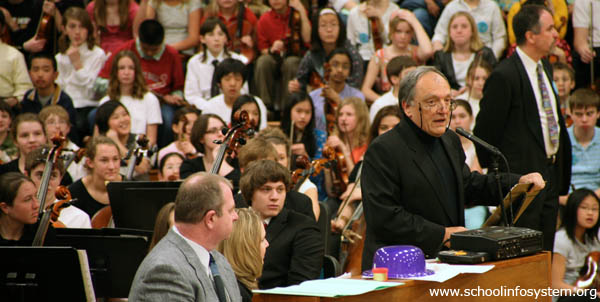
At a pep rally this week, the elementary school’s 285 students whooped and hollered for two hours in a frenzied buildup to the team’s departure.
The Cathedral decathletes, mostly the sons and daughters of working-class immigrants, are more than just academic heroes. Scores of families are attracted to the school because they view the decathlon team’s success as a reflection of the campus’ overall academic excellence.
As other parochial schools face severe financial strains and even closure because of declining enrollment, Cathedral is financially stable and its enrollment has increased.

Share

In Praise of Milwaukee’s High School Anti-Violence Program

Milwaukee Journal-Sentinel Editorial:

An anti-violence program at six Milwaukee high schools continues to show progress, and that is good news for Milwaukee Public Schools and especially for students in those schools.
Suspensions and both violent and nonviolent incidents continue to decline since Violence-Free Zones were implemented at South Division, Marshall, Bay View, Custer, North Division and Washington high schools, according to organizers for the Center for Neighborhood Enterprise, a Washington, D.C.-based group that is working with MPS. If the program continues to show progress, MPS should consider expanding it beyond those schools.

Share

Personal Education Plan (PEP) at West High supports students in their schoolwork and goals for their future

Len Mormino:

As guidance counselors it’s a struggle when we hear our students say, “I came to see you about planning for next year, but you were booked up for the entire week. So I put my name down for next week, but can you remind me about it when you see me?”
Solid theories about how to work with a disengaged student or a high achieving student do not take into account that we have very little time to devote to students in this regard. Research suggests different ways to help high school students navigate traditional academic coursework but none of the research accounts for the distorted ratios we have of student to staff.
Thanks to a grant from the Aristos Program and the Foundation for Madison’s Public Schools, at West we’ve developed the online Personal Education Plan (PEP). The heart of PEP is it collects and stores information students enter into it on the subjects we discuss with them throughout their four years in high school. Even more valuable, the information is accessible to the student, parent, teacher, counselor, or principal, to help support that student in their schoolwork and goals for their future.
For example, an 11th grade male student expresses boredom with classes and is not engaging in school activities. With PEP, I access his profile and note that in 10th grade he expressed interest in an “artistic/humanities path.”

Share

Latest Author Letter……

Mr. William Fitzhugh
The Concord Review
730 Boston Post Road, Suite 24
Sudbury, Massachusetts 01776
Dear Mr. Fitzhugh,
I am happy to tell you that I was admitted early action to Yale and will be going there this fall. I also want to thank you again for including my [10,453-word] paper on the Philippine War in the Winter 2007 issue of The Concord Review. I was honored to have my work included among so many impressive pieces.
Writing my essay gave me a chance to learn something not only about a specific historical event, but also about the nature of scholarship. Throughout high school I have been an inquisitive and capable history student, but my papers did little more than synthesize the views of other historians. When I decided to submit a paper to you for consideration, I started from one I had written for my tenth-grade American history class. As I edited the essay, I became motivated to steep myself in primary materials—from soldiers’ accounts to congressional testimony to newspaper articles, many of them conflicting—in an attempt to piece together some sort of orderly narrative from these fragmented and contradictory stories. I then turned to secondary sources, considering the views of different historians, assessing their sources, and always trying to draw my own conclusions.
This process of revision was challenging and exciting. I enjoyed reading the stories and first-person narratives. But I also learned to think more critically, and to draw parallels between past events and the present. In the words of H.G. Wells, “History is a race between education and catastrophe.” Perhaps through careful study of the past, we can glean insight as to how to approach the future.
Even if the Review had not accepted my paper for publication, doing this research and writing would still remain one of the most intellectually rewarding experiences of my high school years. I am deeply honored that you chose to publish it and I thank you again.
Sincerely,
Benjamin Loffredo
Fieldston School
Bronx, New York

Share

Art Without Craft

On the website www.michelangelo.com/buon/bio, I learn that:

“When Michelangelo turned 13-years-old he shocked and enraged his father when told that he had agreed to apprentice in the workshop of the painter Domenico Ghirlandaio. After about one year of learning the art of fresco, Michelangelo went on to study at the sculpture school in the Medici gardens and shortly thereafter was invited into the household of Lorenzo de’ Medici, the Magnificent…During the years he spent in the Garden of San Marco, Michelangelo began to study human anatomy. In exchange for permission to study corpses (which was strictly forbidden by The Church), the prior of the church of Santo Spirito, Niccolò Bichiellini, received a wooden Crucifix from Michelangelo (detail of Christ’s face). But his contact with the dead bodies caused problems with his health, obliging him to interrupt his activities periodically.
“Michelangelo produced at least two relief sculptures by the time he was 16 years old, the Battle of the Centaurs and the Madonna of the Stairs (both 1489-1492), which show that he had achieved a personal style at a precocious age…”…(and later) “Michelangelo also did the marble Pietà (1498-1500), still in its original place in Saint Peter’s Basilica. One of the most famous works of art, the Pietà was probably finished before Michelangelo was 25 years old.”

My apologies for quoting at such length from a biography, but I have seen his Pietà in Rome on several occasions, and it seems clear to me that it took a gifted young man, with great acquired skill in the craft of shaping marble with hammer and chisel, perhaps two years to achieve this masterwork.

(more…)

Share

When Policy Trumps Results

Marc Eisen makes sense:

Much to its credit, the Madison school board has mostly ignored the March 2007 recommendations of the district’s Equity Task Force. This earnest but unhelpful committee delved into the abstractions of what distinguishes “equity” from “equality,” how the board might commit to equity and what esoteric guidelines could measure that commitment.
………….
This point needs to be emphasized. Madisonians aren’t afraid to tax themselves. They just want good services in return and know that their money isn’t being wasted.
But I can’t for the life of me see them rallying around a pompous and abstruse equity policy, especially one that reads like it was formulated by the UW Department of Leftwing Social Engineering. (Example: “Equity will come about when we raise a generation of children tolerant of differences and engaged in their democracy to stop the processes leading to inequity.”)
The school board, after a suitable 14-month delay, should politely shelve the task force’s recommendations when it finally gets around to voting on them in May.

Kurt Vonnegut’s Harrison Bergeron provides a timely read after Marc’s article.

Share

Introduction to a standards-based system . . . assessment

Madison School District Department of Teaching & Learning:

The Wisconsin Model Academic Standards (WMAS) articulate what students should know and be able to do in each curricular area. Community leaders and staff in the Madison Metropolitan School District (MMSD) elaborated upon these state standards to frame district curriculum and instruction.
Curriculum can be thought of as the planned educational experiences taught in each subject area at each grade level. Standards-based instruction focuses on teaching the knowledge and skills which support students’ continual progress toward meeting the standards.
This article focuses on assessment, the process of using multiple strategies to measure student learning.
The remainder of this article will use mathematics as an example of a content area to demonstrate the use of standards-based assessment. MMSD teachers assess the content standards (i.e., number and algebra) as well as the process standards (i.e., communication, problem solving, and reasoning).
Research indicates that in addition to quizzes and tests, a variety of daily assessment tools (i.e., questioning, observations, discussions, and presentations) are needed to create a more thorough picture of what a student understands.

Share

America’s Most Overrated Product: the Bachelor’s Degree

Marty Nemko:

Among my saddest moments as a career counselor is when I hear a story like this: “I wasn’t a good student in high school, but I wanted to prove that I can get a college diploma. I’d be the first one in my family to do it. But it’s been five years and $80,000, and I still have 45 credits to go.”
I have a hard time telling such people the killer statistic: Among high-school students who graduated in the bottom 40 percent of their classes, and whose first institutions were four-year colleges, two-thirds had not earned diplomas eight and a half years later. That figure is from a study cited by Clifford Adelman, a former research analyst at the U.S. Department of Education and now a senior research associate at the Institute for Higher Education Policy. Yet four-year colleges admit and take money from hundreds of thousands of such students each year!
Even worse, most of those college dropouts leave the campus having learned little of value, and with a mountain of debt and devastated self-esteem from their unsuccessful struggles. Perhaps worst of all, even those who do manage to graduate too rarely end up in careers that require a college education. So it’s not surprising that when you hop into a cab or walk into a restaurant, you’re likely to meet workers who spent years and their family’s life savings on college, only to end up with a job they could have done as a high-school dropout.

Share

Obama Urges Parents to Be More Responsible

Nick Timiraos:

At a stop in Hickory, N.C., after promising to spend $18 billion on education, Sen. Obama said: “This money is not going to make a difference if parents don’t parent.”
He has folded the line into his stump speech across North Carolina and a TV advertisement in the state, where one-third of the Democratic electorate is African-American, ahead of Tuesday’s primary.
The ad, called “Turn It Off,” shows Sen. Obama in a classroom promising to improve education. “But the truth is, government can’t do it all,” he says. “As parents, we need to turn off the TV, read to our kids.”
The personal-responsibility line typically brings the loudest applause from African-American audiences. Sen. Obama first delivered it in an unscripted moment before a mostly black audience in Beaumont, Texas, in February.

Indeed, money is not the key issue, Obama is right about parent’s key role.

Share

Counting High School Graduates

Milwaukee Journal-Sentinel Editorial:

A proposal to standardize the way states calculate high school graduation rates makes sense.
A report earlier this month examining America’s 50 largest school districts found that Milwaukee Public Schools had a graduation rate of only 46.1%. The report by America’s Promise Alliance, an advocacy group, reported that Detroit was at the bottom of that list with a graduation rate of 24.9%.
Wait a minute, MPS officials countered. Our graduation rate is 66%.
Who’s right?
Both probably are. That’s the problem U.S. Education Secretary Margaret Spellings hopes to solve by changing some of the rules under the No Child Left Behind Act, which Congress is considering reauthorizing.
Under the proposal, states would be required to use a uniform method of calculating high school graduation rates by the 2012-’13 school year. As it stands now, comparing graduation rates is difficult. Under the proposal, only students who complete school on time with a regular degree can be counted as graduates. Students who take longer than four years or who earn an alternative diploma, such as a GED certificate, would not be counted.

Share

Dane County Boasts 18 National Merit Scholars

National Merit Scholarship Corporation:

The National Merit® Scholarship Program is an academic competition for recognition and scholarships that began in 1955. High school students enter the National Merit Program by taking the Preliminary SAT/National Merit Scholarship Qualifying Test (PSAT/NMSQT®)–a test which serves as an initial screen of approximately 1.4 million entrants each year–and by meeting published program entry/participation requirements.
Student Entry Requirements
To participate in the National Merit® Scholarship Program, a student must:

  1. take the PSAT/NMSQT® in the specified year of the high school program and no later than the third year in grades 9 through 12, regardless of grade classification or educational pattern;
  2. be enrolled full time as a high school student, progressing normally toward graduation or completion of high school, and planning to enroll full time in college no later than the fall following completion of high school; and
  3. be a citizen of the United States; or be a U.S. lawful permanent resident (or have applied for permanent residence, the application for which has not been denied) and intend to become a U.S. citizen at the earliest opportunity allowed by law.

Press Release PDF:

This year’s competition for National Merit Scholarships began in October 2006 when more than 1.4 million juniors in over 21,000 high schools took the Preliminary SAT/National Merit Scholarship Qualifying Test (PSAT/NMSQT®), which served as an initial screen of program entrants. Last fall, the highest-scoring participants in each state, representing less than one percent of the state’s seniors, were named Semifinalists on a state representational basis.
Only the 16,000 Semifinalists had an opportunity to continue in the competition. Approximately 15,000 Semifinalists met the very high academic standards and other requirements to advance to the Finalist level of the competition. By the conclusion of the 2008 program, about 8,200 Finalists will earn the “Merit Scholar” title and receive a total of more than $36 million in college scholarships. NMSC, a not-for-profit corporation that operates without government assistance, was founded in 1955 specifically to conduct the annual National Merit Scholarship Program. The majority of scholarships offered each year are underwritten by approximately 500 independent corporate and college sponsors that share NMSC’s goals of honoring scholastically talented youth and enhancing their educational opportunities.
CAUTION: Any attempt to compare high schools on the basis of numbers of Merit Scholarship winners will lead to erroneous and unsound conclusions. The National Merit Scholarship Program honors individual students who show exceptional academic ability and potential for success in rigorous college studies. The program does not measure the quality or effectiveness of education within a school, system, or state.

The Capital Times:

Local scholarship winners are:
Seth B. Mulhall, Deerfield High School, Deerfield; Meredith L. Kremer, DeForest Area High School, DeForest; Aaron L. Owen, DeForest Area High School, DeForest.
Joseph K. Carlsmith, West High School, Madison; Sara C. Crocker, West High School, Madison; Erika A. Egner, James Madison Memorial High School, Madison; Reuben F. Henriques, West High School, Madison; Kelsey E. Johnson, Memorial High School, Madison.
Lucas Manuelli, West High School, Madison; Daniel T. Neuser, East High School, Madison; Richard K. Pang, West High School, Madison; Eleanor Shoshany Anderson, La Follette High School, Madison; Alexandro E. Trevino, Memorial High School, Madison.
Benjamin H. Witkovsky, West High School, Madison; Eleanor M. Wroblewski, West High School, Madison; Mary Q. Zhang, West High School, Madison.
Aubrey E. Lauersdorf, Monona Grove High School, Monona; Michael Bethencourt, home school, Mount Horeb.

Congratulations to the students and their families.

Share

The Vacuum Called High School

Re “Clueless in America,” by Bob Herbert (column, April 22):

I don’t dispute Mr. Herbert’s claim that American high school students are not getting a good education, but I question the evidence he is using to prove it. His examples are factual (knowing who Hitler was or when the Civil War was fought).
Students today can Google that kind of information in seconds. What is more important is that they can’t do what I’m doing right now: they can’t identify claims and evidence and evaluate them. Those skills are what constitute “critical thinking” and what our students need to learn in order to succeed in college and beyond.
High schools need to focus on critical-thinking skills, not facts. Nancy Rehm
Biglerville, Pa., April 22, 2008
The writer is a teacher of gifted high school students.
To the Editor:
Bob Herbert correctly points to the dismal state of education in this country today. However, the irony of Bill Gates’s complaining that American students don’t measure up to the rest of the world is too rich to pass up.
It is precisely because of Bill Gates and his ilk that students are told by the educational reformers that they don’t have to “know” anything — they can just look it up on the Web. Instead, they say, let students focus on feel-good exercises that foster “deep learning” and other chimerical and trendy educational goals.
Is it any wonder that our students don’t know the history of their own country, much less that of the rest of the world? A global society, indeed.
Gary Kappel
Bethany, W. Va., April 22, 2008
The writer is a history professor at Bethany College.

Share

Coalition Releases State Of Black Madison Report

Channel3000:

New group the State of Black Madison Coalition said it is out to “change the plight of African Americans in the community,” and members warned if that doesn’t happen, Madison could see the major problems that plague Beloit and Milwaukee.
The new coalition of African American focused groups, armed with a new report called “The State of Black Madison 2008: Before the Tipping Point,” issued a call to action Tuesday to the entire Madison community.
It said Madison is on the precipice of change and if problems of disparity between whites and blacks are not addressed, the city might, as the one coalition member put it, “plunge into intractable problems that plague most major urban cities.”
The reports details the state of African Americans in Madison, saying if trends from 1990-2005 continue, it will take 265 years for the income gap between blacks and the rest of the Dane County community to disappear.
“A city should be measured by how close the weakest link is to the strongest link. My friends, in Madison we are football fields apart,” said Scott Gray, president and CEO of the Urban League of Greater Madison

WKOW-TV:

African-American city leaders say the black community is in trouble and hope a new report called the State of Black Madison will be a catalyst for change.
The summary report, Before the Tipping Point, was released today by the State of Black Madison Coalition. They based their findings on information from the Center on Wisconsin Strategy and other recent research. Among the discoveries: racial disparity is most prevalent in the areas of criminal justice, education, health care and housing. 37-percent of African Americans in Dane County live in poverty today, as compared to just 11-percent of the community as a whole. And if trends that turned up between 1990-2005 continue, it will take 265 years for the income gap between blacks and the rest of the county to disappear.

Complete report (pdf).

Share

A Sociologist Says Students Aren’t So Web-Wise After All

Catherine Rampell:

Eszter Hargittai, an assistant professor in Northwestern University’s sociology department, has discovered that students aren’t nearly as Web-savvy as they, or their elders, assume.
Ms. Hargittai studies the technological fluency of college freshmen. She found that they lack a basic understanding of such terms as BCC (blind copy on e-mail), podcasting, and phishing. This spring she will start a national poster-and-video contest to promote Web-related skills.
Q. Why do people think young people are so Web-wise?
A. I think the assumption is that if it was available from a young age for them, then they can use it better. Also, the people who tend to comment about technology use tend to be either academics or journalists or techies, and these three groups tend to understand some of these new developments better than the average person. Ask your average 18-year-old: Does he know what RSS means? And he won’t.
Q. What demographic groups are less Web-savvy?
A. Women, students of Hispanic origin, African-American students, and students whose parents have lower levels of education, which is a proxy for socioeconomic status.

Share

National Academic Decathlon Finals 4/30/2008 to 5/3/2008

US Academic Decathlon:

2008 Nationals will be held April 30 – May 3, 2008 in Garden Grove, California.
The essay competition will take place online on April 17th, 2008

Wisconsin 2008-2009 Academic Decathlon Schedule.

Share

Edweek Chat: The Use of International Data to Improve US Schools

4/30/2008 @ 2:30p.m. CST:

Join us for a live Web chat about the impact of A Nation at Risk and the potential for using international comparison data to improve academic standards and student achievement in U.S. schools.
Twenty-five years ago, a federal commission issued the landmark report that declared a “rising tide of mediocrity” in U.S. education posed a threat to America’s prosperity and status in the world. Today, many policymakers and members of the business and education communities are sounding the same alarm bells.
Some experts are recommending that the United States put more stock in measuring itself against other countries, including having individual states benchmark their progress against those countries to get a clear and true picture of the status of American education. Would that help improve education in America? What can the United States do to improve education and continue to compete globally? Are the problems with the U.S. education system, compared with those of other industrialized countries’, overblown? Join us for this discussion.
About the guests:
• Dane Linn, is the director of the education division of the National Governors Association, a Washington-based research and advocacy organization that has taken an active role in examining how states might align their academic standards and practices to those of top-performing nations
• Iris C. Rotberg, is the co-director of the Center for Curriculum, Standards, and Technology at George Washington University, in Washington, D.C.
Submit questions in advance.

Related: Fordham Foundation – Wisconsin DPI’s Academic Standards = D-. The Madison School District is implementing “value added assessment” based on the DPI standards.
Watch the Madison School Board’s most recent discussion of “Value Added Assessment“.

Share

Madison School Board Discusses Discipline, Safety, Cell Phones and Code of Conduct

Watch the discussion via this video

Channel3000:

The Madison School Board met on Monday night to discuss a new positive behavior support plan as well as a new code of conduct for students who attend Madison public schools.
The code of conduct has been under review for months by a committee who made recommendations to the board in a special meeting on Monday.
The meeting is especially timely after the highly publicized recordings of students fighting at Toki Middle School came to light last week.
Committee members will recommend making a few major revisions or additions to the code, including specifically banning voice or image recording.
Board members discussed safety, discipline and cell phones, which were all topics of importance that applied to the Toki situation, reported WISC-TV.
Madison’s new student code of conduct targets cell phones. Secret or hidden recordings are a serious offense that could get a student suspended or expelled.
“Cell phones and video cameras are being used in very wrong ways, to take pictures of tests, to film fighting, to record kids in the locker room, that’s just not acceptable,” said school board president Arlene Silviera. “I think we have to be very specific in the use of these types of devices — what can and what cannot be done.”

Tamira Madsen:

In an effort to give principals and administrators a chance to exercise discretion to expel a student who brings a weapon besides a gun to school, Madison school district officials are considering alterations to the language in the student codes of conduct.
Recommended revisions were discussed at Monday night’s School Board meeting.
The current rule for a first offense states that a student who has a weapon on school grounds besides a firearm, pellet gun or BB gun and isn’t carrying the weapon with an “intent to cause harm to another” will receive a five-day suspension. After a second offense, a student could face an expulsion recommendation.
The rule revision would give principals and administrators the option to expel the student for a first-time offense.
Dan Mallin, who works in legal services with the Madison Metropolitan School District and is a member of the committee drafting changes to the codes of conduct, said the rule change is meant to take into account a variety of circumstances.

Share

The Mayor & Madison Schools

Jason Joyce publishes a useful summary of Madison Mayor Dave’s weekly schedule. Tomorrow, Cieslewicz meets with retiring Superintendent Art Rainwater, after recently meeting with incoming super Dan Nerad.
I don’t recall such frequent meetings (if any) in my years observing Joyce’s weekly posts.
Related: Madison Mayor Proposes Expansion of Low Income Housing Throughout Dane County in an Effort to Reduce the MMSD’s Low Income Population.

Share

What to Do With Gifted Students?

Jay Matthews:

I received a letter a few weeks ago from a mother in Prince William County, home to one of the Washington area’s big suburban school systems. It starkly captured the parental frustration at the heart of the national debate over what to do with very gifted students. I ran her letter, with a short response, in my weekly Post column, “Extra Credit,” in which I answer reader mail. That column produced so many letters that I decided to lay out the debate in this column, using the limitless space of the Internet. I have not been very sympathetic with parents of gifted kids. Some of the reaction below echoes things I have said. But I find it difficult to justify forcing Nancy Klimavicz’s son to spend valuable time on busywork. If anyone has any good way out of this impasse, e-mail me at mathewsj@washpost.com.
Dear Extra Credit:
I’ve started this letter many times over the past several months. After my gifted son received rejections from Virginia Tech, James Madison University and William and Mary, I figured it’s time to warn other parents. If you have a very bright student, home-school him.
My son was reading a college-level book in third grade when the gifted education specialist recommended just that. Academically, we figured he’d learn and grow regardless of the environment, but his weakness was social interaction with his peers. We believed childhood should include high school sports teams and clubs, and we remembered being influenced by one or two teachers who were passionate about their subjects. We decided to leave him in public school.

Share

Elite Korean Schools, Forging Ivy League Skills

Sam Dillon:

It is 10:30 p.m. and students at the elite Daewon prep school here are cramming in a study hall that ends a 15-hour school day. A window is propped open so the evening chill can keep them awake. One teenager studies standing upright at his desk to keep from dozing.
Kim Hyun-kyung, who has accumulated nearly perfect scores on her SATs, is multitasking to prepare for physics, chemistry and history exams.
“I can’t let myself waste even a second,” said Ms. Kim, who dreams of attending Harvard, Yale or another brand-name American college. And she has a good shot. This spring, as in previous years, all but a few of the 133 graduates from Daewon Foreign Language High School who applied to selective American universities won admission.
It is a success rate that American parents may well envy, especially now, as many students are swallowing rejection from favorite universities at the close of an insanely selective college application season.
“Going to U.S. universities has become like a huge fad in Korean society, and the Ivy League names — Harvard, Yale, Princeton — have really struck a nerve,” said Victoria Kim, who attended Daewon and graduated from Harvard last June.
Daewon has one major Korean rival, the Minjok Leadership Academy, three hours’ drive east of Seoul, which also has a spectacular record of admission to Ivy League colleges.
How do they do it? Their formula is relatively simple. They take South Korea’s top-scoring middle school students, put those who aspire to an American university in English-language classes, taught by Korean and highly paid American and other foreign teachers, emphasize composition and other skills key to success on the SATs and college admissions essays, and — especially this — urge them on to unceasing study.

Share

Fairfax County Schools to Review Grading Practices

Michael Alison Chandler:

Fairfax County school officials have agreed to review their grading policies in response to parents’ concerns that relatively stringent standards mean their children are losing out on scholarships and college admissions.
More than 2,800 parents and students signed an online petition urging the school system to adopt a 10-point grading scale and give extra weight for honors, Advanced Placement and International Baccalaureate classes. The current system requires a score of 94 or higher for an A, and gives no extra credit to honors courses. AP courses are given half a point.
Many competing school systems, including Montgomery County, give A’s for lower scores and graduate students with similar backgrounds but higher GPA’s, the parents contend. Their concerns come as competition for admission to big-name colleges is at a high and tuition more expensive than ever.
Louise Epstein, president of the Fairfax County Association for the Gifted, said the current policies are unfair. “They cost families money and reduce good opportunities for students just because they go to Fairfax schools,” she said.

Share

AP Drops Four Courses, Three over Demographics

Scott Cech:

Officials overseeing the Advanced Placement program have announced that they intend to drop AP classes and exams in four subject areas, in a pullback expected to affect about 12,500 students and 2,500 teachers worldwide.
Following the end of the 2008-09 academic year, there will be no AP courses or exams in Italian, Latin literature, French literature, and computer science AB, said officials at the College Board, the New York City-based nonprofit organization that owns the AP brand.
The College Board has in past years withdrawn one undersubscribed AP course at a time, but has never taken so many courses off its table of offerings in the half-century since the program started as a way for students to take college-level courses and potentially earn college credit while still in high school.
Trevor Packer, the College Board vice president who oversees the AP program, said the decision was made at a trustee meeting on March 27, and that AP teachers in the affected subjects were notified by e-mail April 3. “Of course, it’s sad for them,” he said of the teachers.
Mr. Packer said the decision was made principally because of demographic considerations.
Only a tiny fraction of the members of underrepresented minority groups who take AP exams take the tests in one of those four affected subject areas, he said.
The College Board has made it a priority to reach such students, including those who are African- American and Hispanic.
“For us, [the question is], are we able to achieve our mission of reaching a broader range of students?” Mr. Packer said.
He added that no additional AP courses would be cut for at least the next five years.

(more…)

Share

Studies: SAT Writing Portion a Good Predictor of Freshman Grades

Janet Kornblum:

The controversial new writing portion of the SAT is actually a better predictor of grades for freshmen college students than the older, more-established, critical reading and mathematics portions, according to preliminary results of two new studies.
The College Board, which administers the SAT, studied test scores from 150,000 freshmen entering 110 colleges in 2006 and then looked at their GPAs at the end of their freshmen year, says Wayne Camara, vice president of research.
“Our study suggests that the writing test is the best single predictor” of freshman grades, he says. The study won’t be finalized until summer, he says.
The University of California drew a similar conclusion from an analysis of its incoming 2006 freshmen and their GPAs, says Sam Agronow, coordinator of admissions research and evaluation at the University of California’s office of the president.

Share

Now It’s Colleges’ Turn to Say ‘Pick Me!’

Valerie Strauss:

The University of Maryland at College Park is making sure that nearly every single student admitted this fall — more than 10,000 of them — gets a personal telephone call from a current student extolling the virtues of becoming a Terrapin.
The student government president at Marymount University in Arlington County is sending a T-shirt to every admitted student.
At Binghamton University in New York, current international students are writing letters to every admitted international student — in their native language — to make sure they know where to get food that suits their diets or how to solve other problems they may encounter.

Share

California Considers New Free Speech Protections in Schools

Daniel Wood:

Eleven-year teaching veteran Teri Hu was adviser to The Voice, the student newspaper of Irvington High School in Fremont, Calif., when school administrators told her not to let it publish a story critical of school policies on teaching assistants. Two months after she refused, Ms. Hu became “former” adviser to The Voice.
Janet Ewell, a tenured teacher in Garden Grove, was enjoying the praise in her 2002 school evaluation until she came to the part about her performance as advisor to journalism students. “[The principal] let me know he didn’t like three student editorials, one about school bathrooms, one about the cafeteria and one about teachers who are not available to help students,” recalls Ms. Ewell. “Then he told me I wouldn’t be advising them the next fall.”
Scenarios like those above occurring in schools across California have prompted the state to take the national lead again in protecting free speech rights on campuses. Two years ago, the state was the first to pass a bill preventing college administrators from censoring student newspapers.
Now, legislation is moving forward to protect both high school and college faculty advisers from being punished by administrators for students’ articles or editorials.

Share

Madison’s Sennett Middle School Discipline Climate & Security Cameras

Channel3000:

But her enthusiasm for the cameras pales in comparison to a new district-wide middle school program started this year called Positive Behavior Intervention Support, or PBIS.
“This is very good for kids — very, very good,” Lodholz said.
The PBIS program uses positive behavior support coaches like Sennett’s Jennifer Tomlinson. She works with students, teachers and staff to teach positive behavior skills to students.
Often the behavior is rewarded and promoted by the students themselves, through handmade posters or activities aimed at showcasing such behaviors, WISC-TV reported.
Officials said the key is to actually instruct kids how to behave correctly, be it through mediation sessions, classroom instruction or other innovative approaches.
“We need to teach kids how to be accountable for their actions and that’s what we’re doing through this system,” Tomlinson said.
Lodholz said the program helps offer instruction to students on how they should be behave. She said the PBIS program builds upon other Sennett school strategies and that it all seems to be working.
Last year incidents of misconduct at Sennett totaled 1,706, and 1,169 suspensions were handed out.
But in the 2007-08 school year to date, with the cameras and new program, Sennett’s seen more than 730 fewer misconduct incidents — at 973 — and only 94 suspensions.

Share

Toki Middle School Security/Safety Update

Channel3000:

This school year some parents, teachers and staff have complained about increasing safety and violence issues at Toki, including bad behavior at the school.
Last March, after a packed PTO meeting, school district officials added another security guard and a “dean of students” to help keep the peace. A positive behavior curriculum program was initiated as well.
“We certainly have a greater comfort level with where the school is headed at this point,” Yudice said.
However, some said that a couple of recent fights at the school posted on YouTube.com show the problems haven’t gotten any better.
PTO President Betsy Reck said teachers have told her things have not improved, despite the extra efforts the last month or so. She said many believe more needs to be done.
“It’s a typical, almost daily, occurrence, the fights at Toki,” Reck said. “It’s a very sad sort of affairs over there right now that they cannot get that under control.”
Last week, police were called to the school for two fights, which apparently were caught on video by students and posted recently on YouTube.com. They have since been removed from the site.

More here and here.
Andy Hall & Karen Rivedal review local school policies on video capture and internet access.

Share

Some HOPE Scholarship recipients need remedial help in college

Jennifer Burk:

Despite earning B averages in high school, at least one in 10 HOPE Scholarship recipients receives some type of remedial help during the first year of college.
Put simply, some college freshmen who seemed to excel in high school still need help in basic math and English.
Twelve percent of college freshmen who have the HOPE Scholarship, awarded to Georgia students who graduate from high school with at least a B average, received learning support in fall 2006, according to the University System of Georgia.
The reasons why run the gamut, with blame placed at the state level all the way down to the student.
“It’s hard for me to say the causes of that,” said Dana Tofig, a spokesman for the Georgia Department of Education.
But part of the reason for the state’s continuing overhaul of the public schools’ kindergarten through 12th grade curriculum is to get students out of remediation and make them more prepared for college work, he said.
“The curriculum“>curriculum before was way too broad and way too vague,” Tofig said.

Share

“The Schools Aren’t Teaching Our Kids What They Need to Know”

Bob Herbert:

Ignorance in the United States is not just bliss, it’s widespread. A recent survey of teenagers by the education advocacy group Common Core found that a quarter could not identify Adolf Hitler, a third did not know that the Bill of Rights guaranteed freedom of speech and religion, and fewer than half knew that the Civil War took place between 1850 and 1900.
“We have one of the highest dropout rates in the industrialized world,” said Allan Golston, the president of U.S. programs for the Bill and Melinda Gates Foundation. In a discussion over lunch recently he described the situation as “actually pretty scary, alarming.”
Roughly a third of all American high school students drop out. Another third graduate but are not prepared for the next stage of life — either productive work or some form of post-secondary education.
When two-thirds of all teenagers old enough to graduate from high school are incapable of mastering college-level work, the nation is doing something awfully wrong.
Mr. Golston noted that the performance of American students, when compared with their peers in other countries, tends to grow increasingly dismal as they move through the higher grades:

Common Core of Data.

Share

Student Fights At Toki Middle School Posted Online

Channel3000.com:

Disturbing video showing girls engaged in vicious fights on the Toki Middle School grounds popped up on the popular Web site YouTube.
The video, which was posted on April 19, featured a fight between girls outside the school and one from inside the building.
Madison police confirmed that they responded to fights at Toki on Thursday, April 17 and one on Friday, April 18, but can’t say whether the fights were the same ones posted online.
“School staff are very aware not only of the videos, but of the things that happened,” said Madison Superintendent Art Rainwater. “The students have been identified and are being dealt with through the discipline system in the ways that are appropriate for what the incident was.”
That discipline could include suspension. Rainwater said the incidents are so new the discipline process is still ongoing.
The incidents come one month after extra security was added to the school in the form of an additional security guard and a dean of students to deal specifically with problematic students.
The additional safety measure came at the request of Toki parents who felt the school was unsafe with escalating violence all year.

More from Kathleen Masterson.

Share

Gifted or not, challenge students to reach higher

Des Moines Register
Nicholas Colangelo is director of the Belin-Blank Center for Gifted Education and Talent Development, Iowa City, established in 1988 at the University of Iowa. His hands-on experience includes teaching middle-school social studies in New York and serving as an elementary-school counselor in Vermont in the 1970s. Four years ago, he co-authored with colleagues the report “A Nation Deceived: How Schools Hold Back America’s Brightest Students.”
Q. The alarm has been sounded that U.S. students are not prepared for the growing global competition they face. But is that true of this country’s brightest students? Are our most gifted students being challenged with sufficient rigor?
A. When it comes to matching top students to top students, we are probably pretty close. But what concerns me is that the top students in the United States do not necessarily get the challenge they need across the board. It really is about ZIP code. We have taken for granted that our top students are getting what they need. If we gave our top students more opportunities to take Advanced Placement and International Baccalaureate and other [accelerated opportunities], they would reveal they are capable of doing much more than we think.
Q. Has the federal No Child Left Behind law affected the ability of schools to challenge all students to excel?
A. As far as I’m concerned, the No Child Left Behind law has done nothing on behalf of high-ability students. Essentially, No Child Left Behind has focused on kids below a standard, ignoring kids above that standard. You should have no law that makes a portion of the students invisible. They are all our kids, and they all deserve our attention and energy.

Share

Adult Workers Have a Lot to Learn Online

Michael Schrage:

Children are fantastic little learning machines. They are hardwired to play with ideas and absorb knowledge. Adults, alas, are not. That is why the challenge of adult education and lifelong learning is more difficult – and ultimately more important – than childhood education. Societies that are serious about raising their standard of living should focus on enhancing the productivity of parents rather than boosting teenage test scores.
The economic rationale is clear. Ageing populations of Europe, China and North America increasingly enjoy long and healthy lives. Yet as they grow older, wealth creation depends on the ability to acquire and convert information, skills and technologies into new value. In this environment, hard-won expertise, rather like expensive capital equipment, often depreciates with astonishing speed. The cruel “human capital” jibe, that many workers do not have 20 years’ experience but one year’s experience 20 times over, has assumed new poignancy.
The premise that quality education during life’s first two decades matters more than for decades four and five has become literally counterproductive. Demographic realities and dynamic economies have made “ageing adults” today’s most underappreciated – and underappreciating – capital asset class.
Improving returns on that asset requires neither great sums of money nor greater flights of imagination. The key is to rethink and reorganise how busy but anxious adults can benefit from education and training opportunities. Technology makes meeting that challenge far more affordable, entrepreneurial and compelling. Adult education is a market ripe for rapid global transformation.

Continuing our technology & education discussions. Related posts: on technology spending in Milwaukee and Lauren Rosen Yaezel on Technology in the Madison Schools.
Brittanica on Adult Education.

Share

The New Math of College Financing

Anne Marie Chaker:

For a lot of students and parents, college costs are about to get much more confusing.
In recent months, some of the wealthiest and most prestigious schools in the country have made their financial aid more generous. Many have replaced loans with grants — money that doesn’t have to be repaid. Some are waiving tuition entirely for families below a certain income threshold. Others are capping costs at a certain percentage of family income.
So far, only a relative handful of colleges are taking these steps — about 50 out of the nation’s more than 2,500 four-year colleges. But some experts think at least some of these programs will spread further as schools compete for top students.
It’s easy to be baffled about what this all means, for now and for the future. Do these offers come with hidden catches? Will you still need to borrow some money to cover tuition? Are there even better deals coming down the road?

Share

Seminar tries to clear up confusion about inclusion

Paul Sloth:

Julie Maurer hopes to see a day when parents of children with special needs, parents like her, don’t have to advocate for their children in public school
Maurer hopes the system changes and schools accept children, like her daughter, Jenny, as easily as children who will never carry a label like “learning disabled” or “emotionally disabled.”
Maurer’s daughter, now 20, attends the University of Wisconsin-Parkside after graduating from Racine Unified.
A small group of parents, educators and disability advocates spent a few hours Saturday at the United Way of Racine County, 2000 Domanik Drive, with University of Wisconsin-Milwaukee education professor Elise Frattura, clearing up the confusion of including special education students in regular education classrooms.
Those years, from elementary school through high school, were marked by Maurer’s struggles to get her daughter into regular classrooms instead of being isolated from the rest of the children her age.
A preschool teacher encouraged Maurer to read the federal special education law, so as to understand what she should expect her daughter to receive in school.

Share

More on Technology Education

Brian Back:

“If we don’t teach this to them,” Joan Fecteau, an MPS instructional technology leader, told me, “then we are doing as much of a disservice as not teaching them to read or write.”
But you can’t teach driving by sitting at a desk. You have to get behind the wheel. Let’s give kids hands-on experience under teacher supervision.
Fecteau not only teaches students but teachers as well. “Some teachers don’t know enough about the Internet to understand how to avoid viruses and tracking devices. For example, clicking on a pop-up window can lead to malicious spyware or unintended Web pages being displayed.”
It is apparent to parents that most kids are far beyond their teachers’ and parents’ understanding. The one institution that has the mission to teach is not keeping up. We need to give schools the nod and the resources to do it – which is code for funding. Oh, no, did I say that?

Lauren Rosen Yeazel’s recent words generated some interesting discussion on technology and schools.
In my view, technology, per se, is not the core issue. Critical thinking and knowledge come first, then tools. Tools we purchase today will be long obsolete by the time our children graduate (maybe this argues for some technology presence in high school). Ideally, our schools should have fast fiber and wireless (open) networks, and as Momanonymous noted, perhaps teacher compensation might include a laptop/mobile device allowance.
I am generally against teaching kids powerpoint, particularly before they’ve mastered the art of writing a paper.

Share

On Toronto’s Homework Reform

Frank Bruni:

On April 16th 2008, Toronto Canada became one of the first jurisdictions in North America to pass a substantive homework reform policy.
The policy reduces the homework burden on middle school and high school students and all but eliminates homework in the elementary grades. In addition, homework will no longer be allowed during vacations.
The new policy mandates that teacher’s co-ordinate their efforts and that the homework that is sent home is “clearly articulated and carefully planned” and “require no additional teaching outside the classroom”.
This policy is a major breakthrough for those of us who have been advocating for homework reform.
When I started to write this it was intended to be a “how to” guide for anyone who wanted to replicate what we have achieved in Toronto. But when I read it it seemed preachy.
I guess what I really want to communicate is, just start. Every situation is different, every school board is different, and every community is different, but just start somewhere.

Share

The Divorce Generation Grows Up

David Jefferson:

Ignorant of the picket fences around our tract homes, divorce was a constant intruder in the San Fernando Valley of my youth. Although I grew up a few blocks from the “Brady Bunch” house, the similarity between that TV family’s tract-rancher and the ones where my friends and I lived pretty much ended at the front door. In the real Valley of the 1970s, families weren’t coming together. They were coming apart. We were the “Divorce Generation,” latchkey kids raised with after-school specials about broken families and “Kramer vs. Kramer,” the 1979 best-picture winner that left kids worrying that their parents would be the next to divorce. Our parents couldn’t seem to make marriage stick, and neither could our pop icons: Sonny and Cher, Farrah Fawcett and Lee Majors, the saccharine Swedes from Abba, all splitsville.
The change had begun in the ’60s as the myth of the nuclear family exploded, and my generation was caught in the fallout. The women’s rights movement had opened workplace doors to our mothers—more than half of all American women were employed in the late ’70s, compared with just 38 percent in 1960—and that, in turn, made divorce a viable option for many wives who would have stayed in lousy marriages for economic reasons. Then in 1969, the year I entered kindergarten, Gov. Ronald Reagan signed California’s “no fault” divorce law, allowing couples to unilaterally end a marriage by simply declaring “irreconcilable differences.”

Encyclopedia Britannica on divorce.

Share

Popping the Prom Question

Daniel de Vise:

efore Tim Shaeffer dared ask Corinne Welker to the prom, he first inquired delicately as to how she was likely to respond. She told him, “It kind of depends on how you ask me.”
So Shaeffer, 17, and a classmate took a roll of red duct tape to the Bay Ridge community marina and taped his question — “Prom?” — to the sail of the family’s 30-foot boat. Then, in a triumph of coordination and timing, he arranged to have his parents motor past the sea wall and unfurl the sail as he and Welker sat in a parked car, admiring the Bay Ridge view.
He got the answer he wanted.
“I took it seriously and went all-out,” said Shaeffer, a senior at Annapolis High School. “For one thing, I really like her. And . . . I wanted it to be so none of her girlfriends could one-up her. It’s getting to where pretty much everybody is going to big lengths to ask people to prom.”

Share

Suburban DC Schools Reject Metal Detectors

Daniel de Vise:

In spring 1991, after a teenage girl stabbed a classmate in the cafeteria of an Anacostia school, the D.C. Board of Education voted to install metal detectors at the front entrances of 10 middle and high schools.
No other school system in the region has embraced the technology, even as metal detectors have multiplied in courthouses, museums and other public buildings across the region over the past two decades.
Many school officials view metal detectors as costly, impractical and fallible. To suburban parents, they conjure up images of armed camps. Even at Albert Einstein High School in Kensington, where three loaded guns were found in a locker last week, consensus is building against them.
“I don’t want my son to come to school through metal detectors. That’s prison,” said Alex Colina, speaking to several hundred other parents at a community meeting Monday night.

Share

Paying for College Without the Home Equity Option

M.P. Dunleavey:

The colleges have given their answers. They have sent acceptance letters to high school seniors and their parents along with notifications of how much, if any, financial aid they are offering.
Now, those parents and students have until May 1 to address what may be the toughest questions: Should they choose the most affordable school? Or should they pick the one with more prestige, even if it’s a financial stretch, even if it means going deep into debt?
While the questions are not new, they are particularly difficult to answer in this economically tumultuous year. Traditional and even nontraditional sources of college financing are suddenly in question. Dozens of companies that once provided billions of dollars in student loans have left the market. Other banks are tightening their standards, making student loans harder to get.
On top of which, the continued turmoil in real estate has meant that home equity — a source of security for many families and a fallback for college funds for some of them — is not as easy, or in some cases impossible, to tap.

Share

For high school students, it’s the ultimate field trip — real-life lessons learned by volunteering abroad.

Cindy Loose:

When Bethesda high school student Jenna Kusek first saw where she’d be living for three weeks in Tanzania, she thought, “You’ve got to be kidding.”
This hole in the ground is the toilet? A trickle of cold water from an elevated hose is the shower?
But Kusek soon gained a new perspective. The white stucco house she shared with other teen volunteers last summer was a mansion by local standards, and better than the concrete-block house they would spend their days building for a local teacher. A cold shower, she realized, was a luxury unavailable to the village kids. A year after the trip, tears come to her eyes when she talks about how guilty she began feeling about having access to any kind of shower.
“Compared to how people lived in the village, our housing was too good to be true,” says Kusek, 18, a senior at Walt Whitman High School. “I knew before I went to Africa that I was blessed, but I had no idea how lucky I was. I can’t believe now the things we once took for granted.”

Putney Student Travel.

Share

“Children Should be Treated Like Refugees”

John Moritz:

A child protection expert says the children — and the children of those children — who are now in state custody should be cared for in the same way as refugees from Southeast Asia who migrated to the United States after the fall of Saigon.
Families from South Vietnam and Cambodia were kept intact, a social safety net was set up around them and they gradually assimilated into mainstream culture, said Richard Wexler, who leads the National Coalition for Child Protection Reform.
“One thing that we as a society know how to do is provide for refugees, and that’s exactly what we are dealing with here,” Wexler said Wednesday from his office in Alexandria, Va. “These children live in a very isolated world of their own and they have no idea of the world they suddenly find themselves in.”
Wexler, who has criticized Texas’ policies regarding the placement of children in foster homes in recent years, urged state officials to do their best to keep families together as long as they are out of reach of anyone who might abuse them.

Share

Sadly, kids’ struggle with writing goes on

In light of West High School Principal Ed Holmes’s budgetary decision to shut down the Writing Lab after almost 40 years in existence, I share this recent column from Barbara Wallraff, who writes the column Word Court.
America’s eighth-graders and high school seniors got their writing “report cards” the other day — the results for the writing part of the 2007 National Assessment of Educational Progress were announced. Just a third of eighth-grade students and a quarter of high school seniors are “proficient” in writing. Oh, dear! And yet federal authorities consider this encouraging news — that’s how bad the situation is.
Granted, the average scores are a few points higher than they were when the test was given in 2002. And the improvement is almost across the board, at least among the eighth-graders. Students in every ethnic group except American Indians are doing better, and the gap white and black eighth-graders is narrowing. Also granted, better is better — and mountains of behavior modification research demonstrate that praising successes is a more effective way to bring about change than criticizing failures.
But still, isn’t cheering because a third of the kids are doing well like congratulating ourselves that we made it a third of the way to the finish line in a race? Or that we managed to pay a third of our bills? Speaking of thirds, a 2003 survey by the College Board concluded that a third of employees at America’s blue-chip corporations are pretty bad at writing and need remedial training. And speaking of writing, can everybody see the handwriting on the wall? The message is terribly disheartening. Writing isn’t just a skill that people tend to need to earn a good living — it’s one of our basic means of communication.
The question is what to do about the two-thirds or three-quarters of our young people who are less than proficient. Keeping on doing whatever we’ve been doing isn’t suddenly going to start yielding different results. Admittedly, the sorry state of America’s writing skills is a vast, long-term problem to which experts have devoted whole careers. So who am I to propose a solution?
Writing is different from other skills. In math, you either get the concept or you don’t. In history, you either know who did what when or you don’t. But writing isn’t right or wrong, just better or worse. Learning to write is something each of us does individually, in our own way — which makes me suspect that sweeping initiatives, no matter how brilliant and well-funded (hah!), aren’t what’s needed.
May I suggest, instead, that anybody who has the time , energy and interest in young people encourage them, one at a time, to write — and read? (Reading skills and writing skills go hand in hand.) Ask kids to write you emails. Lend them a favorite book , and tell them what the book has meant to you. Ask them about what they’ve been reading.
If you’re a parent, you’re probably doing this for your own kids, and you probably know the statistics about what a huge advantage it gives kids if their parents take an interest in their education. If you’re only, or also, a concerned citizen — well, there are plenty of kids who aren’t lucky enough to be growing up in your family. Wouldn’t it make you proud to help a few of them?
For more:

Share

Black-White Gap Widens for High Achievers

Debra Viadero:

New research into what is commonly called the black-white “achievement gap” suggests that the students who lose the most ground academically in U.S. public schools may be the brightest African-American children.
As black students move through elementary and middle school, these studies show, the test-score gaps that separate them from their better-performing white counterparts grow fastest among the most able students and the most slowly for those who start out with below-average academic skills.
“We care about achievement gaps because of their implications for labor-market and socioeconomic-status issues down the line,” said Lindsay C. Page, a Harvard University researcher, commenting on the studies. “It’s disconcerting if the gap is growing particularly high among high-achieving black and white students.”
Disconcerting, but not surprising, said researchers who have studied achievement gaps. Studies have long shown, for instance, that African-American students are underrepresented among the top scorers on standardized tests, such as the National Assessment of Educational Progress. Fewer studies, though, have traced the growth of those gaps among high and low achievers.
The reasons why achievement gaps are wider at the upper end of the achievement scale are still unclear. But some experts believe the patterns have something to do with the fact that African-American children tend to be taught in predominantly black schools, where test scores are lower on average, teachers are less experienced, and high-achieving peers are harder to find.

Thanks to Jenny Root for emailing this article.

Share

Venezuala’s Orchestra for At Risk Students

Bob Simon @ 60 Minutes:

Through a system of early training and local orchestras, Venezuela has not only provided an uplifting musical experience for its at-risk youth, but also developed an orchestra that is world famous.

video

Share

Unready in MA

Many Mass. graduates unprepared in college
Thousands need remedial classes, are dropout risks
By Peter Schworm
Boston Globe Staff / April 16, 2008
Thousands of Massachusetts public high school graduates arrive at college unprepared for even the most basic math and English classes, forcing them to take remedial courses that discourage many from staying in school, according to a statewide study released yesterday.
The problem is particularly acute in urban districts and vocational schools, according to the first-of-its kind study. At three high schools in Boston and two in Worcester, at least 70 percent of students were forced to take at least one remedial class because they scored poorly on a college placement test.
The study raises concern that the state’s public schools are not doing enough to prepare all of their students for college, despite years of overhauls and large infusions of money.
The findings are also worrisome because students who take remedial courses, which do not count toward a degree, are far more likely to drop out of college, often without the skills needed to land a good job. That has broad implications for the state’s workforce, economy, and social mobility.
The report, conducted jointly by the state Departments of Elementary and Secondary Education and Higher Education, found that the problem crossed socioeconomic lines. One third of high school graduates in suburban Hanover took remedial classes, as did 27 percent of graduates in Lynnfield and Needham.

(more…)

Share

It’s Time to Study the Value of College

Marketplace:

College education costs continue to soar at the same time studies show college graduates getting paid less. Commentator David Frum says Americans should re-examine the real value of a college degree in today’s economy.
TESS VIGELAND: Today, yet another student loan provider announced it will suspend lending at several schools. The credit crunch, and a drop in federal subsidies, are prompting more and more student lenders to put out “Not Open for Business” signs, and all this comes right at the time when high school seniors are making decisions about which acceptance letters to say yes to.

Share

Arts Education Gravely Ignored

Suchita Shah:

Imagine a program that produced a fourfold increase in the number of students recognized for academic achievement. What if that initiative also resulted in three times as many students elected to leadership positions at their schools? And imagine that these children would be four times as likely to be in math or science fairs, and also to perform community service. On top of all that, they would also be three times as likely to win an award for exceptional school attendance.
If public school administrators and government officials knew of such a program, I would demand that it be implemented in our schools and that we invest in it immediately. Guess what? We already know of such a program that does achieve all those benefits: It’s called the arts.
According to Americans for the Arts, children deeply involved in arts programs receive the aforementioned benefits, and then some. Yet, paradoxically, schools are cutting arts programs — ranging from band to theater to painting — because of funding limitations.

Share

ARTICULATION

Back in the day [1980], Articulation was the name given to the process to ensure that elementary students were not surprised by the demands of seventh grade, and middle school students were not surprised by the demands of ninth grade (or tenth grade).
Educators had meetings in which they discussed articulation – not better diction for all, but a better fit between different levels of schooling – and it was always a problem. Each level wanted control over what it taught and when, and what academic standards would be enforced, and there was a lamentable inclination by high school educators to look down a bit on middle school educators and for middle school educators to look down a bit on elementary school educators.
While I am sure that this never happens now, in the new Millennium, there is another articulation problem which I believe gets far less attention than students deserve. It has been reported recently that nationally about 30% of our high school students in general drop out of high school and that the percentage rises to a shocking 50% for black and Hispanic students.
But what about the 70% (or 50%) who do graduate and get the diploma certifying that they have met the requirements of an American high school education? In Massachusetts, of those who pass the Massachusetts Comprehensive Assessment System [MCAS] tests and get their diplomas, 37% are now found to be “not ready for college work,” according to a report last month in The Boston Globe.
In an article on EducationNews.org on student writing in Texas, Donna Garner quoted a parent who said about the writing her daughter is doing for the Texas Assessment of Knowledge and Skills [TAKS] tests: “She basically just writes about her feelings on anything of her choice and often is encouraged to just make things up as long as it is flowery and emotional. This is apparently what they look for on TAKS.” And Donna Garner observed: “It is no wonder that college professors think our Texas high-school graduates are not ready for college. The brutal fact is that they are not ready.”

(more…)

Share

Private Education: Is it Worth It?

The Economist:

FEE-PAYING schools have long played a giant part in public life in Britain, though they teach only 7% of its children. The few state-educated prime ministers (such as the current one) went to academically selective schools, now rare; a third of all MPs, more than half the appointed peers in the House of Lords, a similar proportion of the country’s best-known journalists and 70% of its leading barristers were educated privately. There is no sign that the elevator from independent schools to professional prominence is slowing: nearly half of the undergraduates at Oxford and Cambridge were privately schooled too.
Many ambitious parents would like to set their children off on this gilded path. But there is a problem: the soaring cost. Fees at private day schools have more than doubled in the past 20 years, in real terms; those at boarding schools have risen even faster (see chart). Since 2000 fees have risen by at least 6% every year, according to Horwath Clark Whitehill, a consultancy—double retail-price inflation and half as much again as the growth in wages. If this continues, a four-year-old embarking on a career in private day schools this autumn will have cost his parents around £170,000 ($335,000) in today’s money by the time he completes secondary school. So even though more Britons than ever before describe themselves as comfortably off, the share of children being educated privately is barely higher than it was two decades ago.

Share

More Cal State Students Need Remedial Classes

Sherry Saavedra:

Cal State schools are a long way from their goal of seeing 90 percent of entering freshmen ready for college-level work.
Instead, 37 percent of freshmen entered a California State University campus last fall needing remedial math, while 46 percent were unprepared for college-level English, according to new data.
Locally, a quarter of freshmen at San Diego State University started school needing remedial math; 48 percent at Cal State San Marcos needed it. About one-third of SDSU freshmen were not proficient in English, compared with more than half at Cal State San Marcos.
The CSU system pours millions of dollars into outreach efforts aimed at making high schoolers more prepared for college, and it often bails them out with remedial classes when they’re not. But the past seven years have produced only modest improvements in math among Cal State’s 23 campuses, and there have been no changes in English.
Since last year, the math proficiency rate improved by less than half a percentage point, but the English rate slid by triple that amount.
Students are often sent to remedial courses when they don’t demonstrate proficiency on a CSU place

Share

‘Parenting Inc.’ Explores High Price of Parenting

Talk of the Nation:

From ergonomic strollers, to sleep consultants, to professional potty training, child rearing has become a very big business. Author Pamela Paul discusses her new book, Parenting, Inc. and the aggressive marketing aimed at new moms and dads.
“Sometimes, spending a lot on children isn’t just unnecessary; it’s counterproductive,” Paul writes. “Every parent I know is struggling to figure out how to afford a family without succumbing to the spiral of consumption that characterizes modern parenthood.”
Paul says she was determined not to fill her house with baby junk. Then she had her baby.

Share

Concessions Program Helps Put Young People Back in the Game

Sopan Joshi:

Working the Mayorga Coffee stall 129 at Nationals Park, Charnika Burts has energy and a plan.
“I want to train to be a computer technician,” she said. “I love computers.”
Two years ago, Burts dropped out of Anacostia High School in her senior year, quit playing basketball and stopped thinking about a future. Soon she was drifting from one minimum-wage job to another.
“Every day I ask myself why I dropped out, and I still can’t figure it out,” she said. “Don’t nobody get a decent job without a school diploma.”
The ballpark coffee stall might be her ticket to getting back on track.
She is one of 25 D.C. teenagers recruited for a youth development program run by Juma Ventures, a San Francisco-based nonprofit group that helps people from ages 16 to 20 work stadium concession stands, most of them on the West Coast. The idea is to help them work their way toward higher education

Share

Schools Ease Transition to High School

Dani McClain:

The transition to high school made Kayla Owens nervous.
Entering high school, I was getting ready for another step in my life: harder work, a different mind-set, different people.
She had been one of the older students at Hartford University School, a kindergarten through eighth-grade program on the University of Wisconsin-Milwaukee campus, and didn’t know what to expect at the all-girls Catholic school where she was headed.
“I was getting ready for another step in my life: harder work, a different mind-set, different people,” said Owens, now a junior at St. Joan Antida High School.
This fall, the high school will launch a new program aimed at helping its first-year students – who come from dozens of feeder schools around the city – identify with their new school and get on the college prep path. The yearlong program will assign a team of teachers to work with ninth-graders on study skills and will try to get their parents involved from day one.
Many of the school’s first-year students need early academic intervention, said Elizabeth Stengel, St. Joan Antida’s admissions officer.

Share

Competition Improves Results in Many Areas, What About Schools?

Letters to the Wall Street Journal Editor regarding School Choice: Now More Than Ever:

We, of course, have school choice in America as long as those who choose a non-public school pay their own way.
The failure of some public schools to achieve academic excellence should not be used as an argument in favor of vouchers. The real issue is whether or not our present system of financing education affords all students freedom of choice in selecting a school — public or private. Truly, the present system does not provide this freedom of choice.
Bob Meldrum
Harper Woods, Mich.
Mr. Riley presents a good argument illustrating the benefits of school choice replete with the results of studies on charter schools and the like. He doesn’t need to limit the illustration to schools and school choice programs. The simple facts are that public schools in the U.S. are a state-run monopoly and that a free market will outperform a monopoly every time.
Do you really need a study to see freedom’s superior ability to deliver goods and services that are actually needed and wanted? If so, there was a big study in the last century. It was called the Soviet Union. This century continues with several smaller studies — Cuba, Venezuela, North Korea and Argentina, to name a few.

Share

Texas Student Writing

She basically just writes about her feelings on anything of her choice and often is encouraged to just make things up as long as it is flowery and emotional. This is apparently what they look for on TAKS.”

“It is no wonder that college professors think our Texas high-school graduates are not ready for college. The brutal fact is that they are not ready.”

“An Expose of the TAKS Tests” (excerpts)
[TAKS: Texas Assessment of Knowledge/Skills
ELA: English/Language Arts]
by Donna Garner
Education Policy Commentator EducationNews.org
10 April 2008
….Please note that each scorer spends approximately three minutes to read, decipher, and score each student’s handwritten essay. (Having been an English teacher for over 33 years, I have often spent over three minutes just trying to decipher a student’s poor handwriting.) Imagine spending three minutes to score an entire two-page essay that counts for 22 % of the total score and determines whether a student is allowed to take dual-credit courses. A student cannot take dual-credit classes unless he/she makes a “3” or a “4” on the ELA TAKS essay…
The scorers spend only about three minutes scanning the essays and do not grade students down for incorrect grammar, punctuation, spelling, and capitalization unless the errors interfere significantly with the communication of ideas. Students are allowed to use an English language dictionary and a thesaurus throughout the composition portion of the test, and they can spend as much time on the essay as they so choose…

(more…)

Share

Dumbing Down, Then and Now

John Leo:

This is the eighth-grade final exam from 1895 in Salina , Kansas , USA . It was taken from the original document on file at the Smokey Valley Genealogical Society and Library in Salina , KS , and reprinted by the Salina Journal.
8th Grade Final Exam:
Grammar (Time, one hour)
1. Give nine rules for the use of capital letters.
2. Name the parts of speech and define those that have no modifications.
3. Define verse, stanza and paragraph
4. What are the principal parts of a verb? Give principal parts of ‘lie’, ‘play’, and ‘run.’
5. Define case; illustrate each case.
6. What is punctuation? Give rules for principal marks of punctuation.
7 – 10. Write a composition of about 150 words and show therein that you understand the practical use of the rules of grammar.
Arithmetic (Time, 65 minutes)
1. Name and define the Fundamental Rules of Arithmetic.
2. A wagon box is 2 ft. deep, 10 feet long, and 3 ft. wide. How many bushels of wheat will it hold?
3. If a load of wheat weighs 3942 lbs., what is it worth at 50cts/bushel, deducting 1050 lbs. for tare?
4. District No 33 has a valuation of $35,000. What is the necessary levy to carry on a school seven months at $50 per month, and have $104 for incidentals?

Share

“Free Range Kids”

Lenore Skenazy:

I left my 9-year-old at Bloomingdale’s (the original one) a couple weeks ago. Last seen, he was in first floor handbags as I sashayed out the door.
Bye-bye! Have fun!
And he did. He came home on the subway and bus by himself.
RELATED: Listen to Ms. Skenazy on WNYC.
Was I worried? Yes, a tinge. But it didn’t strike me as that daring, either. Isn’t New York as safe now as it was in 1963? It’s not like we’re living in downtown Baghdad.

Share

Lacking Credits, Some Students Learn a Shortcut

Elissa Gootman:

Dennis Bunyan showed up for his first-semester senior English class at Wadleigh Secondary School in Harlem so rarely that, as he put it, “I basically didn’t attend.”
But despite his sustained absence, Mr. Bunyan got the credit he needed to graduate last June by completing just three essay assignments, which he said took about 10 hours.
“I’m grateful for it, but it also just seems kind of, you know, outrageous,” Mr. Bunyan said. “There’s no way three essays can possibly cover a semester of work.”
Mr. Bunyan was able to graduate through what is known as credit recovery — letting those who lack credits make them up by means other than retaking a class or attending traditional summer school. Although his principal said the makeup assignments were as rigorous as regular course work, Mr. Bunyan’s English teacher, Charan Morris, was so troubled that she boycotted the graduation ceremony, writing in an e-mail message to students that she believed some were “being pushed through the system regardless of whether they have done the work to earn their diploma.”

Share

Project GRAD

www.projectgrad.org:

Currently, only 70 percent of all students in public high schools graduate and this number drops to just 53 percent of students from low income families. By the end of fourth grade, low income students, by various measures, are already two years behind other students. By the time these students reach 8th grade, they are three grade levels behind in reading and math. If they reach 12th grade, low-income and minority student achievement levels are about four years behind those of other young people. Low graduation rates are evidence that, in the earlier grades, schools are not meeting the fundamental achievement needs of low-income students.
The bottom line should be alarming for all Americans. A very high proportion of our students are leaving public schools unprepared to gain access to our country’s economic, social and political opportunities. As we strive to become a nation in which no child is left behind, all U.S. public school students deserve the opportunity to graduate from high school and college.

Getting into UCLA.

Share

Milwaukee Schools Join National Testing (NAEP)

Alan Borsuk:

“The Nation’s Report Card” is going to start giving grades for Milwaukee Public Schools.
Milwaukee was named Thursday as one of seven urban school districts that will join the testing program of the National Assessment of Education Progress. NAEP is the closest thing to a nationwide testing program at levels below college admission tests. The government-funded organization that runs NAEP has trade-marked the “Nation’s Report Card” label for the program.
NAEP results released last week showed that Wisconsin eighth-graders were doing a bit better than the nation in writing skills, but that among African-Americans students, Wisconsin had the lowest scores in the United States and the second-widest gap between white and black kids in the nation.
There were no results for Milwaukee specifically in that round of testing, or in earlier tests that showed huge gaps in Wisconsin between white and black students in reading and math.

Share

“Ill Prepared Students Flood Iowa Community Colleges”

Lisa Rossi:

Nearly one-third of freshmen at Iowa’s community colleges took at least one remedial course last fall, but an even larger percentage of the freshmen needed additional high-school-level instruction in one or more subject areas, a Des Moines Register survey has found.
The trend has educators frustrated and concerned.
While community colleges have long accepted that part of their role is to be a bridge between high schools and four-year colleges and universities, some community college advocates are becoming exasperated with the number of ill-prepared students arriving from high schools.
“I just think it’s unfortunate that such a large percentage of students who arrive at our door are in need of additional remediation to come up to the college level,” said M.J. Dolan, executive director of the Iowa Association of Community College Trustees.
The Register’s survey of the community colleges found that 31.5 percent of incoming freshmen last fall took one or more remedial courses to improve their understanding of certain academic subjects.

Share

Technology in the Madison Schools

I am the parent of 2 children, one in first grade and the other soon to enter Kindergarten. I recently registered my child for Kindergarten where I was handed a very helpful folder with lots of great information in it. It had pictures of children learning in various contexts and text touting the wonderful education Madison children receive. The curious thing is that in the center of the folder is a picture of children using computers that are most likely more than 10 years old. Across the picture in large print it says “Welcome to Madison’s Award Winning Schools!” Opposite the picture is a paragraph stating that there is a 4 to 1 computer ratio and that computers are integral to the K-12 instructional program. While I don’t doubt all this to be true, just how old is that computer that is “integral” to my child’s instructional program? Is my child getting the experiences that meet today’s standards for knowledge in this area? While this is just a picture, it caused me to look around my daughter’s school and to talk to a few teachers. What I learned was appalling.
Many teachers do their grades at home, not because of time, but because their classroom computer is so old and slow that it freezes on them or times out during an upload and they lose all of their data. I was stunned and confused. We as parents have been hearing about this new system that will allow us better access to seeing how our kids are doing in school and yet the teachers can’t even enter data from their classrooms. Should we not be embarrassed as a district? Can we really claim truth in the text filled folds of the aforementioned folder?

(more…)

Share

Schools ignored abuse warnings for 2 decades

John Iwasaki:

Seattle Public Schools will pay $3 million for failing to act on dozens of warnings that a popular teacher was molesting some of his fifth-grade students, a pattern that lasted two decades.
The most abused girl will receive $2.5 million, which her attorney said will be the largest reported settlement paid by a school district in Washington to a single victim in a sex-abuse case.
Under the settlement, approved Monday in King County Superior Court, the district acknowledged negligence in failing to protect two girls from Laurence “Shayne” Hill, 58, who has admitted to molesting at least seven girls while teaching at Broadview-Thomson Elementary in North Seattle.
The girls’ lawyers said the district protected Hill even though at least 15 teachers and staff members made at least 30 reports to administrators that he was grabbing girls’ buttocks and having them sit on his lap, sometimes in darkened classrooms, since the mid-1980s.

Related by Doug Erickson & Andy Hall: Former Waunakee educational assistant wasn’t reported by the Madison Schools.

Share

Toronto School Board Considers Scaling Back Homework

Sara Bennett:

After three months of reviewing research on homework and meeting with parents, principals, and teachers, the Toronto, Canada, School District Board is now taking a very close look at a new proposed homework policy. The proposal focuses on quality, not quantity, suggests that homework in the early grades be limited to reading, talks at length about the value of family time, and recommends that all homework assignments be differentiated.
The draft proposal, although not perfect, is one of the very best I’ve seen short of those recommending abolition of homework and is definitely worth reading. If you’re trying to change homework policy in your community, there is very good language that you might want to adopt. Read it here [PDF].

Share

Today’s college students have tuned out the world, and it’s partly our fault

Ted Gup:

I teach a seminar called “Secrecy: Forbidden Knowledge.” I recently asked my class of 16 freshmen and sophomores, many of whom had graduated in the top 10 percent of their high-school classes and had dazzling SAT scores, how many had heard the word “rendition.”
Not one hand went up.
This is after four years of the word appearing on the front pages of the nation’s newspapers, on network and cable news, and online. This is after years of highly publicized lawsuits, Congressional inquiries, and international controversy and condemnation. This is after the release of a Hollywood film of that title, starring Jake Gyllenhaal, Meryl Streep, and Reese Witherspoon.
I was dumbstruck. Finally one hand went up, and the student sheepishly asked if rendition had anything to do with a version of a movie or a play.

Share

“Worst Rank” Doesn’t belong to Kids Alone

Eugene Kane:

It was a bold headline, befitting the seriousness of the problem: “State black 8th-graders rank worst In nation in writing.”
And it was pretty damning stuff when you consider we’re talking about 14-year-old kids here.
The Journal Sentinel’s front-page headline last Friday pointed an accusing finger squarely at young African-American students in Wisconsin who apparently can’t keep up with their contemporaries. The worst writing students in the nation, that’s what national data found when it came to Wisconsin’s black students, including the distinction of having the lowest average scores and worst gap between black and white students anywhere.
These depressing results were taken from a national study often referred to as “The Nation’s Report Card,” which means this is one test we flunked badly. There’s always plenty of blame to go around when things get this dismal. I’m talking teachers, principals, politicians, business leaders, and of course, the parents of all those low-achieving students. But don’t worry about blaming the kids.
They already got theirs in that screaming headline.

2007 NAEP Writing Report. Alan Borsuk’s article.

Share

Do Your Homework, Then Visit the Principal

Mary Ellen Slayter:

For families with children, the quality of local schools is often a key factor in deciding which house to buy.
Buyers trying to determine if the schools in a neighborhood will meet their needs can find plenty of data on the Internet about standardized tests, but they shouldn’t neglect the value of visits to the schools and old-fashioned word of mouth, real estate agents and education experts say.
If you’re working with an agent, don’t expect him to judge the schools for you.
“When my clients begin to ask questions about the quality of the school system, I try to be careful with labeling schools as ‘good’ or ‘bad’ that could be construed as code words to discourage certain groups of people from buying a home in a particular neighborhood, which is a violation of the Fair Housing Act,” said Thomas Minetree, a real estate agent in Weichert’s Gainesville office.

Share

NAEP Writing Scores & Texas Reading/Writing Curriculum

Donna Garner:

The National Assessment of Educational Progress (NAEP) released its 2007 eighth-grade writing scores today. These scores have particular significance to Texas because we are engaged in an intense battle over the rewrite of the English / Language Arts / Reading standards.
One side, the Coalition made up of eleven organizations with ties to NCTE and other national organizations, has joined up with the bilingual organizations to impede progress toward changing the way our state teaches students how to read, write, and speak English.
By looking at the NAEP writing results below, it is obvious that Texas needs to change the status quo. Anyone can see that the way English is being taught right now is simply not working.
Those of us who want change are strongly advocating that students need to be taught explicit grammar, spelling, punctuation, and capitalization so that they will have a strong foundation upon which to build good writing skills.
In the new ELAR standards, our side wants to have a separate strand for oral and written conventions so that these skills will be emphasized among our Texas students.

Share

2008 Bolz Young Artist Competition


Madison Symphony Orchestra:

Congratulations to the 2008 Winners! Pianist Hong-En Chen and violinist Leah Latorraca took top honors in the competition held Wed night in Overture Hall. Each received a $1,000 scholarship. Violinist Chauntee Ross and pianist Naomi Latorraca were awarded Honorable Mentions and each received a $500 scholarship. All four finalists performed with John DeMain and the MSO at the Spring Young People’s Concert.

Share

Wisconsin Black 8th-Graders Rank Worst in Nation in Writing

Alan Borsuk:

The classic three R’s of education – reading, writing and arithmetic – became the three R’s of educational alarm for Wisconsin with the release Thursday of nationwide data on eighth-graders’ writing ability.
While Wisconsin students on the whole did better than the national average and better than in 1998, the last time the same tests were given here, Wisconsin’s African-American students had the lowest average score in the nation, and the gap between black and white scores in Wisconsin was the second worst in the United States.
The writing scores lined up with results released in September from national testing that showed the average reading scores of fourth- and eighth-grade black students in Wisconsin were the lowest in the U.S. The gaps between black students and white students in Wisconsin in reading were the largest in the nation, and the situation for math scores was nearly as grim.
The overall message appears clearly to be that something is seriously off course in the education of African-American children in the state, decidedly more so than in other states. Gaps between whites and Hispanics and between kids from lower-income homes and those from higher-income homes are serious but not nearly the size of the racial gaps.

More here:

“Once again, we see Wisconsin at the bottom of the pack when it comes to the performance of African American students. In fact, Wisconsin was one of just three states that lost ground for its African American students between 1998 and 2007. When you compare Wiscosnin to a state like Arkansas, in 1998, Wisconsin was doing much better for its black students than Arkansas. But Wisconsin has since lost a lot of ground, whereas Arkansas gained a lot of ground, and now you see African American students in Arkansas are doing better than African American students in Wisconsin. We know that Arkansas, for example, has been working diligently for the last 10 years to raise expectations for both teachers and students in terms of the kind of content they are supposed to master, and they’ve also had an explicit focus on insuring that there is coordination across the curriculum so that students are writing not just in a prescribed writing block, but they’re writring in their science courses and in their mathematics couses and in their history courses. You’re seeing the pay off here. Wisconsin would be very well advised to look at the practices of states that have frankly passed it by.

Share

Class Size Reduction “Not a Silver Bullet,” New Research Review Finds; Poor and Minority Students Benefit Most Quality Teaching, Political Climate, Are Key Determinants of Success

Teachers College @ Columbia University:

Ask the average parent or teacher what change they’d most like to see in their school, and there’s a good chance the answer will be “smaller classes.”
Now a new review of major research on the subject finds that reduced class size is far from a universal panacea, and may have no bearing at all on student achievement unless enacted under the right political, economic and academic conditions. Those include quality teaching, targeting of schools and children likeliest to benefit, and avoidance of perverse incentives that can spawn unintended negative consequences.
“Class size reduction is not a silver bullet,” writes Douglas Ready, Assistant Professor of Education at Teachers College, Columbia University, in his paper, Policy, Politics and Implications for Equity. “Establishing appropriate class size is a balancing act between children’s development needs and contemporary fiscal realities. The matter assumes even greater complexity when we consider the relationship between class size and educational equity.”
Ready’s review of the literature does show that poor and minority students are likelier to benefit from class size reduction efforts than white students and students from wealthier families.

Share

2007 “Nation’s Report Card – Writing” Now Available

National Center for Education Statistics:

This report presents the results of the 2007 National Assessment of Educational Progress (NAEP) writing assessment. It was administered to a nationally representative sample of more than 165,000 eighth- and twelfth-graders from public and private schools. In addition to national results, the report includes state and urban district results for grade 8 public school students. Forty-five states, the Department of Defense schools, and 10 urban districts voluntarily participated. To measure their writing skills, the assessment engaged students in narrative, informative, and persuasive writing tasks. NAEP presents the writing results as scale scores and achievement-level percentages. Results are also reported for student performance by various demographic characteristics such as race/ethnicity, gender, and eligibility for the National School Lunch Program. The 2007 national results are compared with results from the 2002 and 1998 assessments. At grades 8 and 12, average writing scores and the percentages of students performing at or above Basic were higher than in both previous assessments. The White — Black score gap narrowed at grade 8 compared to 1998 and 2002 but showed no significant change at grade 12. The gender score gap showed no significant change at grade 8 compared with previous assessments but narrowed at grade 12 since 2002. Eighth-graders eligible for free or reduced-price school lunch scored lower on average than students who were not eligible. Compared with 2002, average writing scores for eighth-graders increased in 19 states and the Department of Defense schools, and scores decreased in one state. Compared with 1998, scores increased in 28 states and the Department of Defense Schools, and no states showed a decrease. Scores for most urban districts at grade 8 were comparable to or higher than scores for large central cities but were below the national average. Trend results are available for 4 of the 10 urban districts.

36% of Wisconsin 8th grade students scored proficient and advanced, tied for 9th best. Complete Report: 3.9MB PDF File.
Sam Dillon:

About one-third of America’s eighth-grade students, and about one in four high school seniors, are proficient writers, according to results of a nationwide test released on Thursday.
The test, administered last year, showed that there were modest increases in the writing skills of low-performing students since the last time a similar exam was given, in 2002. But the skills of high-performing eighth and 12th graders remained flat or declined.
Girls far outperformed boys in the test, with 41 percent of eighth-grade girls scoring at or above the proficient level, compared with 20 percent of eighth-grade boys.
New Jersey and Connecticut were the two top-performing states, with more than half their students scoring at or above the proficient level (56 percent in New Jersey, 53 percent in Connecticut). Those two and seventeen other states ranked above New York, where 31 percent of students wrote at the proficient level.

Joanne offers notes and links.

Share

Spellings: Graduation Rates Should Be Uniform, Disaggregated

David Hoff:

Secretary of Education Margaret Spellings says she will soon propose rules that would require all states to use the same formula to calculate high schools’ graduation rates. She said she would require schools to disaggregate data by socioeconomic status, race, and other categories—just as schools are required to do for test scores under NCLB.
She announced the plan in a speech she delivered at an event kicking off a series of summits on drop outs sponsored by America’s Promise Alliance. But she left many questions unanswered.

Share

Admission Impossible

Keith Gessen:

At the end of our freshman year at Harvard, my roommates and I, having done so well so far in the lottery of life, did badly in the housing lottery. We were sent to live in the Quad, a group of dorms half a mile northwest of the main campus. This was in the mid-’90s, before global warming, so on cold winter days, while our classmates rolled out of bed and into lecture with a steaming hot coffee and a warm apple fritter, we trudged through snow and wind to sit there for an hour in our wet socks. On the other hand, cut off from civilization, we had a lot of time to think. We thought about modernity, the Renaissance, etc.; we played a lot of Ping-Pong; and we considered our lives, thus far, and what Harvard meant to them. One of my friends formulated an idea. “We’ve done the hardest thing,” he said, meaning getting into Harvard. He came to be fond of this statement, and in lulls in dining hall conversation he’d return to it. “We’re 19 years old and we’ve done the hardest thing there is to do,” he’d say, and then we’d sit there, looking stupidly at one another.
In the years since, as I learned from Joie Jager-Hyman’s FAT ENVELOPE FRENZY: One Year, Five Promising Students, and the Pursuit of the Ivy League Prize (Harper, paper, $14.95), it’s only gotten harder. A former Dartmouth admissions officer, Jager-Hyman follows five high school high-achievers trying to get into Harvard.
And it is scary.
Before reading “Fat Envelope Frenzy,” I was convinced that our nation’s youth spent all their time uploading party photos to the Internet. I still think that. Yet it appears that a division of labor has been effected. Reading about Felix, who at 14 spent the summer assisting doctors at a rural orphanage in his parents’ native China; and Nabil, a top “mathlete” already familiar with the work of his potential future professors; and Lisa, a national champion rhythmic gymnast who tells Jager-Hyman that gymnastics “is like my anti-drug — not that I’d be doing drugs,” I kept thinking of poor John Stuart Mill, the original early applicant, whose father home-schooled him from the age of 3, teaching him Greek and Latin and the theories of Jeremy Bentham, but not how to feel. At the age of 20, Mill suffered a breakdown; already one of the most brilliant polemicists in England, he couldn’t say anymore what the point of it was. As he later wrote, “The whole foundation on which my life was constructed fell down.”

Share

Informative, Not Scripted

American Educator 350K PDF:

To some readers, “clear, specific content” may sound like a euphemism for “script.” But Core Knowledge demonstrates that standards could—and should—be heavy on content and light on pedagogy. By clarifying what to teach, but letting teachers decide how to teach, Core Knowledge supports good instruction.
Instead of writing a typical standards document, Core Knowledge developed a bare-bones “sequence” of content for grades K-8. It then developed a detailed teacher handbook for each grade that provides key information—like vocabulary, background knowledge, and connections to other subjects. Teachers can use the sequence to quickly see what is taught in the grades above and below theirs, and the handbook to guide their lesson planning and teaching. Here, we show the full fourth-grade language arts sequence, which includes speeches by Patrick Henry and Sojourner Truth, and the speeches section of the fourth-grade teacher handbook (p. 34-37).
The handbooks have some teaching suggestions, but they do not mandate any particular way of teaching, and they don’t offer anything that even resembles a script. But don’t just take it from us, read what two teachers have to say about it. We asked Kethkeo Vichaiyarath and Xia Lee to discuss how they have used the handbook as they developed lessons on the speeches. Both have nine years’ experience and currently teach fourth grade at Phalen Lake Elementary in St. Paul, Minn. Nearly 70 percent of the students are English language learners and roughly 90 percent qualify for free or reduced-price lunch. Core Knowledge provides Kethkeo and Xia the rich content their students need. —Editors

Share

Stein Scholars Get Help with College Costs

Felicia Thomas-Lynn:

f all goes well, Deja Daniel’s dream of earning a degree won’t be obscured by the nightmare of mounting college-loan debt that often dogs new graduates for many years.
At age 17, the high school senior is getting in on the ground level of a multifaceted program that allows her to earn money for college, and apply for scholarships and financial aid, while academically preparing her for the rigors of college-level work.
“I was already looking at college, but the program has made it easier for me,” said Daniel, one of the first Stein Scholars, named in honor of late philanthropist Marty Stein.
Stein left a portion of his estate to be used for the scholarship program, administered through the Boys & Girls Clubs of Greater Milwaukee.
“We aren’t just interested in getting kids to college, but we want to see them graduate from college,” said Naryan Leazer, director of the program for juniors and seniors.

Share

New Microphones Are Bringing Crystal-Clear Changes

Jay Mathews
The little black devices, the shape and size of small cellphones, have begun to appear in hundreds of Washington area classrooms. Hanging from the necks of elementary school teachers in Alexandria and kindergarten and first-grade teachers in Prince George’s County, they might herald the most significant change in classroom technology since the computer, some predict.
They are infrared microphones, designed to raise the volume and clarity of teachers’ voices above the distracting buzz of competing noises — the hum of fluorescent lights, the rattle of air conditioning, the whispers of children and the reverberations of those sounds bouncing off concrete walls and uncarpeted floors.
“It makes it so much easier for the children but also for the teachers,” said Lucretia Jackson, principal of Alexandria’s Maury Elementary School, one of the first in the area to use the audio enhancement systems for all classrooms. All Alexandria elementary school teachers now have them. “They are no longer suffering from laryngitis,” Jackson said. “They don’t have to project their voices as much as they needed to do in the past.”

Share

How to Disagree: An Attempt at a “Disagreement Hierarchy”

Paul Graham:

The web is turning writing into a conversation. Twenty years ago, writers wrote and readers read. The web lets readers respond, and increasingly they do—in comment threads, on forums, and in their own blog posts.
Many who respond to something disagree with it. That’s to be expected. Agreeing tends to motivate people less than disagreeing. And when you agree there’s less to say. You could expand on something the author said, but he has probably already explored the most interesting implications. When you disagree you’re entering territory he may not have explored.
The result is there’s a lot more disagreeing going on, especially measured by the word. That doesn’t mean people are getting angrier. The structural change in the way we communicate is enough to account for it. But though it’s not anger that’s driving the increase in disagreement, there’s a danger that the increase in disagreement will make people angrier. Particularly online, where it’s easy to say things you’d never say face to face.
If we’re all going to be disagreeing more, we should be careful to do it well. What does it mean to disagree well? Most readers can tell the difference between mere name-calling and a carefully reasoned refutation, but I think it would help to put names on the intermediate stages. So here’s an attempt at a disagreement hierarchy:

Share

Mom Called and Said, “Slow Down”

Christopher Lawton:

Stephanie Wade, a Peck, Kan., mother of six, didn’t make her children wear seat belts in the car when they were younger. So years later, it was difficult to persuade her 16-year-old daughter Kelsie to wear one when she got her driver’s license in November.
To police her child, Ms. Wade in January had a video camera installed in plain view in Kelsie’s car. The camera, made by DriveCam Inc., records both the inside of a car and the view outside through the windshield. Whenever the vehicle makes a sudden move, the camera wirelessly transmits a digital recording to DriveCam’s central-monitoring station, where it’s analyzed and emailed to her parents within 24 hours. DriveCam also sends a weekly report rating the teen’s driving and safety skills.
Using DriveCam’s service, Ms. Wade saw that her daughter wasn’t wearing her seat belt. “We started saying, ‘Kelsie, you have to be buckled and anybody in the car has to be buckled,’ ” says Ms. Wade, 43. Kelsie complied — a move that later may have saved her life.
DriveCam’s $900-a-year camera and one-year monitoring contract were paid for by the Wades’ car-insurance company — an incentive increasingly offered by insurers to attract younger drivers. But it’s also one of several new tools that help parents keep track of teenage drivers.

Share

Salute to D.C.’s College Tuition Champion

Mary Beth Sheridan:

He is a seven-term U.S. representative and a prominent Republican, but Tom Davis hasn’t forgotten what it was like to grow up as one of five children in a struggling family, with a father serving time in prison.
“We had no money,” Davis (R-Va.) said recently at a reception, recounting how he went to Amherst College thanks to a scholarship. “I understand what it means to be a young kid, when you talk about college, and make that a reality.”
Davis is a champion of a federally funded initiative that has sent thousands of D.C. residents to college. He and other supporters of the D.C. Tuition Assistance Grant Program were honored at the reception this month in the Senate.
The program, launched in 2000 and recently renewed, provides tuition subsidies of up to $10,000 per year to D.C. residents to attend public colleges elsewhere in the country. It offers smaller amounts to those choosing private colleges in the D.C. metropolitan area or historically black colleges around the nation. It aims to compensate for the District’s lack of a full public university system.

Share

What’s Missing from Math Standards? Focus, Rigor and Coherence

William H. Schmidt:

Why do some countries, like Singapore, Korea, and the Czech Republic, do so much better than the United States in math? I’ve heard all sorts of reasons; diversity and poverty top the list. But after some 15 years conducting international research, I am convinced that it’s the diversity and poverty of U.S. math standards—not the diversity and poverty of U.S. students—that are to blame.
The single most important result of the Third International Mathematics and Science Study (TIMSS) is that we now know that student performance is directly related to the nature of the curricular expectations. I do not mean the instructional practices. I mean the nature of what it is that children are to learn within schools. (In the U.S., the curricular expectations are usually referred to as standards; in other countries they are known by various names.) After all, what is more central to schooling than those things we, as a society, have chosen to pass on to our children?
The TIMSS research has revealed that there are three aspects of math expectations, or standards, that are really important: focus, rigor, and coherence. Let’s take a brief look at each.

Share

Ways to Measure Schools Without High-Stakes Testing

Jay Matthews:

Who is going to be our next education president? I know, but I’m not telling. Most of The Washington Post’s political reporters these days are young, strong and potentially dangerous. They have warned me about previous attempts to tread on their turf. So I am going to confine myself to helpful advice for our future chief executive, without revealing that person’s name.
I have gotten some astute assistance in this effort from Sharon L. Nichols, an educational psychologist who is an assistant professor at the University of Texas at San Antonio, and David C. Berliner, Regents’ Professor of education at Arizona State University. Their 2007 book “Collateral Damage: How High-Stakes Testing Corrupts America’s Schools” is the latest selection to our Better Late Than Never Book Club, this column’s way of spotlighting good work that I really should have read when it appeared months, sometimes years, before.
Nichols and Berliner attack from all sides the state testing that we use to assess schools under the No Child Left Behind law. Their analysis is clear, their arguments strong. What particularly impressed me was their willingness to suggest viable alternatives to testing as a way for us voters, parents and taxpayers to know which of our schools are doing well and which are not, a service to which some critics of testing seem to think we are not entitled.

Share

Western colleges find school mates in India

Indrajit Basu:

Last month, St Xavier’s College of Kolkata, one of the most orthodox educational institutions in India, announced collaboration with the University of Manitoba, Canada.
For St Xavier’s, one of the country’s oldest and most prestigious educational institutions that has steadfastly stuck to its independent values, this collaboration is significant – it is its first partnership with any external institution in its 150-year history. Despite being affiliated with a local university, St Xavier’s resisted all types of external intervention and insisted on autonomy, which it finally gained two years back.
“It is significant because for one, St Xavier’s has become sufficiently flexible to make educational collaboration workable,” said Professor Michael Trevan, dean of the University of Manitoba, Canada. “[And also because] this bilateral agreement may be used in future to create multi-lateral pacts globally where St Xavier’s could be a part of such pacts.”
St Xavier’s is not alone. Over the past two years, India has seen an influx of many marquee names, including Harvard, Kellogg, Michigan University, Carnegie Mellon, Georgia Institute of Technology (all in the US), Grenoble Ecole de Management (France), and Aston Business School (United Kingdom), while research-oriented institutions like the London Business School, Stanford University and University of California Los Angeles Anderson School of Management, and many others from the world over are working towards setting up bases in India.

Share

Many Potential Leaders of Tomorrow Reject the Role

Laura Sessions Stepp:

A new nationwide survey of girls and boys found that a majority of children and youths in the United States have little or no interest with achieving leadership roles when they become adults, ranking “being a leader” behind other goals such as “fitting in,” “making a lot of money” and “helping animals or the environment.”
The study commissioned by the Girl Scouts of the USA and released today determined that three-quarters of African American girls and boys and Hispanic girls surveyed already identify themselves as leaders, a much larger group than white youths, about half of whom think of themselves this way.
The youths defined leaders as people who prize collaboration, stand up for their beliefs and values, and try to improve society. Girls in particular endorsed these approaches, although a majority of boys did, as well. Yet when asked in focus groups about leadership styles among adults, what they described was traditional top-down management.

Girls Scouts USA:

irl Scouts has always been about leadership. Even at the youngest ages, Girl Scouts gain leadership skills that they can carry with them throughout their lives. The organizational focus on leadership shows girls that they are leaders in their everyday lives, and they will continue to be leaders as they get older.
In 2000, Girls Scouts of the USA (GSUSA) formed the Girl Scout Research Institute (GSRI), which serves as a center for research and public policy information on the healthy development of girls. GSRI is a vital extension of GSUSA’s commitment to addressing the complex and ever-changing needs of girls.
The latest study from GSRI is Change It Up! What Girls Say About Redefining Leadership. You may download the study, the press release, and a fact sheet about Girl Scouts of the USA below.

Share

It’s time to deal with students who cheat

Regan McMahon:

In late March and early April, anxious high school seniors wait for little white envelopes or big fat mailing packets indicating whether they gained admission to the college of their choice. They did everything they could to make the grade. And for 75 percent of them or more, according to a national study conducted by Duke University, that included some form of cheating.
Yet despite the prevalence of academic cheating – ranging from copying homework to plagiarizing off the Internet to purloining test answers – and the concern that without ethics you get Enron, there are no statewide or school-district wide academic integrity standards. Perhaps it’s time to make curbing cheating part of the public policy agenda.
Among the consequences of letting it go unchecked is student and teacher alienation. As I reported in the Chronicle Magazine last September, many students, under intense pressure to get good grades for college admission, believe they’re chumps if they don’t cheat. And many teachers report that when they catch cheaters red-handed, the administration doesn’t back them up.

Share

California’s Content-Rich History “Framework”

American Educator:

Excerpt from the Framework for Grade Ten—World History, Culture, and Geography: The Modern World
World War I and Its Consequences
The growth of nationalism, imperialism, and militarism provides the backdrop for consideration of World War I, which permanently changed the map of Europe and deeply affected the rest of the world. Students should understand the political conditions that led to the outbreak of the war in Europe. Caused in large measure by nationalism, the war stimulated even greater nationalist impulses by dissolving old empires, unleashing irredentist movements, and promoting the spirit of selfdetermination. Within the context of human rights and genocide, students should learn of the Ottoman government’s planned mass deportation and systematic annihilation of the Armenian population in 1915. Students should also examine the reactions of other governments, including that of the United States, and world opinion during and after the Armenian genocide. They should examine the effects of the genocide on the remaining Armenian people, who were deprived of their historic homeland, and the ways in which it became a prototype of subsequent genocides.

Share

2008 Madison Memorial / West Area Strings Festival Photos / Video


Watch a 15 minute video excerpt here and check out the event photos.
Incoming Madison Superintendent Dan Nerad made a few remarks , as did Madison Symphony Orchestra Conductor John DeMain .

Share

John DeMain’s Remarks at the 2008 Memorial / West Strings Festival


Madison Symphony Orchestra Conductor John DeMain made a few remarks at Saturday’s Memorial / West area Strings Festival. Watch the video. Much more about John DeMain.
Incoming Madison Superintendent Dan Nerad’s remarks. Event photos and video.

Share

Texas English Teachers Fight Board Mandated Reading Lists

Terrence Stutz:

cores of English teachers urged the State Board of Education on Wednesday to reject proposed curriculum standards that would spell out what literary works their students should read, insisting they are best suited to make those decisions.
Educators from North Texas and across the state said board members should listen to teachers before they adopt curriculum standards for English that will remain in place for the next decade, influencing not only what is taught in the classroom but also providing the basis for state tests and textbooks used in public schools.
Carrollton-Farmers Branch English teacher Elsa Anderson said a board proposal to establish reading lists for English and reading classes is a mistake and would “tie teachers’ hands and deprive them of making decisions about books that are best for their students.”
Ms. Anderson, representing the Texas Council of Teachers of English Language Arts, said the book titles included in the board proposal — most of them classics — are “extremely limited in diversity” and would have a negative impact on the reading achievement of minority students.

Share

Calling for Clear, Specific Content

American Educator:

Nearly 20 years ago, the nation coalesced around a sound idea for improving schools: standards-based reform. The standards were supposed to establish what students ought to know and be able to do and, as a result, offer clear guidance to teachers, curriculum writers, textbook and assessment developers, and professional development providers. They were supposed to result in a well-aligned system that provides teachers all the resources and supports they need—at least, that’s what we were promised.
Teachers know all too well just how broken that promise is. The typical state’s standards are nowhere near strong enough to serve as the foundation for a well-aligned, coherent educational system. The AFT has been reviewing state standards for more than a decade, and our findings—that state standards are, for the most part, either much too vague or much too long (and sometimes, oddly, both)—have been confirmed by many other reviewers.
We should be outraged. As readers of American Educator know, cognitive science has established that knowledge builds on knowledge-the more you know, the faster you learn.* And so it’s imperative that standards offer carefully sequenced content from the beginning of kindergarten through the end of high school. But they don’t. And as a result, we have some serious problems:

Share

Creativity Step by Step: A Conversation with Choreographer Twyla Tharp

Diane Coutu:

The notion that some people are simply born artistic – and that there is a profile that can help organizations identify them – is quite firmly entrenched. All the talk of genetic determination nowadays undoubtedly has a lot to do with that. But the idea that creativity is a predetermined personality trait probably appeals at a psychological level because it gives people an excuse for not innovating or initiating change themselves, reducing the problem of creativity to a recruitment challenge.
Significantly, the people least likely to buy into the idea that creativity is preordained are the creative geniuses themselves. Choreographer Twyla Tharp, for one, doesn’t subscribe to any notion of effortless artistry. As someone who has changed the face of dance, she’s certainly qualified to have an opinion. The winner of a MacArthur fellowship (popularly called “the genius grant”), two Emmy awards, and a Tony award, she has written and directed television programs, created Broadway productions, and choreographed dances for the movies Hair, Ragtime, and Amadeus. Tharp, now 66, did all this while creating more than 130 dances—many of which have become classics—for her own company, the Joffrey Ballet, the New York City Ballet, the Paris Opera Ballet, London’s Royal Ballet, and American Ballet Theatre. The author of two books, she is now in the process of simultaneously developing new ballets for the Miami City Ballet, American Ballet Theatre, and Pacific Northwest Ballet.
At her Manhattan home, Tharp met with HBR senior editor Diane Coutu to discuss what it takes to be a choreographer. In these pages, she shares what she has learned about fostering creativity, initiating change, and firing even top-notch performers when push comes to shove. In her suffer-no-fools way, she talks about her “monomaniacal absorption” with her work and the need to be tough, even ruthless, when that work is at stake. What follows is an edited version of their conversation.

Share

Annual review rates state-funded preschool programs

Karen Uhlenhuth:

Although many states, including Kansas, are subsidizing public preschool for growing numbers of children, Missouri is serving fewer than it did five years ago.
The National Institute for Early Education Research on Wednesday released its yearly review of state-funded preschool. It found that more states are spending more money to enroll more children in higher-quality preschools. That’s important because children who attend good preschools on average do better on social and learning yardsticks.
Nationally, spending bumped to $3,642 per child, reversing four years of falling support. And for the first time, more than 1 million children nationwide were enrolled in state-funded preschool during the 2006-2007 school year.
Locally, the picture differs quite a bit between Kansas and Missouri.
Support for preschool is reflected in Kansas’ At-Risk Four-Year-Old Children Preschool Program. From the 2001-2002 school year, enrollment grew 168 percent to 5,971 in 2006-2007.
In Missouri, enrollment for 3- and 4-year-olds in 2006-2007 was 4,972, a 12-percent increase over the year before, but a 12-percent drop from 2001-2002. One factor has been stagnant funding, said Jo Anne Ralston, director of Early Childhood Education for the state education department.
“Legislators have crafted bills to get more funding for preschool, but there has not been a lot of support,” she said. On the contrary, Ralston said, Missouri’s preschool program competes with veterans and other constituencies for fees from casinos.

8.4MB complete 2007 report.

Share

Up Close, Typical State Biology Standards Don’t Have the Content or Coherence of the International Baccalaureate

Paul Gross:

Since the beginning of the standards movement, national and state science standards have been padded with politically correct matter having little to do with the substance of scientific knowledge. According to philosopher of science Noretta Koertge, this invasion can be traced to the 1996 National Science Education Standards. They were developed by the National Research Council and have served as a model for the states. Koertge doesn’t blame the national standards; she merely notes that they created the opportunity:

[The National Science Education Standards] note that learning about science as process is not enough. Understanding of content is also required…. But one of their goals opens wide a door [for] … political correctness [to] … intrude. This is the requirement to present Science in Personal and Social Perspectives. “An important purpose of science education is to give students a means to understand and act on personal and social issues.” What might this mean in practice?1

In practice, it could mean almost anything except the actual content of science. As she notes, the national science education standards do recognize content as important. But they don’t resist the politicized formulas and prescriptions for science, nor the sociological turn, that came into prominence during the 1980s and 1990s. Since then, many 18-wheelers, loaded with cargo other than science content, have barreled through the wide-open door.

Share

Program Teaches the Power of the Pen

Jessica Blanchard:

The difference between the two stories is striking.
The first is two nearly bare pages, with two garbled sentences, illustrated by a single pencil drawing. The second, a tale about a little girl’s morning routine, has much more detail, the words and pictures filling three full pages. The cheery sketches are carefully labeled: house, flowers, fence, sun.
The author is a second-grader who is learning English as a second language — and the two stories were written just over two months apart.
“It’s so incredible to see the growth,” said Dan Coles, the literacy program manager for Seattle Public Schools.
Thanks to the Writer’s Workshop program, such rapid progress is becoming more common for Seattle students, he said.
The curriculum, developed by Columbia University Teachers College, has been in place in Seattle middle schools and in various grades at K-8 schools since fall 2006. Four elementary schools are testing out the Writer’s Workshop program this year: Coe, Olympic Hills, Madrona and Loyal Heights. District officials hope to eventually expand the program to all the elementary schools.
The basic format is the same at each school: A daily mini-lesson to introduce a new writing technique, followed by about 40 minutes of writing to help students hone their skills.

Young Authors Conference & Wisconsin Writes @ the Milwaukee Art Museum.

Share

More on Generational Change, Education & Moore’s Law

Cringely:

Let’s consider for a moment what many readers will find to be a politically incorrect position: because of cheap computers and the Internet, the ability to solve problems ad hoc has become more efficient than teaching kids about problems and issues that will never face them. As a result, the United States has let itself become less competitive by putting so much money into a product (a kid) making both its cost and its ability globally uncompetitive. So, instead of putting more effort into making globally competitive products, we put more effort into blaming those who are smarter at using technology that was mostly invented here.
If the idea is to give everyone a nice comfortable pension, if the same money invested each year in a typical kid’s education was instead invested in an IRA, it would give that kid a very comfortable living upon reaching age 65.
Well this is a terrible position to take, don’t you think? It treats our children like capital goods and denies them any ability to excel, dooming them to mediocrity.
Really?
My Mom (Mrs. Cringely to you) once said, “I may not have been the best mother, but at least I got all my kids through school.”
“No you didn’t,” I replied (this is a true story, by the way). “We would have made it through school with or without you.” And we would have.
Not wanting to put too much of a Libertarian spin on it, because I am certainly not a Libertarian, this is a fact that is missed by so many people. There will always be achievers, whether they go to public schools, private schools, home schools, magnet schools, charter schools, or no schools at all. While it is fine for society to create opportunities for advancement, what’s more important is removing BARRIERS to advancement. And for the most part that’s not what we are about.
What we tend to be about as a society is building power structures and most of those power structures, including schools and governments, are decidedly reactive. This is not all bad. After all, the poster child for educational and government proactivity in the 20th century may have been the Taliban in Afghanistan.

Related: Moore’s Law, Culture & School Change.

Share

John Matthews has run Madison’s teachers union for 40 years. Is it time for a change?

Jason Shephard:

But while Matthews laments the failures of government to improve teaching and learning, he glosses over his own pivotal role in local educational leadership. That role includes standing in the way of programs like 4-year-old kindergarten that could help the district meet its educational objectives.
Beginning in the next few weeks, a school board made up mostly of rookies will begin to address the challenges ahead. A new superintendent starting July 1 — Daniel Nerad, formerly top dog in Green Bay — inspires hope of new solutions to nagging problems. But the third pillar of power is John Matthews. He’s been around the longest and arguably knows the most.
Already, Matthews has cemented his legacy from building a strong, tough union. But now, some are wondering if Matthews will also leave behind a legacy of obstructing key educational change.

Clusty Search: John Matthews.

Share

Coverage of the Madison School Board Elections: 2008

Marc Eisen @ Isthmus:

Just because they’re uncontested, you shouldn’t overlook the two races for the Madison school board on the April 1 ballot.
There isn’t a tougher job or a more important one in local politics than maintaining the high quality of the Madison schools and dealing with the serious problems that confront them.
Over the past five weeks, we’ve queried retired teacher Marj Passman, the lone candidate for Seat 6, and attorney Ed Hughes, the lone candidate for Seat 7, on the important issues.
Here’s the week-by-week breakdown of our questions:

Share

Numbers Don’t Tell Whole Story at Madison’s Glendale Elementary

Susan Troller:

Glendale Elementary may be failing by test-based standards, but it’s succeeding by human ones.
The question of how we recognize good schools and bad ones has become a pressing issue.
In Washington, Congress is debating the reauthorization of the No Child Left Behind legislation. Locally, Madison and Sun Prairie parents have recently been upset over boundary changes that some see as sending their children to less desirable schools.
At the same time, the movement toward inclusivity in special education, a growing minority population and increasing poverty rates throughout Dane County, particularly in Madison, have put a sharp point on some important questions:

  • Do advanced students suffer when they share a classroom with struggling students?
  • How should schools address the stresses of poverty?
  • Are test scores a reliable measure of a school’s effectiveness?

This story doesn’t attempt to answer those questions; educational researchers have been struggling with them for decades. Instead, it puts one Madison elementary school under the microscope where all those currents come together — a school that by No Child Left Behind’s test-based standards is clearing failing. Yet, by the assessment of a number of parents, volunteers and other fans, the school is succeeding beyond all expectations.
A closer look at Glendale Elementary, a 50-year-old Madison school within the noisy shadow of U.S. 51, shows a school where success is occurring in ways that test scores can’t measure and poverty rates don’t reveal.

Share

Tax credits for private-school grants a win-win

Erich Cochling:

Education spending has increased at a breakneck pace in Georgia over the past decade, outpacing inflation substantially. Since 1994 per-student spending has more than doubled, representing an increase in spending each year of nearly 10 percent. In 2007 per-student spending exceeded $10,000 for the first time in Georgia’s history.
But despite the high level of spending, Georgia was ranked 48th among the states in high school graduation rates in 2007. That is exactly where the state ranked in 2000. In some of the intervening years, Georgia dropped to 50th, managing to beat out only the District of Columbia and avoid the dishonorable title of “worst in the nation.” State SAT scores have remained stagnant for years in Georgia, with rankings hovering painfully close to 50th. While that trend seems to have changed in 2007, a positive thing no doubt, time will tell whether the improvement is based in real academic achievement or a redesigned exam.
These facts point to a sobering reality that demands our attention: Every four years a generation of students in failing schools graduates unprepared for higher education or the work force, if they graduate at all. To these students, the lack of a quality education can and likely will have devastating results. And requiring students to be subjects in a protracted experiment in education reform seems inhumane at the very least.
Fortunately, Gov. Sonny Perdue and the General Assembly have recognized the plight of these students and have championed legislation to give them hope through education choice.

Share