School Information System

Decoding the five stages of the college application process

Risa Nye:

I am a short-term crisis counselor. For more than 15 years, I’ve guided high school seniors through applications, personal statements, deadlines and all the pressure that goes along with the process. As a college counselor in both public and private schools, I have worked with many kids, held a lot of hands and pulled out the tissue box on several occasions. And, I have survived this journey three times with my own children. The first time around, my daughter did all the work, and my husband and I “just” paid the application fees. My older son had a different approach to the process and involved me a bit more, even allowing me to drag him off to look at the college he eventually fell in love with. My younger son danced dangerously close to every deadline and finally pulled the rabbit out of the hat at the last moment. Happily, all three landed where they wanted to be, and we were still speaking to one another when the dust settled.

Share

2008 ACT State Profile Reports

ACT News:

The ACT High School Profile Report for each state provides information about the performance of 2008 graduating seniors who took the ACT as sophomores, juniors, or seniors. The reports focus on performance, access, course selection, course rigor, college readiness, awareness, and articulation.

Wisconsin’s report can be found here.
Related: Minnesota ranks #1. Jeff Shelman has more:

Minnesota high school students have top scores, but only a third reach the benchmark for college preparedness, and minority students’ scores lag.
Is being the best good enough? When it comes to how Minnesota’s high school graduates fared on the ACT college entrance exam, that’s a question educators are facing.
For the fourth consecutive year, Minnesota’s seniors recorded higher scores than seniors in other states where at least half of the students took the test. But there are significant concerns as well.
Fewer than a third of the 2008 Minnesota high school graduates who took the ACT reached the benchmark for college readiness in all four of the subject areas of English, math, reading and science. Minority students continue to score much lower than white students in the state.

Mike Glover:

Iowa students have ranked second in the nation in the ACT college entrance exam, according to a new report from state education officials.
The average ACT score for Iowa students rose by 0.1 percentage point to an average composite of 22.4 out of a possible total of 36. That ranks Iowa second highest among states testing a majority of graduating high school seniors, the report said.
Minnesota is again first in the nation, with an average score of 22.6. The national average for the college entrance examination is 21.1.

Share

Give Education a Sporting Chance

Frederic J. Fransen
Center for Excellence in Higher Education
Perhaps it’s time for college fundraisers to come clean about the differences between giving to colleges and universities and giving to their athletic programs.
When donors give to athletics their gifts may produce visible results (a winning season, perhaps, or an NCAA tournament spot), but such gifts do not help colleges achieve their primary mission: the education of tomorrow’s leaders.
Not that there is anything wrong with giving to athletic programs, but a spade needs to be called a spade.
We’ve all heard the rationalizations. College athletic programs — especially big-time football and basketball — boost school spirit and spur alumni giving.
College athletic programs give some students a shot at a college education they wouldn’t get otherwise. And sports competition helps us become well-rounded individuals. None of these points is inherently untrue. They’re just irrelevant.
Americans, through tax dollars, tuition, and philanthropy, support some 2,500 public and private four-year colleges and universities for a reason: to educate those who will lead and sustain us in the future.
As much as I might enjoy the Indiana Pacers and Indianapolis Colts, their services are fundamentally unnecessary for the survival, prosperity, well-being and enlightenment of the country.
Yet, 26 percent of all dollars donated to Division I-A colleges and universities now go to athletics, according to an analysis published in the April 2007 issue of the Journal of Sport Management. In 1998, the comparable figure was 14.7 percent.
The Chronicle of Higher Education reported late last year that overall spending on sports has been growing “at a rate three times faster than that for spending on the rest of the campus.” And for most schools, according to recently released NCAA research, sports program costs exceed revenues. Only the top athletic powerhouses make money — and, frequently, only when they win.
Where’s the money going? Mostly, the money goes to build new stadiums, arenas and practice facilities to showcase the schools’ gladiators.
Schools in the six top college athletic conferences received more than $3.9 billion in donations for athletic facilities from 2002 to 2007 alone, the Chronicle of Higher Education says.
The question that needs to be asked is why are schools spending big bucks on athletic facilities for a relative handful of semi-pro athletes when academics should be their focus?
One reason many philanthropists choose to give to college athletics is because they know what they are getting. Who can blame them?
When you donate a large sum of money to support University of Wisconsin athletic programs, you do so because the Badgers have a winning tradition and you hope your gift will help produce additional championships.
When you write the same check to the English or history department, you may never know where the money went.
If education is to be the primary focus of our colleges and universities, officials involved in the “rainmaking” process need to do a better job of demonstrating to donors what their educational gifts accomplish in an equally transparent and powerful way.
They do higher education a disservice when they spend money excessively on the game, while shortchanging the end game: a highly educated workforce to face the competitive challenges of the 21st century — and a tolerant and enlightened public capable of making intelligent personal and political choices.
That’s what we need. And that’s what a new field house doesn’t buy.
Share

Winners Never Quit? Well, Yes, They Do

Alina Tugend:

I’VE been thinking about quitting lately. No, not my job, nor my marriage nor the incredibly long Russian novel I need to read by September for my book group (check back with me on that later).
Rather, I’ve been thinking about the concept in general. Watching the superhuman feats of the Olympic athletes this week, I’ve admired the dedication and single-minded focus they exhibit. I think about how maybe if I had just worked harder — much harder — at gymnastics when I was young, I could have reached that lofty goal (conveniently forgetting how ill-suited I was to the sport because of my great fear of falling on my head).
Olympians embody one of the great clichés about quitting: “Quitters never win and winners never quit.” My athletic career, on the other hand, is summed up by the other platitude about quitting: “You’ve gotta know when to hold ’em, know when to fold ’em.”

Share

Future ‘Top 10’ Hot Careers in 2012: Space Tourism to Genetic Counseling

Rebecca Sato:

In our information-rich society there is an ever increasing demand for workers in the fields of computers, health care, science and space technology—much of it driven by the demands of the retiring baby boomers. If you like to plan ahead, here is sampling of some of the jobs that will be hot in the next several years and beyond.
1) Organic food Industry
By 2010, organic food and beverage will represent about 10 percent of the total market — a tenfold increase from 1998. Bob Scowcroft, executive director of the Organic Farming Research Foundation says the industry will soon need more organic food producers, certification experts, retailers and scientists as organic becomes mainstream.

Share

School Program Puts Focus On Graduation, Not Grades

Ian Shapira:

Bria Heard, 14, a rising sophomore in Prince William County, had a couple of options after she failed world history last year. She could retake the course over six weeks in summer school or during the next school year and try to improve her grade.
Or, she could choose a fairly novel program available in the school system. She could do the course work using a new computer-based program that would not improve her grade, but would allow her to earn the credits needed to stay on track to graduate in four years. To her, the benefits outweighed the cost of not getting a better grade. The program is free and can be completed in days.
“You can go at your own pace and it’s quicker,” Bria said recently while stumbling through questions on Russian history. “I didn’t know if I should do it, but then I realized it was easier than taking the full course.”

Share

Illinois High School Basketball Star Leaves for Prep School

Michael O’Brien & Scott Powers:

It has happened again.
For the second consecutive year, the best basketball player in the state’s senior class is packing up and heading to prep school.
Peoria Central guard and Illinois recruit DJ Richardson announced on Monday that he will spend his senior season at Findlay Prep in Henderson, Nev.
That’s the same school that Washington’s DeAndre Liggins spent his senior year at last season.
“It was my family’s idea,” Richardson said. “It’s because of the ACT. I had a good GPA, just not the ACT. I’m not far off. I just took it two times. I think I could do better. There is no reason to take chances so I’m just going to prep school.”
According to Richardson, the Illinois coaching staff gave him a list of prep schools to choose from.

Share

The 25 Best Boarding School Books

Sarah Ebner:

Books about boarding school have always been popular, but they’ve often been seen – like the schools themselves – as old fashioned and well past their sell-by date. This may no longer be the case – for the school, and their fictional equivalents.
The Boarding Schools Association say that both independent and the 35 state boarding establishments, are in robust health. The numbers of boarders is up for the first time in three years.
Meanwhile Wild Child, a film about an 16-year-old American sent to a British boarding school to be “tamed” is released next week, while School Friends, a new boarding school series aimed at girls of eight and up, is published at the end of August. Its publishers are claiming that it’s “Malory Towers for the new Millennium.” My daughter is already a fan, proclaiming concisely that she “really, really likes them.”

Share

Keeping Up With Korea
Move over, Andover and Exeter. Two South Korean high schools score high on Ivy League acceptances.

BJ Lee & Adam Kushner:

Even as Visa restrictions have tightened in the United States since September 11, foreign students are still banging down the doors at American universities. They now regularly represent more than 10 percent of students at elite schools, many of which have taken up campaigns to broaden their global appeal. And the overwhelming source of these new students? Not the established European and American boarding schools that have always placed a respectable bloc of graduates into the best colleges. Instead, a new crop of prep schools is rising in other parts of the world, particularly South Korea. In a Wall Street Journal survey last December, only two foreign schools ranked in the top 40 for best admission rates to eight leading American universities, including Harvard, Princeton and MIT. Both are in South Korea.
Minjok Leadership Academy, a 12-year-old high school located in a remote mountain village in South Korea, has a track record comparable to the best American prep schools. Of its 77 graduates who applied to American universities for this year, 25 were accepted into the Ivy League, 19 by UC Berkeley and 10 by New York University. The remainder will attend Stanford and other leading institutions. Daewon Foreign Language High School in Seoul has a similar success rate. In 2000 it began to focus on foreign universities, and by the end of last year had sent 263 graduates to the top 50 U.S. universities. Last year alone, 36 got into Ivy League schools.

Share

The Thinking Behind Critical Thinking Courses

Jay Matthews:

Looking for a way to improve your mind and make some money? Check out the latest “critical thinking” courses. Many come up on a Google search. Many promise better grades and higher test scores. Without much effort, you can create your own course and tap into this hot topic.
The only thing is, it turns out such programs don’t work very well, except as a measure of the gullibility of even smart educators. A remarkable article by Daniel T. Willingham, the University of Virginia cognitive scientist outlines the reasons. Critical thinking, he explains in a summer 2007 American Educator article, overlooked until now by me, is not a skill like riding a bike or diagramming a sentence that, once learned, can be applied in many situations.
Instead, as your most-hated high school teacher often told you, you have to buckle down and learn the content of a subject–facts, concepts and trends–before the maxims of critical thinking taught in these feverishly-marketed courses will do you much good.

Share

Family move reveals differences in early education

Nancy Zuckerbrod:

That’s my girl, I thought, as Olivia tore away from us to join the other 5-year-olds for circle time — legs crossed, hand stick-straight in the air in response to the teacher’s question about how the kids spent Father’s Day.
My husband and I exchanged knowing glances, convinced that she was a shoo-in for admission, and left Olivia with her uniform-clad peers so we could tour the British prep school in the quaint red-brick Victorian building.
The e-mail came a week later. It asked us to please call the head teacher, the equivalent of a school principal in the United States.
We were back at home in Washington D.C., thinking about what to store, ship and toss as we prepared for our family move to London. The change is a big one for all of us, but I didn’t realize quite how different things would be for Olivia until that phone call.
The head teacher and I exchanged pleasantries, and then she laid it out. My daughter, who commonly invokes the Mandarin word for little brother and usually wins at the game hangman, has a significant “learning gap” when compared with her British peers — especially in literacy.

Share

Dreams for school’s accessible playground prove boundless

The Capital Times:

Members of the Elvehjem Elementary School community, including students, teachers, parents and other supporters of a unique idea, watched Friday as groundbreaking occurred for a playground designed to be inclusionary to all.
The new playground is designed for use by all kids, including those with disabilities who could not participate in play with their peers on older models of playgrounds.
Last year members of the Elvehjem community decided to enter a national contest for a Boundless Playground and submitted an essay they hoped would win the day for the east side school. But they fell just short, finishing third out of 900 entries.

Share

Shakespeare for Gifted Students

Carol Fertig:

Shakespeare never grows old. He was an outstanding observer of life and created many immortal characters that profess human nature. His characters often capture traits that are universal. He used rich literary devices, compelling plots, and had an enduring wisdom and wit. He also wrote many unforgettable lines that are imbedded in our culture. He continues to be the most-quoted author in the English language.
There are many resources available to help teach about Shakespeare. Here are just a few.

Share

Given Half A Chance: Black Males in Public Schools are Driven to Drop Out

The Schott Foundation for Public Education:

50+ Years Post Brown v. Board of Education, Schott Foundation Report Reveals that States and Districts Fail to Educate the Majority of Male Black Students
The release of the 2008 Schott Foundation Report entitled “Given Half a Chance: The Schott 50 State Report on Public Education for Black Males,” details the disturbing reality of America’s national racial achievement gap. State-by-state data demonstrate that districts with large Black enrollments educate their White, non-Hispanic peers, but fail to educate the majority of their Black male students.

Individual state reports (Wisconsin):

This section includes United States Department of Education National Center for Education Statistics state and district data for Black and White male students for states in which there are districts listed in the preceding section and for those districts themselves. Data are also included from the United States Department of Education Office of Civil Rights 2004 Elementary and Secondary School Survey concerning Special Education, Gifted and Talented and Discipline reports; National Assessment of Educational Progress; and Advanced Placement.

Tammerlin Drummond has more.

Share

Texas Teachers group sues to stop plan to help dropouts

Gary Scharrer:

A teachers group asked the courts Tuesday to stop Texas Education Commissioner Robert Scott from giving tax dollars to private groups to educate school dropouts.
The Texas Education Agency proposal resembles a school voucher program, which state lawmakers expressly prohibited last year, the Texas State Teachers Association said in its motion for an injunction.
Scott has approved a preliminary plan that would award up to $6 million to 22 school districts, community colleges and private organizations chosen to participate in an experiment to help 1,000 school dropouts achieve a high school diploma.
The Harris County Department of Education and school districts in Pasadena and San Antonio were among 19 school systems, charter schools and community colleges selected to participate.
The inclusion, however, of Community Action Inc. of Hays, Caldwell and Blanco Counties, the Christian Fellowship of San Antonio and the San Antonio-based Healy-Murphy Center triggered the lawsuit.

Share

5 Ways to Motivate Students

Jay Matthews:

My Post colleague Marc Fisher had a terrific rant on his Raw Fisher blog last week about a story I did on the strange case of Matthew Nuti. Matthew is a bright if somewhat disorganized 16-year-old, recently expelled from the very selective Thomas Jefferson High School for Science and Technology because his grade point average slipped below 3.0.
Marc objected to this new and extraordinary school policy. “Grades are a means of communication and motivation,” he said. They won’t work in that way, Marc said, if you turn “mediocre grades into a death sentence.” You can’t motivate a corpse, just as you can’t urge greater effort out of a student who has been kicked out of your school.
Marc’s reminder of the importance of motivation in education inspired me to resurrect one of the best books I have read on the topic, and add it to the Better Late Than Never Book Club, my official list of works I should have read when they actually arrived in the mail. This latest entry is a particularly hideous example of my slothful tendencies. “Engaging Minds: Motivation and Learning in America’s Schools” by David A. Goslin was published in 2003.

Share

Keeping The Concord Review Afloat

Kathleen Kennedy Manzo:

A year ago, Will Fitzhugh was wondering if the next issue of The Concord Review, the renowned history journal he founded in 1987 to recognize high school students’ outstanding history research papers, would be the last. On a tattered shoestring budget, Fitzhugh has just published the Summer 2008 edition [18/4], and with some support from schools and other fans in the private sector, he has hopes for four more issues over the next year.
But the former high school history teacher is proceeding mostly on a wing and a prayer, and a driving passion for promoting rigorous academic work for teenagers. Last year, the salary for the curmudgeonly 71-year-old was a measly $8,600. This for a scholar who has won widespread praise among education thinkers in the country for demanding, and rewarding, excellence and earnestness in the study of history. Thousands of high school students—mostly from private schools, but many from public schools, including diverse and challenged ones—have responded with work that has impressed some prominent historians and many college-admissions officers.
So how is it that such an undertaking is only scraping by, while other worthy programs, such as the National Writing Project and the Teaching American History Grants, manage to garner millions of dollars each year in federal and foundation support?
Right now, the Review is staying afloat on the commitment of Fitzhugh and some 20 secondary institutions that have ponied up $5,000 each to join a consortium that was created a year ago to cover the costs of publishing the journal. The National Writing Board, also founded by Fitzhugh, brings in some money from students who pay for an evaluation of their research papers that can be sent in with their college applications.
Why is it that some extraordinary efforts in education, which seem to have vision and the right end goal, struggle so?

Share

Milwaukee Schools Urged to Revise Discipline Policy

Alan Borsuk:

A team of national experts has urged a major overhaul in the way Milwaukee Public Schools handles behavior issues in schools, saying MPS does not do enough to deal with problems short of suspending students and may have the highest suspension rate of any urban school system in America.
“District staff members need to mobilize to meet this challenge” of dealing with behavior issues in ways that don’t involve suspensions but are more effective in improving both a student’s behavior and academic work, the team said in a report to MPS officials.
Superintendent William Andrekopoulos said in an interview that changes in line with the report’s recommendations are under way, including a new policy in which every parent will be given a written statement this fall on the disciplinary practices that will be used in a child’s classroom.
The report, submitted several months ago, is the second in two years by a team from the Council of Great City Schools that was critical of major aspects of what goes on in MPS classrooms. In both cases, the reports were not made public until a Journal Sentinel reporter asked for them. In 2006, a report from the council criticized academic practices and low achievement by students, called for more direction from the central administration of what was being done in schools, and said people involved in MPS, from the School Board to the classroom, “appear fairly complacent.”

Madison police calls near local high schools 1996-2006.

Share

Madison police calls near local high schools: 1996-2006

Madison School District Safety Coordinator
Luis Yudice
(retired police officer and East High graduate) at a recent
West High School neighborhood crime discussion (10/18/2007):

Big picture perspective:

Our community really has changed a lot within the past five years. I sense a great deal of stress within the police department.

Citywide issues:

  • Increasing violence involving girls. He has looked at a lot of data with the District Attorney’s office. Girls are extremely angry.
  • Angry parents are coming into the schools.
  • Increasing issues in the neighborhood that end up in the schools. Mentioned South Transfer Point beating and that Principal Ed Holmes mediated the situation at an early stage.
  • Growing gang violence issue, particularly in the east side schools. We do have gang activity at Memorial and West, but most of the issues are at La Follette and East. Dealing with this via training and building relationships.
  • What the schools are experiencing is a reflection of what is going on in the community.

Madison Police Chief Noble Wray, via Bill Lueders @ Isthmus (7/30/2008):

He (Wray) began by talking about perceptions of crime, and especially the notion that it’s getting worse in Madison. He stressed that it wasn’t just the media and public who felt this way:
If I would ask the average beat cop, I think they would say it’s gotten worse.
But, he added, Worse compared to what?

The absence of local safety data spurred several SIS contributors to obtain and publish the police call data displayed below. Attorney and parent Chan Stroman provided pro bono public records assistance. Chan’s work on this matter extended to the Wisconsin Attorney General’s office.

A few important notes on this data:

  • 13% of the records could not be
    geocoded
    and therefore are not included in the summary information. The downloadable
    1996-2006 police call data .zip file
    is comprehensive, however.
  • Clicking on the numbers below takes the reader to a detail page. This page includes all matching police calls and a downloadable .csv file of same. The .csv file can be opened in Excel, Numbers, and many data management tools.
  • This summary is rather brief; I hope others download the data and have a look.

Police Calls within 0.25 miles of Madison High School Areas (1996–2006)
Year Madison East Area Edgewood Area La Follette Area Memorial Area West Area
General Police Calls
1996 1285 392 324 869 728
1997 1351 455 403 896 750
1998 1340 343 488 875 703
1999 1281 352 477 969 772
2000 1391 300 528 888 933
2001 1476 305 480 769 1034
2002 1470 363 491 886 1019
2003 1362 349 403 865 921
2004 1455 346 449 989 1012
2005 1311 325 465 994 917
2006 1221 330 389 1105 838
Weapons Incident / Offense
1996 5 0 3 4 6
1997 5 0 3 4 0
1998 10 0 5 2 1
1999 10 0 5 4 0
2000 4 0 6 2 5
2001 3 0 3 0 0
2002 11 0 3 5 5
2003 4 1 1 4 5
2004 4 0 9 7 4
2005 9 0 6 6 2
2006 10 1 5 7 3
Drug Incident
1996 10 0 10 9 7
1997 16 0 7 6 4
1998 12 1 8 10 6
1999 18 0 7 18 4
2000 16 2 13 17 12
2001 18 0 10 20 12
2002 22 0 14 16 12
2003 23 2 18 15 8
2004 26 0 20 17 7
2005 19 0 17 20 12
2006 24 2 11 15 8
Arrested Juvenile
1996 59 1 35 28 38
1997 72 0 83 52 29
1998 21 0 34 17 14
1999 16 0 29 24 7
2000 42 0 76 14 15
2001 52 0 66 19 15
2002 51 0 69 13 12
2003 9 0 9 9 3
2004 8 0 8 9 4
2005 11 0 10 7 3
2006 6 0 21 11 4
Bomb Threat
1996 1 0 0 0 1
1997 1 0 1 0 0
1998 4 2 0 0 1
1999 7 0 15 0 1
2000 4 0 17 2 1
2001 1 0 8 10 11
2002 2 0 9 0 4
2003 1 0 2 1 11
2004 6 0 4 0 6
2005 1 0 4 0 0
2006 3 0 0 0 4

Related Links

Share

Assimilation, Integration and Education

The Economist, from Berlin:

Share

2008 Streetball & Block Party next Saturday August 9th at Penn Park; 12 noon to 7 pm

Via a Johnny Winston, Jr. email:

The Johnny Winston, Jr. 2008 Streetball and Block Party will be held on Saturday August 9th from 12 noon to 7:00 p.m. at Penn Park (South Madison – Corner of Fisher and Buick Street). “Streetball” is a full court, “5 on 5” Adult Men’s Basketball tournament featuring some of the best basketball players in the City of Madison, Milwaukee, Beloit, Rockford and other cities. The rain date for basketball games only is Sunday August 10th.
The “block party” activities for youth and families include: old and new school music by D.J. Double D and Speakerboxx DJ’s; funk and soul music by the Rick Flowers Band, youth drill and dance team competition, free bingo sponsored by DeJope Gaming; face painting and youth activities sponsored by Madison School and Community Recreation, YMCA of Dane County, Dane County Neighborhood Intervention Program; The Boys & Girls Club of Dane County, the Madison Children’s Museum, pony rides by “Big Bill and Little Joe” and more. This event includes information booths and vendors selling a variety of foods and other items.
This is a safe, family event that has taken the place of the “South Madison Block Party.” The Madison Police Department and other neighborhood groups are supporting this as a positive activity for the South Madison community. Over the past seven years, $10,000 has been donated to charitable programs that benefit South Madison and support education such as the Boys & Girls Club and the Southside Raiders Youth Football and Cheerleading Teams.
In all, this event will provide a wonderful organized activity for neighborhood residents to enjoy this summer. If you have any questions, would like to volunteer or discuss any further details, please feel free to call (608) 347-9715; e-mail at: johnnywinstonjr@hotmail.com or www.madisonstreetball.com. Hope to see you there!
Please feel free to forward this information to other interested persons or organizations.

Share

Eric Hainstock: Free at Last
Prison may be the best thing that ever happened to Eric Hainstock

Bill Lueders:

Eric Hainstock’s first letter to Isthmus, dated April 15, 2008, got right to the point: “When I was 15 years old I shot my high school principal. I never meant for this to happen. He grabbed me from behind and I got scared. I was already pretty stressed, so that freaked me out even more. Please don’t get me wrong, I am not blaming Mr. Klang for grabbing me. But I am blaming him, the teachers, social services and the school as a whole for never listening to me…. No one ever listened.”
Like other communications to follow, the letter is a plaintive appeal for understanding, with a heavy dollop of self-pity. “No one ever listened”? Perhaps it felt that way to Hainstock.
“I want my story told,” wrote Hainstock, now 17, who picked Isthmus on the recommendation of his “celly,” a former Madison resident. “I want all the social service agencies to listen, the schools, parents all over the state.” He pegged his purpose as altruistic — to make sure no one else would ever have to “live in the hell that I did.” (Quotations from Hainstock’s letters have been edited for spelling and style.)

Share

Externalities in the Classroom: How Children Exposed to Domestic Violence Affect Everyone’s Kids

Justin Wolfers
Many teachers believe that a “few bad apples” can spoil a whole classroom, reducing the learning of everyone in the room. While this is part of the folk wisdom of teaching, it has been surprisingly difficult to find these effects in the data.
But a very convincing new paper, by Scott Carrell of U.C. Davis and Mark Hoekstra of U.Pitt, “Externalities in the Classroom: How Children Exposed to Domestic Violence Affect Everyone’s Kids” (available here), suggests that these effects can be pretty big.
The real difficulty in this style of research is to find a useful proxy for whether or not a classroom is affected by a disruptive student. Previously researchers have used indicators like whether a student has low standardized test scores, but as any teacher knows, the under-performing kids may not be the disruptive ones. And if you analyze only a weak statistical proxy for classroom disruption, you get weak estimates, even when the true effects are large.
The truly innovative part of the Carrell and Hoekstra study begins with their search for potentially disruptive kids: they looked for those coming from particularly difficult family situations. In particular, they combed through court records and linked every domestic violence charge in Alachua County, Florida to the county schooling records of kids living in those households.
It’s a sad story: nearly 5 percent of the kids in their sample could be linked to a household with a reported domestic violence incident. (And given under-reporting, the true number may be much larger.)
The costs of this dysfunction are even more profound. Kids exposed to domestic violence definitely do have lower reading and math scores and greater disciplinary problems. But the effects of this dysfunction are not limited to the direct victims of this violence: kids exposed to kids exposed to domestic violence also have lower test scores and more disciplinary infractions.

(more…)

Share

31 Travel Scholarships, Fellowships, and Grants to Fund Your Next Trip Abroad

Emma Jacobs:

Do your have a worthwhile project or field of study that involves traveling? If so, consider having your travels funded through a grant, fellowship, or travel scholarship.
Begin by contemplating where you want to go and potential projects you could build around those destinations. (Or vice versa.) Always wondered how sustainable agriculture works in Guam? How about local conservation practices in Central America? Once you have a clear vision of a travel / research project, begin looking for funding possibilities that give you the most freedom to pursue your goals.
When applying, take advantage of the resources and support systems you have. Your school, present or past, will have an adviser who can help you navigate the application process.

Share

Older Cars LA Teens Like

LA Times:

The 1980s versions of Mercedes sedans create a maintenance challenge for teens (and/or their parents), but the brand clout this marque carries may justify a part-time job. Money is sure to be spent, because these 30-year-old vehicles usually have well over 250,000 miles on their odometers.

Share

Future looking bleak for state education?

Victoria Camron:

The vast majority of low-achieving students in Colorado are not making enough progress to reach grade level in three years, according to growth model date the Colorado Department of Education released Tuesday.
Lt. Gov. Barbara O’Brien is optimistic the new information — which compares individual students’ academic growth to their academic peers over time — will help educators determine which strategies work and which don’t, she said.
“It’s about helping students get the education they need,” O’Brien said Tuesday when the Colorado Student Assessment Program test results were released at the Department of Education in Denver.

Share

How I Got Here: Dr. Risa Lavizzo-Mourey

Dennis Nishi:

Risa Lavizzo-Mourey grew up with two parents who were also opinionated doctors that often brought work into their Seattle home. She followed their lead, and upon graduating from Harvard University, began teaching at the University of Pennsylvania. Her specialty: geriatrics. She later chaired several federal advisory committees including a White House task force on healthcare reform. Today she is the first African-American – and the first woman — to head the Robert Wood Johnson Foundation, the largest philanthropy dedicated to health care in the U.S. Despite a full schedule, she also practices medicine at a community health clinic in New Jersey. Writer Dennis Nishi spoke with Dr. Lavizzo-Mourey about her career path. Edited excerpts follow.

Share

The Biggest Issue

David Brooks:

Why did the United States become the leading economic power of the 20th century? The best short answer is that a ferocious belief that people have the power to transform their own lives gave Americans an unparalleled commitment to education, hard work and economic freedom.
Between 1870 and 1950, the average American’s level of education rose by 0.8 years per decade. In 1890, the average adult had completed about 8 years of schooling. By 1900, the average American had 8.8 years. By 1910, it was 9.6 years, and by 1960, it was nearly 14 years.
As Claudia Goldin and Lawrence Katz describe in their book, “The Race Between Education and Technology,” America’s educational progress was amazingly steady over those decades, and the U.S. opened up a gigantic global lead. Educational levels were rising across the industrialized world, but the U.S. had at least a 35-year advantage on most of Europe. In 1950, no European country enrolled 30 percent of its older teens in full-time secondary school. In the U.S., 70 percent of older teens were in school.
In “Schools, Skills and Synapses,” Heckman probes the sources of that decline. It’s not falling school quality, he argues. Nor is it primarily a shortage of funding or rising college tuition costs. Instead, Heckman directs attention at family environments, which have deteriorated over the past 40 years.

Related:

Share

Michigan High-School Students Will Have Increased Chances to Develop Science and Engineering Skills

Business Wire:

To help meet the economic and business challenges ahead and retain Michigan’s position as the state with the highest percentage of engineers in the nation, Michigan high-school students will get significantly increased chances to develop critically needed engineering, science and math skills in 2009, thanks to a restructuring of the FIRST Robotics Competition (FRC) in Michigan.
“Although it is impossible to predict the future, including the economic opportunities and challenges Michigan may face, it is clear that to re-energize our economy we need more than a favorable business tax environment and financial incentives alone,” said Bloomfield, Mich. resident and FIRST in Michigan Director, Francois Castaing.
“We need a steady flow of new engineers and technicians who will help existing and new industries tackle international competition and environmental challenges,” he continued. “Michigan needs the next Larry Page to start another Google or to invent a new fuel from crab grass.”

Share

History Books

Will Fitzhugh
The Concord Review
29 July 2008
Katherine Kersten tells me that at Providence Academy in Plymouth, Minnesota, high school history students are required to read James McPherson’s Battle Cry of Freedom [946 pages] and Paul Johnson’s History of the American People [1,104 pages] in their entirety.
It seems likely to me that when these students get to college and find reading lists in their courses in History, Political Science, Economics, and the like, which require them to read nonfiction books, they will be somewhat ready for them, having read at least two serious nonfiction books in their Lower Education years.
For the vast majority of our public secondary students this may not be the case. As almost universally, the assignment of reading and writing is left up to the English departments in the high schools, most students now read only novels and other fiction.
While the National Endowment for the Arts has conducted a $300,000 study of the pleasure reading habits of young people and others, no foundation or government agency, including the National Endowment for the Humanities, has show an interest in asking whether our secondary students read one complete nonfiction book before graduation and if so, what book would it be?

(more…)

Share

Kalamazoo’s lesson: Educate and they will come

Jeff Bennett:

More than a year ago, Kaiser Aluminum Corp. was looking for a spot to build an $80 million office-and-research center that would employ 150 workers.
After considering cities in three different states, the maker of aluminum products settled on Kalamazoo, Mich., a once-prosperous manufacturing city that had lost thousands of jobs in the last decade or so.
One of the draws: The Kalamazoo Promise, a program that provides at least partial college tuition to all graduating seniors who spent their high-school years in the city’s public schools.
Just as Kaiser was gearing up its search, a group of wealthy philanthropists who have remained anonymous unveiled the Promise as a gift to the city. The lure of the program as a benefit for Kaiser employees, and its potential to produce a highly educated work force, proved a big attraction, says Martin Carter, vice president and general manager of common alloy products at Foothill Ranch, Calif.-based Kaiser.

Share

The Final Bell:
Is closing an underperforming high school part of the solution to what ails our public education system—or part of the problem?

Paul Burka:

Seven years ago, I watched my daughter, Janet, receive her diploma from Johnston High School, in East Austin. No parent will ever do that again: In June, Johnston ceased to exist. A few days before this year’s graduation ceremony, Texas education commissioner Robert Scott informed the Austin Independent School District that he was invoking the nuclear option authorized by the Texas Education Code to close the school after five consecutive years of “academically unacceptable” performances on the Texas Assessment of Knowledge and Skills test. Scores improved this year, but not enough to save the school. State rules mandate that three fourths of Johnston’s teachers and half of its students be reassigned when the 2008—2009 academic year begins (some students and teachers can opt to remain at the current campus, which will be “repurposed”). The Johnston name will be expunged, and AISD must produce a plan for some sort of educational triage.
I was saddened to read about Johnston’s fate—but not surprised. For almost two years I had served on its campus advisory council (CAC) with other parents, teachers, administrators, and representatives of the community. I knew Johnston’s problems all too well. In one of my first meetings, we learned that 50 percent of the freshman class had failed all four core courses (English, math, science, social studies) the previous year. In an educational environment dominated by high-stakes testing, Johnston got the black mark, but the roots of the problem reached back into the elementary and middle schools that had failed to prepare their students for high school.

Share

Dear Parents: Please Relax, It’s Just Camp

Tina Kelley:

A dozen 9-year-old girls in jelly-bean-colored bathing suits were learning the crawl at Lake Bryn Mawr Camp one recent morning as older girls in yellow and green camp uniforms practiced soccer, fused glass in the art studio or tried out the climbing wall.
Their parents, meanwhile, were bombarding the camp with calls: one wanted help arranging private guitar lessons for her daughter, another did not like the sound of her child’s voice during a recent conversation, and a third needed to know — preferably today — which of her daughter’s four varieties of vitamins had run out. All before lunch.
Answering these and other urgent queries was Karin Miller, 43, a stay-at-home mother during the school year with a doctorate in psychology, who is redefining the role of camp counselor. She counsels parents, spending her days from 7 a.m. to 10 p.m. printing out reams of e-mail messages to deliver to Bryn Mawr’s 372 female campers and leaving voice mail messages for their parents that always begin, “Nothing’s wrong, I’m just returning your call.”

Share

Attention all faculty and staff: The principal is out of the building. Again.

Ray Cox:

I thoroughly enjoy working for my principal. He’s a great guy, has a no-nonsense approach to dealing with discipline and doesn’t try to micromanage the staff. He’s not perfect (e.g. he still requires me to wear a tie), but after reading all of the comments about other principals, he does an outstanding job. That said, I would very much enjoy to see him more at school, not off at DISD-mandated principals’ meetings.
Now, I don’t know the exact number he has gone to meetings across Dallas, but it’s often more than once a week, and usually half a day or longer. He tries to make it every morning, give the announcements, meet with parents, etc., but then he’s off in a flash to learn about some new initiative, see how our OHI scores are faring, or TAKS test security guidelines. And when we hit the AYP list the first time, he was gone almost twice as much. I’ve yet to see the man take a day off and I wonder how he maintains his sanity sitting in meetings all the time.

Share

Who’s better at math? Subtract gender

Emily Johns:

Scores from 7 million students nationwide show that girls and boys do equally well on tests. But Minnesota’s high school girls still lag.
When it comes to math scores, high school girls are measuring up, reports a national study challenging the persistent notion that boys are naturally better with numbers.
The University of Wisconsin-Madison study released Thursday in the journal Science reported that, overall, U.S. girls and boys got equal math scores, from second through 11th grades. The results of the study, the largest of its kind, represented marked improvement over a 1990 study showing measurable differences in complex problem-solving, starting in high school.

Share

Danel Nerad, stop shutting out student input

Natalia Thompson:

A case in point: When a class of local elementary school students wrote emails to district officials last year expressing their disappointment over a canceled field trip, the district responded by reprimanding their teacher. (See “The Danger of Teaching Democracy,” 2/7/08.) Apparently, Rainwater didn’t appreciate the teacher’s efforts to give her students a little civics lesson.
That’s not to say the district doesn’t listen to students at all. Each year, students complete a school climate survey, which gathers their opinions on the fairness of school policies and the effectiveness of support services.
But if students want to share what’s on their minds on their own terms? Forget it.

Share

D.C. Schools Chief Institutes Tough Changes, Weathers Controversy

John Merrow @ NewsHour:

JOHN MERROW: … when she announced she would close the 23 chronically under-enrolled schools. Ongoing protests did not slow Rhee down. By the end of the school year, she had removed 36 principals, 22 assistant principals, and 121 employees in her central office.
She also revealed plans to overhaul 27 additional schools that had failed to meet federal standards for academic improvement.
MICHELLE RHEE: I’m proud of the fact that we have made some very difficult decisions that there was very vocal opposition to, that we stuck to our guns.
ADRIAN FENTY: We have a once-in-a-lifetime opportunity to make this school system excellent. And to the extent we can allow her to do that, as free from outside obstacles as humanly possible, the faster she will move.
JOHN MERROW: Last year, D.C. voted to dissolve the elected school board. Unlike her predecessors, Rhee reports to one person alone: the mayor.
Has he ever said no to you?
MICHELLE RHEE: No.
JOHN MERROW: Never?

Share

Texas schools with high dropouts get a break in state rankings

Terrence Stutz:

Texas schools with student dropout problems are getting a break in the state’s performance ratings this year – a move likely to spare dozens of school districts and campuses from being slapped with “academically unacceptable” ratings.
State Education Commissioner Robert Scott has decided to excuse schools that fail to meet minimum criteria under the new federal definition for dropouts as long as their passing rates for all student groups on the Texas Assessment of Knowledge and Skills are satisfactory.
The decision means that no school district or campus can receive an unacceptable rating solely for dropout or student completion rates that fall short of the federal standards.
Those standards basically require a high school completion rate of at least 75 percent and an annual dropout rate of no more than 1 percent of the students in grades 7 and 8. The current completion rate refers to the percentage of ninth graders from five years ago who graduated in the Class of 2007.

Share

A test used by business schools to help choose students is at the centre of a controversy

The Economist:

IT WOULD make great material for a business ethics course. In late June ScoreTop.com, a website that helped users prepare for the Graduate Management Admission Test (GMAT), was shut down following allegations that it had published questions being used in current GMAT exam papers. The Graduate Management Admissions Council (GMAC), the business-school body that created the test, intimated that test-takers’ scores might be cancelled if they had abused access to “live” questions (though the council later said it was concentrating on users who may have posted the offending material).
Ominous rumblings from GMAC sparked a flurry of virtual hand-wringing on websites and in the blogosphere. “As the site always maintained that all the questions are its own material there is not much a student can do”, complained one ScoreTop customer posting on BusinessWeek.com. Students are not the only ones fretting. A multi-million dollar industry of test-preparation publishers and training schools has grown up to help aspiring business moguls prepare for the GMAT and the ScoreTop scandal has caused consternation among its ranks. “These threats put users [of test-preparation materials] in a strange position,” wrote a GMAT trainer. “What do you do when sites tell you they have great practice material but you have no clue if its [sic] legal or not?”

Share

Oakland Military Institute

Darren:

Earlier today I had the high privilege of visiting and being given a tour of the Oakland Military Institute, a charter school in the Oakland (California) School District. Summer school was in session so I did get to see some cadets, but I look forward to visiting again some time when the full student population is present–that’s the only way to get a true feel for a school.
The school board and local teachers union were hostile to the creation of OMI from the very beginning; it was only the persistence of then-Mayor Jerry Brown (former CA governor, current attorney general), that allowed the school to get off the ground. For its first few years, OMI was located at the former Oakland Army Base. But that facility became needed, and OMI had to find a new home. There was a closed elementary school in a residential neighborhood…

Share

Ohio Governor’s Conversation on Education

Ted Strickland:

In my State of the State address this year, I outlined six principles that will guide me as I draft my plan for education. We will follow these in pursuit of one clear standard: schools that rank among the best in the world and meet the needs of every Ohio child.
This is not an issue that can be fixed overnight. It involves a grassroots effort and collaboration among communities, governmental leaders and education stakeholders to develop a plan and put it into action.
That’s why I’m holding regional meetings across Ohio. I want to give you the opportunity to vet proposed ideas for creating a system of education that is innovative, personalized and linked to economic prosperity.
As we conduct these conversations, I will engage parents and students, teachers and school administrators, business and community leaders, school board members, and education advocates across the state.

Share

L.A.’s Santee school to team up with Trade-Tech College

Gale Holland:

Mayor Villaraigosa announces a program to train students in culinary arts and tourism while they complete high school. The goal is to prepare them for both a career and further college education.
A $1.2-million program designed to curb galloping high school dropout rates will send Santee Education Complex students to Los Angeles Trade Technical College to train in culinary arts and tourism Mayor Antonio Villaraigosa announced Tuesday.
Funded by a grant from the James Irvine Foundation,, the three-year program will combine college classes with hands-on work experience to produce graduating seniors who are both college-ready and qualified to join the workforce, officials said. Currently, nearly half of Santee’s mostly low-income students drop out.

Share

The Disadvantages of an Elite Education

William Deresiewicz:

It didn’t dawn on me that there might be a few holes in my education until I was about 35. I’d just bought a house, the pipes needed fixing, and the plumber was standing in my kitchen. There he was, a short, beefy guy with a goatee and a Red Sox cap and a thick Boston accent, and I suddenly learned that I didn’t have the slightest idea what to say to someone like him. So alien was his experience to me, so unguessable his values, so mysterious his very language, that I couldn’t succeed in engaging him in a few minutes of small talk before he got down to work. Fourteen years of higher education and a handful of Ivy League dees, and there I was, stiff and stupid, struck dumb by my own dumbness. “Ivy retardation,” a friend of mine calls this. I could carry on conversations with people from other countries, in other languages, but I couldn’t talk to the man who was standing in my own house.
It’s not surprising that it took me so long to discover the extent of my miseducation, because the last thing an elite education will teach you is its own inadequacy. As two dozen years at Yale and Columbia have shown me, elite colleges relentlessly encourage their students to flatter themselves for being there, and for what being there can do for them. The advantages of an elite education are indeed undeniable. You learn to think, at least in certain ways, and you make the contacts needed to launch yourself into a life rich in all of society’s most cherished rewards. To consider that while some opportunities are being created, others are being cancelled and that while some abilities are being developed, others are being crippled is, within this context, not only outrageous, but inconceivable.

Share

All the privileged must have prize

John Summers:

The banality and sense of entitlement of rich students at Harvard left John H. Summers feeling his teaching had been degraded to little more than a service to prepare clients for monied careers
I joined the staff of the Committee on Degrees in Social Studies at Harvard University in 2000. As tutor, then as lecturer, I advised senior theses, conceived and conducted freshman and junior seminars and taught the year-long sophomore tutorial, Social Studies 10, six times. The fractured nature of my appointment, renewed annually for six successive years while never amounting to more than 65 per cent of a full-time position in any one year, kept me on the margins of prestige and promotion even as it kept me there long enough to serve three chairmen of social studies, two directors of study and three presidents of Harvard.
The post-pubescent children of notables for whom I found myself holding curricular responsibility included the offspring of an important political figure, of a player in the show business world and the son of real-estate developer Charles Kushner.

Share

Support Grows for Disabled Job Seekers

Suzanne Robitaille:

Lucy Shi, a job seeker who has a genetic condition that causes short stature, says she’s happy to be singled out as a disability candidate as she hunts for a position in New York.
A graduate of New York University, Ms. Shi, 25, recently interviewed with several Wall Street firms at a recruiting event geared toward people with disabilities who aim to develop professional business careers. “It’s hard to have a disability that’s so visible, and it’s just nice to be able to talk to recruiters without competing with the rest of the world,” says Ms. Shi, who believes many interviewers view her as a child because of her height.

Share

Jump In On Dropouts

Boston Globe Editorial:

DROPPING OUT of high school isn’t just a teenager’s personal problem. It’s a loss for the Massachusetts economy, which needs educated workers.
Recognizing that schools can’t single-handedly solve this problem, a promising bill in the state House would bring in powerful partners to help.
In the 2006-07 school year, more than 11,000 teenagers – nearly 4 percent of the state’s public high school students – dropped out. More troubling is the cumulative number of students who enter ninth grade but, four years later, fail to graduate. Statewide, while 81 percent of the class that entered ninth grade in 2003 graduated on time in 2007, 9 percent dropped out. And 6.6 percent were still in school.
Time can be punishing. Once dropouts reach their 20s, they are no longer seen as youngsters in need of academic help. And their own motivation to get a high school degree can fade. That’s why the state needs a dropout prevention and recovery system that can respond quickly when students quit school. It also needs more alternative programs that meet the needs of young adults who seek diplomas, but who won’t sit in a classroom full of younger students.

Share

Schools & Unions: Learning their lesson – Can a teachers’ union be an engine for reform?

The Economist:

THE election on July 14th of Randi Weingarten as president marks a new era for the American Federation of Teachers (AFT), or so the union says. For years teachers’ unions have been demonised as the main obstacles to school reform, often with good reason. Now the AFT is billing Ms Weingarten as a “reform-minded advocate”. With American students lagging, Ms Weingarten insists that “the union is the solution.” She has some convincing to do.
If any teachers’ union were to promote reform, it would be the AFT, America’s second-biggest. While the larger National Education Association has historically been less nimble, the AFT’s president from 1974 to 1997, Al Shanker, supported accountability and even some pay-for-performance schemes. (“I used to shy away from bribery,” he reportedly said, “but I’ve come to the conclusion that it has a place.”) Today the AFT supports such bonuses, if negotiated with a local union. It also represents teachers in more than 70 charter (publicly funded but self-governing) schools, in ten states.

Share

Camp Leads a Drumbeat for a Marching Band’s Style

Samuel Freedman:

As his extended family gathered around the table for dinner last Christmas, Ben Brock received one final present. It was a scrapbook, each page adorned with photos of him as a child and handwritten notes from his relatives. Then, on the last sheet, the names of his mother, sister, uncles and aunts appeared, with a dollar figure next to each.
Those numbers reflected the money they had pledged to send Ben, 16, almost as far from his home in Seattle as it was possible to go within the continental United States. At the end of that journey lay the dream he had nurtured since watching the movie “Drum Line” in sixth grade: to become part of the Marching 100, the renowned band at Florida A&M University.
So on a gauzy gray morning seven months later Ben and his snare drum strode onto the dewy grass of the band’s practice field on the Tallahassee campus. He had been awakened at 5 a.m. and the day’s last rehearsal would not end until 10 p.m. His feet screamed. His shoulders ached. Gnats swarmed around his face, daring him to break rhythm and lose composure.

Share

Educators debate gulf dividing schools, students

Andy Gammill:

Ruby Payne and Jawanza Kunjufu had never shared the stage before Friday, but their careers have intertwined for years in a debate over how American teachers differ from their students.
Both believe teachers fail to make connections with students because of differences in cultural backgrounds. Payne, a white former principal, believes poverty is the root of that disconnect. Kunjufu, a black educator, says that theory ignores race.
The two have sparred in writing and in separate appearances but spoke together for the first time Friday at Indiana Black Expo to a room of hundreds of educators from around the state.
“They do not agree on many issues, but they have agreed on one important thing: They have agreed to come together and talk to us and help us better understand their views,” Brownsburg Schools Superintendent Kathleen Corbin said in an introduction.

Share

High school basketball talent, college staffs swarm Vegas

Eric Sondheimer:

Las Vegas is a city known for making and breaking dreams, and that’s where hundreds of high school basketball players have converged this week hoping to lock up college scholarships.
For five days beginning today, coaches will be out en masse observing and scouting the biggest collection of teenage talent in the nation, with nearly 900 travel teams playing in four tournaments in dozens of high school gyms spread across the city.
In attendance will be the nation’s most recognizable college coaches and just about everyone else whose business is basketball, with shoe company and apparel executives, agents and professional scouts joining the Elvis impersonators.
The most important requirement for a coach: “If you don’t have GPS, you’re in trouble,” USC assistant Bob Cantu said.

Share

Guess What’s Hot This Summer? School

Amy Hetzner:

Believe it or not, walking the halls of local high schools this summer are students not forced to make up courses they flunked in the spring, but ones who maybe — just maybe — want to be there.
And not just because they want to learn how to drive. They’re taking classes so they can have more time for elective offerings and Advanced Placement classes during the regular school year, or maybe pick up an internship, or even graduate early.
“You’re able to take everything you want if you take a lot of classes during the summer,” said Aaron Redlich, an incoming senior at Nicolet High School in Glendale who is enrolled in physical education and creative writing classes this summer.

Share

Business Schools Try Palm Scans To Finger Cheats

John Hechinger:

In a sign of increasing concern about cheating, the nation’s top business schools will soon require a high-tech identity check for standardized admissions tests.
Aspiring corporate executives taking the Graduate Management Admission Test, or GMAT, will have to undergo a “palm vein” scan, which takes an infrared picture of the blood coursing through their hands. The image — which resembles a highway interchange in a major city — is unique to every individual. The scans are used widely in Japan among users of automated teller machines but only recently have appeared in the U.S.
Palm-vein scanning on GMAT test takers will begin next month in Korea and India, with U.S. centers starting as early as this fall and a world-wide rollout by May.

Share

As education in Iowa slips, where’s the public outcry?

Des Moines Register Editorial:

What would it take for Iowa – and the nation – to fully prepare students for the globally competitive world of today and tomorrow?
What does that mean for the curriculum, training of teachers and expectations for students? What is the best way to transform classrooms to deliver this world-class education, not just to elite students but to everyone? Are national standards the answer, or should that be left to states?
Those are some of the questions The Des Moines Register’s editorial board has asked in recent months. We’ve talked with educators and policymakers, we’ve visited schools and we’ll visit others here and abroad.
everal things are clear from conversations to date:
One is a growing, though hardly universal, concern that the United States must better educate students to keep its competitive edge in a fast-changing global economy. The rise of Asia and the flattening of the world with technology – allowing jobs to move virtually anywhere in the world – create great opportunities but also pose significant threats. That’s especially worrisome when American youngsters perform so poorly in math and science on international tests compared to their peers in many other places.
Interest grows in higher standards.

Share

Doubts Linger on Pre-K-8 Strategy

Bill Turque:

Like surgical scars, once promising or trendy ideas for reform have left their marks all over the D.C. school system. Many came as officials pursued the best way to configure schools for students coping with their turbulent adolescent years.
At one time or another, the city has tried schools starting with kindergarten through ninth grade and K-7; junior highs with grades seven through nine; middle schools with grades six through eight; and, most recently, schools with pre-K through eighth grade.
Schools Chancellor Michelle A. Rhee has decided to expand the District’s investment in that last format, making it a major element in the program of school closures and consolidations she launched last month.
At a cost of $58 million, five elementary and middle schools — Oyster-Adams, Powell, LaSalle, Francis and Brown — will expand to pre-K-8, receiving students from the shuttered schools when classes begin in August. An additional 13 will become pre-K-7 this fall and add eighth grade in 2009.

Share

Use technology to connect students around the world

Des Moines Register Editorial:

Elementary students in Sioux City and Wales have been getting together occasionally for years to talk about holiday traditions, sports and school lunches, said Jim Christensen, distance-learning coordinator at the Northwest Area Education Agency in Sioux City. They’ve made presentations and held interactive question-and-answer sessions.
“It’s easy to say, ‘What does that have to do with the curriculum?’ But it has everything to do with learning to communicate and a perspective on the world that’s unbelievable,” he said.
Colin Evans, head teacher of the school in Wales, echoed those thoughts in an e-mail: “Exchanging e-mails or written letters and photographs would be a poor substitute for these experiences. This has brought a whole new dimension to the curriculum… Use of technology is uniting two schools 6,000 miles apart into one global classroom.”

Related: Credit for Non Madison School District Courses.

Share

The High School Years: “Raw and Still Unfair”

Karen Durbin:

HIGH school can be hard to shake. Some people never make it out of the cafeteria; they’re still trying to find the cool kids’ table. With “American Teen,” opening nationwide on Friday, Nanette Burstein can claim a certain expertise on the subject. This movie earned her the documentary directing award at this year’s Sundance Film Festival and set off a bidding war. It’s also something of an exorcism. Ms. Burstein was co-director, with Brett Morgen, of two highly regarded documentaries: the Oscar-nominated “On the Ropes,” about three young boxers hoping to fight their way out of poverty, and “The Kid Stays in the Picture,” a portrait of the flamboyant Hollywood producer Robert Evans. But the impetus for “American Teen” was more personal: her own intense high school experience two decades ago in Buffalo.
To make the 90-minute film Ms. Burstein moved to Warsaw, Ind., and, deploying multiple cameras, gathered 1,000 hours of footage as she and her crew followed four 17-year-olds through their senior year at the town’s large, modern high school. The students could almost be the template for a John Hughes teen pic: the pampered queen bee Megan, whose imperious will to power masks a terrible secret; the basketball player Colin, who must win a sports scholarship or forgo college for the Army; the gifted bohemian Hannah, ready to break away but terrified that she may have inherited her mother’s bipolar disorder; and the lonely band nerd Jake, funny and appealing but afflicted with vivid acne flare-ups that complicate his wry, determined search for a girlfriend.
To watch these real teenagers is to see egos and identities in raw, volatile formation; on the verge of entering a larger world, they are reaching for a sense of self.

Wall-e (for it’s brief look at assembly line education and cultural homogonization) and the controversial Idiocracy (for its look at ongoing curriculum reduction initiatives) are also worth watching.

Share

Saving Young Men With Career Academies

Jay Matthews:

By usual measures of student progress, America’s high school career academies have been a failure. One of the longest and most scientific education studies ever conducted concluded they did not improve test scores or graduation rates or college success for urban youth. People like me, obsessed with raising student achievement, saw those numbers and said: Well, too bad. Let’s try something else.
And yet, because the career academy research by the New York-based MDRC (formerly known as the Manpower Demonstration Research Corp.) was so detailed and professional, we have just learned that the academies accomplished something perhaps even better than higher passing rates on reading exams. They produced young men who got better-paying jobs, were more likely to live independently with children and a spouse or partner and were more likely to be married and have custody of their children.
This is a remarkable finding. It has the power not only to revitalize vocational education but to shift the emphasis of school assessment toward long-range effects on students’ lives, not just on how well they did in school and college.

MDRC:

Established more than 30 years ago, Career Academies have become a widely used high school reform initiative that aims to keep students engaged in school and prepare them for successful transitions to postsecondary education and employment. Typically serving between 150 and 200 students from grades 9 or 10 through grade 12, Career Academies are organized as small learning communities, combine academic and technical curricula around a career theme, and establish partnerships with local employers to provide work-based learning opportunities. There are estimated to be more than 2,500 Career Academies operating around the country.
Since 1993, MDRC has been conducting a uniquely rigorous evaluation of the Career Academy approach that uses a random assignment research design in a diverse group of nine high schools across the United States. Located in medium- and large-sized school districts, the schools confront many of the educational challenges found in low-income urban settings. The participating Career Academies were able to implement and sustain the core features of the approach, and they served a cross-section of the student populations in their host schools. This report describes how Career Academies influenced students’ labor market prospects and postsecondary educational attainment in the eight years following their expected graduation. The results are based on the experiences of more than 1,400 young people, approximately 85 percent of whom are Hispanic or African-American.

Share

The Next Kind of Integration: Class, Race and Desegregating American Schools

Emily Bazelon:

In June of last year, a conservative majority of the Supreme Court, in a 5-to-4 decision, declared the racial-integration efforts of two school districts unconstitutional. Seattle and Louisville, Ky., could no longer assign students to schools based on their race, Chief Justice John Roberts wrote in his lead opinion in Meredith v. Jefferson County School Board (and its companion case, Parents Involved in Community Schools v. Seattle School District No. 1). Justice Stephen Breyer sounded a sad and grim note of dissent. Pointing out that the court was rejecting student-assignment plans that the districts had designed to stave off de facto resegregation, Breyer wrote that “to invalidate the plans under review is to threaten the promise of Brown.” By invoking Brown v. Board of Education, the court’s landmark 1954 civil rights ruling, Breyer accused the majority of abandoning a touchstone in the country’s efforts to overcome racial division. “This is a decision that the court and the nation will come to regret,” he concluded.
Breyer’s warning, along with even more dire predictions from civil rights groups, helped place the court’s ruling at the center of the liberal indictment of the Roberts court. In Louisville, too, the court’s verdict met with resentment. Last fall, I asked Pat Todd, the assignment director for the school district of Jefferson County, which encompasses Louisville and its suburbs, whether any good could come of the ruling. She shook her head so hard that strands of blond hair loosened from her bun. “No,” she said with uncharacteristic exasperation, “we’re already doing what we should be.”
Todd was referring to Louisville’s success in distributing black and white students, which it does more evenly than any district in the country with a comparable black student population; almost every school is between 15 and 50 percent African-American. The district’s combination of school choice, busing and magnet programs has brought general, if not uniform, acceptance — rather than white flight and disaffection, the legacy of desegregation in cities like Boston and Kansas City, Mo. The student population, which now numbers nearly 100,000, has held steady at about 35 percent black and 55 percent white, along with a small and growing number of Hispanics and Asians.

Former Madison Superintendent Art Rainwater was a principal and assistant Superintendent in Kansas City.

Share

Presidential Election Curricula for the Gifted

Carol Fertig:

As the excitement builds this fall with the upcoming election, teachers and parents will want to have good resources at hand to help gifted students understand the election process. Here are just a few resourses. If you have other good resources to share, please list them in the comments area of this blog entry.
Specific Curricula
Rutherford Public Schools in New Jersey has developed curricula for their gifted program, grades 7–8. The information is very general and includes objectives, course outline, curriculum content standards, assessments, resources, and activities.
One of the resources used in the Rutherford Public Schools curriculum is the Interact simulation The Presidential Election Process. Interact recommends this curriculum for grades 5–8. If you scroll down on this page, you will see that Interact materials were recommended in my June 28, 2008 blog entry.

Share

Why are Public Schools So Bad at Hiring Good Instructors?

Ray Fisman:

PS 49 in Queens used to be an average school in New York City’s decidedly below-average school system. That was before Anthony Lombardi moved into the principal’s office. When Lombardi took charge in 1997, 37 percent of fourth graders read at grade level, compared with nearly 90 percent today; there have also been double-digit improvements in math scores. By 2002, PS 49 made the state’s list of most improved schools. If you ask Lombardi how it happened, he’ll launch into a well-practiced monologue on the many changes that he brought to PS 49 (an arts program, a new curriculum from Columbia’s Teachers College). But he keeps coming back to one highly controversial element of the school’s turnaround: getting rid of incompetent teachers.
Firing bad teachers may seem like a rather obvious solution, but it requires some gumption to take on a teachers union. And cleaning house isn’t necessarily the only answer. There are three basic ways to improve a school’s faculty: take greater care in selecting good teachers upfront, throw out the bad ones who are already teaching, and provide training to make current teachers better. In theory, the first two should have more or less the same effect, and it might seem preferable to focus on never hiring unpromising instructors—once entrenched, it’s nearly impossible in most places to remove teachers from their union-protected jobs. But that’s assuming we’re good at predicting who will teach well in the first place.

Share

Transformation, Not Just Reform of Public Education

Sir Ken Robinson speaking to the Apple Education Leadership Summit earlier this year. video

Share

Washington board weighs stiffer graduation standards

Dan Hansen:

At the urging of major employers and state officials, the Washington state Board of Education is about to adopt tough new high school graduation requirements.
But students might not notice a difference.
That’s because the so-called Core 24 requirements would not take effect until the Legislature comes up with money to pay for them. Educators say the state already falls about $1 billion short of meeting its mandate to finance basic education.
One exception: The board next week is expected to adopt a required third math credit starting with the class of 2013. And that class will have to be at the level of Algebra II or above.

Share

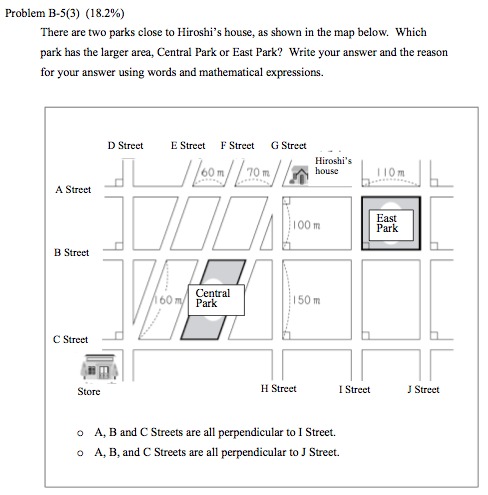
Grade 6 & 9 Math Problems from Japan

700K PDF. Grade 6

Grade 9

Via the Asia Pacific Economic Cooperation Wiki and ed in 08 (best item from their $60M campaign thus far).
Math Forum.

Share

Fairfax County Schools Consider Spending Freeze or Reductions

Michael Alison Chandler:

County departments have been asked to find potential spending cuts of 15 percent. Whether the school system, which with 165,700 students is the region’s largest, agrees to take the same approach is an open question.
Gerald E. Connolly (D) said the school system must share equally in the fiscal burdens faced by other sectors of government. School system spending reductions in past years, he said, have been “pretty anemic.”

Links:

Share

Trendy teaching is back: Four out of five primary schools are introducing ‘creative learning’, with lessons about ‘groovy Greeks’. Should we worry?

Sian Griffiths:

Katie Harris, 11, is telling me that she recently spent a lesson making paper aeroplanes and measuring how far they flew. What did she learn? “It was really enjoyable. It wasn’t just about one subject like maths, there was science in there as well,” she replied.
Katie is a pupil at Bursted Wood primary in Bexley, southeast London, one of eight schools in the borough at the forefront of a stampede back to “creative learning” and progressive teaching methods that were popular more than a decade ago.
Despite the bad press such methods got back then, when they were blamed for turning out thousands of children who couldn’t read or write properly, a survey of 115 primary schools last week revealed that four out of five are returning to teaching based around “topics” such as chocolate.
At Bursted Wood, traditional secondary-school style classes in subjects such as history, geography and maths have been ditched for topics planned out on “creative learning wheels”.

Share

A School Where One Size Doesn’t Fit All

Jay Matthews:

“The model is inspired by the success of home-schoolers,” he said. Students will set their class schedules, enabling them to learn at their pace and in their styles. Teachers will act as advisers, not taskmasters.
As for homework, “the one-size-fits-all [model] mandated in today’s schools is largely counterproductive,” Shusterman says in a slide presentation he uses to sell his idea. School for Tomorrow will have a home reading requirement and “encourage and support individualized, student-initiated homework.”
Much of Shusterman’s plan is inspired by John Dewey, a 20th-century educational philosopher whose devotees have called for teachers to be “guides on the side, not sages on the stage.” Dewey led a movement called progressive education in which, he said, children learn best when pursuing individual projects that allow them to explore their world.
Many teachers, in both private and public schools, use project-based learning to a degree. But at School for Tomorrow, Shusterman said, every course and project will be linked to this question: What does a high school graduate need to know and need to be able to do to thrive in college, the workplace and life in the 21st century?

www.schoolfortomorrow.net

Share

Patton Oswalt’s Brilliant, Politically Incorrect, Graduation Speech

Thomas:

The comedian then got the ball rolling, beginning with a story of a scholarship banquet when he was about to graduate and his being given some advice by a banker at his table. Oswalt’s frank acknowledgment of his own self-absorption and his description of the “myth of myself” is such a dead on descriptor of how our youth conduct themselves had to have the adults nodding in agreement.
He recites the man’s advice:

“And then this banker – clean-shaven, grey suit and vest – you’d never look twice at him on the street – he told me about The Five Environments.
“He leans forward, near the end of the dinner, and he says to me, There are Five Environments you can live in on this planet. There’s The City. The Desert. The Mountains. The Plains. And The Beach.
“You can live in combinations of them. Maybe a city in the desert, or in the mountains by the ocean. Or you could choose just one. Out in the plains somewhere, perhaps.
“But you need to get out there and travel, and figure out where you thrive.

Patton Oswalt

Share

Calm Down or Else

Benedict Carey:

The children return from school confused, scared and sometimes with bruises on their wrists, arms or face. Many won’t talk about what happened, or simply can’t, because they are unable to communicate easily, if at all.
“What Tim eventually said,” said John Miller, a podiatrist in Allegany, N.Y., about his son, then 12, “was that he didn’t want to go to school because he thought the school was trying to kill him.”
Dr. Miller learned that Tim, who has Asperger’s syndrome, was being unusually confrontational in class, and that more than once teachers had held him down on the floor to “calm him down,” according to logs teachers kept to track his behavior; on at least one occasion, adults held Tim prone for 20 minutes until he stopped struggling.
The Millers are suing the district, in part for costs of therapy for their son as a result of the restraints. The district did not dispute the logs but denied that teachers behaved improperly.

Share

Back to school math prep

AZ Central:

We continue our special series this week on preparing your children for the new school year. This year high school students are required to take more math. School Solutions’ Kim Covington explains that’s no sweat for the students of a Tempe teacher.
A record number of students at Desert Vista High School in Tempe got perfect scores on their SAT. That’s 26 students, but another 40 just missed one.
Many of those students attended Desert Vista’s popular 4 hour summer math camp. The 5th-8th graders who take part breezed through Algebra in just a few weeks. Teacher Larry Strom started the math camp two years ago. The Math Department Chair says, “we tell them to take Algebra as early as they possibly can.”

Share

Texas high school athletes could receive more credits for sports

Terrence Stutz:

Texas high school students who play football, basketball and others sports could receive twice as much as credit toward graduation under a proposed rule being considered by the State Board of Education.
The proposal — allowing four years of sports to count for credit instead of two — was brought to the board by a coach from Brenham High School, who said new graduation requirements that took effect with freshmen last year discriminate against student athletes by slicing the time available for participation in athletics.
Under the new state requirements — ordered by the Legislature — students need four years each of math, science, English and social studies — the so-called 4×4 core courses — along with their electives and a handful of other required classes such as two years of foreign language and 1 ½ years of physical education.
In all, the number of credits needed to get a diploma will increase from 24 to 26 for students graduating in 2011.

Share

Peter Schrag: The quick road to math success: Get a bigger whip

Peter Schrag:

There’ve been lots of complaints that Gov. Arnold Schwarzenegger has neither much interest in education policy, nor the capacity to deal with it. But his precipitous plunge into the algebra wars last week and the state Board of Education’s sudden decision to bow to his demand makes you wish that that he had less interest or a lot more capacity.
The leap, in the form of a letter urging the board to require that every eighth-grader take beginning algebra and the board’s overnight agreement to mandate it within three years is like trying to make a scrawny horse pull a heavier load with a bigger whip. At best, it won’t work; at worst, it will kill the horse.
The state has for some years had an admirable “goal” that every eighth-grader take algebra, combined with a set of incentives for districts to get all students there. The incentives – essentially penalizing schools by reducing a school’s Academic Proficiency Index for each student who takes only general math – have worked. More than half of California’s eighth-graders now take either algebra or geometry.

Share

Even background TV can impact kids’ attention

Greg Toppo:

Pediatricians have long said children younger than 2 shouldn’t watch any television. But in new findings from a small-scale study, researchers say that even having a TV on in the background could be “an environmental hazard” for children.
For the study, released today, researchers observed 50 children, ages 1 to 3, for an hour at a time as they played alone in a small room with a variety of toys. Parents sat nearby, and for half of each session (starting either at the beginning or 30 minutes in), a small TV broadcast a taped episode of Jeopardy.
After videotaping and carefully analyzing the children’s reactions, researchers found that kids watched the TV only in snippets but that it modestly shortened their playtime. TV decreased play’s intensity and cut by half the amount of time children focused on a given toy.
The researchers chose Jeopardy on the theory that it would be “nearly incomprehensible” to toddlers.

Share

Leaders explain schools’ gains

Gadi Dechter:

Middle school students at the Crossroads School near Fells Point were evaluated by teachers every single day last school year, with the results driving the next day’s instruction.
At East Baltimore’s Fort Worthington Elementary, about a quarter of the school’s parents turned out for MSA Family Fun Night and sampled questions from the Maryland School Assessments.
Alexander Hamilton Elementary, situated in a West Baltimore neighborhood that the principal calls “gang-infested,” started a gifted education program last year to challenge students to learn beyond their grade levels.
The principals of the three schools credit those and myriad other initiatives with making their schools among of the most improved in Baltimore, during a year in which the school system overall posted historic gains on the standardized tests administered under the federal No Child Left Behind Act.

Share

Nerad Details His First-Year Vision To Madison School Board

Channel3000:

For the past two weeks, Madison Metropolitan School District Superintendant Dan Nerad has been learning the ropes in Madison. He said he has been doing a lot of listening and learning.
On Monday, he officially brought his ideas to the Madison School Board, for the first time laying out a vision for his first year as superintendant.
“I guess my hope, over time, is that while I’m learning about the Madison Metropolitan School District that I can also help inform the school district of important new directions I hope we can take over time,” said Nerad.
One idea Nerad said he believes should be revisited in Madison is 4-year-old kindergarten.

TJ Mertz has more.
Much more on Madison & 4 Year Old Kindergarden here.

Share

Cheating on ACT, SAT college entrance exams has few consequences

Carla Rivera:

If the testing firms suspect fraud, they simply cancel the student’s score — but they never tell schools why.
A group of students at a Los Angeles high school is suspected of cheating on the ACT college entrance exam by paying a former student, who used fraudulent identification, to take the tests. The testing agency recently began investigating the claims, which could result in cancellation of scores provided to colleges.
But those colleges will not be told why the scores are invalid, nor will the students’ high school be clued in.

Share

Algebra Rules

SF Chronicle:

One thing both sides of the math-wars debate should agree on is this: Educators can set high standards, but the higher standards only help students if the students have a base of knowledge from which they can rise. In 1997, when the state board of education issued math standards that called for eighth graders to learn Algebra 1, they knew that California teens could not instantly meet that goal.
Rather than set a strict mandate for eighth grade Algebra 1, the board used other policies to set incentives for moving more students into higher-level math, and disincentives for failing to do so – with the goal of having all eighth graders learn Algebra 1 by 2014. The ratio of eighth graders who took Algebra 1 or even higher level math grew from 16 percent in 2000 to 52 percent today. Those 52 percent of students are in a strong position to make it through the college track. Supporters believe this progress – especially the doubling of African American students in eighth-grade Algebra 1 – represents a coup in the struggle to close the achievement gap.

Share

Math Meltdown

Patrick Welsh:

Summertime means school for an increasing number of high school students who have struggled in their math courses. But the system could be contributing to the kids’ poor performances.
Sam Cooke once cooed: “It’s summertime, and the living is easy.”
Tell that to the increasing number of middle and high school students who will be sweating out summer school this year because of their meltdown in math.

Related: Math Forum.

Share

Former Math Teacher’s Lesson of the Day

Claudia Ayers:

It isn’t absurd enough that we test high school students with a High School Exit Exam that is pretty much on a par with the California Basic Educational Skills Test (CBEST) required of teachers, but now we are all congratulating ourselves with a decision to test eighth graders for algebra. At least state schools chief Jack O’Connell has learned from his own past mistakes and opposed this decision. If only he had the guts to say he blew it on advocating for the exit exam, which is not only a complete waste of tens of millions of dollars, but sends more and more kids into the streets and trouble with the law when they fail to graduate because they do not test as well as others. (About 10 percent of high school students must “fail,” otherwise it isn’t a “test.”)
I tutored algebra to younger students when I myself was in high school. Later I taught it in public high schools for nearly 20 years, concurrently with other math courses, including geometry, pre-algebra and seventh and eighth grade math. I taught in some of the highest achieving, and some of the lowest achieving middle and high schools in the state. So, maybe my perspective is broader than the average citizen’s. Still, anyone who thinks it is a good idea to begin testing all eighth graders in algebra is simply delusional. It would be more PC to say uninformed, but I am at wit’s end.

Share

California’s algebra fracas symbolizes bigger mess

Dan Walters:

This week’s dust-up over whether all of California’s eighth-graders should be taking algebra encapsulates one of the state’s overarching educational dilemmas: Is it wise to set educational standards that apply to all students, even though they have an astonishing and ever-widening array of innate abilities and cultural, economic, ethnic and linguistic backgrounds?
Gov. Arnold Schwarzenegger and advocates of educational rigor are hailing the state Board of Education’s vote to impose the algebra requirement in response to pressure from federal officials about creating more uniformity in standards and testing.
However, state schools Superintendent Jack O’Connell, who wanted to modify the decade-old state policy of introducing eighth-graders to algebra to comply with the federal demands, claims that the decree will leave many kids behind because the state is unprepared, educationally and financially, to implement it.
The conflict echoes, ironically, the controversy over the decree that high-schoolers must pass an exit exam before being awarded graduation diplomas – a standard that O’Connell vigorously championed as legislator and state schools chief.

Share

Forget About the Achievement Gap: High Achieving Students in the Era of No Child Left Behind

Jay Matthews:

“The narrowing of test score gaps, although an important accomplishment,” Loveless writes, should not “overshadow the languid performance trends of high-achieving students.” He adds: “Their test scores are not being harmed during the NCLB era, but they are not flourishing either. Gaps are narrowing because the gains of low-achieving students are outstripping those of high achievers by a factor of two or three to one. The nation has a strong interest in developing the talents of its best students to their fullest to foster the kind of growth at the top end of the achievement distribution that has been occurring at the bottom end.”

Ann Duffett, Steve Farkas & Tom Loveless on the “Robin Hood Effect”:

This publication reports the results of the first two (of five) studies of a multifaceted research investigation of the state of high-achieving students in the No Child Left Behind (NCLB) era.

Part I: An Analysis of NAEP Data, authored by Brookings Institution scholar Tom Loveless, examines achievement trends for high-achieving students (defined, like low-achieving students, by their performance on the National Assessment of Educational Progress, or NAEP) since the early 1990s and, in more detail, since 2000.

Part II: Results from a National Teacher Survey, authored by Steve Farkas and Ann Duffett of Farkas Duffett Research Group, reports on teachers’ own views of how schools are serving high-achieving pupils in the NCLB era.

Share

Kids Urged to Walk, Bike to School

Melissa Kossler Dutton:

Megan Schroeder rides her bike or walks to school to do her part to help the planet.
She also likes the incentives that her school, Bear Creek Elementary, uses to reward kids who ditch mom or dad’s car in favor of biking or walking.
“You get treats, too — usually some kind of food. I won a bike at the awards ceremony,” said Megan, 8, of Boulder, Colo. “Since I like animals, I want to save the environment.”
Across the country, schools are encouraging families to forgo their cars to promote healthy habits, relieve traffic congestion around school buildings and reduce auto emissions. Students who live too far to walk or bike are asked to form car pools, use public transportation or walk part of the way.

Share

Students likely to fail high school exit exam can be identified as early as 4th grade, study says

Seema Mehta, via a kind reader’s email:

As early as fourth grade, students who will be at risk of failing the high school exit exam – a state requirement to earn a diploma – can be identified based on grades, classroom behavior and test scores, according to a new study released Tuesday.
The findings, based on an extensive study of student achievement in San Diego schools, call into question the effectiveness of aiming significant efforts and tens of millions of dollars at struggling high school seniors and older students to help them pass the exam.
“From a political standpoint, such spending seems necessary. However, our results strongly suggest that these 11th-hour interventions by themselves are unlikely to yield the intended results,” according to the report by the Public Policy Institute of California.
Instead, the authors suggested, “moving a portion of these tutoring dollars to struggling students in earlier grades – when the students are still in school – could be a wise choice. An ounce of prevention could indeed be worth a pound of cure.”

Share

India plans massive technical education push

EETimes:

The government is launching a three-year initiative to boost technical education.
The Ministry of Human Resource Development will head the effort designed to overhaul India’s education system, which lags other developing countries. Officials said the effort aims to improve the quality of Indian education by expanding the capacity of institutions and creating new ones.
Regional, social and gender disparities in higher and technical education are also being addressed in the new strategy, which is being bolstered by a nine-fold budget increase for technical education. At the same time, the ministry said, regional governments need to do more to support technical education.
The federal government plans to establish eight new Indian Institutes of Technology, known for producing top researchers for global technology firms. Also planned are two more Indian Institutes of Science, Education and Research. Twenty new Indian Institutes of Information Technology are also planned.

Share

Teachers learn principles to pass on to in-demand students

Kathleen Gallagher:

How many teachers does it take to make a pingpong ball launcher?
More than one, 84 high school and middle school teachers participating in a two-week training class at the Milwaukee School of Engineering found out.
On Friday, they finished learning how to work cooperatively to make pingpong ball launchers and marble sorters, and to rip apart everything from flashlights to strap hinges so they could remake them to work better.
As a result, each is now certified to teach one Project Lead the Way class in digital electronics, civil engineering and architecture, or another engineering topic.
The Project Lead the Way-trained teachers are part of a push that powerful forces in the state have gotten behind.

Share

Commuter College Goes Residential

Dorie Turner:

The neighborhood around Georgia State University was for years a maze of boarded up storefronts, aging buildings and parking lots that emptied at the close of each day.
But the downtown Atlanta campus is shedding its sleepy commuter school image thanks to plush new dorms, gleaming classroom buildings, Greek life and, yes, even football.
Georgia State and other former night schools across the country are transforming into more traditional college campuses to boost enrollment and gain prestige. And each is creating a thriving community that spills over into surrounding neighborhoods, drawing restaurants and retail into once empty streets.

Share

Taking Aim at Youth Gun Violence

Rodrigo Zamith:

A new initiative for Minneapolis and Hennepin County will increase penalties for juveniles caught with firearms, both replica and real.
Minneapolis and Hennepin County officials hope to reduce juvenile gun crime this summer by stiffening penalties for youths caught with BB guns, real guns or replicas.
The new Juvenile Gun Offender Initiative was announced Tuesday by Minneapolis Mayor R.T. Rybak, Hennepin County Attorney Michael Freeman and others. It will also increase enforcement of youth curfew laws, replica firearms ordinances and supervision of juveniles on probation for gun offenses.
The new rules apply to offenders between 10 and 17 years old. First-time offenders with a real gun will be given probation, four to six weeks of out-of-home placement and 40 hours of education on the dangers and effects of guns. If the requirements aren’t met, youths will be given four to six months of out-of-home placement.

Gangs & School Violence Forum.

Share

Education: Where’s the Pride; Where’s the Shame?

William Falzett III
I live in a small town, the kind of town many parents seek out in an effort to raise their children away from the precocious material culture of the suburbs, and the tough third world neighborhoods in and around the cities. We have successfully escaped most of that stuff in our small town, but we have not been able to escape the creeping clutches of political correctness.
My daughter is in the third grade, and recently came home with an assignment to prepare a presentation about a famous historical figure. One of her favorite films “A Night at the Museum” includes a part about Sacajawea, the famous native American, working mother, and guide of the Lewis and Clark expedition. We suggested Sacajawea would be a good choice for her project. She worked on it over a two week period, researching on the Internet, reading a book we bought, and preparing visual aids. She was very excited about the project, and practiced the presentation over and over again at home. After her open house event, I asked what kind of grade she got on it, to which she flatly replied she had gotten 102, an A+. I was surprised by her lack of enthusiasm, so I asked how her grade compared to the other kids. She told me she did not know, because kids are not allowed to share their grades with other students.
A little probing exposed this as a politically correct “don’t ask; don’t tell” rule I have encountered many other times in speaking to the kids about school. Very simply it has no purpose but to ensure no one gets hurt feelings or diminished self-esteem over poor performance. The children are taught that expressions of pride for performance are bad, and there is no shame in performing poorly. Poor performance, mediocrity, and outright failure are all treated the same. Little or no effort is equivalent to diligence, and there is therefore little incentive in the system to perform. Kids learn they can get by doing the bare minimum. Curiously there seems to be no similar treatment of performance when it comes to school sports. The poorest performers are often cut from the team, while the gifted advance, often accompanied by extreme celebration, aggressive coaching, poor sportsmanship and in-your-face trash-talking. The message seems to be that to be good in sports is serious and worth bragging about, but being excellent in academics is not.

Share

Tennessee 2nd in U.S. for texting and driving

Marti Davis:

Almost nine of 10 Americans agree that texting while driving spells trouble, yet South Carolina and Tennessee lead the nation in those who admit to sending or receiving text messages while behind the wheel.
A national survey of nearly 5,000 cell-phone users, released this week by Common Knowledge Research Services for the Vlingo Corp., revealed that Tennessee’s text-messaging motorists are topped only by those in South Carolina.
A bill that would have made driving while texting, or DWT, illegal failed to pass the Tennessee Legislature in March. So for now, at least, Tennessee’s text messengers can go on typing with their thumbs while steering with their pinkies, perhaps assisted by their knees.
“Clearly it’s an enormous danger for anybody to be texting while driving,” said Don Lindsey, longtime safety expert for AAA of East Tennessee. “Not only do you have the distraction of somebody thinking about what you’re going to say, you either have to either feel with your thumbs those little itty-bitty buttons or, worse, look down on the phone and do it.”

Share

Girl Becomes Teen Driving Statistic

Brian Hicks:

When she got her permit on Monday, Cushire Akabidavis had license to drive on some of the most dangerous roads in the nation, governed by a state with some of the weakest teen driving laws.
Within minutes she became another young victim of that volatile mix.
Drivers between the ages of 15 and 17 were involved in 64 traffic fatalities and more than 8,400 injuries in 2006, according to a study by the motorist club AAA.
Those accidents cost taxpayers $629 million, roughly the price of the Arthur Ravenel Jr. Bridge.
“South Carolina is in the top three worst states in the country for driving, and they have some of the worst laws in dealing with teen driving,” said Tom Crosby, vice president for communications at AAA Carolinas.
“This is the state that would not even pass a law to prevent teens from texting while driving.

Share

Young Workers Flee Midwestern States

Celeste Headlee:

Upper Midwestern states are in danger of losing a precious economic commodity: young people. Many are leaving for other parts of the country after finishing school. Without young, educated workers, there’s little incentive for businesses to locate in economically hard-hit states.

audio

Share

Mystery illness fells young man

Beth Walton:

But to get her son’s mysterious malady diagnosed, a mother must battle some of the area’s top hospitals.
School had just started for the year and Cole Haakana could hardly sit still in his fifth-grade classroom. Today, he was going to a friend’s house and they were going to walk into town and get ice cream.
But when school let out later that day and the two boys walked the winding neighborhood roads that follow Lake Minnetonka’s shoreline, Cole needed to stop and rest. The 10-year-old boy—who spent nearly all his free time riding his BMX bike, fishing, and playing baseball—suddenly felt weak.
He was wracked by a cough so scary that his friend’s mother called Cole’s mom.
Carrie Halvorson wasn’t worried at first. It was September 2005, the kids were back in school, and Cole had probably just picked up some type of bug. They’d wait it out over the weekend.

Share

Advertisers in Touch with Teen’s Cellphones

Alana Semuels:

McGraw receives daily text messages from Seventeen magazine about fashion, including tips about what to wear to the prom. She planned to take the magazine’s suggestion to wear a brightly colored outfit and be prepared for “dress malfunctions.” “When the texts recommend a certain look that sounds good, I will try it out, but it doesn’t always mean buying something,” the 17-year-old Laguna Niguel resident said.
Yakking teens and phones have been inseparable for decades. The difference today is that teens use their cellphones for a lot more than just talking. It has become a palm-size entertainment and information center increasingly consuming their time and attention. Advertisers are realizing that if they want to reach teens, they need their number — literally.
“They’re not watching TV, you’re not reaching them in other places,” said Andrew Miller, chief executive of Quattro Wireless, a mobile advertising network. “Mobile is where they congregate.”
This year, shy escorts can buy (for 99 cents) a preproduced video of a guy asking a girl to the prom (“We’d take amazing prom pictures together,” he says) and then send it via mobile phone to ask a girl out, thanks to Venice-based Mogreet Inc.His nervous date can visit Cosmo Girl’s mobile phone site and look at the prom section to find out how to say “No” to alcohol. And she can go to PromGirl.com to download a widget that lets her browse for prom dresses on her phone without burning up valuable Internet minutes.

(more…)

Share

Attention Goes a Long Way at a School, Small by Design

Jennifer Medina:

They sighed with relief when the college applications were completed, and celebrated when the acceptance letters poured in. But even after graduation on Thursday, one more job remained for the high school’s college counselor and principal: hound their students to make sure they have completed every last task to enroll in their college classes in the fall.
So it goes at the Urban Assembly School for Law and Justice in Fort Greene, Brooklyn, where many in the school’s first graduating class of 79 seniors are from the city’s poorest neighborhoods, and have struggled academically for years. Yet they received the kind of personal attention more commonly associated with the priciest prep schools.
Schools Chancellor Joel I. Klein has made new small high schools like Law and Justice a centerpiece of his effort to overhaul the system, saying students who get more personal attention will have more success in the classroom. But many of these schools have struggled with problems of high faculty turnover or of sharing space with other schools. Still, when Education Department officials say the strategy is working, they point to examples like Thursday’s graduation at Law and Justice, where 93 percent of the senior class — nearly all collegebound — collected their diplomas, far higher than the city’s graduation rate of roughly 50 percent.

Share

School Choice: Is Milwaukee still state-of-the-art

Anneliese Dickman:

Milwaukee has long been called “ground zero” of education reform in America, due mostly to our nearly two-decade-long “experiment” with publicly-funded private school vouchers. Now New Orleans, LA (NOLA) threatens to revoke our title as the epicenter of school choice by heeding the lessons learned here in Milwaukee and advancing the policy design with its new voucher program.
Governor Bobby Jindal of Louisiana is set to sign the nation’s fifth voucher program into law, allowing impoverished students in under-performing New Orleans public schools to leave for other options. The NOLA program’s legislation looks designed to avoid many of the failings of Milwaukee’s program: it borrows certain elements of our program, building on Milwaukee’s strengths, yet limits our deficiencies.

Share

The Two Worlds of Advanced Placement

Jay Matthews:

Arguing about Advanced Placement, the college-level program found in most U.S. high schools, can be confusing. Some critics say AP courses and tests, like the similar but smaller International Baccalaureate and Cambridge programs, are too deep for most high school students. Other critics say they are too shallow. Some say AP teachers follow a boring, trivia-filled script. Others say AP teachers are the most creative and engaging instructors they know.
Two well-crafted op-ed pieces, by Chicago high school student Tom Stanley-Becker in the Los Angeles Times and by Stanford University graduate fellow Jack Schneider in the Christian Science Monitor, have recently illuminated this split. They point toward a more intelligent way of seeing AP and other college-level high school courses as a useful whole, rather than as large and clumsy devices with contrary parts.

Share

State curriculum on legalities of parenting coming to Texas high schools this fall

Karen Ayres Smith:

Do you know the difference between an “alleged father” and a “presumed father?” Your child soon will.
The Texas attorney general’s office has created a new parenting curriculum that will be required in every public high school this fall. It will cover everything from the legalese of paternity to dealing with relationship violence.
State officials say the goal is twofold: They want to teach teenage parents their legal rights and they want to show other students the difficulties of being a parent in hopes that they’ll wait to have children.
The program, which has already drawn some skepticism, promises to bring personal and family values out of the home and into the classroom.
“The purpose is to help young people make responsible decisions about their futures,” said Janece Rolfe of the attorney general’s child support division. “What we’re hoping to do is prevent children from having to enter the child support system.”

Share

O Father, Where Art Thou?

Joshua Alston:

Ta-Nehisi Coates grew up in the type of family unit that causes census takers to develop stomach ulcers. His father, Paul, was a bit of a free spirit, which is how it came to be that he fathered Coates and his six siblings with four different women. Despite this peculiar scenario, Paul was an active, present father in all his kids’ lives. Coates certainly had his share of issues growing up in a tumultuous corner of Baltimore, but as he writes in his new memoir, “The Beautiful Struggle,” his father was a source of security and stability in a neighborhood subject to rampant, random violence. “I don’t know if there’s an environmental explanation for why my father was the way he was,” says Coates, 33. “For some reason, he just took being a father really seriously.”
The engaged black father is an elusive character in popular culture. The percentage of black children living in fatherless homes—roughly 50 percent—has perpetuated an orthodoxy that black men are irresponsible and indifferent to fatherhood. Authors such as Coates are in a position to change that. In addition to “Struggle,” last year saw the release of two photo-essay books, Carol Ross’s “Pop” and Rachel Vassel’s “Daughters of Men,” which aimed to show black men celebrating their love for their children.

Share

Police, sheriff’s units tackle growing Seattle-area gang problem

Jennifer Sullivan & Lauren Vane:

Tearing through the winding streets of the Central Area and Rainier Valley at 70 mph last Friday night, Seattle gang detectives Jim Dyment and Tom Mooney experienced an unsettling déjà vu — it was the third shooting they had responded to in a week.
As they drew near the scene of a drive-by shooting, Dyment and Mooney saw a group of officers gathered around five teens who sat handcuffed on a sidewalk in the Rainier Beach neighborhood. The hands of two teens were eventually wrapped in brown-paper sacks to protect any telltale gunpowder residue.
Dyment, a sergeant who has spent years investigating drugs, prostitutes and youth violence, muttered to no one in particular: “Being a gangster is a young man’s sport.”
And chasing gang members is becoming a full-time priority for police officers and sheriff’s deputies throughout the Puget Sound region, where authorities say gang membership is surging. From graffiti spray-painted on a mailbox in Kent’s West Hill neighborhood to recent shootings at area shopping malls, police say crimes associated with gangs appear to be on the upswing.

Gangs & School Violence Forum.

Share

School Is Out, and Nutrition Takes a Hike

Tara Parker-Pope:

As my 9-year-old daughter began summer day camp last week, we talked about swimming rules, sunscreen and … cheese fries.
It was at summer camp a few years ago that she first experienced the culinary joy of cheese fries, which can pack 800 or more calories in a serving. Her camp is typical of those around the country: days packed with archery, swimming and adventure climbing; menus packed with soft drinks, burgers, chicken nuggets and, once a week, cheese fries.
Camp food is just one of the summertime nutrition challenges for parents these days. While childhood health advocates often blame schools for poor nutrition and a lack of physical activity, the problem often gets worse in the summer. Last year, The American Journal of Public Health published a provocative study showing that schools may be taking too much of the blame for the childhood obesity epidemic.
Data from kindergarteners and first graders found that body mass index increased two to three times as fast in summer as during the regular school year. Minority children were especially vulnerable, as were children who were already overweight.

Share

Georgia notifies parents before releasing awful test scores

Laura Diamond:

Parents whose children failed the math test will be notified by local schools. The state requires eighth-graders to pass the reading and math exams to move to high school.
Students who failed math exams — as well as those who might have failed reading — can retake the exam this summer. Schools will provide optional free classes to get them ready. Students who failed the social studies exam don’t face any consequences under Georgia law.
State Superintendent of Schools Kathy Cox said test scores in both subjects dropped because students took harder tests to match the state’s tougher and more rigorous curriculum.
“When you raise standards and expectations, it is not unusual to see a temporary dip in the percent of students who are meeting those expectations,” Cox wrote in a statement released Monday afternoon. “We have seen this in other grades and other areas of the curriculum.”

Share