School Information System

Action Needed, Please Sign on…. Math Teacher Hiring in the Madison School District

via a kind reader’s email: Janet Mertz and Gabi Meyer have written a letter about new math hires that they would like you to sign on to. Please send your name, your school(s), and any relevant identifying information or affiliation to:

mertz@oncology.wisc.edu

Dear Superintendent Nerad and members of the Board of Education:

To address as quickly as possible the MMSD’s need for more middle school teachers with outstanding content knowledge of mathematics, we, the undersigned, urge you to consider filling any vacancies that occur in the District’s middle schools for the coming academic year with applicants who majored in the mathematical sciences or related fields (e.g., statistics, computer science, physics) in college, but may be currently deficient in teaching pedagogy. You might advertise nationally in appropriate places that applications from such candidates would be welcome. In recent years, many outstanding graduates with such backgrounds went into the computing, consulting, and financial industries. However, in the current economic climate, such jobs are much less available, especially to new college graduates. Thus, jobs in the teaching profession may be viewed much more favorably now by folks trained in the mathematical sciences despite the significantly lower salary. One indication of this is the fact that applications to Teach for America were up 42% this year. Teach for America had to reject over 30,000 applicants this spring, including hundreds of graduates from UW-Madison, due to the limited numbers they can train and place. Undoubtedly, some of these applicants were math majors who would be happy to live in Madison. Math for America, a similar program that only accepts people who majored in the mathematical sciences, likely also had to turn away large numbers of outstanding applicants. Possibly, the MMSD could contact Teach for America and Math for America inquiring whether there might be a mechanism by which your advertisement for middle school math teachers could be forwarded to some of the best of their rejects. As these programs do, the MMSD could provide these new hires with a crash course in teaching pedagogy over the summer before they commence work in the fall. They could be hired conditionally subject to completing all of the requirements for state teacher certification within 2 years and a commitment to teach in the MMSD for at least 3-5 years.

While the District’s proposal to provide additional content knowledge to dozens of its current middle school teachers of mathematics might gradually improve the delivery of mathematics to the District’s students, it would take numerous years to implement, involve considerable additional expense, and may still not totally solve the long-term need for math-qualified teachers, especially in view of the continuing wave of retirements. The coincidence of baby boomer retirements with the current severe economic recession provides a rare opportunity to fill our middle schools now with outstanding mathematics teachers for decades to come, doing so at much lower cost to the District since one would be hiring new, B.A.-level teachers rather than retraining experienced, M.A.-level ones. Thus, we urge you to act on this proposal within the next few weeks, in possible.

Sincerely,

Ed Hughes comments over at Madison United for Academic Excellence:

It is interesting to note that state law provides that “A school board that employs a person who holds a professional teaching permit shall ensure that no regularly licensed teacher is removed from his or her position as a result of the employment of persons holding permits.”
Share

With Critics Quiet, Hearing Praises D.C. School Voucher Program

Bill Turque:

The Senate’s most outspoken supporter of the D.C. voucher initiative orchestrated more than two hours of uniformly glowing testimony for the program at a committee hearing yesterday and said the dissenting voices he invited turned him down.


Sen. Joseph I. Lieberman (I-Conn.), chairman of the Committee on Homeland Security and Government Affairs, is pushing for reauthorization of the D.C. Opportunity Scholarship Program, which provides up to $7,500 a year in federally funded tuition to 1,700 D.C. children from low-income families to attend private schools.


Congressional Democrats, supported by teachers unions and other liberal education groups that generally oppose using public money for private education, included language in the recent omnibus spending bill that would end the program in 2010. Last week, President Obama proposed continuing the scholarships so the students currently receiving money can finish high school. The program would be closed to new students.


Lieberman wants to fully revive the program and said yesterday that he has a commitment from Majority Leader Harry M. Reid (D-Nev.) to bring the matter to the floor for debate and a vote this year.

Share

More black lawmakers open to school vouchers

Greg Toppo:

Back when he was on the city council for the District of Columbia, attorney Kevin Chavous would occasionally run into fellow Democrats concerned about the state of the USA’s urban schools.
They were open to a lot of ideas, but most Democrats have historically rejected taxpayer-supported private-school vouchers, saying they drain precious cash from needy public schools. Chavous, who served from 1992 to 2005, openly supported vouchers. He would ask others why they didn’t.
“Several of them would whisper to me, ‘I’m with you, but I can’t come out in front,’ ” Chavous says.
That was then.
While vouchers will likely never be the clarion call of Democrats, they’re beginning to make inroads among a group of young black lawmakers, mayors and school officials who have split with party and teachers union orthodoxy on school reform. The group includes Sacramento Mayor Kevin Johnson, Newark Mayor Cory Booker and former Washington, D.C., mayor Anthony Williams.

Share

They Had it Made

David Brooks:

In the late 1930s, a group of 268 promising young men, including John F. Kennedy and Ben Bradlee, entered Harvard College. By any normal measure, they had it made. They tended to be bright, polished, affluent and ambitious. They had the benefit of the world’s most prestigious university. They had been selected even from among Harvard students as the most well adjusted.
And yet the categories of journalism and the stereotypes of normal conversation are paltry when it comes to predicting a life course. Their lives played out in ways that would defy any imagination save Dostoyevsky’s. A third of the men would suffer at least one bout of mental illness. Alcoholism would be a running plague. The most mundane personalities often produced the most solid success. One man couldn’t admit to himself that he was gay until he was in his late 70s.
The men were the subject of one of the century’s most fascinating longitudinal studies. They were selected when they were sophomores, and they have been probed, poked and measured ever since. Researchers visited their homes and investigated everything from early bed-wetting episodes to their body dimensions.
The results from the study, known as the Grant Study, have surfaced periodically in the years since. But they’ve never been so brilliantly captured as they are in an essay called “What Makes Us Happy?” by Joshua Wolf Shenk in the forthcoming issue of The Atlantic. (The essay is available online today.)

Share

The Harlem Miracle

David Brooks, via a kind reader’s email:

The fight against poverty produces great programs but disappointing results. You go visit an inner-city school, job-training program or community youth center and you meet incredible people doing wonderful things. Then you look at the results from the serious evaluations and you find that these inspiring places are only producing incremental gains.
That’s why I was startled when I received an e-mail message from Roland Fryer, a meticulous Harvard economist. It included this sentence: “The attached study has changed my life as a scientist.”
Fryer and his colleague Will Dobbie have just finished a rigorous assessment of the charter schools operated by the Harlem Children’s Zone. They compared students in these schools to students in New York City as a whole and to comparable students who entered the lottery to get into the Harlem Children’s Zone schools, but weren’t selected.
They found that the Harlem Children’s Zone schools produced “enormous” gains. The typical student entered the charter middle school, Promise Academy, in sixth grade and scored in the 39th percentile among New York City students in math. By the eighth grade, the typical student in the school was in the 74th percentile. The typical student entered the school scoring in the 39th percentile in English Language Arts (verbal ability). By eighth grade, the typical student was in the 53rd percentile.

More here.

Share

Caring for your Introvert

Jonathan Rauch:

Do you know someone who needs hours alone every day? Who loves quiet conversations about feelings or ideas, and can give a dynamite presentation to a big audience, but seems awkward in groups and maladroit at small talk? Who has to be dragged to parties and then needs the rest of the day to recuperate? Who growls or scowls or grunts or winces when accosted with pleasantries by people who are just trying to be nice?
If so, do you tell this person he is “too serious,” or ask if he is okay? Regard him as aloof, arrogant, rude? Redouble your efforts to draw him out?
If you answered yes to these questions, chances are that you have an introvert on your hands–and that you aren’t caring for him properly. Science has learned a good deal in recent years about the habits and requirements of introverts. It has even learned, by means of brain scans, that introverts process information differently from other people (I am not making this up). If you are behind the curve on this important matter, be reassured that you are not alone. Introverts may be common, but they are also among the most misunderstood and aggrieved groups in America, possibly the world.

Share

Why I Give My 9-year-old Pot

Marie Myung-Ok Lee:

Question: why are we giving our nine-year-old a marijuana cookie?
Answer: because he can’t figure out how to use a bong. My son J has autism. He’s also had two serious surgeries for a spinal cord tumor and has an inflammatory bowel condition, all of which may be causing him pain, if he could tell us. He can say words, but many of them–“duck in the water, duck in the water”–don’t convey what he means. For a time, anti-inflammatory medication seemed to control his pain. But in the last year, it stopped working. He began to bite and to smack the glasses off my face. If you were in that much pain, you’d probably want to hit someone, too.
Question: why are we giving our nine-year-old a marijuana cookie?
Answer: because he can’t figure out how to use a bong. My son J has autism. He’s also had two serious surgeries for a spinal cord tumor and has an inflammatory bowel condition, all of which may be causing him pain, if he could tell us. He can say words, but many of them–“duck in the water, duck in the water”–don’t convey what he means. For a time, anti-inflammatory medication seemed to control his pain. But in the last year, it stopped working. He began to bite and to smack the glasses off my face. If you were in that much pain, you’d probably want to hit someone, too.

Share

On Chinese Education

Jim Fallows here and here:

Recently we’ve had Chinese and non-Chinese perspectives on Chinese schools (background here). For balance, a Chinese and a non-Chinese view in the same post!
Reasons I’m offering such long first-hand testimony: (1) no one has to read it! (2) many things about life in China — and yes, life in other places — are conveyed not in theoretical summaries but in accumulations of day by day experiences, like those recounted here. Several more still in the queue. Also, bear in mind that the foreigners writing in are ones who generally came to Chinese schools to “do something good.” They’re not here for the big bucks or the easy life but because they thought it would be valuable as well as interesting to be part of China’s development at this stage.

Share

School bullies are going high-tech

Martina Cermakova:

The video appeared on YouTube last June. Posted by a group of ninth-graders from a school in Železný Brod, a small town in northern Bohemia, it depicted a teacher requesting that a 15-year-old student clean the mess around his desk.
“Pick it up yourself, you piece of trash,” the boy snapped back. Within seconds, the teacher charged the student and slapped him in the face.
The mobile recording received widespread attention, including a snippet on BBC News. Although it wasn’t the cruelest and certainly not the only case of cyber-bullying in the Czech Republic, the video highlights how fast things have evolved in the past few years.

Share

10 Things to Find Out Before Committing to a College

Lynn Jacobs & Jeremy Hyman:

Often we find that students, and their parents, tend to focus on bells and whistles when making their college selections. They fixate on things like the looks of the campus, the size of the library, the honors and study-abroad programs, even the quality of the football team. Hey, these are all fine and good. But we urge you to also think about some things that, while often overlooked, constitute the bread and butter of your college experience. Before you decide, here are 10 things you might not have thought to consider:
1. The number of requirements . These vary widely from school to school. And while it might look very impressive to see a long list of required courses, it’s not so great to find yourself mired in courses that don’t interest you, while you’re unable to take electives in areas that do. It’s even less great when you realize that some of these most unpleasant requirements were instituted by some legislator who insisted that everyone in the state needs to take State History 101. Or by some pushy department in 1950, which couldn’t get students to take its courses in any other way.
2. How flexible those requirements are . Schools that require specific courses, with no substitutions allowed, can really put you in a bind if you’d rather take more advanced courses–or need to take more remedial courses–to fulfill that requirement. So check to see that the school allows a choice of levels to satisfy the various requirements. Also, keep in mind that anytime a school needs to route hundreds or thousands of students through Course X, Course X is going to become a sort of factory that neither the students taking the course nor the teachers teaching the course are going to like much.

Share

Bullying, Thefts Persist Despite Drop in Violence

Valerie Strauss:

Even though spasms of intense violence erupt on campuses occasionally and linger in the social consciousness, violence at schools across the country has been decreasing for a number of years.
That doesn’t necessarily mean schools are safe havens. Consider:
— Eighty-six percent of public schools in 2005-06 reported that one or more violent incidents, thefts of items valued at $10 or greater or other crimes had occurred — a rate of 46 crimes per 1,000 enrolled students.
— Almost a third of students ages 12 to 18 reported being bullied inside school.
— Nearly a quarter of teenagers reported the presence of gangs at their schools.

Indicators of School Crime and Safety.

Share

Shooting stars: Why highfliers flame out in new jobs

Don Sull:

In a downturn firms can acquire resources that would be too expensive or unavailable in a boom. This logic applies to human resources as well as brand or hard assets. A recent survey found that hiring stars is among the most effective ways to enhance a firm’s talent pool during a recession.
Research has consistently found that stars outperform average employees. For highly complex tasks, the top 1% of workers are more than twice as productive as the average employee. Top research scientists and software programmers are five to ten times more productive than average. Markets recognize the value of hiring stars. A study of twenty General Electric alumni appointed as CEOs between 1989 and 2001found the hiring company’s stock price increased in all but three cases when the company announced the new hire, boosting shareholder value more than $1 billion on average.
In a series of excellent studies, Professor Boris Groysberg (with colleagues including Nitin Nohria and Ashish Nanda) has demonstrated that a star’s performance often suffers after switching employers. Star equity analysts (i.e., those earning the highest rankings from Institutional Investor magazine) suffer an average decline in performance of 20% when they shift firms, and do not return to their previous form for five years. Groysberg, who also conducted the study on CEOs from GE, found that several of the new CEOs, including Paolo Fresco at Fiat and Gary Wendt at Conseco, failed to create shareholder value in their new firms.

Share

An Economist, an Academic Puzzle and a Lot of Promise

Steven Pearlstein, via a kind reader’s email:

Early in his career, Paul Romer helped solve one of the great puzzles of economics: What makes some economies grow faster than others? His “new growth theory” might one day earn him a Nobel prize.


Then a decade ago, Romer, by then a professor at Stanford University, decided to tackle what may be an even tougher puzzle: Why were so many of his students coming to class unprepared and disengaged?


Romer’s quest began with the proposition that the more time students put into their studies, the more they learn. As Malcolm Gladwell demonstrates in his new book, “Outliers,” that’s certainly true in many other areas of human endeavor — the more you practice scales or swing a club, the better you are at playing piano or hitting a decent golf shot. Why should learning economics be any different?


It took some noodling around, but two years later, Romer raised $10 million in venture capital to start a software company he called Aplia. The idea was to develop interactive exercises that students could do in conjunction with the most widely used college economics textbooks. Students would answer questions, then get immediate feedback on what they got right and wrong, along with some explanations that might help them get it right on a second and third try. Aplia’s team of young Ph.D. economists and software programmers also devised laboratory experiments in which the entire class could participate in simulated markets that give students a practical understanding of concepts like money supply and demand curves.

Locally, the Madison School Board is discussing a proposed technology plan this evening. Ideally, before any more is spent, the Infinite Campus system should be fully implemented, and used by teachers, staff and students. Once that is done, there are many possibilities, including this example.

Share

The Dreaded Grade Appeal

Shari Dinkins:

During a routine conversation about the semester, curriculum, and student population, a colleague of mine burst in with a frustrated comment about grade appeals. He thinks that we’re seeing more formal grade complaints than in past years. A dozen contacts at community colleges and universities seem to agree; we’re seeing more and more students going to the administration to complain about individual assignment grades, course policies, and final course grades. On a bad week, I will see more students in my office wrangling over assignment grades than those truly hoping to improve their academic performance. It’s depressing. Like many of my academic friends, I want to blame the generational divide for what looks like an increase in the number of grade appeals. After watching “I Love the 80’s” every night in a week, I want to wail and cry, mumbling that this new generation just doesn’t understand. They have no sense of what’s appropriate. They don’t respect authority. And their sense of entitlement is overwhelming. That, my friend, is what’s causing this increase in grade appeals across the nation.

Share

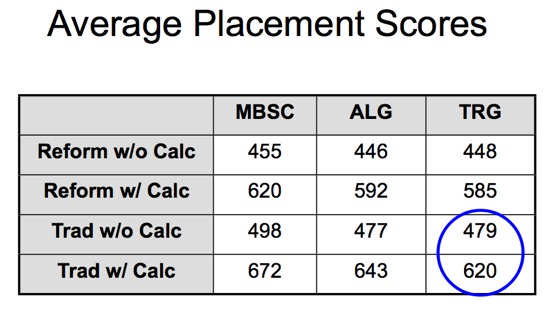
What impact do high school mathematics curricula have on college-level mathematics placement?

James Wollack & Michael Fish [280K PDF], via a kind reader’s email UW Center for Placement Testing [Link to Papers]:

Major Findings:

  • CORE-Plus students performed significantly less well on math placement test and ACT-M than did traditional students
  • Change in performance was observed immediately after switch
  • Score trends throughout CORE-Plus years actually decreased slightly – Inconsistent with a teacher learning-curve hypothesis
  • CORE-AP students fared much better, but not as well as the traditional – AP students – Both sample sizes were low


Related:

[280K PDF Complete Presentation]

Share

China’s boxed itself in
Its emphasis on math and science has certainly fueled its rapid economic growth, but its lack of creative thinking could rob it of an innovative edge.

Randy Pollock:

Which country — the United States or China — will make the 21st century its own?
When President Obama recently called for American young people “to be makers of things” and focus on subjects such as science and engineering, it was partly a nod to China’s rapid growth. Had he lived, taught and consulted in China for the last 33 months, as I have, he might have urged American students first to follow his example and study the liberal arts. Only technical knowledge complemented by well-honed critical and creative thinking skills can help us regain our innovative edge. China’s traditional lack of emphasis on teaching these skills could undermine its efforts to develop its own innovative economy.
I once challenged my Chinese MBA students to brainstorm “two-hour business plans.” I divided them into six groups, gave them detailed instructions and an example: a restaurant chain. The more original their idea, the better, I stressed — and we’d vote for a prize winner. The word “prize” energized the room. Laptops flew open. Fingers pounded. Voices roared. Packs of cookies were ripped open and shared. Not a single person text-messaged. I’d touched a nerve.
In the end, five of the six groups presented plans for, you guessed it, restaurant chains. The sixth proposed a catering service. Why risk a unique solution when the instructor has let it slip he likes the food business?

Share

Asia Seeks Its Own Brand of Business Schools

Moon Ihlwan:

Business major Lee Sun Kee is happy that he attended Korea University in Seoul. Lee, a senior, took four courses at the University of Pennsylvania’s Wharton School last fall as an exchange student and feels that his university in Korea offers business programs just as good as those at Ivy League schools. “At Wharton, I met talented students and a couple of star professors whose lectures were impressive,” says Lee. “But for other classes, I thought I could have learned better in Korea at one-tenth of Wharton’s tuition.”
Lee is one of a growing number of students appreciating a drastic makeover undertaken at business schools in Korea. Under a campaign to globalize curricula, faculty, and ways of thinking by students, top universities in the country have rebuilt their programs by modeling themselves largely on leading business schools in the U.S. “Globalization is our new mission,” says Jang Hasung, dean of Korea University Business School. While Korean multinationals like Samsung Electronics and Hyundai Motor have been expanding worldwide for years, Jang says his school long had focused too much on national issues and Korean perspectives.

Share

Winning the money game

Beth Kowitt:

The economic downturn has made financial aid an even more urgent concern for many families. Reporter Beth Kowitt talked with education financing expert Mark Kantrowitz, the founder of FinAid.org, about how the system works and how to get the most out of it.
Q: How is the recession affecting the availability of financial aid?
A: Colleges recognize that a time of economic distress is the worst time to be cutting student aid. On the other hand, there are many more people applying for aid – applications are up 20% this year. Schools are trying to protect their student aid budgets – they’ve been doing things like laying off faculty and freezing salaries to avoid cutting aid. Some schools that offer both merit- and need-based aid are reducing the academic scholarships and redirecting that money into need-based aid. And they are focusing on the families that need it most. If your 529 plan went down 40% last year, you’re probably not going to get an increase in financial aid, because everybody’s went down 40%. The schools are more likely to offer additional help to parents who lost a job.

Share

Milwaukee teachers reject longer day for more pay

Alan Borsuk:

The Milwaukee Public Schools teachers union has rejected a proposal that would lengthen the school day and pay teachers for the extra time with federal economic stimulus money, says Superintendent William Andrekopoulos.


The MPS chief said Thursday night that the union rejected adding 25 minutes to the school day for teaching math at all elementary and kindergarten-through-eighth grade schools. The union also rejected a proposal that would give all teachers six additional hours a month to work on improving programs in their schools. In both cases, teachers would have been paid for the additional time in line with their hourly rate of pay.


Tom Morgan, executive director of the Milwaukee Teachers Education Association, insisted Friday that there are better ways to improve education than lengthening the school day.


“We’ve taken a consistent view that doing the same thing longer is going to produce the same results,” said Morgan of the idea to add 25 minutes a day.


Speaking to School Board members at a budget meeting Thursday night, Andrekopoulos called the union decisions “unfortunate” and “disturbing.”


Earlier this week, MPS budget officials painted a picture for School Board members that is fast getting uglier when it comes to the $1.2 billion MPS budget and in which there is a dispute over how best to spend tens of millions of dollars in stimulus money.

Share

The Curse of the Class of 2009

Sara Murray:

The bad news for this spring’s college graduates is that they’re entering the toughest labor market in at least 25 years.
The worse news: Even those who land jobs will likely suffer lower wages for a decade or more compared to those lucky enough to graduate in better times, studies show.
Andrew Friedson graduated last year from the University of Maryland with a degree in government and politics and a stint as student-body president on his résumé. After working on Barack Obama’s presidential campaign for a few months, Mr. Friedson hoped to get a position in the new administration. When that didn’t pan out he looked for jobs on Capitol Hill. No luck there, either.
So now, instead of learning about policymaking and legislation, he’s earning about $1,250 a month as a high-school tutor and a part-time fundraiser for Hillel, a Jewish campus organization. To save money, he’s living with his parents.

Share

Boring Within or Simply Boring?

Rob Weir:

In the age of computer-based learning, lecturing gets treated like Model-T Ford. Don’t be deceived; lecturing remains a staple of the academy and it’s likely to remain so for quite some time. University class sizes have swelled in the wake of budget cuts that have delayed (or canceled) faculty searches. A recent study of eleven Ohio four-year colleges reveals that 25 percent of introductory classes have more than 120 students and only a shortage of teaching assistants has kept the percentage that low. At the University of Massachusetts, 12 percent of all classes have enrollments of over 50 and lectures of over 200 are quite common. As long as universities operate on the assembly-line model, lecturing will remain integral to the educational process.
But even if enormous class sizes aren’t the norm at your college, lecturing is still an art you should master. It doesn’t matter how technologically adroit one is or how many non-instructor-directed whistles and bells get crammed into a course, at some point every professor lectures, even if it’s just giving instructions or recapping a completed exercise. (I’ll address online classes in the future, but let’s just say that you’d be wise to incorporate lecture-like components into these as well.)
Lots of new professors harbor anxiety about lecturing, which is understandable, given that it shows up in most top-10 lists of American phobias. The ability to give an engaging lecture doesn’t come shrink-wrapped with your graduate diploma. Nor does it necessarily come with experience; some of the smartest and most seasoned professors I’ve ever encountered are horrible lecturers. That said, lecturing is so integral to successful college teaching that it’s a form of masochism and sadism to not become good at it.

Share

Five MBA students face up to the economic realities

The Economist:

Over the course of one week, Which MBA? followed the fortunes of five MBA students from Northwestern University’s Kellogg School of Management, graduating into one of the toughest jobs markets in memory.
Day one: Daianna
Last summer, The Economist called business schools “ports in a storm,” (see article) such was the surge in applications from prospective students seeking to ride out the recession. Almost a year on, students have seen an economy that looked bad when they first applied grow much, much worse. As the spring term comes to an end, rumour has it that nearly half of my fellow MBAs are still without summer internships or full-time offers. Fierce headwinds face us as we sail back out into the world.
Whatever the initial motives for enrolling, few go to business school without the belief that an MBA will put them on a fast-track to bigger and better things upon graduation. That’s certainly what I had in mind when I left my job, salary and friends to move to Chicago to pursue a two-year, full-time MBA at Kellogg. I wanted to expand my business skills at a top-ranked school in order to change from a career primarily at non-profit organisations to a more traditional role at a prominent company in the private sector.

Share

Our view paying for college: To stretch education dollars, cut out the middleman

USA Today Opinion:

Obama seeks student aid hike, falls short on cost control.
To look at higher education these days, it seems that no one cares about financially strapped students.
On the one hand, colleges have long been raising tuition at a rate faster than the cost of living. On the other, lenders have treated families’ increased borrowing needs as an invitation to easy profits.
To address this, President Obama wants to expand federal Pell Grants for low- and middle-income students. The expansion would be financed by ending the private, scandal-plagued Federal Family Education Loan Program and replacing it with direct government lending.
The obvious question is: Will all this actually make college more affordable? In the past, universities have driven up costs through lavish building, money-losing sports, swelling bureaucracies and a tolerance of professors who barely teach. Simply throwing more money at them isn’t going to prompt necessary belt-tightening.

Share

Writing in Trouble

For many years, Lucy Calkins, described once in Education Week as “the Moses of reading and writing in American education” has made her major contributions to the dumbing down of writing in our schools. She once wrote to me that: “I teach writing, I don’t get into content that much.” This dedication to contentless writing has spread, in part through her influence, into thousands and thousands of classrooms, where “personal” writing has been blended with images, photos, and emails to become one of the very most anti-academic and anti-intellectual elements of the education we now offer our children, K-12.
In 2004, the College Board’s National Commission on Writing in the Schools issued a call for more attention to writing in the schools, and it offered an example of the sort of high school writing “that shows how powerfully our students can express their emotions“:
“The time has come to fight back and we are. By supporting our leaders and each other, we are stronger than ever. We will never forget those who died, nor will we forgive those who took them from us.”
Or look at the National Assessment of Educational Progress (NAEP), the supposed gold standard for evaluating academic achievement in U.S. schools, as measured and reported by the National Center for Education Statistics. In its 2002 writing assessment, in which 77 percent of 12th graders scored “Basic” or “Below Basic,” NAEP scored the following student response “Excellent.” The prompt called for a brief review of a book worth preserving. In a discussion of Herman Hesse’s Demian, in which the main character grows up, the student wrote,
“High school is a wonderful time of self-discovery, where teens bond with several groups of friends, try different foods, fashions, classes and experiences, both good and bad. The end result in May of senior year is a mature and confident adult, ready to enter the next stage of life.”

(more…)

Share

LA teachers banned from class still getting paid

AP:

As the nation’s second-largest school district considers mass layoffs to deal with a budget deficit, it continues to pay about $10 million a year to about 160 instructors and others who are forbidden to enter a classroom.
The Los Angeles Unified School District employees earn salaries while misconduct complaints against them are reviewed.
Last month, the school board voted to lay off as many as 2,400 teachers and 2,000 other personnel to deal with a $596 million budget shortfall for the upcoming school year.
Matthew Kim, a special education teacher, was removed from Grant High School in Van Nuys in 2002 amid allegations that he improperly touched female students. The board voted to fire him in 2003 but he has challenged the decision in both administrative hearings and court.

Share

Holding College Chiefs to Their Words

Ellen Gamerman:

Reed College President Colin Diver suffered writer’s block. Debora Spar, president of Barnard College, wrote quickly but then toiled for hours to cut an essay that was twice as long as it was supposed to be. The assignment loomed over Wesleyan University President Michael Roth’s family vacation to Disney World.
The university presidents were struggling with a task that tortures high-school seniors around the country every year: writing the college admissions essay. In a particularly competitive year for college admissions, The Wall Street Journal turned the tables on the presidents of 10 top colleges and universities with an unusual assignment: answer an essay question from their own school’s application.
The “applicants” were told not to exceed 500 words (though most did), and to accept no help from public-relations people or speechwriters. Friends and family could advise but not rewrite. The Journal selected the question from each application so presidents wouldn’t pick the easy ones. They had about three weeks to write their essays.
The exercise showed just how challenging it is to write a college essay that stands out from the pack, yet doesn’t sound overly self-promotional or phony. Even some presidents say they grappled with the challenge and had second thoughts about the topics they chose. Several shared tips about writing a good essay: Stop trying to come up with the perfect topic, write about personally meaningful themes rather than flashy ones, and don’t force a subject to be dramatic when it isn’t.

Share

Jolly Madison: Why life is still good for business school students … in Wisconsin.

Daniel Gross:

Living and working in the New York region’s financial-media complex in 2009 means daily, compulsory attendance at a gathering of the glum. The economy may be shrinking at a 6 percent annual rate, but finance and media have contracted by about 30 percent. For the past year, the daily routine has meant sitting in a depopulated office (assuming you still have a job); following the latest grim news of magazine closings, buyouts, and layoffs; and commiserating with friends, family, and neighbors. And, of course, the angst extends far beyond directly affected companies. Finance dominates the area’s economy to such a degree that everybody–lawyers, accountants, real estate brokers, waiters, retailers, and cab drivers–have all been affected.
Of course, one can try to get away to sunnier, more mellow climes. But the usual havens aren’t offering much succor. Florida–like New York, except the catastrophe is real estate. Mexico? Um, not now. But last month, I found an unexpected haven: the Midwest. Each semester, the University of Wisconsin School of Business brings in a journalist-in-residence for a week, usually from New York. The theory: Students and professors benefit from the perspective of someone who is chronicling the workings of the world they are studying remotely.
But the benefit was greater for me than for the students. The four days in Madison functioned as a kind of detox. I left thinking the university should turn the Fluno Center for Executive Education into a sort of clinic. It could do for stressed-out financial and media types what Minneapolis’ Hazelden does for the drugged-out: offer a safe, friendly (if chilly) place to escape the toxic influence of New York.

Share

Five Money Lessons for New College Grads

Karen Blumenthal:

This spring’s college grads are heading out into a world where jobs are tough to come by. The economic outlook is uncertain and all the older people they know are feeling the pain of stock-market losses.
Worse, there are all kinds of nitty-gritty details to deal with: opening bank accounts, choosing health insurance, finding an apartment, lining up transportation and figuring out how to invest. How is a young person supposed to get ahead in this environment?
It’s not easy to master money management during the best times and it’s especially hard to navigate the challenges of a recession. Still, many of the same basic principles apply in good times and bad. And getting a taste of a downturn at the start may make current graduates smarter and more thoughtful than those who graduate during boom times.
Here are five broad financial lessons that can pay dividends for a lifetime:

Share

World-Class Knowledge
Annual Geography Bee Tests Students’ Grasp of the Globe

Maria Glod:

Politicians fret these days about how U.S. students stack up in math and science compared with peers in India, China, Singapore and elsewhere. Some of them wonder how many American children could find those countries on a globe. Such talk is driving an effort in Congress to ensure that students learn more about other countries and cultures.
Critics of the No Child Left Behind law, which requires annual math and reading tests in grades three through eight and once in high school, say it has pushed subjects including geography, history and art to the side.
Rep. Chris Van Hollen (D-Md.) and other lawmakers are trying to change that with a bill called the Teaching Geography is Fundamental Act. The legislation would provide funds for teacher training, research and development of instructional materials.
Van Hollen said he has been distressed by surveys showing that students in the United States have a poor grasp of geography. He said the bill has bipartisan support and 70 co-sponsors.

Share

Easy grades equate to failing grads

Heather Vogell:

Some metro Atlanta public high schools that don’t grade rigorously produce more graduates lacking the basic English and math skills needed for college, The Atlanta Journal-Constitution has found.
Many graduates of those high schools are sent to freshmen remedial classes to learn what high school didn’t teach them. As many as a third or more college-bound graduates from some high schools need the extra instruction.
Problems with classroom grading came to light in a February state study that showed some high schools regularly awarded good marks to students who failed state tests in the same subject.
The AJC found that metro high schools where classroom grading appeared lax or out-of-step with state standards tended to have higher rates of students who took remedial classes. And at dozens of high schools, most graduates who received the B average needed for a state HOPE scholarship lost it in college after a few years.
Unprepared high-school graduates are a growing problem for the public university system, where remedial students are concentrated in two-year colleges.
Statewide, the remedial rate has climbed to 1 in 4 first-year students after dropping in the 1990s, said Chancellor Erroll Davis Jr. of the University System of Georgia. The cost to the system: $25 million a year.
Students such as Brandon Curry, 20, a graduate of Redan High in DeKalb County, said they were surprised to learn decent high school grades don’t always translate into college success.

Georgia remedial class database – very useful.

Share

Arne Duncan’s Choice

Wall Street Journal Editorial:

Washington, D.C.’s school voucher program for low-income kids isn’t dead yet. But the Obama Administration seems awfully eager to expedite its demise.


About 1,700 kids currently receive $7,500 vouchers to attend private schools under the Opportunity Scholarship Program, and 99% of them are black or Hispanic. The program is a huge hit with parents — there are four applicants for every available scholarship — and the latest Department of Education evaluation showed significant academic gains.


Nevertheless, Congress voted in March to phase out the program after the 2009-10 school year unless it is reauthorized by Congress and the D.C. City Council. The Senate is scheduled to hold hearings on the program this month, and Senate Majority Leader Harry Reid has promised proponents floor time to make their case. So why is Education Secretary Arne Duncan proceeding as if the program’s demise is a fait accompli?


Mr. Duncan is not only preventing new scholarships from being awarded but also rescinding scholarship offers that were made to children admitted for next year. In effect, he wants to end a successful program before Congress has an opportunity to consider reauthorizing it. This is not what you’d expect from an education reformer, and several Democrats in Congress have written him to protest.

Share

10 Tips for Prepping for Final Exams

Lynn Jacobs & Jeremy Hyman:

Well, it’s just about showtime. Soon you will face that grueling week of finals on which the fate of this semester’s GPA rests. Sorry, we can’t make final’s week into a piece of cake. Only your professors can, and we wouldn’t be counting on it. But how well you prepare will, in no small measure, determine how well you’ll do. So here are our 10 best suggestions on how to prepare for those all-important final exams (together with a brief glance into the professor’s mind that will show you why the tips work):
1. Spend a week. Start studying for each exam a week before you are due to take it. This will give you time to divide the material into manageable portions that you can digest over a number of study sessions. This is especially important in the case of a cumulative final in a course with tons of material. Whatever you do, don’t try to swallow the whole elephant–the whole course, we mean–in one cram session. (Works because, in most courses, the prof is expecting you to have processed and digested the material–something you can’t do in one fell swoop).

Share

Muscular Mediocrity

It is excusable for people to think of Mediocrity as too little of something, or a weak approximation of what would be best, and this is not entirely wrong. However, in education circles, it is important to remember, Mediocrity is the Strong Force, as the physicists would say, not the Weak Force.
For most of the 20th century, as Diane Ravitch reports in her excellent history, Left Back, Americans achieved remarkably high levels of Mediocrity in education, making sure that our students do not know too much and cannot read and write very well, so that even of those who have gone on to college, between 50% and 75% never received any sort of degree.
In the 21st century, there is a new push to offer global awareness, critical thinking, and collaborative problem solving to our students, as a way of getting them away from reading nonfiction books and writing any sort of serious research paper, and that effort, so similar to several of the recurring anti-academic and anti-intellectual programs of the prior century, will also help to preserve the Mediocrity we have so painstakingly forged in our schools.
Research generally has discovered that while Americans acknowledge there may be Mediocrity in our education generally, they feel that their own children’s schools are good. It should be understood that this is in part the result of a very systematic and deliberate campaign of disinformation by educrats. When I was teaching in the high school in Concord, Massachusetts, the superintendent at the time met with the teachers at the start of the year and told us that we were the best high school faculty in the country. That sounds nice, but what evidence did he have? Was there a study of the quality of high school faculties around the country? No, it was just public relations.
The “Lake Woebegone” effect, so widely found in our education system, is the result of parents continually being “informed” that their schools are the best in the country. I remember meeting with an old friend in Tucson once, who informed that “Tucson High School is one of the ten best in the country.” How did she know that? What was the evidence for that claim at the time? None.
Mediocrity and its adherents have really done a first-class job of leading people to believe that all is well with our high schools. After all, when parents ask their own children about their high school, the students usually say they like it, meaning, in most cases, that they enjoy being with their friends there, and are not too bothered by a demanding academic curriculum.
With No Child Left Behind, there has been a large effort to discover and report information about the actual academic performance of students in our schools, but the defenders of Mediocrity have been as active, and almost as successful, as they have ever been in preserving a false image of the academic quality of our schools. They have established state standards that, except in Massachusetts and a couple of other states, are designed to show that all the students are “above the national average” in reading and math, even though they are not.
It is important for anyone serious about raising academic standards in our schools to remember that Mediocrity is the Hundred-Eyed Argus who never sleeps, and never relaxes its relentless diligence in opposition to academic quality for our schools and educational achievement for our students.
There is a long list of outside helpers, from Walter Annenberg to the Gates Foundation, who have ventured into American education with the idea that it makes sense that educators would support higher standards and better education for our students. Certainly that is what they hear from educators. But when the money is allocated and the “reform” is begun, the Mediocrity Special Forces move into action, making sure that very little happens, and that the money, even billions of dollars, disappears into the Great Lake of Mediocrity with barely a ripple, so that no good effect is ever seen.
If this seems unduly pessimistic, notice that a recent survey of college professors conducted by the Chronicle of Higher Education found that 90% of them reported that the students who came to them were not very well prepared, for example, in reading, doing research, and writing, and that the Diploma to Nowhere report from the Strong American Schools program last summer said that more than 1,000,000 of our high school graduates are now placed in remedial courses when they arrive at the colleges to which they have been “admitted.” It seems clear that without Muscular Mediocrity in our schools, we could never have hoped to achieve such a shameful set of academic results.
“Teach by Example”
Will Fitzhugh [founder]
Consortium for Varsity Academics® [2007]
The Concord Review [1987]
Ralph Waldo Emerson Prizes [1995]
National Writing Board [1998]
TCR Institute [2002]
730 Boston Post Road, Suite 24
Sudbury, Massachusetts 01776 USA
978-443-0022; 800-331-5007
www.tcr.org; fitzhugh@tcr.org
Varsity Academics®

Share

Failure Gets a Pass: Firing tenured teachers can be a costly and tortuous task

Jason Song:

A Times investigation finds the process so arduous that many principals don’t even try, except in the very worst cases. Jettisoning a teacher solely because he or she can’t teach is rare.
The eighth-grade boy held out his wrists for teacher Carlos Polanco to see.
He had just explained to Polanco and his history classmates at Virgil Middle School in Koreatown why he had been absent: He had been in the hospital after an attempt at suicide.
Polanco looked at the cuts and said they “were weak,” according to witness accounts in documents filed with the state. “Carve deeper next time,” he was said to have told the boy.
“Look,” Polanco allegedly said, “you can’t even kill yourself.”
The boy’s classmates joined in, with one advising how to cut a main artery, according to the witnesses.

Share

California High school students weigh in on Prop. 1A

San Francisco Chronicle:

The nonpartisan California Budget Challenge is a free online educational tool from the public-policy group Next 10 that lets users try to balance California’s books and see how their choices would affect the state five years into the future.
Users set their own priorities and make tough decisions about what is best for the people of the state. This allows everyday people the chance to consider the effects of important policy choices. This year, Next 10 is taking the challenge on the road, visiting classrooms and diverse communities throughout the state. Staff members teach audiences about the workings of California’s finances and give them a flavor for what it takes to balance the state’s budget. Here are reactions to Proposition 1A from six Bay Area high school students:

Share

Boise State professors live alongside students

Jessie Bonner:

On the west end of the Boise State University campus, Professor Michael Humphrey lives on the third floor of a residence hall with his wife, 2-year-old daughter, their Labrador retriever Booba – and nearly 30 college students.
Humphrey, a 35-year-old with a doctorate in special education, has lived at the university for the past year as part of a campus housing program created in 2004 to help retain students and enhance their college experience.
The basic premise: If students feel as if they belong, they’ll be more likely to stick around.
Nationwide, about 200 colleges have developed more than 600 living-learning residential programs in an attempt to further engage students outside the classroom and allow them to live on campus with others who have similar interests. In some cases, faculty and academic advisers have offices in the same residence hall.
But an analysis of these programs in 2007 found only 7 percent in the United States integrate faculty into the living arrangements, said Karen Kurotsuchi Inkelas, principal investigator for the National Study of Living-Learning Programs at the Center for Student Studies in Ann Arbor, Mich.

Share

Despite Dangers, Afghan Girls Determined To Learn

Soraya Sarhaddi Nelson:

Public education is among the many casualties of the growing war in Afghanistan, and the threat of violence is especially acute for Afghan girls. Parents, who in the past did not allow their daughters to go to school because of societal taboos, are once again keeping them at home because of the threat of attacks by militants wielding acid or worse.
But many girls are refusing to give up their schooling — no matter what the cost.
The Afghan government, aid groups and defiant teachers are operating public schools as well as secret, in-home classes in a risky effort to ensure that Afghan girls get an education.
Nearly half of the country’s children do not attend classes, most of them in the Taliban-rife south, says Afghanistan’s education minister, Farouq Wardak. Hundreds of schools have closed in Kandahar and neighboring provinces because of militant attacks and threats.

Share

Putting Students on the Same High-Performance Page

Lydia Gensheimer:

What happens when you have a law that’s supposed to improve performance among the nation’s school children but instead it creates confusion, lowers expectations and can result in a “dummying down” of state standards?
That’s what a panel of educational experts is trying to address with a plan to incorporate common academic standards. They are urging Congress to support a state-led initiative to develop more-uniform, clear and integrated standards that reflect both the global marketplace and Americans’ mobility within the country.
Under the 2002 No Child Left Behind law (PL 107-110), states set their own standards — resulting in what Education Secretary Arne Duncan calls a “dummying down” of state standards in order to meet benchmarks set by the law.
Those who advocate for common standards contend that a system of variable expectations — ones that are often too low — leads American students to underperform when compared with their peers in Finland or China. President Obama called for common standards in a March 10 speech, and Duncan has said he would use a portion of a $5 billion “Race to the Top” fund under his discretion to reward states working toward that goal.
The panel — which included Randi Weingarten, president of the American Federation of Teachers; former North Carolina Gov. James B. Hunt Jr.; and Dave Levin, founder of the KIPP charter schools — testified April 29 at a House Education and Labor Committee hearing.

Share

Inside the Box

Teachers, students, employees, employers, everyone these days, it seems, is being exhorted to think, act, imagine and perform “Outside the Box.”
However, for students, there is still quite a bit that may be found Inside the Box for them to learn and get good at before they wander off into OutBoxLand.
Inside the Box there still await grammar, the multiplication tables, the periodic table, Boyle’s Law, the Glorious Revolution, the Federalist Papers, Shakespeare, Isaac Newton, Bach, Mozart, Giovanni Bellini, recombinant DNA, Albrecht Durer, Edward Gibbon, Jan van Eyck, and a few other matters worth their attention.
Before the Mission Control people in Houston could solve the unique, immediate, and potentially fatal “Out of the Box” problems with the recovery of Apollo 13 and its crew, they had to draw heavily on their own InBox training and knowledge of mechanics, gases, temperatures, pressures, azimuth, velocity and lots of other math, science, and engineering stuff they had studied before. They may have been educated sitting in rows, and been seen in the halls at Mission Control wearing plastic pocket protectors, but in a very short time in that emergency they came up with novel solutions to several difficult and unexpected problems in saving that crew.
It seems clear to me that a group of ignorant but freethinking folks given that same set of novel tasks would either have had to watch Apollo 13 veer off into fatal space or crash into our planet with a dead crew on board, in a creative way, of course.
Many situations are less dramatic demonstrations of the clear necessity of lots of InBox education as preparation for any creative endeavor, but even high school students facing their first complete nonfiction book and a first history research paper when they arrive in college would have been much better off if they had been assigned a couple of complete nonfiction books and research papers before they left high school.
Basketball coach John Wooden of UCLA was of course happy with players who could adapt to unexpected defenses on the court during games, but according to Bill Walton, when he met with a set of new freshmen trying to make his team, the first thing he taught them was how to put on their socks…Perhaps some of his (and their) success came because he was not above going back into the Old Box to lay the groundwork for the winning fundamentals in college basketball.
Many teachers and edupundits decry the insufficiency of novelty, creativity and freethinking-out-of-the-box in our schools, but I have to wonder how many have realized the overriding importance of the education equivalent of having students put on their socks the right way?
Basic knowledge in history, English, physics, Latin, biology, math, and so on is essential for students in school before they can do much more than fool around with genuine and useful creativity in those fields.
True, they can write about themselves creatively, but if the teacher has read Marcel Proust, and would share a bit of his writing with the students, they might come to see that there is creativity in writing about oneself and there is also fooling around in writing about oneself.
Samuel Johnson once pointed out that: “The irregular combinations of fanciful invention may delight a-while, by that novelty of which the common satiety of life sends us all in quest, but the pleasures of sudden wonder are soon exhausted…”
The pleasures of foolish playacting Outside of the Box of knowledge and skill by students (and their teachers: witness the damage shown in Dead Poets Society) may delight them for a time because they are tired of the hard work involved in learning and thinking about new knowledge in school, but the more they indulge and are indulged in it, the lower our educational standards will be, and the worse the education provided students in our schools.
Novelty and innovation have their place and there they are sorely needed, but the quality of that innovation depends, to a great extent, on the quality of the knowledge and skill acquired while students were still working hard Back in the Box.
www.tcr.org

Share

Genius: The Modern View

David Brooks:

Some people live in romantic ages. They tend to believe that genius is the product of a divine spark. They believe that there have been, throughout the ages, certain paragons of greatness — Dante, Mozart, Einstein — whose talents far exceeded normal comprehension, who had an other-worldly access to transcendent truth, and who are best approached with reverential awe.
We, of course, live in a scientific age, and modern research pierces hocus-pocus. In the view that is now dominant, even Mozart’s early abilities were not the product of some innate spiritual gift. His early compositions were nothing special. They were pastiches of other people’s work. Mozart was a good musician at an early age, but he would not stand out among today’s top child-performers.
What Mozart had, we now believe, was the same thing Tiger Woods had — the ability to focus for long periods of time and a father intent on improving his skills. Mozart played a lot of piano at a very young age, so he got his 10,000 hours of practice in early and then he built from there.

Share

The Outlier Finds His Element

Nancy Duarte:

I read Outliers and The Element back to back last week.
Net-net is that people aren’t successful from passion alone, usually there are other factors or “flukes” that lead to them living in their element. You may have heard successful people say that what made them great is that they were at the right place at the right time. There is some truth to that but they also had enormous passion, put in many hours and were in their “element”.
In Outliers, Malcolm Gladwell contends that passion alone doesn’t equate success; the environment, innovation and generational culture shape our success. Below is an Outlier story of my own.
I have two kids. When Rachel started school, she was like a fish to water. She started kindergarten in an accelerated classroom, worked very hard, loved school and recently finished her teaching credential for the sciences. She’s planning to spend her adult life in the classroom teaching.
Anthony on the other hand didn’t like school enough to even pull his completed homework out of his backpack. In middle school he was a strong D-student,and an exceptional pianist. We contacted the school to see if he could remove Orchestra and PE classes from his schedule so he could devote 4 to 6 hours towards piano practice, they said they’d check with the School District because they “do that kind of thing for athletes”. They said, ” No,” so I pulled him out of public school that very day.

Share

AP More Open, But Not Dumbed Down

Jay Matthews:

More than a decade ago, when I began investigating the odd uses of Advanced Placement courses and tests in our high schools, I tried to find out why AP participation was so much lower than I expected in my neighborhood public school, Walt Whitman High of Bethesda. At least one high school in neighboring D.C., and many more in suburban Maryland, had higher participation rates than Whitman, even though it was often called the best school in the state.


That is how I stumbled on what I call the Mt. Olympus syndrome. There were, I discovered from talking to students, a few AP teachers at that school who didn’t want to deal with average students. One of them actively discouraged juniors who were getting less than an A in a prerequisite course from taking his AP course when they were seniors. He only wanted students who were going to get a 5, the equivalent of an A on the three-hour college-level AP exam, where a score of 3 and above could earn college credit. That test, like all AP exams, was written and graded by outside experts, mostly high school and college instructors. The only way that teacher thought he could control the number of 5s was to make sure only top quality students–the academic gods of the Whitman High pantheon–were allowed into his course.

Related: Growing Pains in the Advanced Placement Program: Do Tough Tradeoffs Lie Ahead?

Share

Kindergarten Waiting Lists Put Manhattan Parents on Edge

Elissa Gootman:

As a growing collection of Manhattan’s most celebrated public elementary schools notify neighborhood parents that their children have been placed on waiting lists for kindergarten slots, middle-class vitriol against the school system — and Mayor Michael R. Bloomberg — is mounting.
Parents are venting their frustrations in e-mail messages and phone calls to the mayor, local politicians and the schools chancellor, Joel I. Klein (“You have unleashed the fury of parents throughout this city with your complete lack of preparedness,” read one father’s recent missive, which he shared with The New York Times). Some are planning a rally on the steps of City Hall for next Wednesday afternoon (“Kindergartners Are Not Refugees!” proclaims a flier), and some are taking it upon themselves to scour the city for potential classroom space.
The outpouring of anger comes as state lawmakers consider whether to renew mayoral control of the city school system, which expires at the end of June, and Mr. Bloomberg is seeking a third term in part on his education record.

Share

Primary schoolchildren will learn to read on Google in ‘slimmer’ curriculum

Graeme Paton:

Computing skills will be put on an equal footing with literacy and numeracy in an overhaul of primary education that aims to slim down the curriculum – but not lose the basics.

Children will be taught to read using internet search engines such as Google and Yahoo in the first few years of school, it is announced.


Pupils in English primary schools will learn to write with keyboards, use spellcheckers and insert internet “hyperlinks” into text before their 11th birthday under the most significant reform of timetables since the National Curriculum was introduced in 1988.


The review by Sir Jim Rose, former head of inspections at Ofsted, also recommends the use of Google Earth in geography lessons, spreadsheets to calculate budgets in maths, online archives to research local history and video conferencing software for joint language lessons with schools overseas.


Sir Jim insisted the changes would not replace come at the expense of traditional teaching, saying: “We cannot sidestep the basics”.


He told BBC Radio 4’s Today programme: “We’ve let the curriculum become too fat. We need to give teachers the opportunity to be more flexible.”


His report, which will be accepted in full by ministers, also proposes more IT training for teachers to keep them ahead of “computer savvy pupils”.

John Sutherland has more.


Google (and other search engine) users should be aware of the many privacy issues associated with these services. Willem Buiter:

Google is to privacy and respect for intellectual property rights what the Taliban are to women’s rights and civil liberties: a daunting threat that must be fought relentlessly by all those who value privacy and the right to exercise, within the limits of the law, control over the uses made by others of their intellectual property. The internet search engine company should be regulated rigorously, defanged and if necessary, broken up or put out of business. It would not be missed.


In a nutshell, Google promotes copyright theft and voyeurism and lays the foundations for corporate or even official Big Brotherism.


Google, with about 50 per cent of the global internet search market, is the latest in a distinguished line of IT abusive monopolists. The first was IBM, which was brought to heel partly by a forty-year long antitrust regulation (which ended in 1996) and partly by the rise of Microsoft.

We must also keep in mind the excesses of Powerpoint in the classroom.

Related: Democracy Now on a Google Anti-Trust investigation.

Share

All-Athletics

The Boston Globe has been publishing for 137 years, and the news that it may have to fold has distressed its many readers. Each Fall, Winter and Spring the paper publishes a special section, of 14 pages or so, on notable local public high school athletes and their coaches. There is a mention of athletes and coaches at local prep schools as well.
The latest Boston Globe’s Winter “ALL-SCHOLASTICS” section arrived, with the “ten moments that stood out among the countless athletic stories in Massachusetts.” There are reports on the best athletes and coaches in Skiing, Boys’ Basketball, Girls’ Basketball, Boys’ Hockey, Girls’ Hockey, Boys’ Track, Girls’ Track, Boys’ Swimming, Girls’ Swimming, Preps, Wrestling, and Gymnastics. The Preps and Gymnastics parts consolidate boys’ and girls’ accomplishments, perhaps to save space (and cost).
Each full-page section also features photographs of 9-16 athletes, with perhaps a twitter-sized paragraph on their achievements. In addition, there are 30 photos and tweets about some coaches, spread among the various sports. There are 26 “Prep” athletes mentioned, from various sports, but I didn’t see any “Prep” coaches profiled. For each high school sport there are two “athletes of the year” identified, and all the coaches are “coaches of the year” in their sport.
There may be, at this time, some high school “students of the year” in English, math, Chinese, physics, Latin, chemistry, European history, U.S. history, biology, and the like. There may also be high school “teachers of the year” in these and other academic subjects, but their names and descriptions are not to be found in The Boston Globe, perhaps the most well-known paper in the “Athens of America” (Boston).
It may be the case, indeed it probably is the case, that some of the athletes featured in the Winter “All-Scholastics” section today are also high school students of math, history, English, science, and languages, but you would not know that from the coverage of The Boston Globe. The coaches of the year may in many, if not all, cases, also be teachers of academic subjects in the Massachusetts public and private schools, but that remains only a guess as well.
When the British architect Christopher Wren was buried in 1723, part of his epitaph, written by his eldest son, Christopher Wren, Jr., read: “Lector, si monumentum requiris, Circumspice.” If you wanted to judge his interest, efforts and accomplishments, all you had to do was look around you. His work was there for all to see.
The work of Massachusetts high school athletes and coaches is all around us in The Boston Globe on a regular basis, but the work of our high school scholars and teachers is nowhere to be seen in that public record.
If one seeks a monument to anti-academic and anti-intellectual views and practices in Boston today, one need look no further than The Boston Globe. I read it every day, and I will be sorry to see it fold, if it does, but I will not miss its attention to and recognition of the academic efforts and accomplishments of Massachusetts secondary students and their teachers, because there is none now, and never has been any, no matter how many reports on education reform and academic standards it may have published over the years. If you ask how much The Boston Globe editors (and I am sure The Globe is not alone in this) cares about the good academic work now actually being done by high school teachers and their students in Massachusetts, the answer is, from the evidence, that they do not.

Share

Growing Pains in the Advanced Placement Program: Do Tough Trade-Offs Lie Ahead?

Ann Duffett & Steve Farkas:


In 2002-2003, 1 million students participated in AP by taking at least one exam. Five years later, nearly 1.6 million did—a 50+ percent increase. But is growth all good? Might there be a downside? Are ill prepared students eroding the quality of the program? Perhaps harming the best and brightest? To find out, the Thomas B. Fordham Institute commissioned the Farkas Duffett Research Group to survey AP teachers in public high schools across the country. Perhaps not surprisingly, the AP program remains very popular with its teachers. But there are signs that the move toward “open door” access to AP is starting to cause concern. Read the report to learn more.

Jacques Steinberg:

A survey of more than 1,000 teachers of Advanced Placement courses in American high schools has found that more than half are concerned that the program’s effectiveness is being threatened as districts loosen restrictions on who can take such rigorous courses and as students flock to them to polish their résumés.

The study, by the Thomas B. Fordham Institute, an educational research and advocacy organization, noted the sharp growth in the A.P. program’s popularity. The number of high school students who took at least one college-level A.P. course increased by 45 percent, to 1.6 million from 1.1 million, from the school year ended 2004 to that ended 2008.

The number of A.P. exams those students took — with hopes, in part, of gaining exemption from some college class work, depending on how well they scored — increased by 50 percent, to 2.7 million.>Dane County, WI High School AP course offering comparison.

Share

Rejection: Some Colleges Do It Better Than Others

Sue Sehllenbarger:

Members of this year’s record-size high-school graduating class applied to more colleges than ever — and now, that’s resulting in a heavier than usual flurry of rejection letters.
Hundreds of students at high schools from Newton, Mass., to Palo Alto, Calif., have created cathartic “Wall of Shame” or “Rejection Wall” displays of college denial letters. On message boards at CollegeConfidential.com, students critique, attack and praise missives from various schools, elevating rejection-letter reviews to a sideline sport.
Even with impressive test scores and grades, abundant extracurricular activities, good recommendations and an admission essay into which “I poured myself heart and soul,” Daniel Beresford, 18, of Fair Oaks, Calif., netted 14 rejection letters from 17 applications, he says. Among the denials: Harvard, Yale, Johns Hopkins and the University of Chicago. (He’s bound for one of his top choices, Pepperdine University.) When he “realized it was going to be so much harder this year,” he started calling in reinforcements, asking teachers and friends to open the rejections for him.

Share

2009 USA Today College All-Stars

Mary Beth Marklein:

The nation’s most gifted college students rightly take pride in their academic achievements, be they in the area of environmental policy, medical research or the classics.
But give them the chance to talk about their proudest accomplishments, and a refreshingly eclectic set of extracurricular interests and talents slips into view.
Matthew Baum, a soon-to-be Yale University graduate whose research on Fragile X Syndrome may someday lead to better treatments for mental retardation, is a wrestler on the side and started a club for beer aficionados. Harvard chemistry major Allen Cheng, 20, who envisions a career as a physician-scientist, finds pleasure in kendo, a form of fencing based on the art of Japanese samurai swordsmanship. And when Aaron Krolikowski is not advocating for environmental justice, he just might be on stage with the Buffalo Chips, a collegiate male a cappella group.
“Music has always been an important part of who I am,” says Krolikowski, 22, who will graduate next month from the University at Buffalo and hopes to serve someday in state public office. Writing and arranging music is an escape, he says, and performing is “exhilarating.”

Share

Colleges offer no-frills degrees

Stacy Teicher Khadaroo:

Kaileen Crane was hardly interested in the hefty price tag that comes with the traditional college experience. So she’s paying $10,000 a year for the Advantage Program offered by Southern New Hampshire University (SNHU), a private college.
Forget about campus housing. Or a meal plan, or a gym with a climbing wall. This program is about the basics – core courses at a bare-bones satellite campus. But the price is less than one-third of what it costs for tuition and room and board at the main campus in Manchester.
“It’s close to where I live, it’s close to where I work, and the cost is just so much cheaper than a lot of other places,” says Ms. Crane during a break from classes in an office building in Salem.

Share

Selling Obesity At School

NY Times Editorial:

The federal school lunch program, which subsidizes meals for 30 million low-income children, was created more than half a century ago to combat malnutrition. A breakfast program was added during the 1960s, and both were retooled a decade ago in an attempt to improve the nutritional value of food served at school.
More must now be done to fight the childhood obesity epidemic, which has triggered a frightening spike in weight-related disorders like diabetes, high-blood pressure and heart disease among young people. And the place to start is the schools, where junk foods sold outside the federal meals programs — through snack bars, vending machines and à la carte food lines — has pretty much canceled out the benefits of all those healthy lunches and breakfasts.

Share

China Faces a Grad Glut After Boom at Colleges

Ian Johnson:

Zhang Weidong has been making the rounds at this city’s weekend talent fair for more than a month now and can’t understand why he hasn’t landed a job.
“These companies are looking for employees, and I have a degree,” says the 22-year-old computer major, clutching a plastic organizer stuffed with résumés, business cards and company information. “I don’t know what I’m doing wrong.”
Unemployed university graduates used to be rare in China. But now their ranks are ballooning to critical levels just as the country suffers its worst economic slump in two decades. Up to one-third of last year’s 5.6 million university graduates are still looking for work, and this year will see another 6.1 million hit the labor market. Finding jobs for graduates is suddenly a national priority: Earlier this month, the central government ordered local governments and state enterprises to hire more graduates to maintain China’s “general stability.”

Share

Are ‘No-Fail’ Grading Systems Hurting or Helping Students?

Joshua Rhett Miller via a kind reader’s email:

What’s a kid gotta do to get an “F” these days?
At a growing number of middle schools and high schools across the country, students no longer receive failing marks when they fail. Instead, they get an “H” — for “held” — on their report cards, and they’re given a chance to rectify their poor performance without tanking the entire semester.
Educators in schools from Costa Mesa, Calif., to Maynard, Mass., are also employing a policy known in school hallways as ZAP — or “Zeros Aren’t Permitted” — which gives students an opportunity to finish the homework they neglected to do on time.
While administrators and teachers say the policies provide hope for underperforming students, critics say that lowering or altering education standards is not the answer. They point to case studies in Grand Rapids, Mich., where public high schools are using the “H” grading system this year and, according to reports, only 16 percent of first-semester “H” grades became passing grades in the second semester.
Click here to see schools that implement some type of no-fail policy.

Much more on “standards based report cards“, here.

Share

Raising Bill Gates

Robert Guth:

In interviews with The Wall Street Journal, Bill Gates Sr., Bill Gates and their family shared many details of the family’s story for the first time, including Bill Gates Jr.’s experience in counseling and how his early interest in computers came about partly as a result of a family crisis. The sometimes colliding forces of discipline and freedom within the clan shaped the entrepreneur’s character.
The relationship between father and son entered a new phase when the software mogul began working full-time seven months ago at the Gates Foundation. For the past 13 years, the father has been the sole Gates family member with a daily presence at the foundation, starting it from the basement of his home and minding it while his son finished up his final decade running Microsoft. They now work directly together for the first time.
At six-foot-six, Bill Gates Sr. is nearly a full head taller than his son. He’s known to be more social than the younger Bill Gates, but they share a sharp intellect and a bluntness that can come across to some as curt. He isn’t prone to introspection and he plays down his role in his son’s life.
“As a father, I never imagined that the argumentative, young boy who grew up in my house, eating my food and using my name would be my future employer,” Mr. Gates Sr. told a group of nonprofit leaders in a 2005 speech. “But that’s what happened.”

Share

He Wants Subjects, Verbs and Objects

Adam Bryant:

Q. What are you listening for as somebody describes their family, where they’re from, etc.?
A. You’re looking for a really strong set of values. You’re looking for a really good work ethic. Really good communication skills. More and more, the ability to speak well and write is important. You know, writing is not something that is taught as strongly as it should be in the educational curriculum. So you’re looking for communication skills.
You’re looking for adaptability to change. You’re looking at, do you get along well with people? And are you the sort of person that can be a part of a team and motivate people? You know, do you have the emotional I.Q.?
It’s not just enough to be able to just do a nice PowerPoint presentation. You’ve got to have the ability to pick people. You’ve got to have the ability to communicate. When you find really capable people, it’s amazing how they proliferate capable people all through your organization. So that’s what you’re hunting for.

Share

Why do professional paths to the top vary so much?

The Economist:

WHEN Barack Obama met Hu Jintao, his Chinese counterpart, at the G20 summit in London, it was an encounter not just between two presidents, but also between two professions and mindsets. A lawyer, trained to argue from first principles and haggle over words, was speaking to an engineer, who knew how to build physical structures and keep them intact.
The prevalence of lawyers in America’s ruling elite (spotted by a Frenchman, Alexis de Tocqueville, in the 1830s) is stronger than ever. Mr Obama went to Harvard Law School (1988-91); his cabinet contains Hillary Clinton (Yale Law, 1969-73) as secretary of state, Eric Holder (Columbia Law, 1973-76) as attorney-general, Joe Biden (Syracuse University law school, 1965-68) as vice-president and Leon Panetta (Santa Clara University law school, 1960-63) as director of the CIA. That’s the tip of the iceberg. Over half of America’s senators practised law. Mr Obama’s inner circle is sprinkled with classmates from Harvard Law: the dean of that school, Elena Kagan, is solicitor-general; Cass Sunstein, a professor there, is also in the administration.
President Hu, in contrast, is a hydraulic engineer (he worked for a state hydropower company). His predecessor, Jiang Zemin, was an electrical engineer, who trained in Moscow at the Stalin Automobile Works. The prime minister, Wen Jiabao, specialised in geological engineering. The senior body of China’s Communist Party is the Politburo’s standing committee. Making up its nine members are eight engineers, and one lawyer. This is not a relic of the past: 2007 saw the appointments of one petroleum and two chemical engineers. The last American president to train as an engineer was Herbert Hoover.

Share

Madison School District Strategic Planning Update


The Madison School District’s Strategic Planning Group met this past week. Several documents were handed out, including:

This recent meeting was once again facilitated by Dr. Keith Marty, Superintendent of the Menomonee Falls school district. Non-MMSD attendance was somewhat lower than the initial 2.5 day session.

Share

The Grammar Cheat Sheet

Alexander Charchar:

When you know the correct way to structure a sentence, the world becomes a scary place – you start to notice how many people get it painfully wrong. The ease of content creation that the web now affords us is making the problem worse, so why not get a basic understanding to help make your text a little more professional?
Before we get into this, let’s establish two things.
1. A lot of these ‘rules’ are different country to country, decade to decade.
The way a proof reader or typesetter might lay out a page in Britain is different to how it might be done in America. How it’s done in 1985 is different than how it might be done in 2005. The styles of typesetting can change over time and throughout different regions.
2. Always be consistent, even if it might not be ‘correct’.

Share

Recession gives ‘take your child to work day’ new tenor this year

Joel Dresang:

Thursday may have been “take your child to work” day, but Paul Holley couldn’t do that. He lost his job in December.
So Holley and fellow job seekers Andy Krumrai and Dotty Posto instead took their daughters along to the Barnes & Noble Café, where they meet each week with other unemployed professionals to encourage and advise one another as they look for new jobs.
It’s a new twist on the annual Take Our Daughters and Sons to Work Day, which aims to expose young people to careers and help them make connections between the classroom and the workplace.
Since last year’s event, 4.5 million more Americans are out of work, according to the latest government numbers.
The scene at the café Thursday – amid Starbucks coffee, cappuccinos and cocoa – was a reminder that unemployment also rattles children.
Clare Posto, 9, said three or four of her friends have parents out of work; one is worried about the parents’ marriage. Clare’s mom, an organizational development manager who left Harley-Davidson as part of a downsizing in February, recently expanded her job search nationwide.
“I don’t really want to move, because I have a lot of friends here,” Clare said.

Share

A Textbook Case of Renting Books

Peter King:

Oh, those text charges. No, not the fees for pecking out text messages on a cellphone, but the cost of every college student’s must-buy: textbooks.
Students spend about $1,000 a year on their texts, according to the College Board. And that most likely will increase: Over the past 20 years, textbook prices have increased at twice the inflation rate, according to the U.S. Government Accountability Office. One solution may be renting. Several companies offer textbook rentals that could save cash-poor college students more than 50% of the cost of a book.
To see how the process works, we ordered textbooks from three rental companies: Book Renter, Campus Book Rentals and Chegg; and one textbook seller, Textbooks.com, which doesn’t rent books, but offers guaranteed buybacks on some texts, making those books a quasi-rental.

Share

Do Good Looks Get High School Students Good Grades?

Science Daily:

Do personal traits predict success in school? If so, which dimension of one’s outward appearance can tell the most about academic achievement?
The answers to these questions are found in a new study by researchers from the University of Miami Health Economics Research Group. The study is the first to demonstrate that non-cognitive traits play an important role in the assignment of grades in high school.
Economists have examined the role that beauty plays on the type of employment, earnings, productivity and the likelihood of politicians being elected to office, and have wondered if “beauty premiums” and “plainness penalties” in the labor market come from an accumulation of differences in attention and rewards received from teachers throughout the school years. Findings from this peer-reviewed study titled: “Effects of Physical Attractiveness, Personality and Grooming on Academic Performance in High School” will be published in the next issue of Labour Economics.

Clusty search.

Share

Don’t boycott school lunch, district tells Nuestro Mundo

Mary Ellen Gabriel:

A group of fourth-graders at Nuestro Mundo Elementary School had planned to remain in their classroom through lunch and recess Friday, enjoying a meal of fresh fruit, vegetables and homemade pasta at cloth-covered tables with flower centerpieces.


The group from Joshua Forehand’s class, which calls itself BCSL (“Boycott School Lunch”) formed to protest what they see as unhealthy food offered in the school’s cafeteria, but they scrapped their plan to host a “Good Real Food” picnic after Assistant Superintendent Sue Abplanalp called school administrators and parents to discourage it.


“There were too many obstacles,” Abplanalp said in an interview, citing the possibility of allergy-causing ingredients in shared homemade food, lack of adequate supervision, and the presence of the news media as major concerns.


“We want students’ voices to be heard. This just seemed to come together too fast, without various issues being addressed.”


When asked if the district feared negative publicity, Abplanalp said no. Instead she cited student privacy as a major concern.


“We have strict guidelines about the media interviewing students on school grounds. The principal maintains a list of kids whose parents have given permission for media exposure.”

Share

Brain Gain: The underground world of “neuroenhancing” drugs.

Margaret Talbot:

young man I’ll call Alex recently graduated from Harvard. As a history major, Alex wrote about a dozen papers a semester. He also ran a student organization, for which he often worked more than forty hours a week; when he wasn’t on the job, he had classes. Weeknights were devoted to all the schoolwork that he couldn’t finish during the day, and weekend nights were spent drinking with friends and going to dance parties. “Trite as it sounds,” he told me, it seemed important to “maybe appreciate my own youth.” Since, in essence, this life was impossible, Alex began taking Adderall to make it possible.
Adderall, a stimulant composed of mixed amphetamine salts, is commonly prescribed for children and adults who have been given a diagnosis of attention-deficit hyperactivity disorder. But in recent years Adderall and Ritalin, another stimulant, have been adopted as cognitive enhancers: drugs that high-functioning, overcommitted people take to become higher-functioning and more overcommitted. (Such use is “off label,” meaning that it does not have the approval of either the drug’s manufacturer or the Food and Drug Administration.) College campuses have become laboratories for experimentation with neuroenhancement, and Alex was an ingenious experimenter. His brother had received a diagnosis of A.D.H.D., and in his freshman year Alex obtained an Adderall prescription for himself by describing to a doctor symptoms that he knew were typical of the disorder. During his college years, Alex took fifteen milligrams of Adderall most evenings, usually after dinner, guaranteeing that he would maintain intense focus while losing “any ability to sleep for approximately eight to ten hours.” In his sophomore year, he persuaded the doctor to add a thirty-milligram “extended release” capsule to his daily regimen.

Share

Staff Jobs on Campus Outpace Enrollment

Tamar Lewin:

Over the last two decades, colleges and universities doubled their full-time support staff while enrollment increased only 40 percent, according to a new analysis of government data by the Center for College Affordability and Productivity, a nonprofit research center.
During the same period, the staff of full-time instructors, or equivalent personnel, rose about 50 percent, while the number of managers increased slightly more than 50 percent.
The data, based on United States Department of Education filings from more than 2,782 colleges, come from 1987 to 2007, before the current recession prompted many colleges to freeze their hiring.
Neither the report nor outside experts on college affordability went so far as to argue that the increase in support staff was directly responsible for spiraling tuition. Most experts say that the largest driver of tuition increases has been the decline in state financing for higher education.

Stephen Dubner has more.

Share

The “Most Failed” College Math Course: Math 111

Shanna Woodruff:

s there any hope for college algebra?
Math 111 has been rumored throughout campus to be one of the most failed classes at Oregon State. Many students go into class with that expectation.
“I heard from everyone that I talked to about Math 111, that it was the number one failed class in the university, so I got in the mindset that I was going to fail, and I did,” said Mark Stockhoff, a freshman in new media communications and business.
The issues relating to this rumor may be caused by the math placement test, poor math education before college, class size and student effort put into the class.
“We have a placement test, which we ask folks to take, and up until last year, only about 50 percent of entering freshmen placed into a college math course,” said Math 111 instructor Peter Argyres.
To address the poor scores, the math department worked to create an online test that wasn’t proctored to allow students to take the test in an easier environment and time frame, but the jump in scores was so significant that it was determined students had cheated on the math test.

Joanne has more.

Share

Education in New York: “The Excellence Charter School”

The Economist:

THE DAY starts in a small office in downtown Manhattan with Zeke Vanderhoek, the principal of The Equity Project, a charter school set to open in the Bronx this autumn. Already the school has attracted national attention—not for its pedagogy, but for its teachers’ salaries: $125,000 annually, plus a performance-related bonus. This pay, easily double or triple what most teachers make, will come out of the school’s grant from the city’s education department—which, as is standard for charter schools, is a good deal less than it spends on its own public schools.

How will he find the money? By hiring great teachers, says Zeke, which will allow him to cut back on everything else: the school will have hardly any non-teaching staff and no assistant principals, just a principal (himself) who earns less than classroom teachers. It will pay for no educational consultants or outside courses: these super-teachers will support each other’s professional development. They will work long, hard days: 8am to 6pm, and each will fill one of the roles normally assigned to support staff, such as chasing up truants. When one is absent, colleagues will cover, rather than the school paying for peripatetic substitutes.

We talk about money and waste in public schools: the programmes started and abandoned; the consultants and other hangers-on, both public-sector and private; the expensive remediation of mistakes made earlier in a child’s education; the even more expensive failure to remediate so that many children leave school having had a small fortune spent on them—and barely able to read.

Share

Diversity Plans Lack Coherence, Shaft University

Ammar Al Marzouqi:

With the end of Plan 2008, which aimed to improve the diversity of our student body, we are once again facing some serious questions that demand thoughtful answers. And with a new initiative on the horizon, those answers gain an extra degree of importance, since they might very well have an effect on the futures of many prospective University of Wisconsin students.
There seems to be a consensus on the notion that Plan 2008 did not properly meet its goals. Minority student enrollment has risen by 64 percent, with only 12 percent of the current student population composed of minorities. This increase is hardly a departure from the natural increase of the enrollment of minority students. Yet are we really that superficial? One wonders what benefits this campus gains from diversity, if the only gauge of the success of initiatives such as Plan 2008 is the percentage of enrolled minority students.
Let’s not forget that we’re in Wisconsin — a state that is 90 percent white. And if anything, the composition of our current student population closely resembles that of the state population. So instead of trying to create an artificial sense of diversity, we must strive to achieve the equality of opportunity for all students regardless of race. When we look at it objectively, it is almost undeniable that there are disparities in educational opportunities between white and minority students.

Share

New York U. Plans to Make ACT and SAT Scores Optional for Applicants

Eric Hoover:

Starting next year, New York University will no longer require applicants to submit ACT or SAT scores, the university announced today. NYU is not going “test-optional,” however. The university will continue to require all applicants to send scores from standardized exams, but the students will have more options.
Currently, applicants to NYU must submit either ACT scores or scores from the SAT and two SAT subject tests. As of next fall, applicants may choose instead to send scores from the SAT and two Advanced Placement examinations; or scores from three SAT subject tests, excluding language tests; or scores from three AP exams, also excluding language tests.
Students who can demonstrate “an extraordinary accomplishment,” such as publishing a book or winning a national competition, may submit only scores from the SAT, or two subject tests, or two AP exams.

Share

California High school exit exam hinders female and non-white students, study says

Mitchell Landsberg:

California’s high school exit exam is keeping disproportionate numbers of girls and non-whites from graduating, even when they are just as capable as white boys, according to a study released Tuesday. It also found that the exam, which became a graduation requirement in 2007, has “had no positive effect on student achievement.”
The study by researchers at Stanford University and UC Davis concluded that girls and non-whites were probably failing the exit exam more often than expected because of what is known as “stereotype threat,” a theory in social psychology that holds, essentially, that negative stereotypes can be self-fulfilling. In this case, researcher Sean Reardon said, girls and students of color may be tripped up by the expectation that they cannot do as well as white boys.
Reardon said there was no other apparent reason why girls and non-whites fail the exam more often than white boys, who are their equals in other, lower-stress academic assessments. Reardon, an associate professor of education at Stanford, urged the state Department of Education to consider either scrapping the exit exam — one of the reforms for which state Supt. of Public Instruction Jack O’Connell has fought the hardest — or looking at ways of intervening to help students perform optimally. Reardon said the exam is keeping as many as 22,500 students a year from graduating who would otherwise fulfill all their requirements.

Share

MPS juniors get school day to take free ACT college entrance exam

Alan Borsuk:

Earth Day is one thing, but for Milwaukee Public Schools high school students, Wednesday was also ACT day.
For the first time, every junior in MPS was given the opportunity to take the ACT college entrance exam for free and on a normal school day. MPS officials said indications were that a very large percentage of them did that.
Terry Falk, the School Board member who initiated the plan, said his goal was to get more students, teachers and administrators to take college-readiness more seriously.
“In the long run, it’s about holding kids to higher standards,” he said.
Falk said he also hoped the step would lead state and local school officials to pay more attention to the performance of students beyond the point early in 10th grade when they take the last round of state standardized tests.
Falk and other MPS officials said the testing Wednesday went smoothly.

Share

A Visit to KIPP Schools in New York City

The Economist:

I AM in Newark, New Jersey’s largest town and long a byword for urban decay. I’ve been invited by KIPP (the “Knowledge is Power Programme”), the biggest and best known of America’s charter-school chains, which has three schools in Newark, with a fourth to open this autumn. Founded by two Teach for America alumni (how familiar that story is getting) in 1994, there are now 66 KIPP schools nationwide, mostly middle schools (ie, with students between 10 and 14 years old). Oddly, none of Newark’s KIPP schools are called that: under the state’s charter law “brand” names are banned, which reflects early fears that big chains would come in and take over. Those fears have dissipated, and Cory Booker, Newark’s mayor since 2006, is a good friend of charters, and wants to see more of them.
I’m actually a bit nervous. KIPP has a fearsome and to my mind not entirely attractive reputation in England for a zero-tolerance approach to discipline–insisting that children keep their gaze on teachers who are speaking, and nod and say “yes” in response to teachers’ requests; giving detentions for minor transgressions; and “benching”–that is, seating naughty children separately in class and forbidding other pupils to speak to them during breaks. A certain type of English politician practically drools when talking about KIPP–the ones who, like many of their compatriots, dislike and fear children, and love all talk of treating them harshly. I’m half-expecting to find dead-eyed Marine-sergeant types with crewcuts barking orders at children one-third their size. If it turns out that the only way to maintain order and calm in a tough urban school is to run it like a boot camp, it will make me very sad.

Share

How to Raise the Standard in America’s Schools

Walter Isaacson:

National standards have long been the third rail of education politics. The right chokes on the word national, with its implication that the feds will trample on the states’ traditional authority over public schools. And the left chokes on the word standards, with the intimations of assessments and testing that accompany it. The result is a K-12 education system in the U.S. that is burdened by an incoherent jumble of state and local curriculum standards, assessment tools, tests, texts and teaching materials. Even worse, many states have bumbled into a race to the bottom as they define their local standards downward in order to pretend to satisfy federal demands by showing that their students are proficient.
It’s time to take another look. Without national standards for what our students should learn, it will be hard for the U.S. to succeed in the 21st century economy. Today’s wacky patchwork makes it difficult to assess which methods work best or how to hold teachers and schools accountable. Fortunately, there are glimmers of hope that the politics surrounding national standards has become a little less contentious. A growing coalition of reformers — from civil rights activist Al Sharpton to Georgia Republican governor Sonny Perdue — believe that some form of common standards is necessary to achieve a wide array of other education reforms, including merit pay for good teachers and the expansion of the role of public charter schools. (See pictures of inside a public boarding school.)
The idea of “common schools” that adopt the same curriculum and standards isn’t new. It first arose in the 1840s, largely owing to the influence of the reformer Horace Mann. But the U.S. Constitution leaves public education to the states, and the states devolve much of the authority to local school districts, of which there are now more than 13,000 in the U.S. The Federal Government provides less than 9% of the funding for K-12 schools. That is why it has proved impossible thus far to create common curriculum standards nationwide. In 1989, President George H.W. Bush summoned the nation’s governors to Charlottesville, Va., to attempt a standards-based approach to school reform. The result was only a vague endorsement of “voluntary national standards,” which never gained much traction. In 1994, President Bill Clinton got federal money for standards-based reform, but the effort remained in the hands of the states, leading to a wildly varying hodgepodge of expectations for — as well as ideological battles over — math and English curriculums.

Share

Basketball Prospect Leaving High School to Play in Europe

Pete Thamel:

Jeremy Tyler, a 6-foot-11 high school junior whom some consider the best American big man since Greg Oden, says he will be taking a new path to the N.B.A. He has left San Diego High School and said this week that he would skip his senior year to play professionally in Europe.


Tyler, 17, would become the first United States-born player to leave high school early to play professionally overseas. He is expected to return in two years, when he is projected to be a top pick, if not the No. 1 pick, in the 2011 N.B.A. draft.


Tyler, who had orally committed to play for Rick Pitino at Louisville, has yet to sign with an agent or a professional team. His likely destination is Spain, though teams from other European leagues have shown interest. A spokesman for Louisville said the university could not comment about Tyler.


“Nowadays people look to college for more off-the-court stuff versus being in the gym and getting better,” Tyler said. “If you’re really focused on getting better, you go play pro somewhere. Pro guys will get you way better than playing against college guys.”

Share

50 Years of Stupid Grammar Advice

Geoffrey Pullum:

April 16 is the 50th anniversary of the publication of a little book that is loved and admired throughout American academe. Celebrations, readings, and toasts are being held, and a commemorative edition has been released.
I won’t be celebrating.
The Elements of Style does not deserve the enormous esteem in which it is held by American college graduates. Its advice ranges from limp platitudes to inconsistent nonsense. Its enormous influence has not improved American students’ grasp of English grammar; it has significantly degraded it.
The authors won’t be hurt by these critical remarks. They are long dead. William Strunk was a professor of English at Cornell about a hundred years ago, and E.B. White, later the much-admired author of Charlotte’s Web, took English with him in 1919, purchasing as a required text the first edition, which Strunk had published privately. After Strunk’s death, White published a New Yorker article reminiscing about him and was asked by Macmillan to revise and expand Elements for commercial publication. It took off like a rocket (in 1959) and has sold millions.

Share

Parentonomics

Tim Harford:

Parentonomics: An Economist Dad Looks at Parenting By Joshua Gans
What happens when Mr Spock meets Dr Spock? The answer is Parentonomics, an autobiographical account of how an economist used his professional training in game theory to bring up his three children.
Joshua Gans describes his experiences in the labour wards, changing nappies and dealing with tantrums, spousal absences and sibling rivalry – all the while explaining what he did or did not do, the economic principles involved, and whether any of it worked as a parenting strategy.
The obvious question is whether this is supposed to be good advice or some kind of joke. There is no ambiguity in Parentonomics: Gans is not joking. Thankfully, he can be very funny. Although he is an academic – a professor at Melbourne Business School – his writing has a professional snap. While the advice is intended to be useful, readers will come to their own conclusions about that. It does at least tend to be thought-provoking.

Share

How the E-Book Will Change the Way We Read and Write

Steven Johnson:

Every genuinely revolutionary technology implants some kind of “aha” moment in your memory — the moment where you flip a switch and something magical happens, something that tells you in an instant that the rules have changed forever.
I still have vivid memories of many such moments: clicking on my first Web hyperlink in 1994 and instantly transporting to a page hosted on a server in Australia; using Google Earth to zoom in from space directly to the satellite image of my house; watching my 14-month-old master the page-flipping gesture on the iPhone’s touch interface.
The latest such moment came courtesy of the Kindle, Amazon.com Inc.’s e-book reader. A few weeks after I bought the device, I was sitting alone in a restaurant in Austin, Texas, dutifully working my way through an e-book about business and technology, when I was hit with a sudden desire to read a novel. After a few taps on the Kindle, I was browsing the Amazon store, and within a minute or two I’d bought and downloaded Zadie Smith’s novel “On Beauty.” By the time the check arrived, I’d finished the first chapter.

Share

The State of Education in New York City

The Economist:

As The Economist’s education correspondent, I’ve been invited by Economist Conferences, one of the businesses in the Economist group, to chair a conference in New York entitled “Global Education 2020“. It’s just one day, but if I’m going to make the trip from London, I may as well stay longer and visit some schools. Those in the city’s poor neighbourhoods have long been known for having serious problems–violence, astronomical drop-out rates and abysmal standards of achievement–but in the last few years exciting things have been happening under Joel Klein, the chancellor of the city ‘s department of education, and I want to see some of the success stories with my own eyes.
Monday morning, and I’m off to Starbucks on 93rd and Broadway to meet Wendy Kopp, the Princeton graduate who in 1990 founded Teach for America (TFA), a non-profit organisation that recruits top-notch graduates from elite institutions and gets them to teach for two years in struggling state schools in poor areas. I know the basics already–TFA been widely copied, including in England. But I quickly realise that I’ve misunderstood TFA’s true purpose.
All three are tired. Their classrooms are not much like the rest of the school where they work, and their heroic efforts are only supported by Chester and each other, not by their co-workers. “The first year was unbelievably bad,” one tells me. “So many years with low expectations meant a lot of resistance from the kids. Eventually they saw the power and the growth they were capable of–but during the first few months we were just butting heads every day.”

Share

Schools May Pass High Stakes Tests, But Fail Low Performing Students

Jay Matthews:

Sarah Fine, a 25-year-old English teacher at Cesar Chavez Public Charter School on Capitol Hill, vividly recalls a conference with the mother of a 10th-grader who read at a third-grade level.
“Shawn is a real asset to our class because he’s so well behaved,” Fine told her, “but I think he might need some extra support to get him up to speed in reading.”
The mother said she had heard that before. Shawn had received help in middle school through special education. “But let me tell you, it don’t do no good, because the problem is that he’s plain lazy,” Fine quoted her as saying. “He’s failing every one of his classes. You got a solution to that?”
In an essay for Teacher Magazine last month, Fine said the mother’s response made her want to squirm. “Shawn’s problem is not that he is lazy,” she wrote. “To the contrary, when I ask him to read in class he sits quietly, moves his eyes over the words, and laboriously tries to answer whatever writing prompt follows — despite the fact that the text makes no sense to him. The real issue is that Shawn’s deficits make it impossible for him to pass the DC-CAS test given to 10th-graders in April, and so my school, consumed by the imperative to make ‘adequate yearly progress,’ has few resources to devote to him. He does not qualify for our English Academy program, which targets students whose reading scores indicate that a ‘push’ might enable them to pass the test, and we do not have a reading specialist because there is no funding for one.”

Share

A Proposal to Separate Fast Food and Schools

Cara Buckley:

Just in from the department of not-so-surprising news: a study has found that young teenagers tend to be fatter when there are fast-food restaurants within one block of their schools.
The report found an increased obesity rate of at least 5.2 percent among teenagers at schools where fast-food outlets were a tenth of a mile — roughly one city block — or less away.
To remedy that, Eric N. Gioia, a city councilman from Queens, wants to stop fast-food restaurants from opening so close to the city’s schools.
“With the proliferation of fast-food restaurants directly around schools, it’s a clear and present danger to our children’s health,” said Mr. Gioia, who proposed the ban at a news conference at a school opposite a McDonald’s in TriBeCa on Sunday.
“A fast-food restaurant on the corner can have a terrible impact on a child’s life,” he said. “Obesity, diabetes, hypertension — it’s a step toward a less healthy life.”

Share

Madison School Board Rejects Teaching & Learning Expansion; an Interesting Discussion

One of the most interesting things I’ve observed in my years of local school interaction is the extensive amount of pedagogical and content development that taxpayers fund within the Madison School District. I’ve always found this unusual, given the proximity of the University of Wisconsin, MATC and Edgewood College, among other, nearby Institutions of Higher Education.


The recent Math Task Force, a process set in motion by several school board elections, has succeeded in bringing more attention to the District’s math curriculum. Math rigor has long been a simmering issue, as evidenced by this April, 2004 letter from West High School Math Teachers to Isthmus:

Moreover, parents of future West High students should take notice: As you read this, our department is under pressure from the administration and the math coordinator’s office to phase out our “accelerated” course offerings beginning next year. Rather than addressing the problems of equity and closing the gap by identifying minority math talent earlier, and fostering minority participation in the accelerated programs, our administration wants to take the cheaper way out by forcing all kids into a one-size-fits-all curriculum.


It seems the administration and our school board have re-defined “success” as merely producing “fewer failures.” Astonishingly, excellence in student achievement is visited by some school district administrators with apathy at best, and with contempt at worst. But, while raising low achievers is a laudable goal, it is woefully short-sighted and, ironically, racist in the most insidious way. Somehow, limiting opportunities for excellence has become the definition of providing equity! Could there be a greater insult to the minority community?

The fact the Madison’s Teaching & Learning Department did not get what they want tonight is significant, perhaps the first time this has ever happened with respect to Math. I appreciate and am proud of the Madison School Board’s willingness to consider and discuss these important issues. Each Board member offered comments on this matter including: Lucy Mathiak, who pointed out that it would be far less expensive to simply take courses at the UW-Madison (about 1000 for three credits plus books) than spend $150K annually in Teaching & Learning. Marj Passman noted that the Math Task Force report emphasized content knowledge improvement and that is where the focus should be while Maya Cole noted that teacher participation is voluntary. Voluntary participation is a problem, as we’ve seen with the deployment of an online grading and scheduling system for teachers, students and parents.

Much more on math here, including a 2006 Forum (audio / video).

Several years ago, the late Ted Widerski introduced himself at an event. He mentioned that he learned something every week from this site and the weekly eNewsletter. I was (and am) surprised at Ted’s comments. I asked if the MMSD had an internal “Knowledge Network”, like www.schoolinfosystem.org, but oriented around curriculum for teachers? “No”.


It would seem that, given the tremendous local and online resources available today, Teaching & Learning’s sole reason for existence should be to organize and communicate information and opportunities for our teaching staff via the web, email, sms, videoconference, blogs, newsletters and the like. There is certainly no need to spend money on curriculum creation.

Men more frequently require to be reminded than informed.”

Listen to tonight’s nearly 50 minute Madison School Board math discussion via this 22MB mp3 audio file.

Share

How to Raise Our IQ

Nicholas Kristof:

Poor people have I.Q.’s significantly lower than those of rich people, and the awkward conventional wisdom has been that this is in large part a function of genetics.
After all, a series of studies seemed to indicate that I.Q. is largely inherited. Identical twins raised apart, for example, have I.Q.’s that are remarkably similar. They are even closer on average than those of fraternal twins who grow up together.
If intelligence were deeply encoded in our genes, that would lead to the depressing conclusion that neither schooling nor antipoverty programs can accomplish much. Yet while this view of I.Q. as overwhelmingly inherited has been widely held, the evidence is growing that it is, at a practical level, profoundly wrong. Richard Nisbett, a professor of psychology at the University of Michigan, has just demolished this view in a superb new book, “Intelligence and How to Get It,” which also offers terrific advice for addressing poverty and inequality in America.

Share

Autism and extraordinary ability

The Economist:

THAT genius is unusual goes without saying. But is it so unusual that it requires the brains of those that possess it to be unusual in others ways, too? A link between artistic genius on the one hand and schizophrenia and manic-depression on the other, is widely debated. However another link, between savant syndrome and autism, is well established. It is, for example, the subject of films such as “Rain Man”, illustrated above.
A study published this week by Patricia Howlin of King’s College, London, reinforces this point. It suggests that as many as 30% of autistic people have some sort of savant-like capability in areas such as calculation or music. Moreover, it is widely acknowledged that some of the symptoms associated with autism, including poor communication skills and an obsession with detail, are also exhibited by many creative types, particularly in the fields of science, engineering, music, drawing and painting. Indeed, there is now a cottage industry in re-interpreting the lives of geniuses in the context of suggestions that they might belong, or have belonged, on the “autistic spectrum”, as the range of syndromes that include autistic symptoms is now dubbed.

Share

Expert panel says gifted students must be challenged

Wendy Owen, The Oregonian
For gifted children to succeed, they must be challenged, according to a panel of experts. Nearly 200 parents and educators filled the auditorium at Westview High School Thursday night to learn about the unique characteristics, best practices and identification methods for Talented and Gifted (TAG) students.
Gifted children lose their motivation when the work is too easy. Having never been challenged, they will lack the tools to deal with difficult work in the future, said Jean Gubbins, associate director of The National Research on the Gifted and Talented at the University of Connecticut. Beaverton, Hillsboro and Forest Grove school districts sponsored the panel as part of an ongoing review of their own TAG programs.
The panelists also stressed the importance of grouping gifted students in middle school, at least during some lessons. “They need time with like-ability peers,” said Hilda Rosselli, dean of the College of Education, Western Oregon State University. Educators should also seek out TAG students among English language learners, students from poverty and other under-served children, who are often overlooked as gifted, the panel said.

Share

Response to the Madison School District’s Math Task Force Recommendations

To: comment@madison.k12.wi.us
Cc: askey@math.wisc.edu
There are a number of points in the Summary of Administrative Response to MMSD Mathematics Task Force Recommendations which should be made. As a mathematician, let me just comment on comments on Recommendation 11. There are other comments which could be made, but I have a limited amount of time at present.
The first question I have is in the first paragraph. “One aspect of the balanced approach is represented in the four block approach to structuring mathematics lessons. The four blocks include Problem Solving, Number Work, Fluency and Maintenance and Inspecting Equations.” There is a missing comma, since it is not clear whether Maintenance goes with the previous word or the last two. However, in either case, “Inspecting Equations” is a strange phrase to use. I am not sure what it means, and when a mathematician who has read extensively in school mathematics does not understand a phrase, something is wrong. You might ask Brian Sniff, who seems to have written this report based on one comment he made at the Monday meeting, what he means by this.
In the next paragraph, there are the following statements about the math program used in MMSD. “The new edition [of Connected Math Project] includes a greater emphasis on practice problems similar to those in traditional middle and high school textbooks. The new edition still remains focused on problem-centered instruction that promotes deep conceptual understanding.” First, I dislike inflated language. It usually is an illustration of a lack of knowledge. We cannot hope for “deep conceptual understanding”, in school mathematics, and Connected Math falls far short of what we want students to learn and understand in many ways. There are many examples which could be given and a few are mentioned in a letter I sent to the chair of a committee which gave an award to two of the developers of Connected Mathematics Project. Much of my letter to Phil Daro is given below.
The final paragraph for Recommendation 11 deals with high school mathematics. When asked about the state standards, Brian Sniff remarked that they were being rewritten, but that the changes seem to be minimal. He is on the high school rewrite committee, and I hope he is incorrect about the changes since significant changes should be made. We now have a serious report from the National Mathematics Advisory Panel which was asked to report on algebra. In addition to comments on what is needed to prepare students for algebra, which should have an impact on both elementary and middle school mathematics, there is a good description of what algebra in high school should contain. Some of the books used in MMSD do not have the needed algebra. In addition, the National Council of Teachers of Mathematics has published Curriculum Focal Points for grades PK-8 which should be used for further details in these grades. Neither of these reports was mentioned in the response you were sent.

(more…)

Share

Teacher plays ‘exceptional role’

Julie Smyth:

A Canadian researcher who has studied the early education of some of the smartest people in the world has uncovered a link that may confound even the most dedicated parent.
According to the research, the most important quality determining intellectual prowess is not at all connected to familiarity with the latest brainy baby toys, involves no amount of flash-card drilling and may, in fact, have little to do with parental involvement in the child’s early academic development.
After examining the backgrounds of more than 50 Nobel laureates, Larisa Shavinina, a gifted-education expert from the Université du Québec en Outaouais, found that what they all had in common was at least one teacher who played “an exceptional role” and went beyond the ordinary classroom practice. “They all had at least one exceptional teacher who acted as a role model.”
In a paper presented at a conference on academic excellence in Paris last summer, Prof. Shavinina said the laureates all talked about how these formative teachers taught in a way that was enthusiastic, inspiring and used “a playful spirit” that sparked their charges’ enthusiasm for science.

Share

California faces shortage of college graduates for workforce, study finds

Gale Holland:

With college enrollment rates among the lowest in the nation, California will face a shortage of 1 million college graduates needed for the state’s workforce in 2025, a report released Thursday warned.
Unless policy changes are made, only 35% of the state’s working-age adults will hold a four-year degree that year, even as a college education will be required for at least 41% of job-holders, the study by the Public Policy Institute of California found.
The state’s three public college systems — the California Community Colleges, California State University and the University of California — educate 2.3 million students annually, and an additional 360,000 students attend private colleges and universities. But the numbers mask a huge gap between the state’s youth population and its college-going and graduation rates, the report found.
Only 56% of California’s high school graduates, as opposed to 62% nationwide, proceed directly to college. The state also ranked comparatively low in other measures, including its share of 25- to 34-year-olds with at least a bachelor’s degree and the number of college students who graduated within five years.

Share

The Dangers Of The Drinking Age

Jeffrey Miron & Elina Tetelbaum:

For the past 20 years, the U.S. has maintained a Minimum Legal Drinking Age of 21 (MLDA21), with little public debate about the wisdom of this policy. Recently, however, more than 100 college and university presidents signed the Amethyst Initiative, a public statement calling for “an informed and dispassionate public debate over the effects of the 21-year-old drinking age.”
The response to the Amethyst Initiative was predictable: Advocates of restricted access and zero tolerance decried the statement for not recognizing that the MLDA21 saves lives by preventing traffic deaths among 18- to 20-year-olds. The president of Mothers Against Drunk Driving, for example, accused the university heads of “not doing their homework” on the relationship between the drinking age and traffic fatalities.
In fact, the advocates of the MLDA21 are the ones who need a refresher course. In our recently completed research, we show that the MLDA21 has little or no life-saving effect.

Share

University of Wisconsin junior founded group to help students like herself afford college

Todd Finkelmeyer:

When Chynna Haas was about 10 years old, her father asked if she had hopes of one day going to college.
“Yes,” she answered.
“OK, then start saving,” her dad told her.
Haas took that advice to heart and now is a junior at the University of Wisconsin-Madison. But making ends meet while coming from a family of modest means has not been easy.
“I’m kind of in this bubble where I don’t qualify for a lot of money, but I don’t have a lot of money — so I’m basically on my own,” said Haas.
To pay for school, Haas works 35 hours per week during the school year and about 60 a week over the summer. Even so, she figures she’ll be about $23,000 in debt when she graduates next May.
It is these financial struggles — as well as an awareness of what money can buy in terms of access to power and opportunities — that prompted her in the fall of 2007 to found a student organization that gives a voice to working-class students at UW-Madison.

Share

An Update on the Madison School District’s Strategic Planning Process

The Madison School District’s strategic planning group will meet next week and review the work to date, summarized in these documents:

Much more on the Madison School District’s Strategic Planning Process here.
It is important to note that this work must be approved (and perhaps modified) by the school board, then, of course, implemented by the Administration.

Share

The Puzzling Politics of School Choice

George Lightbourn, via a kind reader’s email:

I don’t think it would be possible to make things any more confusing for Milwaukee parents. Their children have become political pawns in a political chess match and it will surprise no one to learn that this group of poor, minority parents is being treated quite shabbily.

The politics that these people are caught up in is being run out of the State Capitol. Governor Doyle went out of his way to tuck a decidedly non-fiscal item into his budget that stands to affect all school choice children. Specifically, he added a long list of regulatory requirements that the schools participating in the Milwaukee’s school choice program would have to follow. Governor Doyle’s list of regulations is torn directly out of the Milwaukee Teachers Education Association play book. After all, MTEA worked hard to deliver a totally Democrat state government and they expect a pay off for their effort. And to the glee of MTEA, Governor Doyle delivered.

Lest anyone be deceived, the aim of MTEA has always been to shut down the private school choice program. They want to get all of the kids back into public schools. Their hope is that these new regulations the Governor put in his budget will make it onerous enough for the choice schools that they will be forced to opt out of the choice program. There is logic to the MTEA reasoning given that choice schools operate on tiny budgets that are already strained.

Share

Are we ‘Good-job!’-ing our kids to pieces?

Kate McCarthy:

On a recent soggy morning, Mark Theissen covered a lot of ground fast in his first-grade classroom at Vadnais Heights Elementary School. He sprang from station to station, encouraging students to finish and focus — sound words out, craft Lego configurations mathematically, grip Crayolas in the correct way.

He asked questions but didn’t back-pat; he prodded but didn’t praise. Nor did he carry the ball, merely offering assists. That’s because when Theissen, 36, began teaching in 2000, the backlash against overpraising children was in full swing.

“I try to avoid complimenting them all the time,” he said. “If they get strokes for everything, they expect it, they think everything they do is great — and they don’t want to push themselves. I think they need to develop self-drive and the need to perform for personal satisfaction, not recognition from others.”

Share

High schools rife with hazing, Maine study finds

AP:

Authors of an ambitious survey of hazing in colleges and universities have turned their attention to high schools and discovered that many freshmen arrive on campus with experience — with 47 percent reporting getting hazed in high school.
As in college, high school hazing pervaded groups from sports teams to the yearbook staff and performing arts, according to professors Elizabeth Allan and Mary Madden of the University of Maine’s College of Education and Human Development.
The hazing included activities from silly stunts to drinking games, with 8 percent of the students drinking to the point of getting sick or passing out, they said.
Just like college students, high schoolers are susceptible to getting swept up in group activities and doing things they might not otherwise do, the authors said.
“That group dynamic can lead to the escalation where you have the hazing that’s been reported in the news, some horrendous incidents,” Madden said.
Among them: a “powder puff” event in which several seniors at a suburban Chicago high school were suspended or charged with roughing up junior girls, and junior varsity football players being sodomized by teammates at their New York high school.

Share

A Gallop Toward Hope: One Family’s Adventure in Fighting Autism

Motoko Rich:

When Rupert Isaacson decided to take his autistic son, Rowan, on a trip to Mongolia to ride horses and seek the help of shamans two years ago, he had a gut instinct that the adventure would have a healing effect on the boy. Mr. Isaacson’s instinct was rewarded after the trip, when some of Rowan’s worst behavioral issues, including wild temper tantrums, all but disappeared.
Now the publisher of Mr. Isaacson’s book about the journey, “The Horse Boy,” has a similar instinct about the market potential of his story, and is hoping for its own happy ending.
Little, Brown & Company, which released “The Horse Boy” on Tuesday, has a lot riding on its success: the publisher paid more than $1 million in an advance to Mr. Isaacson before he and his family had even taken their Mongolian trip.
Michael Pietsch, publisher of Little, Brown, said booksellers had already placed orders high enough to justify a first printing of 150,000 copies.

Share

US Education Chief to Spend Billions Transforming US Schools

Oliver Staley & Molly Peterson:

Education Secretary Arne Duncan plans to spend a record $5 billion to transform U.S. schools by rewarding states for innovation, providing merit pay to teachers and creating a national scorecard to identify failing schools.
The Education Department has already distributed $44 billion of its $100 billion in stimulus funds to stave off the firing of teachers, Duncan said yesterday in an interview in Washington. An additional $5 billion will be given as an incentive to states that are “fundamentally willing to challenge the status quo,” he said.
Duncan, 44, the former head of Chicago’s public schools, said the retirement of 1 million teachers in the “next couple of years” gives the U.S. an opportunity to attract and retain a new generation of educators. He said he plans to enlist President Barack Obama and First Lady Michelle Obama to help recruit teachers, and then reward the newcomers for working in struggling schools and districts.
“Talent matters tremendously,” Duncan said. “If we can bring in this next generation of extraordinary talent, we can transform education, and our ability to do that over the next couple of years will shape education in this country for the next 25 or 30 years.”

Share

1 class increases odds of college graduation for struggling students

Science Blog:

A researcher at Ohio State University has developed a course on learning and motivation strategies that actually increases the odds that struggling first-year students will graduate.
Students in academic difficulty who took the “Learning and Motivation Strategies” course in their first quarter at Ohio State were about 45 percent more likely to graduate within six years than similar students who didn’t take the class.
Average-ability students who took the course were also six times more likely to stay in college for a second year and had higher grade point averages than those who didn’t take the class.
“We are taking the students who are least likely to succeed in college and teaching them the skills they need to stay in school and graduate,” said Bruce Tuckman, a professor of education at Ohio State, and creator of the course.
“Just taking this one class has made a big difference in how well below-average students do at Ohio State.”

Share

Don Severson Talks with Vicki McKenna on the Madison Public Schools

25.3MB mp3 audio file. The discussion begins about four minutes into the audio clip. Topics include: spending, program/curriculum assessment, reading results, the District’s strategic planning process, the QEO and possible state budget changes that could raise local property taxes.

Share

Why teenagers are moody, scientists find the answer

The Telegraph:

Psychologists used to blame the unpleasant characteristics of adolescence on hormones.
However, new brain imaging scans have revealed a high number of structural changes in teenagers and those in their early 20s.
Jay Giedd, at the National Institute of Mental Health in Bethesda, Maryland, led the researchers who followed the progress of 400 children, scanning them every two years as they grew up.
They found that adolescence brings waves of so-called ‘brain pruning’ during which children lose about one per cent of their grey matter every year until their early 20s.

Share

Education Standards Likely to See Toughening

Sam Dillon:

President Obama and his team have alternated praise for the goals of President George W. Bush’s No Child Left Behind law with criticism of its weaknesses, all the while keeping their own plans for the law a bit of a mystery.
But clues are now emerging, and they suggest that the Obama administration will use a Congressional rewriting of the federal law later this year to toughen requirements on topics like teacher quality and academic standards and to intensify its focus on helping failing schools. The law’s testing requirements may evolve but will certainly not disappear. And the federal role in education policy, once a state and local matter, is likely to grow.
The administration appears to be preparing important fixes to what many see as some of the law’s most serious defects. But its emerging plans are a disappointment to some critics of the No Child Left Behind law, who hoped Mr. Obama’s campaign promises of change would mean a sharper break with the Bush-era law.

Share

Examining District Data on the Effects of PBIS

As noted in an earlier post, the school district presented data at Monday night’s meeting on the effects of implementing a strategy of Positive Behavioral Interventions and Support (PBIS). As the report notes, “Documenting behavior referrals is inconsistent across middle schools both in terms of what is recorded and where it is recorded.” While this makes it unwise to make comparisons across middle schools, as one school may refer students who are late to class while another only makes referrals as a consequence of fighting, it is valid to make comparisons across time within the same school in order to see what effect the implementation of PBIS has made on student behavior. Unfortunately, as readers of the report will observe, not even that data is consistently presented across the 11 middle schools where PBIS has been implemented. Some schools only have data for the current academic year, others only have data from February 2008 through February 2009, and others provide more.
While the behavioral scientist in me wants to comment on the parts of the report that are incomprehensible (the self-assessment survey schoolwide system analysis from each school) or redundant (providing charts that show time saved in both minutes, in hours, and in days), I will restrict my comments to the data that documents the effects of the implementation of PBIS. While there have been some impressive successes with PBIS, e.g., Sherman, there have also been failures, e.g., Toki. One interpretation would be that some schools have been successful implementing these strategies and we need to see what they are doing that has led to their success, another interpretation would be that PBIS has by and large failed and resulted in an increase in behavioral referrals across our middle schools. At this point, I’ll take the middle ground and say that this new approach to dealing with student behavior hasn’t made any difference. You can look at the table below and draw your own conclusions, Keep in mind though, as noted above, there is not consistency across schools in what sorts of behavioral problems get documented. It is also true that there is considerable variability in the absolute number of referrals across the 11 middle schools and across months, such that a 30% change in the number of behavioral referrals may reflect 45 referrals at Blackhawk, 10 referrals at Wright, and 170 referrals at Toki.

MMSD Behavioral Referral Data
(presented 4/13/09)

Comparison Data Provided Schools Results: Change from 07/08 to 08/09*
None

Cherokee

Jefferson

Whitehorse

 
One month only (February)

Blackhawk

30% decline (decrease of 40 referrals)

O’Keefe 10% decline (decrease of 10 referrals)
Spring Harbor 35% increase (increase of 8 referrals)
Wright 20% increase (increase of 7 referrals)
Six months (Sept. – Feb.)

Hamilton

Declines in Sept. (20%), Nov. (20%) and Dec. (10%); Increases October (40%) and Jan. (20%); No change in February

Sennett

Increases every month ranging from 5% (Dec.) to 75% (Feb.), median increase in referrals – 20%

Toki

Increases every month ranging from 7% (Nov.) to 200% (Sept), median increase in referrals – 68%

Multiple years Sherman Decreases every month ranging from 30% (Feb.) to 70% (Oct., a drop of more than 250 referrals), median decrease in behavioral referrals – 42%

* Note that these percentages are approximate based on visual inspection of the charts provided by MMSD

Share

19th Century Skills

13 April 2009
John Robert Wooden, the revered UCLA basketball coach, used to tell his players: “If you fail to prepare, you are preparing to fail.” According to the Diploma to Nowhere report last summer from the Strong American Schools project, more than one million of our high school graduates are in remedial courses at college every year. Evidently we failed to prepare them to meet higher education’s academic expectations.
The 21st Century Skills movement celebrates computer literacy as one remedy for this failing. Now, I love my Macintosh, and I have typeset the first seventy-seven issues of The Concord Review on the computer, but I still have to read and understand each essay, and to proofread eleven papers in each issue twice, line by line, and the computer is no help at all with that. The new Kindle (2) from Amazon is able to read books to you–great technology!–but it cannot tell you anything about what they mean.
In my view, the 19th (and prior) Century Skills of reading and writing are still a job for human beings, with little help from technology. Computers can check your grammar, and take a look at your spelling, but they can’t read for you and they can’t think for you, and they really cannot take the tasks of academic reading and writing off the shoulders of the students in our schools.
There appears to be a philosophical gap between those who, in their desire to make our schools more accountable, focus on the acquisition and testing of academic knowledge and skills in basic reading and math, on the one hand, and those who, from talking to business people, now argue that this is not enough. This latter group is now calling for 21st Century critical thinking, communication skills, collaborative problem solving, and global awareness.

(more…)

Share

School Reform must include Expulsions

Christopher Thomas:

Some kids just can’t be saved.
There just isn’t a place in our schools for bullies, drug dealers or those that intimidate or assault teachers. While every kid should be given an opportunity to change, we need to ask ourselves, do we need to give them a place to hang out during the day and cause problems while endangering other students? The answer is no.
If they don’t want to be at school, the school shouldn’t be forced to keep them. And yes, that means public schools should be able to expel these students.
There are virtual schools on the internet — schools that provide lesson plans and opportunities for students to learn the basics but don’t have the social interaction with other students. Many of the more troublesome kids may very well do fine with an internet based school. They may even thrive in that atmosphere. But then again, some will show the same lack of commitment to their own betterment that they have in the classroom.

Share