School Information System

Experts say the earlier they can treat autistic children, the better their chances of improvement. But for many youngsters the waiting list is too long

Oliver Chou:

Dannen Chan Kim-wai vividly recalls the joy he felt when his son – “a lovely and healthy child” – was born in 2005. But there was a problem. As he grew, Rex didn’t speak a word, he says.
“Friends comforted us with the usual words, saying that boys typically start talking later than girls. But when all my boy uttered was a single syllable ‘da’ at age two, we decided not to wait. We took him to the Child Assessment Centre. There he was diagnosed as having symptoms of autism.”
Hong Kong is seeing a big leap in autism cases. Last year, the Health Department diagnosed about 1,500 children under the age of 12 with autism spectrum disorders (ASD) compared with 218 children in 2000. That is a five-fold increase over the past 10 years.

Share

Globally Challenged: Wisconsin Lags 12 States & Numerous Countries in Math Proficiency


Paul E Peterson, Ludger Woessmann, Eric A. Hanushek, Carlos X. Lastra-Anadon, via a Chan Stroman email:

Given recent school-related political conflicts in Wisconsin, it is of interest that only 42 percent of that state’s white students are proficient in math, a rate no better than the national average.
At a time of persistent unemployment, especially among the less skilled, many wonder whether our schools are adequately preparing students for the 21st-century global economy. This is the second study of student achievement in global perspective prepared under the auspices of Harvard’s Program on Education Policy and Governance (PEPG).
In the 2010 PEPG report, “U.S. Math Performance in Global Perspective,” the focus was on the percentage of U.S. public and private school students performing at the advanced level in mathematics.1 The current study continues this work by reporting the percentage of public and private school students identified as at or above the proficient level (a considerably lower standard of performance than the advanced level) in mathematics and reading for the most recent cohort for which data are available, the high-school graduating Class of 2011.
Proficiency in Mathematics
U.S. students in the Class of 2011, with a 32 percent proficiency rate in mathematics, came in 32nd among the nations that participated in PISA. Although performance levels among the countries ranked 23rd to 31st are not significantly different from that of the United States, 22 countries do significantly outperform the United States in the share of students reaching the proficient level in math.
In six countries plus Shanghai and Hong Kong, a majority of students performed at the proficient level, while in the United States less than one-third did. For example, 58 percent of Korean students and 56 percent of Finnish students were proficient. Other countries in which a majority–or near majority–of students performed at or above the proficient level included Switzerland, Japan, Canada, and the Netherlands. Many other nations also had math proficiency rates well above that of the United States, including Germany (45 percent), Australia (44 percent), and France (39 percent).

Much more at www.wisconsin2.org.

Share

ACT Trends: National, Wisconsin, Madison

Jeff Henriques, via email.

Many notes and links, here.

Share

Senate Hearing on College Readiness (Imaginary)

on the 17th of never, 2011
Senator, please allow me to express my thanks for including me in these vital hearings on the readiness of our high school graduates for college work.
It would be my sad duty to report to you that if high school football coaches no longer ask their athletes to learn to block and tackle, that would fail to prepare them for college teams. Oh–wait, Senator, that is not correct. (Shuffles papers, starts over).
It would be my sad duty to report that if our high school basketball coaches no longer taught their athletes to dribble, pass, and shoot baskets, then they too would fail at basketball in college.
Oh–my apologies, Senator, that is not my testimony–just a little bad joke. Of course our high school coaches take athletics much too seriously to allow that sort of thing to happen to our kids. In fact, The Boston Globe has more than 100 pages a year on high school athletes. No, Senator, there is no coverage for high school academic achievement.
But I am sorry to have to report that our History and English teachers at the high school level no longer ask our students to read complete nonfiction books or to write substantial research papers, and naturally, this unfits them for the nonfiction books they will be asked to read and the substantial research papers they will be asked to write at the postsecondary level, in what we might call Upper Education.
The famous and influential American educator, John Dewey, wrote in 1896 that: “The centrality of reading and writing was ‘one of education’s great mistakes.'” In following in his footsteps, many of our educators have pushed academic reading and writing so far to the periphery of the curriculum that, for too many of our high school students, they might just as well have fallen off the edge of the flat earth of American secondary education.
The California State College System recently reported that 47% of their Freshmen were required to take remedial reading courses. Of course they can’t handle nonfiction books as they have never been assigned one in their whole high school career.
I have had the privilege of publishing 956 serious (average 6,000 words) history research papers by secondary students from all over this country and from 38 other countries, and I have formed the opinion in the process that high school students are fully capable of reading complete nonfiction books and of writing serious research papers.
But it should be no surprise that so long as our educators never assign nonfiction books or ask students for research papers, they will continue to believe that their students may be able somehow to manage Calculus, European history, Latin, Chemistry, British Literature and the like, but they must still not be able, for some unexplained reason, to read a history book or write a real term paper.
While our colleges do complain, persistently, about the poor preparation in reading and writing of the students who come to them, what do they do in setting requirements for admission?
Senator, hard as it may be to believe, all the writing that colleges ask for is a 500-word “college” essay about the life of the applicant. It is hard to conceive of a more nonacademic task than that, or one more likely to retard the assignment of serious reading and writing at the high school level.
When we celebrate athletes and ignore scholars in our high schools, and when we set such low standards for the high school diploma and for college admission, we should not be surprised that more than one million of our high school graduates need to be in remedial courses when they get to college every year, and that more than half of those will never graduate.
Yes, Senator, I believe that until we take reading and writing more seriously at the secondary level, we can continue to push more and more students into college, but more and more of them will be sadly unprepared to take advantage of that academic opportunities there, and more and more of them will drop out before they graduate from college.
Thanks again for the opportunity to discuss these problems.
===============
“Teach by Example”
Will Fitzhugh [founder]
The Concord Review [1987]
Ralph Waldo Emerson Prizes [1995]
National Writing Board [1998]
TCR Institute [2002]
730 Boston Post Road, Suite 24
Sudbury, Massachusetts 01776-3371 USA
978-443-0022; 800-331-5007
www.tcr.org; fitzhugh@tcr.org
Varsity AcademicsĀ®
www.tcr.org/blog

Share

ACT Scores Decline Somewhat in Madison, Wisconsin Slightly Up, 32% of Badger Students “Ready” for College Level Courses in 4 Areas

Matthew DeFour:

The average ACT score among the Madison School District’s 2011 graduates dipped to its lowest level in 15 years, while the gap between white and minority student scores shrank for the first time in five years.
Though Madison’s average score dipped from 24.2 to 23.9, district students still outperformed the state average of 22.2 and national average of 21.1. A perfect score on the college entrance exam is 36.
Madison’s average scores in recent years have ranged from 23.5 in 1995 to 24.6 in 2007. The average score was also 23.9 in 2003.

Amy Hetzner:

With the highest percent of students taking the ACT in state history, Wisconsin’s Class of 2011 posted an average score slightly above that from the previous year’s graduates and maintained the state’s third-place ranking among states in which the test is widespread.
Seventy-one percent of the 2011 graduates from Wisconsin private and public schools took the college admissions test, averaging a 22.2 composite score on the 36-point test, according to information to be publicly released Wednesday. The nationwide average was 21.1 on the ACT Assessment, which includes tests in English, reading, mathematics and science.
State schools superintendent Tony Evers credited the results to more high school students pursuing more demanding coursework.
“The message of using high school as preparation for college and careers is taking hold with our students,” Evers said in a news release. “Nearly three-quarters of our kids said they took the rigorous classes recommended for college entry, up from just over half five years ago.”
Even so, ACT reported that only 32% of Wisconsin’s recently graduated seniors had test results that showed they were ready for college-level courses in all four areas. Results for individual subjects ranged from 39% readiness in science to 75% in English.

A few somewhat related links:

Ruth Robarts:

When all third graders read at grade level or beyond by the end of the year, the achievement gap will be closed…and not before.
On November 7 (2005), Superintendent Art Rainwater made his annual report to the Board of Education on progress toward meeting the district’s student achievement goal in reading. As he did last fall, the superintendent made some interesting claims about the district’s success in closing the academic achievement gap “based on race”.
According to Mr. Rainwater, the place to look for evidence of a closing achievement gap is the comparison of the percentage of African American third graders who score at the lowest level of performance on statewide tests and the percentage of other racial groups scoring at that level. He says that, after accounting for income differences, there is no gap associated with race at the lowest level of achievement in reading. He made the same claim last year, telling the Wisconsin State Journal on September 24, 2004, “for those kids for whom an ability to read would prevent them from being successful, we’ve reduced that percentage very substantially, and basically, for all practical purposes, closed the gap”. Last Monday, he stated that the gap between percentages scoring at the lowest level “is the original gap” that the board set out to close.
Unfortunately, that is not the achievement gap that the board aimed to close.

“Penelope Trunk”: (Adrienne Roston, Adrienne Greenheart(

10. Homeschool. Your kids will be screwed if you don't.
The world will not look kindly on people who put their kids into public school. We all know that learning is best when it's customized to the child and we all know that public schools are not able to do that effectively. And the truly game-changing private schools cost $40,000 a year.

Notes and links on the recent, successful Madison Talented & Gifted parent complaint.

Share

More Student Loans are Past Due

Phil Izzo:

Student loans are on the rise, but so is the delinquency rate on them.
On Monday Real Time Economics noted that since the depths of the recession the only type of credit to notch growth was student loans. Credit to students also stands out when looking at delinquency rates.
In the second quarter, 11.2% of student loans were more than 90 days past due and the rate was steadily rising, according to data from the Federal Reserve Bank of New York. Only credit cards had a higher rate of delinquency — 12.2% — but those numbers have been on a steady decline for the past four quarters.

Share

Pushy dad learns his lesson

Rupert Chan:

At a recent charity dinner to raise funds for the Charles K. Kao Foundation for Alzheimer’s disease, my son, Phoebus, and his wife, Danielle, performed an improvised version of the theme to the Japanese movie Departures on piano and flute. The music was synchronised to a video on Professor Kao’s achievements, and included a mention of his visit to my home to appraise the music that Phoebus composed for Nancy Koh’s Buddhist-themed verse musical, The First Leaf of Dream Song.
All that reminded me of the endeavours that my wife Helena and I went to as young parents two decades ago to initiate our children into the world of music.
Our daughter and son, Phoebe and Phoebus, were enrolled in music classes at the age of four, when their ears could develop best. They both eventually achieved perfect pitch. They learned to play the piano, as well as the rudiments of aural, theory, composition and improvisation.

Share

Michigan accreditation system ‘no longer has relevance’

Dave Murray:

Michigan’s school accreditation system “no longer has relevance” state educators say, as every school in the state has met state criteria despite sliding backward on federal testing goals.
The state Education Department released announced Monday that 79 percent of Michigan’s public school buildings and 93 percent of the school districts made federal testing goals – called “adequate yearly progress” – for the 2010-11 school year.
That’s down from 86 percent of schools and 95 percent of districts making AYP the previous school year.

Share

Hong Kong Eco-primary school considers a step up to secondary

Chloe Lai:

Sitting under a parasol to avoid the fierce summer sun, two teenagers at a summer camp in the New Territories debate the criteria for an ideal secondary school. Rosemary and White Cloud – adopting nature-related nicknames is a tradition at the camp – are responding to a Q&A session held earlier, when two secondary school principals were quizzed on topics ranging from the logic of school uniform design to how to prevent teachers from abusing their power.
“The school must have strict rules so every student will behave and be polite,” White Cloud says.
Rosemary has very different ideas: “It is not going to work. Strict rules will only make the disobedient even more disobedient. My ideal school is one with no penalties.”
The two friends’ contrasting views reflect their exposure to Gaia School, an alternative private primary school in Tuen Mun that emphasises personal responsibility and learning from nature.

Share

Peter the Wild Boy

Roger Moorhouse:

A mysterious child from northern Germany, portrayed by William Kent on the King’s Grand Staircase, became one of the sensations of the Georgian age, as Roger Moorhouse explains.
In the summer of 1725 a peculiar youth was found in the forest of Hertswold near Hameln in northern Germany. Aged about 12, he walked on all fours and fed on grass and leaves. ‘A naked, brownish, blackhaired creature’, he would run up trees when approached and could utter no intelligible sound. The latest in a long line of feral children – in turn celebrated, shunned and cursed through the ages – ‘The Wild Boy of Hameln’ would be the first to achieve real fame.
After a spell in the House of Correction in Celle, the boy was taken to the court of George, Duke of Hanover and King of the United Kingdom, at Herrenhausen. There the young curiosity was initially treated as an honoured guest. Seated at table with the king, dressed in a suit of clothes with a napkin at his neck, he repelled his host with his complete lack of manners. He refused bread, but gorged himself on vegetables, fruit and rare meat, greedily grasping at the dishes and eating noisily from his hands, until he was ordered to be taken away. He was given the name of Peter, but was variously known as ‘Wild Peter’, ‘Peter of Hanover’, or, most famously, ‘Peter the Wild Boy’.

Share

Here’s how to get your children a great education

Greg Toppo:

Journalist Peg Tyre’s new book, The Good School: How Smart Parents Get Their Kids the Education They Deserve ($26, Henry Holt) out Aug. 16, condenses decades of education research to help parents make better choices about selecting schools for their children. Tyre, whose 2008 book The Trouble With Boys helped spark a national conversation, says, “Schools can’t reasonably be expected to both educate children and educate parents about education. Parents are going to have to get more sophisticated about what excellent education looks like — and demand it for their child.” Tyre recently spoke to USA TODAY:

Share

An Open Letter to Our Young, Gifted, Talented, and Black (YGTB)

The Milwaukee Drum:

Dear Young, Gifted, Talented, and Black (YGTB),
Something has occured within our Black Community which needs to be addressed and I’m going to peel the scab off of it. The chasm has been widened between those in our community who possess knowledge, resources, wisdom, creativity, and determination and those who should be moving into the fold to advance our race. It is a slow death which if prolonged, will choke off any feasible possibility for future survival and success for our people.
YGTB, I sit positioned between you and our elders… not young enough nor mature enough to be in either category. I am transitioning and this is what I want to give you now during my journey (breadcrumbs to follow). Our (some) elders have eaten of the tree of (trick)knowledge bearing the forbidden fruit integration. The false promises of this fruit tantalized those who tasted its flesh with the hope of equality to White People, justice, freedom, legacy, and political power in America (our wilderness).
YGTB, stop!!!!! I am telling you not to follow down their path! Reject this fruit and the lies which flow from its bosom. What you need only to do is observe the plight of our people and judge if the present course (last 2 generations) of our direction produced results that have uplifted the majority of our people? If you see what I do, then you agree that our condition is getting worse. Do not continue to do what has failed us.

Share

Stearns High School pitch to China is a failure

Associated Press:

A school district in the deep woods of Maine that sought out Chinese students to help boost its enrolment and its finances fell far short of its ambitious goal of bringing in 60 students.
Only six Chinese students will attend high school in Millinocket, in a rural part of the northeastern state, next month.
The target of five dozen was probably overly ambitious, officials said.
The efforts were also hindered by a recruiter in China who failed to deliver any students and a writer who told readers of China’s Global Times newspaper that the school was “mediocre” and that Millinocket children hang out in parking lots for fun.
Stearns High School officials said they were disappointed more Chinese students won’t be attending when classes begin on September 6 but will stick with the programme and try to expand in the years ahead.

Share

Pulling strings into a top school: More parents are getting their children to play the harp as a way into prestigious institutions

Lana Lam:

More Hong Kong youngsters are following in the footsteps of Botticelli angels by learning the harp, with parents encouraging this special option as a way to secure a spot in a prestigious school.
Demand for harp lessons had steadily increased in the last three years and its appeal was multi-faceted, said professional harpist Joan Lee Wai-ying, who opened a home-based harp school in Sha Tin in 2008.
“Many parents want to widen the musical knowledge of their children but it’s also because of the school admission test which requires a basic instrument like the piano but also a very special instrument like the harp,” Lee said, with the number of students at her school increasing fivefold since opening.

Share

Why are high school grads still learning to learn?

Chris Rickert:

I’m not surprised more students are taking college-readiness and remedial courses at community and four-year colleges.
In the 1990s, I taught introductory composition at a private, career-oriented college and at a public university in Chicago, where it became clear that many of my students still hadn’t learned the difference between “it’s” and “its,” for example, or proper use of a comma. Never mind critical thinking.
It was especially evident at the private college that many of these high school graduates were forking over thousands of dollars so some master’s level English major with no formal training in education could teach them what they should have learned for free in public school.
The experience puts “Learning to Learn Camp,” Madison Area Technical College’s nine-week, $478.75 incarnation of the college preparatory class, in something of a darkly comic light.

Share

Little Girl Found

Patti Waldmeir:

One might easily see such a thing in a Shanghai alleyway and think nothing of it: a bundle of fabric tied up with a rope. Except that this particular bundle was screaming.
I could not tell at first if the squalling child was male or female, but I knew exactly what it was doing there: a desperate mother had swaddled her newborn infant in several layers of clothing and left it alone in the winter darkness – so that it could have a chance to live.
For me, it was an all-too-familiar story: my own two daughters were abandoned at birth, left alone in a Chinese street to the mercy of strangers. But that was more than a decade ago – a decade in which China has become a powerful force in markets from natural resources to sports cars, from luxury goods to aircraft carriers. In a China of diamond iPads and gold-plated limousines were babies still ending up in anonymous alleyways?

Share

The myth of the rational education market

Peg Tyre:

The idea that school choice is automatically better than no choice has recently been reinforced again, with the “Parent Trigger” in California. Under a law passed there last year, parents whose children attend underperforming public schools can get together, and if 51% of them sign a petition, they can demand their district change the school administrators or convert the school to a charter. So far, a parent group from Compton “pulled the trigger,” but parents from poor urban schools and well-funded suburban schools have been seeking information on how to use the Parent Trigger law to improve their schools.
Similar bills, which are supported by education reformers on both sides of the political aisle, have been passed in Connecticut, Ohio and Mississippi. About a half dozen state legislatures–including New York — are expected to consider Parent Trigger type bills this year.

Share

What does it mean to be a proficient 8th grade reader in Georgia? Not much.

Maureen Downey:

The U.S. Department of Education released a new analysis of state standards this week that maps the standards against federal ones to assess rigor. We don’t look strong on the mapping, especially in eighth grade reading where we trail the nation.
The analysis using National Center for Educational Statistics data superimposes a state’s standard for proficient performance in reading and mathematics onto a common scale defined by scores on NAEP, a federal test administered to student samples in every state to produce a big picture view of American education. (This report offers a lot of data and great graphics.)
The most alarming mapping revealed that Georgia’s standard for proficiency in 8th grade reading is so low that it falls into the below basic category on NAEP scoring. (We don’t look in 8th grade math, either, but the feds warn that our change from QBE standards to Georgia Performance Standards undermines comparisons.)

Share

Pre-college camps help incoming students learn how to learn

Deborah Ziff:

The fall semester hasn’t officially started yet, but this week a group of incoming Madison Area Technical College students gathered on campus to study in groups, submit homework, and take notes on lectures.
They won’t be tested. They’re just practicing.
Programs like this one at MATC — called Learning to Learn Camp — are increasingly common at colleges and universities as educators try to prepare students for the academic rigor and social stresses of college.
The courses tend to provide basic study skills such as note-taking and time management, as well as information on decidedly squishier topics, such as how to stay motivated or take personal responsibility.
“It all sounds very elementary, but particularly for community college and technical college students who often don’t have a college frame of reference, or somebody in their family who went to college, it’s really useful information,” said Melinda Mechur Karp, a senior research associate at the Community College Research Center at Teachers College, Columbia University in New York.

Share

Double degree adds up for Hong Kong maths prodigy

Peter So:

The wonderkid who at nine became the city’s youngest undergraduate four years ago completed his bachelor’s and master’s programme this week at the age of 13.
March Boedihardjo will now head off to the United States for a research programme and, possibly, a doctorate. The youngster was admitted to Baptist University’s double-degree programme in mathematical science in 2007, finishing it in four years – a year early. March said he really enjoyed his university years, despite earlier concerns about how such a young boy would adapt to the life.

Share

Pell Grants Best for Buying Votes

Neal McCluskey:

Quite simply, Pell Grants are not supposed to be for the middle class. As the U.S. Department of Education’s website makes clear, Pell is supposed to be for “low-income undergraduate and certain postbaccalaureate students.”
So why characterize Pell as a benefit for the middle class? Because lots of people consider themselves to be in that group — which federal politicians rarely define — and policymakers want their votes.
Unfortunately, as Rep. George Miller (D-CA) recently demonstrated, saying Pell is intended for the middle class also makes it a valuable weapon in waging class warfare.
“Pell is the reason they are able to go to college and get ahead,” Miller said in response to congressional Republicans purportedly looking to trim the program as part of debt reduction. “It’s a shameful excuse and an attack on middle class families.”

Share

Building character is a worthy subject in schools

Alan Borsuk:

Would you rather have someone graduate high school with good computer skills or good character traits?
I grant it’s a false choice. You ought to have both, and they’re not in conflict. But I ask this as a way of asking what our priorities are when it comes to educating children.
It’s hard to find a school that doesn’t have lots of computers these days. The intense push to load schools up with computers seems to have eased, compared with a decade ago. Money is tighter now, and many schools don’t need much more because they have a lot already.
But it’s not so easy to find schools that have good character education programs.
Schools are held accountable for teaching reading and math and so on. The pressure is always on for academic records for each student and for a school as a whole. But students’ character? Other than attendance and discipline for behavior problems, interest in that is pretty inconsistent.
Of course, many would say, it’s not the school’s job to civilize children. That’s the parents’ job. Absolutely correct, and I think more should be done to try to get more parents to do that job.

Share

Handbooks replace union contracts in Wisconsin schools

Erin Richards:

Some are calling it the summer of the teacher handbook.
With the start of school approaching on Sept. 1, about two-thirds of Wisconsin’s school districts are rushing to finalize employee handbooks to replace now-extinct collective bargaining agreements that for decades outlined duties and salaries for workers.
The passage of the state’s new “Act 10” legislation – in effect for all districts that didn’t extend a contract with teachers before the passage of the law – gives administrators the ability to make sweeping changes to teachers’ pay scales, hours and working conditions without having to negotiate them with unions.
Some sacred cows are disappearing, such as teacher tenure, layoffs based on seniority and the guarantee of 10 years’ worth of post-retirement health insurance. Other big and complex changes on the horizon include new salary structures and pay-for-performance plans.

Share

The ever-increasing burden of education

Ivan Lorentzen:

Even with all its flaws, I’m a proponent of public education in much the same way I remain committed to the fundamental principles of democracy despite recent events in D.C. having tested this commitment.
In terms of public education, there are countless books, articles, and research projects from numerous points of view and it’s clear one can find proponents and opponents to whatever perspective you may choose. One recent publication is noteworthy due to the clarity in writing and direct premise — “Schools Cannot Do It Alone” by Jamie Vollmer, former attorney, businessman, and harsh education critic, now an advocate and consultant to education. I’d like to quote and paraphrase from this book in the following column.
He argues schools need the trust, understanding, permission and support from their communities in order to improve the public education system and increase student success. In tracing his journey from critic to consultant, he weaves an interesting tale as he encounters “blueberries, bell curves, and smelly eighth graders,” and comes to two conclusions. First, we have a system problem, not a people problem. We need to modify the system in order to get the graduates we want. And second, we cannot touch the system without touching the culture of the surrounding town because everything that goes on inside a school is tied to local attitudes, values, traditions and beliefs. But in order to improve the system it’s vital that we first accurately understand the system that presently exists and how it came to be.
For the first time in history the security, prosperity, and health of our nation depend on our ability to unfold the full creative potential of every child — not just the easy ones, not just the top 20 percent of the class, and not just those who reflect our preferred values. The problem is that America’s public education system was never designed to do this. As Thomas Jefferson imagined it, schools should be designed to select and sort students into two groups: a small handful of thinkers and a great mass of obedient doers. Back then most everyone was a farmer, the pace of change was slow, options were few, and only a small handful of people were paid to think.

Share

Partnership between Elgin school, salon a cut above

Emily McFarlan:

U46 schools won’t start class until next week, but already on Thursday, 5-year-old Nicky Moraetes of Elgin leaned forward in his chair at Harriet Gifford Elementary School with a look of intense concentration on his face.
Nicky will start dual-language kindergarten Wednesday, Aug. 24, at Gifford, and he’ll look good when he does. As he squeezed his eyes shut, a smock wrapped around his shoulders, a Salon Professionals Academy stylist clipped short the back of his blond hair.
The 5-year-old was one of many Gifford students and their siblings who got free haircuts during registration at the elementary school Thursday afternoon.

Share

10 Reasons to Skip the Expensive Colleges

Reader’s Digest:

If you’re the parent of a high-achieving high school student prepared to spend whatever it takes to send your kid to an Ivy League college, authors Claudia Dreifus and Andrew Hacker have some unlikely advice: Don’t do it.
Dreifus, a New York Times writer and an adjunct professor at Columbia University School of International and Public Affairs, and Hacker, a veteran political science professor at Queens College in New York, spent three years interviewing faculty, students, and administrators and crunching statistics for their book, Higher Education? How Colleges Are Wasting Our Money and Failing Our Kids — And What We Can Do About It. Their finding? That many of America’s colleges and universities — especially the elite — aren’t worth their tuition and serve faculty over their undergrads.
More outrageous, they say, is that tuition nationwide has jumped at more than twice the rate of inflation since 1982, so many kids graduate deeply in debt. “Tuition is probably the second-largest item you’ll buy in your lifetime, after your home,” Dreifus says. Given that, the authors suggest you consider the following as you bear down on the decision of where your child will spend the next four (or more) years.

Share

Madison Mayor Paul Soglin on The Schools, Community, Curriculum & Parenting

Madison Mayor Paul Soglin Interview 8.12.2011 from Jim Zellmer.

I am thankful that Madison Mayor Paul Soglin took the time to chat yesterday.
Mobile (iPhone, iPad, iPod and Android) visitors, please use this link.
19MB mp3 version.

Share

Michigan has power to reimagine education, but will it?

Tom Watkins:

There are lessons that Michigan business and government must learn from the lost decade that stripped our state of pride and nearly 1 million high-paying middle-class jobs.
If we don’t embrace and imagine a better future, instead falling back on “business as usual,” we will be relegated to the trash heap of dinosaurian, economic history.
The revisionists among us would like us to believe Michigan’s fate was pre-determined by the collapse of the domestic auto industry, capped off by a global economic meltdown in 2008.
While the perfect storm of events that hit Michigan were clearly impactful, they need not have defined us. As my dad always told me, “You have little control what happens to you in this life, you have 100 percent control over how you respond.”
Michigan responded poorly.

Share

Judge Blocks Colorado Voucher Plan

Stephanie Simon:

A state court judge on Friday blocked a suburban school district south of Denver from using public funds to help residents pay for private and religious schools.
Judge Michael A. Martinez ruled that a voucher program designed by the Douglas County School District violated the state constitution because it sent public funds to schools that infused religion throughout their curriculum, required students and faculty to meet certain standards of faith and required students to attend religious services.
The program “provides no meaningful limitations on the use of taxpayer funds to support or promote religion, and no meaningful protections for the religious liberty of participating students,” the judge wrote in a 68-page decision. He also said it amounted to direct public aid to churches and church-sponsored schools, in violation of the Colorado constitution.

Much more on the Douglas County voucher program, here.

Share

A Look at Sun Prairie’s Health Care Costs

sp-eye

In our last post, we made some estimates on potential savings in the 2011-12 budget due to over-budgeting for health insurance premiums in the wake of Governor Walker’s budget.
Our calculations were based on the following:
The cost to the district for a Family plan was estimated to be: $14,249
The cost to the district for a Single plan was estimated to be: $ 6,307

Sun Prairie’s website.

Share

Parents must hold kids accountable

Laura Schubert:

The recent spate of criminal activity involving marauding bands of young people has a lot of greater Milwaukee residents wondering what is going on inside the heads of today’s teenagers and young adults.
The answer, according to current brain research, is a lot. It turns out that the adolescent brain is not fully mature, as previously believed, but is actually in a period of intense growth until children reach their late teens or early 20s. One of the last areas of the brain to mature is the prefrontal cortex.
In a nutshell, the prefrontal cortex governs impulse control. The hormonal surges of puberty kick up heightened emotional responses at a time when the brain is least equipped to regulate emotional urges, thus creating the perfect storm for poor choices.

Share

Bullying climates at schools may be linked with lower test scores

Jeannine Stein:

Bullying can affect a student’s academic performance, but a school’s bullying climate may be linked with lower overall test scores, a study finds.
The study, presented recently at the American Psychological Assn.’s recent annual convention in Washington, D.C., surveyed 7,304 ninth-grade students and 2,918 teachers who were randomly chosen from 284 high schools in Virginia. Students and teachers were asked about incidents of bullying and teasing at the school. Ninth-grade students were chosen because researchers felt this first year of high school was a critical adjustment period, and because poor test scores in this grade may be linked with a higher drop-out rate.
In the study, bullying was defined as using strength or popularity to deliberately injure, threaten or embarrass another person, and that harassment can be verbal, physical or social. Two students close in strength who argue are not considered bullies.

Share

States Fail to Raise Bar in Reading, Math Tests

Stephanie Banchero:

Eight states have raised their standards for passing elementary-school math and reading tests in recent years, but these states and most others still fall below national benchmarks, according to a federal report released Wednesday.
The data help explain the disconnect between the relatively high pass rates on many state tests and the low scores on the national exams, known as the National Assessment of Educational Progress.
In fourth-grade reading, for example, 35 states set passing bars that are below the “basic” level on the national NAEP exam. “Basic” means students have a satisfactory understanding of material, as opposed to “proficient,” which means they have a solid grasp of it. Massachusetts is the only state to set its bar at “proficient”–and that was only in fourth- and eighth-grade math.

Share

Are school boards part of the problem or the solution?

Anne M. Byrne:

In the drama of public education, many people seem to see school boards as wearing black hats. When is the last time you heard a positive reference to school boards in our ongoing national debate? School boards are part of the problem, right?
Actually, local school boards have an essential role in education reform. More often than not, they are composed of energetic citizens who bring a passion for their communities to bear on nettlesome issues ranging from graduation rates to childhood obesity and bullying.
As a longtime school board member in New York State and chair of the student achievement committee for the National School Boards Association, I have been looking at what research says about school boards and student achievement. Does what happens in the boardroom make a difference in the classroom? The answer is yes, unequivocally.
Controlling for demographic differences, districts with high levels of student achievement have school boards that exhibit habits and characteristics that are markedly different from boards in low-achieving districts.

Share

Robots put leadership under skills pressure

Andrew Hill:

We love robots – tireless, productive workhorses of the modern assembly line. But we also hate robots – sinister mechanical simulacra of the human workers they make redundant.
In the latest episode in our complicated relationship with automatons and automation, it is appropriate that Foxconn should have a lead role. The Taiwanese company manufactures the chattering classes’ favourite piece of science fiction come true, the Apple iPad, as well as devices for Nokia and Sony. It employs 1m people in China. It was the epicentre last year of concern about pressure on low-paid young workers, following a series of suicides at its Shenzhen factories. It is, in short, iPad users’ window on to dilemmas of assembly-line politics and management that the developed world last grappled with on this scale decades ago.

Share

Why parents can’t save schools

Jay Matthews:

One of the summer scandals keeping us education wonks amused until school starts is a American Federation of Teachers gaffe in Connecticut. Union officials posted online an analysis of their lobbying against a parent trigger law in that state that revealed too much about their distaste for letting moms and dads decide who should run their schools.
Bloggers RiShawn Biddle and Alexander Russo exposed the union celebrating its gutting of a Connecticut version of California’s parent trigger law. School reform organizations and editorialists were aghast. AFT president Randi Weingarten disowned the Web post. Activists pushing for parent triggers in Texas and New York welcomed the attention.
This idea has already reached the Washington area and may someday inspire legislation here. That would be bad. Despite its worthy proponents and democratic veneer, the parent trigger is a waste of time. Let’s toss it into the trash with other once fashionable reform ideas like worksheets for slow students and brief constructed responses on state tests.

A balance of power in school governance is vital to ongoing improvements AND relevance.

Share

School Vouchers – Panacea or Snake Oil?

Ross Meyer:

As most Coloradans know, at least those who keep up with statewide education news, the Douglas County school board recently approved — unanimously — a groundbreaking plan to help pay the tuition costs for hundreds of students so that they can attend private schools.
This plan, known colloquially as a school voucher program, enjoys ardent support from some quarters, but vigorous opposition elsewhere.
Is such a plan useful, does it seem a wise use of taxpayer provided money, and is it available to all students?
Or, as many think, should public money earmarked for education be used exclusively for public schools to benefit all students? As with so many topics dotting the American sociological landscape, the answers lie in the murky sea of the individual’s political leanings.

Share

Education in Chile: We want the world

The Economist:

IT BEGAN on August 4th with the metallic clink of a few pots and pans. By nightfall, thousands of people were on the streets of Santiago banging kitchenware, a form of protest last heard under the dictatorship of General Pinochet. This time the cacerolazos, as they are called, are being staged in the name of educational Utopia–and in response to a cack-handed government ban on marches.
Chile’s school system is the least bad in Latin America, according to the OECD’s PISA tests, which compare educational attainment across countries. But that does not make it good. And the overall performance hides huge disparities. Analysis done in Chile of the test results in the 65 countries that took part finds that it ranked 64th in terms of the variance of the results according to social class. Rich pupils get good private education; poor ones are condemned to underfunded, dilapidated state-funded schools.

Share

Wisconsin teachers union tops list of biggest lobbying groups for 2009-10, report shows

Scott Bauer:

The statewide teachers union led in spending on lobbying state lawmakers even before this year’s fight over collective bargaining rights.
The Wisconsin Education Association Council spent $2.5 million on lobbying in 2009 and 2010, years when Democrats were in control of all of state government, a report released Thursday by the Government Accountability Board showed.
WEAC is always one of the top spending lobbyists in the Capitol and they took a central role this year fighting Gov. Scott Walker’s plan curbing public employee union rights, including teachers.
Back in 2009, when Democrat Jim Doyle was governor and Democrats controlled the Senate and Assembly, WEAC wasn’t helping to organize massive protests but it was a regular presence in the Capitol.
Much of its lobbying in 2009 was in support of removing caps on raises for teachers during contract negotiations, a move supported by Doyle and approved by the Legislature.

Share

The Trouble with Debt to Degree

Robert Kelchen:

I was pleased to see the release of Education Sector’s report, “Debt to Degree: A New Way of Measuring College Success,” by Kevin Carey and Erin Dillon. They created a new measure, a “borrowing to credential ratio,” which divides the total amount of borrowing by the number of degrees or credentials awarded. Their focus on institutional productivity and dedication to methodological transparency (their data are made easily accessible on the Education Sector’s website) are certainly commendable.
That said, I have several concerns with their report. I will focus on two key points, both of which pertain to how this approach would affect the measurement of performance for 2-year and 4-year not-for-profit (public and private) colleges and universities. My comments are based on an analysis in which I merged IPEDS data with the Education Sector data to analyze additional measures; my final sample consists of 2,654 institutions.
Point 1: Use of the suggested “borrowing to credential” ratio has the potential to reduce college access for low-income students.

Related: Debt to Degree.

Share

Some Folks Have a (Really) Hard Time with Change

Peter Murphy:

Change is hard. So said many a politician trying to tackle problems confronting the state or nation.
The president of the New York State United Teachers (NYSUT), Richard Iannuzzi, is a tell-tale example of someone having real difficulty with change by showing a dark side.
Yesterday’s Associated Press story on the changing landscape of public education was telling. With strengthened accountability and teacher evaluation combined with tightening resources, changes are afoot. On the one hand, Governor Andrew Cuomo is recognizing the “gravitational forces” of change and is in some ways its instigator by his focus on “improving student performance,” including his push that gave more teeth to the state Regents evaluation requirements.

Share

Madison Schools To Start New Talented & Gifted Program

Matthew DeFour:

Spurred by a critical state audit, the Madison School District will begin a new program this year intended to better identify and provide services for talented and gifted students.
Using an approach similar to how it identifies and serves special education students, the district plans to categorize talented-and-gifted services into three tiers and identify where all students fit into those tiers based on a combination of test scores, grades, teacher and staff assessments, and parent and self-identification.
Students who qualify for the top tier could receive additional academic services outside of the classroom. The program also seeks to develop the potential talent of all students, especially those who may not have been identified in the past, such as English language learners and low-income students.
In the past, Madison schools have used a more ad hoc, less systematic, approach for identifying and serving students who demonstrate advanced abilities in intellect, academics, leadership, creativity, and the performance and visual arts. The district also has historically blanched at grouping students by ability.

Related: A group of Madison parents filed a successful complaint related to talented & gifted services with Wisconsin’s Department of Public Instruction.

Share

Super Teachers Alone Can’t Save Our Schools

Steven Brill:

A superstar teacher or charismatic principal rides to the rescue! Downtrodden public school children, otherwise destined to fail, are saved! We’ve all seen that movie–more than once, starting with “Stand and Deliver” and “Lean on Me” in the late 1980s and more recently with documentaries like “Waiting for Superman” and “The Lottery,” which brilliantly portray the heroes of the charter-school movement. And we know the villains, too: teachers’ union leaders and education bureaucrats who, for four decades, have presided over schools that provide comfortable public jobs for the adults who work there but wretched instruction for the children who are supposed to learn there.
One of the heroes of this familiar tale is Dave Levin, the co-founder of the highly regarded KIPP network of charter schools (KIPP stands for Knowledge Is Power Program). But Mr. Levin would be the first to tell you that heroes aren’t enough to turn around an American public school system whose continued failure has become the country’s most pressing long-term economic and national security threat.

65

Share

We’d All Love to See the Plan

Mike Antonucci:

On the pages of Time, Andrew Rotherham examines the various reform-minded groups that have sprung up within the ranks of the big-city teachers’ unions. Sarah Rosenberg at The Quick and the Ed follows suit. Rotherham calls them “insurgents” while Rosenberg refers to “a revolution.” While I applaud any publicly stated diversity of thought within NEA and AFT, I am considerably less sanguine about the prospects of major internal reform.

There are two problems. One is that in any corporate culture radical changes in direction are frowned upon, if not suppressed. In unions, whose very hallmark is solidarity, this reluctance to entertain unorthodox thought is ratcheted up several levels. The relative electoral success of NewTLA is remarkable, but such victories don’t usually result in further gains in subsequent elections. I admit we are operating in extraordinary times, so maybe things will be different and I’ll be surprised.

Share

Hong Kong Teachers stand up against ‘moral lessons’; Profession’s biggest union says government’s proposed curriculum should ‘be given a fail’

Jennifer Ngo:

The city’s biggest teachers’ union has called on the government to scrap its plan to introduce mandatory moral and national education classes at schools after a survey of more than 2,000 of its members found widespread opposition to the proposal.
The pro-democracy Hong Kong Professional Teachers’ Union, which claims a membership of 80,000, or 90 per cent of all the city’s teaching professionals, says the poll found 70 per cent were against the move.
Union officials also criticised the government for carrying out consultation over the move in a “condescending” way and called for a new round of talks.
“If we have to speak in terms of grading requirements, this document [proposing the new curriculum] would be given a `fail’,” said James Hon Lin-shan, deputy director of the union’s rights and complaints department.

Hong Kong Professional Teacher’s Union website. Much more on the Moral and National Education (MNE) curriculum, here.

Share

Thomas D. Parker: Time to downsize federal student loans

Thomas Parker:

I have spent much of my working life studying and promoting student loans. As a good liberal Democrat, I have spent years seeking to expand and then working for the old Federal Family Education Loan Program (FFELP), which had its roots in Lyndon Johnson’s War on Poverty. Currently, I consult to a for-profit student-loan company.
I am surprised, therefore, to hear myself saying that it is time to start downsizing the federal student-loan programs.
I am watching to see how the new Federal Direct Student Loan Program (FDLP) works out. I hope that it is successful.

Share

Mapping State Proficiency Standards Onto the NAEP Scales: Variation and Change in State Standards for Reading and Mathematics, 2005-2009

US Department of Education, via a kind Chan Stroman email:

State-level National Assessment of Educational Progress (NAEP) results are an important resource for policymakers and other stakeholders responsible for making sense of and acting on state assessment results. Since 2003, the National Center for Education Statistics (NCES) has supported research that focuses on comparing NAEP and state proficiency standards. By showing where states’ standards lie on the NAEP scale, the mapping analyses offer several important contributions. First, they allow each state to compare the stringency of its criteria for proficiency with that of other states.
Second, mapping analyses inform a state whether the rigor of its standards, as represented by the NAEP scale equivalent of the state’s standard, changed over time. (A state’s NAEP scale equivalent is the score on the NAEP scale at which the percentage of students in a state’s NAEP sample who score at or above that value matches the percentage of students in the state who score proficient or higher on the state assessment.) Significant differences in NAEP scale equivalents might reflect changes in state assessments and standards or changes in policies or practices that occurred between the years. Finally, when key aspects of a state’s assessment or standards remain the same, these mapping analyses allow NAEP to substantiate state-reported changes in student achievement.
The following are the research questions and the key findings regarding state proficiency standards, as they are measured on the NAEP scale.

Wisconsin’s oft criticized WKCE vis a vis NAEP:
WKCE “proficient” = 2009 NAEP Below Basic for grade 4 reading (along with 34 other states) and grade 8 reading (along with 15 other states)
= 2009 NAEP Basic for grade 4 math (along with 41 other states) and grade 8 (along with 35 other states)
WKCE results showed more positive changes than NAEP results for grade 4
reading from 2007 to 2009, grade 4 math from 2007 to 2009, and grade 4 math from 2005 to 2009
NAEP results showed more positive changes than WKCE results in grade 8
reading from 2005 to 2009.
How does Wisconsin compare? Learn more, here.

Share

Proposed Madison Preparatory Academy’s Website is Live

via a Kaleem Caire email:

Madison Preparatory Academy for Young Men (Madison Prep) is a tuition-free public charter school that will serve as a catalyst for change and opportunity, particularly young men of color. Our mission is to prepare students for success at a four year college or university by instilling excellence, pride, leadership and service.
To achieve this mission, young men will receive an education that:

Notes and links on the proposed Madison Preparatory Academy and Kaleem Caire.

Share

Arguing With Success Eva Moskowitz’s aptly named Harlem charter schools.

The Wall Street Journal:

We write frequently about the charter-school wars in New York City because the battle touches so many aspects of the effort to give children from poor families the education necessary to escape their circumstances.
Today’s report has good news: Results released yesterday of test scores in the New York State Assessment Program showed that the most relentlessly attacked charter schools – Eva Moskowitz’s Harlem Success academies – have outperformed their public-school peers, often by a wide margin.
At all New York City’s public schools, 60% of third, fourth and fifth graders passed the math exam; at Harlem Success, 94% passed. In the state language arts exam, 49% from the city schools passed compared to 78% at the charters. The 94% pass rate for the academies’ black and Hispanic students surpassed the 73% pass rate for white students taking the exam in New York state.

Share

Jocks vs. Pukes

Robert Lipsyte:

In the spring of that hard year, 1968, the Columbia University crew coach, Bill Stowe, explained to me that there were only two kinds of men on campus, perhaps in the world–Jocks and Pukes. He explained that Jocks, such as his rowers, were brave, manly, ambitious, focused, patriotic and goal-driven, while Pukes were woolly, distractible, girlish and handicapped by their lack of certainty that nothing mattered as much as winning. Pukes could be found among “the cruddy weirdo slobs” such as hippies, pot smokers, protesters and, yes, former English majors like me.
I dutifully wrote all this down, although doing so seemed kind of Puke-ish. But Stowe was such an affable ur-Jock, 28 years old, funny and articulate, that I found his condescension merely good copy. He’d won an Olympic gold medal, but how could I take him seriously, this former Navy officer who had spent his Vietnam deployment rowing the Saigon River and running an officers’ club? Not surprisingly, he didn’t last long at Columbia after helping lead police officers through the underground tunnels to roust the Pukes who had occupied buildings during the antiwar and antiracism demonstrations.

Share

Debating Early College and AP Tests

Kevin CareyL

When the producers at Fox & Friends asked me to get up early on Saturday morning to debate the merits of students earning college credits in high school, my third thought (after “Am I being set up as the liberal stooge?” and “Will this get me on The Daily Show?”) was, “Who could be against that?” The president of Belmont University, as it turns out. Here’s the clip.
While our education system is structured to move people along in age cohorts, some people obviously learn much faster than others. Falling behind is a problem, but so is falling ahead and getting stuck in boring classes that you don’t need. As I note, we’ve been running AP and IB programs in for decades now-I took seven AP tests as a high school student in the mid-80s. Curiously, the object lessons of this experience often seem lost in the broader education debate. People are constantly denouncing multiple-choice “fill in the bubble” standardized tests as horribly inadequate and a tool of corporatist oppression, yet well-off progressive parents scramble to enroll their children in high schools with a full slate of AP courses. “Teaching to test” is also a horrible sin, unless, apparently, the test is AP Physics and you’re angling for the Ivy League.

Share

India’s Teachers may work 8 hrs a day

The Times of India:

Schoolteachers had better brace for eight hours of work daily. The Right to Education (RTE) Act, which specifies 45 working hours a week for teachers, including preparation hours, is reportedly about to be implemented in the state.
Though school education minister Bratya Basu said he was not aware of any such development, a senior school education department official said the state government has decided on several changes in schools. For instance, the number of class hours to be put in by students in a year has been fixed. The number will be 800 for classes I to V and 1,000 for classes VI to VIII.
“Students of classes I to V will attend school for 200 days a year while those in classes VI to VIII will have 220 school days annually,” said a senior school education department official.

Share

Raising a dyslexic child: from guilt and confusion to progress

Dr Lau Yuk-king:

I would like to tell you about my experience as the mother of a child with dyslexia. According to the Health Department, children with dyslexia have difficulty with word recognition, reading and dictation. Without proper assistance, this may result in a severe disability in acquiring reading skills.
A 2008 study by the University of Hong Kong found that dyslexia affects 7 per cent to 9 per cent of children in Hong Kong, and up to 17 per cent of children worldwide.
My first child, a girl, is a “normal” child. As an enthusiastic and committed mother, I read books and took courses to equip myself with appropriate parenting knowledge and skills. My daughter learned to read before kindergarten.

Share

Glenn Grothman – Wisconsin State Senator or Walker Education Policy Puppet?

bdgrdemocracy:

In a letter to constituents, and Wednesday on “Sly in the Morning“, Senator Glenn Grothman (R-West Bend) extolled the education-saving virtues of Act 10, saying it was “…the best thing we could do for our public schools.” Grothman went on to say that “Wisconsin Schools are just not that great right now,” citing recent test scores as signs of an education emergency that only eliminating collective bargaining could remedy. Specifically noting that the “…most recent test scores show that black kids have the worst scores in the country…” and “…white kids scored lower than the national average.” Grothman stated his belief that collective bargaining is a roadblock to student achievement that had to be removed – for the sake of the kids. According to Grothman, there are too many “bad teachers” protected by unions that are “too hard to get rid of,” and that “people shouldn’t need an Education degree to teach.”
After speaking with Senator Grothman today two things are very clear – first, he was not very familiar with the full data from the scores, admitting that Governor Walker seemed to have “cherry picked” the scores he cited. The Senator was merely repeating the information he was given by Scott Walker, trusting its accuracy – even out of context. The other issue that was perfectly clear is that he (and the other Republicans) are behaving as puppets to Scott Walker and the Corporatics pulling HIS strings – believing every bit of misinformation being fed to them to demonize teachers and their unions. The best thing for Wisconsin and our children is for this propaganda to be exposed and debunked, so that a real debate about education can take place. For the record, this information was shared with Senator Grothman today.

Share

School boards pay big money to part with leaders

Associated Press:

State records show that Texas school boards have paid more than $7.7 million in severance pay over the past several years to buy out the contracts of superintendents.
The Dallas Morning News reported Sunday that school trustees have offered buyouts to 71 superintendents since 2005 ( http://dallasne.ws/nonEL2). Most received six-figure checks.
The deals have become a common way for school districts to for part ways with their top school administrators. Among the largest settlements in recent years were in the Richardson and Irving school districts.
Though teachers have one- or two-year contracts, superintendents routinely have contracts of at least three years. School trustees also sometimes extend the contracts as shows of support during annual evaluations. To dismiss a superintendent and end the contract early requires a process that involves hearings, appeals and legal costs. So school boards choose to pay severance instead of paying salaries for the full length of superintendent contracts.

Share

Big business of school reform

Sommer Brokaw:

Critics of public school “reform” say that it looks too much like a business model with education foundations that have big wallets taking control away from local communities.
Microsoft Chairman Bill Gates, along with his wife, Melinda Gates, founded the Bill and Melinda Gates Foundation, which had an endowment of $33.5 billion as of 2009. The foundation is “driven by the passions and the interests of the Gates family,” with an education goal to expand educational opportunities and access to information technology.
Another notable figure is Los Angeles entrepreneur and philanthropist Eli Broad (rhymes with road). With his wife Edythe, Broad founded The Broad Foundations, which have assets of $2.1 billion with a mission to advance entrepreneurship for the public good in education, science and the arts.
“Priorities of some of these foundations nationally have taken precedence over parents and community members,” said Pam Grundy, co-founder of Mecklenburg Acts, the local affiliate of Parents Across America. “They’re trying to do a lot of things that have never been proven to work. We feel like our kids are like an experiment.”

Share

Does class size really matter?

Peg Tyre:

Few things about a school seem to matter more to parents than class size. For many of us it is the litmus test for a well-run school. Small class size speaks of a school that is focused on putting resources in the right place — not administrative retreats, paneling for the principal’s office, or expensive but rarely used class-room technology. Small class size is a signal to us that a hundred smaller decisions that accompany the running of a school have been shaped with our children as a priority. As a result, a school is able to invest in an appropriate number of teachers.
Classrooms with fifteen students and one teacher usually look better, too — more controlled than classrooms with thirty kids. At best, we imagine that small classes are environments where our children will be closely observed and where teachers have the opportunity to get to know each child. We assume that in small classes our children will receive personalized attention and that learning can be sprinkled like stardust through the thoughtful, free-ranging give-and-take between student and teacher. Small class size creates an environment that invites parent involvement, as well. If your daughter is one of thirty second-graders, you know without being told that the teacher is going to be hard-pressed to remember which reading group your daughter is in, much less her progress with phonemes. It’s not surprising that so many parents will move heaven and earth to get their children in schools with a low teacher-student ratio.

Share

Wisconsin Charter school growth faces uncertain future

Alan Borsuk, via a Senn Brown email:

At the start of this year, John Gee, executive director of the Wisconsin Charter Schools Association, was predicting that the state soon would have one of the best laws in the nation for improving the number and quality of charter schools.
It’s August now. There’s no new law and Gee is gone as head of the group. Clearly, things haven’t gone as expected this year for these important, independently operated, publicly funded schools.
Charters haven’t fared as badly since January as, say, teachers unions. There are going to be more charter schools in Wisconsin this fall than ever – around 225. In Milwaukee, some weak schools are gone, some strong ones are picking up momentum, and there will be more than 10,000 kids in more than 25 charters in September. Charters are here to stay.
But the bumpy ride for charter school advocates in recent months underscores questions about how big and strong the movement is going to be.

Share

More University of Washington/TFA E-Mail Conversations

Melissa Westbrook:

In this batch of e-mails you start to sense some wariness on the part of UW (and I think they should be). I think TFA is having these universities create these single-use alt certifications but will, in the end, create their own on-line teaching and cut out the middlemen. If U-ACT still exists in 5 years, I’ll be surprised.
David Szatmary (a financial Vice-Provost) to Stritikus; he submitted a number of questions like:

Share

Georgia Governor Deal wants more college graduates, but are we pricing kids out of school?

Maureen Downey:

I am not sure the timing was ideal for Gov. Nathan Deal to talk about prodding Georgia’s public colleges to raise student completion rates. Research shows that a major obstacle to college completion is affordability, and the steps taken by Deal to preserve the long-term viability of the HOPE Scholarship have made college more expensive for thousands of students.
As we have been discussing here on the blog, the cuts to higher education by the Legislature have led to dramatic increases in student fees as colleges look for new sources of revenue. While the University System raised about $221 million from student fees five years ago, it will raise $500 million this year because of rising enrollment and higher fees.
Research suggests that costs are a major reason why low-income students fail to finish college.
But Deal wasn’t talking about higher ed funding or HOPE today. He announced that Georgia was one of 10 states to received a million dollar grant from the Bill and Melinda Gates Foundation. The grant will help underwrite a Complete College Georgia Initiative aimed at improving graduation rates.

Share

School choice is the ‘civil rights’ issue of the 21st century

Ed Jones & Todd Hollenbeck:

It is often difficult to feel optimistic about the future of liberty. Those of us who value individual liberty and free markets look only at the encroachment of government in our lives. We often overlook the victories that should give us hope for the future of liberty. The school choice movement is one of the most important fights in the future of liberty, and one that we are starting to win.
It is fitting to talk about this now, because July 31 would have been Nobel Prize winning economist Milton Friedman’s 99th birthday. Over fifty years ago, Friedman jump-started the school choice movement with an article called “The Role of Government in Education.” In it, he laid out a plan for school vouchers that would allow parents to have a choice in where they send their children. In a 2005 interview with Reason Magazine, Friedman said, “I want vouchers to be universal, to be available to everyone. They should contain few or no restrictions on how they can be used.”

Share

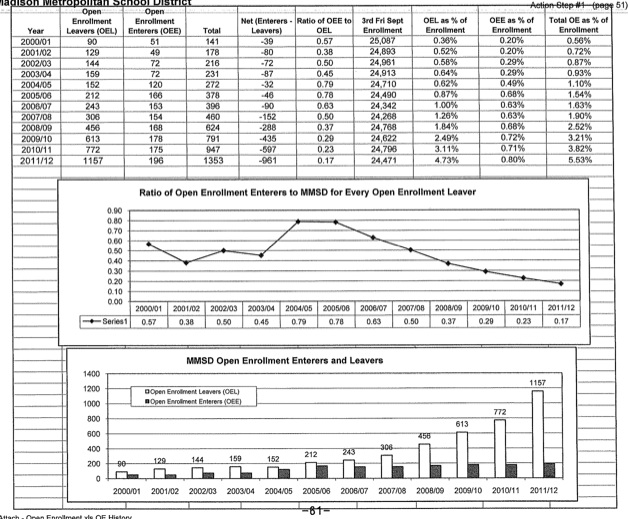
Douglas County, Colorado school voucher hearings wrap up; What happens when citizens lose faith in government? 2011 Madison School District Open Enrollment Data (4.73% Leave)

Elbert County News:

Closing arguments in the case challenging the Douglas County School District’s voucher program ended three days of hearings that could halt the program in its infancy.
A standing-room-only crowd listened in Denver District Court while a legal team from the American Civil Liberties Union faced off against a team that included the Colorado Attorney General’s Office to decide the fate of the district’s school choice scholarship program.
Both sides agreed that any decision from Denver District Court Judge Michael Martinez will likely face an appeal, regardless of the ruling.
“There will be an appeal either way,” said Michael McCarthy, a plaintiff attorney representing the Taxpayers for Public Education. “What (the school district has) done is press the envelope as far as they can. For those interested in preserving public education in this state, they have got in their face as far as they can.”

More from the Wall Street Journal: Wall Street Journal:

In a bold bid to revamp public education, a suburban district south of Denver has begun handing out vouchers that use public money to help its largely affluent residents send their children to private and church-based schools. The Douglas County School District experiment is noteworthy because nearly all voucher programs nationally aim to help children who are poor, have special needs or are trapped in failing public schools. Douglas County, by contrast, is one of the most affluent in the U.S., with household income nearly double the national median, and has schools ranked among the best in Colorado. What do you think? Should vouchers only be used with lower-income students? Should they never be used? Do they violate the constitution?

Chrystia Freeland:

One answer comes from Ivan Krastev, a Bulgarian political scientist. One of Mr. Krastev’s special interests is in the resilience of authoritarian regimes in the 21st century. To understand why they endure, Mr. Krastev has turned to the thinking of the economist Albert O. Hirschman, who was born in Berlin in 1915 and eventually became one of America’s seminal thinkers.
In 1970, while at Harvard, Mr. Hirschman wrote an influential meditation on how people respond to the decline of firms, organizations and states. He concluded that there are two options: exit — stop shopping at the store, quit your job, leave your country; and voice — speak to the manager, complain to your boss, or join the political opposition.
For Mr. Krastev, this idea — the trade-off between exit and voice — is the key to understanding what he describes as the “perverse” stability of Vladimir V. Putin’s Russia. For all the prime minister’s bare-chested public displays of machismo, his version of authoritarianism, in Mr. Krastev’s view, is “vegetarian.”
“It is fair to say that most Russians today are freer than in any other period of their history,” he wrote in an essay published this spring. But Mr. Krastev argues that it is precisely this “user-friendly” character of Mr. Putin’s authoritarianism that makes Russia stable. That is because Russia’s relatively porous dictatorship effectively encourages those people who dislike the regime most, and have the most capacity to resist it, to leave the country. They choose exit rather than voice, and the result is the death of political opposition: “Leaving the country in which they live is easier than reforming it.”

Related:
Madison School District May, 2011 Strategic Plan Update with Action Plans 1.8MB PDF

Share

For a Standout College Essay, Applicants Fill Their Summers

Jenny Anderson:

Josh Isackson, an 18-year-old graduate of Tenafly High School in New Jersey, spent the summer after his sophomore year studying Mandarin in Nanjing, China. The next year he was an intern at a market research firm in Shanghai. When it came time to write a personal statement for his college applications, those summers offered a lot of inspiration.
“When I was thinking about the essay, I realized that taking Chinese was a big part of me,” he said.
So Mr. Isackson wrote about exploring the ancient tombs of the Ming dynasty in the Purple Mountain region of Nanjing, “trading jokes with long-dead Ming Emperors, stringing my string hammock between two plum trees and calmly sipping fresh green tea while watching the sun set on the horizon.”

Share

Business Schools Plan Leap Into Data

Melissa Korn & Shara Tibken:

Faced with an increasing stream of data from the Web and other electronic sources, many companies are seeking managers who can make sense of the numbers through the growing practice of data analytics, also known as business intelligence. Finding qualified candidates has proven difficult, but business schools hope to fill the talent gap.
This fall several schools, including Fordham University’s Graduate School of Business and Indiana University’s Kelley School of Business, are unveiling analytics electives, certificates and degree programs; other courses and programs were launched in the previous school year.
International Business Machines Corp., which has invested more than $14 billion buying analytics industry companies such as Coremetrics and Netezza Corp. since 2005, has teamed up with more than 200 schools, including Fordham, to develop analytics curriculum and training.

Share

Back-to-School Special: 5 Tips on Picking a Good School

Ryan McVay:

I’m a policy guy, not a daddy blogger. As a general rule, I don’t discuss my children in this column or on my Eduwonk blog. But when TIME asked me to write about how my wife (who also works in education) and I chose our kids’ elementary school, I figured why not? We are constantly besieged by friends and colleagues who want to know how we went about picking a school, as if there were some secret education-analyst methodology I was privy to. I wish that were true! But even though I don’t have access to the secret sauce, I do have a pretty good sense of how to kick a school’s tires. Plus, I think it would be a shame not to use all of our parental angst for the greater good. And so, as our kids start a new year at a public school, here are some lessons from our school-hunting experience that might help guide yours.
Look beneath the label. “Public” or “private” doesn’t really tell you much, so don’t scratch a school off your list just because of how it’s governed. There are terrific and lousy schools in the public, private and (publicly funded) charter-school sectors, so relying on labels alone is a big risk. Likewise, you should do more than glance at a school’s test scores or demographic data. My wife and I, for instance, are both products of public schools. I went to ones in Virginia that on paper were both excellent and diverse. But in practice, there were different tracks for different students, so most of the kids in my gifted or AP classes were like me: Caucasian, middle-class, ruggedly good-looking. Well, two out of three of those anyway. My wife grew up in an Ohio district known for great academics but with no diversity. As our kids approached school age, we hoped to find a good school that was racially, ethnically and economically diverse — a tall order given today’s housing patterns and school boundaries. But most important, we wanted to find the right fit for our kids, so we were not opposed to going private if we couldn’t find an option in the public sector that seemed to work for us. (See the 20 best- and worst-paid college majors.)

Share

The myth of the extraordinary teacher

Ellie Herman:

Yes, we need to get rid of bad teachers. But we can’t demand that teachers be excellent in conditions that preclude excellence.
The kid in the back wants me to define “logic.” The girl next to him looks bewildered. The boy in front of me dutifully takes notes even though he has severe auditory processing issues and doesn’t understand a word I’m saying. Eight kids forgot their essays, but one has a good excuse because she had another epileptic seizure last night. The shy, quiet girl next to me hasn’t done homework for weeks, ever since she was jumped by a knife-wielding gangbanger as she walked to school. The boy next to her is asleep with his head on the desk because he works nights at a factory to support his family. Across the room, a girl weeps quietly for reasons I’ll never know. I’m trying to explain to a student what I meant when I wrote “clarify your thinking” on his essay, but he’s still confused.
It’s 8:15 a.m. and already I’m behind my scheduled lesson. A kid with dyslexia, ADD and anger-management problems walks in late, throws his books on the desk and swears at me when I tell him to take off his hood.

Share

More Business Schools To Accept GRE Scores

Melissa Korn:

Momentum for business schools to accept the GRE test, mainly used by graduate-school applicants in the social sciences and humanities, is building as those schools aim to attract less traditional applicants.
Since April, more than 100 business schools have said they will accept applications with GRE–Graduate Record Examination–scores. In the past, business schools have only accepted the Graduate Management Admission Test, or GMAT, which looks more at reading comprehension and reasoning. The GRE has a stronger focus on vocabulary and straightforward quantitative skills.

Share

Excellence in Education explains Florida’s reading reforms and compares Florida’s NAEP progress with Wisconsin’s at the July 29th Read to Lead task force meeting


Excellence in Education’s PowerPoint presentation: 1MB PDF, via a kind Julie Gocey email.
Related links: Video: Governor’s “Read to Lead” Task Force Meeting.
Wisconsin Reading Coalition.
Much more on Wisconsin’s Read To Lead Task Force, here.
How does Wisconsin compare? Learn more at www.wisconsin2.org

Share

The AFT’s Real Feelings About Parent Power

Rishawn Biddle:

When the AFT offers a road map on how to shut down Parent Power efforts, it offers a nice PDF document to do it. Apparently in a fit of celebration during last month’s TEACH 2011 conference, the nation’s second-largest teachers union offered up a presentation on how its Connecticut affiliate managed to make the state’s Parent Trigger law a little less harder for parents to use. (Dropout Nation is doing everyone a courtesy by making it available for public consumption; the orginal is still available at the AFT’s Web site. At least, for now.)

Rick Green has more.

Share

Can Johnny Read? CA bill would eliminate standardized tests for 2nd grade students

Gloria Romero:

Remember a long time ago when educators were asking why Johnny couldn’t read? Well now in California, it appears that there is a major push to delay learning how well Johnny can read in the first place.
Early assessments are essential to get kids like Johnny on track to succeed in school. These assessments provide critical data that help schools identify which kids need extra help and use best practices to help them get to grade level proficiency.
SB 740, a bill pushed by the California Teachers Association, is quickly moving through the California Legislature, which would eliminate standardized second grade testing. SB 740 eliminates a valuable early assessment mechanism for teachers and parents. Without the data from the second grade assessment, we will be less likely to know exactly which students need extra help. And we will likely have more schools that fail to close achievement gaps and allow students–especially low income and minority students–to fall further behind.

Share

The Kapors’ SMASH Academy is filling an education gap

Mike Cassidy:

Give a kid a chance and you’ll be amazed at what happens next.
That thought kept rolling through my mind as I surveyed the controlled chaos that was lunch for 80 teenagers who’d moved onto Stanford’s campus to take five summer weeks of intensive math and science courses.
I know. What’s so different about a passel of brilliant kids studying hard stuff at Stanford?
Well, for one thing, a pessimist might look at these particular kids working their way through hamburgers, chicken and mashed potatoes, and conclude that they are not college material. In fact, the vast majority of them would be the first in their families to go to college. Nearly all of them attend high schools where most students are poor enough to qualify for free or reduced-priced lunch. Some live in tough neighborhoods. Some dodge gangs on the way to and from school — and maybe even at school.
But that’s not what defines them. Not at all. The kids at Stanford, members of the inaugural class of the Silicon Valley version of the Summer Math and Science Honors Academy (SMASH), are energetic, optimistic, determined, resourceful and approaching brilliant.

Share

Bloomberg to Use Own Funds in Plan to Aid Minority Youth

Michael Barbaro & Fernanda Santos:

Share

Union to defend teachers in cheating scandals

Greg Toppo:

The head of the USA’s second-largest teachers union on Monday said local affiliates will defend the rights of teachers caught up in cheating scandals, including the one now unfolding in Atlanta. But she said cheating “under any circumstances is unacceptable.”
Speaking to reporters during the American Federation of Teachers’ biannual training conference, Randi Weingarten said the union would “obviously” represent teachers accused of cheating “to make sure that people have some kind of fairness — and that it’s not some kind of witch hunt.”
A long-awaited report released last week by Georgia Gov. Nathan Deal, a Republican, found teacher- or principal-led cheating in 44 of 56 Atlanta schools investigated. Investigators determined that 178 educators cheated. Of those, 82 confessed.

Share

Madison School District Talented & Gifted Program Update

Superintendent Dan Nerad:

During the 2011-2012 school year, as MMSD implements Response to Instruction and Intervention (RTI2) and the new district School Support Teams, the plan for delivery of Talented and Gifted Services will continue to be integrated and refined so that it accomplishes the following: 1) is both systemic and systematic in nature; 2) is collaborative; 3) is financially sustainable; 4) is fluid and responsive to student needs; S) offers appropriate opportunities for student growth and talent development; 6) addresses the comprehensive needs (academic, social and personal growth) of students; 7) is aligned with State regulations, professional standards, current research, and effective practice; and 8) provides goals and evaluation procedures to evaluate growth and suggest areas in which change is needed. This Plan for TAG Services describes the following:

Much more on the recent complaint regarding the Madison School District’s Talent & Gifted Update, here.

Share

School choice is risk-free, Pennsylvania education secretary says

Tracie Mauriello:

Tax dollars soon could go to schools where teachers aren’t required to be certified and where students aren’t required to take the same standardized tests as their public school counterparts.
That concerns Democrats, who expressed concerns about Republican school-choice measures that were the subject of a House Education Committee public hearing today.
Rep. Jim Christiana, sponsor of one bill in the education reform package, said school choice isn’t about turning public schools into private ones; it’s about letting parents choose where their children will be best educated.
“We’re not saying students shouldn’t have to take standardized tests. We’re just saying the tests should be based on the curriculum you’re offering,” said Mr. Christiana, R-Beaver.

Share

Airy Labs Founder On ‘Higher Education Bubble’ Vs. Real World

Lizette Chapman:

On the surface, Andrew Hsu is a curious fit among the inaugural class of Thiel Fellows.
Andrew Hsu says there are some things you can’t learn in college. “In the real world it’s crazy,” he says.
PayPal co-founder and early Facebook investor Peter Thiel’s “20 Under 20” fellowship program awards $100,000 to 20 people under 20 years of age who drop out of college to pursue science and technological innovation. The program officially launched in May and is the first assault in Thiel’s war against the “higher-education bubble” – a system he says stymies innovation and burdens youngsters with debt.
Hsu, now 20, graduated with honors and degrees in neurobiology, biochemistry and chemistry and a minor in mathematics from the University of Washington at 16. He was a fourth-year Ph.D. candidate in Stanford’s neuroscience program when he left it earlier this year to launch Airy Labs Inc.

Share

Debt to Degree: A New Way of Measuring College Success

Kevin Carey & Erin Dillon:

The American higher education system is plagued by two chronic problems: dropouts and debt. Barely half of the students who start college get a degree within six years, and graduation rates at less-selective colleges often hover at 25 percent or less. At the same time, student loan debt is at an all-time high, recently passing credit card debt in total volume.1 Loan default rates have risen sharply in recent years, consigning a growing number of students to years of financial misery. In combination, drop-outs and debt are a major threat to the nation’s ability to help students become productive, well-educated citizens.
The federal government has traditionally tracked these issues by calculating, for each college, the total number of degrees awarded, the percentage of students who graduate on time, and the percentage of students who default on their loans. Each of these statistics provides valuable information, but none shows a complete picture. A college could achieve a stellar graduation rate by passing students
along and handing out degrees that have little value in the job market, making it difficult for graduates to earn enough money to pay off their debt. Alternatively, a college could keep tuition and loan default rates low while also providing a terrible education and helping few students earn degrees. Students choosing colleges and policymakers governing higher education need an overall measure of value, one that combines debt and graduation.
Education Sector has created such a measure, the “borrowing to credential ratio.” For each college, we have taken newly available U.S. Department of Education data showing the total amount of money borrowed by undergraduates and divided that sum by the total number of degrees awarded. The results are revealing:

Share

More leave UK primary with good ‘three Rs’ grasp

Katherine Sellgren:

The number of children leaving primary school in England with a good grasp of reading, writing and maths has increased again, government data shows.
Some 67% of 11-year-olds gained the expected level, Level 4, in all of these subjects in national curriculum tests, known as Sats.
Last year 64% of primary pupils left school having reached this level.
But one in three youngsters still failed to achieve the level expected of them in all three subjects.
This means that nearly 183,000 pupils left school without a good grasp of reading, writing and maths this summer.

Share

Prejudice lurks even in 3-year-olds

Crystal Chui:

The seeds of prejudice are being planted in the minds of Hong Kong children as young as three, a study has revealed.
Face-to-face questioning of 152 youngsters aged between three and six discovered many hold more negative attitudes towards people with darker skin.
The results of the survey, commissioned by the Equal Opportunities Commission and the first of its kind to be carried out in the city, have prompted calls for better pre-school education and parenting.
The children were asked to describe their attitudes towards different skin colours by rating eight positive and negative qualities, including friendliness, beauty, honesty, courtesy, selfishness and rudeness.

Share

Student Lending’s Failing Grade

Cristian Deritis:

The student lending industry managed to avoid many of the pitfalls that affected mortgages, auto loans and credit cards during the Great Recession. In fact, volume growth has been steady, if not accelerating, as more individuals sought additional education and training in response to the weak labor market, and as lenders did not tightened standards to anywhere near the degree of other segments. The performance of student loans in recent years has barely changed; delinquency and loss rates on outstanding student loan balances remained steady throughout the recession. While this may sound positive, it is concerning in light of the strong balance and account growth, which would typically push delinquency rates down. In addition, performance of other consumer loan segments has significantly improved as the economy has recovered; performance of student loans has not. In this study, we examine the rapid growth of the student loan industry over the past few years, the weakening per- formance of loan portfolios, and what these trends suggest for future performance and lending volumes.

Share

UK pupils ‘among least likely to overcome tough start’

Sean Coughlan, via a kind reader’s email:

The UK performs poorly in an international league table showing how many disadvantaged pupils succeed “against the odds” at school.
The Organisation for Economic Co-operation and Development (OECD) has studied how pupils from poor backgrounds can succeed academically.
It says that “self-confidence” is a key factor in whether such pupils succeed.
The UK comes behind Mexico and Tunisia in the table – with the top places taken by Asian countries.

Share

Face-ID Tools Pose New Risk

Julia Angwin:

As Internet giants Facebook Inc. and Google Inc. race to expand their facial-recognition abilities, new research shows how powerful, and potentially detrimental to privacy, these tools have become.
Armed with nothing but a snapshot, researchers at Carnegie Mellon University in Pittsburgh successfully identified about one-third of the people they tested, using a powerful facial-recognition technology recently acquired by Google.

Share

School, district ratings drop; Austin ISD has 8 underperforming schools, Round Rock has 2

Melissa Taboada:

The Round Rock school district, which earned the state’s second-highest academic rating in 2010, this year has two schools that failed to meet state standards, securing “academically unacceptable” labels that will stick for two years.
The news comes as schools and districts across Texas see their ratings slide this year despite making academic gains. Figures released by the Texas Education Agency on Friday show that more than half of all Texas schools that had the highest rating in 2010, exemplary, fell in their ratings, and five times as many schools were deemed academically unacceptable, the lowest rating.
Locally, eight of the Austin school district’s 112 rated schools missed state academic targets; last year, only one Austin school was rated academically unacceptable. Pflugerville this year has two schools rated unacceptable. Both traditional high schools in Bastrop failed to meet state standards and received the lowest rating. Hutto has two elementary schools that are rated unacceptable.

Share

Researchers warn of school ‘accountability shock’

Bill Kaczor:

Math teacher Antoine Joseph already had been thinking of leaving Miami Norland Senior High School, so when its annual grade from the state dropped from a D to an F nine years ago that just solidified his decision.
Joseph said it wasn’t just a matter of being stigmatized as a failure – he was just tired of the circumstances behind the failing grade.
“There is a propensity to go to another school where the parents are more involved, the students are more eager to learn and they are more thirsty for knowledge,” he said.
Joseph apparently was not alone. A recent study by a trio of economists showed a disproportionate number of Florida teachers left schools that got lower grades in 2002 after the state changed the way it evaluated them.
The researchers call it “accountability shock.” That’s their term for unexpected results from shake-ups in the way students, teachers, administrators or schools are evaluated, graded, rewarded or punished. The study is timely advice because accountability changes are in the works across the nation due to President Barack Obama’s “Race to the Top” school initiative. The program is providing $4.35 billion in federal stimulus money to Florida, 10 other states and the District of Columbia for innovative changes aimed at improving student achievement.

Share

July 29 Wisconsin Read to Lead task force meeting

Julie Gocey, via email:

The fourth meeting of the Governor’s Read to Lead task force took place in Milwaukee on Friday, July 29. The meeting was filmed by Wisconsin Eye, but we have not seen it offered yet through their website. We will send out a notice when that occurs. As always, we encourage you to watch and draw your own conclusions.
Following is a synopsis of the meeting, which centered on reading improvement success in Florida and previously-discussed task force topics (teacher preparation, licensing, professional development, screening/intervention, early childhood). In addition, Superintendent Evers gave an update on activity within DPI. The discussion of the impact of societal factors on reading achievement was held over to the next meeting, as was further revisiting of early childhood issues.

In addition to this summary, you can access Chan Stroman’s Eduphilia tweets at http://twitter.com/#!/eduphilia
Opening: Governor Walker welcomed everyone and stressed the importance of this conversation on reading. Using WKCE data, which has been criticized nationally and locally for years as being derived from low standards, the Governor stated that 80% of Wisconsin students are proficient or advanced in reading, and he is seeking to serve the other 20%. The NAEP data, which figured prominently in the presentation of the guest speakers, tell a very different story. Superintendent Evers thanked the task force members and indicated that this is all about “connecting the dots” and putting all of the “puzzle pieces” together. The work of this task force will impact the work going on in other education-focused committees.
The Florida Story: Guest speakers were Patricia Levesque, the Executive Director of the Foundation for Excellence in Education and the Foundation for Florida’s Future, and Mary Laura Bragg, the director of Florida’s statewide reading initiative, Just Read, Florida! from 2001 to 2006.
In a series of slides, Levesque compared Wisconsin, Florida, and national performance on the NAEP reading test over the past decade. Despite challenges in terms of English language learners, a huge percentage of students on free/reduced lunch, and a minority-majority demographic, Florida has moved from the scraping the bottom on the NAEP to the top group of states. Over the same time period, Wisconsin has plummeted in national ranking, and our students now score below the national average in all subgroups for which NAEP data is disaggregated. 10 points on the NAEP scale is roughly equivalent to one grade level in performance, and Florida has moved from two grade levels below Wisconsin to 1/2 grade level above. For a full discussion of Wisconsin’s NAEP performance, see our website, http://www.wisconsinreadingcoalition.org.
Levesque and Bragg also described the components of the reading initiative in Florida, which included grading all schools from A to F, an objective test-based promotion policy from third to fourth grade, required state-approved reading plans in each district, trained reading coaches in schools, research assistance from the Florida Center for Reading Research, required individual student intervention plans for struggling students, universal K-2 screening for reading problems, improved licensure testing for teachers and principals, the creation of a reading endorsement for teaching licenses, and on-line professional development available to all teachers. As noted above, achievement has gone up dramatically, the gap between demographic groups has narrowed, early intervention is much more common, and third grade retention percentages continue to fall. The middle school performance is now rising as those children who received early intervention in elementary school reach that level. Those students have not yet reached high school, and there is still work to be done there. To accomplish all this, Florida leveraged federal funds for Title 1 and 2 and IDEA, requiring that they be spent for state-approved reading purposes. The Governor also worked actively with business to create private/public partnerships supporting reading. Just Read, Florida! was able to engineer a statewide conference for principals that was funded from vendor fees. While Florida is a strong local control state, reading is controlled from the state level, eliminating the need for local curriculum directors to research and design reading plans without the resources or manpower to do so. Florida also cut off funding to university professors who refused to go along with science-based reading instruction and assessment.
Florida is now sharing its story with other states, and offering assistance in reading plan development, as well as their screening program (FAIR assessment system) and their online professional development, which cost millions to develop. Levesque invited Wisconsin to join Indiana and other states at a conference in Florida this fall.
Questions for, or challenges to, the presenters came from three task force members.

  • Rachel Lander asked about the reading coaches, and Bragg responded that they were extensively trained by the state office, beginning with Reading First money. They are in the classroom modeling for teachers and also work with principals on understanding data and becoming building reading leaders. The coaches now have an association that has acquired a presence in the state.
  • Linda Pils stated her belief that Wisconsin outperforms Florida at the middle school level, and that we have higher graduation rates than Florida. She cited opinions that third grade retention has some immediate effect, but the results are the same or better for non-retained students later, and that most retained students will not graduate from high school. She also pointed out Florida’s class size reduction requirement, and suggested that the NAEP gains came from that. Levesque explained that the retention studies to which Pils was referring were from other states, where retention decisions were made subjectively by teachers, and there was no requirement for science-based individual intervention plans. The gains for retained students in Florida are greater than for matched students who are not retained, and the gains persist over time. Further, retention did not adversely affect graduation rates. In fact, graduation rates have increased, and dropout rates have declined. The University of Arkansas is planning to do a study of Florida retention. The class size reduction policy did not take effect in Florida until last year, and a Harvard study concluded that it had no effect on student reading achievement. Task force member Steve Dykstra pointed out that you cannot compare the NAEP scores from two states without considering the difference in student demographics. Wisconsin’s middle school scores benefit from the fact that we have a relative abundance of white students who are not on free/reduced lunch. Our overall average student score in middle school may be higher than Florida, but when we compare similar cohorts from both states, Florida is far ahead.
  • Tony Pedriana asked what kinds of incentives have been put in place for higher education, principals, etc. to move to a science-based system of instruction. The guests noted that when schools are graded, reading performance receives double weight in the formula. They also withheld funding for university programs that were not science-based.

DPI Update: Superintendent Evers indicated that DPI is looking at action in fours areas: teacher licensure, the Wisconsin Model Early Learning Standards, the use of a screener to detect reading problems, and implementation of the Common Core State Standards.

  • The committee looking at licensing is trying to decide whether they should recommend an existing, off-the-shelf competency exam, or revise the exam they are currently requiring (Praxis 2). He did not indicate who is on the committee or what existing tests they were looking at. In the past, several members of the task force have recommended that Wisconsin use the Foundations of Reading test given in Massachusetts and Connecticut.
  • DPI is revising the WMELS to correct definitions and descriptions of phonological and phonemic awareness and phonics. The changes will align the WMELS with both the Report of the National Reading Panel and the Common Core State Standards. Per the suggestion of Eboni Howard, a guest speaker at the last meeting, they will get an outside opinion on the WMELS when they are finished. Evers did not indicate who is doing this work.
  • DPI is looking at the possibility of using PALS screening or some other tool recommended by the National RTI Center to screen students in grades K-2 or K-3. Evers previously mentioned that this committee had been meeting for 6-7 months, but he did not indicate who is on it.
  • Evers made reference to communication that was circulated this week (by Dr. Dan Gustafson and John Humphries) that expressed concern over the method in which DPI is implementing the Common Core. He stated that districts have been asking DPI for help in implementing the CC, and they want to provide districts with a number of resources. One of those is the model curriculum being developed by CESA 7. DPI is looking at it to see how it could help the state move forward, but no final decision has yet been made.

Task force member Pam Heyde, substituting for Marcia Henry, suggested that it would be better to look at what Florida is doing rather than start from ground zero looking at guidelines. Patricia Levesque confirmed that Florida was willing to assist other states, and invited Wisconsin to join a meeting of state reading commissioners in October.
Teacher Preparation: The discussion centered around what needs to change in teacher preparation programs, and how to fit this into a four-year degree.
Steve Dykstra said that Texas has looked at this issue extensively. Most schools need three courses to cover reading adequately, but it is also important to look at the texts that are used in the courses. He referenced a study by Joshi that showed most of the college texts to be inadequate.
Dawnene Hassett, UW-Madison literacy professor in charge of elementary teacher reading preparation, was invited to participate in this part of the discussion. She indicated we should talk in terms of content knowledge, not number of credits. In a couple of years, teachers will have to pass a Teacher Performance Assessment in order to graduate. This was described as a metacognitive exercise using student data. In 2012-13, UW-Madison will change its coursework, combining courses in some of the arts, and dropping some of the pedagogical, psychological offerings.
Tony Pedriana said he felt schools of education had fallen down on teaching content derived from empirical studies.
Hassett said schools teach all five “pillars” of reading, but they may not be doing it well enough. She said you cannot replicate classroom research, so you need research “plus.”
Pils was impressed with the assistance the FCRR gives to classroom teachers regarding interventions that work. She also said spending levels were important.
Dykstra asked Mary Laura Bragg if she had worked with professors who thought they were in alignment with the research, but really weren’t.
Bragg responded that “there’s research, and then there’s research.” They had to educate people on the difference between “research” from vendors and empirical research, which involves issues of fidelity and validation with different groups of students.
Levesque stated that Florida increased reading requirements for elementary candidates from 3 to 6 credits, and added a 3 credit requirement for secondary candidates. Colleges were required to fit this in by eliminating non-content area pedagogy courses.
Kathy Champeau repeated a concern from earlier meetings that teacher candidates need the opportunity to practice their new knowledge in a classroom setting, or they will forget it.
Hassett hoped the Teacher Performance Assessment would help this. The TPA would probably require certain things to be included in the teacher candidate’s portfolio.
Governor Walker said that the key to the effectiveness of Florida’s retention policy was the intervention provided to the students. He asked what they did to make sure intervention was successful.
Levesque replied that one key was reading coaches in the classroom. Also, district reading plans, individual intervention plans, student academies, etc. all need to be approved by the state.
There was consensus that there should be a difference in reading requirements for elementary vs. secondary teachers. There was no discussion of preparation for reading teachers, reading specialists, or special education teachers.
Licensing: The discussion centered around what teacher standards need to be tested.
Dykstra suggested that the Knowledge and Practice Standards for Teachers of Reading, written by Louisa Moats, et al, and published by the International Dyslexia Association in 2010, would be good teacher standards, and the basis for a teacher competency exam. There was no need for DPI to spend the next year discussing and inventing new teacher standards.
Champeau said that the International Reading Association also has standards.
Pedriana asked if those standards are based on research.
Dykstra suggested that the task force look at the two sets of standards side-by-side and compare them.
Professional Development: The facilitators looked for input on how professional development for practicing teachers should be targeted. Should the state target struggling teachers, schools, or districts for professional development?
Rep. Jason Fields felt all three needed to be targeted.
Heyde asked Levesque for more details on how Wisconsin could do professional development, when we often hear there is no money.
Levesque provided more detail on the state making reading a priority, building public/private partnerships, and being more creative with federal grant money (e.g., the 20% of each grant that is normally carved out by the state for administration). There should be a clear reading plan (Florida started with just two people running their initiative, and after a decade only has eight people), and all the spending should align with the plan to be effective. You cannot keep sending money down the hole. Additional manpower was provided by the provision that all state employees would get one paid hour per week to volunteer on approved reading projects in schools, and also by community service requirements for high school students.
Bragg suggested using the online Florida training modules, and perhaps combining them with modules from Louisiana.
Dykstra also suggested taking advantage of existing training, including LETRS, which was made widely available in Massachusetts. He also stressed the importance of professional development for principals, coaches, and specialists.
Bragg pointed out that many online training modules are free, or provided for a nominal charge that does not come close to what it would cost Wisconsin to develop its own professional development.
Lander said there were many Wisconsin teachers who don’t need the training, and it should not be punitive.
Champeau suggested that Florida spends way more money on education that Wisconsin, based on information provided by the NAEP.
Levesque clarified that Florida actually is below the national average in cost per student. The only reason they spend more than Wisconsin is that they have more students.
Rep. Steve Kestell stated that teachers around the entire state have a need for professional development, and it is dangerous to give it only to the districts that are performing the worst.
Sarah Archibald (sitting in for Sen. Luther Olsen) said it would be good to look at the value added in districts across the state when trying to identify the greatest needs for professional development. The new statewide information system should provide us with some of this value added information, but not at a classroom teacher level.
Evers commented that the state could require new teacher Professional Development Plans to include or be focused on reading.
Pils commented that districts can have low and high performing schools, so it is not enough to look at district data.
Champeau said that administrators also need this professional development. They cannot evaluate teachers if they do not have the knowledge themselves.
Dykstra mentioned a Florida guidebook for principals with a checklist to help them. He is concerned about teachers who develop PDP’s with no guidance, and spend a lot of time and money on poor training and learning. There is a need for a clearinghouse for professional development programs.
Screening/Intervention: One of the main questions here was whether the screening should be universal using the same tools across the state.
Champeau repeated a belief that there are districts who are doing well with the screening they are doing, and they should not be required to change or add something new.
Dykstra responded that we need comparable data from every school to use value added analysis, so a universal tool makes sense. He also said there was going to be a lot of opposition to this, given the statements against screening that were issued when Rep. Keith Ripp introduced legislation on this topic in the last biennium. He felt the task force has not seen any screener in enough detail to recommend a particular one at this time.
Heyde said we need a screener that screens for the right things.
Pils agreed with Dykstra and Heyde. She mentioned that DIBELS is free and doesn’t take much time.
Michele Erickson asked if a task force recommendation would turn into a mandate. She asked if Florida used a universal screener.
Levesque replied that Florida initially used DIBELS statewide, and then the FCRR developed the FAIR assessments for them. The legislature in Florida mandated the policy of universal kindergarten screening that also traces students back to their pre-K programs to see which ones are doing a better job. Wisconsin could purchase the FAIR assessments from Florida.
Archilbald suggested phasing in screening if we could not afford to do it all at once.
Evers supports local control, but said there are reasons to have a universal screener for data systems, to inform college programs, and to implement professional development.
Lander asked what screening information we could get from the WKCE.
Evers responded that the WKCE doesn’t start unitl third grade.
Dykstra said we need a rubric about screening, and who needs what type and how often.
Pedriana said student mobility is another reason for a universal screener.
There was consensus that early screening is important. Certainly by 4K or 5K, but even at age three if a system could be established. Possibilities mentioned were district-run screenings or pediatrician screenings.
Walker reminded the task force that it only makes sense to screen if you have the ability to intervene with something.
Mara Brown wasn’t sure that a universal screener would tell her anything more about her students than she already knows.
Levesque said she could provide a screening roadmap rubric for the task force.
No one on the task force had suggestions for specific interventions. The feeling was that it is more important to have a well-trained teacher. Both Florida and Oregon started evaluating and rating interventions, but stopped because they got bogged down. Wisconsin must also be careful about evaluations by What Works Clearinghouse, which has some problems.
Pedriana asked if the task force is prepared to endorse a model of instruction based on science, where failure is not an option.
The facilitator said this discussion would have to wait for later.
Early Childhood: The task force agreed that YoungStar should include more specific literacy targets.
Rep. Kestell felt that some district are opening 4K programs primarily for added revenue, and that there is wide variability in quality. There is a need to spend more time on this and decide what 4K should look like.
Evers said we should use the Common Core and work backward to determine what needs to be done in 4K.
Wrap-Up: Further discussion of early childhood will be put over to the next meeting, as will the societal issues and accountability. A meeting site has not yet been set, but Governor Walker indicted he liked moving around the state. The Governor’s aides will follow up as to locations and specific agenda. The next meeting will be Thursday, August 25. All meetings are open to the public.
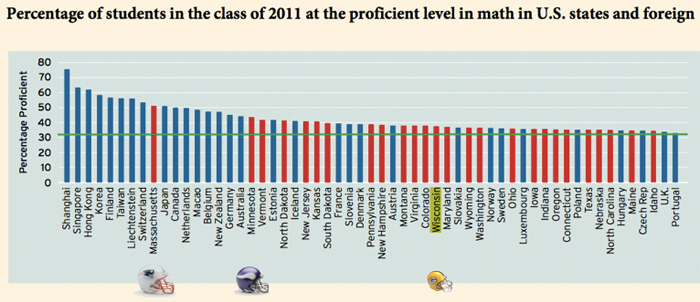
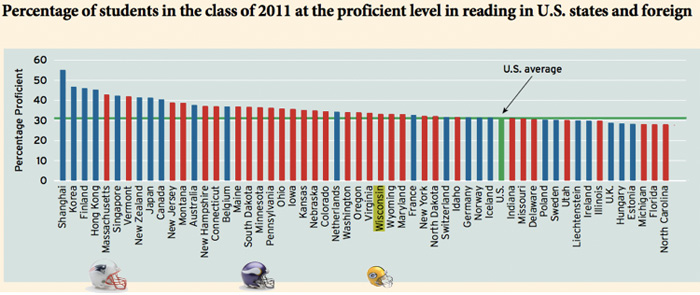
Related: An Open Letter to the Wisconsin Read To Lead Task Force on Implementing Common Core Academic Standards; DPI: “Leading Us Backwards” and how does Wisconsin Compare? www.wisconsin2.org.
Much more on Wisconsin’s Read to Lead Task Force, here.

Share

PBIS in the Sun Prairie Schools

sp-eye:

PBIS is all the rage in school districts across the country. No…Sun Prairie didn’t just dream this up all by themselves. What, exactly, is PBIS? PBIS stands for Positive Behavioral Interventions and Supports. It’s an offshoot of the IDEA program (Individuals with Disabilities Education Act). You may see/hear it as SWPBS (School-wide Positive Behavior Supports). In a nutshell, PBIS is a system of behavior modification, with three stages of intervention.
Primary intervention is targeted to all students and is s system designed to clearly identify which behaviors are acceptable and which are not. Exhibiting positive behavior is rewarded in some fashion. In theory, about 80-85% of students respond to this primary level of intervention. The overall target is to develop a system in which positive reinforcements (for “acceptable/desired” behaviors) outnumber negative reinforcements (for unacceptable behaviors) by about 4:1. In this way, kids overwhelmingly see that “being good” is the place to be. You get rewards.
PBIS extends further to the 2nd tier, kids that do not respond well to these primary tactics. These kids represent about 10-15% of the population and are those that potentially are at risk for “failure”, or at the very least not realizing their academic potential. This group, however is not in need of individualized attention, but rather is targeted in small groups (a modernized form of “group” therapy). The third tier, which includes about 5-10% of students, covers those students who require individualized attention to develop positive behaviors and squelch those behaviors which are not acceptable.

Share

Is laying off teachers by seniority a mistake?

Marcelle Kreiter:

With the economy forcing closer scrutiny of budgeting at all levels of government and politicians zeroing in on government workers’ pay, perhaps the most visible target is education.
For the most part, elementary and secondary education in the United States is funded with local tax dollars, with assists from state and federal coffers. And the biggest line-item expense? Teacher salaries. When it comes time to cut the budget, layoffs are announced, and because of union contracts teachers with seniority are favored. Usually those most recently hired are the ones who go.
But is this the smartest way to fix the budget? Dan Goldhaver, director of the Center for Education Data and Research at the University of Washington Bothell, and Roddy Theobald, a researcher at the center and a doctoral student in statistics, write in the fall issue of Education Next this subservience to union seniority rules is wreaking havoc on the education system, often axing the most energetic and creative educators in the system. Worse yet because they are the most recent hires, their salaries are at the low end of the pay scale so it takes more layoffs to meet the dollar figure necessary to reduce the budget, pushing up class size and sometimes forcing districts to eliminate subject areas and programs entirely

Share

Seize the moment for education reform in Iowa

Souix City Journal:

Add your voice to the discussion. Click here to submit a letter or mini editorial to the Journal staff.
Whatever the endeavor – be it business, athletics … or education -nobody stays number one by staying the same.
Historically, we Iowans have prided ourselves on the quality of our schools. We have considered ourselves at or near the top in the nation.
The state’s education system still gets good, passing grades, don’t get us wrong, but we can and should do better in our classrooms to prepare our children for the realities and dynamics of a changing, more-global workforce. “We must,” in the words of Iowa Department of Education Director Jason Glass, “have a world-class education system …”

Share

Autism Risks: Genes May Not Play Biggest Role

NPR:

Up to now, genetics were thought to account for 90 percent of a child’s risk for autism, but a new Stanford University School of Medicine study suggests environmental factors could play a much larger role than previously thought.
The largest study of its kind, the research focused on autism in 192 pairs of twins — 54 identical, 138 fraternal. The surprise came when Stanford researchers found a greater number of fraternal twins shared autism than identical twins. Fraternal twins share only half their genes with each other, thus, when both fraternal twins are autistic, it suggests factors other than genetics are at work.
In fact, “About half of what we see is due to environmental factors, and half of what we see is due to genetic factors,” Dr. Joachim Hallmayer tells Guy Raz, host of weekends on All Things Considered. Hallmayer is the lead author of the study.

Share

Lessons from the Iowa Education summit

Margaret Crocco:

This is an important moment in the history of education in the state of Iowa.
Earlier this week, U.S. Secretary of Education Arne Duncan, Iowa Gov. Terry Branstad, Iowa Education Director Jason Glass and an array of educational experts offered a set of challenges to educators at the two-day Education Summit in Des Moines.
The message was simple: Things need to change if Iowa is to regain its status as one of the strongest educational systems in the nation.
Although the statistics about Iowa students’ performances on the National Assessment of Educational Progress can be used to support diverse narratives about how students are performing compared with their peers across the nation, international comparisons tell an unambiguous story: American schools will need to do better if the United States is going to produce a globally competitive work force for the 21st century.

Margaret Crocco: Clusty Search argaret Crocco

Share

Will de-funding unravel the academic integrity of universities?

Monica Bulger:

Last week, the New York Times reported that in 2007, Deutsche Bank entered into an agreement with two German universities, Humboldt University and the Technical University of Berlin, to fund a mathematical laboratory. The problematic parts were the ‘secret’ terms: according to the article, the Deutsche Bank could not only influence the hiring process, but bank employees could serve as adjunct professors. Perhaps the most disturbing aspects of the agreement were that the bank had veto power over the laboratory’s research agenda and, more importantly, “was given the right to review any research produced by members of the Quantitative Products Laboratory 60 days before it was published and could withhold permission for publication for as long as two years.”

Share

Controversy @ The Madison School Board over Discipline Policy: “Featuring the Administration as Sisyphus” (Now with Video!)

Madison School Board Member Ed Hughes:

As is becoming increasingly common these days however, mine turned out to be a minority view. Other Board members took turns identifying parts of the revision that they did not like, raising some concerns that they had previously expressed and some that were new. The general tenor of the comments was that the current format of the Code was fine but that Code should be stricter and that more violations should lead to mandatory recommendations for expulsion.
About an hour into the meeting, I expressed some frustration with the proceedings (since I’m just figuring this stuff out, this video starts with eight seconds of black) :
Eventually Board members settled on deep-sixing the Work Group’s proposal but adopting some (but not all) of the substantive changes reflected in the revision. For example, the aggravated theft offense was added. The change to the unintentional use of force against a staff member violation was adopted (a very good move, btw), but the change to the possession and distribution of drugs or alcohol violation was not (I think). Another change boosted the potential consequences imposed for non-physical acts of bullying or harassment.
Also on our agenda Monday night was the creation of a new Board Ad Hoc Committee on Student Discipline, Conduct and Intervention, to be chaired by Lucy Mathiak. Some Board members suggested that the revisions recommended by the Work Group and rejected by the Board might be re-considered by the members of this committee in some fashion.
I found the Board’s rejection of the proposed revisions and ad hoc amending of the existing Code an unfortunate turn of events and criticized what I described as our legislating on the fly right before the vote:

Share

At Sleepaway Camp, Math Is Main Sport

Rachel Cromidas

As camps go, the Summer Program in Mathematical Problem Solving might
sound like a recipe for misery: six hours of head-scratching math
instruction each day and nights in a college dorm far from home.But Mattie Williams, 13, who attends Middle School 343 in the Bronx, was
happy to attend, giving up summer barbecues with her parents and
afternoons in the park with her Chihuahua, Pepsi. She and 16 other
adolescents are spending three weeks at Bard College here in a free, new camp for low-income students who are gifted in mathematics.

All are entering eighth grade at New York City public middle schools
where at least 75 percent of the student body is eligible for free
lunches. And all love math. At this camp, asking “What kind of math do
you like, algebra or geometry?” is considered an appropriate icebreaker,
and invoking the newly learned term “the multiplication principle”
elicits whoops and high-fives.

In a Bard classroom one afternoon, it seemed for a moment that Arturo
Portnoy had stumped everyone. Dr. Portnoy, a math professor visiting
from the University of Puerto Rico, posed this question: “The length of a
rectangle is increased by 10 percent and the width is decreased by 10
percent. What percentage of the old area is the new area?” The 17 campers whispered and scribbled. One crumpled his paper into a
ball. Mattie Williams may have looked as if she was doodling as she drew
dozens of tiny rectangles in her notebook, but she was hard at work on
the problem, which was taken from the American Mathematics Competitions,
a contest series known for its difficulty. In less than 10 minutes, she had the answer — 99 percent — and was ready for the next question.

For some schoolchildren, mathematics is a competitive sport, and summer
is the time for training — poring over test-prep books, taking practice
exams and attending selective math camps. But for students who cannot
afford such programs, or have not been exposed to many advanced math
concepts, the avenues to new skills are limited.

Daniel Zaharopol, the director of the camp at Bard,
is trying to change that. He has brought four math educators to the
Bard campus to teach the middle school students concepts as varied as
number theory and cryptography. Among the instructors is Mr. Portnoy, a
director of the Puerto Rico Mathematical Olympiads. The camp is financed by the Art of Problem Solving Foundation, the
nonprofit arm of an online school that promotes math education for gifted students. Classes meet in two-hour sessions and cover topics including voting theory, graph theory, and math and the arts.

(more…)

Share

Teachers are most important part of education system

Iowa State Daily:

Gov. Terry Branstad’s “education summit” highlights this state’s deficiency in education. In an increasingly competitive national and global economy, students need an education to face any challenge they — and this country — encounter.
We’ve made many attempts over the years to fix education. But we’ve all seen the No Child Left Behind Act’s overemphasis on test scores, and we haven’t really had time to measure how well the Iowa Core Curriculum delivers its “challenging and meaningful content to students that prepares them for success in life.”
The most important thing in education is employing teachers who want to teach. One way to attract good teachers whose work is worth paying for, of course, is to raise salaries above the statewide average of $41,970.

Share

Chicago needs school vouchers. And Rahm needs to meditate.

John Kass:

Mayor Rahm Emanuel certainly made news over his angry, finger-wagging scolding of NBC Chicago TV reporter Mary Ann Ahern the other day.
Ahern dared ask the Rahmfather whether he’d send his kids to the public schools he controls. He reportedly became indignant, took off his microphone and ended the interview.
Later, and with great courtesy, Emanuel revisited the topic with a rival station — which then reported the big exclusive that the mayor was sending his children to a private school.
Emanuel runs Chicago Public Schools. He’s shown grit to stand publicly and admonish the teachers union to improve the product. But he decided his children will not attend the public schools.

Share

McDonald’s to Make Nutrition Push

Melodie Warner:

McDonald’s Corp. plans to promote more nutritional options, such as automatically including fruit or a low-fat dairy option in every Happy Meal.
The fast-food giant said the new Happy Meal, being rolled out in September, will have about 20% fewer calories and less fat.
The company also will promote nutrition in its national kids’ advertising and Happy Meal packaging.
Childhood obesity is a growing concern in the U.S. First Lady Michelle Obama has made it her mission to promote environments that support healthy choices through her “Let’s Move” initiative.

Share

An Open Letter to the Wisconsin Read To Lead Task Force on Implementing Common Core Academic Standards; DPI: “Leading Us Backwards”

Dan Gustafson, PhD 133K PDF, via a kind email from the Wisconsin Reading Coalition:

WRC recommends reading the following open letter from Madison neuropsychologist Dan Gustafson to the Governor’s Read to Lead task force. It reflects many of our concerns about the state of reading instruction in Wisconsin and the lack of an effective response from the Department of Public Instruction.
An Open Letter to the Read-To-Lead Task Force
From Dan Gustafson, PhD
State Superintendent Evers, you appointed me to the Common Core Leadership Group. You charged that the Leadership Group would guide Wisconsin’s implementation of new reading instruction standards developed by the National Governors’ Association Center for Best Practices (NGA Center) and the Council of Chief State School Officers (CCSSO).
It is my understanding that I was asked to join the group with the express purpose of bringing different voices to the table. If anything, my experience with the group illustrates how very far we need to go in achieving a transparent and reasoned discussion about the reading crisis in Wisconsin.
DPI Secretly Endorses Plan Created by Poor Performing CESA-7
I have grave concerns about DPI’s recent announcement that Wisconsin will follow CESA-7’s approach to implementing the Common Core reading standards. DPI is proposing this will be the state’s new model reading curriculum.
I can attest that there was absolutely no consensus reached in the Common Core group in support of CESA-7’s approach. In point of fact, at the 27th of June Common Core meeting, CESA-7 representative Claire Wick refused to respond to even general questions about her program.
I pointed out that our group, the Common Core Leadership Group, had a right to know about how CESA-7 intended to implement the Common Core Standards. She denied this was the case, citing a “non-disclosure agreement.”
The moderator of the discussion, DPI’s Emilie Amundson, concurred that Claire didn’t need to discuss the program further on the grounds that it was only a CESA-7 program. Our Common Core meeting occurred on the 27th of June. Only two weeks later, on July 14th, DPI released the following statement:
State Superintendent Evers formally adopted the Common Core State Standards in June 2010, making Wisconsin the first state in the country to adopt these rigorous, internationally benchmarked set of expectations for what students should know and are expected to do in English Language Arts and Mathematics. These standards guide both curriculum and assessment development at the state level. Significant work is now underway to determine how training will be advanced for these new standards, and DPI is currently working with CESA 7 to develop a model curriculum aligned to the new standards.
In glaring contrast to the deliberative process that went into creating the Common Core goals, Wisconsin is rushing to implement the goals without being willing to even show their program to their own panel of experts.
What Do We Know About Wisconsin/CESA-7’s Model Curriculum?
As an outsider to DPI, I was only able to locate one piece of data regarding CESA-7’s elementary school reading performance:
4TH GRADE READING SCORES, 2007-08 WKCE-CRT,
CESA-7 IS AMONG THE WORST PERFORMING DISTRICTS.
CESA-7 RANKED 10TH OF THE 12 WISCONSIN CESA’S.
What Claire did say about her philosophy and the CESA-7 program, before she decided to refuse further comment, was that she did not think significant changes were needed in reading instruction in Wisconsin, as “only three-percent” of children were struggling to read in the state. This is a strikingly low number, one that reflects an arbitrary cutoff for special education. Her view does not reflect the painful experience of the 67% of Wisconsin 4th graders who scored below proficient on the 2009 National Assessment of Educational Progress.
As people in attendance at the meeting can attest, Claire also said that her approach was “not curriculum neutral” and she was taking a “strong stand” on how to teach reading. Again, when I pressed her on what these statements meant, she would only reference oblique whole language jargon, such as a belief in the principal of release from instruction. When I later asked her about finding a balance that included more phonics instruction, she said “too much emphasis” had been given to balanced literacy. After making her brief statements to the Common Core group, she said she had already disclosed too much, and refused to provide more details about the CESA-7 program.
Disregarding Research and Enormous Gains Made by other States, Wisconsin Continues to Stridently Support Whole Language
During the remainder of the day-long meeting on the 27th, I pressed the group to decide about a mechanism to achieve an expert consensus grounded in research. I suggested ways we could move beyond the clear differences that existed among us regarding how to assess and teach reading.
The end product of the meeting, however, was just a list of aspirational goals. We were told this would likely be the last meeting of the group. There was no substantive discussion about implementation of the goals–even though this had been Superintendent Evers’ primary mandate for the group.
I can better understand now why Emilie kept steering the discussion back to aspirational goals. The backroom deal had already been made with Claire and other leaders of the Wisconsin State Reading Association (WSRA). It would have been inconvenient to tell me the truth.
WSRA continues to unapologetically champion a remarkably strident version of whole-language reading instruction. Please take a look at the advocacy section of their website. Their model of reading instruction has been abandoned through most the United States due to lack of research support. It is still alive and well in CESA-7, however.
Our State Motto is “Forward”
After years of failing to identify and recommend model curriculum by passing it off as an issue of local control, the DPI now purports to lead. Unfortunately, Superintendent Evers, you are now leading us backward.
Making CESA-7 your model curriculum is going to cause real harm. DPI is not only rashly and secretly endorsing what appears to be a radical version of whole language, but now school districts who have adopted research validated procedures, such as the Monroe School District, will feel themselves under pressure to fall in line with your recommended curriculum.
By all appearances, CESA-7’s program is absolutely out of keeping with new Federal laws addressing Response to Intervention and Wisconsin’s own Specific Learning Disability Rule. CESA-7’s program will not earn us Race to the Top funding. Most significantly, CESA-7’s approach is going to harm children.
In medicine we would call this malpractice. There is clear and compelling data supporting one set of interventions (Monroe), and another set of intervention that are counter-indicated (CESA-7). This is not a matter of opinion, or people taking sides. This is an empirical question. If you don’t have them already, I hope you will find trusted advisors who will rise above the WSRA obfuscation and just look at the data. It is my impression that you are moving fast and receiving poor advice.
I am mystified as to why, after years of making little headway on topics related to reading, DPI is now making major decisions at a breakneck pace. Is this an effort to circumvent the Read-To-Lead Task Force by instituting new policies before the group has finished its scheduled meetings? Superintendent Evers, why haven’t you shared anything about the CESA-7 curriculum with them? Have you already made your decision, or are you prepared to show the Read-To-Lead that there is a deliberative process underway to find a true model curriculum?
There are senior leaders at DPI who recognize that the reading-related input DPI has received has been substantially unbalanced. For example, there were about five senior WSRA members present at the Common Core meetings, meaning that I was substantially outnumbered. While ultimately unsuccessful due to logistics, an 11th hour effort was made to add researchers and leadership members from the Wisconsin Reading Coalition to the Common Core group.
The Leadership Group could achieve what you asked of it, which is to thoughtfully guide implementation of the Common Core. I am still willing to work with you on this goal.
State Superintendent Evers, I assume that you asked me to be a member of the Leadership Group in good faith, and will be disappointed to learn of what actually transpired with the group. You may have the false impression that CESA-7’s approach was vetted at your Common Core Leadership Group. Lastly, and most importantly, I trust you have every desire to see beyond destructive politics and find a way to protect the welfare of the children of Wisconsin.
Sincerely,
Dan Gustafson, PhD, EdM
Neuropsychologist, Dean Clinic

View a 133K PDF or Google Docs version.
Related:
How does Wisconsin Compare: 2 Big Goals.
Wisconsin Academic Standards

Wisconsin Teacher Content Knowledge Requirement Comparison

Share

US Education Perspective from a Tech CEO

The Financial Times:

Kevin Johnson, chief executive of Juniper Networks, one of the biggest network equipment makers, talks to the FT’s Paul Taylor about cloud computing, innovation, video and his worries about the failure of the US education system to produce home-grown talent

Share

Chesterton on Dickens on education

Chan Stroman:

It is singular that Dickens, who was not only a radical and a social reformer, but one who would have been particularly concerned to maintain the principle of modern popular education, should nevertheless have seen so clearly this potential evil in the mere educationalism of our time — the fact that merely educating the democracy may easily mean setting to work to despoil it of all the democratic virtues. It is better to be Lizzie Hexam and not know how to read and write than to be Charlie Hexam and not know how to appreciate Lizzie Hexam. It is not only necessary that the democracy should be taught; it is also necessary that the democracy should be taught democracy. Otherwise it will certainly fall a victim to that snobbishness and system of worldly standards which is the most natural and easy of all the forms of human corruption. This is one of the many dangers which Dickens saw before it existed. Dickens was really a prophet; far more of a prophet than Carlyle.

Share

In defence of the maligned PowerPoint

Tim Harford:

I am about to do something rash, which is to disagree with Lucy Kellaway. Last week, the fearless observer of business follies went too far: she called for PowerPoint to be banned.
The prosecution’s argument is simple: many PowerPoint presentations are very bad. This is true but it hardly makes the case for a ban. Serviceable tools can produce awful results in the wrong hands, as anyone who has seen me put up shelves can attest. Banning the screwdriver is not the answer.

Share