School Information System

The Tragedy of Elgin Cook & Other Milwaukee Public Schools’ Black Athletes

The Milwaukee Drum:

I’m certain many of you read (or heard) about Milwaukee Hamilton star basketball player Elgin Cook’s sudden departure from the team. I’m also certain you heard his mother has taken him out of state fearing for her son’s life due to his (alleged) role in what led to the Milwaukee King basketball player being shot. If not, click here to read the story on jsonline.
My comments aren’t going to address the drama Cook and the other boy got themselves caught up in. I’m focused on a tragedy that continues to occur with the Black Student-Athlete over and over in Milwaukee Public Schools. I’m sick and tired of reading and hearing about OUR BEST (and average) student-athletes being academically ineligible before, during and after the sports season. What the hell is going on when kids who are being offered scholarships to play in college cannot maintain a simple 2.0 gpa?
Let’s look at Cook for a moment. In the jsonline article, it mentions that he missed the first 3 games of this season due to being academically ineligible. Yet, in October he signed a letter of intent to accept a scholarship to play basketball at Iowa State. How is this possible? It’s one thing for OUR kids to be lacking the grades and preparation for higher learning, but it is another thing when large colleges and universities know they aren’t ready but bring them in anyway.

Share

Wisconsin Teachers Union plan too late to help schools

Chris Rickert:

Under its “performance pay” proposal, teachers would get more for staffing hard-to-staff schools and filling hard-to-fill positions. Pay would also be related to regular employee evaluations — if in some as-yet-undefined, possibly very weak way. WEAC president Mary Bell declined to specify how closely student test scores should track with evaluations and thus pay hikes, for instance.
Protecting pay is, of course, the most important of the union’s objectives in its reform plan. But pay is a function of how much money is available, and while WEAC is advocating paying better teachers better salaries, it’s not in favor of cutting pay for teachers who aren’t so good. This is about a bigger education pie, in other words, not about the same pie cut into different-sized pieces.
Pay is also a function of who’s handing out the raises, and WEAC is doing what it can to ensure those partly or mostly responsible for handing out the raises are as sympathetic as possible.
To wit, it would like to see the majority of the members on a teacher’s evaluation panel be teachers themselves — thus paving the way, it seems to me, for a lot of good reviews.
“It’s an extremely difficult task,” Bell said of evaluating one of your peers, but one that can work because “people care so deeply about the quality of the profession.”

Related: 2010 Fall Election – WEAC: $1.57 million for Four Wisconsin Senators in a Losing Cause.

Share

Proposed Madison Preparatory Academy IB Charter School Budget

Urban Leage of Greater Madison:

The Urban League of Greater Madison (ULGM) is submitting this budget narrative to the Madison Metropolitan School District Board of Education as a companion to its line‐item budget for Madison Preparatory Academy for Young Men (Madison Prep). The budget was prepared in partnership with MMSD’s Business Services office. The narrative provides context for the line items presented in the budget.
Madison Prep’s budget was prepared by a team that included Kaleem Caire, President & CEO of ULGM; Tami Holmquist, Business Manager at Edgewood High School; Laura DeRoche‐Perez, ULGM Charter School Development Consultant; and Jim Horn, ULGM Director of Finance. Representative of ULGM and MMSD met weekly during the development of the Madison Prep budget. These meetings included including Erik Kass, Assistant Superintendent for Business Services and Donna Williams, Director of Budget & Planning. The budget was also informed by ULGM’s charter school design teams and was structured in the same manner as start‐up, non‐instrumentality public charter school budgets submitted to the District of Columbia Public Charter School Board in Washington, DC. DCPCSB is widely regarded as one of the most effective authorizers of charter schools in the nation.
In addition, Madison Prep’s Facilities Design Team is led by Dennis Haefer, Vice President of Commercial Banking with Johnson Bank and Darren Noak, President of Commercial Building with Tri‐North Builders. Mr. Noak is also the Treasurer of ULGM’s Board of Directors. This team is responsible for identifying Madison Prep’s school site and planning for related construction, renovation and financing needs.
……
Budget Highlights
A. Cost of Education
In 2008‐09, the Madison Metropolitan School District received $14,432 in revenue per student from a combination of local, federal and state government and local property taxes. The largest portion of revenue came from property taxes, $9,049 (62.7%), followed by $3,364 in state aid (23.3%), $1,260 in federal aid (8.7%) and $759 in other local revenue (5.3%). That same year, MMSD spent $13,881 per student on educational, transportation, facility and food service costs for 25,011 students for a total of $347,177,691 in spending.
In 2010‐11, MMSD’s Board of Education is operating with an amended budget of $360,131,948, a decrease of $10,155,522 (‐2.74%) from 2009‐10. MMSD projects spending $323,536,051 in its general education fund, $10,069,701 on food service and $8,598,118 on debt service for a total of $342,203,870. Considering the total of only these three spending categories, and dividing the total by the official 2010‐11 enrollment count of 24,471 students, MMSD projects to spend $13,984 per student.3 This is the amount per pupil that ULGM used as a baseline for considering what Madison Prep’s baseline per pupil revenue should be in its budget for SY2011‐12. ULGM then determined the possibility of additional cutbacks in MMSD revenue for SY2011‐12 and reduced its base per pupil revenue projection to $13,600 per student. It then added a 1% increase to it’s per pupil base spending amount for each academic year through SY2016‐17.
ULGM recognizes that per pupil funding is an average of total costs to educate 24,471 children enrolled in MMSD schools, and that distinctions are not made between the costs of running elementary, middle and high schools. ULGM also understands that the operating costs between all three levels of schooling are different. Middle schools costs more to operate than elementary schools and high schools costs more than middle schools.
Reviewing expense projections for middle and high schools in MMSD’s SY2010‐11 Amended Preliminary Budget, ULGM decided to weight per pupil spending in middle school at 1.03% and 1.16% in high school. Thus, in SY2012‐13 when Madison Prep opens, ULGM projects a need to spend $14,148 per student, not including additional costs for serving English language learners and students with special needs, or the costs of Madison Prep’s third semester (summer).
B. Cost Comparisons between Madison Prep and MMSD
Staffing Costs
In 2010‐11, MMSD projected it would spend $67,133,692 on salaries (and benefits) on 825.63 staff in its secondary (middle and high) schools for an average salary of $81,312. This includes teachers, principals and in‐school support staff. In its first year of operation (SY2012‐13), ULGM projects Madison Prep it will spend $1,559,454 in salaries and benefits on 23 staff for an average of $67,802 in salary, including salaries for teachers, the Head of School (principal) and support staff. In its fifth year of operation, Madison Prep is projected to spend $3,560,746 in salaries and benefits on 52 staff for an average of $68,476 per staff person. In both years, Madison Prep will spend significantly less on salaries and benefits per staff member than MMSD.
Additionally, MMSD spends an average of $78,277 on salaries and benefits for staff in its middle schools and $79,827 on its staff in its high schools.

Additional documents: budget details and Madison Prep’s Wisconsin DPI application.
Matthew DeFour:

The high cost results from the likelihood that Madison Prep will serve more low-income, non-English speaking and special education students, said Kaleem Caire, president of the Urban League of Greater Madison, which is developing the charter school. The school also plans to have a longer school year, school day and require students to participate in volunteer and extracurricular activities.
“What we’re asking for is based on the fact that we’re going to serve a high-needs population of kids,” Caire said. “We don’t know yet if what we’re projecting is out of line.”
Caire said the proposal will likely change as potential state and federal revenues are assessed.
A Republican charter school bill circulated in the Legislature this week could also alter the landscape. The bill would allow charter schools to receive approval from a state board, rather than a local school board, and those that don’t use district employees, like Madison Prep, would be able to access the state retirement and health care systems.

Much more on the proposed Madison Preparatory Academy IB Charter school, here.

Share

New report examines promises, pitfalls of charter school autonomy

The Center on Reinventing Public Education, via a Deb Britt email:

A new report finds that charter schools use the freedoms they have from traditional school district mandates to define and operate schools in innovative new ways. However, expectations about what a school “should look like,” the stress of tight and unstable budgets, and overwhelming administrative demands are powerful forces pulling charter schools back to traditional practice.
This report offers great reason for optimism that charter schools are well positioned to answer President Obama’s call for public schools to innovate. But it also cautions that traditional regulatory structures and weaknesses in capacity must be addressed if they are to fully meet the challenge of innovation.
Based on a four-year study of the teachers, leaders, and academic programs in charter schools in six states, Inside Charter Schools: Unlocking Doors to Student Success observes that “autonomy only creates the opportunity for high-quality schools, it by no means guarantees it.”
Author Betheny Gross, a researcher at the Center on Reinventing Public Education (CRPE) at the University of Washington, argues that autonomy makes it possible for charter schools to:

Share

Observations about Chinese (Chinese-American?) mothers

Tyler Cowen:

I agree with many of Bryan Caplan's views on parenting, and Yana can attest that I have never attempted a "dragon mother" style.  Yet I think that Bryan is overreaching a bit in rejecting virtually all of Amy Chua's claims.  The simpler view — which most Americans intuitively grasp — is that some Asian parenting styles do make kids more productive, and better at school, although it is less clear they make the kids happier.  It remains the case that most people overrate how much parenting matters in a broader variety of contexts, and in that regard Bryan's work is hardly refuted.  Still, I see real evidence for a parenting effect from many (not all) Asian-American and Asian families.

Share

In Defense of Being a Kid Childhood takes up a quarter of one’s life, and it would be nice if children enjoyed it.

James Bernard Murphy:

Amy Chua, the “tiger mother,” is clearly hitting a nerve–especially among the anxious class (it used to be called the upper class), which understands how much skill and discipline are necessary for success in the new economy.
What Ms. Chua and her critics agree on is that childhood is all about preparation for adulthood. Ms. Chua claims that her parenting methods will produce ambitious, successful and happy adults–while her critics argue that her methods will produce neurotic, self- absorbed and unhappy ones.
It took economist Larry Summers, in a debate with Ms. Chua at the World Economic Forum in Davos, to point out that part of the point of childhood is childhood itself. Childhood takes up a quarter of one’s life, Mr. Summers observed, and it would be nice if children enjoyed it.
Bravo, Larry.

Share

School testing shows we have no idea what’s happening in Bountiful

Chris Selley:

“The Fraser Institute released its controversial B.C. elementary school rankings today,” a TV news anchor intoned earlier this week, “and this year a school in the polygamous community of Bountiful topped the list. That’s giving opponents of the rankings more ammunition.”
The report continued with Susan Lambert, president of the B.C. Teachers’ Federation, saying that “everyone who has anything to do, credibly, with the public education system, will tell you that the rankings are worthless.” (The thousands of parents who consult the rankings don’t count, as they should have realized by now.) “It’s just another example of how … meaningless the rankings are, and that we should pay no attention to them.”
And then the Fraser Institute’s Peter Cowley rebutted: “How is it possible that … a president of a teachers’ union can say, on the basis of the evidence that shows that [the school is] doing well, for one year, in reading, writing and math skills at Grades 4 and 7, we have to invalidate those results because of [the community’s religious] beliefs?”
And that was pretty much it. It was the line most media outlets took, and it was almost completely beside the point.

Share

Graduates, but Ill-Prepared Big Disparity Reported Between Getting a Diploma and College-Readiness Rates

Barbara Martinez:

New York state high-school students’ college and career readiness lags far behind the graduation rates that most school districts post, according to data from the state Department of Education.
Across the state, the graduation rate in 2009, the last year for which figures are public, was 77%. But only 41% of high-school students were prepared for a career or college, the state said. The state defines students as college- and career-ready if they score at least an 80 on the state’s math Regents exam and at least a 75 on the English Regents exam. New York students receive a high-school diploma if they achieve a score of at least 65 on Regents tests.

Share

Beating the odds: 3 high-poverty Madison schools find success in ‘catching kids up’

Susan Troller:

When it comes to the quality of Madison’s public schools, the issue is pretty much black and white.
The Madison Metropolitan School District’s reputation for providing stellar public education is as strong as it ever was for white, middle-class students. Especially for these students, the district continues to post high test scores and turn out a long list of National Merit Scholars — usually at a rate of at least six times the average for a district this size.
But the story is often different for Hispanic and black kids, and students who come from economically disadvantaged backgrounds.
Madison is far from alone in having a significant performance gap. In fact, the well-documented achievement gap is in large measure responsible for the ferocious national outcry for more effective teachers and an overhaul of the public school system. Locally, frustration over the achievement gap has helped fuel a proposal from the Urban League of Greater Madison and its president and CEO, Kaleem Caire, to create a non-union public charter school targeted at minority boys in grades six through 12.
“In Madison, I can point to a long history of failure when it comes to educating African-American boys,” says Caire, who is black, a Madison native and a graduate of West High School. “We have one of the worst achievement gaps in the entire country. I’m not seeing a concrete plan to address that fact, even in a district that prides itself on innovative education.”
What often gets lost in the discussion over the failures of public education, however, is that there are some high-poverty, highly diverse schools that are beating the odds by employing innovative ways to reach students who have fallen through the cracks elsewhere.

Related: A Deeper Look at Madison’s National Merit Scholar Results.
Troller’s article referenced use of the oft criticized WKCE (Wisconsin Knowledge & Concepts Examination) (WKCE Clusty search) state examinations.
Related: value added assessment (based on the WKCE).
Dave Baskerville has argued that Wisconsin needs two big goals, one of which is to “Lift the math, science and reading scores of all K-12, non-special education students in Wisconsin above world-class standards by 2030”. Ongoing use of and progress measurement via the WKCE would seem to be insufficient in our global economy.
Steve Chapman on “curbing excellence”.

Share

Generation net: The youngsters who prefer their virtual lives to the real world

Liz Thomas:

Children are often happier with their online lives than they are with reality, a survey has revealed.
They say they can be exactly who they want to be – and as soon as something is no longer fun they can simply hit the quit button.
The study also shows that, despite concerns about online safety, one in eight young people is in contact with strangers when on the web and often lies about their appearance, age and background.
Researchers for children’s charity Kidscape assessed the online activities of 2,300 11- to 18-year-olds from across the UK and found that 45 per cent said they were sometimes happier online than in their real lives.
The report – Virtual Lives: It is more than a game, it is your life – lays bare the attitudes of children today to the internet and includes revealing insights into how they feel when they are on the web.

Share

Study finds funding gap between D.C. specialty and neighborhood schools

Bill Turque:

The two public high schools, 21/2 miles apart in Northwest Washington, serve vastly different student populations. And they do it with vastly different levels of financial support, according to an analysis of school spending by a District advocacy group.
School Without Walls accepts only the city’s most accomplished students after a competitive application process that requires interviews with prospective parents as well. More than 700 students are vying for 120 spots in next year’s ninth-grade class. Those who are admitted will attend classes in a freshly renovated vintage building on the George Washington University campus. District funds per student: $10,257.
Cardozo, near 13th Street and Florida Avenue, is a neighborhood high school that takes all comers in an attendance area that includes about a dozen group homes and homeless shelters. Parole officers and social workers are sometimes the only adults who appear at the school on students’ behalf. The wiring in the cavernous 1916 building was so bad a couple of years ago that when all of the computers were turned on, power in half of the school would go out, said Principal Gwendolyn Grant.
District funds per student: $7,453.

Locally, the Madison School District’s 2010-2011 budget, according to the “State of the Madison School District Report” is $379,058,945. Enrollment is 24,471 which yields per student spending of $15,490.12.

Share

Childhood: Obesity and School Lunches

Roni Caryn Rabin:

A study of more than 1,000 sixth graders in several schools in southeastern Michigan found that those who regularly had the school lunch were 29 percent more likely to be obese than those who brought lunch from home.
Spending two or more hours a day watching television or playing video games also increased the risk of obesity, but by only 19 percent.
Of the 142 obese children in the study for whom dietary information was known, almost half were school-lunch regulars, compared with only one-third of the 787 who were not obese.
“Most school lunches rely heavily on high-energy, low-nutrient-value food, because it’s cheaper,” said Dr. Kim A. Eagle, director of the University of Michigan Cardiovascular Center, and senior author of the paper, published in the December issue of American Heart Journal. In some schools where the study was done, lunch programs offered specials like “Tater Tot Day,” he said.

Share

More charters, more choices

Baltimore Sun:

Montgomery County is rightly proud of its public school system, which is widely regarded as one of the best in the state. Perhaps that’s why, nearly eight years after state lawmakers passed a law allowing for the establishment of charter schools — alternative institutions that receive public funds but operate independently — the Montgomery County school board has yet to approve a single application to open one.
Is that because no one has come up with a credible plan for a school that would give parents more choices for educating their children? Or is it because local school officials simply don’t want the competition?
The state school board looked into the matter last year, after Montgomery County school officials turned down the applications of two groups that wanted to set up new charter schools in the district. What they found goes a long way toward explaining why school reform advocates like the Washington-based Center for Education Reform have rated Maryland’s charter school law as one of the weakest in the nation. Despite passing important reforms last year regarding lengthening of the time it takes teachers to earn tenure and linking student test scores with teacher evaluations, lawmakers need to take another look at strengthening the state’s charter school law if Maryland is to build on those gains.

Share

Bills assert parents’ right to home school in New Hampshire

Norma Love:

A long-simmering dispute between the state and parents who prefer to teach their children at home is being renewed.
The House Education Committee has scheduled for Tuesday hearings on three bills on home schooling in its largest room, the House chamber. Legislation regulating home schooling has drawn large crowds over the years.
Last month, a divorced couple who couldn’t agree on how to educate their daughter took the fight to the state Supreme Court. The court is being asked if parents have a constitutional right to home school their kids. In this case, the father objected to his wife’s strict Christian teachings and wants their daughter taught at public schools. The mother prefers home schooling.
Home schooling advocates say they want less regulation over what they argue is a parent’s right.

Share

Welcome to our urban high schools, where kids have kids and learning dies.

Gerry Garibaldi:

In my short time as a teacher in Connecticut, I have muddled through President Bush’s No Child Left Behind act, which tied federal funding of schools to various reforms, and through President Obama’s Race to the Top initiative, which does much the same thing, though with different benchmarks. Thanks to the feds, urban schools like mine–already entitled to substantial federal largesse under Title I, which provides funds to public schools with large low-income populations–are swimming in money. At my school, we pay five teachers to tutor kids after school and on Saturdays. They sit in classrooms waiting for kids who never show up. We don’t want for books–or for any of the cutting-edge gizmos that non-Title I schools can’t afford: computerized whiteboards, Elmo projectors, the works. Our facility is state-of-the-art, thanks to a recent $40 million face-lift, with gleaming new hallways and bathrooms and a fully computerized library.
Here’s my prediction: the money, the reforms, the gleaming porcelain, the hopeful rhetoric about saving our children–all of it will have a limited impact, at best, on most city schoolchildren. Urban teachers face an intractable problem, one that we cannot spend or even teach our way out of: teen pregnancy. This year, all of my favorite girls are pregnant, four in all, future unwed mothers every one. There will be no innovation in this quarter, no race to the top. Personal moral accountability is the electrified rail that no politician wants to touch.

Share

Love you and leave you

Kathrin Hille:

Wang Tingting last saw her parents nearly two years ago, but now that they are reunited, no one knows what to say to one another. Finally, Su Taoying, Tingting’s mother, clasps her 12-year-old daughter’s hand and says, ruefully, “Next time I see you, you will be taller than me.” As they smile, the family resemblance is striking. And yet for the past five years they have not really been a family.
Wang Tingting is one of tens of millions of ­children in rural China growing up without their parents – parents who have decamped to the cities in order to earn a better living. Some of these children are cared for by their grandparents, but others are handed over to foster centres. Three years ago, as she was about to enter junior high school, Tingting’s parents moved her from her grandparents’ home to a foster centre in Gufeng, their remote village in the eastern province of Anhui. Nobody here found that strange: fewer than half of the children in Gufeng live with their parents, a situation repeated across several provinces in the heavily populated southern half of China.
The Chinese government estimates that there are 58 million “left-behind children”, which accounts for almost 20 per cent of all the children in China, and close to half of all children in the countryside. Their lives illustrate the price China is paying for president Hu Jintao’s goal of building a “moderately well-off society”.

Share

Pennsylvania School voucher debate heats up

Mark Scolforo:

Supporters call them a matter of choice, a lifeline for children stuck in broken schools. Opponents deride them as unconstitutional and unworkable and warn that they will erode conditions in some of Pennsylvania’s most troubled schools.
The debate over taxpayer-paid tuition vouchers to help poor children find alternatives to attending the state’s weakest-performing public schools has emerged as a major item on the legislative agenda for the next six months — perhaps the major item after the state budget.
The voucher issue will come to the fore in the General Assembly on Feb. 16, when the chairman of the Senate Education Committee will lead a hearing on his bill to establish the Opportunity Scholarship and Educational Improvement Tax Credit Act.

Share

HR in public schools fails students

Chris Rickert:

The simplest of conversations, the most important of facts. And yet nearly six years after those images were discovered by the Madison School District, Nelson was a superintendent and had to be caught allegedly trying to solicit sex from what he thought was a 15-year-old boy online before the bizzaro world of public school human resources stood up and took notice.
I am assuming (safely, I really, really hope) that had my imagined exchange occurred, Nelson’s public schools career would have been over. There also does not appear to have been anything contractually or legally to prevent it from occurring.
Madison human resources director Bob Nadler said Nelson had an oral agreement — “not a contract” — under which, in exchange for Nelson’s resignation, the district would disclose nothing more than his dates of employment, position and salary.
These kinds of agreements happened with some frequency, according to Art Rainwater, the superintendent in Madison at the time Nelson was nabbed for porn. As to the exact circumstances surrounding how Nelson was lucky enough to get one and who it was with, well, “I honestly don’t remember,” Rainwater told me.
Not only could Madison have dropped the dime on its very own pervert; state law provides some liability protection for doing so. Employers who act in “good faith” when providing a reference are protected unless they knowingly lie or provide a reference maliciously or violate the state’s blacklisting statute, according to Marquette University Law School Associate Professor Paul Secunda.

Rickert deserves props for contacting former Madison Superintendent Art Rainwater (who now is employed – along with others from the Madison School District – at the UW-Madison School of Education) on this matter.

Share

What school vouchers have bought for my family

Vivian Butler:

I worried constantly about my daughter Jerlisa when she attended our neighborhood elementary school. I knew that I wanted a better education for her, but I didn’t know how to make that happen. In 2005, I took a chance and applied to the D.C. Opportunity Scholarship Program. Little did I know how much more than $7,500 I would be gaining.
I grew up in the District and attended D.C. public schools. Jerlisa started off the same way. We enrolled her at Gibbs Elementary School for kindergarten, and as the years went by she started to fall behind. There was so much going on around the school and in the classroom. Every morning, I walked with her to school, and every afternoon I waited outside the school gates to walk her home again. She got teased for that, but I was worried about the drug dealers, addicts and bullies in the neighborhood. I didn’t have any other choice. I had to make sure she was safe.
When Jerlisa was in fifth grade, she became anxious and didn’t want to return to school. It was clear to me she wasn’t getting the help that she needed. That’s when I received fliers about the Opportunity Scholarship Program. Although I didn’t know everything about the OSP, I knew I had to do something different, even if it meant getting out of my comfort zone. When you’re a single mother on a fixed income, sometimes simple things like filling out your name, address or income on a form can be a scary thing to do.

Share

Postponing Mandatory Teacher use of Madison’s Infinite Campus System

Superintendent Dan Nerad:

Background information: In 2010, the Board approved a number of administrative recommendations geared toward increasing usage of the Infinite Campus System. The current timeline requires all high school teachers to use grade-level appropriate Infinite Campus teacher tools by the end of the fourth quarter of the 2010-2011 school year.
The administration has been notified by the vendor that significant changes will be made to the Infinite Campus interface in July 2011. Accordingly, if training sessions were to continue as required to meet the current deadline, those same teachers would have to be trained on a new interface only months later.
It would be more prudent to wait until the new interface is available and require full implementation of the Infinite Campus teacher tools at the high schools by the end of the second quarter of the 2011-2012 school year.
D. BOE action requested: Postpone mandatory use of Infinite Campus teacher tools at the high schools until the end of the second quarter of the 2011-2012 school year.

Much more on the Madison School District’s implementation of Infinite Campus, here.
A January, 2010 usage survey.
The system originally lifted off during the fall of 2007. I wonder how much has been spent on it without full use? This type of system can be a useful way for parents, teachers and students to communicate – if it is used…..

Share

A Walk Around Emory University


View a few still and panoramic images here.

Share

Should Everyone Go to College?

Kristina Chew:

In a report issued on February 2nd, Harvard researchers question the value of ‘college for all.’
According to the co-authors of the report, Academic Dean Robert Schwartz and Ronald Ferguson, a Senior Lecturer at Harvard, the US’s four-year colleges are failing students by focusing too much on classroom-based academics and not adequately preparing students for careers. The proposal has sparked immediately concern from educators as it raises the ‘specter of tracking,’ in which students (often from lower-income or disadvantaged backgrounds) are ‘channeled unquestioningly into watered-down programs that curtail their prospects,’ according to EdWeek.
Currently, 42 percent of 27-year-olds in the US have no more than a high school degree. Only 30 percent of Americans earn a bachelor’s degree by the time they are 27. President Obama has stated that he wants to improve the nation’s college graduation rate to 60 percent in 10 years (ABC News). The US now ranks in 12th place in the world for college graduates, In comparison Canada’s college graduation rate is 55.8 percent; in South Korea and Russia, the rate for college graduates is 55.5 percent, according to statistics from the College Board.

Share

Texas High School Freshman Sends Robot to School in His Place

Shane:

This is so awesome. A school district in Knox City, Texas has allowed a student with a severe illness that keeps him at home to attend classes like a normal freshman by using a Vgo telepresence robot. My son’s school had to have a meeting with the school board to let me GIVE them technology.
The boy is named Lyndon Baty and he suffers from polycystic kidney disease, and treatment for the disease has left his immune system suppressed. The poor immune system means he can’t be around other kids to attend classes.

Share

The two paths to success

Paul Buchheit:

The recent WSJ article on the supposedly Chinese style of parenting has generated a lot of interesting discussion. The most amusing commentary comes from The Last Psychiatrist, who also points out that Amy Chua, the “Chinese” mother, was actually born in America. There were also claims that the WSJ misrepresented her views, which may or may not be true, but is ultimately irrelevant since it’s the ideas that are being debated.
Here’s the part of the article that interests me:

What Chinese parents understand is that nothing is fun until you’re good at it. To get good at anything you have to work, and children on their own never want to work, which is why it is crucial to override their preferences. This often requires fortitude on the part of the parents because the child will resist; things are always hardest at the beginning, which is where Western parents tend to give up. But if done properly, the Chinese strategy produces a virtuous circle. Tenacious practice, practice, practice is crucial for excellence; rote repetition is underrated in America. Once a child starts to excel at something — whether it’s math, piano, pitching or ballet — he or she gets praise, admiration and satisfaction. This builds confidence and makes the once not-fun activity fun. This in turn makes it easier for the parent to get the child to work even more.

Share

Universities On The Brink

Louis Lataif

Higher education in America, historically the envy of the world, is rapidly growing out of reach. For the past quarter-century, the cost of higher education has grown 440%, according to the National Center for Public Policy and Education, nearly four times the rate of inflation and double the rate of health care cost increases. The cost increases have occurred at both public and private colleges.
Like many situations too good to be true–like the dot-com boom, the Enron bubble, the housing boom or the health care cost explosion–the ever-increasing cost of university education is not sustainable.

Share

Parents protest longer academic year for Catholic schools

Howard Blume:

Several dozen parents protested Thursday outside the Los Angeles archdiocese plans for a longer academic year at Catholic schools.
The parents from at least eight schools are unhappy that church officials plan to extend the school year by 20 days to 200 days a year.
“Children need a break to rejuvenate and the time to try things they can’t during the school year because they’re overloaded,” said Michelle Boydston, whose daughter attends St. Paul the Apostle School in Westwood. “Children need time to play outside, to sit, climb a tree, read a book. Our school is doing a very good job in terms of educating students. They don’t need another 20 days.”
For the archdiocese, the strategy is intended to improve the education program and provide an incentive for parents to choose to remain in Catholic schools, which charge tuition.

Share

Honesty on Application Essays

Scott Anderson:

While this particular website might be new, the idea is hardly innovative. That there are entrepreneurs willing to traffic in essays is no secret to anyone who evaluates admission applications for a living. And if the evidence and anecdotes of déjà vu experienced by admission officers are any indication, such sites probably do a brisk business. In that sense, the public premiere of a new outfit would border on prosaic if it weren’t for the fervent and opposing arguments that inevitably follow:
“Access to essays levels the playing field and helps students from schools with lackluster college counseling programs compete in today’s take-no-prisoners admission wars!”
“The sale of essays promotes plagiarism and diminishes the capacity of students to think for themselves!”
If the first claim is misguided (and conventional wisdom among admission professionals suggests that it is), the second one is incomplete. Yes, plagiarism is a nasty potential byproduct of these businesses. And reliance on samples of other people’s work to create one’s own can certainly constrain rather than inspire. But there’s also an important practical point that usually gets overlooked:

Share

How Race Relates to College Grad Rates

Cliff Kuang:

Even while some minorities are surging ahead, others are trailing far behind.
Higher education has always been the golden ticket to better fortunes. So you’ve gotta wonder: Who’s cashing in, who’s stagnating, and why? The answers are all contained in a must-see interactive infographic showing college graduation rates across the country, created by the Chronicle of Higher Education.
We’ll get to the nuances of the story behind the data in a second, but let’s look at how the map works. You get to see a color coded scale showing what portion of each county in the U.S. has a college degree — the bluer the county, the more people are college graduates. And for every county, you can see a detailed chart, showing exactly how it stacks up against others:

Share

Prepare your middle-schooler for college

Jay Matthews:

Even in middle school, there are a few easy things (and some more challenging steps) students can do to up their chances at a college admission. Join Jay Mathews to discuss these tactics.

Share

Proximity to freeways increases autism risk, study finds

Shari Roan

Children born to mothers who live close to freeways have twice the risk of autism, researchers reported Thursday. The study, its authors say, adds to evidence suggesting that certain environmental exposures could play a role in causing the disorder in some children.
“This study isn’t saying exposure to air pollution or exposure to traffic causes autism,” said Heather Volk, lead author of the paper and a researcher at the Saban Research Institute of Children’s Hospital Los Angeles. “But it could be one of the factors that are contributing to its increase.”

Share

Detroit Public Schools consider public boarding school

Chastity Pratt Dawsey:

The Detroit Public Schools is looking for an organization willing and able to open a public boarding school in fall 2012, the district announced today.
Now through Feb. 28, DPS is accepting applications for a high school that would be a charter school offering residential housing.
The school would target students in grades 9 to 12 and focus on providing a high-quality, rigorous college-preparatory curriculum for youths “who need a thoughtful, caring, safe, and nurturing day and residential environment,” according to a DPS statement released today.

Share

The Children Must Play What the United States could learn from Finland about education reform.

Samuel Abrams via a Mary Battaglia email:

While observing recess outside the Kallahti Comprehensive School on the eastern edge of Helsinki on a chilly day in April 2009, I asked Principal Timo Heikkinen if students go out when it’s very cold. Heikkinen said they do. I then asked Heikkinen if they go out when it’s very, very cold. Heikkinen smiled and said, “If minus 15 [Celsius] and windy, maybe not, but otherwise, yes. The children can’t learn if they don’t play. The children must play.”
In comparison to the United States and many other industrialized nations, the Finns have implemented a radically different model of educational reform–based on a balanced curriculum and professionalization, not testing. Not only do Finnish educational authorities provide students with far more recess than their U.S. counterparts–75 minutes a day in Finnish elementary schools versus an average of 27 minutes in the U.S.–but they also mandate lots of arts and crafts, more learning by doing, rigorous standards for teacher certification, higher teacher pay, and attractive working conditions. This is a far cry from the U.S. concentration on testing in reading and math since the enactment of No Child Left Behind in 2002, which has led school districts across the country, according to a survey by the Center on Education Policy, to significantly narrow their curricula. And the Finns’ efforts are paying off: In December, the results from the 2009 Program for International Student Assessment (PISA), an exam in reading, math, and science given every three years since 2000 to approximately 5,000 15-year-olds per nation around the world, revealed that, for the fourth consecutive time, Finnish students posted stellar scores. The United States, meanwhile, lagged in the middle of the pack.

Share

Florida Lawmaker Wants Teachers To Grade Parents

WBPF:

A central Florida lawmaker wants school teachers to grade parents on their children’s report cards.
State Rep. Kelli Stargel, R-Lakeland, recently proposed a bill that would require public school teachers to grade the parents of their students in kindergarten through third grade.
A grade of “satisfactory,” “unsatisfactory” or “needs improvement” would be added to their children’s report cards.
The grading system would be based on the following criteria:

Share

Why Being a Great Parent is Less Work and More Fun Than You Think

Bryan Caplan:

We’ve needlessly turned parenting into an unpleasant chore. Parents invest more time and money in their kids than ever, but the shocking lesson of twin and adoption research is that upbringing is much less important than genetics in the long run. These revelations have surprising implications for how we parent and how we spend time with our kids. The big lesson: Mold your kids less and enjoy your life more. Your kids will still turn out fine.
Selfish Reasons to Have More Kids is a book of practical big ideas. How can parents be happier? What can they change–and what do they need to just accept? Which of their worries can parents safely forget? Above all, what is the right number of kids for you to have? You’ll never see kids or parenthood the same way again.

Share

‘A Rosa Parks moment for education’

Kevin Huffmana:

Last week, 40-year-old Ohio mother Kelley Williams-Bolar was released after serving nine days in jail on a felony conviction for tampering with records. Williams-Bolar’s offense? Lying about her address so her two daughters, zoned to the lousy Akron city schools, could attend better schools in the neighboring Copley-Fairlawn district.
Williams-Bolar has become a cause célèbre in a case that crosses traditional ideological bounds. African American activists are outraged, asking: Would a white mother face the same punishment for trying to get her kids a better education? (Answer: No.)
Meanwhile, conservatives view the case as evidence of the need for broader school choice. What does it say when parents’ options are so limited that they commit felonies to avoid terrible schools? Commentator Kyle Olson and others across the political spectrum have called this “a Rosa Parks moment for education.”

Share

Grade Inflation: The more we spend on higher education, the more we spend on higher education.

Greg Beato:

When it comes to reforming Big College, give the federal government a C+. Throughout 2010, grade grubbers in Congress, the White House, the Department of Education, and the Government Accountability Office (GAO) worked hard to investigate and regulate the booming for-profit college sector. Among other sins, they accused the schools of predatory recruiting practices, inflating grades to keep students eligible for federal aid, and charging too much for degrees that ultimately have little value in the workplace.
Given that the approximately 2,000 for-profit colleges in the U.S. rely on federal aid for a huge portion of their revenues, such scrutiny is clearly warranted. Still, the $25 billion in federal grants and loans that flows to them each year represents just a fraction of the $113.3 billion the government made available to higher education as a whole in 2009-10. And not all of the $89 billion or so that non-profit institutions collected in federal aid went toward teaching the nation’s youth such career-enhancing skills as how to deconstruct soap operas from a Marxist perspective.

Share

Contemporary Student Life

John Tierney:

It may be that, like me, you don’t quite know what to make of articles that have appeared recently about the state of contemporary secondary and post-secondary education. But maybe you can! If so, help me sort through it. I’ve spent my entire professional life as a teacher — for over twenty years at the college level, and for the last nine years at a high school. Despite all that, I still don’t know what to make of all this.
So, I’m just going to call your attention here to some disparate things I’ve read in recent months, without trying to weave them together in a coherent essay. If you have thoughts, please let me hear them.

Share

College grads make their own jobs

Molly Armbrister:

With Colorado’s unemployment rate at 8.6 percent, college graduates are getting creative when it comes to making a career out of their newly completed educations. For more and more graduates, this means starting a business venture all their own.
Fortunately for these young hopefuls, the entrepreneurial environment in Colorado is a friendly one, from business schools preparing students to begin their venture to established business owners who welcome aspiring entrepreneurs.
The College of Business at Colorado State University is making sure that students have the opportunity to gain all the skills and inspiration necessary to jump-start any entrepreneurial leanings they may have. The college offers a certificate of entrepreneurship program to interested business and engineering students.

Share

What happened to studying?
You won’t hear this from the admissions office, but college students are cracking the books less and less

Keith O’Brien:

They come with polished resumes and perfect SAT scores. Their grades are often impeccable. Some elite universities will deny thousands of high school seniors with 4.0 grade point averages in search of an elusive quality that one provost called “intellectual vitality.” The perception is that today’s over-achieving, college-driven kids have it — whatever it is. They’re not just groomed; they’re ready. There’s just one problem.
Once on campus, the students aren’t studying.
It is a fundamental part of college education: the idea that young people don’t just learn from lectures, but on their own, holed up in the library with books and, perhaps, a trusty yellow highlighter. But new research, conducted by two California economics professors, shows that over the past five decades, the number of hours that the average college student studies each week has been steadily dropping. According to time-use surveys analyzed by professors Philip Babcock, at the University of California Santa Barbara, and Mindy Marks, at the University of California Riverside, the average student at a four-year college in 1961 studied about 24 hours a week. Today’s average student hits the books for just 14 hours.

Share

Tailgating: Isn’t four hours long enough to party?

Maureen Downey:

I’m not sure why the University of Georgia Student Government Association wants tailgating beyond four hours, which seems like a reasonable period time for any pre-game party to me.
Nor am I sure if the SGA is in the best position to ask for a relaxing of the restrictions put on tailgating by the UGA administration to cut down on the trash and mayhem. The administration says someone dragged a couch out of a dorm and set it on fire in Myers Quad during the Nov. 27 game against Georgia Tech. And the college had to deal with jagged glass from beer bottles on the ground as well.
Take a look at this AJC story, which states that UGA student leaders want three North Campus tailgating restrictions imposed last year relaxed; the prohibitions against tents, tables longer than four feet and tailgating more than four hours before kickoff. Lest anyone forget why these restrictions were imposed, please look at the photo accompanying this blog of North Campus after one of the tailgating afternoons that led to the clamp-down by UGA.

Share

Why 4-K is a good idea

Jami Collins & Vikki Kratz:

Mary was four years old when she entered the pre-kindergarten program in Marshall. Her parents were struggling with her behavior. She had a significant speech delay. She didn’t like snuggling with them. She didn’t want to read books. And she refused to let her parents touch her hair.
“What are we doing wrong?” her parents wondered.
Mary’s early childhood teachers worked with her parents and her pediatrician to help diagnose the problem: Mary had autism. Her teachers created a special education plan for her, which included “social stories” — books of pictures from Mary’s daily life that helped explain mysterious rituals like brushing her hair.
The teachers taught Mary how to read facial expressions and verbalize her feelings, instead of having tantrums. They took her on field trips to public places, so she could get used to the noise and bustle of other people.
As Mary’s parents began to understand autism, the teachers supported them by offering advice. The intense, early intervention helped Mary and her family learn to manage her autism. By sixth grade, Mary was doing so well she was able to exit special education services for good.

Much more on Madison’s planned 4k program, here.

Share

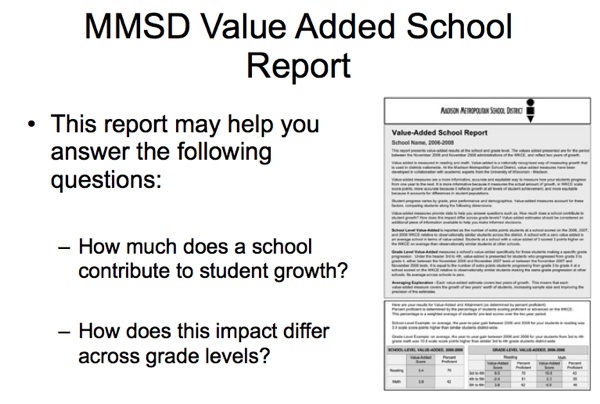
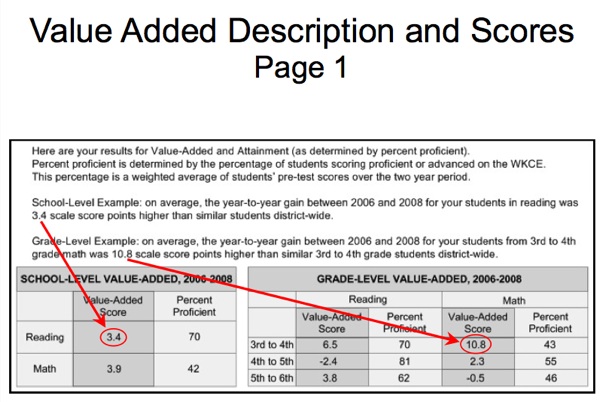
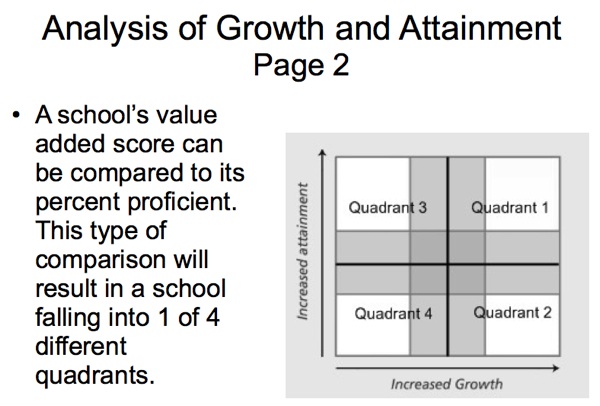
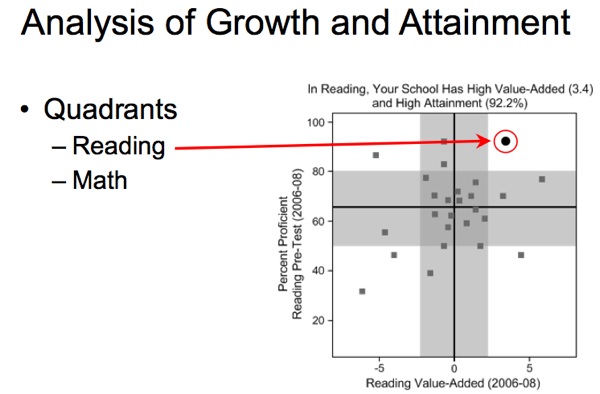
Value Added Assessment in Madison Presentation


Value Added Resource Center @ Wisconsin Center for Education Research

Complete report 1.4MB

Summary.

Much more on value added assessment here.


Madison’s value added assessment program is based on the oft-criticized wkce.

Share

‘Embedded honors’ program has issues

Mary Bridget Lee:

The controversy at West High School continues about the Madison School District’s new talented and gifted program. Students, parents and teachers decry the plan, pointing to the likelihood of a “tracking” system and increasingly segregated classes.
While I am in agreement with them here, I must differ when they mistakenly point to the current “embedded honors” system as a preferable method for dealing with TAG students.
The idea itself should immediately raise red flags. Teaching two classes at the same time is impossible to do well, if at all. Forcing teachers to create twice the amount of curriculum and attempt to teach both within a single context is unrealistic and stressful for the educators.
The system creates problems for students as well. There is very little regulation in the execution of these “embedded honors” classes, creating widely varying experiences among students. By trying to teach to two different levels within one classroom, “embedded honors” divides teachers’ attention and ultimately impairs the educational experiences of both groups of students.
While the concerns raised about Superintendent Dan Nerad’s plan are legitimate, “embedded honors” as a solution is not.

Lots of related links:

Share

A Collaboration to Transform Education in Los Angeles

L.A. Compact, via a David Baskerville email:

In February 2009, leaders from the Los Angeles Education Community publicly signed the L.A. Compact – a collaborative commitment to transform education in Los Angeles. The Compact signers have pledged to put the interests of students first. They have committed to work together to meet the following goals:

Goal 1: All students graduate from high school
Goal 2: All students have access to and are prepared for success in college
Goal 3: All students have access to pathways to sustainable jobs and careers

As part of their commitment, the signers pledged to release an initial data report in order to facilitate the measurement of their progress against these baselines in future years. The data in this report details Los Angeles Unified School District’s rates of graduation, enrollment, preparation, and more. It then follows LAUSD graduates and tracks their progress in post-secondary education. At this point in its development, the report highlights several important markers as we discuss collaborative opportunities for improvement. The measurements and their sources will continue to be refined and expanded over the coming years.

L.A. Compact.

Share

Duncan’s school of wisdom

George Will:

“Since 1995 the average mathematics score for fourth-graders jumped 11 points. At this rate we catch up with Singapore in a little over 80 years . . . assuming they don’t improve.”
– Norman R. Augustine,
retired CEO of Lockheed Martin
What America needs, says one American parent, is more parents who resemble South Korean parents. Education Secretary Arne Duncan, 46, a father of a third-grader and a first-grader, recalls the answer Barack Obama got when he asked South Korean President Lee Myung-bak, “What is the biggest education challenge you have?” Lee answered: “Parents are too demanding.” They want their children to start learning English in first rather than second grade. Only 25 percent of U.S. elementary schools offer any foreign-language instruction.
Too many American parents, Duncan says, have “cognitive dissonance” concerning primary and secondary schools: They think their children’s schools are fine, and that schools that are not fine are irredeemable. This, Duncan says, is a recipe for “stasis” and “insidious paralysis.” He attempts to impart motion by puncturing complacency and picturing the payoff from excellence.

Share

Tough-love mums train cubs for uncertain future

Zhuang Pinghui:

Ding Xinzhu considers herself a strict mother. She lays down the rules for her four-year-old daughter, Yueyue, and she says she’s the only one in the family of seven whom Yueyue “is afraid of” and obeys.
“I told her she needs to sit up straight and feed herself at the table. If she disobeys, I will spank her. She cries, but she listens to me,” Ding, a 34-year-old executive in Shanghai, said. She picked a prominent kindergarten for her daughter and chose painting and ballet as extracurricular activities. On weekends, Yueyue takes piano lessons. “I think I’m the most demanding among my circle of mothers, but I’m only trying to provide the best for my child and prepare her for the future,” Ding said.

Share

Record Level of Stress Found in College Freshmen

Tamar Lewin:

The emotional health of college freshmen — who feel buffeted by the recession and stressed by the pressures of high school — has declined to the lowest level since an annual survey of incoming students started collecting data 25 years ago.
In the survey, “The American Freshman: National Norms Fall 2010,” involving more than 200,000 incoming full-time students at four-year colleges, the percentage of students rating themselves as “below average” in emotional health rose. Meanwhile, the percentage of students who said their emotional health was above average fell to 52 percent. It was 64 percent in 1985.
Every year, women had a less positive view of their emotional health than men, and that gap has widened.
Campus counselors say the survey results are the latest evidence of what they see every day in their offices — students who are depressed, under stress and using psychiatric medication, prescribed even before they came to college.

Share

On the other hand

Harry Eyres:

I want to speak out on behalf of an oppressed minority. This is not one of those minorities one could call fashionable; its oppression might seem negligible, and perhaps most of it, in the west at least, occurred in the past. But left-handed people, who constitute about one-tenth of the population pretty much across the board, have suffered in the course of history.
The negative connotations attached to left-sidedness and left-handedness are remarkably consistent across cultures and across history. Perhaps the most striking is the Latin adjective sinister, which starts off meaning “left” or “on the left hand”, but quickly (in Latin that is) acquires the secondary meanings “wrong”, “perverse” and then (closer to the meaning of sinister in modern English) “unfavourable”, “adverse”, “ill-omened”.

Share

Young inventors prompt colleges to revamp rules

Alan Scher Zagier:

Tony Brown didn’t set out to overhaul his college’s policies on intellectual property. He just wanted an easier way of tracking local apartment rentals on his iPhone.
The University of Missouri student came up with an idea in class one day that spawned an iPhone application that has had more than 250,000 downloads since its release in March 2009. The app created by Brown and three other undergraduates won them a trip to Apple headquarters along with job offers from Google and other technology companies.
But the invention also raised a perplexing question when university lawyers abruptly demanded a 25 percent ownership stake and two-thirds of any profits. Who owns the patents and copyrights when a student creates something of value on campus, without a professor’s help?

Share

Tuition Hike-oholism Hits Bottom?

Kristin Conklin:

“After decades of funding our eleven campuses on the basis of past appropriations and past expenditures, we have lost track of the rationale for each campus’s funding level. We must begin a new approach to funding higher education where we ask the board of higher education to develop a funding methodology that is based on the outcomes that education leaders and citizens would like to see from their college campuses.”
— North Dakota Gov. Jack Dalrymple’s Jan. 4 state of the state address.
Faced with a 5 percent tuition rise and the likelihood of future increases, students at the City University of New York filed a lawsuit against the school protesting the tuition hike. Could we be on the verge of a student movement like that recently under way in England, where rioters incensed over tuition increases have thrown Molotov cocktails, smashed windows, and even attacked Prince Charles’s car?
CUNY’s was a modest hike, with average prices remaining well below the national average. CUNY takes pride in its history of serving low-income and first-generation students with a high-quality, affordable education.. But CUNY, like many public institutions in the U.S., is doing what led to student revolts in England: shifting the burden of paying for higher education from taxpayers to students. According to the State Higher Education Executive Officers association, tuition in the U.S. increased from 25 percent of all educational revenue to 37 percent from 1984 to 2009, even as total spending per student remained about the same.

Share

Introducing Hispanics for School Choice

Aaron Rodriguez:

Hispanics for School Choice (HFSC), a non-profit organization founded in Milwaukee County, is hosting a coming out event at the United Community Center (UCC) on January 24th. It marks the first time in Wisconsin history that leaders in the Hispanic community have organized to expand the Milwaukee Parental Choice Program.
A Buzz at the State Capitol
Last week, Executive Board members of Hispanics for School Choice created somewhat of a buzz as they descended upon the State Capitol to circulate their legislative agenda. Associates from the American Federation of Children and School Choice Wisconsin accompanied HFSC in separate meetings with Senate Majority Leader Scott Fitzgerald, Assembly Speaker Jeff Fitzgerald, Education Committee Chair Steve Kestell, and Secretary of the Department of Administration Mike Huebsch to discuss a timetable of moving the School Choice program forward.
HFSC Board Members were also given exclusive entry to a closed caucus in the Grand Army of the Republic Hearing Room before Assembly Republicans – an access rarely granted to non-profit organizations of any sort for any reason. Before the 60-member caucus, Board Members of HFSC were introduced communicating the idea that HFSC aimed to be more of a resource to legislators than a needy lobbyist.

Share

Tiny island school a beacon for wayward teens

Martha Irvine:

This school isn’t a place you end up by accident.
A small propeller plane flight or a two-hour ferry ride into the northern reaches of Lake Michigan gets you as far as St. James, the northern hub of Beaver Island. But it takes another half hour by car, down bumpy gravel roads, to get to the south tip of the island and the small cluster of classroom buildings and log cabins, shadowed by the historic lighthouse for which this secluded alternative high school is named.
“What the hell have I gotten myself into?” That’s exactly what 18-year-old Katie Daugherty thought as she arrived at the Beaver Island Lighthouse School last September.
She was scared, felt sick to her stomach. She hardly talked to anyone.

Share

More choice in schools needed

James Gleason:

The Gleason Family Foundation has long had an intense interest in the quality of education. With great disappointment over the decades, we’ve watched our public education system continually fail to meet the needs of all children.
The education special interests tell us that the crisis in education is a fabricated one. But the growing body of achievement data overwhelmingly shows that K-12 student performance, particularly in urban school systems, has been middling at best, comparing unfavorably even to some Third World countries.
Rochester, like all too many urban school systems, graduates fewer than 50 percent of its students, many of whom are totally unprepared to meet the challenges of an increasingly high tech world.

Share

Huge child health survey kicks off in Waukesha

Laurel Walker:

One hundred down, 1,150 more to go.
Waukesha County researchers have identified 100 babies who’ll be part of a landmark study of children’s health – a tiny fraction of the 100,000 nationwide who may eventually be identified for the largest long-term study of children’s health ever conducted in the country.
Waukesha County is among the first seven pilot locations, the only one in Wisconsin and part of 105 centers eventually who’ll participate in the National Children’s Study. The $2.7 billion study will follow children from before their birth until age 21 with the aim of identifying the influence of environmental factors, including physical, chemical, biological and psychosocial, on their health and development.
A celebration at the study’s Waukesha office Wednesday highlighted the success in finding the first 100 local participants.
Another 1,150 babies will eventually be added in Waukesha County, and researchers are still recruiting from Brookfield, Big Bend, Hartland, Pewaukee, Oconomowoc, Dousman, New Berlin, Waukesha, Menomonee Falls and Sussex.

Share

Chinese schoolchildren to sit compulsory manners classes

Peter Foster:

From primary school onwards, Chinese children will now receive lessons in the art of queuing, good table manners, how to respect their elders and betters and the correct way to write letters, emails and even send SMS messages.
Older children will be tutored in the arts of introducing oneself to strangers, dealing politely with members of the opposite sex, making public speeches and the rudiments of dealing with foreigners and (to Chinese eyes, at least) their strange ways.
“The goal is to let students know that China is a country with a long history of civilisation, rituals and cultures,” said the guidelines which were published on the ministry’s website.

Share

It’s time for Oklahoma to excel in education

Bill Price:

The 2011 legislative session presents a historic opportunity for Oklahoma to lead in improving our children’s future through comprehensive education reform. The combination of a reform-minded Legislature, governor and state school superintendent, along with an engaged public, provides a unique window for passing the greatest educational improvements in our lifetime.
The first reform is choice in education through an educational tax credit scholarship act that follows the example of the states that have seen the most rapid improvement in educational achievement. This bill empowers parents to find the schools that will best meet their children’s needs, stimulates the creation of innovative scholarship schools, and provides the competition that has been proven to greatly improve the public schools.
Choice also is promoted by expanding the charter school laws, allowing the state schools superintendent to charter new schools, and freeing these highly successful charter schools to finance their own infrastructure needs.

Share

Pro-school choice organization launched

Georgia Pabst:

Hispanics for School Choice, an organization designed to expand school choice programs, launched Monday at a gathering at the United Community Center.
The group’s legislative agenda includes:

  • Removing the enrollment cap in the Milwaukee Parental Choice Program.
  • Expanding choice schools to allow students from Milwaukee to attend schools throughout Milwaukee County.
  • Allowing all parents to participate in choice by lifting income limits.
  • Expanding school choice to other cities.

“Despite differences in political philosophies, our community agrees that school choice is educationally effective in educating our children, and we’re serious about getting the best for our children,” said Zeus Rodriguez, president of the organization.
The school choice movement has backed an array of options outside the traditional public school system. Proponents argue that such programs expand options for parents and pressure public schools to operate more efficiently. Critics argue that the choice program drains resources from public schools, and that public funds shouldn’t flow to private, often religious schools.

Share

In response to criticism, Madison Schools will consider additional 4K sites

Matthew DeFour:

Responding to concerns that potential locations for Madison’s new 4-year-old kindergarten program are not located in poor neighborhoods where they may be most beneficial, school district officials said Monday they will evaluate additional sites.
The School Board on Monday approved 19 elementary schools with available space as potential 4K sites, but also asked the district to identify churches or community centers with space where Madison teachers could be assigned for the 2 1/2 hour daily program beginning this fall.
The district is expecting to hear back this week from 35 day care centers that were approved to participate in the program.
Not all of the 54 potential sites will end up being used, but the district won’t know the exact distribution until parents register their students beginning Feb. 7.

Much more on Madison’s 4K program, here.

Share

Austin superintendent rallies task force to get back to long-term plan

Melissa B. Taboada:

Austin schools Superintendent Meria Carstarphen met with facilities task force members Saturday to encourage them to broaden their scope and not to focus as much on the district’s looming budget crisis.
In recent weeks, the task force seemed to stray a bit from its mission of creating a 10-year plan on future schools, renovations and attendance zones. After it earlier this month named nine schools that could be closed for efficiency’s sake, outraged community members rallied to save their schools.
Although the long-term plan probably will have recommendations on closures, task force members said they felt pressured to produce short-term fixes to help the district get past one of the worst anticipated budget shortfalls in its history.
On Saturday, Carstarphen, in effect, told task force volunteers that was her burden, not theirs.
“There’s only so much in efficiencies you can do,” she said. “You can’t do it all. You don’t need to do it all.”

Austin School Board.
The Austin School District’s 2010-2011 budget is $973,997,900 for 86,000 students ($11,325.55 per student). Madison’s 2010-2011 budget is $379,058,945 (according to the January, 2011 “State of the District” presentation for 24,471 students. That is $15,490 per student.

Share

College Saving Gets Trickier

Jane Kim:

After being pilloried by critics and written off by many families, 529 college-saving plans are getting better. But well-heeled investors still would be wise to spread their bets around.
So-called 529 plans allow people to save for college expenses and withdraw the earnings tax-free. Many also offer a break on state income tax–savings that, in theory, an investor can roll back into the account.
For years 529s were pitched as the ultimate college-savings vehicle, but their limitations were thrown into sharp relief during the financial crisis. Too reliant on stocks, the average 529 investment option lost nearly 24% in 2008. Even portfolios geared to older kids just a few years away from college got hammered, losing 14%, according to investment-research firm Morningstar Inc. What’s more, because savers can generally make investment changes only once a year, many people watched helplessly as their accounts dropped in value.

Share

Parents awarded $1 million in suit claiming therapists created false memories of abuse

Doug Erickson:

A Dane County jury has awarded $1 million to a former Madison couple who claimed therapists created in their daughter false memories of childhood sexual and physical abuse.
Jurors early Sunday found two of the three therapists who treated Charlotte Johnson in the early 1990s professionally negligent, said attorney Bill Smoler, who represented her parents, Dr. Charles and Karen Johnson.
The couple, now of St. Louis, had been accused by their daughter of being Satanists and incest perpetrators. Charlotte Johnson had come to believe that her father had raped her at age 3, that her mother had come after her with a knife and tried to drown her, and that the family dabbled in cults and infanticide, said Smoler, who termed the alleged memories “outrageous.”

Share

Abuse Case Sparks a Clash Over Limits of Tough Parenting

Miriam Jordan:

Dmitriy Kozlov waited until nightfall to place a 911 call to Oregon authorities, alerting them to a terrible case of child abuse in an immigrant community that existed, almost invisibly, in this city’s midst.
The alleged victim was 14-year-old Dmitriy himself. From a pay phone on July 20, 2009, he reported that his parents regularly beat him and several of his six siblings. Their parents, he said, struck them with wires, branches and belts for wearing makeup and getting a fake tattoo.

Share

George Washington University launches online prep school

Daniel de Vise:

George Washington University has opened a private college-preparatory high school that will operate entirely online, one of the nation’s first “virtual” secondary schools to be affiliated with a major research university.
The opening of a laboratory-style school under the banner of a prestigious university generally counts as a major event among parents of the college-bound. The George Washington University Online High School, a partnership with the online learning company K12 Inc., is competing with brick-and-mortar prep schools and with a small but growing community of experimental online schools attached to major universities.
Online learning may be the next logical step in the evolution of university “lab” schools, an ongoing experiment in pedagogy. Online instruction holds the potential to transcend the factory model of traditional public education, allowing students to learn at their own pace. In the ideal online classroom, no lesson is ever too fast or too slow, and no one ever falls behind.

Smart.

Share

New Jersey lawmakers advance school voucher program for students in failing schools

Jessica Calefati:

A state Senate committee voted Thursday to advance a program that would offer vouchers for students in failing public schools to attend private and parochial schools.
The Opportunity Scholarship Act is a signature piece of Gov. Chris Christie’s education reform agenda and another proposal over which he and the state’s largest teachers union are coming to blows. The New Jersey Education Association vehemently opposes the voucher program, calling it “a government bailout for struggling private schools.”
If implemented, the bill would cost about $825 million and serve 40,000 students in 166 chronically failing public schools by its fifth year. It could be a boon for parochial schools, which have been closing in droves because of declining enrollment, but could also force reductions in state aid to public school districts.

Share

College Reversal? Studies find a decline in Asian-American students’ success once they move away from home and go to college.

Kathy Seal:

Some research has found that once Asian-American kids hit college, they no longer outstrip white students academically — if they’re living away from home.
For example, a study of 452 students at UC Irvine led by University of Denver psychologist Julia Dmitrieva found that while both white and Asian-American students’ freshman year grades dipped below their 12th-grade GPAs, Asian-Americans’ fell dramatically, while white Americans’ dropped only slightly.
“There’s a reversal of ethnic differences in college grades, at least temporarily,” Dmitrieva says. That reversal didn’t stem, as some have guessed, from Asian-American students taking more natural science courses, which generally are graded more stringently than other subjects. In fact, her study showed that grades in both natural and social sciences dropped for the Asian-American freshmen, while grades in natural sciences rose for white students.
“We observed the same dip in grades for natural sciences among the Asian-Americans as there are for other majors,” says Dmitrieva.

Share

Learning to Play ‘Angry Birds’ Before You Can Tie Your Shoes

Jennifer Valentino-DeVries:

These kids today. They’re playing with apps and computer games and learning to use a mouse. Whatever happened to tying their shoes and learning to ride a bike?
Young children are still learning to do those traditional activities, but they’re also mastering a variety of tech skills early in life — raising questions about how quickly the world is changing for kids and parents.
Take the skill of tying shoelaces, for example. In a recent survey, 14% of kids age 4 or 5 could tie their shoes, while 21% could play or operate at least one smartphone app.
In the same study, which polled 2,200 mothers in several developed countries, 22% of children that age knew at least one Web address, 34% could open a Web browser and 76% could play an online computer game. By comparison, 31% knew to dial 9-1-1 in an emergency, 35% could get their own breakfast (which we assume doesn’t mean making eggs) and 53% knew their home address. (A full 67% could ride a bike, which makes your Digits blogger feel bad for not learning until she was well into elementary school.)

Share

Proposed New York Property Tax Cap Worries Bayport-Blue Point School Board

TheBayport-Blue Point School District Board of Education discussed the district administration’s preliminary budget plan Tuesday night at its work session meeting, stressing that Gov. Andrew Cuomo’s proposed property tax cap would have a negative impact on the school district.
While the district begins to formulate its budget for the 2011-2012 school year, it does so without knowing how much state aid it will receive and if the governor’s 2 percent tax cap proposal will be law. Cuomo is expected to release his new budget next month.
Superintendent of Schools Anthony Annunziato said the proposed tax cap would be crippling to public schools, including Bayport-Blue Point. “I don’t know if we can get down to 2 percent,” Annunziato said to the board and community members. “I don’t think we can.”

Bayport-Blue Point’s 2010-2011 budget is $66,338,637 for about 2,500 students ($24,795/student). Madison spent $15,241 per student during 2009-2010 according to the Citizen’s Budget.

Share

Teen pregnancy crisis at Memphis high school

Mike Gould:

A Memphis, Tennessee high school is trying to come to grips with a teen pregnancy epidemic.
Ninety students who attend Frayser High School are currently pregnant or have already had a baby this year.
The stunning number means nearly 11 percent of the school’s approximately 800 students are already experiencing the trials of parenthood.
A Title One school, Frayser receives federal dollars based on the number of students from low income families who qualify for free or reduced lunch.
Nearly 100 percent of the students who attend the school qualify.
Such a high rate of pregnancy at one school is dire, but sources say there is a massive initiative in the works dedicated to preventing teen pregnancy in the Frayser community.

Share

Remember ‘The Trip’? Well, It’s Happening.

Stephen Kreider Yoder, Isaac Yoder & Levi Yoder:

STEVE: In three weeks, Levi and I will be in northern Tanzania. Or on a cargo boat on Lake Victoria, or lost in a Ugandan village — I’m not exactly sure.
Sound crazy? I think so. I blame the ex-Army guy who runs the military-surplus store in Berkeley.
Yes, we finally decided to take The Trip. We wrote last year about my fantasy of pulling Levi out of school for six months to seek the sites of our human roots in Africa and then trace the dawn of civilization by vagabonding overland along the Rift Valley, on down the Nile and into the Middle East.
The scheme made no sense. It didn’t make financial sense to take a leave from my great job. It was imprudent for Levi’s education. It wasn’t logical to abandon our comfortable life, leave behind my wife, Karen, and spend money on a whimsical journey when so many others were less fortunate than we.

Share

Why American Mothers are Superior

AnnMaria De Mars:

I really did not have time to write this today, but two articles I read made me drop what I was doing. First was the Wall Street Journal article by a Yale law professor who says Chinese mothers are superior because they produce more mathematical and musical prodigies.
The reason, she says, is because none of them accept a grade less than an “A”, all insist their child be number one in the class, they don’t let their children be in school plays, play any instrument other than piano or violin, etc.
She says that this whole thing about people being individuals is a lot of crap (I’m paraphrasing a bit) and gives an example of how she spent hours getting her seven-year-old to play a very difficult piece on the piano. She uses the fact that the older daughter could do the same piece at that age as proof this was reasonable.
There are a few areas I would take exception with her article. First is her grasp of mathematics and logic. It is clearly impossible that every child in China is number one in the class, unless every classroom in the country has a thirty-way tie for first. Second, as my daughter asked, “There are 1.3 billion people in China. None of them ever got a B?” Third is the issue of claiming your parenting is such a great success when your children are not yet out of high school.

Share

Is There An Education Bubble?

Jeff Carter:

If you pull some free market logic from Finance and apply it to the education market, you might frame things differently. Eugene Fama from the University of Chicago says that there are no such things as “bubbles” in financial markets. If there are, you ought to be able to predict them and act accordingly. He correctly points out that all publicly known information is incorporated into the price of an asset. Are asset bubbles in financial markets directly comparable to intangible assets? Probably not, but Fama’s theory on efficient markets should at least give us a touchstone to think about.
In this case, our asset is a college education. The asset is not physical like a stock or a piece of real estate, but intangible. Hence, there are properties to that asset that are subjective. For example, what is the real value of the Coca-Cola brand name? In turn, what is the real value of a college education-and within the finite range of colleges, what’s the individual value?
Here is the hypothesis: We will assume that there is an education bubble.

Share

KPMG to fund young recruits’ degrees

Chris Cook:

A big graduate recruiter plans to hire the “majority” of its trainees from among school leavers, not university graduates, and pay for them to receive a bespoke degree from a well-regarded British university.
From next year, KPMG will take in 75 school leavers, and then meet the cost of a four-year accountancy degree from Durham university and an accountancy qualification. Trainees on the six-year scheme will start on up to £20,000 a year.
In 2012-13, the maximum university tuition fee, now £3,290, will rise to £9,000. At the same time, subsidies are being withdrawn from the sector and rules loosened to allow new entrants into the market and innovation in course design.
As a consequence, such schemes could become more attractive to universities. David Willetts, universities minister, welcomed the news, saying: “It’s the kind of initiative that we hope will flourish as we reform higher education.”

Share

In Defense of the Guilty, Ambivalent, Preoccupied Western Mom

Ayelet Waldman:

Here are some of the things that my four children of a Jewish mother were always allowed to do:

  • Quit the piano and the violin, especially if their defeatist attitude coincided with a recital, thus saving me from the torture of listening to other people’s precious children soldier through hackneyed pieces of the juvenile repertoire, plink after ever more unbearable plonk.
  • Sleep over at their friends’ houses, especially on New Year’s Eve or our anniversary, thus saving us the cost of a babysitter.
  • Play on the computer and surf the Internet, so long as they paid for their Neopet Usuki dolls and World of Warcraft abomination cleavers out of their own allowances.
  • Participate in any extracurricular activity they wanted, so long as I was never required to drive farther than 10 minutes to get them there, or to sit on a field in a folding chair in anything but the balmiest weather for any longer than 60 minutes.
  • Quit said extracurricular activities, especially if their quitting coincided with league finals that might have demanded participation on my part exceeding the requirements stated above.

Share

China’s Winning Schools?

Nicholas Kristof:

An international study published last month looked at how students in 65 countries performed in math, science and reading. The winner was: Confucianism!
At the very top of the charts, in all three fields and by a wide margin, was Shanghai. Three of the next top four performers were also societies with a Confucian legacy of reverence for education: Hong Kong, Singapore and South Korea. The only non-Confucian country in the mix was Finland.
The United States? We came in 15th in reading, 23rd in science and 31st in math.

Share

Teens Take Elders to Tech Boot Camp

Sue Shellenbarger:

Al Kouba, who lives in Bend, Ore., was told by his son in California that his family’s Christmas letter would only be posted on Facebook–not mailed. That’s when the retired systems engineer knew it was time to play catch up: “If you’re going to communicate with your family, you have to be on Facebook,” he says.
So he turned to a technology expert: his 15-year-old granddaughter, Marlee Norr. But as Marlee explained the steps to log on to the social-networking site, Mr. Kouba protested: “Look, kid, I’m 77 years old! I’m not quite as swift as I used to be.” Both laughed, says Marlee, also of Bend, and she agreed to “back up and slow down.”

Share

Young D.C. families check out the charters

Bill Turque:

Scott and Kim Yarnish live just across the street from Brookland Education Campus @ Bunker Hill, making it the most obvious choice when the time comes for their 2-year-old son, Theo, to begin preschool. But the Ward 5 couple, like most of the young families at the Walter E. Washington Convention Center on Saturday afternoon, were searching for alternatives to their traditional neighborhood public schools.
Attendance figures were not available, but the third-floor exhibition hall was packed for the second annual D.C. Public Charter School Recruitment Expo, where the city’s 52 publicly financed and independently operated schools set up tables to answer questions and offer enrollment forms. The crowd included Mayor Vincent C. Gray, who has promised that his new administration will be more charter-friendly. His appearance alone was a change, according to Nona Richardson, communications director for the D.C. Public Charter School Board, who said that then-Mayor Adrian M. Fenty did not visit the inaugural expo last year.
Scott Yarnish said he came “to get the lay of the land” and because he’d received mixed reports about Brookland, a PS-8 school where less than half of the students read at proficiency level or higher on the 2010 DC CAS.

Share

Unlike Madison, Evanston is cutting honors classes

Chris Rickert:

Twenty-three years ago I walked the halls of Evanston Township High School in Evanston, Ill., with a diverse mix of white-, black- and brown-skinned fellow students.
Then I would walk into an honors class and be confronted with a near-blanket of white.
Not much has changed at my alma mater, and as a result the school district has been embroiled in a contentious curriculum debate that touches on race, academics and the meaning of public education itself.
Sound familiar?
Evanston and Madison are both affluent, well-educated and liberal. And both have high schools where racial achievement gaps are the norm. Their school districts differ, though, in their approach to that gap today: Evanston is cutting honors classes; Madison is adding them.
Unlike Madison, Evanston has long had a sizable minority population and began desegregating its elementary and middle schools in the 1960s — with some positive academic results.
Seniors at ETHS, the city’s only public high school, last year had an average ACT score of 23.5, or 2.5 points higher than the national average. This in one of only five states that requires its students to take the test and in a high school whose student population, about 2,900, is 43 percent white, 32 percent black and 17 percent Latino.

Lots of related links:

More here.

Share

The Tiger Mother Responds to Readers

The Wall Street Journal:

Do you think that strict, “Eastern” parenting eventually helps children lead happy lives as adults?
When it works well, absolutely! And by working well, I mean when high expectations are coupled with love, understanding and parental involvement. This is the gift my parents gave me, and what I hope I’m giving my daughters. I’ve also taught law students of all backgrounds for 17 years, and I’ve met countless students raised the “tough immigrant” way (by parents from Pakistan, India, Nigeria, Korea, Jamaica, Haiti, Iran, Ireland, etc.) who are thriving, independent, bold, creative, hilarious and, at least to my eyes, as happy as anyone. But I also know of people raised with “tough love” who are not happy and who resent their parents. There is no easy formula for parenting, no right approach (I don’t believe, by the way, that Chinese parenting is superior–a splashy headline, but I didn’t choose it). The best rule of thumb I can think of is that love, compassion and knowing your child have to come first, whatever culture you’re from. It doesn’t come through in the excerpt, but my actual book is not a how-to guide; it’s a memoir, the story of our family’s journey in two cultures, and my own eventual transformation as a mother. Much of the book is about my decision to retreat from the strict “Chinese” approach, after my younger daughter rebelled at 13.
I have a 20-month-old, and my husband and I both enjoyed the article. How can you apply this to toddlers?

Share

K-12 Tax & Spending Climate: Young People Are Heeding Austin’s Call, Data Shows

Sabrina Tavernise:

Austin, Tex., drew the largest numbers of young Americans from 2007 through 2009, according to an analysis by a senior demographer at the Brookings Institution, replacing Riverside, Calif., which was the most popular destination for young people in the middle of the decade.
Migration slowed greatly during the recession, and rates have continued to remain low. But in an analysis of migration still occurring among some of the country’s most mobile citizens — people ages 25 to 34 — the cities at the top of the list were those that had remained economically vibrant, like Dallas, and those that were considered hip destinations, like Austin and Seattle, the demographer, William H. Frey, found.
In the middle of the decade, before the recession, the top five destinations were Riverside, Phoenix, Atlanta, Houston and Charlotte, N.C., according to the analysis, which was based on Census Bureau data. Austin ranked ninth in that period, and Las Vegas was No. 10.

Compare Wisconsin & Texas NAEP scores here (White students in Texas outscore Wisconsin students in Math) and have a smaller difference between black students.
A Capital Times perspective on Texas, here. A look at College Station vs. Madison, here

Share

The Almighty Essay

Trip Gabriel:

On a freezing Saturday in February, my wife and I sat through a full-day introduction to college admissions for the parents of 11th graders. This was our first little step on the high-anxiety journey thousands of families trod each year. As parents of twins, we were double-booked. There wasn’t a vacation day in the next eight months that one of us didn’t spend on a college campus, somewhere.
That day, at a workshop called “Behind Closed Doors: the Life of the Application,” an admissions dean from a prestigious small college in Connecticut described carrying home a teetering armload of folders every night during her decision season. She told of examining a student’s high school transcript, the SAT or ACT scores, the letters of recommendation.
“And then,” she said, her manner growing brighter, almost big-sisterly and confidential, “I turn to the personal essay, my favorite part.”

Share

The New Subject-Test Math: 2 = 3

Inyoung Kang:

THE nation’s most selective universities have long required three SAT subject tests. But with the introduction of writing sections on the SAT and ACT in 2005, colleges have been gradually reducing the subject-test requirement.
This admissions cycle, Harvard has jumped on the two-test bandwagon, and Georgetown is “strongly” recommending three instead of requiring them. The most subject tests that any American college now requires is two, according to the National Association for College Admission Counseling. For 18 institutions, the ACT is good enough — no subject tests required at all.
The writing test has been found to be a good indicator of future academic success, says Jeff A. Neal, a Harvard spokesman.

Share

Are U.S. Parents Too Soft?

John Edwards III:

How do we motivate our children to succeed in school, and in life? It’s a fundamental question that animates every parent’s juggle, and there are as many answers as there are families. Amy Chua, author of the new book “Battle Hymn of the Tiger Mother,” shares her own forceful, unyielding answer in an excerpt published in Saturday’s Review section.
Near the beginning, Ms. Chua writes, “Here are some things my daughters, Sophia and Louisa, were never allowed to do:

Share

The Improvisational Brain

Amanda Rose Martinez:

One summer at the annual Bremen Music Festival in Germany, Robert Levin, a classical pianist, was in the midst of improvising a passionate and wild cadenza during Beethoven’s “C Major Piano Concerto.” A cadenza is a passage in a concerto during which the orchestra ceases and a soloist strikes out on his own, improvising within the style of the piece. Up until the early nineteenth century, many classical composers wrote space for these cadenzas within their works. Levin is one of a handful of musicians who has taken it upon himself to revive the practice of classical improvisation. He is world renowned for his ability to effortlessly extemporize in the styles of several composers, including Mozart, Beethoven, Schubert and Mendelssohn. In this particular concert, however, Levin had gotten himself into a bit of a pickle.
“I was going whole hog,” Levin said, thanks to the permission Beethoven gave his renderers to modulate or change keys during his cadenzas. “I had gone really far afield and was in F sharp major. That’s as far away from C major as you can possibly get because if you keep going, you start to get closer to the other side.”

Share

The Newest College Credential

Motoko Rich:

EDUCATION, students are frequently told, is the key to a better job. First, finish high school. Then, go to college and get a degree. For those with higher aspirations, try for a master’s.
But increasingly, there is another way. Short vocational programs leading to a certificate are becoming the kudzu of the educational world. There’s a program for virtually any skill, from interior design to paralegal to managing records at a doctor’s office. Instead of investing in a master’s, professionals itching to move up the career ladder can earn certificates in marketing strategies, credit analysis or even journalism.
In an economy that increasingly rewards specialization, more and more institutions — from the ones that advertise on late-night cable to the most elite of universities — are offering these programs, typically a package of five or six courses, for credit or not, taken over three to 18 months. Some cost a few thousand dollars, others tens of thousands.

Share

Washington Governor Gregoire’s educational reforms: good luck on that

Dick Lilly:

Gov. Gregoire’s’ bold new proposals for an integrated education department? Great in concept (in fact, much needed). Hard to do. Even harder to insure better results than we’re getting now.
That’s how I’d summarize Gov. Gregoire’s proposal to replace the various boards of education with a cabinet-level Department of Education.
First, the need: Sure, the state Board of Community and Technical Colleges, the Higher Education Coordinating Board, and the Board of Education for K-12 schools — not to mention the entire Office of the Superintendent of Public Instruction whose incumbent has already acquitted himself poorly in this debate — all these bodies represent separate silos and have a tough time making their goals and systems fit together. Worse though, they’re also creaky and inefficient, a poor system for making (or changing) policy. (The proposed new department would also absorb the recently created Department of Early Learning which already reports to the governor.)

Share

Effort to Restore Children’s Play Gains Momentum

Hilary Stout:

SARAH WILSON was speaking proudly the other day when she declared: “My house is a little messy.”
Ms. Wilson lives in Stroudsburg, Pa., a small town in the Poconos. Many days, her home is strewn with dress-up clothes, art supplies and other artifacts from playtime with her two small children, Benjamin, 6, and Laura, 3. “I let them get it messy because that’s what it’s here for,” she said.
Ms. Wilson has embraced a growing movement to restore the sometimes-untidy business of play to the lives of children. Her interest was piqued when she toured her local elementary school last year, a few months before Benjamin was to enroll in kindergarten. She still remembered her own kindergarten classroom from 1985: it had a sandbox, blocks and toys. But this one had a wall of computers and little desks.
“There’s no imaginative play anymore, no pretend,” Ms. Wilson said with a sigh.

Share

Kids Draw Their Parents’ Splits: 8 Heartbreaking Pictures

Ashely Reich:

Kids’ Turn, a divorce education program located in San Francisco, encourages children grappling with their parents’ split to express their feelings through art. Founded in 1988, the program–which serves five counties in the Bay Area–has been replicated nationally and internationally, and will be implemented in Great Britain later this year. The following pictures, which were drawn by kids and teens ages 5 to 15, express in crayon and marker feelings often too difficult to explain in words.

Share

New Jersey Governor Christie: Education tops State of the State speech

Angela Delli Santi:

New Jersey Gov. Chris Christie will lay out his ideas for overhauling teacher tenure, giving parents a choice in where their children attend school and shoring up a teetering public worker pension system in his first State of the State address.
Christie told The Associated Press in an interview that he plans to stick to three themes Tuesday in a speech that will top out at under 30 minutes: education reform; changes to the pension and health benefits funds for government workers, teachers, police and firefighters; and responsible budgeting.
“It’s going to be brisk and direct,” Christie said of the speech, “talking about those things and why they’re so important to the future of the state. We’ll do a little bit of a review of where we’ve been and what we accomplished our first year in office, but the majority of the speech will be talking about those three big issues to me.”

Share

Inside the bullied brain: The alarming neuroscience of taunting

Emily Anthes:

In the wake of several tragedies that have made bullying a high-profile issue, it’s becoming clear that harassment by one’s peers is something more than just a rite of passage. Bullied kids are more likely to be depressed, anxious, and suicidal. They struggle in school — when they decide to show up at all. They are more likely to carry weapons, get in fights, and use drugs.
But when it comes to the actual harm bullying does, the picture grows murkier. The psychological torment that victims feel is real. But perhaps because many of us have experienced this sort of schoolyard cruelty and lived to tell the tale, peer harassment is still commonly written off as a “soft” form of abuse — one that leaves no obvious injuries and that most victims simply get over. It’s easy to imagine that, painful as bullying can be, all it hurts is our feelings.

Share

Learning With Disabilities

Abby Goodnough

Ms. Nelson is paying most of her own way at Landmark, a two-year college exclusively for students with learning disabilities and A.D.H.D. She wants to graduate on time this spring, and with tuition and fees alone at $48,000 a year — more than any other college in the nation — she cannot give in to distraction.
“I have a lot riding on this,” says Ms. Nelson, who is also dyslexic. She wants to transfer to a four-year institution and get a bachelor’s degree — a goal that would have been out of reach, she says, had she not found Landmark three years after graduating from high school. If Ms. Nelson gets her associate degree in May after four semesters, she will buck the trend at Landmark.
Only about 30 percent graduate within three years; many others drop out after a semester or two. The numbers suggest that even with all the special help and the ratio of one teacher for every five students, the transition is not easy.

Share

Why Chinese Mothers Are Superior Can a regimen of no playdates, no TV, no computer games and hours of music practice create happy kids? And what happens when they fight back?

Amy Chua:

A lot of people wonder how Chinese parents raise such stereotypically successful kids. They wonder what these parents do to produce so many math whizzes and music prodigies, what it’s like inside the family, and whether they could do it too. Well, I can tell them, because I’ve done it. Here are some things my daughters, Sophia and Louisa, were never allowed to do:

  • attend a sleepover
  • have a playdate
  • be in a school play
  • complain about not being in a school play
  • watch TV or play computer games
  • choose their own extracurricular activities
  • get any grade less than an A
  • not be the No. 1 student in every subject except gym and drama
  • play any instrument other than the piano or violin
  • not play the piano or violin.

Share

‘Daydream’ switch stays on in ADHD

Lindsay Brooke-Nottingham:

New evidence suggests children with ADHD have trouble switching off the “daydreaming” regions in the brain that often interfere with concentration, particularly on tedious tasks.
Using a “Whac-a-Mole” style game, researchers found evidence from brain scans that children with ADHD require either much greater incentives–or their usual stimulant medication–to switch off those regions and focus on a task. The findings are published in the Journal of Child Psychology and Psychiatry.
“The results are exciting because for the first time we are beginning to understand how in children with ADHD incentives and stimulant medication work in a similar way to alter patterns of brain activity and enable them to concentrate and focus better,” says Chris Hollis, a professor of health sciences at the University of Nottingham. “It also explains why in children with ADHD their performance is often so variable and inconsistent, depending as it does on their interest in a particular task.”

Share

A critic of the College Board joins forces with it to build a better Web site for students

Jacques Steinberg:

IN the seven years since he quit his job as a college counselor at a private high school in Portland, Ore., Lloyd Thacker has become something of a folk hero in admissions circles. In standing-room-only gatherings in high school auditoriums, he has implored families to take back the college admissions process from those entities that, he says, do not always act in their best interests — whether a magazine seeking to drum up sales for its rankings issue or a college trying to boost applications.
Among his prime targets has been the College Board, the sprawling, nonprofit organization that oversees the SAT and Advanced Placement program.
In the introduction to “College Unranked: Ending the College Admissions Frenzy,” a collection of essays he edited that was published in 2005, Mr. Thacker lamented the “corporatization” of the board and suggested that its efforts to “compete with other purveyors of college prep services and materials” — referring, in part, to a failed attempt at a for-profit Web site — raised questions about its credibility.
But that was then.
Last spring, Mr. Thacker announced that he and the organization he founded to promote his ideals, the Education Conservancy, were going into partnership with the College Board. Their joint venture: a Web site, free to users, that would provide all manner of advice and perspective on the admissions process.

Share

College’s Value Added: “Large Numbers Don’t Appear to be Learning Very Much”

Amanda Fairbanks:

AT a time when recent graduates, age 24 and under, are experiencing a jobless rate of nearly 10 percent, a new study renews the debate over the value-added component of going to college.
The sociologists Richard Arum of New York University and Josipa Roksa of the University of Virginia tracked 2,300 students through four years of college and into the labor market. The first two years are chronicled in their forthcoming book, “Academically Adrift: Limited Learning on College Campuses” (University of Chicago Press).
This interview with Dr. Arum was conducted and condensed by Amanda M. Fairbanks.
Q. What piqued your interest in this topic?
A. For the last several decades, we’ve evaluated learning in K-12 education. But there’s never been a serious attempt to follow kids through college. We conclude that large numbers don’t appear to be learning very much.

Share

The Concord Review Showcases Journal Showcases The Dying Art of the Research Paper

Sam Dillon:

William H. Fitzhugh, the cantankerous publisher of a journal that showcases high school research papers, sits at his computer in a cluttered office above a secondhand shop here, deploring the nation’s declining academic standards.
“Most kids don’t know how to write, don’t know any history, and that’s a disgrace,” Mr. Fitzhugh said. “Writing is the most dumbed-down subject in our schools.”
His mood brightens, however, when talk turns to the occasionally brilliant work of the students whose heavily footnoted history papers appear in his quarterly, The Concord Review. Over 23 years, the review has printed 924 essays by teenagers from 44 states and 39 nations.
The review’s exacting standards have won influential admirers. William R. Fitzsimmons, Harvard’s dean of admissions, said he keeps a few issues in his Cambridge office to inspire applicants. Harvard considers it “something that’s impressive,” like winning a national math competition, if an applicant’s essay has appeared in the review, he said.

Share

Madison School District School Safety Recommendations and Tactical Site Assessments

Luis Yudice, Safety/Security Coordinator Madison School District:

The Madison Metropolitan School District has the responsibility to provide a safe and secure learning environment for students and staff. To this end, the district periodically conducts assessments of its facilities and reviews its operating practices to ensure that all that can be done is being done to ensure the safety of our schools.
Background
Following a school shooting in the Weston School District in Cazenovia, Wisconsin in 2006, Superintendent Art Rainwater issued security reminders that included the following:

  • Ensure that building security and door locking procedures are followed.
  • Ensure that all non-employees in a building are identified and registered in the office.
  • Ensure that communication systems, radios and PA’s are functioning.
  • Have employees visibly display their MMSD identification badges.
  • Be aware of the school’s security plan and of their role in security procedures.
  • Communicate with and listen to students.
  • Remind students that they should always communicate with staff and share information regarding any threats to the school or to other persons.
  • Ensure that the school’s crisis team is in place.

Share

Wisconsin Open Enrollment Information: 2011-2012 February 7 to February 25

Wisconsin Department of Public Instruction: , via a kind reader’s email.
Much more on open enrollment, here.

Share

Do Home Schoolers Deserve a Tax Break?

Room for Debate:

The new Republicans in Congress have vowed to challenge Washington’s role in American public education, and said they will seek to turn more power over to the states on many fronts. But one of their priorities is a new federal rule: to give parents in every state tax credits if their children are home-schooled.
Previous efforts in Congress to adopt a nationwide tax break have failed, and currently only three states — Illinois, Louisiana and Minnesota — allow some benefit for home schooling.
Will the idea succeed in the new Congress, given some conservatives’ longtime opposition, on the grounds that the credits might open the door to more government regulation of education? How would such a system work? Is it a threat to public education, as its critics claim?

Share

Getting Schooled in Law Loans

Stephanie Landsman:

The American Bar Association has officially issued a warning on its website.
The ABA is now making the case to persuade college students not to go to law school.
According to the association, over the past 25 years law school tuition has consistently risen two times faster than inflation.
The average private law student borrows about $92,500 for law school, while law students who attend public schools take out loans for $71,400. These numbers do not include any debt law students may still have from their time as undergraduates.

Share

Beloit part of voucher plan? “The Days of An Educational Monopoly Are Over”

Justin Weaver:

The new Wisconsin governor is considering sweeping reforms in Madison, one of which could directly impact Beloit schools.
Gov. Scott Walker and the incoming Republican legislature assumed power in the state Monday and wasted no time in introducing the possibility of expanding the state’s school voucher program. The program, presently instituted in the Milwaukee area, allows students to receive taxpayer-financed vouchers to attend private schools, including religious schools. Just under 21,000 of the maximum 22,500 students enrolled in the program this year.
The governor has identified Beloit as one place where the vouchers could be phased in as part of a trial effort to spread the program statewide.
“I think school choice is successful,” Walker told the Milwaukee Journal-Sentinel. “I think it’s worth looking at expanding it. How do you do that? There’s really a multitude of options, not only those being discussed in other parts of the country. And we want to continue to be at the forefront of that.”
Beloit School District Superintendent Milt Thompson said he views the potential voucher introduction as yet another reason for the district to reassess its direction.
“My concern is that the district has to become conscious of today’s market. If you have a system that is attractive, people will send their kids here. If you don’t, the days of an educational monopoly are over,” he said.

Additional choices for our communities is a good thing. Thompson’s perspective is correct and useful.

Share