School Information System

Why Madison Prep deserves consideration

The Capital Times:

We have historically been uncomfortable with so-called “charter” schools, which too frequently sacrifice the principle of providing all students with a well-rounded education in favor of narrower experiments.
And we have never had any taste for separate-but-equal — or more usually separate-and-unequal — schemes that divide students along lines of race, class and gender.
As such, we approached the Madison Preparatory Academy project with trepidation.
The proposal to create a charter school with single-sex classrooms focused on raising the academic performance of minority students has been sincerely and generally well presented by Urban League President Kaleem Caire. We respect that Caire is attempting to address serious issues, including a lingering frustration with the Madison Metropolitan School District’s responses to the achievement gap that has plagued the district for many years.

Share

To: Professors; Re: Your Advisees

Karen Kelsky:

Dear faculty members: I sell Ph.D. advising services on the open market. And your Ph.D. students are buying. Why? Because you’re not doing your job.
Lest you think that by advising, I mean editing research papers and dissertations, let me disabuse you. I offer those services, but rarely am I asked for them.
A former tenured professor at a major research university, I am now running an academic-career consulting business. That’s right: I am doing graduate advising for pay. I am teaching your Ph.D. students to do things like plan a publishing trajectory, tailor their dissertations for grant agencies, strategize recommendation letters, evaluate a journal’s status, judge the relative merits of postdoctoral options, interpret a rejection, follow up on an acceptance, and–above all–get jobs. And business is so good I’m booked ahead for months.

Share

The Latest Crime Wave: Sending Your Child to a Better School

Michael Flaherty:

In case you needed further proof of the American education system’s failings, especially in poor and minority communities, consider the latest crime to spread across the country: educational theft. That’s the charge that has landed several parents, such as Ohio’s Kelley Williams-Bolar, in jail this year.
An African-American mother of two, Ms. Williams-Bolar last year used her father’s address to enroll her two daughters in a better public school outside of their neighborhood. After spending nine days behind bars charged with grand theft, the single mother was convicted of two felony counts. Not only did this stain her spotless record, but it threatened her ability to earn the teacher’s license she had been working on.
Ms. Williams-Bolar caught a break last month when Ohio Gov. John Kasich granted her clemency, reducing her charges to misdemeanors from felonies. His decision allows her to pursue her teacher’s license, and it may provide hope to parents beyond the Buckeye State. In the last year, parents in Connecticut, Kentucky and Missouri have all been arrested–and await sentencing–for enrolling their children in better public schools outside of their districts.

Share

10 Things Student Loan Companies Won’t Say

Anamaria Andriotis:

Your co-signer could do you more harm than good.
Before they will lend thousands of dollars to a college-bound 18-year-old, around 80% of private lenders require a co-signer, according to the Consumer Bankers Association. Typically, that’s a parent or another relative, but it can be anyone willing to take responsibility for paying back the loan. Private lenders often tout the benefit of an adult cosigner, saying that because students don’t have much of a credit history, the a co-signer’s good standing can help secure a lower interest rate. That’s true, but it also puts the student at the mercy of the parent’s credit history, which may not be so stable these days.

Share

K-12 Tax & Spending Climate: Bread & Circuses, or a Look at California’s Union, Pension, Budget and Political Challenges

Michael Lewis:

David Crane, the former economic adviser–at that moment rapidly receding into the distance–could itemize the result: a long list of depressing government financial statistics. The pensions of state employees ate up twice as much of the budget when Schwarzenegger left office as they had when he arrived, for instance. The officially recognized gap between what the state would owe its workers and what it had on hand to pay them was roughly $105 billion, but that, thanks to accounting gimmicks, was probably only about half the real number. “This year the state will directly spend $32 billion on employee pay and benefits, up 65 percent over the past 10 years,” says Crane later. “Compare that to state spending on higher education [down 5 percent], health and human services [up just 5 percent], and parks and recreation [flat], all crowded out in large part by fast-rising employment costs.” Crane is a lifelong Democrat with no particular hostility to government. But the more he looked into the details, the more shocking he found them to be. In 2010, for instance, the state spent $6 billion on fewer than 30,000 guards and other prison-system employees. A prison guard who started his career at the age of 45 could retire after five years with a pension that very nearly equaled his former salary. The head parole psychiatrist for the California prison system was the state’s highest-paid public employee; in 2010 he’d made $838,706. The same fiscal year that the state spent $6 billion on prisons, it had invested just $4.7 billion in its higher education–that is, 33 campuses with 670,000 students. Over the past 30 years the state’s share of the budget for the University of California has fallen from 30 percent to 11 percent, and it is about to fall a lot more. In 1980 a Cal student paid $776 a year in tuition; in 2011 he pays $13,218. Everywhere you turn, the long-term future of the state is being sacrificed.
This same set of facts, and the narrative it suggested, would throw an ordinary man into depression. He might conclude that he lived in a society that was ungovernable. After seven years of trying and mostly failing to run California, Schwarzenegger is persuasively not depressed. “You have to realize the thing was so much fun!” he says. “We had a great time! There were times of frustration. There were times of disappointment. But if you want to live rather than just exist, you want the drama.” As we roll to a stop very near the place on the beach where he began his American bodybuilding career, he says, “You have to step back and say, ‘I was elected under odd circumstances. And I’m going out in odd circumstances.’ You can’t have it both ways. You can’t be a spoiled brat.”

wikipedia on bread and circuses.

Share

Seton Hall Offers Top Applicants Two-Thirds Off

Richard Perez-Pena:

For students with their sights set on a private college, the anxiety comes as a one-two punch: first from competing with thousands of others for a precious few spots, then from trying to scrape together up to $50,000 a year to foot the bill.
Starting next year, Seton Hall University will try to ease that follow-up blow for early applicants with strong academic credentials, giving them two-thirds off the regular sticker price for tuition, a discount of some $21,000. For New Jersey residents, who constitute about 70 percent of Seton Hall’s undergraduates, that would make the cost equivalent to that of Rutgers University, the state’s flagship public institution; for those from out of state, the private school would be much cheaper than the public one.
National experts on admissions and financial aid said the policy was the first of its kind. Seton Hall officials said they hoped it would provide clarity and certainty up front to the most desirable applicants, easing the weeks and months of stress that admitted students face as they wait to hear how much financial aid they might get from different campuses.

Share

To Hover Over Schoolwork, Parents Go Online

Molly Baker:

When Debbie Sumner Mahle, an Atlanta mother, wants to know what her sons, ages 6, 7 and 10, are working on in school, she turns on her computer and logs into NetClassroom. The portal lets her see not just their school assignments but also their attendance and grades.
More public and private school systems are wiring up data-management systems, and school work is just the tip of the iceberg. Parent-accessible websites and “learning community management systems”–or LCMSs, in the age of no jargon left behind–are increasingly handling schools’ scheduling, emergency contacts, immunizations, academic assessments and even meals, with some offering a daily nutritional breakdown of lunch.
Ms. Sumner Mahle receives email reminders to place her sons’ requests at orderlunches.com, which manages the meal program at their school, the Davis Academy. If she wants to work a shift as a cafeteria monitor, or bring cupcakes to a Halloween party, she signs up at volunteerspot.com.

Share

Scott Walker and Mitch Daniels on Public Employee Unions

Ira Stoll:

The governor of Wisconsin, Scott Walker, and the governor of Indiana, Mitch Daniels, were both in New York City earlier this week for a Manhattan Institute conference about a “new social contract” with public employees.
Mr. Walker spoke first. He said the changes enacted in Wisconsin that had opponents sitting in and sleeping over in the state capital in protest earlier this year had saved $1.44 billion for state and local governments combined. He said school districts had used the savings to hire more teachers to reduce class sizes and to offer merit pay.
Mr. Walker said voters are looking for “not Republican leadership, not Democrat leadership, they just want leadership.”
Mr. Walker contrasted his approach with that of Governor Patrick Quinn, a Democrat, of Wisconsin’s neighbor Illinois, who “laid off thousands” of state workers after “massive tax increases.”

Share

Study finds low graduation rates among part-time college students

Carla Rivera:

Growing numbers of college students are in school part time, and they face increasingly long odds of ever graduating, according to a report released Tuesday.
The report, Time is the Enemy, by the nonprofit group Complete College America, includes data on full- and part-time students at public colleges and universities in 33 states, including California. It was funded by the Bill and Melinda Gates Foundation, the Lumina Foundation and others.
“There is a new generation of students who are poorer, more likely to be a minority, working and with families,” said Stan Jones, the organization’s president. “The graduation rates are very low, so that even though more people are going to college looking to better themselves and better their economic circumstances, those goals are not being realized because the system is failing them.”
Among the report’s key findings:

Share

Further Commentary on the Proposed Madison Preparatory Academy IB Charter School: Gender discrimination likely a red herring in charter school discussion

Chris Rickert:

The Madison School District now has another justification for killing a charter school aimed at doing what the district hasn’t: consistently educate minority students.
Last week, the state Department of Public Instruction said the first half of a planning grant for Madison Preparatory Academy would be released. Madison Prep would focus on low-income minority students and was originally just for boys but has since been revamped to include girls in separate classrooms.
But DPI had a catch: In order to get the rest of the grant, the school must provide scientific research that single-gender education is effective. If you’re going to discriminate by gender, DPI is saying, at least have a good reason for it.
I can’t help but wonder: Is this the best DPI can do?
I don’t know much more than what I’ve read in this newspaper about how Madison Prep would organize itself, what kinds of educational approaches it would use or how capable its sponsor, the Urban League of Greater Madison, would be.

TJ Mertz:

ewsletter (as of this writing PD has not taken a position on the Madison Prep proposal). I’ve only changed minimally for posting here; one thing I have added is some hyperlinks (but I did not link as thoroughly as I usually do), another is a small “For Further Reading” set of links at the end,” and of course the song. This is intended to be a broad overview and introduction to what I think are some of the most important issues concerning the decision on the Madison Preparatory Academy presented in the context of related national issues. Issues raised in this post have been and will be treated in more depth — and with hyperlinks — in other posts]

For decades free market advocates such as the Bradley Foundation, the Walton Foundation and the Koch brothers have a waged a multi-front campaign against the public sector and the idea of the common good. Public education has been one of the key battlegrounds. In the coming weeks the Madison Metropolitan School District Board of Education will decide whether to approve a proposal for the Madison Prep Charter School. This proposal and the chief advocate for it – Kaleem Caire of the Urban League of Greater Madison – have their roots in the Bradley/Walton/Koch movement, and like much of that movement they offer false promises of educational progress in order to obscure the damage being done to every child in our public schools.

A Public Hearing on the Madison Prep proposal has been scheduled for Monday October 3, at 6:00 PM in the Doyle Building Auditorium; The Madison Prep proposal is on the agenda of the PD General Membership Meeting (Wed , 9/28 , 6:00 p.m, Hawthorne Branch Library, guests welcome).

Much more on the proposed Madison Preparatory Academy IB Charter School, here.

Share

Parents Losing Faith in Hong Kong Schools

Stuart Lau:

It is no secret that top Hong Kong officials have long said “no” to the education system they govern by sending their own children to schools abroad.
But now more than half of all Hongkongers say they will follow suit, according to a recent survey.
Fifty-two per cent of parents polled said they planned to send their children abroad, according to the survey conducted by credit card company MasterCard. That contrasts with 13 per cent on the mainland and 34 per cent in Taiwan.

Share

Educating the Gifted

Norman Augustine, via a kind reader’s email:

The very subject of giftedness is fraught with contradiction and controversy. On the one hand, we often encounter misunderstanding, envy, and perceived elitism–and on the other, admiration, dependency, and respect. Little wonder that our K-12 education system has not yet determined how best to nurture extraordinary individuals so that they can become extraordinary contributors to society–and feel rewarded in doing so. Unfortunately, it is not simply the gifted who are underserved by most of our nation’s 14,000 public school systems; that group is just more acutely neglected, along with the economically less fortunate, than the nation’s student population as a whole.

Share

The Global Report: Compare US School Districts to the World

The Global Report Card, via a kind Chan Stroman-Roll email:

The Global Report Card was developed by Jay P. Greene and Josh B. McGee as part of the George W. Bush Institute’s Education Reform Initiative. The Bush Institute works to increase dramatically the number of American students who graduate high school ready for college or prepared for a good career by:

  • cultivating a new generation of principals
  • implementing cutting edge research
  • advancing accountability

Driven by accountability and data, these initiatives challenge the status quo and lead a wide range of partners to share goals and use clear metrics tied to student achievement.
Summary of Methodology
The calculations begin by evaluating the distributions of student achievement at the state, national, and international level. To allow for direct comparisons across state and national borders, and thus testing instruments, we map all testing data to the standard normal curve using the appropriate student level mean and standard deviation. We then calculate at the lowest level of aggregation by estimating average district quality within each state. Each state’s average quality is evaluated then using national testing data. And finally, the average national quality is determined using international testing data. Essentially, this re-centers our distribution of district quality based upon the relative performance of the individual state when compared to the nation as a whole as well as the relative performance of the nation when compared to our economic competitors.
For example, the average student in Scarsdale School District in Westchester County, New York scored nearly one standard deviation above the mean for New York on the state’s math exam. The average student in New York scored six hundredths of a standard deviation above the national average of the NAEP exam given in the same year, and the average student in the United States scored about as far in the negative direction (-.055) from the international average on PISA. Our final index score for Scarsdale in 2007 is equal to the sum of the district, state, and national estimates (1+.06+ -.055 = 1.055). Since the final index score is expired in standard deviation units, it can easily be converted to a percentile for easy interpretation. In our example, Scarsdale would rank at the seventy seventh percentile internationally in math.

The Best United States School Districts (2007 Math data) [PDF].
Related: www.wisconsin2.org and 1990-2010 US High School & College Graduation Comparison.

Share

What Do Test Scores Tell Us?

Gary Gutting:

Tests used to be just for evaluating students, but now the testing of students is used to evaluate teachers and, in fact, the entire educational system. On an individual level, some students and parents have noticed a change — more standardized tests and more classroom and homework time devoted to preparation for them.
So what exactly do test scores tell us?
Poor test scores are the initial premises in most current arguments for educational reform. At the end of last year, reading scores that showed American 15-year-olds in the middle of an international pack, led by Asian countries, prompted calls from researchers and educators for immediate action. This year two sociologists, Richard Arum and Josipa Roksa, showed that 45 percent of students, after two years of college, have made no significant gains on a test of critical thinking. Last week’s report of falling SAT scores is the latest example.

Share

Martin Institute Looks at Inclusion Teaching

Bill Dries:

Public and private school teachers will explore the shifting line between “mainstream” students and special education students during a two-day special education summit at The Martin Institute that begins Tuesday, Sept. 27.
The session is for special education teachers. The Wednesday session is for teachers outside the specific special education area. Both are on the Presbyterian Day School campus in East Memphis.
The summit and an 18-month focus on special education that follows arose from a series of luncheons and discussions Institute director Clif Mims had last spring with special education teachers.
The teachers and school system administrators cited “inclusion teaching” as both a trend and a challenge for all teachers.

Share

Commentary on Wisconsin School Choice Battles

Mike Ford:

A 3,000 plus word article by Bill Lueders in the Capital Times today questions the motives behind legislators that support the Milwaukee Parental Choice Program (MPCP). Specifically targeted is Rep. Howard Marklein, a freshman legislator from Spring Green who had the gall to not only support school choice in Milwaukee but also to introduce legislation to improve the program.
Lueders quotes Rep. Sandy Pope-Roberts as asking: “What’s in this for Howard Marklein?…If it isn’t for the campaign funds, why is he doing this?”
Perhaps he is doing it because it benefits taxpayers in the 51st Assembly district. As Marklein points out to Lueders, an analysis by the Legislative Fiscal Bureau shows the MPCP is a benefit to his constituents. Without the MPCP, the 15 school districts represented by Rep. Marklein would lose $1.3 million in state aid. The estimate assumes that 90% of students in the MPCP would have no choice but to return to the more expensive Milwaukee Public School (MPS) system if the MPCP was ended. The 90% figure is the number used by the official state evaluators of the MPCP and is based on evidence from choice programs around the country.

David Blaska has more.
TJ Mertz:

This is Take Two in a series. Take One, with a fuller introduction, can be found here. Briefly, the idea of the series is to counter anti-teacher and anti-teachers’ union individuals and “reform” groups appropriation of the phrase “it is all about the kids” as a means to heap scorn and ridicule on public education and public education employees by investigating some of the actions of these individuals and groups in light of the question “is it all about the kids?” In each take, national developments are linked to local matters in relation to the Madison Prep charter school proposal.
Take Two: A Picture is Worth A Thousand Words: Public Lotteries and the Exploitation of Families and Children

Share

K-12 America Since 1981

edweek, via a kind Richard Askey email:

This interactive timeline digs deep into the Education Week archives to tell the story of U.S. education and the changing policies, theories, and perspectives that have influenced it since 1981, the year the publication began.

Share

A New Law on School Fitness Data Faces Obstacles

Morgan Smith:

Texas children are fat — and getting fatter.
It is something state policy makers have known and have struggled to address for years. In the last decade, the Legislature has passed laws that set nutritional standards for school meals, required body mass index screenings for children and adolescents, and instituted physical activity requirements.
The latest effort came during this year’s legislative session with a bill passed by Senator Jane Nelson, Republican of Flower Mound, that allows a deeper study of schools’ fitness data.
Under the new law, researchers can access unidentified individual student data, which they say will help bolster aggregate analyses that already show correlations between physical fitness and academic performance, gang activity and absenteeism.

Share

Think Different? Not in Higher Ed

Jeffrey Selingo:

When Steve Jobs introduced the “Think Different” advertising campaign on his return to the helm of Apple, in 1997, the slogan was not just aimed at consumers. It was also meant to inspire those inside the struggling company to innovate for the future.
Of course, what followed is now the story of one of the most successful companies in American history: a decade when Apple transformed the music industry with the iPod, the mobile-phone industry with the iPhone, and now the publishing industry with the iPad.
Apple succeed partly because it decided to take a different path than its competitors in the tech industry, and consumers followed. The history of business is filled with similar tales. Just look at what happened to Detroit’s Big Three after the arrival of Japanese automakers in the United States.

Share

Clashes of Money and Values: A Survey of Admissions Directors

Scott Jaschik:

Admissions counselors like to talk about finding the right “fit” for applicants — a great match between a student’s educational and other goals and an institution’s programs. But a new survey of the senior admissions officials at colleges nationwide finds that this “fit” is, from many colleges’ point of view, increasingly about money. As evidence of that pressure, the survey found that:
For many colleges, a top goal of admissions directors is recruiting more students who can pay more. Among all four-year institutions, the admissions strategy judged most important over the next two or three years — driven by high figures in the public sector — was the recruitment of more out-of-state students (who at public institutions pay significantly more). The runner-up was the strategy of providing more aid for low- and middle-income students.
Among all sectors of higher education, there is a push to recruit more out-of-state students and international students.

Share

Are Today’s Youth Really a Lost Generation?

Derek Thompson:

They’re calling us the “Lost Generation.” Young people are struggling in record numbers to find work, leave home, and start a family, according to 2010 Census figures released today.
The proximate cause is the Great Recession. The number of young Americans living with their parents, nearly 6 million, has increased by 25 percent in the last three years. But the greatest cause for concern is that even when the recession has finally let go of the economy, young Americans — Generation Y or Millennials — will face a longer road back to normalcy than their older peers and parents.
Last week, I compared the impact of the recession on three generations: Gen-Y, Gen-X, and Boomers. Each face a particular challenge. For Boomers, it’s a wealth crisis. They invested in homes whose value has fallen by as much as 30 percent. For Gen-X, it’s an income crisis. They should be in the highest-earnings years of their life, but the recession has depressed their salaries and threatened their pensions. For Gen-Y, it’s about the future. The money they’re not making today is a problem. But the money they might not make tomorrow is a greater concern. Two decades after graduating into a recession, an unlucky generation can continue earning 10 percent less than somebody who left school a few years before or after the downturn. When Don Peck added it all up, he found “it’s as if the lucky graduates had been given a gift of about $100,000, adjusted for inflation, immediately upon graduation.”

Share

Teenage Brains

David Dobbs:

To see past the distracting, dopey teenager and glimpse the adaptive adolescent within, we should look not at specific, sometimes startling, behaviors, such as skateboarding down stairways or dating fast company, but at the broader traits that underlie those acts.
Let’s start with the teen’s love of the thrill. We all like new and exciting things, but we never value them more highly than we do during adolescence. Here we hit a high in what behavioral scientists call sensation seeking: the hunt for the neural buzz, the jolt of the unusual or unexpected.
Seeking sensation isn’t necessarily impulsive. You might plan a sensation-seeking experience–a skydive or a fast drive–quite deliberately, as my son did. Impulsivity generally drops throughout life, starting at about age 10, but this love of the thrill peaks at around age 15. And although sensation seeking can lead to dangerous behaviors, it can also generate positive ones: The urge to meet more people, for instance, can create a wider circle of friends, which generally makes us healthier, happier, safer, and more successful.

Share

Our Achievement-Gap Mania

Frederick Hess:

A decade ago, the No Child Left Behind Act ushered in an era of federally driven educational accountability focused on narrowing the chasms between the test scores and graduation rates of students of different incomes and races. The result was a whole new way of speaking and thinking about the issue: “Achievement gaps” became reformers’ catch phrase, and closing those gaps became the goal of American education policy.
Today, the notion of “closing achievement gaps” has become synonymous with education reform. The Education Trust, perhaps the nation’s most influential K-12 advocacy group, explains: “Our goal is to close the gaps in opportunity and achievement.” The National Education Foundation has launched its own “Closing the Achievement Gaps Initiative.” The California Achievement Gap Educational Foundation was launched in 2008 to “eliminate the systemic achievement gap in California K-12 public education.” Elite charter-school operator Uncommon Schools says its mission is running “outstanding urban charter public schools that close the achievement gap and prepare low-income students to graduate from college.” Education Week, the newspaper of record for American education, ran 63 stories mentioning “achievement gaps” in the first six months of this year.
The No Child Left Behind Act’s signal contribution has been this sustained fixation on achievement gaps — a fixation that has been almost universally hailed as an unmitigated good. Near the end of his presidency, George W. Bush bragged that NCLB “focused the country’s attention on the fact that we had an achievement gap that — you know, white kids were reading better in the 4th grade than Latinos or African-American kids. And that’s unacceptable for America.” Margaret Spellings, Bush’s secretary of education, said last year, “The raging fire in American education is the achievement gap between poor and minority students and their peers.”

Share

Wisconsin School chief Evers says state will seek No Child Left Behind waivers

Scott Bauer:

State Superintendent of Public Instruction Tony Evers said Friday that Wisconsin will seek waivers to avoid having to meet basic elements of the federal No Child Left Behind education law at the “first possible moment.”
Evers spoke during a conference call with U.S. Education Secretary Arne Duncan shortly after President Barack Obama announced that he was allowing states to seek the waivers.
“This is absolutely outstanding news,” said Evers, who has long advocated for states to be given the ability to get out of meeting some parts of the law.
Obama is allowing states to scrap the hugely unpopular requirement that all children must show they are proficient in reading and math by 2014 if states can meet conditions designed to better prepare and test students.

Kevin Helliker:

Education chiefs from more than 20 states gathered at the White House on Friday morning to hear President Barack Obama formally propose relaxing certain tenets of the No Child Left Behind act for states that agree to meet a new set of standards he called more flexible.
In characterizing the nearly 10-year-old act as too rigid, the president appeared to strike a chord with school administrators across the country. How much enthusiasm his solution will generate remains to be seen. It calls for evaluating teachers in a way that wouldn’t be legal in California, for example, a state that very much supports amending the No Child Left Behind Act.
“It’s problematic,” Michael Kirst, president of the California State Board of Education, said of a condition that would require states to set specific policy on teacher evaluation, something that in California currently can be done only at the local level. To comply, he said, “we would need legislation passed.”

Much more on No Child Left Behind, here
I spoke with a local mother recently who mentioned that her child was doing great, based on the WKCE math report.

Share

The worth of education cannot be determined solely by marketplace logic. Hong Kong needs to reflect on the true mission of a university to avoid failing its future generations

Anthony Cheung:

While money does not work miracles (as the saying goes, any problem that money can solve is not a problem), it is a necessary ingredient of many solutions to our problems. Without money, many poor countries and rural communities simply cannot provide basic education to improve literacy and promote life skills, never mind consider the quality of education. Unesco, the UN cultural organisation, calls on all governments to invest in education, to provide “education for all”.
Having said that, education should not be seen as just an investment business in the sense that we look for money indicators to measure performance – for example, if we invest so much in a law degree student, how much will he or she earn upon graduation – as if justice can be measured by earnings.

Share

20-Somethings Rack Up Frequent-Flier Miles to Take Far-Flung Journeys; Flying to Fiji for Lunch

Scott McCartney:

The 18-year-old Drexel University student in Philadelphia buys cheap tickets and takes “mileage runs” solely to build up frequent-flier account balances. Then, he cashes in the miles for expensive, far-flung journeys. Once there, he buys rail passes and catches the first train that comes along–doesn’t matter where it’s going–just to see some of the city. “It’s hard for me to stay home. I just want to go,” said Mr. Nguyen, who is from Seattle.
Mr. Nguyen is among a growing number of 20-somethings mastering the calculus of frequent-flier miles, making globe-trotting their hobby. It’s a generation that has grown up with airline deregulation, discount airlines, global airline alliances and “open skies” treaties that make flying between countries easier. They’re also at an age when they have time and flexible schedules. As a result, many have become ferocious travelers.

Share

IXL Learning

ixl.com

Practice makes perfect, and IXL makes math practice fun! IXL allows teachers and parents to monitor the progress of their students and motivate them through interactive games and practice questions. Widely recognized as the Web’s most comprehensive math site, IXL offers a dynamic and enjoyable environment for children to practice math. Students who use IXL are succeeding like never before.

Share

The View from Fifth Grade

Dean Dad:

“I have a locker!”
You forget what’s important when you’re ten.
TW and I went to the parents’ open house at The Boy’s school. Now that he’s in fifth grade, he’s in a new building that unites the kids from the various elementary schools in the district. And yes, he gets a locker.
The principal greeted the parents, if you want to call his mumble a greeting. Honestly, one of the first principles of public speaking is “try to at least pretend to care.” His entire affect conveyed that he’d rather be almost anywhere else. This did not inspire confidence. The only time he seemed to engage was when he mentioned where parents should park.
The library made me sad. TB later reported that his class took a trip there, and he was disappointed in its selection. Luckily we have a good public library in town, and I’ve lent TB my kindle before. At the rate he blasts through books, electronic delivery may be our only hope of keeping up.

Share

Co-Ed Schooling Group Study Assails Merits of Single-Sex Education

Tamar Lewin:

Single-sex education is ineffective, misguided and may actually increase gender stereotyping, a paper to be published Friday asserts.

The report, “The Pseudoscience of Single Sex Schooling,” to be published in Science magazine by eight social scientists who are founders of the nonprofit American Council for CoEducational Schooling, is likely to ignite a new round of debate and legal wrangling about the effects of single-sex education.

It asserts that “sex-segregated education is deeply misguided and often justified by weak, cherry-picked or misconstrued scientific claims rather than by valid scientific evidence.”

Share

The Education Our Economy Needs: We lag in science, but students’ historical illiteracy hurts our politics and our businesses

Norm Augistine:

In the spirit of the new school year, here’s a quiz for readers: In which of the following subjects is the performance of American 12th-graders the worst? a) science, b) economics, c) history, or d) math?
With all the talk of America’s very real weaknesses in the STEM subjects (science, technology, English and math), you might be surprised to learn that the answer–according to the federal government’s National Assessment of Educational Progress–is neither science nor math. And despite what might be suggested by the number of underwater home loans, high-school seniors actually fare best in economics.
Which leaves history as the answer, the subject in which students perform the most poorly. It’s a result that puts American employers and America’s freedoms in a worrisome spot.
But why should a C grade in history matter to the C-suite? After all, if a leader can make the numbers, does it really matter if he or she can recite the birthdates of all the presidents?
Well, it’s not primarily the memorized facts that have current and former CEOs like me concerned. It’s the other things that subjects like history impart: critical thinking, research skills, and the ability to communicate clearly and cogently. Such skills are certainly important for those at the top, but in today’s economy they are fundamental to performance at nearly every level. A failing grade in history suggests that students are not only failing to comprehend our nation’s story and that of our world, but also failing to develop skills that are crucial to employment across sectors. Having traveled in 109 countries in this global economy, I have developed a considerable appreciation for the importance of knowing a country’s history and politics.
The good news is that a candidate who demonstrates capabilities in critical thinking, creative problem-solving and communication has a far greater chance of being employed today than his or her counterpart without those skills. The better news is these are not skills that only a graduate education or a stint at McKinsey can confer. They are competencies that our public elementary and high schools can and should be developing through subjects like history.
Far more than simply conveying the story of a country or civilization, an education in history can create critical thinkers who can digest, analyze and synthesize information and articulate their findings. These are skills needed across a broad range of subjects and disciplines.
In fact, students who are exposed to more modern methods of history education–where critical thinking and research are emphasized–tend to perform better in math and science. As a case in point, students who participate in National History Day–actually a year-long program that gets students in grades 6-12 doing historical research–consistently outperform their peers on state standardized tests, not only in social studies but in science and math as well.
In my position as CEO of a firm employing over 80,000 engineers, I can testify that most were excellent engineers–but the factor that most distinguished those who advanced in the organization was the ability to think broadly and read and write clearly.
Now is a time to re-establish history’s importance in American education. We need to take this opportunity to ensure that today’s history teachers are teaching in a more enlightened fashion, going beyond rote memorization and requiring students to conduct original research, develop a viewpoint and defend it.
If the American economy is to recover from the Great Recession–and I believe it can–it will be because of a ready supply of workers with the critical thinking, creative problem-solving, technological and communications skills needed to fuel productivity and growth. The subject of history is an important part of that foundation.
Mr. Augustine, a former Under Secretary of the Army, is the retired Chairman and CEO of Lockheed Martin.

“Teach by Example”
Will Fitzhugh [founder]
The Concord Review [1987]
Ralph Waldo Emerson Prizes [1995]
National Writing Board [1998]
TCR Institute [2002]
730 Boston Post Road, Suite 24
Sudbury, Massachusetts 01776-3371 USA
978-443-0022; 800-331-5007
www.tcr.org; fitzhugh@tcr.org
Varsity Academics®
www.tcr.org/blog

Share

Universities Seeking Out Students of Means

Tamar Lewin, via a kind reader’s email:

Money is talking a bit louder in college admissions these days, according to a survey to be released Wednesday by Inside Higher Ed, an online publication for higher education professionals.
More than half of the admissions officers at public research universities, and more than a third at four-year colleges said that they had been working harder in the past year to recruit students who need no financial aid and can pay full price, according to the survey of 462 admissions directors and enrollment managers conducted in August and early September.
Similarly, 22 percent of the admissions officials at four-year institutions said the financial downturn had led them to pay more attention in their decision to applicants’ ability to pay.

Share

Kansas City, Mo., School District Loses Its Accreditation

A.G. Sulzberger:

The struggling Kansas City, Missouri School District was stripped of its accreditation on Tuesday, raising the possibility of student departures and a state takeover. The action follows weeks of tumult that included another round of turnover of top leadership.
Though not entirely unexpected, the move was a painful return to reality for the city after a period of optimism that difficult choices were finally being made to confront longstanding problems in the school district, most notably the closing of nearly half the schools in response to a huge budget deficit.
The Missouri Board of Education cited the continued failure to improve academic performance and the continued instability in district leadership as driving its decision. The district has been provisionally accredited for nearly a decade after a two-year period during which it was unaccredited.
“We’ve given Kansas City more time than maybe we should have to address the problems,” said Chris L. Nicastro, the state education commissioner, who had recommended the move. “Over a sustained period of time, student performance has not met state standards.”

Former Madison School District Superintendent Art Rainwater formerly worked for the Kansas City School District.
The great schools revolution Education remains the trickiest part of attempts to reform the public sector. But as ever more countries embark on it, some vital lessons are beginning to be learned.
Money & School Performance is well worth a read.
It is a rare organization that can reinvent itself, rather than continuing to atrophy.

Share

Little Rock desegregation plans go back to court

Associated Press:

The state wants to end its long-running payments for desegregation programs, but three school districts that receive the money say they need it to continue key programs. And a federal judge has accused the schools of delaying desegregation so they can keep receiving an annual infusion of $70 million.
A federal appeals court will hear arguments Monday from both sides. The judges are expected to decide eventually whether Arkansas still has to make the payments and whether two of the districts should remain under court supervision.
The schools, which serve about 50,000 students, have come a long way since 1957, when the governor and hundreds of protesters famously tried to stop the Little Rock Nine from entering Central High School. But thousands of white and black children still have to be bused to different neighborhoods every day under one of the nation’s largest remaining court-ordered desegregation systems.
Now parents are worried about the schools’ future, and some are considering enrolling their children elsewhere.

Share

Putting Parents in Charge

Peg Tyre:

Peg Tyre is the author of “The Good School: How Smart Parents Get Their Kids the Education They Deserve.”
THE school year is in full swing and, if you are the parent of a school-age child, you’ve probably figured out how to get your children up each weekday morning, dressed and out the door — toast in hand — in order to catch the school bus. Good for you.
If you’ve met and exchanged contact information with your child’s homeroom teacher or gone the extra step and volunteered to become the class parent, give yourself a pat on the back. You’re on your way to becoming an engaged parent — the kind of adult, education researchers say, who helps children to be the best they can be in school.
Now, steady yourself. New legislation, called the parent trigger, which is being proposed in more than 20 states, including New York, is about to make your role as an engaged parent a lot more complicated.

Share

Starting College Later

Phil Bowermaster:

Some interesting comments from reader John Kennedy (no relation, as far as I know) on the recent poll about people’s reasons for going to college. He writes:

There’s another question in this discussion that I didn’t address in previous comment. Apparently, kids going to college with no clear goal is somehow thought stupid (that’s the implication). But I would ask, how many 17- or 18-year-olds have any idea about the real working world or about their own strengths and limitations? How many can think? What about having a chance to grow up a bit? This is also what college provides. OK, expensive? Do the first two years of general education at a community college, not perhaps a fine intellectual atmosphere, but possible to live at home, listen to the instructors, maybe get a clearer idea about personal and vocational possibilities.

Share

Family Pioneers in Exploration of the Genome

Amy Dockser Marcus:

A group of researchers said that by examining the whole genome of a family of four, they were able to make unusually specific findings, including the daughter’s risk of blood clots, and suggestions for preventive care.
The study, published Thursday in the journal PLoS Genetics, was led by researchers at Stanford University School of Medicine in Palo Alto, Calif., but also listed as co-authors John and Anne West, a father and daughter who were researching their own genetic make-up at home in Silicon Valley and met the Stanford team in the process. The research is part of scientists’ continuing quest to extract truly useful information from the genome, a person’s complete genetic code.
This is the second time a paper has been published about a family’s whole genome. In the earlier paper, published last year in Science Express by a different group of researchers, the two children in the family had rare genetic conditions, and researchers were searching for the genes that caused them. The goal in the current study was to better predict the disease risk of a family and how family members might respond to medications.

Share

Pay for Only 4 Years of College. Guaranteed.

Alan Schwarz:

Each incoming freshman at Randolph-Macon College this year was eligible to take part in a brief signing ceremony.
The new student, along with a parent and the college president, could sign a special agreement that is emerging at some colleges and universities: As long as the student keeps up with academic work and meets regularly with advisers, the college guarantees that earning a degree there will take no more than four years.
If it fails to hold up its end of the bargain — if required classes are not available, or if advisers give poor counsel — the college promises to cover the cost of additional tuition until the degree is completed.
Four-year degree guarantees, as they have become known, are being offered at a growing number of smaller private colleges. They work as a marketing tool, giving colleges a way to ease parents’ fears that their children might enjoy college enough to stick around for five or six costly years. And they help to focus attention on the task at hand: graduating in four years.

Share

For Student Borrowers, a Hard Truth

Annamaria Andriotis:

As many students and parents struggle to make payments on their student loans, many are finding this debt comes with some serious strings attached.
After years of economic difficulty and rising college tuition, the recent news that the default rate on federal student loans has risen came as little surprise to many. Nearly one in ten federal student-loan borrowers defaulted during the two years ended Sept. 30, 2010, meaning they failed to make a payment on their loans for more than 270 days, according to the Department of Education. That’s up from 7% in 2008. Much of that increase came from for-profit colleges, whose students’ default rate jumped to 15% from 11.6%, but the default rate among students at public and private, four-year universities also increased.
What many people may not realize, however, when taking out a student loan is just how different it is from other kinds of debt. Credit-card debt, for example, can be wiped out in bankruptcy. Mortgages can be discharged through foreclosure. For borrowers with crippling student loan debt, financial failure offers no such fresh start. The loan still must be paid off, and often with new collection costs tacked on, making it much more expensive than before. On top of that, up to 25% of a person’s wages can be deducted until the loan is paid back in full. (Private lenders must get court approval for wage garnishment and the amount they can take varies.) With federal loans, the government can also keep your federal and state income tax refunds, intercept future lottery winnings and withhold part of your Social Security payments. “Defaulting can be completely devastating to a family’s finances and sense of well being,” says Mark Kantrowitz, publisher of FinAid.org and Fastweb.com.

Share

The Shame of College Sports

Taylor Branch:

A litany of scandals in recent years have made the corruption of college sports constant front-page news. We profess outrage each time we learn that yet another student-athlete has been taking money under the table. But the real scandal is the very structure of college sports, wherein student-athletes generate billions of dollars for universities and private companies while earning nothing for themselves. Here, a leading civil-rights historian makes the case for paying college athletes–and reveals how a spate of lawsuits working their way through the courts could destroy the NCAA.
“I’m not hiding,” Sonny Vaccaro told a closed hearing at the Willard Hotel in Washington, D.C., in 2001. “We want to put our materials on the bodies of your athletes, and the best way to do that is buy your school. Or buy your coach.”
How to Fix College Sports Vaccaro’s audience, the members of the Knight Commission on Intercollegiate Athletics, bristled. These were eminent reformers–among them the president of the National Collegiate Athletic Association, two former heads of the U.S. Olympic Committee, and several university presidents and chancellors. The Knight Foundation, a nonprofit that takes an interest in college athletics as part of its concern with civic life, had tasked them with saving college sports from runaway commercialism as embodied by the likes of Vaccaro, who, since signing his pioneering shoe contract with Michael Jordan in 1984, had built sponsorship empires successively at Nike, Adidas, and Reebok. Not all the members could hide their scorn for the “sneaker pimp” of schoolyard hustle, who boasted of writing checks for millions to everybody in higher education.

Share

Taking the Dread Out of Phys Ed

Sue Shellenbarger:

For many middle school students, the words “Phys Ed” are enough to provoke fear–fear of getting dressed in the locker room, of wearing a nerdy uniform, of looking clumsy, of being picked last.
Tammy Brant, a gym teacher at Selma Middle School, in Selma, Ind., is rethinking the way schools have taught girls and boys about fitness. Instead of group calisthenics and contests that favor the most athletic kids, Ms. Brant, like many other teachers nationwide, devotes class time to fitness instruction and to games structured so that more kids can play and enjoy.
Instead of pushing everyone to hit specific performance targets, she urges them to progress toward individualized “fitness zones.” She teaches the stages of a workout–warm-up, training, cool-down–and straps a heart monitor on each child. The goal is to instill healthy habits for life.

Share

Can you name successful parent coup?

Jay Matthews:

Joseph Hawkins, senior study director at the Rockville.-based research group Westat, read my recent attack on the Parent Trigger Law in California and issued a challenge:
“If we put 10 hot-shot education reporters together in a room and asked this question I think the answer would be zero: ‘In the past 10 years of school reform, can you list any schools where a parent revolution took place?'”
Hawkins said he is talking about a successful parent rebellion– “meaning that the parents were fed up with low performance and they literally took over the school and improved it–demanded that it become better.”
He said “I don’t think such parent ‘revolutions’ ever take place at all. We probably could find some schools where a group of fed-up parents started their own charter, but I’m talking about something totally different. I’m pretty sure that both us have been in those low performing schools where many parents when quizzed in depth about their school confessed their frustrations. But mounting a coup d’état? Out of the question.”

Share

MBA applications: How to beat the drop

The Economist:

The Graduate Management Admission Council’s latest report on business-school applications makes for grim reading. According to its 2011 Application Trends Survey (PDF) over two-thirds of schools worldwide say that they have seen applications to their two-year full-time MBA programmes fall over the last year. Meanwhile, 57% also reported a drop in applications to one-year full-time programmes.
There may be several contributing factors. With applications at an all time high the year before (generally applications to business schools rise in tough economic times) there is an element of a return to normality. Still, this doesn’t account for all of the collapse.
Dave Wilson, GMAC’s president, says it may not be that there has been a shocking drop in the number of applicants, rather that each candidate is applying to fewer schools. This is interesting because one explanation could be that more students are only applying for local programmes, where there is a limited choice. If true, this fits neatly with the projections of many of those predicting tough times ahead for business schools.

Share

THE DARK SIDE: Religion has no place in public schools

David Ziemer:

Many years ago, I attended a public high school student’s graduation ceremony out in what I consider the sticks.
I was amazed at the overt Christianity. There was a prayer at the beginning, and again at the end. The commencement speeches were full of references to God.
My own public high school was roughly one-third Jewish, so this wouldn’t have flown. Someone would have sued, and rightfully so. A Jewish student should be able to go to his own public high school graduation without being told he needs to pray to Jesus Christ.
But out in the sticks, I guess, that sort of thing was okay.
Being a lawyer, I approached the father of the graduate, knowing he was not religious, and asked if he would like to bring a lawsuit against the school district. He said he found the ceremony offensive, but that he owns a business in that town, and he was certainly not going to bring a lawsuit just because they turned his son’s graduation ceremony into a revival meeting. Fair enough. I let the matter drop.

Share

Visualizing the uneven geographies of knowledge production and circulation

Kris Olds & Susan Robertson:

As noted in a previous entry (‘Visualizing the globalization of higher education and research‘), we’ve been keen to both develop and promote high quality visualizations associated with the globalization of higher education and research. On this note, the wonderful Floating Sheep collective recently informed me about some new graphics that will be published in:
Graham, M., Hale, S. A., and Stephens, M. (2011) Geographies of the World’s Knowledge, London, Convoco! Edition.

Share

Judging schools by advanced scores

Jay Matthews:

Journalists like me get into ruts. We pick one way of describing data and stick with it. I tell myself that I would confuse readers if I made changes. That might be an excuse for laziness and lack of imagination.
A habit I share with many education writers is presenting school test results one way: the percentage of students who score proficient or above. I ignore a subset of that proficient group, the percentage who achieve at the higher, advanced level.
The advanced percentages are impressive in the Washington suburbs, because they have some of the highest average family incomes in the country. The District is different. Most of its public school students are from low-income families. But I have been noticing some D.C. schools with impressive percentages of students scoring not just proficient but advanced. What would those schools look like if we reported that higher order of achievement? In the long term, don’t we want as many students as possible to be learning at the advanced level?

Share

The Dark Side of the Placebo Effect: When Intense Belief Kills

Alexis Madrigal:

They died in their sleep one by one, thousands of miles from home. Their median age was 33. All but one — 116 of the 117 — were healthy men. Immigrants from southeast Asia, you could count the time most had spent on American soil in just months. At the peak of the deaths in the early 1980s, the death rate from this mysterious problem among the Hmong ethnic group was equivalent to the top five natural causes of death for other American men in their age group.
Something was killing Hmong men in their sleep, and no one could figure out what it was. There was no obvious cause of death. None of them had been sick, physically. The men weren’t clustered all that tightly, geographically speaking. They were united by dislocation from Laos and a shared culture, but little else. Even House would have been stumped.
Doctors gave the problem a name, the kind that reeks of defeat, a dragon label on the edge of the known medical world: Sudden Unexpected Nocturnal Death Syndrome. SUNDS. It didn’t do much in terms of diagnosis or treatment, but it was easier to track the periodic conferences dedicated to understanding the problem.

Share

50 Years of Stupid Grammar Advice

Geoffrey K. Pullum

April 16 is the 50th anniversary of the publication of a little book that is loved and admired throughout American academe. Celebrations, readings, and toasts are being held, and a commemorative edition has been released.
I won’t be celebrating.
The Elements of Style does not deserve the enormous esteem in which it is held by American college graduates. Its advice ranges from limp platitudes to inconsistent nonsense. Its enormous influence has not improved American students’ grasp of English grammar; it has significantly degraded it.
The authors won’t be hurt by these critical remarks. They are long dead. William Strunk was a professor of English at Cornell about a hundred years ago, and E.B. White, later the much-admired author of Charlotte’s Web, took English with him in 1919, purchasing as a required text the first edition, which Strunk had published privately. After Strunk’s death, White published a New Yorker article reminiscing about him and was asked by Macmillan to revise and expand Elements for commercial publication. It took off like a rocket (in 1959) and has sold millions.

Share

Study: College graduates driving increase in bankruptcy filings

Ylan Mui:

College graduates are the fastest-growing group of consumers who have filed for bankruptcy protection in the past five years, according to a new study by a financial nonprofit, which underscores the broad reach of the Great Recession.
The survey by the Institute for Financial Literacy, slated for release Tuesday, found that the percentage of debtors with a bachelor’s degree rose from 11.2 percent in 2006 to 13.6 percent in 2010. The group tracked similar but smaller increases in consumers with two-year associate and graduate degrees. Meanwhile, the percentage of debtors with a high school diploma or who did not finish college declined.

Share

SpongeBob Found to Impair Preschoolers’ Thinking — Should You Be Worried?

Matt Blum:

Who lives in a pineapple under the sea?
SpongeBob SquarePants!
Rot your kids’ brains right there in their heads will he.
SpongeBob SquarePants!
There’s a lot of hullabaloo on the web today about a newly-published study out of the University of Virginia that shows that preschoolers who watched SpongeBob SquarePants had increased difficulty performing tasks requiring focus and self-control. The study draws the conclusion that watching a fast-paced TV show negatively affects kids’ cognitive functioning for a short time after watching it.
The scientists conducting the study, which was published in the journal Pediatrics, took a group of 60 four-year-olds, mostly from white, middle-class families, and randomly separated the kids into three groups: one which watched a part of a SpongeBob episode, one which watched a similar amount of a Caillou episode, and one which simply did some free-drawing and watched no TV. After that phase was over, they gave the children a set of tasks to do which required what’s called “executive function,” a term which refers to a set of skills related to goal-directed behavior — including attention, self-regulation, problem-solving, and ability to deal with delayed gratification. They consistently found that the kids who had watched SpongeBob did significantly worse at the tasks than the kids in either of the other groups.

Share

More Arkansas students taking AP classes, passing, education officials say

Rob Moritz:

The number of Arkansas students taking Advance Placements tests in math, science and English has risen 32 percent in the past five years and there has been a nearly 50 percent rise in the number of students receiving qualifying scores, state education officials heard today.
Also, the state Board of Education learned of an academic turnaround for a Fort Smith elementary which last year ranked among the lowest performing school in the state.
Tommie Sue Anthony, president of the Arkansas Advanced Initiative for Math and Sciences, which is funded primarily through a grant from the national Math and Science Initiative, told board members that the number of students achieving scores of 3 or better on AP math, science and English scores — the highest possible score is 5 — increased in Arkansas by 46 percent from 2007 to 2011.

Share

What if the Secret to School Success Is Failure?

Paul Tough, via a kind reader’s email:

Dominic Randolph can seem a little out of place at Riverdale Country School — which is odd, because he’s the headmaster. Riverdale is one of New York City’s most prestigious private schools, with a 104-year-old campus that looks down grandly on Van Cortlandt Park from the top of a steep hill in the richest part of the Bronx. On the discussion boards of UrbanBaby.com, worked-up moms from the Upper East Side argue over whether Riverdale sends enough seniors to Harvard, Yale and Princeton to be considered truly “TT” (top-tier, in UrbanBabyese), or whether it is more accurately labeled “2T” (second-tier), but it is, certainly, part of the city’s private-school elite, a place members of the establishment send their kids to learn to be members of the establishment. Tuition starts at $38,500 a year, and that’s for prekindergarten.
Randolph, by contrast, comes across as an iconoclast, a disrupter, even a bit of an eccentric. He dresses for work every day in a black suit with a narrow tie, and the outfit, plus his cool demeanor and sweep of graying hair, makes you wonder, when you first meet him, if he might have played sax in a ska band in the ’80s. (The English accent helps.) He is a big thinker, always chasing new ideas, and a conversation with him can feel like a one-man TED conference, dotted with references to the latest work by behavioral psychologists and management gurus and design theorists. When he became headmaster in 2007, he swapped offices with his secretary, giving her the reclusive inner sanctum where previous headmasters sat and remodeling the small outer reception area into his own open-concept work space, its walls covered with whiteboard paint on which he sketches ideas and slogans. One day when I visited, one wall was bare except for a white sheet of paper. On it was printed a single black question mark.
For the headmaster of an intensely competitive school, Randolph, who is 49, is surprisingly skeptical about many of the basic elements of a contemporary high-stakes American education. He did away with Advanced Placement classes in the high school soon after he arrived at Riverdale; he encourages his teachers to limit the homework they assign; and he says that the standardized tests that Riverdale and other private schools require for admission to kindergarten and to middle school are “a patently unfair system” because they evaluate students almost entirely by I.Q. “This push on tests,” he told me, “is missing out on some serious parts of what it means to be a successful human.”

Share

Do You Like Me? Click Yes or No

Jason Harrington:

To: Alice
First day of school. Sucks, huh? This class is so boring. I hate long division. Anyway, I like you. I set up a Tumblr for you while we were supposed to be doing #5. Just a poll with your name as the site’s title:

Share

Why you need to become an Expert

Conditioned for Accomplishments:

Recently I interviewed many experts to find out how they got to where they are. They ranged from world champion arm wrestlers to New York Times bestselling authors. I wanted to know what made them tick and if they were really any different from you and I.
The first thing I did was to redefine what an expert is. Often we hear the word expert and we think of one person who is unique above any other person. He or she has developed qualities and skill that surpass the average person, but that is not what it means to be an expert.
An expert is someone who has tested or tried, a person who is wise through experience.

Share

Awesome! Stanford Quality Master’s in Computer Science Degree Online for $2,000

SimpleRNA

Awesome! Sebastian Thrun of Stanford is absolutely on the right track.
Reply to him @sebastianthrun to let him know you’d like that.
And, more Stanford courses may come online in the near future.

Share

The 1979 6-Year-Old: Less Reading, More Range

KJ Dell Antonia:

Is your child ready for first grade? Earlier this month, Chicago Now blogger Christine Whitley reprinted a checklist from a 1979 child-rearing series designed to help a parent figure that one out. Ten out of 12 meant readiness. Can your child “draw and color and stay within the lines of the design being colored?” Of course. Can she count “eight to ten pennies correctly?” Heck, yeah, I say for parents of kindergarteners everywhere. “Does your child try to write or copy letters or numbers?” Isn’t that what preschool is for?
“Can he travel alone in the neighborhood (four to eight blocks) to store, school, playground, or to a friend’s home?”
It’s amazing what a difference 30 years have made. Academically, that 1979 first grader (who also needed to be “six years, six months” old and “have two to five permanent or second teeth”) would have been considered right on target to start preschool. In terms of life skills, she’s heading for middle school, riding her two-wheeled bike and finding her own way home. It’s not surprising that I came to this link via Lenore Skenazy’s Free-Range Kids blog. What is surprising is just how shocking a jolt it is to realize how stark the difference is between then and now.

Share

Student-Loan Default Rate Rises

Kevin Hilliker:

The percentage of federal student-loan borrowers who defaulted during the two years ended last Sept. 30 rose to 8.8% from 7%, according to figures that the U.S. Department of Education released Monday.
That increase reflects the difficulty graduates are facing finding jobs amid a weak economy, particularly those who attended for-profit schools. The default rate for for-profit schools rose to 15% from 11.6%, compared with a rise to 7.2% from 6% at public institutions and a jump to 4.6% from 4% at private institutions.

Share

New Studies Show Severe Racial Discrimination at University of Wisconsin

Center for Equal Opportunity:

Two studies released today by the Center for Equal Opportunity reveal severe discrimination based on race and ethnicity in undergraduate and law school admissions at the University of Wisconsin-Madison, with African Americans and Latinos given preference over whites and Asians.
The studies are based on data supplied by the schools themselves, some of which the university had refused to turn over until a lawsuit was filed by CEO and successfully taken all the way to the state supreme court. The studies were prepared by Dr. Althea Nagai, a research fellow at CEO, and can be viewed on the organization’s website, www.ceousa.org.
CEO president Roger Clegg will answer questions about the studies when they are formally released at a press conference today at 11:00 a.m. at the DoubleTree hotel in Madison–525 W. Johnson St.
The odds ratio favoring African Americans and Hispanics over whites was 576-to-1 and 504-to-1, respectively, using the SAT and class rank while controlling for other factors. Thus, the median composite SAT score for black admittees was 150 points lower than for whites and Asians, and the Latino median SAT score was 100 points lower. Using the ACT, the odds ratios climbed to 1330-to-1 and 1494-to-1, respectively, for African Americans and Hispanics over whites.

Adelaide Blanchard:

Two reports released today allege the University of Wisconsin discriminates against whites and Asian applicants and have electrified both UW administration and some student leaders.
A crowd of more than 150 students filled the Multicultural Student Center in the Red Gym on Monday after an ominous message from UW Vice Provost for Diversity and Climate Damon Williams claimed a threat had been made against the diversity efforts in the campus community.
The reports were released at midnight on Tuesday from the Center for Equal Opportunity in conjunction with a press conference CEO President Roger Clegg will hold at the Double Tree Inn at 11 a.m. today. Clegg will also be at a debate on the future of Affirmative Action at the UW Law School at 7 p.m. this evening.
Williams said the timing of the events is no coincidence.
In an interview with The Badger Herald, Clegg said the reports show how a heavy preference is given to blacks and Latinos over whites and Asians in the admissions process for undergraduate programs and in the law school.

Todd Finkelmeyer:

Whites and Asians aren’t getting a fair crack at being admitted to the University of Wisconsin-Madison.
That’s what two studies released late Monday night by the Center for Equal Opportunity indicate. The organization states in a press release accompanying the studies that there is “severe discrimination based on race and ethnicity in undergraduate and law school admissions” at Wisconsin’s flagship institution of higher education.
The CEO — a conservative think tank based out of Sterling, Va., that pushes “colorblind public policies” and backs the elimination or curtailment of existing racial preference and affirmative action programs — reports that UW-Madison gives “African Americans and Latinos preference over whites and Asians” in admissions. The studies, which initially were embargoed until Tuesday morning, were released late Monday on the CEO website.
According to the executive summary of the report examining undergraduate admissions at UW-Madison: “In 2007 and 2008, UW admitted more than 7 out of every 10 black applicants, and more than 8 out of 10 Hispanics, versus roughly 6 in 10 Asians and whites.”

Dr. Sara Goldrick-Rab:

The Center for Equal Opportunity and its president and general counsel, Roger Clegg, claim to advance educational opportunity by punishing colleges and universities for attempting to level a highly unequal playing field.
The CEO’s name is laughable. It is the exact opposite of what the organization does. The misnomer is a deliberate deception. It is a lie so blatant that it would be considered a joke in very poor taste were it not so outrageously fallacious.
The record of CEO’s lawsuits has never been in support of equality–it has always been to preserve and protect educational opportunity for those most fortunate social classes and racial/ethnic groups. There is no no record of this organization filing a lawsuit on behalf of newly emerging and underrepresented populations in higher education–it always and only files lawsuits on behalf of the already-advantaged.

Share

Who Are You and What Are You Doing Here?

Mark Edmundson:

Welcome and congratulations: Getting to the first day of college is a major achievement. You’re to be commended, and not just you, but the parents, grandparents, uncles, and aunts who helped get you here.
It’s been said that raising a child effectively takes a village: Well, as you may have noticed, our American village is not in very good shape. We’ve got guns, drugs, two wars, fanatical religions, a slime-based popular culture, and some politicians who–a little restraint here–aren’t what they might be. To merely survive in this American village and to win a place in the entering class has taken a lot of grit on your part. So, yes, congratulations to all.
You now may think that you’ve about got it made. Amidst the impressive college buildings, in company with a high-powered faculty, surrounded by the best of your generation, all you need is to keep doing what you’ve done before: Work hard, get good grades, listen to your teachers, get along with the people around you, and you’ll emerge in four years as an educated young man or woman. Ready for life.

Share

Never a better time for Seattle Schools?

Linda Thomas:

The new school year begins in Seattle today, with the superintendent feeling “excited and hopeful that anything is possible” in the year ahead.
I’m not as confident, yet.
My daughter starts her junior year of high school. She’s enthusiastic, optimistic and one of those students who always gets a “she’s a delight to have in class” comment on her report cards. She has the school system figured out. Today she’s on the team who will help incoming, possibly nervous, freshmen. Have a great day sweetie; I know you will.
This is not a routine day for my son. He’s making the transition from elementary to middle school. No more bubbly fish tank in the school lobby, little kids’ artwork on the walls and shock absorbing wood chips on the playground. Instead, he’ll be surrounded by the echoing thud of steel locker doors slamming, the shuffle of grown up-sized tennis shoes tromping through the halls and concrete sidewalks with weeds growing through the gaps. Have a great day son; I don’t know how your day will go. I can’t wait to find out this afternoon.

Share

Milwaukee Public Schools’ fast-tracks proposal to make ‘voucher tax’ transparent

Karen Herzog:

A proposal that Milwaukee taxpayers be told on tax bills exactly how much of their money is going to private schools through the Milwaukee Parental Choice Program is on the fast track for school board consideration.
During a special MPS board meeting Saturday morning to discuss the district’s long-range master plan for buildings, board member Larry Miller asked that his “voucher tax” transparency proposal be discussed at a school board committee meeting Tuesday, rather than wait to be introduced at the board’s next regular meeting Sept. 22, and then be referred to committee for discussion at a later date.
“The urgency of this is there’s a huge tax burden on the community and it’s important for the community to be educated on this burden,” Miller told the board Saturday morning.
The tax that MPS must levy under state law to support low-income Milwaukee students enrolled in private schools under the choice program would have ranked just behind Milwaukee Area Technical College and ahead of the Milwaukee Metropolitan Sewerage District if it had been broken out, ranked, and displayed under the “Levy by Unit of Government” section of tax information sent to taxpayers in 2010, Miller said.

Share

SpongeBob In Hot Water From Study Of 4-Year-Olds

The cartoon character SpongeBob SquarePants is in hot water from a study suggesting that watching just nine minutes of that program can cause short-term attention and learning problems in 4-year-olds.
The problems were seen in a study of 60 children randomly assigned to either watch “SpongeBob,” or the slower-paced PBS cartoon “Caillou” or assigned to draw pictures. Immediately after these nine-minute assignments, the kids took mental function tests; those who had watched “SpongeBob” did measurably worse than the others. Previous research has linked TV-watching with long-term attention problems in children, but the new study suggests more immediate problems can occur after very little exposure — results that parents of young kids should be alert to, the study authors said.
Kids’ cartoon shows typically feature about 22 minutes of action, so watching a full program “could be more detrimental,” the researchers speculated, But they said more evidence is needed to confirm that.
The results should be interpreted cautiously because of the study’s small size, but the data seem robust and bolster the idea that media exposure is a public health issue, said Dr. Dimitri Christakis. He is a child development specialist at Seattle Children’s Hospital who wrote an editorial accompanying the study published online Monday in the journal Pediatrics.
Christakis said parents need to realize that fast-paced programming may not be appropriate for very young children. “What kids watch matters, it’s not just how much they watch,” he said.
University of Virginia psychology professor Angeline Lillard, the lead author, said Nickelodeon’s “SpongeBob” shouldn’t be singled out. She found similar problems in kids who watched other fast-paced cartoon programming. She said parents should realize that young children are compromised in their ability to learn and use self-control immediately after watching such shows. “I wouldn’t advise watching such shows on the way to school or any time they’re expected to pay attention and learn,” she said.
Nickelodeon spokesman David Bittler disputed the findings and said “SpongeBob SquarePants” is aimed at kids aged 6-11, not 4-year-olds. “Having 60 non-diverse kids, who are not part of the show’s targeted (audience), watch nine minutes of programming is questionable methodology and could not possibly provide the basis for any valid findings that parents could trust,” he said.
Lillard said 4-year-olds were chosen because that age “is the heart of the period during which you see the most development” in certain self-control abilities. Whether children of other ages would be similarly affected can’t be determined from this study. Most kids were white and from middle-class or wealthy families. They were given common mental function tests after watching cartoons or drawing. The SpongeBob kids scored on average 12 points lower than the other two groups, whose scores were nearly identical.
In another test, measuring self-control and impulsiveness, kids were rated on how long they could wait before eating snacks presented when the researcher left the room. “SpongeBob” kids waited about 2 1/2 minutes on average, versus at least four minutes for the other two groups. The study has several limitations. For one thing, the kids weren’t tested before they watched TV. But Lillard said none of the children had diagnosed attention problems and all got similar scores on parent evaluations of their behavior.
——
Online: Pediatrics: http://www.pediatrics.org

Share

An Open Letter to a College Freshman

Timothy Dairymple:

At last your time has come. Leaving behind the old world and the deep ruts you carved in the corner of that world that belonged to you, you’re off to explore undiscovered countries, to join a new and ever-replenishing society of fascinating people and learned scholars and impassioned artists and driven achievers, off to a place where the world is new and so are you. Whether or not your college years will be “the best years of your life,” they will almost certainly be among the most transformative.
The question is whether that transformation will be for the better. Unmoored from the people and places that once defined you, you’ll feel a fluidity in your identity that’s both thrilling and frightening. You may feel as though you can be anyone and become anything. I pray that you will become who you are — the individual you most truly and deeply are, the one God dreamt of when he made you — and not the person that you or your parents or your friends think you should be. In service to that end, I thought I would offer seven pieces of advice. Though it feels churlish to say so, I offer this advice on the basis of some personal experience — more than many and less than some, with four undergraduate years at Stanford, three at Princeton Seminary and seven at Harvard for my Ph.D. I did a fair amount of teaching, came to know many professors well, and spent time too at universities overseas. So, on the basis of those experiences, here are my thoughts:

Share

Lies, damn lies and the myth of “standardized” tests

Marda Kirkwood:

[Note from Laurie Rogers: Recently, results from the 2011 state standardized test scores came out, and the general impression given to the public — for example from the state education agency (OSPI) and from media in Seattle and in Spokane — was that improvements had been made. It’s all in the definitions: How do you define “improvement”? Did some of the numbers go up? Assuredly. Did that mean that real improvments in real academic knowledge had been made? It’s best to remain skeptical.
Most students in Spokane are as weak in math skill this year as they were last year. Given a proper math test that assesses for basic skills, many high schoolers still test into 4th or 5th-grade math. College remedial rates are still high. Parents are still frantic, and students are still stressed out about math. So … what do those higher scores actually mean? I’ve been trying to find out. It’s hard to say.

Share

What teachers really want to tell parents

Ron Clark:

This summer, I met a principal who was recently named as the administrator of the year in her state. She was loved and adored by all, but she told me she was leaving the profession.
I screamed, “You can’t leave us,” and she quite bluntly replied, “Look, if I get an offer to lead a school system of orphans, I will be all over it, but I just can’t deal with parents anymore; they are killing us.”
Unfortunately, this sentiment seems to be becoming more and more prevalent. Today, new teachers remain in our profession an average of just 4.5 years, and many of them list “issues with parents” as one of their reasons for throwing in the towel. Word is spreading, and the more negativity teachers receive from parents, the harder it becomes to recruit the best and the brightest out of colleges.

Share

Why You Should Drop Out of High School

Susannah Breslin:

There is a great deal of debate going on over whether or not you should go to college. Is it worth it? You will enter a difficult job market deeply in college loan debt. Despite your degree, your job prospects will be slim. And nobody can quite figure out what the future really holds for college grads’ futures.
Here’s another question: Why bother graduating from high school?
1. It doesn’t matter.

Share

Back-to-school virtually: Separating fact from fiction

Michelle Mueller:

very principal looks forward to the first day of school when students return with fresh minds eager to learn and ready to work. But as students prepare to hit the books in the next couple weeks, some of them won’t have to take the bus to school, wander the halls looking for their classroom or search rows of desks to find their seat.
Virtual schooling with Wisconsin Connections Academy (WCA) allows students to receive a top-notch public education online from the comfort of their homes. Virtual education is an increasingly popular alternative to the traditional brick and mortar classroom, but many parents still don’t fully understand online learning and how it works.
Virtual public schooling is not homeschooling. In fact, the two are quite different. Virtual public schools deliver public education to a student’s home at no cost that combines state-certified teachers and a rigorous curriculum that correlates to state standards. At WCA, students learn at home under the guidance of a Wisconsin certified teacher. A Learning Coach, typically a parent, assists the student in day-to-day activities. Our teachers work directly with both the student and Learning Coach to develop an individual learning plan, provide instruction and evaluate assignments.

Share

People are biased against creative ideas, studies find

Mary Catt:

The next time your great idea at work elicits silence or eye rolls, you might just pity those co-workers. Fresh research indicates they don’t even know what a creative idea looks like and that creativity, hailed as a positive change agent, actually makes people squirm.
“How is it that people say they want creativity but in reality often reject it?” said Jack Goncalo, ILR School assistant professor of organizational behavior and co-author of research to be published in an upcoming issue of the journal Psychological Science. The paper reports on two 2010 experiments at the University of Pennsylvania involving more than 200 people.

Share

Will Madison School Board pull the plug on Madison Prep’s planning grant?

Susan Troller:

The threat of possible litigation has roiled the already turbulent waters surrounding the proposal for a single-sex Urban League charter school.
Madison school officials began feeling skittish over recommending a $225,000 planning grant for the Madison Preparatory Academy for Young Men after the state Department of Public Instruction raised concerns recently that the school doesn’t meet state and federal requirements to provide gender-equal education.
Now, a new legal threat has emerged, this one from Madison Teachers Inc. Together, the two issues could cause the board to pull back from supporting the planning grant, possibly as early as Thursday.
First, some background: After DPI put the planning grant on hold, the Urban League of Greater Madison last week submitted a new proposal to simultaneously establish a separate campus for girls. Kaleem Caire, Urban League president and a driving force behind Madison Prep, wants to see the schools open next year, initially with 60 sixth-grade girls and 60 sixth-grade boys. The proposal calls for adding 120 additional sixth-graders in each of the four subsequent years. Because the proposal now envisions 600 students rather 480 as originally planned, it would require more funding from the Madison Metropolitan School District than originally planned.

Much more on the proposed Madison Preparatory Academy IB Charter school, here.

Share

ESF school offers fast-track way in for HK$400,000 Discovery College has introduced a priority waiting list – but not all parents are happy about the scheme

Dennis Chong:

The English Schools Foundation (ESF) has angered parents by introducing a fast-track system for its private school in Discovery Bay, in which parents can get priority on the waiting list by agreeing to pay HK$400,000 if their child is accepted.
The ESF started the system for “nomination rights” on Thursday and said it had been introduced for parents seeking to enrol children at Discovery College from the next academic year.

Share

Degrees of separation over top US university’s online courses

Lisa Krieger:

Going online to get a college degree has been championed as a cost-effective way to educate the masses and challenged as a cheapening of academia. Now, the online classroom is coming to the vaunted University of California system, making it the nation’s first top-tier university to offer undergraduate credit for cyberstudies.
By dislodging education from its brick-and-mortar moorings, the University of California – short on money and space – hopes to ease the path to a diploma for students who are increasingly forced to wait for a vacant seat in a lecture hall. Especially in high-demand “gateway courses,” such as chemistry, calculus and composition.
This summer, UC Berkeley tested its first pilot course: Chemistry 1A. For one student, working as a lifeguard in San Rafael, it accelerated her progress toward a joint degree in biology and economics. Another was able to live at home in Sacramento, because she registered for summer school too late to get dorm space.

Share

On the Size Increase in Football Players

Gregg Easterbrook:

Randy White of the Dallas Cowboys, star defensive tackle of the 1970s, member of both the College Football Hall of Fame and Pro Football Hall of Fame: What a joy it was to watch him play! White was a master of leverage, burst and anticipation. Today, he might not even make an NFL roster. If White got on the field, he’d be crushed.
White played defensive tackle at 257 pounds, across from centers weighing 240 or 250 pounds and guards who were considered huge if 265. Last year’s Super Bowl featured defensive tackles B.J. Raji (337 pounds) and Casey Hampton (330 pounds) versus guards Chris Kemoeatu (344 pounds) and Josh Sitton (318 pounds). Either guard would have steamrolled Randy White as if he wasn’t there.
As for today’s biceps: Your Honor, I call to the stand America’s leading expert on these matters, Mel Kiper Jr. Everyone assumes today’s football players are bigger, faster and stronger than those who came before. But what does the data show? No one is better suited to answer that question than Kiper.
Far, far in the past — about 1980 — the United States was not obsessed with the NFL draft. Of course that’s hard to imagine today. Once, bread did not come sliced. But I digress.

Share

USDOE taking student loan enforcement seriously

Mickey Muldoon:

Yes, the US Department of Education owns guns. Its Office of the Inspector General has statutory authority to make arrests, conduct warrants, and pound open your front door. Usually if you get involved in some sort of fraud scheme related to federal student loans.
Here’s a message from a recent victim:

Share

Madison Urban League Meeting Closed, Unless its Open

Samara Kalk Derby:

A meeting Wednesday to discuss the minority achievement gap in the Madison district will be closed to the media, even if that means kicking School Board members out, the organizer said Monday.
The Urban League of Greater Madison invited Madison School Board members to its meeting facilitated by an arm of the U.S. Department of Justice, but if four board members attend, it would be considered a quorum of the school board and need to abide by the open meetings law.
Four of the seven school board members confirmed with the State Journal Monday that they plan to attend the meeting.
“We’ll have to kick one of them out,” said Urban League President Kaleem Caire, laughing. “I’m serious.”

Share

Angst for the educated A university degree no longer confers financial security

The Economist:

MILLIONS of school-leavers in the rich world are about to bid a tearful goodbye to their parents and start a new life at university. Some are inspired by a pure love of learning. But most also believe that spending three or four years at university–and accumulating huge debts in the process–will boost their chances of landing a well-paid and secure job.
Their elders have always told them that education is the best way to equip themselves to thrive in a globalised world. Blue-collar workers will see their jobs offshored and automated, the familiar argument goes. School dropouts will have to cope with a life of cash-strapped insecurity. But the graduate elite will have the world at its feet. There is some evidence to support this view. A recent study from Georgetown University’s Centre on Education and the Workforce argues that “obtaining a post-secondary credential is almost always worth it.” Educational qualifications are tightly correlated with earnings: an American with a professional degree can expect to pocket $3.6m over a lifetime; one with merely a high-school diploma can expect only $1.3m. The gap between more- and less-educated earners may be widening. A study in 2002 found that someone with a bachelor’s degree could expect to earn 75% more over a lifetime than someone with only a high-school diploma. Today the premium is even higher.

Share

College students living in the lap of luxury

Roger Vincent:

Housing is moving away from the dorms and cracker-box apartments of old as part of a national trend. At USC, tanning beds, hot tubs, HD televisions and a club room are all on the amenities list. But it doesn’t come cheaply.
Odds are slim that the cast of “Jersey Shore” will ever enroll at USC. But if they could, TV’s legendary sybarites would find that gym-tan-laundry is just the beginning at a new luxury apartment complex near campus.
Nearly every detail at West 27th Place is upmarket, from the fountains, landscaping and custom outdoor light fixtures to the granite countertops and big-screen HD television sets in every unit. There are also televisions in the well-appointed gym, along with a professional-grade Sundazzler — a walk-in tanning booth that resembles a science-fiction movie prop.

Share

School Curriculum Falls Short on Bigger Lessons

Tara Parker-Pope
Now that children are back in the classroom, are they really learning the lessons that will help them succeed?
Many child development experts worry that the answer may be no. They say the ever-growing emphasis on academic performance and test scores means many children aren’t developing life skills like self-control, motivation, focus and resilience, which are far better predictors of long-term success than high grades. And it may be distorting their and their parents’ values.
“What are we really trying to do when we think about raising kids?” asked Dr. Kenneth R. Ginsburg, an expert in adolescent medicine at Children’s Hospital of Philadelphia. “We’re trying to put in place the ingredients so the child is going to be a successful 35-year-old. It’s not really about getting an A in algebra.”
Take the question of praising a child’s academic achievement. In his new book “Letting Go With Love and Confidence: Raising Responsible, Resilient, Self-Sufficient Teens in the 21st Century” (written with Susan Fitzgerald), Dr. Ginsburg draws a crucial distinction between hard work and simply getting an A or “being smart.”
In one set of studies, children who solved math puzzles were praised for their intelligence or for their hard work. The first group actually did worse on subsequent tests, or took an easy way out, shunning difficult problems. The research suggests that praise for a good effort encourages harder work, while children who are consistently told they are smart do not know what to do when confronted with a difficult problem or reading assignment.
“When we focus on performance, when we say ‘make sure you get A’s,’ we have kids who are terrified of B’s,” Dr. Ginsburg said. “Kids who are praised for effort, those kids learn that intelligence is something that can be built.”
Academic achievement can certainly help children succeed, and for parents there can be a fine line between praising effort and praising performance. Words need to be chosen carefully: Instead of saying, “I’m so proud you got an A on your test,” a better choice is “I’m so proud of you for studying so hard.” Both replies rightly celebrate the A, but the second focuses on the effort that produced it, encouraging the child to keep trying in the future.
Praise outside of academics matters, too. Instead of asking your child how many points she scored on the basketball court, say, “Tell me about the game. Did you have fun? Did you play hard?”
Dr. Ginsburg notes that parents also need to teach their children that they do not have to be good at everything, and there is something to be learned when a child struggles or gets a poor grade despite studying hard.

(more…)

Share

What’s wrong with our universities?

James Piereson:

This fall more than 19 million students will enroll in the 4,000 or so degree-granting colleges and universities now operating in the United States. College enrollments have grown steadily year by year, more than doubling since 1970 and increasing by nearly one-third since the year 2000. More than 70 percent of high school graduates enroll in a community college, four-year residential college, or in one of the new online universities, though only about half of these students graduate within five years. The steady growth in enrollments is fed by the widespread belief (encouraged by college administrators) that a college degree is a requirement for entry into the world of middle-class employment. A college education is now deemed one of those prizes that, if good for a few, must therefore be good for everyone, even if no one in a position of academic authority can define what such an education is or should be. These conceptions are at the heart of the democratic revolution in higher education.

Share

Why Are Textbooks So Expensive?

Ethan Trex:

The beginning of a freshman’s college experience is an exciting time. Dining halls! No bedtime! Taunting your RA! Exorbitantly expensive textbooks!
Wait, that last one is no fun at all. It’s hard to make that first trip to the college bookstore for required texts without leaving with a bit of sticker shock. Why are textbooks so astonishingly expensive? Let’s take a look.
Publishers would explain that textbooks are really expensive to make. Dropping over a hundred bucks for a textbook seems like an outrage when you’re used to shelling out $10 or $25 for a novel, but textbooks aren’t made on the same budget. Those hundreds of glossy colorful pages, complete with charts, graphs, and illustrations, cost more than putting black words on regular old white paper. The National Association of College Stores has said that roughly 33 cents of every textbook dollar goes to this sort of production cost, with another 11.8 cents of every dollar going to author royalties. Making a textbook isn’t cheap.
There’s certainly some validity to this explanation. Yes, those charts and diagrams are expensive to produce, and the relatively small print runs of textbooks keep publishers from enjoying the kind of economies of scale they get on a bestselling popular novel. Any economist who has a pulse (and probably some who don’t) could poke holes in this argument pretty quickly, though.

Share

The Community of Math Teachers, from Elementary School to Graduate School

Sybilla Beckmann:

Why should mathematicians be in- terested and involved in pre-K-12 mathematics education? What are the benefits of mathematicians working with school teachers and mathematics educators?1 I will answer these questions from my perspective of research math- ematician who became interested in mathematics education, wrote a book for prospective elemen- tary teachers, and taught sixth-grade math a few years ago. I think my answers may surprise you because they would have surprised me not long ago.
It’s Interesting!
If you had told me twenty-five years ago, when I was in graduate school studying arithmetic geometry, that my work would shift toward improving pre-K- 12 mathematics education, I would have told you that you were crazy. Sure, I would have said, that is important work, it’s probably hard, and somebody needs to do it, but it doesn’t sound very interesting. Much to my surprise, this is the work I am now fully engaged in. It’s hard, and I believe what I’m doing is useful to improving education, but most surprising of all is how interesting the work is.
Yes, I find it interesting to work on improving pre-K-12 math! And in retrospect, it’s easy to see how it could be interesting. Math at every level is beautiful and has a wonderful mixture of intri- cacy, big truths, and surprising connections. Even preschool math is no exception.

Share

Is Our Students Earning? A new way of measuring how different colleges pay off in the long run.

Erin Dillon:

The college class of 2011 just graduated into one of the worst job markets in recent history. Twenty-four percent of 2011 grads had a job offer in hand by graduation, compared with 51 percent of students graduating in the prerecession year of 2007. As these recent college grads move back in with their parents, and as student loan bills come due, many will wonder–was college worth the money?
The short answer is: probably. While studies of past recessions suggest that the unlucky Great Recession grads will do less well economically than those graduating during better times, they are still likely to earn more and have better job prospects than their peers who lack college credentials. The June 2011 unemployment rate for those with only a high school diploma, for example, was 10 percent, as opposed to 4.4 percent for those with a college degree. And earnings for college graduates were 66 percent higher in 2010 than for high school graduates. Moreover, the benefits of a college degree are not just financial: college graduates tend to lead healthier lives, have lower divorce rates, and have children who are better prepared for school. On average, a college degree is a worthwhile, if increasingly expensive, investment.

Share

The 2011 College Football Grid of Shame

Darren Everson:

College football, to put it as charitably as possible, had a less-than-ideal offseason.
From the Southeast to the Pacific Northwest, a series of scandals, controversies, academic outrages and incidents of boorish behavior has taken a toll on the good names of several schools.
This weekend’s spotlight game, for instance, pits No. 3-ranked Oregon, a school that’s under NCAA investigation for possible recruiting violations, against No. 4 LSU, whose top quarterback, Jordan Jefferson, is suspended for his part in a brawl outside a campus watering hole called Shady’s.

Share

School Days

Steve Prestegard:

Today begins school in Ripon and in most of Wisconsin. So parents breathe a sigh of relief that the kids are finally out of the house, until they realize that now they have to get their children to their various after-school activities.
This has been an unusual summer for one glaring reason, and yet it hasn’t been unusual in the day-to-day things. All three kids went to summer school. All three played baseball (T-ball in Shaena’s case). All three went to church camp, Shaena with me. (Which was not how I expected to spend her summer vacation, although those three days were far from summerlike.) All three visited their grandparents, and we got back reports that made us wonder whose children they had. We didn’t go on vacation, in part for the aforementioned glaring reason, but I’m not sure the family is up to being locked inside a van for extended periods of time anyway. More than once, in fact, I’ve wondered how everyone would have gotten to everything had there been two working parents, particularly with the occasional added complication of orthodontist and veterinarian appointments.

Share

New technologies are promising, but what about the teachers?

Monica Bulger:

This post is not going to promise dramatic learning gains from using a new technology. It’s not one of those stories where at first a teacher was skeptical, but in the end, the classroom was like a sports movie where the technology scored the winning homerun. I feel skeptical when I read those stories. I don’t doubt the success, but I wonder whether the learning gains, increased student interest/participation, or higher levels of reported satisfaction have less to do with the iPad, blog, twitter stream, or virtual environment and more to do with who is in the classroom.
Cathy Davidson recently described an idyllic experience of teaching a course in which she and the students shared in the discovery of new applications of technologies for learning. She describes the process of developing the course, the thrill when the students actually invited and facilitated a guest lecture, and the ways in which the students challenged her to really be collaborative, even in grading.
If we step back for a moment, though, and consider a class with Davidson and those same students without the new technologies, what would the learning experience be like? I imagine it would still be exceptional, because Davidson is an obviously engaged teacher and the students are obviously engaged learners. She employs teaching strategies that were effective before the new technologies she describes. In particular, she encourages students to take ownership of their learning experience and creates a flexible environment to support whatever direction they take. When developing assignments, Davidson incorporates research in motivation, particularly students’ likelihood to put more effort into writing for an authentic audience. She also has deep experience with her topic and an obvious enthusiasm for both the content and the teaching. These factors are consistently linked to positive learning experiences in educational research. Additionally, the students clearly seem motivated to learn. She describes the class list as a diverse collection of disciplines, so the students appear to be choosing the course. They demonstrate active involvement with the assignments and content and even provide substantive feedback for future courses.

Share

A weaker Public School Choice initiative

Los Angeles Times Editorial:

By keeping charter operators out of the first round of applications to run new schools, the L.A. Unified board has scaled back its goal of making educational excellence the highest priority.
The Public School Choice initiative was a landmark reform for the Los Angeles Unified School District. By allowing alternative operators — whether charter school organizations, the mayor or groups of teachers — to apply to manage scores of new and low-performing schools, it set the standard for putting students first. The theory was that anyone could apply and the very best applications would win, ensuring that students attended the best-run schools the district could offer. Just as important, charter operators in the program would have to accept all students within each school’s enrollment area rather than using the usual lottery system under which more-motivated families tend to apply to charter schools.
Of course, this is L.A. Unified, which means things didn’t always work out. More than one management contract was awarded on the basis of political alliances. Charter schools were disappointingly unwilling to take on the tougher challenge of turning around failing schools; most of their applications were for the new, pretty campuses.

Share

Language learning: No, she’s foreign!

The Economist:

LANGUAGE-learning is fascinating, but not for those who can’t take the occasional humiliation.
I live in São Paulo and though I’m sure my Portuguese accent is horrible, it’s horrible in a recognisably Paulistano way. I say the “e” in duzentos (two hundred) with a twang; and I don’t say “sh” for “s”, as Cariocas, or residents of Rio, do. Generally people in São Paulo understand what I’m trying to say–and so do taxi drivers and hotel staff in Rio. Indeed, they are usually so delighted to meet a foreigner who speaks any Portuguese at all that they are highly complimentary, which even if it is more to do with Brazilian hospitality and courtesy, is delightfully confidence-inducing.
Not so Cariocas who don’t have regular contact with tourists. On holiday in Rio with my family recently, I tried to strike up conversation with some children aged around 11 or 12 on the top of the Pão de Açúcar, or Sugarloaf Mountain, one of Rio’s most famous tourist spots. I asked one if they were visiting with their school. (This was an easy guess; they were wearing uniform. But I wanted to practise.) He stared at me, bemused. I repeated: “Vocês estão aqui com sua escola?” No good. He called over a friend. By now I was getting embarrassed, but I tried again. This time he turned to her and said: “Não entendi nada” (I didn’t understand a thing). Only when a teacher came over and repeated my sentence to the children did we get anywhere. Very depressing.

Share

Guardian and New York Times crowdsource schools databases

Katherine Travers:

Education, along with health and taxes, is a principal public concern; politicians win elections because of it, and therefore it’s vital that newspapers provide good coverage of it.
Both The Guardian and The New York Times have launched crowd-sourcing projects on their websites, which intend to provide readers with information relating to the quality of schools.
As it is GCSE results day in the UK, The Guardian has appealed to teachers on its website to fill in a simple online form, which will then allow them to map the exam results of schools across the country.

Share

Team Real on Drug Abuse


www.teamreal.org, via Judy Reed:

TEAM REAL is made up of students from your community that are in-the-know about drugs of abuse. The facts provided will raise awareness of the local drug trends, costs of illicit drugs, ways kids are getting high, and the use of over-the-counter and licit medications as drugs of abuse.

A larger version of this image is available here.

Share

In praise of modest accomplishment

Harry Eyres:

Being an artist seems to require a magnification of ego, but being a craftsperson involves its diminution.
Art and craft might be in their origins indistinguishable – the Greek word techne means art, and craft, and technique – but artists and craftspeople, at least in the past 100 years or so, have developed very different ways of behaving. The cartoon series Young British Artists in the satirical magazine Private Eye, featuring a group of foul-mouthed, self-obsessed and self-promoting yahoos, could not by any stretch of the imagination be called Young British Craftspeople.
For those who want to promote craft, I was thinking as I attended two craft-oriented events in recent weeks, this presents both an opportunity and a problem. Craftspeople are just too modest and self-effacing and even nice to be obvious subjects for the contemporary media circus, with its taste for extravagant and self-destructive lifestyles. Craftspeople are somehow less likely to produce scores of illegitimate children, in the manner of Lucian Freud, or to die in unexplained circumstances at 27, in the manner of Amy Winehouse, than artists. You might think that was a salutary thing but try telling that to a tabloid newspaper editor.

Share

Are Texas’ Schools Really that Bad?

National Center for Policy Analysis:

The Obama administration recently attempted a pre-emptive strike on Texas Governor Rick Perry by unleashing Education Secretary Arne Duncan to attack Texas’ record on education. Duncan’s arguments have generated a lot of useful discussion across the web, but Andrew Biggs, a resident scholar at the American Enterprise Institute, throws some rudimentary data analysis into the picture.
If you look at Texas’ simple average test scores in reading and math for fourth and eighth grade students, they’re about average. But Texas’ schools serve a population with several challenges, in particular many low-income and Spanish speaking children.

Share

Public high school grads struggle at college

Diane Rado, Jodi S. Cohen and Joe Germuska, via a kind Chan Stroman-Roll email:

Ariana Taylor thought she was ready for college after taking Advanced Placement physics and English at her Chicago public high school and graduating with a 3.2 GPA.
Instead, at Illinois State University, she was overwhelmed by her course load and the demands of college. Her GPA freshman year dropped to 2.7 — and that was significantly better than other graduates from Morgan Park High School, who averaged a 1.75 at Illinois State.
“It was really a big culture shock,” said Taylor, 20, now a junior who has started a mentorship program for incoming freshmen. “I had no idea what it would be like.”
A Tribune analysis of data available to Illinois citizens for the first time raises fundamental questions about how well the state’s public high schools are preparing their students for college. The data show these students struggle to get a B average as freshmen at the state’s universities and community colleges, even after leaving top-performing high schools with good grades. In fact, public school graduates at 10 of the state’s 11 four-year universities averaged less than a 3.0 GPA their freshman year.

First-year performance at Illinois public universities and colleges

First-year performance at Illinois public universities and colleges

The newly-released High School-to-College Success Report shows how Illinois public school graduates fared when they became freshmen at the state’s universities and community colleges. The ACT company tracked more than 90,000 students who graduated from public high schools between 2006 and 2008, and then enrolled full-time at an Illinois university or community college that fall. The data do not include students who went to a private college or out-of-state. For each high school, families can look up average high school GPAs and grade point averages earned at each public university and community college that students attended.

Share

Wisconsin Read to Lead Task Force 8.25.2011 Meeting Summary

Wisconsin Reading Coaltion, via a kind Chan Stroman-Roll email:

Summary of the August 25, 2011 Read to Lead Task Force Meeting
Green Bay, WI
The fifth meeting of the Read to Lead task force was held on August 25, 2011, at Lambeau Field in Green Bay. Governor Walker was delayed, so State Superintendent Tony Evers opened the meeting. The main topic of discussion was accountability for reading outcomes, including the strategy of mandatory grade retention. Troy Couillard from DPI also presented an overview of reading reform in Milwaukee Public Schools.
Accountability
Superintendent Evers said that Wisconsin will seek a waiver from the No Child Left Behind proficiency requirements by instituting a new system of accountability. His Educator Effectiveness and Accountability Design teams are working on this, with the goal of a new accountability system being in place by late 2011.
Accountability at the educator level:
The concept of using student achievement or growth data in teacher and principal evaluations is not without controversy, but Wisconsin is including student data in its evaluation model, keeping in mind fairness and validity. The current thought is to base 50% of the educator evaluation on qualitative considerations, using the Danielson Framework http://www.danielsongroup.org (“promoting professional learning through self assessment, reflection on practice, and professional conversations”), and 50% on student data, including multiple measures of performance. 10% of the student data portion of the evaluation (5% of the total evaluation) would be based on whole-school performance. This 5% would be based on a proficiency standard as opposed to a value-added measurement. The 5% is thought to be small enough that it will not affect an individual teacher adversely, but large enough to send a message that all teachers need to work together to raise achievement in a school. The task force was asked if it could endorse whole-school performance as part of teacher evaluation. The task force members seemed to have some support for that notion, especially at the principal level, but had some reservations at the level of the individual teacher.
Kathy Champeau was concerned that some schools do not have the resources to serve some children. She also felt it might not be fair to teachers, as they have no control over other teachers in the school or the principal.
Steve Dykstra said it is important to make sure any value-added system is designed to be fair.
Rachel Lander felt it would be better to use value-added data for whole-school performance rather than a proficiency standard, but supported the importance of schoolwide standards.
Rep. Steve Kestell supported the 5% requirement, and questioned what the qualitative half of the evaluation would be based on. He felt perhaps there could be some schoolwide standards to be met in that part of the evaluation, also.
Tony Evers responded that the Danielson Framework was research-based observations, and that the evaluators would need to be highly trained and consistent in their evaluations.
Tony Pedriana had questions about the type of research on which the Danielson Framework is based.
Evers said he would provide further information to the task force.
Mara Brown said she cannot control what the teacher down the hall does, and that the 5% should apply only to principals.
Linda Pils agreed with the 5%, but felt principals need to be watching and guiding new teachers. She agreed with Dykstra’s comments on measuring growth.
Sen. Luther Olsen was concerned that the 5% portion of a teacher’s evaluation may be the part that tips the balance on job retention for an individual, yet that individual has no control over whole-school performance. He understood the principle of getting everyone involved and committed to a goal, but was concerned with possible consequences.
Mandatory Retention:
The task force was asked to consider whether Wisconsin should implement a mandatory retention policy. If so, what would it look like, and if not, what can be done to make sure students are reading at grade level?
After a guest presentation and discussion, the consensus of the task force was that Wisconsin should not have mandatory retention. Reasons cited were negative effects on later achievement, graduation, self esteem, and psychological well-being. Third grade was felt to be far too late to start intervention, and there needs to be more emphasis on developing teacher expertise and focusing on the responsibility of teachers, principals, and higher education as opposed to threatening the students with retention. Retention without changing the curriculum for the student the following year is pointless.
Dr. Elaine Allensworth, a director at the Consortium on Chicago School Research, joined the task force by telephone to summarize the outcomes of a mandatory retention project in Chicago. Students more than 1 year below the cut-off level on certain tested skills were retained unless they passed the test after a summer bridge program. Students identified as at-risk were given after-school tutoring during the year. Retention was thought to have three primary mechanisms that would affect student performance: motivation for students, families, and teachers to work harder, supplemental instruction after school and during the summer, and an additional year in the grade for failing students. All students in the school could be affected by the motivation and the supplemental instruction, but only the retained students by the extra year of instruction. The study found that the threat of retention worked as a positive motivator for teachers, parents, and some older students. However, there were also negatives in terms of higher-achieving students receiving less attention, more time on test preparation, and an instructional shift to focus on tested skills. The supplemental instruction, especially the summer bridge program, was the biggest positive of the retention project. There was high participation, increased personal attention, and higher-quality instruction. Retention itself had more negative effects than positive. Academic gains were either non-existent or rapidly-disappearing. Multiple year retentions resulted in a problematic mix of ages in classrooms, students unable to finish high school by age 18, and a negative overall attitude toward school.
Dykstra said it appeared that the impetus to do things differently because of the threat of retention had some benefit, but the actual retention had either no effect or a negative effect. He wondered if there was some way to provide the motivation without retention.
Allensworth agreed that the challenge was to provide a motivation without having a threat.
Pils asked if third graders could even understand the threat of retention.
Allensworth replied that they understood if teachers helped them. She also said that some schools with low-quality instruction had no way to improve student learning even with the threat of retention.
Rep. Jason Fields asked how you could avoid teaching to the test.
Allensworth replied that teaching the skills on the test was productive, but not the excessive time that was spent on test-taking strategies. She also said the tendency to teach more narrowly could cause problems later in high school where students needed to be able to participate in broader learning.
Marcia Henry inquired about students who returned to their old rate of learning when they returned to the regular classroom after successfully completing the summer bridge.
Allensworth replied that the summer program used higher quality curriculum and teachers, there was more time provided with students, and the students were more highly motivated.
Dykstra asked if it was possible to determine how much of the summer gain was due to student motivation, and how much due to teachers or parents.
Allensworth said those factors could not be pulled apart.
Champeau questioned whether the summer bridge program taught to the test.
Allensworth replied that it taught in a good way to the skills that the test assessed.
Brown asked if intervention was provided for the first time in third grade.
Allensworth replied that some schools began providing intervention and retaining in first or second grade.
Dykstra asked if the project created a situation where a majority of the school’s resources were concentrated in third grade, leaving other grades short.
Allensworth said they didn’t look at that, though some schools appeared to put their better teachers at certain grades.
Dykstra thought it was the wrong approach to tie services and supports to a specific grade rather than a specific student.
Are some types of consequences necessary to achieve the urgency and intensity necessary for performance improvement? Should there be mandatory summer school or other motivators? The task force did not seem to arrive at a consensus on this.
Lander said schools need the resources to do early intervention, plus information on what should be done in early intervention, and this is not currently the case in Wisconsin.
Pils questioned where teachers would find the time to provide intervention. She liked the idea of after-school and summer programs as well as reading the classics to kids. Providing a model of best instruction is important for teachers who don’t have that background.
Mary Read commented on Bill Gates’ experience with spending a lot of money for minimal results, and the conclusion that money needs to go into teacher training and proven programs such as the Kipp schools or into a national core curriculum.
Dykstra noted that everyone agrees that teacher training is essential, but there is disagreement as to curriculum and training content. His experience is that teachers are generally unable to pinpoint what is going wrong with a student’s reading. We must understand how poor and widespread current teacher training is, apologize to teachers, and then fix the problem, but not at teachers’ expense.
The facilitators asked what the policy should be. Is there an alternative to using retention? Should teacher re-training be mandatory for those who need the support?
Evers said that a school-by-school response does not work. The reforms in Milwaukee may have some relevance.
Olsen suggested that there are some reading programs that have been proven successful. If a school is not successful, perhaps they should be required to choose from a list of approved instructional methods and assessment tools, show their results, and monitor program fidelity. He feels we have a great resource in successful teachers in Wisconsin and other states, and the biggest issue is agreeing on programs that work for intervention and doing it right the first time.
Kestell said some major problems are teachers with high numbers of failing students, poor teacher preparation, the quality of early childhood education, and over-funding of 4K programs without a mandate on how that money is used. There has been some poor decision-making, and the kids are not responsible for that. We must somehow hold schools, school board, and individual educators accountable.
Champeau said teachers have no control over how money is spent. This accountability must be at the school and district level. More resources need to be available to some schools depending on the needs of their student population.
Lander: We must provide the necessary resources to identified schools.
Dykstra: We must develop an excellent system of value-added data so we can determine which schools are actually doing well. Right now we have no way of knowing. High-performing schools may actually be under-performing given their student demographics; projected student growth will not be the same in high and low performing schools.
Pedriana: We have long known how to teach even the most at-risk readers with evidence-based instruction. The truth is that much of our teacher training and classroom instruction is not evidence-based. We need the collective will to identify the evidence base on which we will base our choices, and then apply it consistently across the state. The task force has not yet taken on this critical question.
Pils: In her experience, she feels Wisconsin teachers are among the best in the country. There are some gaps we need to close.
Pedriana: Saying how good we are does not help the kids who are struggling.
Pils: We need to have our best teachers in the inner city, and teachers should not need to purchase their own supplies. We have to be careful with a limited list of approved programs. This may lead to ethics violations.
Pedriana: Referring to Pils’ mention of Wisconsin’s high graduation rates in a previous meeting, what does our poor performance on the NAEP reading test say about our graduation standards?
Michael Brickman (Governor’s aide): There is evidence of problems when you do retention, and evidence of problems when you do nothing. We can’t reduce the failing readers to zero using task force recommendations, so what should we do with students who leave 3rd grade not reading anywhere near grade level? Should we have mandatory summer school?
Henry: Response to Intervention (RTI) is a perfect model for intervening early in an appropriate way. A summer bridge program is excellent if it has the right focus. We must think more realistically about the budget we will require to do this intervention.
Olsen: If we do early intervention, we should have a very small number of kids who are still behind in 3rd grade. Are we teaching the right, most efficient way? We spend a lot of money on K-12 education in Wisconsin, but we may need to set priorities in reading. There is enough money to do it. Reading should be our mission at each grade level.
Facilitator: What will be the “stick” to make people provide the best instruction?
Dykstra: Accountability needs to start at the top in the state’s education system. When the same people continue to make the same mistakes, yet there are no consequences, we need to let some people go. That is what they did in Massachusetts and Florida: start with two or three people in whom you have great confidence, and build from there.
Facilitator: Is there consensus on mandatory summer school for failing students?
Michele Erickson: Summer school is OK if the right resources are available for curriculum and teachers.
Kestell: All grades 4K – 3 are gateway grades. They are all important.
Champeau: Summer school is a good idea, but we would need to solve transportation issues.
Dykstra: We should open up the concept of summer school beyond public schools to any agency that offers quality instruction using highly qualified instructors from outside the educational establishment.
Lander: Supports Dykstra’s idea. You can’t lay summer instruction on schools that can hardly educate during the school year.
Brown: Could support summer school in addition to, but not in place of, early intervention during the school year.
Erickson: Look at the school year first when allocating resources. Summer school is a hard sell to families.
Pedriana: Agrees with Olsen that we probably have sufficient funds for the school year, but we need to spend it more wisely. We cannot expect districts to make the commitment to extra instruction if there is no accountability at the top (including institutions of higher education). We need to resolve the issue of what knowledge and content standards will be taught before we address summer school or other issues.
Milwaukee Public Schools’ tiered RTI system was presented by DPI’s Troy Couillard as an example of an accountability system. MPS chose a new core reading program for 2010-11 after submitting its research base to DPI. Teachers were provided with some in-service training, and there are some site checks for fidelity of implementation. Tier 2 interventions will begin in 2011-12, and Tier 3 interventions in 2012-13. He felt that the pace of these changes, plus development of a data accountability system, student screening with MAP and other testing, progress monitoring, and professional development, has MPS moving much faster than most districts around the county on implementing RTI. DPI embedded RTI in the district’s Comprehensive Literacy Plan. DPI is pushing interventions that are listed on the National RTI site, but teachers are allowed to submit research for things they are using to see if those tools might be used.
Pils: Kids in MPS are already struggling. Reading First would suggest that they have 120 minuets of reading a day instead of the 90 minutes provided in the MPS plan.
Couillard: Tier 2 intervention for struggling students will add onto the 90 minutes of core instruction.
Olsen: Can this system work statewide without DPI monitoring all the districts?
Couillard: Districts are trained to monitor their own programs.
Pils: Veteran schools with proven strategies could be paired with struggling schools as mentors and models.
Pedriana: We have no way of knowing what proven strategies are unless we discuss what scientific evidence says works in reading. The task force must grapple with this question.
Brickman: Read to Lead task force needs to start with larger questions and then move to finer grain; this task force may not be able to do everything.
Pedriana: Is there anything more important for this task force to do than to decide what evidence-based reading instruction is?
Brickman: Task force members may submit suggestions for issues to discuss at the final meeting in September. Tony could submit some sample language on “evidence-based instruction” as a starting point for discussion.
Henry: The worst schools should be required to at least have specific guidelines, whether it is a legislative or DPI issue. Teacher retraining (not a 1-day workshop) is a necessity. Teachers are unprepared to teach.
Olsen: Wisconsin has always been a local control state, but one of the outcomes of the task force may be that we have a method for identifying schools that are not doing well, and then intervene with a plan. The state is ultimately responsible for K-12 education. Districts should take the state blueprint or come up with their own for approval by the state.
Erickson: Can we define what will work so districts can just do it?
Evers: MPS experience shows there is a process that works, and districts can do their own monitoring.
Dykstra: Sees value in making a list of things that districts are not allowed to do in reading instruction; also value in making a list of recommended programs based on alignment with the convergence of the science of reading research. That list would not be closed, but it should not include programs based on individual, publisher-funded studies that do not align with the convergence of the science. This could be of benefit to all districts. Even those doing relatively well could be doing better. Right now there is no list, and no learning targets. The MPS plan contains the Wisconsin Model Early Learning Standards, which contain errors. DPI needs to correct that information and distribute it right now. That would be a good example of accountability at the state level.
Couillard: The new statewide data collection system will help districts monitor their own data.
Champeau: School needs change depending on demographics. The goal should be to build decision-making capacity at the local level, not dictation from outside. We should be talking more about people than programs. Have MPS teachers been doing a better job? What will they do if their program goes away? We need to work on the underlying expertise and knowledge base.
Facilitator: There appears to be agreement that the state can intervene in failing districts.
Lander: We might have some consensus as to what teachers need to know, and then go into schools to see if they know it. If not, we need to teach them.
Pedriana: What is so bad about providing a program, with training, of course? It would help people.
Facilitator: There is consensus around training of teachers.
Dykstra: Some of the distinction between training and programs is artificial. You need both.
Other things the state could require: weighting of reading in evaluation systems, grading of schools etc.
Dykstra: If giving schools grades, they should get separate grades for how they do in teaching separate content areas. In addition, everything should be reported in the best value-added system we can create, because it’s the only way to know if you’re doing a good job.
Pils: Doesn’t like grading of schools. She has a whole folder on cheating in districts that have grading of schools and high stakes tests.
Evers: Do we just want to measure what schools are doing, or do we want to use it to leverage change?
Erickson: Wisconsin has gone from 3rd to 30th on the NAEP, so of course we should be seeking change.
Walker: The idea is not to pick on failing schools, but to help them. We must be able to deploy the resources to the things that work in accordance with science and research to teach reading right.
Dykstra: We should seek small kernels of detailed information about which teachers consistently produce better results in a given type of school for a given type of student. There is a problem with reliability when using MAP data at an individual student level.
Supt. Evers talked about the new state accountability system as being a better alternative to no Child Left Behind. Governor Walker said the state is not just doing this as an alternative to NCLB, but in response to comments from business that our graduates are not well-prepared. Parents want to know what all schools are doing.
Olsen: We need a system to monitor reading in Wisconsin before we get into big trouble. Our changing population is leading us to discover challenges that other states have dealt with for years.
Kestell: The accountability design team is an excellent opportunity to discuss priorities in education; a time to set aside personal agendas and look for solutions that work.
Next Meeting/Status of Report
Michael Brickman will try to send out a draft of a report the week of August 29 with his best interpretation of task force consensus items. The final meeting will be Sept. 27, perhaps in Madison, Eau Claire, or Wausau. Some task force issues will need to be passed on to other task forces in the future.
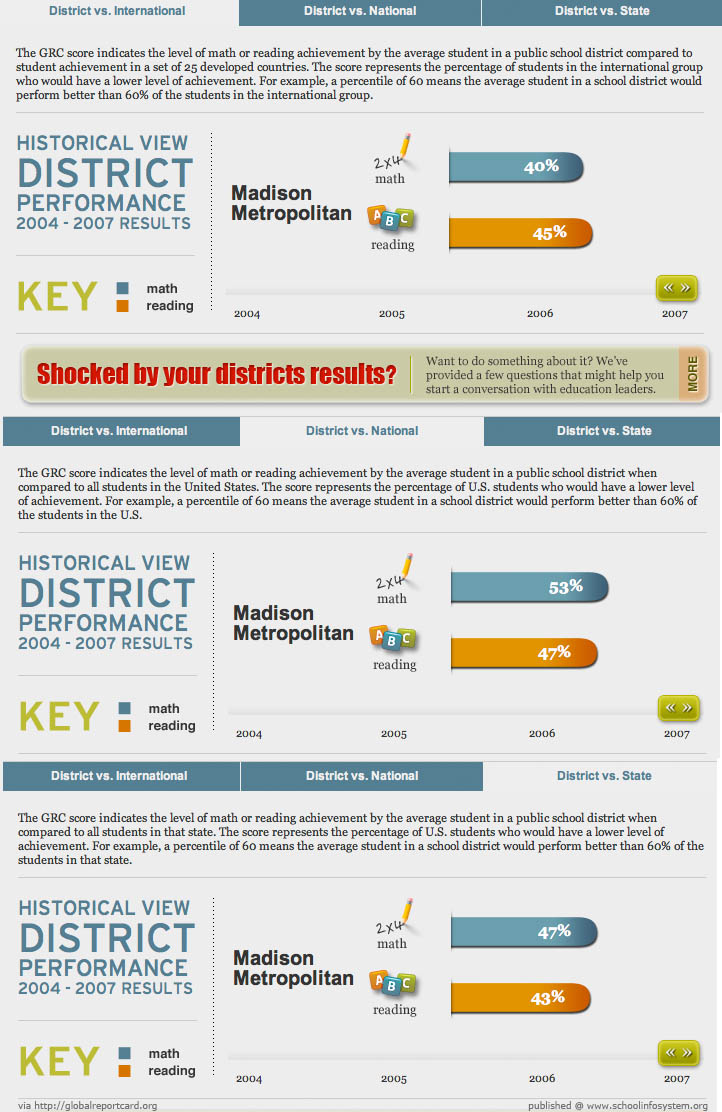

Related: A Capitol Conversation on Wisconsin’s Reading Challenges and Excellence in Education explains Florida’s reading reforms and compares Florida’s NAEP progress with Wisconsin’s at the July 29th Read to Lead task force meeting and www.wisconsin2.org.

Share

The best choice for your child’s school is most likely the local school

David Staples:

The grass isn’t greener and the teachers aren’t really keener at some other school.
If you are the parent of an elementary-age school kid, I’m going to offer you some unsolicited advice: the best school for your child is most likely your neighbourhood school.
Not the school across the city with the cool-sounding special program.
Not the school many blocks away where the provincial tests scores for Grade 3 and Grade 6 are higher than those in your own school.
No, the best choice is usually the community school, the one within walking distance, the school of your neighbours and their children, who will soon be your acquaintances and maybe even your very good friends, but only if your children attend that neighbourhood school.

Share

The Broccoli of Higher Ed

Daniel Everett:

Such gloom must be placed in context. Doubts about the humanities have been around at least since Aristophanes wrote The Clouds. The playwright claimed that if a man engaged in the “new” Socratic form of teaching and questioning, he could wind up with big genitals (apparently seen as a negative side effect) due to a loss of self-control. But the Socratic humanities survived, in spite of the execution of their founder, through the schools of his intellectual son and grandson — the Academy of Plato and the Lyceum of Aristotle.
I don’t think that the humanities are really in a crisis, though perhaps they have a chronic illness. Bachelor’s degrees in the humanities have held relatively steady since 1994 at roughly 12-13 percent of all majors. Such figures demonstrate that the health of the humanities is not robust, as measured in terms of student preferences. In contrast, the number of undergraduate business majors is steadily and constantly increasing.

Share

Sorry, Junior: Parents Pull Back on College Spending

Anamaria Andriotis:

As Zack Zbar gets ready to apply to colleges this fall, his parents have established one important ground rule. Jeff, a Florida writer, and his wife Robbie, a nurse practitioner, would like to send their son to the best college he can get into, but they don’t intend to go into debt to make that happen. They’ll look for grants and scholarships, or they’ll turn to an in-state option. “If we can’t afford it, then we have some reckoning to do,” says Jeff, 47.
A growing number of parents are rethinking how much they’re willing to spend on a child’s college tuition. According to a report released last week by student lender Sallie Mae, about 51% of parents “strongly agreed” that they would stretch financially to to send their children to college, down from 64% of parents last year; about the same number said they would go into debt to do so, down from 59%. It marks the first time those numbers have dropped since the firm began the survey in 2007.

Share

Driver’s Ed, Now No Driving Required

Catey Hill:

Drawn by the desire to stay on the road and lower auto insurance costs, a growing number of older Americans are signing up for driving school. But some of the fastest-growing classes aren’t behind the wheel. They’re behind a keyboard.
That’s right: Adults can now take driver’s ed without ever sitting in a car labeled “student driver” or making a single three-point turn. Instead, online classes — typically four to eight hours in total screen time — have become the fastest way for adults to brush up before a driving test or secure a discount on auto insurance. The AARP’s online driver safety course had more than 60,000 students nationwide in 2010, up 30% from a year earlier. By July of this year, another 40,000 had already enrolled. Participation in the American Automobile Association’s national online senior driving course has also increased an average of 20% per year over the last three years. “There’s been an increasing level of interest from seniors,” says Wade Mezey, president of Professional Driving Associates, which runs an online defensive driving course.
But when it comes to actually being a better driver, experts and driving instructors say online courses might not help. “Research shows that classroom programs don’t really impact positively on driving performance,” says Normand Teasdale, a professor at the University Laval in Quebec, who studies driving patterns among seniors. “You need to practice and get feedback over and over again to improve performance.”

Share

To College or Not to College

64 Notes:

I finished my schooling back in 2010. As norms have it, I was supposed to join a college. But I didn’t.
My question: Why the____?
Hell broke loose! Relatives were all restless, self-righteous were giving lectures, concerned were trying to explain and dad nagged me day-and-night. But even after seeking advice of respected ones; there was little logic anywhere.
I didn’t think I could learn anything valuable in a college. So why go? Just because everyone does? It’s funny how “education” (I call it literacy) is not good enough for the real world. And still they are the standard. Irony!
So I took a gap year, to figure out my life and what next. During my gap year, I failed a startup, helped people, failed people, lost things, gained things, travelled, met people and did things I always wanted to do.

Share

Indiana vouchers prompt thousands to change schools

Tom Coyne:

Weeks after Indiana began the nation’s broadest school voucher program, thousands of students have transferred from public to private schools, causing a spike in enrollment at some Catholic institutions that were only recently on the brink of closing for lack of pupils.
It’s a scenario public school advocates have long feared: Students fleeing local districts in large numbers, taking with them vital tax dollars that often end up at parochial schools. Opponents say the practice violates the separation of church and state.
In at least one district, public school principals have been pleading with parents not to move their children.
“The bottom line from our perspective is, when you cut through all the chaff, nobody can deny that public money is going to be taken from public schools, and they’re going to end up in private, mostly religious schools,” said Nate Schnellenberger, president of the Indiana State Teachers Association.

Share

K-12 Tax & Spending Climate: Annual Income Lost/Gained due to Interstate Migration

Nick Kasprak:

Today’s map comes a day late – we’ve been hard at work getting the data ready. We’ve updated our interactive State Migration Calculator with the latest IRS data, and it now includes migration in 2008-09. I’ve used the new data to create a map of interstate movement of income over the past decade. Florida is the big winner – migrants bought a net $70 billion dollars in annual income into the state between 1999 and 2009. New York, on the other hand, lost the most income: $45 billion.

Share

Grading the Education Reformers

Richard Rothstein:

If you saw Waiting for “Superman,” Steven Brill’s tale in Class Warfare will be familiar. The founder of Court TV offers another polemic against teacher unions and a paean to self-styled “education reformers.” But even for those who follow education policy, he offers an eye-opening read that should not be missed. Where the movie evoked valiant underdogs waging an uphill battle against an ossified behemoth, Brill’s briskly written book exposes what critics of the reformers have long suspected but could never before prove: just how insular, coordinated, well-connected, and well-financed the reformers are. Class Warfare reveals their single-minded efforts to suppress any evidence that might challenge their mission to undermine the esteem in which most Americans held their public schools and teachers. These crusaders now are the establishment, as arrogant as any that preceded them.
Brill’s heroes make a high-profile gallery. They are public-school critics like former New York and Washington, D.C. schools chancellors Joel Klein and Michelle Rhee. They also include charter school operators David Levin (KIPP) and Eva Moskowitz (Harlem Success Academies), as well as alternative teacher and principal recruiters Wendy Kopp (Teach for America) and Jon Schnur (New Leaders for New Schools). Their ranks boast billionaires Bill Gates and Eli Broad, U.S. Education Secretary Arne Duncan and President Obama himself. And they don’t lack for savvy, richly endowed representation. Democrats for Education Reform, a lobbying, political action, and communications campaign rolled into one, has brought them all together. Lavishly supported by the newfound wealth of young Wall Street hedge fund managers answerable to no one, DFER’s troops have been working overtime to radically transform American public education.

Share

WIAA vs. the taxpayers

Steve Prestegard:

At first glance, the ongoing lawsuit between the Wisconsin Interscholastic Athletic Association and Gannett Newspapers might seem like the Iran-Iraq War, or a Bears-Vikings game — fans of neither side might wonder if both could lose.
The WIAA, the sanctioning body for Wisconsin high school athletics, sued Gannett after The Post~Crescent live-streamed several football playoff games in 2008. If a media organization wants to broadcast or stream postseason games, it must get the WIAA’s permission, pay a fee, and adhere to various other rules:

Internet blogs, forums, tweets and other text depictions or references are permitted and are not subject to rights fees unless they qualify as play-by-play (see definition below) or are not in compliance with the media policies of the WIAA. Play-by-play accounts of WIAA Tournament Series events via text are subject to text transmission rights fees.

Share