Wisconsin Property Tax Growth: 1984-2012 (!)
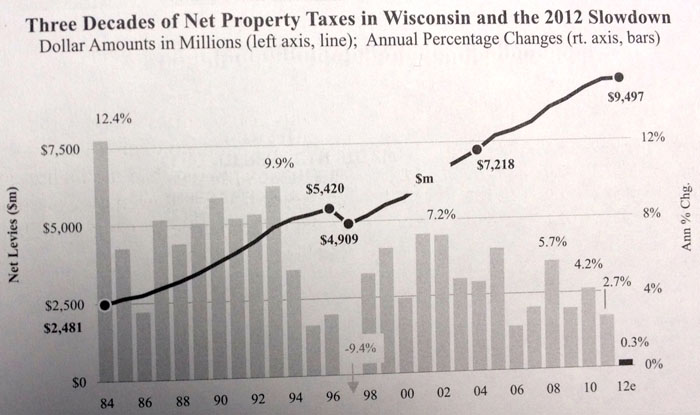
A chart from the January 9, 2012 edition of WISTAX’s Focus. One wonders how long this can be sustained.
Wistax.
A chart from the January 9, 2012 edition of WISTAX’s Focus. One wonders how long this can be sustained.
Wistax.
Throughout my years of being an educator in a traditional school setting, the most challenging aspect has been dealing with the adults, not the students. My views were often those of the minority and consistently clashed with the culture of failure that had been developed over the decades.
One opinion of mine in particular that seldom receives little to no kudos, and is often met with anger and opposition, is that our children do not need sympathy. And when it came to school work, believe me, I gave very little sympathy, if any at all.
“So harsh,” one might say. Well, I have been regularly accused of being unfeeling, insensitive and even heartless. Nevertheless, my students were successful for the most part.
They passed because they knew the material, not because I felt sorry for them. In my classroom, I refused to allow feelings of sympathy to override my charge as an educator. It was my duty to educate students to the best of my ability, regardless of their race, culture, socioeconomic status or family or living situation. My standards were high, and I expected my students to rise to the occasion.
In Buffalo, New York, the heart of the American rust-belt, the public school system pays for its teachers to get plastic surgery. Hair removal. Miscrodermabrasian. Liposuction. If you can name the procedure, it’s probably covered.
No, I am not exaggerating. And no, this article is not an excuse to make “Hot For Teacher” cracks. When I write that Buffalo’s school system pays, I mean it literally. The perk is included as a self-insured rider in its teachers’ contract. Therefore, the district has to cover the cost of each nip and tuck itself. There’s no co-pay, so the school district ends up footing the entire bill. It estimates the current annual cost at $5.2 million, down from $9 million in 2009.
This in a city where the average teacher makes roughly $52,000 a year. The plastic surgery tab would pay salaries for 100 extra educators.
s The Buffalo News has reported, the rider existed for years with little notice. It dates back at least to the 1970s, when “getting a little work done” wasn’t par for the course among women (and some men) of a certain age. Instead, it was intended to cover serious reconstructive surgery, on burn victims, for instance. In 1996, the rider was nearly cut. But after the daughter of a district employee was hurled through a windshield during a car wreck, requiring surgery to repair scars on her face and body, union officials lobbied to keep the benefit in place.
I see a lot of support among the District leadership for clear job descriptions and duties for everyone in the District – everyone, that is, except the District leadership. Each Board member will acknowledge that the Board has the duty to enforce policy yet no Board member will allow that duty to be explicitly stated in any document. It does not appear in the newly adopted Series 1000 Policies. It does not appear in the policy that describes the duties of the Board. It does not appear in the policy on governance. Now the Board is going to adopt two more elements of Board policy that should mention this duty yet fail to do so.
The board policy preamble on the Board meeting agenda this week is an ideal place for it, but instead the preamble makes reference to it only vaguely and euphemistically as “governance tools”. It says that policies can be used by the superintendent to hold staff accountable but it neglects to say that they can be used by the Board to hold the superintendent accountable.
Before a crowd of hundreds of school district officials and school board members in Milwaukee, Gov. Scott Walker announced Thursday that recommendations from a variety of state education task forces will soon be solidified in formal legislation.
The work of three main groups spearheaded by Walker over the past year – a reading task force, a team that’s looked at how to design a statewide teacher and principal evaluation system, and a group figuring out how to rate school quality – will make up a reform package of education legislation, Walker said.
Meanwhile, some critics questioned the governor’s tone of collaboration and cooperation Thursday, saying that after cutting education spending and limiting collective bargaining, he’s trying to play nice now only because he’s likely facing a recall election.
Even state Superintendent of Public Instruction Tony Evers, who has worked closely with Walker on the task forces and praised the work of those involved, made it clear he was concerned about being left out of the legislation-drafting process.
The proposed legislative reforms have been developed over the past year by three statewide task forces working separately on improving literacy, developing a teacher evaluation model and creating a school accountability system to replace No Child Left Behind.
State Superintendent of Public Instruction Tony Evers, who helped lead all three groups, said he wasn’t involved in drafting the education legislation, but would support any actions that are the direct product of the task forces “and deliver on the intent of these collaborative groups.”
“Many students’ schools are already planning for more budget cuts next year on top of cuts made this year,” Evers said in a statement. “Education reforms must be fully funded and not simply be more unfunded mandates that result in further cuts to educational programming for our students.”
Rep. Sondy Pope-Roberts, D-Middleton, ranking Democrat on the Assembly Education Committee, said in a statement she has concerns the work of the task forces was “being hijacked for political gain.”
“It is unnerving to hear that (Evers) was not consulted during the drafting of this legislation,” Pope-Roberts said. “Cutting our state’s foremost education experts out of the process at this time is very shortsighted and reckless.”
Much more on the Read to Lead Task Force, here.
Online education will turn the academy inside out, argue US authors. Sarah Cunnane reports
Graduation rates in the US have fallen, and states have slashed funding for higher education. As a result, public universities have raised tuition fees, and many are struggling to stay afloat during the recession. But two authors working in the US higher education sector claim that the academy has a bigger battle on the horizon: the “disruptive innovation” ushered in by online education.
This disruption, they say, will force down costs, lure prospective students away from traditional “core” universities, transform the way academics work, and spell the end for the traditional scholarly calendar based around face-to-face teaching.
Clayton M. Christensen, the Kim B. Clark professor of business administration at Harvard Business School, and Henry J. Eyring, advancement vice-president at Brigham Young University-Idaho, outline their ideas in The Innovative University: Changing the DNA of Higher Education from the Inside Out.
New Jersey Governor Chris Christie
Renewing his call for passage of a vouchers pilot program, the Opportunity Scholarship Act, the governor drilled into his education reform proposals for government cost-savings.
“Let’s face it: more money does not necessarily lead to a better education,” Christie said. “Today, in Newark, we spend $23,000 per student for instruction and services. But only 23% of ninth graders who enter high school this year will receive high school diplomas in four years. Asbury Park is similar: per pupil costs, at almost $30,000 a year, are nearly 75% above the state average. But the dropout rate is almost 10 times the state average. And math S.A.T. scores lag the state average by 180 points.
“It is time to admit that the Supreme Court’s grand experiment with New Jersey children is a failure,” the Governor added. “63% of state aid over the years has gone to the Abbott Districts and the schools are still predominantly failing. What we’ve been doing isn’t working for children in failing districts, it is unfair to the other 557 school districts and to our state’s taxpayers, who spend more per pupil than almost any state in America.”
In recent decades, key sectors of the American economy have experienced huge and disruptive transformations — shifts that have ultimately yielded beneficial changes to the way producers and customers do business together. From the deregulation that brought about the end of AT&T’s “Ma Bell” system, to the way entrepreneurs like Steve Jobs forever changed the computer world once dominated by IBM, to the way the internet and bloggers have upended the business model of traditional newspapers, we have seen industries completely remade — often in wholly unexpected ways. In hindsight, such transformations seem to have been inevitable; at the time, however, most leaders in these fields never saw the changes coming.
The higher-education industry is on the verge of such a transformative re-alignment. Many Americans agree that a four-year degree is vastly overpriced — keeping many people out of the market — and are increasingly questioning the value of what many colleges teach. Nevertheless, for those who seek a certain level of economic security or advancement, a four-year degree is absolutely necessary. Clearly, this is a situation primed for change. In as little as a decade, most colleges and universities could look very different from their present forms — with the cost of a college credential plummeting even as the quality of instruction rises.
Just when all signs indicated that supporters of Madison Preparatory Academy were abandoning hope of joining forces with the Madison school district, they’ve decided to give it one more shot. They’re seeking another vote on the controversial charter-school proposal in late February.
Urban League of Greater Madison CEO and president Kaleem Caire says Madison Prep will open this fall as a private entity, but hopes it will transition into the district in 2013, once the district’s union contract expires.
Board members who voted against the charter school in December expressed concerns that it would put the district in breach of its contract with Madison Teachers Inc., due to a provision requiring district schools to hire union staff.
School board president James Howard, who voted for Madison Prep, says the board may not have time to address the proposal in February.
Whether the Urban League — which proposed Madison Prep as an ambitious step toward closing the district’s decades-old achievement gap — can recapture its earlier momentum is uncertain, considering that Superintendent Dan Nerad and school board members seem particularly excited about their own plans to address the issue.
“We’re going at it from so many different angles right now,” says board member Beth Moss. “I can’t see how we can’t make some improvement.”
Much more on the proposed Madison Preparatory IB charter school, here.
Fascinating.
We produced the above piece for PBS NewsHour in November of 2011; the focus was on new school choice initiatives in Indiana and the backlash they’re receiving. School choice remains a major issue in education as 2012 begins, so we wanted to convene several experts for a discussion on the topic. Feel free to add your own comments below, as well.
Two decades after it was first devised at Princeton’s Center for Creative Leadership, the learning development concept known as 70/20/10 is transforming Melbourne Business School’s approach to workplace learning.
The concept has spurred Mt Eliza, the executive education arm of MBS, to develop an interactive online tool called Thread, which is due to be launched this month. Mt Eliza has high expectations for Thread, with hopes that it can transform the executive education provider in Victoria, Australia, into a world leader in e-learning.
It is canvassing for a partnership with Ashridge – the UK business school that provides Mt Eliza with online modules through Virtual Ashridge – as well as with other international business schools.
While Mt Eliza will not comment on the talks, Matt Williams, design manager for Thread, says: “Whenever we need to partner with a European institution, it tends to be Ashridge”. The two schools collaborate on a Masters of Management programme and several executive education courses.
The quality of elementary education is falling in rural schools almost two years after education was made a fundamental right in April 2010.
The Annual Status of Education Report (ASER) 2011, a survey of government and private schools in rural areas conducted by the NGO Pratham, shows a decline in schoolchildren’s “learning outcome levels” compared with the previous year, whether in reading or arithmetic skills. (See chart)
However, students of private schools have done slightly better than those of government schools, reveals the annual survey, started seven years ago and considered most authoritative.
For example, 56 per cent Class V students at government schools were unable to read Class III-level text but the figure was 38 per cent in private schools.
When Gov. Bobby Jindal pushed through New Orleans’ school voucher program four years ago, political interest in using taxpayer money to send students to private schools had waned across the country. School choice advocates had suffered several stinging defeats, causing some to throw their weight behind charter schools, which generally receive more bipartisan support.
In 2009, St. Joan of Arc School in New Orleans had more than 80 students receiving vouchers.
Now, as officials expect Jindal to begin an effort to expand Louisiana’s voucher program, the national landscape has changed dramatically.
Although charter schools continue to dwarf vouchers in terms of overall growth, voucher programs have rebounded on the national political and educational scene in the past year. In 2011, more than 30 states introduced bills that would use taxpayer dollars to send children to privately run schools, according to the National Conference of State Legislatures. That’s up more than 300% from the previous year, when only nine voucher bills were introduced.
Governor Andrew Cuomo on Tuesday proposed an overhaul to the state’s pension system and new teacher evaluation system while presenting his $132.5 billion budget plan for the next fiscal year.
The plan reduces overall spending by .2 percent from last year.
In a PowerPoint presentation, Cuomo said his executive budget includes no new taxes, one shot revenues or gimmicks.
It also closes a budget gap of $3.5 billion.
However, while the governor plans to increase education spending by 4 percent or roughly $805 million, he also plans to make that increase contingent upon real reform and, specifically, teacher evaluations.
He’s giving the state’s teachers 30 days to come up with a statewide evaluation system or he will write his own into the budget for the legislature to approve.
Districts would have one year to get the new system up and running or the state would withhold the promised 4 percent increase in school aid.
Wisconsin’s education system ranks 18th in the nation, according to an annual analysis published by Education Week.
The analysis draws on a variety of data, some of which are a couple of years old, so it doesn’t reflect changes in the past year under Gov. Scott Walker.
The report rated Wisconsin in six categories: chance for success; K-12 achievement; standards, assessments and accountability; teachers; school finance; and transitions and alignment.
The state scored highest in school finance, ranking ninth nationally. The lowest marks came in standards, assessment and accountability, where Wisconsin ranked 46th.
Much more at wisconsin2.org
Last Friday’s Capital Times included an article by Jessica Van Egeren on the need to close what DPI spokesman John Johnson and others have deemed the voucher loophole. Van Egeren writes:
“The so-called loophole was inserted into the state budget at the final stage of approval in June by members of the budget-writing Joint Finance Committee. The last-minute language allowed voucher schools to expand from their sole location in Milwaukee to Racine.”
It is worth pointing out that the while the language enabling the expansion of school choice to Racine did occur near the end of the budget process, expanding the Milwaukee Parental Choice Program (MPCP) to Racine was hardly a new concept. A proposal to bring vouchers to Racine was included and passed in the original Assembly version of the 2007-2009 budget (it was eventually removed during the budget process).
For decades, the prevailing wisdom in education was that high self-esteem would lead to high achievement. The theory led to an avalanche of daily affirmations, awards ceremonies and attendance certificates — but few, if any, academic gains.
Now, an increasing number of teachers are weaning themselves from what some call empty praise. Drawing on psychology and brain research, these educators aim to articulate a more precise, and scientific, vocabulary for praise that will push children to work through mistakes and take on more challenging assignments. Consider teacher Shar Hellie’s new approach in Montgomery County.
To get students through the shaky first steps of Spanish grammar, Hellie spent many years trying to boost their confidence. If someone couldn’t answer a question easily, she would coach him, whisper the first few words, then follow up with a booming “¡Muy bien!”
Bob Lutz, the former Vice Chairman of General Motors, is the most famous also-ran in the auto business. In the course of his 47-year rampage through the industry, he’s been within swiping range of the brass ring at Ford, BMW, Chrysler and, most recently, GM, but he’s never landed the top gig. It’s because he “made the cars too well,” he says. It might also have something to do with the fact that Maximum Bob, who could double as a character on Mad Men, is less an éminence grise than a pithy self-promoter who has a tendency to go off corporate message. That said, his new book, Car Guys vs. Bean Counters: The Battle for the Soul of American Business, has a message worth hearing. To get the U.S. economy growing again, Lutz says, we need to fire the M.B.A.s and let engineers run the show.
Lutz’s main argument is that companies, shareholders and consumers are best served by product-driven executives. In his book, Lutz wisecracks his way through the 1960s design- and technology-led glory days at GM to the late-1970s takeover by gangs of M.B.A.s. Executives, once largely developed from engineering, began emerging from finance. The results ranged from the sobering (managers signing off on inferior products because customers “had no choice”) to the hilarious (Cadillac ashtrays that wouldn’t open because of corporate mandates that they be designed to function at -40°F). It’s pretty easy to imagine Car Guy Lutz removing his mirrored shades and shouting to the cowering line manager, “Well, customers in North Dakota will be happy. Too bad nobody else will!”
Should an engineering degree cost more than a degree in English? Or a degree in education?
The question was posed at a House Education Committee meeting Friday.
On hand for the discussion: University of Florida President Bernie Machen, Florida State University President Eric Barron and state University System Chancellor Frank Brogan.
The topic is timely. Gov. Rick Scott has called on universities to produce more majors in science, technology, engineering and mathematics — but without extra dollars from the state. Scott’s proposed budget does not boost funding for public colleges and universities.
After a pretty rough year at Department of Education headquarters, Mayor Bloomberg appears to have gotten his school-reform groove back. It couldn’t come at a more crucial time. The city’s public schools have made some real progress on Bloomberg’s watch, but need a new shot in the arm to help many more students meet higher standards and ensure they’re ready for college.
The mayor laid out a bold and aggressive agenda in his State of the City Address last week, full of common-sense ideas that hark back to the early days of his tenure when no cow was too sacred in the pursuit of higher achievement.
Back then, he took on the three pillars of the education bureaucracy — tenure, seniority and lock-step teacher pay — and refocused our schools on empowerment for teachers and principals and more accountability for results.
Rafael Gomez, via a kind email:
Dear Cherokee Staff:
We have an opportunity to have Emergent Spanish for Educators (Jan. to April 2012) The class will take place at Cherokee every Mondays starting Jan. 23 at 3:30 to 5:45 except the session it will be from 3:45 to 4:45.
Calender:1/30, 2/6, 2/13, 2/20 2/27 3/5 3/12 3/ 19 3/26. 4/4 4/11 4/16 4/23 4/30
All participants will get 3 PAC credits. It is 30 hours of instruction.
Description of the course:
This course will provide participants with skills needed to make an easy transition from English only into Emergent Spanish and have fun while doing it. Participants will be assisted to become more comfortable using their Spanish pronunciation, construction of basic statements and conversing in Spanish with instructor and/or participants.All participants will end up with a learning center to continue learning Spanish.
Objectives:
1. Acquire a repertoire o Spanish vocabulary
2. Increase comfort level to use Spanish
3. Increase awareness of culture and language
4. Gain skill to use their learning center.
Ritual:Participants will interact with parents and students who are native Spanish speakers.
If you have any questions, please contact me.
Rafael Gomez
It took nearly a year for Dale Kleinert to negotiate his first teachers’ contract. When Kleinert started his job as schools superintendent in Moscow, Idaho, the talks were already underway. Then, discussions reached an impasse. There were disagreements over pay and health care costs, and the pace slowed further when first an outside mediator and later a fact-finder didn’t render a decision. It wasn’t until May of 2011 that Kleinert and his union counterparts finally reached an agreement.
Just before then, while Kleinert and the teachers were still stuck, Republican lawmakers in Boise were finishing work on plans to take away much of the leverage that Idaho teachers had long enjoyed in these kinds of negotiations. So for Kleinert’s next round of talks with Moscow’s teachers, which began pretty much right after the previous ones wrapped up, the rules were very different.
Laurie Rogers, via a kind email:
In Eastern Washington, voters are being asked to approve school district levies in a Feb. 14 election. Spokane residents might have seen one or two or 10 billion signs about it strategically placed around the city. I saw a “vote yes for kids” sign at City Hall, tacked to the incoming side of the city bulletin board. I mentioned it to a woman at the counter, and she took it down.
Twice on its front page, The Spokesman-Review published pro-levy material that (to a journalist), can only be seen as full-page advertisements. First was “Anatomy of a Levy.” Then there was “Faces of a Levy.” Where can it go from there? Ears of a Levy? Elbows of a Levy? Butt-cheeks of a levy?
Meanwhile, the union president published a pro-levy article in the KIDS Newspaper, and the school district helpfully delivered that pro-levy article to elementary schools and students across the city.
Clearly, the district, union and newspaper want us to support the levy. Some local advocates would rather we not. Whatever you decide, please don’t just stay home. If just three people vote on the levy, it will pass or fail based on the three votes. As you’re bombarded with a heavy emotional campaign to “vote yes for the kids,” however, here are a few things to consider.
How does a project increase 42% in less than a year? How does it mushroom 83% in less than 2 years?
WHY WHY WHY does this district continue to pound for more than more, better than best? And how do these numbers keep growing? What originally was discussed as a maximum taxpayer commitment of $475,000 has ballooned into the idea of going to referendum with the “new building (elementary school) referendum? Note once again that no decision has been made to even BUILD a new building…but athletic director McClowry and district administration put forth a Situation Report that sure seems certain that that is what’s going to happen?
Let’s stroll back through time, shall we? Take a look see at how the landscape of the Ashley Project has changed.
More, here.
The state Senate will take up a bill Tuesday to rewrite the open enrollment law governing when students can transfer out of their home district into another district.
The bill would allow students and parents more time to request a move to a district outside their own. It would require students’ home districts to share details about any discipline problems with the outside district.
The bill has ping-ponged back and forth between the Senate and Assembly for the last year as the two houses have worked to agree on amendments.
The Senate action will come amid a busy day at the Capitol, with opponents to Walker expected to deliver more than 700,000 signatures seeking to force a recall election against him.
Supporters said the open enrollment bill would help students struggling in one district move into another one where they can thrive. Opponents argue the legislation could harm some school districts by siphoning off students to other districts, including virtual schools that rely on the Internet to help teach students in their own homes.
In my last post, I argued that software will take over many of the tasks doctors do today. And what of education? We find a very similar story of what the popular – and incredibly funny! – TED speaker Sir Ken Robinson calls “a crisis of human resources” (Click here for the RSA talk from the same speaker which has been animated in a highly educational fashion). At the TED 2010 conference, he stated that “we make poor use of our talents.” Indeed, in the same way that we misuse the talents and training of doctors, I believe we misuse the talents and training of teachers.
I want to comment on what I consider a far greater misuse of talent and training: that of our children/students, mostly here talking about high school education. We have focused so much of our education system on children attending primary school, then middle school, then high school, all with the objective of attending university. This is a progression that still remains unchanged and largely unchallenged. Yet, this system is completely linear and, most tragically, unwaveringly standardized not only through instruction methods, but also through testing. Worse, it is mostly what I call “fixed time, variable learning” (the four-year high school) instead of “fixed learning, variable time” to account for individual students’ capabilities and status.
Identifying Emerging Trends In Education
There are new key trends that I see emerging in education enabled by advancing technology: namely decentralization and gamification. By understanding these trends, it is much easier to imagine why we won’t need teachers or why we can free up today’s teachers to be mentors and coaches. Software can free teachers to have more human relationships by giving them the time to be guidance counselors and friends to young kids instead of being lecturers who talk at them. This last possibility is very important–in addition to learning, schools enable critical social development for children through teacher student relationships and interacting with other children–classrooms of peers and teachers provide much more than math lessons. And by freeing up teachers’ time, technology can lead to increased social development rather than less as many assume.
Well worth reading.
Six school districts in Wisconsin – Hartland-Lakeside, Phelps, Oregon, Oshkosh, Beloit and Sparta – have scheduled school referendums for either February or April.
My advice to school officials who want to prevail: encourage high turn-out among voters who cast their ballots at polling places that are actually inside the schools themselves. It, oddly enough, makes a significant difference.
You probably don’t believe this. Neither did voters who were part of an extensive study of polling places in Arizona in 2000 when a ballot initiative proposed raising the state sales tax to support education spending.
Published in the Proceedings of the National Academy of Sciences, the study on what’s known as “priming” concluded that voters in school buildings are unaware of the influence of so-called “environmental stimuli.” We like to think we’re smarter than that. Who wants to admit that their vote was based even in part on whether they were standing in a school hallway or a gym rather than a church or a town hall when they cast their ballot? Are we that easily manipulated?
A long-awaited audit documents the perfect storm that swamped state government’s ability to manage Wisconsin’s Medicaid program, which provided health care to 1.18 million elderly, poor and disabled at a cost of $7.5 billion last year.
It’s an alarming read, even for an eyes-glaze-over financial report. It could be a tea party manifesto. It explains why Democrats, who ran the Capitol for a two-year period that ended a year ago, blocked earlier requests for the audit.
Between 2007 and 2011, state Auditor Joe Chrisman and his staff found, Medicaid budget and program controls were drowned by factors that included:
A state hiring freeze and a requirement that state workers take eight unpaid days for two straight years.
The 2008-’09 expansion of Medicaid to more than 100,000 children, families, pregnant women and adults without dependent children.
The recession, which cost thousands their jobs, forcing them and their families onto Medicaid rolls.
Between 2007 and 2011, the cost of Medicaid went up by 51% (from $5 billion to $7.5 billion), while its caseload went up by 36% (from 870,201 to 1.18 million). But there’s so much more to ask about those numbers. At some point, lawmakers who must approve Medicaid budgets should ask the state Department of Health Services:
Out of control healthcare spending certainly affects K-12 budgets….
Much like the brief torrential rain which drenched New Yorkers on Thursday morning, Mayor Bloomberg’s Thursday afternoon State of the City Address received a deluge of media attention. Today, the print and electronic media feature talk of his jeremiad against the UFT, of his attempted resurrection of ‘market reforms’ such as merit pay which have been discredited even in ‘reform’ circles, as study after study has shown them ineffective, and of his claims that he will introduce a new evaluation system by fiat. Tellingly, nowhere will you read an account of what the Mayor’s proposed imposition of closure under the Turn-Around model would mean for the PLA schools, were he to be successful in implementing it.
Consider what is happening to just a few of the PLA schools. Note that we use here the performance data that, the DoE insists, informs their decisions on the future of schools.
Naomi Lemberger says the way she takes notes in class helps things stick in her brain. She doesn’t use the usual approach (scribble for page after page, then promptly forget – I’ve been doing it all my life).
In a typical instance, she takes those conventional notes within a box covering the upper right section of a sheet of paper and equal to about half the sheet. In a column on the left side of the paper, she writes down questions or sometimes phrases that her main notes cover. And, after a class or at the end of a unit, she writes in a box across the bottom of the sheet a reflection – basically, a summary of what she thinks she learned. She reviews the overall results, especially when she’s preparing for tests. Teachers frequently review her notes.
It’s a system called Cornell Notes. It goes back more than half a century and has been used (and often dropped) in many schools, including several in the Milwaukee area.
At Brookfield East, where Lemberger is a junior, Cornell Notes is a key element of the education program – and a key, in the opinion of school leaders and many teachers, to why the already high-performing school has seen an uptick in overall student success in recent years.
School principals then would have discretion over how to use those funds, as long as they go to teachers. Those dollars could be spent on one-time teacher bonuses, teacher development projects or however the principal sees fit. “The idea is to give principals more power and to help them create a culture of success,” says Ford.
To be eligible to participate in the program, schools also would have to agree to eliminate the traditional teacher pay schedules that mainly reward longevity on the job.
“The No. 1 goal of public education in everything we do is raising academic achievement,” says Ford. “So in the report I propose a framework that takes into account the views of teachers and the existing research on what motivates teachers.”
It’s certainly an interesting concept. But would it work?
Adam Gamoran, a UW-Madison professor of sociology and educational policy studies, says that while research clearly shows some teachers are much more effective than others, what’s not so clear is which attributes these top educators share and whether or not it’s even possible to lead them to teaching more effectively with incentives.
Next year, Verona superintendent Dean Gorrell is in line to collect a $50,000 longevity bonus on top of his $140,000 salary.
In 2014, Madison superintendent Dan Nerad qualifies for a $37,500 payment for six years of service, which like Gorrell’s would be paid into a retirement account. Nerad already receives an annual $10,000 payment into his retirement account, which is separate from his state pension and in addition to a $201,000 yearly salary.
And in 2017, Monona Grove superintendent Craig Gerlach can leave the job with an extra year’s salary, currently $150,000, paid into a retirement account over the following five years.
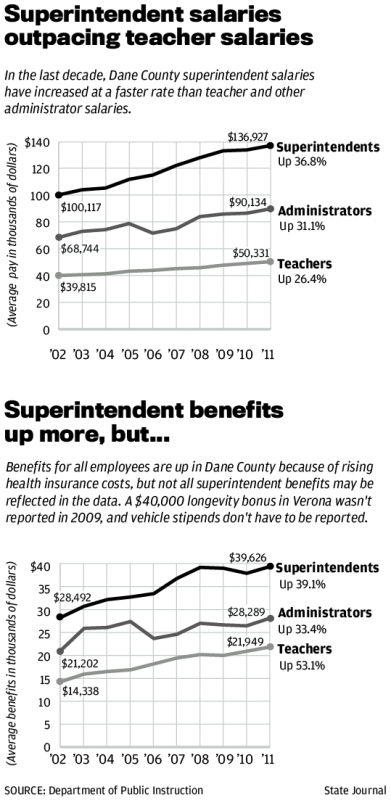
Over the past decade, such perks have been added to some Dane County superintendent contracts, even as, on average, their salary increases outpaced teacher pay hikes, according to data provided by the Department of Public Instruction.
“Any type of payout at that level is clearly going to be an issue from the public’s point of view,” Dale Knapp, research director at the Wisconsin Taxpayers Alliance, said of the longevity payouts. “The problem becomes once these start getting into contracts, it becomes competition and then they become more prevalent.”
Adding bonus language to superintendent contracts became increasingly popular in recent years as school districts faced state-imposed rules on increasing employee compensation.
Perhaps, one day soon, teachers will have similar compensation freedom, or maybe, superintendents should operate under a one size fits all approach…
I’d rather see teacher freedom of movement, and compensation.
Teachers are the most important factor in determining the success of students. No technology, curriculum, or standard can supplant the need for a quality teacher in every classroom. We know children learn differently, we know there is no single recipe for a successful teacher, yet we continue to pay teachers as if they are interchangeable assembly-line workers producing an identical commodity called education.
In a report released this week I propose dumping district-wide lock-step pay schedules that reward only formal education and years on the job in favor of a compensation reform that rewards and motivates teachers in a way conducive to raising the academic achievement. I do not propose a merit pay system that gives bonuses to individual teachers in return for raising test scores.
Why? The track record of such systems can at best be called uneven. Teachers are not uniformly motivated by monetary compensation. Research by UW-Madison professor Allan Odden and others shows teachers value collaboration and student success above other factors. Any reform that does not recognize this is doomed to fail. No less important, students need schools that deliver consistent teacher quality from start to finish so that the work of a good teacher in one grade is not undone by a sub-par teacher the next.
Regular readers know that state finances were worse than the Doyle administration admitted during its eight years of fiscal incompetence. But state finances are also worse than the Walker administration admits now.
The proof is the state’s Comprehensive Annual Fiscal Report, an inch-thick annual tree-killer that summarizes the differences between politicians’ claims about the state’s fiscal health, and the reality of the state’s fiscal health.
The differences lie in correctly measuring state finances, as the Wisconsin Taxpayers Alliance explains:
A recent WISTAX publication mentioned that Wisconsin Medicaid spending increased 87% from 2006 to 2011!
The proposals would allow charter schools in the state, establish a process for failing schools to be taken over by outside organizations and continue an overhaul of the way all teachers and principals are evaluated.
Charters, which are public but independent schools allowed to use unconventional techniques, would be closely monitored by a state board, lawmakers said. Only 50 would be allowed in the state – with no more than 10 new ones authorized each year. Each would be required to adopt a specific plan to serve educationally disadvantaged children.
The evaluations, which would include student test scores and classroom observations, would build on a pilot system already used in several districts in the state, lawmakers said.
Poor performance on the evaluations could lead teachers to lose their tenure, but the focus would be on improvement of teaching methods.
Minutes after Mayor Bloomberg finished delivering his State of the City address today, reactions started flying about his aggressive slate of education proposals.
The reactions ranged from withering (in the case of UFT President Michael Mulgrew) to bewildered (Ernest Logan, principals union president) to supportive (charter school operator Eva Moskowitz and others whose organizations would benefit from the proposals).
Below, I’ve compiled the complete set of education-related reactions that dropped into my inbox. I’ll add to the list as more reactions roll in.
When asked why he didn’t second Ed Hughes’ motion at the Dec. 19 meeting to delay the schools’ opening until 2013, Howard replied, “We had not discussed the implications of what that means. I think we have time if we’re talking about 2013, to make sure we do it correctly, because we don’t know what the rules of the game will be in 2013.”
Superintendent Dan Nerad said, “Whether it will move forward I don’t know. That depends on whether the motion gets on the floor. I don’t have a read on it at this point.”
Others aren’t as diplomatic. “This is a waste of time and money for all involved,” said TJ Mertz, an Edgewood College professor and district watchdog who is among Madison Prep’s most ardent critics.
“The votes are not there and will not be there,” he continued. “It distracts from the essential work of addressing the real issues of the district, including issues of achievement for students in poverty.”
Much more on the proposed Madison Preparatory IB charter school, here.
A merit pay program that incentivizes teachers is about to get a test run at the local level. Two Wisconsin school districts are moving forward with a plan that would reward good teachers with salary bonuses in the 2012-2013 school year.
The Cedarburg and Hartland-Lakeside School Districts will be amongst the first to institute merit pay programs for educators in the Badger State. Bonuses will be tied to teacher evaluations – instructors that earn high marks from administrators will be eligible for extra compensation in the following school year. In Cedarburg, these additional payments range from $1,700 to $2,200.
The ability to institute bonus systems on a district-to-district basis is a new one in Wisconsin. In previous years, most plans would have been wiped out by collective bargaining between the school district and their local teachers’ union. Since Act 10 removed most of these bargaining scenarios, school boards now have more freedom to enact reforms like merit pay in their classrooms.
Arkansas’ education board has approved four new charter schools.
The board voted unanimously Monday in favor of Cross County School District’s proposed charter elementary school. The board also approved applications for proposed charter schools in Lincoln, Osceola and Warren.
Department of Education spokesman Seth Blomeley says charter schools are eligible to apply for up to $600,000 in federal money to use toward startup and other one-time costs.
Cecelia Thornton sets up a makeshift classroom at her kitchen table every day after school to tutor her grandchildren in reading and writing with materials she buys at the local thrift store in the Mojave Desert town of Adelanto (San Bernardino County).
The 5- and 6-year-olds, she said, just aren’t learning enough in their classes at Desert Trails Elementary School.
That’s the key reason why she and a band of other parents and guardians filed a petition Thursday under California’s “parent trigger” law to demand reforms at the K-6 school where just 35 percent of pupils last year tested proficient in reading and 46 percent in math.
The Times and a host of other publications heralded last week’s new study extolling the lifelong money-earning benefits of having a good primary/middle-school teacher. Oh, yay! Let’s do what these economists from the National Bureau of Economic Research suggest, right?
Actually, ugh, no. What economists Raj Chetty and John N. Friedman of Harvard and Jonah Rockoff of Columbia want to do, apparently, is to identify and fire “weaker” teachers, for the sake of a barely perceptible increase in students’ “lifetime income.” Nobody has actually tried this yet; the report doesn’t describe an experiment. It’s just the conclusion they draw from their analysis of massive amounts of data gathered from public schools in New York City and cross-referenced against IRS records and the like.
Here’s a bit from the summary of the original paper. Note that a “high-VA” (“value-added”) teacher is a “good” one–meaning by this, solely, that the teacher in question has succeeded in raising standardized test scores.
The Royal Society has suggested ways the government can overhaul information and communications technology (ICT) teaching in schools.
It follows promises from Education Secretary Michael Gove to scrap the way the subject is taught currently.
The body, which oversees UK sciences, recommends dividing computing into distinct subjects such as computer science and digital literacy.
It said the government must do more to recruit specialist ICT teachers.
Leaders of a proposed charter school for low-income minority students said Friday that they expect to have sufficient funding and will open Madison Prep as a private academy next fall but will continue to return to the Madison School Board for approval, starting with a proposed revote in February to make the school a publicly funded charter starting in 2013.
That would be just weeks before a Madison School Board election in which two Madison Prep supporters are vying for seats.
“We will go back, and we’ll go back, and we’ll go back until the vote is a yes,” said Laura DeRoche-Perez, director of school development at the Urban League of Greater Madison. “That is because we cannot wait.”
The prospects for school board approval for the 2013 opening, at least with the current board, appear uncertain after the same board voted against the school opening in 2012 by a 5-2 margin in December. Those who opposed cited the school’s plan to use non-union teachers and staff and concerns over the school’s accountability to taxpayers and the district and don’t appear to have wavered in their opposition.
Much more on the proposed Madison Preparatory IB charter school, here.
New Mexico lawmakers are considering a proposal from the Martinez administration to link teacher evaluations to student test scores. This is a crucial element in the overall reform plan offered by Public Education Secretary Hanna Skandera. Not surprisingly, it’s proving contentious. It will be a huge topic in the coming 30-day legislative session set to begin Tuesday, Jan. 17.
The Obama administration’s education secretary, Arne Duncan, favors eliminating legal barriers to linking student test scores to teacher evaluations. That means student tests could determine tenure, raises and even termination. He talks about it in the Atlantic Monthly article “What Makes a Great Teacher?” which goes into great detail about the efforts of educational researchers to tease out what constitutes excellence in teaching. Are great teachers just hard-wired that way, or can we cultivate them?
Tamara Butler Battaglino, Matt Haldeman, and Eleanor Laurans:
The latest installment of the Fordham Institute’s Creating Sound Policy for Digital Learning series investigates one of the more controversial aspects of digital learning: How much does it cost? In this paper, the Parthenon Group uses interviews with more than fifty vendors and online-schooling experts to estimate today’s average per-pupil cost for a variety of schooling models, traditional and online, and presents a nuanced analysis of the important variance in cost between different school designs. These ranges–from $5,100 to $7,700 for full-time virtual schools, and $7,600 to $10,200 for the blended version–highlight both the potential for low-cost online schooling and the need for better data on costs and outcomes in order for policymakers to reach confident conclusions related to the productivity and efficiency of these promising new models. Download “The Costs of Online Learning” to learn more.
Mayor Michael R. Bloomberg, directly confronting leaders of the teachers’ union, proposed on Thursday a merit-pay system that would award top performers with $20,000 raises and threatened to remove as many as half of those working at New York City’s most troubled schools.
Delivering his 11th and penultimate State of the City address, Mr. Bloomberg vowed to double down on his longstanding efforts to revive the city’s long-struggling schools, saying, “We have to be honest with ourselves: we have only climbed halfway up the mountain, and halfway isn’t good enough.”
“We cannot accept failing schools,” he said during an often-passionate one-hour speech at Morris High School in the Bronx. “And we cannot accept excuses for inaction or delay.”
Kaleem Caire, via email:
MEDIA ADVISORY
For immediate release: January 12, 2012
Contact: Laura DeRoche-Perez
Director of School Development
Urban League of Greater Madison
2222 S. Park St., Suite 200
Madison, WI 53713
Lderoche@ulgm.org
608-729-1230 (office)
608-556-2066 (cell)
Urban League and Madison Prep Boards to Hold Press Conference
Will announce their plans to seek a new vote on authorizing the opening of Madison Prep for 2013
WHAT: Madison Preparatory Academy and the Urban League of Greater Madison will announce their intentions to seek a February 2012 vote by the Madison Metropolitan School District Board of Education to authorize Madison Prep to open in the fall of 2013. Three MMSD Board of Education members have already shared their support of the motion.
WHEN: 3:30 pm CST, Friday, January 13
WHERE: Urban League of Greater Madison, 2222 S. Park St., Madison, WI 53713
WHO: Madison Preparatory Academy Board of Directors
Urban League of Greater Madison
Others
For more information, contact Laura DeRoche-Perez, Director of School Development, Urban League of Greater Madison, at lderoche@ulgm.org or 608-729-1230.
Much more on the proposed Madison Preparatory IB charter school, here.
Joel Klein, via a kind reader’s email:
Barack Obama has been accused of “class warfare” because he favors closing several tax loopholes — socialism for the wealthy — as part of the deficit-cutting process. This is a curious charge: class warfare seems to be a one-way street in American politics. Over the past 30 years, the superwealthy have waged far more effective warfare against the poor and the middle class, via their tools in Congress, than the other way around. How else can one explain the fact that the oil companies, despite elephantine profits, are still subsidized by the federal government? How else can one explain the fact that hedge-fund managers pay lower tax rates than their file clerks? Or that farm subsidies originally meant for family farmers go to huge corporations that hardly need the help?
Actually, there is an additional explanation. Conservatives, like liberals, routinely take advantage of a structural flaw in the modern welfare state: there is no creative destruction when it comes to government programs. Both “liberal” and “conservative” subsidies linger in perpetuity, sometimes metastasizing into embarrassing giveaways. Even the best-intentioned programs are allowed to languish in waste and incompetence. Take, for example, the famed early-education program called Head Start. (See more about the Head Start reform process.)
The idea is, as Newt Gingrich might say, simple liberal social engineering. You take the million or so poorest 3- and 4-year-old children and give them a leg up on socialization and education by providing preschool for them; if it works, it saves money in the long run by producing fewer criminals and welfare recipients — and more productive citizens. Indeed, Head Start did work well in several pilot programs carefully run by professionals in the 1960s. And so it was “taken to scale,” as the wonks say, as part of Lyndon Johnson’s War on Poverty.
That Kaleem Caire, the charismatic champion of the Madison Preparatory Academy, is frustrated by the proposal’s defeat before the Madison School Board last month should surprise no one.
But the prospect that resentment over the defeat of the proposal runs so deep that it could poison the initiative’s future prospects as a private school or public charter — that’s a distressing possibility whose existence is just now emerging.
The proposal for the school by the Urban League of Greater Madison has won many supporters because of the embarrassingly persistent achievement gap between whites and minorities in the Madison School District, but when Caire spoke Monday to Communities United, a community group dedicated to social justice, his passionate appeal to go beyond the district’s existing model was laced with anger towards the School Board members who voted down the plan.
Much of the discussion Monday between Caire and a handful of staffers from the Urban League — where he is president and CEO — and those at the Communities United meeting centered around the ultra-sensitive topics of race and racism.
Even in that friendly environment (the informal, nonpartisan coalition was already on record in favor of the school), Caire’s accusations against school officials were rejected as political spin by a Madison City Council member on hand and criticized as more of the “race card” by an African-American activist who has skirmished with Caire before over Madison Prep. But a Latina parent and activist greeted his words as an apt assessment of the situation in Madison schools.
Much more on the proposed Madison Preparatory IB charter school, here.
Take advantage of great dual credit courses at your high school! Many of Minnesota’s high schools offer Dual Credit programs that allow qualifying students to earn college credit while still in high school at little or no cost. Dual Credit programs are a great way for high school students to challenge themselves academically, earn college credit, and save time and money. Eligible high school students can choose to participate in the following dual credit programs: Postsecondary Enrollment Options (PSEO),Concurrent Enrollment (CE), Advanced Placement (AP) and International Baccalaureate (IB).
When a fledgling charter school took over the Cottrell Elementary building this fall, district administrators didn’t worry about losing per-pupil state funding, and there were no protests decrying the move as a threat to public education.
That’s because the Oregon Trail School District created the charter school.
Amid increasing budget constraints and continued pressure to reform public education, some savvy educators are taking advantage of federal charter school grants of up to $500,000 to create a hybrid: the district-initiated charter school.
In Oregon, taxpayers finance charter schools, which are typically run by organizations independent from school districts. But two Clackamas County districts have discovered the Oregon charter school law can provide extra funds and flexibility for their own innovative programs.
Cheryl Miller, Robin Lake, via a kind Deb Britt email:
Charter schools provide an intriguing opportunity to rethink the role of public schools in preparing students to become informed and engaged participants in the American political system. As public schools of choice, charter schools are freed from many rules and regulations that can inhibit innovation and improvement. They can readily adopt best practices in civic education and encourage (or even mandate) extracurricular activities to enhance civic learning. With their decentralized approach to administration, they can allow parents and students a far greater role in school governance than they would have in traditional public schools.
In exchange for that flexibility, charter schools must define a clear mission and performance outcomes for themselves. In service of their chosen missions, high-performing charters seek to forge a transformative school culture for their students–expressed in slogans on hallway placards, banners, and T-shirts, and heard in chants, ceremonies, and codes of conduct. Successful charters create a culture in which everyone associated with the school is united around a common mission, enabling them to articulate goals and aspirations that might otherwise be hampered by constituency politics and parental objections. Charter school leaders can (and do) speak forthrightly about the need to teach students good social skills, instill among their pupils a sense of community, and encourage students to make positive change in the world.
The Bill and Melinda Gates Foundation just came out with its latest advice for how to improve schools. As the foundation sees it, districts don’t have a good sense of who their good and bad teachers are, and need better evaluations. But is this really the problem?
Ever since it abandoned its former educational preoccupation, small schools, the Gates Foundation has hit upon stellar teaching as the key to transforming the nation’s schools. It’s not exactly a new idea, but it’s one worthy of rediscovering.
A Stanford economist named Eric Hanushek has put into numerical terms a concept that most people know with their gut. A New Yorker story on the matter a few years ago summarized his findings: “Students of a very bad teacher will learn, on average, half a year’s worth of material in one school year. The students in the class of a very good teacher will learn a year and a half’s worth of material.”
Madison School Board President James Howard
Accountability for significantly narrowing the achievement gap must be at the top of the Madison School District agenda in 2012. How long should the current members of the School Board, Superintendant Dan Nerad, the administration and staff have to demonstrate gains in narrowing the gap?
In 2010 a five-year strategic plan was implemented with narrowing achievement gaps as the number one priority, and we are now starting to get results from the initiatives in the plan.
What will the level of accountability be for those of us who approved the plan? What will the level of accountability be for those of us who have responsibility for implementing the plan?
The question must be: Have we achieved the desired results or educational outcomes demanded by the taxpayers?
Click here to watch Sunday’s “For the Record” on WISC-TV (Ch. 3) with Neil Heinen. Panelists include State Journal editorial page editor Scott Milfred, Republican insider Brandon Schulz and The Progressive editor Matt Rothschild. They bantered about the recent Iowa caucus results, the U.S. Senate race in Wisconsin, the likely gubernatorial recall and the coming Madison School Board elections, which Milfred argues are likely to decide whether a charter school called Madison Preparatory Academy opens its doors.”
Charter schools–public schools of choice that are operated autonomously, outside the direct control of local school districts–have become more prevalent over the past two decades. There is no consensus about whether, on average, charter schools are doing better or worse than conventional public schools at promoting the achievement of their students. Nonetheless, one research finding is clear: Effects vary widely among different charter schools. Many educators, policymakers, and funders are interested in ways to identify and replicate successful charter schools and help other public schools adopt effective charter school practices.
Charter-school management organizations (CMOs), which establish and operate multiple charter schools, represent one prominent attempt to bring high performance to scale. Many CMOs were created in order to replicate educational approaches that appeared to be effective, particularly among disadvantaged students. Attracting substantial philanthropic support, CMO schools have grown rapidly in the past decade. Some of these organizations have received laudatory attention through anecdotal reports of dramatic achievement results.
The National Study of CMO Effectiveness aims to fill the gap in systematic evidence about CMOs, providing the first rigorous nationwide examination of CMOs’ effects on students’ achievement and attainment. The study includes an examination of the relationships between the practices of individual CMOs and their effects on student achievement, with the aim of providing useful guidance to the field. Mathematica Policy Research and the Center on Reinventing Public Education (CRPE) are conducting the study with funding from the Bill & Melinda Gates Foundation and the Walton Family Foundation and project management assistance from the NewSchools Venture Fund. This updated edition of the report provides key findings from the study on CMO practices, impacts, and the relationships between them. A forthcoming report will explore promising practices in greater depth.
Lisa Wachtel & Sue Abplanap: An update on the Madison School District’s literacy and math curriculum.
It is taken as conventional wisdom that “there aren’t any” teachers, administrators, or other people of color and that’s why MMSD’s staff lacks diversity. According to the document at the link below, people of color are applying. They aren’t getting hired. That is happening in many cases because the applicants – even for entry level jobs – are “screened out” because they “lack the qualifications” or have other deficits. Others are referred for interviews but not hired. This is the case from custodians and educational assistants up through principals and high level administrators.
https://boeweb.madison.k12.wi.us/files/boe/applicants%20of%20color.pdf
It is true that recruitment must improve for teachers, but I would argue that is about missed opportunities (e.g. job fairs in urban districts undergoing layoffs, continuing to rely on UW-Madison as the largest source of teacher candidates given the lack of diversity in the School of Education, etc.). It also is about entrenched patterns of hiring, that could be changed with high quality leadership.
The decision to post a position as a strongly HR/employment-related position and then hire someone with no experience in those areas is disturbing given the MMSD’s track record and the need to make knowledgeable, skillful, and significant change. Indeed, it points to the fundamental problem in diversifying MMSD staff at any level.
Full story at: http://host.madison.com/wsj/news/local/education/local_schools/school-board-rips-nerad-s-diversity-proposal/article_b6193661-f1b0-574b-a88c-b34b0568f23c.html?mode=story
There is currently much interest in improving access to high-quality teachers (Clotfelter, Ladd, & Vigdor, 2010; Hanushek, 2007) through improved recruitment and retention. Prior research has shown that it is difficult to retain teachers, particularly in high-poverty schools (Boyd et al., 2011; Ingersoll, 2004). Although there is no one reason for this difficulty, there is some evidence to suggest teachers may leave certain schools or the profession in part because of dissatisfaction with low salaries (Ingersoll, 2001).
Thus, it is possible that by offering teachers financial incentives, whether in the form of alternative compensation systems or standalone bonuses, they would become more satisfied with their jobs and retention would increase. As of yet, however, support for this approach has not been grounded in empirical research.
Denver’s Professional Compensation System for Teachers (“ProComp”) is one of the most prominent alternative teacher compensation reforms in the nation.* Via a combination of ten financial incentives, ProComp seeks to increase student achievement by motivating teachers to improve their instructional practices and by attracting and retaining high-quality teachers to work in the district.
In a move that qualifies as one of the most ignorant and opportunist positions ever taken by a local politician; the Dumanis Mayoral Campaign announced its “Bold” educational initiative this past Thursday at a press conference. The details of the effort–expanding the school board, creating oversight committees and establishing a bureaucracy within the City government to oversee “liaison” efforts were widely reported in the local news media. Candidate Dumanis got lots of face time on local tv news as her plan was uncritically rolled out to the electorate.
The local press failed to notice that Carmel Valley, where the Dumanis presser was held isn’t even in the San Diego Unified School District. The Mayoral candidate appeared blissfully unaware that schools in that area are part of the San Dieguito district as she prattled on about “Leadership, vision and experience are needed to put our schools on a new path because it’s clear the path we are on today is the wrong one.”
Asked about who she worked with in drafting her plan, Dumanis would only say that she’d consulted with an unnamed group of teachers, parents, students and others interested in reform. It’s clear though, that if you look at her list of campaign contributors, the “Bold” plan is largely drawn from the wreckage of the failed San Diegans for Great Schools ballot initiative that, despite receiving over $1 million in donations from a few well heeled “philanthropists”, couldn’t gather enough signatures to be placed in front of the voters.
In 1998, Massachusetts debuted a set of tests it created for people who wanted teaching licenses. People nationwide were shocked when 59% of those in the first batch of applicants failed a communications and literacy test that officials said required about a 10th-grade level of ability.
Given some specifics of how the tests were launched, people who wanted to be teachers in Massachusetts probably got more of a bum rap for their qualifications than they deserved. But the results certainly got the attention of people running college programs to train teachers. They changed what they did, and the passing rate rose to about 90% in recent years.
One more thing: Student outcomes in Massachusetts improved significantly. Coming from the middle of the pack, Massachusetts has led the nation in fourth- and eighth-grade scores in reading and math on National Assessment of Education Program (NAEP) tests for almost a decade.
Could this be Wisconsin in a few years, especially when it comes to reading?
Gov. Scott Walker and state Superintendent of Public Instruction Tony Evers released last week the report of a task force aimed at improving reading in Wisconsin. Reading results have been stagnant for years statewide, with Wisconsin slipping from near the top to the middle of the pack nationally. Among low-income and minority students, the state’s results are among the worst in the country.
The salaries of California State University campus presidents would be capped, and discussions about their pay would be held in public, under a bill being proposed by a state senator frustrated that CSU has been raising executive pay as well as tuition.
The proposal comes months after CSU trustees hired a campus president in San Diego for $400,000 a year – $100,000 more than his predecessor – and at the same meeting that they approved a 12 percent tuition increase.
“It is not reasonable to give $100,000 raises to executive positions, especially when simultaneously raising tuition,” said state Sen. Ted Lieu, D-Torrance (Los Angeles County), author of SB755.
Sometimes it’s hard to realize progress when you’re caught up in the daily grind. You tend to take for granted where you are since the focus is always on what’s next. So, this post is a glance back at where we were a year ago in three priority areas in New Jersey education: tenure reform, leadership at the NJ Department of Education, and the search for Newark Public Schools’ superintendent.
1) New Jersey’s tenure reform debate
On December 9, 2010, Senator Teresa Ruiz (D-Essex), Chairwoman of the NJ Senate Education Committee, held the state’s first-ever hearing on tenure reform. Although conversations on tenure reform today are commonplace in New Jersey, there was no substantive discussion of it before Ruiz’s hearing.
Witnesses at the hearing included officials from NJ Department of Education (NJDOE), Colorado state Senator Michael Johnston (sponsor of Colorado’s “Great Teachers and Great Leaders” bill – aka SB 191, considered to be one of the strongest teacher evaluation and tenure reform bills in the nation), TNTP’s Executive Vice President and General Counsel Daniel Weisberg, and the New Jersey Education Association (NJEA), among others. A few highlights from the day’s testimony:
JEFFREY BROWN: And finally tonight, putting a price on the value of good teachers. A large and new study addresses just that.
Ray Suarez has the story.
RAY SUAREZ: The debate over testing in schools, and whether students’ scores adequately reflect a teacher’s performance, has been raging for well over a decade. Now a new study has tracked more than two-and-a-half million students over two decades.
It found test scores are indeed a good gauge for evaluating student performance. And the study found replacing a bad teacher with an average or a good one can translate into a huge economic difference. Combined, the students could earn hundreds of thousands of dollars more over their working lifetimes.
We look at the study and the response it’s stirred with Harvard economist Raj Chetty, one of its three authors. And we hope to be joined by Randi Weingarten, president of the American Federation of Teachers, the second largest teachers union.
Gov. Andrew Cuomo picked a fight last week with what has long been Albany’s most powerful force: public schools.
In his State of the State address, he accused teachers’ unions, school boards and school aid lobbyists of being more interested in adults than children.
“We need major reform,” he said Wednesday. “We need to focus on student achievement. … We’ve wasted enough time.”
In their best Robert DeNiro, they shot back: “You talkin’ to me?”
In the balance could hang whether the poorest school districts, mostly in larger cities and in rural areas, will get a larger share of state school aid. That had been the case for most of the past decade after the state’s highest court found New York failed to adequately fund education for years. But not last year, in Cuomo’s first budget.
Bashing the No Child Left Behind Act has become so politically popular that it’s easy to forget how overwhelmingly bipartisan it was — the legislation passed the House with 384 votes and the Senate with 91. As the law marks its 10-year anniversary on Jan. 8, it’s important to look at both its successes and its failures. Did NCLB solve all of our public education problems? No. But it set a lot of good things in motion and was specifically designed to be revised after five or six years (in a reauthorization that has yet to happen and is unlikely to before this year’s election.) The No Child law didn’t get everything right the first time, but that’s the wrong yardstick. If we held other policy areas — think food stamps, Medicare, Medicaid or Social Security — to the same standard No Child is held to these days, i.e., flawlessness, then we would have jettisoned those and many other worthy programs long ago.
No Child Left Behind was designed to bring accountability into public schools. It is not a new federal program. Rather, it is the latest modification to the mammoth Elementary and Secondary Education Act of 1965, the omnibus law that governs most federal involvement in public schools. The No Child revisions built on President Bill Clinton’s 1994 Improving America’s Schools Act, which built on the lessons learned during the Reagan years. As former governors, both Clinton and President George W. Bush shared a commitment to having specific standards for what skills children should be learning and holding schools accountable for teaching them. By the late 1990s, key organizations including the Education Trust and the Citizens Commission for Civil Rights were calling for stricter accountability measures, and Democrats on Capitol Hill — including California Representative George Miller, a key player on education policy in the House — were responding. When Bush became President and got recalcitrant Republicans to fall in line and support his accountability measures, it was a Nixon-to-China move on education policy.
In the private sector, people with SAT and GRE scores comparable to those of education majors earn less than teachers do. Does that mean teachers are overpaid? Or that public schools should pay more to attract top applicants who tend to go into higher-paying professions?
California calls its “Academic Performance Index” (API) the “cornerstone” of its accountability system. The API is calculated as a weighted average of the proportions of students meeting proficiency and other cutoffs on the state exams.
It is a high-stakes measure. “Growth” in schools’ API scores determines whether they meet federal AYP requirements, and it is also important in the state’s own accountability regime. In addition, toward the middle of last month, the California Charter Schools Association called for the closing of ten charter schools based in part on their (three-year) API “growth” rates.
Putting aside the question of whether the API is a valid measure of student performance in any given year, using year-to-year changes in API scores in high-stakes decisions is highly problematic. The API is cross-sectional measure – it doesn’t follow students over time – and so one must assume that year-to-year changes in a school’s index do not reflect a shift in demographics or other characteristics of the cohorts of students taking the tests. Moreover, even if the changes in API scores do in fact reflect “real” progress, they do not account for all the factors outside of schools’ control that might affect performance, such as funding and differences in students’ backgrounds (see here and here, or this Mathematica paper, for more on these issues).
Anthony York and Nicholas Riccardi:
Gov. Jerry Brown unveiled his new budget plan, calling for a painful $4.8-billion cut in public school funds if voters reject a proposed tax hike that he hopes to put on the ballot in November.
Despite the possible reduction — the equivalent of slashing three weeks from the school year — the spending blueprint Brown released Thursday is a relatively optimistic document. It assumes he will have to close a $9.2-billion deficit, a vast improvement over last year’s $26-billion gap.
Half of the deficit would be wiped out through the temporary half-cent sales-tax hike and increased levies on the wealthy that Brown wants voters to approve — or by the schools cuts. The remainder would be eliminated with reductions in welfare, Medi-Cal and other programs.
My views about education are, like many others, informed by my own experiences. Born the son of a black sharecropper in rural Alabama near the end of WWII, I attended segregated schools for most of my early years of education, including the first three. And, my teachers in Alabama were all black, all female. The remainder of my primary and secondary schooling was in low income, mostly black communities in Cincinnati, Ohio. All of my teachers in Cincinnati were white and mostly female. I had both good and bad educational experiences in Alabama and Ohio. The one thing these experiences had in common was that those experiences, both good and bad, were determined by the quality of teachers I had. No surprise there.
What is surprising is that the good teachers I had overcame all the “social and economic disabilities” a student like me brought to class with him. My parents were typical of most black families: uneducated or under-educated. My father had no education and could not read or write. My mother had a fifth or sixth grade education. So she could read and write, but knew little about how urban education systems worked. We were very poor, living on the largess of the landowners where we lived in Alabama and on welfare most of the time in Cincinnati. I worked at school and after school from seventh grade on. My experience was not atypical. Most of my classmates had similar stories. Some of us succeeded against great odds. The ones who did succeed educationally did so because there were teachers along the way who encouraged, inspired, and demanded our best.
The education reform package advanced Tuesday by the state’s largest teachers’ union would speed up the dismissal process for poor teachers, but would not strengthen the link between job security and how well students do on state tests.
Mary Loftus Levine, executive director of the Connecticut Education Association, said student achievement has always factored into teacher evaluations.
“There are multiple indicators. It’s not just about test scores,” she said, adding true reform would be to streamline the dismissal process for bad teachers and do more to make sure teachers have proper training before and once they get into the classroom.
The CEA package, called A View From the Classroom, contains a number of other suggestions to provide universal preschool and all-day kindergarten and increase state funding for local education expenses.
School districts and their supporters around the country have launched a wave of lawsuits asking courts to order more spending on public education, contending they face new pressures as states cut billions of dollars of funding while adding more-rigorous educational standards.
About half of the school districts in Texas have sued the state since the legislature cut more than $5 billion from school budgets last year, citing fiscal pressures. School-funding suits also are pending in California, Florida and Kansas, among other states. The suits generally claim schools lack the resources to provide the level of education required by state constitutions.
Critics of such lawsuits–and states being sued–say it is the prerogative of legislatures to decide how much states should spend on education.
In Washington state, the Supreme Court on Thursday ordered the state legislature to come up with a plan for additional funding. Gov. Christine Gregoire, a Democrat, said in a statement she agreed with the ruling, noting that without ample funds it is “difficult for students to gain the skills and knowledge needed to compete in today’s global economy.”
In the early 20th century Helen Todd, a factory inspector in Chicago, interviewed 500 children working in factories, often in dangerous and unpleasant conditions. She asked children the question: “If your father had a good job and you didn’t have to work, which would you rather do–go to school or work in a factory?” 412 said they would choose factory work. One fourteen year old girl, who was interviewed lacquering canes in an attic working with both intense heat and the constant smell of turpentine, said “School is the fiercest thing you can come up against. Factories ain’t no cinch, but schools is worst.”
The recent expansion of the “ASER-like” simple assessments of literacy and numeracy skills of all children in a village based approach provides an accurate, and chilling, picture of just how little learning is going on inside schools in many poor countries. The ASER data can show the learning profile, the association of measured skills and grade completion, by showing what fraction of children who have completed which grade can read a simple story (expected of a child in grade 2) or do simple arithmetic operations. Take Uttar Pradesh in 2010. By the end of lower primary school (grade 5) only one in four children could divide. Even by grade 8, the end of upper primary only 56 percent could. Similarly, by grade 5 only 44 percent could read a level 2 paragraph and by grade 8 still only 77.6 could. A large plurality of children, even of those that had persisted and been promoted through eight full grades or primary school–roughly 8000 hours of available total instruction–were either illiterate or innumerate or both.
Some math classrooms are so quiet you can hear the sound of pencils on paper.
Robert MacCarthy’s class at Willard Middle School in Berkeley has a different soundtrack. His sixth-graders problem-solve out loud — sometimes into a big blue microphone — and applaud each other afterward. They take on lively games and challenges that mix math with art.
Maybe, if they’re lucky, they’ll get to star in a math music video produced by their teacher and classmates under the label mathisnotacrime productions. “Integer Eyes” is the latest hit. “Math Hustla,” released in 2009, quickly became a Willard classic.
“I never met an expression that I couldn’t simplify. I never met a problem that I couldn’t solve,” two students rap, alternating lines, as they move to the beat.
Math can be a tough sell for adolescents. When students hit middle school, they often grow frustrated with math and begin to question the importance of knowing how to isolate a variable or graph an equation. Some end up failing the same courses again and again and eventually drop out of school — even as their schools devote more time to the subject, said Harold Asturias, director of the Center for Mathematics Excellence and Equity at UC Berkeley’s Lawrence Hall of Science.
Education Insider is a monthly report and webinar that provides real-time insights on federal education policy trends, debates, and issues–from the handful of decision makers that are driving the process.
Trying to follow the ins-and-outs of Federal education reform — a morass of legislation, regulations, grants, mandates and more — is like assembling a giant jigsaw puzzle. It is often difficult to see the entire picture when all you have is a few pieces. The challenge is piecing together bits of conversations, speeches, legislation, regulations, and other expressions of policy intent to discern what is happening in the debate. This process is even more complex since other policy issues and political agendas can change the trajectory of education policy.
As with any issue, there are only a handful of insiders that will shape the debate but never before has there been an attempt to tap their collective insights and forecasts.
Organizations must anticipate and react to Federal policy and funding changes need high quality information and analysis and the complete picture that Education Insider provides.
Here’s a depressing but documented comparison of California taxes and economic climate with the rest of the states. The news is breaking bad, and getting worse (twice a month, I update crucial data on this fact sheet):
REVISED: California has the 3rd worst state income tax in the nation. 9.3% tax bracket starts at $46,766 for people filing as individuals. 10.3% tax starts at $1,000,000. Governor Brown is putting on the ballot a prop to change the “millionaires’ tax” to 12.3%, starting at $500,000. If approved, CA will be #1 in income tax rates. http://www.taxfoundation.org/files/bp59_es.pdf
Highest state sales tax rate in the nation. 7.25% (as of 1 July, 2011 – does not include local sales taxes).
http://www.taxfoundation.org/files/bp60.pdf Table #15
California corporate income tax rate (8.84%) is the highest west of the Mississippi (our economic competitors) except for Alaska. http://www.taxfoundation.org/files/bp59.pdf Table #8 – we are 8th highest nationwide.
The Wisconsin adoption of teacher content knowledge requirements, on the form of MTEL 90 (Massachusetts Tests for Educator Licensure) by 2013-2014 would (will?) be a significant step forward via the Wisconsin Read to Lead Report), assuming it is not watered down like the oft criticized (and rightfully so) WKCE.
There are significant implications for :Education School preparation/curriculum with the addition of content knowledge to teacher licensing requirements.
Much more on Read to Lead, here and a presentation on Florida’s Reading Reforms.
www.wisconsin2.org
New York Times news service, via a kind reader:
In Madison, the influx of poor people from Chicago is testing the city’s historical liberalism. About one-quarter of the 3,300 Madison families receiving welfare are former Illinois residents.
Even Mayor Paul Soglin, who earned his liberal stripes in the anti-establishment politics of the 1960s as a Vietnam War protester, now talks of “finite limits of resources” for the poor.
“We’re like a lifeboat that holds 12 people comfortably,” Mr. Soglin said. “We’ve got about 16 in it now, and there’s a dozen more waiting in the water. Since we’re already in danger of going under, what can our community be expected to do?”
A vibrant economy in Wisconsin accounts for much of the migration among poor people, most of them looking for jobs. The state’s unemployment rate has dipped below 4 percent while that in Illinois is 4.4 percent.
my correspondent notes:
Here is an interesting article from 1995. Worth revisiting with Soglin back in office (just because he is the mayor quoted at the time), but mostly as it pertains to our discussions around Madison Prep. What are the unique attributes and qualities that make up both our white population and our minority population?
Summary of the Wisconsin Read to Lead Task Force Recommendations, January, 2012
Teacher Preparation and Professional Development
All teachers and administrators should receive more instruction in reading pedagogy that focuses on evidence-based practices and the five components of reading as defined by the National Reading Panel (phonemic awareness, phonics, fluency, vocabulary, and comprehension).- There must be more accountability at the state level and a commitment by institutions of higher education to improving teacher preparation.
Licensure requirements should be strengthened to include the Massachusetts Foundations of Reading exam by 2013.
Teacher preparation programs should expand partnerships with local school districts and early childhood programs.
Information on the performance of graduates of teacher preparation programs should be available to the public.
A professional development conference should be convened for reading specialists and elementary school principals.
DPI should make high quality, science-based, online professional development in reading available to all teachers.
Professional development plans for all initial educators should include a component on instructional strategies for reading and writing.
Professional development in reading instruction should be required for all teachers whose students continually show low levels of achievement and/or growth in reading.- Screening, Assessment, and Intervention
Wisconsin should use a universal statewide screening tool in pre-kindergarten through second grade to ensure that struggling readers are identified as early as possible.
Proper accommodations should be given to English language learners and special education students.
Formal assessments should not replace informal assessments, and schools should assess for formative and summative purposes.
Educators should be given the knowledge to interpret assessments in a way that guides instruction.
Student data should be shared among early childhood programs, K-12 schools, teachers, parents, reading specialists, and administrators.
Wisconsin should explore the creation of a program similar to the Minnesota Reading Corps in 2013.
- Early Childhood
DPI and the Department of Children and Families should work together to share data, allowing for evaluation of early childhood practices.
All 4K programs should have an adequate literacy component.
DPI will update the Wisconsin Model Early Learning Standards to ensure accuracy and alignment with the Common Core State Standards, and place more emphasis on fidelity of implementation of the WMELS.
The YoungStar rating system for early childhood programs should include more specific early literacy criteria.
- Accountability
The Educator Effectiveness Design Team should consider reading outcomes in its evaluation systems.
The Wisconsin School Accountability Design Team should emphasize early reading proficiency as a key measure for schools and districts. Struggling schools and districts should be given ongoing quality professional development and required to implement scientific research-based screening, assessment, curriculum, and intervention.
Educators and administrators should receive training on best practices in order to provide effective instruction for struggling readers.
The state should enforce the federal definition for scientific research-based practices, encourage the use of What Works Clearinghouse, and facilitate communication about effective strategies.
In addition to effective intervention throughout the school year, Wisconsin should consider mandatory evidence-based summer school programs for struggling readers, especially in the lower grades, and hold the programs accountable for results.
- Family Involvement
Support should be given to programs such as Reach Out and Read that reach low-income families in settings that are well-attended by parents, provide books to low-income children, and encourage adults to read to children.
The state should support programs that show families and caregivers how to foster oral language and reading skill development in children.
Adult literacy agencies and K-12 schools should collaborate at the community level so that parents can improve their own literacy skills.
Related: Erin Richards’ summary (and Google News aggregation) and many SIS links.
MMSD has now posted the videos from the December 19, 2011 meeting at which the Board of Education voted on the proposed Madison Preparatory Charter School. The first video contains the public appearances statements; the second contains the board comments, vote, etc., through the vote to adjourn.
The versions that are now posted are much improved – the video that was originally posted had issues with sound quality and ended abruptly during board statements. The new videos have terrific sound quality and contain the full meeting. (Thanks to MMSD staff for the work that went into this.)
Laurie Rogers, via a kind email:
This article is second in a series of articles regarding media coverage of public education. This article and its predecessor in the series show that Spokesman-Review coverage of the 2011 school-board election in Spokane was biased in favor of a particular candidate and a particular agenda.
On Sept. 28, I filed a Public Disclosure Commission complaint regarding election activity in 2009 and 2011 by Spokane Public Schools administrators, board directors, (new school board director) Deana Brower, and bond and levy advocacy organization Citizens for Spokane Schools (CFSS).
According to Washington State law, articulated in RCW 42.17.130, school district employees and school board directors are prohibited from using public resources to promote – directly or indirectly – elective candidates or ballot propositions such as bonds and levies. This is what RCW 42.17.130 says, in part:
Studies have consistently shown that compared to their white counterparts, minority students are less likely to graduate high school on time or receive any form of higher education, and more likely to drop out of high school.
While some experts point to methods for closing achievement gaps and enhancing the performance of the bottom 5 percent of schools and students by way of legislation and policy, a new report out by the Public Education Network examines the role of the parent.
Whereas just 37 percent of the general public considers schools in their communities — versus schools in other areas — as examples of institutions needing reform, about 70 percent of black and Latino parents point to those in their neighborhoods.
Among the “open courseware” projects at elite U.S. institutions, MITx will be the first to offer an institutional credential — albeit not from MIT proper but from MITx, which will exist as a nonprofit apart from the university. (The Stanford professors who offered an interactive open course in artificial intelligence to all comers in the fall plan to send each non-enrolled student a certifying letter with their cumulative grade and class rank, but Stanford itself is not recognizing them.)
But MIT stamp or no, that is still a big step, says Kevin Carey, policy director at Education Sector, a D.C. think tank.
“I think this is the future,” says Carey, who has written on the emerging relevance of nontraditional credentials. “It’s just the logical next step for the ethic behind the [open educational resources] movement,” he says.
In interviews, MIT officials took care to emphasize that MITx is not meant to supplant the traditional “residential education” that the university cultivates in its Cambridge, Mass., enclave.
Kimberly Lynch, a redhead with freckles, had a keen interest in sunblock. So much so that she spent the past year developing a new method to test the effectiveness of sunscreens and recently submitted the results to a medical journal.
The 17-year-old senior at Bergen Academies in Hackensack, N.J., is quite a bit younger than most scientists submitting papers to accredited medical journals. Then again, Lynch doesn’t go to a typical public high school.
Bergen Academies, a four-year high school, offers students seven concentrations including science, medicine, culinary arts, business and finance, and engineering. It even has its own stem-cell laboratory, where Lynch completed her experiments under the guidance of biology teacher Robert Pergolizzi, a former assistant professor of genetic medicine at Cornell University.
View Bloomberg Business Week’s “great schools” state by state rankings, here.
Sam Dillon, via a kind Doug Newman email:
WASHINGTON — During her first six years of teaching in this city’s struggling schools, Tiffany Johnson got a series of small raises that brought her annual salary to $63,000, from about $50,000. This year, her seventh, Ms. Johnson earns $87,000.
That latest 38 percent jump, unheard of in public education, came after Ms. Johnson was rated “highly effective” two years in a row under Washington’s new teacher evaluation system. Those ratings also netted her back-to-back bonuses totaling $30,000.
“Lots of teachers leave the profession, but this has kept me invested to stay,” said Ms. Johnson, 29, who is a special-education teacher at the Ron H. Brown Middle School in Northeast Washington. “I know they value me.”
Travis Andersen and Christopher J. Girard:
Boston Mayor Thomas M. Menino has appointed the founder of a Dorchester charter school to the School Committee, in the latest signal of warming relations between Menino and the independently run institutions.
The appointee, Meg Campbell, is founder and executive director of the Codman Academy Charter Public School. The school has been noted for its good track record for college admissions, the mayor’s office said yesterday in a prepared statement.
Campbell said last night in a telephone interview that she believes Menino made a bold choice by appointing her to the panel, given her leadership position at a charter school.
“I think it’s a tribute to the mayor’s overriding commitment” to education, she said. “It doesn’t matter to the mayor where you go to school. It matters that you get a phenomenal education.”
Editor’s note: This is the second in a two-part series discussing the presidential candidates’ views and likely policies toward higher education. This part focuses on the Republican candidates’ positions. On December 12, Jay Schalin presented the higher education track record and statements of Barack Obama.)
For the most part, the Republican primary has focused on economic issues such as employment, taxation, and government spending. Higher education hasn’t been a prime topic.
But for future students, taxpayers, and university officials, the presidential hopefuls’ higher education policies could loom large. Decisions at the top could further inflate the higher education bubble or, alternatively, spur educational innovations. A look at the Republican field (in alphabetical order) reveals a variety of policy choices gleaned from their websites, statements, and debates.
We’re in duck and cover mode…purely from the title of this entry.
But, you know what, folks? Whether you are a Walker devotee or a Walker detractor, you have to admit that EVERYTHING that Act 10 did was not bad. Yes, at its heart, Act 10 was a heinous attempt to cut public employees down at the knees. That was neither right nor fair. You can argue whatever you like, but the fact remains that for these scorned public workers, benefits were improved over the years IN LIEU OF salary increases. Rightly or wrongly so, that is what it boiled down to. Publicly, governors declared victory by giving public employees only modest raises (1-2%) each year. In some years, they got nothing. Quietly, however, behind the scenes, they negotiated with the unions to pick up the tab for a greater percentage of benefits…or offered another few days of annual leave(vacation).
This didn’t happen overnight, people! This process developed over the past 25-35 YEARS! We know of many examples of private sector workers who took a job with in the public sector at a substantial demotion in terms of pay. These workers made a choice to do so in exchange for enhanced job security. Again…be it right or wrong, that’s what they did. It took many of these workers 10 years or more to be earning the same salary they did when they left the private sector. But it was a choice, and they were OK with their choice.
Don’t tell us that the private sector is struggling. Certainly, many private businesses and employees have suffered since the economic crisis which began over 3 years ago. But many are faring much better. We are hearing of BONUSES being given this holiday season. Public employees have never and WILL never hear of such a thing. We also know many private sector employees that have good to excellent health and retirement benefits.
New York State’s education commissioner threatened on Tuesday to withhold tens of millions of dollars in federal grants to struggling schools in New York City and nine other districts statewide if they do not prove by Saturday that they will carry out new evaluation systems for teachers and principals.
Officials and union leaders in each district must first agree on the details of the evaluation systems, like how much weight students’ standardized test scores will have on the annual ratings that teachers and principals receive. Compromise has thus far proved elusive.
I’d say that it probably will be, yes, and I’ve been saying so for some time. Think about it for a moment, we still use the educational techniques of the Early Middle Ages.
I first saw this point at Brad DeLong’s place. When books are hand written, extremely expensive (as in, more than a year’s wages possibly) then it makes sense for students to gather in one place and listen to the book being read to them.
Thus what we call a lecture. However, once printing has made the book cheap there’s really not all that much point to such a gathering. Classes, OK, that’s different, they’re more interactive. And yes, of course, there’s more to college than just the lectures and the education.
Schools which fail to improve within six years of being classed “satisfactory” should be relabelled inconsistent and pushed harder to improve, a report says.
The Royal Society of Arts report says half of the 40% of England’s schools classed as “satisfactory” failed to improve within two Ofsted inspections.
Last month Ofsted said nearly 800 schools were “coasting” in this way.
The report says such schools are more likely to be in poorer areas.
The RSA report , published jointly with Ofsted, focused on the 40% of secondary schools in England rated as “satisfactory”.
It noted that half of these schools remained “satisfactory” for at least two inspections and about 8% declined to an “inadequate” rating.
Quite the year we had in Wisconsin education in 2011, so we have lots of awards to give out in our annual recognition ceremony. Let’s get right to the big one for this year:
The “Honey, I Blew Up the Education Status Quo” Award: No surprise who is the winner. Like him or hate him (and there certainly is no middle ground), when you say Gov. Scott Walker, you’ve said it all. State aid cuts. Tightened school spending and taxing. Benefit cuts to teachers. An end to teacher union power as we knew it. No need to say more.
Book of the Year: In some school districts – and the number will grow quickly – it was the handbook issued by the school board, replacing contracts with teachers unions. No more having to get union approval for changing every nitpicky rule about the length of the school day or assigning teachers to lunch duty.
Tool of the Year: Well, it wasn’t anything small. In the Legislature, it was more like a jackhammer, as Republicans and Democrats engaged in all-out battle. As for schools, Walker talked often about giving leaders tools to deal with their situations. This is where it will get very interesting. Will leaders act as if they are holding precision tools to be used cautiously or as if they, too, are holding jackhammers? As one state school figure said privately to me, how school boards handle their new power is likely to be a key to whether there is a resurgence of teacher unions in the state. Which leads us to:
I think Borsuk’s #3 is critical. I suspect that 60ish% of school boards will continue with the present practices, under different names. The remainder will create a new environment, perhaps providing a different set of opportunities for teachers. The April, 2012 Madison School Board election may determine the extent to which “status quo” reins locally.
New Jersey lawmakers are rightfully concerned about the proliferation of applications for new charter schools and their subsequent lack of effective oversight, but legislation proposed by Assemblywoman Mila Jasey requiring proposed charter schools to be approved at the polls is thoroughly misguided and symptomatic of a disappointing trend in how we view charter schools and the role they play in addressing the horrible inequities in our state.
I am disappointed by what is said by many of those who will establish recently approved charters. When asked what is special about their school’s program, they often say something like: “We plan to hire high-quality teachers and have longer hours.” My former students would call that a “duh” statement — their fancy term for a tautology.
The Mind Trust’s plan for transforming Indianapolis Public Schools (IPS) would dramatically shrink the central administration, send about $200 million more a year to schools without raising taxes one cent, provide pre-k to all 4-year-olds, give teachers and principals more freedom, hold them accountable for student achievement gains, and provide parents with more quality school choices. It is the boldest school reform plan in the country.
Take five minutes and watch a short video of The Mind Trust’s Founder and CEO David Harris outlining highlights from the plan.
Nonprofit’s proposal would radically reorganize the Indianapolis Public Schools:
An Indianapolis nonprofit has unveiled an ambitious 160-page reform proposal to completely overhaul Indianapolis Public Schools.
If it came to fruition, the sweeping proposal offered by the Mind Trust would create one of the nation’s most radical new organizational approaches to public education.
“If we’re going to be serious about doing something transformational, we need an aggressive plan,” Mind Trust CEO David Harris said. “Incremental reforms haven’t worked here, and they haven’t worked in other parts of the country.”
The proposal features four key changes:
Report should encourage a serious discussion about district’s future
Here’s my Christmas wish:
It’s that the new Mind Trust report that calls for a sweeping overhaul of the way Indianapolis Public Schools operates will not turn into another tired battle over turf, pride and special interests. Instead, my hope is that it will lead to a broad and much-needed communitywide discussion about the future of the state’s largest, and in some ways most important, school district.
The thorough, sensible and provocative report should spark the same kind of urgent discussion and action that we’re seeing over mass transit, and that we’ve seen for decades over sports stadiums.
Those other issues are important. The education debate is vital.
What is it about graphs and economics? In a discipline where facts are murky and certainty is elusive, graphs offer a bright light of information and a small confidence that the world can be summed up between two axes. So when the BBC asked a group of economists to name their graph of the year, we decided to do the same (so did Wonkblog!). Here, from economists on left and right, and from economic journalists from around the beat, are the graphs of the year. Click through the gallery or scroll down to find the graphs organized under categories including Europe, spending & taxing, and energy.
Harlem Children’s Zone (HCZ), which combines community programs with “No Excuses” charter schools, is one of the most ambitious social experiments to alleviate poverty of our time. We provide the first empirical test of the causal impact of attending the Promise Academy charter schools in HCZ on educational outcomes, with an eye towards informing the long-standing debate on whether schools alone can eliminate the achievement gap or whether the issues that poor children bring to school are too much for educators alone to overcome. Both lottery and instrumental variable identification strategies suggest that the effects of attending the Promise Academy middle school are enough to close the black-white achievement gap in mathematics. The effects in elementary school are large enough to close the racial achievement gap in both mathematics and English Language Arts. We conclude by presenting two pieces of evidence that suggest high-quality schools are enough to significantly increase academic achievement among the poor. Community programs appear neither necessary nor sufficient.
Nichols said though she disagreed with Silveira’s vote, “This is bigger than Madison Prep.”
“My motivation comes from listening to a lot of the community dialogue over the last year and hearing the voices of community members who want greater accountability, who want more diversity in the decision-making and just a call for change,” Nichols said.
Silveira did not return a call for comment Friday.
Two candidates have announced plans to run for the other School Board seat up for election next spring, which is being vacated by Lucy Mathiak. They are Mary Burke, a former state commerce secretary and Trek Bicycle executive, and Michael Flores, a Madison firefighter, parent and East High graduate.
THE SPORTING SCENE about the football program at Don Bosco Preparatory School in Ramsey, New Jersey. Don Bosco, which belongs to the Salesian order of Roman Catholicism, was founded in 1915, as a boarding school for Polish boys, and shut its dormitories for good in 1969. Its reinvention as a football factory began in 1999, with the arrival of a new principal, Father John Talamo.) Talamo, who was thirty-four, had grown up on the outskirts of New Orleans, and brought with him the football-centric values of his native Louisiana.
That is a request from J. and here is one recent story, with much more at the link:
A global study of learning standards in 74 countries has ranked India all but at the bottom, sounding a wake-up call for the country’s education system. China came out on top.
On this question, you can read a short Steve Sailer post, with comments attached. Here are my (contrasting) observations:
1. A big chunk of India is still at the margin where malnutrition and malaria and other negatives matter for IQ. Indian poverty is the most brutal I have seen, anywhere, including my two trips to sub-Saharan Africa or in my five trips to Haiti. I don’t know if Pisa is testing those particular individuals, but it still doesn’t bode well for the broader distribution, if only through parental effects.