School Information System

Transparency: Wichita School District Puts Checkbook Online

KWCH:

In an effort to be transparent in the district’s budget transactions, the Wichita Public Schools launched its District Checkbook on its website. Superintendent John Allison made the announcement during the South Central Legislative Delegation meeting at Wichita State University on January 6.
“Many community members ask questions about school budgets, and this is a way to allow taxpayers to review transactions by month for the fiscal year, to see which fund is used, and the function for that transaction,” said Superintendent Allison.
The District Checkbook shows every item the district purchases and what the purchases were for including instruction, support and bond construction. The items are reported by the categories defined by the State of Kansas and the categories are consistent throughout Kansas’ school districts.

Wichita spends $12,631 per student (50,033 students) via a 632,000,000 budget. Madison spent $15,241 per student in 2009-2010.

Share

Q & A: Charter School Proposal for Madison Preparatory Academy for Young Men

570K PDF:

APPENDIX MMM-7-21 January 31, 2011
Urban League of Greater Madison
SUMMARY
On December 6, 2010, the Urban League of Greater Madison presented an initial proposal for the establishment of Madison Preparatory Academy for Young Men (a non-instrumentality all-boys secondary charter school) to the Planning and Development Committee of the MMSD Board of Education. During the discussion that followed, Board members agreed to submit follow-up questions to the Urban Leagne, to which the Urban Leagne would respond before the next meeting of the Planning and Development Committee. Questions were submitted by Ed Hughes and Lucy Mathiak. Furthermore, Arlene Silveira submitted questions presented to her by several connnunity members. Below each numbered Board member question, you will find the ULGM response.
1. Ed Hughes: Do you have a response to the suggestion that your proposal may violate Wis. Stat. sec. 118.40(4)(c) other than that you also intend sometime in the future to develop and operate a school for girls? If so, what is the response?
ULGM: Please refer to our letter to MMSD Board of Education members that responded to the ACLU’s opposition to Madison Prep. The answer to your question is contained in that letter. We have attached the letter to this document for your review.
2. Ed Hughes: To the extent the information is available to you, please list the 37 or so non instrumentality charter schools currently operating in Wisconsin.
ULGM: The following list of non-instrumentality charter schools currently operating in Wisconsin was compiled from the 20 I 0-20 II Charter Schools Yearbook published by the Department of Public Instruction. You can find the complete Yearbook online at: http://dpi.wi.gov/sms/pdf/2010.llyearbook.pdf
1. Barron, North Star Academy
2. Cambridge, JEDI Virtual High School
3. City of Milwaukee, Central City Cyberschool
4. City of Milwaukee, Darrell Lynn Hines (DLH) Academy
5. City of Milwaukee, Downtown Montessori Academy
6. City of Milwaukee, King’s Academy
7. City of Milwaukee, Milwaukee Academy of Science
8. Grantsburg, Insight School of Wisconsin
9. Hayward, Hayward Center for Individualized Learning
10. Hayward, Waadookodaading Charter School
11. McFarland, Wisconsin Virtual Academy
12. Milwaukee, Carmen High School of Science and Technology
13. Milwaukee, Highland Community School
14. Milwaukee, Hmong American Peace Academy (HAPA)
15. Milwaukee, International Peace Academy
16. Milwaukee, La Causa Charter School
17. Milwaukee, Milwaukee Community Cyber (MC2) High School
18. Milwaukee, Next Door Charter School
19. Milwaukee, Wings Academy
20. Milwaukee, Wisconsin Career Academy
21. Nekoosa, Niikuusra Community School
22. New Lisbon, Juneau County Charter School
23. New Richmond, NR4Kids Charter School
24. Sheboygan, Lake Country Academy
25. UW-Milwaukee, Bruce Guadalupe Community School
26. UW-Milwaukee, Business & Economics Academy of Milwaukee (BEAM)
27. UW-Milwaukee, Capitol West Academy
28. UW-Milwaukee, Milwaukee College Preparatory School
29. UW-Milwaukee, Milwaukee Renaissance Academy
30. UW-Milwaukee, School for Early Development & Achievement (SEDA)
31. UW-Milwaukee, Seeds of Health Elementary School
32. UW-Milwaukee, Tenor High School
33. UW-Milwaukee, Urban Day Charter School, Inc
34. UW-Milwaukee, Veritas High School
35. UW-Milwaukee, Woodlands School
36. UW -Milwaukee, YMCA Young Leaders Academy
37. UW-Parkside, 21st Century Preparatory School
38. Weyauwega-Fremont, Waupaca County Charter School
3. Ed Hughes: Do you have copies of any of the contracts Wisconsin non-instrumentality charter schools have entered into with their school districts? If so, please list the contracts and provide a copy of at least one of them.
ULGM: See attached contracts for Lake Country Academy in Sheboygan and the Wisconsin Virtual Academy in McFarland, which are both non-instrumentality charter schools.
4. Ed Hughes: To the extent the information is available to you, please list the amount ofper.student payment each non-instrumentality charter school in Wisconsin is contractually entitled to receive from its sponsoring school district.
ULGM: We have requested information from the DPI on the current per-student payments to each non-instrumentality charter school in Wisconsin, but we understand that DPI does not now have the information consolidated in one database. We expect that the per-student payment information will be available from DPI by January 17, and we will submit that information to the board and administration as soon as it becomes available from the DPI. The per-pupil payment to each district.authorized charter school in Wisconsin, including instrumentality and non-instrumentality charter schools, is determined through negotiations and mutual agreement between the school district, as the charter school authorizer, and the charter school developer/operator.
5. Ed Hughes: Please identify the minimum per-student payment from the school district that would be required for Madison Prep to be financially feasible from your perspective. If you don’t have a specific figure, provide your best estimate of the range in which that figure is likely to fall.
ULGM: The MMSD Superintendent and Assistant Superintendent-Business in agreement with us that more time is needed to present a projected minimum payment from the school district. DPI’s School Finance Data Warehouse indicates that MMSD reported $14,432 in revenue per student and spent $13,881 per student iu 2008-09. We are certain that we will not request more per student than what MMSD spends annually.
6. Lucy Mathiak: Do you know what Madison Prep will cost the district? And do you know where the money will come from?
ULGM: We have an idea ofwhat our school will cost but as stated in the answer to question number 5, we are working through several costs and line items with MMSD’s Superintendent and Assistant Superintendent-Business. In Wisconsin, public charter schools are funded primarily by school districts or the state legislature (non-school district authorized schools). Generally, private funding is limited to 5% of costs during the budgeting process. However we will raise significantly more in private funding during the pre-implementation and implementation years of the school than we will in out years.
7. Lucy Mathiak: How the financial commitment asked of the district compares to the financial commitment to its existing schools?
ULGM: Assuming you mean existing traditional public schools, we will require more information from MMSD’s administration to make this comparison. Given that Madison Prep will be a new school and a non-instrumentality, there will be costs that Madison Prep has that the school system does not, and vice versa. However, we are firmly committed to ensuring our school is operated within the annual per pupil cost MMSD now spends to educate students in middle and high schools.
8. Community Member, via Arlene Silveira: First of all, has the funding that is indicated as part of the proposal actually been acquired or promised? The proposal indicates $100,000/ year from the Madison Community Foundation, but I can’t find any information from MCF itself about funding Madison Prep. All I can see is that they donated to the Urban League’s capital and Workforce campaigns. Will you check into this? Also, the proposal indicates $250,000/ year for 3 years from Partners for Developing Futures. Last year, despite having received 25 applications for funding from “education entrepreneurs,” this organization did not fund any of them due to the quality of the applications. How is the Madison Prep planning team able to claim this as a source of funding? Have promises been made?
ULGM: The Madison Community Foundation and Partners for Developing Futures were listed as potential revenue sources; these dollars were not committed. Our business plan followed the same approach as most business plans for start-up initiatives: listing prospective revenue sources. However, we do intend to pursue funding through these and other sources. Our private fundraising goals and needs in our five-year budget plan are reasonable.
9. Lucy Mathiak: What additional resources are needed to make the Madison Prep model work?
ULGM: Our school is designed as a demonstration school to be replicable, in whole or in part, by MMSD and other school systems. Therefore, we will not request more than the district’s own annual costs per pupil at the middle and high school levels.
10. Lucy Mathiak: What resources are in hand and what resources will you need to raise?
ULGM: We presently have $50,000 to support the planning of the school, with the offer of additional support. However, we will secure additional private and public funding once the Board of Education formally approves the DPI planning grant application/detailed proposal for Madison Prep.
11. Lucy Mathiak: Ifthere is a proposed endowment, what is the amount of the endowment in hand, the estimated annual rate of return, and the estimated income available for use?
ULGM: New charter schools generally do not budget for endowment in their first few years of operation. We intend to build an endowment at some point and have line items for this in Madison Prep’s budget, but these issues will be decided by the Board ofDirectors ofthe school, for which we will not begin recruiting until the Board of Education approves our DPI plauning grant application/detailed proposal.
12. Ed Hughes: Which parts of your proposal do you require non-instrumentality status to implement?
ULGM: Non-instrumentality status will be vital to Madison Prep’s ability to offer an extended school day, extended school year, as well as the expectations we have of teachers to serve as mentors and coaches to students. The collective bargaining contract between the Board of Education and Madison Teachers, Inc. would not allow for this added instructional time. Yet this added instructional time will be necessary in order for students to meet Madison Prep’s ambitious achievement goals. In addition, our professional development program will also require more hours of training. We also intend to implement other special activities for students and faculty that would not be allowed under MMSD and MTI’s collective bargaining agreement.
13. Ed Hughes: What will be the school’s admission policy? Please describe any preferences that the admission policy will include. To what extent will students who live outside ofthe Madison school district be considered for admission?
ULGM: Madison Prep will comply with all federal and state regulations relating to charter school admissions. In its inaugural school year (20 12-20 13), Madison Prep will be open to any 61h and 7’h grade male student residing within the boundaries of MMSD.
All interested families will complete an Enrollment Form at the Urban League’s offices, online, during community meetings and outreach activities, through local partners, or during a visit to the school (after it opens). If Madison Prep receives less than 45 enrollment forms for either grade (6 and 7) in the tirst year, all students’ who applied will be admitted. If the school receives more than 45 enrollment forms for either grade level in the first year, or enrollment forms exceed the seats available in subsequent years, Madison Prep will hold a public random lottery at a location that provides enough space for applicant students and families. The lottery will be held in accordance with DPI guidelines for random lotteries. If Madison Prep does not fill all available seats, it will continue its grassroots recruitment efforts until it reaches its enrollment goal.
14. Community Member, via Arlene Silveira: We know that Madison Prep won’t accept girls. Will it except boys with Autism or Aspergers? If a boy has a learning disability, will he be allowed to attend? What ifthis learning disability makes it not possible for him to perform above grade level on a standardized test? Will he be allowed in? And can they kick him out if his test scores aren’t advanced/proficient?
ULGM: Please see our answer to question #13. To be clear, Madison Prep will accept students with special learning needs, including students who speak English as a second language. As always, IEP teams will determine on a case-by-case basis if Madison Prep is an appropriate placement for special education students. No Madison Prep student will ever be expelled for academic performance.
15. Ed Hughes: An attraction ofthe proposed school is that it could provide the kind ofiutense academic and other sorts of support that could change the trajectories of its students from failure to success. How will you ensure that your school serves primarily students who require the sort of approach the school will offer in order to be successful?
ULGM: Please see our answer to question #13 and question #16 below. We will go to great lengths to inform parents about Madison Prep as an option for their child, and to recruit students and families to our school. We will over-market our efforts in low-income communities and through media, sports clubs, community centers, churches, employers, and other vehicles that reach these students and their parents. We are also exploring the legality of our ability to set an income goal or threshold for student admissions. Nonetheless, we believe that any young man, regardless of their family background, would be well served by Madison Prep.
16. Ed Hughes: To the extent yon know them, describe what the school’s stndent recruitment and marketing strategies will be.
ULGM: Madison Prep’s marketing plan will support three priorities and goals:
1. Enrollment: Recruiting, retaining, and expanding student enrollment annually -share Madison Prep with as many parents and students as possible and establish a wait-list of at least 20 students at each grade level by June I each year (with the exception of year one).
2. Staffing: Recruiting and retaining a talented, effective, and committed faculty and staff -field qualified applicants for each position in a timeframe that enables us to hire by June 30 each year.
3. Public Image and Support: Building, maintaining, and solidifying a base of support among local leaders, financial contributors, key partners, the media, and the general public.
To ensure the public is well acquainted with the school, Madison Prep, with the support of the Urban League of Greater Madison, will make use of a variety of marketing strategies to accomplish its enrollment, staffing, fundraising, and publicity goals. Each strategy will be phased in, from pre.launch of the school through the first three years of operation. These marketing strategies are less expensive and more sustainable with the budget of a new charter school than television, radio, and popular print advertisements. They also deliver a great return on investment if executed effectively. Each strategy will enable Madison Prep, with its limited staff, to promote itself to the general public and hard-to-reach communities, build relationships, sustain communications and achieve its goals.
A. Image Management: Madison Prep’s logo and images of young men projecting the Madison Prep brand will be featured on the school’.s website, in informational and print materials, and on inexpensive paraphernalia (lapel pins, emblems, ink pens, etc). Students will be required to wear uniforms that include a red or black blazer featuring the Madison Prep emblem, a sweater, a red or black tie, white shirt, black or khaki pants, and black or brown dress shoes. They will also have a gym uniform and athletic team wear that features the Madison Prep emblem. Additionally, Madison Prep will ensure that its school grounds, educational facility, and learning spaces are clean, orderly and well-maintained at all times, and that these physical spaces reflect positive images of Madison Prep students, positive adult males, community leaders, families, and supporters. Madison Prep’s Core Values will be visible through the school as well, and its students, faculty, staff, and Board of Directors will reflect an image in school and in public that is consistent with the school’s Core Values and Leadership Dimensions.
B. Grassroots Engagement: Madison Prep’s founders, Board members, volunteers, and its key staff (once hired) will go door-to-door in target neighborhoods, and other areas within MMSD boundaries where prospective candidates can be found, to build relationships with young men, families, and local community resource persons and advocates to recruit young men to attend Madison Prep. Recruiters will be dressed in the Madison Prep uniform (either a polo shirt, sweater or suit jacket/tie, each showing the Madison emblem, and dress slacks or skirt) and will visit homes in two person teams.
Madison Prep will also partner with City Council members, Advisory Neighborhood Commissioners, and local libraries to host community meetings year-round to promote the school in target neighborhoods and military bases. It will also promote the school to citizens in high traffic residential areas of the city, including metro stops, restaurants, community centers, community health agencies, and at public events. Madison Prep will engage the religious community as well, promoting the school to church leaders and requesting to speak before their congregations or have the church publicize the school during their announcements on Sundays and ministry activities during the week. Area businesses, hospitals, government agencies, foster care agencies, and mentorship programs will be asked to make information available to their patrons, clients, and families. Madison Prep will also seek to form partnerships with the Police Department and Court System to ensure judges, attorneys, neighborhood police officers, and family advocates know about the school and can make referrals of young men they believe will benefit from joining Madison Prep’s school community.
C. Online Presence & Partnerships: Madison Prep will launch a website and update its current Facebook and Twitter pages prior ·to the school opening to expand its public presence. The Facebook page for Madison Prep presently has more than 100 members, has been operational for less than 2 months, and has not yet been widely marketed. The page is used to raise awareness, expand support, communicate progress, announce activities and events, and promote small-donor fundraising campaigns. The website will be used to recruit students, staff, and eventually serve as an entry-point to a member only section on the Internet for faculty, students, and parents. Madison Prep will also seek to establish strategic alliance partnerships with service associations (100 Black Men, Sororities and Fraternities, Civic Clubs or Organizations, etc.), enlisting their participation in the school’s annual events. In addition, Madison Prep will establish partnerships with other public and private schools in the Madison area to recruit students, particularly elementary schools.
D. Viral Marketing: Madison Prep will use email announcements and social networking sites to share its mission, activities, employment opportunities, and successes with its base of supporters and will inspire and encourage them to share the information with their friends, colleagues, parents and young men they know who might be interested in the school. Madison Prep will add to its base of supporters through its other marketing strategies, collecting names and contact information when and where appropriate.
E. Buzz Marketing: Madison Prep will use subtle forms of marketing to recruit students and faculty, increase its donor and support base, and develop a positive public image. The school will maintain an influential board of directors and advisors, will engage notable people and organizations in the school, and will publicize these assets to the general public. The school will also prepare key messages and strategically involve its students, staff, and parents in key events and activities to market its brand -high achieving, thoughtful, forward thinking, confident and empowered young men who are being groomed for leadership and success by equally talented, passionate and committed adults. The messages, images, and quality of interactions that the broader community has with members of the greater Madison community will create a positive buzz about the school, its impact, and the success of its students.
F. School Visits & Activity Participation: Each year, from the week after Thanksgiving through the end of the school year, Madison Prep will invite prospective students and parents, funders, and members of the community to visit the school. A visit program and weekly schedule will be established to ensure that the school day and learning is not interrupted by visitors. Madison Prep will also establish an open visit policy for parents, and will create opportunities for them to leverage their ongoing involvement with the school and their young men. Through nurturing positive relationships with parents, and establishing an enviromnent where they are wanted and respected, Madison Prep will create spokespersons in the community who help grow its student body and community support. Finally, Madison Prep will host an annual community event that engages its school community with the greater Madison community in a day of fun, competitive events for families, and will serve as a resource to parents whose children do not attend Madison Prep by inviting them to participate in its Destination Planning workshops.
G. Popular Media: Madison Prep will allocate resources to market itself on Urban and News Radio during the peak student recruitment season in two phases. Phase I will take place in November 2011 and Phase 2 advertising will take place between Jannary and May 2012. To defray costs, Madison Prep will enlist the support of local and national celebrities for feature interviews, spotlights, and PSAs with Madison Prep’s Leadership to promote the school.
17. Community Member, via Arlene Silveira: It looks like the Charter school is aiming for 50% of its population to be low-income. The middle school my children will go to, Sherman, is 71% low income. Blackhawk is at 62%. Wright is 83%. Sennett is 65%. Cherokee is at 63%. Toki is at 51%. Can we, in good conscious, start a new school-designed to help low income students -that has a lower percentage oflow-income students than six of our existing middle schools?
ULGM: The Urban League has set the 50% low-income target as a floor, not as a ceiling. In fact, we expect that more than 50% of Madison Prep students will qualifY for free or reduced lunch.
Furthermore, we have chosen to use the 50% figure to allow us to be conservative in our budgeting process. No matter what the level of low income students at Madison Prep -50% or higher-the student achievement goals and overall program quality will remain unchanged.
18. Ed Hughes: Have you considered limiting admission to students who have scored minimal or basic on their WKCE tests?
ULGM: No. Madison Prep will be open to any male student who wishes to attend, regardless of past academic performance.
19. Ed Hughes: Some have suggested that Madison Prep could skim offthe most academically.motivated African-American students from the District’s middle and high schools, leaving fewer role models and academic peers for the African-American boys who remain in our existing schools. What is your response to that concern?
ULGM: The notion that charter schools skim off the most motivated students is a common misconception. First, this argument is not logical. Parents/caregivers ofchildren who are academically motivated and doing well in traditional public schools have little incentive to change their students’ educational environment. Those kids will likely stay put. When a parent, teacher, social worker, or school counselor recognizes that a child isn’t doing well in the traditional school and seeks an alternative, the charter school that is sought as an alternative does not in this process gain some advantage. In fact, research suggests the opposite. A 2009 study by researchers at Michigan State University, the University of Wisconsin, and Mathematic Policy Research examined charter schools from across the country to test the “skimming” theory. The researchers found no evidence of skimming. In fact, they found students who go to charter schools typically have LOWER test scores than their counterparts in traditional public schools. (Read the full paper at http://www.vanderbilt.edu/schoolchoice/conference/papers/Zimmer_COMPLETE.pdf)
20. Ed Hughes: Have you extended preliminary or informal offers of employment at Madison Prep to anyone? If so, identify to whom the preliminary or informal offers were made and for which positions.
ULGM:No.
21. Ed Hughes: What will he your strategy for recruiting teachers? What qualifications will you establish for teachers? Please describe the general range of salary and benefits you expect to offer to teachers.
ULGM: Teacher Recruitment -The overarching goal of teacher recruitment will be to hire a highly qualified, passionate, hard-working, diverse staff. The recruitment effort will include casting a wide net that allows Madison Prep to draw from the pool oflocal teachers as well as teachers statewide and nationwide who will embrace the opportunity to help build a school from the ground up. We will recruit though typical both typical means (postings on our website, WECAN, charter school association job pages) as well as through recruitment fairs outside of the state. Our hiring process will take place in early and mid spring rather than late spring and summer so that we may have a competitive edge in recruiting the teachers that are the best fit for Madison Prep. While the Head of School will be responsible for the hiring of teachers, he/she will engage a committee of teachers, community members, parents, and students in the process ofselecting teachers and other staff. In addition to a thorough interview, teacher candidates will be required to teach a sample lesson to a group of students, as well as other interview committee members. Teacher Qualifications-All teachers at Madison Prep will be licensed by the Department of Public Instruction.
General Salary Range and Benefits*-For the 2012-2013 school year, the salary for Master Teachers (of which there will be two) is currently projected to be $61,406 with a signing bonus of $2,000 and a maximum performance bonus of $2,750. The salary for general education teachers is currently projected to be $50,055 for the 2012-2013 school year, with a signing bonus of$2,000 and a maximum performance bonus of$1,750. Madison Prep intends to provide a full range of benefits to its teachers. *Salary and bonus figures are subject to change
22. Ed Hughes: MMSD already has a charter middle school with a very diverse student population -James C. Wright Middle School. If the school district chose to continue James C. Wright as an instrumentality charter school but modeled on your Madison Prep proposal, which components of your proposal do yon think could be implemented at the school and which components of your proposal could not?
ULGM: The Urban League is not in a position to determine how the fundamental elements ofthe Madison Prep proposal could or could not be implemented at James C. Wright Middle School. That determination would have to be made by the district administration and c01mnunity at Wright.
23. Community Member, via Arlene Silveira: Here is the annual report from one of the Urban League charter schools that the proposal cites as a model for Madison Prep:
http://www.doe.mass.edu/charter/reports/2009/annual/0471.doc This is a report from the school’s lO'” year in existence. Please note the test achievement goals and scores on page 4 and compare them with the extremely overconfident goals of the Madison Prep proposal. IfMadison Prep is serious about attaining the goal of 75% oftheir students scoring 22 or higher on the ACT or 1100 or higher on the SAT, how do they plan to achieve this and what will happen with those students who fail to meet this standard? What will happen to the teachers who don’t meet their quota ofstudent test scores above this level? Please investigate these questions in detail and within the framework of Madison Prep processes from admissions through expulsion.
ULGM: The reference to the New Leadership Charter School in Springfield, Massachusetts in the Madison Prep initial proposal was meant to show the precedent for the establishment of charter schools by Urban League affiliates; the New Leadership Charter School is NOT a model for Madison Prep, nor was this ever stated in the initial proposal. That said, Madison Prep IS serious about our student achievement goals related to the ACT and SAT. We plan to meet these goals through-as the proposal states-an all-male student body, the International Baccalaureate Curriculum, college preparatory educational program, Harkness Teaching, an extended school day and year,mentoring and coll1111unity support, and a prep year. Students will be carefully assessed for years leading up to these tests to ensure their preparedness. When formative assessments indicate re-teaching is needed in order to meet the goal, students will receive further individualized instruction. Madison Prep teachers will not have student test score “quotas.”
24. Lucy Mathiak: What would a timeline for the counterpart girls’ school look like?
ULGM: We would like to initiate the process for the girls’ school in the fall of 2012, with an opening aimed at 2014-2015.

I continue to believe that the fate of this initiative will be a defining moment for the Madison School District. If approved and implemented, it will, over time, affect other traditional schools within the District. If it is rejected, a neighboring District will likely step in.
Finally, I found the Urban League’s response to Ed Hughes’ question #5 interesting:
DPI’s School Finance Data Warehouse indicates that MMSD reported $14,432 in revenue per student and spent $13,881 per student iu 2008-09. We are certain that we will not request more per student than what MMSD spends annually.

Share

Madison School District School Safety Recommendations and Tactical Site Assessments

Luis Yudice, Safety/Security Coordinator Madison School District:

The Madison Metropolitan School District has the responsibility to provide a safe and secure learning environment for students and staff. To this end, the district periodically conducts assessments of its facilities and reviews its operating practices to ensure that all that can be done is being done to ensure the safety of our schools.
Background
Following a school shooting in the Weston School District in Cazenovia, Wisconsin in 2006, Superintendent Art Rainwater issued security reminders that included the following:

  • Ensure that building security and door locking procedures are followed.
  • Ensure that all non-employees in a building are identified and registered in the office.
  • Ensure that communication systems, radios and PA’s are functioning.
  • Have employees visibly display their MMSD identification badges.
  • Be aware of the school’s security plan and of their role in security procedures.
  • Communicate with and listen to students.
  • Remind students that they should always communicate with staff and share information regarding any threats to the school or to other persons.
  • Ensure that the school’s crisis team is in place.

Share

“the Board will choose a level of property tax increase to set a target for (2011-2012) budget reductions and efficiencies”

Erik J Kass, Assistant Superintendent for Business:

The process outlined below is intended to provide adequate and timely information to the Board of Education and Community relative to the development of the 2011-12 Budget. This process will create transparency, credibility around data, and provide options for the Board of Education along the way. This process as you will see, also leans very heavily on the 5 year model worked on and completed by the 5 Year Budget Model Ad Hoc Committee.
The goal of this upcoming budget process is comprised of five phases: planning, preparation, approval/ adoption, implementation, and review I evaluation. The proposed timeline and list of activities below are aimed at meeting the goals for planning, preparation, and approval/adoption. It is important to note that all phases of the process will be completed by utilizing the PMA Model and its summary reports only. The proposed process and timeline are as follows:

The 2010-2011 Madison School District budget raised property taxes by about 9%.
Perhaps program reviews and effectiveness will inform 2011-2012 financial decisions.

Share

Wisconsin Open Enrollment Information: 2011-2012 February 7 to February 25

Wisconsin Department of Public Instruction: , via a kind reader’s email.
Much more on open enrollment, here.

Share

K-12 Tax & Spending Climate: The struggle with public-sector unions should be about productivity and parity, not just spending cuts

The Economist:

LOOK around the world and the forces are massing. On one side are Californian prison guards, British policemen, French railworkers, Greek civil servants, and teachers just about everywhere. On the other stand the cash-strapped governments of the rich world. Even the mere mention of cuts has brought public-sector workers onto the streets across Europe. When those plans are put into action, expect much worse.
“Industrial relations” are back at the heart of politics–not as an old-fashioned clash between capital and labour, fought out so brutally in the Thatcherite 1980s, but as one between taxpayers and what William Cobbett, one of the great British liberals, used to refer to as “tax eaters”. People in the private sector are only just beginning to understand how much of a banquet public-sector unions have been having at everybody else’s expense (see article). In many rich countries wages are on average higher in the state sector, pensions hugely better and jobs far more secure. Even if many individual state workers do magnificent jobs, their unions have blocked reform at every turn. In both America and Europe it is almost as hard to reward an outstanding teacher as it is to sack a useless one.

Share

K-12 Tax & Spending Climate: New York Governor Cuomo Offers Plan to Curb State Spending

Danny Hakim:

The proposals laid out by Mr. Cuomo — including reducing the number of agencies, authorities and departments by 20 percent and capping the annual growth of state government to the rate of inflation — set up a clash with the more liberal Democrats who control the State Assembly.
In addition to freezing the salaries of most state workers, Mr. Cuomo would reduce spending on Medicaid and limit local property tax increases statewide.
“New York has no future as the tax capital of the nation,” Mr. Cuomo, a Democrat, said in his speech. “Our young people will not stay, businesses will not come, this has to change. Put it simply, the people of this state simply cannot afford to pay more taxes, period.”
The roughly 47-minute speech also offered New Yorkers a different view of their new governor: he was highly animated in his expressions of frustration over the state’s reputation and injected cornball humor, a PowerPoint slide show, and even air quotes into the formal setting.

Share

Effective reading program shelved, then amazingly reborn

Jay Matthews:

I thought it fitting that my colleague Nick Anderson had his eye-opening piece on the Success For All reading program published in The Post on New Year’s Day. The night before, we were all singing “Should old acquaintance be forgot, and never brought to mind.” That could be the theme song for Success For All.
As Anderson reveals, the cleverly organized and well-tested program, brainchild of legendary Johns Hopkins University research couple Robert E. Slavin and Nancy A. Madden, spent the Bush Administration in a wilderness inhabited by other wrongly discarded educational ideas. It did not disappear, but it did not get much attention or growth. Now it is back in the forefront of school improvement, beneficiary of a $50 million grant from the Obama administration. Its risen-from-the-dead story would be hard to believe if Anderson hadn’t explained it so well in his story.
I know Madden and Slavin. A decade ago, I wrote a magazine piece about their unusual marriage and work, and what they had done to alter reading instruction throughout much of the country. [I would love to link to the piece, but I can’t find it.] They had come from well-to-do families — Madden from Edina, Minn., and Slavin from Montgomery County, Md. They met as undergraduates at Reed College, a Portland, Ore., institution that encourages social activists. They fell in love and decided to dedicate their lives to finding the best ways to teach children, particularly kids whose own upbringings weren’t as comfortable as theirs had been. (They later adopted three children from South America.)

Share

Proposed bill would overhaul Virginia textbook adoption process

Kevin Sieff:

In the wake of a state review that found dozens of errors in Virginia social studies textbooks, Del. David Englin will introduce a bill Monday that would overhaul the state’s textbook adoption process.
The legislation would shift the responsibility of vetting textbooks from panels consisting mostly of school teachers to the publishers. Companies would have to be certified with the Virginia Board of Education before their books are approved for use in public schools.
Last year, textbook review committees approved two books by Five Ponds Press – “Our Virginia, Past and Present” and “Our America to 1865” – that several state-appointed scholars found last month to have dozens of historical inaccuracies.
“As a legislator and a parent, I was shocked and appalled to learn that Virginia social studies textbooks had such egregious factual inaccuracies,” Englin (D-Alexandria) said. “As parents, the bare minimum we expect from textbooks is that the facts are correct.”

Share

Beloit part of voucher plan? “The Days of An Educational Monopoly Are Over”

Justin Weaver:

The new Wisconsin governor is considering sweeping reforms in Madison, one of which could directly impact Beloit schools.
Gov. Scott Walker and the incoming Republican legislature assumed power in the state Monday and wasted no time in introducing the possibility of expanding the state’s school voucher program. The program, presently instituted in the Milwaukee area, allows students to receive taxpayer-financed vouchers to attend private schools, including religious schools. Just under 21,000 of the maximum 22,500 students enrolled in the program this year.
The governor has identified Beloit as one place where the vouchers could be phased in as part of a trial effort to spread the program statewide.
“I think school choice is successful,” Walker told the Milwaukee Journal-Sentinel. “I think it’s worth looking at expanding it. How do you do that? There’s really a multitude of options, not only those being discussed in other parts of the country. And we want to continue to be at the forefront of that.”
Beloit School District Superintendent Milt Thompson said he views the potential voucher introduction as yet another reason for the district to reassess its direction.
“My concern is that the district has to become conscious of today’s market. If you have a system that is attractive, people will send their kids here. If you don’t, the days of an educational monopoly are over,” he said.

Additional choices for our communities is a good thing. Thompson’s perspective is correct and useful.

Share

Proposed Changes to Superintendent Prerequisites

New Jersey Left Behind

The Record reports today that the NJ DOE has drawn up changes to credential requirements for superintendents of “struggling school districts.” Taking a page, perhaps, from Mike Bloomberg, some districts would have the ability to hire superintendents who lack specific educational certification or degrees from teaching colleges.
Richard Bozza, head of the New Jersey Association of School Administrators, says that the proposed change in employment requirements give some applicants a “free pass” and “our view is clear: you need to have an educational background to lead a district.”
(Of course,, such changes offer a solution to the problem of traditionally-credentialed superintendents fleeing the state for greener pastures because of the newly-imposed salary caps, but that’s another matter.)

Share

K-12 Tax & Spending Climate: When States Default: 2011, Meet 1841

Dennis Berman:

Land values soared. States splurged on new programs. Then it all went bust, bringing down banks and state governments with them. This wasn’t America in 2011, it was America in 1841, when a now-forgotten depression pushed eight states and a desolate territory called Florida into the unthinkable: They defaulted on debts.
This was an incredible step, even then. Fledgling U.S. states like Indiana and Illinois were still building credibility on global debt markets. They rightly feared “a prejudice so deep and wide” that they could never sell bonds in Europe again, said one banker.
Their paranoia would be familiar to the shell-shocked California and Illinois of 2011. Each is beset by budget problems so great that some have begun debating default or bankruptcy. These worriers may draw comfort from the state crises that raged and retreated long ago. Most of the states eventually paid off their debts, and changed their laws to safeguard their finances, helping make U.S. states some of the world’s best credits.

Share

Minneapolis district investigates teacher license problems at Broadway High

Tom Weber

Students at Broadway High School in Minneapolis are being told that some of the credits they’ve received for classwork might not be valid for graduation.
Minnesota Public Radio News has learned the Minneapolis school district is investigating whether some teachers at the school didn’t have the proper licenses for classes they were teaching.
Associate superintendent Mark Bonine says issues surfaced this fall as Broadway’s new site administrator, Sally Reynolds, took over the school.
“As Sally was assessing, she had some concerns around some credits,” Bonine said.
The issue is whether those credits were earned properly, but Bonine added that students “are not at fault here.”

Share

Monona Grove science teacher to sail and study near Antarctica

Gena Kittner

Next month, Juan Botella will spend more than 60 days aboard a ship in the Southern Ocean to learn firsthand how scientific research is conducted – knowledge he will bring back to his classroom along with new information on how the southern polar region has changed.
The trip to the body of water surrounding Antarctica fulfills a lifelong dream for Botella, a science teacher at Monona Grove High School who’s always wanted to travel there, although he’s nervous about spending months on a boat.
“I would have liked to be on land,” Botella admits, but added he’s still excited for the trip. “I’m a very bad sailor. I am very easily seasick.”
Botella, 43, was chosen from among more than 150 applicants to accompany and help 32 researchers collect and study water samples from the Antarctic region.

Share

A crucial lesson in education reform Money alone doesn’t help improve student achievement

Don Soifer:

Schools around the country have begun to show measurable progress in closing achievement gaps, according to evidence from a growing range of sources. That’s the good news.
The bad news is that in New Jersey this progress is much more limited, and it is young African-Americans who seem to be losing out the most.
Despite an influx of new funding to New Jersey’s poorest urban school districts following the state Supreme Court’s Abbott rulings, student achievement levels remain mostly flat at the lower end of the spectrum.
The percentage of black eighth-graders who scored above “basic” in reading actually declined, from 62 percent in 2005 to 60 percent in 2009 on the National Assessment of Educational Progress.

Share

A ‘Sputnik’ moment for education

Mike Petrilli & John Richard Schrock:

Education Secretary Arne Duncan said the results from the international education test scores (PISA) were “a massive wake-up call” for American educators. Midmorning discusses what kind of reform American schools need, and if there is room for the rote test-driven education that put Shanghai on top and the U.S. far behind.

Share

Focusing on Languages (Mainly Mandarin)

Fernanda Santos:

During her visit to High School for Violin and Dance in the Bronx on Monday, one of the stops in five-borough tour that worked as her formal introduction to her new job, New York City’s schools chancellor, Cathleen P. Black, gathered around a table with students and alumni, discussing career paths, opportunities and plans.
One man told her he was studying architecture at State University of New York at Delhi. One woman said she was majoring in criminal justice at Hostos Community College. Another, who is graduating at the end of the month, described to Ms. Black how learning to play a musical instrument helped her learn new words.
Before she left the building, Ms. Black peppered the principal, Tanya John, with questions about college preparedness and the school’s curriculum. Then, she revealed what is starting to look like an obsession.

Share

Detroit Public Schools: 40,000 kids to get laptops from stimulus funds Read more: Detroit Public Schools: 40,000 kids to get laptops from stimulus funds

Chastity Pratt Dawsey:

Detroit Public Schools will spend $49 million in federal money to push technology in the district, including distributing 40,000 new laptop computers to students in grades 6-12 for use in class, as well as more than 5,000 new desktop computers.
Each DPS teacher also will get a laptop.
The computers are being funded by stimulus money under the American Recovery and Reinvestment Act of 2009. Details are to be announced this morning by DPS emergency financial manager Robert Bobb.
The district already has started distributing the computers and expects to deliver them all by the end of this school year, said Kisha Verdusco, a DPS spokeswoman.

Share

WEAC leaders hoping to forge relationships with GOP leaders at Capitol

WisPolitics:

Like other union leaders, WEAC President Mary Bell can see some “labor unrest” among her members if they’re targeted by the incoming Walker administration.
But she can’t see them taking an extreme step like going on strike, something they’re prevented from doing under Wisconsin law.
“My members care so desperately about the work they do that it would be extremely difficult to envision them leaving their classrooms, leaving their kids,” Bell said in a new WisPolitics interview. “We have that history in Wisconsin, but it’s been 30 years since those things took place.”
With Scott Walker set to occupy the governor’s office next week and Republicans poised to take over both houses of the Legislature, Bell and WEAC executive director Dan Burkhalter said their members are feeling apprehensive and somewhat targeted. Still, Bell pointed out they’ve felt targeted since the early 1990s, when the state imposed the qualified economic offer.
In the last budget, Dems and Gov. Jim Doyle lifted the QEO, which allowed districts to avoid arbitration so long as they offered teachers a bump in pay and benefits of at least 3.8 percent.

Share

Rules tie up Milwaukee Public Schools real estate

Becky Vevea:

The former Garfield Elementary School building, stately and picturesque, looks as if it could be used for a movie set. That would be one way to fill the empty school with life.
For now, the century-old building at 2215 N. 4th St. sits empty.
Just down the road, construction is under way for a $7 million expansion to St. Marcus Lutheran School, one of the highest performing voucher schools in the city. But before St. Marcus raised millions of dollars, school leaders spent months in conversations with Milwaukee Public Schools about purchasing one of several nearby vacant buildings, including Garfield Elementary.
They were unsuccessful.
For MPS, one less building would mean revenue from the sale and a reduction in maintenance costs. So what happened?
“We were told we could buy them, but could not operate them as a school in competition with MPS,” said Henry Tyson, St. Marcus’ superintendent. “It became clear that the acquisition of one of those vacant MPS buildings was just not an option.”

Share

No one files challenge in coming Madison School Board election

Matthew DeFour:

For the second time in the past four years, Madison won’t have any contested school board contests.
Just like when they ran for the first time in 2008, former middle school teacher Marj Passman and attorney Ed Hughes did not draw any opponents for the spring election. That means seven of the previous nine contests will have featured one candidate.
Passman said her first term was a learning curve. The next term will focus on implementing projects such as the district’s new strategic plan and an upcoming literacy evaluation.

Share

Can we strengthen the parents’ voice in education?

On Oct. 28, Tom Frank, chair of Anne Arundel County’s Countywide Citizen Advisory Committee, resigned.
“I was under the impression that the role of the CAC was to meet with a representative of each school, other interested parents and citizens, and to bring their educational concerns to the school board and the superintendent,” he explained. ”I have been told that I essentially have this backwards and the CAC is supposed to only bring items to the parents that the school board determines are important.”
In a certified letter, board of education President Patricia Nalley had written to Frank that the CAC must restrict its agenda to board-approved issues and would not be allowed to convene any type of candidates’ forum. Frank also was told he’d have to cancel the CAC candidates forum, which was to include the four board members on the ballot for November’s election.
It became apparent the CAC regulations had become a fantasy document. The democratic vision contained in these regulations had been greatly diluted over the decades and many surviving democratic provisions had long since stopped being consistently enforced.

Share

New Jersey Governor Christie wants to expand applicant pool for superintendent posts

Patricia Alex:

The Christie Administration wants to bypass credential requirements for hiring leaders for the state’s struggling school districts and has proposed changes that could open the jobs to applicants without experience as educators.
The proposal could give the administration much wider latitude in choosing leaders for state-run districts like those in Paterson and Newark, where it was looking for a way to give Mayor Cory Booker a bigger role in running the schools.
The proposed changes also could affect more than 50 districts, including Clifton and Passaic, that have been deemed “in need of improvement,” and others where state test scores are lagging.
The administration proposes to amend certification requirements for superintendents in those districts so that the job could be open to those with a bachelor’s degree and managerial experience provided they have no criminal record.

Related: An Email to Madison Superintendent Dan Nerad on Math Teacher Hiring Criteria.

Share

Carlstedt: Time for Wisconsin to stop spending Dollarss on 4K and a Reference to Madison Superintendent Dan Nerad

Rich Carlstedt:

First, the Federal Government funds a program for youngsters that need help. It is called Headstart. The cry for help for such an age group should be addressed by this program, however the schools have found a cash cow in Wisconsin’s 4 K Budget and can make extra funds this way.
Second, rather than looking to Arkansas, (or Georgia, who admit that the 4K program is a failure), we can look right here in Wisconsin. Three years ago I challenged Dan Nerad, the Green Bay Superintendent at that time, when he said, “early education promotes advancement of learning .”

“We do not need to look at studies from other communities, when we have the information right here in Green Bay! 8 years ago, we went from ½ day kindergarten to full day, and yet subsequent grade test scores failed to reflect the additional education time… in fact, scores are decreasing which is proof that extending hours does nothing.”

The charge went unanswered.
Third, I have to say that you left a very large arrow out of your quiver, as your financial equation is not correct for 4 K.
While I feel that $9,900 is closer, let’s use your $9,000 number, it is fine for expressing costs. To get funding for a student, he is counted as one FTE ( full time education) to get the 9K. 4K students however get a kicker. For 13 ¼ hours per week they are counted as .6 FTE ( .5 if less than 13 ¼). So 4 year olds are given a morning class, followed in the PM with another 4 year old. Those two half day students count as (2 x.6) 1.2 FTE or in cash terms, they bring in $10,800 to the district.

Much more on Madison’s planned 4K program, here.
The article’s comments are worth reading.

Share

Glendale principal exonerated from 17 harassment allegations

Susan Troller:

The Madison School District on Monday released a 27-page investigative report (PDF) exonerating Glendale Elementary Principal Mickey Buhl of multiple accusations of “misconduct and harassment” levied by or on behalf of a dozen current and former staff members at the school, located at 1201 Tompkins Drive, on the south east side.
The complaints cover incidents or disagreements covering the five years Buhl has been principal. Many concern the way in which Buhl discussed work performance with employees or attempted to mediate disputes among staff members. The report indicates that staff climate issues and concerns predated Buhl’s tenure at the school.

Share

Madison School District announces kindergarten registration dates

Matthew DeFour:

The Madison School District on Monday announced dates and times for next fall’s kindergarten registration.
Registration for Madison’s new 4-year-old kindergarten program is scheduled for Feb. 7 from 1 to 6 p.m. Registration for 5-year-old kindergarten is scheduled for March 7 from 1 to 6 p.m.
Parents or guardians of children who will turn 4 or 5 on or before Sept. 1 must register at their local elementary school with proof of their child’s age, residency and an immunization record. Children are welcome but not required to attend.

Redistributed state tax dollar funding for Wisconsin 4K programs may change due to budget problems, according to this recent article.

Share

Teachers, parents set stage for Florida education war

Cara Fitzpatrick:

Teachers and like-minded parents have struck first in an expected statewide battle over education changes being proposed by Gov.-elect Rick Scott’s transition team.
They have held meetings and conference calls, traded information via Facebook, planned an education summit and formed bill-writing committees to create alternative legislation.
And on Tuesday, they plan to wear red to send the new governor — and the Republican-dominated legislature — a message that they support public schools.

Share

Glut of candidates for St. Paul school board as 41 apply

Tom Weber:

More than three dozen people have applied for an open seat on the St. Paul School Board.
The seat was left vacant in November when board member Vallay Varro stepped down to head an education non-profit. The St. Paul School Board now has to appoint someone to fill that seat for the year remaining in Varro’s term.
With the application period now closed, the district says 41 people applied. Familiar names include two former St. Paul School Board members, Al Oertwig and William Finney. Finney also used to be St. Paul’s police chief.

Share

Former Waukesha Mayor Nelson teaches English at Waukesha County’s juvenile center

Laurel Walker:

Nine months after Waukesha voters gave Larry Nelson a swift kick out of the mayor’s office, denying him a second term, he’s back to teaching – if in a distinctively different place and position than the one he left four years earlier.
Nelson is the English teacher at the Waukesha County Juvenile Center, where he teaches 11- to 17-year-olds who either are in shelter care or have been court-ordered to secure detention.
“I’ve always loved teaching, and even when I was mayor I felt I was teaching on a bigger scale,” he said.
Since Nelson, 55, was granted a leave of absence from his Butler Middle School teaching job in Waukesha when he was elected mayor in 2006, the School Board allowed him to return this fall, his 31st year of teaching.
Nelson comes to work at 8 a.m. every day to find out how many students he has, and who they are, he said. He could have one, or 10. They may be around for a day, a week or a month. The longest has been two months. With much of his teaching one-on-one or in small groups, he can customize what he teaches, he said.

Share

An Interview with Laurie H. Rogers; Author of “How the Education Establishment Has Betrayed America and What You Can Do About It”

Michael F. Shaughnessy:

1) Who is being “Betrayed” by the public school system in America?
The education establishment is betraying the following groups:

  • The children, who aren’t getting the education they need;
  • Parents, who struggle to manage bored and frustrated children, who must pay for several college remedial classes, and who sometimes wind up with students who have given up and dropped out;
  • Teachers, who are micromanaged and disrespected in myriad ways by the bureaucracy and then blamed for the results;
  • Taxpayers, who pay hundreds of billions of dollars each year for a largely failing K-12 education system;
  • Businesses, which must recruit from other countries;
  • Government agencies and military organizations that struggle to fill critical jobs with qualified Americans;
  • The country, which teeters on the brink of economic and social disaster, crippled by a populace that is not acquiring sufficient skills or knowledge to properly run it or even to fully understand the challenges that face it.

The only people not being betrayed are those who feed off of our failing education system.
Unfortunately, that group gets larger every year.

Share

Paying for learning, not system

Patrick McIlheran:

It’s this: The money a school district gets depends on enrollment. In Milwaukee, the one place private-school choice is now offered, the Milwaukee Public Schools’ per-pupil funding is not hurt at all when kids go somewhere else (per-pupil, it increases annually). But when about 20,000 pupils go elsewhere, MPS has less money overall, since it’s teaching fewer children.
Every school district statewide is liable to this already: Wisconsin parents can enroll children in any other public school district. More than 28,000 kids do this switch annually. For every child who moves, one district loses about $6,800 and another gains it. Since some places are big losers and others big gainers, this affects districts’ budgets.
For instance, Milwaukee lost about $27 million in the latest year; other big losers were Racine, Green Bay and Madison. It made no difference to taxpayers overall, but the system moved money away from districts that parents shunned and toward ones they preferred.
The snag is transportation. Parents must take kids to their preferred district. This is tough for the poor, especially in places like Racine, where the local district includes all of suburbia as far as the edge of Oak Creek. It’s perverse when there are private alternatives in poor neighborhoods.
When Grigsby and others make their complaint, it isn’t to say that letting parents choose other schools will hurt weak districts’ budgets, else they’d be wailing about public school choice, which does just that. The complaint is that the government-run school system overall will have less money as children and their aid leave.

Share

Area’s first dual-language immersion program under way

Pamela Cotant:

The first middle-school dual-language immersion program in the Madison area was started at Sennett Middle School this year and the benefits are far reaching, according to Principal Colleen Lodholz.
At Sennett, 50 percent of the students’ academic classes are taught in English and 50 percent are taught in Spanish.
“It really honors both languages,” Lodholz said. “The students are good little ambassadors in terms of modeling the importance of learning a second language and the importance of learning about another culture.”
Most of the 50 sixth grade students in the program come from Nuestro Mundo Community School — the area’s first elementary dual-language immersion program that started when they were kindergarteners — and a strong sense of community was established, Lodholz said. Lodholz sees the students looking out for each other and fewer discipline issues, she said.

Share

Comparing K-12 Funding Adequacy Across 50 States

Wisconsin Center for Education Research, via email:

Until now, no one has tried to estimate the costs of educational adequacy across all 50 states using a common method applied in a consistent manner. UW-Madison education professor Allan Odden and colleagues have realized that goal.
In a recent report, Odden, Lawrence Picus, and Michael Goetz provide state-by-state estimates of the cost of the evidence-based model. The evidence-based model relies primarily on research evidence when making programmatic recommendations. The evidence-based approach starts with a set of recommendations based on a distillation of research and best practices. As implementation unfolds, teams of state policymakers, education leaders, and practitioners review, modify, and tailor those core recommendations to the context of their state’s situation. Odden’s report compares those estimates to each state’s current spending.
Allan Odden and colleagues have developed the first state-level analysis of education finance spending using a model with consistent assumptions across all 50 states plus the District of Columbia.
Odden and colleagues studied districts and schools that have made substantial gains in student performance. They identified the strategies used, then compared those strategies to the recommendations of the evidence-based model. The research found a strong alignment between the strategies and the resources in the evidence-based model and those strategies used by districts and schools that have seen dramatic increase in student learning.
The Evidence-Based Model and Adequacy
When experts discuss education finance, they sometimes use the term “adequacy.” Odden offers this definition: “Providing a level of resources to schools that will enable them to make substantial improvements in student performance over the next 4 to 6 years, as progress toward ensuring that all, or almost all, students meet their state’s performance standards in the longer term.”
“Substantial improvement in student performance” means that, where possible, the proportion of students meeting a proficiency goal will increase substantially in the short- to medium term. Specific targets might vary, depending on the state and a school’s current performance. Yet this goal could be interpreted as raising the percentage of students who meet a state’s student proficiency level from 35% to 70%, or from 70% to something approaching 90% and, in both examples, to increase the percentage of students meeting advanced proficiency standards. There are several approaches to estimating adequacy. They include cost functions, professional judgment, successful schools and districts, and the evidence-based approach.
…………
Using the national average compensation figures, the weighted per pupil estimated costs for adequacy using the evidence-based model is $9,641, an average increase of $566 per student on a national basis. In 30 of the 50 states, additional revenues are needed to reach the estimated cost level. In the remaining 20 states and Washington, D.C., current funding levels are more than enough.
If all states were to receive funding at the estimated level of the evidence-based model, the total cost would be $27.0 billion, or a 6.2% increase. However, the politically feasible approach would not allow using the “excess funds” from the states currently spending more than that level. Given that, the total cost rises to $47.2 billion (a 10.9% increase) to fully fund the model’s estimates.

Locally, the Madison School District spent $370, 287,471 during the 2009-2010 school year, according to the Citizen’s Budget. for 24,295 students ($15,241/student). I have not seen a Citizen’s Budget for the 2010-2011 period. Madison School District budget information.
More from the WCER article:

Nor does this research address how the funds should be allocated once they are sent to school districts. This is an important point, Odden says, because some states currently spend more than identified in this model, yet do not appear to show the gains in student performance the model suggests are possible.

Share

Health care tops contract debates School districts focus negotiations on cost of retirees’ benefits

Amy Hetzner:

After years of watching escalating health insurance costs eat up and even surpass the savings provided by early retirements, some public school districts are getting tough in contract negotiations to reduce benefit levels.
The Hartland-Lakeside School Board and its teachers union went to arbitration in mid-December as district officials sought to cap insurance benefits and lower a stipend given to retiring teachers.
The Waukesha School Board has gone even further, denying almost all early retirement requests by teachers for the past two years as it advances toward arbitration in contract negotiations.

Health care cost growth has also been an issue locally.

Share

Scottish teaching union to launch manifesto

BBC:

The Educational Institute of Scotland (EIS) said it needed to ensure that education was at the top of the agenda for all political parties.
EIS general secretary Ronnie Smith warned that pupils would suffer most as a result of “damaging cutbacks”.
The so-called “Manifesto for Education” will be launched by union officials next month.
The union said it was keen to protect the country’s schools, colleges and universities.
Mr Smith said: “With the current financial crisis and the deep cuts to public spending, including reduced investment in education, it is vitally important that we make a stand to let the politicians know that continuing attacks on our education system cannot and will not be tolerated by the Scottish people.

Share

K-12 Tax & Spending Climate: Forget Pep Talks; Governors Warn of Tough Times

James Hagerty & Ben Casselman:

New governors in 26 U.S. states are starting to take office with somber warnings to constituents of more tough times amid revenue shortfalls and a weak job market.
With sagging economies, soaring budget deficits and the loss of federal stimulus money, incoming governors face the deepest fiscal crisis in decades and expectations that they will remain true to campaign pledges to slash spending and taxes.
“I don’t think a grand ceremony … would be appropriate,” Andrew M. Cuomo said Saturday after being sworn in as New York’s governor. The Democrat, whose father led New York two decades ago, promised to put a lid on property taxes and shrink the state’s government.
He said budget troubles were only part of the problem in a state that also faced a “trust deficit.” “Too often government responds to the whispers of lobbyists before the cries of the people,” Mr. Cuomo said.

Share

Madison & Middleton-Cross Plains School District 4K Agreement

Matthew Bell:
Matthew W. Bell, Legal Counsel

Attached please find a proposed intergovernmental agreement with the Middleton/Cross Plains Area School District. The proposed agreement with Middleton/Cross Plains Area School District (MCPASD) allows the District to establish a 4k site in a nursery school (Orchard Ridge Nursery School) that lies within the MCPASD’s border. The rationale for the District’s desire to do so is the fact that Orchard Ridge is within 1/4 mile of MMSD’s boundary and it serves primarily (70-80%) Madison residents. The agreement would also allow the District to serve MCPASD 4k students who chose to enroll at Orchard Ridge in exchange for direct non-resident tuition reimbursement by MCPASD to Orchard Ridge. Conversely, MCPASD will be allowed to establish 4k sites at two centers (LaPetite and Middleton Preschool) that are within MMSD’s border. MCPASD’s rational for wanting to contract with those sites is identical to MMSD’s desire to contract with Orchard Ridge (i.e. proximity and demographics of children already at the center). MCPASD would also serve MMSD residents who chose to attend those sites in exchange for MMSD directly reimbursing LaPetite and Middleton Preschool. The agreement with MCPASD is attached for your review and action.

Much more on Madison’s planned 4K program here.

Share

Presentation of “Value Added Assessment (Outcomes)” in the Madison School District, Including Individual School & Demographic Information

Complete Report: 1.5MB PDF File

Value added is the use of statistical technique to identify the effects of schooling on measured student performance. The value added model uses what data are available about students–past test scores and student demographics in particular–to control for prior student knowledge, home and community environment, and other relevant factors to better measure the effects of schools on student achievement. In practice, value added focuses on student improvement on an assessment from one year to the next.
This report presents value-added results for Madison Metropolitan School District (MMSD) for the two-year period between November 2007 to November 2009, measuring student improvement on the November test administrations of the Wisconsin Knowledge and Concepts Examination (WKCE) in grades three through eight. Also presented are results for the two-year period between November 2005 to November 2007, as well as the two-year period between November 2006 to November 2008. This allows for some context from the past, presenting value added over time as a two-year moving average.
Changes to the Value Added Model
Some of the details of the value-added system have changed in 2010. The two most substantial changes are the the inclusion of differential-effects value-added results and the addition to the set of control variables of full-academic-year (FAY) attendance.
Differential Effects
In additional to overall school- and grade-level value-added measures, this year’s value-added results also include value-added measures for student subgroups within schools. The subgroups included in this year’s value-added results are students with disabilities, English language learners, black students, Hispanic students, and students who receive free or reduced-price lunches. The results measure the growth of students in these subgroups at a school. For example, if a school has a value added of +5 for students with disabilities, then students with disabilities at this school gained 5 more points on the WKCE relative to observationally similar students across MMSD.
The subgroup results are designed to measure differences across schools in the performance of students in that subgroup relative to the overall performance of students in that subgroup across MMSD. Any overall, district-wide effect of (for example) disability is controlled for in the value-added model and is not included in the subgroup results. The subgroup results reflect relative differences across schools in the growth of students in that subgroup.

Much more on “Value Added Assessment”, here.

Share

How to Fail in Grant Writing

Elizabeth Jakob, Adam Porter, Jeffrey Podos, Barry Braun, Norman Johnson, and Stephen Vessey

Looking for the fast path to grant rejection?
We provide a list here of proven techniques. We gathered these in the course of serving on grant panels or as program officers, and, in some cases, through firsthand experimentation. We are biologists, but many of our suggestions will be useful to grant writers in all disciplines.

Share

As salaries rise, Fresno State coach Pat Hill takes pay cut

Steve Wieberg, Steve Berkowitz and Jodi Upton

Pat Hill came cheap when he broke into college football coaching a little more than 3½ decades ago.
He worked his first job at a California community college without pay, making ends meet by moonlighting Tuesdays and Thursdays as a pinsetter at a bowling alley and Fridays and Saturdays, when football allowed, as a bouncer. He lived for a while in his Chevy van.
“I’ve never been a monetary guy,” he says.
The contract that will take him into his 15th season as head coach at Fresno State offers further testament.
Hill will take a more than $300,000 cut in guaranteed pay in 2011, an extraordinary concession to a school budget stretched thin by the troubled economy. His guaranteed take of $650,000 remains considerable, but he’ll have to cash in heavily on incentives to match, or even approach, his nearly seven-figure earnings in 2010.

Share

K-12 Tax & Spending Climate: GAO Sees Problems in Government’s Financial Management

Accounting Today:

The U.S. Government Accountability Office said it could not render an opinion on the 2010 consolidated financial statements of the federal government, because of widespread material internal control weaknesses, significant uncertainties, and other limitations.
“Even though significant progress has been made since the enactment of key financial management reforms in the 1990s, our report on the U.S. government’s consolidated financial statement illustrates that much work remains to be done to improve federal financial management,” Acting Comptroller General Gene Dodaro said in a statement. “Shortcomings in three areas again prevented us from expressing an opinion on the accrual-based financial statements.”
The main obstacles to a GAO opinion were: (1) serious financial management problems at the Department of Defense that made its financial statements unauditable, (2) the federal government’s inability to adequately account for and reconcile intragovernmental activity and balances between federal agencies, and (3) the federal government’s ineffective process for preparing the consolidated financial statements.

Share

New Madison middle school (Badger Rock) will provide innovative outdoor education

Kirsten Joiner:

Just before the holiday break, the Madison School District approved the Badger Rock Middle School. This is big and exciting news for Madison, and I hope it sounds a new tone for education in the city.
It is not new news that Madison’s school district has been struggling to maintain its national reputation for innovation and excellence. During the past two budget cycles, the district has suffered deep funding cuts and the loss of millions of dollars. And over the past five years, families have been migrating to surrounding school districts — and to private schools.
But visionary leadership and innovative charter schools such as Badger Rock may just be the answer.
The philosophy for Badger Rock is cutting edge and simultaneously a throwback to classical education. Students learn from their environment. It is a setting and style that would make Aldo Leopold proud, and that ties local curriculum to Wisconsin’s deep-seated environmental roots.

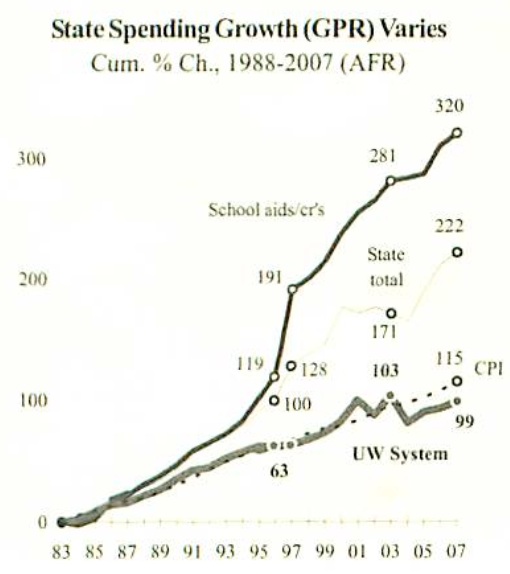
As far as I can tell, local school budgets have grown annually for decades. Ms. Joiner is referring to reductions in the increase. Spending growth slowed this year and will likely do so in the future. The Madison School District’s “Budget Amendments and Tax Levy Adoption for 2010-11” mentions 2010-2011 revenues (property taxes, redistributed state and federal taxes and grants) of $423,005,653, up from $412,219,577 in 2008-2009. The document’s 2009-2010 revenues are $489,487,261, which seems unusual. Enrollment has remained flat during the past few years (details here).

Share

Lunchbox Mix-up Leads to Charges for Sanford, NC Teen

WRAL:

An athletic and academic standout in Lee County said a lunchbox mix-up has cut short her senior year of high school and might hurt her college opportunities.
Ashley Smithwick, 17, of Sanford, was suspended from Southern Lee High School in October after school personnel found a small paring knife in her lunchbox.
Smithwick said personnel found the knife while searching the belongings of several students, possibly looking for drugs.
“She got pulled into it. She doesn’t have to be a bad person to be searched,” Smithwick’s father, Joe Smithwick, said.
The lunchbox really belonged to Joe Smithwick, who packs a paring knife to slice his apple. He and his daughter have matching lunchboxes.
“It’s just an honest mistake. That was supposed to be my lunch because it was a whole apple,” he said.

Share

Teen kicked off campus after lunch box mix-up

WTVD:

A 17-year-old honor student says she has been kicked off campus for the rest of the school year, because of a mix-up with her lunch box.
In October, senior Ashley Smithwick says she got in trouble at school for the first time in her life after she mistakenly took her father’s lunch container — that’s identical to hers — to Southern Lee High School.
Her dad’s container had a three-inch paring knife inside.
“And I had just grabbed my dad’s lunch box,” Smithwick said. “I didn’t mean to. I really didn’t. I just grabbed it and went out the door.”
School leaders say during that day a faculty member discovered a student with marijuana on campus and Smithwick’s paring knife was found during a random search.
According to a written statement received by ABC11 from Lee County Schools Superintendent Jeff Moss on Wednesday, the knife was found in Smithwick’s purse, not her lunchbox.

Share

K-12 Spending Per Student in the OECD

Veronique de Rugy

This chart by Mercatus Center Senior Research Fellow Veronique de Rugy compares K-12 education expenditures per pupil in each of the world’s major industrial powers. As we can see, with the exception of Switzerland, the United States spends more than any other country on education, an average of $91,700 per student between the ages of six and fifteen.
That’s not only more than other countries spend but it is also more than better achieving countries spend – the United States spends a third more than Finland, a country that consistently ranks near the top in science, reading, and math testing.

Share

Power to the People: Britains Big Experiment

Iam Birrell:

For those wanting a less colloquial explanation, the Big Society is an attempt to transform the relationship between the state and its citizens. Using the weapons of devolution and transparency, it seeks to empower individuals, improve public services that fail the most disadvantaged and reconnect the civic institutions that lie between the people and the state.
So why is the Big Society such a radical idea? As one of its leading proponents in government admits, it is a massive social experiment – stripping power from the state in the expectation that individuals, communities and enterprises will pick up the reins. “As in most such experiments, it is based upon instincts and understanding rather than empirical data,” he says. “It will be two to three years before we begin to see if it is playing itself out properly. But the direction of change will be remorseless and I’m confident it will transform Britain.”
This tussle between the responsibilities of state and citizens is at the centre of political struggles across the west, from France’s battles over pensions to the backlash against Washington in the US. Unsurprisingly, the Big Society ideas – far removed from the rampant individualism of the Tea Party – are being watched with growing interest by moderate Republicans.
In Britain, they fit comfortably with a nation fed up with over-bearing statism and corporate irresponsibility. The latest British Social Attitudes survey revealed growing distrust of both state and big business, combined with a desire for smaller, more local institutions.

Share

Showdown in the Offing

Doug Lederman

Three years ago, Congress stopped then-Education Secretary Margaret Spellings dead in her tracks. Cheered on by college leaders, Senator Lamar Alexander and other lawmakers — irked by the Education Department’s aggressive attempts to regulate higher education accreditation and by what they perceived to be the executive branch’s encroachment on their turf — took several legislative steps that effectively blocked the department from issuing new rules on student learning outcomes.
The players and the issues have changed, but signs are emerging that a similar showdown could unfold early next year over the Obama administration’s plan to require for-profit colleges and other vocational programs to prove that they prepare their graduates for “gainful employment.” Exactly how such a showdown would shake out is hard to predict, but the likelihood of it taking place grew significantly in recent days.

Share

State Schools Rethink Fees

Clare Ansberry:

Public universities across the U.S. are arguing for freedom to reap more revenue and create more efficiencies to offset dwindling state dollars.
One way, they say, is to raise tuition. At California University of Pennsylvania, a 158-year-old state school serving 9,400 students, enrollment is rising for all but the poorest students, which, in part, has led to a novel idea: replace the “low tuition for all” policy with a market-rate policy.
University officials say students from wealthier families could afford to pay more than the average $5,804 annual tuition at the state’s 14 universities. Fresh revenue from the higher tuition, they say, could be used to offer more scholarships to help the neediest students.

Share

Indiana Governor Daniels will offer private school voucher plan

Lesley Stedman Weidenbener

Gov. Mitch Daniels said Wednesday he will ask lawmakers to approve an education voucher system that would let low-income students use state money to help pay for private school tuition.
aniels provided few details about his proposal – including income levels at which families would qualify or the amount they could receive – but said it will be part of his larger education agenda for the 2011 session.
The governor and Superintendent of Public Instruction Tony Bennett presented part of that agenda on Wednesday to the Indiana Education Roundtable, a group of education, business and labor leaders who advise the state on school issues.
But Daniels never mentioned the voucher program there. Instead, he and Bennett focused on only a few areas: Freeing schools of regulation, recognizing and rewarding high-quality teachers and limiting the issues for collective bargaining to teacher pay and benefits.

Share

Advocating Dave Blaska for Madison School Board

Capital Times Editorial:

Supporters of the proposal to develop charter schools in the Madison Metropolitan School District — including “academies” segregated along lines of gender — have made a lot of noise in recent weeks about how the School Board should radically rewrite rules, contracts and objectives.
Fair enough. Let’s have a debate.
Two School Board seats will be filled in the coming spring election — those of incumbents Marj Passman and Ed Hughes.
Hughes and Passman have both commented thoughtfully on the Urban League’s Madison Prep boys-only charter school proposal.
Hughes, in particular, has written extensively and relatively sympathetically about the plan on his blog.
Passman has also been sympathetic, while raising smart questions about the high costs of staffing the school as outlined.
But neither has offered the full embrace that advocates such as the Madison Urban League’s Kaleem Caire and former Dane County Board member Dave Blaska — now an enthusiastic conservative blogger — are looking for.

Our community is certainly better off with competitive school board races.

Share

Some Va. history texts filled with errors, review finds

Kevin Sieff, via a James Dias email:

In the version of history being taught in some Virginia classrooms, New Orleans began the 1800s as a bustling U.S. harbor (instead of as a Spanish colonial one). The Confederacy included 12 states (instead of 11). And the United States entered World War I in 1916 (instead of in 1917).
These are among the dozens of errors historians have found since Virginia officials ordered a review of textbooks by Five Ponds Press, the publisher responsible for a controversial claim that African American soldiers fought for the South in large numbers during the Civil War.
“Our Virginia: Past and Present,” the textbook including that claim, has many other inaccuracies, according to historians who reviewed it. Similar problems, historians said, were found in another book by Five Ponds Press, “Our America: To 1865.” A reviewer has found errors in social studies textbooks by other publishers as well, underscoring the limits of a textbook-approval process once regarded as among the nation’s most stringent.

Share

Post-Union Disunion

Jack Stripling:

Bowling Green State University trustees justified recent sweeping changes to a key governing document as a necessary response to faculty unionization, but some professors there say the board is engaged in a retaliatory power grab.
Faculty voted in October to grant collective bargaining powers to the university’s chapter of the American Association of University Professors (AAUP), and the board responded Dec. 10 with changes to the Academic Charter that eliminated numerous faculty committees and stripped professors of their existing roles in the evaluations of deans, directors and chairs.
“This set of changes is allegedly done in response to collective bargaining, but there are so many changes that go beyond that, that clearly something else is afoot,” said David Jackson, president of Bowling Green State University’s Faculty Association, the AAUP union. “It certainly appears, to us anyway, that the administration is using the collective bargaining election and the need to negotiate salaries and benefits to justify wholesale changes.”
Also of concern to Jackson and others is the elimination of the faculty’s role in determining financial exigency, which universities can invoke to dismiss tenured professors. Removing even the faculty’s advisory function in this area, as the trustees have done, constitutes “a clear taking of power,” Jackson said.

Share

Too dumb? Too fat? Too bad

Mark Brunswick:

It’s been well-documented that many high school grads are now too fat to meet the U.S. military’s physical requirements. Now it turns out that many of those same kids may be too dumb.
The nonprofit Education Trust released a first-ever report this week showing that more than one in five young people don’t meet the minimum standard required for Army enlistment. Among minority candidates the ineligibility rates are higher: 29 percent. In Minnesota, the disparity for black applicants was even more startling: 40 percent were found to be ineligible. Among Hispanics in Minnesota the rate was 20 percent, but among whites, it was 14.1 percent.
This is more a distressing indictment of the U.S. education system than it is a testament to today’s Cheeto-eating, Xbox-playing youth, say the authors of the report. It strips away that illusion that the military can be an easy landing ground for those not bound for college, and it suggests that national security is at stake.

Share

K-12 Tax & Spending Climate: The West and the Tyranny of Public Debt

Newsweek:

The history of public debt is the very history of national power: how it has been won and how it has been lost. Dreams and impatience have always driven men in power to draw on the resources of others–be it slaves, the inhabitants of occupied lands, or their own children yet to be born–in order to carry out their schemes, to consolidate power, to grow their own fortunes. But never, outside periods of total war, has the debt of the world’s most powerful states grown so immense. Never has it so heavily threatened their political systems and standards of living. Public debt cannot keep growing without unleashing terrible catastrophes.
Anyone saying this today is accused of pessimism. The first signs of economic recovery, harbingers of a supposedly falling debt, are held up to contradict him. Yet we wouldn’t be the first to think ourselves uniquely able to escape the fate of other states felled by their debt, such as the Republic of Venice, Renaissance Genoa, or the Empire of Spain.

Share

Wisconsin State Senator Seeks to Stop 4K Funding Growth, Including Madison’s Planned Program

Matthew DeFour:

A Republican lawmaker wants to kill Madison’s fledgling 4-year-old kindergarten program before it even begins.
Sen. Glenn Grothman, R-West Bend, said Wednesday the state shouldn’t encourage new 4K programs — now in 85 percent of the state’s school districts and with three times as many students as a decade ago — because taxpayers can’t afford them.
“We have a very difficult budget here,” Grothman said in an interview. “Some of it is going to have to be solved by saying some of these massive expansions of government in the last 10 years cannot stand.”
Madison Superintendent Dan Nerad called Grothman’s proposal “very troubling.”
“I don’t know what the 4-year-olds in Madison did to offend the senator,” Nerad said. “There are plenty of studies that have indicated that it’s a good idea to invest as early as possible.”
Last month the Madison School Board approved a $12.2 million 4K program for next fall with registration beginning Feb. 7. Madison’s program is projected to draw $10 million in extra state aid in 2014 when the state’s funding formula accounts for the additional students. Overall this year, school districts are projected to collect $223 million in state aid and property taxes for 4K programs, according to the Legislative Fiscal Bureau.

Much more on Madison’s planned 4K program, here.
It appears that redistributed state tax dollars for K-12 are destined to change due to a significant budget deficit, not to mention the significant growth in spending over the past two decades.

The recent 9% increase in Madison property taxes is due in part to changes in redistributed state tax funds.
I spoke with a person active in State politics recently about 4K funding. Evidently, some lawmakers view this program as a method to push more tax dollars to the Districts.

Share

Time for Big Cuts in Education Spending?

Hans Bader:

America spends far more on education than countries like Germany, Japan, Australia, Ireland, and Italy, both as a percentage of its economy, and in absolute terms. Yet despite this lavish government support for education, college tuition in the U.S. is skyrocketing, reaching levels of $50,000 or more a year at some colleges, and colleges are effectively rewarded for increasing tuition by mushrooming federal financial-aid spending. Americans can’t read or do math as well as the Japanese, even though America spends way more (half again more) on education than Japan does, as a percentage of income, according to the CIA World Fact Book.
In light of this, it is easy to see why some education experts like Neal McCluskey are floating the idea of “draconian education cuts” to shake up a rotten educational establishment.

Share

Oklahoma’s new education chief says classes are too easy

Megan Rolland:

When state schools Superintendent-elect Janet Barresi takes office, her first priority is going to be stepping up the difficulty and rigor in schools so that more kids are ready for college when they graduate.
Only 2.4 percent of students in Oklahoma’s graduating class of 2009 scored in the upper tiers of national math exams, a ratio that places the state among recently industrialized nations such as Bulgaria, Uruguay and Serbia, according to a study released this month.
State schools Superintendent-elect Janet Barresi said the study, which also ranks Oklahoma among the worst 10 states in producing top-achieving math students, should be a wake-up call against the status quo.
“Let’s quit making excuses,” she said. “Let’s accept it, and use it as a challenge, Oklahoma.”

Share

Obese German children ‘should face’ classroom weigh-ins

Alan Hall:

Germany’s main school teaching body has called for classroom weigh-ins and the enforced removal of ultra-overweight pupils to combat rising obesity in society.
Josef Kraus, the DL teaching federation president, said: “When parents don’t make sure their children eat healthily and get enough exercise, then it can be the beginning of child abuse in extreme cases.” He said school doctors should take a more active role and conduct regular consultations and weight measurements of students. The should also report problem cases to authorities.
“When parental notices about overweight children are thrown to the wind, then youth services must be contacted and as a last resort there should be cuts to their parental benefits or welfare,” Mr Kraus said.
His remarks follow the release of official figures which showed that 51 per cent of Germans are considered overweight. Sixty per cent of men and 43 per cent of women have a Body Mass Index (BMI) – a measure calculated by body weight and height – of more than 25, up from 56 per cent and 40 per cent respectively in 1999.

Share

Green Bay educators worry changes to political landscape could affect local school funding

Patty Zarling:

Local educators say purse strings could tighten at both the state and federal levels when new Republican lawmakers take office in January.
And that has some school officials concerned about funding and revenue limits.
Mike Blecha, who sits on the Green Bay School Board and serves as its legislative liaison, noted that state rules limit school revenue increases to $200 per student, down from $275 in 2008-09. That means a school board’s ability to raise property taxes becomes limited.
Blecha said he’s heard the limit could be reduced to as little as $100 per student. Small, rural districts or districts with declining enrollment could be forced to shut down if levy limits fall that low, he said.

Share

Brave new world: Teachers find benefits of digital technology

Susan Troller:

The sign on the classroom wall prohibits the use of handheld communication devices, yet on this December morning all 28 students in Lori Hunt’s algebra II class are texting on their cell phones. But these Middleton High School students are not a defiant bunch of teens.
With Hunt’s blessing, they’re using their cell phones to text answers to math problems. Every answer appears, anonymously, on a wall-mounted, interactive, electronic whiteboard all students can see.
For Hunt, it provides an instant way of knowing how many students understand the problem and can calculate the answer. For the students, it allows them to use a familiar technology to explore challenging new concepts.

Share

Cheaters Find an Adversary in Technology

Trip Gabriel:

Mississippi had a problem born of the age of soaring student testing and digital technology. High school students taking the state’s end-of-year exams were using cellphones to text one another the answers.
With more than 100,000 students tested, proctors could not watch everyone — not when some teenagers can text with their phones in their pockets.
So the state called in a company that turns technology against the cheats: it analyzes answer sheets by computer and flags those with so many of the same questions wrong or right that the chances of random agreement are astronomical. Copying is the almost certain explanation.
Since the company, Caveon Test Security, began working for Mississippi in 2006, cheating has declined about 70 percent, said James Mason, director of the State Department of Education’s Office of Student Assessment. “People know that if you cheat there is an extremely high chance you’re going to get caught,” Mr. Mason said.

Share

Some places’ integration seats vanish: Aid formula makes big players prefer open enrollment to 220

Amy Hetzner:

Some of the biggest players in the Chapter 220 program will not accept new minority students for the coming school year, a move likely to continue the trend of declining participation in the school integration program.
School boards for Elmbrook, Menomonee Falls and Wauwatosa, which collectively enrolled more than a quarter of all Chapter 220 students last school year, have voted to not open up any new seats to the program in the 2011-’12 school year.
The action comes as districts have increasingly favored the state’s open enrollment public school choice program as a way to attract out-of-district students – and increased state aid – to their schools.
“The reason is largely financially related,” Elmbrook School District Superintendent Matt Gibson said.
While the money that districts collect for open enrollment students comes on top of the revenue limits allowed by the state, Chapter 220 aid does not raise extra revenue for school districts. Instead, the state aid that districts receive through Chapter 220 goes toward lowering district property taxes.

Share

Proposed bill: Make colleges’ spending public

Wayne Washington:

Want to know how much the University of South Carolina spends to mow the grass on the Horseshoe? What about how much Clemson University doles out to clean the carpet in its board room?
If legislation expected to be prefiled in the state House of Representatives passes, the answer to those questions and many, many others will be a few mouse clicks away for South Carolinians. The legislation, which will be called The Higher Education Transparency Act of 2011 and which was backed by House Speaker Bobby Harrell at a press conference Wednesday, will require that public colleges and universities post every penny of their expenditures online.
Much of the schools’ spending is already posted on the Web, but Republican legislators have leaned on school officials to go further.

Share

Wanted: Candidates for Madison school board

The Capital Times

The spring election of 2011 is shaping up as one of the most exciting in years, with impressive fields of candidates for state Supreme Court, Dane County executive and mayor of Madison.
But that does not mean that there are enough candidates. Plenty of races for circuit judge, school board, city council and village and town government posts have attracted only incumbents. These positions form the fabric of local government. At a time when tough decisions have to be made about the scope and character of the operations these elected officials oversee, it’s important that the best and brightest contenders step forward.
Luckily, Wisconsin maintains a low bar for getting on the ballot in local races.

Share

Charter Schools and Equal Opportunity

Nelson Smith:

Remember Norman Rockwell’s stark painting of the little African-American girl being escorted into a New Orleans schoolhouse by two deputy U.S. marshals? Today that little girl, Ruby Bridges, is working to open a public charter school in that same school building, which will house a civil rights museum as well.
Wouldn’t it be strange for a civil rights figure like Bridges to join a movement that was “accelerating re-segregation by race,” as charter schools were characterized in a recent Miller-McCune.com article? Yet that’s what some critics would have us believe, though more than a million black and Latino parents have chosen charters as a way of opening doors for their own children.

Share

What Are Taxes For? Should the primary purpose of taxation be to support the government or maximize economic growth?

Daniel Henninger:

Sarah, Mitt and several tea party groups say the tax compromise with Barack Obama is a bad idea, sells out the GOP’s anti-spending promises and, worst of all, helps you-know-who’s re-election chances. But Newt, Mike and Tim think it’s a decent deal. Far be it from me to interrupt the GOP’s holiday spirit. Let us stipulate, however, that the furtive, ragged tax bill being let out the back door of a lame duck Congress proves–officially and conclusively–that tax policy in the United States has hit the wall.
A compelling, even frightening article in Tuesday’s Wall Street Journal about a tax system that is a morass of extenders, extrusions, loopholes, credits and bubble-gum fixes ended with the story of a grievously ill cancer patient balancing the benefits of taking an experimental drug against the estate-tax benefits to his family of an early death.

Share

K-12 Tax & Spending Climate: Walker, Barrett seek checks on unions

Larry Sandler:

They didn’t seem to agree on anything during the gubernatorial election, but Milwaukee Mayor Tom Barrett is hoping he and Governor-elect Scott Walker can find common ground on at least one issue in 2011.
Both leaders want to rein in public employee unions – just not the same ones.
Walker, who has tangled with Milwaukee County unions as county executive, is gearing up for a clash with state workers, seeking wage and benefit cuts and threatening legislation to weaken or eliminate state unions’ bargaining rights if they won’t agree to concessions.
Barrett, meanwhile, wants Walker’s help to change another law that gives Milwaukee police unions extra bargaining leverage. The mayor also wants to block the police and firefighters’ unions from winning one of their top legislative priorities: abolishing residency requirements.
While most public employee unions backed Barrett, the Democratic nominee for governor, the Milwaukee Police Association and the Milwaukee Professional Firefighters Association endorsed Walker, the Republican. Now both unions’ presidents accuse Barrett of seeking retribution for those endorsements, a charge he denies.

Share

The Police and the Schools

The New York Times:

School officials across the country are revisiting “zero-tolerance” disciplinary policies under which children are sometimes arrested for profanity, talking back to teachers or adolescent behavior that once would have been resolved in meetings with parents. The reappraisals are all to the good given that those who get suspended or arrested are more likely to drop out and become entangled in the criminal justice system permanently.
The New York City Council clearly had this link in mind when it passed a new law earlier this week that will bring long overdue transparency to the school disciplinary process. Under the Student Safety Act, which takes effect in 90 days, the New York Police Department’s school security division will be required to provide clear and comprehensive data that show how many students are arrested or issued summonses at school and why. School officials will also have to provide similarly detailed information on suspensions.

Share

What’s High School For?

Glenn Sharfman:

We all want more young people to attend college. Who would argue with that? Politicians and educators at all levels extol the obvious virtues, from enhanced earning potential to a greater satisfaction in life. One increasingly popular way to encourage college attendance is through dual enrollment, in which students take courses in high school for both high school and college credit.
In theory, dual enrollment enables high school students to accrue college credits for very little cost and imbues them with a sense of confidence that they can complete college work. If students can succeed in college classes while still in high school, conventional wisdom holds, they will be more likely to matriculate at the postsecondary level.
In Indiana, dual enrollment is encouraged at the highest levels, with state Education Secretary Tony Bennett maintaining that at least 25 percent of high school graduates should pass at least one Advanced Placement exam or International Baccalaureate exam, or earn at least three semester hours of college credit during high school.
In reality, though, dual enrollment may do more harm than good.

Related: Credit for non-Madison School District Courses.

Share

An Interview with Kaleem Caire

Maggie Ginsberg-Schutz:

Caire believes the Madison community must first address its at-risk population in a radically different way to level the playing field before fundamental change can come.
“Madison schools don’t know how to educate African Americans,” says Caire. “It’s not that they can’t. Most of the teachers could, and some do, valiantly. But the system is not designed for that to happen.”
The system is also not designed for the 215 annual school days and 5 p.m. end times that Madison Prep proposes. That, and the fact that he wants the school to choose teachers based on their specific skill sets and cultural backgrounds, is why Caire is seeking to proceed without teachers union involvement.
“Ultimately,” he says, “the collective bargaining agreement dictates the operations of schools and teaching and learning in [the Madison school district]. Madison Prep will require much more autonomy.”
Many aspects of Caire’s proposed school seem rooted in his own life experience. Small class sizes, just like at St. James. Uniforms, just like the Navy. Majority African American and Latino kids, eliminating the isolation he grew up with. Meals at school and co-curricular activities rather than extracurricular, so that poor students are not singled out or left out.
Teachers the students can identify with. Boys only, in the hopes of fostering the sensitive, supportive male peer groups so critical to Caire’s evolving sense of self over the years.

Much more on Kaleem, here.

Share

What some call cheating can help learning

Jay Matthews:

My daughter is with us for the holidays, having survived her first barrage of law school exams in California. The exams were longer and more difficult than anything I ever had as a graduate student in Chinese studies. But her professors allowed students to have notes with them. This got my attention because her boyfriend at a neighboring law school was forbidden to have notes in two of his exams.
At these two institutions dedicated to equality under the law, what my daughter did during exams at one could have been considered cheating if she attended the other. What are we to make of the uneven nature of such rules, just as unpredictable as those found in our public K-12 schools? Open-book exams are okay some places, not in others. Cooperating with friends on homework is encouraged by some teachers, denounced elsewhere as a sign of declining American moral fiber.

Share

School in patriotic storm after principal allows students to opt out of the Pledge of Allegiance

David Gardner:

A school was at the centre of a patriotism row after the principal sent home permission slips allowing students to opt out of saying the Pledge of Allegiance.
The letter home sparked an outcry in Brookline, Massachusetts. Parents were asked to tick off whether or not they wanted their children to participate when the principal started reciting the pledge weekly over the school’s public address system.
‘It’s PC ridiculousness,’ said parent Sean Bielat. ‘Remember when the presumption was that we were all good Americans and we all loved the country and we had no problem saying, “Yes, I pledge allegiance”?’

Share

NC education board to require 2 US history classes

WRAL:

North Carolina high school students soon must take and pass two American history courses to graduate.
The State Board of Education approved Thursday a revised social studies curriculum for public schools that will expand study of U.S. history from one year to two to ensure more material is covered.

Share

Wisconsin’s academic luster fading

Amy Hetzner & Erin Richards:

They called it the “Canada effect” – the phenomenon in which students from a string of states along the country’s northern border regularly beat the rest of the nation on academic tests.
As recently as 1992, only three states – all from northern climates – had significantly higher average scores than Wisconsin in fourth-grade reading and eighth-grade math. No states scored significantly better than Wisconsin in fourth-grade math national assessments.
By 2009, this effect was wiped out for Wisconsin’s students. The state’s fourth grade reading scores placed statistically ahead of only 12 states and the District of Columbia. On the fourth- and eighth-grade math tests, the state’s students beat 26 states and the District of Columbia, results that could be considered slightly above average.
“We have lulled ourselves into thinking we’re really, really good,” said state Sen. Luther Olsen (R-Ripon), who will become chairman of the Senate Education Committee. “We’re OK, but we need to get better because other states are doing more at improving.”
With research showing the most important school factor in student performance is the effectiveness of classroom teachers, Wisconsin’s political and education leaders have called louder than ever for improving the quality of the state’s educators.

Share

A few awards to mark the good and bad this year in education

Alan Borsuk:

The last Sunday of the year and time for our first, perhaps annual, awards for noteworthy things that hapened in education around here in 2010.
Unsung Hero of the Year Award: Robert Kattman, director of the Office of Charter Schools at the University of Wisconsin-Milwaukee. The soft spoken former North Shore superintendent has been both supportive and demanding in building a roster of a dozen charter schools authorized by the UW Board of Regents. The list includes some of the best schools in Milwaukee, such as Milwaukee College Prep, Bruce Guadalupe, Seeds of Health Elementary, Woodlands School, Veritas High School. If the charter movement was like this nationwide, there would be far less controversy about these independent, publicly funded schools. Kattman is retiring at the end of the school year. Thanks for all your efforts.
The High Standards Start Here Award: State Superintendent of Public Instruction Tony Evers. Evers quickly signed up Wisconsin to be part of the “core standards” effort to bring coherence to the mish mash of what different states want students to learn. If the follow-through is good, it will raise Wisconsin’s expectations and, one hopes, student performance in years to come.
Most Important Data of the Year Award: The urban school district results from the National Assessment of Educational Progress (NAEP). This was the first time MPS took part and its students could be compared directly to those in 17 other central city school systems. The results were generally pretty distressing. Do we want our local education motto to be: “Thank God for Detroit – at least someone is worse than us”? The data should remain chastening and motivating to everyone involved in local education.

Share

Memphis suburbs consider creating independent school systems

Sherri Drake Silence:

Shelby County suburban mayors are exploring options to escape the prospect of Memphis City and Shelby County schools consolidation.
“People are very clearly concerned about the integrity of the public schools that their children attend in Germantown,” said Mayor Sharon Goldsworthy.
She and a few other mayors are considering creating independent school systems in their cities. Goldsworthy said they’d have to overcome a state prohibition on Tennessee municipalities starting school systems.
“Everything needs to be examined,” Goldsworthy said. “… There are an enormous number of questions and very few answers at the moment about any of this. Our responsibility as elected officials is to get those answers as quickly as possible so we can identify the best course of action for our community.”

Share

iTunes is Taking the Education World by Storm

Katherine Vander Ark

Is your library out of your favorite book? Would you like to take your book home for break? Want to read your favorite book on a plane ride or road trip? University of South Florida is making this very easy now. iTunes and USF have started Lit2Go:

a collaboration between the Florida Department of Education and the University of South Florida College of Education — supports literacy by providing access to recordings of historically and culturally significant literature. The extensive collection of hundreds of audiobooks, stories, and poems, including classics such as Alice in Wonderland, Aesop’s Fables, and A Tale of Two Cities — all for free on iTunes.

Now there is no reason for not finishing your book report! Schools are making it increasingly easy to access information from several sources. It is a more efficient, a green way of teaching and learning, not to mention for free. The iTunes U world instantly expands your reach to knowledge and information. There are options to research by subject, school, and company, all at the tip of your fingers!

Share

Florida Governor Elect Scott’s schools vision: Power to the parents

Ron Matus & Jeffrey Solochek:

Gov.-elect Rick Scott’s education team laid out reform ideas that would give parents state money to pick schools for their children and authority to remove them from a subpar teacher’s class.
That theme echoes throughout the 20 sprawling pages of reform ideas that Gov.-elect Rick Scott’s education team unveiled this week.
Parents should get state money to pick their own schools, public or private. Parents should decide what reform model is best to jump-start their children’s school. Parents should be able to remove their child from an underperforming teacher’s class.
“The parent is the ultimate accountability,” said Patricia Levesque, a close advisor to former Gov. Jeb Bush and a leader of Scott’s education transition team. “They know what’s best for their child. To substitute someone else’s judgment . . . is wrong.”

Share

Ending deception in school safety reports

Jay Matthews:

There was something strange in The Washington Post a week ago. A chart on page A16, using data provided by the D.C. public school system, showed that in late summer and fall 2009, Spingarn High School had by far the lowest number of assaults, thefts, threats and other crimes. There were just six incidents in four months compared with an average of 31 in the other eight high schools assessed.
At that time, teachers at this allegedly safest of all regular D.C. high schools were reporting a rash of crimes and classroom intrusions. The situation became so intolerable that by January they had persuaded D.C. Schools Chancellor Michelle A. Rhee to replace the Spingarn principal.
How could the incidents being reported by security guards under school district rules be so different from what people at the school were experiencing? Why did Rhee ignore the data in changing the school’s leadership and yet her successor, Kaya Henderson, used data from similar security incident reports last week to replace the principal at Dunbar High?

Share

K-12 Tax & Spending Climate: Pensions Push Taxes Higher Cities Tap Homeowners for Revenue as Workers’ Retirement, Health Costs Rise

Jeannette Neuman:

Cities across the nation are raising property taxes, largely citing rising pension and health-care costs for their employees and retirees.
In Pennsylvania, the township of Upper Moreland is bumping up property taxes for residents by 13.6% in 2011. Next door the city of Philadelphia this year increased the tax 9.9%. In New York, Saratoga Springs will collect 4.4% more in property taxes in 2011; Troy will increase taxes by 1.9%.
Property-tax increases aren’t unusual, in part because the taxes are among the main sources of local revenue. But officials say more and larger increases are taking hold. “This year we have seen a dramatic increase in our cities and towns having to increase property taxes” for pensions and other expenses, said Jack Garner, executive director of the Pennsylvania League of Cities and Municipalities.

Share

Education Secretary Sees Little Difference in Teachers with Master’s Degrees

News 8

There is a major budget crunch for schools around southern Nevada. That is why some people are questioning whether teachers should be getting a bigger salary simply because they have a master’s degree.
The U.S. Secretary of Education says there’s little evidence students are getting any better education from teachers who have advanced degrees. Secretary Arne Duncan delivered a speech recently on how financially challenged districts could do more with less.
Teachers who have masters degrees typically earn $5,000 more in annual salary.

Share

How the world’s most improved school systems keep getting better

Mona Mourshed, Chinezi Chijioke, Michael Barber, via several kind readers:

“We analyzed 20 systems from around the world all with improving but differing levels of performance and examined how each has achieved significant, sustained, and widespread gains in student outcomes, as measured by international and national assessments. The report was based on more than 200 interviews with stakeholders in school systems and an analysis of some 600 interventions they carried out two strands of research comprising what we believe is the most comprehensive database of global school system reform ever assembled. It identifies the reform elements replicable for school systems elsewhere, as well as those elements that are context specific, as they move from poor to fair to good to great to excellent performance.
Among other findings, the report shows that a school system can improve from any starting point and can become significantly more effective within six years. The research suggests that all improving systems implement similar sets of interventions to move from one particular performance level to the next, irrespective of culture, geography, politics, or history. A consistent cluster of interventions moves systems from poor to fair performance, a second cluster from fair to good performance, a third from good to great performance, and yet another from great to excellent performance. Although reaching each performance stage involves a common set of interventions, systems may sequence, time, and roll them out quite differently.

Share

The Real War on Christmas: No Teaching of Religion

Andy Rotherham:

It’s a holiday ritual as predictable as Santa showing up at your local mall: overheated rhetoric about the “War on Christmas.” A lowlight this year was a feature on The O’Reilly Factor about a letter from the Tennessee chapter of the American Civil Liberties Union urging school districts to make holiday celebrations inclusive. Through O’Reilly’s prism, the letter — quoted selectively — was an attempt to squelch Christmas. In reality, the letter just asked school districts to avoid celebrations focusing exclusively on a single religion. It was more common sense than state-coerced atheism.
Unfortunately, once you cut through the blather on cable news, there is a real, if much less discussed, problem in that public schools are skittish about teaching much about religion. Although there is little hard data, the consensus among those who study the issue is that to the extent world religions are taught, they are treated superficially, usually with the help of just a few textbook pages that have been heavily sanitized to avoid even the hint of controversy. And that’s not good news if you believe a working knowledge of the world’s religions and their history is an important aspect of a well-rounded education.

Share

Test-driven education won’t generate future leaders

Anita Lie:

In a report based on the Program for International Student Assessment (PISA), a test of half a million 15-year-old students in 65 countries, Organization for Economic Cooperation and Development (OECD) warned Western countries of the prospect of losing their knowledge and skill base.
In contrast, several Asian countries such as South Korea, Hong Kong and Singapore outperformed most other countries. China’s Shanghai took the PISA test for the first time and ranked first in all three areas: reading, mathematics and science (The Jakarta Post, Dec. 9, 2010). The Chinese government has been lauded for its investment in human capital.
It is ironic that just as PISA is highly regarded as a prestigious measure and the world is impressed by Shanghai’s achievement, insiders’ perspectives reveal skeptical and critical thoughts of the results.
One critical response came from Jiang Xueqin, a deputy principal of Peking University High School and director of the International Division. Mr. Jiang is concerned that the “high scores of Shanghai’s students are actually a sign of weakness”.

Share

Schools Still Facing Tough Budget Questions

Vermont Public Radio:

In recent weeks, Vermont School boards have been putting together the budgets they’ll submit to voters next year. This time around, though they were asked by the state to cut spending by an average of more than 2 percent. The cuts were needed to save $23 million as part of the Challenges for Change effort to close the overall state budget gap. But the results fell far short. Statewide, schools appeared to have made just over $4 million in cuts – far short of the $23 million.
Now the schools have a reprieve. Yesterday, Governor elect Peter Shumlin announced $19 million in federal stimulus money will go to the schools – which basically zeros out the needed cuts. But Vermont Education Commissioner Armando Vilaseca says school districts will still face difficult budget decisions next year. And he suggests that, with student enrollment decreasing by 1 1/2% to 2% each year, districts should look at Act 153, the voluntary merger bill.

Share

Google’s Book Trove Yields Cultural Clues

Robert Lee Hotz

Language analysts, sifting through two centuries of words in the millions of books in Google Inc.’s growing digital library, found a new way to track the arc of fame, the effect of censorship, the spread of inventions and the explosive growth of new terms in the English-speaking world.
In research reported Thursday in the journal Science, the scientists at Harvard University, Massachusetts Institute of Technology, Google and the Encyclopedia Britannica unveiled a database of two billion words and phrases drawn from 5.2 million books in Google’s digital library published during the past 200 years. With this tool, researchers can measure trends through the language authors used and the names of people they mentioned.
It’s the first time scholars have used Google’s controversial trove of digital books for academic research, and the result was opened to the public online Thursday.

Share

Two more groups win approval to sponsor Minn. charter schools

Tom Weber:

Two more groups have won state approval to sponsor charter schools in Minnesota.
Authorizers don’t actually run charters but a new law requires them to be more involved in the fiscal and academic oversight of the schools they sponsor. It also requires every current authorizer to re-apply to maintain their status.
The two newly-approved groups are the Northfield School District and Audubon Center of the North Woods. Northfield currently sponsors two charter schools, while Audubon is the state’s largest authorizer with 23.

Share

Montgomery schools’ decision to slow pace of math courses divides parents

Michael Birnbaum

One recent night, Mackenzie Stassel was cramming for a quiz in her advanced math course in Montgomery County. Her review of the complicated topics followed hours of other homework. Eventually she started to nod off at the table.
It was 11:15 p.m. Mackenzie is a sixth-grader.
There will be fewer such nights in the future for many Montgomery students.
Last month, Maryland’s largest school system announced that it would significantly curtail its practice of pushing large numbers of elementary and middle school students to skip grade levels in math. Parents had questioned the payoff of acceleration; teachers had said students in even the most advanced classes were missing some basics.

Related: Math Forum and Madison’s Math Task Force.

Share

Education Spending Myths

Reason:

Reason economics columnist and Mercatus Center economist Veronique de Rugy appeared on Bloomberg TV last week to talk about education myths. We’re spending ever-greater sums of money on historically high numbers of teachers per students, notes de Rugy, yet our high school graduates’ test results have been absolutely flat. What can be done to help students, especially those trapped in the worst-performing schools?

Share

K-12 Tax & Spending Climate: Government liabilities rose $2 trillion in FY 2010: Treasury

David Lawder:

The U.S. government fell deeper into the red in fiscal 2010 with net liabilities swelling more than $2 trillion as commitments on government debt and federal benefits rose, a U.S. Treasury report showed on Tuesday.
The Financial Report of the United States, which applies corporate-style accrual accounting methods to Washington, showed the government’s liabilities exceeded assets by $13.473 trillion. That compared with a $11.456 trillion gap a year earlier.

Share

Christmas Sweater Club Punished At Local High School

They call themselves the “Christmas Sweater Club” because they wear the craziest ones they can find. They also sing Christmas songs at school and try their best to spread Christmas cheer.
Now all 10 of them are in trouble because of what they did at their school.
“They said, ‘maliciously maim students with the intent to injure.’ And I don’t think any of us here intentionally meant to injure anyone, or did,” said Zakk Rhine, a junior at Battlefield High School.
The boys say they were just tossing small two-inch candy canes to fellow students as they entered school. The ones in plastic wrap that are so small they often break apart.

Share

K-12 Tax & Spending Climate: 2010 US Census – Fastest Growth in States Without an Income Tax

Wall Street Journal:

The Census is in. There are now 308.74 million Americans, an increase of 27 million, or 9.7%, since 2000. Americans are still multiplying, one of the best indicators that the country’s prospects remain strong.
About 13 million of that increase were new immigrants. These newcomers brought energy, talent, entrepreneurial skills and a work ethic. Their continued arrival in such large numbers validates that the rest of the world continues to view the U.S. as a land of freedom and opportunity.
The Census figures also confirm that America is a nation in constant motion, with tens of millions hopping across state lines and changing residence since 2000. And more of them are moving into conservative, market-friendly red states than into progressive, public-sector heavy blue states.
In order the 10 states with the greatest population gains were Nevada, Arizona, Utah, Idaho, Texas, North Carolina, Georgia, Florida, Colorado and South Carolina. Their average population gain was 21%. In the fast-growing states, the average income tax rate is 4% versus 6.9% in the slowest growing states.

Share

Professor has seen Madison’s image problem first-hand

Paul Fanlund:

Hi, I’m Kathy. I’m from UW-Madison. Do you mind if I join you?”
Those words, or some variation, provided an introduction at gas stations, coffee shops, cafes and churches across small-town Wisconsin.
While those of us ensconced in Madison scratch our heads about why so many in Wisconsin appear to dislike or distrust us, associate professor Katherine Cramer Walsh ventured out to hear it first-hand. So how did people respond? They were uniformly friendly, she says, but bewildered as to why she was there. “You should have seen their faces,” she says, smiling.
What she found is a big disconnect. For example: “When you ask, ‘What does hard work mean to you? Who does hard work?’ I would give examples like a waitress or someone who works in the lumber industry. Then I would say ‘professor’ and people would just laugh. Like, ‘give me a break.'”

Share

K-12 Tax & Spending Climate: Many Dane County property owners face higher tax bills

Gena Kittner:

Many Dane County residents are facing higher property tax bills this month as the growth of new property hasn’t kept up with higher government spending.
“We’re in a falling value market,” said David Worzala, Dane County treasurer. Taxpayers experienced similar conditions last year, but in this tax cycle “it’s more pronounced,” he said.
Before 2009, new construction and a growing tax base helped reduce the tax hit resulting from spending by schools, local governments and other taxing authorities.
The deadline for residents to pay at least half of their property taxes is Jan. 31.
In Dane County, bills cover municipal and county government, K-12 schools and Madison Area Technical College. Some municipalities add special charges for trash collection or recycling, improvements to streets or sidewalks, or unpaid bills.

Michael Louis Vinson:

School districts across the Green Bay and Appleton areas raised property taxes an average of 3.8 percent compared with last year, slightly higher than the 3.4 percent statewide average.
In Brown County school districts, increases range from 2.9 percent in De Pere and Pulaski to 12.3 percent in West De Pere, according to the Wisconsin Taxpayers Alliance, a government watchdog group that crunched the tax numbers and released them this week. Only the Ashwaubenon district didn’t increase its tax levy.
Each of the six districts based in Brown County is taxing to the limit allowed by the state this year.

Share

High Expectations: Eight-year-old children publish bee study in Royal Society journal

Ed Yong:


“We also discovered that science is cool and fun because you get to do stuff that no one has ever done before.”

This is the conclusion of a new paper published in Biology Letters, a high-powered journal from the UK’s prestigious Royal Society. If its tone seems unusual, that’s because its authors are children from Blackawton Primary School in Devon, England. Aged between 8 and 10, the 25 children have just become the youngest scientists to ever be published in a Royal Society journal.

Their paper, based on fieldwork carried out in a local churchyard, describes how bumblebees can learn which flowers to forage from with more flexibility than anyone had thought. It’s the culmination of a project called ‘i, scientist‘, designed to get students to actually carry out scientific research themselves. The kids received some support from Beau Lotto, a neuroscientist at UCL, and David Strudwick, Blackawton’s head teacher. But the work is all their own.

The paper can be found here.

Share

Saudi Arabia girls’ schools investigated over ‘illegal’ sports day

London Telegraph:

The Dec 8 event involving 200 females from six Jeddah private high schools broke ministry rules against girls’ sports in schools, a ministry official said.
“We don’t have any regulations that say that it’s OK for girls’ schools to hold sports classes or training,” said Ahmed Al-Zahrani, director of girls’ education in Jeddah.
“This tournament was held by these schools, something that has now led us to know about their illegal activities,” he said.

Share

Washington’s faulty thinking about education rules

Harris Miller:

America won the moon race. Can it win the higher education race?
A smart and innovative strategy will make this goal attainable, but too many in Washington fail to recognize that private-sector colleges and universities – sometimes referred to as career colleges – are an essential part of the answer. Now educating 12 percent of higher education students, these schools are the game-changer when a game-changer is badly needed.
In California, private-sector colleges and universities play crucial roles in educating students. More than 340,000 students in the state, 9 percent overall, attend career colleges. Two-thirds of these students are minorities, and almost 80 percent receive financial aid. These students are being armed with the skills needed to meet the demands of the 21st century economy.

Share

More cyber schools on way after funding increase

D. Aileen Dodd

Georgia took steps to become a national leader in cyber education Thursday with the approval of new charter schools and funding that could bring the possibility of online school to the home of every student.
The Georgia Charter Schools Commission authorized a new class of charter schools to open this fall, including a K-12 “virtual campus,” two K-8 schools and a middle school. Its decision to free up funding will enable two other cyber schools to start up as well.
After months of research, the commission agreed to increase funding for cyber schools from $3,400 to $5,800 per pupil – a figure below the national average of $6,500, but one that operators say they can live with.

Share

UC regents seek to cut retirees’ pension eligibility and health benefits

Larry Gordon:

University of California regents approved controversial rollbacks in pension and retiree health benefits Monday, including raising the earliest retirement age for future employees to 55, to help plug huge financial gaps in the university’s plans.
The changes now face tough bargaining with the unions that represent about half of UC’s 115,000 employees. Labor leaders said they are most upset about UC creating a two-tier workforce and contend that the changes would disproportionately affect blue-collar laborers who tend to retire earlier and with more health problems than faculty.
Under the proposals, employees hired after July 2013 would see the minimum age for early retirement rise from 50 to 55 and the age to receive maximum benefits increase from 60 to 65. In addition, all employees would pay higher premiums for post-retirement health plans.

Share

There’s more to education than tests

Autumn R. Campau:

In response to a recent letter received by the parents of the Rome School District, the New York State Education Department notified the district that Rome Free Academy has recently received the status of “in need of improvement” for the academic year 2010-2011. The improvement derives from the assessment results of the 2009-1010 academic year. While the district met the requirements for all students, those students with disabilities did not meet graduation requirements. This forced the group to lose Safe Harbor status, which has ultimately caused the improvement status for Rome Free Academy.
Within this letter, the district stated that due to the No Child Left Behind guidelines within the current status, parents may request their child to be transferred to another high school within the district — yet for these parents, there is no other option.
While currently administrators and teachers are receiving collaborative instructional practice from trained literacy coaches, the graduation rate has not been positively affected by the curriculum. So the question is what is the district really trying to work on?

Share