School Information System

Students defend their knowledge of proposed Idaho education reform

Justin Corr:

The battle over education reform in Idaho will continue this week. The House of Representatives is set to possibly send two of the three bills attached to Superintendent Tom Luna’s plan to the governor’s desk. The teachers’ union is promising more demonstrations and there could also be more student walkouts.
Last week saw student walkouts most of the week from around the state, all in protest of Superintendent of Public Instruction Tom Luna’s Education Reform Plan.
But while it looks like a huge number of students, teachers, and parents are against his plan, Luna doesn’t necessarily believe they’re in the majority.
“Sometimes, there’s an organized effort to get people to testify and protest, and that doesn’t necessarily mean that they represent a majority,” Luna said.
Some students we talked to did admit they were only protesting as a means of getting out of class. Luna believes more students would be in support if his plan if they really knew the facts about it.

Share

Education in Michigan must embrace the possible

Rochelle Riley:

As we debate Gov. Rick Snyder’s proposed budget and whether his constituents can survive it, we should note what the late French essayist Joseph Joubert said: “The aim of argument, or of discussion, should not be victory, but progress.”
That should apply to how we spend tax money. And at risk of death threats, I want us to converse more about education spending.
I find it curious and heartbreaking that whenever a governor proposes cuts to schools, the first outcry is what it will cost the kids.
Why pick on the kids first?

Share

Texans Duel Over Millions in School Funding

Ana Campoy:

As Texas schools scrounge for cash to buy supplies and threaten to lay off teachers, $830 million in education funding earmarked for the state is sitting at the federal Department of Education.
The money, part of the stimulus package passed last year by Congress to help U.S. schools, is trapped by an increasingly hostile battle between the state’s Republican and Democratic politicians over how to use it–to the dismay of school districts facing an almost $10 billion shortfall in state aid.
Democrats in the state’s congressional delegation included a provision in the federal legislation requiring Texas to use the money to supplement existing spending. In the past, they contend, Republicans have replaced state education dollars with federal money, then used the savings for other purposes.
“Federal aid to education should actually aid education in our local Texas schools, not provide a bailout to the governor for his mismanagement of the state budget,” said U.S. Rep. Lloyd Doggett, a Democrat who represents part of Austin.

Share

High School Football Recruiting’s New Face

Pete Thamel:

Sony Michel is still a high school freshman, yet he has shown flashes of Hall of Fame potential. A tailback for American Heritage in Plantation, Fla., Michel has rushed for 39 touchdowns and nearly 3,500 yards in two varsity seasons.
“He’s on par to be Emmitt Smith, on par to be Deion Sanders, on par to be Jevon Kearse,” said Larry Blustein, a recruiting analyst for The Miami Herald who has covered the beat for 40 years. “He’ll be one of the legendary players in this state.”
Michel’s recruitment will also be a test case for a rapidly evolving college football landscape. The proliferation of seven-on-seven nonscholastic football has transformed the high school game, once defined by local rivalries, state championships and the occasional all-star game, into a national enterprise.

Share

Miami’s Education Success Story

Greg Allen

As the White House seized that job news yesterday, President Obama went to Miami. He was there to talk about an issue that has bipartisan support: Education reform. The president visited a Miami high school with an inspiring comeback story. NPR’s Greg Allen reports he was joined by a well-known Florida Republican: The former governor, Jeb Bush.
GREG ALLEN: There are many lessons to be learned from Miami’s Central High School: The first is that when there’s a president visiting, 600 students can make a lot of noise.
President BARACK OBAMA: It is good to be here today.
(Soundbite of cheering)
Mr. OBAMA: I’m excited.
ALLEN: Miami-Dade is the nation’s fourth-largest school district, and for many years Central was one of its worst high schools. A perennial underachiever, for years it consistently ranked as a failing F school. President Obama noted that in one survey only a third of students said they felt safe at school.

Share

Last in, Most Worried

Elissa Gootman:

The clamor over “last in, first out” — shorthand for the way union contracts provide for the layoffs of public-school teachers, according to seniority — is anything but an esoteric political debate for the young teachers at the Academy for Language and Technology, a small high school that opened in the Morris Heights section of the Bronx in 2007. According to a list released by the city, the school stands to lose as many as 9 of 29 teachers if the predictions of 4,675 layoffs before the next school year come true.
Many newer schools and those in poor neighborhoods, which tend to hire newer teachers, would lose a particularly large share of their staff members. The Academy for Language and Technology, which was created for native Spanish speakers, fits into both categories.

Share

Requiem for Multiculturalism

Noel Williams:

Stop the presses! The British, French and German heads of state agree on something: Cameron, Sarkozy and Merkel have all recently declared multiculturalism a failure.
Like the related dogma of diversity, multiculturalism is so deeply embedded in the lexicon of liberalism that it has become axiomatic. Proponents hold it so dear that the faintest doubt poses an existential threat.
With the stakes so high, agnostics face sanctimonious wrath: if you don’t believe in multiculturalism there is simply something wrong with you; maybe you’re even nuts. While I have reservations I think I’m basically sane, and I sure as heck hope the aforementioned world leaders are operating with a full deck.
It’s important to distinguish between diversity and multiculturalism, which are often lumped together in liberal orthodoxy. Diversity is inherently good; but multiculturalism too often leads to separation and resentment that foments extremism.

Share

Wisconsin School choice programs get boost in Walker budget

Matthew DeFour:

Gov. Scott Walker’s budget proposal calls for deep cuts in most areas of public education with one notable exception – public school choice programs.
In addition to steep reductions in school district funding, Walker’s budget calls for a 10 percent cut to grants for programs such as bilingual-bicultural education and 4-year-old kindergarten. It also retains current grant funding for special education and low-income students, despite projected growth in those populations.
Meanwhile, Milwaukee’s 20-year-old voucher program would receive $22.5 million more to accommodate 1,300 additional students. The growth would result from Walker’s proposal to remove the program’s income requirements and enrollment caps.
And independent charter schools would receive $18.4 million more over the biennium. Walker is projecting 600 additional students as his proposal would lift the state enrollment cap on virtual charter schools, allow the UW System’s 13 four-year universities to establish charter schools, and allow independent charter schools in any district in the state.

Share

The Madison School District Plans to Expand its Dual Language Immersion Program

Superintendent Dan Nerad:

Elementary School Level DLI: Proposal to plan and implement DLI programs at Stephens, Thoreau, and Hawthorne Elementary Schools for the 2011-2012 School year. Given the ongoing increase in the number of Spanish-speaking English language learners, MMSD needs to implement bilingual education programming in order to meet legal requirements imposed by the state statutes. It is recommended we start planning at these three sites during the 2011-2012 school year for program implementation during the 2012-2013 school year starting with a Kindergarten cohort.
La Follette High School Dual Language Immersion Program Proposal Update: A committee has been formed to start developing a proposal to bring to the BOE for a high school DLI continuation program. The committee is made up of representatives from the district ESLIBE/DLI Division as well as administrators and staff from La Follette High School. The committee meets biweekly. This high school DLI program would
serve the needs of students in the Sennett DLI program. The students are scheduled to start their high school programming during the 2013-2014 school year. A proposal is scheduled to be presented to the BOE in May of 2011 .

Additional language options, particularly for elementary students will be good news. Nearby Verona launched a Mandarin immersion charter school recently.

Share

Don’t forget the students when mulling what’s next for the Milwaukee Public Schools

Alan Borsuk:

So what will things look like the day after the Milwaukee Public Schools system collapses?
Or, if you prefer, what needs to be done to avoid finding out the answer to that question?
Are these serious questions or is all this the-MPS-world-is-ending talk exaggerated?
I only have a firm sense of the answer to one of those questions, and it’s No. 3: It probably won’t be this fall (although it might be). But, best as I can see, the system as we know it stands at the brink of a momentous functional breakdown.
There have been people in recent years who thought the best solution to the problems of MPS was to blow up the system and build something better.
OK, big talkers: Time to put up. What’s next?

Share

Notes and Links on “The Battle of Wisconsin”

Wisconsin State Journal

Wisconsin cannot continue to spend more money than it has while pushing a pile of bills into the future.
For too long, Wisconsin has lurched from one budget shortfall to another.
The near-constant distraction of the state’s financial mess has kept our leaders from thinking long term. It has intensified partisan squabbles. It has forced difficult cuts and limited our state’s ability to invest in its future.
Gov. Scott Walker’s state budget, unveiled last week, is far from perfect. But it does one big thing right: It finally tackles Wisconsin’s money problems in a serious way – without the usual accounting tricks and money raids that only delay tough decisions.
Walker is largely doing in his budget proposal what he said he’d do: Fix the budget mess without raising taxes.

WPRI Poll: Wisconsinites want Walker to compromise

Wisconsinites overwhelmingly want GOP Gov. Scott Walker to compromise, a new poll says.
The poll, commissioned by a conservative-leaning think tank, also found that state residents think Democratic President Barack Obama is doing a better overall job than Walker.
Further, Wisconsinites narrowly disapprove of Senate Democrats’ decision to leave the state to block a Senate vote on Walker’s budget repair bill, which contains language to strip away most public employee union bargaining rights.
The poll of 603 Wisconsinites was commissioned by the Wisconsin Policy Research Institute and conducted between Feb. 27 and March 1, the day of Walker’s budget address, and has a margin of error of 4 percent. The survey of randomly selected adults included cell phone-users and was directed by Ken Goldstein, a UW-Madison political science professor on leave who is also the co-founder and director of the Big Ten Battleground Poll.
The poll’s release comes amid talks between Walker’s office and the Senate Democrats. Walker has hinted recently at compromise but said he won’t compromise on the core principles of his bi

Amy Hetzner:

Days after Gov. Scott Walker proposed major cuts to state education funding, school officials are still trying to find out how harsh the impact might be on their own districts.
Although the governor recommended a two-year, $834 million decline in state aid for schools and an across-the-board 5.5% decrease in per-pupil revenue caps – restricting how much districts can collect from state aid and property taxes – how that plays out at the local level could still shock some communities.
They have only to think of two years ago when the Democrat-controlled Legislature dropped school aid by less than 3% and nearly one-quarter of the state’s 425 school districts saw their general state aid decline by 15%. The proposed cut in school aid in Walker’s budget is more than 8% in the first year.
“Whenever the state tries to do things at a macro level, with formulas and revenue caps and so forth, there are always glitches,” said Todd Berry, president of the Wisconsin Taxpayers Alliance.

New York Times Editorial on New York’s Budget:

At a time when public school students are being forced into ever more crowded classrooms, and poor families will lose state medical benefits, New York State is paying 10 times more for state employees’ pensions than it did just a decade ago.
That huge increase is largely because of Albany’s outsized generosity to the state’s powerful employees’ unions in the early years of the last decade, made worse when the recession pushed down pension fund earnings, forcing the state to make up the difference.
Although taxpayers are on the hook for the recession’s costs, most state employees pay only 3 percent of their salaries to their pensions, half the level of most state employees elsewhere. Their health insurance payments are about half those in the private sector.
In all, the salaries and benefits of state employees add up to $18.5 billion, or a fifth of New York’s operating budget. Unless those costs are reined in, New York will find itself unable to provide even essential services.

And, finally, photos from Tennessee.
Tyler Cowen:

What to do? Time is no longer on the side of good. I suggest that we confront the nation’s fiscal difficulties as soon as possible. That means both tax hikes and spending cuts, though I prefer to concentrate on the latter. Nonetheless it is naive to think spending cuts can do the job alone, and insisting on no tax hikes drives us faster along the path of fiscal ruin. The time for the Grand Bargain is now, it will only get harder:

Share

The Elephant in Portland’s Room

Caroline Fenn, Charles McGee and Doug Wells:

Monday evening, the Portland School Board will vote on a teacher contract that, once again, ignores the elephant in the room — Portland Public Schools’ failure to adequately educate low-income children and children of color. We encourage all Portland residents to read the contract and see what some would have us celebrate. School board members should explain what they’ve gained and what they’ve given up with this negotiation. The public deserves answers.
The district’s budget woes are real. But the bigger problem is that PPS time and again puts adult jobs and politics ahead of students’ learning and graduating. Our community and state pay a hefty price. With an overall graduation rate of 53 percent (31 percent for Hispanic, 44 percent for African American and 45 percent for poor children), our quality of life is being redefined right before our eyes.
On Dec. 20, the Black Parent Initiative, the Coalition of Black Men, Community & Parents for Public Schools, and Stand for Children asked the school district, school board and teacher association to eliminate barriers to recruiting and retaining excellent teachers and principals, and to better serve our students, in particular our students of color. Barriers exist in both the teacher contract and district policy. The Native American Youth and Family Center, Latino Network, the Asian Pacific American Network of Oregon, the Hispanic Chamber and a number of civic leaders soon joined with us.

Share

The fallout for Wisconsin Committing to excellent public schools

Eric Hillebrand:

The problem with the current crisis in Madison over public-sector unions is that it distracts from the real issue where Wisconsin’s public education is concerned.
The governor recently announced the need to send contract termination notices to public school teachers if a vote on his budget-repair bill doesn’t happen soon.
Hmm. Do unionized teachers earn too much because of their unions? Can the state afford it?
The question should be: Would Wisconsin pay for excellent public schools even without teachers unions?
Teachers are not like General Motors workers in the ’70s or janitors today. Those workers have nothing to offer but their strong backs and hands. If they do not bargain collectively, they lose. Nor can teachers be lumped in with police and firefighters. These workers are necessary in a society that wishes to be safe.
Effective teachers are the kind of professionals who are valuable because of their education, creativity, innovation and initiative. Excellent teachers should be allowed to rise to the top and be in demand, while ineffective ones should be trimmed. The large teacher unions I have belonged to (Milwaukee Teachers’ Education Association and Chicago Teachers Union) seem to do the opposite. However, excellent teachers will still need to be attracted with competitive pay and benefits.

Share

On School Choice

Patrick McIlheran:

Take the school John Norquist sent his son to when he was mayor of Milwaukee. It’s private because it bought into the decidedly non-mainstream Waldorf movement. The Norquist family obviously felt it was worth the tuition, which the mayor could afford.
The school also accepted children via Milwaukee’s school choice program, so poor children could attend. Who was left out? Children from families neither poor nor well-off, including children whose parents worked for Norquist as firefighters and cops.
This is one reason Norquist says Gov. Scott Walker is right to expand school choice. By letting in the middle class, said Norquist, Walker makes better options available to middle-income parents in Milwaukee.
Norquist swiftly adds that he agrees with nothing else Walker has proposed lately. The ex-mayor goes on at length that he believes Walker wrong to limit public-union bargaining power.
That said, he vigorously favors more school choice. Milwaukee has school choice for the middle class, only it amounts to moving out to somewhere that the public schools are good. “One of the reasons people leave the city is because they feel they don’t have good choices for their kids,” Norquist said. “This bill changes that.”

Share

Ghana Teachers are better off under single spine

Nathan Gadugah:

The Deputy Education Minister Mahama Ayariga has dismissed assertions that teachers are worse off under the new pay policy, the single spine salary structure.
Teachers across the country have threatened a nationwide sit-down strike after widespread distortions in their salaries released in February under the Single Spine Salary Structure (SSSS).
The teachers were expecting an improved and enhanced salary under the much publicised single spine but were utterly shocked to notice that their salaries had either being halved or were lower than the preceding month.
They have accused the Fair Wages Commission of among other things failing to include their Professional Allowance in the build up of the SSSS and have threatened to disrupt the 54th Independence Day Celebration if government does not yield to their demands to review the salaries.
But speaking on Joy FM’s News analysis programme News file the deputy Education Minister Mahama Ayariga stated that the agitations by the teachers are a misunderstanding of the issues.

Share

The Way You Learned Math Is So Old School

NPR:

Your fifth-grader asks you for help with the day’s math homework. The assignment: Create a “stem-and-leaf” plot of the birthdays of each student in the class and use it to determine if one month has more birthdays than the rest, and if so, which month? Do you:
a) Stare blankly
b) Google “stem-and-leaf plot”
c) Say, “Why do you need to know that?”
d) Shrug and say, “I must have been sick the day they taught that in math class.”
If you’re a parent of a certain age, your kids’ homework can be confounding. Blame it on changes in the way children are taught math nowadays — which can make you feel like you’re not very good with numbers.
Well, our math guy, Keith Devlin, is very good at math, and he tells Weekend Edition Saturday host Scott Simon that there’s a reason elementary schools are teaching arithmetic in a new way.
“That’s largely to reflect the different needs of society,” he says. “No one ever in their real life anymore needs to — and in most cases never does — do the calculations themselves.”

Share

Bill Gates: How state budgets are breaking US schools


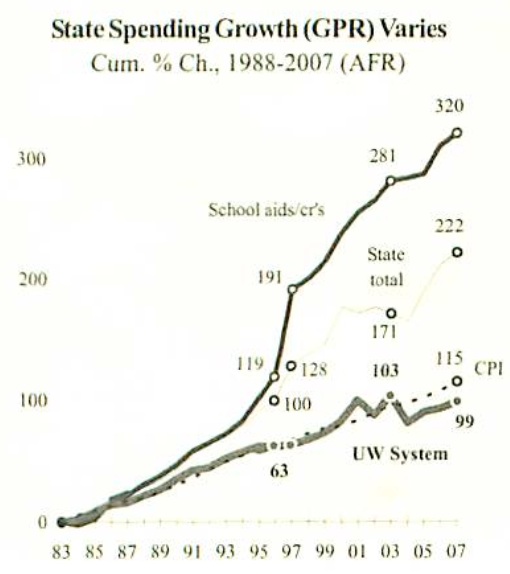
“We need to care about state budgets: Big Money, Little Scrutiny”.
Ripon Superintendent Richard Zimman:

“the very public institutions intended for student learning has become focused instead on adult employment. I say that as an employee. Adult practices and attitudes have become embedded in organizational culture governed by strict regulations and union contracts that dictate most of what occurs inside schools today. Any impetus to change direction or structure is met with swift and stiff resistance. It’s as if we are stuck in a time warp keeping a 19th century school model on life support in an attempt to meet 21st century demands.”

Related: “The Guys at Enron Would Never Have Done This“.
Much more on schools increased “adult to adult” spending here.

Share

Breakthrough

It is settled wisdom among Funderpundits and those to whom they give their grants that the most important variable in student academic achievement is teacher quality.
However, a small number of dissenting voices have begun to speak. Richard Arum and Josipa Roksa, in Academically Adrift have suggested that (p. 131) “Studying is crucial for strong academic performance…” and “Scholarship on teaching and learning has burgeoned over the past several decades and has emphasized the importance of shifting attention from faculty teaching to student learning…”
This may seem unacceptably heterodox to those in government and the private sector who have committed billions of dollars to focusing on the selection, training, supervision, and control of K-12 teachers, while giving no thought to whether K-12 students are actually doing the academic work which they are assigned.
In 2004, Paul A. Zoch, a teacher from Texas, wrote in Domed to Fail (p. 150) that: “Let there be no doubt about it: the United States looks to its teachers and their efforts, but not to its students and their efforts, for success in education.” More recently, and less on the fringe of this new concern, Diane Ravitch wrote in Death and Life of the Great American School System (2010) (p. 162) that “One problem with test-based accountability, as currently defined and used, is that it removes all responsibility from students and their families for the students’ academic performance. NCLB neglected to acknowledge that students share in the responsibility for their academic performance and that they are not merely passive recipients of their teachers’ influence.”
There are necessarily problems in turning attention toward the work of students in judging the effectiveness of schools. First, all the present attention is on teachers, and it is not easy to turn that around. Second, teachers are employees and can be fired, while students can not. It could not be comfortable for the Funderpundits and their beneficiaries to realize that they may have been overlooking the most important variable in student academic achievement all this time.
In February, when the Associated Press reported that Natalie Monroe, a high school English teacher in Pennsylvania, had called her students, on a blog, “disengaged, lazy whiners,” and “noisy, crazy, sloppy, lazy LOAFERS,” the response of the school system was not to look more closely at the academic efforts of the students, but to suspend the teacher. As one of her students explained, “As far as motivated high school students, she’s completely correct. High school kids don’t want to do anything…(but) It’s a teacher’s job…to give students the motivation to learn.”
It would seem that no matter who points out that “You can lead a student to learning, but you can’t make him drink,” our system of schools and Funderpundits sticks with its wisdom that teachers alone are responsible for student academic achievement.
While that is wrong, it is also stupid. Alfred North Whitehead (or someone else) once wrote that; “For education, a man’s books and teachers are but a help, the real work is his.”
As in the old story about the drunk searching under the lamppost for his keys, those who control funds for education believe that as long as all their money goes to paying attention to what teachers are doing, who they are, how they are trained, and so on, they can’t see the point of looking in the darkness at those who have the complete and ultimate control over how much academic achievement there will be–namely the students.
Apart from scores on math and reading tests after all, student academic work is ignored by all those interested in paying to change the schools. What students do in literature, Latin, chemistry, history, and Asian history classes is of no interest to them. Liberal education is not only on the back burner for those focused on basic skills and job readiness as they define them, but that burner is also turned off at present.
This situation will persist as long as those funding programs and projects for reform in education pay no attention to the actual academic work of our students. And students, who see little or no pressure to be other than “disengaged lazy whiners” will continue to pay the price for their lack of education, both in college and at work, and we will continue to draw behind in comparison with those countries who realize that student academic achievement has always been, and will always be, mainly dependent on diligent student academic work.
Share

When It Comes To Class Size, Smaller Isn’t Always Better

Andy Rotherham:

Budget cuts! Layoffs! Bigger classes! Oh my! Given the mini-Wisconsins erupting around the country, it’s not surprising that parents are worried about their children’s schools. At least 45 states will face some budget shortfall for the fiscal year that begins this July, according to The Center on Budget and Policy Priorities.
Last week the school board of Providence, Rhode Island gave pink slips to the city’s entire teaching force. Rumors of class sizes as large as 60 students circulated in Detroit.
Reality check: There will be teachers teaching in Providence next year. Similar sky-is-falling scenarios will be averted in Detroit and elsewhere, too. But that doesn’t mean that there will not be fewer teachers–and larger classes–in many places when school opens this fall. Secretary of Education Arne Duncan may well be right that scarce resources will be the “new normal” for schools.
The looming budget cuts are putting the question of class size front and center in local communities and the national education debate. A proposal to raise class sizes in Idaho by laying off more than 700 teachers led to protests around the state. Many other states and cities are considering changes to rules about class size.

Share

K-12 Tax & Spending Climate: Largest unions pay leaders well, give extensively to Democrats

John C. Henry, Center for Public Integrity:

On the surface, the fight between the governor of Wisconsin and organized labor is about balancing state budgets and collective-bargaining rights. Behind the scenes, hundreds of millions of dollars in compensation to top labor leaders as well as campaign contributions to Democrats could be in jeopardy.
Union treasuries – filled by dues paid by union members – not only fund programs benefiting union members and their families. The money they collect also pays six-figure compensation packages for labor leaders and provides millions of dollars for Democratic causes and candidates.
The Center for Public Integrity found compensation for leaders of the 10 largest unions ranged from $173,000 at the United Auto Workers to $618,000 at the Laborers’ International Union of North America, and almost $480,000 for the president of the American Federation of State, County & Municipal Employees. The latter is the target of GOP governors in Wisconsin, Indiana, Ohio, Tennessee and Kansas.
The union reports, filed with the Department of Labor, list compensation for all union employees and officers. Salaries make up the biggest portion, but other benefits can include tens of thousands of dollars for meal allowances, mileage allowances and entertainment. Health care and pension contributions are not specifically addressed.

Share

n L.A. school board races, outside spending surpasses $2 million [Updated]

Howard Blume:

Outside political action committees continue to dominate the contests over four seats on the Los Angeles Board of Education, spending more than $2 million combined, according to city records.
[Updated at 2:45 p.m.: The candidate attracting the most independent spending is Luis Sanchez, who is running for the one open seat, in District 5, which spans Los Feliz, Silver Lake, Eagle Rock and the southeastern portions of L.A. Unified, including the cities of Huntington Park, Bell and South Gate.
Outside groups have spent more than $727,000 for or against Sanchez. Nearly $500,000 has come in to support Sanchez. The source of this money is fund-raising led by Los Angeles Mayor Antonio Villaraigosa and, separately, spending by Local 99 of the Service Employees International Union, which represents many non-teaching school district workers. The local teachers union, United Teachers Los Angeles, has spent about $260,000 for a campaign opposing Sanchez. It’s also spent more than $127,000 in support of Bennett Kayser, who is running against Sanchez.]

Share

Budget crisis forces states to spend creatively: Duncan

Reuters:

In these challenging financial times — what I call ‘The New Normal’ — governments at every level face a critical need to cut spending where we can in order to invest where we must,” Education Secretary Arne Duncan wrote to U.S. governors while offering “some options on the effective, efficient, and responsible use of resources in tight budget times.”
The $821 billion economic stimulus plan passed in 2009 included the largest transfer of federal funds to states in U.S. history, with much of the money targeted toward healthcare and education.
The plan runs out this year and the states, which are only seeing a modest uptick in revenue as they still struggle with the fallout of the recession, are looking for places to cut to keep their budgets balanced.

Share

Fixing Struggling Schools

Arne Duncan:

Every day educators across the country are challenging the status quo and showing that low-performing schools can be turned around. Today, the President and I will visit Miami Central Senior High School to talk to some of those educators. Central has received nearly $800,000 in federal funding to support and accelerate turnaround efforts already underway.
Working with the school district and teachers union, Central promoted a strong school leader to be principal and replaced more than half the staff. It extended learning time after-school and during the summer, and engaged the community by offering Parent Academy classes for parents on graduation requirements and financial literacy. More than 80 percent of students are on free or reduced price lunch. Yet academic performance is steadily improving — and students and teachers are showing that a committed school can beat the demographic odds.
The burdens of poverty are real, and overcoming those burdens takes hard work and resources. But poverty is not destiny. Hundreds of schools in high-poverty communities are closing achievement gaps. America can no longer afford a collective shrug when disadvantaged students are trapped in inferior schools and cheated of a quality education for years on end.

Share

Dianne Ravitch On Daily Show: Testing And Choice Undermining Education

The Daily Show:

Last night on the Daily Show, Jon Stewart interviewed author, historian, and professor Dianne Ravitch on her new book “The Death and Life of the Great American School System.”
Ravitch argued that testing and choice are undermining America’s education system. She said that ever since the No Child Left Behind Act, “schools have been turned into testing factories.”
She also discussed how being a teacher has turned into a thankless job, and that teachers have become entirely demoralized. She stated that “the whole public monologue for the last couple of years has been ‘Blame the teachers for everything.'” Stewart agreed, noting that his mother worked in education for years.

Ravitch is scheduled to speak in Madison on March 8, 2011 @ 7:00p.m.

Share

NJEA officials warn against N.J. education chief’s plan to tie test scores to teacher evaluations

Ted Sherman:

Tying test scores to teacher evaluations could narrow curriculums in schools and reinforce teaching for the sake of passing a test, the New Jersey Education Association argued today, saying that plans by the Christie Administration to impose performance reviews based on how well students do on standardized tests were unworkable.
Last month, acting Education Commissioner Christopher Cerf unveiled a five-point reform proposal that would abandon New Jersey’s teacher job guarantee program and replace it with an evaluation system rewarding educators for good student performance and working in at-risk schools
Under the plan, the state’s public school teachers would be assessed and paid using a new rating system based in part on how their students do in the classroom.

Share

New York Democrat Governor Cuomo Seeks Speedy Change in Teacher Evaluations

Thomas Kaplan:

Gov. Andrew M. Cuomo said on Tuesday that he would introduce legislation to speed the implementation of a statewide system to evaluate teachers’ performance.
His announcement came minutes after the State Senate passed legislation sought by Mayor Michael R. Bloomberg that would reverse a rule protecting long-serving New York City teachers from layoffs regardless of their effectiveness.
Mr. Cuomo’s proposal would have far broader implications, affecting school districts across the state. But it would not affect the thousands of layoffs that Mr. Bloomberg maintains he will be forced to carry out because of cuts in state aid.
Rather, Mr. Cuomo is seeking to accelerate the introduction of new standards for teacher and principal evaluation that the state’s Education Department, with the support of teachers’ unions, has been developing since last year.

Share

Federal Education Spending Updates

Alyson Klein:

The administration had wanted to see those programs consolidated into a new, broader, $383 million funding stream aimed at improving literacy. Now it appears there may be a lot less available money for that effort.
The measure also gets rid of all funding for the rest of the year for the $88 million Smaller Learning Communities program, which was slated to be funneled into a broader program aimed at improving educational options.
And it scraps the Leveraging Educational Assistance Partnerships, or LEAP, program, financed at $64 million.
The bill also defunds a lot of programs that are right now classified as “earmarks,” meaning money directed at one particular program or project. That includes a number of national education programs, such as Teach for America, the National Board for Professional Teaching Standards, National Writing Project, Reading is Fundamental, and the Close Up fellowship.

Share

Illinois Governor Quinn defends call for merging school districts & Cutting Administrative Costs

Zachary Coleman:

Gov. Pat Quinn defended his proposal to merge school districts on Wednesday, saying the money saved from cutting district administrators will put more teachers in Illinois classrooms.
Quinn said the state could save $100 million by cutting the Illinois’ 868 school districts to about 300. Illinois has the third-most school districts in the nation behind Texas and California, and about 200 districts have just a single school.
“We don’t need as many folks at the top level,” Quinn told reporters at the Capitol. “We need folks on the front line, in teaching, imparting knowledge and making sure our kids get 21st century education.”
Quinn said at least 270 superintendents earn more than his $177,412 salary.

Share

Minn. Senate passes alternative teacher licensing

AP:

The Minnesota Senate has passed a bill that creates a new method of obtaining teacher licenses.
The alternative licensing plan is aimed at meeting projected teacher shortages in the future. It’s designed to give Minnesota schools an infusion of new, mostly young teachers who don’t attend traditional teaching colleges, and help close an achievement gap between white and minority students that’s one of the worst in the country.
Critics say it will harm schoolchildren by making it too easy to become a teacher. But the bill the Senate passed Thursday reflects a compromise between Gov. Mark Dayton and bill sponsors, and it’s expected to get his signature.

Related: Janet Mertz: An Email to Madison Superintendent Dan Nerad on Math Teacher Hiring Criteria

Share

Midwest union battles highlight debate over improving schools

Nick Anderson

The Republican faceoff with labor unions in the Midwest and elsewhere marks not just a fight over money and collective bargaining but also a test of wills over how to improve the nation’s schools.
Various GOP proposals to narrow labor rights, dismantle teacher tenure and channel public money toward private schools raise a question: Should states work with teacher unions to overhaul education or try to roll over them?
Like many Democrats, President Obama wants collaboration. He has preached teamwork with unions even as he pushes harder than any of his predecessors to get bad teachers out of schools and pay more to those who excel.
Here in Indiana, Gov. Mitch Daniels (R) shares many of Obama’s education goals. But Daniels, a possible 2012 presidential contender, and several of his Republican peers are pursuing reform through confrontation.

Share

Budget presented by Fair Lawn, NJ School Board, 1.75% Property Tax Increase

Tracy Putrino:

A tentative school budget of $83.3 million was approved by the Board of Education on March 3.
The budget includes a tax levy, the amount to be paid by taxpayers, of $73,158,200 million. The tax levy is a 1.75 percent increase over last year and below the 2 percent cap permitted for school districts. With debt service of $1,940,222, the total tax levy is $75 million.
For a property assessed at $411,663, the borough average, it amounts to a $181.93 annual increase or $15.16 a month, according to Superintendent of Schools Bruce Watson.
“We still have three weeks to work on it,” said Watson during his presentation. “We can still change it.”

Share

Teachers Wonder, Why the Scorn?

Trip Gabriel:

The jabs Erin Parker has heard about her job have stunned her. Oh you pathetic teachers, read the online comments and placards of counterdemonstrators. You are glorified baby sitters who leave work at 3 p.m. You deserve minimum wage.
“You feel punched in the stomach,” said Ms. Parker, a high school science teacher in Madison, Wis., where public employees’ two-week occupation of the State Capitol has stalled but not deterred the governor’s plan to try to strip them of bargaining rights.
Ms. Parker, a second-year teacher making $36,000, fears that under the proposed legislation class sizes would rise and higher contributions to her benefits would knock her out of the middle class.
“I love teaching, but I have $26,000 of student debt,” she said. “I’m 30 years old, and I can’t save up enough for a down payment” for a house. Nor does she own a car. She is making plans to move to Colorado, where she could afford to keep teaching by living with her parents.

Whitney Tilson, via email:

This front page story in today’s NYT annoys the heck out of me because it’s missing one word in its title – it should read: “Teachers UNIONS Wonder, Why the Scorn?” The author presents NO evidence that Americans don’t cherish teachers other than a random placard and online comment. What Americans DO object to are unions using their enormous political influence to benefit their members while throwing kids under the bus – two great examples are the impossibility of firing even the most horrific teachers and doing layoffs purely by seniority. Checker Finn has it exactly right:

Chester E. Finn Jr., president of the Thomas B. Fordham Institute, a conservative-leaning education policy group, said the decline in teachers’ status traced to the success of unions in paying teachers and granting job security based on their years of service, not ability.
“They are reaping a bitter harvest that they didn’t individually plant but their profession has planted over 50 years, going from a respected profession to a mass work force in which everyone is treated as if they are interchangeable, as in the steel mills of yesteryear,” Mr. Finn said.

And why did the author quote the only young teacher in America who thinks it’s fair that he’s being laid off because he lacks seniority rather than doing it based on which teachers are best for kids? He could have easily quoted one of the Educators 4 Excellence teachers, for example:

Last month Mr. Tougher was notified that because of his lack of seniority, he will be laid off, or “excessed,” this year under the state’s proposed cuts to school aid. A union activist, he believes seniority-based layoffs are fair.
“The seniority part, I get that,” said Mr. Tougher, who is single. “While it would be a bummer if I were excessed for next year, that’s just how things go sometimes.”

Share

Politics, Unions and Wisconsin Pensions

Bruce Murphy:

This is a story that tells how state benefits – and state power – works.
In 1994, former governor Tommy Thompson was running for reelection to his third term. He wanted to win by a wide margin to boast his chances of being considered as a possible candidate for president or vice-president of the United States. So Thompson let union leaders know he was open to improving the pension for state employees.
The overture worked. The state employees union backed Thompson in 1994 and again in 1998. And Thompson made good on his promise, helping to pass, in 1999, a state law that gave all employees a 10 percent increase in the value of their pension for all years worked prior to 2000 (any years worked after this got the usual pension multiplier).
But Thompson went further than the unions wanted. His law allowed employees to collect up to 70 percent of their final average salary in pension payments, an increase from the old 65 percent. That had little value for the unions: Employees would see their annual pension multiplier rise from 1.6 per year to 1.765 percent; even with that increase, however, they would have to work 37 years to hit the legal ceiling of 65 percent of their final average salary.

Share

Gates Says High Pension Costs Hurt Education

Robert Guth & Michael Corkery:

Billionaire philanthropist Bill Gates will step into the national debate over state budgets Thursday with a call for states to rethink their public-employee benefits systems, which he says stifle funding for the nation’s public schools.
Mr. Gates in an interview said he will use a high-profile conference Thursday in Long Beach, Calif., to urge that more attention be paid to how states calculate their employee-pension funding and health-care obligations. “These budgets are way out of whack,” Mr. Gates said. “They’ve used accounting gimmicks and lot things that are truly extreme.”
The comments come after Mr. Gates spent more than a year studying the issue and enlisting the advice of leading academics and others.

Share

Seattle school district: A culture of fear? District Limits Employee Communications with the School Board

Amy Rolph & Scott Gutierrez:

A fear of retaliation and an official policy that keeps Seattle Public Schools employees from directly raising concerns with the school board are at least partly to blame for a scandal involving $1.8 million in misused public funds, auditors and investigators say.
The scandal unfolding at the school district is calling into question why Superintendent Maria Goodloe-Johnson and the seven members of the school board weren’t alerted earlier to concerns about Silas Potter, who ran the Regional Small Business Development Program.
Those concerns aren’t new — at least, not to a handful of employees in the school district. But when those concerns were voiced over the last several years, they never made it up to the school board.
At Seattle Public Schools, when employees do speak up, they have to navigate an obstacle course of bureaucracy before gaining the ears of board members.

Share

Wisconsin Governor Seeks Change in Reading Programs, Highlights dramatic fall in NAEP Performance

Matthew DeFour:

But the Department of Public Instruction (DPI) is questioning the legality of Walker’s proposal to fund the program through the Department of Administration.
Walker has proposed spending $600,000 in each of the next two years to implement recommendations of a new task force appointed by Walker that would develop a third-grade reading test. Walker noted Wisconsin’s performance on a national fourth-grade reading exam has fallen from third out of 39 states in 1994 to 30th out of 50 states in 2009.
“From kindergarten to third grade, our kids learn to read, and then from third grade on, they use reading to learn,” Walker said in his budget address. “We need to make sure every child can read as they move on from third grade.”

Related:

Share

Erasing Signatures From History

Jeffrey Zaslow:

In his 35 years as a high school English teacher in suburban Philadelphia, Thom Williams often encouraged his students to splash their most creative thoughts on the walls of his classroom.
Hundreds of students embraced his invitation, covering those painted cinderblocks with original art, quotes from favorite books, and deep thoughts born from teenaged angst.
“I looked to those walls for inspiration,” says 18-year-old Lauren Silvestri, a student of Mr. Williams’s at Marple Newtown High School in Newtown Square, Pa. Before graduating last year, she signed her name and a quote she loves. “It felt good to know I’d come back someday and my words on the wall would be there.”
Her words won’t remain for long, however. Mr. Williams died of cancer in December at age 63, and now the school is being renovated. That classroom’s walls are set to be demolished or painted over. “Thom was a free spirit who encouraged his students to be free spirits,” says Raymond McFall, the school’s principal. Still, “I can’t have everybody painting on the walls of the school.”

Share

Education ministers wobbly on ICT – ‘don’t get it’?

John Galloway:

The Coalition Government brought a big shift in ICT policy for education. From a position of active strategies, streams of guidance, heavy investment in connectivity, research and equipment, to a touch so light as to be barely perceptible.
The recent white paper, “The Importance of Teaching”, emphasises standards for frontline teaching, with ideas about what the curriculum might contain, but scant reference to how they might teach, or with what resources. ICT has one mention – in relation to procurement. This is no oversight. Why the big change? And a recurrent fear among those consulted is worrying – they simply don’t fully understand the importance of ICT.
A set of three simple questions were put to a number of leading figures involved in ICT for learning (the full set of questions and answers can be downloaded here) and three to schools minister Nick Gibb MP. While the Department for Education emphasised schools’ new freedoms (see below), the other responses raised a range of worries.

Share

Wisconsin Budget cuts $834 million from schools

Amy Hetzner and Erin Richards:

State and local funding for general Wisconsin public school operations would drop 5.5% in 2011-’12 while Milwaukee’s private-school voucher program could be poised for a massive expansion under Gov. Scott Walker’s budget proposal, one that slashes $834 million in state K-12 education spending over the next two years.
The governor’s 2011-’13 budget proposal would phase out the income requirements of the Milwaukee Parental Choice Program, eliminate the enrollment cap on student participation, and allow Milwaukee families to use their publicly funded voucher to attend any private school in Milwaukee County that wished to participate in the program.
Walker also hopes to remove a requirement that students in the choice schools take state tests, possibly scuttling new efforts to gauge whether the private school choice program has meaningful impact on academic achievement.
“We’ve been saying for a month now that the second shoe was going to drop,” said Tom Beebe, executive director of Wisconsin Alliance for Excellent Schools, referring to Walker’s recent push for major concessions on benefits from teachers and other public employees. “It wasn’t just dropped. It was thrown at the head.”

Share

Missing Wisconsin senators rely heavily on union campaign dollars

Daniel Bice and Ben Poston:

The 14 Wisconsin Democratic senators who fled to Illinois share more than just political sympathy with the public employees and unions targeted by Gov. Scott Walker’s budget-repair bill.
The Senate Democrats count on those in the public sector as a key funding source for their campaigns.
In fact, nearly one out of every five dollars raised by those Democratic senators in the past two election cycles came from public employees, such as teachers and firefighters, and their unions, a Journal Sentinel analysis of campaign records shows.
“It’s very simple,” said Richard Abelson, executive director of District Council 48 of the American Federation of State, County and Municipal Employees. “We have interests, and because of that, we attempt to support candidates who support our interests. It’s pretty hard to find Republicans who support our interests these days.”
Critics of Walker’s budget-repair bill say it would mean less union money for Democrats. That’s because the legislation would end automatic payroll deductions for dues and would allow public employees to opt out of belonging to a union.

Related: WEAC: $1.57 million for Four Wisconsin Senators.

Share

K-12 Tax & Spending Climate: Distribution of Tax Burden by Quintile

David Henderson:

In comments on my post on Rand Paul and David Letterman, some commenters expressed interest in seeing the data on overall federal tax burden, not just the burden of the federal income tax. As it happens, the Congressional Budget Office reports such data. I would reprint their tables but I haven’t yet figured out how to do that. So here is the link for 2006 data. Click on their data and you’ll get an Excel spreadsheet that shows the following:
. The bottom quintile paid 4.3 percent of income in taxes,
. The top quintile paid 25.8 percent of income in taxes,
. The top decile paid 27.5 percent of income in taxes,
. The top 5 percent paid 29.0 percent of income in taxes, and
. The top 1 percent paid 31.2 percent of income in taxes.

Share

What Does the Governor’s Budget Mean for the Madison School District?

Madison School Board Member Ed Hughes:

The Governor has stated that the cuts in benefits he is imposing on public employees will allow school districts and other governmental agencies to absorb the cuts in state aid that they will sustain without requiring significant layoffs or decreases in services.
Does that claim hold up? Well, for our school district it looks like it might.
If my assumptions are correct, it looks like the big financial hits the Governor wants our teachers to absorb will enable us to make it through the recommended cuts in state aid and in our spending authority without the need for significant layoffs.
I need to emphasize that this conclusion is tentative and certainly subject to revision as I learn more. But this is how I see it now.
School budgeting issues are invariably confusing. The confusion can be reduced a bit if two issues are kept separate. The first is: How much money can we spend? The second: Where will that money come from?

David Blaska has more on Ed Hughes’ blog, here

I will not replicate here Kris Wigdal’s list of boycott targets but here’s the punchline: her list numbers 154 of the leading companies in Wisconsin! Suffice it to say it would be difficult to mow your lawn, do a summer cook out, quaff your thirst, gas up your car, or get medical care unless you do like the Fugitive 14 Senators and go out of state.
Madison school board member says governor’s budget could work
I have long felt that Ed Hughes is probably squarely in the center of the Madison school board — not too hot, not too cold. His take on Governor Walker’s budget as unveiled Tuesday is that it could work for Madison without teacher layoffs:

Share

Labor union supporters say Wisconsin test scores vastly outpace those in five states without collective bargaining for teachers

Politifact.com:

With that question out of the way, we’ll take a look at the thornier question of how those five states’ test scores stack up nationally, and against Wisconsin in particular.
On Feb. 20, 2011, Angus Johnston, an adjunct assistant professor at the City University of New York, published a comprehensive analysis of this question on his blog. He published links to a chart that appears to have been the inspiration for the tweets and Facebook postings. It offers a state-by-state analysis of scores on the SAT and the ACT, the two leading college-admissions tests, assembled by University of Missouri law professor Douglas O. Linder.
Johnston is critical of Linder’s methodology for a variety of reasons, which he explains in more detail here. But without even taking those concerns into account, we find the statistics unreliable. They were published in 1999, meaning that the statistics themselves are likely more than a dozen years old — far too old to be presumed valid in 2011.
Fortunately, it’s possible to obtain state-by-state rankings for the SAT and ACT of a more recent vintage. Here’s a table of the relevant states:

Share

Even Without Muni Bond Sale, Wisconsin Not in Fiscal Peril

Kelly Nolan, via a Barb Schrank email:

Wisconsin may not be able to refinance $165 million in debt as planned in the municipal bond market this week or next, but that doesn’t mean the state is in any kind of immediate fiscal peril.
Wisconsin has taken center stage this budget season, as Gov. Scott Walker, a Republican, has pushed to eliminate most of the collective bargaining rights for the state’s 170,000 public employees through a controversial budget “repair bill.” Democratic state senators have fled the state to avoid voting on the measure.
Mr. Walker’s latest tactic to lure them back has been threatening to make additional cuts or more layoffs, should the state be unable to refinance $165 million in debt for short-term budget relief. Under his plan, the state would issue a 10-year bond to restructure a debt payment that otherwise would be due May 1.

Share

Monona Grove Teacher Contract Agreement

Peter Sobol:

The MGEA has ratified the contract agreed to earlier today by the board. This contract is for the 2009-2011 school year and will expire June 30th.
The contract mostly maintains the status quo to allow us to complete the year in an orderly fashion even if the current budget repair bill passes. Hopefully it will give us enough time to deal with the implications of the yet to be released state budget and make layoff and staffing decisions with enough knowledge to minimize disruption. The same is true of senior teachers with the option to retire. It also minimizes risk: in the absence of a contract we would be governed only by the complex state statutes if the “budget repair bill” becomes law, and there is a risk that any disputes would end up in litigation without this settlement.
The agreed upon contract provides for 0% salary increase in the first year (2009-10) and 1% in the current year. This is significantly less than inflation and saves the district money relative to what had been budgeted. Given that the MGEA would retain the right to negotiate salaries up to the rate of inflation under the “budget repair bill’ this is probably a deal for the district. A teacher who started in the district this year with a bachelors will receive $31,695 in salary (including the new teacher stipend), a teacher with a master’s and 16 years experience will receive $51,717.

Share

Billions in Bloat Uncovered in Beltway

Damian Paletta:

The U.S. government has 15 different agencies overseeing food-safety laws, more than 20 separate programs to help the homeless and 80 programs for economic development.
These are a few of the findings in a massive study of overlapping and duplicative programs that cost taxpayers billions of dollars each year, according to the Government Accountability Office.
A report from the nonpartisan GAO, to be released Tuesday, compiles a list of redundant and potentially ineffective federal programs, and it could serve as a template for lawmakers in both parties as they move to cut federal spending and consolidate programs to reduce the deficit. Sen. Tom Coburn (R., Okla.), who pushed for the report, estimated it identifies between $100 billion and $200 billion in duplicative spending. The GAO didn’t put a specific figure on the spending overlap.

Share

Extra Money May Not Avert Teacher Layoffs

Michael Howard Saul:

One day after outlining plans to lay off teachers, Mayor Michael Bloomberg said he is unsure whether additional funds from the state would change his call to eliminate more than 6,100 teaching positions.
Earlier this month, as part of his preliminary budget proposal for the fiscal year beginning July 1, the mayor requested $600 million in aid from Albany — $200 million of which he said was needed for New York City’s Department of Education. That additional aid from Albany would close the city’s deficit, he said.

Share

K-12 Tax & Spending Climate: Race to the Bottom?

Walter Russell Mead:

But America shouldn’t compete on the basis of cheap labor: we are not nor should we try to be the Walmart of Work. So the first question becomes how do we compete in ways that don’t involve endlessly ratcheting down wages and benefits? And the second, related question is how can we generate enough demand for American workers so that market forces drive incomes up from year to year and decade to decade?
The key to success is obvious: we need to continue to raise productivity throughout the economy. If productivity goes up quickly enough, wages can rise here even if they are falling elsewhere. This is getting harder; productivity is both easier to measure and to raise in manufacturing than in services. But substituting capital and technology for human sweat has to be a large part of what we do.
To raise productivity significantly, and especially to do it in ways that give us some long term advantages, we are going to have to do more about productivity in services. In particular we are going to have to look at health, government, education and the legal industry. Health care accounts for 18% of our GDP; education for 7%, and government spending (federal, state and local) accounts for 40%. (Because a lot of government spending goes to health and education, the total from these sectors is closer to 45% of GDP than 65%.)

Share

Green Bay School Board should use different means to find new superintendent

Dan Linssen:

In mid-2008, after Dan Nerad’s departure, the Green Bay School Board granted a large salary concession to reel in successor Greg Maass as Green Bay School District superintendent.
Nerad’s final annual salary was $148,000. Maass required an increase to $184,000 (plus benefits, annuity contribution, car allowance and assorted expenses). Everyone anticipated a leader who would take the district to the next level. Instead, partway into his third year, he decides to “retire” to the East Coast. Coincidentally, an opening in the small, high-wealth Marblehead, Mass., school district suddenly catches his eye. Having optimized his Wisconsin retirement pension formula with three years of high salary, now Maass may draw that pension while collecting a similar salary in Marblehead. And Green Bay is back to square one.
Can’t blame Maass. Who doesn’t try to optimize his or her personal welfare within the rules and guidelines of the system? Thousands of former soldiers, police officers and other public employees collect pensions while pursuing late career ventures. Most economists argue that all humans make economically rational decisions, so why shouldn’t Maass? If we’re not happy with that arrangement then we should lobby our state Legislature for change.
Can’t blame the school board. It followed a traditional and thorough selection process. Members all had to rely on representations and intents expressed by the candidates interviewed. No doubt they all believed Maass would become a driver of educational improvement in the Green Bay district.

Share

Record number of California teachers likely to see pink slips

Jill Tucker

A record number of California teachers could see pink slips in their mailboxes over the next two weeks as school districts prepare for the worst possible budget scenario.
With the state budget hinging on proposed June ballot measures to extend and increase taxes, school districts won’t know until summer whether they’ll get enough money from the state to keep all their teachers.
Billions of dollars hang in the balance, but the uncertainty could force districts next month to send layoff notices to some 30,000 or more teachers, an increase from the 20,000 to 25,000 teachers who got a notice last year, education and labor officials said Friday.
The notices, required by state law to be sent out by March 15, will advise the teachers, mostly those with the least seniority, that they might not have a job next year. The layoffs must be confirmed in mid-May.

Share

US State & Federal Tax & Spending Climate

Gerald Seib:

The federal government isn’t simply bleeding money. Because of its addiction to red ink, it’s bleeding power, which is starting to flow away from the nation’s capital and out to the states. This is the little-recognized reality behind the remarkable political upheaval being seen in state capitals.
Republican governors such as Wisconsin’s Scott Walker, New Jersey’s Chris Christie and Indiana’s Mitch Daniels are pursuing their own controversial fiscal policies out of what they consider financial necessity; they have budgets to balance, and little time and few options to do the job. But governors of both parties also have less reason to wait and hope for help from a federal government that, with overwhelming budget deficits, is losing its ability to offer financial goodies to the states.
For decades, the implicit deal between Washington and state capitals has been that the feds would offer chunks of cash, and in return would get commensurate influence over the states’ social policies. Now that flow of federal goodies has begun what figures to be a long-term decline, as the money Washington has available to pass around to the states is squeezed. Already the funds the federal government offered states as part of the 2009 economic stimulus package have nearly run out, and the budget-cutting that has begun in Washington is curtailing the other money available to dole out.

Share

Billions in Bloat Uncovered in Beltway

Damian Paletta:

The U.S. government has 15 different agencies overseeing food-safety laws, 20 separate programs to help the homeless and 80 programs for economic development.
These are a few of the findings in a massive study of overlapping and duplicative programs that cost taxpayers billions of dollars each year, according to a new Government Accountability Office report to be released Tuesday.
The report from the nonpartisan GAO compiles a list of redundant and potentially ineffective federal programs, and it could serve as a template for lawmakers in both parties as they move to cut federal spending and consolidate programs to reduce the deficit.

Share

What Wisconsin reveals about public workers and political power.

The Wall Street Journal:

The raucous Wisconsin debate over collective bargaining may be ugly at times, but it has been worth it for the splendid public education. For the first time in decades, Americans have been asked to look under the government hood at the causes of runaway spending. What they are discovering is the monopoly power of government unions that have long been on a collision course with taxpayers. Though it arrived in Madison first, this crack-up was inevitable.
We first started running the nearby chart on the trends in public and private union membership many years ago. It documents the great transformation in the American labor movement over the latter decades of the 20th century. A movement once led by workers in private trades and manufacturing evolved into one dominated by public workers at all levels of government but especially in the states and cities.
The trend is even starker if you go back a decade earlier. In 1960, 31.9% of the private work force belonged to a union, compared to only 10.8% of government workers. By 2010, the numbers had more than reversed, with 36.2% of public workers in unions but only 6.9% in the private economy.

Robert Barro:

How ironic that Wisconsin has become ground zero for the battle between taxpayers and public- employee labor unions. Wisconsin was the first state to allow collective bargaining for government workers (in 1959), following a tradition where it was the first to introduce a personal income tax (in 1911, before the introduction of the current form of individual income tax in 1913 by the federal government).
Labor unions like to portray collective bargaining as a basic civil liberty, akin to the freedoms of speech, press, assembly and religion. For a teachers union, collective bargaining means that suppliers of teacher services to all public school systems in a state–or even across states–can collude with regard to acceptable wages, benefits and working conditions. An analogy for business would be for all providers of airline transportation to assemble to fix ticket prices, capacity and so on. From this perspective, collective bargaining on a broad scale is more similar to an antitrust violation than to a civil liberty.
In fact, labor unions were subject to U.S. antitrust laws in the Sherman Antitrust Act of 1890, which was first applied in 1894 to the American Railway Union. However, organized labor managed to obtain exemption from federal antitrust laws in subsequent legislation, notably the Clayton Antitrust Act of 1914 and the National Labor Relations Act of 1935.

Share

Madison school officials call Walker’s budget ‘disgraceful’

Dean Robbins:

Madison school superintendent Dan Nerad also admitted that it has been “a difficult day.”
“This district has been making reductions for over 15 years,” Nerad says. “A year ago we had a reduction of 15% in state aid. This year’s it’s an 8% reduction in state aid. While we know that we face a budget deficit, there’s also a need to know that our kids are educated well if our state is to stay strong.”
Nerad says Walker’s budget will cause a $20 million cut in revenue for the district in 2011. If the governor’s budget repair bill passes in its current form, he says, the amount would be about $11 million. Obviously, given the current chaos in the Capitol, the future is murky.

The 2011 State of the Madison School District document puts spending at 379,058,945 for 24,471 students ($15,490.13/student).

Share

K-12 Tax & Spending Climate: Union Pay Isn’t Busting State Budgets: “its almost everything else”

David Leonhardt

To be clear, I’m making an argument that’s different from “Government workers are overpaid.” I’m saying that they are paid in the wrong ways — in ways that make life easier on union leaders and elected officials, at least initially, but that eventually hurt both workers and taxpayers.
The best example is health insurance. Health plans for union workers and retirees are much more likely to require little or no co-payment, which leads to lots of medical treatments that don’t make people any healthier, and to huge costs. Ultimately, some of these plans will probably prove so expensive as to be unsustainable. Workers would have been better off accepting a less generous benefit package and slightly higher salaries.
The solution today is not to cut both the pay and the benefits of public workers, as would happen if workers in Wisconsin, Ohio and elsewhere lost their right to bargain. Remember, public workers don’t get especially generous salaries. The solution is to get rid of the deferred benefits that make no sense — the wasteful health plans, the pensions that start at age 55 and still let retirees draw a full salary elsewhere, the definitions of disability that treat herniated discs as incurable.

Share

Madison Teachers, Inc. 2011 Candidate Questionnaire

1MB PDF, via a kind reader’s email:. Mayoral Candidate Paul Soglin participated and I found this question and response interesting:


What strategies will you introduce to reduce the 6000+ families who move in and out of Madison Public School classrooms each year?
In the last three years more children opted out of the district than all previous years in the history of the district. That contributed to the increase of children from households below the poverty line rising to over 48% of the kids enrolled.
To stabilize our enrollment we need stable families and stable neighborhoods. This will require a collaborate effort between governments, like the city, the county and the school district, as well as the private sector and the non-profits. It means opening Madison’s economy to all families, providing stable housing, and building on the assets of our neighborhoods.
One decades old problem is the significant poverty in the Town of Madison. I would work with town officials, and city of Fitchburg officials to see if we could accelerate the annexation of the town so we could provide better services to area residents.

Ed Hughes and Marj Passman, both running unopposed responded to MTI’s questions via this pdf document.

MTIVOTERS 2011 School Board Election Questionnaire
Please respond to each ofthe following questions. If you wish to add/clarifY your response, please attach a separate sheet and designate your responses with the same number which appears in the questionnaire. Please deliver your responses to MTI Headquarters (821 Williamson Street) by, February 17, 2011.
General:
If the School Board finds it necessary to change school boundaries due to enrollment, what criteria would you, as a Board member, use to make such a judgement?
Ifthe School Board finds it necessary to close a school/schools due to economic reasons, what criteria would you, as a Board member, use to make such a judgement?
If the School Board finds it necessary, due to the State-imposed revenue controls, to make further budget cuts to the 2011-12 budget, what criteria would you, as a Board member, use to make such a judgement?
IdentifY specific MMSD programs and/or policies which you believe should to be modified, re-prioritized, or eliminated, and explain why.
What should the District do to reduce violence/assure that proper discipline and safety (of the learning and working environment) is maintained in our schools?
Do you agree that the health insurance provided to District employees should be mutually selected through collective bargaining?
_ _ YES _ _ NO Explain your concerns/proposed solutions relative to the District’s efforts to reduce the “achievement gap”.
Should planning time for teachers be increased? If yes, how could this be accomplished?
Given that the Wisconsin Association of School Boards rarely supports the interests of the Madison Metropolitan School District, do you support the District withdrawing from the W ASB? Please explain your rationale.
From what sources do you believe that public schools should be funded?
a. Do you support further increasing student fees? _ _ YES _ _ _ NO
Do you support the Wisconsin Alliance for Excellent Schools’ (WAES) initiative to raise sales tax by 1% to help fund schools?
_ _ YES _ _ NO
Do you support class sizes of 15 or less for all primary grades? _ _ YES _ _ NO
Do you support:
a. The use of public funds (vouchers) to enable parents to pay tuition with tax payers’ money for religious and private schools?
_ _ YES _ _ NO
b. The expansion of Charter schools within the Madison Metropolitan School District? _ _ YES _ _ NO
c. The Urban League’s proposed “Madison Preparatory Academy for Young Men” as a charter school which would not be an instrumentality of the District?
_ _ YES _ _ _ NO
Do you agree that the usual and customary work ofteachers, i.e. work ofthose in MTI’s teacher bargaining unit, should not be performed by others (sub-contracted)?
_ _ YES _ _ NO List MMSD staff and Board member(s) from whom you do or would seek advice.
Is your candidacy being promoted by any organization? _ _ YES _ _ NO
If yes, please name such organization(s). Have you ever been employed as a teacher? If yes, please describe why you left the teaching profession.
Do you support the inclusion model for including Title 1, EEN and ESL students in the regular education classroom? Why/why not?
What grouping practices do you advocate for talented and gifted (TAG) students?
Aside from limitations from lack ofadequate financial resources, what problems to you feel exist in meeting TAG students’ needs at present, and how would you propose to solve these problems?
The Board ofEducation has moved from the development ofpolicy to becoming involved in implementation of policy; i.e. matters usually reserved to administration. Some examples are when it:
a. Decided to hear parents’ complaints about a teacher’s tests and grading. b. Decided to modifY the administration’s decision about how a State Statute should be implemented.
Do you believe that the Board should delegate to administrators the implementation of policy which the Board has created?
_ _ YES _ _ NO
Do you believe that the Board should delegate to administrators the implementation of State Statutes? _ _ YES _ _ NO
Do you support the Board exploring further means to make their meetings more efficient? _ _ YES _ _ _ NO
Do you support a merit pay scheme being added to the Collective Bargaining Agreement _ _ YES _ _ _ NO
If yes, based on which performance indicators?
Do/did/will your children attend private or parochial schools during their K-12 years? Ifno, and ifyou have children, what schools have/will they attend(ed)?
_ _ YES _ _ NO If you responded “yes”, please explain why your child/children attended private parochial schools.
Legislation
Will you introduce and vote for a motion which would direct the Wisconsin Association of School Boards to request the introduction and promote the passage oflegislation to eliminate the revenue controls on public schools and return full budgeting authority to the School Board?
_ _ YES _ _ _ NO
Will you introduce and vote for a motion to direct the Wisconsin Association of School Boards to request the introduction and promote the passage oflegislation to prohibit the privatization ofpublic schools via the use oftuition tax credits (vouchers) to pay tuition with taxpayers’ money to private or religious schools?
_ _ YES _ _ NO
Will you introduce and vote for a motion to direct the Wisconsin Association of School Boards to request the introduction and promote the passage of legislation which will maintain or expand the benefit level of the Wisconsin Family and Medical Leave Act?
_ _ YES _ _ _ NO
Will you introduce and vote for a motion to direct the Wisconsin Association of School Boards to request the introduction and promote the passage oflegislation which will increase the retirement formula multiplier from 1.6% to 2% for teachers and general employees, i.e. equal that of protective employees?
_ _ YES _ _ NO
Will you introduce and vote for a motion to direct the Wisconsin Association of School Boards to request the introduction and promote the passage of legislation which will forbid restrictions to free and open collective bargaining for the selection ofinsurance for public employees (under Wis. Stat. 111.70), including the naming ofthe insurance carrier?
_ _ YES
_ _ NO
Will you introduce and vote for a motion to direct the Wisconsin Association of School Boards to request the introduction and promote the passage of legislation which will guarantee free and open collective bargaining regarding the establishment of the school calendar/school year, including when the school year begins?
_ _ YES _ _ NO
Will you introduce and vote for a motion to direct the Wisconsiu Association of School Boards to request the introduction and promote the passage of legislation to forbid the work of employees organized under Wis. Stat. 111.70 (collective bargaining statute) to be subcontracted?
_ _ YES _ _ NO
Will you introduce and vote for a motion to direct the Wisconsin Association of School Boards to seek passage of legislation which will require full State funding of any State-mandated program?
_ _ YES _ _ NO
Will you introduce and vote for a motion to direct the Wisconsin Association of School Boards to seek passage oflegislation which will provide adequate State funding of public education?
_ _ YES _ _ NO
Do you support a specific school finance reform plan (e.g., School Finance Network (SFN), Wisconsin Alliance for Excellent Schools (WAES), Andrews/Matthews Plan)?
Why/why not? Your Campaign:
Are you, or any of your campaign committee members, active in or supportive (past or present) of the “Get Real”, “ACE”, “Vote No for Change” or similar organizations?
Name ofCampaign Committee/Address/Phone #/Treasurer. List the members ofyour campaign committee.

Share

New York Democrat Governor Andrew Cuomo and the unions: The governor’s showdown is more subtle

The Economist:

IN 1975, when New York City teetered toward bankruptcy, Hugh Carey, then the governor of the state of New York, convinced the teachers’ union to invest a significant amount of its pension funds in bail-out bonds. He also persuaded District Council 37 to shelve pay increases for its municipal workers. The unions played a crucial role in saving the city and probably the state with it. Thirty-five years later, during his gubernatorial campaign, Andrew Cuomo gave copies of “The Man Who Saved New York”, an account of Mr Carey’s role in the crisis, to labour leaders. Seymour Lachman, the book’s co-author, reckons that, like Mr Carey, Mr Cuomo wants and needs the unions’ help in surviving the current crisis.
Facing a $10 billion deficit, Mr Cuomo campaigned on pension reform, making it clear he was going to target public-sector unions and sounding more like his Republican neighbour across the Hudson, Chris Christie, than a Democrat. Mr Christie stirred up a lot of headlines when he took on the unions, most recently calling them greedy, selfish and self-interested. Mr Cuomo is less vitriolic, but no less adamant that he wants the unions to do their part. During his budget address on February 1st, in which he declared the state to be “functionally bankrupt”, he called on the state’s public-sector unions to make $450m in concessions. He threatened, as a “last resort”, to lay off up to 9,800 state workers to get the savings needed.

Share

Is America’s best high school soft on math?

Jay Matthews:

By all accounts, he is one of the best math teachers in the country. The Mathematics Association of America has given him two national awards. He was appointed by the Bush administration to the National Mathematics Advisory Panel. For 25 years he has prepared middle-schoolers for the tough admissions standards at Thomas Jefferson High School for Science and Technology, the most selective high school in America.
Yet this year, when Vern Williams looked at the Jefferson application, he felt not the usual urge to get his kids in, but a dull depression. On the first page of Jefferson’s letter to teachers writing recommendations, in boldface type, was the school board’s new focus: It wanted to prepare “future leaders in mathematics, science, and technology to address future complex societal and ethical issues.” It sought diversity, “broadly defined to include a wide variety of factors, such as race, ethnicity, gender, English for speakers of other languages (ESOL), geography, poverty, prior school and cultural experiences, and other unique skills and experiences.” The same language was on the last page of the application.
“This is just one example of why I have lost all faith in the TJ admissions process,” Williams said. “In fact, I’m pretty embarrassed that the process seems no more effective than flipping coins.”

Share

Gov. Scott Walker can thank Michelle Rhee for making teachers unions the enemy

Richard Kahlenberg:

Education writer explains how the former D.C. schools chief helped stoke anti-union fires
A half-century ago, Wisconsin became the first state in the nation to pass legislation allowing collective bargaining for public employees, including educators. At the time, teachers across the country, who make up a significant share of public employees, were often underpaid and mistreated by autocratic administrators. In the fight for greater dignity, union leaders such as Albert Shanker in New York City linked teacher unionization to the fledgling civil rights movement.
Today, Wisconsin is again at the forefront of a union battle – this time in Republican Gov. Scott Walker’s effort to cut his state’s budget deficit in part by curtailing collective bargaining for teachers and other public employees. How did it become okay, once more, to vilify public-sector workers, especially the ones who are educating and caring for our children?

Share

Op-Ed: Rage Simmering Among American Teachers

NPR:

Education historian Diane Ravitch says the teachers on the front lines of labor rallies in Wisconsin reflect growing anger among educators nationwide. Teachers are sick and tired, she says, of being blamed for the ills of America’s public schools.
MARY LOUISE KELLY, host:
Now, as teachers started standing up in union protests in Wisconsin, Diane Ravitch sat down and wrote an opinion piece for CNN’s website titled “Why America’s Teachers are Enraged.” When Diane Ravitch looked at the teachers camping out at Wisconsin’s capital, she connected their demonstrations to what she says is a simmering rage felt among teachers across the country, an anger among educators who feel they’ve been unfairly blamed for everything that’s wrong with schools today. Within a few days, Ravitch’s article was a sensation on social media sites. She got 8,000 comments on Facebook.
We want to hear from teachers and parents, also students out there, about this issue. Do you feel that teachers are unfairly under attack, or do teachers need to rethink the way they do their jobs?

Share

New York Democrat Governor Andrew Cuomo seeks cap on school superintendents’ salaries

Cara Matthews:

Gov. Andrew Cuomo introduced legislation Monday that would cap school superintendents’ salaries based on district enrollment, with a maximum salary of $175,000 a year.
The proposal sparked immediate opposition from superintendents and other school officials, who said the state gives local school districts the authority to set superintendents’ salaries.
Cuomo said his plan would save about $15 million a year. The best areas for potential savings include back-office overhead, administration, consultants and consolidations, he said.
“We must wake up to the new economic reality that government must be more efficient and cut the cost of bureaucracy,” he said in a statement. “We must streamline government because raising taxes is not an option.”

Share

Indiana Statehouse focus now on schools

Kevin Allen:

Labor bills and union protesters drew most of the attention at the Indiana Statehouse last week, as Democrats in the House of Representatives walked out and headed to Illinois to block Republicans from conducting business.
But the other half of the stalemate is over wide-ranging education reform that could change where Indiana children go to school, how their teachers are evaluated, and the formula for funding the system that uses about half of Hoosiers’ state tax dollars.
Democrats say Republicans are trying to dismantle public education. Republicans say Democrats are just protecting teachers unions.

Share

Charter school effort stirs fight in N.Y. district

Fernanda Santos

The guests sipped wine and nibbled sushi, guacamole and Gruyere – lawyers, bankers, preschool teachers, managers and consultants of various kinds, bound together by the anxious decision they must confront in the months ahead: where their 4-year-olds will go to school in the fall.
Downstairs, a flyer by the doorman’s desk had greeted them with a provocative question: “Why should you have to spend college tuition on kindergarten?” Back upstairs, in the stylish apartment on West 99th Street, Eva S. Moskowitz, a former City Council member who runs a network of charter schools in Harlem and the Bronx, delivered a tantalizing sales talk.
“Middle-class families need options too,” she said.
But Moskowitz is trying to expand her chain into a whole new precinct of the city, the relatively well-off Upper West Side. And outside the parties she has organized to drum up interest, the reaction has been anything but warm from the neighborhood’s stridently anti-charter political establishment.

Share

Craft your own Wisconsin budget

Milwaukee Journal-Sentinel:

This is your chance, Wisconsin taxpayer, to cut the 2012 state budget to fix the deficit.
To answer, you need to know what are the most expensive programs. Once you know that, you can set your own priorities. Is aid to public schools more important than health care spending, for example, or aid to local governments?
On Tuesday, you can see how your cuts compare to those that Republican Gov. Scott Walker will recommend.
So, let’s start – and your budget cuts should total $1.3 billion. According to the nonpartisan Legislative Fiscal Bureau, the most state tax funds (not including federal and other funds) are spent on these programs.
No. 1: Aid to public schools: $5.3 billion in direct aid and $6.2 billion if you count tax credits paid property owners to hold down property taxes. Hint: Tuesday, Walker is expected to recommend a $450 million cut in aid to public schools next year. The governor signaled the size of this cut when he said that weakening collective bargaining laws for public employees would allow school districts to save even more – about $488 million – than the cut.
No. 2: Medicaid health care programs that now care for one in five Wisconsin residents: $1.55 billion from state taxes, although federal funds push the annual cost of this program to more than $6 billion. Hint: If you cut state tax funds for Medicaid, you will also be losing federal funds because about 60% of Medicaid funding comes from Washington. And if you cut state aid for Medicaid, you must also cut some care or pay less to medical professionals who provide that care, which could prompt them to no longer take Medicaid patients.


Related: Wisconsin’s redistributed state tax dollars for K-12 public schools has grown significantly over the past few decades.

Share

Washington should stick to proven state math standards

Clifford Mass:

IF our state Legislature takes no action this session, Washington state will drop its new, improved math standards for an untested experiment: Common Core “national” standards that have never been used in the classroom and for which assessments have yet to be developed.
And there is a high price tag for such a switch, an expense our state can ill afford. Surprisingly, one of the most profound changes in U.S. education in decades has been virtually uncovered by the national media.
Until two years ago, our state had some of the worst math standards in the country, rated “F” by the Fordham Foundation, and lacking many of the essentials found in standards used by the highest-performing nations. That all changed in 2008, when under the impetus of the state Legislature, a new set of standards, based on world-class math requirements, was adopted.

Share

Indiana Informs Wisconsin’s Push

Steven Greenhouse:

Evaluating the success of the policy depends on where you sit.
“It’s helped us in a thousand ways. It was absolutely central to our turnaround here,” Mr. Daniels said in an interview. Without union contracts to slow him down, he said, it has been easy for him to merge the procurement operations of numerous state agencies, saving millions of dollars. One move alone — outsourcing and consolidating food service operations for Indiana’s 28 prisons — has saved the state $100 million since 2005, he said. Such moves led to hundreds losing their jobs.
For state workers in Indiana, the end of collective bargaining also meant a pay freeze in 2009 and 2010 and higher health insurance payments. Several state employees said they now paid $5,200 a year in premiums, $3,400 more than when Mr. Daniels took office, though there are cheaper plans available. Earlier in his tenure, Mr. Daniels adopted a merit pay system, with some employees receiving no raises and those deemed to be top performers getting up to 10 percent.
Andrea Helm, an employee at a children’s home in Knightstown, Ind., said that soon after collective bargaining was ended and the union contract expired, coveted seniority preferences disappeared. “I saw a lot of employees who had 20, 30 years on the job fired,” she said. “I think they were trying to cut the more expensive people on top to make their budget smaller.”

Share

Day of reckoning on pensions

Los Angeles Times

he housing bubble and subsequent Wall Street collapse wreaked havoc on the nation’s retirement savings, as many pension funds and 401(k) plans suffered losses of 30% or more. State and local governments are now facing huge unfunded pension liabilities, prompting policymakers to scramble for ways to close the gap without slashing payrolls and services. But a new report from the Little Hoover Commission in Sacramento makes a more troubling point: Many state and local government employees have been promised pensions that the public couldn’t have afforded even had there been no crash.
The commission’s analysis of the problem is hotly disputed by union leaders, who contend that the financial woes of pension funds have been overblown. The commission’s recommendations are equally controversial: Among other things, it urges state lawmakers to roll back the future benefits that current public employees can accrue, raise the retirement age and require employees to cover more pension costs. Given that state courts have rejected previous attempts to alter the pensions already promised to current workers, the commission’s recommendation amounts to a Hail Mary pass. Yet it’s one worth throwing.
A bipartisan, independent agency that promotes efficiency in government, the Little Hoover Commission studied the public pension issue for 10 months before issuing its findings Thursday. Much of the 90-page report is devoted to making the case that, to use the commission’s blunt words, “pension costs will crush government.” Without a “miraculous” improvement in the funds’ investments, the commission states, “few government entities — especially at the local level — will be able to absorb the blow without severe cuts to services.”

Share

Why America’s unions are not working any more

Christopher Caldwell:

During the holiday break this winter, a woman in my neighbourhood was at the supermarket with her son when they ran into the son’s teacher. “See you Monday,” the mother said. The teacher gaily informed her she would not be back until mid-month, as she had planned a vacation in Central America. Teachers used to content themselves with the months off they enjoy in summers and at holidays, but they have got used to more. One can understand why American public employees ardently defend their unions, and the benefits they win. But one can also understand why, in a time of straitened budgets, union-negotiated contracts might be among the first places to make savings.
A fierce budget battle has been running for more than a week in Madison, Wisconsin. It goes far beyond salaries and benefits, to touch on the deeper question of whether collective bargaining has any place in government employment. Governor Scott Walker, a Republican elected last autumn with support from the Tea Party movement, believes it does not. His “budget repair” bill not only requires state employees to contribute to their pension and health plans. It would also end collective bargaining for benefits. Democratic senators, lacking the votes to defeat the bill, fled the state, denying the quorum necessary to bring it to a vote.
Mr Walker is not making a mountain out of a molehill. Wisconsin has a $137m budget gap to fill this year and a $3.6bn deficit over the next two. The big year-on-year leap reflects, in part, the expiration of federal stimulus spending, much of which was used to avoid laying off government workers. Citizens of other advanced countries sometimes make the mistake of assuming that the US has a skeletal bureaucracy. That is wrong. Once you include state, county and city employees, it is a formidable workforce and an expensive one. State employees account for up to $6,000bn in coming pension costs. Wisconsin’s difficulties are milder than those elsewhere, which means that similar clashes are arising in other states, especially where Republicans rule.

Share

American Teaching Standards: Don’t know much about history

The Economist:

Many states emphasise abstract concepts rather than history itself. In Delaware, for example, pupils “will not be expected to recall any specific event or person in history”. Other states teach children about early American history only once, when they are 11. Yet other states show scars from the culture wars. A steady, leftward lean has been followed by a violent lurch to the right. Standards for Texas, passed last year, urge pupils to question the separation of church and state and “evaluate efforts by global organisations to undermine US sovereignty through the use of treaties”.
Some states fare better. South Carolina has set impressive standards–for example, urging teachers to explain that colonists did not protest against taxation simply because taxes were too high. Other states, Mr Finn argues, would do well to follow South Carolina’s example. “Twenty-first century skills” may help pupils become better workers; learning history makes them better citizens.

Related: The State of State U.S. History Standards 2011: Wisconsin = F.

Share

Wisconsin Ranks #4 in State & Local Tax Burden

The Tax Foundation:

For nearly two decades the Tax Foundation has published an estimate of the combined state-local tax burden shouldered by the residents of each of the 50 states. For each state, we calculate the total amount paid by the residents in taxes, then divide those taxes by the state’s total income to compute a “tax burden.” We make this calculation not only for the most recent year but also for earlier years because tax and income data are revised periodically by government agencies.
The goal is to focus not on the tax collectors but on the taxpayers. That is, we answer the question: What percentage of their income are the residents of this state paying in state and local taxes? We are not trying to answer the question: How much money have state and local governments collected? The Census Bureau publishes the definitive comparative data answering t hat question.

Share

Former D.C. Schools Chief Aims To Put ‘StudentsFirst’

NPR:

It’s not only Republicans like Wisconsin Gov. Scott Walker and New Jersey Gov. Chris Christie who are challenging unions. When it comes to teachers unions, increasingly it’s Democrats like Michelle Rhee, the former chancellor of the public school system in Washington, D.C.
Rhee led the school district for almost three years. While she was there, she tied pay increases to merit rather than tenure and fired hundreds of teachers who she said were underperforming.
Those moves angered teachers unions across the country and made Rhee one of the most controversial figures in education reform. Now, she’s heading up an education advocacy group based out of Sacramento, Calif., called StudentsFirst. With it, she tells Weekend All Things Considered host Guy Raz, she hopes to create a powerful lobby to push for education reform.

Share

The Education Report: A breakdown of the Oakland school district’s budget

This is a sampling of The Education Report, Katy Murphy’s Oakland schools blog. Read more at IBAbuzz.com/education. Follow her at Twitter.com/KatyMurphy.
Feb. 18
Oakland schools, rather than the district’s headquarters, might absorb almost all of the budget cuts coming from the state this year, district staff tell us. The rationale? That the central office took the brunt of the reductions last year, sustaining two-thirds of the cuts.
Do you buy it?
Before you answer, get the facts in a new financial report published by the district and posted on the blog. It’s fascinating (for a financial report) because it slices the current and past-year’s expenses in so many ways.
About half of the cuts to the school district’s “unrestricted,” or general-purpose, fund and 56 percent of the cuts to the total general fund came from central services, according to the report.
Note: This isn’t the full picture. Slide 2 suggests that adult education programs are not included in that breakdown. (Adult schools took a $7 million hit last year; that has been counted as a “central services” cut in past accounting, though it arguably is not.) Early childhood education, food services, construction dollars and self insurance don’t appear to factor in either.

Share

A Simple Approach to Ending the State Budget Standoff

Madison School Board Member Ed Hughes:

Here’s an idea for resolving the state’s budget repair bill crisis. Governor Walker’s budget repair bill is designed to eviscerate public employee unions. But with a few changes it could actually lead to an innovative and productive way of addressing the legitimate concerns with the collective bargaining process, while preserving the most important rights of teachers and other public employees.
Background: A Tale of Two Unions
First, some background that highlights the two sides of the issue for me as a member of the Madison School Board. Early on Friday morning, February 25, our board approved a contract extension with our AFSCME bargaining units, which include our custodians and food service workers. The agreement equips the school district with the flexibility to require the AFSCME workers to make the contributions toward their retirement accounts and any additional contributions toward their health care costs that are required by the budget repair bill, and also does not provide for any raises. But the agreement does preserve the other collective bargaining terms that we have arrived at over the years and that have generally worked well for us.
AFSCME has stated that its opposition to the Governor’s bill is not about the money, and our AFSCME bargaining units have walked that talk.
Our recent dealings with MTI, the union representing our teachers and some other bargaining units, have been less satisfying. Because of teacher walk outs, we have to make up the equivalent of four days of school. An obvious way to get started on this task would be to declare Friday, February 25, which has been scheduled as a no-instruction day so that teachers can attend the Southern Wisconsin Educational Inservice Organization (SWEIO) convention, as a regular school day.

Through a variety of circumstances, I’ve had an opportunity to recently visit with several Dane County (and Madison) businesses with significant blue collar manufacturing/distribution employment. In all cases, these firms face global price/cost challenges, things that affect their compensation & benefits. Likely reductions in redistributed State of Wisconsin tax dollars could lead to significantly higher property taxes during challenging economic times, if that’s the route our local school boards take.

Share

Unions brought this on themselves

David Blaska:

Let’s face it: Teachers union president John Matthews decides when to open and when to close Madison schools; the superintendent can’t even get a court order to stop him. East High teachers marched half the student body up East Washington Avenue Tuesday last week. Indoctrination, anyone?
This Tuesday, those students began their first day back in class with the rhyming cadences of professional protester Jesse Jackson, fresh from exhorting unionists at the Capitol, blaring over the school’s loudspeakers. Indoctrination, anyone?
Madison Teachers Inc. has been behind every local referendum to blow apart spending restraints. Resist, as did elected school board member Ruth Robarts, and Matthews will brand you “Public Enemy Number One.”
When then-school board member Juan Jose Lopez would not feed out of the union’s hand, Matthews sent picketers to his place of business, which happened to be Briarpatch, a haven for troubled kids. Cross that line, kid!
The teachers union is the playground bully of state government. Wisconsin Education Association Council spent $1.5 million lobbying the Legislature in 2009, more than any other entity and three times the amount spent by WMC, the business lobby.
Under Gov. Doyle, teachers were allowed to blow apart measures to restrain spending and legislate the union message into the curriculum. Student test scores could be used to determine teacher pay — but only if the unions agreed.
The most liberal president since FDR came to a school in Madison to announce “Race to the Top” grants for education reform. How many millions of dollars did we lose when the statewide teachers union sandbagged the state’s application?

Share

Chicago’s Urban Prep Academies Visits Madison: Photos & a Panorama

.
Students from Chicago’s Urban Prep Academies visited Madison Saturday, 2/26/2011 in support of the proposed Madison Preparatory IB Charter school. A few photos can be viewed here.
David Blaska:

I have not seen the Madison business community step up to the plate like this since getting Monona Terrace built 20 years ago.
CUNA Mutual Foundation is backing Kaleem Caire’s proposal for a Madison Prep charter school. Steve Goldberg, president of the CUNA Foundation, made that announcement this Saturday morning. The occasion was a forum held at CUNA to rally support for the project. CUNA’s support will take the form of in-kind contributions, Goldberg said.
Madison Preparatory Academy for Young Men would open in August 2012 — if the Madison school board agrees. School board president Maya Cole told me that she knows there is one vote opposed. That would be Marj Passman, a Madison teachers union-first absolutist.
The school board is scheduled to decide at its meeting on March 28. Mark that date on your calendars.
CUNA is a much-respected corporate citizen. We’ll see if that is enough to overcome the teachers union, which opposes Madison Prep because the charter school would be non-union.

Share

Leader of Teachers’ Union Urges Dismissal Overhaul

Trip Gabriel, via a kind reader’s email:

Responding to criticism that tenure gives even poor teachers a job for life, Randi Weingarten, the president of the American Federation of Teachers, announced a plan Thursday to overhaul how teachers are evaluated and dismissed.
It would give tenured teachers who are rated unsatisfactory by their principals a maximum of one school year to improve. If they did not, they could be fired within 100 days.
Teacher evaluations, long an obscure detail in an educator’s career, have moved front and center as school systems try to identify which teachers are best at improving student achievement, and to remove ineffective ones.
The issue has erupted recently, with many districts anticipating layoffs because of slashed budgets. Mayors including Michael R. Bloomberg of New York and Cory A. Booker of Newark have attacked seniority laws, which require that teacher dismissals be based on length of experience rather than on competency.
Ms. Weingarten has sought to play a major role in changing evaluations and tenure, lest the issue be used against unions to strip their influence over work life in schools — just as Republican lawmakers in Wisconsin and Ohio are trying to do this week.

Share

K-12 Tax & Spending Climate: Wisconsin Cities Must Wrestle with Reality

Willie L. Hines, Jr.

As you have surely read, there’s a lot going on in Madison, Wis., these days. The tens of thousands of protesters currently storming the Capitol came about when our new governor, Scott Walker, called a special legislative session in order to introduce a “budget repair bill.” The stated purpose for this emergency session and this bill was that we have a short-term deficit that needs to be addressed.
Gov. Walker and Republican legislators have taken the liberty of extending their scope well beyond that original purpose. Instead of focusing on the short-term deficit as promised, they are using this emergency session as an opportunity to introduce dramatic, systematic changes to how local governments operate all over Wisconsin. The most controversial, which saves no money in the near future and perhaps no money ever unless policymakers make future decisions to cut benefits, is to eliminate collective bargaining for non-public safety employees.

Share

Seattle Times Fights Back Against Citizen Journalist

Melissa Westbrook:

Below is an e-mail from David Boardman of the Times. (I had not written to him; he sent this on his own.)
My take on this issue of whether the Times held this story back – I think it’s possible. I say that because of the issues that Charlie has raised, namely, that embedded in the Times’ story of the internal auditor’s resignation were many possible questions about Silas Potter.
That they were trying to get their facts right is good and admirable but it certainly took them a longer time than I might of thought given their resources. I’m a just one person, a citizen journalist so it is harder for me to press people I call for information. (However, that doesn’t stop me from calling. Hey, I just left Fred Stephens a message to give me a ring. I won’t hold my breath but it never hurts to ask.)
Here is my take on the issue of a conspiracy at the Times to cover the district and in particular, Dr. Goodloe-Johnson. Do I think the Times and the Alliance and Stand and the district all sat down in a room and said, “Here’s what each of needs to do to move forward what we believe is best for public education in Seattle.” No, I don’t think that ever happened. I don’t think even two of those groups got together in a room and said that.

Share

On Science Exams, New York’s Students Fall Short

Fernanda Santos:

Only 18 percent of the city’s public school fourth graders and 13 percent of its eighth graders demonstrated proficiency on the most recent national science exams, far below state and national achievement levels, according to results released Thursday.
Alan J. Friedman, a member of the National Assessment Governing Board, the bipartisan group that oversees the tests, called the city’s results “a big disappointment,” particularly because New York has a number of cultural organizations devoted to science, like the Museum of Natural History and the New York Hall of Science in Queens, which he directed for 22 years.
The exam was given in 2009 to a sampling of 4,300 fourth and eighth graders in the city, or about 3 percent of students in those grades. Nationwide, 33 percent of fourth graders and 29 percent of eighth graders showed proficiency, and in New York State, those numbers were 30 and 31, respectively.

Share

On teachers unions, the devil is in the details

Robert Maranto
:

Here are the fiscal facts. Unlike most employees, few Wisconsin teachers have to contribute more than marginally to their retirement and health care costs. My colleague Bob Costrell, who has done substantial work in Milwaukee, calculates that the city’s public school teachers get a remarkable package of benefits equal to 74% of salary, roughly double the normal benefits for workers calculated by the Bureau of Labor Statistics but in line with other Wisconsin teachers.
And that’s not all. By collective bargaining agreement, the Wisconsin Education Association Council has a lock on health insurance coverage for members, not necessarily a great service for teachers but a wonderful profit center for the union.
What explains this? As one who has served in government and taught public personnel management, the answers are three-fold, and in combination explain why allowing a broad scope for collective bargaining undermines transparency and, ultimately, democracy.
First, teachers unions play a big role in politics, meaning that, as Terry Moe writes in “Teacher Unions and School Board Elections” (published in a Brookings Institution book on school boards), “the fact that school boards are elected means that the teacher unions can actually participate in choosing – or even literally choose – the management they will be bargaining with.”
In the California school districts Moe studies, unions fund candidates and mobilize voters in (low-turnout) school board elections and often recruit the candidates. Unions thus control both sides of the collective bargaining table. Surveys of school board members suggest that business interests, in contrast, have little power.
I have not seen comparable research on Wisconsin, but I suspect similar dynamics.

Share

Unileaks: “Keeping Education Honest”

unileaks.org

A place to post information on public interest matters relating to higher education.

Share

A Look At Defined Benefit Pension Costs

The Economist:

FRESH from a duel with Free Exchange, I now find myself compelled to add some context to a Democracy in America post on the Wisconsin situation.
The problem with public sector/private sector pay comparisons is that pay comes in two forms; current and deferred (ie pensions). A pension promise from the government is a very valuable thing indeed; some states have made it constitutionally protected. So, unlike the typical private sector employee who is now in a DC scheme, the public sector employee has certainty about his or her pension entitlement. If the equity market falters, the DC plan member will suffer; the employer of the DB member will make up the shortfall. In effect, the employer has written the employee a put option on the market.
How valuable is this option? We can make a judgment by looking at the Bank of England scheme. It avoids all equity risk by buying index-linked bonds to cover its pension liability. This costs it 55% of payroll in the current year (the ratio varies with the level of real yields). The average contribution into a DC scheme (employer and employee) is 10%, in both Britain and America. In a room full of actuaries last week, I asked whether this was a fair basis of pay comparsion and the answer was yes.

Share

Showdown in Madison: Labour Law in America

The Economist:

The fight to bring a little private-sector discipline to America’s public sector has begun at last
ELECTIONS, Barack Obama once said, have consequences. The Republicans’ triumph in last year’s mid-terms was seen by many as an instruction from the electorate to hack away at America’s sprawling government. In Washington, DC, that debate has gone nowhere. Both Mr Obama and his foes have produced fantastical budgets, full of illusory savings and ignoring the huge entitlement programmes. A government shutdown is looming. But look beyond the Beltway and something rather more promising is under way.
Unlike the federal government, which can borrow money to plug its budgetary gap, almost all the states are required to balance their budgets. Their revenues have been slashed by the recession; the stimulus funds that saw them through 2009 and 2010 have expired; medical costs are soaring. Tax rises remain unpopular, and so are deep cuts to important state-provided services like schools and the police. So governors are finally confronting the privileges that public-sector employees have managed to negotiate for themselves in recent decades.

Share

New Mexico House scrutinizes school promotion

Barry Massey

School administrators and teachers raised questions Wednesday about the potential costs of a proposal backed by Republican Gov. Susana Martinez to stop promoting public school students who lack basic skills in reading.
Legislation under consideration by the House Education Committee will stop third-graders from moving to the fourth grade if they aren’t proficient in reading starting in the 2012-13 school year. A student could be held back one year and schools will be required to provide students with programs to improve their performance.
In testimony to the committee, educational groups suggested that school districts will need additional money for remedial and intensive instruction to help struggling students.
“We know that if we are going to do effective remediation, there are going to be costs associated with that,” said Tom Sullivan of the New Mexico Coalition of School Administrators.

Share

In Wisconsin’s long shadow, unions and tea partyers face off across US

Patrick Jonsson:

Protests sparked by a push from Wisconsin Republicans to gut collective bargaining for unions – in order to balance the state budget – continue to spread, with several state capitals witnessing vitriolic faceoffs between union protesters and tea party activists this week.
About 300 union protesters and about 100 tea party activists taunted one another in front of the gold-domed Georgia Capitol in Atlanta on Wednesday, in a scene echoing similar standoffs earlier in the week in Columbus, Ohio; Des Moines, Iowa; and Denver, Colo.
Meanwhile, deadlock continues in Madison, Wis., ground zero of the debate over public-sector union benefits and their impact on deficit-burdened state coffers. Democratic senators there have decamped for Illinois in protest – and to thwart a quorum for a vote on the union-targeting legislation. A similar episode is playing out in Indiana, where the state legislature is also controlled by Republicans.

Share

Unlike Wisconsin, ‘collective bargaining’ doesn’t exist for Arizona’s teachers

Michelle Reese:

As Wisconsin teachers and other public union workers take on Republican Gov. Scott Walker and his plans to end collective bargaining, Arizona teachers wonder: Could there be an impact here?
Unlike Wisconsin, Arizona is a right-to-work state, along with 21 other states. The National Education Association has an affiliate here – the Arizona Education Association – and most school districts have individual chapters. But Arizona doesn’t have collective bargaining, what public workers are arguing to keep intact in Wisconsin.
The education association represents teachers when lobbying Arizona lawmakers and in negotiation efforts, such as “meet and confer” or “interest based bargaining” with school district leadership.
“With collective bargaining, you’re a little more of a partner at the table than what we see here. In some regards we are a partner, but there are other issues we’re not always included on,” Mesa Education Association president Kirk Hinsey said, pointing out that a school district’s governing board ultimately makes the decisions.

Share

A Fund-Raiser Grown Wild

Shirene Saad:

The word “fund-raiser” evokes an image of endless speeches, bland evening gowns and even blander buffets, but Edible Schoolyard’s yearly benefit should veer a little more toward the wild side. With three fabulous hostesses (the food artist Jennifer Rubell, the fashion buyer Julie Gilhart and the 303 gallerist Lisa Spellman) and a storied downtown locale (the Odeon), the event promises to be more Studio 54 than Cipriani Ballroom. “It’s the kind of fund-raiser that I would love to attend, a fund-raiser that is not boring” says Rubell, just back from the opening of her “Engagement” show at the Stephen Friedman gallery in London. “My favorite women in the city will be there, including Lynn Wagenknecht” — the restaurant’s owner — “who came up with the idea.”
The $50 cover charge goes toward supporting Edible Schoolyard, the Alice Waters-founded organization that creates small farms in public schoolyards to reconnect children with the food-growing cycle. “I think kids should be exposed to the aesthetics of food from a very young age,” Rubell says. “And growing food is so exciting.”

Share

Wisconsin Senate majority leader’s wife given layoff notice

Minnesota Public Radio:

The wife of the Wisconsin Senate majority leader is among school staff receiving preliminary layoff notices.
Lisa Fitzgerald is a counselor in the Hustisford school district and is married to Republican Senator Scott Fitzgerald.
Superintendent Jeremy Biehl says the school board decided Wednesday night to send preliminary layoff slips to all 34 members of the teaching staff, including librarians and counselors. Biehl says the action was taken because of the uncertainty of the state budget bill.

Share

Madison School District preparing hundreds of teacher layoff notices

Matthew DeFour & Gena Kittner:

The Madison School District and others across the state are scrambling to issue preliminary layoff notices to teachers by Monday due to confusion over Gov. Scott Walker’s budget repair bill and the delay of the state budget.
Madison may issue hundreds of preliminary layoff notices to teachers Monday if an agreement with its union can’t be reached to extend a state deadline, school officials said Thursday.
The School Board plans to meet at 7 a.m. Friday in closed session to discuss the matter.
The Wisconsin Association of School Boards this week urged local school officials to decide on staff cuts by Monday or risk having potential layoffs challenged later in court.
“It’s hugely important and hugely upsetting to everyone,” said Craig Bender, superintendent of the Sauk Prairie School District, which will issue preliminary notices to 63 of its roughly 220 teachers. “It has a huge effect on how schools can function and how well we can continue to educate all kids.”
Bender said the preliminary notices reflected “a guess” about the number of teachers who could lose their jobs because the state budget has not been released.

Related: Providence plans to pink slip all teachers Due to Budget Deficit
Amy Hetzner & Erin Richards:

The first tremors of what could be coming when Gov. Scott Walker releases his 2011-’13 budget proposal next week are rippling through Wisconsin school districts, where officials are preparing for the worst possibilities and girding for fiscal fallouts.
“I’m completely nervous,” Cudahy School District Superintendent Jim Heiden said. “Walking into buildings and seeing teachers break into tears when they see you – I mean, that’s the level of anxiety that’s out there.”
For the past two weeks, protests in Madison have been the focus of a nation, as angry public-sector workers have descended on the Capitol to try to stop Walker’s proposal to roll back most of their collective bargaining rights, leaving them with the ability to negotiate only limited wage increases.
Next week, the demonstrations could move to many of the state’s 425 school districts, the first local entities that will have to hash out budgets for a fiscal year that starts July 1.

Susan Troller:

Gov. Scott Walker’s secrecy and rhetoric regarding his budget plans are fueling rumors and anxiety as well as a flurry of preliminary teacher layoff notices in school districts around the state.
In Dane County, the Belleville school board voted to send layoff notices to 19 staff members at a meeting on Monday. Both the Madison and Middleton Boards of Education will meet Friday to determine their options and if they will also need to send out layoff notices, given the dire predictions of the governor’s budget which will be announced March 1.
In Madison, hundreds of teachers could receive layoff notices, district officials confirmed. Superintendent Daniel Nerad called it an option that would provide “maximum flexibility under the worst case scenario” in an e-mail sent to board members Thursday evening.
Most districts are bracing, and planning, for that worst case scenario.

Share

Measure to give Utah Governor control over education advances

Lisa Schencker

A resolution that could give the governor control over Utah education moved one step closer to becoming law Tuesday.
Meanwhile, the sponsor of another resolution that sought to amend the state constitution to make it clear that the state school board’s control and supervision over education is “as provided by statute,” said he will likely no longer push that measure.
The Senate voted 23-6 to give preliminary approval to SJR9, which seeks to amend the state constitution to place public and higher education under the governor’s control. The Senate must now vote on the resolution one more time for it to advance to the House.
In order to take effect, SJR9 would ultimately have to pass the House and Senate by a two-thirds majority. The question would then be put to voters in the 2012 general election.

Share

The Enormous Technological Challenges Facing Education

Thomas:

Advances in technology continue to change how adults view and interact with the world. Of course, those same advances are available to teachers and the youngsters who populate their classrooms.
These developments are leading to enormous challenges for teachers regarding the role digital devices can and should play in the learning process. For some educators, the view is that technology should only be utilized as a tool to help facilitate student understanding and mastery of the current curriculum. For other educators, technology is as fundamental to learning as reading and writing and therefore must become a separate segment of the school curriculum.

Share

NEA to Double Member Dues Contribution to Political War Ches

Mike Antonucci:

Amid substantial membership losses and a $14 million shortfall in its general operating budget, the National Education Association plans to double each active member’s annual contribution to the national union’s political and media funds.
Currently, $10 of each active member’s NEA dues is allocated to these special accounts. The more than $20 million collected each year is then disbursed to state affiliates and political issue campaigns – such as last year’s SQ 744 in Oklahoma. A portion of the money also pays for state and national media buys to support the union’s agenda.
But the most recent numbers show NEA lost more than 54,000 active K-12 members since this time last year. Coupled with less-than-expected increases in the average teacher salary – upon which NEA dues are based – the union will find itself with $14 million less revenue than it had planned. This includes about $500,000 less in the political and media funds.

Share

Future of education? Droids teaching toddlers

Charles Choi:

Robots could one day help teach kids in classrooms, suggests research involving droids and toddlers in California.
A robot named RUBI has already shown that it can significantly improve how well infants learn words, and the latest version of the bot under development should also be able to wheel around classrooms, too.
The idea to develop RUBI came to Javier Movellan, director of the Machine Perception Laboratory at the University of California, San Diego, when he was in Japan for research involving robots and his kids were in a child care center.
“I thought, ‘Let’s bring robots to the child care center,’ and the children got really scared. It was a really horrible experience,” Movellan recalled. “But it showed that the robots really got their attention, and that if we got the experience right, it could be potentially very powerful at evoking the emotional responses we’d want.”

Share

K-12 Tax & Spending Climate: Walker’s claim on health insurance savings for public schools questioned

David Wahlberg:

School districts required to offer health insurance through WEA Trust, a company created by the teachers’ union, would save $68 million a year if employees could switch to the state health plan, Gov. Scott Walker said this week, repeating a claim he made last year.
“That’s one of the many examples of why it’s so critically important to change collective bargaining,” Walker said at a news conference Monday before bringing up the issue again in his public address Tuesday.
Madison-based WEA Trust, created by the Wisconsin Education Association Council, disputes the claim. The insurer says it provides lower-cost choices, and districts can already join the state health plan.
“It’s been an option for them for some time,” said WEA Trust spokesman Steve Lyons.
About 65 percent of the state’s school districts contract with WEA Trust, covering about 35 percent of school employees. Several large districts, including Green Bay, Madison and Milwaukee, don’t offer the plan.

The cost of providing WPS coverage to Madison teachers has long been controversial.

Share

Teaching quality and bargaining

The Economist:

SCOTT LEMIEUX passes along a pretty useful point to keep in mind, courtesy of his friend Ken Sherrill.
Only 5 states do not have collective bargaining for educators and have deemed it illegal. Those states and their ranking on ACT/SAT scores are as follows:South Carolina – 50th
North Carolina – 49th
Georgia – 48th
Texas – 47th
Virginia – 44thIf you are wondering, Wisconsin, with its collective bargaining for teachers, is ranked 2nd in the country.
As Mr Lemieux says, this doesn’t show that collective bargaining makes school systems better. But it makes it pretty hard to argue the converse.

Share

K-12 Tax & Spending Climate: When Pretending Fails to Hide Bankruptcy

Laurence Kotlikoff:

Our country is bankrupt. It’s not bankrupt in 30 years or five years. It’s bankrupt today.
Want proof? Look at President Barack Obama’s 2010 budget. It showed a massive fiscal gap over the next 75 years, the closure of which requires immediate tax increases, spending cuts, or some combination totaling 8 percent of gross domestic product. To put 8 percent of GDP in perspective, this year’s employee and employer payroll taxes for Social Security and Medicare will amount to just 5 percent of GDP.
Actually, the picture is much worse. Nothing in economics says we should look out just 75 years when considering the present-value difference between future spending and future taxes. Over the full long-term, we need an extra 12 percent, not 8 percent, of GDP annually.
Seventy-five years seems like a long enough time to plan. It’s not. Had the Greenspan Commission, which “fixed” Social Security back in 1983, focused on the true long term we wouldn’t be sitting here now with Social Security 26 percent underfunded. The Social Security trustees, at least, have learned a lesson. The 26 percent figure is based on their infinite horizon fiscal- gap calculation.

Share

Providence plans to pink slip all teachers Due to Budget Deficit

Linda Borg:

The school district plans to send out dismissal notices to every one of its 1,926 teachers, an unprecedented move that has union leaders up in arms.
In a letter sent to all teachers Tuesday, Supt. Tom Brady wrote that the Providence School Board on Thursday will vote on a resolution to dismiss every teacher, effective the last day of school.
In an e-mail sent to all teachers and School Department staff, Brady said, “We are forced to take this precautionary action by the March 1 deadline given the dire budget outline for the 2011-2012 school year in which we are projecting a near $40 million deficit for the district,” Brady wrote. “Since the full extent of the potential cuts to the school budget have yet to be determined, issuing a dismissal letter to all teachers was necessary to give the mayor, the School Board and the district maximum flexibility to consider every cost savings option, including reductions in staff.” State law requires that teachers be notified about potential changes to their employment status by March 1.
“To be clear about what this means,” Brady wrote, “this action gives the School Board the right to dismiss teachers as necessary, but not all teachers will actually be dismissed at the end of the school year.”

Providence’s 2010-2011 budget is $405,838,878 for 23,715 students ($17,113.17 per student). Locally, Madison’s per student spending this year is 15,490.13.
The Wisconsin Association of School Boards PDF:

The layoff clauses and the later deadlines for issuing layoff notices that are established by many of the layoff provisions in teacher collective bargaining agreements may be unavailable to districts if the budget repair bill passes in its current form. If this happens, the only way to reduce staff size for 2011-12 in some districts may be through the nonrenewal provisions of Wisconsin Statute 118.22. The absolute latest deadline for giving preliminary notice of nonrenewal to teachers for 2011-2012 would be February 28, 2011, but it would be preferable to have such notices issued by the 25th. Further, school districts that have always adhered to the section 118.22 nonrenewal deadlines to enact staff reductions must consider whether there is a need to issue additional preliminary notices of nonrenewal/staff reduction by the statutory deadline.
ACTION: WASB’s Employment and Labor Law Staff encourages all school districts to give public notice of a special school board meeting for Thursday February 25, 2011 (or Friday February 26th if meeting on the 25th is not possible).

WASB website.

Share

Data for Action 2010: DQC’s State Analysis

Data Quality Campaign:

This presentation discusses the results of the DQC’s sixth annual state analysis Data for Action 2010, a powerful policymaking tool to drive education leaders to use data in decision making.

Share

Pennsylvania’s Unaccountable Voucher Bill

Lawrence Feinberg:

In support of Pennsylvania’s Senate Bill 1, which would provide taxpayer-funded vouchers to private schools, voucher evangelists have been citing a report by the Foundation for Educational Choice, “A Win-Win Solution: The Empirical Evidence on How Vouchers Affect Public Schools.” However, a review of the report by the National Education Policy Center finds no credible evidence that vouchers have improved student achievement.
Located at the University of Colorado at Boulder, the National Education Policy Center aims to provide high-quality information on education policy. Its review found that the “Win-Win” report, “based on a review of 17 studies, selectively reads the evidence in some of those studies, the majority of which were produced by voucher advocacy organizations.
“Moreover, the report can’t decide whether or not to acknowledge the impact of factors other than vouchers on public schools. It attempts to show that public school gains were caused by the presence of vouchers alone, but then argues that the lack of overall gains for districts with vouchers should be ignored because too many other factors are at play.” The review goes on to note that “existing research provides little reliable information about the competitive effects of vouchers, and this report does little to help answer the question.”

Share

Detroit Schools’ Cuts Plan Approved

Matthew Dolan:

The state of Michigan approved a plan for Detroit to close about half of its public schools and increase the average size of high-school classrooms to 60 students over the next four years to eliminate a $327 million deficit.
The plan was submitted in January by Robert Bobb, Detroit Public Schools’ emergency financial manager, as a last-ditch scenario if the district couldn’t find new revenue sources, which it hasn’t so far. Final approval came after Mike Flanagan, the state superintendent of public instruction, cleared Mr. Bobb’s initial plan with some new requirements, including that the district not file for bankruptcy protection during Mr. Bobb’s remaining months in office.
The state approved the plan in a Feb. 8 letter, which the Detroit public-schools district released Monday.
Mr. Bobb said the deep cuts were necessary if the district hoped to be solvent again without additional state aid. But he said the strategy was ultimately ill-advised because it will likely drive even more students away, depriving the district of needed state funds, which Michigan apportions on the basis of enrollment.

Share