School Information System

Education rights for American Indian children need protecting

Lewis Diguid:

Robert Cook gave people at a multicultural education convention in Denver a patriotic history lesson that was different from any that most people had heard before.
Cook, president of the Oglala Lakota Indian Education Association, said Saturday that Article I Section 8 and Article VI of the U.S. Constitution ensure rights through treaties for American Indians. That includes the right for American Indian children to receive a good education that will prepare them for college and good careers.
Sadly, however, American Indian schools, with an average age of 60 years, are in horrible condition, and the dropout rate of Native people is disproportionately high.
“Our schools are literally falling apart,” Cook told the 19th Annual International Conference of the National Association for Multicultural Education, which ends today. “They don’t serve the needs of our students.”

Share

Notes and Links: President Obama and Education Secretary Arne Duncan Visit Madison’s Wright Middle School (one of two Charter Schools in Madison).


Background

President Barack Obama and Education Secretary Arne Duncan will visit Madison’s Wright Middle School Wednesday, November 4, 2009, purportedly to give an education speech. The visit may also be related to the 2010 Wisconsin Governor’s race. The Democrat party currently (as of 11/1/2009) has no major announced candidate. Wednesday’s event may include a formal candidacy announcement by Milwaukee Mayor, and former gubernatorial candidate Tom Barrett. UPDATE: Alexander Russo writes that the visit is indeed about Barrett and possible legislation to give the Milwaukee Mayor control of the schools.

Possible Participants:

Wright Principal Nancy Evans will surely attend. Former Principal Ed Holmes may attend as well. Holmes, currently Principal at West High has presided over a number of controversial iniatives, including the “Small Learning Community” implementation and several curriculum reduction initiatives (more here).
I’m certain that a number of local politicians will not miss the opportunity to be seen with the President. Retiring Democrat Governor Jim Doyle, Wisconsin Department of Public Instruction Superintendent Tony Evers, Dane County Executive Kathleen Falk (Falk has run for Governor and Attorney General in the past) and Madison School Superintendent Dan Nerad are likely to be part of the event. Senator Russ Feingold’s seat is on the fall, 2010 ballot so I would not be surprised to see him at Wright Middle School as well.

Madison’s Charter Intransigence

Madison, still, has only two charter schools for its 24,295 students: Wright and Nuestro Mundo.
Wright resulted from the “Madison Middle School 2000” initiative. The District website has some background on Wright’s beginnings, but, as if on queue with respect to Charter schools, most of the links are broken (for comparison, here is a link to Houston’s Charter School Page). Local biotech behemoth Promega offered free land for Madison Middle School 2000 [PDF version of the District’s Promega Partnership webpage]. Unfortunately, this was turned down by the District, which built the current South Side Madison facility several years ago (some School Board members argued that the District needed to fulfill a community promise to build a school in the present location). Promega’s kind offer was taken up by Eagle School. [2001 Draft Wright Charter 60K PDF]

Wright & Neustro Mundo Background

Wright Middle School Searches:

Bing / Clusty / Google / Google News / Yahoo

Madison Middle School 2000 Searches:

Bing / Clusty / Google / Google News / Yahoo

Nuestro Mundo, Inc. is a non-profit organization that was established in response to the commitment of its founders to provide educational, cultural and social opportunities for Madison’s ever-expanding Latino community.” The dual immersion school lives because the community and several School Board members overcame District Administration opposition. Former Madison School Board member Ruth Robarts commented in 2005:

The Madison Board of Education rarely rejects the recommendations of Superintendent Rainwater. I recall only two times that we have explicitly rejected his views. One was the vote to authorize Nuestro Mundo Community School as a charter school. The other was when we gave the go-ahead for a new Wexford Ridge Community Center on the campus of Memorial High School.

Here’s how things happen when the superintendent opposes the Board’s proposed action.

Nuestro Mundo:

Bing / Clusty / Google / Google News / Yahoo

The local school District Administration (and Teacher’s Union) intransigence on charter schools is illustrated by the death of two recent community charter initiatives: The Studio School and a proposed Nuestro Mundo Middle School.

About the Madison Public Schools

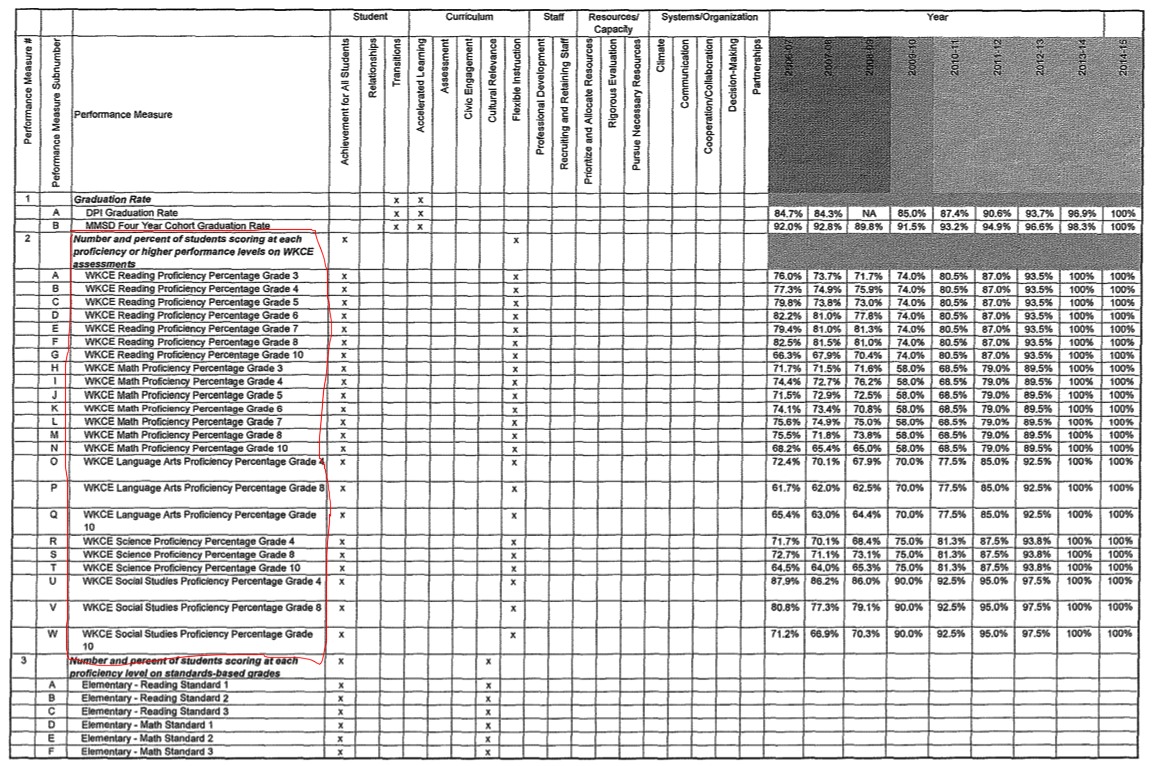
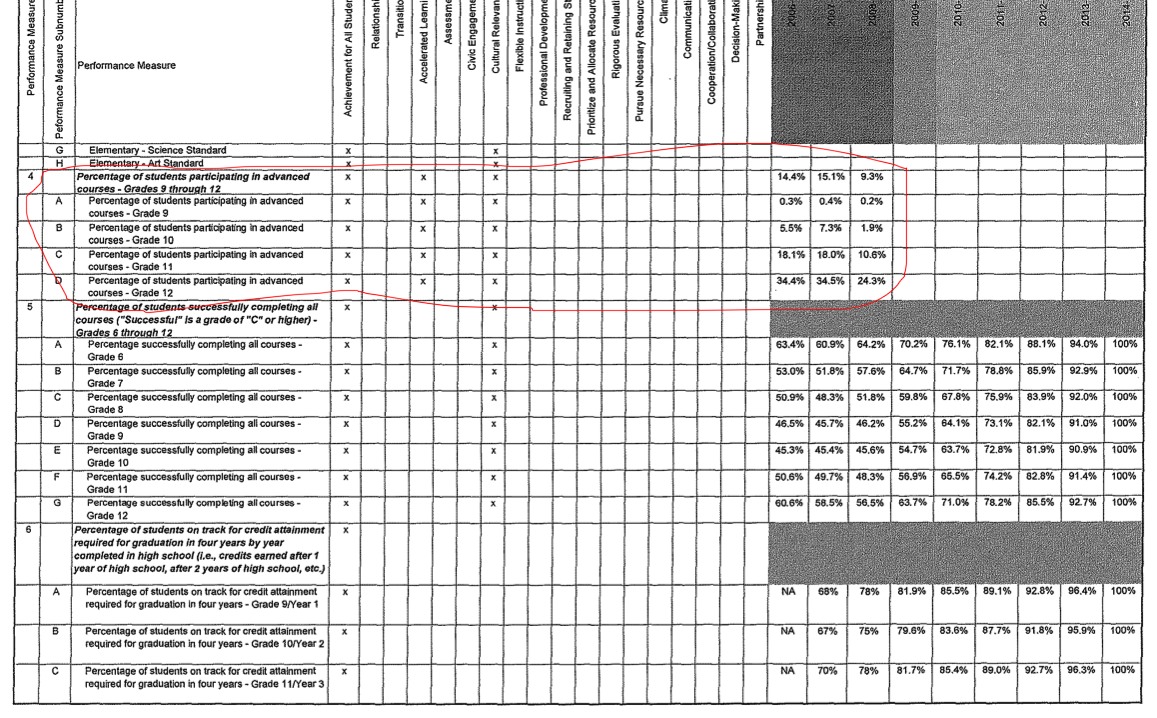
Those interested in a quick look at the state of Madison’s public schools should review Superintendent Dan Nerad’s proposed District performance measures. This document presents a wide variety of metrics on the District’s current performance, from advanced course “participation” to the percentage of students earning a “C” in all courses and suspension rates, among others.

Education Hot Topics

Finally, I hope President Obama mentions a number of Education Secretary Arne Duncan’s recent hot topics, including:

This wonderful opportunity for Wright’s students will, perhaps be most interesting for the ramifications it may have on the adults in attendance. Ripon Superintendent Richard Zimman recent Rotary speech alluded to school district’s conflicting emphasis on “adult employment” vs education.

Wisconsin State Test Score Comparisons: Madison Middle Schools:

WKCE Madison Middle School Comparison: Wright / Cherokee / Hamilton / Jefferson / O’Keefe / Sennett / Sherman / Spring Harbor / Whitehorse

About Madison:

UPDATE: How Do Students at Wright Compare to Their Peers at Other MMSD Middle Schools?

Share

Will reforming teacher salaries bring mile high results?

Alan Borsuk:

Denver is to reform in the way teachers are paid what Milwaukee is to private school vouchers: It’s the place that’s broken a lot of new ground and been a magnet for national attention.
With the likelihood that the Wisconsin Legislature will take important steps in the next few weeks that will substantially increase the prospects for changing the classic system for teacher salaries, here’s some advice for Wisconsin from Brad Jupp, a central architect of the Denver system:
“The most important thing to do is not to be so cautious that you don’t move forward,” Jupp said. “Breaking the barrier doesn’t kill you.”
Nationwide for almost a century, salaries of teachers have been set almost entirely by how many years a person has taught and whether the person has a master’s degree or certain amounts of college credits beyond a bachelor’s degree. Research has pretty firmly established that there is little, if any, correlation between teaching quality and those traditional measurements.
The political appeal of changing the way teachers are paid is huge now. The idea of paying good teachers more than bad teachers or using pay as an incentive to improve educational results has become popular across the political spectrum. President Barack Obama is scheduled to visit Madison this week to speak on education, and you can bet he will hit on this point.

Share

Madison School District Administration Response to the Math Task Force

The local school district’s increasing use of reform math programs lead to the creation of a “Math Task Force“. The District Administration’s response is outlined in this 2.6MB PDF document:

The purpose of this report is to describe the recomrnendations in response to the Madison Metropolitan School District Mathematics Task Force Report: Review of Mathematics Curriculum and Related Issues, submitted to the Board of Education June, 2008.
Administrative Recommendations Summary The materials included in this packet update and replace those distributed to the Board of Education in April 2009. Included in the materials is a proposed budget.
Middle School Mathematics Specialists (see Recommendations 1-5)
The Superintendent and UW-Madison Deans of Letters and Sciences and the School of Education commissioned a representative and collaborative group to design a professional development plan for this initiative. The group was convened in June and has since met four times during the summer to research and design a professional development plan to support middle school mathematics teachers.
The Middle School Math Partnership committee has tentatively planned five courses for the professional development proposal. Those courses are Number and Generalization, Rational Number and Proportional Reasoning, Geometry, Measurement and Trigonometry, and Algebra and Functions. The courses would be spread out over two years and be co-facilitated by UW and MMSD staff.
Research, data gathering and design will continue through 2009-2010 with the initial cohort of middle school teachers beginning in summer 2010. Upon completion of an initial draft, the plan will be presented to district teachers for further input and refinement.
In collaboration with the above group, a National Science Foundation Targeted Partnership proposal, Professional Learning Partnership K-20 (PLP K-20), was submitted on August 20, 2009. A UW-Madison and MMSD team of nearly 30 members worked during the summer to craft a proposal focused on systemic and sustainable mathematics professional development. The vision described in the proposal creates “a lasting interface to coordinate material, human, social, and cyber resources” among the UW-Madison and District. The principal investigator of the NSF proposal is Eric Wilcots. Co-Pl’s include Provost Deluca, Superintendent Nerad, Dean Sandefur and Dean Underwood.

Background notes and links:

Again, it will be interesting to see what, if any substantive changes occur in the local math programs.

Share

“Chicago Muscle” on Education Reform and the Democrat Party

Jonathan Alter:

Kennedy worked closely with President Bush on the flawed and deeply unpopular No Child Left Behind Act. Like a packaged-goods company with a tainted product, the Obama administration has left that name behind and now calls its program the Elementary and Secondary Education Act, LBJ’s original title in 1965. But the accountability-and-standards movement Kennedy and Bush launched is essential, and Obama has moved much faster than expected to advance it. He and Education Secretary Arne Duncan are showing some Chicago muscle and giving states a “choice” right out of The Untouchables: lift your caps on the number of innovative charter schools allowed and your prohibitions on holding teachers accountable for whether kids learn–or lose a chance for some of Obama’s $5 billion “Race to the Top” money. Massachusetts recently lifted its charter cap and nearly a dozen other states are scampering to comply. Now that’s hardball we can believe in.
This issue cleaves the Democratic Party. On one side are Obama and the reformers, who point out that we now have a good idea of what works: KIPP and other “no excuses” charter models boast 80 percent graduation rates in America’s roughest neighborhoods, nearly twice the norm. On the other side are the teachers’ unions and their incrementalist enablers in the political class. They talk a good game about education but make up phony excuses for opposing real reform and accountability.

Share

Madison School District 4K Proposal

Superintendent Dan Nerad [1.5MB PDF]:

Providing four year old kindergarten (4K) may be the district’s next best tool to continue the trend of improving academic achievement for all students and continuing to close the achievement gap.
The quality of care and education that children receive in the early years of their lives is one of the most critical factors in their development. Empirical and anecdotal evidence clearly shows that nurturing environments with appropriate challenging activities have large and lasting effects on our children’s school success, ability to get along with others, and emotional health. Such evidence also indicates that inadequate early childhood care and education increases the danger that at-risk children will grow up with problem behaviors that can lead to later crime and violence.
Background/Charge On February 9, 2009, the Board of Education asked the Superintendent to reconvene staff, and community members to begin planning for a collaborative 4K program in the Madison Metropolitan School District. The committee was directed to develop recommendations and timelines to present to the BOE.
Process Membership is attached and was generated by the AFSCME Child Care Representatives with membership growing as the months proceeded. Kathy Hubbard began facilitation and Jim Moeser is currently facilitating the committee work. Throughout the months of meeting, membership and attendance has been constantly high with energy and enthusiasm the same. The matrix presented in this packet includes a brief overview of the five committees below.

Related:

Perhaps the District might implement these initiatives first – and evaluate their effectiveness prior to expanding the organization (and budget) for 4K.

Share

New York Governor’s Charter Shock

Brendan Scott & Yoav Gonen:

In a surprise move, Gov. Paterson said yesterday he doesn’t plan to push for changes to state laws that experts have warned could jeopardize New York’s chances of raking in hundreds of millions of dollars in federal education aid.
Federal officials have highlighted two state laws in particular — one limiting the number of charter schools to 200 and another prohibiting the use of student test scores in determining whether a teacher deserves tenure — as potential barriers to the state’s bid for a share of the $4.3 billion competitive pot, known as Race to the Top.
While legislation was introduced last week to enhance New York’s standing by scrapping those laws, a spokeswoman for Paterson — who has supported charter schools in the past — said the governor would not be among its boosters.
“At this time, we believe New York state is eligible for Race to the Top funds and that legislative changes are currently not needed,” said the spokeswoman, Marissa Shorenstein.

Share

Teacher Union Politics in Washington, DC: The D.C. Council seems to worry about everyone but students.

Washington Post Editorial:

D.C. SCHOOLS Chancellor Michelle A. Rhee stands accused, it seems, of trying to manage her budget in a way that will do the least harm to students. Not a crime, you might think — unless, like Ms. Rhee’s accusers on the D.C. Council, you are more interested in scoring political points than in hearing what she is doing for children.
Ms. Rhee was called before the council Thursday to explain the layoffs of 388 employees, including 266 teachers and other educators. She provided convincing evidence of the budget pressures leading to this month’s reduction in force. She offered solid reasons for the hiring of some 900 teachers last spring and summer, and held out an olive branch to the council — saying she never intended to blame it for the layoffs. She made clear that her goal was to save summer school as an option for as many children as possible.
This, by the way, was no secret; we referred to Ms. Rhee’s efforts to save summer school on these pages Sept. 23. It might help, in fact, if council Chairman Vincent C. Gray (D) got on the phone when Ms. Rhee called. It’s also clear, in the opinion of budget experts we consulted, that Ms. Rhee has the authority to cut now, with plans to restore summer school, as long as she submits a reprogramming later. So exclamations of surprise at her plans and accusations of law-breaking have little credibility.

Share

Madison School District Strategic Plan: Nirvana by 2014/2015?

The Madison School Board recently passed the District’s Strategic Plan. Superintendent Dan Nerad has now published a draft document outlining performance measures for the plan (this is positive). The 600K PDF document is well worth reading. Mr. Nerad’s proposed performance measures rely on the oft criticized – for its lack of rigor – state exam, the WKCE. The Wisconsin Department of Public Instruction recently stated that “Schools should not rely on only WKCE data to gauge progress of individual students or to determine effectiveness of programs or curriculum“.
A few highlights from the 600K PDF document:

Related:

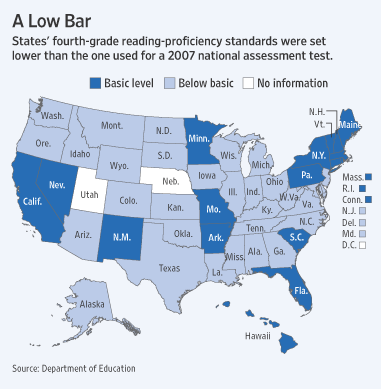
Discussing these data is a step in the right direction. Unfortunately, use of the WKCE does not instill much confidence, from my perspective.

via “Some States Drop Testing Bar” by John Hechinger.
Happy Halloween!

Share

President Obama’s November 4, 2009 Madison Destination: Wright Middle School?

President Obama’s “education” speech, due to be delivered in Madison on Wednesday, November 4, 2009 may, perhaps be given at Wright Middle School. It is a (rare) charter school located in Madison. Obama and Education Secretary (and former Chicago Superintendent) have been promoting structural change within our public schools. Wright, a Charter School, was birthed via a “Madison Middle School 2000” initiative along with the desire to place a new middle school on Madison’s south side. Local biotech behemoth Promega offered land for the school in Fitchburg, which the District turned down (that land and initiative became Eagle School).
Has Wright been successful? Has it achieved the goals illuminated in the original Madison Middle School 2000 initiative?
There are any number of local issues that could be discussed around the visit, including: the District’s general opposition to charter schools, changes to the teacher contract seniority system and Wisconsin’s controversial and weak state test system (WKCE).
The Wisconsin State Journal has more.
It will be interesting to see what, if any, substantive actions arise from Obama’s visit.

Share

Bad Trip: School Outings Get Downgraded

Sarah Nassauer:

Eleven-year-old Clayton Lundstrom couldn’t wait for sixth grade, the year he’d get to spend three days hiking, identifying plants and singing songs around a bonfire in the Cascade Mountains with his classmates. The trip to the Cispus Learning Center has been a rite of passage for sixth-graders in his Washington state district for almost 20 years.
But earlier this year, the Tumwater School District yanked funding for it, and unless the Parent Teacher Association can raise enough money, Clayton’s class will stay home. “I’ve been waiting to go to Cispus basically since first grade,” Clayton says.
As schools across the country face massive budget cuts and parents face their own financial shortfalls, field trips are getting canceled in droves. More than one in six schools plans to eliminate trips this year, according to a survey by the American Association of School Administrators. That’s up from 9% last year. By next school year, one in four schools will need to cut field trips, according to the survey.
Even when trips aren’t canceled, there often are downgrades. After budget cuts in Eau Claire, Wisc., the Northstar Middle School couldn’t pay for the eighth-grade trip to Minneapolis to see a performance of “A Christmas Carol” at the landmark Guthrie Theater, designed by French architect Jean Nouvel. Instead, the students will go to the local movie theater to see the Disney 3-D movie version of the Charles Dickens classic.

Share

West Virginia Charter School Debate Heats Up

Ry Rivard:

Education reformers are intensifying their push to bring charter schools to West Virginia as parents, teachers and lawmakers ready themselves for another round of legislative battles aimed at improving the state’s school system.
Charter schools advocates are stepping up their lobbying efforts by running advertisements and polling West Virginians on their thoughts about charters, which are private-style public schools. The state’s powerful teachers unions helped kill a charter school proposal earlier this year.
“We hope to change that conversation a bit,” said Tim McClung, a member of the group that calls itself West Virginians for Education Reform
To help do that, the National Alliance for Public Charter Schools started polling state residents Wednesday night to gauge their reaction to charter schools, McClung said.

Share

Washington, DC Teacher’s Union vs. Michelle Rhee

Andrew Rotherham:

Everyone is chattering about this full-page ad the AFT took out in this morning’s Washington Post. I work in this space and am quite familiar with all the protagonists and the issues and it took me a minute to make sense of the point of the ad. Maybe I’m stupid or needed more coffee but it was really busy and the punchline is buried in two unchecked boxes on the lower right. So I’m not sure it’s going to move the casual observer to action – or even to an opinion. It needs a clearer message but it’s probably hard to get that message on paper without giving away the game.
Leaving aside technical deficiencies, clearly the strategy is to appear reasonable everywhere else in order to box in Michelle Rhee in D.C. But there are two problems with that strategy. First, at the elite level people get what’s going on (increasingly the press, too) so the whole thing is sort of over before it even started and that plan only works if they can make this stuff real elsewhere and the clock is ticking on that. Meanwhile, even those frustrated with aspects of Rhee’s style and tactics are still sympathetic to what she’s trying to do and the obstacles to that. Second, and more basically, outside of big reform initiatives with lessons I don’t think Michelle Rhee really cares about what’s happening elsewhere and she’ll hold her ground. She responds to different incentives like the rest of us but peer pressure isn’t one of them.

Share

Madison School Board Revises Budget to Reduce the Upcoming Property Tax Increase

WKOW-TV, via a kind reader’s email:

Madison school board leaders are revising a budget plan that lowers their property tax increase but defers millions of dollars in maintenance.
Leaders are looking to lower the previously agreed upon property tax hike by about $50 dollars per homeowner: from $147 on a $250,000 home, to $92.83 on a $250,000 home.
To accomplish that, members took from a few funds, and decided they would not levy the remaining balance on a 2005 maintenance referendum: that equaling out to almost $3 million dollars.
School board members had to compensate for the loss of $12-million dollars in state funding.
The loss of funding for the maintenance referendum didn’t come without discussion. Board member Beth Moss hoped to levy just enough to pay for $1.4 million dollars of roof maintenance.
Moss says, “The maintenance doesn’t go away… You can put it off, but putting it off usually only makes it worse.”
On the list for repairs, a boiler at Marquette Elementary, and more efficient windows at Shorewood Elementary.

Most budget changes passed 7-0, with the exception of the deferred maintenance, which passed 5-2 with Beth Moss and Ed Hughes voting against it. Moss’s school board seat is up for election on April 6, 2010. I emailed Beth last weekend, along with Maya Cole and Johnny Winston, Jr. to see if they plan to run for re-election.
Listen to Monday evening’s Madison School Board discussion via this 1 hour, 50 minute mp3 audio file.
The budget changes were driven by reduced transfers of state tax dollars to school districts and the drop in assessed property values (via an April, 2009 memo). Interestingly, I don’t believe this significant Board (mostly 7 votes, but some big dollar 5-2 as noted above) effort to hold down the local school property tax increase would have occurred with earlier Directors.

Share

Educator promoted ‘essential schools’

Nick Anderson:

Theodore R. Sizer, 77, a leading progressive educator who promoted the creation of “essential schools” to improve public education one school at a time and who thought that teachers function best as mentors or coaches to their students, died Oct. 21 at his home in Harvard, Mass. He had colon cancer.
In a career that spanned five decades, Dr. Sizer was dean of the Harvard Graduate School of Education, headmaster at the private Phillips Academy in Andover, Mass., and chairman of Brown University’s education department.
Dr. Sizer’s view of education reform — with a premium on classroom creativity, bottom-up innovation and multiple measures of student learning — was often at odds with the movement toward state standards, achievement testing and school accountability that culminated in the 2002 No Child Left Behind law.
Dr. Sizer scoffed at public policies that elevated multiple-choice testing to central importance while neglecting the physical and academic environment of schools.

Share

Editorial: School reform the Gates way

The Commercial Appeal:

Memphis City Schools administrators haven’t spent the money, but they’re counting on nearly $100 million from the Bill & Melinda Gates Foundation to improve the effectiveness of the district’s teachers.
In fact, the district is investing $720,000 for a consultant to help make MCS Gates grant-ready.
U.S. Sen. Bill Frist may also tap the wealth of the Microsoft founder to help put together a statewide reform plan for Tennessee that would address teaching and school governance issues.
Not just at the district and state level, however, is the influence of America’s richest education reformer being felt.
The reform-minded Education Secretary Arne Duncan, who’s preparing to hand out $4.3 billion in stimulus money for public education improvement projects across the country, has two former Gates employees among his inner circle.

Share

Girl gang-raped outside high school dance, police say

Karl Fischer & Shelly Meron:

Onlookers laughed, took pictures and even joined in Saturday night during the two-hour gang rape of a semi-conscious 15-year-old outside her high school homecoming dance, police said Monday.
Teams of detectives and school resource officers spent the rest of the weekend trying to track down those responsible.
“The crimes perpetrated against this 15-year-old are both startling and horrific,” police Chief Chris Magnus said Monday. “We are committed to arresting the perpetrators and to preparing the strongest case possible by aggressively pursuing every lead and utilizing the full resources of the department.”

Share

2nd Annual Wisconsin Charter Schools Awards Gala

Wisconsin Charter Schools Association via a Laurel Cavalluzzo email:

The 2nd Annual WCSA Awards Gala will take place on Friday, November 6th at Turner Hall Ballroom in Milwaukee. You don’t want to miss this special evening!
The Annual Awards Gala honors those individuals and schools that have made an impact on schools, teachers and students in Wisconsin’s charter school community.
The event will start at 6 p.m. with a “red carpet” meet and greet, and will continue with dinner and entertainment, with the exciting presentation of the 2009 Charter Schools Awards of Excellence and the premier of our new Charter School Video.

Share

INTRODUCTION by Theodor Sizer

Volume One, Number One
The Concord Review, Fall 1988
Theodore Sizer: Professor of Education, Brown University Author, Horace’s Compromise, Horace’s School Chairman, Coalition of Essential Schools

Americans shamefully underestimate their adolescents. With often misdirected generosity, we offer them all sorts of opportunities and, at least for middle-class and affluent youths, the time and resources to take advantage of them.
We ask little in return. We expect little, and the young people sense this, and relax. The genially superficial is tolerated, save in areas where the high school students themselves have some control, in inter-scholastic athletics, sometimes in their part-time work, almost always in their socializing.
At least if and when they reflect about it, adolescents have cause to resent us old folks. We do not signal clear standards for many important areas of their lives, and we deny them the respect of high expectations. In a word, we are careless about them, and, not surprisingly, many are thus careless about themselves. “Me take on such a difficult and responsible task?” they query, “I’m just a kid!”
All sorts of young Americans are capable of solid, imaginative scholarship, and they exhibit it for us when we give them both the opportunity and a clear measure of the standard expected. Presented with this opportunity, young folk respond. The Concord Review is such an opportunity, a place for fine scholarship to be exhibited, to be exposed to that most exquisite of scholarly tests, wide publication.
The prospect of “exhibition” is provocative. I must show publicly that I know, that I have ideas, and that I can defend them resourcefully. My competence is not merely an affair between me and a soulless grading machine in Princeton, New Jersey. It is a very public act.
The Concord Review is, for the History-inclined high school student, what the best of secondary school theatre and music performances, athletics, and (in some respects) science fairs are, for their aficionados. It is a testing ground, and one of elegant style, taste and standards. The Review does not undersell students. It respects them. And in such respect is the fuel for excellence.

================
“Teach by Example”
Will Fitzhugh [founder]
Consortium for Varsity Academics® [2007]
The Concord Review [1987]
Ralph Waldo Emerson Prizes [1995]
National Writing Board [1998]
TCR Institute [2002]
730 Boston Post Road, Suite 24
Sudbury, Massachusetts 01776-3371 USA
978-443-0022; 800-331-5007
www.tcr.org; fitzhugh@tcr.org
Varsity Academics®

Share

The Financial-Crisis Lit Cheat Sheet

New York Magazine:

Too Big To Fail: The Inside Story of How Wall Street and Washington Fought to Save the Financial System from Crisis — and Themselves, by Andrew Ross Sorkin
WHAT: A virtually minute-by-minute account of the scariest hours of the crisis, beginning in the aftermath of the seizures of Fannie Mae and Freddie Mac and concluding with TARP and the hastily assembled near-afterthought that was the $180 billion AIG bailout.
BEST BIT: On page 120 appears the first print mention of the rumored affair between Joe Gregory, the widely reviled chief operating officer of Lehman Brothers, and Erin Callan, the statuesque, blonde, wholly inexperienced tax attorney promoted to chief financial officer of the firm at the beginning of the year. According to the book, Callan separated from her husband “around the time” of the promotion, after which she and Gregory “became inseparable.”

Share

An Earthquake: Rhode Island School Superintendents Told To Abolish Teacher Seniority

Linda Borg:

Dropping a bombshell on the teachers’ unions, state Education Commissioner Deborah A. Gist ordered school superintendents to abolish the practice of assigning teachers based on how many years they have in the school system.
Gist, who sent a letter to superintendents on Tuesday, is upending tradition and taking on two powerful unions, the National Education Association Rhode Island and the Rhode Island Federation of Teachers and Health Professionals (RIFT), who together represent 12,000 public school teachers.
On Friday, the unions said they were blindsided by Gist’s announcement, adding that the commissioner made no attempt to confer with labor before going public with the decision.
“We’re going to court,” said Marcia Reback, president of the Federation of Teachers. “I’m startled that there was no conversation with the unions about this. I’m startled there were no public hearings, and I’m startled at the content. This narrows the scope of collective bargaining.”
Gist says she has the authority to do away with seniority under the new Basic Education Plan, which the Rhode Island Board of Regents approved in June and which takes effect July 1.

Makes sense…..
NBC10 has more.

Share

Dyslexia Awareness Videos & We can and must help kids with dyslexia

Wisconsin Literacy:

To promote greater knowledge and understanding of dyslexia and related learning disabilities, The International Dyslexia Association (IDA) designated the month of October as National Dyslexia Awareness Month. “Awareness is key with learning disabilities because if identified early enough, their impacts can be minimized through intervention and effective teaching.”
In order to increase awareness of dyslexia, Wisconsin Literacy posted two videos on its website created by Sun Prairie Cable Access. You will need Quicktime installed on your computer to view the video files. Download it for free here: www.apple.com/quicktime/download.
Living and Learning with Dyslexia: Hope and Possibilities
(Time 36:59)
Dr. Julie Gocey leads a panel discussion on dyslexia with Cheryl Ward (Wisconsin Branch of the International Dyslexia Association), Layla Coleman (Wisconsin Literacy, Inc.), Pam Heyde (Dyslexia Reading Therapist) and Margery Katz (Dyslexia Reading Therapist). The program covers a variety of topics including science-based, multisensory instruction for kids and adults; obstacles for identifying individuals with dyslexia; and lack of training of teachers. A college student with dyslexia shares strategies for academic success.

Julie Gocey:

Educators, parents and health professionals must work together to improve literacy for ALL students in Wisconsin. It is well known that early literacy is one of the most powerful predictors of school success, gainful employment and many measures of health.
For that reason, the sincerest expression of child advocacy is to ensure that ALL students in Wisconsin have the opportunity to become proficient readers. In my experience as a pediatrician, co-founder of the Learning Difference Network, and as a parent, current policies and practices do not routinely provide the 10 percent to 17 percent of our students who have some degree of dyslexia with adequate opportunities for literacy.
Dyslexia is a language-based learning problem, or disability if severe. The impact that this neurobiological, highly heritable condition has on learning to read, write and spell cannot be underestimated.
Dyslexia is the best understood and most studied of all learning difficulties. There is clear evidence that the brains of dyslexic readers function differently than the brains of typical readers. But the good news is this: Reading instruction from highly skilled teachers or tutors who use evidence-based techniques can change how the brain processes print and nearly ALL students can become proficient readers.
Early intervention is critical to successful outcomes, but there is a disconnect between research and practice on many levels.
Current obstacles include myths about dyslexia, lack of early identification and a need for educators to be given training in the science of reading and multi-sensory, systematic, language-based instruction. This is critical for students with dyslexia, but can be beneficial to all learners. For those of us who are able to pay for private testing and instruction for our children, the outcomes can be phenomenal. Unfortunately, where poverty and its associated ills make daily life a struggle, this expert instruction is not routinely available.
Families who ask school personnel about dyslexia are often referred to a physician, who in turn sends them back to school for this educational problem. Educational testing is often denied coverage from insurance companies, though the implications for health and wellness are clear. Unfortunately, parents may be left without useful information from anyone, and appropriate treatment – excellent reading instruction – is further delayed.
October is Dyslexia Awareness Month. On Thursday, Oct. 22, there will be a noon rally in the Capitol rotunda to raise awareness about the need to improve reading instruction for students with dyslexia and for all struggling readers in Wisconsin.
State Rep. Keith Ripp, R-Lodi, is introducing bills this week to help identify and help children with dyslexia. One bill calls for screening for specific skills to find kids with a high chance of struggling to learn to read. The other bill aims to improve teacher training to deal with reading problems.
There is too much evidence describing the science of reading, dyslexia and the costs of illiteracy to continue without change. Parents who suspect dyslexia must not be dissuaded from advocating for their children; keep searching until you find help that works.
Health professionals must seek the latest information on this common condition in order to support families and evaluate for related conditions. Educators must seek out training to understand this brain-based condition that requires educational care. The information is solid. We must work together to give ALL our kids the opportunity to read and succeed.
Dr. Julie Gocey is a pediatrician and a clinical assistant professor in the University of Wisconsin School of Medicine and Public Health and also a co-founder of the Learning Difference Network

via a Margery Katz email.

Share

Are Teacher Colleges Turning out Mediocrity?

Gilbert Cruz:

There has been a mantra of sorts going around education circles over the past few years: “Nothing matters more to a child’s education than good teachers.” Anyone who’s ever had a Ms. Green or a Mr. Miller whom they remember fondly instinctively knows this to be true. And while “Who’s teaching my kid?” is an important question for parents to ask, there may be an equally essential (and rarely remarked upon) question — “Who’s teaching my kid’s teachers?”
On Thursday, Secretary of Education Arne Duncan went to Columbia University’s Teachers College, the oldest teacher-training school in the nation, and delivered a speech blasting the education schools that have trained the majority of the 3.2 million teachers working in U.S. public schools today. “By almost any standard, many if not most of the nation’s 1,450 schools, colleges and departments of education are doing a mediocre job of preparing teachers for the realities of the 21st century classroom,” he said to an audience of teaching students who listened with more curiosity than ire — this was Columbia University after all, and they knew Duncan wasn’t talking to them. It was a damning, but not unprecedented, assessment of teacher colleges, which have long been the stepchildren of the American university system and a frequent target of education reformers’ scorn over the past quarter-century.

Share

Theodore R. Sizer, Leading Education-Reform Advocate, Dies at 77

Margalit Fox:

Theodore R. Sizer, one of the country’s most prominent education-reform advocates, whose pluralistic vision of the American high school helped shape the national discourse on education and revise decades-old ideas of what a school should be, died on Wednesday at his home in Harvard, Mass. He was 77.
A former dean of the Harvard Graduate School of Education, Professor Sizer was later the headmaster of Phillips Academy, the preparatory school in Andover, Mass., and chairman of the education department at Brown University. He returned to Harvard as a visiting professor in 1997.
Professor Sizer was best known as the father of the Essential Schools movement, which he founded in 1984. The movement’s umbrella organization, the Coalition of Essential Schools, spans a diverse array of public and private schools united by their adherence to a set of common principles.

Elaine Woo:

His progressive ideas about how schools should be organized and what students should learn helped drive the debates that rattled parents, government officials and educators in the 1980s and ’90s.
Ted Sizer, a former prep school headmaster and Harvard University dean who built an education reform movement that has endured for two decades despite its unfashionable opposition to government- imposed standards and emphasis on deep learning over memorization and regurgitation, has died. He was 77.
Sizer died Wednesday at his home in Harvard, Mass., after a long battle with cancer, according to a statement by the Coalition of Essential Schools, the organization of 600 private and public schools he founded at Brown University in 1984 with the goal of restructuring the American high school.

Share

DPI Superintendent as the Wisconsin Education Czar?

Amy Hetzner:

An effort has been launched in the state Capitol to give the state schools superintendent broader authority to turn around struggling schools and position Wisconsin to better compete for millions of dollars in federal education grants.
Little fanfare has accompanied potential legislative changes that would allow the superintendent of public instruction to order curriculum and personnel changes in chronically failing schools. It didn’t even make the news release for Gov. Jim Doyle’s three-city announcement on Monday of educational changes he is seeking to help Wisconsin qualify for some of the $4.35 billion in Race to the Top funds from the U.S. Department of Education.
State Sen. John Lehman (D-Racine), chairman of the Senate Education Committee, said the idea of giving the state superintendent “super-duper powers” has attracted support from legislators and educational interest groups since it first surfaced earlier this month.
“There’s getting to be general agreement around these interventions,” he said.

Prior to any expansion of the Wisconsin DPI’s powers, I’d like to see them implement a usable and rigorous assessment system to replace the oft-criticized WKCE.
Perhaps, this is simply politics chasing new federal tax dollars….

Share

Regulating home schooling: An inspector calls

The Economist:

A SCHOOL headmaster once observed that he would regularly consult his prefects on the running of the establishment. When he agreed with them, he would allow their views to prevail. It was only when they disagreed that he had to impose his will. On October 19th the schools secretary, Ed Balls, closed a consultation, the outcome of which he seems to have decided already. Legislation will be introduced to force parents wishing to educate their children at home to register with the state and undergo regular inspections.
Mr Balls says he is worried that children who do not attend school risk being abused by those looking after them. An earlier review by Graham Badman, a former head of children’s services in Kent who is now based at London University’s Institute of Education, found that in some areas a disconcertingly high proportion of home-schooled children were known to social services–ie, cause for concern.
No one is sure how many children in Britain are taught at home. York Consulting, a management outfit, put the figure at 20,000 in 2007. It could actually be more than 50,000, reckons Mike Fortune-Wood, who runs a support service for parents educating their children at home, and the total may be rising by 10% a year.

Share

Mississippi Task force to take on hot-button school district consolidation issue

Bobby Harrison:

A task force formed by the Legislature to improve underperforming schools has decided to take on the touchy subject of school district consolidation.
During a recent hearing of the task force, the story was told of an agency in the 1980s that had advocated Mississippi’s 152 school districts be consolidated into 82, basically along county lines. The task force was told, perhaps jokingly, that the agency was eliminated by the Legislature the next session.
Senate Education Chair Videt Carmichael, R-Meridian, the co-chair of the task force, responded, also perhaps jokingly, “I think I might disappear if consolidation happened in some of my school districts.”
For years, an array of groups has touted the virtue of school consolidation as a way to save money and increase efficiency in the public schools. The only problem has been finding agreement on how to do it.
“It’s been my observation everybody wants to consolidate everybody else’s district, but not their own,” said House Education Committee Chair Cecil Brown, D-Jackson, the other co-chair of the task force.

Share

Community Background as the Madison School District Considers Further Property Tax Increases Monday Evening

The Monday, October 26, 2009 Madison School Board meeting agenda will include a discussion (and presumably a vote) on the upcoming property tax rate increases. The board approved a tax hike earlier this year to make up for a reduction in state income tax and fees redistributed to local school districts due to the “Great Recession”. Reductions in property tax assessments (“Of the 73,024 parcels in the City, 53.6% are being changed (6,438 increases and 32,728 reductions”) may further drive taxes upward, certainly a challenge given current conditions.
Superintendent Dan Nerad proposed – and passed – a three year referendum that authorized spending and tax increases while providing time for the Administration to, as Board member Ed Hughes stated “put into place the process we currently contemplate for reviewing our strategic priorities, establishing strategies and benchmarks, and aligning our resources.” Ed’s “Referendum News” is worth reading.
I’ve summarized a number of links from the 2008 referendum discussion and vote below.

It will be interesting to see what, if anything happens with the recent math, fine arts, talented and gifted task forces and the full implementation of “infinite campus“, which should reduce costs and improve services.

Share

Tennessee’s Education Reform Plan

Richard Locker:

A statewide education reform commission headed by former U.S. Sen. Bill Frist issued its final recommendations today, with a goal of moving Tennessee to the top of the Southern states in K-12 education.
Search report cards
“The very simple goal is to make Tennessee – us, our kids – the best in the South in five years,” Frist said at a State Capitol event unveiling the report. “It’s a challenging, ambitious goal but it can be done.”
The recommendations of the bipartisan “State Collaborative on Reforming Education,” or SCORE, which Frist established early this year, includes 60 specific recommendations that revolve around four key “strategies:”
** Embracing the higher graduation standards that are about to go into effect as part of the Tennessee Diploma Project that aims at both raising standards and graduating more students. There has been some fear that when the impact of the more rigorous standards are felt, there will be political pressure on legislators to scale them back.
** Cultivating stronger school leaders, including superintendents and teachers.

Final Report: 2.4MB PDF.

Share

San Francisco Schools Lunch Money Cut off, Rules Broken

Jill Tucker:

Since April, the school district has had to pony up the $1.5 million monthly cost of the lunch program for low-income students after state inspectors on a surprise visit found violations they deemed so serious and recurring that they cut off the flow of federal reimbursements.
The violations had nothing to do with the quality of food being served, but stem from the school district’s inability to follow bureaucratic rules governing the federally subsidized National School Lunch Program, which is administered by the state.
To ensure no child goes without a lunch, the district, meanwhile, has spent more than $11 million, money it will get back once city schools show they can follow the rules – something district officials have been working on since the inspection.

Share

Fenger Academy: A troubled school before the cameras arrived

The Economist:

A FEW weeks after I visited Fenger Academy, on Chicago’s far south side, television cameras swarmed the school. The incident at Fenger was so alarming that the White House dispatched two cabinet secretaries to quell anxiety. I came for happier reasons. The Fenger was still in the heady first days of school, exciting not only because every new year brings new opportunities, but because this year seemed particularly ripe with them.
Fenger is closer to Indiana’s belching mills than to downtown Chicago. It has struggled for decades. From 2006 to 2008 less than 3% of students met Illinois’s pathetic standards of achievement. But this meagre record had one good outcome: Fenger’s district chose it as a “turnaround” school.
AFP
When I arrive in the main office, students are still milling about, a few parents with them, looking for registration or wondering where to pick up their new uniforms–black polo shirts with the school insignia on the breast. Don Fraynd, the turnaround officer, is waiting for me. He is a youngish man whose e-mail signature is punctuated by a proud “PhD”. After a quick tour we sit in the principal’s anteroom. He tells me that reformers have showered Fenger with programmes, to no avail.

Share

Maryland Governor O’Malley urges School Superintendents to cut costs

Nelson Hernandez & John Wagner:

With Maryland facing a $2 billion budget shortfall next year, Gov. Martin O’Malley warned the chiefs of the state’s school systems Tuesday of hard times ahead, and the Senate president told them that they were “going to have to start taking a portion of the hit.”
Speaking in Annapolis to a gathering of the Public School Superintendents Association of Maryland, O’Malley (D) urged the heads of the county’s 24 school jurisdictions to find ways to save money but maintain the quality that earned the state a No. 1 ranking in a national survey by the Education Week trade newspaper.
O’Malley’s cost-saving suggestions included creating a school building design that could be used across the state, buying furniture from the state prison industry and installing solar panels on roofs to generate energy.
But he offered few specifics about what cuts the superintendents might expect in state funding even as he repeatedly stressed the challenge of chopping $2 billion from a $13 billion budget.

Share

Madison Mayor Cieslewicz Visits Toki Middle School

Dave Ceislewicz:

One of my favorite events of the year is the annual Principal for a Day event organized by the Foundation for Madison’s Public Schools and sponsored by CUNA. For one thing, it’s an opportunity for me to use phrases like, “Hey, hey, no running in the halls!” and, “sure, it’s funny until somebody loses an eye.”
This year I chose to be the shadow principal at Toki Middle School. It’s no secret that Toki is at the center of a neighborhood that has been in the news in recent years in part because of some changing demographics. Those changes are apparent at the school where kids eligible for free and reduced lunches have increased from about a third to about half of the school population in just a few years.
But what I saw on a typical day where most of the kids didn’t know or care much who I was (just like a normal day around City Hall) was a school where a lot of learning was taking place. I visited Rhonda Chalone’s Student Leadership class, Vern Laufenberg’s Technology Class and Scott Mullee’s Science Class. I also spent some time with Principal Nicole Schaefer and her staff. What I witnessed was dedicated teachers and engaged students in a friendly and orderly atmosphere. And the diversity that is there is a big advantage, setting those kids up for success in a world that is, if anything, even more diverse than the student body at Toki.
Every school has some challenges, but anyone that doesn’t think Madison schools are doing a great job teaching our kids, should spend a day in one.

The southwest part of Madison, including Toki Middle School has had its share of challenges over the past few years.

Share

School District Strategic Planning: How the World’s Best Performing School Systems Come Out On Top

Via a kind reader’s email [9.5MB PDF]:

The experiences of these top school systems suggest that three things matter most:

  1. getting the right people to become teachers,
  2. developing them into effective instructors, and
  3. ensuring that the system is able to deliver the best possible education for every child.

Share

Community meeting to introduce the new Madison School District Talented and Gifted Plan

via a kind reader’s email:

Tuesday, November 17
6:00 – 7:30 p.m. (this is the correct time)
Hamilton Middle School LMC
4801 Waukesha Street
Madison, Wi
The Madison Metropolitan School District (MMSD) Talented and Gifted Division will host a community forum on November 17, 2009, from 6:00 to 7:30 p.m. Superintendent Dan Nerad and Director of Teaching and Learning Lisa Wachtel will be in attendance.
The focus of the forum will be to provide the Madison community with an overview of the recently Board of Education approved Talented and Gifted Education Plan, followed by an opportunity for discussion.
Link to new MMSD TAG Plan: http://tagweb.madison.k12.wi.us/
More information from MUAE: http://madisonunited.org/TAGplan.html

Share

Fairfax County Schools Propoze Second Year Wage Freeze due to Reduced Revenues in its $2,200,000,00 Budget; Where is Madison’s 2009/2010 Final Budget?

Michael Alison Chandler:

The Fairfax County School Board is bracing for the most dramatic reduction in services in more than 20 years as it attempts to bridge a projected $176 million budget shortfall with cuts that could extend to closing schools, increasing class size, ending summer school, discontinuing most full-day kindergarten classes and eliminating foreign language instruction in elementary schools.
Superintendent Jack D. Dale will not present a formal budget proposal until January, but school officials are releasing a list of potential cuts because they want to give the public the earliest possible look at the severity of this year’s deficit. “What we are trying to get people to understand is, you are all at risk this time,” said board member Jane K. Strauss (Dranesville), the budget chairwoman.
Board members say that classrooms are already strained from adjustments made over the past two years, including consecutive increases in class sizes.
The current budget is $18 million less than last year’s, and the school system has grown by about 5,000 students. Federal stimulus money helped offset even deeper cuts, but the school board still eliminated nearly 800 positions and reduced many program budgets.
This year, programs will probably be discontinued, said school board chairman Kathy L. Smith (Sully). “There is no trimming around the edges anymore,” she said.
In Fairfax, the projected $176 million shortfall assumes 2,000 new students, no increase in county funding and no pay increase for teachers or other staff. If approved, it would mean a second year of salary freezes.

Related:

It will be interesting to see the Madison School District’s “final” 2009/2010 budget, which will be reviewed and voted on by the local school board soon. The budget has, in the past, increased as the year progresses. The 2007/8 budget was $339,685,844; 2008/9 was $368,012,286, and the 2009/10 preliminary budget was 367,912,077, according to the MMSD “Financials” PDF Document).

Share

Obama Wins a Battle as the New Haven Teachers’ Union “Shows Flexibility”

Neil King:

A showdown between the White House and the powerful teachers’ unions looks, for the moment, a little less likely.
This week in New Haven, Conn., the local teachers union agreed, in a 21-1 vote, to changes widely resisted by unions elsewhere, including tough performance evaluations and fewer job protections for bad teachers.
Education Secretary Arne Duncan, as well as the unions, said the New Haven contract could be repeated in other school districts.
Kim Torello, left, and Karen Lavorgna, teachers in New Haven, Conn., discuss the contract that was ratified by their union this week. Terms included tough performance evaluations and fewer job protections.
“I rarely say that something is a model or a template for something else, but this is both,” said Randi Weingarten, president of the American Federation of Teachers, who helped broker the New Haven deal.
“This shows a willingness to go into areas that used to be seen as untouchable,” Mr. Duncan said.
His cause for optimism is this: If teachers’ unions start showing flexibility in other cities, the administration’s high-stakes push to boost graduation rates and improve test scores at public schools could get a lot easier. That might even spare the administration an unwanted fight with a labor force that gave Mr. Obama a big lift in his election.

Share

Broward Teachers Union Says School District Officials Kept Scores of Emails From School Board Members

Patricia Mazzei:

The Broward Teachers Union accused the school district Thursday of blocking hundreds of e-mails sent by school employees to School Board members since March — without board members’ knowledge.
The union says e-mails about teacher raises, use of federal stimulus money and employee contract negotiations never made it to board members’ in-boxes — or to their junk e-mail folders. Instead, they were filed away on a server and never read.
BTU lawyers sent Board Chairwoman Maureen Dinnen and board attorney Edward Marko a letter Thursday asking the district to stop blocking e-mails and threatening to sue if they don’t do so by Oct. 26.
The letter argues blocking e-mails violates the sender’s and the receiver’s constitutional rights under U.S. and Florida laws.
Superintendent Jim Notter said district attorneys were reviewing BTU’s letter. He questioned its timing, with the district in the throes of negotiating a contract with the union. BTU has asked for an average 4 percent pay increase. The district isn’t offering any raise, but has offered to pick up the difference in employee health insurance.
“Unfortunately we’re back in a position where it’s adversarial,” Notter said.

Share

Advocating Charter Schools in Madison

Wisconsin State Journal Editorial, via a kind reader:

Charter schools have no bigger fan than President Barack Obama.
The federal government gave Wisconsin $86 million on Thursday to help launch and sustain more charter schools across the state.
State schools chief Tony Evers said $5 million will go to two dozen school districts this year, with the rest of the money distributed over five years.
Madison, to no surprise, wasn’t on Thursday’s winner list. And don’t expect any of the $86 million for planning and implementing new strategies for public education to be heading Madison’s way.
That’s because the Madison School Board continues to resist Obama’s call for more charter schools. The latest evidence is the School Board’s refusal to even mention the words “charter school” in its strategic action plans.
In sharp contrast, Obama can hardly say a word about public education without touting charters as key to sparking innovation and engaging disadvantaged students.
Obama visited a New Orleans charter school Thursday (and raised money that evening in San Francisco at a $34K per couple dinner) and is preparing to shower billions on states to experiment with new educational strategies. But states that limit charter growth will not be eligible for the money.

I am in favor of a diffused governance model here. I think improvement is more likely via smaller organizations (charters, magnets, whatever). The failed Madison Studio School initiative illustrates the challenges that lie ahead.

Share

Going to school can be a deadly journey

Wendell Hutson:

Community activists said the recent murder of a Fenger High School honor student exposes a problem many teens face every day: safe passage to and from school.
“I wonder how many more teens will be murdered while coming home from school,” said Leonardo D. Gilbert, a Local School Council member in the Roseland community. “All this kid was trying to do was go home and it cost him his life. If we are going to save our children from violence we must make sure children have a safe way home from school.”
According to Chicago police, Derrion Albert, 16, was murdered after school on Sept. 24 while waiting for a bus to go home.
“He was not in a gang but in the wrong place at the wrong time,” said Michael Shields, a retired Chicago police officer who now works as director of security for Chicago Public Schools.

Share

Make Parenting Education Part of Public School Reform

Esther Jantzen:

Mayor Richard Riordan, your disappointment in the progress of educational reform in the Los Angeles Unified School District, after all you’ve done as mayor and secretary of education under Gov. Arnold Schwarzenegger, was palpable in your Oct. 12 Times Op-Ed article, “Course outline for the LAUSD.” This lack of progress breaks my heart too.
At the risk of seeming presumptuous, may I make a suggestion to you and to educational reformers everywhere — a suggestion that is based on experience, common sense and research?
I was an urban public high school English teacher for many years. I tried hard: I took courses in teaching reading and writing; I prepared for classes; I graded research papers on vacations; I won grants for my schools; I won teacher of the year awards; I got advanced degrees; I supported reform.

Share

Lieve Maria: A SIS Quiz – Translate!

A kind reader forward this Dutch student curriculum statement:

Lievemaria.nl was een initiatief dat begin 2006 opgezet is door alle wiskunde en natuurkunde studieverenigingen van Nederland. Naar aanleiding van deze actie heeft toenmalig minister Maria van der Hoeven op dinsdag 24 januari 2006 haar plannen met betrekking tot aanpassen van de Tweede Fase aangepast
(Bekijk het nieuwste persbericht, de e-mailconversatie met een medewerker van de minister, het tentamen dat de Kamerleden voorgeschoteld kregen, lees de echte brief (pdf) of de korte versie hieronder)
Wij zijn boos. Wij merken dat wij het universitair niveau eigenlijk niet aankunnen. Er treden dagelijks situaties op waarbij we merken dat we te weinig wiskunde op de middelbare school hebben gehad. Daarom moeten wij nu bijspijkercursussen volgen, of zelfs stoppen met onze studie. Wij horen het geklaag van onze docenten, maar wat kunnen wij eraan doen? Wij zouden willen dat we meer wiskunde hadden gehad op de middelbare school.
Nu bent u bezig om het onderwijs te vernieuwen. Goed idee! Maar we hoorden dat u van plan bent om nòg minder wiskunde te geven. Als u dat doorzet, dan kunnen de nieuwe studenten straks helemaal niets meer begrijpen! Het lijkt ons een beter idee om juist méér wiskunde te geven!
We hopen dat u er nog even over nadenkt.
http://www.lievemaria.nl
Groetjes, 10.000 studenten (wiskunde, natuurkunde en informatica)

Share

Essay by Klebold’s mother reveals little

Mike Littwin:

The timing could not have been much worse. The 10-year anniversary of Columbine had come and gone. We’d relearned the Columbine lessons we’d nearly forgotten — that the questions are all too big and the answers all too small.
Even worse, all that we don’t know was sadly reinforced by the spate of mass shootings that arrived, as if on some deviant schedule, in the weeks leading up to the anniversary.
And just as we’d put it behind us, Dylan Klebold’s mother, Susan, chose to tell her story — “for the first time ever” — in O, the Oprah magazine.
So it all begins again.
There has been a school of thought — or maybe better called a school of hope — that if the parents of Dylan Klebold and Eric Harris would only talk, they could tell us something essential, that they held family secrets that would allow us to better understand what happened that day.

Share

Ed chief says grants are for reforms

Libby Quaid:

With states jockeying for extra school dollars from the economic stimulus, Education Secretary Arne Duncan reminded them Tuesday the point is to help kids do better.
Cash-strapped states are competing for $5 billion in grants from the economic stimulus for changes the Obama administration wants, such as charter schools and teacher pay based on student performance.
“It’s really not about the money — it’s about pushing a strong reform agenda that’s going to improve student achievement,” Duncan said in an interview with The Associated Press.
States can’t even apply for the money yet. Still, nine states have changed their laws or made budget decisions to improve their standing. The latest is California, where a bill was signed Sunday allowing student test scores to be used to evaluate teachers.
Duncan said the moves are encouraging. Still, he said states will have to do more than make promises.

Share

Thompson and Bloomberg spar over their education records in first mayoral debate

Anna Phillips:

Nothing the candidates said during tonight’s mayoral debate was more surprising than the Rev. Billy Talen’s spirited heckling, but a few choice comments were made about the city’s schools and mayoral control.
Right out of the gate, Mayor Michael Bloomberg launched into a list of comparisons between the Department of Education during the last eight years and the Board of Education during the time that Comptroller Bill Thompson was president. He recited graduation statistics, said that schools are safer today than they were in the 1990s, and boasted about test scores increases.
Thompson said it was ironic that Bloomberg was holding him accountable for the city’s schools when the mayor has repeatedly said that no one had control over the Board of Education.

“He pointed out, under the old Board of Education, no one was in charge. The mayor, the board, the chancellor, so many people were in charge, no one was in charge, so it’s ironic that he would try and distort facts and information, try and change the past, to say that I was the person who was in charge of the Board of Education. Nothing could be further from the truth.”

Share

Loyola to start school of education

Childs Walker:

Loyola University is launching a new school of education that will focus on solving problems in urban schools and on forging practical relationships between the university and Baltimore’s public school system.
The school, which Loyola will dedicate at a ceremony this evening, will house a research center dedicated to innovation in urban education. University officials hope the center will attract top-notch faculty and students with an interest in making practical improvements to Baltimore schools, said Peter Murrell, dean of the school of education.
“It really fits with the Jesuit philosophy that to do good work in the world, you have to get out there and roll up your sleeves,” Murrell said.
Murrell has focused his research on urban education and came to Loyola last year after directing a similar research center at Northeastern University in Boston.

Share

Superintendent Governance: Michelle Rhee “Has no Choice but to Play Tough”

Richard Whitmire:

The forces lined up against D.C. Schools Chancellor Michelle Rhee — angry teachers, grumpy D.C. Council members, the nation’s top teachers’ union leader quarterbacking the opposition — are essentially asking one question: Why can’t you behave more like that nice Arne Duncan?
Indeed, with his aw-shucks humility and his anecdotes about playing b-ball with the president, Duncan has undeniable charm. That charm was honed in Chicago, where he never played in-your-face politics and never publicly suggested there was widespread incompetence among the teaching force, qualities that contributed to President Obama’s tapping him to be U.S. secretary of education.
By contrast, Rhee appeared on the cover of Time wielding a broom to symbolically sweep incompetence out of her public schools. Yikes.
But there’s a reason Rhee plays hardball: She has no choice.

Share

School Choice Even Obama Supports

Rishawn Biddle:

As a presidential aspirant last year, Barack Obama gained the support of the National Education Association — and the scorn of school choice activists — when he declared his skepticism of the school choice and accountability measures in the No Child Left Behind Act. Then in the early months of this year, the newly-elected president further pleased teachers unions when he tacitly allowed congressional Democrats to shutter the D.C. Opportunity Scholarship Plan, the school voucher program that helps 1,716 Washington students attend private schools — even though he avoided sending his own children to D.C.’s abysmal public schools.
Declared Cato Institute Director Andrew Coulson this past May in the Washington Post: “[Obama] has sacrificed a program he knows to be efficient and successful in order to appease the public school employee unions.”

Share

K-12 Tax & Spending Climate: Report: Wisconsin taxes claim 12 percent of income

Scott Bauer:

Wisconsin taxes as a percentage of personal income are 12th highest nationwide and greater than any of its neighbors, according to a new report.
The Wisconsin Taxpayers Alliance report was based on U.S. Census Bureau data from 2007, the most recent year available.
While the tax burden has been steady in recent years, the president of the independent Wisconsin Taxpayers Alliance said Monday he expects it to get worse given recent tax increases and slowed growth in personal income.
During the earlier part of the decade, personal income in Wisconsin grew faster than the national average while taxes increased less, said Todd Berry, president of the alliance.
However, Wisconsin faced a record state budget shortfall this year as tax revenue took a dive during the recession. That resulted in the Legislature approving about $3 billion in tax increases to be collected by mid-2011. That doesn’t count local property taxes, which also are expected to increase by hundreds of millions of dollars.

Share

Schools need overhaul to get students job-ready

San Francisco Chronicle:

These comments are excerpted from a Sept. 16 panel discussion on education and workforce preparation at Santa Clara University. The event, Projections 2010: Leadership California, was hosted by the Silicon Valley Leadership Group.
Moderator, Marshall Kilduff, Chronicle editorial writer: With a lot of bad news in education, including test scores, declining financial support, what would you do?
Mayor Gavin Newsom: I’ll tell you what we’ve done in San Francisco. I believe not just in public-private partnerships. I believe in public-public partnerships. … The City and County of San Francisco does not run its school district … but, nonetheless, we’ve taken some responsibility to addressing the needs of our public-school kids by building a partnership. … We focus on universal preschool. We’ve created a framework, a partnership, that guarantees the opportunity of a four-year college education for every single sixth-grader. It’s those partnerships that I’m arguing for.
Aart J. De Geus, CEO, Synopsys: If I look at it as if I were the CEO of education of California, I would look at a company (in terms of), “What are the resources? What are the results? And what is the management system?” I’d say, “Well, let’s look at the CEO of the educational system.” There is no CEO of the educational system. I know there are commissioners, and whatever they’re called, but, to be a CEO, you need to have both responsibility and power.

Ripon Superintendent Richard Zimman made similar, structural points during a recent Madison Rotary club talk.

Share

Madison Country Day School Host Japanese Students

Pamela Cotant:

Fabian Fernandez, a junior at Madison Country Day School, said hosting a student from Japan forces you to look at your own culture, and to consider the differences and similarities.
“You kind of get to re-experience your own culture,” said Fernandez, whose family has hosted a number of students from other countries. “Even the small things.”
Recently, eight Japanese 10th-graders and one teacher were here for nine days and stayed with host families from Madison Country Day School, which they also attended.
Every other year, the students from Hakuoh High School visit Madison Country Day, a private school for pre-kindergarten through 12th-grade students, through a sister-school relationship.
During alternate years, Madison Country Day students visit the school in Ashikaga City, Japan, about 90 miles from Tokyo. This year, five juniors and seniors are considering the trip.

Share

K-12 Tax & Spending Climate: “Killing the Goose – What Were We Thinking?”

John Mauldin:

Peggy Noonan, maybe the most gifted essayist of our time, wrote a few weeks ago about the vague concern that many of us have that the monster looming up ahead of us has the potential (my interpretation) for not just plucking a few feathers from the goose that lays the golden egg (the US free-market economy), or stealing a few more of the valuable eggs, but of actually killing the goose. Today we look at the possibility that the fiscal path of the enormous US government deficits we are on could indeed kill the goose, or harm it so badly it will make the lost decades that Japan has suffered seem like a stroll in the park.
And while I do not think we will get to that point (though I can’t deny the possibility), for reasons I will go into, there is the very real prospect that the upheavals created by not dealing proactively with the problems (or denying they exist) will be as bad as or worse than the credit crisis we have gone through. This is not going to be something that happens overnight, and the seeming return to normalcy that so many predict has the rather alarming aspect of creating a sense of complacency that will only serve to “kick the can” down the road.
This week we look at the problem, and then muse upon what the more likely scenarios are that may play out. This is a longer version of a speech I gave this morning to the New Orleans Conference, where I also offered a path out of the problems. This letter will be a little more controversial than normal, but I hope it makes us all think about the very serious plight we have put ourselves in.
Let’s review a few paragraphs I wrote last month: “I have seven kids. As our family grew, we limited the choices our kids could make; but as they grew into teenagers, they were given more leeway. Not all of their choices were good. How many times did Dad say, ‘What were you thinking?’ and get a mute reply or a mumbled ‘I don’t know.’
“Yet how else do you teach them that bad choices have bad consequences? You can lecture, you can be a role model; but in the end you have to let them make their own choices. And a lot of them make a lot of bad choices. After having raised six, with one more teenage son at home, I have come to the conclusion that you just breathe a sigh of relief if they grow up and have avoided fatal, life-altering choices. I am lucky. So far. Knock on a lot of wood.
“I have watched good kids from good families make bad choices, and kids with no seeming chance make good choices. But one thing I have observed. Very few teenagers make the hard choice without some outside encouragement or help in understanding the known consequences, from some source. They nearly always opt for the choice that involves the most fun and/or the least immediate pain, and then learn later that they now have to make yet another choice as a consequence of the original one. And thus they grow up. So quickly.”

Share

School district contracts push up tax levy

Jo Egelhoff:

At a time when taxpayers are struggling in this destabilizing recession and most are not seeing wage gains, the Appleton Area School District (AASD) has proposed a budget that increases the tax levy by 9.7%.
At a time when the state budget is suffering billion dollar deficits, when the state has cut its support of AASD, when enrollment has declined by 220 students, and when inflation is 0%, still the district’s total budget increased by over $3 million (from $176 million to $179 million)!
The district’s budget increase is primarily fueled by employee compensation increases, including an 8.2% increase in health care benefits – for a benefit plan that is already a Cadillac. Cost reductions could most certainly be achieved via increased efforts to decrease utilization and increased premium participation (school employees pay only 5% of their health insurance premium that for a family is almost $20,000 a year) and/or simply putting the very costly health insurance program out to bid. As it is now, the union dictates that the health insurance must be carried by an arm of WEAC.
In addition, though the budget reflects a wage freeze for administration employees, no such offer has been forthcoming from the teachers union.

Share

School Reform

Ed Garvey:

Just about every meaningful reform begins with education. If our schools are not working well, then ultimately nothing works. Wisconsin has enjoyed great schools from kindergarten to the university system to technical colleges.
One reason our kids score at or near the top in national testing is parental involvement. Parents in Wisconsin demand high quality education and the elected school boards respond.
The Wisconsin Constitution guarantees public school education for all children from age 4 to 20. At one time that protection did not apply to children with “learning problems.” They were called “retarded” and were sent to institutions, but in 1966 parents decided that was unacceptable. They turned to Attorney General Bronson La Follette for his opinion and he ruled that “all” meant “all.” Every child in Wisconsin would be educated.

Share

Herta Müller Wins Literature Nobel

AP:

Herta Müller, a member of Romania’s ethnic German minority who was persecuted for her critical depictions of life behind the Iron Curtain, won the 2009 Nobel Prize in literature Thursday in an award seen as a nod to the 20th anniversary of communism’s collapse.
Ms. Müller, born in Romania’s Transylvania Banat region, was honored for work that “with the concentration of poetry and the frankness of prose, depicts the landscape of the dispossessed,” the Swedish Academy said.
“I am very surprised and still can not believe it,” Ms. Müller said in a statement released by her publisher in Germany. “I can’t say anything more at the moment.”
The decision was expected to keep alive the controversy surrounding the academy’s pattern of awarding the prize to European writers.

Share

Committee backs $53 million in interest-free bonds for MPS projects

Larry Sandler & Erin Richards:

Milwaukee Public Schools could borrow up to $53.1 million interest-free to create new science and engineering laboratories, build a community learning center and repair aging schools, under a plan backed Wednesday by a Common Council committee.
If the plan wins final approval from the full council, federal stimulus dollars would pay the interest on the bonds and property taxes would be used to repay the principal. The School Board has voted to seek up to $53.1 million of the $72.1 million maximum that the federal government authorized for MPS borrowing, but the city issues school bonds.
Wednesday’s vote by the council’s Finance & Personnel Committee calls for the council to give preliminary approval Tuesday to borrowing the money without a referendum. Further action would be needed to issue the bonds. Mayor Tom Barrett plans to recommend a bond issue of about $48 million, said his chief of staff, Patrick Curley.
Michelle Nate, chief financial officer for MPS, said the ability to borrow at free or extremely low interest rates would allow the district to spend about $30 million on maintenance projects that have been put off for years.
“It’s like any major expense (for a homeowner),” Nate said. “You know you need a new roof, but you put it off until you can afford it.”

Share

Education Agency Will Offer Grants for Innovative Ideas

Sam Dillon:

The federal Department of Education sketched out a new nationwide competition on Tuesday under which some 2,700 school districts and nonprofit groups are expected to compete for pieces of a $650 million innovation fund.
The department already has the 50 states vying for chunks of a $5.4 billion education improvement fund that it calls Race to the Top; the innovation fund is a separate competition.
Federal officials said the Investing in Innovation Fund would be distributed in three categories. Small development grants of up to $5 million will support new, unproven ideas that seem worth exploring, they said. Validation grants of up to $30 million will support existing programs that have shown evidence that they can work. Scale-up grants of up to $50 million will go to programs that have developed a strong track record for improving student achievement, the officials said.

Share

Community Leaders Excluded from Duncan and Holder Four Seasons Chicago Meeting

Dick Johnson & Steve Bryant:

Community leaders and parents outside Fenger are in disbelief that they are not at the breakfast table with Arne Duncan and Eric Holder.
Attorney General Holder and Secretary of Education Duncan are in town to speak, ostensibly, with the community about youth violence — a blight on Chicago neighborhoods so vividly brought to national attention by the videotaped beating of Derrion Albert.
“They are meeting about us without us,” said Phillip Jackson of the Black Star Project, a Chicago-based educational reform organization.
Duncan and Holder’s meeting at the Four Seasons also includes Mayor Daley, Pastor Michael Pfleger, CEO of Chicago Public Schools Ron Huberman, and Police Superintendent Jody Weis.

Material for the Daily Show.

Share

Madison Schools enrollment remains steady at 24,622

via a Madison School District email:

Student enrollment in the Madison Metropolitan School District for the 2009-10 school year is up 82 students to 24,622 according to the official enrollment count conducted on the third Friday in September, as required by state law.
The 82 student rise over last year’s official enrollment count of 24,540 represents an increase of one third of one percent (0.33%).
Enrollment in Madison Schools has been remarkably consistent. This is the ninth straight year that MMSD enrollment has been between 24 and 25-thousand students.
Of note is the increase in the number of kindergarten students enrolled in Madison Schools. The count of 2,146 kindergarten students is:

  • 140 students above last year’s number (2,006);
  • the highest enrollment for that grade level in the last 15 years;
  • nearly four percent greater than the most recent projection (80 students above 2,066 projection).

For more information on kindergarten-12th grade enrollment, go to http://infosvcweb.madison.k12.wi.us/stats

Related: “Where have all the students gone?” The student population drives a school district’s tax & spending authority.

Share

Focus in Chicago: Students at Risk of Violence

Susan Saulny:

The new chief officer of the public schools here, Ron Huberman, a former police officer and transit executive with a passion for data analysis, has a plan to stop the killings of the city’s public school students. And it does not have to do with guns or security guards. It has to do with statistics and probability.
The plan comes too late for Derrion Albert, the 16-year-old who was beaten to death recently with wood planks after getting caught on his way home between two rival South Side gangs, neither of which he was a member, the police said.
The killing, captured on cellphone video and broadcast on YouTube, among other places, has once again caused widespread grief over a seemingly intractable problem here. Derrion, a football player on the honor roll, was the third youth to die violently this academic year — and the 67th since the beginning of the 2007-8 school year. And hundreds of others have survived shootings or severe beatings on their way to and from school.

Share

Education + Politics = $

Cartel, the Movie:

eachers punished for speaking out. Principals fired for trying to do the right thing. Union leaders defending the indefensible. Bureaucrats blocking new charter schools. These are just some of the people we meet in The Cartel. The film also introduces us to teens who can’t read, parents desperate for change, and teachers struggling to launch stable alternative schools for inner city kids who want to learn. We witness the tears of a little girl denied a coveted charter school spot, and we share the triumph of a Camden homeschool’s first graduating class.
Together, these people and their stories offer an unforgettable look at how a widespread national crisis manifests itself in the educational failures and frustrations of individual communities. They also underscore what happens when our schools don’t do their job. “These are real children whose lives are being destroyed,” director Bob Bowdon explains.
The Cartel shows us our educational system like we’ve never seen it before. Behind every dropout factory, we discover, lurks a powerful, entrenched, and self-serving cartel. But The Cartel doesn’t just describe the problem. Balancing local storylines against interviews with education experts such as Clint Bolick (former president of Alliance for School Choice), Gerard Robinson (president of Black Alliance for Educational Options), and Chester Finn (president of the Thomas B. Fordham Institute), The Cartel explores what dedicated parents, committed teachers, clear-eyed officials, and tireless reformers are doing to make our schools better for our kids.

Share

Reviving America’s schools: Ready, set, go

The Economist:

BETWEEN classes at Fenger High School, on the far South Side of Chicago, hundreds of students churn through the halls. Elizabeth Dozier, the new principal, keeps a watchful eye. “Let’s go, gentlemen!” she shouts. “Let’s go to class!” Ms Dozier wears a two-way radio to deal with problems the minute they arise. One is small: the girls’ toilets have no paper towels. One is bigger: there’s a brawl upstairs. It’s not to be ignored: on September 24th an honour-roll student was beaten to death near Fenger, swept up in senseless violence.
For an idea of the task confronting Arne Duncan, Barack Obama’s education secretary, Fenger is a good place to start. The school lies closer to Indiana’s mills than Chicago’s Magnificent Mile. From 2006 to 2008 fewer than 3% of pupils met Illinois’s meagre standards of achievement. But this year everything is supposed to change. The Chicago school district chose Fenger as a “turnaround”. Old teachers have been sacked and new programmes put in place. Fenger faces formidable odds. But if Mr Duncan has his way, the school’s transformation will be the start of a larger shift.

Share

Gifted Student Is Being Held Back By Graduation Rules

Jay Matthews:

Anyone who wants to appreciate how strong a grip high school has on the American imagination — and how clueless some school districts are about this — should consider the story of Drew Gamblin, a 16-year-old student at Howard High School in Ellicott City.
Drew, a child so gifted he taught himself to write at age 3, craves a high school education and all that comes with it — debate team, music, drama and senior prom.
After a series of inexplicable decisions by Howard County school officials, such as requiring him to stay in a Howard High algebra class he had already mastered, his parents decided to home-school him and put him in college classes. But Drew insisted on his high school dream.
So he is back at Howard, although it’s not clear what grade he is in, and the school district is making it hard to enjoy what the school has to offer. He is being forced to take a world history course he already took at Howard Community College and a junior-year English course he took at home, as well as classes in other subjects he has studied.

Share

More Transferring from Private to Public Schools in Montgomery County

Michael Birnbaum:

At the end of August, Gabriel Liegey left his crisp school uniform gathering dust in his closet in favor of jeans and T-shirts. Natalie Medrano and her sister traded a long drive to private school in Frederick for a ride on the school bus with other kids on their block. And Lawson Hamilton gave up an eighth-grade class of 26 for a freshman class of almost 500.
All four joined the rising number of Washington area students who have switched out of private schools this year as financial pressures and the availability of good public schools have made the option irresistible to some.
In Montgomery County, the only jurisdiction in the area that tracks movement between private and public schools, the net number of students who jumped from private to public schools rose to 727 in the 2008-09 school year, according to preliminary figures. That is more than double the number in 2006-07 and the largest total since the county began tracking the numbers in 1988.
Other public schools across the region reported a rise in the number of families transferring in.

Share

One Reason Why Risky D.C. Teacher Evaluation Might Work

Jay Matthews:

My colleague Bill Turque has a terrific story today about D.C. Schools Chancellor MIchelle Rhee’s plan to evaluate the effectiveness of her teachers and get rid of those who are not helping students learn.
The idea is full of risks. Rhee’s plan to evaluate each teacher’s class at the beginning of the year, based on prior test scores and other factors, and set a reasonable mark for their improvement, has not, as far as I can tell, ever been tried before on this scale.
There is only one reason why I think it has a reasonable chance of success, and his name is Jason Kamras. He is now Rhee’s deputy for human capital, an unusual title, but I sort of understand what it means.
Turque said Kamras “led the effort to revamp the District’s system” for assessing teachers. If Kamras were just another headquarters paper pusher, I would predict doom for his plan.
But he is one of the best teachers in the country. Long ago, I once spent a few days getting his life story and checking him out with other great teachers I know. He taught math at Sousa Middle School in the District, and also offered a photography class for those students, most of them from low-income families.

Share

How Teachers Unions Lost the Media

Richard Whitmire & Andrew Rotherham:

Quick: Which newspaper in recent editorials called teachers unions “indefensible” and a barrier to reform? You’d be excused for guessing one of the conservative outlets, but it was that bastion of liberalism, the New York Times. A month ago, The New Yorker–yes, The New Yorker–published a scathing piece on the problems with New York City’s “rubber room,” a union-negotiated arrangement that lets incompetent teachers while away the day at full salary while doing nothing. The piece quoted a principal saying that union leader Randi Weingarten “would protect a dead body in the classroom.”
Things only got worse for the unions this past week. A Washington Post editorial about charter schools carried this sarcastic headline: “Poor children learn. Teachers unions are not pleased.” And the Times weighed in again Monday, calling a national teachers union “aggressively hidebound.”
In recent months, the press has not merely been harsh on unions–it has championed some controversial school reformers. Washington’s schools chancellor, Michelle Rhee, who won’t win any popularity contests among teachers, enjoys unwavering support from the Post editorial page for her plans to institute merit pay and abolish tenure.

Share

Education Spending: Lies Our Professors Tell Us

Neal McCluskey:

On Sunday, the Washington Post ran an op-ed by the chancellor and vice chancellor of the University of California, Berkeley, in which the writers proposed that the federal government start pumping money into a select few public universities. Why? On the constantly repeated but never substantiated assertion that state and local governments have been cutting those schools off.
As I point out in the following, unpublished letter to the editor, that is what we in the business call “a lie:”

It’s unfortunate that officials of a taxpayer-funded university felt the need to deceive in order to get more taxpayer dough, but that’s what UC Berkeley’s Robert Birgeneau and Frank Yeary did. Writing about the supposedly dire financial straits of public higher education (“Rescuing Our Public Universities,” September 27), Birgeneau and Yeary lamented decades of “material and progressive disinvestment by states in higher education.” But there’s been no such disinvestment, at least over the last quarter-century. According to inflation-adjusted data from the State Higher Education Executive Officers, in 1983 state and local expenditures per public-college pupil totaled $6,478. In 2008 they hit $7,059. At the same time, public-college enrollment ballooned from under 8 million students to over 10 million. That translates into anything but a “disinvestment” in the public ivory tower, no matter what its penthouse residents may say.

Unfortunately, this is not an isolated case. The term “cut” is often used when referring to a reduction in the annual increase in education spending.

Share

Binghamton Lecturer Critical of Athletics Is Fired

Pete Thamel:

The Binghamton University adjunct lecturer who accused the athletic department of giving preferential treatment to men’s basketball players and pressuring her to change her grading policy for players was dismissed Tuesday.
The lecturer, Sally Dear, who taught human development for 11 years, said she felt the decision was linked to her criticism that appeared in a New York Times article in February.

Share

NEA moves to help poor schools with best teachers

Greg Toppo:

The USA’s largest teachers union will encourage local chapters to ignore contract provisions that in the past have kept school districts’ best teachers out of schools that serve mostly poor and minority students.
Testifying Tuesday before the House education committee, National Education Association President Dennis Van Roekel said the union, which represents about 3.2 million teachers and other workers, will ask local affiliates to draw up memoranda of understanding with local school districts that would “waive any contract language that prohibits staffing high-needs schools with great teachers.”
Van Roekel said the move is part of the union’s “Priority Schools” campaign that will also encourage “the most accomplished teachers-members” to start their teaching careers in high-needs schools, remain there or transfer there.
In the past, NEA has come under fire from critics for supporting contracts that allow experienced teachers with more seniority to transfer to schools that serve more middle-class children.

Share

Steve Barr’s Answers for School Reform

Malaika Costello-Dougherty:

Green Dot’s founder, who led the turnaround of the toughest school in Los Angeles, discusses his ideas on how to fix a failing system.
This might be the moment for Green Dot founder Steve Barr.
The Obama administration has set a goal of turning around 5,000 failing schools in the next five years, supported by an expected $3 billion in stimulus funds and $2 billion in the 2009 and 2010 budgets. Known in education circles and beyond as an aggressive agent of change, Barr has been in talks with Secretary of Education Arne Duncan about how to boost failing schools and whether Green Dot’s methods can serve as a blueprint for fixing schools across the country.
It was these same failing schools that inspired Barr to start Green Dot. Having known hard times in his youth, including some time as a foster child, Barr was drawn to improving schools for disenfranchised youth.
After working in politics for many years (and cofounding Rock the Vote), he began researching the push to wire all schools with technology. He saw a map that used green dots to represent schools with the necessary infrastructure to be wired and red dots for schools that lacked that foundation. Barr had the vision that every school should be a green dot, and thus began his crusade.
Green Dot consists of 19 small charter high schools in Los Angeles — several of which were formerly part of Watts’s infamous Locke High School, which Green Dot, in an unprecedented coup, broke down into smaller schools. In addition, Green Dot New York finished its first year last June.

Share

Severson / McKenna on the Madison School District, Madison Teacher Union Agreement & Budget

24MB mp3. Notes and links on the recent, tentative agreement between the Madison School District and Madison Teachers, Inc.

Share

October 16 UPPER MIDWEST GREEN SCHOOLS CONFERENCE

site: NORTHLAND COLLEGE , Ashland, WI
2009 Dates: October 16 (Friday Afternoon Pre-Conference) and October 17 (Saturday Conference)
CONFERENCE PROGRAM & REGISTRATION: Go to Green Charter School Conference Program & Registration Links at Northland College.
CONFERENCE KEYNOTERS:
Connections Human & Natural: What Does It Mean To Be An Educated Person? by William Cronon, Professor of History, Geography, & Environmental Studies, U.W. – Madison
Revitalizing Public Education: Let Teachers Lead the Learning by Joe Graba, Founding Partner, Education / Evolving, forty year professional career in public education most recently as Dean of Hamline University’s Graduate School of Education
SMART By NATURE: Schooling for Sustainability is a new book from the Center for Ecoliteracy . It describes the significance of the emerging green schools sector across the country.
“Smart by Nature is must reading for teachers, school administrators, parents, and the concerned public,” writes leading environmental educator David W. Orr. “It is an encyclopedia of good ideas, principles, and case studies of some of the most exciting developments in education.”
The Green Charter Schools Network and River Crossing Environmental Charter School are featured in Smart By Nature. “We’re all concerned about the environment and sustainability,” says Jim McGrath, GCSNet President. “That’s why we’re doing it — because, really, what could be more important than preparing young people for a sustainable future.”
The book documents with firsthand accounts the success stories of green PK-12 schools in preparing students for future environmental challenges. Smart By Nature is 184 pages with 70 photos, charts and illustrations for $24.95 paper from UCPress.

Share

New York City Charter School Study

Jonathan Gyurko:

Stanford University economist Caroline Hoxby released yesterday an update to her 2007 study of charter schools in New York City.1 In the study, she compares the state examination results of students enrolled in the City’s charter schools (i.e. those students “lotteried-in”) to the results for those students who applied to a charter but were not selected for admission (i.e. the “lotteried-out”). In many respects, this is a good approach as it aims to account for the possibility that charters enroll more motivated families and that it is this motivation, rather than any particular charter school effect, that is the cause of stronger student achievement.
Hoxby’s findings are encouraging: by the third grade, the average charter school student was 5.8 points ahead of the lotteried-out counterpart in math and was 5.3 points ahead in English Language Arts.2 As Hoxby follows students’ achievement from 2001 to 2008, she also finds that the average charter school student gained 3.6 more points each year in math and 2.4 more points each year in ELA. For an average charter student continuously enrolled in grades four through eight, the effect is larger with annual gains of 5.0 points in math and 3.6 in ELA above the performance of the lotteried-out student. (Last year, nine charters enrolled students across all of these grades.)
To put this in some context, Hoxby explains that the difference between a student not meeting standard and meeting standard is about 31 points in math and 44 points in ELA. She also points out that, on average, students in neighboring and affluent Scarsdale typically out-perform students in New York City by 35 to 40 points. In this context, Hoxby claims that the compounded gains for an average student continuously enrolled in third to eighth grade in a charter nearly closes the “Harlem-to-Scarsdale” achievement gap and implies — going outside of her dataset — that the trend will continue.

Share

Burlington Township School Superintendent on Elementary Students Singing About President Obama

Christopher Manno:

By now, we’re sure that you are aware of a video placed on the Internet that has been reported heavily by the media. The video is of a class of students singing a song about President Obama.
Over the past two days we have been able to learn more about this situation and would like to provide you with some additional information. The song was one of eight skits performed during a February 2009 program that included second grade classes. Parents attended the program which took place on February 27, 2009. The other skits in the program included Groundhog Day, Chinese New Year, Abraham Lincoln, Valentine’s Day, George Washington, Mardi Gras, and Dental Health Month. The song about President Obama was in recognition of Black History Month. We have been informed that the lyrics of the song were sent home with the children in advance of the assembly, which was the teacher’s normal procedure. There were no concerns or complaints prior to, during, or after the program.
On March 23, 2009, an author visited the Young School as part of the school’s Women’s History Month recognition. As is usual procedure, parents were notified prior to the visit and invited to attend. The author presented two assemblies during which she read from two of her books. She also met with the Teen Book Club at our high school and did an evening book signing for parents and children. The author was accompanied by two individuals. After the first assembly on March 23rd, the class that performed the song at the February assembly about President Obama provided a special performance for the author, since one of the books she wrote was about Barack Obama. We were informed by a representative of the author that one of the individuals who accompanied the author video recorded the performance. School staff had no knowledge of the recording.

Share

The charter school problem: Results are much less positive than a new study suggests

Diane Ravitch:

Charter schools are not a panacea for our education problems. The recent study by Caroline Hoxby of Stanford University concludes that disadvantaged students who attended charter schools in New York City for nine years, from kindergarten through eighth grade, can close most of what she calls the “Scarsdale-Harlem achievement gap.” Hoxby does not say how many students completed nine years in a charter school – a key detail, as the city had only about a dozen small charters in 2000.
The results are impressive, but they are not typical of charter schools across the nation.
Nationally there are about 4,600 charter schools enrolling 1.4 million students. They run the gamut from excellent to abysmal. Even their most ardent supporters recognize that they vary widely in quality. Chester Finn, whose Thomas B. Fordham Institute sponsors charter schools in Ohio, wrote, “Some of the best schools I’ve ever been in are charter schools, some of which are blowing the lid off test scores in such vexed communities as Boston, New York and Chicago. And some of the worst – and flakiest – schools I’ve ever been in are charter schools.”

Much more on Diane Ravitch here.

Share

In Search of The Real Michelle Rhee

Marc Fisher:

W hen Michelle Rhee was a teenager — long before anyone imagined she would ever spend her career trying to turn America’s inner-city public schools into something more like the elite private school she attended back in Ohio — she was a stellar student, a good field hockey player and a kind, caring friend. But she already had the mouth for which she has become infamous. She said what was on her mind, even if it stung. Finally, one day, her mother had just had it with her daughter’s blunt, even brusque, manner. Inza Rhee said to Michelle, “What is wrong with you? You just don’t care what people think of you!”

Share

Madison School District & Madison Teachers Union Reach Tentative Agreement: 3.93% Increase Year 1, 3.99% Year 2; Base Rate $33,242 Year 1, $33,575 Year 2: Requires 50% MTI 4K Members and will “Review the content and frequency of report cards”

via a kind reader’s email (200K PDF):

The Madison Metropolitan School District and Madison Teachers Inc. reached a tentative agreement Tuesday evening on the terms and conditions of a new two-year Collective Bargaining Agreement for MTI’s 2,600 member teacher bargaining unit. Negotiations began April 15.
The Contract, for July 1, 2009 to June 30, 2011, needs ratification from both the Board of Education and MTI. The Union will hold its ratification meeting on Wednesday, October 14, beginning at 7:00 p.m. at the Alliant Energy Center, Dane County Forum. The Board of Education will tentatively take up the proposal in a special meeting on October 19 at 5:00 p.m.
Terms of the Contract include:
2009-2010 2010-11
Base Salary Raise – 1.00% Base Salary Raise – 1.00%
Total Increase Including Benefits – 3.93% Total Increase Including Benefits – 3.99%
Bachelor’s Degree Base Rate $33,242 Bachelor’s Degree Base Rate $33,575
A key part of this bargain involved working with the providers of long term disability insurance and health insurance. Meetings between MTI Executive Director John Matthews and District Superintendent Dan Nerad and representatives of WPS and GHC, the insurance carriers agreed to a rate increase for the second year of the Contract not to exceed that of the first year. In return, the District and MTI agreed to add to the plans a voluntary health risk assessment for teachers. The long term disability insurance provider reduced its rates by nearly 25%. The insurance cost reductions over the two years of the contract term amount to roughly $1.88 million, were then applied to increase wages, thus reducing new funds to accomplish this.
The new salary schedule increase at 1% per cell, inclusive of Social Security and WRS, amount to roughly $3.04 million. Roughly 62% of the salary increase, including Social Security and WRS, was made possible by the referenced insurance savings.
Key contract provisions include:

    Inclusion in the Contract of criteria to enable salary schedule progression by one working toward the newly created State teacher licensure, PI 34. Under the new Contract provision, one can earn professional advancement credits for work required by PI 34.

  • Additive pay regarding National Board for Professional Teaching Standards, i.e. an alternative for bargaining unit professionals who are not teachers (nurses, social workers, psychologists, et al) by achieving the newly created Master Educator’s License.
  • Continuance of the Teacher Emeritus Retirement Program (TERP).
  • The ability after retirement for one to use their Retirement Insurance Account for insurance plans other than those specified in the Collective Bargaining Agreement. This will enable one to purchase coverage specific to a geographic area, if they so choose, or they may continue coverage with GHC or WPS – the current health insurance providers.
    For elementary teachers, the frequency and duration of meetings has been clarified, as have several issues involving planning time. All elementary teachers and all elementary principals will receive a joint letter from Matthews and Nerad explaining these Contract provisions.
  • For high school teachers who volunteer for building supervision, there is now an option to enable one to receive compensation, rather than compensatory time for the service. And there is a definition of what “class period” is for determining compensation or compensatory time.
  • For elementary and middle school teachers, MTI and the District will appoint a joint committee for each to study and recommend the content and frequency of report cards.
    For elementary specials (e.g. art, music) teachers, the parties agreed to end the class and a half, which will mean that class sizes for specials will be similar to the class size for elementary classroom teachers.
  • For coaches, and all others compensated on the extra duty compensation schedule, the additive percentage paid, which was frozen due to the State imposed revenue controls, will be restored.
  • School year calendars were agreed to through 2012-2013.
  • Also, MTI and the District agreed to a definite five-year exemption to the Contract work assignment clause to enable the District to assist with funding of a community-based 4-year-old kindergarten programs, provided the number of said 4-K teachers is no greater than the number of District employed 4-K teachers, and provided such does not cause bargaining unit members to be affected by adverse actions such as lay off, surplus and reduction of hours/contract percentage, due to the District’s establishment of, and continuance of, community based [Model III] 4-K programs. (See note below.)

(more…)

Share

Bad Title, Mind-Changing Book

Jay Matthews:

We education writers receive many books in the mail with terrible titles, real slumber-time stuff. Here are some on my bookshelf: “Learning and Understanding: Improving Advanced Study of Mathematics and Science in U.S. High Schools”;| “Rethinking High School Graduation Rates & Trends”; and “SREB Fact Book on Higher Education.”
Those volumes proved to be pretty good, as evidenced by the fact that I didn’t throw them out. I mention this because on top of that stack is a new book that sets the record for largest gap between quality of work and liveliness of title.
It is “Schoolhouses, Courthouses, and Statehouses: Solving the Funding-Achievement Puzzle in America’s Public Schools” by Eric A. Hanushek and Alfred A. Lindseth| I forced myself to read it because it was on the agenda of a conference I was attending.
I’m glad I did. It is enlightening, maddening, hopeful, frustrating and amazingly informative, all in just 411 pages. I don’t like admitting this, but it even changed my mind on a hot issue, the connection between U.S. schools and U.S. economic success.
I probably would have read “Schoolhouses, Courthouses, and Statehouses” cq that serial comma eventually, because Hanushek is one of the bad boy economists who have been providing some of the most provocative education research. I don’t know Lindseth, an attorney and national expert on school finance law, but the chapters on that subject were very good, and comprehensible, so he also deserves some credit.

Share

“Dramatic Change in the Public Sector”

Ted Kolderie:

The Route Out of Minnesota’s Fiscal Crisis: “We Can Change ‘the Way We Do Things'”
A response limited to cutting-and-taxing would destroy Minnesota. To offset the disadvantages of our cold, remote location we sell a quality state at a high but reasonable price. This is a fragile balance. We could easily lose what attracts people to come here and to stay. And the fight would poison our politics; tear the state apart.
We do a pretty good job upgrading our physical infrastructure. And we do think about productivity in the private economy. But we lack a program for productivity in the public sector.

Much more on Ted Kolderie here.

Share

Revised Madison School District Strategic Plan Posted

via a kind reader’s email:
September 21, 2009 Revision: 900K PDF.
Comments on the District’s website.
Madison School Board President Arlene Silveira’s email on the latest version and upcoming board discussions:

Good afternoon everyone,
The proposed action plans for the strategic plan are now on the district web site.
Please go to the home page (www.mmsd.org), click on bullet for Strategic Planning;
click on “Read and comment on the proposed Strategic Plan – Sept. 21, 2009
Click on “Strategic Plan (proposed) Sept. 21, 2009”
The action plans start on page 30. The Board had requested additional support information. The Administration has added performance measures for each of the strategies. In addition, the plans are cross-referenced to the top critical issues that you identified as a group in your strategic planning meetings. The Board had also asked for a review of the wording for clarity and to lessen the use of educational jargon; a review of priorites to lessen the number of priorities one in the first year; and identification of the connections between various action items as well as connections to oterh plans presented to and/or approved by the Board.
The Board has a meeting scheduled for September 29 at 6:00pm to review/discuss the action plans. If you have any comments prior to that meeting, you can reply on the web or send me an email. I will ensure the Board sees your comments.
Please let me know if you have any questions.
Best regards,
Arlene

Letter from Madison School Board members Ed Hughes and Marj Passman on the revised Strategic Plan:

This Tuesday evening, September 29, the School Board will be having a last and, hopefully, final discussion on the Strategic Plan.
Even though the plan has evolved somewhat since our initial meetings, we think that you will find that it represents the spirit and essence of all your efforts.
You may share your views with the Board, Tuesday at 6:00 P.M., in the Doyle Auditorium.
If you would like to read the plan, please go to http://www.madison.k12.wi.us/
and click on the bullet for Strategic Planning.
It will be good to see you again.
Ed Hughes and Marj Passman
Committee Chairs
MMSD Planning and Development Committee

Much more on the Madison School District’s Strategic Planning process here.

Share

Do Charters ‘Cream’ the Best?

Wall Street Journal:

‘Creaming” is the word critics of charter schools think ends the debate over education choice. The charge has long been that charters get better results by cherry-picking the best students from standard public schools. Caroline Hoxby, a Stanford economist, found a way to reliably examine this alleged bias, and the results are breakthrough news for charter advocates.
Her new study, “How New York City’s Charter Schools Affect Achievement,” shows that charter students, typically from more disadvantaged families in places like Harlem, perform almost as well as students in affluent suburbs like Scarsdale. Because there are more applicants than spaces, New York admits charter students with a lottery system. The study nullifies any self-selection bias by comparing students who attend charters only with those who applied for admission through the lottery, but did not get in. “Lottery-based studies,” notes Ms. Hoxby, “are scientific and more reliable.”
According to the study, the most comprehensive of its kind to date, New York charter applicants are more likely than the average New York family to be black, poor and living in homes with adults who possess fewer education credentials. But positive results already begin to emerge by the third grade: The average charter student is scoring 5.8 points higher than his lotteried-out peers in math and 5.3 points higher in English. In grades four through eight, the charter student jumps ahead by 5 more points each year in math and 3.6 points each year in English.

Share

Performing Arts Center at Menlo-Atherton High School – opening soon

Linda Hubbard Gulker:

Finishing touches are underway in advance of the opening of the new Performing Arts Center at Menlo-Atherton High School the second weekend in October, highlighted by a performance by Music@Menlo’s Artistic Directors, cellist David Finckel and pianist Wu Han, and special guest Anthony McGill, principal clarinetist of New York’s Metropolitan Opera. The center – built in collaboration with the City of Menlo Park – includes a 492-seat theater, lobby, box office, rehearsal and practice rooms, and stagecraft workshop for production of scenery and props.
According to Sequoia Union High School District spokesperson Bettylu Smith, the 31,000-square-foot, 65-foot-high building is inspired by the beauty of the historical grove of Valley Oak trees on campus and has been carefully designed and landscaped to create a tree house-like environment and the impression it is following the contours of an already existing hillside.

Share

National Academic Standards: The First Test

New York Times:

The first official draft of proposed national educational standards was released on Monday, a joint project of the National Governors Association and the Council of Chief State School Officers. The curriculum guidelines detail math and English skills that all students should have by the end of high school. Forty-eight states (Texas and Alaska are the holdouts) have signed on to the effort, called the Common Core Standards Initiative, to write the standards. This is one step on a long road: there is a 30-day comment period, and then the panel convened by the governors association will work on grade-by-grade standards from kindergarten onward.
What are some strengths and weaknesses of the new proposal? What are the obstacles to adopting common curriculum standards? Should this be a national goal, or should education reform efforts be directed elsewhere?

Share

Business can play a role in education, says World Bank boss

Harry Patrinos:

Whether education is best provided by the public or private sector should cease to be an ideological issue, with decisions made purely on the basis of which is the best quality and most cost-effective option, says the World Bank’s lead education economist.
In an interview with The Daily Telegraph, Harry Patrinos, co-author of The Role and Impact of Public-Private Partnerships in Education, a report published by the World Bank, said that he believes there is a much greater role for business in education generally, subject to strict conditions.
Mr Patrinos said that, despite Britain pioneering public-private partnerships (PPPs) to build new school infrastructure under schemes such as the Private Finance Initiative over the past decade, real progress will only be made when private suppliers are allowed to hire and fire teachers and manage schools themselves.
“Education is a social investment, as well as a private investment. There is and will always be a government responsibility, but that doesn’t have to mean ownership of schools,” he said.

Share

Blocking the schoolhouse door

New York Post:

Minority kids try to enter a school. Angry adults scream at them and try to block their path.
Little Rock, 1957?
Try New York City, 2009.
That was the shocking scene last week at a Harlem building shared by a traditional public school, PS 123, and a charter school, Harlem Success Academy 2.
Charter schools are public schools — but they’re mostly free of burdensome union rules. And they regularly outperform traditional schools, which is why parents are desperate to get their kids into charters.
And why it was ironic to see protesters (mostly teachers-union members) handing out flyers decrying the supposedly “separate and unequal” system that charters create.

Share

Second Annual Wisconsin Charter School Awards Gala

Via an Ingrid Beamsley email:

On November 6th, 2009, the Wisconsin Charter Schools Association is hosting the second Annual Charter School Awards Gala. Once again, it will be at the famous Turner Hall in Milwaukee. This year it will be even bigger and better than last year. Of course, there will be great food and drink and a wonderful band. However, this year we’re kicking it up a notch with a red carpet, interviews, and photographs, all to introduce our brand new Charter Schools short film.
This event is about more than getting together and having fun (as important as that is). It is the event to honor not only the excellence of the award nominees and winners?but of the whole charter school community.
Charter schools provide a choice in education for Wisconsin’s families and help Wisconsin’s public school system improve the quality of education for all students with innovative curriculums.
Go to www.wicharterschools.org to secure your spot.
If you have any questions or concerns, please feel free to email or phone Ingrid Beamsley at ibeamsley@wicharterschools.org or 608-261-1120. www.wicharterschools.org

Share

Green teen reaps rewards of eco-friendliness

Julian Guthrie:

Marin County teenager Erin Schrode is a bit like Elle Woods, the gorgeous and bubbly character in “Legally Blonde.” Like Woods, Schrode is beautiful and vivacious – and not to be underestimated.
Where Woods, played by Reese Witherspoon, campaigned in the “Legally Blonde” sequel to outlaw animal testing in cosmetics, Schrode is on a crusade to get harmful chemicals out of beauty products.
The 18-year-old – who moonlights as a model and was recently featured in Seventeen magazine – has testified before the California Legislature, helped found a national coalition called Teens Turning Green, and started an eco-friendly body care line now sold in Whole Foods stores nationwide.
At the end of August, the “ultimate green girl,” as she calls herself, was one of five teenagers from California honored for her activism and impact. She received $36,000, to be applied to college or to her activist work.

Share

Hillsborough (Florida) schools in line for $100 million-plus grant

Sherri Ackerman:

The Hillsborough County school district is in line for a grant that could top $100 million and fund a program school officials hope would ensure almost every student in America graduates from high school.
Hillsborough is one of five nationwide finalists for grants from the Bill & Melinda Gates Foundation. Winners will be announced in mid-November. The other finalists include Pittsburgh; Memphis, Tenn.; Omaha, Neb.; and a group of charter schools in Los Angeles.
“We believe we have it,” Hillsborough schools Superintendent MaryEllen Elia said last week.
If so, it would be “the largest grant ever given to a public school district,” she said.
The district signed off last week on a memorandum of understanding with the Seattle-based foundation — the last step before final confirmation, Elia said. Foundation spokesman Chris Williams said it is possible all five finalists will receive money from the Empowering Effective Teachers grant, but award amounts have not been set.

Share

Obama, Education, DC Vouchers & Senator’s School Choices

Las Vegas Review Journal:

Give Mr. Obama credit for much of what he said, and continues to say, about educational reform. In rhetorical defiance of that major Democratic Party constituency, America’s unionized schoolteachers, Mr. Obama deserves credit for talking a good game on merit pay, charter schools, and breaking down the “tenure” barrier that bars removal of ineffective educators.
Unfortunately, in a now familiar pattern, Mr. Obama does not fare as well when one examines his actual actions, in contrast to his rhetoric.
If Mr. Obama favors innovation designed to increase competition and the range of educational options, particularly for underprivileged kids, why on earth did he stand silent on the sidelines last winter as senators from his own party took the fledgling, highly celebrated Washington, D.C., voucher program out behind the barn and shot it?

Share

Democrats sit on both sides of debates on Milwaukee mayoral control, performance pay

Alan Borsuk:

What does it mean to be a Democrat when it comes to education? Does it mean you stand for sticking pretty much to the way things are now, except for adding more money? Or does it mean calling for some big changes in the way things are done?
Those aren’t just philosophical questions. They point to one of the most interesting and significant things to watch as the political thunderstorms build over Milwaukee Public Schools, the state Capitol and the national education world.
In the debate over mayoral takeover of MPS, so far, it’s Gov. Jim Doyle and Mayor Tom Barrett against an array of Milwaukee political and community figures. Almost all of the people on both sides are Democrats.
Use of student performance data in evaluating teachers is almost sure to be a hot issue in the fall session of the Legislature. It’s a good bet Doyle will be on one side and the teachers unions on the other. Again, all Democrats.
The nationwide push for performance pay for teachers, for more charter schools, and for stiffer accountability – it’s President Barack Obama and Secretary of Education Arne Duncan doing the pushing, with resistance from the education establishment, especially teachers unions. And almost all of the cast are Democrats.

Share

School book ban raises censorship concerns in PR

Manuel Ernesto Rivera:

Several university professors in Puerto Rico are protesting a decision to ban five books from the curriculum at public high schools in the U.S. territory because of coarse language.
The Spanish-language books previously were read as part of the 11th grade curriculum, but proofreaders this year alerted education officials about “coarse” slang, including references to genitalia in “Mejor te lo cuento: antologia personal,” by Juan Antonio Ramos.
Also among the banned books is the novel “Aura” by Carlos Fuentes of Mexico, one of Latin America’s most prominent contemporary writers. The other four authors affected are from Puerto Rico.
Magali Garcia Ramis, a communications professor at the University of Puerto Rico, expressed concern Saturday about how books are being evaluated by the island’s Department of Education.
“This kind of mentality rejects everything that is art and only associates sexuality with inappropriateness,” Garcia Ramis said.
Department of Education spokesman Alan Obrador could not be reached, and the Puerto Rico Teachers Association also was unavailable.

Share

Gingrich & Sharpton on Tour for Education Reform

NPR:

Host Scott Simon speaks with Republican former House Speaker Newt Gingrich and Reverend Al Sharpton about President Obama’s health care speech to Congress, U.S. Rep. Joe Wilson’s outburst and their upcoming education reform tour. The duo has joined forces with Education Secretary Arne Duncan to push cities to fix failing schools. The tour will make stops in Philadelphia, New Orleans and Baltimore.

Share

A Virtual Revolution Is Brewing for Colleges

Zephyr Teachout:

Students starting school this year may be part of the last generation for which “going to college” means packing up, getting a dorm room and listening to tenured professors. Undergraduate education is on the verge of a radical reordering. Colleges, like newspapers, will be torn apart by new ways of sharing information enabled by the Internet. The business model that sustained private U.S. colleges cannot survive.
The real force for change is the market: Online classes are just cheaper to produce. Community colleges and for-profit education entrepreneurs are already experimenting with dorm-free, commute-free options. Distance-learning technology will keep improving. Innovators have yet to tap the potential of the aggregator to change the way students earn a degree, making the education business today look like the news biz circa 1999. And as major universities offer some core courses online, we’ll see a cultural shift toward acceptance of what is still, in some circles, a “University of Phoenix” joke.
This doesn’t just mean a different way of learning: The funding of academic research, the culture of the academy and the institution of tenure are all threatened.

K-12 spending will not continue to increase at the rate it has over the past twenty years (5.25% annually in the case of the Madison School District). Online education provides many useful learning opportunities for our students. While it is certainly not the “be all and end all”, virtual learning can be used to supplement and provide more opportunities for all students. Staff can be redeployed where most effective (The budget pinch, flat enrollment despite a growing metropolitan area along with emerging learning opportunities are two major reasons that the Madison School District must review current programs for their academic and financial efficiency. Reading recovery and reform math are two useful examples).
Related: K-12 Tax & Spending Climate, the coming reset in state government spending and the Madison School District’s planned property tax increase. TJ Mertz on the local budget and communications.
Jeff Jarvis has more.

Share

Obama’s Chat with 9th Graders

Los Angeles Times:

THE PRESIDENT: Thank you. So this is the first day of high school?
STUDENTS: Yes.
THE PRESIDENT: Wow. I’m trying to remember back to my first day of high school. I can’t remember that far back. But it is great to see all of you here. I’m really proud of my Secretary of Education, Arne Duncan, who is just doing a great job trying to create an environment where all of you can learn. And I know it’s a little intimidating with all these cameras around and all this —
SECRETARY DUNCAN: Don’t pay any attention to them.
THE PRESIDENT: — so just pretend that they’re not there.
Here’s the main reason I wanted to come by. As Arne pointed out, when I was growing up, my dad wasn’t in the house. We weren’t poor, but we weren’t rich. My mother had to….
…work really hard, so sometimes my grandparents had to fill in. And my wife, Michelle, who all of you have seen — the First Lady — her dad worked in a — as a — basically in a blue-collar job, an hourly worker. Her mom worked as a secretary. And they lived in a tiny — they didn’t even live in a house, they lived upstairs above her aunt’s house. And so neither of us really had a whole lot when we were growing up, but the one thing that we had was parents who insisted on getting a good education.

Share

Shorewood parents fear impact of suspensions on students’ college admissions

Tom Kertscher:

The Shorewood High School students who are fighting suspensions for toilet papering the school grounds can expect that some colleges would consider the suspensions in weighing the students’ applications.
But it’s unclear whether a one-day suspension would be an important factor weighed by an admissions office, and many colleges don’t ask about suspensions, according to admissions officials.
Five seniors were suspended for the first day of school last week for engaging in the decades-long tradition of hanging toilet paper on the campus just before the start of classes. They also were issued $177 disorderly conduct tickets by police.
Parents of four of the five seniors, each 17, have said they plan to ask that the suspensions be expunged from their sons’ school records, partly because they fear the suspensions could affect the boys’ college admission and scholarship applications. The parents also are angry that no wide-scale announcement was made to let families know that toilet papering would lead to disciplinary action this year, even though such an announcement had been made before the previous school year.

Share

In Syracuse, Biden & Geithner promote education’s importance

William Kates:

Getting into college and being able to pay for it are essential to staying on the middle-class track, Vice President Joe Biden told a college audience Wednesday.
“The president and I believe there is no better ticket to the middle class than a college education,” Biden told about 1,000 people inside Goldstein Auditorium at Syracuse University, where he attended law school.
Biden appeared along with Treasury Secretary Timothy Geithner and Education Secretary Arne Duncan as part of the White House Task Force on Middle Class Families. The task force has held town hall-style meetings across the country focusing on raising the living standards of middle-class, working families.
During Wednesday’s forum, Biden reviewed proposals and reforms the administration believes will make a college degree more attainable for working families.
The administration wants to simplify the financial aid application process, extend eligibility to more students and provide more money for direct student aid while extending tax credits to working families with students.

Share

O.C. school district, ACLU settle suit over ‘Rent’

Seema Mehta:

Newport-Mesa Unified School District agrees to provide harassment and discrimination prevention training after students threatened a girl who appeared in the play and used slurs to describe another.
An Orange County school district where varsity athletes threatened to rape and kill the lead actress in a student production of the musical “Rent” has agreed to provide harassment and discrimination prevention training to Corona del Mar High School students, teachers and administrators and other district officials, according to a legal settlement announced Wednesday. The Newport-Mesa Unified School District will also apologize to the former student.
Because of the settlement, “no one else will have to go through what I went through,” said Hail Ketchum, 17, the victim who, along with family members, identified herself for the first time on Wednesday. She is a freshman studying theater at Loyola Marymount University. “I hope the students at Corona del Mar High School will learn from my experience that it’s possible to stand up for what is right and prevail.”
The campus made headlines across the nation earlier this year when its principal canceled “Rent: School Edition” because of concerns about its content. It was later reinstated. Officials with the American Civil Liberties Union, who sued the district in March, said the controversy over the tale of struggling artists that includes gay characters and some with AIDS was just one example of official tolerance of misogyny and homophobia on campus.

Share

The value of education: Obama’s message good for any classroom

Greg Jordan:

Tuesday I went to Bluefield Intermediate School and watched as fourth-grade students did something that just didn’t happen when I was their age — listen to the president of the United States.
President Obama urged them and other students across the country to stay in school and strive to succeed despite any adversity fate threw their way. He recounted his own struggles to acquire an education, and spoke about how education was a vital part of finding success.
He stayed off controversial topics such as health care and bills like cap and trade, and kept driving home the fact that students needed to take advantage of their opportunities to get an education.
The sight of those children getting to see a live broadcast of the president’s speech brought to mind that time so many years ago when I first heard the word “president.” Things have really changed.

Greg Toppo:

Obama to kids: ‘You can’t drop out of school and into a good job’
President Obama delivered a pointed message to U.S. students Tuesday, telling high-schoolers in a packed Washington-area school gymnasium, “I expect you to get serious this year.”
Ignoring a simmering controversy among political opponents over the planned speech, which was broadcast live coast-to-coast, Obama exhorted students at Wakefield High School to stay in school, ask for help when they need it and resist giving up when school gets difficult. “You can’t drop out of school and into a good job. You’ve got to work for it and train for it and learn for it.”

Wall Street Journal:

A Real Education Outrage
President Obama’s speech to students this week got plenty of attention, and many conservatives looked foolish by fretting about “indoctrination.” They would have done far more good joining those who protested on Tuesday against the President’s decision to shut down a school voucher program for 1,700 low-income kids in Washington, D.C.
“It’s fundamentally wrong for this Administration not to listen to the voices of citizens in this city,” said Kevin Chavous, the former D.C. Council member who organized the protest of parents and kids ignored by most media. Mr. Chavous, a Democrat, is upset that the White House and Democrats in Congress have conspired to shut down the program even though the government’s own evaluation demonstrates improved test scores.

Share

Employers Needed for First Annual Job and Career Fair at West High School

via email:

Does your business employ high school students or individuals with a high school diploma?
On Thursday, October 8, from 9:00 AM until 2:30 PM, West High School will host a job and career fair with a focus on employment opportunities during and after high school. West High is looking for employers who provide job and career opportunities for students in high school and individuals with a high school diploma.
This job fair is intended to provide both students and staff information about job and career opportunities for individuals with a high school diploma. Additionally, as a result of attending this job fair, students may obtain employment, arrange internships, set up job shadowing experiences, or network with potential employers.
For a $35.00 entry fee per business, West High will provide tables and chairs, a steady stream of 50 to 75 high school students per hour, a break room, volunteers to provide breaks and to assist with set up and take down, and a sit down meal and snacks provided by their culinary arts students.
For more information and a registration form, contact Jonathan Davis, transition teacher, at (608) 516-9512 or by e-mail at jidavis@madison.k12.wi.us

This is a good idea.

Share

What the Public Thinks of Public Schools

Paul Peterson:

Yesterday President Barack Obama delivered a pep talk to America’s schoolchildren. The president owes a separate speech to America’s parents. They deserve some straight talk on the state of our public schools.
According to the just released Education Next poll put out by the Hoover Institution, public assessment of schools has fallen to the lowest level recorded since Americans were first asked to grade schools in 1981. Just 18% of those surveyed gave schools a grade of an A or a B, down from 30% reported by a Gallup poll as recently as 2005.
No less than 25% of those polled by Education Next gave the schools either an F or a D. (In 2005, only 20% gave schools such low marks.)
Beginning in 2002, the grades awarded to schools by the public spurted upward from the doldrums into which they had fallen during the 1990s. Apparently the enactment of No Child Left Behind gave people a sense that schools were improving. But those days are gone. That federal law has lost its luster and nothing else has taken its place.

Share