School Information System

The Royal Society Turns 350

The Economist:

THE streets surrounding St James’s Palace in London are dotted with gentlemen’s clubs, many of which now also admit women. This year, one such establishment is marking its 350th anniversary. The club in question is not merely a meeting place for like-minded members, however: it is the society that founded modern science.
The first fellows of the Royal Society, as it is now known, were followers of Sir Francis Bacon, a 17th-century statesman and philosopher who argued that knowledge could be gained by testing ideas through experiments. On a damp and murky night in November 1660, a dozen of them met to hear a lecture by a 28-year-old astronomer called Christopher Wren, who would later become the architect who designed St Paul’s Cathedral. Inspired, they determined to meet every week to discuss scientific matters and to witness experiments conducted by different members of the group. In so doing, they invented the processes on which modern science rests, including scientific publishing and peer review, and made English the primary language of scientific discourse.

Share

Race to the Top — Buyers Beware

Chris Prevatt:

Every American leader, from Barack Obama to Arnold Schwarzenegger, would agree that if there’s one lifelong lesson to be learned from the implosion of the housing market, it is that before you sign on the dotted line, you’d better know what you’re getting yourself into. You’d better ask clarifying questions. You’d better read the fine print. And you’d better make absolutely sure that there are no hidden clauses or trap doors that take you and those dependent on you to the dog house.
While our local districts are comprised of well intentioned, highly educated and reflective leaders who are doing their best to find resources to fill the budget shortfall, we are perplexed that some districts agreed to submit a “Memorandum Of Understanding” with the Governor’s Office to participate in California’s application for the federal Race to the Top (RTTT) competitive grant program. Many of our local teachers’ associations hope that since more than half (60%) of school systems in California did not sign on to the State’s MOU, that there is change in the RTTT program language so that district leaders, teachers, parents and stakeholders can work together with their local districts to come up with solutions that are based in research-supported strategies for all.
Earlier this month the governor signed California’s RTTT legislation that includes: promoting national education standards, using test scores to evaluate and compensate teachers and principals, lifting a cap on charter schools, and allowing parents to transfer their children out of the state’s lowest performing schools — while providing no provision for transportation costs — leaving this last piece a true hollow victory for parents.

Share

Texas Governor Perry refuses federal education money: What’s this mean for Frisco?

Jessica Meyers:

Gov. Rick Perry has refused to compete for up to $700 million in federal education money.
He announced today that the state will not try to snag any of the competitive “Race to the Top” funds that many other states have been going after for months.
“Texas is on the right path toward improved education, and we would be foolish and irresponsible to place our children’s future in the hands of unelected bureaucrats and special interest groups thousands of miles away in Washington, virtually eliminating parents’ participation in their children’s education,” Gov. Perry said in a prepared statement.
The Perry camp argues that the grant isn’t enough to implement the kind of reform needed for almost 5 million schoolchildren in the state.

Share

Have charter schools become tool for privatizing education?

Maureen Downey:

Morning folks, I am running this op-ed on the Monday education page that I assemble each week for the AJC. Written by UGA professor William G. Wraga, it raises some interesting questions about whether the charter school movement has been co-opted by privatization proponents.
By William G. Wraga

The original intent of charter schools, to increase the professional autonomy of teachers so they could explore innovative ways to educate children and youth, has given way to other agendas that have grafted onto the movement.
Increasingly, charter school policies have been influenced by market ideology that treats the movement as a vehicle for privatizing public schools.

Share

State of the Madison School District Presentation by Superintendent Dan Nerad 1/25/2010

via a kind reader’s email:

A State of the District presentation will be made by Superintendent
Daniel Nerad to the community at a Board of Education meeting on Monday, January 25 at 5:30 p.m. in the library of Wright Middle School, 1717 Fish Hatchery Rd. The presentation will be the meeting’s sole agenda item.
All community members are welcome to attend.
The presentation will provide an overview of important information and data regarding the Madison School District – including student achievement – and future areas of focus.
The visually-supported talk will be followed by a short period for questions from those in attendance.
The speech and Q&A period will be televised live on MMSD-TV Cable Channels 96/993 and streaming live on the web at www.mmsd.tv. It will
also be available for replay the following day at the same web site.
For more information, contact:
Ken Syke, 663-1903 or ksyke@madison.k12.wi.us , or
Joe Quick, 663-1902 or jquick@madison.k12.wi.us
Ken Syke
Public Information
Madison School District
voice 608 663 1903; cell 608 575 6682; fax 608 204 0342

Share

The Weingarten Speech

Andrew Rotherham:

Today at the National Press Club AFT President Randi Weingarten is calling for reforms to due process for teachers. You can’t do much better than Sawchuk’s take on it here, but Washington Post and Jay Mathews, USAT, and Bob Herbert also write on it this morning. And although the text isn’t online yet here’s Weingarten herself over at the Huffpo. Update: Text on the AFT site now (pdf).

First the good: This is an important acknowledgement from Weingarten and one with some big implications. She deserves credit for that. For a long time the union line on all this has been that it’s not hard to rid the field of low-performers, the problem is lousy administrators and a blame the teachers mindset. This isn’t all wrong by the way, administrators are not just chompin’ at the bit to rid schools of under-performing teachers. The problems are systemic ones. But by laying this on the table Weingarten is opening the door on that conversation more than a crack and pulling the rug out from under a lot of folks. That’s important. By calling the process “glacial” the genie is out of the bottle, perhaps more than Weingarten herself may realize.

In addition, bringing in Kenneth Feinberg is important. He demonstrated an ability for reasonableness in thorny situations. And because he has no aspirations within education he has no reason to pull any punches. Perhaps most importantly, with Feinberg you get the sense that if this is all a big ruse, that will become clear. He doesn’t seem like someone with a lot of patience for misdirection plays and so forth. In other words, involving him increases the accountability.

Share

November School Board Elections in New Jersey?

New Jersey Left Behind:

Ray Pinney over at New Jersey School Boards Association predicts that “moving the school board member elections to November, along with eliminating the vote on the school budget (if the budget is at or below cap), will occur in the next legislative session.” The benefits: moving school budgets to the Fall buys times for the Legislature to “find a solution to the budget crisis”; voter turnout will increase; it’s cheaper than holding a separate April election. The deficits: “board members are concerned about the encroachment of party politics in a nonpartisan arena of education.”

The Record also chimes in, listing many of the same benefits as Pinney but painting NJEA as the loser if the bill passes through the Legislature:

Critics, including the New Jersey Education Association and state School Boards Association, worry that it will turn school board elections into partisan affairs. Officially, elected school boards are not affiliated with any political party. School board elections are supposed to focus on educational issues, not party dominance, these critics argue.

Maybe so. But currently, the teachers union appears to have more financial involvement than political parties do in school board elections, according to a report by the state Election Law Enforcement Commission. Statewide, about 9 percent of school board campaign contributions were from political parties, compared to 40 percent from donors with ties to the NJEA, the commission found in 2002.

You know where we stand.

Share

NEA Gave Almost $26 Million to Advocacy Groups

Mike Antonucci:

An Education Intelligence Agency analysis of NEA’s financial disclosure report for the 2008-09 fiscal year reveals the national union contributed almost $26 million to a wide variety of advocacy groups and charities. The total more than doubles the amount disbursed in the previous year.
The expenditures fall into broad categories of community outreach grants, charitable contributions, and payments for services rendered. In this list, EIA has deliberately omitted spending such as media buys, or payments to pollsters or consultants that have no obvious ideological component. The grants range from $3.6 million to Protect Colorado’s Future, a coalition created to defeat three ballot initiatives in 2008, down to smaller grants to organizations such as the Children’s Defense Fund, FairTest, MediaMatters, and People for the American Way.

Share

Paradigm Shift in Indian Education

Sify News:

Human Resource Development Minister Kapil Sibal Monday announced that there would be a vast change in education policy making of the government in 2010.
‘You will see a paradigm shift in education policies. It will be an epochal year,’ he said.
Describing the year 2010 as very important for his ministry, Sibal said that researchers and faculty would be given a stake in the system to boost higher education and research which are vital for a nation’s development.
Releasing the book ‘Engineering Education in India’ authored by Prof. Rangan Banerjee and Vinayak P. Muley of IIT-Bombay at Observer Research Foundation, a public policy think tank headquartered in Delhi, the minister noted that while India and China were almost at the same level nearly 15 years back, China has now surged much ahead of India.

Share

Vicki McKenna and Don Severson Discuss Madison’s 4K Plans

Click to listen or download this 27MB mp3 audio file. Much more on the Madison School District’s 4K plans here.

Share

Public Comments on a Sales Tax Increase For Schools and TAG Problems at the 1/11/2010 Madison School Board Meeting

19MB mp3 audio file. TJ Mertz spoke in favor of a .01 increase in the state sales tax, dedicated to schools. There were also a number of pointed parent comments on the District’s Talented and Gifted program.

Share

4K Inches Forward in Madison, Seeks Funding

Listen to the Madison School Board Discussion via this 32MB mp3 audio file (and via a kind reader’s email).
Financing this initiative remains unsettled.
I recommend getting out of the curriculum creation business via the elimination of Teaching & Learning and using those proceeds to begin 4K – assuming the community and Board are convinced that it will be effective and can be managed successfully by the Administration.
I would also like to see the Administration’s much discussed “program/curricular review” implemented prior to adding 4K.
Finally, I think it is likely that redistributed state tax programs to K-12 will decrease, given the State’s spending growth and deficit problems. The financial crunch is an opportunity to rethink spending and determine where the dollars are best used for our children. I recommend a reduction in money spent for “adults to talk with other adults”.
Board member Beth Moss proposed that 4K begin in 2010. This motion was supported by Marj Passman and Ed Hughes (Ed’s spouse, Ann Brickson is on the Board of the Goodman Center, a possible 4K partner). Maya Cole, Lucy Mathiak and Arlene Silveira voted no on a 2010 start. The Board then voted 5-1 (with Ed Hughes voting no) for a 2011 launch pending further discussions on paying for it. Retiring Board member Johnny Winston, Jr. was absent.
I appreciate the thoughtful discussion on this topic, particularly the concern over how it will be financed. Our Federal Government, and perhaps, the State, would simply plow ahead and let our grandchildren continue to pay the growing bill.
Links:

  • Gayle Worland:

    “I’m going to say it’s the hardest decision I’ve made on the board,” said board member Marj Passman, who along with board members Beth Moss and Ed Hughes voted to implement four-year-old kindergarten in 2010. “To me this is extremely difficult. We have to have 4K. I want it. The question is when.”
    But board president Arlene Silveira argued the district’s finances were too unclear to implement four-year-old kindergarten — estimated to serve 1,573 students with a free, half-day educational program — this fall.
    “I’m very supportive of four-year-old kindergarten,” she said. “It’s the financing that gives me the most unrest.”
    Silveira voted against implementation in the fall, as did Lucy Mathiak and Maya Cole. Board member Johnny Winston, Jr. was absent.
    On a second vote the board voted 5-1 to approve 4K for 2011-12. Hughes voted against starting the program in 2011-12, saying it should begin as soon as possible.

  • Channel3000:

    The plan will begin in September 2011. Initially, the board considered a measure to start in 2010, but a vote on that plan was deadlocked 3-3. A second motion to postpone the beginning until the 2011-2012 school year passed by a 5-1 vote.
    The board didn’t outline any of the financing as yet. District spokesman Ken Syke said that they’re working on 2010 budget first before planning for the 2011 one.
    The board’s decision could have a large impact on the district and taxpayers as the new program would bring in federal funds.

  • WKOW-TV:

    This is the first real commitment from MMSD to establish comprehensive early childhood education.
    What they don’t have yet is a plan to pay for it.
    It would’ve cost about $12.2 million to start 4k this fall, according to Eric Kass, assistant superintendent for business services.
    About $4.5 million would come from existing educational service funds, $4.2 million from a loan, and about $3.5 million would be generated thru a property tax increase.
    Some board members said they were uncomfortable approving a funding plan for 4k, because there are still a lot of unanswered questions about the district’s budget as a whole.

  • NBC15:

    Members first deadlocked in a three-to-three tie on whether to start 4-K this fall, then voted five-to-one to implement it the following year.
    The cost this year would have been more than $12 million. The decision to delay implementation is due to serious budget problems facing the Madison District.
    Nearly 1600 4-year-old students are expected to participate in the half-day kindergarten program.

  • Don Severson:

    The Board of Education is urged to vote NO on the proposal to implement 4-year old Kindergarten in the foreseeable future. In behalf of the public, we cite the following support for taking this action of reject the proposal:
    The Board and Administration Has failed to conduct complete due diligence with respect to recognizing the community delivery of programs and services. There are existing bona fide entities, and potential future entities, with capacities to conduct these programs
    Is not recognizing that the Constitution and Statutes of the State of Wisconsin authorizes the provision of public education for grades K-12, not including pre-K or 4-year old kindergarten
    Has not demonstrated the district capacity, or the responsibility, to manage effectively the funding support that it has been getting for existing K-12 programs and services. The district does not meet existing K-12 needs and it cannot get different results by continuing to do business as usual, with the ‘same service’ budget year-after-year-after-year

Share

Building on Massachusetts Charter Schools’ Success

Andrew Rotherham:

Massachusetts enjoys a history as an educational leader dating to the early days of our country. The 1993 Education Reform Act positioned Massachusetts at the forefront of school reform and produced gains in student learning that are the envy of every other state. Now, the Obama administration’s Race to the Top program gives Massachusetts another chance to lead, this time by fully integrating public charter schools into the fabric of the commonwealth’s education system.
Charter schools are public schools open to all students. They’re accountable for their performance and overseen by the state, which has closed down lower performing charters even when these schools outperformed nearby traditional public schools. But unlike traditional public schools, charters have autonomy and flexibility. For example, they can reward their best teachers and fire low performers. This autonomy–not the red herring of funding–is why charter schools are so contentious.
Across the country the experience with charter schools is mixed. Charter schooling is producing amazing schools, many among the best in America. At the same time, the openness of the charter sector is also creating some quality problems. Charter quality varies state by state and owes a great deal to different state polices.

Share

‘Parent trigger’ shifts balance of power in debate over education reform

San Jose Mercury News:

Much has been written about how two education reform bills signed into law last week might affect California’s chances of qualifying for federal Race to the Top funds.
As important as that funding is, the new laws’ significance goes much deeper. It signals that the balance of power in education is shifting away from teachers unions and toward parents, where it belongs.
The “parent trigger,” a controversial element of the legislation, is the best evidence of this turning point.
The concept was developed by the grass-roots group Parent Revolution in the Los Angeles Unified School District. If a majority of parents in a failing school petitions for an overhaul, the district must do something — replace administrators, convert to a charter school or make other major reforms.
By law, tenured California teachers can convert their school to a charter if a majority of them vote for it, and that has happened dozens of times. But teachers unions and other groups opposed giving parents the same right. One group called it the “lynch mob” provision — an odd choice of words, given that it would empower parents primarily in minority communities where failing schools abound.

Share

Revolution in U.S. education is in California

Alain Bonsteel:

The greatest revolution in education in the United States today is taking place in Los Angeles. It is the mandate of the Los Angeles Unified School District School Board to convert almost a third of its schools either to charter schools, the public schools of choice that are the one shining light in an otherwise dysfunctional system, or other alternatives such as magnet schools. The change is not only a mighty one for the state’s largest school district, but in time it could double the number of public schools of choice in California.
What is remarkable is not just the magnitude of this earth-shaking change, but the complete shift of the paradigm about how we think about public education. The driving force behind this revolution is Los Angeles Mayor Antonio Villaraigosa, who is not only a Democrat but also a former organizer for the United Teachers of Los Angeles, Los Angeles teachers’ union. Villaraigosa took his nontraditional stand because, as he noted, LAUSD was racked with violence and plagued with a dropout rate of 50 percent, and showed no signs of improving.

Share

Johnny Winston Jr. to stay involved after school board tenure ends

Gayle Worland:

After two terms on the Madison School Board, Johnny Winston Jr. is moving on — but you’ll still see him involved in groups such as 100 Black Men of Madison and his annual Streetball and Block Party at Penn Park. Another goal for the father of three (No. 4 is due in May): Helping out in the classroom of daughter Jasmine, 6.
Why did you decide not to run?
I’ve been there six years. As a School Board member, I feel I’ve done what I can. I feel I still have a lot to contribute to this community, but at this time what I’d like to do is take a step back, focus on my professional career as an employee of the city of Madison Fire Department, and then look at any other political opportunities that might come up in the future.

Share

Benefit Book for Bibi Jann School in Dar Es Salaam

via a Susan Hobart email:

USE THE ORDER FORM ATTACHED TO ORDER YOUR COPY OF ROOM 2’S PUBLICATION, A IS FOR AVOCADO. ALL PROCEEDS WILL GO TOWARD BUYING A COMPUTER AND BOOKS FOR ALL STUDENTS AT THE BIBI JANN SCHOOL IN DAR ES SALAAM, TANZANIA! DUE TO LOTS OF INTEREST, WE HAVE EXTENDED OUR DEADLINE THROUGH JANUARY! CHECK IT OUT BELOW TO SEE ONLINE COPY OF THE BOOK! IF YOU HAVE ALREADY PLACED YOUR ORDER, HERE IS A SNEAK PEAK OF THE BOOK! THANKS FOR ALL YOUR SUPPORT! SUSIE HOBART, LINDSAY NORRISH AND THE WRITERS OF ROOM 2, LAKE VIEW SCHOOL.
Susan J Hobart
Teacher, Grades 4/5
Lake View Elementary School
1802 Tennyson Lane
Madison, Wisconsin 53704 USA
608.204.4061
shobart@madison.k12.wi.us

Share

ACE Urges MMSD Board NO Vote on 4k and RttT

TO: MMSD Board of Education
FROM: Active Citizens for Education
RE: 4-year old Kindergarten
Race to the Top
I am Don Severson representing Active Citizens for Education.
The Board of Education is urged to vote NO on the proposal to implement 4-year old Kindergarten in the foreseeable future. In behalf of the public, we cite the following support for taking this action of reject the proposal:

  • The Board and Administration Has failed to conduct complete due diligence with respect to recognizing the community delivery of programs and services. There are existing bona fide entities, and potential future entities, with capacities to conduct these programs

  • Is not recognizing that the Constitution and Statutes of the State of Wisconsin authorizes the provision of public education for grades K-12, not including pre-K or 4-year old kindergarten
  • Has not demonstrated the district capacity, or the responsibility, to manage effectively the funding support that it has been getting for existing K-12 programs and services. The district does not meet existing K-12 needs and it cannot get different results by continuing to do business as usual, with the ‘same service’ budget year-after-year-after-year
  • Will abrogate your fiduciary responsibility by violating the public trust and promises made to refrain from starting new programs in exchange for support of the “community partnership” urged for passing the recent referendum to raise the revenue caps

To reiterate, vote NO for District implementation of 4-K.
The Board of Education is urged to vote NO to signing the Memorandum of Understanding (MOU) with the State of Wisconsin as part of an application for funding through the U.S. Department of Education ACT “Race to the Top” (RttT).
In behalf of the public we cite the following support for taking this action to reject the signing the RttT MOU: The Board and Administration

  • Does not have complete information as to the requirements, criteria, expectations and definitions of terms of the MOU or its material Exhibits; therefore, there has been serious inhibitors in time, effort and due diligence to examine, understand and discuss the significant implications and consequences of pursuing such funding
  • Does not have an understanding through the conduct of interactive discussions regarding the roles and relationships of the Board of Education, the Administration and the union regarding the requirements of the MOU as well as any subsequent implications for planning, implementation, evaluation and results for receiving the funding
  • Must understand that the Board of Education, and the Board alone by a majority vote, is the only authority which can bind the District in any action regarding the MOU and subsequent work plan. District participation cannot be authorized by the Board if such participation is contingent on actual or implied approval, now or in the future, of any other parties (i.e., District Administration and/or union)
  • Does not have an understanding of its personnel capacity or collective will to establish needs, priorities and accountabilities for undertaking such an enormous and complicated “sea change” in the ways in which the district conducts its business in the delivery of programs and services as appears to be expected for the use any RttT funding authorized for the District
  • Must also understand and be prepared for the penalties and reimbursements due to the state and federal governments for failure to comply with the provisions attached to any authorized funding, including expected results

To reiterate, vote NO for District approval for the MOU and application for funding through the RttT.

Share

Charters generally perform better than traditional schools, not as well as magnets

Howard Blume Mitchell Landsberg and Sandra Poindexter:

Standardized tests show that the highest-performing charters push low-income black and Latino youth to higher levels of achievement.
At their best, charter schools in Los Angeles shatter the conventional wisdom that skin color and family income are the greatest predictors of academic success.
Setting standards high and wringing long hours out of students and teachers, the highest-performing charters push low-income black and Latino youth to levels of achievement, as measured by standardized tests, more typical of affluent, suburban students.
If such schools were the norm, any debate over the value of charters would be moot. But there is no typical charter. They adhere to no single vision and vary widely in quality.
That said, a Times analysis showed that, overall, L.A. charter schools deliver higher test scores than traditional public schools. But charters lag well behind L.A. Unified’s network of magnet schools.

Share

Make Milwaukee Public Schools discussion about children, not politics

Eugene Kane:

My plan to attend the first public hearing on the controversial mayoral takeover plan for Milwaukee Public Schools was both simple and practical.
Get there late after all the speech-making and political posturing was over.
The hearing at MPS’ central office at 5225 W. Vliet was scheduled to start at 10 a.m. Tuesday. As a veteran of countless public hearings during my career, I knew even if the room was packed with citizens, there would likely be a series of preliminary statements by various politicians and bureaucrats before members of the public got the chance at the microphone.
I figured arriving about an hour after the scheduled start would work just fine.
As it turned out, this was the kind of public hearing where most of the public had to wait for all of the elected officials in the room to have their say first.

Share

Grant great, but Hillsborough district must find $100 million

Sherri Ackerman:

The Hillsborough County school district is getting $100 million in a private grant over the next seven years to overhaul education.
But the money comes with a catch: The district must come up with $100 million from other sources to finish the job.
Where to get the money in a sparse economy remains a question, leaving some district leaders defensive while others shrug.
“We don’t have $100 million,” acknowledges school board member Dorthea Edgecomb.
One thing is for certain: There is give in a district budget that runs about $3 billion a year, so administrators are confident they can shift money from other programs to initiatives prescribed in the Bill & Melinda Gates Foundation grant.
Among the possible sources:
•$16 million over three years to create a computer lab to prepare for the Florida Comprehensive Assessment Test to move online.

A useful article. Grants should not drive strategy, as we’ve often seen. Rather, they should be considered in light of an organization’s plans. It would also be quite useful to see how effective past initiatives have been.

Share

Education Quote of the Decade

Mike Antonucci:

It takes a special statement to become the EIA Communiqué Quote of the Week, and a singular one to be included as one of the Quotes of the Year. So you can imagine how difficult it was to choose the Quotes of the Decade. I found it impossible to chop it down to 10, so here are the 17 most memorable quotes of the 2000s, in countdown order. I have cited the source but have not embedded the original links, since many of them no longer exist.
17) “The nice thing about reducing class size is that it makes teachers happy in their own right and it’s the one thing that we know how to do.” – Diane Whitmore Schanzenbach, education policy professor at the University of Chicago. (February 22, 2009 New York Times)
16) “With increasing cost of college loans and health care and the fact that the buying power of the teacher dollar is no more than what it was 20 years ago, we’re pretty much back to where we were when I started teaching in the 1960s. I had to work in the summer to eat.” – Cheryl Umberger of the Tennessee Education Association. (May 23, 2008 Tennessean)
15) “What would we really do differently if we really did listen to our members? First, we would very rarely, if ever again, give a cent to a politician or a political party.” – former Ohio Education Association Executive Director Robert Barkley, giving his farewell speech at OEA’s Representative Assembly in December 2000.
14) “You deserve a President who understands what I’m about to say.” – U.S. Senator John Kerry, during a July 16, 2004 speech at the American Federation of Teachers convention in Washington, DC.
13) “While building efficiencies of scale might fit a sound business model, it is the antithesis of sound educational practice.” – Hawaii State Teachers Association Vice President Joan Lewis. (November 1, 2005 Honolulu Advertiser)

Share

Quality Counts 2010: The New Surge Toward Common Standards

Christopher B. Swanson, vice president of research and development, Editorial Projects in Education, Amy M. Hightower, Quality Counts project director, EPE Research Center director, Mark W. Bomster, assistant managing editor, Education Week, via a kind reader’s email:

Quality Counts 2010 explores the widening national debate over common academic standards. Join the report’s authors for an in-depth discussion of what they discovered through their research and reporting, as well as the EPE Research Center’s annual updates in four key areas of education policy and performance.

Share

Student arrested over “Nobama” sticker Wins, Gets Settlement

Howard Pankratz:

A Dakota Ridge High School student who wore a “Nobama” sticker taped across the front of his shirt prior to an appearance by Michelle Obama will receive $4,000 from Jefferson County authorities, the ACLU of Colorado announced today.
The $4,000 settlement agreement with the Jefferson County Sheriff’s Department and the Jefferson County School District avoided a potential lawsuit, according to a news release from Taylor Pendergrass, ACLU staff attorney.
On Nov. 3, 2008, Blake Benson showed up outside the high school gym as others were lined up to enter the gym to hear Michelle Obama speak.
Benson was one of three students who chose to “stay and campaign” for Sen. John McCain at the school prior to the speech.
According to the ACLU, Dakota Ridge school officials told Benson to leave. When he refused, officials had Benson handcuffed, searched and arrested for interference — a charge that carries up to six months in jail and a $750 fine.

Share

As NCLB reaches 8-year mark, many wonder what’s next?

Nick Anderson:

Eight years after President George W. Bush signed the bill that branded an era of school reform, the education world is wondering when President Obama will seek to rewrite the No Child Left Behind law.
Obama officials, who for months have been on a “listening and learning” tour, are expected at some point to propose a framework for the successor to a law that is two years overdue for reauthorization. Time is growing short if the president aims for action before midterm elections that could weaken Democratic majorities in Congress.
As the eighth anniversary of the law’s enactment passed quietly Friday — an occasion that Bush marked throughout his presidency as a domestic policy milestone — the regimen of standardized testing and school accountability remains intact.
Every year from grades three through eight, and at least once in high school, students must take reading and math exams. Every year, public schools are rated on the progress they make toward the law’s goal of universal proficiency by 2014. And every year, states label more schools as falling short and impose sanctions on them, including shakeups and shutdowns.

Share

Top 10 education policy issues for 2010

Valeria Strauss:

Since Friday is the day for lists on The Sheet, here is one showing the 10 most important education policy issues for 2010, as determined by the non-profit American Association of State Colleges and Universities. I have shortened the analysis; for a fuller one, click here.
1) Fiscal Crises Facing States
The biggest force behind much of the policy action that will occur in 2010 is the quarter-trillion-dollar collective deficit that has devastated states’ budgets in the past 24 months. Public colleges and universities throughout most of the country are slicing and dicing budgets because state governments have lowered–dramatically in some cases–public funding. This has been most obvious in California, where tuition increases are the highest ever and where enrollment caps have kept ten of thousands of students out of classrooms.

Share

Charters and Unions What’s the future for this unorthodox relationship?

Alexander Russo:

Nearly two years ago, Spanish teacher Emily Mueller was dismayed to learn that her charter high school, Northtown Academy in Chicago, was asking teachers to teach six classes instead of five.
There was no real discussion between teachers and administrators about alternative solutions, according to Mueller. There was no pay increase attached to the increased workload, either. The unilateral, unpaid workload increase “just didn’t seem sustainable,” she says.
But Mueller didn’t want to leave the school, one of three chartered by an organization called Chicago International Charter School and operated by an organization called Civitas Schools. So she and a handful of colleagues did something that only a few charter school teachers have done: they began the long, difficult, but ultimately successful push to join the Illinois Federation of Teachers and negotiate a contract that now represents roughly 140 teachers at the three schools.

Share

1st Toyota Education Project Announced in Mississippi

Shelia Byrd:

Economic development officials on Wednesday announced the first project to use funds from a $50 million education endowment pledged by Toyota Motor Corp.
The project is a curriculum management audit of eight school districts in the area surrounding a Blue Springs site where Toyota plans to build a car plant. Toyota will make its first $5 million payment in May to the education fund being run by the Tupelo-based CREATE Foundation.
Work on the plant, meanwhile, is stalled because of the recession.
“Certainly, we hope this will be another reassurance to the people who have been very patient and understanding that we are coming and we are committed,” said Barbara McDaniel, external affairs manager for Toyota Motor Engineering & Manufacturing North America.
McDaniel said the Mississippi education endowment is the largest ever given by the company.
“I think we wanted to make a strong statement that education is very important to Toyota, and we wanted the money to not just benefit the future for Toyota-related employment, but we wanted it to benefit the entire Mississippi region,” she said.

Share

Schools grant must go forward

Boston Globe:

TEACHERS UNIONS and state education officials may disagree over how to turn around failing schools, especially if it involves overhauling labor contracts. But both sides should be able to agree on one thing: Massachusetts students would benefit greatly from the infusion of $250 million in federal grant money.
A fierce competition is underway among more than 30 states for dollars from the Race to the Top program, an education initiative included in last year’s stimulus bill. Applications are due Jan. 19, and those with the best chance of success will include statements of support signed by superintendents, school committee members, and heads of teachers unions. The unions will be the hardest to enlist. Scores of local union leaders across the state are waiting for signals from the Massachusetts Teachers Association and the state chapter of the American Federation of Teachers. And these union heads are waiting to hear more today from state education officials about how the grant application might affect their members.

Share

Special-Ed Funds Redirected School Districts Shift Millions of Dollars to General Needs After Getting Stimulus Cash

Anne Marie Chaker:

Florida’s Broward County Public Schools saved as many as 900 jobs this school year. Nevada’s Clark County School District just added more math and tutoring programs. And in Connecticut’s Bloomfield Public Schools, eight elementary- and middle-school teachers were spared from layoffs.
These cash-strapped districts covered the costs using a boost in funding intended for special education, drawing an outcry from parents and advocates of special-needs children.
A provision in federal law allows some school districts to spend millions of dollars of special-education money elsewhere, and a government report indicates many more districts plan to take advantage of the provision.
School administrators say shifting the money allows them to save jobs and valuable programs that benefit a wide range of students.
“We absolutely need this,” said James Notter, superintendent of the Broward County Public Schools, the sixth-largest district in the country. He said the provision is “an absolute salvation for us,” because the $32 million reduced from the local budget for special education allows him to save between 600 and 900 jobs that would likely have disappeared this school year.

Share

Famous British school looks to create leaders at Hong Kong offshoot

Liz Heron:

Leadership will be on the curriculum when Hong Kong’s first international boarding school opens its doors in three years’ time under a franchise arrangement with a leading English public school.
With an illustrious history dating back to 1243, Harrow School has produced eight prime ministers and countless statesmen, and its Hong Kong offshoot is aiming to carve out an equally prominent future role.
Executive headmaster Dr Mark Hensman said: “Our hope is that students from Harrow Hong Kong go on to become famous leaders in their fields in Hong Kong, Asia – and the world – be they musicians, scientists, humanitarians or politicians.”
Harrow International Management Services, which runs international schools in Beijing and Bangkok, won a government tender in August for a boarding school on the site of a former military barracks in Tuen Mun. Unlike its parent school in Britain, which is only for boys, the Hong Kong school will be co-educational.

Share

2009 Education Quiz

Valerie Strauss:

Happy and healthy new year to all…. and now let’s start off the new decade with, appropriately for an education blog, a quiz.
I thought about doing one of those top 10 education story of the year or decade lists, but realized it would be repetitive: Budget cuts hurt K-12; budget cuts squeeze community colleges big-time; budget cuts and endowment losses bring pain to colleges and universities … etc.
A quiz sounded more fun. Here are some unusual education stories you may not have read in 2009. Take a look and guess from where they came.
The quiz follows, and the answer sheet will be in a separate posting, complete with links, below this one. You can find it here.
Let me know how you do, and send in other stories that you think would be interesting to share.

Share

UFT And Elected Officials: Charter Schools Must Be Public Schools, Serving All Students

Leo Casey:

With growing appeals for changes in New York’s charter school law, prominent elected officials joined the United Federation of Teachers today in a call for major reforms which would ensure that charter schools become public schools in the fullest meaning of the term — not private schools supported with public funds.
State Senator John Sampson, leader of the Senate’s majority Democratic Conference, and New York City Comptroller John Liu joined UFT President Michael Mulgrew in this call. State Senators Eric Schneiderman and Toby Stavisky and State Assembly members Michael Benedetto, Alan Maisel, Jose Peralta, Adam Clayton Powell, IV and Linda Rosenthal were present and participating in the call.
Among the proposed changes are:
a mandate for charter schools to serve the same proportion of the neediest students as the local community district in which they are located;

Clusty Search: Leo Casey.

Share

Preliminary Draft of the Milwaukee Mayoral Control Legislation:
LRB 3737/P2 Milwaukee Transforms Education for All Our Children (TEACH) Act

via a kind reader’s email 180K PDF:

Milwaukee Public Schools Reading & Math Proficiency 15K PDF.

Related: Madison School District Reading and the Poverty Achievement Gap.

Share

The Replacements: On Substitute Teaching and Days Out of the Classroom

Carolyn Bucior:

TWO years ago, during lunch with a second-grade teacher in the Chicago area, I mentioned that I was going to substitute teach. The teacher — I’ll call him Dan — started into a story about his own experience with a substitute, which is easily summarized: Dan left a lesson plan; the sub didn’t follow it. So, he ended by asking, how hard can substitute teaching be?
I smiled, said nothing and bit into my Reuben.
Over the next two years, I would learn — as I subbed once a week for a variety of classes, including kindergarten, sixth grade, middle-school social studies, high-school chemistry, phys ed, art, Spanish, and English as a second language — that Dan’s story is standard teacher fare. Last time I heard it, though, I didn’t bite my sandwich or my tongue.
As much as I became frustrated by the lack of training and support, I was most angered by how many days teachers were out of their classrooms. Nationwide, 5.2 percent of teachers are absent on any given day, a rate three times as high as that of professionals outside teaching and more than one and a half times as high as that of teachers in Britain. Teachers in America are most likely to be absent on Fridays, followed by Mondays.
This means that children have substitute teachers for nearly a year of their kindergarten-through-12th-grade education. Taxpayers shell out $4 billion a year for subs.
I subbed for many legitimately ill teachers and for many attending educational conferences. But my first assignment was to fill in for a sixth-grade teacher who went to a home-and-garden show. My last was for a first-grade teacher who said she needed a mental health day because her class was so difficult.

Share

As complex investments plunge, 5 Wisconsin school districts pressured over loans

Amy Hetzner:

As five Wisconsin school districts face increased pressure to return millions of dollars in loans, the $200 million in investments they undertook with money from that debt are almost entirely without value and unlikely to pay back when they mature in 2013, according to representatives for the districts.
The districts said in a statement to the Journal Sentinel that one of the investments had stopped paying interest two months ago after a dramatic decline in value. The statement did not indicate which investment had ceased paying interest, but one of the schools’ attorneys, Stephen Kravit, had earlier identified it as an investment devised by the Royal Bank of Canada known as Sentinel Limited Series 2.
The five districts involved – Kenosha, Kimberly, Waukesha, West Allis-West Milwaukee and Whitefish Bay – invested $115 million in Sentinel 2 through trusts, using a combination of existing assets or borrowed money.
The $10 million invested by Whitefish Bay and $5 million by Kimberly were the entire amounts they invested in complicated transactions undertaken in 2006 on the advice of bankers from Stifel, Nicolaus & Co. Inc. The West Allis-West Milwaukee and Waukesha districts invested $40 million each in Sentinel 2 and Kenosha invested $20 million.

Madison’s Assistant Superintendent for Business Services, Erik Kass, formerly worked for the Waukesha School District.

Share

DeKalb County schools: Cars and credibility now in question

Maureen Downey:

Clearly, the great car deals that DeKalb school officials arranged for themselves were wrong. As the AJC reports in an exclusive investigation:

Patricia “Pat” Pope, whose involvement in multimillion-dollar school construction projects is under investigation by county authorities, purchased a black 2005 Ford Explorer from the school district for $5,442 — about one-third the car’s market value at the time, according to county documents obtained by The Atlanta Journal-Constitution.
Pope also asked the county’s maintenance department to overhaul the car with new tires and a paint job before she bought it, according to a state agency that investigated the purchase. The department did about $2,500 worth of work on the car.
The arrangement appears similar to a 2007 car purchase by DeKalb schools Superintendent Crawford Lewis. Pope also played a major role in that transaction, documents show.
The Georgia Department of Audits and Accounts investigated both purchases and determined that the difference between the price Pope and Lewis paid for the vehicles and the cars’ fair market values amounted to a “gratuity,” or extra compensation, which Georgia law forbids.

Share

In D.C. teacher assessments, details make a difference

Jay Matthews:

I am still receiving e-mails about my Nov. 23 column on Dan Goldfarb, the first teacher to share with me the results of an evaluation under the new D.C. teacher assessment plan, IMPACT.
Goldfarb was not happy with his score, 2.3 out of a possible 4 points. He said the rules forced his evaluator to focus on trivia, such as whether he had been — to quote the IMPACT guidelines — “affirming (verbally or in writing) student effort or the connection between hard work and achievement.” He said the evaluator told his principal of his complaints about the program and about D.C. Schools Chancellor Michelle A. Rhee, violating confidentiality.
Goldfarb had legitimate gripes. But his evaluation was a tiny sample of this innovative attempt to rate teachers. When I sought evaluations from teachers not as opposed to IMPACT, several said they would send theirs, but so far only one has.
That evaluation differed from Goldfarb’s in intriguing ways. The score was almost perfect, 3.92 out of 4. The analysis, however, seemed somewhat out of sync with the thinking behind the program.

Share

Just the facts, please, as we ponder Milwaukee Public Schools’ change

Alan Borsuk:

The state Senate’s Education Committee will hold a public hearing at the Milwaukee Public Schools central office, 5225 W. Vliet St., at 10 a.m. Tuesday to hear people’s thoughts about proposals to change the way MPS is governed.
Some people – Gov. Jim Doyle and some legislators – seem to think this hearing is a significant step toward legislative action. I’m dubious, for two reasons:
1. Count me as one who thinks the prospects are not good for action in the Legislature on any major changes, especially the idea of giving control of MPS to Milwaukee’s mayor. The Democratic legislative leaders made that clear by not even taking up proposals in December. Republicans aren’t in the mood to help Mayor Tom Barrett, a Democratic candidate for governor. (Today’s political trivia question: How many members of the Senate Education Committee are from Milwaukee? Zero.)
2. I’m tired of the political posturing, on all sides, about change in MPS. With a few exceptions, so little of it is attached to real commitment to doing better. And so much of it pays little attention to the facts, with ideology, belief or just plain incorrect statements trumping careful, focused use of real, live facts.

Share

A remarkable journey to the Rose Parade for blind marching band

Dan Abendschein, via a kind reader’s email:

Their journey to the 121st Rose Parade is a marvel even to the Ohio State School for the Blind’s marching band leader Dan Kelly.
“It’s very exciting,” said Kelly, who also teaches technology at the school. “It started small, but it’s grown and snowballed – and here we are.”
Back in 1998, the Ohio State School for the Blind’s music program involved only vocal music. Now, just over a decade later, the school’s marching band will perform in one of the world’s top showcases for marching bands – the first blind band ever to march in the Rose Parade.
The band was one of 19 that performed at the two-day Bandfest, which ended Wednesday at Pasadena City College’s football field. It featured all of the marching bands that will appear in the Rose Parade.
But the event also gives the bands a chance to showcase their performance abilities in a larger arena, performing formations they will not be able to do at the parade.

Happy New Year!

Share

City Schools’ New Criteria for Diversity Raise Fears

Crystal Yednak & Darnell Little:

The Chicago public schools’ response to a recent court desegregation ruling — a plan to use students’ social and economic profiles instead of race to achieve classroom diversity — is raising fears that it will undermine the district’s slow and incremental progress on racial diversity.
Chicago schools, like the city itself, are hardly a model of racial integration. But a Chicago News Cooperative analysis of school data shows the district has made modest gains in the magnet, gifted, classical and selective-enrollment schools, where, for nearly 30 years, race has been used as an admission criterion. Those advances may be imperiled in the wake of court rulings that have prompted Chicago Public Schools to look for factors other than race when assigning students to such schools.
Nationwide, court rulings have prompted school districts to seek creative ways to diversify classrooms without using a student’s race as a factor. In Chicago, school officials last week moved ahead with their own experiment.
Instead of race as an admissions factor, they now will use socioeconomic data from the student’s neighborhood — income, education levels, single-parent households, owner-occupied homes and the use of language other than English as the primary tongue — in placing children in selective-enrollment schools.

Share

Gov. Patrick talks education reform at charter school in Norwell

Dana Forsythe:

Norwell had an important visitor this past week.
Bay State Gov. Deval Patrick stopped by the South Shore Charter Public School on Friday (Dec. 18), where he held an on-location cabinet meeting and used the opportunity to talk up his education reform bill.
Patrick and his cabinet met with the students and staff at the charter school and talked with Pru Goodale, the school’s executive director, about the school’s initiatives to diversify education through various programs.
“The South Shore Charter School is helping students thrive and opening up worlds of opportunity for them,” Patrick said. “All children deserve the same chance at a world-class education and that’s what our reform package will give them.”

Share

Alderman Jim Bohl’s MPS Compromise

The Milwaukee Drum:

With competing plans for governing the Milwaukee Public Schools now petering out in Madison, I’m suggesting a modest compromise that gives each side something it wants.
First, give the Mayor of Milwaukee the ability to appoint the MPS Superintendent. The superintendent would be confirmed by the Common Council, and after confirmation, would serve at the pleasure of the mayor.

Share

4k-8 study Monona Grove School District Report

Peter Sobol:

At last nights board meeting former Winnequah Principal Patty McGuinness presented the results of the 4k-8 study commissioned by the board last summer. The report detailed the costs of implementing 4k-8 grade configurations in each community. The proposed configuration would require significant changes to Winnequah school to accomodate programming for Monona 3-8th grade students and some changes to Glacial Drumlin to shift CG 4th graders into the building.
The report (I’ll link it here when it is up on the district website) was very thorough, and I found it a useful exercise to see all the costs and factors that go into making a school laid out in one place. It is worth a read on that basis. One issue identified from the study was that the scheduling wouldn’t work with the current encore staff and additional staffing would be required. These additional requirements hadn’t been worked out, but they would add to the costs included the study.

Complete Report: 5MB PDF.

Share

In many area school districts, a need for painful financial cuts

Gayle Worland:

When the Stoughton Area School District shuttered its Yahara Elementary School last June because of declining enrollments, shrinking funds and a failed school referendum in 2005-06, the total $1 million cost savings was meant to help balance the district’s books into the next decade.
But despite that move, plus 68 staff layoffs and reduced bus routes in recent years, the district now faces another gap — of $3 million over the next three years — and the school board is considering taking a referendum to voters in April.
“The sense was that we would be okay for the 2010-11 school year,” former Yahara principal Cheryl Price, now principal of the new Sandhill Elementary School, said of Yahara’s closing. “They knew that this was one fix. But we thought we had a couple of years” without having to make more drastic cuts.
Those cuts could range from more staff reductions, increasing class sizes, raising athletic fees and eliminating talented and gifted programming.

Related: K-12 Tax & Spending Climate.

Share

Hair incident besmirches MPS

Eugene Kane:

The facts of the braid-cutting case are not in dispute.
A Milwaukee Public Schools teacher was so upset with the behavior of a 7-year-old first-grader, she decided as punishment to cut off a section of her braided hair in front of a classroom of stunned students.
When she was done, she threw the piece of braided hair in a trash can and dared the girl to go home and tell her mother.
The child did just that.
The student’s mother complained to school authorities that her daughter had been humiliated, confused and hurt by the teacher’s actions. In response, the teacher was reported to authorities and she received a $175 ticket for disorderly conduct.
The girl was transferred to another classroom while the teacher faces a disciplinary hearing.

Share

Progressive Dane Endorses Beth Moss for Madison School Board

Progressive Dane:

At the December 16, 2009 general membership meeting, Madison Board of Education Member Beth Moss and County Board Supervisors John Hendrick, Al Matano, Kyle Richmond and Barbara Vedder were enthusiastically endorsed for re-election.

Share

‘Duplicitous and Shameful’ Democrats vote to send poor kids to inferior schools.

Wall Street Journal:

The waiting is finally over for some of the District of Columbia’s most ambitious school children and their parents. Democrats in Congress voted to kill the District’s Opportunity Scholarship Program, which provides 1,700 disadvantaged kids with vouchers worth up to $7,500 per year to attend a private school.
On Sunday the Senate approved a spending bill that phases out funding for the five-year-old program. Several prominent Senators this week sent a letter to Majority Leader Harry Reid pleading for a reconsideration. Signed by Independent-Democrat Joe Lieberman, Democrats Robert Byrd and Dianne Feinstein, and Republicans Susan Collins and John Ensign, it asked to save a program that has “provided a lifeline to many low-income students in the District of Columbia.” President Obama signed the bill Thursday.
The program’s popularity has generated long waiting lists. A federal evaluation earlier this year said the mostly black and Hispanic participants are making significant academic gains and narrowing the achievement gap. But for the teachers unions, this just can’t happen. The National Education Association instructed Democratic lawmakers to kill it.

Share

Detroit Public Schools’ teachers move to oust union president

Gina Damron & Chastity Pratt Dawsey:

On the heels of the Detroit Federation of Teachers approving a contract agreement with Detroit Public Schools, an effort to oust the union president is heating up.
Union members said Saturday they’ve nearly collected the 1,000 signatures needed to force a re-vote on Keith Johnson — a driving force behind the new contract, which requires most union members to defer $10,000 in pay and calls for wide-ranging school reforms.
“We’re not going to accept this,” Heather Miller, a math teacher at Marquette Elementary School, said Saturday, adding that a grievance has been filed over the voting process, including alleged flawed voter rosters and what those who filed the grievance consider wrongly placing information on the ballot about the dangers of a no vote. She said a hearing date on the grievance has not yet been set.
“This is about the future of Detroit; the future of our school district,” she said.

Share

Wisconsin risks stumbling in ‘Race to Top’

University of Wisconsin School of Education Dean Julie Underwood:

President Barack Obama spoke at Wright Middle School in Madison last month and urged our nation to make improving K-12 education a national priority.
The president underscored the critical link between improving education and our nation’s future economy. He called for our schools to push all students to achieve at higher levels.
The president also spoke about our need to raise the bar for student achievement and to close existing achievement gaps. He is offering the states $4.35 billion in competitive “Race to the Top” grants to try to spur improvement.
His call for reform comes at a critical time for our schools. Our graduates face an increasingly competitive world. The future of our state rests on our ability to prepare our students with the knowledge and skills necessary to succeed.
In recent years, however, the real struggle in Wisconsin has been in maintaining the quality public school system created by previous generations. Our public schools operate under a financial system that chokes reform and chips away at quality.

Underwood’s School of Education has a close relationship with the Madison School District via grants and other interactions. Former Madison Superintendent Art Rainwater now works for the School along with former Administrator Jack Jorgenson. Underwood attended the 2008 Madison Superintendent candidate public appearances.

Share

Los Angeles Unified often hands out tenure with little or no review of novice instructors’ ability or their students’ performance.

Jason Felch, Jessica Garrison & Jason Song:

It is a chance L.A. Unified all but squanders, according to interviews with more than 75 teachers and administrators, analyses of district data over the last several years, and internal and independent studies. Among the findings:

  • Nearly all probationary teachers receive a passing grade on evaluations. Fewer than 2% are denied tenure.
  • The reviews are so lacking in rigor as to be meaningless, many instructors say. Before a teacher gets tenure, school administrators are required to conduct only a single, pre-announced classroom visit per year. About half the observations last 30 minutes or less. Principals are rarely held responsible for how they perform the reviews.
  • The district’s evaluation of teachers does not take into account whether students are learning. Principals are not required to consider testing data, student work or grades. L.A. Unified, like other districts in California, essentially ignores a state law that since the 1970s has required districts to weigh pupil progress in assessing teachers and administrators.

Share

Milwaukee School Board Approves Condom Giveaways

Tom Kertscher:

Without discussion, the Milwaukee School Board voted 7-0 Thursday night to make condoms available at many of the city’s high schools, paving the way to make Milwaukee Public Schools one of the relatively few districts in the nation to provide contraception to students.
The communicable disease prevention program, as the district calls it, could be in place as soon as the 2010-’11 school year.
The proposal sparked some opposition after being made public Dec. 2, but the board approved the condom distribution without much dissent. Comments from the public are not allowed at board meetings and a board committee had voted 5-0 on Dec. 9 to recommend adopting the program.
The condoms will be available free of charge, but only to students in high schools that have school nurses and only after students request them at the nurse’s office, according to a fact sheet circulated by the school district. Up to two condoms will be distributed at a time.
Thursday’s vote does not authorize funding for the program, but the district has said it will not use taxpayer money to buy condoms and instead will seek other sources of funding.

Somewhat related: biggovernment.com and mediamatters.org have been going back and forth on Obama Administration “safe school czar” Kevin Jenning’s K-12 sex education activities.

Share

Rules on teachers, schools could change to snare aid

Dawson Bell:

Determined not to leave up to $400 million in federal funds on the table, state lawmakers appear determined this week to resolve differences in House and Senate bills that mandate significant changes in public schools.
To qualify for the Race to the Top federal stimulus money, Michigan would have to make changes to allow merit pay for teachers, lessen restrictions on opening charter schools, plan for sanctions for underperforming schools and make it easier for people to become teachers. Teachers unions and local school officials have fought the ideas in the past.
Rep. Tim Melton, D-Auburn Hills, said state and federal initiatives will produce “a sea change” in the way troubled schools operate and kids learn. “It’s a huge deal,” he said.
And it’s a lot of money for a state with big money problems. The Democrat-controlled House and Republican-controlled Senate have approved different versions of legislation that must be resolved before Gov. Jennifer Granholm can sign it.

Share

TJX hacker mulls Asperger’s defense

Dan Goodin:

The international hacker who has admitted to stealing more than 130 million payment card numbers has mounted a new defense claim that he might suffer from Asperger’s syndrome, a court filing indicates.
On Tuesday, attorneys for Albert Gonzalez filed a report from a forensic psychologist that questioned the criminal hacker’s “capacity to knowingly evaluate the wrongfulness of his actions and consciously behave lawfully and avoid crime,” according to federal prosecutors. The report went on to state that his “behavior was consistent with description of the Asperger’s disorder.”
Gonzalez becomes the latest hacker under prosecution to raise the Asperger’s defense in arguing for leniency. Most notably, NASA hacker Gary McKinnon has cited the Autism-related disorder in fighting extradition to the US to face computer trespass charges. UK Home Secretary Alan Johnson has repeatedly rejected claims raised by McKinnon’s attorneys and supporters and has indicated he will not stop the forced transfer.

Share

A holiday guide to books for kids

Jay Matthews:

I share this secret only with recluses like myself who lack the imagination to conceive of any gift better than a book. If you are buying for a child — particularly if you are in a last-minute Christmas shopping panic — scan this list compiled by a company called Renaissance Learning.
It is an amazing document. Parents who keep track of what their children are doing in school, particularly in this area, might be vaguely aware of Renaissance Learning and its famous product, Accelerated Reader, the most influential reading program in the country. It was started 23 years ago by Judi Paul and her husband, Terry, after she invented on her kitchen table a quizzing system to motivate their children to read.
Students read books, some assigned but many chosen on their own, and then take computer quizzes, either online or with Accelerated Reader software, to see whether they understood what they read. Students compile points based in part on the difficulty and length of each book and sometimes earn prizes from their schools.

Share

A reason to hope for better schools

St. Petersburg Times:

They are two of the clearest reasons to be both discouraged and hopeful about public education in Tampa Bay. The wide disparities in passing rates for Advanced Placement exams, often within the same high school, indicate a failure by district superintendents and school principals to hold teachers accountable for performance. Looking forward, a $100 million grant to Hillsborough schools by the Gates Foundation offers a wonderful opportunity to improve teacher training and match salaries to more sophisticated measures of performance. The bold experimentation in Hillsborough could show the way to address the sorts of shortcomings exposed by the analysis of AP exams.
There are more immediate steps that can be taken to address a system that rewards schools for increasing the number of students taking AP exams but ignores teachers with ridiculously low exam passing rates. The state should proceed with plans to put more weight on passing rates in evaluating high schools. The schools should re-examine their policies that encourage even unprepared students to take college-level AP classes. Students should be challenged with rigorous courses, but it is a disservice to admit those who have virtually no chance to grasp the material well enough to pass the exam. That is a waste of time and taxpayers’ money.

Share

Massachusetts Father Angered At School Over Controversy About Son’s Jesus On Cross Drawing

ABC News:

A Taunton, Massachusetts father is furious that his 8-year-old son was sent home from school and required to undergo a psychological evaluation.
All this comes the boy drawing a picture of Jesus on the cross. It was part of a second grade Christmas assignment.
The student was ordered into counseling by his principal. After the little boy did go into counseling, and the doctor said he was fine, but his father says his son is now uncomfortable in school.
Chester Johnson, father: “I want to transfer him to another school and I want something done about this. They owe my family an apology and they owe me an apology.”

Share

Wisconsin Race to the Top: Governor/DPI Letter and “Memorandum of Understanding”

via a kind reader’s email; Letter from Governor Doyle and Department of Public Instruction Superintendent Tony Evers [107K PDF]:

We are excited to invite you to participate in Wisconsin’s Race to the Top application to the federal government. Through the American Recovery and Reinvestment Act, President Obama and Congress provided $4 billion in competitive grant funding to states that move forward with innovations and reform in education.
Earlier this fall, at our request, the Wisconsin Legislature passed bills to make Wisconsin both eligible and more competitive for the Race to the Top grants. Now our local school district leaders – school board members, superintendents, principals, teachers, and other staff – need to prepare their district for participation in Wisconsin’s grant application. Enclosed is the Race to the Top district memorandum of understanding (MOU) that the federal government requires participating districts to sign as part of the state’s Race to the Top grant application. The MOU provides a framework of collaboration between districts and the state articulating the specific roles and responsibilities necessary to implement an approved Race to the Top district grant.
The MOU is divided into two parts – Exhibit I and Exhibit II. To receive any Race to the Top funding, a district must agree to the activities in Exhibit I. Districts that agree to Exhibit I are eligible, if they so choose, to participate in Exhibit II. In Exhibit II districts will receive additional funding for participating in the additional activities. Exhibit I is included in this information and Exhibit II will be forthcoming in the very near future.

“Memorandum of Understanding” [208K PDF]:

I’m told that Madison’s potential intake of “Race to the Top” funds is less than 1% of the current $400MM budget.
Related: US National Debt Tops Debt Limit.

Share

Put power over California’s schools in hands of parents

Ben Austin:

Let me tell you about my recent trip to Sacramento. It is a story about why we need a revolution.
Earlier this month, Senate leaders introduced a “parent trigger” into California’s “Race to the Top” education reform legislation.
Under the policy, parents at a systemically failing school could circulate a petition calling for change. If 51% of the parents signed it, the school would be converted to a charter school or reconstituted by the school district, with a new staff and new ways of operating. The concept recognized a truth that school officials often discount: Parents are in the best position to make decisions about what’s right for their kids.
Last week, the parent trigger legislation moved to the Assembly Education Committee, chaired by Assemblywoman Julia Brownley (D-Santa Monica). Thousands of parents sent letters, made calls, staged protests and showed up to testify before her committee about the importance of parents taking back power over our schools.

Share

Green Schools National Conference

Dear Green Schools Advocates,
We have extended our Early Bird registration rate for the Green Schools National Conference to January 15th. We are encouraging everyone to register early as space is limited for this ground breaking green schools event.
Purchase Orders are now being accepted so you can lock in the lower rate now and pay later. Low rates are also being offered for groups of 4 or more from one school / organization.
Please go online to register at: http://www.greenschoolsnationalconference.org/register_now.htm
Registration Questions?
Email: greenschoolsconf@continue.uoregon.edu or call 1.800.280.6218 between 9am-5pm Pacific Coast Time.
We have received exciting commitments from two of our featured speakers.
TOM FEEGEL, Author of “Green My Parents” and the mastermind behind “Earth Hour & Live Earth”. Tom is continuously making positive contributions for educators, students and parents in the green schools movement.
MICHAEL STONE, Author of “Smart By Nature: Schooling for Sustainability.” He is Senior Editor at the Center for Ecoliteracy. Michael coedited “Ecological Literacy” and was managing editor of “Whole Earth” magazine.
Plan to attend the GREEN SCHOOLS NATIONAL CONFERENCE on October 24-26, 2010 in Minneapolis, MN.

Share

Wauwatosa teachers get raises; district gets health care concession

Amy Hetzner:

The Wauwatosa School Board has ratified a contract that will give steep pay raises to the district’s most experienced teachers while also winning an important concession for the district with a change in retiree health insurance benefits.
The agreement, approved by the board on Monday and by the Wauwatosa Education Association on Friday, increases teachers’ salaries and benefits by 4.76% this school year and by 4.25% in the following year. The top pay for the most experienced teachers will increase by more than 8% to $74,030. Teachers with doctorate degrees can receive annual stipends of $1,415.
With the agreement, district officials were able to accomplish a goal by getting teacher approval to change health insurance benefits for future retirees. While teachers now receive health insurance after they retire based on the number of years they have worked for the district, teachers hired after July 2010 will be awarded stipends tied to their final salaries with which they can pay for their health insurance, said Daniel Chanen, Wauwatosa’s director of human resources.

Share

Milwaukee schools face booming retiree health care costs

Erin Richards:

The Milwaukee School Board has spent 20 years ignoring a “fiscal time bomb” in the form of generous and unfunded health insurance benefits for retired MPS teachers and staff that will cost the district $5 billion by 2016, according to a new report by the Wisconsin Policy Research Institute.
On Monday, the president of the conservative institute that conducted the report, George Lightbourn, said the study raises serious questions about the School Board’s ability to provide financial oversight of the district and that it lends support to changing the governance structure of MPS.
The report comes in the same week that the Legislature is expected to convene a special session to consider a bill that would give the Milwaukee mayor power to appoint a superintendent and authority over the district’s budget.
“Even if the mayor took over (the school system), the mayor would have to deal with this thing,” Lightbourn said. “But it’s more likely that somebody who has a different approach to this might actually look at this and if nothing else say: ‘We have to slow down these costs.’ ”

Share

Schools race to — where, exactly? California’s pursuit of federal Race to the Top grants seems directionless, even reckless.

Los Angeles Times:

What wouldn’t California do for $700 million right now? That’s not a rhetorical question. With U.S. Education Secretary Arne Duncan parceling out more than $4 billion to states that conform to his vision of school reform, California’s Legislature is just one of dozens that are frantically revamping their states’ education systems for some of that cash. Should California succeed, its share would be somewhere between $350 million and $700 million.
To obtain the money, Sacramento must pass legislation that would serve as the basis for an application. This has given Gov. Arnold Schwarzenegger a perfect opportunity to push for more parent choice and fewer restrictions on charter schools, while the teachers unions have pushed an agenda that would handcuff the charter movement. There is some merit to both sides’ proposals — charter schools should be more accountable, and parents should have more say in the education process — but they have been poorly executed in ways that could have negative repercussions. Applications for Duncan’s “Race to the Top” grants are due in January, so who has time for a thoughtful debate?

Related: Joe Williams DFER blog. Mike Antonucci looks at the California Teachers Association lobbying.

Share

Commentary on Madison’s “High Fliers” and its Large Achievement Gap

Steve Rankin – via a kind reader’s email:

Dear Editor: In the article “Racial Divide,” you quote the Madison School District’s Kurt Kiefer as saying “We celebrate the high fliers” and state that Madison has 57 National Merit semifinalists this year.
But did we “celebrate” them? Two were named last week in the Wisconsin State Journal, and they were named because of their disabilities. I could not find reference to the other 55 on the school district’s website. (By searching madison.com archives, I did find a list of 62 from September, including private school students.) How many high school athletes did we celebrate this week, by posting their names, their accomplishments, and their pictures in the paper?
The State Journal names a male and female athlete of the week, and runs a feature story. When did we name a scholar of the week? A thespian? A musician? Do we cover the State Solo and Ensemble Competition as though it were newsworthy? How about math meets? Debate and forensics? Do we review high school plays with the same attention as weekly football games?
When academic and artistic pursuits are covered with even a quarter of the vigor with which we cover sports, when students of color are served by the district as gifted in fields other than athletics, when we let students know in a public way that we value them for those gifts and that hard work, then we can begin to talk about celebrating the high fliers, and then we can begin to scratch our heads about an achievement gap.
When we send the clear message to students, especially students of color, that they are of value to society for their entertainment value on an athletic field, we do not serve them or us.
Steve Rankin
Madison

Share

Who’s Got Michelle Rhee’s Back?

Wall Street Journal:

The Washington, D.C., public school system, with its high dropout rates and low test scores, has long been a national embarrassment. But things seem to be improving under maverick Schools Chancellor Michelle Rhee. So it’s curious that the White House hasn’t done more to support her reform efforts, especially since they track so closely with the Obama Administration’s own stated education goals.
New student test scores released by the U.S. Department of Education last week showed that Washington’s fourth-graders made the largest gains in math among big city school systems in the past two years. D.C.’s eighth-graders increased their math proficiency at a faster rate than all other big cities save San Diego. Washington still has a long way to go, but it’s no longer the city with the lowest marks, a distinction that now belongs to Detroit.
Before Ms. Rhee’s arrival, the nation’s capital went through six superintendents in 10 years. Since taking over as Chancellor in 2007, Ms. Rhee has replaced ineffective principals, laid off instructors based on “quality, not by seniority” and shuttered failing schools. These actions have angered teacher unions to the point of bringing (unsuccessful) lawsuits, yet academic outcomes are clearly improving.

Share

The Closing of New York City Public Schools: A Case of “Persistently Failing DoE Management”

Leo Casey:

With the last of the official announcements of the schools targeted for closure by Chancellor Klein, the final grim toll can be tallied. An unprecedented twenty-one schools have been told that the Department of Education will begin their phase out in September 2010. Fifteen of those schools — a completely disproportionate number — were high schools.*
With this wide swath of devastation, there can be no illusion that this is a process based on an educational calculus. The evidence simply tells a very different story: the Chancellor could not close significant numbers of Elementary and Middle Schools, once 97% of them scored A and B on School Progress Reports that so heavily weighted the wildly inflated and broken state exams. So Klein decided that to reach his targets, he would close high schools in much larger numbers. Among the high schools slated for closure are schools which are in good standing with the New York State Education Department and schools which are meeting their Annual Yearly Progress benchmarks under No Child Left Behind, as well as a school which just received the school-wide bonus. The list includes schools which never received a School Progress grade lower than C, and schools which actually improved on every measure in the School Progress Reports.
Why take a machete to New York City public high schools in this way? The reason is not difficult to decipher. The Chancellor needs a great deal of space in public school buildings to pursue his political and ideological agenda of creating and supporting new charter schools and new DoE schools. Since it had become politically untenable to create that space by closing large numbers of elementary and middle schools, the space would have to be found in high schools.

Share

Since hearing, states take little action on restraint in schools

Greg Toppo:

A handful of states have moved to restrict or regulate school staff members who restrain or seclude hard-to-handle children against their will in the wake of abuses exposed by congressional investigators seven months ago. But many more states have done little or nothing, advocates say.
“There has been a lot of attention, a lot of advocacy, a lot of family members involved, but it’s slow going,” says Jane Hudson, an attorney for the National Disability Rights Network, based in Washington, D.C.
Many states still have no rules in place to address how and when school staff can restrain and seclude children, says Rep. George Miller, D-Calif., chairman of the House Education and Labor Committee. So he and Rep. Cathy McMorris Rodgers, R-Wash., also on the committee, are pushing legislation to set federal rules.
“Without a federal standard to set the bar, it’s the Wild West,” Miller says. “We believe the right approach is a balanced one that provides federal guidance to states but still allows states the flexibility to tailor their regulations to their specific needs.”

Share

Verona, WI School Board Discussion of the New Century Charter School

via a kind reader’s email, who notes that Verona’s video archives include very helpful topic based navigation!

At the most recent meeting on Dec. 7, the school board heard a final presentation from New Century School’s site council. Developments with New Century’s charter renewal are reaching a critical point, since we need approval from the school board by early January to participate in kindergarten recruitment. New Century is one of Wisconsin’s oldest charter schools (established in May 1995), and our school community is fighting for the charter’s continued existence. It’s been a challenging journey.

Click “video” for the December 7, 2009 meeting and look for “D”, the New Century Presentation. Interestingly, “E” is a presentation on a proposed Chinese immersion charter school.
Unfortunately, Madison lacks significant charter activity, something which, in my view, would be very beneficial to the community, students and parents.

Share

With Wisconsin’s QEO Gone, schools bargain harder on teachers’ contracts

Amy Hetzner:

So far this school year, the approximately 100 school districts that have reached agreements with their teachers have average settlements that increase salaries and benefits by 3.75%, according to Bob Butler, staff counsel for the Wisconsin Association of School Boards. That compares with an average total compensation increase of 4.11% for teachers in the 2008-’09 school year.
Given that settlements tend to go down the longer negotiations take, Butler said the average increases for 2009-’10 and 2010-’11 are likely to be below what they have been in the past and what was considered a minimum settlement under the QEO law.
The recession, even in growing and financially stable districts, is the main reason behind the settlement drops, Butler said. Even though the Legislature removed the QEO salary restrictions, it left revenue limits in place so that any increase in teacher compensation almost certainly means staff cuts, he said.
In addition, facing pressure from taxpayers, some school districts, such as Whitnall, refused to enact a tax levy up to their state-imposed revenue limits this year.
“We have seen such a drastic reduction in the amount of money we have coming in from the state, it would have been hard to settle at 3.8% even if the QEO still stood there,” Whitnall School Board President Bill Osterndorf said.

Related, 9/25/2009: Madison School District & Madison Teachers Union Reach Tentative Agreement: 3.93% Increase Year 1, 3.99% Year 2; Base Rate $33,242 Year 1, $33,575 Year 2: Requires 50% MTI 4K Members and will “Review the content and frequency of report cards”.

Share

Bill gives Milwaukee Mayor Barrett mega power over schools

Larry Sandler & Erin Richards:

Milwaukee Mayor Tom Barrett would have more power over the Milwaukee Public Schools superintendent and budget than nearly any other U.S. mayor holds over a big-city school system, under a bill the Legislature is to consider Wednesday.
“If they go ahead with the present plan, it will make for one of the most powerful education mayors in the country,” said Joe Viteritti, a professor of public policy at Hunter College who led a commission to study mayoral control in New York City and has edited a book, “When Mayors Take Charge.”
The bill, sponsored by state Sen. Lena Taylor (D-Milwaukee), would allow the mayor to appoint the superintendent without confirmation by the School Board or Common Council, and would let the superintendent set the school budget and tax levy without a vote by the board or council.
Elected School Board members – who now select the superintendent and approve the budget – would be limited to an advisory role on the budget and would control only such functions as student discipline, community outreach and adult recreation.

Share

Let big city mayor pick school chief

Wisconsin State Journal Editorial:

Something big needs to happen with Milwaukee Public Schools to boost student performance and graduation rates.
And Gov. Jim Doyle’s push to give the city’s mayor more influence is worth a shot.
The Legislature should accept Doyle’s call for a special floor session this week to change how Milwaukee chooses its school superintendent.
Doyle wants the city’s mayor, rather than the Milwaukee School Board, to appoint the superintendent. In addition, Senate Bill 405 would give the superintendent more power over the district’s budget, contracts and staff.
If city voters didn’t like the results by 2017, they could change back to the current system through a binding referendum.
The Legislature is already planning to meet this week to OK tougher drunken driving laws. So it can easily take up SB 405 as well. The bill needs quick action to help Wisconsin compete for federal “Race to the Top” innovation grants.

Share

America’s Best High Schools; Thomas Jefferson High School for Science and Technology is #1

US News & World Report:

We looked at more than 21,000 public high schools in 48 states and the District of Columbia. The following are the 100 schools that performed the best in our three-step America’s Best High Schools ranking analysis.

Kenneth Terrell:

Thomas Jefferson High School for Science and Technology in Alexandria, Va., the top school in U.S. News & World Report’s America’s Best High Schools rankings, is designed to challenge students. A course load of offerings that include DNA science, neurology, and quantum physics would seem to be more than enough to meet that goal. But students and the faculty felt those classes weren’t enough, so they decided to tackle another big question: What are the social responsibilities of educated people? Over the course of the school year, students are exploring social responsibility through projects of their own design, ranging from getting school supplies for students with cerebral palsy in Shanghai to persuading their classmates to use handkerchiefs to reduce paper waste. The One Question project demonstrates the way “TJ,” as it’s referred to by students and teachers, encourages the wide-ranging interests of its students.
“None of our students has the same passion,” says TJ Principal Evan Glazer. “But having a passion is widely accepted and embraced.”
This enthusiasm has placed TJ at the top of the America’s Best High Schools ranking for each of the three years that U.S. News has ranked high schools. U.S. News uses a three-step process that analyzes first how schools are educating all of their students, then their minority and disadvantaged students, and finally their collegebound students based on student scores on statewide tests, Advanced Placement tests, and International Baccalaureate tests.

Wisconsin high schools ranked 44th among the 50 states. No Dane County schools made the list.

Share

4K reaches 80 percent of Wisconsin school districts

Wisconsin DPI, via a kind reader’s email:

Eighty percent of Wisconsin school districts offer 4-year-old kindergarten (4K), educational programming that has been growing throughout the state.
Sixteen school districts opened 4K programs this year. The 333 districts that provide 4K programs are serving 38,075 children, an enrollment increase of more than 4,000 from last year. Of the districts providing 4K, 101 do so through the community approach, which blends public and private resources to allow more options for the care and education of all 4-year-olds.
Licensed teachers provide instruction for all public school district 4K programs. In the community approach, some districts provide a licensed 4K teacher in a private child care setting, some contract with Head Start or the child care setting for the licensed teachers, and others bring child care into the licensed 4K public school program or mesh licensed 4K services with a Head Start program. Wisconsin is one of the nation’s leading models for combining educational and community care services for 4-year-olds.

Share

Board of Education Progress Report, December, 2009

Madison School Board President Arlene Silveira, via email:

4-Year-Old Kindergarten (4K): The Board received updates from the community-based 4K planning committee in the areas of: 1) logistics; 2) curriculum; 3) public/community relations; 4) family outreach/involvement; 5) funding. The Board voted to have the District continue to work with the community in planning for 4K with an anticipated start date of September 2010, pending the determination of the availability of the resources necessary to support the new program. A presentation on financial resources will be made to the Board in December.
Financial Audit: As required by state statute, the MMSD hires an independent audit firm to perform an audit of our annual financial statements and review our compliance with federal program requirements. The audit looks at the financial operations of the District. This audit was completed by Clifton Gunderson LLP. The Board received the audit report and a summary from Clifton Gunderson.
When asked what the summary message was that we could share with the community, the response was that the District is in a very sound financial position. Results of operations for 2009 were very positive with $10M added to fund balance. The fund balance is critical to the operation of the District and the cash-flow of the District. We were pleased with the audit outcome.
Math Task Force: The Board approved the administrative response to the 13 recommendations listed in the MMSD Math Task Force Report. The recommendations focused on middle school math specialists; district-wide curricular consistency; achievement gap; assessment; teacher collaboration; parent/community communication; balanced math approach; addressing failing grades in algebra; and algebra in 8th grade. The Board also asked for regular updates on the progress of plan implementation. The Task Force Report is located on the District’s web site.
Enrollment Data: The Board reviewed the enrollment data and projections for the District. One area that stood out was the overcrowding in some of the elementary schools in the La Follette attendance area. The Long Range Planning Committee is starting a series of meetings to study the overcrowding in this area and to develop recommendations for the Board on how to address this issue. It is anticipated that recommendations will be brought back to the Board in February. The Board will have the final say on how to deal with the overcrowding issues.
If you have any questions/comments, please let us know. board@madison.k12.wi.us
Arlene Silveira (516-8981)

Share

Tracking/Grouping Students: Detracked Schools have fewer advanced math students than “tracked schools”

Tom Loveless:

What are the implications of “tracking,” or grouping students into separate classes based on their achievement? Many schools have moved away from this practice and reduced the number of subject-area courses offered in a given grade. In this new Thomas B. Fordham Institute report, Brookings scholar Tom Loveless examines tracking and detracking in Massachusetts middle schools, with particular focus on changes that have occurred over time and their implications for high-achieving students. Among the report’s key findings: detracked schools have fewer advanced students in mathematics than tracked schools. The report also finds that detracking is more popular in schools serving disadvantaged populations.

Valerie Strauss:

A new report out today makes the case that students do better in school when they are separated into groups based on their achievement.
Loveless found that de-tracked schools have fewer advanced students in math than do tracked schools–and that de-tracking is more popular in schools that serve disadvantaged students.

Chester Finn, Jr. and Amber Winkler [1.3MB complete report pdf]:

By 2011, if the states stick to their policy guns, all eighth graders in California and Minnesota will be required to take algebra. Other states are all but certain to follow. Assuming these courses hold water, some youngsters will dive in majestically and then ascend gracefully to the surface, breathing easily. Others, however, will smack their bellies, sink to the bottom and/or come up gasping. Clearly, the architects of this policy have the best of intentions. In recent years, the conventional wisdom of American K-12 education has declared algebra to be a “gatekeeper” to future educational and career success. One can scarcely fault policy makers for insisting that every youngster pass through that gate, lest too many find their futures constrained. It’s also well known that placing students in remedial classes rarely ends up doing them a favor, especially in light of evi- dence that low-performing students may learn more in heterogeneous classrooms.
Yet common sense must ask whether all eighth graders are truly prepared to succeed in algebra class. That precise question was posed in a recent study by Brookings scholar Tom Loveless (The 2008 Brown Center Report on American Education), who is also the author of the present study. He found that over a quarter of low-performing math students–those scoring in the bottom 10 percent on NAEP–were enrolled in advanced math courses in 2005. Since these “misplaced” students are ill-pre- pared for the curricular challenges that lie ahead, Loveless warned, pushing an “algebra for all” policy on them could further endanger their already-precarious chances of success.
When American education produced this situation by abolishing low-level tracks and courses, did people really believe that such seemingly simple–and well-meanin –changes in policy and school organization would magically transform struggling learners into middling or high-achieving ones? And were they oblivious to the effects that such alterations might have on youngsters who were al- ready high-performing?

Related: English 10.

Share

The Perfect Example of Communalism

Andreal Davis – Madison School District Instructional Resource Teacher for Cultural Relevance, via a kind reader’s email:

Communalism is the concept that the duty to one’s family and social group is more important that individual rights and privileges. On November 4, 2009 I personally experienced this concept through President Barack Obama’s visit to James Coleman Wright Middle School.
The experience began with my 12 year old son, Ari Davis, being selected to lead the Pledge of Allegiance during the ceremony. Minutes after being informed of this special occasion, I was invited to attend the event as a member of the Madison Metropolitan School District staff. Thus, I attended the ceremony wearing two hats, one as a parent and the other as an educator.
On the day of this event, several of us anxiously awaited – for more than four hours – the arrival of President Obama. During this period I experienced first hand the spirit of communalism. A recap of my educational career began to unfold in the parking lot as I held conversations with past and current MMSD colleagues. As I entered Wright Middle School I had the opportunity to interact with students I had taught at Lincoln Elementary. This allowed me to see some products of my work by listening to their thought provoking reactions to the President’s impending visit.

Clusty Search: Communalism.

Share

An Update from the Madison School Board’s Student Member

Sarah Maslin:

4k is really exciting, since it provides a great opportunity for four year olds to get a head start with learning before they get to kindergarten. It’s also a promising step towards eliminating the achievment gap. Right now, we’re smooting out some rough edges– deciding whether to start with all of the buildings and teachers, or whether to “phase in,” starting with 1/3 or 2/3 the amount of resources, and then increase it in the next few years.
However, though there’s still some negotiating to go, the 4k plan seems to be on its way. Another issue that involved a lot of intense discussion was the district’s Reading Recovery Program.
Reading Recovery is a program for first grade students who are really struggling with reading. Targeted at the lowest 20% reading level students, Reading Recovery provides very intense one-on-one training every day which, when continued throughout the year, has very good national results of getting kids back on track.
However, in the last few years, RR in the MMSD has had less success than the national average (42% students finish the program versus around 60% nationally). This lead the district to worry and evaluate the program. At our meeting, we discussed schools that had experienced success with reading recoverey, and other ones that had not. The team that evaluated the program has recommended “full implementation” of reading recovery at schools with the most needy children, which would hopefully increase the success rate at those schools. However, due to limited resources, Reading Recovery can not be implemented at every school.

Share

Just How Long Has The Milwaukee Public Schools Takeover Been Planned?

The Milwaukee Drum:

Troy Shaw (Focus On Diversity) held a panel discussion 3 years ago to discuss something similar to a MPS Takeover. Look at who was on the panel then… interesting how long this issue has been on the table. Dr. Onick tells the audience exactly what he believes should be done with underperforming schools… shut ’em down.

Share

More Texas students taking, failing Advanced Placement exams

Holly Hacker:

Robust Advanced Placement programs are often seen as a seal of quality for high schools. And in its quest for excellence, Texas has seen an explosion of the classes that offer the promise and prestige of college credit.
But the latest data show Texas high school students fail more than half of the college-level exams, and their performance trails national averages.
Some say Texas failure rates are higher because more students from an increasingly diverse pool take AP classes here. But high failure rates from some of the Dallas area’s elite campuses raise questions about whether our most advantaged high school students are prepared for college work.

More: Inequities found in Advanced Placement Course Choices.

Share

The Race to the Top Starts Now

Antonio Villaraigosa:

It is far past the time for California to step up and reform its education system. As a state, our schools were once the fourth-highest in the nation in reading and math. Now, we now rank below 40. In science, our students were once proudly some of the highest in the nation and now they are now some of the lowest.
This is simply unacceptable.
We have to reform the way we educate our children and, thanks to the Obama administration, we have a chance to do just that.
Thanks to the Race to the Top funds – $4.35 billion worth of competitive grants – states have the opportunity to compete for these funds that are intended to “encourage and reward states that are creating the conditions for education innovation and reform.” Essentially, the White House and Department of Education have issued a challenge to states – come up with a workable plan to fix your failing schools and they will reward you with funding.

Share

Doyle calls special legislative session for Milwaukee Public Schools changes

Patrick Marley:

Citing low Milwaukee Public Schools’ scores on a new national assessment, Gov. Jim Doyle called for a special legislative session for Dec. 16 to give the Milwaukee mayor the power to appoint the school superintendent.
That’s the same day lawmakers hope to pass a bill to toughen drunken driving laws.
Doyle for weeks has pushed for the change to help secure a share of $4.35 billion in federal Race to the Top funds. But he faces strong opposition from some of his fellow Democrats who control the Legislature.
“I am calling a special session of the Legislature because we must act now to drive real change that improves students’ performance, month after month and year after year,” Doyle said in a statement. “The children at Milwaukee Public Schools are counting on the adults around them to prepare them for success.”
But opponents of the plan said they will continue to fight the measure.
“It is disappointing that Gov. Doyle has decided to ignore the will of Milwaukee’s citizens and continue his push for a mayoral takeover of Milwaukee Public Schools,” Rep. Tamara Grigsby (D-Milwaukee) said in a statement. “MPS needs serious reform, but the top-down approach for which he advocates lacks the level of community engagement and consideration that any proposal of this magnitude requires.”

Share

40 years later, chemistry show is still a hit

Deborah Ziff:

It would seem to hold all the appeal of listening to someone read the dictionary aloud.
But hundreds of people will pack into a room on the UW-Madison campus Saturday to attend a presentation on the properties of carbon dioxide, liquid nitrogen and zirconium.
In short, the choice activity in Madison on Saturday is a chemistry lecture.
If it sounds like a snooze, then you don’t know Bassam Shakhashiri.
This is the 40th time the UW-Madison professor has held his annual Christmas show extravaganza, otherwise known as “Once upon a Christmas cheery, in the lab of Shakhashiri.”
With a flair for showmanship, Shakhashiri is like a magician who wows audiences by using science, rather than sleight of hand or illusions. Beakers erupt with material, solutions turn psychedelic colors, chemicals explode thunderously – all to an audience oohing and ahhing as if they were watching Harry Houdini.

Share

Math Gains Stall in Big Cities

John Hechinger:

Most urban school districts failed to make significant progress in math achievement in the past two years, and had scores below the national average, according to a federal study.
The results, released Tuesday by the Department of Education, offer more ammunition to critics who question claims of academic progress in districts such as New York City. But federal and schools officials said that many of these districts had shown large gains since 2003, and didn’t lose ground despite budget constraints.
Four of the 11 school districts the study has tracked since 2003 — including Washington, D.C., which is in the throes of a turnaround effort — bucked the trend and showed solid gains between 2007 and 2009.
Urban districts are central to federal efforts to improve U.S. education, especially among poor and minority students, who are disproportionately taught in underperforming schools. Congress is likely to look at the fresh data when it considers, as soon as next year, reauthorizing George W. Bush’s No Child Left Behind law, which requires that all students be proficient in reading and math by 2014. The law relies on state tests, but critics — liberals and conservatives — worry that states may be making the tests too easy.

Share

The dumbing down of education

Peggy Alley:

Childs Walker’s article “Poor, minority students lose ground in college, study says” (Dec. 4) was quite chilling for anyone who has watched the demise of our public school system. The thinking seems to be that if minorities can’t pass tests than the tests must be too difficult and should be made easier. That has become American education’s mindset and has produced high school graduates who can’t read, write, do basic math or think for themselves. It is much easier to dumb down education than to address the real problems of lack of parenting skills and inadequate teaching methods.
Of course America will be at a competitive disadvantage; while the rest of the world is raising educational standards, we are focused on making sure minority testing and graduate percentage rates are as high as non-minorities no matter how closing the gap is achieved.

Share

Milwaukee, Waukesha parents fight for bilingual schools

Georgia Pabst:

Parents at two largely Latino, bilingual schools – one on Milwaukee’s south side and one in Waukesha – are waging battles to save their schools.
Although Kagel and White Rock elementary schools stand 18 miles apart in separate counties, the debates at both fit into the larger, national philosophical issues about bilingualism, small schools vs. large schools, economic pressures on school districts and changing demographics.
At Kagel, a neighborhood school in the heart of Milwaukee’s Latino community, more than 200 parents filled the school’s small gymnasium last month when word leaked out that Kagel was on the list of schools that Superintendent William Andrekopoulos identified for possible closure because of dropping enrollment or performance issues.
Parents reacted with signs that read: “Small school – Ideal scenario” and “Our children’s education is important to us.”
At the meeting, Andrekopoulos assured parents that Kagel, which is 76% Latino, won’t be shut down. But because of low enrollment – 334 students – and increasing district costs, some changes might be in store, such as converting it into an early child education center, he said.
Zuleika Reza, a parent and member of the school’s governance council, said parents don’t want that.
“We want to make it clear that we want to keep it as a small school that’s within walking distance for many families,” she said.

Share

Detroit Teachers Loaning the District 10K over Two years, 1% Raise in the Third Year

Chastity Pratt Dawsey:

Boos and jeers filled Cobo Hall this afternoon as Detroit Public Schools teachers reacted to details in a proposed contract agreement with the district.
The tentative agreement [Master Settlement PDF] includes:

  • Teachers loaning the district $10,000 each over two years with deductions taken from their paychecks.
  • A base salary increase of 1% in the third year of the three-year contract.
  • Increase in health insurance costs.
  • Plus a plethora of school reforms that include a peer evaluation process.

Teachers union president Keith Johnson told the crowd that the contract may not be exactly what they want but the alternative is to have the district declare bankruptcy, possibly leaving many of them unemployed.
“I cannot, I will not gamble, play Russian roulette, call the bluff of the district,” Johnson said.

Share

Troops to Teachers

Bernie Becker:

In her last job in the Air Force, Tammie Langley gave prospective pilots and navigators an introduction to aeronautics. Four years later, Ms. Langley is in a different sort of classroom, teaching sixth graders in North Carolina everything from reading to math.
The settings may be radically different, but Ms. Langley said the transition from teaching 22-year-olds to teaching 11- or 12-year-olds had been fairly seamless. “Either way, you still have to kind of wipe their noses a bit and kick them in the behind every now and then,” said Ms. Langley, who is in her second year at Kannapolis Intermediate School, about 25 miles north of Charlotte.
Ms. Langley, 36, became a schoolteacher in large part because of Troops to Teachers, a federal program that, over 15 years, has helped about 12,000 former service members transition into second careers in the classroom. Now, a bipartisan group in Congress is hoping to expand the program to allow more veterans returning from Iraq and Afghanistan to sign up, while also increasing the number of places in which they could find employment.
Not all of the veterans who enter the classroom with the help of Troops to Teachers, some of whom are up to a generation older than teachers starting right out of college, share Ms. Langley’s background in formal instruction. But the program’s supporters and participants say that military service in general provides the sort of discipline and life experiences that translate well to teaching.

Share

A New Look for Graduate Entrance Test

Tamar Lewin:

After two false starts, the Graduate Record Exam, the graduate school entrance test, will be revamped and slightly lengthened in 2011 and graded on a new scale of 130 to 170.
The Educational Testing Service, which administers the G.R.E., described its plans Friday at the annual meeting of the Council of Graduate Schools in San Francisco, calling the changes “the largest revisions” in the history of the test.
Although the exam will still include sections on verbal reasoning, quantitative reasoning and analytical writing, each section is being revised. The new verbal section, for example, will eliminate questions on antonyms and analogies. On the quantitative section, the biggest change will be the addition of an online calculator. The writing section will still have two parts, one asking for a logical analysis and the other seeking an expression of the student’s own views.
“The biggest difference is that the prompts the students will receive will be more focused, meaning that our human raters will know unambiguously that the answer was written in response to the question, not memorized,” said David G. Payne, who heads the G.R.E. program for the testing service.
For security reasons, he said, new content would be introduced and the sequence of questions scrambled every two hours. The new test will be three and a half hours.

Share

An Update on the Madison School District’s Proposed 4K Program

Superintendent Dan Nerad [600K PDF]:

Attached to this memorandum is detailed costing information relative to the implementation of four-year-old kindergarten. We have attempted to be as inclusive as possible in identifying the various costs involved in implementing this program.
Each of the identified options includes cost estimates involving all three program models that have previously been discussed. The first option includes the specific cost requests provided to us by representatives from the community providers. The remaining options include the same costing information for Model I programs (programs in district schools) but vary for Model II and III programs (programs in community-based early learning centers). These options vary in the following ways:

  1. For District Option 1, we have used a 1:10 staffing ratio instead of a 1:8.5 staffing ratio that was submitted by representatives from the community providers.
  2. For District Option 2, we have used a three-year phase-in for the reimbursement to local providers.
  3. For District Option 3, we have used both a 1:10 ratio and a three-year phase-in for reimbursement to local providers.
  4. For District Option 4, we have used both a 1:10 ratio and a two-year phase-in for the reimbursement to local providers.

The District options with a 1:10 ratio were created because this was the staffing ratio that was recommended by the 4K planning committee and is the ratio needed for local accreditation. All Modell costing(in District schools) is based on a 1:15 ratio with the understanding that additional special education and bilingual support to the classroom is provided. The District options employing a two- or three-year phase-in of the

Share

Is the Denver school board’s Andrea Merida an embarrassment or a hero?

Melanie Asmar:

Plenty of folks, including members of the Denver Post editorial board, have been pretty disapproving of new Denver Public Schools board member Andrea Merida in the days since she had herself secretly sworn in hours before a Monday-night board meeting so she could vote on controversial school reforms at the session, highlighted in the video above. Critics have called the move “shameful,” “embarrassing” and “unprofessional.”

This reaction mirrored the responses in the DPS administration building’s fourth-floor cafeteria, where meeting-goers were sent to watch the proceedings on TV once the boardroom was full. There were lots of raised eyebrows and whispers of “Oh-no-she-didn’t!” when Merida took her seat.

The move allowed Merida to vote against the most high-profile reform, the turnaround plan for low-performing Lake Middle School. However, it took that privilege away from eight-year board member Michelle Moss, who Merida was scheduled to replace and who left the meeting in tears.

The Denver School Board has hired a marriage counselor to help members work through their issues.

Share

Jeff Raikes, The Gates Foundation and Education

Jay Greene:

It’s lunchtime at the Ashongman School in Accra, the capital city of Ghana, and dozens of children in orange-and-brown uniforms file out to a serving table to pick up plates of jollof rice, a hearty dish with stewed chicken and tomatoes.
As the kids sit down, Jeffrey S. Raikes approaches them with the air of a waiter checking to see if his customers are enjoying their meal. “Do you like the rice?” he asks, as the kids stick their fingers into bowls to scoop up their meals in the dimly lit room. The kids nod, not entirely sure what to make of the stranger.
Raikes isn’t there to gauge if the menu is a hit, nor can the chief executive of the Bill & Melinda Gates Foundation claim credit for the three-year-old Ghana School Feeding Program. Of the $2.8 billion the foundation doled out last year, not a penny was spent on putting food in the mouths of these children. Instead, Raikes wants to learn why much of the rice eaten by the program’s participants comes from Thailand instead of from farms a few miles away. If Ghana’s farmers can find buyers for their crops, Raikes argues, they will have an incentive to make their land more productive and give this West African nation a more secure food supply. “The real opportunity here is to create a stabilized market,” says Raikes. “You can use the school feeding program to bootstrap those efforts.”

Share

Strongest voucher Milwaukeeschools thrive

Alan Borsuk:

Michelle Lukacs grew up in Mequon and worked as a teacher in Milwaukee. Then she was a teacher and guidance counselor in Jefferson. She got a school principal’s license through a program at Edgewood College in Madison.
She moved back to Milwaukee and decided to open a school as part of the publicly funded private school voucher program. She called it Atlas Preparatory Academy because she liked the image of Atlas holding the whole world up and because it was the name of a refrigeration company her husband owns.
On the first day of classes in September 2001, Atlas had 23 students in leased space in an old school building at 2911 S. 32nd St.
This September, Atlas had 814 students, a growth of 3,439% over eight years. It now uses three buildings on the south side and has grown, grade by grade, to be a full kindergarten through 12th-grade program.
Atlas’ growth is explosive, even within the continually growing, nationally significant voucher program. Voucher enrollment over the same period has roughly doubled from 10,882 in September 2001 to 21,062 this fall.
The Atlas story underscores an interesting trend: The number of voucher schools in recent years has leveled off, and this year, fell significantly. But the total number of students using vouchers to attend private schools in the city has gone up, and a few schools have become particular powerhouses, at least when it comes to enrollment.

Share

Notes & Commentary on a Madison School Board & Wisconsin State Representative Mark Pocan Meeting

TJ Mertz:

State Representative Mark Pocan met with the Madison Metropolitan School District Board of Education on Monday, November 30 to discuss “K-12 Funding in Wisconsin and the Impact of the State Budget on School District Finances.” (State Senator Mark Miller, who was also expected, was ill, Liz Stevens from his office attended in his stead). The short version of what transpired is that although Pocan brought Bob Lang and Dave Loppnow from the Legislative Fiscal Bureau as support, they were unable to “shut the lions’ mouths” and the Board got a few nips in. Beyond that, Pocan explained the intent and context of the budget “fix,” emphasized the importance of addressing revenue issues, gave some thoughts on school finance reform, defended parts of his record and more-or-less split the blame for everything bad between Governor Jim Doyle and the economy.
I have to give Pocan some credit and respect for facing the lions and for being very forthright and forthcoming. I’ll even go beyond that and say that when he was talking about what can and should be done and why, he showed understanding and that he cared. It was words, not actions, and I want action from my State Rep.. But at least he didn’t shut the door on action. Let’s help him open that door (more on that below, but think Penny for Kids).

Share

In Search of Education Leaders

Bob Herbert:

For me, the greatest national security crisis in the United States is the crisis in education. We are turning out new generations of Americans who are whizzes at video games and may be capable of tweeting 24 hours a day but are nowhere near ready to cope with the great challenges of the 21st century.
An American kid drops out of high school at an average rate of one every 26 seconds. In some large urban districts, only half of the students ever graduate. Of the kids who manage to get through high school, only about a third are ready to move on to a four-year college.
It’s no secret that American youngsters are doing poorly in school at a time when intellectual achievement in an increasingly globalized world is more important than ever. International tests have shown American kids to be falling well behind their peers in many other industrialized countries, and that will only get worse if radical education reforms on a large scale are not put in place soon.
Consider the demographics. The ethnic groups with the worst outcomes in school are African-Americans and Hispanics. The achievement gaps between these groups and their white and Asian-American peers are already large in kindergarten and only grow as the school years pass. These are the youngsters least ready right now to travel the 21st-century road to a successful life.

Share

Schools are not off-limits for UK spending cuts

Steve Bundred:

When the Conservatives left office, spending on state-maintained primary and secondary schools totalled £13.9bn. By 2007-08, it had increased by 56 per cent in real terms, to £28.9bn. Including government-funded academies and city technology colleges, the increase is even greater. Pupil numbers fell over the same period, with the result that funding per pupil has grown by 65 per cent in real terms.
The government has been similarly generous with capital. It allowed the Building Schools for the Future programme, launched in February 2004, £9.3bn over three years from 2008-09 to 2010-11 with the aim of rebuilding or remodelling all of England’s 3,500 state secondary schools.
But has all this money been well spent? Undoubtedly some has. Educational attainment has risen. Subject to reservations about standards we have to recognise that 67 per cent of 16-year-olds achieved the equivalent of five or more A* to C grades in GCSE examinations in 2009; that comfortably exceeded the government’s 60 per cent target.
So the issue is not whether schools have improved during the Blair and Brown years. It is whether the improvement has been commensurate with the extra funding. If improvement could have been achieved with less, it must be possible to cut funding without damaging prospects. Attainment levels might even improve.

Share

60% to 42%: Madison School District’s Reading Recovery Effectiveness Lags “National Average”: Administration seeks to continue its use

via a kind reader’s email: Sue Abplanalp, Assistant Superintendent for Elementary Education, Lisa Wachtel, Executive Director, Teaching & Learning, Mary Jo Ziegler, Language Arts/Reading Coordinator, Teaching & Learning, Jennie Allen, Title I, Ellie Schneider, Reading Recovery Teacher Leader [2.6MB PDF]:

Background The Board of Education requested a thorough and neutral review of the Madison Metropolitan School District’s (MMSD) Reading Recovery program, In response to the Board request, this packet contains a review of Reading Recovery and related research, Madison Metropolitan School District (MMSD) Reading Recovery student data analysis, and a matrix summarizing three options for improving early literacy intervention. Below please find a summary of the comprehensive research contained in the Board of Education packet. It is our intent to provide the Board of Education with the research and data analysis in order to facilitate discussion and action toward improved effectiveness of early literacy instruction in MMSD.
Reading Recovery Program Description The Reading Recovery Program is an intensive literacy intervention program based on the work of Dr. Marie Clay in New Zealand in the 1970’s, Reading Recovery is a short-term, intensive literacy intervention for the lowest performing first grade students. Reading Recovery serves two purposes, First, it accelerates the literacy learning of our most at-risk first graders, thus narrowing the achievement gap. Second, it identifies children who may need a long-term intervention, offering systematic observation and analysis to support recommendations for further action.
The Reading Recovery program consists of an approximately 20-week intervention period of one-to-one support from a highly trained Reading Recovery teacher. This Reading Recovery instruction is in addition to classroom literacy instruction delivered by the classroom teacher during the 90-minute literacy block. The program goal is to provide the lowest performing first grade students with effective reading and writing strategies allowing the child to perform within the average range of a typical first grade classroom after a successful intervention period. A successful intervention period allows the child to be “discontinued” from the Reading Recovery program and to function proficiently in regular classroom literacy instruction.
Reading Recovery Program Improvement Efforts The national Reading Recovery data reports the discontinued rate for first grade students at 60%. In 2008-09, the discontinued rate for MMSD students was 42% of the students who received Reading Recovery. The Madison Metropolitan School District has conducted extensive reviews of Reading Recovery every three to four years. In an effort to increase the discontinued rate of Reading Recovery students, MMSD worked to improve the program’s success through three phases.

Reading recovery will be discussed at Monday evening’s Madison School Board meeting.
Related:
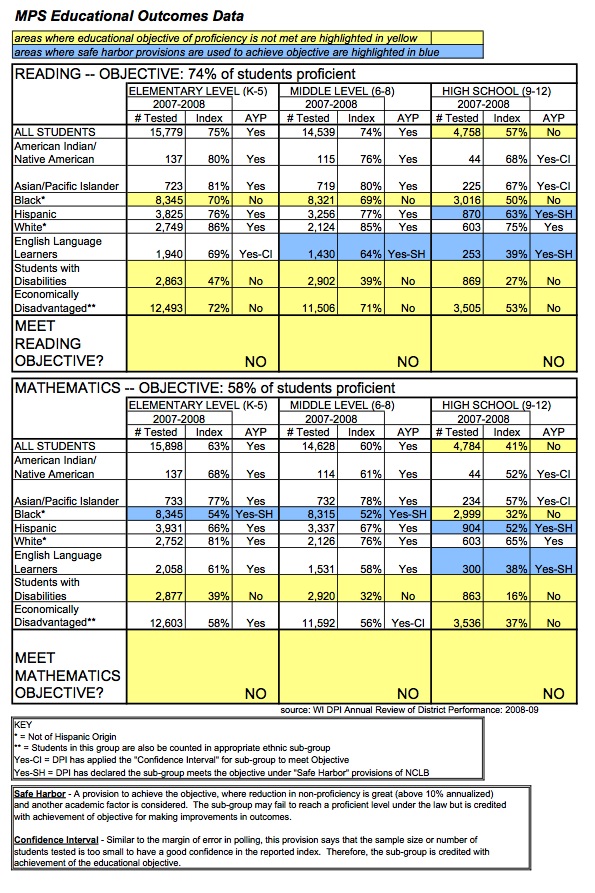
  • University of Wisconsin-Madison Psychology Professor Mark Seidenberg: Madison schools distort reading data:

    In her column, Belmore also emphasized the 80 percent of the children who are doing well, but she provided additional statistics indicating that test scores are improving at the five target schools. Thus she argued that the best thing is to stick with the current program rather than use the Reading First money.
    Belmore has provided a lesson in the selective use of statistics. It’s true that third grade reading scores improved at the schools between 1998 and 2004. However, at Hawthorne, scores have been flat (not improving) since 2000; at Glendale, flat since 2001; at Midvale/ Lincoln, flat since 2002; and at Orchard Ridge they have improved since 2002 – bringing them back to slightly higher than where they were in 2001.
    In short, these schools are not making steady upward progress, at least as measured by this test.
    Belmore’s attitude is that the current program is working at these schools and that the percentage of advanced/proficient readers will eventually reach the districtwide success level. But what happens to the children who have reading problems now? The school district seems to be writing them off.
    So why did the school district give the money back? Belmore provided a clue when she said that continuing to take part in the program would mean incrementally ceding control over how reading is taught in Madison’s schools (Capital Times, Oct 16). In other words, Reading First is a push down the slippery slope toward federal control over public education.

    also, Seidenberg on the Reading First controversy.

  • Jeff Henriques references a Seidenberg paper on the importance of phonics, published in Psychology Review.
  • Ruth Robarts letter to Isthmus on the Madison School District’s reading progress:

    Thanks to Jason Shepard for highlighting comments of UW Psychology Professor Mark Seidenberg at the Dec. 13 Madison School Board meeting in his article, Not all good news on reading. Dr. Seidenberg asked important questions following the administrations presentation on the reading program. One question was whether the district should measure the effectiveness of its reading program by the percentages of third-graders scoring at proficient or advanced on the Wisconsin Reading Comprehension Test (WRCT). He suggested that the scores may be improving because the tests arent that rigorous.
    I have reflected on his comment and decided that he is correct.
    Using success on the WRCT as our measurement of student achievement likely overstates the reading skills of our students. The WRCT—like the Wisconsin Knowledge and Concepts Examination (WKCE) given in major subject areas in fourth, eighth and tenth grades— measures student performance against standards developed in Wisconsin. The more teaching in Wisconsin schools aims at success on the WRCT or WKCE, the more likely it is that student scores will improve. If the tests provide an accurate, objective assessment of reading skills, then rising percentages of students who score at the proficient and advanced levels would mean that more children are reaching desirable reading competence.

  • Madison teacher Barb Williams letter to Isthmus on Madison School District reading scores:

    I’m glad Jason Shepard questions MMSD’s public display of self-congratulation over third grade reading test scores. It isn’t that MMSD ought not be proud of progress made as measured by fewer African American students testing at the basic and minimal levels. But there is still a sigificant gap between white students and students of color–a fact easily lost in the headlines. Balanced Literacy, the district’s preferred approach to reading instruction, works well for most kids. Yet there are kids who would do a lot better in a program that emphasizes explicit phonics instruction, like the one offered at Lapham and in some special education classrooms. Kids (arguably too many) are referred to special education because they have not learned to read with balanced literacy and are not lucky enough to land in the extraordinarily expensive Reading Recovery program that serves a very small number of students in one-on-on instruction. (I have witnessed Reading Recovery teachers reject children from their program because they would not receive the necessary support from home.)
    Though the scripted lessons typical of most direct instruction programs are offensive to many teachers (and is one reason given that the district rejected the Reading First grant) the irony is that an elementary science program (Foss) that the district is now pushing is also scripted as is Reading Recovery and Everyday Math, all elementary curricula blessed by the district.
    I wonder if we might close the achievement gap further if teachers in the district were encouraged to use an approach to reading that emphasizes explicit and systematic phonics instruction for those kids who need it. Maybe we’d have fewer kids in special education and more children of color scoring in the proficient and advanced levels of the third grade reading test.

Share

KIPP has optimized the Standards v1.0 school

Tom Vander Ark:

Standards and common assessments were introduced 15 years ago. KIPP took the expectations expressed by state tests seriously and made numerous process improvements to the old model of school. At the middle school I visited Monday, 100% of the Kipsters had passed the state math test.
This KIPP school gives uniform weekly quizzes in every state tested subject and relentlessly evaluates the data from every classroom and student. The school only hires new teachers, trains them on data-driven instruction, and expects hard work (e.g., to go along with their bonus plan, a sign in the principal’s office read, “New Incentive Plan: Work or Get Fired”)
This is the best of the batch-print model. Kids sit obediently in rows in classrooms of 25 students. One teacher per subject per grade yields direct accountability for results. Their homegrown curriculum is mostly worksheets. Quizzes are paper based. Scores are tabulated on a spreadsheet. No fancy learning management system at work here–they just figure out what the state wants, teach it and test it. They are fantastic executors–a critical innovation in a sector that is commonly sloppy and uneven in delivery.

Share

Australia’s child-migration horror

The Economist:

CEREMONIES in the Great Hall of Parliament House in Canberra are typically attended by visiting royals, heads of state and other dignitaries. On November 16th several hundred ordinary, middle-aged Australians, with pain in their faces and tears in their eyes, packed the hall to witness a ceremony devoted to them. It seemed a miracle that many were there at all. Shipped from Britain as youngsters, or plucked from broken homes and single mothers in Australia, some suffered childhoods spent in orphanages where violence, sexual abuse and humiliation were rife. Some of their peers killed themselves.
After years of campaigning, survivors gathered to hear Kevin Rudd, the prime minister, offer a formal apology for this “great evil”. It was the second such apology Mr Rudd has offered in under two years. Early last year, he began his government’s first term by apologising to the “stolen generations”: children, many of mixed race, taken by the authorities from aboriginal families. In all, by 1970 over 500,000 “stolen”, migrant and non-indigenous children had been placed in church, charity and government institutions.
Mr Rudd’s latest apology has focused attention on Britain’s grim “child migration” scheme, under which children as young as three were sent to the former colonies of Canada, Australia, New Zealand and South Africa, often without their parents’ knowledge or consent. One motive was racial: the young countries wanted “British stock”. Australia took about 10,000 children, most of them after Canada reduced its intake in the 1940s.

Share

Delaware to change education policy as state competes for federal grant

Jennifer Price:

Gov. Jack Markell’s administration today announced planned changes in education policy designed to help Delaware compete for a $75 million federal education grant.
U.S. Secretary of Education Arne Duncan plans to award a portion of the $4 billion federal Race to the Top Fund early next year – and again in 2011 – to states willing to undertake changes in the way schools are run.
Markell wants to help Delaware’s chances of receiving the grant by improving student readiness, ensuring teacher quality, effectively using student data and turning around the state’s lowest-performing schools.
“This is as important as anything we could possibly do to advance our state,” Markell said.
Duncan hasn’t said how many states he expects to win a chunk of the money, but has indicated that only states that lead the way in education reform will have a chance. Based on its student population size, Delaware could receive up to $75 million.

Governor Jack Markell:

To improve the quality of Delaware schools and better prepare Delaware students for college, work and life, the Governor and the Department of Education have created an education reform action plan that represents the input of more than 100 participants, including teachers, administrators, the business community, parents, the disabilities community, higher education leaders, and legislators over the course of several months.
“This action plan [78K PDF] focuses on four specific goals to help ensure that Delaware schools are world-class – improving student readiness, ensuring teacher quality, effectively using student data, and turning around persistently low-performing schools,” said Delaware’s Secretary of Education Lillian Lowery. “It is a plan that takes bold steps and was built from months of discussion from everyone who has a stake in the strength and success of our public schools.”
The Secretary and the Governor will be attending community forums in local districts to discuss the plan in depth and how the plan aligns with efforts to compete with the federal Race to the Top competition for additional federal dollars to invest in public schools.

Share

Bush Foundation commits $4.5 million to University of Minnesota for teacher education

University of Minnesota:

The http://www.bushfoundation.org/“>Bush Foundation has committed up to $4.5 million to support the University of Minnesota as it restructures teacher preparation programs in the College of Education and Human Development.
Through ongoing collaboration with K-12 schools, the university’s Teacher Education Redesign Initiative (TERI) will have a long-lasting, positive impact on the children of Minnesota, new teachers and programs within the college. Improved partnerships with K-12 districts are designed to benefit the university, district and prospective teachers.
Teachers prepared through TERI will strongly focus on student learning and have the ability to adapt to the needs of all learners. The university will diversify its teaching candidate pool and provide pathways into its teacher preparation programs for both exceptionally qualified undergraduate students and for career changers.
The first group of prospective teachers will enter the redesigned program during summer 2011.

Share