School Information System

Schools Face Test on Budget Math

Mark Whitehous & Amy Merrick:

For seventh-grader Kyle Scarpa, budget strains affecting schools across the country are hitting where it hurts.
In the wake of the worst recession in more than half a century, many communities find themselves with no choice but to cut funding for education. In Downe Township, N.J., the cuts are hitting where it hurts.
In addition to freezing wages and jettisoning its librarian, the school he attends here in southern New Jersey will cancel his after-school remedial math and literacy classes. His teacher believes the tutoring helped him build confidence and get his average grade up to a C from a D.
“He could fall through the cracks,” says teacher Rose Garrison, noting that Kyle is among four kids in her class having trouble keeping up. “When you’re teaching exponents and you have kids who don’t know the multiplication tables, how are you going to teach them?”
The struggles at Downe Township School illustrate the challenges public schools face across America as a convergence of factors–ravaged state and local finances, tapped-out taxpayers and a reform push by the Obama administration–force wrenching change. As the school year winds down, educators are grasping for new ways to do more with less, and to remedy an embarrassing reality: Despite spending more per student than the average developed country, U.S. schools perform below average in core subjects such as math and reading.

Share

Race to Top Buy-In Level Examined

Michele McNeil:

States significantly increased buy-in from local teachers’ unions in round two of the Race to the Top competition, but made far less progress in enlisting districts or expanding the number of students affected by the states’ education reform plans.
Those patterns emerged from an Education Week analysis of applications from 29 states and the District of Columbia, all of which entered both rounds of the $4 billion federal grant contest.
Although the changes made in applications from the first to the second round varied widely from state to state, union buy-in increased on average by 22 percentage points, with states such as Florida, Michigan, and Wisconsin making big leaps.
At the same time, the overall level of district support and students affected in the 30 applications barely budged, mostly owing to California’s loss of support from about 500 districts representing nearly 2 million students. That negated progress other states made in improving buy-in.

Share

Abolishing Department of Education isn’t extreme

Mona Charen:

Newly minted Nevada senate candidate Sharron Angle is a kook. That’s what Sen. Harry Reid’s people are telling reporters. ABC, CNN, and other outlets seem to agree, noting that Mrs. Angle wants to shutter the federal Department of Education, get the U.S. out of the U.N., phase out Social Security, and eliminate the IRS.
We haven’t yet heard her explanations of these positions — many of which can be justified in the proper context. It’s certainly possible that she is a little eccentric (that prison massage program doesn’t pass the smell test). But this much is certain: It is not kooky to favor the elimination of the Department of Education. That this proposal is routinely labeled “extremist” is a reminder of the one-way ratchet that operates in government. Enshrine something in a federal agency and it becomes sacrosanct. Democrats cheerlead for federal programs because they are the party of government, and Republicans quietly go along because they’re afraid.
But if Republicans know how to argue for smaller government — as Gov. Chris Christie is demonstrating in New Jersey — they need not be intimidated. There are hundreds of federal programs that could be eliminated tomorrow with only the happiest consequences for the nation. And yes, the whole Department of Education could be scrapped. It vacuums up money and produces … what exactly?

I’m not an optimist with respect to our exploding Federalism and the related money printing approach to spending.

Share

K-12 Tax & Spending Climate: Pennsylvania‟s Taxpayer Relief Act: Big Gamble Pays Off for Some, But Most Lose Their Shirt

Jaime Bumbarger:


There is perhaps no greater debate in America than the one surrounding taxes, whether it is at the national, state, or local level. While taxes serve the important purpose of funding government programs, they also bear quite a burden on taxpayers. For example, property taxes account for the majority of revenue for local governments across the country.1 Pennsylvania is no different. In 2000, property taxes accounted for nearly $10 billion of revenue in Pennsylvania, which was 30 percent of total local government revenues and 70 percent of all local government tax revenues.2
Property taxes accounted for an even larger piece of the pie when it came to school districts: approximately 85 percent of the total tax revenues for Pennsylvania school districts in 2000.3 Nearly half of all school district revenue came from the collection of property taxes.4 Only counties relied more heavily on property taxes as a source of revenue.5
The state‟s heavy reliance on property taxes by school districts hit the wallets of Pennsylvania taxpayers and led to several attempts by legislators to harness the spending.6 The most recent attempt was Act 1 of 2006.7 Act 1 attempts to do what other legislation failed to do: provide property tax relief to all Pennsylvanians, but it, too, falls short of its mark.8
Although it was enacted more than three years ago, the Act still plays a prominent role today. Less than two years ago, homeowners started reaping the benefits of Act 1 when the first reduction in property tax bills occurred.9 Last fall, taxpayers could have faced another referendum on their ballots, asking whether they favor increasing the local income tax to offset a decrease in property tax.10 Officials faulted public confusion for the last referendum overwhelmingly failing across the Commonwealth.11 Also, last year‟s budget impasse resulted in new legislation that could significantly alter property tax relief in the future.12

Share

It’s the Public’s Data: Democratizing School Board Records

J. H. Snider, via a kind reader:

Consider just a few of the questions whose answers might help a community’s leaders and citizens make better decisions about how to improve their schools:

  • What has been said and written about school start times in districts with comparable demographics and financial resources, but better student test scores?
  • What is the relationship between student test scores and systems for electing school board members in comparable school districts?
  • How do superintendent contracts vary in comparable districts?

Parents, teachers, administrators, and taxpayers have legitimate reasons to ask questions like these. But it has been incredibly hard for them to do so. One reason is that much public information remains locked in the file cabinets of America’s more than 14,000 school districts. Another is that even if the information is posted to school websites, it may be posted in ways, such as a scanned document, that Internet search engines cannot read. Public information that should be available instantaneously and at no cost, like so much other information now available via search engines, instead takes hundreds of work-lifetimes and a fortune to gather–if it can be gathered at all.

Well worth reading.

Share

Commentary: Time to end teacher union stranglehold on education

Sara Longwell:

For young teachers looking to get their first gig after graduating from education school, times are tough.
In New York City, the Success Charter network advertised 135 openings; it received 8,453 resumes in response. In Westchester, a school announced seven openings. More than 3,000 candidates responded.
New York isn’t alone: School districts across the country, faced with budget shortfalls, have put a freeze on hiring any new educators. This is bad news for newly minted teachers entering the work force.
There is a silver lining, however: This glut of new educators gives administrators a golden opportunity to revamp rules protecting bad teachers.
Reformers can take advantage of this surplus of labor by pointing out that anyone who doesn’t like new rules that will improve the nation’s quality of education can quickly be replaced by those who will play ball.

Share

Obama’s attack on education

Critical Reading:

Ravitch was assistant secretary of education in the administration of George H.W. Bush and a board member of various right-wing think tanks, who has now become a leading critic of the market-based school “reform” that has been embraced by both Democrats and Republicans. Ravitch is “still looking” for an elected official to take a stand against these changes, but opposition is more likely to come from below. One encouraging piece of news is the landslide victory this week of the Caucus Of Rank-and-file Educators in the election for the leadership of the Chicago Teachers Union. –PG

Share

Our View: We need more innovation in education

Wausau Daily Herald:

As a part of the economic stimulus package of January 2009 — you may have heard of it — the federal government created a $100 billion education fund for states that were willing to take bold action to reform and improve their schools.
The fund, known as Race to the Top, is having the desired effect in many places. With state budgets in dire shape across the nation, it has provided a real incentive for states to look for ways to innovate in order to address real problems in the educational system — failing schools, bureaucratic deadlock, the achievement gap between rich and poor students.
In Wisconsin, though, what it has inspired is something more like a few pro-forma changes and half-hearted applications.
Wisconsin ranked in the bottom half of all the states that applied for Race to the Top funding in the first round in March. (The federal government placed our state’s application 26th out of 41 states and the District of Columbia that applied.)

Share

New Wisconsin teacher rules hitting classrooms

Amy Hetzner:

Ten years after Wisconsin overhauled its licensure system for public school educators, the first big wave of teachers is set to advance under the rules – and reports are mixed on whether the change has made a difference.
Expectations for the new licensure regulations were high when they were first approved in 2000. In addition to requiring that teachers pass basic knowledge and skills tests and receive mentors for their first year in the profession, the rules also provided that teachers would have to demonstrate they had grown enough in their careers to attain a “professional” license.
For some beginning teachers, the new rules have been stressful additions to the start of an unfamiliar career with many bugs still left to be worked out. Others say they appreciate that they could set their own teaching goals and pursue related professional development activities while also reflecting on their experiences.
“I think teachers who really take the process seriously and do it with fidelity – they choose a goal that they really believe in and they want to achieve – that’s fine, that’s good, it serves its purpose,” said Judy Gundry, a citywide mentor for educators with initial teaching licenses in Milwaukee Public Schools.

Share

K-12 Tax & Spending Climate

Peter Scheer:

For public employee unions – those representing police, firefighters, teachers, prison guards and agency workers of all kinds at the state and local levels – these are the worst of times.
Despite record high membership and dues, and years of unparalleled clout in state capitols, public-sector unions find themselves on the defensive, desperately trying to hold onto past gains in the face of a skeptical press and angry voters. So far has the zeitgeist shifted against them that on one recent weekend, government employees were the butt of a “Saturday Night Live” skit, and the next day, a New York Times Magazine cover article proclaimed “The Teachers’ Unions’ Last Stand.”
Public unions’ traditional strength – the ability to finance their members’ rising pay and benefits through tax increases – has become a liability. Although private-sector unions always have had to worry that consumers will resist rising prices for their goods, public sector unions have benefited from the fact that taxpayers can’t choose – they are, in effect, “captive consumers.”

Share

In bold move, Colorado alters teacher tenure rules

Colleen Slevin:

Colorado is changing the rules for how teachers earn and keep the sweeping job protections known as tenure, long considered a political sacred cow around the country.
Many education reform advocates consider tenure to be one of the biggest obstacles to improving America’s schools because it makes removing mediocre or even incompetent teachers difficult. Teacher unions, meanwhile, have steadfastly defended tenure for decades.
Colorado’s legislature changed tenure rules despite opposition from the state’s largest teacher’s union, a longtime ally of majority Democrats. Gov. Bill Ritter, also a Democrat, signed the bill into law last month.
After the bill survived a filibuster attempt and passed a key House vote, Democratic Rep. Nancy Todd, a 25-year teacher who opposed the measure, broke into tears.
“I don’t question your motives,” an emotional Todd said to the bill’s proponents. “But I do want you to hear my heart because my heart is speaking for over 40,000 teachers in the state of Colorado who have been given the message that it is all up to them.”
While other states have tried to modify tenure, Colorado’s law was the boldest education reform in recent memory, according to Kate Walsh, the president of the Washington-based National Council on Teacher Quality, which promotes changing the way teachers are recruited and retained, including holding tenured teachers accountable with annual reviews.

Share

Evaluating Curricular Programs in the Madison School District

Madison School District Administration 2.8MB PDF:

I. Introduction
A. Title or topic – District Evaluation Protocol – The presentation is in response to the need to provide timely and prioritized information to the Board of Education around programs and interventions used within the District. The report describes a recommended approach to formalizing the program evaluation process within the District.
B. Presenters
Kurt Kiefer – Chief Information Office/Director of Research and Evaluation
Lisa Wachtel– Executive Director of Teaching & Learning
Steve Hartley – Chief of Staff
C. Background information – As part of the strategic plan it was determined that priority must be given to systematically collect data around programs and services provided within the district. The purposes for such information vary from determining program and intervention effectiveness for specific student outcomes, to customer satisfaction, to cost effectiveness analyses. In addition, at the December 2009 Board meeting the issue of conducting program evaluation in specific curricular areas was discussed. This report provides specific recommendations on how to coordinate such investigations and studies.
D. Action requested – The administration is requesting that the Board approve this protocol such that it becomes the model by which priority is established for conducting curricular, program, and intervention evaluations into the future.
II. Summary of Current Information
A. Synthesis of the topic· School districts are expected to continuously improve student achievement and ensure the effective use of resources. Evaluation is the means by which school systems determine the degree to which schools, programs, departments, and staff meet their goals as defined by their roles and responsibilities. It involves the collection of data that is then transformed into useful results to inform decisions. In particular, program evaluation is commonly defined as the systematic assessment of the operation and/or outcomes of a program, compared to a set of explicit or implicit standards as a means of contributing to the improvement of the program.
Program evaluation is a process. The first step to evaluating a program is to have a clear understanding of why the evaluation is being conducted in the first place. Focusing the evaluation helps an evaluator identify the most crucial questions and how those questions can be realistically answered given the context of the program and resources available. With a firm understanding of programs and/or activities that might be evaluated, evaluators consider who is affected by the program (stakeholders) and who might receive and or use information resulting from the evaluation (audiences). It is critical that the administration work with the

Evaluating the effectiveness of Madison School District expenditures on curriculum (such as math and reading recovery) along with professional development (adult to adult programs) has long been discussed by some Board and community members.

Share

Morning Bell: Prolonging Education’s Race to the Bottom

Israel Ortega:

In perhaps President Obama’s most stealth campaign to date, the federal government has been slowly tightening its grip on the education sector to little fanfare. Rather than working through the democratic legislative process, this Administration has circumvented Congress to enact an ill-conceived education agenda that will weaken accountability, reduce transparency and minimize choice while only adding to the national deficit.

For close to four decades, the federal government has operated under the seemingly simple premise that increased spending on education will translate into academic achievement. This line of thinking has resulted in inflation-adjusted federal expenditures on education increasing 138 percent since 1985. Per-pupil expenditures have ballooned to over $11,000 per student, and are even higher in most urban areas including the District of Columbia where the government spends $14,500 on each child. Billions upon billions of dollars have been poured into our public school system because the federal government, backed by powerful teachers unions, is convinced that it is best suited to administer our country’s education system. Unfortunately, this approach has been a miserable failure.>

Share

Madison School District Board of Education Progress Report–March through June 2010

Maya Cole, Board President & Beth Moss Board Vice-President, Via email:

The 2009-10 school year is over, and the Board is wrapping up a very busy spring 2010. After several months of hard work, the Board finalized the preliminary 2010-11 budget on June 1. For the second year in a row, the state legislature decreased the amount of per pupil state aid by 15%. This decrease in revenue, coupled with a decrease in property values in the Madison Metropolitan School District, created a much larger than usual budget shortfall. This year is different because unlike previous years when the Board of Education was not allowed to raise property taxes to cover the shortfall, this year the state gave the Board the authority to raise taxes by an extreme amount. The Board and administration have worked hard to mitigate the tax impact while preserving programs in our schools.
2010-11 Budget Details:
The Board approved a preliminary budget of $360,131,948 after creating savings of over $13 million across all departments in the district. This budget represents a decrease of over $10 million from 2009-10. The final tax impact on a home of average value ($250k) is $225. The Board made reductions that did not directly affect instruction in the classroom, avoiding mass teacher lay-offs as experienced by many districts around the country and state.
Other State action:
The School Age Guarantee for Education (SAGE) Act was changed from funding K-3 class sizes of 15:1 to 18:1. The Board is considering how to handle this change in state funding.
Race to the Top is a competitive grant program run through the federal government. The state of Wisconsin applied for Race to the Top funding in round 1 and was denied. The Board approved the application for the second round of funding. Federal money will be awarded to states that qualify and the MMSD could receive $8,239,396.
Board of Education Election:
Thank you for 6 years of service and good luck to Johnny Winston, Jr. Taking his seat is James Howard, an economist with the Forest Service and MMSD parent. New Board officers are Maya Cole, president, Beth Moss, vice president, Ed Hughes, clerk, and James Howard, treasurer.
Sarah Maslin, our student representative from West High School, will be off to Yale University in the fall. Thank you for your service and good luck, Sarah! Congratulations to Wyeth Jackson, also from West, who won the election for student representative to the Board of Education. Jessica Brooke from La Follette will return as Student Senate president and alternate to the BOE Student Representative.
Other news:
In April the board received the following reports:
The Facility Assessment Report, a compilation of district maintenance needs over the next 5 years.
The Board of Education/Superintendent Communication Plan, providing a template for reports to the Board.
The District Reorganization Plan, a plan to restructure the administration and professional development department of the district.
The Board held a public hearing on the proposed budget at UW Space Place. In addition, the School Food Initiative Committee and the 4-K Advisory Committee met.
In May the Strategic Planning Steering Committee met. Stakeholders reviewed accomplishments achieved thus far and discussed and reprioritized action steps for the next year. A second public hearing on the budget was also held in May.
In June the Board finalized the Preliminary Budget after a statutory public hearing. During committee meetings on June 7, the ReAL grant team presented action plans for each of the large high schools and gave the Board an update on the ReAL grant and the Wallace grant. The four high schools have collaborated for the past two years to improve engagement and achievement at our high schools. The Student Services and Code of Conduct/Expulsions Committee presented a proposal for a new code of conduct and abeyance, with an emphasis on restorative justice.
Congratulations and good luck to all graduates! Have a safe and restful summer break.

Share

Google Apps (email, docs & calendar) for Madison School District Staff & Students Proposed by the Administration

550K PDF:

Technical Services has planned to replace our Eudora student email system since 2008 and identified this as Activity 50 in the June 2010 Technology Plan, approved by the Board of Education. Consideration has also been given to replacing our GroupWise staff email system since instability of the web version ofthis system became a problem beginning in October 2009. Demands on our staff email system have always been greater due to our need for highly secure, robust and reliable local and remote access, shared calendaring, and integration with an archival system allowing for a seven year retention. This has been a complicated system and is core to many critical business and legal functions ofthe District.
An request for proposals (RFP) for alternatives to replace our student email, with the caveat that our staff email might be considered as well, was released in fall 2009, generating responses from nine vendors, representing 11 products. Both Microsoft’s Live@edu and Google’s Gmail have been final contenders for student email and following product reviews in March by 13 teachers, six technical staffand four administrators, consensus built around migrating both student and staff email to Gmail. In addition to email, Google Apps for Education includes access to a wide variety ofGoogle tools including Docs (word processing, spreadsheets, presentations, fonus) and Google calendar.
Financial considerations:

  • Moving to Gmail for both students and staff will enable free email account hosting and cost $67,320/yr for the use ofPostini for staff email archiving. We will continue to use Novell’s ZenWorks for desktop application maintenance, at a cost of $28,000/yr through the 2010-2011 fiscal year. This approach would cost $95,320/yr. Discussion around creating and maintaining Gmail accounts from Infinite Campus and Lawson, as well as migrating staff calendars and live email accounts has not concluded whether consulting help will be required, although discussions with other school districts suggest we may not need external assistance. Should technical assistance be required we would hire consulting support on a time and materials basis, for this help.
  • If instead, the District stayed with GroupWise bundled with ZenWorks, Novell’s annual maintenance would be $54,378/yr. Continuing use our current staff email archive product would cost $29,300/yr. This approach would cost $83,678/yr, an annual savings ofless than $12,000. However, this approach will continue to require growth in data storage and requires an estimated 0.5 FTE allocation to maintain.

Related: Yale delays switch to Gmail and Oregon educational system offers Google Apps.

Share

Monona Grove School District Governance: Teacher Union Contract Bargaining

Sunny Schubert:

Monona Grove School Superintendent Craig Gerlach is not a happy camper these days, and the source of his displeasure is the ongoing job action by the Monona Grove Education Association.
As previously reported, the teachers are “working the contract,” meaning they refuse to take part in school-related activities that are not specifically required.
It is a tactic the union has employed successfully in the past when contract negotiations have stalled, as they are as of this writing.
“It’s extremely frustrating,” Gerlach said. “Also, it’s embarrassing.”
How so? Gerlach gave an example: At the Fine Arts Awards ceremony at the high school, teachers refused to come, so the kids wound up passing out the awards to each other.
“I’ve been getting a number of phone calls from parents,” he said, “and I don’t know what to say. This is all relatively new to me.”

Board member Peter Sobol responds.

Share

Teachers Are Fair Game

David Brooks:

I started covering education reform in 1983, with the release of the “Nation at Risk” report. In those days everybody had some idea for how we should reorganize the schools or change the curriculum–cut school size, cut class size, create vouchers, create charters, get back to basics, do less basics, increase local control, increase the federal role.
Some of the reforms seemed promising, but the results were disappointing, and tangential to the core issue: the relationship between teacher and student. It is mushy to say so, but people learn from people they love.
Today, aided by the realization that teacher quality is what matters most, a new cadre of reformers have come on the scene, many of them bred within the ranks of Teach for America. These are stubborn, data-driven types with a low tolerance for bullshit. The reform environment they find themselves in is both softhearted and hardheaded. They put big emphasis on the teaching relationship, but are absolutely Patton-esque when it comes to dismantling anything that interferes with that relationship. This includes union rules that protect bad and mediocre teachers, teacher contracts that prevent us from determining which educators are good and which need help, and state and federal laws that either impede reform or dump money into the ancien régime.

Share

Education minister sets deadline for balanced Vancouver School Budget

John Bermingham:

B.C. Education Minister Margaret MacDiarmid is laying down the law to the Vancouver School Board — ordering trustees to send her a draft budget by June 18.
She also wants trustees to consider a number of cost-cutting options from last week’s comptroller-general’s report on the district’s finances.
The board currently faces a $17-million budget deficit, and has to submit a final and balanced budget to MacDiarmid by June 30.
Last week’s report recommended almost $12 million in other cost saving schemes.
They include closing schools, winning contract concessions from workers and charging higher rent to childcare centres.

Share

K-12 Tax & Spending Climate: Pension Cuts Face Test in Colorado, Minnesota

Jeannette Neumann:

A showdown is looming over whether commitments made to retirees by government pension funds can be scaled back in dire economic times.
Facing shortfalls, some public pension funds are responding by paring back payouts pledged to retired workers. Earlier this year, pension funds in Colorado and Minnesota curtailed annual cost-of-living increases.
“No matter how draconian you got on the new hires, you ran out of money” if you didn’t cut benefits to current retirees, said Meredith Williams, chief executive of the Colorado Public Employees’ Retirement Association, with $34.2 billion in assets.

Share

Incomplete Standards

The new national standards are too timid to recommend that high school students read complete history (or other nonfiction) books, or that high school students should write serious research papers, like the Extended Essays required for the International Baccalaureate Diploma.
Even the College Board, when it put together “101 books for the college-bound student” included only four or five nonfiction books, and none was a history book like Battle Cry of Freedom, or Washington’s Crossing.
For several reasons it has become taboo to discuss asking our students to read complete nonfiction books and write substantial term papers. Not sure why…
In fact, since the early days of Achieve’s efforts on standards, no one has taken a stand in recommending serious history research papers for high school students, and nonfiction books have never made the cut either.
Since 1987 or so it has seemed just sensible to me that, as long as colleges do assign history and other nonfiction books on their reading lists, and they also assign research papers, perhaps high school students should read a nonfiction book and write a term paper each year, to get in academic shape, as it were.
After all, in helping students prepare for college math, many high schools offer calculus. For college science, high school students can get ready with biology, chemistry and physics courses. To get ready for college literature courses, students read good novels and Shakespeare plays. Students can study languages and government and even engineering and statistics in their high schools, but they aren’t reading nonfiction books and they aren’t writing research papers.
The English departments, who are in charge of reading and writing in the high schools, tend to assign novels, poetry, and plays rather than nonfiction books, and they have little interest in asking for serious research papers either.
For 23 years, I have been publishing exemplary history research papers by high school students from near and far [39 countries so far], and it gradually became clearer to me that perhaps most high school students were not being asked to write them.
In 2002, with a grant from the Shanker Institute, I was able to commission (the only) study of the assignment of history term papers in U.S. public high schools, and we found that most students were not being asked to do them. This helped to explain why, even though The Concord Review is the only journal in the world to publish such academic papers, more than 19,000 of the 20,000 U.S. public high schools never submitted one.
The nonfiction readings suggested in the new national standards, such as The Declaration of Independence, Letter From Birmingham Jail, and one chapter from The Federalist Papers, would not tax high school students for more than an hour, much less time than they now spend on Catcher in the Rye, Lord of the Flies, and the like. What would the equivalent be for college preparation in math: long division? decimals?
High school graduates who arrive at college without ever having read a complete nonfiction book or written a serious term paper, even if they are not in remedial courses (and more than one million are each year, according to the Diploma to Nowhere report), start way behind their IB and private school peers academically, when it comes to reading and writing at the college level.
Having national standards which would send our high school graduates off to higher education with no experience of real term papers and no complete nonfiction books doesn’t seem the right way to make it likely that they will ever get through to graduation.
“Teach by Example”
Will Fitzhugh [founder]
Consortium for Varsity Academics® [2007]
The Concord Review [1987]
Ralph Waldo Emerson Prizes [1995]
National Writing Board [1998]
TCR Institute [2002]
730 Boston Post Road, Suite 24
Sudbury, Massachusetts 01776-3371 USA
978-443-0022; 800-331-5007
http://www.tcr.org; fitzhugh@tcr.org
Varsity Academics®
www.tcr.org/blog
Share

Don Severson & Vicki McKenna Discuss The Madison School District’s 2010-2011 Budget

35mp mp3 audio file.

Share

National Standards Nonsense is Still Nonsense

Jay Greene:

Over at Flypaper Mike Petrilli has finally tried to address the problems we’ve raised regarding national standards. Despite Mike’s best efforts, I’m afraid that national standards and assessments still sound like a really bad idea.
I raised doubts about the rigor and soundness of the proposed national standards, citing the fact that many credible experts have denounced them as lousy. His response is simply to repeat that Fordham has given the standards good grades and thinks the latest revisions have been positive. This is not a substantive response; it is simply a reiteration of their initial position.
Why should we find Fordham’s grading of the proposed national standards any more credible than that of the experts who have denounced the standards? The fact that Fordham issued a report with letter grades is just a marketing exercise for Fordham’s opinion. There is nothing scientific or rigorous about Fordham hand-picking their friends experts to repeat the opinion Fordham already holds — especially when we know from past experience that Fordham might exclude experts or change the grades if it does not come out the way they want.

Share

Little-known San Jose educator lands atop heap in race for California schools chief

Sharon Noguchi:

Some neophyte politicians spent megabucks gained from their famous companies to persuade California voters Tuesday to grant them a spot on the November ballot.
Then there was Larry Aceves. The retired superintendent of San Jose’s Franklin-McKinley, a school district obscure even in its own county, stumbled onto the ballot for California’s superintendent of public instruction after a low-budget campaign tour of the Rotary and PTA circuit. Topping 11 other candidates, Aceves won 18.8 percent of the statewide vote, the secretary of state’s office reported Wednesday, shocking two better financed and more experienced candidates.
“I pinched myself several times to make sure this wasn’t a dream,” the until now, little-known educator said Wednesday morning.
Assemblyman Tom Torlakson, D-Martinez, won 18 percent and the chance to face Aceves in a November runoff. Sen. Gloria Romero, D-Los Angeles, earned 17.2 percent of the vote, while nine others each got less than 10 percent in their quest to replace outgoing schools chief Jack O’Connell.

Share

Detroit’s Struggle with Mayoral Control

Maddy Joseph:

Detroit Mayor Dave Bing announced that he is ready to take control of Detroit’s failing schools. He endorsed petition efforts underway to put mayoral control on the November ballot, but evidence suggests that the effort might be an uphill electoral battle.
Detroit’s schools suffer a litany of challenges. Its students have the lowest NAEP scores of any urban district. There has been a precipitous decline in enrollment over the last decade and a budget deficit in the hundreds of millions prompted Governor Granholm to appoint “emergency financial manager” Robert Bobb in March 2009 to command control of the district’s cash.
Despite these pressing issues, only 4% of Detroit residents feel that the schools are the biggest problem facing the city, a statistic that, though disheartening, is fairly unsurprising considering that the city was named one of the ten most dangerous in the world by CNN this year and that unemployment hovers somewhere around 25%. Voters have other things on their minds, but getting their attention won’t be the biggest obstacle to mayoral control. History will.

Share

K-12 Tax & Spending Climate: US States’ Per student Spending

NCES. Wisconsin spends an average of $10,791 per student. Madison spends $15,241.30 per student, according to the 2009-2010 citizen’s budget. More here.

Share

Bailing out schools

Winston Salem Journal:

The banks got their federal bailout. So did the automakers.
Now North Carolina public-school children are asking if they will get theirs. Only their congressman knows for sure.
U.S. Education Secretary Arne Duncan was in North Carolina last week with a warning from the Obama administration and education supporters across the country. If Congress does not provide a bailout of state school budgets, as many as 300,000 teachers nationwide, 10,000 of them in North Carolina, could be laid off before the start of the next school term.
North Carolina legislators are so certain that the federal government won’t allow such a catastrophe that they have already written a lot of unappropriated federal money into the budget for the fiscal year that begins on July 1. But they are being optimistic in doing so.

Share

I agree, it’s time the Vancouver, Canada school board grew up

Jon Ferry:

You can say what you like about B.C. comptroller-general Cheryl Wenezenki-Yolland, at least if you can pronounce her name. But she sure knows how to shake things up.
Last fall, this steely mother of two blasted bloated management at TransLink and excessive executive compensation at B.C. Ferries, drawing cries of outrage from high-priced boss David Hahn.
Now, Wenezenki-Yolland has drawn equal if not greater howls of indignation by ripping into the Vancouver School Board. And the report she released Friday on the trustees’ management ability, or lack of it, has had board chairwoman Patti Bacchus on the verge of tears.

Share

Obama to high school grads: ‘Don’t make excuses’

Erica Werner:

President Barack Obama is telling high school graduates in Michigan not to make excuses, and to take responsibility for failures as well as successes.
In excerpts of remarks to be delivered later Monday at Kalamazoo Central High School, Obama says that it’s easy to blame others when problems arise. “We see it every day out in Washington, with folks calling each other names and making all sorts of accusations on TV,” the president says.
He says the high school kids can and have done better than that.
The 1,700-student high school in southwest Michigan landed Obama as its commencement speaker after winning the national Race to the Top High School Commencement Challenge.

Share

K-12 Tax & Spending Climate: Pols turn on labor unions

Magge Haberman:

Spurred by state budget crunches and an angry public mood, Republican and some Democratic leaders are focusing with increasing intensity on public workers and the unions that represent them, casting them as overpaid obstacles to good government and demanding cuts in their often-generous benefits.
Unlike past battles over the high cost of labor, this time pitched battles over wages and pensions are being waged from Sacramento to Springfield to New York City and the conflict is marked by its bipartisan tone, with public employee unions emerging as an intransigent public enemy number one in cities and state capitals across the country.
They’re the whipping boys for a new generation of governors who, thanks to a tanking economy and an assist from editorial boards, feel freer than ever to make political targets out of what was once a protected liberal class of teachers, cops, and other public servants.

Share

Black Parents vs. the Teachers’ Union: Union intransigence hits a low point

Nat Hentoff:

In Harlem–as elsewhere in this city, state, and nation–there is a sharply rising struggle between teachers’ unions and black parents.
That dispute is over parental choice of schools, especially in regards to publicly financed charter schools which can, and usually do, refuse to recognize teachers’ unions. Geoffrey Canada, whose Harlem Children’s Zone is nationally known for making charter schools a working part of the community, recently sent out a rallying cry to black parents everywhere when he said, “Nobody’s coming. Nobody is going to save our children. You have to save your own children.”
In Harlem, where thousands of parents apply for charter schools on civil rights grounds, State Senator Bill Perkins–whose civil liberties record I’ve previously praised in this column–is in danger of losing his seat because of his fierce opposition to charter schools. The UFT contributes to his campaigns. His opponent, Basil Smikle–who has worked for Hillary Rodham Clinton, the Bill Clinton Foundation, and, unfortunately, Michael Bloomberg–says: “Education has galvanized the community.”

Share

K-12 Tax & Spending Climate: Wisconsin Democrat Governor Candidate Barrett calls for $1 billion in state government cuts

Mary Spicuzza:

Democratic candidate for governor Tom Barrett wants to get rid of the offices of the secretary of state and the state treasurer as part of a plan he says would cut more than $1 billion from Wisconsin’s budget.
Barrett said some of the savings could be achieved every year, while other cuts — such as eliminating those constitutional offices, an uncertain and arduous process — would represent one-time savings.
At a news conference outside the state Capitol on Monday, Barrett said his plans would include steps like combining workers statewide into pools to purchase lower-cost health insurance, cracking down on Medicaid fraud and other financial crimes, and cutting prisoner health care costs.
He also called for “right-sizing” the state employee work force but did not say if that would involve layoffs or simply not filling vacant jobs.
Barrett called it his plan for “putting Madison on a diet.”

Related:

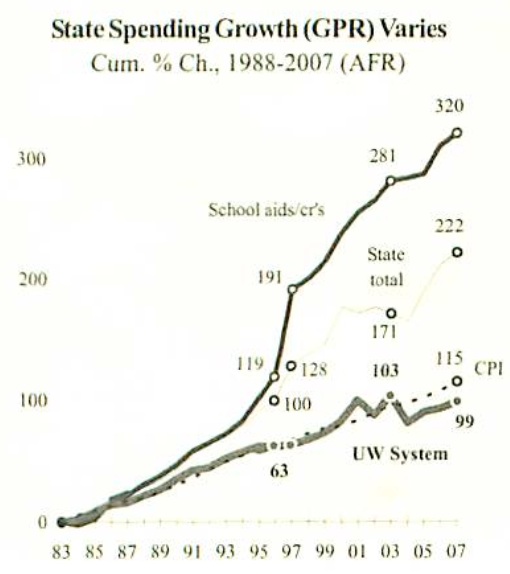
Wisconsin has seen substantial growth in redirected tax dollars devoted to K-12 public districts over the past 20+ years.
Madison School Board Vice President Beth Moss asked whether the State might further reduce redistributed tax dollars for K-12 spending in the next year, at the June 1, 2010 Budget meeting.

Share

K-12 Tax & Spending Climate: Number of the Week: U.S. Debt Nears Key Threshold

Mark Whitehouse:

8%: Gross U.S. public debt as a share of annual economic output.
There’s little doubt that the U.S. needs to get its mounting debts under control. But at what point do they become a clear and present danger?
By some measures, we’re reaching that point about now. As of Friday, our total national debt – the sum of all outstanding IOUs issued by the U.S. Treasury – stood at a bit more than $13 trillion, or almost 90% of our projected gross domestic product for 2010.
The 90% level is significant, because recent research by economists Carmen Reinhart and Kenneth Rogoff suggests that once a developed nation’s debt crosses it, its annual economic growth tends to be about one percentage point lower. At a time when economists are saying it could take years for the U.S. to bring unemployment back down to pre-recession levels, that percentage point could make a big difference.

Share

Why should education be exempt from recession budgeting?

George Will:

Jay Gould, a 19th-century railroad tycoon and unrepentant rapscallion, said he was a Democrat when in Democratic districts and a Republican when in Republican districts but that he was always for the Erie Railroad. Gould, emblematic of Gilded Age rapaciousness, was called a robber baron. What should we call people whose defining constancy is that they are always for unionized public employees? Call them Democrats.
This week, when Congress returns from its Memorial Day recess, many Democrats, having gone an eternity — more than a week — without spending billions of their constituents’ money, will try to make up for lost time by sending another $23 billion to states to prevent teachers from being laid off. The alternative to this “desperately” needed bailout, says Education Secretary Arne Duncan, is “catastrophe.” Amazing. Just 16 months ago, in the stimulus legislation, Congress shoveled about $100 billion to education, including $48 billion in direct aid to states. According to a University of Washington study, this saved more than 342,000 teaching and school staff positions — about 5.5 percent of all the positions in America’s 15,000 school systems.
The federal component of education spending on kindergarten through 12th grade, the quintessential state and local responsibility, has doubled since 2000, to 15 percent. Now the supposed emergency, and states’ dependency, may be becoming routine and perpetual.

Related: The Madison School Board discusses travel and professional development spending for the 2010-2011 budget and Bloomberg: US’s $13 Trillion Debt Poised to Overtake GDP.

Share

Madison School District 2009-2010 $416,060,561 Budget Update through 4/30/2010

2.2MB PDF. Estimated 2009-2010 spending is $416,060,561, up from 2008-2009’s 408,558,511.
The Teaching & Learning Department’s budget (page 10) is up 6% from 7,895,226 in 2008-2009 to 8,379,130 in the current 2009-2010 budget.
The Superintendent’s budget (page 12) is up 25% from 14,520,867 in 2008-2009 to 18,218,072 in 2009-2010.

Share

Madison Metropolitan School District Student Conduct and Discipline Plan Part II:

1MB PDF:

The district has developed over time a very detailed Student Code of Conduct that clearly outlines student misbehavior and prescribes suspension and expulsion as the specific responses for some misbehavior. While the current code is clear regarding which misbehaviors require suspension and a recommendation for expulsion, it does not offer administrators a sufficient array of options that can be used to intervene in order to support behavior change in students when suspension and expulsion are not an appropriate consequence.
Current research shows that a reactive model in the absence of positive, proactive strategies is ineffective. As an evidence-based national model that has recently been adopted at the state level in Wisconsin, Positive Behavior Supports (PBS) provides the mechanism for schools to shift to data driven decision making and practices grounded in a tiered approach that emphasizes teaching, modeling and reinforcing pro-social skills and behavior. Many districts across the country are developing Codes of Conduct that align with the PBS Model.
As all elementary, middle and high schools move toward full implementation of Positive Behavior Supports (PBS), it is important that the Code of Conduct is aligned with the PBS model which is grounded in teaching appropriate behaviors to students and acknowledging students for learning and exhibiting positive behavior. PBS provides a framework for defining and teaching in positive terms what is expected from students as behavior expectations that are defined only by
Appendix LLL-12-11 June 14,2010
III.
rules and “what not to do” provide an inadequate understanding for students and families.
The proposed Code o f Conduct represents a step toward improved alignment with the PBS model and reflects a shift in thinking from an approach that relies heavily on rules, consequences and reactive practices to an approach that provides a multi-tiered, progressive continuum of interventions to address a wide range of student behavior. While the current code is used primarily by administrators to determine which misbehaviors are appropriate for suspension and expulsion, the proposed code would also be used by teachers and other staff to determine which behaviors they are expected to handle in the classroom and which behaviors should be referred to the administrator or designee. It will provide all staff with multiple options in three (3) categories of intervention: Education, Restoration and Restriction (see details in attached chart). In addition, the proposed code presented in ‘chart form’ would be used as a teaching tool to give students a visual picture o f the increasing severity o f behaviors and the increasing intensity of interventions and consequences that result from engaging in inappropriate behaviors.

Related: Disciplinary Alternatives: Abeyance Option Phoenix Program:

The District has developed overtime, an extensive and very clear expulsion process, that is compliant with state and federal law, that focuses on procedure and is based on zero tolerance for some behaviors, In the 2007/08 school year, 198 students were recommended for expulsion with 64 actually being expelled. In the 2008/09, 182 students were recommended for expulsion with 44 actually being expelled.
Students are expelled from two to three semesters depending on the violation with an option to apply for early readmission after one semester if conditions are met. Approximately 72% of the students meet early readmission conditions and retum after one semester. Currently, no services are provided to regular education students who are expelled, Expelled special education students are entitled to receive Disciplinary Free Appropriate Public Education services.
Concems have been raised by members of the Board of Education, MMSD staff and community about the zero tolerance model, lack of services to expelled students and the significant disruption caused in the lives of these students, families and neighborhoods when students are expelled.
Approval is being sought for the implementation of an abeyance option, the Phoenix Program, including the budget, to be implemented at the beginning of the 2010/11 school year,

Share

Race to Sanity

David Brooks:

First, Obama and the education secretary, Arne Duncan, set up a contest. They put down $4.5 billion in Race to the Top money. They issued some general guidelines about what kind of reforms states would have to adopt to get the money. And then they fired the starting gun.
Reformers in at least 23 states have passed reform laws in hopes of getting some of the dough. Some of the state laws represent incremental progress and some represent substantial change. The administration has hung tough, demanding real reform in exchange for dollars. Over all, there’s been a tremendous amount of movement in a brief time.
This is not heavy-handed Washington command-and-control. This is Washington energizing diverse communities of reformers, locality by locality, and giving them more leverage in their struggles against the defenders of the status quo.
Second, the Obama administration used the power of the presidency to break through partisan gridlock. Over the past decade, teacher unions and their allies have become proficient in beating back Republican demands for more charters, accountability and choice. But Obama has swung behind a series of bipartisan reformers who are also confronting union rigidity.
In Rhode Island, the Central Falls superintendent, Frances Gallo, fired all the teachers at one failing school. The unions fought back. Obama sided with Gallo, sending shock waves nationwide. If the president had the guts to confront a sacred Democratic interest group in order to jolt a failing school, then change was truly in the air. Gallo got the concessions she needed to try to improve that school.

Share

A Breakthrough for Local-Control-Loving U.S. Schools

Pat Wingert:

It’s a moment many education reformers have dreamed of for decades and many thought they’d never see: a set of high-quality national education standards designed to set a higher bar for American schools that states seem eager to adopt. The goal, much discussed since George H. W. Bush was president, was finally accomplished because the National Governors Association and the Council of Chief State School Officers (rather than the federal government) took the lead, and states were invited to join the process voluntarily. In a country where local control of schools often outranks other educational considerations, the key to success was finding a way to create national but not federal standards.
The lack of nation-wide education standards has long been a key difference between US schools and those of most other developed countries, many of which score higher on international comparisons.

Share

Wisconsin schools commit to Common Core State Standards

Erin Richards:

To help make sure schoolchildren around the country are learning the same grade-by-grade information necessary for success in college and life after high school, Wisconsin’s schools chief Wednesday formally committed the state to adopting a set of national education standards.
The long-awaited Common Core State Standards for English and math, released Wednesday, define the knowledge and skills children should be learning from kindergarten through graduation, a move intended to put the United States on par with other developed countries and to make it easier to compare test scores from state to state.
“These standards are aligned with college and career expectations, will ensure academic consistency throughout the state and across other states that adopt them, and have been benchmarked against international standards for high-performing countries,” state Superintendent of Public Instruction Tony Evers said in a news release Wednesday.
Wisconsin already had pledged to support the common standards. A draft report released in March solicited public comment on the standards, which were subsequently tweaked before the final document was released Wednesday.

Share

A Study on How Florida Tax-Credit Scholarship program impacts public schools

David Figlio and Cassandra Hart [340K PDF]:

School choice option including both voucher and neo-voucher options like tuition tax credit funded scholarship programs have become increasingly prevalent in recent years (Howell, Peterson, Wolf and Campbell, 2006). One popular argument for school choice policies is that public schools will improve the education they offer when faced with competition for students. Because state funds are tied to student enrollment, losing students to private schools
constitutes a financial loss to public schools. If schools face the threat of losing students and the state funds attached to those students–to private schools, they should be incentivized to cultivate customer (i.e., parental) satisfaction by operating more efficiently and improving on the outcomes valued by students and parents (Friedman, 1962).
Alternatively, vouchers may have unintended negative effects on public schools if they draw away the most involved families from public schools and the monitoring of those schools diminishes, allowing schools to reduce effort put into educating students (McMillan, 2004).1
It is notoriously difficult to gauge the competitive effects of private schools on public
school performance because private school supply and public school performance affect each other dynamically (Dee, 1998; McEwan, 2000). In cross-section, the relationship between private school supply and public school performance could plausibly be either upward-biased or downward-biased. On the one hand, private schools may disproportionately locate in communities with low-quality public schools. In such a case, the estimated relationship between private school penetration and public school performance would be downward-biased. On the other hand, if private schools locate in areas with high valuation of educational quality, then the

Jay Greene has more.

Share

Schools policy ‘more to do with media than evidence’

BBC:

Pressure for quick fixes can outweigh research evidence when ministers set schools policy, according to a study of three decades of education initiatives.
Media pressure and political expediency are more likely to influence decision making, says a report from the CfBT education charity.
The report draws upon interviews with former ministers and civil servants.
It calls for the setting up of an independent chief education officer to give objective advice.
The report, Instinct or Reason, due to be published next week, examines the pressures that have shaped education policy since the late-1970s, across Conservative and Labour administrations.

Share

Governors’ Group Seeks National Education Standards

Stephanie Banchero:

A group representing governors and state school chiefs laid out a detailed blueprint Wednesday of the skills students should learn at each grade level, reinvigorating the battle over what some see as an attempt to usurp local control of schools.
Forty-eight states and the District of Columbia have signed on to the concept of common standards but haven’t promised to adopt them. If they do, it could trigger wide-scale changes to state tests, textbooks and teacher-education programs nationwide.
The Common Core State Standards detail the math and language-arts knowledge children should master to prepare them for college and the work force.
The blueprint doesn’t tell teachers exactly what to teach or how to teach but lays out broad goals for student achievement. Kindergartners, for example, should know how to count to 100 by tens, and eighth-graders should be able to determine an author’s point of view. Currently, each state sets its own academic benchmarks, and the rigor varies widely.

Sam Dillon has more.

Share

In Teacher Layoffs, Seniority Rules. But Should It?

Larry Abramson:

School districts around the country are planning massive layoffs as they struggle to bridge big budget deficits.
And as they select which teachers go and which ones stay, many can only use one factor as their guide: seniority. Many districts will have to cast out effective teachers, because local contracts and even state laws require it.
Like many of his counterparts around the country, Cleveland schools CEO Eugene Sanders is facing a monster $54 million spending gap.
According to Sanders, there’s no room left to trim, and he may have to shed more than 500 teachers. He says that when he sent out pink slips earlier this year, he had no flexibility.

Share

Race to Top Leaves Some School Reformers Weary

Stephanie Banchero:

President Barack Obama’s signature education initiative has encouraged the overhaul of state laws governing charter schools, teacher evaluations and student-testing systems.
But ahead of the Tuesday deadline for states to apply for the second phase of Race to the Top, some education reformers were complaining the changes have not been as bold or widespread as expected.
“It’s the dog that didn’t bark,” said Andy Smarick, a former education department official under George W. Bush who supports the initiative. “I don’t want to underplay what has happened, but we have not seen revolutionary changes from coast to coast.”

Share

Comments on the Madison School District’s Budget

Susan Troller:

Madison’s public school budget process is lurching to a preliminary close tonight — final numbers will be available in October after the state revenue picture is clear and district enrollment will be set. Tonight there’s a public meeting at 5 p.m. at the Doyle Building for last minute pleas and entreaties, 545 West Dayton St., followed by a School Board workshop session, which is likely to include some additional budget amendments from board members. Current projections suggest there will be an increase of about $225 property tax increase on the average $250,000 home.
It’s been a particularly painful process this time around, as illustrated by a recent e-mail I got. It came from one of my favorite teachers and said that due to some of the recent budget amendments, the Madison school district’s elementary school health offices would no longer be able to provide band-aids for teachers to use in their classrooms. Instead, children would be required to bring them from home with other supplies, like tissues or crayons.

Related: Madison Schools’ 2010-2011 Budget Amendments: Task Force Spending Moratorium, Increase consulting, travel and Professional Development Spending.
A Madison School District Property Tax Increase Outlook (39% over the next 6 years) including 4 Year Old Kindergarten (4K).
Madison School District’s 2009-2010 Citizen’s Budget Released ($421,333,692 Gross Expenditures, $370,287,471 Net); an Increase of $2,917,912 from the preliminary $418,415,780 2009-2010 Budget.
Much more on the 2010-2011 Madison School District Budget here.
The Madison School District = General Motors?:

Ripon Superintendent Richard Zimman spoke to the Madison Rotary Club on “What Wisconsin’s Public Education Model Needs to Learn from General Motors Before it is too late.” 7MB mp3 audio (the audio quality is not great, but you can hear the talk if you turn up the volume!).
Zimman’s talk ranged far and wide. He discussed Wisconsin’s K-12 funding formula (it is important to remember that school spending increases annually (from 1987 to 2005, spending grew by 5.10% annually in Wisconsin and 5.25% in the Madison School District), though perhaps not in areas some would prefer.
“Beware of legacy practices (most of what we do every day is the maintenance of the status quo), @12:40 minutes into the talk – the very public institutions intended for student learning has become focused instead on adult employment. I say that as an employee. Adult practices and attitudes have become embedded in organizational culture governed by strict regulations and union contracts that dictate most of what occurs inside schools today. Any impetus to change direction or structure is met with swift and stiff resistance. It’s as if we are stuck in a time warp keeping a 19th century school model on life support in an attempt to meet 21st century demands.” Zimman went on to discuss the Wisconsin DPI’s vigorous enforcement of teacher licensing practices and provided some unfortunate math & science teacher examples (including the “impossibility” of meeting the demand for such teachers (about 14 minutes)). He further cited exploding teacher salary, benefit and retiree costs eating instructional dollars (“Similar to GM”; “worry” about the children given this situation).
Zimman noted that the most recent State of Wisconsin Budget removed the requirement that arbitrators take into consideration revenue limits (a district’s financial condition @17:30) when considering a District’s ability to afford union negotiated compensation packages. The budget also added the amount of teacher preparation time to the list of items that must be negotiated….. “we need to breakthrough the concept that public schools are an expense, not an investment” and at the same time, we must stop looking at schools as a place for adults to work and start treating schools as a place for children to learn.”

Share

No magic bullet for education America keeps looking for one simple solution for its education shortcomings. There isn’t one.

Los Angeles Times:

The “unschooling” movement of the 1970s featured open classrooms, in which children studied what they were most interested in, when they felt ready. That was followed by today’s back-to-basics, early-start model, in which students complete math worksheets in kindergarten and are supposed to take algebra by eighth grade at the latest. Under the “whole language” philosophy of the 1980s, children were expected to learn to read by having books read to them. By the late 1990s, reading lessons were dominated by phonics, with little time spent on the joys of what reading is all about — unlocking the world of stories and information.
A little more than a decade ago, educators bore no responsibility for their students’ failure; it was considered the fault of the students, their parents and unequal social circumstances. Now schools are held liable for whether students learn, regardless of the students’ lack of effort or previous preparation, and are held solely accountable for reaching unrealistic goals of achievement.
No wonder schools have a chronic case of educational whiplash. If there’s a single aspect of schooling that ought to end, it’s the decades of abrupt and destructive swings from one extreme to another. There is no magic in the magic-bullet approach to learning. Charters are neither evil nor saviors; they can be a useful complement to public schools, but they have not blazed a sure-fire path to student achievement. Decreeing that all students will be proficient in math and reading by 2014 hasn’t moved us dramatically closer to the mark.

Diffused governance, is, in my view, the best way forward. This means that communities should offer a combination of public, private, virtual, charter and voucher options. A diversity of K-12 approaches insures that a one size fits all race to the bottom does not prevail. I was very disappointed to recently learn that Wisconsin’s Democrat Senator Russ Feingold voted to kill the Washington, DC voucher program. No K-12 approach is perfect, but eliminating that option for the poorest members of our society is simply unpalatable.
Somewhat related Lee Bergquist and Erin Richards: Wisconsin Governor Candidate Mark Neumann taps public funds for private schools

Republican businessman Mark Neumann started his first taxpayer-funded school with 49 students, and in eight years enrollment has mushroomed to nearly 1,000 students in four schools.
Neumann, a candidate for governor who preaches smaller government and fiscal conservatism, has used his entrepreneurial skills to tap private and public funds – including federal stimulus dollars – to start schools in poor neighborhoods.
The former member of the U.S. House operates three religious-based schools in Milwaukee, a fourth nonreligious school in Phoenix and has plans to build clusters of schools across the country.
The Nashotah businessman is part of a growing national movement from the private sector that is providing poor neighborhoods an alternative to traditional public schools.
There are signs the schools are achieving one of their primary goals of getting students into post-secondary schools.

Share

New Jersey education commissioner prefers ‘educational effectiveness’ over seniority when cutting teacher jobs

Bob Braun:

Bret Schundler is like no education commissioner the state has ever had. He’s not an educator, but a businessman and a politician. He is more of an advocate for private schools than for public schools. He is a true believer in parental choice, something he deems “a human right.”
And, in the midst of an ugly fight between his governor and the state’s largest teachers union, his spokesman refers to New Jersey schools as “wretched” — just when they led the nation in a countrywide test of educational achievement.
Okay, so he repudiated the word “wretched” when legislators and educators protested — but what does he really think of the public schools he is constitutionally sworn to support?
That’s not an easy question to answer, even after sitting with Schundler for three hours and talking about the schools.

Share

Oklahoma Education budget cuts force drastic district moves

Murray Evans:

ith the Washita Heights School District out of money and no help apparent on the horizon, Superintendent Steve Richert went before the school board and told its members he needed to lose his job — because the district would have to be shut down.
The district’s already precarious financial situation became untenable when state appropriations began to be cut as legislators scrambled to make up a $669 million budget hole for the current fiscal year. Richert worked the numbers and determined his school district — which served the tiny Washita County towns of Corn and Colony — would run out of money by May 1.
The western Oklahoma district was able to finish out the school year, barely, and now has been consolidated with neighboring Cordell, leaving Richert to wrap up Washita Heights’ remaining business by June 30.
“Technically and legally, Washita Heights is a memory right now,” Richert said Wednesday, sitting in his office. “We no longer exist.”

Share

Teachers union may not sway California schools chief race

Jill Tucker:

For nearly three decades, California’s largest teachers union has all but handpicked the candidate who went on to win the race for state superintendent of public instruction.
It was pretty much a given for the candidate: Get the California Teachers Association’s campaign cash, gain the support of most other education groups in the state and win the race.
This year is different.
In a packed field of 12 candidates, three have emerged as the top contenders for the nonpartisan job. All three are Democrats, two of whom are splitting the support of the education establishment, and a third who has attracted support of non-establishment education reformers.
The three include former South Bay schools superintendent Larry Aceves; state Sen. Gloria Romero, D-Los Angeles; and Assemblyman Tom Torlakson, D-Antioch

Share

What does UK academy freedom mean?

Mike Baker:

Academy status is “a state of mind more than anything else”.
That is the view of the former Schools Commissioner, Sir Bruce Liddington, who heads EACT, which sponsors eight academies with more in the pipeline.
He was trying to answer my question: “what exactly makes an academy different?”
As we could be about to see academies in England leap from just over 200 now to well over 2,000 in a few years, it is a key issue.
Professor Chris Husbands of the Institute of Education says that it could be “the most significant change in the school system for 45 years”.

Share

Madison Schools’ 2010-2011 Budget Amendments: Task Force Spending Moratorium, Increase consulting, travel and Professional Development Spending

The Madison School Board meets Tuesday evening, June 1, 2010 to discuss the 2010-2011 budget. A few proposed budget amendments were posted recently:

Much more on the 2010-2011 Madison School District budget here.

Share

Schools Key in Harlem Election

Barbara Martinez:

Basil Smikle Jr. has a lot of ideas about how to address Harlem’s most vexing problems, from crime to housing to underemployement, but his biggest asset as he runs for state Senate against Bill Perkins may be that he supports charter schools.
Mr. Perkins, a two-term legislator from Harlem, has outraged the charter-school community with his vocal opposition of the schools.
During a hearing on charter schools that he organized in April, Mr. Perkins said that because so many of the schools serve predominantly African-American and Hispanic children, “there is concern that charters are creating a de facto re-segregationist educational policy in New York City,” Mr. Perkins said.

Share

The Public Education Spending Binge Must Stop

Lindsey Burke:

On Wednesday, Education Secretary Arne Duncan tried to publicly shore-up support for the $23 billion “Education Jobs Fund” being considered by Congress. Flanked by union heads Dennis Van Roekel (President, National Education Association) and Randi Weingarten (President, American Federation of Teachers) and Representatives Dave Obey (D-WI) and George Miller (D-CA), Secretary Duncan pleaded for additional taxpayers dollars:

School boards and state legislatures are finalizing their education budgets for the upcoming school year and many face tough choices about whether to retain teachers and continue programs that are vital to their ability to provide a world-class education for their students. We must act quickly and responsibly to provide schools the resources they need so they don’t have to make choices that would not be in the best interests of their students and teachers.

Share

Are the school reforms really going to improve education?

The Guardian:

Under plans unveiled by Michael Gove last week, the school system in England and Wales will be radically overhauled. Some will break away from local government control. Elsewhere, other new schools will be created by parents. Here, experts discuss whether this shake-up will benefit those who matter most – our children
His fake diamond earring, only just small enough to meet school rules, is gleaming in the May sunshine. Under a tough exterior, over-long, frayed trousers and a shambling walk, is a sensitive teenager coping with a lot. Shane tells me that his girlfriend has run off with his best friend, he is not getting on with his dad’s new “bird”, he is looking after his seven-year-old brother who is depressed and To Kill a Mocking Bird is just “bare” hard.
This student and 80 like him have been subjected to a carefully choreographed series of interventions – one-to-one mentoring, Saturday school, motivational assemblies, extra revision classes – at the London comprehensive where I work, to try to get them to the magic number of five good GCSEs.

Share

Free UK schools and private profit

The Guardian:

Simon Jenkins is right to be critical of the way in which the education proposals in the Queen’s speech will further undermine local government (Comment, 26 May). However, that is the least of the problems inherent in the expansion of academies and the proposed introduction of Swedish-style “free” schools. What we will see, if the Treasury does not sabotage these expensive proposals, is more and more outsourcing of public education to private, profit-driven companies.
If this could be shown to be an effective means of raising overall standards, it might be a price worth paying, but all the evidence is to the contrary.

Share

A Tale of Two Students In middle school, Ivan and Laura shared a brief romance and a knack for trouble. Then they parted ways. Now he is college-bound and she isn’t. How different schools shaped their paths.

Miriam Jordan:

In middle school, Ivan Cantera ran with a Latino gang; Laura Corro was a spunky teen. At age 13, they shared their first kiss. Both made it a habit to skip class. In high school, they went their separate ways.
This fall, Ivan will enter the University of Oklahoma, armed with a prestigious scholarship. “I want to be the first Hispanic governor of Oklahoma,” declares the clean-cut 18-year-old, standing on the steps of Santa Fe South High School, the charter school in the heart of this city’s Hispanic enclave that he says put him on a new path.
Laura, who is 17, rose to senior class president at Capitol Hill High School, a large public school in the same neighborhood. But after scraping together enough credits to graduate, Laura isn’t sure where she’s headed. She never took college entrance exams.
The divergent paths taken by Laura and Ivan were shaped by many forces, but their schools played a striking role. Capitol Hill and Santa Fe South both serve the same poor, Hispanic population. Both comply with federal guidelines and meet state requirements for standardized exams and curriculum. Santa Fe South enrolls about 490 high school students, while Capitol Hill has nearly 900.
At Santa Fe South, the school day is 45 minutes longer; graduation requirements are more rigorous (four years of math, science and social studies compared with three at public schools); and there is a tough attendance

Share

No, We Don’t Need a Teacher Bailout

Neal McCluskey:

From the recent apocalyptic pronouncements of Education Secretary Arne Duncan and others, you may think our schools are selling their last bits of chalk and playground sand to employ mere skeleton crews of teachers and staff. The truth is “apocalypse not.”
Yes, American Federation of Teachers President Randi Weingarten last week warned that, without a huge infusion of federal cash, public schools face “draconian cuts.” And the American Association of School Administrators declared a few weeks ago that without a bailout, job losses “would deal a devastating blow to public education.”
Then there’s Duncan’s warning, while making the TV-news rounds last week, of educational “catastrophe” if a federal rescue isn’t forthcoming. And now the National Education Association has launched something called “Speak Up for Education & Kids” — a campaign to get people to call their congressmen and demand a handout for education.
The scaremongering is producing results. House Appropriations Chairman David Obey (D-Wisc.) is planning to put $23 billion to save education jobs in a supplemental spending package. The move appears to have widespread Democratic support.

Share

Big blunder cost New Jersey teachers years of goodwill

Kevin Manahan:

At Saturday’s rally in Trenton, teachers wondered when the Earth started spinning in the other direction.
“It’s like we woke up one morning and the world had changed,” said Linda Mirabelli, a music teacher in Livingston. “We were liked and respected, and now, overnight, people have turned against us.”
How did it happen? That’s easy: One bad decision, one stupid miscalculation: An overwhelming majority of teachers refused to accept a pay freeze. They could have won taxpayers’ eternal gratitude, but instead demanded their negotiated raises and fought against contributing a dime toward budget-breaking health insurance benefits. Teachers could have pitched in, but they dug in.
They thumbed their noses at taxpayers, who have lost their jobs, had their pay cut, gone bankrupt and fallen into foreclosure. As taxpayers made less, teachers demanded more. You do that, you become a villain. Fast. It doesn’t matter how many stars Junior gets on his book report.
Teachers listened to their overpaid brain trust, the architects of this disastrous public relations strategy. Together, NJEA president Barbara Keshishian, executive director Vincent Giordano and spokesman Steve Wollmer earn more than a million dollars.
Keshishian, who has been outmaneuvered by the governor at every turn, earns $256,450 annually. Giordano, with salary and deferred compensation, earned $550,203 in 2009, and Wollmer makes $300,000.
Who says you get what you pay for? Union members are shelling out a lot of money for lousy representation. They should stage a coup. Instead they joined hands at Saturday’s You-And-Me-Against-The-World rally and tried to convince each other they’re doing the right thing.

NJ Teacher who complained of low pay to Gov. Chris Christie makes >$100,000 with benefits.

Share

Q&A: UK Schools reform

David Turner:

What has the government proposed?
Every state school in England will be allowed to apply to become an academy – a school funded by the state but independent from local authorities. That leaves them free to set their curriculum and run themselves as they see fit. In practice, however, anything too unconventional will attract a bad rating from Ofsted, the schools watchdog. Fears that this academic freedom could, for example, lead to the teaching of Creationism as a factual discipline can therefore be largely allayed.
Hasn’t this all been done already by Labour?
Yes, but the policy was limited. Only 203 academies were established under Labour out of a possible 3,100 secondary schools. The last government mainly invited bids from schools in deprived areas, arguing that this was where radical changes such as the creation of academies were most needed. But Michael Gove, the Conservative education secretary, said on Wednesday he expected the bulk of secondaries to become academies eventually. He has also invited applications from primaries, which were disbarred by Labour from bidding for academy status.
Are these academies the same as “free schools”?

Share

Towns Challenge New Jersey Voters’ Wishes

Winnie Hu:

After years of frustration over school taxes, New Jersey residents turned out in record numbers last month to reject 58 percent of their school districts’ budget proposals — sounding an unmistakable call to arms that echoed across the country.
But in the weeks since, many of the 316 defeated budgets have been adopted with few, if any, changes by town councils, where members risked thwarting the will of voters — and incurring their wrath — rather than cut sports, lay off teachers or increase class sizes.
In Ridgewood, an affluent village in Bergen County known for its schools, the Council whittled $100,000 from the proposed $84.9 million budget, or 0.1 percent. Average savings to taxpayers: $12 per year.

Share

Teachers’ Strike in Paradise

Reason TV:

South Orange County is a suburban paradise is southern California. The climate is unbeatable, the surfing is great and the public schools are performing well. But not everything is perfect in the Capistrano Unified School District.
In April 2010, 2,200 teachers went on strike for three days after the school board imposed a 10 percent pay cut. The children who attended school during the strike had to walk past their teachers who, instead of preparing for class, were marching in front of the school with picket signs reading “It’s not about the money” and “We’d rather be teaching.”
Some parents honked in support of the union as they drove by. Other parents were frustrated by union members who were unwilling to work out a compromise with a district that is facing a $34 million budget deficit. Lots of parents talked about using the strike as “a teaching moment.”

Share

K-12 Tax & Spending Climate: Easy Money, Hard Truths & Local Maintenance Referendum Audit?

David Einhorn:

Are you worried that we are passing our debt on to future generations? Well, you need not worry.
Before this recession it appeared that absent action, the government’s long-term commitments would become a problem in a few decades. I believe the government response to the recession has created budgetary stress sufficient to bring about the crisis much sooner. Our generation — not our grandchildren’s — will have to deal with the consequences.
According to the Bank for International Settlements, the United States’ structural deficit — the amount of our deficit adjusted for the economic cycle — has increased from 3.1 percent of gross domestic product in 2007 to 9.2 percent in 2010. This does not take into account the very large liabilities the government has taken on by socializing losses in the housing market. We have not seen the bills for bailing out Fannie Mae and Freddie Mac and even more so the Federal Housing Administration, which is issuing government-guaranteed loans to non-creditworthy borrowers on terms easier than anything offered during the housing bubble. Government accounting is done on a cash basis, so promises to pay in the future — whether Social Security benefits or loan guarantees — do not count in the budget until the money goes out the door.
A good percentage of the structural increase in the deficit is because last year’s “stimulus” was not stimulus in the traditional sense. Rather than a one-time injection of spending to replace a cyclical reduction in private demand, the vast majority of the stimulus has been a permanent increase in the base level of government spending — including spending on federal jobs. How different is the government today from what General Motors was a decade ago? Government employees are expensive and difficult to fire. Bloomberg News reported that from the last peak businesses have let go 8.5 million people, or 7.4 percent of the work force, while local governments have cut only 141,000 workers, or less than 1 percent.

Locally, the Madison School Board meets Tuesday evening, 6/1 to discuss the 2010-2011 budget, which looks like it will raise property taxes at least 10%. A number of issues have arisen around the District’s numbers, including expenditures from the 2005 maintenance referendum.
I’ve not seen any updates on Susan Troller’s April, 12, 2010 question: “Where did the money go?” It would seem that proper resolution of this matter would inform the public with respect to future spending and tax increases.

Share

Seattle Schools Chief Maria Goodloe-Johnson Heads into Board Evaluation on the Heels of Scathing Surveys

Nina Shapiro:

Is Seattle Schools Superintendent Maria Goodloe-Johnson in for a drubbing tomorrow?
The school board will hear a report from a local consulting company that summarizes what individual board members have said about the superintendent in one-on-one interviews, as well as what Goodloe-Johnson has said about herself.
The report will be used for a formal evaluation of the superintendent and will help determine whether she gets a raise and an additional bonus. It will also influence whether her contract, which runs through 2012, is extended.
If the report is anything like a recent community group’s survey, Goodloe-Johnson is in trouble.

Melissa Westbrook has more.

Share

Is the public turning against teachers unions?

Jo-Ann Armao:

Kurt Schmoke, the former mayor of Baltimore who helped broker the contract agreement between D.C. schools and its teachers union, had strong words for those who wanting to improve education. “Stop demonizing the unions,” he told an education roundtable convened Wednesday at the Aspen Institute. U.S. Education Secretary Arne Duncan quickly seconded his message. I couldn’t help wondering if the two had happened to catch Monday night’s final episode of “Law & Order.”
The program, centered on a frantic search to find a blogger threatening to assault a New York City high school, deals with some of the thorny issues of school management and reform. The program’s title, “The Rubber Room,” comes from the real-life temporary reassignment centers where New York City teachers who are facing disciplinary action are sent. For those who are less avid “Law & Order” fans and missed the show, detectives first suspect a deranged student, but it turns out the blogger, called Moot, is a teacher who had been sent to a rubber room after he was falsely accused of molesting a student.

Share

Gove invites every UK state school to bid for academy status

Richard Garner:

Academy status will become the norm for state secondary schools, the Education Secretary, Michael Gove, forecast yesterday.
Mr Gove revealed he had written to every state school head in England – primary, secondary and special – urging them to consider putting in a bid for academy status.
If they take up his offer, it would bring to an end 108 years of local authorities running the vast majority of state schools. Mr Gove predicted that secondary schools would initially be more interested in taking up the offer than primaries. “I anticipate that’s likely to be the case [for academy status to be the norm for secondary schools],” he added. “However, I’m not putting a time limit on it. It’s up to the schools to decide.”

More here.

Share

K-12 Tax & Spending Climate: New York Is Almost Out of Cash

Betsy McCaughey:

Guess how long it is before the state of New York runs out of cash? Less than a week, according to the state’s comptroller.
On June 1, New York is due to send $3.8 billion in aid to local school districts, including $2.1 billion that was supposed to be paid in March but not sent for lack of funds. Yet New York is still $1 billion short. This could affect school operations, the solvency of any business that sells goods or services to the state, the paychecks of state workers, and ultimately home values.
At the state capitol in Albany, you wouldn’t sense there’s a crisis. The state senate still meets only half a work-week, Monday evening through Wednesday. Meanwhile, Democratic legislators (in the majority) are shuttling back and forth between Albany and the Democratic Party’s state nominating convention at the Rye Town Hilton in Westchester County, 150 miles away.
The crowded meeting rooms and festooned ballrooms are where you’ll find the action. Legislators are securing their nominations for another two-year term. Never mind that legislative malpractice is to blame for the cash running out.a

Share

The Swedish module: Overhauling England’s Education System with Privately Run schools

David Turner:

Lesley Surman, a 42-year-old housewife and mother of three – “working class and proud of it” – wants to set up a new secondary school in the west Yorkshire village of Birkenshaw.
Mrs Surman is no fantasist. She is part of a group of about 60 activists trying to establish the school in 2013 because she harbours doubts about the alternatives available to local parents. “We want to get back to core values, pastoral care and a school where you celebrate winning.” Instead of offering “beauty therapy and mechanics” – vocational subjects increasingly offered in the state sector – she would prefer a focus on nine or so academic subjects, including science and history.
The answer to her problems could lie several hundred miles across the North Sea. Tomorrow’s Queen’s Speech, outlining the ruling coalition’s legislative priorities, is expected to use Sweden’s “free schools” as a model for an overhaul of the English education system, making it easier for parents and teachers to create privately run but state-funded primary and secondary schools.
“Free” in the sense of independent, these private establishments were introduced in 1995 to provide greater choice for parents unable to afford the fees for Sweden’s tiny (now even tinier) privately funded sector. Underpinning the policy of the country’s centre-right government was the free-market principle that competition would raise standards in all schools as state institutions were forced to work harder to keep up.
The government has similar hopes for England (Wales, Scotland and Northern Ireland are responsible for their own education policies) – where, in spite of large numbers of private, fee-charging, schools, 93 per cent of children are state educated.

Related Links: The Guardian’s Editorial.
The Prime Minister’s Office:

“Legislation will be introduced to…give teachers greater freedom over the curriculum and allow new providers to run state schools.”
The purpose of the Bill is to:
Give full effect to the range of programmes envisaged in the Coalition agreement.
The main benefits of the Bill will be:

  • To give all schools greater freedom over the curriculum
  • To improve school accountability
  • To take action to tackle bureaucracy
  • To improve behaviour in schools

The main elements of the Bill are:

  • To provide schools with the freedoms to deliver an excellent education in the way they see fit.
  • To reform Ofsted and other accountability frameworks to ensure that head teachers are held properly accountable for the core educational goals of attainment and closing the gap between rich and poor.
  • To introduce a slimmer curriculum giving more space for teachers to decide how to teach.
  • To introduce a reading test for 6 year olds to make sure that young children are learning and to identify problems early.
  • To give teachers and head teachers the powers to improve behaviour and tackle bullying.
  • We expect standards across the education sector to rise through the creation of more Academies and giving more freedom to head teachers and teachers. We will also ensure that money follows pupils, and introduce a ‘pupil premium’ so that more money follows the poorest pupils.

Share

Voters face tough choice: pay up or shutdown

Carolyn Jones:

Alameda voters embark today on a monthlong, mail-only election to decide whether taxes will be raised to support public schools. Both sides describe the outcome as Armageddon for the quiet island city.
Measure E is a parcel tax that would give Alameda some of the highest school taxes in the Bay Area: Homeowners would pay $659 a year and business owners would owe up to $9,500 annually per parcel.
If it passes, many small business owners, already struggling with the recession, say they’ll be forced to close, stripping Alameda of its mom-and-pop charm. If the measure fails, the district’s superintendent warns that half the schools in town would close.
“If this doesn’t pass, all bets are off in Alameda,” said Encinal High School Principal Mike Cooper, a fifth-generation Alamedan. “We’re watching the collapse of public education. We’ve been trying to make this work, but something’s got to give.”

Share

The Disproportionate Impact of Seniority-Based Layoffs on Poor, Minority Students

Cristina Sepe and Marguerite Roza via a Deb Britt email:

K-12 school districts that lay off teachers by seniority, a policy known as “last in, first out,” disproportionately affect the programs and students in their poorer and more minority schools than in their wealthier, less minority counterparts.
Looking at the 15 largest districts in California, researchers at the Center on Reinventing Public Education found that teachers at risk of layoffs are indeed concentrated in schools with more poor and minority students.
In these districts, if seniority-based layoffs are applied for teachers with up to two years’ experience, highest-poverty schools would lose some 30 percent more teachers than wealthier schools, and highest-minority schools would lose 60 percent more teachers than would schools with the fewest minority students.

Complete report: 354K PDF.

Share

Seattle School District Files Appeal in “Discovery Math” Lawsuit Loss

Martha McLaren:

The District’s Appeal Brief is in — A link to the appeal is shown on the lower left.
The Seattle School District’s first brief in its appeal of Judge Spector’s decision was filed on Friday. To me, it is not surprising that its arguments are weak. I don’t think we could ever have scored this unprecedented victory had our case not been extremely well founded. Nonetheless, one can’t predict what the appeals panel will rule.
Basically, the brief restates the district’s original contention that, because the specified process was followed, any decision made by the board, (I might add — regardless of how it flouted overwhelming evidence) must stand. Also, the brief misstates and misinterprets many aspects of our case. One of the most egregious examples is the contention that the court overstepped its authority by making a decision on curriculum. Not so – the court simply remanded the board’s decision back to the board on the basis of the lack of evidence to support the decision.
We have 30 days to file our response brief (by June 21), and SPS has 15 days after (by July 6) to file its rebuttal. Our attorney tells me that a hearing will be scheduled after all briefs have been filed.

Much more on the initial, successful rollback of Seattle’s Discovery Math program here

N.J. taxpayers question school administrators’ pay

James Osborne:

Lately, when Cheryl Gismonde logs onto her Facebook account, she often finds messages that veer wildly from the usual array of restaurant recommendations and photos of other people’s children.
A recent post from one of her friends reads: “Burlington County has 39 school districts!! So let’s figure the average Super makes $150K, maybe an assistant at $100K, and a Business Administrator at $90K. That’s approx. $13 million and some of these Supers have districts with just 2-3 schools. Entirely too much $$ wasted on positions that arent hands-on with the ki. . .ds.”
Similar messages are being posted by friends and fellow parents from around South Jersey on an almost daily basis, said Gismonde, a mother of three living in Cherry Hill.
“People are starting to get angry. They’re asking why we need to give up teachers when we’re floating another $50,000 to an administrator,” she said. “People are posting this person’s salary and that person’s salary. It’s getting pretty crazy.”
With public schools across New Jersey facing historic budget cuts next school year, taxpayers – and the governor’s office – are turning their attention to the matter of school administrator pay.
The average salary for a superintendent in New Jersey is $154,409, about $9,000 above the national average but below that of other states in the region, according a 2008 report commissioned by the New Jersey Association of School Administrators (NJASA).

Share

Cuts spare highest ranks of central office school staffs

Maureen Downey:

The AJC examined the oft-made charge that schools are not cutting many high-salaried central office while they slash and burn their way through the teacher ranks. Turns out it’s true.
The AJC analysis found that while metro school districts have laid off “central office staff,” most of those cuts are lower-salaried jobs, not high-paid administrators. (Many of these folks function as cabinets to the superintendents, and I think few leaders ever want to get rid of their personal posses.)
In the story, central office staffs are defended as behind-the-scenes lifelines, who help and support schools. But are these folks in “adviser” and “expert” roles any real help to teachers and students? Or do a lot of people at the top only put more pressure on the bottom?
According to the AJC analysis: (This is only an excerpt. Please, read the whole piece.)

More than 1,000 public school administrators in metro Atlanta earn more than $100,000 a year, an Atlanta Journal-Constitution review of school salary data shows.
The review shows that Atlanta Public Schools, the smallest of metro Atlanta’s major school districts, has the highest administrative costs. Cobb County, while having the second-largest student population in the state, has one of the smallest central-office staffs and some of the lowest costs. DeKalb schools have more people making $100,000-plus a year than any district.
The AJC analysis comes as metro school districts are laying off more than 1,500 teachers, increasing class sizes and cutting budgets by tens of millions of dollars. While districts say they are also cutting “central office staff,” most of those cuts are lower-salaried jobs, not high-paid administrators.
Stuart Bennett, executive director of the Georgia Association of Educational Leaders, says central office pay is not out of line.
“I don’t think they’ve just pulled these salaries out of thin air,” he said. “A lot of districts have done salary studies with private industry. It looks like a lot of people are making those salaries, but we have a couple of districts whose budgets are around a billion dollars.”
On average in Georgia, the central office accounts for 5 percent of a district’s operating budget. In metro Atlanta, that average increases to 6 percent. But Atlanta Public Schools spends nearly 10 percent of its budget on administration.

Share

Polk County Superintendent of Schools: Let the Selection Proceed

The Ledger:

And then there were two. Friday’s abrupt withdrawal by Robert Schiller from consideration as Polk County school superintendent leaves two candidates to replace Gail McKinzie, who will retire near year’s end.
It also leaves in its wake a big divide between Polk Businesses for World Class Education – which pledged $50,000 to assure a nationwide search for a replacement – and the School Board. The board meets Tuesday to make a selection and to hear a plea from Polk Businesses’ Hunt Berryman, who said the entire process should begin anew.
“The whole thing is a sham and a shame,” Berryman said. He’s particularly upset at School Board member Frank O’Reilly, who asked Schiller if he’d ever applied for another superintendent’s position in Florida.
KEY QUESTION
When Schiller said yes (15 years ago in Palm Beach County), O’Reilly asked a follow-up: “Never applied in Pinellas County?”
Schiller replied, “No, not that I can recall.” Caught by an Internet search (the information was on the St. Petersburg Times’ website), Schiller later told O’Reilly he should have asked the question “in private.”

Share

Saturation point: Teachers unions must stop trying to hamstring charter schools

New York Daily News Editorial:

The future of charter schools in New York hangs on negotiations between City Hall and teachers union President Michael Mulgrew. This is perverse.
The United Federation of Teachers is fighting to limit the growth of charters even as the state’s application for as much as $700 million in federal Race to the Top money demands letting the number of schools expand.
Mulgrew’s strategy has been to give the nod to upping the charter cap while trying to make it all but impossible for a sponsor to open one of these privately run, publicly funded academies. For example, by creating barriers to moving a charter into unused space in a public school building.
Although the city’s charter schools have almost universally racked up amazing achievement gains, the UFT resists them because most are not unionized. And the more successful charters have become, the greater the resistance has grown

Share

Financial Manager Bobb, Detroit school board duke it out in court

Chastity Pratt Dawsey:

The Detroit school board and its emergency financial manager battled over money and power in two Wayne County Circuit Court cases on Friday.
Irene Nordé, a math administrator for the Detroit Public Schools, testified Friday that state appointee Robert Bobb made changes to the curriculum that put students in jeopardy of not being able to pass standardized tests.
That’s because, she said, teachers have been instructed to focus on remediation, rather than moving students forward.
Nordé was subpoenaed by attorneys for the school board, which alleges that Bobb is violating state law by making academic decisions and not consulting with the board on financial plans as required by law.
Bobb refuted Nordé’s claim. “We’ll let the data speak for itself,” he said, referring to test scores.
The case, which will continue for another six to eight weeks, could determine who has authority over much-needed reform in a school district where students received the lowest scores on 2009 national math and reading tests.

Share

Colorado gets millions for education data system

Jeremy Meyer:

Colorado won a $17.4 million federal grant to build a statewide data system that will link information about public school students from the time they enter preschool to when they graduate from college.
The grant was announced at noon by U.S. Education Secretary Arne Duncan.
Colorado was one of 20 states to share $250 million in stimulus funds intended to support the development of systems that link data across time and databases, from early childhood into careers, including matching teachers to students, according to the Institute of Education Sciences.
The student data will be kept private.
All 50 states, the District of Columbia, Puerto Rico, and the U.S. Virgin Islands applied for the grants. Colorado’s was the fourth largest grant.

Share

Governance Matters

Chad Alderman:

Nevada has recently been considering whether to change the way its state education agency is run. The governor has asked for the state superintendent to be part of the cabinet and for the power to name the state school chief. The legislature has turned down this request with a political argument, arguing the governor would have too much power under such an arrangement.

Share

Finally — a school funding lawsuit is filed against California

Rachel Norton:

Today is a pretty big day for anyone who cares about school funding in California. This morning a broad coalition of people and organizations–individual students and parents, nine school districts (including SFUSD!), the state PTA, the California School Boards Association (CSBA) and the Association of California School Administrators (ACSA)–announced that a school funding adequacy lawsuit has been filed against the state.
The lawsuit, Robles-Wong v. California, requests that the current education finance system be declared unconstitutional and that the state be required to establish a school finance system that provides all students an equal opportunity to meet the academic goals set by the State.
In a press release, the plaintiffs said:

Share

Public Schools Need a Bailout Washington didn’t let Wall Street fail. Why should we do less for our kids?

Randi Weingarten:

A number of sectors of the economy appear to be bouncing back. Housing starts, home foreclosures and job creation all show movement in the right direction. But the fiscal situation in most states will not improve for quite some time. And, for public schools, the coming year promises to be the worst yet of the economic downturn.
Years of budget cuts in the vast majority of school districts already have taken their toll, with sharp reductions in after-school programs, academic enrichment and other so-called extras. Most states have exhausted their federal stimulus funds, and many states long ago tapped out their financial reserves. School districts now are cutting into bone, eliminating classroom teachers and core academic offerings like foreign languages.
According to a survey of more than 80% of school districts by the American Association of School Administrators, 275,000 teachers and other school staff will receive pink slips. It’s not that these schools will educate fewer children, or that students won’t need the personnel and programs that will be cut. But the cuts could rob an entire generation of students of the well-rounded education they need and deserve. Class sizes will swell, and students will lose important classes and programs, such as art, music, physical education, Advanced Placement classes, and counseling and intervention programs for those who need the most help.

Share

Waukesha Offers Teachers 0.8% and 1.51% Increases over the Next Two Years, Union Counters with 3.52 and 4.66%

Chris Lufter:

In my wildest dreams, I never thought I would say that it is time for this community to support the Waukesha School Board. Currently, the Waukesha School Board and the Education Association of Waukesha are seeking arbitration over the latest contract negotiations due to a $5.7 million dollar discrepancy in salary and benefits between the two sides.
A little history is in order here. The qualified economic offer and revenue caps passed the state Legislature back in the early ’90s due to the ever increasing burden of salaries and Cadillac benefits placed on school district budgets and taxpayers. The QEO was designed to limit salary and benefit increases to 3.8 percent to avoid arbitration. Acknowledging that the QEO and revenue caps (the control on school spending) were out of line, the state Legislature eliminated the QEO. This was to help school boards limit or eliminate budget reductions seen every year.
There are several items in dispute between the EAW and the Waukesha School Board: restoring the insurance back to the WEA Trust (the state teachers-owned health insurance), reinstating and making permanent early retirement language and total compensation calculations.
First, the insurance. Traditionally the district has had to use WEA Trust for the teacher’s Cadillac insurance plan. There were minimal outof-pocket expenses to the employee, no contribution to the cost and a whopping $21,000-plus price tag (family plan). For the 2007-09 contract, the board successfully worked in a premium contribution of $20 for a single plan and $40 for a family plan per month from the employee. In addition, a $250/500 outof-pocket was added. The current school board proposal is looking to change this in the new contract to $500 single/$1000 family and a 10 percent premium contribution. These changes reflect what is really happening in the private sector today.

Share

K-12 Tax & Spending Climate: Need More Union Members? Legislate Them

Jo Egelhoff:

How to increase union membership among non-government workers? Legislate it – and include it as a non-fiscal policy item in your state’s massive budget bill.
Just what the Service Employees International Union (SEIU) and its supporters did in 2008. And just what the SEIU did in earlier years, first establishing a pilot referral program in Dane County.
The Wisconsin Democracy Campaign provides the “follow-the-money” history: In 2002,”four SEIU locals made over $750,000 in independent expenditures, mostly on behalf of Dem primary candidate (and not coincidentally, Dane County Executive) Kathleen Falk. Eight SEIU locals inside and outside Wisconsin contributed another $190,000+, with “most of the contributions” going to Falk.
In 2004, SEIU locals contributed $17,500 to Governor Jim Doyle, not up for reelection that year. In 2006, the SEIU Political Education and Action Fund (SEIU PEA) made independent expenditures of $36,651 on behalf of Doyle. They also joined with AFSCME in sponsoring issue ads targeting Doyle opponent Mark Green, with plans to spend about $500,000.

Share

On Teachers’ Unions, Accountability and School Reform

KATHERINE SCHULTEN AND HOLLY EPSTEIN OJALVO:

Education reform is “moving into prime time,” writes Steven Brill in the Times Magazine article “The Teachers’ Unions’ Last Stand.” He looks at how Race to the Top, the charter-school movement and other factors are coming together to overhaul public education in the United States — and why teachers’ unions are resisting many of these reforms.
…[Race to the Top] has turned a relatively modest federal program (the $4.3 billion budget represents less than 1 percent of all federal, state and local education spending) into high-yield leverage that could end up overshadowing health care reform in its impact and that is already upending traditional Democratic Party politics. The activity set off by the contest has enabled [the school-reform network New Leaders for New Schools] to press as never before its frontal challenge to the teachers’ unions: they argue that a country that spends more per pupil than any other but whose student performance ranks in the bottom third among developed nations isn’t failing its children for lack of resources but for lack of trained, motivated, accountable talent at the front of the class.

Share

How Student Loans Helped Destroy America

ZenCollege Life:

On March 30 2010, President Obama signed “historic student loan legislation” into law. The Education Reconciliation Act is intended to generate $61 billion in savings, by streamlining the student loan program and reinvesting the money to make college more affordable. Sadly, it is too little, too late.
Once a Great Nation
The student loan burden on today´s working population has already destroyed the economy, practically removed any last semblance of freedom in our workplace and just served to fatten the wallets of the bankers, lawyers and corporate suits that now run the country. The virtues that once made America a great nation have been abused by those entrusted with its care, and even $61 billion will not reverse the situation that we now find ourselves in.
The History
In 1944, the GI Bill (“Servicemen´s Readjustment Act”) was enacted to help war veterans further their educations and, in turn, increase the number of employable persons in order to strengthen the U.S. economy. Throughout the next twenty years, improvements were made to this system through the National Defence Student Loan Program (1958 – aka Perkins Loan Program) and the Higher Education Act of 1965 – creating the Guaranteed Student Loan Program.
Sallie Mae
Although it would be easy to say that the rot set in with the founding of Sallie Mae in 1972, you have to acknowledge that they only exasperated later problems through their incompetence and greed. In 1972, people still worked their way through college, and Sallie Mae was established to simply facilitate loans to those who needed them, rather than lend any funds themselves.
No. The cause of all today´s problems are those pillars of education – the colleges.

Share

RI school district agrees to rehire fired teachers

Eric Tucker:

A school district that gained the support of President Barack Obama for promoting accountability after it fired all its teachers from a struggling school announced on Sunday it had reached an agreement with the union to return the current staffers to their jobs.
The two sides said a transformation plan for Central Falls High School for the coming school year would allow the roughly 87 teachers, guidance counselors, librarians and other staffers who were to lose their jobs at the end of this year to return without having to reapply. More than 700 people had already applied for the positions.
The agreement calls for a longer school day, more after-school tutoring and other changes.
“What this means is that they have come to an agreement about a reform effort and that will change the quality” of the education program at Central Falls, said Rhode Island Education Commissioner Deborah Gist, who applauded both sides for working together.

Share

Obama’s education czar charters a course to Brooklyn

Carl Campanile & David Seifman:

In a dramatic show of White House support, President Obama’s education czar will visit a Brooklyn charter school Tuesday to help persuade the foot-dragging state Assembly to lift the cap on the number of charters, The Post has learned.
The timing of Education Secretary Arne Duncan’s trip is significant since New York has just two weeks to revamp its charter-school law ahead of the June 1 deadline for the state to submit its application for $700 million in federal education funds.
“I hope the Legislature will do the right thing by children,” Duncan told The Post yesterday.

Share

“The key impediment to improving public education is not lack of money, but the organizational structure of public schools”

Liv Finne:

As an education policy analyst, I am very concerned about the quality of education our children are receiving. My research has led me to conclude that the key impediment to improving public education is not lack of money, but the organizational structure of public schools. Private schools in Washington and public charter schools in other states are given the advantage of operating free of public education’s centralized and highly regulated superstructure. As a result, private and public charter schools can better direct resources to the classroom, more reliably place effective teachers in every classroom, and offer better life prospects to children through higher-quality education. Cutting central bureaucracies and putting qualified principals in charge of their schools would help make sure that education dollars actually reach the classroom.
Recently, I turned my attention to a restrictive policy that applies to public schools but not to private or public charter schools: mandatory collective bargaining agreements. Here is a link to our full study of Seattle’s current collective bargaining agreement [563K PDF], and below is a summary of our findings.
School district salaries and benefits

  • Teachers in Seattle receive an average of $70,850 in total salary (base pay and other pay), plus average insurance benefits of $9,855. These figures apply to a ten-month work year.
  • Teachers in Seattle public schools can earn up to $88,463 in total base and other pay for a ten-month work year, or $98,318 including benefits.
  • Seattle Schools employ 371 people as “educational staff associates,” who receive an average of $76,339 for a ten-month year, or $86,194 including benefits.
  • Seattle Schools employs 193 non-teachers, mostly senior administrators, who each receive more than $100,000 in total pay.

Share

School officials question early-retirement deal for Michigan teachers

Paula Davis:

Despite Lansing politicians touting projected savings through the school employee retirement incentive plan that passed the Legislature Friday, some area school officials say the measure leaves unanswered questions and they wonder how much of a savings it truly will hold for their districts.
“We’ve just taken a major step in the right direction to provide support for schools around the state,” said Republican Senate Majority Leader Mike Bishop of Rochester. The bill passed the Republican-led Senate by a 21-14 vote and the Democratic House, 56-45.
Proponents of the legislation, which the governor says she will sign, contend it could save school systems more than $670 million in the next fiscal year.
But that will depend on how many of the 57,000 school employees eligible to retire actually choose to do so. They must decide by Sept. 1.

Share

US Education Secretary Duncan Addresses UW-Madison Graduates

Nick Penzenstadler:

U.S. Education Secretary Arne Duncan said he’s taller than Barack Obama and has a better jump shot than Sen. John McCain but stopped short of challenging the commander-in-chief’s own skills on the court.
Duncan, speaking Saturday to University of Wisconsin-Madison spring graduates at the Kohl Center, joked about his credentials over other notable speakers, referencing a student newspaper article chiding officials for taking so long to invite someone with “somewhat” the same speaking prowess as the president, who spoke at the University of Michigan in Ann Arbor two weeks ago.
Like most graduation speeches this spring, Duncan referenced the tough job market facing graduates but offered advice for adapting to the new age of employment. He spoke at one of UW’s five ceremonies that add up to about 6,000 graduates this spring.
“Rather than telling you about time-honored truths, I want to talk about skillfully managing uncertainty and serendipity as the defining elements of the 21st century education,” Duncan said. “It’s not just knowledge and subject mastery; your ability to adapt, be creative and pursue your passion will determine how you fare in the job market.”
Citing the “hallmarks of a great progressive education,” Duncan told graduates they need to focus on their ability to work both independently and in teams and be creative in a global job market.

Share

Can schools be free and accountable?

Mike Baker:

Welcome to the new age of school autonomy and teacher freedom.
At least that is what has been promised: fewer directives and targets, less guidance and prescription.
However, there are conflicting messages on English education policy from the new coalition government.
They can be summed up by two consecutive sentences in the “coalition agreement”, which has become the working handbook for the new government.
First, it promises that all schools will have “greater freedom over the curriculum”. Then, it adds that all schools will be held “properly accountable”.

Share

K-12 Tax & Spending Climate: California Shortfall Now $19.1 Billion

Stu Woo:

California Gov. Arnold Schwarzenegger proposed a revised spending plan Friday that pegged the state’s budget shortfall at $19.1 billion and called for deep cuts to welfare and health programs–but no tax increases–to close the gap.
The new shortfall estimate is higher than the previous projection of $18.6 billion partly because the state collected less tax revenue than expected in April for the 2009 tax year. Court decisions challenging some of Mr. Schwarzenegger’s cuts also added to the budget gap.
This will be the third straight year that Mr. Schwarzenegger has proposed deep spending cuts. Tax revenue in California has plunged because of the collapse of the real-estate and financial markets. Legislators closed a $60 billion budget gap last year, but not before state officials had to issue IOUs to creditors to keep the state solvent.

Share

Wisconsin Democrat Representative Ron Kind (D-3) Introduces Legislation Requiring Government Tracking of Children’s Body Mass

Penny Starr:

A bill introduced this month in Congress would put the federal and state governments in the business of tracking how fat, or skinny, American children are.
States receiving federal grants provided for in the bill would be required to annually track the Body Mass Index of all children ages 2 through 18. The grant-receiving states would be required to mandate that all health care providers in the state determine the Body Mass Index of all their patients in the 2-to-18 age bracket and then report that information to the state government. The state government, in turn, would be required to report the information to the U.S. Department of Health and Human Services for analysis.
The Healthy Choices Act–introduced by Rep. Ron Kind (D-Wis.), a member of the House Ways and Means Committee–would establish and fund a wide range of programs and regulations aimed at reducing obesity rates by such means as putting nutritional labels on the front of food products, subsidizing businesses that provide fresh fruits and vegetables, and collecting BMI measurements of patients and counseling those that are overweight or obese.

Share

Education Reform in Wisconsin Cannot Penetrate a Thick Padding of Insulation

George Lightbourn:

Thanks largely to the efforts of President Obama, more Americans are paying attention to education reform. In Wisconsin, many people were forced out of their comfort zone (we are pleased about ranking either #1 or #2 in ACT scores) when the Obama administration snubbed our request for federal “Race to the Top” money.
Just as the public is coming to understand the vulnerability of the Wisconsin economy, they are beginning to see the vulnerability of our K-12 school system. Dropouts are up, test scores are down, and we have never spent more on education. Increasingly, people are beginning to demand more performance from their education dollar.
In education, like so many aspects of our lives, we look for success stories. Today’s rock star of education reform is the diminutive head of the Washington D.C. schools, Michelle Rhee. She is shaking up the world of education based on her passion around one simple concept; performance. Enabled by changes in federal and city laws, Rhee has put in place a teacher evaluation system, 50% of which is based on teachers’ impact on student learning. Using this tool, Rhee laid off dozens of teachers. If they were not performing, they were gone.

Share

Don’t lose sight of why we have public schools

Marj Passman:


The need to succeed at teaching children is at the basic core of everything we do in Madison schools.
So why did the very society that depends on us to educate their most precious beings, their children, come to be so apprehensive about us? How did this happen? When did our state Legislature and many of our fellow citizens decide that an increase and/or a change in public financing of education was not in their interest?
Perhaps we all need to calm down and ask ourselves the very basic question of why we have public schools. The following tenets are a good start:
1. To provide universal access to free education.
2. To guarantee equal opportunities for all children.
3. To unify a diverse population.
4. To prepare people for citizenship in a democratic society.
5. To prepare people to become economically self-sufficient.
6. To improve social conditions.
7. To pass knowledge from one generation to the next.
8. To share the accumulated wisdom of the ages.
9. To instill in our young people a love for a lifetime of learning.
10. To bring a richness and depth to life.
Many Americans have either forgotten, disregard, or no longer view public schools as needed to achieve the above. Some, not all, view the public schools in a much more narrow and self-indulgent way — “What are the public schools going to do for me and my child?” — and do not look at what the schools so richly provide for everyone in a democratic society.

There are many reasons that public education institutions face credibility challenges, including:

Having said that, there are certainly some remarkable people teaching our children, in many cases resisting curriculum reduction schemes and going the extra mile. In my view, our vital public school climate would be far richer and, overall, more effective with less bureaucracy, more charters (diffused governance) and a more open collaborative approach with nearby education institutions.
Madison taxpayers have long supported spending policies far above those of many other communities. The current economic situation requires a hard look at all expenditures, particularly those that cannot be seen as effective for the core school mission: educating our children. Reading scores would be a great place to start.
The two Madison School Board seats occupied by Marj Passman and Ed Hughes are up for election in April, 2011. Interested parties should contact the Madison City Clerk’s office for nomination paper deadlines.

Share

New Madison School Board Governance: Maya Cole is President & Beth Moss Vice President

Monday evening’s Madison School Board meeting included a shifting of the chairs as Maya Cole succeeds Arlene Silveira as President and Beth Moss steps in for Lucy Mathiak as Vice President. Best wishes.

Share

Pennsylvania Kids Deserve School Choice

Anthony Hardy Williams:

Under President Obama’s new $4.35 billion Race to the Top program, states can compete for funds by creating programs that improve the quality of their schools. The idea of rewarding school reform initiatives is good, but one-time grants from the federal government will not improve our public education system by itself.
Why? Because the $400 million grant Pennsylvania now seeks represents less than half of 1% of the $23 billion spent annually in my state’s public school system. Given the thousands of dollars already being spent per student, an additional $56 per child will be insignificant–unless it is accompanied by comprehensive school-choice reform.
Pennsylvania should adopt reform based on the same premise as the Race to the Top initiative: that competition for taxpayer dollars improves the quality of education.

Mr. Williams is a state senator from Pennsylvania and a candidate in the May 18 Democratic primary for governor.

Share

A High-Powered Exchange on Public Education

Steve Novick:

“I hope we will criticize the many reform ideas that rest upon false assumptions about the differences between “us” (especially middle- and upper-class whites) and “them” … spouted by folks … whose solutions support the continuation of schools with a test-prep curriculum and military/prison-style behavioral norms … I want all kids to have a chance to go to schools of the sort where Arne Duncan and President Obama send their own kids.” – Deborah Meier
If you’re interested in public education, take a look at this exchange between reknowned inner-city principal and writer Deborah Meier and Diane Ravitch, author most recently of The Death and Life of the Great American School System. It’s a terrific back-and-forth. Meier, by the way, had this to say about the selection of Arne Duncan in a discussion that occurred right after he was picked:

Share

NJEA: “Every Teacher is Meritorious.”

New Jersey Left Behind:

NJEA’s website has a new feature: an analysis NJ’s RTTT application. While its censorious tone is no surprise, there’s a few factual misrepresentations. As a public service, we offer these annotations.
1) The proposal will call “for more and more testing, in all subject areas, in all grades.” Actually, the DOE is most likely going to eliminate statewide assessments in all grades except for 4th, 8th, 11th. New district assessments will be web-based and easily integrated into classroom instruction. (By the way, anyone want to figure out how much time and money was spent on developing our new grade 3, 5,6,7, and 9 assessments?)
2) “while NJEA was vilified for weeks by Christie when the poorly conceived and hastily written Phase RTTT application was rejected by the Obama Administration, Schundler told reporters he didn’t think NJEA’s support was central to approval in Phase II.” Actually, Schundler is echoing U.S. Ed Sec. Arne Duncan, who has explained that he prefers strong reforms without buy-in over weak reforms with union support.

Share

Pennsylvania Kids Deserve School Choice

Anthony Hardy Williams:

Under President Obama’s new $4.35 billion Race to the Top program, states can compete for funds by creating programs that improve the quality of their schools. The idea of rewarding school reform initiatives is good, but one-time grants from the federal government will not improve our public education system by itself.
Why? Because the $400 million grant Pennsylvania now seeks represents less than half of 1% of the $23 billion spent annually in my state’s public school system. Given the thousands of dollars already being spent per student, an additional $56 per child will be insignificant–unless it is accompanied by comprehensive school-choice reform.
Pennsylvania should adopt reform based on the same premise as the Race to the Top initiative: that competition for taxpayer dollars improves the quality of education.

Share

Middleton, WI Superintendent Message to Parents & Guardians on Enrollment Policies (in light of a recent Student’s arrest on murder charges)

via a kind reader:

Dear Parents and Guardians,
Last week we informed you of the heightened security measure at Middleton High School due to the gang-related homicide in Madison. The Middleton High School student involved in the incident was last seen in Texas and police do not believe he will return to the Madison area. As a result, security will be back to normal at the high school on Monday.
You have also likely seen the news in the media regarding the true identity and age of the student involved in the incident. The individual attending Middleton High School as Arain Gutierrez was later identified by police as 21-year old Ivan Mateo-Lozenzo. Once we were made aware of the suspect’s identity and age we immediately began to investigate how he was enrolled at Middleton High School. Federal privacy laws prevent us from releasing the specific information or documents that are provided for an individual student. It does appear that our enrollment policies and procedures were correctly followed for his admission to our school district. To enroll in our school district the following must be provided for the student:
– A completed enrollment form
– Proof of residency in our district, such as a MGE or Alliant Energy bill, a signed apartment lease or accepted offer to purchase a home
– Proof of age is asked for but only required for children entering kindergarten
– Immunization record, if available
– Transfer of records request from the previous school district, if applicable
We also rely on information in the Wisconsin Student Locator system. This is a database with information on every student who has attended public school in Wisconsin. Arain Gutierrez was in this system as he previously attended Madison West High School before coming to Middleton. School districts throughout the state use this database to transfer student information from one district to another for thousands of students. There would be no reason to question the legitimacy of a student name or date of birth. We also have no record of an adult ever falsifying documents to gain entrance in our school district as a minor.
As a result of this incident, we are reviewing our current policies and procedures to determine what, if any, changes will be made to our enrollment process. We also continue to work with law enforcement to assess the impact this student may have had on others in the school district. The security of our schools is our highest priority. We will continue to take all measures to ensure the safety of our students and staff.
Sincerely,
Dr. Don Johnson
Superintendent

I’ve not seen any additional comments from the Madison School District beyond this brief statement from Superintendent Dan Nerad:

Still, Madison Superintendent Dan Nerad said the district will review its enrollment policies.
“I cannot tell you where this will lead, but we will have conversations about it,” Nerad said.

Share

Duncan Orders Study of Restrictive Transfer Policies

The Chronicle:

Arne Duncan, the U.S. secretary of education, has asked the National Center for Education Statistics and the Office of Postsecondary Education to conduct a study of “restrictive” policies that make it more difficult for students to transfer credits from one institution to another. Higher-education experts have argued that loosening such policies would help the nation reach President Obama’s goal of increasing the number of college graduates.

Share

K-12 Tax & Spending Climate: Illinois Budget Woes Come to a Boil

Amy Merrick:

Illinois lawmakers were in disarray Thursday as they groped for stopgap measures to address a $13 billion deficit equaling nearly half of the state’s general-fund revenue.
The state faces one of the nation’s worst budget crises, spilled over in part from the broader national economic crunch, and its current bond ratings lag only California’s. But the confusion in the legislature indicates that serious steps to fix state finances won’t be taken until after the November elections–if then.
Most states have addressed or still face gaps in their budgets totaling $196 billion for fiscal year 2010, while tax revenue declined in the final quarter of 2009 in 39 of the states for which data is available.
Illinois lawmakers have little appetite for drastic spending cuts. An income-tax increase proposed by Democratic Gov. Pat Quinn is going nowhere. Even temporary steps, such as borrowing to make pension payments, have stalled. Illinois is months late on many of its bills and has no plan for catching up.
The legislature may push the problem to the governor’s office by granting Mr. Quinn emergency budget powers and adjourning Friday, about three weeks earlier than usual. A bill under consideration in the state House would give Mr. Quinn greater leeway to shift money among state funds and to require agencies to set aside part of their budgets now in case of future cuts.

Related: How States Fail (Fiscally).

Share