School Information System

Evaluating teachers is a delicate conversation

Stephanie McCrummen:

They met on an icy afternoon, Clay Harris, an elementary math teacher at the end of a hectic day, and Eric Bethel, one of the city’s new master educators, there to render a verdict on Harris’s teaching that could determine whether he kept his job.
In polite, awkward silence, they walked to Harris’s empty classroom at Beers Elementary School in Southeast Washington and settled in kid-size chairs at a low, yellow table.
Bethel set up his laptop. Harris took out a piece of paper for notes and began tapping his pencil on it.
“I didn’t do everything perfectly,” he said almost apologetically.
Bethel smiled. “No one does,” he said.

Share

Educational Innovation, Technology and Entrepreneurship

Fernando Reimers:

I have spent the last 25 years studying and working with governments and private groups to improve the education available to marginalized youth, in the United States and around the world. Most of that work was based in the belief that change at scale could result from the decisions made by governments, and that research could enlighten those choices. When I joined the Harvard faculty 13 years ago I set out to educate a next generation of leaders who would go on to advise policy makers or to become policy makers themselves, and designed a masters program largely responsive to that vision. During those years I continued to write for those audiences.
Over time, however, I have become aware that traditional approaches can’t improve education at a scale and depth sufficient to ready the next generation of students for the challenges they will face. I have also become more skeptical of the assumed linear relationship between conventional research and educational change. I now believe the needed educational revitalization requires design and invention, as much as linear extrapolation from the study of the status quo — that is, of the past. It also requires systemic interventions — changes in multiple conditions and at multiple levels, inside the school and out. And it requires a departure from the conventional study into how much we can expect a given intervention or additional resource to change one educational outcome measure — typically a skill as measured on a test or access to an education level, or transition to the next.

Share

Embattled principal to leave Madison for Puerto Rico school

Matthew DeFour:

The Glendale Elementary School principal who was accused by some teachers of being a bully while praised by others as a visionary is leaving at the end of the year to take a principal job in Puerto Rico.
In a statement, Mickey Buhl said he knew sometime last school year that this would be his last year at Glendale. “The stage we are at makes it a wise time for a change for the school and for me,” he wrote to parents last week.
Superintendent Dan Nerad praised Buhl as an “innovative instructional leader who has played a key role in improving the educational results for Glendale students.”
During Buhl’s six years, test scores among Glendale’s low-income and minority students have improved as changes were made to foster more collaboration between teachers. But Buhl’s aggressive management style rubbed some teachers the wrong way, prompting a district investigation last fall.

Share

Report: Teacher quality crucial: Meeting targets best practices for nation’s educators

Associated Press:

Countries that outpace the U.S. in education employ many different strategies to help their students excel. They do, however, share one: They set high requirements to become a teacher, hold those who become one in high esteem and offer the instructors plenty of support.
On Wednesday and today, education leaders, including U.S. Education Secretary Arne Duncan, the nation’s largest teacher unions, and officials from the highest scoring countries, are meeting in New York to identify the best teaching practices.
The meeting comes after the recently released results of the Programme for International Student Assessment exam of 15-year-olds alarmed U.S. educators. Out of 34 countries, it ranked 14th in reading, 17th in science and 25th in math.
“On the one hand, the United States has a very expensive education system in international standards,” said Andreas Schleicher, who directs the exam. “On the other hand, it’s one of the systems where teachers get the lowest salaries.
“Then you ask yourself, how do you square those things?”

Investors:

Some 16 countries’ teachers union leaders and education ministers say the U.S. must “raise the status of the teaching profession”– meaning spend more money. We’ve wasted enough. Let’s reduce unions’ power.
Defenders of government control of education will believe any and every explanation for failure — except government control.
Andreas Schleicher, the head of the division of the Organization for Economic Cooperation and Development that conducts evaluations of the scholastic performance of different countries’ 15-year-old pupils every three years, complains in a new report about the image of educators in America.
“The teaching profession in the U.S. does not have the same high status as it once did,” he says, “nor does it compare with the status teachers enjoy in the world’s best-performing economies.”

Share

An interview with Henna Virkkunen, Finland’s Minister of Education

Justin Snider:

The Hechinger Report: It’s well-known that Finland’s teachers are an elite bunch, with only top students offered the chance to become teachers. It’s also no secret that they are well-trained. But take us inside that training for a moment – what does it look like, specifically? How does teacher training in Finland differ from teacher training in other countries?
Virkkunen: It’s a difficult question. Our teachers are really good. One of the main reasons they are so good is because the teaching profession is one of the most famous careers in Finland, so young people want to become teachers. In Finland, we think that teachers are key for the future and it’s a very important profession–and that’s why all of the young, talented people want to become teachers. All of the teacher-training is run by universities in Finland, and all students do a five-year master’s degree. Because they are studying at the university, teacher education is research-based. Students have a lot of supervised teacher-training during their studies. We have something called “training schools”–normally next to universities–where the student teaches and gets feedback from a trained supervisor.
Teachers in Finland can choose their own teaching methods and materials. They are experts of their own work, and they test their own pupils. I think this is also one of the reasons why teaching is such an attractive profession in Finland because teachers are working like academic experts with their own pupils in schools.

Share

U.S. Is Urged to Raise Teachers’ Status

Sam Dillon via a Kris Olds’ email:

To improve its public schools, the United States should raise the status of the teaching profession by recruiting more qualified candidates, training them better and paying them more, according to a new report on comparative educational systems.
Andreas Schleicher, who oversees the international achievement test known by its acronym Pisa, says in his report that top-scoring countries like Korea, Singapore and Finland recruit only high-performing college graduates for teaching positions, support them with mentoring and other help in the classroom, and take steps to raise respect for the profession.
“Teaching in the U.S. is unfortunately no longer a high-status occupation,” Mr. Schleicher says in the report, prepared in advance of an educational conference that opens in New York on Wednesday. “Despite the characterization of some that teaching is an easy job, with short hours and summers off, the fact is that successful, dedicated teachers in the U.S. work long hours for little pay and, in many cases, insufficient support from their leadership.”

Share

Superman & Teacher Evaluation

Elizabeth Coffman:

There’s been a lot of negative media lately, particularly surrounding education and teachers’ unions in Wisconsin, Ohio and Florida.
My children attend a Florida public high school that is ranked as one of the top five best schools in the state for academics, and consistently ranked number one in football and volleyball. They have an extensive Advanced Placement course program that is so popular that my kids cannot get into all of the AP courses that they want. The courses are large and overenrolled, but at least they are challenging.
From my perspective as a parent and a college educator, most of my kids’ high school teachers have been excellent. A few, however, have been inferior — a situation that does not really surprise me. As a former department chair and evaluator of faculty performance at the college level, I understand how flawed and difficult the evaluation process can be. I also understand how faculty have different strengths and weaknesses. The weaker scholar with the higher student GPA average may be the person who provides after-hours counsel to students in trouble. The faculty with the lower student evaluations and course G.P.A.’s may be the most intellectually challenging faculty in the classroom — the one who students learn to appreciate after they graduate. And then there are a few faculty who should probably leave education entirely, but will not go and cannot be fired without difficulty, if they have tenure. All of these issues–teacher evaluation, compensation, tenure–are on the political table right now for public schools. Florida is one of the states that is pushing a bill to link secondary student performance to better teacher retention and merit pay. New Florida Governor (and Tea Party favorite) Rick Scott supports a bill in which teacher evaluations are no longer subject to the collective bargaining process, only pay and benefits are negotiated. Teachers’ unions are unhappy about the methods (and the rhetoric) that many politicians are using for evaluating them and their classrooms. It’s unfortunate how this clash between workers and management is playing out in the classroom.

Share

Education Pioneers are creating new ways to promote learning

Tom Vander Ark:

“Life is difficult.” I read the first line in The Road Less Traveled on my first day off after my first year as a superintendent and thought to myself, “M. Scott Peck should try being a school superintendent.” Peck describes love as, “extending yourself to benefit another.” At that point, I turned the book sideways and wrote “teaching” in big letters in the margin. Helping another person learn is the greatest gift a person can give. Becoming a school teacher is still the best way to give the gift of learning, but there is an expanding array of learning professions where skill and passion can unite to make a difference.
Jay Kimmelman is a serial edupreneur. After graduating from Harvard in 1999, Jay founded Edusoft to bring simple scanning technology to education assessment. The simple step automated data collection at a time when nearly every state was planning to implement standards and assessments. By 2003, EduSoft had achieved revenues of $20 million and Jay sold the company to Houghton Mifflin. That launched a worldwide journey to study the obstacles faced by people living in poverty. Jay spent 18 months studying subsistence farming in a remote Chinese village. In 2007, Jay moved to Kenya and launched Bridge International Academies, an affordable network of schools serving families in the slums of Nairobi for less than $40 per year. Jay built a scalable “school in a box’ model by relentlessly driving down the cost of each component and pushing up the quality. Jay was not trained as an educator, but may do more to improve access to quality education in Africa than anyone in history.

Share

The Best of Times and the Worst of Times?

Ron Tupa:

Years from now, lets hope ed reformers looking back on 2011 and gauging the Republican “position” don’t liken it to the opening of Charles Dickens’ classic A Tale of Two Cities, with it having been among “the best of times and the worst of times” for education reform. Of course, at first blush this scenario would appear to be highly unlikely – an exaggeration at best -but sadly such a pronouncement seems less farfetched with each passing day of the new 112th Congress and with the emerging priorities of at least some self-proclaimed education reform governors.
Huh? Wasn’t 2011-12 supposed to be a ‘banner year’ for all things education reform?

Share

FAQ’s on Madison’s Latest Collective Bargaining Agreement

Madison School Board Member Ed Hughes:

After a marathon bargaining session that lasted from Friday morning into early Saturday morning, the school district and MTI, our teachers union, settled on the terms of a two-year collective bargaining agreement for our teachers and four other bargaining units that will take effect on July 1. As is true for most negotiations, the terms of the final agreement varied considerably from the parties’ initial offers (discussed in my previous post). The school board ratified the agreement on Saturday and MTI membership voted to approve the pacts today, Sunday.
Here are some frequently asked questions about the agreement along with my responses.
What is your reaction to the settlement?

I wonder if any provisions were included that address the District’s “infinite campus” implementation challenges?

Share

Pop Quiz: Rhee & Weingarten

Bill Sternberg:

Two Cornellians on opposite sides of the education debate–controversial former D.C. schools chancellor Michelle Rhee ’92 and teachers’ union leader Randi Weingarten ’80–sat down with CAM to talk about school reform. (But not together.)
They are the two strong-willed women at the heart of the nation’s debate on school reform. Both were featured in last year’s education documentary Waiting for Superman–one as a hero, the other as a heavy. They have offices seven blocks from each other in Washington, D.C., but are miles apart philosophically. And, yes, reform advocate Michelle Rhee ’92 and union leader Randi Weingarten ’80 are both Cornellians, a connection they’ve never discussed.
Rhee, forty-one, catapulted to national prominence–including appearances on Oprah and the covers of Time and Newsweek–as a result of her tumultuous three years as schools chancellor in the District of Columbia. Appointed in 2007 by Mayor Adrian Fenty to overhaul the troubled D.C. system, she fired hundreds of teachers and principals, closed schools, and reorganized the bureaucracy. Test scores rose and enrollment stabilized, but her steamroller style made enemies, not the least of them the Weingarten-led American Federation of Teachers. AFT poured money into the mayoral campaign of Vincent Gray, who defeated Fenty in last September’s Democratic primary. Rhee, calling the outcome “devastating,” resigned soon after. She has since started a new organization, Students First, to promote school reform. A native of Toledo and the divorced mother of two daughters, Rhee is engaged to former NBA star Kevin Johnson, the mayor of Sacramento.

Share

College Degree Fails to Promote Active Civic Engagement Beyond Voting

Intercollegiate Studies Institute:

nlightened Citizenship: How Civic Knowledge Trumps a College Degree in Promoting Active Civic Engagement is the fifth report to the nation issued by ISI’s National Civic Literacy Board. While each past study has had a different point of emphasis, all share a common thread of examining the relationships that exist between higher education, civic knowledge, and citizenship.
Unfortunately, the results of ISI’s past civic literacy research does not inspire confidence that our institutions of higher learning are living up to their educative and civic responsibilities, responsibilities that almost all American colleges recognize as critical to their overall public missions.
In 2006 and 2007, ISI administered a sixty-question multiple-choice exam on knowledge of American history and institutions to over 28,000 college freshmen and seniors from over eighty schools. In both years, the average freshman and senior failed the exam.
In 2008, ISI tested 2,508 adults of all ages and educational backgrounds, and once again the results were discouraging. Seventy-one percent of Americans failed the exam, with high school graduates scoring 44% and college graduates also failing at 57%.

Share

On Creative Writing

Andrew Cowan:

Creative writing is an academic discipline. I draw a distinction between writing, which is what writers do, and creative writing. I think most people in the UK who teach creative writing have come to it via writing – they are bona fide writers who publish poems and novels and play scripts and the like, and they have found some way of supporting that vocation through having a career in academia. So in teaching aspirant writers how to write they are drawing upon their own experience of working in that medium. They are drawing upon their knowledge of what the problems are and how those problems might be tackled. It’s a practice-based form of learning and teaching.
But because it is in academia there is all this paraphernalia that has to go with it. So you get credits for attending classes. You have to do supporting modules; you have to be assessed. If you are doing an undergraduate degree you have to follow a particular curriculum and only about a quarter of that will be creative writing and the rest will be in the canon of English literature. If you are doing a PhD you have to support whatever the creative element is with a critical element. So there are these ways in which academia disciplines writing and I think of that as Creative Writing with a capital C and a capital W. All of us who teach creative writing are doing it, in a sense, to support our writing, but it is also often at the expense of our writing. We give up quite a lot of time and mental energy and also, I think, imaginative and creative energy to teach.

Share

Let Kids Rule the School

Susan Engel:

IN a speech last week, President Obama said it was unacceptable that “as many as a quarter of American students are not finishing high school.” But our current educational approach doesn’t just fail to prepare teenagers for graduation or for college academics; it fails to prepare them, in a profound way, for adult life.
We want young people to become independent and capable, yet we structure their days to the minute and give them few opportunities to do anything but answer multiple-choice questions, follow instructions and memorize information. We cast social interaction as an impediment to learning, yet all evidence points to the huge role it plays in their psychological development.
That’s why we need to rethink the very nature of high school itself.

Share

Teachers must be evaluated by what students learn

Doug Lasken & Bill Evers:

Students in California public schools are not achieving at the levels they should. Too many students are unprepared for jobs or have to take remedial courses when they start college. In California, we judge student achievement through student scores on statewide tests. These tests assess how much students know about subject-matter content that is specified in an official set of state academic-content standards. Research has long shown that effective teachers are among the best ways to bring up student achievement. But in order to improve teaching effectiveness, it is helpful to know where the challenges are.
We’ve heard a lot in California recently about the move to factor student test scores from statewide standards-based tests into teacher evaluations. Yet did you know that for more than a decade, it has been the law in California to do just that?

Share

St. James School wins $10K in energy contest

Pamela Cotant:

St. James School, a small Catholic school tucked away off South Mills Street, — made a big splash when a group of eighth-graders won $10,000 in a national renewable energy contest.
Two teams in teacher Gina Pignotti’s eighth-grade science class entered projects in the Lexus Eco Challenge competition. One of the teams, which is raising $7,000 to install a solar panel on the school, received the award and the chance to compete with other winners for a $30,000 grand prize in the Final Challenge. The students will submit their entry Thursday and will learn next month if they won.
For the Final Challenge, the students are required to educate others. So they worked with Tim Tynan, a teaching assistant at UW-Madison who has helped students produce videos, to create a short documentary about renewable energy, their experiences with the project and a challenge to others to learn about the issue and do something about it.

Share

Lieutenant governor favors Iowa high school graduation test

Associated Press

Iowa Lt. Gov. Kim Reynolds said Monday that she may support requiring students to pass a competency test before graduating from high school.
Reynolds was asked about her views on required competency tests for high school students during a news conference to announce details of an education summit that Gov. Terry Branstad plans for July.
“I think it’s something we need to take a look at,” Reynolds said. “That’s been very effective in Massachusetts, as has been indicated by the test scoring.”
She said requiring such competency tests could help determine how effective schools are in bolstering student achievement.

Share

New York High School Investigating Alleged SAT Cheating Ring

NY Post:

A group of students at a prestigious New York high school was being eyed in a college test cheating ring, the New York Post reported Monday.
The teens, seniors at John L. Miller Great Neck North High School on Long Island, allegedly tried to improve their college prospects by hiring a third party to take their SAT exams, sources said.
A school board source confirmed that the district was investigating the alleged cheaters.

Share

1 Billion Customers for Education

Sanjay Saigal:

The sixteenth century universalist poet Kabir captures the high Indian regard for education:
गुरु गोबिंद दोऊ खडे, काके लागूं पाये
बलिहारी गुरु आप की, गोबिंद दियो मिलाये
To whom should I bow, my Guru or the Lord?
I bow to thee, O Guru, for you have shown me God
A host to universities since before the time of Christ, India has long revered learning, which, along with spirituality have been the pillars of the Indian notion of civilization (Sankriti). Despite the history, at the time of independence in 1947, only one in five citizens was literate. In independent India, equitable access to education was considered of first importance, hence the sector came under the purview of the government.
Until economic liberalization in 1991, India’s best tertiary institutions were exclusively public funded. These included the well-known Indian Institutes of Technology (IITs) and the Indian Institutes of Management (IIMs). The first private university was recognized in 1995 – today, India has 77. Most private universities are run on unabashedly profit-oriented lines. While the better ones compete with the top public institutions, most do not. Philanthropic support of college and universities is weak, even as the ranks of the wealthy grows in strength.

Share

Idaho lawmakers want to give kids computers and require some online courses. Idaho Virtual Academy has done it for 9 years

Kristine Rodine:

Based in a Meridian business park and powered by the K12 education company, the Idaho Virtual Academy is the state’s oldest and largest online charter school, with 3,000 students from 43 counties.
State Superintendent Tom Luna’s education reform would give students computers and require some online classes. His proposals, stuck in the Senate Education Committee for the past two weeks, would not affect the Virtual Academy, but the current debate has fostered numerous misconceptions about virtual education, according to academy staff and students.
“The biggest misconception is that the computer replaces the teacher,” academy Head of School Desiree Laughlin said. More than 80 certified teachers who live and work in Idaho teach the classes, and learning coaches, generally parents, oversee the home study.

Share

Higher Property Taxes, Teacher Cuts and Blame

Ross Ramsey:

There will be blood. It’s undeniable, especially when the governor goes out of his way to say that he doesn’t have any on his hands.
Rick Perry, watching over a legislative session that threatens (at this point) to cut $9.3 billion or more from state spending on public education, said this week that it would not be the state’s fault if any public school teachers lost their jobs. “The lieutenant governor, the speaker and their colleagues aren’t going to hire or fire one teacher, as best I can tell,” he said. “That is a local decision that will be made at the local districts.”
House Speaker Joe Straus, Republican of San Antonio, said a day later that the governor was “technically correct,” in that the teachers don’t work directly for the state and the state won’t be doing the firing. They may be cutting off the food supply to the kitchen, but it’s the cooks who decide which diners will be fed.

Share

Alaska legislative task force releases tentative education report

Christopher Eshleman:

The Legislature should attend to policies impacting distance education, teacher training and student counseling, a task force has said.
The tentative report serves as early recommendations from the group, which formed almost a year ago under a legislative directive.
Policy makers will ultimately look to its final recommendations for guidance when setting education policy. The group spent two days last week combing, as a co-chairman put it, through a “kitchen sink” of 63 ideas. Roughly half remained when it wrapped up work Friday afternoon.
The list — still tentative — places emphasis on turning to technology-supported distance education in a vast state with relatively few residents. The group suggested state education and workforce development departments should team with university leaders to assess broadband infrastructure. The list would also nudge lawmakers further by asking them to consider encouraging school districts to start requiring some online coursework before a student can graduate.

Share

Vouchers advance in Pennsylvania and Washington, D.C.

The Wall Street Journal:

The U.S. is enjoying a new spring of education reform, with challenges to teacher tenure and “parent-trigger” for charter schools. So it’s natural that the mother of all school choice reforms–vouchers–is also making a comeback.
Last week a House committee voted to restore Washington, D.C.’s opportunity scholarship program, which lets kids in persistently failing schools attend a private school of the family’s choosing. Joe Lieberman is pushing similar legislation in the Senate, where it enjoys bipartisan support. The White House and teachers unions killed the program in 2009, despite clear evidence of academic gains.
Meanwhile, more states are realizing that true educational choice extends beyond charter schools. The most promising development is occurring in Pennsylvania, where a state-wide voucher bill supported by new Governor Tom Corbett is moving through the Republican-controlled legislature.

Share

The Classroom vs. the Workshop

Edmund de Waal:

When I was a child there was a truism that anyone could make something (a rabbit hutch, say) or mend something (a bicycle) if they had a classical education. It was felt that using intellectual tools–parsing a bit of Latin history, constructing an argument–was training enough for taking on the material world. Learning gave you a steady approach to the tricksiness of the world of things. Lurking behind this belief was an attitude of de haut en bas; condescension towards those working with their hands.
This annoyed me. Partly because I could only stumble through my Latin lessons but mostly because my afternoons were spent in a pottery workshop learning to throw pots. It was clear to me–a white apron over my school uniform as I kneaded the clay to take out the air bubbles and give it the right consistency, pulled the long twisted wire made from rabbit snares, divided it into 4-ounce balls and sat at my kick wheel in the corner readying myself for my hours of practice–that this was different from classroom learning.

Share

Demonize data on teaching at our state’s (California) peril

Jim Wunderman:

The facts are hard.
A generation ago, California had what was considered the best education system on the planet.
Today, our daughters and sons attend one of the worst-performing education systems in the industrialized world.
We are failing on the rock-bottom basics. California students’ ability to read is ranked 49th in the country by the U.S. Department of Education. Our kids’ ability to do math is ranked 47th and we are second to worst in science. Compared globally, the situation darkens further. Of the top 35 nations, the United States is ranked 29th in science and 35th in math. Your neighborhood school might be good by California standards, but that is a very low bar indeed. Our education crisis is a human tragedy and a looming economic disaster.
The Bay Area Council resolutely refuses to accept this crisis as our state’s fate. Let’s get past the political gridlock and get down to the real business of dramatically improving California schools. We know, as every honest study has shown, that it will take a combination of real dollars and major changes in the way we deliver education.

Share

Randi Weingarten scolds KIPP

Jay Matthews:

Yesterday afternoon I got a call from Randi Weingarten, president of the American Federation of Teachers. She was responding to my request for her union’s view of the charge that union rules might force KIPP to close its high-performing schools in Baltimore.
Weingarten was not happy. She unloaded the harshest assessment of KIPP, the nation’s best-known charter school network, and its dealings with her and her union I have ever heard from her.
She said KIPP is playing by its own set of rules. She said the network, with 99 schools in 20 states and the District, has undermined her repeated attempts to establish a relationship that would allow them to work together for the greater good of children and public schools.

Share

Making students smarter AND better

Jay Matthews:

One of the great failures of high schools, my favorite subject, is the lack of effective training in productive behaviors and attitudes, such as cooperating, being on time, making eye contact, speaking persuasively, offering suggestions and focusing on tasks.
Many educators are trying to develop programs that teach these traits. Some call this character education, which has been around for decades. A few schools and school systems have made progress. Most have not.
Now a study offers renewed hope. An approach called social and emotional learning (SEL), which trains students to think and act in positive ways, can make a significance difference in school achievement, according to this research. The next step will be to see if it has the same effect on life and work after graduation.

Share

Teachers shouldn’t be judged by test scores alone

David Sanchez:

There are those who think the best way to determine teacher effectiveness is by looking only at students’ test scores. The simplicity of this approach can be seductive, but it is inherently flawed. This approach only makes sense if you assume all children come to school with the same abilities, have the same educational resources and opportunities and return home to the same support systems. As a kindergarten teacher for more than 30 years, I can confirm what you already know to be true: Every child is different.
The fact of the matter is student achievement and teacher effectiveness aren’t simple to measure, and the results of one test are not going to offer a complete assessment of either. Many different measures must be used in order to determine true effectiveness.
So how do you define teacher effectiveness? How to evaluate it? How to reward it? These are all good questions. Most research will tell you an effective teacher is one of the most important factors in a student’s education, and I would agree. Research will also tell you that many other factors can and do influence student success: poverty, hunger, homelessness, language skills, parental involvement and education, the learning environment, hormones and personal motivation.

Share

Proposed budget makes all-male charter school in Madison less likely

Matthew DeFour:

The chances the Madison School Board will approve an Urban League proposal for an all-male charter school geared toward low-income minorities are dwindling.
Madison Preparatory Academy would cost the district $1.1 million in 2012-13, its first year of operation. That would increase to $2.8 million by its fifth year, Superintendent Dan Nerad told the board last week.
“For each of these years, (the district) would be obligated to reduce programs and services to our existing schools to transfer this amount of money to Madison Prep,” Nerad wrote in a memo.
Some school board members said last week that Gov. Scott Walker’s budget proposal makes it less likely they will be able to support cutting other programs to find money for Madison Prep.

Share

Who has plan to lift teachers’ gloom?

Alan Borsuk:

So much tumult lately. It’s hard to focus on just one thing. So here are four short columns instead of one long one.
Column 1
Forget the Viagra. The teachers I’ve been in touch with lately need Prozac.
Somewhere in the chaos of last week, the Milwaukee teachers union confirmed that it had given up the fight for its members’ rights to have drugs for sexual dysfunction covered by their insurance (a stand that, whatever its merits, belongs in the Hall of Fame of public relations blunders).
But depression among teachers – now that’s a serious subject. Maybe not genuine, clinical depression. Rather, bad-morale, pessimistic, stressed-out, I-think-it’s-only-going-to-get-worse depression.
Maybe the unhappiness will blow over. Daily routines tend to win out in our minds. Or maybe you think ill will is just a necessary by-product of the mother of all comeuppances that teachers deserved and got at the hands of Gov. Scott Walker and the legislative Republicans.
But marking the 150th anniversary of the start of the Civil War by staging a new one in Wisconsin will have long-term consequences on teachers and teaching. Some maybe on the upside. Some will have lasting effects as downers. Who goes into teaching, who stays, what the work is like – there will be big issues to sort out.

I sincerely hope that Wisconsin political, education and civic leaders take the lead on new education opportunities, rather than follow. Minnesota Democrat Governor Mark Dayton just signed an alternative teacher licensing law days ago. Janet Mertz advocated for a similar model for math & science teachers via this 2009 email. Education model, curricular and financial changes are certainly well underway.

Share

It’s Breakfast Time, and Education Will Pay

James Warren:

If Terry Mazany, the interim chief of Chicago Public Schools, is no longer chief upon the arrival of a new mayor, he can at least claim to have performed the impossible: shortening the school day.
In a Chicago Tribune homage to Mr. Mazany upon the “milestone” of his 100th day in office, various achievements were claimed as he threw his predecessor, Ron Huberman, under a school bus. (“The system was in free fall,” Mr. Mazany said.)
Nowhere in a multimedia outreach by Mr. Mazany was there mention of a policy change that makes about as much sense as Gov. Scott Walker’s joining the Wisconsin state employees union. You didn’t think it could happen, but Chicago’s pitifully short school day is getting even shorter.

Share

Pay Teachers More

Nick Kristof:

Until a few decades ago, employment discrimination perversely strengthened our teaching force. Brilliant women became elementary school teachers, because better jobs weren’t open to them. It was profoundly unfair, but the discrimination did benefit America’s children.
These days, brilliant women become surgeons and investment bankers — and 47 percent of America’s kindergarten through 12th-grade teachers come from the bottom one-third of their college classes (as measured by SAT scores). The figure is from a study by McKinsey & Company, “Closing the Talent Gap.”
Changes in relative pay have reinforced the problem. In 1970, in New York City, a newly minted teacher at a public school earned about $2,000 less in salary than a starting lawyer at a prominent law firm. These days the lawyer takes home, including bonus, $115,000 more than the teacher, the McKinsey study found.
We all understand intuitively the difference a great teacher makes. I think of Juanita Trantina, who left my fifth-grade class intoxicated with excitement for learning and fascinated by the current events she spoke about. You probably have a Miss Trantina in your own past.
One Los Angeles study found that having a teacher from the 25 percent most effective group of teachers for four years in a row would be enough to eliminate the black-white achievement gap.

Share

Detroit Considers Turning 41 Schools Into Charters

Matthew Dolan:

The emergency financial manager of the Detroit Public Schools presented a plan Saturday to turn nearly one in every three schools into charter schools as part of a bid to save the district millions of dollars and prevent massive school closings.
The 41 schools selected for independent control currently enroll about 16,000 of the district’s 73,000 students and would operate as public school academies starting as soon as this fall. The district expects to release a list of the schools this week and solicit proposals for their transfer.
Recently the district led by a state-appointed manager overseeing a total of 142 schools has explored modeling Detroit on post-Katrina New Orleans, where a shrunken district was remade with mostly charter schools.
Robert Bobb, the emergency financial manager, said in a news release Saturday that the charter-school plan would reduce operating costs by $75 million to $99 million, but did not say over what period of time any cost savings would be realized.

Share

Salman Khan: Let’s use video to reinvent education

TedTalks:

Salman Khan talks about how and why he created the remarkable Khan Academy, a carefully structured series of educational videos offering complete curricula in math and, now, other subjects. He shows the power of interactive exercises, and calls for teachers to consider flipping the traditional classroom script — give students video lectures to watch at home, and do “homework” in the classroom with the teacher available to help.

Khan discusses moving away from the “one size fits all” approach to education. However, he does advocate “peer to peer tutoring”…….

Share

What the school reform debate misses about teachers

Joel Klein:

As the debate rages over public unions and, in particular, over their role in school reform, an unfortunate dichotomy about America’s teachers has emerged. On one side, unions and many teachers say that teachers are unfairly vilified, that they work incredibly hard under difficult circumstances and that they are underpaid. Critics, meanwhile, say that our education system is broken and that to fix it we need better teachers. They say that teachers today have protections and benefits not seen in the private sector – such as life tenure, lifetime pension and health benefits, and short workdays and workyears.
Both sides are right.
Teaching is incredibly hard, especially when dealing with children in high-poverty communities who come to school with enormous challenges. Many teachers work long hours, staying at school past 6 p.m., and then working at home grading papers and preparing lessons. Some teachers get outstanding results, even with our most challenged students. These are America’s heroes, and they should be recognized as such. Sadly, they aren’t.

Share

Just say no to voucher expansion

Barbara Miner:

Memo to all Wisconsin legislators. There is an easy way to prove you care about public education in Wisconsin. And it won’t cost a penny.
Just say no to Gov. Scott Walker’s proposed expansion of the Milwaukee voucher program providing tax dollars to private schools.
This may seem merely like a Milwaukee issue. It’s not. Voucher advocates have made clear for more than 20 years that their goal is to replace public education with a system of universal vouchers that includes private and religious schools.
The heartbreaking drama currently playing in Milwaukee – millions of dollars cut from the public schools while vouchers are expanded so wealthy families can attend private schools in the suburbs – may be coming soon to a school district near you.

Share

Madison School District reaches tentative contract agreement with teachers’ union

Matthew DeFour:

The Madison School District has reached a tentative agreement with all of its unions for an extension of their collective bargaining agreement through mid-2013.
Superintendent Dan Nerad said the agreement includes a 50 percent employee contribution to the pension plan. It also includes a five percentage point increase in employees’ health insurance premiums, and the elimination of a more expensive health insurance option in the second year.
Salaries would be frozen at current levels, though employees could still receive raises for longevity and educational credits.
The district said the deal results in savings of about $23 million for the district over the two-year contract.
The agreement includes no amnesty or pay for teachers who missed four days last month protesting Gov. Scott Walker’s proposal to strip public employee collective bargaining rights. Walker’s signing of the bill Friday prompted the district and MTI to reach an agreement quickly

Channel3000:

A two-year tentative contract agreement has been reached between the Madison Metropolitan School District and the Madison Teachers Union for five bargaining units: teachers, substitute teachers, educational and special educational assistants, supportive educational employees and school security assistants.
District administrators, with the guidance of the Board of Education, and Madison Teacher Inc. reps negotiated from 9 a.m. Friday until 3 a.m. Saturday when the tentative agreements were completed.
Under details of the contract, workers would contribute 50 percent of the total money that’s being contribution to pension plans. That figure according to district officials, is believed to be very close to the 12 percent overall contribution that the budget repair bill was calling for. The overall savings to the district would be $11 million.

David Blaska

I present Blaska’s Red Badge of Courage award to the Madison Area Technical College Board. Its part-time teachers union would rather sue than settle until Gov. Scott Walker acted. Then it withdrew the lawsuit and asked the board for terms. No dice. “Times have changed,” said MATC’s attorney.
The Madison school board showed a rudimentary backbone when it settled a contract, rather hastily, with a newly nervous Madison teachers union.
The school board got $23 million of concessions over the next two years. Wages are frozen at current levels. Of course, the automatic pay track system remains, which rewards longevity.

NBC 15

The Madison Metropolitan School District and Madison Teachers, Inc. have reached tentative contract agreements for five bargaining units: teachers, substitute teachers, educational and special educational assistants, supportive educational employees, and school security assistants.
District administrators, with the guidance of the Board of Education, and MTI reps negotiated from 9:00 a.m. Friday until 3:00 a.m. Saturday when the tentative agreements were completed.
The Board of Education held a Special Meeting today at 2:00 p.m. and ratified the five collective bargaining agreements. The five MTI units must also ratify before the contracts take effect.
Summary of the agreements:

Share

Will the Khan Academy Revolutionize the Classroom?

Sunny Chanel:

Technology continues to become of more and more importance in the classroom. But is it being used properly and to the best of its’ ability? Many would argue the answer is no. And one man is on a mission to change that – Salman Khan. Khan, along with his fellow brainiacs at the Khan Academy (and with the help of the Bill and Melinda Gates Foundation as well as Google), want to revolutionize the way technology is utilized, making the use of computers and videos to have a more positive and powerful impact. How?
Shantanu Sinha, the president of Khan Academy, stated in a piece for the Huffington Post that, “for the most part, we didn’t teach kids with the computer, we taught them how to use the computer. Most kids need no help and could probably teach their parents.” He added that, “in the end, computer labs were a side show, expensive investments largely squandered due to a lack of good content or purpose.”

Share

Emanuel: City (Chicago) needs more single-gender public high schools

Fran Spielman:

Chicago needs more public high schools in general — and more single-gender high schools in particular — to bolster student performance and stem an exodus of middle class families, Mayor-elect Rahm Emanuel said Friday.
During a town-hall meeting with Chicago high-school students, Emanuel blamed a “severe shortage” of high schools, in part, for an alarming, 200,000-person decline in the city’s population in the 2010 U.S. Census.
The mayor-elect said that nine out of ten students who apply for admission to Lane Tech High School are turned away. On the West Side, there are 14,000 students “ready to go to high school and only 7,000 slots,” he said.

Share

Sandburg bilingual student wins national writing contest

The Madison School District:

A 3rd grade bilingual student from Sandburg Elementary School has won a nationwide writing contest for bilingual students.
Rachel Temozihui won the essay contest sponsored by the National Association of Bilingual Education.

Share

Teachers Unions explained

via Brian Hall

Share

The Education DIMARYP (Pyramid Spelled Backwards)


The Concord Review.

Share

How Did Students Become Academically Adrift?

Melinda Burns:

“Academically Adrift,” a new book on the failures of higher education, finds that undergrads don’t study, and professors don’t make them.
Here’s the situation. You’re an assistant to the president at DynaTech, a firm that makes navigational equipment. Your boss is about to purchase a small SwiftAir 235 plane for company use when he hears there’s been an accident involving one of them. You have the pertinent newspaper clippings, magazine articles, federal accident reports, performance graphs, company e-mails and specs and photos of the plane.
Now, write a memo for your boss with your recommendation on the SwiftAir 235 purchase. Include your reasons for finding that the wing design on the plane is safe or not and your conclusions about what else might have contributed to the accident.
You have 90 minutes.

Share

Will an expanded Wisconsin voucher program cost more or less?

Public Policy Forum:

Gov. Walker’s proposed 2011-2013 biennial budget calls for an expansion of the Milwaukee Parental Choice Program by repealing the enrollment cap, allowing private schools anywhere within Milwaukee County to participate, and expanding eligibility to all City of Milwaukee families by eliminating income limits.
During tough budget deliberations, it would be good to know whether the expanded choice program is likely to save or cost state taxpayers over the long run. Either is possible – taxpayers save if the students who join the expanded program otherwise would have been students at more costly public or charter schools and taxpayers lose if the new voucher users would have otherwise been free to the state as tuition-paying private school students.
There is a debate over the likelihood that the program will be able expand considerably, as capacity for new students in the county’s existing private schools appears constrained at this time. However, the debate so far has overlooked the fact that the proposed budget would allow new voucher users to be existing private school students starting in the 2012-13 school year. There is a real concern that the expanded program may, in fact, increase costs for the state over the long run by increasing the total number of Wisconsin K-12 students who receive state support for their education.

Share

My hard lessons teaching community college

Kate Gieselman:

“Stand up if you have ever been told that you weren’t college material,” the school president booms during the commencement ceremony.
In answer to his question, dozens of students stand and pump their fists; cheers go up; an air horn blasts. He goes on:
“Now, stand if you are the first member of your family to go to college.”
Dozens more rise.
“Stand if you started your degree more than 10 years ago,” and then the president tells them to stay standing as he ticks off intervals of time, “Fifteen years? Twenty years? Twenty-five years?”

Share

New Tennessee education chief is ‘right fit’

Jennifer Brooks:

Gov. Bill Haslam went outside the state and outside the schoolhouse to find Tennessee’s next education commissioner.
Kevin Huffman is a Washington, D.C.-based attorney who has two years of classroom experience and a decade as an administrator at Teach for America, a nonprofit dedicated to taking bright young college students with no teaching experience and training them to teach in some of the poorest schools in the nation.
“I put a special effort into finding the right fit for education commissioner,” Haslam said in Thursday’s announcement of one of his final Cabinet appointments. “… Kevin combines the experience of having been a bilingual first- and second-grade teacher to helping oversee a national organization with 1,400 full-time employees and a budget of $212 million.”

Share

In a Wealthy Suburb, Concern Over School Taxes

Louis Uchitelle:

This wealthy New York suburb prides itself on its public schools. Class sizes are small. Students can choose from an array of subjects not offered everywhere. Teacher pay ranks among the nation’s highest. And voters long approved high real estate taxes to pay for it all.
But even here — as in other affluent enclaves — corners are being cut, bringing home the wrenching debate that has caused turmoil in so many other communities. What some really fear is that the cuts will continue. “You hear people say they want Mandarin taught in the sixth grade or they want smaller class size or some other enhancement,” said Julie Meade, president of the Parent Teacher Association and mother of two school-age children. “But they don’t talk about raising taxes to pay for what they advocate. I haven’t heard anyone say raise taxes to pay for quality.”
Ms. Meade and others in her P.T.A. are beginning to suggest that austerity may be going too far, particularly in the matter of class size, which has crept up in kindergarten through fifth grade to an average of 22 from 19.9 in 2006-7, the last full school year before the recession. While 22 is hardly overcrowding by the standards of most American school districts, it does push the envelope in the wealthiest suburbs.

Share

USA Today series forces look at cheating

Jay Matthews:

The Los Angeles Board of Education shocked the city, and much of the education world, last week by ordering six charter schools shut down after a charter official was found to have orchestrated cheating on state tests. It is rare for a school board to close that many charters at once. Even the local teachers union, often hostile to charters, advised against it.
But more surprising, and perhaps a sign of a significant shift in the national debate over testing, is the fact that the jump in scores at the Crescendo charter system was investigated at all. USA Today, in a series of stories launched this week, has compiled nationwide evidence of inexplicable test score gains, followed by equally puzzling collapses, that experts say suggest cheating but are ignored by the officials responsible for those schools.

Share

‘Insanity,’ ‘stupidity’ drive education reform efforts

Susan Troller:

A big crowd packed into the University of Wisconsin’s Memorial Union Theater on Tuesday night to hear education historian Diane Ravitch, considered one of the most influential scholars in the nation on schools.
In her talk, she ripped into Gov. Scott Walker’s budget, U.S. Secretary of Education Arne Duncan’s Race to the Top, the obsession with measuring student progress through high stakes testing, privatization of education through charters and vouchers and No Child Left Behind legislation that is closing schools and punishing teachers.
Her gloomy assessment of the current passion for “fixing” education and vilifying teachers is particularly striking because Ravitch herself is a former proponent of school testing and accountability and an early supporter of the No Child Left Behind legislation.

Share

More on Whether Computers Can Assess Writing

Bill Tucker:

A few weeks ago, I wrote about research on new computer-based tools to assess student essays. I concluded that, for now, these tools might be best for establishing basic levels of writing proficiency. But, I also noted that the most important value of these tools may not be for high-stakes testing, but to increase writing practice and revision.
Randy Bennett, one of the world’s leading experts on technology-enhanced assessments, points me to his extremely helpful — and readable — new article, which offers advice to the assessment consortia as they look to implement automated scoring (not just in writing, but also for literacy and math).
Bennett’s paper distinguishes among the various types of automated scoring tasks, illustrating where automated scoring is most ready for high-stakes use. He makes a much needed call for transparency in scoring algorithms and even provides ideas on how automated and human-based scoring can improve one another (noting flaws in human-based scoring, too). Finally, he ends with this sensible approach:

Share

Wisconsin Governor Walker’s Budget Bill’s Education Component

The Milwaukee Drum:

Visit the Wisconsin Department of Administration website and look up “Budget in Brief” to find this and other information regarding the budget. The Drum received this document from a Waukesha County School District resident. These memos were sent out to all the parents of children in their district and we were told the teachers are not happy.
There are some interesting changes Gov. Walker is looking to pull of. The one that stands out to me is found in the last bulleted point on page 1. It is the repeal of the requirement that charter school teachers hold a DPI teacher license and the only requirement is to have a bachelor’s degree.
This won’t be popular, but I know several professionals that want to get involved in education and do not because of the licensing requirement. If this gets repealed I know that some will get involved in charter schools and they will have a positive impact on students. There will be more Black Male teachers as a result of this sea change.

Share

Tested: Covering schools in the age of micro-measurement

LynNell Hancock:

Eleven New York City education reporters were huddling on e-mail last October 20, musing over ways to collectively pry a schedule of school closings out of a stubborn press office, when the chatter stopped cold. Word had filtered into their message bins that the city was about to release a set of spreadsheets showing performance scores for 12,000 of the city’s 80,000 teachers–names included. Few understood better than the beat reporters that this wonky-sounding database was a game changer.
The Los Angeles Times already had jolted newsrooms across the country back in August, when it published 6,000 public school teachers’ names next to its own performance calculations. New York education reporters, though, were considerably more reluctant to leap on this bandwagon. They found themselves with twenty-four hours to explain a complex and controversial statistical analysis, first to their editors and then to the public, while attempting to fend off the inevitable political and competitive pressure to print the names next to the numbers, something nearly every one of them opposed. “I stayed up all night kind of panicked,” said Lindsey Christ, the education reporter for the local NY1 television station, “writing a memo to everyone in the newsroom explaining what was coming and what was at stake.”

Share

`Illiterate’ boy takes on state

Agence France Press:

A 15-year-old Australian boy is suing the government after allegedly being left illiterate and innumerate despite being taught at a state-run school, officials confirmed yesterday.
The Victoria state education department said it was defending the claim made by the boy from Melbourne.
Lawyers for the student reportedly told the Federal Court that the state government promises a “world-class” education for students, but the boy had been severely bullied at school and left illiterate and innumerate.

Share

White House Blog Post on Education

Katelyn Sobochik:

In the third edition of the Advise the Advisor program, Melody Barnes, Director of the Domestic Policy Council and one of President Obama’s senior advisors on education policy, is asking for feedback from parents, teachers and students on what’s working in communities and what needs to change.
Providing our nation’s students with a world-class education is a shared responsibility. It’s going to take all of us – educators, parents, students, philanthropists, state and local leaders, and the federal government – working together to prepare today’s students for the jobs of the 21st century.
You can add your voice to the conversation by answering one or all of the following questions at WhiteHouse.gov/Advise:

Share

Bipartisan Group Backs Common School Curriculum

A bipartisan group of educators and business and labor leaders announced on Monday their support for a common curriculum that states could adopt for public schools across the nation.
The proposal, if it gains traction, would go beyond the common academic standards in English and mathematics that about 40 states adopted last year, by providing specific guidelines for schools and teachers about what should be taught in each grade.
For decades, similar calls for common academic standards, curricular materials and tests for use nationwide — the educational model used by many countries in Europe and Asia — have been beaten back by believers in America’s tradition of local control of schools.

Share

When test scores seem too good to believe

Greg Toppo:

Scott Mueller seemed to have an uncanny sense about what his students should study to prepare for upcoming state skills tests.
By 2010, the teacher had spent his 16-year career entirely at Charles Seipelt Elementary School. Like other Seipelt teachers, Mueller regularly wrote study guides for his classes ahead of state tests.
On test day last April, several fifth-graders immediately recognized some of the questions on their math tests. The questions were the same as those on the study guide Mueller had given out the day before. Some numbers on the actual tests were identical to those in the study guide and the questions were in the same order, the kids told other Seipelt teachers.

Share

Hundreds protest cuts to education during Las Vegas Strip rally

Jackie Valley:

What was billed as a funeral procession of sorts made its way from the Las Vegas Strip to the Palms hotel-casino on Sunday as about 500 people protested Gov. Brian Sandoval’s proposed cuts to education — or what attendees referred to as the “death of education” in Nevada.
Although it was a student-led protest, the rally attracted parents and educators as well, many of whom carried posters bearing messages such as “Nevadans care about education! So should you, Mr. Sandoval,” “What happens in Vegas matters,” and “Budget cuts? Nevada bleeds.”
Protesters lamented the effects cuts would have on education in Nevada, arguing for more creativity and tax increases rather than slashing the budgets of K-12 and higher education.
“No matter how many budget cuts they take from us, we will continue to rise,” said Greg Ross, a Nevada State College student. “… Education, no matter what happens at the end of the day, determines the future.”

Share

Students defend their knowledge of proposed Idaho education reform

Justin Corr:

The battle over education reform in Idaho will continue this week. The House of Representatives is set to possibly send two of the three bills attached to Superintendent Tom Luna’s plan to the governor’s desk. The teachers’ union is promising more demonstrations and there could also be more student walkouts.
Last week saw student walkouts most of the week from around the state, all in protest of Superintendent of Public Instruction Tom Luna’s Education Reform Plan.
But while it looks like a huge number of students, teachers, and parents are against his plan, Luna doesn’t necessarily believe they’re in the majority.
“Sometimes, there’s an organized effort to get people to testify and protest, and that doesn’t necessarily mean that they represent a majority,” Luna said.
Some students we talked to did admit they were only protesting as a means of getting out of class. Luna believes more students would be in support if his plan if they really knew the facts about it.

Share

Diane Ravitch Interviews & Madison Appearance 3/8/2011

Dave Murray:

The United States is “in an age national stupidity,” with a corporate education reform agenda bent on “demonizing teachers so it can fire them,” national education advocate Diane Ravitch said at a union-backed education reform symposium.
Ravich, a former assistant U.S. secretary of education who had a role in developing No Child Left Behind and the charter school movement, renounced both reforms, saying they’ve given way to a culture of incentives and punishments through testing that does little to help students.
We recently wrote a column for CNN.com that garnered national attention for saying there was a “simmering rage” among teachers who feel they’ve been under attack and made a scapegoat for school and budget problems.

Susan Troller:

Historians are known for studying news, not making it. But Diane Ravitch, a New York University professor of education, senior fellow at the Brookings Institution and blogger for Education Week, is not only heralded as the nation’s “most history-minded education expert” (The Wall Street Journal) but is also a newsmaker in her own right.
When Ravitch, assistant secretary of education under President George H. W. Bush and an early proponent of the No Child Left Behind legislation, recanted her former support for school choice and standardized testing in 2010, her turnaround made headlines in all the major media.
Ravitch says applying a business model to schools and classrooms is misguided. She also maintains that many of the most popular notions for restructuring public education, including privatization, high-stakes testing, and charter and voucher schools, have put public education in peril.

Details on Ravitch’s Madison 7-8:30p.m. appearance are here.

Share

Texans Duel Over Millions in School Funding

Ana Campoy:

As Texas schools scrounge for cash to buy supplies and threaten to lay off teachers, $830 million in education funding earmarked for the state is sitting at the federal Department of Education.
The money, part of the stimulus package passed last year by Congress to help U.S. schools, is trapped by an increasingly hostile battle between the state’s Republican and Democratic politicians over how to use it–to the dismay of school districts facing an almost $10 billion shortfall in state aid.
Democrats in the state’s congressional delegation included a provision in the federal legislation requiring Texas to use the money to supplement existing spending. In the past, they contend, Republicans have replaced state education dollars with federal money, then used the savings for other purposes.
“Federal aid to education should actually aid education in our local Texas schools, not provide a bailout to the governor for his mismanagement of the state budget,” said U.S. Rep. Lloyd Doggett, a Democrat who represents part of Austin.

Share

Miami’s Education Success Story

Greg Allen

As the White House seized that job news yesterday, President Obama went to Miami. He was there to talk about an issue that has bipartisan support: Education reform. The president visited a Miami high school with an inspiring comeback story. NPR’s Greg Allen reports he was joined by a well-known Florida Republican: The former governor, Jeb Bush.
GREG ALLEN: There are many lessons to be learned from Miami’s Central High School: The first is that when there’s a president visiting, 600 students can make a lot of noise.
President BARACK OBAMA: It is good to be here today.
(Soundbite of cheering)
Mr. OBAMA: I’m excited.
ALLEN: Miami-Dade is the nation’s fourth-largest school district, and for many years Central was one of its worst high schools. A perennial underachiever, for years it consistently ranked as a failing F school. President Obama noted that in one survey only a third of students said they felt safe at school.

Share

Requiem for Multiculturalism

Noel Williams:

Stop the presses! The British, French and German heads of state agree on something: Cameron, Sarkozy and Merkel have all recently declared multiculturalism a failure.
Like the related dogma of diversity, multiculturalism is so deeply embedded in the lexicon of liberalism that it has become axiomatic. Proponents hold it so dear that the faintest doubt poses an existential threat.
With the stakes so high, agnostics face sanctimonious wrath: if you don’t believe in multiculturalism there is simply something wrong with you; maybe you’re even nuts. While I have reservations I think I’m basically sane, and I sure as heck hope the aforementioned world leaders are operating with a full deck.
It’s important to distinguish between diversity and multiculturalism, which are often lumped together in liberal orthodoxy. Diversity is inherently good; but multiculturalism too often leads to separation and resentment that foments extremism.

Share

Wisconsin School choice programs get boost in Walker budget

Matthew DeFour:

Gov. Scott Walker’s budget proposal calls for deep cuts in most areas of public education with one notable exception – public school choice programs.
In addition to steep reductions in school district funding, Walker’s budget calls for a 10 percent cut to grants for programs such as bilingual-bicultural education and 4-year-old kindergarten. It also retains current grant funding for special education and low-income students, despite projected growth in those populations.
Meanwhile, Milwaukee’s 20-year-old voucher program would receive $22.5 million more to accommodate 1,300 additional students. The growth would result from Walker’s proposal to remove the program’s income requirements and enrollment caps.
And independent charter schools would receive $18.4 million more over the biennium. Walker is projecting 600 additional students as his proposal would lift the state enrollment cap on virtual charter schools, allow the UW System’s 13 four-year universities to establish charter schools, and allow independent charter schools in any district in the state.

Share

The Madison School District Plans to Expand its Dual Language Immersion Program

Superintendent Dan Nerad:

Elementary School Level DLI: Proposal to plan and implement DLI programs at Stephens, Thoreau, and Hawthorne Elementary Schools for the 2011-2012 School year. Given the ongoing increase in the number of Spanish-speaking English language learners, MMSD needs to implement bilingual education programming in order to meet legal requirements imposed by the state statutes. It is recommended we start planning at these three sites during the 2011-2012 school year for program implementation during the 2012-2013 school year starting with a Kindergarten cohort.
La Follette High School Dual Language Immersion Program Proposal Update: A committee has been formed to start developing a proposal to bring to the BOE for a high school DLI continuation program. The committee is made up of representatives from the district ESLIBE/DLI Division as well as administrators and staff from La Follette High School. The committee meets biweekly. This high school DLI program would
serve the needs of students in the Sennett DLI program. The students are scheduled to start their high school programming during the 2013-2014 school year. A proposal is scheduled to be presented to the BOE in May of 2011 .

Additional language options, particularly for elementary students will be good news. Nearby Verona launched a Mandarin immersion charter school recently.

Share

Don’t forget the students when mulling what’s next for the Milwaukee Public Schools

Alan Borsuk:

So what will things look like the day after the Milwaukee Public Schools system collapses?
Or, if you prefer, what needs to be done to avoid finding out the answer to that question?
Are these serious questions or is all this the-MPS-world-is-ending talk exaggerated?
I only have a firm sense of the answer to one of those questions, and it’s No. 3: It probably won’t be this fall (although it might be). But, best as I can see, the system as we know it stands at the brink of a momentous functional breakdown.
There have been people in recent years who thought the best solution to the problems of MPS was to blow up the system and build something better.
OK, big talkers: Time to put up. What’s next?

Share

The Elephant in Portland’s Room

Caroline Fenn, Charles McGee and Doug Wells:

Monday evening, the Portland School Board will vote on a teacher contract that, once again, ignores the elephant in the room — Portland Public Schools’ failure to adequately educate low-income children and children of color. We encourage all Portland residents to read the contract and see what some would have us celebrate. School board members should explain what they’ve gained and what they’ve given up with this negotiation. The public deserves answers.
The district’s budget woes are real. But the bigger problem is that PPS time and again puts adult jobs and politics ahead of students’ learning and graduating. Our community and state pay a hefty price. With an overall graduation rate of 53 percent (31 percent for Hispanic, 44 percent for African American and 45 percent for poor children), our quality of life is being redefined right before our eyes.
On Dec. 20, the Black Parent Initiative, the Coalition of Black Men, Community & Parents for Public Schools, and Stand for Children asked the school district, school board and teacher association to eliminate barriers to recruiting and retaining excellent teachers and principals, and to better serve our students, in particular our students of color. Barriers exist in both the teacher contract and district policy. The Native American Youth and Family Center, Latino Network, the Asian Pacific American Network of Oregon, the Hispanic Chamber and a number of civic leaders soon joined with us.

Share

The fallout for Wisconsin Committing to excellent public schools

Eric Hillebrand:

The problem with the current crisis in Madison over public-sector unions is that it distracts from the real issue where Wisconsin’s public education is concerned.
The governor recently announced the need to send contract termination notices to public school teachers if a vote on his budget-repair bill doesn’t happen soon.
Hmm. Do unionized teachers earn too much because of their unions? Can the state afford it?
The question should be: Would Wisconsin pay for excellent public schools even without teachers unions?
Teachers are not like General Motors workers in the ’70s or janitors today. Those workers have nothing to offer but their strong backs and hands. If they do not bargain collectively, they lose. Nor can teachers be lumped in with police and firefighters. These workers are necessary in a society that wishes to be safe.
Effective teachers are the kind of professionals who are valuable because of their education, creativity, innovation and initiative. Excellent teachers should be allowed to rise to the top and be in demand, while ineffective ones should be trimmed. The large teacher unions I have belonged to (Milwaukee Teachers’ Education Association and Chicago Teachers Union) seem to do the opposite. However, excellent teachers will still need to be attracted with competitive pay and benefits.

Share

On School Choice

Patrick McIlheran:

Take the school John Norquist sent his son to when he was mayor of Milwaukee. It’s private because it bought into the decidedly non-mainstream Waldorf movement. The Norquist family obviously felt it was worth the tuition, which the mayor could afford.
The school also accepted children via Milwaukee’s school choice program, so poor children could attend. Who was left out? Children from families neither poor nor well-off, including children whose parents worked for Norquist as firefighters and cops.
This is one reason Norquist says Gov. Scott Walker is right to expand school choice. By letting in the middle class, said Norquist, Walker makes better options available to middle-income parents in Milwaukee.
Norquist swiftly adds that he agrees with nothing else Walker has proposed lately. The ex-mayor goes on at length that he believes Walker wrong to limit public-union bargaining power.
That said, he vigorously favors more school choice. Milwaukee has school choice for the middle class, only it amounts to moving out to somewhere that the public schools are good. “One of the reasons people leave the city is because they feel they don’t have good choices for their kids,” Norquist said. “This bill changes that.”

Share

The Director of Cambridge’s Summer School Has More to Share About its Learning Vacation

Arthur Frommer:

Britain’s awesome Cambridge University calls its July/August session an “International” summer school because it is open to people from all over the world and of any age, without entrance requirements and without later tests or examinations. I recently wrote about this impressive program, which can be pursued in much of July and August for either one, two, three, or six weeks at a time. Probably because she enjoys a Google alert bringing to her attention any mention of her school, the Director of that program learned about my blog and has now sent me a charming comment that adds helpful details about the opportunity to spend a learning vacation at Cambridge this summer. Her e-mail to me reads as follows:

Share

Higher education: An Iowa success story

Robert Downer:

Iowa has been widely known as an “education state” throughout its existence. Because of population shifts and changing educational needs for our K-12 students, this part of our education system receives a great deal of attention.
There is another component of Iowa’s education system which internally has probably not attracted as much attention but which has brought both distinction and tens of thousands of high school graduates to our state for more than a century and a half.
That component is higher education – public universities under the governance of the Board of Regents, private colleges and universities, and area community colleges. All have made great contributions to Iowa, the United States and the world. Their economic impact within Iowa might be described as “hidden in plain sight.”

Share

The Way You Learned Math Is So Old School

NPR:

Your fifth-grader asks you for help with the day’s math homework. The assignment: Create a “stem-and-leaf” plot of the birthdays of each student in the class and use it to determine if one month has more birthdays than the rest, and if so, which month? Do you:
a) Stare blankly
b) Google “stem-and-leaf plot”
c) Say, “Why do you need to know that?”
d) Shrug and say, “I must have been sick the day they taught that in math class.”
If you’re a parent of a certain age, your kids’ homework can be confounding. Blame it on changes in the way children are taught math nowadays — which can make you feel like you’re not very good with numbers.
Well, our math guy, Keith Devlin, is very good at math, and he tells Weekend Edition Saturday host Scott Simon that there’s a reason elementary schools are teaching arithmetic in a new way.
“That’s largely to reflect the different needs of society,” he says. “No one ever in their real life anymore needs to — and in most cases never does — do the calculations themselves.”

Share

Bill Gates: How state budgets are breaking US schools


“We need to care about state budgets: Big Money, Little Scrutiny”.
Ripon Superintendent Richard Zimman:

“the very public institutions intended for student learning has become focused instead on adult employment. I say that as an employee. Adult practices and attitudes have become embedded in organizational culture governed by strict regulations and union contracts that dictate most of what occurs inside schools today. Any impetus to change direction or structure is met with swift and stiff resistance. It’s as if we are stuck in a time warp keeping a 19th century school model on life support in an attempt to meet 21st century demands.”

Related: “The Guys at Enron Would Never Have Done This“.
Much more on schools increased “adult to adult” spending here.

Share

Breakthrough

It is settled wisdom among Funderpundits and those to whom they give their grants that the most important variable in student academic achievement is teacher quality.
However, a small number of dissenting voices have begun to speak. Richard Arum and Josipa Roksa, in Academically Adrift have suggested that (p. 131) “Studying is crucial for strong academic performance…” and “Scholarship on teaching and learning has burgeoned over the past several decades and has emphasized the importance of shifting attention from faculty teaching to student learning…”
This may seem unacceptably heterodox to those in government and the private sector who have committed billions of dollars to focusing on the selection, training, supervision, and control of K-12 teachers, while giving no thought to whether K-12 students are actually doing the academic work which they are assigned.
In 2004, Paul A. Zoch, a teacher from Texas, wrote in Domed to Fail (p. 150) that: “Let there be no doubt about it: the United States looks to its teachers and their efforts, but not to its students and their efforts, for success in education.” More recently, and less on the fringe of this new concern, Diane Ravitch wrote in Death and Life of the Great American School System (2010) (p. 162) that “One problem with test-based accountability, as currently defined and used, is that it removes all responsibility from students and their families for the students’ academic performance. NCLB neglected to acknowledge that students share in the responsibility for their academic performance and that they are not merely passive recipients of their teachers’ influence.”
There are necessarily problems in turning attention toward the work of students in judging the effectiveness of schools. First, all the present attention is on teachers, and it is not easy to turn that around. Second, teachers are employees and can be fired, while students can not. It could not be comfortable for the Funderpundits and their beneficiaries to realize that they may have been overlooking the most important variable in student academic achievement all this time.
In February, when the Associated Press reported that Natalie Monroe, a high school English teacher in Pennsylvania, had called her students, on a blog, “disengaged, lazy whiners,” and “noisy, crazy, sloppy, lazy LOAFERS,” the response of the school system was not to look more closely at the academic efforts of the students, but to suspend the teacher. As one of her students explained, “As far as motivated high school students, she’s completely correct. High school kids don’t want to do anything…(but) It’s a teacher’s job…to give students the motivation to learn.”
It would seem that no matter who points out that “You can lead a student to learning, but you can’t make him drink,” our system of schools and Funderpundits sticks with its wisdom that teachers alone are responsible for student academic achievement.
While that is wrong, it is also stupid. Alfred North Whitehead (or someone else) once wrote that; “For education, a man’s books and teachers are but a help, the real work is his.”
As in the old story about the drunk searching under the lamppost for his keys, those who control funds for education believe that as long as all their money goes to paying attention to what teachers are doing, who they are, how they are trained, and so on, they can’t see the point of looking in the darkness at those who have the complete and ultimate control over how much academic achievement there will be–namely the students.
Apart from scores on math and reading tests after all, student academic work is ignored by all those interested in paying to change the schools. What students do in literature, Latin, chemistry, history, and Asian history classes is of no interest to them. Liberal education is not only on the back burner for those focused on basic skills and job readiness as they define them, but that burner is also turned off at present.
This situation will persist as long as those funding programs and projects for reform in education pay no attention to the actual academic work of our students. And students, who see little or no pressure to be other than “disengaged lazy whiners” will continue to pay the price for their lack of education, both in college and at work, and we will continue to draw behind in comparison with those countries who realize that student academic achievement has always been, and will always be, mainly dependent on diligent student academic work.
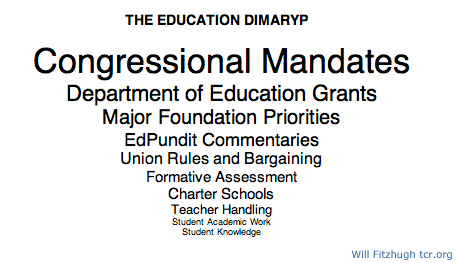
Share

When It Comes To Class Size, Smaller Isn’t Always Better

Andy Rotherham:

Budget cuts! Layoffs! Bigger classes! Oh my! Given the mini-Wisconsins erupting around the country, it’s not surprising that parents are worried about their children’s schools. At least 45 states will face some budget shortfall for the fiscal year that begins this July, according to The Center on Budget and Policy Priorities.
Last week the school board of Providence, Rhode Island gave pink slips to the city’s entire teaching force. Rumors of class sizes as large as 60 students circulated in Detroit.
Reality check: There will be teachers teaching in Providence next year. Similar sky-is-falling scenarios will be averted in Detroit and elsewhere, too. But that doesn’t mean that there will not be fewer teachers–and larger classes–in many places when school opens this fall. Secretary of Education Arne Duncan may well be right that scarce resources will be the “new normal” for schools.
The looming budget cuts are putting the question of class size front and center in local communities and the national education debate. A proposal to raise class sizes in Idaho by laying off more than 700 teachers led to protests around the state. Many other states and cities are considering changes to rules about class size.

Share

Fixing Struggling Schools

Arne Duncan:

Every day educators across the country are challenging the status quo and showing that low-performing schools can be turned around. Today, the President and I will visit Miami Central Senior High School to talk to some of those educators. Central has received nearly $800,000 in federal funding to support and accelerate turnaround efforts already underway.
Working with the school district and teachers union, Central promoted a strong school leader to be principal and replaced more than half the staff. It extended learning time after-school and during the summer, and engaged the community by offering Parent Academy classes for parents on graduation requirements and financial literacy. More than 80 percent of students are on free or reduced price lunch. Yet academic performance is steadily improving — and students and teachers are showing that a committed school can beat the demographic odds.
The burdens of poverty are real, and overcoming those burdens takes hard work and resources. But poverty is not destiny. Hundreds of schools in high-poverty communities are closing achievement gaps. America can no longer afford a collective shrug when disadvantaged students are trapped in inferior schools and cheated of a quality education for years on end.

Share

Dianne Ravitch On Daily Show: Testing And Choice Undermining Education

The Daily Show:

Last night on the Daily Show, Jon Stewart interviewed author, historian, and professor Dianne Ravitch on her new book “The Death and Life of the Great American School System.”
Ravitch argued that testing and choice are undermining America’s education system. She said that ever since the No Child Left Behind Act, “schools have been turned into testing factories.”
She also discussed how being a teacher has turned into a thankless job, and that teachers have become entirely demoralized. She stated that “the whole public monologue for the last couple of years has been ‘Blame the teachers for everything.'” Stewart agreed, noting that his mother worked in education for years.

Ravitch is scheduled to speak in Madison on March 8, 2011 @ 7:00p.m.

Share

NJEA officials warn against N.J. education chief’s plan to tie test scores to teacher evaluations

Ted Sherman:

Tying test scores to teacher evaluations could narrow curriculums in schools and reinforce teaching for the sake of passing a test, the New Jersey Education Association argued today, saying that plans by the Christie Administration to impose performance reviews based on how well students do on standardized tests were unworkable.
Last month, acting Education Commissioner Christopher Cerf unveiled a five-point reform proposal that would abandon New Jersey’s teacher job guarantee program and replace it with an evaluation system rewarding educators for good student performance and working in at-risk schools
Under the plan, the state’s public school teachers would be assessed and paid using a new rating system based in part on how their students do in the classroom.

Share

New York Democrat Governor Cuomo Seeks Speedy Change in Teacher Evaluations

Thomas Kaplan:

Gov. Andrew M. Cuomo said on Tuesday that he would introduce legislation to speed the implementation of a statewide system to evaluate teachers’ performance.
His announcement came minutes after the State Senate passed legislation sought by Mayor Michael R. Bloomberg that would reverse a rule protecting long-serving New York City teachers from layoffs regardless of their effectiveness.
Mr. Cuomo’s proposal would have far broader implications, affecting school districts across the state. But it would not affect the thousands of layoffs that Mr. Bloomberg maintains he will be forced to carry out because of cuts in state aid.
Rather, Mr. Cuomo is seeking to accelerate the introduction of new standards for teacher and principal evaluation that the state’s Education Department, with the support of teachers’ unions, has been developing since last year.

Share

Minn. Senate passes alternative teacher licensing

AP:

The Minnesota Senate has passed a bill that creates a new method of obtaining teacher licenses.
The alternative licensing plan is aimed at meeting projected teacher shortages in the future. It’s designed to give Minnesota schools an infusion of new, mostly young teachers who don’t attend traditional teaching colleges, and help close an achievement gap between white and minority students that’s one of the worst in the country.
Critics say it will harm schoolchildren by making it too easy to become a teacher. But the bill the Senate passed Thursday reflects a compromise between Gov. Mark Dayton and bill sponsors, and it’s expected to get his signature.

Related: Janet Mertz: An Email to Madison Superintendent Dan Nerad on Math Teacher Hiring Criteria

Share

Midwest union battles highlight debate over improving schools

Nick Anderson

The Republican faceoff with labor unions in the Midwest and elsewhere marks not just a fight over money and collective bargaining but also a test of wills over how to improve the nation’s schools.
Various GOP proposals to narrow labor rights, dismantle teacher tenure and channel public money toward private schools raise a question: Should states work with teacher unions to overhaul education or try to roll over them?
Like many Democrats, President Obama wants collaboration. He has preached teamwork with unions even as he pushes harder than any of his predecessors to get bad teachers out of schools and pay more to those who excel.
Here in Indiana, Gov. Mitch Daniels (R) shares many of Obama’s education goals. But Daniels, a possible 2012 presidential contender, and several of his Republican peers are pursuing reform through confrontation.

Share

Teachers Wonder, Why the Scorn?

Trip Gabriel:

The jabs Erin Parker has heard about her job have stunned her. Oh you pathetic teachers, read the online comments and placards of counterdemonstrators. You are glorified baby sitters who leave work at 3 p.m. You deserve minimum wage.
“You feel punched in the stomach,” said Ms. Parker, a high school science teacher in Madison, Wis., where public employees’ two-week occupation of the State Capitol has stalled but not deterred the governor’s plan to try to strip them of bargaining rights.
Ms. Parker, a second-year teacher making $36,000, fears that under the proposed legislation class sizes would rise and higher contributions to her benefits would knock her out of the middle class.
“I love teaching, but I have $26,000 of student debt,” she said. “I’m 30 years old, and I can’t save up enough for a down payment” for a house. Nor does she own a car. She is making plans to move to Colorado, where she could afford to keep teaching by living with her parents.

Whitney Tilson, via email:

This front page story in today’s NYT annoys the heck out of me because it’s missing one word in its title – it should read: “Teachers UNIONS Wonder, Why the Scorn?” The author presents NO evidence that Americans don’t cherish teachers other than a random placard and online comment. What Americans DO object to are unions using their enormous political influence to benefit their members while throwing kids under the bus – two great examples are the impossibility of firing even the most horrific teachers and doing layoffs purely by seniority. Checker Finn has it exactly right:

Chester E. Finn Jr., president of the Thomas B. Fordham Institute, a conservative-leaning education policy group, said the decline in teachers’ status traced to the success of unions in paying teachers and granting job security based on their years of service, not ability.
“They are reaping a bitter harvest that they didn’t individually plant but their profession has planted over 50 years, going from a respected profession to a mass work force in which everyone is treated as if they are interchangeable, as in the steel mills of yesteryear,” Mr. Finn said.

And why did the author quote the only young teacher in America who thinks it’s fair that he’s being laid off because he lacks seniority rather than doing it based on which teachers are best for kids? He could have easily quoted one of the Educators 4 Excellence teachers, for example:

Last month Mr. Tougher was notified that because of his lack of seniority, he will be laid off, or “excessed,” this year under the state’s proposed cuts to school aid. A union activist, he believes seniority-based layoffs are fair.
“The seniority part, I get that,” said Mr. Tougher, who is single. “While it would be a bummer if I were excessed for next year, that’s just how things go sometimes.”

Share

Wisconsin Governor Seeks Change in Reading Programs, Highlights dramatic fall in NAEP Performance

Matthew DeFour:

But the Department of Public Instruction (DPI) is questioning the legality of Walker’s proposal to fund the program through the Department of Administration.
Walker has proposed spending $600,000 in each of the next two years to implement recommendations of a new task force appointed by Walker that would develop a third-grade reading test. Walker noted Wisconsin’s performance on a national fourth-grade reading exam has fallen from third out of 39 states in 1994 to 30th out of 50 states in 2009.
“From kindergarten to third grade, our kids learn to read, and then from third grade on, they use reading to learn,” Walker said in his budget address. “We need to make sure every child can read as they move on from third grade.”

Related:

Share

Students Struggle for Words Business Schools Put More Emphasis on Writing Amid Employer Complaints

Diana Middleton:

Alex Stavros, a second-year student at the Stanford Graduate School of Business, had been pitching an eco-tourism luxury resort idea to potential investors for months, but wasn’t getting any bites.
He noticed that investors lost interest after the first few minutes of his presentation, and were slow to reply to emails. So Mr. Stavros enlisted the help of one of Stanford’s writing coaches for six weeks to help streamline his pitch. After the instruction, his pitch was whittled down to 64 words from 113, and he dropped three unnecessary bullet points.
“During my consulting career, each slide was a quantitative data dump with numbers and graphs, which I thought proved I had done the work,” he says. “Now, my presentations are simpler, but more effective.”

Share

Erasing Signatures From History

Jeffrey Zaslow:

In his 35 years as a high school English teacher in suburban Philadelphia, Thom Williams often encouraged his students to splash their most creative thoughts on the walls of his classroom.
Hundreds of students embraced his invitation, covering those painted cinderblocks with original art, quotes from favorite books, and deep thoughts born from teenaged angst.
“I looked to those walls for inspiration,” says 18-year-old Lauren Silvestri, a student of Mr. Williams’s at Marple Newtown High School in Newtown Square, Pa. Before graduating last year, she signed her name and a quote she loves. “It felt good to know I’d come back someday and my words on the wall would be there.”
Her words won’t remain for long, however. Mr. Williams died of cancer in December at age 63, and now the school is being renovated. That classroom’s walls are set to be demolished or painted over. “Thom was a free spirit who encouraged his students to be free spirits,” says Raymond McFall, the school’s principal. Still, “I can’t have everybody painting on the walls of the school.”

Share

Education ministers wobbly on ICT – ‘don’t get it’?

John Galloway:

The Coalition Government brought a big shift in ICT policy for education. From a position of active strategies, streams of guidance, heavy investment in connectivity, research and equipment, to a touch so light as to be barely perceptible.
The recent white paper, “The Importance of Teaching”, emphasises standards for frontline teaching, with ideas about what the curriculum might contain, but scant reference to how they might teach, or with what resources. ICT has one mention – in relation to procurement. This is no oversight. Why the big change? And a recurrent fear among those consulted is worrying – they simply don’t fully understand the importance of ICT.
A set of three simple questions were put to a number of leading figures involved in ICT for learning (the full set of questions and answers can be downloaded here) and three to schools minister Nick Gibb MP. While the Department for Education emphasised schools’ new freedoms (see below), the other responses raised a range of worries.

Share

It’s Time for a National Digital-Library System

David Rothman:

William F. Buckley Jr., my political opposite, once denounced the growing popularity of CD-ROM’s in student research. Shouldn’t young people learn from real books?
I disagreed. Why not instead digitize a huge number of books and encourage the spread of book-friendly tablet computers with color screens and multimedia capabilities? (Decades later, we have a version of that in the iPad.) Buckley loved my proposal (“inspiring”) and came out in the 1990s with two syndicated columns backing the vision. As a harpsichord-playing Yalie famous for political and cultural conservatism and cherishing archaic words, Buckley was hardly a populist in most respects. But he fervently agreed with me that a national digital library should be universal and offer popular content–both books and multimedia. The library should serve not just the needs of academics, researchers, and lovers of high culture.

Share

3rd grade field trip allowed access to Capitol building for lesson in civics

Gena Kittner:

While hundreds of protesters were forced to stay outside, 15 third-graders were admitted into the Capitol on Wednesday to complete their mission: Find out what democracy looks like.
“We’re not here to protest. We’re here to observe what other people are doing,” explained Suzanne Downey, a third-grader at Madison’s Lincoln Elementary who was part of the class field trip.
Accompanied by their teachers and chaperones, the students explored the Capitol’s ground floor, mingled with the remaining die-hard protesters, talked to police and “collected data” on what they saw and heard.
“We thought it would be best for them to see for themselves what was going on,” said Korinna McGowan, a student teacher at Lincoln. “We want to provide them with a real-life example and a real-life experience.”

Share

Labor union supporters say Wisconsin test scores vastly outpace those in five states without collective bargaining for teachers

Politifact.com:

With that question out of the way, we’ll take a look at the thornier question of how those five states’ test scores stack up nationally, and against Wisconsin in particular.
On Feb. 20, 2011, Angus Johnston, an adjunct assistant professor at the City University of New York, published a comprehensive analysis of this question on his blog. He published links to a chart that appears to have been the inspiration for the tweets and Facebook postings. It offers a state-by-state analysis of scores on the SAT and the ACT, the two leading college-admissions tests, assembled by University of Missouri law professor Douglas O. Linder.
Johnston is critical of Linder’s methodology for a variety of reasons, which he explains in more detail here. But without even taking those concerns into account, we find the statistics unreliable. They were published in 1999, meaning that the statistics themselves are likely more than a dozen years old — far too old to be presumed valid in 2011.
Fortunately, it’s possible to obtain state-by-state rankings for the SAT and ACT of a more recent vintage. Here’s a table of the relevant states:

Share

Bill Gates Addresses Governors on Improving Education

cspan:

The National Governors Association concluded its 3-day winter meeting today with an address by Microsoft Chairman Bill Gates. Governors from across the country gathered to discuss issues facing states, including job creation and providing education that prepares workers to compete in a global market.
Today’s closing session focused on “Preparing to Succeed in a Global Economy.” Gates talked about the efforts of the Bill and Melinda Gates Foundation to improve education and how education is imperative to remaining competitive in a global economy.
This morning, the Governors were at the White House to meet with President Obama. He discussed with them the ongoing state and federal budget situation as well as the implementation of the health care law. In remarks, the President said that he is open to new ideas on how to lower the cost of health care and the burden on the states, but the quality of care cannot suffer.

Gates notes that US per pupil spending has doubled in the past 20 years and yet the outcomes have not changed that much. Gates advocates “flipping these curves”, essentially spending the same and doing much more.
Gates also noted the decline in the amount of time teachers spend teaching (adult to children) accompanied by an increase in adult staffing levels over the past 20 years.

Share

K-12 Tax & Spending Climate: Race to the Bottom?

Walter Russell Mead:

But America shouldn’t compete on the basis of cheap labor: we are not nor should we try to be the Walmart of Work. So the first question becomes how do we compete in ways that don’t involve endlessly ratcheting down wages and benefits? And the second, related question is how can we generate enough demand for American workers so that market forces drive incomes up from year to year and decade to decade?
The key to success is obvious: we need to continue to raise productivity throughout the economy. If productivity goes up quickly enough, wages can rise here even if they are falling elsewhere. This is getting harder; productivity is both easier to measure and to raise in manufacturing than in services. But substituting capital and technology for human sweat has to be a large part of what we do.
To raise productivity significantly, and especially to do it in ways that give us some long term advantages, we are going to have to do more about productivity in services. In particular we are going to have to look at health, government, education and the legal industry. Health care accounts for 18% of our GDP; education for 7%, and government spending (federal, state and local) accounts for 40%. (Because a lot of government spending goes to health and education, the total from these sectors is closer to 45% of GDP than 65%.)

Share

Changes Schools Should Make to Better Serve Students: A Student’s View

Adora Svitak
My mom once asked me about the first steps I would hypothetically take to make a “better school.” I don’t claim to be an education expert, but I do have personal opinions about the ideal school — one I’d like to go to. Among many other things, I said that I would change school starting times, improve cafeteria lunches, and bring back recess. These would be good first steps because they help a lot of students a little bit. And they can have wide-reaching impacts.
Starting Times
Studies have repeatedly shown that everyone, especially children with developing brains, need a good amount of high-quality sleep. It’s difficult to get when you have to worry about waking up at 7 in the morning to go to school. Not everyone is a morning lark, and by starting school so early, not only students but also educators have to stave off yawns throughout the day.
I was at a conference where a well-respected sleep researcher, Dr. James Maas, revealed that adolescent sleep cycles tend to begin at 3 a.m. and end at 11 a.m. Yet we’re starting school at 7 or 7:30 a.m. While I wouldn’t quite change school start times to 11 a.m. (since we have to consider parents who have to go to work), I think it would be reasonable to move them to 8:45 AM or after. Then hypothetically a teenager could go to bed at 12 a.m. (as many often do), wake up at 8, shower and eat breakfast, and go to school with eight rather than five or six hours of sleep.
Lunch
Another step: improve cafeteria lunches. Put a cap on the amount of sodium, fat, and calorie content allowed in each lunch. Mandate nonfat or 1 to 2 percent milk (and in smaller containers — who really drinks that much milk?) instead of whole milk. Get rid of chocolate milk, soft drinks, and vending machines with unhealthy items. Require a certain percentage of food served be organic and/or local, and have smaller portions to help minimize cost (we all know how much food gets dumped out). Have the school’s cooking classes (or maybe the entire student body) help make lunch on certain days.
A bigger step: I think it would be a good idea to have randomly assigned seating during lunch. This might be controversial among students, but the social division that occurs when students simply pick out where they want to sit can be hurtful and exclusive to students new to the school or children with difficulty making friends. Also, it seems that teachers rarely eat lunch and converse with the students. I’ve learned a lot from being able to have conversations with adults. So, teachers would be required to eat lunch with the students — at least on certain days — (and really, if they really can’t stand students to the extent that they can’t eat with them, should they be teaching?)

(more…)

Share

Inside the multimillion-dollar essay-scoring business

Jessica Lussenhop:

Dan DiMaggio was blown away the first time he heard his boss say it.
The pensive, bespectacled 25-year-old had been coming to his new job in the Comcast building in downtown St. Paul for only about a week. Naturally, he had lots of questions.
At one point, DiMaggio approached his increasingly red-faced supervisor at his desk with another question. Instead of answering, the man just hissed at him.
“You know this stuff better than I do!” he said. “Stop asking me questions!”
DiMaggio was struck dumb.
“I definitely didn’t feel like I knew what was going on at all,” he remembers. “Your supervisor has to at least pretend to know what’s going on or everything falls apart.”
DiMaggio’s question concerned an essay titled, “What’s your goal in life?” The answer for a surprising number of seventh-graders was to lift 200 pounds.

Share

New York Democrat Governor Andrew Cuomo and the unions: The governor’s showdown is more subtle

The Economist:

IN 1975, when New York City teetered toward bankruptcy, Hugh Carey, then the governor of the state of New York, convinced the teachers’ union to invest a significant amount of its pension funds in bail-out bonds. He also persuaded District Council 37 to shelve pay increases for its municipal workers. The unions played a crucial role in saving the city and probably the state with it. Thirty-five years later, during his gubernatorial campaign, Andrew Cuomo gave copies of “The Man Who Saved New York”, an account of Mr Carey’s role in the crisis, to labour leaders. Seymour Lachman, the book’s co-author, reckons that, like Mr Carey, Mr Cuomo wants and needs the unions’ help in surviving the current crisis.
Facing a $10 billion deficit, Mr Cuomo campaigned on pension reform, making it clear he was going to target public-sector unions and sounding more like his Republican neighbour across the Hudson, Chris Christie, than a Democrat. Mr Christie stirred up a lot of headlines when he took on the unions, most recently calling them greedy, selfish and self-interested. Mr Cuomo is less vitriolic, but no less adamant that he wants the unions to do their part. During his budget address on February 1st, in which he declared the state to be “functionally bankrupt”, he called on the state’s public-sector unions to make $450m in concessions. He threatened, as a “last resort”, to lay off up to 9,800 state workers to get the savings needed.

Share

Is America’s best high school soft on math?

Jay Matthews:

By all accounts, he is one of the best math teachers in the country. The Mathematics Association of America has given him two national awards. He was appointed by the Bush administration to the National Mathematics Advisory Panel. For 25 years he has prepared middle-schoolers for the tough admissions standards at Thomas Jefferson High School for Science and Technology, the most selective high school in America.
Yet this year, when Vern Williams looked at the Jefferson application, he felt not the usual urge to get his kids in, but a dull depression. On the first page of Jefferson’s letter to teachers writing recommendations, in boldface type, was the school board’s new focus: It wanted to prepare “future leaders in mathematics, science, and technology to address future complex societal and ethical issues.” It sought diversity, “broadly defined to include a wide variety of factors, such as race, ethnicity, gender, English for speakers of other languages (ESOL), geography, poverty, prior school and cultural experiences, and other unique skills and experiences.” The same language was on the last page of the application.
“This is just one example of why I have lost all faith in the TJ admissions process,” Williams said. “In fact, I’m pretty embarrassed that the process seems no more effective than flipping coins.”

Share

New Berlin teen with Asperger’s finds he belongs on the stage

Laurel Walker:

When Judy Smith was looking for someone to play the central role of stage manager in “Our Town,” the classic Thornton Wilder play about life in small-town America, she wasn’t expecting to cast a boy with Asperger’s syndrome.
Yet when 14-year-old Clayton Mortl auditioned more than six weeks ago, Smith said she experienced a director’s “quintessential moment.” He was perfect for the role.
Legendary actors like Paul Newman have brought powerful performances to the play – a staple of Broadway, community theater and classrooms since its 1938 debut, said Smith, the performing arts center manager and theater arts adviser at New Berlin West Middle / High School.
But when the 18-member middle school cast takes the stage Thursday, at 10 a.m. and 7 p.m., Clay’s performance may be legendary in its own right.
Though everyone is different, people with Asperger’s – an autism spectrum disorder – have impaired ability to socially interact and communicate nonverbally. Their speech may sound different because of inflection or abnormal repetition. Body movements may not seem age appropriate. Interests may be narrowly focused to the extent that common interests aren’t shared.

Share

Indiana Statehouse focus now on schools

Kevin Allen:

Labor bills and union protesters drew most of the attention at the Indiana Statehouse last week, as Democrats in the House of Representatives walked out and headed to Illinois to block Republicans from conducting business.
But the other half of the stalemate is over wide-ranging education reform that could change where Indiana children go to school, how their teachers are evaluated, and the formula for funding the system that uses about half of Hoosiers’ state tax dollars.
Democrats say Republicans are trying to dismantle public education. Republicans say Democrats are just protecting teachers unions.

Share

Charter school effort stirs fight in N.Y. district

Fernanda Santos

The guests sipped wine and nibbled sushi, guacamole and Gruyere – lawyers, bankers, preschool teachers, managers and consultants of various kinds, bound together by the anxious decision they must confront in the months ahead: where their 4-year-olds will go to school in the fall.
Downstairs, a flyer by the doorman’s desk had greeted them with a provocative question: “Why should you have to spend college tuition on kindergarten?” Back upstairs, in the stylish apartment on West 99th Street, Eva S. Moskowitz, a former City Council member who runs a network of charter schools in Harlem and the Bronx, delivered a tantalizing sales talk.
“Middle-class families need options too,” she said.
But Moskowitz is trying to expand her chain into a whole new precinct of the city, the relatively well-off Upper West Side. And outside the parties she has organized to drum up interest, the reaction has been anything but warm from the neighborhood’s stridently anti-charter political establishment.

Share

Washington should stick to proven state math standards

Clifford Mass:

IF our state Legislature takes no action this session, Washington state will drop its new, improved math standards for an untested experiment: Common Core “national” standards that have never been used in the classroom and for which assessments have yet to be developed.
And there is a high price tag for such a switch, an expense our state can ill afford. Surprisingly, one of the most profound changes in U.S. education in decades has been virtually uncovered by the national media.
Until two years ago, our state had some of the worst math standards in the country, rated “F” by the Fordham Foundation, and lacking many of the essentials found in standards used by the highest-performing nations. That all changed in 2008, when under the impetus of the state Legislature, a new set of standards, based on world-class math requirements, was adopted.

Share

American Teaching Standards: Don’t know much about history

The Economist:

Many states emphasise abstract concepts rather than history itself. In Delaware, for example, pupils “will not be expected to recall any specific event or person in history”. Other states teach children about early American history only once, when they are 11. Yet other states show scars from the culture wars. A steady, leftward lean has been followed by a violent lurch to the right. Standards for Texas, passed last year, urge pupils to question the separation of church and state and “evaluate efforts by global organisations to undermine US sovereignty through the use of treaties”.
Some states fare better. South Carolina has set impressive standards–for example, urging teachers to explain that colonists did not protest against taxation simply because taxes were too high. Other states, Mr Finn argues, would do well to follow South Carolina’s example. “Twenty-first century skills” may help pupils become better workers; learning history makes them better citizens.

Related: The State of State U.S. History Standards 2011: Wisconsin = F.

Share

Can parents effectively reclaim duties after funding cuts?

Alan Borsuk:

This is a boom time for parental choice in education. Frankly, that’s pretty scary to me.
I’m not talking about the school voucher program or charter schools, or other things like that.
I’m talking about the choices parents make in how they raise their children – how they can do (or not do) things that maximize the chances of their children becoming well-educated, well-balanced, constructive adults.
Since, say, the 1960s, expectations have grown for schools to take care of an increasing range of children’s needs. That goes for academics, of course, but also for social development, recreation, mentoring and, in many cases, providing nutrition, clothing and some basics of health care. That’s especially true for schools serving low-income kids, but you’d be surprised how often it is true in all schools.
I believe that one of the things we are seeing in the continuing chaos in Madison is that the tide is cresting for schools to play such roles. Teachers and staff members are simply going to be unable to do some of the things they’ve done to make up for what parents aren’t doing.

Share