School Information System

India Graduates Millions, but Too Few Are Fit to Hire

Geeta Anand:

Call-center company 24/7 Customer Pvt. Ltd. is desperate to find new recruits who can answer questions by phone and email. It wants to hire 3,000 people this year. Yet in this country of 1.2 billion people, that is beginning to look like an impossible goal.
So few of the high school and college graduates who come through the door can communicate effectively in English, and so many lack a grasp of educational basics such as reading comprehension, that the company can hire just three out of every 100 applicants.
India projects an image of a nation churning out hundreds of thousands of students every year who are well educated, a looming threat to the better-paid middle-class workers of the West. Their abilities in math have been cited by President Barack Obama as a reason why the U.S. is facing competitive challenges.

Share

How the System Ensures Teacher Quality

Stuart Buck:

As we have seen in the past, teacher licensing requirements have little relation to student achievement. One reason for this may be that rather than driving up teacher quality, licensure requirements can be so full of bureaucratic red tape that they drive away smart and knowledgeable teaching candidates who have other options.
In support of that theory, I offer an anecdote, namely an email from a good friend of mine who has more knowledge and training than most prospective teachers — she went to Princeton for undergrad, Yale for a master’s degree, and Harvard for law school. But before she can even get in the door and start studying pedagogical techniques and the like, she is being told that she has to take nine (9) more undergraduate courses of background knowledge.

Share

Gov. Christie creates task force to review N.J. education rules

Ginger Gibson:

Gov. Chris Christie created a committee today that will be tasked with reviewing all of the state’s education regulations.
The task force will return recommendations to eliminate regulations which take decision-making power away from the local districts, Christie said.
“What I want to have happen here is to return more of the power back to school districts and less from the central office in Trenton, so that we can encourage people to innovate,” Christie said. “We’ve gotten into a pattern over the course of time with increasing money coming from Trenton over the last 20 to 25 years years with increasing regulation coming from Trenton. I don’t think that’s the best way for us to go at transforming education.

Share

Kids Do More With Arts Education: Closing the Achievement Gap By Increasing Social Assets

Kristen Paglia:

The great secret, Eliza, is not having bad manners or good manners… but having the same manner for all human souls. In short, behaving as if you were in Heaven, where there are no third-class carriages, and one soul is as good as another.
Professor Henry Higgins says this to Eliza Doolittle in George Bernard Shaw’s 1912 play, Pygmalion. He has wagered that he can pass Eliza, a “lowly” flower girl, for a society lady by teaching her how to speak and behave properly. Higgins is successful, Eliza does pass, but her acceptance into the social elite came as much from her newly found self-esteem, as her style and manner.
The idea that “social assets” can help kids get ahead and do more in the world isn’t a new one. Social assets aren’t about money, but the stuff that comes with money. Things like knowing about fine art, current events, fashion, design, even food and wine. These are the social markers that give away what part of town you live in, where you go to school, and what your parents do for a living. In the last forty years the concept of social assets has been widely recognized in educational research as a major factor in where, or if, kids go to college, and how much they’ll earn over their lifetimes.

Share

In World of Education Apps, Tech Owes Teachers Some Media Literacy

Jessica Prois:

As a former high school English teacher, I used to have a pretty constricted view when attending continuing education workshops. Like most teachers, I thought: How can this help my school and students? Now, as a HuffPost Education editor reporting at the recent Digital Media and Learning Conference in Los Angeles, I got to think big in terms of the newest education ideas and who they affect. And there was lots to take note of.
The conference was a mix of educators, reformers and software developers who spent three days bouncing around theories, policies and practices on the best ways to use technology in the classroom. Diligent teachers tuned in by taking notes on their iPads and updated grades on their smartphones — all while discussing how best to use these platforms in their curriculum.

Share

Pioneer of ballet wants girls to have more choices

Amy Nip:

Being born female set sometime actress Christine Liao on the road to a career in ballet, but it could all have been so different.
Growing up in a traditional, male-dominated environment, the founder of the Christine Liao School of Ballet and the Hong Kong Ballet Company may never have had such an impact on the art form had she not seen other career paths blocked.
And that’s precisely why she is backing a new campaign called “Because I am a Girl”, which will promote the rights of girls.
Liao began dancing when she was eight and, at the age of 19, she became a film actress using the stage name Mao Mei, and starred in eight films from 1955 to 1962. After graduating from the University of Hong Kong with a degree in languages and literature, she turned her back on the silver screen and considered becoming a lawyer or working in an office.

Share

A new school in Sai Kung will be a model for sustainable design and education in Hong Kong

Viv Jones:

No longer the preserve of tree-huggers, the trend for sustainable design is gaining momentum as more people opt for homes and buildings created using renewable resources that don’t cost the earth, literally. No wonder – these buildings use less energy, cost less to operate, use fewer natural resources and have less of an impact on the environment than their conventional counterparts.
Hong Kong Academy’s green school, which opens in Sai Kung in 2013, is part of a new era in sustainable architecture in our city, says Josh Arnold, who teaches middle school science, maths and design technology at HKA.

Share

Choice Schools Do Pay Off

Patrick McIlheran:

The striking bit of news out of that ongoing study comparing private and public schools in Milwaukee is this: Researchers aren’t yet sure how, but the private schools are better at getting kids across the finish line.
This is one bright spot in a report otherwise showing that children using Milwaukee’s school choice program were doing only about as well as Milwaukee Public Schools kids on state tests. The study, by independent university researchers, is following two sets of children, matched for background and poverty, to see which system does a better job of improving their scores on math and reading tests. So far, say researchers, there’s no statistically significant difference.
But the study’s oldest students have reached graduation age. There, say researchers, there is a difference. Children in choice schools were notably more likely to graduate from high school. Just among those who spent ninth grade taking their state aid to a private school in the form of a voucher, 77% graduated in four years; 69% of MPS kids did.
Among students who spent all four years in a choice school, 94% graduated on time; 75% of kids who stayed in MPS all four years did.

Much more on the Milwaukee Parental Choice program, here.

Share

MISSED ADJUSTMENTS and OPPORTUNITIES RATIFICATION OF Madison School District/Madison Teachers Collective Bargaining Agreement 2011-2013

The Madison Metropolitan School District Board of Education and the Madison Teachers, Inc. ratified an expedited Collective Bargaining Agreement for 2011-2013. Several significant considerations were ignored for the negative impact and consequences on students, staff and taxpayers.
First and foremost, there was NO ‘urgent’ need (nor ANY need at all) to ‘negotiate’ a new contract. The current contract doesn’t expire until June 30, 2011. Given the proposals regarding school finance and collective bargaining processes in the Budget Repair Bill before the legislature there were significant opportunities and expectations for educational, management and labor reforms. With such changes imminent, there was little value in ‘locking in’ the restrictive old provisions for conducting operations and relationships and shutting the door on different opportunities for increasing educational improvements and performances in the teaching and learning culture and costs of educating the students of the district.
A partial listing of the missed adjustments and opportunities with the ratification of the teacher collective bargaining agreement should be instructive.

  • Keeping the ‘step and advancement’ salary schedule locks in automatic salary increases; thereby establishing a new basis annually for salary adjustments. The schedule awards increases solely on tenure and educational attainment. This also significantly inhibits movement for development and implementation of ‘pay for performance’ and merit.
  • Continues the MOU agreement requiring 50% of teachers in 4-K programs (public and private sites combined) to be state certified and union members
  • Continues required union membership. There are 2700 total or 2400 full-time equivalent (FTE) teachers, numbers rounded. Full-time teachers pay $1100.00 (pro-rated for part-time) per year in automatic union dues deducted from paychecks and processed by the District. With 2400 FTE multiplied by $1100 equals $2,640,000 per year multiplied by two years of the collective bargaining unit equals $5,280,000 to be paid by teachers to their union (Madison Teachers Inc., for its union activities). These figures do not include staff members in the clerical and teacher assistant bargaining units who also pay union dues, but at a lower rate.
  • Continues to limit and delay processes for eliminating non-performing teachers Inhibits abilities of the District to determine the length and configuration of the school day, length and configuration of the school year calendar including professional development, breaks and summer school
  • Inhibits movement and placement of teachers where needed and best suited
  • Restricts adjustments to class sizes and teacher-pupil ratios
  • Continues very costly grievance options and procedures and litigation
  • Inhibits the District from developing attendance area level teacher/administrator councils for collaboration in problem-solving, built on trust and relationships in a non-confrontational environment
  • Continues costly extra-duties and extra-curricular agreements and processes
  • Restricts flexibility for teacher input and participation in professional development, curriculum selection and development and performance evaluation at the building level
  • Continues Teacher Emeritus Retirement Program (TERP), costing upwards to $3M per year
  • Does not require teacher sharing in costs of health insurance premiums
  • Did not immediately eliminate extremely expensive Preferred Provider (WPS) health insurance plan
  • Did not significantly address health insurance reforms
  • Does not allow for reviews and possible reforms of Sick Leave and Disability Leave policies
  • Continues to be the basis for establishing “me too” contract agreements with administrators for salaries and benefits. This has impacts on CBAs with other employee units, i.e., support staff, custodians, food service employees, etc.
  • Continues inflexibilities for moving staff and resources based on changes and interpretations of state and federal program supported mandates
  • Inhibits educational reforms related to reading and math and other core courses, as well as reforms in the high schools and alternative programs

Each and every one of the above items has a financial cost associated with it. These are the so-called ‘hidden costs’ of the collective bargaining process that contribute to the over-all costs of the District and to restrictions for undertaking reforms in the educational system and the District. These costs could have been eliminated, reduced, minimized and/ or re-allocated in order to support reforms and higher priorities with more direct impact on academic achievement and staff performance.
For further information and discussion contact:
Don Severson President
Active Citizens for Education
donleader@aol.com
608 577-0851
100k PDF version

Share

It’s time for schools to focus on quality, not politics or structure

Alan Borsuk:

I’m tired of talking about systems and governance and structures for education. If we’ve proved anything in Milwaukee, we’ve proved that these things make less difference than a lot of people once thought.
Since 1990, Milwaukee has been one of the nation’s foremost laboratories of experimentation in school structures. This has been driven by hope (some national experts used the word panacea) that new ways of creating, running and funding schools would bring big progress.
A ton of data was unloaded during the last week, including test results from last fall for every school in Wisconsin, a new round of studies comparing performance of students in Milwaukee’s publicly funded private school voucher program with Milwaukee Public Schools students and – for the first time – school-by-school test results for those voucher schools.
And what did I learn from all this?
1.) We’ve got big problems. The scores, overall, were low.
2.) We’re not making much progress overall in solving them.
3.) Schools in all three of the major structures for education in Milwaukee – MPS, voucher schools and charter schools – had about the same overall results.
4.) Some specific schools really did much better than others, even when dealing with students with much the same backgrounds as those in schools that got weaker results.
In my dreams, all of us – especially the most influential politicians, policy-makers and civic leaders – focus a lot more on the fourth point than we have been doing.

Related: Ripon Superintendent Richard Zimman’s 2009 speech to the Madison Rotary Club:

Zimman’s talk ranged far and wide. He discussed Wisconsin’s K-12 funding formula (it is important to remember that school spending increases annually (from 1987 to 2005, spending grew by 5.10% annually in Wisconsin and 5.25% in the Madison School District), though perhaps not in areas some would prefer.
“Beware of legacy practices (most of what we do every day is the maintenance of the status quo), @12:40 minutes into the talk – the very public institutions intended for student learning has become focused instead on adult employment. I say that as an employee. Adult practices and attitudes have become embedded in organizational culture governed by strict regulations and union contracts that dictate most of what occurs inside schools today. Any impetus to change direction or structure is met with swift and stiff resistance. It’s as if we are stuck in a time warp keeping a 19th century school model on life support in an attempt to meet 21st century demands.” Zimman went on to discuss the Wisconsin DPI’s vigorous enforcement of teacher licensing practices and provided some unfortunate math & science teacher examples (including the “impossibility” of meeting the demand for such teachers (about 14 minutes)). He further cited exploding teacher salary, benefit and retiree costs eating instructional dollars (“Similar to GM”; “worry” about the children given this situation).

I appreciate and approve of Borsuk’s sentiment.

Share

Autism sufferer Lo Yip-nang found a way to express himself through art – and his work is dazzling thousands

Oliver Chou:

A joyful kaleidoscope in clay, Lo Yip-nang’s display of intricate patterns in jewel tones entranced thousands of people who visited his exhibition at the Jockey Club Creative Art Centre in Shek Kip Mei. Although many were eager to talk to the artist, he kept working with his slivers of coloured clay, giving monosyllabic replies to queries.
“You’ve been working all day; are you tired?” asks one woman. “No,” he says after a long pause. “People like your work, does that make you happy?” asks another. “Yes.”
Lo wasn’t playing the temperamental artist, though. The 30-year-old is autistic and his two-week exhibition last month is a personal triumph – and a sign of hope that people with the disability can live independently.
Autism stems from glitches in neurological development that cause sufferers to be socially impaired. Unable to interpret what people are expressing or to communicate how they feel, they typically become engrossed with specific objects instead or find comfort in repetitive behaviour and routine. But Lo, or Nang as he is affectionately known, is a rare autistic person who found a way to express himself.

Share

Education commissioner calls for compromise in Minnesota K-12 bills

Tom Weber:

Education Commissioner Brenda Cassellius said Friday that the Dayton administration and the Republican-controlled Legislature have some work ahead of them to reach some compromise on the education funding bills that passed at the Capitol this week.
The proposals would boost the basic per-pupil funding. But it freezes spending for special education and other funding that goes primarily to the Minneapolis, St. Paul and Duluth districts.
One example is aid that’s distribute based on how concentrated poverty is in a school building. Cassellius says cutting that funding would hurt the most vulnerable students.
“It’s really a realization of not understanding the difficult nature of concentrations of poverty, and the difficulty to meet the needs of all children and all the challenges that are there,” she said.

Share

Another brand of Bush school reform: Jeb’s

Nick Anderson:

The president who turned No Child Left Behind from slogan into statute is gone from Washington, and the influence of his signature education law is fading. But another brand of Bush school reform is on the rise.
The salesman is not the 43rd president, George W. Bush, but the 43rd governor of Florida, his brother Jeb.
At the core of the Jeb Bush agenda are ideas drawn from his Florida playbook: Give every public school a grade from A to F. Offer students vouchers to help pay for private school. Don’t let them move into fourth grade unless they know how to read.
Through two foundations he leads in Florida and his vast political connections, Jeb Bush is advancing such policies in states where Republicans have sought his advice on improving schools. His stature in the party and widening role in state-level legislation make him one of the foremost GOP voices on education.

Share

Seven Stumbling Blocks for Madison Prep

Madison School Board Member Ed Hughes:

The Madison School Board’s recent consideration of the Urban League’s application for a planning grant from DPI for the Madison Preparatory Academy for Young Men prompted me to dig deeper into the issues the charter school proposal raises. I have several concerns – some old and some new – that are described below.
I apologize for the length of this post. It kind of turned into a data dump of all things Madison Prep.
Here are the seven areas of concern I have today about the Madison school district agreeing to sponsor Madison Prep as a non-instrumentality charter school.
1. The Expense.
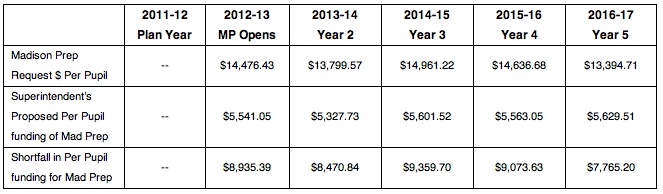
As I have written, it looks like the roughly $14,500 per student that Madison Prep is seeking from the school district for its first year of operations is per nearly twice the per-student funding that other independent and non-instrumentality charter schools in the state now receive.
Independent charter schools, for example, receive $7,750 per-student annually in state funding and nothing from the local school district. As far as I can tell, non-instrumentality charter schools tend to receive less than $7,750 from their sponsoring school districts.
It seems that the Madison Prep proposal seeks to pioneer a whole new approach to charter schools in this state. The Urban League is requesting a much higher than typical per-student payment from the school district in the service of an ambitious undertaking that could develop into what amounts to a shadow Madison school district that operates at least a couple of schools, one for boys and one for girls. (If the Urban League eventually operates a girl’s school of the same size as projected for Madison Prep, it would be responsible for a total of 840 students, which is a larger total enrollment than about 180 school districts in Wisconsin can claim.)
What about the argument that Madison Prep does not propose to spend any more on a per-student basis than the Madison school district already spends? There are a couple of responses. First, MMSD does not spend $14,500 per student on in-school operations – i.e., teachers, classroom support, instructional materials. The figure is more like $11,000. But this is not the appropriate comparison.

Much more on the proposed IB Charter school: Madison Preparatory Academy, here.

Share

UW Ed School Dean and WPRI President on the Recent School Choice Results

Julie Underwood:

The release of the results of the Wisconsin Knowledge and Concepts Exam, the standardized test that every state public school is required to give, is a rite of spring for Wisconsin schools.
Distributed every year, the WKCEs provide educators, parents and community members with information about how well schools and districts are performing, broken down by subject and grade level.
The WKCEs are used alongside other measures to determine where schools are falling short and what is working well. For parents with many different types of educational options from which to choose, the WKCEs allow them to make informed choices about their child’s school. For taxpayers, the tests provide a level of transparency and demonstrate a return on investment.
But while state law requires all public schools to give the WKCEs, not all publicly funded schools are required do to so. Since its inception 20 years ago, the Milwaukee Parental Choice Program has been virtually without any kind of meaningful accountability measures in place. Choice schools have not been required to have students take the WKCEs. That is, until this school year.

George Lightbourn:

We have all done it at one time or another — opened our mouth before engaging our brain.
State Rep. Sondy Pope-Roberts, D-Middleton, just had one of those moments. In reacting to the news that, on average, students attending schools in the Milwaukee Parental Choice program performed about the same or slightly below students in Milwaukee Public Schools, she said taxpayers are being “bamboozled” and the program is “a disservice to Milwaukee students.”
Whoa! Had she taken a moment to think before she spoke, here are a few things that should have occurred to her:
• Those private schools are performing about as well at educating Milwaukee children as the public schools — at half the cost. Public funding for each child in the choice program costs taxpayers $6,442 while each child in Milwaukee Public Schools receives taxpayer support of over $15,000. If all of the 21,000 choice students moved back into Milwaukee Public Schools, that would require a $74 million increase in local property taxes across the state, according to the Legislative Fiscal Bureau.

Much more, here.

Share

Phelps, WI eight grader will represent state in National Geographic Bee

Ron Seely:

Thirteen-year-old Robert Rosner is in eighth grade in Phelps, Wis. — pop. 1,400. There are seven students in his class in the small, Northwoods village near the Michigan state line.
But on the walls of his bedroom, Robert has taped National Geographic maps that carry him to landscapes far beyond the woodsy confines of Phelps. Every night, before he sleeps, he stares at the maps and travels to places he’s never seen, according to his mother, Donna.
Friday, Robert mustered all he has learned from those imaginary journeys to win the state National Geographic Bee and a very real trip to Washington, D.C., where in May he will compete against 49 other students who have advanced from their own state contests to the national geography competition.
Robert plowed through tough questions on everything from tectonic plates beneath South America to tunnels in Norway and crocodiles in Mauritania to best more than 100 other elementary and middle school students from around Wisconsin in the annual contest. He seemed cool and confident throughout, unlike his mother.

Share

An Interview with Jackson school board candidate Nicolas Antonoff

Jtown:

Why are you running for a seat on the Jackson Schools Board of Education?
When we bought our home in Jackson (only the second purchase in my thirty plus years of rather hectic service in the “Military-Industrial Complex”, helping fight and win the Cold War in all its versions across nearly half the lower 48 states), my wife and I found ourselves stakeholders in the Jackson Enterprise , both divisions – educational (60 percent) and municipal (40 percent). After observing the rapid deterioration in the management of both from the relatively peaceful days of the late 1990′s (zero increase in the school tax rate and an equally steady municipal tax rate) I took an active interest in the operation of the increasingly dysfunctional Board of Education (BoE). Of special interest is the BoE’s stubborn and inflexible operating principle that “education” improvement is inevitable if you just shovel sufficient millions of dollars into the bottomless maw of the educator cadres (NJEA Jackson cell in cahoots with the School Administration), eventually some of that will stick. Ending this mind set is my overriding objective.
How do you feel your presence on the school board can benefit education in Jackson?
What passes for a proper education, to be fair, not just in Jackson, is the fostering in the Trophy Kids generation students of a conviction of entitlement and victimization if they are not pampered at every turn(expect to get a medal or commendation of some sort for just showing up on time ). Other countries, our main competitors, teach that students have an obligation to learn in return for the privilege, not the right, granted them . That is their duty to their parents and the nation, and ultimately themselves. That is why our pampered students get their clock cleaned in international math and science competitions, year after bloody year. My contribution to education in Jackson will flow from my thirty years of experience of overseeing and executing the staffing of programs in often way-off-the-road places demanding the hiring on tight schedules of large numbers (hundreds) of often ill-prepared junior engineers with king-sized salary expectations. Thank God for the availability of retiring US Army trained senior noncoms and warrant officers – they always save the contract and know how to run an mission to meet assigned objectives.

Share

Vouchers Aren’t the Answer

Lisa Kaiser:

Today the Department of Public Instruction (DPI) released new results for the statewide exam.
Not surprising to those who have been paying attention, Milwaukee Public Schools (MPS) did better than schools in the Milwaukee Parental Choice Program (MPCP), otherwise known as the voucher program.
Overall, MPS had 47.8% of its students scoring as proficient in math, with 59% proficient in reading.
Among economically disadvantaged kids, MPS scored 43.9% in math and 55.3% in reading.
Those scores are lower for students in the voucher program–all of whom are economically disadvantaged, although that could change if Gov. Scott Walker has his way and opens up the program to middle-class and wealthy kids. Only 34.4% of voucher students scored proficient in math, while 55.2% were proficient in reading, about the same as MPS.

Share

East Valley, WA district moving to K-8 schools

Lisa Leinberger:

The East Valley School District is asking voters to approve a $33.75 million school construction bond on April 26. The bond will be used to expand and renovate its primary schools.
But the issue many are debating is the district’s decision to eliminate its middle schools and turn its elementary schools into kindergarten through eighth grade schools, regardless of bond approval.
It’s a model that’s being considered across the country. Districts in Massachusetts, Pennsylvania, Ohio, Tennessee, Oklahoma, Maryland and New York – including the large urban areas of Cincinnati, Cleveland, Philadelphia and Baltimore – are moving toward K-8 schools.

Share

What is a Charter School? And what does it have to do with you?

Kathleen Vinehout:

“I’ve heard of charter schools,” the woman told me. “But I really don’t know understand them.” People are not familiar with schools often run by a private group but using taxpayer dollars.
Imagine a school created with a business-like contact or “charter”. This charter sets it own rules for the school and exempts it from the usual rules about classes, staff, budgeting and administration.
Many charter schools are created and run by local school districts but some are independent charters. Cost to local school districts for these independent schools this year was almost $60 million statewide. In our Senate District, school districts will pay an estimated $1.3 million in the next two years for these independent charter schools.

Share

Executive Order #22: Read to Lead Task Force

Wisconsin Governor Scott Walker, via a kind reader’s email:

EXECUTIVE ORDER # 22
Relating to the Creation of the Governor’s
Read to Lead Task Force
WHEREAS, the number one priority for children in grades kindergarten through third grade is to learn to read; and
WHEREAS, one third of all Wisconsin students cannot read at a basic level and two thirds of all African American students in our state cannot read at a basic level, which is the lowest rate in the nation; and
WHEREAS, in approximately ten years, Florida, through state reading law reforms, has improved from one of the lowest ranked states in the nation to one of the highest and in doing so achieved a much smaller racial achievement gap than Wisconsin; and
WHEREAS, it is critical to have initiatives that will empower teachers, districts, and parents–not lawmakers–with the ability to decide how best to teach reading and explore ways to provide teachers and parents with better tools to identify young struggling students and address why they are struggling and how to overcome those challenges; and

Share

Literacy rates in sub-Saharan Africa are low, particularly among women. Some new initiatives are trying to change this …

More Intelligent Life:

When Wayétu Moore fled her home of Monrovia, Liberia with her father and two sisters in the summer of 1989, banished by the outburst of civil war, one of the few things she had was a small notebook. In Lai, the village where they hid for six months, five-year-old Wayétu and her sisters scribbled about the death and mayhem they witnessed around them.
Over two decades after they left Liberia, the Moore sisters now lead successful lives in America. Their parents have reunited (their mother was a Fulbright scholar at Columbia University when they had to flee), and two brothers were born in America. But they have never forgotten their war-devastated homeland, and the fact that very few children there–especially girls–are educated, or even literate. Earlier this year Wayétu Moore (pictured) and her siblings launched One Moore Book, a publishing company that creates children’s books for countries with low literacy rates. The idea is to publish stories about kids who rarely feature in children’s books, and to donate books to these countries through schools and libraries.

Share

Green Bay Catholic & Public School Test Scores

Patty Zarling:

Many families choose to enroll their children in Catholic schools for religious reasons, but educators say kids also get academic benefits.
The Green Bay Area Catholic Education system for the first time compared test scores from 10 local Catholic schools with scores from area public schools. Catholic educators say the comparison showed students at the parochial schools are generally more proficient or advanced in math, reading and language arts than their peers at public schools.
Catholic school advocates say the scores highlight the strong quality of education at those schools at a time when they’re working hard to attract students. That effort ramps up this week, which is National Catholic Schools Week.
GRACE president Carol Conway-Gerhardt said bringing together 10 local Catholic schools into one system allowed administrators to compare test scores from those students with those at public schools.

Share

School Spotlight: Excellence is Wayfarer’s tradition

Pamela Cotant:

While many high school magazines have discontinued, the annual Wayfarer magazine at Edgewood High School is thriving.
The school recently learned that the 2010 issue of Wayfarer, the 25th edition of the student literary and art magazine, received a Superior Award from the National Council of Teachers of English and was nominated for a Highest Award. The council annually reviews student literary magazines for quality, variety, editing and proofreading and design/artistic aspects. The Wayfarer is one of only two Wisconsin high school literary magazines to receive both of these honors.
Diane Mertens has been the faculty adviser for about 25 years and said an introduction to the magazine’s 20th anniversary issue holds true today: “I continually rediscover how refreshing it is to look at the world through adolescent eyes. I also find it exciting to observe the editorial board’s discussions as members debate the artistic merit and quality of student writing and artwork.”

Share

New study on KIPP: Higher attrition and lots more money per pupil

Maureen Downey:

There are a few dissenters who have remained leery of the great success story of the KIPP schools, questioning the turnover of students in the acclaimed program. KIPP operates three schools in the metro area and a high school, KIPP Atlanta Collegiate, opens this summer.
Now skeptics are about to get some data on attrition and funding that may confirm their suspicions.
In a study bound to raise the hackles of KIPP supporters, researchers at the College of Education and Human Development at Western Michigan University and Teachers College at Columbia University found that KIPP has a high attrition rate among African-American boys.
While the study does not challenge the academic success of KIPP graduates, it raises questions about the funding and whether the high level of private dollars is sustainable. The study found that KIPP schools benefit tremendously by donations and private funding, earning an extra $6,500 on average per pupil.
KIPP sent me a comment and fact sheet rebuttal of the study: Go to the link to see the back sheet.

Share

Tests Reveal Madison Schools Wrestle With Achievement Gaps Tests Examined Reading, Math Proficiency

Channel3000:

Madison Metropolitan School District officials are beginning to digest new statewide test score results.
The results for Madison are mixed, but district leaders said that they believe they have a lot of work to do to improve.
The tests reveal that Madison is home to some very bright students, but Superintendent Dan Nerad said that schools aren’t doing enough for students who are struggling. He said the test results are proof.
The results showed that, in general, reading levels among students increased across the board while math performance improved only slightly.
District officials said that they also continue to be a “bi-modal” district — meaning there are students who are scoring at the highest level while it also has ones who are scoring at the lowest levels in nearly every grade in math and reading.

Related:

The Wisconsin Knowledge & Concepts Examination (WKCE) has long been criticized for its lack of rigor. Wisconsin DPI WKCE data.

Related: “Schools should not rely on only WKCE data to gauge progress of individual students or to determine effectiveness of programs or curriculum”.

Share

Final exam: As elections loom, Barack Obama tries to reform America’s schools

The Economist:

AMERICA’S schools are dotted with stories of progress. In December your correspondent watched a class of seven-year-olds on Chicago’s poor West Side. As Mauricia Dantes, a consultant for IBM before she retrained as a teacher, led the pupils in a discussion about the deaf-and-blind author Helen Keller, one small girl declared: “I feel like I’m in college.” One day, thanks to Ms Dantes and other teachers, she may be.
Barack Obama wants such scenes to be the rule rather than the exception. The question is what the federal government can do to help. Ten years ago Congress passed the No Child Left Behind Act (NCLB), a bold effort to improve America’s schools. On March 14th Mr Obama announced that he wants to pass a new version by August. It could be one of his most important feats. But it will not be easy.

Share

Study: Voucher students more likely to attend college

Milwaukee voucher students are more likely to graduate and enroll in college than their public school counterparts, according to a new study from researchers the state asked to evaluate the Milwaukee Parental Choice Program.
The finding is one of eight that researchers with the University of Arkansas’ School Choice Demonstration Project say demonstrate the “neutral to positive” results of the 20-year-old voucher program.
Other findings, such as the neutral effect on student test scores, were discovered in past years of the study and reaffirmed in the latest findings.
“We haven’t found any evidence of harm, and it wasn’t for lack of looking,” said lead researcher Patrick Wolf, who will be presenting the new research at UW-Madison today.

Erin Richards has more on the Milwaukee voucher program:

A day after the release of state test scores showed voucher-school students in Milwaukee achieving lower levels of reading and math proficiency than students in Milwaukee Public Schools, new data from researchers studying the voucher program’s results over multiple years shows those students are doing about the same as MPS students, not worse.
The contradictory report is part of the latest installment of data from a group of researchers at the University of Arkansas who have been tracking a sample of Milwaukee voucher students matched to a set of MPS peers since 2005-’06.
After looking at achievement results on state tests over three years for those matched samples of students, the researchers’ data continues to show little difference in academic achievement between both sectors in 2009.
For a matched sample of ninth-grade students in 2005-’06, the researchers found slightly higher graduation rates and college enrollment for voucher students three years later.
….
John F. Witte, a professor of political science and public affairs at the University of Wisconsin-Madison who’s involved with research on the five-year study, said the program is justifiable because it gives low-income families more opportunities.
“Some higher-income people are free to switch schools or move their kids out of the city because they have resources, and some people don’t have those resources, so the program balances that out,” Witte said. “This was never intended to be a silver bullet.”

Milwaukee Parental Choice Research information.

Share

Indiana House Passes Broad Voucher Bill

The Indy Channel:

The Indiana House on Wednesday passed what would be the nation’s broadest use of school vouchers, allowing even middle-class families to use taxpayer money to send their children to private schools. The bill passed the house 56-42.
In an effort to lure House Democrats back from a five-week, self-imposed exile in Illinois, Republicans agreed to reduce the number of vouchers, with a limit of 7,500 the first year and 15,000 the second, 6News’ Norman Cox reported.
Still, unlike other systems that are limited to lower-income households, children with special needs or those in failing schools, this one would be open to a much larger pool of students, including those whose parents earn up to $60,000 a year.

Share

In School Board races, talk about education scarce

Chuck Sweeney:

A week from today, about 10 percent to 15 percent of the voters will go to the polls and choose three members of the Rockford School Board to help govern the third largest school district in Illinois.
A fourth member, Bob Evans, will be re-elected because the Rockford College professor is unopposed.
We’ve written reams of copy here at the News Silo about the upcoming election. Our colleagues at WNTA radio and at the television stations have interviewed the candidates on the air. Forums have been held.
A lot of issues have been discussed. Should the board continue to be elected from seven subdistricts or should we pursue legislation at the state level to allow the mayor of Rockford and the Winnebago County Board chairman to appoint some or all of the members? What are the “real” numbers in the ongoing debate about the size of the budget shortfall for the remainder of this school year and the next? Do people trust the superintendent or should we hire a new one?

Share

Return of the One-Room Schoolhouse

RiShawn Biddle

Even among the nation’s woeful traditional big-city school districts, Detroit Public Schools is a particular abomination. Between falling into state receivership for the second time in the past 12 years, facing $327 million in budget deficits for the next four years, wrangling with scandals such as the travails of literacy-bereft now-former school board president Otis Mathis (who resigned last year after the district’s superintendent complained that he had engaged in lewd acts during meetings), and constant news about its failure to educate its students, the Motor City district has secured its place as the Superfund site of education.
So it wasn’t a surprise when Detroit’s state-appointed czar, Robert Bobb, announced on March 12 that the district would slash its deficit — and eliminate as much as $99 million in costs from operating its bureaucracy — by getting rid of 29 percent of the 142 dropout factories and failure mills. But instead of just shutting down the 41 schools (as the district originally planned to do) it would convert them into charter schools, handing off instruction, curriculum, and operations to nonprofits, parents groups, and others interested in running schools.

Share

School Founder Says Class Size Doesn’t Matter

Neal Conan:

Small class size is thought to be a ticket to classroom success. Some states require schools, by law, to limit the number of students assigned to one teacher. But Eva Moskowitz, founder and chief executive of the Success Charter Network, argues that formula doesn’t guarantee a good education.

Share

Obama team opposes Boehner’s school vouchers bill

Catalina Camia:

The Obama administration “strongly opposes” a bill championed by House Speaker John Boehner that would revive and expand vouchers for low-income students in the District of Columbia.
The administration’s statement stops short of saying President Obama will veto the measure, known as the Scholarships for Opportunity and Results Act or SOAR.
“Private school vouchers are not an effective way to improve student achievement,” said the Office of Management and Budget statement. “The administration strongly opposes expanding the D.C. Opportunity Scholarship Program and opening it to new students.”

Share

Pushout

Several decades ago, the Canadian Army was having a problem with its male recruits. Far too many of them were going Absent WithOut Leave, for various reasons, to various places, for varying amounts of time.
The Army tried giving them punishment laps, kitchen duty, latrine duty, even time in the stockade, but nothing worked–they were still going AWOL.
Finally, someone thought of trying something completely new. They sent the recruit home to his mother, with a note saying he was too immature for Army duty, and would she keep him at home for another year, and then perhaps he could try again. The AWOL problem disappeared.
Something like 50% of new teachers leave the profession within five years, and they don’t, for the most part, go home to mother, but they do leave a hole and a problem in filling their shoes back in the schools.
My guess is that no one conducts serious exit interviews with these teachers, who are perfectly free to leave the profession, for personal reasons, to start a different career, or whatever. But I would argue that a significant portion of them, it would be found if there were serious exit interviews conducted, have been virtually pushed out.
People go back and forth arguing whether teaching is a profession or a civil service job like firefighters and police, paid out of municipal taxes.
In general, professionals don’t have clients delivered to them, as students are delivered to teachers, and if a client leaves a lawyer for another lawyer the first lawyer does not call his union representative.
For me, one test of whether a teacher is a professional or not is whether she/he can refuse service to someone. Lawyers who are about to try a case in court before a jury can interview potential jurors and they have, I think, two peremptory challenges, which allow them to say: “This potential juror and that potential juror are excused.” They can exercise this privilege if there are a couple of people they think would prejudice their case or make it harder to win. They don’t have to give any reasons.
A “professional” teacher, on the other hand, is not allowed to look over a class, and say, “This one and that one, I can’t teach.” Even if what it means is if those students stay in their class they may have to give 60% of their time to controlling them, and have only 40% of their time for the other 27 students. And it is worse than that, because the effort to control disruptive students does not come at one time in the class, but is needed to interrupt the rest of the class any number of times.
Teachers are trained and expected not to think about stuff like that. They are taught and expected to believe that it is their job to accept all comers and exercise their “classroom management skills” without being relieved of the burden of any disruptive student, no matter how much damage that student may do to the education of the other students in the class.
So teachers, for the most part, take all students, and their teaching suffers as a result. They are frustrated in their efforts to offer the best that they have to the majority of their students. And, by the way, it is no secret to the students that the school administration doesn’t have enough respect for the teacher’s professional work to remove such a student. And we wonder why people don’t want to be teachers and don’t want their children to be teachers.
Theodore Roosevelt had a guest in the oval office one day, when his daughter Alice came charging through the room screaming. The guest asked the President if he couldn’t control her. TR responded that he could control Alice, or he could be President of the United States, but not both. He was a professional and was treated as such.
I blame teachers for not having the courage to say that if I have to keep this student or that student in my class, the education I am able to offer to the other students will be damaged by 60%. If they did say that, of course they would be judged incompetent in classroom management and probably encouraged to leave the profession.
Many too many do leave the profession, and I believe that many of them were literally pushed out through being prevented from doing their best by the unchecked and disregarded misbehavior of some students. I know that every Nobel Prize winner was once a high school student, but so was every rapist and murderer, and students who cannot conduct themselves as they should must not be allowed to ruin the careers of our teachers. Perhaps such students should be sent home to their mothers, but they don’t belong in classrooms where important professional academic work is going on.
———————-
“Teach by Example”
Will Fitzhugh [founder]
The Concord Review [1987]
Ralph Waldo Emerson Prizes [1995]
National Writing Board [1998]
TCR Institute [2002]
730 Boston Post Road, Suite 24
Sudbury, Massachusetts 01776-3371 USA
978-443-0022; 800-331-5007
www.tcr.org; fitzhugh@tcr.org
Varsity Academics®
www.tcr.org/blog

Share

Sun Prairie Schools’ WKCE Results Above State Averages

Scott Beedy, via a kind reader’s email:

The 2010 Wisconsin Knowledge and Concepts Exam results reveal strong academic achievement for students in the Sun Prairie Area School District, according to district officials.
This past November, Sun Prairie administered the WKCE to more than 3,400 students in grades 3 through 8 and grade 10. Students in grades 3 through 8 were assessed in reading and math. Students in grades 4, 8 and 10 were also assessed in language arts, science, social studies and writing.
It is important to note that testing in the fall shows the impact of instruction from the previous school years and just two months at the designated grade level. For example, 6th grade scores reflect proportionately more about the 5th grade program than about the 6th grade program.
Combining all grade levels, 88 percent of Sun Prairie students are proficient or advanced in reading and 86 percent are proficient or advanced in math, according to district officials. The numbers are both an increase from last year.

Much more on the recent WKCE results, here.

Share

Professor X Is Back

Scott Jaschik:

In his (anonymous) new book, Professor X describes a scene he witnessed in a departmental office. A frazzled student comes in and wants the secretary to get a message to her professor. The secretary asks the professor’s name, and the student turns out to be unaware — at the midpoint of the semester.
The secretary shows no judgment but proceeds to figure out a way to identify the professor:
“Male or female?”
Female.
“Tall or short?”
Regular,
“Blond or brunette? Light hair, dark hair?”
She has dreads.
By process of elimination, the secretary identifies the instructor and promises to deliver the message. The secretary never smirks — even after the student leaves. The student is treated with respect. Professor X marvels at the commitment of staffers to helping students at the colleges at which he teaches. “Nowhere are employees friendlier,” he writes. “The staffers could not be more accommodating to students who have lost their way in the forests of financial aid or class schedules.”

Share

Transparency: Are the Richest Americans Also the Best Educated?

GOOD and Greg Hubacek:

The latest data from the U.S. Census’s American Community Survey paints a fascinating picture of the United States at the county level. We’ve looked the educational achievement and the median income of the entire nation, to see where people are going to school, where they’re earning money, and if there is any correlation.

Share

D.C. to review high rates of erasures on school tests

Marisol Bello and Jack Gillum:

The D.C. State Board of Education will hold a hearing next week on irregularities in standardized test scores, board President Ted Trabue said Monday.
The hearing comes in response to a USA TODAY investigation that found 103 public schools in the nation’s capital where tests showed unusually high numbers of answers that had been changed from wrong to right.
“It’s disturbing,” Trabue said. “You never want to see the system being gamed.”
The board is a group of elected officials who advise the state superintendent, the District of Columbia’s equivalent to a state education department.

Share

Mandating Betamax

Jay Greene:

I just returned from the Association for Education Finance and Policy annual conference in Seattle, which was a really fantastic meeting. At the conference I saw Dartmouth economic historian, William Fischel, present a paper on Amish education, extending the work from his great book, Making the Grade, which I have reviewed in Education Next.
Fischel’s basic argument is that our educational institutions have largely evolved in response to consumer demands. That is, the consolidation of one-room schoolhouses into larger districts, the development of schools with separate grades, the September to June calendar, and the relatively common curriculum across the country all came into being because families wanted those measures. And in a highly mobile society, even more than a century ago, people often preferred to move to areas with schools that had these desired features. In the competitive market between communities, school districts had to cater to this consumer demand. All of this resulted in a remarkable amount of standardization and uniformity across the country on basic features of K-12 education.
Hearing Fischel’s argument made me think about how ill-conceived the nationalization effort led by Gates, Fordham, the AFT, and the US Department of Education really is. Most of the important elements of American education are already standardized. No central government authority had to tell school districts to divide their schools into grades or start in the Fall and end in the Spring. Even details of the curriculum, like teaching long division in 4th grade or Romeo and Juliet in 9th grade, are remarkably consistent from place to place without the national government ordering schools to do so.

Share

Multiculturalism and the politics of bad memories

Markha Valenta:

‘Multiculturalism’ entails society offering a full range of prospects, membership, and respect to all its members – regardless of cultural and religious differences -while also creatively accommodating them in a fashion that is both morally persuasive and practically effective for the majority of society. Has Europe ever tried it?
You always know something is up when the leaders of Germany, France and Britain are in happy agreement. Their most recent cheery confabulation is that multiculturalism in Europe has been a failure. In quick succession first Merkel, then Cameron, then Sarkozy seized the limelight and declared diversity’s demise. They stated this as a truism rather than as an argument. Equally striking is that these political leaders seem more relieved than troubled: as if, for a while, western Europe had lost its bearings but now is regaining them. Diversity is out, they seem to say, and common sense back in.
But of course, given the diversity of our societies, it is diversity that is common sense.

Share

Caire, Nerad & Passman Wisconsin Senate Bill 22 (SB 22) Testimony Regarding Charter School Governance Changes

Madison Urban League President Kaleem Caire 13mb .mp3 audio file. Notes and links on the Urban League’s proposed IB Charter school: Madison Preparatory Academy. Caire spoke in favor of SB 22.
Madison School District Superintendent Dan Nerad 5mb .mp3 audio file. Nerad spoke in opposition to SB 22.
Madison School Board Member Marj Passman 5mb .mp3 audio file. Passman spoke in opposition to SB 22.
Much more on SB 22 here.
Well worth listening to. Watch the hearing here.

Share

What cuts? Madison schools OK

Wisconsin State Journal Editorial:

Alarmists in Madison suggest Gov. Scott Walker’s state budget proposal will decimate public education.
But Superintendent Dan Nerad’s proposed 2011-2012 budget for Madison School District tells a different story.
Under Nerad’s plan, unveiled late last week, the Madison district would:

That’s not to suggest Madison schools are flush with money. Gov. Walker, after all, is trying to balance a giant state budget deficit without raising taxes or pushing the problem further down the road. Walker has proposed cuts to most state programs, including aid to public schools.

Share

Milwaukee Voucher School WKCE Headlines: “Students in Milwaukee voucher program didn’t perform better in state tests”, “Test results show choice schools perform worse than public schools”, “Choice schools not outperforming MPS”; Spend 50% Less Per Student

Erin Richards and Amy Hetzner

Latest tests show voucher scores about same or worse in math and reading.
Students in Milwaukee’s school choice program performed worse than or about the same as students in Milwaukee Public Schools in math and reading on the latest statewide test, according to results released Tuesday that provided the first apples-to-apples achievement comparison between public and individual voucher schools.
The scores released by the state Department of Public Instruction cast a shadow on the overall quality of the 21-year-old Milwaukee Parental Choice Program, which was intended to improve results for poor city children in failing public schools by allowing them to attend higher-performing private schools with publicly funded vouchers. The scores also raise concerns about Gov. Scott Walker’s proposal to roll back the mandate that voucher schools participate in the current state test.
Voucher-school advocates counter that legislation that required administration of the state test should have been applied only once the new version of the test that’s in the works was rolled out. They also say that the latest test scores are an incomplete measure of voucher-school performance because they don’t show the progress those schools are making with a difficult population of students over time.
Statewide, results from the Wisconsin Knowledge and Concepts Exam show that scores didn’t vary much from last year. The percentage of students who scored proficient or better was higher in reading, science and social studies but lower in mathematics and language arts from the year before.

Susan Troller:

Great. Now Milwaukee has TWO failing taxpayer-financed school systems when it comes to educating low income kids (and that’s 89 per cent of the total population of Milwaukee Public Schools).
Statewide test results released Tuesday by the Wisconsin Department of Public Instruction include for the first time performance data from the Milwaukee Parental Choice Program, which involves about 110 schools serving around 10,000 students. There’s a total population of around 80,000 students in Milwaukee’s school district.
The numbers for the voucher schools don’t look good. But the numbers for the conventional public schools in Milwaukee are very poor, as well.
In a bit of good news, around the rest of the state student test scores in every demographic group have improved over the last six years, and the achievment gap is narrowing.
But the picture in Milwaukee remains bleak.

Matthew DeFour:

The test results show the percentage of students participating in the Milwaukee Parental Choice Program who scored proficient or advanced was 34.4 percent for math and 55.2 percent for reading.
Among Milwaukee Public Schools students, it was 47.8 percent in math and 59 percent in reading. Among Milwaukee Public Schools students coming from families making 185 percent of the federal poverty level — a slightly better comparison because voucher students come from families making no more than 175 percent — it was 43.9 percent in math and 55.3 percent in reading.
Statewide, the figures were 77.2 percent in math and 83 percent in reading. Among all low-income students in the state, it was 63.2 percent in math and 71.7 percent in reading.
Democrats said the results are evidence that the voucher program is not working. Rep. Sondy Pope-Roberts, D-Middleton, the top Democrat on the Assembly Education Committee, said voucher students, parents and taxpayers are being “bamboozled.”
“The fact that we’ve spent well over $1 billion on a failed experiment leads me to believe we have no business spending $22 million to expand it with these kinds of results,” Pope-Roberts said. “It’s irresponsible use of taxpayer dollars and a disservice to Milwaukee students.”
Rep. Robin Vos, R-Rochester, who is developing a proposal to expand the voucher program to other cities, took a more optimistic view of the results.
“Obviously opponents see the glass half-empty,” Vos said. “I see the glass half-full. Children in the school choice program do the same as the children in public school but at half the cost.”

Only DeFour’s article noted that voucher schools spend roughly half the amount per student compared to traditional public schools. Per student spending was discussed extensively during last evening’s planning grant approval (The vote was 6-1 with Marj Passman voting No while Maya Cole, James Howard, Ed Hughes, Lucy Mathiak, Beth Moss and Arlene Silveira voted yes) for the Urban League’s proposed Charter IB School: The Madison Preparatory Academy.
The Wisconsin Knowledge & Concepts Examination (WKCE) has long been criticized for its lack of rigor. Wisconsin DPI WKCE data.
Yin and Yang: Jay Bullock and Christian D’Andrea.
Related: “Schools should not rely on only WKCE data to gauge progress of individual students or to determine effectiveness of programs or curriculum”.

Share

Racial achievement gap narrows state-wide, but remains a problem in Madison

Matthew DeFour:

Statewide the gap between the percentage of white and black students scoring proficient or advanced closed 6.8 percentage points in math and 3.9 points in reading between 2005-06 and this year. Comparing white students to Hispanics, the gap closed 5.7 points in math and 3.7 points in reading.
In Madison the gap between white and black students closed 0.4 percentage points in math and 0.6 points in reading. Among Hispanics, the gap increased half a point in math and decreased 1 point in reading.
Madison Superintendent Dan Nerad was unavailable to comment Monday on the results.

The Wisconsin Knowledge & Concepts Examination (WKCE) has long been criticized for its lack of rigor.
Related: “Schools should not rely on only WKCE data to gauge progress of individual students or to determine effectiveness of programs or curriculum”.

Share

ALO versus Differentiated Teaching

Melissa Westbrook:

A thread was requested about ALOs (Advanced Learning Opportunities, the third tier of the Advanced Learning program) and differentiated teaching. Differentiated teaching is a teacher knowing his/her students’ strengths, challenges and readiness and being able to adjust teaching to the different levels in the classroom. (This doesn’t necessarily mean teaching to every single student’s level but rather knowing that there are different abilities in the classroom and trying to meet those needs.)

Share

‘Value-added’ teacher evaluations: Los Angeles Unified tackles a tough formula

Teresa Watanabe:

In Houston, school district officials introduced a test score-based evaluation system to determine teacher bonuses, then — in the face of massive protests — jettisoned the formula after one year to devise a better one.
In New York, teachers union officials are fighting the public release of ratings for more than 12,000 teachers, arguing that the estimates can be drastically wrong.
Despite such controversies, Los Angeles school district leaders are poised to plunge ahead with their own confidential “value-added” ratings this spring, saying the approach is far more objective and accurate than any other evaluation tool available.
“We are not questing for perfect,” said L.A. Unified’s incoming Supt. John Deasy. “We are questing for much better.”

Much more on “Value Added Assessment“, here.

Share

Yin & Yang on Voucher Schools

Margaret Farrow:

School choice opponent Barbara Miner says that Wisconsin legislators should “just say no” to Gov. Scott Walker’s proposal to expand educational options for Milwaukee parents (Crossroads, March 13).
My advice to legislators?
Just say yes.
Those who do will have Milwaukee residents, especially Milwaukee parents, on their side.
In a recent poll, Milwaukeeans rate the 20-year-old Milwaukee Parental Choice Program successful by a two-to-one margin (60%-28%). The results cut across racial and economic lines and extend even to households without school-age children.
Parents are especially enthusiastic. Two-thirds say the program is successful, and 64% endorse expansion.
There is good reason for their support. Students in Milwaukee’s school choice program graduate from high school at rates 18% higher than Milwaukee Public Schools students, according to estimates by University of Minnesota professor John Robert Warren.

Barbara Miner:

Memo to all Wisconsin legislators. There is an easy way to prove you care about public education in Wisconsin. And it won’t cost a penny.
Just say no to Gov. Scott Walker’s proposed expansion of the Milwaukee voucher program providing tax dollars to private schools.
This may seem merely like a Milwaukee issue. It’s not. Voucher advocates have made clear for more than 20 years that their goal is to replace public education with a system of universal vouchers that includes private and religious schools.
The heartbreaking drama currently playing in Milwaukee – millions of dollars cut from the public schools while vouchers are expanded so wealthy families can attend private schools in the suburbs – may be coming soon to a school district near you.
For those who worry about taxation without representation, vouchers should send shivers down your spine. Voucher schools are defined as private even though subsidized by taxpayers.

Share

IMPORTANT SCHOOL BOARD MEETING: Madison Board of Education to Vote on Madison Prep Planning Grant!

Kaleem Caire, via email:

March 28, 2011
Dear Friends & Colleagues,
In 30 minutes, our team and the public supporting us will stand before the Madison Metropolitan School District Board of Education to learn if they will support our efforts to secure a charter planning grant from the Wisconsin Department of Public Instruction for Madison Preparatory Academy for Young Men.
For those who still do not believe that Madison Preparatory Academy for Young Men is a cause worthy of investment, let’s look at some reasons why it is. The following data was provided by the Madison Metropolitan School District to the Urban League of Greater Madison in September 2010.
Lowest Graduation Rates:

  • In 2009, just 52% of Black males and 52% of Latino males graduated on-time from the Madison Metropolitan School District (MMSD) compared to 81% of Asian males and 88% of White males.

Lowest Reading Proficiency:

  • In 2010, just 45% of Black, 49% of Hispanic, and 59% of Asian males in 10th grade in the MMSD were proficient in reading compared to 87% of White males.

Largest ACT Performance Gap:

  • Just 7% of Black and 18% of Latino seniors in the MMSD who completed the ACT college entrance exam were “college ready” according to the test maker. Put another way, a staggering 93% of Black and 82% of Latino seniors were identified as “not ready” for college. Wisconsin persistently has the largest gap in ACT performance between Black and White students in the nation every year.

Children Grossly Underprepared for College:

  • Of the 76 Black seniors enrolled in MMSD in 2010 who completed the ACT college entrance exam required by Wisconsin public universities for admission consideration, just 5 students (7%) were truly ready for college. Of the 71 Latino students who completed the ACT, just 13 students (18%) were ready for college compared to 403 White seniors who were ready.
  • Looking at it another way, in 2010, there were 378 Black 12th graders enrolled in MMSD high schools. Just 20% of Black seniors and completed the ACT and only 5 were determined to be college ready as state above. So overall, assuming completion of the ACT is a sign of students’ intention and readiness to attend college, only 1.3% of Black 12th graders were ready for college compared to 36% of White 12th graders.

Not Enrolled or Succeeding in College Preparatory Courses:

  • High percentages of Black high school students are completing algebra in the 9th grade but only half are succeeding with a grade of C or better. In 2009-10, 82% of Black 9th graders attending MMSD’s four comprehensive high schools took algebra; 42% of those taking the class received a C or better compared to 55% of Latino and 74% of White students.
  • Just 7% of Black and 17% of Latino 10th graders attending MMSD’s four comprehensive high schools who completed geometry in 10th grade earned a grade of C or better compared to 35% of Asian and 56% of White students.
  • Just 13% of Black and 20% of Latino 12th graders in the class of 2010 completed at least two or more Advanced Literature courses with a grade of C or better compared to 40% of White and 43% of Asian students.
  • Just 18% of Black and 26% of Latino 12th graders in the class of 2010 completed at least two or more Advanced Writing courses with a grade of C or better compared to 45% of White and 59% of Asian students.
  • Just 20% of Black 12th graders in the class of 2010 completed 2 or more credits of a Single Foreign Language with a grade of C or better compared to 34% of Latino, 69% of White and 59% of Asian students.
  • Just 33% of Black students took Honors, Advanced and/or AP courses in 2009-10 compared to and 46% of Latino, 72% of White and 70% of Asian students.
  • Just 25% of Black students who took Honors, Advanced and/or AP courses earned a C or better grade in 2009-10 compared to 38% of Latino, 68% of White and 64% of Asian students.

Extraordinarily High Special Education Placements:

  • Black students are grossly over-represented in special education in the MMSD. In 2009-10, Black students made up just 24% of the school system student enrollment but were referred to special education at twice that rate.
  • Among young men attending MMSD’s 11 middle schools in 2009-10, 39% of Black males were assigned to special education compared to 18% of Hispanic, 12% of Asian and 17% of White males. MMSD has been cited by the Wisconsin Department of Public Instruction for disparities in assigning African American males to special education. The full chart is attached.
  • Of all students being treated for Autism in MMSD, 14% are Black and 70% are White. Of all Black students labeled autistic, 77% are males.
  • Of all students labeled cognitively disabled, 46% are Black and 35% are White. Of all Black students labeled CD, 53% are males.
  • Of all students labeled emotionally disabled, 55% are Black and 35% are White. Of the Black students labeled ED, 70% are males.
  • Of all students labeled learning disabled, 49% are Black and 35% are White. Of the Black students labeled LD, 57% are males.

Black students are Disproportionately Subjected to School Discipline:

  • Black students make up a disproportionate percentage of students who are suspended from school. Only Black students are over represented among suspension cases.
  • In 2009-10, MMSD levied 2,754 suspensions against Black students: 920 to Black girls and 1,834 to Black boys. While Black students made up 24% of the total student enrollment (n=5,370), they accounted for 72% of suspensions district-wide.
  • Suspension rates among Black children in MMSD have barely changed in nearly 20 years. In 1992-93, MMSD levied 1,959 suspensions against a total of 3,325 Black students. This equaled 58.9% of the total black enrollment in the district compared to 1,877 suspensions against a total of 18,346 (or 10.2%) white students [Dual Education in the Madison Metropolitan School District, Wisconsin Policy Research Institute, February 1994, Vol. 7, No. 2].
  • Black males were missed a total of 2,709 days of school during the 2009-10 school year due to suspension.
  • Additionally, 20 Black students were expelled from the MMSD in 2009-10 compared to 8 White students in the same year.

    The Urban League of Greater Madison his offering MMSD a viable solution to better prepare young men of color for college and beyond. We look forward to making this solution a reality in the next 18 months.
    Madison Preparatory Academy for Young Men 2012!
    Onward!
    Kaleem Caire
    President & CEO
    Urban League of Greater Madison
    Main: 608-729-1200
    Assistant: 608-729-1249
    Fax: 608-729-1205
    Website: www.ulgm.org

  • Much more on the proposed Madison Preparatory Academy Charter school.

    Share

    Appeals court sides with Seattle schools over math text choice

    Katherine Long:

    The Washington State Court of Appeals has reversed an earlier decision in King County Superior Court that found Seattle’s choice of a new high-school math series was arbitrary and capricious.
    The appellate court found no basis for the Superior Court’s conclusion in February 2010 that the Seattle School board “was willful and unreasoning in coming to its decision” when it chose the Discovering Math series of textbooks for algebra and geometry in high school math.
    The school district has been using the series since the start of the 2009 school year.
    Some parents have criticized the Discovering Math series, saying it is inferior to other series and that its emphasis on verbal descriptions makes it difficult for some students to understand, especially those for whom English is a second language.

    Much more on the Seattle Discovery Math lawsuit, here.

    Share

    Corbett’s vision for Pennsylvania schools: His plan includes voter approval of budgets.

    Dan Hardy:

    When it comes to changing public education in Pennsylvania, Gov. Corbett’s proposed billion-dollar funding cut to school districts this year could be just the beginning.
    The governor also is pushing a legislative agenda that could significantly affect the way children are taught, the teachers who instruct them, and how schools craft their budgets.
    One proposal that many suburban school boards fear and many taxpayers relish calls for voter approval of proposed district budgets when tax increases exceed inflation. If this were in effect now, more than 80 percent of the districts in Philadelphia’s suburbs probably would have to vote.
    Other Corbett initiatives would:
    Give school boards, for the first time, a free hand to lay off teachers to cut costs, with the decider in the furloughs being classroom performance, not seniority.
    Create vouchers providing state funding so low-income children in struggling schools could transfer to private ones. The role of charter schools would also be expanded.

    Share

    Audience Participation

    I remember once, in the early 1980s, when I was teaching at the high school in Concord, Massachusetts, I visited a class in European History taught by my most senior colleague, a man with a rich background in history and many years of teaching.
    He presented a lot of historical material in that class period, interlaced with interesting historical stories and anecdotes which the students seemed to enjoy. While I envied him for his knowledge and experience, I began to notice that the students were, for the most part at least, laid back and simply being entertained.
    They were not being asked to answer challenging questions on the material, or demonstrate the knowledge they had gathered from their homework or outside reading in history, or, in fact, do anything except sit there and be entertained.
    This was before the IPod, IPhone, IPad or laptops appeared in classrooms, so no one was texting anyone, but I did see that a few students were not even being bothered enough to be entertained. Here was this fine, educated instructor offering them European history and they were just not paying attention.
    I understand that high school classes are only partly voluntary, that if students want a high school diploma they have to take some courses, and history is generally less demanding than calculus, chemistry or physics.
    Nevertheless it stayed with me that there was so little “audience participation” from these Juniors and Seniors. I couldn’t see that any of them felt much obligation, or opportunity really, to do the work or take part in the class.
    Perhaps the teacher was trying to entertain them because a junior colleague was visiting the class, but I don’t think that was it. I think that good teacher, like so many of us, and so many of his colleagues to this day, had bought the idea that it was his job to entertain them, rather than to demand that they work hard to learn history for themselves.
    He told good stories, but the students said nothing. They, too, had adopted the notion that a “good” teacher would keep them entertained with the absolute minimum of effort on their part, as though it was the teacher’s responsibility to “make learning happen,” as it were, to them.
    The memory of this classroom visit comes back to me as I see so many people in and out of education these days, talk about selecting, monitoring, controlling, and, if necessary removing, teachers who are not sufficiently entertaining, who do not “make students learn” whether they want to or are wiling to work on it themselves or not.
    As a high school student in Pennsylvania recently commented, “It’s a teacher’s job to motivate students.” Of course, football and basketball coaches are expected to motivate their athletes as well, but not while those athletes do nothing but sit in the stands and watch the coach do “his thing.” They are expected to take part, to work hard, to get themselves into condition and to carry their load in the enterprise of sports.
    A sports clothing store near me sells sweatshirts which say; “Work all Summer, Win all Fall.” I confirmed with the store owner, a part-time high school football coach, that “Work” in this case does not mean get a summer job and save some money. Rather, it means run, lift weights and generally put time in on their physical fitness so that they will be in shape to play sports in the Fall.
    I do not know of any equivalent sweatshirt for high school academics: “Study all Summer, Get Good Grades all Fall.” I don’t think there is one, and I think the reason is, in part, that so many of us, including too many teachers, have decided that teachers are the ones who need to work on, and take responsibility for, student academic learning. Their job goes way beyond the coaches’ task of motivating young athletes who “Work all Summer” and come expecting to give it their all in the Fall.
    Those who keep saying that the most important variable in student academic achievement is teacher quality simply conspire with all those others, including too many students, who support the idea that academic work and student learning are the teachers’ problem, and not one in which the students have a major share. Of course teachers who are forced out of teaching because their students don’t do any academic work suffer, but we should also be concerned with the consequences for so many of our students who have been led down the primrose path of believing that school is not their primary job at which they also must work hard.
    ——————-
    “Teach by Example”
    Will Fitzhugh [founder]
    The Concord Review [1987]
    Ralph Waldo Emerson Prizes [1995]
    National Writing Board [1998]
    TCR Institute [2002]
    730 Boston Post Road, Suite 24
    Sudbury, Massachusetts 01776-3371 USA
    978-443-0022; 800-331-5007
    www.tcr.org; fitzhugh@tcr.org
    Varsity Academics®
    www.tcr.org/blog
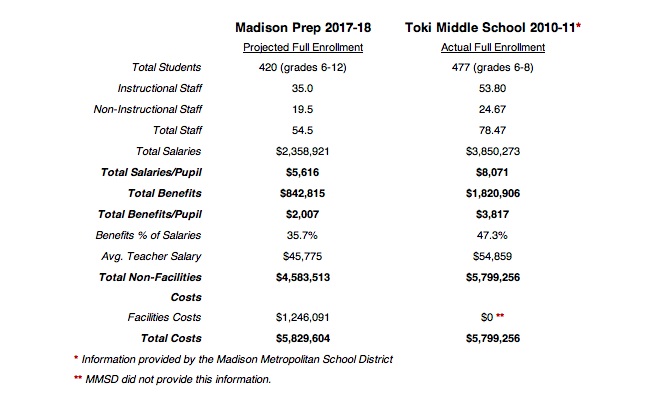
    Share

    It’s back to the basics in Milwaukee schools: evidence-based approach to improving literacy teaching and learning across all schools and classrooms

    Heidi Ramirez:

    The district has focused reading instruction and has launched an intensive effort aimed at boosting dismal outcomes. The MPS chief academic officer asks: Will we be given enough time?
    Walk in many Milwaukee Public Schools classrooms today, and here’s what you’re likely to see:
    There will be a teacher sitting at a table in a corner, guiding a handful of young readers or writers in targeted instruction. The other students, whether they be 4-year-olds or teenagers, will be actively engaged in small group work.
    What you’re not likely to see: a teacher holding court at the center of the room of mostly silent children, heads down on tables or blank stares on their faces.
    As the district’s new literacy effort takes hold, our students increasingly work in small groups at hands-on literacy stations set up around the room. Students, who otherwise would have had to wait for their teacher to pause and for their turn to speak, are instead guiding their own practice and that of their peers.

    Share

    Milwaukee could become first American city to use universal vouchers for education

    Alan Borsuk:

    Milwaukee’s private school voucher program has broken new and controversial ground often in its 21-year history. Now, it is headed toward what might well be another amazing national first.
    If Gov. Scott Walker and leading voucher advocates prevail, Milwaukee will become the first city in American history where any child, regardless of income, can go to a private school, including a religious school, using public money to pay the bill.
    Universal vouchers have been a concept favored by many free-market economists and libertarians since they were suggested by famed economist Milton Friedman more than half a century ago. Friedman’s theory was that if all parents could apply their fair share of public money for educating their children at whatever school they thought best, their choices would drive educational quality higher.
    Coming soon (fairly likely): Milwaukee as the biggest testing ground of Friedman’s idea.
    But not only is it hard to figure out what to say about the future of vouchers, it’s not easy to know what to say about the past of Milwaukee’s 21-year-old program of vouchers limited to low-income students except that it has been popular (more than 20,000 students using vouchers this year to attend more than 100 private schools) and there is not much of a case (except in some specific schools) that it has driven quality higher, both when it comes to many of the private schools specifically and when it comes to the educational waterfront of Milwaukee.

    Share

    Education ‘group think’ gets in the way of teaching kids to read

    Dick Lilly, via a kind reader’s email:

    School administrators should end their obsession with average test scores and focus instead on an absolute standard: Can each child actually read?
    For more than two decades now, the Seattle school district has been telling us that its most important goal is “closing the achievement gap.” Nevertheless, it is not unfair to say that only incremental progress has been made.
    Seattle, as everyone knows, is not alone. “Closing the achievement gap” has come to stand for the perennial problems of American K-12 education — though the inability of high schools to graduate more than two-thirds of their students has been running a close second.
    Among the results of this frustratingly persistent problem is a vast, energetic industry of school reform, headlined in recent years by the involvement of powerful private foundations and the policy directives of the federal government: “No Child Left Behind” in the “Race to the Top.”

    Share

    PLEASE JOIN US MONDAY! Madison Board of Education to Vote on Madison Prep; costs clarified


    March 25, 2011
    Dear Friends & Colleagues,
    On Monday evening, March 28, 2011 at 6pm, the Madison Metropolitan School District’s (MMSD) Board of Education will meet to vote on whether or not to support the Urban League’s submission of a $225,000 charter school planning grant to the Wisconsin Department of Public Instruction. This grant is essential to the development of Madison Preparatory Academy for Young Men, an all-male 6th – 12th grade public charter school.
    Given the promise of our proposal, the magnitude of longstanding achievement gaps in MMSD, and the need for adequate time to prepare our final proposal for Madison Prep, we have requested full support from the school board.
    Monday’s Board meeting will take place at the Doyle Administration Building (545 West Dayton Street) next to the Kohl Center. We hope you will come out to support Madison Prep as this will be a critical vote to keep the Madison Prep proposal moving forward. Please let us know if you’ll be attending by clicking here. If you wish to speak, please arrive at 5:45pm to register.
    Prior to you attending, we want to clarify misconceptions about the costs of Madison Prep.
    The REAL Costs versus the Perceived Costs of Madison Prep
    Recent headlines in the Wisconsin State Journal (WSJ) reported that Madison Prep is “less likely” to be approved because of the size of the school’s projected budget. The article implied that Madison Prep will somehow cost the district more than it currently spends to educate children. This, in fact, is not accurate. We are requesting $14,476 per student for Madison Prep’s first year of operation, 2012-2013, which is less than the $14,802 per pupil that MMSD informed us it spends now. During its fifth year of operation, Madison Prep’s requested payment from MMSD drops to $13,395, which is $1,500 less per student than what the district says it spends now. Madison Prep will likely be even more of a savings to the school district by the fifth year of operation given that the district’s spending increases every year.
    A March 14, 2011 memo prepared by MMSD Superintendent Daniel Nerad and submitted to the Board reflects the Urban League’s funding requests noted above. This memo also shows that the administration would transfer just $5,541 per student – $664,925 in total for all 120 students – to Madison Prep in 2012-2013, despite the fact that the district is currently spending $14,802 per pupil. Even though it will not be educating the 120 young men Madison Prep will serve, MMSD is proposing that it needs to keep $8,935 per Madison Prep student.


    Therefore, the Urban League stands by its request for equitable and fair funding of $14,476 per student, which is less than the $14,802 MMSD’s administration have told us they spend on each student now. As Madison Prep achieves economies of scale, reaches its full enrollment of 420 sixth through twelfth graders, and graduates its first class of seniors in 2017-18, it will cost MMSD much less than what it spends now. A cost comparison between Madison Prep, which will enroll both middle and high school students at full enrollment, and MMSD’s Toki Middle School illustrates this point.


    We have also attached four one-page documents that we prepared for the Board of Education. These documents summarize key points on several issues about which they have expressed questions.
    We look forward to seeing you!
    Onward!
    Kaleem Caire
    President & CEO
    Urban League of Greater Madison
    Main: 608-729-1200
    Assistant: 608-729-1249
    Fax: 608-729-1205
    Website: www.ulgm.org


    Kaleem Caire, via email.
    Madison Preparatory Academy Brochure (PDF): English & Spanish.
    DPI Planning Grant Application: Key Points and Modifications.
    Update: Madison School Board Member Ed Hughes: What To Do About Madison Prep:

    In order to maintain Madison Prep, the school district would have to find these amounts somewhere in our budget or else raise property taxes to cover the expenditures. I am not willing to take money away from our other schools in order to fund Madison Prep. I have been willing to consider raising property taxes to come up with the requested amounts, if that seemed to be the will of the community. However, the draconian spending limits the governor seeks to impose on school districts through the budget bill may render that approach impossible. Even if we wanted to, we likely would be barred from increasing property taxes in order to raise an amount equal to the net cost to the school district of the Madison Prep proposal.
    This certainly wouldn’t be the first time that budgetary considerations prevent us from investing in promising approaches to increasing student achievement. For example, one component of the Madison Prep proposal is a longer school year. I’m in favor. One way the school district has pursued this concept has been by looking at our summer school model and considering improvements. A good, promising plan has been developed. Sadly, we likely will not be in a position to implement its recommendations because they cost money we don’t have and can’t raise under the Governor’s budget proposal.
    Similarly, Madison Prep proposes matching students with mentors from the community who will help the students dream bigger dreams. Effective use of mentors is also a key component of the AVID program, which is now in all our high schools. We would very much like to expand the program to our middle schools, but again we do not have the funds to do so.

    Mr. Hughes largely references redistributed state tax dollars for charter/virtual schools – a portion of total District per student spending – the total (including property taxes) that Madison Prep’s request mentions. I find Madison Prep’s fully loaded school based cost comparisons useful. Ideally, all public schools would publish their individual budgets along with total District spending.

    Share

    Great Teacher for Every Course

    Tom Vander Ark:

    here are some problems that are too hard to solve in traditional ways. Teacher effectiveness and school choice fit the bill–they are complicated and contentious. The good news is that digital learning allows us to solve these problems in new ways.
    It’s pretty easy to solve the teacher problem if we focus on providing a ‘great teacher for every course’ rather than a great teacher in every classroom.’
    If educational funding follows the student to the best course available (online or onsite) it provides a much more powerful and accountable model than partial funding for a private school down the street.
    Digital Learning Now recommends that all students should be able to “customize their education using digital content through an approved provider.” More specifically, DLN recommends that states:

    Share

    Building Teacher Evaluation Systems: Learning From Leading Efforts

    The Aspen Institute:

    Ambitious reforms across the country are reshaping teacher evaluation and performance management. Designing new systems for measuring teacher effectiveness and using that information to increase student achievement are at the heart of these efforts and at the center of important policy debates. Yet little information exists about how these systems work in practice and how to use evaluations in concert with other levers to improve teaching and learning.
    As policymakers and education leaders seek to accelerate reform in this area, it is essential to learn from efforts already underway. The Education & Society Program published three new reports: profiles of the performance management work in District of Columbia Public Schools (DCPS) and the Achievement First (AF) charter school network; and a synthesis of issues that emerge from the two profiles. Both DCPS and AF are at the forefront of efforts to re-design teacher evaluation, performance management, and compensation policies. The commonalities, distinctions, and early lessons learned in these initiatives represent an important learning laboratory for the field.

    Share

    Losing Our Way

    Bob Herbert:

    So here we are pouring shiploads of cash into yet another war, this time in Libya, while simultaneously demolishing school budgets, closing libraries, laying off teachers and police officers, and generally letting the bottom fall out of the quality of life here at home.
    Welcome to America in the second decade of the 21st century. An army of long-term unemployed workers is spread across the land, the human fallout from the Great Recession and long years of misguided economic policies. Optimism is in short supply. The few jobs now being created too often pay a pittance, not nearly enough to pry open the doors to a middle-class standard of living.
    Arthur Miller, echoing the poet Archibald MacLeish, liked to say that the essence of America was its promises. That was a long time ago. Limitless greed, unrestrained corporate power and a ferocious addiction to foreign oil have led us to an era of perpetual war and economic decline. Young people today are staring at a future in which they will be less well off than their elders, a reversal of fortune that should send a shudder through everyone.

    Share

    The Death and Life of the Great American School System: How Testing and Choice Are Undermining Education, a Review

    Reviewed by Katharine Beals, via a kind reader’s email:

    The Death and Life of the Great American School System was wildly hailed as author and education critic Diane Ravitch’s dramatic about-face on No Child Left Behind, charter schools, and school choice. What’s missing from this sensational take is that Ravitch has changed her mind only about school reform tactics, and not about what constitutes good schools, or about her top priorities in fostering them.
    She still stresses curriculum–apparently still her topmost priority. She still supports a challenging, content-rich core curriculum of the sort promoted by E.D. Hirsch and his Core Knowledge Foundation. She still believes that the best teachers are those with who know their fields well and are enthusiastic about teaching. She still believes that attracting such teachers is nearly as essential, if not as essential, as curriculum reform.
    It’s in the question of why we’ve strayed so far from these ideals that Ravitch has shifted. While her earlier research (c.f. Left Back, published in 2000) critiqued, inter alia, a variety of prominent fad-peddling members of the education establishment, Ravitch now appears to blame just three factors: the high-stakes testing and accountability of No Child Left Behind (NCLB); the meddling in education by powerful outsiders like politicians and businessmen; and school choice ventures that skim off the best students and leave the rest to the most struggling of public schools.
    On NCLB testing and accountability, Ravitch is convincing. Tests can be effective, comprehensive measures of achievement, in which case teaching “to” them is equivalent to teaching students what they should learn anyway. But, as Ravitch explains, NCLB’s top-down, high-stakes, punitive approach deters states from devising tests that come anywhere near this ideal.

    Share

    GOP seeks to expand school voucher program

    Matthew DeFour:

    A Republican Assembly leader plans to add to the state budget bill an expansion of Milwaukee’s voucher program to other school districts, potentially giving more families in cities such as Madison access to private and religious schools.
    Voucher advocates say the time is ripe to expand the program to other cities, especially with Republicans in control of state government and a recent study suggesting students in the 20-year-old Milwaukee program are testing as well or better than their public school counterparts, with a lower cost per pupil.
    They also argue that vouchers would level the playing field for private schools, which have seen enrollment decline as public charter schools have gained popularity.
    But voucher opponents say expansion would further cripple public schools, which already face an $834 million cut in state funding over the next two years.
    And state test scores to be released Tuesday, which for the first time include 10,600 Milwaukee voucher students, could suggest they are testing no better than poor students in the Milwaukee Public Schools.
    “Given the proposed unprecedented cuts to public education as well as results from our statewide assessments, I question plans in the 2011-13 state budget for expanding the choice program in Milwaukee or anywhere else in Wisconsin,” State Superintendent Tony Evers said.

    Share

    Video, Notes & Links: Wisconsin Senate Bill 22 Hearing

    via a kind reader’s email:

    Clusty Search: Wisconsin Senate Bill 22.

    Share

    Seattle’s Strategic Plan Refresh

    Charlie Mas

    The District is preparing a “Strategic Plan Refresh“. They will review the Strategic Plan and decide which projects to continue, alter, defer, or remove. The refresh will have to include goals, timelines, status, and budgets for each of the projects.
    I spoke with Mark Teoh last night and asked if he could include two items in the Refresh program:
    1) A record of the various projects in the Strategic Plan, including those that were originally in it, those that were added, those that were completed, and those that were simply dropped without notice. Remember how there was supposed to be an APP Review in the plan? Remember how there was going to be an alternative education review? These projects just silently faded away. At the same time, Capacity Management and World Language curricular alignment, which were not part of the original plan, have been added.
    2) A review of the community engagement protocols and some table that shows which of the projects are meeting the requirements of the protocol (it’s easy – none of them).

    Share

    A Nation of Dropouts Shakes Europe

    Charles Forelle:

    Isabel Fernandes, a cheery 22-year-old with a constellation of stars tattooed around her right eye, isn’t sure how many times she repeated fifth grade. Two, she says with a laugh. Or maybe three. She redid seventh grade as well. She quit school with an eighth-grade education at age 20.
    Ms. Fernandes lives in a poor suburb near the airport. She doesn’t work. Employers, she says, “are asking for higher education.” Even cleaning jobs are hard to find.
    Portugal is the poorest country in Western Europe. It is also the least educated, and that has emerged as a painful liability in its gathering economic crisis.
    Wednesday night, the economic crisis became a political crisis. Portugal’s parliament rejected Prime Minister José Sócrates’s plan for spending cuts and tax increases. Mr. Sócrates handed in his resignation. He will hang on as a caretaker until a new government is formed.

    Share

    Teachers protest IB program

    Mark McDermott:

    Fifty teachers from Redondo Union High School stormed the Board of Education Tuesday night to protest the implementation of the International Baccalaureate program.
    The group included a majority of the school’s department heads and some of the longest-tenured and most respected teachers at RUHS. Their concerns ranged from the cost of the program to what they argued was a lack of teacher input and a greater need to address the needs of less high-achieving students.
    Linda Dillard, the chair of the school’s science department, told the school board that teachers have not been allowed to engage in a “data-driven, fact-finding process” to help determine if the program is a good fit for RUHS.

    Share

    Race, Poverty and the Public Schools

    Letters to the New York Times:

    Re “Separate and Unequal,” by Bob Herbert (column, March 22):
    In spite of the 1954 Brown v. Board of Education decision by the Supreme Court, sadly the struggle goes on. The Department of Education reported in 2008 that 70 percent of white schoolchildren attend schools where at least 75 percent of the students are white, whereas more than half of all black children in industrial states attend schools where over 90 percent are members of minority groups. Go into any urban school and it is clear that 57 years after Brown, the schools have largely remained segregated.
    Years of social science research have cited the benefits of integrated schools. In our work with the West Metro Education desegregation initiative in Minneapolis public schools, the students in grades 3 to 7 who got on the bus to attend suburban schools made three times the progress in both reading and math when compared with similar students who did not participate.
    Teacher quality remains a consistent important factor. Ultimately, though, students in diverse classrooms benefit from collaboration and teamwork with those whose family circumstances are different from theirs. Eric J. Cooper
    President, National Urban Alliance for Effective Education
    Stamford, Conn., March 22, 2011

    Share

    What do students miss with a virtual education?

    Christopher Dawson:

    I had the chance to speak at a local university on Tuesday, talking to a class on cloud computing about the impact of technology (especially, of course, the cloud) on higher education. The class was great and was, itself, focused on team-based learning and simulations using a variety of cloud and web-based tools. What was even better, though, was the Q&A session with the students and my follow-up conversations with faculty and staff.
    Let me start with something that ZDNet’s digital video and photo blogger, Janice Chen, wrote in an unrelated discussion we were having about ZDNet’s upcoming 20th anniversary:

    Share

    Why One Innovator is Leaving the Public Sector

    Andrew Rotherham:

    Lately you can’t turn around in education without bumping into someone talking about innovation. The President is asking Congress for more federal support for educational innovation in this year’s budget, more and more school districts are naming “innovation officers,” and just last week a group of Silicon Valley start-up veterans launched a new incubator for innovative education companies. But while innovation is a catchy buzzword, on the ground conditions are often anything but innovative. This week, the resignation of a school administrator in New York City who most readers have probably never heard of vividly illustrates that disconnect.
    Joel Rose, 40, got his start teaching in Houston with Teach For America. After law school and a stint at Edison Schools, he landed at the New York City Department of Education leading a personnel strategy for that massive 1.1. million student system. Rose was struck, as many observers are, by how little technology had changed education relative to most other fields during the past few decades. So he started a program within the New York City Public Schools called “School of One” that uses technology to offer a completely customized schooling experience for each student.

    Share

    Why He Did It: For good reason, the Capitol exploded when Gov. Walker struck at collective bargaining: The Rise of Teacher Unions


    Christian Schneider, via a kind reader’s email

    By now, the political lore is familiar: A major political party, cast aside by Wisconsin voters due to a lengthy recession, comes roaring back, winning a number of major state offices.
    The 43-year-old new governor, carrying out a mandate he believes the voters have granted him, boldly begins restructuring the state’s tax system. His reform package contains a major change in the way state and local governments bargain with their employees, leading to charges that the governor is paying back his campaign contributors.
    Only the year wasn’t 2011 — it was 1959, and Gov. Gaylord Nelson had just resurrected the Democratic Party of Wisconsin. Certain of his path, Nelson embarked on an ambitious agenda that included introduction of a withholding tax, which brought hundreds of protesters to the Capitol. Nelson also signed the nation’s first public-sector collective bargaining law — the same law that 52 years later Gov. Scott Walker targeted for fundamental revision.
    Two different governors, two different parties, and two different positions.
    Ironically, their assertive gubernatorial actions may produce the same disruptive outcome. By empowering the unions, Nelson’s legislation led to public-sector strikes and work stoppages. By disempowering the unions, Walker’s actions might lead to public-sector strikes and work stoppages.
    In Walker’s case, union members reluctantly agreed to his pension and health-care demands, but have fought desperately to preserve their leverage in negotiating contracts. That raises the basic question of the Madison showdown: Why is Scott Walker so afraid of collective bargaining?
    The answer can be found in the rise of the state’s teachers unions.

    Ripon Superintendent Richard Zimman:

    Beware of legacy practices (most of what we do every day is the maintenance of the status quo), @12:40 minutes into the talk – the very public institutions intended for student learning has become focused instead on adult employment. I say that as an employee. Adult practices and attitudes have become embedded in organizational culture governed by strict regulations and union contracts that dictate most of what occurs inside schools today. Any impetus to change direction or structure is met with swift and stiff resistance. It’s as if we are stuck in a time warp keeping a 19th century school model on life support in an attempt to meet 21st century demands.”

    Share

    Not-so-public education: A Colorado school voucher program seems likely to benefit mostly middle-class students and religious schools.

    Los Angeles Times

    Supporters of school vouchers like to say that their goal is to provide a higher-quality education for the children who need it most. The latest events in Colorado say otherwise. A voucher program there seems more likely to benefit middle-class children and religious schools than low-income public school students, and to worsen inequities in education.
    Last week, the board of the Douglas County School District voted for a pilot program that will give the parents of 500 of its 60,000-students about $4,500 each — 75% of what the district receives in per-pupil funding — to use toward tuition at participating private schools of their choice. Many of the private schools in the area are religiously based.
    Even in Colorado, where a dollar stretches a lot further than in Southern California, $4,500 falls significantly short of private school tuition. Most schools there range from about $7,000 up to $14,000. Clearly, the parents poised to benefit most from this taxpayer-sponsored perk are those with a few thousand to spare to fill in the price gap. There might be scholarships for some of the needier students — about 10% of the Douglas County students qualify for free or reduced-price school lunches — but no one is promising anything.

    Share

    Hand-Crafted Digital Texts

    Scott McLemee:

    Despite an abiding preference for the traditional book, I started using an e-reader about seven months ago — and have found it insinuating itself into daily life, just as a key chain or wallet might. For there is a resemblance. A key chain or wallet (or purse) is, in a sense, simply a tool that is necessary, or at least useful, for certain purposes. But after a while, each becomes more than that to its owner. To be without them is more than an inconvenience. They are extensions of the owner’s identity, or rather part of its infrastructure.
    Something like that has happened with the e-reader. I have adapted to it, and vice versa. Going out into the world, I bring it along, in case there are delays on the subway system (there usually are) or my medical appointment runs behind schedule (likewise). While at home, it stays within reach in case our elderly cat falls asleep in my lap. (She does so as often as possible and has grown adept at manipulating my guilt at waking her.) Right now there are about 450 items on the device. They range from articles of a few thousand words to multivolume works that, in print, run to a few hundred pages each. For a while, my acquisition of them tended to be impulsive, or at least unplanned. Whether or not the collection reflected its owner’s personality, it certain documented his whims.

    Share

    Hundreds attend, testify at legislative hearing on charter school changes

    Susan Troller:

    Testimony at the Capitol over a controversial bill that would strip control over charter schools from locally elected officials and place it in the hands of a politically appointed state-wide authorizing board drew hundreds on Wednesday to a standing-room-only Senate education committee hearing.
    Senate Bill 22, authored by state Sen. Alberta Darling (R-River Hills) would also fund independent charter schools ahead of traditional public schools. I wrote about the bill on Tuesday and it’s generated a robust conversation.
    Madison Superintendent Daniel Nerad testified in opposition to the bill, and so did local school board member Marjorie Passman. Kaleem Caire, president and CEO of the Urban League of Greater Madison and a strong proponent of the proposed boys-only Madison Preparatory Academy for minority students, testified in support of the bill. Madison Prep, if approved, will be a publicly funded charter school in Madison.

    Share

    Suburban Parents Blocked In Try For Charter Schools

    Claudio Sanchez:

    Charter schools may be multiplying fast across the country, but they’re stalled in affluent, high-performing suburban school systems. Of the 5,300 charter schools in the U.S., only one-fifth are in suburbs.
    Suburban parents are frustrated by what they see as arbitrary policies to keep charter schools from spreading and are fighting back.
    That’s the case with some parents in Montgomery County, Md., outside Washington, D.C., where Ashley Del Sole lives. Her oldest daughter is about to start school, but she can’t go to her neighborhood school because it’s overcrowded.
    “My daughter is actually slated to go to a middle school next year for kindergarten because of the overcapacity problem,” Del Sole says.

    Share

    Can we achieve more with less?

    Dan Deming:

    With millions being cut from Kansas schools by legislative action or local boards reacting to reduced funding, it is easy to fall into a trap of believing that with less money our schools can’t possibly do as good of a job educating our kids. Probably, but not necessarily.
    Bill Gates, the Microsoft billionaire who is devoting much of his fortune to improving education and who co-chairs the Bill and Melinda Gates Foundation, wrote a provocative column this month in the Washington Post. Highlights from Gates’ conclusions are spotlighted in this week’s column to remind us that spending more money does not ensure better-educated kids and that some radical changes in how the dollars we now pour into education might significantly improve outcomes.

    Share

    Teacher bonus program fails to lure and retain top teachers in Washington’s high-poverty schools

    Jim Simpkins, via email:

    – A $99 million teacher bonus program that Washington legislators designed to lure good teachers into high-poverty schools has not worked as intended, according to a new analysis from the University of Washington Bothell’s Center on Reinventing Public Education.
    “Not only has the $10,000 annual bonus failed to move effective teachers to high-poverty schools, it has also failed to make those teachers any more likely to stay in high-poverty schools than other teachers,” said the report’s author, Jim Simpkins.
    Washington State provides $5,000 bonuses to those teachers who undergo and pass the rigorous national board certification process, a credentialing program that marks its graduates as among the best teachers. The evidence, however, on whether national board certified teachers (NBCTs) are actually more effective teachers is mixed.
    In 2007, state legislators added a second $5,000 bonus for NBCTs who teach in a high-poverty school, defined as one where a large portion of students are on free or reduced-price lunches. According to the Center’s report, ” . . . less than 1% of Washington’s NBCTs move from low-poverty to high-poverty schools each year.”

    Share

    NOMENCLATURA

    Albert Shanker was one of a kind (sui generis). No one has replaced him or the intelligent analysis of American education in his weekly columns in The New York Times. Known as a powerful advocate of union solidarity and the protection of teachers, he was also the source of the idea for charter schools, and, perhaps most astonishingly, he often spoke of the “nomenclatura of American education.”
    He used that term, borrowed from the name for the Soviet bureaucrats and their special privileges and interlocking tentacles, to label the complex interconnections of the many layers of special interest agencies in our education system: organizations of superintendents, school boards, curriculum specialists, counselors, professional development experts, literacy experts of all kinds, and so forth.
    I believe he was pointing out that this system of special interest groups had achieved a paralysis of our educational efforts similar to the paralysis that the Soviet nomenclatura brought to the economy and society of the USSR, leading to its spectacular collapse in 1989.
    He suggested that any good idea for reform to help our students learn more was likely to be immediately studied, re-interpreted, deconstructed, re-formulated and expounded until all of its value and any hope of its bringing higher standards to American education had been reduced to nothingness. The concern of the special educational nomenclatura for their own jobs, pensions, perks, prerogatives, and policies would manage to overwhelm, confuse and disintegrate any worthwhile initiative for greater academic achievement by students.
    Mr. Shanker is gone, and the loss is ours, but the nomenclatura he spoke of is alive and well. With all the best intentions, for example, the Council of Chief State School Officers, and the National Governors Association, cheered on by the Department of Education, major foundations, and others, have taken on the idea of Common Standards for American students.
    Unfortunately, they have largely left out curriculum–any clear requirements for our high school students to, for instance, read a history book or write a serious research paper. For a long time, those in the nomenclatura involved in assessment have been reluctant to ask students to demonstrate any knowledge on tests, for fear that they would not have any knowledge to demonstrate. So essay tests, for example, do not ask students to write about literature, history or science, but rather to give opinions off the top of their heads about school uniforms or whether it is more important to be a good student or to be popular, and the like.
    For all the talk in the nomenclatura about college and career readiness, no one knows whether our high school students are now expected to read a single complete nonfiction book or write one 20-page research paper before they graduate, because no one asks about that.
    One could have hoped that our Edupundits would try to fill the void left by the loss of Mr. Shanker, but sad to say, they have largely become lost in the tangles and tentacles of the nomenclatura themselves. They endlessly debate the intricate problems of class size, teacher selection, budgets, principal education, collective bargaining, school governance, and so on, until they are too exhausted, or perhaps just unable, to take an interest in what our students are being asked to read and write.
    Although great efforts have gone into the new Common Core Standards, they contain no actual curriculum, partly because the nomenclatura doesn’t want to engage in difficult political battles over what actual knowledge our students must have. So, even though almost all of the state bureaucracies have signed on the new Standards, the chance is good that they will collapse of their own weight because they contain no clear requirements for the actual academic work of students.
    Our Edupundits are constantly hard at work. Some could be described, to paraphrase Alexander Pope, as “dull, heavy, busy, bold and blind,” and they do meet, discuss, speak, and write a great deal about the details of educational administration and management–details which are very popular with those who seek to apply a business school mindset to the organization of our K-12 education.
    However, so long as they continue to ignore the actual academic work of our students, our students will be quite free to do the same. Fortunately, some teachers will continue to require their own high school students to read serious books and write research papers, and to do the most difficult academic work of which they are capable, in literature, languages, math and science. But in their efforts they will have received at best no help (or at least no interference) from the nomenclatura, and the Edupundits who are lost in their wake.
    ———————–
    “Teach by Example”
    Will Fitzhugh [founder]
    The Concord Review [1987]
    Ralph Waldo Emerson Prizes [1995]
    National Writing Board [1998]
    TCR Institute [2002]
    730 Boston Post Road, Suite 24
    Sudbury, Massachusetts 01776-3371 USA
    978-443-0022; 800-331-5007
    www.tcr.org; fitzhugh@tcr.org
    Varsity Academics®
    www.tcr.org/blog

    Share

    Harvard Isn’t Worth It Beyond Mom’s Party Chatter: Amity Shlaes

    Amity Shlaes:

    Anxious families awaiting April college admission news are living their own March Madness.
    Their insanity is captured in Andrew Ferguson’s new book, “Crazy U: One Dad’s Crash Course in Getting His Kid Into College” (Simon & Schuster). He describes the vanity of a desperate mother at a cocktail party who is dying to announce her daughter’s perfect SAT scores:
    “‘We were really surprised at how well she did,’ the mother would say, running a finger around the rim of her glass of pink Zinfandel.
    Her eyes plead: Ask me what they were, just please please ask.”

    Share

    Separate and Unequal

    Bob Herbert:

    One of the most powerful tools for improving the educational achievement of poor black and Hispanic public school students is, regrettably, seldom even considered. It has become a political no-no.
    Educators know that it is very difficult to get consistently good results in schools characterized by high concentrations of poverty. The best teachers tend to avoid such schools. Expectations regarding student achievement are frequently much lower, and there are lower levels of parental involvement. These, of course, are the very schools in which so many black and Hispanic children are enrolled.

    Share

    Unions Give Teachers a Voice and a Platform From Which to Help Students

    Marc Korashan:

    When I began teaching in New York City in 1975 I didn’t initially see the need for a union or get involved in union activities. I knew, from history and the stories my parents and grandparents told, about the struggle for unions, but like so many today, I took the existence of a union and a contract for granted. My chapter leader gave me some advice and made sure I had all the necessary forms when I got appointed, but that was the sum of my union involvement until I moved to a position as an Education Evaluator on School Based Support Teams.
    In that position, as a Special Education Teacher/Education Evaluator, I was much more exposed to the whims of management than I had been as a classroom teacher. Administrators didn’t often walk into my SIE VIII classroom as most of them were afraid of the volatile students I taught. I worked with my co-teacher and we succeeded in making a difference for most of our students.

    Share

    The Value of Education — and Teachers

    The Somewhat Daily RAG:

    A pharmacist friend in Jasper, Alberta said that she was appalled at the seemingly light sentences given to abusers who kill children while someone murdering a police officer gets a life sentence.
    Her take on this disparity was, “How do you know that if this child grew up he wouldn’t become a policeman?”
    An interesting and provocative take which I recalled when thinking of the value of education and our teachers who seem to be under attack these days as overpaid (whoever though a teacher could be accused of that?) and greedy.

    Share

    Georgia charter school ruling to reverberate across nation

    A state Supreme Court opinion that will decide who has the power to fund and open public charter schools is expected by March 31, ending a constitutional challenge that threatens to derail the education of thousands of students.
    The two-year legal battle launched by seven local districts over power, money and the exclusive right to open neighborhood schools has threatened Georgia’s reputation as a national leader in education reform.
    The feud began in 2009 when the Georgia Charter Schools Commission, a state board, got into the business of approving and funding neighborhood schools such as Cherokee Charter Academy.
    The school, which plans to open in the fall as Cherokee County’s first charter campus, received more than 1,300 applications for about 700 spots. It was denied twice by the Cherokee Board of Education.

    Share

    Capitol Smackdown: Teacher Union vs. Teacher Union

    Rick Green:

    Don’t let anyone tell you that things aren’t changing. AFT Connecticut is supporting a reform package that would accelerate creation of better teacher evaluation standards. The Connecticut Education Association is opposing it.
    The idea is to speed-up efforts already underway so that school districts have clear measures over what makes a good teacher. Instead of, say, how many years a teacher has been on the job — which is the seniority standard that dominates in school districts.
    The rival Connecticut Education Association will have none of this. John Yrkchik, in testimony prepared for delivery at tomorrow’s public hearing by the education committee, says:

    Share

    Bill Gates Seeks Formula for Better Teachers

    Stephanie Banchero:

    Bill Gates shook up the battle against AIDS in Africa by applying results-oriented business metrics to the effort. Now, he is trying to do the same in the tricky world of evaluating and compensating teachers.
    The Microsoft Corp. co-founder has moved on from a $2 billion bet on high school reform–much of it spent on breaking up big, failing high schools and replacing them with smaller ones.
    Now, he is venturing that improving teacher effectiveness is the key to fixing broken schools. The Bill & Melinda Gates Foundation has awarded $290 million to school districts in Memphis, Tenn.; Hillsborough, Fla.; and Pittsburgh, and a charter consortium in California to build new personnel systems Mr. Gates hopes will be models for the country.

    Share

    Next US education reform: Higher teacher quality

    Christian Science Monitor
    Compared with more than 70 economies worldwide, America’s high school students continue to rank only average in reading and science, and below average in math. But this sorry record for a wealthy nation can be broken if the US focuses on recruiting and keeping first-rate teachers.
    That’s the conclusion of a new paper that looks at the latest achievement tests of 15-year-olds in the 34 developed countries of the Organization for Economic Cooperation and Development (OECD), as well as many other nations.
    America has been trying to raise its academic standards for more than two decades, an effort that cannot be abandoned in tough times. But it can learn more from other countries about the difficult task of teacher training, selection, and compensation – even as cash-strapped states take on teacher unions.
    The government-union wrangling would be less if both sides focused on quality investments in better teachers. The goal is not debatable. Studies show that matching quality teachers with disadvantaged students is an effective way to close the black-white achievement gap. Good teachers are more effective than small class sizes, for instance.
    For starters, the United States needs to increase its pool of quality teachers. Almost half of its K-12 teachers come from the bottom third of college classes. Classroom leaders such as Singapore, South Korea, and Finland select from the top ranks. In Finland, only 1 in 10 applicants is accepted into teacher training.
    Part of the hurdle in the US is compensation. Teaching offers job security but not great pay compared with other professions that top college graduates might choose. As states tussle over budgets, one solution might be to lower teacher benefits and end tenure while bulking up salaries.
    And yet pay isn’t the only consideration. Last year, 11 percent of graduates from US elite colleges applied to the federally funded Teach for America program. Participants teach in low-achieving rural and urban districts for two years.
    In Finland, teachers earn only about what their American counterparts do (US teacher pay starts, on average, at $39,000). The difference is that in Finland, teaching is a high-status, well-respected job, right up there with doctoring and lawyering.
    Another US hurdle is teacher training. Many states require a master’s degree in education in order to be certified to teach. This automatically locks out a talented population such as second-career experts in a field who don’t want to invest the time or money in a graduate degree that’s often short on classroom skills and long on pedagogy.
    President Obama’s “Race to the Top” fund encourages states through competitive grants to open up alternative, effective routes to teacher certification. Hopefully, that fund will survive budget cutting (same for Teach for America).
    Public schools won’t be able to attract and keep high quality teachers if they don’t reward and develop them once they get into the classroom.
    That’s next to impossible given the standard operating procedure of teacher unions. As the nation is witnessing, a rigid rule such as last-hired, first-fired lops off enthusiastic newcomers in favor of those with seniority. Experience is important in education, but it does not always add up to quality. Performance must be the determiner.
    Unions need to accept that the main goal is high teacher performance and student outcomes, not job preservation. That’s what the teacher union did in Ontario, Canada, according to the paper based on the OECD findings.
    Teachers in Ontario are heavily organized. Yet, in 2003, the union and the premier of Ontario reached a grand bargain based on the need to elevate student achievement.
    “The educators, through their union, agreed to accept responsibility for their own learning and the learning of their students; the government agreed to supply all of the necessary support,” according to the report.
    The paper, called “What the U.S. Can Learn from the World’s Most Successful Education Reform Efforts,” says that Ontario students subsequently shot up from the bottom to the top of test scores.
    Investing in high quality teaching is necessary to boost US economic competitiveness. The study argues that the US also needs to elevate the teaching profession to one of high status and respect. But respect doesn’t come overnight. Government and educators will have to earn it by working together to improve teacher quality.

    Share

    Republican bill calls for a board of political appointees to authorize charter schools

    Susan Troller:

    Under a Republican-sponsored bill, nine political appointees would get to authorize public charter schools while local school districts foot the bill. The creation of this state-wide charter school authorizing board — with members appointed by the governor and the leaders of the state Senate and Assembly — is a key provision of legislation authored by Sen. Alberta Darling of River Hills that will get a hearing on Wednesday at 10 a.m. at the Capitol before the Senate Education Committee.
    Senate Bill 22 not only de-emphasizes local control, but also creates changes in how teachers are certified and removes caps from the numbers of students who may enroll in virtual schools. A companion bill is also pending in the state Assembly.
    Opponents say the proposed changes would not only eliminate local control in favor of a new, politically motivated bureaucracy but would also siphon general aid away from all of Wisconsin’s 424 public school districts in favor of charters. But backers say it will remove current barriers that prevent charter schools from realizing their full potential.
    “This bill would get rid of the charter school lite culture we currently have in Wisconsin and allow these schools’ full potential for autonomy, flexibility and innovation to be fully realized,” says John Gee, executive director of the Wisconsin Association for Charter Schools.

    Related:
    School Choice Wisconsin: Milwaukee residents favor school choice expansion

    Share

    Teacher Tenure Reform: Applying Lessons from the Civil Service and Higher Education

    Public Impact:

    Research continues to confirm what intuition has told many of us for years: Teacher quality has a bigger impact on student learning than any other factor in a school. Nationwide, this finding has increasingly motivated policymakers and the public to focus reforms on dramatically improving teacher quality. National, state, and local leaders have initiated reforms designed to better prepare teachers for the classroom, more accurately identify and reward top teachers, support teachers’ development, and equip education leaders to identify and remove the very least-effective teachers.
    Discussions of teacher quality often lead to questions about which teachers are retained and dismissed in K-12 public schools, and thus to questions about tenure. Teacher tenure was designed in the early 1900s as a set of procedural protections against unfair and arbitrary dismissals.1 But today, concerns about the effect on student outcomes — along with budgetary constraints — dominate education reform discussions.
    As a result, leaders in a handful of states and districts have begun making changes to align their tenure systems with their goal of increasing student learning. Common changes include streamlining tenure protections and increasing the rigor of the tenure-granting process.2 Parallel efforts to improve the quality, accuracy, and rigor of educator evaluations have strengthened the basis for personnel decisions based on performance, and have fueled increased interest in tenure reform

    Share

    The Search for a New Way to Test Schoolkids

    Bill Tucker:

    Excerpt from Greg Toppo’s article:
    “…In other places, educators are experimenting with different ways to test what kids learn. Bill Tucker, a managing director at Education Sector, a Washington, D.C., think tank, says states like Oregon have led the way with so-called adaptive tests, computerized assessments that actually change as students answer questions right or wrong. Such tests satisfy the requirements of the No Child Left Behind law. Students sit for these tests any time they’re ready, from October on, and the tests allow schools to find out more about how much kids have learned. And since each test is essentially different from the last, they’re “harder to game,” Tucker says.
    In a bid to look beyond bedrock skills such as reading and math, a few states are also looking at other measures, such as how many of their high school graduates had to take remedial classes in college, Tucker says. Federal Race to the Top funding, part of the Obama administration’s education stimulus plan, is pushing states to develop databases that would allow states to track graduates.
    The federal government has also invested in two separate efforts by the states to overhaul tests; 45 states are participating. One project is aimed at developing so-called “through testing,” which would sample every few months how much students learn, then combine those scores with the score on an end-of-year test. The other project focuses on computer-adaptive tests, like those used in Oregon, to be given at year’s end.

    Share

    Charter school changes would hurt quality

    Martin Scanlan:

    On Wednesday morning at the state Capitol, the Senate Committee on Education will hold a public hearing on several bills: SB 20, SB 22 and SB 34. Senate Bill 22, which deals with public charter schools, is the bill with the most statewide effects. (The others focus solely on Milwaukee Public Schools.)
    Two dimensions of SB 22 should give pause to citizens across the political spectrum because as written, the bill would make it less likely for charter schools to serve the common good. The effect will be to reduce the professionalism of the faculty and the level of local accountability for charter schools.
    Clearly, the quality of education that occurs across sectors – public to private, preschool to postsecondary – is in the public interest. We all benefit when our schools educate children not only academically but in numerous other manners as well. Society is strengthened to the degree that children learn reflection, compassion, creativity and generosity. Schools can foster cross-cultural relationships and nurture respect amongst a populace that is growing increasingly pluralistic. While all schools serve the common good when they promote such learning, these characteristics define our expectations of public schools.

    Share

    What the Department of Education’s “82 Percent of Schools Are Failing” Statistic Really Tells Us

    Rachel Sheffield:

    According to the Obama Administration, the majority of the nation’s schools could be failing.
    In a statement to the House Committee on Education and the Workforce just over a week ago, U.S. Secretary of Education Arne Duncan said that under the current No Child Left Behind law, 82 percent of the nation’s schools may not be sufficiently educating students. But this is debatable.
    It is true that far too many schools in the United States are not providing students with a good, or even remedial, education. Children in the U.S. continue to fall behind their peers internationally, and too few students are able to reach proficient levels in crucial areas like reading and math. This spells tragedy for the future of our nation.

    Share

    Education reform: the problem with helping everyone reach ‘average’

    Ann Robinson
    The alarm clock is sounding on American education. While China’s emergence as an educational powerhouse is relatively new, the continued poor performance by US students – though improved, still 31st place in math on the most recent international test – is not. Today, Shanghai tops the charts, but yesterday, it was other nations. Even a casual observer of education news knows the US long ago ceded its place as world leader in student performance. It’s an unsettling state of affairs.
    West loses edge to Asia in education: Top five OECD findings
    But what’s more unsettling is how prominent education leaders like Education Secretary Arne Duncan have called America’s sorry standing a “wakeup call.” President Obama has called for a new “Sputnik moment” to reignite the nation’s commitment to science education. But the wakeup alarm didn’t just start going off. It sounded decades ago; the US has just repeatedly hit the snooze button.
    The crisis in American education includes both our overall poor national performance and the miniscule numbers of US students achieving at the highest levels. Even our best students are less competitive. The problem with previous education reform efforts is that they have poured time, money, and resources into bringing all students up to proficiency – at the expense of our most gifted students. If we want the best educational performance, we have to target our brightest students, not ignore them in the fight to help everyone reach “average.”
    Moving from paper to practice
    We’ve been inundated with reams of reports, studies, and expert panels advising us how to fix this problem. During one week last fall, two government-convened panels released reports full of prescriptions for what the nation must due to reclaim its position as a leading innovator.
    The reports by the President’s Council of Advisors on Science and Technology (PCAST) and the National Science Board offer a plethora of recommendations including better teacher training, creating 1,000 new STEM-focused (science, technology, engineering, and mathematics) schools, and holding schools accountable for the performance of high-achieving students.

    (more…)

    Share

    Teaching to the Text Message

    Andy Selsberg:

    I’VE been teaching college freshmen to write the five-paragraph essay and its bully of a cousin, the research paper, for years. But these forms invite font-size manipulation, plagiarism and clichés. We need to set our sights not lower, but shorter.
    I don’t expect all my graduates to go on to Twitter-based careers, but learning how to write concisely, to express one key detail succinctly and eloquently, is an incredibly useful skill, and more in tune with most students’ daily chatter, as well as the world’s conversation. The photo caption has never been more vital.
    So a few years ago, I started slipping my classes short writing assignments alongside the required papers. Once, I asked them, “Come up with two lines of copy to sell something you’re wearing now on eBay.” The mix of commerce and fashion stirred interest, and despite having 30 students in each class, I could give everyone serious individual attention. For another project, I asked them to describe the essence of the chalkboard in one or two sentences. One student wrote, “A chalkboard is a lot like memory: often jumbled, unorganized and sloppy. Even after it’s erased, there are traces of everything that’s been written on it.”

    Share

    Obama’s War on Schools

    Diane Ravitch:

    Over the past year, I have traveled the nation speaking to nearly 100,000 educators, parents, and school-board members. No matter the city, state, or region, those who know schools best are frightened for the future of public education. They see no one in a position of leadership who understands the damage being done to their schools by federal policies.
    They feel keenly betrayed by President Obama. Most voted for him, hoping he would reverse the ruinous No Child Left Behind (NCLB) legislation of George W. Bush. But Obama has not sought to turn back NCLB. His own approach, called Race to the Top, is even more punitive than NCLB. And though over the past week the president has repeatedly called on Congress to amend the law, his proposed reforms are largely cosmetic and would leave the worst aspects of NCLB intact.

    Share

    Better education takes team work

    Kathleen Monohan Romano:

    Suzanne Fields writes in her March 5 column that teachers should put pupils first. I am appalled that teachers are being blamed for the state of education and the economy.
    I have been a teacher in the Capital Region for 25 years and have had the privilege of working with highly qualified, dedicated, hardworking professionals. Yes, we consider ourselves professionals. The union has fought to improve salaries and working conditions, and protect workers from favoritism.
    U.S. schools lag behind those in other countries because of America’s culture. There has been a decline in discipline, self-discipline and structure in the home, as well as a host of other social problems. Teachers should be respected by their students and the families they serve; instead, they are unfairly under attack. Students in other countries work harder; their culture is one of respect for education and teachers.

    Share

    Minnesota House GOP releases sweeping K-12 finance bill

    Tom Scheck:

    Republicans in the Minnesota House offered a K-12 Finance bill that would dramatically alter the how the state’s schools are funded, change teacher seniority rules and would allow public money to be spent for low-income students to attend private schools.
    The bill, released Saturday afternoon, makes a slight reduction in expected growth for K12 schools, but increases the amount of money in the state’s per pupil formula.
    “The debate in education this year isn’t going to be about how much we spend,” said Rep. Pat Garofalo, R-Farmington as he compared his bill to Gov. Mark Dayton’s budget plan. “The debate instead will be what we fund and what reforms we make to the system.”
    Garofalo finds the extra funding in the per pupil formula by cutting the state aid schools rely on for integration. It also caps state special education funding at current levels, leading many Democrats to allege that it would force local school districts to raise property taxes to meet federal requirements. Garofalo says he plans to offer a bill later this session that would free up state requirements on schools with special ed students. He says that would save schools money.

    Share

    Legislation may chart new course for Wisconsin charter schools

    Alan Borsuk:

    I wrote several weeks ago (not in the newspaper) that education in Wisconsin was entering “unchartered” waters.
    Oops. For one thing, I meant “uncharted” waters. A mental slip.
    More important, the waters are, in reality, about to become increasingly chartered. Charter schools are in for major boosts, both in Milwaukee and statewide, if Republican proposals in the Legislature become law. In fact, a big step in that direction may come Wednesday when the state Senate Education Committee takes up three education bills.
    But as more charter boats get launched, expectations rise for successful sailing. Will the resulting schools be piloted well? Will they set sail with enough skill and power to carry more kids to success?
    “If we’re going to maintain our credibility and maintain legislative support, we’ve got to show that we’re not simply producing large numbers, we’re producing quality schools,” said Dennis Conta, who heads a coalition known as the Milwaukee Charter School Advocates.
    Nationwide, the verdict is out on whether charter schools are a worthy innovation. The good ones offer important contributions to school improvement efforts. But, overall, those star schools are far outnumbered by charter schools where things aren’t more successful than nearby conventional schools. Sometimes they’re worse. There is no convincing case that charter schools overall have made things better.

    Share

    A Teachers Education

    Jerrianne Hayslett:

    I can’t get that electrician out of my mind. He was so incensed at last week’s School Board meeting.
    Shameful, he said, that South Milwaukee teachers, on average, make more than the average income of South Milwaukeeans. Shameful that the School Board had signed a new contract with teachers.
    I don’t remember all the stats he reeled off, backed up with proof, he said, as he waved a sheaf of papers of god knows what along with his assertions. But the upshot was that the School District was paying its teachers way too much in relation to other school districts in the the state. Nevermind that South Milwaukee students’ high achievement rates reflect the high quality of teachers the district hires. Or maybe the electrician puts no value on high-achieving students. Warehousing kids to keep them out of parents’ hair during the day is OK?
    Now, I really, really respect the work electricians do. They and plumbers and roofers do stuff I could and would never, never do or be able to do.
    Neither would I be able to do what a teacher does. Even a kindergarten teacher. Or make that, most especially a kindergarten teacher. I’ve spend time in a kindergarten classroom–as a visitor. Believe me, I would last about 10 minutes if I had to be in charge of just wrangling a classroom of those children–adorable as they are–let alone actually have to teach them something.

    Share

    The College Board Honors 4 Districts with Advanced Placement District of the Year Awards:
    Districts in Chicago; Tampa, Fla.; Hudson County, N.J.; and San Bernadino, Calif. to Be Recognized at the AP® Annual Conference in July

    The College Board:

    AP Achievement List of 388 school districts that have had similar successes.
    “These districts are defying expectations by expanding access while improving scores,” said College Board President Gaston Caperton. “They are experimenting with initiatives and strategies that have driven increases in average exam scores when making AP available to a much broader and more diverse student population. Over the next two months we will work closely with each of the AP District of the Year winners to document what they are doing so we can share their best practices with all members of the AP community.”

    Wisconsin Districts that achieved recognition:
    Appleton Area School District
    Columbus School District
    D C Everest Area School District
    Diocese of Madison Education Office
    Germantown School District
    Green Bay Area Public Schools
    Kimberly Area School District
    Marshfield School District
    Menomonie Area School District
    Middleton-Cross Plains Schools
    Monroe School District
    Mt Horeb Area School District
    Mukwonago Area School District
    School District of Hudson
    School District of Rhinelander
    Stevens Point Area Public School District
    Trevor-Wilmot Consolidated School District
    Watertown Unified School District
    Wauwatosa School District
    West Bend School District

    Share

    As Thomas Jefferson High School adds help for poor English skills, some Va. parents fume

    Kevin Sieff:

    As Northern Virginia became home to more immigrant families in recent decades, Fairfax County officials say they started programs to teach English as a second language at every school – about 200 of them. Except one.
    The holdout was the region’s hallowed magnet school, Thomas Jefferson High School for Science and Technology, where many assumed that steep admissions standards rendered such a program for English language learners unnecessary.
    But next year, at the behest of the school’s teachers, Thomas Jefferson – often called TJ – plans to hire its first instructor to cater to a growing number of students who thrive in math and science classes but sometimes struggle with English.
    The decision to hire the half-time teacher has reinvigorated a debate about TJ’s mission – namely, how heavily the school’s admissions policy should favor math and science standouts over well-rounded applicants with superior reading and writing abilities.

    Share

    Wisconsin Kids caught in the middle of stalemate between Walker, teachers union

    Chris Rickert:

    Meanwhile, American kids, when compared with those in other countries, are in the middle of the pack or worse when it comes to reading, math and science proficiency, according to a study released last week. And locally, Madison schools struggle with rising numbers of low-income students and poor minority graduation rates.
    These are not problems that can be solved by killing teachers unions, nor with teachers unions unwilling to participate in real reform.
    But I suppose that as long as Walker and the unions remain in fight mode, solutions will have to wait.

    Share

    The search for a new way to test schoolkids

    Greg Toppo:

    By all accounts, George Washington Elementary School is the very model of a modern urban public school.
    Tucked into an up-and-coming neighborhood west of downtown, the school has produced impressive results on annual Maryland School Assessment (MSA) math and reading tests over the past several years. By 2007, scores had improved so steadily that the U.S. Department of Education made it a National Blue Ribbon School of Excellence. First lady Laura Bush came to town to hand out the award.
    But in October 2008, a parent came forward with a troubling complaint: Someone was tampering with answer bubble sheets at Washington Elementary.
    Soon, Baltimore Schools CEO Andres A. Alonso showed up at a PTA meeting at Washington and found “very poor” parent turnout and “an absence of student or staff enthusiasm,” according to city records.

    Share

    Can Anyone Change No Child Left Behind?

    Andrew Rotherham:

    The Obama Administration is doubling down on its push to overhaul the federal No Child Left Behind Act. Last Wednesday, Secretary of Education Arne Duncan testified before Congress and aggressively urged action to revise the landmark and contentious education law that was passed in 2001. The President began this week with a speech at a northern Virginia middle school urging Congress to act and then spent part of Tuesday cutting several radio interviews prodding Capitol Hill even more.
    This isn’t the first time the Administration has implored Congress to change this law: it’s been a constant drumbeat since 2009 (the law was due to be “reauthorized,” Washingtonspeak for tuned up, in 2007 but Congress couldn’t agree on how to do it) and even during the 2008 campaign. Now, frustrated with the lack of action, Obama and Duncan are trying a new approach: scaring Congress into acting. Both Obama and Duncan are highlighting Department of Education estimates that more than 80% of schools will not meet performance targets this year if the law isn’t changed. One wag dubbed the new strategy a “fail wail.”

    Share