School Information System

New education reform could impact ISU teachers

David Bartholomew:

In a move that has startled many on the left and the right, Iowa Republican Gov. Terry Branstad has made public his new 18-page education reform bill titled “One Unshakable Vision: World-Class Schools for Iowa.” The plan, officially released Oct. 3, makes sweeping changes to the Iowa public education system, as well as to the process for becoming a teacher in Iowa, which could substantially affect aspiring teachers at Iowa State and other colleges and universities in Iowa.
Under this new education bill, students in K-12 public school will be subjected to a more intense Iowa core curriculum, third graders will be required to take a reading test in order to move on to the fourth grade, ninth graders will be asked to take a standardized test that would compare them to other students on an international basis, and 11th graders will be required to take a college entrance exam.
As for teachers, the required grade point average for admission into teaching programs at Iowa universities will be raised from a 2.5 to 3.0, core content coursework may be increased, new teachers will enter into an apprentice program in which they will be mentored and trained by distinguished veteran teachers, and a new pay ladder will be implemented from which pay will be tied to both performance and experience. Many believe that these new ambitious approaches are needed to make Iowa a leader in education again, but many still remain wary of some of the ideas proposed in the bill, especially the new standards for prospective teachers at Iowa universities.

Share

Fran, Henderson & Pingry, and Me: A Tale of Problems vs Exercises

Barry Garelick, via email:

Fran, by Way of Introduction
My high school algebra 2 class which I had in the fall of 1964, was notable for a number of things. One was learning how to solve word problems. Another was a theory that most problems we encountered in algebra class could be solved with arithmetic. Yet another was a girl named Fran who I had a crush on.
Fran professed to not like algebra or the class we were in, and found word problems difficult. On a day I had occasion to talk to her, I tried to explain my theory that algebra was like arithmetic but easier. Admittedly, my theory had a bit more to go. She appeared to show some interest, but she wasn’t interested. On another occasion I asked her to a football game, but she said she was washing her hair that day. Although Fran had long and beautiful black hair, and I wanted to believe that she had a careful and unrelenting schedule for washing it, I resigned myself to the fact that she would remain uninterested in me, algebra, and any theories about the subject.
My theory of arithmetic vs. algebra grew from a realization I had during that the problems that were difficult for me years ago when I was in elementary school were now incredibly easy using algebra. For example: $24 is 30% of what amount? In arithmetic this involved setting up a proportion while in algebra, it translated directly to 24 = 0.3x, thus skipping the set up of the ratio 24/30 = x/100. Similarly, it was now much easier to understand that an increase in cost by 25% of some amount could be represented as 1.25x. What had been problems before were now exercises; being able to express quantities algebraically made it obvious what was going on. It seemed I was on to something, but I wasn’t quite sure what.

Share

Coding for Kids

codingforkids.org:

This group was created by a community of people brought together on the 12th October 2011 at the Guardian, York Way, London – made up of young people, teachers, ex-teachers, developers, parents and industry with the purpose of finding ways to support education of programming and computational thinking for the current and next generations in the UK. Whether this be through traditional education methods – or other stuff.
One of the catalysts was a speech by Google CEO Eric Schmidt in which he said the country that invented the computer was “throwing away your great computer heritage” by failing to teach programming in schools. “I was flabbergasted to learn that today computer science isn’t even taught as standard in UK schools,” he said. “Your IT curriculum focuses on teaching how to use software, but gives no insight into how it’s made” (Full text of lecture], view lecture online).

Share

AP Enterprise: Rising concern over test cheating

Associated Press:

New York state officials say cheating on state Regents exams is a growing concern but just a fraction of the cases are being discovered as the tests are being used more to evaluate schools and teachers.
State Education Commissioner John B. King Jr. says New York’s system is missing many more cases in public, private and public charter schools. He is expected to announce on Monday several measures aimed at discouraging and catching cheats.
Cheating is often reported by students and parents, officials say, and the number of confirmed cases remains a fraction of the 222,000 teachers in the state’s classrooms. Data obtained by The Associated Press shows just 50 cases were confirmed in the 2009-10 school year and 41 in the 2010-11 school year.
The data gives an incomplete picture of a problem that also concerns the state teachers’ union.

Share

Partial business plan gives first look at proposed Madison Prep

Matthew DeFour:

The first class of sixth-graders in the proposed Madison Preparatory Academy would attend school nearly year-round, be in class from 8 a.m. until 5 p.m., and participate in mandatory extracurricular activities.
Parents would take classes in how to prepare their students for college while the school would aim to enroll at least 70 percent minorities and 65 percent low-income students.
Those and other new details about the controversial charter school proposal are included in a draft business plan the Urban League of Greater Madison provided to the Madison School Board this week. The School District provided a copy to the State Journal at the newspaper’s request.
The business plan is incomplete. More details will be shared with the board by the end of the month, Urban League President Kaleem Caire said.

Share

Lessons From New Orleans

The New York Times:

Before Hurricane Katrina, more than 60 percent of children in New Orleans attended a failing school. Now, only about 18 percent do.
Five years ago, less than a quarter of the children in a special district set up by the state to manage the lowest performing schools scored at or above the “basic” level on state tests. Now, nearly half do.
Education Secretary Arne Duncan says the progress made by New Orleans’s school reform effort in the six years since Hurricane Katrina has been “stunning.” And there are many reasons for optimism about a system that is overwhelmingly made up of poor and minority students — just the sort of place where optimism is in short supply.
There are three important things to consider about the New Orleans experience: Many of the structural changes occurred because the hurricane essentially destroyed the old system, allowing the city to begin fresh. Charter schools, while a foundation of the system now, did not by themselves improve achievement. And finally, New Orleans has done the hard work of changing the school culture while embracing new instructional methods.

Share

Creating the Political Will to Change Educational Performance

Lindsey Wright:

In his recent post on this blog, Lessons From Finland #1 – Teacher Education and Training, Bob Compton states that the quality crisis in the US education system can be solved by changing teacher’s educational requirements to stipulate higher levels of education, specialization in the fields teachers teach, and an increase in the amount of time student teachers spend in classrooms under the guidance of experienced master-level teachers, rather than just in online courses or teacher training. He notes that these educational changes require the action of each state’s governor and its legislature, and further states “All it takes is courage to withstand the screams from colleges of education – the sacred cash cow of most universities.” At the heart of this issue is the question: “what does it take to effect political change?”
Actually making political changes, of course, is for better or worse ultimately in the hands of our elected officials. Unfortunately the primary concern for many politicians becomes getting elected, even if their motivations are purely to serve their constituencies. We must also recognize that their constituencies are comprised of both individuals and businesses or other organizations, some of which often have very different priorities. Because corporate entities are frequently the largest political donors, their needs are often addressed first. Call it corruption or simply the nature of democratic government; either way, corporate contributors’ interests often lead politicians to prevent legislative changes that might threaten business. Education reform is no exception.
So what can be done to spur the process? Unfortunately, there is no simple formula for creating the political will to change educational performance standards in this country. However, there are steps that can be taken to slowly turn the political behemoth in the right direction.

Share

CERN Lectures on Cosmology and Particle Physics

Sean:

Here’s a blast from the somewhat-recent past: a set of five lectures I gave at CERN in 2005. It looks like the quality of the recording is pretty good. The first lecture was an overview at a colloquium level; i.e. meant for physicists, but not necessarily with any knowledge of cosmology. The next four are blackboard talks with a greater focus; they try to bring people up to speed on the basic tools you need to think about modern early-universe cosmology.
Obviously I’m not going to watch all five hours of these, so I’ll just have to hope that I’m relatively coherent throughout. (I do remember being a bit jet-lagged.) But I do notice that, while it was only a few years ago, I do appear relatively young and enthusiastic. Ah, the ravages of Time…

Share

Student progress can be tied to teacher’s school

Donna Gordon Blankinship:

The academic progress of public school students can be traced, in part, to where their teachers went to college, according to new research by the University of Washington Center for Education Data & Research.
But the center’s director, Dan Goldhaber, cautioned that the study is just a first step toward determining what kind of training — not where the training occurred — best prepares teachers for excellence in the classroom.
Even so, it’s the kind of information U.S. Education Secretary Arne Duncan would like every school to have access to and that’s why he recently announced a new program to use federal dollars to pay for similar research.
Washington state schools are among the first to see which teacher training programs seem to result in the best student test scores, but 35 states now have the means to do similar research, according to the Data Quality Campaign, a national organization formed by education and business groups to track state progress on collecting data about students and schools.

Share

Another initiative to fix Milwaukee education, but let’s give it a shot

Alan Borsuk:

If Milwaukee needs a big, well-crafted, we’re-all-in-this-together effort by a wide-range of power players working on meeting the educational needs of so many thousands of our children, why do I sense so much reluctance to be enthusiastic about an effort that aims to be all of those things?
Two simple answers:
Because we’ve been down roads like this before and nothing much came from them.
Because a lot of people, including some of those power players, are skeptical about our collective ability to make real progress.
I’m sympathetic with both of those points.
For years, I’ve seen community leaders of all kinds say good things (and often mean them) and come up with no consequential results.
I, too, suffer from oh-no-not-another-big-initiative syndrome. And we all know how deeply entrenched our problems are.
But overall, I say: It’s time to get moving, folks.

Share

Now’s your chance to help revitalize public education

Chris Rickert:

But it’s clear that teachers are doing their part to keep one small, if important, piece of the public education reform movement alive: making sure they have an organized voice.
Now we should do ours.
Say what you want about his approach, Walker basically gave reform-minded school districts their chance by ramming through a collective bargaining law that drastically limits what’s subject to negotiation.
So, if you think the school year should be longer, if you’d like to see your district have an easier time keeping that awesome first-year teacher and ditching the underwhelming 20-year vet, if you want more money put into recruiting minority teachers and less into teachers’ generous health care and pension benefits — now’s your chance.
For despite what you might have heard from union backers, teachers union priorities and students’ needs are not always the same thing.
Unions exist, appropriately, to protect their members. You can quibble about whether Walker went too far in lessening their power. But a grudge against a transitory public figure shouldn’t take precedence over trying something new to improve public education.
Besides, it’s not as if teachers won’t have a seat at the reform table.

Share

50 percent of all high school courses will be taken online by 2019

Clayton M. Christensen and Michael B. Horn:

As a disruptive innovation–an innovation that transforms a sector from one that was previously complicated and expensive into one that is far simpler and more affordable–the rise of online learning carries with it an unprecedented opportunity to transform the schooling system into a student-centric one that can affordably customize for different student needs by allowing all students to learn at their appropriate pace and path, thereby allowing each student to realize her fullest potential.
Whether it does this in the coming years will depend on several variables.
Entrepreneurs and investors–both for-profit and non-profit–are doing their part, as they seek to fashion the future by solving the problems they see students and teachers struggling with today.
Some, like those at Los Altos School District and Rocketship Education, are creating new learning and schooling models and liberating students and teachers.

Share

The Steve Jobs Model of Education Reform

Rupert Murdoch:

These days everyone is for education reform. The question is which approach is best. I favor the Steve Jobs model.
In 1984 Steve introduced the Mac with a Super Bowl ad. It ran only once. It ran for only one minute. And it shows a female athlete being chased by the helmeted police of some totalitarian regime.
At the climax, the woman rushes up to a large screen where Big Brother is giving a speech. Just as he announces, “We shall prevail,” she hurls her hammer through the screen.

Share

Voucher proposal will be battleground for Pennsylvania Governor Corbett’s education plan

Eric Boehm:

A plan to provide vouchers to students from low-income families and are enrolled in failing schools is at the center of a four-point education reform agenda, but the Corbett administration declined to state how much these reforms would cost taxpayers.
Calling on lawmakers to give students and their families access to the widest variety of educational options, Gov. Tom Corbett announced Tuesday a plan that would:
Offer a voucher program;
Expand the educational tax credit program;
Create a new statewide commission to oversee and evaluate charter schools;
Overhaul state’s teacher evaluation process.

Share

Iowa Governor Branstad stumps for education reform package

Mike Wiser:

Gov. Terry Branstad received a standing ovation when he took the stage in Ankeny High School’s auditorium to talk education reform Wednesday night.
He left the stage about 90 minutes later, to another round of applause, although the crowd stayed their seats this time.
It was the governor’s fourth community forum since he unveiled his education blueprint last week. The blueprint will form the basis of a legislative package for education reform in the state that the governor plans to send to the General Assembly when it reconvenes in January.
The blueprint calls for changing the way teachers are paid and evaluated, institutes a third-grade reading test students must pass to reach the fourth and a calls for a series of the end-of-course exams high school seniors must pass to graduate, among its biggest changes.
And at least to the 120 or so that came out to the Ankeny forum, those changes are sitting well, for the most part.

Share

Talking education with California Gov. Brown

San Diego Union Tribune:

Gov. Jerry Brown’s message accompanying his veto of legislation to overhaul California’s system of measuring the performance of students and their schools was blunt, iconoclastic and witty. In disputing the conventional wisdom emphasizing the importance of testing, the governor invoked Greek mythology – mocking the “siren song” of the latest trends in education reform – and quoted Albert Einstein – “Not everything that counts can be counted, and not everything that can be counted counts.”
But his veto message raised larger questions: Is Brown rejecting the value of testing in general or just attempting to play the role of a policy provocateur?
In a phone interview this morning with a U-T editorial writer, the governor said it was “neither a rejection of testing or a spur to debate.” Instead, Brown said, it was “critical reflection” on the bill by Senate President Darrell Steinberg and its addition of more vague measures of student and school performance, which he called “a fool’s errand.”
“I believe [in] a certain amount of testing,” Brown said, calling the existing Academic Performance Index “a good metric.” But he said it shouldn’t crowd out “other good measures” of student performance.

Share

Another Plan for a Plan

Mike Ford:

The Milwaukee Journal Sentinel recently reported on a new civic effort to improve K-12 education in Milwaukee titled “Milwaukee Succeeds.” The effort is certainly ambitious. Erin Richards and Tom Tolan report that it is “focused on large, big-picture ideas that are easy for folks to stand behind, such as making sure all children are prepared to enter school, succeed academically and graduate, take advantage of postsecondary education or training, and contribute to the Milwaukee community.”

It is ironic that the Journal Sentinel also recently ran a profile of former Milwaukee Public Schools (MPS) superintendent Lee McMurrin. It was McMurrin who in 1975 unveiled his own ambitious ten-point plan for fixing K-12 education in Milwaukee. His goals, according to an August 6, 1975 Milwaukee Journal story, included improving attendance, achievement, job placement for graduates, and the creation of a plan to engage staff in school improvement.

Ten years later McMurrin’s plan was replaced by a new plan from Milwaukee school board members Joyce Mallory, Mary Bills and David Cullen titled “A Plan for the Future and a Plan for Now.” Their plan, according to a November 17, 1985 Milwaukee Journal article, called for the creation of a 20-member committee of community leaders “to look at the work of futurists and strategic planners and come up with new ideas for running the schools here.” Their committee was to include “religious and business leaders, college educators, legal officials and public officials.”

Share

The Teachers’ Guild – A Short Story From a Parallel Universe

David Xanatos:

Imagine a world, in which when you teach something to someone the knowledge is considered your “intellectual property”. Your students are not permitted to teach the things they have learned from you to anyone else, neither for money, nor even for free.
To become a teacher, one must buy into the guild for a lot of money, inherit rights from someone who was a teacher, or teach something that hasn’t been learned from anyone, i.e. something newly invented.
Being a teacher was a very powerful position. Having a monopoly to teach and usually even your own districts to educate exclusively, a teacher could charge any price. Furthermore, teachers even had the right to dictate the purpose and conditions on which the knowledge they taught was allowed to be used.

Share

Believing in What’s Possible for Milwaukee Schools

Alan Borsuk:

Abby Ramirez wants other people to come to – and act on — the same beliefs she has: That a large majority of low-income children can become high-performing students and that the number of schools where such success is widespread can be increased sharply in Milwaukee.
In an “On the Issues” session with Mike Gousha at Eckstein Hall on Tuesday, Ramirez described the work of Schools That Can Milwaukee, a year-old organization that has the goal of increasing the number of students in high-performing schools to 20,000 (more than twice the current total) by 2020. Ramirez is executive director of the organization.
“If you haven’t seen a high-performing school, go visit one because it will change your belief in what’s possible,” she told about 150 people at the session hosted by Gousha, the Law School’s distinguished fellow in law and public policy. She said you can tell in such a visit that the program is different – more energetic, more focused, more committed to meeting ambitious goals – than in schools where there is an underlying belief that the students aren’t going to do well because of factors such as poverty.

Share

How to Improve Vocabulary: 101 ways

DictionUP:

1. Read: Any thing and Everything.
2. Write: Use new words that your learn in your writings.
3. Listen: When someone uses a word you don’t understand, ask them what it means or look it up later.
4. Carry a Dictionary.
5. Watch Frasier: Get your hands on Frasier Dvds. An entertaining way to Improve Your Vocabulary.
6. Make sticky notes of new words and post them in strategic places.
7. Download a words and definitions screensaver.

Share

Student turning computers into composers

BUY Computer Science Alumni Association:

Computer Science doctoral student Kristine Monteith pulls out her laptop and asks, “What are we feeling like?” With 30 seconds and a click of the mouse, her ThinkPad becomes a regular Beethoven, composing original songs based on any emotion she chooses.
Monteith is a left and right brain kind of person. She came to BYU with a bachelor’s degree in music therapy, a passion for voice, piano and guitar, and is now preparing to defend her doctoral dissertation on her computer program that can generate original music.
Since the beginning of her graduate work, Monteith has been trying to answer a golden question – can machines be creative like humans?
A classic issue in machine learning is developing ways for computers to act like humans. Can computers be so humanlike as to fool us? For Monteith, her question was “Can a computer act like a human in composing music?”

Share

State residents rank among most fiscally responsible

Paul Gores:

When it comes to creditworthiness, it’s hard to top the consumers of Wisconsin.
Four Wisconsin cities – including Wausau at No. 1 – are among the 10 communities in the nation with the highest average credit scores, a new survey shows.
Wausau residents posted an average credit score of 789 in the survey conducted by the credit-rating agency Experian. Madison was third, at 785; Green Bay sixth, at 780; and La Crosse 10th, at 777.
Milwaukee, with a score of 765, was 33rd of 143 cities included in the survey.
“Wisconsin residents remain among the nation’s most fiscally responsible,” Experian stated Tuesday in announcing the survey results.
Higher credit scores generally give consumers the ability to borrow money at lower interest rates.

Share

Parental authority is at the heart of school choice

John Coons

We founded the American Center for School Choice because we believe a focus on parental empowerment can contribute to a broadening and coalescing of the coalition that seeks to provide the best possible education for children. Simultaneously, empowering parents creates a common good–for the child, the parent, the family, and society.
We begin with the delicate subject of authority–that of parent or of government over the mind of the young. In our culture, authority over thought (or even behavior) has never been a popular premise for argument. But no other way exists; some adult will in fact select a preferred set of skills and values and will attempt, through schooling, to convince Johnny, Susie, Jamal, or Juanita of their truth. Authority is simply a fact.
Whether one is Democrat, Republican, Libertarian, or the National Education Association, we must proceed by asking which big person will decide this issue for some little person. The fact of authority is no exit, but it is instead the necessary entrance to the debate of educators and society about content, values, money, liberty, the best interest of the child, and the common good.

Clusty Search: John Coons.

Share

School kills creativity [video]

Sir Ken Robinson.

Share

Why Are Poor And Minority Kids So Different Than Special Education Kids?

Andrew Rotherham:

Is United States Senator Tom Harkin (D-IA) gearing up to take away a lot of rights from students with special needs and return decision-making about their education to states and localities?
Of course not, he’s a leading advocate for special education on Capitol Hill. But given how his proposed rewrite of the Elementary and Secondary Education Act would leave most school accountability decisions to states and localities (Update: Full text now online here (pdf)) it’s a question worth asking. After all, like special education students a generation ago the needs of poor and minority students are systematically overlooked by states and local school districts. You see this in access to resources like curriculum and effective teachers, you see it in the flows of public dollars to schools, and you see it in areas of emphasis.
What’s different for special education students today? Well, for all of its ongoing problems and friction points the federal “IDEA” special education law is widely credited with a substantial leap forward for students with special needs. Why? It established standards and legal recourse when special education students were being shortchanged. Hasn’t always been pretty and is far from perfect but has resulted in real progress for kids in special education. The obvious counterfactual is how much progress would have been made for special education students absent IDEA? I’d argue some, sure, but not as much and not as systemically.

Share

Word List for GRE, SAT & CAT

DictionUp:

The list of words that was considered while producing DictionUp. About a 1000 words from this list are on DictionUp. Please feel free to print and use this word list while listening. This list can be used for GRE, SAT, CAT and IELTS preparation

Share

Rick Scott to Liberal Arts Majors: Drop Dead

Adam Weinstein:

Florida’s unpopular tea party governor, Rick Scott, wants more of the state’s youths to pick up college degrees… but only if the degrees are useful to corporations and don’t teach students to question social norms. “You know what? They need to get education in areas where they can get jobs,” Scott told a right-wing radio host Monday morning. He continued:
“You know, we don’t need a lot more anthropologists in the state. It’s a great degree if people want to get it, but we don’t need them here. I want to spend our dollars giving people science, technology, engineering, math degrees. That’s what our kids need to focus all their time and attention on. Those type of degrees. So when they get out of school, they can get a job.”
It’s no idle sound bite. The governor, an ex-corporate CEO with a checkered business past, is pushing a plan that would all but kill liberal arts and social sciences at the Sunshine State’s public universities–and he’s got support from the Legislature’s psychology-hatin’ GOP majority. He explained the strategy Monday in a separate interview with the Sarasota Herald-Tribune:

Share

College of Education can learn about itself

Deborah Van Eendenburg:

No factor is more important to the quality of education than the quality of the teacher. With so much at stake, it would be good to know just how well teacher preparation programs are equipping tomorrow’s teachers — and their students — up for success.
To answer this question, the National Council on Teacher Quality has partnered with U.S. News & World Report to launch a review of the more than 1,400 teacher preparation programs around the country. NCTQ will look at whether the programs select academically capable students, ensure they know the subjects they will teach and equip them with the techniques they need to help their students achieve. The review will let aspiring teachers know where they can get the best preparation, and encourage other programs to emulate the models of their field.
In the 2008-09 academic year, the University of Minnesota’s College of Education and Human Development produced more than 300 of the 4,500 new teachers who graduated in Minnesota. Yet despite its key role in filling the state’s ranks of educators and despite being sent a formal request to participate in July, as of this week, CEHD has not indicated that they will cooperate with the review.

Teacher colleges balk at being rated Wisconsin schools say quality survey from national nonprofit and magazine won’t be fair by: Erin Richards:

Share

The Lecturer’s Filibster

Steve Kolowich:

The system’s corps of lecturers feels this threat sharply. “We believe that if courses are moved online, they will most likely be the classes currently taught by lecturers,” reads a brief declaration against online education on the website of UC-AFT, the University of California chapter of the American Federation of Teachers, “and so we will use our collective bargaining power to make sure that this move to distance education is done in a fair and just way for our members.”

Share

Arne and Obama Gut School Accountability

Rishawn Biddle:

As your editor expected, the waivers from the No Child Left Behind Act being pushed by President Barack Obama and his education secretary, Arne Duncan, aren’t worth the paper upon which they are written.
Under the Obama plan, states will be allowed to evade the aspirational 100 percent proficiency provision with a vague set of “ambitious but achievable goals” and an equally amorphous requirement that states must put “college and career-ready” curriculum standards in place. Many surmise the latter means implementing Common Core standards in reading and math — something that 45 states have done so far. But Duncan has had to avoid making such a public statement means in order to avoid the full wrath of congressional Republicans and some reformers who essentially declare that doing so oversteps the Department of Education’s authority. As a result, a state can probably come up with some mishmash, call it college- and career-ready, and easily get it past federal officials.

Share

Suburban charter? Forget about it.

Jay Matthews:

Welcome to Fantasyland. Eric Welch just sent me a detailed plan for a public charter school in Fairfax County. He and several other people on the board of what they call the Fairfax Leadership Academy say they want to help low-income families with a school unlike any local students have had before.
They are deluded to think this would ever be approved, although Welch, much-honored as an educator, knows a lot about kids and teaching. We met several years ago when I visited his class at J.E.B. Stuart High School, where he used a program known as Advancement Via Individual Determination (AVID) to prepare average students for challenging courses. He is now the executive director and board chairman of the planned academy.
Counting him, the 17-member board includes 12 current or former Fairfax school educators, plus state Del. Kaye Kory (D-Fairfax). I expected more sense than this from such capable people, well-versed in the ways of public school politics. I hope they read the next few sentences carefully.

Share

My Smartphone Is A Microscope. What Can Yours Do?

Eliza Barclay:

I lied. My smartphone isn’t a microscope — yet. But there are some smart physicists who want to make that transformation possible very soon, if not for you and me at first, then for doctors who don’t have easy access to laboratories.
There are a lot of ways to trick out your smartphone. And if you’re an eager Apple fan, the brand-new iPhone 4S will come with fancy apps that use its increasingly sophisticated camera to scan and image the world. A smartphone camera lens can measure objects, help translate words, and even tell you whether your potato chips have been caught in a food safety recall.
But Sebastian Wachsmann-Hogiu and colleagues at the Center for Biophotonics, Science and Technology at the University of California, Davis say a smartphone’s camera lens can also serve as a microscope and a spectrometer, which both could be pretty handy for looking at blood samples.

Share

Some Truth About (Chicago’s) Urban Prep and Why It Matters

TJ Mertz:

To bolster their case and push their agendas, advocates for market-based education reform and market-based policies in general tout “miracle schools” that have supposedly produced amazing results . Urban Prep in Chicago is often exhibit A.

As Diane Ravitch wrote of Urban Prep and other ed deform favorites ” the only miracle at these schools was a triumph of public relations.”

Locally, backers of the Madison Preparatory Academy have incorporated much of the Urban Prep model in their plan and have repeatedly cited the “success” of that school as evidence of the soundness of their proposal. Just this weekend Derrell Connor was quoted as saying in relation to Madison Prep “We are using Urban Prep (in Chicago) as an example, which for the last four years has a 100 percent graduation rate and all those kids have gone on to college.” As I pointed out in a back-and-forth in the comments on that interview, the actual Urban Prep graduation rate is far below 100% (62.6% is the correct figure, my mistakes in the comments, also there have only been two graduating classes, not four) .

Much more on the proposed Madison Preparatory Academy IB Charter school, here.

Share

Starting to Worry

Kevin Kiley:

“Because we’re in that position is exactly why we thought we could ask those questions,” said Smith College President Carol Christ. “We aren’t worried about what’s going to happen next year.”
And Smith isn’t alone. In the past year, presidents of several elite liberal arts colleges have questioned whether the financial model underpinning their institutions – one relying on high tuition costs and student aid paying for expensive instruction and residential life on beautiful campuses — is sustainable over the long term. They have also begun to question whether the education they offer, with small classes, relatively rigid schedules, limited course and major offerings, and intense academic rigor, is going to continue to appeal to students.
“The model – if it’s not breaking – it’s showing signs of age,” said Richard Kneedler, former president of Franklin and Marshall College, a liberal arts college in Pennsylvania, and a consultant with Ann Duffield and Colleagues, a presidential consulting firm. “The price has been pushed up at a number of the top institutions. It’s gotten to the point where people are asking a lot of questions about it, and this high price is creating a sense in part of the public that higher education is becoming a commercial exercise.”

Share

Improve your vision with an app

Peter Aldhous

A system that trains your brain to overcome degrading vision as you age will soon be available as an iPhone app
WE HAVE gotten used to the idea that smartphone apps can substitute for devices like GPS navigation systems or portable music players. But the latest item on the list may come as a surprise: reading glasses.
Early next year, a company called Ucansi will launch GlassesOff, an iPhone app that could help older people shed their reading glasses for at least part of the time – and may allow others to carry on reading without optical aids for years longer than would otherwise be possible.
The app helps people compensate for deterioration in their eyes’ ability to focus on nearby objects by training the brain to process the resulting blurred images. “We’re using the brain as glasses,” says Uri Polat of Tel Aviv University in Israel, and co-founder of Ucansi.

Share

Is tutoring effective?

The Baltimore Sun:

Maryland has long been a leader in the field of educational accountability, and the Baltimore City school system took a crucial next step last year with a new teacher contract that will directly tie promotion and advancement to student outcomes. So it’s mystifying that so little effort is being made to hold the private tutoring groups that are getting millions of dollars a year to help students from Baltimore’s worst-performing schools accountable for the results they promise, or even to know whether they’re making a difference.
As part of the No Child Left Behind law, districts were required to set aside part of their federal Title I money to pay for free private tutoring for poor students at failing schools. Since Baltimore City has such a high proportion of students from poor families, and because the school system historically has struggled to meet NCLB’s progress requirements, the city has been obliged to spend some $55 million on private tutors over the last nine years, with little oversight by the school system or the state.
That paradox arose because the NCLB law specifically forbade city school officials from vetting or ranking the private tutoring companies for effectiveness, on the theory that schools that were already judged to be failing should not be allowed to interfere with parents’ decisions about what was best for their children. At the same time, the law required school systems to fully inform parents about the availability of such services and pay for whatever programs the parents chose. That prompted hundreds of tutoring outfits to emerge in hopes of capitalizing on the federal largesse. Some had established records of excellence, but many did not.

Share

Free Trips Raise Issues for Officials in Education

Michael Winerip:

Since 2008, the Pearson Foundation, the nonprofit arm of one of the nation’s largest educational publishers, has financed free international trips — some have called them junkets — for education commissioners whose states do business with the company. When the state commissioners are asked about these trips — to Rio de Janeiro; London; Singapore; and Helsinki, Finland — they emphasize the time they spend with educators from around the world to get ideas for improving American public schools.
Rarely do they mention that they also meet with top executives of the Pearson company.
The foundation’s officials say the free trips are solely educational and have no business purpose. On the foundation’s tax forms for the last two years, the line for listing “payments of travel or entertainment expenses for any federal, state or local public officials” has been left blank.

Share

CA Gov. Jerry Brown Hates Testing-Or Does He?

Richard Lee Colvin:

California Gov. Jerry Brown is one of the most powerful anti-student testing politicians in the country. So, when given the chance to sign into law a new system of education accountability that would place far less emphasis on test scores, what did Brown do? He vetoed it. In his veto message over the weekend he called the bill “yet another siren song of school reform” that “relies on the same quantitative and standardized paradigm at the heart of the current system.”
California Senate Bill 547 would have replaced what is known as the Academic Performance Index, which dates to 1999 and is based entirely on test scores, with the Education Quality Index, which, as the name implies, incorporated a broader range of measures. Schools’ graduation rates, for example, as well as new indices of college preparedness and career readiness, would have been factored in. So would the availability and participation in extracurricular and enrichment opportunities. As for test scores, they would contribute no more than 40 percent of the value of the EQI for high schools and no less than 40 percent for elementary schools.

Share

Here’s What’s So Bad About School Choice

Madison School Board Member Ed Hughes

This week’s Isthmus includes an opinion column by Larry Kaufmann entitled “What’s So Bad About School Choice?” Mr. Kauffmann is identified as “an economic consultant based in Madison.” I bet Mr. Kaufmann is really smart in a lot of ways. But this column of his seems strikingly misguided.
In a nutshell, Kaufmann argues that our public schools have failed. Public education “is one of the most unproductive and underperforming sectors in America.” Spending on schools has gone up but “students’ combined math and reading scores have been flat.” Hence, our educational productivity “has fallen by 50% since 1970.”
If all you have is a hammer, every problem looks like a nail. Kaufmann apparently is an economist and his preferred solution to what he sees as the underperformance of the educational-output industry is to unleash the magic of the market.
Specifically, his answer is unfettered school choice. Instead of shoveling money down educational sinkholes, parents should be given vouchers to purchase educational services from whomever they choose. Kaufmann assumes that parents as consumers will choose wisely; innovative and efficient schools will flourish; less effective schools will exit the market; and math and reading scores will soar.

Share

Does Pennsylvania have the right education equation?

Irva Pineda:

As a senior, I am at a critical point in my high school career, arguably the most significant, the college application process.
It is a long, strenuous process that will determine not just the next four years, but also set the stage for the rest of my life. Yet as I look around in class and read the news, I have to wonder are we really being prepared for the future?
I’m not sure exactly when it happened but somewhere along the way as I saw our economy declining and educational budget cuts being made nationwide, I realized just how difficult it is becoming for students today to attain a higher education and to acquire a job in today’s competitive and ever demanding labor market.

Share

Accountability, transparency desperately needed for education expenditures

Laurie Rogers, via email

The British are coming! The British are coming!
The sky is falling! The sky is falling!
Public education needs more money! Public education needs more money!
One of these statements (had Paul Revere actually said it) was true. One of these statements is obviously false. And the third, well, skies don’t fall, silly.
Taxpayers keep hearing how the funding for public education has been cut. We’re constantly barraged with: “Money is tight.” “We’ve cut the budget to the bone.” “We’re running out of options.” “We’ve done all we can; now we have to cut programs and teachers.” These claims defy explanation. They aren’t true in Spokane. They aren’t true in Washington State. They aren’t true in most other states, and they aren’t true at the federal level. Unfortunately, many people believe them.
A city council candidate insisted recently: “We can’t gut education!” Last week, a Spokane reporter wrote: “Since 2002, Spokane Public Schools has cut $45 million from its budget…” In its budget forums last spring, district administrators and board directors told the public that since 2002, the district has cut $54 million from its budget. Spokane school board candidate Deana Brower has repeatedly said that the district needs more money.
Let’s look at some numbers. Follow the links to the budget documents. See how the budget has grown, and see the district’s tendency to budget for greater expenditures than it has in revenues.

Share

Brown Blasts data-based school reform

California Governor Jerry Brown (PDF):

To the Members of the California State Senate:
I am returning Senate Bill 547 without my signature.
This bill is yet another siren song of school reform. It renames the Academic Performance Index (API) and reduces its significance by adding three other quantitative measures.
While I applaud the author’s desire to improve the API, I don’t believe that this bill would make our state’s accountability regime either more probing or more fair.
This bill requires a new collection of indices called the “Education Quality Index” (EQI),consisting of “multiple indicators,” many of which are ill-defined and some impossible to design. These “multiple indicators” are expected to change over time, causing measurement instability and muddling the picture ofhow schools perform.
SB 547 would also add significant costs and confusion to the implementation of the newly-adopted Common Core standards which must be in place by 2014. This bill would require us to introduce a whole new system of accountability at the same time we are required to carry out extensive revisions to school curriculum, teaching materials and tests. That doesn’t make sense.
Finally, while SB 547 attempts to improve the API, it relies on the same quantitative and standardized paradigm at the heart of the current system. The criticism of the API is that it has led schools to focus too narrowly on tested subjects and ignore other subjects and matters that are vital to a well-rounded education. SB 547 certainly would add more things to measure, but it is doubtful that it would actually improve our schools.
Adding more speedometers to a broken car won’t tum it into a high-performance machine.
Over the last 50 years, academic “experts” have subjected California to unceasing pedagogical change and experimentation.
The current fashion is to collect endless quantitative data to populate ever-changing indicators of performance to distinguish the educational “good” from the educational “bad.” Instead of recognizing that perhaps we have reached testing nirvana, editorialists and academics alike call for ever more measurement “visions and revisions.”

Valerie Strauss has more.

Share

UW System to ease transition for transfers, lessen stigma

Karen Herzog:

The University of Wisconsin System is trying to help transfer students get a degree quicker and cheaper as part of its effort to increase the number of college graduates in the state.
Transferring credits from one school to another often means wasted time and money because course requirements don’t match. With some 17,000 students – the equivalent of two small UW universities – transferring into and within the UW system each year, making the process more efficient could have a dramatic effect on retention and graduation rates.
Such a step might not seem like an economic driver, but boosting the percentage of Wisconsin residents who have a college degree could help lure companies to the state, system officials reason. That, in turn, could stimulate the economy.
Many college students today aren’t dropped off at one school as freshmen and picked up at the same school four years later with a degree, said UW System President Kevin Reilly. It’s more of a “swirl,” he said, with students leaving college for a number of reasons, then returning to school somewhere else with credits to transfer.

Share

Over-Education and the Skills of UK Graduates

Arnaud Chevalier, Joanne Lindley:

During the early Nineties the proportion of UK graduates doubled over a very short period of time. This paper investigates the effect of the expansion on early labour market attainment, focusing on over-education. We define over-education by combining occupation codes and a self-reported measure for the appropriateness of the match between qualification and the job. We therefore define three groups of graduates: matched, apparently over-educated and genuinely over-educated; to compare pre- and post-expansion cohorts of graduates. We find the proportion of over-educated graduates has doubled, even though over-education wage penalties have remained stable. This suggests that the labour market accommodated most of the large expansion of university graduates. Apparently over-educated graduates are mostly undistinguishable from matched graduates, while genuinely over-educated graduates principally lack non-academic skills such as management and leadership. Additionally, genuine over-education increases unemployment by three months but has no impact of the number of jobs held. Individual unobserved heterogeneity differs between the three groups of graduates but controlling for it, does not alter these conclusions.

Share

“Unlimited Distribution” Michael Hart, father of e-books and founder of Project Gutenberg, died on September 6th, aged 64

The Economist:

AMONG the episodes in his life that didn’t last, that were over almost before they began, including a spell in the army and a try at marriage, Michael Hart was a street musician in San Francisco. He made no money at it, but then he never bought into the money system much–garage-sale T-shirts, canned beans for supper, were his sort of thing. He gave the music away for nothing because he believed it should be as freely available as the air you breathed, or as the wild blackberries and raspberries he used to gorge on, growing up, in the woods near Tacoma in Washington state. All good things should be abundant, and they should be free.
He came to apply that principle to books, too. Everyone should have access to the great works of the world, whether heavy (Shakespeare, “Moby-Dick”, pi to 1m places), or light (Peter Pan, Sherlock Holmes, the “Kama Sutra”). Everyone should have a free library of their own, the whole Library of Congress if they wanted, or some esoteric little subset; he liked Romanian poetry himself, and Herman Hesse’s “Siddhartha”. The joy of e-books, which he invented, was that anyone could read those books anywhere, free, on any device, and every text could be replicated millions of times over. He dreamed that by 2021 he would have provided a million e-books each, a petabyte of information that could probably be held in one hand, to a billion people all over the globe–a quadrillion books, just given away. As powerful as the Bomb, but beneficial.

Project Gutenberg:

Project Gutenberg offers over 36,000 free ebooks to download to your PC, Kindle, Android, iOS or other portable device. Choose between ePub, Kindle, HTML and simple text formats.
We carry high quality ebooks: All our ebooks were previously published by bona fide publishers. We digitized and diligently proofed them with the help of thousands of volunteers.
No fee or registration is required, but if you find Project Gutenberg useful, we kindly ask you to donate a small amount so we can buy and digitize more books. Other ways to help include digitizing more books, recording audio books, or reporting errors.

Share

G.O.P. Anti-Federalism Aims at Education

Trip Gabriel:

Representative Michele Bachmann promises to “turn out the lights” at the federal Education Department. Gov. Rick Perry calls it unconstitutional. Newt Gingrich, the former House speaker, would allow it to live but only as a drastically shrunken agency that mainly gathers statistics.
Even Mitt Romney, who in 2008 ran for president defending No Child Left Behind, the federal law that vastly expanded Washington’s role in public schools, now says, “We need to get the federal government out of education.”
For a generation, there has been loose bipartisan agreement in Washington that the federal government has a necessary role to play in the nation’s 13,600 school districts, primarily by using money to compel states to raise standards.

Related: A Federal Takeover of Education.

Share

GRADING THE DIGITAL SCHOOL: Inflating the Software Report Card

Trip Gabriel & Matt Richtel:

The Web site of Carnegie Learning, a company started by scientists at Carnegie Mellon University that sells classroom software, trumpets this promise: “Revolutionary Math Curricula. Revolutionary Results.”
The pitch has sounded seductive to thousands of schools across the country for more than a decade. But a review by the United States Department of Education last year would suggest a much less alluring come-on: Undistinguished math curricula. Unproven results.
The federal review of Carnegie Learning’s flagship software, Cognitive Tutor, said the program had “no discernible effects” on the standardized test scores of high school students. A separate 2009 federal look at 10 major software products for teaching algebra as well as elementary and middle school math and reading found that nine of them, including Cognitive Tutor, “did not have statistically significant effects on test scores.”
Amid a classroom-based software boom estimated at $2.2 billion a year, debate continues to rage over the effectiveness of technology on learning and how best to measure it. But it is hard to tell that from technology companies’ promotional materials.

Share

Building character traits benefits students and staff

Alan Borsuk:

Consider three anecdotes from Mary Diez, dean of education at Alverno College:
Several years ago, she was walking up to the door of a Milwaukee high school. A student told her, “Lady, you don’t want to go in there. It’s not a nice place.” Unfortunately, she said, he was right. Too many staff members didn’t really care about the kids, and you had the feeling the place could go out of control at any time. Is that the formula for a successful school?
While Diez was involved in an effort to help 11 specific schools in the city, a principal showed her a six-page document, listing rules and the consequences for violating them. Her response: “You think, if you had more engaging classes, you would need all that?”
Students at one school were telling her about their favorite teacher. “She respects us and we respect her back,” one said. The teacher had found something you don’t learn from a course or a manual: the right mix of caring for kids and demanding educational progress from them that brings good outcomes, even with high-needs youths.
Diez is one of the leading figures in the Milwaukee area in what I believe (and this may be hopeful thinking) is a growing commitment by schools and educators to strengthen their work on improving the character traits of their students – and of staff members.

Share

E-Learning is Dead?

Frederic Leblanc & Nicolas Lupien:

Have you ever experienced an online course ? If you are reading this article, I’m presuming the answer is yes. Whether you are the teacher or the student, you probably thought, at one time or another: the experience could have been better if… Maybe it wasn’t exactly those words, but I’m sure you found out that the Learning Management System (LMS) you were using – or the course material you were producing/looking at – wasn’t as hot as you expected.
This is quite common. In the beginning of this century, LMSs are only starting to be usable by the mainstream. What we’re asking teachers is to create online material without, sometimes, any knowledge of computers or the LMS itself.
How can the experience be better? LMS can be simpler if online material can be produced without requiring a degree in computer science… and in a reasonable time frame.

Share

The Big Easy’s School Revolution John White, superintendent of New Orleans’ public schools: ‘In other cities, charter schools exist in spite of the system. Here they are the system.’

Matthew Kaminski:

At John McDonough High School in this city’s Esplanade Ridge district, the new superintendent points to a broken window boarded up with plastic. Nobody thought to fix it properly. “Why? Because these are the poor kids,” says John White, who arrived in New Orleans this spring. “The message is: ‘We don’t care.'”
John Mac is one of the worst schools in New Orleans, which makes it one of the worst in America. It scored 30 out of 200 on a statewide performance scale when 75 counts as “failing.” In a school built for 800 students, 340 are enrolled. Virtually all are African-American. A couple years ago, an armed gang burst into the cafeteria and assassinated a student.
Mr. White looks in on classrooms. In one, groups of seniors chat loudly and puzzle over a basic algebra problem. In another the teacher struggles to start a conversation about a USA Today article that few students had read. A girl in the corner sits with a jacket over her head, headphones in both ears.

Share

Madison Prep gets closer but big questions remain

Susan Troller:

Backers of the Madison Preparatory Academy and Madison School Board members appear to have ironed out some of the major wrinkles in the plans for the controversial new charter school aimed at improving the academic performance of minority students.
But the devil remains in the details, board members say. Bringing several issues into clearer focus and then getting agreement will be essential to move the project forward. A final vote by the School Board will take place before the end of the year.
Details to be examined include the fine print on a broad agreement announced last week between the Madison teachers union and organizers of the Urban League-sponsored charter school.
“There are still some tremendously big questions that haven’t been answered about how this agreement would actually work,” says Marj Passman, School Board vice president. “It’s not clear to me that all the parties are on the same page on all the issues, large and small.”

Share

How Geniuses Think

Psychology Today:

How do geniuses come up with ideas? What is common to the thinking style that produced “Mona Lisa,” as well as the one that spawned the theory of relativity? What characterizes the thinking strategies of the Einsteins, Edisons, daVincis, Darwins, Picassos, Michelangelos, Galileos, Freuds, and Mozarts of history? What can we learn from them?
For years, scholars and researchers have tried to study genius by giving its vital statistics, as if piles of data somehow illuminated genius. In his 1904 study of genius, Havelock Ellis noted that most geniuses are fathered by men older than 30; had mothers younger than 25 and were usually sickly as children. Other scholars reported that many were celibate (Descartes), others were fatherless (Dickens) or motherless (Darwin). In the end, the piles of data illuminated nothing.
Academics also tried to measure the links between intelligence and genius. But intelligence is not enough. Marilyn vos Savant, whose IQ of 228 is the highest ever recorded, has not exactly contributed much to science or art. She is, instead, a question-and-answer columnist for Parade magazine. Run-of-the-mill physicists have IQs much higher than Nobel Prize winner Richard Feynman, who many acknowledge to be the last great American genius (his IQ was a merely respectable 122).
Genius is not about scoring 1600 on the SATs, mastering fourteen languages at the age of seven, finishing Mensa exercises in record time, having an extraordinarily high I.Q., or even about being smart. After considerable debate initiated by J. P. Guilford, a leading psychologist who called for a scientific focus on creativity in the sixties, psychologists reached the conclusion that creativity is not the same as intelligence. An individual can be far more creative than he or she is intelligent, or far more intelligent than creative.

Share

Madison Prep Charter School Receives $2.5M Gift from Mary Burke

Madison Preparatory Academy, via email:

Today, Madison Preparatory Academy Board Chair, David Cagigal, announced a gift of $2.5 million presented to the public charter school from Madisonian Mary Burke.
Ms. Burke, a retired business executive whose family owns Trek Bicycles and who served as Wisconsin’s Secretary of Commerce during the Doyle Administration, described the reason for her gift.
“We all know Madison can do better. I am happy to do my part to invest in our community and the future of all of our youth. Madison Prep is a powerful idea backed up by a powerful and cost-effective plan. It offers real hope to Madison students, teachers and families who want to realize their expectations and dreams.”
Ms. Burke also shared, “I understand we are in tight budget times and don’t want concerns about the cost of Madison Prep or the availability of public funding to supersede the real need for the School Board to support it. I am confident Madison Prep will be a great opportunity for children and want to see it happen. I hope my gift helps the School Board overcome its financial concerns.”
Gloria Ladson-Billings, Vice Chair of Madison Prep’s Board and the Kellner Family Professor of Urban Education at the University of Wisconsin-Madison sees Ms. Burke’s gift as an investment in innovation and human potential.
“We need to search for new solutions to solve the achievement gap in our Madison schools. To do this, we must be willing to innovate. Madison can be a perfect incubator for new educational methods and approaches. Mary Burke’s gift is stunning in its generosity and powerful in its potential.”
Mr. Cagigal sees the gift as the start of an important trend in the region. “Mary is absolutely committed to eliminating the achievement gap and is investing her resources in multiple approaches to achieve this goal. Whether it’s Madison Prep or the Boys & Girls Club’s AVID/TOPS program, Mary believes that supporting such efforts will ultimately benefit our entire community in the future. She is setting a great example for others and we are very thankful to have her in our corner.”
With Ms. Burke’s gift, the Urban League of Greater Madison will further reduce its request for per pupil funding from the Madison Metropolitan School District from $11,471 per pupil to $9,400 in the school’s first year, and $9,800 per pupil in years two through five of the school’s proposed five year budget. The Madison district currently spends $13,207 per pupil to educate students in middle and high schools.
Madison Preparatory Academy plans to open two college preparatory public charter schools in the fall of 2012, one for boys and one for girls. Their mission will be the same: to prepare students for success at a four year college or university by instilling excellence, pride, leadership and service. Both academies will be tuition-free, offer an identical curriculum in a single-sex education environment, and serve as catalysts for change and opportunity, particularly for young people of color.
Beginning with the 2012-13 school year, the Academies will serve 60 sixth grade boys and 60 sixth grade girls when they open next year, eventually growing to serve 820 students total.
Madison’s Board of Education will vote next month on the new charter schools.

Share

Steve Jobs Advocates non-monolithic education

Smithsonian Oral History:

DM: But you do need a person.
SJ: You need a person. Especially with computers the way they are now. Computers are very reactive but they’re not proactive; they are not agents, if you will. They are very reactive. What children need is something more proactive. They need a guide. They don’t need an assistant. I think we have all the material in the world to solve this problem; it’s just being deployed in other places. I’ve been a very strong believer in that what we need to do in education is to go to the full voucher system. I know this isn’t what the interview was supposed to be about but it is what I care about a great deal.
DM: This question was meant to be at the end and we’re just getting to it now.
SJ: One of the things I feel is that, right now, if you ask who are the customers of education, the customers of education are the society at large, the employers who hire people, things like that. But ultimately I think the customers are the parents. Not even the students but the parents. The problem that we have in this country is that the customers went away. The customers stopped paying attention to their schools, for the most part. What happened was that mothers started working and they didn’t have time to spend at PTA meetings and watching their kids’ school. Schools became much more institutionalized and parents spent less and less and less time involved in their kids’ education. What happens when a customer goes away and a monopoly gets control, which is what happened in our country, is that the service level almost always goes down. I remember seeing a bumper sticker when the telephone company was all one. I remember seeing a bumper sticker with the Bell Logo on it and it said “We don’t care. We don’t have to.” And that’s what a monopoly is. That’s what IBM was in their day. And that’s certainly what the public school system is. They don’t have to care.
Let’s go through some economics. The most expensive thing people buy in their lives is a house. The second most expensive thing is a car, usually, and an average car costs approximately twenty thousand dollars. And an average car lasts about eight years. Then you buy another one. Approximately two thousand dollars a year over an eight year period. Well, your child goes to school approximately eight years in K through 8. What does the State of California spent per pupil per year in a public school? About forty-four hundred dollars. Over twice as much as a car. It turns out that when you go to buy a car you have a lot of information available to you to make a choice and you have a lot of choices. General Motors, Ford, Chrysler, Toyota and Nissan. They are advertising to you like crazy. I can’t get through a day without seeing five car ads. And they seem to be able to make these cars efficiently enough that they can afford to take some of my money and advertise to other people. So that everybody knows about all these cars and they keep getting better and better because there’s a lot of competition.

Share

What’s so bad about school choice? Opponents are waging a misinformation campaign

Larry Kaufmann:

Monopolists hate competition, and they’ll say almost anything to prevent it. When natural gas competition was introduced in the mid-1980s, pipeline executives told regulators it would lead to gas explosions throughout Manhattan. As implausible as that tale was, it pales in comparison to the misinformation campaign waged by the public school monopoly against school choice.
The school choice movement is gathering steam because of one simple fact: Public education is one of the most unproductive and underperforming sectors in America. Since 1970, spending on public schools (per student, in inflation-adjusted terms) has more than doubled. Over the same period, students’ combined math and reading scores have been flat, and the U.S. has fallen behind most other industrial nations on standardized tests.
Educational productivity can be measured as the “output” of educational achievement for each inflation-adjusted dollar spent per student, and by this measure, the productivity of American public schools has fallen by 50% since 1970. A dollar invested in public schools in the U.K., Ireland and New Zealand now yields nearly twice the educational achievement as the same dollar spent in U.S. public schools.
These results cannot be explained by the efforts made to educate the disadvantaged, or by “exit exams” that reduce the pool of high school graduates in some countries. America’s public schools clearly need to be improved but, in spite of receiving a massive increase in resources, have consistently failed to do so. Given this dismal performance, the current calls for fundamental educational reform are natural, healthy and long overdue.

Share

The Other Crisis in American Education

Daniel Singal:

A college professor looks at the forgotten victims of our mediocre educational system–the potentially high achievers whose SAT scores have fallen, and who read less, understand less of what they read, and know less than the top students of a generation ago.
Two crises are stalking American education. Each poses a major threat to the nation’s future. The two are very different in character and will require separate strategies if we wish to solve them; yet to date, almost without exception, those concerned with restoring excellence to our schools have lumped them together.
The first crisis, which centers on disadvantaged minority children attending inner-city schools, has received considerable attention, as well it should. Put simply, it involves students whose habitat makes it very difficult for them to learn. The key issues are more social than educational. These children clearly need dedicated teachers and a sound curriculum, the two staples of a quality school, but the fact remains that most of them will not make significant progress until they also have decent housing, a better diet, and a safer environment in which to live.

Share

Portland mom opts children out of standardized testing

Seth Koenig:

At the time, Julie Fitzgerald didn’t know much about standardized testing or the laws in place that promote it. She just saw her young child crying.
“He was trying to do his math homework, which is a subject he usually enjoyed,” she recalled. “He was really struggling, and he put his head down on the counter and started to cry. He said, ‘I’m stupid.'”
Fitzgerald learned that her son, then in the second grade, had taken an assessment test that day in school and had become overwhelmed by it. A year later, she has informed Portland school officials in writing that she’s opting both of her kids, students at Hall Elementary School, out of standardized testing.
She’s one of few parents in Portland to take that step, but represents a local tie to a growing nationwide movement of parents dissatisfied with assessment tests mandated by state and federal education laws.

Share

Duncan encourages states to ditch No Child Left Behind

Prescott Carlson:

A week after President Obama said he planned to rollback No Child Left Behind requirements, a majority of states have indicated they’re on board with the plan, and U.S. Education Secretary Arne Duncan is encouraging others to do the same.
In a recent appearance on MSNBC’s Morning Joe, Duncan said that he wants “to get out of the way of the states,” and that teachers need “room to move and we can’t keep beating down from Washington.”
In a letter to state education officials, Duncan stated that he was encouraging state and local government agencies to request waivers to NCLB, which Duncan says he is able to enact through a section in the Elementary and Secondary Education Act of 1965. The new waivers will provide flexibility to school curriculum, provided that the governing bodies meet certain requirements.

Share

Dress code for teachers?

Rose Locander:

It appears that the one thing holding down student achievement was the jeans the teacher wore to class. Oh, if only we had realized that unless the teacher was wearing a tie while dodging spitballs from his class of 60 kids, that would make all the difference as to whether or not Johnny could read.
No one cares to lower class sizes, and heaven forbid we should give teachers the opportunity to have any say in their workplace. So let’s enact dress codes for teachers. No one is saying where the teachers are going to get the money for all these clothes, but I guess Goodwill might be high on the list.
What an interesting paradox to read the Oct. 2 article on dress codes for teachers in the same newspaper that carried the lament that we need more people with manufacturing skills such as machinists and CNC operators. Does anyone remember that some people who work with their hands are the ones who are actually helping the economy along? I mean, are we so blinded by the thought that we all want everyone to be a doctor, lawyer or MBA that we have forgotten that some people are amazing at doing jobs that don’t require wearing a suit?

Nancy Ettenheim:

In this era of tumult and freefall for teachers in public schools, the imposition of a teacher dress code seems almost over the top. At first glance, it appears heavily dredged in the flour of unbounded management power.
A number of public school districts in the metro area have imposed dress codes on their teaching staff. While the codes vary in detail, they seem to center around a neat, casual appearance for the teachers.
Politics aside, when one steps back and examines the strengths of the policy, it is a good idea. Teachers quoted in an Oct. 2 Journal Sentinel article, for the most part, appear to be supportive. In my experience, most teachers already dress this way, what I call “respectfully comfortable.”
The key issue to me is that teachers not be mistaken for students because of lax appearance. Clothing is a powerful symbol in all areas of life; it makes announcements as to how a person wishes to be perceived. Teachers do and should occupy an arena of esteem and authority. This can be diminished if a teacher shows up in class wearing clothes so informal as to send a message to students that, hey, we’re all buddies and I want to be your friend.

Share

New Path for Teacher Ed Reform

Allie Grasgreen:

“Our shared goal is that every teacher should receive the high-quality preparation and support so that every student can have the education they deserve,” U.S. Education Secretary Arne Duncan said at the report’s release here on Friday at a forum sponsored by Education Sector. The current system provides no measurement of teacher effectiveness, and thus no guarantee of quality, he said. Despite federal rules requiring states to identify low-performing teacher preparation programs, in the past dozen years, more than half haven’t pointed to a single one. “That would be laughable if the results weren’t so tragic for our nation’s children,” Duncan said.
The plan also includes special aid for programs that recruit more diverse candidates who become successful teachers, to address the increasing difference between the proportion of minority students and that of minority teachers.
Measuring teacher performance has been a focus for Duncan, who last year upset many programs by suggesting that master’s degrees in education should not automatically merit higher paychecks, saying that money should be redirected to teachers who either prove their ability to perform or work in high-needs areas such as low-income districts. The new federal proposal, which Duncan announced here on Friday, was widely praised for its goal of improving student outcomes. But it also prompted some skepticism from teacher education groups questioning its feasibility.

Share

On being seduced by The World University Rankings (2011-12)

Kris Olds & Susan Robertson:

The Top 400 outcomes will and should be debated, and people will be curious about the relative place of their universities in the ranked list, as well as about the welcome improvements evident in the THE/Thomson Reuters methodology. But don’t be invited into distraction and only focus on some of these questions, especially those dealing with outcomes, methods, and reactions.
Rather, we also need to ask more hard questions about power, governance, and context, not to mention interests, outcomes, and potential collateral damage to the sector (when these rankings are released and then circulate into national media outlets, and ministerial desktops). There is a political economy to world university rankings, and these schemes (all of them, not just the THE World University Rankings) are laden with power and generative of substantial impacts; impacts that the rankers themselves often do not hear about, nor feel (e.g., via the reallocation of resources).

Share

Are Top Students Getting Short Shrift?

Room for Debate:

t sounds so democratic, a very American idea: break down the walls of “remedial,” “average” and “advanced” classes so that all students in each grade can learn together, with lessons that teachers “differentiate” to challenge each individual. Proponents of this approach often stress that it benefits average and lagging students, but a new study from the Thomas B. Fordham Institute suggests that the upsides may come at a cost to top students — and to the international competitiveness of the United States.

Share

Reforming NCLB: How the GOP and Democrats Compare

Kevin Carey:

Everybody hates the No Child Left Behind Act. In the last few weeks, both conservative Republicans and President Obama have announced plans to overhaul George W. Bush’s signature education law by sending power over K-12 schooling back to the states. On the surface, this might seem like a rare moment of bipartisan consensus. Don’t believe it. The two plans actually represent radically different views of the federal government’s responsibility for helping children learn.
To see why, it helps to understand some common misconceptions about NCLB. The law requires schools to administer annual reading and math tests in grades 3-8 and once in high school, and it holds schools accountable for the percentage of students who pass the tests. That target percentage increases steadily over time, to 100 percent in 2014. Since universal proficiency is obviously impossible, the law has been cast as a malevolent force designed to tar public schools with “failing” labels as a prelude to corporate takeover and/or conversion to the free-market voucher nirvana of Milton Friedman’s dreams.
There are, however, three aspects of NCLB that render this scenario very unlikely. First, states were given total discretion to set their own academic standards, pick their own tests, and decide what scores on the tests count as passing. Last year, for example, Alabama reported that 87 percent of its fourth graders had passed the state’s reading test. Yet Alabama is, by all available measures, one of the most academically low-performing states in the nation. According to the federal National Assessment of Education Progress, only 34 percent of Alabama fourth graders are proficient in reading. The lesson: Give state education officials the ability to decide how their performance will be judged, and they’ll respond in predictable fashion.

Share

Online textbooks moving into Washington area schools

Emma Brown, via a kind James Dias email:

Seventh-grade history teacher Mark Stevens bellowed a set of 21st-century instructions as students streamed into class one recent Friday at Fairfax County’s Glasgow Middle School.
“Get a computer, please! Log on,” he said, “and go to your textbook.”
Electronic books, having changed the way many people read for pleasure, are now seeping into schools. Starting this fall, almost all Fairfax middle and high school students began using online books in social studies, jettisoning the tomes that have weighed down backpacks for decades.
It is the Washington area’s most extensive foray into online textbooks, putting Fairfax at the leading edge of a digital movement that publishers and educators say inevitably will sweep schools nationwide.
But questions remain about whether the least-privileged children will have equal access to required texts. Many don’t have computers at home, or reliable Internet service, and the school system is not giving a laptop or e-reader to every student.

Share

Review of the National Research Council’s Framework for K-12 Science Education

Paul Gross, Forward by Chester E. Finn, Jr., and Kathleen Porter-Magee:

Science will soon join the short list of K-12 subjects for which American states, districts, and schools will have the option of using new, multi-state (aka, “national”) academic standards rather than standards developed by individual states. One can reasonably surmise that new assessments aligned with those standards will follow in due course, as will curricula, professional development, textbooks, and much more.
Is this a good thing for American students and teachers–and for the nation’s future? It depends, of course, on whether the new standards (and ensuing assessments, etc.) are better than those that states have been devising and deploying on their own. Today, every state has its own unique version of K-12 science standards. A year or so from now, however, many of them are apt to be deciding whether to replace their individual standards with the new multi-state standards that a (privately funded) consortium of organizations (led by Achieve, Inc.) recently began to draft.

Share

America’s revolution in business school education

Morgen Wenzel:

Business schools are under the microscope again, their relevance and value questioned in many quarters. The financial crisis has triggered a self-examination of their raison d’etre.
However, before we can decide whether and how business schools need to change, it is worth pausing to consider how and why business schools have evolved as they have.
A new book, “The Roots, Rituals and Rhetorics of Change: North American Business Schools After the Second World War,” describes the revolution in business education that took place in the 1950s and 1960s. The book was published by Stanford University Press.

Share

Our unprepared graduates

Kathleen Parker:

Certainly not for the many young Americans being graduated from colleges that have prepared them inadequately for the competitive marketplace. The failure of colleges and universities to teach basic skills, while coddling them with plush dorms and self-directed “study,” is a dot-connecting exercise for Uncle Shoulda, who someday will say — in Chinese — “How could we have let this happen?”
We often hear lamentations about declining educational quality, but the focus is usually misplaced on SAT scores and graduation rates. Missing from the conversation is the quality of what’s being taught. Meanwhile, we are mistakenly wed to the notion that more people going to college means more people will find jobs.
Obviously the weak economy is a factor in the highest unemployment rate for those ages 16 to 29 since World War II. But there’s more to the story. Fundamentally, students aren’t learning what they need to compete for the jobs that do exist.
These facts have been well documented by a variety of sources, not to mention the common experience of employers who can’t find applicants who can express themselves grammatically.

Share

What if the NFL Played by Teachers’ Rules? Imagine a league where players who make it through three seasons could never be cut from the roster.

Fran Tarkenton:

Imagine the National Football League in an alternate reality. Each player’s salary is based on how long he’s been in the league. It’s about tenure, not talent. The same scale is used for every player, no matter whether he’s an All-Pro quarterback or the last man on the roster. For every year a player’s been in this NFL, he gets a bump in pay. The only difference between Tom Brady and the worst player in the league is a few years of step increases. And if a player makes it through his third season, he can never be cut from the roster until he chooses to retire, except in the most extreme cases of misconduct.
Let’s face the truth about this alternate reality: The on-field product would steadily decline. Why bother playing harder or better and risk getting hurt?
No matter how much money was poured into the league, it wouldn’t get better. In fact, in many ways the disincentive to play harder or to try to stand out would be even stronger with more money.
Of course, a few wild-eyed reformers might suggest the whole system was broken and needed revamping to reward better results, but the players union would refuse to budge and then demonize the reform advocates: “They hate football. They hate the players. They hate the fans.” The only thing that might get done would be building bigger, more expensive stadiums and installing more state-of-the-art technology. But that just wouldn’t help.

Share

Wise words, well delivered: What is it that gives mentoring its particular force and makes it different from teaching or training?

Harry Eyres:

I suppose this is, officially speaking, the end of the tennis season. Djokovic and Nadal – a raging bull tamed by a matador of superhuman reflexes and speed – fought out their thunderous final in New York a month ago and our end-of-season party at the club took place not long afterwards. As far as I’m concerned, though, there is no end to the season; I was brought up to play in light snow and some of our most exhilarating battles have been joined on crisp winter evenings with the temperature close to zero.
Perhaps the best moments of my tennis year, so far, came just as the autumn leaves started to strew the courts, just before the nets and posts of the grass courts were taken up for the last time. There were some good late-season games – but even better than the games were flashes of insight, not just into technical aspects of the game but more particularly into the true nature of mentoring.
Our club is a place where people of different generations come regularly and naturally together, from the senior members, a little creaky in the limbs, to very young children just beginning to swing racquets (you hope not in the direction of their brothers and sisters), and that in itself is unusual in a world that is more and more stratified in terms of age – and not just age.

Share

Teachers Union Courts Aldermen

Hunter Clauss:

The Chicago Teachers Union’s closed-door “policy briefings” for aldermen Monday were as much about public relations as they were about school policy, Mayor Rahm Emanuel’s unofficial City Council floor leader, Ald. Patrick O’Connor (40th Ward) said after attending one of the three sessions.
For weeks, the union and Emanuel have been locked in a war of words over the mayor’s push to immediately extend the school day by 90 minutes. On Monday, the union’s leaders made their case instead to 25 of the council’s 50 members, with eight other aldermen sending aides to the meetings.
“They’re trying to win a little more sympathy from the public and the City Council, and this was their effort to do that,” O’Connor said. “I think today was an attempt by the Chicago Teachers Union to basically say, ‘We don’t like to be vilified. We don’t want to be in a position when people are upset with us as being an obstruction to a longer school day.'”

Share

Audit of online education funds a necessity

The Coloradoan:

It all seemed like a good idea at the time: give students an option to attend school online rather than through traditional bricks-and-mortar institutions.
The concept launched in Colorado in 1995 was intended to help at-risk students who struggle in traditional settings and to provide a choice for students and parents looking to reap more from their educational experiences.
Here in Poudre School District, its online school, the Global Academy, is controlled with much the same accountability as other PSD schools, including regular audits and monitoring for achievement and standardized testing.

Share

Madison Preparatory Academy Hearing Statement

Don Severson, via email:

DATE: October 3, 2011
TO: MMSD Board of Education
FROM: Don Severson, President, 577-0851, donleader@aol.com RE: Madison Preparatory Academy Hearing
Notes: For public appearance
The actions of the past few days are stunning, but not necessarily surprising ULGM (Madison Prep) and MTI have made working ‘arrangements’ regarding employment of teachers and staff and working conditions, the details of which have yet to be made public.
Major issue: ‘negotiations/arrangements’ have been made between MP & MTI without MMSD BOE nor administration at the table–both observed and verified by parties not involved.
In other words, MTI is the de facto negotiator for the Board and NOT the elected BOE, nor specified as its representative
ACE has publicly stated its support of MP. We must now withhold affirmation of that support until and unless major, systemic changes occur in how the proposal process and plans (both academic and business) play out.
By design, default, benign neglect or/and collusion the BOE has abdicated the authority vested in it by law and the electorate of the District with regards to its fiduciary irresponsibility and lack of control for policy-making.
Lest you are OK with your past and current operating methods; have forgotten how you are demonstrating your operating methods; or don’t care, you have been elected to be the leader and be in charge of this District, not MTI.
By whatever BOE action or in-action has thus far been demonstrated, the proposed operational direction of MP has been reduced to appearing and acting in the mirror image of the District. This is inappropriate to say the least. The entire purpose of a charter school is to be different and to get different results.
How is forcing MP to operate in essentially the same fashion as the District and at a cost of more money….any different from….operating the District’s nearly 30 current alternative/innovative programs and services for 800 students, at millions of dollars, taking away from other students in the District? And, you can’t even produce data to show what differences, if any, are being made with these students.
This current Board, and past Boards of Education have proven over and over again that spending more money and doing essentially the same things, don’t get different results (speaking here essentially about the ‘achievement gap’ issue)
Continuing to speak bluntly, the Board’s financial and academic philosophies, policies and actions are inconsistent, phony and discriminatory.
Let us be clear…
The process for consideration of the Madison Prep charter school proposal must

  • be open and public
  • be under the leadership of the BOE
  • be accountable to the BOE and the public
  • have ALL stakeholders at the same table at ALL times

Thank you.

PDF Version.
Much more on the proposed Madison Preparatory IB charter school, here.

Share

Public Comments on The Proposed Madison Preparatory IB Charter School

Matthew DeFour:

Late last week the proposal cleared a major hurdle with the announcement that the Urban League had struck a deal with MTI to employ unionized teachers, nurses and clerical staff.
AFSMCE Local 60 President Tom Coiyer asked the district to use its own unionized custodial staff rather than allow them to be contracted. And Don Severson, president of a conservative district watchdog group, withdrew his previous support because of the deal struck between the Urban League and MTI, which didn’t involve the School Board.
MTI executive director John Matthews, who attended but did not speak at the hearing, said the union would no longer oppose the proposal. However, he remains skeptical that Madison Prep would be more successful than the district’s high schools at closing the achievement gap.

Share

The price of a free school: Of course the idea sounds grand – but free from what? Or, more importantly, free for what?

Harry Eyres:

At this time of year there is always talk of education. The autumn term has started; some children are entering school for the first time; others are making the transition from primary to secondary; young adults are being driven, with bulging bags and cases, to halls of residence by parents who may be more traumatised than they are. And this year, at least in the UK, there is more talk than ever, because education is being “shaken up” by Michael Gove, a notably driven and idealistic, and ideological, education secretary; and also by a universities minister, David Willetts, of legendary intellectual firepower. A new class of “free schools” has been created; the whole system of university education has been rethought, or at least put on a different financial footing.
Of course the idea of free schools sounds grand – but free from what? Or, more importantly, free for what? Trying to get some perspective on what this idea of freedom might mean, I found myself looking back to two inspiring experiments in education, both of which were conducted in Madrid before the Spanish Civil War.
The more famous of the two was the Residencia de Estudiantes – the arty version of an Oxbridge college at which Lorca, Buñuel, Dalí, Falla and others spent time in the 1920s and 1930s, and which served as a seedbed for much of the burgeoning artistic creativity of that brilliant, short-lived time.
But the less well-known Institución Libre de Enseñanza, or Free Institute of Education, founded in 1876 by Francisco Giner de los Ríos, is possibly more relevant to my theme. In this case the word “free” meant very specifically free from the dead hand of state and religious control. The Spanish “Glorious Revolution” of 1868 had promised a more modern, secular, scientific model of education; but the Restoration of 1874 brought back not only the Bourbons but a repressive, state-controlled education system in which the minister dictated the choice of textbooks and curriculum, and forbade the teaching of non-Catholic religious doctrine or critical political ideas.

Share

Incentives for Advanced Work Let Pupils and Teachers Cash In

Sam Dillon:

Joe Nystrom, who teaches math at a low-income high school here, used to think that only a tiny group of students — the “smart kids” — were capable of advanced coursework.
But two years ago, spurred by a national program that offered cash incentives and other support for students and teachers, Mr. Nystrom’s school, South High Community School, adopted a come one, come all policy for Advanced Placement courses. Today Mr. Nystrom teaches A.P. statistics to eight times as many students as he used to, and this year 70 percent of them scored high enough to qualify for college credit, compared with 50 percent before. One in four earned the top score possible, far outpacing their counterparts worldwide.
South High students said Mr. Nystrom and his colleagues had transformed the culture of a tough urban school, making it cool for boys with low-slung jeans who idolize rappers like Lil Wayne to take the hardest classes.

Share

Do Principals Know Good Teaching When They See It?

Melinda Burns:

Most principals can’t identify or explain what constitutes good teaching, much less help teachers improve, according to a new book.
It’s happened hundreds of times. An audience of principals, superintendents and instructional coaches is shown a short videotape of a classroom lesson and asked to score it from 1 to 5. It would seem straightforward: The teacher is good, bad or somewhere in-between. But invariably, the scores come in all over the map, with high and low in fairly equal numbers.
Having toured the United States with those videotapes, two leaders of the University of Washington’s Center for Educational Leadership conclude that most school leaders can’t identify or explain what constitutes good teaching, much less come up with helpful suggestions for improvement.

Leading for Instructional Improvement: How Successful Leaders Develop Teaching and Learning Expertise

Share

Common-Core Math Standards Don’t Add Up

Grant Wiggins, via a kind reader

There is little question in my mind that national standards will be a blessing. The crazy quilt of district and state standards will become more rational, student mobility will stop causing needless learning hardships, and the full talents of a nation of innovators will be released to develop a vast array of products and services at a scale that permits even small vendors to compete to widen the field to all educators’ benefit.
That said, we are faced with a terrible situation in mathematics. In my view, unlike the English/language arts standards, the mathematics components of the Common Core State Standards Initiative are a bitter disappointment. In terms of their limited vision of math education, the pedestrian framework chosen to organize the standards, and the incoherent nature of the standards for mathematical practice in particular, I don’t see how these take us forward in any way. They unwittingly reinforce the very errors in math curriculum, instruction, and assessment that produced the current crisis.

One wonders what became of the Madison School Districts Math Task Force?

Share

Should kids’ test scores be used to evaluate teachers’ colleges?

Todd Finkelmeyer:

The ongoing debate over whether using student test results on standardized exams is a good way to evaluate a teacher’s effectiveness just took a new twist.
The U.S. Department of Education on Friday released a report calling for new regulations designed to link federal funding for teacher-education programs to the test scores of students.
“While there are many beacons of excellence, unfortunately some of our existing teacher preparation programs are not up to the job,” U.S. Secretary of Education Arne Duncan says in the forward to the report. “They operate partially blindfolded, without access to data that tells them how effective their graduates are in elementary and secondary school classrooms after they leave their teacher preparation programs. Too many are not attracting top students, and too many states are not setting a high bar for entry into the profession.”
The report, which outlines the Obama administration’s proposals for teacher education reform, also calls for additional funds for teaching scholarships and expanding efforts to create more minority teachers. It’s mainly catching the eyes of higher education officials nationally, however, for proposing ways to hold colleges, universities and programs that produce teachers accountable for those they send into the classroom.

Share

Make the use of open standards in education mandatory

Jan:

Some of you have noticed there is something buzzing among your Dutch friends. It has to do with education, Silverlight, open standards and being obese. I’ve been asked to write about it in English so you all can get on the same page as us, and sign a petition to show your support for our campaign to make the use of open standards in education mandatory.
What came first?
At first there was a problem, and the problem is called Magister. Magister is software for the school administration but it also expanding it’s reach to serve as an education learning environment and a license-tool for educational materials. When a school deploys Magister students are required to go online and use Magister via their browser. For them the tool is web-based. Till 2008 there where no issues, but in 2008 Schoolmaster, the company behind Magister, partnered with Microsoft and Siverlight was chosen as the tool of choice. Since Magister 5.x problems have been mounting for students using other browsers than Internet Explorer or another operating system than Windows. Microsoft and Schoolmaster state that Magister is truly multiplatform because Silverlight is available for Windows, Mac OS X and Linux. Well, as most Linux fans and users know, there is an open source implementation for Silverlight. It’s called Moonlight and to call it a crappy implementation would be giving it too much credit. Students using Moonlight can’t get Silverlight to work.

Share

Why Madison Prep deserves consideration

The Capital Times:

We have historically been uncomfortable with so-called “charter” schools, which too frequently sacrifice the principle of providing all students with a well-rounded education in favor of narrower experiments.
And we have never had any taste for separate-but-equal — or more usually separate-and-unequal — schemes that divide students along lines of race, class and gender.
As such, we approached the Madison Preparatory Academy project with trepidation.
The proposal to create a charter school with single-sex classrooms focused on raising the academic performance of minority students has been sincerely and generally well presented by Urban League President Kaleem Caire. We respect that Caire is attempting to address serious issues, including a lingering frustration with the Madison Metropolitan School District’s responses to the achievement gap that has plagued the district for many years.

Share

How Smartphones Could Revolutionize Scientific Experiments

Nick Clayton:

Cognitive psychology is, broadly, the study of mental processes almost as if the human mind was a type of computer. It is generally a highly empirical academic discipline relying on experimentation to study faculties such as language, attention and memory. It could be revolutionized by smartphones.
The current problem, according to a paper in peer-reviewed publication PLoS One, is that experiments usually rely on groups of volunteers coming to a research facility. By using smartphone technology instead, data could be collected from thousands of subjects across the world.
The paper comes from an international group of researchers who have been running a classic experiment which asks users to distinguish rapidly between words and non-words. (Its results can be used, for example, in the diagnosis of reading impairments.) Participants in the experiment downloaded a free app from iTunes to use on their iPhone or iPad.

Share

Frustrations mount as racial achievement gap persists in Madison schools

Matthew DeFour:

Tim Comer says when his son moved from a mostly black magnet school in Chicago to the Madison School District in 2006, “he went from sharp to dull.”
Comer, 45, a black father and unemployed electronic engineer, said the difference was that Madison was “laid back” while the Chicago school pushed students to work extra hard to succeed.
“In Chicago he was always a frontrunner,” Comer said. “But here, he’s always on the back burner.”
Comer’s dissatisfaction is shared by many black parents in Madison where, despite decades of efforts, a significant gap persists between white and black students’ academic performance and graduation rates.
Although the gap is closing among students completing algebra by the 10th grade, it has widened on 4th grade reading tests and in high school graduation rates since 2003. Those changes have come as the number of black students in the district has increased and the number of whites has declined.
“We know that we’re not pushing the needle significantly,” Superintendent Dan Nerad said about what he considers “the most significant social justice issue in America.”

Share

To: Professors; Re: Your Advisees

Karen Kelsky:

Dear faculty members: I sell Ph.D. advising services on the open market. And your Ph.D. students are buying. Why? Because you’re not doing your job.
Lest you think that by advising, I mean editing research papers and dissertations, let me disabuse you. I offer those services, but rarely am I asked for them.
A former tenured professor at a major research university, I am now running an academic-career consulting business. That’s right: I am doing graduate advising for pay. I am teaching your Ph.D. students to do things like plan a publishing trajectory, tailor their dissertations for grant agencies, strategize recommendation letters, evaluate a journal’s status, judge the relative merits of postdoctoral options, interpret a rejection, follow up on an acceptance, and–above all–get jobs. And business is so good I’m booked ahead for months.

Share

History of education reform in Iowa

The Des Moines Register:

State leaders have created at least five task forces over the past three decades to provide recommendations for overhauling Iowa’s education system. The groups produced at least six reports with their ideas for changes. These are the highlights of the proposals.
“First in the Nation Education,” 1984
Implement an effective evaluation process for teachers, administrators and support services staff.
Give all educators 12-month contracts and use time for planning, developing, implementing and evaluating programs, staff development and more instruction time.

Share

Study: No real progress in Chicago Public grade school reading in 20 years

Rosalind Rossi:

So after waves and waves of reform, you thought Chicago public elementary schools had made tremendous progress in the last 20 years?
Think again.
Despite millions of dollars in fixes and programs, Chicago’s elementary grade reading scores have barely budged over the last two decades, a new report by the University of Chicago’s Consortium on Chicago School Research has found.
Math scores improved only “incrementally” in those grades, and racial gaps in both subjects increased, with African American students falling the most behind other groups, especially in reading — an area pushed heavily under former Mayor Richard M. Daley.
But the good news in a unique study called “Trends in Chicago’s Schools Across Three Eras of Reform: Summary of Key Findings” is that Chicago Public Schools made “dramatic improvement” in its high school graduation rate over almost two decades. Less than half of CPS freshmen graduated by age 19 in 1990, compared to about two thirds today, the study said.

Rebecca Vevea

In 20 years of near-constant reform efforts, Chicago’s elementary school students have made few gains, high school students have advanced, and the achievement gap between poor and rich areas has widened, a major University of Chicago study found, contradicting impressions created by years of Chicago Public Schools testing data.
The report examined performance across three eras of reform over the last two decades — a span including the Argie Johnson, Paul Vallas and Arne Duncan regimes. Researchers for the University of Chicago Consortium on School Research found that most publicly available data measuring the success of public schools in Chicago did not provide an accurate picture of progress.
One of the most striking findings is that elementary school scores in general remained mostly stagnant, contrary to visible improvement on state exams reported by the Illinois State Board of Education. The consortium study used a complex statistical analysis of data from each state-administered test over the last 20 years, controlling for changes in the test’s content and how it was scored, said Stuart Luppescu, a lead consortium researcher.

Share

Madison Prep and Teacher’s Union Collaborate: What’s it all about?

Kaleem Caire, via email:

October 3, 2011
Dear Friends & Colleagues.
As the Wisconsin State Journal and The Capital Times newspapers reported over the weekend, the Urban League of Greater Madison, the new Board of Madison Preparatory Academy and Madison Teachers, Inc., the local teachers’ union, achieved a major milestone last Friday in agreeing to collaborate on our proposed charter schools for young men and women.
After a two-hour meeting and four months of ongoing discussions, MTI agreed to work “aggressively and proactively” with Madison Prep, through the existing collective bargaining agreement (CBA) between MTI and the Madison Metropolitan School District, to ensure the school achieves its diversity hiring goals; educational mission and staff compensation priorities; and staff and student performance objectives.
Where we started.
In March 2011, we submitted a proposal to MMSD’s Board of Education to start an all-boys public charter school that would serve 120 boys beginning in the 2012-13 school year: 60 boys in sixth grade and 60 boys in seventh grade. We proposed that the school would operate as a “non-instrumentality” charter school, which meant that Madison Prep would not employ teachers and other relevant support staff that were members of MTI’s collective bargaining unit. We also proposed a budget of $14,471 per pupil, an amount informed by budgets numbers shared with us by MMSD’s administration. MMSD’s 2010-11 budget showed the projected to spend $14,800 per student.
Where we compromised.
A. Instrumentality: As part of the final proposal that the Urban League will submit to MMSD’s Board of Education for approval next month, the Urban League will propose that Madison Prep operate as an instrumentality of MMSD, but have Madison Preparatory Academy retain the autonomy of governance and management of both the girls and boys charter schools. MTI has stated that they have no issue with this arrangement.
What this means is that Madison Prep’s teachers, guidance counselor, clerical staff and nurse will be members of the MTI bargaining unit. As is required under the current CBA, each position will be appropriately compensated for working extra hours to accommodate Madison Prep’s longer school day and year. These costs have been built into our budget. All other staff will employed by Madison Preparatory Academy, Inc. and the organization will contract out for some services, as appropriate.
B. Girls School Now: When we began this journey to establish Madison Prep, we shared that it was our vision to establish a similar girls school within 12-24 months of the boys school starting. To satisfy the concerns of the Wisconsin Department of Public Instruction about how Madison Prep complies with federal Title IX regulations, we offered to start the girls school at the same time. We have since accelerated the girls school in our planning and look forward to opening the girls and boys schools in August 2012 with 60 sixth grade boys and 60 sixth grade girls. We will add one grade per year in each school until we reach a full compliment of 6th – 12th grades and 840 students total.
C. Costs: Over the past six months, we have worked closely with MMSD’s administration to identify an appropriate budget request for Madison Prep. Through an internal analysis of their spending at the secondary level, MMSD recently reported to us that they project to spend $13,207 per pupil on the actual education of children in their middle and high schools. To address school board members’ concerns about the costs of Madison Prep, we worked hard to identify areas to trim spending without compromising our educational mission, student and staffing needs, and overall school effectiveness. We’ve since reduced our request to $11,478 per pupil in Madison Prep’s first year of operation, 2012-13. By year five, our request decreases to $11,029 per pupil. Based on what we have learned about school spending in MMSD and the outstanding educational needs of students that we plan to address, we believe this is a reasonable request.
Why we compromised.
We have more information. After months of deliberation, negotiation and discussion with Board of Education members, school district administration, the teacher’s union and community stakeholders, we’ve been able to identify what we believe is a clear path to getting Madison Prep approved; a path that we hope addresses the needs and interests of all involved without compromising the mission, objectives and needs of our future students.
We believe in innovation and systemic change. We are very serious about promoting change and opportunity within our public schools, and establishing innovative approaches – including new schools – to respond to the educational needs, interests and challenges of our children, schools and community. Today’s children are tomorrow’s workforce; tomorrow’s leaders; tomorrow’s innovators; and tomorrow’s peacekeepers. We should have schools that prepare them accordingly. We are committed to doing our part to achieve this reality, including finding creative ways to break down boundaries rather than reinforce them.
The needs and desires of our children supersede all others. Children are the reward of life, and our children are our first priority. Our commitment is first and foremost to them. To this end, we will continue to seek ways to expand opportunities for them, advocate on their behalf and find ways to work with those with whom we have differences, even if it means we have to compromise to get there. It is our hope that other organizations and individuals will actively seek ways to do to the same.
We see the bigger picture. It would not serve the best interests of our community, our children, our schools or the people we serve to see parents of color and their children’s teachers at odds with each other over how best to deliver a quality education to their children. That is not the image we want to portray of our city. We sincerely hope that our recent actions will serve as a example to areas businesses, labor unions, schools and other institutions who hold the keys to opportunity for the children and families we serve.
Outstanding Issues.
Even though we have made progress, we are not out of the woods yet. We hope that over the next several weeks, the Board of Education will respond to your advocacy and work with us to provide the resources and autonomy of governance and leadership that are exceedingly important to the success of Madison Prep.
We look forward to finding common ground on these important objectives and realizing our vision that Greater Madison truly becomes the best place in the Midwest for everyone to live, learn and work.
Thank you for your courage and continued support.
Madison Prep 2012!
Onward!
Kaleem Caire
President & CEO
Urban League of Greater Madison
Phone: 608-729-1200
Fax: 608-729-1205
www.ulgm.org
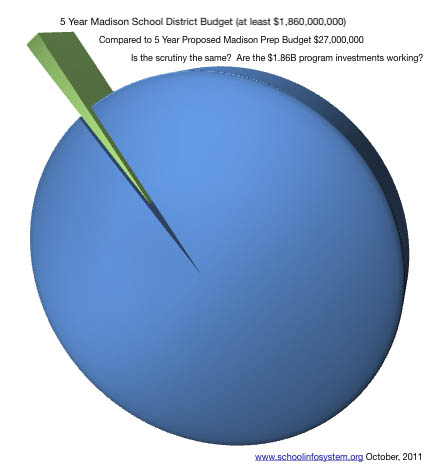
Share

Madison Prep – 1,2,3 Yellow Light (updated)

TJ Mertz:

Big news over the weekend in the Madison Preparatory Academy saga. There has been significant and positive movement on four issues by the Urban League of Greater Madison (ULGM). First, they have changed their request from non-instrumentality to instrumentality, increasing control by and accountability to the district. Second, they have agreed to be staffed by teachers and other educators represented by Madison Teachers Incorporated (MTI) and follow the existing contract between MTI and the Madison Metropolitan School District (the memo on these two items and more is here). ULGM has also morphed their vision from a district-wide charter to a geographic/attendance area charter. Last, their current budget projections no longer require outrageous transfers of funds from other district schools. Many issues and questions remain but these move the proposal from an obvious red light to the “proceed with caution” yellow. It is far from being a green light.
Before identifying some of the remaining questions and issues, I think it is important to point out that this movement on the part on the Urban League came because people raised issues and asked questions. Throughout the controversies there has been a tendency to present Madison Prep as initially proposed as “THE PLAN” and dismiss any questioning of that proposal as evidence that the questioners don’t care about the academic achievement of minorities and children of poverty. This has been absurd and offensive. Remember this started at $28,000 per/pupil. Well, ULGM has moved this far because people didn’t treat their proposal as if it had been brought down from Mount Sinai by Moses; if the proposal is eventually approved, MMSD and likely Madison Prep will be better because these changes have been made. As this process enters the next phases, I hope everyone keeps that in mind.

Share

Bringing the Common Core State Mathematics Standards to Life

Hung-Hsi Wu, via Richard Askey:

Many sets of state and national mathematics stan- dards have come and gone in the past two decades. The Common Core State Mathematics Standards (CCSMS), which were released in June of 2010,*have been adopted by almost all states and will be phased in across the nation in 2014. Will this be another forgettable stan- dards document like the overwhelming majority of the others?
Perhaps. But unlike the others, it will be a travesty if this one is forgotten. The main difference between these standards and most of the others is that the CCSMS are mathematically very sound overall. They could serve–at long last–as the foundation for creating proper school mathematics textbooks and dramatically better teacher preparation.
Before the CCSMS came along, America long resisted the idea of commonality of standards and curriculum–but it did not resist such commonality in actual classrooms. Despite some politicians’ rhetoric extolling the virtues of local control, there has been a de facto national mathematics curriculum for decades: the curriculum defined by the school mathematics textbooks. There are several widely used textbooks, but mathe- matically they are very much alike. Let’s call this de facto math- ematics curriculum Textbook School Mathematics (TSM).1

Share

Math Curriculum: School District’s Activities Should be an Open Book

Laurie Rogers:

Since January 2007, I’ve attempted repeatedly and in myriad ways to persuade Spokane Public Schools‘ leadership to provide teachers with good math materials so that our children will gain sufficient basic math skills. It’s an effort you’d think would be welcome, respected, and relatively painless. Alas.
In 2008, after repeated failed efforts to get a conversation going with the district or with the daily newspaper, I decided to take that conversation public. Thus was born my blog, Betrayed. Shortly after that, I began writing my book, Betrayed: How the Education Establishment Has Betrayed America and What You Can Do about it. The book was published in January 2011, and shortly thereafter, I worked with two professionals to hold public forums in Spokane and talk directly with the people. The district leadership does not appear to appreciate my efforts to inform the people and try to get the children the mathematics they need.
A school district’s activities should be an open book to the community that pays for them. My blog, book and advocacy all required thorough and accurate information. Therefore, over these nearly five years of effort, I’ve had to file public records requests with the district in order to obtain pertinent information that wasn’t available in any other venue. For records other than internal district communications, my searches usually went like this:

Share

AP & ACT Results Over the Years at Madison’s Edgewood High School

Edge on the News:

Last year, 120 students took 223 Advanced Placement exams from 15 different exams last year. Congratulations to all of our faculty and staff who contributed to our students’ success.

  • 34% of juniors – over 40% of seniors and over a quarter of juniors took at least one AP course and exam in 2010-2011. The most recent report available shows the national figure in 2010 was 2010 was 26% for Wisconsin.
  • 86.7% of EHS students who took an AP course scored a 3 or higher (passing), compared with 69.9% in the State of Wisconsin and 60.2% globally.
  • 38.2% of the EHS graduating class passed (scored 3, 4 or 5) at least one AP exam. According to the 2010 AP report, the national average was 16.9% and Wisconsin average was 18.3% for any time during high school.
  • EHS offers one AP course for every 13-14 seniors.

For the period 1997-2011:

  • Edgewood’s average ACT score rose about 2 points to 25.0 with an average of 96% of EHS students taking the test over that period. During the same period, state and national averages remained essentially unchanged from the low 22s and about 21, respectively. In 2010-11, 71% of Wisconsin students and 49% of all US students took the test.
  • The total number of students taking Edgewood’s AP courses more than tripled.
  • The average number of tests taken per EHS AP student per year rose from 1.34 to 1.86.
  • The percent of students receiving passing scores (3, 4 or 5) rose from 54% to 87%.

Share

U.S. Education Secretary calls Massachusetts ‘great example’ for nation

Matt Murphy:

Celebrating the one-year anniversary of Massachusetts’s successful pitch for $250 million from the Obama administration’s Race to the Top program, Gov. Deval Patrick, U.S. Education Secretary Arne Duncan and state Education Secretary Paul Reville on Wednesday touted the efforts the state has made to improve innovation and student performance in public schools.
The anniversary comes as state education officials indicate they plan to seek a waiver from key provisions of the federal No Child Left Behind Act that require 100 percent of students to be proficient in English and math by 2014. Obama announced the opportunity for states to apply to opt out of portions of NCLB last Friday.
Duncan credited Massachusetts with setting “a great example for the country,” despite Reville acknowledging that under No Child Left Behind over 90 percent of Massachusetts schools have been categorized in some way as “underperforming” based on the most recent MCAS scores.

How does Wisconsin compare to Massachusetts? Find out, here.

Share

Cassidy: Education on the brink of an online revolution

Mike Cassidy:

I’ve been something of a pessimist when it comes to the general state of public education.
But I’m coming around. I’m coming around to the view that big, important, disruptive — and positive — changes are coming; and they’re coming faster than many might think. I’ve concluded that those who see online learning as a part of the solution to crumbling school budgets and lackluster student performance are right. I now believe that the education world is on the brink of a revolution that will come about not because of politics and policy, but despite them.
The potential is so compelling that if the education establishment does not encourage the move to smart online learning, parents, students, teachers and innovative administrators will lead the charge. They will engineer the shift. And they’ll do it in a matter of years, not decades.

Share

The China Syndrome? Here? In Sun Prairie?

sp-eye:

Someone PLEASE explain to us the fascination the district (or a portion thereof) has with the need for Mandarin Chinese in the curriculum!
We hear the argument, “China is the second largest country by size and most populous–and therefore the ability to speak Chinese will ultimately have value”.
Right. And property values always rise. And 100-year storms only occur once in one hundred years.

Share

The Obama Administration’s Plan for Teacher Education Reform and Improvement

US Department of Education:

Teacher preparation programs play an essential role in our elementary and secondary education system, which relies on them to recruit, select, and prepare approximately 200,000 future teachers every year.1 Strong programs recruit, select, and prepare teachers who have or learn the skills and knowledge they need to be hired into teaching positions, be retained in them, and lead their students to strong learning gains. Weak programs set minimal standards for entry and graduation. They produce inadequately trained teachers whose students do not make sufficient academic progress.
Unfortunately, while there are shining examples of strong programs throughout the country, too many of our teacher preparation programs fall short. As a whole, America is not following the lead of high-performing countries and recruiting the nation’s best and brightest into teaching. Instead, only 23% of all teachers, and
only 14% of teachers in high-poverty schools, come from the top third of college graduates.2 Our differences with other nations are not due to teacher preparation alone. We must do more to support and reward excellent teaching at various stages in the education system. However, we can do more in the area of preparation. After admission, too many programs do not provide teachers with a rigorous, clinical experience that prepares them for the schools in which they will work. Only 50 percent of current teacher candidates receive supervised clinical training. More than three in five education school alumni report that their education school did not prepare them for “classroom realities.” 3

Share

A federal takeover of education

George Will:

Many Americans, having grown accustomed to Caesarism, probably see magnanimity in that front-page headline. Others, however, read it as redundant evidence of how distorted American governance has become. A president “gives” states a “voice” in education policy concerning kindergarten through 12th grade? How did this quintessential state and local responsibility become tethered to presidential discretion? Here is how federal power expands, even in the guise of decentralization:
Ohio Sen. Robert Taft (1889-1953) was “Mr. Republican,” revered by conservatives chafing under the domination of the GOP by Eastern money that preferred moderates such as New York Gov. Tom Dewey, the GOP’s 1944 and 1948 presidential nominee. In “The Roots of Modern Conservatism: Dewey, Taft, and the Battle for the Soul of the Republican Party,” Michael Bowen, historian at Pennsylvania’s Westminster College, recounts how Taft leavened his small-government orthodoxy with deviations, including federal aid to primary and secondary education.
In the 79th Congress (1945-47), Taft sponsored legislation to provide such education more than $8 billion over 25 years. The sum was huge (the 1947 federal budget was $34.5 billion), and the 25-year horizon said that federal intervention would not be temporary. Taft drafted his bill with help from the National Education Association (NEA), the teachers union that today is an appendage of the Democratic Party, except when the relationship is the other way around.

Share

Hillsborough school officials take new evaluation system to parents

Marlene Sokol:

It started with a partnership between the school district and the teachers’ union.
Next came $100 million in grant funding from Bill and Melinda Gates, then the arduous job of explaining the Empowering Effective Teachers plan to more than 11,000 teachers.
On Monday night, a small group of parents braved heavy rains for its chance.
Turnout at Chamberlain High School to hear Hillsborough County school officials explain and answer questions about the program was sparse. But Melissa Erickson, president of the county PTA council, didn’t mind.
“It’s the beginning of a conversation,” she said.

Share

Do High Flyers Maintain Their Altitude? Performance Trends of Top Students

Yun Xiang, Michael Dahlin, John Cronin, Robert Theaker, Sarah Durant:

Fordham’s latest study, “Do High Flyers Maintain Their Altitude? Performance Trends of Top Students,” is the first to examine the performance of America’s highest-achieving children over time at the individual-student level. Produced in partnership with the Northwest Evaluation Association, it finds that many high-achieving students struggle to maintain their elite performance over the years and often fail to improve their reading ability at the same rate as their average and below-average classmates. The study raises troubling questions: Is our obsession with closing achievement gaps and “leaving no child behind” coming at the expense of our “talented tenth”–and America’s future international competitiveness? Read on to learn more.

Share

Preschool Funding for Kids Now Pays Off Billions Later

Katherine Harmon:

There are few sure investments in this chaotic economic climate, but on a national level, education has proven to pay off big down the road. As tight economic times have put the squeeze on education budgets here in the U.S., a new report shows the big benefits of even small investments in early education worldwide.
For every dollar invested in boosting preschool enrollment, middle- and low-income countries would see a return of some $6.40 to $17.60, according to a new analysis published September 22 in The Lancet. “Early childhood is the most effective and cost-effective time to ensure that all children develop to their full potential,” noted the authors, led by Patrice Engle, of California Polytechnic State University. “The returns on investment in early child development are substantial.”

Share

Crunch Time for Madison Prep Charter School


Ruth Conniff:

Ed Hughes has a problem.
Like most of his fellow school board members and practically everyone else in Madison, he was bowled over by Urban League president Kaleem Caire’s vision for Madison Prep, a charter school that would aggressively tackle the school district’s entrenched minority achievement gap.
“The longer day, the instructional focus, and the ‘no excuses’ approach appealed to me,” Hughes says.
But as he looked into the details, Hughes became more and more concerned about the cost of the school and “whether there is a good match between the problem we are trying to address and the solution that’s being proposed.”
Expressing those doubts in his blog has turned the soft-spoken Hughes into a heretic.
Caire is a superstar who has galvanized the community to get behind his charter school. At school board hearings, only a handful of speakers express any reservations about the idea, while an overwhelming number speak passionately about the need to break the school-to-prison pipeline, and about Madison’s moral obligation to do something for the kids who are not being served.
Hughes listens respectfully. But, he says, “for Madison Prep to be the answer, we’d need to know that the students it was serving would otherwise fall through the cracks.”
…..
But Hughes’ big problem with the Urban League’s draft proposal, submitted to the district last February, is cost. The total cost to the school district of $27 million over five years is just too much, he says.

Madison School Board Member Ed Hughes:

I don’t know if the Urban League’s plans for Madison Prep will come to fruition. If they do, I predict here and now that the school will have a higher graduation rate than the Madison school district as a whole for African-American students and probably for other groups of students as well. I also predict that all or nearly all of its graduates will apply to and be admitted to college. What is impossible to predict is what difference, if any, this will make in overall educational outcomes for Madison students.
Of course charter schools like Madison Prep will have higher graduation rates than their home school districts as a whole. Students enrolled in charter schools are privileged in one clear way over students not enrolled. Each student has a parent or other caregiver sufficiently involved in the child’s education to successfully navigate the process to get the student into the charter school. Not all students in our traditional neighborhood schools have that advantage. Other things equal, students with more involved parents/caregivers will be more likely to graduate from high school. So, one would expect that charter schools will have higher graduation rates.

Share

Academic Performance and the BCS

John V. Lombardi , Elizabeth D. Capaldi and Craig W. Abbey:

Those of us who inhabit the core of the university’s academic environment share the enthusiasm for measuring and evaluating the quality of our institutions, although we have less enthusiasm for the endless ranked lists that appear in popular publications.
While some dote on the U.S. News rankings, which like their BCS counterpart rely on hugely unreliable opinion surveys, we, however, prefer our own system for evaluating the Top American Research Universities that recognizes the importance of successful performance among highly competitive institutions without requiring a simple top to bottom ranking that often distorts more than it informs.
For over ten years, The Center for Measuring University Performance, now located at Arizona State University, has produced an annual report on the Top American Research Universities that uses objective data on nine measures to put universities into categories according to their performance.

Share