School Information System

Common-Core Math Standards Don’t Add Up

Grant Wiggins, via a kind reader’s email:

There is little question in my mind that national standards will be a blessing. The crazy quilt of district and state standards will become more rational, student mobility will stop causing needless learning hardships, and the full talents of a nation of innovators will be released to develop a vast array of products and services at a scale that permits even small vendors to compete to widen the field to all educators’ benefit.
That said, we are faced with a terrible situation in mathematics. In my view, unlike the English/language arts standards, the mathematics components of the Common Core State Standards Initiative are a bitter disappointment. In terms of their limited vision of math education, the pedestrian framework chosen to organize the standards, and the incoherent nature of the standards for mathematical practice in particular, I don’t see how these take us forward in any way. They unwittingly reinforce the very errors in math curriculum, instruction, and assessment that produced the current crisis.

Share

Madison Prep, More Questions than Answers

TJ Mertz:

With only 24 days remaining till the Madison Metropolitan School District Board of Education will vote on the Madison Preparatory Academy charter and only 9 days until the MMSD administration is required to issue an analysis of their proposal (and that is assuming the analysis is issued on a Sunday, otherwise we are talking only one week), there are still many, many unanswered questions concerning the school. Too many unanswered questions.
Where to start?
All officially submitted information (and more) can be found on the district web site (scroll down for the latest iterations, and thanks to the district public info team for doing this).
The issues around instrumentality/non instrumentality and the status of staff in relation to existing union contracts have rightfully been given much attention. It is my understanding that there has been some progress, but things seem to be somewhat stalled on those matters.

Much more on the proposed Madison Preparatory IB Charter school, here.
Do current schools face the same scrutiny as the proposed Madison Preparatory Academy IB Charter?

Share

The National Study of Charter Management Organization (CMO) Effectiveness

Joshua Furgeson, Brian Gill,Joshua Haimson, Alexandra Killewald, Moira McCullough, Ira Nichols-Barrer, Bing-ru Teh, Natalya Verbitsky-Savitz, Melissa Bowen, Allison Demeritt, Paul Hill, Robin Lake

Charter schools–public schools of choice that are operated autonomously, outside the direct control of local school districts–have become more prevalent over the past two decades. There is no consensus about whether, on average, charter schools are doing better or worse than conventional public schools at promoting the achievement of their students. Nonetheless, one research finding is clear: Effects vary widely among different charter schools. Many educators, policymakers, and funders are interested in ways to identify and replicate successful charter schools and help other public schools adopt effective charter school practices.
Charter-school management organizations (CMOs), which establish and operate multiple charter schools, represent one prominent attempt to bring high performance to scale. Many CMOs were created in order to replicate educational approaches that appeared to be effective, particularly among disadvantaged students. Attracting substantial philanthropic support, CMO schools have grown rapidly from encompassing about 6 percent of all charter schools in 2000 to about 17 percent of a much larger number of charter schools by 2009 (Miron 2010). Some of these organizations have received laudatory attention through anecdotal reports of dramatic achievement results.

Andrew Rotherham comments on the study.

Share

NAEP reaction in the blogosphere

Mandy Zatynski:

Education think tanks and reformers have been abuzz today with the release of NAEP (National Assessment of Educational Progress) scores — also known as “The Nation’s Report Card.” The biennial release charts student achievement in math and English in fourth and eighth grades. (For an explainer on all things NAEP, go here.) The 2011 stats showed slight improvement in math across both levels, but reading scores among fourth-graders remained stagnant.

NAEP provides us the data, but officials do not surmise causes or reasons for growth – or lack thereof. That’s why we have eduwonks. Here’s what they had to say (in no particular order):

Share

Madison School District Identified for Improvement (DIFI); Documentation for the Wisconsin DPI

Madison School District Superintendent Dan Nerad 15MB PDF

1. Develop or Revise a District Improvement Plan
Address the fundamental teaching and learning needs of schools in the Local Education Agency (LEA), especially the academic problems o f low-achieving students.
MMSD has been identified by the State of Wisconsin as a District Identified for Improvement, or DIFI. We entered into this status based on District WKCE assessment scores. The data indicates that sub-groups of students-African American students, English Language Learner Students with Disabilities or Economically Disadvantaged -did not score high enough on the WKCE in one or more areas of reading, math or test participation to meet state criteria.
Under No Child Left Behind, 100% of students are expected to achieve proficient or advanced on the WKCE in four areas by 2014. Student performance goals have been raised every year on a regular schedule since 2001, making targets more and more difficult to reach each year. In addition to the curriculum changes being implemented, the following assessments are also new or being implemented during the 2011-12 school year (see Attachment 1):

  1. The Measures of Academic Progress (MAP): Grades 3-7. MAP is incorporated into the MMSD Balanced Assessment Plan as a computer adaptive benchmark assessment tool for grades 3-7. Administration of the assessment was implemented in spring, 2011.
  2. Cognitive Ability Test (CogAT): Grades 2 and 5. As proposed in the Talented and Gifted Plan approved by the Board of Education in August, 2009, the district requested approval of funds to purchase and score the Cognitive Ability Test (CogAT) which was administered in February, 2011, to all second and fifth graders.
  3. The EPAS System: Explore Grades 8-9, Plan Grade 10, ACT Grade 11. The EPAS system provides a longitudinal, systematic approach to educational and career planning, assessment, instructional support, and evaluation. The system focuses on the integrated, higher-order thinking skills students develop in grades K-12 that are important for success both during and after high school. The EPAS system is linked to the College and Career Readiness standards so that the information gained about student performance can be used to inform instruction around those standards.

Attached are six documents describing programs being implemented for the 2011-12 school year to address the needs of all students.
1. Strategic Plan Document: Year Three (Attachment 2)
2. Strategic Plan Summary of Three Main Focus Areas (Attachment 3)
3. Addressing the Needs of All Learners and Closing the Achievement Gap Through K-12 Alignment (Attachment 4)
4. Scope and Sequence (Attachment 5)
5. The Ideal Graduate from MMSD (Attachment 6)
6. 4K Update to BOE- Program and Sites- (Attachment 7)

Clusty Search: District Identified for Improvement (DIFI)
Matthew DeFour:

Madison School District administrators aren’t keeping track of the best classroom instruction. Not all principals create a culture of high expectations for all students. And teachers aren’t using the same research-based methods.
Such inconsistencies across the district and within schools — stemming from Madison’s tradition of school and teacher autonomy — are hurting student achievement, according to a district analysis required under the federal No Child Left Behind law.
“There are problems within the entire system,” Superintendent Dan Nerad said. “We do have good practice, but we need to be more consistent and have more fidelity to our practices.”
Inconsistencies in teaching and building culture can affect low-income students, who are more likely to move from school to school, and make teacher training less effective, Nerad said.
The analysis is contained in an improvement plan the district is scheduled to discuss with the School Board on Monday and to deliver next week to the state Department of Public Instruction.

Share

Give high school kids more than one option

Milwaukee Journal-Sentinel:

About 5,500 students at Milwaukee Public Schools are on a path that research shows leads to better understanding of science, engineering and math, more engagement in school and improves their academic performance. Project Lead the Way does all that.
Which is why William Symonds thinks more kids should have such “apprenticeship” opportunities.
And we think he’s right.
Symonds, head of the Pathways to Prosperity Project at Harvard University, says kids need to be more firmly connected to the workplace – at a younger age. His message: Four-year college degrees aren’t for everyone, and by overemphasizing that goal, parents, schools and businesses have left a huge swath of kids behind. There is certainly evidence of that in Milwaukee.
And while it’s a fact that southeastern Wisconsin needs more college graduates, the goal of more baccalaureate degrees is not incompatible with the idea of offering high school students multiple pathways to careers.

Share

New Grades On Charter Schools

Andrew Rotherham:

The two most common criticisms about charter schools are that A) many of them aren’t that good and B) the good ones can’t be replicated to serve enough kids to really make a difference. TIME got an exclusive first look at the most comprehensive evaluation of charter school networks ever, and although the study, which will be released on Nov. 4, underscores the challenge of creating quality schools, it also makes clear that it is indeed possible to build a lot of schools that are game-changers for a lot of students.
The study, conducted by Mathematica Policy Research and the University of Washington’s Center on Reinventing Public Education, examined networks of affiliated charter schools, which in the education world are referred to as charter school management organizations (CMOs). There are more than 130 of these non-profit networks serving about 250,000 students nationwide. I was on an advisory board for the early conception and design of this study, the goal of which was to better understand how CMOs operate and how effective they are. The study is filled with valuable data about how CMOs manage their teachers, how much funding they get and how they use it and what kinds of students they serve. But I’m focusing here on student achievement, which is, of course, the most contentious issue in the national debate about charter schools.

Share

School Has a Charter, Students and a Strong Opponent: Its District

Winnie Hu, via a kind Carla McDonald email:

Charter schools, publicly financed but independently operated, have encountered fierce resistance in many suburban communities, criticized by parents and traditional educators who view them as a drain on resources.
But since the Amani Public Charter School won state approval to open this year, officials at the Mount Vernon City School District have taken that opposition to a new level.
The district, in Westchester County, sued the State Education Department and the Amani school this year, calling the approval an “arbitrary and capricious” decision, and sought to block Amani from moving forward. It has refused to turn over state, federal and local aid money to Amani, so the state has begun paying the charter directly. During the summer, district workers were sent to knock on the doors of Amani students to check that they lived in the district, a tactic that angered some parents. And in recent weeks, the district has delayed providing special education services to Amani students.

Share

Everything you wanted to know about urban education and its solutions!

Dr. Armand A. Fusco, via a kind email:

“No one has been able to stop the steady plunge of young black Americans into a socioeconomic abyss.” Bob Herbert / Syndicated columnist
Everything you wanted to know about urban education and its solutions!
For over 50 years this shame of the nation and education has remained as a plague upon its most vulnerable children. All reform efforts involving billions of dollars have not alleviated this scourge in our public schools. The rhetoric has been profound, but it has been immune to any antidote or action and it is getting worse; but it doesn’t have to be!
The following quotes summarize the 285 pages and over 400 references from my book.

Edited Insightful Quotes
The explanations and references are found in the contents of the book.

  • School pushouts is a time bomb exploding economically and socially every twenty-six seconds
  • Remember what the basic problem is–they are in all respects illiterate and that is why they are failing.
  • Every three years the number of dropouts and pushouts adds up to a city bigger than Chicago.
  • Politics trump the needs of all children to achieve their potential.
  • One reason that the high school dropout crisis is known as the “silent epidemic” is that the problem is frequently minimized.
  • Simply stated black male students can achieve high outcomes; the tragedy is most states and districts choose not to do so.
  • In the majority of schools, the conditions necessary for Black males to systematically succeed in education do not exist.
  • While one in four American children is Latino–the largest and fastest growing minority group in the United States–they are chronically underserved by the nation’s public schools and have the lowest education attainment levels in the country.
  • Miseducation is the most powerful example of cruel and unusual punishment; it’s exacted on children innocent of any crime.
  • Traditional proposals for improving education–more money, smaller classes, etc.–aren’t getting the job done.
  • The public school system is designed for Black and other minority children to fail.
  • The U.S. Department of Education has never even acknowledged that the problem exists.
  • Though extensive records are kept…unions and school boards do not want productivity analysis done.
  • Educational bureaucracies like the NEA are at the center of America’s dysfunctional minority public schools.
  • Does bonus pay alone improve student outcomes? We found that it does not.
  • Performance pay is equivalent to “thirty pieces of silver.”
  • Data necessary to distinguish cost-effective schools are all available, but our system has been built to make their use difficult.
  • Districts give credit for students who fail standardized tests on the expectation that students someday will pass.
  • We saw some schools that were low performing and had a very high parent satisfaction rate.
  • We’re spending ever-greater sums of money, yet our high school graduates’ test results have been absolutely flat.
  • America’s primary and secondary schools have many problems, but an excess of excellence is not one of them.
  • Not only is our use of incarceration highly concentrated among men with little schooling, but corrections systems are doing less to correct the problem by reducing educational opportunities for the growing number of prisoners.
  • Although states will require school districts to implement the common core state standards, the majority of these states are not requiring districts to make complementary changes in curriculum and teacher programs.
  • We can show that merit pay is counterproductive, that closing down struggling schools (or firing principals) makes no sense.
  • The gap between our articulated ideals and our practice is an international embarrassment.
  • It’s interesting to note that despite the growing support by minority parents for charters, the NAACP, the National Urban League, and other civil rights groups collectively condemn charter schools.
  • Public schools do respond constructively to competition by raising their achievement and productivity.
  • Gates Foundation has also stopped funding the small school concept because no results could be shown.
  • The policies we are following today are unlikely to improve our schools.
  • Our country still does a better job of tracking a package than it does a student.
  • Indeed, we give these children less of all the things that both research and experience tell us make a difference.
  • Reformers have little knowledge of what is working and how to scale what works.
  • The fact is that illiteracy has persisted in all states for generations, particularly among the most vulnerable children, and getting worse is a testament that national policy and creative leadership rings hollow.
  • We can’t change a child’s home life, but what we can do is affect what they do here at school.
  • Only a third of young Americans will leave high school with the knowledge and skills they need to succeed.
  • Black churches can no longer play gospel in the sanctuaries while kids drop out into poverty and prison. They must embrace school reform and take the role that Catholic churches have done for so long and for so many.
  • There is only one way to equalize education for all–technology.
  • Whatever made you successful in the past won’t in the future.
  • The real potential of technology for improving learning remains largely untapped in schools today.
  • Can’t read, can’t learn, can’t get a job, can’t survive, so can’t stay within the law.
  • Of the 19.4 million government workers, half work in education, which rivals health care for the most wasteful sector in America.
  • The only people not being betrayed are those who feed off our failing education system…that group gets larger every year.
  • Mediocrity, not excellence, is the national norm as demonstrated by the deplorable evidence.
  • Parents are left to face the bleak reality that their child will be forever stuck in a failing school and a failing system.
  • The key is that unless there is accountability, we will never get the right system.
  • The very public institutions intended for student learning have become focused instead on adult employment.
  • We conclude that the strategies driving the best performing systems are rarely found in the United States.
  • No reform has yet lived up to its definition!
  • Minority males don’t get the beef, they get the leftovers.
  • The cotton plantations have become the school plantations (children held in bondage of failing schools) and the dropouts move on to the prison plantations.

Share

9.27.2011 Wisconsin Read to Lead Task Force Notes

Wisconsin Reading Coalition, via a kind Chan Stroman-Roll email:

Guest Speaker Mark Seidenberg (Donald O. Hebb and Hilldale Professor of Psychology and Cognitive Neuroscience, UW-Madison): Professor Seidenberg gave an excellent presentation on the science of reading and why it is important to incorporate the findings of that science in teaching. Right now there is a huge disconnect between the vast, converged body of science worldwide and instructional practice. Prospective teachers are not learning about reading science in IHE’s, and relying on intuition about how to teach reading is biased and can mislead. Teaching older students to read is expensive and difficult. Up-front prevention of reading failure is important, and research shows us it is possible, even for dyslexic students. This will save money, and make the road easier for students to learn and teachers to teach. Seidenberg endorses using the Massachusetts model exam for teachers of reading (MTEL 90), which was developed with input from reading scientists. He also supports universal assessment to identify students who are at risk, and he mentioned the Minnesota Reading Corps as a model of reading tutoring that would be good to bring to Wisconsin.
Lander: Can Seidenberg provide a few examples of things on which the Task Force could reach consensus?
Seidenberg: There is a window for teaching basic reading skills that then will allow the child to move on to comprehension. The balanced literacy concept is in conflict with best practices. Classrooms in Wisconsin are too laissez-faire, and the spiraling approach to learning does not align with science.
Michael Brickman: Brickman, the Governor’s aide, cut off the discussion with Professor Seidenberg, and said he would be in touch with him later.

Much more on the Read to Lead Task Force, here.

Share

Now is the Time for States to Help High Schools Get the Postsecondary Data They Want

College Summit:

Particularly in rough economic times, states must make hard choices about resources. But there is one targeted investment that mayors, business leaders, educators, and parents are crying out for, and that states have already initiated. It is reports for high schools on their students’ postsecondary performance, answering the critical questions: Do students enroll in a postsecondary institution? Do they pass their non-remedial courses? In which academic areas are they thriving, or struggling? These data will enable high schools everywhere in a state to find out how their graduates are doing anywhere in the state. Without this information, high schools are handicapped in their ability to prepare students for college and career.
Indeed, too many students, especially low-income students, are not prepared. In the last decade, Americans have enrolled in college in record numbers. But once there, they are stumbling at alarming rates and at enormous cost to themselves, their families, and their city and state tax bases. By one estimate, the lost personal income for one year of one class of these students is $3.8 billion; the federal government loses $566 million and the states lose $164 million in taxes from this cohort of college students who should have graduated and the numbers multiply each year. 1
Superintendents and principals are desperate to know what went wrong. Business leaders anx- iously hope for employees who are ready for 21st century work. Governors, too, know that above all they need an educated workforce to compete in the national and global marketplace.
States are making progress toward producing the high school postsecondary performance data these stakeholders need. But in the meantime, the stakeholders are restless.

Share

Reforming Teacher Prep

Jocelyn Huber:

Students across the country have settled into another school year and many prospective teachers are in their first year of student teaching experience. Student teaching gives prospective teachers the opportunity to put theory into practice and ideally to learn the art of teaching from a skilled educator. Despite the importance of the student teaching experience, in some cases too little attention is paid to the quality of these programs. Some states are bravely tackling the arduous task of developing and refining teacher evaluation systems, but have yet to look carefully at the institutions and pre-service experiences that have the ability to deliver either exceptional or failing teachers. Rather than struggling to find the fairest way to identify, remediate, or ultimately remove bad teachers, wouldn’t it be far more beneficial for the profession and for students’ learning to ensure that only the very best teachers are earning certification and entering the classroom? (See DFER’s white paper, Ticket to Teach, to read some of our recommendations on reforming the profession here.)
In an attempt to more carefully examine the quality of pre-service training and education for teachers, the National Council on Teacher Quality (NCTQ) has begun a review of teacher preparation. In July, they released “Student Teaching in the United States.” The report and the larger review are controversial and have generated some backlash. But, if one can look past the defensiveness and posturing on all sides, the report suggests some helpful guidelines for teacher preparation programs and states to begin setting clearer and more rigorous training criteria for the benefit of students.

Share

Just the research we all want to see: Multiple measures doesn’t mean muddied mess

The National Council on Teacher Quality

Value-added measures are often criticized for providing a narrow view of a teacher’s performance. Conversely, broader measures like observations are seen as too subjective. A new study shows–happily–that both types of evaluations are consistent and complementary: they predict future students’ achievement. Teachers who score well on one also score well on the other. Best of all, combining them produces a stronger and more accurate measure of a teacher’s effectiveness than using either alone.
Jonah E. Rockoff and Cecilia Speroni of Columbia University looked at the ability of three measures to predict teacher effectiveness: a rigorous job application process, observations and ratings by trained mentors, and value-added calculations based on students’ math and English scores.

Share

Madison Prep’s ambitious plan to close achievement gap sparks vigorous debate

Susan Troller:

Nicole is a teacher’s dream student. Bright, curious and hard-working, she has high expectations for herself and isn’t satisfied with anything less than A grades. In fact, her mother says, she sometimes has to be told not to take school too seriously.
But when Nicole was tested in seventh grade to see if she’d qualify for an eighth-grade algebra course that would put her on track for advanced math courses in high school, her score wasn’t top-notch. She assured the teacher she wanted to tackle the course anyway. He turned her down.
In fact, her score could not predict whether she’d succeed. Neither could the color of her skin.
As an African-American girl, Nicole didn’t look much like the high-flying students her teacher was accustomed to teaching in his accelerated math classes at a Madison middle school. But instead of backing off, Nicole and her family challenged the recommendation. Somewhat grudgingly, her teacher allowed her in the class.
Fast forward a year: Nicole and one other student, the two top performers in the eighth-grade algebra class, were recommended for advanced math classes in high school.

Much more on the proposed Madison Preparatory Academy IB Charter school, here.

Share

Wisconsin 25th in 2011 NAEP Reading

Wisconsin Reading Coalition E-Alert, via a kind Chan Stroman Roll email:

The 4th and 8th grade NAEP reading and math scores were released today. You can view the results at http://nationsreportcard.gov. The presentation webinar is at http://www.nagb.org/reading-math-2011/.
Following is commentary on Wisconsin’s NAEP reading scores that was sent to the Governor’s Read to Lead task force by task force member Steve Dykstra.
2011 NAEP data for reading was released earlier than usual, this year. Under the previous timeline we wouldn’t get the reading data until Spring.
While we returned to our 2007 rank of 25 from our 2009 rank of 30, that is misleading. All of our gains come from modest improvement among Black students who no longer rank last, but are still very near the bottom. The shift in rank is among Wisconsin and a group of states who all perform at an essentially identical level, and have for years. We’re talking tenths of points as the difference.
It is always misleading to consider NAEP scores on a whole-state basis. Different states may have very different demographic make-ups and those difference can either exaggerate or mask the actual differences between the two states. For instance, the difference between Florida and Wisconsin (all scores refer to 4th grade reading) at the whole-state level is only 3 points. In reality, the difference is much greater. Demographic variation masks the real difference because Florida has far more minority students and far more poverty than Wisconsin. When we look at the subgroups, comparing apples to apples, we see that the real differences are vast.
When we break the groups down by gender and race, Florida outperforms Wisconsin by a statistically significant margin in every group. The smallest difference is 8 and some are as large as 20. If we break the groups down by race and school lunch status Florida outperforms Wisconsin by a statistically significant margin in every group, except black students who don’t get a free lunch. For that group Florida does better, but not by enough to declare statistical certainty. The smallest margin is 9, and many are at or above 15.
10 points are generally accepted as a grade level for this range of the NAEP. Every Florida subgroup except one exceeds it’s Wisconsin counterpart by a nearly a full grade level, and most by a lot more.
When we compare Wisconsin to Massachusetts the story is the same, only worse. The same groups are significantly different from each other, but the margins are slightly larger. The whole-state difference between Wisconsin and Massachusetts (15+ pts) only appears larger than for Florida because Massachusetts enjoys many of the same demographic advantages as Wisconsin. In fact, Wisconsin students are about the same 1.5 grade levels behind both Florida and Massachusetts for 4th grade reading.
If you want to dig deeper and kick over more rocks, it only gets worse. Every Wisconsin subgroup is below their national average and most are statistically significantly below. The gaps are found in overall scores, as well as for performance categories. We do about the same in terms of advanced students as we do with low performing students. Except for black students who don’t get a free lunch (where the three states are in a virtual dead heat), Wisconsin ranks last compared to Florida and Massachusetts for every subgroup in terms of percentage of students at the advanced level. In many cases the other states exceed our rate by 50-100% or more. Their children have a 50 -100% better chance to read at the advanced level.
We need a sense of urgency to do more than meet, and talk, and discuss. We need to actually change the things that will make a difference, we need to do it fast, and we need to get it right. A lot of what needs to be done can be accomplished in a matter of days. Some of it takes a few hours. The parts that will take longer would benefit from getting the other stuff done and out of the way so we can devote our attention to those long term issues.
Our children are suffering and so far, all we’re doing is talking about it. Shame on us.

Share

Comparing Rhetoric Regarding Texas (10th) & Wisconsin NAEP Scores: Texas Hispanic and African-American students rank second on eighth-grade NAEP math test

Texas Hispanic and African-American students rank
second on eighth-grade NAEP math test

Texas Education Agency:

Texas Hispanic and African-American students earned the second highest score among their peer groups on the 2011 eighth-grade National Assessment of Educational Progress (NAEP) mathematics test. The state’s white eighth grade students ranked fourth, missing out on the second place position themselves by less than one point.
Only Hispanic students in Montana earned a higher scale score on the math test than did eighth-grade Hispanic Texans. Only African-American students in Hawaii earned a higher average score than did their counterparts in Texas.
White students in the District of Columbia earned an average scale score of 319, the highest score for that ethnic group. Texas students ranked fourth, with less than a fraction of a point separating this group from students in Massachusetts and New Jersey. Massachusetts students had the second highest scale score at 304.2876, while Texas received an average score of 303.5460.
Overall, the state ranked 10th among the states with an average scale score of 290, substantially above the national average score of 283.

NAEP math on upward trend, state reading results stable

Wisconsin DPI:

Wisconsin’s biennial mathematics and reading results held steady on the 2011 National Assessment of Educational Progress (NAEP), also known as the Nation’s Report Card. The state’s overall trend in mathematics is improving.
For fourth-grade mathematics, the state’s 2011 scale score was 245, up one point but statistically the same as in 2009, compared to the national scale score of 240, a one-point increase from 2009. Wisconsin results for fourth-grade math are significantly higher than in 2003 when the average scale score was 237. At eighth grade, the Wisconsin scale score for mathematics was 289,
the same as in 2009 and up five points from 2003, which is statistically significant. For the nation, the 2011 mathematics scale score was 283, up one-point from 2009. State average scale scores in mathematics at both grade levels were statistically higher than the national score.

Average scores for fourth grade

All White Black Hispanic Asian Amer-Pac.Island Native Amer
US 240 249 224 229 256 227
Texas 241 253 232 235 263 ***
Wisconsin 245 251 217 228 242 231
Average scores for eighth grade
US 283 293 262 269 302 266
Texas 290 304 277 283 316 ***
Wisconsin 289 295 256 270 290 ***

via a kind Richard Askey email.
Erin Richards has more on Wisconsin’s results.
Steve Dykstra’s comments on Wisconsin’s NAEP reading scores.
Related: Madison and College Station, TX.

Share

Elmhurst District 205 School Report Card Data Now Available Online

Karen Chadra:

Elmhurst Unit District 205 has posted links to Illinois School Report Card data for the district’s schools on its web site.
The Illinois State Board of Education issues School Report Cards each fall for all public schools and school districts in the state. The reports include data on school finances, demographics, instruction and student assessments, which are based on student testing done during the 2010-2011 school year.
York High School and Churchville Middle School failed to meet adequate yearly progress as defined by the federal No Child Left Behind Act, which stipulates 100 percent of students must meet AYP by 2014. If any subgroup of a school fails to meet AYP, then the whole school does not meet AYP.

Share

Charter school deserves Milwaukee’s approval

Tim Sheehy:

On Tuesday, the Milwaukee Common Council will consider the Charter School Review Committee’s recommendation that the City of Milwaukee contract with Rocketship Education to open a network of independent charter schools.
Rocketship Education selected Milwaukee as its first expansion city outside of California because it saw great need but also because it sees the opportunity to be part of a systemic change in a community that desperately needs it. Rocketship has never promised miracles. It does promise a chance – a chance for children and a chance for Milwaukee.
Milwaukee has serious challenges and an urgent need to grow, develop and attract more schools that are effective in educating low-income children. Closing the gap in educational achievement for all 127,000 of the city’s K-12 schoolchildren is a community-wide responsibility.
There are no miracles, and we cannot wait for Superman. What we can do is expand our best-performing schools and work to improve our high-potential schools that operate as Milwaukee Public Schools or under the charter and choice programs. This requires the development of quality teachers and school leaders.

Share

The $10,000 College Degree Rick Perry’s $10,000 degree plan is just one option to obtain an inexpensive education.

Jenna Ashley Robinson:

Editor’s Note: Scroll down to the bottom to view OnlineCollege.org’s infographic about rising costs and the $10,000 degree.
The latest news on Wall Street is that the occupiers want forgiveness of student debt. And while President Obama didn’t meet their demands in his recent speech, he is still focusing on the same side of the equation: more money for higher education.
But down the road, the best way to deal with the high cost of college education is to reduce it! And Texas governor Rick Perry has thrown out the gauntlet by demanding that his regents come up with a plan for a $10,000 degree–not $10,000 per year but $10,000 for a full degree.
Is such a price possible? At the Pope Center, we’ve looked at affordability–and the innovation that will be required to get prices to that level–from many angles. My view is that extreme reductions are possible, but they may be far in the future. Meanwhile, however, you can save a lot of money if you take care.

Share

Physics vs. Phys Ed: Regardless of Need, Schools Pay the Same

Tom Gantert:

There are 19 gym teachers in the Farmington School District who make more than $85,000 a year each. The average gym teacher’s salary in Farmington is $75,035. By comparison, the science teachers in that district make $68,483 per year on average.
That’s not unusual in Michigan schools, according to Freedom of Information Act requests received from around the state.
In the Woodhaven-Brownstown district, 18.5 (FTE) science teachers average some $58,400 per year in salary, while 12 gym teachers averaged nearly $76,700. In Harrison, science teachers earned $49,000 on average while gym teachers averaged $62,000.
This is not unusual, because school districts don’t differentiate what a teacher does when considering compensation, regardless of the district’s educational needs. Teachers are paid on a single salary schedule based on seniority and education level.

Share

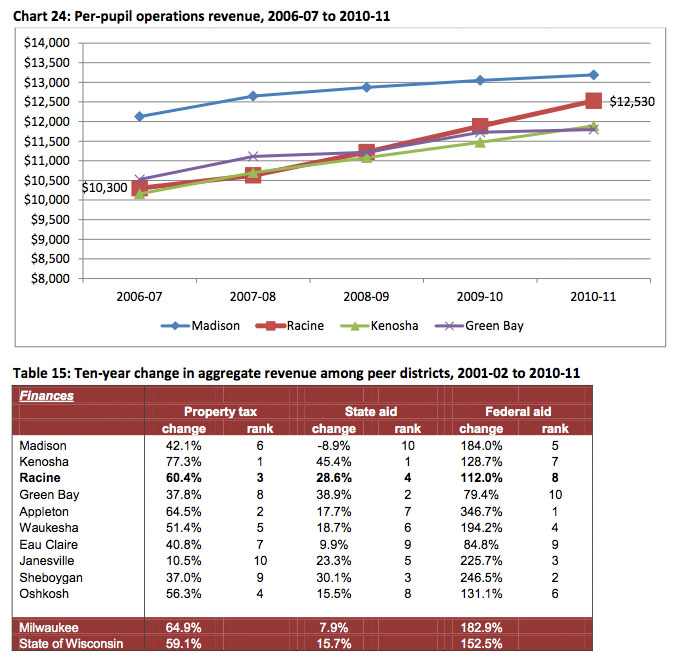
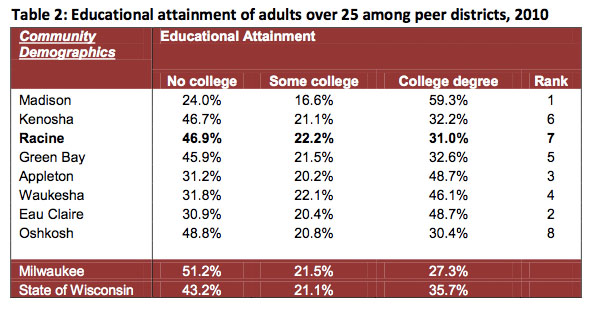
Comparing Racine to Madison, others; Racine school district holding itself accountable to goals, but academic achievement still lags peer districts


The Public Policy Forum

Racine Unified School District (RUSD) implemented a district-wide vision for improvement in March 2009. Called the North Star vision, it is intended to specify “the path to successful completion of high school for all RUSD students with an ultimate goal of every graduate being ready for a career and/or college.” It includes performance targets at each grade level to be used in creating school improvement plans and in setting school-level learning targets.
The vision is the result of a collaborative effort by the school board, district administrators, the teachers and administrators unions, and the support staff union. A simple graphic illustrating the measures of focus at each grade level has been widely distributed to parents, teachers, and district stakeholders.

Public Policy Forum Report (PDF):

For dedicated readers, this 14th Annual Comparative Analysis of the Racine Unified School District will look quite different from the previous 13 reports. For the first time, we compare the district’s performance to its own goals, as well as to its peers and to its past performance. The peer comparison tables, which have been the hallmark of previous reports, appear in Appendix I. The body of the report is focused on the district goals established in 2009 as the North Star vision, which according to the district, “is a shared vision that clearly identifies the path to successful completion of high school for all RUSD students with an ultimate goal of every graduate being ready for a career and/or college.”
As in previous reports, we also present contextual information about the Racine community and student body. RUSD has experienced many changes over the past 14 years, including: slipping from the third largest district in the state to the fourth largest, becoming a majority minority district, and now having most of its students quality for free or reduced-price lunch. The community has also become less wealthy during this time and seen fewer adults obtain college degrees. It is clear that RUSD has many challenges to overcome and a loss of significant state aid for this school year is yet another challenge. Consequently, this year’s report also includes a more in-depth analysis of the district’s fiscal situation.

Share

What Kids Demand in a Novel

Maile Meloy:

Sometimes you find yourself part of a trend accidentally: Some old, beloved jacket in your closet becomes fashionable, or your private, favorite novel is discovered by the world. Having written four books of fiction for adults, I wrote a novel for kids, and looked up from the first draft to find that other writers were doing the same thing–and adults were reading the books.
My plunge into the world of children’s publishing surprised my friends as much as it surprised me. One asked, “How did you make the change? Did you have some kind of magical elixir?” I did, if you consider that magical elixirs are slow and difficult and sometimes frustrating to make, and involve wrong turns and unexpected discoveries. But here’s the basic recipe:
1. Don’t worry about what category the book belongs in. I thought I was writing a young adult novel and discovered that there was a type of book called “middle reader” only when my publishers told me I’d written one. I worked in a state of utter naïveté about what the rules are for writing children’s books, which was liberating.

Share

Madison Prep Academy would open in former church on Near West Side

Matthew DeFour:

Madison Preparatory Academy would open next fall in a former church on the city’s Near West Side if the School Board approves a contract for the controversial charter school.
The non-profit organization that would run the school has signed a letter of intent to lease the former Mount Olive Lutheran Church at 4018 Mineral Point Road, according to a business plan for the school released Saturday morning.
The site is on a Metro bus route and includes a 32,000-square-foot facility and 1,200-square-foot house. It also achieves the school’s goal of being located near the Downtown, said Urban League of Greater Madison President Kaleem Caire.
“It’s a good neighborhood,” Caire said. “We would hope the neighbors would want to get involved with the kids in the school.”
The business plan lays out several other new details including a daily schedule from 8 a.m. to 5 p.m. with 90-minute classes, report cards for parents and performance bonuses for staff.

Meanwhile, Progressive Dane announces its opposition to the proposed Madison Preparatory IB Charter school.

Share

Too much too soon about birds and bees

China Daily:

Recently there has been a significant move among Chinese educators to provide better sex education to students in college, primary schools and even kindergartens.
The Ministry of Education recently issued a circular requiring colleges to make courses on reproductive physiology and sex psychology part of the standard curriculum.
This kind of education as a rule is included in courses known as physiology and hygiene in middle schools, but in actual practice some more sensitive topics are either not addressed or glossed over by instructors who consider them embarrassing and not essential.
In the past, this kind of information about sexuality was generally passed on informally outside the schools, by young people.
One of the many stated reasons for offering formal, medically accurate instruction is to protect children from sex abuse, and to prevent teen pregnancy and sexually transmitted diseases.

Share

Reinventing Discovery

James Wilsdon:

This year’s Nobel Prize in Physics was shared between three scientists – Saul Perlmutter, Brian Schmidt and Adam Reiss – for discovering, through their research on supernovae, that the universe’s rate of expansion is accelerating.
Yet, as the plaudits for the winners began to flow, one or two of their peers sounded notes of caution. Martin Rees, former president of the Royal Society, suggested that this was an instance where the Nobel committee had been “damagingly constrained” by its convention of not honouring more than three individuals at one time.
The prize-winning work had been carried out by two groups, each made up of a dozen or so scientists. “It would have been fairer,” Rees argued, “and would send a less distorted message about how this kind of science is actually done, if the award had been made collectively to all members of the two groups.”

Share

Proposed Madison Preparatory Academy IB Charter School Business & Education Plans

Education Plan (PDF) via a kind Kaleem Caire email:

Madison Preparatory Academy’s educational program has been designed to be different. The eight features of the educational program will serve as a powerful mix of strategies that allow Madison Prep to fulfill its mission: to prepare students for success at a four-year college or university by instilling Excellence, Pride, Leadership and Service. By fulfilling this mission, Madison Prep will serve as a catalyst of change and opportunity for young men and women who live in a city where only 48% of African American students and 56% of Latino students graduate from high school. Madison Prep’s educational program will produce students who are ready for college; who think, read, and write critically; who are culturally aware and embrace differences among all people; who give back to their communities; and who know how to work hard.
One of the most unique features of Madison Prep is the single gender approach. While single gender education has a long, successful history, there are currently no schools – public or private – in Dane County that offer single gender education. While single gender education is not right for every student, the demand demonstrated thus far by families who are interested in enrolling their children in Madison Prep shows that a significant number of parents believe their children would benefit from a single gender secondary school experience.
Madison Prep will operate two schools – a boys’ school and a girls’ school – in order to meet this demand as well as ensure compliance with Title IX of the Education Amendments of 1972. The schools will be virtually identical in all aspects, from culture to curriculum, because the founders of Madison Prep know that both boys and girls need and will benefit from the other educational features of Madison Prep.
The International Baccalaureate (IB) curriculum is one of those strategies that Madison Prep’s founders know will positively impact all the students the schools serve. IB is widely considered to be the highest quality curricular framework available. What makes IB particularly suitable for Madison Prep is that it can be designed around local learning standards (the Wisconsin Model Academic Standards and the Common Core State Standards) and it is inherently college preparatory. For students at Madison Prep who have special learning needs or speak English as a second language, IB is fully adaptable to their needs. Madison Prep will offer both the Middle Years Programme (MYP) and the Diploma Programme (DP) to all its students.
Because IB is designed to be college preparatory, this curricular framework is an ideal foundation for the other aspects of Madison Prep’s college preparatory program. Madison Prep is aiming to serve a student population of which at least 65% qualify for free or reduced lunch. This means that many of the parents of Madison Prep students will not be college educated themselves and will need the school to provide considerable support as their students embark on their journey through Madison Prep and to college.
College exposure, Destination Planning, and graduation requirements that mirror admissions requirements are some of the ways in which Madison Prep will ensure students are headed to college. Furthermore, parents’ pursuit of an international education for their children is increasing rapidly around the world as they seek to foster in their children a global outlook that also expands their awareness, competence and comfort level with communicating, living, working and problem solving with and among cultures different than their own.
Harkness Teaching, the cornerstone instructional strategy for Madison Prep, will serve as an effective avenue through which students will develop the critical thinking and communication skills that IB emphasizes. Harkness Teaching, which puts teacher and students around a table rather than in theater-style classrooms, promotes student-centered learning and rigorous exchange of ideas. Disciplinary Apprenticeship, Madison Prep’s approach to literacy across the curriculum, will ensure that students have the literacy skills to glean ideas and information from a variety of texts, ideas and information that they can then bring to the Harkness Table for critical analysis.
Yet to ensure that students are on track for college readiness and learning the standards set out in the curriculum, teachers will have to take a disciplined approach to data-driven instruction. Frequent, high quality assessments – aligned to the standards when possible – will serve as the basis for instructional practices. Madison Prep teachers will consistently be analyzing new data to adjust their practice as needed.

Business Plan (PDF), via a kind Kaleem Caire email:

Based on current education and social conditions, the fate of young men and women of color is uncertain.
Black and Hispanic boys are grossly over-represented among youth failing to achieve academic success, are at grave risk of dropping out of school before they reach 10th grade, are disproportionately represented among adjudicated and incarcerated youth, and are far less likely than their peers in other subgroups to achieve their dreams and aspirations. Likewise, boys in general lag behind girls in most indicators of student achievement.
Research indicates that although boys of color have high aspirations for academic and career success, their underperformance in school and lack of educational attainment undermine their career pursuits and the success they desire. This misalignment of aspirations and achievement is fueled by and perpetuates a set of social conditions wherein men of color find themselves disproportionately represented among the unemployed and incarcerated. Without meaningful, targeted, and sustainable interventions and support systems, hundreds of thousands of young men of color will never realize their true potential and the cycle of high unemployment, fatherless homes, overcrowded jails, incarcerated talent, deferred dreams, and high rates of school failure will continue.
Likewise, girls of color are failing to graduate high school on-time, underperform on standardized achievement and college entrance exams and are under-enrolled in college preparatory classes in secondary school. The situation is particularly pronounced in the Madison Metropolitan School District where Black and Hispanic girls are far less likely than Asian and White girls to take a rigorous college preparatory curriculum in high school or successfully complete such courses with a grade of C or better when they do. In this regard, they mimic the course taking patterns of boys of color.
Additionally, data on ACT college entrance exam completion, graduation rates and standardized achievement tests scores provided to the Urban League of Greater Madison by the Madison Metropolitan School District show a significant gap in ACT completion, graduation rates and standardized achievement scores between students of color and their White peers.
Madison Preparatory Academy for Young Men and Madison Preparatory Academy for Young Women will be established to serve as catalysts for change and opportunity among young men and women in the Greater Madison, Wisconsin area, particularly young men and women of color. It will also serve the interests of parents who desire a nurturing, college preparatory educational experience for their child.
Both schools will be administratively separate and operated by Madison Preparatory Academy, Inc. (Madison Prep), an independent 501(c)(3) established by the Urban League of Greater Madison and members of Madison Prep’s inaugural board of directors.
The Urban League of Greater Madison, the “founder” of Madison Prep, understands that poverty, isolation, structural discrimination, limited access to schools and classrooms that provide academic rigor, lack of access to positive male and female role models in different career fields, limited exposure to academically successful and achievement-oriented peer groups, and limited exposure to opportunity and culture experiences outside their neighborhoods contribute to reasons why so many young men and women fail to achieve their full potential. At the same time, the Urban League and its supporters understand that these issues can be addressed by directly countering each issue with a positive, exciting, engaging, enriching, challenging, affirming and structured learning community designed to specifically address these issues.
Madison Prep will consist of two independent public charter schools – authorized by the Madison Metropolitan School District Board of Education – designed to serve adolescent males and females in grades 6-12 in two separate schools. Both will be open to all students residing within the boundaries of the Madison Metropolitan School District (MMSD) who apply, regardless of their previous academic performance.

Much more on the proposed Madison Preparatory Academy IB Charter School, here.

Share

Lawsuits for School Reform?: Parent Power May Insert Itself in L.A. Unified’s Teachers’ Contract; Demand that the LAUSD Immediately Comply with the Stull Act

RiShawn Biddle:

Earlier this year, Dropout Nation argued that one way that school reformers — including school choice activists and Parent Power groups — could advance reform and expand school choice was to file lawsuits similar to school funding torts filed for the past four decades by school funding advocates. But now, it looks like Parent Power activists may be filing a lawsuit in Los Angeles on a different front: Overhauling teacher evaluations. And the Los Angeles Unified School District may be the place where the first suit is filed.
In a letter sent on behalf of some families Wednesday to L.A. Unified Superintendent John Deasy and the school board — and just before the district begins negotiations with the American Federation of Teachers’ City of Angels unit over a new contract — Barnes & Thornburg’s Kyle Kirwan demanded that the district “implement a comprehensive system” of evaluating teachers that ties “pupil progress” data to teacher evaluations. Kirwan and the group he represents are also asking for the district to begin evaluating all teachers “regardless of tenure status” and to reject any contract with the American Federation of Teachers local that allows for any veteran teacher with more than a decade on the job to go longer than two years without an evaluation if they haven’t had one in the first place.

We represent minor-students currently residing within the boundaries of the Los Angeles Unified School District (the “District” or “LAUSD”), the parents of these students, and other adults who have paid taxes for a school system that has chronically failed to comply with California law.
Our clients seek to have the District immediately meet its obligations under the Stull Act, a forty year old law that is codified at California Education Code section 44660 et seq. (the “Stull Act“).
In relevant part, the Stull Act requires that “[t]he governing board of each school district establish standards of expected pupil achievement at each grade level in each area of study.”
Cal. Educ. Code § 44662(a). The Stull Act requires further that “[t]he governing board of each school district … evaluate and assess certificated employee performance as it reasonably relates to … [t]he progress of pupils toward the standards established pursuant to subdivision (a) and, if applicable, the state adopted academic content standards as measured by state adopted criterion referenced assessments ….” Cal. Educ. Code§ 44662(b)(l).
In the forty years since the California Legislature passed the Stull Act, the District has never evaluated its certificated personnel based upon the progress of pupils towards the standards established pursuant to Education Code section 44662(a) and, if applicable, the state adopted academic content standards as measured by the state adopted criterion referenced assessments; never reduced such evaluations to writing or added the evaluations to part of the permanent records of its certificated personnel; never reviewed with its certificated personnel the results of pupil progress as they relate to Stull Act evaluations; and never made specific recommendations on how certificated personnel with unsatisfactory ratings could improve their performance in order to achieve a higher level of pupil progress toward meeting established standards of expected pupil achievement.

Share

Do kids need computers to learn? Some schools are saying no

Henry Aubin:

Are Quebec schools embracing computers too zealously? I don’t know the answer – I’m no pedagogue – but it’s a question worth asking.
Two things are clear.
One is that most parents, school officials and politicians see children’s familiarity with computers at an early age as desirable – nay, imperative – for successful individual careers and for society’s prosperity in a “knowledge economy.” The English Montreal School Board, for one, even provides laptop computers as a teaching tool in pre-kindergarten (where the 4-year-olds use them for recognition of numbers and letters and to do puzzles). In response to strong public support for this trend, Premier Jean Charest promised a few months ago to put a smart whiteboard (a front-of-the-class board that allows for digital touch interaction) in every primary- and secondary-school classroom across the province.

Share

NIXTY Responds to Adrian Sannier of OpenClass: You are not Open. You are betting the future of Pearson on the ability to beat Open.

Nixty:

Adrian of OpenClass responds to our questions. See our responses below:
Adrian writes:
@Nixty, a competitor to OpenClass, asks:
What happens when readily available free courses/texts help students learn better than Pearson’s closed expensive courses/texts?
What happens when we have clear research support that shows how students taking the open and free course learn more than students taking Pearson’s closed and expensive course?
Pearson’s stated aim is to make the LMS a commodity so they can sell more of their closed content and course tools. What happens when Pearson isn’t selling enough of their closed content and course tools?
Adrian’s Answer: Is this a trick question? Doesn’t this boil down to the more general question — What happens when a free product is better than one you pay for? There’s only one conclusion I can come to – free wins that round. And ‘for pay’ has to come up with something worth paying for, which is the essence of competition, the arms race that drives economics to produce improvement. I believe Pearson has proven it is up to that challenge for the long haul.

Share

The man who knows everything

David Gelles:

On a humid Monday in late September, a wonky entrepreneur named Salman Khan visited New York City. Khan, a 35-year-old American of South Asian descent with bushy black hair and a nerdy affect, was in town to promote his Silicon Valley startup. He stayed at the London NYC, an upscale hotel just south of Central Park, and dined at Maze, the Gordon Ramsay restaurant off the lobby.
But that night, instead of seeing the sights or going out with friends, Khan holed up in his hotel room, fiddled with his laptop, and produced a series of amateurish videos about geometry. They are disarmingly simple – Khan’s deep voice talks over a black screen, where he draws shapes and writes out questions and equations in multiple colours. One, a six-minute clip called “Congruent triangle proof example”, shows a proof that a point on a line is the midpoint, using two triangles. Another, “Finding congruent triangles”, establishes why four related postulates are all equally reasonable. When he was finished, he uploaded them to YouTube and went to sleep.

Khan Academy.

Share

Seattle Cluster Grouping Talk

Melissa Westbrook:

I attended the talk last night by Dr. Dina Bulles put on by Wedgwood Elementary (and held at Nathan Hale High). (FYI, her name is pronounced Bree-yays.) The other SPS staff represented were the principal of Wedgwood, Chris Cronas, Ex. Director, Phil Brockman, and head of Advanced Learning, Bob Vaughn. Mr. Cronas pointed out that several Wedgwood teachers were in attendance as well. There were a large number of seats put out but the room wasn’t full. My guess is it was about 60 people.
Dr. Bulles explained that in her district, Paradise Valley School district (which is just outside of Phoenix, Arizona), all of their elementary schools use cluster grouping. (Her district is about 35,000 students and there are 31 elementary schools.) She said out of those 35,000, about 5,000 student received gifted classes/services. (Help me out anyone else who attended; I thought she said towards the end that this was included high school students taking AP/IB. Is that what you heard?) She also made a startling statement that 68% of her teachers (and I believe this is in elementary) had 3 years or less of teaching experience. Wow.

Share

Ignoring the Achievement Gap

Andrew Rotherham:

Ah, the achievement gap. So much trouble to fix, so why bother trying? That seems to be the attitude in Washington, where pundits have spent the last several months ripping the current focus on improving the low end of student performance in our nation’s schools. In September the Obama Administration put forward a plan to offer waivers to states that want more flexibility — i.e., less ambitious targets — under the No Child Left Behind (NCLB) Act. Last week the bottom really fell out when the Senate committee that handles education passed a rewrite of the No Child law basically leaving it to states to figure out how (and probably, in practice, even whether) to close the gaps. In other words, a decade after an overwhelmingly bipartisan effort to get serious about school accountability, it’s open season on a strong federal role in education. How did we get here?
Let’s start with the pundits. Leading the charge is the American Enterprise Institute’s Rick Hess, who, in the fall issue of National Affairs, launched a contrarian broadside against NCLB’s focus on low-achieving students. “The relentless focus on gap-closing has transformed school reform into little more than a less objectionable rehash of the failed Great Society playbook,” Hess wrote. Next came a September report from the Thomas B. Fordham Foundation, another conservative think tank, claiming that the current focus is shortchanging high-achievers. Yet the data in the Fordham report didn’t support its alarmist conclusions that high-achievers were being hurt by today’s policies. The truth is, according to Fordham’s own data, that high-performers didn’t fare that badly overall. Other evidence bears this out. None of that slowed down the pundits.

Share

CPS to use tougher standard for evaluating schools

Joel Hood:

After years of futility inside the classroom, Chicago Public Schools soon will adopt a more rigorous internal evaluation system that judges schools on how well they prepare students for college, a move that could lead to more school closings in the years ahead.
This stricter method of evaluation promises to be an eye-opener for many parents, considering the current process used for years already paints a bleak picture of the district: 42 percent of schools — 207 elementary and 76 high schools — are on probation for low-academic performance and poor attendance.
Seventy-two schools have been on probation for five consecutive years, and 16 of them for 15 years in a row.
Approximately 123,000 students are in underperforming schools, officials said, prompting parents in large numbers to uproot their families for neighborhoods with better schools inside or outside the city. Maps presented to the school board Wednesday showed a correlation between some of the city’s poorest-performing schools and schools that are most underenrolled.

Share

Add this to the list of things that bureaucrats don’t understand about teachers’ lives.

Mrs. Cornelius:

So here’s a situation.
A parent requested a conference with a teacher I know during conference time. This parent began yelling and gesticulating wildly during the conference, until the teacher asked the parent to leave. By the way, the teacher in question is so calm, he’s practically a reincarnation of the Buddha. Parent stormed off and went to an administrator and made a bunch of wild claims about the teacher and then stormed out of the administrator’s office.
So far, not all that unusual, right?
Here’s where it gets interesting: the parent’s kid approached the teacher a few days later, accused him of threatening the mother, and then threatened to attack the teacher. This was done IN FRONT OF WITNESSES.
Wow. Makes Race to the Top seem kind of insignificant and out-of-touch, doesn’t it?

Share

US Ed Department Takes Aim at Schools of Education

The Federal Register (PDF):

The Department has identified the following constituencies as having interests that are significantly affected by the topics proposed for negotiations. The Department plans to seat as negotiators individuals from organizations or groups representing these constituencies:

  • Postsecondary students, including legal assistance organizations that represent students.
  • Teachers.
  • Financial aid administrators at postsecondary institutions.
  • Business officers and bursars at postsecondary institutions.
  • Admissions officers at postsecondary institutions.
  • State officials, including officials with teacher preparation program approval agencies, State teacher licensing boards, higher education executive officers, chief State school officers, State attorneys general, and State data system administrators.
  • Institutions that offer teacher preparation programs, including schools of education.
  • Institutions of higher education eligible to receive Federal assistance under Title III, Parts A, B, and F, and Title V of the HEA, which include Historically Black Colleges and Universities, Hispanic-Serving Institutions, American Indian Tribally Controlled Colleges and Universities, Alaska Native and Native Hawaiian- Serving Institutions, Predominantly Black Institutions, and other institutions with a substantial enrollment of needy students as defined in Title III of the HEA.
  • Two-year public institutions of higher education.
  • Four-year public institutions of higher education.
  • Private, non-profit institutions of higher education.
  • Private, for-profit institutions of higher education.
  • Operators of programs for alternative routes to teacher certification.
  • Accrediting agencies.
  • Students enrolled in elementary and secondary education, including parents of students enrolled in elementary and secondary education.
  • School and local educational agency officials, including those responsible for hiring teachers and evaluating teacher performance.
    The topics the committee is likely to address are as follows:

    • The requirements for institutional and program report cards on the quality of teacher preparation (Section 205(a) of the HEA);
    • The requirements for State report cards on the quality of teacher preparation (Section 205(b) of the HEA);
    • The standards to ensure reliability, validity, and accuracy of the data submitted in report cards on the quality of teacher preparation (Section 205(c) of the HEA);
    • The criteria used by States to assess the performance of teacher preparation programs at higher education institutions in the State, the identification of low-performing programs (Section 207(a) of the HEA), and the consequences of a State’s termination of eligibility of a program (Section 207(b) of the HEA);
    • The definition of the term ”high quality teacher preparation program” for the purpose of establishing the eligibility of an institution to participate in the TEACH Grant program (Section 420L(1) of the HEA);
    • The definition of the term ”high quality professional development services” for the purpose of establishing the eligibility of an institution to participate in the TEACH Grant program (Section 420L(1) of the HEA); and
    • The service and repayment obligations for the TEACH Grant Program (Subpart E of 34 CFR 686).

Share

My Favorite Test Question of All Time

Sam Shah:

In Calculus, we just finished our limits unit. I gave a test. It had a great question on it, inspired by Bowman and his limit activity.
Without further ado, it reads:
Then I ask part (b)…
Which reads: “Scratch off the missing data. With the new information, now answer the question: What do you think the limit as x approaches 2 of the function is (and say “d.n.e.” if it does not exist)? Explain why (talk about what a limit is!).
So then they get this…

Share

Toughest Exam Question: What Is the Best Way to Study?

Sue Shellenbarger:

Here’s a pop quiz: What foods are best to eat before a high-stakes test? When is the best time to review the toughest material? A growing body of research on the best study techniques offers some answers.
Chiefly, testing yourself repeatedly before an exam teaches the brain to retrieve and apply knowledge from memory. The method is more effective than re-reading a textbook, says Jeffrey Karpicke, an assistant professor of psychological sciences at Purdue University. If you are facing a test on the digestive system, he says, practice explaining how it works from start to finish, rather than studying a list of its parts.
In his junior year of high school in Cary, N.C., Keenan Harrell bought test-prep books and subjected himself to a “relentless and repetitive” series of nearly 30 practice SAT college-entrance exams. “I just took it over and over again, until it became almost aggravating,” he says.

Share

The Most Important Thing to Not Take for Granted During College

Thoughts of a Student Entrepreneur:

This jumped out to me after watching Steve Job’s 2005 Stanford graduation speech; the biggest thing to make sure not to take for granted at college is how easy it is to meet so many different & amazing people. You get 4 years to live on a student campus full of dots waiting to be connected ( in the words of Steve ) you must take advantage of every possible moment to connect dots. Especially if you want to start a startup. Looking back I wish I would have hung out a ton more in the C.S. Lab instead of doing my comp sci hw in my dorm room lounge in between switching off games of call of duty with my roommates.
I’m dying for an awesome co-founder right now!! More than anything, and it would have been awesome to be able to go to a college buddy with the same interests as I have. A college campus represents the easiest and most abundant source for finding a Co-Founder. Everything I’ve done until now I’ve done alone out of necessity b/c it’s been extremely hard to find a good co-founder.
Don’t take that barrier free access to tons of new friends & potential co-founders for granted!! That’s my single most important advice to any college student that wants to start their own company. I took it for granted and it’s making my startup career 100 times more difficult, trust me.

Share

College Readiness Is Lacking, New York City Reports Show

Fernanda Santos:

Only one in four students who enter high school in New York City are ready for college after four years, and less than half enroll, according to the A-through-F high school report cards released on Monday.
Those numbers, included for the first time in the report cards, confirmed what the state suggested several months ago: the city still has a long way to go to prepare students for successful experiences in college and beyond. And they were a signal that graduation rates, long used by Mayor Michael R. Bloomberg as a validation of his education policies, were not as meaningful as they seemed.
“There’s a huge change in life chances for kids who are successful in post-secondary education,” the city’s chief academic officer, Shael Polakow-Suransky, said. “We really have a task to prepare kids for that, and the data is one of the most motivating tools.”

Share

Denver’s Moment of Reckoning is Approaching

Moira Cullen:

Is Denver going to follow in the footsteps of other reform minded urban school districts that saw momentum, change, and improvement fade away? Or will we be one of the few cities to sustain and even accelerate effective school reform?
In less than two weeks, the most hotly contested and expensive school board race in the history of Colorado will come to an end. It looks like nearly $1 million will be spent by both sides in this election by the time Election Day arrives on November 1st.
Denver has a seven-person school board with four members currently supporting the Superintendent Tom Boasberg and a broad set of reforms while the remaining three board members have relied upon Diane Ravitch to try to thwart nearly every reform initiative. Needless to say, if two of the three seats go to anti-reform candidates, Boasberg will need to look for another job and the Colorado reform community is going to have to look to some other districts for bold leadership.
Denver has been the epicenter for reform in Colorado since Michael Bennet took the helm of Denver Public Schools (DPS). Most of the reforms, which were highlighted in Colorado’s Race to the Top application and elsewhere, are dependent upon Denver leading the charge.

Share

Madison Prep’s proposal raises questions

Anne Arnesen, Barbara Arnold, Nan Brien and Carol Carstensen:

We applaud the Urban League’s energy and persistence in identifying the significant achievement gap that remains in Madison schools. We welcome the fact that the Urban League has helped focus broader community discussion on this issue, and the need to serve more effectively and successfully African-American and Hispanic students. The achievement gap is real and must be addressed.
While the Madison Preparatory Academy may provide a fine educational experience for 840 students, the Madison Metropolitan School District is charged with improving outcomes for more than 12,000 children of color. We may be better served by using our limited and diminishing resources:
1. To increase the number of students in AVID (Advancement Via Individual Determination) by expanding this nationally proven and successful program, now in all four high schools, to lower grade levels. AVID is a college readiness system that accelerates learning for students in the academic middle who may not have a college tradition in their families. Ultimately, AVID uses research-based instructional strategies to increase academic performance schoolwide. East High, the first Madison school to implement AVID, has had two graduating classes. These graduates, who attend a variety of Wisconsin colleges and universities, are 90 percent students of color and 74 percent low income; 52 percent of these graduates speak a language other than English as their first language.

Share

Why no school? Really no good reason

Chris Rickert:

I will not be working in the office Thursday. I have to care for my kids, two of whom, like lots of other Wisconsin public school students, have the day off.
Why, you ask, are classes canceled on this entirely unremarkable Thursday the week before Halloween? On a day not set aside for any national holiday, nor part of any traditionally recognized vacation season, nor beset by record-breaking snowfall or some other natural cataclysm?
Well, because historically, a couple of consecutive weekdays in October have been something of a Wisconsin public schools-recognized holiday — the traditional time for the annual convention of the statewide teachers union, the Wisconsin Education Association Council.
I know what you’re saying: “Don’t be ridiculous. Teachers have two and a half months in the summer to hold their convention! Why wouldn’t they have it then?”
And I hear you; an October teachers convention does defy logic. Yet, that’s been the case until this year, when things managed to get even more illogical.

Share

The Times They are a Changing….


via a kind Larry Winkler email.

Share

Why We Can’t Fire Our Way to Urban School Reform

Christina Collins:

A recent SchoolBook article on the high teacher turnover at one of Eva Moskowitz’s Harlem Success Schools raises an important question in the debate over improving urban schools — how can we stop corporate education reform’s focus on “getting rid of bad teachers” from creating a level of instability in school staffing that hurts our city’s students?
The case of turnover in the Harlem Success schools is only the latest example of this issue, but it’s a striking one. Over a third of the teachers at Harlem Success 3 have chosen to leave the school in the past few months, a decision Moskowitz describes as “frankly, unethical.” At the same time, however, Moskowitz chooses to employ her staff with a policy of “at will employment” rather than a negotiated contract. Under this model, she and her principals have the right to terminate teachers’ service at the school at any time, for any reason. In fact, Steven Brill’s Class Warfare describes the case of one new teacher who was “forced out” only a few months into the school year when a young principal at Harlem Success decided she wasn’t a “good fit” for the school.

Share

At Elite Schools, Easing Up a Bit on Homework

Jenny Anderson:

It was the kind of memo that high school students would dream of getting, if they dreamed in memos.
Lisa Waller, director of the high school at Dalton, a famously rigorous private school on the Upper East Side, sent a letter to parents this summer announcing that tests and papers would be staggered to make sure students did not become overloaded. January midterms would be pushed back two weeks so students would not have to study during vacation.
Across town at the Trinity School, another of Manhattan’s elite academies, the administration has formed a task force to examine workload, and the upper school, grades 9 to 12, has been trying ways to coordinate test-taking with papers, labs and other projects.
Horace Mann School, in the Bronx, opened a tutoring center this year to help students manage their work. Hunter College High School, which has a tough admissions exam, is for the first time this year offering homework holidays, on Halloween, the Chinese New Year (Jan. 23) and a day nearer spring, March 14.

Share

Toughest Exam Question: What Is the Best Way to Study?

Sue Shellenbarger:

Here’s a pop quiz: What foods are best to eat before a high-stakes test? When is the best time to review the toughest material? A growing body of research on the best study techniques offers some answers.
Chiefly, testing yourself repeatedly before an exam teaches the brain to retrieve and apply knowledge from memory. The method is more effective than re-reading a textbook, says Jeffrey Karpicke, an assistant professor of psychological sciences at Purdue University. If you are facing a test on the digestive system, he says, practice explaining how it works from start to finish, rather than studying a list of its parts.
In his junior year of high school in Cary, N.C., Keenan Harrell bought test-prep books and subjected himself to a “relentless and repetitive” series of nearly 30 practice SAT college-entrance exams. “I just took it over and over again, until it became almost aggravating,” he says.

Share

Teacher Quality Bonanza

DFER:

While a small number of cynics out there still argue that classroom teachers are not really an important ingredient in a child’s overall education recipe, one of the most important developments in K-12 education policy in the last few years has been the recognition that decades-old teacher evaluations (where the best a child can hope for is a ‘satisfactory’ teacher over an ‘unsatisfactory’ teacher) aren’t up for the task of recognizing which teachers are hitting the ball out of the park with their students.
At DFER, we’ve long believed that the widespread irrelevance of excellence itself in the K-12 world has created a culture that has actively done damage to the lives of too many children who deserved much, much better from our nation’s most important public institution.
But there have been a lot of positive developments in this area of late. There’s obviously a long way to go, and surely some of what has been done to-date will need to be changed/enhanced/expanded, but we are clearly closer to a day where the link between teaching and learning is more clear in workplace evaluations for educators. (And we continue to hope and believe that this will usher in a new era where successful teachers are treated more like the community heroes that we believe they are.)

Share

Wisconsin budget panel backs expanding charter school program statewide

Jason Stein:

An independent charter school program would expand to medium and large school districts around Wisconsin, under a bill passed Wednesday by Republicans on the Legislature’s budget committee.
The proposal passed 12-3 on a party-line vote, with Republicans voting in favor and Democrats voting against.
The bill would take an independent charter school program currently operating in only Milwaukee and Racine and extend it statewide to districts with more than 2,000 students. That would apply to roughly a quarter of the state’s districts.
Republicans said it would help provide another options for students whose schools are failing them.
“The bill we are taking up today is truly something that is going to help the long-term prospects of Wisconsin,” said Rep. Robin Vos (R-Burlington), a co-chairman of the committee.
But Democrats said that the program would undermine local control of schools by elected officials in favor of an unelected board. They said the proposal could also prove another financial blow to regular public schools that are losing nearly $800 million in state aid over two years as part of the state budget and having tight state caps placed on their property tax levies.

Share

The Effect of Charter Schools on Student Achievement

Julian R. Betts and Y. Emily Tang via a kind Deb Britt email:

Charter schools are largely viewed as a major innovation in the public school landscape, as they receive more independence from state laws and regulations than do traditional public schools, and are therefore more able to experiment with alternative curricula, pedagogical methods, and different ways of hiring and training teachers. Unlike traditional public schools, charters may be shut down by their authorizers for poor performance. But how is charter school performance measured? What are the effects of charter schools on student achievement?
Assessing literature that uses either experimental (lottery) or student-level growth- based methods, this analysis infers the causal impact of attending a charter school on student performance.
Focusing on math and reading scores, the authors find compelling evidence that charters under-perform traditional public schools in some locations, grades, and subjects, and out-perform traditional public schools in other locations, grades, and subjects. However, important exceptions include elementary school reading and middle school math and reading, where evidence suggests no negative effects of charter schools and, in some cases, evidence of positive effects. Meta-analytic methods are used to obtain overall estimates on the effect of charter schools on reading and math achievement. The authors find an overall effect size for elementary school reading and math of 0.02 and 0.05, respectively, and for middle school math of 0.055. Effects are not statistically meaningful for middle school reading and for high school math and reading. Studies that focus on urban areas tend to find larger effects than do studies that examine wider areas. Studies of KIPP charter middle schools suggest positive effects of 0.096 and 0.223 for reading and math respectively. New York City and Boston charter schools also appeared to deliver achievement gains larger than charter schools in most other locations. A lack of rigorous studies in many parts of the nation limits the ability to extrapolate.

Share

On Charter Authorizing

Alex Medler:

Charter schools provide plenty of compelling news. Often the coverage is of great schools producing amazing outcomes for kids. But too often the stories are more tragic or sordid. A school’s governing board becomes mired in dysfunctional arguments; a school’s students are performing badly on state tests for several years running; somebody absconds with money; or a student with disabilities is discouraged from enrolling in a school.
Facing these unfortunate circumstances, a person is likely to shout, “Somebody should do something!” The outraged observer is correct. Generally, the “somebody” that ought to act is a charter school authorizer. Strong charter school authorizers screen initial applicants to avoid future failures. They also implement practices that respect each school’s autonomy while also protecting against abuses and ensuring that floundering schools close. Twenty years into the charter school movement, it appears that it will be difficult to hold all charter schools accountable unless we start to hold authorizers accountable for fulfilling their responsibilities.

Share

2011 Global Education Digest

UNESCO Institute for Statistics, via a kind Kris Olds email:

Two out of three children in Africa are left out of secondary school
Governments are struggling to meet the rising demand for secondary education, especially in sub-Saharan Africa, where there are enough school places for just 36% of children of age to enrol, according the latest edition of the Global Education Digest.
Globally, secondary schools have been accommodating almost one hundred million more students each decade, with the total number growing by 60% between 1990 and 2009. But the supply is dwarfed by demand as more countries approach universal primary education.
In 2009, 88% of children enrolled in primary school reached the last grade of this level of education, compared to 81%. Yet, in 20 countries — mostly in sub-Saharan Africa — a child in the last grade of primary school has a 75% chance at best of making the transition to lower secondary school.
The path to prosperity
“There can be no escape from poverty without a vast expansion of secondary education. This is a minimum entitlement for equipping youth with the knowledge and skills they need to secure decent livelihoods in today’s globalized world. It is going to take ambition and commitment to meet this challenge. But it is the only path towards prosperity,” said UNESCO’s Director-General Irina Bokova.
“An educated population is a country’s greatest wealth,” she added. “The inequalities signalled in this Report, especially in relation to girls’ exclusion from secondary education in many countries, have enormous implications for the achievement of all the internationally agreed development goals, from child and maternal health and HIV prevention to environmental security.”
In terms of enrolment, sub-Saharan Africa has made the greatest gains of all regions, with gross enrolment ratios rising from 28% to 43% for lower secondary and from 20% to 27% for upper secondary education between 1999 and 2009. Nevertheless, more than 21.6 million children of lower secondary school age remain excluded from education across the region and many will never spend a day in school.

The complete report is available here (PDF).

Minnesota educators tackle standards for evaluating principals

Tom Weber:

With increasing pressure over the last decade to improve student achievement, a growing body of research highlights the crucial role school principals play in creating good environments for learning.
But in Minnesota, there is no uniform method to evaluate the state’s roughly 1,700 principals. That’s about to change, due to a law passed this summer, and a group of educators who will develop the evaluation criteria and method.
In the state education budget that passed this summer was a requirement that every principal be evaluated starting the 2013 school year. The law also lays out what must be measured.

Share

Wisconsin Districts consider paying teachers based on evaluations

Erin Richards and Tom Tolan:

At Nicolet Union High School, science teacher Karyl Rosenberg keeps the evaluations she’s received over the past 21 years in neat files: one for each of her first three years of probationary teaching, and one every third year after that.
So far this year, she’s been observed twice briefly by a principal. But how she will be formally evaluated in years to come is still unclear.
That’s because many districts across the state, including Nicolet, are developing new systems for measuring teacher performance that aim to better distinguish superior educators from those who are average or below par. They will likely use student achievement growth as one measure of performance, and the results of the evaluation may help administrators decide whom to promote, dismiss or provide with more targeted help.
Research continues to show that the most significant in-school factor to improve student performance is teacher effectiveness, but Wisconsin districts such as Nicolet have been spurred to action by another factor: the Act 10 legislation signed by Gov. Scott Walker.
The legislation has dramatically limited collective bargaining in about two-thirds of the state’s districts so far, and it allows for pay structures and staffing decisions based on factors other than seniority. But for quality rather than years of experience to be used as a determining factor in such decisions, administrators need an accurate tool to assess it.

Share

Economics in One Lesson

Henry Hazlitt:

The first edition of this book appeared in 1946. Eight translations were made of it, and there were numerous paperback editions. In a paperback of 1961, a new chapter was added on rent control, which had not been specifically considered in the first edition apart from government price-fixing in general. A few statistics and illustrative references were brought up to date.
Otherwise no changes were made until now. The chief reason was that they were not thought necessary. My book was written to emphasize general economic principles, and the penalties of ignoring them-not the harm done by any specific piece of legislation. While my illustrations were based mainly on American experience, the kind of government interventions I deplored had become so internationalized that I seemed to many foreign readers to be particularly describing the economic policies of their own countries.
Nevertheless, the passage of thirty-two years now seems to me to call for extensive revision. In addition to bringing all illustrations and statistics up to date, I have written an entirely new chapter on rent control; the 1961 discussion now seems inadequate. And I have added a new final chapter, “The Lesson After Thirty Years,” to show why that lesson is today more desperately needed than ever.

Share

Is This the Future of Punctuation!? On the misuse of apostrophe’s (did your eye just twitch?) and our increasingly rhetorical language

Henry Hitchings:

Punctuation arouses strong feelings. You have probably come across the pen-wielding vigilantes who skulk around defacing movie posters and amending handwritten signs that advertise “Rest Room’s” or “Puppy’s For Sale.”
People fuss about punctuation not only because it clarifies meaning but also because its neglect appears to reflect wider social decline. And while the big social battles seem intractable, smaller battles over the use of the apostrophe feel like they can be won.
Yet the status of this and other cherished marks has long been precarious. The story of punctuation is one of comings and goings.
Early manuscripts had no punctuation at all, and those from the medieval period suggest haphazard innovation, with more than 30 different marks. The modern repertoire of punctuation emerged as printers in the 15th and 16th centuries strove to limit this miscellany.

Share

When charter schools get too picky

Jay Matthews:

The Pacific Collegiate School in Santa Cruz, Calif., is a public charter school. It must hold a random lottery when it has more applicants than vacancies. It is not supposed to be selective.
Yet somehow its average SAT score has risen to the top 10th of 1 percent nationally. Less than 10 percent of its students are from low-income families, compared with 40 percent in its city. Maybe that has something to do with the fact that the school is allowed to ask (not require, it emphasizes) that every family donate $3,000 and 40 hours of volunteer time a year.
As a supporter of the charter school movement, I get grief from people who say that charters — independent public schools using tax dollars — are private schools in disguise. They are almost always wrong about that, but there are enough Pacific Collegiate situations to make me wonder whether the rules need revision.

Share

Should everyone take honors classes?

Jay Matthews:

Earlier this year, I said educators should try eliminating grade-level courses in high school and move everyone into honors or AP courses. Did I think anyone would actually do that? No.
Wrong again. As some upset e-mailers have been telling me, the Anne Arundel County schools are going ahead with such a plan, in a slapdash way made worse by not preparing parents for the change.
Karen Colburn, who has a seventh-grader at Central Middle School in Edgewater, said her advanced-track son found himself in mixed math and English classes slowed to a crawl so non-honors students could catch up. “Kids are repeating things they learned in elementary school,” Colburn said. “Also, supports are not in place for special education children and some standard-level children.”

Share

A Silicon Valley School That Doesn’t Compute

Matt Richtel:

The chief technology officer of eBay sends his children to a nine-classroom school here. So do employees of Silicon Valley giants like Google, Apple, Yahoo and Hewlett-Packard.
But the school’s chief teaching tools are anything but high-tech: pens and paper, knitting needles and, occasionally, mud. Not a computer to be found. No screens at all. They are not allowed in the classroom, and the school even frowns on their use at home.
Schools nationwide have rushed to supply their classrooms with computers, and many policy makers say it is foolish to do otherwise. But the contrarian point of view can be found at the epicenter of the tech economy, where some parents and educators have a message: computers and schools don’t mix.
This is the Waldorf School of the Peninsula, one of around 160 Waldorf schools in the country that subscribe to a teaching philosophy focused on physical activity and learning through creative, hands-on tasks. Those who endorse this approach say computers inhibit creative thinking, movement, human interaction and attention spans.

Share

We Petition the Obama Administration to promote legislation to prevent public schools from starting earlier than 8 a.m.

Terra Snider, via a kind JH Snider email:

Considerable research confirms the relationship between school start times, sleep deprivation, and student performance, truancy, and absenteeism, as well as depression, mood swings, impulse control, tobacco and alcohol use, impaired cognitive function and decision-making, obesity, stimulant abuse, automobile accidents, and suicide. Mounting evidence about the biology of adolescent sleep, and about the impact of later start times, shows that starting school before 8 a.m. not only undermines academic achievement but endangers health and safety. Because logistical and financial issues prevent local school systems from establishing safe and educationally defensible hours, however, federal legislation mandating start times consistent with student health and educational well-being is essential.

Terra Snider:

As the parent of two former and one current Severna Park High School student, I’ve been living with the issue of early high school start times for years. Although the consensus of scientific opinion is that teenagers (and young adults) would be better off if school hours were better aligned with their biological clocks, the possibility of changing school hours inevitably sparks raging controversy, both here and across the country.
Changing school hours costs money, and we all know school systems don’t have a lot of that on hand. It also means changing the way we do things, and most of us don’t like doing that much either. On the other hand, Moses didn’t come down from Mount Sinai with commandments that schools must start at 7:17 a.m. and end at 2:05 p.m.
Surely if we know students learn better, and are healthier and safer, with different hours, we should make that our number one priority. Shouldn’t we?
The Severna Park High School CAC (and the now defunct countywide CAC) have been working on the issue of high school start time for years, decades even – to no avail. Many of us have become convinced that the only solution to the problem is a national mandate. That’s why I created a petition on We the People on WhiteHouse.gov, a new platform that allows anyone to create and sign petitions asking the Obama Administration to take action on a range of issues.

Share

Will Dropouts Save America?

Michael Ellsberg:

I TYPED these words on a computer designed by Apple, co-founded by the college dropout Steve Jobs. The program I used to write it was created by Microsoft, started by the college dropouts Bill Gates and Paul Allen.
And as soon as it is published, I will share it with my friends via Twitter, co-founded by the college dropouts Jack Dorsey and Evan Williams and Biz Stone, and Facebook — invented, among others, by the college dropouts Mark Zuckerberg and Dustin Moskovitz, and nurtured by the degreeless Sean Parker.
American academia is good at producing writers, literary critics and historians. It is also good at producing professionals with degrees. But we don’t have a shortage of lawyers and professors. America has a shortage of job creators. And the people who create jobs aren’t traditional professionals, but start-up entrepreneurs.

Share

Shock at revisiting my high school

Jay Matthews:

This summer I moved back to my boyhood house in San Mateo, California, after 48 years living elsewhere, mostly on the east coast and in China. My California-born wife and I are Golden State chauvinists of the sentimental kind. We have framed orange crate labels on our walls. We choke up when we hear “California Dreamin'” on the radio.
San Mateo looked pretty much the same. But I found I wasn’t recapturing the simpler days of my youth. When I started reconnecting with favorite spots like my old high school, I encountered complexities and advances I had not expected, particularly after the many headlines about California in decline.
The little house where I grew up on Voelker Drive still has no garbage disposal, no dishwasher, and no air-conditioning. But my brother Jim, the computer teacher at Baywood Elementary School, set up a Wi-Fi system and satellite TV. I felt up-to-date until I visited my alma mater, Hillsdale High School, a sprawling campus two blocks away on Alameda de las Pulgas.

Share

Transporting Finland’s education success to U.S.

Mark Phillips:

Finland is dominating my educational radar screen.
When I read Linda Darling Hammond’s excellent “The Flat World and Education” (2010) a few months ago, her description of “The Finnish Success Story” fascinated me. Watching the film American Teacher last month, the most hopeful piece of information for me was that in Finland teaching is the most admired job by college students. In the Q and A that followed a local showing of the movie, questions and comments about the Finnish system dominated. A few days later The Answer Sheet reprinted a compelling letter from Diane Ravitch to Deborah Meier reporting on her visit to Finland and on the Finnish system of education. Finland. Finland. Finland.
And now comes a book by Pasi Sahlberg, the leading authority on Finland’s educational reform strategy, “Finnish Lessons,” to be published next month by Teachers College Press. A former teacher, leader of professional development for the Ministry of Education and then with the World Bank, where he wrote a definitive report on Finnish education, Sahlberg is now the leader of one of Finland’s major organizations in the field of innovation.

Share

Charters and Minority Progress

Wall Street Journal:

A tragedy of American politics is that civil rights groups like the NAACP oppose education reform, even as reform’s main beneficiaries are poor and minority students in places like Harlem and New Orleans. The latest evidence comes in a study showing that black students in charter schools outperform their peers in traditional public schools.
The California Charter Schools Association looked at the state’s Academic Performance Index (API), which runs on a scale from 200 to 1000, and found that the average black charter student outscored the average black traditional school student by an average of 18 points over the last four years of publicly available data.
In reform hubs like Los Angeles, the charter advantage was 22 points, in Sacramento 48 points, in Oakland 51 and in San Francisco 150. In San Diego, the other major urban center, traditional schools outscored charters by an average of eight points.

Share

Grading the Teachers Schools have a lot to learn from business about how to improve performance

Melinda & Bill Gates:

America’s schoolteachers are some of the most brilliant, driven and highly skilled people working today–exactly the kind of people we want shaping young minds. But they are stuck in a system that doesn’t treat them like professionals.
In most workplaces, there is an implicit bargain: Employees get the support they need to excel at their jobs, and employers build a system to evaluate their performance. The evaluations yield information that employees use to improve–and that employers use to hold employees accountable for results.
At Microsoft, we believed in giving our employees the best chance to succeed, and then we insisted on success. We measured excellence, rewarded those who achieved it and were candid with those who did not. Teachers don’t work in anything like this kind of environment, and they want a new bargain.

Share

The State Of Education In Nebraska

WOWT:

After a bleak State of the Schools Report was released Wednesday by Nebraska’s Department of Education, many are wondering what needs to be changed in our schools to improve student scores. One special Omaha Public Schools teacher is not discouraged.
The Nebraska Teacher of the Year was awarded Tuesday at Liberty Elementary School at 20th and St. Mary. She has been a kindergarten teacher there for the past eight years. Despite the report, which some would say is disappointing, Luisa Palomo has a lot of hope for our students.
Palomo made her first official address under her new title Thursday at UNO to high school students interested in becoming future educators. “I did not see it coming, but I’m thrilled, I’m thrilled that I get to share the good things that are happening at our school and in Omaha with people around the country.”
Some of the alarming statistics outlined in the report show that Nebraska is falling behind, particularly in math scores. Palomo says steps are being taken to improve Nebraska’s education scores, including here in Omaha.

Share

Some of the costs of doing education business with Washington

Education Sector:

Excerpt from Mikhail Zinshteyn’s article:
As the Senate moves forward with Sen. Tom Harkin’s (D-Iowa) bill to overhaul U.S. K-12 education, with a greater emphasis coming on the side of local control and funding flexibility, states are still shouldering federal expectations that aren’t expected to go away any time soon.
Here are two education funding obligations states have to the federal government — even as the country moves beyond NCLB — and one way for states to increase its funding flexibility.
One obligation to have persistently earned the ire of education advocates is test funding, with repeated critiques coming down on “billions” spent on assessments and test preparation. Sure, billions are being allocated, but it’s a drop in the bucket compared to overall education spending.
Before NCLB, most states already had some form of student assessment in place. The 2002 law mandated no fewer than nine grades be monitored for student proficiency and improvement — a six grade jump from what was required previously. The costs of implementing, issuing, grading, and analyzing those assessments makes up a soupcon of total education spending.

Share

Tea Party and Teachers’ Union Make Strange Brew

Jonathan Alter:

The age-old tension between federal authority and states’ rights is back in a big way in this year’s presidential campaign, with Republican candidates taking the let-the-states-handle-it position on everything from environmental regulation to health-care reform.
Now President Barack Obama’s education policy, a rare bipartisan winner, may also be headed back to the states, which were collectively responsible in recent years for dumbing down standards, ignoring obvious failure and otherwise jeopardizing the whole future of the country.
With the support of Republicans, Obama over the past three years has moved aggressively to set high education standards from Washington and let states and localities figure out how to meet them. But now the Tea Party is pushing Republicans to abolish the Department of Education and resist any federal “intrusions” into education.

Share

Senate Panel Approves Bill That Rewrites Education Law

Sam Dillon:

Legislation rewriting the No Child Left Behind education law finally gained traction this week, and the Senate Democrat whose committee passed the bill said on Friday that progress became possible because lawmakers were irritated by the Obama administration’s offering states waivers to the law’s key provisions.
“Some of us on both sides of the aisle were upset with them coming out with the waiver package that they did, so that spurred us on,” Senator Tom Harkin of Iowa, who heads the Senate education committee, said in an interview. “It gave us a sense of urgency.”
Mr. Harkin’s committee voted 15 to 7 on Thursday to approve a bill that would greatly reduce Washington’s role in overseeing public schools. It was co-sponsored by Senator Michael B. Enzi, the Wyoming Republican who is the committee’s ranking minority member. Mr. Harkin called it “a good compromise bill” that would have bipartisan support in the full Senate.

Share

History of Charter Schools; Second in the Series

Save Seattle Schools:

To note; again, not hugely comprehensive but a look at what the basic history is of charter schools. I think the history can best be summed up by saying the charter schools idea started as one thing and spread, like cracks on a windshield, in all directions. This is not to say that there are not some charters that are innovative. (I still need to do research to see if I can find even one charter that reflects the earliest thinking.)
Like NCLB, where we have 50 different tests and no real way to prove how American students are doing as a whole, there is charter law in 41 states and the District of Columbia and every single law is different, the numbers of allowed charters is different, the accountability is different and yet, the movement grows. When I get to the Landscape Today, I have some thoughts on why that is (and it’s not because charters do well).

Share

Views on Pending Wisconsin Education Legislation, Including Open Enrollment & Charter Schools

Wisconsin Association of School Boards & The Madison School District PDF Document.

Share

Madison Prep is so much more than same-sex classes

Scott Milfred

Let’s see:

  • A longer school day and year, with July classes.
  • Higher standards, expectations and school uniforms.
  • Mandated extracurricular activities.
  • Grades for parents based on their involvement at the school.
  • More minority teachers as role models.
  • More connections and internships with local employers.
  • Millions in private fundraising.

If the Madison Preparatory Academy can pull off all of that, how could it not improve the academic success of its largely black and Latino students?
That’s the big picture view Madison should adopt as it considers the Urban League of Greater Madison’s intriguing charter school request. Instead, a disproportionate amount of time and concern has been spent on a final part of the proposal:
Same-sex classrooms.

Related: Much more on the proposed Madison Preparatory Acdemy IB Charter school.

Share

School Fear and Panic

Terrence Falk:

When the notice went out that there would be a facilities planning meeting at Reagan High School a few weeks back, the rumor shot around that the administration was considering closing Reagan and that people should pack the meeting to protest such a move. In reality, facilities planning meetings were being held all over the school district, including most high schools, to figure out the direction for the entire district. Milwaukee has more school buildings than what it needs, and we need to close some of our oldest buildings, but that does not mean Reagan is on the chopping block.
When the school year began this fall, school officials at both Rufus King and Riverside high schools discovered that each school was about a hundred students short. When they contacted the missing students, they discovered that many of them had elected to attend suburban and private high schools after hearing the dire predictions of overcrowded classrooms and cancelled programs.
Make no mistake about it, both schools took a financial hit, but the death of either school was wildly exaggerated. Both schools had to dig deeply into their waiting lists to fill up their student ranks this fall. Fortunately both schools report that recent orientation sessions for prospective students and parents were once again filled, and both schools will have little trouble filling their school with new students next school year.

Share

Blame Game: Let’s Talk Honestly About Bad Teachers

Andrew Rotherham:

When a prominent educational figure remarked that, “a lot of people who have been hired as teachers are basically not competent,” it was a rare candid statement about teacher quality. The comment arguably overstates the problem and — in fairness — he was also quick to point out that with several million teachers there would of course be some lousy ones, just as there would be in any field. Still, it was a jarring thing to say.
Education policy debates are often like an argument between a couple in a bad relationship — about everything except the actual problems. Our leaders seem congenitally unable to lead a difficult but honest conversation about our nation’s teaching force that acknowledges that several things are all true at once — we have a teacher quality problem and a management problem, teachers are not to blame for all that ails our schools, we can’t fire our way to better schools, but removing some percentage of low-performers would be quite good for students. Instead we have a shallow debate dancing around the thing that matters most in schools: instructional quality.

Share

African American Student Performance in Charters

California Charter Schools Association, via a kind reader’s email:

Chartering and Choice as an Achievement Gap-Closing Reform
One of the greatest public education challenges in California–and the nation–is the achievement and opportunity gaps between African American students and their White and Asian peers.
The California Charter Schools Association (CCSA) has an interest in understanding how the state’s charter public schools can accelerate closing achievement gaps for African American students, while at the same time advancing educational innovation that improves teaching and learning for all public school students.
The Chartering and Choice as an Achievement Gap-Closing Reform report, released by CCSA in October 2011, details the performance and enrollment trends of African American students in both charter public and traditional public schools. The results show that California charter public schools are effectively accelerating the performance of African American students, and that African American students are enrolled at higher percentage in the state’s charters, among other findings.
Since the inception of the Charter Schools Act in California in 1992, charter schools have become an important part of the public education system, opening their doors in both urban and rural areas, in order to provide quality educational options for families. Chartering and Choice as an Achievement Gap-Closing Reform demonstrates that as laboratories of innovation, California’s highly effective charter public schools can demonstrate proven paths to success that should be replicated nationally.

Share

An Incredible Time To Be Alive

A Learning a Day:

If you take the picture the media paints to heart, you are likely to feel very depressed. Eurozone is in trouble, there are protests all around the world, global warming is likely to get worse – the world is in crisis. Everything is getting worse.
I thought I’d flip it around.
This is truly an incredible time to be alive, isn’t it?
The world is flat, connected and extremely personal.

Share

Change.edu: Rebooting for the New Talent Economy

Tattered Cover:

“The next twenty-five years offer an opportunity to transform the way students have learned for centuries. We will be able to deliver education to students where they are, based on their specific needs, desires, and backgrounds.”–Andrew S. Rosen
Imagine a university where programs are tailored to the needs of each student, the best professors are available to everyone, curriculum is relevant to the workplace – and the value of the education is demonstrable. In Change.edu, Andrew S. Rosen shows how that future is possible but in danger of being stifled by a system of incentives that emphasize prestige and tradition, rather than access and outcomes.
The U.S. higher education system has historically been considered one of the best in the world. This thought-provoking story presents the imperative for transforming that system for the 21st century and beyond. Rosen takes on the sacred cows of traditional higher education models, and calls on the country to demand the changes we need to build a qualified workforce and compete in a global economy. Change.edu is sure to open minds — and open doors to a wealth of opportunities.

Share

NYU Exiting National Merit Scholarship Citing Test Process

Janet Lorin:

New York University pulled out of the National Merit scholarships, becoming at least the ninth school to stop funding one of the largest U.S. merit-based aid programs, because it doesn’t want to reward students based on a standardized test.
The National Merit Scholarship Corp. distributed more than $50 million to students in the 2009-2010 year based on the PSAT college entry practice exam. Most of the money comes from almost 200 colleges, including Northwestern University and University of Chicago, to fund awards of as much as $8,000 over four years. Companies such as Boeing Co. and Pfizer Inc. also sponsor the program, primarily to benefit their employees’ children.
NYU’s withdrawal is another blow to National Merit, already ignored by many elite colleges and a subject of a critical report by a Harvard College-chaired commission. Schools are debating how to allocate scarce financial-aid dollars as tuition costs rise and the economy remains sluggish. While high schools trumpet National Merit winners, relying heavily on a standardized test is a flawed way to evaluate students, said Shawn Abbott, assistant vice president of admissions at NYU.
……….
National Merit hasn’t collected any fees from the PSAT for the past 14 years, though it is entitled to a “nominal percent” of revenue under their contract, Kauffmann said. Instead, it has reinvested the funds into the program to keep test fees low and expand access to fee waivers, he said.
The College Board gains a marketing benefit from its association with National Merit when school districts or states consider using public funds to pay for the PSAT in 11th grade or ACT Inc.’s 10th-grade test known as PLAN, according to Bob Schaeffer, a spokesman for FairTest, a nonprofit group in Boston that works to end the misuses of standardized testing. Almost 1.3 million 10th-graders nationally took the PLAN test in the 2010-2011 academic year, according to the nonprofit ACT.

Related: 2011 National Merit Cut Scores

Illinois 214
Minnesota 213
Iowa 209
Massachusetts 223
Michigan 209
Texas 215
Wisconsin 209

Share

Please Don’t Study So Much!

High School Students–please study less, if you can. As you should know, jobs and our economy depend on consumers buying goods and services, and the time you spend reading and writing, doing math and science problems, and the like, is simply time spent out of the economy and contributes nothing to the effort to sell products and provide jobs for the American people.
You could consider your time away from studying as part of your community service, putting the needs of the economy ahead of your own selfish desire to learn and grow by doing homework for yourself alone. By spending more time buying and using goods produced by America’s workers, you are making a contribution to the community in which you live.
If you have to do three or four hours of homework a week, at least do it using a computer and software which you or your family have purchased. If you do it that way, naturally you will find it easier to play the games you have bought, spend time with social media, and to listen to the songs you paid for at the same time, and you can also surf the Web for products on which you may wish to spend more money in the future.
While in the short term you may do less well in school by combining your schoolwork with your commercial obligations, at least you will be helping to keep our economy going and providing jobs for our unemployed workers.
It is possible that when it comes time for you to look for a job, you may not have the knowledge, skills, and general educational background to qualify for the ones on offer, but that is not your problem in the present.
If you need to learn something in the future, there will always be digital learning and online classes for you to buy. There will be no need to go to the library or read on your own. We expect young people to make sacrifices and to do community service, and refraining from studying is one painless and very useful way for you to work on behalf of those in your country who need jobs now, so that our economy can get help in its recovery on the backs of those of our students who have decided to study even less than they usually do.
The main thing is not to let your schoolwork interfere with your own purchases or with influencing as much as possible the purchases of your parents and friends.
As our President has told us, we need more jobs right now, and if you spend too much time on reading books, writing term papers, and stuff like that, you will be basically just more of a drag on our economy than you should be, so please study less, or if possible, not at all, and help keep our economy growing. You will learn less, but someone somewhere in our economy will thank you for spending more time away from those old printed school books and term papers!
——————————
“Teach by Example”
Will Fitzhugh [founder]
The Concord Review [1987]
Ralph Waldo Emerson Prizes [1995]
National Writing Board [1998]
TCR Institute [2002]
730 Boston Post Road, Suite 24
Sudbury, Massachusetts 01776-3371 USA
978-443-0022; 800-331-5007
www.tcr.org; fitzhugh@tcr.org
Varsity Academics®
www.tcr.org/blog

Share

Test scores could be factor in teacher discipline under bill

Jason Stein:

School officials could use standardized tests to help decide whether to discipline or fire a teacher, under a bill passed by the state Senate Thursday.
The bill passed 17-16 on a party-line vote, with Republicans supporting it and Democrats in opposition.
Current law allows school administrators to use standardized tests as one of multiple criteria to evaluate teachers’ performance but prohibits school districts from using the test results to fire or suspend a teacher. The bill would allow such actions as long as the test results weren’t the sole reason for removing, suspending or disciplining a teacher.
Democrats urged senators to hold off on the bill and wait for an effort by GOP Gov. Scott Walker and state schools Superintendent Tony Evers to finish its work developing a system to better evaluate student learning.
“This is a very unfair position that we’re putting teachers in,” Sen. Lena Taylor (D-Milwaukee) said.

Share

10.7.2011 Draft; Proposed Madison Preparatory IB Charter School Business Plan

2.6MB PDF, via a kind reader’s email:

Black and Latino boys are grossly over-represented among youth failing to achieve academic success, are at grave risk of dropping out of school before they reach 10th grade, are disproportionately represented among adjudicated and incarcerated youth, and are far less likely than their peers in other subgroups to achieve their dreams and aspirations. Likewise, boys in general lag behind girls in most indicators of student achievement.
Research indicates that although boys of color have high aspirations for academic and career success, their underperformance in school and lack of educational attainment undermine their career pursuits and the success they desire. This misalignment of aspirations and achievement is fueled by and perpetuates a set of social conditions wherein men of color find themselves disproportionately represented among the unemployed and incarcerated. Without meaningful, targeted, and sustainable interventions and support systems, hundreds of thousands of young men of color will never realize their true potential and the cycle of high unemployment, fatherless homes, overcrowded jails, incarcerated talent, deferred dreams, and high rates of school failure will continue.
Likewise, girls of color are failing to graduate high school on-time, underperform on standardized achievement and college entrance exams and are under-enrolled in college preparatory classes in secondary school. The situation is particularly pronounced in the Madison Metropolitan School District where Black and Latino girls are far less likely than Asian and White girls to take a rigorous college preparatory curriculum in high school or successfully complete such courses with a grade of C or better when they do. In this regard, they mimic the course taking patterns of boys of color.
Additionally, data on ACT college entrance exam completion, graduation rates and standardized achievement tests scores provided to the Urban League by the Madison Metropolitan School District show a significant gap in ACT completion, graduation rates and standardized achievement scores between students of color and their white peers.
Madison Preparatory Academy for Young Men and Madison Preparatory Academy for Young Women will be established to serve as catalysts for change and opportunity among young men and women in the Greater Madison, Wisconsin area, particularly young men and women of color. It will also serve the interests of parents who desire a nurturing, college preparatory educational experience for their child.

Share

What tea party defeat in Wake County, NC means for schools

Richard D. Kahlenberg:

School board elections in Wake County (Raleigh) North Carolina delivered an important victory for proponents of integration last week as Democrats swept four of five contested school board seats and led substantially in a fifth race headed for a runoff. Most importantly, board chairman Ron Margiotta, who had led the effort to dismantle a nationally acclaimed socioeconomic school integration plan in North Carolina’s largest school district, was defeated, denying conservatives a majority on the nine-member school board.
The vote has national significance because it demonstrates that if school diversity policies are pursued through choice, rather than compulsion, they can draw strong public support.
Wake County’s widely lauded school integration plan sought to give all students a chance to attend solidly middle-class public schools by limiting the proportion of students eligible for free or reduced-price lunch at 40% in any one school.

Share

In Cheating Cases, Teachers Who Took Risks or Flouted Rules

Sharon Otterman:

A charter school teacher warned her third graders that a standardized test question was “tricky,” and they all changed their answers. A high school coach in Brooklyn called a student into the hallway and slipped her a completed answer sheet in a newspaper. In the Bronx, a principal convened Finish Your Lab Days, where biology students ended up copying answers for work they never did.
These are among the 14 cases of cheating by educators substantiated by New York City’s special commissioner of investigation for schools since 2002.
They represent a tiny fraction of the more than 1,250 accusations of test tampering or grade changing that the special commissioner has received since Mayor Michael R. Bloomberg took control of the city schools — most are handled by the Education Department, which has declined to provide a full accounting of its investigations.

Share

Former Wisconsin DPI Superintendent Bert Grover sees clouds on school horizon

Dave Zweifel:

Bert Grover, a pistol of a state legislator from the ’60s who became a prominent state educator and then was elected superintendent of Wisconsin’s public schools, has been battling some health issues the past several months — not the least of which was a severe staph infection following some knee surgery — but he’s doing quite well these days, thank you.
I called Bert (actually Herbert J. Grover, Ph.D., but he has never been much for formalities) at his Gresham home last week not only to check in, but to get his take about what’s been happening to Wisconsin’s public education system now that Gov. Scott Walker and his gang have taken over state government.
“Well, let’s just say this. Public schools are supposed to be places that are bubbly, enthusiastic, optimistic, hopeful,” the 74-year-old educator remarked. “Sad to say, Walker has removed most of that.”

Related: Madison Superintendent Dan Nerad Advocates Additional Federal Tax Dollar Spending & Borrowing via President Obama’s Proposed Jobs Bill

Share

60% of Illinois public schools fail to meet U.S. test targets

Tara Malone:

Six of every 10 Illinois public schools failed to meet federal test targets this year and risk federal sanctions as a result, according to information released Thursday by the Illinois State Board of Education.
High schools fared the worst.
Statewide, 656 of the 666 public high schools fell short of the proficiency standard on math and reading tests that students take every spring. Only eight high schools where students take the exam in 11th grade met federal standards. Two more high schools made it based on participation and student performance on other state exams.

Share

Bidding Adieu to the Madison School Board; “Facts are an Obstacle to the Reform of America”

Lucy Mathiak, via a kind email:

Dear Friends,
I am writing to thank you for your encouragement and support in my decision to seek election to the MMSD Board of Education in late fall 2005. Your help in getting elected, your support during tough times, and your help in finding solutions to problems, have made a great difference to my service on the board.
I am writing to let you know that I will not seek re-election in 2012. I continue to believe that the Board of Education is one of the most important elected positions for our community and its schools, and encourage others to step forward to serve in this capacity. MMSD is facing significant challenges, and it is more important than ever that thoughtful citizens engage in the work that will be needed to preserve the traditional strengths of our public schools while helping those schools to change in keeping with the times and the families that they serve.
At the same time, I do not view school board service as a career, and believe that turnover in membership is healthy for the organization and for the district. I have been fortunate to have had an opportunity to serve on this board, and to work with many fine community organizations in that capacity. For that I am grateful.
Again, thank you for your interest, support, and collegiality.
Lucy J. Mathiak
716 Orton Ct.
Madison, WI 53703
Madison School Board
Seat #2

I am appreciative of Lucy’s tireless and often thankless work on behalf of our students.
Every organization – public or private, deteriorates. It is often easier to spend more (raise taxes), raise fees on consumers – or a “rate base”, reduce curricular quality and in general go along and get along than to seek substantive improvements. Change is hard.
Citizens who seek facts, ask difficult and uncomfortable questions are essential for strong institutions – public or private. Progress requires conflict.
Yet, very few of us are willing to step into the theatre, spend time, dig deep and raise such questions. I am thankful for those, like Lucy, who do.
Her years of activism and governance have touched numerous issues, from the lack of Superintendent oversight (related: Ruth Robarts) (that’s what a board does), the District’s $372M+ budget priorities and transparency to substantive questions about Math, reading and the endless battle for increased rigor in the Madison Schools.
In closing, I had an opportunity to hear Peter Schneider speak during a recent Madison visit. Schneider discussed cultural differences and similarities between America and Germany. He specifically discussed the recent financial crisis. I paraphrase: “If I do not understand a financial vehicle, I buy it”. “I create a financial product that no one, including me, understands, I sell it”. This is “collective ignorance”.
Schneider’s talk reminded me of a wonderful Madison teacher’s comments some years ago: “if we are doing such a great job, why do so few people vote and/or understand civic and business issues”?
What, then, is the payoff of increased rigor and the pursuit of high standards throughout an organization? Opportunity.
I recently met a technical professional who works throughout the United States from a suburban Madison home. This person is the product of a very poor single parent household. Yet, high parental standards and rigorous academic opportunities at a somewhat rural Wisconsin high school and UW-Madison led to an advanced degree and professional opportunities.
It also led to a successful citizen and taxpayer. The alternative, as discussed in my recent conversation with Madison Mayor Paul Soglin is growth in those who don’t contribute, but rather increase costs on society.
Lucy will be missed.

Share

Madison LaFollette student named an AP Scholar of the Year

Susan Troller:

Nick Jensen, a graduate of Madison’s LaFollette High School, has been named one of 117 top students at the national level for his performance on Advanced Placement courses while in high school.
The College Board Advanced Placement (AP) Program also honored Rachel Sobel, a Brookfield Central High School graduate, for her performance on high school AP classes.
The two Wisconsin scholars are among just 117 students chosen from across the U.S. and the District of Columbia, according to a news release from the Department of Public Instruction.
This is the 21st year that the organization has granted State AP Scholar Awards, with the distinction going to one male and one female student from each state and the District of Columbia.

Share

Rocketship Education’s plan for school in Milwaukee advances

Erin Richards, via a kind Chan Stroman-Roll email:

A young and tech-savvy charter school network that’s gotten attention for reducing the achievement gap in San Jose, Calif., got the green light from a Common Council committee Tuesday to bring the model to Milwaukee.
Rocketship Education, a nonprofit management company, has applied for a charter from the City of Milwaukee that would allow it to open a publicly funded school in the fall of 2013, with the eventual intent to serve up to 4,000 children in eight K-5 schools by 2017. Each school would have to show measurable progress before subsequent schools could open.
The organization, started in 2006, currently serves about 2,500 students in five San Jose area elementary schools.
A majority of members on the Steering and Rules Committee on Tuesday approved sending Rocketship’s application to the full council for consideration.
Rocketship CEO and co-founder John Danner explained the organization’s three areas of emphasis: engaging parents through teacher-led home visits and training them to advocate for their children; developing talent by growing a pipeline of teachers who can become school leaders; and giving all students individualized learning plans that blend six hours a day of face-to-face instruction with two hours of lab time spent working with online computer programs and low-cost tutors.

Share

India, Bangladesh target students’ ‘digital divide’

Syed Tashfin Chowdhury:

India and Bangladesh have launched their own brands of tablet and laptops, at unthinkably low prices.
Bangladeshi Prime Minister Sheikh Hasina launched Doel, a brand of netbooks and laptop that will be manufactured entirely in Bangladesh, on October 11. Distribution will reportedly start this week. They will be available from 10,000 takas (US$131), according to the Bangladesh Sangbad Sangstha news agency.
“This is a big step towards building a digital Bangladesh,” Mohammad Ismail, managing director of state-owned Telephone Shilpa Sangstha (TSS), which is in charge of making the gadgets, said following Doel’s launch. At present, 90% of the laptop equipment is imported, “but within six months we will be able to produce 40% of the components,” he said.

Share

New Path for Teacher Ed Reform

Allie Grasgreen:

“Our shared goal is that every teacher should receive the high-quality preparation and support so that every student can have the education they deserve,” U.S. Education Secretary Arne Duncan said at the report’s release here on Friday at a forum sponsored by Education Sector. The current system provides no measurement of teacher effectiveness, and thus no guarantee of quality, he said. Despite federal rules requiring states to identify low-performing teacher preparation programs, in the past dozen years, more than half haven’t pointed to a single one. “That would be laughable if the results weren’t so tragic for our nation’s children,” Duncan said.
The plan also includes special aid for programs that recruit more diverse candidates who become successful teachers, to address the increasing difference between the proportion of minority students and that of minority teachers.

Share

How Cheating Cases at New York Schools Played Out

Sharon Otterman:

A charter school teacher warned her third graders that a standardized test question was “tricky,” and they all changed their answers. A high school coach in Brooklyn called a student into the hallway and slipped her a completed answer sheet in a newspaper. In the Bronx, a principal convened Finish Your Lab Days, where biology students ended up copying answers for work they never did.
These are among the 14 cases of cheating by educators substantiated by New York City’s special commissioner of investigation for schools since 2002. They represent a tiny fraction of the more than 1,250 allegations of test tampering or grade changing that the special commissioner has received since Mayor Michael R. Bloomberg took control of the city schools — most are handled by the Department of Education, which has declined to provide a full accounting of its probes. But as cheating scandals have engulfed school districts in Atlanta and Washington, D.C., as well as New Jersey and Pennsylvania, a review of this relative handful of substantiated local cases shows that cheating schemes can be mundane or audacious, with motivations that include inflating the statistics that are used to evaluate a school, and helping a favorite student become eligible to graduate.

Share

Will asking a question get your science paper cited more?

Ben Goldacre:

In an ideal world, you might imagine that scientific papers were only cited by academics on the basis of their content. This might be true. But lots of other stuff can have an influence.
One classic paper from 1991, for example, found that academic papers covered by the New York Times received more subsequent citations. Now, you might reasonably suggest a simple explanation: the journalists of the Times were good at spotting the most important work. But the researchers looking into this were lucky. They noticed the opportunity for a natural experiment when the printers – but not the journalists – of the Times went on strike.
The editorial staff continued to produce a “paper of record”, which was laid down in the archives, but never printed, never distributed and never read. The scientific articles covered in these unprinted newspapers didn’t see a subsequent uplift in citations. That is, if we can take a moment, a very clever piece of opportunistic research.

Share

Los Angeles Charities and Minority Groups Tell United Teachers Los Angeles and LAUSD: ‘Don’t Hold Us Back’

Hillel Aron:

Today, full page ads appear in the L.A. Times, Daily News and La Opinion taken out by Don’t Hold Us Back — respected organizations calling out United Teachers Los Angeles and LAUSD for letting kids fail. The new supergroup includes The United Way, The Urban League, Community Coalition, Alliance for a Better Community, Families in Schools, Asian Pacific American Legal Center and Communities for Teaching Excellence.
The ad’s bland wording at first seems a bit “so what?” but it’s actually written in code to UTLA leaders, who have helped the local teachers union gain a reputation as one of the most anti-reform big-city education unions in the U.S. Here’s a translation:
In one line, the ad says teachers should “be rewarded for academic excellence.”
That sounds normal, right?
But in fact, that idea has for years been vehemently opposed by UTLA. UTLA has fiercely fought efforts to reward the most effective teachers, or the teachers who take on the toughest assignments, by giving them financial sweeteners — merit pay.

Share

Study of philosophy makes gains despite economy

Jeff Gammage:

Shannon Maloney had already earned a degree in mechanical engineering, but she returned to Lehigh University for a fifth year to complete a second major she knows will make her more employable:
Philosophy.
Yep, philosophy.
Though philosophy is routinely dismissed and disparaged – as useless as English, as dead as Latin, as diminished as library science – more college students are getting degrees in that field than ever before.
Though the overall figures remain small, the number of four-year graduates has grown 46 percent in a decade, surpassing the growth rates of much bigger programs such as psychology and history.

Share

It’s Not Plagiarism. In the Digital Age, It’s ‘Repurposing.’

Kenneth Goldsmith:

In 1969 the conceptual artist Douglas Huebler wrote, “The world is full of objects, more or less interesting; I do not wish to add any more.” I’ve come to embrace Huebler’s idea, though it might be retooled as: “The world is full of texts, more or less interesting; I do not wish to add any more.”
It seems an appropriate response to a new condition in writing: With an unprecedented amount of available text, our problem is not needing to write more of it; instead, we must learn to negotiate the vast quantity that exists. How I make my way through this thicket of information–how I manage it, parse it, organize and distribute it–is what distinguishes my writing from yours.
The prominent literary critic Marjorie Perloff has recently begun using the term “unoriginal genius” to describe this tendency emerging in literature. Her idea is that, because of changes brought on by technology and the Internet, our notion of the genius–a romantic, isolated figure–is outdated. An updated notion of genius would have to center around one’s mastery of information and its dissemination. Perloff has coined another term, “moving information,” to signify both the act of pushing language around as well as the act of being emotionally moved by that process. She posits that today’s writer resembles more a programmer than a tortured genius, brilliantly conceptualizing, constructing, executing, and maintaining a writing machine.

Share

How evaluation spoiled teaching for her

Jay Matthews:

D.C. teacher Stephanie Black sent me an absorbing e-mail that began with a favorable review of my book “Work Hard. Be Nice” on KIPP school founders Dave Levin and Mike Feinberg. Then she explained why her positive feelings about the KIPP charter school network had deepened her distaste for the D.C. teacher evaluation program, IMPACT.
I have not taken a strong stand for or against IMPACT, other than to say it is better than the weak evaluation systems in many districts that give almost all teachers satisfactory ratings. Black’s personal reaction to what happened at her school is moving and persuasive. I am going to ask a D.C. school official to respond.

Share

Is Real Educational Reform Possible? If So, How?

Peter Gray:

From the dawn of institutionalized schooling until now there have always been reformers, who want to modify the way schooling is done. For the most part, such reformers can be scaled along what might be called a liberal-conservative, or progressive-traditionalist, continuum. At one end are those who think that children learn best when they are happy, have choices, study material that is directly meaningful to them, and, in general, are permitted some control over what and how they learn. At the other end are those who think that children learn best when they are firmly directed and guided, by authoritative teachers who know better than children what to learn and how to learn it. Over time there has been regular back-and-forth movement of the educational pendulum along this continuum. But the pendulum never moves very far. Kindhearted progressives, viewed as softheaded by the traditionalists, push one way for a while, and that doesn’t work very well. And then hardnosed traditionalists, viewed as petrified fossils by the progresssives, push the other way for a while, and that doesn’t work very well either.

Share

Madison Prep supporters, opponents fight it out

Nathan Comp:

Kaleem Caire is feeling pretty confident that the Madison school board will approve Madison Preparatory Academy in late November. After all, he’s made substantial concessions to appease his most influential critics, and support for the charter school, which would target at-risk minority students, appears to be gaining momentum.
Still, Caire, who is CEO of the Urban League of Greater Madison, the nonprofit agency that would run the school, faces a dedicated opposition that remains unflinching in its wide-ranging criticism, some of it highly personal. Some opponents have called Caire an “enemy of public education.”
“The fact that people scrutinize us isn’t the issue, but it gets to the point where some of this borders on ridiculous,” he says.
Caire proposed the school last year, calling it an important first step in closing the minority achievement gap, a problem first documented by the Urban League in 1968. Supporters say that after four decades of doing little, the time has come for a more radical approach.
“Can you imagine this city if 48% of the white kids were dropping out?” asks Gloria Ladson-Billings, an education professor at UW-Madison and Madison Prep board member. “I don’t get why that kind of failure is tolerable.”

Share

Poor kids still lose race despite better scores

Jay Matthews:

It has become fashionable for our most selective colleges to worry about becoming as representative of American diversity as suburban country clubs.
College admissions experts conferring at the University of Southern California this year were so alarmed that they suggested our most prestigious campuses add space for another 100 students in each class and fill those slots with low-income kids.
Why are our choosiest colleges so dominated by affluent white or Asian students? The explanations are many: not enough financial aid, inadequate preparation in inner-city high schools, poor students’ discomfort mixing with rich kids.
But a new study by researchers from the University of Michigan and the University of Arizona suggests something different. Great high schools and families like those in the Washington area may be at fault, at least in part. In the last 32 years, low-income students have significantly raised the grades and test scores that affect college admissions, but have made little headway because students from affluent families have improved even more.

Share

‘The Learning’: Foreign Teachers, U.S. Classrooms

NPR

When the United States took control of the Philippines at the turn of the 19th century, one of the first things the U.S. did was send in American teachers. The goal was to establish a public school system and turn the Philippines into an English-speaking country.
It worked so well that two centuries later, American schools started traveling to the Philippines to recruit teachers to come here.
In a new documentary called The Learning, filmmaker Ramona Diaz follows four teachers on their journey from the Philippines to classrooms in Baltimore, where 10 percent of the city’s teachers — about 600 — were Filipino in 2010.
“At the height of the recruitment, which was in ’05, ’06 and ’07, they were recruiting from overseas because there was a shortage of math and science and special-ed teachers,” Diaz tells Rebecca Roberts, guest host of weekends on All Things Considered.

Share

Why gifted education misses out

Jay Matthews:

Frederick M. Hess’s long essay in the latest issue of the quarterly National Affairs pleased those of us who share the American Enterprise Institute scholar’s dislike for politicians’ fixation on closing the achievement gap. Reducing the gap sounds good until you realize that means it is okay for high achievers to stagnate so that low achievers can catch up.
I have been venting about this for several years and getting only puzzled looks. Hess’s piece — the most detailed and vehement ever on the subject — will hopefully lead to more discussion of better ways to deal with the different average achievement levels of poor kids and affluent kids.
I think we have borrowed language from another issue, the income gap, and shoved it into the education debate, where it doesn’t belong. Making money and learning about the world are not similar enterprises. If someone accumulates $1 billion and spends it on Rolls-Royces and gold bathroom fixtures, that is very different from fixating on learning something new about solar energy and making the world a cleaner place.

Share