School Information System

Brave New World: Are our kids ready to compete in the new global economy? Maybe not

Marc Eisen:

Most of us have had those eerie moments when the distant winds of globalization suddenly blow across our desks here in comfortable Madison. For parents, it can lead to an unsettling question: Will my kids have the skills, temperament and knowledge to prosper in an exceedingly competitive world?
I’m not so sure.
I’m a fan of Madison’s public schools, but I have my doubts if such preparation is high on the list of school district priorities. (I have no reason to think things are any better in the suburban schools.) Like a lot of parents, I want my kids pushed, prodded, inspired and challenged in school. Too often — in the name of equity, or progressive education, or union protectionism, or just plain cheapness — that isn’t happening.

(more…)

Share

Kobza, Mathiak, Robarts and Vang Vote Yes to Support Elementary Strings: Carstensen, Silveira and Winston Vote No And Support Cutting Elementary Strings

Thank you to students, parents and community members who wrote to and spoke before the School Board in support of elementary strings. It may seem, at times, that your letters or statements fall on deaf ears, but that is not the case. Each and every letter and each and every statement of support is critical to communicating to the School Board how much the community values this course. There are Board members who listen and understand what you’re saying.
Last night MMSD School Board members Lawrie Kobza, Lucy Mathiak, Ruth Robarts and Shwaw Vang voted to restore Grade 5 elementary strings classes to twice weekly. Also, these same four Board members voted in favor of a pilot elementary string course at one or more schools that would provide 4th and 5th grade students with the option to select either General Music or Elementary Strings as their music class. My thanks for their votes of support for elementary strings and a strong music education and opportunities for all our children.
Johnny Winston Jr. (Board President), Carol Carstensen and Arlene Silveira voted against this option, electing to support cutting elementary strings. These three board members did not support elementary strings and supported the Superintendent’s proposal, which would cut Grade 4 elementary strings next year and would have cut Grade 5 elementary strings the following year, eliminating elementary strings for about 543 low-income children, 1610 elementary children in all, within two years.
The elementary string program, even with an additional class in Grade 5 was cut in Grade 4 and the budget was reduced about 13% on top of a 50% cut the previously year. (In comparison, the budget for extracurricular sports increased 25%.)
The board majority who voted for 2 classes per week in Grade 5 and a pilot want to learn more about what option(s), instructionally, administratively, and financially would work best in the future, so elementary string instruction remains part of music education. I appreciate their efforts.
Elementary strings is less than 0.09% of the District’s $330+ million budget, taught 1610 (543 low income) Grade 4 and Grade 5 children this year, is a heterogenous, diverse course.

Share

Continue Elementary Strings – 550 Low-Income Children Deserve the Opportunity to Proudly Play Their Instruments

On Wednesday, May 31st, the MMSD School Board will consider amendments to the 2006-2007 school budget proposed by the Superintedent. In his proposal, the Superintendent proposed cutting Grade 4 strings this year and Grade 5 strings the end of next year. One amendment to be discussed on Wednesday would have Grade 4 strings 1x per week (45 minutes) and Grade 5 2x per week (45 minutes each class).
Students who will be affected the most are our low-income children. There is no other place in Dane County that can teach so many low-income children. This year about 550 low-income students took elementary strings. Fewer opportunities at this age will lead to fewer low-income/minority students in our middle and high school orchestras and band – this is a direction we do not want to move in as our student body becomes more diverse.
Like it or not, people moving into the area with children check out what schools offer – our suburban school districts have elementary string programs that are growing in many towns.
I’ve advocated for a community committee for fine arts education to develop a long-term plan for this academic area. I hope this comes to pass, but first I hope the School Board favorably considers this amendment and follows Lawrie Kobza’s idea – hold off spending on “things” because people cannot be added back in as easily as things can be added back into the budget.
I’ve written a letter to the school board that follows:

(more…)

Share

A Parent’s Note to the Madison School Board on Strings

Ann O’ Brien:

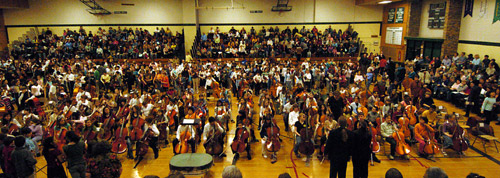
Every year when I attend my children’s strings concerts, I am so amazed by the broad and diverse participation of students in strings. How moving to see so many students playing instruments often stereotyped as only for the rich who can afford lessons. The cacophony of sounds coming from the 100’s of students at the city-wide concerts inspires the kids, the parents and the community that all is well in the world; that integration, opportunity, and artistic expression are not just paid lip service, but are working in our schools. I appreciate your work to keep strings available to all students.

Share

High School Documentary Film Making

Educational Video Center.

Share

Speak Up For Fine Arts Education’s Future

I have been an outspoken advocate for elementary strings the past several years, because this course is a highly valued, high demand academic course that is part of the K-12 MMSD music curriculum but has been repeatedly put on the cut list without any meaningful curriculum planning taking place from year to year. However, I also strongly believe there has been a lack of long-term planning in all fine arts education since cuts began about 1999. Perhaps other academic areas have needed the administration’s attention, such as reading and math. That’s understandable, but the School Board missed yearly opportunities to put in place other structures to plan for the future of fine arts education in Madison – community committee is an example of one option they might have considered pursuing.
I was encouraged two weeks ago when the Performance and Achievement and Partnership Committee chairs indicated an interest in working on not only the cuts to elementary strings, but also other aspects of fine arts education. I hope a community-led fine arts education committee is formed from these two Board committees that will undertake long-term, strategic planning for fine arts education in Madison. I would like to see such planning include music, visual arts, dance, theater, etc. – all facets of the arts that bring joy and enrichment to the citizens in our community, growth to our city’s economy now and in the future and play an important academic role in the excellent education our children receive.
Again, School Board members can be emailed at: comments@madison.k12.wi.us

Share

Speak Up For Strings – Thanks for Emailing the School Board: Keep The Emails Coming

MMSD’s School Board meets tonight to discuss the 2006-2007 school budget. There are no public appearances on tonight’s agenda, but the Madison community can continue to email the School Board in support of elementary strings at: comments@madison.k12.wi.us. Thank you to the parents and community who have attended the public hearing and who have sent emails to the School Board in support of elementary strings for Madison’s 9- and 10-year old students.
Cutting elementary strings will hurt low-income children! Keep the emails coming in support of about 550 low-income children who signed up for elementary strings – no other organization in Madison or Dane County offers an academic year long class that teaches this many children how to play an instrument. Madison School Board: Let’s work together to enhance this learning experience for our children; not tear it down and not tear it down before hearing from and working with the community.
I support restoring elementary strings to 2x per week, and I support forming a community task force on elementary strings and fine arts education to build fine arts education in Madison, not continue to tear it down. I reject late spring reports from the District administration that are clearly biased against this course and have not engaged teachers, music professionals, the community in the preceding 4 years! It’s not a administrative staffing issue, but it is poor, poor planning. We’ve had revenue caps since the early 1990s, and the Superintendent has been cutting fine arts since 1999 with no long-term plan in place, no community task force formed.
Call for an end to unfair cuts to elementary strings – cut 50% last year. No other high demand, highly valued course has been targeted in any year let alone year in and year out for cuts for 5 springs!
The state needs to take action on school financing; Madison needs the MMSD School Board to take action on elementary strings and fine arts educationl. Work with the community – please start now!

Share

MadCAP Spring Concert Video Clips

MadCAP held their music studio recital last night. 20MB video clip excerpts.
Share

Cutting Elementary Strings Hurts Children From Families With Low and Moderate Incomes

Members of the Board of Education,
I am writing to urge you all to vote in support of continuing the strings program in elementary schools.
I am a parent of a 6th grader at Hamilton Middle School, and I am fortunate to have been able to afford private and group violin lessons outside the school system for my son, since kindergarten. I can not tell you what a huge benefit this has been to him, in terms of teaching him to strive towards a rewarding goal, the joy of working together in a group of other learners, and appreciating the goodness of the arts in a troubled world.
And yet I know that the disadvantaged children in MMSD have no opportunity at all to play a violin or other instrument in elementary school unless the strings program continues.
It is clear to me and all music instructors that if a child starts violin in 6th grade, it is by far more difficult for them and much more likely that they will become frustrated and give up.
Starting in grade 4 will not only help students learn and stay with it, but will be a better use of the precious funds that we do allocate to strings in all grades — a better foundation means better participation and more benefits in the later grades.
My own son did not take strings in 4th and 5th grade, because I felt it was better to give another spot to a family that did not have another means to offer strings to their child. He now participates in 6th grade. I can tell you that with all the other major adjustments of the transition to middle school, starting a stringed instrument from scratch would have added a lot of stress to our family.
Please, please find a way to continue strings in 4th and 5th grades. I have been to enough meetings to know that there are things that could be cut from the budget that are way less important than strings.
Thank you,
Jane Sekulski
PS. If you have never seen the movie “Music of the Heart”, please consider doing so. It is based on a true story, which is documented in the film “Small Wonders”, of a violin program in inner city New York. The documentary is even better.

Share

Speak Up for Strings Tonight: Public Appearances at Board Public Hearing On the Budget – 6:30 p.m. Tuesday, May 9th at Memorial High School

Dear Madison Community,
Children and parents are encouraged to speak in support of elementary strings and to bring their instruments to tonight’s School Board public hearing on the budget if they would like to play. My husband, Fred Schrank, who is the principal bassist with the MSO and who teaches orchestra to elementary and middle school children in the district, will be there. I’ve asked him if he would accompany those children who might want to play for the School Board to show their support for the course. The public hearing begins 6:30 p.m at Memorial High School, 201 S. Gammon Road, Auditorium [map].
For your information – the School Board takes students who want to speak for 3 minutes (or play for 3 minutes) first. I also have signs and will have colored markers for students or others who want to make signs for the School Board to see.
The Superintendent’s proposal to cut Grade 4 strings is unacceptable, incomplete and would put in place a music curriculum planning process AFTER the cut is made to Grade 4 strings instruction. His conceptual idea is to plan to offer elementary children experiences with varied instruments in the 07-08 school year when Grade 5 strings would be cut and there would be no more elementary strings. That’s a curious idea. Why? Current General Music practice is to offer children experiences on different instruments – so the planning would not result in any meaningful curriculum change except the elimination of elementary stringed instrument instruction. What kind of plan would that be? No community planning took place this year for music education, which DPI recommends as best practice for standards based curriculum planning – include professionals and the community in the effort. The only plan is to cut Grade 4 strings, with planning for next steps to follow. Without good planning and good information – bad practice and bad decisions follow.
My question: Where’s the planning been for the past year, for the past 5 years? Our kids deserve better. Hundreds of children and community members have spoken in support of the elementary strings course over the years and emails and support for this course remain strong as demonstrated by the children once again this year through their enrollment in this course – over 1,700 children in September (550+ low income children who will be hurt the most by this cut).
After 5 springs of advocating for this course, I’m exasperated and annoyed; but when I listen to children and parents tell their stories about their hopes and dreams, I get reinvigorated as I was last night after listening and speaking. Last night, Ruth Robarts, Shwaw Vang and Lucy Mathiak spoke strongly in support of the program and in working on strings through the Performance and Achievement and the Partnership Committees. I think the idea to collaborate among board committees is novel and appropriate for Fine Arts – and may be for other areas. I feel involving the community – music and art professionals, parents, organizations in the process is critical to the long-term success of fine arts education in Madison, especially in tight financial times.
Also, Lawrie Kobza, School Board Vice President, reminded the Superintendent that the School Board had additional options to his proposal to consider – the Superintendent’s options plus keeping the course the same as this year or restoring the course to what it was two years ago (2x per week for 45 minutes).
So, please, if you have time tonight, come and Speak Up For Strings! Even if it’s only to stop in on your way to and from another event (it’s that crazy time of year with concerts, sporting games, dances and preparation for graduations taking up lots of time) and register with the Board in support of the course. I’ll be there to help with registering to speak in support, or simply registering your support. Each person’s presence makes a difference – individually and collectively!
Best,
Barbara Schrank
P.S and FYI – the Supt.’s proposed Grade 4 strings cut would not affect any current teachers and would be made through retirements and resignations. However, 1,700 children would lose something they dearly value that provides them with so much. I think, over time, our community will lose even more.

Share

Why Does Elementary Stringed Instrument Instruction Matter? One Reason – Student Demand is Strong

I sent the following letter to the School Board last week after reviewing data and text on elementary strings sent to the School Board by the Fine Arts Coordinator. In late March, I spoke before the School Board about working together on strengthening strings and fine arts education and hoped that we would not see another spring of “surprise reports.” Shwaw Vang and others thought this was a good idea, but I guess the administration did not agree. Following my talk, the Superintendent sent a memo to the School Board with a proposal to eliminate elementary strings the end of next school year and offer General Music.
For the past five springs, in one form or another, reports on strings have been presented to the School Board, which present data and give reasons why not to teach strings. These reports are all prepared by top administrators with basically no input from or curriculum review by teachers, parents, students, the community. No other data are presented in the same manner and with as much detail as this course – none, which I find troubling. Courses are dropped for lack of enrollment, which is not the case with elementary strings. Also, no other academic course has come before the School Board year after year for cuts – not even open classroom, ropes, wrestling.
I have MMSD historical data on strings from when the course was first introduced. In spite of the administration’s best efforts to cut the course,

  • demand from students remains strong and
  • the community still values the course.

In a comment, Lucy Mathiak wrote: “As a board member, I do not see the issue as strings vs. math vs. athletics, which is how the annual budget pageant usually works. I see the issue as strings and math and athletics vs. cost overruns in building projects, growth in business services, and expenditures for contracted services that may or may not benefit our schools.
Attacking strings, or extracurriculars, or sports, will not put teachers, librarians, and other key staff into schools. Nor will it repair curricula that are of questionable efficacy. If we want good schools, the conversation starts with what is in the budget — ALL of the budget — and whether the budget supports the kind of programs that we value in our schools.” I strongly agree with her statement, because focusing on ALL of the budget keeps the focus on what’s important – student learning and achievement. An increasing body of research and experience shows studying an instrument positively affects student achievement. If so, why isn’t the School Board working with the community to strengthen fine arts education.
Dear School Board Members,
You recently received some statistical information from the District Fine Arts Coordinator on string instrumental enrollment for Grades 4-12 that was in response to a question from Ms. Carstensen on enrollment.
I feel the information presented could have been titled, “Reasons [the Administration Wants] to Cut Elementary Strings,” which, of course I found strange and inconsistent with data on this course and how other data are presented to the School Board [for issues/practices the administration supports].
I would like to provide you with some additional information that I believe provides a bigger picture and shows how this course has grown as the District has changed:

  1. Historical Enrollment:

    [Please excuse me, I don’t know how to change the x axis to years. Year 1 is 1969 and the last year is 2005.] This data was kept in the Fine Arts Department by those overseeing the elementary strings enrollment. I have a copy of the original chart, which I would be happy to provide MMSD if they cannot find a copy of this information..
    The dip around year 23 (1991) was due to a proposal to cut elementary strings and the later dip around year 29 was due to the inability to replace an FTE. You can see the strong growth in the course following a proposal to cut the course. During the 1990s enrollment grew, peaking in the early 2000s at 2,049. Even with the Superintendent’s proposals to cut the course, demand for instruction remains strong. During the same time period in the 1990s, low-income and minority enrollment in the elementary grades increased (while total enrollment in elementary school declined). Even with the proposed cuts to elementary strings since 2002, enrollment has stayed strong, consistently about 50% of 4th and 5th grade students participate. This course is a high demand, highly valued course as growth in enrollment continues to show.
  2. Elementary Strings – Demographics and Over Time:
    When you look at the statistics you received on elementary strings – I would recommend that you look at the entire course over time as well as student groups over time (cohorts). If you look at the course over time, you see increases in demographics at all grade levels as you see increases in low-income and minority in the total student population – that’s moving in the right direction and teachers deserve praise for this. In fact, if you look at the low-income (%) enrollment in Grade 4 strings this year – that percentage is 2.8% lower than the percentage of low-income students in the entire Grade 4 this year.
    Also, when students go from Grades 5 to Grade 6, they have another choice of instrument to study – a band instrument. When you look at the historical enrollment in instrumental music from grades 5 to 6, you will see an increase in students opting to play an instrument in Grade 6. Elementary strings plays a role in preparing students to read music and to perform with other students in an ensemble. The curriculum is an instrumental curriculum from Grades 4-12. [Low income children have no other viable option to learn how to play an instrument – $2,000 per year for lessons and instrument rental.]

(more…)

Share

Strings Program – Why is it So Important?

Reader Andrea Cox emails:

I don’t understand why it’s so important to keep the elementary strings program. Some things have to go because of the budget constraints imposed upon the schools. Strings strikes me as much less important than, say, class size, mathematics, or reading. We can’t have everything without major changes in how the school funding is set at the state level.
(I would have posted a “comment” to this topic, but I couldn’t figure out how to do this on the site.)

Share

Speak Up For Strings – Starting May 9th

Please Help Save Elementary Strings!!!
How: Ask the New School Board –
Work with the Community to Build Fine Arts Education!
When: Starting May 9th
Other districts facing fiscal and academic achievement challenges have had successes maintaining and growing their fine arts education – through strategic planning, active engagement and real partnerships with their communities. School districts in Arizona, Chicago, New York, Texas and Minneapolis are looking for innovative ways to preserve and to grow fine arts education when facing tight budgets.
What does MMSD do?

For the 5th spring, elementary strings are at risk. Superintendent Rainwater is proposing to eliminate elementary strings – to cut Grade 4 strings next year and Grade 5 strings the following year. NO other high demand, highly valued academic course is targeted in next year’s budget – NONE.

Hundreds of students, parents, teachers and community members understand the value of this course for young children and have shown their public support for this course before the School Board each spring. We need to remind the new School Board, once again, of the value of this course – to our students’ growth and achievement, to our community.
Facts:

Enrollment Doubled – In the 1990s, course enrollment doubled to slightly more than 2,000 students – at the same time the low income and minority elementary student population increased. Approximately 50% of 4th and 5th graders elect to participate in elementary strings.
Low Income Enrollment Grew – Over time, low-income enrollment in elementary strings has grown. This year, the percentage of low-income children enrolled in Grade 4 strings is higher than the percentage of low-income children in that grade enrolled in the district. No other private/public organization in Madison teaches 550+ low-income children how to play an instrument at a higher level and to perform in ensembles.

You Can Help:
Speak to the School Board – bring signs, play your instrument
When: Tuesday, May 9, 2006 – 6:30 p.m., Memorial High School Auditorium [map]
Write to the School Board – comments@madison.k12.wi.us – and ask them

  1. to reject the Superintendent’s proposal as inadequate, and
  2. to work with Madison by forming a community fine arts committee to address fine arts educations issues, such as strings, so kids can get the personal and academic benefits of fine arts education.

Five years of targeting strings is unacceptable, short-sighted and goes against a) what the research shows strings does for children’s growth, development and academic achievement, b) what’s being done in other areas in MMSD, and b) what the community values for our children’s education.
For more information, email: savestrings@charter.net

Share

Fostering Young Artists: Start Spreading the News

Erika Kinetz:

The foundation awards high school seniors more than $500,000 in cash prizes each year for achievement in the performing, literary and visual arts. It also nominates presidential scholars in the arts, and some colleges refer to its rosters for recruitment.
Yet many people have never heard of the foundation.
“That’s what I was surprised about,” said Grace Weber, a winner in voice who attends Pius XI High School in Milwaukee. “People outside the art world don’t know about it.”
Billy Buss, a winner in jazz trumpet and a senior at Berkeley High School in California, added, “My friends only cared I was winning a lot of money.”

National Foundation for the Advancement of Arts website. 2007 registration is open.

Share

The Madison Community – Students, Parents, Professionals, Citizens – Can Help Elementary Strings: Here’s How

The community CAN HELP elementary strings and fine arts education in MMSD. Please write the School Board – comments@madison.k12.wi.us – ask them a) to establish a community fine arts education advisory committee beginning with a small community working group to put together a plan for this, b) develop a multi-year strategic and education plan for fine arts education, c) work with the music professionals and community to address short-term issues facing elementary music education (other fine arts areas – dance, drama) that supports children’s learning and academic achievement. Until this is done, please write the School Board asking them not to accept (to reject) the Superintendent’s current K-5 music education proposal to eliminate elementary strings.
At this late date in the year, I feel a small community working group needs to be established that will develop a plan for moving forward with the community on fine arts education issues. I would be more than happy to volunteer my time to help coordinate this effort, which I see as a first step toward the establishment of a community fine arts education task force/advisory committee. However, what is key is the School Board’s support and the Superintendent’s leadership, and I would be honored to work with all members of the school board and with the Superintendent. I’m sure other people would be happy to help as well.
The issues with MMSD’s fine arts elementary music education is not solely a budget issue, but the administration’s lack of imagination and longer-term education planning in fine arts makes courses such as strings become budget issues because nothing is done from year to year to make it anything other than a budget issue.
Elementary strings is a high-demand course – this isn’t 50 kids across the district, it was 1,745 in September 2005. From 1969 to 2005, enrollment has tripled, increasing by 1,000 students from 1992 until 2002, at the same time that the number of low income and minority children increased in the elementary student population. Demand for the course is annually 50% of the total enrollment in 4th and 5th grade. Plus, minority and low income enrollment has increased over the years. This year there are about 550 low income children enrolled in the elementary class. More low income children enrolled to take the course, but did not because of the pull out nature, I’m assuming. There is nowhere else in the City that so many low-income children have the opportunity to study an instrument at a higher level and continuously as part of their daily education.

(more…)

Share

Fifth Verse – Same, Sorrowful Tune: Superintendent Proposes to Elminate Elementary Strings

Other districts facing fiscal and academic achievement challenges have had successes maintaining and growing their fine arts education – through strategic planning, active engagement and real partnerships with their communities. In Tuscon, AZ, with a large low income and hispanic population, test scores of this population have climbed measurably (independent evaluations confirmed this). This state has received more than $1 million in federal funding for their fine arts education work. School districts in Chicago, New York, Texas and Minneapolis have also done some remarkable work in this area.
In my opinion, the administration’s music education work products and planning efforts this year are unsatisfactory, unimaginative and incomplete. In spite of research that continues to demonstrate the positive effects on student achievement (especially for low income students) and the high value the Madison community places on fine arts, the administration continues to put forth incomplete proposals that will short change all students, especially our low-income students, and the administration does its work “behind closed doors.”
Three or four weeks ago, I spoke at a board meeting and said I thought we needed to do things differently this year – Shwaw Vang and other board members supported my idea of working together to solve issues surrounding elementary strings. Apparently, the administration saw things differently. Since my public appearance the Superintendent has issued two reports – one eliminating elementary strings replacing K-5 music with a “new, improved” idea for K-5 music and a second report with enrollment data presented incompletely with an anti-elementary strings bias. Teachers had no idea this proposal or data were forthcoming, saw no drafts, and they did not receive copies of statistics relevant to their field that was sent last week to the School Board. Neither did the public or the entire School Board know these reports were planned and underway. During the past 12 months, there were no lists of fine arts education priorities developed and shared, no plans to address priorities, processes, timelines, staff/community involvement, etc. String teachers received no curriculum support to adjust to teaching a two-year curriculum in 1/2 the instructional time even though they asked for this help from the Doyle building, and they never received information about the plans for recreating elementary strings in the future. None.
I don’t feel the Superintendent proceeded in the manner expressed to me by Mr. Vang nor as demonstrated by the School Board’s establishment of community task forces over this past year on a number of important issues to the community. Madison’s love of fine arts lends itself well to a community advisory committee. I hope other Board members support Mr. Vang’s community team approach, rejecting the Superintendent’s recent music proposal as incomplete and unacceptable.
In his fifth year of proposals to eliminate elementary strings, the Superintendent is proposing a “new and improved” K-5 music that is not planned for another year, but requires elimination of Grade 4 strings next year. The recent proposal, once again, was developed by administrators without any meaningful involvement of teachers and no involvement of the community. Elementary strings and fine arts education are important to the community. The Superintendent did not use a process that was transparent, well planned with a timeline, open and involved the community.
Music education, including elementary string instruction, is beneficial to a child’s developing, learning and engagement in school. However, music education, also directly supports and reinforces learning in math and reading. Instrument instruction does this at a higher level and that’s one of the reasons why MMSD’s music education curriculum introduces strings in Grade 4, following a sequence of increasing challenges in music education. In fact, all the points made in the Superintendent’s “new” K-5 music program, including multicultural experiences, exist in MMSD’s current music curriculum. The only thing “new” in the Superintendent’s proposal is the elimination of elementary strings.
It is not acceptable to say that we have to do something, because we have to cut money. Also, this is not about some folks being able to “yell” louder than others. To me, this is about five years that have been wasted – no planning, no community involvement, no shared visions. Our kids deserve better. Let’s get started on a new path working together now.

(more…)

Share

The heterogeneous debate: Some say best students get short shrift

Sandy Cullen:

Some parents say the Madison School District’s spending cuts, combined with its attempts to close the achievement gap, have reduced opportunities for higher-achieving students.
Jeff Henriques, a parent of two high-achieving students, said one of the potential consequences he sees is “bright flight” – families pulling students with higher abilities out of the district and going elsewhere because their needs aren’t being met.
One of the larger examples of this conflict is surfacing in the district’s move toward creating “heterogeneous” classes that include students of all achievement levels, eliminating classes that group students of similar achievement levels together.
Advocates of heterogeneous classes say students achieving at lower levels benefit from being in classes with their higher-achieving peers. But some parents of higher-achieving students are concerned their children won’t be fully challenged in such classes – at a time when the amount of resources going to talented and gifted, or TAG, programs is also diminishing.

Check out Part I and Part II of Cullen’s series.
Watch Professor Gamoran’s presentation, along with others related to the homogeneous / heterogeneous grouping debate here. Links and commentary and discussion on West’s English 10. Jason Shepherd took a look at these issues in his “Fate of the Schools” article.

Share

Madison Schools Make Effort to Close the Achievement Gap

Sandy Cullen:

Working in conjunction with the Schools of Hope project led by the United Way of Dane County, the district has made progress in third-grade reading scores at the lowest achievement levels. But racial and income gaps persist among third-graders reading at proficient and advanced levels.
Other initiatives are taking place in the middle and high schools. There, the district has eliminated “dead-end classes” that have less rigorous expectations to eliminate the chance that students will be put on a path of lower achievement because they are perceived as not being able to succeed in higher-level classes.
In the past, high school students were able to take classes such as general or consumer math. Now, all students are required to take algebra and geometry – or two credits of integrated mathematics, combining algebra, statistics and probability, geometry and trigonometry – in order to graduate.
One of the district’s more controversial efforts has been a move toward “heterogeneous” classes that include students of all achievement levels, eliminating classes that group students of similar achievement levels together.
Advocates of heterogeneous classes say students who are achieving at lower levels benefit from being in classes with their higher-achieving peers. But others say the needs of higher-achieving students aren’t met in such classes.
And in addition to what schools are already doing, Superintendent Art Rainwater said he would like to put learning coaches for math and reading in each of the district’s elementary schools to improve teachers’ ability to teach all students effectively.

The first part of Cullen’s series is here.

Share

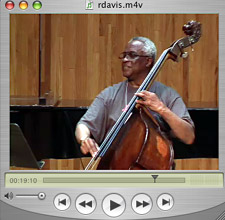
Richard Davis Birthday Bash Audio / Video

Richard Davis’s Friday night Birthday Bash (Richard mentioned that his birthday is actually tax day, April 15) seemed an appropriate way to wrap up a beautiful Madison week, with temperatures reaching into the 70’s. The bash was held Friday night at Mills Hall and included participants from the Bass Conference Faculty.

Audio / Video:

Conference pictures are available here.

More on Richard: Wikipedia | Clusty | Google | Yahoo

Share

Performance and Achievement Meeting of 27-Mar-2006 Available

The Performance and Achievement Meeting of 27-Mar-2006 is now available. Julie Palkowski, the District’s Fine Arts Coordinator, made a presentation on the current Elementary Schools Strings program, and discussed future directions.

Share

Task Forces Are an Important Mechanism for Bringing People With Different Perspectives Together to Work on Important Issues – What About Music and Art Education?

Tonight the School Board’s Performance and Achievement Committee will discuss a status report on the elementary strings class, which they received last Thursday.
This report describes the current course, but the report a) is not an assessment of the course and b) says nothing about the future of the course. (Mr. Rainwater told me the committee only asked for a status report.) I have been one of hundreds of advocates for this course over the past 5 springs, and I see the same thing unfolding again this year that I have in the 4 previous springs without any work from the preceding year on this academic course. This course is much loved by generations of people who live in Madison, many who do not have children in the schools but do vote.
Not included with the status report is a draft vision statement developed by a group of string teachers. It’s long, needs more discussion with string teachers and the community (all string teachers have seen this) but with this draft statement a) these teachers tried to come up with something meaningful, which top management asked them to do and b) these teachers have had less than two hours of group time to even discuss what the future could be and that ended abruptly in December with no further next steps. These same teachers were given no time to work together on what adjustments needed to be made to curriculum when class time is cut in half. In June, they asked the interim FAC, who forwarded this request to Supt. Rainwater. The meetings did not take place. I don’t feel this should happen, especially when drastic curriculum changes are being considered.
For five years, hundreds of students, parents, community members and community organizations have asked for your help – either restructuring the course of redesigning this course, but working with the community in some way to keep arts strong, because it’s so important for achievement.
I and others have been strong proponents of making the course work in our current financial situation. Over these five years, I feel we have lost opportunities to develop relationships which are important for acquiring funds, to assess and redesign the K-5 music education curriculum, to develop funding sources for small group lessons for children afterschool to further strengthen what they learn during the school day.
Last year the elementary strings course reached about 1,800 students in 27 schools. Nearly 600 children (42% of the low income children in Grades 4 & 5 participated in this course). This year the course is teaching 1,650 students. The status report does not say how many low income. I do know from conversations with the Fine Arts Coordinator and with teachers that more low income children indicated an interest in taking elementary strings than were in the class for many reasons, I am sure.
I think elementary strings is an example where there have been hundreds of advocates for keeping this course, but minimal positive response and support from the School Board to bring the professionals and advocates together to work on this and other music and art issues. We have task forces for boundary changes, afterschool, live animals in the classroom, equity, etc. Given the community’s love of the arts, such a task force seems right for the arts.
I’d like to see the dialogue change this year for elementary strings and for music and art education to one where we talk about how can we work together. I would like to see the School Board consider a community task force under the oversight of the Performance and Achievement and the Partnership Committees that would bring advocates for music and art education and professionals together to work on this issue. I would like to see such a committee work on short-term issues re the elementary strings course, but also develop a 5 year fine arts strategic community plan. I have spoken with teachers, music organizations, private music teachers, the Fine Arts Coordinator and the Superintendent about the need for this. I have heard positive responses from community members and teachers, interest from the Fine Arts Coordinator.
I feel such a committee needs to be led by well-known community leaders who support the arts and arts education in the schools, because developing relationships within the community will be important for partnerships and possible fundraising.
I also think such a committee is important for credibility and for continuity. Over 5 years, MMSD has had 3 fine arts coordinators with one year without a fine arts coordinator. In spring 2003, the last fine arts coordinator was getting up to speed, in the 04-05 school year a teaching team was to help with coordination when the fine arts coordinator position was cut but this group was not put in place, and now the district has a new fine arts coordinator, who is working hard, meeting the community, teachers, helping in many ways. I think this is a critical position on the district and an important member to be on a community fine arts education committee.
Lastly, without classes during the day for elementary strings, there is no way to reach as many low-income children as the course currently reaches. Also, the district loses something special. Hundreds of children have asked the Board for help. I hope they do.
I will commment on this at the School Board meeting tonight. I have taken to writing on the blog vs. speaking at School Board meetings, because, after 5 years, and personal attacks, it takes too much out of me.

Share

2006 West Side Strings Festival: Photos & Video


Check out the photos and video from this great event.
[Download a video ipod compatible file here.]

Share

New Glarus 4th Grader Wins Art Prize

Ellen Williams-Masson:

Fourth grader Jonathan Mattmann may live in a hushed world but his artistic interpretation shouts from the page in the drawing that has won him top honors in a statewide art competition for people with disabilities.
Jonathan comes from a family in which sign language is a way of life and lip reading is second nature. His father, Eric, has been deaf since early childhood and Jonathan, his sister Heather, and his mother Melisa have varying degrees of hearing loss.
Jonathan’s drawing titled “Summer Day on the Farm” was one of five winners selected from more than 100 entries in the VSA arts of Wisconsin’s 2006 Children’s Call for Art. The winning pieces are displayed in a traveling art show for five years before being retired and sold.

Share

Jazz in the Schools

the National Endowment for the Arts and Jazz at Lincoln Center:

Dear Teacher:
Welcome to NEA Jazz in the Schools. The National Endowment for the Arts and Jazz at Lincoln Center have created these materials to help fill and enthrall your classroom with jazz and build important connections for your students between the music and the story of our nation.

Share

A Power Point You Will Actually WANT To See

http://www.blackshirtbands.org/budget.asp
Description from the Milwaukee Journal-Sentinel
MONDAY, Feb. 20, 2006, 2:33 p.m.
Banding together: Waukesha students support music programs
Waukesha South High School band boosters have set to music their reasons for why band and orchestra should be saved from anticipated cuts in the next school year.
You can check out their multimedia presentation here. A sample: “Don’t let the community that gave us Les Paul end up with Less Music.”
The Waukesha School Board is considering $3 million worth of program and service cuts to balance its 2006-’07 budget. Among the cutbacks being contemplated is the elimination of three full-time music teachers, which would push back the start of elementary orchestra and band instruction by one year.
The board has a work session scheduled for Feb. 28. A final vote on program cuts is slated for the board’s March 8 meeting.
-By Amy Hetzner

Share

UW: Future Artists Showcase

University of Wisconsin:

The arts are not only a means of personal expression. Ideas also regularly travel the compelling highways that the arts of all kinds provide.
Case in point: The ideas embedded in the works that apprentice artists — students — are exploring and articulating in “The Chancellor Presents the Performing Artists of the Future: A World Class Evening of Music, Drama and Dance,” Saturday, Feb. 25, at the Overture Center.

Quite a deal at $15.00.

Share

East High School Show Choir

Sandy Cullen:

Antonio Branch may have gotten off on the wrong foot at Madison East High School, but his tune changed once he started singing and dancing with the school’s Show Choir.
“I was with a bad crowd,” said Branch, 18, who saw many of his friends from eighth grade drop out of high school.
But Branch said the tightknit ensemble of student performers he joined last fall has helped give him the motivation to get his grades up and set his sights on attending Madison Area Technical College en route to a four-year college degree.
“They build you up, tell you you can do it,” said Branch, a senior who’s now thinking about becoming an elementary school teacher.

Share

Winter Solstice Celebration: Thoreau Student Self Portraits


Thoreau Art Teacher Andy Mayhall:

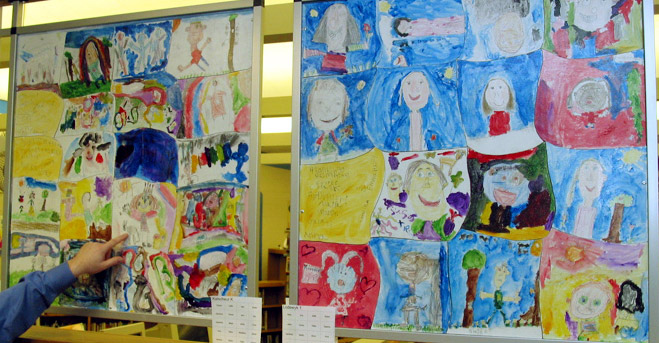
Thoreau Elementary School was given a donation by a retired art teacher to have an artist-in-residency. We had artists submit proposals to the school, which were reviewed by the Cultural Arts Committee. Local artist, Susan Tierney, was selected to work with me, and Thoreau students to create self-portrait paintings. Susan worked with students in the classroom on and off for about a month. The students made sketches and then final drawings onto hardboard. Students could create realistic or non-realistic, some were cartoon like, self-portraits. They used colored pencil and acrylic paint to color the portraits. The finished portraits were put together to form 22 murals. The murals are on display in the hallway between the LMC (library) and classrooms on the upper floor. These murals will be a permanent display at Thoreau.

Check out the murals via these photos.

Share

Giving Credit Where Credit Is Due: A Look at the Educational Histories of the 29 West HS National Merit Semi-Finalists

Earlier this semester, 60 MMSD students — including 29 from West HS — were named 2006 National Merit Semifinalists. In a 10/12/05 press release, MMSD Superintendent Art Rainwater said, “I am proud of the many staff members who taught and guided these students all the way from elementary school, and of this district’s overall guidance and focus that has led to these successes.”
A closer examination of the facts, however, reveals that only 12 (41%) of West High School’s 29 National Merit Semifinalists attended the Madison public schools continuously from first grade on (meaning that 59% received some portion of their K-8 schooling in either private schools or non-MMSD public schools). Here’s the raw data:

(more…)

Share

NEW ART DOLLARS TARGET MADISON SCHOOLS

American Girl and an anonymous donor contribute $20,000 to grants program
The Foundation for Madison’s Public Schools and the Dane County Cultural Affairs Commission have secured $20,000 in new grant funds designated exclusively for arts programs in Madison schools. The two organizations have forged a unique grantmaking partnership to distribute the funds supporting guest artist residencies and other special K-12 arts programs in the schools planned for the 2006-07 year

(more…)

Share

Revisit and Evaluate a Strings Change

I know this topic is discussed every year but I want to re-visit the success of the administrative change to 4/5 strings based on budgetary demands versus academic demands.
The 4/5 strings was changed to once a week this year from twice a week last year. The choices the board juggled was no strings in 4/5, twice a week 5th only, or once a week 4/5 strings due to the budget cuts. While I applaud the board for trying to work with the community I would love some feedback on how the once a week 4/5 decision is working at other schools.
For my daughter, and I can only speak for her and a few of her friends, this is what we have experienced………

(more…)

Share

Music and Art Improve Student Achievement, Especially for English Language Learners and Low Income Students In Tucson Unified School District

The Tucson Unified School District’s Opening Minds through the Arts , also known as OMA, was recently awarded a federal grant totaling over one million dollars to continue research on its music and art model and how it positively effects student achievement.
Independent research has shown that OMA participant’s especially English language learners and students from disadvantaged communities, have significantly improved their standardized test scores in reading, language, and math. Furthermore, research indicates that students at OMA schools demonstrate fewer behavioral problems, improve their classroom focus, and show greater respect for themselves and fellow students and teachers.
Now in its fifth year at TUSD, OMA integrates the fine arts into traditional and arts curriculum for kindergarten through sixth-grade students. The OMA model is based on extensive research on the neurological development of children. Using opera, dance, costume design and music, students learn new ways to view and understand complex math and language problems. In Grade 3 students learn to play the recorder. In Grade 4 all students learn to play a stringed instrument and in Grade 5 all students learn to play an instrument in a band or orchestra.
OMA was one of 23 programs selected nationally to receive the U.S. Department of Education grant. Titled Professional Development for Arts Educators, the grant will provide the district with $1,001,700 over the next three years for additional research on past student achievement results and specific OMA components that help increase student success.
It’s amazing what can be accomplished when minds are open to changes and a focus on what contributes positively to student achievement and what improves learning and closing the achievement gap. Federal funding for approaches similar to OMA have been available for several years. But, the first step is support for what supports children’s learning and achievement and a willingness to work together under current constraints on new ideas. This past summer the director of OMA conducted workshops throughout the US, one in Minneapolis. Perhaps School Board will put together a working group to get started on something similar for our children.

Share

Arts & Technology Charter School

The Capital Times:

The initial steps toward creation of an arts and technology charter public school in Madison will be held Thursday at 6 p.m. at the Madison Gas and Electric Co. Innovation Center in Research Park.
The target date to begin such a program is the fall of 2007, according to Nancy Donahue, a leader in the Preschool of the Arts. The Madison School District now has two charter schools – the Wright Middle School and Nuestro Mundo, a kindergarten/first-grade unit operating in the Allis Elementary School. Board of Education approval would be required to add a third school.
Donahue said the charter school could be built on encouraging the exploration by pupils much like what occurs in the private preschool of the arts. A downtown location would enable pupils to tap into existing resources there, she said.

Share

Ken Lonnquist @ Thoreau School


Local musician Ken Lonnquist was recently in residence at Thoreau School. Ken worked with each grade to compose a song. The resulting music, ultimately destined for a CD, was performed on a recent evening. Here’s a brief video clip from the event.
UPDATE: Thoreau’s Rhonda Schilling emailed the funding details:

Dane County Cultural Affairs ($1450 grant)
Wisconsin School Music Association ($500 grant)
Thoreau PTO ($1750 Cultural Arts Budget and Barnes & Noble Fundraiser)

Share

UW Freshman Class Scores High in Smarts – 52% Studied Performance Music

Karen Rivedale in the WI State Journal article, “Creamier Crop at UW Madison,” writes that “This year’s freshman class posted high scores on college entrance exams, beating the average national scores on the tests and continuing UW-Madison’s increasing selectivity among the state’s top students. Freshmen this year posted high class ranks, with more than half graduating from high school in the top 10 percent.”
In a sidebar in the article, the Freshamn enrolled is a record high (6,142), 62% earned a varsity letter, 52% performed with a school musical group, 23% won an award for community service.
Meanwhile, closer to home, MMSD’s administrator’s proposed a competitive athletic budget that continued to grow from the previous school year for this school year (parents do pay a fee of $115 per sport, extra for more expensive sports) – that’s good. However, MMSD’s administrators continued their cuts to music education with proposals to eliminate elementary performance music and increase general music class size. The School Board restored half the elementary stringed course in elementary schools and did not increase general music class size. There were also reductions in middle school performance music that were not restored.
Performance music improves academic performance, especially for lower income children who have no other access to performance music except through their public school. It is sad that MMSD is moving in the opposite direction of what the research shows benefits children’s academic performance by cutting performance music.
Performance music directly benefits reading and mathematical skills for young children. There is more research and results that show that today and the information and data showing the positive effects of instrumental music on children’s education are growing not shrinking. In future blogs I will post additional information on this research and results.

Share

Arts – Ask For More

A Harris Poll released in June 2005 on the attitudes of Americans toward arts education revealed that 93 percent of Americans agree that the arts are vital to providing a well-rounded education for children. Additionally, 54 percent rated the importance of arts education a “ten” on a scale of one to ten.

Share

Next Steps for Fine Arts Education in Madison Public Schools – community arts education advisory committee?

An issue that interests and is important to me is arts education, and I hope to journal about this issue on this blog site and www.danearts.org over the coming school year. Also, I hope to be able to play a different role in supporting arts education as a community member on the Partnership Commmittee.
For the past six years there have been various cuts in fine arts education for Madison’s students. If the current budget constraints continue, there will be continued cuts in Madison’s public schools, which will lead to continued cuts in many areas that contribute to an excellent education for all Madison’s children.

(more…)

Share

Art Smarts: Two New Books on the Meaning of Arts

The Economist on two new books, The Accidental Masterpiece: On the Art of Life and Vice Versa and What Good Are the Arts:

Mr Kimmelman, a gifted piano student as a boy, returned more seriously to the keyboard in 1999 when he entered, and went on to the final round, of an amateur piano competition in Fort Worth, Texas. Organised by the Van Cliburn Foundation, which since 1962 has presented the world’s leading piano competition for young professionals, the competition brought 90 people, who neither taught nor performed professionally, to Texas.
Mr Kimmelman’s article about his fellow pianists—a numismatist, two flight attendants, a hairstylist and a former crack addict who had been jailed for burglary and who found taking up music helped him recover—raised a sizeable correspondence from people who are not artists by profession, but for whom art adds an important other dimension to their lives. It was this idea, so emblematic of the author’s own life, that spawned the book.
Far better is the second half of the book in which Mr Carey seeks to persuade us that the greatest of all art forms is not painting or music but literature, and English literature specifically. Uninflected and without gendered nouns, English was uniquely placed to offer Shakespeare the linguistic pliancy and suppleness he needed to turn out the epidemic of metaphors and similes that so mark his work.

(more…)

Share

The Simpson Street Free Press Sounds Off On Arts Education

The current issue of The Simpson Street Free Press includes pieces by both Jazmin Jackson and Andrea Gilmore on the importance of arts education. This issue also has a letter to the editor from School Board member Johnny Winston, Jr. on the arts funding issues facing the District.

(more…)

Share

NEA Jazz in the Schools Curriculum and Resources

http://media.jalc.org/nea/home.html
The National Endowment for the Arts and Jazz at Lincoln Center have created materials to help fill and enthrall classrooms with jazz and to build important connections between the music and the story of our nation. The program web sites includes on-line materials and contact information for people who are interested in using this curriculum.

Share

Concerts on the Square: 16 Year Old Violinist

Joan mentioned last night’s Wisconsin Chamber Orchestra’s Concerts on the Square. The concert included the performance of a Dvorak piece by a 16-year old violinist from Janesville Parker, Saya Chang-O’Hara. Conductor Andrew Sewell introduced Saya as follows (paraphrased): “I don’t mean to be political here, but she learned to play the violin in elementary strings“.

Share

Simply amazing

This season’s Concerts on the Square kicked off with an interesting medley of polka/waltz/cancans, but the best reason to have attended was the performance of a Dvorak piece by a 16-year old violinist from Janesville Parker, Saya Chang-O’Hara. Put simply, she was brilliant. Juilliard should be knocking on her door any day now. It was an honor to hear her play.
But what might be of interest to folks on this site is this: she only started playing when she was eleven, AS PART OF HER SCHOOL’S STRINGS PROGRAM.

Share

Music Education – Learn About the Benefits Before Cutting Curriculum

If there is no money, cut arts education is the decisions administrators make – often, though, without first looking at the impact on student’s achievement (using readily available data) or without consideration of the impact on who will stay/leave a school. Couldn’t decisions made in the absence of examining data and listening to parents cost far more in lost revenue and prestige than the cost of a class?
When I read about the cuts to music education at the elementary school level, the primary reasons given are that these cuts were due to budget constraints and pull-out programs are difficult to schedule. When I read about the cuts to Sherman Middle School’s vocal and instrumental music program from the regular school day, the primary reasons given are lack of interest (decline in enrollment during the past several years coincidentally matches the current principal’s tenure) and the principal’s requirement for heterogenous classes and mandated exploratory options for Sherman’s children.
Yet, when I read the national news, research and hundreds of other documents I learn that a) music improves children’s peer relationships and academic performance in schools and b) schools with a signficant low income student body that increase their arts education see significant increases in these children’s test scores.

(more…)

Share

Music Education in Sherman MIddle School: Pull Out or Afterschool

Sherman’s parents are puzzled and frustrated. Music classes for instrument and vocal will be during the day, but the classes will be pull out classes!

(more…)

Share

Gilmore: Add Elementary Strings to the Curriculum

Andrea Gilmore (This opinion piece was published in the Wisconsin State Journal):

I am lucky. I have been playing the violin since I was in the fourth grade. I was exposed to music at an early age and music has helped me gain skills that have enhanced my school career. Through music, I learned self-confidence, self-discipline, time management, cooperation and study skills.
Unfortunately, many young people may not have the opportunity I had. The elementary strings program costs only $500,000 in a budget of about $300 million. School board members recently decided to keep the elementary strings program next year in some form, while cutting approximately $500,000 overall out of the music-education programs.

(more…)

Share

Dear MMSD Interim Fine Arts Coordinator –

I was asked to post the following letter from Robert Rickman, MMSD instrument teacher, to Rita Applebaum, MMSD Interim Fine Arts Coordinator:
6/15/05
Dear Ms. Applebaum,
I was recently informed that you spoke to Mark Messer, Memorial High School orchestra teacher, about the 4th and 5th grade Strings classes. I am shocked to hear that you have moved to eliminate fourth grade Strings classes based upon a conversation with him, and a hurried and undiscussed vote from Strings teachers that you solicited by e-mail the day before school was out.

(more…)

Share

There is Something Seriously Wrong with Music Education in MMSD

Suzy Grindrod writes that Madison school bureaucrats’ decisions are short-sighted and are Stringing the kids along
So they make the arts unworkable in early elementary school, they gut the incredibly successful elementary strings program, they remove band and orchestra from core curriculum in middle school … and then they are going to complain that there is no diversity in the high school bands and orchestras and — CHOP.
There is something fundamentally wrong with what is happening in Wisconsin’s Capitol city — a community that just built a $200 million arts district downtown, as these short-sighted and creatively stunted bureaucrats make it unlikely that many Madison kids will end up on Overture’s stage in the future unless they have the money to buy private lessons.
Can Madison turn this disgraceful situation around before the existing cost-effective MMSD music education curriculum implodes and vanishes from public school and performance music education is only for those who can pay?

(more…)

Share

Art Attack at Lapham School

From The Capital Times, Monday, June 6
http://www.madison.com/tct/mad/local//index.php?ntid=42450

Changes coming in music, art classes
The arts hit hardest in teacher layoffs

By Cristina Daglas
June 6, 2005
Lapham Elementary School music teacher Lynn Najem and art teacher Sally Behr will keep their jobs next year, but their classrooms won’t be what they have been.
Next year, both Behr and Najem will be teaching classes of approximately 22 students in comparison to the previous 15.
The total number of students they teach is not increasing, but the number of classes offered is decreasing. The approximately 230 kindergarten through second-grade students at Lapham will remain the same.
“They think of us as fancy recess … a holding tank,” Najem said. “This is typical of the School Board.”

(more…)

Share

Please Help Sherman Middle School Children: Email the School Board and Say to Them – We Want our School Board Approved Academic Curricular Subjects Taught During the Middle School Day (7:45 a.m. – 2:40 p.m.)

Please e-mail the school board. Simply say, “I do not agree with the plan to move Sherman’s curricular performance music classes to an afterschool, 8th hour format. Our children deserve to have their school academic curricular classes during the day not after school.”
And sign your name. It’s as easy as that. School Board members can be emailed at: comments@madison.k12.wi.us.

Share

Sherman Middle School Principal Mandates Change by Fiat – Renames Afterschool an 8th hour and Kicks Academic Performance Music Out to Afterschool

The current music education upheaval at Sherman Middle School is about

  • what Madison values for our children’s education, such as academic music education during the school day and
  • who makes those decisions.

It is not about money, because teacher allocations will be needed to teach the 8th hour same as during the school day.
Making changes that seem to be by fiat may be desirable to the person in charge, but the students and parents are the school’s and district’s customers – please listen to us at the start of a process, let us have time to have meaningful input and comment! Isn’t it the School board who are the district’s policymakers, especially curriculum policy and what defines a school day. Those are the basics! A longer school day might make sense – but not by what appears and feels like fiat and not without public discussions, deliberations and decisions by our School Board.

(more…)

Share

Parents skeptical of music class shakeup

“A plan to make band and orchestra classes at Sherman Middle School an after-school program next year is upsetting parents and other music supporters in the Madison School District,” according to a story by Sandy Cullen in the Wisconsin State Journal.

Share

Erosion of music instruction is the wrong direction, especially for non-traditional learners

The following letter was written by a parent of an East High Student to Carol Carstensen, President of the Madison School Board. The writer expresses concerns over the Sherman Middle School proposal to place curriculum band and orchestra classes in afterschool and the layoff Thursday of 8.55 FTE music teachers.
Based upon my review of the 05-06 MMSD budget, financial issues do not support the recent music educator layoffs and the curriculum change proposal at Sherman Middle School. It’s about values – community values for what our children learn in public school and what contributes positively to their achievement as learners.

Carol:
I am writing to you as School Board President (and neighbor) because I am very disturbed about the impact on music education of several recent decisions affecting students of the MMSD . I write as the mother of an 11th grade student of color at East High for whom music performance education has been crucial. Without the solid, consistent music instruction and opportunities he has received for the last six years, I question where he would be right now.
I fear that music performance is sometimes viewed as an elite activity for already motivated students. For my son, it has been the primary area in which he could excel at school over the years while he struggled with regular academic classes. It was the break in the school day where he felt energized and motivated, part of a large team working toward excellence and specific identifiable goals. Over the years, band classes offered an opportunity to interact with a different group of highly motivated peers, to perform in public concerts that affirmed his sense of achievement, and to participate in challenging music trips. Because of his school day band experience, my son gets himself up and to school every Tuesday morn! ing at 6:30 a.m. to participate in Jazz Band before school starts. His band program is a source of joy, discipline, and motivation, as well as musical growth.

(more…)

Share

MMSD Teacher Layoffs Target Elementary String Teachers

On Thursday, based upon Superintendent Rainwater’s recommendation, the Madison School Board approved 20 FTEs for layoff. These layoffs included 60% of the elementary string staff – the largest percentage of one academic personnel group ever laid off in the history of the Madison Metropolitan School District. How come a program that cost less than 1/10 of one percent of the $318 million budget resulted in nearly 50% of the teacher layoffs? Elementary string teacher are less than 3/10 of 1% of the total teacher population. What happeded? No evaluation of the music education curriculum, no planning (not exploring the allowed use of federal dollars for fine arts education for low income children) and some might say vindictiveness from top administrators and some Board members toward string teachers because of the community outcry in support of elementary strings – our community cannot tolerate the latter. Money is not the issue – data do not support money being the issue.

(more…)

Share

NPR: Washington DC Jr. High Orchestra Teacher Interview

All Things Considered:

Sarah Henks is a first-year orchestra teacher at Kipp Academy in Washington, D.C. The Florida State University graduate says she had originally wanted to perform in an orchestra herself, but something kept pulling her towards kids, strings and the classroom.
For her it’s been a year of highs and lows. Her junior high orchestra just performed its first big concert. We recently visited her class and asked her to tell us how the year went.

Share

Middle School Band and Orchestra

Picked up the following flyer in our PTO box this morning……
“ATTENTION ALL PARENTS OF MIDDLE SCHOOL BAND & ORCHESTRA:
Sherman Middle School Administration has taken upon themselves to move the Orchestra and Band Programs to an “exploratory” optional class that will be offered after the school day effective next school year. MMSD is looking at this as a pilot program at Sherman with idea of implementing these changes at all middle schools in Madison.
Please help us fight this change. Our students have rights to attend these classes during the school day.
You can help by writing to the school board and MMSD administration to voice your concerns before this becomes the norm in the Madison School District.
For more information you can contact Sheryl Trumbower at 243-1005 or 279-2117.”
East High Band Parents Organization

Share

Mischaracterized Mr. Winston Re Sports and Arts

In previous blogs I left the impression that Johnny was pro sports and dropping the ball on fine arts academic curriculum because there was a sports committee last year and not a fine arts committee.
The admin made that decision, not the school board. My apologies to Mr. Winston for assuming as Chair of the Partnership Committee that he had been involved in this decision.
I still believe we need a fine arts committee that includes parents, teachers, fine arts organizations, uw staff, etc., to discuss long-term issues facing MMSD’s fine arts academic curriculum. I hope School Board members urge the administration to get this rolling rather than wait until next spring when it’s too late.

Share

Superintendent Rainwater: It doesn’t matter what Johnny thinks

In Thursday’s Capital Times article titled “Strings program is still not safe” by Lee Sensenbrenner, the Superintendent said, “It doesn’t matter what Johnny thinks!” Mr. Winston responded strongly. “I would like to see the strings program continued somehow, some way,” Winston added. “I think the community wants that. I think that’s loud and clear.”
Mr. Rainwater, it does matter to me what Johnny thinks. I, and I’m sure others, care about what the School Board is directing the superintendent to do, and we care deeply that the Superintendent is following through on directions from the majority of the School Board. Coming back one day later, declaring the charge is impossible, is puzzling following a presentation by the administration the night before of options.

(more…)

Share

Sports, Music, Academics – Last Minute Proposals Stressful: Need Big Picture with all the Pieces

(The Capital Times, Strings to play on in city’s schools by Lee Sensenbrenner) reported that I “…admitted to calling Winston “a jock,” but said she meant the board was favoring athletics while it dealt with budget cuts..” Not exactly with the name-calling, but I have been critical of the District Administration’s handling of cuts to fine arts, and the School Board’s implicit support of this approach until hundreds of students, teachers, parents and other Madison residents rally, write letters and emails, or lobby board members. I believe the board needs to be working on any changes to an academic curriculum over the year and needs to engage teachers, parents and other professionals in the process. That has simply not been done with the fine arts, an academic curriculum, and I still believe the proposed cuts to the fine arts curriculum, especially in elementary school, are burdensome – 41% of the proposed elementary school budget cut is from elementary music education (general and strings classes) yet elementary music education makes up less than 3% of the elementary school budget. A 3% cut to elementary music education would have been $49,000 – reduction of 1 FTE rather than nearly 13 FTEs. We need to share the burden of cuts – I don’t get cutting a high-demand (1,866), highly valued curriculum program 100% that just put in place a fee this year.

(more…)

Share

My Proposal for 4th & 5th Grade Strings

Tonight (May 10, 2005) the Board of Education will discuss proposed amendments to the budget. This discussion will include a discussion of the 4th & 5th grade strings programs.
I support offering students the opportunity to take strings in 4th and 5th grade. Currently, 4th and 5th grade students who elect to take strings have two different music classes each week: general music, and strings. General music has two 30 minute classes per week, and strings meets twice a week for 45 minutes each. The strings classes are pull-out classes, which means that the students taking strings are missing another class during the time that they are out for strings.

(more…)

Share

Elementary Strings – It Doesn’t Affect You Bill Keys Tells Student

An East High Student wrote Bill Keys, MMSD School Board president. In her letter she wrote:
“The reason I am involved in the high school orchestra today is
because I was able to participate in the elementary strings program
in elementary school….I am the oldest child of thirteen children. The youngest is about two months old today. All of my siblings following me up to the fifth grade play the violin in school. This was made possible because we were all given the chance to participate in the ever-wonderful Elementary Strings program that started in elementary school.”
Mr. Keys’ began his response, “First, to clarify: it is only at the 4th and 5th grade level that the strings program has been recommended bythe staff for cut should the referendum fail.”
Mr. Keys, I think it is you who need the clarification.

(more…)

Share

String / Fine Arts Rally – May 2nd at 545 W. Dayton

What: Elementary Strings / Fine Arts Rally –
Where: Doyle Building – 545 W. Dayton Street
When: May 2nd, 7 p.m.
Why: 1,866 Nine- and Ten-Year Old Children Need Your Help Now! The entire 4th and 5th grade elementary strings program has been targeted for removal from the 2005-2006 budget. Further, since last year, the administration has not undertaken any curriculum assessment and review of fine arts education, needs, costs, etc. The administration has not done their homework. There is no justification for cutting 100% a program that costs 0.17% of the $328 million school budget and is a well-established, much-loved curriculum.
Download Information on String Rally

Share

Benefits of Strings More Than Music

Pat Kukes, MMSD teacher, wrote the following opinion piece that appeared in the WI State Journal on Friday, April 29, 2005:
Having already received my termination notice, I write this not as a teacher trying to save his job, but rather as an experienced educator who knows the value of a good educational system and who has seen firsthand how cutting a program like elementary strings can hurt a sound school district.

(more…)

Share

The Power of the Arts

A moving story in the New York Times on the staging of King Lear by inmates of a Wisconsin prison.
Would that these men had a fine arts program when they were young students.
http://www.nytimes.com/2005/04/29/national/29lear.html?

(more…)

Share

Elementary Strings Cut is Punitive and Too Much

Cuts of 10% to elementary music and art and 100% to elementary strings are being proposed by the administration. The overall MMSD budget cut needed is 2%. The School Board has not discussed or asked questions about the proposed cut list at any public meeting since they received the list on March 3rd – that’s nearly two months now. Rather School Board members are “selling Art Rainwater’s proposed cut list.” Board members are “making excuses” why there are increases to the administrative contract budget, save all extracurricular sports for kids, unecessarily dividing rather than bringing together parent and professionals to work on what we can do for all kids and fairly. Rather, our board says, we can’t do anything else – it’s because the state does not give the school district enough money. Our board membes are not asking the question – what’s academic, how will this affect children’s learning, how have the administrators worked with teachers and other relevant professionals to minimize the impact on children. If they asked this about elementary strings and fine arts education – the answer would be that they have done nothing. I expect the answer is the same for many other academic areas.

(more…)

Share

5 Reasons Why the Madison School Board Should Continue the Elementary Strings Program

In the May 24 referendum for the operating budget, voters will determine whether the Madison schools will have an additional $7.4 million to spend next year and for all the years thereafter. Superintendent Art Rainwater and the management team issued a cut list in March. According to Rainwater, the board should cut the programs, staff and expenses on this list if the referendum fails. http://www.madison.k12.wi.us/budget/mmsd/0506/2005-06_Budget_Discussion_Items.pdf
Before the referendum election, the school board can take items off of the cut list. One of the items that should come off the list is the proposed elimination of the elementary strings program, a program that costs $500,000 within a budget of more than $350 million.

(more…)

Share

Demand Student Centered Decisions

Decisions: Adult or Student-centered? by Dr. John Benham, Music Advocate
Why do I include this as an issue of music advocacy? Because, it is my observation that the lack of a student-centered decision-making process is the number one issue in education!

(more…)

Share

Arts & Education: Milwaukee Ballet, Degas & Milwaukee Art Museum

I chanced upon a rather extraordinary afternoon recently at the Milwaukee Art Museum. The Museum is currently featuring a Degas sculpture exhibition, including Little Dancer. Interestingly, several ballerinas from the Milwaukee Ballet were present. Children could sketch and participate. I took a few photos and added some music. The result is this movie. Enjoy!
Share

Mr. Rainwater, I am looking at you. And I�m more than disappointed.

Dear Editor,
I just returned from the annual Madison Strings Festival with a warm feeling in my heart. It wasn�t the warmth of joy, however, despite the lasting echoes of 1,000 children playing music. It was the embers of rage beginning to kindle. For the fourth time, the Strings Festival was tainted by rumblings of anger, shock, and outrage at Art Rainwater�s ongoing assault on Madison values. For the fourth time, the elementary strings program in the Madison schools is targeted for demolition.

(more…)

Share

String Instrument Study is Academic – Can Comfortably Begin at a Young Age

Bravo for taking this [string survey] on…it is really important for the elementary string classes to be recognized as an ACADEMIC elective, NOT as extra- or co-curricular study.

(more…)

Share

Strings Festival Video/Audio Now Available

Video & MP3 Audio here.
Share

The arts are a crucial component of an intelligent school curriculum.

“Without incorporating arts education, our children will not be prepared for success and survival in the world community we live in. The arts broaden our perception of the world, utilize our brains more fully and train us to look for a variety of solutions. The arts bring joy into lives that are not always full of sun.

(more…)

Share

Strings Festival Photos (Madison West High School)

Strings Festival Photos
West High School
April 2, 2005


Video/Audio (MP3)
(thanks to Denny Lund for taking these pictures)

Share

Let the String Teachers Stick to Music Education

“It is unreasonable that the strings program in MMSD should be the target of cuts every year, when it is demonstrated OVER AND OVER that it is a successful program musically, it helps with academic progress, and it is a boon to economically disadvantaged students. Will the School Board please allow the string teachers in the district stick to music education rather than fighting for the existence of a proven program?”
from comments – String Survey

Share

String Survey – Comments

Take the string survey – results will be tabulated and forwarded to the school board. I’ll be posting comments from the survey on this website:
survey comment response: “Don’t cut music. I was never in a strings program, but rather played trombone. I think that my experiences in music helped shape my teenage years more than probably any other factor. I think it would be sad to see it go. 4th grade is not too young to learn music; and early start allows them to be interested in music before they are overwhelmed by too many other things.”

Share

String Orchestra Festival Soars Despite District Administration Annual Assault

The annual string festival is a reminder of how wonderful music education is, and of how important this is for our children’s education. This annual spring event is also a reminder of how badly the existing School Board is failing our children. Lawrie Kobza, school board candidate for Seat 6, wrote, “Fourth and fifth grade strings is a well-established, much-loved, and much-supported program. There is also significant research demonstrating a high correlation between playing an instrument and achievement. Given all of these positives, the 4th & 5th grades strings program should not be considered for cuts until the district does everything possible it can to retain or if necessary restructure the program so that strings can continue to be offered in 4th and 5th grades even in times of tight finances.” This is Lawrie’s approach – not settling for the status quo, working together creatively for what we value for our kids’s education. I am voting for her on Tuesday, April 5th, because the strings festival, sports, academics would all benefit from her talents on the school board. The status quo is not working locally – the longer we stay with the status quo, the more our kids will suffer.

(more…)

Share

Super Strings Festival

The Memorial Strings Festival was a wonderful collection of children from forth to twelve grade, every color, every size, and all abilities. As I sat proudly and watched my daughter play, along with so many parents who were sitting and standing (as there were no seats left so many showed up)I was sad. The director was sad and the two strings teachers that were given pink slips (one from Crestwood, our school) Friday were sad. Surely this program does not need to be on the chopping block. I kept thinking, with this many parents attending a festival couldn’t we do a fundraiser at the festival, sale something or just have a donation box for strings. Many parents like myself feel strings and no-cut freshman sports are placed on the block because they get the “involved parents” fired up to vote for whatever the referendum is, just to save these two programs. They are right. I will vote for the referendum to save a $500,000 program. I would not vote to save a secretary, two aides, two janitors and two middle management positions. But I will vote for it because, although I have been in charge of many fundraising events, I can’t figure out how to raise $500,000 without a major community effort.
I have an idea though. How about moving 4/5 strings out of the classroom and into the Monday afternoon slot? Run it through MSCR or After School Program and while all the other teachers do whatever it is they do Monday afternoon allow strings kids to stay Monday for an hour of strings.(At Crestwood, After School provides foreign language in this same manner) MSCR does not seem to be a part of the MMSD budget that requires cutting and parents already pay a fee ($40 for me) to have their child in strings. We could increase the fee and then raise money for scholarships so to include low income children. The only problem I see with this arrangement is;
1. transportation for low -income students (we could have one at the Allied Drive Learning center instead of the school, parents could choose) 2. could we get enough strings teachers to cover the schools at the same time slot? If the referendum fails lets not throw this program out, let’s think outside the box and find a solution.

Share

School Board Candidate Lawrie Kobza Says Don’t Cut Elementary Strings – Offers Suggestions

VOTE TUESDAY, APRIL 5
I support offering students the opportunity to take strings in 4th and 5th grade, and oppose the administration’s proposed cuts to the program.
Fourth and fifth grade strings is a well-established, much-loved, and much-supported program. There is also significant research demonstrating a high correlation between playing an instrument and achievement. Given all of these positives, the 4th & 5th grades strings program should not be considered for cuts until the district does everything possible it can to retain or if necessary restructure the program so that strings can continue to be offered in 4th and 5th grades even in times of tight finances.

(more…)

Share

Madison Area String Festivals – Saturday, April 2, 2005

Saturday, April 2nd is the annual Madison Area String Festivals – a much-loved, special event for all Madison public school children who play in MMSD’s string orchestras from Grades 4-12. More than 2,000 children will be performing 12 songs.
Each of the 4 area high schools will host a string performance on Saturday. Your elementary or middle school child, who is playing in a string orchestra, will be performing at the high school their school feeds into. For example, Randall Elementary feeds into West High School, so the elementary string children from Randall Elementary will be performing Saturday at that high school.
The performances last about one hour, and the schedule for the day is:
Memorial Area String Festival – 10 a.m. at Memorial High School
East Area String Festival – 12 noon at East High School
LaFollette Area String Festival – 2 p.m. at Lafollette High School
West Area String Festival – 4 p.m. at West High School
Dress rehearsals will be held Friday – performers need to check with their orchestra teacher for times.
These are wonderful performances – 600+ children playing together in each of Madison’s four area high schools; a special site to behold and wonderful music to hear!
Parents and relatives – bring your still and video cameras! This is truly a unique Madison experience.

Share

Elementary Strings is Academic Music Education – Parents and Madison Citizens Need to Ask School Board Why Supt. Is Not Supporting an Academic Curriculum with Direct Postive Benefits on Student Achievement

Madison parents and citizens need to ask the School Board a) why they continue to allow the Superintendent to treat elementary strings separate from the music education curriculum, b) why there is a continued delay in getting a committee together for fine arts, c) why the delay in seeking federal funding for fine arts for disadvantaged children, d) why the Administration continues to attack the fine arts academic curriculum rather than coming forward with ideas for strengthening this curriculum in light of the academic achievement benefits?
In July 2004, U.S. Secretary of Education wrote to all Superintendents of school districts in the United States:

“…the arts are a core academic subject under the No Child Left Behind Act (NCLB). I believe the arts have a significant role in education both for their intrinsic value and for the ways in which they can enhance general academic achievement and improve students’ social and emotional development.”
“There is much flexibility for states and local school districts under the No Child Left Behind Act with respect to support for the core subjects. …Under NCLB, Title I, Part A funds also can be used by local education agencies to improve the educational achievement of disadvantaged students through the arts.”
“In keeping with NCLB’s principle of classroom practices based on research evidence, studies have shown that arts teaching and learning can increase students’ cognitive and social development. The arts can be a critical link for students in developing the crucial thinking skills and motivations they need to achieve at higher levels.”

Share

WORT’s In Our Backyard – March 15, 2005

Proposed Elementary Strings Program Elimination
Listen now: 3.5MB mp3 audio file. WORT
Madison School Board President Bill Keys, Strings Teacher Jack Young, Parent Michael McGuire and Activist Barb Schrank.

Share

Axing the Arts: District (again) proposes cutting popular strings program

Jason Shephard, writing in the 3.11.2005 Isthmus:
Music teachers, parents and community activists are already agitating against Madison schools Superintendent Art Rainwater�s call to eliminate the elementary strings program, as part of a proposed slate of budget cuts.
�This creates a very disturbing environment in the community,� says Marie Breed, executive director of the Wisconsin Youth Symphony Orchestra. �It�s particularly shocking for a strong arts community like Madison to dismiss elementary string education so easily, saying essentially, �We�re not going to support these children.��
By eliminating the fourth- and fifth-grade strings program, Rainwater says the district can cut nearly ten full-time equivalent positions, saving about $500,000 in salaries and another $100,000 in equipment, repairs and books. In all, the district needs to trim $8.6 million to comply with state-imposed revenue caps — or else secure referendum approval to exceed them.

(more…)

Share

School Strings Cut Plan Blasted by Lee Sensenbrenner, The Capital Times

Strings Plucked: Once again, District administrators attack elementary music and art to the tune of nearly $800,000, including total elimination of the elementary string progam. Their pitch is off and their song is out of tune.
Keys and Carstensen have no plans to reach out to fine arts students and teachers for their support – aren’t annual threats of cut classes and lost livelihood enough? In his article Sensenbrenner writes “…School Board President Bill Keys said he hoped that strings supporters would help the district pass the spring referendums.
But neither he nor fellow board member Carol Carstensen said they had a ready plan to convince strings supporters – stung to see the whole program on the chopping block – to be a helping hand, not a pounding fist.”
Monday night Mr. Keys said that the Overture Center was not a metaphor for MMSD’s fine arts – however, the fine arts vision of those who brought Overture is what inspires.
Ms. Carstensen said she had tried to raise money throught the Founation for Madison Public Schools – I worked with her on those fundraisers. they were not designed to fund a fine arts curriculum but rather were meant to have an endowment for grants for creative projects for existing fine arts curriculum. further the foundation for Madison’s public schools, at the time, was not making grants for existing MMSD programs. That policy is now changing and may provide an opportunity to pursue.
If our leaders look at the glass as half empty that’s what we’ll get – a half empty glass. You never finish a painting unless you begin, you never get to the fourth movement of a symphony unless you start playing, etc. Failed expectations won’t get us where we need to go and it’s not up to two people – we need the community at the table.

Share

Comments to School Board – Where Are You Putting Your Increased Revenue for Next Year, Why Do You Form Collaborations With Parents and the Community for Sports, Pets but after Four Years – Still Fail to Collaborate with the Community on Fine Arts?

Dear School Board Members,
Good evening. I plan to comment on the following � a) net reductions in classroom instruction budgets while the total budget grew this year, b) cutting elementary strings 100 % inequitably targets low income (minority) children and says you do not deserve what others in Madison have, c) limited options offered to the public and pursued by the board – fourth year that the board has not pursued with parents and the community ideas and possibilities for collaborations/partnerships for fine arts.
The budget discussion items document distributed last week is not a budget it�s only one option of cuts. The board needs to ask where the increased revenue dollars for next year will be spent and they need to ask for additional sets of budget cut options.
Annually advancing only one set of a seemingly random list of cuts out of context of where the money will be spent makes parents and voters skeptical about the board�s decisionmaking ability and this year public skepticism will threaten the passage of an operating referendum for instruction.
We may very well need money for instruction, but what do we need and what options can we pursue � referendum, private funds, grants for what Madison values. The current school board will not get people to vote for a referendum if what Madison values is threatened and important questions are not asked now. Voters will not have confidence in how and where the money is being spent and in how the board is protecting children�s learning and achievement through alternatives.
We cannot continue the path of current decisionmaking, because this board continues to lead us toward a narrow, conservative vision for public education bankrupting our children�s learning.
Download comments to School Board on Budget

Share

Superintendent Art Rainwater Proposes to Decimate Fine Arts: Turns Back on Curriculum and Academic Achievement Benefits of Fine Arts Education – Fails to Work with the Community, Year After Year

Superintendent Art Rainwater proposes (2005-2006 Budget Discussion Items)to cut another $1 million in elementary music and art education once again this year without any prior curriculum review and assessment of impact on children’s learning and achievement – that would have involved teachers and the community.

MADISON SCHOOL BOARD CONTINUES TO IGNORE CHILDREN’S, PARENTS’, TEACHERS’ AND THE COMMUNITY’S REQUEST TO WORK TOGETHER TO EXPLORE ALTERNATIVE FINANCING STRATEGIES FOR FINE ARTS EVEN AS STUDIES ACROSS THE COUNTRY ARE SHOWING THE POSITIVE IMPACTS ON ACADEMIC ACHIEVEMENT FOR LOW INCOME CHILDREN WHO HAVE A STRONG MUSIC, ART AND INSTRUMENTAL MUSIC INSTRUCTION IN ELEMENTARY SCHOOL.
NO CHILD LEFT BEHIND IDENTIFIES FINE ARTS AS CORE CURRICULUM – IMPORTANT TO STUDENT ACHIEVEMENT, STUDENT INTEREST IN LEARNING AND IMPROVEMENT IN CHILDREN’S CREATIVITY.

Here’s the Information:
Superintendent’s Proposed Fine Arts Cuts – Released to MMSD Board of Education yesterday:
Eliminate elementary strings curriculum 9.8 FTEs $496,860
Double up Special classes in Grade 1 5-7.5 FTEs $253,500-$380,250
Total Impact on Fine Arts Curriculum 14.8-17.3 FTEs $750,367-$877,110

plus another $100,000 in instrument purchase and repair budget.
Total existing k-12 Fine Arts budget approximately $7 million
which is 2% of the total budget. Superintendent Art Rainwater’s proposed cut would eliminate 14% of the existing fine arts budget – 100% of the elementary string teachers who likely would be laid off as they are specialized and not easily transferred. They’re also not administrators, none of whom are at risk of layoff.
History of Holding Hostage a Community that Values Music and Art Education:

(more…)

Share

Ford Foundation Funding Arts Infused Education – Supporting Partnerships

The Ford Foundation is one organization that is investing in efforts to integrate the arts into classroom instruction in urban schools. Read Ford Foundation: Deep In the Arts of Texas .
Madison Schools have a fine arts curriculum with standards and benchmarks in place. In addition to fine arts curricula, Madison’s public school children attend performances and there are artists-in-residences, for example. Many of these relationships were nurtured by the district’s fine arts coordinator, a position that has been vacant for nearly 9 months. Two arts issues require immediate attention:

  • First: Last fall, the District’s fine arts teachers asked that the Fine Arts Coordinator be reinstated (which the school board voted to do). These same teachers also asked for personnel to be hired that could help them out in the interim, which has not been done. This has left a void in the district’s relationship with the community’s arts organizations. The Fine Arts Coordinator had served on many local committees and boards to foster the relationship between the District and the community’s arts organizations. We need to get back on track with these relationships. This is an important first step.
  • Second: As a next step, I would like to see a collaborative effort form among the City, University, community arts organizations and the MMSD to explore models for strengthening an arts infused education that further supports learning in the classroom – and raises children’s test scores, especially for low income and minority children. Test scores from various parts of the country are showing the positive links between arts and test scores.
Share

School Board Governance Lacking – Fine Arts

Let the School Board know how you feel about the following at comments@madison.k12.wi.us.
Monday, February 7, 2005, I spoke before the School Board during public appearances. The purpose of my statement was to speak about my concern re. the School Board’s ongoing inaction regarding the fine arts curriculum. During the past six years, there have been cuts to courses, reduced positions, continued threats of cuts to curriculum (such as the elementary strings academic classes) without any engagement or dialogue with the hundreds of concerned community members who have voiced their support for a strong fine arts curriculum and have asked (over and over) for the School Board to work collaboratively with the community to develop a fine arts vision and strategy for fine arts.
If the fine arts curriculum were being treated fairly in light of the District’s overall financial challenges, that would be one thing. But this academic discipline has not been treated fairly and in some cases analyses and a board member’s recommendation are made that appear spiteful (for example, a $500-600 fee for the elementary strings academic classes that are part of the School Board approved Grade 4-12 instrumental curriculum). In the fall the District formed a working group with supporters of extracurricular sports. What’s wrong with this picture? Fine arts is also a great way to explore and develop community partnerships.
I believe the City of Madison and its fine arts community need to be seriously concerned with the District’s continued lack of attention to this important curriculum area and the absence of leadership by the School Board to �think outside the box.� Board members are allowing this curriculum to wither even in light of research showing the positive effect on low income student achievement and have missed opportunities for federal funding of the arts for low income children.
On Monday, I was “politely” told that I should be the one to remind board committee chairs to follow up with items on their agenda. What kind of foolishness is this? Each board committee has a support person from district staff who should review this information with the committee and provide periodic updates – publicly, since the public is expecting follow-up.
This follow-up and continuity is not happening. For example, in March 2003 the Fine Arts coordinator provided an overview of fine arts curriculum and community relationships between MMSD and the community to the Performance and Achievement Committee. Board members asked for a follow-up the next year. This did not happen. During the year, I contacted the Fine Arts Coordinator and asked about progress on a Fine Arts strategy. He informed me that his superiors would tell him when to work on this – they never did. Does that mean the public needs to take note of tasks assigned or commitments made publicly at a meeting and follow whether the statements are being followed up? No way.
I also reminded the School Board that the superintendent said that in the absence of a Fine Arts Coordinator, he had told the board a committee of teachers would be put together to handle tasks. Rather than address my concern, I was “politely” told (dismissed) about how it’s taken so long to find a Fine Arts Coordinator, because the District wants the best person for the position. I say hogwash. The District waited 5 months before even putting up an ad for the position when the outreach portion existed.
Are community members supposed to let the School Board know the teachers’ committee is not in place, there has been no posting for the Fine Arts Coordinator position and MMSD positions on fine arts boards are going unfilled because there is no Fine Arts coordinator and another options is needed? The fine arts teachers did just that in early fall – no action by the School Board.
The Board says they are making an effort to find the best person. Yet, the District abandoned the first interview process that included qualified candidates, lowered the standards (removed a licensing requirement) and re-announced the position. Ads were only placed in newspapers. When asked if the District had placed ads with professional organizations that would know how to contact qualified personnel, the District said they did not have the time to do that. (note: many employers advertise online for positions
these days – www.monster.com is the place to be, generally).
Why does the public have to follow up with everything? Why can’t we have confidence that appropriate steps are being taken? Why are there no mechanisms in place for the Board to provide appropriate oversight?
By his actions (and inactions) the Superintendent continues to show a lack of understanding of the demonstrated positive benefits of fine arts curriculum on student achievement, and fails to reach out to the community to keep the arts strong in Madison�s schools, which is something the community deeply values. In times of scarce resources, the district needs to work collaboratively with the community.
In the area of Fine Arts, it appears the Superintendent needs closer supervision by the Board. Yet, the School Board is not providing oversight either. Maybe I’m being too cranky. Afterall, what difference does it make if the Board abandons fine arts? Plenty.
What are the risks of not doing this? The board runs the risk of missing an important opportunity to improve student achievement and build community relationships with a community that strongly values the arts. Also, the board runs the risk of the district not remaining competitive with surrounding districts that have strong fine arts curriculum for their students. This would be an additional burden and negative impact on our low income students whose families do not have the opportunity to move to the suburbs. We can�t let this happen. Our children’s learning deserves more responsibility and accountability from our School Board.
How does the School Board expect the community to support a referendum when there is inaction year after year? They won�t if the public is not confident in the board’s ability to keep our school district strong by reflecting community values.
Specific comments in my statement included:

A. School Board is Non-responsive to the Community.

For three years, children, parents and members of the Madison community have spoken to board members about the important contribution of the fine arts curriculum to successful learning in core academic subject areas. While the School Board forms community committees to address community concerns about long-term planning, extracurricular sports, afterschool, and even school animals, the requests of hundreds of children, teachers and community members over the past three years for such a committee for fine arts curriculum planning go unanswered.
Abandoned promises. While looking for a new Fine Arts Coordinator, the School Board has let 9 months pass without professional support in the fine arts area for teachers and as a liaison with the community. Yet, the Superintendent said a committee of fine arts teachers would be put into place � this did not happen, and there was no follow-up publicly from the Board even after fine arts teachers spoke to the School Board about needing help last fall. Teachers even provided the School Board with possible solutions.
What has this meant? Diminished Community Outreach. There has been less community outreach and communication between the District and the arts community than in previous years. Representatives from the district�s fine arts professionals have not been on boards. I can only believe that if you had asked any of the fine arts teachers who are experienced professionals (many are involved in the community) to be on these boards, they would have been honored to serve. Even if you need to pay for time, the money would have been well spent.
Diminished Long-Term Planning for the Arts. MMSD lacks a fine arts vision that can only be developed with teacher, administrator, and community involvement. Long-term planning for the fine arts curriculum � looking at what currently exists, and what is needed for maintenance and growth of a strong fine arts curriculum is non-existent.
B. Missed Funding Opportunities.
In July, the Secretary of Education sent all school district superintendents a policy letter on fine arts curriculum. His letter began,
�As I am sure you know, the arts are a core academic subject under the No Child Left Behind Act (NCLB). I believe the arts have a significant role in education both for their intrinsic value and for the ways in which they can enhance general academic achievement and improve students’ social and emotional development.�
While we can all agree that we have philosophical and financial issues with NCLB, the points made in the Secretary�s letter reflect the current knowledge, key strengths and benefits to math and reading about fine arts education. His letter also went on to provide links to flexibility in federal grants for fine arts curriculum for low income students and all students and provided links to resources and to research showing independently evaluated improved test scores for low income children. This funding has been available for several years � MMSD�s former fine arts coordinator was not included in grant applications at federal level for fine arts. This is not something you would not undertake independently.

C. Community Enagagement/Partnering

How much longer is the School Board willing to let the District�s fine arts curriculum wither? If resources are as scarce as the School Board continues to warn the public, then action is needed yesterday. Our community values fine arts � that�s clear to everyone. Fine arts curriculum directly benefits children�s performance in school � achievement.
Other districts nationally are independently assessing the proven benefits of fine arts curriculum for low income children�s learning and academic achievement. They are seeing improved results in their test scores. How long is the School Board willing to risk these benefits to Madison�s children?
What�s needed? I believe the Board needs a Fine Arts working group under the Partnership Committee with feedback to the Performance and Achievement Committee. This committee must a) review what exists � existing approved curriculum and standards, b) develop a vision and action plan for fine arts that will lead to a strong fine arts curriculum for our children c) determine costs and d) identify partnerships. I would recommend the first step for the group would be to develop a work plan for board approval. I believe the Fine Arts Coordinator needs to lead this, but I asked the Board to begin now. Even though the Fine Arts Coordinator might be new, there are people with vast experience in this field and strong community ties who can help get up and going and provide the support the Fine Arts Coordinator will need when they are on board.
What are the risks of not doing this? The board runs the risk of missing an important opportunity to improve student achievement. Also, the board runs the risk of the district not remaining competitive with surrounding districts that have strong fine arts curriculum for their students. This would be an additional burden and negative impact on our low income students whose families do not have the opportunity to move around. We can�t let this happen.
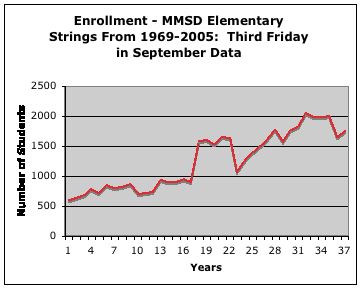
Share

The Public Survey Trap and Music Education

In his weekly advice on music advocacy, Dr. Benham, on www.supportmusic.com talks about public surveys. Useful information can be gathered, but they can also be used to threaten the public or be used as a mandate from the public if referendums do not pass. the music advocate needs to keep music off the surveys. Dr. Benham writes,
“In the presence of a financial crisis one of the approaches used to inform the public of the seriousness of the situation is a Public Survey.
The survey may be used for a variety of reasons, some of which may need to be “read between the lines.”
* To inform the public of the financial crisis
* To inform the public of the need to raise taxes
* To establish a basis for a levy referendum to increase funding
* To inform (sometimes threaten) the public of probable cuts if additional finding is not increased
* To get a sense of what the public values most so that the cuts made cause the least negative reaction
One school district in which I worked mailed surveys to all employees and residents in the district. The survey listed 200 categories or programs within the district. The respondent was asked to rank each with a response of “A” (Most important to retain), “B” (Cut here first), or “C” (Save this if possible). After the district levy referendum failed the district mandated cuts in the music program that would have eliminated 70% of the orchestra staff and 48% of the band staff.
What actually occurred is that the results were summarily ignored, not even calculated. The administration proposed the music cuts based on their own educational philosophy and blamed the community for lack of support for music. The music parents requested permission to review the surveys and discovered the following.
* Of the 60,000 surveys distributed only 211 were returned
* Lack of participation by the community invalidated the survey, exposing the administrative action as self-serving
* Of the nine (9) music categories included on the list of 200 in the survey, music was ranked by the community as “most important to retain” on a basis equivalent with curricular status.
* Music categories outranked all extra-curricular activities as “most important to retain”
Continue Reading “The Public Survey Trap”

Share

The Art of Education Success by Nick Rabkin and Robin Redmond

Rabkin and Redmond wrote in the Washington Post on January 8, 2005 that “…the arts are not just affective and expressive. They are also deeply cognitive.”
Districts with music and art curriculum standards and benchmarks tied to other curriculum see improved test scores. The research is showing more and more that children’s learning directly benefits from music and art curriculum.
The authors note that “Successful programs in Chicago, Minneapolis and elsewhere have proven that arts integration is within the reach of most schools and districts. Now research is showing that connecting the arts to learning across the curriculum is a strategy that helps close the achievement gap and make schools happier places by moving beyond a crippling focus on basics and discipline. It is time for more districts and schools to make use of this strategy.”
MMSD’s fine arts teachers know this and gear their curriculum to provide student’s with the benefits in learning from music and art education. If MMSD administration narrowly focuses on reading, math, science, etc., scores and not what contributes to children learning experiences being successful, administrators will miss the benefits of the arts.
Children and teachers have been telling them for the past several years how music and art benefit children’s learning. Hopefully, they are listening.

(more…)

Share

Arts Are a Core Subject Under No Child Left Behind – Flexibility for Federal Funding of the Arts Exists

In an August Letter to ALL superintendents across the country, Secretary Paige (Dept. of Education) stated that the arts are a core subject area of No Child Left Behind, provided research that demonstrates children who are more engaged in the arts do better on tests, and offered guidance on flexibility, funding for arts
Noting that the arts are a core subject under the No Child Left Behind Act, U.S. Secretary of Education Rod Paige has issued guidance on the law’s funding and flexibility that can be used to improve art education and teacher quality, particularly as a means to improve the educational achievement of economically disadvantaged students through the arts.
The letter cites research that shows arts teaching and learning can increase students’ cognitive and social development and serve as a “critical link” to help students develop crucial thinking skills and become motivated to achieve at higher levels. Research also shows that students who are highly involved in the arts earn better grades and perform better on standardized tests.
Secretary Paige’s letter also reminds superintendents about the law’s flexibility and the funding available to support core subjects through programs supported by the No Child Left Behind Act, including: Title I funds to improve the academic achievement of the neediest students; the Comprehensive School Reform program; and Title II Teacher Quality Enhancement Grants to provide professional development for teachers of the arts.
In Arizona, for example, as part of Superintendent Tom Horne’s current “content-rich curriculum” initiative, $4 million in Comprehensive School Reform (Title I, Part F) funds are supporting arts education at 43 current Comprehensive School Reform schools throughout the state. Additional Arizona Arts Education Initiative school sites are being supported with Title V (Innovative Programs) funding under NCLB.
The City of Madison needs to ask what available funding for the arts under NCLB the Madison Metropolitan District has pursued.
Continue Reading “US Department of Education Press Release: Arts are a Core Subject Under No Child Left Behind”

Share

MUSIC ADVOCACY: Caring Enough to Put the Student First by Dr. Benham

Dr. John Benham, writing on www.supportmusic.com says, “Music Education Advocacy. The concept can make us indignant. Why should anything so valuable to the education of every child need to be defended?”
He continues, “If you�re a parent of a young person interested in playing music, you�ve already experienced first-hand the positive impact of this sort of challenge. If you�re a member of the community with a love of music, you know how much it has benefited you.
But the truth is, we have no choice but to defend school music programs. In a time of drastic reductions in school budgets, music can sometimes be misunderstood as not core to an academic curriculum. But we do know that participation in music is vital to a young person�s academic and social development.”
Advocacy for music education for students is not about what we teach children as much as it is about what children are learning and music education is fundamental to that.
Continue Reading “MUSIC ADVOCACY: Caring Enough to Put the Students First” – Dr. John Benham

Share

Music To His Ears by Sandy Cullen, WI State Journal

Janitor Directs Generosity To East High, Trades His Broom For Baton Tonight by Sandy Cullen, January 13,2005, WI State Journal
Jim Ely loves music and the arts.
He also loves Madison East High School.
It’s where he and his wife, Judy, who died of ovarian cancer in February 2003, were high school sweethearts more than 30 years ago, when he took her to his prom and she took him to the TWIRP (The Woman Is Required to Pay) dance.
It’s where they worked together on the 1969 production of “Oklahoma!”
Read the entire article,
Music to His Ears

Share

Update on Hiring MMSD Fine Arts Coordinator – Art Rainwater Briefs Board on Ongoing Delay and Reposting of Position with Fewer Requirements

Art Rainwater informed MMSD School Board members on January 10, 2005 that the Fine Arts Coordinator position would be reposted. Why? It’s unclear, as the following quicktime movie shows. There were about 9 candidates.
Members on the committee, who included MMSD and public representatives, said they forwarded two qualified candidates for the next step toward hiring. Why wasn’t one of those people hired?
Art Rainwater says that the license requirement for the position will be removed to attract a broader category of candiate. My question is – possibly a less qualified candidate? There has been no public notice of a substantive change in the responsibilities of this position. You would think that professionals in the field and the arts community would be involved in major changes were being considered. Read Mariel Wozniakl for information on how removing a license can be problemmatic and what experience an MMSD Fine Arts Coordinator needs to have.
Video of Art Rainwater’s Update on Hiring of Fine Arts Coordinator to the MMSD School Board on Monday, January 10, 2005

Share

A Local Music Coalition – Madison Needs Its Own Music Coalition

“…in my view it is the most effective way to ensure that your school district provides equal educational opportunities for all of its students to participate in the making of music!” Dr. Benham exclaims for children in his recent commentary on music advocacy, “An effective local music coalition holds a school district accountable for student-centered decision making.”
Some of the leading reasons Dr. Benham identifies for a local music coalition include:
* A local coalition places the student back to the center of the decision-making process.
* A local coalition identifies the music program as an integral part of the community.
* A local coalition unifies the music program as a unified district-wide curriculum.
* A local coalition promotes music education, not just band, choir, orchestra, or general music.
* A local coalition is a community organization that incorporates all of its constituents in the support of music making.
* A local coalition provides for bringing music into all of life.
* A local coalition puts the “public” in Public Education!
Continue Reading “The Local Music Coalition – Dr. John Benham”

Share

New Posting for the Fine Arts Coordinator Position Mentioned – Removes Professional License Requirements by Dr. Mariel Wozniak, retired MMSD Fine Arts Coordinator

I was concerned and confused as I listened on Monday night to Superintendent Rainwater inform the School Board that the position description posted for the Fine Arts Coordinator was being reposted without a license requirement so that more applicants could be included. The Fine Arts Coordinator oversees the design and implementation of the District’s Fine Arts curriculum, and this position has an important community role with the City’s varied fine arts organizations.
All other coordinators require a license #10 and so should the Fine Arts Coordinator position. Licenses insure that an applicant has met certain standards and is meant to protect against less qualified applicants being hired.
“The points in the posting indicate a change in the position of a full-time Coordinator of Fine Arts,” Dr. Wozniak, retired MMSD Fine Arts Coordinator pointed out in a recent essay. “While educational change is legitimate, a new role for the Coordinator of Fine Arts and reasons for change should not only be well known by the community, but by arts education specialists who should be involved in those changes. This city values education which includes designated arts instruction in its schools and its enhancement by the arts and other resources in the community. We need to remember that teachers, principals, and superintendents are public servants and should fulfill the community’s educational goals.”
What continues to be lacking in the District’s decisionmaking about Fine Arts education is the ongoing lack of an open process that includes professionals in the field and the community so that best choices can be made for children’s learning.
Dr. Wozniak notes, “The responsibility of the board of education is to make informed decisions for the education of its children with accountability and commitment to its electorate.” This is not possible at MMSD, because decisions about Fine Arts education are being made behind closed doors by a handful of administrators and then announced to the board of education as fact.
Download Dr. Wozniak’s Complete Essay: New Posting for the Fine Arts Coordinator Position Mentioned – Downgrades Professional Requirements

Share

ARTS DAY 2005 – GROW WISCONSIN CREATIVELY – WEDNESDAY, MARCH 2, 2005

Wisconsin�s arts leaders will come together to show support for greater visibility and increased investment in the arts to benefit Wisconsin’s communities and the people of the state, on ARTS DAY 2005, Wednesday, March 2, 2005, at the State Capitol in downtown Madison.

(more…)

Share

Is My Music Program Vulnerable to Cuts? – Dr. John Benham

As one superintendent stated, “There is no group of people more capable of rallying immediate and effective advocacy than a well-organized music coalition!” John Benham, music education advocate, reminds his readers in his December 15th column on www.supportmusic.com.
Dr. Benham urges his readers to become active participants in the education decision-making process. “In the face of what appears to have become a national trend to target music programs for reduction, it becomes the responsibility of the music advocate to stay informed by active participation in the decision-making process.” he advises, “We must encourage and/or remind parents and other advocates that the school district really belongs to the community. We must become educated in school polity, empowering the people to ensure student-centered decisions.”
Continue Reading “Is My Music Program Vulnerable to Cuts? – Dr. John Benham”

Share

What is the Single Most Important Issue in Music Advocacy – YOU! by Dr. John Benham

SupportMusic.com is a website storehouse of resources for defending music education in schools. In December, this website began a weekly blog on advocacy for music education by Dr. John Benham, who is President of Music in World Cultures, Inc. and Director of Graduate Studies in Music at Bethel University in St. Paul, Minnesota.
In his December 8th blog, Dr. Benham writes that “In over 20 years as a consultant for music advocacy I have never seen a music program cut when there was a well-organized and cohesive support group.
There is no place where your participation has more immediate impact than in your school district. Your participation is vital to the health of your music program.
It is quite simple: Your participation is a “YES” vote, providing music making opportunities for the students in your district. Your failure to participate is a “NO” vote, even if by default.”
Continue Reading “What is the Single Most Important Issue in Music Advocacy – YOU!”

Share

Elementary School Needs String Instruments – Sandy Cullen

Sandy Cullen, Wisconsin State Journal reporter, wrote a story in early December about a shortage of string instruments at Leopold Elementary School. It seems that newly hired MMSD strings teacher, Pat Kukes, has more students than violins for his elementary string students. He’s hoping donations will be made to the school so that children will have instruments to practice and so that all students can play together in a concert.
Most of the students in the elementary strings program are low income, so renting an instrument privately is not an option.
Elementary School Needs String Instrumenets

Share

Overture Center Soars while MMSD Fine Arts Curriculum Sinks

The following letter was submitted to the Madison papers today.
Dear Editor:
What joy I experience when I attend performances at the new Overture Center for the Performing Arts! I�ve been to a variety of free and paid performances, including the MSO and Kanopy Dance. Thank you Jerry Frautschi and Pleasant Rowland for your gift to the City of Madison, your vision for a vibrant arts community, and your support for the city�s economic and cultural future. Yet sadly, we are in danger of this joy not lasting into the future.
The problem is not Madison�s citizens. Their support for arts organizations is impressive. The Great Performance Fund is a major step in that direction, and the UW-Madison is undertaking a major renovation and investment in the arts as well. These foundations are critical to the support of a vibrant Madison future, but they are not sufficient.
What is missing? We are lacking a commitment to a strong Fine Arts foundation in the Madison Metropolitan School District (MMSD), which serves nearly 25,000 students.
continue reading entire letter.

(more…)

Share

MMSD Fine Arts Teachers Ask School Board for Community Arts Committee

On Monday night, October 4, 2004, more than 12 MMSD Fine Arts teachers attended the School Board meeting. Four of those teachers read a letter to the School Board asking for the Fine Arts Coordinator position to be filled. They also asked that a community committee be formed to develop a fine arts vision for the district that would include an assessment of the current fine arts curricula. A summary of the points in the letter (which can be downloaded) includes:
Fine Arts Coordinator (FAC)
– Thank you for reinstating the portion of the Fine Arts Coordinator position that works with teachers. (The existing � time position was funded by Fund 80 and would not have supported the 140+ teachers in 47 schools.)
– Need a professional in the field to fill the vacant position
– Need someone soon
– Hire an interim FAC � much like a long-term sub until a full-time professional is hired
– In next budget, look across all professional support staff � over the the FAC cut from 2 FTE to 0 FTE. The � Fund 80 position isn�t able to work with staff
Fine Arts Vision
– Fine Arts have curricula in MMSD
– Fine Arts have standards in MMSD
– Overture and UW have their vision for the role of art in the community � MMSD needs to do the same
– Form a community committee � community assessment of the fine arts in schools and development of fine arts vision for the MMSD with goals, budget, etc.

(more…)

Share