School Information System

“Community Services Levies Climb Since Caps Lifted”

Amy Hetzner:

Lawmaker requests audit as school districts across state raise taxes to support programs.
Five years after state legislators released them from state-imposed revenue caps, school districts’ community service tax levies have nearly tripled, reaching $49 million this year.
The rampant growth in these property taxes – earmarked for community-based activities – took place as the total levies for schools statewide rose by 22.7%.
That has raised concerns about school districts skating around revenue limits and has prompted one lawmaker to request an audit of the program.
State Rep. Debi Towns (R-Janesville) said she is curious why property taxes that pay for recreational and community activities offered by school districts have grown so much since the 2000-’01 school year. In that time, the number of school districts raising taxes for such services has doubled to 240.
“I’m not saying anyone’s misspending. I’m just saying the fund has grown tremendously, and the purpose never changed,” said Towns, chairman of the Assembly Education Committee. In November, Towns called for the Legislative Audit Bureau to study how select school districts use their community service levies.

The Madison School District’s Community Service “Fund 80” has grown significantly over the past few years. Lucy Mathiak summarized Fund 80’s tax and spending increases here ($8.5M in 2005/2006, up from $3.5M in 2001/2002 – Milwaukee’s 05/06 tax levy was slightly less: $8M). Carol Carstensen notes that Fund 80 is worth our support.
Much more on Fund 80 here.

Share

Learnings Per Share

Denis Doyle:

If education is funded without measuring results decisions are based on impulse and sentiment, a risky business that. Yet if education is to be funded on results we need a high degree of social consensus on what results are desirable (and measurable).
As it happens, this sentiment does not respect party lines. Former Minnesota DFL Senator John Brandle famously said – more than 20 years ago – “there will be more dollars for education when there is more education for the dollar.”
Conceptually, the task is straightforward: identify what value schooling adds and measure it. While most people associate the value add of schooling with academic progress, there is also a social dimension, ranging from socialization to custodial care. These too can be measured.
Take year ‘round schooling as an example. Students who attend 240 days (rather than the typical US 180-day year) are likely to escape “summer learning loss.” While preliminary evidence suggests that with poor children in particular, summer learning loss is diminished significantly with year ‘round schooling, it is an empirical question. Risk-taking school districts could offer year ‘round schooling on a pilot basis and measure what happens – who enrolls, how popular is the program, and what are the results? (One prediction: working parents will love it.)
Alternately, 13 180-day years equals 2,340 days from K to graduation. Taken in 240 day installments, a typical student could graduate in 10 rather than 13 years. This too is an empirical question. Are there answers? Certainly Japanese experience suggests that there is. The Japanese school year is 240 days long and the typical graduate (after 13 years) is reputed to have completed the equivalent of two years of a good American college.
What business or industry would close for one-third of the year? What other human capital intensive activity — health care facility, for example — would shut its doors one-third of the year?

Share

“Education Just a Click Away”

Mindy Hagen:

In South Carolina, several large school districts such as Richland 2 and Lexington 1 offered online courses. For example, Richland 2’s virtual school employed 27 teachers and had students register for a total of 559 online courses last year, said Margaret Walden, the district’s instructional technology coordinator.
Despite the efforts of individual districts, no statewide program existed to help students in rural areas keep pace.
“This levels the playing field,” Appleby said. “These online courses are available to any student in any district in the state.”
The virtual school has been able to cut down on costs by relying on the same technical software used by teachers for online professional development.
Students at Charleston high schools such Academic Magnet and North Charleston have experience with online courses, but the state’s program will expand access, district spokeswoman Mary Girault said.

Share

Madison School Board Passes a New Advertising Policy

WKOW-TV:

he Madison Metro School District’s “no advertising” policy is now a thing of the past. Tonight they voted unanimously to allow some advertising at certain venues. They say in the face of limited resources and cutting programs, the district needs to find ways of generating revenue outside the taxpayer.
“The district right now has a menu of things to look at…the website…not really targeting toward kids, but targeting toward the community that would be sporting events, that would be community events that we have,” says board president Johnny Winston Jr.

Share

Don Severson / Vicki McKenna Discussion on Local School Climate, the School District Budget and the Fall Referendum

WIBA’s Vicki McKenna and Active Citizens for Education’s Don Severson discussed a variety of topics today, including Judy Newman’s series on Madison’s changing economic landscape, the Madison School District’s budget process and the planned November referendum for a new far west side school, Leopold Elementary school expansion and debt consolidation. 17MB MP3 audio.

Share

Antonucci Commentary on Public vs. Private School NAEP Scores

Mike Antonucci on the recent Education Department report comparing private and public school math and reading scores:

If I read the wonderfully titled report Comparing Private Schools and Public Schools Using Hierarchical Linear Modeling correctly, there is virtually no difference between the math and reading test scores of public and private school students when corrected for various characteristics of students, teachers and schools.
This is bad news for private schools (and when the same results exist for charters, for them as well). If you are going to sell yourself as the superior alternative to traditional public schools, you have to produce results. Reading and math scores on the NAEP tests are excellent measures of academic results, though — as my friends at NEA and AFT always tell me — not the only measures.
National Education Association President Reg Weaver was correct when he told the New York Times that had the results been different, “there would have been press conferences and glowing statements about private schools.”
Where Reg went wrong, however, was when he said that the results showed public schools were “doing an outstanding job.” Standardized test scores are the measures used by the bad guys — you know, people like me — to evaluate schools. What about all the measures the unions claim are important?
Private schools spend about two-thirds what public schools spend.

Share

Taxes and the Wisconsin Association of School Boards

Milwaukee Journal-Sentinel Editorial:

The board voted to eliminate from the school district’s 2006-’07 budget $7,000 for the association’s membership dues. It is now the only school board of the 425 boards in Wisconsin that is not a member.
Part of the reason was financial: Like most boards throughout the state, New Berlin is trying to get a handle on expenses in tough financial times and is cutting extraneous items.
But part of the reason was political: According to board Vice President Matt Thomas, the final straw for him involved a column written by Ashley and published in Wisconsin School News that bloggers were ridiculing for comparing support for the Taxpayer Protection Amendment with 1930s Germany.

Share

Menomonee Falls Schools “Efficiency Study”

Amy Hetzner:

Among the audit’s findings:

  • With 17 administrators, the Menomonee Falls district is at the high end of comparably sized districts, which have 14.5 to 17 administrators. But its licensed teaching staff exceeded staffing at similar districts by the equivalent of 40 to 60 full-time employees in the 2005-’06 school year. In particular, specialty courses at Menomonee Falls High School often have smaller class sizes than other districts or even other district schools, Germain found. The board already is planning to reduce its staff by 10 full-time teachers in 2006-’07.
  • Departments and teachers are “pushed” to spend the money the district budget provides annually by the end of the school year. “That is, purchase orders are rushed into the Business Office during April in an attempt to spend any remaining budget dollars so that when next year’s budget is prepared their budget level is not reduced,” according to the study.
  • The district’s building structure – separate middle schools for sixth- and seventh-graders and for eighth- and ninth-graders and a 10th- through 12th-grade high school – contributes to more administrative staffing, time lost for traveling teachers and small class sizes for courses such as foreign languages.

More commentary.

Share

“Competition the Cure for Health Care”

Harvard Business School Working Knowledge:

Last month HBS Working Knowledge offered an excerpt from Redefining Health Care: Creating Value-Based Competition on Results, by Harvard Business School professor Michael E. Porter and Elizabeth Olmsted Teisberg. The U.S. healthcare system is dysfunctional, a Rube Goldberg contraption that rewards the wrong things and doesn’t create value for the consumer. In this Q&A, Porter discusses his research.
Roger Thompson: What went wrong with the American model? On paper it looks ideal. It’s private, it’s competitive, yet it doesn’t seem to work.
Michael E. Porter: The United States has a system with the wrong kind of competition, on the wrong things. Instead, we have a zero-sum competition to restrict services, assemble bargaining power, shift the cost to others, or grab more of the revenue versus other actors in the system.
Zero-sum competition does not create value; it can actually destroy value by adding administrative costs and leads to structures involving health plans and providers and other actors, which are misaligned with patient value. In a world of zero-sum competition, for example, providers will consolidate into provider groups to gain clout against insurers. But, as we point out in our book, the provider group doesn’t create any value, but value is not created by breadth of services but excellence in particular medical conditions.

NPR’s OnPoint recently interviewed Harvard’s Michael Porter: [20MB MP3 Audio]
Health care expenses have been much discussed with respect to the Madison School District’s $332M+ budget.

Share

Weighted Student Funding

Fordham Institute:

Everyone agrees that education funding today is a mess. Most disadvantaged students don’t receive the funding they need; red tape and overhead waste time and money; and new types of education options, like charter schools, are starved for dollars. Unfortunately, until now, so-called solutions have consisted of nothing more than soothing slogans and gimmicks.
But a broad, bipartisan coalition now urges a new method of funding our public schools–one that finally ensures the students who need the most receive it, that empowers school leaders to make key decisions, and that opens the door to public school choice. It’s a 100 percent solution to the most pressing problems in public school funding–and it’s called Weighted Student Funding.

Nancy Salvato comments on the report.

Share

Sun Prairie Cuts Health Care Costs & Raises Teacher Salaries – using the same Dean Healthcare Plan

Milwaukee reporter Amy Hetzner:

A change in health insurance carriers was achieved by several Dane County school districts because of unique circumstances, said Annette Mikula, human resources director for the Sun Prairie School District.
Dean Health System already had been Sun Prairie’s point-of-service provider in a plan brokered by WEA Trust, she said. So, after WEA’s rates increased nearly 20% last year and were projected for a similar increase this year, the district negotiated a deal directly with Dean.
When the Dean plan goes into effect Sept. 1, the district’s premiums will drop enough that it can offer a starting salary $2,000 above what it paid last school year and yet the health plan will stay the same, Mikula said. Several other Dane County districts also have switched to Dean.
“I don’t see that our teachers made a concession because really the only thing that’s changing in theory is the name on the card,” she said. “But for the name on the card not to say WEA is huge.”
According to the school boards association, fringe benefits made up 34% of the average teacher’s compensation package in the 2004-’05 school year vs. 24% less than two decades before.

Sun Prairie School District website.

Jason Shephard noted earlier this year that the most recent attempt by the Madison School District to evaluate health care costs was a “Sham(e)”:

Last week, Madison Teachers Inc. announced it would not reopen contract negotiations following a hollow attempt to study health insurance alternatives.
Not to put too fine a point on it, but anyone who suggests the Joint Committee on Health Insurance Issues conducted a fair or comprehensive review needs to get checked out by a doctor.
The task force’s inaction is a victory for John Matthews, MTI’s executive director and board member Wisconsin Physicians Service.
Losers include open government, school officials, taxpayers and young teachers in need of a raise.
From its start, the task force, comprised of three members each from MTI and the district, seemed to dodge not only its mission but scrutiny.
Hoping to meet secretly until Isthmus raised legal questions, the committee convened twice for a total of four hours – one hour each for insurance companies to pitch proposals.
No discussion to compare proposals. No discussion about potential cost savings. No discussion about problems with WPS, such as the high number of complaints filed by its subscribers.

The Madison School Board recently discussed their 2006/2007 goals (my suggestsions). The Wisconsin State Journal noted that there are some early positive signs that things might change.

Share

More Discussion on Spending & Education Quality

Ryan Boots:

From time to time I’ve mentioned the disastrous Kansas City experiment, which tends to be a rallying point for those who dare to contradict the Kozol doctrine that increased spending will cure all that ails American education. Looks like somebody didn’t get the memo, because we have a Kansas City for the new millennium:

Boots references George Stratigos, President of the Marin city School District – blog.

Gregory Kane:

In the 40th anniversary of the beginning of the Black Power movement in the United States, there is no clearer indication of black power’s failure than in urban school systems like Baltimore’s that are run by Democrats. Washington, D. C. schools are some of the worst in the country. Democrats run D.C.
In the Manhattan Institute study, Baltimore’s graduation rate was 91st of the country’s 100 largest school systems. But Detroit’s — another city run by Democrats — was 98th. In both Baltimore and Detroit, most of those Democrats are black who are supposed to be exercising black power to improve conditions for black folks.

– via Rotherham.

Share

LA’s Muddled Governance

LA Times Editorial:

A.J. DUFFY’S SUPPORT OF the mayor’s plan to reorganize the management of Los Angeles’ schools hardly qualifies as news. Duffy is president of the school district’s teachers union, which would gain even more power under the plan. But Duffy did propose a novel argument Wednesday in Sacramento, testifying in support of the bill that would authorize the restructuring.
A weakened school board, as beholden to UTLA as ever, makes an ideal negotiating partner for a powerful union. A superintendent who isn’t answerable to the board gives the union enough wiggle room to continually challenge district policy. A situation in which no one is dominant provides a perfect opportunity for the strongest player to emerge as the leader of the district. And UTLA is a strong, well-financed player. No wonder Duffy likes this deal so much.

Share

University Student Reading Buddies

Reader Reed Schneider emails this:

A plan to have 40 Spring Arbor University students serve next year as “reading buddies” for struggling first-graders in Jackson Public Schools could be a win-win situation.
The Jackson school board recently cut three Reading Recovery teacher positions to help trim its $1.86 million deficit.
JPS will obtain the services of 40 people who plan to make education their future profession, at a very low cost — $1,800 to transport the Spring Arbor students to elementary buildings. The remaining cost of the $69,780 program will go toward various training programs for teachers in the district. Overall, the district will save $221,287 over the Reading Recovery program.

“I’m sure there are a couple thousand students in the UW-Madison School of Education. With numbers like that, you could save many $100,000’s by getting rid of Reading Recovery and still have two teachers for every former RR kid.”

Share

Racine Health Care Costs & Teacher Layoffs

Scott Niederjohn [PDF]:

Facing a budget shortfall of $7.2 million this year, the Kenosha school district asked each of their labor groups to switch their health insurance provider from the WEA Trust to Minneapolis-based United Healthcare. The coverage offered by United Healthcare has the same benefits and cost sharing provisions as the WEA Trust plan currently used by the district’s employees. All of the labor groups within the district, except for the teacher’s union, chose to make this change and save the district over $3 million in benefit costs. Another $3 million would have been saved if the teacher’s had switched to this identical insurance plan as opposed to remaining with the union owned insurance provider.
The most remarkable part of this story is that because the teachers chose not to make this switch, the district has been forced to layoff 40 teachers to alleviate their budget shortfall.

Share

The Schools Scam

I realize that some of the legal frameworks differ but think that this serves as a good remider that TIFs have an impact on school funding everywhere.
From the Chicago Reader See also: Epoch TimesTJM
By Ben Joravsky
The Schools Scam

Under the TIF system millions of dollars in property taxes are being diverted from education to development.
By Ben Joravsky June 23, 2006
On June 15 Mayor Daley brought public school officials and aldermen to a south-side grammar school for a revival meeting of sorts. The ostensible purpose of the press conference was to announce the mayor’s plans to spend $1 billion over the next six years to build 24 new schools in neighborhoods across Chicago. But Daley and the other officials made a point of reminding people of the economic development plan that makes this possible: the tax increment financing program.
“This is a creative use of existing dollars which have accrued from our successful TIF program and will not require any property tax increase by the city of Chicago to fund,” Daley said in his remarks.
Even as public pronouncements go, this was a whopper. Of course building new schools requires an increase in property taxes. It’s just that in this case the deed’s been done: TIFs have been jacking up property tax bills for almost 23 years. Rest assured they’ll continue to—the city shows no sign of abandoning them. On the contrary, City Hall insiders tell me that the mayor’s press conference was part of a move to win public approval for the extension of the Central Loop TIF, the city’s oldest and largest, which is set to expire next year.
But as a public relations maneuver the announcement was brilliant. In one fell swoop, Daley managed to tweak the state for not paying more in education funds and look like the heroic protector of the city’s schoolchildren, using the promise of new schools to camouflage the diversion by TIFs of millions from public education coffers.
According to the city, as much as $600 million, or 60 percent, of the new construction costs will come from various TIFs, districts created by the City Council that put a rough cap on the amount of property taxes that go to the schools, the parks, and the county for a period of 23 years. Additional property taxes generated in these districts through rising assessments and new development flow into TIF accounts, which function as virtually unmonitored slush funds.
Originally TIFs weren’t intended to build tax-exempt properties like schools: they were supposed to subsidize economic development in blighted communities with the goal of even-tually increasing property tax revenue. But as the TIF program has expanded and evolved—the city’s created more than 100 districts in the last ten years—Mayor Daley and the City Council have drawn on them to subsidize projects from upscale condos in trendy neighborhoods to Millennium Park to a rehab of of the lake-shore campus of tax-exempt Loyola University.
Daley says he’s repaying the public. “Our taxpayers have been generous beyond words,” he said at the press conference. “Today we’re giving back to those taxpayers something real and meaningful—something they will see and touch and feel and know that their dollars are being invested carefully and appropriately.”
That’s a noble aspiration, and Lord knows there are neighborhoods that desperately need new classrooms. But even with the new construction, the Chicago Public Schools won’t come close to retrieving the property tax revenue it’s lost to TIFs. According to CPS officials, the city has already spent about $280 million in TIF funds building or rehabbing schools. By 2012, when the proposed construction program is completed, that amount will have gone up to about $880 million. Since TIFs operate without budgets, the other side of the ledger is more difficult to calculate. But based on the annual statements provided by the county clerk’s office, TIFs have diverted about $621 million in property taxes over the last two years. Since roughly half of this would have gone to the schools, the money diverted from the schools to TIFs amounts to about $310 million in the last two years alone. As TIFs continually grow, this means that by a conservative estimate they will have diverted well over $1 billion from the schools by 2012, when the new construction is completed—a shortfall of $120 million or so.

(more…)

Share

Local Population Growth, Student Numbers and Budget Implications

Wisconsin State Journal Editorial:

Imagine what would have happened if a city the size of Beloit had sprung up in Dane County over the past five years.
That’s almost what happened. Dane County’s population grew by 31,580 from 2000 to 2005, according to U.S. Census Bureau estimates released last week.
No other Wisconsin county gained as many people.
The population increase extended a trend. Over the past 15 years Dane County has gained 91,000 people, almost equal to the population of Kenosha, Wisconsin’s fourth largest city. Projections call for the growth to continue.

Barb Schrank:

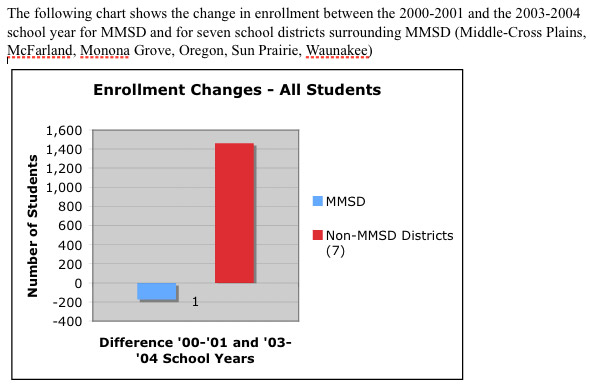
MMSD Lost 174 Students While the Surrounding School Districts Increased by 1,462 Students Over Four School Years. Revenue Value of 1,462 Students – $13.16 Million Per Year*
MMSD reports that student population is declining. From the 2000-2001 school year through the 2003-2004 school year, MMSD lost 174 students. Did this happen in the areas surrounding MMSD? No. From the 2000-2001 through the 2003-2004 school year, the increase in non-MMSD public school student enrollment was 1,462 outside MMSD.
The property tax and state general fund revenue value of 174 students is $1.57 million per year in the 2003-2004 MMSD school year dollars (about $9,000 per student). For 1,462 students, the revenue value is $13.16 million per year. Put another way, the value of losing 174 students equals a loss of 26-30 teachers. A net increase of 1,462 students equals nearly 219 teachers. There are more subtleties to these calculations due to the convoluted nature of the revenue cap calculation, federal and state funds for ELL and special education, but the impact of losing students and not gaining any of the increase of students in the area is enormous.

Share

Need based School Funding Formula Disputed

Peter Gascoyne made an excellent point in recent comment regarding “No free lunch”. In other words, a change that’s positive in one area may not be all that great for others. Beverly Creamer notes that Hawaii is implementing a new Weighted Student Formula that is not without controversy:

A new controversy is shaping up over how money is divided among the state’s public schools under a formula based on student need.
Small and rural schools were expected to suffer staggering monetary losses under a new Weighted Student Formula that will take effect with the new school year July 27. And even though the losses were averted with an extra $20 million from the Legislature, the outcry over the expected impact on small and rural schools generated widespread concern.
Now, a special Department of Education committee charged with re-examining the formula has proposed a key change intended primarily to address wide discrepancies in funding between the largest and smallest schools.
Under the plan, each school would receive a base amount — or “foundation grant” — to assure that each could afford essential positions. The foundation grants would amount to about 25 percent of total school funding, leaving much less to be divided according to student need.

Share

WIAA: Should Schools Be in the Athletic Business?

Rob Hernandez:

“Are we making the assumption that all districts want to have (sports)?” Dyer asked. “How widely is that (view) shared. Maybe they don’t want them. Maybe they’re becoming too much of an albatross financially. That’s a question that has to be asked.”
Afterward, Dyer predicted the question will be asked more frequently unless the WIAA and other agencies “get behind” interscholastic athletics and defend their existence.

The Madison School District’s sports budget increased from 1.4M in 2005/2006 to 1.8M in 2006/2007 – a topic discussed during recent school board budget deliberations.

Share

Madison School District Worker’s Comp Investigation

WKOW-TV:

Administrators from the Madison School District tell us before our story aired last year, the district was seeing a decrease in worker’s comp claims and days missed. But in the year that passed by since our story aired, the numbers shot way down — 41 percent.
According to records from the Federal Occupational Safety and Health Administration (OSHA) — in 2004, Madison School District employees reported 144 injuries, resulting in 1280 missed days of work. That cost tax payers roughly $1.25 million in worker’s comp claims.
A year ago, Roger Price, Madison School District Assistant Superintendent of Business Services, told us the district was in control of the situation. “We’ve been able to get our employees back to work, which reduces the days out,” Price said last year.
But we compared Madison’s numbers to other similar sized districts, and found a much different story in Green Gay. In the same time frame, OSHA records show that the Green Bay School District reported 219 injuries — about 60 more than Madison. But Green Bay employees missed only 92 days of work. That means Madison employees missed roughly 1,100 more days, due to on the job injuries, than similar sized Green Bay.

Share

Few school districts set up benefits trusts

Amy Hetzner:

School districts throughout Wisconsin could be losing out on thousands of dollars in aid by not setting up special funds to pay retirement benefits for their employees.
Only 32 of the state’s 426 school districts in the 2004-’05 school year had established the trust funds, which set aside money to pay promised benefits to employees once they retire, according to Kathy Guralski, a school finance auditor with the state Department of Public Instruction.
At least 10 more established them for 2005-’06, although they have not submitted their final paperwork, she said.

Share

How Schools Pay a (Very High) Price for Failing to Teach Reading Properly

Brent Staples:

Imagine yourself the parent of an otherwise bright and engaging child who has reached the fourth grade without learning to read. After battling the public school bureaucracy for what seems like a lifetime, you enroll your child in a specialized private school for struggling readers. Over the next few years, you watch in grateful amazement as a child once viewed as uneducable begins to read and experiences his first successes at school.
Most parents are so relieved to find help for their children that they never look back at the public schools that failed them. But a growing number of families are no longer willing to let bygones be bygones. They have hired special education lawyers and asserted their rights under the federal Individuals With Disabilities Education Act, which allows disabled children whom the public schools have failed to receive private educations at public expense.
Federal disability law offers public school systems a stark choice: The schools can properly educate learning-disabled children — or they can fork over the money to let private schools do the job.

More on Brent Staples.

Share

2006 Condition of Education Statistics

National Center for Education Statistics:

This website is an integrated collection of the indicators and analyses published in The Condition of Education 2000–2006. Some indicators may have been updated since they appeared in print

Chester Finn has more:

–A huge fraction of U.S. school children now attend “schools of choice”: more than half of K-12 parents reported in 2003 that they had the “opportunity” to send their kids to a “chosen public school.” It appears that 15 percent actually sent them to a “chosen” public school (including charter schools), to which must be added the 10 to 11 percent in private schools, the 1 to 2 percent who are home schooled, and what seems to be 24 percent who moved into their current neighborhood because of the schools. Though there is some duplication in those numbers, it looks to me like a third to a half of U.S. schoolchildren’s families are exercising school choice of some sort.
–Class-size data are elusive but it’s easy to calculate the student/teacher ratio in U.S. public schools, which has been below 17 to 1 since 1998. Even allowing for special ed, AP physics, and 4th year language classes with 5 kids in them, one may fairly ask why a country with fewer than 17 kids per public-school teacher remains obsessed with class-size reduction. (When I was in fifth grade, the national ratio was about 27:1.)
–Total expenditures per pupil in U.S. public schools reached $9,630 in 2003—up 23 percent in constant dollars over the previous 7 years. At 17 kids per teacher, that translates to almost $164,000 per teacher. Why, then, are teachers not terribly well paid? Because (using the NCES categories) the U.S. spends barely half of its school dollars on “instruction.”

Joanne does as well.

Share

WIBA’s Vicki McKenna & Don Severson Discuss the November Referendum

10MB MP3 Audio

Share

Audio / Video: Madison School Board Fall 2006 Referendum Discussion & Vote

MP3 Audio or Video

The Madison School Board discussed and voted on a a November, 2006 Referendum that features “three requests in one vote“: a new far west side school, a 2nd Leopold expansion request and a refinancing plan that frees up some funds under the state revenue caps in the MMSD’s $332M+ budget. Learn more about the May 2005 referenda, which included a much larger Leopold question here.
Share

School Board OK’s 23.5M November Referendum: Three Requests in One Question

Sandy Cullen:

he Madison School Board will put one $23.5 million referendum question to voters in the Nov. 7 general election.
If approved, the referendum would provide $17.7 million for a new elementary school on the Far West Side, $2.7 million for an addition at Leopold Elementary, and $3.1 million to refinance debt.
It also would free up $876,739 in the portion of next year’s operating budget that is subject to state revenue limits. Board members could use that money to restore some of the spending cuts in the $332 million budget they recently approved, which eliminated the equivalent of about 86 full-time positions to help close a $6.9 million gap between what it would cost to continue the same programs and services next year and what the district can raise in taxes under revenue limits.

Susan Troller has more:

The board voted unanimously to hold the referendum in November, rather than placing in on the ballot during the fall primary in September. The later date, board members said, provides more time to organize an educational effort on why the projects are necessary.
“We’ll see what happens,” said board member Ruth Robarts, the lone dissenting voice on the decision to bundle all three projects together in a single question to voters in the general election. Robarts, who preferred asking the three questions separately, said she was concerned that voters who did not like one project might be likely to vote against all three.

What’s the outlook for a successful referenda? I think, as I wrote on May 4, 2006 that it is still hard to say:

(more…)

Share

Weighted Student Formula : Putting Funds Where They Count in Education Reform

This is an excerpt from the conclusion of an recent paper posted on the Education Working Paper Archive by Bruce S. Cooper, Timothy R. DeRoche, William G. Ouchi, Lydia G. Segal, and Carolyn Brown. WSF stands for Weighted Student Formula, a means of budgeting that assigns money to students based on a number of factors instead budgeting by position or building. The Equity Formula in Madison is similar in some ways, but recent budget cuts have left very little money to be distributed. To read the full paper click here.
TJM
IV. Twelve Suggestions for Successful Implementation of WSF
Based on lessons learned from Edmonton, Seattle, and Houston, we have compiled the following list of “commandments” that may be useful to districts beginning to implement a WSF system. By following these guidelines, district leaders can ensure that the WSF program allocates funds equitably and provides local educators with the right kinds of incentives.
Distribute as much as possible of the operating budget via the WSF. Schools will feel the impact of budgetary discretion only when they have significant resources at their disposal.
Avoid subsidies for small schools. If small schools are to succeed, they must do so within the same per-pupil budget as larger schools.
Phase-in the financial impact of WSF over 2-3 years. Schools need time to prepare for the significant budget changes that often result from the implementation of WSF. Pilot programs may not be effective, since they can pit schools against one another.
Phase-in the use of actual teacher salaries over 5-10 years. Schools need an extended period of time to address the complex financial consequences of their hiring decisions.
Establish a public forum for making weighting decisions. Weighting decisions must be driven by the educational needs of different types of students. Principals, district administrators, parents, and teachers must all accept the weights as valid.
Base funding on a mixture of enrollment and attendance. Schools should receive a financial incentive to improve attendance rates. However, policies should not penalize schools that serve students with high rates of truancy.
Fund secondary schools at a higher base rate than elementary schools. Historically, secondary schools have required more funds per student than elementary schools, and WSF should reflect this difference.
Give schools information on expenditures as soon and as often as possible. To make responsible spending decisions, principals must have access to up-to-date financial information. Financial systems must be transparent, accurate, and up-to-date.
Make it easy for schools to purchase from outside vendors. When schools are allowed to purchase products/services from outside vendors, Central Office units must compete for business and therefore push themselves to improve services. Credit cards allow schools to make instantaneous spending decisions.
Provide appropriate support and oversight for principals and support staff. To operate in a world of budgetary discretion, new principals need management training. Each school may need one highly-trained support person to serve as the site’s business manager.
Allow parents to choose the public school that best fits their needs. Public school choice complements a WSF system by creating a financial incentive for schools to improve their educational programs, thereby attracting more students (and more dollars). Weightings ensure that schools have an incentive to recruit and serve students with special needs.
Share information on school performance with educators and parents. Decision makers must see the educational consequences of their spending decisions. Since WSF empowers schools to target programs to the local student population, local educators need accurate, up-to-date information on student achievem

Share

MTI Demands to Bargain: Middle School Math Masters Program and Reading Recovery Teacher Leader

A reader emailed this item: Madison Teachers, Inc. Solidarity Newsletter [pdf file]:

The District sent literature to various teachers offering credit to those who enroll in the above-referenced courses. As an enticement for the Reading Recovery Teacher Leader course, the District offers “salary, tuition, and book costs.” The program will run after work hours during the school year. Regarding the Middle School Math Master’s Program, every District teacher, who teaches math in a middle school, is “expected” to take three (3) District inservice courses in math, unless they hold a math major or minor. The District is advising teachers that they must complete the three (3) courses within two (2) years. The courses are 21 hours each. The program is scheduled to run during the school day, with substitute teachers provided on the days the courses will be taught.
The Wisconsin Employment Relations Commission has previously ruled that an employer offering financial incentives, including meals and lodging, or release time, to employees in conjunction with course work or seminars is a mandatory subject of bargaining between the school district and the union.

Share

Schools That Work

Megan Boldt, Maryjo Sylwester, Meggen Lindsay and Doug Belden:

On paper, the schools appear troubled: low-income students, low state test scores. But a closer look reveals 13 are doing better than expected.
The challenges are not uncommon at schools such as Dayton’s Bluff that serve mostly low-income students. But Siedschlag had faith in the teachers she said nurtured students, and she thought things would get better.
They did. A new principal arrived in 2001 and renewed the school’s energy. Expectations became clear. Students respected teachers. And staffers now go out of their way to support parents.
School visits and interviews showed that the factors seen as critical to success at Dayton’s Bluff also are found at many of the other schools: They have strong principals and a cohesive staff who offer students consistency and structure. They emphasize reading and writing above all else. And they focus instruction on the needs of individual students rather than trying to reach some average child.
These successful schools have focused on basics — reading, writing and math — as they educate their at-risk students. They also have shifted to small-group learning and one-on-one instruction.
“We used to teach to this mythical middle student,” said literacy coach Paul Wahmanholm, who has taught at Dayton’s Bluff for eight years. Now, “we got away from this one-size-fits-all approach and focused on individualized instruction.”

Via Joanne.
Megan Boldt notes the importance of high expectations for all, or as a local teacher friend says: “Standards not sympathy”.

So shouldn’t the level of poverty be taken into account when determining how well schools teach kids?
No, say educators and researchers who contend that doing so would create two classes of U.S. schools and eviscerate the No Child Left Behind federal education law, which aims to have all students proficient in reading and math by 2014.
“Changing that would create a two-tier system of education — one with high expectations for the wealthy and a set of lower expectations for low-income students,” said Diane Piché, executive director of the Citizens’ Commission on Civil Rights.
“It’s simply not fair for students born into poverty to expect less of them when we know what’s possible,” she said. “That’s what we should focus on, rather than what’s likely.

Share

Teachers Contract: Bonuses, Relaxed Rules Proposed

V. Dion Haynes:

A proposed contract to be voted on today by the more than 4,000 members of the D.C. teachers union would enable teachers to earn bonuses tied to student performance and to opt out of some union work rules.
Although both programs would be voluntary and limited to a few schools, the proposals are a turnabout for the Washington Teachers’ Union, whose leaders in the past have opposed various forms of pay-for-performance and more-demanding work schedules.

Share

Racine Voters Approve Referendum

Alice Chang:

Voters on Tuesday night passed a $6.45 million one-year spending referendum. About 54% of those voting approved the request for more money, and 46% rejected it.
“I’m relieved. It doesn’t give us a great pause. We still have a lot of big issues,” said School Board member Randy Bangs. “The vote demonstrates we need to do a better job linking with the community and addressing core issues.”
Jayne Siler, president of the Racine Taxpayers Association, said, “I thank the voters who voted ‘no.’ . . . I’m sorry so many people are worried about their jobs and health insurance rather than the way the district spends money.”
The referendum proposal is for the same amount and duration as an expiring spending referendum, and it helps plug a projected $9 million hole in the 2006-’07 budget.
District officials on Monday revealed that $3.3 million of the gap was due to an accounting miscalculation.

Share

Oregon’s Open Book$ Project

The Chalkboard Project / Oregon Department of Education:

When the Chalkboard Project conducted the most extensive statewide polling ever of Oregonians on education issues and priorities, 65% said they would have greater confidence in K-12 schools if they could easily find standardized budget information they could compare and contrast.
People want to know where their money is going, and they want that information in a straightforward manner that is easy to understand.
The Open Book$ Project aims to provide ordinary Oregonians with an open, simple look at where K-12 dollars really go. Audited data is supplied by the Oregon Department of Education in cooperation with Oregon’s 198 school districts.
Open Book$ is funded by the Chalkboard Project, a non-partisan, non-profit initiative of Foundations For A Better Oregon. Launched in early 2004, Chalkboard exists to inspire Oregonians to do what it takes to make the state’s K-12 public schools among the nation’s best, while restoring a sense of involvement and ownership back to taxpayers. Chalkboard aims to help create a more informed and engaged public who understand and address the tough choices and trade-offs required to build strong schools

The Portland School District spent $443,634,000 in 2004/2005 to educate 47,674 students ($9,306/student) while the Madison school district spent $317,000,000 to educate 24,710 students (12,829/student) during that same year.
A number of our local politicians have visited Portland over the years in an effort to learn more about their urban and economic development plans.
California’s Ed-Data is also worth checking out.

Share

Madison School Board Discussion of a New West Side Elementary School, Fitchburg TIF District, Leopold Addition & Fall Referenda

Watch the video.

Sandy Cullen has more as does Susan Troller.

Share

Racine School Referendum

Milwaukee Journal-Sentinel Editorial:

It might be time for residents of the Racine Unified School District to send their school officials a message that they aren’t happy with the progress the district has not been making in recent years and the constant requests the district has been making for more money from taxpayers. They can do this by voting “no” on Tuesday’s one-year, $6.45 million spending referendum.
There is no doubt that Racine school officials and teachers have a tough job. Running any urban school district is tough. Doing so in Wisconsin with its spending caps and high health care costs is that much tougher. But that doesn’t mean that districts can keep going back to already burdened taxpayers for more money every time they run into problems. Sometimes, they need to make tough choices that could include dropping programs and closing schools if that’s what’s necessary.

Share

Notes & Links on the 2006/2007 Madison Schools Budget

Notes and links on last night’s passage of the District’s 332M+ 2006/2007 budget:

Share

Budget process better this year

This year’s budget process showed some improvement over previous years, including:

– The “tabs” with questions from board members and responses from the administration;
– Board members’ amendments in writing prior to consideration;
– A hearing after the board members submitted their amendments;
– A more deliberate process, which did not feel as rushed as previous years;
– More information posted on the MMSD’s site;
– Board members asking questions and expecting meaingful answers.

I look forward to more improvements next year, including:

– Beginning next year’s budget process tomorrow, literally;
– Clear comparisons between previous year spending and proposed spending;
– Comparisons by school for previous year spending and proposed year;
– Comparisons by major program areas for previous year and proposed;
– Proposed program changes by school;
– Proposed staffing changes by school;
– Showing program and school funding by source (fed, state, local, grant, for instance).

And most important of all, the administration, board, and community need to formulate a shared vision for Madison schools and use the budget to advance the vision.
This year’s budget deliberations lack any sense of direction. One board member brings up a subject and it’s largely considered in isolation. The next board member brings up a different subject and it gets considered in isolation. All budget items should be considered in how they advance or hinder achievement of a vision.
But the board first needs to take on the difficult challenge of leading the community in defining the vision.

Share

Equity Fund: Amount and Use is a School Board Responsibility

Tim Schell in his comments on the District’s Equity Fund referenced a DPI web page on Fund Balance Practices. I went to this web page and found the information on Fund Balance Practices (Equity Fund) useful and easy to understand. I hope our Board members and others who follow district budget issues take a moment to read this information.
While the Equity Fund is not a “pot of money” for annual district expenditures, this is a substantial financial fund and needs to be part of the School Board’s discussions during the annual budget process and discussions about long-term financial planning. Closer board monitoring of and board direction to the administration re the amount and uses of this fund is the board’s responsibility, and the public deserves to know and understand how the School Board is using this Fund during the annual budget process, in the School Board’s monitoring of revenues and expenditures and in the context of the district’s long-term financial planning.
At a recent board meeting, when the question came up about the Equity Fund – what is it and how is it used. The administration’s answer was to balance the books – which is indeed one role for this fund. This raised a series of questions when board members heard more about account overruns, unnexpected expenditures (rise in utility costs), which caused cash to be drawn from this Fund to balance other Funds. For example, the Equity Fund was used to balance the deficit in the Food Service fund at the end of a fiscal year. (Accounting practices for balance sheet require this.) I was perplexed that the School Board did not have a clear understanding of how this significantd fund is used and what their role/responsibility in managing this fund is.
The School Board is responsible for determining the Fund Balance they want to work with. From DPIs web page:

As part of the budget process, the board must determine fund balance amounts to be:

  • retained for working cash needs, recognizing that the working cash fund also serves as district’s contingency or “rainy day” fund.
  • used to fund expenditures of the next fiscal period, recognizing that if used for recurring expenditures, future budget decisions will revolve around finding resources to continue funding these expenditures.

I have not seen the School Board take up this discussion during the budget process. In fact, the board has had a separate contingency fund of less than $1 million separate from the Equity Fund. Why? And why does the school board not discuss fund overruns before they are “balanced out” using the equity fund?
The Equity Fund balance influences what interest rate district gets for short-term borrowing, bond ratings, etc. Therefore, I would like the School Board to ask the administration what their current practices are for this fund using examples from the past several years. What is the overall Fund balance target? How is this achieved and maintained?
In general, I would like to see the School Board have a clearer understanding of the Equity Fund and more closely monitor accounts within fund areas before the end of the fiscal year. For example, on a regular basis the School Board could ask for updated forecasts of expenditures and revenues for different accounts such as food services, contractors, utilities, transportation, etc.
As a starting point, I would like to see the School Board ask for a summary of changes in the Equity Fund for the past five to ten years by the various categories in this fund – reserved (committed for identified purposes), unreserved – designated (school board has identified tentative uses – working cash purposes), unreserved – undesignated fund balance (not identified). Note: It should be noted that opinions of the Wisconsin Attorney General have stated that Wisconsin governments cannot accumulate fund balances without having a specified purpose for such balances.
I’m sure the School Board, as part of various approval processes, approves the Equity Fund, but how this is done and when might merit a review tomorrow as part of the budget discussions. Also, I would like to see more discussion a) about what and how much is included in “unreserved-designated” and b) closer monitoring of budget expenditures so that the board is determining what is being used out of the equity fund to cover contingencies – and board members know this well in advance of June 30th each year.

Share

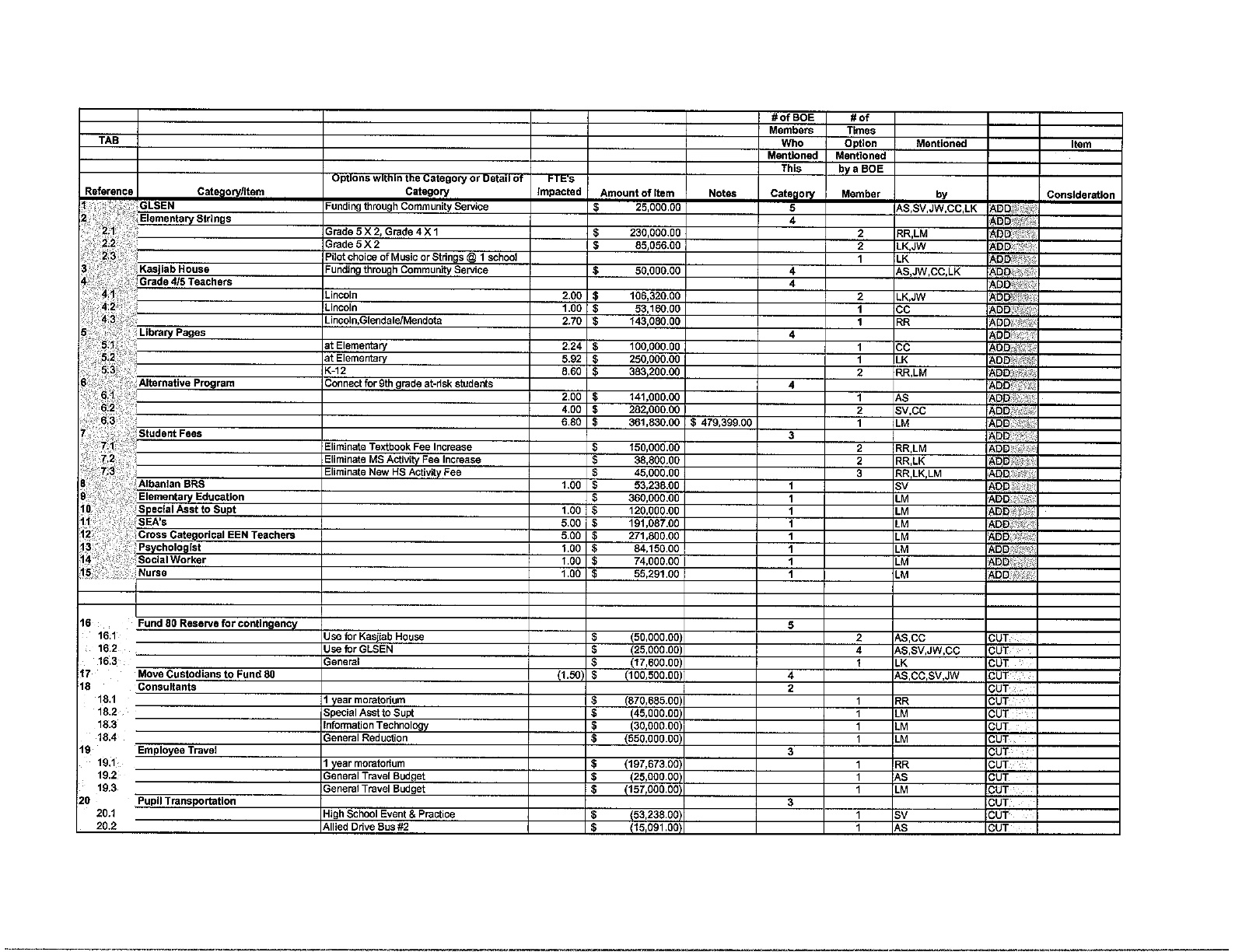
Recommended Amendments to the MMSD Budget

The Madison School District has posted a summary spreadsheet of board add/cut recommendations and district analysis of the various proposals on its web site.
http://www.madison.k12.wi.us/budget/mmsd/0607/budget.htm
Page 1 | Page 2 | Page 3

Share

Week of May 30th – School Board Update by President Johnny Winston, Jr.

Via a Johnny Winston, Jr. email:

Currently, the Madison School Board is deliberating over the 2006-07 budget. Board members submitted budget amendments to the Administration last week. The strings program, library pages, funding for community groups, student fees, school programs and class sizes are among the items identified by board members to change in the budget. For a list of budget amendments and Administrative responses please go to: http://mmsd.org/budget/mmsd/0607/budget.htm.
We invite the public to comment on the budget amendments at our public hearing on Tuesday May 30th at 5 p.m. at the Doyle Building or in writing to the board at comments@madison.k12.wi.us. The board will finalize the budget on Wednesday May 31st. Both of these meetings will be televised on MMSD television on cable channel 10 at 5 p.m.

(more…)

Share

Push for changes in school financing

A letter to the editor
Dear Editor: I appreciated Susan Troller’s recent article where she examined the impact of eroding budgets on schools and classrooms throughout Madison. Unfortunately, this situation is not unique to Madison schools.
The repeated cutting of school budgets is strongly affecting classrooms, teachers and students in scores of school districts throughout Wisconsin. I feel confident that Madison schools, and many other school districts, are years past cutting the “frills” from their budgets school boards and administrators are now forced to make cuts that truly affect the quality of education that our children are receiving.
These current cuts, and inevitable future cuts, are a direct result of statewide school finance restrictions that have been placed on local communities by our state Legislature since the mid-1990s. School funding is extremely complicated, and I won’t begin to try to explain it here. What I will do, however, is invite readers to educate themselves on this very important issue. A good place to begin is the Web site of the Wisconsin Alliance for Excellent Schools, www.excellentschools.org.
After we better educate ourselves, we need to have conversations with our neighbors, our friends, our school personnel and our policy makers. School financing, as it currently exists, is not going to change unless we help to make it change. And if our current school financing system does not change, then our schools will cease to be the national leaders that they still are today. And the ones who truly will lose out are our children.
I encourage readers to learn about school financing and to engage in positive dialogue with others so that we can quickly find creative solutions.
Barbara Katz
Madison
Published: May 26, 2006
The Capital Times

Share

Proposed Board Member Amendments for the 2006 / 2007 MMSD Budget

38 proposed amendments can be found here (“Tab 1 to Tab 38”).

Share

The District’s Equity Fund Explained

There were some earlier postings and questions about the Equity Fund that I believe need to be answered.  First equity in this case is similar to the equity you have in your house as you pay down your mortgage.
The Equity Fund is a consequence of the fact that, by state law, the district operates on a fiscal year budget (July 1-June 30) but the taxes are collected on a calendar year basis.  So the 2006-07 year is paid for partially from last year’s tax levy and partially from the 2007 taxes that will be collected in January 2007.
Furthermore, about 75% of total taxes come in by January 31 – the rest come in by July 31.  So when the district closes its books at the end of the fiscal year (June 30th) it has some tax funds set aside to pay for the July-Jan portion of the year and bookkeepers and accountants require a label/category for all funds – this is the Equity Fund.  It is the funds that (with the additional July collections) are intended to cover the expenses of the district for the July-Jan months.

(more…)

Share

School Board to restore school programs, but . . .

Sandy Cullen:

Madison School Board members have come up with their lists of programs to put back into next year’s budget.
But in order to get those items back, four of the board’s seven members have to agree not only on what to add, but how to fund it.
Madison School Board President Johnny Winston Jr. wants to restore the district’s elementary strings program for fifth- graders to twice a week, keep fourth- and fifth-grade classes at Lincoln Elementary School limited to 20 students and fund programs to improve the attendance of Hmong students and to make schools safer by reducing bullying.
School Board member Ruth Robarts wants to keep the strings program for fourth graders as well as fifth-graders, nix increases in student textbook fees and restore the positions of library pages who assist school librarians, which were cut from the $332 million budget district administrators have proposed for next year.

Share

2006 / 2007 MMSD Food Service Budget Discussion

28 minute video excerpt of this evening’s discussion of the MMSD’s food service budget (the food service budget is evidently supposed to break even, but the operating budget has apparently been subsidizing it by several hundred thousand dollars annually).

This sort of excellent citizen oversite is essential to any publicly financed organization, particularly one that plans to spend $332M in taxpayer funds next year and hopes to pass referenda in the near future.
Former Madison Mayor Paul Soglin made a similar case today when he discussed our fair city’s water problems:

It’s funny how progressives forget their history and the reason for doing things. The idea is to have a citizen board, not a board with public employees. That is part of the checks and balances. In fact the progressive left in Madison went though considerable time over the years gradually removing city staff from committees so they would not dominate and squelch the citizens who are more likely to be ‘whistleblowers.’

In the water example, a citizen spent years chasing this issue, finally getting the attention of the traditional media and the politicians.
A number of board members have been asking many questions (the video clip will give you a nice overview of who is asking the questions and what the responses are). You can check the action out here (Each “Tab” is a question to the Administration, with their response”). For example, we learn in tab 11 2 Page PDF that the district spent a net (after 200K in gate receipts and 450K in student fees) $1,433,603 on athletics in 2005/2006 and plans to spend a net $1,803,286 in 2006/2007, a 25% increase. The overall budget will grow by more than 3%.
This is quite a change from past years, and provides some hope for the future.

Share

Technology in Education

In the wake of the annual EdWeek Technology Counts issue, there has been some discussion surrounding the idea that technology is education is harmful. I attribute this to a few factors, including to overstated claims for educational technology in the past, concerns about very specific uses of technology in education like calculators, and the comfort some of us take in the instructional environments we experienced. This rejection of technology is unfortunate, however. Effectively utilized technology has an important role to play in increasing the effectiveness of our schools.
The focus on technology as an end in and of itself is very misplaced in K-12. Instead, districts should focus on providing an adequate level of infrastructure for staff and students and then using technology where it can improve student and staff productivity, allow for a more personalized learning experience, and provide an interactive learning experience.

(more…)

Share

Counting the Cash for K-12

DeHavilland Blog:

Excellent report here on education spending titled “Counting the Cash for K-12: The Facts About Per-Pupil Spending in Colorado [pdf],” published by the Independence Institute. While the report is focused on education spending in Colorado, they use national data in several instances for comparative purposes, and the information they provide is relevant to people across the country with an interest in K12 spending.
Their primary conclusion is that we should look less at how much we spend per student and more at how we’re spending, since school budgets and per-pupil spending do not correlate with achievement. What’s more, people can manipulate or reframe spending figures to make them look better or worse depending on their purposes – a trick that can confuse the entire discussion.

Share

Community groups can apply for MMSD funding

The school board agenda for tonight’s meeting (May 15) shows that the board will discuss funding for the following groups:

– The Gay, Lesbian, and Straight Education Network
– The Center for Academically Talented Youth
– The Kajsiab House Project
– The Youth Empowerment Academy.

Johnny Winston, Jr. previously chose these groups and convinced the board to fund them without inviting all community groups to apply through a request for proposals, which could be used to solicit programs to further specific MMSD goals. (Funds for the Youth Empowerment Academcy were previosly provided through a grant to The Charles Hamilton Houston Institute, Inc.)
Board member Ruth Robarts raised concerns about this funding approach the first time around, and her concerns remain valid.
Since Johnny Winston, Jr. and the board continue to fund community groups, it would be wise for any and all community groups to apply for funding from the MMSD. I suppose that proposals could be sent to Johnny Winston, Jr. or Supintendent Rainwater.

Share

End Near for Reading Recovery in MMSD?

The reduction of over $680,000 of ESEA Title 1 entitlement grant dollars challenges the district to change the way students and teachers are supported under Title 1. The current direct service model of student support cannot be supported in the long run with current funding. The administration will use the first semester of next year to develop a new model. (Page 252, Department & Division Detailed Budgets)

The MMSD uses Title 1 money to fund Reading Recovery. Does the statement above mean the end of Reading Recovery in the district?

Share

States Struggle to Computerize School Records

Sam Dillon:

Nearly all states are building high-tech student data systems to collect, categorize and crunch the endless gigabytes of attendance logs, test scores and other information collected in public schools — and the projects in some states seem to have gone haywire.
In North Carolina, a statewide school computer system known as NC WISE is years behind schedule, and estimated costs have risen to $250 million. Teachers have nicknamed it NC Stupid. California has spent $60 million on a system, and officials estimated that the state would spend an additional $60 million in coming years to help school districts connect to it.

Wisconsin’s status on student longitudinal data can be found here.

National Center for Educational Accountability.

Share

Local Property Tax Assessment Challenges Are Way Up This Year

Lee Sensenbrenner:

Prices seemed to be falling as he was buying, he said, and he paid less for his condominium than ones that were sold a month or two earlier. He paid $259,000, including a parking stall, and his fight against City Hall is to have it assessed at $221,000 rather than $241,000, plus $18,000 for the parking stall, which is now treated as a separate property.
He said others in the building have nicer views and are higher up, but have lower assessments for the same floor space. In particular, he points to Ald. Mike Verveer’s condo two floors above him, which faces the lake instead of the courtyard, and is assessed at $231,000. Like those of all units in the building, its assessed value did not increase from 2005 to 2006.
“Obviously,” Taylor wrote in a letter submitted to the Assessor’s Office, “my second-floor unit’s value should be far less than a fourth-floor unit with a lake view.”

A close look at assessments raises many more questions. Some municipalities, such as Fitchburg reassess properties every 3 to 5 (or longer) years rather than annually as Madison does. Learn more via Access Dane (I do find it odd that some publicly financed data requires a “subscription” – we have the opportunity to pay twice).
Sensenbrenner’s article provides more grist for the consideration of a fall referendum.

Share

Renewable energy grants for schools & nonprofits

We Energies has posted on its website a Request for Proposals (RFP) to identify and to competitively select the best customer-sited renewable energy projects to receive customer project incentives under the We Energies “Renewable Energy Development” program:

We Energies will provide financial incentives ranging from $10,000 to $100,000 to selected customer-owned renewable energy projects that are interconnected to the We Energies distribution system and meet the eligibility criteria of ownership by a not-for-profit organization, not-for-profit educational/academic institution, unit of government, or special district or authority defined as government under Wisconsin law. In addition, all proposed projects need to include a strong and clearly-identified outreach and educational component that will be used to inform and educate members of the general public about renewable energy in a ongoing and continuous manner. In all cases, incentive recipients must be existing We Energies retail electric customers in Wisconsin.
Incentives shall not exceed 50% of total installed project cost less any federal or state government incentive or credit and less any Focus on Energy funding. Proposed solar photovoltaic and wind energy system projects must have a site assessment completed (preferably though the Wisconsin Focus on Energy Site Assessment Program, or equivalent). The assessment shall provide an estimate of the energy output of the project once operational. In addition, all installations must be completed by a Focus on Energy designated Full Service Installer.
There may be up to five rounds of incentive applications and evaluations. Deadline for first round of applicants is May 31, 2006.

Share

Math or Technology: Take Your Pick

Sarah Natividad:

Recently Utah schools have been given an F for technology use in the classroom (or lack thereof). This is one area I hope Utah continues to fail in. Technology has been touted as a fabulous tool for teaching math and other subjects, but it’s not. Technology teaches technology; you still have to learn math separately if you want to know math too.

I agree. The basics come first – technology, which changes frequently and may not always be appropriate (see Powerpoint, and here.)

Share

Tom Beebe Presentation at Van Hise

Carol Carstensen:

Parent Group Presidents:
One more message from me. Van Hise Elementary is inviting the public to their meeting next Tuesday, May 16 to hear a presentation about state funding by Tom Beebe of Wisconsin Alliance for Excellent Schools (WAES). WAES has ideas about how schools ought to be funded and is working to build a state-wide movement to bring about change at the state level. Here are the details:
When: Tuesday, May 16 at 7 p.m.
Where: Van Hise Elementary Cafeteria [Map]
Tom gave a presentation to the Board last October and it is well worth your time (though I know how hectic May is).
Carol

More on Tom Beebe.

Share

A Revolution of One

Larry Sankey:

My European friends ask me all the time why America doesn’t do what they do in Europe. The first time I was asked was 20 years ago by a friend from the Netherlands. Just recently I was asked by a German friend. Why not allocate money for all the schools from the state’s general tax base, and not by district according to real estate taxes, as is the current practice? Then every school gets the same amount of money per student no matter whether the students are black, white, brown, or any other minority. Whether their parents are rich or poor. That ways no child is truly left behind.
I believe that when this is seen as an integration issue, basically a black and white issue, it short changes both blacks and whites. Specifically poor blacks and poor whites. Because it is the poor of both races and other minorities who have poor schools and end up stuck in a cycle of poor education which leads to prison or poverty or both. Which leads to in turn poor education for the next generation. My finely tuned sense of paranoidar leads me to suspect that it’s a good way for the rich folk to keep out the competition. Kids with rich parents don’t have to compete with the poor for a good college education and later for good jobs and eventually for a nice house in a good neighborhood. It keeps poor folk right where they are generation after generation. A kind of neo-serfdom. The poor and middle class, distracted by arguments over integration, spend time fighting each other over busing, as America under-educates its potential workforce into third world status. Meanwhile the privileged point their fingers at minorities and blame them for generation after generation of failure. But this is a failure of the system. Given the same chance at education, the poor, all the poor, minority or otherwise, would have much improved lives.

Share

Recommendations for 2006-2007 Budget

Active Citizens for Education offers the following recommendations for the consideration of the MMSD Board of Education in the allocation of funds for the 2006-2007 budget: (I appeared on WIBA, 1310, this evening with Brian Schimming and discussed the MMSD proposed budget and ACE recommendations) [18MB mp3]

(more…)

Share

How much is this going to cost? Is it worth it?

Page 98 of the undated 2006 budget document includes the following:

Library Media Services Division initiatives contemplated for the upcoming 2006-07 school year include (a) the consolidation of the elementary and middle school Technology and Information Literacy curricula, (b) the expansion of Accent database services to bookrooms and high school textbook collections, (c) the transition from a magnetic tape-based video distribution system to a datacast and optical disc-based distribution system and (d) further expansion of district-wide online subscriptions.


The document leaves to the reader’s imagination what the initiatives might cost or whether they’re worth the cost, because it offers no rationale or estimated expenditure that I can find.
Further, the document gives the board and public no information with which to compare the value of these initiatives to other ways the money might be spent. Yet, those are exactly the choices the board and community ought to be able to make through budgeting.

Share

Speak Up for Strings Tonight: Public Appearances at Board Public Hearing On the Budget – 6:30 p.m. Tuesday, May 9th at Memorial High School

Dear Madison Community,
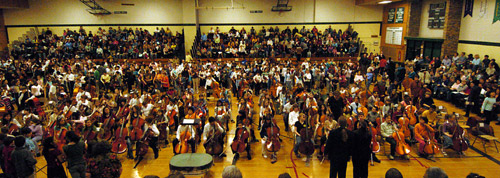
Children and parents are encouraged to speak in support of elementary strings and to bring their instruments to tonight’s School Board public hearing on the budget if they would like to play. My husband, Fred Schrank, who is the principal bassist with the MSO and who teaches orchestra to elementary and middle school children in the district, will be there. I’ve asked him if he would accompany those children who might want to play for the School Board to show their support for the course. The public hearing begins 6:30 p.m at Memorial High School, 201 S. Gammon Road, Auditorium [map].
For your information – the School Board takes students who want to speak for 3 minutes (or play for 3 minutes) first. I also have signs and will have colored markers for students or others who want to make signs for the School Board to see.
The Superintendent’s proposal to cut Grade 4 strings is unacceptable, incomplete and would put in place a music curriculum planning process AFTER the cut is made to Grade 4 strings instruction. His conceptual idea is to plan to offer elementary children experiences with varied instruments in the 07-08 school year when Grade 5 strings would be cut and there would be no more elementary strings. That’s a curious idea. Why? Current General Music practice is to offer children experiences on different instruments – so the planning would not result in any meaningful curriculum change except the elimination of elementary stringed instrument instruction. What kind of plan would that be? No community planning took place this year for music education, which DPI recommends as best practice for standards based curriculum planning – include professionals and the community in the effort. The only plan is to cut Grade 4 strings, with planning for next steps to follow. Without good planning and good information – bad practice and bad decisions follow.
My question: Where’s the planning been for the past year, for the past 5 years? Our kids deserve better. Hundreds of children and community members have spoken in support of the elementary strings course over the years and emails and support for this course remain strong as demonstrated by the children once again this year through their enrollment in this course – over 1,700 children in September (550+ low income children who will be hurt the most by this cut).
After 5 springs of advocating for this course, I’m exasperated and annoyed; but when I listen to children and parents tell their stories about their hopes and dreams, I get reinvigorated as I was last night after listening and speaking. Last night, Ruth Robarts, Shwaw Vang and Lucy Mathiak spoke strongly in support of the program and in working on strings through the Performance and Achievement and the Partnership Committees. I think the idea to collaborate among board committees is novel and appropriate for Fine Arts – and may be for other areas. I feel involving the community – music and art professionals, parents, organizations in the process is critical to the long-term success of fine arts education in Madison, especially in tight financial times.
Also, Lawrie Kobza, School Board Vice President, reminded the Superintendent that the School Board had additional options to his proposal to consider – the Superintendent’s options plus keeping the course the same as this year or restoring the course to what it was two years ago (2x per week for 45 minutes).
So, please, if you have time tonight, come and Speak Up For Strings! Even if it’s only to stop in on your way to and from another event (it’s that crazy time of year with concerts, sporting games, dances and preparation for graduations taking up lots of time) and register with the Board in support of the course. I’ll be there to help with registering to speak in support, or simply registering your support. Each person’s presence makes a difference – individually and collectively!
Best,
Barbara Schrank
P.S and FYI – the Supt.’s proposed Grade 4 strings cut would not affect any current teachers and would be made through retirements and resignations. However, 1,700 children would lose something they dearly value that provides them with so much. I think, over time, our community will lose even more.
Share

Business Services: Growing and growing and growing

While the school board refused last year to get outside advice on the operations of Business Services, the department just keeps growing and growing and growing.
Compared to 2004-2005 budget, the number of Food Service Workers would increase by 11.32 FTE if the board approves the administration’s proposed budget. District enrollment will decline by approximately 336 students between 2004-2005 and next year. Why does it take 11 more people to feed 336 fewer students?
The job category “trades” would grow by 7 FTE from last year to next year, while cutting 1 painter and 1 carpenter, according to the proposed budget.
But what’s really odd, the budget approved by the board in the summer of 2005 shows 27 FTE in trades. Now the administration asserts that the revised budget approved in October 2005 increased the number to 35 FTE. Not! At least not that I can find. No place does the revised budget show an increase in FTEs in trades.
Is someone “cooking” the numbers or padding the payroll to increase the Business Services domain?

Share

Announcement from Madison School Board President Johnny Winston, Jr. (and the 04 / 07 elections)

Via a Johnny Winston, Jr. MMSD email:

It is with great humility that I announce that I have been elected to serve as President of the Madison School Board. I am honored to have the opportunity to provide leadership to our school district and community. Serving as President is the culmination of part of a life long dream to be a public servant.
I was elected to the board in 2004. During my tenure, I have served as Chair of the Finance and Operations and Partnership Committees and most recently as role of Vice President. I welcome working with the entire elected school board. Some of the critical matters for us to address include but are not limited to: the building of new schools to accommodate our growing district, student achievement, parent involvement and strengthening communication and partnership efforts in our community. Together, we can identify and implement creative solutions to these issues.

Johnny, along with Shwaw and Ruth’s seat are up for election in April, 2007. Today’s public announcement by former Madison School Board member Ray Allen that he’s running for Mayor [more on Ray Allen] (same 04/07 election) and MTI’s John Matthews recent lunch with Mayor Dave mean that positioning for the spring election is well under way.
Another interesting element in all this is the proposed fall referendum for a new far west side elementary school [west task force] and the Leopold expansion (I still wonder about the wisdom of linking the two questions together…., somewhat of a do-over for Leopold linked to another question). Have the local prospects for passing a referendum improved since the May, 2005 vote where two out of three failed (including a much larger Leopold expansion)?
I think it’s hard to say:

Televising all board meetings and a more active district website may or may not help, depending of course, on what’s being written or mentioned.
Jason Shephard’s seminal piece on the future of Madison’s public schools will resonate for some time.
It will be an interesting year. I wish the entire Board well as they address these matters. It’s never too early to run for school board 🙂 Check out the election pages for links and interviews.

(more…)

Share

Interview with Oregon’s New Superintendent

Ellen Williams-Masson:

Fiscal challenges are testing the mettle of school superintendents across the country, but Oregon’s new hire for the top job has a lot of experience in tightening the belt on school spending.
“When you are in a district that faces financial challenges, it teaches you what the true priorities in public education are,” incoming Oregon School Superintendent Brian Busler said. “It teaches you how to be creative and utilize every dollar available to get the best return for a student’s education.”

Share

Citizens ask District to Spare School Programs

The Madison School Board held a public hearing last night on the Distirct’s proposed 332.9M+ 06/07 budget last night. Maggie Rossiter Peterman:

Sean Storch pleaded with members of the Madison School Board on Tuesday night not to cut teachers in the district’s four high school alternative education programs.
Storch, 28, and another teacher work with about 20 “at- risk” ninth-graders in the Connect program at La Follette High School.

Channel3000 has more.

Share

“Underassessed Lakefront Houses”

Nan Brien recently wrote about local property taxes. Tom Bozzo spends some time looking at local tax assessments. Interesting. Via the Daily Page.

Share

Why AP Matters

Jay Matthews:

Only 30 percent of high-school students take any Advanced Placement courses at all; by the time Frausto graduates later this month, she will have taken 16 of them — in many cases earning the highest grade, a 5, on the three-hour final exam.
That is because Frausto’s school, the Talented and Gifted Magnet School near downtown Dallas, is one of a growing number of high schools trying to make AP as much a part of students’ lives as french fries and iPods. Located in a run-down neighborhood not usually associated with high-level learning, Talented and Gifted — “TAG” to its students — tops NEWSWEEK’s list of America’s Best High Schools. Members of its racially mixed student body say they feel united by the challenge. “What I really love about TAG is the atmosphere,” said Frausto, who will be attending MIT on a scholarship in the fall. “There is so much closeness.”
Large studies in Texas and California done over the past two years indicate that good grades on AP tests significantly increase chances of earning college degrees. That has led many public schools in disadvantaged neighborhoods to look for ways to get their students into AP and a similar but smaller college-level course program called International Baccalaureate (IB), in hopes that their students will have the same college-graduation rates enjoyed by AP and IB students from the country’s wealthiest private schools and most selective public schools.

Share

MMSD Budget Mystery #7: Aides, aides, where are the aides?

Roger Price’s corrected table of FTEs shows that the proposed MMSD budget would cut 29.5 FTE aide positions compared to the cost-to-continue budget. According to my comparison, the budget would cut 13.16 FTE aide positions in the coming year compared to the actual FTEs this year.
When I plow through the budget document titled Department & Division Detailed Budgets (undated), the document appears to show total FTE reductions of 18.95 (see pages 16, 38, and 63) in postions for educational assistants.
So, dedicated detectives, see whether you can make sense of the numbers. Does the proposed budget reduce educational assistant FTEs by 29.5, 13.16, or 18.95?

Share

Budget proposes ESL/bilingual advisory council

An inconspicuous provision in the newly unveiled MMSD budget document would establish an ESL/bilingual advisory council (Department & Division Detailed Budgets, page 55).
I encourage the Board of Education to remove the provision and give any proposed council the careful and detailed attention the board gave to the attendance task forces and equity task force.
As the provision stands, the budget document provides absolutely no justification, no charge, no detail, no membership, no cost, and no staffing for the proposal.
The advisory council might be valuable, but it needs much more consideration before the board acts on it.
Last year a similarly obscure phrase led to the creation of two new classrooms and an expenditure of $350,000 at Marquette.
I see a pattern here. Cryptic language being use to launch new initiatives without board or public input.

(more…)

Share

Fund 80 Is Worth Our Support

Carol Carstensen:

What is Fund 80, and why are people saying such awful things aboutit?
Fund 80 is the state accounting code for community services expenditures,the major portion of which is for Madison SchoolCarstensen Community Recreation (MSCR) and the district’s cable channel 10.The current budget for community services is $11 million. Of that $8 millionis from the tax levy; the remainder comes from fees and grants.
MSCR programs range from exercise programs for seniors to swim lessons forinfants and toddlers, from adult sport leagues to summer day camps forelementary students, plus art and dance classes for all ages.
The 2001-03 state budget allowed community services expenditures to bemoved out from under the revenue cap imposed on school districts. This wasdone so that adult softball leagues could be funded without reducing a schooldistrict’s core educational program for students.

(more…)

Share

Milwaukee Public Schools 2006/2007 Budget Information

The Milwaukee Public Schools recently posted their 2006/2007 budget. Alan Borsuk has more:

Citing the intensifying impact of poverty on the lives of students, Milwaukee School Superintendent William Andrekopoulos unveiled a budget proposal Friday for the 2006-’07 school year that increases health and nutrition programs for students.

Share

Audio: Mitch Henck Interviews Carol Carstensen and Nan Brien

Mitch Henck interviewed Carol Carstensen and Nan Brien this morning. They discussed the District’s 06/07 planned budget, health care spending, local property taxes and Monday’s approval of an 856K electrical upgrade to Sennett Middle School that was $397,000 over the estimated cost, funded by the maintenance referendum (I’ve not seen any discussion of this in the local media [Cap Times | Channel3000]. Excerpt: 5.7MB MP3 file.
The property tax discussion is interesting as there are many factors that affect what a homeowner pays for schools including:

  • redistributed state taxes (“aid” – via income, sales and other taxes/fees), # of students (the district’s taxing/spending authority follows students numbers. Losing students is expensive.),
  • assessed value changes (some communities like Madison reassess annually, while others, such as Fitchburg are on a much less frequent schedule) and
  • Fund 80 – district spending that is not constrained by state revenue caps.

I’m glad Carol, Nan and others are discussing these issues. I hope we see more of this.

Share

STRANGER THAN EVER!!!!

In an e-mail to the Board of Education, Roger Price admitted a serious error in the budget documents given to the board only three days ago:

I incorrectly classified some professional positions as administrators and some supervisory positions as clerical.

Price attached a corrected Excel table to show the FTEs in the revised “balanced budget.”
I’ve taken Price’s revised “balanced budget” FTEs and compared them to the current year FTEs in a second Excel table.
Initially, Price’s table show and INCREASE of 5.38 FTE clerical positions. Now he shows a DECREASE of 16.32. His original table showed a DECREASE of 22.70 supervisor FTEs. Now he shows a decrease of 1. For administrators, the original table showed an INCREASE of 2.50. His table now shows a DECREASE of 3.00.
You have to wonder how many other figures are wrong. You have to wonder whether the rest of the budget figures need to be changed throughout the 99-page Financial Summaries document to reflect the errors.
And now the MOST AMAZING CHANGE! Price’s new chart includes the seven members of the board in the FTEs. This has NEVER been done previously, and Price gave no reason in his memo to explain the sudden need to add the board members to the FTEs.
This budget process has GOT TO CHANGE!
Remember, this is the same Roger Price who couldn’t produce a budget on time last year, and then needed hundreds of hours of staff overtime to produce the budget at the last minute! This is the same Roger Price who cost the district tens of thousands of dollars to reprint referendum ballots because of “miscommunication”.

(more…)

Share

Cieslewicz State of the City speech

Madison Mayor Dave Cieslewicz spoke at yesterday’s Rotary club meeting. His 3416 word state of the city speech included 159 directly related to our local public schools:

8. We need to work more seamlessly to maintain our excellent public school system.

Our public schools have recently been ranked the third best in the nation. Yet, they face unprecedented challenges as they work to educate more children that come from impoverished families and more children with special needs. I am very aware that we elect a school board to make these decisions and it is not my intent to overstep my authority, but I do recognize that good schools are vital ingredients in healthy neighborhoods. We will renew our efforts to work with the school district, with parents and teachers to make sure that city government and the schools are pulling together, not working at cross purposes. For instance, the decisions the City regarding new housing development has a significant impact on school attendance and boundary issues. Our recently-adopted Comprehensive Plan notes the importance of city and school planning staff working together.

Kristian Knutsen attended the speech.

Share

Educating from the Bench

Jay Greene:

Spending on public schools nationwide has skyrocketed to $536 billion as of the 2004 school year, or more than $10,000 per pupil. That’s more than double per pupil what we spent three decades ago, adjusted for inflation–and more than we currently spend on national defense ($494 billion as of 2005). But the argument behind lawsuits in 45 states is that we don’t spend nearly enough on schools. Spending is so low, these litigants claim, that it is in violation of state constitutional provisions requiring an “adequate” education. And in almost half the states, the courts have agreed.
Arkansas is one such state, and its “adequacy” problem neatly illustrates the way courts have driven spending up and evidence out. In 2001 the state Supreme Court declared the amount of money spent at that time–more than $7,000 per pupil–in violation of the state constitutional requirement to provide a “general, suitable and efficient” system of public education. Like courts in other states, Arkansas’s court ordered that outside consultants be hired to determine how much extra funding would be required for an adequate education.
A firm led by two education professors, Lawrence Picus and Allan Odden, was paid $350,000 to put a price tag on what would be considered adequate. In September 2003 Messrs. Picus and Odden completed their report, concluding that Arkansas needed to add $847.3 million to existing school budgets. They also recommended policy changes, but the only thing that really mattered, at least as far as the court was concerned, was the bottom line–bringing the total to $4 billion, or $9,000 per pupil.

Share

Florida Links Teacher Pay to Student Test Scores

Peter Whoriskey:

A new pay-for-performance program for Florida’s teachers will tie raises and bonuses directly to pupils’ standardized-test scores beginning next year, marking the first time a state has so closely linked the wages of individual school personnel to their students’ exam results.
The effort, now being adopted by local districts, is viewed as a landmark in the movement to restructure American schools by having them face the same kind of competitive pressures placed on private enterprise, and advocates say it could serve as a national model to replace traditional teacher pay plans that award raises based largely on academic degrees and years of experience.
Gov. Jeb Bush (R) has characterized the new policy, which bases a teacher’s pay on improvements in test scores, as a matter of common sense, asking, “What’s wrong about paying good teachers more for doing a better job?”
But teachers unions and some education experts say any effort to evaluate teachers exclusively on test-score improvements will not work, because schools are not factories and their output is not so easily measured. An exam, they say, cannot measure how much teachers have inspired students, or whether they have instilled in them a lifelong curiosity. Moreover, some critics say, the explicit profit motive could overshadow teacher-student relationships.

Share

Milwaukee Schools Budget: District wants to spread funds evenly

Sarah Carr:

Next year, the High School of the Arts might not have a spring musical at all.
Some parents and teachers say the soul of the school is at stake. Their concern is echoed at some of the other most renowned high schools in Milwaukee Public Schools, including Rufus King, considered the toughest school to get into.
Parents are crying out that MPS schools with strong academic or art specialties can’t survive much longer under current budget realities. They argue that their programs have been taken for granted as the district moves to put more families in neighborhood schools and create dozens of smaller high schools.
“I’m really afraid the School Board is positioning itself to cut its arts program,” said John Glaspey, whose daughters attend the arts high school. “I think they are hellbent on sacrificing that for the neighborhood and K-8 schools and this small high school initiative.”

Share

A Lengthy Reading Recovery Discussion

The use and effectiveness of Reading Recovery is in the news elsewhere. More links. Joanne Jacobs has more.

Share

2006 / 2007 Madison School Board Budget Discussion

Superintendent Art Rainwater presented the proposed 2006 / 2007 budget Monday night (Barb earlier pointed out that 06/07 allocations were sent to the schools on 4/3/2006). Board questions followed. Video and audio [22MB mp3]:


36 minute video

1 hour Board Q & A/Discussion video

Additional commentary:

Share

MMSD Budget Mystery #6: FTEs from the Black Box Budget

Once again the strange MMSD budget process presents uncountable mysteries for our intrepid investigators.
Somehow the administration puts this year’s budget and staff into a black box somewhere in the Doyle Building and miraculously out comes a prediction of the FTEs needed to continue the current level of services, as well as proposed FTEs for a balanced budget.
A look at this year’s FTEs compared to the balanced budget FTEs produces a much different picture for investigation, as you can see from the attached Excel file.
Train your spy glasses on the puzzling FTEs in a couple of job classifications.
In 2005-2006 the district employed 34.70 supervisors. However, the administration said only 11 are need under the cost to coninue budget (page 41) and 12 under the balanced budget. Page 41 then shows an increase of one position, when the comparison between current FTEs and the balanced budget shows a reduction of 22.7. (As an aside, does the cost to continue with 11 supervisors mean that last year the district employed 23.70 supervisors who really weren’t needed?) Very strange.
In another inexplicable change, the district employed 94.57 food service workers in 2004-2005. This year’s balanced budget proposes 105.89 FTEs for Food Service Workers. Why? Why does the district need 11.32 more FTEs to serve about 300 fewer students? Maybe we’re getting bigger eaters in the MMSD. Who knows?
Check this writer’s facts, the district’s facts, and come up with soluitons to the Mysteries of the Black Box Budget!

Share

Insurance trumps teachers’ raises

Jake Rigdon:

The dilemma has hit smaller school districts the hardest.
According to unofficial estimates, health insurance premiums are expected to increase between 16 percent and 23 percent in the next school year in the Athens, Auburndale, Edgar, Marathon, Spencer, Stratford and Tomahawk school districts, affecting more than 460 teachers. Some districts pay 100 percent of the premiums. Others require teachers to pay a portion.
In response, Athens, Auburndale, Edgar, Marathon and Stratford are considering options such as finding a new insurance carrier that offers a cheaper plan, shifting to plans with fewer benefits or joining an insurance consortium.

Share

Adapt to New Student Population

Wisconsin State Journal Editorial:

If Madison is to maintain the high quality of its public schools, the community must solve a growing problem. But first, Madison must distinguish what the problem is from what it is not.
It is not a dramatic increase in the number of minority, immigrant and low-income students requiring extra services. That is not a problem. That is a fact.
The problem is the community’s response to the stunning change in the student population. We must find ways to cost-effectively educate the new and vastly more diverse generation of Madisonians.

Share

Madison Schools’ Proposed Balanced Budget for 2006/2007

The Madison Metropolitan School District Administration published it’s proposed $332.9M+ balanced budget for 2006/2007 in 3 parts:

  • Executive Summary [pdf]
  • Financial Summaries [pdf]
  • Department and Division Reports [pdf]

“Total spending under the proposed budget is $332,947,870, which is an increase of $11,012,181 or 3.42% over 2005-06. The increase of 2.6% under the revenue limit plus other fund increases or expenditures makes up the whole proposed budget. The property tax levy would increase $11,626,677 or 5.8% to $211,989,932.”
“The property tax levy has to increase more than spending because state and federal aids and grants are decreasing. The district is being conservative in its early estimates of these aids and grants in order to avoid overspending.”

4/5 strings is once again on the chopping block. Page 6 of the executive summary. The document refers to the “current strings program”.
Links & Notes:

Share

Carol Carstensen’s Weekly Email

Carol Carstensen:

Parent Group Presidents:
BUDGET FACTOID:
The administration’s proposed budget for the 2006-07 school year will be made public on Friday, April 21. Board members and the media will have hard copies of the budget and an electronic version should be up on the web site shortly. The Board begins discussion and consideration of the budget on Monday April 24th at about 6:30 p.m. There are forums scheduled for Tuesday, May 2 at 6:30 p.m. at LaFollette and Tuesday, May 9 at 6:30 at Memorial.

(more…)

Share

Nan Brien on Local Property Taxes

Nan Brien:

In recent weeks Madison homeowners received their 2006 assessments. Most of us saw an increase in the value of our homes. What will this mean for the next property tax bill?
Last spring Grandparents United for Madison Public Schools attempted to explain that school property taxes had actually gone down for many Madison homeowners over the previous 10 years.
Now it’s time to revisit five factors that influence the school district’s role in your property tax bill.
School District tax levy: Property taxpayers fund a little less than two-thirds of the Madison School District budget, which was $321 million in 2005-06.

Share

Teachers Unions as Agents of Reform

Sara Reed:

Voters in Denver, Colo., in 2005 overwhelmingly approved a $25 million tax increase to fund a new, nine-year performance-based pay system for the city’s teachers. Brad Jupp taught in Denver’s public schools for 20 years, and was the lead DCTA negotiator on the team that negotiated the pilot project in 1999, and for the next 5 years he worked on the team that implemented the ProComp pilot.
ES: Why were you able to develop a pay-for-performance model in Denver when other places haven’t been?
BJ: Denver had a combination of the right opportunities and people who were willing, once they saw the opportunities, to put aside their fears of losing and work with other people to try to take advantage of those opportunities. The people included a school board president willing to say, “If the teachers accept this, we’ll figure out how to pay for it. They included the teacher building reps who said, “This is too good to refuse outright; let’s study it.” They included a local foundation that, once we negotiated the pay for performance pilot, realized we might actually be serious and offered us a million dollars to help put it in place. They included the Community Training and Assistance Center, the group that provided us with technical support and a research study of our work. They were willing to take on the enormous and risky task of measuring the impact of the pilot. And they included 16 principals in Denver who were able to see that this was going to be an opportunity for their faculties to build esprit de corps, to make a little extra money, to do some professional development around measuring results. I don’t really think there was a secret ingredient other than people being able to move past their doubts and seize an opportunity. It was a chance to create opportunities where the rewards outweighed the risks. I don’t think we do that much in public education.
………
But public schools have a harder time making changes, especially in the way people are paid, for a number of reasons. First, we don’t have a history of measuring results, and we don’t have a results-oriented attitude in our industry. Furthermore, we have configured the debate about teacher pay so that it’s a conflict between heavyweight policy contenders like unions and school boards. Finally, we do not have direct control over our revenue. It is easier to change a pay system when there is a rapid change in revenue that can be oriented to new outcomes. Most school finance systems provide nothing but routine cost of living adjustments. If that is all a district and union have to work with, they’re not going to have money to redistribute and make a new pay system.

Fascinating interview.

Share

Can We Talk 3: 3rd Quarter Report Cards

Ms. Abplanalp and MMSD District Staff (cc’d to the Board of Education),
 
I read with some confusion your letter [350K PDF] sent to all elementary school parents about the lack of measurable change in students marking period as too small to report to parents on their third quarter report cards.  
 
Here’s my confusion.  I have complained many times about the lack of communication from MMSD to parents concerning students grades or progress.  At the elementary level the “grade issue” seems to do with the lack of any measurable assessments.  While I know testing is a bad word in the education world I find it amusing that between the end of Jan. and beginning of April,  my two elementary students failed to have any measurable change in their grades.  My 7th grader had a full report card…..with grades and everything.  I’m old at 42, but we used to have report cards come home every 6 weeks. My parents could assess my progress rather well that way, and I got lots of candy from Grandma.  I accept the quarter system as being more practical but seriously…you can’t even accomplish quarterly reports.  
 
I am wondering why my two elementary students were sent home early on April 4th.  My tax dollars went to pay for what?…..four grades evaluated out of 31 (not including behavior grades).  The teachers spent the time to log onto the computers to tell me about one grade in reading and 3 in math.  My daughter who is in 5th grade tells me lots of social studies and science occurred from Jan. to April but I guess none was graded.  The paper work, the early release, the time spent logging on for four grades has to rank up there with the last day of school with the amount of  waste of tax payer money (last day is one and 1/2 hour of school with bus service and all). 

(more…)

Share

The School Transformation Plan

A Strategy to Create Small, High-Performing College-Preparatory Schools in Every Neighborhood of Los Angeles
Green Dot Public Schools, Bain & Company [180K PDF]:

Public school reform has become the #1 issue for the City of Los Angeles. While most acknowledge the poor state of the public education system, the discussion to date has largely focused on governance issues, such as mayoral control and district break-up. This whitepaper is intended to refocus the debate on a future vision for public schools in Los Angeles about which all stakeholders will be enthusiastic. Simply put, every child in Los Angeles should have the opportunity to attend a small, safe, college-preparatory public school. This whitepaper also provides a strategy for how the City of Los Angeles can take advantage of its historic opportunity to make this vision a reality. With $19 billion in bond funding, the Los Angeles Unified School District has unparalleled resources to execute a dramatic transformation.

via Eduwonk.

(more…)

Share

Madison Schools Make Effort to Close the Achievement Gap

Sandy Cullen:

Working in conjunction with the Schools of Hope project led by the United Way of Dane County, the district has made progress in third-grade reading scores at the lowest achievement levels. But racial and income gaps persist among third-graders reading at proficient and advanced levels.
Other initiatives are taking place in the middle and high schools. There, the district has eliminated “dead-end classes” that have less rigorous expectations to eliminate the chance that students will be put on a path of lower achievement because they are perceived as not being able to succeed in higher-level classes.
In the past, high school students were able to take classes such as general or consumer math. Now, all students are required to take algebra and geometry – or two credits of integrated mathematics, combining algebra, statistics and probability, geometry and trigonometry – in order to graduate.
One of the district’s more controversial efforts has been a move toward “heterogeneous” classes that include students of all achievement levels, eliminating classes that group students of similar achievement levels together.
Advocates of heterogeneous classes say students who are achieving at lower levels benefit from being in classes with their higher-achieving peers. But others say the needs of higher-achieving students aren’t met in such classes.
And in addition to what schools are already doing, Superintendent Art Rainwater said he would like to put learning coaches for math and reading in each of the district’s elementary schools to improve teachers’ ability to teach all students effectively.

The first part of Cullen’s series is here.

Share

In Carson, Teachers Say No Thanks to Grant

Mitchell Landsberg:

The concept of Talent Development rests largely on two pillars. One is a special ninth-grade “academy” that focuses extra attention on freshmen, who are at the highest risk of dropping out. Once students make it to 10th grade, the odds are strong that they will graduate.
The other pillar involves a different way of scheduling classes. Known as the “four-by-four block schedule,” it breaks the school year into quarters, and the school day into four 90-minute classes. The idea is to make each course more intensive, collapsing a semester’s work into 10 weeks. It also gives students the opportunity to take more courses over a school year — 16, compared with 12 in a typical schedule. If a student flunks a class, there are more opportunities to make it up.
John Francis Polytechnic High School in Sun Valley adopted the four-by-four schedule in 2004, along with other aspects of the Talent Development program. Last June, 92% of its ninth-graders had enough credits to move up to 10th grade, about one-third more than the previous year.

Share

Milwaukee schools build their budgets

The Web site of the Milwaukee schools includes the documents school use to build their budgets. Unlike the MMSD, which creates a budget in a black box at the top, the Milwaukee district appears to build a budget publicly from the bottom up. I prefer Milwaukee’s approach.

Share

Madison Schools, New Population, New Challenges

Sandy Cullen:

Twenty-five years ago, less than 10 percent of the district’s students were minorities and relatively few lived in poverty. Today, there are almost as many minority students as white, and nearly 40 percent of all students are considered poor – many of them minority students. And the number of students who aren’t native English speakers has more than quadrupled.
“The school district looks a lot different from 1986 when I graduated,” said Madison School Board member Johnny Winston Jr.
The implications of this shift for the district and the city of Madison are huge, city and school officials say. Academic achievement levels of minority and low-income students continue to lag behind those of their peers. Dropout, suspension and expulsion rates also are higher for minority students.
“Generally speaking, children who grow up in poverty do not come to school with the same skills and background” that enable their wealthier peers to be successful, Superintendent Art Rainwater said. “I think there are certainly societal issues that are race-related that also affect the school environment.”
While the demographics of the district’s students have changed dramatically, the makeup of the district as a whole doesn’t match.
The overall population within the school district, which includes most of Madison along with parts of some surrounding municipalities, is predominantly white and far less likely to be poor. And most taxpayers in the district do not have school-age children, statistics show, a factor some suggest makes it harder to pass referendums to increase taxes when schools are seeking more money.
Forty-four percent of Madison public school students are minorities, while more than 80 percent of residents in the city are white, according to U.S. Census figures for 2000, the most recent year available. And since 1991, the percentage of district students who qualify for free or reduced-price lunches has nearly doubled to 39 percent; in 2000, only 15 percent of Madison’s residents were below the poverty level.
Although the city’s minority and low-income population has increased since the 2000 census, it’s “nowhere near what it is in the schools,” said Dan Veroff, director of the Applied Population Laboratory in UW- Madison’s department of rural sociology.

Barb Schrank asked “Where have all the Students Gone? in November, 2005:

There’s a lot more at work in the MMSD’s flat or slightly declining enrollment than Cullen’s article discusses. These issues include:

Thoreau’s most recent PTO meeting, which included 50 parent and teacher participants, illustrates a few of the issues that I believe are driving some families to leave: growing math curriculum concerns and the recent imposition of mandatory playground grouping without any prior parent/PTO discussion.
Student losses, or the MMSD’s failure to capture local population growth directly affects the district’s ability to grow revenue (based on per student spending and annual budget increases under the state’s revenue caps).
The MMSD’s failure to address curriculum and govenance concerns will simply increase the brain flight and reduces the number of people supporting the necessary referendums. Jason Shepherd’s recent article is well worth reading for additional background.
Finally, Mary Kay Battaglia put together some of these numbers in December with her “This is not Your Grandchild’s Madison School District“.

Share

Why the GMCC Opposes the Taxpayers Protection Amendment

Greater Madison Chamber of Commerce [pdf]

The Greater Madison Chamber of Commerce (GMCC) Board of Directors opposes the Wisconsin Taxpayer Protection Amendment and has urged legislators to vote against SJR 63 and AJR 77.
What the Wisconsin Taxpayer Protection Amendment (WTPA) proposes and what the likely outcome will be are two different things. While we believe that limiting or reducing taxes is a laudable goal, we disagree that this proposed amendment is the best way to achieve that. The GMCC’s intent is to bring balance to the discussion.
It is our position that the state constitution is not a place to implement permanent limitations that are sure to have major long term consequences. There are many unresolved questions and arguments raised by others related to WTPA which are outlined below. GMCC shares many of these questions and concerns.

via an email from Jennifer Alexander.

(more…)

Share

San Francisco Schools: Student Funding Follows Kids

Lisa Snell:

San Francisco is one of a handful of public school districts across the nation that mimic an education market. In these districts, the money follows the children, parents have the right to choose their children’s public schools and leave underperforming schools, and school principals and communities have the right to spend their school budgets in ways that make their schools more desirable to parents.
Thanks to weighted funding, schools get more money for harder-to-educate students. Principals decide how to allocate funds.
In San Francisco the weighted student formula gives each school a foundation allocation that covers the cost of a principal’s salary and a clerk’s salary. The rest of each school’s budget is allocated on a per student basis. There is a base amount for the “average student,” with additional money assigned based on individual student characteristics: grade level, English language skills, socioeconomic status, and special education needs.
. . . The more students a school attracts, the bigger the school’s budget. So public schools in San Francisco now have an incentive to differentiate themselves from one another. Every parent can look through an online catalog of niche schools that include Chinese, Spanish, and Tagalog language immersion schools, college preparatory schools, performing arts schools that collaborate with an urban ballet and symphony, schools specializing in math and technology, traditional neighborhood schools, and a year-round school based on multiple-intelligence theory. Each San Francisco public school is unique. The number of students, the school hours, the teaching style, and the program choices vary from site to site

Via Joanne Jacobs

Share

Leopold Additions Included in 2006 MMSD Operating Budget

Channel3000:

The Madison school board voted 4–3 Monday night to include additions to Leopold Elementary School in next year’s operating budget.
A final vote will come at a later meeting, but this essentially means that construction can start with our without a referendum.

Background on Leopold here. Johnny Winston, Jr., Juan Jose Lopez, Bill Keys and Shwaw Vang voted for the motion while Carol Carstensen, Lawrie Kobza and Ruth Robarts voted against it, preferring, I’m told, to consider this question with the entire 2006/2007 budget, which the board has not yet seen.
Student rep Connor Gants pointed out (he also voted for it) that the motion does not really matter as it could be changed when the 2006/2007 budget is actually approved. More on the budget, here.
Channel3000 has an update here.

Share

Affordable Health Care: Four Wisconsin Proposals

A forum hosted by Progressive Dane and The Edgewood College Human Issues Program.
Thursday, April 6th 6:30 to 8:30 at Edgewood College’s Anderson Auditorium, in the Predolin Humanities Center.
Access to health insurance has become a national crisis, but there are bold, creative proposals to fix it. Please join us to hear four great proposals to make affordable health care widely available locally and statewide. Representatives from each plan will briefly describe their proposal, followed by ample time for audience questions and open discussion.
Co-Sponsors include: The League of Women Voters, The Democratic Party of Dane County, The South Central Federation of Labor, The Four Lakes Green Party, and The Center for Patient Partnerships at the UW-Madison.
The presenters and four major health care plan proposals are:

(more…)

Share

Priorities for upcoming budget

In the upcoming budget deliberations, I urge the board to direct as many available funds as possible to proven in-school programs which support the board’s three stated goals:

* All students complete 3rd grade able to read at grade level or beyond.
* All students complete Algebra by the end of 9th grade and Geometry by the end of 10th grade.
* All students, regardless of racial, ethnic, socioeconomic or linguistic subgroup, attend school at a 94 percent attendance rate at each grade level.


On the flip side, I urge the board to avoid cuts in proven in-school programs that support these goals.
To go a step further, I urge the board to initiate new in-school programs and expand those MMSD programs already proven to succeed.

Share

The Elephant in the School Board Meeting

Scott Niederjohn [PDF File]:

These requests were overwhelmingly rejected by the voters with more than 70% of ballots cast as “no” on each of the measures. Perhaps voters recognize that many school districts are ignoring the elephant sitting right in their meetings.
Data from the Wisconsin Association of School Boards (WASB) database show that teacher health insurance costs have grown much faster than teacher salaries in recent years.i In fact, the average annual Wisconsin teacher health benefit costs in 2002-2003 were over 46% of the average annual base teacher salary. In 1984-1985, health benefit costs averaged just 14% of average annual teacher salaries. 2001-2002 data from the U.S. Census Bureau shows that Wisconsin provides the second most generous fringe benefits in the nation, in terms of per-pupil costs, for teachers. Only New York teachers enjoy more lucrative benefit packages than educators in Wisconsin. In 2001-2002, Wisconsin taxpayers spent an average of $1,397 per pupil on public school teacher benefits while the national average was $884 per pupil.

Share

2004 US Census Data on Public School Financing

US Census Bureau:

Education finance data include revenues, expenditures, debt, and assets (cash and security holdings) of elementary and secondary public school systems. These data are available in viewable tables and downloadable files. Information related to file layouts and definitions can be found in the Technical Documentation below.

Share

Study to Examine California Public Schools

Mitchell Landsberg:

The studies, to be completed by the end of the year, will be aimed at giving state officials the information needed to reform the system, with a focus on whether funding is adequate and whether it is allocated efficiently and fairly.
That will mean taking on some politically delicate topics such as the discrepancies between rich and poor districts, and the difficulty of assigning the best teachers to the neediest schools.
“We admit we have an achievement gap, and that achievement gap is unacceptable,” state Supt. of Schools Jack O’Connell said in a telephone news conference about the research project. “We need a clear idea of what it’s going to cost to meet the different educational needs of our very diverse student population.”

Share

Budget Forum Audio / Video

Rafael Gomez held a “Parent and Taxpayer Perspective on School Budgets” last evening. Participants included: Carol Carstensen, Peter Gascoyne, Don Severson, Jeff Henriques, Shari Entenmann, Jerry Eykholt and Larry Winkler. This 70 minute event is well worth watching (or listening via the audio file).

  • Carol discussed the “three legs” of school finance and passed around an article she wrote recently “State Finance of Public Education and the MMSD Budget” [112K pdf version];
  • Peter Gascoyne suggested that we embrace long term financial forecasts as a means to guide our planning. Peter also expressed doubts about any material change to state school financing of public education over the next five years (I agree with this assessment).
  • Don Severson mentioned Madison’s historic strong financial support for public education and the need to be as efficient as possible with the District’s $321M+ budget.

Audio [mp3] and video

Share

Madison School Board Leopold Expansion and New West Side School Discussion

Watch or listen to the Madison School Board’s discussion and approval of expanding Leopold Elementary School and a new west side school. Though the Board did not vote on how to fund these schools. That decision will be taken at their April 10, 2006 meeting, according to Susan Troller. Video | MP3 Audio

Additional coverage:

Many links, articles and videos regarding the Leopold discussion can be found here.

Share

New Berlin School District Sells Naming Rights

Reid Epstein:

While other public schools have named sports stadiums after major donors, New Berlin is believed to be the first Wisconsin district to actively solicit naming rights sponsors for other areas of its schools.
The InPro corporate sponsorship, which is worth $150,000 to the district, is the first of what New Berlin school officials hope will be a gravy train of private money for the Reagan school and the district’s high school additions.
Quite literally, the names of everything from conference rooms to weight rooms are for sale.

Share

2006 West Side Strings Festival: Photos & Video


Check out the photos and video from this great event.
[Download a video ipod compatible file here.]

Share