School Information System

The Politics of Education and the Perils of Preferment

The Economist:

PLEDGES are shrinking to aspirations; aspirations are quietly evaporating; no more hoodies are being hugged or huskies stroked (or was it the other way around?). The sunny Californian Conservatism that David Cameron once espoused has been darkened by the crunch. His promise of a happier tomorrow now hangs on a few upbeat policies. Chief among them is education reform–which could make Michael Gove, the shadow schools secretary, among the most privileged and pressured members of a future Tory government.
Ed Balls, his counterpart in the cabinet, is an equally important figure for Labour, before and after the next general election. Ire over public services often focuses on bad hospitals: death is more heart-wrenching than illiteracy. But pound for pound (and there have been a lot of them), Labour’s education spending has been less rewarding than its health splurge. It falls to Mr Balls to defend its record on what Tony Blair proclaimed his main priority–and to soften the recession’s impact on teenagers and soothe a rumbling moral panic about harm done by and to children.

Share

E-Books: Publishers Nurture Rivals to Kindle

Shira Ovide & Geoffrey Fowler:

Some newspaper and magazine companies, feeling let down by the Kindle electronic reader from Amazon.com Inc., are pushing for alternatives.
A few publishers are forging alliances with consumer-electronics firms to support e-readers that meet their needs. Chief among their complaints about the Amazon portable reading gadget is the way Amazon acts as a middleman with subscribers and controls pricing. In addition, the layout isn’t conducive to advertising.
Hearst Corp., which publishes the San Francisco Chronicle and Houston Chronicle as well as magazines including Cosmopolitan, is backing a venture with FirstPaper LLC to create a software platform that will support digital downloads of newspapers and magazines. The startup venture is expected to result in devices that will have a bigger screen and have the ability to show ads.

Share

Rare Alliance May Signal Ebb In Union’s Charter Opposition

Jay Matthews:

I didn’t see many other reporters Tuesday in the narrow, second-floor meeting room of the Phoenix Park Hotel in the District. A U.S. senator’s party switch and new National Assessment of Educational Progress data were a bigger draw. But in the long term, the news conference at the hotel might prove a milestone in public education. It isn’t often you see a leading teachers union announce it is taking money from what many of its members consider the enemy: corporate billionaires who have been bankrolling the largely nonunion charter school movement.
Of course, it might turn out to be just another publicity stunt. But the people gathered, and what they said, impressed me.
Randi Weingarten, president of the American Federation of Teachers, unveiled the first union-led, private foundation-supported effort to provide grants to AFT unions nationwide to develop and implement what she called “bold education innovations in public schools.” The advisory board of the AFT Innovation Fund includes celebrities of my education wonk world: former Cleveland schools chief Barbara Byrd-Bennett, Stanford professor Linda Darling-Hammond, Harvard professor Susan Moore Johnson and even Caroline Kennedy, well known for other reasons but identified at the conference as an important fundraiser for New York schools.

Share

Muscular Mediocrity

It is excusable for people to think of Mediocrity as too little of something, or a weak approximation of what would be best, and this is not entirely wrong. However, in education circles, it is important to remember, Mediocrity is the Strong Force, as the physicists would say, not the Weak Force.
For most of the 20th century, as Diane Ravitch reports in her excellent history, Left Back, Americans achieved remarkably high levels of Mediocrity in education, making sure that our students do not know too much and cannot read and write very well, so that even of those who have gone on to college, between 50% and 75% never received any sort of degree.
In the 21st century, there is a new push to offer global awareness, critical thinking, and collaborative problem solving to our students, as a way of getting them away from reading nonfiction books and writing any sort of serious research paper, and that effort, so similar to several of the recurring anti-academic and anti-intellectual programs of the prior century, will also help to preserve the Mediocrity we have so painstakingly forged in our schools.
Research generally has discovered that while Americans acknowledge there may be Mediocrity in our education generally, they feel that their own children’s schools are good. It should be understood that this is in part the result of a very systematic and deliberate campaign of disinformation by educrats. When I was teaching in the high school in Concord, Massachusetts, the superintendent at the time met with the teachers at the start of the year and told us that we were the best high school faculty in the country. That sounds nice, but what evidence did he have? Was there a study of the quality of high school faculties around the country? No, it was just public relations.
The “Lake Woebegone” effect, so widely found in our education system, is the result of parents continually being “informed” that their schools are the best in the country. I remember meeting with an old friend in Tucson once, who informed that “Tucson High School is one of the ten best in the country.” How did she know that? What was the evidence for that claim at the time? None.
Mediocrity and its adherents have really done a first-class job of leading people to believe that all is well with our high schools. After all, when parents ask their own children about their high school, the students usually say they like it, meaning, in most cases, that they enjoy being with their friends there, and are not too bothered by a demanding academic curriculum.
With No Child Left Behind, there has been a large effort to discover and report information about the actual academic performance of students in our schools, but the defenders of Mediocrity have been as active, and almost as successful, as they have ever been in preserving a false image of the academic quality of our schools. They have established state standards that, except in Massachusetts and a couple of other states, are designed to show that all the students are “above the national average” in reading and math, even though they are not.
It is important for anyone serious about raising academic standards in our schools to remember that Mediocrity is the Hundred-Eyed Argus who never sleeps, and never relaxes its relentless diligence in opposition to academic quality for our schools and educational achievement for our students.
There is a long list of outside helpers, from Walter Annenberg to the Gates Foundation, who have ventured into American education with the idea that it makes sense that educators would support higher standards and better education for our students. Certainly that is what they hear from educators. But when the money is allocated and the “reform” is begun, the Mediocrity Special Forces move into action, making sure that very little happens, and that the money, even billions of dollars, disappears into the Great Lake of Mediocrity with barely a ripple, so that no good effect is ever seen.
If this seems unduly pessimistic, notice that a recent survey of college professors conducted by the Chronicle of Higher Education found that 90% of them reported that the students who came to them were not very well prepared, for example, in reading, doing research, and writing, and that the Diploma to Nowhere report from the Strong American Schools program last summer said that more than 1,000,000 of our high school graduates are now placed in remedial courses when they arrive at the colleges to which they have been “admitted.” It seems clear that without Muscular Mediocrity in our schools, we could never have hoped to achieve such a shameful set of academic results.
“Teach by Example”
Will Fitzhugh [founder]
Consortium for Varsity AcademicsĀ® [2007]
The Concord Review [1987]
Ralph Waldo Emerson Prizes [1995]
National Writing Board [1998]
TCR Institute [2002]
730 Boston Post Road, Suite 24
Sudbury, Massachusetts 01776 USA
978-443-0022; 800-331-5007
www.tcr.org; fitzhugh@tcr.org
Varsity AcademicsĀ®

Share

Federal education money goes to all the wrong places

Dan Thomasson:

A funny thing has been happening to some of that widely heralded federal education money. It has fallen off the bus on the way to school. At least a few cash-strapped local governments upon notification of the federal input have eliminated an equal amount from their own budgets, hardly what the Obama administration had in mind for the $100 billion aimed at vastly improving the nation’s schools.
While the practice is not general and there are strict rules about the use of the federal bucks as part of the economic recovery effort, local and state officials are being forced to reduce manpower in vital services like fire and police. The temptation to relieve some of that pressure and to prevent teacher layoffs seems overwhelming and likely to grow.
For instance, the local press here recently reported that Loudon County in the nearby Virginia suburbs was a case in point. Upon hearing that the county would receive more than $11 million in new school money from Uncle Sam, the county’s supervisors slashed $7.3 million from the regular school budget. According to the reports, the board also has made it clear that schools might have to give more local money back if there were other federal contributions. Similar actions have been taken elsewhere and Arne Duncan, the new secretary of Education, has warned of strong reprisals if this abuse of the president’s intentions is not stopped.

Share

Failure Gets a Pass: Firing tenured teachers can be a costly and tortuous task

Jason Song:

A Times investigation finds the process so arduous that many principals don’t even try, except in the very worst cases. Jettisoning a teacher solely because he or she can’t teach is rare.
The eighth-grade boy held out his wrists for teacher Carlos Polanco to see.
He had just explained to Polanco and his history classmates at Virgil Middle School in Koreatown why he had been absent: He had been in the hospital after an attempt at suicide.
Polanco looked at the cuts and said they “were weak,” according to witness accounts in documents filed with the state. “Carve deeper next time,” he was said to have told the boy.
“Look,” Polanco allegedly said, “you can’t even kill yourself.”
The boy’s classmates joined in, with one advising how to cut a main artery, according to the witnesses.

Share

Madison School District’s Technology Plan

1.4MB PDF:

Extensive planning and feedback was conducted during the development of the plan involving many different stakeholders – teachers, library media specialists, counselors, psychologists, social workers, nurses, secretaries, computer tech support staff, principals and administrators, parents, students, community agencies, local businesses and business groups, higher education faculty and staff – in order to create the most comprehensive plan possible that meets all of the community’s needs.
Key Issues
Access for All – There is compelling evidence that technology access – especially in regard to Internet access – is not currently equitably distributed within the community (and the nation as a whole) particularly as it relates to the socio-economic status of households. In order to be competitive in a global economy all students (and their parents) must have equitable access to technology in their public schools. The issue extends beyond the school into student’s homes and neighborhoods and must be addressed in that context.
Recommendations: Acquire and deploy technology using a strategy that recognizes the socio-economic access divide so that all students can be assured of contemporary technology-based learning environments. Increase public access to District technology resources outside the regularly scheduled school day so that it is open to parents, students and the community. Implement very specific actions to collaborate with all stakeholders within the community to address these issues. Explore options for families to gain access to computers for use in their homes.
Professional Development – Without an understanding of what technology can do, the hardware simply won’t be used. The feedback is overwhelming that the teacher is key to any technology strategy. Their learning – and access to technology – must be a high priority.
Recommendations: Create four staff positions that provide technology integration professional development support. Create part-time instructional support roles within each school as coaches for teachers and staff. Embed technology within all content-based professional development. Focus on high leverage, low cost options technology tools such as Moodle, Google Apps, Drupal, wikis, and blogs. Create an offering of basic technology professional development courses – both online and face-to-face for staff to access. Create an annual showcase conference opportunity for teachers to share their learning with each other.
Attending to Basics – The MMSD technology infrastructure has been slow to keep up with changes in network issues such as Internet capacity and bandwidth. Fiber-based Internet access was just completed this school year. Emerging technologies include wireless, which opens many more flexible learning opportunities for students. While the number of computers in Madison schools is not significantly behind volumes in other school districts, the age of the computers is significantly older with a current nine-year replacement rate. The District needs to ensure that the basic infrastructure for the core systems are up-to- date and stable, e.g., email, printing, copying, faxing, and telephony.
Recommendations: Investigate network upgrade options, especially wireless. Deploy these technologies across all schools as rapidly as possible. Implement a personal computing plan that replaces all student instructional computing devices every four years and three years for administrative and instructional staff computers. Explore lower cost mobile netbook and hand held devices to supplement any desktop computers.

Share

School reform must have urban focus

Rochester Democrat & Chronicle Editorial:

he state Board of Regents, which oversees public schools in the state among its duties, has a lot on its plate at the moment. There is the problem of the crippled state finances and their impact on local schools. There is the arrival of a new education secretary, Arne Duncan, who not only is handing out stimulus money but is looking for national school reform.
And then there is the regents’ task of choosing a commissioner to replace Richard Mills, who is leaving the job this summer, a leader who changed the conversation about public school performance by championing consistent, measurable standards in academic fundamentals.
The value of a measuring process based almost entirely on standardized tests was often questioned, but test scores did show with great clarity the disparity between urban and suburban schools.

Share

Madison School District 2009-2010 Budget Discussion

44MB mp3 audio file. The April 30, 2009 meeting discussed:

  1. undo class and a half for SAGE schools
  2. not extend class and a half for non-SAGE schools
  3. restore funding for Ready Set Go conferences

The board also discussed member compensation, future proposals from task forces such as the fine arts and math along with the strategic plan.
Via a kind reader’s email.

Share

An Update on the Madison School District’s 4 year old Kindergarten Plans

Dan Nerad 100K PDF:

The 4K steering committee had four meetings reviewing prior history, leaming from other districts, and looking at what needs to be accomplished prior to start up. At the last meeting we came to consensus on a time-line. As a result, the steering committee is recommending that the Board of Education make a commitment in May to begin 4K no later than fall, 2010.
The next 4K meeting is tentatively scheduled for Monday, May 11, from 9:30 to 11:30, site to be determined. At this meeting we will divide into working subcommittees focused around the Tasks Ahead piece developed in previous meetings. Attached is a list of the tasks.
The steering committee is a terrific group of individuals to work with and there is no lack of enthusiasm and passion for this initiative.

Share

The Madison School District on WKCE Data

Madison School District 1.5MB PDF:

The 2008-09 school year marked the fourth consecutive year in which testing in grades 3 through 8 and 10 was conducted in fulfillment of the federal No Child left Behind law. The Wisconsin Knowledge and Concepts Exams (WKCE) is a criterion-referenced test (CRT) where a student’s performance is compared to a specific set of learning standard outcomes. The WKCE-CRT includes testing in all seven grade levels reading and math and in grades 4, 8 and 10 additional testing in language arts, science and social studies. Just under 12,400 MMSD students participated in this year’s WKCE-CRT.


Under NClB, schools are required to test 95% of their full academic year (FAY) students in reading and math. Madison’s test participation rates exceeded 95% in all grade levels. Grades 3 through 8 achieved 99% test participation or higher while the District’s 10th graders reached 98% in test participation.


In general, performance was relatively unchanged in the two academic areas tested across the seven grade levels. In reading, across the seven grades tested four grade levels had an increase in the percentage of students scoring at the proficient or higher performance categories compared with the previous year while three grades showed a decline in the percentage. In math, three grades increased proficient or higher performance, three grades declined, and one remained the same.


The changing demographics of the district affect the overall aggregate achievement data. As the district has experienced a greater proportion of students from subgroups which are at a disadvantage in testing, e.g., non-native English speakers, or English language learners (Ells), the overall district averages have correspondingly declined. Other subgroups which traditionally perform well on student achievement tests, i.e., non-low income students and white students, continue to perform very high relative to statewide peer groups. Therefore, it is important disaggregate the data to interpret and understand the district results.

Jeff Henriques recently took a look at math performance in the Madison School District.

Schools should not rely on only WKCE data to gauge progress of individual students or to determine effectiveness of programs or curriculum

Share

California High school students weigh in on Prop. 1A

San Francisco Chronicle:

The nonpartisan California Budget Challenge is a free online educational tool from the public-policy group Next 10 that lets users try to balance California’s books and see how their choices would affect the state five years into the future.
Users set their own priorities and make tough decisions about what is best for the people of the state. This allows everyday people the chance to consider the effects of important policy choices. This year, Next 10 is taking the challenge on the road, visiting classrooms and diverse communities throughout the state. Staff members teach audiences about the workings of California’s finances and give them a flavor for what it takes to balance the state’s budget. Here are reactions to Proposition 1A from six Bay Area high school students:

Share

Keep the Wisconsin QEO

Wisconsin State Journal Editorial:

Wisconsin’s three-legged stool of school finance is wobbling and about to fall over.
The Legislature needs to prevent a terrible crash by rejecting the governor’s attempt to kick out the sturdiest leg of the system — the QEO, or “qualified economic offer,” which limits increases in teacher compensation.
Wisconsin’s system of paying for public schools has long been described as a three-legged stool. It’s designed to protect property taxpayers and the quality of K-12 education.
The three legs are:

Much more on the QEO and Wisconsin school revenue limits here.

Share

School districts brace for economic hard times

Amy Hetzner & Erin Richards:

Flat state funding, dropping enrollments and fears about overburdening local taxpayers are helping to shape some of the most difficult financial decisions that school districts have faced in years.
In response, school officials have proposed staff reductions, maintenance cutbacks, energy efficiencies and other ways to curb costs. What’s absent is a reliance on the record levels of new federal funding flowing to the state – already anticipated at $857 million and climbing – for the next two years.
Thus far into school districts’ planning for their 2009-’10 budgets:

Share

Putting Students on the Same High-Performance Page

Lydia Gensheimer:

What happens when you have a law that’s supposed to improve performance among the nation’s school children but instead it creates confusion, lowers expectations and can result in a “dummying down” of state standards?
That’s what a panel of educational experts is trying to address with a plan to incorporate common academic standards. They are urging Congress to support a state-led initiative to develop more-uniform, clear and integrated standards that reflect both the global marketplace and Americans’ mobility within the country.
Under the 2002 No Child Left Behind law (PL 107-110), states set their own standards — resulting in what Education Secretary Arne Duncan calls a “dummying down” of state standards in order to meet benchmarks set by the law.
Those who advocate for common standards contend that a system of variable expectations — ones that are often too low — leads American students to underperform when compared with their peers in Finland or China. President Obama called for common standards in a March 10 speech, and Duncan has said he would use a portion of a $5 billion “Race to the Top” fund under his discretion to reward states working toward that goal.
The panel — which included Randi Weingarten, president of the American Federation of Teachers; former North Carolina Gov. James B. Hunt Jr.; and Dave Levin, founder of the KIPP charter schools — testified April 29 at a House Education and Labor Committee hearing.

Share

University of Washington to borrow from private financial model

Nick Eaton:

For several months, University of Washington officials had been mum about it. As the state Legislature got closer to slashing UW funding by one quarter, administrators started dropping hints.
UW President Mark Emmert and members of the Board of Regents had been asking themselves, “Is this the privatization of the university?”
This week, Emmert finally said it publicly, in a letter he sent to the UW community: The University of Washington will need to “change its fundamental financial model.”
So, what does that mean?
“When the education is less subsidized by the state, then universities have to be more market-oriented,” Emmert told seattlepi.com. “The university will have to shift to a much more market-driven model than it has in the past.”

Share

Universities and the Recession

The Economist:

THE class of 2009 will be almost the largest in America’s history. More than 3m students are getting their high-school diplomas in late spring. Those who plan to go on to university have been told for years to expect a rough time: with so many students applying, winning admission to their college of choice will be a challenge. But those who clear that hurdle will find that their problems are just beginning.
College life is an enviable set-up given the job market at the moment. It comes at a price, though: an average of roughly $25,000 per year at a private university, and $6,600 at a state one. That was this year, and next year it will in most cases cost a bit more. That is ominous for students and the people who fund them. Parents have lost jobs, and seen their savings wither. “I think more parents are being emboldened to ask for more money, or to ask for financial aid, period,” says James Boyle, the president of College Parents of America.

Share

Is new board president Bonds a ‘clean slate’ for the Milwaukee Public Schools?

Alan Borsuk:

New Milwaukee School Board President Michael Bonds took a stand Wednesday in support of major changes in the direction of Milwaukee Public Schools, calling for a hiring freeze in the central office, more school closings and less busing.
Bonds said MPS could save millions of dollars by taking a series of steps, including some similar to what was in a stinging consultant’s report done for Gov. Jim Doyle and Milwaukee Mayor Tom Barrett.
Bonds said he was sending letters to Doyle and Barrett, asking for weekly meetings with them or their representatives to develop a unified effort to improve education in Milwaukee. He also held out the prospect of involvement by city and state representatives in MPS decision-making.
He said MPS should not seek or expect more money from the state, both because it is not realistic and because the district needs to do more to control its own spending.
“I still think we have millions in unrealized efficiencies,” he said.

Share

Giving Kids a Jump on Technology Innovative Mitchellville Shows Off Its Success

Ovetta Wiggins:

You could see the pride in third-grader Kuron Anderson’s eyes as he jumped from his tiny chair to talk about his technology project. He called it “The Many Faces of the Man,” a digital photo mosaic that he created to celebrate the election of President Obama.
“I worked hard on it, and I did my best,” Kuron said.
He then methodically explained how he used about 1,000 pictures to create his project for the first science and technology fair last month at the Mitchellville School of Math, Science and Technology in Bowie.
“This is the before picture,” the 8-year-old said, pointing to the cutout on the cardboard display. “And if you step back, you will see his face on the computer. It is made up of cell images.”

Share

A Primer on Wisconsin School Revenue Limits

The Wisconsin Taxpayer 3.4MB PDF:

Since 1994, Wisconsin school districts have operated under state-imposed revenue limits and the associated qualified economic offer (QEO) law.

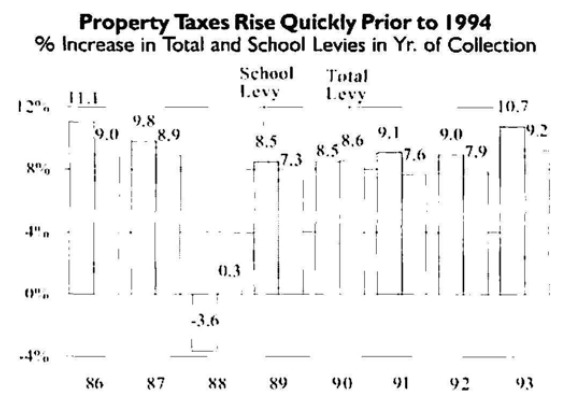
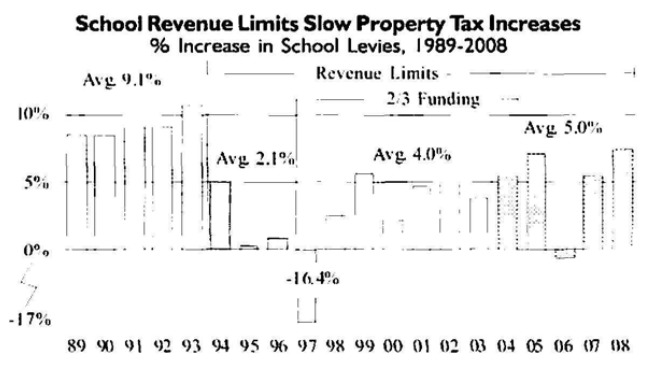
  • Revenue limits have helped reduce school property tax increases to less than 5% per year from more than 9% annually prior to the caps.
  • The limits have had \aried impacts on school districts, with growing districts experiencing the largest revenue gains. Low-spending districts prior to the caps have seen the largest per student gains.
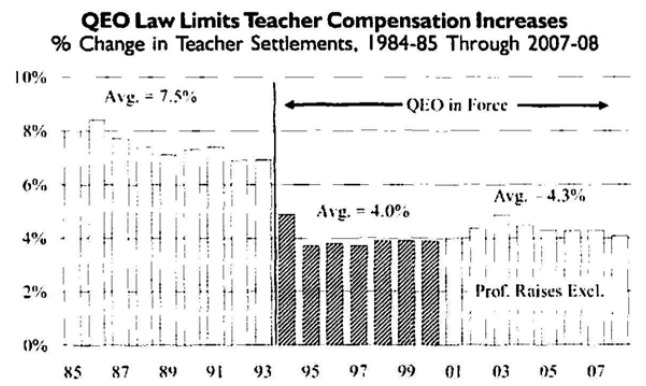
  • The QEO law has helped school districts keep compensation costs somewhat in line with revenue limits. However, since benefits are given more weight, teacher salary increases have slowed.

Since 1994. Wisconsin school districts have operated under slate-imposed revenue limits, which arc tied to inflation and enrollments. The associated qualified economic offer (QEO) law limits staff compensation increases to about 4% annually. With declining student counts, fluctuations in stale school aid. and various concerns over teacher pay. revenue limits and the QEO have attracted increasing debate.
The governor, in his proposed 2009-11 state budget, recommends eliminating the QEO. I le has also talked about providing ways for school districts to move away from revenue limits. This report does not address these specific proposals. Rather, it seeks to help inform discussions by examining the history of revenue limits and the QEO, legislative attempts to fix various issues, and the impacts of limits on schools, educators, and taxpayers.
THE REVENUE LIMIT LAW
School districts collect revenue from a variety of sources. The two largest sources are the property tax and state general (or equalization) aid, General aid is distributed based on district property wealth and spending. Combined, these two revenue sources account for about 75% of an average district’s funding. The remainder is a combination of student fees, federal aid. and state categorical aids. such as those for special education and transportation.
The revenue limit law was implemented in 1994 (1993-94 school year) and caps the amount districts can collect from property taxes and general aid combined. It does not restrict student fees, federal aid. or state categorical aid. A district’s revenue limit is determined by its prior-year cap, an inflation factor, and enrollments. There is an exception to the limit law for districts defined as “low-revenue.” Currently, districts with per student revenues less than S9.000 are allowed to increase their revenues to that level.
Background
While Wisconsin’s revenue limit law began in 1994. its roots date back to several teacher strikes in the early 1970s, culminating with the 1974 Hortonville strike during which 86 teachers were fired. That strike gained national attention.


Related: K-12 tax & spending climate. A number of links on local school spending and tax increases before the implementation of State limits on annual expenditure growth. The Madison School District spent $180,400,000 during the 1992-1993 school year. In 2006, the District spent $331,000,000. The 2009/2010 preliminary Citizen’s Budget proposes spending $367,912,077 [Financial Summary 2.1MB pdf], slightly down from 2008/2009’s $368,012,286.

Share

Californians want schools to spend more wisely

Nanette Asimov:

Californians care deeply about public education – and most want school funding protected in the state budget – but they are feeling less generous than in past years about giving schools more money, a new statewide survey reveals.
People feeling the recession’s bite want schools do a better job with the money already allocated, according to the survey of education attitudes by the Public Policy Institute of California.
At the same time, people are far less willing than in past years to pay higher taxes even to maintain existing levels of school funding.
“Californians are concerned about school quality and they’re concerned about school funding. But that hasn’t translated into more support for taxes and spending,” Mark Baldassare, president of the independent research firm, said in a statement. “They’re looking for reform and innovation that can lead to gains in school performance and student achievement.”

Mitchell Landsberg has more.

Share

Mandated K-12 Testing in Wisconsin: A System in Need of Reform

Mark C. Schug, Ph.D., M. Scott Niederjohn, Ph.D.:

By law public schools in Wisconsin must administer a rigid, comprehensive set of tests. In the fall of every school year students are tested in reading, math, language, science and social studies. Test results from each district and each school are posted on the Internet, passed along to the federal government to comply with No Child Left Behind requirements and are made available to parents. In an era where measurable student performance is essential, it is expected that Wisconsin’s elaborate system of testing will tell us how Wisconsin students are performing. Unfortunately the testing required by Wisconsin state law is not very good.
The purpose of state standards and state-mandated testing is to increase academic achievement. Does Wisconsin’s elaborate system of testing advance this goal? From every quarter the answer is a clear no. That is the consensus of independent, third-party evaluators. Wisconsin’s massive testing program has come under fire from the U.S. Department of Education which said that Wisconsin testing failed to adequately evaluate the content laid out in the state’s own standards. Further, a joint report issued by the independent Fordham Institute and the Northwest Evaluation Association performed a detailed evaluation of testing in every state and ranked Wisconsin 42nd in the nation. The Fordham Institute gave Wisconsin’s testing a grade of “D-minus.”
Perhaps even more troublesome is that many Wisconsin school districts find the testing system inadequate. Over 68% of Wisconsin school districts that responded to a survey said they purchase additional testing to do what the state testing is supposed to do. These districts are well ahead of the state in understanding the importance of timely, rigorous testing.
This report lays out the thirty-year history of testing in Wisconsin and the criticism of the current testing requirement. It is the first of two reports to be issued regarding Wisconsin’s testing program. The second report will show how a new approach to testing will not only meet the standards that parents, teachers and the public expect, but will also allow teachers and policy makers to use testing to actually increase the achievement of Wisconsin’s children.

Share

School Reform Talk Is Good, Now Let’s See the Walk

Wall Street Journal Editorial:

Secretary of Education Arne Duncan tells us that “School Reform Means Doing What’s Best for Kids” (op-ed, April 22). His cry for “doing what’s best for kids” rings a bit hollow when he failed to do what is best for the 1,700 low-income kids in Washington, D.C. who were counting on him. Those kids were given a lifeline — a voucher to escape schools that continually failed them, schools in a district to which neither Mr. Duncan nor his boss would send their own children. When crunch time arrived, politics trumped educational freedom, at least when it came to poor, inner-city kids in the District of Columbia.
Mr. Duncan speaks eloquently about how the public education establishment must change. He correctly says “we need a culture of accountability in America’s education system if we want to be the best in the world.” But what greater accountability can there be than that which comes from customers exercising free choices? True accountability in education will only come about when all parents are empowered to choose what they deem is best for their own children, not just those, like President Obama, Mr. Duncan, and most readers of the Wall Street Journal, who have financial means. So my question is, “When will the Obamas, Duncans, et. al. stand up for low-income parents so that they, too, can make choices that are best for their kids?”

Share

Waukesha to use child care centers for 4-K classes

Erin Richards:

bout 15 local child care centers are likely to host the Waukesha School District’s new half-day, 4-year-old kindergarten program next year, a district curriculum and instruction coordinator said.
Deb Wells, the district coordinator for the new 4-K program and coordinator for kindergarten and elementary social studies, said her staff is conducting site visits at 15 or 16 community child care sites in Waukesha to determine that they meet high standards for 4-K instruction.
Wells said that about 20 community sites applied to be a part of the program.
Of the 15 or 16 they’ve settled on, Wells said, the district will likely work with most if not all of them.

Share

Colleges offer no-frills degrees

Stacy Teicher Khadaroo:

Kaileen Crane was hardly interested in the hefty price tag that comes with the traditional college experience. So she’s paying $10,000 a year for the Advantage Program offered by Southern New Hampshire University (SNHU), a private college.
Forget about campus housing. Or a meal plan, or a gym with a climbing wall. This program is about the basics – core courses at a bare-bones satellite campus. But the price is less than one-third of what it costs for tuition and room and board at the main campus in Manchester.
“It’s close to where I live, it’s close to where I work, and the cost is just so much cheaper than a lot of other places,” says Ms. Crane during a break from classes in an office building in Salem.

Share

Wisconsin’s Latest State K-12 Test Results, and Related Criticism

Gayle Worland:

Across Wisconsin, educators like Hensgen are part of a growing chorus to reassess the way the state assesses students. Currently, teachers and districts wait five months for WKCE results, so they have little time to react to the findings and adjust their curriculum. The tests eat into a week of class time and are based on standards that, critics say, are too low to give parents and teachers a clear picture of how students measure up globally.
“It’s widely agreed that the WKCE is a really lousy test that measures lame standards,” said Phil McDade, a departing member of the Monona Grove School Board. “The bigger issue to me in Wisconsin is that there’s a sense of self-satisfaction with our school districts, that we’re doing fine, that we’re Lake Wobegon, that everybody here’s above average.”
The Department of Public Instruction commissioned a state task force on the issue last fall and is reviewing the group’s recommendations, said Michael Thompson, executive assistant to the state superintendent of schools. The state’s current testing contract lasts at least another two years.

Alan Borsuk has more.
“Schools should not rely on only WKCE data to gauge progress of individual students or to determine effectiveness of programs or curriculum”
The ACT Explore test was mentioned in Gayle Worland’s article.

Share

Are ‘No-Fail’ Grading Systems Hurting or Helping Students?

Joshua Rhett Miller via a kind reader’s email:

What’s a kid gotta do to get an “F” these days?
At a growing number of middle schools and high schools across the country, students no longer receive failing marks when they fail. Instead, they get an “H” — for “held” — on their report cards, and they’re given a chance to rectify their poor performance without tanking the entire semester.
Educators in schools from Costa Mesa, Calif., to Maynard, Mass., are also employing a policy known in school hallways as ZAP — or “Zeros Aren’t Permitted” — which gives students an opportunity to finish the homework they neglected to do on time.
While administrators and teachers say the policies provide hope for underperforming students, critics say that lowering or altering education standards is not the answer. They point to case studies in Grand Rapids, Mich., where public high schools are using the “H” grading system this year and, according to reports, only 16 percent of first-semester “H” grades became passing grades in the second semester.
Click here to see schools that implement some type of no-fail policy.

Much more on “standards based report cards“, here.

Share

Shorter Florida High School Sports Season

Chris Chmura:

Most high school athletes will spend fewer nights under the stadium lights next year, as the state’s athletic board shortens the season for many sports.
The Florida High School Athletic Association voted Monday to cut costs by reducing varsity seasons by 20 percent and junior varsity seasons by 40 percent. Football and cheerleading are exempt.
“Football is a moneymaker and most others are not,” said Lanness Robinson, Athletic Director for public schools in Hillsborough County.
FHSAA could not provide specifics for the estimated cost savings. A spokeswoman said the board had the backing of school districts and superintendents. She said an across-the-board schedule reduction would spare some sports from total elimination.

Share

Mayoral Control of Schools Unlikely in St. Paul

Emily Johns & Chris Havens:

St. Paul Mayor Chris Coleman often says that education is the key to many things that make a city successful, including economic development, crime fighting and neighborhood stability.
“Every mayor has to make education their Number 1 priority,” he says.
U.S. Secretary of Education Arne Duncan takes it one step further — he wants more big-city mayors to follow the lead of Michael Bloomberg in New York City and take over their cities’ school systems to help improve their leadership and stability.
“Where you’ve seen real progress in the sense of innovation, guess what the common denominator is?” Duncan asked. “Mayoral control.”
That said, could the mayors take over the schools here?

Share

Rancor Where Private-School Parents Make Public-School Decisions

Peter Applebome:

If you wanted to help a Martian understand this sliver of the planet in Rockland County, you might do two things.
First, you would take him (or her or it) to the cavernous Foodmart International on the main drag, Route 59.
The shoppers chatter in the broad, chilly aisles in every language under the sun. The wares include Cuban bread, Thai jasmine rice, Vietnamese chili-garlic sauce, Chinese kidney and liver herb extract, Haitian sugar, Salvadoran pickled vegetables, Honduran cream, Malaysian papaya pudding — like the provisions for some modern ark.
Then, you would head a mile or so down the road toward Monsey, where you would see gaggles of observant Jews in traditional garb walking on the street, pushing strollers, popping into shops offering kosher pizza, falafel and ice cream.
This would be helpful in understanding not just this area, but disputes along sensitive cultural fault lines that are playing out in several suburban communities. In fact, the East Ramapo school district here is going through the same drama as the district in Lawrence, on Long Island.

Share

Doyle, Barrett warn Milwaukee Schools on tax increase

Alan Borsuk:

Gov. Jim Doyle and Milwaukee Mayor Tom Barrett warned Friday that it “defies common sense” to consider a large increase in property taxes for Milwaukee Public Schools for next year and said they will hold MPS leaders accountable if there is such an increase.
They did not spell out exactly what they meant by accountable, but their sharp statement came as the two consider supporting major changes in the way MPS is run, including a possible mayoral takeover of the system. It also came shortly before they name a commission to oversee putting into action a consultant’s report that said MPS could save millions of dollars if it operated like a well-run business.
The governor and mayor were reacting to Thursday’s release of a proposed budget for MPS by Superintendent William Andrekopoulos. The proposal did not include a projection for property taxes for next year – that won’t come for months – but it did include a statement that it was likely there would be “a significant property tax increase.” Some MPS leaders have suggested it could be 10% or more.
The reaction also came the same day incoming state Superintendent of Public Instruction Tony Evers told the state Assembly’s Education Reform Committee that he intends to appoint a “federal funds trustee” to oversee how MPS spends tens of millions of dollars of federal economic stimulus money.
Doyle and Barrett jointly issued a brief statement about the MPS property tax picture:

Somewhat related: Joel McNally on the QEO.

Share

Madison School District Strategic Planning Update


The Madison School District’s Strategic Planning Group met this past week. Several documents were handed out, including:

This recent meeting was once again facilitated by Dr. Keith Marty, Superintendent of the Menomonee Falls school district. Non-MMSD attendance was somewhat lower than the initial 2.5 day session.

Share

Memphis school district a finalist for Gates Foundation money

Memphis Appeal:

Memphis City Schools is one of 10 districts being considered for millions of dollars over five years to improve teacher quality, including exit strategies for those who don’t make the grade.
The Bill & Melinda Gates Foundation has set aside $500 million to study what makes an effective teacher, create ways to develop more and set up meaningful rewards, which could include merit pay.
Four winners will be announced in mid-August.
A delegation from Memphis, including Supt. Kriner Cash, school board president Tomeka Hart and Stephanie Fitzgerald, president of the Memphis Education Association, is in Atlanta discussing options with foundation members through today.
“The focus is very clear. The Gates are looking for how you keep excellent teachers and new ways to begin measuring their effectiveness,” Cash said. “The work will also include an exit strategy for teachers who are not as satisfactory.”
Gates — the biggest private source of money for education reform in the nation — invited 30 districts to submit applications. Memphis made the cut after foundation officials visited several days late this winter and invited district leaders to Atlanta as a semifinalist.

Share

Private school enrollment in Wisconsin drops 11% in decade

Amy Hetzner:

Buffeted by the twin forces of a slumping economy and a decline in school-age children, enrollment in Wisconsin private schools dropped more than 11% over the past decade.
The decline is more than that suffered by the state’s public schools, which saw their enrollments decrease by less than 1%, according to state Department of Public Instruction reports.
The losses threaten the survival of some schools in the Milwaukee area.
St. Luke Parish School in Brookfield already has announced plans to close at the end of the school year. Holy Angels and St. Mary’s schools in West Bend are exploring a possible merger, although those involved with the discussions say enrollment drops at both are only one reason for the move.
“Part of it is financially driven, the other part is driven by this is a good idea,” said David Lodes, superintendent of Catholic schools for the Archdiocese in Milwaukee, which operates schools in 10 southeastern Wisconsin counties. “We don’t need to be competing against each other. We need to be working together as Catholics in a community.”
Student enrollment shifts vary from school to school, but the declines have been especially hard on Milwaukee’s suburbs. Of the 21 Milwaukee-area private schools that have lost at least half of their enrollments since the 1998-’99 school year, 15 were located in suburban communities.

Share

A Textbook Case of Renting Books

Peter King:

Oh, those text charges. No, not the fees for pecking out text messages on a cellphone, but the cost of every college student’s must-buy: textbooks.
Students spend about $1,000 a year on their texts, according to the College Board. And that most likely will increase: Over the past 20 years, textbook prices have increased at twice the inflation rate, according to the U.S. Government Accountability Office. One solution may be renting. Several companies offer textbook rentals that could save cash-poor college students more than 50% of the cost of a book.
To see how the process works, we ordered textbooks from three rental companies: Book Renter, Campus Book Rentals and Chegg; and one textbook seller, Textbooks.com, which doesn’t rent books, but offers guaranteed buybacks on some texts, making those books a quasi-rental.

Share

Don’t boycott school lunch, district tells Nuestro Mundo

Mary Ellen Gabriel:

A group of fourth-graders at Nuestro Mundo Elementary School had planned to remain in their classroom through lunch and recess Friday, enjoying a meal of fresh fruit, vegetables and homemade pasta at cloth-covered tables with flower centerpieces.


The group from Joshua Forehand’s class, which calls itself BCSL (“Boycott School Lunch”) formed to protest what they see as unhealthy food offered in the school’s cafeteria, but they scrapped their plan to host a “Good Real Food” picnic after Assistant Superintendent Sue Abplanalp called school administrators and parents to discourage it.


“There were too many obstacles,” Abplanalp said in an interview, citing the possibility of allergy-causing ingredients in shared homemade food, lack of adequate supervision, and the presence of the news media as major concerns.


“We want students’ voices to be heard. This just seemed to come together too fast, without various issues being addressed.”


When asked if the district feared negative publicity, Abplanalp said no. Instead she cited student privacy as a major concern.


“We have strict guidelines about the media interviewing students on school grounds. The principal maintains a list of kids whose parents have given permission for media exposure.”

Share

Minnesota House passes legislation to hold school funding flat

Tim Pugmire:

The Minnesota House has passed an education finance bill that would hold state funding for public schools flat over the next two years.
The vote Thursday night was 85-48. With the state facing a $4.6 billion budget deficit, House Democrats say the bill provides dependable funding in difficult times. But Republicans argue that schools need more.
The House K-12 bill maintains current state funding for education by using federal economic stimulus money, as well as delayed payments to school districts and property tax accounting shifts, to offset spending cuts.
DFL Rep. Mindy Greiling of Roseville, chair of the House K-12 Education Finance Division, said the bill holds the ship steady until the state reaches calmer economic waters. Greiling said the bill lays the groundwork for a new school finance system that would begin ramping up funding levels in 2014.
“Education is something that even in the hard times we should prioritize,” Greiling said. “And that’s what this bill does. Because building a workforce that’s ready to compete in a global economy has always been and must remain a Minnesota priority.

Share

Staff Jobs on Campus Outpace Enrollment

Tamar Lewin:

Over the last two decades, colleges and universities doubled their full-time support staff while enrollment increased only 40 percent, according to a new analysis of government data by the Center for College Affordability and Productivity, a nonprofit research center.
During the same period, the staff of full-time instructors, or equivalent personnel, rose about 50 percent, while the number of managers increased slightly more than 50 percent.
The data, based on United States Department of Education filings from more than 2,782 colleges, come from 1987 to 2007, before the current recession prompted many colleges to freeze their hiring.
Neither the report nor outside experts on college affordability went so far as to argue that the increase in support staff was directly responsible for spiraling tuition. Most experts say that the largest driver of tuition increases has been the decline in state financing for higher education.

Stephen Dubner has more.

Share

Charter Schools’ Secret Weapon: Ivy Grads

Jay Matthews:

I am ignorant of many things, but I think I know charter schools, particularly what makes the best ones successful. I have a new book out on that subject. I discuss the issue often in this column. For instance, in a recent piece I sifted reader reaction and concluded the best name for our highest-achieving charters is No Excuses schools, because their teachers believe their students’ impoverished backgrounds are no barrier to learning.
But here comes Steven F. Wilson, one of the savviest of charter school scholars, making me look dumb. He has revealed an important facet of No Excuses schools that never occurred to me. I tried to cover my embarrassment when I read his American Enterprise Institute paper, “Success at Scale in Charter Schooling.”
“Oh, yeah, I knew that,” I said.

Share

Big Milwaukee School Tax Hike Likely

Alan Borsuk:

Even though a proposed Milwaukee Public Schools budget released Thursday calls for no increase in overall core spending next year, the property tax levy increase might still reach double digits – a year after a 14.6% jump.
The new budget proposal answers two big questions about MPS, and leaves two others unanswered.
Unanswered: How much will property taxes go up? Michael Bonds, chair of the School Board’s finance committee, said this week that he won’t vote for anything over 10%. But the board may find itself debating something in that range after the state budget is set and other factors play out. Or, as the budget documents say: “Despite the district’s efforts to contain costs, the budget likely will require a significant property tax increase.”
Unanswered: What about the nearly $100 million in federal economic stimulus money coming to MPS over the coming two years, according to an announcement by Gov. Jim Doyle on Thursday? Stay tuned – a second budget proposal will be made by mid-May, Superintendent William Andrekopoulos said. It appears it won’t call for citywide use of the “year-round” school calendar and longer days for elementary students, but it is likely to make steps in those directions, along with other initiatives that would draw on stimulus money.
But that money is not expected to help with property taxes.

Share

9 Madison School District employees win grants

Wisconsin State Journal:

Nine Madison School District employees have won grants totalling $45,677 to carry out projects including having students sit on large balls, rather than chairs, and connecting Madison students with their Honduran counterparts via the Internet, the district announced.
The grants range from $462 to $9,820 and were given out by the Aristos Scholars Academy, which the district describes as a “think tank” of staff members who “explore district issues.”
Of the nine funded initiatives, three are at the high school level, four are at elementary schools and one is at a middle school. One — to connect Madison students with students in Honduras — will be carried out at Nuestro Mundo Community School, a bilingual charter school.
The balls-for-chairs project, at Allis Elementary, will give first- and fourth-graders the chance to sit on balls during class as a way to improve their attention and the appearance of their written work, among other benefits, according to a district news release.

Share

On Wisconsin’s State K-12 Education Budget

Bob Godfrey:

Following several hours of impassioned testimony from administrators, parents, and staff from school districts throughout the state, both large and small, at this week’s School Finance Network Assembly Hearing, it ended, unfortunately, on what could be charitably characterized as a flat note. Despite the hard work of disparate leaders of education groups meeting constantly for the past couple of years to come up with a thoroughly conceptualized school finance reform plan to present to the legislature, a committee composed of organizations in the School Finance Network who have often been traditionally at odds with each other in the past (for example WEAC and WASB ), came to the hearing armed with numbers vetted by both economists at the UW-Madison and the state Legislative Fiscal Bureau, including a number of suggestions for how to pay for this reform. However, the Committee on Education made it clear they were not going to take any action on this plan for the upcoming budget legislation hearings for the 2009-2011 budget. And most discouragingly there were, was, as far as I’m aware, no newspaper coverage of this event. I saw only one Madison tv crew present. They covered some of the personal testimony at the beginning but were not around to hear the actual presentation of the plan itself, which came late in the proceedings, too late to make it into the evening broadcast.

Share

State schools to get $366 million in stimulus aid; Madison gets $11.7M

Gayle Worland:

The Madison School District will spend the next couple of months figuring out how best to spend a two-year, nearly $11.7 million windfall in federal stimulus money, Madison’s school superintendent said Thursday.
More money for early-learning programs, possibly including 4-year-old kindergarten, is one of many ideas on the table, Superintendent Dan Nerad said.
“We have to be deliberative about our planning,” he said. “If we had the benefit of more time, we could have a longer conversation. But we’re going to have a good conversation, with a lot of good ideas. We’ve been waiting for the regulations, to make sure that we weren’t putting things out there that couldn’t be included in the final package.”

Related: China increases gold reserves.

Share

Education in New York: “The Excellence Charter School”

The Economist:

THE DAY starts in a small office in downtown Manhattan with Zeke Vanderhoek, the principal of The Equity Project, a charter school set to open in the Bronx this autumn. Already the school has attracted national attention—not for its pedagogy, but for its teachers’ salaries: $125,000 annually, plus a performance-related bonus. This pay, easily double or triple what most teachers make, will come out of the school’s grant from the city’s education department—which, as is standard for charter schools, is a good deal less than it spends on its own public schools.

How will he find the money? By hiring great teachers, says Zeke, which will allow him to cut back on everything else: the school will have hardly any non-teaching staff and no assistant principals, just a principal (himself) who earns less than classroom teachers. It will pay for no educational consultants or outside courses: these super-teachers will support each other’s professional development. They will work long, hard days: 8am to 6pm, and each will fill one of the roles normally assigned to support staff, such as chasing up truants. When one is absent, colleagues will cover, rather than the school paying for peripatetic substitutes.

We talk about money and waste in public schools: the programmes started and abandoned; the consultants and other hangers-on, both public-sector and private; the expensive remediation of mistakes made earlier in a child’s education; the even more expensive failure to remediate so that many children leave school having had a small fortune spent on them—and barely able to read.

Share

A Visit to KIPP Schools in New York City

The Economist:

I AM in Newark, New Jersey’s largest town and long a byword for urban decay. I’ve been invited by KIPP (the “Knowledge is Power Programme”), the biggest and best known of America’s charter-school chains, which has three schools in Newark, with a fourth to open this autumn. Founded by two Teach for America alumni (how familiar that story is getting) in 1994, there are now 66 KIPP schools nationwide, mostly middle schools (ie, with students between 10 and 14 years old). Oddly, none of Newark’s KIPP schools are called that: under the state’s charter law “brand” names are banned, which reflects early fears that big chains would come in and take over. Those fears have dissipated, and Cory Booker, Newark’s mayor since 2006, is a good friend of charters, and wants to see more of them.
I’m actually a bit nervous. KIPP has a fearsome and to my mind not entirely attractive reputation in England for a zero-tolerance approach to discipline–insisting that children keep their gaze on teachers who are speaking, and nod and say “yes” in response to teachers’ requests; giving detentions for minor transgressions; and “benching”–that is, seating naughty children separately in class and forbidding other pupils to speak to them during breaks. A certain type of English politician practically drools when talking about KIPP–the ones who, like many of their compatriots, dislike and fear children, and love all talk of treating them harshly. I’m half-expecting to find dead-eyed Marine-sergeant types with crewcuts barking orders at children one-third their size. If it turns out that the only way to maintain order and calm in a tough urban school is to run it like a boot camp, it will make me very sad.

Share

How Members of the 111th Congress Practice Private School Choice

Lindsey Burke:

Policies that give parents the ability to exercise private-school choice continue to proliferate across the country. In 2009, 14 states and Washington, D.C., are offering school voucher or education tax-credit programs that help parents send their children to private schools. During the 2007 and 2008 legislative sessions, 44 states introduced school-choice legislation.[1] In 2008, private-school-choice policies were enacted or expanded in Arizona, Florida, Georgia, Louisiana, Pennsylvania, and Utah[2]–made possible by increasing bipartisan support for school choice.[3]


On Capitol Hill, however, progress in expanding parental choice in education remains slow. Recent Congresses have not implemented policies to expand private-school choice. In 2009, the 111th Congress has already approved legislative action that threatens to phase out the D.C. Opportunity Scholarship Program (OSP), a federal initiative that currently helps 1,700 disadvantaged children attend private schools in the nation’s capital.


Congress’s Own School Choices


At the same time, many Members of Congress who oppose private-school-choice policies for their fellow citizens exercise school choice in their own lives. Senator Richard Durbin (D-IL), the chief architect of the language that threatens to end the OSP, for instance, sends his children to private school[4] and attended private school himself.[5]

Washington Post editorial: “Only for the Privileged Few?“:

NEW SURVEY shows that 38 percent of members of Congress have sent their children to private school. About 20 percent themselves attended private school, nearly twice the rate of the general public. Nothing wrong with those numbers; no one should be faulted for personal decisions made in the best interests of loved ones. Wouldn’t it be nice, though, if Congress extended similar consideration to low-income D.C. parents desperate to keep their sons and daughters in good schools?


The latest Heritage Foundation study of lawmakers’ educational choices comes amid escalating efforts to kill the federally funded D.C. Opportunity Scholarship Program that helps 1,700 disadvantaged children attend private schools. Congress cut funding beyond the 2009-10 school year unless the program, which provides vouchers of up to $7,500, gets new federal and local approvals. Education Secretary Arne Duncan cited that uncertainty as the reason for his recent decision to rescind scholarship offers to 200 new students. Senate hearings on the program’s future are set for this spring, and opponents — chiefly school union officials — are pulling out all the stops as they lobby their Democratic allies.

Share

Educator offers a radical approach

Jeremy Meyer:

Michelle Rhee, a national firebrand for education reform, urged Colorado educators and lawmakers Thursday night to continue their efforts to change the state of education.
Rhee — chancellor of Washington, D.C., schools who closed 23 schools in her first year, fired 36 principals and proposed paying more money to good teachers and firing the bad ones — spoke at a meeting of the Democrats for Education Reform in the auditorium of the Denver Newspaper Agency building.
The standing-room-only crowd included Lt. Gov. Barbara O’Brien, state Senate President Peter Groff and U.S. Rep. Jared Polis.
“We have public schools so that every kid can have an equal shot in life,” Rhee said. “That is not the reality for children in Washington, D.C., today or many children in urban cities today. That is the biggest social injustice imaginable.”
Rhee said radical changes are necessary. “Unless we do something massive about this right now, unless we are willing to turn the system on its head . . . then all of the ideals of this country are actually hollow,” she said.

Share

Charter Schools Face High Demand, but Few Seats
Obama Wants to Expand the Alternative Program, but Laws, Labor Unions Will Make That Hard to Achieve

Robert Tomsho:

The waiting lists for charter schools, already notoriously long, look like they are about to get longer.
President Barack Obama and Arne Duncan, his new education secretary, are trying to entice states into opening more of the alternative schools. But despite brisk enrollment growth and long waiting lines for many existing charter schools, states appear to be in no hurry to oblige.
With 1.4 million students in 4,600 schools, charters are by far the most significant achievement of the “choice” movement that strives to promote educational gains through school competition. Enrollment in charter schools, which are publicly funded, has more than doubled in the last six years.
But obstacles loom to accommodating more charter-school students. The recession has intensified school districts’ concerns about competing for public funds with charter schools. Some charter-school supporters say such schools need more oversight. But unions are using any missteps at charter schools, which aren’t typically unionized, to oppose their expansion.

Share

Taking School Choice for Granted

Lindsey Burke & Dan Lips:

President Obama, Education Secretary Arne Duncan, and most members of Congress have never known the sense of desperation that LaTasha Bennett feels.
Bennett is one of hundreds of Washington, D.C., parents who recently opened a letter from the U.S. Department of Education with devastating news: Her child was no longer eligible to receive a private-school scholarship for the upcoming school year. This sent Bennett and other parents scrambling to find their children spots in good public schools — a challenge in a city where few students read at grade level and barely half graduate from high school.
President and Mrs. Obama faced the same problem when they moved to the District in January, but they were able to afford a private school for their daughters. And for Secretary Duncan and his wife, finding a good school was a top concern when deciding where to live in the D.C. area. They wound up choosing Arlington, Va., a community with good public schools. Duncan recently told Science magazine: “My family has given up so much so that I could have the opportunity to serve; I didn’t want to try to save the country’s children and our educational system and jeopardize my own children’s education.”

George Will has more:

He has ladled a trillion or so dollars (“or so” is today’s shorthand for “give or take a few hundreds of billions”) hither and yon, but while ladling he has, or thinks he has, saved about $15 million by killing, or trying to kill, a tiny program that this year is enabling about 1,715 D.C. children (90 percent black, 9 percent Hispanic) to escape from the District’s failing public schools and enroll in private schools.


The District’s mayor and school superintendent support the program. But the president has vowed to kill programs that “don’t work.” He has looked high and low and — lo and behold — has found one. By uncanny coincidence, it is detested by the teachers unions that gave approximately four times $15 million to Democratic candidates and liberal causes last year.


Not content with seeing the program set to die after the 2009-10 school year, Education Secretary Arne Duncan (former head of Chicago’s school system, which never enrolled an Obama child) gratuitously dashed even the limited hopes of another 200 children and their parents. Duncan, who has sensibly chosen to live with his wife and two children in Virginia rather than in the District, rescinded the scholarships already awarded to those children for the final year of the program, beginning in September. He was, you understand, thinking only of the children and their parents: He would spare them the turmoil of being forced by, well, Duncan and other Democrats to return to terrible public schools after a tantalizing one-year taste of something better. Call that compassionate liberalism.

Share

Financial Manager Targets Detroit Schools

Noah Ovshinsky:

Detroit’s public schools are under the microscope — and a new state-appointed emergency financial manger is addressing a $300 million deficit. In the month Robert Bobb has been on the job, he has proposed closing up to 50 schools in the next two years.

Share

Education in New York: Off to School

The Economist:

QUITE a few Economist journalists have children in private schools, and whenever I write about the astronomical fees they read my articles with keen interest. More than one has asked me, hopefully and with a certain Schadenfreude, whether the global recession means that schools finally have to start cutting their fees? In London, that’s doubtful; I want to find out whether Manhattan is any different.
One reason fees in both places have been so high is limited supply: opening a new school in either of these crowded, pricey cities is difficult. So my first stop is Claremont Prep, one of the rare ones that has managed it. It opened just five years ago, in an old Bank of America building just off Wall Street. P.D. Cagliastro, the school’s flack, shows me around.
It cost $28m just to open the doors, Ms Cagliastro tells me, and another $7m has been spent since–and I can easily believe it. The former banking hall, its murals carefully restored, is now a grand auditorium; in the student cafeteria the old vault door is still visible, protected behind glass. There is an indoor swimming pool, and a basketball court on the 9th floor. The rooftop garden is surreal–an adventure playground on Astroturf, surrounded by skyscrapers and overlooked by the New York Stock Exchange.

Share

School Reform Means Doing What’s Best for Kids

Arne Duncan:

As states and school districts across America begin drawing down the first $44 billion in education funds under the American Recovery and Reinvestment Act, they should bear in mind the core levers of change under the law. In order to drive reform, we will require an honest assessment by states of key issues like teacher quality, student performance, college-readiness and the number of charter schools. We’ll also have a strategy to address low-performing schools and provide incentives to compel improvement.


When stakeholders — from parents and business leaders to elected officials — understand that standards vary dramatically across states and many high-school graduates are unprepared for college or work, they will demand change. In fact, dozens of states are already independently working toward higher standards in education. Union leaders have also signed on.


When parents recognize which schools are failing to educate their children, they will demand more effective options for their kids. They won’t care whether they are charters, non-charters or some other model. As President Barack Obama has called for, states should eliminate restrictions that limit the growth of excellent charter schools, move forward in improving or restructuring chronically failing schools, and hold all schools accountable for results.

Share

The Economic Impact of the Achievement Gap in America’s Schools

McKinsey [772K PDF]:

McKinsey’s report, The Economic Impact of the Achievement Gap in America’s Schools, examines the dimensions and economic impact of the education achievement gap. While much controversy exists on the causes of the gap and on what the nation should do to address it, the full range of the achievement gap’s character and consequences has been poorly understood.

This report examines the dimensions of four distinct gaps in education: (1) between the United States and other nations, (2) between black and Latino students and white students, (3) between students of different income levels, and (4) between similar students schooled in different systems or regions.

The report finds that the underutilization of human potential as reflected in the achievement gap is extremely costly. Existing gaps impose the economic equivalent of a permanent national recession—one substantially larger than the deep recession the country is currently experiencing. For individuals, avoidable shortfalls in academic achievement impose heavy and often tragic consequences via lower earnings, poor health, and higher rates of incarceration.

Share

Abolish Local School Districts?

The Economist:

Today is the conference for which I’ve travelled to New York. It’s at the Rubin Museum, a small, new venue devoted to Himalayan art, which certainly beats the usual hotel. We see the galleries at each coffee break, and at the end of the day there is a guided tour for those inspired to learn more about the art.
The conference features a stellar cast of speakers: educators, researchers and some hard-headed business types too. Lou Gerstner, an ex-CEO of IBM, enthusiastically pitches his plan for school reform: he wants the 15,000 local school districts abolished and replaced by around 70 (the states plus a couple of dozen big cities), national standards in core subjects introduced, with all children tested against them, and teachers paid much, much more.
Jim Rohr of PNC Financial Services talks about “Grow Up Great“, the bank’s $100m, 10-year investment in early-childhood education, which gives grants to non-profit school-readiness programmes, and sponsors employees to volunteer their time and services. One delegate asks about the lessons learned; Mr Rohr gets a laugh of recognition when he says that the main one is that volunteers face a hideous maze of bureaucratic regulations and permissions–and all because they wanted to help.

Share

How the E-Book Will Change the Way We Read and Write

Steven Johnson:

Every genuinely revolutionary technology implants some kind of “aha” moment in your memory — the moment where you flip a switch and something magical happens, something that tells you in an instant that the rules have changed forever.
I still have vivid memories of many such moments: clicking on my first Web hyperlink in 1994 and instantly transporting to a page hosted on a server in Australia; using Google Earth to zoom in from space directly to the satellite image of my house; watching my 14-month-old master the page-flipping gesture on the iPhone’s touch interface.
The latest such moment came courtesy of the Kindle, Amazon.com Inc.’s e-book reader. A few weeks after I bought the device, I was sitting alone in a restaurant in Austin, Texas, dutifully working my way through an e-book about business and technology, when I was hit with a sudden desire to read a novel. After a few taps on the Kindle, I was browsing the Amazon store, and within a minute or two I’d bought and downloaded Zadie Smith’s novel “On Beauty.” By the time the check arrived, I’d finished the first chapter.

Share

The State of Education in New York City

The Economist:

As The Economist’s education correspondent, I’ve been invited by Economist Conferences, one of the businesses in the Economist group, to chair a conference in New York entitled “Global Education 2020“. It’s just one day, but if I’m going to make the trip from London, I may as well stay longer and visit some schools. Those in the city’s poor neighbourhoods have long been known for having serious problems–violence, astronomical drop-out rates and abysmal standards of achievement–but in the last few years exciting things have been happening under Joel Klein, the chancellor of the city ‘s department of education, and I want to see some of the success stories with my own eyes.
Monday morning, and I’m off to Starbucks on 93rd and Broadway to meet Wendy Kopp, the Princeton graduate who in 1990 founded Teach for America (TFA), a non-profit organisation that recruits top-notch graduates from elite institutions and gets them to teach for two years in struggling state schools in poor areas. I know the basics already–TFA been widely copied, including in England. But I quickly realise that I’ve misunderstood TFA’s true purpose.
All three are tired. Their classrooms are not much like the rest of the school where they work, and their heroic efforts are only supported by Chester and each other, not by their co-workers. “The first year was unbelievably bad,” one tells me. “So many years with low expectations meant a lot of resistance from the kids. Eventually they saw the power and the growth they were capable of–but during the first few months we were just butting heads every day.”

Share

Billions “Wasted” on Scottish Education

Lorraine Davidson:

“It is clear from the research that the extra spending is simply not delivering value for money,” Geoff Mawdsley, director of Reform Scotland, said. “Put another way, billions of pounds have been spent in the last decade to little or no effect.”
While spending per pupil has risen from £2,092 to £4,638 at primary level and from £3,194 to £6,326 at secondary schools, the proportion of those gaining five good grades at the end of fourth year has fallen from 47 per cent to 46 per cent.
Reform Scotland also claimed that data it had obtained showed that pupils in England who had been lagging behind Scotland in 1998 are now ahead, with the number achieving equivalent grades rising from 36 per cent to 48 per cent.
The Scottish education system has long been regarded as among the best in the world, but the report claims that this view is now a myth.
Mr Mawdsley called on the Scottish government to publish more information about pupils’ performance. “Using the measure of the pupils attaining five good grades by S4, including maths and English, would be a good start,” he said.

Share

Madison School Board Rejects Teaching & Learning Expansion; an Interesting Discussion

One of the most interesting things I’ve observed in my years of local school interaction is the extensive amount of pedagogical and content development that taxpayers fund within the Madison School District. I’ve always found this unusual, given the proximity of the University of Wisconsin, MATC and Edgewood College, among other, nearby Institutions of Higher Education.


The recent Math Task Force, a process set in motion by several school board elections, has succeeded in bringing more attention to the District’s math curriculum. Math rigor has long been a simmering issue, as evidenced by this April, 2004 letter from West High School Math Teachers to Isthmus:

Moreover, parents of future West High students should take notice: As you read this, our department is under pressure from the administration and the math coordinator’s office to phase out our “accelerated” course offerings beginning next year. Rather than addressing the problems of equity and closing the gap by identifying minority math talent earlier, and fostering minority participation in the accelerated programs, our administration wants to take the cheaper way out by forcing all kids into a one-size-fits-all curriculum.


It seems the administration and our school board have re-defined “success” as merely producing “fewer failures.” Astonishingly, excellence in student achievement is visited by some school district administrators with apathy at best, and with contempt at worst. But, while raising low achievers is a laudable goal, it is woefully short-sighted and, ironically, racist in the most insidious way. Somehow, limiting opportunities for excellence has become the definition of providing equity! Could there be a greater insult to the minority community?

The fact the Madison’s Teaching & Learning Department did not get what they want tonight is significant, perhaps the first time this has ever happened with respect to Math. I appreciate and am proud of the Madison School Board’s willingness to consider and discuss these important issues. Each Board member offered comments on this matter including: Lucy Mathiak, who pointed out that it would be far less expensive to simply take courses at the UW-Madison (about 1000 for three credits plus books) than spend $150K annually in Teaching & Learning. Marj Passman noted that the Math Task Force report emphasized content knowledge improvement and that is where the focus should be while Maya Cole noted that teacher participation is voluntary. Voluntary participation is a problem, as we’ve seen with the deployment of an online grading and scheduling system for teachers, students and parents.

Much more on math here, including a 2006 Forum (audio / video).

Several years ago, the late Ted Widerski introduced himself at an event. He mentioned that he learned something every week from this site and the weekly eNewsletter. I was (and am) surprised at Ted’s comments. I asked if the MMSD had an internal “Knowledge Network”, like www.schoolinfosystem.org, but oriented around curriculum for teachers? “No”.


It would seem that, given the tremendous local and online resources available today, Teaching & Learning’s sole reason for existence should be to organize and communicate information and opportunities for our teaching staff via the web, email, sms, videoconference, blogs, newsletters and the like. There is certainly no need to spend money on curriculum creation.

Men more frequently require to be reminded than informed.”

Listen to tonight’s nearly 50 minute Madison School Board math discussion via this 22MB mp3 audio file.

Share

Madison School District Superintendent Dan Nerad on Local Stimulus / Splurge Spending

4.6MB mp3 audio file. Roughly 11M over two years plus grant opportunities. Much more on the stimulus / splurge here.

Share

Tonight’s Madison School Board Meeting at O’Keefe Middle School

The meeting, which will discuss math (TJ Mertz comments), non-SAGE schools and many other topics. The meeting begins at 6:00p.m.
O’Keeffe Middle School
510 South Thornton Ave. [Map]
Madison, WI 53703
Library Media Center
The meeting agenda can be found here.

Share

California Schools Superintendent Wants to Water Down Academic Standards in Name of “21st-Century Skills”

Bill Evers:

California State Schools Superintendent Jack O’Connell spoke to the annual EdSource Forum in Irvine today (April 17).
O’Connell, who holds a nonpartisan office, began his speech with political partisanship:

President Obama won a mandate for change that has placed him in a position to cause a massive shift in the way our government operates and in the manner in which it serves the needs of its citizens….
In just the first few months of this Administration, I can easily and confidently say that we have seen a dramatic shift in the willingness of this White House to be a partner to states — this is a welcome difference from the previous Administration….

There was more, but you get the general idea.
O’Connell then went on to identify “four key areas” that the Obama administration wants states to concentrate on:

Share

Why Your Taxes May Double

David Walker:

Even under the best of economic circumstances, tax season is a tense time for American households. The number of hours we collectively spend working on our returns is probably a lot more than government agencies claim.
The burden in financial terms is even greater: A recent independent survey found that the average American’s total federal, state and local tax bill roughly equals his or her entire earnings from January 1 up until right before tax day.
Now imagine that tax bill doubling over time.
In recent years, the federal government has spent more money than it takes in at an increasing rate. Total federal debt almost doubled during President George W. Bush’s administration and, as much as we needed some stimulus spending to boost the economy, the nonpartisan Congressional Budget Office now estimates total debt levels could almost double again over the next eight years based on the budget recently outlined by President Obama.
Regardless of what politicians tell you, any additional accumulations of debt are, absent dramatic reductions in the size and role of government, basically deferred tax increases. Remember the old saw? “You can pay me now or you can pay me later, with interest.”
To help put things in perspective, the Peterson Foundation calculated the federal government accumulated $56.4 trillion in total liabilities and unfunded promises for Medicare and Social Security as of September 30, 2008. The numbers used to calculate this figure come directly from the audited financial statements of the U.S. government.

Editor’s Note: David M. Walker served as comptroller general of the United States and head of the Government Accountability Office from 1998 to 2008. He is now president and CEO of the Peter G. Peterson Foundation.
On a related note, the Madison School Board will be discussing an “Update on planning regarding funds that MMSD may be eligible to receive under the American Recovery and Reinvestment Act“.

Share

Madison School District Math Program: Proposal to Increase Teacher Training and Teaching & Learning Staff

Monday evening’s Madison School Board meeting will discuss a proposal to increase math teacher training and add staff to the Teaching & Learning Department. 215K PDF.

Interestingly, the latest document includes these words:

MMSD Teaching & Learning Staff and local Institute of Higher Education (IHE) Faculty work collaboratively to design a two-year professional development program aimed at deepening the mathematical content knowledge of MMSD middle school mathematics…

It is unusual to not mention the University of Wisconsin School of Education in these documents…. The UW-Madison School of Education has had a significant role in many Madison School District curriculum initiatives.

Related:

Share

Virginia Superintendent Thinks Small in Plan to Revamp Middle Grades

Theresa Vargas:

Alexandria Superintendent Morton Sherman was less than a week into the job, greeting parents outside an elementary school, when he was first asked how he planned to fix the middle schools.
Last night came his answer: through a massive overhaul.
Sherman, seven months into his tenure, presented a plan for restructuring the city’s two middle schools, which have never met federal benchmarks and which, he said, contribute to Alexandria’s dropout rate being among the highest in the area.
Locally and across the nation, middle schools have generally been regarded as the problem child for school systems, marking the turbulent teenage years in which test scores and enthusiasm drop. In response, school systems have begun getting creative and investing more resources into those grade levels. The District school system, for example, has a program that pays students for their performance, and Montgomery County schools have committed to a three-year, $10 million plan to accelerate curriculum, train teachers and improve the leadership structure.
Sherman’s plan, which he presented to the Alexandria School Board last night, calls for splitting the two middle schools into five smaller ones, each with its own principal and staff. The change would not cost the school system more, he said, adding that staff would be reallocated. If the board approves the plan, the new structure will be in place in time for the next school year.

Sherman, wisely, has a blog, including comments!

Share

Mystery Donor Gives Universities Millions

NPR:

Over the last few weeks, a mystery person or organization has been giving away millions of dollars. Universities have been receiving anonymous donations. Purdue University got $8 million. The University of Iowa got $7 million. Other schools got donations too. Nobody knows who gave away the more than $45 million.

Share

An Update on the Madison School District’s Strategic Planning Process

The Madison School District’s strategic planning group will meet next week and review the work to date, summarized in these documents:

Much more on the Madison School District’s Strategic Planning Process here.
It is important to note that this work must be approved (and perhaps modified) by the school board, then, of course, implemented by the Administration.

Share

The Puzzling Politics of School Choice

George Lightbourn, via a kind reader’s email:

I don’t think it would be possible to make things any more confusing for Milwaukee parents. Their children have become political pawns in a political chess match and it will surprise no one to learn that this group of poor, minority parents is being treated quite shabbily.

The politics that these people are caught up in is being run out of the State Capitol. Governor Doyle went out of his way to tuck a decidedly non-fiscal item into his budget that stands to affect all school choice children. Specifically, he added a long list of regulatory requirements that the schools participating in the Milwaukee’s school choice program would have to follow. Governor Doyle’s list of regulations is torn directly out of the Milwaukee Teachers Education Association play book. After all, MTEA worked hard to deliver a totally Democrat state government and they expect a pay off for their effort. And to the glee of MTEA, Governor Doyle delivered.

Lest anyone be deceived, the aim of MTEA has always been to shut down the private school choice program. They want to get all of the kids back into public schools. Their hope is that these new regulations the Governor put in his budget will make it onerous enough for the choice schools that they will be forced to opt out of the choice program. There is logic to the MTEA reasoning given that choice schools operate on tiny budgets that are already strained.

Share

US Education Chief to Spend Billions Transforming US Schools

Oliver Staley & Molly Peterson:

Education Secretary Arne Duncan plans to spend a record $5 billion to transform U.S. schools by rewarding states for innovation, providing merit pay to teachers and creating a national scorecard to identify failing schools.
The Education Department has already distributed $44 billion of its $100 billion in stimulus funds to stave off the firing of teachers, Duncan said yesterday in an interview in Washington. An additional $5 billion will be given as an incentive to states that are “fundamentally willing to challenge the status quo,” he said.
Duncan, 44, the former head of Chicago’s public schools, said the retirement of 1 million teachers in the “next couple of years” gives the U.S. an opportunity to attract and retain a new generation of educators. He said he plans to enlist President Barack Obama and First Lady Michelle Obama to help recruit teachers, and then reward the newcomers for working in struggling schools and districts.
“Talent matters tremendously,” Duncan said. “If we can bring in this next generation of extraordinary talent, we can transform education, and our ability to do that over the next couple of years will shape education in this country for the next 25 or 30 years.”

Share

The Union War on Charter Schools

Jay Greene:

On education policy, appeasement is about as ineffective as it is in foreign affairs. Many proponents of school choice, especially Democrats, have tried to appease teachers unions by limiting their support to charter schools while opposing private school vouchers. They hope that by sacrificing vouchers, the unions will spare charter schools from political destruction.


But these reformers are starting to learn that appeasement on vouchers only whets unions appetites for eliminating all meaningful types of choice. With voucher programs facing termination in Washington, D.C., and heavy regulation in Milwaukee, the teachers unions have now set their sights on charter schools. Despite their proclamations about supporting charters, the actions of unions and their allies in state and national politics belie their rhetoric.


In New York, for example, the unions have backed a new budget that effectively cuts $51.5 million from charter-school funding, even as district-school spending can continue to increase thanks to local taxes and stimulus money that the charters lack. New York charters already receive less money per pupil than their district school counterparts; now they will receive even less.


Unions are also seeking to strangle charter schools with red tape. New York already has the “card check” unionization procedure for teachers that replaces secret ballots with public arm-twisting. And the teachers unions appear to have collected enough cards to unionize the teachers at two highly successful charter schools in New York City. If unions force charters to enter into collective bargaining, one can only imagine how those schools will be able to maintain the flexible work rules that allow them to succeed.

Share

Severson on McKenna

Jim, thank you for posting the link to this fascinating set of rants on the MMSD school board. I STRONGLY suggest that people watch the committee meeting video that is available at: http://mediaprodweb.madison.k12.wi.us/Board+Meetings
Simply put, many of the critiques that Severson complains are not happening are in fact very much alive in school board debate, whether it comes to what needs to happen to improve the math curriculum to the reviews and changes in fiscal practice that are making it possible to close the spending gap without further trashing programs. I guess that Don was napping during the three meetings when the discussions were underway?
Or, I may be wrong. This may not be a manipulation of the truth for political purposes. You be the judge – watch the video – and see whether nothing is being done on significant issues as Severson asserts.

Share

Don Severson Talks with Vicki McKenna on the Madison Public Schools

25.3MB mp3 audio file. The discussion begins about four minutes into the audio clip. Topics include: spending, program/curriculum assessment, reading results, the District’s strategic planning process, the QEO and possible state budget changes that could raise local property taxes.

Share

Wisconsin law restricting teacher raises (to at least 3.8%) likely to be repealed

Amy Hetzner:

A state law used to settle contracts and restrict teacher compensation in school districts from Wauwatosa to Cedarburg to New Berlin could be repealed this year, now that Democrats control both houses of the Legislature and the governor’s mansion.


The Legislature’s Joint Finance Committee took the most significant step toward eliminating the qualified economic offer (QEO) law since Gov. Jim Doyle took office simply by keeping the repeal proposal in the budget that it will begin considering Thursday. Prior attempts by Doyle to repeal the QEO as part of the biennial budget process were rejected by the committee when it was under bipartisan and Republican rule.


But now that the process is controlled by Democrats, who typically are more favorable to teacher- and labor-backed issues, state Sen. Luther Olsen (R-Ripon) called the chances the QEO will be eliminated this year “100%.” Passing the measure with the budget is viewed as easier than proposing it as an individual bill.


“The teachers union has wanted to get rid of this for a long time,” Olsen said. “They finally got the Democrats in power to do it. The Democrats plan to get rid of the QEO. The governor will get rid of the QEO.”


In place since 1993, the QEO was implemented as part of a three-pronged approach to change how public schools are funded in the state.

Share

More on a Possible Mayoral Takeover of the Milwaukee Schools

Bruce Murphy:

Four weeks ago, I did a column arguing the mayor should take over Milwaukee Public Schools. I didn’t get much from readers disputing my reasoning. Rather, I was told by some insiders that the issue was moot because Tom Barrett doesn’t want to take over the schools.
Wrong. He’s interested, and that’s what last week’s report on the finances of MPS was really all about. Coverage by the Milwaukee Journal Sentinel went into great depth on the minutia of money that could be saved (which was less impressive than it sounds) while underplaying the real game plan: to lay the groundwork for a governance change.
Barrett is a consensus builder who never moves quickly. He has methodically traveled to Chicago and Washington, D.C., to learn about how a mayoral takeover worked there. He met with President Barack Obama’s education secretary, Arne Duncan, who supports this kind of governance change. “It’s no secret Barrett has met with these people,” says his chief of staff, Pat Curley. “You have to look at whether the current model (for MPS) works.”
There’s pressure on Barrett from the business community to do something about MPS to ensure that graduates have the skills needed to function in the workplace. Last week’s report by McKinsey & Co. was paid for by the Bader, Bradley, Argosy, Northwestern Mutual Life and Greater Milwaukee foundations, which range from liberal to conservative to centrist in their views, but all have businesspeople on their boards. The first paragraph of the report notes that the economic future of Milwaukee depends on the ability of the schools “to prepare well-educated, highly trained and skilled graduates.”

Share

Michigan Charter school report OK’d

Peggy Walsh-Sarnecki:

The state Board of Education approved a controversial report on charter schools Tuesday, but it agreed to search for a better comparison for next year’s report.
The Free Press raised questions about the report in advance of the meeting, noting that charter schools’ scores are more likely to fall short of the test scores of the districts in which they sit.
The Michigan Department of Education’s annual report to the Legislature compares all charters to 20 school districts that contain 75% of the state’s charter schools. By that measure, charter schools generally outperformed traditional public schools.

Share

Despite initial low test scores, Madison’s Nuestro Mundo gains fans

Samara Kalk Derby:

It’s Thursday afternoon at Madison’s Nuestro Mundo Elementary School and teacher Christina Amberson, “Maestra Cristina” to her kindergarten students, speaks in rapid-fire Spanish. If you didn’t know better, you would assume Spanish was Amberson’s native language. But her impeccable Spanish is a product of many years of studying and teaching abroad in a number of Spanish-speaking countries.


Children respond only in Spanish. The only time they speak English is when English-speaking children are sitting together at tables. If Amberson overhears, she reminds them to use their Spanish.


Amberson’s kindergartners — a nearly even mix of native Spanish speakers and native English speakers — seem more confident with their language than a typical student in a high school or college Spanish class.


Everything posted on the dual-language immersion school’s bulletin boards or blackboards is in Spanish except for a little section of photos and articles about “El Presidente Barack Obama.”

It is ironic that WKCE results are used in this way, given the Wisconsin DPI’s statement: “Schools should not rely on only WKCE data to gauge progress of individual students or to determine effectiveness of programs or curriculum”. Much more on the WKCE here. The Madison School District is using WKCE data for “Value Added Assessment“.

Share

Wisconsin Education Superintendent may use power to impose major change on MPS

Alan Borsuk:

Elizabeth Burmaster, the outgoing state superintendent of public instruction, on Tuesday emphasized the need for a united effort to make quick, major changes to MPS but for the first time hinted that she could use broad powers to make improvements unilaterally if needed.


In her first interview since the release of a consultants report last week that said Milwaukee Public Schools could save as much as $103 million a year by changes in its financial practices, Burmaster said she wants to see major changes in the way MPS teaches reading and language arts; more time in schools for students; more efforts to improve the quality of teaching; and, in general, a more consistent effort to attain quality across the 80,000-student system.


She said changes in the district’s business operations are also needed.


Burmaster said an MPS-improvement plan should be set by July and implemented by the start of the 2009-’10 school year. She leaves office July 6, but her successor, Tony Evers, is expected to pursue a similar course and some of what she called for is in line with relatively tough stands on MPS that Evers took during his campaign leading up to last week’s election.


He could not be reached Tuesday.

Share

Charter schools are the way to go

Jed Wallace:

President Obama recently electrified the school reform community by calling for the growth of charter schools while ensuring that they are held to the highest standards of accountability.
His announcement represented a watershed moment for the charter school movement, because it confirmed that the political establishment has finally recognized what hundreds of thousands of California parents have long known: that the charter school movement is the most important school reform effort of our time.
Charter schools also offer the greatest hope for reforming public education in Los Angeles. The data coming in is simply irrefutable: More than 70 percent of charter schools in Los Angeles outperform their nearby district public schools. This past week, 10 of Los Angeles’s 12 recently recognized California Distinguished Schools were charter schools. On a statewide level, 12 of the state’s 15 highest-performing public schools serving low-income students are charter schools.

Share

Stimulus, Splurge & The Status Quo

Lisa Falkenberg:

Can you still call it ā€œstimulusā€ funding if it’s being used for a purpose no more stimulating that maintaining the status quo?


The obvious answer, being shouted from schoolhouse rooftops by superintendents and the Texas Democratic congressional delegation, is no.


But that’s in large part what lawmakers are in the process of doing with federal stimulus dollars meant for Texas schools.


It’s a kind of switcheroo in which state Senate budget-writers cleaned out the state’s main public school fund, and one for school technology, sprinkled the dollars elsewhere in the budget, and then replenished the state school funds with about $2 billion in federal stimulus money.


In elementary math, that would be one, minus one, plus one equals one. In terms of state schools funding, Texas schoolchildren gain zero.


The Senate, led by Lt. Gov. David Dewhurst and Senate Finance Chair Steve Ogden, R-Bryan, approved the budget. It’s expected to be considered by the full House Friday.
Some argue the maneuver is a fiscally conservative, forward-thinking method of protecting the state’s rainy day fund this session so we’ll have about $9 billion of it next session to deal with whatever budget calamities arise.

Share

The Safety Lessons of Columbine, Re-Examined

Stephanie Simon:

The carnage at Columbine High on April 20, 1999, prompted a swift and aggressive response around the U.S.
Hundreds of millions of dollars flooded into schools after two seniors stalked the halls of Columbine in trench coats, killing 12 students and a teacher before committing suicide in the school library.
The money — federal, state and local — bought metal detectors, security cameras and elaborate emergency-response plans. It put 6,300 police officers on campuses and trained students to handle bullying and manage anger.
Ten years later, the money is drying up. The primary pot of federal grants has been cut by a third, a loss of $145 million. The Justice Department has scrapped the cops in schools program, once budgeted at $180 million a year. States are slashing spending, too, or allowing districts to buy textbooks with funds once set aside for security measures.
Money is so tight that the Colorado district that includes Columbine High, which reopened four months after the shootings, has canceled its annual violence-prevention convention. Miami can afford to send just half as many students as it used to through anger-management training. Many educators and security consultants find the cutbacks frightening.

Share

Commentary: Charter Schools offer hope to public education

Eugene Paslov:

Charter schools offer hope for the future of our public education system. Charter schools promise options and opportunities for students and their parents that include diverse curricula — arts and humanities, career and vocational choices. They have unique delivery systems — distance learning, Montessori programs, special needs, and a mix of accelerated traditional and university courses. All meet high standards; all are accountable; all are independent and are defined as public schools, although with a new, expanded concept of public schools.
There are 25 charter schools in Nevada, two in Carson City, several in Washoe, Douglas and Lyon counties. (Nationally there are over 3,000 charter schools and the movement is fast growing.) Charter school growth has not been as robust in this state as in others, but it continues to receive support from the Legislature. In this legislative session there is a bill (AB489), that if passed will create an 18th school district for charter schools and will enable this new school district to authorize new charters.
I serve on the Silver State Charter High School Board in Carson City. This charter, a public school sponsored by the State Board of Education, is a distance learning school in which students interact with their teachers online as well as meet with them in person. The state has identified the school as “exemplary.” It is well managed and has a dedicated, licensed faculty and support staff. This charter school is a life-saver for over 500 kids and their parents.

Share

District-Wide Reform of Mathematics and Science Instruction: Case Studies of Four SCALE Partner Districts

William Clune:

This paper is a synthesis of case studies of four districts that implemented multifaceted reforms aimed at offering rigorous instruction in mathematics and science for all students as part of a National Science Foundation-supported partnership. A common theory of action aimed for a rigorous curriculum, professional development delivered close to the point of instruction, monitoring of instructional quality, and system coordination. Immersion units would offer an in-depth experience in scientific inquiry to all students. The theory of action was successful in many ways. Excellent access to top management allowed the partnership to assist with multiple aligned dimensions of instructional guidance. The biggest obstacles were turnover in district leadership, loose coupling across departments, attenuation of vertical alignment through overload of instructional guidance, and insufficient budget for adequate school site support (e.g., coaches). Greater coherence resulted from delivery of instructional guidance closer to schools and teachers, as with science immersion. The study suggests that complete, affordable packages of instructional guidance delivered to the school level district-wide might be the best model for district reform.

Related: Math Forum, Madison School District’s Math Task Force and the significant role that the UW-Madison School of Education has had in Madison School District curriculum decisions (see links and notes in this post’s comments)

Share

“Hand in Hand: Academic & Social Success”

Wisconsin Center for Education Research, via a kind reader’s email:

Recent developments in social and emotional learning (SEL) have pointed to the reciprocal relations between children’s academic functioning and their socio-emotional health. Professional literature in this field points to the need for including students’ academic skills and competencies as part of mental health intervention research.
University of Wisconsin-Madison psychologist and professor Thomas R. Kratochwill says educators cannot afford to continue offering mental health services for K-12 students in isolation. These services need to be reframed, mainstreamed, and folded into schools’ broader academic mission.
The good news is that schools already have resources, supports, and opportunities that may provide entry points for delivery of expanded mental health services. Virtually all elementary and secondary schools in the U.S. have school psychologists and provide mental health services, Kratochwill says. The bad news is that the proportion of students needing services continues to outpace supply, and mental health services often remain separate from academic programs. Knowledge about mental health programs and educational achievement have developed in isolation from each other.
To identify research directions for future studies of school-based mental health services, Tom Kratochwill and colleagues reviewed scholarly literature to identify evidence- based interventions that target a combination of students’ academic-educational functioning and their mental health functioning.
They studied 2000 articles published between 1990 and 2006; only 64 studies met the methodological criteria for inclusion in this review. Of those 64 studies, 24 tested the effects of a program on both academic and mental health outcomes, while 40 examined mental health outcomes only.
Schools are increasingly held accountable for achieving academic outcomes. Given that, Kratochwill says he was surprised that most of the mental health studies did not include academically relevant outcomes. That means that the impact of school-based mental health interventions on educationally relevant behaviors is under researched and may be poorly understood.
Many children receive mental health services in school settings. Although studies of social and emotional learning have linked social and academic competence, the impacts of mental health interventions on academics, and of academic interventions on mental health, are understudied.
Kratochwill argues for a multi-tiered intervention approach in schools. Varying levels of service intensity are available over time and in different grades for students, especially during transitional periods.
Because schools and districts have tight budgets, it’s important to know which students might benefit most from different types of intervention. And to streamline or adapt effective interventions for dissemination on a larger scale, it’s important to understand how various interventions produce positive outcomes.

Share

Charter Schools Always Face a Financial Struggle

Kevin Ferris:

As I walked the halls of First Philadelphia Charter School for Literacy recently with the school’s CEO Stacey Cruise-Clarke, I was struck as she reprimanded a student for “yelling.” I hadn’t heard a thing.
In the school’s cavernous facility there are 30 classrooms, a performance art center, a gym, a literacy center, and nearly 700 students in uniform. It is an oasis in a city that witnesses thousands of assaults in its public schools each year and has engaged in a running debate over whether to arm school security guards. The charter school was founded nearly seven years ago, and is very lucky to own its facilities.
Typically, banks are reluctant to lend to charters because they have little collateral, no long-term funding, and a five-year license to operate that may not be renewed. That is the reality that will confront President Barack Obama if he tries to make good on his promise to expand charter schools. These schools serve a public good, but they are also risky borrowers.
What’s more, while charters receive per-pupil funding from the state, they aren’t given start-up money to buy or lease classroom space — one of the misguided restrictions put on charters that hamper their growth. The president may want more charters — see, for example, his March 10 speech, where he called for increasing the number of charters in states that imposed limits — but is he willing to do more to help charters cover capital costs? At the moment, private organizations step in to fill the void in public funding for these public schools.

Share

Eli Broad dangles a carrot in front of Los Angeles Unified

Howard Blume:

Los Angeles philanthropist Eli Broad will help pay for a New York-based arts program that benefits poor and minority students — and he said Friday that he and other donors would provide similar funding here if the Los Angeles school district can better manage its own arts programs, especially the new downtown arts high school.
The Broad Foundation has pledged to contribute $425,000 so the Juilliard School can allow dozens of public school students to receive up to four years of free musical training. Broad said he decided to make the gift after reading a newspaper article about the program canceling auditions in a tight budget year.
“It really moved me,” Broad said. “I was saddened they were going to cut out these minority kids.”
But Broad also made a point about problem-plagued Central L.A. Area High School No. 9, the high-concept arts specialty school that is scheduled to open in the fall even though it still lacks an executive director, a permanent principal, a staff and an arts curriculum.
“It’s clear that if you have a quality arts high school, especially one that is educating kids from minority communities, there will be philanthropic funds forthcoming, as evidenced from our willingness to give money to Juilliard,” Broad said.
Such funding will be crucial for the new campus, he said, adding that it will cost more to run than other public high schools. “It will need some philanthropic support, not only from us but from others,” he said.

Share

Many Skeptical That Milwaukee Public Schools Will Change

Erin Richards:

Several Milwaukee School Board members bristled at not receiving or being briefed in advance on a consultants’ report that claims the city’s public schools could be saving more than $100 million per year if its bureaucracy was run more efficiently.
Some said they had already pushed for reform on many of the reported problem spots: streamlining purchasing, selling unused land and curtailing large salaries.
Outside the system, many wanted to know what makes this report – another in a long line of analyses that paint a dismal picture of MPS – different from the others. What, if anything, will be done about the wasteful spending practices the report outlines? And how soon?
Tim Sheehy, president of the Milwaukee Metropolitan Association of Commerce, called the report “eye-popping, but not unexpected.”

Share

The Money Myth in Improving Schools

Jay Matthews:

Hard battles lost long ago leave a mark. (The worst for me was the 1973 Super Bowl.) University of California at Berkeley professor W. Norton Grubb, for instance, still replays the 1971 Serrano v. Priest decision by the California Supreme Court. It threw out the state’s education financing system based on property taxes. He thought the decision was going to make heroes of school financing experts like him who would, he hoped, “improve the minutiae of finance formulas, and equitable and powerful schooling would spread to all children.”
Except that didn’t happen. Federal courts and the property-tax-limiting ballot Proposition 13 got in the way, and Grubb eventually learned his dream was based on a misunderstanding, what he calls the money myth, which he uses as the title of a very detailed and enlightening new book.
The myth, he says, is “the idea that more money leads to improved outcomes, that the solution to any educational problem requires increased spending.”
The Money Myth,” published by the Russell Sage Foundation, has a subtitle, “School Resources, Outcomes and Equity,” which sounds like a really bad homework assignment. But once you get into it, it is hard to put down. Grubb makes a daring attempt to identify exactly which approaches will improve our children’s academic performance, and by how much.

Share

Providence, RI School District to End Teacher Bumping; Plans to Fill Vacancies Based on Qualifications.

AP:

Providence schools are set to phase out so-called “bumping” by filling teaching vacancies based on instructors’ qualifications instead of their senior status.
Superintendant Tom Brady said in a letter Wednesday to staff that six schools in the district will end the practice of seniority-based staffing decisions.
The change goes into effect in the next school year. The rest of the district is to use the new plan beginning in the 2010-2011 academic year.

Documents:

Share

School of Second Chances

Kevin Houppert:

he six teenage boys, incarcerated at the District’s Oak Hill juvenile detention facility in Laurel file into their classroom after lunch one late January afternoon. They are surprised to see strangers — five women and two men — sitting in the chairs that the boys typically occupy.


The students find some empty seats and shrug out of their matching brown coats and mismatched scarves. They are curious about the visitors in a lean-back, fold-your-arms, prove-it kind of way.


“I’m James Forman,” begins a 40-something man. “I’m a professor at Georgetown Law School and — ”


“You related to the James Forman?” interrupts 17-year-old Carleto Bailey.


“I’m James Forman Jr.”


“That your father? James Forman your dad?” Carleto demands.

Share

More on the Obama Administration’s Opposition to Washington, DC Vouchers

Russ Whitehurst:

The Institute of Education Sciences (IES) within U.S. Department of Education released a study on April 3 of the D.C. Opportunity Scholarship Program, which provides up to a $7,500 annual voucher for students from low-income families in the District of Columbia to attend private schools. Notably, the study found that students who won the lottery to receive the limited number of available vouchers had significantly higher reading achievement after three years than students who lost the lottery.
Yet last month Congress voted to eliminate funding for the program. Columnists for the Wall Street Journal and the Denver Post, accompanied by the blogosphere, have alleged that Secretary of Education Arne Duncan sat on the evidence of the program’s success. The WSJ writes that, “… in November preliminary results were presented to a team of advisers who work with the Education Department to produce the annual evaluation. Since Education officials are intimately involved in this process, they had to know what was in this evaluation even as Democrats passed (and Mr. Obama signed) language that ends the program after next year.” The Denver Post questions the Secretary’s denial of having known the results of the study prior to congressional action, asserting that he was, “at best … willfully ignorant.”
As director of IES through November 2008, I was responsible for the evaluation that is at the center of the controversy. Given the established procedures of IES it is extremely unlikely that Secretary Duncan would have known the results of the study until recently.

David Harsanyi:

Secretary of Education Arne Duncan argues that we have an obligation to disregard politics to do whatever is “good for the kids.”
Well then, one wonders, why did his Department of Education bury a politically inconvenient study regarding education reform? And why, now that the evidence is public, does the administration continue to ignore it and allow reform to be killed?
When Congress effectively shut down the Washington, D.C., voucher program last month, snatching $7,500 Opportunity Scholarship vouchers from disadvantaged kids, it failed to conduct substantive debate (as is rapidly becoming tradition).
Then The Wall Street Journal’s editorial board reported that the Department of Education had buried a study that illustrated unquestionable and pervasive improvement among kids who won vouchers, compared with the kids who didn’t. The Department of Education not only disregarded the report but also issued a gag order on any discussion about it.

Share

Nation’s top educator warn states against taking money from their youngest students

WBIR.com:

The nation’s top educator headed back to class Wednesday warning states against taking money from their youngest students.
“We’re not going to balance the budget on the backs of our young children. We just can’t afford to do this,” said Secretary of Education Arne Duncan.
All but 12 states pay for pre-k programs.
The federal government also funds head start, for low-income kids.
Last year, states added more than 100,000 new preschoolers and spent a billion more on them than the year before.
But with five billion in federal stimulus money on the way at least nine states may cut their own funding so there’s little if any net benefit.
Advocates say that would hurt the middle class.
“Children whose families are just above the poverty line all the way up to the median income have less chance of being in a good preschool program than children in poverty. And for children in poverty, it’s less than 50 percent,” said Steve Barnett of the National Institute for Early Education Research

Share

An Interview with US Education Secretary Arne Duncan

Science:

What do we know works to improve student achievement in K-12 STEM [science, technology, engineering, and mathematics] education?
A.D.: I’d say great teachers, who know the content.
How do we know that?
A.D.: I think that’s true in any subject area. If you get outstanding teachers, kids learn.
What’s the evidence for that?
A.D.: Lots of evidence points to the fact that great teachers have an impact.
What is it about effective teachers that makes a difference?
A.D.: Lots of factors. It’s not one. In this area, it sounds like common sense, but still, having teachers that truly know the content is critically important. You can’t teach what you don’t know. So that’s a starting point. Beyond that, what do great teachers look like? They are passionate, they have high expectations–this is a calling, not a job. They go way beyond the call of duty to make sure that students are getting what they need. And they are really able to differentiate instruction, to work with kids who are struggling and those who are on track to becoming the next generation of chemists and physicists.
You mentioned content. But there are studies that have found what teachers majored in in college doesn’t necessarily affect their ability to improve student achievement.
A.D.: You’re right. I’m not talking about what you major in. I’m saying that you can’t teach physics if you don’t know physics. You don’t have to have majored in physics. Maybe you come out of industry, or out of some other place. I worry a lot about how many folks are teaching classes in which they are not experts in the content. To me, that’s a big part of the problem. We don’t have enough teachers today who are experts in math and science. This is not just high school, it’s also fifth, sixth, seventh grade.

Share

Math Performance Anxiety

Debra Saunders:

n the 1990s, the Math Wars pitted two philosophies against each other. One side argued for content-based standards – that elementary school students must memorize multiplication tables by third grade. The other side argued for students to discover math, unfettered by “drill and kill” exercises.
When the new 1994 California Learning Assessment Test trained test graders to award a higher score to a child with a wrong answer (but good essay) than to a student who successfully solved a math problem, but without a cute explanation, the battle was on. New-new math was quickly dubbed “fuzzy crap.” By the end of the decade, repentant educators passed solid math standards.
Yet the Math Wars continue in California, as well as in New Jersey, Oregon and elsewhere. In Palo Alto, parent and former Bush education official Ze’ev Wurman is one of a group of parents who oppose the Palo Alto Unified School District Board’s April 14 vote to use “Everyday Mathematics” in grades K-5. Wurman recognizes that the “fuzzies” aren’t as fuzzy as they used to be, but also believes that state educators who approve math texts “fell asleep at the switch” when they approved the “Everyday” series in 2007.
The “Everyday” approach supports “spiraling” what students learn over as long as two or more years. As an Everyday teacher guide explained, “If we can, as a matter of principle and practice, avoid anxiety about children ‘getting’ something the first time around, then children will be more relaxed and pick up part or all of what they need. They may not initially remember it, but with appropriate reminders, they will very likely recall, recognize, and get a better grip on the skill or concept when it comes around again in a new format or application-as it will!” Those are my italics – to highlight the “fuzzies’ ” performance anxiety.

Related: Math Forum.

Share

US schools chief says kids need more class time

Kristen Wyatt:

American schoolchildren need to be in class more — six days a week, at least 11 months a year — if they are to compete with students abroad, Education Secretary Arne Duncan said Tuesday.
“Go ahead and boo me,” Duncan told about 400 middle and high school students at a public school in northeast Denver. “I fundamentally think that our school day is too short, our school week is too short and our school year is too short.”
“You’re competing for jobs with kids from India and China. I think schools should be open six, seven days a week; eleven, twelve months a year,” he said.
Instead of boos, Duncan’s remark drew an unsurprising response from the teenage assembly: bored stares.
The former Chicago schools superintendent praised Denver schools for allowing schools to apply for almost complete autonomy, which allows them to waive union contracts so teachers can stay for after-school tutoring or Saturday school.

It is indeed, time to move away from the current, 19th century agrarian model.

Share

Online charter school rings bell with parents, students

Noreen S. Ahmed-Ullah:

Learning at home in her pajamas before a computer screen, Emily Brown’s youngest daughter is picking up things in 6th grade that her older daughter is attempting as a freshman at a Catholic school.
For the former teacher, that’s evidence enough that Chicago Virtual Charter School is working.
“The curriculum is better here,” Brown said. “It’s a grade level higher.”
The school, the city’s only online program for kindergarten through high school, has become an alternative to traditional public schools for parents such as Brown who believe regular schools often don’t challenge children enough or don’t give slow learners the extra time they need.

Share

Newark schools, Rutgers unveil research collaboration

Steve Chambers:

s one of the state’s poorest school districts, Newark has long known it has some severe problems. Quantifying them has been another matter.
Now, the district may be one step closer to getting some answers as Superintendent Clifford Janey joined officials at Rutgers University in Newark today to announce an ambitious research collaboration.
Modeled after a 20-year relationship between the University of Chicago and that city’s public schools, the project seeks to join a growing trend of universities helping public schools use technology to better track student performance. The relationships are particularly prevalent in cities where impoverished students have long struggled and are the focus of growing national concern.

Share

Study Finds Millions in Waste in the Milwaukee Public Schools

Alan Borsuk:

Milwaukee Public Schools could save as much as $103 million a year if it operated like a well-run business, according to a much-anticipated report that has Gov. Jim Doyle and Milwaukee Mayor Tom Barrett taking steps that could lead to a takeover of the system.
The report, released Thursday, concludes that MPS does not have a culture aimed at achieving good results, and is in tenuous financial shape that will worsen without systemic changes.
The report mostly sidesteps the academic side of MPS, concentrating instead on business operations, from busing to lunch programs to purchasing practices to health insurance policies. It found waste in every area – inefficient payroll processing, overqualified maintenance teams, even pencil sharpeners that cost more than $100. The report also found more than five dozen central office jobs with six-figure salaries.
Spending outside the classroom is about a third of total MPS spending.
“To free up funds needed to close its worrisome academic achievement gaps, MPS must first get its financial house in order,” the report says.
Invoking powers granted the state by federal law, Doyle and Barrett said they will move within several weeks to create a council of community leaders to pursue major changes in the way MPS conducts business – and, ultimately, how well it educates children.

Share

High School Dropouts: A Scandal More Shameful than AIG and Just as Costly for Taxpayers

Keli Goff:

They say there are two things you should never discuss on a first date or at a dinner party: religion and politics. But there has always been another subject that is so taboo that most people would rather arm wrestle over the other two than dare mention it.
That subject is class.
Americans have never liked discussing class status. Unlike our founding cousins over in England where your status is something bestowed upon you by birth, here we believe in a little something called the American Dream; the idea that any person regardless of race, religion or socio-economic background can become anything they want to be, including president.
But unfortunately that Dream is becoming increasingly out of reach for millions of Americans.
Though Madoff and the Wall Street meltdown have forced some of us to finally become more aware of the world beyond our comfortable middle and upper-middle class bubbles, another issue has been lurking for years that threatens to bring about even greater financial Armageddon for our country down the road: America’s burgeoning dropout epidemic. Before you decide that this issue has nothing to do with you (and therefore decide to move on from this blog post) consider these facts for a moment:

Share

Big Tax Jumps Loom in 10 States, including Wisconsin

Leslie Eaton:

A free fall in tax revenue is driving more state lawmakers to turn to broad-based tax increases in a bid to close widening budget gaps.
At least 10 states are considering some kind of major increase in sales or income taxes: Arizona, Connecticut, Delaware, Illinois, Massachusetts, Minnesota, New Jersey, Oregon, Washington and Wisconsin. California and New York lawmakers already have agreed on multibillion-dollar tax increases that went into effect earlier this year.
Fiscal experts say more states are likely to try to raise tax revenue in coming months, especially once they tally the latest shortfalls from April 15 income-tax filings, often the biggest single source of funds for the 43 states that levy them.
The squeeze is especially severe in states hit hardest by the recession, such as Arizona, where sales-tax revenue has fallen by 10.5%, income-tax collections are down 15.7% this fiscal year, and the government faces a $3.4 billion budget gap next year. But such shortfalls are likely to be widespread; federal income-tax receipts from individuals have dropped more than 15% in the past six months, according to Congressional Budget Office estimates.

Share

A Look at Textbook Prices in Hong Kong

:

The cost of textbooks under the new senior academic structure has risen, with some publishers nearly doubling the prices for certain subjects.
The fewer subjects required to qualify for the future Hong Kong Diploma of Secondary Education examination, which will replace the HKCEE, meant longer lesson times per subject, which would translate into thicker textbooks, the Educational Publishers Association said.


Compulsory Form Four subjects under the new system, including Chinese, English language and mathematics, registered an average increase of 8 per cent – with prices for English-language textbooks rising 12.3 per cent.


The average prices in elective subjects such as geography (HK$401), physics (HK$510) and economics (HK$414) have also gone up. Biology textbooks will cost an average of HK$476 – an increase of 87 per cent on last year’s HK$255.


The Education Bureau released the prices of books for senior secondary subjects yesterday after assessing 152 sets of textbooks submitted by publishers.

The Hong Kong dollar is worth .129025 US Dollars at this writing.

Share

Teachers union sent scripted questions to New York City Council members

Elizabeth Green:

At today’s education committee hearing, City Council members took turns questioning Department of Education officials on the rise of charters schools. Their questions were passionate, specific, and universally accusatory. They may have also been scripted.
Just before the hearing began, a representative of the city teachers union, which describes itself as in favor of charter schools, discreetly passed out a set of index cards to Council members, each printed with a pre-written question.
One batch of cards offered questions for the Department of Education, all of them challenging the proliferation of charter schools. “Doesn’t the Department have a clear legal and moral responsibility to provide every family in the city guaranteed seats for their children in a neighborhood elementary school?” one card suggested members ask school officials. “Isn’t the fundamental problem here the Department’s abdication of its most important responsibility to provide quality district public schools in all parts of the city?” another card said. (View more of the cards in the slideshow above.)
Several council members picked up on the line of thought. “Shouldn’t we aspire to have every school in the city good enough for parents to feel comfortable sending their children?” Melinda Katz, a Council member from Queens, said in questioning school officials. “I remember when Joel Klein became the chancellor,” the committee chair, Robert Jackson, said. “Back then, he used to talk about making every neighborhood school a good school where every parent would want to send their children. I don’t hear him talk about that anymore.”
Asked about the cards, union president Randi Weingarten provided a statement saying that she regretted the tactic. “We are often asked by the council for information and ideas about various issues. Additionally, when I am available, I often respond to what others testify to. In this instance, I was in Washington and couldn’t be at City Hall,” she said in the statement. “I am proud of the testimony we gave today, but I regret the manner in which our other concerns were shared.”

Share