School Information System

Gov. Christie creates task force to review N.J. education rules

Ginger Gibson:

Gov. Chris Christie created a committee today that will be tasked with reviewing all of the state’s education regulations.
The task force will return recommendations to eliminate regulations which take decision-making power away from the local districts, Christie said.
“What I want to have happen here is to return more of the power back to school districts and less from the central office in Trenton, so that we can encourage people to innovate,” Christie said. “We’ve gotten into a pattern over the course of time with increasing money coming from Trenton over the last 20 to 25 years years with increasing regulation coming from Trenton. I don’t think that’s the best way for us to go at transforming education.

Share

Don’t use Michigan’s K-12 fund for higher education

Lansing State Journal:

Michigan’s education funding system has been broken for a long time.
Gov. Rick Snyder’s plan to shift college and university funding into the School Aid Fund that pays for K-12 education is not a good long-term solution.
Snyder is trying to use the financial pressure to accelerate efforts to curb the overpromising of salaries, pensions and benefits – especially health care benefits – to teachers. Likewise, many in the Republican Party believe the state’s colleges and universities have spent too much on salaries and benefits.

Share

Fun with the California Federation of Teachers

Mike Antonucci:

It’s a serious time in the world of education labor. Some even call it war. And while the California Federation of Teachers is stockpiling arms in the Fight for California’s Future, the union still has a wide range of priorities, as evidenced by its list of approved resolutions from last month’s convention at the Marriott Manhattan Beach.
Resolution 1 calls on the state to research the effects of methyl iodide and asks CalSTRS to divest any investment in the company that manufactures it for agricultural use.
Resolution 2 institutes compensation for additional statewide CFT officers, the amount to be determined by the CFT Executive Council.
Resolution 4 directs the union to lobby for compulsory kindergarten.

Share

New York’s Claremont Prep Is Sold To a For-Profit Network

Jenny Anderson:

Claremont Preparatory School, a six-year-old institution in Lower Manhattan that has had difficulty fulfilling its ambitions, is being sold to a private-equity-backed firm, in a sign of growing investor interest in private schools in New York City.
The sale to the firm, Meritas, which is owned by Sterling Partners, illustrates the growing force of profit-seeking companies in private education, a development loaded with potential and risks. Private equity firms are as well known for their top-notch management teams as for their cost-cutting mandates, which have been widely tested in the world of business but are relatively new to the field of elementary and secondary education.

Share

Kids Do More With Arts Education: Closing the Achievement Gap By Increasing Social Assets

Kristen Paglia:

The great secret, Eliza, is not having bad manners or good manners… but having the same manner for all human souls. In short, behaving as if you were in Heaven, where there are no third-class carriages, and one soul is as good as another.
Professor Henry Higgins says this to Eliza Doolittle in George Bernard Shaw’s 1912 play, Pygmalion. He has wagered that he can pass Eliza, a “lowly” flower girl, for a society lady by teaching her how to speak and behave properly. Higgins is successful, Eliza does pass, but her acceptance into the social elite came as much from her newly found self-esteem, as her style and manner.
The idea that “social assets” can help kids get ahead and do more in the world isn’t a new one. Social assets aren’t about money, but the stuff that comes with money. Things like knowing about fine art, current events, fashion, design, even food and wine. These are the social markers that give away what part of town you live in, where you go to school, and what your parents do for a living. In the last forty years the concept of social assets has been widely recognized in educational research as a major factor in where, or if, kids go to college, and how much they’ll earn over their lifetimes.

Share

Tax credits for religious schools? Supreme Court says taxpayers have no say.

Warren Richey:

The US Supreme Court on Monday dismissed a lawsuit filed by taxpayers in Arizona challenging a state tax credit program that primarily benefits parochial schools.
In a 5-to-4 decision, the high court said the taxpayers lacked the necessary legal standing to bring their lawsuit.
The action sweeps away a ruling by a federal appeals court panel that had struck down the tax credit program as a violation of the First Amendment’s ban on government establishment of religion.
The majority justices did not directly address the larger constitutional issue. Instead, the 19-page decision written by Justice Anthony Kennedy focuses on whether the complaining taxpayers had suffered a direct and personal injury from Arizona’s religious school tax credit program.

Share

Pioneer of ballet wants girls to have more choices

Amy Nip:

Being born female set sometime actress Christine Liao on the road to a career in ballet, but it could all have been so different.
Growing up in a traditional, male-dominated environment, the founder of the Christine Liao School of Ballet and the Hong Kong Ballet Company may never have had such an impact on the art form had she not seen other career paths blocked.
And that’s precisely why she is backing a new campaign called “Because I am a Girl”, which will promote the rights of girls.
Liao began dancing when she was eight and, at the age of 19, she became a film actress using the stage name Mao Mei, and starred in eight films from 1955 to 1962. After graduating from the University of Hong Kong with a degree in languages and literature, she turned her back on the silver screen and considered becoming a lawyer or working in an office.

Share

K-12 Tax & Spending Climate: Google’s Low tax Strategy, Relations with President Obama and Anti-Intellectualism

Lisa O’Carroll:

Take Google, for example – like WPP it has sited its European headquarters in Dublin although it most of its European revenues are generated outside Ireland – from the UK and other large EMEA economies such as Germany.
The internet giant doesn’t pay 12.5% corporate tax in Ireland, it pays 20%. But that figure is not the interesting one. The interesting figure is the gargantuan “administrative expense” that reduces its gross profit from €5.5bn to just €45m.
Grant Thornton tax accountant Peter Vale, who works with multinationals in Dublin says the corporate tax rate of 12.5% may not be a critical factor for companies like Google.
The search engine is using Ireland as a conduit for revenues that end up being costed to another country where its intellectual property (the brand and technology such as Google’s algorithms) is registered. In Google’s case this country is Bermuda, according to an investigation by Bloomberg last year.
Vale points out that Bermuda is likely to be happy to receive tax revenues from such a huge company, saying: “To them, the 12.5% probably doesn’t matter.”
The 2009 Google Ireland Limited accounts show the company turned over a phenomenal €7.9bn in Europe for the year ending 2009 – up from €6.7bn the previous year.

Jeremy Bowers @ ycombinator

Part of the problem is that the American distrust of intellectualism is itself not the irrational thing that those sympathetic to intellectuals would like to think. Intellectuals killed by the millions in the 20th century, and it actually takes the sophisticated training of “education” to work yourself up into a state where you refuse to count that in the books. Intellectuals routinely declared things that aren’t true; catastrophically wrong predictions about the economy, catastrophically wrong pronouncements about foreign policy, and just generally numerous times where they’ve been wrong. Again, it takes a lot of training to ignore this fact. “Scientists” collectively were witnessed by the public flipflopping at a relatively high frequency on numerous topics; how many times did eggs go back and forth between being deadly and beneficial? Sure the media gets some blame here but the scientists played into it, each time confidently pronouncing that this time they had it for sure and it is imperative that everyone live the way they are saying (until tomorrow). Scientists have failed to resist politicization across the board, and the standards of what constitutes science continues to shift from a living, vibrant, thoughtful understanding of the purposes and ways of science to a scelerotic hide-bound form-over-substance version of science where papers are too often written to either explicitly attract grants or to confirm someone’s political beliefs… and regardless of whether this is 2% or 80% of the papers written today it’s nearly 100% of the papers that people hear about.
I simplify for rhetorical effect; my point is not that this is a literal description of the current state of the world but that it is far more true than it should be. Any accounting of “anti-intellectualism” that fails to take this into account and lays all the blame on “Americans” is too incomplete to formulate an action plan that will have any chance of success. It’s not a one-sided problem.

In The Plex: How Google Thinks, Works, and Shapes Our Lives by Steven Levy:

“Google was Obama territory [during the campaign], and vice versa. With its focus on speed, scale, and above all data, Google had identified and exploited the key ingredients for thinking and thriving in the Internet era. Barack Obama seemed to have integrated those concepts in his own approach to problem solving. Naturally, Googlers were excited to see what would happen when their successful methods were applied to Washington, D.C. They were optimistic that the Google worldview could prevail outside the Mountain View bubble. … [A]nyone visiting the Google campus during the election year could not miss a fervid swell of Obama-love. While some commentators wrung hands over the Spock-like nature of the senator’s personality, Googlers swooned over the dispassionate, reason-based approach he took to problem solving. … ‘It’s a selection bias,’ says Eric Schmidt of the unofficial choice of most of his employees. ‘The people here all have been selected very carefully, so obviously there’s going to be some prejudice in favor of a set of characteristics – highly educated, analytic, thoughtful, communicates well.’ …
“[O]ne of the company’s brightest young product managers, Dan Siroker [the Chrome browser], … got permission to take a few weeks off. … At [Obama] campaign headquarters in Chicago, Siroker began looking at the web efforts to recruit volunteers and solicit donations. … [H]e returned to Google to help launch Chrome. But over the July 4 weekend, he went back to Chicago to visit the friends he’d met on the campaign. Barack Obama walked through headquarters, and Siroker was introduced to him. He told the senator he was visiting from Google. Obama smiled. ‘I’ve been saying around here that we need a little more Google integration.’ That exchange with the candidate was enough to change Siroker’s course once more. Back in Mountain View, he told his bosses he was leaving for good. He became the chief analytics officer of the Obama campaign. …
“Just as Google ran endless experiments to find happy users, Siroker and his team used Google’s Website Optimizer [tool for testing site content] to run experiments to find happy contributors. The conventional wisdom had been to cadge donations by artful or emotional pitches, to engage people’s idealism or politics. Siroker ran a lot of A/B tests and found that by far the success came when you offered some sort of swag; a T-shirt or a coffee mug. Some of his more surprising tests came in figuring out what to put on the splash page, the one that greeted visitors when they went to Obama2008.com. Of four alternatives tested, the picture of Obama’s family drew the most clicks.
“Even the text on the buttons where people could click to get to the next page was subject to test. Should they say, SIGN UP, LEARN MORE, JOIN US NOW, or SIGN UP NOW? (Answer: LEARN MORE, by a significant margin.) Siroker refined things further by sending messages to people who had already donated. If they’d never signed up before, he’d offer them swag to donate. If they had gone through the process, there was no need for swag – it was more effective to have a button that said PLEASE DONATE. … There were a lot of reasons why Barack Obama raised $500 million online to McCain’s $210 million, but analytics undoubtedly played a part.”

Via Mike Allen.
The FTC on Google’s “deceptive tactics” and violation of its own privacy rules.

Google Inc. has agreed to settle Federal Trade Commission charges that it used deceptive tactics and violated its own privacy promises to consumers when it launched its social network, Google Buzz, in 2010. The agency alleges the practices violate the FTC Act. The proposed settlement bars the company from future privacy misrepresentations, requires it to implement a comprehensive privacy program, and calls for regular, independent privacy audits for the next 20 years. This is the first time an FTC settlement order has required a company to implement a comprehensive privacy program to protect the privacy of consumers’ information. In addition, this is the first time the FTC has alleged violations of the substantive privacy requirements of the U.S.-EU Safe Harbor Framework, which provides a method for U.S. companies to transfer personal data lawfully from the European Union to the United States.
“When companies make privacy pledges, they need to honor them,” said Jon Leibowitz, Chairman of the FTC. “This is a tough settlement that ensures that Google will honor its commitments to consumers and build strong privacy protections into all of its operations.”
According to the FTC complaint, Google launched its Buzz social network through its Gmail web-based email product. Although Google led Gmail users to believe that they could choose whether or not they wanted to join the network, the options for declining or leaving the social network were ineffective. For users who joined the Buzz network, the controls for limiting the sharing of their personal information were confusing and difficult to find, the agency alleged.

Finally: Massive Offshore Tax Giveaway supported by Senators Kohl & Feingold:

As mentioned here, I, too, would like the 5.25% tax rate that our good Senators Russ Feingold and Herb Kohl supported (to repatriate foreign profits via a one year tax break). Timothy Aeppel looks at the results:

But it’s far from clear whether the spending has spurred the job growth that backers of the break touted.
A law signed by President Bush shortly before the 2004 election allows companies to transfer profit from overseas operations back to the U.S. this year at a special low tax rate of 5.25%. Businesses often keep such funds outside the country in part to avoid paying taxes in the U.S., where the effective rate on repatriated profit for many companies is normally closer to 25%. Backers said the measure would provide an incentive to companies to invest those funds in U.S. operations.
Most companies using the break have offered only broad outlines for how they intend to use their windfall. For the most part, they say they are using the bulk of the money for tasks such as paying down debt and meeting payrolls. Direct job creation rarely appears on the list.

Tom Foremski:

Why do countries and cities and states try to attract tech companies such as Google when they don’t want to support the local community tax base?
Twitter, for example is trying to get out of paying San Francisco payroll taxes.
Yet the Obama administration believes that innovation from companies like Google and Twitter will help build jobs and provide the wealth to eliminate US deficits. Other governments have similar hopes.
That’s a highly optimistic view and one that’s not supported by the actions of those companies who seek the best deals they can get, and use every loophole to get out of paying a share of their profits to the communities where they live and work.

Well worth Reading: John Mauldin: The Plight of the Working Class and Ed Wallace: What’s that Whining Sound?
This influence peddling at the highest levels is not unique to Google, or to the private sector for that matter. MG & E’s lobbying is another example where funds, generated from a large rate base (the general public), are spread to a few politicians. Facebook’s privacy problems and cellular user tracking are also worth following.

Share

A new school in Sai Kung will be a model for sustainable design and education in Hong Kong

Viv Jones:

No longer the preserve of tree-huggers, the trend for sustainable design is gaining momentum as more people opt for homes and buildings created using renewable resources that don’t cost the earth, literally. No wonder – these buildings use less energy, cost less to operate, use fewer natural resources and have less of an impact on the environment than their conventional counterparts.
Hong Kong Academy’s green school, which opens in Sai Kung in 2013, is part of a new era in sustainable architecture in our city, says Josh Arnold, who teaches middle school science, maths and design technology at HKA.

Share

Guaranteeing my future employment

Jay Matthews:

Three distinguished scholars at the Brookings Institution have been spending much time worrying about what we education writers are going to do with ourselves in the uncertain future. This week, they released their third consecutive report on this subject, and filled me with hope that I had not had before.
The three — governance studies director Darrell M. West, Brown Center on Education Policy Director Grover J. Whitehurst and governance studies senior fellow and Post political columnist E. J. Dionne Jr. — have discovered among our fellow Americans a stubborn faith in education reporting in newspapers. That’s right: The byproduct of dead trees sitting in front of your house getting soaked in the spring rain is still a useful tool.
They surveyed 1,211 adults in the continental United States and found that daily newspapers were the second-most common source for current education news among this diverse group, with 60 percent saying newspapers were a source of education news for them.

Share

Racine schools want $118 million from voters, promise improvement

Amy Hetzner:

In a city hit hard by the recent economic downturn, school officials have set an ambitious agenda for turning around a struggling school system.
Within five years, Racine Unified School District officials say, their goal is to have 90% of third-graders reading at grade level or higher – a dramatic improvement over the 65% proficiency rate posted on the recent state test.
What they’re asking for in return in a Tuesday referendum is an additional $118.5 million. If approved, it would be the largest successful referendum in Wisconsin, not even counting another question on the ballot that seeks an additional $10 million for district reserves.
“What this referendum is about is us, as a district, making a commitment, but also having the community make a commitment, to make us demonstrably better,” Racine Unified Deputy Superintendent Alan Harris said.

Harris was formerly Principal of Madison’s East High School.

Share

SEC recommends action against bank over $200 million school investments

Amy Hetzner:

School officials in Kenosha, Kimberly, Waukesha, West Allis-West Milwaukee and Whitefish Bay claim they were misled about the nature of the investments
Securities and Exchange Commission staff have recommended taking enforcement action against an investment bank involved in five Wisconsin school districts’ $200 million investment in risky financial instruments, the bank disclosed Friday.
The parent corporation for Stifel, Nicolaus & Co. Inc. disclosed in an SEC filling that Stifel Nicolaus had received a “Wells Notice” from the federal agency on Friday, indicating that “the staff intends to recommend the filing of a civil or administrative enforcement action against Stifel Nicolaus for possible violations of securities laws related to its role” in the school districts’ investments.
“Stifel Nicolaus plans to respond and explain why it believes enforcement action is not warranted,” the company wrote in the filing.
Bankers with Stifel Nicolaus helped sell $200 million worth of complex financial instruments known as collateralized debt obligations in 2006 to five school districts – Kenosha, Kimberly, Waukesha, West Allis-West Milwaukee and Whitefish Bay – as a way to help fund non-pension post-employment benefits for the districts’ employees.

Share

Choice Schools Do Pay Off

Patrick McIlheran:

The striking bit of news out of that ongoing study comparing private and public schools in Milwaukee is this: Researchers aren’t yet sure how, but the private schools are better at getting kids across the finish line.
This is one bright spot in a report otherwise showing that children using Milwaukee’s school choice program were doing only about as well as Milwaukee Public Schools kids on state tests. The study, by independent university researchers, is following two sets of children, matched for background and poverty, to see which system does a better job of improving their scores on math and reading tests. So far, say researchers, there’s no statistically significant difference.
But the study’s oldest students have reached graduation age. There, say researchers, there is a difference. Children in choice schools were notably more likely to graduate from high school. Just among those who spent ninth grade taking their state aid to a private school in the form of a voucher, 77% graduated in four years; 69% of MPS kids did.
Among students who spent all four years in a choice school, 94% graduated on time; 75% of kids who stayed in MPS all four years did.

Much more on the Milwaukee Parental Choice program, here.

Share

MISSED ADJUSTMENTS and OPPORTUNITIES RATIFICATION OF Madison School District/Madison Teachers Collective Bargaining Agreement 2011-2013

The Madison Metropolitan School District Board of Education and the Madison Teachers, Inc. ratified an expedited Collective Bargaining Agreement for 2011-2013. Several significant considerations were ignored for the negative impact and consequences on students, staff and taxpayers.
First and foremost, there was NO ‘urgent’ need (nor ANY need at all) to ‘negotiate’ a new contract. The current contract doesn’t expire until June 30, 2011. Given the proposals regarding school finance and collective bargaining processes in the Budget Repair Bill before the legislature there were significant opportunities and expectations for educational, management and labor reforms. With such changes imminent, there was little value in ‘locking in’ the restrictive old provisions for conducting operations and relationships and shutting the door on different opportunities for increasing educational improvements and performances in the teaching and learning culture and costs of educating the students of the district.
A partial listing of the missed adjustments and opportunities with the ratification of the teacher collective bargaining agreement should be instructive.

  • Keeping the ‘step and advancement’ salary schedule locks in automatic salary increases; thereby establishing a new basis annually for salary adjustments. The schedule awards increases solely on tenure and educational attainment. This also significantly inhibits movement for development and implementation of ‘pay for performance’ and merit.
  • Continues the MOU agreement requiring 50% of teachers in 4-K programs (public and private sites combined) to be state certified and union members
  • Continues required union membership. There are 2700 total or 2400 full-time equivalent (FTE) teachers, numbers rounded. Full-time teachers pay $1100.00 (pro-rated for part-time) per year in automatic union dues deducted from paychecks and processed by the District. With 2400 FTE multiplied by $1100 equals $2,640,000 per year multiplied by two years of the collective bargaining unit equals $5,280,000 to be paid by teachers to their union (Madison Teachers Inc., for its union activities). These figures do not include staff members in the clerical and teacher assistant bargaining units who also pay union dues, but at a lower rate.
  • Continues to limit and delay processes for eliminating non-performing teachers Inhibits abilities of the District to determine the length and configuration of the school day, length and configuration of the school year calendar including professional development, breaks and summer school
  • Inhibits movement and placement of teachers where needed and best suited
  • Restricts adjustments to class sizes and teacher-pupil ratios
  • Continues very costly grievance options and procedures and litigation
  • Inhibits the District from developing attendance area level teacher/administrator councils for collaboration in problem-solving, built on trust and relationships in a non-confrontational environment
  • Continues costly extra-duties and extra-curricular agreements and processes
  • Restricts flexibility for teacher input and participation in professional development, curriculum selection and development and performance evaluation at the building level
  • Continues Teacher Emeritus Retirement Program (TERP), costing upwards to $3M per year
  • Does not require teacher sharing in costs of health insurance premiums
  • Did not immediately eliminate extremely expensive Preferred Provider (WPS) health insurance plan
  • Did not significantly address health insurance reforms
  • Does not allow for reviews and possible reforms of Sick Leave and Disability Leave policies
  • Continues to be the basis for establishing “me too” contract agreements with administrators for salaries and benefits. This has impacts on CBAs with other employee units, i.e., support staff, custodians, food service employees, etc.
  • Continues inflexibilities for moving staff and resources based on changes and interpretations of state and federal program supported mandates
  • Inhibits educational reforms related to reading and math and other core courses, as well as reforms in the high schools and alternative programs

Each and every one of the above items has a financial cost associated with it. These are the so-called ‘hidden costs’ of the collective bargaining process that contribute to the over-all costs of the District and to restrictions for undertaking reforms in the educational system and the District. These costs could have been eliminated, reduced, minimized and/ or re-allocated in order to support reforms and higher priorities with more direct impact on academic achievement and staff performance.
For further information and discussion contact:
Don Severson President
Active Citizens for Education
donleader@aol.com
608 577-0851
100k PDF version

Share

It’s time for schools to focus on quality, not politics or structure

Alan Borsuk:

I’m tired of talking about systems and governance and structures for education. If we’ve proved anything in Milwaukee, we’ve proved that these things make less difference than a lot of people once thought.
Since 1990, Milwaukee has been one of the nation’s foremost laboratories of experimentation in school structures. This has been driven by hope (some national experts used the word panacea) that new ways of creating, running and funding schools would bring big progress.
A ton of data was unloaded during the last week, including test results from last fall for every school in Wisconsin, a new round of studies comparing performance of students in Milwaukee’s publicly funded private school voucher program with Milwaukee Public Schools students and – for the first time – school-by-school test results for those voucher schools.
And what did I learn from all this?
1.) We’ve got big problems. The scores, overall, were low.
2.) We’re not making much progress overall in solving them.
3.) Schools in all three of the major structures for education in Milwaukee – MPS, voucher schools and charter schools – had about the same overall results.
4.) Some specific schools really did much better than others, even when dealing with students with much the same backgrounds as those in schools that got weaker results.
In my dreams, all of us – especially the most influential politicians, policy-makers and civic leaders – focus a lot more on the fourth point than we have been doing.

Related: Ripon Superintendent Richard Zimman’s 2009 speech to the Madison Rotary Club:

Zimman’s talk ranged far and wide. He discussed Wisconsin’s K-12 funding formula (it is important to remember that school spending increases annually (from 1987 to 2005, spending grew by 5.10% annually in Wisconsin and 5.25% in the Madison School District), though perhaps not in areas some would prefer.
“Beware of legacy practices (most of what we do every day is the maintenance of the status quo), @12:40 minutes into the talk – the very public institutions intended for student learning has become focused instead on adult employment. I say that as an employee. Adult practices and attitudes have become embedded in organizational culture governed by strict regulations and union contracts that dictate most of what occurs inside schools today. Any impetus to change direction or structure is met with swift and stiff resistance. It’s as if we are stuck in a time warp keeping a 19th century school model on life support in an attempt to meet 21st century demands.” Zimman went on to discuss the Wisconsin DPI’s vigorous enforcement of teacher licensing practices and provided some unfortunate math & science teacher examples (including the “impossibility” of meeting the demand for such teachers (about 14 minutes)). He further cited exploding teacher salary, benefit and retiree costs eating instructional dollars (“Similar to GM”; “worry” about the children given this situation).

I appreciate and approve of Borsuk’s sentiment.

Share

Bennet introduces bill to close loophole in how feds fund high-poverty schools

Yesenia Robles:

In an attempt to close funding disparities between high- and low-poverty schools, a bill introduced in Washington, D.C., on Thursday would force districts to be more detailed in reporting school-by-school funding, closing a longtime loophole.
The bill, introduced by Sens. Michael Bennet, D-Colo., and Thad Cochran, R-Miss., targets districts that collect federal Title I funding for high-poverty schools.
“All too often, well-intentioned policies hatched in Washington do not work the way they were intended,” Bennet said in a release. “We are one of only three developed countries to pump more money into affluent schools than low-income schools. That needs to change.”
When federal Title I funding was started, it was meant to be an additional resource on top of other funds to help students in need get on an equal academic playing field.

Share

Wisconsin DPI Superintendent Tony Evers’ Budget Testimony

Questions, via WisPolitics:

JFC co-chair Robin Vos, R-Rochester, said in the last budget, cuts to K-12 education were offset by millions of stimulus dollars from the federal government.
“It was a luxury that was great at the time,” he said. “Now we don’t have that one-time money.”
While he admitted that the “tools” Gov. Walker provides may not offset funding cuts dollar-for-dollar, he said asking teachers to pay more for health insurance coverage and pension will help. Vos then asked Evers if he supports the mandate relief initiatives Walker proposed in his budget.
Evers said the mandates, which include repealing the requirement that schools schedule 180 days instruction but retains the required number of hours per school year, won’t generate much savings for school districts. He said the challenge schools face from reduced funding is much greater.
“It’s nibbling around the edges,” Evers said of the mandates. “I think we’re beyond that.”

via WisPolitics:

Excerpts from Department of Public Instruction Superintendent Tony Evers prepared remarks to the Joint Finance Committee:
“We know that resources are scarce. School districts around the state have demonstrated that they are willing to do their part, both in recent weeks in response to this state budget crisis and throughout the past 18 years under the constraints of revenue caps. While this difficult budget demands shared sacrifice, we need a budget that is fair, equitable, and does not undercut the quality of our children’s education,” Evers said.
“As you know, the Governor’s budget proposal, which increases state spending by 1.7 percent over the next two years, would cut $840 million in state school aids over the biennium – the largest cut to education in state history. While these cuts present unprecedented challenges, an even larger concern is the proposed 5.5 percent reduction to school district revenue limits, which dictate exactly how much money schools have available to spend. Depending on the school district, schools would have to reduce their spending between $480 and $1,100 per pupil. Statewide, the proposed revenue limit cuts will result in a $1.7 billion cut over the biennium, as compared to current law. These dramatic and unprecedented revenue limit cuts will be a crushing challenge to our public schools, especially by the second year of the budget.”

Share

Higher Education Governance Agreement in Oregon, For Now

Doug Lederman:

In contrast to some other states (yes, that means you, Wisconsin), Oregon’s politicians and the leaders of its public colleges and universities are on the same page about changes the state should make in how it manages higher education. But don’t blink, or you might miss the moment.
Governor John Kitzhaber and the president of the University of Oregon, Richard Lariviere, agreed Tuesday that the university would postpone for a year its push for legislation that would give it a new financing stream and an independent governing board separate and apart from the existing State Board of Higher Education.
Under the agreement, which was memorialized in an exchange of letters, Lariviere said the university would throw its support behind the governor’s plan to create a single statewide board to oversee pre-K to postsecondary education. While Kitzhaber did not openly state in return that he would fully back the university’s autonomy plan, Lariviere said in an interview Thursday that he was heartened by what university officials had heard in their discussions with the governor and his staff. “What we have received is as strong and as clear an endorsement of our ideas as we could reasonably expect at this stage,” he said.

Share

Time for a change: Susan Schmidt is a newcomer who is well-informed about what makes for successful schools. She appears ready to make the tough decisions needed to get the Milwaukee School district on track.

Milwaukee Journal Sentinel:

The Milwaukee School Board needs fresh ideas, which is why we favor newcomer Susan Schmidt over Terry Falk for the at-large seat on Tuesday’s ballot.
Schmidt, 49, a single parent of two, is well-informed about what makes for successful schools, having visited and worked with a number of Milwaukee Public Schools and charter and choice schools.
Through her work with the nonprofit Scooter Foundation, established after her brother was shot and killed in Milwaukee in 2005, Schmidt opposes expanding choice beyond poor students. She believes the district needs to be more fiscally responsible. She said the board has a history of putting the needs of adults ahead of students.
The board’s reluctance to allow Superintendent Gregory Thornton to explore the idea of outsourcing food service to save the district money is a prime example of the board’s lack of leadership.

Share

Janesville Schools Take Steps To Balance Budget

Channel3000

At Thursday night’s school board meeting, the school board approved cuts and fee increases totaling nearly $1 million.
“(Superintendent Karen Schulte) made an extensive presentation that covered $12 million in cuts covering a good portion of our $13 million budget shortfall.” said Keith Pennington chief financial officer of the Janesville School District.
The approved cuts include reducing district travel expenses and increasing fees for student athletic events.
“We are going to be increasing ticket prices for sporting events from $3 for adults and $2 for students to $5 for adults and $3 for students, which is aligned with the other schools in our conference,” Pennington said. “Participation fee increases, student parking fees will increase from $50 a year to $100 a year and other miscellaneous costs surrounding athletic events.”

Share

Education commissioner calls for compromise in Minnesota K-12 bills

Tom Weber:

Education Commissioner Brenda Cassellius said Friday that the Dayton administration and the Republican-controlled Legislature have some work ahead of them to reach some compromise on the education funding bills that passed at the Capitol this week.
The proposals would boost the basic per-pupil funding. But it freezes spending for special education and other funding that goes primarily to the Minneapolis, St. Paul and Duluth districts.
One example is aid that’s distribute based on how concentrated poverty is in a school building. Cassellius says cutting that funding would hurt the most vulnerable students.
“It’s really a realization of not understanding the difficult nature of concentrations of poverty, and the difficulty to meet the needs of all children and all the challenges that are there,” she said.

Share

Another brand of Bush school reform: Jeb’s

Nick Anderson:

The president who turned No Child Left Behind from slogan into statute is gone from Washington, and the influence of his signature education law is fading. But another brand of Bush school reform is on the rise.
The salesman is not the 43rd president, George W. Bush, but the 43rd governor of Florida, his brother Jeb.
At the core of the Jeb Bush agenda are ideas drawn from his Florida playbook: Give every public school a grade from A to F. Offer students vouchers to help pay for private school. Don’t let them move into fourth grade unless they know how to read.
Through two foundations he leads in Florida and his vast political connections, Jeb Bush is advancing such policies in states where Republicans have sought his advice on improving schools. His stature in the party and widening role in state-level legislation make him one of the foremost GOP voices on education.

Share

Seven Stumbling Blocks for Madison Prep

Madison School Board Member Ed Hughes:

The Madison School Board’s recent consideration of the Urban League’s application for a planning grant from DPI for the Madison Preparatory Academy for Young Men prompted me to dig deeper into the issues the charter school proposal raises. I have several concerns – some old and some new – that are described below.
I apologize for the length of this post. It kind of turned into a data dump of all things Madison Prep.
Here are the seven areas of concern I have today about the Madison school district agreeing to sponsor Madison Prep as a non-instrumentality charter school.
1. The Expense.
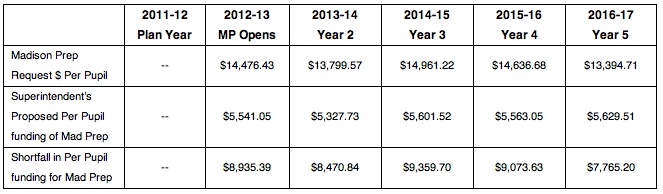
As I have written, it looks like the roughly $14,500 per student that Madison Prep is seeking from the school district for its first year of operations is per nearly twice the per-student funding that other independent and non-instrumentality charter schools in the state now receive.
Independent charter schools, for example, receive $7,750 per-student annually in state funding and nothing from the local school district. As far as I can tell, non-instrumentality charter schools tend to receive less than $7,750 from their sponsoring school districts.
It seems that the Madison Prep proposal seeks to pioneer a whole new approach to charter schools in this state. The Urban League is requesting a much higher than typical per-student payment from the school district in the service of an ambitious undertaking that could develop into what amounts to a shadow Madison school district that operates at least a couple of schools, one for boys and one for girls. (If the Urban League eventually operates a girl’s school of the same size as projected for Madison Prep, it would be responsible for a total of 840 students, which is a larger total enrollment than about 180 school districts in Wisconsin can claim.)
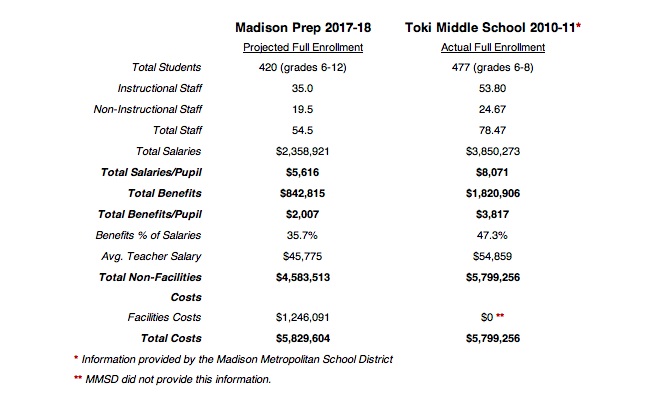
What about the argument that Madison Prep does not propose to spend any more on a per-student basis than the Madison school district already spends? There are a couple of responses. First, MMSD does not spend $14,500 per student on in-school operations – i.e., teachers, classroom support, instructional materials. The figure is more like $11,000. But this is not the appropriate comparison.

Much more on the proposed IB Charter school: Madison Preparatory Academy, here.

Share

UW Ed School Dean and WPRI President on the Recent School Choice Results

Julie Underwood:

The release of the results of the Wisconsin Knowledge and Concepts Exam, the standardized test that every state public school is required to give, is a rite of spring for Wisconsin schools.
Distributed every year, the WKCEs provide educators, parents and community members with information about how well schools and districts are performing, broken down by subject and grade level.
The WKCEs are used alongside other measures to determine where schools are falling short and what is working well. For parents with many different types of educational options from which to choose, the WKCEs allow them to make informed choices about their child’s school. For taxpayers, the tests provide a level of transparency and demonstrate a return on investment.
But while state law requires all public schools to give the WKCEs, not all publicly funded schools are required do to so. Since its inception 20 years ago, the Milwaukee Parental Choice Program has been virtually without any kind of meaningful accountability measures in place. Choice schools have not been required to have students take the WKCEs. That is, until this school year.

George Lightbourn:

We have all done it at one time or another — opened our mouth before engaging our brain.
State Rep. Sondy Pope-Roberts, D-Middleton, just had one of those moments. In reacting to the news that, on average, students attending schools in the Milwaukee Parental Choice program performed about the same or slightly below students in Milwaukee Public Schools, she said taxpayers are being “bamboozled” and the program is “a disservice to Milwaukee students.”
Whoa! Had she taken a moment to think before she spoke, here are a few things that should have occurred to her:
• Those private schools are performing about as well at educating Milwaukee children as the public schools — at half the cost. Public funding for each child in the choice program costs taxpayers $6,442 while each child in Milwaukee Public Schools receives taxpayer support of over $15,000. If all of the 21,000 choice students moved back into Milwaukee Public Schools, that would require a $74 million increase in local property taxes across the state, according to the Legislative Fiscal Bureau.

Much more, here.

Share

Don’t hide ‘step and lane’ raises in the Madison School District

The Wisconsin State Journal:

The salary schedule for Madison teachers is frozen for the next school year.
But teachers will still get raises.
That’s because, outside of the general salary schedule, Madison teachers are financially rewarded for their years of experience and for the higher education coursework they complete toward advanced degrees.
These “step and lane” raises, as they are called, will average 2.3 percent next school year for Madison teachers.
Madison School District Superintendent Dan Nerad and two School Board members didn’t know what this figure was when they met with the State Journal editorial board three weeks ago.
One School Board member even suggested the average teacher raise for years of experience and higher education credits would be so small it was hardly worth considering.
But a 2.3 percent raise sounds pretty good to private sector workers who have endured real pay freezes, furloughs and layoffs for years now because of the recession and slow economic recovery. The school district calculated the 2.3 percent figure last week at the State Journal’s request.

Updated with a new link (and a Google Cache archive pdf) sent by a kind reader’s email. Here is the original, non working link.

Share

Milwaukee Public Schools agree to close, merge, move schools

The Milwaukee School Board on Thursday night closed, merged or relocated about seven schools for next year to address space and facility issues in a district facing an upcoming $74 million budget shortfall.
At the same time, board members considered plans to open a handful of public charter schools next year. By late Thursday, they had approved an education management company to restart North Division High School as a charter school, and they had approved a voucher-school operator to open a public K-12 charter school with a residential element for high schoolers.
The board approved a proposal from Milwaukee College Prep, one of the city’s highest-performing charter schools, to lease with an option to buy the vacant Thirty-Eighth Street School building. The deed restriction on the school, which keeps it from being used as a school that would compete with MPS, would be lifted after five years.
Robert Rauh, leader of Milwaukee College Prep, said College Prep proposed expanding into the Thirty-Eighth Street building as an MPS non-unionized charter school for kindergarten through fourth grade. Middle schoolers in grades five through eight would make up the population at Milwaukee College Prep’s main campus in Metcalfe Park.

Share

Boxer Calls on American Bar Association to Ensure Accurate and Transparent Data Reporting by Law Schools

Boxer.Senate.Gov:

U.S. Senator Barbara Boxer (D-CA) today called on the American Bar Association (ABA) to improve its oversight of admissions and post-graduation information reported by law schools across the country.
Boxer’s letter follows news reports that have highlighted several law schools allegedly using misleading data to enhance a school’s position in the competitive and influential U.S. News and World Report annual rankings. Such inaccurate post-graduation employment and salary data can mislead prospective students into believing they will easily be able to find work as an attorney and pay off their loans despite a sharp decline in post-graduation full-time employment.
The full text of the Senator’s letter is below:

Share

An Interview with Jackson school board candidate Nicolas Antonoff

Jtown:

Why are you running for a seat on the Jackson Schools Board of Education?
When we bought our home in Jackson (only the second purchase in my thirty plus years of rather hectic service in the “Military-Industrial Complex”, helping fight and win the Cold War in all its versions across nearly half the lower 48 states), my wife and I found ourselves stakeholders in the Jackson Enterprise , both divisions – educational (60 percent) and municipal (40 percent). After observing the rapid deterioration in the management of both from the relatively peaceful days of the late 1990′s (zero increase in the school tax rate and an equally steady municipal tax rate) I took an active interest in the operation of the increasingly dysfunctional Board of Education (BoE). Of special interest is the BoE’s stubborn and inflexible operating principle that “education” improvement is inevitable if you just shovel sufficient millions of dollars into the bottomless maw of the educator cadres (NJEA Jackson cell in cahoots with the School Administration), eventually some of that will stick. Ending this mind set is my overriding objective.
How do you feel your presence on the school board can benefit education in Jackson?
What passes for a proper education, to be fair, not just in Jackson, is the fostering in the Trophy Kids generation students of a conviction of entitlement and victimization if they are not pampered at every turn(expect to get a medal or commendation of some sort for just showing up on time ). Other countries, our main competitors, teach that students have an obligation to learn in return for the privilege, not the right, granted them . That is their duty to their parents and the nation, and ultimately themselves. That is why our pampered students get their clock cleaned in international math and science competitions, year after bloody year. My contribution to education in Jackson will flow from my thirty years of experience of overseeing and executing the staffing of programs in often way-off-the-road places demanding the hiring on tight schedules of large numbers (hundreds) of often ill-prepared junior engineers with king-sized salary expectations. Thank God for the availability of retiring US Army trained senior noncoms and warrant officers – they always save the contract and know how to run an mission to meet assigned objectives.

Share

Vouchers Aren’t the Answer

Lisa Kaiser:

Today the Department of Public Instruction (DPI) released new results for the statewide exam.
Not surprising to those who have been paying attention, Milwaukee Public Schools (MPS) did better than schools in the Milwaukee Parental Choice Program (MPCP), otherwise known as the voucher program.
Overall, MPS had 47.8% of its students scoring as proficient in math, with 59% proficient in reading.
Among economically disadvantaged kids, MPS scored 43.9% in math and 55.3% in reading.
Those scores are lower for students in the voucher program–all of whom are economically disadvantaged, although that could change if Gov. Scott Walker has his way and opens up the program to middle-class and wealthy kids. Only 34.4% of voucher students scored proficient in math, while 55.2% were proficient in reading, about the same as MPS.

Share

East Valley, WA district moving to K-8 schools

Lisa Leinberger:

The East Valley School District is asking voters to approve a $33.75 million school construction bond on April 26. The bond will be used to expand and renovate its primary schools.
But the issue many are debating is the district’s decision to eliminate its middle schools and turn its elementary schools into kindergarten through eighth grade schools, regardless of bond approval.
It’s a model that’s being considered across the country. Districts in Massachusetts, Pennsylvania, Ohio, Tennessee, Oklahoma, Maryland and New York – including the large urban areas of Cincinnati, Cleveland, Philadelphia and Baltimore – are moving toward K-8 schools.

Share

What is a Charter School? And what does it have to do with you?

Kathleen Vinehout:

“I’ve heard of charter schools,” the woman told me. “But I really don’t know understand them.” People are not familiar with schools often run by a private group but using taxpayer dollars.
Imagine a school created with a business-like contact or “charter”. This charter sets it own rules for the school and exempts it from the usual rules about classes, staff, budgeting and administration.
Many charter schools are created and run by local school districts but some are independent charters. Cost to local school districts for these independent schools this year was almost $60 million statewide. In our Senate District, school districts will pay an estimated $1.3 million in the next two years for these independent charter schools.

Share

Executive Order #22: Read to Lead Task Force

Wisconsin Governor Scott Walker, via a kind reader’s email:

EXECUTIVE ORDER # 22
Relating to the Creation of the Governor’s
Read to Lead Task Force
WHEREAS, the number one priority for children in grades kindergarten through third grade is to learn to read; and
WHEREAS, one third of all Wisconsin students cannot read at a basic level and two thirds of all African American students in our state cannot read at a basic level, which is the lowest rate in the nation; and
WHEREAS, in approximately ten years, Florida, through state reading law reforms, has improved from one of the lowest ranked states in the nation to one of the highest and in doing so achieved a much smaller racial achievement gap than Wisconsin; and
WHEREAS, it is critical to have initiatives that will empower teachers, districts, and parents–not lawmakers–with the ability to decide how best to teach reading and explore ways to provide teachers and parents with better tools to identify young struggling students and address why they are struggling and how to overcome those challenges; and

Share

hree DeKalb County, GA school chief finalists: All run much smaller districts

Maureen Downey:

Arthur Culver: He is the superintendent in Champaign, Illinois and has been suggested in the Illinois media as a candidate for the Chicago’s school chief job.
In 2009, the Champaign school board voted 4-3 to extend his contract. In 2007, the board extended Culver’s contract from four years to five. His contract now goes to 2012. According to the local newspaper, Culver earns $226,049 a year.
Culver had been school chief in the Longview Independent School in Texas. (Here is a story about a controversy that followed Culver from Texas to Illinois.)
Culver came from Texas to Champaign in 2002. According to the newspaper in East Center Illinois, the News-Gazette, “Since then, he’s had his hands full trying to meet the requirements of a consent decree negotiated before his arrival that is aimed at improving the performance of minority students. He’s done a good job, so it’s understandable a board majority would want to show its appreciation.”

Share

Racine Unified taking next steps on path to North Star vision

Racine Superintendent Dr. James Shaw:

The Racine Unified School District is at a crossroads. We are doing the right things and we are making progress. On April 5, the school referendum will ask for your support in furthering that progress.
Racine Unified has a powerful vision of learning for all students, the North Star. It says that ALL students will graduate career- and/or college-ready. We have a data system that tracks learning, teaching, engagement and resources to monitor our progress and increase accountability. We have early successes in sixth-grade math, in writing at every measured grade level, the growth of student cohorts on the WKCE and dramatic improvements in such excellent schools as Gifford, Red Apple and Schulte Elementary Schools.
We have reorganized school schedules to increase instructional time and collaborative planning time for teachers. We have raised the bar for all students by reducing basic classes and expanding IB curriculum and AP courses across the district. We have increased tutoring, summer school and Lighted Schoolhouse programs. We are including special education children in regular education classrooms. We are negotiating a Master Teacher and Master Principal program as the first step toward pay for performance. We have school-based payday and data teams that have developed aggressive improvement plans for each school. We have reorganized the Administrative Service Center to support as well as supervise school improvement efforts.

Share

Pink slips line road to more efficient UW

Chris Rickert:

This is why a year and a half after the economy started growing again, unemployment remains near 9 percent; companies realize they can produce just as much with fewer of us. (Oddly, the BLS does not measure productivity in the public sector, like in public universities.)
Reducing staff is not a tactic UW-Madison has tried of late. From 2007 to 2010, it added about 325 people per year, from the equivalent of 16,368 full-time employees in 2007 to 17,344 in 2010.
But managers know some employees are better than others. Ask them who they can live without, and then expect them to live without them.
Darrell Bazzell, UW-Madison vice chancellor for administration, said that “given the budget cuts, we will likely lose many positions.” But he said the consultant could help find savings “above and beyond the savings available through simply reducing staffing.”

Share

New study on KIPP: Higher attrition and lots more money per pupil

Maureen Downey:

There are a few dissenters who have remained leery of the great success story of the KIPP schools, questioning the turnover of students in the acclaimed program. KIPP operates three schools in the metro area and a high school, KIPP Atlanta Collegiate, opens this summer.
Now skeptics are about to get some data on attrition and funding that may confirm their suspicions.
In a study bound to raise the hackles of KIPP supporters, researchers at the College of Education and Human Development at Western Michigan University and Teachers College at Columbia University found that KIPP has a high attrition rate among African-American boys.
While the study does not challenge the academic success of KIPP graduates, it raises questions about the funding and whether the high level of private dollars is sustainable. The study found that KIPP schools benefit tremendously by donations and private funding, earning an extra $6,500 on average per pupil.
KIPP sent me a comment and fact sheet rebuttal of the study: Go to the link to see the back sheet.

Share

Tests Reveal Madison Schools Wrestle With Achievement Gaps Tests Examined Reading, Math Proficiency

Channel3000:

Madison Metropolitan School District officials are beginning to digest new statewide test score results.
The results for Madison are mixed, but district leaders said that they believe they have a lot of work to do to improve.
The tests reveal that Madison is home to some very bright students, but Superintendent Dan Nerad said that schools aren’t doing enough for students who are struggling. He said the test results are proof.
The results showed that, in general, reading levels among students increased across the board while math performance improved only slightly.
District officials said that they also continue to be a “bi-modal” district — meaning there are students who are scoring at the highest level while it also has ones who are scoring at the lowest levels in nearly every grade in math and reading.

Related:

The Wisconsin Knowledge & Concepts Examination (WKCE) has long been criticized for its lack of rigor. Wisconsin DPI WKCE data.

Related: “Schools should not rely on only WKCE data to gauge progress of individual students or to determine effectiveness of programs or curriculum”.

Share

Final exam: As elections loom, Barack Obama tries to reform America’s schools

The Economist:

AMERICA’S schools are dotted with stories of progress. In December your correspondent watched a class of seven-year-olds on Chicago’s poor West Side. As Mauricia Dantes, a consultant for IBM before she retrained as a teacher, led the pupils in a discussion about the deaf-and-blind author Helen Keller, one small girl declared: “I feel like I’m in college.” One day, thanks to Ms Dantes and other teachers, she may be.
Barack Obama wants such scenes to be the rule rather than the exception. The question is what the federal government can do to help. Ten years ago Congress passed the No Child Left Behind Act (NCLB), a bold effort to improve America’s schools. On March 14th Mr Obama announced that he wants to pass a new version by August. It could be one of his most important feats. But it will not be easy.

Share

The Public Sector Premium for School Principals

Average Salaries, 2007-2008
Age Public Private Public Premium
  Under 40 $80,600 $47,300 70.40%
  40 to 44 $84,900 $54,800 54.93%
  45 to 49 $86,000 $55,000 56.36%
  50 to 54 $88,100 $59,500 48.07%
  55 or over $91,500 $63,700 43.64%
Average $86,900 $58,300 49.06%

In a recent CD post, I featured the public sector premium for full-time elementary and secondary school teachers, which ranges from 14% to 102%, depending on experience and education.  The chart above is based on Department of Education data for the salaries of private and public school principals in 2007-2008 based on age.  Compared to public school principals in the age groups above, private school principals have slightly more experience as principals, slightly less experience as teachers, and are less likely to have advanced degrees (Master’s or Doctor’s degrees).  So the age group categories above don’t control perfectly for education and experience, but still show huge premiums for public school principals of 43% or higher, with an overall average premium of 49%.

Share

Detroit Considers 45 Charter School

Matthew Dolan:

The state-appointed manager of Detroit Public Schools identified 45 schools in the struggling district that could be turned over to private charter operators in a bid to improve student performance.
Wednesday’s release of the target list comes as the manager, Robert Bobb, heads into a new round of talks with unions, armed with broad new authority to reopen labor contracts, cut costs and dictate curriculum.
Since his appointment more than two years ago, Mr. Bobb’s efforts to stabilize the district’s finances and bolster its academics have faced resistance from teachers unions and the school board. Michigan Republican Gov. Rick Snyder changed all of that earlier this month, when he signed into law expanded powers for Mr. Bobb and other financial managers appointed to take over struggling cities and schools.
A Wayne County judge who earlier ruled that Mr. Bobb had improperly exerted control over academics stayed her order in light of the new legislation.
“This is one-man rule,” said George Washington, an attorney for the school board. “He doesn’t even have to meet with the school board.”

Share

Study: Voucher students more likely to attend college

Milwaukee voucher students are more likely to graduate and enroll in college than their public school counterparts, according to a new study from researchers the state asked to evaluate the Milwaukee Parental Choice Program.
The finding is one of eight that researchers with the University of Arkansas’ School Choice Demonstration Project say demonstrate the “neutral to positive” results of the 20-year-old voucher program.
Other findings, such as the neutral effect on student test scores, were discovered in past years of the study and reaffirmed in the latest findings.
“We haven’t found any evidence of harm, and it wasn’t for lack of looking,” said lead researcher Patrick Wolf, who will be presenting the new research at UW-Madison today.

Erin Richards has more on the Milwaukee voucher program:

A day after the release of state test scores showed voucher-school students in Milwaukee achieving lower levels of reading and math proficiency than students in Milwaukee Public Schools, new data from researchers studying the voucher program’s results over multiple years shows those students are doing about the same as MPS students, not worse.
The contradictory report is part of the latest installment of data from a group of researchers at the University of Arkansas who have been tracking a sample of Milwaukee voucher students matched to a set of MPS peers since 2005-’06.
After looking at achievement results on state tests over three years for those matched samples of students, the researchers’ data continues to show little difference in academic achievement between both sectors in 2009.
For a matched sample of ninth-grade students in 2005-’06, the researchers found slightly higher graduation rates and college enrollment for voucher students three years later.
….
John F. Witte, a professor of political science and public affairs at the University of Wisconsin-Madison who’s involved with research on the five-year study, said the program is justifiable because it gives low-income families more opportunities.
“Some higher-income people are free to switch schools or move their kids out of the city because they have resources, and some people don’t have those resources, so the program balances that out,” Witte said. “This was never intended to be a silver bullet.”

Milwaukee Parental Choice Research information.

Share

Indiana House Passes Broad Voucher Bill

The Indy Channel:

The Indiana House on Wednesday passed what would be the nation’s broadest use of school vouchers, allowing even middle-class families to use taxpayer money to send their children to private schools. The bill passed the house 56-42.
In an effort to lure House Democrats back from a five-week, self-imposed exile in Illinois, Republicans agreed to reduce the number of vouchers, with a limit of 7,500 the first year and 15,000 the second, 6News’ Norman Cox reported.
Still, unlike other systems that are limited to lower-income households, children with special needs or those in failing schools, this one would be open to a much larger pool of students, including those whose parents earn up to $60,000 a year.

Share

In School Board races, talk about education scarce

Chuck Sweeney:

A week from today, about 10 percent to 15 percent of the voters will go to the polls and choose three members of the Rockford School Board to help govern the third largest school district in Illinois.
A fourth member, Bob Evans, will be re-elected because the Rockford College professor is unopposed.
We’ve written reams of copy here at the News Silo about the upcoming election. Our colleagues at WNTA radio and at the television stations have interviewed the candidates on the air. Forums have been held.
A lot of issues have been discussed. Should the board continue to be elected from seven subdistricts or should we pursue legislation at the state level to allow the mayor of Rockford and the Winnebago County Board chairman to appoint some or all of the members? What are the “real” numbers in the ongoing debate about the size of the budget shortfall for the remainder of this school year and the next? Do people trust the superintendent or should we hire a new one?

Share

Return of the One-Room Schoolhouse

RiShawn Biddle

Even among the nation’s woeful traditional big-city school districts, Detroit Public Schools is a particular abomination. Between falling into state receivership for the second time in the past 12 years, facing $327 million in budget deficits for the next four years, wrangling with scandals such as the travails of literacy-bereft now-former school board president Otis Mathis (who resigned last year after the district’s superintendent complained that he had engaged in lewd acts during meetings), and constant news about its failure to educate its students, the Motor City district has secured its place as the Superfund site of education.
So it wasn’t a surprise when Detroit’s state-appointed czar, Robert Bobb, announced on March 12 that the district would slash its deficit — and eliminate as much as $99 million in costs from operating its bureaucracy — by getting rid of 29 percent of the 142 dropout factories and failure mills. But instead of just shutting down the 41 schools (as the district originally planned to do) it would convert them into charter schools, handing off instruction, curriculum, and operations to nonprofits, parents groups, and others interested in running schools.

Share

School Founder Says Class Size Doesn’t Matter

Neal Conan:

Small class size is thought to be a ticket to classroom success. Some states require schools, by law, to limit the number of students assigned to one teacher. But Eva Moskowitz, founder and chief executive of the Success Charter Network, argues that formula doesn’t guarantee a good education.

Share

Obama team opposes Boehner’s school vouchers bill

Catalina Camia:

The Obama administration “strongly opposes” a bill championed by House Speaker John Boehner that would revive and expand vouchers for low-income students in the District of Columbia.
The administration’s statement stops short of saying President Obama will veto the measure, known as the Scholarships for Opportunity and Results Act or SOAR.
“Private school vouchers are not an effective way to improve student achievement,” said the Office of Management and Budget statement. “The administration strongly opposes expanding the D.C. Opportunity Scholarship Program and opening it to new students.”

Share

Retired Teachers in California Earn More Than Working Teachers in 28 States

Mike Antonucci:

I came across the most recent summary report for the California State Teachers’ Retirement System (CalSTRS) and I thought its pared-down tables and graphs nicely encapsulated the pension situation in the state.
First note that the average annual salary in 2010 for active working educators enrolled in the system was $64,156. The next table states that the average retirement benefit paid out in 2010 was $4,256 per month. That’s $51,072 annually. In other words, the average retired teacher in California made more than the average working teacher in 28 states, according to the salary rankings published by NEA.
The final graph in the report provides the big picture. While the value of the pension system’s assets has increased fairly steadily over the past nine years, the accrued liabilities have grown non-stop during the same period, leaving the fund at 78% of full coverage. What’s more, CalSTRS operated on an assumed annual return of 8 percent. Last year, the pension board lowered that expectation to 7.75 percent, which means projections for the future will show even more of a gap.

Share

Pushout

Several decades ago, the Canadian Army was having a problem with its male recruits. Far too many of them were going Absent WithOut Leave, for various reasons, to various places, for varying amounts of time.
The Army tried giving them punishment laps, kitchen duty, latrine duty, even time in the stockade, but nothing worked–they were still going AWOL.
Finally, someone thought of trying something completely new. They sent the recruit home to his mother, with a note saying he was too immature for Army duty, and would she keep him at home for another year, and then perhaps he could try again. The AWOL problem disappeared.
Something like 50% of new teachers leave the profession within five years, and they don’t, for the most part, go home to mother, but they do leave a hole and a problem in filling their shoes back in the schools.
My guess is that no one conducts serious exit interviews with these teachers, who are perfectly free to leave the profession, for personal reasons, to start a different career, or whatever. But I would argue that a significant portion of them, it would be found if there were serious exit interviews conducted, have been virtually pushed out.
People go back and forth arguing whether teaching is a profession or a civil service job like firefighters and police, paid out of municipal taxes.
In general, professionals don’t have clients delivered to them, as students are delivered to teachers, and if a client leaves a lawyer for another lawyer the first lawyer does not call his union representative.
For me, one test of whether a teacher is a professional or not is whether she/he can refuse service to someone. Lawyers who are about to try a case in court before a jury can interview potential jurors and they have, I think, two peremptory challenges, which allow them to say: “This potential juror and that potential juror are excused.” They can exercise this privilege if there are a couple of people they think would prejudice their case or make it harder to win. They don’t have to give any reasons.
A “professional” teacher, on the other hand, is not allowed to look over a class, and say, “This one and that one, I can’t teach.” Even if what it means is if those students stay in their class they may have to give 60% of their time to controlling them, and have only 40% of their time for the other 27 students. And it is worse than that, because the effort to control disruptive students does not come at one time in the class, but is needed to interrupt the rest of the class any number of times.
Teachers are trained and expected not to think about stuff like that. They are taught and expected to believe that it is their job to accept all comers and exercise their “classroom management skills” without being relieved of the burden of any disruptive student, no matter how much damage that student may do to the education of the other students in the class.
So teachers, for the most part, take all students, and their teaching suffers as a result. They are frustrated in their efforts to offer the best that they have to the majority of their students. And, by the way, it is no secret to the students that the school administration doesn’t have enough respect for the teacher’s professional work to remove such a student. And we wonder why people don’t want to be teachers and don’t want their children to be teachers.
Theodore Roosevelt had a guest in the oval office one day, when his daughter Alice came charging through the room screaming. The guest asked the President if he couldn’t control her. TR responded that he could control Alice, or he could be President of the United States, but not both. He was a professional and was treated as such.
I blame teachers for not having the courage to say that if I have to keep this student or that student in my class, the education I am able to offer to the other students will be damaged by 60%. If they did say that, of course they would be judged incompetent in classroom management and probably encouraged to leave the profession.
Many too many do leave the profession, and I believe that many of them were literally pushed out through being prevented from doing their best by the unchecked and disregarded misbehavior of some students. I know that every Nobel Prize winner was once a high school student, but so was every rapist and murderer, and students who cannot conduct themselves as they should must not be allowed to ruin the careers of our teachers. Perhaps such students should be sent home to their mothers, but they don’t belong in classrooms where important professional academic work is going on.
———————-
“Teach by Example”
Will Fitzhugh [founder]
The Concord Review [1987]
Ralph Waldo Emerson Prizes [1995]
National Writing Board [1998]
TCR Institute [2002]
730 Boston Post Road, Suite 24
Sudbury, Massachusetts 01776-3371 USA
978-443-0022; 800-331-5007
www.tcr.org; fitzhugh@tcr.org
Varsity Academics®
www.tcr.org/blog


Share

Sun Prairie Schools’ WKCE Results Above State Averages

Scott Beedy, via a kind reader’s email:

The 2010 Wisconsin Knowledge and Concepts Exam results reveal strong academic achievement for students in the Sun Prairie Area School District, according to district officials.
This past November, Sun Prairie administered the WKCE to more than 3,400 students in grades 3 through 8 and grade 10. Students in grades 3 through 8 were assessed in reading and math. Students in grades 4, 8 and 10 were also assessed in language arts, science, social studies and writing.
It is important to note that testing in the fall shows the impact of instruction from the previous school years and just two months at the designated grade level. For example, 6th grade scores reflect proportionately more about the 5th grade program than about the 6th grade program.
Combining all grade levels, 88 percent of Sun Prairie students are proficient or advanced in reading and 86 percent are proficient or advanced in math, according to district officials. The numbers are both an increase from last year.

Much more on the recent WKCE results, here.

Share

Transparency: Are the Richest Americans Also the Best Educated?

GOOD and Greg Hubacek:

The latest data from the U.S. Census’s American Community Survey paints a fascinating picture of the United States at the county level. We’ve looked the educational achievement and the median income of the entire nation, to see where people are going to school, where they’re earning money, and if there is any correlation.

Share

School choice expanding as record fine languishes

Associated Press:

A school choice group that pumped millions of dollars into helping get its candidates elected in Ohio, Wisconsin and other states has yet to pay a record $5.2 million fine imposed three years ago by Ohio election officials, according to the state attorney general.
The fine imposed on All Children Matter languishes even as Ohio Gov. John Kasich pushes a $55.5 billion budget proposal that would continue to expand school choice, doubling the number of school vouchers in the state and lifting a cap on community schools.
The Ohio Elections Commission unanimously ruled in 2008 that All Children Matter, headed by former Michigan Republican Chairwoman Betsy DeVos and run out of that state, illegally funneled $870,000 in contributions from its Virginia political action committee to its Ohio affiliate. That violated a $10,000 cap on what Ohio-based political-action committees could accept from any single entity.

Share

How to Raise the Status of Teachers

Room for Debate:

Michael J. Petrilli is the executive vice president at the Thomas B. Fordham Institute and a research fellow at the Hoover Institution.
Raising the “status” of teaching is like chasing a mirage: It looks great from a distance but it never seems to materialize. Teachers today are one of the most respected members of our society, according to opinion polls. The growing backlash against perceived “teacher-bashing” in Wisconsin and elsewhere is more testament that Americans like their teachers. So what exactly is the problem the status-boosters are hoping to solve? Raising teachers’ self-esteem?
On the other hand, it’s true that teaching today is not among the most attractive careers open to talented young people. Making it more attractive is an objective we can do something about.
Today’s teacher compensation system is perfectly designed to repel ambitious individuals. We offer mediocre starting salaries, provide meager raises even after hard-earned skills have been gained on the job and backload the most generous benefits (in terms of pensions) toward the end of 30 years of service. More fundamentally, for decades we’ve prioritized smaller classes over higher teacher pay. If we had kept class sizes constant over the past 50 years, the average teacher today would be making $100,000.

Share

Mandating Betamax

Jay Greene:

I just returned from the Association for Education Finance and Policy annual conference in Seattle, which was a really fantastic meeting. At the conference I saw Dartmouth economic historian, William Fischel, present a paper on Amish education, extending the work from his great book, Making the Grade, which I have reviewed in Education Next.
Fischel’s basic argument is that our educational institutions have largely evolved in response to consumer demands. That is, the consolidation of one-room schoolhouses into larger districts, the development of schools with separate grades, the September to June calendar, and the relatively common curriculum across the country all came into being because families wanted those measures. And in a highly mobile society, even more than a century ago, people often preferred to move to areas with schools that had these desired features. In the competitive market between communities, school districts had to cater to this consumer demand. All of this resulted in a remarkable amount of standardization and uniformity across the country on basic features of K-12 education.
Hearing Fischel’s argument made me think about how ill-conceived the nationalization effort led by Gates, Fordham, the AFT, and the US Department of Education really is. Most of the important elements of American education are already standardized. No central government authority had to tell school districts to divide their schools into grades or start in the Fall and end in the Spring. Even details of the curriculum, like teaching long division in 4th grade or Romeo and Juliet in 9th grade, are remarkably consistent from place to place without the national government ordering schools to do so.

Share

iPad as Digital Whiteboard

Fraser Speirs:

I want to highlight a fun thing I tried the other day. I don’t know why it didn’t occur to me before try it, but it worked pretty well.
Long story short, the whiteboards in my classroom are worn out. They’re impossible to wipe without spraying enough whiteboard cleaner to get an elephant high. Not a good situation.
With my new AV system in hand and an iPad 2, I figured out that I could probably put something together that looks like a digital whiteboard.

Share

Freshmen Ineligibility: An Old-but-Wise Approach to Improving Academics in College Basketball

Maggie Severns:


U.S. Secretary of Education Arne Duncan ushered in the NCAA Men’s Basketball tournament earlier this month with an op-ed in The Washington Post arguing that schools should only qualify for post-season play if they are on track to graduate at least 40 percent of their players.
The argument by Duncan, who is a basketball player and fan himself, has been made by many critics, including the Knight Commission for Intercollegiate Athletics, which proposed restricting participation to only those programs that graduated more than half of their players. And rightfully so: men’s college basketball does a poor job of graduating its players, with 10 of the original 68 teams in the tournament not meeting the “50 percent” benchmark this year. This leaves players who don’t go professional — the vast majority of them — without the knowledge and skills they need to succeed in the real world. Many sportswriters and fans, on the other hand, think that Duncan’s viewpoint is out of touch –and that critics of NCAA basketball and football need to come to grips with the fact that, for many athletes who play for hugely popular athletics programs, the sport is simply more important than the degree.

Share

Wisconsin State Budget Hearings

Laura Chern, via email:

The Joint Committee on Finance is required to get input on the proposed budget at a series of hearing around the state. Let legislators and the governor know how you feel about the $1 billion in cuts to public education by attending a hearing. Here is a link to the hearing schedule:
http://legis.wisconsin.gov/lfb/jfc/schedule.htm

2011-13 Summary of Governor’s Budget Recommendations (SB27/AB 40).

Share

Wisconsin Schools Told to Wait on Contracts

Scott Bauer:

The Wisconsin school board association on Monday urged districts that have not reached new deals with teachers’ unions to hold off given the uncertainty over whether a new law removing nearly all collective bargaining rights is in effect.
Many school districts, counties and municipalities have been rushing to reach deals before the law that takes away all bargaining rights except over base salary kicks in.
Republican lawmakers pushed through passage of the law earlier this month despite massive protests that drew up to 85,000 people to the state Capitol and a boycott by Democratic state senators. Opponents immediately filed a series of lawsuits, and a hearing on one was scheduled Tuesday. The judge in that case had issued a restraining order barring Democratic Secretary of State Doug La Follette from publishing the law, typically the last step before it takes effect.

Share

Caire, Nerad & Passman Wisconsin Senate Bill 22 (SB 22) Testimony Regarding Charter School Governance Changes

Madison Urban League President Kaleem Caire 13mb .mp3 audio file. Notes and links on the Urban League’s proposed IB Charter school: Madison Preparatory Academy. Caire spoke in favor of SB 22.
Madison School District Superintendent Dan Nerad 5mb .mp3 audio file. Nerad spoke in opposition to SB 22.
Madison School Board Member Marj Passman 5mb .mp3 audio file. Passman spoke in opposition to SB 22.
Much more on SB 22 here.
Well worth listening to. Watch the hearing here.

Share

What cuts? Madison schools OK

Wisconsin State Journal Editorial:

Alarmists in Madison suggest Gov. Scott Walker’s state budget proposal will decimate public education.
But Superintendent Dan Nerad’s proposed 2011-2012 budget for Madison School District tells a different story.
Under Nerad’s plan, unveiled late last week, the Madison district would:

That’s not to suggest Madison schools are flush with money. Gov. Walker, after all, is trying to balance a giant state budget deficit without raising taxes or pushing the problem further down the road. Walker has proposed cuts to most state programs, including aid to public schools.

Share

Milwaukee Voucher School WKCE Headlines: “Students in Milwaukee voucher program didn’t perform better in state tests”, “Test results show choice schools perform worse than public schools”, “Choice schools not outperforming MPS”; Spend 50% Less Per Student

Erin Richards and Amy Hetzner

Latest tests show voucher scores about same or worse in math and reading.
Students in Milwaukee’s school choice program performed worse than or about the same as students in Milwaukee Public Schools in math and reading on the latest statewide test, according to results released Tuesday that provided the first apples-to-apples achievement comparison between public and individual voucher schools.
The scores released by the state Department of Public Instruction cast a shadow on the overall quality of the 21-year-old Milwaukee Parental Choice Program, which was intended to improve results for poor city children in failing public schools by allowing them to attend higher-performing private schools with publicly funded vouchers. The scores also raise concerns about Gov. Scott Walker’s proposal to roll back the mandate that voucher schools participate in the current state test.
Voucher-school advocates counter that legislation that required administration of the state test should have been applied only once the new version of the test that’s in the works was rolled out. They also say that the latest test scores are an incomplete measure of voucher-school performance because they don’t show the progress those schools are making with a difficult population of students over time.
Statewide, results from the Wisconsin Knowledge and Concepts Exam show that scores didn’t vary much from last year. The percentage of students who scored proficient or better was higher in reading, science and social studies but lower in mathematics and language arts from the year before.

Susan Troller:

Great. Now Milwaukee has TWO failing taxpayer-financed school systems when it comes to educating low income kids (and that’s 89 per cent of the total population of Milwaukee Public Schools).
Statewide test results released Tuesday by the Wisconsin Department of Public Instruction include for the first time performance data from the Milwaukee Parental Choice Program, which involves about 110 schools serving around 10,000 students. There’s a total population of around 80,000 students in Milwaukee’s school district.
The numbers for the voucher schools don’t look good. But the numbers for the conventional public schools in Milwaukee are very poor, as well.
In a bit of good news, around the rest of the state student test scores in every demographic group have improved over the last six years, and the achievment gap is narrowing.
But the picture in Milwaukee remains bleak.

Matthew DeFour:

The test results show the percentage of students participating in the Milwaukee Parental Choice Program who scored proficient or advanced was 34.4 percent for math and 55.2 percent for reading.
Among Milwaukee Public Schools students, it was 47.8 percent in math and 59 percent in reading. Among Milwaukee Public Schools students coming from families making 185 percent of the federal poverty level — a slightly better comparison because voucher students come from families making no more than 175 percent — it was 43.9 percent in math and 55.3 percent in reading.
Statewide, the figures were 77.2 percent in math and 83 percent in reading. Among all low-income students in the state, it was 63.2 percent in math and 71.7 percent in reading.
Democrats said the results are evidence that the voucher program is not working. Rep. Sondy Pope-Roberts, D-Middleton, the top Democrat on the Assembly Education Committee, said voucher students, parents and taxpayers are being “bamboozled.”
“The fact that we’ve spent well over $1 billion on a failed experiment leads me to believe we have no business spending $22 million to expand it with these kinds of results,” Pope-Roberts said. “It’s irresponsible use of taxpayer dollars and a disservice to Milwaukee students.”
Rep. Robin Vos, R-Rochester, who is developing a proposal to expand the voucher program to other cities, took a more optimistic view of the results.
“Obviously opponents see the glass half-empty,” Vos said. “I see the glass half-full. Children in the school choice program do the same as the children in public school but at half the cost.”

Only DeFour’s article noted that voucher schools spend roughly half the amount per student compared to traditional public schools. Per student spending was discussed extensively during last evening’s planning grant approval (The vote was 6-1 with Marj Passman voting No while Maya Cole, James Howard, Ed Hughes, Lucy Mathiak, Beth Moss and Arlene Silveira voted yes) for the Urban League’s proposed Charter IB School: The Madison Preparatory Academy.
The Wisconsin Knowledge & Concepts Examination (WKCE) has long been criticized for its lack of rigor. Wisconsin DPI WKCE data.
Yin and Yang: Jay Bullock and Christian D’Andrea.
Related: “Schools should not rely on only WKCE data to gauge progress of individual students or to determine effectiveness of programs or curriculum”.

Share

Racial achievement gap narrows state-wide, but remains a problem in Madison

Matthew DeFour:

Statewide the gap between the percentage of white and black students scoring proficient or advanced closed 6.8 percentage points in math and 3.9 points in reading between 2005-06 and this year. Comparing white students to Hispanics, the gap closed 5.7 points in math and 3.7 points in reading.
In Madison the gap between white and black students closed 0.4 percentage points in math and 0.6 points in reading. Among Hispanics, the gap increased half a point in math and decreased 1 point in reading.
Madison Superintendent Dan Nerad was unavailable to comment Monday on the results.

The Wisconsin Knowledge & Concepts Examination (WKCE) has long been criticized for its lack of rigor.
Related: “Schools should not rely on only WKCE data to gauge progress of individual students or to determine effectiveness of programs or curriculum”.

Share

ALO versus Differentiated Teaching

Melissa Westbrook:

A thread was requested about ALOs (Advanced Learning Opportunities, the third tier of the Advanced Learning program) and differentiated teaching. Differentiated teaching is a teacher knowing his/her students’ strengths, challenges and readiness and being able to adjust teaching to the different levels in the classroom. (This doesn’t necessarily mean teaching to every single student’s level but rather knowing that there are different abilities in the classroom and trying to meet those needs.)

Share

Teachers’ union sues MIddleton-Cross Plains school district

Gena Kittner:

The union representing teachers in the Middleton-Cross Plains School District sued the district Monday over their collective bargaining negotiations.
According to the complaint filed in Dane County Circuit Court, the union said the district “bargained in bad faith” and proposed non-negotiable contract changes including removal of just cause for discipline and discharge, total district discretion of work hours, elimination of seniority protections, elimination of fair share union dues, modifications/freezes on salary schedules and elimination of compensatory time off.
The district also proposed, according to the complaint, that the School Board be the final step in the grievance procedure as opposed to having a third-party arbitrator as the current agreement states.

Share

‘Value-added’ teacher evaluations: Los Angeles Unified tackles a tough formula

Teresa Watanabe:

In Houston, school district officials introduced a test score-based evaluation system to determine teacher bonuses, then — in the face of massive protests — jettisoned the formula after one year to devise a better one.
In New York, teachers union officials are fighting the public release of ratings for more than 12,000 teachers, arguing that the estimates can be drastically wrong.
Despite such controversies, Los Angeles school district leaders are poised to plunge ahead with their own confidential “value-added” ratings this spring, saying the approach is far more objective and accurate than any other evaluation tool available.
“We are not questing for perfect,” said L.A. Unified’s incoming Supt. John Deasy. “We are questing for much better.”

Much more on “Value Added Assessment“, here.

Share

Yin & Yang on Voucher Schools

Margaret Farrow:

School choice opponent Barbara Miner says that Wisconsin legislators should “just say no” to Gov. Scott Walker’s proposal to expand educational options for Milwaukee parents (Crossroads, March 13).
My advice to legislators?
Just say yes.
Those who do will have Milwaukee residents, especially Milwaukee parents, on their side.
In a recent poll, Milwaukeeans rate the 20-year-old Milwaukee Parental Choice Program successful by a two-to-one margin (60%-28%). The results cut across racial and economic lines and extend even to households without school-age children.
Parents are especially enthusiastic. Two-thirds say the program is successful, and 64% endorse expansion.
There is good reason for their support. Students in Milwaukee’s school choice program graduate from high school at rates 18% higher than Milwaukee Public Schools students, according to estimates by University of Minnesota professor John Robert Warren.

Barbara Miner:

Memo to all Wisconsin legislators. There is an easy way to prove you care about public education in Wisconsin. And it won’t cost a penny.
Just say no to Gov. Scott Walker’s proposed expansion of the Milwaukee voucher program providing tax dollars to private schools.
This may seem merely like a Milwaukee issue. It’s not. Voucher advocates have made clear for more than 20 years that their goal is to replace public education with a system of universal vouchers that includes private and religious schools.
The heartbreaking drama currently playing in Milwaukee – millions of dollars cut from the public schools while vouchers are expanded so wealthy families can attend private schools in the suburbs – may be coming soon to a school district near you.
For those who worry about taxation without representation, vouchers should send shivers down your spine. Voucher schools are defined as private even though subsidized by taxpayers.

Share

Charter, Shmarter

New Jersey Left Behind:

Michael Winerip in today’s New York Times channels Diane Ravitch:

There is a quiet but fierce battle going on in education today, between the unions that represent the public school teachers and the hedge-fund managers who finance the big charter chains, between those who trust teachers to assess a child’s progress and those who trust standardized tests, and occasionally it flares out into the open over something as seemingly minor as the location of a school.

Ooh, those greedy hedge fund managers.
There are plenty of fierce battles in education today, some not so quiet, but I’m not sure the assignation of space in this Washington Heights neighborhood is one of them. Winerip describes two candidates for the space in question, one a traditional public school to be called Castle Bridge, which defines its mission as a non-reliance on standardized testing to gauge student learning, and the other a KIPP academy, with a well-proven track record of excellence.

Share

IMPORTANT SCHOOL BOARD MEETING: Madison Board of Education to Vote on Madison Prep Planning Grant!

Kaleem Caire, via email:

March 28, 2011
Dear Friends & Colleagues,
In 30 minutes, our team and the public supporting us will stand before the Madison Metropolitan School District Board of Education to learn if they will support our efforts to secure a charter planning grant from the Wisconsin Department of Public Instruction for Madison Preparatory Academy for Young Men.
For those who still do not believe that Madison Preparatory Academy for Young Men is a cause worthy of investment, let’s look at some reasons why it is. The following data was provided by the Madison Metropolitan School District to the Urban League of Greater Madison in September 2010.
Lowest Graduation Rates:

  • In 2009, just 52% of Black males and 52% of Latino males graduated on-time from the Madison Metropolitan School District (MMSD) compared to 81% of Asian males and 88% of White males.

Lowest Reading Proficiency:

  • In 2010, just 45% of Black, 49% of Hispanic, and 59% of Asian males in 10th grade in the MMSD were proficient in reading compared to 87% of White males.

Largest ACT Performance Gap:

  • Just 7% of Black and 18% of Latino seniors in the MMSD who completed the ACT college entrance exam were “college ready” according to the test maker. Put another way, a staggering 93% of Black and 82% of Latino seniors were identified as “not ready” for college. Wisconsin persistently has the largest gap in ACT performance between Black and White students in the nation every year.

Children Grossly Underprepared for College:

  • Of the 76 Black seniors enrolled in MMSD in 2010 who completed the ACT college entrance exam required by Wisconsin public universities for admission consideration, just 5 students (7%) were truly ready for college. Of the 71 Latino students who completed the ACT, just 13 students (18%) were ready for college compared to 403 White seniors who were ready.
  • Looking at it another way, in 2010, there were 378 Black 12th graders enrolled in MMSD high schools. Just 20% of Black seniors and completed the ACT and only 5 were determined to be college ready as state above. So overall, assuming completion of the ACT is a sign of students’ intention and readiness to attend college, only 1.3% of Black 12th graders were ready for college compared to 36% of White 12th graders.

Not Enrolled or Succeeding in College Preparatory Courses:

  • High percentages of Black high school students are completing algebra in the 9th grade but only half are succeeding with a grade of C or better. In 2009-10, 82% of Black 9th graders attending MMSD’s four comprehensive high schools took algebra; 42% of those taking the class received a C or better compared to 55% of Latino and 74% of White students.
  • Just 7% of Black and 17% of Latino 10th graders attending MMSD’s four comprehensive high schools who completed geometry in 10th grade earned a grade of C or better compared to 35% of Asian and 56% of White students.
  • Just 13% of Black and 20% of Latino 12th graders in the class of 2010 completed at least two or more Advanced Literature courses with a grade of C or better compared to 40% of White and 43% of Asian students.
  • Just 18% of Black and 26% of Latino 12th graders in the class of 2010 completed at least two or more Advanced Writing courses with a grade of C or better compared to 45% of White and 59% of Asian students.
  • Just 20% of Black 12th graders in the class of 2010 completed 2 or more credits of a Single Foreign Language with a grade of C or better compared to 34% of Latino, 69% of White and 59% of Asian students.
  • Just 33% of Black students took Honors, Advanced and/or AP courses in 2009-10 compared to and 46% of Latino, 72% of White and 70% of Asian students.
  • Just 25% of Black students who took Honors, Advanced and/or AP courses earned a C or better grade in 2009-10 compared to 38% of Latino, 68% of White and 64% of Asian students.

Extraordinarily High Special Education Placements:

  • Black students are grossly over-represented in special education in the MMSD. In 2009-10, Black students made up just 24% of the school system student enrollment but were referred to special education at twice that rate.
  • Among young men attending MMSD’s 11 middle schools in 2009-10, 39% of Black males were assigned to special education compared to 18% of Hispanic, 12% of Asian and 17% of White males. MMSD has been cited by the Wisconsin Department of Public Instruction for disparities in assigning African American males to special education. The full chart is attached.
  • Of all students being treated for Autism in MMSD, 14% are Black and 70% are White. Of all Black students labeled autistic, 77% are males.
  • Of all students labeled cognitively disabled, 46% are Black and 35% are White. Of all Black students labeled CD, 53% are males.
  • Of all students labeled emotionally disabled, 55% are Black and 35% are White. Of the Black students labeled ED, 70% are males.
  • Of all students labeled learning disabled, 49% are Black and 35% are White. Of the Black students labeled LD, 57% are males.

Black students are Disproportionately Subjected to School Discipline:

  • Black students make up a disproportionate percentage of students who are suspended from school. Only Black students are over represented among suspension cases.
  • In 2009-10, MMSD levied 2,754 suspensions against Black students: 920 to Black girls and 1,834 to Black boys. While Black students made up 24% of the total student enrollment (n=5,370), they accounted for 72% of suspensions district-wide.
  • Suspension rates among Black children in MMSD have barely changed in nearly 20 years. In 1992-93, MMSD levied 1,959 suspensions against a total of 3,325 Black students. This equaled 58.9% of the total black enrollment in the district compared to 1,877 suspensions against a total of 18,346 (or 10.2%) white students [Dual Education in the Madison Metropolitan School District, Wisconsin Policy Research Institute, February 1994, Vol. 7, No. 2].
  • Black males were missed a total of 2,709 days of school during the 2009-10 school year due to suspension.
  • Additionally, 20 Black students were expelled from the MMSD in 2009-10 compared to 8 White students in the same year.

    The Urban League of Greater Madison his offering MMSD a viable solution to better prepare young men of color for college and beyond. We look forward to making this solution a reality in the next 18 months.
    Madison Preparatory Academy for Young Men 2012!
    Onward!
    Kaleem Caire
    President & CEO
    Urban League of Greater Madison
    Main: 608-729-1200
    Assistant: 608-729-1249
    Fax: 608-729-1205
    Website: www.ulgm.org

  • Much more on the proposed Madison Preparatory Academy Charter school.

    Share

    Corbett’s vision for Pennsylvania schools: His plan includes voter approval of budgets.

    Dan Hardy:

    When it comes to changing public education in Pennsylvania, Gov. Corbett’s proposed billion-dollar funding cut to school districts this year could be just the beginning.
    The governor also is pushing a legislative agenda that could significantly affect the way children are taught, the teachers who instruct them, and how schools craft their budgets.
    One proposal that many suburban school boards fear and many taxpayers relish calls for voter approval of proposed district budgets when tax increases exceed inflation. If this were in effect now, more than 80 percent of the districts in Philadelphia’s suburbs probably would have to vote.
    Other Corbett initiatives would:
    Give school boards, for the first time, a free hand to lay off teachers to cut costs, with the decider in the furloughs being classroom performance, not seniority.
    Create vouchers providing state funding so low-income children in struggling schools could transfer to private ones. The role of charter schools would also be expanded.

    Share

    ‘Education was the main thing’

    Mark Lett:

    Richard Riley worked the levers of politics, government and education for more than a half-century by giving respect, taking advice, setting expectations, staying focused and never giving up.
    Most of all, he never gave up.
    As it turned out, Riley did it right. His career has been as successful as it has been tenacious. Now 79 and living and working in his hometown of Greenville, Riley:
    Mobilized support to overwhelm anti-tax sentiment and pass a tax increase for public education in 1984, producing what Southern historian Walter Edgar called “one of the most important pieces of education legislation ever passed in South Carolina.”

    Share

    Misplaced Priorities At a Session on Chicago Schools

    James Warren:

    Terry Mazany, interim chief of Chicago Public Schools, was like a baseball manager beckoning a star relief pitcher an inning early to hold a lead. Rather than Mariano Rivera, he waved in Kate Maehr to last week’s Board of Education meeting.
    He had opened an ultimately melancholy session dominated by budget woes by suddenly and without explanation defending the Breakfast in the Classroom program, quietly pushed through in January.
    The defense was due partly to an earlier mention in this column that generated lots of “Huh, are they serious?” responses among parents and others, according to board officials. The program mandates that the first instructional class open with pupils having breakfast at their desks, even at schools already offering pre-class breakfast.

    Share

    Discussion of Kansas ed spending ignites at public forum

    Michael Strand:

    Everybody knows education is expensive, but exactly how expensive depends on what you want to count.
    And a difference of opinion over that issue led to a few tense moments at Saturday mornings’s legislative forum in Salina.
    Ken Kennedy, director of operations for the Salina School District, asked local lawmakers the final question of the forum, asking whether lawmakers had suggestions for what spending districts should cut, and how soon they’ll know how much money they’re getting for the 2011-12 school year.
    Sen. Pete Brungardt, R-Salina, fielded the question first, saying it would likely be May before the Legislature passes a final budget — and that more cuts are likely.
    “It’s clear the trend has been down,” Brungardt said, adding that after accounting for inflation, school districts now have about the same funding as in 1990.

    Share

    Cost of borrowing to send child to a for-profit college may be too high

    Dear Liz: My son will be going to a for-profit technical school about 120 miles away from home. Unfortunately, we have not saved any money for his college education. What are our best options for borrowing to pay for his college education, which will cost about $92,000 for four years? He is not eligible for any financial aid other than federal student loans. Our daughter will graduate debt free with her bachelor’s degree in December. Since we concentrated on her education first, our son kind of got left behind.
    Answer: Please rethink this plan, because your family probably cannot afford this education.

    Share

    New L.A. schools chief to take lower pay: $275,000

    Jason Song:

    The incoming Los Angeles schools superintendent told the Board of Education on Saturday to withhold part of his $330,000 salary because of serious projected budget shortfalls.
    In an email to his bosses, John Deasy said he had been meeting with employees to explain potential budget-cutting scenarios. Last month, the board approved sending preliminary layoff notices to almost 7,000 teachers.
    “All of our work and plans for restoration are in serious peril,” Deasy wrote. “This is remarkably painful and emotional. As such, given our current circumstances, at this time I respectfully will not accept the salary offered in your contract.”
    Deasy will not forgo his entire salary but will instead keep receiving the pay — $275,000 — he has been getting as deputy superintendent. The $55,000 difference represents a nearly 17% reduction.

    Share

    It’s back to the basics in Milwaukee schools: evidence-based approach to improving literacy teaching and learning across all schools and classrooms

    Heidi Ramirez:

    The district has focused reading instruction and has launched an intensive effort aimed at boosting dismal outcomes. The MPS chief academic officer asks: Will we be given enough time?
    Walk in many Milwaukee Public Schools classrooms today, and here’s what you’re likely to see:
    There will be a teacher sitting at a table in a corner, guiding a handful of young readers or writers in targeted instruction. The other students, whether they be 4-year-olds or teenagers, will be actively engaged in small group work.
    What you’re not likely to see: a teacher holding court at the center of the room of mostly silent children, heads down on tables or blank stares on their faces.
    As the district’s new literacy effort takes hold, our students increasingly work in small groups at hands-on literacy stations set up around the room. Students, who otherwise would have had to wait for their teacher to pause and for their turn to speak, are instead guiding their own practice and that of their peers.

    Share

    Atlanta Public Schools underfunded its pension plan

    Russell Grantham:

    Beset by scandal over irregularities in test scores, Atlanta Public Schools has another, longer-running scandal on its hands: The district has underfunded its pension for custodians, bus drivers and cooks by more than a half-billion dollars.
    APS has the worst underfunding of any large public pension plan in the state, according to a recent state audit. While it is generally agreed that, at any given time, a pension plan should contain 80 percent to 90 percent of the money it is obligated to pay out, APS has assets to cover just 17.4 percent of its pension promises.
    The Jan. 1 report by the state Audits and Accounts Department found that pensions run by Georgia’s cities, counties and other local governments are under water by almost $4.5 billion. Three plans run by the city of Atlanta, plus the APS plan, accounted for nearly 40 percent of the deficit statewide.

    Share

    Milwaukee could become first American city to use universal vouchers for education

    Alan Borsuk:

    Milwaukee’s private school voucher program has broken new and controversial ground often in its 21-year history. Now, it is headed toward what might well be another amazing national first.
    If Gov. Scott Walker and leading voucher advocates prevail, Milwaukee will become the first city in American history where any child, regardless of income, can go to a private school, including a religious school, using public money to pay the bill.
    Universal vouchers have been a concept favored by many free-market economists and libertarians since they were suggested by famed economist Milton Friedman more than half a century ago. Friedman’s theory was that if all parents could apply their fair share of public money for educating their children at whatever school they thought best, their choices would drive educational quality higher.
    Coming soon (fairly likely): Milwaukee as the biggest testing ground of Friedman’s idea.
    But not only is it hard to figure out what to say about the future of vouchers, it’s not easy to know what to say about the past of Milwaukee’s 21-year-old program of vouchers limited to low-income students except that it has been popular (more than 20,000 students using vouchers this year to attend more than 100 private schools) and there is not much of a case (except in some specific schools) that it has driven quality higher, both when it comes to many of the private schools specifically and when it comes to the educational waterfront of Milwaukee.

    Share

    Madison School District Proposes a 3.2% Property Tax Increase for the 2011-2012 Budget

    Matthew DeFour:

    Madison teachers wouldn’t pay anything toward their health insurance premiums next year and property taxes would decline $2 million under Superintendent Dan Nerad’s 2011-12 budget proposal.
    The $359 million proposal, a 0.01 percent increase over this year, required the closing of a $24.5 million gap between district’s estimated expenses from January and the expenditures allowed under Gov. Scott Walker’s proposed state budget, Nerad said.
    Nerad proposes collecting $243 million in property taxes, down from $245 million this year. Because of an estimated drop in property value, the budget would mean a $90 increase on an average Madison home, down from $170 this year. That amount may decrease once the city releases an updated average home estimate for next year.

    Related taxbase articles:

    Share

    Education ‘group think’ gets in the way of teaching kids to read

    Dick Lilly, via a kind reader’s email:

    School administrators should end their obsession with average test scores and focus instead on an absolute standard: Can each child actually read?
    For more than two decades now, the Seattle school district has been telling us that its most important goal is “closing the achievement gap.” Nevertheless, it is not unfair to say that only incremental progress has been made.
    Seattle, as everyone knows, is not alone. “Closing the achievement gap” has come to stand for the perennial problems of American K-12 education — though the inability of high schools to graduate more than two-thirds of their students has been running a close second.
    Among the results of this frustratingly persistent problem is a vast, energetic industry of school reform, headlined in recent years by the involvement of powerful private foundations and the policy directives of the federal government: “No Child Left Behind” in the “Race to the Top.”

    Share

    PLEASE JOIN US MONDAY! Madison Board of Education to Vote on Madison Prep; costs clarified


    March 25, 2011
    Dear Friends & Colleagues,
    On Monday evening, March 28, 2011 at 6pm, the Madison Metropolitan School District’s (MMSD) Board of Education will meet to vote on whether or not to support the Urban League’s submission of a $225,000 charter school planning grant to the Wisconsin Department of Public Instruction. This grant is essential to the development of Madison Preparatory Academy for Young Men, an all-male 6th – 12th grade public charter school.
    Given the promise of our proposal, the magnitude of longstanding achievement gaps in MMSD, and the need for adequate time to prepare our final proposal for Madison Prep, we have requested full support from the school board.
    Monday’s Board meeting will take place at the Doyle Administration Building (545 West Dayton Street) next to the Kohl Center. We hope you will come out to support Madison Prep as this will be a critical vote to keep the Madison Prep proposal moving forward. Please let us know if you’ll be attending by clicking here. If you wish to speak, please arrive at 5:45pm to register.
    Prior to you attending, we want to clarify misconceptions about the costs of Madison Prep.
    The REAL Costs versus the Perceived Costs of Madison Prep
    Recent headlines in the Wisconsin State Journal (WSJ) reported that Madison Prep is “less likely” to be approved because of the size of the school’s projected budget. The article implied that Madison Prep will somehow cost the district more than it currently spends to educate children. This, in fact, is not accurate. We are requesting $14,476 per student for Madison Prep’s first year of operation, 2012-2013, which is less than the $14,802 per pupil that MMSD informed us it spends now. During its fifth year of operation, Madison Prep’s requested payment from MMSD drops to $13,395, which is $1,500 less per student than what the district says it spends now. Madison Prep will likely be even more of a savings to the school district by the fifth year of operation given that the district’s spending increases every year.
    A March 14, 2011 memo prepared by MMSD Superintendent Daniel Nerad and submitted to the Board reflects the Urban League’s funding requests noted above. This memo also shows that the administration would transfer just $5,541 per student – $664,925 in total for all 120 students – to Madison Prep in 2012-2013, despite the fact that the district is currently spending $14,802 per pupil. Even though it will not be educating the 120 young men Madison Prep will serve, MMSD is proposing that it needs to keep $8,935 per Madison Prep student.


    Therefore, the Urban League stands by its request for equitable and fair funding of $14,476 per student, which is less than the $14,802 MMSD’s administration have told us they spend on each student now. As Madison Prep achieves economies of scale, reaches its full enrollment of 420 sixth through twelfth graders, and graduates its first class of seniors in 2017-18, it will cost MMSD much less than what it spends now. A cost comparison between Madison Prep, which will enroll both middle and high school students at full enrollment, and MMSD’s Toki Middle School illustrates this point.


    We have also attached four one-page documents that we prepared for the Board of Education. These documents summarize key points on several issues about which they have expressed questions.
    We look forward to seeing you!
    Onward!
    Kaleem Caire
    President & CEO
    Urban League of Greater Madison
    Main: 608-729-1200
    Assistant: 608-729-1249
    Fax: 608-729-1205
    Website: www.ulgm.org


    Kaleem Caire, via email.
    Madison Preparatory Academy Brochure (PDF): English & Spanish.
    DPI Planning Grant Application: Key Points and Modifications.
    Update: Madison School Board Member Ed Hughes: What To Do About Madison Prep:

    In order to maintain Madison Prep, the school district would have to find these amounts somewhere in our budget or else raise property taxes to cover the expenditures. I am not willing to take money away from our other schools in order to fund Madison Prep. I have been willing to consider raising property taxes to come up with the requested amounts, if that seemed to be the will of the community. However, the draconian spending limits the governor seeks to impose on school districts through the budget bill may render that approach impossible. Even if we wanted to, we likely would be barred from increasing property taxes in order to raise an amount equal to the net cost to the school district of the Madison Prep proposal.
    This certainly wouldn’t be the first time that budgetary considerations prevent us from investing in promising approaches to increasing student achievement. For example, one component of the Madison Prep proposal is a longer school year. I’m in favor. One way the school district has pursued this concept has been by looking at our summer school model and considering improvements. A good, promising plan has been developed. Sadly, we likely will not be in a position to implement its recommendations because they cost money we don’t have and can’t raise under the Governor’s budget proposal.
    Similarly, Madison Prep proposes matching students with mentors from the community who will help the students dream bigger dreams. Effective use of mentors is also a key component of the AVID program, which is now in all our high schools. We would very much like to expand the program to our middle schools, but again we do not have the funds to do so.

    Mr. Hughes largely references redistributed state tax dollars for charter/virtual schools – a portion of total District per student spending – the total (including property taxes) that Madison Prep’s request mentions. I find Madison Prep’s fully loaded school based cost comparisons useful. Ideally, all public schools would publish their individual budgets along with total District spending.

    Share

    “Raise the Curtain!” – A project to renovate the theater at East High

    Learn more here, via a Kathy Esposito email.

    Share

    Great Teacher for Every Course

    Tom Vander Ark:

    here are some problems that are too hard to solve in traditional ways. Teacher effectiveness and school choice fit the bill–they are complicated and contentious. The good news is that digital learning allows us to solve these problems in new ways.
    It’s pretty easy to solve the teacher problem if we focus on providing a ‘great teacher for every course’ rather than a great teacher in every classroom.’
    If educational funding follows the student to the best course available (online or onsite) it provides a much more powerful and accountable model than partial funding for a private school down the street.
    Digital Learning Now recommends that all students should be able to “customize their education using digital content through an approved provider.” More specifically, DLN recommends that states:

    Share

    Building Teacher Evaluation Systems: Learning From Leading Efforts

    The Aspen Institute:

    Ambitious reforms across the country are reshaping teacher evaluation and performance management. Designing new systems for measuring teacher effectiveness and using that information to increase student achievement are at the heart of these efforts and at the center of important policy debates. Yet little information exists about how these systems work in practice and how to use evaluations in concert with other levers to improve teaching and learning.
    As policymakers and education leaders seek to accelerate reform in this area, it is essential to learn from efforts already underway. The Education & Society Program published three new reports: profiles of the performance management work in District of Columbia Public Schools (DCPS) and the Achievement First (AF) charter school network; and a synthesis of issues that emerge from the two profiles. Both DCPS and AF are at the forefront of efforts to re-design teacher evaluation, performance management, and compensation policies. The commonalities, distinctions, and early lessons learned in these initiatives represent an important learning laboratory for the field.

    Share

    Losing Our Way

    Bob Herbert:

    So here we are pouring shiploads of cash into yet another war, this time in Libya, while simultaneously demolishing school budgets, closing libraries, laying off teachers and police officers, and generally letting the bottom fall out of the quality of life here at home.
    Welcome to America in the second decade of the 21st century. An army of long-term unemployed workers is spread across the land, the human fallout from the Great Recession and long years of misguided economic policies. Optimism is in short supply. The few jobs now being created too often pay a pittance, not nearly enough to pry open the doors to a middle-class standard of living.
    Arthur Miller, echoing the poet Archibald MacLeish, liked to say that the essence of America was its promises. That was a long time ago. Limitless greed, unrestrained corporate power and a ferocious addiction to foreign oil have led us to an era of perpetual war and economic decline. Young people today are staring at a future in which they will be less well off than their elders, a reversal of fortune that should send a shudder through everyone.

    Share

    Goodbye, flagship, and take elitism too

    Chris Rickert:

    My wife and I decided long ago that we have no intention of trying to bankroll the traditional college experience for our children.
    With tuition increases far outpacing inflation, I figure four years of college for each of my three kids would cost in the neighborhood of $300,000, and this journalist and his social worker wife would never be able to afford that.
    So when UW-Madison Chancellor Biddy Martin says she wants her university to set sail from the constraints of the UW System, I say bon voyage!
    Respected public universities such as UW-Madison increasingly have sought status and brand-recognition as they prey on that bizarre middle-class American fetish for higher education that assumes a student’s choice of college is possibly the most important choice of his life.

    Share

    For that reason alone, he does not deserve Seattle School Board re-election

    Charlie Mas:

    In an earlier thread, skeptical wrote about Director Sundquist:

    Sundquist also opened the last, hardest, of this year’s budget sessions by making a sweeping statement that staff’s board recommendations should be baseline accepted as the starting point of discussion.

    For that reason alone, he does not deserve re-election. Which actions or statements by Board Directors make them un-deserving of re-election?
    I’ll provide the second one.

    Share

    GOP seeks to expand school voucher program

    Matthew DeFour:

    A Republican Assembly leader plans to add to the state budget bill an expansion of Milwaukee’s voucher program to other school districts, potentially giving more families in cities such as Madison access to private and religious schools.
    Voucher advocates say the time is ripe to expand the program to other cities, especially with Republicans in control of state government and a recent study suggesting students in the 20-year-old Milwaukee program are testing as well or better than their public school counterparts, with a lower cost per pupil.
    They also argue that vouchers would level the playing field for private schools, which have seen enrollment decline as public charter schools have gained popularity.
    But voucher opponents say expansion would further cripple public schools, which already face an $834 million cut in state funding over the next two years.
    And state test scores to be released Tuesday, which for the first time include 10,600 Milwaukee voucher students, could suggest they are testing no better than poor students in the Milwaukee Public Schools.
    “Given the proposed unprecedented cuts to public education as well as results from our statewide assessments, I question plans in the 2011-13 state budget for expanding the choice program in Milwaukee or anywhere else in Wisconsin,” State Superintendent Tony Evers said.

    Share

    Community College vs. Student Loan Debt

    Ron Lieber:

    One of the articles in our special section on Money Through the Ages (produced in partnership with the public radio program Marketplace Money) is about an 18-year-old high school senior with a choice to make. Should he go into at least $6,500 in debt each year to attend a private college or university like Juniata or Clark, or is he better off working part time and attending community college for two years before transferring to one of those colleges?

    Zac Bissonnette, the author of Debt-Free U and a senior in college himself, encourages students and families to take on as little debt as possible. He urged the subject of our profile, Mino Caulton of Shutesbury, Mass., to consider the University of Massachusetts, though Mr. Caulton was worried that he wouldn’t get enough individual attention there.

    Share

    Video, Notes & Links: Wisconsin Senate Bill 22 Hearing

    via a kind reader’s email:

    Clusty Search: Wisconsin Senate Bill 22.

    Share

    Seattle’s Strategic Plan Refresh

    Charlie Mas

    The District is preparing a “Strategic Plan Refresh“. They will review the Strategic Plan and decide which projects to continue, alter, defer, or remove. The refresh will have to include goals, timelines, status, and budgets for each of the projects.
    I spoke with Mark Teoh last night and asked if he could include two items in the Refresh program:
    1) A record of the various projects in the Strategic Plan, including those that were originally in it, those that were added, those that were completed, and those that were simply dropped without notice. Remember how there was supposed to be an APP Review in the plan? Remember how there was going to be an alternative education review? These projects just silently faded away. At the same time, Capacity Management and World Language curricular alignment, which were not part of the original plan, have been added.
    2) A review of the community engagement protocols and some table that shows which of the projects are meeting the requirements of the protocol (it’s easy – none of them).

    Share

    A Nation of Dropouts Shakes Europe

    Charles Forelle:

    Isabel Fernandes, a cheery 22-year-old with a constellation of stars tattooed around her right eye, isn’t sure how many times she repeated fifth grade. Two, she says with a laugh. Or maybe three. She redid seventh grade as well. She quit school with an eighth-grade education at age 20.
    Ms. Fernandes lives in a poor suburb near the airport. She doesn’t work. Employers, she says, “are asking for higher education.” Even cleaning jobs are hard to find.
    Portugal is the poorest country in Western Europe. It is also the least educated, and that has emerged as a painful liability in its gathering economic crisis.
    Wednesday night, the economic crisis became a political crisis. Portugal’s parliament rejected Prime Minister José Sócrates’s plan for spending cuts and tax increases. Mr. Sócrates handed in his resignation. He will hang on as a caretaker until a new government is formed.

    Share

    Race, Poverty and the Public Schools

    Letters to the New York Times:

    Re “Separate and Unequal,” by Bob Herbert (column, March 22):
    In spite of the 1954 Brown v. Board of Education decision by the Supreme Court, sadly the struggle goes on. The Department of Education reported in 2008 that 70 percent of white schoolchildren attend schools where at least 75 percent of the students are white, whereas more than half of all black children in industrial states attend schools where over 90 percent are members of minority groups. Go into any urban school and it is clear that 57 years after Brown, the schools have largely remained segregated.
    Years of social science research have cited the benefits of integrated schools. In our work with the West Metro Education desegregation initiative in Minneapolis public schools, the students in grades 3 to 7 who got on the bus to attend suburban schools made three times the progress in both reading and math when compared with similar students who did not participate.
    Teacher quality remains a consistent important factor. Ultimately, though, students in diverse classrooms benefit from collaboration and teamwork with those whose family circumstances are different from theirs. Eric J. Cooper
    President, National Urban Alliance for Effective Education
    Stamford, Conn., March 22, 2011

    Share

    On Public Education

    Jerry Pournelle:

    “How Not to Lay Off Teachers” in today’s Wall Street Journal (link) rather weakly repeats something that everyone who studies the education mess knows. It’s worth your time if you have any doubts that seniority is not the right way to determine who should be paid public money to teach in public schools. Of course just because everyone knows something doesn’t mean much.

    The steep deficits that states now face mean that teacher layoffs this year are unavoidable. Parents understandably want the best teachers spared. Yet in 14 states it is illegal for schools to consider anything other than a teacher’s length of service when making layoff decisions.
    It gets worse. “Many people don’t realize that teachers are not evenly distributed nationwide,” says Tim Daly of the New Teacher Project, which has released a new report on the nationwide impact on quality-blind layoffs. “Fourteen states have these rules but about 40% of all teachers work in those states, and they’re the states with the biggest budget deficits.” In addition to New York, the list includes California, New Jersey, Pennsylvania, Ohio, Illinois and Wisconsin.

    Share

    What do students miss with a virtual education?

    Christopher Dawson:

    I had the chance to speak at a local university on Tuesday, talking to a class on cloud computing about the impact of technology (especially, of course, the cloud) on higher education. The class was great and was, itself, focused on team-based learning and simulations using a variety of cloud and web-based tools. What was even better, though, was the Q&A session with the students and my follow-up conversations with faculty and staff.
    Let me start with something that ZDNet’s digital video and photo blogger, Janice Chen, wrote in an unrelated discussion we were having about ZDNet’s upcoming 20th anniversary:

    Share

    NEArmageddon: The State of States You Haven’t Read About

    Mike Antonucci:

    Kansas – A House committee passed a bill that would allow employee associations other than Kansas NEA access to teacher bulletin boards and orientation sessions.

    Florida – The House Appropriations Committee approved a bill that would “require unions to get written authorization from union members in order to use those dues for political purposes.”

    Alabama – The House Ways and Means Committee passed a bill that would provide taxpayer-funded liability insurance for education employees. In states where workers are not compelled to join unions or pay agency fees, liability insurance from the union is a powerful recruiting tool.

    Share

    Why One Innovator is Leaving the Public Sector

    Andrew Rotherham:

    Lately you can’t turn around in education without bumping into someone talking about innovation. The President is asking Congress for more federal support for educational innovation in this year’s budget, more and more school districts are naming “innovation officers,” and just last week a group of Silicon Valley start-up veterans launched a new incubator for innovative education companies. But while innovation is a catchy buzzword, on the ground conditions are often anything but innovative. This week, the resignation of a school administrator in New York City who most readers have probably never heard of vividly illustrates that disconnect.
    Joel Rose, 40, got his start teaching in Houston with Teach For America. After law school and a stint at Edison Schools, he landed at the New York City Department of Education leading a personnel strategy for that massive 1.1. million student system. Rose was struck, as many observers are, by how little technology had changed education relative to most other fields during the past few decades. So he started a program within the New York City Public Schools called “School of One” that uses technology to offer a completely customized schooling experience for each student.

    Share

    Why He Did It: For good reason, the Capitol exploded when Gov. Walker struck at collective bargaining: The Rise of Teacher Unions


    Christian Schneider, via a kind reader’s email

    By now, the political lore is familiar: A major political party, cast aside by Wisconsin voters due to a lengthy recession, comes roaring back, winning a number of major state offices.
    The 43-year-old new governor, carrying out a mandate he believes the voters have granted him, boldly begins restructuring the state’s tax system. His reform package contains a major change in the way state and local governments bargain with their employees, leading to charges that the governor is paying back his campaign contributors.
    Only the year wasn’t 2011 — it was 1959, and Gov. Gaylord Nelson had just resurrected the Democratic Party of Wisconsin. Certain of his path, Nelson embarked on an ambitious agenda that included introduction of a withholding tax, which brought hundreds of protesters to the Capitol. Nelson also signed the nation’s first public-sector collective bargaining law — the same law that 52 years later Gov. Scott Walker targeted for fundamental revision.
    Two different governors, two different parties, and two different positions.
    Ironically, their assertive gubernatorial actions may produce the same disruptive outcome. By empowering the unions, Nelson’s legislation led to public-sector strikes and work stoppages. By disempowering the unions, Walker’s actions might lead to public-sector strikes and work stoppages.
    In Walker’s case, union members reluctantly agreed to his pension and health-care demands, but have fought desperately to preserve their leverage in negotiating contracts. That raises the basic question of the Madison showdown: Why is Scott Walker so afraid of collective bargaining?
    The answer can be found in the rise of the state’s teachers unions.

    Ripon Superintendent Richard Zimman:

    Beware of legacy practices (most of what we do every day is the maintenance of the status quo), @12:40 minutes into the talk – the very public institutions intended for student learning has become focused instead on adult employment. I say that as an employee. Adult practices and attitudes have become embedded in organizational culture governed by strict regulations and union contracts that dictate most of what occurs inside schools today. Any impetus to change direction or structure is met with swift and stiff resistance. It’s as if we are stuck in a time warp keeping a 19th century school model on life support in an attempt to meet 21st century demands.”

    Share

    Not-so-public education: A Colorado school voucher program seems likely to benefit mostly middle-class students and religious schools.

    Los Angeles Times

    Supporters of school vouchers like to say that their goal is to provide a higher-quality education for the children who need it most. The latest events in Colorado say otherwise. A voucher program there seems more likely to benefit middle-class children and religious schools than low-income public school students, and to worsen inequities in education.
    Last week, the board of the Douglas County School District voted for a pilot program that will give the parents of 500 of its 60,000-students about $4,500 each — 75% of what the district receives in per-pupil funding — to use toward tuition at participating private schools of their choice. Many of the private schools in the area are religiously based.
    Even in Colorado, where a dollar stretches a lot further than in Southern California, $4,500 falls significantly short of private school tuition. Most schools there range from about $7,000 up to $14,000. Clearly, the parents poised to benefit most from this taxpayer-sponsored perk are those with a few thousand to spare to fill in the price gap. There might be scholarships for some of the needier students — about 10% of the Douglas County students qualify for free or reduced-price school lunches — but no one is promising anything.

    Share

    Chicago Public Schools deficit up to $720 million

    Rosalind Rossi:

    Interim Chicago Schools CEO Terry Mazany Wednesday delivered bad news — followed by more bad news.
    The estimated Chicago Public School deficit for next school year is $720 million, Mazany said. That’s up $20 million from just before his predecessor walked out the door in late November.
    Mazany called for “shared sacrifice,” including from teachers. Their pay raises will cost $80 million but, Mazany said, any successor to him appointed after Rahm Emanuel is seated as mayor May 16 will have to decide whether to try to re-negotiate the teachers’ contract to trim that tab.
    The interim CEO also proposed a series of what he called “urgently” needed actions that would impact 4,800 students at 17 schools, displace up to 100 teachers and up-end the jobs of, eventually, nine principals.

    Share

    Hand-Crafted Digital Texts

    Scott McLemee:

    Despite an abiding preference for the traditional book, I started using an e-reader about seven months ago — and have found it insinuating itself into daily life, just as a key chain or wallet might. For there is a resemblance. A key chain or wallet (or purse) is, in a sense, simply a tool that is necessary, or at least useful, for certain purposes. But after a while, each becomes more than that to its owner. To be without them is more than an inconvenience. They are extensions of the owner’s identity, or rather part of its infrastructure.
    Something like that has happened with the e-reader. I have adapted to it, and vice versa. Going out into the world, I bring it along, in case there are delays on the subway system (there usually are) or my medical appointment runs behind schedule (likewise). While at home, it stays within reach in case our elderly cat falls asleep in my lap. (She does so as often as possible and has grown adept at manipulating my guilt at waking her.) Right now there are about 450 items on the device. They range from articles of a few thousand words to multivolume works that, in print, run to a few hundred pages each. For a while, my acquisition of them tended to be impulsive, or at least unplanned. Whether or not the collection reflected its owner’s personality, it certain documented his whims.

    Share

    Madison teachers given until April 15 to rescind fake doctors’ notes

    Matthew DeFour:

    Madison teachers who missed school last month to attend protests and turned in fraudulent doctor’s notes have been given until April 15 to rescind those notes, officials said Thursday.
    The district received more than 1,000 notes from teachers, human resources director Bob Nadler said. A couple hundred of those were ruled fraudulent because they appeared to be written by doctors at the Capitol protests against Gov. Scott Walker’s proposal to limit collective bargaining.
    Teachers who don’t rescind fraudulent notes could receive a disciplinary letter of suspension, the most serious form of discipline aside from termination, Nadler said. The suspension would be considered already served — the time missed during the protests.
    “We didn’t want to give anybody more time off,” Nadler said. “They can’t afford it. We can’t afford to have them gone any more. I don’t think kids need their teacher gone another two days.”

    Share