School Information System

Hearing on Pennsylvania teacher anti-strike bill set for Thursday

philly.com

The Neshaminy School District, mired in a contract impasse with its teachers for more than three-and-a-half years, will host a state hearing Thursday on a bill that would make teacher strikes and school lockouts illegal.
The Pennsylvania House Education Committee, chaired by Rep. Paul Clymer, R-Bucks, will discuss House Bill 1369 at Neshaminy High School starting at 10 a.m. The hearing is open to the public.
The bill, sponsored by Rep. Todd Rock, R-Franklin, contains financial penalties, including a $5,000 individual fine, per incident, for inciting a strike; striking teachers losing two days of pay for each day of an illegal strike; and the striking union forfeiting its dues check-off privilege for one year.

Share

Superintendent Comments on Wisconsin School Budgets

Susan Troller:

In his rural district, which serves 249 students, the 2011-13 state budget has been nothing to celebrate. In fact, it has accelerated a difficult process of belt-tightening that’s been going on for almost 20 years due to revenue controls that have limited the amount districts can increase taxes to keep up with rising costs. The revenue controls hit some schools especially hard, especially those with declining enrollment, high-needs students or high property values. The new state budget’s huge reduction in overall aid for schools — $793 million over the biennium — accompanied by new limits on how much money districts can raise in property taxes to offset those losses — has, for many school districts, made a bad situation worse.
According to Quinton, Pepin parents are supportive of education, and he credits his School Board and staff for helping run “a tight financial ship.” Nonetheless, many of the district’s programs and services have been trimmed once again, from transportation to teaching staff, athletics to academic assistance for at-risk students. Paring back has been a way of life in Pepin for many years, Quinton says, but the newest round of losses caused by this budget cut to the bone.

Related:

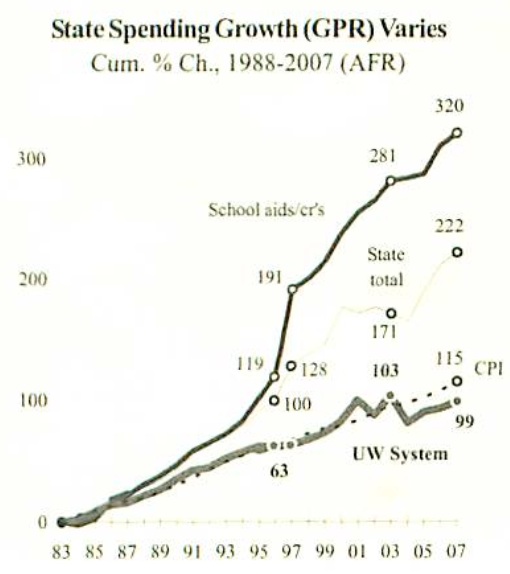
Wisconsin State Tax Based K-12 Spending Growth Far Exceeds University Funding and K-12 Tax & Spending Climate: Wisconsin State and Local Debt Rose Faster Than Federal Debt During 1990-2009 Average Annual Increase in State Debt, 7.8%; Local Debt, 7.3%
Wisconsin’s essential challenge is to grow the economy. We’ve been falling behind Minnesota for decades.
Siobhan Hughes:

The U.S. economy will have another big budget deficit in fiscal 2011 and faces at least a couple more years of sluggish growth, as the effects of the recent recession persist, government forecasters said Wednesday.
The Congressional Budget Office projected a deficit of almost $1.3 trillion for fiscal 2011. Though that will mark the third straight year of deficits above $1 trillion, the deficit forecast was a slight improvement from the almost $1.4 trillion estimated in an April analysis and reflected higher-than-anticipated revenue from individual income taxes.
The outlook for the U.S. economy also remains challenging, with growth expected to remain too slow this year and next year to make a big dent in the unemployment rate. The jobless rate will fall to 8.9% by the end of calendar 2011 and 8.5% by the end of 2012, the forecast said, as the economy grows by 2.3% this year and 2.7% next year, measured from fourth quarter to fourth quarter.

Share

Grade Inflation for Education Majors and Low Standards for Teachers When Everyone Makes the Grade

Cory Koedel

Students who take education classes at universities receive significantly higher grades than students who take classes in every other academic discipline. The higher grades cannot be explained by observable differences in student quality between education majors and other students, nor can they be explained by the fact that education classes are typically smaller than classes in other academic departments. The remaining reasonable explanation is that the higher grades in education classes are the result of low grading standards. These low grading standards likely will negatively affect the accumulation of skills for prospective teachers during university training. More generally, they contribute to a larger culture of low standards for educators.
Key points in this Outlook:
Grades awarded in university education departments are consistently higher than grades in other disciplines.
Similarly, teachers in K-12 schools receive overwhelmingly positive evaluations.
Grade inflation in education departments should be addressed through administrative directives or external accountability in K-12 schools.

When A Stands for Average: Students at the UW-Madison School of Education Receive Sky-High Grades. How Smart is That?

Share

Q&A with Christensen and Eyring on their new book: “The Innovative University”

Forbes:

Could you give our readers a short crash course to the main ideas of your book?
“The Innovative University” makes the case that a “disruptive” technology, online learning, is bringing fundamental change to higher education. Traditional universities and colleges are vulnerable because their model of education was already becoming too expensive for many students. Most young students will continue to want the campus-based learning experience, but they will expect to pay less and to enjoy a combination of face-to-face and online instruction. Institutions that don’t provide a hybrid will see declining enrollments. Most institutions will also have to focus more narrowly on student instruction, rather than emulating the large research universities, such as Harvard. Making these changes will be hard, given the strength of higher education tradition and the autonomy of faculty members. However, we believe that it can be done.

Share

Shortchanged by the Bell

Luis Ubinas & Chris Gabrieli:

AFTER a summer of budget cuts in Washington and state capitals, we have only to look to our schools, when classes begin in the next few weeks, to see who will pay the price.
The minimum required school day in West Virginia is already about the length of a “Harry Potter” double feature. In Los Angeles, Philadelphia and Milwaukee, summer school programs are being slashed or eliminated. In Oregon and California this year, students will spend fewer days in the classroom; in rural communities from New Mexico to Idaho, some students will be in school only four days a week.
For all the talk about balancing the budget for the sake of our children, keeping classrooms closed is a perverse way of giving them a brighter future.

Share

Chicago Public Schools begins move to extend school day

Noreen S. Ahmed-Ullah:

Chicago Public Schools today launched their plans to extend students’ time in the classroom by 90 minutes each and by two weeks each year and set up an advisory committee to figure out how it’ll be done.
However, Chicago Teachers Union President Karen Lewis said she would decline an invitation to serve on the committee, saying in a written statement that, “this news has nothing do with helping our children and everything to do with politicizing a real serious problem.”
Mayor Rahm Emanuel began pushing for a longer school day while he was on the campaign trail, saying Chicago’s school day is the shortest in the nation when compared to public school systems in nine other large cities. School reform legislation passed in June allows the district to implement a longer school day in the fall of 2012 with or without the union’s agreement, and CPS officials have said they would do that.

Share

After Words with Steven Brill

C-Span:

The founder of The American Lawyer magazine and Court TV tells the story of a coalition of unlikely allies in the fight to change a school system that many parents believe is failing the nation’s children. He debated education solutions with former Assistant Secretary of Education Diane Ravitch.

Share

Wisconsin Reading program plans questioned Concerns raised about DPI’s approach to developing a model curriculum

Amy Hetzner:

So far, this has been the summer of education task forces in Wisconsin.
There’s one addressing school accountability, another tackling how to help school districts implement new academic standards and a third devoted to improving third-grade reading proficiency. That doesn’t even count other groups already in existence that are looking at reforming statewide tests or increasing teacher effectiveness.
“There’s so many work groups and task forces operating right now, it’s hard to keep track of them,” said state Rep. Steve Kestell (R-Elkhart Lake), chairman of the Assembly Education Committee and a member of some of those task forces.
Keeping all of the task forces on track may also prove difficult.
Earlier this month, a member of the group charged with helping school districts implement new reading standards sent an open letter to members of the governor’s Read to Lead Task Force expressing concerns about the approach that the state Department of Public Instruction was taking in developing a model reading curriculum. That letter was followed by another that recommended specific approaches that the task force should take. Dan Gustafson, a Madison-based pediatric neuropsychologist, said he wrote the letters because he was concerned that the DPI was moving ahead with a model reading curriculum without input from differing viewpoints on reading instruction.

Share

Out-of-State Admissions to State Universities

Kenneth Anderson:

Cohen particularly focuses on UCLA and UC Berkeley as examples of the new trend in college admissions:

Even colleges that shunned out-of-state students for years are showing a marked receptivity. The University of California’s top campuses–Berkeley and UCLA–have doubled and even tripled their rosters of out-of-state kids. At UCLA, the total percentage of out-of-state kids is still relatively low: only about 7 percent of last year’s entering class. But at Berkeley, it was a whopping 19 percent and will grow to 20 percent this year, according to Janet Gilmore, a university spokesperson. Five years ago, the percentage of out-of-state students at Berkeley was a mere 5 percent.
At most of these world-class universities, admission is still very selective. The acceptance rate for out-of-state students at UCLA was only 30 percent last year. But that was still better than what California residents experienced, which was a 21 percent acceptance rate. And it even got a tad easier for out-of-staters compared with previous years. Five years ago, out-of-staters applying to UCLA were admitted only 21 percent of the time, compared with their California counterparts, who saw a 23 percent admit rate.

My daughter was a beneficiary of this; she was accepted to both. I would not have thought she was competitive for either place as a pure out-of-stater even a few years ago. (It probably helps that very few private school kids in DC seem to apply to either UCLA or Cal; my daughter’s friends at Sidwell Friends, National Cathedral School, and St. Albans, where my wife teaches, went en masse to Michigan, but very few of them apply to the University of California.) When we visited the two UC schools, the admissions people were explicit in saying they were looking for out-of-state and international admissions, partly to keep their reputations up but mostly for the money.

Share

Florida Governor Scott explores higher-ed reforms

Denise-Marie Balona:

Gov. Rick Scott is exploring dramatic higher-education reforms that are similar to those already under way in Florida’s public school districts.
Patterned after reforms being championed by Texas Gov. Rick Perry, who recently announced he’s running for president, Scott is looking at changing the way professors are paid and moving toward a merit-pay system with limits on tenure.
Texas has been debating such changes to save money and bolster professor productivity — going so far as to consider tying professor pay to how many students they teach and how much research money they bring in.
Instructors would get annual bonuses as high as $10,000 a class if they rated highly on student satisfaction surveys. Even the assignment of faculty offices and parking spaces would be based on their performance.

Share

The school reform deniers

Steven Brill:

Every year I tell students in a journalism seminar I teach about the junior reporter for The American Lawyer – the magazine I founded and edited -who committed a classic error when he submitted a draft of a profile about some lawyer in the news who had made it big. Midway through the article, the young reporter described a showcase this lawyer had in his office that displayed a bunch of combat medals. The reporter declared, matter-of-factly, that our legal hero had won the medals for his heroics in Vietnam, which was relevant, he added, because the lawyer made his war record and his lock-n-load approach to his work part of his pitch to potential clients.
In the margin next to the statement about the lawyer having won the medals I wrote, “Who says?” When the reporter came to ask me what I had meant, I told him to check with the Pentagon about the supposed medals. Which the reporter did, and which caused a mini-scandal after we reported in our otherwise positive profile that our hero hadn’t won them.
The story has three points. First, that reporters should believe nothing told to them by a biased source, especially when what they are being told is a checkable fact. Second, that while opinions deserve balanced reporting of both sides’ views, facts are facts. They are knowable. The guy either got medals or he didn’t. Third, the best way to test facts that you think you know is to put them in front of the person with the greatest stake in refuting them. In this case when we confronted the lawyer with the Pentagon’s records that he had not won any medals, he produced no evidence to the contrary and, in fact, ultimately confessed his deception. Case closed.

Share

Almanac of Higher Education 2011

The Chronicle of Higher Education:A reasonable question for postdocs looking to enter the faculty ranks in 2011 and midcareer administrators eyeing the college presidency might have been, Are you sure you want the job?
Professors and presidents alike found themselves in the thick of political battles that questioned their productivity, their pay, and their rights to collectively bargain. Their campuses encountered rising demands for accountability and brutal assessments of their rigor. At the same time, resources diminished, particularly at public universities reliant on state dollars, leading to cuts in programs and positions and increases in class sizes and tuition.

Share

Wisconsin DPI announces $6 million for charter school planning and dissemination grants; Proposed IB Madison Preparatory Academy Charter School Not Funded

Wisconsin Department of Public Instruction, via a kind reader’s email:

Groups planning new charter schools and established charter schools that want to replicate their success are sharing $6 million in federal charter school grants.
Planning grants total $4.5 million and will go for planning activities in 23 charter schools that have already been approved by their local school board or authorizing authority. Five of those grants are going to districts that do not currently have charter schools. Five grants, totaling $625,000, will support the expansion of successful charter school models. Another seven grants, totaling $875,000, will help charter schools that are in the second year dissemination activities.
“Planning grant proposals in this round of funding are for a mix of innovative charter schools,” said State Superintendent Tony Evers. “This is just what the charter school law promotes: local solutions to serve students and their families.”

Matthew DeFour has more.

Share

Stop ignoring key provision in Missouri education law

Kate Casas

But it is a lesser-known and never-enforced section of the act that has become the center of the education debate in Missouri.
This section, a consumer protection law of sorts, states:
“The board of education of each district in this state that does not maintain an accredited school pursuant to the authority of the state board of education … shall pay the tuition of and provide transportation … for each pupil resident therein who attends an accredited school in another district of the same or an adjoining county.”
The act provides important relief under law for children living in unaccredited school districts by providing them with a mechanism for escaping their failing schools and enrolling in successful ones.
There currently are two unaccredited districts in Missouri, Riverview Gardens and St. Louis City.

Share

Why unions are livid about L.A.’s new teacher-evaluation experiment

Daniel Wood

After years of frustration with its own teacher-evaluation system, the second-largest school district in the country is pilot-testing a new idea against the wishes of its union.
With the Obama administration offering incentives for school systems to revamp how they evaluate teachers’ effectiveness, the episode with the Los Angeles Unified School District (LAUSD) carries important lessons nationwide, analysts say.
The fresh approach in Los Angeles meshes with the Obama administration’s efforts to use more systematic and data-driven approaches to evaluate teachers. It includes parent and student feedback, students’ standardized test scores, and more detailed observations given by peers – who watch teachers and then type their observations and questions into laptop computers, then discuss their impressions the next day.

Share

Be realistic about paying for college costs

Jahna Berry:

State-budget cuts forced many colleges and universities to make huge tuition hikes. Job losses siphoned money for college savings accounts.
When home values nose-dived during the housing bust, students and parents lost the ability to tap home-equity lines for extra cash. The Dow’s wild swings have chewed up balances in 529 college-saving accounts, which often include stocks.
“Parents are desperate,” said April Osborn, executive director of the Arizona Commission for Postsecondary Education, which administers several federal and state grants that go to Arizona college students.
While college costs rise, there is less grant money to go around. Three state grants that awarded up to $2,000 to college students were suspended last year.
Two federal grants, including one that provided up to $3,000 for awardees, were eliminated and won’t be available starting this fall, she said.

Share

WEAC head Mary Bell stands up to Gov. Scott Walker with sometimes controversial tactics

Roger Bybee:

Mary Bell, president of the Wisconsin Education Association Council, is quiet and thoughtful in one-on-one conversations. She’s a middle-aged, cheery, bespectacled woman whose dimpled face is surrounded by a thick corona of whitish-gray hair.
But when fighting for her members, Bell forcefully projects her belief in teachers’ right to respect, decent pay and union representation. At a rally with tens of thousands at the Capitol on a snowy, bitter Feb. 26, Bell expressed outrage at Gov. Scott Walker’s proposals for the near-total stripping of union rights for teachers, librarians, highway workers, prison guards and other public workers across the state. Yet her anger was tempered by her humor and her belief in Wisconsinites’ fundamental commitment to fairness and public education.
The rhetoric Mary Bell used that day about “Wisconsin values” was no stretch for her, because she perceives herself as a typical Wisconsinite, sharply different from the image of the insular Madison insider, as Walker likes to portray his enemies.

Share

Learning the Hard Way The reformers who want to save the public schools are starting to make a difference, against ferocious opposition

Joel Klein:

Like so many debates in America today, the fight over public education is as polarized as it is consequential. There appears to be a general sense of agreement that the results we are getting are woefully inadequate, especially given the demands that a high-tech, global economy will place on our future work force. Nevertheless, there’s a sharp disagreement over exactly what to do.
Spending more money is of course a perennial demand. Since 1970 America has more than doubled the real dollars spent on K-12 education. We have increased the number of teachers by more than a third, created legions of nonteaching staff, and raised salaries and benefits across the board. Yet fewer than 40% of the students who graduate from high school are ready for college. At the same time, students in other countries are moving ahead of us, scoring higher–often much higher–on international tests of reading, math and science skills.

Share

In Census Data, All Matter of Information Tied to Schools

Sabrina Tavernise:

It is August, and the Census Bureau is counting things again. This time it was items associated with school, which is just around the corner for children across the country.
Ever wondered, for example, how much people spend on back-to-school clothes? About $7 billion, according to figures released Friday by the bureau, judging from sales at family clothing stores in August 2010, the last back-to-school shopping month for which it has data. That is about the size of the Los Angeles city budget. It represents a small increase from 2009.
The bureau estimated that 55 million students would be enrolled in pre-kindergarten through high school this fall, and that 11 percent would be in private schools. That total is up by about 16 percent from 20 years ago.

Share

What Does Research Say About School District Consolidation?

REL Northwest:

One way REL Northwest connects practitioners with research is by posting responses to inquiries made to the Ask A REL Reference Desk. The free Reference Desk service provides educators, policymakers, and community members with prompt, authoritative resources on topical issues, customized to their local needs. Recent responses point to research on topics such as mathematics interventions, data-driven decision making, and the impact of early childhood education programs.
The latest inquiry is on a topic that’s receiving increased national attention due to budget challenges: whether consolidating school districts might result in lower overall costs for education. Unfortunately, research on consolidation does not offer definitive guidance for making such decisions. There are several reasons for this: empirical studies of consolidation employ different analytical approaches to data; older data in some studies yield results that may not be representative of current district conditions; studies do not uniformly separate costs related to merging only a narrow range of district services from costs related to merging entire districts or combining schools; different studies focus on different costs or estimate costs in different ways; and much of the literature consists of advocacy.

Share

Visualized: A School Day as Data

Brandon Keim:

By putting RFIDs on children and monitoring their interactions over a single day, researchers have produced one of the most detailed analyses ever of the roiling, boiling social free-for-all that is school.
The findings, published August 16 in Public Library of Science One, document the minute-by-minute interactions and locations of 232 children aged 6 to 12 and 10 teachers.
Reconfigured as pulsing network maps and flows of color are the universal experiences of middle school: the between-class rush, playground cliques, snatched hallway conversation and the fifth-graders who are too cool for everyone else.
“We can compare different types of assumptions or modeling with a model that takes into account all interactions,” said Alain Barrat, who studies complex networks at the Institute of Scientific Interchange in Turin, Italy.

Share

No Common Core Standards in Waivers, but what about Assessments?

Anne Hyslop:

As Education Week has reported today, Secretary of Education Arne Duncan clarified that states will not have to endorse the Common Core State Standards in order to successfully obtain a waiver from portions of No Child Left Behind. While the full details of Duncan’s all-or-nothing waiver proposal have not been released, most (including Education Sector’s Kevin Carey) speculated that states would have to demonstrate they embraced high academic content standards – i.e. Common Core – in order to be let off the hook for meeting the 100% proficiency by 2014 deadline.

While taping C-SPAN’s Newsmakers program, Duncan assured states who have not yet adopted Common Core that the Department is “happy to work with them” as long as they verify their own standards are rigorous. Duncan also noted that this process would likely involve states having their standards approved by their state’s postsecondary institutions – supposedly to certify that they are “college and career ready” standards.

Share

The Out-of-State Admissions Edge

Steve Cohen:

More than ever before, cash-crunched state schools are looking for out-of-state applicants to balance their budgets. Steve Cohen on which schools offer the biggest advantage.
Some kids apply to faraway colleges so they can break with their parents and party–er, study–in peace. But choosing a state school that’s not where you live isn’t just a good way to gain independence; it’s a smart admissions tactic, too.
College-admissions season is upon us, and it promises to be just as competitive as last year. And one of best-kept secrets in college admissions this year is that many top state universities will be admitting more out-of-state applicants than ever before.

Share

Charter management group just might help Milwaukee schools

Alan Borsuk:

First, a lesson from baseball: It was roughly a year ago that Brewers fans were wringing their hands that the pitching was bad and there was little prospect for fixing that in the off-season, given a weak free agent scene and limited finances. Now, the Brewers have pitching that is basically amazing.
Sometimes, things do improve dramatically. Sometimes, that happens even when there are sound arguments for why they won’t.
I could write this entire column – if not a book – on why I’m pessimistic about things getting a lot better on the Milwaukee education scene. I would present a pretty sound case, too.
Maybe I’m wrong. In fact, I hope I’m wrong. I’d like to see things take off like a rocket ship.

Share

What’s the link between time in school and achievement?

Jennifer Davis and Emily McCann:

There is perhaps no more eloquent statement on the essential link between time and learning than the National Education Commission on Time and Learning, which delivered its report in April 1994. In its highly-quotable declaration, the commission makes very clear that unless the education system is completely reconfigured around the objective of achieving proficiency, rather than meeting arbitrary time requirements, we will never reach the goal of serving all children well. In the commission’s words:
“Learning in America is a prisoner of time. For the past 150 years, American public schools have held time constant and let learning vary. The rule, only rarely voiced, is simple: learn what you can in the time we make available…. If experience, research, and common sense teach nothing else, they confirm the truism that people learn at different rates, and in different ways with different subjects. But we have put the cart before the horse: our schools and the people involved with them-students, parents, teachers, administrators, and staff-are captives of clock and calendar. The boundaries of student growth are defined by schedules for bells, buses, and vacations instead of standards for students and learning.”

Share

Teacher Union Controlled Health Care Provider WEA Trust: Have to Adapt – and Fast

Karen Rivedal:

Less than two months after a new state law took health benefits off the bargaining table for public workers and required them to pay at least 12.6 percent — up from zero, in some school districts — of their health insurance premiums, WEA Trust has lost a fifth of its business.
And that means big changes could be coming for the Madison-based group health insurer of mostly school districts that employs nearly 500.
“We’re going to have to adapt and adjust,” said Mark Moody, president and CEO of WEA Trust. “You can’t absorb a 20 percent loss and not do anything.”
The Trust, a not-for-profit company, provides health insurance to just over 100,000 employees in about 60 percent of the state’s 425 school districts.
It was created in 1970 by the state’s largest teachers’ union, the Wisconsin Education Association Council, or WEAC.
Critics have long accused the two bodies of working together to fleece taxpayers through over-priced contracts they say school boards have effectively been forced to sign under union pressure.

Share

Madison School District Trying Alternatives to Large Public Hearings

Matthew DeFour:

If you didn’t get the Madison School District’s invitation to Thursday’s meeting about a controversial proposal to let police bring drug-sniffing dogs into schools, don’t take it personally; neither did School Board President James Howard.
The meeting was for minority community leaders to ask questions and provide feedback about the proposal, which the School Board is expected to vote on Aug. 29.
School Board members weren’t invited, which Howard, who learned about the meeting Wednesday from a television reporter, said is a problem.
“Board members should always be informed of these meetings,” Howard said. “I don’t know why the ball got dropped.”
The School District’s revamped communications department organized the meeting at the Urban League on South Park Street as part of a new outreach effort, said Marcia Standiford, the department’s new manager.

Share

The Debt Crisis at American Colleges

Andrew Hacker & Claudia Dreifus:

How do colleges manage it? Kenyon has erected a $70 million sports palace featuring a 20-lane olympic pool. Stanford’s professors now get paid sabbaticals every fourth year, handing them $115,000 for not teaching. Vanderbilt pays its president $2.4 million. Alumni gifts and endowment earnings help with the costs. But a major source is tuition payments, which at private schools are breaking the $40,000 barrier, more than many families earn. Sadly, there’s more to the story. Most students have to take out loans to remit what colleges demand. At colleges lacking rich endowments, budgeting is based on turning a generation of young people into debtors.
As this semester begins, college loans are nearing the $1 trillion mark, more than what all households owe on their credit cards. Fully two-thirds of our undergraduates have gone into debt, many from middle class families, who in the past paid for much of college from savings. The College Board likes to say that the average debt is “only” $27,650. What the Board doesn’t say is that when personal circumstances go wrong, as can happen in a recession, interest, late payment penalties, and other charges can bring the tab up to $100,000. Those going on to graduate school, as upwards of half will, can end up facing twice that.

Share

Women See Value and Benefits of College; Men Lag on Both Fronts, Survey Finds

Pew Research Center:

Half of all women who have graduated from a four-year college give the U.S. higher education system excellent or good marks for the value it provides given the money spent by students and their families; only 37% of male graduates agree. In addition, women who have graduated from college are more likely than men to say their education helped them to grow both personally and intellectually. These results of a nationwide Pew Research Center survey come at a time when women surpass men by record numbers in college enrollment and completion.
The survey also found that while a majority of Americans believe that a college education is necessary in order to get ahead in life these days, the public is somewhat more inclined to see this credential as a necessity for a woman than for a man. Some 77% of respondents say this about women, while just 68% say it about men.

Share

Cash-strapped University of California hands out millions in raises

Nanette Asimov:

The University of California will spend $140 million raised from increased student tuition, general fund money and other UC sources to give merit raises to thousands of faculty members and nonunion employees earning up to $200,000, UC officials said Wednesday.
UC is experiencing what officials have called the worst financial crisis in its history, losing million of dollars in state funding over the last few years while steadily raising tuition and laying off employees to compensate.
But the regents also agreed in November to set aside money for merit raises. Faculty have consistently received such raises during the last few years, but the salaries of nonunion staff members have been frozen for four years.

Share

Sending Your Child to College? Advice from Dr. Drew

Andrew Rotherham:

With thousands of kids starting to pack for their first year at college or preparing to return after the summer break, now is a good time to talk to them about some important health and wellness issues on campus. To help parents figure out what to look for and worry about, School of Thought asked Dr. Drew Pinsky, the best-selling author and TV and radio host who has been dubbed the “surgeon general of youth culture” by the New York Times. On his college radar: prescription drugs, hook-up culture and processed food. As a practicing physician and the father of triplets, Dr. Drew isn’t fielding abstract questions — his own kids are starting university this fall.
College isn’t always a bastion of healthy living. Late nights, pizza and stress can’t be good for you. What should parents talk to their children about when they leave for college?
Start with the easy stuff — safety. In the [college] age group, accidents are a major cause of morbidity, and alcohol is often involved in some fashion. Remind students that they’re on their own and are not invincible.
I’ve been to hundreds of colleges all over the country, and almost every one has an outstanding health and mental-health service. Tell them to take advantage of the screenings, services and mental-health services that are there if they need them.

Share

Not by The Book

University of Dayton:

Apply. Visit campus. Complete the financial aid form. Get four years of free textbooks.
First-year University of Dayton students can receive up to $4,000 over four years for textbooks by completing three steps of the fall 2012 application process by March 1.
“We want to help parents and students understand that from the very first day, a University of Dayton education is very rewarding,” said Kathy McEuen Harmon, assistant vice president and dean of admission and financial aid.
“Through this initiative, we want to underscore that a University of Dayton education is affordable and we are committed to helping families in very tangible ways,” she said.
With the economy still difficult, Harmon said the free textbook program will bring families clarity and certainty about one piece of the financial puzzle.

Share

Not For Profit College Board Getting Rich as Fees Hit Students

Janet Lorin

When Gaston Caperton was recruited to run the College Board, owner of the SAT entrance exam, he said he didn’t want to just run “a testing company.”
Founded by Harvard and 11 other universities in 1900 to create a standardized test to admit students based on merit rather than family connections, the College Board by 1999 was facing cash-flow problems.
Caperton turned the nonprofit company into a thriving business, more than doubling revenue to $660 million by boosting fees, expanding the Advanced Placement program and the sale of names of teenage test-takers to colleges. A former West Virginia governor, he persuaded 11 states to cover fees for a preliminary SAT in the 10th grade.

Share

Why Public Schools Need Less Regulation

Michael Horn:

Picture the following scenario. You ask your friend to come up with a creative meal that will amaze your guests at a dinner party you are holding, but you impose some constraints. Your friend can only use the ingredients from a restrictive list and must follow the specific directions from a meal you cooked these same guests just weeks earlier.
What are the odds that your friend makes something innovative? Not good. After all, you’ve practically defined the solution by specifying nearly all of its inputs before she can even consider what she might cook.
A far better way to generate an innovative solution is to define the outcome you need — a five-course meal for eight — and then allow your friend to figure out the best way to get there.

Share

Commentary on the Seattle School Board Races

Melissa Westbrook:

The (Seattle) Times’ editorial board is nothing if not amusing. Their current editorial on the School Board races puts forth the results without much analysis (because, of course, if they said, out loud, that the incumbents all appear to be in trouble that would hurt their cause). Here’s how they framed the results:

Frustration about Seattle School Board leadership weighed heavily on the minds of primary voters who, in all but one board race, were more generous with their votes for challengers than incumbents.

Yes, generous is one way to put it. Another would be that all the incumbents appear to be in trouble.
They can only say about the challengers that they raise valid concerns about the district and the current Board. Almost like, “thanks for pointing that out, now move along.”

Share

Apple, Microsoft May Bid for 15 Million Turkish Tablets, AA Says

Ercan Ersoy:

Apple Inc. (AAPL), Microsoft Corp. and Intel Corp. (INTC) may participate in the government’s project to supply as much as 15 million tablet computers for school children over four years, state-owned Anatolia news agency said, citing Turkish Trade Minister Zafer Caglayan.
Apple officials told Caglayan during his visit to the U.S. that the Cupertino, California-based maker of smart devices may also decide to use some Turkish manufacturers to make some peripheral equipment such as covers, earphones for its iPad and iPhone models, Caglayan said at a news conference with Turkish reporters in Seattle, according to the Ankara-based agency.

Share

More on WEAC’s Layoffs

Mike Antonucci

here are still some open questions in the aftermath of the WEAC layoffs – which the union appears reluctant to answer. WEAC executive director Dan Burkhalter wouldn’t tell the Milwaukee Journal-Sentinel about membership levels, saying it was “internal information,” and a WEAC spokeswoman “refused an on-camera interview with WISC-TV Monday, and a conference call later that day was cut short after only two reporters had asked questions.”
Most media outlets have been reporting that the 42 pink-slipped staffers constitute 40 percent of the union’s workforce, but there must be some detail missing. The union’s 2008-09 filings show 151 employees, and I can guarantee you WEAC was not servicing 98,000 members with 105 staffers.

Share

Villanova law school censured after misreporting test scores

St. Petersburg Times:

The law school at Villanova University has been censured for submitting falsified admissions data for several years to the American Bar Association. Villanova’s average Law School Admissions Test scores were padded by two to three points from 2005 to 2009, law school dean John Gotanda said. The median GPA was raised by up to 0.16 points. Both data sets often factor into law school rankings. The law school could have lost its accreditation because of the scandal. The school must post the reprimand on its website for two years. School officials described the misreporting as an “odd” scheme, considering the inflation “didn’t propel us into the top 50.”
Displaced whale dies in Calif. river
A 45-foot gray whale that delighted people for more than a month after taking up residence in Northern California’s Klamath River died Tuesday after beaching itself on a sandbar. In June, the whale and its calf took refuge in freshwater for an unknown reason while migrating north from Baja California. Scientists said it may have been escaping from killer whales. The calf swam out to sea on July 23, about the right time for it to go off on its own.

Share

New Jersey Superintendents Call State Agency Ineffective

Winnie Hu:

Nearly three-quarters of New Jersey school superintendents said the state Education Department did not play an important role in helping districts raise students’ achievement or prepare graduates for college and careers, according to a survey the department released Monday.
Many superintendents criticized how the state set goals and evaluated districts’ progress and said they did not find school report cards or state and federal data requirements useful in improving students’ performance.
They also expressed dissatisfaction with the state’s handling of special-education services and its guidance on curriculum and instruction. For instance, 63 percent of superintendents said they had not found the department’s efforts helpful in improving math instruction, and 59 percent said the same of improving literacy.

Share

Kids, Privacy, Free Speech & the Internet

Adam Thierer:

In the field of Internet policy, 2011 has been the year of privacy. Congress has introduced six bills related to online privacy, and the Obama administration released two major reports recommending greater federal oversight of online markets. The Federal Trade Commission (FTC) appears poised to step up regulatory activity on this front. State-level activity is also percolating, led by California, which floated two major bills recently.
These efforts would expand regulatory oversight of online activities in various ways. Some measures would institute “Fair Information Practice Principles” (FIPPS), governing the collection and use of personal information online. Others would limit some types data collection, ban certain data or advertising practices, or create new mechanisms to help consumers block online ad-targeting techniques. Another measure would mandate websites adopt a so-called Internet “Eraser Button,” which would allow users to purge unwanted personal information from online sites and services.

Share

Madison teachers union files lawsuit challenging constitutionality of collective bargaining law

Ed Treleven:

Unions representing Madison teachers and Milwaukee sanitation workers sued Gov. Scott Walker on Thursday, alleging that the controversial law severely restricting the collective bargaining rights of most public workers in Wisconsin is unconstitutional.
The lawsuit, brought by Madison Teachers Inc. and AFL-CIO Local 61 in Milwaukee alleges that the state legislature passed what was originally called the budget repair bill in violation of the state constitution’s provision that governs special legislative sessions.
The lawsuit also alleges that the law places severe and unfair restrictions on what unions and their members can discuss with municipalities and school districts, and imposes severe wage increase limits that don’t apply to nonunion workers.

Share

The Khan Academy And The Future Of Learning

On Point @ WBUR:

Salman Khan sent a video to his young cousin online, to help her with her math homework. A simple explanation, quickly sketched out. Then another and another, up on YouTube.
The next thing you know, a lot of other kids were paying attention. Using those math videos. Millions of kids. Including Bill Gates’s kids.
Now, Salman Khan is an education rock star, with videos up on math and chemistry and the Napoleonic Wars. Teachers are keying in. Classrooms. And it’s all free.

Share

Test scores same at Milwaukee public, voucher schools, auditors say; Vouchers Spend 50% Less Per Student

Dinesh Ramde:

State auditors on Wednesday confirmed a report that found little difference in test scores between students in Milwaukee’s school voucher program and those in the city’s public schools.
Wisconsin lawmakers had asked the state Legislative Audit Bureau to evaluate a study, conducted by privately funded education researchers, that analyzed test scores from both groups of students. The study had found no significant difference, a conclusion that state auditors also reached.
The researchers studied the Milwaukee Parental Choice Program, a voucher program that allows low-income children in Milwaukee to attend private schools at taxpayers’ expense. The two-year budget signed by Gov. Scott Walker in June repealed the enrollment limit for voucher schools in Milwaukee and expanded vouchers to schools in suburban Milwaukee and Racine.

View the 950K PDF report, here.
Milwaukee Voucher School WKCE Headlines: “Students in Milwaukee voucher program didn’t perform better in state tests”, “Test results show choice schools perform worse than public schools”, “Choice schools not outperforming MPS”; Spend 50% Less Per Student.

Share

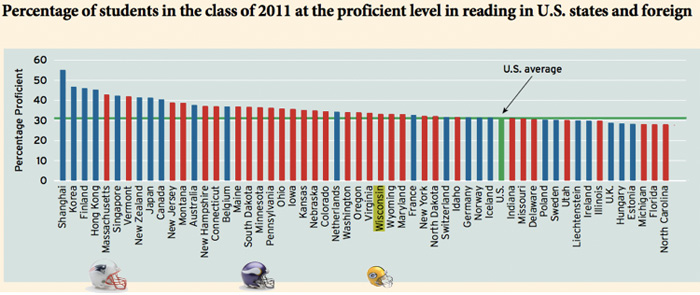
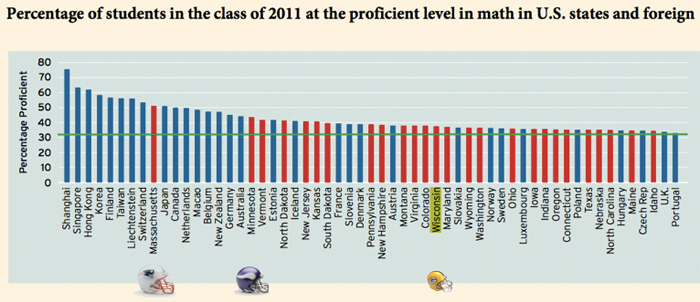
Globally Challenged: Wisconsin Lags 12 States & Numerous Countries in Math Proficiency


Paul E Peterson, Ludger Woessmann, Eric A. Hanushek, Carlos X. Lastra-Anadon, via a Chan Stroman email:

Given recent school-related political conflicts in Wisconsin, it is of interest that only 42 percent of that state’s white students are proficient in math, a rate no better than the national average.
At a time of persistent unemployment, especially among the less skilled, many wonder whether our schools are adequately preparing students for the 21st-century global economy. This is the second study of student achievement in global perspective prepared under the auspices of Harvard’s Program on Education Policy and Governance (PEPG).
In the 2010 PEPG report, “U.S. Math Performance in Global Perspective,” the focus was on the percentage of U.S. public and private school students performing at the advanced level in mathematics.1 The current study continues this work by reporting the percentage of public and private school students identified as at or above the proficient level (a considerably lower standard of performance than the advanced level) in mathematics and reading for the most recent cohort for which data are available, the high-school graduating Class of 2011.
Proficiency in Mathematics
U.S. students in the Class of 2011, with a 32 percent proficiency rate in mathematics, came in 32nd among the nations that participated in PISA. Although performance levels among the countries ranked 23rd to 31st are not significantly different from that of the United States, 22 countries do significantly outperform the United States in the share of students reaching the proficient level in math.
In six countries plus Shanghai and Hong Kong, a majority of students performed at the proficient level, while in the United States less than one-third did. For example, 58 percent of Korean students and 56 percent of Finnish students were proficient. Other countries in which a majority–or near majority–of students performed at or above the proficient level included Switzerland, Japan, Canada, and the Netherlands. Many other nations also had math proficiency rates well above that of the United States, including Germany (45 percent), Australia (44 percent), and France (39 percent).

Much more at www.wisconsin2.org.

Share

ACT Trends: National, Wisconsin, Madison

Jeff Henriques, via email.

Many notes and links, here.

Share

Senate Hearing on College Readiness (Imaginary)

on the 17th of never, 2011
Senator, please allow me to express my thanks for including me in these vital hearings on the readiness of our high school graduates for college work.
It would be my sad duty to report to you that if high school football coaches no longer ask their athletes to learn to block and tackle, that would fail to prepare them for college teams. Oh–wait, Senator, that is not correct. (Shuffles papers, starts over).
It would be my sad duty to report that if our high school basketball coaches no longer taught their athletes to dribble, pass, and shoot baskets, then they too would fail at basketball in college.
Oh–my apologies, Senator, that is not my testimony–just a little bad joke. Of course our high school coaches take athletics much too seriously to allow that sort of thing to happen to our kids. In fact, The Boston Globe has more than 100 pages a year on high school athletes. No, Senator, there is no coverage for high school academic achievement.
But I am sorry to have to report that our History and English teachers at the high school level no longer ask our students to read complete nonfiction books or to write substantial research papers, and naturally, this unfits them for the nonfiction books they will be asked to read and the substantial research papers they will be asked to write at the postsecondary level, in what we might call Upper Education.
The famous and influential American educator, John Dewey, wrote in 1896 that: “The centrality of reading and writing was ‘one of education’s great mistakes.'” In following in his footsteps, many of our educators have pushed academic reading and writing so far to the periphery of the curriculum that, for too many of our high school students, they might just as well have fallen off the edge of the flat earth of American secondary education.
The California State College System recently reported that 47% of their Freshmen were required to take remedial reading courses. Of course they can’t handle nonfiction books as they have never been assigned one in their whole high school career.
I have had the privilege of publishing 956 serious (average 6,000 words) history research papers by secondary students from all over this country and from 38 other countries, and I have formed the opinion in the process that high school students are fully capable of reading complete nonfiction books and of writing serious research papers.
But it should be no surprise that so long as our educators never assign nonfiction books or ask students for research papers, they will continue to believe that their students may be able somehow to manage Calculus, European history, Latin, Chemistry, British Literature and the like, but they must still not be able, for some unexplained reason, to read a history book or write a real term paper.
While our colleges do complain, persistently, about the poor preparation in reading and writing of the students who come to them, what do they do in setting requirements for admission?
Senator, hard as it may be to believe, all the writing that colleges ask for is a 500-word “college” essay about the life of the applicant. It is hard to conceive of a more nonacademic task than that, or one more likely to retard the assignment of serious reading and writing at the high school level.
When we celebrate athletes and ignore scholars in our high schools, and when we set such low standards for the high school diploma and for college admission, we should not be surprised that more than one million of our high school graduates need to be in remedial courses when they get to college every year, and that more than half of those will never graduate.
Yes, Senator, I believe that until we take reading and writing more seriously at the secondary level, we can continue to push more and more students into college, but more and more of them will be sadly unprepared to take advantage of that academic opportunities there, and more and more of them will drop out before they graduate from college.
Thanks again for the opportunity to discuss these problems.
===============
“Teach by Example”
Will Fitzhugh [founder]
The Concord Review [1987]
Ralph Waldo Emerson Prizes [1995]
National Writing Board [1998]
TCR Institute [2002]
730 Boston Post Road, Suite 24
Sudbury, Massachusetts 01776-3371 USA
978-443-0022; 800-331-5007
www.tcr.org; fitzhugh@tcr.org
Varsity Academics®
www.tcr.org/blog
Share

ACT Scores Decline Somewhat in Madison, Wisconsin Slightly Up, 32% of Badger Students “Ready” for College Level Courses in 4 Areas

Matthew DeFour:

The average ACT score among the Madison School District’s 2011 graduates dipped to its lowest level in 15 years, while the gap between white and minority student scores shrank for the first time in five years.
Though Madison’s average score dipped from 24.2 to 23.9, district students still outperformed the state average of 22.2 and national average of 21.1. A perfect score on the college entrance exam is 36.
Madison’s average scores in recent years have ranged from 23.5 in 1995 to 24.6 in 2007. The average score was also 23.9 in 2003.

Amy Hetzner:

With the highest percent of students taking the ACT in state history, Wisconsin’s Class of 2011 posted an average score slightly above that from the previous year’s graduates and maintained the state’s third-place ranking among states in which the test is widespread.
Seventy-one percent of the 2011 graduates from Wisconsin private and public schools took the college admissions test, averaging a 22.2 composite score on the 36-point test, according to information to be publicly released Wednesday. The nationwide average was 21.1 on the ACT Assessment, which includes tests in English, reading, mathematics and science.
State schools superintendent Tony Evers credited the results to more high school students pursuing more demanding coursework.
“The message of using high school as preparation for college and careers is taking hold with our students,” Evers said in a news release. “Nearly three-quarters of our kids said they took the rigorous classes recommended for college entry, up from just over half five years ago.”
Even so, ACT reported that only 32% of Wisconsin’s recently graduated seniors had test results that showed they were ready for college-level courses in all four areas. Results for individual subjects ranged from 39% readiness in science to 75% in English.

A few somewhat related links:

Ruth Robarts:

When all third graders read at grade level or beyond by the end of the year, the achievement gap will be closed…and not before.
On November 7 (2005), Superintendent Art Rainwater made his annual report to the Board of Education on progress toward meeting the district’s student achievement goal in reading. As he did last fall, the superintendent made some interesting claims about the district’s success in closing the academic achievement gap “based on race”.
According to Mr. Rainwater, the place to look for evidence of a closing achievement gap is the comparison of the percentage of African American third graders who score at the lowest level of performance on statewide tests and the percentage of other racial groups scoring at that level. He says that, after accounting for income differences, there is no gap associated with race at the lowest level of achievement in reading. He made the same claim last year, telling the Wisconsin State Journal on September 24, 2004, “for those kids for whom an ability to read would prevent them from being successful, we’ve reduced that percentage very substantially, and basically, for all practical purposes, closed the gap”. Last Monday, he stated that the gap between percentages scoring at the lowest level “is the original gap” that the board set out to close.
Unfortunately, that is not the achievement gap that the board aimed to close.

“Penelope Trunk”: (Adrienne Roston, Adrienne Greenheart(

10. Homeschool. Your kids will be screwed if you don't.
The world will not look kindly on people who put their kids into public school. We all know that learning is best when it's customized to the child and we all know that public schools are not able to do that effectively. And the truly game-changing private schools cost $40,000 a year.

Notes and links on the recent, successful Madison Talented & Gifted parent complaint.

Share

More Student Loans are Past Due

Phil Izzo:

Student loans are on the rise, but so is the delinquency rate on them.
On Monday Real Time Economics noted that since the depths of the recession the only type of credit to notch growth was student loans. Credit to students also stands out when looking at delinquency rates.
In the second quarter, 11.2% of student loans were more than 90 days past due and the rate was steadily rising, according to data from the Federal Reserve Bank of New York. Only credit cards had a higher rate of delinquency — 12.2% — but those numbers have been on a steady decline for the past four quarters.

Share

Chicago Teachers upset enough to ask for strike vote, union chief says

Rosalind Rossi

The president of the Chicago Teachers Union said Friday on a radio show that there is a “very high” likelihood that teachers will ask her to take a strike vote, given how angry and disrespected they feel.
But clarifying later to the Chicago Sun-Times, Karen Lewis said she did not predict that teachers will ultimately go on strike, only that the probability is high that members will call for a strike vote.
“People are very upset. People feel disrespected,” Lewis told WLS- AM Radio’s Connected to Chicago, which airs at 6 a.m. Sunday.
“We have teachers who have been extremely vilified for political purposes,”

Share

Michigan accreditation system ‘no longer has relevance’

Dave Murray:

Michigan’s school accreditation system “no longer has relevance” state educators say, as every school in the state has met state criteria despite sliding backward on federal testing goals.
The state Education Department released announced Monday that 79 percent of Michigan’s public school buildings and 93 percent of the school districts made federal testing goals – called “adequate yearly progress” – for the 2010-11 school year.
That’s down from 86 percent of schools and 95 percent of districts making AYP the previous school year.

Share

Rhode Island Commissioner Gist’s Budget: Consultants Cash In

Dan McGowan:

The Rhode Island Department of Education’s (RIDE) consulting budget has ballooned to over $28 million for the 2012 fiscal year, nearly double what it was spending just two years ago, GoLocalProv has learned.
According to the agency, the sudden jump in consultants and vendor spending is directly related to a number of federal grants the department has received over the past several years, including the $75 million in Race To The Top funds secured last year. RIDE says the outside contractors are helping with curriculum development, data management and overseeing an inter-district transportation system for new teachers.

Share

Student Loan Debt is Up Sharply

Justin Lahart:

According to the Federal Reserve Bank of New York’s quarterly report on debt and credit, U.S. households had $11.42 trillion in debt outstanding in the second quarter. That was down from a peak of $12.5 trillion in the third quarter of 2008, when the financial crisis took hold, and the lowest since the first quarter of 2007. Mortgage debt, home equity loans, credit card debt and auto loans are all down sharply — partly because people are being more careful, but also because many have defaulted.
But student loans are up sharply. There was $550 billion in student debt outstanding in the second quarter, up 25% from $440 billion in the third quarter of 2008.

Share

Hong Kong Eco-primary school considers a step up to secondary

Chloe Lai:

Sitting under a parasol to avoid the fierce summer sun, two teenagers at a summer camp in the New Territories debate the criteria for an ideal secondary school. Rosemary and White Cloud – adopting nature-related nicknames is a tradition at the camp – are responding to a Q&A session held earlier, when two secondary school principals were quizzed on topics ranging from the logic of school uniform design to how to prevent teachers from abusing their power.
“The school must have strict rules so every student will behave and be polite,” White Cloud says.
Rosemary has very different ideas: “It is not going to work. Strict rules will only make the disobedient even more disobedient. My ideal school is one with no penalties.”
The two friends’ contrasting views reflect their exposure to Gaia School, an alternative private primary school in Tuen Mun that emphasises personal responsibility and learning from nature.

Share

Chicago Principals to Get Merit Pay

Rebecca Vevea:

Chicago Public Schools will offer merit pay to principals who perform well on a new set of evaluative metrics that may include student growth on test scores, the school climate and leadership skills, Mayor Rahm Emanuel said Monday.
The performance rewards will be paid for over the next four years by a new $5 million fund created through charitable donations, Emanuel said. The district plans to create a similar incentive program for teachers, he said.
CPS CEO Jean-Claude Brizard said the bonuses will range from about $5,000 to $10,000 per principal.

Share

Stearns High School pitch to China is a failure

Associated Press:

A school district in the deep woods of Maine that sought out Chinese students to help boost its enrolment and its finances fell far short of its ambitious goal of bringing in 60 students.
Only six Chinese students will attend high school in Millinocket, in a rural part of the northeastern state, next month.
The target of five dozen was probably overly ambitious, officials said.
The efforts were also hindered by a recruiter in China who failed to deliver any students and a writer who told readers of China’s Global Times newspaper that the school was “mediocre” and that Millinocket children hang out in parking lots for fun.
Stearns High School officials said they were disappointed more Chinese students won’t be attending when classes begin on September 6 but will stick with the programme and try to expand in the years ahead.

Share

We Can’t Teach Students to Love Reading

Alan Jacobs:

While virtually anyone who wants to do so can train his or her brain to the habits of long-form reading, in any given culture, few people will want to. And that’s to be expected. Serious “deep attention” reading has always been and will always be a minority pursuit, a fact that has been obscured in the past half-century, especially in the United States, by the dramatic increase in the percentage of the population attending college, and by the idea (only about 150 years old) that modern literature in vernacular languages should be taught at the university level.
At the beginning of the 20th century, perhaps 2 percent of Americans attended a university; now the number is closer to 70 percent (though only about 30 percent get bachelor’s degrees). A particularly sharp acceleration occurred in the years after 1945, when the GI Bill enabled soldiers returning from World War II to attend college for free, thus leading universities across the country to throw up quonset huts for classrooms, and English professors to figure out how to teach 40 students at a time, rather than 11, how to read sonnets. (And those GI’s wanted their children to have the same educational opportunities they had, or better ones.) These changes have had enormous social consequences, but for our purposes here, the one that matters is this: From 1945 to 2000, or thereabouts, far more people than ever before in human history were expected to read, understand, appreciate, and even enjoy books.

Share

Sun Prairie’s 2011-2012 Budget Pork

sp-eye:

It’s getting time to fish or cut bait. We’ve taken a good hard look at the proposed/draft 2011-12 SPASD budget, and we find a number of budget lines to be potentially low hanging fruit…ripe for the pickin’.
Download a PDF copy of SP-EYE Analysis of the 2011-12 SPASD Budget
Maybe we don’t have it right…we can admit it when we make an error…but it places the burden of proof squarely upon the district. PROVE to the community that you absolutely need all that is budgeted, and you have our support.

Share

Little Girl Found

Patti Waldmeir:

One might easily see such a thing in a Shanghai alleyway and think nothing of it: a bundle of fabric tied up with a rope. Except that this particular bundle was screaming.
I could not tell at first if the squalling child was male or female, but I knew exactly what it was doing there: a desperate mother had swaddled her newborn infant in several layers of clothing and left it alone in the winter darkness – so that it could have a chance to live.
For me, it was an all-too-familiar story: my own two daughters were abandoned at birth, left alone in a Chinese street to the mercy of strangers. But that was more than a decade ago – a decade in which China has become a powerful force in markets from natural resources to sports cars, from luxury goods to aircraft carriers. In a China of diamond iPads and gold-plated limousines were babies still ending up in anonymous alleyways?

Share

The myth of the rational education market

Peg Tyre:

The idea that school choice is automatically better than no choice has recently been reinforced again, with the “Parent Trigger” in California. Under a law passed there last year, parents whose children attend underperforming public schools can get together, and if 51% of them sign a petition, they can demand their district change the school administrators or convert the school to a charter. So far, a parent group from Compton “pulled the trigger,” but parents from poor urban schools and well-funded suburban schools have been seeking information on how to use the Parent Trigger law to improve their schools.
Similar bills, which are supported by education reformers on both sides of the political aisle, have been passed in Connecticut, Ohio and Mississippi. About a half dozen state legislatures–including New York — are expected to consider Parent Trigger type bills this year.

Share

Pre-college camps help incoming students learn how to learn

Deborah Ziff:

The fall semester hasn’t officially started yet, but this week a group of incoming Madison Area Technical College students gathered on campus to study in groups, submit homework, and take notes on lectures.
They won’t be tested. They’re just practicing.
Programs like this one at MATC — called Learning to Learn Camp — are increasingly common at colleges and universities as educators try to prepare students for the academic rigor and social stresses of college.
The courses tend to provide basic study skills such as note-taking and time management, as well as information on decidedly squishier topics, such as how to stay motivated or take personal responsibility.
“It all sounds very elementary, but particularly for community college and technical college students who often don’t have a college frame of reference, or somebody in their family who went to college, it’s really useful information,” said Melinda Mechur Karp, a senior research associate at the Community College Research Center at Teachers College, Columbia University in New York.

Share

Pell Grants Best for Buying Votes

Neal McCluskey:

Quite simply, Pell Grants are not supposed to be for the middle class. As the U.S. Department of Education’s website makes clear, Pell is supposed to be for “low-income undergraduate and certain postbaccalaureate students.”
So why characterize Pell as a benefit for the middle class? Because lots of people consider themselves to be in that group — which federal politicians rarely define — and policymakers want their votes.
Unfortunately, as Rep. George Miller (D-CA) recently demonstrated, saying Pell is intended for the middle class also makes it a valuable weapon in waging class warfare.
“Pell is the reason they are able to go to college and get ahead,” Miller said in response to congressional Republicans purportedly looking to trim the program as part of debt reduction. “It’s a shameful excuse and an attack on middle class families.”

Share

Handbooks replace union contracts in Wisconsin schools

Erin Richards:

Some are calling it the summer of the teacher handbook.
With the start of school approaching on Sept. 1, about two-thirds of Wisconsin’s school districts are rushing to finalize employee handbooks to replace now-extinct collective bargaining agreements that for decades outlined duties and salaries for workers.
The passage of the state’s new “Act 10” legislation – in effect for all districts that didn’t extend a contract with teachers before the passage of the law – gives administrators the ability to make sweeping changes to teachers’ pay scales, hours and working conditions without having to negotiate them with unions.
Some sacred cows are disappearing, such as teacher tenure, layoffs based on seniority and the guarantee of 10 years’ worth of post-retirement health insurance. Other big and complex changes on the horizon include new salary structures and pay-for-performance plans.

Share

The ever-increasing burden of education

Ivan Lorentzen:

Even with all its flaws, I’m a proponent of public education in much the same way I remain committed to the fundamental principles of democracy despite recent events in D.C. having tested this commitment.
In terms of public education, there are countless books, articles, and research projects from numerous points of view and it’s clear one can find proponents and opponents to whatever perspective you may choose. One recent publication is noteworthy due to the clarity in writing and direct premise — “Schools Cannot Do It Alone” by Jamie Vollmer, former attorney, businessman, and harsh education critic, now an advocate and consultant to education. I’d like to quote and paraphrase from this book in the following column.
He argues schools need the trust, understanding, permission and support from their communities in order to improve the public education system and increase student success. In tracing his journey from critic to consultant, he weaves an interesting tale as he encounters “blueberries, bell curves, and smelly eighth graders,” and comes to two conclusions. First, we have a system problem, not a people problem. We need to modify the system in order to get the graduates we want. And second, we cannot touch the system without touching the culture of the surrounding town because everything that goes on inside a school is tied to local attitudes, values, traditions and beliefs. But in order to improve the system it’s vital that we first accurately understand the system that presently exists and how it came to be.
For the first time in history the security, prosperity, and health of our nation depend on our ability to unfold the full creative potential of every child — not just the easy ones, not just the top 20 percent of the class, and not just those who reflect our preferred values. The problem is that America’s public education system was never designed to do this. As Thomas Jefferson imagined it, schools should be designed to select and sort students into two groups: a small handful of thinkers and a great mass of obedient doers. Back then most everyone was a farmer, the pace of change was slow, options were few, and only a small handful of people were paid to think.

Share

Partnership between Elgin school, salon a cut above

Emily McFarlan:

U46 schools won’t start class until next week, but already on Thursday, 5-year-old Nicky Moraetes of Elgin leaned forward in his chair at Harriet Gifford Elementary School with a look of intense concentration on his face.
Nicky will start dual-language kindergarten Wednesday, Aug. 24, at Gifford, and he’ll look good when he does. As he squeezed his eyes shut, a smock wrapped around his shoulders, a Salon Professionals Academy stylist clipped short the back of his blond hair.
The 5-year-old was one of many Gifford students and their siblings who got free haircuts during registration at the elementary school Thursday afternoon.

Share

Discarding “No Child Left Behind”

John Van Hecke:

In the midst of unsettled, economically anxious times, conservative policy advocates have embraced a public chaos strategy. While they create disorder, sapping public confidence in public infrastructure, conservative policymakers pursue a policy agenda limiting public investment in public systems that serve all Minnesotans. They create cover for their true aim, directing public investment’s benefits to fewer and wealthier people.
“No Child Left Behind” is a terrific example of this strategy. By creating an impossible performance standard–every child must pass the mandated standardized exam–the results allow conservative advocates to express outrage and shock that public schools are failing the public. It’s not responsible public policy but it is a marvelously self-fulfilling prophecy, consistent with conservative traditions of defunding government while attacking it for failing to do what they’ve deliberately prevented it from doing.
In the meantime, while modest income people struggle, our country still fights two wars and gives huge tax breaks to the very richest Americans. Minnesota has its own version of this experience, revealed during the recent budget stand-off and state government shutdown. Conservative policy leaders preserved a lower effective tax rate on the richest Minnesotans while cutting state services and accelerating program costs shift to property tax payers.

Share

10 Reasons to Skip the Expensive Colleges

Reader’s Digest:

If you’re the parent of a high-achieving high school student prepared to spend whatever it takes to send your kid to an Ivy League college, authors Claudia Dreifus and Andrew Hacker have some unlikely advice: Don’t do it.
Dreifus, a New York Times writer and an adjunct professor at Columbia University School of International and Public Affairs, and Hacker, a veteran political science professor at Queens College in New York, spent three years interviewing faculty, students, and administrators and crunching statistics for their book, Higher Education? How Colleges Are Wasting Our Money and Failing Our Kids — And What We Can Do About It. Their finding? That many of America’s colleges and universities — especially the elite — aren’t worth their tuition and serve faculty over their undergrads.
More outrageous, they say, is that tuition nationwide has jumped at more than twice the rate of inflation since 1982, so many kids graduate deeply in debt. “Tuition is probably the second-largest item you’ll buy in your lifetime, after your home,” Dreifus says. Given that, the authors suggest you consider the following as you bear down on the decision of where your child will spend the next four (or more) years.

Share

Louis Moreau Gottschalk on education

Chan Stroman:

Those favored by fortune can educate themselves in all countries: and it is for that reason that the American thinkers did not dedicate their cares to the aristocratic element of society, but rather to the lowest ranks of the great mass of the people, whom they have struggled to enlighten; comprehending that education ought not to be a privilege, but something which belongs to all, as much as the air we breathe; and that every citizen has as imprescriptible a right to the light of the Spirit as he has to the light of the sun which illuminates him.

Louis Moreau Gottschalk:

Share

Madison Mayor Paul Soglin on The Schools, Community, Curriculum & Parenting

Madison Mayor Paul Soglin Interview 8.12.2011 from Jim Zellmer.

I am thankful that Madison Mayor Paul Soglin took the time to chat yesterday.
Mobile (iPhone, iPad, iPod and Android) visitors, please use this link.
19MB mp3 version.

Share

Meeting test score standards – by lowering the bar

Mary McConnell:

Today’s Wall Street Journal highlights a report for the U.S. Government’s National Center for Education Statistics. In case you have trouble following the link, here’s the discouraging news:
“Eight states have raised their standards for passing elementary-school math and reading tests in recent years, but these states and most others still fall below national benchmarks, according to a federal report released Wednesday.”
The data help explain the disconnect between the relatively high pass rates on many state tests and the low scores on the national exams, known as the National Assessment of Educational Progress.

Share

Michigan has power to reimagine education, but will it?

Tom Watkins:

There are lessons that Michigan business and government must learn from the lost decade that stripped our state of pride and nearly 1 million high-paying middle-class jobs.
If we don’t embrace and imagine a better future, instead falling back on “business as usual,” we will be relegated to the trash heap of dinosaurian, economic history.
The revisionists among us would like us to believe Michigan’s fate was pre-determined by the collapse of the domestic auto industry, capped off by a global economic meltdown in 2008.
While the perfect storm of events that hit Michigan were clearly impactful, they need not have defined us. As my dad always told me, “You have little control what happens to you in this life, you have 100 percent control over how you respond.”
Michigan responded poorly.

Share

Judge Blocks Colorado Voucher Plan

Stephanie Simon:

A state court judge on Friday blocked a suburban school district south of Denver from using public funds to help residents pay for private and religious schools.
Judge Michael A. Martinez ruled that a voucher program designed by the Douglas County School District violated the state constitution because it sent public funds to schools that infused religion throughout their curriculum, required students and faculty to meet certain standards of faith and required students to attend religious services.
The program “provides no meaningful limitations on the use of taxpayer funds to support or promote religion, and no meaningful protections for the religious liberty of participating students,” the judge wrote in a 68-page decision. He also said it amounted to direct public aid to churches and church-sponsored schools, in violation of the Colorado constitution.

Much more on the Douglas County voucher program, here.

Share

A Look at Sun Prairie’s Health Care Costs

sp-eye

In our last post, we made some estimates on potential savings in the 2011-12 budget due to over-budgeting for health insurance premiums in the wake of Governor Walker’s budget.
Our calculations were based on the following:
The cost to the district for a Family plan was estimated to be: $14,249
The cost to the district for a Single plan was estimated to be: $ 6,307

Sun Prairie’s website.

Share

Obama Shows Spunk Pushing Bold Education Plan: Jonathan Alter

Jonathan Alter:

Although President Barack Obama is on the ropes, with even some Democratic allies describing him as weak and passive, this week he showed boldness and imagination in one vital area: education.
Obama backed Education Secretary Arne Duncan’s announcement that he will grant waivers to states that want to be excused from the punitive provisions of No Child Left Behind , Washington’s much-maligned 2002 overhaul of elementary and secondary education policy.
Republican lawmakers complain that the White House waivers run roughshod over the legislative branch — and they’re right. But gridlock demands more robust use of presidential authority and, at least in this case, we’re getting it. Unless Duncan’s action is challenged and reversed on constitutional grounds, No Child Left Behind will be left behind for good.

Share

College Tours: When did they become a thing?

Jeremy Singer-Vine:

Despite a lousy economy and high gas prices, college visits by prospective students increased over the last year, according to an informal poll by the New York Times. Almost three-quarters of the 41 colleges surveyed said they had more visitors this summer than last. When did the pre-enrollment campus visit become a “thing”?
The late 1960s. The college visit as we know it–with guest-lectures from the provost, tours, and occasional free goodies–dates to the Vietnam era. During this time, universities faced increased competition from a boom in two-year colleges, while cheaper airfare, the civil rights movement, and a shift to co-educational teaching gave prospective students more choice than ever among postsecondary schools. Colleges realized they needed to market themselves more vigorously, and campus visits became a big part of the pitch. (This was a smart move: A 1982 study found that about 16 percent of prospective students considered their campus visit the most influential factor in naming their first-choice college.)

Share

At Dalton, a Push for Change

Sophia Hollander:

Assembling diverse classes is an oft-stated goal among New York City private schools, with brochures featuring beaming multicultural students.
But this September Dalton will approach a rare benchmark: Nearly half of the incoming kindergarten class will be students of color.
Dalton will dramatically exceed the citywide average for kindergarten diversity at New York’s private schools, which was 30% students of color last year, according to data from the National Association of Independent Schools.
It’s a milestone in an aggressive campaign by the admissions director, Elisabeth “Babby” Krents, to broaden the school’s reach since she assumed the position in 1996. The previous year, the kindergarten class was 6% diverse. This year, it will be 47% of the 97-member incoming class.

Share

States Fail to Raise Bar in Reading, Math Tests

Stephanie Banchero:

Eight states have raised their standards for passing elementary-school math and reading tests in recent years, but these states and most others still fall below national benchmarks, according to a federal report released Wednesday.
The data help explain the disconnect between the relatively high pass rates on many state tests and the low scores on the national exams, known as the National Assessment of Educational Progress.
In fourth-grade reading, for example, 35 states set passing bars that are below the “basic” level on the national NAEP exam. “Basic” means students have a satisfactory understanding of material, as opposed to “proficient,” which means they have a solid grasp of it. Massachusetts is the only state to set its bar at “proficient”–and that was only in fourth- and eighth-grade math.

Share

Are school boards part of the problem or the solution?

Anne M. Byrne:

In the drama of public education, many people seem to see school boards as wearing black hats. When is the last time you heard a positive reference to school boards in our ongoing national debate? School boards are part of the problem, right?
Actually, local school boards have an essential role in education reform. More often than not, they are composed of energetic citizens who bring a passion for their communities to bear on nettlesome issues ranging from graduation rates to childhood obesity and bullying.
As a longtime school board member in New York State and chair of the student achievement committee for the National School Boards Association, I have been looking at what research says about school boards and student achievement. Does what happens in the boardroom make a difference in the classroom? The answer is yes, unequivocally.
Controlling for demographic differences, districts with high levels of student achievement have school boards that exhibit habits and characteristics that are markedly different from boards in low-achieving districts.

Share

Robots put leadership under skills pressure

Andrew Hill:

We love robots – tireless, productive workhorses of the modern assembly line. But we also hate robots – sinister mechanical simulacra of the human workers they make redundant.
In the latest episode in our complicated relationship with automatons and automation, it is appropriate that Foxconn should have a lead role. The Taiwanese company manufactures the chattering classes’ favourite piece of science fiction come true, the Apple iPad, as well as devices for Nokia and Sony. It employs 1m people in China. It was the epicentre last year of concern about pressure on low-paid young workers, following a series of suicides at its Shenzhen factories. It is, in short, iPad users’ window on to dilemmas of assembly-line politics and management that the developed world last grappled with on this scale decades ago.

Share

Why parents can’t save schools

Jay Matthews:

One of the summer scandals keeping us education wonks amused until school starts is a American Federation of Teachers gaffe in Connecticut. Union officials posted online an analysis of their lobbying against a parent trigger law in that state that revealed too much about their distaste for letting moms and dads decide who should run their schools.
Bloggers RiShawn Biddle and Alexander Russo exposed the union celebrating its gutting of a Connecticut version of California’s parent trigger law. School reform organizations and editorialists were aghast. AFT president Randi Weingarten disowned the Web post. Activists pushing for parent triggers in Texas and New York welcomed the attention.
This idea has already reached the Washington area and may someday inspire legislation here. That would be bad. Despite its worthy proponents and democratic veneer, the parent trigger is a waste of time. Let’s toss it into the trash with other once fashionable reform ideas like worksheets for slow students and brief constructed responses on state tests.

A balance of power in school governance is vital to ongoing improvements AND relevance.

Share

School Vouchers – Panacea or Snake Oil?

Ross Meyer:

As most Coloradans know, at least those who keep up with statewide education news, the Douglas County school board recently approved — unanimously — a groundbreaking plan to help pay the tuition costs for hundreds of students so that they can attend private schools.
This plan, known colloquially as a school voucher program, enjoys ardent support from some quarters, but vigorous opposition elsewhere.
Is such a plan useful, does it seem a wise use of taxpayer provided money, and is it available to all students?
Or, as many think, should public money earmarked for education be used exclusively for public schools to benefit all students? As with so many topics dotting the American sociological landscape, the answers lie in the murky sea of the individual’s political leanings.

Share

Education in Chile: We want the world

The Economist:

IT BEGAN on August 4th with the metallic clink of a few pots and pans. By nightfall, thousands of people were on the streets of Santiago banging kitchenware, a form of protest last heard under the dictatorship of General Pinochet. This time the cacerolazos, as they are called, are being staged in the name of educational Utopia–and in response to a cack-handed government ban on marches.
Chile’s school system is the least bad in Latin America, according to the OECD’s PISA tests, which compare educational attainment across countries. But that does not make it good. And the overall performance hides huge disparities. Analysis done in Chile of the test results in the 65 countries that took part finds that it ranked 64th in terms of the variance of the results according to social class. Rich pupils get good private education; poor ones are condemned to underfunded, dilapidated state-funded schools.

Share

Wisconsin teachers union tops list of biggest lobbying groups for 2009-10, report shows

Scott Bauer:

The statewide teachers union led in spending on lobbying state lawmakers even before this year’s fight over collective bargaining rights.
The Wisconsin Education Association Council spent $2.5 million on lobbying in 2009 and 2010, years when Democrats were in control of all of state government, a report released Thursday by the Government Accountability Board showed.
WEAC is always one of the top spending lobbyists in the Capitol and they took a central role this year fighting Gov. Scott Walker’s plan curbing public employee union rights, including teachers.
Back in 2009, when Democrat Jim Doyle was governor and Democrats controlled the Senate and Assembly, WEAC wasn’t helping to organize massive protests but it was a regular presence in the Capitol.
Much of its lobbying in 2009 was in support of removing caps on raises for teachers during contract negotiations, a move supported by Doyle and approved by the Legislature.

Share

The Trouble with Debt to Degree

Robert Kelchen:

I was pleased to see the release of Education Sector’s report, “Debt to Degree: A New Way of Measuring College Success,” by Kevin Carey and Erin Dillon. They created a new measure, a “borrowing to credential ratio,” which divides the total amount of borrowing by the number of degrees or credentials awarded. Their focus on institutional productivity and dedication to methodological transparency (their data are made easily accessible on the Education Sector’s website) are certainly commendable.
That said, I have several concerns with their report. I will focus on two key points, both of which pertain to how this approach would affect the measurement of performance for 2-year and 4-year not-for-profit (public and private) colleges and universities. My comments are based on an analysis in which I merged IPEDS data with the Education Sector data to analyze additional measures; my final sample consists of 2,654 institutions.
Point 1: Use of the suggested “borrowing to credential” ratio has the potential to reduce college access for low-income students.

Related: Debt to Degree.

Share

Some Folks Have a (Really) Hard Time with Change

Peter Murphy:

Change is hard. So said many a politician trying to tackle problems confronting the state or nation.
The president of the New York State United Teachers (NYSUT), Richard Iannuzzi, is a tell-tale example of someone having real difficulty with change by showing a dark side.
Yesterday’s Associated Press story on the changing landscape of public education was telling. With strengthened accountability and teacher evaluation combined with tightening resources, changes are afoot. On the one hand, Governor Andrew Cuomo is recognizing the “gravitational forces” of change and is in some ways its instigator by his focus on “improving student performance,” including his push that gave more teeth to the state Regents evaluation requirements.

Share

Preparing Future Teachers

Melissa Westbrook:

From the Grand Rapids, Michigan Press, comes a story about Arne Duncan and what he thinks should happen for teachers and teacher training:
U.S. Secretary of Education Arne Duncan says teachers should be paid between $60,000 to $150,000 – but should be held more accountable.
Duncan also told the National Board for Professional Teaching Standards last week that it should be more difficult for prospective students to enter college teacher preparation programs.
The latter sentence is part of a bigger discussion over whether colleges of education in this country do a good job of attracting good students and if they are training them properly. Indeed, a big worry expressed among some UW COE faculty about bringing in TFA is that if the COE doesn’t step up and do better they could be shut down. Some of the UW COE faculty seem to think the TFA training may be the training of the future for teachers.

Share

Madison Schools To Start New Talented & Gifted Program

Matthew DeFour:

Spurred by a critical state audit, the Madison School District will begin a new program this year intended to better identify and provide services for talented and gifted students.
Using an approach similar to how it identifies and serves special education students, the district plans to categorize talented-and-gifted services into three tiers and identify where all students fit into those tiers based on a combination of test scores, grades, teacher and staff assessments, and parent and self-identification.
Students who qualify for the top tier could receive additional academic services outside of the classroom. The program also seeks to develop the potential talent of all students, especially those who may not have been identified in the past, such as English language learners and low-income students.
In the past, Madison schools have used a more ad hoc, less systematic, approach for identifying and serving students who demonstrate advanced abilities in intellect, academics, leadership, creativity, and the performance and visual arts. The district also has historically blanched at grouping students by ability.

Related: A group of Madison parents filed a successful complaint related to talented & gifted services with Wisconsin’s Department of Public Instruction.

Share

Super Teachers Alone Can’t Save Our Schools

Steven Brill:

A superstar teacher or charismatic principal rides to the rescue! Downtrodden public school children, otherwise destined to fail, are saved! We’ve all seen that movie–more than once, starting with “Stand and Deliver” and “Lean on Me” in the late 1980s and more recently with documentaries like “Waiting for Superman” and “The Lottery,” which brilliantly portray the heroes of the charter-school movement. And we know the villains, too: teachers’ union leaders and education bureaucrats who, for four decades, have presided over schools that provide comfortable public jobs for the adults who work there but wretched instruction for the children who are supposed to learn there.
One of the heroes of this familiar tale is Dave Levin, the co-founder of the highly regarded KIPP network of charter schools (KIPP stands for Knowledge Is Power Program). But Mr. Levin would be the first to tell you that heroes aren’t enough to turn around an American public school system whose continued failure has become the country’s most pressing long-term economic and national security threat.

65

Share

Atlanta Starts New School Year Under Cloud of Cheating Scandal

Judy Woodruff

JUDY WOODRUFF: Now, the first of two stories about the nation’s schools.
Students returned to Atlanta classrooms for the start of a new school year today. But students and teachers will be laboring under the cloud of a major cheating scandal that’s raising big questions in Atlanta and in districts across the country.
JOHN TULENKO: Parks Middle School in Atlanta, Georgia, was a beacon of hope. Located in one of the poorest neighborhoods in the city, it had built a reputation as a high-achieving school.
Chandra Gallashaw felt lucky to send her children to Parks.
CHANDRA GALLASHAW, mother: This was a college prep middle school. I had seen the change going on over there. And I was really impressed with that. That’s what made me want my daughter to go there more so than ever.
JOHN TULENKO: Parks had made some of the largest gains anywhere in Georgia. Pass rates on the state tests climbed from 35 percent to 78 percent in reading, and from 24 percent to 86 percent in math.

Share

Hong Kong Teachers stand up against ‘moral lessons’; Profession’s biggest union says government’s proposed curriculum should ‘be given a fail’

Jennifer Ngo:

The city’s biggest teachers’ union has called on the government to scrap its plan to introduce mandatory moral and national education classes at schools after a survey of more than 2,000 of its members found widespread opposition to the proposal.
The pro-democracy Hong Kong Professional Teachers’ Union, which claims a membership of 80,000, or 90 per cent of all the city’s teaching professionals, says the poll found 70 per cent were against the move.
Union officials also criticised the government for carrying out consultation over the move in a “condescending” way and called for a new round of talks.
“If we have to speak in terms of grading requirements, this document [proposing the new curriculum] would be given a `fail’,” said James Hon Lin-shan, deputy director of the union’s rights and complaints department.

Hong Kong Professional Teacher’s Union website. Much more on the Moral and National Education (MNE) curriculum, here.

Share

The Annotated No Child Left Behind Waiver Conversation

Andrew Rotherham:

I’m not opposed to a new round of waivers on No Child Left Behind, but the devil is in the details. Unfortunately, the details seem to be getting short shrift lately in favor of the same talking points. To wit, let’s take a look at today’s NYT story on the forthcoming Duncan waiver proposal. Here it is (mostly) annotated with text from the article in itals.

Secretary of Education Arne Duncan has announced that he will unilaterally override the centerpiece requirement of the No Child Left Behind school accountability law, that 100 percent of students be proficient in math and reading by 2014.

Well, it’s not really 100 percent, more like 92 percent or so, and it’s not 2014 in practice but really several years later. And in practice for a school to make “adequate yearly progress” often only 6 or 7 in 10 of its students need to be passing a test at the proficient level right now. And, to be proficient doesn’t mean a perfect score on a test, often more like getting half the questions on a test right. That all makes it sound too reasonable though. Besides, those are details! Nothing but details!

Share

Thomas D. Parker: Time to downsize federal student loans

Thomas Parker:

I have spent much of my working life studying and promoting student loans. As a good liberal Democrat, I have spent years seeking to expand and then working for the old Federal Family Education Loan Program (FFELP), which had its roots in Lyndon Johnson’s War on Poverty. Currently, I consult to a for-profit student-loan company.
I am surprised, therefore, to hear myself saying that it is time to start downsizing the federal student-loan programs.
I am watching to see how the new Federal Direct Student Loan Program (FDLP) works out. I hope that it is successful.

Share

Judge rules Memphis city schools to merge with county

Bill Mears:

Public schools in Memphis, Tennessee, will be consolidated with those of the surrounding county beginning in 2013-14, a federal judge ruled Monday. The decision ends for now a yearslong fight over funding that spilled into questions of race and politics.
The 146-page ruling from Judge Hardy Mays was prompted by a lawsuit and subsequent voter referendum in March that dissolved the Memphis City Schools charter.
“The Memphis City Schools has been abolished for all purposes except the winding down of its operations and the transfer of administration to the Shelby County Board of Education under the terms of Public Chapter 1 and Tennessee education law,” wrote Mays. He said the surrender of the city charter did not affect the validity of the city board’s actions up until now.

Share

Mapping State Proficiency Standards Onto the NAEP Scales: Variation and Change in State Standards for Reading and Mathematics, 2005-2009

US Department of Education, via a kind Chan Stroman email:

State-level National Assessment of Educational Progress (NAEP) results are an important resource for policymakers and other stakeholders responsible for making sense of and acting on state assessment results. Since 2003, the National Center for Education Statistics (NCES) has supported research that focuses on comparing NAEP and state proficiency standards. By showing where states’ standards lie on the NAEP scale, the mapping analyses offer several important contributions. First, they allow each state to compare the stringency of its criteria for proficiency with that of other states.
Second, mapping analyses inform a state whether the rigor of its standards, as represented by the NAEP scale equivalent of the state’s standard, changed over time. (A state’s NAEP scale equivalent is the score on the NAEP scale at which the percentage of students in a state’s NAEP sample who score at or above that value matches the percentage of students in the state who score proficient or higher on the state assessment.) Significant differences in NAEP scale equivalents might reflect changes in state assessments and standards or changes in policies or practices that occurred between the years. Finally, when key aspects of a state’s assessment or standards remain the same, these mapping analyses allow NAEP to substantiate state-reported changes in student achievement.
The following are the research questions and the key findings regarding state proficiency standards, as they are measured on the NAEP scale.

Wisconsin’s oft criticized WKCE vis a vis NAEP:
WKCE “proficient” = 2009 NAEP Below Basic for grade 4 reading (along with 34 other states) and grade 8 reading (along with 15 other states)
= 2009 NAEP Basic for grade 4 math (along with 41 other states) and grade 8 (along with 35 other states)
WKCE results showed more positive changes than NAEP results for grade 4
reading from 2007 to 2009, grade 4 math from 2007 to 2009, and grade 4 math from 2005 to 2009
NAEP results showed more positive changes than WKCE results in grade 8
reading from 2005 to 2009.
How does Wisconsin compare? Learn more, here.

Share

Is College Worth the Cost?

Christina Couch:

Today’s parents are paying substantially higher out-of-pocket costs for higher education than their parents did 30 years ago. And the public has noticed. Three out of four Americans say college is unaffordable for most people, according to the widely publicized survey Pew Research Center survey “Is college worth it?”
A four-year degree is becoming increasingly difficult to attain due to several factors:
–College costs are rising at nearly three times the rate of inflation, according to FinAid.org.
–More than 1 in 10 students graduate with more than $40,000 in undergraduate student debt, according to the Project on Student Debt.

Share

Emanuel defends property tax increase for Chicago Public Schools

John Byrne

Mayor Rahm Emanuel today said a property tax hike for Chicago Public Schools is acceptable because district administrators have made large cuts to the school budget and investment is necessary to improve important programs like early childhood education.
In his first comments since the proposed schools tax increase was announced last week, the mayor said school officials have done more to make the schools more efficient.
“I have no tolerance for an overblown bureaucracy, and I have no tolerance for inefficiency in the city budget, in other agencies, and I’m glad (school officials) followed the cut and invest strategy,” Emanuel said. “I think they’ve made the tough choices.”
“I also expect people to respect the hard-earned dollars of taxpayers,” he added. “But they also rely on the school system. As you know, I said I was going to protect the classroom. We’ve not only protected the classroom, we’ve expanded educational choices and opportunities for the parents that rely on the school system, while other school systems are cutting back.”

Share

Madison’s Dual language immersion program faces challenges

Matthew DeFour:

As the Madison School District’s dual language immersion program enters its eighth year, the increasingly popular option for native Spanish and English speakers is experiencing growing pains.
The district is expanding the program to all of its high school attendance areas, and is looking into possibly adding French and Chinese dual language programs, which would also pair native and non-native English speakers.
National research has shown dual language programs improve student learning better than programs that teach English to non-native speakers or two languages to non-English speakers.
But some School Board members have concerns about the expansion, especially after a recent report highlighted some of the program’s shortcomings.
“I’d rather fix the red flags and make sure we’ve got it right before we expand,” said School Board member Lucy Mathiak. “I don’t see how you expand a program and attend to the things that need to be dealt with at the same time.”

Share

Memphis Consolidation Decision Leaves Board Question Unanswered

Bill Dries:

Attorneys for all of the sides in the schools consolidation court case have a Friday, Aug. 12, deadline that will set the stage for the next crucial part of the landmark court case.
What does a new countywide school board look like and when is there a transition to that school board?
Federal Judge Hardy Mays ruled Monday that the county school system controls the move toward consolidation of Memphis City Schools and Shelby County Schools, which Mays ruled, will take place in August 2013. But he also ruled the county school board districts, which do not include the city of Memphis, are unconstitutional and have to be redrawn or changed in some way.
He gave the attorneys on all sides through Friday to suggest remedies. And his 146-page ruling left some clues about how he will judge the ideas.

Share

It Rhymes With ‘Tool’

Liam Goldrick:

Thursday morning in Washington DC — the only city that could host such a vacuous, inane event — the Thomas B. Fordham Institute is hosting (the hopefully one-off) “Education Reform Idol.” The event has nothing to do with recognizing states that get the best results for children or those that have achieved demonstrated results from education policies over time — but simply those that have passed pet reforms over the past year.
It purports to determine which state is the “reformiest” (I kid you not) with the only contenders being Florida, Illinois, Indiana, Ohio and Wisconsin and the only judges being: (1) a representative of the pro-privatization Walton (WalMart) Family Foundation; (2) the Walton-funded, public education hater Jeanne Allen; and (3) the “Fox News honorary Juan Williams chair” provided to the out-voted Richard Lee Colvin from Education Sector.

Share

Online Education: A Word of Caution

Andrew Miller:

Online education is becoming a legitimate and viable option for education systems around the country. Both colleges and secondary schools are offering classes to students. In fact many states and schools are requiring students to take some method of mode of online learning. New York made major changes around seat time and face-to-face contact between student and teacher. The state’s intentions are good. They want to move away the focus from seat time, and they want to offer courses that might be hard to offer in certain areas of the state to all students. With all these innovative systemic changes, one might think we are completely on the right track. I offer a word of caution.
Online education is in danger of replicating a system that isn’t working. Yes, I wrote it. With all the potential for innovation that online education has to offer, we have fallen into the pitfall of replication. The keyword is “danger.” There is much that online education can do to innovate the education system, and much that has already been done as a result. Yet most of the actual courses and pedagogical structures that are in place are simply replicating the traditional style of education.

Share

State budget problems keep squeezing Minn. schools

Chris Williams:

Each summer as she sets up her classroom for the fall, elementary school teacher Kate Schmidt said it seems like she spends more of her own money for school supplies, her classes get larger and she has fewer colleagues.
“I remember people telling me that if you get through your first year of teaching, you’re good to go,” said the 22-year teaching veteran. “Well, I work much harder now than I ever did as a first-year teacher.”
Schmidt, 43, teaches fourth-grade in the Rosemount-Apple Valley-Eagan district in the Twin Cities suburbs which, like most districts, is coping with state funding that has failed to keep up with inflation for nearly a decade. Then in July the Legislature and Gov. Mark Dayton held back another $700 million to solve the latest budget deficit.

Share