School Information System

The Heisenberg Uncertainty Principle applied to schools

Anneliese Dickman:

Werner Heisenberg’s Uncertainty Principle states that one cannot simultaneously measure the location of a particle while also measuring the momentum of that particle. When you apply this principle to schools, it’s a little disheartening–if we attempt to measure where we are now, we are no longer certain how fast we’re improving. If the environment in which the measurement is taking place is also moving (think of the vast legal and budgetary changes at the state level), the uncertainty is all but overwhelming.
Thus, this year’s analysis of public school data in southeast Wisconsin heeds Heisenberg and emphasizes the use of the 2010-11 data as a baseline. Knowing that all Wisconsin school districts will be in a state of flux over the next few years due to changes in contractual bargaining legislation, the state budget, a slow economic recovery, a new standardized testing system, and new standards for curriculum, in the future we hope to measure their improvements over time as these various “new normals” kick in. For now, we emphasize where they’ve been and where they are currently.

Share

K-12 Tax & Spending Climate: The Geography of Jobs

TIP Strategies:

Map Highlights
This animated map provides a striking visual of employment trends over the last business cycle using net change in jobs from the U.S. Bureau of Labor Statistics on a rolling 12-month basis. We used this approach to provide the smoothest possible visual depiction of ongoing employment dynamics at the MSA level. By animating the data, the map highlights a number of concurrent trends leading up to the nation’s present economic crisis. The graphic highlights the 100 largest metropolitan areas so that regional trends can be more easily identified.
The timeline begins in 2004 as the country starts its recovery from the 2001 recession, following the bursting of the dot-com bubble. At first, broad economic growth was apparent across most of the country. Two notable exceptions are the Bay Area — the hub of the tech boom that drove job growth during the prior decade — and several metropolitan areas within the Midwest. The map reveals that much of the industrial Midwest never fully recovered from the previous recession, as manufacturers continue to shed jobs while other parts of the country were adding them in large number.

A rather spirited discussion of Madison school finances and spending priorities occurred during the recent last minute Board Meeting on the proposed Madison Preparatory IB Charter school.

Share

Study: Atlanta education gap grows, could hurt employment

David Markiewicz:

Employment in metro Atlanta has been hurt in recent years by the area’s dependence on troubled job sectors, including administrative and support services, and specialty trade contracting. One thing that’s helped the employment rate has been a relatively strong supply of educated workers.
But a new report from the Brookings Institution says the area’s “education gap” is growing and could become a problem if the trend is not reversed. The education gap refers to the difference between local employer demand for educated workers and a community’s ability to provide enough of them.
Metro Atlanta had the nation’s fifth-largest increase in education gap from 2005-2009, the study found. No market of comparable size was in the top 10.

Share

The Chicago Forward: Education essay winners are …

Trib Nation:

For our Sept. 13 public affairs forum with Chicago schools chief Jean-Claude Brizard and teachers union leader Karen Lewis, we asked Trib Nation to write an essay on what makes public education succeed or fail.
Here are the contributions from winners Ray Salazar, G. A. Finch, Trevon Martin, Eva Delgado, Cassandra Eddings and Devyn Rigsby, along with two other noteworthy essays from Gary Lawson and Ron Barker:
G. A. Finch, parent:
I chair the LSC at Decatur Classical, an obscure selective enrollment school that the Tribune, Sun-Times, and Chicago Magazine have ranked the highest performing elementary school in Illinois. Despite its diversity in income, ethnicity, race and religion, it consistently exceeds state testing standards.

Share

Academic publishers make Murdoch look like a socialist

George Monbiot:

Who are the most ruthless capitalists in the western world? Whose monopolistic practices make Walmart look like a corner shop and Rupert Murdoch a socialist? You won’t guess the answer in a month of Sundays. While there are plenty of candidates, my vote goes not to the banks, the oil companies or the health insurers, but – wait for it – to academic publishers. Theirs might sound like a fusty and insignificant sector. It is anything but. Of all corporate scams, the racket they run is most urgently in need of referral to the competition authorities.
Everyone claims to agree that people should be encouraged to understand science and other academic research. Without current knowledge, we cannot make coherent democratic decisions. But the publishers have slapped a padlock and a “keep out” sign on the gates.
You might resent Murdoch’s paywall policy, in which he charges £1 for 24 hours of access to the Times and Sunday Times. But at least in that period you can read and download as many articles as you like. Reading a single article published by one of Elsevier’s journals will cost you $31.50. Springer charges €34.95, Wiley-Blackwell, $42. Read 10 and you pay 10 times. And the journals retain perpetual copyright. You want to read a letter printed in 1981? That’ll be $31.50.

Share

Concern rising about quality of education

Wannapa Khaopa:

Although, the majority of Thai children have access to basic education, as net enrolment for primary and secondary schoolage children increases, people still question the quality of education being provided as international learning assessments show Thai students’ performances lag behind most Asian countries.
So, the Office of the Education Council (OEC) is preparing to propose government strategies to enhance the teaching levels and ensure quality education for all children in collaboration with the United Nations Country Team (UNCT).
The net enrolment for primary schoolage children in Thailand increased from 81 per cent in 2000 to 90 per cent in 2009. And, net enrolment for secondary schoolage children increased from 55 per cent in 2000 to 72 per cent in 2009, according to UN Data Online and the United Nations Educational, Scientific and Cultural Organisation Education for All Monitoring Report.

Share

Mount Horeb School Gets 21st Century Makeover

Jeff Glaze:

Ten months after Mount Horeb area voters approved $10.5 million in renovations to the village’s first- and second-grade building, a walk through the Primary Center reveals little resemblance to the building’s previous 93 years of life. Classroom walls and staircases have been removed, and a gaping hole allows workers to see the basement from the second floor.
The construction is part of a year-long project that Mount Horeb Area School District Superintendent Wayne Anderson said “will bring the school into the 21st century.”
The Primary Center, constructed in 1918, provided a challenging place for teachers to hold class, with inconsistently sized rooms, split levels and distractions including a bug infestation, said Vicky Rosenbaum, a first- and second-grade teacher at the school. The school was without air conditioning and operated its heating system on the original 1918 boilers, which made the building prone to extreme and fluctuating temperatures. The Primary Center also had a mysterious problem with bees, she said.

Share

Lies, damn lies and the myth of “standardized” tests

Marda Kirkwood:

[Note from Laurie Rogers: Recently, results from the 2011 state standardized test scores came out, and the general impression given to the public — for example from the state education agency (OSPI) and from media in Seattle and in Spokane — was that improvements had been made. It’s all in the definitions: How do you define “improvement”? Did some of the numbers go up? Assuredly. Did that mean that real improvments in real academic knowledge had been made? It’s best to remain skeptical.
Most students in Spokane are as weak in math skill this year as they were last year. Given a proper math test that assesses for basic skills, many high schoolers still test into 4th or 5th-grade math. College remedial rates are still high. Parents are still frantic, and students are still stressed out about math. So … what do those higher scores actually mean? I’ve been trying to find out. It’s hard to say.

Share

Building the largest Chess AI ever

Sylvain Zimmer:

Many people are familiar with the SETI@home project: a very large scale effort to search for patterns from alien civilizations in the ocean of data we receive from the sky, using the computing power of millions of computers around the globe (“the grid”).
SETI@home has been a success, obviously not in finding aliens, but in demonstrating the potential of large-scale distributed computing. Projects like BOINC have been expanding this effort to other fields like biology, medicine and physics.
Last weekend, a team at Joshfire (Thomas, Nathan, Mickael and myself) participated in a 48-hour coding contest called Node Knockout. Rules were simple: code the most amazing thing you can in the weekend, as long as it uses server-side JavaScript.

Share

Administrators Ate My Tuition Want to get college costs in line? Start by cutting the overgrown management ranks.

Benjamin Ginsberg:

No statistic about higher education commands more attention–and anxiety–among members of the public than the rising price of admission. Since 1980, inflation- adjusted tuition at public universities has tripled; at private universities it has more than doubled. Compared to all other goods and services in the American economy, including medical care, only “cigarettes and other tobacco products” have seen prices rise faster than the cost of going to college. And for all that, parents who sign away ever-larger tuition checks can be forgiven for doubting whether universities are spending those additional funds in ways that make their kids’ educations better–to say nothing of three times better.
Between 1975 and 2005, total spending by American higher educational institutions, stated in constant dollars, tripled, to more than $325 billion per year. Over the same period, the faculty-to-student ratio has remained fairly constant, at approximately fifteen or sixteen students per instructor. One thing that has changed, dramatically, is the administrator-per-student ratio. In 1975, colleges employed one administrator for every eighty-four students and one professional staffer–admissions officers, information technology specialists, and the like–for every fifty students. By 2005, the administrator-to-student ratio had dropped to one administrator for every sixty-eight students while the ratio of professional staffers had dropped to one for every twenty-one students.

Share

City, Union Stories on Votes Conflict

Hunter Clauss:

In an attempt to counter Mayor Rahm Emanuel’s relentless campaign for a longer school day, the Chicago Teachers Union claimed Friday that 30 elementary schools have voted to reject the city’s offer to extend the school day in exchange for financial incentives.
Emanuel and the Chicago Public Schools have offered up to $150,000 in discretionary funds and a roughly 2 percent raise for teachers at city elementary schools that elect to waive a portion of the union contract and add 90 minutes to the day. CPS spokeswoman Becky Carroll told the Chicago News Cooperative that the union’s list is not accurate. She said the only schools that have voted are the four elementary schools that have accepted the district’s deal.
“Not a single school voted down waivers. Not true,” Carroll said in an email. “Only four have voted on waivers and they all supported them.”

Share

The typewriter lives on in India

Mark Magnier:

It’s a stultifying afternoon outside the Delhi District Court as Arun Yadav slides a sheet of paper into his decades-old Remington and revs up his daily 30-word-a-minute tap dance.
Nearby, hundreds of other workers clatter away on manual typewriters amid a sea of broken chairs and wobbly tables as the occasional wildlife thumps on the leaky tin roof above.
“Sometimes the monkeys steal the affidavits,” Yadav said. “That can be a real nuisance.”
The factories that make the machines may be going silent, but India’s typewriter culture remains defiantly alive, fighting on bravely against that omnipresent upstart, the computer. (In fact, if India had its own version of “Mad Men,” with its perfumed typing pools and swaggering execs, it might not be set in the 1960s but the early 1990s, India’s peak typewriter years, when 150,000 machines were sold annually.)

Share

Duncan energizing U.S. education scene

Alan Borsuk:

rne Duncan has the across-the-spectrum appeal to make just about everybody on the Wisconsin education scene eager to be in the room with him, and the political guts to tell Gov. Scott Walker face-to-face and in front of all those folks that he was wrong to kibosh collective bargaining in Wisconsin.
In short, he is about as interesting and significant a person as anyone in American education.
The U.S. secretary of education stopped by the Milwaukee School of Career and Technical Education (that’s the new version of Custer High School) for an hour and a half Friday, enough time for several hundred people, from big shots to students, to get a dose of the highly demanding form of optimism that is a key to Duncan.
You want to get some positive re-enforcement for the things you’re doing, Duncan is your guy. You want to hear how what you’re doing isn’t anywhere near enough, Duncan is your guy.

Share

California’s Math Pipeline: The Grade 7 Pivot Point

EdSource:

For students to be career- and college-ready when they complete high school, they must build a strong base of mathematics knowledge. The end of 7th grade provides an important moment to assess how prepared California’s students are to succeed in the more advanced math curriculum that starts with algebra.
California’s 1997 academic content standards in mathematics outline the stepping stones to algebra, and the Grade 7 Mathematics California Standards Test (CST) provides a benchmark measure of students’ readiness.
In addition, 7th grade is the point where students’ math course-taking paths clearly begin to diverge:

Share

The Great Candy Debate

sp-eye:

“Motivation is part of education and classroom teachers should have input because they are the ones doing the work. ”
“Not all candy purchases are used for motivation.”
“The question becomes do we want to be the food police in the schools. ”
“Teachers and principals might not understand why this issue is being pushed so hard. ”
—Administration Response to “Candy Purchases” issue (Minutes of the Finance Committee meeting 8-22-11)

Share

What teachers really want to tell parents

Ron Clark:

This summer, I met a principal who was recently named as the administrator of the year in her state. She was loved and adored by all, but she told me she was leaving the profession.
I screamed, “You can’t leave us,” and she quite bluntly replied, “Look, if I get an offer to lead a school system of orphans, I will be all over it, but I just can’t deal with parents anymore; they are killing us.”
Unfortunately, this sentiment seems to be becoming more and more prevalent. Today, new teachers remain in our profession an average of just 4.5 years, and many of them list “issues with parents” as one of their reasons for throwing in the towel. Word is spreading, and the more negativity teachers receive from parents, the harder it becomes to recruit the best and the brightest out of colleges.

Share

Why You Should Drop Out of High School

Susannah Breslin:

There is a great deal of debate going on over whether or not you should go to college. Is it worth it? You will enter a difficult job market deeply in college loan debt. Despite your degree, your job prospects will be slim. And nobody can quite figure out what the future really holds for college grads’ futures.
Here’s another question: Why bother graduating from high school?
1. It doesn’t matter.

Share

Iowa says 415 schools not making enough progress

Sioux City Journal:

An annual report on Iowa public schools shows students in 30 districts aren’t making the progress required by the federal No Child Left behind law, triggering required actions such as changing staff members.
The report released by state education officials Thursday showed that 415 schools weren’t making adequate progress. That nearly 30 percent of all Iowa schools.

Share

Why They Chose STEM, 20% say “extremely well prepared”

Libby Nelson:

Most college students studying for degrees in science, technology, engineering or math make the decision to do so in high school or before — but only 20 percent say they feel that their education before college prepared them “extremely well” for those fields, according to a survey released today by Microsoft and polling company Harris Interactive.
The survey, which asked college students pursing STEM degrees and the parents of K-12 students about attitudes toward STEM education, also found that male and female students enter the fields for different reasons: females are more likely to want to make a difference, while males are more likely to say they’ve always enjoyed games, toys or clubs focused on the hard sciences.

Share

Cambridge tops league table of world’s best universities

Jeevan Vasagar:

Cambridge has topped a league table of the world’s best universities, with Harvard and MIT ranked second and third.
The annual QS World University Rankings remains dominated by US institutions, which took 13 of the top 20 places.
There are five British universities in the top 20 – Oxford ranks fifth, Imperial sixth, UCL seventh and Edinburgh 20th. The only university in the top 20 which is not from the English speaking world is the Swiss Federal Institute of Technology, in Zurich, at 18. The highest ranking Asian universities are Hong Kong at 22, Tokyo at 25, and the National University of Singapore at 28. King Saud University, in Saudi Arabia, made the top 200 for the first time. At 200, it was the highest rated institution in the Arab world.
It is the second year running that Cambridge University has taken the top spot.

Share

Connecticut Education reform group presents proposals to state board

Caitlin Emma:

A group of business and philanthropic leaders appointed by Governor Dannel P. Malloy presented their education reform proposals to the state Board of Education Wednesday, pitching changes to teacher certification requirements, preparation programs and evaluations to help close Connecticut’s dramatic achievement gap.
Members of the Connecticut Council on Education Reform said they considered the timing appropriate, coming as Malloy introduced his new education commissioner and reiterated that education will be a priority in next year’s legislative session.
“We think next year could be the lynchpin,” said Steve Simmons, vice chair of the council and CEO of Simmons/Patriot Media and Communications. “The governor has said that this first year was focused on the budget crisis and the second year was going to be education reform. I think we have a great chance here over this next nine or ten month period to really push for change.”

Share

Education in China: a path to unity with diversity

Liu Lili:

China is a united multicultural country. The development of each national minority (with its unique language, culture, location and shared experience) has different requirements and the educational needs of each nationality within China involve unique challenges.
What is the best way to renew thinking about education for minority nationalities and improve multicultural education in ethnic minority areas?

Share

Needs of schools, not seniority, best way to manage staff

Eau Claire Leader Telegram:

A debate related to the repeal of collective bargaining rights for most public employees in Wisconsin is whether teachers’ job security should be tied to seniority.
The Cadott school board recently rewrote its employee handbook, which now says the needs of the district, not the seniority of its employees, will be the “prime consideration” to determine which employees should be laid off.
Other school districts are deciding how to proceed. In the past, representatives of the school board and teachers union would negotiate the handbook’s contents. Now, the board can unilaterally set the rules, which has teachers understandably unnerved. Job security, especially in this economy, is paramount.

Share

Technology in the Classroom

Michael Horn:

Simply put, people should not take from this article that technology will not be a significant part of the answer for the struggles of the country’s education system. It will likely be the very platform for it.

Technology has the potential to transform the education system—not by using technology for technology’s sake through PowerPoint or multimedia at the expense of math and reading or something like that—but instead as a vehicle to individualize learning for students working to master such things as math and reading, thereby creating a student-centric system as opposed to today’s lockstep and monolithic one.

According to the article (and with a full caveat that the article of course may not capture the true intent of the school officials profiled), a goal here was to create a computer-centric classroom. If this is true, it dramatically misses the point. As others have noted, a critical problem with the notion of creating the “classroom of the future” is just that phrase—“the classroom of the future”—for the ways in which that language locks in our imagination around the current paradigm of schooling and even sometimes implies that creating this should be the goal in and of itself.

Share

Madison Preparatory IB Charter School School Board Discussion Notes

Matthew DeFour:

Madison Preparatory Academy will receive the first half of a $225,000 state planning grant after the Madison School Board determined Thursday that the revised proposal for the charter school addresses legal concerns about gender equality.
Madison Schools Superintendent Dan Nerad announced the decision following a closed School Board meeting.
Questions still remain about the cost of the proposal by the Urban League of Greater Madison, which calls for a school for 60 male and 60 female sixth-graders geared toward low-income minorities that would open next year.
“I understand the heartfelt needs for this program,” Nerad said, but “there are other needs we need to address.”

Madison School Board Member Ed Hughes

The school district does not have a lot of spare money lying around that it can devote to Madison Prep. Speaking for myself, I am not willing to cut educational opportunities for other students in order to fund Madison Prep. If it turns out that entering into a five-year contract with Madison Prep would impose a net cost of millions of dollars on the school district, then, for me, we’d have to be willing to raise property taxes by that same millions of dollars in order to cover the cost.
It is not at all clear that we’d be able to do this even if we wanted to. Like all school districts in the state, MMSD labors under the restrictions of the state-imposed revenue caps. The law places a limit on how much school districts can spend. The legislature determines how that limit changes from year to year. In the best of times, the increase in revenues that Wisconsin school districts have been allowed have tended to be less than their annual increases in costs. This has led to the budget-slashing exercises that the school districts endure annually.
In this environment, it is extremely difficult to see how we could justify taking on the kind of multi-million dollar obligation that entering into a five-year contract with Madison Prep would entail. Indeed, given the projected budget numbers and revenue limits, it seems inevitable that signing on to the Madison Prep proposal would obligate the school district to millions of dollars in cuts to the services we provide to our students who would not attend Madison Prep.
A sense of the magnitude of these cuts can be gleaned by taking one year as an example. Since Madison Prep would be adding classes for seven years, let’s look at year four, the 2015-16 school year, which falls smack dab in the middle.

TJ Mertz:

Last night I (TJ) was asked to leave the meeting on African American issues in the Madison Metropolitan School District (MMSD) advertised as being facilitated by the Department of Justice Community Relations Service (DOJ CRS) and hosted or convened by the Urban League of Greater Madison (ULGM) with the consent and participation of MMSD. I was told that if I did not leave, the meeting would be canceled. The reason given was that I write a blog (see here for some background on the exclusion of the media and bloggers and here for Matt DeFour’s report from outside the meeting).
I gave my word that I would not write about the meeting, but that did not alter the request. I argued that as a parent and as someone who has labored for years to address inequities in public education, I had both a legitimate interest in being there and the potential to contribute to the proceedings. This was acknowledged and I was still asked to leave and told again that the meeting would not proceed if I did not leave. I asked to speak to the DOJ CRS representatives in order to confirm that this was the case and this request was repeatedly refused by Kaleem Caire of the ULGM.

The Milwaukee Journal-Sentinel:

An idea hatched in Madison aims to give parents with boys in Wisconsin’s second-largest city another positive option for their children. It’s an idea that ought to be channeled to Milwaukee.
Madison Preparatory Academy for Young Men would feature the rigorous International Baccalaureate program, longer days, a longer school year and lofty expectations for dress and behavior for boys in sixth grade through high school. And while it would accept all comers, clearly it is designed to focus on low-income boys of color. Backers hope to open a year from now.
One of the primary movers behind Madison Prep is Kaleem Caire, the head of the Urban League of Madison, who grew up in the city and attended Madison West High School in 1980s, Alan J. Borsuk explained in a column last Sunday. Caire later worked in Washington, D.C., as an education advocate before returning to Madison.
Caire saw too many young black men wash out and end up either dead or in jail, reported Borsuk, a senior fellow in law and public policy at Marquette University Law School. And Caire now is worried, as are we, about the atrocious statistics that place young black boys so far behind their white peers.

Rebecca Kemble:

The Department of Justice official explained the shadowy, confidential nature of the Community Relations Service to the audience by describing the kinds of situations it intervenes in, mostly having to do with hate crimes and rioting. He said in no uncertain terms, “We are not here to do an investigation,” and even asked for the audience members to repeat the sentence with him. He then went on to ask for people to respect the confidentiality of those raising issues, and laid out the structure of the meeting: 30 minutes for listing problems relating to the achievement gap and 45 minutes generating solutions.
I will respect the confidentiality of the content of the meeting by not repeating it. However, I will say that what was said in that room was no different that what has been said at countless other open, public meetings with the School District and in community groups on the same topic, the only difference being that there were far fewer parents in the room and few if any teachers.
It turned out that the Department of Justice secretive meeting was a convenient way to pack the house with a captive audience for yet another infomercial about Madison Prep. Kaleem Caire adjourned the one meeting and immediately convened an Urban League meeting where he gave his Madison Prep sales pitch yet again. About 1/3 of the audience left at that point.

Share

Many School Boards Replace Union Contracts with Employee Handbooks

Wisconsin Public Radio:

School boards across Wisconsin are coming out with employee handbooks to replace union contracts after the elimination of most collective bargaining powers for teachers. Some major trends include elimination of seniority protection and just cause for teacher non renewal.
Cadott School District Administrator Joe Zydowsky says the school board has been working since spring on the employee handbook that will set the work rules for district personnel. Zydowsky says they did solicit comments from teachers and staff while writing the book, “We tried to have as much input as possible but ultimately it came down to being the responsibility of the school board.”
The finished product eliminates layoff protections based on seniority and a provision that the district provide just cause for not renewing a teacher’s contract. Zydowsky says those changes give the district flexibility in personnel matters, “Sometimes that might mean that we have to make a reduction in staff. Sometimes that might mean we need to make a change in staff and the new employment policies of our school district will make it easier for us to make those changes when they’re necessary.”

Share

Back-to-school virtually: Separating fact from fiction

Michelle Mueller:

very principal looks forward to the first day of school when students return with fresh minds eager to learn and ready to work. But as students prepare to hit the books in the next couple weeks, some of them won’t have to take the bus to school, wander the halls looking for their classroom or search rows of desks to find their seat.
Virtual schooling with Wisconsin Connections Academy (WCA) allows students to receive a top-notch public education online from the comfort of their homes. Virtual education is an increasingly popular alternative to the traditional brick and mortar classroom, but many parents still don’t fully understand online learning and how it works.
Virtual public schooling is not homeschooling. In fact, the two are quite different. Virtual public schools deliver public education to a student’s home at no cost that combines state-certified teachers and a rigorous curriculum that correlates to state standards. At WCA, students learn at home under the guidance of a Wisconsin certified teacher. A Learning Coach, typically a parent, assists the student in day-to-day activities. Our teachers work directly with both the student and Learning Coach to develop an individual learning plan, provide instruction and evaluate assignments.

Share

Colorado’s Story: A key narrative in Steven Brill’s Class Warfare

Moira Cullen:

While they say that all politics is local, Colorado seems to be national news, yet again. Our state is featured prominently in Steven Brill’s new book, Class Warfare, which is receiving a lot of press from national news outlets.
Weaving a narrative around the passage of Senate Bill 10-191 in Colorado, Brill tells a good story, replete with heroic figures like Senator Mike Johnston. I worked closely on SB 191 from its inception to passage, I can tell you that the on the ground details of its success are even more interesting than what’s depicted in Brill’s account.
Please see DFER’s case study on SB 191 here for a close examination of the strategy, the broad coalition, and the bipartisan champions that helped make SB 191 a reality. Without the active support of the sophisticated coalition of political leaders on both sides of the aisle, including House sponsors Rep. Christine Scanlan and Rep. Carole Murray, non-profit organizations such as Stand for Children Colorado, civil rights groups, and business leaders that worked with the media, spoke with legislators, and reached out to their communities, the bill would not have passed. For further reading, Van Schoales, a DFER-CO Advisory Committee member, has written a review of Class Warfare: available here.

Share

Web of Science

Thompson Reuters:

Web of Science ® provides researchers, administrators, faculty, and students with quick, powerful access to the world’s leading citation databases. Authoritative, multidisciplinary content covers over 10,000 of the highest impact journals worldwide, including Open Access journals and over 110,000 conference proceedings. You’ll find current and retrospective coverage in the sciences, social sciences, arts, and humanities, with coverage available to 1900.
Overcome information overload and focus on essential data across 256 disciplines.

Share

Ohio reduces convictions in closely watched school-choice case

Jo Ingles:

Ohio Governor John Kasich said on Wednesday that an Akron-area mother convicted of felony charges for lying about where she lived to enroll her children in a suburban school district deserves a second chance.
Kelley Williams-Bolar, 41, attracted national attention and drew the support of school-choice advocates after she was convicted and jailed for using her father’s address to enroll her two daughters in the higher performing Copley Fairlawn School District instead of the Akron Public Schools.
Kasich, a Republican, reduced Williams-Bolar’s two felony convictions to misdemeanors, overruling the state’s parole board, which last week rejected a pardon in the case.

Share

Do schools need a state-wide student computer system?

Kathleen Vinehout:

Did Joey show up to school today? What grade did Britney receive in third grade English? Did the Larson Family pay the towel fee? Does Mrs. Rendell cover metrics in her math class?
Some in Wisconsin are making plans for a state-wide student information system set for implementation next year. The plan is to have every school in the state use the same web-based system. A single private company will be awarded a five year contract.
Most of the cost for operating the system will be shouldered by cash strapped schools.
The private vendor will be paid by fees assessed on each school district. The annual cost of maintaining the system has not yet been determined; estimates run between eight and twenty-two million a year. Fifteen million dollars in start-up costs for the new system was set aside in a special account controlled by the Legislature’s budget writing committee. But the money to run the new system has not been budgeted.
I see the effects of deep budget cuts when I visit our local schools. Class sizes are larger, bus rides longer, experienced teachers retired, fewer electives, support staff reduced to bare bones and fees increased. Some teachers are reduced to part time.

Share

People are biased against creative ideas, studies find

Mary Catt:

The next time your great idea at work elicits silence or eye rolls, you might just pity those co-workers. Fresh research indicates they don’t even know what a creative idea looks like and that creativity, hailed as a positive change agent, actually makes people squirm.
“How is it that people say they want creativity but in reality often reject it?” said Jack Goncalo, ILR School assistant professor of organizational behavior and co-author of research to be published in an upcoming issue of the journal Psychological Science. The paper reports on two 2010 experiments at the University of Pennsylvania involving more than 200 people.

Share

A Story about Learning

Brad Hargreaves:

So will we open a bunch more campuses? Put all our classes online? Start training executives? We don’t know. Right now we’re singularly focused on continuing to create a great, meaningful experience at our New York campus. That said, we see the bigger picture: there is immense demand for social, application-driven education in technology, design, and entrepreneurship, and we’re committed to addressing this real need.

Share

Will Madison School Board pull the plug on Madison Prep’s planning grant?

Susan Troller:

The threat of possible litigation has roiled the already turbulent waters surrounding the proposal for a single-sex Urban League charter school.
Madison school officials began feeling skittish over recommending a $225,000 planning grant for the Madison Preparatory Academy for Young Men after the state Department of Public Instruction raised concerns recently that the school doesn’t meet state and federal requirements to provide gender-equal education.
Now, a new legal threat has emerged, this one from Madison Teachers Inc. Together, the two issues could cause the board to pull back from supporting the planning grant, possibly as early as Thursday.
First, some background: After DPI put the planning grant on hold, the Urban League of Greater Madison last week submitted a new proposal to simultaneously establish a separate campus for girls. Kaleem Caire, Urban League president and a driving force behind Madison Prep, wants to see the schools open next year, initially with 60 sixth-grade girls and 60 sixth-grade boys. The proposal calls for adding 120 additional sixth-graders in each of the four subsequent years. Because the proposal now envisions 600 students rather 480 as originally planned, it would require more funding from the Madison Metropolitan School District than originally planned.

Much more on the proposed Madison Preparatory Academy IB Charter school, here.

Share

ESF school offers fast-track way in for HK$400,000 Discovery College has introduced a priority waiting list – but not all parents are happy about the scheme

Dennis Chong:

The English Schools Foundation (ESF) has angered parents by introducing a fast-track system for its private school in Discovery Bay, in which parents can get priority on the waiting list by agreeing to pay HK$400,000 if their child is accepted.
The ESF started the system for “nomination rights” on Thursday and said it had been introduced for parents seeking to enrol children at Discovery College from the next academic year.

Share

Back to (the wrong) school

Seth Godin:

A hundred and fifty years ago, adults were incensed about child labor. Low-wage kids were taking jobs away from hard-working adults.
Sure, there was some moral outrage at seven-year olds losing fingers and being abused at work, but the economic rationale was paramount. Factory owners insisted that losing child workers would be catastrophic to their industries and fought hard to keep the kids at work–they said they couldn’t afford to hire adults. It wasn’t until 1918 that nationwide compulsory education was in place.
Part of the rationale to sell this major transformation to industrialists was that educated kids would actually become more compliant and productive workers. Our current system of teaching kids to sit in straight rows and obey instructions isn’t a coincidence–it was an investment in our economic future. The plan: trade short-term child labor wages for longer-term productivity by giving kids a head start in doing what they’re told.
Large-scale education was never about teaching kids or creating scholars. It was invented to churn out adults who worked well within the system.

Share

Oregon Democrat Governor Kitzhaber: Outdated education system needs change

Jonathon Cooper:

Oregon’s public schools are stuck in an old-fashioned way of doing business, Gov. John Kitzhaber said Tuesday, telling an audience of school teachers and administrators that improving education “requires the courage to change.”
He laid out a vision of an education system that identifies at-risk children from birth, gives their parents the tools they need to help children be ready to read by kindergarten, and helps students transition through the education system without falling behind.
“The path forward in this new century requires innovation, requires the willingness to challenge assumption, requires the courage to change,” Kitzhaber said at the annual back-to-school event for Springfield Public Schools employees.
As students in much of the state returned Tuesday to classrooms more crowded than last year, Kitzhaber said education is underfunded at all levels. But he said the lack of money makes it even more important to overhaul the education bureaucracy and turn “islands of excellence” into a “culture of excellence.”

Share

Confessions of a bad teacher

John Owens:

By the time we sang “The Star-Spangled Banner” in 9th grade English, it was too late to save me. So I didn’t even try to keep the kids quiet, and joined the class as they burst into song.
Almon, an A-average boy whose parents had emigrated from the Dominican Republic by way of Milwaukee, was absolutely sure our national anthem includes the lyric “cheese bursting in air.”
Daria, who came from Honduras just a few years ago and was struggling with English, was gamely singing, trying to guess what words would be appropriate for a song about her new country. “Nice!” “Nice! In air!”
Sarah, the daughter of Ghanese immigrants, got every word right and hit every note with church-choir perfection. And from Rikkie, the highly intelligent, perhaps brilliant, boy, whose father is serving six years in an upstate prison, to Cristofer, a skinny kid who fancies himself a Puerto Rican tough (“I didn’t even cry when my father died”), to A’Don, whose mother doesn’t speak English, to Michael, whose father doesn’t speak English, to Macon, who only seems to care about basketball, we sang loud, we sang laughing, we sang whatever words we knew, and we sang for all we were worth.

Share

Degrees of separation over top US university’s online courses

Lisa Krieger:

Going online to get a college degree has been championed as a cost-effective way to educate the masses and challenged as a cheapening of academia. Now, the online classroom is coming to the vaunted University of California system, making it the nation’s first top-tier university to offer undergraduate credit for cyberstudies.
By dislodging education from its brick-and-mortar moorings, the University of California – short on money and space – hopes to ease the path to a diploma for students who are increasingly forced to wait for a vacant seat in a lecture hall. Especially in high-demand “gateway courses,” such as chemistry, calculus and composition.
This summer, UC Berkeley tested its first pilot course: Chemistry 1A. For one student, working as a lifeguard in San Rafael, it accelerated her progress toward a joint degree in biology and economics. Another was able to live at home in Sacramento, because she registered for summer school too late to get dorm space.

Share

Emanuel urges parents to demand longer school day

Rosalind Rossi:

Mayor Rahm Emanuel focused on parents Tuesday in his quest for a longer school day, saying they should demand the extra hours teachers already approved outside the Chicago Teachers Union contract at STEM Magnet Academy and two other schools.
“Three schools took this step forward. We hope other schools will do the same,” Emanuel said as he kicked off a new school year at STEM, a new magnet school in an old Chicago Public School building.
“Most important, the parents want this,” said Emanuel, whose campaign promises included a longer school day. “Parents need to ask their schools, ‘How can we get the same thing?'”
Meanwhile, CPS officials Tuesday invited all elementary schools to join the “Longer School Day Pioneers Program,” which adds 90 minutes of daily instructional time this school year in exchange for pro-rated teacher raises of 2 percent. Plus, schools that join in September will net an extra $150,000; those that start in January will get $75,000, a CPS news release explained.

Share

Donna Shalala in the news: Stanford, Notre Dame and … Miami?

Allie Grasgreen:

With the institution she leads, the University of Miami, in the midst of a football scandal that threatens to be among the worst in National Collegiate Athletic Association history, Donna E. Shalala might be forgiven for trying to change the conversation about Miami’s sports program away from acknowledged rule breaking by current and former players, possible wrongdoing by university employees, and the potential imposition of the NCAA’s “death penalty.”
In the latest in a series of public statements she has made since the controversy broke several weeks ago, Shalala shifted the focus this week to the academic performance of Miami’s athletes. In doing so, however, she engaged in some hyperbole about the institution’s standing and the company it keeps.

Share

Copernicus: the man who changed the world

Dave Sobel:

Nicolaus Copernicus, the man credited with turning our perception of the cosmos inside out, was born in the city of Torun, part of “Old Prussia” in the Kingdom of Poland, at 4:48 on Friday afternoon, February 19 1473. By the time his horoscope for that auspicious moment was created – at the end of the astronomer’s life – his contemporaries already knew that he had fathered an alternative universe: that he had defied common sense and received wisdom to place the Sun at the centre of the heavens, then set the Earth in motion around it.
Copernicus grew up Niklas Koppernigk, the second son and youngest of four children of a merchant family. He was raised in Torun, in a tall brick house that is now a museum to the memory of the town’s famous son. From here, he and his brother, Andrei, could walk to classes at the parish school of St. John’s Church or to the family warehouse near the river Vistula. When Niklas was 10, his father died, and he and his siblings came under the care of their maternal uncle, Lukasz Watzenrode, a minor cleric, or “canon”, in a nearby diocese. He arranged a marriage contract for one niece and consigned the other to a convent, but his nephews he supported at school, until they were ready to attend his alma mater, the Jagiellonian University in Krakow. By then, Uncle Lukasz had risen to become Bishop of Varmia.

Share

On the Size Increase in Football Players

Gregg Easterbrook:

Randy White of the Dallas Cowboys, star defensive tackle of the 1970s, member of both the College Football Hall of Fame and Pro Football Hall of Fame: What a joy it was to watch him play! White was a master of leverage, burst and anticipation. Today, he might not even make an NFL roster. If White got on the field, he’d be crushed.
White played defensive tackle at 257 pounds, across from centers weighing 240 or 250 pounds and guards who were considered huge if 265. Last year’s Super Bowl featured defensive tackles B.J. Raji (337 pounds) and Casey Hampton (330 pounds) versus guards Chris Kemoeatu (344 pounds) and Josh Sitton (318 pounds). Either guard would have steamrolled Randy White as if he wasn’t there.
As for today’s biceps: Your Honor, I call to the stand America’s leading expert on these matters, Mel Kiper Jr. Everyone assumes today’s football players are bigger, faster and stronger than those who came before. But what does the data show? No one is better suited to answer that question than Kiper.
Far, far in the past — about 1980 — the United States was not obsessed with the NFL draft. Of course that’s hard to imagine today. Once, bread did not come sliced. But I digress.

Share

Time for union to jettison Matthews

Tom Consigny:

While attending a recent party on the shores of Lake Mendota, the use of drug-sniffing dogs in city high schools became a discussion topic. As parents and taxpayers, we concluded that the use of random sweeps is an excellent idea because Madison and Dane County have seen dramatic increases in drug use among younger people.
We thought it incredible that John Matthews, the teachers union boss, would utter such nonsense that there wouldn’t be better control with drug-sniffing dogs and “why do we want to make kids go to school in that environment?”

Share

Urgent – Support Need; School Board schedules abrupt hearing on Madison Prep; Revised Proposal Submitted to the Madison School District

Kaleem Caire, via email:

September 7, 2011
Dear Friends & Colleagues,
On Thursday, August 25, 2011, leadership of the Urban League of Greater Madison, the Wisconsin Department of Public Instruction and the Madison Metropolitan School District met at DPI’s Madison offices to discuss how the Urban League and MMSD would address DPI’s concerns that a comparable option to Madison Prep’s charter school for boys also be available to girls at the same time the boys’ school would open in August 2012.
During that meeting, all three parties discussed ways “comparability” could be achieved. DPI suggested and the Urban League agreed that starting the girl’s campus at the same time as the boy’s campus would be the best way to achieve comparability and sufficiently comply with state law and federal Title IX regulations that address single-sex public schools.
Initially, the Urban League planned to wait 12-24 months to start the girls’ campus of Madison Prep. However, given DPI’s concerns, we saw this as the perfect opportunity and argument to serve girls right away, and subsequently adjusted our plans to include a girls’ campus of Madison Prep last week. You can review a copy of the proposal we submitted last week to DPI and MMSD that explains how we’ll adjust our plans and add the girls’ campus in 2012 by clicking here. We have also attached the document to this email here.
Today, we were excited to learn from a DPI official, Mr. Bob Soldner, that our proposal for adding the girls’ campus now satisfies DPI’s concerns that a comparable option would be available for boys and girls at the same time. Mr. Soldner also said he was awaiting a response to our plan from the Madison Metropolitan School District before releasing our $225,000 charter school planning grant, which DPI put on hold two weeks ago.
I just learned 2 hours ago from MMSD Superintendent, Dr. Daniel Nerad, that the Board of Education decided today to hold an executive session tomorrow at 4:30pm at the Doyle Administration Building to “discuss the legal implications of Madison Prep and the potential for litigation.” Dr. Nerad said that immediately following their executive session, the Board of Education would also hold a “special public meeting” to discuss Madison Prep.
Unfortunately, the Urban League of Greater Madison and the Board members of Madison Prep will not be able to attend the public meeting on Madison Prep tomorrow as we are attending a long-scheduled fundraiser for the school at the same time tomorrow – 5:30pm. This will be the first major fundraiser for the school, and is being hosted by four prominent leaders and advocates for children in Greater Madison.
We hope that those of you who support Madison Prep and are not attending our fundraiser tomorrow night will be available to attend the public meeting of the Board of Education tomorrow to express your support for our proposal to establish Madison Preparatory Academy campuses for boys and girls. We assume a critical decision regarding our charter school grant application will be decided tomorrow. You can find the agenda for the Board of Education’s meeting by clicking here.
For more information about tomorrow’s Board of Education meeting, please contact the Madison Metropolitan School District’s Board of Education at board@madison.k12.wi.us or 608-204-0341. For more information about our updated Madison Prep proposal, please contact Ms. Laura DeRoche Perez at Lderoche@ulgm.org or 608-729-1230.
We intend to host our own public forum on Madison Prep in the near future. More details and information will be shared with you soon.
Thank you so much. It’s all about the future of our children.
Onward!
Kaleem Caire
President & CEO
Urban League of Greater Madison
Phone: 608-729-1200
Fax: 608-729-1205
www.ulgm.org

Much more on the proposed Madison Preparatory Academy IB Charter School, here.
The Madison Urban League’s 9.2.2011 memorandum to the Madison School District 311K PDF.
Matthew DeFour:

A Madison charter school geared toward low-income, minority students would include single-gender classrooms for both boys and girls in 2012 under a revised proposal for Madison Preparatory Academy.
The new proposal from the Urban League of Greater Madison would nearly double the contribution required by the Madison School District in the fifth year — from $4.8 million in the original plan to $9.4 million — but the net cost to the district remains unclear.
The Urban League submitted the proposal to the school district and the state Department of Public Instruction on Friday, and it was made public by the district Wednesday. The revision came after DPI withheld support for a $225,000 planning grant for an all-boys charter school that the Urban League had discussed creating for more than a year. State officials said that such a school would discriminate against girls and that if they open an all-male school, they must open a similar school for girls at the same time.
The Madison School Board has scheduled two meetings for Thursday, one in closed session at 4:30 p.m. to discuss legal issues related to the new proposal and the second in open session at 5:30 p.m., Superintendent Dan Nerad said.

Share

USDOE taking student loan enforcement seriously

Mickey Muldoon:

Yes, the US Department of Education owns guns. Its Office of the Inspector General has statutory authority to make arrests, conduct warrants, and pound open your front door. Usually if you get involved in some sort of fraud scheme related to federal student loans.
Here’s a message from a recent victim:

Share

Madison Urban League Meeting Closed, Unless its Open

Samara Kalk Derby:

A meeting Wednesday to discuss the minority achievement gap in the Madison district will be closed to the media, even if that means kicking School Board members out, the organizer said Monday.
The Urban League of Greater Madison invited Madison School Board members to its meeting facilitated by an arm of the U.S. Department of Justice, but if four board members attend, it would be considered a quorum of the school board and need to abide by the open meetings law.
Four of the seven school board members confirmed with the State Journal Monday that they plan to attend the meeting.
“We’ll have to kick one of them out,” said Urban League President Kaleem Caire, laughing. “I’m serious.”

Share

Plain Talk: Who’d want to be a teacher?

Dave Zweifel:

couple of newspaper stories in the past few days said all too much about the kind of society we’ve been building for ourselves in recent years.
One was a piece in the Wisconsin State Journal that told of the enormous salaries the medical establishment is paying its administrative executives. Some of the hospital CEOs are making more than $1 million a year and one in Janesville is pulling down more than $3 million. Even midlevel executives are well into the six figures. Same is true for the executives at the hospitals’ and clinics’ ancillary health insurance plans.
The justification is that running medical institutions today is terribly complicated and includes ensuring that patients get quality care and are satisfied with it. So, in order to attract the best managers, the pay needs to be substantial. Never mind the impact those substantial pay packages have on the growing cost of the nation’s health care, which is passed on to consumers just as certainly as governments levy taxes.

Share

Wisconsin’s cuts to school aid steepest of 24 states studied

Susan Troller:

Wisconsin has the dubious distinction of reducing state aid per student this school year the most of 24 states studied by an independent, Washington-based think tank, the Center on Budget and Policy Priorities.
According to a preliminary study released Sept. 1 by the nonprofit research organization, the dollar change in spending from the last fiscal year to this year dropped $635 per student under Gov. Scott Walker’s budget that took effect July 1. New York was in second place, cutting state school aid $585 per student. California was third at $484.
The study only reports on the 24 states where current-year data is available. Those states educate about two-thirds of the nation’s K-12 students.
In percentage terms, Wisconsin had the third sharpest state school aid cut, at 10 percent. Illinois was worst, cutting state aid 12.9 percent. Texas was second at 10.4 percent. Wisconsin now provides an average of about $9,500 per student.

Related: Wisconsin State Tax Based K-12 Spending Growth Far Exceeds University Funding

Madison spends roughly $14,476 per student, according to the recent Madison Preparatory Academy charter school discussions.
Federal, State, and Local Expenditures as a Share of GDP at WWII Levels.
Much more on our K-12 tax & spending climate, here.
The “Great Recession” has certainly changed our tax base….

Share

Khan Academy Competitor? Mike Feerick of Alison.com Talks About The Future of Online Education

Paul Glader:

In the camp of free online learning, Irishman Mike Feerick believes his Alison.com has more to offer than the buzz-heavy Khan Academy. Feerick, a Harvard MBA and serial entrepreneur, has an impressive track record at several startups including his current project: Alison.com. It offers 300 free courses online that lead to training certificates and it has nearly 700,000 people taking the courses globally. Mr. Feerick, an Ashoka Fellow, says the enterprise has turned the corner on profits in recent months. “I think we’re proving there is a market for education online,” he said recently over coffee in Berlin. He points to the United Nation’s 1948 Declaration of Human Rights, Article 26, as justification for his business model: “Everyone has the right to education. Education shall be free…” He’s a key figure in the open-source learning world and a rival of sorts to Salman Khan. Wired Academic editor Paul Glader recently interviewed Mr. Feerick:
WA – How did you first decide to become a social entrepreneur in the education space?
MF – I’ve always been interested in social enterprise. Part of that came from working with Chuck Feeney – an american philanthropist [and founder of the Duty Free Shoppers Group]. I worked closely with him as an assistant 20 years ago. He’s been a huge funder of education. You can’t spend too much time with him without feeling responsibility for the world and wanting to do something about it… The wonderful thing about education is that it really underpins progress on nearly everything – from climate change, to ecology to economics. It’s all about people learning and teaching and improving. If I could make quality education free online, than I could be making my contribution to society.

Share

Grading The Teacher’s Teachers

Erin Dillon and Elena Silva:

Largely ignored during the past 30 years of efforts to reform K-12 schools, the higher education community is about to feel the glare of the public spotlight on its work — and that attention is causing concern and skepticism.
In January 2011, the National Council on Teacher Quality (NCTQ), an independent, nonprofi t group that advocates for reforms in teacher policies, said it would rate all teacher preparation programs and publish the results next year in U.S. News & World Report. The announcement has rankled many, even in the teacher reform movement, and highlights in sharp relief the divergent factors and strategies at play. Most school reform efforts have focused on schools, districts, and communities. But the move to assess teacher education and publicize the results puts higher education under a spotlight that it has rarely experienced.
Schools of education have responded to the news with alarm, describing the national review of teacher preparation as “flawed,” “unnecessary,” and “a violation of sound research.” The American Association of Colleges for Teacher Education (AACTE), a national alliance of educator preparation programs, found in a recent survey that only 12% of its member institutions plan to participate willingly.

Share

Angst for the educated A university degree no longer confers financial security

The Economist:

MILLIONS of school-leavers in the rich world are about to bid a tearful goodbye to their parents and start a new life at university. Some are inspired by a pure love of learning. But most also believe that spending three or four years at university–and accumulating huge debts in the process–will boost their chances of landing a well-paid and secure job.
Their elders have always told them that education is the best way to equip themselves to thrive in a globalised world. Blue-collar workers will see their jobs offshored and automated, the familiar argument goes. School dropouts will have to cope with a life of cash-strapped insecurity. But the graduate elite will have the world at its feet. There is some evidence to support this view. A recent study from Georgetown University’s Centre on Education and the Workforce argues that “obtaining a post-secondary credential is almost always worth it.” Educational qualifications are tightly correlated with earnings: an American with a professional degree can expect to pocket $3.6m over a lifetime; one with merely a high-school diploma can expect only $1.3m. The gap between more- and less-educated earners may be widening. A study in 2002 found that someone with a bachelor’s degree could expect to earn 75% more over a lifetime than someone with only a high-school diploma. Today the premium is even higher.

Share

The 2011 Report of the Task Force on Instructional Technology

Virginia Tech:

The Case For Change. We live in extraordinary times. The Internet began as a communications link to enable information sharing and collaboration between universities, research centers, and other institutions of higher learning. The World Wide Web began for many of the same reasons. Both are now a primary means of communication on the planet, with an unprecedented speed, reach, and multimodal capacity born of the computer’s inherent property as a “universal machine,” a machine that can simulate or model any other machine. These advances have come within an astonishingly short time frame. Interactive computing is about fifty years old. The concept of personal computing emerged a little less than forty years ago, at a time when notions of personal computers seemed laughable to many people. Within the last thirty years we have moved from slow desktop computers with dual floppy disk drives to powerful laptops to sophisticated smart phones that are essentially full-featured, always-connected pocket computers that also do telephony, audio-video recording and editing, and geo-location. Moreover, some believe that we will soon be carrying web servers around in our pockets, context-sensitive machines that can seamlessly link us to many types of devices in settings ranging from offices to trains, planes, and automobiles–and everywhere in between.

Share

America is losing another generation to science illiteracy

Margaret Honey:

Steven Brill has it exactly right when he says that “our nation’s economy, security, and core values depend on [the] success” of our public schools.
That’s what President George W. Bush had in mind when he signed “No Child Left Behind” into law in 2001. Signaling his strong concerns about that legislation’s shortcomings, it is also why Education Secretary Arne Duncan announced earlier this month that he would override the requirement under No Child Left Behind that 100 percent of students be proficient in math and reading by 2014.
Mr. Duncan said he is waiving the law’s proficiency requirements for states that have adopted their own testing and accountability programs and are making other strides toward better schools. Without the waivers, he said, 80 percent of American schools would get failing grades under the law.
But No Child Left Behind has an even more pernicious effect – it is discouraging the teaching of science courses, particularly at the elementary level, at a time when America needs them the most. What is more central to our current economy, security and core values than science? Where would we be without Google and Apple, stealth technology, gene-based therapy, and high-tech prosthetics?

Share

College students living in the lap of luxury

Roger Vincent:

Housing is moving away from the dorms and cracker-box apartments of old as part of a national trend. At USC, tanning beds, hot tubs, HD televisions and a club room are all on the amenities list. But it doesn’t come cheaply.
Odds are slim that the cast of “Jersey Shore” will ever enroll at USC. But if they could, TV’s legendary sybarites would find that gym-tan-laundry is just the beginning at a new luxury apartment complex near campus.
Nearly every detail at West 27th Place is upmarket, from the fountains, landscaping and custom outdoor light fixtures to the granite countertops and big-screen HD television sets in every unit. There are also televisions in the well-appointed gym, along with a professional-grade Sundazzler — a walk-in tanning booth that resembles a science-fiction movie prop.

Share

State Controlled Curriculum… A question of identity

Dennis Chong:

British science fiction author and futurist Arthur Clarke once said: “It is not easy to see how the more extreme forms of nationalism can long survive when men have seen the earth in its true perspective as a single small globe against the stars.”
He was referring to competing human space programmes, but the quote may be seen to have some relevance to the debate over the proposed “national education” of Hong Kong school pupils.
To many the question is simply whether Beijing-style propaganda should be introduced through the public education system in what has remained largely a free city in the 14 years since the handover of sovereignty from Britain in 1997.
Conflict has erupted in the Legislative Council, in public forums and on the street, with one faction accusing the government of sacrificing personal liberty and the other saying it has sacrificed national unity by not introducing the subject earlier. A public consultation ended on Wednesday.

Share

Sticking it to ‘The Man’

Neerav Kingsland:

Once, someone asked me about the modern education reform movement, and this is what I said: “The past twenty years of education reform consist of brilliant people working very, very hard to achieve moderate gains.”
Why has this occurred? See picture below:


In short: we’ve built an irrational system. Let’s just call it ‘The Man’ — and we all know who the Man is. The Man is the existing structure, one that evolved over time to serve a now-vanished 19th century world and no longer serves its original purpose. The Man causes rational people to act in ways that cause the whole system harm. And, when it comes to educators — specifically, unions and charters — who are held down by the Man, I can sympathize with both sides of the debate.

Share

Parents of seven told: Your children are too fat, so you will never see them again

Jane Simpson:

Four obese children are on the brink of being permanently removed from their family by social workers after their parents failed to bring their weight under control.
In the first case of its kind, their mother and father now face what they call the ‘unbearable’ likelihood of never seeing them again.
Their three daughters, aged 11, seven and one, and five-year-old son, will either be ‘fostered without contact’ or adopted.
Torn apart: The parents, far left and right, with six of their children who they fear will be taken away from them
Either way, the family’s only hope of being reunited will be if the children attempt to track down their parents when they become adults.
The couple, who have been married for nearly 20 years and are not being named to protect their children’s identities, were given a ‘draconian’ ultimatum three years ago – as reported at the time by The Mail on Sunday.
Warned that the children must slim or be placed in care, the family spent two years living in a council-funded ‘Big Brother’ house in which they were constantly supervised and the food they ate monitored.

Share

What’s wrong with our universities?

James Piereson:

This fall more than 19 million students will enroll in the 4,000 or so degree-granting colleges and universities now operating in the United States. College enrollments have grown steadily year by year, more than doubling since 1970 and increasing by nearly one-third since the year 2000. More than 70 percent of high school graduates enroll in a community college, four-year residential college, or in one of the new online universities, though only about half of these students graduate within five years. The steady growth in enrollments is fed by the widespread belief (encouraged by college administrators) that a college degree is a requirement for entry into the world of middle-class employment. A college education is now deemed one of those prizes that, if good for a few, must therefore be good for everyone, even if no one in a position of academic authority can define what such an education is or should be. These conceptions are at the heart of the democratic revolution in higher education.

Share

Why Are Textbooks So Expensive?

Ethan Trex:

The beginning of a freshman’s college experience is an exciting time. Dining halls! No bedtime! Taunting your RA! Exorbitantly expensive textbooks!
Wait, that last one is no fun at all. It’s hard to make that first trip to the college bookstore for required texts without leaving with a bit of sticker shock. Why are textbooks so astonishingly expensive? Let’s take a look.
Publishers would explain that textbooks are really expensive to make. Dropping over a hundred bucks for a textbook seems like an outrage when you’re used to shelling out $10 or $25 for a novel, but textbooks aren’t made on the same budget. Those hundreds of glossy colorful pages, complete with charts, graphs, and illustrations, cost more than putting black words on regular old white paper. The National Association of College Stores has said that roughly 33 cents of every textbook dollar goes to this sort of production cost, with another 11.8 cents of every dollar going to author royalties. Making a textbook isn’t cheap.
There’s certainly some validity to this explanation. Yes, those charts and diagrams are expensive to produce, and the relatively small print runs of textbooks keep publishers from enjoying the kind of economies of scale they get on a bestselling popular novel. Any economist who has a pulse (and probably some who don’t) could poke holes in this argument pretty quickly, though.

Share

Teachers at 3 small schools act early to approve longer school day By opting out of union pact, teachers will get bonuses and schools will get discretionary funds

Joel Hood:

Mayor Rahm Emanuel and Chicago Public Schools chief Jean-Claude Brizard landed a pre-Labor Day body blow in the fight over longer school days, getting three small CPS elementary schools on Friday to sign waivers opting out of their teachers union contract and extending their school day 90 minutes.
The teachers will be rewarded with bonuses and the schools with discretionary funds for agreeing to the changes before a new state law allows CPS to institute a longer day without union agreement.
The votes are “a historic step forward in bringing the kind of change we need in the classroom to help our children get the world class education they deserve,” according to a written statement issued by CPS and attributed to Emanuel and Brizard.

Share

Public education still pays for most school leaders

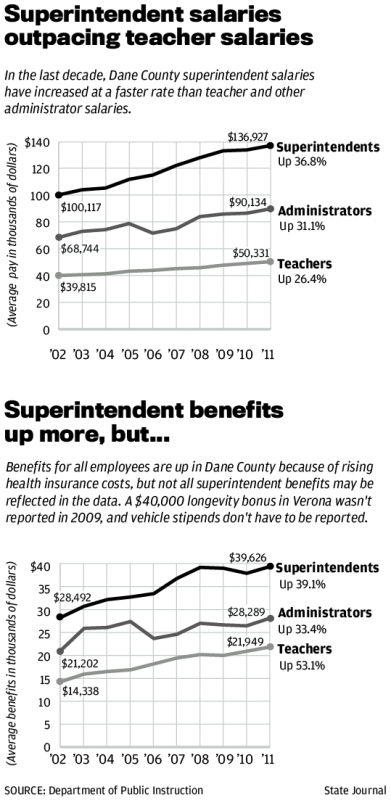
Alissa Smith and M.D. Kittle:

John Knight said he didn’t get into education for the money.
The superintendent of the Drummond Area School District, a 400-student public school system in the far northern Wisconsin community of Bayfield, this year is expected to make an arguably comfortable salary of $96,000.
But he has to work five jobs to earn his pay.
This past school year, Knight earned $19,050 as superintendent. He also served as the district’s director of pupil services, director of transport and director of food services and technology coordinator and principal of Drummond Elementary School. All positions combined will net Knight’s $96,000 salary.
This jack-of-many-educational-trades earned nearly the same salary as the previous district administrator, whose sole position was superintendent.

Share

K-12 Tax & Spending Climate: Federal, State, and Local Expenditures as a Share of GDP at WWII Levels

Matthew Mitchell:

In this week’s chart, Mercatus Center Research Fellow Matthew Mitchell uses data from the Bureau of Economic Analysis to illustrate the increase in the size of federal, state, and local expenditures as a share of GDP over the course of the past century.
The chart shows how expenditures as a share of GDP spiked during World War II but were reduced rapidly and significantly. However, spending never returned to the pre-war level and has followed a general upward trend ever since.
Today federal, state, and local expenditures as a share of GDP are back at the highs reached during World War II. This time, however, we are unlikely to see a swift decrease. Wartime expenditures on items like weaponry and salaries for conscripted soldiers were relatively easy to wind down. The bulk of current and future government spending is on entitlement programs like Social Security and Medicare. This variety of spending is nearly impossible to reduce in the near term.

Share

The Community of Math Teachers, from Elementary School to Graduate School

Sybilla Beckmann:

Why should mathematicians be in- terested and involved in pre-K-12 mathematics education? What are the benefits of mathematicians working with school teachers and mathematics educators?1 I will answer these questions from my perspective of research math- ematician who became interested in mathematics education, wrote a book for prospective elemen- tary teachers, and taught sixth-grade math a few years ago. I think my answers may surprise you because they would have surprised me not long ago.
It’s Interesting!
If you had told me twenty-five years ago, when I was in graduate school studying arithmetic geometry, that my work would shift toward improving pre-K- 12 mathematics education, I would have told you that you were crazy. Sure, I would have said, that is important work, it’s probably hard, and somebody needs to do it, but it doesn’t sound very interesting. Much to my surprise, this is the work I am now fully engaged in. It’s hard, and I believe what I’m doing is useful to improving education, but most surprising of all is how interesting the work is.
Yes, I find it interesting to work on improving pre-K-12 math! And in retrospect, it’s easy to see how it could be interesting. Math at every level is beautiful and has a wonderful mixture of intri- cacy, big truths, and surprising connections. Even preschool math is no exception.

Share

A Teacher Finds Good in Testing

Ama Nyamekye:

In college, I pumped my fist at a rally against standardized testing. I’d never seen the exam I was protesting, but stood in solidarity with educators and labor organizers who felt the testing movement was an attack on teachers, particularly those working in poor public schools. My opposition grew when I became a teacher in the South Bronx, one of America’s poorest communities. I wanted to uplift my students and resented the weight of a looming high-stakes test.
Besides, I thought good teachers should be left to their own devices. And, I was certain that I was a good teacher. For the most part, my students were punctual, respectful, and engaged. It wasn’t until my second year in the classroom that I began questioning this assumption.
In a routine evaluation, my principal praised my organization, management, and facilitation, but posed the following question: “How do you know the kids are really getting it?” She urged me to develop more-rigorous assessments of student learning. Ego and uncertainty inspired me to measure the impact of my instruction. I thought I was effective, but I wanted proof.

Share

Is Our Students Earning? A new way of measuring how different colleges pay off in the long run.

Erin Dillon:

The college class of 2011 just graduated into one of the worst job markets in recent history. Twenty-four percent of 2011 grads had a job offer in hand by graduation, compared with 51 percent of students graduating in the prerecession year of 2007. As these recent college grads move back in with their parents, and as student loan bills come due, many will wonder–was college worth the money?
The short answer is: probably. While studies of past recessions suggest that the unlucky Great Recession grads will do less well economically than those graduating during better times, they are still likely to earn more and have better job prospects than their peers who lack college credentials. The June 2011 unemployment rate for those with only a high school diploma, for example, was 10 percent, as opposed to 4.4 percent for those with a college degree. And earnings for college graduates were 66 percent higher in 2010 than for high school graduates. Moreover, the benefits of a college degree are not just financial: college graduates tend to lead healthier lives, have lower divorce rates, and have children who are better prepared for school. On average, a college degree is a worthwhile, if increasingly expensive, investment.

Share

Work together to serve our students

Madison Superintendent Dan Nerad:

A new school year is upon us. For a school superintendent, this is often the best time of year. Planning and hiring draw to a close, and we return to the work of educating our community’s children.
A new school year also stimulates many emotions in our students, parents, guardians and staff: anticipation, excitement, a sense of being ready and for some, a sense of uncertainty. This uncertainty is why I write.
The dawn of a new school year causes us to look forward, especially knowing how difficult last year was. One year ago, we could not have predicted what would happen in our community from a social fabric point of view. It is more than clear how various legislative changes have affected staff morale.
At a time when we need our staff to feel as good as possible about their important work, they feel less valued and less hopeful than when the fray began. Our children need much from us as employees of this district, but our staff also needs much from this community. While there is room for differences of opinion about priorities, our new school year needs to start with a sense of optimism and hope about the work our great staff members are doing in the Madison School District.

Share

The 2011 College Football Grid of Shame

Darren Everson:

College football, to put it as charitably as possible, had a less-than-ideal offseason.
From the Southeast to the Pacific Northwest, a series of scandals, controversies, academic outrages and incidents of boorish behavior has taken a toll on the good names of several schools.
This weekend’s spotlight game, for instance, pits No. 3-ranked Oregon, a school that’s under NCAA investigation for possible recruiting violations, against No. 4 LSU, whose top quarterback, Jordan Jefferson, is suspended for his part in a brawl outside a campus watering hole called Shady’s.

Share

Who Are You and What Are You Doing Here?

Mark Edmundson:

Welcome and congratulations: Getting to the first day of college is a major achievement. You’re to be commended, and not just you, but the parents, grandparents, uncles, and aunts who helped get you here.
It’s been said that raising a child effectively takes a village: Well, as you may have noticed, our American village is not in very good shape. We’ve got guns, drugs, two wars, fanatical religions, a slime-based popular culture, and some politicians who–a little restraint here–aren’t what they might be. To merely survive in this American village and to win a place in the entering class has taken a lot of grit on your part. So, yes, congratulations to all.
You now may think that you’ve about got it made. Amidst the impressive college buildings, in company with a high-powered faculty, surrounded by the best of your generation, all you need is to keep doing what you’ve done before: Work hard, get good grades, listen to your teachers, get along with the people around you, and you’ll emerge in four years as an educated young man or woman. Ready for life.

Share

Does Chicago have scandalously short school days?

Eric Zorn:

Houston, do we have a problem?
Your school days and years are strikingly longer than Chicago’s — a bit more than an hour more instructional time per day and 10 additional instructional days on the annual calendar, according to calculations by the Chicago Teachers Union.
That’s about 250 extra hours in the classroom per year, which is roughly equivalent to three extra school years from first grade through 12th grade. That eye-opening number is figuring into the debate here about increasing classroom time for Chicago’s students, as Mayor-elect Rahm Emanuel has said he wants to do.
So, Houston, is all this extra schooling paying off?
The average ACT score for Houston’s public high school students is 19.7, compared with 17.3 in Chicago, according to state report-card figures. From 2002 to 2009, your average eighth-grade reading scores inched up 4 percent while our scores were flat, and your average eighth-grade math scores rose 13 percent compared with our 9 percent increase, according to the National Association of Educational Progress.
On the other hand, Houston’s four-year graduation rate is basically the same as Chicago’s, depending on who’s crunching the numbers. And 87 percent of Chicago’s pupils are classified as “low income,” compared with 79 percent of pupils in Houston labeled “economically disadvantaged.”

Share

What makes a good principal? It takes a principal

Laura Schubert:

Due to a slew of administrative retirements, 39 schools in the Milwaukee Public Schools system will have new principals this school year. The aptitude of this incoming class of leaders is unarguably pressing in the turbulent wake of the spring’s budget showdown and its rippling effects on education.
Principals are charged with the daunting task of cultivating and maintaining school environments that are conducive to learning. Their performance strongly correlates to the ultimate success or failure of their schools.
While it’s easy to spot those who excel in the role, it’s trickier to pinpoint the attributes that define principals on the high end of the efficacy spectrum. What exactly sets them apart?
Effective principals recognize the value of each employee’s role in achieving schoolwide success. They treat staff members as competent professionals, involve them in goal-setting and school improvement plans and delegate key responsibilities as much as plausible.
While they monitor progress to ensure accountability, proficient principals don’t fall into the trap of micromanagement. Rather, they articulate high expectations and trust staff members to successfully fulfill their obligations.

Share

All-male Madison IB charter school could put minority boys on road to success

Alan Borsuk:

Kaleem Caire knows what it is like to be a young black man growing up in Madison and going on to success. A troubled kid when he was a student at Madison West High School in the 1980s, he went on to become a nationally known Washington-based education advocate before returning in 2010 to head the Urban League of Greater Madison.
Kaleem Caire knows what it means to be a young black man growing up in Madison and going on to failure. He saw what happened to many childhood friends who ended up dead or in prison. He sees it now in the disturbing statistics on African-American education outcomes and unemployment.
And Kaleem Caire has an eye-catching idea he thinks will put more black and Latino youths on the path to success – enough to make a difference in the overall troubling picture of minority life in the state’s second largest city.
The idea? An all-male charter school for sixth- through 12th-graders with longer days and longer school years than conventional schools, an International Baccalaureate program, and high expectations of students and teachers, including academic performance, the way they treat others, and the way they dress.

Related:
Notes and links on the proposed Madison Preparatory IB Charter School.
Susan Troller:Madison Prep now says girls will be welcome:

Kaleem Caire says there’s a simple fix for concerns that a proposal for an all-male charter school in Madison would discriminate against girls.
“If it’s a problem, we’ll introduce a single-sex charter school for girls at the same time we start the boys’ school, in the fall of 2012-2013,” Caire said in an interview Friday.
Caire, president of the Urban League of Greater Madison, first began talking a year ago about creating a rigorous, prep-style public charter school for boys aimed at improving minority student performance. With its single-sex approach, International Baccalaureate curriculum, emphasis on parent involvement and expanded hours and days, Madison Preparatory Academy would not only be unique in the Madison district, but also unique in the state.

The fate of Madison Preparatory Academy will be a defining moment for our school climate.

Share

School Days

Steve Prestegard:

Today begins school in Ripon and in most of Wisconsin. So parents breathe a sigh of relief that the kids are finally out of the house, until they realize that now they have to get their children to their various after-school activities.
This has been an unusual summer for one glaring reason, and yet it hasn’t been unusual in the day-to-day things. All three kids went to summer school. All three played baseball (T-ball in Shaena’s case). All three went to church camp, Shaena with me. (Which was not how I expected to spend her summer vacation, although those three days were far from summerlike.) All three visited their grandparents, and we got back reports that made us wonder whose children they had. We didn’t go on vacation, in part for the aforementioned glaring reason, but I’m not sure the family is up to being locked inside a van for extended periods of time anyway. More than once, in fact, I’ve wondered how everyone would have gotten to everything had there been two working parents, particularly with the occasional added complication of orthodontist and veterinarian appointments.

Share

New technologies are promising, but what about the teachers?

Monica Bulger:

This post is not going to promise dramatic learning gains from using a new technology. It’s not one of those stories where at first a teacher was skeptical, but in the end, the classroom was like a sports movie where the technology scored the winning homerun. I feel skeptical when I read those stories. I don’t doubt the success, but I wonder whether the learning gains, increased student interest/participation, or higher levels of reported satisfaction have less to do with the iPad, blog, twitter stream, or virtual environment and more to do with who is in the classroom.
Cathy Davidson recently described an idyllic experience of teaching a course in which she and the students shared in the discovery of new applications of technologies for learning. She describes the process of developing the course, the thrill when the students actually invited and facilitated a guest lecture, and the ways in which the students challenged her to really be collaborative, even in grading.
If we step back for a moment, though, and consider a class with Davidson and those same students without the new technologies, what would the learning experience be like? I imagine it would still be exceptional, because Davidson is an obviously engaged teacher and the students are obviously engaged learners. She employs teaching strategies that were effective before the new technologies she describes. In particular, she encourages students to take ownership of their learning experience and creates a flexible environment to support whatever direction they take. When developing assignments, Davidson incorporates research in motivation, particularly students’ likelihood to put more effort into writing for an authentic audience. She also has deep experience with her topic and an obvious enthusiasm for both the content and the teaching. These factors are consistently linked to positive learning experiences in educational research. Additionally, the students clearly seem motivated to learn. She describes the class list as a diverse collection of disciplines, so the students appear to be choosing the course. They demonstrate active involvement with the assignments and content and even provide substantive feedback for future courses.

Share

Report: Florida’s low-income tax credit students making academic gains

Jon East:

A new report on the academic performance of low-income students receiving Tax Credit Scholarships in Florida finds they are making modestly larger gains in reading and math than their counterparts in public school.
That conclusion from 2009-10 test data is encouraging for those of us who work to provide these learning options, which served 34,550 low-income students statewide last year. But the report, released today and written by respected Northwestern University researcher David Figlio, is also a reminder of the inherent complexities of judging whether these programs work.

Share

1 in 4 students can pass geography exam

Brian Tynes:

Do you know who is responsible for collecting fuel wood and water for families in East Africa?
Can you identify South America by looking at a diagram of its elevation changes in profile?
Those are sample questions found on the National Assessment of Educational Progress geography assessment test for 12th-grade students this year.
If you don’t know the answers, you’re not alone. Only 25 percent of American students passed the test.
It’s a far cry from most people’s perception of geography skills, such as identifying a river or mountain range on a map. It’s one of the main reasons the subject doesn’t get the same attention as others, such as math and English.

Share

A weaker Public School Choice initiative

Los Angeles Times Editorial:

By keeping charter operators out of the first round of applications to run new schools, the L.A. Unified board has scaled back its goal of making educational excellence the highest priority.
The Public School Choice initiative was a landmark reform for the Los Angeles Unified School District. By allowing alternative operators — whether charter school organizations, the mayor or groups of teachers — to apply to manage scores of new and low-performing schools, it set the standard for putting students first. The theory was that anyone could apply and the very best applications would win, ensuring that students attended the best-run schools the district could offer. Just as important, charter operators in the program would have to accept all students within each school’s enrollment area rather than using the usual lottery system under which more-motivated families tend to apply to charter schools.
Of course, this is L.A. Unified, which means things didn’t always work out. More than one management contract was awarded on the basis of political alliances. Charter schools were disappointingly unwilling to take on the tougher challenge of turning around failing schools; most of their applications were for the new, pretty campuses.

Share

The Amazing Colossal Syllabus

Thomas Bertonneau:

Instructors have to spell out every detail for today’s students, and do some of their thinking for them.
When I was an undergraduate at UCLA in 1972, I was enrolled in four classes. On the first day of the term, each instructor went through the ritual of introducing the course and handing out the syllabus, if there was a syllabus. In the freshman composition course, taught by a man who later distinguished himself as a James Joyce scholar, I remember no syllabus at all, only the comment that we would be writing a number of formal papers.
In Cultural Anthropology there was a syllabus–a single mimeographed sheet with a few dates on it (exams, deadlines for papers) and the mandatory bibliography. In first-term German, as in freshman composition, the teacher issued no syllabus. The chapters of the primer were syllabus enough. For my fourth course, a survey of ancient civilizations, the textbook’s table of contents served as the syllabus.
Admission to UCLA in the mid-twentieth century was still rigorous and exclusive; our preceptors rightly took for granted that students understood that the ten weeks of the term would correspond to a structure. Students would expect regular quizzes, that they would have to submit formal essays at the midterm and at the end of the quarter, and that they would have to keep up with the reading.

Share

Charter Schools ARE Public Schools

Jed Wallace:

Despite the success of charter schools, especially here in Los Angeles, or perhaps because of it, misconceptions abound about what charter schools are and what they do. A recent piece in City Watch by Janet Denise Kelly echoed many of these common misunderstandings, following them to the wrong conclusions. Charter schools are tuition-free public schools that are open to all students who apply. The only reason they have admission lotteries is that many charter schools have more students applying than they can serve. Unlike exclusive private schools or district magnet schools, charter public schools are prohibited from “cherry picking,” or selecting “the best” students. In fact, research has shown that charters serve diverse students with a wide range of needs.
I start by highlighting charter school lotteries because their very existence flips on its head the argument that charter schools are growing for the sake of growth. The fact is, new charter schools have opened in direct response to overwhelming demand from parents for better educational options in their communities. For too long, families in south LA haven’t had many options if they were dissatisfied with their local traditional public school. They could pay a steep price for a private school or they could fight to get into one of LAUSD’s exclusive magnet programs, which might be a long bus ride away.

Share

“A New York Times Reporter Tips His Hand”

Eugene Volokh:

That’s the title of a post from Heather Mac Donald (Secular Right); here’s an excerpt, though you should read the whole post:

In the course of a column blasting media entrepreneur Steven Brill’s new book on the school reform movement, New York Times reporter Michael Winerip inadvertently sets out his economic assumptions. A revelation of an entire world view does not get any more crystalline than this. (Regarding education, Winerip almost equally tellingly criticises Brill for not showing enough respect to teachers and teachers unions.)

Winerip lists several of Brill’s sources — the “millionaires and billionaires who attack the unions and steered the Democratic Party to their cause” — then adds:

Share

Out of School and Into the Red

Jenna Ashley Robinson:

Last month, Smart Money released a “payback scorecard,” which ranked universities based on whether graduates’ salaries justify the tuition paid to the school. They surveyed 50 top-priced Ivy League, public, and private schools across the country.

Since none of North Carolina’s 54 colleges or universities is one of the most expensive schools, none of them showed up on Smart Money’s rankings.

But data showcased on the North Carolina College Finder (a Pope Center website) will help potential students assess North Carolina schools and decide whether their salaries after graduating are likely to justify the expense. A summary of the data can be seen below.

Share

Language learning: No, she’s foreign!

The Economist:

LANGUAGE-learning is fascinating, but not for those who can’t take the occasional humiliation.
I live in São Paulo and though I’m sure my Portuguese accent is horrible, it’s horrible in a recognisably Paulistano way. I say the “e” in duzentos (two hundred) with a twang; and I don’t say “sh” for “s”, as Cariocas, or residents of Rio, do. Generally people in São Paulo understand what I’m trying to say–and so do taxi drivers and hotel staff in Rio. Indeed, they are usually so delighted to meet a foreigner who speaks any Portuguese at all that they are highly complimentary, which even if it is more to do with Brazilian hospitality and courtesy, is delightfully confidence-inducing.
Not so Cariocas who don’t have regular contact with tourists. On holiday in Rio with my family recently, I tried to strike up conversation with some children aged around 11 or 12 on the top of the Pão de Açúcar, or Sugarloaf Mountain, one of Rio’s most famous tourist spots. I asked one if they were visiting with their school. (This was an easy guess; they were wearing uniform. But I wanted to practise.) He stared at me, bemused. I repeated: “Vocês estão aqui com sua escola?” No good. He called over a friend. By now I was getting embarrassed, but I tried again. This time he turned to her and said: “Não entendi nada” (I didn’t understand a thing). Only when a teacher came over and repeated my sentence to the children did we get anywhere. Very depressing.

Share

Speculations on the future of reading

Shreeharsh Kelkar:

In 2008, Nicholas Carr published an essay in the Atlantic Monthly titled “Is Google making us stupid?” The article got a lot of play and was later turned into a book titled “The Shallows.” At its heart, Carr’s thesis is a simple one. He argues that the extensive internet reading – meaning the the copious amount of reading that we do on the internet as well as our need to be always “plugged in” into, for instance, email and Facebook – is changing the way we think. He is explicitly worried about the future of reading. He thinks that the art of reading deeply – think about being immersed in a novel for a few hours – is dying out; that, instead, reading has become a “sampling” activity: a little bit here, then a quick glance through email, another little bit there. Since reading did not come naturally to the human brain and in fact helped shaped the brain as we know it today, this new form of reading – all stops and starts – will change it as well. If that happens, will the decline of quiet contemplative deep reading result in the decline of deep thinking? (Obviously Carr poses this question rhetorically; his answer is an emphatic yes.)

Share

Lunch with the FT: Toby Young

Chris Cook:

Toby Young is not nervous about publicity. I first met him at last year’s Conservative party conference in Birmingham. The journalist and author approached me in a bar, pretended to punch me in the stomach several times, then looked up and asked: “Why haven’t you written about my school yet?”
Young, 47, is chairman of the governors at the West London Free School, a new secondary school in Hammersmith, which will welcome its first pupils (120 children aged 11) next month. It is a high-profile project that has made Young a regular participant in debates about education in Britain.
The school is one of the first wave of “free schools“, funded by the state but founded by private groups such as churches or community groups (in Young’s case, local parents), intended to bring new providers into the education system.
What makes the West London Free School particularly unusual is the celebrity of its chairman. Young first attracted attention in the early 1990s as the bumptious co-founder and editor of the Modern Review magazine before moving to the US. In New York he worked as a contributing editor at Vanity Fair magazine where he was not a success and fell out with Graydon Carter, its editor, though subsequently Young managed to convert the experience into a successful book, play and film, all called How to Lose Friends and Alienate People

Share

Ivy League Fooled: How America’s Top Colleges Avoid Real Diversity

Cord Jefferson:

Back in March, as colleges began to herald their newly admitted classes for PR purposes, the Ivy League schools got to patting themselves on the back.
The Harvard Gazette bragged that Harvard’s newest batch of accepted students included record numbers of blacks and Latinos. Brown said its admitted class was “the most racially … diverse” in the school’s centuries-long history. Dartmouth shared actual percentages, declaring that a full 44 percent of its newest class was composed of students of color. Coincidentally, that was the same percentage of minorities in Penn’s freshman class.
Numbers like these might lead someone to believe that diversity is no longer an issue at America’s most elite colleges. Like everyone else, students of color have long strived to make it to the Ivy League, where the education and connections can set a person up for life. Now, evidently, huge numbers of minorities are getting their chance. When nearly half of an Ivy League school’s accepted class is made up of people of color–America as a whole is only 47 percent non-white (PDF)–aren’t we nearing perfect equality? If only.

Share

Guardian and New York Times crowdsource schools databases

Katherine Travers:

Education, along with health and taxes, is a principal public concern; politicians win elections because of it, and therefore it’s vital that newspapers provide good coverage of it.
Both The Guardian and The New York Times have launched crowd-sourcing projects on their websites, which intend to provide readers with information relating to the quality of schools.
As it is GCSE results day in the UK, The Guardian has appealed to teachers on its website to fill in a simple online form, which will then allow them to map the exam results of schools across the country.

Share

A K-8 school by day, adult club by night?

Kathleen McGrory, via a kind Marc Eisen email:

By day, the Balare Language Academy is an A-rated charter school, home to children in kindergarten through middle school.
But when the kids are tucked into bed, Balare apparently becomes a playground of a different kind.
Party fliers, printed and on the Web, indicate that the campus at 10875 Quail Roost Dr. has been hosting raunchy, booze-soaked bashes into the wee hours. One flier for an upcoming party features a voluptuous, scantily clad woman posing with champagne bottles. Another shows a woman in a string bikini bending over suggestively and a man with flashy jewelry sitting on a stack of currency in front of a gold sports car.
Asked if the school was hosting any parties, founder and principal Rocka Malik responded: “Not that I’m aware of.”

Share

Lessons From the One-Room Schoolhouse

Sue Shellenbarger:

Before classes began at Spring Creek School near Decker, Mont., community volunteers cut back the grass, cleared tumbleweeds and made sure there were no rattlesnakes around the playground. Last week, the one-room schoolhouse opened for its six K-5 students.
“We all pitch in out here to support the school,” says Loren Noll, a neighbor who showed up to dig weeds. Even though his 4-year-old daughter isn’t old enough to attend, Mr. Noll volunteers as chairman of the school board.
In the U.S., 237 public schools had only one teacher, according to 2009 federal data, down from 463 in 1999. Most are located in remote areas. And while conditions are far from the rough-hewn rooms of “Little House on the Prairie,” such schools often lack the amenities typically associated with high-quality schooling, such as computer labs, libraries, sports, art, music, nurses and psychologists.

Share

Emily’s Post: In defense — and praise — of public school teachers

Emily Mills:

My mother was a public school teacher. She graduated college with a degree in elementary education and spent the rest of her life — nearly up until the time of her death at age 50 — teaching children. I remember the hours she spent at home working on projects, grading, and just making decorations for the classroom, and all this even though she spent most of those years as a substitute teacher.
Eventually she found a niche teaching children with learning disabilities how to read. My mother worked tirelessly to see that these kids had a leg-up and didn’t fall through the cracks of the system. She knew how important it is to be able not only to read, but to read well.
Through all of the time spent, hours worked, problems tackled, gold stars given, lives changed, she barely made any money. I was too young to know her exact salary but I know it wasn’t much, especially given that she had three kids of her own at home. We made do — my parents took good care of us despite what I now know were some very rough financial times. And I never heard my mom complain, not in front of us, anyway. She loved her work and the kids she worked with, and that’s what mattered.
And so I know it to be the same case, far more often than not, with teachers. Teaching is not a career that is entered into lightly. It’s some of the hardest, if most rewarding, work around — all for some pretty petty cash. They’re not living in mansions. Average yearly salary is just $46,390 in Wisconsin, with an average starting salary of a mere $25,222, ranking us 20th in the nation. For some perspective, that starting salary would put you under the federal poverty line for a family of five, and just barely over it for a family of four.

Share

Insure Stuff at School

The Wall Street Journal:

As parents prepare to send kids off to college, here’s one thing to think about: how to insure the belongings students are taking with them.
A homeowners insurance policy will generally cover your child’s things if he or she is living on campus. But the coverage for his or her belongings may be limited to 10% of your total possessions coverage, which varies by insurer. If your child will live off campus, coverage could be more limited.
If the 10% rule applies and you have $50,000 of personal-possessions coverage, only $5,000 is covered off-site.

Share

Why I think Higher Education should experiment with an incubator model

Jesse Rodgers:

In Canada the rise of the incubator choices is quite noticeable. The success of the Y-Combinator (YC) model is hard to ignore, it seems to be the accepted way to grow young tech companies at the moment. However, it isn’t clear if the model works anywhere but YC and TechStars, these programs cost a lot of money to run so does the math hold up for everyone?
How many companies make it a big enough exit (assuming you need a $30 million exit per incubator) and in what time frame? In Canada there is a trend that shows some crazy growth in exits but how many are in that ‘big enough’ range or more that haven’t been around for 5-10 years or more? I think one maybe two. It isn’t just Canada though, how many exists are there in a year for any tech startup anywhere? Likely not enough to sustain the current number of incubators globally.

Share

Duncan Worries About Losing “Great Young Talent”: What About Us Old Timers?

Anthony Cody:

Last week during Arne Duncan’s Twitter Town Hall there was one phrase that keeps sticking in my mind. John Merrow asked him what his message is for teachers who feel under attack.
Secretary of Education Arne Duncan’s response included this:
“We have to do everything we can to support teachers. I worry about losing too much of our great young talent.”
It is hard to disagree with this. I spent the last four years leading a program in Oakland designed to do just that. We created TeamScience to give novice science teachers a professional community to belong to, offering them experienced colleagues as mentors as well as workshops, curriculum and professional development. We did this because we have a huge turnover issue among our science teachers. Most of the vacancies are filled with interns from Teach For America and other programs, and three years after they start, 75% of these teachers have left the District.

Share

Team Real on Drug Abuse


www.teamreal.org, via Judy Reed:

TEAM REAL is made up of students from your community that are in-the-know about drugs of abuse. The facts provided will raise awareness of the local drug trends, costs of illicit drugs, ways kids are getting high, and the use of over-the-counter and licit medications as drugs of abuse.

A larger version of this image is available here.

Share

New Jersey set to pilot new teacher evaluation systems

Christopher Cerf:

Every child deserves a great teacher. New Jersey — which ranks among the top states in the nation in student achievement — is making great strides in delivering on that promise.
Research shows that the effectiveness of the teacher in front of the classroom is the most important in-school factor affecting student learning, and we owe an enormous debt of gratitude to our teachers for our children’s success.
Precisely because teaching is an honored craft, we must recognize and respect effective educators, support teachers in their efforts to continue to develop their skills and ensure that those comparatively few individuals who are unable to improve no longer remain in the classroom.

Share

Ex-LA teacher union head AJ Duffy to launch charter school

Christina Hoag:

The former president of the teachers union in the nation’s second largest school district is moving on to a new job that might surprise many: He is launching a charter school organization after often criticizing such schools in his previous role.
A.J. Duffy, 67, who headed United Teachers Los Angeles for six years before he was termed out in June, said Thursday he will be executive director of the newly formed Apple Charter Academy Public Schools.
If approved by the Los Angeles Unified School District, the schools are planned to open next year, possibly as soon as February or in September at the latest, with campuses in South Los Angeles, he said.
The model he wants to create will be a radical departure from both traditional and charter schools, promised Duffy. “We want to create a system that’s not just good for kids and fair to teachers, but that’s revolutionary,” he said.

Charters are an opportunity for teacher unions.

Share

Time to focus on excesses of football practice

Gregg Easterbrook:

From the standpoint of most spectators, football is all about the game. From the standpoint of most players, football is all about practice. What players go through at practice, particularly two-a-days, can be more grueling than what they go through during games. When coaches tell players, “Compared to practice, the game will be fun,” they aren’t kidding.
Though spectators and viewers think of games as the dangerous part of football, because it’s during games that injuries are widely seen — coaches whom I have interviewed think players are more likely to be injured at a practice than during a game. Partly this is simply because players spend so much more time practicing than performing, meaning more hours of risk.

Share

In praise of modest accomplishment

Harry Eyres:

Being an artist seems to require a magnification of ego, but being a craftsperson involves its diminution.
Art and craft might be in their origins indistinguishable – the Greek word techne means art, and craft, and technique – but artists and craftspeople, at least in the past 100 years or so, have developed very different ways of behaving. The cartoon series Young British Artists in the satirical magazine Private Eye, featuring a group of foul-mouthed, self-obsessed and self-promoting yahoos, could not by any stretch of the imagination be called Young British Craftspeople.
For those who want to promote craft, I was thinking as I attended two craft-oriented events in recent weeks, this presents both an opportunity and a problem. Craftspeople are just too modest and self-effacing and even nice to be obvious subjects for the contemporary media circus, with its taste for extravagant and self-destructive lifestyles. Craftspeople are somehow less likely to produce scores of illegitimate children, in the manner of Lucian Freud, or to die in unexplained circumstances at 27, in the manner of Amy Winehouse, than artists. You might think that was a salutary thing but try telling that to a tabloid newspaper editor.

Share

John Kuhn’s rousing speech at SOS march

Substance News:

Let me speak for all public school educators when I say unequivocally: We will. We say send us your poor, send us your homeless, the children of your afflicted and addicted. Send us your kids who don’t speak English. Send us you special-needs children, we will not turn them away.
But I tell you today, public school teacher, you will fail to take the shattered children of poverty and turn them into the polished products of the private schools. You will be unacceptable, public school teacher. And I say that is your badge of honor. I stand before you today bearing proudly the label of unacceptable because I educate the children they will not educate.
Day after day I take children broken by the poverty our leaders are afraid to confront and I glue their pieces back together. And at the end of my life you can say those children were better for passing through my sphere of influence. I am unacceptable and proud of it.

Share

More heat on Hong Kong national education: Controversial plan suffers a fresh blow with a pro-government teachers’ body raising objections and calling for a trial scheme first

Dennis Chong:

The government faces mounting pressure to scale back its controversial plan to introduce national education to all schools within two years. Many teachers have raised objections during the four-month public consultation which ends today.
The plan to require all primary and secondary schools in Hong Kong to include national education as a study subject has triggered heated debate in the city. It is one of the key political objectives for Donald Tsang Yam-kuen, who step downs as chief executive next year.
For years, the pro-Beijing camp in Hong Kong have been critical of schools’ lack of efforts to instil a sense of national identity in students, and feared it would alienate them from the rest of the country. The opposition worried compulsory national education would be used to rationalise autocratic rules on the mainland and become a “brain-washing” tool.

Share

Wanted: More involved parents

Wisconsin State Journal Editorial:

Listen carefully, and you can hear it everywhere:
Schoolgirls chattering about clothes and music and, of course, boys. Schoolboys rough-housing on the playground, boasting of touchdowns and soccer goals, and pretending not to notice the girls, who are pretending not to notice the boys.
As summer gives way to fall, the sweet sound of education is back.
From kindergarten classrooms with fears and tears always close, to middle school mixers where “tweens” finally begin to find themselves, to high school hallways where the minds get sharper and the humor gets darker, school is again in session.
For many it was a summer of discontent as recall elections were ripple-effect reminders of the political unrest from last spring, when K-12 educators and other public employees were at the center of a debate that featured much disagreement.

Share