School Information System

A Better Online Reader

Maria Konnikova

Soon after Maryanne Wolf published “Proust and the Squid,” a history of the science and the development of the reading brain from antiquity to the twenty-first century, she began to receive letters from readers. Hundreds of them. While the backgrounds of the writers varied, a theme began to emerge: the more reading moved online, the less students seemed to understand. There were the architects who wrote to her about students who relied so heavily on ready digital information that they were unprepared to address basic problems onsite. There were the neurosurgeons who worried about the “cut-and-paste chart mentality” that their students exhibited, missing crucial details because they failed to delve deeply enough into any one case. And there were, of course, the English teachers who lamented that no one wanted to read Henry James anymore. As the letters continued to pour in, Wolf experienced a growing realization: in the seven years it had taken her to research and write her account, reading had changed profoundly—and the ramifications could be felt far beyond English departments and libraries. She called the rude awakening her “Rip van Winkle moment,” and decided that it was important enough to warrant another book. What was going on with these students and professionals? Was the digital format to blame for their superficial approaches, or was something else at work?

Certainly, as we turn to online reading, the physiology of the reading process itself shifts; we don’t read the same way online as we do on paper. Anne Mangen, a professor at the National Centre for Reading Education and Research at the University of Stavanger, in Norway, points out that reading is always an interaction between a person and a technology, be it a computer or an e-reader or even a bound book. Reading “involves factors not usually acknowledged,” she told me. “The ergonomics, the haptics of the device itself. The tangibility of paper versus the intangibility of something digital.” The contrast of pixels, the layout of the words, the concept of scrolling versus turning a page, the physicality of a book versus the ephemerality of a screen, the ability to hyperlink and move from source to source within seconds online—all these variables translate into a different reading experience.

Share

Politics, Wisconsin & The Common Core, Part 34

Alan Borsuk:

Here’s a suggestion for something to include in Wisconsin-specific education standards for Wisconsin children:

By the end of first grade, children will know that two Badgers plus two Badgers equals four Badgers.

You want Indiana-specific standards for Indiana kids? By the end of first grade, children will know that two Hoosiers plus two Hoosiers equals four Hoosiers.

North Carolina standards for North Carolina kids? You got it — two Tar Heels plus two Tar Heels equals four Tar Heels.

What kind of silliness is this? Best as I can see, it’s about the level of silliness the whole discussion of education expectations for our children is reaching, both in Wisconsin and across the nation.

With Gov. Scott Walker’s one-sentence statement on Thursday that he wants the Legislature to repeal Wisconsin’s involvement in the Common Core standards movement, we have crossed onto turf where chaos in education policy is likely to reign for the coming school year.

At the same time, I bet we’re also on the way, in the long run, to changing very little when it comes to state standards for what kids should learn. I say that because states that have announced they are going to set their own standards are generally coming up with new plans that actually change little. That’s for two reasons.

Share

Wisconsin’s DPI Lags again: Minnesota Publicly Links High School Graduation to College Achievement Data

Mila Koumpilova

Six years ago, 225 students graduated from St. Paul’s Como Park High School. More than 70 percent went to college. Almost 40 percent got a degree.

That’s the sort of information Minnesota educators and parents have long wished they had. Now, it is readily available for the first time on a newly launched website that shows where a high school’s graduates went to college, how long they stayed on campus and how many graduated.

For state officials like Education Commissioner Brenda Cassellius, the information promises to highlight hidden success stories and inform policy decisions at a time of intense focus on college and career readiness. High schools can use it to assess how well they are preparing students and to spur partnerships with campuses popular with their graduates.

“This is a huge step forward in understanding how our students do when they leave us,” said Joe Munnich, the St. Paul district’s assistant director of research, evaluation and assessment. “It opens up amazing possibilities.”

Of Minnesota’s 2008 high school graduates, 69 percent went to a two- or four-year college, and 45 percent have since gotten a diploma. Eventually, the web site will also include information on how college graduates are faring on the job market.

The new data and web site are a joint effort by Minnesota’s Office of Higher Education, the Departments of Education and the Department of Employment and Economic Development. The project is funded with the same federal grant that has supported the state’s “Getting Prepared” reports, which show what portion of a high school’s graduates had to take remedial courses in college.

Until now, high schools knew which of their students graduated in a given year. Higher education institutions knew which students arrived on their campuses and which stuck around until graduation. The state project linked up that data for each student.

This data has been discussed from time to time in Madison & Wisconsin. Yet, our Wisconsin DPI – parent of the oft criticized WKCE – seems to be living in the status quo.

It appears that the Wisconsin DPI spent $48,531,028.75 during 2013 according to the Wisconsin “Open Book” site.

Here’s an example from Minnesota’s “SLEDS” System:


Dive in at the SLEDS site.

Share

Adjuncts Urge Labor Dept. Inquiry Into Working Conditions

Inside Higher Ed

More than 500 adjunct professors and their advocates have signed a petition calling for the U.S. Department of Labor to investigate their working conditions. The petition’s authors, all current or former adjuncts at various colleges and universities, allege that they are being paid for only part of the work they do, and that that amounts to wage theft. The petition is addressed to David Weil, director of the agency’s Wage and Hour Division, and urges him to “open an investigation into the labor practices of our colleges and universities in the employment of contingent faculty, including adjunct instructors and full-time contract faculty outside the tenure track.” The investigation should be conducted at the “sector” level, they say, rather than individually.

Share

Unspoiled Children, No Rod Needed

Veronica Dagher:

You want to give your children everything. But sometimes you can go too far and create a spoiled, entitled brat.

The consequences can be severe: In addition to acting like whiny complainers now, spoiled children are more likely to grow into financially dependent, irresponsible adults plagued by overspending and debt.

“Some parents want their children to have everything for free,” says Katherine Dean, managing director of wealth planning at Wells Fargo Private Bank in San Francisco. “But the real world doesn’t work that way.”

Financial advisers and therapists suggest various ways to avoid spoiling your children. A few:

Share

How to Teach Reading and Writing

Letters to the New York Times Editor on The Fallacy of ‘Balanced Literacy, via a kind reader:

To the Editor:

Kudos to Alexander Nazaryan for his eloquent defense of “conventionally rigorous” teaching techniques.

The decision by the New York City schools chancellor, Carmen Fariña, to reinstate balanced literacy despite the unfavorable results of studies done during the Bloomberg administration reflects, in my opinion, a general aversion to empirical evidence within the educational establishment in favor of ideology and faddish group think.

I very much appreciate the excellent K-12 teaching I received in Brooklyn public schools during the 1940s and ’50s, when a “conventionally rigorous” approach was the norm.

My more recent experience as a volunteer tutor in Wisconsin elementary schools during the past 12 years mirrors that of Mr. Nazaryan in Brooklyn in 2005-06. Again, an approach appropriate for the Midwestern equivalent of “brownstone Brooklyn” kids was employed in classrooms where half the kids were poor or minorities or both. The results of this approach are what the local press has described as a notoriously high racial achievement gap.

Carl Silverman
Madison, WI

Much more on “balanced literacy”, here along with Madison’s long term disastrous reading results.

Share

Wisconsin High school students can’t be charged for college credit courses; Credit for Non Madison Schools Courses Redux

Mary Spicuzza:

The University of Wisconsin System cannot charge high school students taking courses offered in their schools for college credit, known as concurrent enrollment classes, the state’s attorney general says.

“This opens a lot of doors, basically. This is a good deal for kids and parents,” said John Johnson, spokesman for the state Department of Public Instruction. “The bottom line is that parents and students won’t be on the hook for costs.”

In an opinion released Thursday, Attorney General J.B. Van Hollen also said the state’s Department of Public Instruction — rather than UW System — should determine concurrent enrollment program costs for UW System and school districts.

“Impact on UWS (the payments it will receive) and the resident school district (the payments it will make) will be decided by DPI,” Van Hollen wrote. “Not only does the student no longer pay any tuition for a concurrent enrollment course, his application to attend a concurrent enrollment court cannot be denied on the ground that it might impose ‘an undue financial burden’ on his resident school district.”

A look at credit for non-Madison School District courses.

Share

Students Face Debt by 1,000 Fees

Megan McArdle

To solve this problem, UCLA is introducing a $4 student fee to pay for better concerts. That illuminates a budgeting issue in higher education — and indeed among human beings more generally.

That $4 is not a large fee. Even the poorest student can probably afford it. On the other hand, collectively, UCLA’s student fees are significant: more than $3,500, or about a quarter of the mandatory cost of attending UCLA for a year.

Those fees are made up of many items, each trivial individually. Only collectively do they become a major source of costs for students and their families and potentially a barrier to college access for students who don’t have an extra $3,500 lying around.

As I’ve written before, this is a common phenomenon that you see among people who have gotten themselves into financial trouble — or, for that matter, people who are doing OK but complain that they don’t know where the money goes and can’t save for the big-ticket items they want. They consider each purchase individually, rather than in the context of a global budget, which means that they don’t make trade-offs. Instead of asking themselves “Is this what I want to spend my limited funds on, or would I rather have something else?” they ask “Can I afford this purchase on my income?” And the answer is often “Yes, I can.” The problem is that you can’t afford that purchase and the other 15 things that you can also, one by one, afford to buy on your income. This is how individual financial disasters occur, and it is also one way that college tuition is becoming a financial disaster for many families.

Share

Students vs. Teacher Unions

Joe Klein:

New York City’s mayor handed teachers a big win. Struggling students will be the losers

Back in 2005, when New York City was pre-crash flush, Mayor Michael Bloomberg offered the United Federation of Teachers a raise in return for 150 extra minutes of classroom work per week. The mayor’s idea was to spend that extra time tutoring the kids who needed the most help–the bottom third of each class. UFT president Randi Weingarten agreed that the group sessions would be small, no more than 10 students per class. Schools chancellor Joel Klein wanted three 50-minute periods per week. The union wanted five 30-minute periods. They compromised on four 37½-minute sessions.

The program was never given a name, which made it easier for New York’s new “progressive” mayor Bill de Blasio to give it back–to eliminate the required 150 minutes of special instruction–in his negotiations with the UFT this spring. You might well wonder why. I tried to find out but received a heaping ration of gobbledygook from a source close to the mayor. He said that the program had been “inflexible” and “one size fits all.” That it was not “workable to the purpose.” Translation: it didn’t work. But how do we know that? No studies or evaluations were done. At his press conference announcing the new union deal, the mayor and his schools chancellor, Carmen Fariña, gave several foggy reasons for the change: the time would be used for additional parent conferences and for “professional development” so the teachers could learn how to teach the new core curriculum. A lot of unspecific wiggle room was negotiated on both counts–part of the mayor’s drive toward “flexibility.”

Share

Who Does Your College Think Its Peers Are?

Chronicle of Higher Education:

Colleges selected by institutions as peers show the power players in the world of higher education. Those choices also reveal sometimes surprising connections.
Explore the 1,595 colleges in this network to find out more, or read our article to learn about the trends.

Share

The NEA’s Weak Hand

Rishawn Biddle:

Your editor didn’t bother paying much mind to last week’s call by the National Education Association’s Representative Assembly for Arne Duncan’s resignation as U.S. Secretary of Education. For one, your editor was more-concerned with spending time with his lovely wife and fast-growing son during the Fourth of July weekend than with anything dealing with the union. The fact that the NEA’s call for Duncan’s resignation comes two years or so before he actually steps down from the job as part of the end of the Obama Administration’s term-limited tenure also makes the demand especially silly.

wpid-threethoughslogoBut what got your editor’s attention is the response to the resignation call from both Duncan and the Obama Administration. It was clearly not to the liking of either the NEA or other traditionalists long-opposed to the administration’s reform efforts. Duncan simply brushed off the NEA — and actually pointed out the lack of credibility the teachers’ union even has among its own rank-and-file membership — when he said that “I always try to stay out of local union politics” and that “I think most teachers do, too”. As for the White House? The president’s flacks didn’t bother to comment at all.

There are certainly some national reporters outside the education beat (along with a few newbies within it) who are finally, belatedly acknowledging what Dropout Nation and others have pointed out for at least the past six years: That neither the NEA nor the American Federation of Teachers can count on the Democratic National Committee for unquestioned support. So the NEA’s call for Duncan’s resignation is about as newsworthy as the fact that the union’s longtime second-in-command, Lily Eskelsen Garcia, was formally anointed as Dennis Van Roekel’s successor as its overlord.

At the same time, the NEA’s desperate move — along with the Obama Administration’s response to it — is noteworthy for this important reason: It epitomizes how far the NEA’s influence over education policy (as well as that of the AFT) has declined at the federal level as well as within states.

Share

Test Scores Are No Sure Guide to What Students Know

Joe Craven McGinty:

When New York and Kentucky rolled out the first tests aligned with the Common Core State Standards, the results were dismal: Most students failed the new standardized tests, in stark contrast to the old assessments, which the vast majority passed.

The results alarmed parents, but the scores on these new tests—just like those on earlier forms of assessment—reveal less about what children know than about the way the test makers decide to measure that knowledge.

The National Governors Association and Council of Chief State School Officers unveiled the Common Core standards in 2010, saying they were intended to raise academic standards, and the test scores so far appear to reflect the increased expectations.

Share

There Are Now 50 Colleges That Charge More Than $60,000 Per Year

Peter Jacobs:

As the average cost of higher education in America continues to rise, at least 50 American colleges and universities are now charging students more than $60,000 per year.

We found these numbers by examining the average cost of tuition, fees, room, and board that an incoming student would face over the 2014-15 academic year. Check out a more in-depth breakdown of the 20 most expensive colleges here >>

While these direct costs are a significant portion of the total cost of college, they alone do not reveal the true financial burden of higher education — students are also responsible for paying for textbooks, travel costs, and, of course, any social expenses. These “indirect costs” can often add up to an extra $2,000.

Share

Girls’ school chief: we need diversity in the staffroom as well as the boardroom

Helen Fraser:

Today, it was reported that a girls’ state school in Bradford has been criticised by Ofsted for only employing female teachers. Feversham College, a Muslim school, has been told to hire positive male role models for its 664 girls, aged 11-18, who currently have an ‘all-female learning environment’.

Its head teacher has stated that the school – which used to be private – was established “in response to parental demand for single-sex education based on religious beliefs” and said the policy had been accepted when the it applied for voluntary-aided status in 2001.

That may be. But, as Chief Executive of the Girls’ Day School Trust (GDST) – a group of 26 independent schools and academies in England and Wales – I can’t help but agree with the Ofsted report. Simply, we can’t argue for diversity in the boardroom and then not allow it in the staffroom.

Girls’ schools have long been at the forefront of extending opportunities for young women. We expect, quite rightly, that no doors will be closed to the girls leaving us at the end of their school lives this month and going on to university, or the world of work.

Share

Making School Choice Work

Michael DeArmond, Ashley Jochim, Robin Lake, via a kind Deb Britt email:

Survey finds many city parents are choosing their child’s public school but challenges remain.

School choice is increasingly the new normal in urban education. But in cities with multiple public school options, how can civic leaders create a choice system that works for all families, whether they choose a charter or district public school?

To answer this question, CRPE researchers surveyed 4,000 parents in eight cities (Baltimore, Cleveland, Denver, Detroit, Indianapolis, New Orleans, Philadelphia, and Washington, D.C.) with high degrees of school choice. The researchers also conducted interviews with government officials, choice advocates, and community leaders in four cities, and looked at how many different agencies oversee schools in 35 cities.

The study found that:

In the eight cities surveyed, the majority of parents are actively choosing a school for their children.

Parents face significant barriers to choosing schools, including inadequate information, transportation, and lack of quality options.

Challenges facing families are not confined to the charter or district sector.

Responsibility for schools often falls to multiple parties, including school districts, charter school authorizers, and state agencies, weakening accountability and making it difficult for leaders to address the challenges facing parents.

Share

Are Universities Going the Way of Record Labels?

Martin Smith:

If you spent the 1990s plucking songs from a stack of cassettes to make the perfect mixtape, you probably welcomed innovations of the next decade that served your favorite albums up as individual songs, often for free. The internet’s power to unbundle content sparked a rapid transformation of the music industry, which today generates just over half of the $14 billion it did in 2000—and it’s doing the same thing to higher education.

The unbundling of albums in favor of individual songs was one of the biggest causes of the music industry’s decline. It cannibalized the revenue of record labels as 99-cent songs gained popularity over $20 albums. It also changed the way music labels had to operate in order to maintain profitability. The traditional services of labels: identifying artists; investing in them; recording, publishing, and distributing their work; and marketing them—are now increasingly offered a la carte.

Pressure from labels then had downstream effects on content creators, specifically artists. The top one 1 per cent of artists now take home 77 per cent of revenue, and the rest is spread across an increasing number of artists. The pain of the record labels is forced on artists through smaller royalty payments.

Share

As New York City Expands Pre-K, Private Programs Fear Teacher Drain

Kyle Spencer:

When Michelle Arvelo returned to her prekindergarten classroom on June 30 after a weeklong vacation in the Dominican Republic, 18 exhilarated 4-year-olds sprinted to the door to greet her, wrapping their arms around her thin frame and inquiring about her tan, her haircut and whether her plane had a co-pilot in the cockpit.

Her boss at Cypress Hills Childcare Center in Brooklyn, which runs a year-round preschool, was thrilled to see her, too. But she was also worried that Ms. Arvelo might soon be departing again, this time permanently.

Ms. Arvelo has applied to the city in the hope of getting one of the new prekindergarten teaching jobs opening up in public schools. Directors who oversee dozens of independently run programs like Cypress Hills say that they cannot compete with the salary and benefits offered by the Education Department, so a program that promises to be a boon for families of young children may end up being a loss for them, an unintended consequence of Mayor Bill de Blasio’s prekindergarten expansion.

Share

K-12 Tax & Spending Climate: The Intellectuals’ Hostility to the Market Economy

Matt McCaffrey:

The intellectuals are a paradoxical product of the market economy, because “unlike any other type of society, capitalism inevitably and by virtue of the very logic of its civilization creates, educates and subsidizes a vested interest in social unrest.” Like Hayek, Schumpeter described intellectuals broadly as “people who wield the power of the spoken and the written word.” More narrowly, “one of the touches that distinguish them from other people who do the same is the absence of direct responsibility for practical affairs.” That is, intellectuals do not participate in the market (at least not in the areas they write about), and do not generally rely on satisfying consumers to earn a living. Add to this their naturally critical attitude—which Schumpeter argues is the product of the essential rationality of the market economy—and it is easy to see why intellectuals would be hostile to the market.

In other words, intellectuals are often out of place in entrepreneurial societies. The growth of the intellectual class is not a response to consumer demand, but to the expansion of higher education. Passing through the higher education system does not necessarily confer valuable skills, but it often does convince graduates that work in the market is beneath them:

Share

Higher Ed, Clinton Extravagance, and an American Pathology

Josh Hedtke:

Hillary Clinton gave a Luskin Thought Leadership lecture at UCLA last March for which she raked in $300,000 in speaking fees. The appearance was one of at least eight lectures she gave at various universities throughout the past year. Her minimum speaking fee at said universities was reportedly $200,000.

There has been outrage among some students of these universities, who lambaste their administrators for doling out stratospheric speaking fees while students are left to grapple with tuitions that have increased by 500 percent over the last thirty years.

In defense of Clinton’s exploits, it’s been noted that the fees she was paid did not come out of the pot of money funded by tuition but rather from privately donated grants. For instance, at UCLA, the Luskin Lecture for Thought Leadership fund established in 2011 by benefactors Meyer and Renee Luskin paid her fee.

The nascent Luskin Lecture for Thought Leadership program has thus far brought in three speakers: Bill Clinton, Hillary Clinton, and Kofi Annan, all of whom are, incidentally (or not?), of the liberal bent.

It is correct to point out that, because she was paid by a private donation, it is not as if her speaking fee directly diminished the school’s ability to pay for classroom resources and the like.

Share

Young First-Time Mothers Less Likely to be Married, Census Bureau Reports

The percentage of young first-time mothers who are married is dropping, according to Fertility of Women in the United States: 2012, a report released today by the U.S. Census Bureau.

In the early 1990s, at least half of all first births to mothers younger than age 23 occurred in marriage. Since 2005, more young mothers were cohabiting (38 percent) than were married (24 percent) at the time of their first birth. However, the majority of all women continue to have their first child within marriage.

Fertility of Women in the United States: 2012 uses data from the 2012 American Community Survey and the 2012 Current Population Survey. The report examines women’s marital status at the time of their first births, the completed fertility of women up to age 50 and the fertility patterns of young women. Fertility patterns are shown by race, ethnicity, age, citizenship and employment status, as well as state of residence.

Share

Allowance Lessons: Teaching Kids How to Save and Spend Properly

Anne Marie Chaker:

Allowance has undergone a major overhaul at the McDermott household this summer.

Beatrice McDermott, 14, and her younger brother, Jack, 11, started getting $10 a month three years ago. Their parents paid them for a set of daily chores like setting the table, clearing dishes and emptying their lunch boxes after school.

But “it wasn’t truly teaching them how to save or spend,” says their father, Matthew McDermott, 45, a Washington, D.C. information technology manager. He and his wife, Christina Gorski McDermott, 43, would find crumpled up bills around the house. “These guys had no sense of money,” he says.

Share

Exploitation, Hard Work and Motivation: Wall Street and the School House Part II

David Kaib:

Ho explains the compensation process on Wall Street as driven by a culture of high risk / high reward. Prior to being hired, as we saw before, non-monetary concerns are central to recruitment. But after being hired there is a denial that there is any motivation other than financial reward. Ho reports that her informants insisted that this is how jobs should be structured: “They enter into a ‘risk-reward’ bargain they fully accept, and it is through this experience that investment bankers learn ‘who is flexible and who can accept change.’” (274) Why is this flexible stance so important? Because of the strategy of no strategy: “to have no long term plans”, thus allowing “immediate responsiveness ” to a changing market. (275) Change is highly valued, partly to facilitate the taking of great risks. If these didn’t work out, they could land at another firm, and if the firms got into trouble, everyone assumed the government would bail them out (something the rest of us do not enjoy). That is, the risk that they accept is related to their immediate jobs, not their long-term prospects, the health of their firms or the systematic risks they impose on the world beyond.

Reformers have often engaged in attacks on public school teachers insisting that—as a class—they do not work hard, they are overpaid, and that “tenure,” meaning due process, allows lazy and unethical teachers to remain in their jobs forever leaving administrators with no recourse. These claims are made all the more strongly if those teachers are protected by a union. Teachers are lambasted for having summers off, for resisting increases in their hours (generally without any increase in pay). Traditionally teaching has been seen as a profession, which entails having a voice in how schools are run, a certain level of control over what is taught and how, and requiring significant training and an apprenticeship. Reformers have sought to challenge these notions, by placing power in the hands of “supermen” and introducing inexperienced and untrained but ‘smart’ TFA recruits to replace experienced teachers.

Share

Pro-Sports Moochers and the True Cost of “Student Athletes”

Andrew Helms:

“Right now the NCAA is like a dictatorship,” said Kain Colter, starting quarterback for the Northwestern University football team this past January. “No one represents us in negotiations. The only way things are going to change is if players have a union.”

Colter’s push to form a union with his Northwestern teammates has reignited a long-simmering debate over the status of college athletes. It’s no secret that many institutions of higher learning cohabitate with athletic programs that are professional in everything but name, and that the NCAA clings to the clever verbal conjunction “student-athlete” in order to claim that scholarships alone provide athletes with equitable compensation for their labor. But as billion-dollar television contracts continue to stuff NCAA coffers, it’s difficult to not agree with civil rights historian Taylor Branch’s conclusion that the current system carries a “strong whiff of the plantation.”

Share

Arne Duncan, Larry Summers, and the Higher Education Myth

Bob Samuels:

I am currently working on a book, The Politics of Higher Education, Jobs, and Inequality. One of my main arguments is that there is a bipartisan consensus that higher education is the solution to all of our economic and social problems. There are several problems with this stance: 1) producing more people with college degrees does not create more good jobs; 2) higher education itself magnifies economic and social inequality; 3) political officials focus on higher education so they don’t have to talk about underemployment, exploitive labor practices, globalization, automation, de-unionization, de-professionalization, privatization, poverty, the minimum wage, and social welfare programs; and 4) the belief in higher education as a fair meritocracy serves to justify inequality.

These myths surrounding higher education and the economy were on full display during Arne Duncan’s and Larry Summers’ presentations at the Aspen Festival of Ideas this week. Duncan argued that since the value of having a college degree has never been greater, we have to find ways of making colleges and universities more accountable. For Duncan, this means that instead of the government simply giving schools more money with no strings attached, we need to judge higher education institutions on outputs like their graduation rates and number of Pell Grant students. Although these are important issues, they do not address the question of educational quality. Instead, the Obama administration is developing their own method of rating and ranking schools, and this feeds into the logic of the meritocracy and the idea that we know how to judge learning in a quantifiable way.

Share

College Discount Escalation

Ry Rivard:

Private colleges are continuing unabated their strategy of setting high sticker prices while giving most of their students steep discounts, according to the latest survey of private colleges by the National Association of College and University Business Officers.
The colleges, many of which are struggling to meet enrollment goals, are taking in only 54 cents for every $1 they claim to charge in tuition.

The “high tuition, high discount” business model is often confusing to students and parents, but it’s how things are done at most private colleges: the colleges charge high prices and then offer students they want huge discounts. The discount comes in the form of need-based aid for low-income students and “merit” aid for students with characteristics that make them desirable to a college. At wealthy colleges, endowments may have actual funds to replace lost tuition revenue, but most colleges are just waiving the chance of getting more.

This so-called discount rate – the college’s aid dollars as a percentage of tuition and fees – is again at an all-time high.

Share

Commentary on Charter & Traditional Public Schools

Dave Zweifel:

Lafer’s report details how Rocketship teaches only basics like reading and math with “live” teachers, while the rest of the curriculum is taught online. There are no art, music or gym classes.

The teachers are recent education school grads who have volunteered for a couple of years with Teach for America, a private national program that was modeled after the Peace Corps, but aimed at American schools in poor and troubled neighborhoods.

Like many recently formed charter school companies, Rocketship uses the savings from its educational model to expand its schools throughout the country. Meanwhile, one of its directors runs a for-profit company that provides thousands of educational materials to the schools.

Indeed, it’s these kind of behind-the-scenes financial relationships that have raised eyebrows throughout the educational community.

To be sure, charter schools can be public schools if the school districts set them up to be accountable to the board and administrators. Madison has established three such charters — Wright Middle School, Badger Rock and Nuestro Mundo — that appear to have had good results experimenting with different educational methods and providing a different academic focus.

Related: The rejected Madison Preparatory Academy IB Charter School.

Share

Conversations on the Rifle Range 3: The Broom in the Store Room, Multiple Answers, and the Rituals of Groupthink – See more at: http://oilf.blogspot.com/2014/07/conversations-on-rifle-range-3-broom-in.html#sthash.y48Wbg1F.dpuf

Barr Garelick, via a kind email:

I believe strongly in how math should be taught, and even more strongly in how math should not be taught. Nevertheless, when I am involved in teaching it as I believe it should be taught, I feel vaguely guilty, as if I am doing something against the rules and perhaps even wrong. That’s how groupthink works. It is an acculturation process.

I am reminded of a job I had as a nighttime janitor at the University of Michigan Medical School the summer between my sophomore and junior years. The janitors put up with the college kids who worked with them, but they also could give us a hard time. On my first day, the supervisor told me to get a broom from the store room. This was an initiation rite. No matter which broom I laid a hand on, someone piped up “That’s mine!” In fact all the brooms had been claimed except one which belonged to someone who was not there. That one was off limits as well, but the supervisor finally said with an air of reluctance, “Well you may as well use that one. He probably won’t be coming back.” And true enough, he never did and the broom was mine. Several weeks later, another “new guy” joined the ranks and he was told to find a broom. Though I had found this initiation procedure ridiculous, when the new guy put a hand on my broom, to my horror I heard my voice booming “THAT’S MINE!”

My algebra classes used a book published by Holt (referred to as Holt Algebra). The team of authors include a math professor (Dr. Edward Berger) and a math reformer (Steven Leinwand). The book is fairly traditional, as evidenced by something the math department chair had said during the teacher workday I talked about earlier. Sally, the person from the District office had been telling us about the Common Core approach to teaching math—more open ended problems, more discussion, more working in groups, more problems that have multiple right answers. The math department chair brought up the point that it’s hard to do all this because the books they use just don’t have those types of problems in them. “Most of the problems can only be solved one way,” he lamented.

Nevertheless, the book does cater to some of the current groupthink trends in math education. When teaching the first unit for the first year Algebra 1 course, I wanted to focus on how to express certain English statements in algebraic symbols; for example, “4 less than a certain number” can be written as x – 4. While Holt Algebra does do this, it tends to focus more on the other way around—taking an algebraic expression such as 4/x and translating it into English. While most algebra books do this (as did mine from 50 years ago), the good ones tend to focus more on going from English to algebra. Holt Algebra spends more time going from algebra to English. In addition, it asks students to find two ways of expressing it, thus satisfying the “more than one way to solve a problem” motif that supposedly builds “deep understanding”.

“How are we supposed to find two ways to say this? What does this mean?” a girl named Elisa in my 6th period class asked me. She had told me on the first day that she was bad in math and requested to sit in front so she could see better and not be distracted.

“How would you say 4/x in words?” I asked. No answer. “What are you doing with the 4? Multiplying by x? Dividing by x?”

“Oh, dividing,” she said. “OK, so ‘4 divided by x’?”

Share

New York Schools Chief Advocates More ‘Balanced Literacy’

Javier Hernandez:

The reading lesson began like any other. Tara Bauer, a teacher at Public School 158 on the Upper East Side of Manhattan, took her perch in front of a class of restless fourth graders and began reciting the beginning of a book about sharks.

But a few sentences in, Ms. Bauer shifted course. She pushed her students to assume the role of teacher, and she became a mediator, helping guide conversations as the children worked with one another to define words like “buoyant” and identify the book’s structure.

“Turn and talk,” she said as she raced around the classroom, prodding students to share their impressions.

The student-led approach to reading and writing used by Ms. Bauer, which is known as balanced literacy, is poised to make a comeback in New York City classrooms. The new schools chancellor, Carmen Fariña, wants more schools to adopt aspects of balanced literacy, including its emphasis on allowing students to choose many of the books they read.

The move, while cheered by proponents of this method, is seen by some as a departure from recent trends in the city and nationwide.

The city’s Education Department turned away from balanced literacy several years ago amid concerns that it was unstructured and ineffective, particularly for low-income children. And Ms. Fariña is facing sharp resistance from some education experts, who argue that balanced literacy is incompatible with the biggest shift in education today: the Common Core academic standards.

Via Will Fitzhugh.

Much more on “balanced literacy”, here.

Share

The ‘Balanced Literacy’ Hoax

Chester Finn:

My chief mentor, the late Daniel Patrick Moynihan, occasionally warned against “semantic infiltration,” which he correctly attributed to the late arms-control expert, Fred Ikle. It is, of course, the judo-like practice of using terms that are appealing to an audience as fig leaves for practices that the same audience would find repugnant—turning one’s own language against one’s interests, you might say.

Moynihan noted, for example, that countries that style themselves “democratic republics” are almost never either democratic or republics.

So it is with “balanced literacy,” which has reared its head once again in New York City, as schools chancellor Carmen Farina places Teachers College professor Lucy M. Calkins back on the English language arts curricular and pedagogical throne that she briefly occupied a decade ago until Joel Klein learned what a catastrophe that was.

Balanced literacy is neither “balanced” nor “literacy,” at least not in the sense that poor kids taught to read via this approach will end up literate.

Rather, it flies in the face of “scientific reading instruction” (phonics, phonemic awareness, etc.) and reinstates the disastrous approach to early reading known as “whole language.”

– via Will Fitzhugh

Much more on “balanced literacy”, here.

Share

The Looming Crisis in Higher Education

Martin Kich:

The “real problem” behind the exploitation of adjunct faculty is quite obvious: universities have continued to produce a reasonable number of Ph.D.’s but no longer are willing to hire a reasonable number of them into full-time, never mind tenure-track, positions.

This situation will change when enrollment in graduate programs starts to contract, and even to crater, because students confront the reality that they have significantly less than a fifty percent chance of finding full-time employment after completing their doctorates—when they confront the reality that the majority of them are spending up to a decade or more in graduate school, and in the process accumulating far more debt on average than undergraduates accumulate, all in order to earn a wage comparable to what they could earn as an “associate” at WalMart.

Because the current pool of adjunct faculty has been built up over several decades but is continually eroded by the grim realities of such employment, any sudden decline in graduate enrollments will have a very significant and immediate impact.

Share

Walking Without Papers at ASU, The “New American University”

Tressie McMillan Cottom

It has been an eventful news cycle for Arizona State University.

Last week they announced a partnership with Starbucks employees that went from press release to critical analysis in about 48 hours. I chimed in with a few thoughts on a public college extracting revenue from Starbucks employees. It turns out that the public university will invest more in the partnership than Starbucks, who can ostensibly afford it.

This week the university billing itself as the “New American University” is back in the news with a more personal story about class (and race and gender). ASU campus police arrested professor Ersula Ore for jaywalking on a campus street. You can watch the video here:

Folks are circulating petitions, expressing outrage and support. This being the Internet, more than a few folks are also making the case in support of the campus police. You’ll find plenty of questions and critique along that gamut. I have a few different questions.

Call me odd but I wonder just want an Arizona State University professor has to deserve the university’s support when the campus police assaults and arrests them?

Share

Academia and the people without jobs

Ryan Anderson

The 1960s are over. When are we going to wake up and realize that it’s 2014 and our academic paradise is a smoldering ash heap, a sad leftover from thirty something years of complete and utter demolition? We no longer have a booming economy and tons of federal money going into the university system. The days of cheap, accessible higher ed are done and gone. And yet, we keep churning out graduate students as if they, too, are going to end up as university professors. As if each and every one of them will soon have their own hip little office full of books, dedicated students, and bright, starry-eyed careers ahead of them. It’s not happening. Paradise. In. Ashes.

In other words: there are no jobs in academia.

I’m a graduate student in anthropology. Ya, the discipline that Forbes rated as the “least valued” in all of the land. Lucky me. Over the years, people have often asked me: “Anthropology eh? So what are you going to do with that?” My response was invariably a version of something like “Well, there’s a LOT I can do with anthropology.” That usually followed with me thinking—hoping—that there actually was something on the other side.

Share

Arboretum walk introduces children to bugs

Pamela Cotant:

Some of the tiniest inhabitants of the 1,260-acre UW Arboretum captivated young participants during a June Family Walk.
The free walk, which is held from 1:30 to 2:30 p.m. every second Sunday, focused on insects last month.
Favorites for Jamison Wagner, 8, were the caterpillar and a spider.

“The spittlebugs were kind of cool, too,” said Jamison, who will be a third-grader at Randall Elementary School.

Other sitings on the walk led by naturalist Kristin Lamers included a stink bug, a butterfly, ants, flies, a weevil and other beetles.

Jane Lowy, 8, who will be a third-grader at Crestwood Elementary School, was enjoying the walk because she loves to be outside.

“It’s going great,” she said. “I like discovering all the bugs and plants and making observations.”

Danyon Wagner was on the walk with his wife, Sarah Wagner, their daughter, Claire Wagner, 4, who will be a kindergartner at Franklin Elementary School, and Jamison.

Share

Get with the program with coding for kids

Sarah Mishkin:

Preparing young children for the future by enrolling in Mandarin classes is very last year. The thing to do now is teach them to code. Thanks to a host of new apps, websites, and even a popular board game featuring turtles, the least technical of parents or teachers can introduce kids to programming.

Homework

The goal of most of the apps and games designed to teach children computer science is not to instruct them in actual coding, but to use a visual interface with drag and drop commands to show how to think like a programmer.

That point is that they get kids thinking about basic logic structures – such as the concept that an action, gesture or particular input can trigger a defined response – and introduce them to the idea that a sequence of commands strung together can create something.

Share

School should be year-round

Wausau Daily Herald:

More than 40 percent of Wausau School District students are attending summer school this year. That’s about the same proportion of students who took summer classes last year, and it’s considered pretty good participation for the Summer Learning program.

It should be 100 percent. A three-month summer vacation is bad for students, and it’s especially bad for at-risk students.

Story: 40 percent of Wausau district kids in summer school

The problem with a long summer break is that, when students are out on vacation for months on end, they tend to forget a lot of what they’ve learned. Research shows that they are especially likely to forget things that require memorization, such as multiplication tables or grammatical rules.

Locally, Madison appears unable to change any material aspect (the stillborn proposed Madison Preparatory Academy IB Charter School) of its agrarian era K-12 organization, one that spends double the national average per student and has long tolerated disastrous reading results.

Share

Conversations on the Rifle Range 2: Negative Numbers, Back-to-School Night, a Tattooed Man and a Mysterious Stranger

Barry Garelick:

Barry Garelick, who wrote various letters under the name Huck Finn and which were published here is at work writing what will become “Conversations on the Rifle Range”. This will be a documentation of his experiences teaching math as a long-term substitute. OILF proudly presents episode number two:

My back-to-school night was held on a Thursday evening during the first full week of school. Like most back-to-school nights, it was designed to give parents a peek at what goes on in their child’s school-day. And like most back-to-school nights that I’ve been to, parents shuffled from class to class, following their child’s schedule with somnambulistic fervor—each class lasting 10 minutes.

Of course, it wasn’t an exact replica of a school day: the school used block schedules, with hour and fifty minute classes and odd and even-period classes alternating every other day. I had three classes held during second, fourth and sixth periods—which meant that I taught every other day.

This was my first ever back-to-school night as a teacher. Parents from my three classes showed up, though attendance was fairly sparse. I assured all that I was certified to teach math, and that I would follow the teacher’s lessons and grading procedures. I had a list of topics that I would be teaching in my algebra classes and pointed to them. People nodded vaguely. I then said “I teach by providing instruction, worked examples, and lots of problems.” People nodded vaguely again. So far so good.

I was teaching the two-year sequence of Algebra 1. It is designed for students who are having difficulty in math. My high school, being very small, only offered the 2-year sequence. Students, who for whatever reason did not take Algebra 1 in 8th grade, unless they went to summer school, were therefore stuck with the two–year sequence of algebra, regardless of their ability to handle the one-year course in 9th grade. Two of my classes were the first year of the two-year sequence, and one was the second year.

I was most curious about the parents who showed up for my sixth period class “first year” algebra 1 class) since the students in that class were the most difficult. Out of 25 students, perhaps four were actually intent on learning anything. In fact the parents of a girl named Laura—one of the good students—showed up. She had two sets of parents. Her biological father was there; he bore tattoos on his neck including one of a poorly drawn heart with a number inside it. The step-dad and mother were there as well, along with Laura’s little sister—everyone but my student. And then there was a man who arrived late and sat in the back, looking somehow familiar, with a bored look on his face, slouched at a desk.

Part I: Not your mother’s algebra 1 & the guy who really knows.

Share

Media Reality Check on Madison’s K-12 Tax & Spending

Molly Beck, writing for the Wisconsin State Journal:

Madison schools could see a $2.6 million increase in state aid next school year, but that’s about $5.6 million less than what district officials assumed when the School Board passed its preliminary budget last month, according to state estimates released Tuesday.

The Madison School District expected its state aid to increase from $52.2 million to $60.4 million for the 2014-15 school year, according to its preliminary budget, but the state Department of Public Instruction projects the district to receive $54.8 million. That number could change by October, when final payments will be known after districts report student enrollments, DPI spokesman Tom McCarthy said.

School Board vice president James Howard said he isn’t sure what factors or assumptions the district used to project the higher level of state aid.

“That’s a very good question, and that’s one we’ll all be looking for an answer for,” said Howard. “If the preliminary budget is based on that $60 million state aid estimate, then that’s going to be an issue.”

District spokeswoman Rachel Strauch-Nelson said officials expected state aid would cover more of the district’s costs under Wisconsin’s complex funding formula.

Pat Schneider writing for the Capital Times:

Like most school districts in the state, Madison Metropolitan School District is likely to see a boost in state aid for next year, the Department of Public Instruction reports.

Madison is projected to receive $54.89 million in general school aid in the 2014-15 school year, up $2.69 million, or 5.1 percent, from the year before.

Total general school is set at $4.47 billion for 2014-15, a 2.1 percent increase compared to last school year, the DPI says. Actual aid payments are estimated at $4.3 billion because of statutory reductions for the Milwaukee voucher program and for independent charter schools in Milwaukee and Racine

Of the state’s 424 school districts, 53 percent will receive more general aid in 2014-15, while 47 percent of districts are expected to receive less aid.

Among those projected to receive less is Middleton-Cross Plains Area School District, which is expected to receive $8.29 million in general state aid, down $1.47 million, or 15.1 percent, from the year before.

Enrollment and property values are big influences on the state general aid calculation, says Tom McCarthy, DPI communications officer. Aid increases with increased enrollment and decreases as property values rise, he said.

Perhaps Capital Newspapers might dive a bit deeper and share historic hard numbers with readers?

Remarkable.

Share

Report: Charter schools don’t have higher student exits

Joey Garrison:

It delivered one of the biggest blows in Nashville’s fight over charter schools — a spreadsheet compiled by Metro Nashville Public Schools that suggested a suspiciously high number of students exit charters midyear and return to traditional schools.

The implication: Charters were weeding out low-performing students before end-of-year testing, improving the schools’ results.

But more than one year after a debate on student attrition widened a gulf between charters and the district, a team of Vanderbilt researchers contends there is no evidence of a larger exodus of students from charters.

Instead, a 75-page Vanderbilt Capstone study conducted at the request of Metro Schools calls poverty the root of a widespread mobility problem in Davidson County — students routinely moving from one school to another.

It recommends that the Metro school system improve its data collection on why students transfer, conduct exit interviews when students leave and enhance communication with transfers within both charter operators and the district.

Share

An unholy alliance De Blasio’s embrace of the teachers union isn’t progressive; it’s political

Wayne Barrett:

I am a progressive, have been one since the 1960s, when I became a New York City public school teacher for a few years and learned that my union, the United Federation of Teachers, was much better at representing my interests than those of the kids I taught. It shouldn’t have come as such a surprise.

What was true then is true now.

Though the union masquerades to this day as an advocate for children, its job is to advance the interest of teachers. On some issues, like class size, decent salaries and school funding, teachers, parents and students are natural allies. On others, like protecting bad teachers behind seniority and tenure walls and resisting any form of effective evaluation, they are on a decades-long collision course.

As someone who’s spent a lifetime on the left, covering politics for nearly 40 years at the Village Voice, I’ve long been angered by the refusal of many on my side to even acknowledge that the UFT is a special-interest group. It’s never been more disturbing than it is now, six months into the first term of a mayor who is simultaneously a progressive paragon and an advance man for the union. We haven’t lived with that kind of contradiction before.

Share

New York State Challenge Planned on Teacher Tenure Law

Leslie Brody:

A new advocacy group is helping parents prepare a challenge to New York’s teacher tenure and seniority laws, contending that they violate children’s constitutional right to a sound basic education by keeping ineffective teachers in classrooms.

Campbell Brown, a former CNN anchor who has been a critic of job protections for teachers, launched the group, Partnership for Educational Justice, in December. She said six students have agreed to serve as plaintiffs, arguing they suffered from laws making it too expensive, time-consuming and burdensome to fire bad teachers.

The preparations to challenge the state’s tenure laws this summer follow a landmark ruling in California earlier this month. Los Angeles Superior Court Judge Rolf M. Treu struck down the state’s laws on tenure, dismissal and seniority, saying they disproportionately saddled poor and minority students with incompetent teachers. Evidence that ineffective teachers hurt learning, he wrote, “shocks the conscience.”

California unions that intervened in the case, Vergara v. California, said they would appeal, and legal analysts predicted the ruling would inspire similar suits around the country.

Share

Explaining Tuition Hikes at the University of Michigan

Student Union of Michigan:

This is part of an ongoing series of printable pamphlets designed to explain how money flows through public research universities in general and the University of Michigan in particular. The pamphlets are intended to clarify arguments and push back against pervasive and seemingly “common sense” narratives about the crisis of public higher education that impede, rather than advance, meaningful political action. We hope tactics and strategies will emerge from these counter-narratives—after all, we can’t fight what we don’t understand. Download the printable version of this pamphlet here and see the Resources page for the entire series.

Why has tuition grown so much and so fast at the University of Michigan? According to the administration, it has to do with “the long-term decline in state funding.”[1] We’re going to show you why this story is at best incomplete and at worst manipulative. It’s true that since the 1970s politicians around the country have cut budgets for many social services, including public higher education. Using the chart on the following page, the administration argues that state funding made up 78% of U-M’s general fund budget in the 1960s, but by 2012 this number had fallen to 17%. The chart suggests that tuition has increased to replace it, and the two streams are about equal.

So what’s missing from the administration’s story?

First, it’s important to recognize that the university’s budget is far more complex than the chart suggests. There’s not just two streams of revenue into the university. The general fund only represents a small piece of the university’s operating activities. As the pie chart on the next page indicates, other significant revenue sources include federal research grants (about $1 billion), distributions from the endowment (about $400 million), and gifts (about $150 million).[2] Why is this important? It shows that, even when we take the state’s budget cuts into account, overall revenue at U-M is actually increasing significantly. Over the last decade, for example, total revenue for operating activities (excluding the health system) has jumped from about $2.2 billion to $3.4 billion per year.[3] During that same period, state funding fell by just $41 million, while the revenue generated by student tuition increased by an astronomical $466 million. Even if state funding had remained constant, there would still be a lot more money floating around in the system, and students are more than making up for the difference.

Share

How Teacher Prep Programs Are Failing New Teachers — And Your Kids

Joy Resmovits:

As education policymakers untangle the implications of last week’s California court ruling that declared teacher tenure laws unconstitutional, an education think tank says its comprehensive survey of college teacher preparation programs shows they rarely provide new teachers with solid skills for the classroom.

The National Council on Teacher Quality, a Washington group that advocates tougher teacher evaluations, said its second annual evaluation of teacher preparation programs, released on Tuesday, found that only 7 percent performed well enough to achieve “top status.” Only 1 in 15 programs provide new teachers with “solid preparation,” according to the group’s director, Kate Walsh. Three out of four programs “fail to insist that applicants meet even modest standards,” the group wrote, meaning at least a 3.0 grade point average, or scoring above the 50th percentile on the ACT or SAT.

“The whole set of issues that Vergara concerned itself with were what happened to teachers when they’re already in the classroom,” Walsh said, referring to the Vergara v. California tenure case. “The Vergara case, as supportive as we were of it, is emblematic of the country’s focus on teacher quality. That’s been very encouraging … but we’ve had the debate with almost no regard for teacher selection or preparation. The debate in that respect has been short-sighted.”

UW-Madison School of Education Dean on the NCTQ Results: “Don’t mean much”.

Share

A startling waste of precious classroom time

Jay Matthews:

Lucia and Ignacia Barajas are sisters who attend Compton High School in southern Los Angeles County. They want an education, but their school seems unable to give them enough time to get one.

During the 2011-2012 school year, Lucia’s biology teacher went on maternity leave. For two months there were nothing but short-term substitutes in the class, most staying only a few days. In the fall 2013 semester, Ignacia’s American history class had more than 10 substitute teachers, and some days none at all. The restless students waited outside the door until they were sent to the library or another classroom.

Wasting time is common in the nation’s low-income schools. Class schedules can be a mess at the beginning of the year, forcing students to wait days in the library for their assignments. Lockdowns because of neighborhood violence detract from learning time. Teacher absence rates are high, and instructors will often quit mid-year with no good replacements available.

Share

CUNA Mutual & Madison School District Financial Partnership grows again

Molly Beck

CUNA Mutual Group has promised more than $1 million to a new program aimed at training and keeping new teachers developed by the Madison School District and the UW-Madison School of Education.

Officials announced the company’s $1.2 million commitment Thursday at Wright Middle School. It is the largest grant the organization has awarded, said CUNA Mutual Foundation executive director Steve Goldberg.

“This is also the largest opportunity we’ll ever have to make a difference in the future trajectory of our community and especially the young people who live here,” Goldberg said.

The money will fund the mentoring of 150 new teachers starting this fall and for the next three years. District spokeswoman Rachel Strauch-Nelson said the district will “be working to develop a sustainable model for years” after that.

The project, dubbed “Forward Madison,” would provide mentors and coaches for new teachers, improve professional development for teachers, and create a program for district students to become teachers to diversify teaching ranks. The CUNA Mutual grant only pays for the mentoring.

CUNA funds have been involved in a number of Madison School District programs over the years. How have they performed?

My sense is that Madison has added many “programs” over the years, yet the District’s long term disastrous reading problem, remains.

Madison Schools’ Administration has “introduced more then 18 programs and initiatives for elementary teachers since 2009”.

I asked a former Madison Superintendent if the program, coaching and “professional development” program growth reflected an inability to address the core issues? The then Superintendent responded that “there is some truth to that”.

Perhaps the monolithic structure has run its course.

Share

The Miseducation of America: The movie ‘Ivory Tower’ and the rhetoric of crisis and collapse

William Deresiewicz

While I was watching Ivory Tower, a documentary about the state of college in America that appears in select theaters this month (the movie also airs on CNN this fall), it occurred to me that of the many problems with higher education these days, not the least concerns the way we talk about it. “Efficiency,” “art-history majors,” “kids who graduate with $100,000 in debt,” “the college bubble,” the whole rhetoric of crisis and collapse: The public discourse is dominated by sound bites, one-liners, hearsay, horror stories, and a very great deal of misinformation.

Higher ed is not unique in this respect, of course, but it is particularly bad. College, as the movie points out, was always treated as a black box: 18-year-olds were inserted at one end, 22-year-olds came out the other, and as long as the system appeared to be working, no one bothered to inquire what happened in between. Americans, as a result, have very little understanding of what college is about—how it works, what it’s for, what larger social benefits it offers—and those employed in higher education have had very little practice in explaining it to them. The debate has been left to the politicians, the pundits, and increasingly, the hustlers and ideologues. Few who talk about college in public understand it, and few who understand it talk about it.

Ivory Tower, for the most part, is an honorable exception. The movie, directed by Andrew Rossi (Page One: Inside the New York Times), covers a lot of territory, and it covers it patiently, clearly, and thoughtfully. The headline issues of ballooning tuition and student debt are placed in their historical context: institutional competition, expansion, and borrowing; administrative bloat; the rise of the “party track” and its concomitant amenities as public universities have turned to full payers from out of state to deal with budgetary shortfalls; and the long-term withdrawal of public funding—the shift from taxes to student loans—that has been the fundamental factor in creating the entire mess.

Share

Madison “Strategic Framework Process” Update; a few tweets

Meeting agenda, here.

Related: Superintendnet Cheatham’s Rotary Club Talk – 2013

Share

There are no free lunches: not even ‘free’ school lunches

Chris Rickert:

Madisonians usually aren’t too keen on doling out public subsidies to people who don’t need them.

There’s that old saw about “tax breaks for millionaires,” of course, but also past outrage over a proposed taxpayer loan for Edgewater hotel renovators and brewing discontent over a potential taxpayer loan for the Judge Doyle Square developer.

Providing government-funded breakfast and lunch to every student in seven Madison public schools, though, probably won’t inspire similar objections about welfare for the schools’ middle- and upper-class children.

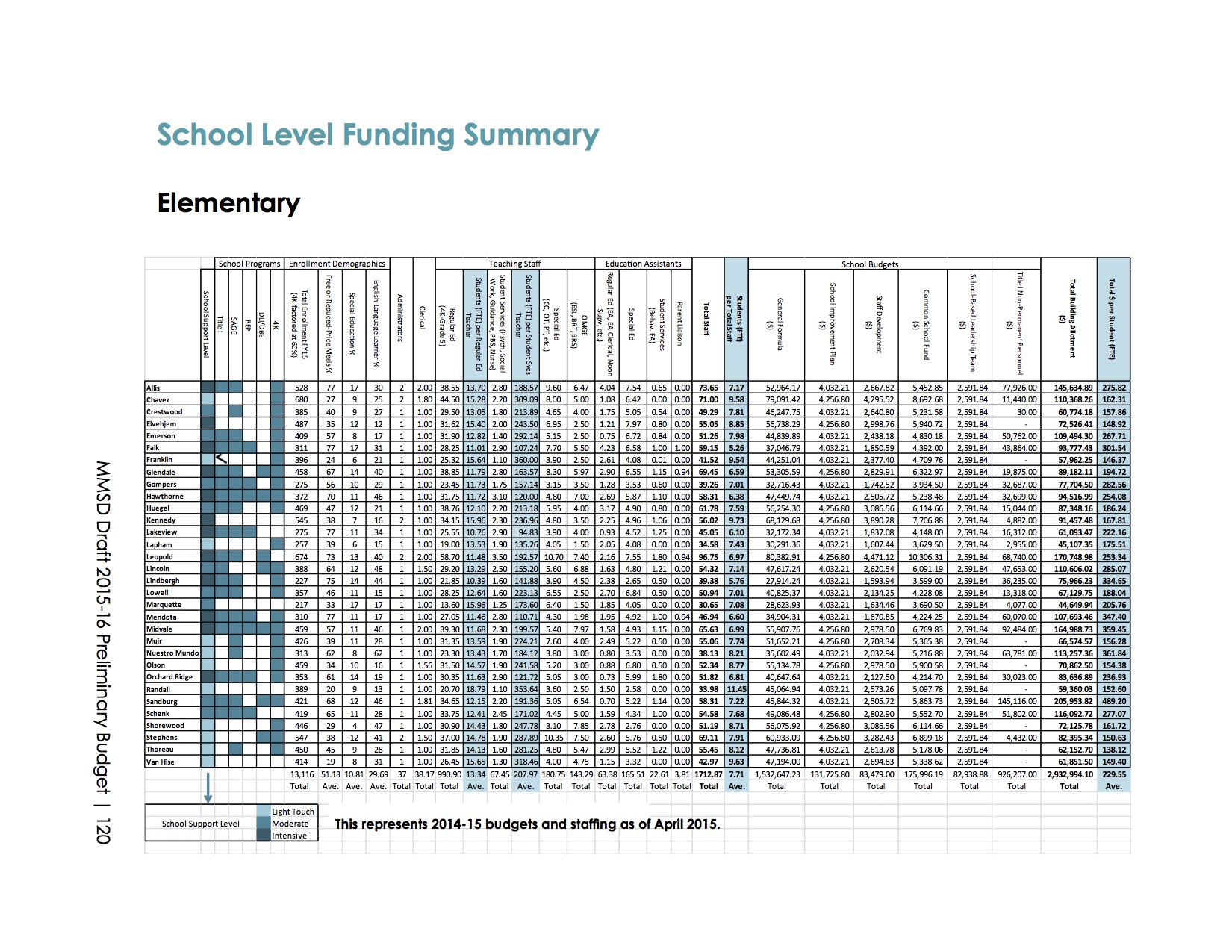
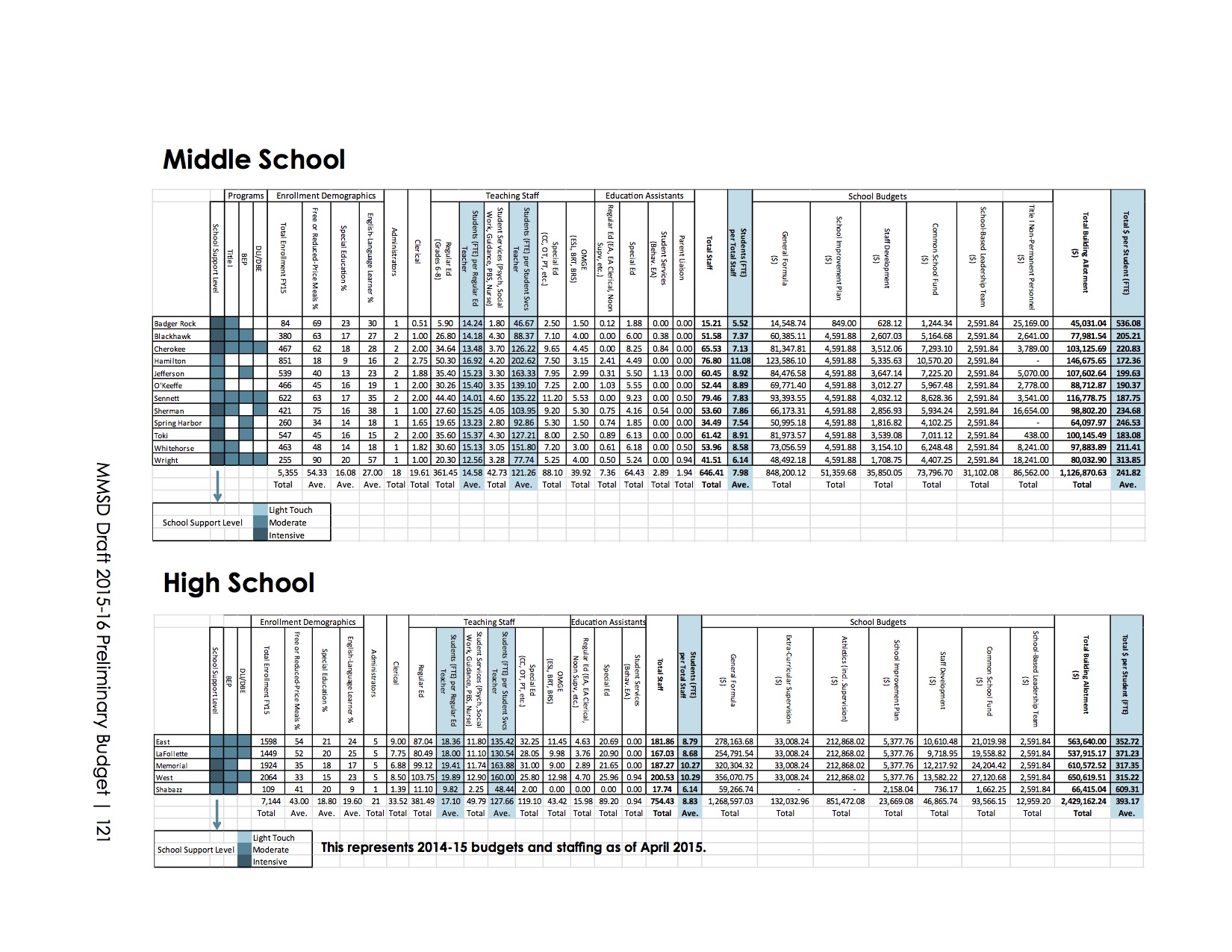
Free meals for some 2,800 children at Allis, Falk, Lake View, Leopold, Mendota, Sherman and Wright schools could start next year through a 4-year-old federal program to provide meals to all students at schools in high-poverty areas. On average, about 77 percent of students at the seven Madison schools were “economically disadvantaged” last school year, according to data from the state Department of Public Instruction. That means about 2,100 students were already eligible for subsidized meals though the federal government’s long-standing — and necessary — free-and-reduced-price lunch program.

But if the schools are accepted into the program, parents of the rest will no longer have to buy the Cheerios, juice boxes, and peanut-butter-and-jelly fixings they’ve proved capable of buying until now.

Assuming a 10 percent increase in meals, up to $1.5 million in federal dollars would cover the cost-shifting, according to district spokeswoman Rachel Strauch-Nelson. That would make the program cost-neutral for the district — if not for taxpayers at large.

Share

Madison Schools Propose a $24,000,000 Maintenance Referendum & Property Tax Increase; above $402M budget; 4%+ tax increase looms

The Madison School District (1.4MB PDF).

“All elementary boundaries are due for a long term review”. Agreed. A look at the maps below along with the wide demographic variation across Madison public public schools indicates that addressing boundaries is job #2 – after dealing with the long term disastrous reading results.

Going to referendum prior to addressing boundary and demographic issues appears to be a “cart before horse” strategy.

It will be interesting to see how gubernatorial candidate Mary Burke addresses this question.

Presentation slides (tap to view a larger version):


Related: Open questions from the 2005 maintenance referendum lead to calls for an audit.

Share

Commentary on Wisconsin’s Recent K-12 Spending; No mention of Substantial Growth During Recent Decades


Pat Schneider:

Wisconsin has had the second deepest slash in per-student spending in the nation since 2008 — second only to Alabama — according to a study by the Center on Budget and Policy Priorities.

Spending per pupil in Wisconsin was down $1,038 from 2008 for the school year just ended. Alabama cut per-pupil spending by $1,242.

Alabama and Wisconsin led the list of at least 35 states providing less funding per student than they did before the recession hit.

Wisconsin spending per pupil is 15.3 percent lower than in 2008, making it among 14 states where per-pupil spending remains at least 10 percent lower than before the economic recession.

The state cuts to education leave local school districts forced to cut services, raise taxes or both, notes the study. The cuts also hamper economic recovery by reducing the number of teaching jobs and school district workers’ buying power, the authors say.

A deeper dive: Wisconsin K-12 Spending Dominates Redistributed Tax Dollars.


More, here.

Lastly, the article lacks any discussion of K-12 spending effectiveness. Compare state NAEP performance, here.

Share

Things you love are Made with Code

Google Code:

Miral is a hip hop dancer and choreographer who lights up stages across the country. Danielle is a cinematographer at Pixar, helping to bring beloved characters like Nemo and Merida to life. Erica is a humanitarian fighting malaria around the world.

These are all women with cool, amazing jobs. But, more important, they’re all women who use computer science, and an ability to code, to do those cool, amazing jobs. They couldn’t do what they do without having learned not just to use technology, but to build it themselves. Unfortunately, there are far too few women like them and far too few young girls following their paths. In fact, fewer than one percent of high school girls express interest in majoring in computer science.

This is an issue that hits home for me. My school-age daughter instinctively knows how to play games, watch videos and chat with friends online. She understands technology. And she likes using technology. But, she never expressed any interest in creating it herself.

Share

Trial Balloon on Raising Madison’s Property Taxes via another School Referendum? Homeowners compare communities…..

Molly Beck

There’s been little movement since mid-March when Madison School District Superintendent Jennifer Cheatham proposed asking voters in November for $39.5 million in borrowing to upgrade facilities and address crowding.

The proposed referendum’s annual impact on property taxes on a $200,000 Madison home could range from $32 to $44, according to the district.

After discussing the idea, School Board members said that the always contentious idea of changes to school boundaries would at least have to be publicly vetted as a possible solution to crowding before moving forward with a referendum. There have not been any public discussions on the matter since.

Spending and accounting problems with the last maintenance referendum (2005) lead to a discussion of an audit.

I recently met a young “Epic” husband and wife who are moving from their Madison townhouse to the Middleton/Cross Plains area. I asked them what prompted the move? “Costs and taxes per square foot are quite a bit less” as they begin planning a family. See “Where have all the students gone“.

Their attention to detail is unsurprising, particularly with so many young people supporting enormous student loans.

Madison spends double the national average per student. I hope that District seeks more efficient use of it’s $402,464,374 2014-2015 budget before raising property taxes.

Dive deeper into the charts, here.

Share

OneCity Early Learning Centers: A New Plan for South Madison Child Development Incorporated (DRAFT)

OneCity Early Learning Centers by Kaleem Caire and Vivek Ramakrishnan (PDF), via a kind reader

In the fall of the 2013-14 school year, public school children across Wisconsin completed the state’s Knowledge and Concepts Exam, an annual test that measures their knowledge, ability and skills in reading and mathematics in grades 3 through 8 and 10, and in language arts, science, social studies and writing in grades 4, 8 and 10. Just 13% of Black and 15% of Latino children who completed these assessments were reading at grade level (proficient or advanced) in elementary schools across Dane County. The numbers are even more striking than the percentages: just 207 of the 1,497 Black children and 266 of 1,688 Latino children enrolled in grades 3, 4 and 5 were reading at grade level. Despite better outcomes among White and Asian students, their rates of 51% and 48% reading at grade level are disturbing as well.

Tap for a larger version.

We need your help. We have a plan to facilitate greater educational and life success among children and their families in Dane County and hope you will join us in our efforts. That is why you are receiving this paper. We hope that when you are finished reading it, you will call or email us and say, “Yes, I’m signing up to assist you with establishing One City Early Learning Centers so that many more children in our community are ready to read, compute and succeed at grade level by the time they enter first grade, regardless of their race, ethnicity or socio- economic pedigree.”

In April 2014, after months of consideration, the Board of Directors of South Madison Child Development Incorporated (CDI), one of Dane County’s oldest and most heralded childcare providers, decided that it was time to reorganize, rebrand and re-launch its Center with a new mission, new leadership, a new educational program, and new plans for future expansion. Beginning in the fall of 2014, South Madison CDI will become One City Early Learning Centers Incorporated and will change the name of its centers located at 2012 Fisher Street on Madison’s South Side and the Dane County Job Center.

Share

As much as I respect NAEP, I submit that the essays in TCR are better indicators of the highest academic ability than scores on NAEP. Read some of them to see if you agree.

Walt Gardner, via Will Fitzugh:

Elitism is a dirty word in education in this country.

Just why, I don’t understand because supporting students with academic ability is as important as supporting students with special needs.

I thought of this as I read the news about the latest NAEP results (“U.S. ‘report card’: stagnation in 12th-grade math, reading scores,” The Christian Science Monitor, May 8). The closely watched report showed that high school seniors did no better in reading and math than they did four years ago. The head of the National Assessment Governing Board, which was created by Congress in 1988 to create and measure standards for student performance, warned that too few students are achieving at a level to make the U.S. internationally competitive.

I urge him to look over the index of The Concord Review from 1988 to 2014. For those readers not familiar with TCR, its founder and publisher is Will Fitzhugh. He has provided a forum for essays written overwhelmingly by high school students in this country (and to a small extent to those abroad) on a wide variety of subjects. They range from ancient history to modern issues. I’ve read many of them. They are not only meticulously researched but gracefully written.

I realize that the students who have been published in TCR constitute only a tiny percentage of high school seniors in this country (and in 39 other countries). But I maintain that far more students are capable of writing informative and lively papers than we believe. As much as I respect NAEP, I submit that the essays in TCR are better indicators of the highest academic ability than scores on NAEP. Read some of them to see if you agree.

I don’t know if the almost total focus on students below average is the result of anti-elitism or of sheer ignorance. But TCR serves as compelling evidence that we are squandering talent. Many of these students will go on to make a name for themselves in their various fields of specialization. They’re the ones who can make the U.S. highly competitive in the global economy. Yet we feel extremely uncomfortable supporting them.

We don’t have to choose democratization or differentiation. There is room for both in our schools. But so far, most of our resources are earmarked to achieve the former. Only in the U.S. does that happen. Most countries have no compunction about identifying and nurturing their academically gifted students.

————————-
“Teach with Examples”
Will Fitzhugh [founder]
The Concord Review [1987]
Ralph Waldo Emerson Prizes [1995]
National Writing Board [1998]
TCR Institute [2002]
730 Boston Post Road, Suite 24
Sudbury, Massachusetts 01776-3371 USA
978-443-0022; 800-331-5007
www.tcr.org; fitzhugh@tcr.org
Varsity Academics®
tcr.org/bookstore
www.tcr.org/blog

Share

An update on Madison’s 2014-2015 $402,464,374 budget

We recommend adopting a Preliminary Budget for 2014-15 which includes the budget changes recorded in the companion document MMSD 2014-15 DPI Recommended Format for Budget Adoption. The changes are related to student fees and technology. With this recommendation we restate our strategy to address health insurance, salaries, and tax levy as a package in the fall Final Budget.

There are several advantages to addressing health insurance, salaries, and tax levy as a package in the fall Final Budget:

Key financial data, including enrollment, revenue limit, equalization aid, tax levy and tax base will be available in October.

The insurance committee will have time to meet with the HMO’s and build on the work accomplished by the administration this spring.

The wellness plan design can be further developed and factored into the larger discussion of health insurance and compensation.

A piecemeal approach to salary/wage increases, employee contributions to health insurance, the wellness plan, and the fall tax levy is unlikely to produce the best result.

Much more on the 2014-2015 budget, here.

Share

Reading? “Time to celebrate our success – AND – Plan for the future” – Madison School Board/Administrative Retreat

Madison School District PDF:.


Fascinating.

Lots of administrative meeting metrics, but no data on Madison’s long term disastrous reading results.

Share

MTI Preserves, Gains Contracts Through June, 2016

Madison Teachers, Inc. Newsletter, via a kind Jeannie Kamholtz email (PDF):

Last fall, MTI asked the District to bargain Contracts for multiple years. They refused, and a Contract was negotiated for the 2014-15 school year.

After hundreds of MTI members, sporting their MTI red shirts, attended two school board meetings in late May, the Board had a change of heart – and also a change in leadership with Arlene Silveira replacing Ed Hughes. Several MTI members addressed the Board at its meetings on May 26 and 29. The Board agreed to bargain. After five days of bargaining, terms were reached for Contracts for MTI’s five bargaining units, AFSCME’s two bargaining units, and that of the Building Trades Council.

In the new Contracts, MTI was successful in retaining members’ employment security and economic security provided by Contract salary schedules and fringe benefits.

MTI’s Contracts for 2014-15 and 2015-16 are the only contracts with Wisconsin school districts, for those years. A synopsis of the new Contracts is available on MTI’s webpage www.madisonteachers.org.
MTI members ratified the Contracts last Tuesday evening

Madison Teachers, Inc. Synopsis (PDF):

HANDBOOK: Among the topics addressed in our 2013 negotiations was how the Act 10 mandated “Employee Handbook” would be developed. In last year’s negotiations MTI gained agreement with the District, that while most school boards acted unilaterally to develop the Handbook, MTI has 5 appointees to the Committee which will develop the Handbook. That agreement also provides that MTI’s 2014- 15 Collective Bargaining Agreements serve as the foundation for the Handbook. That has now been amended to provide that the 2015-16 Contracts will serve as the foundation for the Handbook. Some school boards have rolled back employee rights to the 1950’s or 1960’s, when unilaterally creating the Handbook for their school districts. For example, teachers in some districts cannot wear sandals, open-toed

shoes and women must wear skirts or dresses at least to the knee. The Janesville School Board just eliminated wages for any credits or
degrees beyond the BA.

Share

Conversations on the Rifle Range, I: Not Your Mother’s Algebra 1 and the Guy Who Really Knows

Out in Left Field, via a kind Barry Garelick email:

Barry Garelick, who wrote various letters under the name Huck Finn and which were published here is at work writing what will become “Conversations on the Rifle Range”. This will be a documentation of his experiences teaching math as a long-term substitute. OILF proudly presents the first episode:

Those familiar with my writing on math education know me from my previous incarnations as John Dewey and Huck Finn, whose adventures I recounted in a book called “Letters from John Dewey/Letters from Huck Finn”. I am in a second career which for lack of a better title is known as “trying to obtain a permanent math teaching position in a desirable area of California.” I retired a few years ago and obtained a math teaching credential. Although I have applied for various math teaching jobs, I have only managed to get two interviews, so I’ve had to make do by being a substitute teacher. This situation may be due to age, or perhaps my views on math education are becoming known, or both.

In the course of the 2013-14 school year, however, I took on two long-term substitute assignments. The first one was for six weeks at a high school which started at the beginning of the school year. The second was for an entire semester at a middle school, starting in January and ending in June.

Both assignments took place amidst the media hype that focused on the 50th anniversary of events occurring in 1963 and 64 including but not limited to the Kennedy assassination, the Beatles’ arrival in the US and performance on the Ed Sullivan Show. Not mentioned by the press but every bit as important is the fact that it was also the 50th anniversary of my taking Algebra 1. And while I am not an outright proponent of the philosophy that “If you want something done right, you have to live in the past”, when it comes to how to teach math there are worse philosophies to embrace.

As if to keep me from delving too far into my past, my teaching assignments occurred during a year of transition to the Common Core standards. In both assignments, I came to know the person from the District office, who I shall call Sally, whose role was to get the teachers—as part of the transition effort— to try various Common Core type activities with their students. I met her for the first time on the teacher workday held before the first day of school.

Sally started out the meeting by telling us that she had been meeting with the person in charge of putting together the California “Framework” for Common Core. “So he REALLY KNOWS what’s going on,” she said. This stated, she then talked about this in-the-know person’s view of Common Core’s Standards for Mathematical Practice (SMPs).
– See more at: http://oilf.blogspot.com/2014/06/conversations-on-rifle-range-i-not-your.html#sthash.QEod5yFY.dpuf

Share

Mommy-Daddy Time

Zoë Heller:

The reputation of parenthood has not fared well in the modern era. Social science has concluded that parents are either no happier than people without children, or decidedly unhappier. Parents themselves have grown competitively garrulous on the subject of their dissatisfactions. Confessions of child-rearing misery are by now so unremarkable that the parent who doesn’t merrily cop to the odd infanticidal urge is considered a rather suspect figure. And yet, the American journalist Jennifer Senior argues in her earnest book about modern parenthood, it would be wrong to conclude that children only spoil their parents’ fun. Most parents, she writes, reject the findings of social science as a violation of their ‘deepest intuitions’. In fact, most parents – even the dedicated whingers – will say that the benefits of raising children ultimately outweigh the hardships.

Senior’s characterisation of parenthood as a wondrous ‘paradox’ – a nightmare slog that in spite of everything delivers transcendent joy – has gone down very well in America, where parents seem reassured to find a cheerful, pro-kids message being snatched from the jaws of sleep deprivation and despondency. The book spent six weeks on the bestseller list and has earned Senior the ultimate imprimatur of a lecturing gig at the TED conference. ‘All Joy and No Fun inspired me to think differently about my own experience as a parent,’ Andrew Solomon observed in his New York Times review. ‘Over and over again, I find myself bored by what I’m doing with my children: how many times can we read Angelina Ballerina or watch a Bob the Builder video? And yet I remind myself that such intimate shared moments, snuggling close, provide the ultimate meaning of life.’

Share

K-12 Tenure Declared Unconstitutional in California: Could Higher Ed be Next?

Changing Universities:

One of these myths is the idea that students from low-income areas perform poorly because they don’t have the best teachers. What this view rejects is any understanding of the different economic, psychological, and social forces affecting young people. Not only does this myth repress the role that poverty plays in shaping every aspect of these students’ lives, but it also neglects the advantages given to the wealthier students. Instead of looking at school funding or how the lack of good healthcare prevents students from going to school, the judge is highly invested in the current idea that a great teacher can overcome all social and personal obstacles facing a low-income student.

The ruling begins by citing Brown v Board of Education to point to the important value of providing equal education to all races. In two other cited cases, the theme is once again the equality of educational opportunity. Although it would be hard to argue against this egalitarian ideal, it is clear that self-segregation and white flight have made schools very unequal. Moreover, while the Governor has pushed through a new plan to redistribute funds to low-income schools, this plan has yet to come into full effect.

Diane Ravitch comments.

Share

King’s College London to cut jobs to fund university buildings

Claire Shaw and Michael Allen:

Staff at King’s College London (KCL) are in dispute with their university over plans to cut up to 120 jobs in the health schools to help fund buildings and equipment, amounting up to £400m.

The vast majority of jobs under threat are in the schools of medicine and biomedical sciences, and the institute of psychiatry. The university says it plans to reduce academic staff costs by 10% which could see 120 out of 777 staff in the health schools face redundancy.

Staff have been told that these cuts are a way to compensate for the changes to the funding of higher education, which have seen universities experiencing a reduction in public funding for capital projects, such as new buildings and infrastructure.

“The proposals are not about raising money for buildings alone,” says a KCL spokesperson.

“The changes to the external funding environment for higher education mean that any investment we wish to make – whether to maintain the existing estate, to provide world class research facilities with cutting edge equipment, an excellent student learning environment supported by the latest technology, high-quality halls of residence, or scholarships and bursaries – we have to fund ourselves.

Share

Colleges are full of it: Behind the three-decade scheme to raise tuition, bankrupt generations, and hypnotize the media

Thomas Frank:

The price of a year at college has increased by more than 1,200 percent over the last 30 years, far outpacing any other price the government tracks: food, housing, cars, gasoline, TVs, you name it. Tuition has increased at a rate double that of medical care, usually considered the most expensive of human necessities. It has outstripped any reasonable expectation people might have had for investments over the period. And, as we all know, it has crushed a generation of college grads with debt. Today, thanks to those enormous tuition prices, young Americans routinely start adult life with a burden unknown to any previous cohort and whose ruinous effects we can only guess at.

On the assumption that anyone in that generation still has a taste for irony, I offer the following quotation on the subject, drawn from one of the earliest news stories about the problem of soaring tuition. The newspaper was the Washington Post; the speaker was an assistant dean at a college that had just announced a tuition hike of 19 percent; and the question before him was how much farther tuition increases could go. “Maybe all of a sudden this bubble is going to burst,” he was quoted as saying. “How much will the public take?”

Oh, we would take quite a lot, as it happened. It was 1981 when the assistant dean worried in that manner—the very first year of what was once called the “tuition spiral,” when higher ed prices got the attention of the media by outpacing inflation by a factor of two or three. There was something shocking about this development; tuition hadn’t gone up like that during the 1970s, even though that was the heyday of ascending consumer prices.

Share

2014 Teacher Prep Review Findings

National Council on Teacher Quality:

Our Approach
There’s widespread public interest in strengthening teacher preparation — but there’s a significant data gap on what’s working. We aim to fill this gap, providing information that aspiring teachers and school leaders need to become strategic consumers and that institutions and states need in order to rapidly improve how tomorrow’s teachers are trained.

Our strategy
Our strategy is modeled on Abraham Flexner’s 1910 review of medical training programs, an effort that launched a new era in the field of medicine, transforming a sub-standard system into the world’s best.

How we’re doing it
NCTQ takes an in-depth look at admissions standards, course requirements, course syllabi, textbooks, capstone projects, student teaching manuals and graduate surveys, among other sources, as blueprints for training teachers. We apply specific and measurable standards that identify the teacher preparation programs most likely to get the best outcomes for their students. To develop these standards, we consulted with international and domestic experts on teacher education, faculty and deans from schools of education, statistical experts and PK-12 leaders. We honed our methodology in ten pilot studies conducted over eight years.
Our goals

Currently, high-caliber teacher training programs go largely unrecognized. The Review will showcase these programs and provide resources that schools of education can use to provide truly exceptional training. Aspiring teachers will be able to make informed choices about where to attend school to get the best training. Principals and superintendents will know where they should recruit new teachers. State leaders will be able to provide targeted support and hold programs accountable for improvement. Together, we can ensure a healthy teacher pipeline.

Wisconsin took a very small step toward teacher content knowledge requirements by adopting Massachusetts’ MTEL requirements for elementary teachers – in English only.

Much more on NCTQ, here.

Share

The White Teachers I Wish I Never Had

Mia McKenzie:

I was born Black in a Black family in a Black neighborhood. My early childhood was an entirely Black experience. Besides what I saw on television and in movies, my whole world was Black people. My family, my friends, my babysitters, my neighbors and my teachers were all Black.

From Head Start through third grade, I had exclusively Black teachers. As a very bright, gifted Black girl, having Black teachers, mostly Black women, who saw my giftedness and encouraged and nurtured it, meant everything. These were teachers who could look at me and see themselves. They could see their children, their hopes, their dreams. These were teachers who could be as proud of me when I did well as my own family was, who could understand me when I talked about my life, and who knew how to protect the spirit of a gifted Blackgirlchild in a world they knew would try to tear her apart every chance it got.

I thrived in those early years in school. I loved learning, I had a very high capacity for it, and it showed. My teachers challenged me creatively and intellectually, supported my growth, and rewarded my efforts. My second and third grade teacher, Ms. Lucas (who goes down in history as the best and most influential teacher I ever had) gave me my first paid work as a writer. In third grade, after I wrote the best poem about springtime (“…sometimes words can never say the things that flowers say in May…”), she brought me ice cream! She, like the other Black teachers I had, recognized, and helped me to see, my extraordinariness. Seeing it, I soared. I felt confident and self-assured. I believed I was the smartest, most talented kid ever!

Share

College radio is dying — and we need to save it

Garrett Martin:

WRAS 88.5 FM in Atlanta was the first radio station to play Outkast. It was one of the first few stations in the country to play R.E.M., Deerhunter and the Indigo Girls. It’s been a crucial, student-run force in independent music both locally and nationally for decades. But later this month, a backdoor deal will replace all of its daytime programming with “Fresh Air” simulcasts and “Car Talk” reruns.

This is a huge blow for the students who run WRAS, for Atlanta’s art and music communities and for the entire independent music industry. WRAS is one of the most powerful college radio stations in the nation. Its signal is as strong as the law will allow; those 100,000 watts cover all of Atlanta’s sprawling metropolitan area. And the closure of WRAS is just the latest in a long string of colleges failing to preserve their cultural institutions and selling their radio signals off to outside interests. It happened at Rice in 2011, at Vanderbilt between 2011 and 2014, and now it’s happening at Georgia State University, home of one of the most important college radio stations in the nation.

In early May, GSU announced an agreement to hand over WRAS’s signal to Georgia Public Broadcasting for 14 hours a day, from 5 a.m. to 7 p.m. The student-produced programming that WRAS has broadcast during those hours since 1971 will now be confined to an Internet stream. The students who run the station weren’t included in negotiations, which stretch back to 2012. The station’s student management only learned about the deal shortly before the public did. The larger GSU student body didn’t get to vote on the deal or have any input in the agreement. It feels similar to another recent ugly scene in Atlanta, as the neighboring Cobb County resorted to banana republic tactics to squelch public debate on its plan to give the Atlanta Braves hundreds of millions of dollars for a new stadium.

Share

L.A. Unified suspension rates fall but some question figures’ accuracy

Teresa Watanabe:

IIn the heart of Watts, where violence in nearby housing projects can spill over onto campuses, two of the city’s toughest middle schools have long dealt with fights, drugs and even weapons.

Administrators typically have handled these problems by suspending students. But this year Markham and Gompers middle schools have reported marked reductions in that form of discipline — as has the L.A. Unified School District overall, where the suspension rate dropped to 1.5% last year from 8% in 2008.

The drop came after the Los Angeles Board of Education and L.A. schools chief John Deasy called for fewer suspensions as concern grew nationwide that removing students from school imperils their academic achievement and disproportionately harms minorities, particularly African Americans.

But have suspensions really become rarer?

Share

The Privatization of Special Education

Katie Osgood:

Like so much else in education and beyond, we are seeing the familiar pattern of defunding, claiming crisis, and then calling for privatization in special education.

This past week in Chicago, our unelected Board of Education recently voted to expand contracts with private, for-profit organizations to meet the growing needs of our children with special needs as well as at-risk populations.

Of course, this move is nothing new in the world of special education. In Illinois, there are a multitude of private operators (both non-profit and for-profit, though the tax status is mostly irrelevant in practice.) Some of these schools are beautiful places. Some have lovely sounding websites, covering up truly horrible, poorly-run warehouses for students with special needs. But they are almost all very very expensive.

In fact, as these schools expand in number, investors understand there is a huge profit margin to be had on the backs of these vulnerable students. Districts, by federal law, must pay for these placements if it is determined to be the best environment for the student.

Share

The Case for Academic Gossip

Lili Loofbourow:

One foggy fall day, I came across a savage review of an academic book. The book was written by someone I know well. The reviewer seemed delighted by his own vitriol, and as I read, I got irritated, on the author’s behalf, at what struck me as an ungenerous misreading of the work. Was this review being well-received? Did it have merits I didn’t see? What effect do reviews have socially and professionally? How was this affecting public perception of my acquaintance’s work? I reached almost automatically for my keyboard and typed in the name of the author and critic. I wanted to tap into my field, get some alternate perspectives. I wanted to see smart people hash out the merits of the review and, by extension, the book.

The review was published nearly a year ago in a respectable academic publication. I’d heard nothing at all about it, but surely others in my field had. Someone somewhere must have posted a response, or a discussion, or something. Both parties were fairly prominent in their field, and a direct attack is the kind of thing academics chatter about incessantly in the halls. Some of that must have leaked online!

So I did what I usually do when something of interest turns up: I Googled the two names to see who was discussing the review, its merits, and anything else of interest that might arise in connection with the review, which felt like the opening salvo in an intellectual battle.

Share

South Korea’s Millionaire Tutors: The vast sums spent on preparing children for tests are causing unease

Simon Mundy:

Kim Ki-hoon has risen to stardom of a sort that exists in few places outside South Korea. As the country’s highest-earning celebrity English tea­ch­er, he estimates he made about $4m last year from his online language lessons – and then there is the income from his educational publishing company, which turned over about $10m.

The star tutor says about 1.5m South Koreans have taken his classes in the past 12 years. He attributes his success to his engaging teaching style and clever marketing: he selects his television appearances carefully, and made a pop song aimed at nervous university candidates with a chorus urging “Trust me!”.

Mr Kim’s earnings are a fraction of the estimated $20bn spent an­nually on private tuition in South Korea. Yet he, like others in the industry, ex­presses unease at the scale of the system that paid for his Porsche. “There should be no need for private education,” he says.

The fierce debate in South Korea over the national education system – in particular, the huge industry of private crammers (hagwons) and online study providers – might surprise its foreign admirers. Figures such as US President Barack Obama and Michael Gove, UK education secretary, have hailed South Korean education as a model, pointing to its children’s impressive showing in Organisation for Economic Co-operation and Development tests of maths, literacy and science.

Share

Teaching our kids government dependency

Christian Schneider:

If asked to identify the most urgent problem with Milwaukee Public Schools, few people would likely say “too much parental involvement.”

In fact, over the years, public schools have been forced to take on more of the duties normally reserved for pupils’ parents. For this, MPS deserves some sympathy — as more children are raised in households with absent or disinterested parents, teachers have had to fill in the gaps in more kids’ upbringing.

But it appears that once a dollar bill is dangled in front of the district, it is more than happy to take over traditional parental responsibilities. Last week, MPS announced that it would be applying to provide free meals to all of the district’s children regardless of the kids’ family income.

Under the federal Healthy, Hunger-Free Kids Act, school districts where as few as 40% of the students qualify for free or reduced-cost lunches can apply for federal aid to feed the remainder of the students, regardless of their family’s economic standing.

In Wisconsin, 43.3% of all students qualify for free and reduced-cost lunches, and in MPS, 82% of students are currently eligible. Yet it appears the district will not rest until every one of its students is dependent on the government for his or her nourishment, whether the student needs the aid or not.

For years, giving out free meals has been a cash cow for school districts. A decade ago, the Miami-Dade school district determined that the number of kids receiving free breakfasts would factor into a school principal’s performance review. The district began making automated phone calls to households in the district to urge their kids to eat breakfast at school.

Related: 2005 Forum on Poverty & Education.

Share

Commentary on Madison’s Achievement Gap

The Capital Times:

The statistics on African-American achievement have been so grim throughout the years that in 2010, Kaleem Caire, at the time the CEO of the Urban League of Greater Madison, put forth a proposal for a charter school designed to help African-American students surmount the achievement gap. It was ultimately rejected by the Madison School Board in 2011 after a bitter fight.

It’s against this backdrop that Madison School District Superintendent Jennifer Cheatham took over the top job in spring 2013. In her first year, Cheatham earned favorable remarks from many in the community for her smart, focused and flexible approach, with a talent for connecting with teachers, the School Board, parents and city leaders alike.

Madison School District superintendent Jennifer Cheatham listens during a meeting at Madison Central Library.

In the 2013-2014 school year, she revised the discipline policy to reduce the number of suspensions and expulsions in favor of practices that let students stay in school, own up to misconduct, and learn how to better conduct themselves in the future. Many education equity advocates see changes in school discipline policies, like those adopted under Cheatham, as key to closing the achievement gap.

Related: Madison’s Disastrous Reading Results.

2004: When all third graders read at grade level or beyond by the end of the year, the achievement gap will be closed…and not before

Share

Commentary on Madison’s School Climate

Alan Talaga:

I think the Wisconsin State Journal’s editorial board is generally pretty fair. The editorials, mostly written by editor Scott Milfred, come from a fiscally-conservative, socially-liberal perspective. While I often disagree with their views, I admire their principled stance on marriage equality and transparency in all levels of government.

Sometimes the State Journal spills ink tilting at windmills like suggesting Walker and legislative Republicans were seriously going to consider redistricting reform, even when the latest round of redistricting gave the GOP a 10-year lock on control of the Assembly. Other times, they dilute their message a bit by trying a bit too hard to be even-handed.

However, those attempts at even-handedness go out the window when it comes to teachers’ unions, with Madison Teachers Inc. as the State Journal’s primary target. I, myself, have many criticisms of MTI, but the editorial board has handpicked them to be public employee boogeyman number one.

I would think that the elimination of almost every single teacher’s union in the state would make for a less tempting target, but this editorial board still feels a need to take weird potshots at MTI.

A couple of weeks ago, the State Journal ran an editorial in support of year-round schools, which is a good idea that I wholly support. But then much of the editorial suggested that MTI was the reason we don’t have any year-round school programs in Madison.

“Badger Rock Middle School is a good example of why the district should insist on more options with its teachers,” it read. “Badger Rock is a charter school that employs union teachers, so it follows the traditional school calendar.”

This seemed odd to me, as I had never read anything about MTI being opposed the idea of year-round schools. Obviously, I remember their opposition to Madison Prep, but that’s involved a ton of issues.

Share

Thinking machines are ripe for a world takeover

Anjana Ahuja:

If it looks like a duck and sounds like a duck, then it probably is a duck. That is the inelegant logic behind one of the challenges posed in artificial intelligence: the Turing test, which sets out to answer the question, “can machines think?”

The stroke of genius from Alan Turing, the second world war codebreaker, was to recognise that while actual sentience in machines is virtually impossible to verify, the illusion of sentience is absolutely testable. He proposed that if a machine could “converse” with a person so convincingly that the user thinks they are interacting with a real person, then that machine can be said to think.

According to weekend reports, Turing’s benchmark of artificial intelligence, which dates back to 1960, has been met by a supercomputer disguised as a teenager from Ukraine. In a test devised by the University of Reading, a third of judges having a five-minute text conversation with “Eugene Goostman” believed he was a 13-year-old boy, rather than an advanced natural language computer program. Such advances, the organisers say, will set the scene for a new, sinister kind of cybercrime, in which trusting people are fooled by clever machines into handing over sensitive information.

Share

Searching for Community in the Era of Choice

Reviewed by: Moira McLaughlin:

In Washington, D.C., about 43 percent of students attend charter schools, and only 25 percent attend their assigned neighborhood schools. Washington parents have choices. What does all this choice mean for public education, local author Sam Chaltain wonders in his new book, “Our School.”

“In this new frontier,” Chaltain asks, “will the wider array of school options help parents and educators identify better strategies for helping all children learn — strategies that can then be shared for the benefit of all schools? Or will the high stakes of the marketplace lead us to guard our best practices, undermine our colleagues, and privatize this most public of institutions?”

Share

How charters and rivals may get together

Jay Matthews:

Elliott Witney, a brilliant reading teacher, was one of the six people who launched KIPP, now the nation’s largest charter school network, in a Chicago hotel conference room 14 years ago. He eventually became principal of KIPP’s flagship school in Houston. So, why has this hero of the charter movement taken an administrator job in a traditional Houston area district full of bureaucratic annoyances charters were created to eliminate?

That is one of the many surprising questions asked and answered in Richard Whitmire’s intriguing new book, “On the Rocketship: How Top Charter Schools Are Pushing the Envelope.” It is the best account yet of what is happening with charters. Both those who hate the independent public schools and those who love them should read it.

Whitmire does not hide charter struggles and mistakes. The Rocketship charter network at the center of his story soars, then sputters, then twists and turns. Whitmire is as sympathetic to the parents and educators opposed to Rocketship as he is to the entrepreneurs and educators who created the network.

Share

America’s Most Challenging High Schools

Jay Matthews:

We take the total number of Advanced Placement, International Baccalaureate and Advanced International Certificate of Education tests given at a school each year and divide by the number of seniors who graduated in May or June. I call this formula the Challenge Index. With a few exceptions, public schools that achieved a ratio of at least 1.00, meaning they had as many tests in 2013 as they had graduates, were put on the national list at washingtonpost.com/highschoolchallenge. We rank the schools in order of ratio, with the highest (21.91) this year achieved by the American Indian Public Charter in Oakland, Calif., which repeats as the top-ranked school.

I think 1.00 is a modest standard. A school can reach that level if only half of its students take one AP, IB or AICE test in their junior year and one in their senior year. But this year, just 9 percent of the approximately 22,000 U.S. public high schools managed to reach that standard and earn placement on our list. On our list, the top 220 schools are in the top 1 percent nationally, the top 440 in the top 2 percent, and so on.

Madison Memorial made the list at #33 in Wisconsin.

Somewhat related: Madison’s on and off again “high school redesign“.

Share

The Hatred of Students

Chris Taylor:

If the university once (understood itself to have) functioned as the place where humans left their self-incurred immaturity, as Kant might put it, if it once served as the place where students prepared themselves to participate in public life, the Dads of higher ed are now insisting with the primness of a period-piece dowager that students should be seen and not heard. Literally. Bowen recalls a commencement protest over the grant of an honorary degree to a Nixonite in the 70s. (You can hear the daddishness: “back in my day…”) Happily, the “protestors were respectful (mostly), and chose to express their displeasure, by simply standing and turning their backs when the Secretary was recognized.” If ed gurus today salivate over tech-leveraged “disruption,” what Bowen admires about these human swivels is their decision “to express their opinion in a non-disruptive fashion.” No noise, just image, and the spectacle went on, with Princeton investing a Nixonite with an honorary degree.

I’ve been insisting on the term spectacle because, as everyone knows, the operative fiction of Carter’s letter and Bowen’s sermon is bullshit. Not even your liberalist liberal, your deliberativest deliberative democrat, could in good faith claim that commencement speeches are scenes of open debate. They are, rather, capstone moments where the university takes on a body, incorporates itself, and seeks to establish the conditions of its corporate reproducibility. A lovely experience validating 240k in cash or debt, a spectacle for parents and future donors—but hardly a scene of debate or discussion! Just a droning message, some platitudes, and the implicit promise that the fundraising office will soon track you down.

Share

The Morbid Fascination With the Death of the Humanities

Benjamin Winterhalter:

I have been going to academic conferences since I was about 12 years old. Not that I am any sort of prodigy—both of my parents are, or were at one point, academics, so I was casually brought along for the ride. I spent the bulk of my time at these conferences in hotel lobbies, transfixed by my Game Boy, waiting for my mother to be done and for it to be dinnertime. As with many things that I was made to do as a child, however, I eventually came to see academic conferences as an integral part of my adult life.

So it was that, last year, I found myself hanging out at the hotel bar at the annual conference of the Modern Language Association, despite the fact that I am not directly involved with academia in any meaningful way. As I sipped my old fashioned, I listened to a conversation between several aging literature professors about the “digital humanities,” which, as far as I could tell, was a needlessly jargonized term for computers in libraries and writing on the Internet. The digital humanities were very “in” at MLA that year. They had the potential, said a white-haired man in a tweed jacket, to modernize and reinvigorate humanistic scholarship, something that all involved seemed to agree was necessary. The bespectacled scholars nodded their heads with solemn understanding, speaking in hushed tones about how they wouldn’t be making any new tenure-track hires that year.

Share

White Students Dominate Chicago’s Test-Admittance Public Schools

Steve Bartin:

According to the U.S. Census Bureau, Chicago’s population peaked a long time ago. In 1950, Chicago had 3. 6 million people. Recent estimates put Chicago’s population at 2.7 million. With the growth of American suburbs, many Chicago families have fled to public schools in the suburbs. Chicago’s horrible public schools have been an embarrassment for Chicago’s elite. A recent Chicago Tribune editorial estimated that only “only 8 of 100 freshmen who enter Chicago public high schools manage to get a college diploma.”

In an attempt to keep white families from fleeing Chicago, the second Mayor Daley came up with a plan: test-admittance-only public high schools. This was a reasonable solution for gentry liberals who pay high property taxes but didn’t want to leave the city or couldn’t afford to send their children to private schools. These select public high schools produce college bound students while “limiting” gentry liberal’s children from being exposed to children from “troubled backgrounds”. This is a sensitive subject because Chicago’s Public School System is only 9.2% white, while being 39.7% African-American.

Being admitted to these select magnet schools can often determine whether a family stays in Chicago or moves elsewhere. Recently, Daniel Hertz made news by graphically showing how Chicago’s middle class has being largely eliminated since 1970. The new Chicago is still a one-party town, but is now a coalition of rich and poor with a residual government worker middle class. White children have left Chicago’s Public School system leaving minorities as the majority. But, who gets into the selective public high schools? The Chicago Sun-Times reports:

Share

Reading: The Struggle

Tim Parks:

The conditions in which we read today are not those of fifty or even thirty years ago, and the big question is how contemporary fiction will adapt to these changes, because in the end adapt it will. No art form exists independently of the conditions in which it is enjoyed.

What I’m talking about is the state of constant distraction we live in and how that affects the very special energies required for tackling a substantial work of fiction—for immersing oneself in it and then coming back and back to it on numerous occasions over what could be days, weeks, or months, each time picking up the threads of the story or stories, the patterning of internal reference, the positioning of the work within the context of other novels and indeed the larger world.

Every reader will have his or her own sense of how reading conditions have changed, but here is my own experience. Arriving in the small village of Quinzano, just outside Verona, Italy, thirty-three years ago, aged twenty-six, leaving friends and family behind in the UK, unpublished and unemployed, always anxious to know how the next London publisher would respond to the work I was writing, I was constantly eager for news of one kind or another. International phone-calls were prohibitively expensive. There was no fax, only snail mail, as we called it then. Each morning the postino would, or might, drop something into the mailbox at the end of the garden. I listened for the sound of his scooter coming up the hairpins from the village. Sometimes when the box was empty I would hope I’d heard wrong, and that it hadn’t been the postino’s scooter, and go out and check again an hour later, just in case. And then again. For an hour or so I would find it hard to concentrate or work well. You are obsessed, I would tell myself, heading off to check the empty mailbox for a fourth time.

Share

Teacher Benefits Still Eating Away at District Spending; 25.8% of Madison’s $402,464,374 2014-2015 budget

Chad Alderman, via a kind reader:

The Census Bureau’s latest Public Education Finances Report is out, and it shows that employee benefits continue to take on a rising share of district expenditures.

The table below uses 20 years of data (all years that are available online) to show total current expenditures (i.e. it excludes capital costs and debt), expenditures on base salaries and wages, and expenditures on benefits like retirement coverage, health insurance, tuition reimbursements, and unemployment compensation. Although it would be interesting to sort out which of these benefits have increased the most, the data don’t allow us to draw those granular conclusions. But they do tell us that teachers and district employees are forgoing wage increases on behalf of benefit enhancements.

From 2001 to 2012 alone, public education spending increased 49 percent, but, while salaries and wages increased 36 percent, employee benefits increased 96 percent. Twenty years ago, districts spent more than four dollars in wages to every one dollar they spent on benefits. Now that ratio has dropped under three-to-one. Benefits now eat up more than 20 percent of district budgets, or $2,363 per student, and those numbers are climbing.

Much more on Madison’s 2014-2015 budget, here.

Share

Bright Diligent High School Students of History

Here are some of the essays which won Ralph Waldo Emerson Prizes after being published in Volume 24 of The Concord Review.

Kathleen Wenyun Guan of Singapore, a Senior at the United World College of Southeast Asia, had published a 6,103-word history research paper on the One Child Policy in China. (Georgetown School of Foreign Service)

Maya Tulip Lorey, of Oakland, California, a Senior at the College Preparatory School of Oakland, had published a 5,792-word history research paper on residential segregation in Berkeley, California. (Stanford)

Jonathan Slifkin, of New York, a Senior at the Horace Mann School in the Bronx, had published an 8,017-word history research paper on Brazilian Independence. (Harvard)

Iris Robbins-Larrivee, of Vancouver, a Junior at the King George Secondary School in Vancouver, had published a 14,212-word history research paper on French Canadian Nationalism. (McGill)

Rebecca Grace Cartellone, of Hudson, Ohio, a Senior at Western Reserve Academy in Hudson Ohio, had published a 7,111-word history research paper on the Three Gorges Dam. (Columbia)

Gao Wenbin, of Qingdao, Shandong, China, a Senior at Qingdao No. 2 Middle School in Shandong, had published a 16,380-word history research paper on Chinese Liberalism. (Yale)

——————————
“Teach with Examples”
Will Fitzhugh [founder]
The Concord Review [1987]
Ralph Waldo Emerson Prizes [1995]
National Writing Board [1998]
TCR Institute [2002]
730 Boston Post Road, Suite 24
Sudbury, Massachusetts 01776-3371 USA
978-443-0022; 800-331-5007
www.tcr.org; fitzhugh@tcr.org
Varsity Academics®
tcr.org/bookstore
www.tcr.org/blog

Share

Bloomberg @ Harvard

There is an idea floating around college campuses—including here at Harvard—that scholars should be funded only if their work conforms to a particular view of justice. There’s a word for that idea: censorship. And it is just a modern day form of McCarthyism.

Dennis Saffran, via Will Fitzhugh:

I wasn’t looking forward to Michael Bloomberg’s speech at my daughter’s Harvard commencement last week. As an active New York City Republican, I have decidedly mixed feelings about the former mayor, a Democrat-turned-Republican-turned-independent and prominent social liberal. While I admired his successful anti-crime policies, I was less enthusiastic about his nanny-state hectoring on public health and driven to distraction by his instinctual reliance on (and seeming obliviousness to the bias of) liberal “experts” on a range of other issues. And, though I agree with many of his positions on gun control, I’ve always been put off by his morally superior tone, which can make him sound as if he’s blaming gun violence on law-abiding gun owners in the flyover states and the outer boroughs. In short, while the billionaire mayor did some great things and left New York City a better place, he often seemed to me the very embodiment of a “limousine liberal.” And it was this Michael Bloomberg that I expected to show up at Harvard. “It’s going to be all guns and trans fats,” I joked to a conservative friend of my daughter’s the night before the speech. The mayor, I assumed, would play it safe, and play up to his liberal audience.

I was splendidly wrong. Speaking at the epicenter of academic leftism, Bloomberg forcefully challenged growing intolerance and ideological rigidity on campus—which he bluntly called “modern day McCarthyism”—and declared that “a liberal arts education must not be an education in the art of liberalism.”

He set out his main themes early in the speech: that “great universities . . . lie at the heart of the American experiment in democracy” as “places where people of all . . . beliefs [can] debate their ideas freely and openly”; that “tolerance for other people’s ideas, and the freedom to express your own, are inseparable values” that form a “sacred trust” undergirding democratic society; that this trust “is perpetually vulnerable to the tyrannical tendencies of monarchs, mobs, and majorities”; and, pointedly, that “lately, we have seen those tendencies manifest themselves too often, both on college campuses and in our society.” Perhaps to reassure his audience, Bloomberg picked a conservative cause—opposition to the so-called Ground Zero mosque—as his first example of this tendency. But he quickly tied his defense of the mosque back to his central point: “We cannot deny others the rights and privileges that we demand for ourselves. And that . . . is no less true at universities, where the forces of repression appear to be stronger now than they have been since the 1950s.”

Bloomberg alluded to a recent proposal in The Harvard Crimson to jettison academic freedom in favor of an Orwellian concept of “academic justice” that would shut down “research promoting or justifying oppression” or “countering” the supposed “goals” of the “university community” to oppose “racism, sexism, and heterosexism.” The proposal echoed similar proposals at other elite universities. Bloomberg warned his liberal listeners of a new McCarthyism of the Left paralleling the Red Scare tactics of the fifties:

Share

A Learning Secret: Don’t Take Notes with a Laptop

Cindy May:

“More is better.” From the number of gigs in a cellular data plan to the horsepower in a pickup truck, this mantra is ubiquitous in American culture. When it comes to college students, the belief that more is better may underlie their widely-held view that laptops in the classroom enhance their academic performance. Laptops do in fact allow students to do more, like engage in online activities and demonstrations, collaborate more easily on papers and projects, access information from the internet, and take more notes. Indeed, because students can type significantly faster than they can write, those who use laptops in the classroom tend to take more notes than those who write out their notes by hand. Moreover, when students take notes using laptops they tend to take notes verbatim, writing down every last word uttered by their professor.

Obviously it is advantageous to draft more complete notes that precisely capture the course content and allow for a verbatim review of the material at a later date. Only it isn’t. New research by Pam Mueller and Daniel Oppenheimer demonstrates that students who write out their notes on paper actually learn more. Across three experiments, Mueller and Oppenheimer had students take notes in a classroom setting and then tested students on their memory for factual detail, their conceptual understanding of the material, and their ability to synthesize and generalize the information. Half of the students were instructed to take notes with a laptop, and the other half were instructed to write the notes out by hand. As in other studies, students who used laptops took more notes. In each study, however, those who wrote out their notes by hand had a stronger conceptual understanding and were more successful in applying and integrating the material than those who used took notes with their laptops.

Share

Math & History

[I asked her about some of her experiences with math and history. Will Fitzhugh]

Jessica Li (Class of 2015)
High School Junior, Summit, New Jersey
24 May 2014
[6,592-word Sophomore paper on Kang Youwei…
Ralph Waldo Emerson Prize 2014]

My interest and involvement in mathematics was inspired by my family and my own exploration. My family instilled in me a strong love of learning in general but especially of mathematics. In elementary and early middle school, I mostly participated in various smaller math contests, practiced contest and advanced math on my own, and took higher-level math classes in school. In late middle school and high school, I first began to see the true beauty of mathematics when I began reading pure and applied math research papers written by graduate students and professors. At first, these papers were, of course, very difficult to understand. But gradually, through persistence and great effort, I began to understand them more and enjoy reading them more.

Before high school, especially in early middle school, my parents had provided more assistance in extracurricular academic pursuits, specifically giving me suggestions about what programs I should look into, what books I might want to read based on my interests, helping me through some challenging problems, etc. Around the beginning of high school, my involvement in mathematics became more independent of my family. They certainly supported me in everything I did, but I began to find my own route and chart my own path. Through participating in summer programs, contests, and online courses I found, I built a network of like-minded peers who shared more information with me about other math-related opportunities. Specifically, in summer 2012, I attended AwesomeMath Summer Program where I met International Math Olympiad participants, medalists, and coaches as well as many other talented young mathematicians.

In summer 2013, I attended the Hampshire College Summer Studies in Mathemats, a six-week math research program with interesting seminars and courses on a variety of different topics including 4D geometry, theoretical computer science, complex analysis, algebraic topology, set theory, graph theory, group theory, and more. For several years, I have participated in the American Mathematics Competition, American Invitational Mathematics Exam, the United States Mathematical Talent Search (where I received a Gold medal), and Math Madness (where I was in the top four in the country). I have written for Girls’ Angle Bulletin, the journal of Girls’ Angle. I recently conducted my own research and placed in the top three of my category and won a special computing award at the North Jersey Regional Science Fair and was published in the Journal of Applied Mathematics and Physics. Earlier this year, I was accepted to the MIT PRIMES-USA program, a year-round research program with MIT. Only thirteen students in the nation were accepted this year. Last week, I presented my research at the MIT PRIMES Conference.

I try my best not to take all of these wonderful mathematical opportunities for granted. I realize that many other students of all ages do not have the same opportunities as I do to explore mathematics. I have created programs for underprivileged students to learn contest mathematics and showcase their abilities.

In my school, I have worked to involve more girls in mathematics and get more girls interested in the subject through making presentations, suggesting programs, organizing contests and research courses, leading the Mu Alpha Theta research team, giving project ideas and research guidance, sharing posters and math games, etc. This summer, I will be traveling to different states to present at local schools about snowflake and virus symmetries, a main focus of my MIT PRIMES-USA project. The puzzles I designed and 3D-printed to share information about snowflake and virus symmetries will be featured in the Museum of Mathematics in New York City and hopefully other museums as well. My MIT PRIMES-USA project was featured at the Undergraduate Research Symposium at the Illini Union and in a presentation to the head of the Illinois Geometry Lab. My school, specifically the entire mathematics and science departments, honored me with the Rensselaer Medal for Mathematics and Science for my mathematics and science accomplishments in contests, research success, and for involving other students in math.

I have also used my mathematical knowledge and abilities in my other STEM (science, technology, engineering, and math) activities. I have used statistical analysis in my environmental engineering projects on microbial fuel cells, cellulosic ethanol, and invasive species control. I also used the leadership skills I gained from getting more people, especially underprivileged students and girls, interested in mathematics to involve students worldwide in environmental engineering and research through a nonprofit organization I founded.

Though I have not used much math in computer science, my interest in math led me to study Java, Matlab, and C/C++ on my own. I have created a number of apps to help clean-water charities and the blind.

My typical family vacation has always been centered around museums. For as long as I can remember, I have loved visiting museums, reading the books about the museum exhibits and artifacts before and after the visit, listening to the tour guides, doing my own research on related topics, etc. I did not, however, conduct my own historical research and write a paper on my research until tenth grade. In my history 10 course, each student was required to write a research paper on a topic of their choice based on a relevant book. I had always been interested in Chinese history, because of its close connection to my family history and my roots. So, I read The Chinese in America by Iris Chang, an author who I was already familiar with after reading The Rape of Nanking. My paper focused on a comparison of the challenges faced by Chinese immigrants in mainland China and in America during the mid 20th century. I loved completing the project. Even though I was only required to write a four-page paper, I wrote twenty pages including a poem from the point of a view of a Chinese immigrant. I also used my computer science skills to create a game that teaches others about the information I learned from my research.

In the middle of tenth grade, I heard about The Concord Review through a friend who knew about my interests and abilities in history and suggested that I may be interested in submitting a research paper to the journal. I was very interested in taking on the challenge to improve my reading, writing, and research skills and to share my work with high school history students, teachers, and other historians. I had some difficulty deciding upon a topic to research.

Around this time in my history 10 class we were learning about the Opium War. After some thought, I decided to complete my research paper on Chinese modernization. I was fascinated by the progress China had made in terms of modernization in the last century and was interested in investigating further. I wanted to shed light on this topic that is not so well known to high school students and others. Before beginning my research paper when I asked teachers, other adults, and friends for advice, they all emphasized the importance of reading other history research papers on similar topics.

Not only would I learn more information relevant to my topic of choice but I would also be more familiar with the style of academic writing featured in high-level, very well-respected journals such as The Concord Review, which is unique at the secondary level. I spent the winter and spring of tenth grade in the library, reading dozens of books and papers on Chinese modernization. In the early spring, I finalized my topic—the rise and fall of Kang Youwei, a prominent reformer in the late Qing Dynasty who is little known, yet had a tremendous influence on Chinese modernization. For the rest of the spring, I focused on reading literature specifically about Kang and those movements and figures related to him and his effects.

I began writing my paper in the beginning of the summer and focused on editing and rewriting for the remainder of the summer. My history 10 teacher found time in her summer to help edit my paper and provide helpful suggestions for improving it. Finally, in August, I was ready to submit my (6,592-word) final paper to The Concord Review. My paper was accepted for publication later in the Winter 2013 issue. I was so excited and honored to be able to share my work with The Concord Review subscribers and others worldwide.

Even though I am not working on a new history project right now, I have continued pursuing my interest in history through reading papers and books and completed a shorter project this year on mental hospitals. I look forward to continuing my history studies and research in college and beyond. Before conducting my own history research, and writing history research papers, I never thought I would continue to study history after high school because I had always thought my main interest would be in math and engineering. But now, I realize the value of history research and academic writing in any career and life path I choose, and also simply to satisfy my curiosity about the past, the present, and the future.

The Rise & Fall of Kang Youwei (PDF).

“I am simply one who loves the past and is diligent in investigating it.”

K’ung-fu-tzu (551-479 BC) The Analects

Share

Echoes from the Gap

Education Trust, via a kind email:

You really want to know what makes this school different?” high school Principal John Capozzi leaned in, “Talk to a kid like James.” A “tough kid from the Bronx,” James transferred to Elmont Memorial High School in New York, where he slid silently into seats in the back of his classes and waited for the same bad experience that met him at every school before. But this time, it never came.

“He was in my first period class when I was still teaching,” Capozzi recalled. “And, this one particular day, the kids were really whiney — ‘why all these rules,’ ‘why all this work,’ ‘nya, nya, nya.’ And, as they were complaining about things, James — who never said anything in class — looks up and says, ‘You guys don’t know what you have here. You got teachers who care, who want you to do your work. Y’all wouldn’t last one minute in a bad school.’

“So you want to know what makes this school different?” challenged Capozzi. “Talk to a kid who’s been somewhere else.”

Ten years later and Capozzi’s words remain one of the best pieces of advice I’ve ever received.

In the last few decades, education leaders, researchers, and advocates have amassed rich lessons from adults in high-performing schools: lessons about effective practices, leadership, and what it takes to sustain real change. These contributions, distilled in studies, books, and reports, have provided sharp insight into the workings of successful schools and have shifted the national conversation from one of whether educating all students is even possible to one of how best to do it.

Share

Suburban teens are on a mission to boost Milwaukee schools

Edgar Mendez

Chandlar Strauss and Danielle “Dani” Fleming, a couple of 16-year-olds from the suburbs, might seem an unlikely pair to be so deeply invested in the educational outcomes of Milwaukee students.

But every Tuesday since the beginning of the school year, they’ve been hitting the halls of Milwaukee College Prep’s Lloyd Street Campus to tutor, and the two recently staged a fundraiser that brought in $30,000 to help them play their own small part in an ambitious effort.

“We want to close the educational gap that exists between the city and suburbs and build a relationship between the communities,” Strauss said.

Fleming, of Mequon, and Strauss, of Whitefish Bay, are lifelong friends who were side by side in hospital cribs when they were born.

The teens have now created Kids4Kids, an organization they hope will support efforts in Milwaukee to expand high-performing schools. The two are encouraging like-minded suburban teens to join their effort.

“We’re hoping to recruit students from Nicolet, Shorewood and other places to volunteer (tutor) at schools in Milwaukee,” Fleming said.

Their organization recently hosted a dance for high schoolers at Rail Hall in Walker’s Point that raised nearly $30,000 — with donations still coming in, Strauss said.

Share

Madison’s Property Taxes Per Capita 2nd Highest in WI; 25% of 2014-2015 $402,464,374 Budget Spent on Benefits


Tap the chart to view a larger version.

A few slides from the School District’s fourth 2014-2015 budget presentation to the Board:


I am surprised to see Physician’s Plus missing from the healthcare choices, which include: GHC, Unity or Dean.


The slides mention that the “Budget Proposal Covers the First 5% of Health Insurance Premium Increase”.

Madison Schools’ 2014-2015 v4 budget document (PDF).

Deeper dive:

2014-2015 Madison Schools’ Budget

Long term, disastrous reading results.

Healthcare costs have long been a somewhat contentious issue, including decades of expensive WPS coverage.

Questions about recent maintenance referendum spending.

Middleton’s property taxes are about 16% less than Madison’s for a comparable home.

Wisconsin per capita property tax data via the May 30, 2014 WISTAX Focus Newsletter.

Share

TeacherMatch Presentation to the Madison School Board


4MB PDF presentation. https://www.teachermatch.org. Duckduckgo search.

Fascinating. Humans create the software, reports and decision support process…

Share

Teacher Education School Qualification Commentary

Chris Rickert:

I guess when you’re 76 years old and on the verge of retirement after more than 50 years in the same field, there’s really no need to pull your punches.

Madison East High School biology teacher Paul du Vair proved that in a Sunday story in this newspaper, where he says the “greatest failure in education” is how little experience professors of education have in the classroom.

“They have no idea what goes on in our schools,” he said.

Provocative words from someone who owes at least part of his long and successful career to his college education. But are they true?

No doubt plenty of education professors, especially researchers, at UW-Madison lack teaching experience and haven’t logged significant time in the classroom. But plenty of them have, too.

At least one instructor in each of the School of Education’s licensure areas — the sciences, art, English, etc. — has “extensive teaching experience,” according to Cheryl Hanley-Maxwell, a former special education teacher and the School of Education associate dean responsible for teacher preparation.

And she estimated that about 75 percent of the faculty that students encounter when doing their education-related coursework, and nearly all faculty in areas such as teaching methods and classroom management, have teaching experience.

Related: Wisconsin adopts one aspect of Massachusetts’ teacher content knowledge requirements – MTEL.

Wisconsin rated D+ in teacher NCTQ State Teacher Policy Handbook.

Share

Most Madison teachers will get a good raise

Wisconsin State Journal

The president of the Madison teachers union just lamented an “embarrassingly low” wage increase for his members of 0.25 percent.

But that doesn’t include automatic pay raises most teachers will receive for their years of experience.

A large majority of Madison school teachers (in past years it has ranged from two-thirds to three-quarters of educators) will get longevity raises averaging between 2 percent and

3 percent, according to the district.

Add that to the 0.25 percent and the real raise for most Madison teachers will be about 10 times more than advertised.

In addition, a smaller group of teachers will get extra pay for completing higher education coursework toward advanced degrees. And under the district’s new contract for the 2015-16 year, teachers who supervise certain extracurricular clubs as well as those who take on work related to special education can earn more.

Much more, here.

Share

Borrowing Against the Future: The Hidden Costs of Financing US Higher Education

Charlie Eaton, Cyrus Dioun, Daniela García Santibáñez Godoy, Adam Goldstein, Jacob Habinek and Robert Osley-Thomas

America’s higher education system is gaining a reputation for high costs and large inequities. In 2012, the U.S. spent $491 billion on higher education1 and twice2 as much per student than comparable industrialized countries. Where is all that money going?

Scholars have offered several explanations for these high costs including faculty salaries, administrative bloat, and the amenities arms race.3 These explanations, however, all miss a crucial piece of the puzzle. In fact, financing costs for college institutional debts, equity investments in for-profit colleges, and student loans have also come to soak up a growing portion of educational expenditures by households, taxpayers, and other private funders of higher education.

In recent years, students’ families and colleges have increasingly sought capital from three main financial markets. Public colleges faced declining state appropriations, and the average cost of tuition, room, and board increased much faster than grant aid for needy students.4 This pushed families to borrow increasing amounts from student loan markets to pay for college costs.5 Private and public colleges increased institutional borrowing, particularly from municipal bond markets for capital projects.6 And the rapid growth of for-profit colleges was fueled by equity investors that provided them with capital. All of this financing comes at great cost, in the form of either interest payments or profits earned to satisfy equity investors.

In this report, we estimate – for the first time – the total cost to the American higher education system of reliance on capital from each of these markets. The report covers the years for 2002 to 2012 – the only years for which adequate data are available.7 For student loans, we estimate the total interest paid annually on all outstanding student loans — both private and federal. For institutional borrowing, we describe total interest payments on college and university debts — the largest share of which went to funding amenities.8 In the case of for-profit colleges with capital from equity markets, we estimate the costs to students and taxpayers of profits made by these institutions —and the vast share of revenue they brought in from federal student aid programs — to satisfy stock shareholders and private equity investors. Except where noted, our estimates cover all colleges that received federal Higher Education Act Title IV funds9 and granted two-year, four-year, or graduate degrees between 2002 and 2012.

Share

Trafficked Teachers: Neoliberalism’s Latest Labor Source

George Joseph:

Between 2007 and 2009, 350 Filipino teachers arrived in Louisiana, excited for the opportunity to teach math and science in public schools throughout the state. They’d been recruited through a company called Universal Placement International Inc., which professes on its website to “successfully place teachers in different schools thru out [sic] the United States.” As a lawsuit later revealed, however, their journey through the American public school system was fraught with abuse.

According to court documents, Lourdes Navarro, chief recruiter and head of Universal Placement, made applicants pay a whopping $12,550 in interview and “processing fees” before they’d even left the Philippines. But the exploitation didn’t stop there. Immediately after the teachers landed in LAX, Navarro coerced them into signing a contract paying her 10 percent of their first and second years’ salaries; she threatened those who refused with instant deportation. Even after they started at their schools, Navarro kept the teachers dependent on her by only obtaining them one-year visas before exorbitantly charging them for an annual renewal fee. She also confiscated their passports.

“We were herded into a path, a slowly constricting path,” said Ingrid Cruz, one of the teachers, during the trial, “where the moment you feel the suspicion that something is not right, you’re already way past the point of no return.” Eventually, a Los Angeles jury awarded the teachers $4.5 million.

Share

Students Paying Bigger Share of Public College Costs

Adrienne Lu:

Once public university tuition goes up, it rarely, if ever, goes down.

Since the Great Recession ended, states have been struggling to control tuition costs with a patchwork of tuition freezes, more student aid and additional state funds.

Caught in the middle are students and their families, who have had to pick up a growing proportion of the cost of college by paying higher tuition. Average tuition and fees at public four-year colleges grew from $7,008 to $8,893, or 27 percent, from 2008-09 to 2013-14, according to a study by the College Board.

State and local funding for public colleges and universities is finally on the rise again in many states, after hitting bottom in fiscal year 2012. States appropriated 5.7 percent more to higher education in fiscal 2014 compared to the previous year, ranging from an increase of 27.3 percent in New Hampshire to a cut of 8.1 percent in Wyoming.

Despite the recent upswing, however, states are still spending an average of 23 percent less per student on higher education than they did when the recession hit at the end of 2007, according to the Center on Budget and Policy and Priorities.

Share

Universities can’t fulfill the myth, but they can’t become vocational schools either

Chris Lee:

Is it time to rethink higher education? I’m someone who went through the system and I’m now, to a greater or lesser extent, contributing to its maintenance, so it seems strange that I should advocate its dismantling. Yet I’m beginning to think that I ought to.

Unlike most rants of this nature, I have no complaints about the modern standard of education. The myth of falling standards has been with us since the Roman republic decided that they wanted the south of France as their personal back garden. If they really were falling for that long, we would all be living in caves wondering how our fore bearers were able to create this thing called fire.

Indeed, I think that students today learn a hell of a lot more than I did in my day. Although I may mourn the fact that Lagrangian mechanics is now a footnote on the way to a physics degree, that is not a sign of falling standards, but rather tells us that it is more important to learn other things to obtain a relevant education.

Share

Will the Madison School Board Prove Mary Burke Wrong (or Right)?

James Wigderson, via a kind reader:

We should not have been surprised when Democratic candidate for governor Mary Burke voted with the rest of the Madison school board to negotiate a contract extension with the teachers union. After all, it was just a month ago that Burke told the Milwaukee Journal Sentinel in a video recorded interview that she believes she didn’t need Act 10 to get the same concessions from the unions. “I think it was only fair to ask for contributions to health care and to pensions, um, but I think those could have been negotiated, ah certainly firmly but fairly.”

Let’s set aside that negotiating a contract extension with the union is likely a violation of the law, as attorney Rick Esenberg of WILL informed the school board. Okay, that’s a little bit like saying to the dinosaurs, “setting aside that giant meteor head towards Earth…”

But setting the issue with the law aside, we’re about to about to see whether Burke’s claim is correct that she is capable of achieving the benefits of Act 10 without having to rely upon the powers granted by Act 10 to local government bodies. If we’re to use upon history as our guide, Burke is unlikely to prove anything except that the passage of Act 10 by Governor Scott Walker and the legislature was necessary.

After the passage of Act 10, Madison teachers staged a massive “sick out” in order to protest Walker’s reforms. Despite a public statement from then-WEAC President Mary Bell to go back to work and a request by the Madison Metropolitan School District to cancel a scheduled day off, Madison’s teachers continued to stay out of work to continue the protest. In fact, a MacIver investigation discovered that John Matthews of Madison Teachers, Inc. lied about the union’s involvement in planning the protest.

Against that background, and a determination not to be bound by the terms of Act 10, the Madison teachers union and the school district negotiated the first contract extension into 2013. Instead of the 12.6 percent health care contribution called for under Act 10 and even supported by Bell, the district was only able to negotiate a 5 percent health care contribution. The agreement did allow an increase to 10 percent the following year.

Related:

Teacher Union Collective Bargaining Continues in Madison, Parent Bargaining “like any other union” in Los Angeles.

Act 10.

Mary Burke.

Share

The White Privilege Moment

Cory Weinberg:

When Bill O’Reilly decried on his show last week a course on white privilege supposedly starting at the Harvard University Kennedy School of Government, he said his working class roots make him “exempt” from white privilege. Scholars across the country could have told the Fox News commentator that he got the concept wrong.

The concept of white privilege – with roots in the 19th century, a resurgence in 1980s feminist scholarship and now making a mainstream splash – doesn’t point fingers at white supremacy or racist acts, but at structural and historical problems in society. White privilege is about the way white people are treated, generally favorably, regardless of what is in their hearts and minds. And Harvard officials aren’t starting a course on the topic, despite what you might hear on Fox.

But despite misconceptions and misinformation, Paul R. Croll, assistant professor of sociology at Augustana College, sees the recent discussion as part of a watershed moment for the academic field. “It’s a complex, deep sociological idea being brought into the mainstream, and it’s not easy to understand always. But even an angry discussion opens the door,” Croll said. “Bill O’Reilly saying ‘I don’t have white privilege’ is still Bill O’Reilly saying ‘white privilege.’ ”

Share

School Board answers to MTI, not to students, taxpayers —

Norman Sannes

Nothing has changed in the past 30 years. The love affair between the Madison School Board and Madison Teachers Inc. Executive director John Matthews is still in full bloom.

The latest pending agreement to extend the existing union contract is proof. The ensuing litigation could cost Madison taxpayers a great deal. The Wisconsin Institute for Law and Liberty has already promised to challenge this if the School Board caves to MTI.

MTI is not about our kids. It never has been (other than indoctrinating liberalism). The union’s opposition to the Madison preparatory charter school is further proof.

The School Board is supposed to be looking out for the kids and the taxpayers, but their first priority continues to be MTI and the demands from Matthews.

Related: Madison Governance Status Quo: Teacher “Collective Bargaining” Continues; West Athens Parent Union “Bargains Like any other Union” in Los Angeles.

Share

How BASIC Opened Up Computers to All of Us

Dan Rockmore:

Fifty years ago, at 4 a.m. on May 1, 1964, in the basement of College Hall at Dartmouth College, the world of computing changed forever. Professor John Kemeny, then the chairman of the mathematics department at Dartmouth and later its president, and Mike Busch, a Dartmouth sophomore, typed “RUN” on a pair of computer terminals to execute two programs on a single industrial-sized General Electric “mainframe” computer. The programs were written in Basic (Beginner’s All-purpose Symbolic Instruction Code), a fledgling computer language designed for the everyman, by Prof. Kemeny, Professor Tom Kurtz and a team of eager students.

Back then, using a computer was almost exclusively the privilege of a select minority of scientists and engineers who were conversant in the early languages of assembly code and Fortran. Prof. Kemeny, who had been a programmer on the Manhattan Project for Richard Feynman and an assistant to Albert Einstein, and Prof. Kurtz, a former student of the computing pioneer John Tukey, saw great potential in computers for advancing teaching and research, but they realized that this would require a whole new level of accessibility.

Basic was the first programming language designed specifically for nonengineers and nonmathematicians. It was easy to learn (“LET X = 5,” “IF X = 5 THEN Z = 10,” “PRINT X”), and at the same time, mainframe computers were starting to use timesharing—a system that let them more quickly handle multiple requests from terminals (a novel form of which was created by a team of Dartmouth undergraduates). As a result, an environment of interactive and available computing took over the campus. The pieces were in place for a global transformation as wide-ranging as the Industrial Revolution.

Share

What are the humanities good for?

Adam Kotsko:

Simply because the humanities are often critical in their approach does not mean that they lead people to contest existing political arrangements. Many if not most of the greatest humanistic scholars of all time were enthusiastic advocates — precisely in the context of their scholarly work — of policies that we now regard as self-evidently abhorrent.

Similarly, we should not be misled by the superficial similarities between certain humanistic habits of thought and certain desirable moral dispositions. Humanistic methods of inquiry have no more inherent moral force than do the various methodologies of the natural sciences.

Nor is it prudent to construe the difference between the humanities and other intellectual disciplines that model themselves on the natural sciences as that between the “qualitative” and the “quantitative.” Every intellectual discipline works with empirical facts of some kind (quantitative), and every intellectual discipline relies on concepts and theories (qualitative). And even if we could somehow claim that the humanities had a monopoly on the qualitative aspect as compared to the “merely empirical” sciences, that still would not give us grounds for believing that the humanities are more meaningful and hence that the study of the humanities leads necessarily to a more meaningful life.

Share

‘Legendary’ teacher retires after more than 50 years in the classroom

Molly Beck

Classroom 3027 in the northeast corner of Madison East High School’s third floor looks — and smells — like a biology textbook come to life.

Schools of mounted fish and five tanks worth of swimming ones watch the classroom from their perches. Small turtles to giant tortoise shells hang on one wall. A reindeer hoof hangs on another.

Underneath the wall decorations, filling shelves and bookcases, are about 400 small jars with yellowing labels tapped out on a typewriter: “cat uterus,” “elegant spider,” “human ovaries” and “golden hamster.” There are human brains, a kidney and a cancerous uterus preserved in formaldehyde.

Also among them is the preserved “Lord Ribbit Baron of Barphe” — the African-clawed frog that lived for 30 years in the classroom, unsurprisingly named by high school freshmen.

To Paul du Vair, the collection is a scrapbook of a teaching career he leaves at 76 years old, an age possibly unmatched by any Madison teacher before him, when he retires this month after more than 50 years, including 34 at East.

Share