Principals named for 2 Madison schools
Read the story in the Capital Times online.
Ed
Read the story in the Capital Times online.
Ed
An East High Student wrote Bill Keys, MMSD School Board president. In her letter she wrote:
“The reason I am involved in the high school orchestra today is
because I was able to participate in the elementary strings program
in elementary school….I am the oldest child of thirteen children. The youngest is about two months old today. All of my siblings following me up to the fifth grade play the violin in school. This was made possible because we were all given the chance to participate in the ever-wonderful Elementary Strings program that started in elementary school.”
Mr. Keys’ began his response, “First, to clarify: it is only at the 4th and 5th grade level that the strings program has been recommended bythe staff for cut should the referendum fail.”
Mr. Keys, I think it is you who need the clarification.
Dear Community Members:
Thank you for your heartfelt comments regarding the 4th & 5th grade strings program. I know first hand about the program. I was a strings program participant at Lindbergh Elementary School in 1977. I know that strings are a very beloved program within our district. However, I don’t believe that our community understands the complexity of our budgetary challenges. This is not something you merely can “bake sale”, “brat fest” or write grants to solve.
Reading award given for language lessons learned
Jefferson student catches up to class with Read 180 By Amy Weaver, Manitowoc Herald Times Reporter
MANITOWOC — It’s hard to imagine that less than two years ago, Guadalupe Dominguez couldn’t speak a word of English, let alone read it.
She started at Jefferson Elementary School as a fourth-grader, but her reading ability was nowhere near her grade level. Last year, she felt as if she was reading like a first-grader or younger, but then Guadalupe found hope in a program called Read 180 as well as in herself.
Continue the story.
The MMSD uses Read 180 in some Madison schools, as reported in the WSJ.
What: Elementary Strings / Fine Arts Rally –
Where: Doyle Building – 545 W. Dayton Street
When: May 2nd, 7 p.m.
Why: 1,866 Nine- and Ten-Year Old Children Need Your Help Now! The entire 4th and 5th grade elementary strings program has been targeted for removal from the 2005-2006 budget. Further, since last year, the administration has not undertaken any curriculum assessment and review of fine arts education, needs, costs, etc. The administration has not done their homework. There is no justification for cutting 100% a program that costs 0.17% of the $328 million school budget and is a well-established, much-loved curriculum.
Download Information on String Rally
Pat Kukes, MMSD teacher, wrote the following opinion piece that appeared in the WI State Journal on Friday, April 29, 2005:
Having already received my termination notice, I write this not as a teacher trying to save his job, but rather as an experienced educator who knows the value of a good educational system and who has seen firsthand how cutting a program like elementary strings can hurt a sound school district.
Roger Price, MMSD Assistant Superintendent, watched intently as people drifted into the room for the hearing on the school budget at the Warner Park Community Center.
When he spotted school board members, Price quickly handed them a memo that read in part:
Our goal was to provide the total budget and district profile on April 29. We are very close to completing the written parts of that document. The fiscal and staffing sections that will be imported as part of the total report are not completed. This is not due to a lack of effort, but rather to the vast amount of inputs and the complexity of the work that occurs when implementing a new software system and putting in place a system that will sustain us into the future. . . . This work was completed in time to prepare the necessary reports had all of the internal technical working of the new system performed the first time. As you may know if you have been involved in implementing new systems, that is almost never the case. We have experienced some delays in the actual processing and marrying of the numerous data elements. (Complete PDF memo)
In other words, the new $6 million software package doesn’t work, even though implementation probably began in late 2003 or early 2004. (Motions in board minutes)
In her recent letter to the Wisconsin State Journal Chris Kolar, co-president of the Leopold Elementary School Parent Faculty Organization, criticizes me for my “early departure” from a Madison School Board meeting on April 25. She states that I “walked out of the board of education meeting at about the time Leopold was to be discussed”.
Please consider the facts that Ms. Kolar did not include in her letter.
The Milwaukee Public Schools has a detailed and informative budget posted on the Web.
Will the MMSD budget be as detailed if it’s ever released?
Click here to see Milwaukee’s budget.
Ed Blume
The Madison School Board is facing some of the biggest challenges that a school district can face. These challenges include three referenda on the ballot on May 24th. One of the most unique challenges is the potential boundary changes throughout the district. These situations are very complex, political, frustrating and exhilarating at the same time. They’re complex because it affects so many people. It is political because of the many parent organizations it involves. It is frustrating because it takes so much work and time. Finally, in the case of Hawthorne and Lakeview it is exhilarating because the school board took action.
In “What, Me Worry?”, Tom Friedman holds forth, as he so often does, on a speech Bill Gates gave on the antiquated way we educate our high school students. Gates warns that the future belongs not to those countries rich in natural resources but rather to those who “mine” their populace’s intellectual power. China and India will soon propel many more of their students ahead of ours, and with the flattening of the globe, Tom’s latest book’s thesis, these students will no longer have to come to the US. Thus the brain drain will be from within and without.
http://www.nytimes.com/2005/04/29/opinion/29friedman.html
A moving story in the New York Times on the staging of King Lear by inmates of a Wisconsin prison.
Would that these men had a fine arts program when they were young students.
http://www.nytimes.com/2005/04/29/national/29lear.html?
Despite common characterizations of Madison’s school board as split along liberal and conservative lines, it just ain’t so.
The seven members of the board of education have to be among the most liberal people in Madison. I’d guess that all seven voted for John Kerry in the last presidential election, and they’ll all probably vote for the Democratic candidate in the next presidential election, no matter who the candidate might be.
The true fault line runs between a group determined to defend the status quo and a group whose few members ask whether the board and district could be better.
The status quo defenders say things like “Madison is the best school district in the nation” and “We follow the best possible decision-making processes. No change could make any improvement.”
By contrast, the questioners raise queries like “How can equity be improved in the district?” and “How can we make decisions on budget cuts before we’ve seen the budget?”
Forget liberal vs. conservative. Think in terms of status quo vs. improvement.
Ed Blume
New AAAS Report Explores How Schools Improve Math and Science Learning
A System of Solutions: Every School, Every Student
Ten U.S. school districts have achieved significant improvement in science and mathematics performance by developing ambitious programs that set high standards and then closely tracking what works and what doesn’t work in helping students learn, according to a new AAAS report.
The 22-page report, “A System of Solutions: Every School, Every Student,” identifies 10 U.S. K-12 school districts, serving some of the nation’s major inner-city areas, and discusses the systemic practices that helped them improve student performance and close the gap between minority and non-minority students.
U.S. school districts examined as part of the AAAS report are: Atlanta; Boston; Brownsville, Texas; Columbus, Ohio; El Paso, Texas; Houston; Los Angeles; Miami; Portland, Ore.; and San Diego.
The 22-page report was commissioned by the GE Foundation and is available on-line here http://www.aaas.org/programs/centers/capacity/documents/GELongReport.pdf.
Late Monday afternoon, the school district finalized the search committee for the East High principal. The committee met Tuesday night for orientation, and I believe that the interviews will start next Monday, May 1.
As Mr. Rathert reported at the April 14 meeting of the new parent/staff/school community organization, there are 8 candidates who will be interviewed. The district typically doesn’t release the names until the field is narrowed to the finalists, so the names of the eight candidates are not available at this time.
It is likely that the new parent/staff/school community organization’s May 12 meeting (7:00, East High cafeteria) will focus on the search, results if any, and ways that the East High community can participate in the transition process.
According to Bob Nadler, head of Human Resources for the district, the committee members are:
Parents: Kymberli Crowder, Larry Riechers, Cynthia Walton-Jackson
Staff: Scott Eckel, Sara Krauskopf, Jen Simpson
Administrators: Ed Holmes, Mary Ramberg, Ted Szalkowski [Note: in the past the other three high school principals have served on the committee, but apparently there are reasons why that didn’t work this time.]
Students: Two students applied
This is an e-mail sent to the Madison CARES listserve. Enjoy. By DENNIS A. SHOOK – Freeman Staf (April 16, 2005)
The hardest question on any test for a state legislator is what should be done to fund education?
Some legislators would answer “nothing” while others would answer “whatever it takes.’” But common sense tells us the right answer has to be somewhere between those two poles.
It is not a multiple choice question, with one or two right answers. It is more like an essay question that could cause even the most terse college student to fill several pages with an answer.
The latest round of referendum questions statewide showed the public is generally of the belief that education receives enough of the public’s tax money already. Yet school districts like Racine are considering ending extracurricular activities such as music and athletic programs. That could well cause an exodus from that city’s public schools to private schools or force families to relocate to other communities entirely. That surely can’t be what anybody wants, even the most ardent teacher bashers.
How did we arrive at such a state?
Cuts of 10% to elementary music and art and 100% to elementary strings are being proposed by the administration. The overall MMSD budget cut needed is 2%. The School Board has not discussed or asked questions about the proposed cut list at any public meeting since they received the list on March 3rd – that’s nearly two months now. Rather School Board members are “selling Art Rainwater’s proposed cut list.” Board members are “making excuses” why there are increases to the administrative contract budget, save all extracurricular sports for kids, unecessarily dividing rather than bringing together parent and professionals to work on what we can do for all kids and fairly. Rather, our board says, we can’t do anything else – it’s because the state does not give the school district enough money. Our board membes are not asking the question – what’s academic, how will this affect children’s learning, how have the administrators worked with teachers and other relevant professionals to minimize the impact on children. If they asked this about elementary strings and fine arts education – the answer would be that they have done nothing. I expect the answer is the same for many other academic areas.
Out of all the local media, only Isthmus probes for insights into the curriculum and governance of the Madison Metropolitan School District.
Isthmus stories on reading, special education, talented and gifted, and board infighting support the best of democratic processes by sparking lively debate necessary to effective public policy decisions.
The rest of the media, the MMSD administration, and the majority of the school board condemn healthy discussions as divisive and destructive. Yet, the absence of debate will quietly slide the district deeper and deeper into stagnation.
Keep up your excellent reporting, Isthmus.
Ed Blume
ps. If you have an opinion on Isthmus’ reporting, feel free to post a comment.
I watched the school board last Monday talk about the process for the “budget” up until the referendum. The original timeline had public hearings being completed prior to release of the 2005-2006 budget. Why? As Superintendent Rainwater says people don’t care about the budget; they only care about the programs, courses and services they want to save. I care about the budget process and so do other parents and community members.
Back in October, I testified at a meeting of the Long Range Planning Committee. I asked the committee “to do only three simple things.” To my knowledge, the Board and Long Range Planning Committee have not done them, so I’m going to vote against the referendum on Leopold.
If the Board has done what I suggested, I welcome a response on all three points.
Here’s what I said in October:
First, take the time to understand the budget consequences of a new school. By this I mean that you needed a referendum for operating expenses for this school year. How much additionally will you need to ask from taxpayers in annual referenda to fund a new elementary school?
Second, take the time to understand the enrollment impact of a new elementary school on the middle school and high school it will serve.
Third, citizens of the broad Madison school community include people with a tremendous amount of expertise in education, management, finance, urban planning, real life, and more. You should use every possible opportunity to tap their knowledge.
Ed Blume
Florida is making news again: This time, having handcuffed a five-year old black girl, of course, but after her tantrum was over.
What impressed me was the incompetence of Nicole Dibenedetto, the new assistant principal of Fairmont Park Elementary school. This principal had just been through Crisis Prevention training and, I suppose, was following the rules and procedures she had learned there. It doesn’t say much about the competence of the training either.
Any parent who has had to handle the typical and not that unusual tantrum from a 5-year-old will recognize both the child’s behavior and the thorough lack of knowledge this principal has in handling children.
Here is the recent link to the news report that has links to the video. Total video time is about 30 minutes. Report and Video
The California of the 50’s and 60’s was the embodiment of the “American Dream”. Their schools were the best. Today, the California school system ranks at the bottom in the nation, with Mississippi and Guam. Proposition 13 in 1978, and revenue caps require referenda to exceed the caps to be passed by 2/3! majority. Some now admit the California schools have achieved Third World status.
Today, most schools are like the Santa Monica-Malibu School District, serving one of the richest districts in California. The schools here do not have PE, Arts, Music, counselors, and minimal or no electives. A educational fads have taken hold: whole language, new math, multiple choice testing. And, of course, loss of local control to the State legislature.
For a sobering look at a failed school system, click on the transcript.
(Warning: Parent bragging ahead.) My daughter and son, now college students, had terrific school sports experiences by just about any standard. Both played for Central Coast Section and league championship teams at Archbishop Mitty High School. Sarah’s soccer team was ranked No. 1 in the nation for a while. Our son’s basketball team was ranked No. 1 by the Mercury News and reached the NorCal championship game at Arco Arena in Sacramento.
And yet for all of that, I still look back on our family’s trip through the youth and club sports gantlet with emotions that cause me to shake my head, shudder, grimace, get indigestion or . . . yes, scream.
This is what the gantlet does: It takes away the sweetness of simply enjoying a game. As your children progress in sports and the pressure builds from coaches and parents to make sure your kid plays on the “right team” with the “right exposure” so the kid can “move up to the next level,” you can almost feel the whole thing starting to smother you like a blanket.
On Monday, April 25, the Madison School Board will hold a special session to vote on a plan that affects hundreds of west side families and six to eight elementary schools in the event that the May 24 referendum to build a second school on the Leopold site fails.
Options before the Board do not mention the drastic changes taking place in the Ridgewood apartment complex that is near Leopold Elementary School and home to many current Leopold students and their families. While it appears increasingly likely that the large low income community near Leopold will be displaced by changes in ownership of the apartment complex, the Board will be voting on plans that do not take this factor into account. Instead, at the insistence of Board member Carol Carstensen, the Board seems poised to lock into
This link was forwarded to Madison School Board members by Joe Quick
Racine School Board decides its next move after failed referendum.
Is it me, or is this a forshadowing of the future of Madison School District?
A national survey of K-12 salaries appears in a recent issue of Education Week.. Among other things, the Educational Research Service that conducted the survey found that the gap between salaries of teachers and those of education professionals in higher paid positions–principals and superintendents–has steadily widened over the past decade.
Local point of interest—the salary paid to Madison Superintendent Art Rainwater in 2003-04( $153,150) exceeded the average for superintendents in the Great lakes states ($114, 026) and the average for superintendents nationally with the same years in office ($109,254) for 2004-05.
In 2000, The Justice Matters Institute Discipline Task Force published a report called Turning TO Each Other Not ON Each Other: How School Communities Prevent Racial Bias in School Discipline.” The report provides helpful insights and resources for people who are concerned about creating more effective and equitable approaches to discipline in our schools.
That report is available in PDF form at: http://www.justicematters.org/turnto.html
To add to the discussion of successful/unsuccessful reading programs there is an interesting system in place in Anchorage, Alaska that has shown to be successful and seems very logical. Kindergarten students are screened thru testing in the Spring of each year with a system called the Slingerland pre-reading test. This test evaluates student’s strengths and weaknesses in the auditory, visual, and kinesthetic modalities. Once strengths are identified they are placed in first grade, and some times second, based on the results. First/Second grade teachers are trained to emphasis either an auditory, visual, or kinesthetic curriculm and students with that strength are placed accordingly. Of course, some students show no strengths or weaknesses in a specific area and are placed in classrooms based on traditional means.
This is a wonderful, proactive way to target a childs natural learning style. It avoids waiting for a problem to develop before seeking this information. Slingerland was developed to work with Autistic children but has been adapted to a general classroom setting and is implemented in all the Anchorage elementary schools.
I came across an interesting review by Joseph K. Torgesen in the American Educator that is relevant to recent discussions on Reading Recovery and Direct Instruction. You can find the article online, but I will limit myself to quoting just a few lines from the paper.
“Instruction for at-risk children must be more explicit than for other children. … Explicit instruction is instruction that does not leave anything to chance and does not make assumptions about skills and knowledge that children will acquire on their own. … Evidence for this is found in a recent study of preventive instruction given to a group of highly at-risk children during kindergarten, first grade, and second grade (Torgesen, Wagner, Rashotte, Rose, et al., 1999). Of three interventions that were tested on children with phonological weaknesses, the most phonemically explicit one produced the strongest growth in word-reading ability. In fact, of the three interventions tested, only the most explicit intervention produced a reliable increase in the growth of word-reading ability over children who were not provided any special interventions.(emphasis added) Other studies (Brown and Felton, 1990; Hatcher, Hulme, and Ellis, 1994; Iversen and Tunmer, 1993) combine with this one to suggest that schools must be prepared to provide very explicit and systematic instruction in beginning word-reading skills to some of their students if they expect virtually all children to acquire word-reading skills at grade level by third grade.
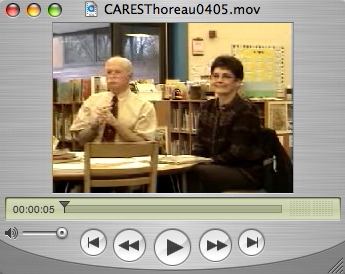 |
Madison School Board President Bill Keyes & Arlene Silveira Madison CARES presentation at the Thoreau PTO on Tuesday, April 12, 2005. Video (75MB). More on Madison CARES here. |
This information was provided to school board members via public information department
· Leopold Elementary School is overcrowded, and will become more and more overcrowded. The schools capacity is 655 students; 668 students currently attend the school. In five years the school is projected to have a minimum of 750 students and as many as 830 students, that is 95 to 175 over capacity.
· In addition, because of overcrowding there, 111 students who live close to Leopold are assigned to elementary schools outside their neighborhood. One of these schools is Chavez Elementary which currently needs and will continue to need seats for students moving into new developments close to this school on the southwest side.
· This question asks for authorization for up to $14.5 million to build and equip a new elementary school adjacent to the existing school on the Leopold site, and to renovate, remodel, equip and add to the existing Leopold building, and to make related site improvements.
· Building on the existing site precludes having to purchase at least 15 acres of additional land for an elementary school.
· Included in the $14.5 million is up to $1.6 million for the existing Leopold building to convert and remodel the former library and current cafeteria into small and large classrooms.
· If this referendum is approved, the new school will open for the 2007-08 school year, and plans call for the two schools to be paired. Just as its done in other school district paired schools, one building would have kindergarten 2nd grade students, and the other building would have 3rd 5th grade students.
· Construction of this new elementary school will be consistent with the school district practice of having schools close to where students live, and of all students in a given neighborhood attending the same school.
· Without the new school on the Leopold site, and in the optimal boundary changes scenario presented to the Board of Education, at least an additional 64 current Leopold students will be assigned to schools outside their neighborhood. Under this scenario, over 300 students will be moved to different West side elementary schools Thoreau, Van Hise, Stephens and Crestwood.
· Other boundary redistricting scenarios under consideration would move 828, 1063 or 1137 students to different elementary schools due to overcrowding. *(soon there will be an option to move around 300 students but the school board has yet to receive the information)
· The new school will cost the average homeowner an average of $25 per year for 15 years, and will generally maintain present school boundaries. (The median value of Madison homes is $205,400.)
For more information about the May 24 referendum, go to the districts Web site at www.mmsd.org
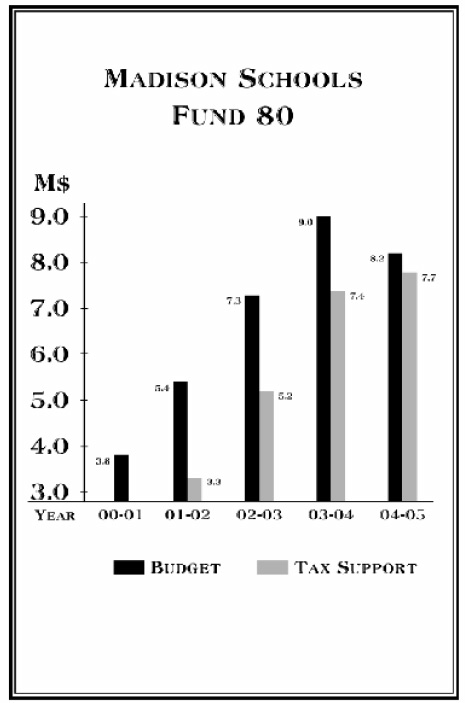 Click on this graph for a larger version |
Following is a link to 2005 Senate Bill 171 relating to the scheduling of referenda to approve school district borrowing or exceed a school district’s revenue limit. A hearing is scheduled for the bill on Wednesday, April 20, 9:00 a.m., Room 400 SE, before the Committee on Labor and Election Process Reform of the Senate, Tom Reynolds, Chair. (74K PDF). Send your views on this to Senate President Alan Lasee 200K PDF ACE Whitepapers: 1. Community Services Fund (Fund 80) [64K PDF] 2. Fund 80 Media Presentation [180K PDF] Kanavas requests audit of Waukesha School District’s Community Service Funds. |
Capital Times April 15, 2005
Full article at: http://www.madison.com/tct/mad/local//index.php?ntid=36209&nt_adsect=edit
Teachers fight possible bilingual education cuts
By Lee Sensenbrenner
April 15, 2005
Bilingual teachers who are helping students in the Madison Metropolitan School District to learn English are organizing against a proposed cut to their department.
Threatened with losing eight positions if a May 24 operating budget referendum for $7.4 million is unsuccessful, the teachers said in an open letter Thursday that the cut would take away much of their ability to help mainly Spanish speaking elementary students who are struggling to keep up.
As laid out in the administration’s $7.4 million list of proposed cuts, dropping 8.4 bilingual resource teachers would save $425,880. This would take away one of two teachers in the elementary classrooms where the positions would be lost.
Senator Ted Kanavas (R-Brookfield) has asked the Legislative Audit Bureau to audit the Waukesha School District’s use of “community service funds” (called “Fund 80” by Madison Metropolitan School District) to finance high school pool project.
The following article from the April 15 Milwaukee Journal Sentinel includes a larger discussion about how funds are being used in other Milwaukee-area communities and whether those uses conform to state law.
The following story from the April 13, Appleton Post-Crescent reports on a school district in Wisconsin that is actually adding staff to both gifted and special education.
News-Record staff writer
NEENAH � The equivalent of four teachers will be added to the Neenah Joint School District next year to enhance its special education, and gifted and talented programs.
Last week, the Board of Education set the staffing level at 480.5 teaching positions for 2005-06, compared with 476.5 this year.
The changes will cost taxpayers an additional $244,000 next year.
The cover story in today’s Isthmus (dated April 15) includes new praise for the effectiveness of Direct Instruction for teaching reading.
For example, the article says, “Among the beneficiaries . . . are special ed students, who receive an especially intense form of Direct Instruction. One-third of Marquette’s special ed kids were ‘advanced’ readers on last year’s third-grade test, while over one-half were ‘proficient.’
The article continue, “Meanwhile, at Franklin-Randall, the district’s other paired elementary schools, the third-grade scores for special ed students are the inverse of those at Lapham-Marquette: Whereas Marquette has one-third of its kids at the top and 8% at the bottom, Randall has 8% at the top and one third at the bottom. At Hawthorne Elementary, one of five schools formerly eligible for the Reading First grant, no special ed children register as ‘advanced,’ and most perform poorly.”
Unfortunately, most Isthmus articles are not posted on-line. When an electronic copy become available, I’ll post a link to it.
Ed Blume
Below Jeff Henriques posted a response from the MMSD to a letter criticizing Reading Recovery.
The critical letter concludes:
“Reading Recovery has not met the needs of these lowest performing students. Most significantly, its excessive costs can make it more difficult for a school to provide help for all students in need, especially those who are behind in the upper grades. Thus, Reading Recovery is not a productive investment of taxpayers� money or students� time and is a classic example of a �one size fits all� method.”
Read the full letter letter on Reading Recovery’s flaws.
Ed Blume
The New York Times on April 13 reported on a study by the Northwest Evaluation Association that shows there is a decline in the improvement of students in schools since the enactment of NCLB. To quote the article in part:
“Since No Child Left Behind, … individual growth has slowed, possibly because teachers feel compelled to spend the bulk of their time making sure students who are near proficiency make it over the hurdle.
The practice may leave teachers with less time to focus on students who are either far below or far above the proficiency mark, the researchers said, making it less likely for the whole class to move forward as rapidly as before No Child Left Behind set the agenda.”
The following link is to the actual report from the NWEA site, for your reading pleasure.
Download file
In response to criticism of Reading Recovery here and on the Madison TAG Parents web site, MMSD Reading Recovery Coordinator, Sharon Gilpatrick, provided TAG staff with information in response to the letter about Reading Recovery and asked that it be shared with the community.
According to the Reading Recovery Council of North America the Internet letter criticizing Reading Recovery was not an “unbiased review of evidence. It represents a narrow but vocal minority opinion.” They also state that it has a number of biases and omits important findings. You can draw your own conclusions by reading their letter signed by their group of international researchers.
The District must have a budget process that allows the Board of Education and the public to review the budget, and balance the interests of the public, students and staff to accomplish the effective and efficient operation of the School District, and to ensure that its priorities are addressed.
The current timeline for budget approval does not allow the Board or the public to have reasonable and informed access to the information necessary to balance those interests, or to ensure those priorities.
Instead, current and past budget practices allow staff contracts to be accepted, budget cuts to be proposed, and additional programs to be considered, all without the ability to place these items within the budget as a whole, and therefore balance all interests.
Modifying the budget process to allow this balancing, to me, is non-negotiable.
I, for one, will not be supporting any of the referenda on the May 24 ballot, unless the budget process is fixed.
I will be voting in favor of all the referenda on May 24, if and only if the Board takes actions prior to the referenda to ensure all proposed staff contracts and other agreements are incorporated into the previously published budget and not acted separately upon by the Board; and, if and only if, all cuts to programs are proposed and presented in the context of the previously published budget, and not acted separately upon by the Board.
In order to get my vote, the 2005-2006 budget process and timelines need to be modified, even at this late date, to conform. We cannot reneg on any contracts already voted on by the Board, and we cannot review the failure to consider adminstrative renewals by the Board, and we cannot pull back the publicly proposed cuts to await the timely arrival of the budget.
But, we must be delivered an estimated 2005-2006 budget sooner than the proposed May 2nd to give the public time to review it, place the proposed cuts into its budget context, and plan for alternative budget adjustments. At the latest, the budget can be delivered to the Board and public on April 22nd, even under the current timeline, by posting the budget on the website prior to or instead of printing (we might even be able to save printing costs!).
Accepting the referenda for a changed budget process is a quid pro quo contract between the Board and the public. It is a prototypical win-win agreement. All sides to the coming debate over the referenda get everything they want. Those in favor of the referenda get the referenda passed; those who want a significantly better budget process get their interests heard.
Accepting such a challenge might even avoid the coming, and, what I perceive to be, very devisive battle among the many sides to debates.
For those who find such an agreement more of a compromise than a win-win agreement, consider it progress towards opening up the budget process � progress that could have been accomplished years ago.
The real debate has not started, but I�ve already heard some loose lips. I�ve heard it said (paraphrasing), �If you can�t afford the tax increases, take a mortgage out on your home.� And I�ve read comments that said (paraphrasing again), �If the Leopold expansion was in a white area, there would be no problem. The opposition are racists.�
Unless some agreement is accepted, I don�t see a reasoned and tempered debate occurring in the next month and a half.
Instead, we�ll be spitting at each other.
There is some difference of opinion about what state law requires under the QEO statutes, particularly regarding the “required” 3.8% increase. For what it’s worth, this is how the statute is worded:
TO: Madison School Board Members
FROM: School District Employee
RE: MMSD Budget Concerns/Questions
As a Madison taxpayer, parent, and employee of MMSD, I have a unique perspective on the workings of this school district. I also feel a great responsibility to write my concerns. The Board should address:
� How can food service/custodial/secretarial personnel be cut/surplused at the same time that more administrators are added and given substantial raises?
In Madison, parents have begun asking why MMSD does not link parents to teachers through regular e-mail reports and messages. The April 6, 2005 issue of Education Week offers pros and cons of this suggestion. http://www.edweek.org/ew/articles/2005/04/06/30email.h24.html?querystring=e-mail%20opens%20line
Direct Instruction frequently enters discussions of reading in Madison’s schools.
Strictly speaking, Direct Instruction (with a capital D and a capital I) is a copyrighted program. Direct instruction (little d, little i) refers to a variety of programs that use direct systematic instruction and other principles of Direct Instruction.
Additionally, direct instruction works to teach other subjects, math, science, history, and more.
Dr. Martin Kozloff, professor at University of North Carolina-Willmington, prepared a long list of direct instruction cirricula. Click here to read a short description of each.
Ed Blume
Jason Shepard speculated on how a majority might form on the MMSD school board when Lawrie Kobza officially takes a seat.
�Lawrie Kobza�s win . . . over Madison school board incumbent Bill Clingan by a 53% – 47% margin will almost certainly alter the board�s ideological alignment. The only question is how.
Kobza credits a surprise endorsement from The Capital Times as the tipping point of her campaign. But a last minute mailing signed by Ed Garvey and former Mayors Paul Soglin and Sue Bauman questioned whether Kobza is really a liberal.
Kobza, an attorney with a sharp mind, says her election proves voters want changes in school governance. Soon-to-be colleague Ruth Robarts is thrilled: �There�s going to be a new dialogue.�
At election�night parties, there was speculation that Kobza could side with Robarts on what would normally be 6-1 votes, and also of a coalition made up of Kobza, Robarts and moderates Shwaw Vang and Johnny Winston. But Carol Carstensen says her big win . . . shows public support of the board�s liberal majority. We�ll see.�
— Isthmus, April 8, 2005
In the May 24 referendum for the operating budget, voters will determine whether the Madison schools will have an additional $7.4 million to spend next year and for all the years thereafter. Superintendent Art Rainwater and the management team issued a cut list in March. According to Rainwater, the board should cut the programs, staff and expenses on this list if the referendum fails. http://www.madison.k12.wi.us/budget/mmsd/0506/2005-06_Budget_Discussion_Items.pdf
Before the referendum election, the school board can take items off of the cut list. One of the items that should come off the list is the proposed elimination of the elementary strings program, a program that costs $500,000 within a budget of more than $350 million.
Decisions: Adult or Student-centered? by Dr. John Benham, Music Advocate
Why do I include this as an issue of music advocacy? Because, it is my observation that the lack of a student-centered decision-making process is the number one issue in education!
Air America’s Al Franken interviewed Richard Blumental, Connecticut’s Attorney General, Friday because he is fiing a law suit against the federal government. His complaint on behalf of the state of Connecticut is the federal government is illegally and unconstitutionally requiring states and communities to spend millions of dollars to administer federally mandated test. He claims it is unconstitutional for the federal government to mandate education to the local communities without financially backing the mandates. He is asking that other states join in…………
Dear Editor,
I just returned from the annual Madison Strings Festival with a warm feeling in my heart. It wasn�t the warmth of joy, however, despite the lasting echoes of 1,000 children playing music. It was the embers of rage beginning to kindle. For the fourth time, the Strings Festival was tainted by rumblings of anger, shock, and outrage at Art Rainwater�s ongoing assault on Madison values. For the fourth time, the elementary strings program in the Madison schools is targeted for demolition.
By trying to compare city council ward maps and the Leopold Elementary attendance map, it appears to me that Lawrie Kobza and Bill Clingan ran neck and neck in the Leopold area:
| Ward 57 | Ward 58 | Ward 59 | Total | |
| Kobza – 32 | Kobza – 16 | Kobza – 129 | Kobza – 177 | |
| Clingan – 36 | Clingan – 14 | Clingan – 138 | Clingan – 188 |
Kobza favored construction of a new school at a different location to help relieve crowding at Leopold. Clingan favored construction of the new school at the Leopold site.
Do the results mean that the attendance area is nearly evenly split on the two options?
The comments section is open for anyone with an answer or interpretation.
Ed Blume
Bravo for taking this [string survey] on…it is really important for the elementary string classes to be recognized as an ACADEMIC elective, NOT as extra- or co-curricular study.
“Without incorporating arts education, our children will not be prepared for success and survival in the world community we live in. The arts broaden our perception of the world, utilize our brains more fully and train us to look for a variety of solutions. The arts bring joy into lives that are not always full of sun.
Timing is everything. Timing is the reason that I believe a one-year operating referendum has a better chance of passage than a two or three year referendum.
Since being elected to the Madison school board last year, it has been very clear to me that many people in our community are educated in school board politics via local media. Unfortunately, television snippets, radio sound bites and newspaper articles rarely tell the entire story. However, in the March 31st Opinion section of the Wisconsin State Journal gets the story right! The article states, Tapping property taxpayers for more money is a regrettable option, but the finger of blame does not point to the board. Rather, outdated and unproductive state school financing rules are at fault. They put school districts like Madison’s in a no-win situation. In response, the School Board, with a few exceptions, has been taking the right approach. By cutting, combining and conserving, the board has held down spending while keeping school quality high. Thank you Wisconsin State Journal for telling readers the truth!
I support the one-year operating referendum because I believe it is the right thing to do and the right time given the other referenda on the ballot (building a new school and maintenance being the other two). I am also sympathetic to community concerns regarding higher property taxes and the uneasiness that leaves in the communitys sense of economic security. For instance, gas prices are increasing, President Bush is advocating privatizing social security and many lawmakers are still promoting the Taxpayer Bill of Rights (TABOR).
The timing for any school board referendum will never be optimal. However, it is important to make any referenda as palatable as possible for as many people as possible. Given our circumstances, the time to do that is for one year. That time will be on Tuesday May 24th.
“It is unreasonable that the strings program in MMSD should be the target of cuts every year, when it is demonstrated OVER AND OVER that it is a successful program musically, it helps with academic progress, and it is a boon to economically disadvantaged students. Will the School Board please allow the string teachers in the district stick to music education rather than fighting for the existence of a proven program?”
from comments – String Survey
Take the string survey – results will be tabulated and forwarded to the school board. I’ll be posting comments from the survey on this website:
survey comment response: “Don’t cut music. I was never in a strings program, but rather played trombone. I think that my experiences in music helped shape my teenage years more than probably any other factor. I think it would be sad to see it go. 4th grade is not too young to learn music; and early start allows them to be interested in music before they are overwhelmed by too many other things.”
The annual string festival is a reminder of how wonderful music education is, and of how important this is for our children’s education. This annual spring event is also a reminder of how badly the existing School Board is failing our children. Lawrie Kobza, school board candidate for Seat 6, wrote, “Fourth and fifth grade strings is a well-established, much-loved, and much-supported program. There is also significant research demonstrating a high correlation between playing an instrument and achievement. Given all of these positives, the 4th & 5th grades strings program should not be considered for cuts until the district does everything possible it can to retain or if necessary restructure the program so that strings can continue to be offered in 4th and 5th grades even in times of tight finances.” This is Lawrie’s approach – not settling for the status quo, working together creatively for what we value for our kids’s education. I am voting for her on Tuesday, April 5th, because the strings festival, sports, academics would all benefit from her talents on the school board. The status quo is not working locally – the longer we stay with the status quo, the more our kids will suffer.
The Memorial Strings Festival was a wonderful collection of children from forth to twelve grade, every color, every size, and all abilities. As I sat proudly and watched my daughter play, along with so many parents who were sitting and standing (as there were no seats left so many showed up)I was sad. The director was sad and the two strings teachers that were given pink slips (one from Crestwood, our school) Friday were sad. Surely this program does not need to be on the chopping block. I kept thinking, with this many parents attending a festival couldn’t we do a fundraiser at the festival, sale something or just have a donation box for strings. Many parents like myself feel strings and no-cut freshman sports are placed on the block because they get the “involved parents” fired up to vote for whatever the referendum is, just to save these two programs. They are right. I will vote for the referendum to save a $500,000 program. I would not vote to save a secretary, two aides, two janitors and two middle management positions. But I will vote for it because, although I have been in charge of many fundraising events, I can’t figure out how to raise $500,000 without a major community effort.
I have an idea though. How about moving 4/5 strings out of the classroom and into the Monday afternoon slot? Run it through MSCR or After School Program and while all the other teachers do whatever it is they do Monday afternoon allow strings kids to stay Monday for an hour of strings.(At Crestwood, After School provides foreign language in this same manner) MSCR does not seem to be a part of the MMSD budget that requires cutting and parents already pay a fee ($40 for me) to have their child in strings. We could increase the fee and then raise money for scholarships so to include low income children. The only problem I see with this arrangement is;
1. transportation for low -income students (we could have one at the Allied Drive Learning center instead of the school, parents could choose) 2. could we get enough strings teachers to cover the schools at the same time slot? If the referendum fails lets not throw this program out, let’s think outside the box and find a solution.
A message to Madison School Board members from Superintendent Art Rainwater:
Attached is a press release from the Federal Department of Education in which they use our closing the gap in third grade reading as the example for Wisconsin of what NCLB and the Reading First grants have accomplished. The other interesting thing is the data they use to show how successful they have made us is the same data we used to show them why they should fund our Balanced Literacy program.
Download file
VOTE TUESDAY, APRIL 5
I support offering students the opportunity to take strings in 4th and 5th grade, and oppose the administration’s proposed cuts to the program.
Fourth and fifth grade strings is a well-established, much-loved, and much-supported program. There is also significant research demonstrating a high correlation between playing an instrument and achievement. Given all of these positives, the 4th & 5th grades strings program should not be considered for cuts until the district does everything possible it can to retain or if necessary restructure the program so that strings can continue to be offered in 4th and 5th grades even in times of tight finances.
The District’s functional analysis report from Virchow-Krause (hereafter VK) has been touted as showing how well the District is being run. But, the report’s results are less than they seem. On page three of the report, VK gives the assumptions for the report. Quoting from the report:
——-
As Superintendent Rainwater has noted, there are several key assumptions behind the functional
analysis. These assumptions are:
� Every single thing the District does is good for kids. Long ago the District eliminated all those
things that were peripheral.
� All District staff members – teachers, administrators, custodians and food service workers �
are good at what they do.
� The District has very talented people that work very hard and that work very smart.
� Site-based teachers and administrators currently have full time jobs � and they can’t absorb
more work. Functions cannot move from the central office to people at the site because sitebased
staff members are working as hard and as efficiently as possible.
With these assumptions in mind, the results of the functional analysis are presented in this
report.
——-
Clearly, given the assumptions of the report, VK could not have found anything but that the District is doing everything just perfectly.
Had these assumptions not been in place, VK might have been able to inform the District, Board and public of solutions not currently in front of us.
What is disturbing, however, is that the Board doesn’t truly read or understand the critical material before them, that the District can make those assumptions, probably with Board acquiesence, and then have the temerity to claim they are providing leadership, and doing all that they can do.
Burmaster announces High School Task Force members
MADISON�State Superintendent Elizabeth Burmaster released a list of the members of the State
Superintendent�s High School Task Force.
The group, co-chaired by JoAnne Brandes, executive vice president, chief administrative officer,
and general counsel for Johnson Diversey Inc., and Ryan Champeau, principal of Waukesha North High
School, will hold its next meeting May 3 at the Sheraton Madison Hotel. It will look at various local
initiatives aimed at redesigning or transforming the high school experience, enhancing student learning
and engagement, and strengthening the alignment of high school with postsecondary education and
workforce needs.
Madison Participants include:
Katie Arnesen of Madison
Parent
Steve Hartley, Director of Alternative Programs
Madison Metropolitan School District
Michael Meissen, Principal
LaFollette High School, Madison
Kendra Parks, Teacher
Memorial High School, Madison
The press release and a list of the members of the task force is on-line at: http://www.thewheelerreport.com/releases/Apr05/Apr1/0401dpihstaskforce.pdf
I submitted the following letter of endorsement for Lawrie Kobza to the local papers.
Dear Editor,
I am deeply concerned about the lack of commitment to school financing at the federal and state levels and I support changes in school financing. However, I am equally concerned about our local Board of Education�s tepid leadership given the current fiscal constraints.
The school board�s decisions seem to move from one crisis to another, and each spring, the board holds our community hostage to its budget cutting process. The board appears to be paddling feverishly in a canoe without steering. And the canoe continues to go in circles because there is no planned destination. Given the withdrawal of federal and state dollars for schools, the challenge rests with our local school board to begin to chart new waters.
That will only happen if there is a change in leadership on the school board. That�s why I�m supporting Lawrie Kobza candidacy for the board. Ms. Kobza is an exceptionally well-qualified candidate, who is dedicated to excellence in public education and has a proven record of leadership and creative collaboration. She has worked successfully with the community, MMSD staff and current board members on a number of school issues.
A good school board candidate needs to be a) a strong advocate for student achievement and excellent instruction, and b) a strong facilitator of meaningful dialogue between the community, educators and the administration. Only then can we develop the best policies � educational and fiscal � for Madison schools.
A group of parents and community members who are concerned about the current school board�s governance have made numerous suggestions for alternative approaches. These are posted on www.schoolinfosystem.org. Many of us believe that voting the status quo in the April school board election will continue more of the same feverish paddling without any direction, while the community faces continued threats of cuts to great programs and services.
Madison will need educational referendums to fund our schools, but we need to know those dollars are spent wisely. This requires a clear vision of what excellent public education means for Madison, how we�ll get there, what the costs are and what different investment options are needed. Various new collaborative financial relationships with the community may also be necessary in some instances, such as for sports or fine arts � two areas Madison values.
Our school board members won�t know what�s possible by talking among themselves. School board members need to invite community members and parent organizations to the table, so that we can identify issues and work together to maintain our excellent public education system. The only trumpet call from the current school board is a call to referendum. One call will not work much longer. Madisonians expect more from their school board.
I know Lawrie Kobza can meet those expectations. She will be thoughtful and thorough in her approach to the issues facing Madison schools. She will navigate us through tough times. I am sure her opponent cares about public education, but Madison needs a school board member who does more than that. Lawrie Kobza not only cares about public education, she also brings independence to the board. She will provide much-needed critical analysis of programming decisions and an openness to community involvement. Madison�s lucky to have a better choice for our kids on April 5, 2005 � Lawrie Kobza.
Barb Schrank
Madison, WI
I encourage the expression of any and all points of view on schoolinfosystems.org. To that end, I posted below a recent letter to the editor on public confidence in the Madison school board.
Ed Blume
The Capital Times :: EDITORIAL :: 9A
Tuesday, March 22, 2005
Janet Morrow, Madison
Dear Editor: I am concerned by the “fact” that the public has lost confidence in the Madison School Board.
This is a lie. There is evidence to the contrary. The current board has engaged the public this school year more than ever. Board members have actively listened to public input and responded accordingly.
Take, for example, the possible boundary changes presented by the school district. Board members rejected the changes based on public input, altered them using ideas and suggestions from the community and directed the administration to come up with new boundary changes.
Through this process the public has steadily gained confidence in the School Board. Ignore the rumors and embrace the facts.
Please share this information with others who may be interested in helping to
create a revitalized PTO at East.
March 30, 2005
UPDATE ON EFFORTS TO BUILD AN EAST HIGH SCHOOL PTO
______________________________________________________
Upcoming meetings:
Thursday, April 14
Thursday, May 12
All meetings are held at East High School and begin at 7 p.m., with time for
informal conversation from 6:30 to 7:00.
Editorial: Lawrie Kobza for School Board
An editorial
March 30, 2005
Voters who care about public education are blessed with two fine candidates for Seat 6 on the Madison School Board. Both incumbent Bill Clingan and challenger Lawrie Kobza have deep roots in the community, both have solid records of involvement with neighborhood schools and both line up on the progressive side of debates about equity, discipline and curriculum in the schools.
So there is not a “wrong” vote that can be cast on April 5. But there is a “right” vote, and that is for Kobza.
The School Board has been rocked by too many personality clashes, and there are growing complaints that the board majority has not done a good job of involving the community in the decision-making process. We worry about the ability of this board to go to an essentially pro-public education electorate and win support for needed school funding referendums. The last referendum barely won, yet the board has continued to operate as if the disenchantment of the voters can be dismissed – or that a slightly different spin will do the trick.
We share Kobza’s view that it will take more than that. Kobza says, “I am concerned that the public will be less supportive of referendums than they were in the past. The public has little confidence that the board and district are managing the money the district already has wisely. The board and district must do a better job of making its budget and budgeting process understandable and relevant to the public in order to regain the public’s confidence in the board’s financial management of the school district.”
If elected, Kobza would bring fresh ideas to the board, along with a smart, professional style that, we believe, would allow her achieve the reforms she seeks. We are equally certain that she could do this without getting mired down in the “personality politics” that often thwart board cooperation.
A respected environmental lawyer, Kobza has expertise is in working with local government bodies. As such, she would bring valuable professional skills to the board. But Kobza’s passion in recent years has been the Madison public schools, and she has been deeply involved in grass-roots efforts to improve them. She’s the president of the parent group at Sherman Middle School, where she and other parents played a leadership role in stabilizing a school that over three years had three principals and four assistant principals.
It is inspiring to listen to Kobza’s story of the work she and other parents did to get Sherman back on track – she served on principal interview committees, worked with the district on building improvement plans and helped school staff develop a new discipline plan. And it is notable that Kobza is not just a “my-kid’s-school” activist. She’s a member of the Northside PTO/A Coalition, where she has been a leader on equity and summer literacy initiatives, and she was recently honored by the Northside Planning Council for her work with schools.
Kobza has direct ties to parents and community activists with whom the School Board needs to make deeper connections. That would help her implement her goal of increasing citizen involvement in budget decisions – perhaps using a model developed by the Waukesha School Board.
Kobza also has a savvy understanding of the dynamics of the current board, including how its internal conflicts have created perception problems in the community. With a tough, no-nonsense approach, she thinks she can free up the debate and create a healthier, more open and engaged discourse.
We believe Kobza is right, which is why we endorse her. It is difficult for us to go against Clingan, an amiable and well-intentioned board member whom we have backed in the past. But we simply don’t see the incumbent as someone who is going to change the dynamic on the board. In order to renew confidence in the board, a change is needed, and we think Lawrie Kobza is the best agent of that change.
Editor’s note: Thursday’s editions of The Capital Times will feature endorsements for the Madison City Council.
Saturday, April 2nd is the annual Madison Area String Festivals – a much-loved, special event for all Madison public school children who play in MMSD’s string orchestras from Grades 4-12. More than 2,000 children will be performing 12 songs.
Each of the 4 area high schools will host a string performance on Saturday. Your elementary or middle school child, who is playing in a string orchestra, will be performing at the high school their school feeds into. For example, Randall Elementary feeds into West High School, so the elementary string children from Randall Elementary will be performing Saturday at that high school.
The performances last about one hour, and the schedule for the day is:
Memorial Area String Festival – 10 a.m. at Memorial High School
East Area String Festival – 12 noon at East High School
LaFollette Area String Festival – 2 p.m. at Lafollette High School
West Area String Festival – 4 p.m. at West High School
Dress rehearsals will be held Friday – performers need to check with their orchestra teacher for times.
These are wonderful performances – 600+ children playing together in each of Madison’s four area high schools; a special site to behold and wonderful music to hear!
Parents and relatives – bring your still and video cameras! This is truly a unique Madison experience.
I believe that our community strongly supports high quality schools. I know that the state and federal governments do not provide sufficient funding for the programs that we want. I am willing to pay higher property taxes to make up the difference when necessary. However, before I commit to higher taxes, I must have a high level of confidence in the decisions that put the matter on the ballot. I think that you do also.
Today I ask that you think about the qualities that you want in school board members as you prepare to vote on the May referendums, especially the referendum for the operating budget.
I have lived and followed education in 3 states. Alaska, Texas, and Wisconsin. The DPI is a first. After 4 years I have tried to understand this governmental body. There is a Leader, Ms. Burmaster and based totally on the web site anywhere from 441 to 600 employees in this agency. When I have asked what all these employees do for the education of the state no one seems to know. The many teachers I asked stated their only interaction with the DPI is to renew their license. This seems like a logical function of a state but does it take 400- 600 people? When I view the directory on the DPI web site I am amazed all these people work for the education department yet none of the people I know that work at SCHOOLS actually benefit from all these state salaried persons. Can anyone educate me on the department, I mean really what they do, before I am once again asked to vote for a leader of a governmental body I fail to understand?
I have the highest respect for Rick Chandler. He earned it as head of the state’s “budget shop” in the Department of Administration a few years ago.
I must, however, take issue with his defense of business taxes in Wisconsin.
The argumet over whether Wisconsin businesses carry their fair share of the tax burden gets admitedly muddied by the imprecise language of speakers like MMSD Superintendent Art Rainwater (Wisconsin State Journal) when he talked about “taxes” without specifying which taxes.
Confusion on the part of business tax critics is no reason for Rick to mistate the argument as one about whether businesses pay their fair share of property taxes.
That’s not the argument. The true issue is whether businesses pay their fair share of the state taxes necessary to provide an adequate level of state aid for school districts.
They don’t. The record is clear, according to the business community’s own Forward Wisconsin. If you visit the Web site of this shameless corporate cheerleader, you’ll read more than one item that contradicts Chandler. For example:
Wisconsin business taxes are lower than those in 35 other states. That’s the conclusion of a new study by the Federal Reserve Bank of Boston that measures more than 15 taxes that can affect corporate profits.
Wisconsin ranks fourth lowest in the nation in business taxes as a percent of all state and local taxes. The state’s business-friendly attitude is reflected in positive business tax changes that have been made in every biennial legislative session since the early 1970s.
If the current “business-friendly attitude” continues in the state legisalture, we’ll soon see the decline — not only of school spending — but in student achievement.
Ed Blume
Consider the following facts and issues regarding the Madison school district to help determine whether you will vote for Board of Education candidates who will continue in the same direction as indicated; or, vote for candidates who will change the direction for the future of the District.
1. There is continuous dissemination of incomplete and misinformation, any of which are misleading to the public and self-serving of the Board and administration.
2. There is a continuous �cheerleading� approach to how great things are in terms of the education in the district and how awful things are financially due the state and federal governments and the economy.
3. There is a continuous approach to the absolution of and by the majority of the Board of Education for responsibility and accountability for actions, or lack thereof, in the leadership and management of the district and its educational and fiscal stewardship.
I found the story on the Stoughton superintendent interesting because the school board conducts an evaluation twice a year. Madison’s board has failed to evaluate the MMSD superintendent for years!
Bill Clingan, chair of the MMSD’s human resources committee responsible for evaluating Superintendent Art Rainwater, admits that Lawrie Kobza, his opponent in the upcoming election, is right to highlight an oversight in the superintendent’s evaluation, according to a story in Isthmus.
The story on the Stoughton board’s action in the Wisconsin State Journal says:
“According to the board’s policy, the superintendent is evaluated twice each year, the first during an informal session in the fall. The second evaluation is a formal session before the board’s April reorganizational meeting and includes written evaluation statements from each board member.
The president of the board then writes a composite evaluation based on the written work of the board members, and it is then reviewed by the board.”
Read the full story here.
Ed Blume
ps The comment option below is open for anyone with thoughts on how the Madison school board could evaluate the superintendent.
I received this message from Brian Grau, a teacher from LaFollette who recently visited his hometown of Racine, who like Madison is going to referendum. Enjoy!
The Journal Times, Racine, WI, 3/24/05
Referendum means it’s time for finger pointing
By Jeff Ruggaber
Hey Racine! It’s that time again. Time to complain about money spent on schools! Who’s to blame? Let the finger pointing begin! Hey, there’s a group of teachers. Let’s blame them. They are just over paid baby sitters! I wish. I figure if I got paid $5.00 for each kid (25 per class), for 6 hours a day, for 180 days. I would make $135,000 a year! Let’s give those with a master’s $7.00 and hour per kid. That’s $189,000. Reality $39,000. Between my wife and I, last year we paid close to $7,000 just to keep our jobs (property taxes, classes to renew licenses, fee for licenses, and out of pocket expenses to supplement our classroom’s). I love paying close to $1000 of my own salary in property taxes. Healthcare. The district offered us the plan. Would you have turned it down? Should we pay more? Remember that teachers did trade salary for benefits.
Let’s point fingers at the school district. All they have done is cut spending year after year. Costs go up, spending goes down. You do the math!
Attention Racine: we have schools that were built during the Abraham Lincoln administration! Can you accurately guess from year to year how much it costs to keep these buildings running, when the ghosts of the 1800s still run through the halls! More cuts need to be made even if this does not pass. This district does not have the money to give you what this city deserves. Kids learning in run down, overcrowded buildings is a very real thing.
Next, let’s point fingers at the taxpayers. Those same people who spend $1 to $2 for a bottle of water. Those people who spend a dollar a day at the soda machine at work! Those people who don’t think twice at paying $4-$5 for one beer at Harbor Fest, Summerfest, Lambeau Field and the rest. Those people who are still driving their SUVs, pick-up trucks, Cadillac’s, and other gas guzzling cars. Those same people who pay $40-$50 a month so they can make sure their 12-year-old has a cell phone, $50 cable bills, $200 utility bills, $40 video games to baby-sit your kids, 20 cent increase for a gallon of gas this past week, the list goes on! Complain about those. Oh yeah, those things don’t go to a referendum, Why is it that when schools need more money, everyone complains? One person wants a user fee. The more kids you have, the more you pay. So I should pay more for the fire department if they put out my fire and I have 10 kids? Same concept! I’ve never used the fire department yet, can I get a refund? One lady offered the keys to her house. You got it! That will save three teachers jobs. Thanks! For those who think you don’t benefit from Unified because you have no more kids there, well then I think we need to make Unified and Non-Unified lines at every place of business. So when you go to the store, doctor, or gas station you can only go to the line where your tax money is spent.
Now the Racine Taxpayers Association gives the referendum a thumbs down. They say not enough cuts have been made. Have you been to our schools? Have you seen the plaster falling on kid’s heads? Have you seen the paint chipped so bad the wood is rotting underneath? Have you felt the below zero wind blow through the cracks in the 100 year old windows? Have you tried to teach in a classroom where the temperature varies from near 90 degrees to 60 degrees all in one day? Oh, that’s right, you think teachers should pay more for their insurance. Well if we do, then I want a raise back on my salary that I gave up for the past 10 years. The bottom line is that we have a serious problem.
So either fight for a better educational system and support it, or get out of our way. The future is now!
Without support, you can’t imagine how bad things are going to get.
Jeff Ruggaber is an art teacher at Red Apple School.
Despite a written agreement between Madison Teachers Incorporated and the Board of Education that aims at settling the teachers contract for 2005-07 by June 30, union executive director John Matthews and Superintendent Art Rainwater made a jovial � and unprecedented – announcement that they would delay discussion of wages and benefits until after the April 5 school board elections.
Delaying talk about pay and benefits for teachers is a puzzling step for union leader Matthews, especially given his March 17 comments that “No matter what the settlement is, it won’t be enough to reward the teachers,” Matthews said as the MTI proposal was presented Wednesday, “These are teachers, not priests and nuns who took a vow of poverty.”
Ive noticed in several postings that people have criticized the Madison School Board for lack of leadership. I believe that true leadership happens in the community and then comes to the board level for action. This has been the case in many actions that have been taken place in the past, present and will undoubtedly be the case in the future. All of these actions have had or will have a profound impact on the Madison Metropolitan School District.
Fifty-one years ago, the U.S. Supreme Court eliminated formal school segregation in Brown v. Board of Education. Twenty-five years later, this ruling forced the Madison School District to dramatically change how it educated elementary students. In 1979, South Madison residents lead by Dr. Richard Harris filed a lawsuit with the federal Office of Civil Rights concluding that the Madison School Board had knowingly created and perpetrated racial isolation by closing schools and changing boundaries on the city’s heavily populated minority South Madison. This lead to the creation of a task force that created the current school pairings we know today.
This community leadership has also lead to new initiatives such as Nuestro Mundo Community School, the districts dual-language charter school. This school is responding to Latino community leaders concerns regarding the changing demographics in the city and school district. English speaking families wanting to expose their children to Spanish and Latino culture are also enrolling their children in the school.
In addition to Nuestro Mundo, the Madison School Board is supporting the building of Wexford Ridge Community Center on the grounds of Jefferson Middle and Memorial High Schools. Wexford Ridge Neighborhood Center currently runs adult and youth programming out of a two-bedroom apartment. Again, community leaders and residents supported the proposal that initially didnt have the support of the Superintendent or a majority of the board. I am proud to state that voting for this proposal was one of my first acts as a member of the school board.
In the near future, on April 11th the School Boards Partnership Committee will convene a meeting to discuss a proposal from a group of parents to form a girls hockey program. This program will be a cooperative effort with girls from Memorial, West, East and LaFollette as well as schools outside of Madison being able to participate on one team. I am in favor of this program because it allows girls to participate positively in athletics and uses parents creativity and community resources to fund the proposal.
In conclusion, the school board is elected to lead the school district, however, it is the community that truly leads schools. It is the above stated community initiatives that lead me to believe that the real leadership comes from the community, not solely from school board members. I look forward to seeing what future initiatives come from the community, so we can work together to make them happen for the betterment of the Madison Metropolitan School District.
On March 28, the Madison School Board will vote to place three referendums on the ballot in a special election on May 24. The total bill for the referendums will be $85.1M if the operating budget referendum is for three years, as proposed by Finance Chair Carol Carstensen.
The RFP is available for inspection on-line here (PDF):
PROPOSAL NUMBER: 3060
ISSUE DATE: 02/21/05
DUE DATE: 03/31/05 2:00 PM Local Time
PLEASE NOTE: The deadline for requested modifications to the RFP WAS March 8, 2005. A vendor conference WAS held “on March 14, 2005 at 9:00AM in room 209 at 545 West Dayton Street, Madison, to respond to written questions…”
Madison parents and citizens need to ask the School Board a) why they continue to allow the Superintendent to treat elementary strings separate from the music education curriculum, b) why there is a continued delay in getting a committee together for fine arts, c) why the delay in seeking federal funding for fine arts for disadvantaged children, d) why the Administration continues to attack the fine arts academic curriculum rather than coming forward with ideas for strengthening this curriculum in light of the academic achievement benefits?
In July 2004, U.S. Secretary of Education wrote to all Superintendents of school districts in the United States:
“…the arts are a core academic subject under the No Child Left Behind Act (NCLB). I believe the arts have a significant role in education both for their intrinsic value and for the ways in which they can enhance general academic achievement and improve students’ social and emotional development.”
“There is much flexibility for states and local school districts under the No Child Left Behind Act with respect to support for the core subjects. …Under NCLB, Title I, Part A funds also can be used by local education agencies to improve the educational achievement of disadvantaged students through the arts.”
“In keeping with NCLB’s principle of classroom practices based on research evidence, studies have shown that arts teaching and learning can increase students’ cognitive and social development. The arts can be a critical link for students in developing the crucial thinking skills and motivations they need to achieve at higher levels.”
Mr. Rainwater says, “We are long past the time that we can solve our revenue cap problems by being more efficient or eliminating things that are nice but not necessary (March 2005 Budget Discussion Items Report – basically, budget cut document). Without the budget, this is a scary statement. Sadly, a budget would show this statement to be a scare tactic.
What’s scary to me is that we may indeed need a referendum, but the current board’s weak governance, lack of public discussion and review, alienation of many public groups won’t be able to make the case, because educating the entire child and excellent instruction for all are not driving the board’s priorities. That scares me.
Attached is a fact sheet from Shel Gross, Director of Public Policy for the Mental Health Association in Milwaukee County. He is the head of the Wisconsin Prevention Network.
The fact sheet is to help people lobby against the elimination of Safe and Drug Free Schools funding from the Federal government.
Lucy Gibson
I realize that many people in this community arent happy about the recent decision made by the Madison School Board to go to referendum for the operational budget shortfall. This will indeed raise property taxes. I am more than sympathetic to senior citizens (or others) on fixed incomes and how this decision affects them. I also empathize with those who might not agree with the direction of the district by stating additional cuts in services should be considered or discussed. While Im agreeable with those rationales, I will NOT stand for what I believe is blatant racism by members of this community who will use the changing demographics of the school district and community as an excuse for not voting for a referendum. Listed below is a copy of an e-mail recently sent to school board members. The sender is a City of Madison bus driver who has sent e-mails to the School Board before. I have retracted the senders name.
dear board members;i think it is an insult for you , not all of you.to ask for tax increases for the school budget problems.these schools are supposed to be so great in this city.they dont seem to be any better than when i went to school here.my niece was going to east high until a black girl that was 14 years old and already had 2 kids was giving her a hard time.my niece ended up going to another school.and just the other day, a gang of black kids were beating up a white kid at the east transfer point.also at east high.i know some people that said they have seen the black girls walk down the halls and push the white girls out of the way.i bet the public doesnt know about half the things that go on in this city.if you ask me i think you people should actually have better schools than just say you do.i thought schools were bad when i went and they were,i would hate to be a kid going to school here now.getting bullied and the school doesnt do anything about it.and you want us to pay more.i not only think that these schools suck ,this city is starting to also.
This is my response:
It is absolutely incredible to me that in 2005, there are people who perform public services in our community that are without question racist. It seems to me that you are indeed troubled with the changing demographics in the City of Madison. I want to remind you that as an employee working as a bus driver for the City of Madison, taxpayers are paying your salary as well. And, so are the thousands of Black and other racial and ethnic minority persons who probably ride the bus that youre driving. To be frank, it must be very difficult to drive with the white sheet covering your eyes. Thank you for wasting the taxpayers time for me having to respond to your ignorance.
Johnny Winston, Jr.
School Board member, who is Black and deeply offended by your bigoted comments. And I wish we didn’t have to ask you for your money!
I am more than willing to understand those who disagree but racism has no place in our schools and in our community! I hope we can all agree on that!
In January of 2005 Superintendent Art Rainwater told the Madison Board of Education that two administrative positions would be eliminated for 2005-06. He would cut the positions of Risk Manager and Data Manager when the incumbents retired at the end of 2004-05.
Imagine my surprise on March 14, when the superintendent cut half of the position of Risk Manager for a second time.
This is not the headline of an article in The Onion. Rather, as the Astronauts on the Apollo Mission said, “Houston, we have a problem.”
After 10 years of continually reducing services to our children and community . . . long past the time that we can solve our revenue cap problems by being more efficient or eliminating things that are �nice but not necessary� (MMSD budget cut document – not budget) More than $13,000 per student and all the Distict can do is teach math and reading. This should send a huge red flag up. It is – to those who can afford to, they are moving their kids, home schooling, paying for private tutoring and other lessons, and sending their kids to private schools. Who’s losing inthis picture – underprivileged kids in education and priviledged kids by not being part of a diverse school environment. All the kids are losing – big time and the negative impact on the economics and culture of the city will follow – that’s why my parents kept me out of NYC schools and I went to high school in Connecticut. That is not what I wanted for my daughter, but I need to protect her education – she’s only got the next 5 years.
There is no budget governance and leadership by board members and by the Finance and Operations Committee, which Ms. Carstensen chairs – threatening statements are made to other board members and to the public, no questions are asked, no budget is visible and the state is to blame. I suggest board members hold up a mirror, and I suggest that other progressives in Madison who share my concerns and want an excellent public education system in Madison, vote for a positive change in leadership on April 5th and read the following:
At Wednesday, March 17, 2005, candidates’ forum, Lawrie Kobza provided information that Mr. Clingan did not convene the Human Resouces Committee, which he chairs, to evaluate the Superintendent. As Chair of that committee he also did not follow through on a review of an administrative RFP from last spring that was developed in response to the public’s concern about administrators (source: board minutes spring 2004). No follow-up, same issue with administrators this year as last and an increase in the administrative budget from $1.5 million in two years even with 2 less FTEs – it’s about leadership and putting children’s learning first.
Mr. Clingan pointed out that he had attended more than 200+ meetings. Attendance is important, but it does not demonstrate leadership and does not lead to meaningful committee work being done effectively on behalf of children’s education and achievement.
Committee Chairs are leadership positions as is Vice President of the Board. Mr. Clingan said that the Board evaluates the Superintendent and they do so at each meeting providing him direction. You can evaluate the Superintendent at each meeting, but that is not very strategic and tends toward wasteful micromanaging.
The superintendent’s contract requires the establishment of yearly goals. This is one of the most important undertaking’s the board does. Historically, the Human Resources committee takes the lead in the Superintendent’s evaluation – Ray Allen the former chair undertook coordinating this review.
If Mr. Clingan did not want to do this as Chair of that committee he needed to advise the Board president – apprently, since there are no goals in place for the Superintendent, this was not done.
The annual establishment of goals with the superintendent, which should be in place before the start of the school year sets the direction for the rest of the district and its employees and is an important communication goal with the community about what the district will be accomplishing in the short-term towards its long-term goals. What’s so complicated about that? Why isn’t it done?
From University Communications:
Event to celebrate women in science
(Posted: 3/16/2005)
The Wisconsin Initiative for Science Literacy (WISL) on Saturday, April 9, will present “Celebrating Women of Science,” a daylong event that will feature talks by several prominent researchers, followed by hands-on science activities for teenagers and young adults.
WISL is a project of the chemistry department.
Scientists, including Laura Kiessling, Wendy Crone, Ann Kelley, Judith Burstyn and Gelsomina de Stasio, will speak on topics ranging from cancer to carbohydrates to the neural basis of eating. Chancellor John D. Wiley will make opening remarks.
Following the morning presentations, college, high-school and middle-school students can participate in any of eight hands-on science sessions. Among the activities, students can peer through a scanning electron microscope, handle live microbes or build working batteries on their own.
“Celebrating Women of Science” will take place in from 9 a.m.-3:30 p.m. on April 9 in Room 1315, Chemistry Building, 1101 University Ave. The event is free, but registration is required by Friday, April 1, for the hands-on sessions. To obtain a registration form, visit http://www.scifun.org/ or call (608) 263-2424.
I started attending meetings several years ago and, initially, was naive enough to take Carol Carstensen at her word when she said “if you don’t like our cuts, you need to tell us where to cut.” Board members then claim that they “have no choice” and that critics “only criticize but don’t offer solutions.” This is one disingenuous ploy, since it invites people to participate but leaves the door open for the board’s typical response: we know more than you do and we don’t like your ideas. This is not listening.
I was looking through some old records the other day, and found the following message that I sent to the board over a year ago:
Carol Carstensen told me last night that I’ve been “angry” over elementary strings for the past four years. I learned many years ago never to “tell” people what they are feeling – 90% of the time you’re wrong, and in this case Ms. Carstensen is dead wrong about me.
Her comment to me came after I asked her why the board would agree to a recommendation that puts the ENTIRE elementary strings program at risk if a referendum does not pass yet the board did not ask nor would it even consider a) reducing the administrative budget (increased $1.5 million over two years even with cut of 2 positions), b) reducing any of the services to high school children for extracurricular sports ($2 million budget) – which makes sense. They are paying 20% of the cost of the program, and, so are the elementary strings children. Plus, the board has an athletics committee – not a fine arts committee. Something wrong with this picture? Yes, very much so, and it’s resulting in discrimination against underprivileged children who study instrumental music.
Carol Carstensen�s recent letter to the editor of the Wisconsin State Journal (�Carstensen replies to Robarts�) illustrates the choices before the public in this spring�s school board elections. Many of these choices revolve around the core question of whether one can support progressive ideals and challenge the board�s go along and get along status quo.
I believe that it is not only possible but necessary for progressives to question the status quo � particularly if it results in serious board consideration of balance between employee wages and benefits as part of a comprehensive search for ways to preserve our current staff levels and programs in view of current funding realities.
In her letter, Carol Carstensen erroneously reduces my suggestions to one simplistic idea and then condemns the idea as anti-teacher and ill-informed. Perhaps it is easier to attack a straw-person concept, but it doesn�t move the community or the board closer to the honest problem-solving that is required at a time when we need all of the input and ideas that we can get.
The Madison School Board of Education and the District administration are proposing nearly $50 million worth of referenda and are begging for the support of the taxpaying public to significantly raise taxes. At the same time, Superintendent Rainwater bashes the business community for not contributing more tax dollars to fund public education. By accusing businesses of “eating their own young” and “contributing to their own demise” he is creating a very divisive atmosphere that makes it very difficult for taxpayers to see the value in more and more spending for mediocre results.
Diane Ravich
It makes no sense to blame the high schools for their ill-prepared incoming students. To really get at the problem, we have to make changes across our educational system. The most important is to stress the importance of academic achievement. Sorry to say, we have a long history of reforms by pedagogues to de-emphasize academic achievement and to make school more “relevant,” “fun” and like “real life.” These efforts have produced whole-language instruction, where phonics, grammar and spelling are abandoned in favor of “creativity,” and fuzzy math, where students are supposed to “construct” their own solutions to math problems instead of finding the right answers.
These are the exact same points Professor Seidenburg, UW Madison, made to the MMSD School Board earlier this year. He also critized the MMSD Superintendent for turning away $10+ million over several years of Reading First federal grant money.
I did a simple search on Google: State budget and school funding. I was not surprised to find Wisconsin sharing in their education funding crisis with many other states. On the first two pages of my search I discovered California, Texas, Washington, Pennsylvania, Indiana, Minnesota, New Jersey, Ohio, Illinois, and New York have news articles about their educational funding “crisis”. Each state has it’s version of revenue caps, TABOR like situations, or tax restraints that cause their current problem. Some just never raise taxes and can’t figure out how to fund a state and local program without taxes. Also interesting to note is Ohio and Illinois legislation funds their local schools at 51% while Washington state legislation is suppose to pay 80%. None of these states actually fund their schools at their promised level just as our federal government fails to fund it’s many mandates at it’s required level. I find this interesting because each time I watch the “MMSD Budget Horse and Pony Show”, as I like to refer to this annually released performance, I am told how awful the state legislation is and that Wisconsin is backwards in its funding of education. While there may be some truth to that, it is comforting to know my state is not the only awful backwards state out there. That comfort however, does not solve the problem. The reason I went on this search is I have twice, maybe more, asked the board to “think outside the box”. I decided since the board wants the public to present them with solutions and not complaints that I would find out how other states and communities are financing schools and present these ideas to them before they develop another “sequel”.
One state that caught my attention was Virgina. To solve their school funding problem they instituted a half a cent sales tax through out the entire state. This idea was suggested by a think tank organized by Gov. Doyle in Wisconsin but it was quickly run out of Madison. The plan is something to think about,as Virgina just signed their budget that added an additional 759 million dollars to the governors original budget towards public education. I will continue this search and loft new ideas at this site. We need a new way, a creative way to fund education because we are all tired of fighting for our schools and very tired of watching “sequels” with no new plots or twist.
The Virginia link: Leesburg2day.com/current.cfm.catid=54&newsid=8927.
The March 13, 2005 issue of the Appleton Post Crescent had the following column by Jennifer Edmondson. She writes:
Before I began researching the topic of �intellectual giftedness,� I thought it was a bunch of trendy education baloney.
During the past four years, my thinking has changed radically. I have read books, called organizations for gifted kids, talked to teachers and parents of gifted kids, and I have attended seminars.
Gifted kids really do exist. More importantly, gifted kids have special needs. If those needs aren�t met, not only is that child doomed, but so is our society.
The inside, unsigned cover page of MMSD’s non-budget cut list that tells the public that the administration is protecting math and reading for young children. For $12,000+ per student, the administration will teach our kids to read and to do math – what happened to science and social studies? What happened to educating the whole child or the district’s educational framework – engagement, learning and relationships?
You don’t put a cut list before a budget – no family would do that with their own budgeting process. How does a board member know where the money is going and how can board members ask needed, important questions about policy and direction? Looking at the proposed cuts in the elementary school you can easily see these cuts harm the academics and academic support for underprivileged child the most � it’s hard to determine if consider educating the whole child.
Good for Lawrie! She’s leading the School Board and showing Bill Clingan how a board member needs to lead.
At the Northside Planning Council candidates’ forum, Lawrie Kobza emphasized that she would have public discussions to set annual measurable goals and objectives for the Superintendent. The last time his goals were set with the School Board was in 2002!!!!!!
Guess what? All of a sudden the Human Resources Committee is meeting to discuss administrator goals – first the meeting was set for March 28th, now it’s set for March 14th. But, it’s a power point about the process for setting administrators’ goals – not their goals. AND, no Superintendent’s goals – AGAIN. What does it matter anyway – goals should start the school year, not end the year!!!!!
The Human Resources Committee, which Bill Clingan chairs, has not led the work of this committee, until Lawrie Kobza pointed out the work was not getting done. Mr. Clingan said he was ill with pneumonia last fall. Okay, but he’s been chair since last spring, and he has a MMSD staff person assigned to this committee to work with him to set the calendar.
Got to have time to toot your horn during the last few weeks of the campaign, Mr. Clingan! Too little for the district, too late for the public. We see this action for what it is – election year politics!!!!!! Play ball.
For disclosure: I’m Lawrie Kobza’s Treasurer
There was a small turnout Wednesday night for the first public hearing on whether to hold spring school referendums. NBC 15 MMSD Public Hearing
The Fitchburg city council unanimously approved a redevelopment resolution Tuesday night that calls for a possible condemnation of the Ridgewood Apartments, and may use tax increment financing to support improvements.
These are the apartments across the street from Leopold Elementary. The Board is basing much of its claim that the school will remain at a high capacity due to these low income apartments.
There may be several years until these apartments are full again and will the population and price of these apartments affect the population?
The most important vote to me is the April 5th School Board election, and I will be voting to change the School Board by voting to elect Lawrie Kobza to Seat 6. If we don�t change the school board, current board members will continue to accept the administration�s recommendations for budget cuts year after year without asking to see the �priorities� that remain in the budget. We need transparency, not smoke and mirrors, and serious school board discussions and decisions at meetings. Download file April 5th Board Election Critical
The March issue of the Simpson Street Free Press included this article by Jazmin Jackson about fighting the achievement gap. Ms. Jackson is a 15 year old student at LaFollette High School. She wrote this piece for the paper’s Fresh Face section, and graciously consented to let me post her article here.
Don’t Be a Statistic: Fight the Achievement Gap
by Jazmin Jackson
So you think �it�s not gangsta, it�s not hot, it�s not cool� to get good grades. Well consider this: It�s the 1820�s. Millions of African Americans are enslaved. A young African American boy would give anything to be able to read, but it�s against the law.
Now, fast forward to the year 2005. A 15 year-old black boy decides to skip school so he can smoke a joint with his crew.
What I want to know is when did it become cool to not get good grades and to not take advantage of the opportunity to learn? In what year did some kids decide that grade point averages could be sacrificed for popularity?
Strings Plucked: Once again, District administrators attack elementary music and art to the tune of nearly $800,000, including total elimination of the elementary string progam. Their pitch is off and their song is out of tune.
Keys and Carstensen have no plans to reach out to fine arts students and teachers for their support – aren’t annual threats of cut classes and lost livelihood enough? In his article Sensenbrenner writes “…School Board President Bill Keys said he hoped that strings supporters would help the district pass the spring referendums.
But neither he nor fellow board member Carol Carstensen said they had a ready plan to convince strings supporters – stung to see the whole program on the chopping block – to be a helping hand, not a pounding fist.”
Monday night Mr. Keys said that the Overture Center was not a metaphor for MMSD’s fine arts – however, the fine arts vision of those who brought Overture is what inspires.
Ms. Carstensen said she had tried to raise money throught the Founation for Madison Public Schools – I worked with her on those fundraisers. they were not designed to fund a fine arts curriculum but rather were meant to have an endowment for grants for creative projects for existing fine arts curriculum. further the foundation for Madison’s public schools, at the time, was not making grants for existing MMSD programs. That policy is now changing and may provide an opportunity to pursue.
If our leaders look at the glass as half empty that’s what we’ll get – a half empty glass. You never finish a painting unless you begin, you never get to the fourth movement of a symphony unless you start playing, etc. Failed expectations won’t get us where we need to go and it’s not up to two people – we need the community at the table.
Dear School Board Members,
Good evening. I plan to comment on the following � a) net reductions in classroom instruction budgets while the total budget grew this year, b) cutting elementary strings 100 % inequitably targets low income (minority) children and says you do not deserve what others in Madison have, c) limited options offered to the public and pursued by the board – fourth year that the board has not pursued with parents and the community ideas and possibilities for collaborations/partnerships for fine arts.
The budget discussion items document distributed last week is not a budget it�s only one option of cuts. The board needs to ask where the increased revenue dollars for next year will be spent and they need to ask for additional sets of budget cut options.
Annually advancing only one set of a seemingly random list of cuts out of context of where the money will be spent makes parents and voters skeptical about the board�s decisionmaking ability and this year public skepticism will threaten the passage of an operating referendum for instruction.
We may very well need money for instruction, but what do we need and what options can we pursue � referendum, private funds, grants for what Madison values. The current school board will not get people to vote for a referendum if what Madison values is threatened and important questions are not asked now. Voters will not have confidence in how and where the money is being spent and in how the board is protecting children�s learning and achievement through alternatives.
We cannot continue the path of current decisionmaking, because this board continues to lead us toward a narrow, conservative vision for public education bankrupting our children�s learning.
Download comments to School Board on Budget
I received the following email update from Tom Beebe (tbeebe@wisconsinsfuture.org) on school funding:
Exciting week for school-funding reform advocates
Florence High School is newest school to join Youth ROC
Baraboo brings WAES school district partnerships to 41
Two more school-funding forums held
WCCF analyzes Governor�s budget
Still not too late to tell the Governor to veto AB58