| School Information System |
 | Sponsorships | Sponsorships |
|
|
Educators and researchers have long recognized the importance of mastering reading by the end of third grade. Students who fail to reach this critical milestone often falter in the later grades and drop out before earning a high school diploma. Now, researchers have confirmed this link in the first national study to calculate high school graduation rates for children at different reading skill levels and with different poverty rates. Results of a longitudinal study of nearly 4,000 students find that those who don't read proficiently by third grade are four times more likely to leave school without a diploma than proficient readers. For the worst readers, those who couldn't master even the basic skills by third grade, the rate is nearly six times greater. While these struggling readers account for about a third of the students, they represent more than three fifths of those who eventually drop out or fail to graduate on time. What's more, the study shows that poverty has a powerful influence on graduation rates. The combined effect of reading poorly and living in poverty puts these children in double jeopardy.
The study relies on a unique national database of 3,975 students born between 1979 and 1989. The children's parents were surveyed every two years to determine the family's eco- nomic status and other factors, while the children's reading progress was tracked using the Peabody Individual Achievement Test (PIAT) Reading Recognition subtest. The database re- ports whether students have finished high school by age 19, but does not indicate whether they actually dropped out.
For purposes of this study, the researchers divided the children into three reading groups which correspond roughly to the skill levels used in the National Assessment of Educational Progress (NAEP): proficient, basic and below basic. The children were also separated into three income categories: those who have never been poor, those who spent some time in poverty and those who have lived more than half the years surveyed in poverty.
The findings include:
-- One in six children who are not reading proficiently in third grade do not graduate from high school on time, a rate four times greater than that for proficient readers.
-- The rates are highest for the low, below-basic readers: 23 percent of these children drop out or fail to finish high school on time, compared to 9 percent of children with basic reading skills and 4 percent of proficient readers.
-- Overall, 22 percent of children who have lived in poverty do not graduate from high school, compared to 6 percent of those who have never been poor. This rises to 32 percent for students spending more than half of their childhood in poverty.
-- For children who were poor for at least a year and were not reading proficiently in third grade, the proportion that don't finish school rose to 26 percent. That's more than six times the rate for all proficient readers.
-- The rate was highest for poor Black and Hispanic students, at 31 and 33 percent respectively--or about eight times the rate for all proficient readers.
-- Even among poor children who were proficient readers in third grade, 11 percent still didn't finish high school. That compares to 9 percent of subpar third grade readers who have never been poor.
-- Among children who never lived in poverty, all but 2 percent of the best third- grade readers graduated from high school on time.
-- Graduation rates for Black and Hispanic students who were not proficient readers in third grade lagged far behind those for White students with the same reading skills.
Newsletter signup | Send us your ideas
Alan Schwarz and Sarah CohenNearly one in five high school age boys in the United States and 11 percent of school-age children over all have received a medical diagnosis of attention deficit hyperactivity disorder, according to new data from the federal Centers for Disease Control and Prevention.
These rates reflect a marked rise over the last decade and could fuel growing concern among many doctors that the A.D.H.D. diagnosis and its medication are overused in American children.
The figures showed that an estimated 6.4 million children ages 4 through 17 had received an A.D.H.D. diagnosis at some point in their lives, a 16 percent increase since 2007 and a 41 percent rise in the past decade. About two-thirds of those with a current diagnosis receive prescriptions for stimulants like Ritalin or Adderall, which can drastically improve the lives of those with A.D.H.D. but can also lead to addiction, anxiety and occasionally psychosis.
"Those are astronomical numbers. I'm floored," said Dr. William Graf, a pediatric neurologist in New Haven and a professor at the Yale School of Medicine. He added, "Mild symptoms are being diagnosed so readily, which goes well beyond the disorder and beyond the zone of ambiguity to pure enhancement of children who are otherwise healthy."
Read more here.
A thoughtful (and personal) commentary here.
Newsletter signup | Send us your ideas
A new study of elementary and middle school students has found that those who are the youngest in their grades score worse on standardized tests than their older classmates and are more likely to be prescribed stimulants for attention deficit hyperactivity disorder.
The findings suggest that in a given grade, students born at the end of the calendar year may be at a distinct disadvantage. Those perceived as having academic or behavioral problems may in fact be lagging simply as a result of being forced to compete with classmates almost a full year older than them. For a child as young as 5, a span of one year can account for 20 percent of the child's age, potentially making him or her appear significantly less mature than older classmates.
The new study found that the lower the grade, the greater the disparity. For children in the fourth grade, the researchers found that those in the youngest third of their class had an 80 to 90 percent increased risk of scoring in the lowest decile on standardized tests. They were also 50 percent more likely than the oldest third of their classmates to be prescribed stimulants for A.D.H.D. The differences diminished somewhat over time, the researchers found, but continued at least through the seventh grade.
The new study, published in the journal Pediatrics, used data from Iceland, where health and academic measures are tracked nationally and stimulant prescription rates are high and on par with rates in the United States. Previous studies carried out there and in other countries have shown similar patterns, even among college students.
Helga Zoega, the lead author of the study, said she had expected there would be performance differences between students in the youngest grades, but she did not know that the differences, including the disparity in stimulant prescribing rates, would continue over time.
"We were surprised to see that," said Dr. Zoega, a postdoctoral fellow at the Mount Sinai School of Medicine in New York and an assistant professor at the University of Iceland. "It may be that the youngest kids in class are just acting according to their age. But their behavior is thought of as symptoms of something else, rather than maturity."
In the study, Dr. Zoega and her colleagues tracked over 10,000 students born in Iceland in the mid-1990s, following them from fourth through seventh grade, or roughly ages 9 to 12. Iceland has detailed national registries containing health and academic information, so the researchers were able to compare students' scores on standardized tests and look at the medications prescribed to them.
The researchers then divided the subjects based on the months in which they were born. In Iceland, children start school in September of the calendar year in which they turn 6, and the nationwide birthday cutoff in schools is Jan. 1. So the oldest third in any grade are born between January and April. The middle third are born between May and August, and the youngest third are born between September and December.
The study showed that average test scores in mathematics and language arts, which covers grammar, literature and writing, were lowest among the youngest students in each class. On standardized tests at age 9, the children that made up the youngest third ranked, on average, about 11 percentile points lower in math and roughly 10 percentile points lower in language arts than their classmates who made up the oldest third. Compared to the oldest students, the younger ones were 90 percent more likely to earn low test scores in math and 80 percent more likely to receive low test scores in language arts. By the seventh grade, the risk had diminished somewhat, but the younger children were still 60 percent more likely to receive low test scores in both subjects.
A similar pattern was seen with A.D.H.D. medication, with students in the youngest third of their grade significantly more likely to receive stimulant prescriptions than their classmates in the oldest third. Dr. Zoega found that gender had some influence as well. Over all, girls scored higher than boys on tests, and had lower rates of stimulant prescriptions. But ultimately there was still an age effect among girls for both academic performance and the use of A.D.H.D. medication.
The findings dovetail with research carried out by two economists, Kelly Bedard and Elizabeth Dhuey. In looking at fourth graders around the world, the two found that the oldest children scored up to 12 percentile points higher than the youngest children. Their work, which was described in the best-selling 2008 book "Outliers" by Malcolm Gladwell, has shown a similar pattern among college students.
"At four-year colleges in the United States," Mr. Gladwell wrote, "students belonging to the relatively youngest group in their class are underrepresented by about 11.6 percent. That initial difference in maturity doesn't go away with time. It persists. And for thousands of students, that initial disadvantage is the difference between going to college -- and having a real shot at the middle class -- and not."
Dr. Zoega said she did not want her study to be seen as an indictment against stimulants. Instead, parents and educators should consider a child's age relative to his or her classmates when looking at poor grades and at any behavioral problems.
"Don't jump to conclusions when deciding whether a child has A.D.H.D.," she said. "It could be the maturity level. Keep in mind that he or she might not be performing as well as the older kids in the class, and that should not be a surprise."
Newsletter signup | Send us your ideas
Paul Vallas at LaFollette Video
School reform superintendent Paul Vallas spoke at LaFollette High School at the behest of Boys and Girls Club of Dane County CEO Michael Johnson. The two and a half hour presentation with question and answer periods as attended by about 100 people in the LaFollette Auditorium.
Paul Vallas has been the Superintendent of schools in Chicago (CPS), Philadelphia, New Orleans, and currently Bridgeport Connecticut. He is currently hired to improve the schools in both Chile and Haiti, and has been praised in two State of the Union addresses. His work as a superintendent has engendered both strong support and strong disagreement.
The two and a half hour meeting has been divided into five clips and I have tried to summarize comments made by Paul Vallas, the panel and the audience members who spoke.
Newsletter signup | Send us your ideas
An 11-year-old class-action lawsuit that has seen Milwaukee Public Schools battle a disability rights group, the state and the courts over how it finds and serves children with special needs came to a dramatic climax Friday when a federal appeals court ruled in favor of the district.The decision, outlined in a dense 51-page ruling by a three-judge panel at the U.S. Court of Appeals for the Seventh Circuit in Chicago, upholds all four areas of appeal the state's largest school district had sought - incuding the certification of the class itself.
By throwing out the class-certification order from a lower court, the judges subsequently vacated the liability and remedial orders the school district was under obligation to follow as well.
Newsletter signup | Send us your ideas
Are you and your partner graduates and prepared to answer a few online questions about your children? If so, Simon Baron-Cohen would like to hear from you.One of the country's foremost researchers into the causes of autism, Professor Baron-Cohen wants to know what kind of degree you hold. If you are both graduates in the so-called hard sciences, such as engineering and computer science, then you may end up being of particular interest. The reason is that parents who are both "systemisers", as he describes them, appear more likely to have autistic children.
Systemisers are lovers of precision, people who are good at analysing how things work and discerning patterns. Ideal material for code-breaking activities. Current thinking suggests we all sit somewhere on a scale of systemising. At one end are people who have little or no drive to be precise when confronted with structured information - political spin doctors might be an example - and at the other are hyper-systemisers, those whose obsession with analysis and dissection borders on the autistic.
Newsletter signup | Send us your ideas
That is a new paper of mine, you will find the link here. Here is the abstract:This paper considers an economic approach to autistic individuals, as a window for understanding autism, as a new and growing branch of neuroeconomics (how does behavior vary with neurology?), and as a foil for better understanding non-autistics and their cognitive biases. The relevant economic predictions for autistics involve greater specialization in production and consumption, lower price elasticities of supply and demand, a higher return from choosing features of their environment, less effective use of social focal points, and higher relative returns as economic growth and specialization proceed. There is also evidence that autistics are less subject to framing effects and more rational on the receiving end of ultimatum games. Considering autistics modifies some of the standard results from economic theories of the family and the economics of discrimination. Although there are likely more than seventy million autistic individuals worldwide, the topic has been understudied by economists. An economic approach also helps us see shortcomings in the "pure disorder" models of autism.
Newsletter signup | Send us your ideas
Proposed changes in the definition of autism would sharply reduce the skyrocketing rate at which the disorder is diagnosed and might make it harder for many people who would no longer meet the criteria to get health, educational and social services, a new analysis suggests.The definition is now being reassessed by an expert panel appointed by the American Psychiatric Association, which is completing work on the fifth edition of its Diagnostic and Statistical Manual of Mental Disorders, the first major revision in 17 years. The D.S.M., as the manual is known, is the standard reference for mental disorders, driving research, treatment and insurance decisions. Most experts expect that the new manual will narrow the criteria for autism; the question is how sharply.
The results of the new analysis are preliminary, but they offer the most drastic estimate of how tightening the criteria for autism could affect the rate of diagnosis. For years, many experts have privately contended that the vagueness of the current criteria for autism and related disorders like Asperger syndrome was contributing to the increase in the rate of diagnoses -- which has ballooned to one child in 100, according to some estimates.
Newsletter signup | Send us your ideas
The first night they slept entwined on his futon, Jack Robison, 19, who had since childhood thought of himself as "not like the other humans," regarded Kirsten Lindsmith with undisguised tenderness.She was the only girl to have ever asked questions about his obsessive interests -- chemistry, libertarian politics, the small drone aircraft he was building in his kitchen -- as though she actually cared to hear his answer. To Jack, who has a form of autism called Asperger syndrome, her mind was uncannily like his. She was also, he thought, beautiful.
So far they had only cuddled; Jack, who had dropped out of high school but was acing organic chemistry in continuing education classes, had hopes for something more. Yet when she smiled at him the next morning, her lips seeking his, he turned away.
"I don't really like kissing," he said.
Newsletter signup | Send us your ideas
A year after Luiz Munoz-Rivera School shut its doors as the public school system dealt with a budget shortfall, the district has opted to reopen it for nearly the same reason.Rebranded as the Rivera Learning Community, the school has become the flagship for the district's efforts to invest in in-house special education programs rather than send students to expensive out-of-district institutions.
The rising cost of out-of-district placement for special education students has dogged the district for years and drawn heavy criticism from the state Department of Education.
Newsletter signup | Send us your ideas
Jacob Rainey is inspiring people all across the sports world - and no more so than giants from the NFL.The Virginia prep quarterback who had to have part of his right leg amputated has moved the likes of Alabama coach Nick Saban, Green Bay Packers linebacker Clay Matthews and Denver quarterback Tim Tebow.
A highlight film of Rainey on YouTube shows why college coaches had taken notice.
It shows the once-promising quarterback at Woodberry Forest School throwing a 40-yard dart for a touchdown, running into the line on a quarterback sneak, then emerging from the pile and sprinting 40 yards for a TD. There is also of clip of him running a draw for another 35-yard score.
All that was taken away, without warning when he was tackled during a scrimmage on September 3. He suffered a severe knee injury and a severed artery and part of his right leg had to be amputated.
Newsletter signup | Send us your ideas
Despite efforts by school administration to streamline its special education services, an unforeseen 59 students joined special ed this year, causing the district to face a deficit for the third year running.Superintendent Dr. Stephen Falcone told the Board of Education that he's expecting a $251,866 shortfall, primarily due to out of district tuition increases of more than $550,000, and another year of reduced state funding. Darien also lost $225,000 in stimulus money after receiving it for the past two years.
To close some of this gap, Falcone advised a number of saving measures to get the schools back on track. [see related story]
Newsletter signup | Send us your ideas
Amber Dias couldn't be sure what was wrong with her little boy.Chase was a bright, loving 2 1/2-year-old. But he didn't talk much and rarely responded to his own name. He hated crowds and had a strange fascination with the underside of the family tractor.
Searching the Internet, Amber found stories about other children like Chase -- on websites devoted to autism.
"He wasn't the kid rocking in the corner, but it was just enough to scare me," recalled Dias, who lives with her husband and three children on a dairy farm in the Central Valley town of Kingsburg.
She took Chase to a psychologist in Los Angeles, who said the boy indeed had autism and urged the family to seek immediate treatment.
Newsletter signup | Send us your ideas
A new paper has caused a lot of excitement: it reports large increases in the number of neurons in children with autism. It comes to you from veteran autism researcher Eric Courchesne.Courchesne et al counted the number of cells in the prefrontal cortex of 7 boys with autism and 6 non-autistic control boys, aged 2-16 years old. The analysis was performed by a neuropathologist who was blind to the theory behind the study and to which brains were from which group. That's good.
Newsletter signup | Send us your ideas
A major breakthrough in Michael Gove's education revolution will be heralded tomorrow with the launch of the first-ever 'free schools' for special needs children.pecial needs children Read more: http://www.dailymAnd two of Britain's oldest football clubs, Everton and Derby County, are to open free schools for children from difficult backgrounds.
Education Secretary Mr Gove believes the latest batch of establishments will silence critics who claim they are designed to be the elitist preserve of pupils of sharp-elbowed, middle-class parents.
Newsletter signup | Send us your ideas
More than six million children in the U.S. fall into the "special needs" category, and their ranks are expanding. The number of those affected by one developmental disability alone--autism--grew more than 70% between 2005 and 2010.The tax code can help--if you know where to look.
There are numerous tax breaks for education, but the most important one for many special-needs students isn't an education break per se. Instead, it falls under the medical-expense category.
Although students with disabilities have a right to a "free and appropriate" public education by law, some families opt out and others pay for a range of supplemental therapies.
Newsletter signup | Send us your ideas
It's time to restructure all of our schools to become inclusive of all of our children.Cheryl M. Jorgensen, Ph.D., is a member of the affiliate faculty with the National Center on Inclusive Education at the Institute on Disability at the University of New Hampshire. In 2008 she received the National Down Syndrome Congress Education Award for her leadership and pioneering research supporting the inclusion of students with Down syndrome. She has written this open letter to Shael Polakow-Suransky, the chief academic officer for New York City schools.We have reached the tipping point where it is no longer educationally or morally defensible to continue to segregate students with disabilities. We shouldn't be striving to educate children in the least restrictive environment but rather in the most inclusive one.
Inclusion is founded on social justice principles in which all students are presumed competent and welcomed as valued members of all general education classes and extra-curricular activities in their local schools -- participating and learning alongside their same-age peers in general education instruction based on the general curriculum, and experiencing meaningful social relationships.
Newsletter signup | Send us your ideas
Crystal Phend, via a kind Larry Winkler email:
Children with autism appear to have bigger brains with more neurons than normal for their age, a small preliminary study affirmed.Postmortem examinations of seven boys with autism showed 67% more neurons in the prefrontal cortex (1.94 billion), which controls social and emotional development as well as communication, compared with six controls (1.16 billion, P=0.002), Eric Courchesne, PhD, of the University of California San Diego, and colleagues found.
Autistic brains also weighed 17.6% above normal for age (P=0.001), the group reported in the Nov. 9 issue of the Journal of the American Medical Association.
Point out that the brains from autistic boys in this study were 17.6% above what is considered normal brain weight based on age.
Neuron counts in the autistic children should have been accompanied by brain weights of 29.4% versus the observed 17.6% enlargement, they said. "Thus, the size of the autistic brain, overlarge though it is, might actually underestimate the pathology of excess neuron numbers," the group explained.
Newsletter signup | Send us your ideas
In the opening scene of The Social Network, Jesse Eisenberg portrays a cold Mark Zuckerberg getting dumped by his girlfriend, who is exasperated by the future Facebook founder's socially oblivious and obsessive personality. Eisenberg's Zuckerberg is the stereotypical Silicon Valley geek -- brilliant with technology, pathologically bereft of social graces. Or, in the parlance of the Valley: 'on the spectrum'.Few scientists think that the leaders of the tech world actually have an autism spectrum disorder (ASD), which can range from the profound social, language and behavioural problems that are characteristic of autistic disorder, to the milder Asperger's syndrome. But according to an idea that is creeping into the popular psyche, they and many others in professions such as science and engineering may display some of the characteristics of autism, and have an increased risk of having children with the full-blown disorder.
Newsletter signup | Send us your ideas
Augenblick, Palaich and Associates:
As part of the School Funding Reform Act of 2008, New Jersey changed how special education was funded. Prior to 2008, special education students in New Jersey were funded based on their level of need. Each student was placed into one of four need tiers, with higher per pupil funding associated with the higher need tiers. A study done in 2003 by Center for Special Education Finance (CSEF) showed that New Jersey had higher per pupil spending for special education than the national average. 1 The study suggested switching to a census-based special education funding model might help New Jersey control its spending. In 2008, the state made the switch to a census-based model.New Jersey Left Behind:Under a census-based funding model all districts are funded for the same percentage of special education students. For the 2008-09 through 2010-11 school years the funding percentage was 14.69%. (This percentage does not include students receiving only speech services, who are funded separately.) Each district's special education funding, excluding extraordinary aid2, is calculated by multiplying the district's resident student population by 14.69% to determine the number of special education students to fund. This funded count is then multiplied by the special education per pupil funding amount to determine the total special education funding allotted to the district. The new system then wealth equalizes two thirds of this amount, splitting it up into a state and local share, and then funds the remaining third entirely from the state. Wealth equalization is a process commonly used in school funding formulas that determines what percentage of funding the state pays based inversely on the relative wealth of each individual district (the wealthier the district, the lower percentage the state pays). It is important to note that districts also receive extraordinary aid for special education students who are extremely expensive to serve. This aid is beyond the basic special education funding.
First, a little back story. New Jersey currently has about 185,000 kids who are eligible for special education services, out of a total enrollment of about 1.3 million. Before SFRA, costs for special ed kids was calculated based on the individual level of need. But after the passage of SFRA, we went to a census-based model which calculates state aid for kids with disabilities based on a percentage above cost-per-pupil of 14.69%. The idea behind the census-based model was that we could control our special ed costs, which are among the highest across the nation.The formula is also weighted for high high cost-disabilities (like autism, emotional disturbances, deaf/blind, severe cognitive impairment); moderate-cost disabilities (like moderate cognitive impairment, auditory); and low-cost disabilities (like specific learning disabilities or communication-impaired).
Newsletter signup | Send us your ideas
Only one in four students who enter high school in New York City are ready for college after four years, and less than half enroll, according to the A-through-F high school report cards released on Monday.Those numbers, included for the first time in the report cards, confirmed what the state suggested several months ago: the city still has a long way to go to prepare students for successful experiences in college and beyond. And they were a signal that graduation rates, long used by Mayor Michael R. Bloomberg as a validation of his education policies, were not as meaningful as they seemed.
"There's a huge change in life chances for kids who are successful in post-secondary education," the city's chief academic officer, Shael Polakow-Suransky, said. "We really have a task to prepare kids for that, and the data is one of the most motivating tools."
Newsletter signup | Send us your ideas
A system that trains your brain to overcome degrading vision as you age will soon be available as an iPhone appWE HAVE gotten used to the idea that smartphone apps can substitute for devices like GPS navigation systems or portable music players. But the latest item on the list may come as a surprise: reading glasses.
Early next year, a company called Ucansi will launch GlassesOff, an iPhone app that could help older people shed their reading glasses for at least part of the time - and may allow others to carry on reading without optical aids for years longer than would otherwise be possible.
The app helps people compensate for deterioration in their eyes' ability to focus on nearby objects by training the brain to process the resulting blurred images. "We're using the brain as glasses," says Uri Polat of Tel Aviv University in Israel, and co-founder of Ucansi.
Newsletter signup | Send us your ideas
Researchers are finding that a hormone in the body believed to help people form emotional bonds with each other may work to treat people with schizophrenia, autism and certain other psychiatric disorders related to social interaction.A number of small scientific studies have been published recently suggesting that puffs of oxytocin into the nose may reduce some symptoms in people with these disorders and improve their ability to function. In particular, the hormone seemed to enhance patients' abilities to recognize others' emotions, which is a crucial step in improving social interactions.
Oxytocin, produced both by men and women, is nicknamed the "love hormone" because of its apparent role in building trust between people. Women, for instance produce large amounts of oxytocin during labor preceding childbirth, presumably to foster bonding with the newborn.
Newsletter signup | Send us your ideas
Hundreds of pieces of legislation are sitting on Governor Jerry Brown's desk awaiting his proverbial "thumbs up" or "thumbs down." Gov. Brown has already warned that many of these bills will be vetoed, saying that there will be "plenty of veto blues."One bill that regretfully deserves a veto is Senate Bill 946 (Steinberg). It would impose a costly new mandate for private health insurance to pay for educational non-medical services for children with autism, while exempting the public health programs -- Medi-Cal and Healthy Families -- from the requirement to cover the same therapy.
The bill was jammed through the legislature at the last possible moment without sufficient time for debate or evaluation of the potential consequences of passage. While on the surface it may seem like a well-intentioned bill, it is riddled with flaws and in the end will do more harm than good.
Newsletter signup | Send us your ideas
For some students with autism, the idea of operating in the social environment of a college classroom can be so debilitating as to derail the pursuit of higher education at all. For those who do enroll, their condition can make it difficult to succeed in a traditional classroom setting.But Dana Reinecke, in the department of applied behavior analysis at the Sage Colleges in Albany, N.Y., said she realized that through online learning, students with autism can overcome those barriers. "It allows them to learn from their most comfortable environment, whether it's home, a library, a friend's house, a treatment center, their psychiatrist's office," she said. "It takes away that need to be in a room full of people that they might be uncomfortable with."
Newsletter signup | Send us your ideas
Dannen Chan Kim-wai vividly recalls the joy he felt when his son - "a lovely and healthy child" - was born in 2005. But there was a problem. As he grew, Rex didn't speak a word, he says."Friends comforted us with the usual words, saying that boys typically start talking later than girls. But when all my boy uttered was a single syllable 'da' at age two, we decided not to wait. We took him to the Child Assessment Centre. There he was diagnosed as having symptoms of autism."
Hong Kong is seeing a big leap in autism cases. Last year, the Health Department diagnosed about 1,500 children under the age of 12 with autism spectrum disorders (ASD) compared with 218 children in 2000. That is a five-fold increase over the past 10 years.
Newsletter signup | Send us your ideas
I would like to tell you about my experience as the mother of a child with dyslexia. According to the Health Department, children with dyslexia have difficulty with word recognition, reading and dictation. Without proper assistance, this may result in a severe disability in acquiring reading skills.A 2008 study by the University of Hong Kong found that dyslexia affects 7 per cent to 9 per cent of children in Hong Kong, and up to 17 per cent of children worldwide.
My first child, a girl, is a "normal" child. As an enthusiastic and committed mother, I read books and took courses to equip myself with appropriate parenting knowledge and skills. My daughter learned to read before kindergarten.
Newsletter signup | Send us your ideas
Up to now, genetics were thought to account for 90 percent of a child's risk for autism, but a new Stanford University School of Medicine study suggests environmental factors could play a much larger role than previously thought.The largest study of its kind, the research focused on autism in 192 pairs of twins -- 54 identical, 138 fraternal. The surprise came when Stanford researchers found a greater number of fraternal twins shared autism than identical twins. Fraternal twins share only half their genes with each other, thus, when both fraternal twins are autistic, it suggests factors other than genetics are at work.
In fact, "About half of what we see is due to environmental factors, and half of what we see is due to genetic factors," Dr. Joachim Hallmayer tells Guy Raz, host of weekends on All Things Considered. Hallmayer is the lead author of the study.
Newsletter signup | Send us your ideas
Matthew Stewart believes there is a place for charter schools. Just not in his schoolyard.http://www.hanyuschool.org/. Locally, the Verona School District offers a Mandarin immersion charter school. More, here.Mr. Stewart, a stay-at-home father of three boys, moved to this wealthy township, about 20 miles from Midtown Manhattan, three years ago, filling his life with class activities and soccer practices. But in recent months, he has traded play dates for protests, enlisting more than 200 families in a campaign to block two Mandarin-immersion charter schools from opening in the area.
The group, Millburn Parents Against Charter Schools, argues that the schools would siphon money from its children's education for unnecessarily specialized programs. The schools, to be based in nearby Maplewood and Livingston, would draw students and resources from Millburn and other area districts.
"I'm in favor of a quality education for everyone," Mr. Stewart said. "In suburban areas like Millburn, there's no evidence whatsoever that the local school district is not doing its job. So what's the rationale for a charter school?"
Newsletter signup | Send us your ideas
With nearly one in six students exhibiting mental health problems and fewer specialists to monitor their behavior, Madison school and community leaders are launching new efforts to better treat student mental health.TJ Mertz advocates property tax increases to support additional Madison School District expenditures.The Madison school district is expanding services this fall, and Superintendent Dan Nerad is calling for a task force from the broader community, including health care providers, to review the issue and devise solutions.
"The need far outweighs the resources that are currently available," Nerad said.
Local experts say untreated children's mental health problems such as depression, anxiety and post-traumatic stress can result in lower academic performance, higher dropout rates, and more classroom disruptions, truancy and crime.
The problems are often exacerbated by childhood trauma related to poverty, domestic violence and substance abuse. Madison's growing number of low-income students, who account for two-thirds of those exhibiting mental health problems, also face barriers to accessing mental health services, local experts and advocates say.
Newsletter signup | Send us your ideas
A new study of twins suggests that environmental factors, including conditions in the womb, may be at least as important as genes in causing autism.The researchers did not say which environmental influences might be at work. But other experts said the new study, released online on Monday, marked an important shift in thinking about the causes of autism, which is now thought to affect at least 1 percent of the population in the developed world.
"This is a very significant study because it confirms that genetic factors are involved in the cause of the disorder," said Dr. Peter Szatmari, a leading autism researcher who is the head of child psychiatry and behavioral neuroscience at McMaster University in Ontario. "But it shifts the focus to the possibility that environmental factors could also be really important."
Newsletter signup | Send us your ideas
In the last two years, teaching candidates from Oakland Teaching Fellows and Teach for America pretty much had a lock on all open special education positions in the Oakland school district.All but three of the 70 new hires during that time period were teachers placed in Oakland schools through one of those two programs, according to a report the school district released today.
But district staff say in the report that is about to change:
Newsletter signup | Send us your ideas
As the mother of a special needs child and as someone who works professionally with individuals with disabilities, I support Assembly Bill 110, the Special Needs Scholarship Act. The bill would allow the small group of parents whose children's needs cannot be met by their school district to pursue an appropriate education for their children, just as any parent would want to do.It is a sad fact that some school districts across this state fail to provide special needs students with the education they require due to lack of funding/resources, specialized training and sometimes willingness. In these few cases, the scholarships would help move these children into a program that meets their needs and prepares them for success.
Our family lives in the Racine Unified School District. We removed our son from the district when he was 3 due to inappropriate, undocumented, unapproved and sustained restraint by teachers at his school. (In 2007, the Journal Sentinel reported on the case, with the state Department of Public Instruction echoing concerns about the school's use of restraint. Following an investigation, the DPI determined that teachers in the district had improperly used restraint.)
Newsletter signup | Send us your ideas
Janie Scull, Amber M. Winkler, Ph.D.:
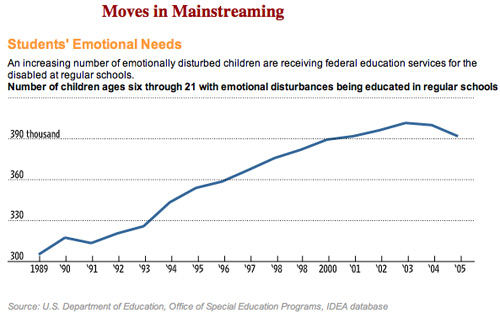
In this new Fordham Institute paper, analysts examine public data and find that the national proportion of students with disabilities peaked in 2004-05 and has been declining since. This overall trend masks interesting variations; for example, proportions of students with specific learning disabilities, mental retardation, and emotional disturbances have declined, while the proportions of students with autism, developmental delays, and other health impairments have increased notably. Meanwhile, at the state level, Rhode Island, New York, and Massachusetts have the highest rates of disability identification, while Texas, Idaho, and Colorado have the lowest. The ratio of special-education teachers and paraprofessionals to special-education students also varies widely from state to state--so much so that our analysts question the accuracy of the data reported by states to the federal government.
Newsletter signup | Send us your ideas
Verbally is an easy-to-use, comprehensive assisted speech solution for the iPad. It is the first free Augmentative and Alternative Communication (AAC) iPad app that enables real conversation. Just tap in your phrase and Verbally speaks for you.Verbally website.
Newsletter signup | Send us your ideas
John Elder Robison would stand out in a crowd even if he didn't have Asperger syndrome. A gruff, powerfully built, tirelessly curious, blue-eyed bear of a man, he hurtles down a San Diego sidewalk toward a promising Mexican restaurant like an unstoppable force of nature. "What's keepin' you stragglers?" he calls back to the shorter-legged ambulators dawdling in his wake.As they catch up, Robison utters his all-purpose sound of approval -- "Woof!" -- which he utters often, being a man in his middle years who is finally at peace with himself after a difficult coming-of-age. For the acclaimed author of the 2007 New York Times bestseller Look Me in the Eye, a diagnosis of Autism Spectrum Disorder in mid-life was liberating, giving a name to the nagging feeling that he was somehow different from nearly everyone around him.
Newsletter signup | Send us your ideas
In October, after months of anxiety, Caroline Barwick and her husband, Russell Huerta, celebrated the arrival of their son Sebastian's third birthday. It was the day the San Francisco Unified School District became legally responsible for addressing Sebastian's severe autism.
Ms. Barwick and Mr. Huerta met with school clinicians to discuss their son's education and treatment. But the meeting did not go as they had hoped -- the district offered Sebastian fewer than half of the therapeutic services recommended by three private doctors and did not offer a choice of schools.
"You're reeling from what's already been a tragic diagnosis," Ms. Barwick said, "then it's almost like you're slapped across the face."
The couple took legal action against the district. Last week, an administrative law judge criticized the district for its handling of the case and ordered it to reimburse Sebastian's parents for about $55,000 they spent on his therapy and education during the dispute.
Ms. Barwick and Mr. Huerta are part of a growing number of parents of special-needs children who are battling the school district over federally mandated support. The stakes are high. The district is facing a $25 million budget shortfall, and the types of intensive services in dispute can run into hundreds of thousands of dollars per child.
There is not always agreement on what constitutes appropriate treatment. Disputes between the district and parents are initially addressed in Individualized Education Program meetings, and sometimes in hearings involving lawyers.
Thirteen legal actions -- called requests for due process -- were filed against the district in the first three quarters of this fiscal year. There were just five during the same period last year. Some families and lawyers believe the district is taking a more aggressive approach toward special-needs cases to hold down costs.
"In a perfect world with unlimited resources we could provide every single family everything they want," Maribel S. Medina, the district's head legal counsel, said in an interview.
More than 6,000 students with physical, emotional or developmental disabilities attend San Francisco public schools. The federal Individuals with Disabilities Education Act, passed by Congress in 1990, requires school districts to provide those children from age 3 with a "free and appropriate education."
Rachel Norton, a San Francisco Board of Education commissioner who pays for her autistic daughter to attend a private school because she could not find an appropriate placement in the district, said school officials often weighed what would cost less: settling with families or litigating over services. "We have a lot of disputes, we spend a lot of money and we have terrible outcomes," Ms. Norton said.
In September, independent auditors commissioned by the district to evaluate special education services found that parents and teachers frequently complained of children being placed in programs that did not serve their needs. "Many parents view 'special education office' staff who attend I.E.P. meetings as being obstructionists and more interested in controlling costs for the district than making sure that children receive the supports they need in order to succeed in school," the auditors wrote in their final report.
Cecelia Dodge, assistant superintendent of special education, said at the time that school administrators agreed with the auditors' findings and promised to revamp special education services districtwide.
But some parents and lawyers involved in special-needs cases said the district had only gotten more restrictive in allocating services.
"They really developed a policy that they felt that they were settling cases too easily," said Michael Zatopa, a lawyer whose firm is handling Sebastian's case and has worked on special-education disputes for three decades.
Education officials said the district had increased training and supervision across the special education department, including clinical staff who help determine placement and student services. They said the district had also placed more restrictions on offering special-needs students placement in private schools.
"I have no doubt that they are seeing a major shift in the district's approach to special education, but it's a good shift," said Ms. Medina, the district's chief legal counsel.
Since Ms. Barwick's and Mr. Huerta's first meeting with the district in October, they have been engaged in an emotionally and financially draining battle over Sebastian's education. They have exhausted nearly all of their savings on therapy, private school tuition and legal fees.
Sebastian didn't start talking until he was well past 2. His progress was short-lived; a month later, he stopped using words, his vocabulary replaced by grunts and other noises. He repeatedly opened and closed doors, fixated on his shadow and detached from those around him. Specialists diagnosed autism and recommended Applied Behavior Analysis therapy -- which focuses on the relationship between a child's behavior and environment -- for 30 hours a week and a one-to-one aide in a mainstream preschool classroom.
Before meeting with the district, Ms. Barwick, who is an insurance underwriter, and Mr. Huerta, who works for a software start-up, asked three times to visit the district's programs for children with autism but said their requests were ignored. At the October meeting, they said, district representatives dominated the discussion and failed to make a formal placement offer, as mandated by federal law and the California education code.
In subsequent mediations, the district was represented by the Southern California law firm of Leal and Trejo, which advocated for the district's proposal: less than half the weekly therapy hours recommended by outside experts and a classroom assignment in which Sebastian would not be accompanied by an aide.
Mr. Huerta said that throughout the process, the couple felt stonewalled by a "juggernaut law firm-combo-school district."
Gentle Blythe, a district spokeswoman, said the district "takes its obligation to offer services seriously, and we evaluate each child to determine" the appropriate level of education. District officials declined to talk specifically about Sebastian's case.
Ms. Barwick described the district's offer as: "Your kid has autism, you get package A."
Negotiations dragged on for months as Ms. Barwick's and Mr. Huerta's expenses mounted. Mr. Zatopa, their lawyer, said the case was similar to others in which Leal and Trejo showed an uncommon willingness to litigate even when the evidence appeared to be stacked high against the district.
"I call it the gauntlet approach," Mr. Zatopa said. "Make things difficult and expensive, and the parents will give up, and in many cases that's true."
William Trejo, a lawyer and a former special education teacher who has represented the district on several special-needs disputes, said in an interview that private lawyers representing the families often prolong the legal process to generate fees.
"When we have to come in at the back end of problems on a litigation track, that's when the money is not put to best use," he said.
Sebastian's case came before an administrative law judge in March. In last week's ruling, the judge, Michael Barth, criticized the rationale for putting the couple and their child through the seven-month ordeal. "It is clear from the evidence that district had predetermined student's placement and denied parents meaningful participation in the decision-making process," Judge Barth wrote. In addition to covering the couple's legal fees, the district is required to arrange 30 hours of therapy a week and an aide for Sebastian.
Newsletter signup | Send us your ideas
For the first time, researchers have studied an entire population sample and found that one in 38 children exhibited symptoms of autism. The study was published Monday in the American Journal of Psychiatry."These numbers are really startling" said Geraldine Dawson, chief science officer for Autism Speaks, one of the three organizations that funded the project. Most previous researchers have found that about one in 110 children is autistic.
The NewsHour explored the puzzling condition of autism in the recent Autism Now series, anchored by Robert MacNeil.
Newsletter signup | Send us your ideas
Among the questions facing parents raising children with autism is this: Could easing the symptoms be as simple as taking away grains and dairy products?Many parents swear the popular gluten-free, casein-free diets being promoted by celebrities help their children be more social and less prone to problematic behaviors such as loud outbursts.
But Lee Anne Owens, a Brownsburg mother of two boys with autism, isn't sure.
"I have a girlfriend who has tried it for her autistic child, and she has seen remarkable improvement," Owens said. "But I just don't see it."
Newsletter signup | Send us your ideas
Disability Rights Wisconsin (78K PDF), via a kind reader's email:
Special interests in Washington DC have hired expensive lobbyists who also represent large corporate interests including, General Motors and Proctor & Gamble to try to pull the wool over the eyes ofparents ofchildren with disabilities. They allege that their interest is, "To advocate for parental options in education that empowers low and middle-income families to make choices in where they send their children to school." (1) These high powered special interests have never approached Disability Rights Wisconsin or any other major Wisconsin disability group to learn from those of us who have been advocating for Wisconsin children with disabilities for over 30 years, to find out what really needs improvement Wisconsin's special education system. Instead, they have set up a Facebook site which fails to tell the whole truth about the bill they promote.Related: Wisconsin Public Hearing on Special Needs Scholarship.This fact sheet tells the whole truth about AB 110 and its effort to dismantle special education as we know it and subsidize middle and upper income families who want to send their kids to private school ai taxpayer expense.
Myth# l-AB 110 allows parents the option to choose any other school they want their child to attend if they are unsatisfied with the special education being provided in their public school.
Fact-AB 110 has no requirement in it that forces any school to accept a child who has a special needs voucher.
Myth# 2-Since only children with Individualized Education Programs (IEPs) can receive a special needs scholarship, private schools who accept them must provide them with special education and implement the child's IEP.
Facts-AB 110 makes no requirement that private schools which accept a special needs scholarship provide any special education or implement any IEP. In fact, AB II 0 does not even require that private schools which accept special needs scholarships have a single special education teacher or therapist on their staff!
Newsletter signup | Send us your ideas
Brian Pleva Government Affairs Associate: American Federation for Children-Wisconsin, via a kind reader's email:
Does contain the info you need?Good afternoon!Wisconsin Special Needs Scholarship Assembly Bill 110 Summary (PDF).
I am writing to you because you recently expressed an interest in the bipartisan Wisconsin Special Needs Scholarship Act (Assembly Bill 110).
As you may know, the bill would allow parents to enroll their special needs children in the public or private school of their choice with the education dollars following the child to the new school. The bill, introduced by Representatives Michelle Litjens, Jason Fields & Evan Wynn, and Senators Leah Vukmir & Terry Moulton, has impressive momentum:
-AB 110 has attracted Republican, Democrat, and Independent cosponsors
-32 members of the Assembly have signed on to AB 110, which is over one-third of that house's current membership
-5 members of the Assembly Committee on Education have signed-on to AB 110, which is almost half of the 11-member committee
Fortunately, Assembly Education Committee Chair Rep. Steve Kestell decided today to schedule a Public Hearing on the Special Needs Scholarship Act for 10:00 am, next Tuesday, May 3rd.
This opportunity can pave the way toward making Special Needs Scholarships in Wisconsin a reality. It is crucial that as many affected families and school leaders as possible attend this public hearing and tell committee members, in their own words, what these scholarships would mean to them.
Please respond to this email and confirm whether you would be able to advocate for this legislation at the public hearing.
One parent wrote on our Facebook page, "It's so important! Why doesn't EVERYBODY get that???!!" It may be difficult to comprehend, but there are powerful, special interest groups that don't get it and will be working to defeat this bipartisan legislation.
While an impressive list of parents who wish to testify is growing, we know that opponents of education reform are always represented at these hearings. Therefore, please forward this email to friends, family, and colleagues who you think will be supportive. The momentum is encouraging, but we must keep it up!
If you have any questions about the bill or public hearing, please feel free to contact me, and check out our website: http://www.specialneedsscholarshipswi.org/.
Thank you!
Brian Pleva
Government Affairs Associate
American Federation for Children-Wisconsin
(608) 279-9484
Assembly
PUBLIC HEARING
Committee on EducationThe committee will hold a public hearing on the following items at the time specified below:
Tuesday, May 3, 2011
10:00 AM
417 North (GAR Hall)
State Capitol
Assembly Bill 110
Relating to: creating the Special Needs Scholarship Program for disabled pupils, granting rule-making authority, and making an appropriation.
By Representatives Litjens, Fields, Wynn, Knudson, Nass, Pridemore, Thiesfeldt, Vos, Kleefisch, LeMahieu, Nygren, Strachota, Bernier, Bies, Brooks, Endsley, Farrow, Honadel, Jacque, Knilans, Kooyenga, Kramer, Krug, Kuglitsch, T. Larson, Mursau, Petryk, Rivard, Severson, Spanbauer, Tiffany and Ziegelbauer; cosponsored by Senators Vukmir, Moulton, Galloway and Darling.
An Executive Session may be held on AB 71 at the conclusion of the public hearing.
Representative Steve Kestell
Chair
Newsletter signup | Send us your ideas
An ambitious six-year effort to gauge the rate of childhood autism in a middle-class South Korean city has yielded a figure that stunned experts and is likely to influence the way the disorder's prevalence is measured around the world, scientists reported on Monday.The figure, 2.6 percent of all children aged 7 to 12 in the Ilsan district of the city of Goyang, is more than twice the rate usually reported in the developed world. Even that rate, about 1 percent, has been climbing rapidly in recent years -- from 0.6 percent in the United States in 2007, for example.
But experts said the findings did not mean that the actual numbers of children with autism were rising, simply that the study was more comprehensive than previous ones.
Newsletter signup | Send us your ideas
A novel strategy developed by autism researchers at the University of California, San Diego School of Medicine, called "The One-Year Well-Baby Check Up Approach," shows promise as a simple way for physicians to detect cases of Autism Syndrome Disorder (ASD), language or developmental delays in babies at an early age.Led by Karen Pierce, PhD, assistant professor in the UC San Diego Department of Neurosciences, researchers at the UC San Diego Autism Center of Excellence (ACE) assembled a network of 137 pediatricians in the San Diego region and initiated a systematic screen program for all infants at their one-year check up. Their study will be published in the April 28 online edition of the Journal of Pediatrics.
"There is extensive evidence that early therapy can have a positive impact on the developing brain," said Pierce. "The opportunity to diagnose and thus begin treatment for autism around a child's first birthday has enormous potential to change outcomes for children affected with the disorder."
Newsletter signup | Send us your ideas
80K PDF, via a kind reader's email:
I. Introduction A. Title/topic -Alternative Redesign to Address Mental Health Concerns B. Presenter/contact person- Sue Abplanalp, John Harper, Pam Nash and Nancy YoderThis initiative was discussed during Monday evening's Madison School Board meeting. Watch the discussion here (beginning at 180 minutes).Background information -The Purpose of this Proposal: Research shows that half of all lifetime cases of mental illness begin by age 14.1 Scientists are discovering that changes in the body leading to mental illness may start much earlier, before any symptoms appear.
Helping young children and their parents manage difficulties early in life may prevent the development of disorders. Once mental illness develops, it becomes a regular part of a child's behavior and more difficult to treat. Even though doctors know how to treat (though not yet cure) many disorders, a majority of children with mental illnesses are not getting treatment (National Institute of Mental Health).II. Summary of Current Information: Success is defined as the achievement ofsomething desired and planned. As a steering committee, our desire and plan is to promote a strategic hub in three sites (Hoyt, Whitehorse and Cherokee) that connect, support and sustain students with mental health issues in a more inclusive environment with appropriate professionals, in order to maximize students' success in middle school and help them achieve their aspirations in a setting that is appropriate for their needs. The new site will also offer mini clinics from a community provider
Current Status: Currently, there is one program housed at Hoyt that serves 28-30 students in self contained settings. There is currently a ratio of 1:4 with 4 staff and 4 special educational assistants assigned to the program. In addition, there is a Cluster Program housed at Sherman with 2 adults and 6-7 students in the program.
Proposal: This proposal leaves approximately half of the students and staff at the current Hoyt site (those students who pose more of a danger to self or others) and removes all of the students and staff from Sherman (no program at Sherman) to the new sites. Students will attend either Whitehorse or Cherokee Middle Schools with a program that provides ongoing professional help and is more inclusive as students will be assigned to homerooms and classes, with alternative settings in the school to support them when they need a more restrictive environment with support from a smaller student ratio and a psychologist or social worker that is assigned to the team.
Newsletter signup | Send us your ideas
Hong Kong has escaped the anti-MMR childhood vaccine movement - linking the jab to autism - which spread across many English-speaking countries in the past decade.But despite the overseas movement's dangers and the fraudulent study that inspired it, a prominent paediatrician has nevertheless warned that local parents are too complacent about potential environmental factors that could trigger the onslaught of autism among some young children.
"They just don't know about it. They are just ignorant about it," said Dr Wilson Fung Yee-leung, who is a council member of the Hong Kong Medical Association.
He said it was dangerous not to be concerned about autism and its potential environmental causes.
Newsletter signup | Send us your ideas
ROBERT MACNEIL: As we've reported, autism now affects one American child in a 110. Last month, a committee convened by public health officials in Washington called it a national health emergency. The dramatic rise in official figures over the last decade has generated a surge of scientific research to find what is causing autism.Among the centers for such research is here, the University of California, Davis MIND Institute in Sacramento. Here and around the country, we've talked to leading researchers about where that effort now stands. Among them is the director of research at the MIND Institute, Dr. David Amaral.
DR. DAVID AMARAL, MIND Institute: Well, I think we're close to finding several causes for autism. But there's -- I don't think there's going to be a single cause.
ROBERT MACNEIL: The science director of the Simons Foundation in New York, Dr. Gerald Fishbach; Dr. Martha Herbert, professor of neurology at Harvard Medical School; and Dr. Craig Newschaffer, professor of epidemiology and biostatistics at Drexel University in Philadelphia. First, I asked, how close are we to discovering the cause of autism?
Newsletter signup | Send us your ideas
The Journal of School Choice recently published an article in which researchers Jack Buckley and Carolyn Sattin-Bajaj confirmed the UFT's findings in 2010 that charter schools in New York City enrolled a lower proportion of limited English proficient (LEP) students than the average district school in 2007-08. Overall, they find that among the city's charters from 2006-2008, "in the case of the LEP proportions, there is a large group of schools with very few, a handful with a larger proportion, and perhaps 1-3 schools, depending on the year, with a large share of LEP students."This report provides a valuable complement to our findings in "Separate and Unequal," both in its examination of two additional years of data and in its use of sophisticated statistical formulas to account for possible errors in the numbers of LEP students that charters report to the state each year. As this chart from the article shows, even when the researchers controlled for that possibility, the proportion of LEP students in most charters in the city fell well below the district average (represented by the solid line on the graph).
Newsletter signup | Send us your ideas
ROBERT MACNEIL: In New York City schools, there are more than 7,000 students with autism. Seven hundred of them, from preschool age to 21, attend this public school for autism in the Bronx, PS 176.WOMAN: Roll the dice. Oh, boy. What number?
STUDENT: Three.
WOMAN: Good. What are you going to do next?
ROBERT MACNEIL: These children see doctors periodically, but they go to school every day. It's the public school system that bears most of the burden of treating children with autism, because treatment means teaching. And federal law mandates that all children with disabilities are entitled to a free, appropriate education.
RIMA RITHOLTZ: Autism can suck the fun out of life. Having a child with a disability can suck the fun out of life. And we work very hard here to put the fun back in.
Newsletter signup | Send us your ideas
Several readers of the Consults blog recently had questions about the long-term course of autism, including succeeding in college and beyond. Our experts Dr. Fred Volkmar of the Yale Child Study Center and Dr. Lisa Wiesner, co-authors of "A Practical Guide to Autism," respond. For more on this and other topics, see their earlier responses in "Ask the Experts About Autism," and The Times Health Guide: Autism. The authors also teach a free online course on autism at Yale University, which is also available at iTunesU and on YouTube.Q.
Are you aware of any longitudinal studies of occupational outcomes and successful (independent) living for high-functioning autistic adults? Where would I find those? Are there particular strategies that should be pursued in high school or college to enhance the likelihood of success in these areas?
Newsletter signup | Send us your ideas
For the first time in more than 15 years, Robert MacNeil is returning to the program he co-founded, with a major series of reports on Autism Now. The subject that drew him back is one that resonates deeply with his own family and many others. Robin's 6-year-old grandson, Nick, has autism.The six-part series, "Autism Now," will air on the PBS NewsHour beginning April 18. It's the most comprehensive look at the disorder and its impact that's aired on American television in at least five years. For more than a year, Robin has been researching and preparing these stories. He and his producer, Caren Zucker, have been criss-crossing the country producing the reports for the past five months.
As Robin told Hari Sreenivasan during a recent visit to our Washington studio, the series is designed to provide viewers with an authoritative, balanced look at the latest scientific research and medical thinking about the disorder. Equally important, it chronicles the growing impact of autism as seen through the eyes of families, children, educators and clinicians.
Since Friday is the beginning of Autism Awareness Month, we are posting Hari's interview with Robin to introduce our audience to the series:
Newsletter signup | Send us your ideas
The Newark Council Education Committee met last night with group of stakeholders, including Theresa Adubato of the Robert Treat Academy, Junius Williams of the Abbott Leadership Institute, ELC founder Paul Tractenberg, and School Board Chair Shavar Jeffries. According to the Star-Ledger, the debate was noteworthy for its lack of contention, especially in light of recent fireworks. The meeting was chaired by South Ward Councilman Ras Baraka, who moonlights as Principal of Newark Central High School.The conversation veered toward the disparity between the number of special needs kids in charter schools (like Robert Treat) and the number of special needs kids in traditional public schools. Here's Michael Pallante, who is the former principal of Camden Street School, a district K-4 school. He's now is at Robert Treat:
Newsletter signup | Send us your ideas
PhD candidate in the School of Psychology, Karen O'Brien, said children with autism could have difficulties in social interactions and that their siblings played an important role in their development, particularly when it came to social skills."Children acquire the ability to identify mental states, also known as 'theory of the mind' (ToM), at around four years of age," she said.
"Research has shown that children with autism typically struggle on ToM tests and their everyday ToM skills are impaired, making it rare for even the highest-functioning autistic child to pass these tests before the age of 13 years."
Mental states identified in ToM include intentions, beliefs, desires and emotions, in oneself and other people, and understanding that everyone has their own plans, thoughts, and points of view.
According to Ms O'Brien, typically developing children show a significant advance in ToM understanding between the ages of three to five years.
Newsletter signup | Send us your ideas
Three new studies conclude that many widely used behavioral and medication treatments for autism have some benefit, one popular alternative therapy doesn't help at all, and there isn't yet enough evidence to discern the best overall treatment.Parents of children with autism-spectrum disorder often try myriad treatments, from drugs to therapy to nutritional supplements. The studies being published Monday and funded by the federal Agency for Healthcare Research and Quality, were part of the effort to examine the comparative effectiveness of treatments in 14 priority disease areas, including autism-spectrum disorders.
Autism and related disorders, conditions marked by social and communication deficits and often other developmental delays, have become more common over the years and now affect 1 in 110 U.S. children, according to estimates from the U.S. Centers for Disease Control and Prevention.
Newsletter signup | Send us your ideas
When a Stafford County jury this month found an autistic teenager guilty of assaulting a law enforcement officer and recommended that he spend 101/2 years in prison, a woman in the second row sobbed.It wasn't the defendant's mother. She wouldn't cry until she reached her car. It was Teresa Champion.
Champion had sat through the trial for days and couldn't help drawing parallels between the defendant, Reginald "Neli" Latson, 19, and her son James, a 17-year-old with autism.
Newsletter signup | Send us your ideas
It's been 81 years since Virginia Wolff published her famous essay, more than 20 since I read it, and even more before I followed her advice that "a woman must have a room of her own, if she is to write."When my mother was my age, she considered the best part of her life as behind her. When my grandmother was this age, considered herself "old." And my great-grandmother most certainly was. But that was then, and this is the era of longevity, vitality and change. We've rewritten all the rules. But maybe rules are only scaffolds we construct to contain what we can't control. Which is just about everything.
My dreams and expectations changed radically when my child was diagnosed with Autism. From that moment, and for the next decade, every thought in my head, urge in my heart and pulse in my body was redirected to helping him. When your child is diagnosed as on the Spectrum, you're told that much can improve, but most profoundly before the age of 5. My son was already three. So the clock was ticking, the meter was running, and I had a choice to make; pursue my needs, or save his life. So I put away the screenplay I was writing, abandoned the film collective I was trying to form, and forgot any notion of going back to a traditional job. In their place, I organized a line of behavioral therapists, occupational therapists, auditory training technologies, and casein-free diets. And thanked God each day that I had the resources so I could.
Newsletter signup | Send us your ideas
Acting Comm. Christopher Cerf directly rebutted "myths" about charter schools at a State Board of Education meeting, according to The Record. Contrary to claims by anti-charter proponents, says Cerf, NJ's charter school admit very poor kids and children with disabilities, and perform better than traditional public schools in Abbott districts.Here's the powerpoint.
For example, in NJ 15.87% of kids are classified as eligible for special education services. (We rank second in the nation in this category. First is Massachusetts. Then again, the classification rate at Wildwood High is 24.6%, Asbury Park High is 20.2%, John F. Kennedy in Paterson is 24.1%, and Camden Central High is a stunning 33.6%. But back to charters.)
Newsletter signup | Send us your ideas
When Judy Smith was looking for someone to play the central role of stage manager in "Our Town," the classic Thornton Wilder play about life in small-town America, she wasn't expecting to cast a boy with Asperger's syndrome.Yet when 14-year-old Clayton Mortl auditioned more than six weeks ago, Smith said she experienced a director's "quintessential moment." He was perfect for the role.
Legendary actors like Paul Newman have brought powerful performances to the play - a staple of Broadway, community theater and classrooms since its 1938 debut, said Smith, the performing arts center manager and theater arts adviser at New Berlin West Middle / High School.
But when the 18-member middle school cast takes the stage Thursday, at 10 a.m. and 7 p.m., Clay's performance may be legendary in its own right.
Though everyone is different, people with Asperger's - an autism spectrum disorder - have impaired ability to socially interact and communicate nonverbally. Their speech may sound different because of inflection or abnormal repetition. Body movements may not seem age appropriate. Interests may be narrowly focused to the extent that common interests aren't shared.
Newsletter signup | Send us your ideas
Advocates for low-income, minority students and students with special needs, including the Rhode Island Disability Law Center and The Autism Project of Rhode Island scored a major victory in Providence last week when Education Commissioner Deborah Gist announced she would scrap a plan for a three-tiered high school diploma system tied to standardized test scores.The plan called for students with high scores to receive an "Honors'' diploma, those with average scores to earn a "Regents'' diploma, and ones who score "partially proficient'' to be granted a basic Rhode Island diploma. Children who fail the test would have the opportunity to take it again. If they fail a second time, but other requirements are achieved, they could still graduate with a certificate.
Opponents claimed the proposal created a state-sanctioned caste system that would stigmatize struggling students and haunt them when seeking future employment or college admission. Based on recent test scores, they countered that almost all students who were poor, minorities, had disabilities, or were learning English would get the lowest tier diploma, if they even got one at all.
Newsletter signup | Send us your ideas
This is so awesome. A school district in Knox City, Texas has allowed a student with a severe illness that keeps him at home to attend classes like a normal freshman by using a Vgo telepresence robot. My son's school had to have a meeting with the school board to let me GIVE them technology.The boy is named Lyndon Baty and he suffers from polycystic kidney disease, and treatment for the disease has left his immune system suppressed. The poor immune system means he can't be around other kids to attend classes.
Newsletter signup | Send us your ideas
Children born to mothers who live close to freeways have twice the risk of autism, researchers reported Thursday. The study, its authors say, adds to evidence suggesting that certain environmental exposures could play a role in causing the disorder in some children."This study isn't saying exposure to air pollution or exposure to traffic causes autism," said Heather Volk, lead author of the paper and a researcher at the Saban Research Institute of Children's Hospital Los Angeles. "But it could be one of the factors that are contributing to its increase."
Newsletter signup | Send us your ideas
Ms. Nelson is paying most of her own way at Landmark, a two-year college exclusively for students with learning disabilities and A.D.H.D. She wants to graduate on time this spring, and with tuition and fees alone at $48,000 a year -- more than any other college in the nation -- she cannot give in to distraction."I have a lot riding on this," says Ms. Nelson, who is also dyslexic. She wants to transfer to a four-year institution and get a bachelor's degree -- a goal that would have been out of reach, she says, had she not found Landmark three years after graduating from high school. If Ms. Nelson gets her associate degree in May after four semesters, she will buck the trend at Landmark.
Only about 30 percent graduate within three years; many others drop out after a semester or two. The numbers suggest that even with all the special help and the ratio of one teacher for every five students, the transition is not easy.
Newsletter signup | Send us your ideas
New evidence suggests children with ADHD have trouble switching off the "daydreaming" regions in the brain that often interfere with concentration, particularly on tedious tasks.Using a "Whac-a-Mole" style game, researchers found evidence from brain scans that children with ADHD require either much greater incentives--or their usual stimulant medication--to switch off those regions and focus on a task. The findings are published in the Journal of Child Psychology and Psychiatry.
"The results are exciting because for the first time we are beginning to understand how in children with ADHD incentives and stimulant medication work in a similar way to alter patterns of brain activity and enable them to concentrate and focus better," says Chris Hollis, a professor of health sciences at the University of Nottingham. "It also explains why in children with ADHD their performance is often so variable and inconsistent, depending as it does on their interest in a particular task."
Newsletter signup | Send us your ideas
A now-retracted British study that linked autism to childhood vaccines was an "elaborate fraud" that has done long-lasting damage to public health, a leading medical publication reported Wednesday.An investigation published by the British medical journal BMJ concludes the study's author, Dr. Andrew Wakefield, misrepresented or altered the medical histories of all 12 of the patients whose cases formed the basis of the 1998 study -- and that there was "no doubt" Wakefield was responsible.
"It's one thing to have a bad study, a study full of error, and for the authors then to admit that they made errors," Fiona Godlee, BMJ's editor-in-chief, told CNN. "But in this case, we have a very different picture of what seems to be a deliberate attempt to create an impression that there was a link by falsifying the data."
Newsletter signup | Send us your ideas
For decades, parents of children with autism have been searching for a drug or diet to treat the disorder.Their latest hope is the hormone oxytocin. It's often called the trust hormone or the cuddle hormone. And just to be clear, it has nothing to do with the narcotic oxycontin.
But some children with autism are already being treated with oxytocin, even though it's not approved for this purpose.
The Trust Hormone
It's no wonder parents of children with autism have high hopes for oxytocin. So do a lot of researchers, like Jennifer Bartz at Mount Sinai School of Medicine in New York.
Newsletter signup | Send us your ideas
Mark Hyman loves the case study; when one of his posts at Huffington Post deals with an almost magical healing he's engendered, well, chances are, there's gonna be a kid involved. This time up, it's Hyman curing autism cuz he's teh man.Let's look at his first paragraph: "Imagine being the parent of a young child who is not acting normally and being told by your doctor that your child has autism, that there is no known cause, and there is no known treatment except, perhaps, some behavioral therapy."
Fortunately, I don't have to imagine this scenario; I can and do speak from experience. The whole assessment thing for Bobby was hell on wheels from 1994 when we first began the process through 1998 when we got a thorough assessment. We were never told there were no known causes. Even in the mid 90s there were known causes and tests to run, like Fragile X, so that right there is BS on Hyman's part. We were also, despite the crap we were told, never told there was no known treatment. Speech, OT, PT and therapy were begun in 1994, even as we went through a string of inaccurate diagnoses.
Newsletter signup | Send us your ideas
AUTISM is a puzzling phenomenon. In its pure form it is an inability to understand the emotional responses of others that is seen in people of otherwise normal--sometimes above normal--intelligence. However, it is often associated with other problems, and can also appear in mild and severe forms. This variability has led many people to think of it as a spectrum of symptoms rather than a single, clear-cut syndrome. And that variability makes it hard to work out what causes it.There is evidence of genetic influence, but no clear pattern of inheritance. The thought that the underlying cause may be hereditary, though, is one reason for disbelieving the hypothesis, which gained traction a few years ago but is now discredited, that measles vaccinations cause autism.
One suggestion that does pop up from time to time is that the process which leads to autism involves faulty mitochondria. The mitochondria are a cell's powerpacks. They disassemble sugar molecules and turn the energy thus liberated into a form that biochemical machinery can use. Mitochondrial faults could be caused by broken genes, by environmental effects, or by a combination of the two.
Newsletter signup | Send us your ideas
I ought to have known better than to have lunch with a psychologist."Take you, for example," he said. "You are definitely autistic."
"What!?"
"I rest my case," he shot back. "Q.E.D."
His ironic point seemed to be that if I didn't instantly grasp his point -- which clearly I didn't -- then, at some level, I was exhibiting autistic tendencies.
Simon Baron-Cohen, for example, in his book "Mindblindness," argues that the whole raison d'être of consciousness is to be able to read other people's minds; autism, in this context, can be defined as an inability to "get" other people, hence "mindblind."
Newsletter signup | Send us your ideas
The Texas Education Agency has sent a conservator to the Houston school district to make sure it fixes problems in serving a group of students with disabilities.The school district has come under state oversight after failing to correct multiple violations, such as not providing students with the instruction they were promised and giving too many children modified state exams.
The problems highlighted by the TEA focus only on the district's program for students with disabilities who are in the custody of residential facilities. Children who live in these private or state-run facilities -- which include group homes and residential treatment centers -- are away from their families. A 2005 court order requires the TEA to monitor how districts educate these children.
"Often times, these kids are so far away from their families that there's really no oversight if TEA isn't doing the job," said Maureen O'Connell, an attorney with the Southern Disability Law Center. O'Connell represented the children in the lawsuit brought against the TEA that led to the mandatory monitoring.
Newsletter signup | Send us your ideas
On Sunday, November 7, the Wisconsin State Journal featured a front-page article about the Madison School District's Talented and Gifted education services: "TAG, they're it." The story describes parents' frustration with the pace of reform since the Board of Education approved the new TAG Plan in August, 2009. It paints the TAG Plan as very ambitious and the parents as impatient-perhaps unreasonable-to expect such quick implementation.The article includes a "Complaint Timeline" that starts with the approval of the TAG Plan, skips to the filing of the complaint on September 20, and proceeds from there to list the steps of the DPI audit.
Unfortunately, neither this timeline nor the WSJ article conveys the long history leading up to the parents' complaint. This story did not start with the 2009 TAG Plan. Rather, the 2009 TAG Plan came after almost two decades of the District violating State law for gifted education.
To provide better background, we would like to add more information and several key dates to the "Complaint Timeline."
November 2005: West High School administrators roll out their plan for English 10 at a PTSO meeting. Most of the 70 parents in attendance object to the school eliminating English electives and imposing a one-size-for-all curriculum on all students. Parents ask administrators to provide honors sections of English 10. They refuse. Parents ask administrators to evaluate and fix the problems with English 9 before implementing the same approach in 10th grade. They refuse. Parents appeal to the BOE to intervene; they remain silent. Meanwhile, parents have already been advocating for years to save the lone section of Accelerated Biology at West.
Newsletter signup | Send us your ideas
The Houston Independent School District is holding ten public meetings during two days in November to gather feedback from parents and community members regarding the effectiveness of the district's special education program.During the meetings, the public's input will be gathered on a series of questions which have been developed by the TEA to gather information on the effective operation and performance of special education programs throughout the State. The questions include:
One purpose of the Individuals with Disabilities with Education Act or IDEA is to strengthen the role of parents and ensure family participation in the education of their children. Within the context of the Houston Independent School District, how are parents involved in the educational process for their children?
Newsletter signup | Send us your ideas
The rise of mainstream tablet computers is proving to have unforeseen benefits for children with speech and communication problems--and such use has the potential to disrupt a business where specialized devices can cost thousands of dollars.iOS speech and translation tools are quite remarkable.Before she got an iPad at age two, Caleigh Gray couldn't respond to yes-or-no questions. Now Caleigh, who has been diagnosed with cerebral palsy, uses a $190 software application that speaks the words associated with pictures she touches on Apple Inc.'s device.
"We're not having to fight to prove to people that she is a smart little girl anymore, because it's there once they see her using the iPad," said Caleigh's mother, Holly Gray, who said her daughter can use the tablet to identify colors or ask to go outside.
Newsletter signup | Send us your ideas
Here's a reminder for some Tulsa-area school board members: Your attorney is not your boss. So when he advises that you disregard state law, think twice. And think about that part of your oath as a school board member that requires you to uphold state law.The blatant disregard with which school board members in Broken Arrow and Jenks acted last week in voting not to comply with a new state law is outrageous. Worse yet, several other school boards may follow suit.
At issue is the Lindsey Nicole Henry Scholarship program, which allows children with special needs to attend private school at state expense. Doug Mann, attorney for the Broken Arrow and Jenks boards, advised board members not to pay the scholarships. He said the law is unconstitutional and paves the way for school vouchers.
Newsletter signup | Send us your ideas
Officials with several suburban school districts responded to their critics Thursday, claiming that they have no choice but to disobey a new law that calls for public schools to fund private school scholarships for special education students."We have taken this very courageous stand to try to get this law reviewed, not because we want to be sued or because we want to violate the law," Union Superintendent Cathy Burden said. "We have no way of getting it to the court system without drawing a line in the sand."
Burden will ask the Union school board on Monday to join the Broken Arrow and Jenks boards in approving measures that state that they do not intend to pay any parent who requests a Lindsey Nicole Henry Scholarship.
Newsletter signup | Send us your ideas
A legal complaint alleges that the Big Easy's schools discriminate against children with disabilities. What good is the charter revolution if it doesn't reach the students who are most in need?New Orleans, where more than 70 percent of public schools will be independently chartered after this school year, has been placed on a pedestal as a shining model by education reformers. The new documentary Waiting for "Superman", which hopes to serve as a call to arms for education reform, devotes a page of its Web site to touting New Orleans's new citywide school-choice system.
Charter-school advocates such as Caroline Roemer Shirley, executive director of the Louisiana Association of Public Charter Schools (LAPCS), are boasting of the success they've had in the wake of Hurricane Katrina, when much of the population of New Orleans that might have opposed those policies was displaced from the city. "I don't think we need to wait for Superman," says Shirley. "It is happening today." National media outlets have similarly gushed over New Orleans, some going so far as to suggest that Katrina saved the public-education system in the city.
Newsletter signup | Send us your ideas
William Howell, Martin West and Paul Peterson:
Democrats and Republicans in Washington, D.C., are more polarized today than they have been in nearly a century. And among the general public, party identification remains the single most powerful predictor of people's opinions about a wide range of policy issues. Given this environment, reaching consensus on almost any issue of consequence would appear difficult. And when it comes to education policy, which does a particularly good job of stirring people's passions, opportunities for advancing meaningful policy reform would appear entirely fleeting.
Against this backdrop, the results of the 2010 Education Next-Program on Education Policy and Governance (PEPG) Survey are encouraging. With the exceptions of school spending and teacher tenure, the divisions between ordinary Democrats and Republicans on education policy matters are quite minor. To be sure, disagreements among Americans continue to linger. Indeed, with the exception of student and school accountability measures, Americans as a whole do not stand steadfastly behind any single reform proposal. Yet the most salient divisions appear to be within, not between, the political parties. And we find growing support for several strategies put forward in recent years by leaders of both political parties--most notably online education and merit pay.
Nearly 2,800 respondents participated in the 2010 Education Next-PEPG Survey, which was administered in May and June of 2010 (see sidebar for survey methodology). In addition to a nationally representative sample of American adults, the survey included representative samples of two populations of special interest: 1) public school teachers and 2) adults living in neighborhoods in which one or more charter schools are located. With a large number of respondents, we were able, in many cases, to pose differently worded questions to two or more randomly chosen groups. So doing, we were able to evaluate the extent to which expressed opinions change when a person is informed of certain facts, told about the president's position on an issue, or simply asked about a topic in a different way.
Newsletter signup | Send us your ideas
The $122 million San Francisco schools spend on its 6,300 special education students fails to consistently address the needs of those children, too often needlessly segregating them in special classrooms and disproportionately diagnosing disabilities based on race, an independent audit found.The auditors called the district's services outdated and counterproductive to the belief that all students can and should succeed in school and called for a massive rethinking of how disabled students are assigned to schools and how they are served when they get there.
Currently, many special education students are clustered in schools designated for specific disabilities, the auditors noted.
Newsletter signup | Send us your ideas
It is 8:30 on a crisp September morning, the start of a busy day for preschoolers at the Waisman Center's Early Childhood Program, a nationally renowned laboratory school.At a piano in the gym, a teacher holds a 4-year-old named Michael in her lap and helps him tap out "Twinkle, Twinkle, Little Star." She speaks to him using both sign language and a singsong voice. Several other boys driving toy cars swerve around another teacher doing duty as traffic cop. A student teacher is coloring at a table with students. In a corner of the gym, two girls are playing house. "This is your bed, Baby Kitty. Go to sleep right NOW!" one of them says. A tiny child with big brown eyes, named Caroline, curls up on a mat and pretends to sleep.
Michael, distracted by the noisy traffic behind him, wriggles out of Kerri Lynch's lap and runs up to the boys in cars, making guttural sounds. The boys ignore him and continue to whiz past. Lynch waves down an especially energetic driver in a red T-shirt who has snagged the school's popular police car. "Michael is talking to you," she says, holding Michael, who is clearly becoming frustrated. She puts Michael's face between her hands gently so that he makes eye contact with the other child and encourages him to try to speak again. The other boy listens carefully as the teacher translates: "Michael is wondering when he can have a turn?"
Newsletter signup | Send us your ideas
Autism has hit L.A. harder than almost any other region of California, with diagnosed cases double or quadruple the state average in many instances, and at a time when our local schools and public health agencies have ever less funds to intervene. In the September issue of Los Angeles we tackle the subject of autism in L.A. While the causes of this public health crisis are elusive, understanding the disorder doesn't have to be. We offer practical advice for parents on what do after their son's or daughter's diagnosis and an etiquette handbook for friends and relatives (example: Do not say, "She's autistic? She looks normal."). We explore how the film industry has shaped--and misshaped--autism awareness, whether it's Elvis Presley as a singing physician who smothers autism with hugs in 1969's Change of Habit or Claire Danes's majestic work in HBO's Temple Grandin. Dustin Hoffman discusses the many realities that coalesced into his Oscar-winning role as Raymond Babbitt in Rain Man. We hear from warrior moms--or "AutMoms"--struggling for their children in Silver Lake and Compton, and from dads as diverse as Altadena poet Tony Peyser and former NFL quarterback Rodney Peete. Then there are firsthand accounts from adults with autism, among them Pulitzer-winning music critic Tim Page, who tells how he chooses not to wear prescription eyeglasses in order to dull the sensory assault that is Los Angeles.
Newsletter signup | Send us your ideas
My six-year-old son is affectionate (a Southern granny couldn't give bigger hugs), funny (he looked at me one morning and declared, "Mama's hair is broke"), and bright (his memory is scary-sharp, and he can assemble a 250-piece puzzle five times faster than I can). He is also autistic.We learned that Isaac had mild autism when he was three. A close friend asked my husband and me, "Do you notice how he flaps his hands? He has a lot of anxiety, too. I'm just wondering..." It had never crossed our minds. We just thought Isaac was eccentric, a late talker but a charmer. I Googled "autism symptoms" and sat at the computer in disbelief. Assessments followed. Out went his Montessori, where he was most often found safe in the lap of a teacher, far from the mayhem of Duck, Duck, Goose; in came a special-needs program with our school district. The teacher was kind but the classroom too large, the demands of the children too disparate. Isaac sat on his assigned carpet square, lined up for snacks, and absorbed nothing. He was slipping further into his obsessions--fountains, photographs, Dr. Seuss--and became so fettered by his fears of crying babies and barking dogs that it was hard to leave our house. During trips to the Getty or dinners at our local pizza joint, I bristled at the reproachful stares of strangers.
Newsletter signup | Send us your ideas
A wealthy couple is accused of bilking the San Francisco school district and insurers of about $400,000 for their autistic son's treatment.Prosecutors say Jonathan Dickstein and his wife, Barclay Lynn, created a dummy company and used it to double-bill the district and insurers for special education services between 2006 and 2008. The couple also is accused of defrauding the law firm where Dickstein served as a partner.
Newsletter signup | Send us your ideas
Families in the most affluent New York City school districts, including the Upper East and Upper West sides, file more claims than other parts of the city seeking reimbursement of their children's private-school tuition, according to Department of Education data.The department last year spent $116 million in tuition and legal expenses to cover special-education students whose parents sued the DOE alleging that their public-school options were not appropriate. The number is more than double three years ago, and the costs are expected to continue to rise.
Parents have been helped by a series of U.S. Supreme Court decisions that strengthened their legal position to sue school districts. The most recent case was last summer.
"No one begrudges parents the right to send their children to private school," said Michael Best, general counsel at the DOE. "But this system was not intended as a way for private school parents to get the taxpayers to fund their children's tuition."
Newsletter signup | Send us your ideas
Three weeks had passed since Shannon Rosa had glanced over the numbers on her tiny blue raffle ticket. Like many other parents, she had agreed to cough up $5 not because she thought she had any real chance of winning, but to support the school.Now, as she sat in her Honda Odyssey in a Redwood City parking lot, about to pick up some tacos for the family, her cellphone rang. It was the school secretary. Rosa had won the raffle.
Alone in her van, she screamed. Then she drove straight to Clifford School to claim her prize: a glistening new iPad.
Although Rosa already owned an iPod Touch, she had purposely held off on the iPad. She isn't an early adopter; she likes to wait until the kinks are worked out. But for $5, she didn't mind taking the iPad home one bit. Maybe Leo would like it.
Newsletter signup | Send us your ideas
Michael Winerip, via a kind reader:
People with autism are often socially isolated, but the Madison public schools are nationally known for including children with disabilities in regular classes. Now, as a high school junior, Garner, 17, has added his little twist to many lives.He likes to memorize plane, train and bus routes, and in middle school during a citywide scavenger hunt, he was so good that classmates nicknamed him "GPS-man." He is not one of the fastest on the high school cross-country team, but he runs like no other. "Garner enjoys running with other kids, as opposed to past them," said Casey Hopp, his coach.
Garner's on the swim team, too, and gets rides to practice with a teammate, Michael Salerno. On cold mornings, no one wants to be first in the water, so Garner thinks it's a riot to splash everyone with a colossal cannonball. "They get angry," the coach, Paul Eckerle, said. "Then they see it's Garner, and he gets away with it. And that's how practice begins."
Newsletter signup | Send us your ideas
is a Democratic state senator from Philadelphia who ran for governor this year on a platform that included universal school choiceI was raised to revere the National Association for the Advancement of Colored People (NAACP). As a child, I learned of its legendary achievements in fighting against the oppression of the human spirit and removing the barriers of segregation and racial discrimination. The organization's recent involvement in controversies surrounding Shirley Sherrod and the tea party, however, indicates a shift away from its core values. Today, the long-revered civil rights group seems more concerned about public relations, political positioning, and currying interest-group favor than providing a voice to the voiceless. Nowhere is this transformation more evident, or troubling, than in the area of education.
Newsletter signup | Send us your ideas
Democratic gubernatorial nominee Jerry Brown unveiled an education reform plan Wednesday that calls for a wholesale restructuring of California's public school system, from changing the way schools are funded to revamping the state's higher education system.The eight-page plan touches upon the major issues facing the state's education system, from the increasing cost of college to the state's dismal dropout rate. Some of the proposals, such as changing the way schools are funded, would take years. Brown urged patience.
"There is no silver bullet that will fix everything," he wrote. "Education improvement takes time, persistence and a systematic approach."
Newsletter signup | Send us your ideas
Gifted and Talented Education is a broad term for special practices used in the education of children who have been identified as intellectually gifted. There is no common definition for exactly what that means. GATE supporters argue that the regular curriculum fails to meet their special needs. Therefore, these students must have modifications that will enable them to develop their full potential.
In Virginia, each school division establishes procedures for the identification of gifted students and for the delivery of services to those students. GATE funding comes from the state with a local match. Consequently, there is some variation between school divisions in the strength of their GATE programs.
Each Virginia school division must develop a GATE plan. The larger school systems often have separate GATE teachers and classrooms. Others use the regular classroom teacher (often specially trained) to practice what is called differentiation within the classroom.
Differentiation is not providing the GATE student with an extra worksheet. It might be more like, for example, having the GATE students write a novella while the other students are writing a short report. The GATE students may also work together in small groups to solve teacher-generated problems related to the curriculum the whole class is working on.....
But GATE has long struggled with an educational system that has been much more focused on the children struggling to reach a certain level of proficiency. This became more pronounced with the advent of SOL tests and No Child Left Behind. GATE also suffers from charges that it is elitist and focuses on economically advantaged and non-minority children. Any time children and academic labels come together, it can make for a highly-charged environment.
There is no doubt that some children's academic skills put them in a very different category from the majority of students. And who could argue with the concept that public education should try to provide specialized programs to meet each student's specific needs. I think advocates of gifted education would get more public support if they used different terminology. Special education is defined by the type of curriculum not the intellectual capabilities of the students. The identification process can be arbitrary in defining who is "gifted" and who is not. And everyone has the capability to be talented at something....
Newsletter signup | Send us your ideas
Today's Star-Ledger looks at the increasing cost of educating children with special needs in out-of-district placements, and districts' efforts to create in-district classrooms. Fact from the article: Bedminster's Somerset Hills Learning Institute for autistic children costs more than $116,000 per student this year.Here's another fact (not from the article): New Jersey classifies children as eligible for special education services at a higher rate than any other state in the country. In fact 18%, almost 1 in 5, of our children are diagnosed with either learning disabilities or other handicaps. To round out the picture, we classify minority children at a much higher rate than white kids. From a 2007 report from the Harvard School of Education:
Newsletter signup | Send us your ideas
As recently as 2008, Locke High School here was one of the nation's worst failing schools, and drew national attention for its hallway beatings, bathroom rapes and rooftop parties held by gangs. For every student who graduated, four others dropped out.Now, two years after a charter school group took over, gang violence is sharply down, fewer students are dropping out, and test scores have inched upward. Newly planted olive trees in Locke's central plaza have helped transform the school's concrete quadrangle into a place where students congregate and do homework.
"It's changed a lot," said Leslie Maya, a senior. "Before, kids were ditching school, you'd see constant fights, the lunches were nasty, the garden looked disgusting. Now there's security, the garden looks prettier, the teachers help us more."
Newsletter signup | Send us your ideas
A bipartisan group of legislators in Louisiana have passed a pilot voucher program for children with special needs in Louisiana.I think this makes Louisiana the sixth state to pass a private choice program for special needs children (Florida, Ohio, Utah, Arizona, Oklahoma having already done so).
Newsletter signup | Send us your ideas
Newsletter signup | Send us your ideas
Donovan Forde was dozing when the teacher came around to his end of the table. Pale winter light filtered in through the grated classroom window, and the warm room filled softly with jazz. It fell to his teacher's aide to wake him up from his mid-morning nap.She shined a small flashlight back and forth in his eyes like a dockworker signaling a ship, and called his name. Then she put her hand on his cheek, steering his head forward as he focused his eyes.
The teacher, Ricardo Torres, placed a red apple against Donovan's closed left hand, and then held it near his nose so he could smell it. "Donovan, the fruit holds the seeds of the plant," he said.
Then Mr. Torres held a plastic container of apple seeds to Donovan's ear, shaking it, and placed Donovan's hand inside so he could feel them. "And these are the seeds," Mr. Torres said.
Newsletter signup | Send us your ideas
People with autism often have a hard time finding and keeping jobs, so more schools are creating programs to help students with autism get prepared for the workplace. One of those programs helped change the life of Kevin Sargeant.Just a few years ago, when Kevin was still in elementary school, things weren't looking good for him. He was antisocial, desperately unhappy and doing poorly in school.
"He was pretty much a broken child, the way I would describe it," says his mother, Jennifer Sargeant. "We really didn't see that he would be able to go to college, even have a job. That just wasn't in our future for him."
Kevin, now 18, says his autism left him unable to handle the social interactions at school.
Newsletter signup | Send us your ideas
Recently I was invited to Paris to present at a prestigious international colloquium on autism and education, which was organized by the INS HEA, the French Ministry of Education's training institute for special education teachers. Seventeen years earlier, I had left France because in those days, children with autism did not have the right to an education, and my son, Jeremy, was severely impacted by autism.It was an emotional moment for me, standing there, addressing 500 attendees in a lecture hall of the Universite Paris Descatres in Bolulogne - Billancourt, explaining my son's educational experience in the United States, where all children have the right to a free and appropriate education under IDEA.
In 1993, my family left France, where we had been living since 1981. Both Jeremy and his sister, Rebecca (who is neurotypical), were born in Paris at the time when children with autism were considered mentally ill, not developmentally disabled. They had no right to an education. Instead, they were enrolled in day programs on hospital sites, where they were treated with psychoanalysis. Parents had no right to visit the day program, nor did they receive any communication about what went on during the hours their child spent there.
Newsletter signup | Send us your ideas
Diagnosis of autism has always been difficult and often the condition remains unrecognised until too late for treatment to have a maximum effect.But now researchers at Imperial College London have discovered a potential way of spotting the disorder in children as young as six months old.
They have found that children with autism spectrum disorder (ASD) also suffer from disorders in their gut and that this can be detected with a simple urine test.
That would mean that intensive behavioural and social treatment could begin before the disease has caused any permanent psychological damage.
Professor Jeremy Nicholson, the author of the study, said: "Children with autism have very unusual gut microbes which we can test for before the full blown symptoms of the disease come through.
"If that is the case then it might become a preventable disease."
Newsletter signup | Send us your ideas
Shawn Doherty via a kind reader's email:
It started out as the dreaming of a lonely mother overwhelmed and held captive by the challenges of raising twin toddlers with autism, each of whom required up to 43 hours a week of intensive in-home therapy. There should be a refuge where she and others struggling with the devastating developmental disorder could find respite, company, play groups and therapy, Jackie Moen thought. As her boys grew, so did her dreams. Why couldn't schools build curriculum around these children's unique talents and needs, rather than forcing many of them to fall short of the rigid classroom norms?And so Jackie and her husband Ken, joined by a passionate group of other parents, teachers and therapists, have set out to create such a place themselves. In 2007, they bought an old brick schoolhouse in McFarland and poured their savings and a pool of grants and contributions into renovating it into a homey space with donated couches, sunlit classrooms and gleaming wood floors. As soon as the Common Threads Family Resource Center opened in 2007, director of operations Ellen Egen recalls, "the phone calls just kept coming." Hundreds of children and desperate family members flocked to the cheerful schoolhouse for an array of activities not available elsewhere, including play groups, teen therapy sessions, respite care and mental health counseling. "It grew like magic," Moen, now the center's director, recalls.
Newsletter signup | Send us your ideas
When Nitya Rajendran started kindergarten, she didn't talk until November. "She'd point and wave," said her teacher, Rick Parbst. This year she was the lead in Trinity School's spring musical and decided to translate parts of "The Iliad" from ancient Greek. She's headed to Georgetown University in September.In fourth grade, Cody Cowan's class was studying ancient Egypt, and he was asked to develop an irrigation system. He was fine with the engineering, but didn't know how to draw people and animals. "By the time I turned around, he had four girls doing his drawings," recalled his teacher from that year, Mary Lemons. This summer, Mr. Cowan will intern on Representative Carolyn B. Maloney's re-election campaign, and he plans to study international relations in the fall.
At Trinity, one of Manhattan's oldest independent schools, a roomful of graduating seniors and their childhood teachers unearthed these pieces of the past at the annual survivors breakfast, a rite of passage for seniors who received all 13 years of their formal education at Trinity. Over coffee and bagels and chocolate Jell-O pudding doused with crushed Oreos and gummy worms (a class of 2010 culinary tradition), the students reconnected with teachers and dished about who, at age 5 , ate Play-Doh, sang well and cried whenever his mom left the room.
Newsletter signup | Send us your ideas
SACHI FUJIMORI
When Gabby Abramowitz was younger, she was cautious about inviting new friends to the house. She wasn't sure how they would react to her younger brother, Ben, who is autistic. And she didn't want a repeat of the Simpsons incident. That was the time she had a friend over for dinner, and Ben sat at the table reciting the entire "Treehouse of Horror" Simpsons Halloween special.
Gabby pleaded with him to stop, but he persisted.
"My friend was like, 'What's going on?' and then started laughing," she said.
At that time, she was in elementary school and lacked the words and understanding to explain her brother's condition. But with the help of her parents and through her own study, Gabby, now 16 and a sophomore at Tenafly High School, has grown to understand the nuances of autism and often speaks out to teach her peers while growing closer to Ben, 14.
Through her research, she found that her experiences, and those of others like her, often are overlooked. "I think the effect on siblings is underestimated. We get pushed into the background."
Newsletter signup | Send us your ideas
When Christopher Xu turned 2, his mother's worst fears were confirmed. The other babies at her son's birthday party babbled, gestured and used simple words as they played and interacted with their parents and each other. But Christopher was different.Much more on autism here and via Wolfram Alpha."He was locked in his own world," Sophia Sun recalls. "No eye contact. No pointing. No laughing at cartoons or looking at me when I talk to him."
In fact, Sun says, she and her husband, Yingchun Xu, both Chinese-born computer engineers who earned their graduate degrees in Vancouver, British Columbia, had never known anyone with this kind of remote, inaccessible child.
The couple were living with their older daughters, Iris and Laura, in a Chicago suburb when Christopher was born. Both girls were interactive, affectionate babies, but Christopher paid little attention to his mother, his family or his surroundings. As a toddler he spent most of his time lining up his favorite toys in order or spinning himself in circles -- over and over again. When the Xu family went to an air show, his mother pointed to the planes roaring overhead, saying, "Christopher, look at that! Look up!" but the little boy just spun around and around, oblivious to the noise or the world surrounding him.
Now Christopher is 11, and he will soon graduate from the fifth grade at Madison's John Muir Elementary to head off to middle school. Thanks to the love and persistence of his family, powerful early training, insightful teachers and accepting classmates, his story has changed dramatically, and his remarkable abilities are increasingly apparent.
Newsletter signup | Send us your ideas
Robin Lake, via a Deb Britt email:
The book can be purchased, using a credit card, from the print-on-demand service CreateSpace (an Amazon.com affiliate) or by check or purchase order directly from CRPE..................................................................
Unique Schools Serving Unique Students (Robin Lake, editor) offers a pioneering look at the role of charter schools in meeting the needs of special education students. The book addresses choices made at the intersection of two very important policy arenas in education: special education and charter schools.
Drawing lessons from parent surveys and case studies, this volume poses and addresses a number of important questions that have received limited attention to date: How many students with disabilities attend charter schools? How do parents choose schools for their children with special needs and how satisfied are they with their choices? What innovations are coming out of the charter school sector that might be models for public education writ large? Finally, what challenges and opportunities do charter schools bring to special education?
Newsletter signup | Send us your ideas
Over the past 40 years or so, child advocates have given a good amount of lip service to the view that adults, especially educators, should respect children's "individual differences."In theory, this recognizes the fact that every trait is distributed in the general population in a manner represented by the bell-shaped curve. Whether the issue is general intelligence, sociability, optimism, musical aptitude, artistic ability, or mechanical skill (to mention but a few), relatively few people are "gifted" and relatively few people are disadvantaged.
Whatever the characteristic, most folks are statistically "normal." That is, they possess an adequate amount, enough to get by.
People gifted in more than a couple of areas are rare, and people gifted in one area but lacking in another are not unusual. A person with outstanding musical aptitude, for example, may be noticeably lacking in social skills, and a person with outstanding verbal skills may be mechanically inept.
Newsletter signup | Send us your ideas
AP:
The University of Wisconsin-Parkside is considering suspending admission to the school's teacher certification program and dissolving the teacher education department.The Journal Times in Racine reports that Chancellor Deborah Ford is recommending the action.
If the proposal passes the Faculty Senate next week, officials say students enrolled in the certification program would be able to finish their degrees and student teaching, but no new students would be admitted.
Ford said she hopes a new education program will be in place in three years. Her announcement comes about a year after a Wisconsin Department of Public Instruction investigation found that the university's education program had "serious deficiencies and noncompliance issues."
Newsletter signup | Send us your ideas
The recent disclosure that African-American fourth-graders in Wisconsin have the worst reading skills in the entire country came as a shock to many Milwaukeeans.Keisha Arnold wasn't among them.
Her 10-year-old son has experienced reading problems and poor grades at his Milwaukee school for some time. Arnold has been frustrated with her inability to find a way to address the problem.
"I just don't understand why he can't seem to get the help he needs," said Arnold, 28, a single parent who returned to Milwaukee a few years ago after living in Phoenix.
When she returned to her hometown, she enrolled her son in a local charter school. "I didn't want him to go to MPS because I didn't think he'd get a good education there," she explained.
But it didn't take long for Arnold to recognize that deficiencies in her son's reading and math skills were not being addressed.
She met with his teachers and sought additional tutoring, but her son's grades failed to improve.
Newsletter signup | Send us your ideas
Temple Grandin, diagnosed with autism as a child, talks about how her mind works -- sharing her ability to "think in pictures," which helps her solve problems that neurotypical brains might miss. She makes the case that the world needs people on the autism spectrum: visual thinkers, pattern thinkers, verbal thinkers, and all kinds of smart geeky kids.
Newsletter signup | Send us your ideas
By age 2 Donovan Richards was kicked out of day care for hitting. At age 3, he was obsessed with dinosaurs and utterly uninterested in other children. At 4, he was hospitalized for mania after he threatened to kill himself with his toy sword. And by 5, he was on medicine for bipolar and autism spectrum disorders. One doctor told Paula Buege her son would end up in an institution. Buege vowed to help him remain at home and go to public school in Middleton instead.Followup article here.He was a handful there. School records from a grim stretch in November 2001 show Donovan, then 7, was given frequent timeouts and suspended several days in a row. "Donovan was being escorted to the calming room. When the special education aide tried to remove a ball from the room, Donovan lay on the ball and bit the EA on the wrist. He also hit her arm with the door when she was trying to get out of the room," read one report. The next school day, Donovan threw wood chips in a classmate's face and was put into the "quiet" room again. "He repeatedly kicked the wall and slammed the window with great force, spit on walls and shouted profanity," his teacher wrote.
Newsletter signup | Send us your ideas
Some infants headed for a diagnosis of autism, or autism spectrum disorder as it's officially known, can be reliably identified at 14 months old based on the presence of five key behavior problems, according to an ongoing long-term study described March 11 at the International Conference on Infant Studies.These social, communication and motor difficulties broadly align with psychiatric criteria for diagnosing autism spectrum disorder in children at around age 3, said psychologist Rebecca Landa of the Kennedy Krieger Institute in Baltimore. In her investigation, the presence of all five behaviors at 14 months predicted an eventual diagnosis of autism spectrum disorder in 15 of 16 children.
"That's much better than clinical judgment at predicting autism," Landa noted.
Her five predictors of autism spectrum disorders among 14-month-olds at high risk for developing this condition include a lack of response to others' attempts to engage them in play, infrequent attempts to initiate joint activities, few types of consonants produced when trying to communicate vocally, problems in responding to vocal requests and a keen interest in repetitive acts, such as staring at a toy while twirling it
Newsletter signup | Send us your ideas
Has the time come for parents to pull the plug on mobile media?A recent study completed by the Kaiser Family Foundation brought little in the way of surprises for those who work with children. But just to set the record straight, the foundation found that daily media use among children and teens is up dramatically even when compared to just five years ago.
With mobile devices providing nonstop internet availability, it is easy to see that entertainment media has never been more accessible than it is right now. The results of the Kaiser survey reveals that children, particularly minority youth, are taking advantage of that access.
But for parents and educators, the key question should not be simply how much time is actually spent with media. Instead, the issue should center upon what effect such consumption has on the mental, emotional and academic development of our youngsters.
Newsletter signup | Send us your ideas
'Who do you think made the first stone spear?" asks Temple Grandin. "That wasn't the yakkity yaks sitting around the campfire. It was some Asperger sitting in the back of a cave figuring out how to chip rocks into spearheads. Without some autistic traits you wouldn't even have a recording device to record this conversation on."As many as one in 110 American children are affected by autism spectrum disorders, according to the Centers for Disease Control. Boys are four times more likely to be diagnosed than girls. But what causes this developmental disorder, characterized by severe social disconnection and communication impairment, remains a mystery.
Nevertheless, with aggressive early intervention and tremendous discipline many people with autism can lead productive, even remarkable, lives. And Ms. Grandin--doctor of animal science, ground-breaking cattle expert, easily the most famous autistic woman in the world--is one of them.
Earlier this month, HBO released a film about her to critical acclaim. Claire Danes captures her with such precision that Ms. Grandin tells me watching the movie feels like "a weird time machine" to the 1960s and '70s and that it shows "exactly how my mind works."
Newsletter signup | Send us your ideas
Introduction and Overview
1. Background and Overview Daniel A. Nerad, Superintendent of SchoolsPrior to the fall of 2008, MMSD high schools functioned as four separate autonomous high schools, with minimal focus on working collaboratively across the district to address student educational needs.
In 2008 MMSD received a Federal Smaller Learning Communities for $5.3 million dollars over a five year period. The purpose of that grant is to support the large changes necessary to:
District administration, along with school leadership and school staff, have examined the research that shows that fundamental change in education can only be accomplished by creating the opportunity for teachers to talk with one another regarding their instructional practice. The central theme and approach for REaL has been to improve and enhance instructional practice through collaboration in order to increase stndent achievement. Special attention has been paid to ensure the work is done in a cross - district, interdepartmental and collaborative manner. Central to the work, are district and school based discussions focused on what skills and knowledge students need to know and be able to do, in order to be prepared for post-secondary education and work. Systemized discussions regarding curriculum aligll1nent, course offerings, assessment systems, behavioral expectations and 21 st century skills are occurring across all four high schools and at the district level.
- Increase student achievement for all students.
- Increase and improve student to student relationships and student to adult relationships.
- Improve post-secondary outcomes for all students.
Collaborative professional development has been established to ensure that the work capitalizes on the expertise of current staff, furthers best practices that are already occurring within the MMSD high school classrooms, and enhances the skills of individuals at all levels from administration to classroom teachers needed. Our work to date has laid the foundation for further and more in-depth work to occur.
While we are at the formative stages of our work, evidence shows that success is occurring at the school level. Feedback from principals indicates that district meetings, school buildings and classrooms are feeling more collaborative and positive, there is increased participation by teachers in school based decisions, and school climate has improved as evidenced by a significant reduction in behavior referrals.
This report provides a summary of the REaL Grant since fall of2008 and includes:
1. Work completed across all four high schools.
2. School specific work completed.
3. District work completed.
4. REaL evaluation
5. Future implicationsIn addition the following attachments are included:
1. Individual REaL School Action Plans for 09-10
2. REaL District Action for 09-10
3. ACT EP AS Overview and Implementation Plan
4. AVID Overview
5. Templates used for curriculum and course alignment
6. Individual Learning Plan summary and implementation plan
7. National Student Clearninghouse StudentTracker System
8. Student Action Research example questions2. Presenters
3. Action requested of the BOE
- Pam Nash, Assistant Superintendent of Secondary Schools
- Darwin Hernandez, East High School AVID Student
- Jaquise Gardner, La Follette High School AVID Student
- Mary Kelley, East High School
- Joe Gothard, La Follette High School
- Bruce Dahmen, Memorial High School
- Ed Holmes, West High School
- Melody Marpohl, West High School ESL Teacher
The report is an update, providing information on progress of MMSD High Schools and district initiatives in meeting grant goals and outlines future directions for MMSD High schools and district initiatives based on work completed to date.
MMSD has contracted with an outside evaluator, Bruce King, UW-Madison. Below are the initial observations submitted by Mr. King:Related:The REaL evaluation will ultimately report on the extent of progress toward the three main grant goals. Yearly work focuses on major REaL activities at or across the high schools through both qualitative and quantitative methods and provides schools and the district with formative evaluation and feedback. During the first two years ofthe project, the evaluation is also collecting baseline data to inform summative reports in later years of the grant. We can make several observations about implementation ofthe grant goals across the district.
These include:
Observation 1: Professional development experiences have been goal oriented and focused. On a recent survey of the staff at the four high schools, 80% of responding teachers reported that their professional development experiences in 2009-10 were closely connected to the schools' improvement plans. In addition, the focus of these efforts is similar to the kinds of experiences that have led to changes in student achievement at other highly successful schools (e.g., Universal Design, instructional leadership, and literacy across the curriculum).
Observation 2: Teacher collaboration is a focal point for REaL grant professional development. However, teachers don't have enough time to meet together, and Professional Collaboration Time (PCT) will be an important structure to help sustain professional development over time.
Observation 3: School and district facilitators have increased their capacity to lead collaborative, site-based professional development. In order for teachers to collaborate better, skills in facilitation and group processes should continue to be enhanced.
Observation 4: Implementing EP AS is a positive step for increasing post-secondary access and creating a common assessment program for all students.
Observation 5: There has been improved attention to and focus on key initiatives. Over two- thirds ofteachers completing the survey believed that the focus of their current initiatives addresses the needs of students in their classroom. At the same time, a persisting dilemma is prioritizing and doing a few things well rather than implementing too many initiatives at once.
Observation 6: One of the important focus areas is building capacity for instructional leadership, work carried out in conjunction with the Wallace project's UW Educational Leadership faculty. Progress on this front has varied across the four schools.
Observation 7: District offices are working together more collaboratively than in the past, both with each other and the high schools, in support of the grant goals.
Is it likely that the four high schools will be significantly different in four more years?
Given the focus on cultivating teacher leadership that has guided the grant from the outset, the likelihood is strong that staff will embrace the work energetically as their capacity increases. At the same time, the ultimate success ofthe grant will depend on whether teachers, administrators, anddistrict personnel continue to focus on improving instruction and assessment practices to deliver a rigorous core curriculum for all and on nurturing truly smaller environments where students are known well.
Newsletter signup | Send us your ideas
Virginia officials are moving to sharply limit an alternative testing program that many schools in the Washington suburbs use to measure the abilities of special education students who traditionally have fared poorly on the state's Standards of Learning exams.The effort by state lawmakers and education officials targets "portfolio" tests, which have helped increase passing rates at many schools by allowing students to avoid the multiple choice tests in favor of more flexible, individually tailored assessments. Critics have said that the alternative tests undermine Virginia's widely praised accountability system and overstate the progress districts are making in closing achievement gaps between racial groups.
Newsletter signup | Send us your ideas
You would think that raising standards and pushing for an extending day and year would be a great time to embrace a couple thousand entrepreneurial organizations that specialize in targeted tutoring and compelling after-school learning. You would think that a disruptive effort to fix or replace the lowest performing schools would be accompanied by an insurance policy of direct support for low income students that have been trapped in low performing schools. You would think that 500,000 low income minority students receiving targeted tutoring sounded like a good idea. However, Supplemental Educational Service (SES) providers are getting the message that they are not needed; more specifically, they are getting the message that school districts want the $3b Title 1 set aside back.Maybe we just got off on the wrong foot; SES was inserted as what seemed like punishment in a progression of interventions in NCLB and, a result, most districts didn't do much to market these extended learning opportunities. Where districts embraced SES providers as partners in student success, tailored solutions worked well for schools, kids, and parents.
Newsletter signup | Send us your ideas
A math class for students with intellectual disabilities at Paul VI Catholic High School in Fairfax practiced naming dates on a calendar one recent morning and deciphering what time it is when the big hand is on the 10 and the little hand is on the 11. But first, the teacher led them in a prayer.Father in heaven, we offer you this class and all that we may accomplish today," they said together.
Federal law requires that public schools offer a free, appropriate education for students with disabilities, and federal and state governments subsidize the higher costs of smaller classes and extra resources. Catholic schools have no such legal mandate, and financial constraints have historically made it difficult for them to offer similar specialized services.
That is starting to change.
Newsletter signup | Send us your ideas
Susan Troller, via a kind reader's email
Will Morton was a happy, creative and enthusiastic child until he went to kindergarten.Learning Differences Network and Wisconsin State Reading Association.As his classmates sounded out letters, and began reading words and simple sentences, he fell behind. His teacher was perplexed by Will's lack of progress because he was clearly bright and had plenty of exposure to books and language at home. And his parents were worried, because Will's older brother and sister had learned to read easily.
"We knew nothing about reading problems because we hadn't ever had any experience with them, but I remember wondering in kindergarten if he was dyslexic because he seemed to have trouble recognizing letters and associating them with sounds," says Chris Morton, Will's mother. "His teacher told us not to worry, that it was a little developmental delay and we needed to give him time and he'd be fine."
But she was wrong, experts on dyslexia say.Students like Will - who have persistent trouble reading because the neural pathways in their brains do not decode letters and sounds in the ways that make reading and writing natural - need specific help, they say, and the sooner the better. Without that kind of help, they will never catch up, and even if they manage to disguise their different learning style, they are likely to continue to struggle with reading, spelling, language and sometimes with math; in short, they won't ever achieve their full intellectual potential.
Newsletter signup | Send us your ideas
Posted by Jim Zellmer at 1:51 AM Subscribe to this site via RSS/Atom:
A nasal spray containing a hormone that makes women more maternal and men less shy apparently can help those with autism make eye contact and interact better with others, according to a provocative study released Monday.The study involving 13 adults with autism found that when they inhaled the hormone oxytocin they scored significantly better on a test that involved recognizing faces and performed much better in a game that involved tossing a ball with other people.
Although more research is needed to confirm and explore the findings, the results are the latest in a growing body of evidence indicating that the hormone could lead to ways to help people with the often devastating brain disorder function better.
Newsletter signup | Send us your ideas
A woman's chance of having a child with autism increase substantially as she ages, but the risk may be less for older dads than previously suggested, a new study analyzing more than 5 million births found."Although fathers' age can contribute risk, the risk is overwhelmed by maternal age," said University of California at Davis researcher Janie Shelton, the study's lead author.
Mothers older than 40 were about 50 percent more likely to have a child with autism than those in their 20s; the risk for fathers older than 40 was 36 percent higher than for men in their 20s.
Even at that, the study suggests the risk of a woman over 40 having an autistic child was still less than 4 in 1,000, one expert noted.
The new research suggests the father's age appears to make the most difference with young mothers. Among children whose mothers were younger than 25, autism was twice as common when fathers were older than 40 than when dads were in their 20s.
Newsletter signup | Send us your ideas
The Asbury Park Press slams the Marlboro Board of Education for taking a hard line with the local teachers union during contract negotiations and then, apparently, folding after two years of an escalating impasse. If only it were that simple.Here's how it works in N.J.: as the end of a typically-three-year contract approaches, a school board, represented by an attorney, and the local NJEA chapter, represented by NJEA reps, exchange proposals and proceed with negotiating everything from minor changes in contract language to salary increases and contributions (or not) to health benefits. If the two sides reach an impasse (usually once they hit salary and benefits, but sometimes over a seemingly insurmountable semantic technicality), they call in a state-appointed mediator who proposes a compromise. If one or both sides reject the compromise, they go to a state-appointed fact-finder who recommends a settlement. (Here's Marlboro's fact-finder's report.) If that doesn't work, they go to someone called a super conciliator, who writes up a lengthy resolution to the impasse. None of these interventions are binding.
Newsletter signup | Send us your ideas
Ronnay Howard is 9 years old and legally blind with cornrows in her hair and a smile on her face.She sits in front of a keyboard in the resource room for the visually impaired at Engleburg Elementary School, her small hands moving methodically over six large keys.
She is writing in Braille, spelling out a single word - furious.
"I know I'm really good at it," she says.
This is how Braille is learned and how it is preserved, one student at a time, one word at a time.
Technology has been a great leveler, a blessing in this modern age for those with visual impairments. It has enabled tens of thousands of people to access written material quickly, to hear what they cannot see.
But there is an underside to the use of technology, to all the cassette tapes and digital recordings of everything from romance novels to textbooks to government forms.
It is called Braille illiteracy.
The National Federation of the Blind has been waging a campaign to ensure that those who are visually impaired learn how to read Braille.
Newsletter signup | Send us your ideas
Virtual schooling can be an educational choice with particular benefits for some students with disabilities. The recent study "Serving Students with Disabilities in State-level Virtual K-12 Public School Programs" by Eve Müller, Ph.D., published in September 2009 by the National Association of State Directors of Special Education (NASDSE)'s Project Forum, and funded by the U.S. Department of Education's Office of Special Education Programs, surveyed state education agencies nationwide regarding their virtual K-12 public school programs:
Eleven states described one or more benefits associated with serving students with disabilities in virtual K-12 public school programs. These include:
Newsletter signup | Send us your ideas
Why is a child born in northwest Los Angeles four times as likely to be diagnosed with autism as a child born elsewhere in California?Medical experts have pondered for years why autism rates have soared nationwide, and why the disorder appears to be much more prevalent in certain communities than in others. Now, some recent studies that zero in on California may shed some light on these baffling questions.
A new autism study shows clusters of high autism rates in parts of California. WSJ's health columnist Melinda Beck joins Simon Constable on the News Hub with more.
Researchers from Columbia University, in a study published in the current Journal of Health & Place, identified an area including West Hollywood, Beverly Hills and some less posh neighborhoods that accounted for 3% of the state's new cases of autism every year from 1993 to 2001, even though it had only 1% of the population.
Another recent study, from the University of California, Davis, published in Autism Research, also found high rates of autism in children born around Los Angeles, as well as nine other California locations. Autism, usually diagnosed before a child is 3 years old, is a developmental disorder characterized by impaired social interaction and communication and repetitive behavior.
Newsletter signup | Send us your ideas
Although public charter schools are required by law to admit all students who apply, a common criticism is that charters fail to enroll enough special education students. Statistics show that public charter schools have proportionately smaller special education enrollments than conventional public schools, but recent trends suggest the difference will continue to dwindle.According to the Center for Educational Performance and Information, 13.6 percent of students in conventional schools in the 2008-2009 school year were enrolled in special education programs, compared to 9.6 percent in charter schools. While a difference still exists between charter and conventional schools, special education enrollment is rising quickly in charter schools.
Since the 2000-2001 school year, the proportion of charter school students enrolled in special education programs grew by 76 percent. Charter schools served nearly four times as many special education students at the end of the last decade as they did at the beginning.
Newsletter signup | Send us your ideas
39MB mp3 audio. I recorded this from Monday evening's video stream. Unfortunately, the sound level was quite low. Notes and links on the 2010 State of the Madison School District here.
566K State of the District PDF.
Newsletter signup | Send us your ideas
Picture a Milwaukee Public Schools high school that college-bound students are clamoring to attend. The school has grown from 100 to 1,000 in six years. Its program is rigorous, its test scores are strong. Hundreds are on a waiting list for admission for next year.
You might think MPS leaders would look at the meteoric rise of Ronald Wilson Reagan College Preparatory School on the far south side and say, "Terrific! This is an opportunity. What can we do to satisfy the obviously huge appetite for what this program has to offer?"
Or, if you were perhaps a bit more cynical, you might think MPS leaders would look at the Reagan situation and say: "OK, who screwed up? Who allowed this school to grow so fast? Can we get a lot of these parents to switch their kids to other high schools where - for some reason - there is no waiting list?"
Reagan arguably has provided the biggest shot in the arm that MPS has gotten in the last decade or so. It provides a rigorous International Baccalaureate program for all its students - "We have one vision, one mission, one focus - IB," says Julia D'Amato, the principal and chief driver behind Reagan's success. Reagan is working with other MPS schools to develop a kindergarten through high school IB continuum in MPS.
But in recent months, Reagan has had to fend off an attempt to cap its enrollment and it has been ordered to reduce sharply the number of students next fall who do not fall into the special education category. Reagan leaders clearly feel frustrated by how much work is going into protecting their success from MPS leaders.
"All the buzzwords that are supposed to make a successful school, that's what we have here," says Mary Ellen McCormick-Mervis, one of the school's administrators. "If we're doing everything right, why not help us?"
Parent meeting set
Newsletter signup | Send us your ideas
When Gov. Jim Doyle announced last April that $366 million in federal stimulus money was headed for Wisconsin schools, the stated goal from Washington was to help children with disabilities and at-risk students in poor schools -- "while stimulating the economy."But it's unclear if the almost $12 million distributed to the Madison School District, with a third of that going to teacher training and coaching, will accomplish those goals.
"I think at the end of this period we will have spent a lot of money and I don't know what we'll have to show for it," said Lucy Mathiak, vice president of the Madison School Board. "Professional development is a really nice thing, but how do you even measure the in-class result?"
About $1 million of the Madison district's $11.7 million in stimulus money will buy technology for schools, welcomed by school officials. Programs for students with behavioral and mental health needs will be beefed up as well, and the district estimates about 40 new short-term jobs will be created.
Newsletter signup | Send us your ideas
Last year's stimulus legislation (American Recovery and Recovery Act of 2009, a/k/a "ARRA") provides a one-time boost (to be spent for the 2009-10 and 2010-2011 school years) in federal funding for students with disabilities in elementary and secondary schools under IDEA (the Individuals with Disabilities in Education Act), Part B.
According to the State of Wisconsin's stimulus tracker web site, IDEA Special Education Grants to the states under ARRA totaled $11.3 billion (for context, "regular" IDEA Part B appropriations were $11.51 billion in 2009 and in 2010, according to the New America Foundation's 2010 Education Appropriations Guide). Wisconsin has received ARRA IDEA Part B funding of $208.2 million, with $6.199 million to the Madison Metropolitan School District.
Newsletter signup | Send us your ideas
19MB mp3 audio file. TJ Mertz spoke in favor of a .01 increase in the state sales tax, dedicated to schools. There were also a number of pointed parent comments on the District's Talented and Gifted program.
Newsletter signup | Send us your ideas
During my guestblogging stint, I have mentioned a couple of American expats who exported their problematic conceptions of "mental illness" all over the world from their base in Toronto. Ken Zucker and Ray Blanchard are egregious examples of this problem, but they are just the tip of the iceberg. It's one of the most important political issues of the 21st century, but it is one of the most difficult for both practitioners and the general public to step back and see in its historical and geopolitical context. It involves challenging some of the most deeply held beliefs about how the world works.Today, the New York Times has an excellent introduction to the concept, by Ethan Watters, author of Therapy's Delusions. It's a good overview of his upcoming book. Quoth Ethan:
Newsletter signup | Send us your ideas
Researchers have identified a cluster of autism cases in the South Bay -- but the elevated regional incidence seems linked to parents' ability to gain a diagnosis for their child, rather than any geographic risk.UC Davis MIND Institute press release.A rigorous study of all 2.5 million births in California between 1996 and 2000 revealed 10 places where the disability is more common than elsewhere in the state -- including the Sunnyvale-Santa Clara area, the San Carlos-Belmont area and several parts of southern California and Sacramento.
The scientists found a correlation, not cause, concluding that parents of autistic children in these clusters were more likely to be white, live near a major treatment center, be highly educated and
There was a lower incidence of the diagnosis where families were Latino and less educated.
A diagnosis of autism requires considerable advocacy by parents, who must navigate the complex world of pediatrics, psychiatry and autism experts. Once diagnosed, children gain access to all types of specialized services.
Newsletter signup | Send us your ideas
Anne Marie Chaker:
Florida's Broward County Public Schools saved as many as 900 jobs this school year. Nevada's Clark County School District just added more math and tutoring programs. And in Connecticut's Bloomfield Public Schools, eight elementary- and middle-school teachers were spared from layoffs.These cash-strapped districts covered the costs using a boost in funding intended for special education, drawing an outcry from parents and advocates of special-needs children.
A provision in federal law allows some school districts to spend millions of dollars of special-education money elsewhere, and a government report indicates many more districts plan to take advantage of the provision.
School administrators say shifting the money allows them to save jobs and valuable programs that benefit a wide range of students.
"We absolutely need this," said James Notter, superintendent of the Broward County Public Schools, the sixth-largest district in the country. He said the provision is "an absolute salvation for us," because the $32 million reduced from the local budget for special education allows him to save between 600 and 900 jobs that would likely have disappeared this school year.
Newsletter signup | Send us your ideas
Dan Abendschein, via a kind reader's email:
Their journey to the 121st Rose Parade is a marvel even to the Ohio State School for the Blind's marching band leader Dan Kelly.Happy New Year!"It's very exciting," said Kelly, who also teaches technology at the school. "It started small, but it's grown and snowballed - and here we are."
Back in 1998, the Ohio State School for the Blind's music program involved only vocal music. Now, just over a decade later, the school's marching band will perform in one of the world's top showcases for marching bands - the first blind band ever to march in the Rose Parade.
The band was one of 19 that performed at the two-day Bandfest, which ended Wednesday at Pasadena City College's football field. It featured all of the marching bands that will appear in the Rose Parade.
But the event also gives the bands a chance to showcase their performance abilities in a larger arena, performing formations they will not be able to do at the parade.
Newsletter signup | Send us your ideas
Victor Pauca will have plenty of presents to unwrap on Christmas, but the 5-year-old Winston-Salem boy has already received the best gift he'll get this year: the ability to communicate.Victor has a rare genetic disorder that delays development of a number of skills, including speech. To help him and others with disabilities, his father, Paul, and some of his students at Wake Forest University in Winston-Salem have created an application for the iPhone and iPad that turns their touch screens into communications tools.
The VerbalVictor app allows parents and caregivers to take pictures and record phrases to go with them. These become "buttons" on the screen that Victor touches when he wants to communicate. A picture of the backyard, for example, can be accompanied by a recording of a sentence like "I want to go outside and play." When Victor touches it, his parents or teachers know what he wants to do.
Newsletter signup | Send us your ideas
We all know that securing a good education for your children is strongly influenced by clout. Do we have it or not? The mayor's kid usually gets more attention than the grocery checker's kid. If you have taken the trouble to make friends with the principal, you are more likely to get your way than if you never appear in the building, or even PTA meetings.But rarely have I seen a better illustration of this than my colleague Emma Brown's terrific piece leading the Monday Metro section about how much Army and Marine Corps families are gaining from those services' decisions to back their members when they seek help for children with disabilities.
Among other examples, she tells how Karen Driscoll, wife of a Marine Corps officer, was told by officials of a northern San Diego County school district that they could only offer a classroom aide for her son ten hours a week. The child's previous school in Fairfax County had provided 21 hours and told her that was what she deserved under federal law.
Most parents seeking special education services know what that means. They are in for a long period of testy meetings, long emails, expensive private evaluations and maybe even legal action before they get what they need, if they ever do. But because of a new Marine Corps initiative, Driscoll had the services of a caseworker and a special education attorney in her meetings with school officials, and soon got what she was looking for.
Newsletter signup | Send us your ideas
Data from local school and federal public health officials suggest that children in Monroe County, Ind., are diagnosed with autism at nearly double the epidemic rate that afflicts the nation.On Dec. 18, 2009, the Centers for Disease Control and Prevention (CDC) released a new report that put the incidence of autism in the United States at 1 in 110 for children born in 1996, or 0.9 percent of the population. A survey, sponsored by the Maternal and Child Health Bureau of the Health Resources and Services Administration and published in the journal Pediatrics in October, showed 1 in 91 children between the ages of 3 and 17 had autism.
Newsletter signup | Send us your ideas
Michelle Parks & Mary Carmichael:
How did you conceive the idea for the project?At first, my editors and I were interested in childhood bipolar disorder simply because it's a controversial topic -- there's a lot of debate about how the disorder should be diagnosed and whether it even exists in kids. But then I found that most of what had already been written was focused on either the academic side of the controversy -- [such as] what is the definition of pediatric bipolar disorder -- or the dangers of medicating kids. There weren't many vivid descriptions of the actual experience of being, or raising, a child with the diagnosis. So I decided I wanted to bridge that gap -- to show as well as tell, to force the reader to think through the difficult decisions that parents have to make instead of just saying "parents of these kids have to make tough decisions."
I thought the best way to do it would be to zoom in on one family, to give the reader someone with whom to identify. I knew the Blakes were the right family when Amy [Max's mother] said to me in our first interview that "no one understands how it feels" to raise a child like Max -- after all, the whole purpose of the project was to show people how that feels.
Newsletter signup | Send us your ideas
Greg Mortenson via Jay Matthews:
Greg Mortenson's first book, "Three Cups of Tea," was a gravity-defying, wide-screen, wilderness adventure. It began with the author's failed attempt to climb the world's second-highest mountain. It included a daring rescue, a bonding with an alien tribe in a tiny cliffside village and his establishment of several dozen schools in Taliban territory despite being kidnapped and threatened with death.That book, which came out in 2006, was a publishing-industry cliffhanger, too. Mortenson hated the subtitle Penguin insisted on: "One Man's Mission to Fight Terrorism One School at a Time." It sold nicely in hardcover, enough to merit a paperback edition and to persuade the publisher to insert Mortenson's preferred subtitle: "One Man's Mission to Promote Peace One School at a Time."
Newsletter signup | Send us your ideas
The international hacker who has admitted to stealing more than 130 million payment card numbers has mounted a new defense claim that he might suffer from Asperger's syndrome, a court filing indicates.On Tuesday, attorneys for Albert Gonzalez filed a report from a forensic psychologist that questioned the criminal hacker's "capacity to knowingly evaluate the wrongfulness of his actions and consciously behave lawfully and avoid crime," according to federal prosecutors. The report went on to state that his "behavior was consistent with description of the Asperger's disorder."
Gonzalez becomes the latest hacker under prosecution to raise the Asperger's defense in arguing for leniency. Most notably, NASA hacker Gary McKinnon has cited the Autism-related disorder in fighting extradition to the US to face computer trespass charges. UK Home Secretary Alan Johnson has repeatedly rejected claims raised by McKinnon's attorneys and supporters and has indicated he will not stop the forced transfer.
Newsletter signup | Send us your ideas
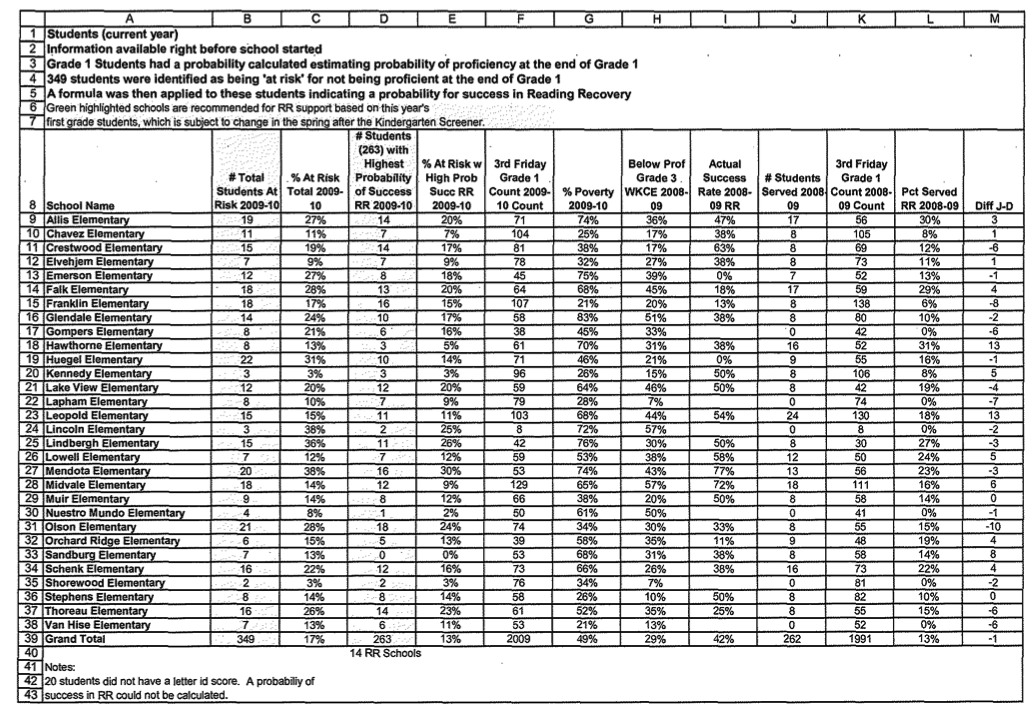
Click for a Reading Recovery Data Summary from Madison's Elementary Schools. December 2009
Madison School Board 24MB mp3 audio file. Madison Superintendent Dan Nerad's December 10, 2009 memorandum [311K PDF] to the board in response to the 12/7/2009 meeting:
Attached to this memo are several items related to further explanation of the reason why full implementation is more effective for Reading Recovery and what will happen to the schools who would no longer receive Reading Recovery as part of the administrative recommendation. There are three options for your review:Related: 60% to 42%: Madison School District's Reading Recovery Effectiveness Lags "National Average": Administration seeks to continue its use.The first attachment is a one-page overview summary ofthe MMSD Comprehensive Literacy Model. It explains the Balanced Literacy Model used in all MMSD elementary schools. It also provides an explanation of the wrap around services to support each school through the use of an Instructional Resource Teacher as well as Tier II and Tier III interventions common in all schools.
- Option I: Continue serving the 23 schools with modifications.
- Option II: Reading Recovery Full Implementation at Title I schools and Non-Title I Schools.
- Option III: Serving some students in all or a majority of schools, not just the 23 schools who are currently served.
The second attachment shows the detailed K-5 Title I Reading Curriculum Description in which MMSD uses four programs in Title I schools: Rock and Read, Reading Recovery, Apprenticeship, and Soar to Success. As part of our recommendation, professional development will be provided in all elementary schools to enable all teachers to use these programs. Beginning in Kindergarten, the four instructional interventions support and develop students' reading and writing skills in order to meet grade level proficiency with a focus on the most intensive and individualized wrap around support in Kindergarten and I" Grade with follow up support through fifth grade.
Currently these interventions are almost solely used in Title I schools.
The third attachment contains three sheets - the frrst for Reading Recovery Full Implementation at Title I schools, the second for No Reading Recovery - at Title I Schools, and the third for No Reading Recovery and No Title I eligibility. In this model we would intensify Reading Recovery in a limited number of schools (14 schools) and provide professional development to support teachers in providing small group interventions to struggling students.The fourth attachment is a chart of all schools, students at risk and students with the highest probability of success in Reading Recovery for the 2009-10 school year. This chart may be used if Reading Recovery would be distributed based on student eligibility (districtwide lowest 20% of students in f rst grade) and school eligibility (based on the highest number of students in need per school).
Option I: Leave Reading Recovery as it currently is, in the 23 schools, but target students more strategically and make sure readiness is in place before the Reading Recovery intervention.
Props to the Madison School Board for asking excellent, pointed questions on the most important matter: making sure students can read.
Newsletter signup | Send us your ideas
The middle school years, when nothing seems more important or more impossible than fitting in, are rough for nearly everyone. But they are particularly brutal for preteens such as Will Gilbertsen, whose mild autism makes him stand out.Less than two months into sixth grade at Arlington County's Kenmore Middle School this fall, the freckle-faced 11-year-old with a passion for skateboarding had gained a reputation for racewalking through the halls between classes. "That's so I can't hear the teasing," he told his mother.
As the number of children with autism has ballooned nationwide, so has the population of children who, like Will, are capable of grade-level academics but bewildered by the social code that governs every interaction from the classroom to the cafeteria. Not so profoundly disabled that they belong in a self-contained classroom but lacking the social and emotional skills they need to negotiate school on their own, they often spend the bulk of their day in mainstream classes supported with a suite of special education services including life-skills groups and one-on-one aides.
Newsletter signup | Send us your ideas
Trine Tsouderos & Patricia Callahan:
James Coman's son has an unusual skill. The 7-year-old, his father says, can swallow six pills at once.Diagnosed with autism as a toddler, the Chicago boy had been placed on an intense regimen of supplements and medications aimed at treating the disorder.
Besides taking many pills, the boy was injected with vitamin B12 and received intravenous infusions of a drug used to leach mercury and other metals from the body. He took megadoses of vitamin C, a hormone and a drug that suppresses testosterone.
This complex treatment regimen -- documented in court records as part of a bitter custody battle between Coman, who opposes the therapies, and his wife -- may sound unusual, but it isn't.
Thousands of U.S. children undergo these therapies and many more at the urging of physicians who say they can successfully treat, or "recover," children with autism, a disorder most physicians and scientists say they cannot yet explain or cure.
Newsletter signup | Send us your ideas
Educating children with disabilities is expensive.This year, the Keene School District will spend about $13.7 million for services ranging from special education teachers to speech and physical therapists.
That figure also includes funds for programs that serve children with severe disabilities, programs that are so specialized the district can't run them in Keene.
As expensive as those programs can be -- hundreds of thousands of dollars for one year, in some cases -- the cost is more easily absorbed in a city the size of Keene than in some of the neighboring towns.
Sometimes, the annual school district meeting in a small town can sound like a game of "what if":
What if a child with a severe disability moves into our town?
Paying for one student to attend a specialized program, like the school at Crotched Mountain Rehabilitation Center in Greenfield, could double the special education budget of some districts.
Out-of-district placements this year range from $30,000 to $375,000 in the Chesterfield, Harrisville, Marlow, Marlborough, Nelson and Westmoreland school districts, according to Timothy L. Ruehr, the districts' business manager.
Newsletter signup | Send us your ideas
As principal of Custer High School, Kathy Bonds often faces criticism for having one of the most notoriously rough schools in the city.Many of her students live in poverty, return at night to homeless shelters, commit severe crimes or deal with a staggering number of mental, emotional and physical disabilities.
Look at the numbers, Bonds says: 30.8% of her students are classified as special education, a main reason that performance at her school continues to suffer.
The Milwaukee School Board appeared to agree with the spirit of that assessment last week when it voted to even out the distribution of special education students within the city's high schools.
As part of the approved recommendation, the board directed the administration to immediately begin making sure all schools are equipped to serve a wide range of student needs. Members also directed the administration to establish a target range of special education students, and to help schools with very high or low special education populations come closer to that target range.
Newsletter signup | Send us your ideas
Keith Ripp and other Madison-area parents have spent thousands of dollars to test and tutor their children for dyslexia. They think this is something Wisconsin school districts should more aggressively pursue.But Ripp has a better-than-average ability to do something about it. A Republican state assemblyman from Lodi, he has authored a bill to require that schools perform dyslexia screening on pupils in kindergarten through second grade, as well as those from grades three to five who score low on reading tests.
Another Ripp bill would require the Department of Public Instruction to ensure that reading specialists, special education teachers and elementary school reading instructors are trained and tested in dyslexic instruction techniques.
"My youngest son, who is 13, has severe dyslexia," says Ripp. "My wife and I knew something was going on before second grade. We hired tutors. We tried to work with the school system to come up with something. We had his hearing and eyesight checked. He was very intelligent but was struggling a lot with reading."
The couple paid for the testing on their own, as well as some tutoring, at an estimated cost of about $8,000.
Newsletter signup | Send us your ideas
Judge Chris Freese sided with the family of Kaleb Drew, who argued that the boy's yellow Labrador retriever is a service animal allowed in schools under Illinois law. They say the dog is similar to a seeing-eye dog for the blind and is trained to help Kaleb deal with his disabilities, keeping him safe and calm in class.
The Villa Grove school district had opposed the dog's presence and argued that it isn't a true service animal.
The case and a separate lawsuit involving an autistic boy in southwestern Illinois are the first challenges to an Illinois law allowing service animals in schools.
Authorities in both school districts have said that the needs of the autistic boys must be balanced against other children who have allergies or fear the animals.
Kaleb Drew's dog, Chewey, has accompanied him to school since August under court order, pending the judge's final ruling Tuesday on the family's lawsuit against the school district.
Similar lawsuits have been filed on behalf of autistic children in other states, including California and Pennsylvania.
Newsletter signup | Send us your ideas
The Madison School Board recently passed the District's Strategic Plan. Superintendent Dan Nerad has now published a draft document outlining performance measures for the plan (this is positive). The 600K PDF document is well worth reading. Mr. Nerad's proposed performance measures rely on the oft criticized - for its lack of rigor - state exam, the WKCE. The Wisconsin Department of Public Instruction recently stated that "Schools should not rely on only WKCE data to gauge progress of individual students or to determine effectiveness of programs or curriculum".
A few highlights from the 600K PDF document:
| Grade | 2006/2007 | 2007/2008 | 2008/2009 |
| 9 | 0.3% | 0.4% | 0.2% |
| 10 | 5.5% | 7.3% | 1.9% |
| 11 | 18.0% | 18.1% | 10.6% |
| 12 | 34.1% | 34.3% | 24.3% |
Discussing these data is a step in the right direction. Unfortunately, use of the WKCE does not instill much confidence, from my perspective.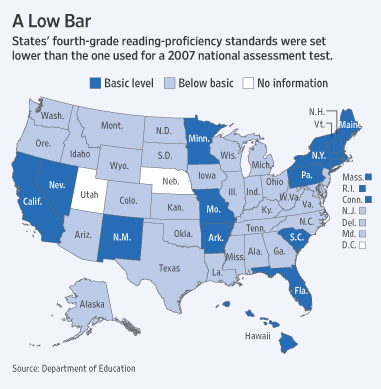
via "Some States Drop Testing Bar" by John Hechinger.
Happy Halloween!
Newsletter signup | Send us your ideas
The Davenport School Board approved a state-required special education delivery plan Monday to the disappointment of one member who said it was a missed opportunity.The board approved the plan 6-1, with Timothy Tupper voting against it.
"We had a real opportunity with this document to really look at our process and procedures, and we didn't do that," Tupper said during discussion of the plan. "I hoped we would look at our delivery of services to see how we (could) do it better."
The plan moves the district away from teaching special needs students in seclusion. Instead, general education teachers will work with special education students in a regular classroom setting. The special education service delivery plan, recently required by the Iowa Department of Education, defines how schools meet the educational needs of students.
About 30 teachers were involved in the delivery plan and public input was sought, Betty Long, director of exceptional education and federal programming, told the board. Most public input was received via e-mail.
Newsletter signup | Send us your ideas
To promote greater knowledge and understanding of dyslexia and related learning disabilities, The International Dyslexia Association (IDA) designated the month of October as National Dyslexia Awareness Month. "Awareness is key with learning disabilities because if identified early enough, their impacts can be minimized through intervention and effective teaching."Julie Gocey:In order to increase awareness of dyslexia, Wisconsin Literacy posted two videos on its website created by Sun Prairie Cable Access. You will need Quicktime installed on your computer to view the video files. Download it for free here: www.apple.com/quicktime/download.
Living and Learning with Dyslexia: Hope and Possibilities
(Time 36:59)
Dr. Julie Gocey leads a panel discussion on dyslexia with Cheryl Ward (Wisconsin Branch of the International Dyslexia Association), Layla Coleman (Wisconsin Literacy, Inc.), Pam Heyde (Dyslexia Reading Therapist) and Margery Katz (Dyslexia Reading Therapist). The program covers a variety of topics including science-based, multisensory instruction for kids and adults; obstacles for identifying individuals with dyslexia; and lack of training of teachers. A college student with dyslexia shares strategies for academic success.
Educators, parents and health professionals must work together to improve literacy for ALL students in Wisconsin. It is well known that early literacy is one of the most powerful predictors of school success, gainful employment and many measures of health.via a Margery Katz email.For that reason, the sincerest expression of child advocacy is to ensure that ALL students in Wisconsin have the opportunity to become proficient readers. In my experience as a pediatrician, co-founder of the Learning Difference Network, and as a parent, current policies and practices do not routinely provide the 10 percent to 17 percent of our students who have some degree of dyslexia with adequate opportunities for literacy.
Dyslexia is a language-based learning problem, or disability if severe. The impact that this neurobiological, highly heritable condition has on learning to read, write and spell cannot be underestimated.Dyslexia is the best understood and most studied of all learning difficulties. There is clear evidence that the brains of dyslexic readers function differently than the brains of typical readers. But the good news is this: Reading instruction from highly skilled teachers or tutors who use evidence-based techniques can change how the brain processes print and nearly ALL students can become proficient readers.
Early intervention is critical to successful outcomes, but there is a disconnect between research and practice on many levels.
Current obstacles include myths about dyslexia, lack of early identification and a need for educators to be given training in the science of reading and multi-sensory, systematic, language-based instruction. This is critical for students with dyslexia, but can be beneficial to all learners. For those of us who are able to pay for private testing and instruction for our children, the outcomes can be phenomenal. Unfortunately, where poverty and its associated ills make daily life a struggle, this expert instruction is not routinely available.
Families who ask school personnel about dyslexia are often referred to a physician, who in turn sends them back to school for this educational problem. Educational testing is often denied coverage from insurance companies, though the implications for health and wellness are clear. Unfortunately, parents may be left without useful information from anyone, and appropriate treatment - excellent reading instruction - is further delayed.
October is Dyslexia Awareness Month. On Thursday, Oct. 22, there will be a noon rally in the Capitol rotunda to raise awareness about the need to improve reading instruction for students with dyslexia and for all struggling readers in Wisconsin.State Rep. Keith Ripp, R-Lodi, is introducing bills this week to help identify and help children with dyslexia. One bill calls for screening for specific skills to find kids with a high chance of struggling to learn to read. The other bill aims to improve teacher training to deal with reading problems.
There is too much evidence describing the science of reading, dyslexia and the costs of illiteracy to continue without change. Parents who suspect dyslexia must not be dissuaded from advocating for their children; keep searching until you find help that works.
Health professionals must seek the latest information on this common condition in order to support families and evaluate for related conditions. Educators must seek out training to understand this brain-based condition that requires educational care. The information is solid. We must work together to give ALL our kids the opportunity to read and succeed.Dr. Julie Gocey is a pediatrician and a clinical assistant professor in the University of Wisconsin School of Medicine and Public Health and also a co-founder of the Learning Difference Network
Newsletter signup | Send us your ideas
Just about every meaningful reform begins with education. If our schools are not working well, then ultimately nothing works. Wisconsin has enjoyed great schools from kindergarten to the university system to technical colleges.One reason our kids score at or near the top in national testing is parental involvement. Parents in Wisconsin demand high quality education and the elected school boards respond.
The Wisconsin Constitution guarantees public school education for all children from age 4 to 20. At one time that protection did not apply to children with "learning problems." They were called "retarded" and were sent to institutions, but in 1966 parents decided that was unacceptable. They turned to Attorney General Bronson La Follette for his opinion and he ruled that "all" meant "all." Every child in Wisconsin would be educated.
Newsletter signup | Send us your ideas
Nearly a month into the school year and teachers in several Front Range districts are still working without a contract."We have more locals that have not been able to settle than is typical for this time of year," said Deborah Fallin, spokeswoman for the Colorado Education Association. "Usually, most of the contracts are settled before school starts."
Colorado teachers have not waged a strike for 15 years -- since Denver teachers struck for five days in 1994.
No one expects a strike this year, but teachers unions from Pueblo to Greeley are battling their districts over contract offers they say are unfair.
Districts say they have less money this year, citing plummeting state revenues and an overall financial crisis.
Newsletter signup | Send us your ideas
With a new school year upon us, the long-simmering issue of how best to accommodate special education students has been pushed to the forefront by a major U.S. Supreme Court ruling.Parents of students with special needs have the right to seek reimbursement from their districts for private school tuition, even if they did not first try their public school's special education programs, according to the recent ruling.
"This is an extremely important decision," said Matthew Cohen, a Chicago attorney who specializes in disability law. "It makes it clear that school districts ... may be held legally liable for placements that the parents make on their own."
The practical effect on districts is unclear. Some educators fear the ruling will strain already cash-strapped districts and pit parents against one another as they clash over scarce resources. But it's unlikely parents will flock to private schools because they have to pay the cost, then seek reimbursement.
Still, schools should take seriously their obligations to provide services provided under the federal Individuals With Disabilities Education Act (IDEA), state officials say. Students are entitled to a "free and appropriate public education" under the law, and districts must pick up the tab for private schooling but only if the district's efforts to meet a child's needs have failed.
Newsletter signup | Send us your ideas
In March, an independent hearing officer made official what Shnette Tyler already knew: Her 11-year-old son, who has severe learning and behavioral disabilities, had not been receiving a proper education from Chicago Public Schools.Detailing how the school system had repeatedly failed Devon Mallard, the hearing officer wrote: "Despite a history of disability as well as documented behavioral difficulties, it took two years of decreasing reading scores, increasingly aggressive behaviors, and the filing of a due process complaint for the district to take notice of this student and focus on his specific needs for special education services."
Within 45 days, the school district was ordered to set up a proper education plan for Devon -- who attends Ray Elementary School in Hyde Park -- and provide him with an array of weekly services including psychological counseling, occupational therapy and a reading tutor.
Newsletter signup | Send us your ideas
Like seeing-eye dogs for the blind, trained dogs are now being used to help autistic children deal with their disabilities. But some schools want to keep the animals out, and families are fighting back.Two autistic elementary school students recently won court orders in Illinois allowing their dogs to accompany them to school. Their lawsuits follow others in California and Pennsylvania over schools' refusal to allow dogs that parents say calm their children, ease transitions and even keep the kids from running into traffic.
At issue is whether the dogs are true "service dogs" - essential to managing a disability - or simply companions that provide comfort.
Newsletter signup | Send us your ideas
Federal law first insisted in 1975 that public schools educate disabled students. Since then, the portion of students receiving special education services has increased 64%. Today, 13.5% of all public school students have been diagnosed with a disability. Special education, it turns out, is no longer particularly special at all.Taxpayers pay a substantial price for the growth in special education. In New York state, for instance, in 2007, the average special education student cost $14,413 more to educate than a regular-enrollment student.
What has produced such rapid growth in the percentage of American students identified as disabled? Don't worry--it's not "something in the water."
Better means of identification explain part of special education's expansion. However, a growing body of research points to a less benign cause: Schools see a financial incentive to designate low-achieving students as disabled, while they may not actually be disabled at all.
Newsletter signup | Send us your ideas
All disabled people will be entitled to free education to the level of graduating with a bachelor's degree starting next year, Education Minister Jurin Laksanavisit said on Tuesday.Mr Jurin said this was a resolution made by the Committee on Education for the Disabled.
The disabled will be entitled to free education to the bachelor's degree level in either state-run or private universities.
They will not have to pay tuition or other fees to the universities where they study. Their expenses will be covered by the offices of he Basic Education Commission and the Higher Education Commission, he said.
Newsletter signup | Send us your ideas
Miguel Landeros is a lanky, well-spoken 12-year-old about to begin seventh grade in Stafford County. He is severely learning disabled, with reading, writing and math skill levels at least two years below his peers, and needs special teaching, according to a licensed clinical psychologist at the Kennedy Krieger Institute in Baltimore and other specialists.Last February, Stafford officials refused to accept that evaluation and left him in regular classes. He performed poorly, failing all core subjects. Recently, they promised to give him more specialized services, but not the ones the experts who examined him say he needs.
I admit that education writers in general, and I in particular, write very little about learning disabilities and the many failures of federally mandated public school programs to help students who have them. I often say the cases are so complicated I have difficulty translating them into everyday language, and even then readers struggle to understand.
Newsletter signup | Send us your ideas
Madison School District Superintendent Dan Nerad [838K PDF]:
As part of Federal Stimulus funding iliat will be made available the district will receive American Recovery and Reinvestment Act (ARRA) funds to be used over a two year period.The proposal includes quite a bit of professional development, such as $400,000 for dual language immersion, $1.48M for 4K staff and $456,000 for 4K furniture and $100,000 for talented & gifted assessment.These funds are in IDEA, IDEA EC and Title 1.
Program Costs/FundingiConsultation Service Employment Contract
The district has prepared a two year funding proposal along with a budget analysis for 2009-10 and 2010-11 for each of the sources for your review. The proposal amounts are as follows:
IDEA - $6,199,552
IDEA EC - $293,082
Title I - $5,161,444Salary Savings
The funding proposals would increase FTE's and include funding sources during the two year period of the ARRA funds
Plan B, without 4K spending, includes $1,150,000 for professional development in the following areas: Topics include universal design, differentiation, mental health,
inclusive practices, autism, and quality IEPs.
Newsletter signup | Send us your ideas
In 1975, Congress passed legislation giving students with disabilities the right to an appropriate education at public expense. But having a right is only as good as your ability to enforce it. In New York City and elsewhere, public schools regularly delay and frustrate disabled students seeking appropriate services--everything from tutoring to speech therapy to treatment of severe disabilities--making their federally protected right all but meaningless. Rather than compelling families with disabled children to contend with obstinate public school systems, we should give them the option of purchasing the services they need for their children from a private provider. That is, we should give them special-ed vouchers--good for the same amount of money that we already spend on them in the public school system--that they could then use to pay for private school. Not only would this bring better services to disabled New York students; it could also save the public money.Many parents of disabled students have a lot of trouble ensuring that public schools give their kids an appropriate education. The parents have to know what they're entitled to, and most do not. They must negotiate services from the local schools--but the schools are experienced in these negotiations, while the parents generally aren't, so the schools often get away with minimizing their responsibilities. And even if parents win at the negotiating table, getting the schools actually to deliver on their promises is enormously difficult.
Newsletter signup | Send us your ideas
One side of Heron Road, south London, is lined with grey-brick, bay-windowed Victorian terraced houses. The other is dominated by a strikingly modern building.Michael Tippett School stands within a frame of timber pillars spanned by orange and maroon louvres, its walls are covered with slats of chestnut cladding and its eco-roof is topped with a thin carpet of mauve plants.
Many schools for children with severe and complex special needs are designed to protect the children from the outside world and seem to hide them away.
But through the front doors of Michael Tippett you can see the social hub of the school, a double-storey atrium, the garden and the undulating landscape of a small community park beyond.
Situated in a part of Lambeth borough that is dominated by vast regimented blocks of flats and crammed terraces, this generous entrance is a bold statement about the value put on educating the least able in the community.
"It has to do with dignity and respect for the people we work with," said head Jan Stogdon. "The building reflects the ethos of the school."
Michael Tippett is named after the British composer whose music celebrated the resilience of the human spirit in the face of oppression. The 70 pupils, aged 11 to 19, have their own daily struggles against the limitations of their own complex needs and severe or profound learning difficulties. Some have sight or hearing impairments, a number have gastrotomy tubes and others are at various points on the autistic spectrum.
Newsletter signup | Send us your ideas
On July 21, the Board unanimously approved the following components of the new strategic plan.
New Mission: Our mission is to cultivate the potential in every student to thrive as a global citizen by inspiring a love of learning and civic engagement, by challenging and supporting every student to achieve academic excellence, and by embracing the full richness and diversity of our community.
Strategic Objectives:
StudentNext steps:
We will ensure that all students reach their highest potential and we will eliminate achievement gaps where they exist. To do this, we will prepare every student for kindergarten, raise the bar for all students, create meaningful student-adult relationships, and provide student-centered programs and supports that lead to prepared graduates.Curriculum
To improve academic outcomes for all students and to ensure student engagement and student support, we will strengthen comprehensive curriculum, instruction and assessment systems in the District.Staff
We will implement a formal system to support and inspire continuous development of effective teaching and leadership skills of all staff who serve to engage and support our diverse student body while furthering development of programs that target the recruitment and retention of staff members who reflect the cultural composition of our student body.Resource/Capacity
We will rigorously evaluate programs, services and personnel through a collaborative, data-driven process to prioritize and allocate resources effectively and equitably, and rigorously pursue the resources necessary to achieve our mission.Organization/Systems
We will promote, encourage, and maintain systems of practice that will create safe and productive learning and work environments that will unify and strengthen our schools, programs, departments and services as well as the District as a whole.
We did not approve any action plans. We went around the table and listed our priority areas and the Administration will develop action plans to support those areas and bring them back to the Board in August. There will be plenty of opportunity for discussion around the action plans brought forward. We have structured our process this way to ensure we keep moving forward as the plan is Important for setting the future direction of the District.
Arlene
Newsletter signup | Send us your ideas
An experiment in levelling the playing fieldON A sweltering day in Alexander City, Alabama, summer school was in full swing. Two girls were reading "Julius Caesar" as two others wrestled with maths. A boy worked his way through a psychology quiz, and a teacher monitored an online discussion with students from around the state: Was Napoleon the last enlightened despot or the first modern dictator?
This is not a traditional classroom scene, but it has become common enough in Alabama. The state has many small, rural schools. Because of their size, and the relative scarcity of specialised teachers, course offerings have been limited. Students might have had to choose between chemistry or physics, or stop after two years of Spanish. But thanks to an innovative experiment with online education, the picture has changed dramatically.
In 2005 the governor, Bob Riley, announced a pilot programme called Alabama Connecting Classrooms Educators and Students Statewide, or ACCESS. The idea was to use internet and videoconferencing technology to link students in one town to teachers in another. It was something of a pet cause for Mr Riley, who comes from a rural county himself. He was especially keen that students should have a chance to learn Chinese.
........
Joe Morton, the state superintendent of schools, points to the number of black students taking AP courses. In 2003, according to the College Board, just 4.5% of Alabama's successful AP students (those who passed the subject exam) were black. In 2008 the number was up to 7.1%. There is still a staggering gap--almost a third of the state's students are black--but the improvement in Alabama was the largest in the country over that period. "That makes it all worthwhile right there," says Mr Morton.
Newsletter signup | Send us your ideas
Some wounds never heal. In 1968, at the age of 15, Do Van Du lost a leg and part of an arm while serving as a combat interpreter for the US Special Forces near the Cambodian border. He moved to the US in 1971 and became a successful software engineer and systems analyst. Then, seven years ago, Du returned to his homeland to help found a college-level programme run by Catholic Relief Services to train disabled young people to be software engineers and tech workers - a first for Vietnam.
"People with disabilities don't have a voice in Vietnam," he says. "You are basically thrown away. You are not 'normal'. You can't work. You are a leech on society," he says, before walking into a classroom full of eager students on crutches and in wheelchairs. "In Asia, because of the belief in reincarnation, people think you have done something in a prior life and now you are paying for it."Grim evidence of the harsh treatment of Vietnam's disabled citizens is easy to find among the students in Du's programme.
Duong Anh My was pelted with rocks because his leg was deformed.
Newsletter signup | Send us your ideas
This memo is a summary of the results from the surveys completed during the past school year with various parent groups whose children reside within the MMSD attendance area but receive certain alternative education options. Also included are results of the survey conducted with non-residents who attend MMSD schools via the Open Enrollment program (Le., Open Enrollment Enter).This document will be discussed at Monday evening's Madison School Board meeting. UPDATE:
Background
Groups were surveys representing households whose students were enrolled in one of four different educational settings: MMSD resident students attending private/parochial schools, MMSD resident students attending other public schools via the Open Enrollment program, non-resident students attending MMSD schools via the Open Enrollment program, and MMSD resident students provided home based instruction.
The surveys were conducted between December 2008 and February 2009. The surveys were mailed to households or they could complete the survey online. Two mailings were conducted - the initial mailing to all households and a second to non-respondents as a reminder request. Total group sizes and responses are provided below.
Newsletter signup | Send us your ideas
We'll still have to wait a few years to mind-meld with our Camrys, but researchers at Toyota have unveiled an advanced brain sensing system that controls the movement of a wheelchair by reading a user's thoughts alone. By processing patterns in brain waves, the system can propel a wheelchair forward, as well as make turns, with virtually no discernable delay between thought and movement.Developed by researchers at BSI-Toyota Collaboration Center, the brain machine interface technology can return a response from a thought stimulus in just 125 milliseconds, whole seconds faster than existing technology, in effect creating real-time responsiveness. Five electroencephalography sensors stationed above the regions of the brain that deal with motor movement interpret patterns in the signals generated by the user. Further, the software interpreting the signals adapts to a particular user's patterns of thinking, achieving 95% accuracy after just one week of three-hour training sessions.
The potential applications for BMI technology extend far beyond the wheelchair, but Toyota's immediate focus will be to help those with mobility issues regain their freedom of movement, as well as to improve nursing care for the elderly. In that pursuit, Toyota is far from alone, as an aging population has Japan forecasting a shortage of health-care workers in the future. Rival automaker Honda is experimenting with a similar technology that allows its Asimo robot to be manipulated via brain signals, the idea being that humanoid robots could replace home care nurses in coming years.
Newsletter signup | Send us your ideas
State regulators are violating mental health and other laws by allowing health insurers to deny effective treatment for children with autism, consumer advocates contended today.In a lawsuit, Consumer Watchdog, a Santa Monica group that monitors insurance practices, is asking a judge to order the Department of Managed Health Care to enforce the law and require insurers to provide their autistic members with the services their physicians have ordered.
Without court action, the suit says, "California's thousands of autistic children and their families will continue to suffer."
The department said it was "holding health plans accountable to provide a range of healthcare services for those with autism" and was handling consumer complaints according to the law.
Autism impairs communication and socialization and is often accompanied by repetitive, injurious behavior.
Newsletter signup | Send us your ideas
BBC:
Complications during pregnancy and giving birth later in life may increase the risk of having a child with autism, a review of dozens of studies suggests.Researchers found the bulk of studies into maternal age and autism suggest the risk increases with age, and that fathers' age may play a role too.
The mothers of autistic children were also more likely to have suffered diabetes or bleeding during pregnancy.
The US review of 40 studies appears in the British Journal of Psychiatry.
The recorded number of children with autism has risen exponentially in the past 30 years but experts say this is largely due to improved detection and diagnosis, as well as a broadening of the criteria.
The cause of the condition is unclear, and the review team from the Harvard School of Public Health said there was "insufficient evidence" to point to any one prenatal factor as being significant.
Newsletter signup | Send us your ideas
The U.S. Supreme Court took a major step toward ending a 17-year legal battle today, deciding Arizona has done enough to help students who haven't learned to speak, read or write English.The justices reversed the decision of the lower courts and sent the case, known as Flores vs. Arizona, back with instructions to consider improvements the state has made in the way schools teach English learners.
"This is a major step to stop federal trial judges from micromanaging state education systems," said state schools superintendent Tom Horne, who asked the Supreme Court to weigh in on the case. "This affirms that important value that we the people control our government and our elected representatives and not ruled over by an aristocracy of lifetime federal judges."
The Supreme Court decided the lower courts concentrated too narrowly on how much the state spent to help language learners and allowed that increases in overall school funding could be considered as a boost to help schools take the appropriate action called for in federal law.
The decision did not weaken Equal Education Opportunity Act of 1974, as some civil rights attorneys feared. But the justices' said simply complying with the No Child Left Behind Act of 2002 did help to satisfy the requirements in the 1974 law to "take appropriate action" to help students overcome language barriers.
Newsletter signup | Send us your ideas
Robert Barnes & Nelson Hernandez:
By a 6 to 3 vote, the court settled an emotional and contentious issue that has divided frustrated parents and financially strapped school officials, often ending in legal battles. In writing the opinion, Justice John Paul Stevens said Congress intended for the Individuals With Disabilities Education Act to provide an appropriate educational experience for all children, no matter whether they had ever received special-education services from a school system.The issue has emerged as one of the fastest-growing components of local education budgets, threatening to "seriously deplete public education funds," according to a brief filed by the nation's urban school districts.
Local school systems in the Washington area spend millions of dollars each year on private school reimbursement. And the D.C. public schools allocated $7.5 million of this year's $783 million budget just for the legal costs of hearing officers or judges to decide whether the system can provide appropriate services for children with disabilities.
Newsletter signup | Send us your ideas
The Supreme Court on Monday made it easier for parents of special education students to get reimbursement for private school tuition. School administrators fear the 6-3 ruling will lead to a jump in private school placements.The student in the case is known simply as "T.A." The Forest Grove School District, outside of Portland, Ore., noticed that he was having problems in high school, but suspected marijuana use and refused to give him special education services. Toward the end of his junior year, T.A.'s parents pulled him out of public school and sent him to a private residential academy.
The parents then sued the school district to recover the $65,000 they spent on private tuition. The school district argued the parents stepped over the line and lost the ability to seek reimbursement when they transferred him without first giving public special education a try.
Newsletter signup | Send us your ideas
A federal judge has ordered Milwaukee Public Schools to launch a wide search for students who didn't get special education services they should have gotten between 2000 and 2005 and to figure out what needs to be done to make that up to them.U.S. Magistrate Judge Aaron Goodstein ordered that someone from outside the system be hired to monitor work on providing education services to compensate the students or former students involved because MPS has not shown it will adequately remedy its problems in special education on its own.
Goodstein's decision earlier this month was another step in a lawsuit that dates to 2001. In earlier decisions, he ruled that MPS had denied students their rights in the past and ordered major changes in how MPS deals with deciding whether children are entitled to special education help. The process of making those changes is under way.
Newsletter signup | Send us your ideas
Children taking stimulant drugs such as Ritalin to treat attention-deficit hyperactivity disorder are several times as likely to suffer sudden, unexplained death as children who are not taking such drugs, according to a study published yesterday that was funded by the Food and Drug Administration and the National Institute of Mental Health.While the numbers involved in the study were very small and researchers stopped short of suggesting a cause and effect, the study is the first to rigorously demonstrate a rare but worrisome connection between ADHD drugs and sudden death among children. In doing so, the research adds to the evolving puzzle parents and doctors face in deciding whether to treat children with medication.
Doctors have speculated about such a connection in the past because stimulants increase heart rate and have other cardiovascular effects. Physicians are currently advised to evaluate patients for cardiac risks before prescribing the drugs, and FDA officials said yesterday that those guidelines do not need strengthening in light of the new study. About 2.5 million children in the United States take ADHD medications such as Ritalin and Adderall.
Newsletter signup | Send us your ideas
While her classmates were signing yearbooks and preening for the prom, Vicheka Chres was experiencing a different kind of senioritis as she approached Friday's graduation.As she had since she started high school, Vicheka, 17, was studying six hours a night. After school and on weekends, she was making apple turnovers in her uncle's bakery - for no pay. At home, she was translating for her mother, whose English is poor and who has a sixth-grade education.
"Fun? I don't really have fun," Vicheka said recently while taking a break from swabbing tables at Rio Vista Bakery, where her mother also works. "I know American kids go see movies, concerts. Go shopping. But that's not what I do."
Vicheka has reason to be motivated. She knows that if her family had stayed in their native Cambodia, which they left in 2003, she wouldn't have had the luxury of studying trigonometry and literature six hours a night. She'd be working in a factory, sewing clothes 12 hours a day for $50 a month.
Instead, she's bound for UC Davis. She plans to study biochemistry so she can eventually be a pharmacist and support her family, those in Rio Vista as well as in Phnom Penh.
Newsletter signup | Send us your ideas
Leo Lytel was diagnosed with autism as a toddler. But by age 9 he had overcome the disorder.His progress is part of a growing body of research that suggests at least 10 percent of children with autism can "recover" from it -- most of them after undergoing years of intensive behavioral therapy.
Skeptics question the phenomenon, but University of Connecticut psychology professor Deborah Fein is among those convinced it's real.
She presented research this week at an autism conference in Chicago that included 20 children who, according to rigorous analysis, got a correct diagnosis but years later were no longer considered autistic.
Among them was Leo, a boy in Washington, D.C., who once made no eye contact, who echoed words said to him and often spun around in circles -- all classic autism symptoms. Now he is an articulate, social third-grader. His mother, Jayne Lytel, says his teachers call Leo a leader.
The study, funded by the National Institute of Mental Health, involves children ages 9 to 18.
Autism researcher Geraldine Dawson, chief science officer of the advocacy group Autism Speaks, called Fein's research a breakthrough.
Newsletter signup | Send us your ideas
We spend some time with a family whose little boy is newly diagnosed.
Newsletter signup | Send us your ideas
Leslie Clark and her husband have been trying to communicate with their autistic 7-year-old son, JW, for years, but until last month, the closest they got was rudimentary sign language.
He's "a little bit of a mini-genius," Clark says, but like many autistic children, JW doesn't speak at all.Desperate to communicate with him, she considered buying a specialized device like the ones at his elementary school in Lincoln, Neb. But the text-to-speech machines are huge, heavy and expensive; a few go for $8,000 to $10,000.
Then a teacher told her about a new application that a researcher had developed for, of all things, the iPhone and iPod Touch. Clark drove to the local Best Buy and picked up a Touch, then downloaded the "app" from iTunes.
Total cost: about $500.
Newsletter signup | Send us your ideas
Karen Kaldenbach, an 18-year-old high school senior in Arlington County, remembers vividly what life was like when she was 11: "I saw Social Services almost as much as I saw my mother, who was always drunk. Her best friends, alcohol and money, were always there for her. She spent so much time with them, she couldn't raise my little sister and me. Social Services always came to talk to me at school. They asked questions about my family. My response? A lie, always."Such stories are not uncommon in the Washington area. They often end unhappily. Yet these days, Kaldenbach is thriving, with a supportive adoptive mother, plus awards, scholarships and an acceptance letter from George Mason University.
We are in the midst of a national debate, its outcome uncertain, over what should be the emphasis of efforts to fix public schools. Some say the focus should be on improving teaching. Only in the classroom, they say, is there a chance to give students -- particularly those in poverty -- the tools they need to succeed. Others say teachers cannot reach those children until their family lives, shaken by parental joblessness or mental or physical illness, are straightened out by government action.
Newsletter signup | Send us your ideas
Toni Price was at work that afternoon in 2002 when she got the call from her foster son Cedric's eighth-grade teacher: Paramedics were at his middle school in Killeen, Texas. Cedric wasn't breathing.
When Price arrived at school, there he was, lying on the floor. "I'm thinking he's just laying there because he didn't want to get in trouble," she says, fighting back tears.Actually, Cedric was dead.
A 14-year-old special-education student who'd arrived at the school with a history of abuse and neglect, Cedric had been taken from his home five years earlier with his siblings.
He'd just been smothered by his teacher, police said, after she placed him in a "therapeutic floor hold" to keep him from struggling during a disagreement over lunch.
Newsletter signup | Send us your ideas
A Times investigation finds the process so arduous that many principals don't even try, except in the very worst cases. Jettisoning a teacher solely because he or she can't teach is rare.The eighth-grade boy held out his wrists for teacher Carlos Polanco to see.
He had just explained to Polanco and his history classmates at Virgil Middle School in Koreatown why he had been absent: He had been in the hospital after an attempt at suicide.
Polanco looked at the cuts and said they "were weak," according to witness accounts in documents filed with the state. "Carve deeper next time," he was said to have told the boy.
"Look," Polanco allegedly said, "you can't even kill yourself."
The boy's classmates joined in, with one advising how to cut a main artery, according to the witnesses.
Newsletter signup | Send us your ideas
THAT genius is unusual goes without saying. But is it so unusual that it requires the brains of those that possess it to be unusual in others ways, too? A link between artistic genius on the one hand and schizophrenia and manic-depression on the other, is widely debated. However another link, between savant syndrome and autism, is well established. It is, for example, the subject of films such as "Rain Man", illustrated above.A study published this week by Patricia Howlin of King's College, London, reinforces this point. It suggests that as many as 30% of autistic people have some sort of savant-like capability in areas such as calculation or music. Moreover, it is widely acknowledged that some of the symptoms associated with autism, including poor communication skills and an obsession with detail, are also exhibited by many creative types, particularly in the fields of science, engineering, music, drawing and painting. Indeed, there is now a cottage industry in re-interpreting the lives of geniuses in the context of suggestions that they might belong, or have belonged, on the "autistic spectrum", as the range of syndromes that include autistic symptoms is now dubbed.
Newsletter signup | Send us your ideas
When Rupert Isaacson decided to take his autistic son, Rowan, on a trip to Mongolia to ride horses and seek the help of shamans two years ago, he had a gut instinct that the adventure would have a healing effect on the boy. Mr. Isaacson's instinct was rewarded after the trip, when some of Rowan's worst behavioral issues, including wild temper tantrums, all but disappeared.Now the publisher of Mr. Isaacson's book about the journey, "The Horse Boy," has a similar instinct about the market potential of his story, and is hoping for its own happy ending.
Little, Brown & Company, which released "The Horse Boy" on Tuesday, has a lot riding on its success: the publisher paid more than $1 million in an advance to Mr. Isaacson before he and his family had even taken their Mongolian trip.
Michael Pietsch, publisher of Little, Brown, said booksellers had already placed orders high enough to justify a first printing of 150,000 copies.
Newsletter signup | Send us your ideas
Wisconsin Center for Education Research, via a kind reader's email:
Recent developments in social and emotional learning (SEL) have pointed to the reciprocal relations between children's academic functioning and their socio-emotional health. Professional literature in this field points to the need for including students' academic skills and competencies as part of mental health intervention research.University of Wisconsin-Madison psychologist and professor Thomas R. Kratochwill says educators cannot afford to continue offering mental health services for K-12 students in isolation. These services need to be reframed, mainstreamed, and folded into schools' broader academic mission.
The good news is that schools already have resources, supports, and opportunities that may provide entry points for delivery of expanded mental health services. Virtually all elementary and secondary schools in the U.S. have school psychologists and provide mental health services, Kratochwill says. The bad news is that the proportion of students needing services continues to outpace supply, and mental health services often remain separate from academic programs. Knowledge about mental health programs and educational achievement have developed in isolation from each other.
To identify research directions for future studies of school-based mental health services, Tom Kratochwill and colleagues reviewed scholarly literature to identify evidence- based interventions that target a combination of students' academic-educational functioning and their mental health functioning.
They studied 2000 articles published between 1990 and 2006; only 64 studies met the methodological criteria for inclusion in this review. Of those 64 studies, 24 tested the effects of a program on both academic and mental health outcomes, while 40 examined mental health outcomes only.
Schools are increasingly held accountable for achieving academic outcomes. Given that, Kratochwill says he was surprised that most of the mental health studies did not include academically relevant outcomes. That means that the impact of school-based mental health interventions on educationally relevant behaviors is under researched and may be poorly understood.
Many children receive mental health services in school settings. Although studies of social and emotional learning have linked social and academic competence, the impacts of mental health interventions on academics, and of academic interventions on mental health, are understudied.
Kratochwill argues for a multi-tiered intervention approach in schools. Varying levels of service intensity are available over time and in different grades for students, especially during transitional periods.
Because schools and districts have tight budgets, it's important to know which students might benefit most from different types of intervention. And to streamline or adapt effective interventions for dissemination on a larger scale, it's important to understand how various interventions produce positive outcomes.
Newsletter signup | Send us your ideas
A federal court may have changed the public discourse about the safety of vaccines in February, when it dismissed the theory that they cause autism. But vaccine damage is still the reigning paradigm for a rump caucus of thousands of parents who turn to physicians with a remarkable set of beliefs and practices in hope of finding recourse for their children's ills.
To sift through the 15,000-page record of the Autism Omnibus hearings and the decisions by the three special masters who considered the evidence is to peek into a medical universe where autism is considered a disease of environmental toxicity, rather than an inherited disorder, and where doctors expose children to hundreds of tests simply to justify the decision to "detoxify" them. In some cases, the judges found, doctors simply ignored data that didn't fit the diagnosis.
The court came down hard on the alternative medical practitioners who tailor their treatments to fit theories of vaccine damage. Among the doctors criticized was Jeff Bradstreet, a former Christian preacher in Melbourne, Fla., who has treated 4,000 children with neurological disorders. Among the children was Colten Snyder, whose case was one of those considered by the court.
Newsletter signup | Send us your ideas
Parents and special education advocates fear that a proposal before the legislature could make it harder for special-education students to get "free, appropriate, public education" in the state.Under a current regulation, parents who are unable to resolve a problem with their child's special-education plan through the school district can appeal to the state Department of Education. The appeal can lead to a state-mediated hearing at which the school district must demonstrate that the education plan adheres to federal law.
But a bill proposed by the legislature's education committee would shift that burden of proof to the party filing the complaint -- which in most cases is the parents.
Supporters of the bill say it would save school districts money and shorten hearings, which can last anywhere from a week to 40 days.
Newsletter signup | Send us your ideas
Ayub Abdi is a cute 5-year-old with a smile that might be called shy if not for the empty look in his eyes. He does not speak. When he was 2, he could say "Dad," "Mom," "give me" and "need water," but he has lost all that.He does scream and spit, and he moans a loud "Unnnnh! Unnnnh!" when he is unhappy. At night he pounds the walls for hours, which led to his family's eviction from their last apartment.
As he is strapped into his seat in the bus that takes him to special education class, it is hard not to notice that there is only one other child inside, and he too is a son of Somali immigrants.
"I know 10 guys whose kids have autism," said Ayub's father, Abdirisak Jama, a 39-year-old security guard. "They are all looking for help."
Autism is terrifying the community of Somali immigrants in Minneapolis, and some pediatricians and educators have joined parents in raising the alarm. But public health experts say it is hard to tell whether the apparent surge of cases is an actual outbreak, with a cause that can be addressed, or just a statistical fluke.
Newsletter signup | Send us your ideas
With the economy forcing budget cuts and layoffs in higher education, colleges and universities might be expected to be cutting financial aid. But no.Students considering a wide range of private schools, as well as those who are already enrolled, can expect to get more aid this year, not less.
The increases highlight the hand-to-mouth existence of many of the nation's smaller and less well-known institutions. With only tiny endowments, they need full enrollment to survive, and they are anxious to prevent top students from going elsewhere.
Falling even a few students short of expectations can mean laying off faculty members, eliminating courses or shelving planned expansions.
"The last thing colleges and universities are going to cut this year is financial aid," said Kathy Kurz, an enrollment consultant to colleges. "Most of them recognize that their discount rates are going to go up, but they'd rather have a discounted person in the seat than no one in the seat."
Newsletter signup | Send us your ideas
Thousands of parents who claimed that childhood vaccines had caused their children to develop autism are wrong and not entitled to federal compensation, a special court ruled today in three decisions with far-reaching implications for a bitterly fought medical controversy.The long-awaited decision on three test cases is a severe blow to a grass-roots movement that has argued -- predominantly through books, magazines and the Internet -- that children's shots have been responsible for the surge in autism diagnoses in the United States in recent decades. The vast majority of the scientific establishment, backed by federal health agencies, has strenuously argued there is no link between vaccines and autism, and warned that scaring parents away from vaccinating their youngsters places children at risk for a host of serious childhood diseases.
Newsletter signup | Send us your ideas
Gov. Jim Doyle is stumping for a bill that would require insurance companies to cover autism.Most insurance companies don't cover autism because it is classified as an emotional disorder rather than a neurological condition.
A host of lawmakers and Drew Goldsmith, a 12-year-old autistic boy from Middleton, backed Doyle at a press conference in his office Tuesday.
Doyle is proposing strengthening current legislation to include minimum coverage levels of $60,000 for intensive treatment and $30,000 for post-intensive services. He said it would cut the waiting list to join a state-run program for autism services by a third.
Lawmakers on Tuesday said they hope to win support for the bill in the Legislature.
Newsletter signup | Send us your ideas
About 13% of public school students in New York State are enrolled in special education. Educating each of them costs taxpayers many thousands of dollars more than it does to educate a regular student. With the financial crisis compelling Gov. Paterson, Mayor Bloomberg and other officials around the state to make cuts that have the least impact on services to which we have become accustomed, now is the time for them to give a special-education voucher program a second look. Aside from offering better educational outcomes, such a program would significantly reduce expenditures.Contrary to popular belief, tuition charged by private schools, where vouchers can be used, is actually lower than public school per-pupil expenditures. Take Florida, which is home to the nation's first voucher program for disabled students. Under the program, all disabled students are eligible for a voucher that is worth the lesser of the amount the public school would have spent on them or the tuition at a chosen private school. The value of the average voucher for disabled students there is $7,295. Not only is this far less than what the state spends to educate a disabled student in a public school, it is even below the state's much lower average per-pupil cost of educating all students, both disabled and regular enrollment.
In other words, the public system actually saves money when it pays for students to attend private school, and even more money when those students are disabled.
Newsletter signup | Send us your ideas
Main point. Topic sentences. Supporting paragraphs. Organization.Arrowhead High School teacher Kathy Kopp ticked through her lesson on essay construction. Then she gave her sophomores one more tip for their upcoming language arts test from the state.
"Please, don't panic and say, 'I can't write,' " she called out. "Your ideas are good enough to put down on paper and have someone else read."
Part educators, part cheerleaders, Kopp and her colleagues in Arrowhead's special education department cajole students to finish their math homework, help them learn new reading strategies and prepare them for the state's annual testing regimen.
Last year, the school's 10th-graders with disabilities fell short of the state's reading proficiency standard under the federal No Child Left Behind Act. Under President George W. Bush's signature change to federal education law, schools are evaluated based on how their students perform on state tests in math and reading.
Newsletter signup | Send us your ideas
When Kina King goes through the classwork her children bring home from school, she has a hard time telling which belongs to 5-year-old Danielle and which belongs to 16-year-old Jamie.That's because Jamie, a freshman at Wisconsin Career Academy in Milwaukee, reads at the level of a second-grader. Her writing, with its d's and b's reversed and halting attempts at self-expression, is at a third-grade level.
King said she repeatedly had asked Milwaukee Public Schools to evaluate whether Jamie had special needs since the girl was 5. But it wasn't until Jamie failed first grade for the third time that the district determined that she suffers from cognitive delays and needs additional support.
The question of what MPS should do to compensate the students it has failed to place in special education in a timely manner is at the heart of the third phase in an ongoing class-action suit about how MPS serves special education students. Jamie Stokes is the lead plaintiff in that suit and testified during a weeklong trial that wrapped up in November.
"If they gave her the help she would have been better, not doing coloring books her sister in kindergarten is doing," King said.
Newsletter signup | Send us your ideas
Kathleen Chamberlain is the president of East End Special Education Parents, a not for profit parent advocacy group. She is mother of a child with a disability and formed EESEP with other local parents whose children were also not getting the special education services they felt they were entitled to. In addition to advocating for children with disabilities, she owns her own financial services firm. She lives with her husband, and daughter on Eastern Long Island in New York.1) First of all, you are President of EESEP. What exactly is EESEP and what are you trying to do?
East End Special Education Parents is a not for profit parent advocacy group.Our main goal is to teach parents how to advocate for their children with disabilities and we have been very effective doing so.So effective in fact that our members are routinely trashed at local Board of Education meetings and in the local papers by school district administrations because knowledge is power and the school districts have it and sped parents don't and they want to keep it that way.It's our goal to make sure that doesn't happen.
Newsletter signup | Send us your ideas
Tyler Lehmann could read "Harry Potter" books before he started first grade, yet an anxiety disorder left him unable to speak to his teacher and all but one of his classmates in Woodbury. Simon Fink attends a school for gifted students in St. Paul, but Asperger's syndrome can make it hard for him to interact with peers and focus on lessons.
School can be tough for kids with challenges ranging from emotional disorders to ADHD or dyslexia. For gifted students, too, it's not always a cakewalk, between boredom and the sense of isolation that can result from being a "brainiac."
Then there are students such as Tyler and Simon, who fall into both categories.
Raising children with learning barriers is a task in itself, "but when they're bright and gifted and have a high IQ, it's even more frustrating, because the teachers just don't understand how to work with these kids," said Bloomington parent Chelle Woolley, whose 17-year-old son, Matt, was in fifth grade when he tested out for both giftedness and attention deficit disorder.
A growing awareness of so-called "twice-exceptional" or "2X" students, many of whom qualify for both gifted and special education services, is prompting some researchers to take a closer look at their needs. This fall, educators at the University of St. Thomas and four metro-area school districts are using a $490,000 federal grant to launch a five-year project aimed at developing better ways to teach 2X children, helping schools identify them and training teachers to work with them.
Newsletter signup | Send us your ideas
Paging through 176 MRI scans of my 9-year-old's brain on my home computer, I discovered a button that let me play them as a movie. Gray swirls burst onto the screen, dissolving into one another and revealing a new set of patterns. Beams of light faded in and out, some curving and traveling around the different regions of his brain. I saw the squiggly folds of his cerebral cortex, the gray matter that is the center of human intelligence.These scans, the most intimate pictures I had ever seen of my son, Leo, may help researchers understand what's going on in his head -- and relieve him of a diagnosis that I have devoted several years to helping him overcome.
Leo, identified as No. C1059, underwent the scans as part of a research study at the Olin Neuropsychiatry Research Center at Hartford Hospital in Connecticut. He was thrilled to earn $200 for taking part. I smiled along with him, because I could remember the days when he had a limited range of emotions, and pride was not one of them.
Newsletter signup | Send us your ideas

D-PAN: Deaf Performing Artists Network. Worth Watching.
Newsletter signup | Send us your ideas
Although called Attention Deficit Disorder, and thus many parents and teachers believe that the primary problem is distractibility or poor attention, in reality this disorder is primarily a disorder of impaired executive function. When an individual has ADHD, executive functions are not emerging or unfolding as expected for the child chronological age. By executive functions I refer to a wide range of central control process of the brain that temporaneously connect, prioritize and integrate cognitive functions in the same manner that a conductor directs a band. Clearly, this does not refer to a single task at a given point in time such as focusing on getting a hamburger when hungry, or pushing a button at a given moment in order to stop a character is a video game from going forward. But, it does mean there is impairment in the ability to sustain concentrated focus on a task that requires constant monitoring and adjustment, as well as intermediate and long-term projection into the future such as driving a car, following a complicate classroom lecture or interacting with others and anticipating their reactions and the long-term outcomes of my statements or actions. In short, impaired executive functions negatively impact the real stuff of day to day life.
Newsletter signup | Send us your ideas
If there is a case to be made for dissolving the Milwaukee Public Schools board, several of its members, but particularly its president, Peter Blewett, seemed hell bent on making it during last week's budget meetings.That the end result of those meetings--a double digit increase in the district's property tax levy--was the only responsible option the board could have chosen, won't do anything to assuage the board's growing number of critics or even improve its standing among its supporters.
Blewett has had a long time (a year, in fact, since the last budget fiasco) to persuade the public and other elected officials that the board and Superintendent William Andrekopoulos have the ability to manage the district's complicated finances. And while the scores of people who showed up to support an increase in the tax levy made an impressive display, their presence seemed more in support of an idea and not an endorsement of those behind it. It's notable that, as far as I know, not one elected official spoke out in support of the board's actions despite the fact that everyone is aware of the poor hand MPS is dealt when it comes to state funding.
Newsletter signup | Send us your ideas
In her first policy speech of the presidential campaign, Gov. Sarah Palin vowed Friday that a McCain administration would allow all special-needs students the choice of attending private schools at public expense, a controversial and potentially costly proposal likely to be welcomed by many parents and bitterly opposed by many school districts.The Madison School District spent $70,582,539 on Special Education, according to the 2007/2008 Amended Budget (,a href="http://www.schoolinfosystem.org/pdf/2008/10/2007_MMSD_BOE_Amended_Budgetocr.pdf">460K PDF). Total budget was $365,248,476 according to the same document.Ms. Palin, the Republican nominee for vice president, also promised that she and Senator John McCain would finally provide public schools the federal money that was promised when the law covering students with special needs was passed in 1975. Her pledge was intended to address the top concern of many school districts, and is one that has been made by many other politicians but never fulfilled.
The policy speech was a departure for Ms. Palin, whose métier is the kind of foot-stomping pep rally she headlined the night before, at a stop north of Pittsburgh, where she recalled an anecdote about "Joe the quarterback" -- as in Namath, a local native -- to "guarantee" that she and Mr. McCain would come from behind to win.
In a hotel meeting room before about 150 parents and children with special needs, Ms. Palin was more subdued, and departed slightly from her prepared remarks to speak of her fears when she learned that the baby she was carrying earlier this year would have Down syndrome.
Newsletter signup | Send us your ideas
Via a kind reader's email:
The State Superintendent' s Council on Special Education will be holding a public forum to gather input on matters related to special education in Wisconsin. Information obtained will be used by the Council in advising the Department of Public Instruction on matters affecting the education of Wisconsin 's children and youth with disabilities.This public forum will be held Monday evening, November 17, 2008 from 5:00 to 7:00 PM at the Madison Marriott West, Salon D (1313 John Q. Hammons Drive Middleton, Wisconsin; 608/831-2000).
Should you have any questions related to this public forum, do not hesitate to contact Chair Myrah at gary.myrah@pwssd.k12.wi.us or (262) 268-6079.
Newsletter signup | Send us your ideas
The District's top special education official testified in federal court yesterday that some school personnel ignore scheduled meetings with parents, contributing to the city's failure to meet the needs of students with learning disabilities or behavioral challenges.Richard Nyankori, acting deputy chancellor for special education, said the backlog of D.C. children awaiting special education services is lengthy in part because school staff don't show up for meetings, leaving cases unresolved and parents in the lurch.
"Sometimes it is willful on the part of some staff not to make it to meetings," Nyankori said under questioning from U.S. District Judge Paul L. Friedman.
Friedman called the hearing to quiz officials about the District's lack of progress in complying with a 2006 consent decree that settled a class action brought by parents of children with learning problems. The District's public and public charter schools have nearly 11,000 special education students. About 20 percent attend private schools, at a cost to taxpayers of about $200 million, because D.C. cannot meet their needs.
Newsletter signup | Send us your ideas
On a typical Monday morning at an atypical high school, teenage boys yanked open the glass doors to the First Baptist Church of Decatur, Ga. Half-awake, iPod wires curling from their ears, their backpacks unbuckled and their jeans baggy, the guys headed for the elevator. Arriving at Morning Meeting in the third-floor conference room, Stephen, his face hidden under long black bangs, dropped into a chair, sprawled across the table and went back to sleep. The Community School, or T.C.S., is a small private school for teenage boys with autism or related disorders. Sleep disturbances are common in this student body of 10, so a boy's staggering need for sleep is respected. Nick Boswell, a tall fellow with thick sideburns, arrived and began his usual pacing along the windows that overlook the church parking lot and baseball diamond. Edwick, with spiky brown hair and a few black whiskers, tumbled backward with a splat into a beanbag chair on the floor."O.K., guys, let's talk about your spring schedules," said Dave Nelson, the 45-year-old founding director. He wore a green polo shirt, cargo shorts and sneakers and had a buzz haircut and an open, suntanned face. After his son Graham, 19, was given a diagnosis of autism spectrum disorder (A.S.D.) as a young child, Nelson left the business world and went into teaching and clinical and counseling work. On that Monday, he was instantly interrupted.
"I had a very bad night!" Edwick yelled from the floor. "Nightmares all night!"
Newsletter signup | Send us your ideas
Winnie Hu: Tom Holohan, a 16-year-old with autistic symptoms, grew up paralyzed by fear and anxiety about leaving his family's home. But for the last two years, Tom has had to commute to a Connecticut boarding school that specializes in treating his disability, returning on weekends to his home in Farmingdale, N.Y.
"There's always this thing inside you that you want to be home," said Tom, who attended five day schools here on Long Island and tried home schooling before his local school district sent him to the Connecticut school, Devereux Glenholme. "I mean, I got used to living there, but every day I think about what's going on at home. It's really difficult."
Next year, Tom is hoping to attend Westbrook Preparatory School, a $2.5 million institution that will be New York State's first residential school for students with high-functioning autism and that was founded after intense lobbying by parents, including Tom's mother, Maureen Holohan, 48, who is on the school's governing board. The new school, to serve 24 middle and high school students with average or above-average intelligence but in need of significant emotional and social support, is part of a statewide push to bring special education students back from out-of-state private schools by creating publicly financed alternatives closer to home.
Newsletter signup | Send us your ideas
Tom Holohan, a 16-year-old with autistic symptoms, grew up paralyzed by fear and anxiety about leaving his family's home. But for the last two years, Tom has had to commute to a Connecticut boarding school that specializes in treating his disability, returning on weekends to his home in Farmingdale, N.Y., about nine miles from here."There's always this thing inside you that you want to be home," said Tom, who attended five day schools on Long Island and tried home schooling before his local school district sent him to the Connecticut school, Devereux Glenholme. "I mean, I got used to living there, but every day I think about what's going on at home. It's really difficult."
Next year, Tom is hoping to attend Westbrook Preparatory School, a $2.5 million institution that will be New York State's first residential school for students with high-functioning autism and that was founded after intense lobbying by parents, including Tom's mother, Maureen Holohan, 48, who is on the school's governing board. The new school, serving 24 middle and high school students with average or above-average intelligence but in need of significant emotional and social support, is part of a statewide push to bring special education students back from out-of-state private schools by creating publicly financed alternatives closer to home.
Newsletter signup | Send us your ideas
Almost half of children with special needs failed their high school exit exam this year. Legislation calls for identifying new ways to assess performance and devising new methods.The predictable result came in last week from forcing students with disabilities to pass a high school exit exam in order to earn a diploma. Nearly half failed.
Failed. Demoralizing words for some kids who struggle daily to perform tasks most teens carry out with ease.
The psychological damage "is horrific," says Sid Wolinsky, director of litigation for Disability Rights Advocates, which fought unsuccessfully for alternative ways to measure the knowledge of special education students.
"We had dozens of sworn declarations from parents about the deep depression that their disabled children went into when they didn't pass the exit exam," Wolinsky says. "When you're a child with a disability, you start with problems of stigma, societal stereotyping and self confidence.
"Then you're shattered when you can't pass the exit exam. You blame yourself and have terrible problems with self worth."
Newsletter signup | Send us your ideas
For the first time in my six-year teaching career, I am not completely freaked out by going back to school. I have, however, more than paid my dues to reach this stage of teacher emotional stability. In my first year of teaching, I freaked out not only in September, but pretty much every day (and well into every night) of the school year. At the time, I taught teenagers with learning disabilities in the South Bronx, including many emotionally disturbed students. I somehow managed to stick it out, and the next year, I met a Bronx teenager who would change my life and set me on my current career path.Jeremy has Asperger's syndrome, a high-functioning form of autism. As guilty as I feel admitting this as a teacher, there's no denying that Jeremy was my favorite student. He may always be. While other teachers seemed exasperated by Jeremy's autistic quirks, I got along with him easily. We hung out during lunch. He fixed the classroom computers and shared his unique life insights. He also easily passed a New York State Science Regents exam on his first try, which quickly shifted the school administration's attitude from, "We have to get rid of this kid," to, "We need this kid for our numbers." Sadly, Jeremy didn't exactly receive a stellar public education in the Bronx. I often wondered how much further he could have gone had he received stronger educational support from an early age.
Newsletter signup | Send us your ideas
MY husband and I were sitting down to dinner when the police called. It was a female dispatcher whose voice I recognized from previous incidents involving my 20-year-old son, Andrew, who has autism.In recent years, this police department has picked him up for shoplifting, taken reports from restaurants where he had dined and dashed, and once even brought him back from the airport after he tried to stow away on a plane.
Roughly half of the force has lectured me about keeping a closer eye on him, placing him in a secure facility, and finding a better psychiatrist, while the other half has been sweet and apologetic, concerned about how I'm bearing up.
On this occasion the dispatcher explained that my car, which I had earlier reported stolen, had been found on the side of the highway some 70 miles away in St. Cloud, Minn. -- scratched, filthy and out of gas but otherwise undamaged. I would need to retrieve it from the impound lot. My son, unhurt, was waiting at the station. When would I be able to pick him up?
I swallowed a sip of Chianti and recited the line I had been rehearsing all afternoon: "I want to press charges."
"I told you, the car is fine. Your son is fine. All you have to do is come pick them both up."
"I want to press charges," I said again, resolved to see this through.
"Against your son?" she asked, incredulous.
Newsletter signup | Send us your ideas
Eric Hainstock's first letter to Isthmus, dated April 15, 2008, got right to the point: "When I was 15 years old I shot my high school principal. I never meant for this to happen. He grabbed me from behind and I got scared. I was already pretty stressed, so that freaked me out even more. Please don't get me wrong, I am not blaming Mr. Klang for grabbing me. But I am blaming him, the teachers, social services and the school as a whole for never listening to me.... No one ever listened."Like other communications to follow, the letter is a plaintive appeal for understanding, with a heavy dollop of self-pity. "No one ever listened"? Perhaps it felt that way to Hainstock.
"I want my story told," wrote Hainstock, now 17, who picked Isthmus on the recommendation of his "celly," a former Madison resident. "I want all the social service agencies to listen, the schools, parents all over the state." He pegged his purpose as altruistic — to make sure no one else would ever have to "live in the hell that I did." (Quotations from Hainstock's letters have been edited for spelling and style.)
Newsletter signup | Send us your ideas
For the 140 students lucky enough to attend the Texas School for the Blind, life is about team sports, class plays, American Idol parties, and prom night. In fact, it’s the one place where they can see themselves for who they really are: typical teenagers.Three days before the prom at the Texas School for the Blind and Visually Impaired, I stopped by House 573, a small girls’ dormitory on the school’s campus, in Austin. Tammy Reed, House 573’s sturdy, perpetually good-natured dorm manager—beloved for, among other things, her Tuesday night American Idol viewing parties, which include running commentary and hot wings—was telling me why the prom was the most thrilling night of the year for her girls. “Blind students usually don’t get asked to the prom,” she said as we sat at the kitchen table, which had been taken over by curling irons, cans of hair spray, bobby pins, Q-tips, nail polish, and costume jewelry. “And if they go to the prom, they end up standing against the wall. Everyone comes to our prom, and there won’t be a kid there who doesn’t dance.”
Newsletter signup | Send us your ideas
Lucy Shi, a job seeker who has a genetic condition that causes short stature, says she's happy to be singled out as a disability candidate as she hunts for a position in New York.A graduate of New York University, Ms. Shi, 25, recently interviewed with several Wall Street firms at a recruiting event geared toward people with disabilities who aim to develop professional business careers. "It's hard to have a disability that's so visible, and it's just nice to be able to talk to recruiters without competing with the rest of the world," says Ms. Shi, who believes many interviewers view her as a child because of her height.
Newsletter signup | Send us your ideas
Early in her career teaching special education, Beverly Levett Gerber once had an unusual mix of students; some had behavior problems, others developmental disabilities and some were gifted.
It was quite the challenge, but she knew how to achieve harmony.
“There were few things we could do together, but we could do the art work together at their rate and level,” Gerber said. “When you reach them at their level, they succeed.”
Gerber, a professor emeritus at Southern Connecticut State University who still teaches a course each semester, is a nationally recognized star in the fields of both art education and special education, most noted for combining the two seemingly divergent fields. Gerber taught at her alma mater, Southern, for 33 years before retiring from full-time work in 2003.
“Because of the uniqueness of the two fields coming together, I call myself a matchmaker,” Gerber, of Milford said with a twinkle in her eye.
Gerber’s commitment to the notion that art is a vehicle for special needs students to learn other subjects, to express themselves emotionally and show their level, has led to such groundbreaking progress in the field that colleagues from the National Art Education Association established The Beverly Levett Gerber Lifetime Achievement award to go each year to an outstanding art educator who works with special needs children.
Newsletter signup | Send us your ideas
From Media Matters:
On July 16, the No. 3 syndicated radio talk show host in the country, Michael Savage, made the following statement on autism:
"Now, you want me to tell you my opinion on autism? ... A fraud, a racket."
Savage went on to say:
Now, the illness du jour is autism. You know what autism is? I'll tell you what autism is. In 99 percent of the cases, it's a brat who hasn't been told to cut the act out. That's what autism is.
What do you mean they scream and they're silent? They don't have a father around to tell them, "Don't act like a moron. You'll get nowhere in life. Stop acting like a putz. Straighten up. Act like a man. Don't sit there crying and screaming, idiot."
Autism -- everybody has an illness. If I behaved like a fool, my father called me a fool. And he said to me, "Don't behave like a fool." The worst thing he said -- "Don't behave like a fool. Don't be anybody's dummy. Don't sound like an idiot. Don't act like a girl. Don't cry." That's what I was raised with. That's what you should raise your children with. Stop with the sensitivity training. You're turning your son into a girl, and you're turning your nation into a nation of losers and beaten men. That's why we have the politicians we have.
During the same broadcast, Savage also attacked those in "the minority community" who suffer from asthma. He stated: "[W]hy was there an asthma epidemic amongst minority children? Because I'll tell you why: The children got extra welfare if they were disabled, and they got extra help in school. It was a money racket. Everyone went in and was told [fake cough], 'When the nurse looks at you, you go [fake cough], "I don't know, the dust got me." ' See, everyone had asthma from the minority community."
Michael Savage's mean-spirited comments are disgusting and are an affront to basic decency.
Newsletter signup | Send us your ideas
A barefoot girl in her nightgown is picked up wandering along a dark Dane County highway. Sheriff deputies have no idea how the little girl got there, who she is, what happened to her, or where to take her.A young man walks out of a camp for adults with cognitive disabilities and into the woods. It takes thousands of searchers a week to find Keith Kennedy -- naked, weak, covered with scratches and ticks, but alive.
A 7-year-old with blue eyes slips out of the basement of his house in Saratoga. On the fifth day of a massive search, rescue dogs find Benjamin Heil in a nearby pond, drowned.
These recent Wisconsin cases all involved individuals with autism, a devastating brain disorder that impairs judgment and communication. Over the past decade, the number of children diagnosed with this disorder has multiplied tenfold, and the national Centers for Disease Control now considers autism to be a public health crisis. Autism frequently wreaks havoc not just on a child's entire family, but on law and safety enforcement in the streets. The problem is expected to get worse as this population grows up.
Newsletter signup | Send us your ideas
The children return from school confused, scared and sometimes with bruises on their wrists, arms or face. Many won’t talk about what happened, or simply can’t, because they are unable to communicate easily, if at all."What Tim eventually said," said John Miller, a podiatrist in Allegany, N.Y., about his son, then 12, "was that he didn’t want to go to school because he thought the school was trying to kill him."
Dr. Miller learned that Tim, who has Asperger’s syndrome, was being unusually confrontational in class, and that more than once teachers had held him down on the floor to “calm him down,” according to logs teachers kept to track his behavior; on at least one occasion, adults held Tim prone for 20 minutes until he stopped struggling.
The Millers are suing the district, in part for costs of therapy for their son as a result of the restraints. The district did not dispute the logs but denied that teachers behaved improperly.
Newsletter signup | Send us your ideas
Bob Compton, via a kind reader's email:
ersonally, I know that China and India are not “Third World” countries, but that is because I’ve traveled to those countries and I deeply admire their cultures and their people.The inspiration for the name “Third World Challenge” came a statement made to me by a professor at the Harvard Graduate School of Education when I showed my film Two Million Minutes for the HGSE faulty. “We have nothing to learn from education systems in Third World countries,” he intoned with much gravitas, “Much less a Third World country that lacks freedom of speech.” To my surprise, no other faculty member rose to challenge that statement.
While I certainly expected a more open-minded and globally aware audience at Harvard, I have now screened my film around the country and a surprisingly large segment of the American population believes India and China’s K-12 education systems are inferior to that of the United States. While no American makes the statement with the boundless hubris of a Harvard professor, the conclusion often is the same – America is number one in education and always will be.
This of course is not true. American students’ academic achievement has been declining vis-à-vis other developed countries for more than 20 years. What is now surprising and worrisome is US students are even lagging the developing world.
Newsletter signup | Send us your ideas
When it comes to state funding for some of the students who cost the most to educate, Wisconsin’s largest school system has been a big loser.Over the past few years, as the state has ratcheted up its support for schools struggling with the costs of high-need special education students, the amount collected by Milwaukee Public Schools has barely budged.
Of the $5.4 million pool distributed this year, MPS took in just $40,182, according to an announcement by the state Department of Public Instruction. That puts MPS in the same range as Brown Deer, Manitowoc, and Montello, and the Milwaukee district received less than a third of the $131,390 that went to Middleton.
The Madison Metropolitan School District, the state’s second largest school district, got more than $1.4 million, and $439,673 was given to the Racine Unified School District.
Newsletter signup | Send us your ideas
The first day of kindergarten found Alex Barth in the principal's office. The teacher had asked students to draw self-portraits. Alex had wanted to draw his in red crayon. There was no red crayon. Alex had melted down.Alex was a capable child with superior intelligence -- and no end of eccentricities. He would flee noisy school assemblies. He couldn't bear the smell of the cafeteria. By the end of first grade, his mother was spending much of the day at Alex's side.
Robyne Barth soon learned her son had Asperger syndrome, a developmental disorder on the autism spectrum. Children with the disorder, known in shorthand as Asperger's, might have strong academic gifts but deficiencies in such social skills as carrying on a conversation and playing with others at recess.
Newsletter signup | Send us your ideas
Wisconsin Department of Public Instruction: Students from Kenosha, Green Bay, and Madison are among the top Braille users in the United States and Canada, winning a competition held earlier this spring at the Wisconsin Center for the Blind and Visually Impaired in Janesville, as a part of the international Braille Challenge.
The three Wisconsin winners are eligible to attend the finals of the international Braille Challenge, which will be held in Los Angeles on June 27th.
The winners, Baylee Alger of Green Bay, Zachary Morris of Kenosha, and Amelia King of Madison, competed in reading comprehension, proofreading, spelling, dictation, and charts and graphs events as part of the challenge. Alger and Morris won top honors in the apprentice category for students in the first and second grades. Both attend their local school districts and receive Braille instruction from teachers of the blind: Alger from Kathleen Ford and Morris from Harry Ostrov. King has placed as a finalist twice before and won the competition in 2004. She currently attends the Wisconsin School for the Visually Handicapped in Janesville and has been a student at Madison Memorial High School.
Newsletter signup | Send us your ideas
Jeffrey Spitzer-Resnick, the attorney representing the plaintiffs in the case, said Sunday that the decision will bring "the most substantial reform in MPS history," one that will bring higher graduation rates, fewer discipline problems and improved test scores within a few a years.MPS officials have fought the goals set forth in the decision of Federal Magistrate Judge Aaron Goodstein, saying they would lead to big increases in spending and taxes and actually harm children and lower educational standards. MPS spokeswoman Roseann St. Aubin said Superintendent William Andrekopoulos and School Board members had not yet seen the decision and did not want to comment until they met about it. She quoted Andrekopoulos saying only, "We're going to continue to move forward with education reforms that meet the needs of all our children."
Goodstein's decision, signed Friday and circulated over the weekend, came down on every point in favor of the position of the plaintiffs, an organization now known as Disability Rights Wisconsin, and in favor of a settlement reached recently between that organization and the state Department of Public Instruction, which was also a defendant in the case. Goodstein rejected all grounds MPS offered for finding things wrong with that settlement.
Newsletter signup | Send us your ideas
Harriet McBryde Johnson, a feisty champion of the rights of the disabled who came to prominence after she challenged a Princeton professor’s contention that severely disabled newborns could ethically be euthanized, died on Wednesday at her home in Charleston, S.C. She was 50.Related: Doctors vs. Parents: Who Decides Right to Life?No cause has been determined, her sister, Beth Johnson, said, while pointing out that her sister had been born with a degenerative neuromuscular disease. “She never wanted to know exactly what the diagnosis was,” Beth Johnson said.
The condition did not stop Harriet Johnson from earning a law degree, representing the disabled in court, lobbying legislators and writing books and articles that argued, as she did in The New York Times Magazine in February 2003, “The presence or absence of a disability doesn’t predict quality of life.”
Using a battery-powered wheelchair in which she loved to “zoom around” the streets of Charleston, Ms. Johnson playfully referred to herself as “a bedpan crip” and “a jumble of bones in a floppy bag of skin.”
Newsletter signup | Send us your ideas
Joanne Jacobs: Jay Greene is dubious about Response To Intervention -- trying to educate children well so they’re not diagnosed as learning disabled — because he thinks schools have an incentive to put kids in special ed.
Essentially, RTI frees-up money to get schools to do what they presumably should have been doing already — providing well-designed instruction in the early grades. Unless we think that the main impediment to well-designed instruction was that schools lacked the funding to do it, diverting 15% of special education money to early-grade instruction will not get them to do anything significantly different from what they were already doing.
Newsletter signup | Send us your ideas
A small but growing number of schools are using experimental therapies to retrain students' hearing and vision, in essence reteaching them to hear and see. It's a bid to reverse problems with the ability to focus and learn brought on by years of excessive TV, poor nutrition and, for some, in vitro drug exposure.
At Gordon Parks Elementary School, a charter school in Kansas City, Mo., 60% of kindergartners in 2004 failed a visual-skills test. Most had 20/20 vision, but they struggled to focus on moving objects, track lines of print and refocus from near to far.That fall, Gordon Parks began regular lessons in visual skills. Therapist Cheryl Steffenella says dangerous neighborhoods and the ubiquity of TV and video games means many of her students "aren't doing kid things" — climbing trees, jumping and running — that help develop visual and motor skills. Even playing video games that require a lot of eye movement exercises children's vision minimally, she says.
Newsletter signup | Send us your ideas
One morning, students at Walbridge School used their fingers to trace letters representing sounds in a mix of sand and sparkling glitter on a paper plate.
When a student was squeamish about the task, he asked if he could trace with a pen instead of his finger.
This lesson is an example of the multisensory approach taken by Walbridge School, which was founded in 1986. The private, nonprofit school enrolls children in grades 1 through 8 at 7035 Old Sauk Road on the Far West Side.
"We teach children who learn differently, who cannot succeed with traditional ways of learning," said Gary Lewis, head of the school.
The primary concerns for students at Walbridge are learning issues rather than behavioral, he said. Some have specific disabilities such as dyslexia, dysgraphia and attention deficit disorder.
Some students have other concerns such as confusion over space and time.
Newsletter signup | Send us your ideas
Jeff Sell, a Texas trial lawyer with four children, recently became a lobbyist for the Maryland-based Autism Society of America, a job that has him crisscrossing the country to persuade state lawmakers to make life easier for people who have the little-understood developmental disability.
He shut down his law firm, which had pursued legal cases linking autism with vaccines. But rather than move to Maryland, Sell is staying in Texas, so his twin 13-year-old sons can continue to receive state-financed treatment for their autism. If he moves, Sell said, his sons would be on a years-long waiting list for therapy that costs as much as $60,000 a year.
“I live in Texas, basically, because it’s economically feasible for me to survive in Texas,” Sell said.
One of the toughest problems facing autism patients, their families and policymakers is paying for treatment. Families are increasingly relying on states to help them cope with the financial, medical and educational needs.
Governors and lawmakers have tried to ease those costs with two different approaches: by requiring private insurers to pick up the tab for more services or by creating new or expanding existing public health programs, such as Medicaid, to cover autism treatment.
Newsletter signup | Send us your ideas
As a task force begins this spring to revamp Seattle Public Schools' approach to special education, it's likely many classrooms around the district will begin to look more like Eckstein's. The details haven't been worked out, but in general, the district will try to deliver services to the students instead of bringing the students to the services.Seattle Special Education Review - Full Document (PDF). Seattle Special Education PTSA.A consultant recommended Seattle try to include more students in general-education classes and educate more special-education students at their neighborhood schools.
As the diagnosis of disabilities becomes more refined, school districts nationwide are faced with students whose needs are more complicated. At the same time, districts face federal requirements to meet individual students' educational needs in the least restrictive environment possible.
Balancing those two realities can be difficult, said Doug Gill, the director of special education for the Washington state Office of the Superintendent for Public Instruction.
"What I see is districts serving kids, sometimes with more complex needs, and as you see kids served with more complex needs, you need, really, a more specialized environment," he said.
Newsletter signup | Send us your ideas
“Nearness learning” is a more appropriate term for what the Open University's business school offers, according to its dean in an interview for Which MBA, published by the Economist Intelligence UnitSomething to consider with respect to the clash between District and Student interests.When the Open University (OU) was founded in 1969, it represented one of the most important educational innovations of the 20th century, not just in Britain, but across the world.
Established by Britain's then prime minister, Harold Wilson, it is considered by many to be the first university to offer genuinely high-quality degrees through distance learning. It was originally to be called the “University of Air”, because most of its lectures took the form of late-night broadcasts on the BBC. Indeed, for many Britons of a certain age the Open University will be a formative memory. Long before Britain had transformed itself into a 24-hour society, most will remember the sinking feeling of finding out that, come midnight, the only thing on their television was a hirsute OU professor, dryly working his way through the laws of thermodynamics.
Newsletter signup | Send us your ideas
Julie Maurer hopes to see a day when parents of children with special needs, parents like her, don’t have to advocate for their children in public schoolMaurer hopes the system changes and schools accept children, like her daughter, Jenny, as easily as children who will never carry a label like “learning disabled” or “emotionally disabled.”
Maurer’s daughter, now 20, attends the University of Wisconsin-Parkside after graduating from Racine Unified.
A small group of parents, educators and disability advocates spent a few hours Saturday at the United Way of Racine County, 2000 Domanik Drive, with University of Wisconsin-Milwaukee education professor Elise Frattura, clearing up the confusion of including special education students in regular education classrooms.
Those years, from elementary school through high school, were marked by Maurer’s struggles to get her daughter into regular classrooms instead of being isolated from the rest of the children her age.
A preschool teacher encouraged Maurer to read the federal special education law, so as to understand what she should expect her daughter to receive in school.
Newsletter signup | Send us your ideas
How's this for a brainteaser?President Bush's top domestic policy achievement is an education reform law that demands no child be left behind by emphasizing early reading. Yet public school students with language-based learning disabilities such as dyslexia — disabilities that make it difficult to learn to read — are still being left behind.
I first came to the subject about seven years ago, when I met my future wife — a language therapist who helps children with dyslexia. My first lesson was humility. Reading had come easily for me, and so I was impatient with classmates who struggled to read.
Yet over the years, I've had the chance to interact with elementary school students who have dyslexia, and I've always come away impressed. It takes courage to get up in the morning and go to school even though you know you're going to struggle. Yet you go. And tomorrow, you'll go again.
Newsletter signup | Send us your ideas
In the latest rebuke to Mayor Michael R. Bloomberg’s agenda, state lawmakers have decided to bar student test scores from being considered when teacher tenure determinations are made.Legislators said the move was the final detail negotiated as part of the budget, which they expect to complete on Wednesday. It was a setback to efforts by the mayor and former Gov. Eliot Spitzer to hold teachers accountable by using student performance data, and a boon for the teachers’ unions, which hold enormous influence over the political process in the capital.
The new language being prepared for the state law says that for the next two years student scores will not be considered in decisions on teachers’ tenure; in the meantime, a commission is to be created to study the issue.
The move was denounced Tuesday night by the Bloomberg administration.
Newsletter signup | Send us your ideas
According to that statement, the settlement includes the appointment of an outside authority, paid by DPI, to monitor MPS’s compliance with state and federal special education law and establish standards for MPS.The agreement will also create a parent trainer position that will be based at Wisconsin Family Assistance Center for Education, Training & Support. This person will support MPS parents and DPI will pay his or her salary.
MPS did not enter into the agreement, and issued a statment today calling DPI's decision "a disappointment" because of the tax increase district officials say will result for local taxpayers.
According to the district's statement, the MPS School Board sent a letter to the state Attorney General last month asking that negotiations continue.
Newsletter signup | Send us your ideas
The little black devices, the shape and size of small cellphones, have begun to appear in hundreds of Washington area classrooms. Hanging from the necks of elementary school teachers in Alexandria and kindergarten and first-grade teachers in Prince George's County, they might herald the most significant change in classroom technology since the computer, some predict.
They are infrared microphones, designed to raise the volume and clarity of teachers' voices above the distracting buzz of competing noises -- the hum of fluorescent lights, the rattle of air conditioning, the whispers of children and the reverberations of those sounds bouncing off concrete walls and uncarpeted floors.
"It makes it so much easier for the children but also for the teachers," said Lucretia Jackson, principal of Alexandria's Maury Elementary School, one of the first in the area to use the audio enhancement systems for all classrooms. All Alexandria elementary school teachers now have them. "They are no longer suffering from laryngitis," Jackson said. "They don't have to project their voices as much as they needed to do in the past."
Newsletter signup | Send us your ideas
CNN:
Recently, at 48 years of age, I was diagnosed with Asperger's syndrome. For most of my life, I knew that I was "other," not quite like everyone else. I searched for years for answers and found none, until an assignment at work required me to research autism. During that research, I found in the lives of other people with Asperger's threads of similarity that led to the diagnosis. Although having the diagnosis has been cathartic, it does not change the "otherness." It only confirms it.When I talk to people about this aspect of myself, they always want to know what it means to be an "Aspie," as opposed to a "Neurotypical" (NT). Oh, dear, where to start . ...
The one thing people seem to know about Asperger's, if they know anything at all, is the geek factor. Bill Gates is rumored to be an Aspie. We tend to have specialized interests, and we will talk about them, ad infinitum, whether you are interested or not. Recognizing my tendency to soliloquize, I often choose silence, although perhaps not often enough. Due to our extensive vocabularies and uninflected manner of speaking, we are called "little professors," or arrogant.
Newsletter signup | Send us your ideas
One Colorado school district is going to shake things up by getting rid of grades.Related: Proposed Madison School District Report Card/Homework Changes.The move includes traditional letter grades and grade levels.
The Adams County School District 50 school board approved a new system that lets students progress at their own pace.
Students will need to master 10 skill levels to graduate. They could end up graduating earlier, or later than fellow classmates. It just depends upon how long they need in order to master the skills.
District administrators says the new system will focus on students' competence, rather than achievement for grades.
There are other school districts across the country that have adopted this type of system.
The district says it will put an explainer on transcripts for students applying to college, since the students will not have grade point averages or class rankings.
Newsletter signup | Send us your ideas
As it stands, Madison school district policy strictly forbids students from having cell phones in school. The Student Senate will recommend to the School Board next month that phones be allowed to be used before and after school and during lunch."I don't know many teenagers who would like to be separated from their cell phone," said Laura Checovich, 17, president of the Student Senate and a student at West High School.
"Right now, the current policy is that you could be expelled just for having one in your backpack or in your pocket. We thought that was pretty drastic and thought it needed to be looked at again," she said.
Some students leave their cell phones in their lockers, but Checovich estimates that between 80 and 90 percent of students keep their phones in their pockets or backpacks, which is prohibited under current school policy.
The School Board directed the Student Senate in December to research and recommend potential changes to district policy on cell phone use in schools. The Senate's recommendations will be confined to policy in the high schools. The Senate will present its findings to the board at a 5 p.m. meeting April 14 at La Follette High School.
Newsletter signup | Send us your ideas
Here, buried in my sixth paragraph, is the most important nugget: we've reached the point in our (disparate) cultural adaptation to computing and communication technology that the younger technical generations are so empowered they are impatient and ready to jettison institutions most of the rest of us tend to think of as essential, central, even immortal. They are ready to dump our schools.There's no question that revolution is in the air. The education process is ripe for change for a number of reasons, including those mentioned by Cringely. We've seen substantial education spending increases over the past decade, which are unlikely to continue growing at the same pace, given other spending priorities such as health care and infrastructure. The ongoing flap over the proposed Madison report card changes is another example of change in the air. Links:Cringely has posted a followup article here.I came to this conclusion recently while attending Brainstorm 2008, a delightful conference for computer people in K-12 schools throughout Wisconsin. They didn't hold breakout sessions on technology battles or tactics, but the idea was in the air. These people were under siege.
I started writing educational software in 1978. The role of instructional technology has changed since then from a gimmick to a novelty to an effort to an essential component of any curriculum. Kids can't go to school today without working on computers. But having said that, in the last five years more and more technical resources have been turned to how to keep technology OUT of our schools. Keeping kids from instant messaging, then text messaging or using their phones in class is a big issue as is how to minimize plagiarism from the Internet. These defensive measures are based on the idea that unbound use of these communication and information technologies is bad, that it keeps students from learning what they must, and hurts their ability to later succeed as adults.
But does it?
These are kids who have never known life without personal computers and cell phones. But far more important, there is emerging a class of students whose PARENTS have never known life without personal computers and cell phones. The Big Kahuna in educational discipline isn't the school, it is the parent. Ward Cleaver rules. But what if Ward puts down his pipe and starts texting? Well he has.
Andy Hertzfeld said Google is the best tool for an aging programmer because it remembers when we cannot. Dave Winer, back in 1996, came to the conclusion that it was better to bookmark information than to cut and paste it. I'm sure today Dave wouldn't bother with the bookmark and would simply search from scratch to get the most relevant result. Both men point to the idea that we're moving from a knowledge economy to a search economy, from a kingdom of static values to those that are dynamic. Education still seems to define knowing as more important than being able to find, yet which do you do more of in your work? And what's wrong with crimping a paragraph here or there from Cringely if it shows you understand the topic?
This is, of course, a huge threat to the education establishment, which tends to have a very deterministic view of how knowledge and accomplishment are obtained - a view that doesn't work well in the search economy. At the same time K-12 educators are being pulled back by No Child Left Behind, they are being pulled forward (they probably see it as pulled askew) by kids abetted by their high-tech Generation Y (yes, we're getting well into Y) parents who are using their Ward Cleaver power not to maintain the status quo but to challenge it.
Newsletter signup | Send us your ideas
Victoria Miresso cannot button a shirt, match a sock or tell one school bus from another. Yet at Roberto Clemente Middle School in Germantown, she is expected to function much like any other sixth-grader, coping with class changes, algebra quizzes and lunchroom bullies.Victoria's parents say she is a victim of inclusion: a trend, in Montgomery County and across the nation, toward shutting down traditional special education classes and placing special-needs students in regular classrooms at neighborhood schools.
"At this point, we're about halfway through the school year, and she hasn't learned anything," said Laura Johnson, her mother. "It's not fair for her to go to school and sit there and be teased because she doesn't understand what they're teaching her."
Montgomery school officials say Victoria is no victim. She is, however, one of the first generation of students who cannot attend secondary learning centers, a network of self-contained classrooms open to special education students at eight middle and high schools in the county since the 1970s. Montgomery school leaders decided in 2006 to phase out the centers, part of an ongoing shift of special-ed students and teachers out of separate classrooms and into the general school population.
Newsletter signup | Send us your ideas
Cindy Brimacombe has known for almost two years that her son has autism, but she won't be able to get him the full treatment he needs until next year because of a long waiting list.Republicans and Democrats in the Legislature both had plans that would have helped Brimacombe and her 3 1/2 -year-old son, Max. But they ended their session last week without a compromise, guaranteeing that nothing will change until next year.
"It's so sad," the Oconomowoc mother said of the stalemate. "It's so sad because these children have so many special gifts. . . . How can you deny these little ones help?"
Such is the nature of a Capitol under split control, where little gets done but lawmakers build up records they can tout on the campaign trail.
Newsletter signup | Send us your ideas
Private negotiations to settle a lawsuit over how Milwaukee Public Schools handles special education students broke into the open Thursday when MPS rejected a proposal that could extend such services to thousands of students who are suspended from school frequently or held back a grade.With harsh words particularly for the state Department of Public Instruction, MPS leaders said the proposed settlement could cost tens of millions of dollars, harm the education of students who don't need special education services and interfere with the pursuit of broader goals for improving MPS.
But Jeffrey Spitzer-Resnick, an attorney for Disability Rights Wisconsin, which brought the suit in 2001, said the agreement was a "fantastic" opportunity for MPS and that MPS had not negotiated in good faith. He said it was frustration with MPS negotiators that led his organization and DPI to reach a separate settlement and to demand MPS take it or leave it.
The terms of the settlement would put special education in MPS under the control of an outside authority; require MPS to make major improvements in identifying students who need special education services; and potentially extend services to thousands of students.
Newsletter signup | Send us your ideas
The Oconomowoc Area School District must pay the educational costs of a disabled man placed by Winnebago County court order in a residential treatment center within district boundaries, an appeals court has decided.Officials involved in the case say it could affect other school districts that host residential care and education centers, which often serve the most drastically disabled and costly students.
"Special education tuitions can run thousands, if not hundreds of thousands of dollars," Oconomowoc Superintendent Patricia Neudecker said.
The ruling affirms a decision by the state Department of Public Instruction that transferred the financial burden of the man's education at the Oconomowoc Developmental Training Center to the Oconomowoc district once he reached 18 and moved to an adult residential facility located in the district.
The DPI had argued that while state law exempts local school districts from paying the costs of students placed by court order in residential care centers such as the one in Oconomowoc, that exemption does not apply to adult students living in community facilities.
Neudecker said her district challenged the state's decision to assign to it the educational costs of a person who had never been enrolled in the school system or lived there before his court-ordered placement, not only because of the financial burden but also because of the larger implications.
Newsletter signup | Send us your ideas
Autism Breakthrough: Girl's Writings Explain Her Behavior and FeelingsTwo years ago, working with pictures and symbols on a computer keyboard, she started typing and spelling out words. The computer became her voice.
"All of a sudden these words started to pour out of her, and it was an exciting moment because we didn't realize she had all these words," said speech pathologist Barbara Nash. "It was one of those moments in my career that I'll never forget."
Then Carly began opening up, describing what it was like to have autism and why she makes odd noises or why she hits herself.
"It feels like my legs are on first and a million ants are crawling up my arms," Carly said through the computer.
Newsletter signup | Send us your ideas
The Demarest school district eliminated health insurance for teacher's aides.Becton Regional High School canceled the school play.
Ramsey postponed repairs to an athletic field so dangerous that the track team hosted meets in nearby towns.
The reason: skyrocketing special-education bills.
"It's uncomfortable," said Ramsey Superintendent Roy Montesano. "You don't ever want to have it appear that we're taking away, because we don't want it to be a fight between general education and special education."
Districts are under intense financial pressure after five years of flat state funding, rising health-care costs, public despair over sky-high tax bills and a law capping tax increases. At the same time, costs for New Jersey's neediest special-education students have tripled to $595 million.
Newsletter signup | Send us your ideas
The YouTube clip opens with a woman facing away from the camera, rocking back and forth, flapping her hands awkwardly, and emitting an eerie hum. She then performs strange repetitive behaviors: slapping a piece of paper against a window, running a hand lengthwise over a computer keyboard, twisting the knob of a drawer. She bats a necklace with her hand and nuzzles her face against the pages of a book. And you find yourself thinking: Who's shooting this footage of the handicapped lady, and why do I always get sucked into watching the latest viral video?But then the words "A Translation" appear on a black screen, and for the next five minutes, 27-year-old Amanda Baggs — who is autistic and doesn't speak — describes in vivid and articulate terms what's going on inside her head as she carries out these seemingly bizarre actions. In a synthesized voice generated by a software application, she explains that touching, tasting, and smelling allow her to have a "constant conversation" with her surroundings. These forms of nonverbal stimuli constitute her "native language," Baggs explains, and are no better or worse than spoken language. Yet her failure to speak is seen as a deficit, she says, while other people's failure to learn her language is seen as natural and acceptable.
And you find yourself thinking: She might have a point.
Newsletter signup | Send us your ideas
The rising number of special education students in Milwaukee Public Schools is having a growing financial impact and should be given greater recognition in any comparison of MPS and private schools in the voucher program in the city, MPS Superintendent William Andrekopoulos said in a statement Wednesday.Related editorial.Andrekopoulos was reacting to research about voucher schools released Monday.
He said concerns about the impact of the voucher program on property taxes in Milwaukee had been verified by the research.
Researchers based at the University of Arkansas said that city property taxes go up for each student who uses a voucher, compared to what would be the case if that student went to MPS, while state income taxes go down, as do property taxes in most of the rest of the state.
Newsletter signup | Send us your ideas
D.C. Schools Chancellor Michelle A. Rhee plans to establish an experimental program that would offer customized lessons for disabled, regular and gifted students in the same classroom, a key component of her strategy to reduce exorbitant special education costs.Rhee's proposal would launch a "differentiated learning" laboratory at West Elementary School in Northwest Washington, then replicate it citywide. Under the proposal, which is being met with skepticism from some West teachers and parents, the system would hire a private special-education school to run the program.
The proposal is among several actions Rhee is taking to overhaul special education, which for years has lacked high-quality programs for learning-disabled and physically disabled students. The system spends about $137 million on private school tuition annually for about 2,400 children (out of more than 9,400 disabled students) whom it cannot serve in the public schools.
Since 2006, the D.C. public schools have been under a federal court order to eliminate a backlog of more than 1,000 decisions from hearing officers regarding placement of students in special education programs. The order stemmed from a consent decree that settled a class-action suit filed by parents protesting the system's long delay in providing services for the students.
Federal law requires schools to practice "inclusion" -- putting special education students in regular classrooms whenever possible -- a mandate the system has ignored in countless cases, advocates say. Under differentiated learning or differentiated instruction, an approach that has been used in schools in Prince George's and Montgomery counties and across the nation over the past decade, students are grouped in the same classroom according to their ability levels and learning styles. They get the same lesson but are given different assignments and tasks based on their abilities.
For instance, a third-grade class in St. Louis recently was assigned to report on Martin Luther King Jr., with some students writing a timeline, others illustrating pages and others comparing the era of the slain civil rights leader to today.
Rhee is proposing to go a step further than most other districts using the concept. She wants to treat all students in the differentiated instruction classrooms much like special education students, with each getting an education plan outlining how teachers would address the child's specific strengths, weaknesses and learning style.
Special education "is about individualization of instruction -- that is going to be the overarching theme of these schools. Every kid -- gifted kids -- need really good individualization," Rhee said in an interview. "All kids will benefit when we're operating in that manner."
Newsletter signup | Send us your ideas
WISC-TV first told the story of Common Threads back in October when the school opened.
Common Threads is a place where children can learn to overcome some of the communications challenges of autism.It also provides support and services for families who aren't able to get it anywhere else.
"I don't know what else we'd do," said mother Krysia Braun. "Honestly I'd probably have to go to preschool with him in order to make sure that he was getting the most out of it. If you're going to spend money to go to private school, the kids need the support, and we find it at Common Threads"
On Sunday, the school held a fundraiser hoping to raise the $250,000 needed for the school's operational costs."It's necessary to help with our operating expenses during the first year of startup," said Common Threads executive director Jackie Moen. "We are assimilating the children in slowly so they are fully supported and then they feel comfortable and understood and then we'll bring in perhaps one to two children a week."
Newsletter signup | Send us your ideas
Genome-wide scans of families affected by autism spectrum disorder (ASD) have revealed new evidence that previously unknown chromosomal abnormalities have a substantial role in the prevalent developmental disorder, according to a new report. Structural variants in the chromosomes were found to influence ASD with sufficiently high frequency to suggest that genomic analyses be considered in routine clinical workup, according to the researchers.
Newsletter signup | Send us your ideas
At Excel High School, in South Boston, teachers do not just prepare students academically for the SAT; they take them on practice walks to the building where the SAT will be given so they won’t get lost on the day of the test.In Chattanooga, Tenn., the schools have abolished their multitrack curriculum, which pointed only a fraction of students toward college. Every student is now on a college track.
And in the Washington suburb of Prince George’s County, Md., the school district is arranging college tours for students as early as seventh grade, and adding eight core Advanced Placement classes to every high school, including some schools that had none.
Those efforts, and others across the country, reflect a growing sense of urgency among educators that the primary goal of many large high schools serving low-income and urban populations — to move students toward graduation — is no longer enough. Now, educators say, even as they struggle to lift dismal high school graduation rates, they must also prepare the students for college, or some form of post-secondary school training, with the skills to succeed.
Newsletter signup | Send us your ideas
Parents of children with autism don't get much good news: It's still not clear what causes the often devastating disorder, which affects as many as 1 in 150 children and for which there is no cure. As a result, theories abound on potential causes, the most notorious being the 1960s-era notion of "refrigerator mothers."In recent years, much energy has been expended on arguing whether vaccines could cause autism: Some parents think that the measles-mumps-rubella vaccine or thimerosal, a mercury-based preservative in other vaccines, is the culprit. Scientists, on the other hand, think autism is largely genetic, and have focused on looking for genes that could be at fault. That disconnect has been frustrating to parents and sometimes dangerous; an unproven treatment known as chelation therapy, which leaches heavy metals such as mercury from the body, resulted in the death of a 5-year-old boy in 2006 after he was administered the wrong drug.
The best evidence to date that vaccines are not responsible is published today in the Archives of General Psychiatry. Researchers with the California Department of Public Health found that the number of new cases of autism reported in California has risen consistently for children born from 1989 through 2003, which includes the period when thimerosal was phased out. Studies in other countries, including one from Canada published in 2007, have also exonerated vaccines and thimerosal.
Newsletter signup | Send us your ideas
Adam Nystrom remembers being taunted by classmates in middle school for needing so many special-education courses."They'd say, 'Oh, that's the retard class,' and everybody would laugh," recalls Adam, who suffers from a learning disorder that impedes reading ability. "I wouldn't really say anything because there isn't anything funny about it."
Adam, now 20 years old, spent a tumultuous 13 years in the local public-school system. He played pranks on teachers and disrupted lectures with a talking pen that delivered punch lines from the movie "Napoleon Dynamite." At Choctawhatchee High School, he struggled to pass Florida's mandatory graduation test, taking the exam six times. Once, he drew a suspension.
But Adam's academic journey ended in success. He became a varsity wrestler and was selected three times to be a part of the homecoming king and queen's royal court. After graduating in 2006, he joined the Army, fulfilling a childhood dream.
A major force behind his turnabout: the school district's program for mainstreaming special-education students into regular classrooms.
As the momentum for such programs has accelerated across the country, many have faced serious obstacles. Special-education students account for a disproportionate amount of discipline problems and sometimes commit violent acts. Teachers say they often lack the training and resources to handle them. Many parents have fought to keep schools and classrooms segregated, saying school administrators have used mainstreaming, also known as "inclusion," as a pretext for cost cutting.
To free up funds for his special-education overhaul -- which initially focused on elementary-school reading -- Mr. Gaetz began by making deep cuts in central-office spending. He eliminated more than 40 administrative positions, saving the district about $6 million a year. Some displaced personnel took special-education positions in the schools, which were given additional funds and broad latitude to hire more psychologists, social workers and special-ed teachers as they saw fit. Educators say such site-based management of mainstreaming programs was rare at the time.
Newsletter signup | Send us your ideas
Georgia’s new Special Needs Scholarship program was built on the promise that public school families of disabled children would get more schooling options. It was, nonetheless, a disappointment for most first-year applicants. According to state Department of Education figures, of 5,750 families who applied for a tuition voucher, 85 percent either couldn’t find a campus to accept their children, couldn’t afford the additional private school costs or didn’t meet all of the scholarship’s eligibility criteria. Nearly 900 families are getting financial aid, however, and supporters are convinced more children will be helped next year if more schools are willing to accept the vouchers. State lawmakers narrowly passed Georgia’s first K-12 school voucher program in the spring. Modeled after a Florida program, the plan was to give families of public special-education students more educational choices by offering them tuition vouchers to use at participating private schools. When the program opened this summer, education department and school officials were flooded with telephone calls, e-mails and applications. By the September deadline, thousands had applied. Late last month, 899, or 15 percent, of them received tuition checks. Families looking for vouchers were stymied partly by timing. Still, families, special education advocates and private school administrators say one of the biggest obstacles to finding a new school was the cost. Parents are expected to pick up the tab for any tuition the voucher does not cover, as well as expenses such as transportation and physical therapy.
Newsletter signup | Send us your ideas
Officials Give School One Year Extension
BOSTON -- State officials are allowing a controversial special education school to use electric shock treatments on students for another year.
But the state's Office of Health and Human Services said the extension for the Judge Rotenberg Educational Center comes with conditions.
The decision comes after an August incident in which two emotionally disturbed students were wrongly given dozens of shocks after a prank call from a person posing as a supervisor.
After the Aug. 26 call, the teens, ages 16 and 19, were awakened in the middle of the night and given the shock treatments, at times while their legs and arms were bound. One teen received 77 shocks and the other received 29. One boy was treated for two first-degree burns.
Newsletter signup | Send us your ideas
The causes of autism remain largely shrouded in mystery, but there are some types of the disorder that can be traced to specific gene defects. The most common of these — responsible for roughly 5% of autism cases — is a flaw in the X chromosome that causes a condition known as Fragile X Syndrome. Because the defect has been studied on a molecular level, it provides a unique window into understanding autism — and treating it. And that is why a paper published in this week's issue of the journal Neuron is bound to generate excitement, even though the work was done in rodents. It shows that wide-ranging symptoms of Fragile X, which include epilepsy, impaired mental functioning, aberrant brain structure and other abnormalities, can be reversed. The work, researchers say, holds enormous promise for humans with Fragile X and probably for other forms of autism as well.
Newsletter signup | Send us your ideas
A charter school that will serve students with autism-spectrum disorders in grades 6 to 10 is being hailed as a haven for teens with special needs -- and their families.You can see the ache in Tamara Phillips' eyes.
As her autistic daughter, now 14, has grown, so too has the loneliness: her daughter's loneliness in school, but also the parents' loneliness -- because having an autistic child can seem a solitary climb up a very long hill. "There's a lot of pain," Phillips said.
Tired of it feeling alone and weary of years of pushing public schools to better educate their kids, a group of parents of autistic children is starting a charter school specifically for older students with the disorder. When Lionsgate Academy opens, scheduled for the fall of 2008, it will be the only public school in Minnesota -- and one of only a handful in the country -- designed for children with autism-spectrum disorders.
Newsletter signup | Send us your ideas
When Alex entered kindergarten, his teacher noticed he was having difficulties. He could not pass the school readiness test. His pediatrician determined he had ADHD. No one told me he might also have learning disabilities.Blake passed the readiness test and seemed to be doing fine until second grade. In third grade, he began to slip in reading and other subjects that required him to read.
I read to my kids. We did homework and extra work together. I made flash cards and bought computer programs to help them. Why couldn’t my children read?
Newsletter signup | Send us your ideas
For years, Jonathan Schuster's mother begged the public schools here to put her son in a special program where he could get extra help for his emotional problems. By 11th grade, Jonathan had broken his hand punching a wall and been hospitalized twice for depression -- once because he threatened to kill himself with a pocket knife.But teachers insisted that Jonathan, who suffers from attention deficit disorder, learning disabilities and bipolar disorder, could get by in regular classrooms. His mother, Kathleen Lerch, says the reason was cost. "It was all about the bottom line," she says. Citing confidentiality, school officials declined to discuss Jonathan's case but said they seek to provide an appropriate education to all children.
Advocates for the disabled have long promoted the inclusion of special-education children in regular classes, a practice called mainstreaming. Many educators view mainstreaming as an antidote to the warehousing of children with special needs in separate, and often deficient, classrooms and buildings.
Now, some experts and parents complain that mainstreaming has increasingly taken on a new role in American education: a pretext for cost-cutting, hurting the children it was supposed to help. While studies show that mainstreaming can be beneficial for many students, critics say cash-hungry school districts are pushing the practice too hard, forcing many children into classes that can't meet their needs. Inclusion has evolved into "a way of downsizing special education," says Douglas Fuchs, a Vanderbilt University education professor.
Districts have a powerful motivation to cut special-education costs. U.S. schools spend almost twice as much on the average disabled student as they do on a nondisabled peer, according to a 2004 federal study. But the study also found that, in recent years, per-student special-education costs rose more slowly than for the general population. One of the likely reasons, researchers found, was cost savings from mainstreaming.
Newsletter signup | Send us your ideas
Autistic children have more gray matter in areas of the brain that control social processing and sight-based learning than children without the developmental disability, a small study said on Wednesday.Researchers combined two sophisticated imaging techniques to track the motion of water molecules in the brain and pinpoint small changes in gray matter volume in 13 boys with high-functioning autism or Asperger syndrome and 12 healthy adolescents. Their average age was 11.
The autistic children were found to have enlarged gray matter in the parietal lobes of the brain linked to the mirror neuron system of cells associated with empathy, emotional experience and learning through sight.
Those children also showed a decrease in gray matter volume in the right amygdala region of the brain that correlated with degrees of impairment in social interaction, the study found.
Newsletter signup | Send us your ideas
Jacob, a former Issaquah student with severe disabilities, used to love it when other students visited his special-education classroom.His mother said it helped him learn how to talk to other kids.
So when Jacob, who has been diagnosed with autism and mental retardation, went to live at the state-run Frances Haddon Morgan Center in Bremerton, his mother expected similar success. For years, school-aged Morgan Center residents had attended Bremerton public schools.
But this year the district decided it no longer has the classroom space to accommodate them. Recently, the district reached an agreement with the state Department of Social and Health Services, which runs the Morgan Center, to open a classroom on the institution grounds.
On Wednesday, Disability Rights Washington filed a lawsuit saying that taking these youths out of public school violates state and federal laws against discrimination.
The lawsuit, filed on behalf of eight youths ranging in age from 14 to 20, names the school district, the state Office of Superintendent of Public Instruction and DSHS as defendants, saying each played a role in the decision.
Newsletter signup | Send us your ideas
Last fall, groups who favor placing disabled students in regular classrooms faced opposition from an unlikely quarter: parents like Norette Travis, whose daughter Valerie has autism.More on from the Wall Street Journal on Mainstreaming.Valerie had already tried the mainstreaming approach that the disability-advocacy groups were supporting. After attending a preschool program for special-needs students, she was assigned to a regular kindergarten class. But there, her mother says, she disrupted class, ran through the hallways and lashed out at others -- at one point giving a teacher a black eye.
"She did not learn anything that year," Ms. Travis recalls. "She regressed."
As policy makers push to include more special-education students into general classrooms, factions are increasingly divided. Advocates for the disabled say special-education students benefit both academically and socially by being taught alongside typical students. Legislators often side with them, arguing that mainstreaming is productive for students and cost-effective for taxpayers.
Some teachers and administrators have been less supportive of the practice, saying that they lack the training and resources to handle significantly disabled children. And more parents are joining the dissenters. People like Ms. Travis believe that mainstreaming can actually hinder the students it is intended to help. Waging a battle to preserve older policies, these parents are demanding segregated teaching environments -- including separate schools.
Newsletter signup | Send us your ideas
AP:
A plan to educate a handful of developmentally disabled students at the state-run center where they live, rather than in public school classrooms, has drawn a lawsuit from an advocacy group.Disability Rights Washington contends that the planned change, due to take effect at the end of the month, violates state and federal laws against discrimination.
This year the Bremerton School District apparently decided it no longer had the classroom space to accommodate the students, who range in age from 13 to 20. The district reached agreement with the state Department of Social and Health Services, which runs the Frances Haddon Morgan Center, to open a classroom on the center's grounds.
"These children are being denied access to school purely because they have disabilities and live at an institution," said David Carlson, a lawyer for the advocacy group.
Newsletter signup | Send us your ideas
The word "mediation" usually isnt all that menacing. But these days, and in this district, "mediation" packs plenty of punch.Links and notes on Madison's recent teacher's contract.
A few weeks ago the Waukesha School Board announced it had taken its teachers to mediation. That means a neutral party will try to negotiate a settlement between the teachers union (the Education Association of Waukesha) and the board.Whats most significant about the boards action is the mediator can declare an impasse and send the proposals to an arbitrator. And that, my friend, is a big deal.
Why? First, because arbitration is the labor-relations version of high-stakes poker. Its a winner-take-all proposition. Both sides present their proposal to a (supposedly) neutral third party, who picks the plan he or she believes fairest. There is no in-between - you win or you lose.
Arbitration also is a big deal because its hardly ever done, at least when state public schools are involved.
"Yes, its significant," said David Schmidt, superintendent of the School District of Waukesha for the past 10 years. "Its the first time weve done it since Ive been here."
Schmidt says he is fine with the teachers union, that the real trouble is in Madison. (The EAW is very much in agreement.) But right now, the problem has to be fixed closer to home. "What we can control locally are our expenditures," Schmidt says.
Newsletter signup | Send us your ideas
A few decades ago, people probably would have said kids like Ryan Massey and Eddie Scheuplein were just odd. Or difficult.More here.Both boys are bright. Ryan, 11, is hyper and prone to angry outbursts, sometimes trying to strangle another kid in his class who annoys him. Eddie, 7, has a strange habit of sticking his shirt in his mouth and sucking on it.
Both were diagnosed with a form of autism. And it's partly because of children like them that autism appears to be skyrocketing: In the latest estimate, as many as one in 150 children have some form of this disorder. Groups advocating more research money call autism "the fastest-growing developmental disability in the United States."
Doctors are concerned there are even more cases out there, unrecognized: The American Academy of Pediatrics last week stressed the importance of screening every kid for autism by age 2.
Newsletter signup | Send us your ideas
With thousands of special-education students in Maryland high schools failing the state's graduation exams, parents and advocates are deeply divided about whether these students should have to pass the tests.The discussion is taking place as part of a larger debate by the state school board over whether all students, beginning with the Class of 2009, must pass High School Assessments in English, algebra, biology and American government before they can receive a diploma.
While about two-thirds or more of students are passing the tests, only about one-third of those in special education are doing so. There are about 30,000 special-education students in Maryland high schools.
Newsletter signup | Send us your ideas
Last month, the School Board sent a warning to parents about the “harmful effects” of drugs used to treat attention deficit hyperactivity disorder.Much of the flier’s information was taken from the Internet, including from a Web site run by a group founded by the Church of Scientology.
This week, six national organizations and eight local groups sent a letter requesting that the School Board retract the flier and send a new one stating that ADHD is a disease that requires treatment.
P O L L
Should the Portsmouth School Board have sent a controversial flier on Attention Deficit Hyperactivity Disorder to parents?
Yes
No
Undecided
View results
Latest Videos
Once-injured turtle returned to the ocean
H.S. Football: Green Run 62, Ocean Lakes 18
Yacob Hailemariam returns home
Being a war correspondent takes a lot of equipment
California Wildfires Turn Deadly
GOP Jindal Wins Louisiana Gov. Race
Drought Intensifying Tri-state Water WarSee the complete Pilot, exactly as in print
- View stories, photos and ads
- E-mail clippings
- Print copies
Log in or learn more
The groups include the American Academy of Child & Adolescent Psychiatry, the Virginia chapter of the American Academy of Pediatrics, and the Tidewater chapter of Children and Adults with Attention Deficit/Hyperactivity Disorder.The flier was sent “to instill fear in parents,” said E. Clarke Ross, CEO of the Landover, Md.-based national office of CHADD. “It’s not based on published science, but on propaganda.
“This is the first time I’ve heard of this kind of propaganda being officially disseminated from a school system to its pupils,” Ross said.
Newsletter signup | Send us your ideas
At age 9, Jodie threw tantrums so violent his elementary school threatened to call the police. The next year, the special education student tried to strangle an aide on the school bus, his mom said.Diagnosed first with bipolar disorder and more recently as having Asperger syndrome, the bespectacled Kingwood boy has a history of biting, kicking, swearing and soiling himself to get attention.
Since he was in third grade, Humble Independent School District administrators have moved Jodie to at least three different schools. At one of the latest, the district's center for children with emotional disturbances, Carol Allred found her son in a timeout room covered in his own waste.
She pushed then, as before, for taxpayer-funded private schooling.
But only this year, after Jodie had fallen behind two grades in reading and spent countless hours isolated from other students because of his outbursts, did school officials agree.
Newsletter signup | Send us your ideas
What's so unusual about a baby fascinated with spinning a cup, or a toddler flapping his hands, or a preschooler walking on her toes?autismspeaks.orgParents and even doctors sometimes miss these red flags for autism, but a new online video "glossary" makes them startlingly clear.
A new Web site offers dozens of video clips of autistic kids contrasted with unaffected children's behavior. Some of the side-by-side differences can make you gasp. Others are more subtle.
The free site, which makes its debut Monday, also defines and depicts "stimming," "echolalia" and other confusing-sounding terms that describe autistic behavior. Stimming refers to repetitive, self-stimulating or soothing behavior including hand-flapping and rocking that autistic children sometimes do in reaction to light, sounds or excitement. Echolalia is echoing or repeating someone else's words or phrases, sometimes out of context.
Newsletter signup | Send us your ideas
I sent an email to Ed and Marj, both of whom have announced their plans to run for Madison School Board next spring, asking the following:
I'm writing to see what your thoughts are on the mmsd's high school "reform" initiative, particularly in light of two things:They replied:In other words, how do you feel about accountability? :)
- The decision to re-apply for the US Dept of Education Grant next month
- The lack of any public (any?) evaluation of the results at West and Memorial in light of their stated SLC goals?
Marj Passman:
I am generally supportive of small learning communities and the decision to reapply for a Federal grant. Our high schools continue to provide a rich education for most students -- especially the college bound - but there is a significant and maybe growing number of students who are not being engaged. They need our attention. The best evidence is that well implemented small learning communities show promise as part of the solution to increasing the engagement and achievement of those who are not being well served, do no harm and may help others also. My experience as a teacher backs up the research because I found that the caring relationships between staff and students so crucial to reaching those students falling between the cracks on any level of achievement are more likely to develop in smaller settings. Some form of small learning communities are almost a given as part of any reform of our high schools and if we can get financial help from the Federal government with this part of the work, I'm all for it.Ed Hughes:I think it is important not to overestimate either the problems or the promise of the proposed solutions. The first step in things like this is to ask what is good that we want to preserve. Our best graduates are competitive with any students anywhere. The majority of our graduates are well prepared for their next academic or vocational endeavors. We need to keep doing the good things we do well. If done successfully, SLCs offer as much for the top achieving students as for any group – individual attention, focus on working with others of their ability, close connection to staff, and consistent evaluation.
You also asked about "accountability" and the evaluations of the existing SLCs. Both evaluations are generally positive, show some progress in important areas and point to places where improvements still need to be made. Neither contains any alarming information that would suggest the SLCs should be abandoned. The data from these limited studies should be looked at with similar research elsewhere that supports SLC as part of the solution to persistent (and in Madison) growing issues.
Like many I applauded when all the Board members asked for a public process for the High Schools of the Future project and like many I have been woefully disappointed with what I've seen so far. Because of this and the coming changes in district leadership I'd like to see the redesign time line extended (the final report is due in April) to allow for more input from both the public and the new superintendent.
Thanks for this opportunity
Marjorie Passman
http://marjpassmanforschoolboard.com
From what I know, I am not opposed to MMSD re-applying for the U.S. Dept. of Education grant next month. From my review of the grant application, it did not seem to lock the high schools into new and significant changes. Perhaps that is a weakness of the application. But if the federal government is willing to provide funds to our high schools to do what they are likely to do anyway, I'm all for it.Related Links:Like you, I am troubled with the apparent lack of evaluation of results at West and Memorial attributable to their small learning communities initiatives. This may seem inconsistent with my view on applying for the grant, but I do not think we should proceed further down an SLC path without having a better sense of whether in fact it is working at the two schools that have tried it. It seems to me that this should be a major focus of the high school redesign study, but who knows what is going on with that. I asked recently and was told that the study kind of went dormant for awhile after the grant application was submitted.
My own thoughts about high school are pointing in what may be the opposite direction - bigger learning communities rather than smaller. I am concerned about our high schools being able to provide a sufficiently rich range of courses to prepare our students for post-high school life and to retain our students whose families have educational options. The challenges the schools face in this regard were underscored last spring when East eliminated German classes, and now offers only Spanish and French as world language options.
It seems to me that one way to approach this issue is to move toward thinking of the four comprehensive high schools as separate campuses of a single, unified, city-wide high school in some respects. We need to do a lot more to install sufficient teleconferencing equipment to allow the four schools to be linked - so that a teacher in a classroom at Memorial, say, can be seen on a screen in classrooms in the other three schools. In fact, views of all four linked classrooms should simultaneously be seen on the screen. With this kind of linkage, we could take advantage of economies of scale and have enough student interest to justify offering classes in a rich selection of languages to students in all four high schools. I'm sure there are other types of classes where linked classrooms would also make sense.
This kind of approach raises issues. For example, LaFollette's four block system would be incompatible with this approach. There would also be a question of whether there would need to be a teacher or educational assistant in every classroom, even if the students in the classroom are receiving instruction over the teleconferencing system from another teacher in another school. I would hope that these are the kinds of issues the high school re-design group would be wrestling with. Perhaps they are, or will, but at this point there seems to be no way to know.
There are some off-the-top-of-my-head thoughts prompted by your question and by Maya Cole's post about the high school re-design study. Feel free to do what you want with this response.
Newsletter signup | Send us your ideas
THE teacher held up a laminated card, and 4-year-old Ryan Murphy tried to name the object shown: strawberries, oranges, a pair of pants.But the lesson did not end there. Every time he got one right, the teacher instructed him to look at her and clap his hands. That was because Ryan and his five classmates have autism or a related disorder in this unusual preschool class at Radcliffe Elementary School and must be taught the social niceties and everyday interactions that come naturally to most other children.
Last month, the 4,000-student district here in Essex County started its first in-house program for autistic children after years of paying for them to be educated at specialized private schools. Nutley has seen a steady increase in autistic students with 27 children this year, about twice the number of children five years ago. In 2006, the district, which has an annual budget of $52.7 million, spent $984,964 on private school tuition and busing for autistic students alone, according to district officials.
Newsletter signup | Send us your ideas
"Here, he is totally independent," said Witt, whose family moved to LaGrange a year ago. "He just fits, and he's loving that."Witt's interpretation bumps up against a more traditional definition of special-education law that, for the last three decades, has caused massive changes in how students with disabilities are educated, including the setting where they receive their instruction.
It's that definition, which contends that disabled students should learn alongside non-disabled classmates as often as possible, that has prompted an ongoing lawsuit challenging the future of Lakeland School.
Jeffrey Spitzer-Resnick, managing attorney for Disability Rights Wisconsin, casts his group's case against the school as a modern-day Brown vs. Board of Education. "Separate is not equal, and it certainly is not better," said Spitzer-Resnick, whose group sued the Walworth County Board of Supervisors to prevent a new, larger home for Lakeland.
Students with disabilities who are taught separately miss the kind of social networking that helps them land jobs and become full members of their communities, Spitzer-Resnick said.
Newsletter signup | Send us your ideas
Despite mounting scientific evidence to the contrary, thousands of families still ardently believe that vaccines containing the mercury-based preservative thimerosal are the cause of their children's autism. A study published Wednesday in The New England Journal of Medicine concluding that there is no correlation between thimerosal and neuropsychological development in young children is unlikely to dissuade them. And two articles accompanying the new study, including one that sounds the alarm about a coming onslaught of civil lawsuits against vaccinemakers by autism families, will hardly defuse the emotionally charged issue. Together, the three journal pieces highlight the the tangle of scientific, medical and legal strands underlying one of our most enduring and complicated public-health controversies.
Newsletter signup | Send us your ideas
A decade ago, Tom Freston, then a top Viacom Inc. executive, began a legal battle to force New York City to pay for his son's tuition at a Manhattan private school for children with learning disabilities.Today, the U.S. Supreme Court is set to hear arguments to resolve the central question of the case: Must parents of special-education students give public schools a chance before having taxpayers reimburse them for private-school tuition? How the justices respond will have broad implications for school budgets and the movement toward "mainstreaming," or educating disabled children in regular classrooms. Mr. Freston, pledging to donate any proceeds, has said the fight is about principle, not money.
Under a landmark 1975 special-education law, now known as the Individuals with Disabilities Education Act, school systems must provide a "free appropriate" public education to disabled students. Congress, alarmed that schools were warehousing kids with special needs in poorly equipped classrooms, said that, wherever possible, the children should be placed in the "least restrictive environment" -- often the same classrooms as their nondisabled peers. In 2005, about 54% of special-education students spent 80% or more of the school day in a regular classroom, up from 33% in 1990.
Nonetheless, the act permits parents to seek public financing for private schools if they can establish that the public schools can't meet their children's needs. About 88,000 of the nation's more than six million special-education students are educated in private schools or in private residential facilities at public expense.
Newsletter signup | Send us your ideas
Two years ago, Jacob Micheletti was diagnosed with autism.His parents say Applied Behavior Analysis (ABA) has transformed their son from a boy who was retreating into darkness into a precocious, gregarious kid.
Jake's father, Joe Micheletti, who works for the state of New Jersey, assumed the family's insurance company would cover the treatment costs. They were not, which came as a shock, Micheletti said. So he took the case to the state's highest court — facing off with fellow co-workers along the way — and won.
Newsletter signup | Send us your ideas
Milwaukee Public Schools officials expressed confidence Wednesday that continuing improvements they have made in determining whether children need special education help will convince a federal judge that he does not need to force the school system to do more.While U.S. Magistrate Judge Aaron Goodstein talked in a decision issued Tuesday about "systemic failures" in how MPS assessed children and got them into programs, Patricia Yahle, director of special services for MPS, talked about systemic improvements. Yahle said the Goodstein decision was based on the track record through 2005 and that things had gotten better since.
"We all believe we have made important systemic changes," she said. "I think that you would definitely see a different picture now. . . . We have moved consistently forward and have made many, many improvements in many aspects of our service."
Newsletter signup | Send us your ideas
A federal judge ruled Tuesday that Milwaukee Public Schools systemically failed to provide special education services to children who needed them, and the state Department of Public Instruction failed to exercise adequate oversight.In his decision, U.S. Magistrate Judge Aaron Goodstein said the district broke the law between 2000 and 2005 when it failed to evaluate students with a suspected disability on a timely basis and routinely suspended them instead of figuring out if they needed special education services.
For the state, Goodstein wrote, "the underlying problem was the failure of DPI to put any teeth into its bite."
Goodstein quoted the testimony of one DPI administrator who said she was not aware that any deadlines were set for MPS to remedy its problems. "No consequences were ever imposed," Goodstein wrote.
Newsletter signup | Send us your ideas
Mark Claypool left social work jaded by how special education students were shuffled around and ignored in public schools. He had one radical idea: The best way to teach special education students would be to turn a profit while doing it."It would have been more traditional to do this in a not-for-profit fashion," Claypool said. "But the CEO for a not-for-profit walks around with his hand out all day long to keep the doors open and the lights turned on. I didn't want to do that."
Claypool founded Educational Services of America in Nashville in 1999 as one of the few companies even attempting to make money by running special education private schools.
With programs in 16 states, ESA owns and operates more than 120 private and charter schools. It hires the teachers and sets up the curriculum for about 7,800 students with learning, developmental or behavioral problems.
Critics from within public education have said it's wrong and ineffective to turn a profit off special education students, but the company generated $75 million in revenue this year, and Claypool expects revenue to grow to $90 million next year. The privately owned company would not disclose profits.
Newsletter signup | Send us your ideas
John Hechinger and Daniel Golden:
On June 25, 2006, Michael Bredemeyer threw his tasseled cap in the air and cheered after getting his high school diploma. Two days later, his parents mailed the diploma back.Michael, now 19 years old, has learning disabilities and finished high school at a seventh-grade reading level, despite scoring above average on IQ tests. The Bredemeyers say he passed some classes because teachers inflated his grades and accepted poor work. By awarding him a meaningless diploma, they say, school officials avoided paying for ongoing instruction.
"I felt proud because he had worked so hard," says Michael's mother, Beverly, her voice breaking. "You don't want to take that away from him. But you knew it wasn't real. What's he going to do in the future? Will he be able to go to college and get a job?"
The Bredemeyers represent a new voice in special education: parents disappointed not because their children are failing, but because they're passing without learning. These families complain that schools give their children an easy academic ride through regular-education classes, undermining a new era of higher expectations for the 14% of U.S. students who are in special education.
Years ago, schools assumed that students with disabilities would lag behind their non-disabled peers. They often were taught in separate buildings and left out of standardized testing. But a combination of two federal laws, adopted a quarter-century apart, have made it national policy to hold almost all children with disabilities to the same academic standards as other students.
Newsletter signup | Send us your ideas
Caitlyn & Marguerite sat knee to knee in a sunny room at the Hawks Camp in Park City, Utah. On one wall was a white board with these questions: What’s your favorite vacation and why? What’s your favorite thing about yourself? If you could have any superpower, what would it be?Caitlyn, who is 13, and Marguerite, who is 16 (I’ve used only their first names to protect their privacy), held yellow sheets of paper on which they had written their answers. It was the third day of the weeklong camp, late for icebreakers. But the Hawks are kids with autistic disorders accompanied by a normal or high I.Q. And so the main goal of the camp, run on a 26-acre ranch by a Utah nonprofit organization called the National Ability Center, is to nudge them toward the sort of back and forth — “What’s your favorite video game?” — that comes easily to most kids.
Along with Caitlyn and Marguerite, there were nine boys in the camp between the ages of 10 and 18. They also sat across from one another in pairs, with the exception of one 18-year-old who was arguing with a counselor. “All I require is a purple marker,” the boy said over and over again, refusing to write with the black marker he had been given. A few feet away, an 11-year-old was yipping and grunting while his partner read his answers in a monotone, eyes trained on his yellow paper. Another counselor hurried over to them.
Newsletter signup | Send us your ideas
Experienced teachers, supplemental programs are two key elements to helping students thrive
Liz Bowie
Baltimore Sun
July 22, 2007
Tucked amid a block of rowhouses around the corner from Camden Yards is an elementary school with a statistical profile that often spells academic trouble: 76 percent of the students are poor, and 95 percent are minorities.
But George Washington Elementary has more academic whizzes than most of the schools in Howard, Anne Arundel, Carroll and Baltimore counties.
These students don't just pass the Maryland School Assessment - they ace it. About 46.2 percent of George Washington students are scoring at the advanced level, representing nearly half of the school's 94 percent pass rate.
An analysis by The Sun of 2007 MSA scores shows that most schools with a large percentage of high achievers on the test are in the suburban counties, often neighborhoods of middle- and upper-middle-class families. But a few schools in poorer neighborhoods, such as George Washington, have beaten the odds.
Statewide, Howard County had the highest percentage of students with advanced scores, and Montgomery and Worcester counties weren't far behind.
Of the top five elementary schools, two are in Montgomery County, two in Anne Arundel and one in Baltimore County.
Whether they are in wealthy or poor neighborhoods, schools with lots of high-scoring students share certain characteristics. They have experienced teachers who stay for years, and they offer extracurricular activities after school. Sometimes, they have many students in gifted-and-talented classes working with advanced material.
Newsletter signup | Send us your ideas
Paul McGlone, an iron worker, and his wife, Tricia, became worried in 2006 that their autistic son knew fewer letters in kindergarten than he had in preschool.When the East Islip school district refused their request for at-home tutoring by an autism specialist, they exercised their right under federal special-education law to an administrative hearing. There, a hearing officer ordered East Islip to pay for seven hours a week of home therapy. The McGlones hired a tutor, and their son "started to click again," his mother says.
Then the district appealed the decision to Paul F. Kelly, the New York state review officer for special-education cases. He denied any reimbursement for home services. "The child's progress was consistent with his abilities," Mr. Kelly found in February. The family canceled the tutoring.
The McGlone case is part of a pattern that has many parents and advocates for the disabled in an uproar. They say administrative reviews in many parts of the U.S. overwhelmingly back school districts in disputes over paying for special-education services. State education departments, which have an interest in keeping down special-education costs, typically train or hire the hearing officers. Also, recent U.S. Supreme Court decisions and changes to federal law have made it harder for parents to win cases.
Newsletter signup | Send us your ideas
When leaders of the North East Independent district realized some students weren’t succeeding, they rolled up their sleeves and went to work. The results were dramatic.The North East Independent School District, serving part of the city of San Antonio, cherishes its image as a diverse system of high-achieving students bound for college. But two years ago, the 61,000-student district received a jolt when 10 of its 61 schools failed to make adequate yearly progress, or AYP, under the federal No Child Left Behind Act. At each, the performance of students with disabilities tipped the scale downward. Four were considered “academically unacceptable” under state standards, a rating that was successfully appealed but still a blow.
Superintendent Richard A. Middleton, who has led the district for 17 years, said the results were demoralizing: “When we have a school that for the large part is very successful, if a smaller cell of student scores creates a low ranking, there’s an air of disbelief and confusion.”
The plan required both a practical and a philosophical change for district professionals. Principals, in partnership with district-level data-coaching teams, dug deeper into student achievement data than they ever had before. All students, particularly those with disabilities, had to be taught the most rigorous classwork teachers believed they could master. Administrators were asked to internalize a belief that all students could learn—no excuses.
Not every school leader was immediately on board. Linda Skrla, an associate professor at Texas A&M University, in College Station, and a graduate school classmate of Ms. Thomas’, gave a presentation to district administrators the summer after the 2005-06 test administration. Along with James J. Scheurich, Ms. Skrla wrote a book called Leadership for Equity and Excellence, contending that unconscious biases can lead administrators to have low expectations for students. The authors urge administrators to confront those biases and institute reforms.
Newsletter signup | Send us your ideas
Letters to the Editor on "When Discipline Starts a Fight".
Newsletter signup | Send us your ideas
Children with autism are often described as robotic: They are emotionless. They engage in obsessive, repetitive behavior and have trouble communicating and socializing.Now, a humanoid robot designed to teach autistic children social skills has begun testing in British schools.
Known as KASPAR (Kinesics and Synchronisation in Personal Assistant Robotics), the $4.33 million bot smiles, simulates surprise and sadness, gesticulates and, the researchers hope, will encourage social interaction amongst autistic children.
Developed as part of the pan-European IROMEC (Interactive Robotic Social Mediators as Companions ) project, KASPAR has two "eyes" fitted with video cameras and a mouth that can open and smile.
Children with autism have difficulty understanding and interpreting people's facial expressions and body language, says Dr. Ben Robins, a senior research fellow at the University of Hertfordshire's Adaptive Systems Research Group, who leads the multi-national team behind KASPAR.
Newsletter signup | Send us your ideas
When Eva Loeffler walked into her daughter Isabel's classroom at Waukee Elementary School on Dec. 15, 2004, she says a male guidance counselor was trying to contain the shrieking 8-year-old by wrapping his arms around hers in a restraint hold.Isabel, suffering from autism and other disabilities, had a history of aggressive behavior, but Mrs. Loeffler had never seen her so agitated. Her eyes were glazed and her face was red. "She was like a wild animal," says Mrs. Loeffler, who, at the time, felt sorry for the counselor who had to deal with her daughter in such a state.
That sympathy waned as Mrs. Loeffler and her husband learned all the measures the school district used on Isabel. These included restraint holds by three adults at once and hours in a seclusion room that teachers called "Isabel's office." There the girl sometimes wet herself and pulled out her hair, according to documents filed in a 2006 administrative-law case the Loefflers brought against the school district.
In March, the presiding administrative-law judge ruled that the district had violated federal law by educating Isabel in overly restrictive settings and failing to adequately monitor its methods. The district has appealed. Its lawyer, Ronald Peeler, says it used "established educational principles" in addressing Isabel's problems, and made adjustments when its discipline wasn't working. "We are not dealing with an exact science here," says Mr. Peeler.
Newsletter signup | Send us your ideas
A decade ago, it took a few months to get a child into Melmark New England, a special school largely for children with autism. Now, the wait can be five yearsBoston-area parents, worried their child may be autistic, routinely face delays as long as nine months to confirm the diagnosis -- even though current wisdom holds that treatment should begin as early as possible.
And LADDERS, a Wellesley autism clinic, has all but closed its doors to new patients: "We're backed up well over a year here, and other clinics are struggling the same way," said Dr. Margaret Bauman, its director.
Statewide, the number of schoolchildren diagnosed with autism has nearly doubled over the last five years, from 4,080 to 7,521, according to soon-to-be-published data from the Department of Education.
Newsletter signup | Send us your ideas
New York City lags behind the rest of the state in placing special education students into mainstream classrooms, the state said yesterday.While other school systems across the state have significantly increased the number of students who attend classes in schools with mainstream students, the number of students in separate schools — spending all their time with other special education students — has been mostly stagnant in the city, according to a report released by the state’s Board of Regents.
The report, issued annually, cited modest gains in test scores and graduation rates for special education students statewide, though officials acknowledged that the results were “disturbing.”
Newsletter signup | Send us your ideas
Students with disabilities have long had the right, under the federal Individuals with Disabilities Education Act (IDEA), to attend private schools at public expense if the public schools in their community are unable to provide them with appropriate special educational services. But less than 1 percent of students with disabilities have such private placements, in part because these placements can be costly, complicated, and time-consuming to obtain under the existing law.Florida's popular McKay Scholarships for Students with Disabilities Program seeks to tilt the balance in these students’ favor. The program provides parents with an alternative to expensive legal proceedings and complicated bureaucracy—a voucher that they can use at a public or private school of their choice. Florida's legislature approved the program in 1999 and named it after a then-state senator, John McKay, who is also the father of a special-needs child.
Newsletter signup | Send us your ideas
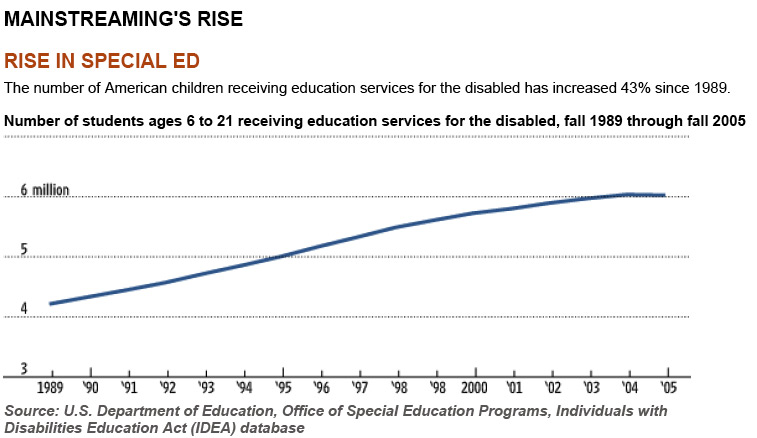
Click for a larger version
The recent Wall Street Journal article "Mainstreaming Trend Tests Classroom Goals" by John Hechinger included some useful charts along with a look at Key US Special Education Legislation:
Mandates creation of an individualized education program (IEP) for such students. Establishes procedures for parents to challenge related decisions about their children.
Requires review of relevant records by parents and school officials within 10 days of a childs change of placement for disciplinary reasons.
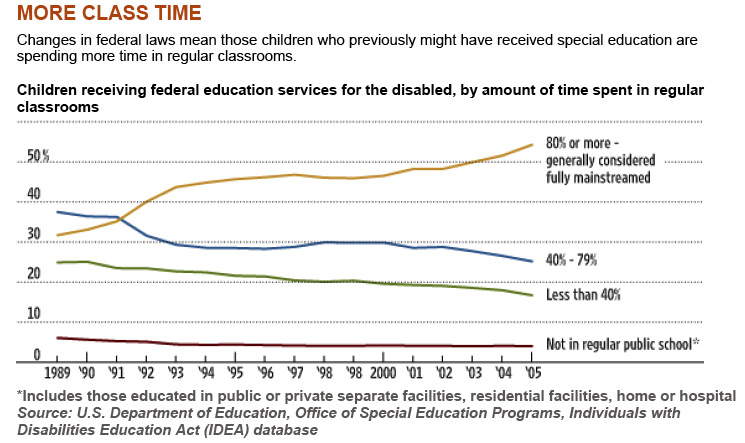
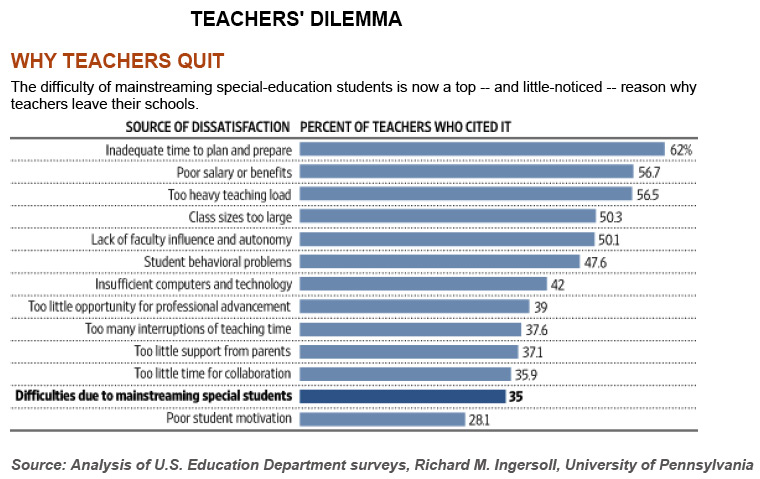

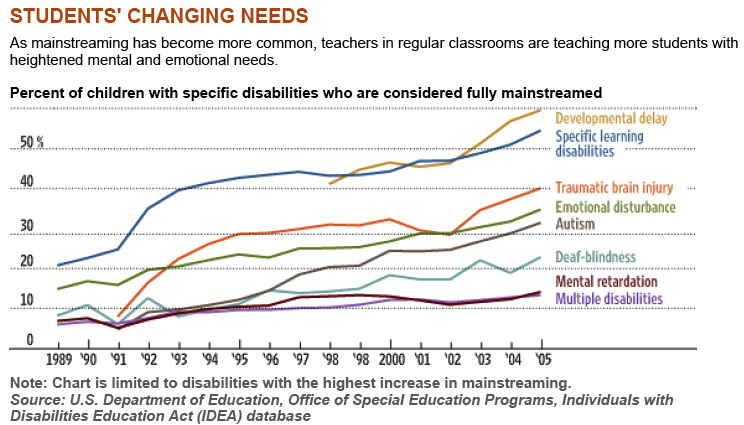 Newsletter signup | Send us your ideas
The U.S. Department of Education released evaluations this week of each state’s efforts to teach children with disabilities, from infants to secondary school students, giving most midding grades.The evaluation process is based on data submitted by the states as mandated by the 2004 reauthorization of the federal Individuals with Disabilities Education Act. The law attempts to move states away from monitoring compliance with the complex legislation, and toward a focus on educational outcomes for students with disabilities.
Newsletter signup | Send us your ideas
The Wrights’ venture was also an effort to end the internecine warfare in the world of autism — where some are convinced that the disorder is genetic and best treated with intensive therapy, and others blame preservatives in vaccinations and swear by supplements and diet to cleanse the body of heavy metals.Autism SpeaksWith its high-powered board, world-class scientific advisers and celebrity fund-raisers like Jerry Seinfeld and Paul Simon, the charity was a powerful voice, especially in Washington. It also made strides toward its goal of unity by merging with three existing autism organizations and raising millions of dollars for research into all potential causes and treatments. The Wrights call it the “big tent” approach.
But now the fissures in the autism community have made their way into the Wright family, where father and daughter are not speaking after a public battle over themes familiar to thousands of families with autistic children.
Newsletter signup | Send us your ideas
Randy and Lynn Gaston received the distressing diagnosis not once but three times.Their sons, Zachary, Hunter and Nicholas, are triplets, and as the brown-haired boys grew into toddlers, Lynn noticed how oddly they played, how little they babbled, how they cried inconsolably at doctor's offices and family gatherings.
Two years ago, when the boys were 4, specialists confirmed the Gastons' suspicions: The boys have varying degrees of autism, a neurological disorder that hampers communication and social interactions and can include obsessive-compulsive behavior.
"It was shocking," Lynn said, "but in my heart, I knew, yes, somebody finally sees it."
Newsletter signup | Send us your ideas
The Supreme Court ruled today that parents of children with disabilities need not hire lawyers if they want to sue public school districts over their children’s special-education needs.In a case of interest to parents and educators across the country, the justices ruled in favor of a couple from the Cleveland suburb of Parma who were unhappy with the school district’s proposal to meet the special needs of their autistic son.
Jeff and Sandee Winkelman were unable to afford a lawyer to sue the Parma City School District over the program designed for the youngest of their five children, Jacob, who was 6 when the lawsuit begin about four years ago.
In general, federal law allows people to represent themselves in court. But most federal courts have barred parents of children with disabilities from appearing without a lawyer in cases filed under the Individuals with Disabilities Education Act, or IDEA, which guarantees all children a “free appropriate public education.”
Newsletter signup | Send us your ideas
The public school enrollment of autistic children, whether born into privileged or impoverished circumstances, has gone from a trickle to a flood. Their legal rights are crashing up against strapped school budgets.Under two federal laws — the Individuals With Disabilities Education Act and the Rehabilitation Act, both passed in the 1970s and revised over the years — all special-needs children, including those with autism, are entitled to free and appropriate public school educations in the least restrictive environment. And, science shows, the sooner children with autism get treatment, the better their odds of speaking, reading, learning and eventually living independently.
A breakthrough discovery, released Feb. 18 in the online publication of the journal Nature Genetics, could mean that someday medical science might pinpoint the disorder in infancy, or even before birth. Researchers homed in on the genes behind autism, putting an early DNA test within reach.
Newsletter signup | Send us your ideas
But when students resume classes in the fall, fewer special education teachers like Bartlett will be available to work with Karega and 228 other of the Madison School District's 3,600 special education students.2007 - 2008 MMSD $339M+ Citizens Budget [72K PDF] [2006 - 2007 $333M+Citizen's Budget]That's because the School Board last week voted to save $2.2 million in the 2007-08 school year -- by far the largest single amount cut and one-fourth of the total budget reduction -- by making a major change in the way special education teachers are allocated to the district's schools.
There's been little public outcry about the cut, compared to the howls over the board's decision to close Marquette Elementary and end free busing for private-school students. But some think those affected by the budget maneuver, which is generating a mixture of concern and praise, don't fully realize the effect yet.
Newsletter signup | Send us your ideas
It's a contentious fact that has run through so many Madison School Board races and referendums in recent years:Links: Madison spending, student and staffing history. 2006/2007 MMSD Citizen's Budget. Carol Carstensen's thoughts on a 2007 Referendum.Madison schools spend a lot -- $12,111 per student during the 2005-06 school year.
If the district is spending that much, how can it be in crisis?
The answer is complex and a bit murky. Yet a few things are clear.
Liberal Madison has long spent more than most K-12 districts in Wisconsin. This was true before the state adopted school revenue limits in the 1990s, and the caps only reinforced this today.
"When revenue caps went in, everyone was basically frozen in place," Madison School Superintendent Art Rainwater said Friday. "We do spend more than the state average. But that has been the expectation of our community."
So why does Madison spend more? Berry points to Madison's higher number of staff who aren't teachers. Madison hires a lot of social workers, psychologists, nurses and administrators.
Madison spends more per pupil than Racine, Green Bay and Kenosha -- as well as the state average -- on student and staff services, administration and building and grounds. And Madison's non- instructional costs are rising as a percentage of its spending.
"Madison is actually de- emphasizing instruction," Berry contends.
In addition, Berry suspects Madison is over-identifying students for learning disabilities.
Newsletter signup | Send us your ideas
As some of you may recall, back in December, I posted a few questions to the members of Madison Partners for Inclusive Education. As a result of that posting, several members of each group have met a couple of times in order to try and make personal connections and identify areas of shared concern and potential joint advocacy. It is too early to say how that effort is going. I, personally, am ever hopeful that we can find the patience and persistence needed to build a foundation of mutual understanding and trust, a foundation upon which we can ultimately work together for all children.
I would like to share a recent exchange from the MUAE list serve (where MPIE members have been welcome since the get-go -- in fact, more than one are longtime MUAE list serve members). In response to a post about one of the BOE candidates, an MPIE member wrote the following:
I would like to clarify something that was misstated in a recent post. Madison Partners for Inclusive Education (MPIE) does NOT promote or endorse COMPLETELY heterogeneous classrooms ALL the time. The group does not think completely heterogeneous classrooms all of the time is in the best interest of children with disabilities. Their website goes on to explain their philosophy: http://www.madisonpartnersforinclusion.org/whatisinclusion.html Thank you for understanding this and clarifying in future posts.
I then replied:
Thanks for the clarification, though I really think we are in agreement on this point. Certainly the inclusion decision for students with disabilities should be a flexible one, based on the specific nature of the disabilities, the specific educational needs, and the family's preference for their child. Most of us know, for example, about IDEA and the K-12 IEP process. We know, too, that our high schools offer alternative classes and other learning options for those students with disabilities for whom the "regular" classes are not appropriate.
I am sure we get sloppy with our language, at times; but our language errors are surely inadvertent, mostly because -- like all parents -- we are simply thinking about our own children, whether or not they are thriving, and whether or not their needs are being well met by our schools. We are guilty of being good parents. Nevertheless, we apologize.
The fact is, we do not want much of anything to change for students with disabilities. (We would like to see the state and federal governments pay a larger portion of the tab for special education -- can we encourage your group to take the lead on that issue at the local level?). We support all of the flexibility, all of the options, and all of the tailoring of educational programming that goes on for them during their years in the MMSD. MUAE stands absolutely with MPIE on that, as I see it (though obviously I really can't speak for everyone). We are your partners there.
We ask the same of you.
I wonder, will you be our partners in getting our children's educational needs met in the same way that the needs of students with disabilities are met? Just as you do not think placement in completely heterogeneous classrooms all of the time is in the best interest of children with disabilities, so do we think such placement is inappropriate for our children. Full days spent in "regular" classrooms does not necessarily meet our children's educational needs any better than it does your children's needs. We are told the District is committed to giving each student the appropriate "next level of challenge." And yet too many of us know (or have) "formerly bright" students who have become turned off to school as a result of too many years of insufficient challenge and chronic boredom. They are miserable. They are in pain. They are not growing well at all. Meanwhile, our advocacy efforts on our children's behalf are too often met with disdain, deception and complete stonewalling. We do not yet have the same legal foundation on which to stand as you do.
We at MUAE are simply asking for the same flexibility -- in thinking, in approach, in educational opportunity and in classroom placement -- for the District's highest potential, highest performing students that students with disabilities experience. Nothing more; nothing less.
Can you and the other MPIE members support us in that position as wholeheartedly as MUAE members support you in yours? (That's really the question I was asking of you in my SIS post a while back.)
I hope so.
Newsletter signup | Send us your ideas
The Madison West High School PTSO held a school board candidate forum Monday night. Topics included:
I applaud the West PTSO for holding this event. I also liked the way that they handled questions: all were moderated, which prevents a candidate supporter from sandbagging the opposition. I attended a forum last year where supporters posed questions before local parents had the opportunity.
Video and mp3 audio clips are available below. Make sure you have the latest version of Quicktime as the video clips use a new, more efficient compression technique.
Opening Statements: Video mp3 audio
Question 1: For Seat 3 Candidate Beth Moss (vs. Rick Thomas) regarding Madison's High Schools: Video mp3 audio
Question 2: What did you do to pass the last referendum and what will you do for the next? Video mp3 audio
Question 3: What values do you bring to the ($333M+ budget) decision making process? Video mp3 audio
Question 4: The MMSD's demographics are changing with more students with special needs while many families feel that they have less resources available for their "normal" students. How would you balance the needs of these various constituencies so that the families without special needs students don't leave the Madison Metropolitan School District? Video mp3 audio
Question 5: for Marj Passman (opposed by Maya Cole); Answering a recent Isthmus question about "How do you play with others", you said that you saw your role as convincing fellow board members as to the correctness of your views. You didn't say anything about listening to others. What role does listening play in your new board member job description? Video mp3 audio
Question 6: Given the statistics in Sunday's paper that only about 30% of Madison households have kids, how does that affect your approach to "selling" another referendum? Video mp3 audio
Question 7 – All Candidates
Please explain your views on additional charter schools given the success of Nuestro Mundo here in Madison and several offerings in Appleton just to name a few?
Question 8 – All Candidates
How can the school district provide for second languages to be taught to all students starting in Kindergarten and continuing through all grades?
Question 9 – All Candidates
The Board will be hiring a new superintendent. Please discuss what you believe is the top 3 criteria for a superintendent. You are free to ignore my request to address communication between Board and Administration/Superintendent, Boards communication with public, Superintendent and Public.
Question 10 – All Candidates
What role should School Board, Parents and Educator play in changing state law which adversely affect our schools?
Question 11 - Rick and Maya
What accountability mechanisms do you envision?
Question 12 – All Candidates
What is your position on the health insurance issue for teachers, that is the WPS option versus HMO’s?
Candidate responses to these questions can be found here.
Newsletter signup | Send us your ideas
Madison School Board Seat 5 candidate Marj Passman talked with Tony Castañeda recently on WORT-FM. Marj faces Maya Cole in the April 3, 2007 spring election. Marj and Tony discussed health care costs, curriculum, governance, special education, this website, and the Madison School District's $331M+ budget.
Listen via this 5.7MB mp3 audio file. A transcript will be posted when available.
Newsletter signup | Send us your ideas
 The Madison School Board heard a presentation on the district's special education program, which currently serves 4,314 students, Monday evening. Watch Jack Jorgenson's presentation via this video.
Links:
Newsletter signup | Send us your ideas
"No place is perfect, but I wanted the place that was the most perfect for us and them," says Ms. O'Gorman, 44. "To me, it's better than leaving them a house or my 401k."Locally, the well known Waisman Center has brought families to the Madison area.Across the country, a small but growing number of parents like the O'Gormans are dramatically altering their families' lives to pursue the perfect private school for their children. While past generations of parents might have shifted addresses within a town to be near a particular school, or shipped junior off to boarding school, these parents are choosing school first, location second. "I hear about it all the time," says Patrick Bassett, president of the National Association of Independent Schools, or NAIS, in Washington, D.C.
Germantown Friends School in Philadelphia says four families have moved to the area in the past two years so their children can attend the school. Hathaway Brown School, an all-girls school in Shaker Heights, Ohio, reports five such families, four of which moved in the past few years. "It's been a little more frequent in the last two or three years," says Sally Jeanne McKenna, admissions director at Polytechnic School of Pasadena, Calif.
Newsletter signup | Send us your ideas
Jane Healy, an educational psychologist and author of Failure to Connect: How Computers Affect Our Children's Minds and What We Can Do About It doesn't agree that video games and computers for children will give them a leg-up in the competitive world of the 21st Century. "Behind the big push to get kids onto computers is this idea that if we don't, they won't become functional members of the 21st century," she says. "That's not only false, it's dangerous."
In Healy's opinion, electronic gaming at a young age can lead to shorter attention spans, a lack of internal motivation, difficulty with problem solving and a lack of creativity. She thinks kids should avoid computers entirely until the age of 7.
But while harried parents may love the videos, to suggest that it therefore means they're good for kids is like suggesting that Coca-Cola (nyse: KO - news - people ) is a health drink because millions of customers love it.
Good learning games, on the other hand, can be simple and cheap. A game of jump rope, for example, promotes fitness, coordination and social skills, while basic board games like Hasbro's (nyse: HAS - news - people ) Candy Land and Snakes and Ladders teach children about rules and consequences.
So, by all means, give your kids a leg up on learning when picking out their gifts this year. But consider doing so with a set of blocks, a board game or a jump rope.
Newsletter signup | Send us your ideas
Middle school isn't an easy time for anybody, but it was especially difficult for Jordan Johnson.His fellow students teased him about the cane he used, and his teachers frequently forgot to provide worksheets and other materials in the large type he needed because of a progressive vision loss called retinitis pigmentosa. He would fall behind and frequently lose work, but his parents wouldn't learn of his problems until quarter grades came out, said his mother, Sally.
That ended when he transferred to the Waukesha School District, under the state's open enrollment program, to use the district's virtual high school, iQ Academies at Wisconsin, which allows students to attend classes via computers set up in their home.
"Ever since, I've been getting pretty good grades," said Jordan, 16, whose family moved to Hudson recently.
Newsletter signup | Send us your ideas
I have a few questions for Barb and the other members of MPIE. I hope one or more of them will take the time to answer.
As I look over the course catalogs for the four high schools, I see that each school has both a Special Education Department and an English as a Second Language Department (although they may not be called exactly that at each school). Each of these departments in each of the four high schools offers an extensive range of courses for students who qualify and need the specialized educational experiences offered within these departments. Many of the courses offered by these departments fulfill graduation requirements and so can be used as curriculum replacement for the "regular" courses.
Here are my questions:
Newsletter signup | Send us your ideas
 | The Madison Partners for Inclusive Education presented information to the School Board Monday evening. Watch the 38 minute video. |
Newsletter signup | Send us your ideas
My daughter is the "Mothering Type". You know the kind. She still loves dolls beyond her friends, and loves pets, and she took the babysitting class as soon as possible so she could be around small children. She is always the person in the class the helps and socializes with the high needs kids in her classroom too. One day while I was volunteering at her school, a very nice mom of a high need autistic child was in her class, to discuss what she needed the students in this class to know. She discussed her child's sensitivity to sound, high stimulation, and the need for calmness. During this discussion the students in the class discovered that this student had a sibling. A student inquired about this sibling and who's class (teacher) he/she was in....
The mother responded that her other child went to a private school in town because she wanted that child to have the best education possible. I sat there stunned for a moment. This mother has the right to send her child wherever she believes they fit best. She has the right and the honor to elect where to send her child for an education but I was stunned. There sat my daughter rubbing this child's back to calm them down from the stress of the conversation, and I am thinking "Is my child a part of a social experiment? Did I send her to this public school to socialize poor behaving children and high needs children and see what happens?" Remember when parents of high need students fought hard to intergrate their children into normal classrooms? Remember when parents were mad they had to pay to send their special need students to private schools? Are we reversing this trend in the opposite direction?
I know several parents with dual children in the district. One functioning at a high level and one with special needs. This was my first thought of the public school being a place to put your special needs child and not your high functioning child. What an interesting development. Obviously this Mom loves her children and wants the best for both of them, but I somehow came away from that interaction with a new outlook. Public education is now the place to put your special education child and then you pay to put you high functioning child somewhere else. Didn't we just reverse this trend in the 80's so that special needs would be intergrated? If all parents felt this way we would have a real problem. One day the public school may be nothing but high need students. I find this a curious development.
My husband is a psychiatrist, with two very psychotic sisters. We are very knowledgeable in the world of mental health. The mental health institutes were abolished and legislation passed to develop local mental health clinics to care for these patients so they would no longer live in those unhealthy mental health institutes. The problem is no federal funds followed and the local mental health clinics were never developed. Now you can find homeless and imprisoned mentally ill across the nation. I find a similar situation with the high need students. A federal mandate to intergrate high need students followed by a substandard of funding. It is as though we are repeating ourselves with societies highest need citizens. I suppose I felt a sense of "well it is O. K. to send my high needs child to public schools but if I want my high functioning child to make it in the world I need to send them to a private school". Or maybe I felt a twing of "yuck, public school is for the needy but not for the smart." I don't know and I know I am being unfair to this mom but it made be think about how I sometimes think my children are a part of a social experiment.....and I am unsure if the experiment is for the better or worse for my children. Either way it is an unusual and noteworthy development.
Newsletter signup | Send us your ideas
Board member stirs controversy
Baraboo News Republic
Thursday May 25, 2006
By Christina Beam
BARABOO - New Baraboo School Board member Kevin Bartol
(
"There are some people in this country that cannot be educated," Bartol said to the board. "They may have their eyes open, but there's no one awake upstairs."
His comments Monday came as part of the board's review of district
policies, including one for "Programs for Students with Disabilities." The first sentence of that policy reads that the board "shall provide a free and appropriate public education in the least restrictive environment for students with disabilities who reside within the district."
Bartol proposed the board add a modifier before the word student, such as "educable," so that if a child who "can't be taught" wants to enter or stay in a Baraboo public school the district is not required to serve him or her.
"Every child can be taught," said Director of Special Ed Gwynne Peterson said, who added the district is under federal obligation -as well as moral and ethical - to teach every student.
"I don't think that's true," Bartol said. "What if you teach them for two or three years and they haven't learned anything?"
High School Principal Machell Schwarz responded, "Then we work with them and try everything we possibly can." Bartol requested the board look into the legalities of modifying the disability policy.
By Tuesday word of the exchange had spread around the district, District Administrator Lance Alwin said, and he had received feedback from community members troubled by Bartol's comments.
"Any family that has a child with special needs would be very disconcerted to know we were thinking about defining the type of child we intend to work with," Alwin said. "All children shall be served. Until I'm told differently, I have no intention of beginning to socially exclude any child that shows up at our doorstep."
In an interview Wednesday Bartol did not back down from his statements but said he was misunderstood by administrators and other board members who took offense to his comments.
"To my knowledge, all the students that are attending the Baraboo School District fall into the category of being able to be educated," he said. "But it is feasible and it has occurred in other school districts where students that because of some type of brain damage were not be able to be educated and yet they were allowed to go to school."
In a statement from Wisconsin Association of School Boards Wednesday,
attorney Nancy Dorman advised the district state and federal laws entitle all children to an education, and the district's obligation to provide it cannot be waived through local policy.
It's possible those state and federal laws implied that "students" were children capable of being educated, Bartol said. He said ideally the district would have a team of experts determine if children with severe cognitive disabilities were making progress in the public school setting. If after a year or two they hadn't improved, he said, they could go elsewhere.
"Public school systems are not a baby-sitting service or a nurse care
service for children such as those," he said. "They're a place to educate students."
Peterson, who also investigates discrimination and harassment complaints in the district, said she was outraged by Bartol's "discriminatory and prejudicial" remarks.
"It's frightening to me that someone in a position making decisions on the education of the students in our community believes these kinds of things," she said.
Education for severely cognitively disabled students is adapted and
individualized to the children's needs, Peterson said, but it still
qualifies as education. Special ed teachers may work with a student to
learn to hold his head up, she said, freeing the student to be more
independent and spend his energies learning new tasks and concepts.
"We have had very young students with developmental disabilities who you might look at and just by appearance decide this student can't learn," she said. "I've seen those kids, and I've seen how far they do come."
The district's policy for students with disabilities borrows heavily from state and federal legislation, such as the Individuals with Disabilities Education Act, which defines disabilities and schools' obligations to serve students.
Bartol said the whole issue is probably moot if the board is unable to make any policy changes. "I'm not going to be upset about it one way or another," he said, "and hopefully no one else gets upset about it one way or another."
Bartol was elected to the board after a recount of the April 4 election had him winning by a three-vote margin over write-in candidate Doug Mering. Bartol, who was on the same ticket as a five-year, $7.5-million referendum, ran on an anti-referendum platform.
Newsletter signup | Send us your ideas
Five years ago we moved to Madison. A big factor in this decision was the expectation that we could rely on Madison public schools to educate our children. Our eldest went through West High School. To our delight the rigorous academic environment at West High transformed him into a better student, and he got accepted at several good public universities.
Now we are finding this promise betrayed for our younger children. Our elementary school appears to be sliding into disarray. Teachers and children are threatened, bullied, assaulted, and cursed at. Curricula are dumbed down to accommodate students who are unprepared for real school work. Cuts in special education are leaving the special needs kids adrift, and adding to the already impossible burdens of classroom teachers. To our disappointment we are forced to pull one child out of public school, simply to ensure her an orderly and safe learning environment.
Unless the School Board addresses these challenges forcefully and without obfuscation, I am afraid a historic mistake will be made. Madison schools will slip into a vicious cycle of middle class flight and steady decline. The very livability of our city might be at stake, not to mention our property values.
To me the necessary step is clear. The bottom five to ten percent of students, and especially all the aggressive kids, must be removed from regular classes. They should be concentrated in separate schools where they can receive the extra attention and intensive instruction they need, with an option to join regular classes if they are ready.
Meanwhile regular schools should be populated by children who can actually remain in their seats and do school work. Money can be saved by increasing class size. Achievement of underprivileged kids would improve when harmful distractions are removed and teachers can focus on teaching instead of constant discplinary management.
I have boiled things down to three theses, which I imagine most Madisonians would agree with:
I sincerely hope we can maintain a viable city and its great schools. In the case of Madison these two are inextricably tied together.
Timo Seppalainen
Newsletter signup | Send us your ideas
I received a copy of this personal essay -- a letter to the Administration and BOE -- last night. The author said it was fine for me to post it, if I thought it was worth it. I most definitely think it's worth it because it so poignantly describes a family's real life experience and frustration in our schools ... not to mention their agony over whether or not to move elsewhere.
Our kids are in 5th, 4th and 1st grades. I am really very concerned about our son going into sixth grade next year. He has some special education needs related to Asperger Syndrome, such as sensory defensiveness and skills to do with what some have called "theory of mind" (self-control, recognizing and assessing others' points-of-view and feelings, anger management). I love the idea that Spring Harbor is smaller because of his sensitivities to light, personal space issues, noise levels and the like. I do not like that they are relatively inflexible in meeting special needs otherwise because they are small and missing some services - or severely limited - due to space and spending constraints. I also do not like that we would have NO options as to who his special ed case manager/teacher would be, because there is essentially one person to cover it all for each grade, whether or not they display and apply the kind of flexibility that being a "cross-categorical" special ed teacher demands.
His teachers at XXXXX have generally managed to meet his needs relative to AS pretty well, but they are kind of at a loss as to what to do with his obvious degree of intellectual ability because they can only address so many different needs at once, and for him, it has repeatedly come down to crisis management. He has had very competent and caring teachers much of the time, but when there are a variety of academic levels and associated needs in one classroom, some of them just can't keep more than about half of the class engaged at any one time. His 4/5 teachers (for example) have been teriffic, but his 2/3 teacher(s) did not understand him or his needs at all (for example, including one of his special ed teachers (!), they had no idea of his level of intellect and thought that when he had nervous breakdowns and "meltdowns", he was "misbehaving" and needed "consequences for his misbehaviors"). Our 4th grade daughter skipped over first grade, going from Kindergarten to second (after not having been allowed to start Kindergarten "early" even though she could read and do basic math). Even then, as far-and-away the youngest in a 2/3 class, she was a 2nd grader grouped mainly with 3rd graders in most areas (hurrah for her teacher for daring to group them and reach out to all levels!!), and was at loose ends by the beginning of 3rd grade because all of her academic peers were gone (on to 4th grade). It is a very good thing that her teacher thought she was the best thing since sliced bread, or her fidgeting, non-linear thought patterns and concomittant anxious perfectionism in 3rd grade would have alienated the poor woman completely. That teacher continued to let her go as far as she wanted to in math (with one boy as a peer there), occupy her own spelling group, and read as much as she could on the side while also keeping up (easily) with the highest book group/reading group the teacher could run (she felt they needed at least three people to read the same book and try to discuss it at all!). When our daughter was working on other subjects during other groups' discussion times, she did her own work well and listened to the groups going on around her enough that she used to blurt out answers during reading groups other than her own. Her teacher used to joke that she was in ALL the (5) reading groups! For science, they were as cramped as everyone else by the standardized "blahness" of Foss, because that is what they have to use, and it does not allow any room at all for creativity and differentiation by even the best teachers (much less by a typical elementary teacher who generally feels that science is their shallowest subject).Now, in 4th grade in a 4/5 class, she has a teacher who cannot seem to differentiate to save her (or my daughter's) life. She has all of the kids on the same page in the same math textbook at the same time, in her fourth grade math. Thank God we finally approached the teacher she teams with across the hall and who teaches the 5th graders from both their classes math, and worked out to have our daughter switched over to there by Thanksgiving - but it took months and she was a basket case mentally and emotionally, from not being challenged at all in math, and having the naughtiest kids around assigned seats next to hers (so she could "calm them down" and "help them", I'm sure), resulting in a complete lack of concentrated work time to do the work in the first place. She literally is on medication for the stress and anxiety resulting from being in this class. And she is too damn nice to share what she shares with us with her teacher, because she wants everyone to like her. So it sounds like we are claiming she feels this, that and the other, even with her trying to soften the blow with "well-kind-ofs" or, "it's-been-better-latelys" when we do get in to see her teacher with her along.
I am so tired. I am tired of being the brass, obnoxious mom who seems to think only her kids are gifted (which is not true - I teach special ed myself, and I know what brilliance lurks behind some learning disabilities and what level of boredom and frustration being some emotional disabilities), and I am tired of having to come up with all the suggestions for solutions and new ideas myself. At least they have been willing to try those suggestions recently, but I honestly don't think they understand that we are not harping on our daughter to "be the best" and "work more", and expecting that the teacher concentrate only on her and her needs. Anyway, I am just tired. If I am going to do most of the instruction myself, then at least I should be homeschooling her or be her "learning coach" for virtual schooling, and get some of the credit for it. On the other hand, I also hate to take her out of our school now, because they need more kids like her who care and work hard, not fewer!!
I am sorry: I know you have heard all this a million times. I believe in quality public education and I hate the thought of everyone with kids who need more challenge than is typical out of our public schools. But I also need to do what's right for my own kids. I don't know how much to tell of what to whom, and not have them just think I am yet another annoyed white upper-middle class parent who thinks her children are the smartest around and just wants all the educational services to go to them. I am not, and I don't.
I meant it when I said I almost cry when I start thinking about all this junk, and let it start getting to me. I know what it is like myself, to be a really bright (okay, "gifted") kid who is afraid to show it because everyone will think you're stuck-up or just a complete geek that no one would ever want to spend time with in any circumstance beyond allowing you to do all the work on a "group, cooperative learning project". And my teachers were largely supportive of me - I hate to think of what would have happened to me if I had not gotten the support I needed from my teachers and my school(s). Especially my daughter who reminds me so much of me - I don't want her to end up with even more insecurities and emotional problems than I had to go through. (said with a rueful smile, but at least 75% seriously)I know what it is like as a teacher to have 21 kids with 21 wholly different sets of needs, staring at you and expecting help in learning what they need to know, day after day. It is bad enough when you have seven 7th graders in a reading class, ranging from two who cannot even identify letters and sounds, all the way through two who can "read" at a low third grade level but not understand more than half of what they read. When I think of trying to meet their needs at the same time as trying to meet the needs of ten other learners who range from "average", through "gifted" and on into "highly gifted/genius" levels...? I can't sleep at night trying to imagine that! It is hard enough trying to actually engage learners at levels "only" five to two grade levels below expectations. Trying to engage learners from typical through gifted in the same class at the same time, is almost impossible, even if you DO know how to differentiate well. And teachers are not paid enough for the kind of planning time that would take, on top of what they already work at teaching and planning for classes of learners even close to the same abilities.
Newsletter signup | Send us your ideas
BBC:
He believes the genes which make some analytical may also impair their social and communication skills.A weakness in these areas is the key characteristic of autism.
It is thought that around one child in every 100 has a form of autism - the vast majority of those affected are boys.
The number of diagnoses seems to be on the increase, but some argue this is simply because of a greater awareness of the condition.
In a paper published in the journal Archives of Disease of Childhood ($), Professor Baron-Cohen labels people such as scientists, mathematicians and engineers as 'systemizers'.
Newsletter signup | Send us your ideas
 | Madison United for Academic Excellence [www site] held a Madison School Board candidate forum Tuesday evening, January 17, 2006. Maya Cole, Michael Kelly, Lucy Mathiak and Arlene Silveira participated (election website). Candidate statements and questions appear below: |
|
Newsletter signup | Send us your ideas
From Lauren Mikol:
The Department of Educational Services would like to advise staff, parents and community members of a public forum on November 9 sponsored by the State Superintendent's Council on Special Education.
The purpose of the forum is to gather public input on significant topics related to special education in Wisconsin including IDEA 2004 and state special education law and disproportionality issues in special education.
Open to anyone interested to attend and give input.
Newsletter signup | Send us your ideas
Study spells out new evidence for roots of dyslexia
(Posted by University Communications: 5/31/2005)
Report of newly released research by Mark Seidenberg and colleagues.
Addressing a persistent debate in the field of dyslexia research, scientists at UW-Madison and the University of Southern California (USC) have disproved the popular theory that deficits in certain visual processes cause the spelling and reading woes commonly suffered by people with dyslexia.
Rather, a more general problem in basic sensory perception may be at the root of the learning disorder, the scientists reported May 29 in the journal Nature Neuroscience. The work suggests new ways to identify dyslexics and to assess the many unevaluated techniques teachers use to help dyslexics in the classroom.
For the full press release, go to: http://www.news.wisc.edu/11252.html
Newsletter signup | Send us your ideas
Special education is a hot topic here, with school board meetings exploding into shouting matches over what services children are entitled to under federal law and parents spending thousands of dollars on appeals to force the school district to provide those services for their children.
The parents say they have no choice: the district, one of the state's most affluent, is fighting just as hard to hold the line on skyrocketing special education costs.
Newsletter signup | Send us your ideas
The following story from the April 13, Appleton Post-Crescent reports on a school district in Wisconsin that is actually adding staff to both gifted and special education.
News-Record staff writer
NEENAH � The equivalent of four teachers will be added to the Neenah Joint School District next year to enhance its special education, and gifted and talented programs.
Last week, the Board of Education set the staffing level at 480.5 teaching positions for 2005-06, compared with 476.5 this year.
The changes will cost taxpayers an additional $244,000 next year.
Two additional teachers and one additional paraprofessional will be hired for special education.
The number of special education students in Neenah has increased by 5 percent to 948 during the last 15 months because of more cases of autism and speech and language disabilities, according to Anne Lang, director of special education.
That means one in every seven students in Neenah receives special education services.
The staffing plan also authorizes 1.5 additional positions for the district�s gifted and talented program.
One teacher will be hired for a new magnet class for highly intellectual students at Shattuck Middle School. It will be an extension of the magnet class begun this year at the elementary level.
Neenah parent James Godlewski said his fifth-grade son has blossomed in the magnet class. He asked that the program be continued in middle school.
�Promoting the excellence of our talented students, whether it be in athletics, in music or academically, is a very important aspect of what makes the Neenah Joint School District an important and special place,� Godlewski said.
A half-time gifted and talented position will be added at the elementary schools, reversing a cut made last year.Neenah High School will get 2.5 additional teaching positions next year, including one for the recently approved alternative high school for at-risk students that will be housed at the Boys� and Girls� Brigade.
Administrators initially had sought 3.5 additional positions as a result of an accounting error.
The increase in staff at the high school will be offset by three fewer positions at the elementary schools. Administrators projected a 4 percent decline in elementary enrollment next year.
Duke Behnke can be reached at 920-729-6622, ext. 32, or by e-mail at dbehnke at newsrecord.net.
Newsletter signup | Send us your ideas
Amy Hetzner writes that school finance reform is necessary, but no one agrees on the formula. Hetzner points out the strange nature of this issue: spending, in many cases has gone up significantly despite "spending controls". Excellent article. Steven Walters writes a followup today on the proposed sales tax boost.
The State Journal has posted four more editorial pieces on schools:
Newsletter signup | Send us your ideas
Diana Jean Schemo writes about States' efforts to get around the No Child Left Behind improvement requirements:
Under the federal No Child Left Behind law, every category of student at Broad Acres � including special education � must show improvement or the entire school can face penalties. But like a dozen other states, Maryland is hoping to circumvent those rules, asking to count students like Ms. Grant's only as children of poverty, a big group that would hide any lack of academic growth.Maryland officials say their proposals would avoid large numbers of schools being labeled "in need of improvement" when only small numbers of students are doing poorly. If changes are not made, said Nancy Grasmick, Maryland's superintendent of schools, "there'll be a lot of anger on the part of the community," some of it possibly directed at the special education students.
Newsletter signup | Send us your ideas