February 20, 2005
Question for Ruth Robarts: Better fallback plan required, or new building?
Thanks, Ms. Robarts, for calling attention to the problems with MMSD's fallback proposal for boundary changes on the west side, if a referendum to build a new elementary school should fail. You point out that under the fallback plan, too many kids would be coming and going from some schools, and that the boundary changes would disproportinately affect certain schools on the west side.
Do you know if anyone has come up with a better proposal to handle west side growth, in the event we can't build a new school?
I studied MMSD's posted proposals on the web site and came away with the impression that the administration couldn't figure out a way to make room in the west side elementaries to cover 2010 projections without either building a new school or reshuffling a lot of kids around now. It was my sense that they were trying for a solution that would preclude the need for new boundaries, at least for 5 years.
It did also cross my mind that maybe on purpose they're making all the alternatives to building a new school look bad.
If this is the case, I would think someone should be able to propose a better fallback plan. Do you know if anyone has? In other words, in objecting to the administration's fallback proposal, are you saying we need a better fallback plan (and that you know of one), or that we'd better pass a building referendum?
Thanks for any help with this, and also for your alert.
Why I Oppose the Administration's Recommendation for School Boundary Changes if the Leopold School Referendum Fails
On Monday, February 21, the Long Range Planning Committee of the Madison School Board will hear the administration’s explanation of five options for reducing overcrowding at Leopold School and providing seats for students from new housing developments on the west and southwest side of the district. Last Monday, after I asked the administration to withdraw options that it will not recommend, a set of nine options dropped to five. Of the remaining five options, the administration recommends only two choices. Option A (3A2 PDF) depends on passage of a referendum to build a second school building on the Leopold grounds. Option B (3D1 PDF) assumes that the referendum fails. Madison Schools Boundary Change web page.
I cannot support Option B, the fallback option in the event that the proposed Leopold referendum fails. There are important but unanswered questions about how the proposed school boundary changes would affect the middle and high schools on the west side. However, more compelling to me is that this option moves 1137 students to new elementary schools, including 516 low income students, and moves them in a way that will excessively disrupt many of the eleven affected schools.
It is difficult to measure the disruption to a school of students moving both in and out of the attendance area. Net changes in the school enrollments do not capture the impact of moving students in both directions.
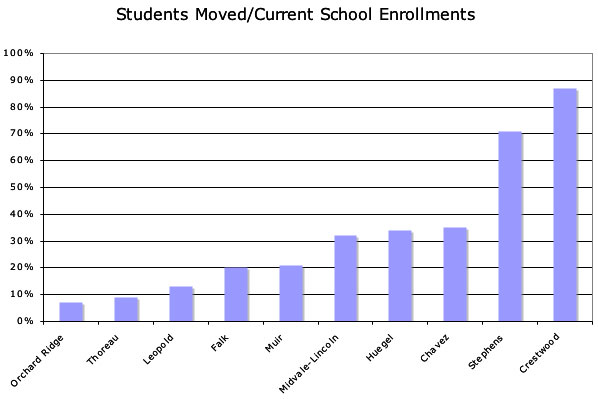
For example, the current enrollment of Stephens Elementary School is 444 students. Option B moves 214 students to new schools. At this point only 230 ( 51%) of the current students remain at Stephens. Then Option B adds 100 new students from other schools and the enrollment rises to 330. The net change looks small—90 additional students. However, 314 students have changed schools to make this adjustment. My approach gives Stephens a disruption rate of about 71%.
My chart compares the total number of students moved in and out of ten elementary schools on the west side to the current enrollments of those schools. I use the resulting percentage as a rough measure of disruption to the school. This approach demonstrates that the net change in students may be small, but the number of students changing schools is very large in proportion to the current size of the school in Option B. It is only a rough measure. However, the chart directs attention away from what appear to be minimal net enrollment changes to the impacts that families and schools will experience when coping with moves of students in and out of the same schools.
Option B also has an important impact on one east side school. It moves 120 students from Midvale-Lincoln School to Glendale Elementary School. Glendale School enrollment would increase from 267 to 387, a 45% increase in students in one year.
Roger Price Budget Presentation
Roger Price, the Madison School District's Assistant Superintendent for Business Services presented a look at the upcoming year's district budget last Monday night (2.14.2005). Roger forwarded his powerpoint slides (260K pdf) and an excel spreadsheet on tax levies from 1993 to 2005 that he used in his presentation. You can view the presentation (or listen to an audio mp3 file) here.
Barb Schrank took a look at the video clip and has some comments below.
Education Next: Forum on No Child Left Behind
JOHN CHUBB, ROBERT LINN, KATI HAYCOCK, AND ROSS WIENER: Do we need to repair the monument?
An A-Maze-ing Approach to Math
Barry Garelick on our "National crisis in mathematics education". Fat Link on Barry Garelick.
Diversity Forum: Madison School Board Candidates
Barbara Golden:
Saturday March 12, 2005 @ 5:00p.m. at Edgewood College (Predolin Center Auditorium) [Map with Driving Directions], sponsored by Money, Education Prisons (MEP) with support from the Madison NAACP. 88K PDFMAFAAC web site.WE ASK QUESTIONS OF THE CANDIDATES THAT YOU WON’T HEAR ANYWHERE ELSE. BEFORE YOU VOTE, FIND OUT WHERE THEY STAND