School Information System

Madison School Board Workshop: Evaluate Business Services?

The Madison School Board had several interesting discussions Monday night. The first was a proposed 3rd party evaluation of the District’s Business Services Department. This discussion is somewhat in response to the complaint that, given budget choices, the Madison School District lays off teachers rather than accountants.


Watch This Discussion – Quicktime

MP3 Audio

The 50 minute video provides a very interesting look at the different perspectives that the Madison School Board Members have on evaluating district operations and general decision making. I thought Carol did a nice job making the discussion happen.

Carol Carstensen, Lawrie Kobza and Ruth Robarts provided written comments on the Business Services evaluation – click the link below (well worth reading).

I also understand that the Board will start looking at next year’s budget this fall, rather than waiting until the spring.

(more…)

Share

… Schools Can’t Do it Alone – East St. Louis

Claudio Sanchez, All Things Considered:

As Washington policymakers talk of leaving no child behind, the reality in places like East St. Louis, Ill., is that schools can’t do it alone. When the school day is over and during the long summer vacation, children in these communities face poverty, crime, broken families and despair.

Audio

Share

Getting More Girls to Study Math

Dan Fost:

“There’s still a big disparity between the percentage of women in science, engineering and technology versus the percentage of men,” Milgram said. “I think there has been a tendency to define certain things as masculine and feminine. Science and technology are defined as masculine.”
Milgram will be joined on the panel by Ellen Spertus, a computer science professor at Mills College and part-time software engineer at Google; Margaret Torn, a geological scientist at Lawrence Berkeley Lab; Neveia Chappell, product marketing engineer for Agilent Technologies; and Violet Votin, a recent graduate of Stanford University in cell biology.

Share

Energy Saving Daylight Savings Change?

Reader Erika Frederick emailed this article by John Fialka:

As a step to save energy, Congress appears poised to extend U.S. daylight-saving time for two months, starting it earlier, on the first Sunday in March, and ending it later, on the last Sunday of November.

The move was first approved in May as part of the energy bill by the House. The idea has now been agreed upon by House and Senate committee staffs, with the approval of both Republican chairmen and ranking Democrats. That means it is likely to be approved by the full House-Senate conference committee, which begins squaring the differences between the House and Senate versions of the bill this week.

The change is not without controversy:

The Air Transport Association has asserted that its members, long-distance American airlines, could lose millions of dollars because of schedule disruptions that the proposal would cause by throwing U.S. arrivals at foreign airports out of synchronization with European schedules and Europe’s system of awarding “slots,” or landing rights at airports.

Some large church groups also oppose extending daylight-saving time into the early spring and late fall, because it would require children to wait for school buses in the dark. “Without the light of day, they are more susceptible to accidents with school buses, or other motorists, and the darkness also provides cover for individuals who prey on children,” said the Rev. William F. Davis, deputy secretary of the U.S. Conference of Catholic Bishops, in a letter written to the House sponsors of the measure

The proposed change is part of the Energy Bill.

Share

Oakland Mayor Jerry Brown on Education

Recently married Oakland Mayor Jerry Brown comments on the LA Board of Education’s proposed requirement that all students take the courses necessary to enter California State Universities.

Share

The Other 82%

From the FightingBob website comes this piece by a Milwaukee school teacher:
http://www.fightingbob.com/article.cfm?articleID=402
His thesis: “Education spending alone cannot eliminate the educational advantages that affluent children have over poor children, but that does not mean we should not try.”
I sympathize with him and admire his dedication, but wonder still if there are reliable data to tease out the connection between dollars and performance. One thing I noticed in his arguing that we get good value for our teacher salaries and other per pupil spending was a reliance on the high ACT performance in this state, a statistic often touted. But I’d like to see an honest accounting of who these high scoring students are who actually take the test, out of the general student population, as well as where they attend school and what the per pupil spending is there and what the demographics are. In other words, I think that the use of the ACT statistic is a bit misleading.
I am certainly not advocating throwing in the towel on kids who come to school less prepared than those more fortunate, but I also think it’s time for an honest discussion on just how much difference our public school system can make. In a world of infinite resources, we would spend unlimited funds to reach just a few, but that’s not our reality. I would hope very much that we could have this conversation without labeling or name-calling.

(more…)

Share

A New Deal for Schools

The Economist:

So the challenge is different. But the solution once again is to be found in the education system—particularly America’s rotten public schools. Republicans are, generally speaking, reluctant to spend more money—partly because they represent people in richer school districts and partly because so much cash has already been wasted (America spends much more than other countries). Meanwhile Democrats, enslaved to the teachers’ unions, are generally unwilling to countenance reforms such as school vouchers and testing; and they are also keener on affirmative action, the system of race-based preferences which makes universities less competitive and keeps the poison of race in a debate which is best focused on income.
This is depressing. But a political solution of sorts is going begging. Republicans should be willing to spend more cash on schools in poor areas (including on teachers’ salaries) in exchange for the Democrats accepting structural reform. The No Child Left Behind Act, which introduced some forms of testing and the daring possibility of shutting down some bad schools, was an important step forward. But more is needed. Otherwise two Americas really will start to jump out off the map.

Share

100 Black Men of Madison Golf Outing

100 Black Men of Madison seeks individual golfers/foursomes for it’s 5th Annual Golf Outing on Monday July 25th at Cherokee Country Club.

(more…)

Share

Johnny Winston, Jr. Annual Streetball & Block Party

The Johnny Winston, Jr. 2005 Streetball and Block Party will be held on Saturday August 13th from 12 noon to 7:00 p.m. at Penn Park (South Madison – Corner of Fisher and Buick Street). Last year this event raised the funds necessary to keep the MMSD varsity reserve football and boys and girls basketball program operational.

(more…)

Share

Where Teachers Rule: Schools with no Principal

Sarah Carr:

That’s largely because Community High lacks a traditional hierarchy. The school is one of a rapidly growing number of so-called “teacher-led” schools that operate without administrators – including principals and assistant principals. The teachers make decisions about the curriculum, the budget and student discipline. They perform peer evaluations of each other. Often, they come to decisions through discussion and debate, taking a vote if a consensus is not reached. The buck stops with them, not in the principal’s office.
In Milwaukee, which is a national leader in the movement toward teacher-led schools, there will be at least 14 such programs next year, and that figure does not count private schools.

Share

Can We Talk?

Can we Talk about communication?
My three busy kids participate in swimming, baseball, basketball, soccer, football, book clubs, math olympiad, etc….. you get the idea, my kids are healthy, busy kids. I see hundreds of families participating in these events, games, parties, and all of the commmunications relayed to every family right here in Madison is done on the computer, internet or better known as e-mail. If I did not have access to e-mail I would show up at incorrect times, fail to pay fees, miss important meetings, for all these activities my kids participate in and I volunteer to help. What does this have to do with MMSD education? Nothing, and I mean nothing at all because MMSD doesn’t communicate with me via computer. When I moved to Madison, the PR on the Web and Madison.com lead me to believe this was the future, the end all, the best the US offered. I wish they spent more on PC’s than PR because the technology in our district is archaic.

(more…)

Share

Study Great Ideas, But Teach to the Test

Four letters to the editor in response to Michael Winerip’s recent article on teaching to the test:

Ms. Karnes learned all sorts of exercises to get children excited about writing, get them writing daily about what they care about and then show them how they can take one of those short, personal pieces and use it as the nucleus for a sophisticated, researched essay.
“We learned how to develop good writing from the inside, starting with calling the child’s voice out,” said Ms. Karnes, who got an A in the university course. “One of the major points was, good writing is good thinking. That’s why writing formulas don’t work. Formulas don’t let kids think; they kill a lot of creativity in writing.”
And so, when Ms. Karnes returns to Allendale High School to teach English this fall, she will use the new writing techniques she learned and abandon the standard five-paragraph essay formula. Right?
“Oh, no,” said Ms. Karnes. “There’s no time to do creative writing and develop authentic voice. That would take weeks and weeks. There are three essays on the state test and we start prepping right at the start of the year. We have to teach to the state test” (the Michigan Educational Assessment Program, known as MEAP).

Read the full article here. Read the letters to the editor by clicking on the link:

(more…)

Share

Public Hearing on Wisconsin Virtual Schools

WisPolitics:

After months of encouragement from the Wisconsin Coalition of Virtual School Families to engage in such a dialogue, the State Superintendent of Public Instruction Elizabeth Burmaster has recently convened a group of expert advisors to examine virtual schools and online learning in the public PK-12 schools of Wisconsin. Their findings may include suggested changes in DPI practice, administrative rule, and Wisconsin States.
The Wisconsin Coalition of Virtual School Families will testify before this committee.
Monday, July 18th
9:30 AM to 2:30 PM
Room G09 of the GEF2 Building
101 South Webster Street, [Map]
Madison
The Coalition consists of hundreds of parents, students, teachers and others concerned about the educational opportunities available to Wisconsin families. It was formed in the wake of legal threats to virtual education in Wisconsin. On January 7, 2004, the Wisconsin Education Association Council (WEAC) filed a complaint in Ozaukee County Circuit Court against a virtual public school (the Wisconsin Virtual Academy), the Northern Ozaukee School District, and the Department of Public Instruction (DPI) in an effort to shut down the school. They argued that parental participation was too significant. DPI, although it originally had approved the charter school, took the union’s side in the dispute in December.
Public and the media are invited to attend.
For further information, contact:
George 414-763-3661

Share

Board & Administration Don’t Respond to Request

I’ve twice sent the e-mail below, and I have received no acknowldegement or response.

From: Ed Blume
To: rprice@madison.k12.wi.us
Cc: jwinstonjr@madison.k12.wi.us ; arainwater@madison.k12.wi.us ; ccarstensen@madison.k12.wi.us
Sent: Thursday, June 23, 2005 9:26 PM
Subject: Program spending
Roger,
Can you please tell me the amount the MMSD budgeted and spent in the 2004-2005 fiscal year on the following programs:
TEP
Reading Recovery
Read 180
Direct Instruction
Educational Framework
SIP
Could you also give me the amount budgeted for each program in the 2005-2006 fiscal year?
Ed Blume

Share

Practicing Math with Your Children

Catherine Johnson sends a link to her Kitchen Table Math Wiki. Quite useful. (What’s a wiki?)

Share

National High School Survey Results

The National Governor’s Association, as part of their “Redesiging American High School initiative” recently conducted a survey of over 10,000 American students, ages 16 to 18. Major findings include:

  • Less than 1 in 10 say high school has been “very hard.”
  • More than one-third say high school has been “easy.”
  • 32% “strongly agree” they would work harder if high school offered more demanding and interesting courses.
  • 71% think taking courses related to the kinds of jobs they want is the best way to make their senior year more meaningful. (they also mention taking courses that count as college credit)

The survey also collects information from those who dropped out or are considering dropping out of high school.

Survey Conclusions:

  • It is critical to communicate to students that they need to seek out and take rigorous courses to be prepared for the future
  • Educators and parents must do a better job of encouraging students to find meaning in senior
    year by emphasizing its importance to their futures.

  • The message “you too can benefit from a high school education,” if continually reinforced, can work because a majority of teens who dropped out
    or who plan to drop out want to finish high school.

Read the entire summary here (250K PDF)

Share

Task Forces Need Community Expertise & Open Debate

I delivered the following statement to the MMSD Long Range Planning Committee on July 11:

Back on October 18, 2004, I spoke to the Long Range Planning Committee at a meeting at Leopold School. I suggested that “the Long Range Planning Committee take the time to think beyond an April referendum on a new school” at Leopold. I see the West side task force as just that, and I compliment the board for forming the group.
I also made the statement that “citizens of the broad Madison school community include people with a tremendous amount of expertise in education, management, finance, urban planning, real life, and more. You should use every possible opportunity to tap their knowledge.”
I’m here again tonight to restate my plea that the Long Range Planning Committee draw on the vast knowledge and experience of people in the community, because as I said in October, “I have this perhaps naive democratic belief that the more ideas you get the better the final outcome.”

(more…)

Share

Joe Gotjard, Toki’s New Middle School Principle

Cristina Daglas:

He was known as “Big Joe” when he transitioned from student to staff member in the Madison school district more than 10 years ago. But times have changed and titles altered, and “Big Joe” is now Principal Gothard.
For the first time in 13 years, Joe Gothard will not be coaching football this season, and he says he’s open to hobbies. However, the new top job at Toki Middle School and chasing after his three young children at home may just take up this 32-year-old’s “extra” time.
Just recently hired, Gothard is settling into his new office and working diligently to get accustomed to the environment before the year’s beginning rolls around. He’s hoping to make the transition as smooth as possible keeping consistency for the Toki community. But the scenery isn’t all too new for the Madison native, a true product of the district’s “grow your own” administrator initiative, which one board member campaigns for rather frequently.

Share

UW’s Lawson Software Implementation Problems

Channel3000:

The “Lawson Project” aim to replace old mainframe technology with new comprehensive payroll software.
A News 3 investigation finds after years of work, and tens of millions of dollars, system officials still can’t say when it will be powered up or how much it will cost.
“We have spent more money at this point than the people who initially envisioned the project thought we would have spent five years out, and we’re not as far along as they thought we would be,” said Don Mash, chairman of the steering committee for the APBS/Lawson project, which is an unprecedented endeavor that will impact every UW System campus and its 42,000 workers statewide.

The Madison School Distrct has also been working to implement a new Lawson HR/Finance (ERP) System.

Share

The Evils of Excellence

Susan Black on the “Trouble with Classroom Competition”:

How much competition is too much?
I asked myself that question some years ago when I was appointed director of curriculum and instruction for a Midwestern city school district. Making the rounds of the district’s 12 schools I found competition everywhere.
In a 10th-grade English class, I found kids writing essays on citizenship for a local bar association’s contest. Moving on to a middle school, I saw seventh-grade science students drawing posters for a county humane society contest in hopes of winning stuffed animals. That afternoon, I watched third-graders hop around a gym as part of a national charity’s pledge drive. The kids who hopped the longest won crayons and coloring books.
When I counted up the number of competitive activities in classrooms — more than 200 in one school year — I knew it was time to put on the brakes. It wasn’t easy, but with the school board’s support and principals’ cooperation, we reclaimed the instructional program. Competitive activities were still allowed, but they were held after school for students who wanted to sign up.

Via Joanne Jacobs and Gadfly. I wonder if students in India, China, Japan, Finland and elsewhere have curriculum planners with this point of view? This thinking seems rather Soviet, where everyone is the same except for those who are not.

Share

Education Gains are Lost on High School Students

Alan Borsuk:

The message put forth by, among others, U.S. Secretary of Education Margaret Spellings on Thursday, is that the data point to the urgency of the hot new issue in education: What can we do about high school?
The priority of the issue increased with the release of data on long-term, nationwide trends in performance by students in math and reading. The information is from the National Assessment of Education Progress, a Department of Education effort that calls itself “The Nation’s Report Card.” NAEP has been testing samples of students from across the United States since the 1970s.
The results show that among 9-year-olds, reading performance in 2004 was up a significant amount, compared with both 1999 and the oldest data available, from 1971. In fact, the overall score was the highest on record.
But among 17-year-olds, the average score in 2004 was exactly the same as in 1971, and the trend has been downward slightly since the early 1990s.

Share

Sam Dillon, NY Times: For Parents Seeking a Choice, Charter Schools Prove More Popular Than Vouchers

CLEVELAND – When Ohio enacted a pilot program of school vouchers here a decade ago, David Brennan, an Ohio businessman, quickly founded two schools for voucher students.
Three years later, with voucher programs under attack, Mr. Brennan closed the schools and reopened them as charter schools, another educational experiment gaining momentum at the time.

(more…)

Share

Planning for MMSD Legislative Committee for 2005-06

As chair of the MMSD School Board’s Legislative Committee for 2005-06, I post information about state and federal laws and legislative issues related to the Madison Schools on this blog under Hot Topics , Madison School Board Legislative Committee blog.
In June I asked MMSD staff for the committee, Joe Quick, for his ideas on future directions for the committee. My questions and his answers are available under as well as news reports and background materials.

(more…)

Share

School districts adopt boundary changes

Boundary changes were approved by both Madison and Verona school boards last night.

Share

Private funds ok’d for soccer

Private funds for 2 West High Soccer teams were approved by the School Board on Monday, July 11th. The approval is for one year.

Share

Blame State Leaders if Schools Close: WI State Journal Editorial

The Wisconsin State Journal’s July 11th editorial says Blame State Leaders if Schools Close “…state leaders are just as much if not more to blame if the Florence School District shuts down. And don’t be surprised if more school districts, particularly in rural areas, are soon forced to consider such a drastic option.”
When will our state leaders get down to business? How much more do our kids have to take?

Share

Florence School Board Votes to Close School District

The Florence County School Board in northern Wisconsin followed through with its plan to shut down the district, voting 6-1 for a second and final time Monday to dissolve next July.
Download file Florence School Board Votes to Close School District

Share

Edward Tufte in Madison 8/8

Presenting Data and Information: A One-Day Course Taught by Edward Tufte is in Madison August 8, 2005 ($320/person):

I attended his course in Chicago last year. Highly recommended. More on Edward Tufte.

Share

Merens Interviews Wisconsins’ Future Jack Norman

WPR’s Ben Merens interviewed Jack Norman, research director for the Institute for Wisconsin’s Future on their “Wisconsin Adequacy Plan”. Real audio – WPR is not, unfortunately podcasting at the moment. The Institute’s Website has a number of useful articles and publications. Their Wisconsin Atlas of School Finance is worth looking at.

Share

School Naming Rights For Sale

Plymouth-Canton, Mich., school district is selling school naming rights.

Share

Arizona School Drops Textbooks

MSNBC:

A high school in Vail will become the state’s first all-wireless, all-laptop public school this fall. The 350 students at the school will not have traditional textbooks. Instead, they will use electronic and online articles as part of more traditional teacher lesson plans.
Vail Unified School District’s decision to go with an all-electronic school is rare, experts say. Often, cost, insecurity, ignorance and institutional constraints prevent schools from making the leap away from paper.

Share

Goodbye, Class See You in the Fall: Looping in Ardsley NY Public Elementary School

The New York Times
July 11, 2005
Goodbye, Class. See You in the Fall.
By ALAN FINDER
ARDSLEY, N.Y. – Even though it was his last day of kindergarten, Zachary Gold, a bright, enthusiastic 6-year-old, said he wasn’t scared about moving up to the rigors of first grade. Unlike most kindergartners at the Concord Road Elementary School in this Westchester County village, he already knew who his first-grade teacher would be.

(more…)

Share

Common Expectations for All Middle Schools

Does the MMSD Web site have a link to the document titled “Common Expectations for All Middle Schools,” which the superintendent mentions as the guide for MMSD middle schools? If the site has a link, I couldn’t find it.

Share

Letter from Art Rainwater to Sherman Parents About Changes at Sherman and Plans for all Madison Middle Schools

In response to inquiries from Sherman Middle School parents, Art Rainwater wrote a letter to parents/guardians dated June 27, 2005. In that letter he mentioned District plans to revisit the core courses taught middle school students – “…we will revisit this document [Common Expectations for All Middle Schools] again, beginning this summer, and address each of the areas in the document to ensure that our middle schools are consistent in the courses offered to each student.” I didn’t read anything about parents being included in such a process. If you have comments re your child’s middle school academics and/or what processes you hope the administration follows – send them to the School Board at www.comments@madison.k12.wi.us.
Download Superintendent Rainwater letter to Sherman parents/guardians

Share

K-12 Math Curriculum: A Visit With UW Math Professor Dick Askey

UW Math Professor Dick Askey kindly took the time to visit with a group of schoolinfosystem.org writers and friends recently. Dick discussed a variety of test results, books, articles and links with respect to K-12 math curriculum. Here are a few of them:

  • Test Results:

    Wisconsin is slipping relative to other states in every two year NAP (sp?) Math test (4th and 8th grade). In 1992, Wisconsin 4th graders were 10 points above the national average while in 2003 they were 4 points above. Wisconsin students are slipping between 4th and eighth grades. In fact, white and hispanic children are now performing equivalent to Texas students while Wisconsin black students are performing above Washington, DC and Arkansas (the two lowest performers). He mentioned that there is no serious concern about the slippage.

    30 years ago, the United States had the highest % of people graduating from High School of any OECD country. Today, we’re among the lowest. We also have a higher drop out rate than most OECD countries.

    Said that he has asked Madison Schools Superintendent Art Rainwater twice in the past five years if our District asked for and received corrections for the current connected Math textbooks.

    Mentioned that CorePlus is evidently being used at West High but not Memorial

    Asked why these math performance declines are happening, he mentioned several reasons; “tame mathemeticians”, declining teacher content knowledge (he mentioned the rigor of an 1870’s California Teacher exam) and those who are true believers in the rhetoric.

  • Books:

    Knowing and Teaching Elementary Mathematics: Teachers’ Understanding of Fundamental Mathematics in China and the United States

    The Schools by Martin Mayer

(more…)

Share

Ask the Cognitive Scientist

Daniel T. Willingham:

Modality theory—the idea that students differ in their visual, auditory, and kinesthetic abilities and learn more when instruction is geared to their strengths—has been a popular idea for decades. But research has found that learning is enhanced by designing instruction around the content’s best modality, not the student’s.

Share

Something New: Sun Prairie’s Website is Now a Blog

The Sun Prairie School District has launched a new website, essentially a blog with links. The key for Sun Prairie or any organization is to embrace all that that internet offers (audio, video, links, background information) and provide timely and useful information. They must frequently update the site. I wish them well. PBS’s Frontline provides a great example. Their stories include video/audio clips, transcripts, documents and extensive background data.

Share

More on the Florence School District

Phil Brinkman takes a look at the Florence School District, which may disband:

“I want them to teach our children within their means,” said Tibbs, probably the chief antagonist in what has become a battle between cash-strapped residents and an equally cash- strapped school district over the future of education here.
Members of the Florence County School Board are finally conceding that battle after voters last month turned down the third spending referendum in the past two years. The measure would have let the district exceed state- imposed revenue caps by $750,000 a year for three years.
“There are other school districts of the same size, wealth and makeup that aren’t dissolving,” said Tony Evers, deputy state superintendent of public instruction. “Clearly, things happened in this school district that didn’t happen in other school districts.”
But Evers said Florence County’s death spiral provides sobering evidence that the state’s school funding formula is overdue for a change. Under that formula, state aid is provided in roughly inverse proportion to a community’s property wealth, and the total revenue a district can raise is capped. If costs exceed that – and officials in districts from Florence to Madison to Milwaukee say they are – districts must ask property taxpayers for more.
“We will need to, absolutely, continue to find better ways to measure wealth than property value,” Evers said.

note: this link will suffer “linkrot” as Capital Newspapers takes their links down after a period of time.

(more…)

Share

“No” on Intellectual Pluralism

George Archibald:

“There are no secret agendas here. Divergency [of views] in the classroom is being stifled. More and more, what we can say in the classroom is being restricted,” said Mr. Jackson, a high school English teacher from Kennewick, Wash.
Teachers have a responsibility “to instruct students how to think, not to indoctrinate,” he said. “All this is trying to do is to open this up and to prevent restriction” of the academic freedom of students as well as teachers.
But Tom Oxter, president of a Florida higher-education group that led the fight before the Florida Legislature against a similar campaign for a student academic bill of rights there, denounced the proposal as “really just the beginning of a witch hunt” by conservatives.

Via Joanne Jacobs. Joanne also summarizes the NEA’s comments on the Achievement Gap.

Share

Superintendent Rainwater’s Letter to Governor Doyle

Madison School Superintendent Art Rainwater via WisPolitics :

Thank you for making public education in Wisconsin a priority in the budget you presented to the Legislature – a proposal that protected Wisconsin’s overburdened property tax payers and the children of the state. Unfortunately, the budget before you resembles little of what you offered for our taxpayers and K-12 students.
Since the inception of state-imposed revenue limits in 1993, Madison has cut over $43 million in its “same-service” budget and eliminated almost 540 positions – including 121 positions for the 05-06 school year. It is disingenuous for Republican leaders to claim their $458 million school aid increase as “historic,” when over 90 percent of the resources are targeted for school property tax relief, not for school programs and services. We have long surpassed cutting fat from our local budget, but have cut into bone as we increase class size in secondary instruction, eliminate classroom opportunities for students and cut support staff who assist our most needy students and families.
I urge you to use your veto authority to the fullest extent in order to restore revenue limit increases that keep pace with inflation, versus the GOP plan that cuts the allowable increase to 1.4 percent – less than half of the current inflation rate. Aside from increases in categorical aids, the revenue limit increase represents a school district’s only opportunity to fund critical programs for students.

I’m glad the Superintendent sent his comments to the Governor. It will be interesting to see where the Governor, facing a 2006 election campaign, lands on the amount of increased spending for Wisconsin schools (the battle is over the amount of increased money: the Republican budget includes a 458M increase to the 5.3B base, while Governor Doyle originally proposed a $900M increase via borrowing and other shifts).

Madison is also somewhat unique in this discussion in that about 25% of its budget comes from the State (State school spending will go up faster than inflation, in either case. The puzzle for me is the 1.4% that Superintendent Rainwater refers to. Is this due to Madison’s flat enrollment and/or based on the formulaic penalty we face for our higher than average per student spending? The enrollment situation is sort of strange, given the housing explosion we’ve seen over the past 10 years), whereas other districts receive a much higher percentage of their budget from state taxpayers. Further, Madison taxpayers have supported a significant increase in local school support over the past decade. The District’s Operating Budget has grown from $200M in 1994-1995 to $317M in 2005-2005. Art’s letter mentions “cut $43 million in its “same-service” budget and eliminated almost 540 positions – including 121 positions for the 05-06 school year”. There’s also been some discussion here about District staffing changes.

I also believe the District needs to immediately stop operating on a “same service approach”. Given the rapid pace of knowledge and information change today (biotech, science, engineering among others) AND the global challenges our children face (Finland, India, China and other growing economies – see Thomas Friedman’s The World is Flat) things that worked over the past decade may no longer be practical or affordable for that matter.

Having said all that, it is difficult to manage anything when the curveballs are coming rather quickly. It would be great for the state to be consistent in the way it provides funds for 25% of our District’s budget. Similarily, in the private sector, many would love to see less risk and change, but I don’t see it happening.
Share

It’s About the Kids

Ed,
My vote re the proposal to fund two West High JV soccer teams was about the kids and was for the kids. MMSD’s athletic budget for next year will fund 8 teams in each high school for soccer, but at West the demand from kids is for 10 teams, so the parent proposal was to fundraise for the two teams that school would be short under next year’s team allocation matrix.
I appreciated the parents’ efforts to be proactive on behalf of 50 high school kids who want to play soccer. I appreciated that the parents from West High expanded the name of their group to Madison, recognizing the possible future need to help kids across the city who want to play soccer. I hope we can harness these parents’ positive efforts for future discussions about what we need to do to keep athletics and other educational opportunities strong for our kids.
Further, in my opinion the long-term issue regarding extra-curricular sports is not about the number of teams (by the way, it’s up to 66 teams for all grades per high school in several sports, not just soccer), but a) what high school athletic program do we want for Madison’s children, b) how much does that athletic program cost, c) how much can the District afford to pay, and d) how will we pay for the amount not covered in the budget. The School Board has not had this discussion and needs to have this discussion ASAP.
In the meantime, as a community member on the Partnership Committee I supported this proposal and will continue to be open to new ideas from the community in all educational areas for different ways to build community linkages that will support a strong, complete educational environment for all our kids.

Share

Why One More Team?

Barb,
If each high school will have 66 teams for each grade level, why do parents feel they need a few more soccer teams at West?

Share

I Voted Yes to Privately Fund Two West High Soccer Teams

At its June 27, 2005 meeting, the Partnership Committee listened to a request from West High School parents (Friends of West High School Soccer) to fundraise money for an additional 2 soccer teams this fall. A committee member made a motion to allow parents to fundraise the money and that motion passed unanimously. The entire School Board will vote on the Partnership Committee’s recommendation on Monday, July 11th and I hope the majority of the School Board votes yes.
I am a community member on the Partnership Committee, and I voted yes because I want as many children as possible who want to play sports (soccer in this case) to have that opportunity, and I appreciate the parent group stepping forward to take on the job of fundraising the necessary money to field two more teams. I would also like to thank the parent group for changing their name from Friends of West High Soccer to Friends of Madison Soccer, intending to form a city-wide support group if that becomes necessary so kids can play sports in high school.
Was I concerned about equity issues among the 4 Madison high schools who field athletic teams when I voted yes? Not in this instance, because during the 2005-2006 school year each high school will have the opportunity to field up to 66 freshman, sophmore, junior varsity, varsity and combination athletic teams (264 teams in total). This district-wide team structure has a $2 million+ budget for next year that the School Board approved in June 2005.
Further, the up to 66 teams per school that is budgeted for the 2005-2006 academic year is more than the number of teams East and Lafollette High Schools had during the 2004-2005 school year and less than the number of teams that West and Memorial High Schools had this past school year.
The West High proposal is NOT about one school having teams and another school not having teams because of any disparity due to access to funding. The Athletic Committee that came up with the team structure for next year treated each school equally when it came to the number of teams per sport and total teams that would be funded.
To me, this proposal is about parents and community members a) seeing a demand for soccer greater than the District’s budget can afford next year, and b) working together to come up with a proposal for helping kids play sports. Helping kids – that’s what made so much sense to me in this proposal.
Will the School Board have to have discussions about equity when funding school activities, public vs. private funding for different activities? Yes, definitely, but I don’t think those needed future discussions should stop the School Board from going forward with a proposal that makes sense. I hope a majority of the School Board supports this proposal on Monday, July 11th. I think it’s a proposal that is good for kids, works within the existing athletic infrastructure, and we will be able to learn from this effort for future discussions about how sports are funded. Thank you, parents and community members for coming forward to help Madison’s students.

Share

California English Teacher on Teacher Evaluations

Tod Seal discusses teacher evaluations in three parts:

  • Student Voices

    Students choosing the easy route make up a large percentage of any public school. I’d say that easily 80% of the students in any high school will choose the teacher who shows movies and simply requires basic recall of class lecture over the teacher who reads novels and requires challenging essays. Yes, students in public school choose Advanced Placement (AP) classes.

  • Teacher Voices

    It’s been suggested that there is a struggle to create “objective, articulable standards” [sic] for teacher evaluation. It’s further been suggested that teachers be evaluated based on subjective standards, in the absence of those “articulable standards.” I, for one, certainly don’t want to be judged on subjective standards and I don’t want other teachers evaluated thusly. I wouldn’t judge my students subjectively and I wouldn’t expect any boss to evaluate employees subjectively.

  • Administrator View

    Teachers in my school district are currently evaluated by a bi-annual visit from an administrator (principals and the like). Every 2 years, an administrator spends 53 minutes in my classroom, taking notes on what happens during that time. That 53-minute period, that solitary visit to my classroom on a day and time that I know about well in advance is supposed to be some type of record of how effective I am as an educator. That visit is the single requirement our district has for teacher evaluation.
    Clearly, this is a flawed system

Share

Health Talks Won’t Be Secret

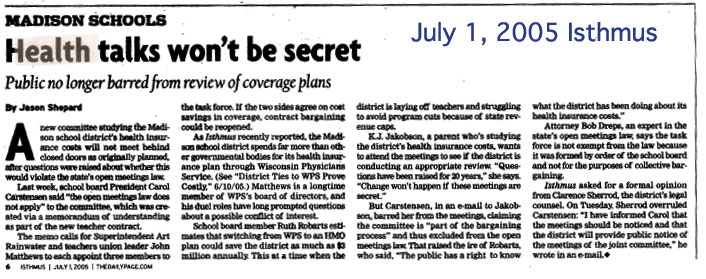
Jason Shepherd wrote about the nature of the Madison School District’s joint committee with MTI (Madison Teachers Inc.)regarding health care costs. Initially, according to Shepherd, Madison School Board President Carol Carstensen said that “the open meeting law does not apply to the committee”.

KJ Jakobsen, a parent studying the District’s health insurance costs, wants to attend the meetings to see if the district is conducting an appropriate review. “Questions have been raised for 20 years,” she says. “Change won’t happen if these meetings are secret”.

But Carstensen, in an e-mail to Jakobsen, barred her from the meetings, claiming the committee is “part of the bargaining process” and thus excluded from the open meetings law. That raised the ire of [Ruth] Robarts, who said, “The public has a right to know what the distrct has been doing about its health insurance costs”.

Read the article here. Isthmus’ web site

Share

Are Students More Equal than Others?

Susan Lampert Smith: “West High kids may have more opportunities because their parents are able to pay so they can play”. Evidently, the issue is $6,000 in the Madison School District’s $320M+ budget.
Meanwhile, Sandy Cullen discusses an attempt to move extramural sports to MSCR (part of Fund 80) as a response to the elimination earlier this year of freshman no cut sports. Madison Superintendent Art Rainwater mentioned:

“Our problem is facilities,” Rainwater said, adding that after-school activities, practices and games, as well as community programs, are already using the space needed for an extramural program. “If we don’t have facilities, we can’t do it.”

I hope and assume that programs for our school age children always come first in these discussions.

Share

Konkel on the City’s Budget Process

Tangential at best to this blog, but deja vu for schoolinfosystem.org readers. Brenda Konkel asks questions about the Madison Police Department’s $44M budget and is accused of “micromanaging”. Interesting times. Read on.

Share

Going Online Keeps Students in Line

Tom Kertscher:

At the same time, a new system for disciplining students also helped reduce the number of Badger Middle School students sent to the dean’s office because of misbehavior, said first-year principal Ted Neitzke, 34. But the use of a daily “blog” – an adaptation of e-mails shared among teachers and other staff – was perhaps more important, Neitzke said. He had used the system a year earlier on his previous job as an assistant principal in Sheboygan.

The blog, Neitzke said, is a “positive, proactive communication tool.”

The West Bend School Board received annual reports from schools on progress they are making on individual improvement plans. Badger, the larger of West Bend’s two middle schools, said reducing behavioral problems was its “greatest achievement” in the school year that just ended.

Share

Gibson: Who Owns the Words?

William Gibson:

We seldom legislate new technologies into being. They emerge, and we plunge with them into whatever vortices of change they generate. We legislate after the fact, in a perpetual game of catch-up, as best we can, while our new technologies redefine us – as surely and perhaps as terribly as we’ve been redefined by broadcast television.

“Who owns the words?” asked a disembodied but very persistent voice throughout much of Burroughs’ work. Who does own them now? Who owns the music and the rest of our culture? We do. All of us.

Though not all of us know it – yet.

Gibson’s most recent book is Pattern Recognition, which is a must read. Gibson’s website.

Share

Developing Credibility

From Debroah Bush-Suflita, Communications Manager of the Capital Region Board of Cooperative Educational Services, Albany, New York:

The most important element of an effective public information program is credibility. Indeed, credibility is the most important element in an effective educational program. You cannot lie or obscure the truth, because you will quickly lose credibility. . . .

(more…)

Share

California’s Proposed School Funding Changes

Nanette Asimov:

Since California’s property tax revolt more than 25 years ago, teachers, parents and school supporters have honed their battle skills arguing with politicians in Sacramento for more education money every year.
They haven’t always gotten their way, but since 1988 they have been able to count on a minimum funding level established by Proposition 98, the voter- approved ballot measure enshrined in the state constitution that says schools would be given first priority in the budget.

Share

Only Half of Committees Have Met

Since the committee chairs announced goals for their committees on June 7, only three committees – Long Range Planning, Finance and Operations, and Partnerships — have met. No committees have meetings scheduled for July or beyond.

Share

Online Middle School Math Assessment

Check out your middle schooler’s math skills with an online Saxon Math placement test.
Saxon Math offers excellent math programs from all grade levels. Some parents ask the teachers not to assign math homework to their child and use daily Saxon Math lessons instead.

Share

Florence School District Likely to Close in One Year

In northern Wisconsin Florence County Schools Likely To Close. The local school board voted 6-1 to consider closing the schools.
Since 1998-1999 school year, Florence School District:
student population declined 15%
property tax share of school costs increased 16%
state contribution to school costs decreased 15.7%
cost to educate a child increased 23.3%
With changes like this coupled with the recent absence of meaningful discussions by the WI government on public education, more school closing/mergers are likely.
When are we going to have the discussion – what does it cost to educate a child? When will the WI government get down to seriously discussing the business of financing the public education of Wisconsin’s children and stop the unproductive rhetoric saying we’re spending more on schools than ever without having any idea of what level of investment is needed to fund public education? The state is happy to avoid the question blathering on about taxes and giving money to special projects all the while shifting the costs of education to property tax payers, an approach that won’t work much longer.
How many more school districts have to close? How many more kids have to be displaced?
School district leadership bears some of the responsibility of meaningful strategic discussions about the future of financing public education and examining different approaches. More on that topic in a later blog.
Immediate issue is a state government that is not seriously undertaking the issue of school financing but is giving tax credits to home and private schooling while avoiding important discussions about the financing of public schools, which is part of the state’s constitution. The United States is littered with examples of state governments who have avoided this responsibility – why does WI have to be one of those states?

Share

125 Science Questions

Science Magazine:

In a special collection of articles published beginning 1 July 2005, Science Magazine and its online companion sites celebrate the journal’s 125th anniversary with a look forward — at the most compelling puzzles and questions facing scientists today.

Share

NCTQ Debate on Teacher Compensation

The National Council on Teacher Quality has published their first Square off, where two economists debate: “Are Teachers Underpaid“?

Share

Property Taxes Biggest Share of Income in Milwaukee and Madison Areas

Wistax:

The other part of the state where the property tax burden was high was Dane county, according to WISTAX. The city and town of Madison led the area with property taxes at 8.8% and 8.2% of income, respectively. Five suburbs surrounding Madison also made the top-50 list: McFarland and Mt. Horeb (both 7.4%); Sun Prairie (7.3%); and DeForest and Stoughton (both 7.1%).
..
In a separate part of the report, WISTAX notes that the property tax-to-income ratio is much like a political “heart monitor.” When property taxes relative to income climb above 4%, discontent begins to grow. The study cited several periods in the postwar era when property taxes were unusually high and led to a major change, either in politics or in policy-making. Most recently, this occurred in 1993-94, when property taxes completed a 14-year rise, hitting 4.8% of income. Then, a bipartisan majority in state government imposed school revenue limits and first committed the state to providing two-thirds of local schools’ revenues.

Share

DPI Letter – Optional Class Hours are NOT Part of the Regular School Day

In his letter to a Sherman parent, Michael George, Director of Content and Learning Team wrote:
“The requirements for regular instruction in 121.02(1)(L) are to be scheduled within the regular school day which is defined as “the period from the start to the close of each pupil’s daily instructional schedule.” Times of the day or week during which student attendance is optional are not considered part of the regular school day.”
In May Sherman principal Ann Yehle sent a letter to Sherman parents telling them band, orchestra and vocal music classes would be offered in an optional 8th hour. Parents wrote to DPI for clarification of the state law regarding regarding regular school day.
There will still be an optional 8th hour class with some form of music, but the newest proposal is to offer orchestra, band and vocal music education courses as pull-out classes, pulling students from other classes who want to study band, orchestra or vocal music. I’m left to wonder why students who want to study band, orchestra or vocal music continously have to “double up” their studies – seems like they are being penalized. Why wouldn’t this put additional and, perhaps, unnecessary, pressure on these students.
The entire content of the DPI letter follows:

(more…)

Share

Wisconsin Senate Passes Budget

The Wisconsin State Senate passed their version of the next two year budget early this morning. Read more here:

The bill goes back to the Assembly next week, where it must be approved before it is sent to Governor Doyle. The Senate version increases state support for K-12 public schools by 458M to 5.3billion (the Governor wanted to increase state support by 938M via borrowing and transfers).

I think Doyle, looking toward an election year in 2006, will take a Solomon approach and split the difference via his line item veto powers.

Share

Denver’s New Superintendent

Rocky Mountain News:

Moreover, he will lead the campaign for a mill levy to fund ProComp, the pay-for-performance model that has been approved by teachers and that also has Hickenlooper’s support. Indeed, Bennet is so committed to that model that he hopes to negotiate such a provision as part of his own employment contract, a sure sign of confidence that the job is doable and the challenges are not intractable.
On Monday, Bennet said naming a chief academic officer would be among his highest priorities, and that he expects to start a national search for that person soon. That decision, perhaps more than any other he makes early in his new post, could determine whether he achieves the ambitious goal he has set for Denver: to be the best urban school district in the country.

Joanne Jacobs has some useful links behind this story, one of which is Siegfried Englemann’s piece on students “who are victims of the unshifted paradigm”.

Share

Concerts on the Square: 16 Year Old Violinist

Joan mentioned last night’s Wisconsin Chamber Orchestra’s Concerts on the Square. The concert included the performance of a Dvorak piece by a 16-year old violinist from Janesville Parker, Saya Chang-O’Hara. Conductor Andrew Sewell introduced Saya as follows (paraphrased): “I don’t mean to be political here, but she learned to play the violin in elementary strings“.

Share

Keep School Spending in Check

A reader forwarded this Wisconsin State Journal Editorial:

You have to wonder if the members of the Madison School Board couldn’t benefit from a remedial math course.
Last week, with the School District facing the prospect of having to cut $3.1 million from its budget, the School Board voted to add $651,400 in spending.
No wonder frustrated School Board member Bill Keys felt compelled to warn: “We have a serious financial problem on our hands. I do think the community and the board is in a kind of denial.”
Keys’ words deserve the attention of taxpayers not only in Madison but also throughout a majority of school districts in Wisconsin. Any district that denies the looming threats to its budget risks paying a stiff price.
School boards face uncertain budget circumstances. Schools will benefit from an increase in state spending on education in the next state budget. But how big the increase will be remains undecided.

Share

Wisconsin Property Tax Hikes Outpacing Wages

Wistax:

Aids to local governments increased dramatically since 1955, according to the study. Local school aids rose 10.8% per year, while shared revenues to local governments increased 4.9% annually. However, WISTAX researchers point out that there are questions about the long-term effectiveness of local aids for reducing property taxes. Economic research in Wisconsin and elsewhere finds that state and federal aids to local governments only partially offset local property taxes, as a portion of that aid funds new spending.
The study finds that some limits on local governments have been effective at relieving property taxes and some have not. During the 1970’s, the state imposed cost controls on schools and levy limits on counties and municipalities. Due to an increasing number of “loopholes,” they were deemed ineffective and eliminated in 1983. Recent revenue limits on schools have been more effective, because they do not have similar loopholes. Counties and technical colleges have limits on the tax rates they can impose. However, large increases in property values have limited their effectiveness.

Share

Simply amazing

This season’s Concerts on the Square kicked off with an interesting medley of polka/waltz/cancans, but the best reason to have attended was the performance of a Dvorak piece by a 16-year old violinist from Janesville Parker, Saya Chang-O’Hara. Put simply, she was brilliant. Juilliard should be knocking on her door any day now. It was an honor to hear her play.
But what might be of interest to folks on this site is this: she only started playing when she was eleven, AS PART OF HER SCHOOL’S STRINGS PROGRAM.

Share

FutureTense

Corante launched an interesting new blog on the “Future of Work“. Food for thought.

Share

Sherman’s Curriculum Riles Parents

Sandy Cullen’s article in the June 28, 2005 WI State Journal Sherman’s curriculum riles parents notes:

On Friday, the state Department of Public Instruction ruled that under Wisconsin law, instrumental music instruction must be available to all students in grades seven through 12 during the regular school day.
“It is unusual to pull students from one class to meet instructional time in another class,” said Michael George, director of the Content & Learning Team for the state Department of Public Instruction, who issued Friday’s ruling. “Clearly, they’re not getting the same experience as other students.”

Besides music instruction, Sherman parents are concerned that few students have the opportunity to take 8th grade algebra and that no child will have the opportunity to take a full year of foreign language prior to high school.
Yehle said middle school is a time when students should be sampling many subject areas to gauge their interests and skills, and should be introduced to what it’s like to study a foreign language, rather than develop proficiencies.

Sherman principal Ann Yehle’s comments seem at odd with a) Wisconsin’s Model Academic Standards in foreign language which call for “… a strong foreign language program beginning in the elementary grades” and b) Wisconsin’s Administrative Code – Public Instruction, Chapter PI 8 Appendix 8 Instructional Guidelines which recommend 100 minutes of foreign language instruction per week beginning in Grade 5.
It’s hard to see where Sherman Middle School’s curriculum is not being dummed down for its students compared to other Madison middle schools and to school districts surrounding Madison WI.

Share

Middle School Curriculum

Much afoot at Sherman Middle school. MMSD will look at developing a district-wide middle school curriculum. While that might improve the mess at Sherman, it might also mean watering down the curriculum, eg. math, throughout the district.
http://www.madison.com/wsj/home/local/index.php?ntid=45223
“School Board President Carol Carstensen, who made it one of her priorities to examine how the district’s 11 middle schools are structured and to consider proposals for changes, said that questions and concerns about middle- school curriculum existed before the situation at Sherman boiled over.
“It came to a head around Sherman,” Carstensen said.
Among the concerns is whether the kind of preparation students receive for high school varies depending on which middle school they attend, she said.
In one of her first jobs as the new superintendent of secondary schools, Pam Nash will focus on designing a middle school system that is consistent across the district, Rainwater said.
“Each of our middle schools has developed in a very different way,” Rainwater said, adding, “It provides a tremendous amount of flexibility.”
Carstensen said that while a more centralized model would sacrifice some autonomy and creativity in a school’s ability to meet the needs of its specific student population, she believes that all students should have the same opportunities in certain areas, including instrumental music and advanced math classes.”

(more…)

Share

Bringing Better Nutrition to School Cafeterias

Talk of the Nation:

The school cafeteria line is hardly the place to develop healthy eating habits. Forget fruits and veggies — the typical lunch usually contains fast food staples like pizza and french fries. What can — or can’t — school districts do to make lunches healthier?

audio. Chez Panisse’s Alice Water’s participated in this program (Waters has been active in Berkeley nutrition programs).

Share

Great Decision Making

The current issue of Fortune (2nd of a 2 part 75th anniversary edition) includes some fascinating examples of leadership and decision making. Jerry Useem summarizes the article.

If surmounting your anxieties is step one, step two is letting go of your inner perfectionist because there is no such thing as a perfect decision-maker. Even if you had all the information in the world and a hangar full of supercomputers, you�d still get some wrong.
But there�s a big difference between a wrong decision and a bad decision. A wrong decision is picking Door No. 1 when the prize is actually behind Door No. 2. It�s a lousy result, but the fault lies with the method. A bad decision is launching the space shuttle Challenger when Morton Thiokol�s engineers predict a nearly 100% chance of catastrophe. The method, in this case, is no method at all.
The distinction is important, because it separates outcomes, which you can�t control, from process, which you can. Wrong decisions are an inevitable part of life. But bad decisions are unforced errors. They�re eminently avoidable—and there are proven techniques to avoid the most predictable pitfalls (see Great Escapes).

20 Decisions that made history is also quite worthwhile.

Share

Leopold Referendum Not in Near Term

Cristina Daglas:

The Madison School Board flirted Monday night with the idea of holding another referendum to seek funding for a second school on the Leopold Elementary grounds, but then backed away from it for now.
The board’s Long Range Planning Committee met with parents from Leopold at the school and heard their pleas for another referendum. Two of the three committee members – Juan Jose Lopez and Bill Keys – favored holding another referendum but ultimately moved to table the idea when it was clear that a majority of board members were not ready to go back to the voters so soon after the defeat of a similar referendum on May 24.

Share

Virginia Drops Non-Math Teacher Math Tests

Joanne Jacobs:

Virginia will drop a basic skills test for would-be teachers which measures high-school-level reading, writing and math performance. Instead, the state will develop its own test of college-level reading and writing skills. Only math teachers will be tested on math knowledge.

Here are “advanced math” test prep questions for Praxis I, which is being abandoned. Thirty-five years out of high school, I can do these problems in my head. It’s hard to believe there are people smart enough to teach who can’t pass a basic math test. How are they going to average students’ grades?

Share

Grigsby on WI Sex Education

Rep Tamara Grigsby, via Wispolitics:

  • Wisconsin has the highest incidence of African-American teen births in the nation.
  • Milwaukee has the highest high school drop-out rates for African-Americans in the country, which is directly connected to the high teen birth rate in our state.
  • In 2001, Milwaukee had the second highest teen birth rate of the nation’s 50 biggest cities.
  • Wisconsin has the 14th highest chlamydia rate (17,942 cases reported) and the 21st highest rate of syphilis in the nation (5,663 cases reported).
  • Almost ½ of all new sexually transmitted infections are contracted by 15-24 year olds, despite the fact that this population only makes up 25% of the sexually active population.

Share

Madison Girls Hockey Not On Thin Ice Anymore

Message from Mitch Wolfe, parent organizer for the program:
The WIAA Board of Controls approved a 7 school co-op which includes all four Madison city schools, Middleton, Waunakee, and Monona Grove for the upcoming 2005-6 season.

(more…)

Share

Ethnomathematics

Diane Ravitch:

In a comparison of a 1973 algebra textbook and a 1998 “contemporary mathematics” textbook, Williamson Evers and Paul Clopton found a dramatic change in topics. In the 1973 book, for example, the index for the letter “F” included factors, factoring, fallacies, finite decimal, finite set, formulas, fractions and functions. In the 1998 book, the index listed families (in poverty data), fast food nutrition data, fat in fast food, feasibility study, feeding tours, ferris wheel, fish, fishing, flags, flight, floor plan, flower beds, food, football, Ford Mustang, franchises and fund-raising carnival.
……
It seems terribly old-fashioned to point out that the countries that regularly beat our students in international tests of mathematics do not use the subject to steer students into political action. They teach them instead that mathematics is a universal language that is as relevant and meaningful in Tokyo as it is in Paris, Nairobi and Chicago. The students who learn this universal language well will be the builders and shapers of technology in the 21st century. The students in American classes who fall prey to the political designs of their teachers and professors will not.

Share

Teen Screen

Reader David Lehane emailed this article by Evelyn J. Pringle:

he scheme concocted by the pharmaceutical industry and pushed forward by the Bush administration to screen the entire nation’s public school population for mental illness and treat them with controversial drugs was already setting off alarms among parents all across the country. But in the state of Indiana, the alarm just got louder.
Tax payers had better get out their check books because school taxes are about to go up as the law suits against school boards start mounting over the TeenScreen depression survey being administered to children in the school.
The first notice of intent to sue was filed this month in Indiana by Michael and Teresa Rhoades who were outraged when they learned their daughter had been given a psychological test at school without their consent.
In December 2004, their daughter came home from school and said she had been diagnosed with an obsessive compulsive and social anxiety disorder after taking the TeenScreen survey.

Share

Does Wisconsin’s method inflate graduation rate?

Original URL: http://www.jsonline.com/news/state/jun05/336091.asp
NOTE: THIS LINK LEADS TO A PAGE THAT INCLUDES A CHART THAT IS NOT REPRODUCED HERE
From the Milwaukee Journal Sentinel
Does state’s method inflate graduation rate?
Wisconsin says 92% finish high school; report estimates 78% do

By SARAH CARR
scarr@journalsentinel.com
Posted: June 23, 2005
A new report lambastes states across the country for using flawed, and even “irrational,” methods of calculating graduation rates that ultimately dupe the public.
The report does not criticize Wisconsin as harshly as a few other states, such as North Carolina, but it does offer an alternative method of estimating graduation rates that would put Wisconsin’s rate at 78% for the 2000-’01 school year, 14 percentage points lower than the 92% rate reported for the 2002-’03 school year.
“Every year (states) report these literally preposterous numbers,” said Kati Haycock, director of the Education Trust, a Washington, D.C.-based organization that advocates for disadvantaged students and released the report.
The report suggests that Wisconsin and many other states measure graduation rates in a manner that gives an overly rosy, distorted picture of the number of students who are actually finishing high school in the United States.

(more…)

Share

What schools get SAGE next year?

What criteria does the district use to select SAGE schools?
The board has before it on Monday, June 27, a motion to drop SAGE at Lapham/Marquette (37/24% low-income) and Crestwood (23% low-income). Huegel (41%) and Sandburg (42%) will replace them. The agenda also lists all of the schools scheduled to be designated SAGE schools.
The following schools will be SAGE schools though they have a lower percentage of low income students than Lapham’s 37%: Chavez (29%), Muir (29%), Shorewood (28%), Stephens (32%).
The following schools with particularly high percentages of low-income students do not appear on the list: Glendale (67%), Lincoln (70%), Mendota (73%), Midvale (65%), and Nuestro Mundo (45%).
The MMSD Web site has a list of low-income students in all schools.

(more…)

Share

Education Gets the Schank

Roger Schank spoke at iLaw today:

i had to retire before i could talk about this stuff!
Charles Eliot was the president of harvard 1869-1909 is the most evil man in the history of harvard — he set up the high school curriculum that is still in place TODAY.
If you ever wondered why you took algebra in high school, is because the guy in princeton was selling a textbook on algebra, so he put algebra on high school curriculum!
i’m a math major and a computer science prof, and algebra has never come up in my life, maybe it has in yours.

Roger C. Schank Backbround

Share

Talking To Strangers

Bruce Schneier:

“Many children are taught never to talk to strangers, an extreme precaution with minimal security benefit.”
In talks, I’m even more direct. I think “don’t talk to strangers” is just about the worst possible advice you can give a child. Most people are friendly and helpful, and if a child is in distress, asking the help of a stranger is probably the best possible thing he can do.
This advice would have helped Brennan Hawkins, the 11-year-old boy who was lost in the Utah wilderness for four days.
The parents said Brennan had seen people searching for him on horse and ATV, but avoided them because of what he had been taught.
“He stayed on the trail, he avoided strangers,” Jody Hawkins said. “His biggest fear, he told me, was that someone would steal him.”
They said they hadn’t talked to Brennan and his four siblings about what they should do about strangers if they were lost. “This may have come to a faster conclusion had we discussed that,” Toby Hawkins said.
In a world where good guys are common and bad guys are rare, assuming a random person is a good guy is a smart security strategy. We need to help children develop their natural intuition about risk, and not give them overbroad rules.

Share

Cap Times Editorial Supports Kobza on Use of $240K

The Capital Times:

Newly elected Madison School Board member Lawrie Kobza was wise to move to use $240,000 in money made available by insurance savings to revive Lincoln Elementary School’s Open Classroom Program and to restore “specials” – music, art and gym classes at the elementary schools – to their regular sizes. And the board majority was right to back her move to maintain broadly accepted standards of quality in the city’s public schools.

Share

Capital Times Editorial: Board backs school quality

Newly elected Madison School Board member Lawrie Kobza was wise to move to use $240,000 in money made available by insurance savings to revive Lincoln Elementary School’s Open Classroom Program and to restore “specials” – music, art and gym classes at the elementary schools – to their regular sizes. And the board majority was right to back her move to maintain broadly accepted standards of quality in the city’s public schools.

(more…)

Share

Taught at Home, but Seeking to Join Activities at Public Schools by James Dao, New York Times

The New York Times
June 22, 2005
STRASBURG, Pa., June 16 – Mary Mellinger began home-schooling her eldest sons, Andrew and Abram, on the family’s 80-acre dairy farm five years ago, wanting them to spend more time with their father and receive an education infused with Christian principles. Home schooling could not, however, provide one thing the boys desperately wanted – athletic competition.

(more…)

Share

Newsweek Updates Top 1000 US High Schools List

Jay Matthew has updated his list of the top 1000 US High Schools. The list, known as The Challenge Index, uses a ratio: the number of Advanced Placement or International Baccalaureate tests taken by all students at public high schools in 2004, divided by the number of graduating seniors at the schools in 2004. Newsweek says that although the list “doesn’t tell the whole story about a school, it’s one of the best measures available to compare a wide range of students’ readiness for higher-level work, which is more crucial than ever in the postindustrial age.”
Here’s a list of Wisconsin High Schools included on the Challenge Index. Verona (710) and Madison Memorial (598) were the only Dane County schools included. Milwaukee Rufus King was the top ranked Wisconsin school on the list at 215.
Tom Kertscher takes a look at a recent addition to the list, Grafton High School.

Share

Let them Control Their Culture

From this week’s iLaw conference: “Teach the kids to code. Teach the artists to code. Let them control their own culture.” Are we fostering consumers or creative types? Follow the discussion here.

Share

Dept of Admin June 21 Memo on per-student revenue

http://www.thewheelerreport.com/releases/June05/June22/0622doaschools.PDF
Date: June 21, 2005
To: Marc Marotta
Secretary
From: David Schmiedicke
State Budget Director
Subject: School District Revenue Limits — REVISED
We have received a number of inquiries regarding the impact of the reduction to the allowable per pupil revenue limit increase made by the Joint Committee on Finance (JCF’) in its version of the 2005-07 biennial budget bill (AB 100). As you know, Governor Doyle’s budget recommendations retained the current law allowable increase, which is last year’s allowable increase plus increase in the consumer price
index.
Under current law, the increases are estimated to be $248.48 per pupil in FY2005-06 and $252 in FY2006-07. The JCF version of the budget reduces those increases to $120 per pupil in FY06 and $100 in FY2006-07. For the biennium, this represents a reduction of an estimated $352 million in school district revenues compared to current
law.
On a percentage basis, current law and the Governor’s proposal would provide the average district with per pupil revenue increases of approximately 2.9% in each year (over the state average base revenue per pupil of $8,415 for FY05). Under the JCF version of the budget, the allowable increase would be reduced to 1.4% in FY06 and 1.2% in FY07.
The net increase in school district revenue limits after the JCF reductions to current law can also be compared with the increase in the all-funds state budget adopted by JCF. Compared with the fiscal year 2004-05 base of $24.9 billion, the JCF budget increases all funds spending over the prior year by 5.0% in fiscal year 2005-06 and 2.4% in fiscal year 2006-07. The increase to general fund spending in the JCF budget over the fiscal year 2004-05 base of $12.0 billion is 7.7% in fiscal year 2005-06 and 2.6% in fiscal year 2006-07 over the prior year.

Share

We are Our History – Don’t Forget It

David Gelernter:

I thought she was merely endorsing the anti-war position. But my son set me straight. This student actually believed that if she had lived at the time, she might have been drafted. She didn’t understand that conscription in the United States has always applied to males only. How could she have known? Our schools teach history ideologically. They teach the message, not the truth. They teach history as if males and females have always played equal roles. They are propaganda machines.
Ignorance of history destroys our judgment. Consider Sen. Dick Durbin (D-Ill), who just compared the Guantanamo Bay detention center to Stalin’s gulag and to the death camps of Hitler and Pol Pot — an astonishing, obscene piece of ignorance. Between 15 million and 30 million people died from 1918 through 1956 in the prisons and labor camps of the Soviet gulag. Historian Robert Conquest gives some facts. A prisoner at the Kholodnaya Gora prison had to stuff his ears with bread before sleeping on account of the shrieks of women being interrogated. At the Kolyma in Siberia, inmates labored through 12-hour days in cheap canvas shoes, on almost no food, in temperatures that could go to minus-58. At one camp, 1,300 of 3,000 inmate

More on David Gelernter.

Share

Unprepared: Back to the Basics in College

Melissa Milios:

n high school, I was a 3.8 (grade-point average) student. It was simple for me to get by with the bare minimum. I just got lazy,” says Andrea Edwards, 19, a graduate of Inglewood High. “Now that I’m here, it’s embarrassing — there’s so much I just don’t know.”
“You kind of feel left behind — like, why is my report card lying?” adds 19-year-old Kiwanna Hines, who was in the top 10 percent of her class at Junipero Serra High in Gardena. “I have my grandma, my auntie, my mom, my cousins — all of them are depending on me to graduate college. It’s a lot of pressure.”

The story notes that 8 out of 10 first-time freshman enrolled at Dominguez Hills last fall needed remediation in English and 7 in 10 needed remediation in math. Throughout the 23-campus CSU system, only 43% of the entering freshmen were proficient in both classes. Dominguez Hills president James Lyons summed it up: “There’s a disconnect between what they’re doing in high school to earn that GPA, and what is required and expected at the university level.” Via Eduwonk and Joanne Jacobs

Share

Put “no” voters on task force

The long range planning committee approved motions to address the East and West side “demographics and long range facility needs, including the development of a task force, a charge to the task force, task force membership, task force timeline, and task force process.”
The West side task force will presumably tackle the problem of Leopold overcrowding. The body should definitely include representatives of those of us who voted against the referendum on building a second school at Leopold. Hopefully, an inclusive group will produce a proposal that can win wide-spread support. A task force only of supporters will likely fail to gain needed public confidence.

Share

WI State Budget Update

The Wisconsin Assembly approved a new two year state budget early this morning by a 56-40 vote. Spending increases 6.4%, while the percentage of funds generated by sales taxes goes up 9.9%. Governor Doyle proposed a 16% (!) increase in road projects to 4.4billion. Republicans added $93M to that, creating a 18% increase in road spending. State support for local school spending grows 8.6% (458M) to 5.3billion (Doyle proposed a $938M increase, “paid” for by additional state borrowing and transfers from other programs).

  • Phil Brinkman does a great job summarizing the budget. I appreciate the fact that he included total spending dollars along with the increases.
  • Stacy Forster and Patrick Marley also summarize the Assembly’s budget.
  • WisPolitics’ Budget Blog tracks the Assembly’s activities.
Share

Referenda News: Germantown & Racine

Two interesting looks at Referenda activity:

  • Tom Kertscher finds that Germantown residents are attempting to raise funds for a High School expansion privately first:

    But supporters of the music programs realize that in Germantown – and throughout the Milwaukee area – most borrowing referendums for school building projects have failed in the past year and a half. So they are trying a new approach: Before asking for public money, they plan to raise private money to help fund additions to the high school.
    Germantown parent John Dawson, who is leading plans for a music referendum, said the message to taxpayers will be “we need your help, but we’re not looking for a handout.”

  • Alice Chang reports that Racine voters approved a $6.45M one year operating referendum (a $17.8M two year question failed this past April):

    The reprieve from financial pressure will be relatively short-lived. The district still faces a $13.4 million shortfall next year and likely will be asking voters again for a boost in funding.
    Rather than resting on the success of the spending referendum, School Board members already were looking ahead to future challenges.
    “We have an obligation to make sure we keep an eye on being fiscally responsible,” said board member Randy Bangs, who added that the passage of the referendum proposal was just one battle. “The bigger prize is a better district, which needs the support of the entire community.”
    Bangs said the board will continue to search for ways to make the district more efficient so that next year, if finances necessitate it, the district will attempt to pass a spending referendum for a minimal amount.

  • Brent Killackey has more on the Racine Referendum
Share

Insights into Promoting Critical Thinking in Online Classes

Daithí Ó Murchú and Brent Muirhead:

At the beginning of the 21st. Century, all educators and all educational institutions, at all levels of education provision, are faced with the greatest time of possibility for change and evolution or stagnation and regression. Barker, 1978 in New York, stated that “action with vision can change the world” and the authors, based on their many years of experience working in both traditional and managed or virtual, E-Learning, lifelong-learning environments contend that the promotion of critical thinking is a key element in meaningful, responsible and soulful learning. Our ‘raison d’être’ as educators is to prepare our students for the society which does not yet exist and in doing so, provide them with opportunities to critically assess and transform their experiences into authentic learning experiences (Ó Murchú, 2005). This article explores the thought processes, realities and perceptions of the authors’ on-going experiences in on-line classes and gives their insights into promoting critical thinking in these Managed Learning Environments (MLEs).

Share

Elementary Specials: Funding Restored for All Elementary Special Classes Except Strings? Can That Be Correct?

At the Monday June 20, 2005 MMSD School Board meeting, funding was restored for music, art and gym elementary specials for a total of about $550,000. Can it be possible that all elementary specials, except elementary strings, would be restored? I can’t believe this. Isn’t the elementary string course an elementary music special (part of the School Board approved music education curriculum). If this restoration of funds exclude the elementary string teachers, isn’t this even more demoralizing to a small group of teachers who have already seen 60% of their colleagues laid off. And, what about the nearly 2,000 children who will only learn half what they previously learned in two years – that’s okay? How can these children’s education NOT be affected if they are only learning half the curriculum?
The Administration in March and the School Board last night have made all these decisions without asking one single question about the impact of their decisions on what children will be able to learn. They did not ask one single question about what planning has taken place in music education curriculum in the past year. There hasn’t been any.
Money is not the only issue. I believe a lack of strategic planning in fine arts is an issue. I’m coming to think this about foreign language and more advanced math in middle school – challenging curriculum in general. Progressive curriculum planning in the face of draconian budget constraints is desperately needed in music education and has not taken place over the past five years that courses have been on the chopping block. Administrative staff admits they have not assessed music curriculum. Without further exploration, staff continues to think only general music is needed. Administrators do not want to pay attention to music education in my opinion, so parents, teachers and the community need to let our School Board know action is needed (comments@madison.k12.wi.us).

(more…)

Share

6.20.2005 School Board Meeting Summary

Sandy Cullen summarized last evening’s Madison School Board meeting where:

  • Board members approved an administrative staff hiring freeze (5-2 with Bill Keys and Juan Jose Lopez voting against it)
  • Voted to use 200K in excess district insurance funds for elementary art, music and gym class sizes at 15 students in SAGE schools. (4-3 with Bill Keys, Juan Jose Lopez and Johnny Winston, Jr. voting against it)
  • Adopted the 2005-2006 budget 5-2 with Ruth Robarts and Shwaw Vang opposed
Share

Legislative Fiscal Bureau Memo on Proposed Changes to Revenue Limits for School Districts

This June 20, 2005 document is on-line in PDF format at: http://www.thewheelerreport.com/releases/June05/June20/0620lfbschoollimits.pdf
In response to a number of legislative inquiries, this memorandum provides information on
the potential changes to revenue limits for school districts, compared to the 2004-05 base year,
under AB 100 as proposed by the Governor and the Joint Finance version of the budget.
Under the Joint Finance provisions, the per pupil adjustment would be set at $120 in 2005-06
and $100 in 2006-07 and thereafter, compared to an estimated $248 and $252, respectively, under
current law and AB 100. Under the Joint Finance provisions, the low-revenue ceiling would be
increased from the current law $7,800 in 2004-05 to $8,100 in 2005-06 and $8,400 in 2006-07,
identical to AB 100.
The attachments present information to illustrate the possible revenue limit changes under
AB 100 and the Joint Finance provisions compared to the 2004-05 base year.

Share

The Art of Science

Princeton’s First Annual Art of Science Exhibition is now online. Via Virginia Postrel.

Share

Milwaukee Journal Sentinel on WI Budget Debate over Funding Public K-12 Schools

How far can schools stretch their dollars?
Education funding is central to budget debate in Madison

By ALAN J. BORSUK and AMY HETZNER, The Milwaukee Journal Sentinel
aborsuk@journalsentinel.com
Posted: June 18, 2005
Let’s say your parents base your budget for gasoline for the year on $1.75 a gallon.
The next year, Mom and Dad say, we’re increasing your allowance to cover $2 a gallon.
But gas now costs $2.30.
54987School Funding
Quotable
There has to be more of a middle ground here that I would challenge both parties to deal with. They’re not serving the state very well with this kind of polarization.
Have your folks given you an increase? Of course. A big one, if you look at the percentage.
Have they given you a decrease? Of course. There’s no way you’re going to be able to drive as far you did last year with less gasoline.
Welcome to the intense, real and genuinely important debate over state funding of education for the next two years.
Here’s a two-sentence summary of an issue likely to dominate the Capitol for the next few weeks as the state budget comes to a head:
Republican leaders are saying the increase in education funding for the next two years, approved by the Joint Finance Committee and heading toward approval by the Legislature itself, calls for $458 million more for kindergarten through 12th-grade education for the next two years, a large increase that taxpayers can afford.
Democrats and a huge chorus of superintendents, teachers and school board members around the state are protesting, saying that the increase will mean large cuts in the number of teachers and the levels of service for children because it doesn’t contain enough fuel to drive the educational system the same distance as before.

(more…)

Share

WI State Budget Republican K-12 Proposed Funding – Bad for Children and WI’s Economic Future

Please write/call legislatures ASAP – the legislature plans to take up the proposed budget this coming week, and the proposed budget for education is a disaster for our children’s future and our state’s economic health.
Schultz (WI State Senator, Republican Leader in the Senate):
http://www.legis.state.wi.us/senate/sen17/sen17.html
Gard (WI State Representative, Wi State Assembly Speaker):
http://www.legis.state.wi.us/assembly/asm89/asm89.html
Doyle:
http://www.wisgov.state.wi.us/section.asp?linkid=59&locid=19
The Republican legislature is planning to move forward with a proposed state budget that is attempting to back off once again 2/3 state funding of schools with some fancy language. Just like that – saying we are already giving the largest increase in history to education.
Thanks for making the effort to contact GOP leaders and to ask the Gov. to hold firm (which ALL his public statements have indicated that he will, but it’s unclear what his veto opportunties will be until the statutory languagefor the budget document is available). This information was provided by:
Joe Quick
Legislative Liaison/Communication Specialist
Madison Schools
663-1902

(more…)

Share

Education in Wisconsin: K through UW

Ostensibly about how short-sighted the legislative cuts are to the UW system, this guest MJS business op-ed addresses a few big issues affecting how we finance public education in general.
http://www.jsonline.com/bym/news/jun05/334962.asp
Of particular interest was this: “Working with a team of business leaders to explore strategies that would free resources to enhance educational outcomes. Do we need 16 school districts in Dane County? Could distance education better leverage UW’s teaching stars?
Finding a lower cost health care benefits solution that mirrors private sector changes to build more consumerism into health care decisions.
Working with Doyle to find a better K-12 school financing system that also recognizes the need for some degree of spending limits in our schools.
We do not want to wake up and wonder what happened to the educational system that once made Wisconsin and its businesses so great. Businesses, not to mention our children, will pay the price.”

(more…)

Share

Trends in Grade Inflation, Nationwide

Economist Mark Thoma offers some thoughts on grade inflation:

There are two episodes that account for most grade inflation. The first is from the 1960s through the early 1970s. This is usually explained by the draft rules for the Vietnam War. The second episode begins around 1990 and is harder to explain….

My study finds an interesting correlation in the data. During the time grades were increasing, budgets were also tightening inducing a substitution towards younger and less permanent faculty. I broke down grade inflation by instructor rank and found it is much higher among assistant professors, adjuncts, TAs, instructors, etc. than for associate or full professors. These are instructors who are usually hired year-to-year or need to demonstrate teaching effectiveness for the job market, so they have an incentive to inflate evaluations as much as possible, and high grades are one means of manipulating student course evaluations.

Alex Tabarrock offers some additional thoughts & background links.

Share

TABOR in the News

Paul Caron points to two articles on TABOR:

  • America’s Next Tax Revolt – Wall Street Journal:

    A Taxpayer Bill of Rights is a long overdue addition to the architecture of state constitutions. Proposition 13 halted the aggressive encroachment of state government more than 25 years ago, but only temporarily: Even after adjusting for inflation, most state tax collections are two to three times fatter than they were then. The painful experience since is that only hard and fast constitutional limits can rein in the powerful spending interests that live off the government.

  • Tax Foundation, TABOR, The Cure for Ratchet Up:

    Another important tool in alleviating tax and spend “ratchet-up” is the Taxpayer Bill of Rights (TABOR). This budget tool requires that excess revenue growth (in excess of population plus inflation) be rebated to the taxpayers. TABOR also requires voter approval for tax increases.

Share