School Information System

6th Annual Streetball & Block Party on Saturday Aguust 12th

Johnny Winston Jr.:

he 6th Annual Johnny Winston, Jr. Streetball and Block Party will be held on Saturday August 12th from 12 noon to 7:00 p.m. at Penn Park (South Madison – Corner of Fisher and Buick Street). Streetball is a full court, 5 on 5 adult mens Basketball tournament featuring some of the best basketball players in the City of Madison, Milwaukee, Beloit, Rockford and other cities.
The block party activities for youth and families include: Music by D.J. Fabulous & friends; A drill and dance team competition at 2 pm; Free Bingo sponsored by DeJope Gaming at 1 pm, 3 pm and 5 pm; Face painting and youth activities sponsored by M.S.C.R., YMCA, Neighborhood Intervention Program and the Boys & Girls Club. At 3 pm, a talent showcase featuring singers and Hip Hop performances will take place on the MCCCA Culture Coach stage. In addition, this event includes information booths and vendors selling a variety of foods and other items.

(more…)

Share

A question for Tom & Neal Gleason

Tom,
I’ve asked you, Neal Gleason and others, but all of you avoid the question. Let’s try one more time.
Do you believe a 50%-60% success rate for Reading Recovery is about all that can be achieved because 1) some students just can’t learn or 2) no one knows how to teach struggling first graders or 3) the MMSD doesn’t know how to teach those first graders?
Ed

Share

It Takes More Than Schools to Close Achievement Gap

Diana Jean Schemo:

WHEN the federal Education Department recently reported that children in private schools generally did no better than comparable students at public schools on national tests of math and reading, the findings were embraced by teachers’ unions and liberals, and dismissed by supporters of school voucher programs.
But for many educators and policy makers, the findings raised a haunting question: What if the impediments to learning run so deep that they cannot be addressed by any particular kind of school or any set of in-school reforms? What if schools are not the answer?
The question has come up before. In 1966, Prof. James S. Coleman published a Congressionally mandated study on why schoolchildren in minority neighborhoods performed at far lower levels than children in white areas.
To the surprise of many, his landmark study concluded that although the quality of schools in minority neighborhoods mattered, the main cause of the achievement gap was in the backgrounds and resources of families.
For years, education researchers have argued over his findings. Conservatives used them to say that the quality of schools did not matter, so why bother offering more than the bare necessities? Others, including some educators, used them essentially to write off children who were harder to educate.

More on the Coleman Report from Clusty.
Kevin Carey has some comments:

Schemo frames No Child Left Behind as one side of an argument between people who believe that factors outside schools affect students, and believe who don’t believe that factors outside schools affect students. There is no such debate. No reasonable person believes that students’ economic, social, and family circumstances are irrelevant to educational progress.
To say that NCLB “holds a school alone responsible” for student progress is to ascribe far more power to the law than it, or any law, could possibly have. There are whole worlds of responsibility for the dire circumstances of disadvantaged students who aren’t learning well. All No Child Left Behind does is create a system that identifies which schools those students attend, and insists that we should try to make those schools better.

Share

“A Nation of Wimps?”

Hara Estroff Marano:

Maaybe it’s the cyclist in the park, trim under his sleek metallic blue helmet, cruisin along the dirt path… at three miles an hour. On his tricycle
Or perhaps it’s today’s playground, all-rubber-cushioned surface where kids used to skin their knees. And… wait a minute… those aren’t little kids playing. Their mommies—and especially their daddies—are in there with them, coplaying or play-by-play coaching. Few take it half-easy on the perimeter benches, as parents used to do, letting the kids figure things out for themselves.
Then there are the sanitizing gels, with which over a third of parents now send their kids to school, according to a recent survey. Presumably, parents now worry that school bathrooms are not good enough for their children.
Consider the teacher new to an upscale suburban town. Shuffling through the sheaf of reports certifying the educational “accommodations” he was required to make for many of his history students, he was struck by the exhaustive, well-written—and obviously costly—one on behalf of a girl who was already proving among the most competent of his ninth-graders. “She’s somewhat neurotic,” he confides, “but she is bright, organized and conscientious—the type who’d get to school to turn in a paper on time, even if she were dying of stomach flu.” He finally found the disability he was to make allowances for: difficulty with Gestalt thinking. The 13-year-old “couldn’t see the big picture.” That cleverly devised defect (what 13-year-old can construct the big picture?) would allow her to take all her tests untimed, especially the big one at the end of the rainbow, the college-worthy SAT.

Share

Schools Try Elementary Approach To Teaching Foreign Languages

Maria Glod:

School systems across the Washington area are adding foreign language classes in elementary grades in response to a call from government and business leaders who say the country needs more bilingual speakers to stay competitive and even to fight terrorism.
Educators say that the youngest brains have the greatest aptitude for absorbing language and that someone who is bilingual at a young age will have an easier time learning a third or fourth language later on. Compared with adults or even high school students, young children are better able to learn German with near-native pronunciation or mimic the subtle tones of Mandarin.

Share

“Mainstreaming of special education students has helped improve their academic peformance”

University of Florida:

However, the trend once known as “mainstreaming”— widely considered the best option for such students – appears to have stalled in some parts of the country, the study’s authors report. And a student’s geographic location, rather than the severity of his disability, often determines how he will spend his school days, the researchers say.
“We’ve known for a long time that students with MR (mental retardation) are better off educationally if they can spend at least part of the day in a typical classroom,” said James McLeskey, chair of special education in UF’s College of Education and an author of the study. “We’ve found that there are still lot of students who could be included in the general classroom but aren’t included.”
Before the mid-1970s, most children with mental retardation were completely segregated from other children in the school system, if they were formally educated at all. Society widely viewed these children as uneducable, and those who did attend school were sent to institutions solely for children with mental retardation.

Share

Can the model designed for a farm economy be fixed?

Jim Wooten:

School reform matters especially in Atlanta. The city may or may not be in the midst of a return-to-the-city movement. Certainly, condos and apartments are going up everywhere. But until the problem of a laggardly school system is cured, people with children won’t return, unless they have alternatives. Atlanta’s revival will be limited to the childless and to retiring baby boomers. I think that means, of course, some program of vouchers or tax credits that encourages new schools to be created by the private sector or by groups of educators starting their own.
It’s always necessary to try to improve the existing school system for parents who will always prefer to let government do it, who will choose to be uninvolved and are perfectly happy to hand Jimmy over at age 5 and check him back out at age 18, hoping he’s educated enough to get out of the house. The question for conservatives, though, is whether that’s enough. Can the model designed for a farm economy be fixed so that it serves most everybody? And if you’re open to reform, what’s the boldest reform you’d support?

Share

Pet Policy Approved by the Madison School Board

Channel3000:

After more than a year of debate, the Madison school board finalized a policy regarding animals in the classroom on Monday night.
Board members said it strikes a balance between animals and the health of students.

Susan Troller has more.

Share

Governing Board Revamps Mathematics NAEP For 12th Graders

Sean Cavanagh:

he board that sets policy for the National Assessment of Educational Progress has revised the blueprint for the 12th grade mathematics version of the influential exam, in an attempt to make the test better reflect the skills that students need for college and highly skilled jobs.
The changes, approved Aug. 4, are expected to make the math test more challenging in some areas, through the addition of more-complex algebraic concepts, trigonometry, and a stronger emphasis on mathematical reasoning and problem-solving, officials associated with the board say. Those revisions could also shape individual states’ math standards, which are often influenced by the content of the NAEP frameworks.
The National Assessment Governing Board, the independent entity that directs NAEP, unanimously agreed to make the changes at its quarterly meeting here. The board has spent about two years on the project.
“What we’re doing here is not unique to NAEP. It is what society is demanding,” said Sharif M. Shakrani, a professor of psychometric testing at Michigan State University in East Lansing, who consulted on changes to the framework. “We need to judge what students know and where they are weak.”

Share

Fall Referendum – 3 months to Time Zero

The Madison School District’s Fall $23.5M Referendum Question will be in front of voters 3 months from today. The question asks voters to fund 3 iniatives with a single yes or no vote:

What K-12 issues might be on voter’s minds November 7?

The community has long supported Madison’s public schools via above average taxes and spending (while enrollment has largely remained flat) and initiatives such as the Schools of Hope and the Foundation for Madison Public schools, among many others. The November 7, 2006 question will simply be one of public confidence in the governance and education strategy of the MMSD and the willingness to spend more on the part of local property taxpayers.

UPDATE: Recently elected Madison School Board Member Arlene Silveira posted words seeking input on the Progressive Dane “In the News” blog.

Share

In a One-Style-Fits-All Educational System, the Misfits Lose Out

Bob Sipchen:

This ugly two-story Lawndale strip mall seems better suited to selling kalua pork at the Hawaiian BBQ downstairs than to educating high school students. In fact, when I first walk into the standard-looking classroom on the second floor, not much education seems to be going on. Not that teacher Jeanett Hector isn’t trying. She’s picked a Stephen King teleplay for the class to read aloud, and she’s brimming with enthusiasm for it, certain that the 17 students slumping in their seats will get into it. At the moment, though, most of them are mumbling excuses and acting bored. Well aware that a reporter’s watching, Hector grows increasingly annoyed.

Share

“Is Our Students Learning?”

Kevin Carey:

Imagine you’re about to put a chunk of your life savings into a mutual fund. Now imagine you peruse the various “best mutual fund” guides on the news rack, only to find they’re all missing crucial pieces of information. The guides list where the fund managers went to college, how much investment capital they’ve attracted, and what kind of “experience” investors had at the annual fund meeting. But they don’t tell you what you most want to know: What the funds’ rates of return have been–or if they’ve ever made a dime for anyone. You might still decide to invest in a mutual fund, but it would be a heck of a crapshoot. And with their scorecard hidden, fund managers wouldn’t be under much pressure to perform, let alone improve.
That imaginary mutual-fund market pretty much shows how America’s higher-education market works. Each year prospective college students and their parents pore over glossy brochures and phone-book-sized college guides in order to decide how to invest their hard-earned tuition money–not to mention four years of their lives. Some guides, like the popular rankings published by U.S. News & World Report, base ratings on factors like alumni giving, faculty salaries, and freshman SAT scores. Others identify the top “party schools,” most beautiful campuses, and most palatial dorms.
But what’s missing from all the rankings is the equivalent of a bottom line. There are no widely available measures of how much learning occurs inside the classroom, or of how much students benefit from their education. This makes the process of selecting a college a bit like throwing darts at a stock table. It also means that colleges and universities, like our imaginary mutual-fund managers, feel little pressure to ensure that students learn. As anyone who’s ever snoozed through a giant freshman psychology 101 lecture knows, sitting in a classroom doesn’t equal learning; knowledge doesn’t come by osmosis.

Related: Washington Monthly’s Annual College Guide.

(more…)

Share

The Overachievers

Eugene Allen:

“The Overachievers” is part soap opera, part social treatise. Robbins identifies her main characters — four juniors, three seniors and one alum who’s a college freshman — by how they’re perceived at Whitman. Then she stands back and lets them prove otherwise. Julie, the Superstar, is so plagued by self-doubt that she worries she will be voted “Most Awkward” by her senior classmates. Sam, the Teacher’s Pet, runs out of time to find and interview a Muslim for an assignment in his Modern World class, so he makes one up and writes a fake transcript of their conversation. And A.P. Frank, who took a grueling all-Advanced Placement course load his junior and senior years of high school, wants nothing more than a decent social life when he gets to college. I was so hooked on their stories that I wanted to vote for my favorite contestant at the end of every chapter.
The book is less effective when Robbins leaves Whitman to gather supporting anecdotes from students in other parts of the country. After a while the kids at New Trier High School in Winnetka, Ill., sound like the kids in Kentucky, who sound like the kids in Vermont, who sound like the kids in New Mexico. There’s also a detour into the cutthroat world of private schools in Manhattan that would have worked better as the seed for another book. Nice coup, sitting in on interviews and admission decisions at the Trinity School, but can we please get back to Bethesda?

Tattered Cover Link: The Overachievers by Alexandra Robbins.

Share

College Competition & Ninth Grade

R.C. Barajas:

Our son is poised on the knife’s edge between middle and high school, and we have arrived — as if by time machine, it seems — at the moment when we must decide where he will spend his last four years of mandatory education.
We are welcomed, and given an overview from several educators, including Arlington Superintendent Robert Smith, and about half an hour later parents splinter off to presentations in various rooms around the school. Represented here are the four Arlington high schools: Washington-Lee, which has the International Baccalaureate option; high-achieving Yorktown; H-B Woodlawn, with its hugely popular alternative approach; and Wakefield, which is open to all Gunston Middle students who want to continue in Spanish immersion. Each of these schools appeals to us in some way, so I want to get information on all of them. Topping the list at the moment, though, is the continuation of Spanish immersion, so I follow our close-knit group of parents to where Wakefield is presenting.
Wakefield’s principal, Doris Jackson, is very charismatic. She’s been with Arlington Public Schools for 15 years — this is her fifth as Wakefield principal, and the staff members standing behind her this evening in Room 110 smile at us with pleasant zealotry. Jackson says the school believes fervently that the makeup of Advanced Placement classes should mirror the racial, ethnic and economic makeup of the general student body. To this end, in the spring of 2004, Wakefield launched an effort to support any and all students who want to take AP classes: a preparatory program called AP Bridge, which is designed to help entering students overcome their hormone-induced brain scramble by strengthening their time management and study skills. Visualizing Sebastian’s junk heap of a desktop, I scratch a large “!” in my notes.

Share

La Follette’s New Principal: John Broome

Susan Troller:

And like Goldilocks finding a perfect fit after several tries, Broome has had experiences – rather positive experiences he is quick to note – in other places that make him especially appreciative of La Follette’s, and the Madison public school district’s unique charms.
As Broome steps into the buzz saw surrounding La Follette’s controversial four-block scheduling system, and a student population that has grown rapidly diverse, he appears not only fearless, but positively ebullient.

Share

Students Learn from Global Field Trips

Anita Clark:

or some students studying Chinese at Memorial High School, their summer assignment was intense: Spend three weeks in China, conversing with natives and exploring their culture.
“What surprised me is how different the rural area of China is from the big cities,” said Alison Knickelbine, 18, who plans to major in Chinese when she begins college this fall at the University of Hawaii in Manoa.
Nine young people and six adults who made the trip gathered recently for their first reunion, sharing a cake decorated with a Chinese proverb and laughing at memories such as sampling exotic food and planting bamboo in a panda reserve.
Ten young explorers from Sun Prairie’s two middle schools returned last month from the Amazon rainforest in Peru, where they expected to meet pink dolphins, spot umbrella birds and catch piranha.
“The kids learned an enormous amount of science,” said Geri Stenstrup, a teacher at Royal Oaks Elementary who led the trip two summers ago. Next year, she’ll take older teens to Serengeti National Park in Tanzania.
The China trip cost about $3,200 per person. Two students received full scholarships and one a partial scholarship, supported by fundraising projects such as selling Chinese dumplings and egg rolls in the Memorial lunchroom.
The Center for East Asian Studies at UW-Madison paid most costs for the accompanying teachers, and a grant will pay for developing curriculum from the trip.

Share

On the Public-Private School Achievement Debate

Paul E. Peterson and Elena Llaudet:

According to the NCES study, the performance of students attending private schools was superior to that of students attending public schools. But after statistical adjustments were made for student characteristics, the private school advantage among 4th-graders was reported to give way to a 4.5 point public school advantage in math and school-sector parity in reading. After the same adjustments were made for 8th-graders, private schools retained a 7 point advantage in reading but achieved only parity in math.
However, NCES’s measures of student characteristics are flawed by inconsistent classification across the public and private sectors and by the inclusion of factors open to school influence.
Utilizing the same data as the original study but substituting better measures of student characteristics, improved Alternative Models identify a private school advantage in 11 out of 12 public-private comparisons. In 8th-grade math, the private school advantage varies between 3 and 7 test points; in reading, it varies between 9 and 13 points. Among 4th graders, in math, parity is observed in one model, but private schools outperform public schools by 2 to 4 points in the other two models; in 4th-grade reading, private schools have an advantage that ranges from 6 to 10 points. Except when parity is observed, all differences are statistically significant.

Share

Blackboard Inc. files first course management patent suit

Richard Wiggins:

Huge news that will affect universities and K-12 schools in a big way, so far ignored by the media:
Blackboard Inc. has sued Desire2Learn Inc. asserting that they infringe upon a patent for course management systems. Blackboard was awarded the patent in the US in January and has filed similar patents in many nations.
The US patent, 6,988,138, reads in incredibly broad terms. No doubt the defendant and rival learning management companies such as Angel are checking into prior art and obviousness defenses.
Course management systems (aka learning management systems) are de rigueur in higher education now, and fast spreading across K-12 education. Students find the syllabus, read the course reading materials, collaborate, and take tests, all online. They are used for on-campus and distance education applications. This is a huge market and this is likely to be a huge and ugly battle.

Nathan Dintenfass discusses prior art.

Share

Good, Bad News on the Math Front

Karen Rouse:

When results are broken down by race, just 10 percent of black and Latino sophomores in Colorado schools are proficient in math; 90 percent are not.

Those scores are “scary,” said Jenna Fleur Lin, a math teacher who tutors high school students in the Cherry Creek School District and runs a free week-long math and science camp at an inner-city Denver church.

“What it means is you have a huge population that’s not going to function properly,” Lin said.

Moloney said one problem is that, unlike elementary and middle school students, high schoolers have the freedom to choose many of their own courses.
“Are minority youngsters being channelled into challenging programs or are you being (steered) to diminished programs?” he said.
Lin said she believes many students don’t have a solid foundation in math in elementary school.
They are just learning to do calculations but they don’t understand how to

Share

Tasting Freedom’s Simple Joys in the Barnes & Noble

Samuel Freedman:

Nearly a decade ago, hanging out in a bookstore would have seemed so corny. Back then, Mr. Edwards was a high school dropout, known as Kat on the streets of Paterson, and Top Cat on his arrest record, the one that described his itinerary for the evening of Nov. 12, 1997. With a friend, a stolen car and several weapons, he robbed nine people within an hour. He wound up with a few dollars, some jewelry and, ultimately, a prison sentence of 9 years, 10 months and 4 days.
All that time gave him a chance to reconsider the virtues of corniness. He had gotten his first dictionary in prison, from a friend serving 30 years for homicide. Mostly, Mr. Edwards took it to the law library, doing a felon’s version of homework. Only later, after he was transferred to a halfway house in Newark, had someone suggested to him that reading had purposes beyond filing an appeal.

Share

National Geographic’s My Wonderful World Combats Geographic Illiteracy

My Wonderful World for Educators, Parents and Kids/Teens:

Geography is more than places on a map. It’s global connections and incredible creatures. It’s people and cultures, economics and politics. And it’s essential to understanding our interconnected world.
But sadly, our kids aren’t getting enough of it. A new National Geographic-Roper survey shows half of young Americans can’t locate world powers like Japan and India. Twenty percent can’t even find the Pacific Ocean. (More about the survey.) Without geography, our children aren’t ready for the world.
That’s why we started My Wonderful World. It’s a National Geographic-led campaign—backed by a coalition of major national partners—to expand geographic learning in school, at home, and in the community. We want to give our kids the power of global knowledge.

Share

Black Star Project Encourages Parents to Walk Their Children to School

Chicago’s Black Star Project launches the “Million Father March“. Molly Snyder Edler has more:

Chicago’s Black Star Project launched a nationwide event called the “Million Father March” that encourages African-American fathers, grandfathers, stepfathers and foster fathers to “march” their kids to their first day of school to demonstrate their commitment to education and their kids’ futures.
Even thought the “Million Father March” is based in the Windy City, it will take place all over the country. Almost 50 cities are on board with the project, including Milwaukee.
Local organizers Phillip Bridges and Todd Pierce hope to see thousands of dads escourting their kids to class on the first day of school. Milwaukee Public Schools start Tuesday, Sept. 5.
“Research has shown that when a father takes an active role in the educational and social development of a child, the child earns better grades, gets better test scores, enjoys school more and is more likely to graduate high school and attend college,” says Bridges.
In Milwaukee, only 24 percent of African-American males graduate from high school, and 54 percent are unemployed. Also, it’s speculated that by 2007 the incarceration rate of black men in Milwaukee will be over 65 percent.

Share

Madison School Board Progress Report for the week of July 31st

Via a Johnny Winston, Jr. Email:

Is it me or is the summer going by way too fast? Very soon the school year will arrive for our students and the board action will mark some changes. On July 17th the Board approved a “wellness policy” that will prohibit the sale of soft drinks at local high schools in favor of milk, diet sodas, bottled water and 100% juices. In addition, it will stop the sale of “junk food” during the school day that put school cafeterias in competition with school stores or vending machines. Some of our students and staff believe that this will hurt school fundraising efforts, however, our board believes that our students are resourceful and will find alternative means for funding. This policy was developed in part because of a federal mandate that all schools nationwide must have a wellness policy…The board also approved “advertising” and “sponsorship” policies. These policies have very clear parameters. Examples of where ads and sponsorship could occur include the district website, newsletters and announcements at sporting events. Given our fiscal challenges, I believe that this is an appropriate policy that I hope will help preserve some of our extra-curricular, arts and sports programs which are often vulnerable to budget cuts… On August 7th the Board will vote on the proposed “Animals in the Classroom” policy and begin the process of evaluating the Superintendent
On August 14th the board will discuss the November 7th referendum and have our regular monthly meeting.

(more…)

Share

High School Rigor: Iowa AP Index and a Michigan School Board Member

The University of Iowa:

Every May a large number of high school students across America take AP exams. In May 2005 over 1.2 million high school students took over 2.1 million AP exams. AP allows students to pursue college-level studies while still in high school. Over 3000 colleges accept AP exam scores for either college credit or placement in higher level courses. AP was developed by The College Board and is one of the most successful and respected academic programs in the nation.
There have been numerous studies and articles proclaiming the advantages of AP. AP test scores have been found to be very good predictors of college grades and college graduation. A National Center for Educational Accountability study (2005) indicated that passing AP exams shows a strong and consistent relationship to college graduation rates. Recently, there has been considerable reporting on the benefits of AP courses and exams for minority students and students from poverty backgrounds. Such students exceed their educators’ expectations on AP (when given the opportunity). AP tests and minority students were made famous with the movie “Stand and Deliver” portraying the high success of inner-city Latino students on the AP Calculus exam.
While there is some controversy over AP (e.g., too much material covered in a short time; more breadth than depth) there is strong agreement (backed by research) by educators that AP courses and exams are a rigorous and meaningful indicator of academic preparation for college. Also, AP exams provide a uniform standard of academic accomplishment across geography, economic status, ethnicity and school size. AP exams cover 34 subject areas and exams are scored on a scale of 1-5, with 5 considered top level work (a grade equivalent of an “A”) in a corresponding college course. A score of 3 or better is often accepted for either college credit or placement.

(more…)

Share

Georgia District’s Schoolchildren Already Back in Class

Susanna Capelouto:

While many students around the country still have weeks left of vacation, the school year began today in Rockdale County, Ga. The early start is part of a trend in pockets of the country, as summer breaks get shorter.
Schools are under pressure to raise test scores, and experts say a shorter break can help kids retain what they’ve learned in the previous year. But parents are split over whether that’s worth sacrificing their childrens’ summers.
Rockdale County, 20 miles east of Atlanta, is one of a handful of school systems that are opening up in July. And an early August start date is now common in Georgia. The trade-off for the short summer break comes in the form of two week-long breaks through out the year.

Share

“Big Mother & Kids Lunches”

Engadget:

While programs like these have a solid premise, we envision kids making friends for more than just social reasons as middle-school cafeterias turn into fast-paced trading blocks to circumvent the system as connector children smuggle in junk food from the outside world. Or maybe we’re just letting our imaginations get away with ourselves again.

Share

Kids Come First

Joseph Epstein:

And child-centered we indubitably are, like no other people at no other time in history. A major enticement for parents to move, for example, is good schools. Private schools, meanwhile, flourish as never before, heavy though the expense usually is. Parents slavishly follow their children around to their every game: soccer, little league, tennis. Camcorders whirl; digital cameras click. Any child who has not been either to Disneyland or Disney World by the age of seven is considered deprived. Serious phone calls are interrupted because Jen or Tyler needs Mom or Dad now. Attention must be paid.
Nor does it end in childhood. A friend wrote to me about his 16-year-old: “My daughter Hope is a serious rocker, and I’ve been taking her and her girlfriends to a lot of concerts recently. The latest was at a biker-bar-like club in a suburban Virginia strip mall next to a Korean grocery store to see a Swedish metal band called Opeth. It was about 95 degrees in the place, and when I got home at 1:30 a.m., my clothes were still damp and smelled of smoke.” He wasn’t complaining, please understand, merely describing.

Share

Acting White

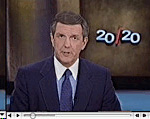
Donna Ford, Ph.D., and Gilman Whiting, Ph.D., both of Vanderbilt University, are two leading African American education scholars who have dedicated their professional lives to the issue of minority achievement. Professor Ford is a nationally recognized expert in gifted education, multicultural education, and the recruitment and retention of diverse students in gifted education. Professor Whiting is a nationally recognized expert in African American male achievement and under-achievement. Professors Ford and Whiting made a two-part visit to the MMSD earlier this year, the result of an invitation from Diane Crear, recently retired MMSD Special Assistant to the Superintendent for Parent-Community Relations. As part of their program for minority parents, Professors Ford and Whiting talked about the research that attests so clearly to the importance of books in the home, reading to our children, talking with our children in intellectually stimulating ways, and taking an active interest in our children’s educational experience. They also showed the following segment from a June, 1999, episode of ABC’s “20/20.” The segment is entitled “Acting White” and was filmed at our own Madison East High School. It is thought-provoking, to say the least, and generated a lot of discussion amongst those in the audience last March when it was shown. We offer it to SIS readers for their thoughtful consideration.

20/20 Acting White (1999).

2020.jpg

Video

For more on the work of Drs. Ford and Whiting, here are two recent papers:
Ford, D. Y. & Whiting, G. W. (2006). Under-Representation of Diverse Students in Gifted Education: Recommendations for Nondiscriminatory Assessment (Part 1). Gifted Education Press Quarterly, 20(2), 2-6.
Moore, J. L., Ford, D. Y., & Milner, R. (2005). Recruitment Is Not Enough: Retaining African American Students in Gifted Education. Gifted Child Quarterly, 49, 51-67.

Share

Digital Curricula

Jeffrey Goldfarb:

What began as a long-shot attempt last year by Pearson Plc to sell California educators digital materials to teach history and politics, collectively known in U.S. schools as social studies, has become reality in what could be the first large-scale step to eliminate books from classrooms.
Pearson, the world’s biggest publisher of educational materials, disclosed on Monday with its half-year results that about half the state’s elementary school students will learn about the American Revolutionary War and Thomas Jefferson using an interactive computer program.
The company also said its success in California, where about 1.5 million students aged 5-11 will use the program in classrooms this year, has led it to plan the same approach in additional states and with more subjects.

Share

The Complex Relationship Between Nature, Nurture, and Intelligence

After the Bell Curve
David L. Kirp
The New York Times
When it comes to explaining the roots of intelligence, the fight between partisans of the gene and partisans of the environment is ancient and fierce. Each side challenges the other’s intellectual bona fides and political agendas. What is at stake is not just the definition of good science but also the meaning of the just society. The nurture crowd is predisposed to revive the War on Poverty, while the hereditarians typically embrace a Social Darwinist perspective.
A century’s worth of quantitative-genetics literature concludes that a person’s I.Q. is remarkably stable and that about three-quarters of I.Q. differences between individuals are attributable to heredity. This is how I.Q. is widely understood — as being mainly “in the genes” — and that understanding has been used as a rationale for doing nothing about seemingly intractable social problems like the black-white school-achievement gap and the widening income disparity. If nature disposes, the argument goes, there is little to be gained by intervening. In their 1994 best seller, “The Bell Curve,” Richard Herrnstein and Charles Murray relied on this research to argue that the United States is a genetic meritocracy and to urge an end to affirmative action. Since there is no way to significantly boost I.Q., prominent geneticists like Arthur Jensen of Berkeley have contended, compensatory education is a bad bet.
But what if the supposed opposition between heredity and environment is altogether misleading? A new generation of studies shows that genes and environment don’t occupy separate spheres — that much of what is labeled “hereditary” becomes meaningful only in the context of experience. “It doesn’t really matter whether the heritability of I.Q. is this particular figure or that one,” says Sir Michael Rutter of the University of London. “Changing the environment can still make an enormous difference.” If heredity defines the limits of intelligence, the research shows, experience largely determines whether those limits will be reached. And if this is so, the prospects for remedying social inequalities may be better than we thought.

Share

California School Districts Try to Cope With Declining Enrollment

Catherine Saillant:

Statewide, public school enrollment was down slightly this year, for the first time in nearly a quarter of a century. And though officials aren’t quite sure of all the reasons behind the drop, they are sure that the cost of housing is one of them.
In Santa Barbara, school administrators worry about lost revenue, because funding is tied to enrollment.
Already, administrators said, the decline has cost the district millions annually. Now, having made small, less-painful cuts, they are considering larger steps, such as selling off vacant property or building housing to sell to teachers at below-market value.

Share

“Training Teachers Is Our Society’s Achille’s Heel: The Demise Of Schools Of Education”

Robin Good:

Question: What big idea of 2006 will be extinct in 2036?
Answer: Modern teacher training
By 2036, the forms of teacher preparation that currently prevail in Western nations will have sunk into oblivion.
We will have discarded schools of education, the pedagogies they teach, and the certification apparatus that they serve. Such schools, pedagogies, and certifications have clung to life stubbornly for the better part of a century despite ample evidence of their unsuitability.
Why predict that in the next 30 years they will finally follow the giant ground sloth into the La Brea tar pit of history?

Share

Are You a Toxic Parent?

Marc Fisher:

True or False:

  • Kids are going to drink anyway, so they might as well do it at home, under adult supervision
  • Restricting teenagers makes no sense when they’ll be on their own in college soon enough
  • You’d rather be your child’s friend than an authority figure

If you answered ‘true’ to any of the above, you are not alone.
But that doesn’t mean you’re right
Lots of parents sign the pledge, often because of peer pressure: If everyone else is signing, how would it look if your name were not on the list? Who opposes keeping kids safe? But it’s something else entirely actually to pick up the phone and call other parents, especially when your kid is 15, 16, 17 years old.
Nancy Murray calls. She calls even though her kids are “so embarrassed.” She calls even when — especially when — she doesn’t know the parents who are hosting the party. She calls and runs through her questions: Will you be there? Will you be in the room? Will you be checking who comes in the door?
The host parents answer, sometimes readily, sometimes grudgingly. But, however the parent on the phone responds, Murray has concluded, “you really don’t know, no matter what they say.” Murray, who has two kids in high school and two already finished, has learned not to trust other parents, even those she knows fairly well. “These are people I socialize with,” she says. “And they say, ‘Well, they’re going to drink anyway, they might as well do it at my house, where I can watch them and know they’re safe.’ I tell them that’s against our rules, and they say, ‘Oh, you’re being naive.'”
Few parents realize until they are deep into the battle to keep their kids safe that the enemy is often other parents.

Share

Projections of High School Graduates by State, Income, and Race/Ethnicity, 1988-2018

Western Interstate Commission for Higher Education [176K PDF]:

Wisconsin was among the low- to average-growth states in the nation between 1990 and 2000, falling considerably below the national growth rate over that period. Following a period of decline in the number of public high school graduates in the state from 1987-88 through 1991-92, minimal growth characterized the years to 2001-02 (see Figure 2). Increases of 1 to 7 percent were seen during several years prior to 2001-02. By the end of the 14-year period between 1987-88 and 2001-02, Wisconsin had gone from 58,438 public high school graduates to 60,575. But the growth trend of the 1990s is not projected to continue. Between 2002-03 and 2017-18, Wisconsin will see several years of losses in the number of graduates, punctuated by a few years of increases. Annual declines that range from less than 1 to over 3 percent during this period will offset increases. The number of public high school graduates is expected to decrease to 58,109 in 2017-18, a 4.1 percent decline over 2001-02. Nonpublic high school graduates accounted for 9 percent of all Wisconsin high school graduates in 1987-88; by 2001-02, that share had decreased to 8 percent, or 5,302 nonpublic graduates. Although the number of nonpublic graduates is expected to decline through 2017-18 to approximately 5,000, their share is projected to remain at about 8 percent.

Flat or declining enrollment has financial implications as Wisconsin’s school funding formula rewards districts with growing populations while penalizing those experiencing declines.

Share

Redrawing the College Map

The NY Times latest “Education Life” takes a look at a number of college topics:

  • Off the Beaten Path:

    Twenty colleges worth a trip, or at least a detour. Visiting Ann Arbor? Do Kalamazoo, too.

  • Degrees of Acceptance:

    For adults entering the job market, online diplomas make sense. But what do employers really think about them?

  • A Father’s Lot:

    For $35,000, all I’m asking is a place to put my car for 30 minutes.

Share

Math Camps Spread for Kids Who Can’t Get Enough

John Hechinger:

A college math student might grapple with this topic in an advanced elective. Ryan was stretching his elementary-school mind at MathPath, perhaps the nation’s toughest summer camp for numerical prodigies.
Math camps are multiplying in part because families are seeking an edge in competitive college admissions and worry about the quality of U.S. math instruction. Last summer, parents paid $280 million to send 120,000 children to academic summer camps, with math among the most popular subjects, according to Eduventures, a Boston research firm, which estimates enrollment is climbing 10% a year. Sylvan Learning Centers, the big tutoring company, says participation in summer math programs, including day camp, jumped 23% last year — twice the rate of other subjects.
The American Mathematical Society counts two dozen “challenging summer math programs” — twice as many as seven years ago. Most focus on high-school students. MathPath caters only to middle-school kids, age 10 to 14. It is also smaller — and more selective — than some better known programs.
About 80,000 kids in second through eighth grade, for example, take part in the annual “talent search” run by Johns Hopkins University’s Center for Talented Youth. Through the search, about 70% qualify for summer camps across the country and some 10,000 enroll in a given year.

Another example of the “Brave New World” referenced in Marc Eisen’s recent words. Neal Gleason comments.
Links: MathPath, Johns Hopkins Center for Talented Youth.

Share

Not to Worry: Neal Gleason Responds to Marc Eisen’s “Brave New World”

Neal Gleason in a letter to the Isthmus Editor:

I have long admired Marc Eisen’s thoughtful prose. But his recent struggle to come to grips with a mutli-ethnic world vvers from xenophobia to hysteria (“Brave New World”, 6/23/06). His “unsettling” contact with “stylish” Chinese and “turbaned Sikhs” at a summer program for gifted children precipitated first worry (are my kids prepared to compete?), And then a villain (incompetent public schools).
Although he proclaims himself “a fan” of Madison public schools, he launches a fusillade of complaints: doubting that academic excellence is high on the list of school district pirorities and lamentin tis “dubious maht and reading pedagogy.” The accuracy of these concerns is hard to assess, because he offers no evidence.
His main target is heterogeneous (mixed-ability) classes. He speculates that Madison schools, having failed to improve the skills of black and Hispanic kids, are now jeopardizing the education of academically promising kids (read: his kids) for the sake of politically correct equality. The edict from school district headquarters: “Embrace heterogeneous classrooms. Reject tracking of brighter kids. Suppress dissent in the ranks.” Whew, that is one serious rant for a fan of public schools.

(more…)

Share

“Teachers’ dissatisfaction with Leopold principal reaches boiling point”

Kurt Gutnecht writing in the Fitchburg Star: [96K PDF]

The management of Principal Mary Hyde has prompted a near revolt among teachers and staff members at Leopold Elementary School.
Discontent among teachers has been simmering for years and came to the forefront recently when Hyde, who’s been principal at the school for six years, decided to terminate a shared teaching arrangement that had previously been praised by Hyde and others.
Sue Talarczyk, who has had such an arrangement with Sue Wagner for seven years, unsuccessfully sought a fuller explanation for Hyde’s decision. Ninety-one teachers and staff members at the school signed a petition asking Hyde to reconsider the termination.
Appeals to district administrators to review Hyde’s decision were also unsuccessful.
Several teachers characterized Hyde as insensitive, intimidating and inconsiderate. All except Talarczyk asked to remain anonymous for fear of retribution.
Teachers interviewed for this article said Hyde made decisions unilaterally, without weighing the opinions of teachers and staff members. had actively solicited parents’support.

Share

Guggenheim Study Suggests Arts Education Benefits Literacy Skills

Randy Kennedy:

In an era of widespread cuts in public-school art programs, the question has become increasingly relevant: does learning about paintings and sculpture help children become better students in other areas?
A study to be released today by the Solomon R. Guggenheim Museum suggests that it does, citing improvements in a range of literacy skills among students who took part in a program in which the Guggenheim sends artists into schools. The study, now in its second year, interviewed hundreds of New York City third graders, some of whom had participated in the Guggenheim program, called Learning Through Art, and others who did not.

Share

Community service levies climb since cap lifted

Five years after state legislators released them from state-imposed revenue caps, school districts’ community service tax levies have nearly tripled, reaching $49 million this year.
The rampant growth in these property taxes – earmarked for community-based activities – took place as the total levies for schools statewide rose by 22.7%.
That has raised concerns about school districts skating around revenue limits and has prompted one lawmaker to request an audit of the program.
State Rep. Debi Towns (R-Janesville) said she is curious why property taxes that pay for recreational and community activities offered by school districts have grown so much since the 2000-’01 school year. In that time, the number of school districts raising taxes for such services has doubled to 240.
“I’m not saying anyone’s misspending. I’m just saying the fund has grown tremendously, and the purpose never changed,” said Towns, chairman of the Assembly Education Committee. In November, Towns called for the Legislative Audit Bureau to study how select school districts use their community service levies.
“So that, of course, leads to a natural questioning of what are they doing differently now than they were doing before,” she said.
The growth in the community service levies is expected to continue next year.
Arts, police, pools
Already, Milwaukee Public Schools has launched a arts education program through its recreation centers that it expects to fund with $1 million in community service funds. The Mukwonago School District plans to keep a police officer in its high school, despite the recent loss of a grant, with a $60,000 boost in property taxes from its community service levy.
The Menomonee Falls School District, which has not raised its levy for recreation and community activities in more than a decade, is counting on a $180,000, or 63%, increase next school year to continue operating one of its two pools.
School administrators say they have a simple explanation for why they are turning to their community service levies more now than they did when they were capped – it didn’t matter before. Because both the general and community service funds were restricted by revenue caps and eligible for state aid, it was simply an accounting preference whether a district paid for it from one fund or the other.
Athletics or academics?
But once the Legislature removed the caps on the community service levies for the 2000-’01 school year and gave school districts an opportunity to keep their recreational activities from conflicting with educational programs, more took advantage of it.
“I think – when you look at districts across the state – that’s really what caused the jump,” said Art Rainwater, superintendent of the Madison Metropolitan School District, which in 2005-’06 had the largest community service levy in the state.
Like some of the bigger community service funds, Madison’s supports a full recreation department with adult and youth programming. But it also helps pay for television production activities, after-school activities, a gay and lesbian community program coordinator and part of a social worker’s time to work with low-income families, Rainwater said.

The School District’s community service levy is expected to grow to $10.5 million in the coming school year. In contrast, the same levy for Milwaukee Public Schools – which serves nearly four times as many children in its educational programs – is expected to reach $9.3 million, said Michelle Nate, the district’s director of finance.
Although the state Department of Public Instruction has issued guidelines to school districts on how they should use their community service levies, it leaves it up to local residents to decide whether their school boards do so wisely and legally.
In the Greendale School District, which at $990,000 had the sixth-largest community service levy in the state last school year, business manager Erin Gauthier-Green acknowledges that her school system has gotten good use out of the fund.
But she also said the School District plans to reduce the property taxes it levies for community services by $300,000 next year now that it has completed some repair projects and before taxpayers complain.
“We know it can be a hot-button issue,” Gauthier-Green said.
By AMY HETZNER
ahetzner@journalsentinel.com
July 22, 2006
Share

In Kindergarten Playtime, a New Meaning for ‘Play’

Clara Hemphill:

THE word “kindergarten” means “children’s garden,” and for years has conjured up an image of children playing with blocks, splashing at water tables, dressing up in costumes or playing house. Now, with an increased emphasis on academic achievement even in the earliest grades, playtime in kindergarten is giving way to worksheets, math drills and fill-in-the-bubble standardized tests.
Nowhere are the demands greater than at Achievement First East New York Charter School in Brooklyn, which holds classes through this month. On a recent Friday morning, 20 kindergartners in uniforms of yellow shirts and blue jumpers or shorts, many yawning and rubbing their eyes, filed into the classroom of Keisha Rattray and Luis Gonzalez. Some sat in plastic chairs lined up before the teachers for phonics and grammar drills, while others sat at computer screens, listening through headphones to similar exercises.

Share

National Survey of Salaries and Wages in Public Schools (2005-06)

Edweek.org:

For the third year, The National Survey of Salaries and Wages in Public Schools was released to Education Week by Educational Research Service as part of a research partnership.
The survey of more than 600 school districts conducted by ERS, a nonprofit organization based in Alexandria, Va., that has been conducting the survey for more than 30 years, revealed that district size has a more pronounced effect on the salaries of superintendents than any other staff category.
The strong relationship between district size and salary for more senior administrators weakens among lower-paid education professionals. On average, assistant principals, teachers, counselors, and librarians earn the highest salaries in mid-sized districts serving between 2,500 and 25,000 students.

Full survey [292K PDF]

Share

11 Sex Offenders Eligible To Teach

Daniel de Vise:

State auditors told legislators yesterday that they had found 11 convicted sex offenders who were certified as teachers and eligible to be hired by Maryland public schools.
None of the 11 was actually working as a teacher. But all remained in a database of teachers with valid certification from the Maryland State Department of Education because of inadequate communication between the state agency and some of the 24 local school systems, the auditors said, speaking to the Joint Audit Committee of the Maryland General Assembly.
A routine audit of the public school system, completed last month, found a similar lapse in the oversight of school bus drivers. In one school system, which the auditors did not name, a driver remained on the job after failing a drug or alcohol test and was subsequently involved in two accidents.
In each case, auditors faulted the state school system for failing to properly update a database, which included lists of certified teachers and of drivers who had tested positive for drugs or alcohol. The audit covered a three-year span ending June 30, 2005.

Share

What’s the MMSD doing for 10th graders who can’t read?

Not much in any systematic way.
Twenty-four percent of Madison’s 10th graders read at a minimal or basic level, i.e., below grade level.

Share

Don’t Give Exit Exam a Pass

Former La Mayor Richard Riordan:

IN HIS EYE-OPENING book, “The World Is Flat,” New York Times columnist Thomas L. Friedman warns that the United States is in a “quiet crisis” and that “we should be embarking on an all-hands-on-deck, no-holds-barred, no-budget-too-large crash program for science and engineering education immediately.” If we don’t, Friedman points out, our society will not be able to compete with such countries as India and China in today’s unprecedented open market. Millions of American jobs could be at risk.
This is the crucial context of the California high school exit exam. Right now, in order to graduate, seniors in the state need to pass a test — a test, mind you, that they can take as many as six times before the end of senior year. This exam only assesses whether students have attained 8th-grade math levels and 10th-grade English skills. That’s correct; students only need to demonstrate middle school math skills to pass a high school exit exam. And we hope to prepare our next generation for the fierce global job competition ahead?

Bold Added

Marc Eisen raised similar points recently: “Brave New World: Are our kids ready to compete in the new global economy? Maybe not“.

Share

ED.Gov: New Report Shows Progress in Reading First Implementation and Changes in Reading Instruction

US Department of Education:

Children in Reading First classrooms receive significantly more reading instruction and schools participating in the program are much more likely to have a reading coach, according to the Reading First Implementation Evaluation: Interim Report, released today by the U.S. Department of Education. The report shows significant differences between what Reading First teachers report about their instructional practices and the responses of teachers in non-Reading First Title I schools, which are demographically similar to the Reading First schools.
“The goal of Reading First is to help teachers translate scientific insights into practical tools they can use in their classrooms,” Secretary Spellings said. “The program is helping millions of children and providing teachers with high-quality, research-based support. As we push towards our ultimate goal of every child reading and doing math on grade level by 2014, Reading First is a valuable help to our efforts.”
The report shows Reading First schools appear to be implementing the major elements of the program as intended by the No Child Left Behind legislation. Reading First respondents reported that they made substantial changes to their reading materials and that the instruction is more likely to be aligned with scientifically based reading research; they are more likely to have scheduled reading blocks and spend more time teaching reading; they are more likely to apply assessment results for instructional purposes, and they receive professional development focused on helping struggling readers more often than non-Reading First Title I schools in the evaluation.

Reading First funds, subject to some controversy, were rejected by the Madison School District a few years ago. UW’s Mark Seidenberg wrote a letter to Isthmus addressing reading last year (.doc file). More on Seidenberg.
Madison School Board Superintendent Art Rainwater wrote an email responding to a Wisconsin State Journal’s Editorial.

Share

Legalizing Markets in Happiness and Well-Being

Michael Strong:

Four years ago I moved my family to Angel Fire, New Mexico, to create a charter high school. Two teachers with whom I had previously worked ten years earlier in Alaska moved to New Mexico to work at the school I was creating. By the second year of the school, we had the created the highest ranked public high school in New Mexico based on Jay Mathews’ Challenge Index. The third year, we ranked among the “Top 100 Best Public High Schools” on Newsweek’s list.
But at that point, I had been forced out by the state of New Mexico because I was not a licensed administrator. When I had moved to New Mexico charter school administrators did not need a license. But the law had changed, and I would have needed seven years’ experience as a licensed public school teacher in order to enter an administrative licensure program. Despite the fact that my work as an educator has been praised by leading educational theorists and practitioners, and despite the fact that I have achieved spectacular results, it is not legal for me to lead a charter school in New Mexico. Moreover, beyond spectacular academic results, my focus as an educator is always first and foremost on developing adolescent happiness and well-being. It is inexcusable that it is not legal for me to lead schools. We need to legalize markets in happiness and well-being.

Share

Education Spending and Changing Revenue Sources

Sonya Hoo, Sheila Murray, Kim Rueben:

Real per capita school spending increased by about 50 percent between 1972 and 2002. Spending levels fell in the late 1970s and early 1980s, reflecting declines in student populations and funding that grew more slowly than inflation. However, those real declines were reversed by the mid-1980s.
Although school districts are the primary supplier of education services, they do not always have independent authority to set spending levels or raise revenues. The ability to set expenditure levels depends in part on the taxing authority of school districts. School districts in 36 states are designated independent, meaning they may generate their own revenues, usually by setting property tax rates. In the other states, some school districts are dependent on a city, town, or county to raise revenues. For example, most school districts in Connecticut, Massachusetts, and Rhode Island are city- or towndependent, while districts in Maryland and North Carolina are primarily dependent on counties. Other states have a mix of both dependent and independent school districts, with dependent school districts generally found in larger cities. Most dependent school districts are on the East Coast.

Share

Research Center to Scour States’ Data Troves

Debra Viadero:

The Urban Institute and six universities have joined forces to start a federal research center to mine the wealth of long-term data now piling up in state education databases.
The newly created Center for Analysis of Longitudinal Data in Education Research, or CALDER, is being launched with a five-year, $10 million grant from the U.S. Department of Education’s Institute of Education Sciences.
The job of the center, which the Urban Institute announced last week, is to tap into the trove of statistics that states are amassing through new data-collection systems that use unique “identifier” numbers so that students—and teachers—can be tracked anonymously over time as they move from classroom to classroom or district to district.
Center researchers intend to focus their efforts for now on studying issues related to teacher quality—who teaches what kinds of students, what determines quality, and how hiring, compensation, and retention policies affect student achievement.

Share

Most States Fail Demands Set Out in Education Law

Sam Dillon:

Most states failed to meet federal requirements that all teachers be “highly qualified” in core teaching fields and that state programs for testing students be up to standards by the end of the past school year, according to the federal government.
The deadline was set by the No Child Left Behind Act, President Bush’s effort to make all American students proficient in reading and math by 2014. But the Education Department found that no state had met the deadline for qualified teachers, and it gave only 10 states full approval of their testing systems.
Faced with such findings, Secretary of Education Margaret Spellings, who took office promising flexible enforcement of the law, has toughened her stance, leaving several states in danger of losing parts of their federal aid.

Share

One classroom, many classes

Kate Grossman:

“There are high expectations” for the top students, “and expectations that we’ll perform miracles on the low end.” — Third-grade teacher Natalie Brady
In the first six weeks of school, Leigha Groves, whose daughter is one of Brady’s top students, asks for a syllabus repeatedly and meets with Brady several times. Early on, she only saw math homework coming home and dismissed it as simple.
“When you hear the University of Chicago, you know they want the best, but it’s not a gifted program,” says Groves, a 39-year-old police officer and college grad. “I wondered where the challenge would come from.”
Her daughter, Aleigha, transferred from a gifted program at South Loop elementary. Groves also wanted her daughter with more black students.
Nicole Miller says she thinks her son is changing, for the worse

Share

More students, fewer spaces

Megan Twohey:

Flash back 25 years at the University of Wisconsin-Madison, and you’d find admissions standards that are sure to shock aspiring Badgers of today.
The university guaranteed admission to all high school graduates in the top half of their class. It accepted more than 80% of applicants.
“I walked upright,” Dan Conley, a 1981 graduate, said with a chuckle. “That’s how I got in.”
How times have changed.
Now students are discouraged from applying without a grade-point average from 3.5 to 3.9, an ACT score of at least 26 and a class rank in the 85th to 96th percentiles. The acceptance rate for Wisconsin residents is 65%. No student is guaranteed a spot in the freshman class, no matter how good his or her grades are.

Share

Grammar Sheriff

Sam Whiting:

On the root of the problem:
I only learned within the last year that they stopped teaching rules of grammar in the ’60s. They taught people what to say but not why. No wonder why people make so many mistakes. They can’t go back in their minds and say, “This is transitive, this is intransitive.” It’s the “lie, lay” thing.

SPELL’s website.

Share

Homebodies

C.W. Nevius:

When 24-year-old ________________ began dating someone new, she had to make an awkward confession. She was still living at home in Sonoma with her parents.

No problem, her new friend said. He was still living with his.

Doesn’t it seem like they all are? Who are these puzzling, 20ish tweeners who don’t want to leave home? They’re not really adults, at least by traditional standards, and they certainly aren’t kids any more.

Share

“Community Services Levies Climb Since Caps Lifted”

Amy Hetzner:

Lawmaker requests audit as school districts across state raise taxes to support programs.
Five years after state legislators released them from state-imposed revenue caps, school districts’ community service tax levies have nearly tripled, reaching $49 million this year.
The rampant growth in these property taxes – earmarked for community-based activities – took place as the total levies for schools statewide rose by 22.7%.
That has raised concerns about school districts skating around revenue limits and has prompted one lawmaker to request an audit of the program.
State Rep. Debi Towns (R-Janesville) said she is curious why property taxes that pay for recreational and community activities offered by school districts have grown so much since the 2000-’01 school year. In that time, the number of school districts raising taxes for such services has doubled to 240.
“I’m not saying anyone’s misspending. I’m just saying the fund has grown tremendously, and the purpose never changed,” said Towns, chairman of the Assembly Education Committee. In November, Towns called for the Legislative Audit Bureau to study how select school districts use their community service levies.

The Madison School District’s Community Service “Fund 80” has grown significantly over the past few years. Lucy Mathiak summarized Fund 80’s tax and spending increases here ($8.5M in 2005/2006, up from $3.5M in 2001/2002 – Milwaukee’s 05/06 tax levy was slightly less: $8M). Carol Carstensen notes that Fund 80 is worth our support.
Much more on Fund 80 here.

Share

SAT Group Can do Better

Karen Arenson:

The College Board should acquire better scanning software, increase training for test center personnel and make other improvements in its procedures to help prevent errors in scoring SAT exams, according to a report released yesterday.
The report, by the consulting firm Booz Allen Hamilton, was commissioned by the board after more than 5,000 SAT exams were incorrectly scored last October, some by as many as 450 points out of a possible 2,400 points. The College Board owns and manages the SAT.
The report said the board had already taken significant steps to improve scoring processes since March, when the errors were disclosed. But it said further changes could be made, like improving the manual procedures used to check whether SAT answer sheets have been scanned properly.
Gaston Caperton, the College Board president, said that he welcomed the report’s conclusions and that its recommendations were “very executable.”
But critics of the College Board questioned the independence of Booz Allen, which received $5.2 million in consulting fees from the board in the year ending June 30, 2005, according to a board filing with the Internal Revenue Service.
“This isn’t the outside independent scrutiny” that is needed, said Brad MacGowan, a college counselor in Newton, Mass.

Share

“Is the Democratic elite turning against the teachers’ unions?”

Mickey Kaus:

Eduwonk thinks so. Some evidence (and not just from Eduwonk): 1) Democratic Governor-in-waiting Eliot Spitzer of New York has endorsed opening more independent charter schools–which are typically not unionized to the same degree as public schools–after a study showed many of them to be doing better than their traditional public competitors.** 2) Speaking at the recent fancy Aspen Institute event, former Clinton official (and now New York City schools chancellor) Joel Klein made a “case that teachers-union contracts are the main obstacle to improving urban education,” according to Mort Kondracke:

“The contract protects the interests of adults at the expense of kids,” he told a rapt audience, describing how it bars pay differentials based on student performance and service in difficult schools; makes it impossible for principals to fire underperforming teachers; and allows teachers to choose their own professional development tracks, regardless of supply-and-demand needs, such as those for more math and science teachers.

Share

Pittsburgh Outsources Curriculum

Joanne Jacobs:

Pittsburgh has hired a private company to write a coherent curriculum for city schools, reports the Post-Gazette.
Because course content is uneven and out of sync with state standards, the Pittsburgh Public School district is paying New York-based Kaplan K12 Learning Services $8.4 million to write standardized curricula for grades six through 12.
. . . Teachers in other districts have complained that Kaplan’s detailed curriculum turned them into automatons and deprived them of time to cover material in adequate detail or help students with individual needs.
. . . Pittsburgh school officials cite an urgent need to bring coherence and rigor to what’s taught and tested in the district’s classrooms.

Interesting. Perhaps an RFP looking for different ideas might be useful. Public and private organizations could respond. One only has to look at the “Cathedral and the Bazaar” to see the power of a community vs a top down approach. Leadership, particularly that which embraces the community is critical – as Lucy Mathiak recently pointed out:

Later, she added: “I think one of the fundamental questions facing our district is whether we treat parents as resources or problems. Any parent who is concerned about safety, discipline or academic issues needs to feel confident that their concerns are going to be heard. We have to court the parents. The future of our schools depends on their confidence that we are working as partners with them.”

Here’s a parent’s perspective on curriculum and school climate. Another. A vast majority of the UW Math Department’s perspective (35 of the 37 signed this letter). Marc Eisen offers still another perspective.

Share

Learnings Per Share

Denis Doyle:

If education is funded without measuring results decisions are based on impulse and sentiment, a risky business that. Yet if education is to be funded on results we need a high degree of social consensus on what results are desirable (and measurable).
As it happens, this sentiment does not respect party lines. Former Minnesota DFL Senator John Brandle famously said – more than 20 years ago – “there will be more dollars for education when there is more education for the dollar.”
Conceptually, the task is straightforward: identify what value schooling adds and measure it. While most people associate the value add of schooling with academic progress, there is also a social dimension, ranging from socialization to custodial care. These too can be measured.
Take year ‘round schooling as an example. Students who attend 240 days (rather than the typical US 180-day year) are likely to escape “summer learning loss.” While preliminary evidence suggests that with poor children in particular, summer learning loss is diminished significantly with year ‘round schooling, it is an empirical question. Risk-taking school districts could offer year ‘round schooling on a pilot basis and measure what happens – who enrolls, how popular is the program, and what are the results? (One prediction: working parents will love it.)
Alternately, 13 180-day years equals 2,340 days from K to graduation. Taken in 240 day installments, a typical student could graduate in 10 rather than 13 years. This too is an empirical question. Are there answers? Certainly Japanese experience suggests that there is. The Japanese school year is 240 days long and the typical graduate (after 13 years) is reputed to have completed the equivalent of two years of a good American college.
What business or industry would close for one-third of the year? What other human capital intensive activity — health care facility, for example — would shut its doors one-third of the year?

Share

“Education Just a Click Away”

Mindy Hagen:

In South Carolina, several large school districts such as Richland 2 and Lexington 1 offered online courses. For example, Richland 2’s virtual school employed 27 teachers and had students register for a total of 559 online courses last year, said Margaret Walden, the district’s instructional technology coordinator.
Despite the efforts of individual districts, no statewide program existed to help students in rural areas keep pace.
“This levels the playing field,” Appleby said. “These online courses are available to any student in any district in the state.”
The virtual school has been able to cut down on costs by relying on the same technical software used by teachers for online professional development.
Students at Charleston high schools such Academic Magnet and North Charleston have experience with online courses, but the state’s program will expand access, district spokeswoman Mary Girault said.

Share

Half of State Tests Don’t Draw on State Standards, AFT Study Finds

Education Week:

Only 11 states met the union’s criteria for strong standards and tests that “align” with them, it says, and 20 states “have much work to do”—beefing up their standards, matching up tests with standards, or showing what they have done online.
“The systems in those states aren’t smart enough yet to bear the weight of the accountability functions they are asked to serve,” said Antonia Cortese, the AFT’s executive vice president. As one example of such a function, she cited the “in need of improvement” label applied to schools if they don’t meet measures of adequate yearly progress, or AYP. The label triggers a series of consequences for the schools.
In their study, the AFT researchers looked for standards to be clear, explicit by grade level, and rooted in the knowledge and skills for the particular subject, as well as accessible on the Web. Similarly, documentation of the relationship between the standards and the tests had to be available online.
The researchers contend that such “transparency” helps teachers do their jobs and builds trust in the system among educators and the public.
The union, which from 1995 to 2001 published an annual report evaluating states’ academic standards, found significant progress on that front. The standards that relate to NCLB testing are more specific and more often set out by grade levels—a help to teachers and test-makers—than the across-the-board standards examined five years ago, the report says. The progress is particularly noteworthy because of the pressure on state education departments to respond quickly to the sweeping federal law’s mandates, which include annual tests in reading and mathematics in grades 3-8 and once in high school and, starting next year, three tests of science spread across grade levels.

Full PDF study can be found here. The report noted that only 1 to 25% of Wisconsin’s state tests aligned to “strong content standards”.

Share

NYC: Charter Students Outperform Nearby Public Schools

Carl Campanile:

Charter schools in the city are vastly outperforming public schools in their neighborhoods, according to a bombshell state report obtained by The Post.
The just-released study by state Education Department found students in 11 of 16 city charter schools outscored kids in nearby public schools on the state’s fourth-grade English and math exams in 2005.
The academic gap widens in the upper grades, the report said, with kids in five of six upper-grade charter schools faring better on eighth-grade English and math exams.
Charters are privately managed but publicly financed schools that have more flexibility in developing a curriculum, hiring personnel and establishing work rules than traditional schools.

New York State Department of Education website.

Share

Comparing Low Income with Teacher Attributes

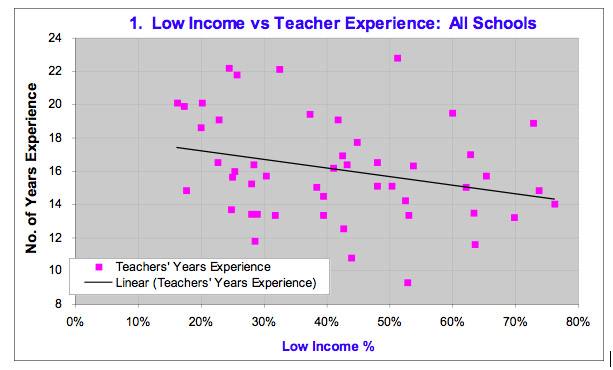
The question was recently asked on this site as to how teacher experience compared with poverty levels by school. Using the 2004-05 school data provided in the 2005-06 detailed budget, I compared low-income percentages with: number of years’ experience; % of teachers with advanced degrees; student / teacher ratio. Below are summary charts for all schools in the MMSD.

The first chart compares each school’s low-income percentage with the average number of years of experience their teachers have. Each pink data point represents a different school within the district. For example, the highest point on the chart represents Schenk Elementary School, which had 51% low-income (reading from the x-axis), and an average teachers’ experience of 22.8 years (reading from the y-axis). The black line is the Excel-generated trend line depicting the relationship between teacher experience and school poverty levels. Notice that the points in the chart are widely scattered – they are not closely surrounding the trend line. This dispersion implies a very weak relationship between teacher experience and poverty levels. The very weak relationship that does exist suggests teacher experience declines slightly as low-income levels increase. The oft-stated lament in this country is that as teachers become more experienced, they gravitate toward the “easier” schools with fewer low-income kids. In the MMSD at least, that gravitation appears to be occurring at a remarkably slow rate.

(more…)

Share

What to do About Homework….

Dan Green:

There is an interesting post and series of comments about homework at The Daily Grind.
I agree that homework needs to be assigned every class period. But, like every teacher, I’ve struggled with how to best hold students accountable for not just completing it, but understanding it. In our freshmen math courses (Algebra 1, Numeracy), we give students full credit on an assignment if it is completed and turned in on time (we don’t assess it for correctness at all). We also don’t accept late work, unless students have an excused absence. The purpose of this is to build the ethic of doing homework and turning it in – as many students seem to come to high school with out having done much – if any – homework in the past. We are pretty successful at getting students to turn in their work by the end of freshman year. Getting them to really think about it, try hard on questions they don’t understand, and seek help when they have difficulties is another thing altogether.

Share

Education Makes You Healthier

David Cutler & Adriana Lleras-Muney:

There is a large and persistent association between education and health. In this paper, we review what is known about this link. We first document the facts about the relationship between education and health. The education ‘gradient’ is found for both health behaviors and health status, though the former does not fully explain the latter. The effect of education increases with increasing years of education, with no evidence of a sheepskin effect. Nor are there differences between blacks and whites, or men and women. Gradients in behavior are biggest at young ages, and decline after age 50 or 60. We then consider differing reasons why education might be related to health. The obvious economic explanations – education is related to income or occupational choice – explain only a part of the education effect. We suggest that increasing levels of education lead to different thinking and decision-making patterns. The monetary value of the return to education in terms of health is perhaps half of the return to education on earnings, so policies that impact educational attainment could have a large effect on population health.

Tyler Cowen has more.

Share

Public vs. Private School

NY Times Editorial:

The national education reform effort has long suffered from magical thinking about what it takes to improve children’s chances of learning. Instead of homing in on teacher training and high standards, things that distinguish effective schools from poor ones, many reformers have embraced the view that the public schools are irreparably broken and that students of all kinds need to be given vouchers to attend private or religious schools at public expense.
This belief, though widespread, has not held up to careful scrutiny. A growing body of work has shown that the quality of education offered to students varies widely within all school categories. The public, private, charter and religious realms all contain schools that range from good to not so good to downright horrendous.
What the emerging data show most of all is that public, private, charter and religious schools all suffer from the wide fluctuations in quality and effectiveness. Instead of arguing about the alleged superiority of one category over another, the country should stay focused on the overarching problem: on average, American schoolchildren are performing at mediocre levels in reading, math and science — wherever they attend school.

Share

Conspiracy to end public schools?

Does the Bush administration want to undermine and eliminate public education?
To my amazement, I was told today that many people in education would emphatically answer yes.
What are the thoughts of people who post on or read schoolinfosystem.org?
Ed Blume

Share

Measured Progress: A Report on the High School Reform Movement

Education Sector:

Requiring students to take greater numbers of rigorous courses that are more likely to prepare them for college does not necessarily lead to lower graders or higher dropout rates, if the courses are taught by capable teachers, the new research suggests.
Intensive “catch-up” courses help a significant percentage of students who enter high school well behind their peers reduce their chances of dropping out and get on the track to college.
But researchers have found that though creating more supportive educational environments for students is critical, doing so produces more significant improvements in student learning when combined with high expectations and rigorous instruction. Improving school climates alone is not the answer.

Share

“Basic Facts About the US Education System”

Center on Education Policy [PDF Report]:

This report highlights the important facts concerning the U.S. education system and how things have changed– and will continue to change — over time.
The primer provides a comprehensive picture of the nation’s public schools with data about students, governance, funding, achievement, teachers, and non-instructional services.

Share

Parents Want Tougher Policy on Sex Offenses

Susan Troller:

Nancy Greenwald, an attorney and one of the parents involved in the complaint, urged the board to accept Superintendent Art Rainwater’s recommendation that Vazquez be fired and to turn over all relevant files to the Wisconsin Department of Public Instruction, which has begun an investigation that could lead to the revocation of Vazquez’s teaching license.
In addition, Greenwald said, “We need you to do more. We urge you to step in and turn this administration around. From the beginning, the administration tried to push this complaint under the rug.”
Kelly Fitzgerald, PTO president at Jefferson, said in an interview after the meeting: “It has been arduous and painstaking. That it took this long for the administration to recommend removing this teacher is obscene.”
Board member Lucy Mathiak, chair of the district’s Partnerships Committee, said that supporting and enhancing relationships with parents would be a priority for her committee.
Later, she added: “I think one of the fundamental questions facing our district is whether we treat parents as resources or problems. Any parent who is concerned about safety, discipline or academic issues needs to feel confident that their concerns are going to be heard. We have to court the parents. The future of our schools depends on their confidence that we are working as partners with them.”

WKOW-TV has more:

Parent Nancy Greenwald is still troubled about what it took to get Vazquez out of the classroom.
“We found the system seriously flawed.”
Greenwald and other parents say school investigators originally failed to connect the dots of Vazquez’s alleged pattern of sexual harassment.

Sandy Cullen:

“The recommendation finally reached after 13 months included an independent investigation and an evaluation by a psychotherapist who was asked to determine whether or not Mr. Vazquez poses a danger to our children,” Greenwald said, adding that if the psychotherapist’s evaluation “is one reason for the superintendent’s recommendation, as we believe it is, then the initial dismissal of our concerns by the administration was not only wrong, it was dangerously wrong.”
“It should not take the yearlong efforts of a large group of parents that happens to include two attorneys to get the administration to do the right thing,” Greenwald said. “Students who are the victims of sexual harassment are often vulnerable, needy children with little support at home. Who’s going to protect them?”

Share

Madison School Board Superintendent Review Discussion

The Madison School Board discussed the Superintendent review process Monday evening. 46MB Video | 7MB MP3 Audio. The discussion included references to curriculum.

Share

Madison School Board Wellness Presentation / Discussion

Monday evening’s Madison School Board meeting included a discussion of the proposed Nutrition Policy. 84MB Video | 13MB MP3 Audio.

Share

Madison School Board Passes a New Advertising Policy

WKOW-TV:

he Madison Metro School District’s “no advertising” policy is now a thing of the past. Tonight they voted unanimously to allow some advertising at certain venues. They say in the face of limited resources and cutting programs, the district needs to find ways of generating revenue outside the taxpayer.
“The district right now has a menu of things to look at…the website…not really targeting toward kids, but targeting toward the community that would be sporting events, that would be community events that we have,” says board president Johnny Winston Jr.

Share

Don Severson / Vicki McKenna Discussion on Local School Climate, the School District Budget and the Fall Referendum

WIBA’s Vicki McKenna and Active Citizens for Education’s Don Severson discussed a variety of topics today, including Judy Newman’s series on Madison’s changing economic landscape, the Madison School District’s budget process and the planned November referendum for a new far west side school, Leopold Elementary school expansion and debt consolidation. 17MB MP3 audio.

Share

Board and committee goals – 2006

Johnny Winston, Jr. provided a summary of the board’s June 19th discussion of board and committee goals.
I found two of the board’s priorities particularly noteworthy.
One priority under Performance and Achievement reads:

Math and Literacy and Curriculum
• Review the appropriateness of the goal of completion of algebra and geometry in high school in view of test scores in math (and sub categories) at 4th and 10th grades
• Develop specific, measurable goals regarding the district’s strategic priorities: “offering challenging, diverse and contemporary curriculum and instruction”
– Include input from community
• Initiate public discussion and dissemination of MMSD information that explains:
– What curriculum is used and why
– Evidence base for choosing curriculum and teaching methodologies
– Evaluation of student outcomes associated with changes/use of specific curriculum/methodologies
• Curricular review with input from parents and K-12 post secondary educators and employers
• Cost effectiveness of reading recovery
• Math curriculum
• Review math and reading curriculum to assess impact on high school

(more…)

Share

Antonucci Commentary on Public vs. Private School NAEP Scores

Mike Antonucci on the recent Education Department report comparing private and public school math and reading scores:

If I read the wonderfully titled report Comparing Private Schools and Public Schools Using Hierarchical Linear Modeling correctly, there is virtually no difference between the math and reading test scores of public and private school students when corrected for various characteristics of students, teachers and schools.
This is bad news for private schools (and when the same results exist for charters, for them as well). If you are going to sell yourself as the superior alternative to traditional public schools, you have to produce results. Reading and math scores on the NAEP tests are excellent measures of academic results, though — as my friends at NEA and AFT always tell me — not the only measures.
National Education Association President Reg Weaver was correct when he told the New York Times that had the results been different, “there would have been press conferences and glowing statements about private schools.”
Where Reg went wrong, however, was when he said that the results showed public schools were “doing an outstanding job.” Standardized test scores are the measures used by the bad guys — you know, people like me — to evaluate schools. What about all the measures the unions claim are important?
Private schools spend about two-thirds what public schools spend.

Share

Taxes and the Wisconsin Association of School Boards

Milwaukee Journal-Sentinel Editorial:

The board voted to eliminate from the school district’s 2006-’07 budget $7,000 for the association’s membership dues. It is now the only school board of the 425 boards in Wisconsin that is not a member.
Part of the reason was financial: Like most boards throughout the state, New Berlin is trying to get a handle on expenses in tough financial times and is cutting extraneous items.
But part of the reason was political: According to board Vice President Matt Thomas, the final straw for him involved a column written by Ashley and published in Wisconsin School News that bloggers were ridiculing for comparing support for the Taxpayer Protection Amendment with 1930s Germany.

Share

Math & Science Teacher Supply & Demand

LA Times Editorial:

L.A. Unified plans to spend millions to train, recruit and keep math and science teachers, who are a hot commodity nationwide.
Recognizing the critical need to boost math and science test scores, the Los Angeles Unified School District has taken several steps — including offering bonuses — to attract and keep teachers in those fields at the district’s neediest schools.

Share

Moving Away from Uniformity

Frederick Hess & Andrew Rotherham:

Perhaps the most encouraging trend in public education today is the growing willingness of educators and policymakers to embrace choices and customization, while turning away from the notion of one-size-fits-all corporatism that dominated 20th century school reform. In education, though, no good deed long goes unpunished. In a barely coherent 5-2 decision, Florida’s Supreme Court used recklessly broad language to overturn the state’s private school voucher program. In doing so, it set an unfortunate precedent that stretches far beyond the question of school choice.
Florida’s Opportunity Scholarship program is the oldest, and smallest, of three private-school choice plans in Florida and has been the focal point of the legal and political battle between school choice proponents and opponents in Florida. In deciding to declare the program unconstitutional, the court read the constitutional requirement that the state provide a “uniform, efficient, safe, secure, and high quality system of free public schools that allows students to obtain a high quality education” as decreeing a constitutional “uniformity” in operations. The decision was greeted with great fanfare by the National School Boards Association, the NAACP, and the teachers unions.

Rotherham has more.

Share

God and Man in School

Ms. Cornelius:

Dennis has a lovely post discussing the myth that God has abandoned the public schools over at his place. It is beautifully written. I hope you go over and read it; it is really well-crafted and obviously comes straight from the heart. Here’s the intro: Dennis was sent one of those chain emails:

Share

Who is to Blame?

Walter Williams:

Let’s look at the recent “Nation’s Report Card,” published annually by the U.S. Department of Education’s National Center for Education Statistics.
Nationally, in reading, only 13 percent of black fourth graders, and 11 percent of black eighth graders score as proficient. Twenty-nine percent achieve a score of “basic,” defined as a partial knowledge and skills needed to be proficient in the grade. Fifty-nine percent score below basic, lacking necessary knowledge and skills. It’s the same story for black eighth graders, with 40 percent scoring basic and 49 percent below basic.
In math, it’s roughly the same story. For black fourth graders, 12 percent score proficient, 47 percent score basic and 40 percent below basic. For black eighth graders, 8 percent score proficient, while 33 percent score basic and 59 percent score below basic; however, 1 percent of black fourth graders and eighth graders achieved an advanced score in math.
Teachers and politicians respond to this tragic state of affairs by saying more money is needed. The Washington, D.C., school budget is about the nation’s highest with about $15,000 per pupil. Its student/teacher ratio, at 15.2 to 1, is lower than the nation’s average. Despite this, black academic achievement in D.C. is the lowest in the nation. Reading scores for D.C.’s fourth-grade black students are: 7 percent proficient, 21 percent basic and 71 percent below basic. For eighth-graders, it’s 6 percent proficient, 33 percent basic and 58 percent below basic.

Share

Best Practices Studies

National Center for Educational Accountability:

This report explores the possibility of reaching higher standards for all students in all schools and suggests the principles and practices for doing so. Of course, moving any school system from knowing what high-performing systems do, to doing what high-performing systems do is a complex process. Strong agreement about what high-performing systems do will begin to bring some order to that process.
One practice, which relates to the Framework theme of Curriculum and Academic Goals, is the pursuit of rigorous course content across a broad range of academic levels in high-performing schools. This includes higher expectations for the work of students characterized as “average” or “below average,” more aggressive efforts to enroll borderline students in advanced classes, and more frequent access to the school’s top teachers for average students. At Dr. Michael M. Krop Senior High School in Florida, educators said that the “culture of high expectations is applied to students at all performance levels, not just to the academically advanced.” Students in all academic courses expect homework assignments that require approximately two hours of time each day to complete for each class.

via Joanne.

Share

Kids Today

Stanford Alumni Magazine:

Share

“Public vs. Private Schools: Pupils Perform Almost Equally”

Diana Jean Schemo:

The Education Department reported on Friday that children in public schools generally performed as well as or better than comparable children in private schools in reading and mathematics. The exception was in eighth-grade reading, where the private school counterparts fared better.
The report, which compared fourth- and eighth-grade reading and math scores in 2003 from nearly 7,000 public schools and more than 530 private schools, also found that conservative Christian schools lagged significantly behind public schools on eighth-grade math.
The study, carrying the imprimatur of the National Center for Education Statistics, part of the Education Department, was contracted to the Educational Testing Service and delivered to the department last year.

National Center for Education Statistics:

This study compares mean 2003 National Assessment of Educational Progress (NAEP) reading and mathematics scores of public and private schools in 4th and 8th grades, statistically controlling for individual student characteristics (such as gender, race/ethnicity, disability status, identification as an English language learner) and school characteristics (such as school size, location, and the composition of the student body). In grades 4 and 8, using unadjusted mean scores, students in private schools scored significantly higher than students in public schools for both reading and mathematics. But when school means were adjusted in the HLM analysis, the average for public schools was significantly higher than the average for private schools for grade 4 mathematics and not significantly different for reading. At grade 8, the average for private schools was significantly higher than the average for public schools in reading but not significantly different for mathematics. Comparisons were also carried out between types of sectarian schools. In grade 4, Catholic and Lutheran schools were compared separately to public schools. For both reading and mathematics, the results were similar to those based on all private schools. In grade 8, Catholic, Lutheran, and Conservative Christian schools were each compared to public schools. For Catholic and Lutheran schools for both reading and mathematics, the results were again similar to those based on all private schools. For Conservative Christian schools, the average adjusted school mean in reading was not significantly different from that of public schools. In mathematics, the average adjusted school mean for Conservative Christian schools was significantly lower than that of public schools.

Complete Report [680K PDF].
Leo Casey has more along with Kevin Drum.

Share

Commentary on the New Jersey Voucher Lawsuit

Kristen Graham:

Organizers called the suit an important step in the civil-rights movement, pointing out that many students in the defendant districts are poor and minorities.
“This lawsuit today is as important as the Montgomery bus boycott of the mid-1950s,” said the Rev. Reginald T. Jackson, executive director of the Black Ministers Council of New Jersey, which joined in the suit. “This, too, will launch a national effort.”
Also supporting the suit are Excellent Education for Everyone, a pro-voucher group with offices in Newark and Camden; the Latino Leadership Alliance of New Jersey; and the Alliance for School Choice, a national organization based in Phoenix.
Voucher programs have been implemented with varying success in Arizona, Florida, Ohio and Wisconsin. They have been unsuccessful in California, Georgia, Illinois, and New York.

Jim Wooten has more.

Share

Court Allows District to Pay More Than Union Scale

Mike Antonucci:

The North Dakota Supreme Court let stand a ruling that the Kenmare school district could offer and pay more money to fill a speech-language pathologist position. The district’s action was the subject of a lawsuit by the Kenmare Education Association (KEA).
The union filed suit in July 2005, after a state fact-finding committee recommended the district be allowed to offer an additional $15,000 in salary to find a taker for the hard-to-fill position. The union asserted that paying a pathologist more money than was proscribed by the salary scale violated the collective bargaining agreement.
Last November, a state district court judge upheld the district’s action, prompting KEA President Donna Schmit to say, “For one individual to be allowed to negotiate up to $15,000 additional salary is wrong.”

Share

Meadville High Commencement Speech

FTC Chairman Deborah Platt Majoras [PDF]:

I have yet to see a “blamer” – someone who fails to stand up and take responsibility – who is truly successful or satisfied. This is because blaming, while easy, is contrary to who we are as Americans. It runs contrary to our fundamentals. As author Philip Howard put it in his book The Death of Common Sense, “taking responsibility was, of course, the basic premise of the republic.”4 And in a recently published book, America Against The World, the authors reported that in a survey of 44 nations, the United States was among the top in believing that those who fail have themselves, not society, to blame.5 These authors describe us as “a people who are more personally freewheeling, self-reliant, and adverse to government involvement” than peoples of most other nations. This tells me that taking responsibility is still fundamentally engrained in our culture and in our beings.
When you stand up and take responsibility, you will show yourself as a leader and as one who deserves respect.

Share

High School Online Classes

Pauline Vu:

The majority of statewide virtual schools, which mostly are geared toward high school students, offer courses that supplement traditional brick-and-mortar schools. But a growing number of virtual charter schools are offering high schoolers the option of earning their diploma the digital way, without ever stepping foot in a classroom.
There are now 24 states with statewide programs that offer credit for online courses, according to John Watson, researcher for the annual Keeping Pace [PDF File] report that tracks virtual programs.
And more states are hopping on the virtual bandwagon. This year, Missouri and South Dakota enacted laws paving the way for a statewide virtual learning program. In April, Michigan made an online class a high school requirement, starting with the class of 2011. Georgia, which had its inaugural virtual education program in the last school year, enacted a new law to allow for cyber charter schools, while Illinois will open its first public virtual elementary school this fall.
The largest state programs are Utah’s Electronic High School, which opened in 1993 and taught a course to about a third of the state’s recent graduating class, and Florida Virtual School, which serves grades 6-12 and opened in 1997.
Utah’s program has more than 52,000 students. Florida’s program has 31,000 students and 65,000 course enrollments, the most in the country.
Many of the schools’ students are making up credits, trying to graduate early, or taking classes their schools don’t offer. Students in rural districts that don’t offer Advanced Placement (AP) courses, for example, can take those classes online.

The article includes links to course examples.

Share

Pittsburgh High School Graduation Rate Study

John Engberg and Brian Gill:

Graduation and dropout rates are difficult to calculate. These difficulties arise because of both conceptual ambiguities and imperfect data. In this paper, the authors review some of these challenges, discuss how the challenges have been approached when using cross-sectional data, and describe a method that analyzes longitudinal, student-level data to provide an improved estimate of graduation and dropout rates. They then apply that method to estimate graduation and dropout rates for the Pittsburgh Public Schools district-wide and for each high school in the district.

Joe Smydo and Tim Grant have more:

City school board members angrily denounced a study that estimates 35 percent of high school students — including nearly half of all black male students — drop out of Pittsburgh Public Schools.
“It’s very incendiary to put something like this out there when there’s so much gray area and speculation,” board member Randall Taylor said at a meeting last night. “For us to tell the city we are not graduating this many students, this is devastating to the city.”

Andrew Rotherham notes that “It’s the PR, Stupid“…… “The report also offers a nice walk-through of some of the issues surrounding calculating grad rates.”

Share

Upper Grades, Lower Reading Skills

Lori Aratani:

The Alliance for Excellent Education, a Washington-based education policy research and advocacy group, estimates that as many as 6 million middle and high school students can’t read at acceptable levels. It’s an issue for students well above the bottom of the class. A report released in March that looked at the reading skills of college-bound students who took the ACT college entrance exam found that only 51 percent were prepared for college-level reading.
“That is what is the most startling and troubling,” said Cyndie Schmeiser, ACT’s senior vice president of research and development. “The literacy problem affects all groups — not exactly in the same ways, but it’s affecting all groups regardless of gender, income or race.”

Alliance for Excellent Education Adolescent Literacy Site.

Share

Menomonee Falls Schools “Efficiency Study”

Amy Hetzner:

Among the audit’s findings:

  • With 17 administrators, the Menomonee Falls district is at the high end of comparably sized districts, which have 14.5 to 17 administrators. But its licensed teaching staff exceeded staffing at similar districts by the equivalent of 40 to 60 full-time employees in the 2005-’06 school year. In particular, specialty courses at Menomonee Falls High School often have smaller class sizes than other districts or even other district schools, Germain found. The board already is planning to reduce its staff by 10 full-time teachers in 2006-’07.
  • Departments and teachers are “pushed” to spend the money the district budget provides annually by the end of the school year. “That is, purchase orders are rushed into the Business Office during April in an attempt to spend any remaining budget dollars so that when next year’s budget is prepared their budget level is not reduced,” according to the study.
  • The district’s building structure – separate middle schools for sixth- and seventh-graders and for eighth- and ninth-graders and a 10th- through 12th-grade high school – contributes to more administrative staffing, time lost for traveling teachers and small class sizes for courses such as foreign languages.

More commentary.

Share

Raising the Bar?

Elia Powers:

One of the largest community college systems in the country is looking into creating an honors college with free tuition and fees for high-achieving high school students who are looking to transfer to competitive four-year institutions.

Houston Community College System
administrators have discussed the possibility of starting the program by fall 2007, but the governing board has yet to formally discuss the plan, which calls for a centralization of existing university-level courses and high admissions standards.
Whereas Houston Community College accepts any Texas student with a high school diploma, the honors college would probably require students to have at least a 3.5 grade point average and an equivalent SAT score, said Maria Straus, director of learning initiatives at the college.

Share

Schoolbooks Are Given F’s in Originality

Diana Jean Schemo:

Just how similar passages showed up in two books is a tale of how the largely obscure $4 billion a year world of elementary and high school textbook publishing often works, for these passages were not written by the named authors but by one or more uncredited writers. And while it is rare that the same language is used in different books, it is common for noted scholars to give their names to elementary and high school texts, lending prestige and marketing power, while lesser known writers have a hand in the books and their frequent revisions.
As editions pass, the names on the spine of a book may have only a distant or dated relation to the words between the covers, diluted with each successive edition, people in the industry, and even authors, say.
In the case of the two history texts, the authors appeared mortified by the similarities and said they had had nothing to do with the changes.

Share

Summer leisure and Drop-out Students

My 13 year old son was complaining the other day about how “hard” it was he had to get up and swim at 7 a.m. for his local swim club. (7 is a little early when it’s cold but…) He then complained about umpiring a Little League game because a coach yelled at him.
As a calm and understanding parent I lost my temper, “They created summer for farm children to get up at sun rise and pick corn, cotton, etc… and all you have to do is play sports and relax. I had to haul hay and clean rental homes for my dad, you need to work more that is your problem!” Which of course, as a parent I am completely guilty of making this life too easy for my children, and I will be correcting that problem next summer…my motto now is if they are bored give them a chore…….
Which reminded me of an idea I had when I was in high school, and again when I was teaching high school, and again when I recently read an article in Newsweek
In North Carolina there are several school districts that have an agreement with their local community colleges (MATC) that allows Junior and Senior students in high school to receive credits for both a skill and high school. When these students graduate they have a degree from High School and an associates degree in whatever interest them. WOW! That was my idea 20 year ago. I noticed when I was in high school that many of my friends and myself left school at 3:00 and went to work. Some were so interested in work and the skills they learned they left school to make money and pursue a more interesting skill.
We could reduce the drop out rate if we arranged a similar association with MATC for our students not bound for college. They would be ready for a job, have a diploma, and excited about their future. If they changed their mind they still have a H.S. degree and could go to college. 16 and 17 year olds get into trouble because they are bored….and they are bored because we wait until they are 18 to treat them as participants in society. We assume they are all interested in calculus and becoming lawyers, of course that is not true. Most other industrialized countries realize this and have created “prep” schools for those that will attend college. The great part about the N.C. plan is they will have a degree and can change their direction or mind to attend college, because 16 is a young age to decide your future, but at least they would have a skill to fall back on.
I remember how busy I was the last two years of high school, not studying but doing all kinds of activities, taking college courses, working a couple of jobs, and I was not even away from home yet. We need to advance these capable students forward to an area that interests them. Utilize their endless energy. Let’s look at this model and see if this would help resolve our gap, dropout rate and problem students for MMSD. We have the community college right here and plenty of educators…..this is an issue that should be discussed.

Share

Create public ARTS school in Madison

Please help to make  THE STUDIO SCHOOL  —  an option for parents and children within the public school district.
 
You’re invited to attend a planning meeting of local parents, educators, community leaders and others:   
 
Date:    July 19 ( Wednesday )
Time:    6:00 – 8:00 pm 
Site:     MADISON Library – Sequoya Branch
513 South Midvalle Blvd. [Map]  — 
 
See the summary description of the proposed school  —   executive summary
 
BRYAN GRAU, co-founder of Nuestro Mundo Community (charter) School in Madison, has been invited to the July 19 meeting to discuss the charter school authorization and implementation process.
 
Here’s additional background info for your review …..  
 
Creating a Charter School  — 
 
DPI – Charter Schools in Wisconsin — 
 
Academy of Fine Arts  — 
 
Reggio Emilia-based Schools  — 
 
The Growing Place  — 
 
The Arts & Technology Academy  — 
 
PreSchool of the Arts  — 
 
Elements of Effective Charter Schools  — 
 
Please RSVP to:
     
SENN BROWN
Wisconsin Charter Schools Association
P.O. Box 628243
Middleton, WI 53562
  Tel: 608-238-7491   Fax: 608-663-5262
  Email: sennb@charter.net   Web: http://www.wicharterschools.org

Share

Revenue Caps Affect Middleton

Budget Hangs On Enrollment Middleton Watching Numbers
The Capital Times Tuesday, July 11, 2006
By Christopher Michaels
Increased enrollment in the weeks preceding the start of the school year could mean more state aid for the Middleton-Cross Plains School District. It also could mean an easing of planned staff reductions of special concern to one of the district’s elementary schools.
Teachers and parents from Park Elementary School in Cross Plains are asking the School Board to do what it can to avoid staff cuts at their school, which has a number of special needs students.
In a preliminary 2006-07 district budget approved by the School Board Monday, the tax rate remains unchanged from the 2005-06 school year. However, state revenue limits mean the district has had to reduce its budget by about $1.4 million compared to last year.
That reduction is taking its toll on programs and staffing with about 15 positions districtwide being eliminated, said Superintendent Bill Reis. Some of those positions, including two teachers and available hours for educational assistants, are at Park.

(more…)

Share

Soglin on Allied Drive, Gangs

Former Madison Mayor Paul Soglin:

he future for Allied Drive and the City of Madison appears bleak. WMTV-15 reported two nights ago:
Allied Drive Crowds a Growing Concern for Police
Madison police say they have needed to call for backup three times within the last week due to troublesome crowds of people in the Allied Drive neighborhood. And that’s draining resources from other parts of the city.
Police report groups of 20 to 80 people shouting, sometimes pounding on squad cars while officers try to make an arrest…
This report is not from Milwaukee, or even the Town of Madison but the city of Madison, the self-avowed hotbed of progressive leadership. For those interested in verbose, lengthy analysis, go to Waxingamerica.com to any of my posts under the category of gangs.

Last Fall’s Gangs and School Violence Forum is a must watch (listen – mp3 audio). Participants included representatives from law enforcement, principals and county/state service employees.
Forum notes can be found here along with a number of background links

Share

What Billions Can Buy

Andrew J. Coulson:

Mr. Buffett and the Gateses are not the first to invest over a billion dollars in an ambitious school reform plan. Ambassador and TV Guide mogul Walter Annenberg trod this path during the 1990s, donating $500 million of his own money and another $800 million in matching funds to the “Annenberg Challenge.”
Mr. Annenberg’s goal was to create exemplary schools and districts that would act as models for the nation. He sought not incremental change, but systemwide transformation. He didn’t get it. Though some Annenberg Challenge projects showed promise, at least for a time, their impact on the system as a whole was negligible.
Why? The Wreck of the Annenberg can be attributed to a single fundamental flaw in the ambassador’s approach: he assumed that excellence, once demonstrated, would automatically be imitated.
It is easy to see why people who have amassed riches in the private sector might assume that successful models are always mimicked on a broad scale. That is what happens in competitive markets – including competitive education markets.

More on the Annenberg Challenge.

Share

Home starts here remain weak

Home building in Dane County remains the weakest it has been this century, according to the latest figures from MTD Marketing.
There were just 129 permits issued for single-family homes and duplexes here in June, well below the 222 last year and at least 39 below every June since 1999, the earliest year for which MTD reported figures. The June permits did have a record average value of $243,038. The average square footage was 2,357, behind only the 2,379 a year ago.
Year-to-date through June, there were 822 permits in Dane County, 414 below a year ago and at least 167 below every year since 1999. This year’s permits had a record average value of $250,444, up from the prior record of $239,166 a year ago. The average square footage was a record 2,480, edging out the 2,477 in 2004.
From The Capital Times, July 10, 2006

Share

UK ‘Brains register’ for bright children

‘Brains register’ for bright children
By Nick Hodgson, PA
Published: 11 July 2006
A register of talented pupils in England is being launched by the Government.
Head teachers at every secondary school will get letters this week asking them to register their brightest and most talented pupils with the National Academy for Gifted and Talented Youth (Nagty), according to the BBC.
The aim is to help children from poorer backgrounds fulfil their potential.
Schools Minister Andrew Adonis said: “We must stop the terrible waste of talent when children don’t reach their full potential.
“This register will ensure they are spotted early and don’t lose out because they come from a deprived background.
“Our brightest children should be helped to reach the top and use their gifts. The pursuit of excellence which benefits the whole country should be open to children of all backgrounds, not just a privileged minority.”
The scheme will involve having specially-trained teachers in every secondary school and in groups of primary schools.
But the plans have been criticised.
Former chief inspector of schools Chris Woodhead said the problem was not identifying the bright pupils, but offering them appropriate support.
Mr Woodhead, professor of education at the University of Buckingham, said: “The problem is doing something for them and if secondary schools are not doing enough for the brightest children now why are they going to do anything for them if they are on a register?”
He said if there were more grammar schools gifted children would prosper anyway because “there, bright children are educated in schools for bright children”.
The register follows research from education charity the Sutton Trust which suggested just one-in-five children from poorer homes go on to higher education compared with half of those from the top three social classes.
The Government wants schools to identify the top 5% of 11 to 19-year-olds who are eligible for Nagty membership.
http://education.independent.co.uk/news/article1171813.ece

Share