School Information System

Madison School District Working on Virtual School

Channel3000:

By this time next year, students from across the country could be attending Madison schools online.
The Madison Metropolitan School District is developing a virtual campus and curriculum. The idea has been in the works for several years, but the district hopes to make it widely available for the 2006-2007 school year.
WISC-TV caught up with one Sun Prairie family who uses online education to home school nine of their 10 children.
Sharon Leonard has nothing but glowing words for virtual schools. Her son John, 7, is currently enrolled in the Appleton School District’s Virtual kindergarten program.
“I like curriculum with a lot of diversity that’s a bit challenging,” said Leonard. “Not too heavy on the writing part, not lots of homework, not lots of extra assignments. I just want them to focus on the basics.”

Share

“Take Responsibility for School Violence”

Wisconsin State Journal Editorial:

That is why Madison School Superintendent Art Rainwater was right last week when he said a recent flurry of violence in Madison schools merited attention by families and the community, as well as educators.
School violence is not just a school problem. It is a community problem.
Rainwater also said something that was wrong, however: “Our schools are absolutely safe.”
To be sure, Madison schools deserve high marks for safety. But the evidence shows that safety is far from absolute.

Share

Notes & Links on Constructivism

Joanne Jacobs:

I said Ken De Rosa of D-Ed Reckoning would write more on why constructivism doesn’t work. He has. See part 1, part 2, part 3 and part 4.

Natalie Solent looks at reasons why constructivism (aka “discovery, experiential, problem-based or inquiry learning” ) remains popular despite lack of results. She thinks people who were good at school are generalizing from their own ah-hah! experiences, forgetting the non-ah-hah! moments and flattering themselves that they figured things out without help. Also, she says, “they don’t want to look bossy.”

But they’re plenty bossy when they teach prospective teachers, writes Tin Drummer.

Share

US Welfare Accounting Overhaul

Krishna Guha:

A radical new approach to government accounting that would require the US administration to account for the cost of future social security payments year by year as people build up entitlements will be proposed on Monday.
The proposal by the federal accounting standards advisory board (FASAB) – which would also require the government to account for benefits accrued under Medicare and other social insurance programmes in the same way – is unprecedented internationally. It would radically change the presentation of US government finances, in effect bringing forward the cost of rapidly increasing social security and Medicare obligations and greatly increasing the reported fiscal deficit.
George W. Bush’s administration is firmly opposed to the proposal, which officials believe wrongly implies that the government is contractually obliged to make future payments based on current benefit rules.
They fear this would make it more difficult to reform the big entitlement programmes and increase pressure on future governments to raise taxes to meet projected funding shortfalls.
The big increase in the reported fiscal deficit under the proposed rule could have an immediate political effect, making it more difficult to press for Bush tax cuts scheduled to expire in 2010 to be made permanent.

This will ripple all over the place, or “trickle down” as it were. FASAB “preliminary views“.

Share

The Merrow Report

Learning Matters:

The Broad Foundation awards $1 million to the top urban school district in the nation. But what is the measure of success? And what are the ways that urban superintendents can lead their schools toward success in the long-term? John Merrow moderates a symposium with the five finalists. Superintendents from Boston; Bridgeport, CT; Jersey City, N.J.; Miami-Dade County; and New York City joined last year’s winner from Norfolk, VA to discuss and debate the best practices of urban education.
Reforming our urban educational systems is a daunting task and a national necessity, particularly as America’s urban centers become more diverse. The lively exchanges among these experienced superintendents about everything from union negotiation and parental expectations to state-takeovers and the merits and short-comings of the controversial No Child Left Behind legislation are sure to inform–and entertain–you.

audio

Share

Saving Money in the Toledo School System

Chris Meyers:

ideasfortps.com is all about citizen-powered ideas. You can comment, rate and even submit your own ideas here to help the Toledo Public School (TPS) district save money. Learn more about the site purpose and function or get help by reading our FAQ.
You can rate the ideas without an account. You also do not need an account to submit your great idea(s), but if you are interested in commenting please create an account. View the ideas below or using the links on the left in the Navigation box. You DO NOT need to live in Toledo to submit ideas. We need everyone’s help!

Via Rotherham.
Deja vu on the list of ideas, particularly with respect to the Administration Building. A great example of citizen activism.

Share

UW Gets $3M to Explore Educational Gaming

Chris Fleissner:

An education research team at the University of Wisconsin-Madison will receive $3 million from the MacArthur Foundation to study the impact of digital media on youth culture, learning, and literacy.
MacArthur’s total $50 million investment will support 24 national studies of different aspects of the digital revolution and its educational and societal implications.
“What MacArthur is actually trying to do, with this grant to us, is establish the field of video games and learning,” said James Paul Gee, principal investigator in the UW-Madison project.
“It’s a new field,” Gee said, “We will do the research to establish what the key issues, topics, and approaches in the field ought to be, and the implementation of new programs.”

Share

Clauses and Commas Make a Comeback: SAT Helps Return Grammar to Class

Daniel de Vise:

Mike Greiner teaches grammar to high school sophomores in half-hour lessons, inserted between Shakespeare and Italian sonnets. He is an old-school grammarian, one of a defiant few in the Washington region who believe in spending large blocks of class time teaching how sentences are built.
For this he has earned the alliterative nickname “Grammar Greiner,” along with a reputation as one of the tougher draws in the Westfield High School English department.
Or, as one student opined in a sonnet he wrote, “Mr. Greiner, I think you’re torturing us.”
Greiner, 43, teaches future Advanced Placement students at the Chantilly school. Left on their own to decide where to place a comma, “they’ll get it right about half of the time,” he said. “But half is an F.”
Ten or 20 years ago, Greiner might have been ostracized for his views or at least counseled to keep them to himself. Grammar lessons vanished from public schools in the 1970s, supplanted by a more holistic view of English instruction. A generation of teachers and students learned grammar through the act of writing, not in isolated drills and diagrams.
Today, Greiner is encouraged, even sought out. Direct grammar instruction, long thought to do more harm than good, is welcome once more

One of my high school English teachers was just like Greiner.

Share

Political Backlash Builds Over High-Stakes Testing

Peter Whoriskey:

This election season may be the first in which the growing use of high-stakes school testing, embodied in the No Child Left Behind legislation, has reached this level of political prominence.
A similar exam revolt has become a key issue in the race for governor in Texas, another state in the vanguard of the testing movement, and the issue has roiled the Ohio gubernatorial contest as well.
High-stakes testing — using standardized test scores to impose consequences affecting teachers and students — has been embraced widely in recent years as a way to hold educators and students accountable for their performance. Experts say the movement is one of the most significant shifts in U.S. education in decades.

Mike Antonucci has more.

Share

MMSD and School Climate

I’ve been very impressed with the way that Madison School District staff have communicated with parents during several recent unfortunate events and incidents.

Share

Study Takes a Sharp Look at NYC’s Dropout Rate

Elissa Gootman:

The first comprehensive look at New York City’s failing students has found that nearly 140,000 people from ages 16 to 21 have either dropped out of high school or are already so far behind that they are unlikely to graduate.
The study, which the New York City Department of Education is to present to the State Board of Regents today, for the first time sheds light on a population of students who for decades have been relegated to the shadows of the city’s sprawling school system. The study was conducted by the Parthenon Group, a Boston consulting group, and was paid for with $2.6 million from the Bill and Melinda Gates Foundation.

Lucy Mathiak recently discussed a Madison School District Study that evaluated late 1990’s dropout data:

I think we need to be careful about what we assume when we are talking about students of color in the schools. The children of color in our schools include a growing number of children whose parents, regardless of racial or ethnic identity, are highly educated with degrees ranging from the BA/BS levels to PhD, law, and medical degrees. Many have attended schools or come from communities with high numbers of professionals of African American, Latino/a, Asian American, or American Indian heritage. As our businesses and higher educational institutions hire more diverse professionals, we will see more children of color from middle and upper income families.
Children of color with highly educated parents historically have had trouble getting access to advanced educational opportunities regardless of their academic preparation or ability. And we are seeing a concurrent relocation to private schools, suburbs, and other cities because the parents have every bit as high expectation for their children as any other parents.

I hope there will be an update to this study. Related: The Gap According to Black.

Share

Parents vs. Coach

C.W. Nevius:

Parents interfering in their kids’ sports is nothing new. But a group of parents at Castro Valley High is taking it to a new extreme.
What started as a group of unhappy parents griping amongst themselves has ballooned into multiple investigations, an observer attending every girls varsity basketball practice and a committee that will pick the team.
It’s the kind of over-the-top behavior that’s increasingly common — parents running on the field, screaming from the sidelines and, in the worst cases, punching out officials. It happens when well-intentioned parents let their protective instincts for their children overwhelm their good judgment.
In Castro Valley, the club wielded by parents is legal clout.

Share

Terrific job by Lucy Mathiak

Lucy Mathiak deserves high praise for her performance in the discussion on the MMSD’s math curriculum. She pressed and pressed the superintendent to justify his recommendations.
A board member of any organization or corporation does not need to be an expert on a topic, but simply has to be certain that the head of the organization holds a firm grasp of the facts to support the direction of the organization.
We need more Lucy Mathiak’s on the board.

Share

Wisconsin School Financing Proposal

Amy Hetzner:

A major study of restructuring the state’s school funding system has produced a plan its author predicts could double academic achievement among Wisconsin students for 6.8% more money annually than the state spends currently.
The study by Allan Odden, a University of Wisconsin-Madison education professor, is more than a year in the making and has included input by some of the state’s most influential education policy makers. However, members of the task force who have been advising Odden say it is still a work in progress, and major disagreements arose Friday at a meeting at which he released detailed cost estimates for his plan.
“Nobody agrees with everything,” Odden conceded, “but there’s been no great revolts.”
Odden is slated to present the plan at a hearing next week of a special legislative council on the school-aid formula, which is headed by state Sen. Luther Olsen ( R-Ripon), a member of Odden’s task force.
The council will also hear about two other plans, one from Democratic state Sen. Jon Erpenbach (D-Middleton) and the other from the Wisconsin Alliance for Excellent Schools, Olsen said.
Jack Norman, research director for the Institute for Wisconsin’s Future, who helped draft the funding plan for the Wisconsin Alliance for Excellent Schools, called Odden’s plan “really terrific.” But he disagreed with some of the details, including how it would fund special education and its reduced funding for high school electives.

Share

Amplification in the Classroom

Reader Steven Ralser emails this article by Wendy Cole:

Twenty pairs of eyes eagerly converge on Jennifer Larcey as the afternoon science lesson gets under way at Bassett Elementary in suburban Cleveland, Ohio. Sure, the transfixed first-graders are salivating at the prospect of examining–and tasting–the physical properties of peanuts, raisins and M&Ms. But something else is riveting the kids, even as Larcey stands to the side of the room issuing directions: the breathtaking clarity of her voice. “Feel the peanuts, and try to describe the texture,” she instructs.
Larcey is one of seven teachers at Bassett who are, in effect, wired for sound. Nearly every word to her students is amplified through speakers wirelessly linked to a small blue transmitter dangling from her neck. Because she began using the technology three years ago, Larcey barely notices the device, except for the rare instances when she forgets to switch it on. “It’s obvious. The kids just don’t pay attention in the same way,” she says. Bassett has joined the growing ranks of schools embracing a deceptively simple technology at a time when federal No Child Left Behind accountability standards are compelling districts to find new ways to boost academic performance. Although amplification systems have long been used to help hearing-impaired students, recent research has shown that enhanced audio benefits all students by helping a teacher’s voice get through loud and clear, even at the back of the classroom.

Share

Dane County Saves $1.2M on Employee Health Insurance: Will the Madison School District Follow This Lead?

Recently, the Sun Prairie School district and its teachers’ union successfully bargained with DeanCare to bring down future costs for employee health insurance. This week Dane County and five of its employee unions agreed to save $1.2M in employee health insurance costs for 2007 by moving all covered employees to one provider, Physicians Plus HMO. County reaches pacts with 5 of 9 employe unions They chose Physicans Plus HMO following a competitive bidding process.
Can the Madison School Board learn from these examples? I hope so.
On September 25, the Human Resources Committee (Kobza, Vang and Robarts) heard a presentation from a Bob Butler, an attorney-consultant from the Wisconsin Association of School Boards on this topic. Containing MMSD’s employee health insurance costs: what’s next? The presentation demonstrated why school districts have no choice but to work with employee representatives to try to get the best health insurance for the lowest cost.
On Monday, October 23, the Human Resources Committee will consider making recommendations to the full board regarding future health insurance costs. The meeting will be at 7:45 p.m. in McDaniels Auditorium and will be televised.

Share

Nations With ‘Happy’ Students Post Poorer Scores

A nation full of students who enjoy mathematics and feel confident in the subject is not necessarily a nation that scores high on international math tests, a report being released this week concludes.
The report from the Brookings Institution suggests, in fact, that the so-called “happiness factor” in math may be inversely related to achievement. In countries where students express high levels of math confidence and enjoyment, it says, students tend to score below average on international math exams in 4th and 8th grades, and vice versa.
Students in the United States are among the world’s happiest, though their average scores are higher than those for most countries that rate strongly on the “happiness” scale.
By Debra Viadero, in Education Week, published October 18, 2006

(more…)

Share

No Test Tubes? Debate on Virtual Science Classes

Sam Dillion:

When the Internet was just beginning to shake up American education, a chemistry professor photographed thousands of test tubes holding molecular solutions and, working with video game designers, created a simulated laboratory that allowed students to mix chemicals in virtual beakers and watch the reactions.
In the years since, that virtual chemistry laboratory — as well as other simulations allowing students to dissect virtual animals or to peer into tidal pools in search of virtual anemone — has become a widely used science teaching tool. The virtual chemistry laboratory alone has some 150,000 students seated at computer terminals around the country to try experiments that would be too costly or dangerous to do at their local high schools. “Some kids figure out how to blow things up in half an hour,” said the professor, Brian F. Woodfield of Brigham Young University.

Share

To Voting Madison Citizens

I didn’t vote for the Leopold referendum last spring, and I still believe that was the correct vote. If the community had voted to build a second school on Leopold then we would not have the opportunity for the community to vote “Yes” on this referendum, which I believe is a better financial and long term solution for our growth. When I was asked to participate on the Westside Long Range Planning Task Force, I was determined to find a better solution for our district than building another school.
I approached this job with study and concentration, as did many of the Task Force participants. In my effort to not build a new school I looked at shifting students East, shifting South, moving 5th graders to middle school, and moving neighborhoods to other schools and in the end I found it was more than just filling seats. The shifts made equity uneven. One shift created a school with less than 5 % low income while others were closer to 70%. Other shifts still left some schools too full because the seats were not where the growth is coming from. Some shifts worked but only for two years. After many hours of discussion and shifting, it became clear that we could shift students if we wanted to; split neighborhoods, shift them again in two years, create schools of inequity, provide 100’s of students with a bus ride of 45 minutes or more each way, and change our classroom quality so that teachers no longer had classrooms but carts that they moved from room to room (Art and Music Teachers). When we thought about those options, none of us wanted it for our own children or grandchildren and we believed that for $30 a year, others in the community would prefer that their children and grandchildren not be handed one of these options either. There are other options, but none with the long term solutions that the current referendum provides.

(more…)

Share

New Jersey Considers School District Consolidation

Tom Hester, Jr.:

New Jersey voters would decide whether the state should create 21 county school districts under a plan considered Wednesday by legislators looking to cut the nation’s highest property taxes.
A referendum question would ask voters to approve the shift next year, a massive undertaking for a state with 616 school districts spread across 566 municipalities.

Share

Madison School Board Math Curriculum Discussion with the Superintendent

Video | Audio

School Board members that ask questions are essential to public confidence in and strong oversight of our $332m+ district. Monday evening’s Superintendent review discussion with respect to the district’s controversial math curriculum was interesting in this respect. Watch the video or listen to the mp3 audio file. The math related discussion starts about 24 minute into the video and ends at about the one hour mark.

3 School Board seats are up for election in April, 2007. These meetings demonstrate the need for candidates with strong leadership and governance abilities with respect to the most important issues for our next generation: a world class curriculum.

Share

Maybe Math isn’t Supposed to be Fun: Just Cutting to the Chase is a Better Approach

Ben Feller:

Children who are turned off by math often say they don’t enjoy it, they aren’t good at it and they see little point in it. Who knew that could be a formula for success?
The nations with the best scores have the least happy, least confident math students, says a study by the Brookings Institution’s Brown Center on Education Policy.
Countries reporting higher levels of enjoyment and confidence among math students don’t do as well in the subject, the study suggests. The results for the United States hover around the middle of the pack, both in terms of enjoyment and in test scores.
In essence, happiness is overrated, says study author Tom Loveless.”We might want to focus on the math that kids are learning and just be a little less obsessed with the fact that they have to enjoy every minute of it,” said Loveless, who directs the Brown center and serves on a presidential advisory panel on math.
“The implication is not Let’s go make kids unhappy,'” he said. “It’s Let’s give kids better signals as to how they’re performing, relative to the rest of the world.'”
Other countries do better than the United States because they seem to expect more from students, he said. That could also explain why high performers in other nations express less confidence and enjoyment in math.

Share

MetLife 2006 Survey of the American Teacher

Harris Interactive:

The 2006 survey looks at the expectations of teachers upon entering the profession, factors that drive career satisfaction, and the perspectives of principals and education leaders on successful teacher preparation and long-term support. In addition, it examines data collected from past MetLife American Teacher surveys to understand the challenges teachers face and their likelihood of remaining in the profession in order to recommend recruitment and retention strategies. Through focus groups of prospective and former teachers, also conducted by Harris Interactive, the report offers added insight about why individuals choose to enter the profession, and why some “opt out” early.

Key findings include:

1. Today’s teachers face challenges:

  • Most teachers do not have enough time for planning and grading (65%), helping individual students (60%) or classroom instruction (34%).
  • Although teachers’ professional prestige is on the rise, nearly four in 10 (37%) say their professional prestige is worse than they expected.
  • Two-thirds of teachers (64%) report their salaries are not fair for the work they do.

2. The struggle to retain teachers gives cause for concern:

  • One quarter (27%) of teachers say they are likely to leave the profession within the next five years to enter a different occupation.
  • The veteran teacher with 21 years or more experience is more likely than his or her less-experienced colleague to “opt out”—that is, more than twice as likely to leave the profession (56% vs. 26%).

3. Principals and education leaders have dramatically different perspectives on what new teachers should expect on-the-job.

  • More than half of principals (54%) think teachers are unrealistic about the number of hours they will work each week, in contrast to 32% of deans and chairpersons.
  • More than half of principals (52%) believe teachers are unrealistic about the number of students with special needs with whom they will work, in contrast to 25% of deans and chairpersons.

4. Teachers’ experiences align more closely with what principals say they should expect than with the views of deans and chairpersons who prepare them for classroom life.

  • Four in 10 teachers (42%) work more with special needs students than they expected.
  • Fifty-eight percent of teachers find the hours they work each week are worse than expected.
  • Three of the four top strategies teachers recommend for recruitment and retention—a decent salary, more financial support of school systems and more respect in society–are similar to those of principals.

5. Still, there is good news about the state of K-12 education:

  • Despite the challenges they face, teachers’ career satisfaction is at 20-year high: 56% are very satisfied with teaching as a career, a 70% increase over findings reported in the 1986 MetLife Survey of the American Teacher: Restructuring the Teaching Profession.
  • Today’s new teachers feel better prepared to engage families, work with students of varying abilities and maintain order in the classroom than did their than experienced peers when they first entered the career.
  • Eighty-two percent of new teachers were matched with a more experienced mentor during their first year of teaching, compared to only 16% of veteran teachers.

Full Survey 800K PDF.

Share

11/7/2006 Referendum Conversation: Mitch Henck, Johnny Winston, Jr and Don Severson

Listen to the conversation, along with call-in questions: 17MB mp3 audio (about 50 minutes). Mitch Henck’s website. Much more on the referendum here.

Share

Police Reports from The East and West High School Area

Madison’s East and West High Schools were locked down Monday. The Daily Page linked to the two police reports:

Channel3000 has more here and here.

Share

The Structural Inadequacy of Public Schools for Stigmatized Minorities: The Need for Institutional Remedies

Shavar Jeffries:

This Article challenges the failure of courts and advocates considering remedies in school cases to assess whether public schools, as currently constituted, are institutionally aligned with stigmatized minorities’ particular educational needs. Numerous legal scholars have written about the longstanding failure of public schools to effectively educate racial minorities; but they have overlooked the relationship of public schools’ institutional context to the educational consequences of racial stigma. This Article does so, claiming that because stigma attacks the very capacities enabling education, services must specifically account for stigma’s noxious effects on racial minorities’ educability. Stigma distinctively affects minorities’ educational fortunes both categorically and individually. As a class, the ontological challenge posed by stigma, obviously, affects only the stigmatized; individually, children have different levels of access to resources contradicting stigma and also cope variably with stigma. Schools therefore need flexibility to respond not only to the unique class-wide harms engendered by stigma but also its specific manifestations in individual children.
Despite this need for flexibility, traditional public schools are highly bureaucratic and rule-bound, preempting the flexibility stigmatized minorities require. This disposition toward uniformity, moreover, is not coincidental but is central to political accountability, especially in urban districts disproportionately serving racial minorities. Finally, because they are minorities, relatively poor, and stigmatized, stigmatized minorities cannot politically realize bureaucratic rules consistently responsive to their educational needs.

Share

For Math Students, Self-Esteem Might Not Equal High Scores

Jay Matthews:

It is difficult to get through a day in an American school without hearing maxims such as these: “To succeed, you must believe in yourself,” and “To teach, you must relate the subject to the lives of students.”
But the Brookings Institution is reporting today that countries such as the United States that embrace self-esteem, joy and real-world relevance in learning mathematics are lagging behind others that don’t promote all that self-regard.
onsider Korea and Japan.
According to the Washington think tank’s annual Brown Center report on education, 6 percent of Korean eighth-graders surveyed expressed confidence in their math skills, compared with 39 percent of U.S. eighth-graders. But a respected international math assessment showed Koreans scoring far ahead of their peers in the United States, raising questions about the importance of self-esteem.

1.3mb PDF Full Brookings/Brown Report

Share

Facts & Questions about the 2006 Madison School District Referendum

Questions:

What is the anticipated cost of equipping the Leopold addition and the elementary school at Linden Park? Are those projected costs included in the referendum authorization or not?
What is the anticipated cost of operating the Leopold addition and the elementary school at Linden Park? How will those costs be appropriated/budgeted (and in what years?) given that the Board expects to have to cut $6-8 million per year?
What are the “shared revenue” total costs for each of three parts of the referendum question? Are these costs included in the $29.20 estimated cost for a median assessed home-owner? Please provide the ‘working papers’ or calculations arriving at these costs. How can a home-owner figure the annual cost of this referendum for the assessed value of their home?
What information about the Ridgewood complex and projected enrollment was used to calculate the need for the Leopold addition?
Construction has already begun for the Leopold addition without voter/taxpayer approval. What is the current impact on the operations budget? What would be the future impact on the operations budget if the referendum fails?

(more…)

Share

If Chartering is the Answer, What was the Question?

Ted Kolderie and Joe Graba, charter school leaders at Education/Evolving urge legislators to expand Wisconsin’s charter school law:

“The Importance of Innovation in Chartering”
Remarks to the Legislative Study Committee on Charter Schools
By Ted Kolderie and Joe Graba, Education/Evolving
October 17, 2006
TED KOLDERIE
Let me try to set the context for the Legislature’s use of the chartering strategy. The ‘Why?’ of anything is important to legislators. It is fair to ask: “If ‘chartering’ is the answer, what was the question?”
The question is: How do we make schooling different enough to motivate the kids who have never learned well in conventional school?
Paul Houston, the head of AASA, has been pointing out how dramatically the signals have been switched for public education. Forever, their charge was access and equity: take everybody; give everybody the opportunity to participate and to learn. Now suddenly the charge is proficiency: The districts are required to see that all children learn.
This is a huge change. The current model of schooling was not built for this. The districts were not built for this. Success with this very different assignment requires major readjustment in the institution.

(more…)

Share

Does Television Cause Autism?

Michael Waldman, Sean Nicholson and Nodir Adilov [Full 728K PDF Report]:

One of the major health care crises currently facing the United States is the exploding incidence of autism diagnoses. Thirty years ago it was estimated that roughly one in 2500 children had autism while today it is estimated that approximately one in 166 is diagnosed with the condition – more than a ten-fold increase.1 In turn, due to the high costs of treating and caring for a typical autistic individual over his or her lifetime, it is estimated that the annual cost to society of autism is thirty-five billion dollars (Ganz 2006). Clearly, the highest priority needs to be given to better understanding what is causing the dramatic increase in diagnoses and, if possible, using that improved knowledge to reverse the trend.
Despite the recent rapid increase in diagnoses and the resulting increased attention the condition has received both in the media and in the medical community, very little is known about what causes the condition. Starting with the work of Rimland (1964), it is well understood that genetics or biology plays an important role, but many in the medical community argue that the increased incidence must be due to an environmental trigger that is becoming more common over time (a few argue that the cause is a widening of the criteria used to diagnose the condition and that the increased incidence is thus illusory). However, there seems to be little consensus and little evidence concerning what the trigger or triggers might be. In this paper we empirically investigate a possibility that has received almost no attention in the medical literature, i.e., that early childhood television watching is an important trigger for the onset of autism.

Via Slate.

Researchers might also turn new attention to study of the Amish. Autism is rare in Amish society, and the standing assumption has been that this is because most Amish refuse to vaccinate children. The Amish also do not watch television.

Share

Reading First: The Lie of Robert Sweet of Errors and Misconceptions in Washtington Post

Trying to find the truth in education, like in most areas in American society, is fraught with dilemma — most public commentors are either incompetent or bald-faced liars.

Robert W. Sweet, Jr. likely falls into both categories.

See previous posts of regarding his comments on this site, and his letter to the Washington Post here. Robert Sweet’s title is Former Professional Staff Member Committee on Education and the Workforce, U.S. House of Representatives Committee Staffer for the Reading First law.

First, let’s place all this into context. The Inspector General’s Reading First report (hereafter IGRF), published September 2006, audited the Reading First Grant Application Process and reported problems. Michael Grunwald of the Washington Post wrote an article about the IGRF Report, and Robert Sweet responded to the Grunwald article in a letter to the Washington Post editor. The crux of the Sweet letter was to allege, point-by-point, each significant error made the Grunwald in his article interpreting the IGRF findings.

I’m not going to review either Grunwald’s article nor Sweet’s response point-by-point, and I have not read or studied the IGRF fully, so I’m not prepared to do so. To prove Robert Sweet a liar will only require comparing one, his first, claim of “error” he’s alleged with the actual language of the IGRF.

Here is Sweet’s first alleged error by Grunwald.

1. Grunwald: “The Reading First panels that oversaw state applications were stacked with department officials and other phonics fans.”
Correction: Department officials were not on panels that judged state applications.

Sweet’s comment shows his art of misdirection — his “correction” does not refute Grunwald’s interpretation. It’s true that Department officials were not on the panels, but as the IGRF details, quoted below, it was the Department officials who actually judged the applications from the States’ perspective.
Let’s read the actual language of the IGRF report, at length (with minimal editting).

(more…)

Share

“Far too Fuzzy Math Curriculum is to Blame for Declining NYC Test Scores”

Elizabeth Carson:

Here’s a math problem for you: Count the excuses people are trotting out for why schoolkids in New York City and State did poorly in the latest round of math scores. The results showed just 57% of the city’s and 66% of the state’s students performing at grade level – and a steady decline in achievement as kids got older.
It’s about family income, said an article in The New York Times. “The share of students at grade level in affluent districts was more than twice as big as in impoverished urban districts.”
It’s about unfair funding levels, said state education Secretary Richard Mills.
It’s about class size, said activist Leonie Haimson.
Wrong again, claimed other observers. The real culprit was a new test.
If, like me, you’re running out of fingers – and patience – there’s a reason. Nobody spinning the test scores is zeroing in on the single biggest reason math achievement in New York City and state lags and will continue to lag: Our schools use a far-too-fuzzy curriculum that fails to give kids rigorous instruction in the basics.
In New York City, the program required in the vast majority of schools is called Everyday Mathematics. Chancellor Joel Klein swears by it. If you ask administrators to explain it, they’ll use just enough jargon to make it sound decent.
But the truth is, Everyday Math systematically downplays addition, subtraction, multiplication and division, which everyone knows are the foundations for all higher math. Instead of learning those basic four operations like the backs of their hands, students are asked to choose from an array of alternative methods, such as an ancient Egyptian method for multiplication. Long division is especially frowned upon.

Everyday Math is used in the Madison School District. Much more on Math curriculum and politics here. Via Joanne.
Carson is Co-Founder and Executive Director of NYC Hold:

The performance of American students in mathematics is mediocre at best. In many cases, mathematics instruction is not serving our children’s best interests. In order to help all students achieve success in school mathematics courses, have access to adequate preparation for the broadest options in high school math and science courses, and the opportunity to advance into mathematics based college courses and careers, it is important to examine the direction of recent attempts at mathematics education reform.

More on Everyday math.

Share

Tips for Better Parent-School Relationships

Jay Matthews:

In many ways, parents are the most important teachers children will ever have. But drawing them into schools is often difficult. So is forging a constructive parent-school relationship. Teachers complain about parents who meddle too much and those who can’t be found. Parents say that educators claim to want more involvement but that they belittle their suggestions.
Here are 10 recommendations for better relations from educators and school-savvy parents.

Share

City Students Endure Traumatic Day

Andy Hall:

tudents, parents, police and educators throughout Madison were rattled Monday but no significant injuries were reported in three unrelated incidents that included a lockdown at East High School, a pellet gun attack outside West High School and a car crash triggered by two O’Keeffe Middle School students.
Tensions were high because of recent violence and threats in schools in Wisconsin, Colorado and Pennsylvania, officials acknowledged. Monday’s chaos ended peacefully, they said, because of an unnamed community tipster, good security planning and quick police work.
Madison Superintendent Art Rainwater said about 1,800 students at East High School were restricted to their third-period classrooms, except for a quick trip to the cafeteria and bathroom breaks, from 11 a.m. until classes were dismissed at 3:30 p.m. because of a “credible threat” against a student.

Share

Significant errors and misconceptions – “Billions for an Inside Game on Reading” by the Washington Post

Robert W. Sweet, Jr.

This letter and the enclosure are an appeal to you for help in alerting your readers to significant errors and misconceptions in an article printed in the Post on October 1, 2006 titled “Billions for an Inside Game on Reading” by Michael Grunwald.
He asserted that Reading First grants were awarded to preferred reading programs, and that billions of dollars were misspent because the requirement in Reading First that reading programs be based on “scientifically based reading research” were ignored.
Below is a summary of the essential facts that document the errors and misconceptions that have damaged one of the most effective programs to teach vulnerable children to read. Attached to this letter is a detailed presentation that seeks to correct the record.
It is my hope that you will consider printing a clarification so that the public you serve will know the truth about Reading First.

The MMSD’s omission with respect to Reading First was to support the Superintendent’s rejection of the $2M+ grant without a School Board discussion, particularly in light of the District’s devotion to the expensive Reading Recovery program. 2M is material, even to an organization with an annual budget of $332M+. Much more on Reading First here and Bob Sweet [Interview].

Share

East & West locked down on Monday

From madison.com:

Madison school officials locked down East High School this morning after “serious” threats were made by one student to another.
The school’s safety procedures call for the doors, which were secured at 11 a.m., to remain locked until the end of the school day at 3:30 p.m. Students were not to be released until that time.
The threat was made to one student who was at the school by another who was off school grounds.
“The danger is outside the school, not inside,” said school district spokesman Ken Syke. “That’s why we went into lockdown.”
Officials said the threats stemmed from fights between East High students over the weekend, with the disputes remaining unresolved today.
Syke said rumors circulating among students that someone was spotted with a gun are simply “not true.”
But he added, “It was a legitimate enough notice that we have taken it seriously.”
Also at West High School this morning, pellet gun shots were reportedly fired from a vehicle passing the school. The shots were reported by a witness who heard the shots and saw the vehicle.
Police had the alleged perpetrator in custody by 1 p.m. District security coordinator Luis Yudice, West High administrators, central office staff and Madison police worked together to initiate the district’s safety and security procedures to respond to the situation at West, which included limiting access to the school until early this afternoon.

Share

E-Learning Guide

US News & World Report:

Thinking about getting an online education? USNews.com’s E-Learning Guide lays out detailed information gathered directly from more than 2,800 traditional colleges and virtual universities. Select one of the options below to find the online degree or certificate that’s right for you.

Share

Special Education Funding

Andy Hall:

Pressure on schools has intensified because the state has paid a decreasing share of special education costs. This year, the state is reimbursing schools 29 percent of the $1.16 billion cost. In 1993, the state paid 45 percent of the $585.9 million cost of special education.
Educators say they have been forced to cut so deeply into overall school budgets that in many cases, the educations of regular and special education students are jeopardized.
Terry Milfred, superintendent of the Weston district, 75 miles northwest of Madison, said administrators had to eliminate a school counseling position, slice the music program in half, eliminate cooking and sewing portions of home economics classes, outsource drivers’ education to a private company and reduce library staffing to balance the budget in recent years.
“Those things aren’t required by law, and consequently that’s where the services tend to be reduced to the point that we feel we can,” said Milfred, who sympathizes with the Legislature’s desire to hold down taxes but hopes for reforms.
Meanwhile, he said, the bill for one of the district’s special education students is $30,000, and another is transported 160 miles a day to receive specialized services.

Share

The Essential Support for School Improvement

Penny Bender Sebring, Elaine Allensworth, Anthony S. Bryk, John Q. Easton, and Stuart Luppescu:

n this report, which draws on data from Chicago public elementary schools in the 1990s, the authors present a framework of essential supports and community resources that facilitate school improvement. The authors provide evidence on how the essential supports contribute to improvements in student learning, and they investigate how community circumstances impact schools’ ability to embrace the essential supports.
The authors offer empirical evidence on the five essential supports—leadership, parent-community ties, professional capacity, student-centered learning climate, and ambitious instruction—and investigate the extent to which strength in the essential supports was linked to improvements in student learning, and the extent to which weakness was linked to stagnation in learning gains.

Share

Defending the Classroom

Jeff Carlton:

Youngsters in a suburban Fort Worth school district are being taught not to sit there like good boys and girls with their hands folded if a gunman invades the classroom, but to rush him and hit him with everything they got – books, pencils, legs and arms.
“Getting under desks and praying for rescue from professionals is not a recipe for success,” said Robin Browne, a major in the British Army reserve and an instructor for Response Options, the company providing the training to the Burleson schools.
That kind of fight-back advice is all but unheard of among schools, and some fear it will get children killed.
But school officials in Burleson said they are drawing on the lessons learned from a string of disasters such as Columbine in 1999 and the Amish schoolhouse attack in Pennsylvania last week.

via Joanne.

Share

More concern about technology in MMSD: another teacher explains the problem

Recently, I posted a letter from a middle school teacher in Madison regarding inadequate computers at one of our middle schools. Fancy programs on aging computers:an MMSD teacher tries to make things work
Today the Madison school board received another letter from a teacher explaining how the current state of computers and software makes teaching harder and more stressful. While this is a typical complaint from the schools, I don’t see the same problems with central administration computers.
Dear Board Members and Mr. Rainwater,
I have been a teacher for MMSD for fifteen years. I am committed to and love this district and its students. I work at …. This is a wonderful building in which to work. The staff is solid, caring, and professional.
….
A second concern in our building is technology. I love the new attendance system and am currently using the grading program on infinite campus which I also enjoy. Unfortunately, our computers are slow and often freeze up. Quite often, I have to call my attendance into the office because it takes 10-15 minutes for the computer to load. We have little access to adequate computers as a staff. It makes it difficult to be able to keep grades in a timely manner. Six of us in 8th grade have to share one antiquated computer for our planning area. My guess is that most other professionals in this city would not even think of working with such inadequate technology.

(more…)

Share

Wisconsin Tax Climate Update & Local Property Tax Levy Changes

tax2006.jpg
Wisconsin State Journal Editorial:

The first step toward improving the state’s tax climate must be for lawmakers to control spending. The state cannot afford to cut taxes and thus forgo revenue unless the next governor and Legislature do a better job of paring, consolidating and conserving.
Even the promise that lower taxes will generate more business development in the future will not address the immediate strains created by rising costs for Medicaid and other programs.

Tax Foundation’s report.

WISTAX has more:

  • Municipal Property Taxes Outpace “Freeze”, Rise 4.1% in Large Cities:

    Despite a “freeze” designed to slow property tax growth, Wisconsin’s 230 largest cities and villages increased levies at the same rate as in prior years. According to the Wisconsin Taxpayers Alliance (WISTAX), municipal-purpose property tax levies rose 4.1% in these municipalities in 2005-06 (2006), the same as the average increase from 2002 to 2005.

  • State Budget Increasingly on Autopilot:

    In recent years, most state spending growth has been in two areas: school aids and Medical Assistance (MA). The inescapable link between state aid and school revenue limits on the one hand and property taxes on the other virtually assures that, when combined with accelerating MA costs, most new state revenue is already “spoken for.” Funds for state agencies, higher education, and other state programs are likely to grow little, if at all, thus continuing a long trend..
    State law gives the governor and legislators the power to enact budgets. Yet, through various actions and commitments from both over the past decade, they have increasingly put the state budget on autopilot.

  • Election 2006 Issues and Questions.

The Milwaukee Journal-Sentinel:

Globally, American companies already are at a disadvantage because the benchmark federal corporate tax rate is 35%, which the Tax Foundation notes is “one of the highest corporate tax rates of any of the industrialized economies” – even after the successive rounds of tax reductions under President Bush.
The foundation’s report, however, only added to a bewildering array of national tax rankings, each using different methodologies that have sparked a lively debate among policy-makers.
The foundation’s annual State Business Tax Climate Index is based on a weighted index that ranks each state’s corporate taxes, individual income taxes, sales taxes, unemployment taxes and property taxes. While it relies on U.S. census data for each state’s property tax, it compares state tax rates and tax laws to measure the other four. It employs a matrix of 10 subindexes and 113 variables.
The Madison-based Wisconsin Taxpayers Alliance, using the latest available census numbers, put Wisconsin at No. 6 when measured as a percentage of personal income. That figure represents years of incremental improvements after Wisconsin registered No. 3 in the nation under the same measures in 1994.

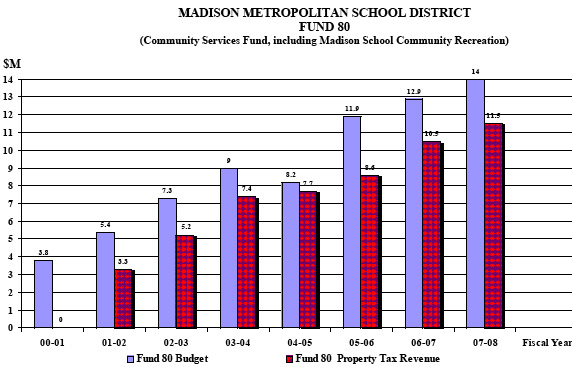
Taxes, particularly the much discussed property tax “Freeze” will certainly be on voter’s minds November 7, 2006. The Madison School District’s 06/07 budget will grow local property taxes by 11,626,677 to $211,989,932 (5.8%) [See 2006/2007 Budget Executive Summary – PDF]. Gotta love politics, 5.8% is certainly not a freeze :). The Madison School District’s property tax levy changes over the past 6 years. The mill rate has not changed at the same rate as the levy increases because local assessed values have been increasing. That will probably change now as the housing market takes a breather.

Share

The Handwriting is on the Wall

Margaret Webb Pressler:

The computer keyboard helped kill shorthand, and now it’s threatening to finish off longhand.
When handwritten essays were introduced on the SAT exams for the class of 2006, just 15 percent of the almost 1.5 million students wrote their answers in cursive. The rest? They printed. Block letters.
And those college hopefuls are just the first edge of a wave of U.S. students who no longer get much handwriting instruction in the primary grades, frequently 10 minutes a day or less. As a result, more and more students struggle to read and write cursive.
Many educators shrug. Stacked up against teaching technology, foreign languages and the material on standardized tests, penmanship instruction seems a relic, teachers across the region say. But academics who specialize in writing acquisition argue that it’s important cognitively, pointing to research that shows children without proficient handwriting skills produce simpler, shorter compositions, from the earliest grades.

Share

Better Teachers: A Lesson Plan

Marie Gryphon:

Good teachers matter. This may seem obvious to anyone who has a child in school or, for that matter, to anyone who has been a child in school. For a long time, though, researchers couldn’t actually prove that teaching talent was important. But new research finally shows that teacher quality is a close cousin to student achievement: A great teacher can cram one-and-a-half grades’ worth of learning into a single year, while laggards are lucky to accomplish half that much. Parents and kids, it seems, have been right all along to care whether they were assigned to Mrs. Smith or Mr. Brown.
Yet, while we know now that better teachers are critical, flaws in the way that administrators select and retain them mean that schools don’t always hire the best.
Many ingredients of good teaching are difficult to ascertain in advance–charisma and diligence come to mind–but research shows a teacher’s own ability on standardized tests reliably predicts good performance in the classroom. You would think, then, that top-scoring teachers would be swimming in job offers, right? Not so, says Vanderbilt University professor Dale Ballou. High-scoring teaching applicants “do not fare better than others in the job market,” he writes. “Indeed, remarkably, they do somewhat worse.”
Even more surprising, given the national shortage of highly skilled math and science teachers, school administrators are more keen to hire education majors than applicants who have math or science degrees.

(more…)

Share

A New School on Madison’s Far West Side: A Long Term Perspective

On November 7, Madison area residents will be asked to vote on a referendum concerning our local schools. While the referendum has three parts, this paper will focus on the first part – the construction of a new school on the far west side, representing over 75% of the total cost of the referendum.

This report will argue that the most important determinant of whether or not a new school should be built on the far west side (or anywhere else in the district), is whether the long-term outlook clearly indicates it is appropriate. Otherwise, the problem should be considered temporary, with temporary measures pursued to address it. However, the situation here suggests strongly that the problem is a more permanent one, requiring a “permanent solution”, the building of a new school.

This report will not attempt to forecast specific enrollment figures for the Madison Metropolitan School District (MMSD) – such an effort would take several months to do properly. Instead, it will focus on the TRENDS that support the conclusion a new school is warranted.

(more…)

Share

Changing our high schools

by Superintendent Art Rainwater
The purpose of high school is to ensure that all of our students leave ready for college, jobs and civic involvement. Our traditional, comprehensive high schools today look and feel much like they have for generations. However, the world our students will live and work in has changed dramatically.
The structure of high schools has served society well by preparing young people for the world they were entering. There were good, family supporting jobs that didn’t require a high school diploma. The type of classroom teaching strategies that were employed worked well for the post high school plans of our students.
It is becoming increasingly clear however, that not only four year colleges, but also any post secondary education or job training program requires a substantial background in mathematics, science, social studies and language arts.
We need to dramatically change our high schools. This is not a reflection of current high school teachers or their teaching methods. It is a reflection of a changing society. The needed reforms at high school have to be concentrated on making a high level of demanding coursework accessible to all students. To accomplish this goal requires that we change the way we relate to students and that we implement a wide variety of teaching strategies in every class.
The education world has not been oblivious to this need for change. There have been many efforts, across the country, to change high schools, including in our own district. However, high school reform has rarely addressed the underlying problem — the high school classroom.
To meet the needs of every student, the student, not the content of the course, must be at the center of our work. It’s obvious that the content is critical, for that is what will prepare students for adult success. But first, everything from our teaching methods to the way we inculcate positive behaviors must begin with the student and not the textbook. We have to use our knowledge of how children learn to create classroom strategies that connect with students’ own experiences and relate what we want them to learn to its use in the real world.
Regardless of how our high schools look there must always be three goals for our students: ensure that every student gains the knowledge and skills to be a successful adult, provide the opportunity for every student to grow academically and socially, and to learn to be an active participant in the society in which they live.
To reach these three goals we must continue to foster high academic achievement; we must close the achievement gap among different groups of students and we must promote civic and personal growth among our students.
We are beginning the journey of redesigning our high schools. This will take creativity, commitment and our best thinking. It will take all of us, collectively, having the will to find the way so that a diploma from our high schools can provide a ticket to the future for all of our students.

Share

Conference on High School Task Force recommendations

The State Superintendent will host a conference on October 20 on the recommendations of the High School Task Force, which she appointed:

A: Encourage educators and policymakers to move outside of existing structures and pursue innovation.
B: Give students the opportunity to engage in rigorous, authentic learning experiences that are relevant to their learning needs and future ambitions.
C: Create smaller, personalized learning environments and require learning and lifelong education plans for individual students.
D: Promote and enhance partnerships among schools, parents, businesses, and communities, linking community resources with school programs and curriculum
.

Link to a PDF of the conference brochure.

Share

Indiana School District Deploys District-Wide Wireless Network

Government Technology:

New Castle School District of New Castle, Indiana, is deploying the Meru Networks Wireless LAN System across its district to enable its more than 4,000 students and 500 staff and faculty to access a broad range of wireless voice and data applications. When completed, the wireless deployment will span New Castle’s seven elementary schools, a middle school, high school and vocational school, the district’s administration building and its technology center.
With a wireless LAN and several mobile computer labs, New Castle could allow entire classrooms to use computing resources efficiently and cost-effectively. In addition, the district wanted a solution that could be used for both data and voice over IP, allowing staff to keep in touch as they move about the school’s campus during the workday.

Share

The State of the City’s Schools

Superintendent Art Rainwater and Madison School Board President Johnny Winston, Jr. discuss the state of Madison’s public schools with Stuart Levitan.

Watch the video | MP3 Audio

Topics discussed include:

  • School Safety
  • The November 7, 2006 Referendum
  • School funding
  • “Education is not one size fits all” – Johnny during a discussion of the initiatives underway within the school district (the last 12 minutes) such as online learning, the Studio School and differentiation.
  • Levitan asked Art Rainwater if, during his 8 years as Superintendent, the education our children receive is better than it was in 1998? Art said it was and cited a number of examples.

Interesting.

Share

Tests & Results: New York State Elementary & Middle Mathematics

New York State Education Department:

Share

The Mathematics Education of Elementary School Teachers

Jim Lewis:

The Mathematical Education of Teachers [268K PDF] recommends that the mathematical education of teachers be viewed as a partnership between mathematics faculty and mathematics education faculty and further recommends that there needs to be more collaboration between mathematics faculty and school mathematics teachers. We will report on The Mathematics Semester at the University of Nebraska-Lincoln, a partnership that resulted from Math Matters, a NSF-CCLI grant.

Also: Math in the Middle Institute Partnership [PDF]

Share

The Politics of K-12 Math and Academic Rigor

The Economist:

Look around the business world and two things stand out: the modern economy places an enormous premium on brainpower; and there is not enough to go round.
But education inevitably matters most. How can India talk about its IT economy lifting the country out of poverty when 40% of its population cannot read? [MMSD’s 10th Grade Reading Data] As for the richer world, it is hard to say which throw more talent away—America’s dire public schools or Europe’s dire universities. Both suffer from too little competition and what George Bush has called “the soft bigotry of low expectations”.

Thursday’s meeting between Madison School Superintendent Art Rainwater, the MMSD’s Brian Sniff and the UW Math department included two interesting guests: UW-Madison Chancellor John Wiley [useful math links via the Chancellor’s website] and the Dean of the UW-Madison Education School. Wiley and the Ed School Dean’s attendance reflects the political nature of K-12 curriculum, particularly math. I’m glad Chancellor Wiley took time from his busy schedule to attend and look forward to his support for substantial improvements in our local math program.

(more…)

Share

Teaching Math, Singapore Style

The countries that outperform the United States in math and science education have some things in common. They set national priorities for what public school children should learn and when. They also spend a lot of energy ensuring that every school has a high-quality curriculum that is harnessed to clearly articulated national goals. This country, by contrast, has a wildly uneven system of standards and tests that varies from place to place. We are also notoriously susceptible to educational fads.
Editorial, New York Times, September 18, 2006

(more…)

Share

World Famous Artist Collaborates with Cherokee Middle School Students

Channel3000:

tudents at a Madison middle school collaborated with a world-famous contemporary painter to create a mural.
The artist known simply as Wyland — who is famous for panting building-sized marine murals in cities around the country — visited Cherokee Middle School on Tuesday where he worked with 40 students to paint a mural.

Much more on Wyland. Wyland’s Milwaukee County Courthouse Annex “Whale Commuters” was recently destroyed as part of a new freeway project.

Share

Report Urges Changes in the Teaching of Math in U.S. Schools

In a major shift from its influential recommendations 17 years ago, the National Council of Teachers of Mathematics yesterday issued a report urging that math teaching in kindergarten through eighth grade focus on a few basic skills.
If the report, ”Curriculum Focal Points,” has anywhere near the impact of the council’s 1989 report, it could signal a profound change in the teaching of math in American schools. It could also help end the math curriculum struggles that for the last two decades have set progressive educators and their liberal supporters against conservatives and many mathematicians.
Article by Tamar Lewin, New York Times, September 13, 2006

(more…)

Share

The No. 1 Graduate School of Education?

Kevin Carey:

What’s the No. 1 graduate school of education in America? If you asked people in the academic world, many would probably mention Teachers College at Columbia University, which is not only well-regarded by its peers, but also unusually large, granting more than 100 doctoral degrees in education every year.
But for the past two decades, one university has out-produced Teachers College in doctorate production: Nova Southeastern University. Based in Fort Lauderdale, Fla., Nova enrolls more than 25,000 students, making it the seventh-largest private, nonprofit university in the nation. It was founded as a technical university in 1964 and specializes in distance learning for adult students. Most students for advanced education degrees are classroom teachers and other educators in public schools.
For most of the 1990s, Nova Southeastern granted about 250 education doctorates per year. But as Chart 1 shows, those numbers began to increase sharply in 2002. By 2005, Nova’s degree production surged to almost 450 a year. Teachers College granted 150 education doctorates that year, virtually the same as it granted in 1998.

Share

The Accuracy and Effectiveness of Adequate Yearly Progress: NCLB’s School Evaluation System

William J. Mathis [16.1MB PDF]:

Adequate Yearly Progress (AYP) is the key element of the accountability system mandated by the federal No Child Left Behind Act (NCLB). This report reveals that AYP in its 2006 form as the prime indicator of academic achievement is not supported by reliable evidence. Expecting all children to reach mastery level on their state’s standardized tests by 2014, the fundamental requirement of AYP, is unrealistic. The growth model and other improvement proposals now on the table do not have sufficient power to resolve the underlying problems of the system. In addition, the program, whether conceived as implementation costs or remedial costs, is significantly underfunded in a way that will disproportionately penalize schools attended by the neediest children. Further, the curriculum is being narrowed to focus on tested areas at the cost of other vital educational purposes.

Share

Money & Academic Success

Ken DeRosa:

In his new book, Eric Hanushek delivers the smack down on Johnathan Kozol who has been insisting these many years that the funding gap between middle class and inner city schools was the cause of the achievement gap between white and minority kids. Thus, to erase the achievement gap all we had to do was eliminate the funding gap:

In both Savage Inequalities and its 1995 successor, Amazing Grace, Kozol described the once beautiful and successful Morris High School in the Bronx as “one of the most beleaguered, segregated and decrepit secondary schools in the United States. Barrels were filling up with rain in several rooms. . . . Green fungus molds were growing in the corners” of some rooms, and the toilets were unusable. Kozol wrote that it would take at least $50 million to restore Morris’s decaying physical plant and suggested that the white political establishment would never spend that much money on a ghetto school. The city actually did spend more than $50 million to restore Morris High School after the publication of Savage Inequalities, though Kozol had not a word to say about it when discussing Morris in the second book. Of course the newly gleaming building had no perceptible effect on the academic performance of the students.

Share

Fancy programs on aging computers: an MMSD teacher tries to make things work

From time to time, I wonder whether MMSD’s central administration decisions take into account the needs of staff in our schools. Here’s a recent letter to the school board from a middle school teacher discussing the poor fit between software and hardware at the school.
“I came in very early this morning to run new student summaries for several of my kids who had decided to make up missing work in order to raise their grades. I think we would all agree that this is a good thing.
I spent 15 minutes trying to get my computer to print one student’s summary. The computer kept locking up on me and I would have to cold boot it. Actually, this is not my computer; it is the only computer in the planning area shared by 6 eighth grade teachers. It runs Windows 98.

(more…)

Share

Report from the First Grade Trenches

Ken Derosa:

The first month of school is now over for my son who is in first grade. Let me summarize what has transpired in the first 1/9 of the school year so far. Bear in mind that most of my information comes from a six year old with the attention span of a flea.
One assignment asked them to draw pictures of things having numbers, like a clock or calendar. Another asked them to find a picture that told a math story–there are three dogs and two cats in this picture, how many are there all together.
He’s learning about math, instead of learning math. Clearly, the focus is on “understanding,” and not on developing proficiency in basic math skills. There are opportunity costs associated with this high constructivism approach as well. Time spent on these contrived exercises is time lost in which basic math skills, like addition, could have been taught and practiced.
I hesitate to call what’s going on reading since there is so little actual reading going on. The kids were given a DIBELS test and broken up into reading groups. Whether they were broken up by ability, I do not know. Teaching consists mostly of letting kids pick out books they like and letting them “read” them independently. If the kids can’t read yet, they can look at the pictures. That’s nice.
Again, we see a pedagogy that favors higher performers. Kids who can read already, practice their reading skills. Kids who can’t read, practice their picture viewing skills. Which kids do you suppose will make more progress learning to read this year?

Share

New Bus Routes Get LaFollette Students Involved

Channel3000:

One year after LaFollette students complained of having to drop out of extra-curricular activities becasue of busing problems, the situation is fixed. More buses are running and WISC-TV went back to see if it has made a difference.

Share

Falling need for West side school?

Do current housing declines wipe out the need for a new West side school? Here’s an article from The Capital Times (Oct. 9, 2006):

Home building keeps plunging here
The decline in home building in Dane County this year accelerated in September, remaining the weakest this century, according to the latest figures from MTD Marketing.
There were just 73 permits issued for single-family homes and duplexes here in September, less than half the 195 last September, and at least 68 below every September back to 1999, the earliest year MTD reported figures.
The September permits did set a record average value for the month at $242,836. The average square footage was 2,410, third highest since 1999.
Year-to-date through September, there were 1,116 permits in Dane County, 711 below a year ago and at least 332 below every year back to 1999. The average value for the first nine months of the year did set a record at $246,660. The average square footage of 2,449 was behind only the 2,469 in 2004.

Share

Book: What School Boards Can Do

Donald R. McAdams:

To provide essential guidance to urban school board members committed to high achievement for all children, Don McAdams presents a comprehensive approach to board leadership he calls reform governance. This accessible framework brings together all the work of an urban school board, including everything from big ideas about core beliefs and theories of action for change, to the fundamental relationships and processes through which boards and superintendents work together, and the leadership role boards have in building community support for sustained change. Taking into account the hot political arena of urban education, reform governance:

  • Helps school board members understand why it is necessary to redesign urban districts and what their role in the process should be.
  • Sets forth principles that boards can use as guides to action, and gives real-life examples of how they work.
  • Shows how a strong board and superintendent team can work together to be agents for change.

Share

The Cost of an “Adequate” Education

Eric A. Hanushek:

The nation is watching to see what happens with New York City school finance. After a dozen years in the courts, the case of Campaign for Fiscal Equity (CFE) v. New York is now back at the Court of Appeals for a final judgment about the added appropriations that the legislature must send to the city. This judgment is, however, unlikely to be the final statement. If the legislature must come up with an incredible sum of money close to the more than $5 billion currently on the table, it may well balk, precipitating a true constitutional crisis.
New York’s school-finance case may be the most visible in the nation, but it is certainly not unique. Almost half of the states today have an “adequacy” case in their courts. Only five states have never faced a school-finance case during the past three decades. New York, however, is on center stage this week. Because of the size of the judgment, the New York decision could send shock waves through state legislatures across the country.
Earlier this year New York’s intermediate court called for an added appropriation of $4.7 to $5.6 billion per year to go to New York City schools. The state, with Attorney General Eliot Spitzer helming the defense, appealed this decision. Final oral arguments will be given tomorrow, marking at least a culmination in the legal battle, though likely not the last word in the fight.
New Yorkers tend to view this case with righteous indignation: The legislature simply failed to provide the city schools with adequate resources. After all, they argue, the trial court, after listening to seven months of testimony, found this to be a clear violation of the state constitution and slapped a precise dollar value on what it saw to be the magnitude of that violation.
Unfortunately, in determining the cost of an “adequate” education, the court relied heavily on the questionable analysis of consultants hired by the plaintiffs. Their analysis, labeled a “professional judgment model,” was advertised as a scientific determination of the amount of spending necessary to secure an “adequate” education for every New York City student. Yet, this analysis violates virtually every principle of science and, as a result, has produced a politically saleable but scientifically unsupportable answer to the problem.

Background on the “Campaign for Fiscal Equity”.
Mr. Hanushek is a member of the Hoover Institution’s Koret Task Force on K-12 Education and editor of “Courting Failure” (Education Next Books, 2006).

Share

School System offers Teachers Special Inducement

Michael Alison Chandler:

Despite those limitations, school officials came up with a new tool this year to entice more teachers to Loudoun.
With help from the county’s chamber of commerce, a school employee approached dozens of area businesses, banks and apartment complexes about offering discounts of some kind for county educators.
The result is the Loudoun Incentives for New Employees program. Think of it as a coupon book for teachers.
School officials say they hope that with the extra financial assistance — a break on closing costs for a new home, for example, or a $100 deposit in a new checking account — more teachers will choose to live in Loudoun, closer to the football games and after-school activities that are part of school life. Loudoun is now the home address of 63 percent of the county’s teachers.

Share

Why More Class-Size Reduction is a Bad Idea

Lance T. Izumi & Rachel L. Chaney:

There’s no more popular education program among politicians and teachers than reducing class sizes in kindergarten through third grade. No other program, however, has spent more tax dollars for less result. Now lawmakers are pushing a bill that would fund class-size reduction (CSR) for additional grades.
SB 1133 would spend nearly $3 billion over seven years to decrease class size in fourth through eighth grade down to 25 students. California’s current CSR law has spent around $16 billion over the last 10 years reducing class size to 20 students per K-3 classroom. The ultimate goal of the program, says the state Department of Education, is to “increase student achievement, particularly in reading and mathematics.” Under this criterion, CSR comes up short.
A state-sponsored consortium of top research organizations analyzed the program and found no association between the total number of years a student had been in reduced size classes and differences in academic achievement. Further, there’s no evidence that CSR helps at upper grade levels. Stanford education professor Michael Kirst says that research has focused on elementary grades, not middle-school levels, as SB 1133 would do. Also, that research has examined reducing class sizes to 20 students or fewer, not to 25 students as the bill would require. Says Kirst, “This is really a dark continent in terms of any research.”
In spite of this lack of evidence, some top state education officials believe that SB 1133’s minor provisions aimed at improving teacher quality in low-performing schools make the bill worthwhile. Unfortunately, teacher-quality problems in California plunge to a much deeper level. Consider the California Basic Educational Skills Test (CBEST) given to prospective teachers in California.
The CBEST was designed, “to test basic reading, mathematics, and writing skills found to be important for the job of an educator,” according to the official CBEST website. While teachers should be proficient in these areas, the CBEST sets such low standards that it proves nothing.
One Bay Area teacher who took the test in 2003 described the experience as “a joke” and said: “Compared with other standardized tests like the SAT and GRE, the CBEST is laughable. The math section tests maybe for a fourth-grade skill level, and the verbal sections are hardly better.”

Joanne posts a sample question from the CBEST test:

Which of the following is the most appropriate unit for expressing the weight of a pencil?
pounds
ounces
quarts
pints
tons

Share

Fabulous Inside the Cell Animation

cellvideo.jpg

Beth Marchant:

The Inner Life of a Cell, an eight-minute animation created in NewTek LightWave 3D and Adobe After Effects for Harvard biology students, won’t draw the kind of box office crowds that more ferocious˜and furrier˜digital creations did last Christmas. But it will share a place along side them in SIGGRAPH’s Electronic Theatre show, which will run for three days during the 33rd annual exhibition and conference in Boston next month. Created by XVIVO, a scientific animation company near Hartford, CT, the animation illustrates unseen molecular mechanisms and the ones they trigger, specifically how white blood cells sense and respond to their surroundings and external stimuli.

Via Wayne.

Share

Letters Regarding “Demoting AP Classes”

Letters to the editor regarding “Demoting AP Classes“:

To the Editor:
Re “Demoting Advanced Placement,” by Joe Berger (On Education column, Oct. 4):
As a college history professor, I see the demotion of Advanced Placement courses as a step toward (not away from) the “frenzied” race toward college and the dumbing down of American education.
In my classes, students who have taken A.P. history are consistently better prepared for intensive college-level work. They know how to read maps and analyze primary sources. They understand that “huffing and puffing through chronological parades of facts and documents” is indeed necessary for any serious understanding of “The Grapes of Wrath,” Montesquieu or Freud.
They understand that history is about change over time, and that yes, the most lively discussion of Reconstruction should give way to study of women’s suffrage, and to the connections between the two topics.
Eliminating rigorous survey courses at the high school level means that colleges have to do remedial work with even the most “elite” students.
Atina Grossmann
New York, Oct. 4, 2006
The writer is a professor of history at Cooper Union.

(more…)

Share

School Improvement Rubrics

School Improvements, desired by all of us, need financial resources, but primarily, the need is for a quality strategic and measureable plans and goals. Ed Blume has posted a few such rubrics from Victoria Bernhardt. He has not received much input on these worthy rubrics. See.
That was certainly my experience also, as I posted a full Excel spreadsheet of Bernhardt’s rubrics on this site back in August 21, 2005.
I will continue with three more school improvement rubrics from Bernhardt: Continuous Improvement, Information and Analysis, and Student Achievement.
Bernhardt’s rubrics allows one to subjectively rate each of these measures on Approach, Implementation and Outcome on a scale of 1 to 5.
The above three rubrics add to this important list. These rubrics are based on measuring individual schools, and so those with more intimate knowledge of a particular school will be better able to evaluate these rubrics, but using these rubrics to evaluate the District would also be useful. I think finding such raters, at the school level, will be nigh impossible because what I perceive to be the very closed nature of the school administration at MMSD as a whole.
To start the exercise, look at Continuous Improvement.
Level ONE

Approach: Neither goals nor strategies exist for the evaluation and continuous improvement of the school organization or for elements of the school organization.
Implementation: With no overall plan for evaluation and continuous improvement, strategies are changed by individual teachers and administrators only when something sparks the need to improve. Reactive decisions and activities are a daily mode of operation.
Outcome: Individuals struggle with system failure. Finger pointing and blaming others for failure occurs. The effectiveness of strategies is not known. Mistakes are repeated.

Level TWO:

Approach: The approach to continuous improvement and evaluation is problems solving. If there are no problems, or if solutions can be made quickly, there is no need for improvement or analyses. Changes in part of the system are not coordinated with all other parts.
Implementation: Isolated changes are made in some areas of the school organization in response to problem incidents. Changes are not preceded by comprehensive analyses, such as an understanding of the root causes of problems. The effectiveness of the elements of the school organization, or changes made to the elements, is not known.
Outcome: Problems are solved only temporarily and few positive changes results. Additionally, unintended and undesirable consequences often appear in other parts of the system. Many aspects of the school are incongruent, keeping the school from reaching its vision.

Level THREE:

Approach: Some elements of the school organization are evaluated for effectiveness. Some elements are improved on the basis of the evaluation findings.
Implementation: Elements of the school organization are improved on the basis of comprehensive analyses of root causes of problems, client perceptions, and operational effectiveness of processes.
Outcome: Evidence of effective improvement strategies is observable. Positive changes are made and maintained due to comprehensive analyses and evaluation.

Level Four:

Approach: All elements of the school’s operations are evaluated for improvement and to ensure congruence of the elements with respect to the confirmation of students’ learning experience.
Implementation: Continuous improvement analyses of student achievement and instructional strategies are rigorously reinforced within each classroom and across learning levels to develop a comprehensive learning continuum for students and to prevent student failure.
Outcome: Teachers become astute at assessing and in predicting the impact of their instructional strategies on individual student achievement. Sustainable improvements in student achievement are evident at all grade levels, due to continuous improvement.

Level FIVE:

Approach: All aspects of the school organization are rigorously evaluated and improved on a continuous basis. Students, and the maintenance of a comprehensive learning continuum for students, become the focus of all aspects of the school improvement process.
Implementation: Comprehensive continuous improvement becomes the way of doing business at the school. Teachers continuously improve the appropriateness and effectiveness of instructional strategies based on student feedback and performance. All aspects of the school organization are improved to support teachers’ efforts.
Outcome: The school becomes a congruent and effective learning organization. Only instruction and assessment strategies that produce quality student achievement are used. A true continuum of learning results for all students.

*****
Now, on this one measure called Continuous Improvement, how would you rate the Board of Education, MMSD, and one or more individual schools that you are familiar with?

Share

Narrowing the Field

Elite athletes now dominate many high school teams. As other sports opportunities shrink, average kids lose out.
Shari Roan:

THE long, sweaty summer practices are over. The pep rallies have begun. Fall sports are underway around the nation.
Cory Harkey, 16, is part of the action. The 6-foot-5, 220-pound junior at Chino Hills High School is symbolic of the elite athlete who has come to dominate interscholastic high school sports. He practices to the point of exhaustion almost daily and plays on private club teams to maintain his star status in several sports. He dreams of a college scholarship in basketball or football, and college scouts undoubtedly will scrutinize his potential during the coming year.
Sara Nael, 17, is not part of any team. A senior at the same school, she won’t go near a volleyball game this fall, having failed to make the team as a freshman. She considered trying out for something else but eventually concluded that playing in high school sports “doesn’t look fun.”
The two students represent what is both positive — and distressing — about the state of youth sports today. High school athletes are fitter, more skilled and better trained than ever before. But these top-notch athletes, say many health and fitness experts, have become the singular focus of the youth sports system — while teenagers of average or low ability no longer warrant attention.

Share

Drumroll Starts for a Yes Vote

Susan Troller:

With Election Day just a month off, the discussion over Madison’s $23.5 million dollar school referendum has been remarkably quiet.
But that changes today and referendum supporters say they are optimistic that this time voters will give a thumbs-up to district building projects.
A grassroots citizen group will start today to assemble and distribute yard signs supporting the referendum. In the next two weeks, the school district will hold four informational sessions at Sennett, Cherokee, Sherman and Jefferson middle schools.
At issue is the three-part question that school district voters will be asked to approve or reject Nov. 7.

Much more, here.

Share

A Profile of the UW’s William Reese

Susan Troller:

When publications like the New York Times want an expert to comment on the big issues facing public schools like testing or immigration, it’s a University of Wisconsin-Madison professor they’re likely to call.
Relatively unknown in his adopted hometown, history and educational policy studies professor William Reese is able offer a long view on these kinds of perennial hot-button issues that resonate across the country, and provoke local debate, too.
In one recent New York Times story about schools cutting back on other subjects to concentrate on math and reading so their students will perform better on nationally mandated testing, Reese explained that President Bush’s No Child Left Behind Act has leveraged one of the most abrupt instructional shifts in education history.
…….
But when asked to apply his knowledge to how our Madison schools work, and how the public responds to them, he shrugs off the questions, saying he is only an outside observer. He and his wife, Carol, do not have children; he says any knowledge he has about local school affairs comes only from living in the city and having friends who are teachers in the Madison Metropolitan School District.
“I suspect Madison can be seen as a microcosm of what is going on throughout the rest of the country,” Reese said in a recent interview in his book-lined Bascom Hill office. “There are many extraordinarily well educated people here, and they have very high expectations of what kind of education their children are receiving.”

Reese’s website.

Share

Study says no video games on school nights

Eric Bangeman:

s parents of two children, the older of which is in the first grade, one of the decisions we’ve had to make is how much screen time—TV and computer—the kids get. A new study appearing in the October 2006 issue of Pediatrics suggests that any amount of video gaming and TV is too much, if it happens on a school night.
The results come from a survey of 4,500 midle-school students in New Hampshire and Vermont. Researchers asked the students to rate their own performance in school on a scale ranging from “below average” to “excellent,” instead of looking directly at their grades or other metrics of academic performance. The study also took different parenting styles into account, but did not look at specific household rules covering homework, gaming, and watching TV.

Share

Algebra Basics Website

Show me how, Now“.

Share

Lessons from Charter Schools

Chester Finn, Jr:

Charter schools have taught us much. Since Minnesota enacted America’s first charter law in 1991, 39 states have followed suit and eager school reformers have created some 4,000 of these independent public schools. About 3,600 are still operating today, enrolling approximately a million kids, 2 percent of all U.S. elementary and secondary pupils. More than a dozen cities–including Detroit, Cleveland, and Milwaukee–now have charter sectors that serve at least one in every six children. These numbers rise annually–and would balloon if the market were able to operate freely, unconstrained by legislative compromises, funding and facilities shortfalls, and local pushback from the school establishment and its political allies.
The first lesson is that the demand for alternative school options for children is intense–and plenty of people and organizations are eager to meet it wherever policy and politics allow them to. In Dayton, Ohio, today, more than a quarter of all kids attend charter schools; in New Orleans (a special case, to be sure) it’s seven out of ten children. Many schools across the nation have waiting lists.
Lesson Two: Though critics warned that charters would “cream” the best-parented, ablest, and most fortunate youngsters, actual enrollments are dominated by poor and minority kids, ex-dropouts, and others with huge education deficits unmet by regular school systems–most often the urban school systems whose residents most urgently need decent alternatives.

Share

A Seattle Summit to Raise Black Achievement Standards and Close Gaps

Seattle Alliance of Black Educators:

To help African American students experience success in school districts and meet the challenges of the state graduation requirements, Seattle Alliance of Black School Educators in partnership with Seattle Public Schools, Pearson Scott Foreman, National Urban Publishing Companies, and other community organizations will host an Educational Summit on October 13 & 14, 2006 at Mercer Middle School in Seattle.
Many African American students have been left behind in the public education system in the state of Washington, and a transformed education system is needed that honors all students in a holistic manner—accounting for their various worldviews, languages, learning styles, cultural heritages, and multiple intelligences. Therefore, it is critical that our parents and communities must partner with schools, churches and other service providers to maximize resources and to improve student learning outcomes.

Share

Seattle School District Does the Math on Surplus Properties

Kathy Mulady:

Preschoolers walk in wiggly, giggly lines through the wide halls of the old Crown Hill Elementary School. They clamber on playground equipment, building up appetites for lunch being prepared in the kitchen.
The Seattle School District closed the doors more than 25 years ago, but these days it has found new life.
As the Small Faces Childhood Development Center, about 180 youngsters duck through the doors during the week for preschool, before- and after-school care and summer programs. There’s ballet and a children’s flamenco class. Community meetings are held in the newly painted classrooms. Basketballs bounce in the gymnasium.
But as the district proposes closing as many as 10 more buildings next year, it also is considering what to do with about two dozen surplus properties it owns, including seven former schools now leased to day care and community-center operators at a discounted rate of $37,000 to more than $60,000 a year.

Share

If I were superintendent

If I were the superintendent of the MMSD, I’d set the following as my highest management priorities:
1. Move the MMSD administration out of Stage 1 and toward Stage 5 on leadership and partnerships;
2. Focus on the MMSD’s core mission: education. That might mean finding other agencies to provide MSCR functions and summer food programs, for example;
3. Design and implement a budget system that allows for assessment and control of operational and curriculum expenditures by the board;
4. Innovate for achievement, beginning by initiating pilot projects staring with curriculum and charter schools and partnerships with other educational institutions to give MMSD students a wider range of academic choices.
Hopefully, others will post thoughts on what their priorities might be as superintendent.

Share

Better Luck this Time?

Jason Shephard:

On Nov. 7, residents in the Madison Metropolitan School District will vote on a referendum that includes building a new school on the far west side. The total package would hike taxes on an average home by about $29.
Although a similar referendum was defeated in May 2005, this year’s ballot initiative may be the best solution to the growth and school-boundary issues that have dogged the district for more than five years.
Already, several Madison schools, notably Leopold elementary, are severely overcrowded. And city planners expect west-side growth to add 13,000 new dwelling units, twice as many as in the city of Middleton, over the next two decades.
…..
“The referendum is not only about the space issue. It’s sort of about how this community supports the school district,” he says. “The district needs to know from a planning perspective whether the community will help the district meet its bottom line.”
There’s no question that boundary and growth issues have consumed Madison school officials, at the expense of issues regarding achievement, accountability and curriculum. November’s referendum gives citizens the chance to move forward the agenda.

Interesting comments from Carol regarding substantive changes in the Madison School Board’s discussions. Much more on the 11/7/2006 referendum here.
Shephard’s last paragraph succinctly sums up my views on the November question.

Share

For Afghan Girls, Learning Goes on in the Shadows

UW Grad Thomas Barnett:

For Afghan Girls, Learning Goes On, In the Shadows: Home classes proliferate as insurgents attack schools,” schools,” by Pamela Constable, Washington Post National Weekly Edition, 2-8 October 2006, p. 17. 17.

It all starts with educating young girls, the one great predictor of development.
Naturally, in Afghanistan, it is the great consistent target of the Taliban, who have “targeted dozens of schools in the past year, especially those teaching girls.”
The resurrection of schooling, especially that for girls, was heralded as the great advance in post-Taliban Afghanistan. From nowhere, five million kids were in school. Now that tide is receding in areas threatened by the Taliban and across much of the rest of the country–just too dangerous:

Share

Bush: No Child Left Behind Closing Achievement Gap

Theola Labbe:

President Bush said today that the No Child Left Behind education requirements he signed into law four years ago have helped to close the achievement gap and he proposed several changes to the law aimed at assisting teachers and giving parents more school choice.
Speaking at Friendship-Woodridge Elementary and Middle School in Northeast Washington, Bush said that the federal law has been successful because the annual testing in reading and math hold schools accountable for how they teach and what students learn. The law, which is scheduled to be reauthorized next year, requires all students, including special education and learning disabled populations, to be proficient in reading and math by 2014.

Share

The Beginnings of Teach for America

Gillian Gillers:

Kopp didn’t listen. Traveling around the county that summer, she met with potential funders, nonprofit leaders, and school system officials. After securing a seed grant from Exxon Mobil and office space from Morgan Stanley, Kopp hired nearly 20 recent college graduates to help run the program and recruit teachers. By the spring of 1990, the team had selected 500 college seniors and convinced six school districts to hire them. Then Texas billionaire Ross Perot offered Kopp a challenge grant of $500,000, which she had to match three to one. The grant gave Teach For America credibility, and other donors soon emerged with the remaining $1.5 million. The organization trained and placed its first corps class by the fall of 1990.
Today, Teach For America has grown into a hugely successful non-profit organization. This fall, they won a “Social Capitalist Award” sponsored by Fast Company magazine and the Monitor Group. The annual award honors 25 non-profits that use creativity and business smarts to solve social problems.

Share

How the Torrent of Anti-Americanism Affects Teenagers

Jeff Zaslow:

Knowing that America is hated in many corners of the world, some of our best high-school students have a few requests.
Their school curricula require them to study the French Revolution, which began in 1789. Why, they ask, aren’t they also learning about the Iranian Revolution of 1979?
They’re taught foreign languages — lots of verbs and nouns — but not enough about the cultures where these languages flourish. Why, they ask, are they not given more insight into the politics and religions of those countries?
I learned of these and other concerns last week, when I interviewed about 70 students taking advanced-placement government and international-affairs courses at two suburban Detroit schools. These juniors and seniors — they were the 11- and 12-year-olds of Sept. 11, 2001 — had a good sense of the issues threatening the nation they will inherit. Aware that many of their contemporaries overseas are being taught to hate the U.S., they wonder what confrontations lie ahead when their generation reaches adulthood.

Share

Containing MMSD’s employee health insurance costs: what’s next?

In June of 2006, the Madison School Board identified containment of employee health insurance costs as a major goal for its Human Resources Committee for 2006-07. On September 25, the HR committee began to study current health insurance costs, projections of future increases in these costs and the implications of failing to slow the expected increases. At the September meeting, Bob Butler, an experienced negotiator and consultant from the Wisconsin Association of School Boards, presented the facts. 9/25/2006 Health Insurance Presentation
When the HR committee meets again on October 30, I will ask the committee to follow up on key recommendations in the Butler presentation. I will propose two things: a public education campaign and a public process for exploring alternatives. The public education campaign would explain in detail why it is in the best interests of the employees and the district to contain health insurance costs. The public process for exploring alternatives would involve inviting representatives of our employees to engage in a joint and public exploration of changes in plan designs, insurance providers, wellness programs and other options.

Share

Deal is a Lesson in Education Politics

Bob Sipchen:


Six weeks ago, Deshawn Hill and I walked into Pacific Dining Car and caught a glimpse of democracy in action: A.J. Duffy and Robin Kramer having a late evening chat.
Duffy’s the charmingly cocky boss of Southern California’s biggest teachers union. Kramer is the mayor’s charmingly clever chief of staff. I’ll remind you who Hill is later. For now, let’s stick to the boss and the chief.
Kramer tells me the meeting was a coincidental bump-into-each-other thing. But seeing those two together at the city’s power-broker steak palace resonated with a hunch I’d been harboring: All those months of teachers union squawking about Mayor Antonio Villaraigosa’s plans to take over the Los Angeles Unified School District were mainly for show.
Because he’s a teacher, though, his motives conflict.
Like you, I think good teachers are heroes who deserve more money and respect and smaller classes and more control over what they teach. I understand why many people have a hard time accepting that their kids’ teachers’ interests don’t always overlap with students’ interests. In protecting a teacher’s interests, a union often adds to the bureaucratic bloat.
Since I began reporting this column in January (and in the 17 years I’ve followed my children through L.A. Unified schools) the most righteously frustrated people I’ve met have tended to lash out at two villains: the district bureaucracy and the union to whom so many board members and bureaucrats are beholden.
Even many teachers say privately that they’re disgusted that unions erect barricades against merit pay, charter schools and administrators’ ability to move experienced teachers to the schools at which they’re most needed. Hear enough stories about just how hard it is to fire an utterly incompetent teacher, and you begin to wonder why the public tolerates unelected union power brokers in their children’s lives at all.

Mike Antonucci has much more, including notes from Racine here.

Share

NYC Considers Plan to Let Outsiders Run Schools

David M. Herszenhorn:

In what would be the biggest change yet to the way New York City’s school system is administered, officials are considering plans to hire private groups at taxpayer expense to manage scores of public schools.
The money paid to the private groups would replace millions of dollars in grants from the Bill and Melinda Gates Foundation, which supported dozens of these groups in opening more than 180 small schools in the city since 2003.
The four-year grants, typically worth $100,000 a year per school, will run out for more than 50 schools in June.
The move would further Chancellor Joel I. Klein’s earlier efforts to tear apart the traditional bureaucracy of the nation’s largest school system, giving principals greater autonomy and increasing the role of the private sector. It could put private entities like the College Board, the Urban Assembly and Expeditionary Learning-Outward Bound on contract to manage networks of schools as soon as the 2007-8 school year.

Share

Demoting Advanced Placement

Joe Berger:

This town’s public high school, well known for turning out some of the nation’s finest college prospects, is contemplating a step that would seem to betray its competitive reputation: eliminating Advanced Placement courses.
Scarsdale High School is a place where 70 percent of the 1,500 students take an A.P. course, and many take five and six to impress college admissions officers with their willingness to challenge themselves. But like a few private schools, Scarsdale is concluding that the A.P. pile-on is helping turn the teenage years into a rat race where learning becomes a calculated means to an end rather than a chance for in-depth investigation, imagination, even some fun to go along with all that amassing of knowledge.
“People nationwide are recognizing what an inhuman obstacle course college admission is, and a big element of that is A.P.,” said Bruce Hammond, director of college counseling at Sandia Preparatory School in Albuquerque, which dropped A.P. courses a few years ago.

Share

11/7/2006 Referendum Notes & Links

We’re closing in on the 11/7/2006 election, including the Madison School District’s Referendum. Kristian Knutsen notes that a petition was circulated at Tuesday evening’s Madison City Council meeting regarding the referendum. Johnny Winston, Jr. posted a few words on the referendum over at the daily page forum.
This will be an interesting election. Nancy and I support the referendum question (and hope that we see progress on some curriculum issues such as math and West’s one size fits all English 10, among others). However, as Phil M points out, there are a number of good questions that taxpayers will ask as they prepare to vote. I previously outlined what might be on voter’s minds this November.

Share

A Recipe to Fix School Funding

Andy Hall
Wisconsin State Journal
October 4, 2006
On a moonlit autumn evening, talk turned Tuesday to a “perfect storm” that might actually help Wisconsin fix its school-funding mess.
“Everything is coming together in an election year,” Thomas Beebe, outreach specialist for the nonprofit Institute for Wisconsin’s Future, told 17 Madison School District parents and activists who gathered at the Warner Park Community Recreation Center to discuss why Wisconsin schools always seem to be running out of money, and what to do about it.
The Institute for Wisconsin’s Future helped establish the Wisconsin Alliance for Excellent Schools, a coalition of 122 organizations and school districts, including Madison’s, focusing on school-finance reform.
Beebe, a former official at the state Department of Public Instruction, who served on the Fort Atkinson School Board, said prospects are brighter now than any time in the past decade because increasing numbers of the state’s 425 public school districts are reporting serious financial problems because of state revenue limits imposed since 1993.
In addition, Beebe said, a state task force headed by UW-Madison researcher Allan Odden soon will recommend major changes in how Wisconsin pays for its schools, and a bipartisan Wisconsin Legislative Council panel is exploring school financing for the first time in a decade.
A top goal, Beebe said, would be to radically shift Wisconsin’s philosophy. The education budget would be based on what’s needed to adequately educate all children, including those with special needs, rather than forcing schools to make do with whatever amount of money is available through a formula.
But to make the storm happen, Beebe said, the public will need to push political candidates and public officials into taking stands – including support of controversial proposals to boost school funding by raising the sales tax, eliminating some sales tax exemptions, raising corporate income taxes, and other means.
“I think Tom is exactly right,” Barbara Arnold, a former Madison School Board president who two years ago served on a governor-appointed task force on education reform, said after the session sponsored by the East Attendance Area PTO Coalition.
Matt Calvert, a parent of a Lapham Elementary first- grader and a Marquette Elementary third-grader, said he’s pleased with the schools and their teachers, but he’s troubled by discussions of reducing a music program and increasing class sizes.
“It’s getting to the point now that it’s pinching,” Calvert said.
Madison School Board member Carol Carstensen agreed that prospects for reform are brightening, but she also warned that big changes will require sacrifice.
“There’s no real solution without additional funds,” she said.

Share

Comment on Early Repairs in Foundation for Reading

The post by Ruth Robarts includes the following:

The panel also will recommend some shifts in teaching techniques, said a panel member, Dr. Susan Landry of the University of Texas Medical School at Houston. These include having at-risk children spend more time in small groups that address their specific weaknesses; emphasizing skills like blending sounds (C + AT = CAT), which have been found to be good performance predictors; and training parents to reinforce school lessons.


To be able to blend C+AT, a student must first have a command of phonemic awareness, i.e., the ability to hear three sounds. To be able to read (and therefore blend) C+AT, the student must have a command of sound-symbol correspondence, i.e., the child must know what sounds the letters make when pronoucing C, A, and T.
This is true of absolutely every child, regardless of their so-called learning style.
Effective reading programs (like direct instruction curricula) make absolutley and systematically certain that students possess phonemic awareness and sound-symbol correspondence.
Less effective reading programs (like Reading Recovery and balanced literacy) leave the student to discover or construct phonemic awareness and sound symbol correspondence hapazardly on their own.
Unfortunately, children who struggle to read do not easily (and sometimes never) make these discoveries on their own. Even those who learn to read easily benefit from instruction that builds mastery of phonemic awareness and sound-symbol correspondence.

Share

Early Repairs in Foundation for Reading

ALLENTOWN, Pa. — Children with severe reading problems usually struggle for years before getting the help they need. But a growing number of neurologists and educators say that with the latest diagnostic tests, children at high risk for these problems can be identified in preschool and treated before they ever begin to read.
The newer tests, available in computerized versions, measure a child’s fluency with the skills that are the foundation of reading: the ability to recognize differences between sounds, the knowledge of letters and the accumulation of basic vocabulary and language skills. The National Early Literacy Panel, a committee of experts convened by a consortium of federal agencies, has found that these tests, when given to 3- and 4-year-olds, predict later reading problems as effectively as they do when they are given to kindergartners and first graders, said the panel’s chairman, Dr. Timothy Shanahan of the University of Illinois in Chicago. The committee plans to recommend increased preschool screening when it publishes its findings later this year.
The panel also will recommend some shifts in teaching techniques, said a panel member, Dr. Susan Landry of the University of Texas Medical School at Houston. These include having at-risk children spend more time in small groups that address their specific weaknesses; emphasizing skills like blending sounds (C + AT = CAT), which have been found to be good performance predictors; and training parents to reinforce school lessons.
The point is to identify and attack the problems early, when they are easiest to correct.
“Once a child falls behind, it’s very difficult to catch up,” said Dr. Angela Fawcett of the University of Sheffield in England.
Article from New York Times by By JOHN O’NEIL, published: October 4, 2006

(more…)

Share

“Anyone Being Educated on the Upcoming Referendum?”

The Daily Page Forum, where Stuart Levitan announced that Art Rainwater and Johnny Winston, Jr. will be on Madison City Cable Channel 12 October 11 from 7 to 8:00p.m.:

It’s not a debate on the referendum, it’s a report on the state of the school system. The referendum will be one of the topics. So, no, not planning on inviting any referendum opponents. But they are welcome, nay, encouraged, to call.

I asked what “Might be on voter’s minds” a few months ago as they consider the 11/7/2006 referendum. Inevitably, voters will take their views on our $332M+ 24,490 student school district with them to the ballot “box”. These views, I think, are generally positive but for math , report cards and some of the other issues I mentioned in August.

More on Stuart Levitan.

Share

Art Rainwater’s Memo on School Violence

Madison School District Superintendent Art Rainwater:

By now, I’m sure you know that last Friday a 15 year old boy entered Weston School in Cazenovia (Sauk County) and allegedly shot and killed the principal. This incident has stirred in all of us the uneasy realization that this can happen anywhere, at anytime. We mourn the loss of the principal and empathize with the staff, students, families and community members of that school district. We also feel tremendous responsibility for our own students and staff. Last week, our entire staff spent a day talking about the crucial nature that relationships play in our schools. While the primary focus was on issues of race and equity, we also know that we were talking about any student who doesn’t feel connected to the school and valued by an adult. Last Friday after we heard about what happened at Weston High School, we sent to our staff the following reminders:

Notes & Links:

  • Channel3000
  • Clusty News | Google News | Microsoft Live | Yahoo News
  • Rafael Gomez organized a Gangs & School Violence Forum last September [Audio / video / Notes], attended by all Madison High School Principals and local law enforcement representatives. East High grad Luis Yudice also participated. Yudice is the Madison School District’s coordinator of safety and security.
  • Many more links
  • Johnny Winston, Jr.:

    Message from Johnny Winston, Jr., President of the Madison Board of Education
    On behalf of the Madison Board of Education, we send our heartfelt condolences to the Klang family, Weston School district and Cazenovia community.
    In response to this tragedy as well as recent incidents in Green Bay and Colorado, Superintendent Art Rainwater has sent a message to all employees of the Madison Metropolitan School District outlining strategies and effective communication tools between students and adults. He wrote, “The most effective tool we have for preventing violent behaviors at school is building and maintaining a climate of trusting relationships and communication between and among students and adults.” He has also indicated that the Madison Police will increase their presence at our schools for the next week.
    We know that the Madison community joins our school board in support of the Klang family, Weston School district and Cazenovia community. Our thoughts and prayers are with them during this difficult period.

(more…)

Share

Ten Ways to Get A’s in College

Jay Matthews:

Getting A’s was not high on my to-do list. To this day I don’t believe getting good grades in college is as important as getting good grades in high school. High school, for most people these days, is about getting ready for college. You cannot do that if you do not apply yourself to your studies. College, on the other hand, is about getting ready for life. Unless you have your heart set on med school or law school or some other form of grad-school trauma, your extracurricular activities in college are often more important than your courses.
But getting A’s is better than getting B’s, B’s are better than C’s, and so on. For those who want to get the best grades they can in the time they have allotted for study, a new book, “Professors’ Guide to Getting Good Grades in College,” provides wonderfully useful and easily digestible wisdom.

Share

At the Head of Some Classes, Desks Dismissed

Jay Matthews:

“I just never figured out how on earth to teach sitting down,” said Dorman, 58, a veteran teacher at Kenmore Middle School in Arlington County. She calls herself “a walker and a stalker.” She carries what she needs in her pockets and keeps students in what she considers a useful state of alertness because they are never quite sure where she is going to be.
Here and there, a small but growing number of teachers is following Dorman’s example, educators say, abandoning the traditional classroom power center. To them, a desk is really a ball and chain, distancing them from students.

Share

Wisconsin Association of School Boards Governor’s Q&A

Too busy to continue the farewell and the urge to share information remains. This is from the October School News a publication of the WASB. Linked here.
Excerpt:

SN: Gov. Doyle, in the 2005-07 state budget, you provided more than $700 million for K-12 schools and restored two-thirds funding in the second year of the biennium. Will school funding again be your priority in the 2007-09 state budget? Will you propose restoring the state’s two-thirds funding commitment?
Doyle: Education is my top priority.
As governor, I have consistently
fought to ensure that our schools have the resources they need to maintain the high quality of instruction and services that Wisconsin
parents and taxpayers expect.
While I have fought to increase resources to make Wisconsin’s high-quality schools even better, I have also been helping to protect our schools from repeated Republican attacks to cut school funding. In the 2003-05 biennial budget, I vetoed Republican efforts to cut $400 million from our schools, and, again, in the 2005-07 budget, I vetoed Republican efforts to cut $330 million. These cuts would have put thousands of teachers out of work, forced the elimination of arts and foreign language classes, increased class sizes and put our children’s education at risk. The Wisconsin Association of School Boards released a study that showed the Republican budget proposal could have meant the elimination of more than 4,700 teacher positions.
Just as it was in this past budget, school funding will continue to be a top priority of mine in the 2007-09 biennial budget. As part of this commitment,
I will again propose funding two-thirds of the cost of local schools in the 2007-09 biennial budget.
SN: Rep. Green, at the State Education
Convention in January, you stated that you are opposed to the restoration of the state’s two-thirds funding commitment for schools.
At what level should the state fund public K-12 schools?

Green: I believe that a strong education
system is critical to the future of our state. Without a solid educational
foundation, we are disadvantaging
our students as compared to students from neighboring states.
While education will always be my top spending priority, given our current fiscal climate, I think it would be irresponsible for me as a candidate to be our state’s chief executive to say I would arbitrarily commit to a $500 million spending increase. I believe our state needs to commit to K-12 education an amount that begins to meet the mutual goals established for our K-12 public schools by the citizens of Wisconsin, the governor’s office and the state Legislature. For some years that may, in fact, be two-thirds funding, but in others, it may be more or it may be less. In either case, I will increase funding for education — it is just a matter of how much.
I cannot, in good conscience, make a promise I am not 100 percent certain I could keep. Jim Doyle promised as a candidate in 2002 to fund two-thirds. However, less than two months after being in office, he broke that promise.
If there is one thing I know about our state it is that there is no shortage of good ideas. My door would always be open to you to make certain we are meeting the needs of our students.

Share

Two at Memorial get national kudos …

From The Capital Times (Weekend of September 30 – October 1, 2006):
Two Madison Memorial students are among 1600 African American high school seniors being honored for their academic excellence by the National Achievement Scholarship Program.
Michael McKenzie and Jarrell Skinner-Roy are designated semifinalists in the 43rd annual awards competition, which makes them eligible to compete for about 800 scholarship awards worth a total of about $2.5 million.
The National Achievement program is conducted by the National Merit Scholarship Corporation and was initiated in 1964 to honor academically promising black youths.
Congratulations, Michael and Jarell!

Share

“I Teach to the Test”

Matthew Matera:

Like most K-12 teachers in America, I work in a world of standardized tests these days. I analyze state standards and study breakdowns of my students’ test performance. I think about the expectations of the state as I plan lessons, and I spend time explicitly teaching test-taking strategies.
So, yes, I admit it. I teach to the test.
The more important question then becomes, is that a problem?
I don’t think it is, but the issue is hardly uncontroversial.
Michael Winerip, the former New York Times education columnist, registered a typical complaint recently about the No Child Left Behind Act: “Because teachers’ judgment and standards are supposedly not reliable, the law substitutes a battery of state tests that are supposed to tell the real truth about children’s academic progress.” Jonathan Kozol, a best-selling writer, sent a mass e-mail earlier this year calling on educators “to resist the testing mania.”

Share

Remaking the New Orleans School System

Larry Abramson:

Today, there are only about one-third as many students attending the New Orleans public school system as there were before Hurricane Katrina. The system is recovering from the storm, and from a state takeover to address years of failing test scores. As a result, it has been completely remade, and is now being run by a patchwork of charter school organizers, and state and local administrators.

Share

Study: Weekday TV viewing harms class performance

Carla Johnson:

Parents now have science to back them up when they say, “Turn off the TV. It’s a school night.”
Middle school students who watch TV or play video games during the week do worse in school, a new study finds, but weekend viewing and gaming does not affect school performance much.
“On weekdays, the more they watched, the worse they did,” said study co-author Dr. Iman Sharif of Children’s Hospital at Montefiore in the Bronx. “They could watch a lot on weekends, and it didn’t seem to correlate with doing worse in school.”
Children whose parents allowed them to watch R-rated movies also did worse in class, and for boys, that effect was especially strong. The findings are based on a survey of 4,500 students in 15 New Hampshire and Vermont middle schools. The study appears in the October issue of Pediatrics.

Share