School Information System

Sobol v. Sobol

Teachers College: Columbia University News:

On the issue of educational equity, Tom Sobol is an unabashed friend of the people. On the issue of Tom Sobol, he takes a tougher line
When Tom Sobol was superintendent of schools in Scarsdale, New York, there was a guy named Bob who came to all the budget meetings—the classic, thorn-in-your-side self-appointed public citizen who haunts town halls across the nation.
“Bob used to roundly excoriate us for violating the public trust, and I had to hand it to him, he did a great job at doing his thing—he knew the budget better than just about anyone except me,” says Sobol.
It’s a warm spring day, and Sobol, 75, who retired in 2006 as TC’s first Christian A. Johnson Professor of Outstanding Educational Practice, is talking with an interviewer in his new office on the second floor of Grace Dodge Hall. (He still teaches one course per semester.) He is a kind-faced man whom time has given the craggy features of an eagle, with a thatch of white hair atop his head. His voice is soft, the result of medicine he takes for a spinal cord disorder that has left him without feeling in his legs, confined to a powered wheelchair; however, his eyes are clear and steady.
“Well, then Bob’s wife died, and he stopped coming to meetings. And one year, we were going along, and I knew the annual budget hearings were coming up, and I thought, I wonder how Bob is doing. So I picked up the phone and called him. I said, ‘How are you?,’ and he said, ‘Well, it’s hard getting along without Jane.’ I said, ‘Are you up on your numbers?,’ and of course, he was, he wouldn’t have been anything else. I said, ‘Are we going to see you out there at the meeting?,’ and he said, ‘No, I can’t drive anymore.’ And I said—and this was before my own legs gave out—‘Listen, the meeting is at eight, I’ll come around beforehand and pick you up, and we’ll go over together.’ So I did, and we drove over, and the meeting went along, and around nine o’clock, he stood up and roundly excoriated us for violating the public trust. And afterward I drove him home. I’ve always felt good about that.”
The story captures many familiar aspects of Sobol—the good Samaritan, whose many students and friends distributed “Noble Sobol” buttons for his retirement party; the adroit politician whose sense of community interaction (he wrote his doctoral thesis at TC on the subject) helped him become New York State’s Commissioner of Education under Governor Mario Cuomo; the dry, self-deprecating wit who effortlessly mixes quotes from Robert Frost, E.M. Forster and May Sarton with amusing stories of being “parked” by his grandchildren so they can ride around on his motorized wheelchair. Perhaps the most singular, however, is the man so concerned about choosing the moral course of action—and so committed to public engagement as the best means of arriving at it—that he quite literally imports his own toughest critics.

Share

Hidden method of reading revealed


Liz Seward:

The mystery of how we read a sentence has been unlocked by scientists.
Previously, researchers thought that, when reading, both eyes focused on the same letter of a word. But a UK team has found this is not always the case.
In fact, almost 50% of the time, each of our eyes locks on to different letters simultaneously.
At the BA Festival of Science in York, the researchers also revealed that our brain can fuse two separate images to obtain a clear view of a page.
Sophisticated eye-tracking equipment allowed the team to pinpoint which letter a volunteer’s eyes focused on, when reading 14-point font from one metre away.

Share

Do Milwaukee’s Public Schools Spend Too Much

Bruce Murphy:

That was certainly the suggestion of a new Wisconsin Taxpayers Alliance study, which was done for the Metropolitan Milwaukee Association of Commerce. The latter’s leader, Tim Sheehy, has been a frequent critic of local governments for paying benefits he believes are too high. In the Milwaukee Journal Sentinel article covering the study, Sheehy was quoted as declaring that the district needed to establish control over its “staffing, pension and benefit costs.”
Blogger Jay Bullock has suggested that the report, the JS story by Alan Borsuk, and an earlier JS story written by me in 2003, were all deliberately timed to pressure the teacher’s union to accept lower salaries and benefits. I doubt that Borsuk cares to be classed with me (he’s probably wearing a bag over his head), and I’m not convinced he was out to get the union. But his story, as well as Bullock’s blog, seemed to miss some of the forest for the trees. So who and what should we believe?
For starters, MPS is spending less per pupil than the Madison system and an amount similar to what other urban districts in Wisconsin spend. But it’s doing that with less-experienced teachers: Milwaukee teachers average 10 years of experience versus 15 years statewide. Since teachers typically get an automatic “step increase” for every year of service, you need to hold the level of experience constant and then measure. That measurement shows MPS teachers are getting 38 percent more than the statewide average in total compensation, the report found.

Share

Does UW’s PEOPLE program help minorities succeed?

Anita Weier:

Aaron Olson is confident he’s ready for UW-Madison.
He graduated from Memorial High School last year with a 3.6 grade point average, scored a 28 on the ACT exam and did it all while being an athlete.
But University of Wisconsin-Madison officials continue to struggle to attract minority students like Olson, and even more importantly, to retain them through graduation.
The freshman enrollment of targeted minorities (meaning all of them except foreigners and Asians not connected to southeast Asia) increased from 254 in 1996 to 541 in 2006. Less than 58 percent of targeted minorities who started college in 2000 had graduated by 2006, however, compared to 79.2 percent of students overall.
So what is it that makes it hard for many minorities to succeed at UW-Madison.

Much more on the People Program, here.

Share

Milwaukee Public Schools Resist Special Ed Ruling

Alan Borsuk:

Milwaukee Public Schools officials expressed confidence Wednesday that continuing improvements they have made in determining whether children need special education help will convince a federal judge that he does not need to force the school system to do more.
While U.S. Magistrate Judge Aaron Goodstein talked in a decision issued Tuesday about “systemic failures” in how MPS assessed children and got them into programs, Patricia Yahle, director of special services for MPS, talked about systemic improvements. Yahle said the Goodstein decision was based on the track record through 2005 and that things had gotten better since.
“We all believe we have made important systemic changes,” she said. “I think that you would definitely see a different picture now. . . . We have moved consistently forward and have made many, many improvements in many aspects of our service.”

Share

A Lost Art: Instilling Respect

Patricia Dalton:

There’s been a fundamental change in family life, and it has played out over the years in my office. Teachers, pediatricians and therapists like me are seeing children of all ages who are not afraid of their parents. Not one bit. Not of their power, not of their position, not of their ability to apply standards and enforce consequences.
I am not advocating authoritarian or abusive parental behavior, which can do untold damage. No, I am talking about a feeling that was common to us baby boomers when we were kids. One of my friends described it this way: “All my mother had to do was shoot me a look.” I knew exactly what she was talking about. It was a look that stopped us in our tracks — or got us moving. And not when we felt like it.
Now.
These days, that look seems to have been replaced by a feeble nod of parental acquiescence — and an earnest acknowledgment of “how hard it is to be a kid these days.”
In my office, I have seen small children call their parents names and tell them how stupid they are; I have heard adolescents use strings of expletives toward them; and I remember one 6-year-old whose parents told me he refused to obey, debated them ad nauseam and sometimes even lashed out. As if on cue, the boy kicked his father right there in the office. When I asked the father how he reacts at home, he told me that he runs to another room!

Share

“It May Not Matter Much Where You Go to College”

Paul Graham:

A few weeks ago I had a thought so heretical that it really surprised me. It may not matter all that much where you go to college.
For me, as for a lot of middle class kids, getting into a good college was more or less the meaning of life when I was growing up. What was I? A student. To do that well meant to get good grades. Why did one have to get good grades? To get into a good college. And why did one want to do that? There seemed to be several reasons: you’d learn more, get better jobs, make more money. But it didn’t matter exactly what the benefits would be. College was a bottleneck through which all your future prospects passed; everything would be better if you went to a better college.
A few weeks ago I realized that somewhere along the line I had stopped believing that.
What first set me thinking about this was the new trend of worrying obsessively about what kindergarten your kids go to. It seemed to me this couldn’t possibly matter. Either it won’t help your kid get into Harvard, or if it does, getting into Harvard won’t mean much anymore. And then I thought: how much does it mean even now?

Share

Teachers in Trouble, Parents Ignored: Readers React

Jay Matthews:

Twenty-one years later, Suzanne Stradling still remembers her third-grade teacher. The woman passed out math worksheets that each student had to complete and bring to her for a personal assessment. Stradling spent the entire time writing her answers, erasing them and writing them again because she said she was so terrified by the teacher’s yelling at students who did not seem to be working and deriding students when they presented answers. Stradling’s most vivid memory is of a dyslexic classmate named Sean, who stood in the front of the class as the teacher “launched into a tirade about his laziness, stupidity, and probable future failure.”
I received many Web site comments and e-mails like Stradling’s in response to my series of columns on parents left out of decisions about teachers. Many readers shared unhappy memories of abusive teachers and told why they often did not mention what they saw and heard to their parents. “This teacher had a reputation as mean, and I knew that complaining that the teacher was mean would be a non-starter with my parents,” Stradling said. “Of course, ‘mean’ is often school patois for strict teachers.”

Share

Academic cheating is at an all-time high. Can anything be done to stop it?

Regan McMahon:

If there were a test on the current state of cheating in school, I would have gotten an F. My knowledge was as outdated as the stolen answers to last week’s quiz. Ask a high school or college student about cheating, and before you can finish the sentence, the person will blurt out two things: “Everybody does it,” and “It’s no big deal.” Survey statistics back up the first statement, and the lack of serious consequences and lax enforcement of academic integrity policies in schools support the second.
Not only is cheating on the rise nationally – a 2005 Duke University study found that 75 percent of high school students admit to cheating, and if you include copying another person’s homework, that number climbs to 90 percent – but there has also been a cultural shift in who cheats and why.
It used to be that cheating was done by the few, and most often they were the weaker students who couldn’t get good grades on their own. There was fear of reprisal and shame if apprehended. Today, there is no stigma left. It is accepted as a normal part of school life, and is more likely to be done by the good students, who are fully capable of getting high marks without cheating. “It’s not the dumb kids who cheat,” one Bay Area prep school student told me. “It’s the kids with a 4.6 grade-point average who are under so much pressure to keep their grades up and get into the best colleges. They’re the ones who are smart enough to figure out how to cheat without getting caught.”

Share

West and Memorial lead state in National Merit scholars

Susan Troller:

wo Madison high schools easily outpaced any other high schools in Wisconsin in the number of students who qualified as semifinalists for the 2008 National Merit Scholarships. Thirty-one students at West High School qualified and 24 qualified at Memorial in the prestigious scholarship competition.
Schools with the next highest numbers of semifinalists were Mequon’s Homestead High School in Ozaukee County with 17 semifinalists and the University School of Milwaukee with 16 semifinalists.
Four students at East High, two students at La Follette and one student at Edgewood also qualified for a total of 62 National Merit semifinalists from Madison.
Other Dane County high schools with qualifying students include Middleton (10 students), De Forest (5 students), Monona Grove (3 students), Verona (3 students), Oregon (2 students), Sun Prairie (2 students), Mount Horeb (2 students, including a student who is homeschooled), Deerfield (1 student) and Waunakee (1 student).

Share

Milwaukee Public Schools Lose Special Education Lawsuit

Sarah Carr & Alan Borsuk:

A federal judge ruled Tuesday that Milwaukee Public Schools systemically failed to provide special education services to children who needed them, and the state Department of Public Instruction failed to exercise adequate oversight.
In his decision, U.S. Magistrate Judge Aaron Goodstein said the district broke the law between 2000 and 2005 when it failed to evaluate students with a suspected disability on a timely basis and routinely suspended them instead of figuring out if they needed special education services.
For the state, Goodstein wrote, “the underlying problem was the failure of DPI to put any teeth into its bite.”
Goodstein quoted the testimony of one DPI administrator who said she was not aware that any deadlines were set for MPS to remedy its problems. “No consequences were ever imposed,” Goodstein wrote.

Share

Engaging Our Community in Meaningful Public Deliberation: Facilitating Large Scale Dialogue

UW-Madison & Carolyn Lukensmeyer, via a reader’s email:

UW-Madison is pleased to welcome Carolyn Lukensmeyer, founder and President of AmericaSpeaks, to our campus for a unique day-long workshop on Monday, September 24, 2007.
“Engaging Our Community in Meaningful Public Deliberation: Facilitating Large Scale Dialogue” will provide a special opportunity for us to experience Carolyn’s special skills and tools for engaging communities in meaningful, deliberative dialogue.
America Speaks has emerged as a leader in applying technology to the facilitation of large-scale conversations that allow for small-group, intimate, honest dialogue among diverse participants. It has been used in addressing issues such as the future of social security, addressing the needs of Washington, DC, and reconstruction of the World Trade Center site in New York City.

Share

Napa High School, a state standout, is considered a federal failure

Nanette Asimov:

Napa High School has so impressed the state’s top education brass that they’ve declared it a California Distinguished School in recognition of its good scores, stellar performing arts programs, and success at helping needy kids.
Rogelio Ramirez was one of those kids. He sold bottled water on the streets of Mexico until 2002, when he immigrated with his family to the United States. He spoke no English, but with help from teachers at Napa High, Ramirez was soon taking one advanced-placement class after another, participating in clubs and sports, and maintaining an A+ average until he graduated in June. Brown University, the highly selective Rhode Island college, snapped him up.
“Academically, I would give Napa an A,” said Ramirez, 18. “It’s a pretty good school.”
But the federal No Child Left Behind Act – the dominant force in public education today – has a different grade for Napa High: F, for failing.

Joanne has more.

Share

Madison LaFollette High School and the District’s Athletic Director Changes

from a “Madison Parent”, via email:

I was checking out the MMSD situation with reguards to the Athletic Directors positions and its impact on the schools. I was real suprised to hear that Lafollette has kept on Jim Pliner as a stff member in a position as Dean of Students. It seems that as he cannot be the AD they did find a way to keep Mr. Pliner. I will first say that Jim was and is a great asset to Lafollette. He was a great influence on students in a most positive fashion, not just for athletes but all the student body. BUT…..Lafollette already has one Dean of students. This replaces a Assit. Principal that was eliminated due to enrollment decline and the budget.Now we take and add a dean of students and they assume some of those duties to help the administration cope. What they do not tell parents is the position takes away from a teaching position.So now we have two deans and that means two Faculty positions are gone. Lafollette has created “skinny” classes in some electives so they can still be offered to students but even these are not enough to keep classes avail to most. What was cut from the schedule this year and prior years to keep the “Deans”.And with cuts coming up again, what gets cut again. A look will reveal its not the “prep” courses but a lot of Tech and other electives that the “blue collar” community of Lafollette could use. enough from me..Could someone show mw Im wrong?

Share

Did you ride on a plane? Read a book?

Alan Borsuk:

A glimpse of the real life of students in the school: MPS Superintendent William Andrekopoulos asked the sixth-graders some questions about their summer.
How many of you took a trip on an airplane? No hands went up.
How many of you took a trip out of state? Three hands went up (one went to Chicago, one to North Carolina, one moved to Milwaukee from Minnesota).
How many saw a movie? Most of the hands went up. Went to State Fair? Eight or so hands, it appeared. Summerfest? About the same.
How many went swimming? Almost everybody.
How many read a book? Less than a quarter, it appeared.

Share

Sun Prairie School Board Consider’s a Fall Referendum

Sun Prairie School District:

Five years of study, planning, and effort regarding the future of the high school are likely to come to a critical decision point at the regular School Board meeting this Monday, September 10.
The School Board will consider the final options developed this past year by the High School Planning Team and reviewed by the Community Response Team and may pass resolutions that put into place a referendum on Tuesday November 6, 2007.
The Board will begin with consideration of a possible swimming pool, based on last year’s recommendations from the Ad Hoc Pool Task Force. They will then review the final high school plans and costs, and finally decide whether to adopt resolutions necessary to cause a referendum.

Sun Prairie will also begin to require that school visitors show a Photo ID at the main office.

Share

Private Firm Finds Profits in Special Ed

Will York:

Mark Claypool left social work jaded by how special education students were shuffled around and ignored in public schools. He had one radical idea: The best way to teach special education students would be to turn a profit while doing it.
“It would have been more traditional to do this in a not-for-profit fashion,” Claypool said. “But the CEO for a not-for-profit walks around with his hand out all day long to keep the doors open and the lights turned on. I didn’t want to do that.”
Claypool founded Educational Services of America in Nashville in 1999 as one of the few companies even attempting to make money by running special education private schools.
With programs in 16 states, ESA owns and operates more than 120 private and charter schools. It hires the teachers and sets up the curriculum for about 7,800 students with learning, developmental or behavioral problems.
Critics from within public education have said it’s wrong and ineffective to turn a profit off special education students, but the company generated $75 million in revenue this year, and Claypool expects revenue to grow to $90 million next year. The privately owned company would not disclose profits.

Share

When School Works

Laura Vanderkam:

Michelle González has an impressive résumé. She has worked at Booz Allen Hamilton, a consulting company; and Fried, Frank, Harris, Shriver & Jacobson, a law firm; she starts a job at the architecture firm Arquitectonica this month. Even more impressive? She’s only 17 years old. “Every year there’s a new profession thrown at me,” she says.
That’s because she’s a student at Cristo Rey New York High School (CRNYHS), part of a new national network of 19 urban Catholic schools that combine on-the-job work experience with rigorous academics. Five days a month for the past few years, González has traveled from her Bronx home to Manhattan offices. She has answered phones, written letters and filled in Excel spreadsheets. Three other classmates have shared each job with her.
(Illustration by Sam Ward, USA TODAY)
In exchange, her employers have paid $27,500 for each full-time equivalent position to CRNYHS, as do the 80 other companies that employ González’s 300 fellow students. These payments keep tuition at $2,000 a year. That’s important because the majority of students at this East Harlem school, and its sister schools with similar work-study programs in Denver, Los Angeles and elsewhere, come from economically disadvantaged backgrounds.

Share

Dual-language classes give U.S. an edge

AP:

Days before the start of the school year, Fabrice Jaumont walked out of the French Consulate’s mansion on Fifth Avenue, his arms filled with boxes containing books, DVDs and CDs in his native tongue.
He loaded them into the trunk of a car. Destination: the Bronx.
The 35-year-old diplomat was headed to the public Jordan L. Mott middle school in one of the nation’s poorest districts, where some students will arrive for science and other classes — taught in French.
Four dual-language programs are starting in the city this fall. Three are in French, for the first time, including one at a school in Manhattan’s Harlem area, and the fourth is in Chinese.
“It’s about time,” says Mr. Jaumont, the education attache for the Cultural Services of the French Embassy.

Share

Educational Assistant Struck (and Killed) by SUV in Front of Cherokee Middle School

Madison Police Department:

At 7:13 a.m. on Monday September 10th Madison Police were called to the Cherokee Middle School at 4301 Cherokee Drive for a report of a pedestrian versus motor vehicle crash.
The preliminary investigation shows that a parent driving a red SUV dropped off a student in front of the school. As this was happening, school staff member Becky Sue Buchmann, Age 48, from Oregon WI, was walking across Cherokee Drive while on her way to the school.

Channel3000:

A woman was struck by a car and injured in front of Cherokee Middle School in Madison on Monday morning.
Madison police are investigating the crash, which happened at about 7:30 a.m., WISC-TV reported.
Authorities said that the woman was hit by a red SUV in the street in front of the school and was taken to the hospital with what witnesses said were serious injuries.

The Capital Times:

A Cherokee Middle School staff member suffered potentially life-threatening injuries after being hit outside of the school this morning.
According to Madison Police Department spokesman Joel DeSpain, the woman was hit by a red SUV at 7:13 a.m. Witnesses at the scene told police the woman suffered serious injuries and she was taken by ambulance to the hospital.

Share

Tighter Link Sought Between Spending, Achievement in N.Y.

Michele McNeil:

As states look for ways to hold school districts accountable for how they use big increases in K-12 funding, New York’s experience may offer a test case in directing the flow of that new money.
Under the state’s ambitious “Contracts for Excellence” program, 55 of New York’s 705 districts will share $430 million in extra aid this school year, but are required to file detailed plans that limit the spending to five strategies intended to raise student achievement.
The early signs are that districts are complying with the new rules. According to a review by Education Week of contracts available as of last week—representing some three-quarters of the new funding—about half the increase will be spent this year on reducing class size, one of the five state-mandated categories.
Another quarter of the new money will go to increase students’ time on task in those districts, usually by lengthening the school day or year.

Share

Kansas City: End of Middle School?

Charles Gibson:

The Kansas City, Mo., school superintendent believes he has found the wave of the future in education: Eliminate middle school and test scores will go up.
For 50 years, the model for American public schools has been elementary school, then middle school and then high school.
But Kansas City, Mo., is eliminating the middle schools in favor of a single “elemiddle” school that will go from kindergarten through eighth grade. There, students in all grades stick with one teacher for the most of the day, so older kids will not switch classrooms for every subject as is the practice in middle schools.
“You’re in a nurturing environment,” said Kansas City School Superintendent Anthony Amato. “You don’t see as many teachers as you would in a large environment, [such] as a middle school of 1,000 students.”
He said the kids will calm down when they can be role models for the younger students. And he believes reading and math scores will go up as expulsion rates and drop-out rates go down.
Kids Reactions: ‘Horrible’ to ‘Helpful’

Share

Internet Knowledge Network

NY Times:

A new learning and networking platform that combines the unmatched resources of The New York Times with the best educators from leading institutions. Online.

Share

French & British Education Climate Update

The Economist:

  • Bac to School:

    LADEN with hefty backpacks, French children filed back to school this week amid fresh agonising about the education system. Given its reputation for rigour and secular egalitarianism, and its well-regarded baccalauréat exam, this is surprising. What do the French think is wrong?
    Quite a lot, to judge from a 30-page “letter to teachers [Lettre aux éducateurs 326K PDF Google Summary Ministry of Education]” just sent by President Nicolas Sarkozy. Too many school drop-outs; not enough respect or authority in the classroom (pupils, he says, should stand up when the teacher enters); too little value placed on the teaching profession; too little art and sport in the curriculum; too much passive rote-learning; and too much “theory and abstraction”. France, the president concludes, needs “to rebuild the foundations” of its education system.
    The criticisms touch all levels. A government-commissioned report reveals that two in five pupils leave primary school with “serious learning gaps” in basic reading, writing and arithmetic. One in five finish secondary school with no qualification at all. Even the baccalauréat is under attack. This year’s pass rate of 83% is up from just over 60% in the early 1960s. “The bac is worth absolutely nothing,” asserts Jean-Robert Pitte, president of the Sorbonne-University of Paris IV.

  • Parent-Led Schools: B

    Going beyond the call of duty to get good teaching
    THE transition to secondary school is hard for children at the best of times. Imagine, then, that your precious baby must make a 90-minute journey across London twice a day, just to attend a school that has space only because locals have turned up their noses and gone elsewhere. Until this autumn, that was the prospect faced by many parents in West Norwood, South London. Not any more—and they can take the credit for improving their children’s lot.
    On September 10th 180 of the neighbourhood’s 11-year-olds will start their secondary education in the school their parents built. Not quite with their bare hands—the local council, Lambeth, renovated a disused Victorian school to house them until their permanent home is finished in 2009. But certainly with their sweat, and even the occasional tear. For The Elmgreen School is Britain’s first state school to have been set up with parents—not a church, or business, or charity, or council—in the driving seat.

  • Latest Thinking on Education:

    THE Conservative Party knows all too well that education is an emotive issue in British politics—indeed, perhaps the most emotive. In May a restatement of its line on selective grammar schools—that new ones would not be created by a future Tory government, just as they had not been by the last one—provoked a fortnight of internal strife.
    The report of the party’s public-services policy group on September 4th is forcing the Tories to talk about education again. They will be grateful for its many sensible ideas. Setting (selecting classes by students’ ability in specific subjects) is a neat compromise between the inclusive aims of comprehensive secondary schools and grammar schools’ commitment to high-flying performance. There are measures to improve discipline, too.

  • Schools Unchained:

    SOMETHING extraordinary is happening in London this week: in Lambeth, one of the city’s poorest boroughs, 180 children are starting their secondary education in a brand new school. The state-funded school was set up, without a fancy business sponsor, by parents who were fed up with the quality of local education. In countries with more enlightened education systems, this would be unremarkable. In Britain, it is an amazing achievement by a bunch of desperate and determined people after years of struggle (see article).
    Britain’s schools are in a mess. Although British schoolchildren perform reasonably well compared with those in other countries, average standards are not improving despite billions in extra spending, and a stubbornly long tail of underachievers straggles behind. A couple of years ago, a consensus emerged among reformers that councils had too much control and parents too little. There was radical talk in both main parties of encouraging parental choice as the best way to drive up standards: if schoolchildren were free to vote with their feet, taking public funding with them, new schools would open and existing ones would improve in order to compete.

Share

Too $hort, Career Counselor

Eric Arnold:

But the afternoon’s biggest surprise came when Todd Shaw — aka Too $hort, the most iconic Oakland rapper of all time — announced that he was moving back to “tha town” and joining the two-year-old East Oakland community center as a career counselor. $hort’s remarks were met with cheers, and attracted favorable notice from San Francisco Chronicle columnist Chip Johnson four days later — yet also drew pointed criticism from one of Youth UpRising’s most outspoken opponents.

Share

Wisconsin Open Enrollment Closed to White Madison Students

Andy Hall covers a potent issue:

If he lived anywhere else in Wisconsin, Zachary Walton, 12, wouldn’t have this problem.
If he were black, Asian, Hispanic, or American Indian, Zachary wouldn’t have this problem, either.
But he’s in Madison, where growing numbers of white students are discovering that because of their race, the state’s open enrollment program actually is closed.
“I feel like I’m left out,” said Zachary, who wants to attend a public online school — one like his big brother Daniel, 15, enjoys.
Last week, when most students across Wisconsin began a new school year, Zachary began his second year of home schooling in his family’s East Side apartment.
Madison officials, supported by the state Department of Public Instruction, have ruled that Zachary and 125 other students living in the district must stay put this year in the name of racial integration.
The policy is enforced even for dozens of students, such as Zachary, who don’t attend public school but instead go to private schools or receive home schooling.
Laura and Mike Starks, Zachary’s mother and stepfather, believe that Madison and DPI are going overboard. And that it’s depriving Zachary of one-on-one attention needed for him to catch up academically.
“If we had the money, we would have aggressively fought this,” Mike Starks said.

Much more on Wisconsin’s Open Enrollment Law here.
Gloria Ladson-Billings:

The headline in Sunday’s paper – “You can’t transfer, white kids told” – could just as easily have been “School district refuses to re-segregate” or “School district complies with spirit of Brown decision.” Of course, that would not be nearly as provocative as the one designed to sell more papers and allow members of the white community to believe they have fewer privileges than families of color.
School district officials are not ignorant. They know that if every transfer request is granted, some of our schools will become even more racially segregated and inequitable.
Also, it is interesting that your story focuses on the 140 denials rather than the 286 acceptances and, more specifically, on the 77 out of 140 denials that used racial balance as a reason for the denial.
Incidentally, my own daughter was denied a transfer in 1999. I guess if she were white we could have had a feature story about it.

Charles Staeven:

Madison’s enrollment policy racist
I was appalled by the front page of Sunday’s State Journal. Madison, the supposed bastion of progressive thought, has the only school district in the state that is working under a racist policy when it comes to open enrollment.
Even worse, District Administrator Art Rainwater believes his hands are tied. His “we are powerless” statements when facing a blatantly in-your-face racist policy indicate poor leadership.
Please recall Dr. King’s message that it’s not the color of one’s skin, and I believe he meant any color. Come on, get out of the kids’ way!

Share

Really Leaving No Child Behind

NY Times Editorial:

The No Child Left Behind Act of 2002 set ambitious new goals when it required the states to improve public schooling for all students — and to educate poor children up to the same standards as their affluent counterparts — in exchange for federal aid. The country still has a long way to go to reach those goals. And they will never be met if Congress, which must now reauthorize the law, backs away from provisions that hold schools accountable for how well and how much children learn.
The country’s largest teachers’ union, the politically powerful National Education Association, would like to see the law gutted. Fortunately, the chairman of the House education committee, George Miller, Democrat of California, has resisted those pressures. Even so, his proposed changes in the law’s crucial accountability provisions, put forth in a draft version of the House bill, may need to be recast to prevent states from backing away from the central mission of the law.

Share

When Schools and Parents Collaborate

NPR News & Notes:

News & Notes continues its month-long education series with a look at what happens when parents and teachers approach education as a team effort.
Joining the discussion are Joyce Epstein, director of the Center on School, Family, and Community Partnerships at Johns Hopkins University; Pam Dickenson, a parent of two students at KIPP Tech Valley school in Albany, New York; and Daniel Ceaser, principal and math teacher at KIPP Tech Valley.

Audio

Share

How Do Parents Handle Legal Drugs?

Sarah Viren:

A couple weeks back I wrote a story about the drug Salvia divinorum, a legal hallucinogen that is sold over the Internet and at area smoke shops. The DEA and some states are considering banning it, but only a few have (Texas lawmakers tried, but didn’t succeed last session).
So far schools say they haven’t seen teenagers with Salvia and police said they are unaware of it, which makes some folks less than eager to go through the effort of banning it. Their argument: it’s not doing any visible harm. And, indeed, many I talked with said the effects of the plant are so strong that those who try it once never want to take it again. I heard recently, though, from two parent in the Katy area who said it’s becoming popular among some teens out there. Neither wanted to be quoted, but said I could post parts of theirs emails and their stories on this blog. Here they are:

Share

Pro / Con on Appleton Charter Schools

Tim Maylander:

As a former charter school student, I can attest to how valuable they can be to a child’s education. When they’re properly planned, a charter school can give a student exactly what he or she needs to succeed later on in life. I feel I owe many of my present successes to my charter school upbringing.
However, we need to cut back on the number of educational options in Wisconsin, specifically in the Fox Valley.
In the last decade, there has been an explosion of charter schools in Appleton alone. Programs like the Classical Charter School, Magellan Charter School, Tesla Engineering School and the Renaissance School for the Arts are examples of the numerous alternative schooling opportunities now available to parents and their children.
Despite my earlier comments about the good qualities of charter schools, the increasing number of programs isn’t beneficial to anyone, especially the student. It is, after all, possible to have too much of a good thing.
Take the charter school I participated in, for example. When most kids would have gone to middle school, my parents opted to send me to the Magellan program. It allowed gifted students to take classes at a high school setting with high school teachers at an accelerated pace.
Not only did the Magellan students learn a great deal more about traditional subjects then they would have normally, they were also exposed to a world of new opportunities at Appleton West, where the program was located. Students in the program were allowed to join the debate team as well as many other character-building activities and organizations.
Magellan was exactly what the students needed — accelerated learning in a high school locale with endless possibilities for development.

Sara Hetland:

A visit to a public school classroom will reveal the immense range of learning styles among students.
There’s the boy sitting seemingly idle in the back corner. He says little, but his test scores indicate he’s among the intellectually gifted.
In the middle of the room is the student who can play anything he wishes on the piano, but simply can’t comprehend long division.
There’s the student who finds it difficult to learn from a lecture, but she makes great academic strides while doing a hands-on project.
Charter schools allow for more academic freedom. They’re publicly funded schools that have been released from some of the regulations that apply to other public schools, and instead are accountable for producing certain results written in the school’s charter.
Charter schools can avoid many of the procedural obstacles that distract other schools’ resources and energy away from the goal of education. Diversity in learning styles, a sense of community and potential benefits to public schools make expanding charter schools in the Fox Valley a good decision.
One reason why charter schools should be expanded is to address the diversity in learning styles.

Share

Virtual Schooling Growing at K-12 Level (Though not in Madison)

Bill Kaczor:

As a seventh-grader, Kelsey-Anne Hizer was getting mostly D’s and F’s and felt the teachers at her Ocala middle school were not giving her the help she needed. But after switching to a virtual school for eighth grade, Kelsey-Anne is receiving more individual attention and making A’s and B’s. She’s also enthusiastic about learning, even though she has never been in the same room as her teachers.
Kelsey-Anne became part of a growing national trend when she transferred to Orlando-based Florida Virtual School. Students get their lessons online and communicate with their teachers and each other through chat rooms, e-mail, telephone and instant messaging.
“It’s more one-on-one than regular school,” Kelsey-Anne said. “It’s more they’re there; they’re listening.”

Meanwhile, just down the street at the University of Wisconsin-Madison, Jan Miernowski, Professor of Italian and French won a national award for his online learning course.

Share

Arabic-language teaching arrives in New York

The Economist:

“MARCH on,” wrote the Lebanese-American philosopher and poet Khalil Gibran, “and fear not the thorns, or the sharp stones on life’s path.” Thus did the pupils, staff and administrators of the institution named after him march through a storm of controversy and into the doors of the Khalil Gibran International Academy this week.
The school, which will teach Arabic as well as Middle Eastern history and culture and will inevitably discuss Islam, has been under scrutiny since the New York Department of Education announced its creation last February. Conservative commentators have muttered that it will be a training ground for terrorists. Many portrayed Debbie Almontaser, the school’s Yemeni-American principal, as an apologist for suicide-bombers after she insufficiently denounced an Arab women’s group that produces “Intifada NYC” T-shirts.

Share

Latino, Black, Indian And Asian Elementary Kids Likely To Top 50% Of Madison’s Enrollment

Susan Troller:

ased on recent demographic trends, this is likely to be the year when minority students become the majority in Madison’s elementary schools.
While the student census in all districts in Wisconsin will not be verified until Sept. 21, which is the official enrollment count, statistics from the Madison district over the last 10 years suggest a combination of Hispanic, Asian, African-American and American Indian students will exceed 50 percent of the elementary school population during the 2007-08 school year.
“This could be the tipping year when minority students become the majority,” Sue Abplanalp, assistant superintendent for elementary education, confirmed in a recent interview.
During the 2006-07 school year, Madison’s 5,542 American Indian, Hispanic, Asian and African-American elementary students accounted for 49.6 percent of the kindergarten through fifth grade student body, compared to 5,636 white students. Minority enrollment in Madison has been growing by about 2 percent each year for more than a decade.

Share

Teacher Report Cards
Florida has launched a new Web site allowing parents to check on the disciplinary records of teachers. Other states may follow suit.

Peg Tyre:

Just in time for the start of school, the state of Florida has launched an eye-opening Web site that enables parents to see the disciplinary records of their kids’ teachers. The site, called www.myfloridateacher.com, makes public a troubling secret in education: that the people who teach our kids and discipline them sometimes have a few demerits on their own permanent records.

Share

NAACP & Education

Michael Meyers:

Third, the NAACP must make public education the civil-rights issue of our times. Everything else will fall into place if young blacks overcome illiteracy, stay in school, and are inculcated with a love for learning and for the pursuit of excellence instead of trained to accept mediocrity and quotas as a means of social advancement.
Holding school authorities accountable — including black teachers and black-dominated school boards such as in Newark, N.J., and Washington, D.C. — must be the priority. That means tutoring pupils and coaching teachers so that they pass standardized competency tests, and eschewing notions that such examinations are “culturally biased.”
A revamped NAACP should not accept any alibis for blacks’ academic underachievement. It would take the lead in answering those black educators and their paternalistic allies who develop ghetto industries for grants and careers explaining blacks’ deficits. It would confront separatist schemes such as “black paradigms” of learning and Ebonics as the language of Africans in America.

Share

Housing Slump Strains Budgets of Cities, States

Amy Merrick:

Tremors from the housing market’s slump are straining the budgets of state and local governments from coast to coast, sending officials scrambling to plug gaps.
Rising defaults on subprime home loans are boosting the inventory of unsold homes and driving sale prices lower. That’s cutting into housing-related revenues from building-permit fees, taxes on contracting and recording property transfers, and even sales taxes.
As a result, legislators in Florida, which was at the forefront of the housing boom, plan a special session this month to consider deep budget cuts to offset a projected $1.5 billion funding gap. California forecasts a shortfall of at least $5 billion in next year’s budget. And Chicago faces a $217 million gap in its $5.6 billion budget for 2008.
In the Kansas City, Mo., area, more than two dozen agencies that serve the homeless are likely to lose at least some of their funding this year. Meanwhile, the tiny town of Sultan, Wash., near Seattle, has had to lay off the janitor at City Hall, forcing office workers to take over bathroom-cleaning duties.
In many cases, budget officials knew that the fast pace of housing-related revenue growth in recent years wasn’t sustainable, but the extent of the slowdown has sometimes surprised them. Unlike the federal government, states and local governments generally balance their budgets. That means sudden revenue shortfalls can translate into serious cutbacks in spending plans.
“Our forecasts for the last couple of years have been building in a decline” of revenue as the economy headed toward a soft landing, says Amy Baker, coordinator of the Florida Legislature’s Office of Economic and Demographic Research. “What we discovered, when we met in 2006 and then spring 2007, is that the decline was actually occurring more rapidly than we thought.”

Share

Opportunities and Risk with the Departure of Madison School District Superintendent and Staff

Jason Shephard:

This week, nearly 25,000 Madison schoolchildren will settle into the routines of a new school year defined by anticipation and anxiety about big changes to come.
After eight years as superintendent, Art Rainwater, 64, will retire in June. Last week, the Madison school board moved decisively on its new top priority by agreeing on key details for the replacement search and setting a half-dozen deadlines leading to the hiring of a new superintendent early next year.
Rainwater’s announcement in early January of his plan to step down has given his loyal deputies ample time to consider retirement or new jobs. In recent months, Rainwater has lost three top aides: chief of staff Mary Gulbrandsen, legal counsel Clarence Sherrod and budget director Roger Price.
Rainwater calls Gulbrandsen and Sherrod his “two closest advisers,” and tried to convince both to stay for his final year. “I honestly talked to Mary probably 15 times a day,” Rainwater says. “There probably hasn’t been a thought that went through my head in the last nine years that she didn’t react to.”
More high-level retirements are expected at the end of this school year, leaving in place as few as three of nine department heads with significant time on the job. The brain drain is coupled with a relatively inexperienced principal base, especially at the city’s four major high schools, and departures in other administrative positions.

Share

No Child Left Behind Loopholes Decried

Jay Matthews:

Should suburban schools that barely miss federal learning targets be allowed to escape penalties, while inner-city schools that never even hit the dart board are required to give free tutoring and let students transfer to better schools?
That question is at the heart of an emerging argument in Washington over how to improve the federal No Child Left Behind Act. Influential House Democrats and Republicans have circulated a draft proposal that would take many schools off the hook if they raise achievement for most students but miss the mark for a few.
Yesterday, Education Secretary Margaret Spellings pushed back hard against that approach. “To move from reasonable accommodations to big loopholes would be a huge mistake,” she said.
In a speech to the Business Coalition for Student Achievement, which supports the federal law, Spellings said she is willing to consider proposals to allow states to use more than just annual tests in reading and math to rate schools and to treat differently schools that fall only slightly short of targets. But she said she is not willing to bend if the changes mean struggling students won’t get the extra help they need.

Secretary of Education Margaret Spelling’s Speech.

Share

School District Has Dress Code, and Is Buying the Uniforms, Too

Winnie Hu:

Many public schools are supplying their students with an ever-growing list of essentials that go far beyond textbooks to include scientific calculators, personal laptops and free breakfast.
Now they are dressing them, too.
The Elizabeth school district has spent more than $2 million since January 2006 to buy navy blazers, khaki pants, polo shirts, gym shorts and even socks as part of a new policy to put all its students in uniforms.
The district, which serves mostly poor and minority families, has outfitted more than 9,000 students — nearly half its enrollment — so far as it phases in the uniforms a few schools at a time over five years to spread out the cost.
“They’re just getting another school supply; that’s how we see it,” said the Elizabeth superintendent, Pablo Muñoz, noting that schools had long provided uniforms for athletic teams, choirs and marching bands. “If we expect high-quality academic achievement in the Elizabeth schools, not only do we need the staff and the materials, the kids need their uniforms.”

Share

The School Cafeteria, on a Diet

Andrew Martin:

As students return to school this week, some are finding an unusual entry on the list of class rules: no cupcakes.
School districts across the country have been taking steps to make food in schools healthier because of new federal guidelines and awareness that a growing number of children are overweight.
In California, deep fryers have been banned, so chicken nuggets and fries are now baked. Sweet tea is off the menu in one Alabama school. In New Jersey, 20-ounce sports drinks have been cut back to 12 ounces.
Food and beverage companies have scrambled to offer healthier alternatives in school cafeterias and vending machines, and some of the changes have been met with a shrug by students. The whole-wheat chocolate-chip cookies? “Surprisingly, the kids have kind of embraced them,” said Laura Jacobo, director of food services at Woodlake Union schools in California.

Share

Bipolar Illness Soars as a Diagnosis for the Young

Benedict Carey:

The number of American children and adolescents treated for bipolar disorder increased 40-fold from 1994 to 2003, researchers report today in the most comprehensive study of the controversial diagnosis.
Experts say the number has almost certainly risen further since 2003.
Many experts theorize that the jump reflects that doctors are more aggressively applying the diagnosis to children, and not that the incidence of the disorder has increased.
But the magnitude of the increase surprises many psychiatrists. They say it is likely to intensify the debate over the validity of the diagnosis, which has shaken child psychiatry.

Share

The Toughest Assignment: A Year with Montie Apostolos’ Eighth Grade Class

Stephanie Banchero & Heather Stone:

At a school where every other reform had failed, Montie Apostolos was the last, best chance for students to succeed.
She had been brought in because she produced impressive gains in reading test scores at her last school. She was tough. Her lessons were rooted in the best research, and she was trained for inner-city schools.
She’s an uncompromising, charismatic 56-year-old grandmother with an irresistible life story: She had fought off water cannons, attack dogs and white supremacists to get her own education in the segregated South. Nothing her students faced was going to surprise her.
But on a fall morning last year, at Sherman School of Excellence on Chicago’s South Side, Apostolos’ steely demeanor met its match.
A baby-faced 8th-grade boy stood at a lectern analyzing a poem. In a squeaky voice, he talked about feeling alone and neglected, like the narrator. And, matter-of-factly, he ticked off events that brought him there.
He had been taken away from his crack-addicted mother. His brother had been shot in the heart and head during a gang fight. His young cousin had died of neglect.

Share

Thinking About K-12 Building Maintenance, Spending and School Climate in Colorado

Nancy Mitchell:

Colorado’s speaker of the house is traveling the state in daylong jaunts – driving on unpaved roads to meet with kids, eating lunch in restaurants decorated with rusted farm tools, singing America the Beautiful with the Lions Club – to learn more about rural schools.
It’s not always a pretty picture.
In the San Luis Valley, the high school’s only math teacher is too busy with other subjects to teach calculus; in Ordway, the gym weights are prison castoffs; in tiny Joes, a teacher applies for Gerber Foods grants to buy textbooks.
In repairs alone, K-12 schools statewide need $6 billion to $10 billion. Which is why Romanoff may propose, for the first time in Colorado history, a statewide ballot measure to build and repair schools.

Share

No break, no bells in school of the future

Anushka Asthana:

Jared Downer, 17, stared in awe at the curved, concrete walls towering above him. Stepping into the open lobby, more than 15 metres high, he saw sweeping staircases, multi-coloured up-lighting and soundproof glass walls. A striking, arched ceiling stretched above him with retractable panels and mirrors that reflected light back towards the centre-piece – a huge eye-shaped pod filled with computers.
Designed by architects working for Norman Foster, this could have been the futuristic headquarters of a multinational company. It was, in fact, Jared’s new school.
It is more than just the architecture that will be different when the Thomas Deacon Academy opens in Peterborough, Cambridgeshire, next week, replacing three local schools. This project will break apart the traditional notion of how a school should operate. Under head Alan McMurdo, the academy will be a school with no playground, no break time, no bells and no register. A school that McMurdo hopes will help shape the future of British education.
‘People have got to realise that things develop,’ he said, standing by a vast window overlooking the red-brick building that was until recently Deacon’s School. ‘We know more about the brain, about how people work and about effective teaching. It would be an outrage if you went to the doctor and they were still treating you like they did 40 years ago.’

Related: The Big Picture.

Share

Goal is to get students walking, bicycling

Tom Held:

As children make their way back to classrooms, schools and municipalities in Wisconsin will start spending $4 million in federal transportation grants to encourage and help more of them make that trek by foot or bicycle.
Milwaukee Public Schools will spend the largest planning grant, $242,000, to teach 6,000 grade school and middle school students how to walk or bike to school safely.
That such an educational program is deemed necessary suggests how much society has changed from a time in the late 1960s when more than half of the students in the country walked or biked to school. That percentage has dropped to 15%, according to the Federal Highway Administration.
The decline in walking or biking to school has been cited as a cause behind a different trend: the growing number of children who are overweight or obese. A national study found that 18.8% of children ages 6 to 11 were obese in 2003′-04, roughly triple the percentage found two decades earlier.
Looking to reverse the trends, Congress allocated $612 million for the national Safe Routes to Schools program, spread across the 2005-’09 fiscal years.

Share

Putting Our Changing (Milwaukee) District to the Test

Alan Borsuk:

As a new school year opens, we look at the new challenges and recurring demands facing education and ask what can be done to aid our classrooms and students
The start of the school year is always a time when children, parents, teachers and administrators have to rush to take care of a zillion small questions, from what to wear on the first day to whether there’s a teacher in every classroom.
But it is also the start of the next round of the wrestling match with the largest questions hanging over education, especially in urban places such as Milwaukee.
Here are 10 of the big questions facing Milwaukee as the school year begins in earnest today and thumbnail thoughts on how they are being answered.
1) What works? Want to hear a recitation of all the reforms that haven’t really succeeded in getting better educational outcomes for Milwaukee children? Neither do we. Nonetheless, there are bright spots on the local education scene – specific schools that are doing well – and they tend to have common traits, including excellent principals, united and stable staffs, a strong commitment to clear education programs and a willingness to keep working with each child to get the child engaged and to the point of success.

Share

The Story and Science of the Reading Brain

Michael Dirda:

Anyone who reads is bound to wonder, at least occasionally, about how those funny squiggles on a page magically turn into “Bare ruined choirs, where late the sweet birds sang” or “After a while I went out and left the hospital and walked back to the hotel in the rain.” Where did this unlikely skill called reading come from? What happens in our brain when our eyes scan a line of type? Why do some of us, or some of our children, find it difficult to process the visual information held in words?
In Proust and the Squid, Maryanne Wolf, a professor at Tufts University and director of its Center for Reading and Language Research, offers explanations for all these questions, but with an emphasis that is “more biological and cognitive than cultural-historical.” This means that Wolf focuses on the physiological character of the human brain, which holds at its disposal “three ingenious design principles: the capacity to make new connections among older structures; the capacity to form areas of exquisitely precise specialization for recognizing patterns in information, and the ability to learn to recruit and connect information from these areas automatically.” These “design principles” provide the neuronal foundation of reading, and Wolf spends half her book explaining the evolution and minutiae of this “reading brain.”

Proust and the Squid: The Story and Science of the Reading Brain @ Amazon.com

Share

Navigating Middle School Takes Just the Right Combination of Skills

Michael Alison Chandler:

“Strike two,” said Brian Hill as his stepdaughter Briana DeLeon, 11, rotated the dial on her red locker, searching for the number 39 through slightly crooked, wire-framed glasses. “Left, right, left,” he coached, as she spun it around. After the third misdial, her mother gave it a go. Then Hill rolled up his sleeves. “Let me try.”
After a few more strikes, a teacher parted the crowd of sixth-graders and parents at Seneca Ridge Middle School’s orientation last week in Sterling and helped Briana and her family cross the first of many potential middle school hurdles to come: opening her locker.
For the first days of school, the anxieties of moving from the familiarity of the one-teacher classroom in elementary school to a bigger, more anonymous middle school can be boiled down to a three-digit combination.
Worries include “I could be late to class,” “I could grab the wrong book” and a myth that Jack Berckemeyer, assistant executive director of the National Middle School Association, said is “passed down from generation to generation: ‘I could get locked in there.’ “

Share

Education Roundtable

NPR:

Today we kick off a new month-long series on education. While public school may be free, the price of making sure kids are equipped to learn is out of reach for some parents.
Joining Farai Chideya are Rudy Crew, the superintendent of Miami-Dade County Public Schools and the author of Only Connect: The Way to Save Our Schools; Janelle Thompson, a third grade teacher at Kohne Elementary in the Chicago Public School District; and Genea, a single mom living in Southern California.

Share

Student Loans: Reeling in the College Bound

Erich Dash:

Mr. Meyers’s student-lending niche has exploded into something of the norm as the cost of a college education has skyrocketed. And the company he helped to found 16 years ago, First Marblehead, is now one of the biggest in a $20 billion industry that occupies one of the most lucrative segments of consumer lending.
But such growth — as well as the fact that debt levels for newly minted graduates have more than doubled over the last decade — has drawn the scrutiny of Congress and regulators. Andrew M. Cuomo, the New York State attorney general, has helped expose financial ties between some lenders and colleges — including kickbacks to financial aid officers — that put their own interests ahead of those of students. (First Marblehead was not one of the companies implicated.)
The student loan industry could be in for more jolts. Policy makers and regulators say that there are dangerous parallels between the private student loan and subprime mortgage markets. In both, there have been phenomenal profits, aggressive marketing and, until the recent credit market turmoil, a healthy appetite from Wall Street investors.
And, as was seen in the subprime market, many student loans that were made in the last couple of years are resetting at much higher rates.

Share

Police calls for Madison schools, July 2006-June 2007

Madison Parent:

The tables linked below summarize Madison Police Department calls for service to MMSD schools from July 1, 2006 through June 30, 2007, as follows:
By call date
By school, subgrouped by call date
By school, subgrouped by incident type
School subtotals
Incident type subtotals
To repeat the commentary from the last time we posted call data statistics:

Data like this provides a starting point for getting a sense of the type and levels of incidents that affect safety in our children’s schools, and it’ll be useful to compare these numbers from time to time against like categories of data going forward. Context that we need, but don’t have, is information on the number and types of violent or disruptive incidents occurring in the schools as a whole (not just those resulting in police calls), and to what extent policies on summoning law enforcement in response to a violent or disruptive incident vary from school to school (in which case call data alone may be an unreliable index of the school’s relative safety).

Share

Madison School Board August 2007 Progress Report

Arlene Silveira:

Superintendent Search: The search for our new Superintendent officially started on August 27. The Board met with our search consultant, Hazard, Young and Attea, to plan the timeline and action items for the search. Ideally, we would like to have a new Superintendent in place in the February time-frame. This will give the new person time to transition properly with Superintendent Rainwater. The first big step in the process is the development of the Superintendent Leadership Profile. The development of the profile will involve the Board, staff and community. Our consultants will conduct focus groups and forums on September 19 and 20 to determine what people value in a new Superintendent. We are in the process of scheduling times for our staff and community to be involved in this process. More detailed information will be available the week of September 3. Everyone will have an opportunity to participate in this process.
School Naming: The Board has made final revisions to Board Policy 6700, the policy for naming an MMSD building or facility. A Citizens Naming Committee will now be part of the process. The committee will review all of the proposed names, copies of public comments, and ay additional research conducted on the proposed names. The committee will recommend to the Board a minimum of four names which meet the naming criteria established by the Policy and provide the reasons for the Committee’s recommendation. At least 2 of the recommended names shall be for a prominent national or local figure who is deceased. The committee will have 12 members and 1 chairperson. Board members will submit citizen recommendations to the Board President who will assign the committee members. We will start accepting new names the week of September 17. The process and information on how to submit names will be found on the MMSD home page at www.mmsd.org .
Referendum Discussion: The Board had its first discussion on a potential referendum to be held during the 2007-2008 school year. Below are the questions the Board will have to answer as we move through the evaluation process:

  • Should the Board submit a referendum question(s) to the public during the 2007-2008 school year to alleviate the continuing reduction of services caused by the revenue caps?
  • If the Board decided to submit a referendum question(s) to the public, should it be recurring or non-recurring?
  • How many years should the referendum question(s) cover?
  • What should be the content of the referendum question(s)?
  • Should the referendum be one question or separate questions?
  • When should the referendum be held? February 19, 2008 or April 1, 2008

Share

Racine School District is a “Lesson for Hands Off Boards”

Amy Hetzner & Jennie Tunkieicz:

Among the problems highlighted in a recent investigation of the Racine Unified School District’s relationship with a private firm was the “broad discretion” given to the district’s superintendent.
Although the words are never mentioned in the seven-page preliminary report by Milwaukee-based law firm Reinhart Boerner Van Deuren, to those familiar with the Racine School Board, that complaint refers to policy governance.
Begun in Racine in early 2006, policy governance was intended to reduce board micromanagement in operational issues that could be left to hired professionals, such as superintendents, so members could focus more on student achievement. It’s a concept that is gaining support in school systems throughout the state with encouragement and training by the Wisconsin Association of School Boards.
The idea is that while school boards have traditionally been intimately involved in the operational issues of running school districts – some believe too involved – they have not been active enough in monitoring student achievement. Under policy governance, they draft policies and achievement goals and give wide leeway to their superintendents to meet those high expectations.
Area school boards are trying to change the traditional model, and three – Brown Deer, Kettle Moraine and Wauwatosa – have agreed to participate in a multistate study into whether their efforts can affect student performance.
“The demands have changed, where years ago boards were really to focus on the budget and maybe boundary lines,” said LuAnn Bird, a governance consultant for the school board association. “What’s changed for school boards is . . . there’s more demand from the public that it’s no longer acceptable to have children who, for example, can’t read or graduate without the basics.

Share

Mistaking Attendance

Harold Levy & Kimberly Henry:

HERE’S a math problem only truant officers will get right: How is it possible for many school districts in America to report both that average daily attendance is better than 90 percent and that almost 30 percent of students miss a month of school annually?
(a) Averages hide underlying data. While a few schools have nearly perfect attendance, most have a serious truancy problem.
(b) Elementary schools are large and have high attendance, while middle and high schools have smaller enrollments and miserable attendance. Large numbers of dropouts in the upper grades hide mass absences because enrollments there are lower.
(c) That 90 percent average daily attendance doesn’t mean the same 10 percent of children are out all the time; it could mean 30 percent are chronically absent, only on different days.
Sadly, the answer is:

Share

Paying Parents to “Do the Right Thing”

Raina Kelley:

Paying kids for good grades is a popular (if questionable) parenting tactic. But when school starts next week, New York City will try to use the same enticement to get parents in low-income neighborhoods more involved in their children’s education and overall health. Mayor Michael Bloomberg has raised more than $40 million (much of it from his own money and the Rockefeller Foundation) to pay families a modest amount for small tasks—$50 for getting a library card or $100 to take a child to the dentist—that could make a big difference.
The experimental program, called Opportunity NYC, is modeled on a 10-year-old Mexican program called Oportunidades, which has been so successful in reducing poverty in rural areas that it has been adopted by more than 20 countries, including Argentina and Turkey. International studies have found that these programs raise school enrollment and vaccination rates and lower the number of sick days students take

Share

Auditors Rejecting AP Course Syllabuses

Jay Matthews:

Students of David Keener, an ex-priest who teaches at T.C. Williams High School in Alexandria, almost always pass the Advanced Placement biology exam. So when the teacher submitted a description of his course for the College Board’s first quality-control audit of the AP program, nobody thought there would be a problem.
A clean audit was also expected for Frazier O’Leary of Cardozo High School in the District. The College Board has often asked the highly regarded AP English teacher, who has long experience in urban education, to help train others to meet the challenge of teaching at a college level.
Yet Keener, O’Leary and other AP veterans in the last few months have met with a surprising initial response from auditors: rejection. Most ultimately win approval, but the new audits begun this year have rubbed raw the already bruised relations between some high school AP teachers and the college professors who are rating them.

Share

Middle School String Participation Fee – Error Corrected

During Middle School Registration, some middle schools collected a $70 string participation fee. This fee, which was posted on the District’s Fee webpage, was in error and has been corrected. Those parents who paid a fee should be receiving a refund per a letter from the Administration to parents (MS String Participation Fee Reimbursement).

Share

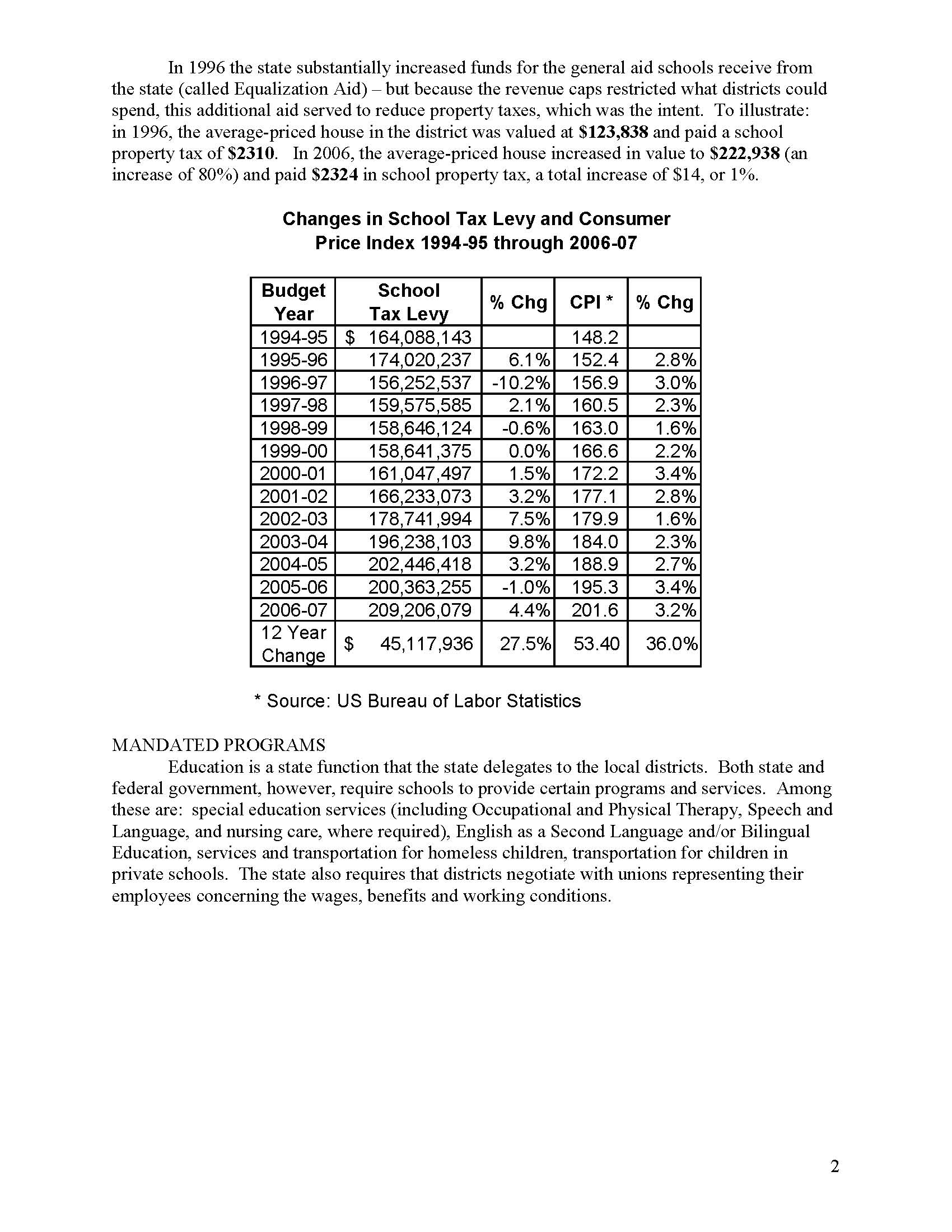
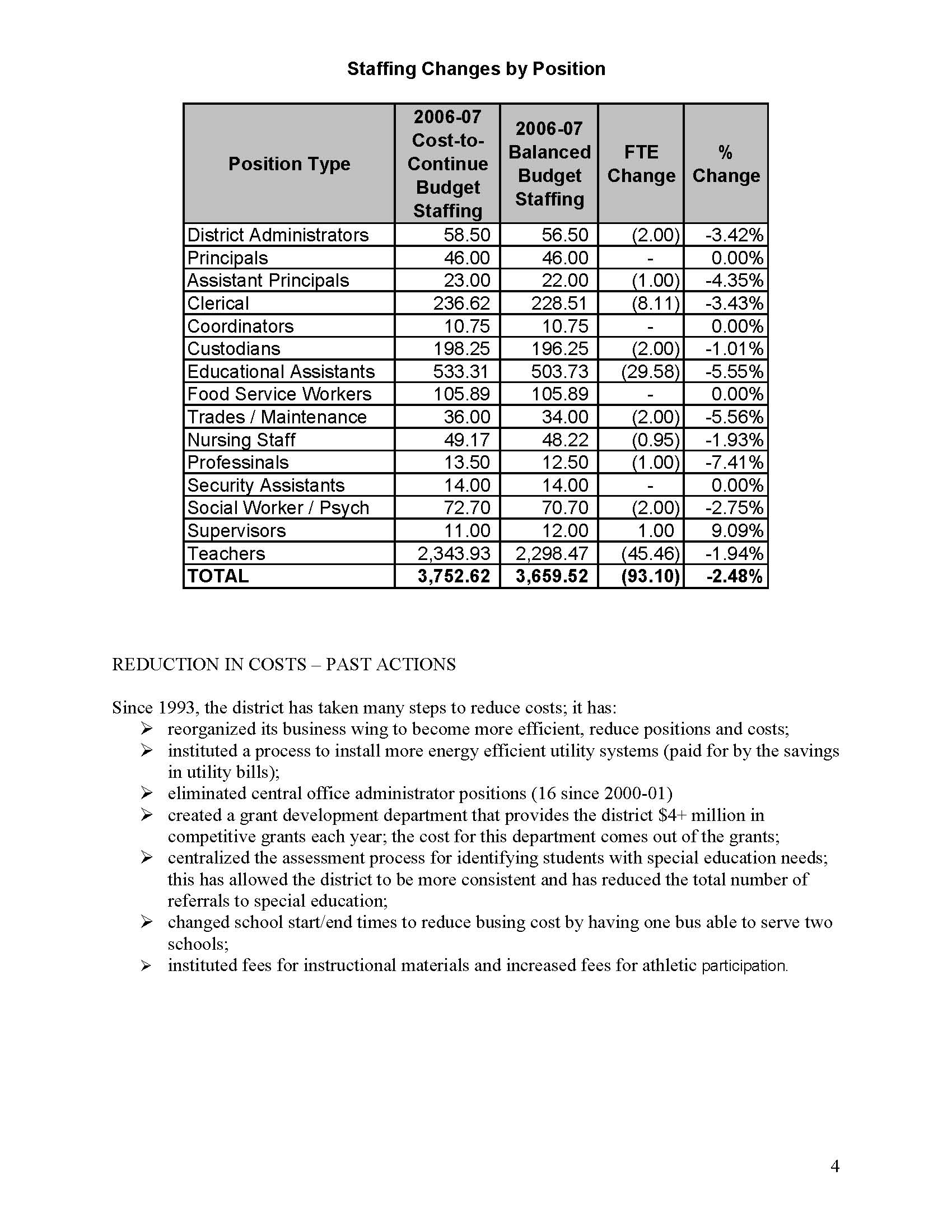
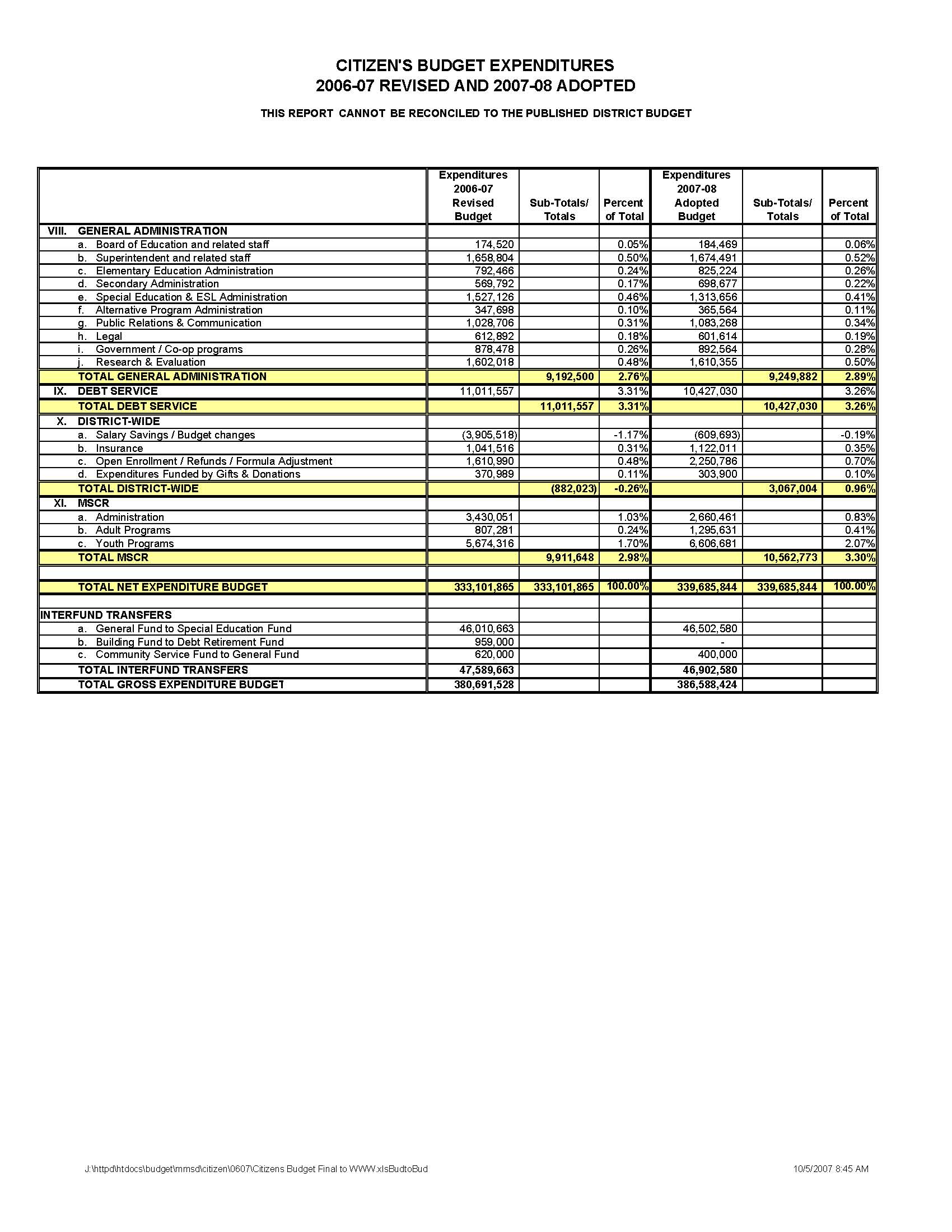
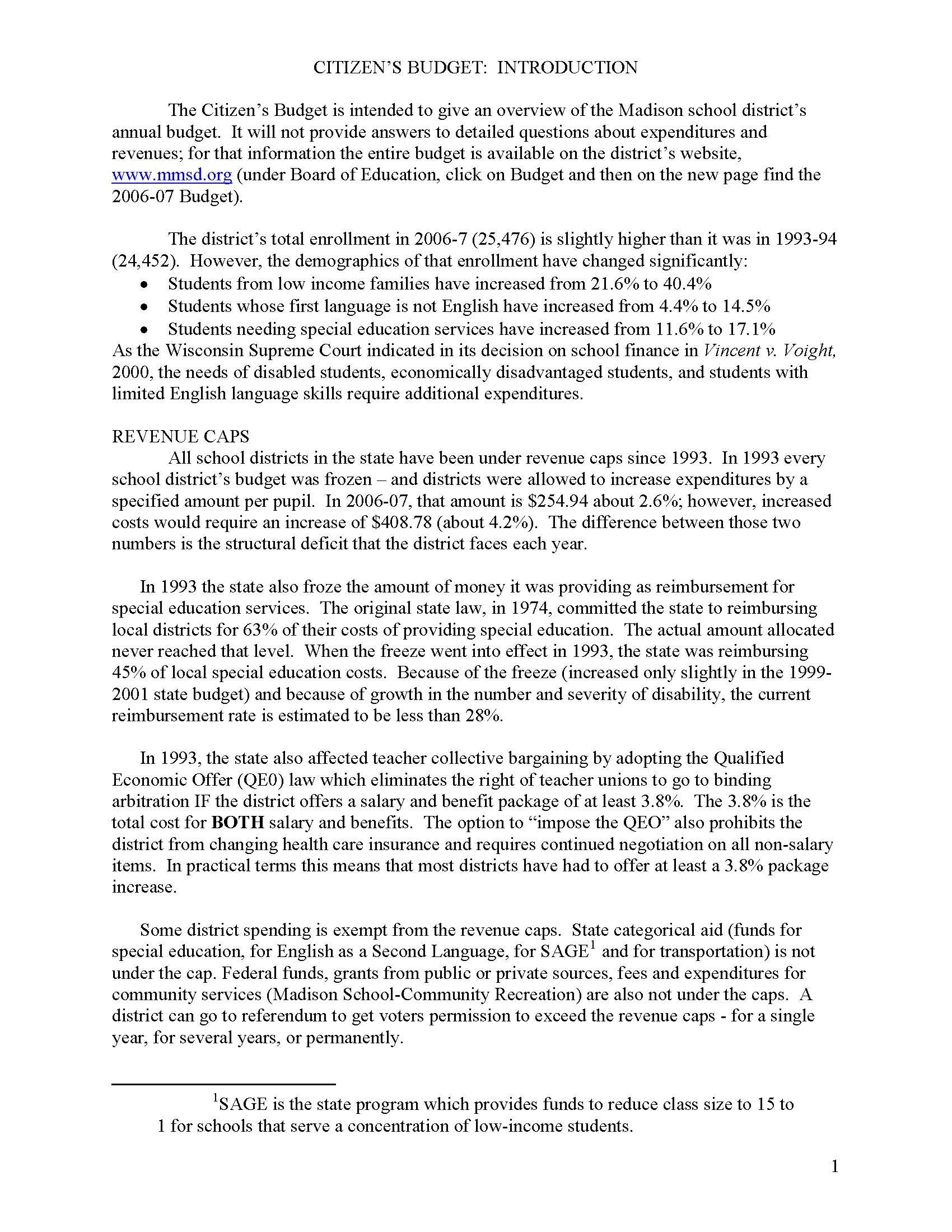
Madison School District Citizen’s Budget 2007-2008


PDF Version 2007-2008 enrollment: 24,268 [24,342 in 2006/2007 and 24218 in 2005/2006]

(more…)

Share

Top 3 Ways Parents Can Boost Kids

Judie Kleinmaier:

It’s that time of year — a chance for a fresh start for all students. It’s been a long time since I started a school year, but I remember the anxiety and anticipation: Will it be a good year? What do I have to do to be successful?
With that in mind, I e-mailed principals at three Madison schools and asked them to offer a bit of advice. My question was simple and straightforward: What are the three most important things parents can do to help their kids get off to a good start in school this fall?
Their answers brought to mind a book that was a bestseller in the 1980s: “All I Really Need to Know I Learned in Kindergarten” by Robert Fulghum. The advice from these experienced educators involves a lot of common sense and caring and sharing.
Here are their responses:

Share

Madison Reading Conference: October 12 – 13, 2007

Blowing the Lid Off Reading Achievement: Putting All the Pieces Together [120K PDF Conference Program] [160K PDF Registration Form]
Alliant Energy Center, Exhibition Hall, Madison, WI [Map]
October 12-13, 2007
Conference Program
Friday, October 12, 2007________________________________________________________
9:00-12:00 Keynote Speakers:
Drs. Sally and Bennett Shaywitz, Overcoming Dyslexia
Extraordinary progress in understanding the nature of reading and dyslexia, including their neural underpinnings, have direct implications for the earlier and more accurate identification and more effective treatment of dyslexia. This presentation focuses on these discoveries and their translation into clinical practices for overcoming dyslexia and for appreciating the sea of strengths associated with dyslexia.
12:00-1:30 Luncheon: Entertainment provided by Ervin Allen and the Walbridge Choir
2:45-3:45 Breakout Sessions

  1. Karin Chenowith from the Education Trust answers questions following her keynote address and provides a book signing opportunity.
  2. Fort Atkinson, WI Public School District, Principal of Barrie Elementary, Tony Bolz, and his staff outline their study and implementation of Overcoming Dyslexia and their overall K-12 reading plan.
  3. SRA/McGraw-Hill, Resources For Reaching Students With Disabilities The most proven and popular Direct Instruction Programs presented by professionals in this field.
  4. Project Read presenters share their research-based curriculum and instructional methodology for at-risk students in grades kindergarten through third grade and special education students.
  5. Wisconsin Branch of the International Dyslexia Association (WIBIDA) creates an awareness of what it is like to be dyslexic with simulations and a description of the association’s programs and services.
  6. Madison Reading and Learning Center Director, Janice Schreiber-Poznik, M.S., with staff, parents, and students, describe their remedial and enrichment programs of one-on-one tutoring for children and adults, which includes evidence based instruction, parent participation, and community partnerships.
Share

West HS English 10: More from Pam Nash

As many of you know, I have been in touch with the District and West HS administration — as well as with our BOE — with a request for “before-and-after” data on the English elective choices of West’s juniors and seniors. The reason for my request is that one of the primary reasons why English 10 was implemented was the concern that some groups of West students were not choosing to take challenging electives in their upper class years. Here are links to my earlier posts:
https://www.schoolinfosystem.org/archives/2007/08/west_hs_english_4.php
https://www.schoolinfosystem.org/archives/2007/08/west_hs_english_5.php
On August 29, I received the following email from Pam Nash:
Laurie-
Our Research and Evaluation staff reported today that the district does not keep course requests and course assignments beyond one year. Therefore, we cannot retrieve information that shows, historically, what English courses were chosen by whom over time.
We will be able to give you this year’s information by the end of next week.
Pam

(more…)

Share

Do culture-themed public schools cross a legal line?

Nathanial Popper:

When the Tarek ibn Ziyad Academy opened four years ago in suburban Minneapolis, the school was a bold experiment and its survival was in question. There was the scramble to attract students that any charter school faces, but Tarek ibn Ziyad had the additional worry of a constitutional challenge, given the school’s sponsorship by a nonprofit called Islamic Relief and the curriculum’s emphasis on Muslim culture and the Arabic language.
The school has not only survived but thrived, and there are plans for local expansion. Perhaps the surest sign that the experiment worked came last week, when a new charter school opened up thousands of miles away in Hollywood, Fla.–founded by Jewish parents, Ben Gamla Charter School has kosher food in the cafeteria and Hebrew posters in the classrooms. In the planning of the Florida school, Tarek ibn Ziyad’s experience was taken into account.
The success of Tarek ibn Ziyad’s model, and its adoption outside of Minnesota, heralds a potentially explosive new trend in America’s charter schools: publicly funded schools tied to a particular religion. The founders of Ben Gamla are already promising more branches in other states, and parents from other religions are sure to venture into similar territory, pushing the constitutional limits even further. As Peter Deutsch, the Orthodox Jewish congressman who started Ben Gamla, has said, it “could be a huge paradigm shift in education in America

Share

Superintendent by Feb. eyed: School Board wants hire by then

Susan Troller:

The Madison School Board intends to hire its new superintendent of schools by early February 2008, so he or she can learn the ropes before veteran Superintendent Art Rainwater retires at the end of June.
Board President Arlene Silveira announced a working schedule for the superintendent search this week. The board has been meeting throughout the summer with a consulting firm and now has mapped out dates and action items for naming the new administrator.
“We’re very comfortable with our consultants and with the process. Even so, I’m a little nervous about it,” she said this morning. “This is likely to be the most important thing we do as a board, and we’re taking it very seriously. Change is good, though, and it’s an exciting process.”
She said the process in Madison will include more public input than is typical in most communities looking for a new school superintendent.
“We’ll have two general community forums on September 19 and 20, and there will probably be 20 focus groups with everyone from advocacy groups, to our philanthropic partners, to the business community and staff members. If we made it any broader, we’d just be inviting names out of the phone book,” she laughed.

Share

Washington State’s Math Standards Review

Donna Gordon Blankinship:

The board’s executive director, Edie Harding, said public comment required some changes to a draft report the committee circulated last month, but the basic message is the same: The state needs tougher math standards and clearer guidance for teachers, parents and students.
The draft report called for putting more emphasis on learning the mechanics of math, but Harding said the math committee learned during public hearings around the state that people thought the report came on too strong concerning memorizing basic math facts.
Washington does need to re-emphasize the mechanics of math, but not give up on teaching students how to apply what they learn and to understand how math ideas fit together, Harding said.
The report, written by Linda Plattner of the Maryland-based educational research firm Strategic Teaching, which was hired by the state to assess its math expectations, also emphasizes the need to simplify grade level expectations and to set priorities for the state’s math standards.
“That should help teachers as well as kids,” Harding said.
The focus groups also taught the math committee that they need to include a math educator in their review committee so they can hear from a teacher if the standards will work in the classroom.

Strategic Teaching Draft Report: 650K PDF:

The bottom line is that Washington’s math standards need to be strengthened. If mathematics is the gateway to student success in higher education and the workplace, Washington is getting too few of its students to and through the door.
Compared to other higher-achieving states and countries, Washington is not expecting enough of its students. There is insufficient emphasis on key mathematical content. Some key math should be taught earlier in a student’s schooling, and some key math is simply missing. Washington does not provide sufficient clarity in its math expectations and does not ensure that Washington students learn the critical algorithms — math rules — that they need to succeed.
And the standards do not provide sufficient clarity of how well students are expected to learn math. For example, the standards often call for student “understanding” rather than a demonstration that a student can actually use the math to calculate, estimate, or solve a problem.
This is a harsh assessment. To be sure, there are good qualities in Washington’s mathematics standards including well-defined and developed mathematical processes and some well-developed strands, such as Algebra in the elementary years.

The Madison School Board instructed Superintendent Art Rainwater to conduct an “Independent Math Review” as part of his annual review process. Proposed Math Review Task Force [outline] (which did not obtain the required NSF funding).
I found it interesting and useful that Strategic Teaching included a discussion “on higher achieving states and countries” acknowledging the fact that our next generation is not competing with students from only from Racine or Green Bay, but those from Helsinki, Bangalore, Moscow and many other communities around the world.

Share

Make science easier, examiners are told

Adam Kula & Alexandra Frean:

Examiners will have to set easier questions in some GCSE science papers, under new rules seen by The Times. A document prepared by the Joint Council for Qualifications (JCQ), which represents awarding bodies across Britain, says that, from next year, exam papers should consist of 70 per cent “low-demand questions”, requiring simpler or multiple-choice answers. These currently make up just 55 per cent of the paper.
The move follows growing concern about the “dumbing down” of science teaching at GCSE and grade inflation of exam results, which critics claim is the result of a government drive to reverse the long-term decline in the number of pupils studying science.
In the past five years, the proportion of students gaining a grade D or better in one of the combined science papers has leapt from 39.6 to 46.7 per cent.
The latest move has been condemned by an education expert. Last night Professor Alan Smithers, head of the Education and Employment Research Centre at the University of Buckingham, said: “Deliberately increasing the proportion of easier questions is a clear example of lowering the bar.”

Share

Teachers in Trouble, Parents Ignored, Part III

Jay Matthews:

Dawn Henderson’s daughter Kaitlin was crying hysterically when she came home from Hardy Middle School one day in early October 2003. The D.C. sixth grader had a learning disability. She had not understood her social studies homework and was among six students who had not completed it.
Henderson said she knew the teacher to be a young woman new to the profession. During visits to Hardy, Henderson said she heard the teacher yell at some students about failing to do homework.
Kaitlin told her mother that day the teacher had tried something new: She made the six students stand in front of the class and hold all of their textbooks in their outstretched arms for about 15 minutes, until their muscles ached. Kaitlin did not have many books, but they were heavy for an 11-year-old.

Share

Views on Wisconsin’s K-12 School Spending

Frank Lassee:

The third Friday of September is an important date for schools. On that day the final enrollment count is made, then each school district will move to finalize their annual budget. Having the school budgets final by mid October is important for all of us, especially property taxpayers.
Under current law, schools will be allowed to spend $264 more for each student than last year. That is what the Governor and Democratic Senators proposed, as well. The Assembly has shaved it back to $200 per kid each year of the budget (with an incentive of $264 if the teachers agree to negotiate for a less expensive health plan). Last year in Wisconsin, we spent almost $10 billion on our public schools, approximately $5 Billion of state taxes, $4 Billion of local property taxes and $1 Billion from the federal government.

Paul Soglin:

Wisconsin State Representative Frank Lasee (R-2nd) needs to go back to school. I suppose it is an intended public service that he tells us that, “Education is by far the single biggest expense of our state budget.”
O.K. Interesting information, but he never tells us what is the proper level of spending, or for that matter, why home owners should pay more so that businesses can pay less for education.
He makes additional observations such as the fact that, “Total spending divided by the number of teachers works out to nearly $150,000 for each teacher.”
Huh? What does that mean? Lasee thinks that the cost of busing kids to school or the cost of school books is to be measured by the cost per teacher. A figure as useful as knowing the cost of postage to mail a letter to the moon. Most of his comments continue with measures and data that are meaningless, either with no context or a useless context.

Much more on K-12 spending here.

Share

Emphasizing Middle School Academics

Daniel de Vise:

Montgomery County School Superintendent Jerry D. Weast marched down a hallway on the first day of classes in the newly modernized Parkland Magnet Middle School in the Rockville area, trailed by a retinue of students. Then he stopped and asked, “Who’s taking algebra?” Three hands went up.
A few years ago, the question would have seemed more fitting in a high school. But today, half of Montgomery students take high school algebra before they leave the eighth grade, part of a regionwide trend toward more rigorous instruction in middle school.
Middle schools are the center of attention as Washington area school systems enter the 2007-08 academic year, which began yesterday in Montgomery, Howard, Anne Arundel and Charles counties and in the District. Four of eight middle schools in Charles, eight of 19 in Anne Arundel and 11 of 38 in Montgomery missed their achievement targets this year under the No Child Left Behind law.

Share

2007 SAT Scores Released

The College Board:

The College Board announced SAT® scores today for the class of 2007, the largest and most diverse class of SAT takers on record. Nearly 1.5 million students (1,494,531) in the class of 2007 took the SAT, and minority students comprised nearly four out of 10 test-takers.
“The record number of students, coupled with the diversity of SAT takers in the class of 2007, means that an increasing number of students in this country are recognizing the importance of a college education and are taking the steps necessary to get there,” said Gaston Caperton, president of the College Board. “I am encouraged by the greater numbers of students from all walks of life who are taking on the challenge of the SAT and college.
This year’s average score in critical reading is 502, a 1-point decline compared to last year, or a change of 0.20 percent. The average scores in mathematics and writing declined 3 points each compared to a year ago, bringing the scores to 515 and 494, or a change of 0.58 percent and 0.60 percent, respectively.

Wisconsin Results [250K PDF]. 50 State results are available here.
Daniel de Vise:

The Class of 2007 posted the lowest SAT averages in several years, according to scores released this morning. Scores from the second year of an expanded, three-section college-entrance test declined by double digits in Maryland and the District, by five points in Virginia and by seven points nationwide, compared with the previous graduating class.
Education leaders said the modest decline reflected an ever larger and more diverse population of students taking the test. More blacks, Asians and Hispanics took the SAT in this year’s graduating class than in any previous class; two-fifths of test takers are now minorities.

Share

Study finds emotional trauma can alter size of a child’s brain

Jill Tucker:

Hoping to unlock some of the mysteries of post-traumatic stress disorder in children, a Stanford University researcher looked inside their heads.
What Dr. Victor Carrion found was startling: Children with PTSD and exposure to severe trauma had smaller brains.
Carrion found a nearly 9 percent reduction in the size of the hippocampus, a horseshoe-shaped sheet of neurons that deals with memory and emotions.
The study, released earlier this year, was just a first step toward understanding the physical effects of trauma and why some children have a greater ability to ward off physical and mental reactions.

Share

Families Weigh Drugs for Attention Deficit

Benjamin Brewer, MD:

With school about to start, kids are coming in for their physicals — and for medication for attention deficit hyperactivity disorder.
I’m seeing more kids each year with symptoms of ADHD. Some just have the attention problems and others are hyperactive, too.
New treatments can be given once a day. They are relatively easy for kids to take at home and don’t require the involvement of the school nurse during the day, as shorter-acting older medicines do.
The medicines are even easier for doctors to prescribe. A trial of medication is the quickest and easiest thing to try for kids with symptoms, given the limited impact a doctor can have on complex family dynamics.
It may be too easy an option considering the rising sales of these heavily marketed medications. Ads for attention-deficit medications are everywhere in the popular press where a parent might see them, including People, Good Housekeeping and Family Circle magazines at our house.

Share

Is Wisconsin’s ACT Rank Inflated?

Bruce Murphy:

Last week, we got the annual good news that Wisconsin “scores near top on ACT once again,” as a Milwaukee Journal Sentinel headline declared. Aping her predecessors, state Superintendent Elizabeth Burmaster hailed the results as proof of how dandy we’re doing in Badgerland. The “composite score speaks well of our students’ academic achievement and the support they receive from their parents and teachers,” she declared.
But are we really doing that well? A close look at the ACT test data offers some reason for caution. Yes, Wisconsin’s average score of 22.3 was high compared to the national average of 21.2 (with scores ranging from 18.9 for Mississippi to 23.5 for Massachusetts), but the percentage of students taking the test here is lower than in 15 states. While 70 percent of Wisconsin students take the test, the percentage is 100 in Illinois and Colorado, 96 in Tennessee and Mississippi, and ranges from 71 to 82 percent for another 11 states.
Why does this matter? As the percentage of students taking the test increases, you are likely to include more low-attendance and low-performance students in the mix, pushing the average score lower.
Burmaster brags that Wisconsin has maintained its high ACT score even as the percentage of students taking the test rose. But the increase was minimal, rising from 68 percent in 2002 to 70 percent last year. That includes a steady rise in the number of African-American and Hispanic students taking the test, but they still remain underrepresented.
“We allow people in this state to pound their chest while ignoring the fact that Milwaukee has significantly fewer kids taking (the ACT),” Milwaukee School Board member Terry Falk declared in the JS story. (Falk, a former contributor to Milwaukee Magazine, sure knows how to give good quotes.)
As a reality check, I looked at state scores combined with the percentage of students taking the test to estimate which states we might actually trail. A state like Mississippi, for instance, can be quickly rejected: Yes, 96 percent of students took the test, but the average score of 18.9 was abysmally low, worst among all 50 states. Even if Wisconsin tested 96 percent of students, its average score would never drop that low.

Share

America Risks the Fate of the Roman Republic

David Walker (Comptroller General of the United States):

T he US is a great nation, possibly the greatest of all time. Yet to keep America great, policymakers must learn certain lessons from history, notably the downfall of the Roman republic.
The world has changed dramatically in recent years. The US is currently the sole superpower on earth but that exclusive status is likely to be short-lived. While the US is number one in many things, from the size of its economy to military might, it faces several big sustainability challenges.
America’s fiscal, healthcare, education, energy, environment, immigration and Iraq policies are in need of review and revision. Timely action is needed because Washington’s historical crisis-management approach to dealing with hard public policy choices is no longer prudent.

Jeremy Grant has more along with David Potter and Martin Walker.
Comptroller of the Currency

Share

Teens exposed to world of biotech careers through partnership

Bernadette Tansey:

The family culture of Berkeley’s Hernandez clan is a cool blend of Mexican roots and Bay area savvy – jumpy banda music, quinceanera parties, spicy pico de gallo and genetic engineering experiments.
That last part, the biotechnology, has been grafted onto the traditions Roberto and Irma Hernandez brought with them when the family immigrated to California in the late 1980s. Their arrival was timely – a new school program was about to welcome minority and disadvantaged kids to the biotech industry.
Their oldest child, Roberto, was the pioneer at 15 when he took a chance on the unfamiliar subject at Berkeley High School in 1992. Over the years, he has persuaded his brother and two of his three sisters to sign up for the biotechnology classes.
These four children of immigrants are now part of a young generation of biotech initiates whose prospects include some of the best-paying jobs in the Bay Area.
Roberto Hernandez, 30, was one of the first students to join the school program designed to convince disadvantaged kids that biotechnology jobs are a real option for them. The program, Biotech Partners, removes the barriers that often stand between low-income students and the well-compensated positions abounding in their own neighborhoods.
Hernandez and his sister Griselda, 28, work at the sprawling Bayer Healthcare campus in West Berkeley. Their younger brother Jesus just spent the eve of his 17th birthday tossing around terms such as “cell transformation” and “diafiltration” at a celebration for Biotech Partners students like himself who were finishing summer internships.

Biotech Partners Website:

Biotech Partners provides an entry-level biotechnology education and training program dedicated to supporting the San Francisco Bay Area’s robust bioscience industry while providing valuable working skills for local young people.
Biotech Partners has long been recognized as a model for connecting youth who are under-represented in the sciences to the world of biotechnology. A non-profit organization, Biotech Partners owes its success to strong collaboration among local biotechnology companies, secondary school and community college districts, a dedicated core staff and most importantly, the students and their families.

Related: Madison West High School’s Accelerated Biology Program [RSS].

Share

Beloit College’s Mindset List® for the Class of 2011

Beloit College:

Most of the students entering College this fall, members of the Class of 2011, were born in 1989. For them, Alvin Ailey, Andrei Sakharov, Huey Newton, Emperor Hirohito, Ted Bundy, Abbie Hoffman, and Don the Beachcomber have always been dead.
# What Berlin wall?
# Humvees, minus the artillery, have always been available to the public.

Cathy Lynn Grossman has more:

For this fall’s incoming college class, “off the hook” could mean “excellent” or escaping blame, but for sure it has nothing to do with telephones.
“Here’s Johnny!” That’s Jack Nicholson in The Shining, not the intro for Johnny Carson’s monologue, according to today’s 18-year-olds.
Professors had best update their lingo if they want to communicate with the Class of 2011 (on the assumption that anyone actually finishes in four years anymore).
Here to help is the 10th annual Beloit College Mindset List, released today by the small Wisconsin liberal arts college.

Share

Checking the Kids Homework Over the Internet
Growing Web-Based Software

Christopher Lawton:

After his divorce, Gregg La Montagne found it hard to help his 15-year-old daughter with her schoolwork since she lives in another state. So for her Spanish class recently, Mr. La Montagne told her to write her assignment in an online word-processing application made by Google Inc.
Mr. La Montagne, a sales manager in Austin, Texas, then accessed his daughter’s homework online, using the same software through his Web browser at home. A native Spanish speaker, Mr. La Montagne was then able to suggest grammar changes, which he typed in at the bottom of the paper. His daughter, who was online at the same time, was able to see her father’s notes almost instantaneously as her screen refreshed, and then in turn correct the document for him to see.
“It makes it easier to participate,” says Mr. La Montagne, 50 years old. “It’s not the same as being with her, but it’s at least a step in that direction.”
Mr. La Montagne is one of a growing number of parents now using Web-based applications to review and aid their children’s educational work. Google Docs & Spreadsheets, which Mr. La Montagne used, provides word processing and spreadsheets that a consumer can access using just a Web browser.

Share

New LA Superintendent “Blasts Culture of Low Expectations”

Howard Blume & Joel Rubin:

The L.A. schools chief tells administrators ‘we’re going to teach you how to change.’ They’ll get leadership training and will be held accountable for student achievement, he says.
In his first formal speech to administrators, Los Angeles Schools Supt. David L. Brewer told principals and managers Friday that they must change both themselves and a pervasive culture of “low expectations for brown and black children,” adding that they would receive mandatory leadership training and support but also would be held accountable for student achievement.
Brewer, a devotee of management books, set out eight principles — including creating “a sense of urgency,” “building a team” and “communicating a vision” — that he expects principals and others to follow.
In a later interview, Brewer said the Los Angeles Unified School District would launch a pilot management-training program, with courses shaped by input from universities, outside consultant firms and corporations.
“We’re going to teach you how to change,” Brewer told his audience, promising “world-class leadership and management training” as well as real support from higher-ups. “You’re going to need it,” he said.
Many of the roughly 1,500 administrators in attendance took notes on stationery provided free by a credit union that was trying to drum up business. After Brewer’s morning speech at a hall in the Los Angeles Convention Center, “inspirational” was the adjective of choice for many.

Share

French Gains Foothold in NYC’s Dual Language Schools

Julie Bosman:

Nearly all the 65 dual-language programs in the New York City public schools are conducted in Spanish and Chinese, languages that are considered practical tools for future success.
So far, French has not fit into that equation.
But next month, the first French-English dual-language programs will begin at three schools in the city: Public School 125 on the Upper West Side, P.S. 58 in Carroll Gardens, Brooklyn, and Intermediate School 22 in Harlem. They are the result of two years of lobbying from the French Embassy and a group of parents determined to promote the language in the public schools.
Dual-language programs have operated for more than 15 years, officials at the city’s Department of Education said. The inclusion of French brings the total number of languages in the program to five, including Spanish, Chinese, and last year’s addition of Haitian-Creole and Russian.

Share

West HS English 10: Request for Data — Reply from Pam Nash

I received the following reply to my request for English 10 data from Assistant Superintendent for Secondary Schools Pam Nash:
Date: Fri, 24 Aug 2007 14:27:48 -0500
From: pnash@madison.k12.wi.us>
To: lauriefrost@ameritech.net, eholmes@madison.k12.wi.us, hlott@madison.k12.wi.us, arainwater@madison.k12.wi.us, mbking1@wisc.edu
Laurie-
Mr. Holmes and his staff will do this. Pam
Pamela J. Nash
Assistant Superintendent
for Secondary Schools
Madison Metropolitan School District
(608) 663-1635
(608) 442-2149 (fax)

And here’s what I wrote back:
Date: Fri, 24 Aug 2007 15:21:06 -0500
To: pnash@madison.k12.wi.us, eholmes@madison.k12.wi.us, hlott@madison.k12.wi.us, arainwater@madison.k12.wi.us, mbking1@wisc.edu
From: “Laurie A. Frost”
Subject: Re: English 10 early results request
Cc: asilveira@madison.k12.wi.us, lkobza@boardmanlawfirm.com, lucym@charter.net, jwinstonjr@madison.k12.wi.us, mcole@madison.k12.wi.us, bmoss@madison.k12.wi.us, ccarstensen@madison.k12.wi.us
Thank you, Pam. I will look forward to receiving the data.
I know you all probably see me as a thorn in your side. Please try to understand, I am simply trying to keep you honest with the public … and empirically based.
If the results are positive — if English 10 is associated with a significant change in the target variable of concern (rigor of elective choices in 11th and 12th grade) — wouldn’t you want to know?
And if the results are not positive, wouldn’t you want to know?
Laurie

Share

Back to School Picnic

100 Black Men of Madison:

100 Black Men of Madison 11th Annual Back to School Picnic will be held this Saturday August 25th, rain or shine at Demetral Park located on Commercial and Packers Avenue at 11 am.
Over 2,000 free backpacks filled with school supplies will be distributed to students in kindergarten thru eighth grade.
In addition, hamburgers, hot dogs and beverages will be served. This event is first come, first served and students must be in attendance to receive a backpack.
The purpose of this event is to assist students at the beginning the school year with the supplies needed for academic success and to reduce the achievement gap.
For more information please contact, Chris Canty at 244-1259 or cwcanty@gmail.com.

Via a Johnny Winston, Jr. email.

Share

West HS English 10: Request for Data

Here is an email I sent to the BOE, asking them to request important outcome data for West HS’s English 10 initiative. Embedded in the email is my own request for such data. As both a content and a process issue, I should think this would be of interest to all SIS readers. By all means, feel free to write to these people with your own request. –LAF
August 22, 2007
Dear BOE (especially Performance and Achievement Committee members Kobza, Winston and Cole):
Please see my email below to various people involved with the West HS English 10 initiative. Thank you for taking the appropriate and expected responsibility to obtain these data and make them public. We need to know if the things we are doing to our high school students are actually having the desired impact, in part, to guard against our doing things for our own misguided adult reasons (things like politics and stubborn pride).
I should think that the gap-closing effectiveness (or lack thereof) of a core course in 10th grade English at one of our four high schools would be of significant interest to community members throughout the District, including parents, teachers and students at the other three high schools … and especially members of our School Board.
Many thanks,
Laurie
Date: Wed, 22 Aug 2007 08:42:39 -0500
To: hlott@madison.k12.wi.us,mbking1@wisc.edu,eholmes@madison.k12.wi.us,pnash@madison.k12.wi.us,arainwater.k12.wi.us
From: “Laurie A. Frost”
Subject: English 10 early results request
Dear All:
One of the primary reasons for the implementation of English 10 at West High School was concern about the failure of some groups of West students to take rigorous English electives in their upper class years.
Can you please send me the data regarding the English electives chosen by this year’s 11th graders when they registered for classes six months ago? (Needless to say, I would also like to see the English elective data for the past few years, so that a meaningful comparison can be made between the choices of English 10-era versus pre-English 10-era students.)
This is the first group of West students to take English 10, so a look at the early results of the curricular initiative seems appropriate, as does sharing that information with the West community. I assume that the data are appropriately disaggregated by race and SES, given your concerns and your hypotheses about the impact of the new core course.
Many thanks.
Laurie Frost
West HS parent

Share

Attempts to make schools healthier are faltering

The Economist:

THE proportion of children in America who are overweight has tripled over the past 20 years and now exceeds 17%, according to the Centres for Disease Control and Prevention (CDC). The health problems that this causes include hypertension and type-2 diabetes, formerly known only among the nation’s overweight adult population. A group sponsored by the National Institute on Ageing has warned that this may be the first generation ever to have a shorter lifespan than their parents.
All the while, the proportion of children who take part in daily exercise at high school has dropped from 42% in 1991 to only 28% in 2004, according to the CDC. Snacking has greatly increased; the Government Accountability Office found in 2003 that 99% of America’s high schools now sell snacks and other food as well as providing lunches.
In an attempt to get the problem tackled at local level, Congress in 2004 passed an act directing school districts that get money from the national school-lunch programme to create “wellness” policies by the start of the 2006-07 school year. The districts were told to set standards for nutrition, physical activity and education about good food, then make sure that schools actually implement them.
One year after the deadline, the results are haphazard. School districts’ plans range from a few paragraphs long to more than 25 pages. Some states, like Texas and Arkansas, have pre-emptively set standards for school districts under their jurisdiction, forcing schools to ban fizzy drinks and junk food while increasing the amount of exercise the pupils take. Others offer guidelines rather than mandates, with no repercussions for schools that don’t comply. And in some areas, schools are being eased into change very slowly. Oregon’s legislature passed a bill in June that gives its schools ten years to meet its new physical-education requirements.

Share

Kewaunee High School goes solar

From WFRV:

KEWAUNEE (WFRV) – Tuesday morning, solar-electric panels were installed on the roof of Kewaunee High School.
The panels are part of a system that will produce about 2,800 kilowatt-hours of electricity each year – that’s enough electricity to power three classrooms, which amounts to approximately $200 in energy savings per year to the school.
In addition to the solar panels, the school was awarded a three-week renewable energy curriculum to be integrated into the science curriculum. Students and teachers can access data from the solar-electric system via the Internet and use the information in classroom projects throughout the year.
The system was donated to the school by WPS Community Foundation as part of the SolarWise® for Schools program. Every year three or four new high schools are selected. Since 1996, 41 high schools in the Wisconsin Public Service area have participated in the program.
This program is funded by donations from 3,800 Wisconsin Public Service customers, as well as state grants.


For more information on solar energy, go to Focus on Energy.

Share

NY State Names 17 More ‘Persistently Dangerous’ Schools

Jennifer Medina:

New York State education officials yesterday added 17 schools to the list of those considered “persistently dangerous,” substantially expanding the list for the second year in a row. All but 2 of the 27 schools on the new list are in New York City, including a dozen schools designed for students with severe disabilities.
The schools ranged from the behemoth Jamaica High School in Queens to smaller schools like Powell Middle School in Harlem and Public School 14 in Staten Island. The list also includes a school in Rochester and Berkshire Junior-Senior High School in Canaan, N.Y.
The federal No Child Left Behind Act requires states to compile annual lists of “persistently dangerous” schools but leaves it to each state to define the term. Many states, including New York, have been criticized for issuing extremely short lists in past years.
“We are utterly determined to make all schools safe,” said Richard P. Mills, the state education commissioner, in announcing the list yesterday at a news conference in Albany.
Mr. Mills said New York’s list had grown because the state had vastly improved its reporting efforts. He noted that the 49 other states had listed a total of only 30 schools as “persistently dangerous” last year, just a hairsbreadth more than the schools now listed by New York.

Madison Parent’s School Safety Site posted 2006/2007 student teacher assaults/injury data here.
Wisconsin DPI “Discipline Data Collection and Reporting” webpage.

Share

Teachers in Trouble – Parents Ignored, Part II

Jay Matthews:

For a long time, Dawn Mosisa had trouble forgiving herself for the way she shrugged off her daughter’s story about the teacher who hit one of her second grade classmates in the spring of 2003. Her daughter said the man ordered the class to count to 10 in French while he hit the boy 10 times with a ruler.
The girl was not in the habit of making up such stories, the mother said, but like most parents, Mosisa did not want to think that any educator would be so cruel, so she chose not to believe it. When the teacher left the school the next year, Mosisa grew more concerned. But she said she could not get anyone at Maryvale Elementary School in Rockville to explain to her or her child exactly what had occurred and how they should respond.
Abuse of a student at school is a parent’s nightmare. Not only do such incidents harm the victims and their parents, but they also trouble the children who may have witnessed the event and their parents. Such cases usually remain undisclosed because parents do not want their children embarrassed or disturbed by public knowledge of what happened. But Mosisa, 44, a student financial services official for a public university, has given an unusually detailed account that sheds light on a rarely examined side of public education.

Share

Flushing Out Life’s Hard Calls

Roger Blitz:

Harvard law school thinks it has found the solution to many of society’s problems, from teenage delinquency to world diplomatic crises: a hand of poker.
The card game that is a game of skill to its advocates, and a potentially ruinous bet on chance to its detractors, is to be taught to disadvantaged US schoolchildren and college students to teach respect, business acumen and even war strategy.

Share

Madison and State ACT Scores Rise

Susan Troller:

Madison public school students’ average scores on the ACT college admissions exam outpace those of their counterparts statewide, even as Wisconsin performs well compared to other states.
The average composite score of Madison public high school students on the national test was 24.6 over the 2006-07 school year, the best showing the district has had since it began keeping ACT records 22 years ago. Nearly 70 percent of high school students in Madison took the test last year.
Up from 24.2 in 2005-06, the average score for Madison students compares to 22.3 among students statewide. The average national composite score is 21.2.
Although an achievement gap remains among minority students and their white counterparts in Madison, students from all ethnic groups here perform substantially better than their peers statewide, and nationally. For the second year in a row, all Madison minority sub-groups improved their performance on the ACT.

Share

School Employees Serving on School Boards

Chris Moran:

School employees commonly serve on the governing boards of school districts that don’t employ them. What makes a case in South County different is three administrators’ dual roles at Southwestern College and the Sweetwater Union High School District, because they’re in positions to vote on each other’s budgets and salaries.
Greg Sandoval is interim president of Southwestern and a member of the Sweetwater board. Arlie Ricasa is director of student activities at Southwestern and is on the Sweetwater board. Jorge Dominguez is director of the Educational Technology Department at Sweetwater and a member of the Southwestern board.
The arrangement is legal. Governance ethicists raise questions about appearances, though, especially when the crossover votes occur as close together as they have recently.
How close?
In May, Sandoval joined the majority in a 3-2 vote rejecting $500,000 for Dominguez’s department.

Share

Open records request re: private school busing

I want to know who knew what when about missing the August 4 deadline to notify parents of the MMSD decision on busing private school students, so I sent the following to Steve Hartley:

I am sending this message to you because I was told that you are now the legal custodian of district records.
This is an open records request under sec. 19.35 of the Wisconsin Statutes for all records, prepared between August 22, 2006 and August 22, 2007, that relate to or mention in any way the busing of private school students by the Madison Metropolitan School District.
As I hope that you know, Wisconsin statues define records rather broadly. It is my understanding that the definition would include any e-mail between staff on their personal computers or MMSD computers and all e-mail that might have a format such as b710146.admin.admin1@madison.k12.wi.us and b717934.mailpo1.maildomi@madison.k12.wi.us.
I look forward to your prompt response to this request.
Ed Blume

Share

K-12 Spending More Reliant on Federal Government Since No Child Left Behind Act

Gerald Prante:

New data from the National Center for Education Statistics show that the federal government has been commandeering a continually larger role in K-12 education in recent years, especially since 1999 and the January 2002 passage of the No Child Left Behind Act.
The new statistics include detailed financial data about school districts across the nation for the 2004-05 school year. Five years earlier, during the 1999-2000 school year, public school districts received an average of $578 per pupil from the federal government. By 2004-05, that number had risen to $919. That’s a 60-percent increase, and even after adjusting for inflation, it’s a 39 percent boost in federal aid. In this study we rank the states on how much more reliant they have become on Uncle Sam for this traditionally local government function.
There are several ways to quantify this increasing reliance on the federal government. The two we present in Table 1 are the absolute dollar amounts per pupil that the federal government sent to each state’s school system, and the percentage of each state’s education spending that comes from the federal government. The rightmost column shows how every state’s share of revenue from the federal government has changed since 1999-00.

Related: K-12 Spending Climate.

Share

When Special Education Goes Too Easy on Students

John Hechinger and Daniel Golden:

On June 25, 2006, Michael Bredemeyer threw his tasseled cap in the air and cheered after getting his high school diploma. Two days later, his parents mailed the diploma back.
Michael, now 19 years old, has learning disabilities and finished high school at a seventh-grade reading level, despite scoring above average on IQ tests. The Bredemeyers say he passed some classes because teachers inflated his grades and accepted poor work. By awarding him a meaningless diploma, they say, school officials avoided paying for ongoing instruction.
“I felt proud because he had worked so hard,” says Michael’s mother, Beverly, her voice breaking. “You don’t want to take that away from him. But you knew it wasn’t real. What’s he going to do in the future? Will he be able to go to college and get a job?”
The Bredemeyers represent a new voice in special education: parents disappointed not because their children are failing, but because they’re passing without learning. These families complain that schools give their children an easy academic ride through regular-education classes, undermining a new era of higher expectations for the 14% of U.S. students who are in special education.
Years ago, schools assumed that students with disabilities would lag behind their non-disabled peers. They often were taught in separate buildings and left out of standardized testing. But a combination of two federal laws, adopted a quarter-century apart, have made it national policy to hold almost all children with disabilities to the same academic standards as other students.

Share

Moving Students Out of Poor Inner Cities Yields Little, Studies of HUD Vouchers Say

Jay Matthews:

Many social reformers have long said that low academic achievement among inner-city children cannot be improved significantly without moving their families to better neighborhoods, but new reports released today that draw on a unique set of data throw cold water on that theory.
Researchers examining what happened to 4,248 families that were randomly given or denied federal housing vouchers to move out of their high-poverty neighborhoods found no significant difference about seven years later between the achievement of children who moved to more middle-class neighborhoods and those who didn’t.
Although some children had more stable lives and better academic results after the moves, the researchers said, on average there was no improvement. Boys and brighter students appeared to have more behavioral problems in their new schools, the studies found.

Share

Where does MMSD get its numbers from?

One of the reasons that I have devoted more time than I should to analyzing the outcomes from the District’s SLC grants (way too much time, given that I don’t get paid for this and given that the District is going to continue on its merry way with restructuring our high schools into Small Learning Communities no matter what the data indicates) has to do with the frustration I experience when I try and find consistency in the District’s data. Frankly, there isn’t any. MMSD is consistently inconsistent with their numbers, see for example my earlier post trying to identify what the District spent in 2004/05.
The District’s latest press release trumpeting the success of our high school students on the ACT is just the latest example of this problem. According to MMSD, the percentage of Madison students who took the ACT is significantly higher than the percentages that are reported by DPI.
The District reports that “Sixty-nine percent of all MMSD 12th grade students participated in the ACT during 2006-07, compared to 70% last year. Over the last 13 years, MMSD participation has ranged from 67-74% (see pg. 2 table).”

ACT Score Comparison by Year
Average Composite:

                                    %MMSD 12th
 Year     Madison   WI     US     Graders Tested 
2006-07    24.6     22.3    21.2        69%
2005-06    24.2     22.2    21.1        70%
2004-05    24.3     22.2    20.9        74%
2003-04    24.2     22.2    20.9        70%
2002-03    23.9     22.2    20.8        68%
2001-02    24.4     22.2    20.8        67%
2000-01    24.1     22.2    21.0        70%
1999-00    24.2     22.2    21.0        72%
1998-99    24.4     22.3    21.0        67%
1997-98    24.5     22.3    21.0        67%
1996-97    24.5     22.3    21.0        70%
1995-96    23.8     22.1    20.9        71%
1994-95    23.5     22.0    20.8        70%

According to DPI, a much smaller percentage of the District’s 12th graders have taken the ACT in their junior or senior years. (The table below is taken from DPI)


ACT Results – Composite – All Students

Madison Metropolitan
  Enrollment
Grade 12
Number Tested % Tested Average Score – Composite
1996-97 1,552 982 63.3 24.5
1997-98 1,650 1,016 61.6 24.5
1998-99 1,639 1,014 61.9 24.4
1999-00 1,697 1,127 66.4 24.2
2000-01 1,728 1,091 63.1 24.1
2001-02 1,785 1,113 62.4 24.4
2002-03 1,873 1,126 60.1 23.9
2003-04 1,920 1,198 62.4 24.2
2004-05 2,055 1,247 60.7 24.3
2005-06 2,035 1,244 61.1 24.2
2006-07 1,983 1,151 58.0 24.6

An examination of minority student participation in the ACT reveals that the percentage of African American and Hispanic students taking the test has declined over the last three years. Only 20.1% of African American students in the District took the ACT as compared to 34.6% of African American students across the state.
I am more than willing to believe that DPI’s numbers are inaccurate, but don’t they get this data from the District? Several months ago I was attempting to clarify discrepancies between MMSD and DPI in the cost per student data, and that experience is perhaps informative here. I wrote to clarify this issue:

I am writing to ask about the data that the district lists on its web site regarding cost per pupil. The excel spreadsheet t1.xls on the page (http://www.madison.k12.wi.us/re/dataprofile.htm) lists numbers that do not match those listed on DPI’s web site (http://data.dpi.state.wi.us/data/selschool.asp). Specifically, the numbers that MMSD lists as the state average cost per student are greater than the numbers that DPI lists on its site, while at the same time the MMSD cost per student listed is less than what DPI states that our District spends per student.
I am attaching the spreadsheet I downloaded from the District web site, along with the numbers that I got from DPI. If you could help me understand the discrepancy in these numbers it would be most appreciated.

The response that I got back from Roger Price was:

Jeff,
Both data sources are from the DPI. They calculate both tables. I am not sure what the differences are between the two. We utilize the “Basic Facts” data as published by the Wisconsin Taxpayers Alliance.
Roger

Why the District with its extensive Data Warehouse has to rely on the Wisconsin Taxpayers Alliance to tell it what they spend per student is beyond me, but it doesn’t fill me with any confidence about the accuracy of their data.

Share

Don’t fund Small Learning Community grant sought by MMSD

August 20, 2007
Gregory Dennis
U.S. Department of Education
400 Maryland Avenue, SW., room 3W243 FB6
Washington, DC 20202-6200
Dear Mr. Dennis,
As a long-time advocate for academic excellence in the Madison Metropolitan School District (MMSD, Madison, Wisconsin), I urge the Department of Education to reject the MMSD’s recent application for a Small Learning Centers grant, Smaller Learning Communities Program CFDA #84.215L.
Please visit a popular Madison blog, schoolinfosystem.org, where you will find long threads with comments, questions, and concerns about the grant application, as well as the MMSD’s pilot efforts in small learning centers.
Blog commentators, some of whom as statistics instructors at the University of Wisconsin-Madison, clinical psychologists, and other professionals with advanced degrees, express little support for the MMSD’s implementation of small learning communities.
When people try to get evaluation data from the MMSD on the current small learning communities, the district cannot or will not produce the information. The little available information about the MMSD’s small learning communities does not point to success, but rather to no impact on academic achievement. (See the evaluation on the MMSD Web site by Bruce King, whose services the MMSD wrote into its grant proposal.)
As the MMSD implements small learning schools, it simply amounts to closing the achievement gap by limiting opportunities for academic success of advanced students without raising the academic performance of low-performing ones.
Finally, the MMSD would be better off not to launch a major program change, especially when the current superintendent, the champion for the changes, will leave the district in the summer of 2008.
Sincerely,
Ed Blume

Share

Hours of teaching differ for schools

Amy Hetzner & Alan Borsuk:

Where a student attends public school in the five-county metropolitan Milwaukee area can make a difference of as much as four weeks’ time in the classroom per year, according to data reported to the state.
For the last two school years, the school districts of Burlington, Cudahy, Kettle Moraine, Mukwonago, Slinger, South Milwaukee and Wauwatosa reported that most – if not all – of their schools held classes at least 65 hours longer than the minimum hours set by state law.
Meanwhile, the Oak Creek-Franklin and Waukesha school districts met for the minimum amount of hours, and a large number of schools in the Milwaukee Public Schools system fell below the standard in 2006-’07.
“There’s nothing more important than time with the classroom teacher,” said Tony Evers, deputy superintendent of the state Department of Public Instruction. “And, if that’s continually taken away, the state of Wisconsin would have an obligation that doesn’t happen.”
By and large, most public schools in Milwaukee, Ozaukee, Racine, Washington and Waukesha counties reported similar annual total instructional hours for their students for the past two years, the only years for which data was available from the DPI.

Share

Teachers in Trouble, Parents Ignored — Part I

Jay Matthews:

I have written several columns about clashes between educators and parents, a subject that rarely gets much attention because it is so personal. Those involved are often reluctant to give details. Over the last few years I have been saving material on some particularly interesting cases in which parents feel school officials froze them out of the process of dealing with their children’s teachers. A few months ago, less-detailed versions of these episodes were reported in The Post. Today, and in the next two columns, I will describe four cases at more length, and follow with a column of reader reactions, and one on how experts in parental issues think these cases should have been handled.
What do you think explains these communication meltdowns? What can be done about them? Two of the cases I will examine are about teachers who allegedly abused students and were eventually fired, with parents unable to get the full story. I will start however with a different situation: a teacher who was fired for reasons that made no sense to the many parents who loved her work. They tried to influence the decision, but found their views rebuffed.

Share

New Study Reveals School Finance Lawsuits Increase Funding Temporarily, Hike Taxes Permanently

Christ Atkins:

But few studies have attempted a comprehensive, state-by-state measure of the long-term fiscal impact of court education mandates4 and none have presented a state-by-state estimate of the cost of legislation approved to comply with court education mandates.
How much more are states spending on education as a result of these mandates? Have lawmakers increased taxes to comply with the mandates, and if so, how much? Has compliance with court mandates led to long-term increases in per-pupil spending? This study—the first in a new series called Appropriation by Litigation—will answer these questions.

Share

Elmbrook considers allowing bonus for college-level work

Lisa Sink:

The Elmbrook School Board is considering plowing new ground by extending weighted-grade options to courses taken by students preparing for technical colleges rather than only four-year universities.
Elmbrook would be “blazing new territory” because no other area school district that Elmbrook considers high-achieving has this weighted-grade policy, said Elyce Moschella, Brookfield Central High School’s coordinator of gifted and talented students.
The move would touch sensitive issues such as grade point averages and class rank. The policy change would extend weighted grades to Elmbrook classes that provide dual credit at both technical colleges and universities.
Those classes are college accounting, principles of interior design, mechanical drafting and computer-aided design, engineering computer-aided design seminar and auto systems and tuneup. Students taking those courses would earn an extra 0.025 on their grade point per semester, the same added quarter-point that students earn for taking advanced placement and fifth-year foreign language classes.

Share

Education in Mexico: La Maestra

The Economist:

A YEAR ago Felipe Calderón won a desperately close election for Mexico’s presidency by a margin of barely 200,000 votes. While there were many factors behind his victory, one that may have tipped the balance was the support of Elba Esther Gordillo, the head of the National Educational Workers’ Union, as the country’s teachers’ union is called. Ms Gordillo is reckoned by many to be the most powerful woman in Mexico. Indeed, after Mr Calderón, she may be the second most powerful politician in the country.
Ms Gordillo’s political power comes mainly from the union’s sheer size: with 1.4m members teaching in primary and secondary schools, it is the largest labour union in Latin America. From that political base, Ms Gordillo controls a significant block of deputies in the lower house of the federal Congress, as well as two senators. And while no state governor will say so openly, “none of them will go against her will,” says Carlos Ornelas, an education specialist at Mexico City’s Metropolitan Autonomous University.
“La maestra” (“the teacher”), as Ms Gordillo is known, is widely reckoned to have reached an unwritten—and maybe even implicit—agreement with Mr Calderón, under which she has swapped her support in other matters for his acquiescence in her grip over the country’s schools.

Share

Life in the Carpool Lane

Annie Groer:

Four mothers armed with calendars and schedules huddled around a kitchen table in Vienna plotting how to get their children to and from Trinity School at Meadow View when classes start in two weeks.

Share