School Information System

Referendum Climate: A Look at the US Government Budget

.

NY Times Graphics.
Related:

Further proof that there is no free lunch. The ongoing calls for additional state redistributed tax dollars for K-12 public education will likely have an effect on other programs, as this information illustrates. I do think that there should be a conversation on spending priorities.

The current financial system “crisis” presents parents with an excellent opportunity to chat with our children about money, banks, politics and taxes (When you deposit the baby sitting money, where does it go? What happens if the funds are no longer in the bank?). It is a rather potent mix. Much more, here.

Share

Disrupting Class: Student-Centric Education Is the Future

Clayton M. Christensen & Michael B. Horn:

The answer isn’t simply investing more in computer equipment and technology for schools, either. The United States has spent more than $60 billion equipping schools with computers during the last two decades, but as countless studies and any routine observation reveal, the computers have not transformed the classroom, nor has their use boosted learning as measured by test scores. Instead, technology and computers have tended merely to sustain and add cost to the existing system.
That schools have gotten so little back from their investment comes as no surprise. Schools have done what virtually every organization does when implementing an innovation. An organization’s natural instinct is to cram the innovation into its existing operating model to sustain what it already does. This is perfectly predictable, perfectly logical — and perfectly wrong.
Student as Consumer
The key to transforming the classroom with technology is in how it is implemented. We need to introduce the innovation disruptively — not by using it to compete against the existing paradigm and serve existing customers, but to target those who are not being served — people we call nonconsumers. That way, all the new approach has to do is be better than the alternative — which is nothing at all.
To convey what we mean, we need to briefly explain the disruptive-innovation theory. In every market, there are two trajectories: the pace at which technology improves and the pace at which customers can utilize the improvements. Customers’ needs tend to be relatively stable over time, whereas technology improves at a much faster rate. As a result, products and services are initially not good enough for the typical customer, but, over time, they improve and pack in more features and functions than customers can use.

Much more on Clayton Christensen.

Share

Investigation into the LA School District’s Administration

Beth Barrett:

Managing almost 900 schools and more than 650,000 students is a huge task. But a Daily News review of salaries and staffing shows LAUSD’s bureaucracy ballooned by nearly 20 percent from 2001 to 2007. Over the same period, 500 teaching positions were cut and enrollment dropped by 6 percent.
The district has approximately 4,000 administrators, managers and other nonschool-based employees – not including clerks and office workers – whose average annual salary is about $95,000. About 2,400 administrators are among the 3,478 LAUSD employees who earn more than $100,000 annually.
Meanwhile, the average salary for an LAUSD teacher is $63,000. And the average household income in Los Angeles County is less than $73,000.
The Daily News obtained the LAUSD salaries database through the California Public Records Act. The database – searchable by name, job title and salary range – is posted at dailynews.com.
“(The bureaucracy) grows whether it’s fat or lean times,” said United Teachers Los Angeles union leader A.J. Duffy, a longtime critic of the district’s administrative staffing.

Share

DCPAC Dan Nerad Meeting Summary

A video tape of the entire presentation and discussion with Dr. Nerad may be viewed by visiting this internet link: https://www.schoolinfosystem.org/archives/2008/09/ madison_superin_10.php

Dan Nerad opened his remarks by stating his commitment to efforts for always continuing change and improvement with the engagement of the community. He outlined four areas of focus on where we are going from here.

  1. Funding: must balance district needs and taxpayer needs. He mentioned the referendum to help keep current programs in place and it will not include “new” things.
  2. Strategic Plan: this initiative will formally begin in January 2009 and will involve a large community group process to develop as an ongoing activity.
  3. Meet people: going throughout the community to meet people on their own terms. He will carefully listen. He also has ideas.
  4. Teaching and learning mission: there are notable achievement gaps we need to face head-on. The “achievement gap” is serious. The broader mission not only includes workforce development but also helping students learn to be better people. We have a “tale of two school districts” – numbers of high achievers (including National Merit Scholars), but not doing well with a lot of other students. Low income and minority students are furtherest away from standards that must be met. Need to be more transparent with the journey to fix this problem and where we are not good. Must have the help of the community. The focus must be to improve learning for ALL kids, it is a “both/and” proposition with a need to reframe the issue to help all kids move forward from where they are. Must use best practices in contemporary assessment, curriculum, pedagogy and instructional methods.

Dr. Nerad discussed five areas about which he sees a need for community-wide conversations for how to meet needs in the district.

  1. Early learning opportunities: for pre-kindergarten children. A total community commitment is needed to prevent the ‘achievement gap’ from widening.
  2. High schools: How do we want high schools to be? Need to be more responsive. The curriculum needs to be more career oriented. Need to break down the ‘silos’ between high school, tech schools and colleges. Need to help students move through the opportunities differently. The Small Learning Communities Grant recently awarded to the district for high schools and with the help of the community will aid the processes for changes in the high schools.
  3. School safety: there must be an on-going commitment for changes. Nerad cited three areas for change:

    a. A stronger curriculum helping people relate with other people, their differences and conflicts.

    b. A response system to safety. Schools must be the safest of sanctuaries for living, learning and development.

    c.Must make better use of research-based technology that makes sense.

  4. Math curriculum and instruction: Cited the recent Math Task Force Report

    a. Good news: several recommendations for curriculum, instruction and policies for change.

    b. Bad news: our students take less math than other urban schools in the state; there are notable differences in the achievement gap.

  5. Fine Arts: Cited recent Fine Arts Task Force Report. Fine arts curriculum and activities in the schools, once a strength, has been whittled away due to budget constraints. We must deal with the ‘hands of the clock’ going forward and develop a closer integration of the schools and community in this area.

(more…)

Share

The Early Education of Our Next President

Peter Meyer:

One of them, Barack Obama, was awakened at four in the morning in Jakarta to study from a correspondence course; the other, John McCain, attended grade school in old airplane hangars. Both went on to elite private high schools.
Whether it is the image of Abraham Lincoln studying by log cabin candlelight or George Washington dutifully copying the Rules of Civility and Decent Behaviour in Company and Conversation into his schoolboy notebooks, presidential schooling has long been a national fascination (see Figure 1).
Today we have a graduate of Columbia College and Harvard Law (Obama) taking on a graduate of the Naval Academy and National War College (McCain). Harvard boasts seven presidents as alumni (including George W. Bush’s business degree); the Naval Academy, just one (Jimmy Carter). But it is the early schooling–how did they get there?–that is most fascinating. George Washington’s early education is remarkable for what is not known about it, but there is general agreement that if he had much formal education, it ended at about age 15. Teddy Roosevelt, said to have had an “uneven” education at home (strong in biology, French, and German but deficient in math, Latin, and Greek), graduated from Harvard magna cum laude. Harry Truman, the only president since 1897 who did not graduate from college, got up early too, at five in the morning, to practice piano.

Share

Packers Launch Anti-Steroid Initiative in 7 Wisconsin High Schools

Green Bay Packers:

The Green Bay Packers will partner with seven Wisconsin high schools to implement the NFL ATLAS & ATHENA Schools Program, a nationally-acclaimed initiative designed to promote healthy living and reduce the use of steroids and other drugs among high school athletes.
The high schools, Ashwaubenon, Columbus, De Pere, Gibraltar, New Holstein, Two Rivers and West De Pere, will complete the program sessions during the 2008-09 school year. The schools were chosen based on interviews with program administrators and school-wide commitment from the principal, athletic director and coaches.
This local opportunity was created as a result of a $2.8 million grant from the NFL Youth Football Fund to Oregon Health & Science University (OHSU). The Green Bay Packers, other NFL teams and the NFL Players Association all contribute to the NFL Youth Football Fund. The NFL grant is one of a series of improvements to the NFL and NFL Players Association’s policy and program on anabolic steroids and related substances. It will be used to disseminate ATLAS and ATHENA to 36,000 high school athletes and 1,200 coaches in 80 high schools during the 2008-2009 school year. Participating teams include the Arizona Cardinals, Baltimore Ravens, Chicago Bears, Kansas City Chiefs, Miami Dolphins, Minnesota Vikings, Oakland Raiders, Pittsburgh Steelers, San Diego Chargers, San Francisco 49ers, Seattle Seahawks, St. Louis Rams, and Washington Redskins.

Share

Madison 2008 Referendum: Watch List Report Card

10/6/2008 update
Active Citizens for Education presents this “Watch List Report Card” as a means of reporting relevant information, facts and analyses on topics appropriate for consideration by taxpayers in voting on the Madison Metropolitan School District referendum question November 4, 2008.
This document is dynamic in nature, thus it is updated on a regular basis with new information and data. Questions, analyses, clarifications and perspectives will be added to the entries as appropriate. Review Ratings will be applied to report the progress (or lack thereof) of the Board of Education and Administration in its plans, data, information, reports and communications related to the referendum.
The question which shall appear on the ballot is as follows:

“Shall the following Resolution be approved?
RESOLUTION AUTHORIZING THE SCHOOL DISTRICT BUDGET TO EXCEED REVENUE LIMIT FOR RECURRING PURPOSES
BE IT RESOLVED by the School Board of the Madison Metropolitan School District, Dane County, Wisconsin that the revenues included in the School District budget be authorized to exceed the revenue limit specified in Section 121.91, Wisconsin Statutes, for recurring purposes by: $5,000,000 beginning in the 2009-2010 school year; an additional $4,000,000 beginning in the 2010-2011 school year (for a total of $9,000,000); and an additional $4,000,000 beginning in the 2011-2012 school year (for a total of $13,000,000 in 2011-2012 and each year thereafter).”

(Source: MMSD Administration 09/15/08)
Continue reading here (277K PDF).

Share

Effective education, kindergarten to retirement

Mitch Daniels:

Last week I wrote that building the best possible business environment in America was the key to attracting jobs and investment to Indiana. Our state has recently achieved top-tier rankings as a place to do business, with low taxes and utility costs, reduced regulation, new infrastructure investments, and the highest credit rating in history. But we will not maximize these advantages if we do not also have enough well-educated workers. Jobs and investment that would otherwise come to Indiana will wind up somewhere else if we can’t provide a large enough pool of skilled labor.
As our economy diversifies, jobs in all sectors, including manufacturing, increasingly require skills and knowledge beyond high school. Right now, too many of our workers lack the education and training they need to perform — or even qualify for — the kinds of skilled jobs that we want to bring to or grow here in Indiana. Thousands of jobs are open and waiting in fields such as information technology, health and logistics, but are not being filled because of this skills mismatch.

Share

Some districts drop class ranks to improve students’ college chances

Erin Richards:

At Brookfield East High School, Laura Turner is the kind of student who shouldn’t have to worry about getting into the college of her choice.
She’s articulate, mature and enthusiastic, a hard worker with high marks — a 3.88 grade-point average — who organized hundreds of students last year in Waukesha County to sleep in a parking lot and raise thousands of dollars for displaced Ugandan citizens.
But ranked against her peers in terms of GPA, Turner isn’t in the top 25% of her senior class.
The stratification caused by class rank, which arguably makes a student such as Turner appear less accomplished, compelled the Elmbrook School District last week to start looking at whether its two high schools should quit tracking the data. It’s a move that’s been implemented within the past five years at Whitefish Bay and Shorewood high schools, where administrators say they’ve seen more seniors being accepted into the University of Wisconsin-Madison.

Share

At Amherst college, 1% of first-year students have landlines, 99% have Facebook accounts

Clive Thompson:

Peter Schilling — the director of information technology at Amherst College — crunched the numbers on the technological habits of this year’s incoming class, and discovered some fascinating stuff. He’s published it online as the “IT Index“, crafted in the style of a Harper’s Index, and it’s an intriguing snapshot of some of the technologically-driven behavioral changes that will mark the next generation.
Below are a few of my favorite stats, culled from the list. As you read, keep in mind that this incoming class has 438 students in it:

Share

“Open Detroit School District to Choices”

Stephen Henderson:

When I covered the Detroit Public Schools for the Free Press in the mid 1990s, writing umpteen stories about failed programs, stolen money and incompetent management, I reached a point where it seemed to me better just to shut the system down and start fresh, to build something that worked, rather than continuing with what clearly didn’t.
People laughed when I would say that out loud. What would you do with the kids? You can’t just give up on the whole thing.
But who’d be laughing now? If I said it’s time to embrace the rapid decommissioning of the very idea of a Detroit Public Schools system, would I even get a chuckle?
The truth is that the system is imploding, and every family with the ability to roll with something other than DPS appears to be grabbing that choice. The student population plummeted by an estimated 17,000 over the past year, equal to the total number of people living in Auburn Hills.

Share

Voters told new Germantown school could pay for itself

Term Kertscher:

A School Board member says voters can approve a $22.5 million school referendum without seeing an increase in property taxes – and a pro-referendum committee goes even further, saying a successful referendum could actually lower property tax bills.
The president of the Wisconsin Taxpayers Alliance has his doubts, and some Germantown School District residents question the idea that borrowing $22.5 million for a new elementary school wouldn’t raise their taxes.
“It just makes people all the more suspicious,” resident Anne Bastow said about the Nov. 4 referendum. “To say your (property tax) payments are going down when you’re getting something new, it just doesn’t jibe.”
But a top official with the state Department of Public Instruction says school districts can increase their state aid – and simultaneously reduce property tax levies – by increasing enrollment.

Share

Wisconsin State Tax Based K-12 Spending Growth Far Exceeds University Funding

via WISTAX

WISTAX published a fascinating chart in their most recent issue of FOCUS [Page 1, Page 2]:

However, the state pledge to provide two-thirds of schools revenues in 1996-97 changed the budget landscape. By 2006-07, state-tax support for the UW System had almost doubled during Ihe 25 years prior. However, inflation (CPI, up 115%). school aids/credits (320%). and overall slate GPR expenditures (222%) rose more.

Related:

Further proof that there is no free lunch. The ongoing calls for additional state redistributed tax dollars for K-12 public education will likely have an effect on other programs, as this information illustrates. I do think that there should be a conversation on spending priorities.

Share

Madison Schools “Individual Endowments”

Foundation for Madison Public Schools:

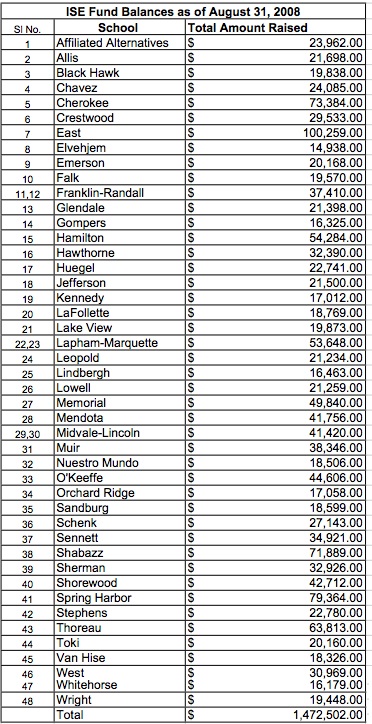
The Foundation for Madison’s Public Schools developed the Individual School Endowment Initiative, which is unique in the country. This initiative was designed to build an endowment fund for each of the 48 schools in the district. Through the generosity of John Taylor and the Clay-Price Fund, each school was offered a challenge grant of $5,000. Schools needed to raise $5,000 toward the establishment of an endowment fund in order to earn the $5,000 match and establish their $10,000 Individual School Endowment Fund. We are thrilled to announce that as of June, 2007, all 48 schools had met the match and established endowment funds. 32 schools have endowment fund balances greater than $20,000 and 6 schools have over $50,000 in their endowments. This initiative has raised over $1.45 million and endowment balances continue to grow. Our long-term goal is to see every school have a $50,000 endowment as well as a mutually beneficial relationship with a community partner. To that end, we have established our Adopt-A-School Program.

2008 FMPS Grants:

$10,000
Madison – Our History
Dept of T/L
This proposal would support the completion of Phase II of this project to write a book, Madison-City of Four Lakes, Our History and Our Home and the accompanying curriculum for third grade history instruction for Madison schools. Phase II includes funding for the graphic artist to complete the layout for the book and printing 2000 copies and the web based construction.
$9,120
AVID Summer Training
East High School
AVID is a program designed to provide underachieving and underserved populations training for skills they will need to be successful in advanced level high school courses and four year college programs. This grant would support summer training for teachers at the AVID institute.
$9,900
Literacy Initiative Grant
East High School
This proposal would fund 5 and 1/2 days of training for 12 East High teachers to learn content area reading strategies across all major content areas. The professional development is part of a sustained coordinated effort to improved literacy at East. Funds would also support some of the materials necessary to implement literacy instruction.

Share

District Improvement Plan

East Hartford Public Schools [300K PDF]:

The East Hartford Public Schools District Improvement Plan represents the evolution of work begun five years ago. Although it has undergone several transformations as a result of extensive professional development, it continues to serve as the blueprint for action and a path to excellence.
The generally upward trajectories in student achievement confirm the application of researched-based strategies can make a difference in student achievement. This result has provided encouragement and motivation to staff.
Although pleased with the district’s accomplishments and the progress we have made, sustained focus, reinforcement, and fidelity of implementation must continue to be priority. Accomplishments, along with current work in progress, encompass many important areas of focus:

Kate Farrish:

The board of education has unanimously endorsed a state-mandated district improvement plan that aims to raise standardized test scores, reduce school suspensions and narrow significant achievement gaps between black and white students and poor students and their wealthier peers.
Superintendent of Schools Marion H. Martinez will present the plan, approved Monday night, to the State Board of Education on Oct. 2. It will then be detailed for the public at a local board meeting on Oct. 6. The state requires such plans when districts or schools have been deemed “in need of improvement” under the federal No Child Left Behind Act.
The plan calls for raising the percentage of students reaching proficiency in reading, writing and math scores on the Connecticut Mastery Test and Connecticut Academic Performance Test by at least 15 points over the next three years. It also calls for reducing the test score gap between racial and ethnic groups and socioeconomic groups by 30 percent in the same three years. Currently, for example, there is a 30 percent average gap in reading scores between those groups in grades 3 to 9, and the plan calls for the gap to be narrowed by 9 percentage points — a 30 percent drop — by 2010-11.

Share

Beware of the Easy School Fix

Jay Matthews:

When fixing schools, beware of miracle cures. Every week people send me ideas they say will change the future of education and lead all humanity to enlightenment. So, when management expert William G. Ouchi let me look at his new work on the surprising power of total student loads per teacher, or TSL, I was skeptical.
He says when middle or high school principals are given control of their schools’ budgets — a rare occurrence in big districts — they tend to make changes in staffing, curriculum and scheduling that sharply reduce TSL, the number of students each of their teachers is responsible for. Some urban districts have TSLs approaching 200 kids per teacher. But after principals get budgeting power, the load drops sharply, sometimes to as low as 80 kids per instructor. When that happens, the portion of students scoring “proficient” on state tests climbs. A group of New York schools had a surge of 11 percentage points after they reduced average TSL by 25 students per teacher.
I hear the mumbles out there. Yes, correlation is not causation. Test scores are not a perfect measure. Many other factors could explain the rise in achievement. For instance, the principals might be using their new powers to hire good teachers and fire bad ones.

Share

K-12 Outreach & Distance Education

Texas Tech University, via a kind reader’s email:

TTUISD has a comprehensive curriculum – coursework is offered in all required subject areas from kindergarten through high school. Our Credit by Examinations (CBEs) allow students to test out of subjects.
TTUISD offers all courses required for a high school diploma in the state of Texas. Our elementary level lesson plans require no prior teaching experience to use, and all TTUISD courses are written by Texas-certified teachers.
TTUISD high school students may choose between a Minimum Graduation Plan and a Recommended Graduation Plan (College Preparatory Program). Students who successfully complete high school requirements and pass the exit-level TAKS will earn an accredited Texas high school diploma.
Students must take a minimum of four full courses to be considered a full-time TTUISD student. CBEs do not count when determining full-time student status.

Perhaps nearby UW-Madison will give K-12 another try?

Share

McCain, Obama Advisers to Debate Education

Mitchell Landsberg:

On Oct. 21, the education advisors to the two candidates — Lisa Graham Keegan for McCain; Linda Darling-Hammond for Obama — will face off in a debate at Teachers College, the venerable education school at Columbia University in New York. The debate, which begins at 4 p.m. PDT, will be webcast by Education Week. The moderator will be Susan Fuhrman, the president of Teachers College.
In the meantime, you can read the education platforms for McCain here and Obama here. And here is Edweek’s blog on the campaign. For those who don’t want to go to that much trouble, we’ll helpfully reduce the platforms to fit on the head of a pin: McCain believes in school choice and local control; Obama believes in an expansion of early childhood education and increased federal funding for education.

Share

Use of School Budgets in State Funding Lawsuit Questioned

Laura Diamond:

Gov. Sonny Perdue has asked the attorney general’s office to determine whether school districts can use state and local school money to pay for a lawsuit over how Georgia funds education.
The Consortium for Adequate School Funding in Georgia, a group of about 50 mostly rural systems, filed the suit in 2004. The trial was scheduled to begin next month, but the group withdrew the action last week after the case was assigned to a new judge. Consortium leaders, who argue insufficient state funding has resulted in low student achievement, said they will file a new lawsuit.
In a letter Perdue sent to the attorney general’s office Tuesday, he cited a provision in the state constitution that requires school money be spent on schools, academics and support programs.
“Taxpayers in these school districts need to know that their education tax dollars have been used to pay lawyers suing the state instead of in their children’s classrooms,” Perdue said Thursday in a news release. “My hope is that in the future decisions on school funding will be made through the public policy process, not in a courtroom where the plaintiffs’ lawyers are paid with local education tax dollars to battle defense lawyers paid with state tax dollars.”

Share

[For] Crying Out Loud

September 24, 2008 By Glenn Ricketts:

Yes, yes, we know that you’ve been an outstanding high school history student and that you’d like to major in that subject in college, but we’re not sure why you’re inquiring about scholarships here. Wait, not so fast: it’s certainly impressive that you’ve had some original research published, and your grades are indeed outstanding. But if, as you say, you’re looking for a scholarship, we’d like to hear about your curve ball. Oh, you didn’t play baseball in high school? Well, then how about football or basketball? No? Lacrosse, soccer, swimming, maybe? Golf, bowling, tennis? In that case, do you sing or dance? You don’t appear to have any disabilities, not that we’d ask.
No, sorry, speaking fluent French is not really what we had in mind by “diversity.” Do you by chance play the xylophone? What’s that? History scholarships? You mean something geared specifically towards outstanding high school history students? Ho! Ho! Good one.
No, not here. Haven’t heard of ’em anywhere else, either. Where’d you come up with that idea anyway? Look, we’re not sure we can do anything for you at this point unless…wait a minute, did you say you were a cheerleader? Sit down. I think we’re finally on to something. Yes, that’s right, we have several scholarships for cheerleaders. Can you send us all of the relevant information about your high school cheerleading experience? We may also be able to direct you to other sources of support for promising college cheerleading prospects. Why didn’t you tell us this at the outset, instead of getting sidetracked with all of that stuff about history? We’re very busy in this office, you know. No doubt you’re an outstanding history student, and by all means major in it if you like, but that’s not going to get you anywhere if you’re looking for a scholarship. Good thing you mentioned the cheerleading angle, especially since we have to be careful to choose only the most outstanding applicants.
I made up this little drama, but it is based on the “true facts.” History scholarships are rare. Cheerleading scholarships are pretty common–even at colleges and universities that one might think value intellectual achievement over human pyramids.
Will Fitzhugh is a former high school history teacher who, frustrated with the lack of opportunities to showcase academic achievement among young students, in 1987 founded The Concord Review, (www.tcr.org) a quarterly journal devoted entirely to outstanding research essays by high school students. Anyone who doubts the possibility of impressive research skills and consummate writing ability among some of today’s secondary school students should read at least one issue of the Review, where future historians and teachers might well be making their first appearances. These students don’t need remedial English, and could probably be bumped up beyond the usual introductory survey courses in history to begin work as history majors on the fast track.
Trouble is, as Will has pointed out to us, the students who write in The Concord Review don’t get much recognition beyond that, to say nothing of scholarship assistance. A few colleges–most notably Reed College–have recently started supporting The Concord Review financially–which is bound to encourage some bright, highly capable students to consider attending college out in Portland, Oregon. But by and large, the prospect for students winning scholarships on the basis of outstanding ability to engage in historical scholarship isn’t very bright.

(more…)

Share

Kiselev’s Geometry: Book II, Stereometry

Alexander Givental, via email:

The Stereometry book adapted from Russian by A. Givental is the second part of the legendary Kiselev’s Geometry. It first appeared in 1892 as a second half of a single textbook and, for a long time, the two co-existed between the same covers. Indeed, the idea of a plane was introduced on page 1 while the last chapter of the book (that followed the stereometry part) was devoted to the geometric constructions in two dimensions. Kiselev’s Geometry has demonstrated an unusual staying power, being in an uninterrupted circulation for a good part of a century. (For the historic outline, see the review of the first part.) As a matter of fact, the first part of the book met with stiffer competition so that, while its rule was weakened in the 1960s, the second part reigned in the textbook market well into the 1970s.
The combined 1980 edition came out under the title Elementary Geometry for teacher colleges with a Foreward by A. N. Tikhonov who observed, albeit with some reservations, that the pedagogical mastery with which the book was written, the simplicity and consistency of the exposition, kept the book from becoming obsolete.

Share

Minnesota Democrat-Farm Laborers Believe in new School “Miracle”

Norman Draper:

In the face of a strained economy and an almost-certain state budget shortfall, the party is pushing a bold new education initiative. Better schools, they say, will be an investment that counters the downturn.
When DFL state Rep. Denise Dittrich went door to door campaigning for re-election in Champlin last week, a smattering of homeowners brought up education.
One worried that the enrollment at her child’s elementary school would drop so low that the school would shut down. Another fretted about property taxes that have soared, in part because voters approved increases in school funds.
One resident, Shelley Peterson, said she was equally concerned about education and the economy. She said she wants more money for education and wants to lower the high activity fees in the Anoka-Hennepin School District. But would she be willing to consider higher taxes to do that?

Share

Reinventing the School Lunch

TedTalks:

Speaking at the 2007 EG conference, “renegade lunch lady” Ann Cooper shares her passionate belief in remaking the school lunch. She uses scathing language to describe how most American kids are fed at the noon bell, out of cans, boxes and plastic bags — sowing the seeds of the obesity epidemic that is spreading from the US around the globe. But, she says, there’s a coming revolution in the way kids eat at school — local, sustainable, seasonal and even educational food. (Recorded December 2007 in Los Angeles, California. Duration: 19:42.)

Share

You say “accountability,” I say “longitudinal study”

Milwaukee’s Public Policy Forum:

In a report released last week that did not get press other than a post on the education blog of the Journal Sentinel, the Legislative Audit Bureau rehashed the first-year findings of the School Choice Demonstration Project’s study of the Milwaukee Parental Choice Program (MPCP). Interestingly, the Bureau found the study’s data cannot provide information about performance in individual schools. In response, a prominent school choice lobbying group has called for test scores to be reported annually on a school-by-school basis.
The overall findings, released last February, were not as positive as education reform supporters had anticipated. The Audit Bureau re-analyzed the data and confirmed these findings. For example, the sample of choice students in the private schools had lower reading scores on state standardized tests than a matched sample of MPS students at three of six grade levels. At all six grade levels tested, the private school students scored lower than a random sample of MPS students. In nearly all cases, however, the differences were not statistically significant.

Share

When Tough Times Weigh on the Kids

Sue Shellenbarger:

At a little under three years of age, Bailey Haag can’t understand the turmoil on Wall Street. But last week, the little girl’s brow furrowed and her face grew sad as she overheard her mother on the phone, reacting to a ripple effect of the nation’s economic problems — her father’s layoff.
Although her mother, Claire Crawford Haag, had hoped to shield Bailey from stress, the child knew from her mother’s voice that “it was not a good conversation,” Ms. Haag says. Noticing her daughter’s face crumple, Ms. Haag began fashioning in her head an explanation a small child could understand.
Amid fallout from the nation’s worsening financial picture, many parents are trying to protect their children from worries about layoffs and financial hardship. But children are actually silent carriers of family financial stress, research shows. They’re not only keenly aware of it, but it makes them more likely to behave badly or develop emotional problems. To help kids cope, psychologists and researchers say, parents need to communicate in ways they can understand, keep family relationships on track, and give children a role in helping solve family problems.

Share

Spare the Rod: Why You Shouldn’t Hit Your Kids

Alan Kazdin:

The typical parent, when whacking a misbehaving child, doesn’t pause to wonder: “What does science have to say about the efficacy of corporal punishment?” If they are thinking anything at all, it’s: “Here comes justice!” And while the typical parent may not know or care, the science on corporal punishment of kids is pretty clear. Despite the rise of the timeout and other nonphysical forms of punishment, most American parents hit, pinch, shake, or otherwise lay violent hands on their youngsters: 63 percent of parents physically discipline their 1- to 2-year-olds, and 85 percent of adolescents have been physically punished by their parents. Parents cite children’s aggression and failure to comply with a request as the most common reasons for hitting them.
The science also shows that corporal punishment is like smoking: It’s a rare human being who can refrain from stepping up from a mild, relatively harmless dose to an excessive and harmful one. Three cigarettes a month won’t hurt you much, and a little smack on the behind once a month won’t harm your child. But who smokes three cigarettes a month? To call corporal punishment addictive would be imprecise, but there’s a strong natural tendency to escalate the frequency and severity of punishment. More than one-third of all parents who start out with relatively mild punishments end up crossing the line drawn by the state to define child abuse: hitting with an object, harsh and cruel hitting, and so on. Children, endowed with wonderful flexibility and ability to learn, typically adapt to punishment faster than parents can escalate it, which helps encourage a little hitting to lead to a lot of hitting. And, like frequent smoking, frequent corporal punishment has serious, well-proven bad effects.

Share

“Data Driven” Education Research

Javier Hernandez:

Roland G. Fryer Jr., a Harvard economist, has often complained that while pharmaceutical companies have poured billions of dollars each year into studying new drugs and Boeing devoted $3 billion to develop the 777 jet, there has been little spent on efforts to scientifically test educational theories.
Now Dr. Fryer has quit his part-time post as chief equality officer of the New York City public schools to lead a $44 million effort, called the Educational Innovation Laboratory, to bring the rigor of research and development to education. The initiative will team economists, marketers and others interested in turning around struggling schools with educators in New York, Washington and Chicago.
Backed by the Broad Foundation, founded by the billionaire philanthropist Eli Broad, and other private groups, the research is intended to infuse education with the data-driven approach that is common in science and business, Dr. Fryer said. He compared the current methods of educational research to the prescriptions of an ineffective doctor.

Share

National Punctuation Day

http://www.nationalpunctuationday.com/:

A celebration of the lowly comma, correctly used quotes, and other proper uses of periods, semicolons, and the ever mysterious ellipsis.

Share

I’ll Take My Lecture to Go, Please

Andy Guess:

It looks like students can be open-minded after all: When provided with the option to view lectures online, rather than just in person, a full 82 percent of undergraduates kindly offered that they’d be willing to entertain an alternative to showing up to class and paying attention in real time.
A new study released today suggests not only a willingness but a “clear preference” among undergraduates for “lecture capture,” the technology that records, streams and stores what happens in the classroom for concurrent or later viewing.
The study, sponsored by the University of Wisconsin-Madison’s E-Business Institute, tackles the much-discussed question of students’ preferences for traditional versus online learning with unusual rigor. Based on a survey of more than 29,000 undergraduate and graduate students at the university, the study had a response rate of over 25 percent. Almost half of the undergraduates — 47 percent — had taken a class with lectures available for online viewing.

Share

Is a university degree still worth the time and money it takes?

The Economist:

“MORE will mean worse,” wrote an angry Kingsley Amis in 1961, contemplating plans to expand university education. His prediction has been tested past anything he could have imagined, as that era’s new universities were joined by the ex-polytechnics in the 1990s, and the proportion of youngsters who go on to university rose from less than 10% to almost 40% now. The 430,000 new undergraduates heading off to freshers’ weeks later this month will find themselves part of Britain’s largest university cohort ever.
Similar rumblings have continued since Amis’s jeremiad. With less government money (in real terms) per student than in his day, universities have to pack them in and keep them in to balance the books. Paul Buckland, an archaeology professor at Bournemouth University, resigned when administrators overruled his failing grades for ten students (last month he won a case for “constructive dismissal”). In June a barnstorming lecture by Geoffrey Alderman, of Buckingham University, gained wide attention with its claims of impotent external examiners, widespread unpunished plagiarism and a “grotesque bidding game” in which universities dished out good grades in order to claw their way up league tables.

Share

Weekly Update

This past week on the board I have moved in varied circles, hopefully which may lead our district in a new and better direction as we improve our connections with the broader community.
Early in the week the Madison Board of Education approved the submission of two resolutions for the state school board association’s annual meeting. I was happy to be an author of one and to get assistance from the Middleton/Cross Plains board on the second.
One meeting that I’m always happy to attend is with community organizers and childcare providers working to bring quality early childhood education to all students in Madison. We met at a local business, Ground Zero coffee shop, and enjoyed much in the way of conversation and goal-setting. If you would like to learn how to get involved in this effort feel free to contact me and I will put you in touch with some great people working on behalf of young children and through an investment in our future.
In addition, I may start holding listening sessions at local businesses to better communicate with the community.
Personal blog, RSS Feed.

Share

Local Students Considered for National Achievement Honors

Tamira Madsen:

Four area high school students were named semifinalists for the National Achievement Scholarship Program competition and are eligible for scholarships for Black American students through the National Merit Scholarship Program.

Middleton students Zowie L. Miles and Kristina M. Teuschler, Matthew Bowie-Wilson from Madison West and Taylor M. Behnke from Madison Edgewood, along with 13 other Wisconsin students, made the list.

More than 150,000 juniors requested consideration for the 2009 National Achievement Scholarship Program competition by taking the Preliminary SAT/National Merit Scholarship Qualifying Test, a test which served as an initially screening of the applicants.

Share

Madison High School Students Organize and Push Referendum

Tamira Madsen:

Kaley Stroup has seen the impact school budget cuts have had on classmates and friends at La Follette High School.

Officials at La Follette were forced to drop the Italian language program from the curriculum for the 2008-09 school year, and students had to scramble to restructure their class schedules.

Stroup said elimination of the courses put many seniors like her in a tough situation when thinking ahead to college.

“Their schedules are messed up now because colleges want you to have four years of the same foreign language, and they’ve had to switch to French and Spanish, and it’s thrown things off for them,” Stroup said.

She is part of a group of Madison Metropolitan School District students intent on bolstering community approval for the school referendum so deeper budget cuts won’t have to be made going forward. Leaders of the group hope to have some two dozen students getting out the word about voting “yes” on Nov. 4.

Much more on the 2008 Madison Referendum here.

Share

The Special Needs Kindergarten Crunch

Christine Gralow:

It’s the third week of pre-school. Kids are still settling in, and many are still crying when their parents drop them off in the morning. During these first weeks of school, pre-school teachers do a lot of waiting and wondering — waiting patiently for the separation tears to end and wondering what fascinating young characters will begin to emerge in this year’s class. My students’ parents, however, are already thinking about next year — they’re worried about getting their kids into kindergarten.
As a pre-school special needs teacher in New York, I’ve learned that the city’s culture of cut-throat competition extends to kindergarten admissions. And from that, an unexpected part of my job has evolved — providing psychological and emotional support to parents as they undertake the daunting task of finding an appropriate placement for their child. Securing a good spot in an oversubscribed New York City kindergarten, whether public or private, is difficult enough for most parents. But for the parents of children with special needs, it is especially challenging.

Share

“Let’s You and Him Fight over School Vouchers”

Political Insider:

David Poythress called. The only announced Democratic candidate for governor wanted to pick a fight with Eric Johnson over school vouchers.
“To re-direct public money from public education into unregulated private entities with the magical expectation that somehow the private sector was going to remedy all the education problems in the state — that’s just wrong. It’s not going to happen,” Poythress said.
Johnson, currently the Senate president pro tem, has seized on the voucher issue as a likely ticket to the Republican nomination for lieutenant governor in 2010.
To set the stage:

Share

Officials Propose Large Scale Changes to the Milwaukee Public Schools

Alan Borsuk:

A chancellor who would coordinate all the schools in town, including private schools and universities?
Clamping down on busing of Milwaukee Public Schools students, high salaries in central office and other high-cost items?
Creating new programs to get disruptive students out of classrooms?
Ideas were flying Monday as the spotlight continued to shine on MPS and its financial problems.
In its specifics, the proposal endorsed by School Board members on a 6-3 vote last week to explore dissolving MPS may or may not go forward. A meeting Thursday night at which the board will consider it formally is the next main event.

Share

Minnesota Governor Outlines School Reform Plans

Duluth News Tribune & AP:

Gov. Tim Pawlenty is taking another stab at changing teacher pay, preparation and recruitment in a series of proposals he’ll present to the 2009 Legislature.
“This is serious business,” Pawlenty said during a news conference at Monaco Air Duluth this morning. “Research shows that a student who has the benefit of successive years in a row of an effective teacher has a significantly higher performance than a student who does not. Having two or three ineffective teachers in a row it can decrease a student’s performance by as much as 50 percent, he said.
Pawlenty and Education Commissioner Alice Seagren are visiting Duluth, Moorhead, St. Cloud, St. Paul, Winona and Albert Lea today to release details of his K-12 education reform initiatives — called the Teaching Transformation Act — his first initiative for next year’s session.

Via Tim Pawlenty’s website:

The Teaching Transformation Act includes:

  • Tying increases in teacher pay to improved student performance.
  • Setting tougher entrance requirements for admission into teacher preparation programs. This would include setting minimum entrance requirements for college students before admission into teacher preparation programs; strengthening the state’s teacher certification test, including raising cut scores for prospective teachers; revising the standards for approving college teacher preparation programs and including more rigorous standards on content, technology and instructional strategies; enhancing academic preparation that reflects challenges facing teachers today; using data to analyze student needs; utilizing technology in relevant, exciting ways; and developing strategies with higher education institutions to recruit students to become math or science teachers.
  • Creating the SMART Program (State of Minnesota Mid-Career Alternative Route to Teaching) to recruit mid-career professionals to teach in high-need subject areas in math, science and other teacher shortage areas. The program would be modeled after similar programs in New York City and Texas that have been effective in bringing mid-career professionals and other high-quality, dedicated individuals into teaching. It would be developed in partnership with non-profit organizations or universities and local school districts would be able to hire from the pool of teachers.
  • Modernizing professional development for teachers by focusing on more time for continuous training, providing teachers with performance feedback through evaluations, and encouraging teacher collaboration to better use data to improve student achievement. The Governor’s proposal would improve the current system of professional development that relies too heavily on periodic seminars and programs that fail to relate directly to the classroom. Currently, two percent of the general education funding formula is utilized for staff development.

Share

Referendum Climate: Washington must heed fiscal alarm bell

Dave Walker:

Beyond the turmoil for banks and homeowners, however, there is a super-sub-prime crisis brewing in Washington. Our fiscal policies have created a disconnect between today’s citizens and future taxpayers. Today’s taxpayers benefit from high government spending and low taxes, while future generations are expected to pay the bill. Our real challenge is where we are headed on our do-nothing fiscal path.
Washington has charged everything to the nation’s credit card – engaging in tax cuts and spending increases without paying for them. Washington’s imprudent, unethical and even immoral behaviour is facilitated by a lack of transparency. For example, as of September 30, 2007 the federal government was in a $53,000bn dollar fiscal hole, equal to $455,000 per household and $175,000 per person. This burden is rising every year by $6,600-$9,900 per American. Medicare represents $34,000bn of this deficit and the related Medicare trust fund is set to run dry within 10 years. The Social Security programme is projected to have negative cash flow within about 10 years.

Share

Locke High: The Real Charter Challenge

Paul Tough:

The new union-friendly charter school in the Bronx I wrote about last week is not the only big project that Green Dot Public Schools has taken on this fall. The other is the attempted transformation of Locke High School in the Watts neighborhood of Los Angeles. The school, which currently has about 2,500 students, has long been notorious as one of the worst in the city, with what the L.A. Times recently described as a “reputation for student fisticuffs and an appallingly high dropout rate.”
Green Dot was founded by Steve Barr, a garrulous, outspoken Irish American in his late 40s who helped start Rock the Vote in 1990 and nine years later decided his role in life was to run high schools. His organization now manages 10 of them, mostly in L.A., and his new mission is to transform the way public education works in the city (and then in the rest of the country).

Share

Perceiving the World in Alternative Terms

Mark Edmundson:

Because really good teaching is about not seeing the world the way that everyone else does. Teaching is about being what people are now prone to call “counterintuitive” but to the teacher means simply being honest. The historian sees the election not through the latest news blast but in the context of presidential politics from George Washington to the present. The biologist sees a natural world that’s not calmly picturesque but a jostling, striving, evolving contest of creatures in quest of reproduction and survival. The literature professor won’t accept the current run of standard clichés but demands bursting metaphors and ironies of an insinuatingly serpentine sort. The philosopher demands an argument as escapeproof as an iron box: what currently passes for logic makes him want to grasp himself by the hair and yank himself out of his seat.
Good teachers perceive the world in alternative terms, and they push their students to test out these new, potentially enriching perspectives. Sometimes they do so in ways that are, to say the least, peculiar. The philosophy professor steps in the window the first day of class and asks her students to write down the definition of the word “door.” Another sees that it’s hard to figure out how the solar system works by looking at the astronomy book. So he takes his friends outside and designates one the sun, the other the earth and gets them rotating and revolving in the grassy field. (For reasons of his own, he plays the part of the moon.) The high-school teacher, struck by his kids’ conformity, performs an experiment. He sends the hippest guy in the class off on an errand and while he’s gone draws pairs of lines on the board, some equal, some unequal. When the hip kid comes back, the teacher asks the class, who are in on the game, which lines are the same length and which are different and, as they’ve been instructed, they answer the wrong way. They’re surprised at how often the cool kid disobeys the evidence of his own eyes and goes along with the pack. A few hours later, at home, they’re surprised at how good they were at fooling their friend and how much pleasure they took in making him the butt of the experiment.

Share

Questions for Charles Murray: Head of the Class

Deborah Solomon:

Although attending college has long been a staple of the American dream, you argue in your new book, “Real Education,” that too many kids are now heading to four-year colleges and wasting their time in pursuit of a bachelor’s degree. Yes. Let’s stop this business of the B.A., this meaningless credential. And let’s talk about having something kids can take to an employer that says what they know, not where they learned it.

Much more on Charles Murray, here.

Share

Youth express ideas and dreams through art

A. David Dahmer:

Art and working with young minds are two of Sheba McCants’ passions in life. Through mural making, she has been able to combine those two passions to make a difference in the lives of some Madison-area girls.
McCants has teamed up with Madison SOS (Speak Out Sister) to create a community mural that reflects and celebrates local teen girls’ vision for the future of their city. The Mural Unveiling Celebration — the culmination of six weeks of hard work on a 32-foot wall — will take place on Friday, Sept. 26, at the Wisconsin Youth and Family Center, 1201 McKenna Blvd.
The idea for the mural hatched about a year ago, when McCants, who works for the Urban League of Greater Madison by day, and Natalia Thompson, who is the project coordinator for Madison SOS, were talking about working on a project together. “We sent out e-mails to a lot of different people and the Wisconsin Youth and Family Center responded and said that they would love to have a mural in their gymnasium,” McCants says. “Natalia was the grant writer and has helped me facilitate and coordinate the project. She has been huge, in terms of getting this all together
This summer, McCants and other high school artists have created a design for the mural that expresses the young ladies’ ideas and dreams — and then spent six weeks learning about the art of mural making, painting, and having fun with other girls who love art.

Share

Nobody’s Waiting to Bail the Milwaukee Public Schools Out

Eugene Kane:

In a week when America’s financial markets experienced a meltdown, perhaps it shouldn’t have been that surprising to learn Milwaukee Public Schools was also apparently in dire financial straits.
Last week, a shake-up of major Wall Street firms sent shock waves through the stock market. The federal government announced a risky, multibillion-dollar bailout of endangered institutions amid concerns about the worst financial crisis in decades. With all that turmoil afoot, it was almost anticlimactic to learn the School Board had voted to look into ways to dissolve the public school system because of increasing financial problems.
Yes, that’s right; dissolve it.
Most folks knew things were bad at MPS; nobody suspected it was that bad. At least one board member, Michael Bonds, still isn’t convinced.
“I was outraged,” said Bonds, who left the room shortly after a 6-3 vote by MPS board members to consider options for dissolving the state’s largest school district. “Yes, that’s why I left the room.”

Share

California’s new 8th-grade algebra rule gets some poor marks

Howard Blume:

The new state policy of requiring algebra in the eighth grade will set up unprepared students for failure while holding back others with solid math skills, a new report has concluded.
These predictions, based on national data, come in the wake of an algebra mandate that the state Board of Education, under pressure from Gov. Arnold Schwarzenegger, adopted in July. That decision won widespread praise from some reform advocates and the Bush administration, putting California out front in a national debate over improving mathematics instruction.
The policy also led to a lawsuit filed this month by groups representing school districts and school administrators. They contend that the state board adopted the new rules illegally. Their underlying concern is that the algebra policy is unworkable and unfunded.
The new study, released today by the Brookings Institution in Washington, D.C., looked at who is taking eighth-grade algebra and how they are doing.
And there was some ostensibly good news. Nationwide, more students are taking algebra than before. Over five years, the percentage of eighth-graders in advanced math — algebra or higher — went up by more than one-third. In total, about 37% of all U.S. students took advanced math in 2005, the most recent year in the analysis.

More here and here.

Share

Schools Sour on Giving Students Sweet Rewards

Daniel de Vise:

Schools around the Washington region are quietly removing Jolly Ranchers and Tootsie Pops from the teacher’s desk, ending a long tradition of rewarding classroom obeisance with candy.
In the District and many suburbs, school systems have imposed rules during the past two years that discourage teachers from using candy or other junk food as an incentive. Some policies reject any offer of food as reward, or denial of food as punishment, on the theory that students should not be taught it is a privilege to eat.
Regulation of classroom candy is part of a broader “wellness” movement that has swept public schools this decade. Federal law required school systems to establish rules by fall 2006 to govern Gummi Worms in cafeterias and sodas in vending machines, birthday cupcake parties and Halloween binges, physical education and recess, as well as the proliferation of candy and other food of questionable nutritional value in contests, promotions and everyday classroom activities.

Share

History Lesson

Bob McGum:

Want to read another story about the dumbing down of American students? How far SAT scores have dropped or standards fallen?
If so, look elsewhere.
We wish instead to draw your attention to one of those little starbursts of intelligence sparkling over our dreary educational landscape: The Concord Review. The first and only academic journal dedicated to the work of high school students, The Concord Review has published essays on everything from the sinking of the Lusitania to the Pullman Strike of 1894 and the Harlem Renaissance. Appropriately enough, it is published out of the same town where, more than two centuries back, embattled farmers fired the shot heard ’round the world.
The Review is the child of Will Fitzhugh, a Harvard alumnus who started publishing it out of his own home in 1987 while a high school teacher himself. The next year he quit his job and dedicated himself to the journal full-time. Not least of the spurs behind his decision was having witnessed two of his fellow Concord teachers propose an after-school program to help a select group of students prepare a serious history essay-only to be shot down by the administration on the grounds of “elitism.”
Like most such academic adventures, the Review isn’t going to challenge People magazine any time soon; it still has only about 850 subscribers, and among the high schools that don’t subscribe are a number whose students have been published in the Review itself. But it is attracting attention. The Concord Review has received endorsements from a cross-section of prominent historians such as David McCullough, Eugene Genovese, Diane Ravitch, and Arthur Schlesinger, Jr., who says “there should be a copy in every high school.” Another fan is James Basker, a Barnard and Columbia professor who also serves as president of the Gilder Lehrman Institute of American History.
“Students rise to the expectations you have of them,” states Mr. Basker. “All you have to do is show them they are capable of writing serious historical essays, and off they go.” To emphasize the point, his institute will on June 10 inaugurate three annual Gilder Lehrman Essay Prizes in American History drawn from Concord Review essayists. This year’s first prize, for $5,000, goes to Hannah S. Field for her contribution about library efforts to suppress Frank Baum’s Wizard of Oz.
All this acclaim notwithstanding, Mr. Fitzhugh believes today’s culture retains a pronounced bias against academic achievement and excellence. He cites the example of a Concord Review essayist from Connecticut who subsequently went on to Dartmouth and will be studying medicine this fall at Harvard. When Mr. Fitzhugh paid a visit to her high school, he found that though everyone knew she was all-state in soccer, no one knew that an essay of hers had appeared in the Review, beating out hundreds of the finest student essays from not only the U.S. but other parts of the English-speaking world. It’s one of the things that tells him that the need for such a journal remains strong.
“Varsity athletics and athletes are celebrated everywhere,” Mr. Fitzhugh says. “We’ve decided to celebrate varsity academics.”

Share

The Misplaced Math Student: Lost in Eighth-Grade Algebra

Tom Loveless:

Algebra in eighth grade was once reserved for the mathematically gifted student. In 1990, very few eighth graders, about one out of six, were enrolled in an algebra course. As the decade unfolded, leaders began urging schools to increase that number. President Clinton lamented, “Around the world, middle students are learning algebra and geometry. Here at home, just a quarter of all students take algebra before high school.”1 The administration made enrolling all children in an algebra course by eighth grade a national goal. In a handbook offering advice to middle school students on how to plan for college, U.S. Secretary of Education Richard Riley urged, “Take algebra beginning in the eighth grade and build from there.”2 Robert Moses ratcheted up the significance of the issue by labeling algebra “The New Civil Right,” thereby highlighting the social consequences of so many poor and minority students taking remedial and general math courses instead of algebra.3
The campaign was incredibly successful. Several urban school districts declared a goal of algebra for all eighth graders. In 1996, the District of Columbia led the nation with 53 percent of eighth graders enrolled in algebra. From 1990 to 2000, national enrollment in algebra courses soared from 16 percent to 24 percent of all eighth graders.
The surge continued into the next decade. Eighth-grade enrollment in algebra hit 31 percent nationally in 2007, a near doubling of the 1990 proportion. Today more U.S. eighth graders take algebra than any other math course.4 In July 2008, the State of California decided to adopt an algebra test as its eighth-grade assessment of student proficiency. The policy in effect mandates that all eighth graders will be enrolled in algebra by 2011.

Related from Jay Matthews.

Share

Recalculating The 8th-Grade Algebra Rush

Jay Matthews:

Nobody writing about schools has been a bigger supporter of getting more students into eighth-grade algebra than I have been. I wrote a two-part series for the front page six years ago that pointed out how important it is to be able to handle algebra’s abstractions and unknown quantities before starting high school. I have argued that we should rate middle schools by the percentage of students who complete Algebra I by eighth grade.
Now, because of a startling study being released today, I am having second thoughts.
Tom Loveless, director of the Brown Center on Education Policy at the Brookings Institution, has looked at the worst math students, those scoring in the bottom 10th on the National Assessment of Educational Progress eighth-grade test. He discovered that 28.6 percent of them — let me make that clear: nearly three out of every 10 — were enrolled in first-year algebra, geometry or second-year algebra. Almost all were grossly misplaced, probably because of the push to get kids into algebra sooner.
The report (to be available at http://www.brookings.edu/brown.aspx ) reprints this simple NAEP problem:
There were 90 employees in a company last year. This year the number of employees increased by 10 percent. How many employees are in the company this year?
A) 9
B) 81
C) 91
D) 99
E) 100
The correct answer is D. Ten percent of 90 is 9. Add that to 90 and you get 99. How many of the misplaced students got it right? Just 9.8 percent. Not good.

Share

Scrap the Sacrosanct Teacher Salary Schedule

Jacob Vigdor:

On what basis should we distribute rewards to salespeople?
It seems like a silly question, doesn’t it? First, “we,” meaning the public at large, don’t usually get to decide such matters. Second, there are obvious systems of rewards for salespeople already in place, foremost among them the system of commissions, which pays salespersons for the value they directly contribute to a firm’s operation.
Replace the word “salespeople” with “teachers,” however, and we move from the realm of silly questions to the arena of intense policy debate. Teachers are in most cases public employees. So we do, in theory at least, get to decide how they are paid. The commission model for teachers, variants of which have been proposed for many years, would involve compensating them for the value they provide to their school’s operation, that is, the degree to which they educate their students. Unfortunately, the amount of education a student receives in a given year is much harder to quantify than the total sales recorded by a clerk in a store. Measuring student growth has been made somewhat easier by recent advances in the tracking of student performance on standardized tests over time. But the notion of paying teachers on the basis of their ability to improve test scores, often termed “merit pay,” while earnestly debated by education policy researchers, is strongly opposed by teachers unions and is a political nonstarter in many parts of the country.

Share

College Panel Calls for Less Focus on SATs

Sara Rimer:

A commission convened by some of the country’s most influential college admissions officials is recommending that colleges and universities move away from their reliance on SAT and ACT scores and shift toward admissions exams more closely tied to the high school curriculum and achievement.
The commission’s report, the culmination of a yearlong study led by William R. Fitzsimmons, the dean of admissions and financial aid at Harvard, comes amid growing concerns that the frenzy over standardized college admissions tests is misshaping secondary education and feeding a billion-dollar test-prep industry that encourages students to try to game the tests.
A growing number of colleges and universities, like Bates College in Maine, Lawrence University in Wisconsin, Wake Forest University in North Carolina and Smith College in Massachusetts, have made the SAT and ACT optional. And the report concludes that more institutions could make admissions decisions without requiring the SAT and ACT.
“It would be much better for the country,” Mr. Fitzsimmons said in an interview, “to have students focusing on high school courses that, based on evidence, will prepare them well for college and also prepare them well for the real world beyond college, instead of their spending enormous amounts of time trying to game the SAT.”
The report calls for an end to the practice of using minimum-admissions-test scores to determine students’ eligibility for merit aid. And it specifically urges the National Merit Scholarship Corporation to stop using PSAT scores as the initial screen for eligibility for recognition or scholarships. The National Merit Scholarship competition “contributes to the misperception of test scores as sole measures of ‘merit’ in a pervasive and highly visible manner,” the report says.

Share

The Harmful Mistakes of Sex Education in School

Minette Marrin:

Those who can, do, according to the old saying, and those who can’t, teach. That has always seemed to me unfair. However, I have come to think that those who can’t teach, teach sex education.
Judged by its results – not a bad way of judging – sex education has been an utter failure. The increase in sex education here in recent years has coincided with an explosion of unwanted pregnancies and sexually transmitted disease (STD) far worse than anywhere else in Europe. Since the government’s teenage pregnancy strategy was introduced in 1999, the number of girls having abortions has soared. You might well be tempted to argue that sex education causes sexual delinquency.
Only two months ago the Health Protection Agency reported that a culture of promiscuity among the young had driven the rate of STDs to a record. Almost 400,000 people – half of them under 25 – were newly diagnosed, 6% more than in 2006.
When something fails, the usual procedure is to drop it and try something else. With sex education, the worse it gets, the more people cry out for more of it and earlier. Ministers are considering whether to make schools offer more sex education, offer it earlier and deny parents the right to withdraw their children from it.

Share

Monona Grove Enrollment Numbers

Peter Sobol:

Preliminary 2008-9 enrollment numbers show a total of 3076 students “in seats” as of 9/10. This includes 85 4k students and community daycare sites, 107 4k students at Maywood and TP, and 133 open enrollment in (vs. 39 oe out).

It will be interesting to see County and Statewide open enrollment numbers.

Share

Student Music at the Madison Farmer’s Market


Enterprising students from Madison’s West High School. I learned that one can make well over $100 on a Saturday morning.

Share

Georgia School districts try to avoid ‘outspoken’ judge

Bill Torpy:

A consortium of rural school districts suing the state to change its funding formula withdrew its long-running case from Fulton last week and said it would refile it in another venue after it was reassigned to Schwall.
“We have been transferred to a judge who is new to the subject, and we have a judge whose political views are well-known,” said Joe Martin, the group’s executive director and a Democrat who has run for state school superintendent. “We could barrel ahead, but it is unlikely we would get a fair hearing” because of his political connections.
Gov. Sonny Perdue, who is fighting the school suit, appointed Schwall to the bench after Judge Roland Barnes was allegedly shot to death by Nichols in 2005. Perdue lashed out at the group’s “transparent attempt at forum shopping.”
Schwall, in an e-mail to The Atlanta Journal-Constitution, said: “The integrity of our judicial system depends on a judge’s ability to make decisions based upon the law and the facts presented, not upon politics or any other outside influence.”

Share

Engaging students in discussion on the achievement gap

A. David Dahmer:

Two hundred students from 23 school districts across the country will convene in Madison for the annual Minority Student Achievement Network (MSAN) Student Conference Sept. 24-27. This year’s theme will be “Futura De La Juventud: Laying Foundation, Affirming Our Identity, Building Relationships.”
“One of the things that the conference is really focused on is engaging the kids in discussion about the achievement gap and what barriers that students of color face in their school environment,” says Lisa Black, special assistant to the Superintendent for Race & Equity and the planning chair for the MSAN Conference. “Our goals really are to increase access to post-secondary options.”
African American and Latino students from around the country will gather at Monona Terrace to share experiences and develop strategies for improving student academic achievement and school climate in their home districts.
Black stresses that the students have really taken ownership of the planning for the conference.
“The students really set the agenda. We shared with them what MSAN is all about and they studied the gap and all the data in the district, and they are taking it from there,” she says. “It’s important that their voices and views are heard, and [that] it’s not always adults setting the agenda.”
Each year, MSAN holds a student conference in a different city across the United States where teams of students of member district schools engage in discussion and plan for follow up activities related to improving the effectiveness of their schools in educating African American and Latino youth.

Share

How Well Do You Know Your State Board of Education?

Katy Vine:

Ever wonder who decides what your kids are taught in school? It’s not their principals and teachers. Nor is it their school’s superintendent. The Legislature, maybe? Not quite; the Legislature’s responsibility is to write the education code, fund the schools, and keep the state’s commitment to an accountability system. Every once in a while a lawmaker might pass a bill that authorizes Bible classes or requires daily recitation of the pledge of allegiance to the Texas flag, but the Legislature isn’t responsible for curriculum. Okay, then, how about the Texas Education Agency and the commissioner of education? Sounds right, but you’re wrong again. The TEA’s role is simply (or not so simply) to administer the education code.
Ready for the answer? The folks who decide what Texas schoolchildren will learn are the fifteen members of the State Board of Education. Don’t worry if you can’t name a single one. Almost nobody can! Members of this obscure panel are elected in down-ballot races that generate about as much media attention as an appointment to the Funeral Service Commission, but they are the ones who determine the classroom content for every public- or charter-school student in Texas. The board, currently composed of ten Republicans and five Democrats, oversees the process that establishes curriculum standards–known as Texas Essential Knowledge and Skills–and adopts or rejects textbooks. Members serve four-year terms and receive no financial compensation. (You heard right: They do this for free.) So how well do you know the powerful volunteers who control your children’s education? Take this quiz and see.

Share

Marquette University Receives $4M US Reading Grant

Dani McClain:

Spellings was in town to present the grant to Marquette University, but she used the opportunity to defend the success of Early Reading First and Reading First, two initiatives financed through the law.
“No Child Left Behind has taken a flat line in student achievement, and it’s starting to tick upward,” Spellings said at a meeting with the Journal Sentinel editorial board.
Congress already has cut back on the $1 billion-a-year Reading First initiative. The program’s budget was reduced by 60% last year following revelations of mismanagement.
The Education Department’s inspector general reported in 2006 that Reading First administrators had violated conflict-of-interest rules when awarding grants and steered contracts to favored textbook publishers. The program’s director at the time, Chris Doherty, resigned shortly before the report was made public. Also, an Education Department study made public in May concluded that Reading First failed to improve reading comprehension among participating children.
Spellings said Thursday that “the ship has been righted” and that she hopes the agency will avoid further cuts to the program.

Share

What Happens When a School District Fails?

Jessica Calefati:

Students, families, and educators in Georgia still are struggling to make sense of how a school district recently lost its accreditation and what impact the ruling will have on the students’ chances of getting into competitive colleges. The Southern Association of Colleges and Schools, one of the nation’s major accrediting agencies, revoked the Clayton County school system’s accreditation in late August after the district’s leaders failed to achieve eight of nine mandates for improvement set by SACS in February. Some of the unmet mandates include establishment of a responsible school board, removal of outside influences that disrupt the district’s ability to function, and adherence to a code of ethics.
SACS Chief Executive Officer Mark Elgart said the board’s problems permeated the system, but that dysfunction did not directly affect the quality of learning offered by the 50,000-student district located just south of Atlanta. Revocation of accreditation, he said, was the only way to prevent further damage to that system. The last school system to lose its accreditation in the United States was Florida’s Duval County in 1969.

Share

Referendum Climate: “Missing Step: Control Spending”

Wisconsin State Journal Editorial:

Wisconsin received more evidence this week that its taxes are too high.
This time the evidence arrived in a study suggesting that Wisconsin may be just a few tax cuts away from becoming one of the nation’s economic hot spots.
The study, from the Pacific Research Institute in association with Forbes magazine, should give state and local policymakers new incentive to control spending so that taxes can be reduced.
The study of all 50 states, called the economic freedom index report, considered a variety of factors from tax levels to justice systems to make conclusions about how much economic freedom each state allows.
The goal was to forecast which states offer the freedom that should lead to prosperity in years to come.
The study showed that Wisconsin made the biggest leap forward among all states since a similar study was completed in 2004.

Much more on the November, 2008 Madison referendum here.

Share

A Look at Madison’s Multi-age Classrooms

Andy Hall:

A third of the elementary classrooms in the Madison School District are multi-age. That figure, which has held steady for more than five years, makes Madison one of the biggest users of multi-age classrooms — some educators say the largest user — in Dane County.
Also, Madison’s Sennett Middle School is in its 33rd year of offering a unique multi-age classroom setting that blends sixth, seventh and eighth graders.
“I think it really does foster that sense of family,” said Sennett Principal Colleen Lodholz, who said the arrangement is so popular that several former students have returned to teach at the East Side school.
There’s nothing new about putting children of more than one grade level into a single classroom.
“Look at the one-room schoolhouse. That was all multi-age. That’s where we started in the United States,” said Sue Abplanalp, the assistant superintendent overseeing Madison’s elementary schools.

Share

Cultivating Algebra Enthusiasm

Michael Alison Chandler:

“Nothing like a little math to wake you up in the morning,” teacher Tricia Colclaser said this month after a taxing round of word problems.
Abstract math is not known for its stirring effect on U.S. teenagers. But algebra is viewed as increasingly essential for students preparing for college or careers in a fast-changing, technology-based economy. Some advocates call it the new literacy.
Strengthening the math abilities of all students is a steep challenge. Educators must reinforce basic concepts early on, attract teachers talented enough to go beyond dictating formulas, and, not least, overcome an anti-math bias many students harbor long into adulthood, that all the hours spent mixing letters and numbers yield more punishment than possibility.
How hard can it be?
The question led this education reporter back to high school to try again, as a student in Colclaser’s class. To prepare, I reviewed a recent version of Virginia’s Algebra II Standards of Learning exam. The 50 questions conjured a familiar wave of anxiety but little actual math. I then fumbled through a state Algebra I test, getting at most 10 answers right.

Share

Education Awareness Building in Hawaii

The Learning Coalition:

Everyone seems to have an opinion about education and they seem more than happy to share it. Nelson Mandela called education the most powerful tool you can use to change the world, while Mark Twain joked that he never let his schooling interfere with his education.
One thing we can agree on: We all want our children to have the best education possible — one that will help them to achieve their potential in life, no matter which path they choose.
Our kids in Hawaii deserve our best efforts to give them a good start on life, and we have a unique opportunity to do just that. With a culturally rich and ethnically diverse student population, Hawaii represents a microcosm of the world’s future. We have teachers, principals and administrators deeply committed to equipping our children with the knowledge and skills they’ll need, and parents ready to support them in their efforts. We have a Board of Education responsible for setting policies and standards to ensure all children a quality education, regardless of their economic background or ZIP code. By working together and coordinating our efforts, we have the potential to transform our island state into an educational model for others to emulate.

Share

Schools use treats to maximize attendance on state’s annual tally date

Alan Borsuk:

It was 7:10 a.m. and the line of children and parents stretched across the gym at the Academy of Accelerated Learning, through the lobby and then down a long corridor of classrooms. Hundreds of people, families sharing a special time together, united by two things:
School and pancakes.
Oh, and one more thing: third Friday.
The pancake breakfast is a tradition at the southwest side elementary school in Milwaukee Public Schools. “There’s something special about pancakes and school,” said Principal Susan Miller as she cheerfully presided over the scene.
“My kids are really excited about it,” said Felicia Wilson, as she waited in line with Keandra, a second-grader, and Keandre, a 5-year-old kindergartner.

Share

Wisconsin Governor Doyle Wants a Study of the Milwaukee Public Schools

Alan Borsuk:

Gov. Jim Doyle called Friday for “a complete evaluation of exactly where MPS is” as a first step toward any action by state government to do more for Milwaukee schools or change the way the school system is run.
“The School Board has really opened this up now,” Doyle said, referring to a surprising 6-3 vote by Milwaukee School Board members Thursday night in favor of exploring the dissolving of Milwaukee Public Schools, which is under financial pressure. Such a step might leave responsibility for Milwaukee schools in the state’s lap.
“I take this vote very seriously by the board and, if they are moving in this direction at all, it can only be done through state law,” Doyle said in an interview. “I think we need — everybody needs — to have a good clear understanding of where exactly the Milwaukee schools are.”
He said he wants to know whether MPS is making the best use of the money it has. He expects to announce plans for conducting such an evaluation next week.
“You can’t just sort of speculate that maybe we’re going to dissolve and have the state just sort of stand there,” Doyle said. “We have to be prepared.”

Share

Inside Bay Area KIPP Schools

Jay Matthews:

One of the benefits of finding public schools that work is the chance to study them and discover exactly what they are doing that other schools are not doing. Sadly, this rarely seems a blessing to the educators at those schools, who have to fill out surveys, sit for long interviews and have strangers recording their every move. Often they feel like Michael Phelps might have felt, told to take a drug test every time he won an Olympic gold medal.
I sense these often intrusive assessments have been particularly galling for many teachers at KIPP (Knowledge Is Power Program). It has become the most studied school network in the country, one more indication that it is probably also the best. KIPP serves children from mostly low-income minority families at 66 schools in 19 states and the District, a network way too big for most researchers to handle. But since KIPP began to expand in 2001 from the two successful charter middle schools created by co-founders Dave Levin and Mike Feinberg, scholars have been examining pieces of the growing enterprise.
KIPP has cooperated with the research; one of its “Five Pillars” — its philosophy of success — is “Focus on Results.” Five independent studies of KIPP have been done so far. A sixth has just been released, available at http://policyweb.sri.com/cep/publications/SRI_ReportBayAreaKIPPSchools_Final.pdf.

Share

Some High Schools Are Dropping Out of the Advanced Placement Program

Eddy Remirez:

Some people say the AP program inhibits top teachers and students from really exploring the subject matter.
One of the nation’s leading private K-12 schools, the Univer-sity of Chicago Laboratory Schools, seems poised to renounce–at least in part–the curriculum most colleges and universities look for on their applicant’s transcripts: the Advanced Placement program. The school is a magnet for the children of the university’s faculty; the daughters of Michelle and Barack Obama are Lab Schools students. The school believes its students might benefit more from a different history and science curriculum, one that teachers say puts less emphasis on memorization and test preparation.
But college admission officers consider the AP program to be one of the best indicators of whether students are prepared for college-level coursework. The question that high schools debating whether to stay with AP face is how to offer the most engaging experience they can while convincing admissions offices their curriculum is academically rigorous.

Dane County High School AP course offerings.

Share

Teens, Video Games & Civics

Amanda Lenhart Joseph Kahne Ellen Middaugh Alexandra Rankin Macgill Chris Evans Jessica Vitak:

The first national survey of its kind finds that virtually all American teens play computer, console, or cell phone games and that the gaming experience is rich and varied, with a significant amount of social interaction and potential for civic engagement. The survey was conducted by the Pew Internet & American Life Project, an initiative of the Pew Research Center and was supported by the John D. and Catherine T. MacArthur Foundation. The primary findings in the survey of 1,102 youth ages 12-17 include —
Game playing is universal, with almost all teens playing games and at least half playing games on a given day. Game playing experiences are diverse, with the most popular games falling into the racing, puzzle, sports, action and adventure categories.
Game playing is also social, with most teens playing games with others at least some of the time and can incorporate many aspects of civic and political life.

Share

Maryland Charter “School learns its lesson”

Nicole Fuller:

Since opening inside a Hanover office park three years ago, the county’s only public charter school has delivered strikingly high standardized test scores and, this year, produced a semifinalist – the only one in Anne Arundel County – in a national science competition.
But Chesapeake Science Point Public Charter School has also struggled. It faced the threat of closure after it failed to adhere to the county school system’s standards in special education, and in administrative and staffing matters. Fulfilling its plan to expand to include high-schoolers, the charter school expanded to ninth-graders last year but was ultimately forced to downsize back to sixth through eighth grades amid space concerns.
Though it remains on probation through June, administrators at the school said the outlook for this year is bright, pointing to improved communication with school system officials that has led to a greater understanding of expectations.

Share

Mentoring, in addition to metal detectors, are needed to curb violence in schools.

Milwaukee Journal – Sentinel Editorial:

The stabbing at Hamilton High School last week, in which a 15-year-old girl was attacked with a knife by another girl in a bathroom, came on the day the school was to roll out its airport-quality metal detector.
But while metal detectors can keep weapons out of schools when properly used, we believe no machine could have guaranteed this attack wouldn’t have happened. Students can be attacked anywhere. In order to get a handle on violence, more mentoring is needed among at-risk youth.
The Violence-Free Zones program, now in use in seven local high schools, has been successful in reducing violence and suspensions by offering a big brother, big sister type of approach.

Police calls at and near Madison high schools: 1996-2006.

Share

Milwaukee Considers Dissolving School District

Alan Borsuk:

The Milwaukee School Board voted Thursday night to begin looking into dissolving the Milwaukee Public Schools system.
The completely unexpected 6-to-3 vote followed a gloomy assessment of the short- and long-term financial situation of MPS from Superintendent William Andrekopoulos and several board members.
The resolution called for the administration to examine state and federal guidelines for dissolving the school district and who would be responsible for educating children in Milwaukee if that happened.
Voting for the resolution were board members Danny Goldberg, Jennifer Morales, Jeff Spence, Bruce Thompson, Terry Falk and Tim Petersons. Voting against were Peter Blewett, Michael Bonds and Charlene Hardin.
While it is extremely far from this step to MPS going out of business — and the action might turn out to be largely a symbolic protest of the MPS financial situation — it was by far the board’s most dramatic reaction to the pressures it is under. Those pressures include wide demands for better student achievement, a tightening money vise and the strong prospect of a double-digit increase in the property tax levy to be imposed this fall.
“We have ample evidence the current model is going to move us to ruination sooner or later,” Goldberg said.

Share

Answer not ‘No Child Left Ahead’

Cincinnati Enquirer
Advocates for gifted education say states need three things in order to serve high-ability students well: a mandate to identify them, a mandate to serve them and the money to carry out those mandates.
Very few states have all three.
Ohio is one of a handful to only have one, a mandate to identify gifted children. Indiana is one of very few to do all three, after mandating identification and service last January and putting state funds into executing those mandates. Kentucky mandates service, but under funds.
Now Ohio is stepping up its gifted education program with new standards that set minimums for minutes-per-week and students-per-classroom in gifted instruction. But some parents and gifted educators fear that, with little state money attached, schools may shrink away from serving gifted students.
It’s part of a long and contentious debate on if, when and how to serve brilliant students. And it’s only gotten more divisive since No Child Left Behind forced school districts to focus harder on low-achieving students or face sanctions.
Gifted advocates say the move to make everyone proficient shortchanges students who can achieve much more academically. They say there’s little incentive for students to push the upper levels of achievement, and that boiling the focus down to reading and math – on which most standardized tests focus – means gifted kids often lose time in subjects they love, like science and the arts.

Share

College Applicants, Beware: Your Facebook Page Is Showing

John Hechinger:

High-school seniors already fretting about grades and test scores now have another worry: Will their Facebook or MySpace pages count against them in college admissions?
A new survey of 500 top colleges found that 10% of admissions officers acknowledged looking at social-networking sites to evaluate applicants. Of those colleges making use of the online information, 38% said that what they saw “negatively affected” their views of the applicant. Only a quarter of the schools checking the sites said their views were improved, according to the survey by education company Kaplan, a unit of Washington Post Co.
Some admissions officers said they had rejected students because of material on the sites. Jeff Olson, who heads research for Kaplan’s test-preparation division, says one university did so after the student gushed about the school while visiting the campus, then trashed it online. Kaplan promised anonymity to the colleges, of which 320 responded. The company surveyed schools with the most selective admissions.

Share

History Scholar

Will Fitzhugh, The Concord Review
9/18/2008
College scholarships for specific abilities and achievements are not news. There are football scholarships and volleyball scholarships and music scholarships and cheerleading scholarships, and so on – there is a long list of sources of money to attract and reward high school students who have talent and accomplishments if those are not academic.
Consider an example: there is a high school student in Georgia, in an IB program, who spent a year and a half working on an independent study of the Soviet-Afghan War in the 1980s. This paper, a bit more than 15,000 words, with endnotes and bibliography was published in the Fall 2008 issue of The Concord Review, the only journal in the world for the academic research papers of secondary students, and it is a strong candidate for the Ralph Waldo Emerson Prize. If he were an outstanding baseball player, a number of college baseball coaches would have heard about him, and would be doing what they could to persuade him to accept an athletic (baseball) scholarship to their colleges.
But suppose he were not a HS athlete, but only a HS history students of extraordinary academic promise at the high school level. Would college professors of history know about and take an interest in his work? No. Would there be college history scholarships competing for him? No. Would his teacher, who worked with him on his independent study, attract attention from his peers at the college and university level? No.
I hope I am wrong, but based on what I have found out so far, there are no college scholarships available specifically for outstanding secondary students of history. There is abundant moaning and gnashing of teeth by edupundits and professors about the widespread ignorance of history among our young people, but when someone shows unusually strong knowledge of history at the Lower Education Level, no one pays any attention at the Higher Education Level.
In 21 years of working to publish 824 history research papers by secondary students of history from 44 states and 34 other countries in The Concord Review, I have not learned of a single instance of an author being offered a college scholarship based on their academic work in history.
When we lament that our adolescents seem more interested in sports than in academics, we might consider how differently we celebrate and reward those activities. High school coaches who are well known to and almost treated as peers by their college counterparts, receive no attention at all for their work as teachers, no matter how unusually productive that work may happen to be. Higher Education simply does not care about the academic work being done by teachers and students at the Lower Education level.
Behavioral psychology argues that by ignoring some behavior you will tend to get less of if, and by paying attention to and rewarding other behavior you are likely to find that there is more of it.
I know that students are being recruited for college scholarships in cheerleading, and I would dearly love to hear from anyone who can tell me of students being recruited for their specific academic work in a high school subject, like history, literature, physics, Chinese, chemistry and so on.
I realize there are scholarships for disadvantaged students, for students of high general intellectual ability, and the like, but where are the scholarships for specific HS academic achievement? After all, athletic and dance scholarships are not awarded on the basis of general tests of physical fitness, but because of achievement in the actual performance of particular athletic or artistic activities.
It is said that you get what you pay for, and it seems likely that you get more of what you value and reward in academics as well. If we continue to overlook and ignore the academic achievement of our secondary-level scholars of history and other subjects, that does not mean that some students will no longer work hard in their areas of academic interest. There may be fewer of them, and fewer teachers who see the point of putting in the extra coaching time with exceptionally diligent students, but if we continue down this road, at least folks in Higher Education ought to be aware that they are working just as hard to discourage good academic work at the secondary level as anyone, and they should stop complaining about the attitudes toward scholarship of the students in their classrooms, which, after all, are in part a result of their own contempt for and neglect of academic work at the secondary (aka “pre-college”) level.
Will Fitzhugh [founder], Consortium for Varsity Academics® [2007]
The Concord Review [1987], Ralph Waldo Emerson Prizes [1995]
National Writing Board [1998], TCR Institute [2002]
730 Boston Post Road, Suite 24, Sudbury, Massachusetts 01776 USA
978-443-0022; 800-331-5007, www.tcr.org; fitzhugh@tcr.org, Varsity Academics®

Share

San Diego School Board Members “Agree to Strict Behavior Rules”

Maureen Magee:

They have been mocked for being dysfunctional, chided for their infighting and, most recently, ridiculed as busybodies and micromanagers.
During the past decade, San Diego school board members have been known as much for their reforms as for their behavior on and off the dais.
Now, in the peak of campaign season – three seats are up in November – when tensions tend to run high, trustees have agreed to a strict new governence code.
Months in the making, the new policies follow several workshops and retreats aimed at improving board relations and increasing efficiency. The 46-page document outlines issues such as acceptable behavior during public forums and professional conduct in the community, with the media and in the Normal Street headquarters of the San Diego Unified School District.
Superintendent Terry Grier negotiated a “no meddling” clause in his contract, as did his predecessor Carl Cohn. But the new policies specifically elaborate on the relationship between superintendent and trustees.
For example, the superintendent “is neither obligated nor expected to follow the directions or instructions of individual board members,” according to the document. Instead, directives are to come from the entire board and after a vote on any matter.

Share

Unprepared high school grads focus of state education hearing

Diane D’Amico:

David Morales never thought much about going to college. But in 12th grade he watched his aunt graduate from The Richard Stockton College in Galloway Town-ship.
“After seeing her succeed in everything she wanted to do and watching her face light up with her own accomplishment, this inspired me to change my mind,” Morales told the state Board of Education on Wednesday.
It was too late to switch to college preparatory classes, but Morales thought that since he had received all A’s and B’s in his courses, he could still handle college. But when he took the Accuplacer placement test at Cumberland County College, he found he would have to take remedial courses first.
“Now I will be in school a year longer to get my degree (in radiology),” he said.
Morales was one of three current and former Cumberland County College students who spoke to the board about their high school experiences. CCC President Ken Ender brought them to the meeting to demonstrate the consequences for students who meet the current high school graduation requirements but are still not ready for college.

Share

Educating Migrant Children

The Economist:

How migrants fare in school, and what schools can learn from them.
MOST teachers admit that occasionally, when a lesson is going badly, they suspect the problem lies not with the subject or pedagogy, but with the pupils. Some children just seem harder to teach than others. But why? Is it because of, say, cultural factors: parents from some backgrounds place a low value on education and do not push their children? Or is it to do with schools themselves, and their capacity to teach children of different abilities?
It might seem impossible to answer such a question. To do so would require exposing similar sorts of children to many different education systems and see which does best. As it happens, however, an experiment along those lines already exists–as a result of mass migration. Children of migrants from a single country of origin come as near to being a test of the question as you are likely to find.

Share

Colleges spend billions to prep freshmen

AP:

It’s a tough lesson for millions of students just now arriving on campus: even if you have a high school diploma, you may not be ready for college.
In fact, a new study calculates, one-third of American college students have to enroll in remedial classes. The bill to colleges and taxpayers for trying to bring them up to speed on material they were supposed to learn in high school comes to between $2.3 billion and $2.9 billion annually.
“That is a very large cost, but there is an additional cost and that’s the cost to the students,” said former Colorado governor Roy Romer, chair of the group Strong American Schools, which is issuing the report “Diploma to Nowhere” on Monday. “These students come out of high school really misled. They think they’re prepared. They got a 3.0 and got through the curriculum they needed to get admitted, but they find what they learned wasn’t adequate.”
Christina Jeronimo was an “A” student in high school English, but was placed in a remedial course when she arrived at Long Beach Community College in California. The course was valuable in some ways but frustrating and time-consuming. Now in her third year of community college, she’d hoped to transfer to UCLA by now.
Like many college students, she wishes she’d been worked a little harder in high school.
“There’s a gap,” said Jeronimo, who hopes to study psychology. “The demands of the high school teachers aren’t as great as the demands for college. Sometimes they just baby us.”

Share

Madison Superintendent Dan Nerad’s Remarks at a Dane County Public Affairs Council Event

Watch the 70 minute presentation and discussion or listen to this 29MB mp3 file

I took a few notes (with apologies for their brevity):

Dan Nerad:

Revisit strategic plan in January with local stakeholders. Preferred to lead with strategic plan but budget came first.
Hopes (MMSD) literacy programs are maintained.
He wants to listen to the community.
The District’s mission is teaching and learning.
The District has several strengths and some notable weaknesses, including achievement gaps.
Schools have a broader mission than workforce development, including helping students be good people.
Achievement gap is a significant issue. There is a compelling need to face an issue that affects Madison’s viability. These are not quick fix kind of issues. We need to talk more openly about this.
If I speak openly, I hope that people will be supportive of public education.
He wishes to reframe conversation around improvements for all students.
Five areas of discussion:

  1. 4k community conversation
  2. SLC grant (More here).  Use the grant to begin a conversation about high schools. The structure has been in place for over 100 years. Discussed kids who are lost in high school.
  3. Curriculum can be more workforce based. Green bay has 4 high schools aligned with careers (for example: Health care).
  4. Revisit school safety
  5. Curriculum
    – safety plan and response system
    – schools should be the safest place in the community
    – technology is not the complete answer
    math task force; Madison high school students take fewer credits than other Wisconsin urban districts
    – reaffirms notable  math achievement gap

  6. Fine Arts task force report: Fine arts help kids do better academically,

Erik Kass, Assistant Superintendent of Business Services:

Discussed budget gaps.
Plans to review financial processes.
He previously worked as a financial analyst.
Goal is to provide accurate, honest and understandable information.

Jonathan Barry posed a useful question (46 minutes) on how the current MTI agreement prohibits participation in alternative programs, such as Operation Fresh Start (“nobody shall educate that is not a member of Madison Teachers”). Barry mentioned that a recent United Way study referenced 4,000 local disconnected youth (under 21). This topic is relevant in a number of areas, including online learning and credit for non-MMSD courses. This has also been an issue in the local lack of a 4K program.

Share

Wisconsin Task Forces on Arts and Creativity

New, critical support for arts education is mounting from business, government, and education. Wisconsin leaders are capitalizing on these opportunities in unparalleled ways.
For more information, read

WI Forces for 21st Century Arts Education.pdf by Karin Wolf, Arts Program Administrator, Madison Arts Commission, City of Madison, Wisconsin

Share

Issues 08: Education

Tom Ashbrook @ OnPoint:

Crisis in the financial markets on a scale not seen since the Great Depression. And Americans awakening to challenges that go to the bedrock of the nation’s strength.
Nothing is ultimately more bedrock than the education of our children — the readiness of our citizens and coming generations to compete and lead in a global economy. To carry the responsibilities of democracy.
Where do McCain and Obama stand? This hour, we’ll ask their top advisers where McCain and Obama would lead on a basic issue for America — education.

Share

Madison’s Leopold Elementary School’s Overcrowding in the News

Click to view a map displaying Leopold and nearby schools.

Tamira Madsen:

Five days after Madison Metropolitan School District and Madison School Board officials learn if voters approved a referendum to help finance the district budget, they’re expected to vote on options to ease overcrowding at Leopold Elementary.
And those fixes, especially the long-range ones, won’t be cheap.
Overcrowding at the largest elementary school in the district has been a hot-button topic the past several years, and the School Board has put the issue at the top of its priority list. Leopold had 718 students last year (new figures aren’t available yet), making it more than double the size of many district elementary schools and larger even than all but one middle school.
A decision can’t come quickly enough for the Leopold community, as evidenced by the 130 parents, teachers and faculty who attended a meeting Sept. 9 at the school. District officials were there to outline a variety of options (see them at www.mmsd.org/boe/longrange) they’re considering for the south Madison school located on Post Road.

Distance from Leopold Elementary to:

Share

New school year, new programs in Minneapolis, St. Paul

James Sanna:

As a host of new charter schools opened this year in the metro area, trying to lure disaffected parents away from public school systems, both Minneapolis and St Paul public schools are rolling out new programs and programming changes to keep these families – and the state funding dollars that come with them – in the school systems. In particular, Minneapolis public schools have fired the opening salvo in a multi-year offensive against their poor reputation, with a thorough-going re-design of district high schools.
St Paul
Fortunately for St. Paul Public Schools (SPPS), the district does not have as serious a credibility problem as Minneapolis Public Schools (MPS). St Paul school board members Tom Goldstein and Keith Hardy told this reporter in July that district leadership believes not all parents want a “one-size-fits-all” public school. Some parents, Hardy said, are looking for specific types of programming, such as gender-segregated education or career-specific training in high school, and the district has to provide these or risk losing these families to charter schools.

Share

An Email to Madison Superintendent Dan Nerad on Credit for non MMSD Courses

Dear Superintendent Nerad:
I was rather surprised to learn today from the Wisconsin State Journal that:
“The district and the union also have quarreled over the role of MTI members in online learning for seven years. Under the new agreement, ANY (my emphasis) instruction of district students will be supervised by Madison teachers. The deal doesn’t change existing practice but confirms that that practice will continue.”
You are quite new to the MMSD. I am EXTREMELY disappointed that you would “cave in” to MTI regarding a long-standing quarrel it has had with the MMSD without first taking the time to get input from ALL affected parties, i.e., students and their parents as well as teachers who might not agree with Matthews on this issue. Does this agreement deal only with online learning or ALL non-MMSD courses (e.g., correspondence ones done by mail; UW and MATC courses not taken via the YOP)? Given we have been waiting 7 years to resolve this issue, there was clearly no urgent need for you to do so this rapidly and so soon after coming on board. The reality is that it is an outright LIE that the deal you just struck with MTI is not a change from the practice that existed 7 years ago when MTI first demanded a change in unofficial policy. I have copies of student transcripts that can unequivocally PROVE that some MMSD students used to be able to receive high school credit for courses they took elsewhere even when the MMSD offered a comparable course. These courses include high school biology and history courses taken via UW-Extension, high school chemistry taken via Northwestern University’s Center for Talent Development, and mathematics, computer science, and history courses taken at UW-Madison outside of the YOP. One of these transcripts shows credit for a course taken as recently as fall, 2005; without this particular 1/2 course credit, this student would have been lacking a course in modern US history, a requirement for a high school diploma from the State of Wisconsin.
The MMSD BOE was well aware that they had never written and approved a clear policy regarding this matter, leaving each school in the district deciding for themselves whether or not to approve for credit non-MMSD courses. They were well aware that Madison West HAD been giving many students credit in the past for non-MMSD courses. The fact is that the BOE voted in January, 2007 to “freeze” policy at whatever each school had been doing until such time as they approved an official policy. Rainwater then chose to ignore this official vote of the BOE, telling the guidance departments to stop giving students credit for such courses regardless of whether they had in the past. The fact is that the BOE was in the process of working to create a uniform policy regarding non-MMSD courses last spring. As an employee of the BOE, you should not have signed an agreement with MTI until AFTER the BOE had determined official MMSD policy on this topic. By doing so, you pre-empted the process.
There exist dozens of students per year in the MMSD whose academic needs are not adequately met to the courses currently offered by MTI teachers, including through the District’s online offerings. These include students with a wide variety of disabilities, medical problems, and other types of special needs as well as academically gifted ones. By taking appropriate online and correspondence courses and non-MMSD courses they can physically access within Madison, these students can work at their own pace or in their own way or at an accessible location that enables them to succeed. “Success for all” must include these students as well. Your deal with MTI will result in dozens of students per year dropping out of school, failing to graduate, or transferring to other schools or school districts that are more willing to better meet their “special” individual needs.
Your rush to resolve this issue sends a VERY bad message to many families in the MMSD. We were hoping you might be different from Rainwater. Unfortunately, it says to them that you don’t really care what they think. It says to them that the demands of Matthews take primarily over the needs of their children. Does the MMSD exist for Matthews or for the children of this District? As you yourself said, the MMSD is at a “tipping point”, with there currently being almost 50% “free and reduced lunch” students. Families were waiting and hoping that you might be different. As they learn that you are not based upon your actions, the exodus of middle class families from the MMSD’s public schools will only accelerate. It will be on your watch as superintendent that the MMSD irreversibly turns into yet another troubled inner city school district. I urge you to take the time to learn more about the MMSD, including getting input from all interested parties, before you act in the future.
VERY disappointingly yours,
Janet Mertz
parent of 2 Madison West graduates
Tamira Madsen has more:

“Tuesday’s agreement also will implement a measure that requires a licensed teacher from the bargaining unit supervise virtual/online classes within the district. The district and union have bickered on-and-off for nearly seven years over the virtual/online education issue. Matthews said the district was violating the collective bargaining contract with development of its virtual school learning program that offered online courses taught by teachers who are not members of MTI.
In the agreement announced Tuesday, there were no program changes made to the current virtual/online curriculum, but requirements outlined in the agreement assure that classes are supervised by district teachers.
During the 2007-08 school year, there were 10 district students and 40 students from across the state who took MMSD online courses.
Though Nerad has been on the job for less than three months, Matthews said he is pleased with his initial dealings and working relationship with the new superintendent.
“This is that foundation we need,” Matthews said. “There was a lot of trust level that was built up here and a lot of learning of each other’s personalities, style and philosophy. All those things are important.
“It’s going to be good for the entire school district if we’re able to do this kind of thing, and we’re already talking about what’s next.”

Share

The Death of WKCE? Task Force to Develop “Comprehensive Assessment System for Wisconsin”

The Wisconsin Department of Public Instruction [150K PDF], via a kind reader’s email:

Wisconsin needs a comprehensive assessment system that provides educators and parents with timely and relevant information that helps them make instructional decisions to improve student achievement,” said State Superintendent Elizabeth Burmaster in announcing members of a statewide Next Generation Assessment Task Force.
Representatives from business, commerce, and education will make recommendations to the state superintendent on the components of an assessment system that are essential to increase student achievement. Task force members will review the history of assessment in Wisconsin and learn about the value, limitations, and costs of a range of assessment approaches. They will hear presentations on a number of other states’ assessment systems. Those systems may include ACT as part of a comprehensive assessment system, diagnostic or benchmark assessments given throughout the year, or other assessment instruments and test administration methods. The group’s first meeting will be held October 8 in Madison.

A few notes:

.

Share

Future of ‘No Child’ Left Behind

Maria Glod:

For the next president, one of the first domestic challenges will be to reshape the No Child Left Behind law, hailed six years ago as a bipartisan solution to America’s education troubles.
But in their race for the White House, Sens. John McCain (R-Ariz.) and Barack Obama (D-Ill.) are distancing themselves from what has become a tainted brand.
Education experts say the candidates have offered, at best, a fuzzy vision for the future of the No Child Left Behind law. Obama pledges to “fix the failures” of the law, while McCain seeks to avoid mention of it.

Share

Madison Schools & Madison Teachers Union Settle Online Class Administration & Athletic Director Conflict

Wisconsin State Journal:

At a joint news conference at MTI headquarters, Madison schools Superintendent Daniel Nerad and MTI Executive Director John Matthews said the settlement resolves issues that have festered for up to eight years.
Among other things, the agreement reinstates Boyce Hodge, the longtime West High School athletic director, to that position and as coach of the boys basketball team for the current school year. The district’s other three major high schools also will have full-time athletic directors.
The district and the union also have quarreled over the role of MTI members in online learning for seven years. Under the new agreement, any instruction of district students will be supervised by Madison teachers. The deal doesn’t change existing practice but confirms that that practice will continue.

Tamira Madsen:

Matthews said he was pleased with the negotiations and agreements, and added that he’s enjoyed working with Nerad.
“I think probably the over-reaching issue that this resolution provides is an improved problem-solving relationship between the union and the school district that’s possible now with the coming of Dan Nerad as the superintendent in Madison,” Matthews said.

Fascinating and an interesting look at new Superintendent Dan Nerad’s approach.
Related: Madison Teachers June, 2008 Athletic Director Issue Press Release 12K PDF and Arbitrators award 222KB PDF.

Share

Educators focus attention on ninth-graders’ transition to high school

Seema Mehta:

Because the first year of high school is considered crucial to a student’s success, more campuses are sheltering freshmen in small learning communities or sometimes on separate campuses.
As Jessica McClain, 14, stood in line to get her student ID picture taken on her first official day as a Muir High School student, she was a churning mix of anticipation and anxiety.
“The campus is huge,” a wide-eyed McClain said as she looked at hundreds of freshmen lined up in the school’s cavernous gymnasium. “I am excited, but I’m nervous. New school. Bigger school. Bigger people.”
But for McClain, freshman year will be a more intimate experience than for earlier generations. Ninth grade is crucial to a student’s eventual academic success, so secondary schools across the nation, including Pasadena’s Muir High, are increasingly sheltering their freshmen in small learning communities or sometimes on separate campuses.
“We really wanted to make sure our freshmen have a strong, solid foundation and are able to bond with the school,” said Edwin Diaz, superintendent of the Pasadena Unified School District. “If they don’t connect well in ninth grade, they tend to disappear in 10th. A high percentage drop out.”

Share

Madison CAST November, 2008 Referendum Neighborhood & PTO Newsletter

We are asking if you would put this in your school newsletters and share it with your members as we need your help to spread the word about the referendum to your friends and neighbors. Please feel free to share the attached with your neighborhood newsletters as well.
Jackie Woodruff jkwoodruff@charter.net
Communites and Schools Together Treasurer
On November 4, 2008 voters in the Madison school district will decide on a funding referendum that is crucial to the future of our children and our community.
Good schools are the backbone of a healthy community. Our public schools are essential for expanding prosperity, creating opportunity, overcoming inequality, and assuring an informed, involved citizenry. Madison’s public schools have been highly successful and highly regarded for many years. We’ve learned that quality public education comes from well-trained teachers, the hard work of our students and teachers, and also from a steady commitment from the community at large.
After several public forums, study, and deliberation, the Board of Education has unanimously recommended that our community go to referendum, to allow the board to budget responsibly and exceed the revenue caps for the 2009-2012 school years. The referendum is a compromise proposal in that it seeks to offset only about 60% of the estimated budget shortfall in order to keep tax increases low.
The projection is that school property taxes would increase by less than 2%. Even with increased property values and a successful referendum, most property owners will still pay less school property taxes than they did in 2001.
Most importantly, this November 4th, the voters in Madison can recommit to public education and its ideals by passing a referendum for the Madison Metropolitan School District.
Thank you so much for your work and support for Madison’s Public Schools, Communities and Schools Together (CAST) – a grassroots organization devoted to educating and advocating on behalf of quality schools — needs your help in support of the November referendum. We need volunteers to help distribute literature, put up yard signs, host house parties for neighbors, write letters to the editor–but most of all we need your support by voting YES on the referendum question.
Keep our schools and communities strong by supporting the referendum. To learn more, donate to the campaign or get involved–visit Community and Schools Together (CAST) at www.madisoncast.org.

Share

Beyond “No Child”

Anthony Brooks, Jeremy Miller, Seppy Basili, Sara Mead and Jordan Meranus:

How to improve under-achieving schools in America’s poorest communities has vexed policy makers for generations. President Bush’s No Child Left Behind law insists on accountability. But critics charge it encourages teaching to the test at the expense of real learning.
The law still sparks a loud argument — but as one of our guests today writes in the current issue of Harper’s magazine, there’s debate that test-prep companies such as Kaplan are profiting handsomely from the federal mandate to test, and test, and test again.

Share

Re-examine testing of special ed students

George Skelton:

Almost half of children with special needs failed their high school exit exam this year. Legislation calls for identifying new ways to assess performance and devising new methods.
The predictable result came in last week from forcing students with disabilities to pass a high school exit exam in order to earn a diploma. Nearly half failed.
Failed. Demoralizing words for some kids who struggle daily to perform tasks most teens carry out with ease.
The psychological damage “is horrific,” says Sid Wolinsky, director of litigation for Disability Rights Advocates, which fought unsuccessfully for alternative ways to measure the knowledge of special education students.
“We had dozens of sworn declarations from parents about the deep depression that their disabled children went into when they didn’t pass the exit exam,” Wolinsky says. “When you’re a child with a disability, you start with problems of stigma, societal stereotyping and self confidence.
“Then you’re shattered when you can’t pass the exit exam. You blame yourself and have terrible problems with self worth.”

Share

States hire foreign teachers to ease shortages

AP:

The school system in coastal Baldwin County — 60 miles by 25 miles of Alabama farmland framed on two sides by waterfront towns — was short on teachers, especially in courses such as math and science.
So short, in fact, that district officials went around the world last year, with expenses paid by a teacher recruiting firm, and brought back Michel Olalo of Manila and 11 other Filipinos to teach along the shores of the Gulf Coast and Mobile Bay and in the communities in between.
That raised some eyebrows in Baldwin County, where nine out of 10 people are white, just one in 50 is foreign-born and, as the county’s teacher recruiter Tom Sisk noted recently, “Many of our children will never travel outside the United States.”
Yet school administrators throughout the U.S. are plucking from an abundance of skilled international teachers, a burgeoning import that critics call shortsighted but educators here and abroad say meets the needs of students and qualified candidates.

Share

Talking with Jeremy Miller, Author of “Tyranny of the Test”

Benjamin Austen:

Jeremy Miller is the author of “Tyranny of the Test,” the September cover story. The article, which explains how No Child Left Behind has changed the structure of our schools-and how “teaching the test” takes more away from students than it gives-was based on his years of experience working as a test-prep “coach” for Kaplan, Inc. Associate Editor Ben Austen follows up with Jeremy Miller now that the issue is on newsstands.
1. At some point last year, you decided you wanted to write about working for Kaplan in New York City’s public schools. This kind of reporting, in which the participant’s journalistic intentions are not made explicit, is always complicated. But the issues here seemed to be compounded by your background as a full-time classroom teacher and by your desire to succeed at a job that you increasingly saw as problematic. What were some of the difficulties you faced in reporting this story?

Share

Read On Wisconsin Website Launched

Via a Jessica Doyle email:

Greetings and welcome to the updated website! Read On Wisconsin, is my book club for students and book-lovers across the state. I hope you will get involved in this statewide book club by reading and discussing fascinating books. This year’s top picks are recommended by students and educators across the state. Through the club, students, teachers, and parents can read and discuss award-winning books in and outside of the classroom.
I hope you will use the improved Student and Teacher Web Logs, and the Events section to keep you informed of school visits. I really encourage you to post your opinions and reactions to the books.

Share

Navigator’s for the College Bound

Julie Bick:

WHAT may be largest high school senior class ever in the United States is applying to college this fall. And thousands of students will look beyond their high school guidance counselors to help them get into the schools of their choice.
Private educational consultants take up where overburdened high school guidance counselors leave off. Charging by the hour or offering a package of services, these consultants usually meet multiple times with a student to talk about goals for college and beyond. They synthesize information from parents, transcripts and other sources to help create a list of colleges that might be a good match. Then they guide students through the application process, reviewing essays, preparing them for interviews and keeping them organized to meet deadlines.
There are 4,000 to 5,000 private educational consultants in the United States focused on college admissions, according to Mark Sklarow, executive director of the Independent Educational Consultants Association, based in Fairfax, Va. The number has doubled in the last five years, Mr. Sklarow said, and is expected to double again in the next three to five years. Consultants are most heavily concentrated on the East and West Coasts, and in larger cities and affluent suburbs across the rest of the country.

Share

Colleges spend billions to prep freshmen

Justin Pope
It’s a tough lesson for millions of students just now arriving on campus: even if you have a high school diploma, you may not be ready for college.
In fact, a new study calculates, one-third of American college students have to enroll in remedial classes. The bill to colleges and taxpayers for trying to bring them up to speed on material they were supposed to learn in high school comes to between $2.3 billion and $2.9 billion annually.
“That is a very large cost, but there is an additional cost and that’s the cost to the students,” said former Colorado governor Roy Romer, chair of the group Strong American Schools, which is issuing the report “Diploma to Nowhere” on Monday. “These students come out of high school really misled. They think they’re prepared. They got a 3.0 and got through the curriculum they needed to get admitted, but they find what they learned wasn’t adequate.”
Christina Jeronimo was an “A” student in high school English, but was placed in a remedial course when she arrived at Long Beach Community College in California. The course was valuable in some ways but frustrating and time-consuming. Now in her third year of community college, she’d hoped to transfer to UCLA by now.
Like many college students, she wishes she’d been worked a little harder in high school.
“There’s a gap,” said Jeronimo, who hopes to study psychology. “The demands of the high school teachers aren’t as great as the demands for college. Sometimes they just baby us.”

Share

Massachusetts Lowers Science Standards

Worcester Telegram:

The state Board of Elementary and Secondary Education this week took a step back from educational excellence by approving “emergency rules” that will permit high school students to appeal for relief from the MCAS science requirement after just one failure.
The change undermines a key goal of the state’s education reform effort: to ensure all high school graduates have achieved at least minimal competence in science.
An appeals process exists for English or math requirements. However, students are eligible to appeal only after failing those portions of the MCAS tests three times — a policy that, properly, gives students an incentive to improve their skills.

Share

Miami-Dade Superintendent’s Biggest Challenge

Kathleen McGrory:

As the new Miami-Dade schools superintendent, Alberto Carvalho will face a multitude of challenges — among them, boosting morale among teachers and navigating a financial crisis.
But none will be as tricky — or as paramount to his success — as working with the sharply fractured School Board.
”There’s a divided board that isn’t in harmony,” said former schools chief Merrett Stierheim. “That’s the mountain he’s got to climb. And it’s a very steep mountain.”
While board members were hesitant at first to appoint a permanent replacement for Rudy Crew last week, Carvalho, with a competing offer from Pinellas County in hand, told them he wouldn’t accept a temporary position.
He was offered the permanent top job with a 5-3 vote.

Share

Want Schools to Work? Meet the Parents

Sandra Tsing Loh, making sense, continues her whirlwind media tour, this time at the Washington Post (thanks to a kind reader’s email for this link):

Yea, public school parents’ priorities are routinely placed below those of building inspectors, plant managers, even, given an errant bell schedule, cafeteria workers. Although, teachers are down in the bunkers with us, too. You’d be amazed how many extraordinary schoolteachers, who’ve served faithfully, conscientiously, daily for 40 years, just keep their heads down at this point.
Since most politicians have never dealt with U.S. public schools as customers themselves (in the same way that precious few of them put their own children in the Army), it might shock you, Mr. Future President, how poorly parents are treated out here in Public-School-Landia. You know how when you walk into a Wal-Mart or a McDonald’s, someone greets you with, “Hello! May I help you?” It’s startling how seldom you can expect this basic courtesy in public schools, how often we parents approaching the counter are treated as felons, or more often simply ignored by the frantically typing office-administrator-type-person. It’s a peculiar thing, in this 21st century. Forget best-practice research and technology-driven classrooms. I really believe if anyone in the multibillion-dollar industry called U.S. public education were ever listening to us, improved schools would start, simply, with this: “Hello! May I help you?”
Where does this culture of committee-oriented time wastage — even for parents who work — spring from? Here’s a clue. L.A. Unified recently faced such a budget shortfall that the district was actively recruiting potential save-our-schools spokesparents to submit their resumes and come to the central offices for “media training” if selected. Cut to the bone as it is, though, next year’s budget still slates a hefty $78.8 million for consultants (last year a consultant was paid $35,000 to teach our superintendent how to use a computer). And yes, I realize that I’m getting off-message by noting that our school district wastes money.. . . That’s like waving red meat in front of America’s seniors, who’ll probably vote to cut taxes again! Even though it’s not the bureaucracy, but the children who get squeezed. That’s all budget cuts mean, in the end. My kids have their assemblies on cracked asphalt. Now the cracked asphalt will have weeds.
But here’s the good news, Mr. Future President. In a testament to the incredible can-do American spirit (and I mean that in the most drop-dead-serious way), activist public school parents are fighting back against U.S. public education’s wasteful and unresponsive corporate “professionalism.” (Remember George Bernard Shaw’s quip about the professions being “conspiracies against the laity”?) City by city, homegrown “parents for public schools”-style Web sites are springing up daily, little rebel force fires on the horizon. From New York to Chicago, Seattle to San Francisco and beyond, activist parents are starting to blog their outrage over millions of education dollars wasted on non-working computer technology, non-child-centered programs and, of course, those entities whose education dollars are never, ever cut — the standardized-testing companies.

Some years ago, I sketched a chart illustrating the influence of various factions on our nearly $400M local school system. Topping the list were Administrators of both the school system and local teachers union. Far down were teachers (think of the “downtown math police”) and parents. Further still were students themselves. Taxpayers were not represented.
Observing public education rather closely for a number of years, it seems to me that all players, especially teachers, parents and students, would be better off with a far more diffused governance model (charters, smaller districts/schools, choice?).

Share

Performance Artist Writes ‘Mother on Fire’

Scott Simon @ NPR continues the Sandra Tsing Loh media frenzy:

Artist and author Sandra Tsing Loh has a new book about her life as a mother of two young children and the agony and ecstasy of sending them to Los Angeles public schools.

audio
Tsing Loh contrasts fine arts in the public schools versus “general music”.

Share

School Choice Better Choice for Poor

Amy Hall:

Barack Obama, whose campaign is heavily funded by teachers unions, plans to funnel more money into the existing public education system. In this system, poor kids remain the only ones who don’t get to choose which school they attend. Mr. McCain is a strong supporter of school choice and has a record of this in Arizona.
As a teacher of 30 years, I am outraged that the liberal leaders in this country pretend to champion the poor, while, through their opposition to school choice, they act to keep the poor uneducated and poor.

Share