School Information System

K-12 Wisconsin Tax & Spending Climate: A look at Wisconsin’s Economic Base

Thomas Hefty & John Torinus, Jr:

Our state motto is “Forward,” but Wisconsin is falling behind in the economic race to create jobs and raise family incomes.
As we’ll show here, Wisconsin is lagging its own economic performance of the 1990s and losing ground to other states–especially to other upper Midwest states like Minnesota, Iowa and Illinois. It is even failing to meet its own goals–established in 1997 with much fanfare by a blue ribbon commission–for ramping up the state economy.
Although our political and media leaders ignore these failings, Wisconsin residents intuitively understand how our economic anemia has sapped their incomes and diminished their opportunities.
Since 2005, Wisconsin has experienced growing out-migration. Our citizens have voted with their feet, moving to states where they foresee a better future.
In the end, gauging economic success is really pretty simple for most people. Is Wisconsin gaining jobs? Are family incomes rising? Are wages increasing? In a word: No. Yet our state officials go out of their way (perhaps understandably) to emphasize the good news about Wisconsin business while ignoring the bad.
Consider how officials in the Doyle administration have massaged the unemployment rate to make Wisconsin job performance look better than it really is.
Share

End tenure, improve teaching

John D. Marshall
Over the past 70 years, public education has been a catalyst for America’s rise to global leadership. Public schools are a gateway to opportunity for everyone and offer the best hope for lifting a child out of poverty, giving him an opportunity for a better life.
As conscientious citizens, we must invest significantly more time and resources in our public schools, and specifically in our best teachers. On most standardized and norm-referenced tests, American students score in the middle of the pack or worse, and far below the developed countries in Europe and Asia.
We read about increasing class sizes, reduction of teachers’ aides and extracurricular activities, elimination of special ed programs, and “virtual” education replacing the traditional classroom teacher — all as a result of the current economic downturn.
However, this recession may provide the leverage to make fundamental changes to our education system and specifically, to enhance the teaching profession, whose reputation has suffered for the past 30 years.
The most important factor in student learning is the quality of the teacher. Recent research indicates overwhelmingly that, with the exception of the family’s role, the capabilities of the classroom teacher are more important than any other school factor in a student’s learning. It is more important than class size, facilities, curriculum, the number of computers in a school, and per-pupil funding.
The difference in what students learn from a good teacher compared to a poor teacher is vast. We are better off having our child in a class of 25 with a great teacher than in a class of five with a mediocre teacher.
But how do we identify promising teacher candidates? It turns out that identifying the good teachers before they enter the field is surprisingly difficult. Research indicates that a college graduate’s grades, test scores, graduate degrees and teaching certifications have little predictive value in determining effectiveness. The many intangibles make it almost impossible to predict someone’s ability to connect with kids. In fact, many experts believe that teachers’ character, integrity and personality may be more important than their content knowledge.
However, what everyone in the field can agree on is that becoming a really good teacher takes time. And by the time the school system is able to determine who is a good teacher — and who is not — everyone in the profession has achieved tenure. This is a problem.

Share

My Totally Unscientific Teacher Quality Survey

My survey:

Based on your experience working in a traditional public school serving primarily low-income and/or minority students, what percentage of the teachers you worked with were (the numbers in the three boxes must add up to 100):

  • Good/great (you would be happy to have your child in the class)
  • Fair, but improvement is possible (you would have reservations having your child in the class)
  • Horrible and unlikely to ever improve (you would NEVER permit your child to be in the class)

46 people responded and here were the results:
Good/great: 20%
Fair: 35%
Horrible: 45%
This is obviously a very skewed group of mostly TFA teachers in the worst schools, but nevertheless I’m shocked that the horrible number is so high. If this figure is even close to being right, then the problem is even bigger than I thought. I’ll have to think about the implications of this, but one obvious one is the enormous importance of changing union contracts (and other factors) that make it impossible to remove horrible teachers — and let’s be clear, everyone knows who they are. There may be some tough calls regarding whether to keep certain teachers in the “fair” category, but horrible ones who are unlikely to ever improve need to find another line of work — but, esp in this economy, they will fight to the death to keep their very nice jobs…
2) Here’s a comment from one person who responded to the survey:
Good/great: 50%
Fair: 30%
Horrible: 20%

I taught in NYC for 5 years, from 2002-2007; I taught 5th grade, all subjects, and I was not TFA, but was NYCTF. One quibble with your survey and its framing: I would not want my daughter in any classroom in my school, regardless of the teacher quality. The curriculum (Teacher’s College reading and writing; Everyday Math, virtually zero science, social studies, art and music) was either bad or nonexistent, and the social environment (harsh, chaotic) was not fit for any child. I agree that teacher quality is huge, but it’s not enough to overcome all other problems. Great schools are great schools when all or most of the moving parts (teachers, administrators, curriculum, accountability, environment, seriousness of purpose, parental involvement, et al) are working. Planes can fly if they lose an engine, even two. They can’t fly on one. At least not for very long.

Share

Madison School Proposed Board Strategic Plan Discussion – Audio

The Madison School Board discussed the proposed Strategic Plan [PDF] last evening. Listen to this discussion via this 85MB mp3 audio file. Much more on the proposed Strategic Plan here. Some recent written questions from the Board to the Administration can be found here.

Share

Seat Assignment? Check. Student Playlist? Check. School of the Future? Check.

Jennifer Medina:

The seating arrangements are compared to airport traffic patterns. The student schedules are called playlists. And lesson plans are generated by a complicated computer algorithm for the 80 students in the class.
This could be the school of the future, according to the schools chancellor, Joel I. Klein, who visited Middle School 131 in Chinatown on Tuesday to promote a pilot program called School of One.
The program, which is being held in a converted library, consists mainly of students working individually or in small groups on laptop computers to complete math lessons in the form of quizzes, games and worksheets. Each student must take a quiz at the end of every day, and the results are fed into a computer program to determine whether they will move on to a new topic the next day.
Mr. Klein said the program would allow learning in a way that no traditional classroom can, because it tailors each lesson to a student’s strengths and weaknesses, as well as the child’s interests.
“The model we are using throughout the United States in kindergarten to 12th-grade education is fundamentally the same as it was 100 years ago,” Mr. Klein said.

Share

New York City Comptroller Questions Graduation Statistics

Javier Hernandez:

he New York City comptroller, William C. Thompson Jr., released a report on Tuesday suggesting that the city’s graduation rates were inflated, saying he had found instances where it appeared schools had wrongly changed student grades and improperly awarded credit.
But Mr. Thompson, a candidate for mayor, did not point to any conclusive evidence of manipulation, saying only that a lack of oversight coupled with intense pressure to push up graduation rates created the potential for abuse. And he acknowledged that, by and large, the schools examined in his audit were awarding diplomas only to students who had met graduation requirements.
Still, Mr. Thompson cautioned, the city was not monitoring students records scrupulously enough, and the record-keeping system was disorganized and prone to inaccuracy.
“The mayor’s managerial style has created an incentive for schools to graduate students whether or not they have met the requirements,” Mr. Thompson said at a news conference on Tuesday. “A New York City high school diploma is supposed to represent one standard.”

Share

India makes education compulsory and free under landmark law

Dean Nelson:

The Indian parliament has passed a bill to provide universal, free and compulsory education for all children aged between six and 14.
The law, passed more than 60 years after India won independence, has been hailed by children’s rights campaigners and educationalists as a landmark in the country’s history.
India’s failure to fund universal education until now, and its focus on higher education, have been cited as factors in its low literacy rates. More than 35 per cent of Indians are illiterate, and more than 50 per cent of its female population cannot read.
Official figures record that 50 per cent of Indian children do not go to school, and that more than 50 per cent of those who do drop out before reaching class five at the age of 11 or 12.
Campaigners say children from poor families are often discouraged by parents who need them to work, while financial obstacles are put in the way of families who would like their children to be educated. Families are often deterred by the cost of school books and uniforms.
The Right to Free and Compulsory Education Bill will now guarantee 25 per cent of places in private schools are reserved for poor children, establish a three-year neighbourhood school-building programme, and end civil servants’ discretion in deciding which children will be given places.

Share

Bill Gates: Better data mean better schools

Kathy Matheson:

The U.S. must improve its educational standing in the world by rewarding effective teaching and by developing better, universal measures of performance for students and teachers, Microsoft co-founder Bill Gates said Tuesday.
Speaking at the National Conference of State Legislatures’ annual legislative summit, Gates told hundreds of lawmakers how federal stimulus money should be used to spark educational innovation, spread best practices and improve accountability.
Gates, one of the world’s richest men, has been a longtime critic of American public schools and has used philanthropy to advocate for a better educational system.
U.S. schools lag their international counterparts because of “old beliefs and bad habits,” and it’s not clear how to get them back on track without uniform achievement standards, he said.

Share

6 Lessons From Montgomery County Public Schools That Mostly Missed the Point

Jay Matthews:

If you don’t like Jerry D. Weast, superintendent of schools in Montgomery County, do not take the new book “Leading for Equity: The Pursuit of Excellence in Montgomery County Public Schools” to the beach for your summer reading. Your resulting heart attack will frighten other vacationers and bring sorrow to your family.
Still, for those of us who like Weast, or take a neutral stance toward the aggressive school leader, it is a fascinating read. The authors, Harvard Business School experts Stacey M. Childress and David A. Thomas and national business and education authority Denis P. Doyle, look at Montgomery’s remarkable success in raising student achievement as if they were analyzing Wal-Mart’s marketing triumphs. It is all about process. People who deal with this sort of stuff in their own jobs will be intrigued.
I, however, write about teachers, and I am not quite as thrilled with the book as the folks hanging around the business school’s soda machine might be. Let me take you through its key chapter, “Six Lessons from the Montgomery County Journey and a New Call to Action,” to show what I mean.
I pause here for a brief pep talk. Please, please read the summary titles of the six lessons below without giving up and moving over to John Kelly’s column. I realize that Kelly is always good, and these titles are almost impenetrable. But that is part of my point.

Share

Just 3 new Milwaukee voucher schools approved

Alan Borsuk:

A board authorized by the state Legislature to control the entry of schools into Milwaukee’s controversial private school voucher program is beginning its life with a powerful statement that it will stop any school it doesn’t think is prepared to provide a quality education from getting off the ground.
The New Schools Approval Board, part of the Institute for the Transformation of Learning at Marquette University, voted last week to give a green light to only three new voucher schools for this fall. Each of them involves an existing education program that has not received public voucher payments previously.
The board stopped 16 schools from opening, generally start-up operations that were on track to meet the requirements for opening that existed prior to this year.
Leaders of some of those organizations were angered by the decisions and say they will meet soon to consider further action, such as a lawsuit. The new state law provides no appeals process for decisions by the New Schools Approval Board.
Three schools will be the smallest number of new voucher participants in years. In the past five years, there have been between eight and 15 new schools in the voucher program each September. Combined with the closing of other schools, the total number of participating schools has stayed in the range of 120 to 125.

Share

Singapore Math Workbook Only Purchase Discussion (No textbooks or teacher guides) at the Madison School Board

26MB mp3 audio file. Marj Passman, Lucy Mathiak and Maya Cole raised a number of questions regarding the purchase of $69K worth of Singapore Math Workbooks (using Federal tax dollars via “Title 1“) without textbooks or teacher’s guides at Monday evening’s Board Meeting. The purchase proceeded, via a 5-2 vote. Ed Hughes and Beth Moss supported the Administration’s request, along with three other board members.
Related Links:

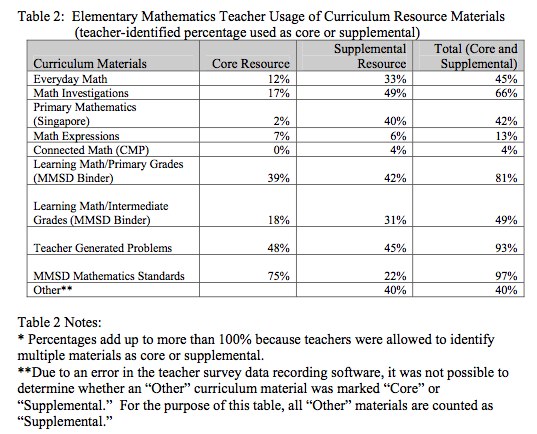
The Madison Math Task Force Report [3.9MB PDF] found that local elementary school teachers used the following curricular materials (page 166):

What, if anything has the Math Task Force report addressed?

Share

Parent-Paid Aides Ordered Out of New York City Schools

Winnie Hu:

For years, top Manhattan public schools have raised hundreds of thousands of dollars from parents to independently hire assistants to help teachers with reading, writing, tying shoelaces or supervising recess. But after a complaint by the city’s powerful teachers union, the Bloomberg administration has ordered an end to the makeshift practice.
Principals have been told that any such aides hired for the coming school year must be employees of the Department of Education, their positions included in official school budgets.
But such employees can command nearly double the pay of the independently hired assistants, and several schools on the Upper East Side either have told current employees they will probably not have jobs in the fall or have put off hiring new employees. That has incensed many parents, who see the aides less as a perk than as a necessity to cope with growing class sizes in well-regarded schools like the Lower Lab School for gifted children, where the average class size is now 28, and Public School 290, where broom closets are used as offices and the cafeteria doubles as a gym.
“The reason the teaching assistants are here is because they’ve been stuffing so many kids in these classes,” said Patrick J. Sullivan, co-president of the Parent-Teacher Association at the Lower Lab School (P.S. 77), where parents spend $250,000 a year on the teaching assistants. “Nobody wants to break any rules, but 28 is just too many kids for one teacher.”

Share

Detroit Schools on the Brink Shrinking District Heads Toward Bankruptcy to Gain Control of Its Costs

Alex Kellogg:

Detroit’s public-school system, beset by massive deficits and widespread corruption, is on the brink of following local icons GM and Chrysler into bankruptcy court.
A decision on whether to file for protection under federal bankruptcy laws will be made by the end of summer, according to Robert Bobb, Detroit Public Schools’ emergency financial manager. Such a filing would be unprecedented in the U.S. Although a few major urban school districts have come close, none has gone through with a bankruptcy, according to legal and education experts.
But in Detroit — where U.S. Education Secretary Arne Duncan dubbed the school system a “national disgrace” this spring — lawmakers and bankruptcy experts see few alternatives, given the deep financial challenges confronting the district and the state.
“Am I optimistic that they can avoid it…? I am not,” says Ray Graves, a retired bankruptcy judge who has been advising Mr. Bobb in recent weeks.
As with General Motors Corp. and Chrysler LLC, bankruptcy may not be the worst thing for Detroit’s schools. A filing under Chapter 9 of the Bankruptcy Code, which covers public entities like school districts and municipalities, would allow the district to put major creditors such as textbook publishers, private bus operators and DTE Energy, the local gas-and-electric utility, in line for payment. It also would give Mr. Bobb broad latitude to tear up union contracts without protracted negotiations.
But a filing also could hurt the district’s debt rating and ability to float bonds.

Share

Within you, without you

Harry Eyres:

Michel de Montaigne, inventor of the essay, could also be seen as the begetter of the contemporary curse of self-absorption. Montaigne (1533-1592) made a move, nearly five hundred years ago, that still seems modern and revolutionary. He reversed the whole direction of study, research, investigation; he turned the lens from the observed to the observer. “For many years now the target of my thoughts has been myself alone; I examine nothing, I study nothing, but me; and if I do study anything else, it is so as to apply it at once to myself, or more correctly, within myself.”
Now you could see this (like other French revolutions) as profoundly dangerous. You could blame Montaigne for the culture of narcissism, the world of endlessly proliferating self-help books, whose sheer number betrays a sense of desperation. Montaigne is indeed the patron saint of self-help books: “You should not blame me for publishing; what helps me can perhaps help someone else.”
Now go back to that first quotation, and pause on the subtle but all-important distinction Montaigne makes at the end of it. What is the difference between applying something to yourself and applying it within yourself? When you apply something to yourself, the two entities involved, the something and yourself, don’t really change; they may work in tandem for a while, but they can be decoupled. But when you apply something within yourself, that implies a profound transformation from within – a more organic, less violent and more permanent process, a silent but momentous shift in the whole machinery of the self.

Share

In search of a modern-day Mozart

Richard Fairman:

The premiere of Mozart’s Mitridate, re di Ponto at the Teatro Regio Ducal in Milan on December 26 1770, must have been a memorable occasion. Six hours long, the opera was an immediate hit, and its run extended to 21 performances. “Every evening the theatre is full, much to the astonishment of everyone,” the young composer wrote in a letter to his sister. “People say that since they have been in Milan they have never seen such crowds at a first opera.” Mozart was 14 at the time.
He is far from being the only teenage genius in musical history; a recent poll to decide music’s greatest prodigy in BBC Music Magazine didn’t even manage to place Mozart in the top 10. Mendelssohn, who was the winner, composed his brilliant Octet when he was just 16. In second place, Schubert set German song alight by penning “Gretchen am Spinnrade” at 17. Korngold, placed third, completed his sexually saturated opera Violanta at the same age.
EDITOR’S CHOICE
More from Arts – Nov-24
Where are the equivalents to these prodigies today? There is plenty of evidence that young people are as busy composing as ever – the recent Channel 4 television series about 16-year-old British composer Alexander Prior will have alerted the world to that – but very few music-lovers are likely to be aware of them. Spend a year going to concerts in any cultural capital and it would be quite normal not to hear a note of music by a single composer as yet untroubled by middle-aged spread.
If there is one place where youth really has a hold, it is the BBC Proms. The 2009 season opens on Friday and promises the usual admirable spotlight on youth. Young audiences, teenage soloists, family days, youth orchestras all have their place. But what of young composers? Search through the season programme and the score here looks rather different. The youngest living composer in the main evening concerts is 28. There are only three others under 30 out of the 128 composers altogether. By that age Mozart, Mendelssohn, Schubert and Bizet had already turned out masterpieces by the armful (and, tragically, each only had a few more years to live).

Share

Mayoral Control of Schools: The New Tyranny

Gerald Bracey:

Our Secretary of Education, Arne Duncan, has been on a “listening tour” where he’s done most of the talking. He advocates, repeatedly, that mayors should take control of urban schools. Obviously he cannot take an honest look at his own accomplishments under this governance system or–he’d have to shut up.
The usual rationale a mayoral power grab is it brings more accountability and a clear line of authority. School boards are generally elected in off years and few people vote, allowing special interest groups (usually education unions, some claim) to essentially rig the elections. School boards are fractious and try to micromanage. They are amateurs and prisoners of deeply rooted school bureaucracies.
But do mayors do better? Depends on how you feel about democracy. The Spring 2009 issue of Rethinking Schools, said that, as Daley’s man, Duncan “has shown himself to be the central messenger, manager and staunch defender of corporate involvement in, and privatization of, public schools, closing schools in low-income neighborhoods of color with little community input, limiting local democratic control, undermining the teachers union and promoting competitive merit pay for teachers.”
The most important corporate involvement involves the 132-year-old Commercial Club of Chicago. Yet that organization recently published Still Left Behind, slamming Chicago’s public schools as awful and that the reforms they’ve endured were designed to make the adults running the schools look good, not improve the lives of children. You could say the Club stabbed Arne in the back except that they did it upfront in the open, without once mentioning Duncan’s name. The Club report backs up its case with many data.

Share

Wisconsin K-12 Tax & Spending Climate: Democrat State Senator Mark Miller on the recent Budget


Christian Schneider @ WPRI:

Over the weekend, Democrat State Senator Mark Miller took to the airwaves to explain what happened. Here is Miller’s (albeit clumsy) explanation of why Madison area districts are taking a big hit in this budget, from the “Here and Now” show:
Now, the pages of this blog have not been very friendly to Miller and his cohorts during the budget process. But on this one, I think he’s getting a bad rap – and explaining why helps illustrate the constant struggle the state has with the school finance formula.
(CAUTION: What follows is an attempt at explaining school aids, and may be dreadfully boring. If it gets too bad, feel free to go over and read the Dogs With Mustaches blog and come back in 15 minutes.)
Let’s look at the purpose of the school aid equalization formula. As its name suggests, it exists to “equalize” the relative wealth of districts. The theory behind the formula is that kids in property poor districts should have access to the same resources as kids in property rich districts (like Madison), even if the local district doesn’t have the same property values on which to draw. Thus (and this is a substantial generalization), the state grants more money to property poor districts and less money to property rich districts.
(For a full explanation of the complexities of the school aid formula, take about four caffeine pills and read this.)
For example, take a school district like Peshtigo, with per pupil property values of $275,466. Peshtigo receives about 81.6% of their budget from the state. On the other end of the scale, the Madison Metropolitan School District boasts property values of $844,000 per student, and thus receive about 41.25% of their budget in state aid. (Since you were wondering, the Geneva J4 school district, with per pupil property values of $3.3 million, receive the lowest in state aid, at 16.9%. Beloit gets 85.1% of their budget paid for by the state, since apparently nobody there has discovered indoor plumbing.)

Related by Lucy Mathiak: Mark Miller “explains” how State budget isn’t all that bad

Share

Pay bump for teachers with master’s degrees could be put to better use

The Center on Reinventing Public Education via a Debra Britt email:

Seattle, WA, July 20, 2009 — In this recessionary climate of depressed revenues and budget cuts for education, school districts across the U.S. “would be foolhardy” not to rethink paying teachers for master’s degrees, according to a new report out today.
“On average, master’s degrees in education bear no relation to student achievement,” say education researchers Marguerite Roza and Raegen Miller in their short paper, Separation of Degrees: State-By-State Analysis of Teacher Compensation for Master’s Degrees.
The brief was produced jointly by the Center on Reinventing Public Education and the Center for American Progress.
“During this time of fiscal stringency, it should raise eyebrows when a state automatically allocates such large sums of the average per-pupil expenditure in a manner that is not even suspected of promoting higher levels of student achievement,” say the authors.
In hard dollars, this means New York state spends an extra $416 per student (for a total of $1.121 billion a year) just because 78 percent of its teachers hold master’s degrees. In Washington state, the analogous numbers are $319 per pupil (or $330 million a year total) for the 56 percent of its teachers with a master’s. These expenditures, respectively, represent 2.78 percent and 3.30 percent of the total federal, state, and local money devoted to education in each state.
Roza and Miller chart these numbers for each state and suggest that the money now committed to the master’s bump in pay could be better spent, writing that: “Teaching candidates with salient and meaningful master’s degrees should be given preferential attention when competing for jobs, all else being equal. A master’s degree in engineering, for example, should be construed as evidence that a candidate possesses a deep understanding of a subject matter that is relevant to teaching mathematics or science.”

(more…)

Share

My Full Set of Questions on the Strategic Plan

First, thank you Jim Z for posting the responses to our questions. I should note that we did not get answers to ALL of our questions. I am uploading the PDF that I sent with my questions in case you are interested in the full set. I apologize for the size of the document – I took the PDF, added notes and highlighting where I was requesting answers, and saved only the pages that were marked up. There are 25 pages in all.
Also, I found the following text while looking for something on the web in my day job. I liked the formulation, so am passing it along:

To meet the challenges of the twenty-first century, our students need not only knowledge, but also the skills to use that knowledge, the responsibilities associated with using it and practice in the integration of that knowledge in new and complex ways.

StratPlanCOMMENTS-Mathiak.pdf

Share

How states like Illinois rig school tests to hype phony achievement

Wall Street Journal Editorial:

When President Obama chose Arne Duncan to lead the Education Department, he cited Mr. Duncan’s success as head of Chicago’s public school system from 2001 to 2008. But a new education study suggests that those academic gains aren’t what they seemed. The study also helps explain why big-city education reform is unlikely to occur without school choice.
Mr. Obama noted in December that “in just seven years, Arne’s boosted elementary test scores here in Chicago from 38% of students meeting the standard to 67%” and that “the dropout rate has gone down every year he’s been in charge.” But according to “Still Left Behind,” a report [158K PDF] by the Civic Committee of the Commercial Club of Chicago, a majority of Chicago public school students still drop out or fail to graduate with their class. Moreover, “recent dramatic gains in the reported number of CPS elementary students who meet standards on state assessments appear to be due to changes in the tests . . . rather than real improvements in student learning.”
Our point here isn’t to pick on Mr. Duncan, but to illuminate the ease with which tests can give the illusion of achievement. Under the 2001 No Child Left Behind law, states must test annually in grades 3 through 8 and achieve 100% proficiency by 2014. But the law gives states wide latitude to craft their own exams and to define math and reading proficiency. So state tests vary widely in rigor, and some have lowered passing scores and made other changes that give a false impression of academic success.
The new Chicago report explains that most of the improvement in elementary test scores came after the Illinois Standards Achievement Test was altered in 2006 to comply with NCLB. “State and local school officials knew that the new test and procedures made it easier for students throughout the state — and throughout Chicago — to obtain higher marks,” says the report.

Share

Teacher, Can We Leave Now? No.

Tom Friedman:

I confess, I find it hard to come to Afghanistan and not ask: Why are we here? Who cares about the Taliban? Al Qaeda is gone. And if its leaders come back, well, that’s why God created cruise missiles.
But every time I start writing that column, something stills my hand. This week it was something very powerful. I watched Greg Mortenson, the famed author of “Three Cups of Tea,” open one of his schools for girls in this remote Afghan village in the Hindu Kush mountains. I must say, after witnessing the delight in the faces of those little Afghan girls crowded three to a desk waiting to learn, I found it very hard to write, “Let’s just get out of here.”
Indeed, Mortenson’s efforts remind us what the essence of the “war on terrorism” is about. It’s about the war of ideas within Islam — a war between religious zealots who glorify martyrdom and want to keep Islam untouched by modernity and isolated from other faiths, with its women disempowered, and those who want to embrace modernity, open Islam to new ideas and empower Muslim women as much as men. America’s invasions of Iraq and Afghanistan were, in part, an effort to create the space for the Muslim progressives to fight and win so that the real engine of change, something that takes nine months and 21 years to produce — a new generation — can be educated and raised differently.

Share

An unsentimental education

Christopher Caldwell:

Long before the US began shedding millions of jobs last year, American politicians were obsessed with retraining people cast off by the global economy. “The average worker will change jobs six or seven times in a lifetime,” Bill Clinton said in an address to the Cleveland City Club in 1994. That was not much help: how do you train people for tomorrow’s jobs if you do not know what tomorrow’s jobs will be?
President Barack Obama’s call for $12bn (£7.4bn, €8.5bn) of investment in “community colleges” is evidence that the flux Mr Clinton alluded to is ending. Community colleges offer a range of short-term credentialing courses along with two-year and four-year degrees. They are where you go to become a dental hygienist, a cyber-security expert, a nurse or a solar-energy technician. If job-specific training is making more sense, then the job market is probably growing more predictable. The economy may be in a terrible rut, but we are, to a degree, re-entering the world of stable, credentialed work.
Community colleges now accommodate half the nation’s undergraduates. Enrolment has leapt by a million students in the past decade, to more than 6m. Most are funded by individual states, which have had to cut their budgets even as demand for spaces has risen, and no one has picked up the slack. The Chronicle of Higher Education notes that “community colleges receive less than one-third the level of federal support per full-time-equivalent student ($790) that public four-year colleges do ($2,600).”

Share

Intern in the News: Matthew Robson

Andrew Edgecliffe-Johnson:

Two weeks ago, Mr Robson was pretty pleased at being one of half a dozen London schoolchildren to secure a work experience placement at Morgan Stanley’s Canary Wharf offices.
Such positions usually go to the friends and family members of well-connected bankers. In Mr Robson’s case, the networking was done by his whippet, Rudy, who dragged his mother into conversation with the wife of one of Morgan Stanley’s media analysts while both walked their dogs in Greenwich Park.
After a week of presentations by senior staff, the Kidbrooke comprehensive school pupil felt he had grasped the basics of banking, and was looking forward to a secondment to the European media research desk.
Many a teenage internship has been spent fetching Starbucks orders and being otherwise ignored. But Mr Robson struck lucky when Edward Hill-Wood, the head of the team, asked him to spend a few days pulling together an account of his friends’ media and communications habits. Mr Hill-Wood’s decision to publish the three- page report Mr Robson handed in has made the 15-year-old the world’s most famous intern since Monica Lewinsky.
The report made for stark reading for the bank’s clientele. His peers see advertising, the struggling sector’s congealing lifeblood, as “extremely annoying and pointless”. They “cannot be bothered” to read a newspaper, never buy CDs or use yellow pages directories, and generally try to avoid paying for anything other than concerts and cinema tickets.
While mobile phones are central to their social lives, the friends he canvassed (by text message) avoid expensive handsets for fear of losing them, do not use the mobile internet as it costs too much and prefer games consoles for free chat.

Share

Madison School District Budget Update: Wisconsin K-12 State Budget Changes

Superintendent Dan Nerad [184K PDF]:

Every two years the State of Wisconsin goes through a process to finalize a two year budget for all governmental programs. This biennial budget process is the source of the State’s commitment to public education here in Wisconsin, historically driven by legislative guidance to adhere to two-thirds funding.
The two-thirds funding has changed over recent years, but for the most part the State of Wisconsin was able to continue annual increases to public education in an attempt to keep up with rising costs within this sector.
The biennial budget was sigued into law near the end of June by Governor Jim Doyle after various proposals and with relatively few vetoes. This budget has numerous provisions that will effect the future of public education that include:

  • Repeal of the Qualified Economic Offer (QEO)
  • Decrease in funding for public education by the state of approximately $147 million
  • Decrease in the per pupil increase associated with revenue limits

Each of these provisions can and Will have a very unique impact on :MMSD over the years to come. The repeal of the QEO will potentially impact future settlements for salaries and benefits. The decrease in funding for public education by the state is projected to create the need for a tax increase conversation in order to sustain current programs. The decrease in the revenue limit formula will cause MMSD to face more reductions in programs and services fur the next two years at a minimum.
Many public and private organizations are dealing with this issue. It is perhaps a time to make lemonade out of lemons. In the MMSD’s case, getting out of the curriculum creation business (teaching & learning) and placing a renewed focus on hiring the most qualified teachers and letting them run.

Share

Arne Duncan Public School System has biggest black-white achievement gap in USA

Edward Hayes:

A phony interpretation of Chicago Public Schools’ academic progress isn’t the only beast threatening your local schools. For decades now, in every school district with a fireplug, a Walgreens, and a crooked alderman, the test scores of white children have been higher than those of black youngsters. The monster is called the achievement GAP. It slithers into your school even when the black and white students are sitting right next to each other in the same classroom. Furthermore, black middle-class students cannot escape its wrath because the GAP tracks them down even when their parents escape to the suburbs or move uptown.
Boring but important: The stupidly named National Assessment for Education Progress (NAEP) exams, administered by the National Center for Education Statistics, the statistical arm of the U.S. Department of Education (whew!), reports that the national GAP has narrowed for 9 to 13 year olds in math and reading since 1978, but remains unchanged for the last ten years. But there are isolated pockets of small success where the gap narrowed a bit.
4th Grade Reading: Three states reduced the GAP (1990-2007) -Delaware, Florida, & New Jersey.

Share

Are Obama and Duncan attacking teachers and local control?

Jesse ALred:

Since Franklin Roosevelt’s 1933 victory, working familes have been the heart of the Democratic Party. Except for African-Americans, Obama did not win the party’s heart in his primary contest with Hillary Clinton. He won with the support of affluent social liberals, well-educated youthful volunteers and superior financial support from the corporate sector.
The public schools’ policies of President Obama and his Secretary of Education Arne Duncan so far suggest this middle-class feeling that in spite of all his gifts Mr. Obama may lack the common touch or grounding in everyday reality may be right.
Secretary of Education Arne Duncan’s agenda seems designed to alienate middle-class teachers and parents who depend on public schools. His school reform proposals lack a well-grounded sense of why schools fail. His agenda includes the following:

Share

Proposed Madison Schools’ Strategic Plan: School Board Written Questions

Madison School Board 1.1MB PDF:

4) Curriculum Action Plan – Flexible Instruction (page 44)
Arlene Silveira Is “flexible Instruction” the latest term for differentiation or differentiated teaching/team teaching? If so, we have been doing this for a while in the district. Do we have any evaluation of how this is working?
Lucy Mathiak
Please define “flexible instruction (and in civilian terms vs. eduspeak, please).
Ed Hughes
To what extent, if at all, does the “flexible instruction” action plan contemplate less “pull out” instruction for special ed students?


Madison School District Administration’s response:

Flexible instruction is similar to other terms, such as differentiation and universal design. All of these terms mean that teachers begin with explicit standards and/or curricular goals for a unit or course. Teachers then design multiple ways to teach and multiple learning experiences for students for all core standards and/or curricular goals. Flexible instruction is best planned in teams composed of regular education, special education, and ESL teachers so that many aspects of diverse learners, including options for students abovelbelow grade level, are addressed in the original design of lessons. In classrooms with flexible instruction, various groups of students can work together, share and leam from each other even when the different groups of students might be working on slightly different types of experiences.
Although there is no explicit evaluation of how this is currently working, one of the highest priorities of teachers is the time to engage in this type of collaborative professional work.

The last paragraph states “Although there is no explicit evaluation of how this is currently working” gets to the heart of curricular issues raised by a number of board members, parents and those discussed in the recent outbound parent survey.
This document is a must read for all public school stakeholders. It provides a detailed window into School Board governance and the current state of our public school Administration.
Related Links:

UPDATE: Lucy Mathiak posted her full set of questions here.

Share

Reading Strategies and Cargo Cult Science

Robert Pondiscio:

The idea that it’s enough to simply “find what works, adopt it, and spread it around,” notes scientist/blogger Allison over at Kitchen Table Math is an example of what physicist Richard Feynman called “Cargo Cult Science“:

In the South Seas there is a Cargo Cult of people. During the war they saw airplanes land with lots of good materials, and they want the same thing to happen now. So they’ve arranged to make things like runways, to put fires along the sides of the runways, to make a wooden hut for a man to sit in, with two wooden pieces on his head like headphones and bars of bamboo sticking out like antennas–he’s the controller–and they wait for the airplanes to land. They’re doing everything right. The form is perfect. It looks exactly the way it looked before. But it doesn’t work. No airplanes land. So I call these things Cargo Cult Science, because they follow all the apparent precepts and forms of scientific investigation, but they’re missing something essential, because the planes don’t land.

“Cargo Cult education seems to be all the rage in lots of communities,” Allison notes. “Sure, districts could just start grabbing lessons from high performing schools but that won’t make the students suddenly read or write. Unless they understand what’s underneath the ‘lessons of the high performing school’ then it won’t matter.”

Share

An unsentimental education

Christopher Caldwell:

Long before the US began shedding millions of jobs last year, American politicians were obsessed with retraining people cast off by the global economy. “The average worker will change jobs six or seven times in a lifetime,” Bill Clinton said in an address to the Cleveland City Club in 1994. That was not much help: how do you train people for tomorrow’s jobs if you do not know what tomorrow’s jobs will be?
President Barack Obama’s call for $12bn (£7.4bn, €8.5bn) of investment in “community colleges” is evidence that the flux Mr Clinton alluded to is ending. Community colleges offer a range of short-term credentialing courses along with two-year and four-year degrees. They are where you go to become a dental hygienist, a cyber-security expert, a nurse or a solar-energy technician. If job-specific training is making more sense, then the job market is probably growing more predictable. The economy may be in a terrible rut, but we are, to a degree, re-entering the world of stable, credentialed work.
Community colleges now accommodate half the nation’s undergraduates. Enrolment has leapt by a million students in the past decade, to more than 6m. Most are funded by individual states, which have had to cut their budgets even as demand for spaces has risen, and no one has picked up the slack. The Chronicle of Higher Education notes that “community colleges receive less than one-third the level of federal support per full-time-equivalent student ($790) that public four-year colleges do ($2,600).”

Share

Duncan to Principals: Release Your Inner Warrior!

Lesli Maxwell:

In his campaign for turning around the nation’s worst public schools, U.S. Education Secretary Arne Duncan this morning called for a cadre of “warrior principals.”
Speaking to principals from across the country, Mr. Duncan said that without strong leaders, any effort to dramatically transform the thousands of public schools that have failed for decades would be futile. He challenged the leaders to “take on the toughest job in America.”
“We need a team of warrior principals to leave the easier places and go into the most underserved communities with a chance to build a new team,” Mr. Duncan said to the roughly 350 principals who are in Washington this week for the annual meeting of the National Association of Elementary School Principals and National Association of Secondary School Principals. Mr. Duncan said he would need to enlist about 1,000 principals a year, over the next five years.
The secretary has been pushing hard for turning around thousands of failing schools, and has already implored other groups of educators, including the charter school movement, to get involved in that work. Mr. Duncan also asked the principals to work on fixing the “broken” teacher evaluation system by developing evaluations that are “fair, thoughtful, but meaningful.”

Share

Democrats’ math fuzzy on school aid; Districts can do better at cutting, too

James Wigderson:

tate Democrats are congratulating themselves on two points. They made the trains run on time; they passed the state budget just before the deadline.
They also claim that 99 percent of us will not see a tax increase.
If they had taken just a little more time with the budget they would have recognized they did not even come close to their 99 percent threshold. Even their own budget document lists so many tax and fee increases you would have to be a contortionist to get around them.
But their budget also plays a cruel game of peek-a-boo with taxpayers. The Democrats hide tax increases by pushing them to the local level. Taxpayers in the Waukesha School District are discovering the first of these hidden taxes.
The Waukesha School District is getting hit with a $6 million reduction in state aid. Never fear, we’re told. This does not mean an actual cut in school spending. It means the district will raise local property taxes to make up for the shortfall, a 10.51 percent increase in the tax levy.

Share

Wash. Board of Education revises math requirement

AP:

The State Board of Education has made a minor revision in the high school math credit requirements.
During a meeting in Gig Harbor on Friday, the board gave students more flexibility in their choices for high school math.
The board decided earlier that beginning with the class of 2013, high school students will be required to earn three credits of math to earn a diploma.
When the requirement was changed, the state rule said students who took a high school level math class without credit as an eighth grader were required to repeat that same course for credit in high school.

Share

D.C. Chancellor Gains Ground With Aggressive Agenda

NPR Audio:

Washington, D.C., Public Schools Chancellor Michelle Rhee is pushing forward with her efforts to turn around the local school system. Those efforts have thrust Rhee’s agenda onto a national stage, as educators across the country grapple with struggling school districts. Rhee discusses her work, which includes recently narrowing an achievement gap between white and minority students.

Share

Swine flu is a real danger to children. But not a Dickensian one

David Spiegelhalter:

The death of an apparently healthy six-year-old child has helped to put swine flu back on the front pages. The Health Protection Agency says that 5 to 14-year-olds remain the group predominately affected by the illness — 1 in 600 of them — 1,500 a day — went to their GPs with symptoms last week. The death of a child naturally provokes our shock and sympathy, and such events are now so rare that they are unfamiliar to most people. Statistically, 7 is the safest age to be in England and Wales — there are 650,000 seven-year-olds and about 60 die each year. That’s 1 in 10,000.
So what do young people die of, and what might swine flu do to those risks? The Office for National Statistics reports that of 6.3 million children aged between 5 and 14 in England and Wales, 721 died in 2007. The statistics rather coldly amalgamate 721 individual stories, each of which will be gone over endlessly by parents and others who were touched by their short lives.
We tend to hear about the 135 accidental deaths — including 34 pedestrian fatalities, 18 killed on bicycles, 5 on motorbikes, 22 in cars, 2 in trains, 1 who fell from a tree, 8 drownings, 1 electrocution, 3 deaths in fires and 6 accidental poisonings. These events are so rare that it is unsurprising when they make local or even national news. We also hear about the 24 homicides in this age group — about half of them committed by the child’s parents — though we hear less of the 16 suicides.

Share

Before College, Costly Advice Just on Getting In

Jacques Steinberg:

The free fashion show at a Greenwich, Conn., boutique in June was billed as a crash course in dressing for a college admissions interview.
Katherine Cohen has a Web site called ApplyWise that puts prospective college applicants through a 12-step presentation.
Yet the proposed “looks” — a young man in seersucker shorts, a young woman in a blue blazer over a low-cut blouse and short madras skirt — appeared better suited for a nearby yacht club. After Jennifer Delahunty, dean of admissions at Kenyon College, was shown photos of those outfits, she rendered her review.
“I burst out laughing,” she said.
Shannon Duff, the independent college counselor who organized the event, says she ordinarily charges families “in the range of” $15,000 for guidance about the application process, including matters far more weighty than just what to wear.
Ms. Duff is a practitioner in a rapidly growing, largely unregulated field seeking to serve families bewildered by the admissions gantlet at selective colleges.
No test or licensing is required to offer such services, and there is no way to evaluate the counselors’ often extravagant claims of success or experience. And Ms. Duff’s asking price, though higher than many, is eclipsed by those of competitors who may charge upwards of $40,000 — more than a year’s tuition at many colleges.

Share

Testing Tactics Helped Fuel D.C. School Gains

Bill Turque:

When Mayor Adrian M. Fenty announced the continued growth of standardized test scores for District students Monday, he hailed it as “powerful evidence of the incredible work being done by teachers, principals and most importantly our students.”
What Fenty did not say was that the two-year improvement in District of Columbia Comprehensive Assessment System results — including an average of nearly 15 percentage points in the pass rates on elementary reading and math tests — was also the product of a strategy that relied on improved statistical housekeeping.
These include intensive test preparation targeted to a narrow group of students on the cusp of proficient, or passing, scores, and “cleaning the rosters” of students ineligible to take the tests — and also likely to pull the numbers down.
Chancellor Michelle A. Rhee described some of these approaches as the pursuit of “low-hanging fruit.”

Share

History Is Scholarship; It’s Also Literature
Before we can educate graduate students about good writing,

Stephen J. Pyne:

History is a book-based discipline. We read books, we write books, we promote and tenure people on the basis of books, and at national meetings we gather around book exhibits. But we don’t teach our graduate students how to write books.
It’s an odd omission. We view statistics, geographic-information systems, languages, oral-history techniques, paleography, and other methodologies as worthy of attention in doctoral study–but not serious writing. Yet careers rise and fall on the basis of what we publish.
It may be that the scientific model of the grant-supported article is becoming more dominant, or that the simple production of data has become a sufficient justification for scholarship. Surely one reason is that research seminars offer enough time to compose an essay or a journal article but not a book, or even a book chapter. Perhaps an obsession with historiography has blocked interest in historical writing as literature, or the belief has arisen that the best way to meet the challenges of postmodern literary criticism is to deny its claims altogether, particularly since the contamination of memoir by fictional devices has tainted the whole question of applying “literary” techniques, borrowed from fiction, to nonfiction sources.
It may be simply that most of us don’t know how to teach writing–real writing, which is to say, finding the means to express what we want to say. Instead we defer to the off-the-shelf formulas of the favored journals and the thesis-evidence-conclusion style of traditional dissertations. We take students’ ideas for books and turn them into dissertations, and then expect them to magically reconvert them back into the books that originally motivated their imaginations and that their subsequent careers will require. While at least some historians are keen to unpack prose, few are eager to teach how to pack it properly in the first place. Whatever the reasons, serious writing isn’t taught. There isn’t even an accepted name for it.
Over the years my curiosity about that tendency ripened into concern. Then, a few years ago, while visiting at Australian National University, I was asked to lead a seminar on writing. That inspired me to offer a graduate course at my own institution on the theory and practice of making texts do what their writers wished. It would be English for historians, just as we might offer statistics for ecologists or chemistry for geologists. It’s been the best teaching experience of my career.
Initially I thought most of the students who enrolled would come from history; almost none of them did. Instead, my students came from biology, anthropology, journalism, English, geography, communications, and undeclared majors who strolled in more or less off the streets. The only historian who took it did so as an override in defiance of her program of study. What all of the students shared was a desire to write better, and generally to write something other than the oft-cribbed, formulaic prose required of their disciplines.

(more…)

Share

Online Education and its Enemies

Liam Julian:

Holly Bates, an eight-year-old Florida girl, has such bad allergies that being near nuts or nut-based products–or even being near someone who has recently eaten nuts–can trigger anaphylactic shock. With peanut peril ubiquitous, young Holly is not enrolled in a traditional public school; instead, she attends Florida Connections Academy, a full-time “virtual” school that she accesses from her home computer. Her mother, a former public school teacher, loves the program. “The curriculum is unbelievable,” she told the Tampa Tribune in 2007. “It would astound you, the progress these children make.”
The Sunshine State is something of a virtual education pioneer. Since the 2003-04 school year, Florida has partnered with two for-profit companies–Connections Academy and K12 Inc.–to provide pupils with the option of attending school online, full-time, for free. But years before that, Florida was promoting other types of virtual education. Florida Virtual School is a statewide program that allows students to take individual courses online, often in subjects not offered at their local school, like Latin or Macroeconomics. It began in 1997 as a small grant-based project with just 77 course enrollments. Today, Florida Virtual School is its own school district and has an annual budget near $100 million. In the 2008-09 school year, according to Education Next, some “84,000 students will complete 168,000 half-credit courses, a ten-fold increase since 2002-03.” A newly-minted Florida Virtual School Connections Academy, announced in August 2008, will further expand online learning options and access.

Joanne has more.

Share

Education Change Agent: Alex Johnston, CEO, ConnCAN

Education Gadfly via a kind reader’s email:

What drew you to working in the education field and what path did you take to end up where you are now?
I was in college during the LA riots of 1992, and seeing how quickly our society could pull apart at the seams really made me want to focus on addressing the underlying inequalities that produce such fragile ties in the first place. I was doing a lot of work with Habitat for Humanity in inner city Boston at the time, and that in turn led me to focus my undergrad studies on affordable housing and the politics of exclusionary zoning in the suburbs of Boston. After a diversion to grad school overseas, I landed back in New Haven, Connecticut for a stint of couch-surfing with friends while I finished up a doctoral dissertation on the impact of government funding on non-profit housing providers. I then took all that book learning and put it to the test by signing on to the management team that was charged with turning around the New Haven Housing Authority from the brink of receivership. It just so happened that one of those friends whose couch I’d been staying on was Dacia Toll, the founder of the Achievement First network of charter schools–and so I got a unique perspective on the incredible power of these schools to transform their students’ lives because so many of her kids were coming right out of the very same housing developments that I was managing. Rewarding as it was to help the housing authority’s residents reclaim their communities from years of neglect, once I began to appreciate how powerful schools could be in turning the cycle of poverty on its head, I was hooked.
And so about five years ago I was fortunate to connect with ConnCAN’s founding Board Chair, Jon Sackler. Together with an array of business, community and higher education leaders we founded ConnCAN on the premise that we need more than pockets of excellence to close Connecticut’s worst-in-the-nation achievement gap. We need statewide policies that allow educational innovations like Teach for America or Dacia’s schools to spread far and wide. And those policies will never be enacted unless we create the political will for them by building a movement of education reformers. We’ve been at it ever since, from the early days when it was just me and my dog working out of my house to today, when we’ve got a fantastic team of ten, and we’re well on our way to building a powerful, statewide movement for education reform.

Share

Connected Kids At Elite High Schools

Alexander Russo:

‘ve been ignoring the UofI clout story for weeks now, feeling like it was more of a higher ed thing than something about local high schools, but this latest story from the Tribune really caught my eye:
Half of the 616 Illinois students who received preferential treatment from 2005 to 2009 graduated from just 22 high schools, all but one in the metro area. Highland Park High had the most kids on the list, with Loyola Academy coming in second. There were only 25 kids on the clout list from CPS schools.

Share

No Size Fits All

David Brooks, via a kind reader’s email:

If you visit a four-year college, you can predict what sort of student you are going to bump into. If you visit a community college, you have no idea. You might see an immigrant kid hoping eventually to get a Ph.D., or another kid who messed up in high school and is looking for a second chance. You might meet a 35-year-old former meth addict trying to get some job training or a 50-year-old taking classes for fun.
These students may not realize it, but they’re tackling some of the country’s biggest problems. Over the past 35 years, college completion rates have been flat. Income growth has stagnated. America has squandered its human capital advantage. Students at these places are on self-directed missions to reverse that, one person at a time.
Community college enrollment has been increasing at more than three times the rate of four-year colleges. This year, in the middle of the recession, many schools are seeing enrollment surges of 10 percent to 15 percent. And the investment seems to pay off. According to one study, students who earn a certificate experience a 15 percent increase in earnings. Students earning an associate degree registered an 11 percent gain.

Share

A Degree, At Long Last

Stephanie Lee:

Aiko (Grace) Obata Amemiya, 88, started working at a hospital in the mid-1940s, fulfilling her dream of becoming a nurse. As of Thursday, she’s on her way to fulfilling another lifelong dream: obtaining a degree from the University of California at Berkeley.
That dream was destroyed after Pearl Harbor, when President Franklin D. Roosevelt issued Executive Order 9066, sending 110,000 Japanese-American citizens to internment camps to protect the nation “against espionage and against sabotage.” Born in the United States to parents from Akita, Japan, Amemiya was one of roughly 700 University of California students who spent those “stolen years,” as some call them, in wooden barracks with no running water or air conditioning, far away from their relatives, homes and colleges.
Now, nearly 70 years after Pearl Harbor, she and many others will get degrees from the university. The Board of Regents voted Thursday to award honorary degrees to the students who were interned, following in the footsteps of universities in Washington State and Oregon. “I’m elated for all the students that were here at Cal at that time,” said Amemiya in a phone interview. “I think it’s such an honor for all of us to be considered for an honorary degree.”
Mark Yudof, the university system president, said in a statement: “This action is long overdue and addresses an historical tragedy. To the surviving students themselves, and to their families, I want to say, ‘This is one way to apologize to you. It will never be possible to erase what happened, but we hope we can provide you a small measure of justice.’

Share

School safety ‘insult’ to Pullman

BBC:

Several high-profile authors are to stop visiting schools in protest at new laws requiring them to be vetted to work with youngsters.
Philip Pullman, author of fantasy trilogy His Dark Materials, said the idea was “ludicrous and insulting”.
Former children’s laureates Anne Fine and Michael Morpurgo have hit out at the scheme which costs £64 per person.
Officials say the checks have been misunderstood and authors will only need them if they go to schools often.
The Home Office says the change from October will help protect children.
The measure was drafted in response to recommendations made by the inquiry into the murders of Holly Wells and Jessica Chapman in 2002, by school caretaker Ian Huntley.

Share

Charter Schools Gain in Stimulus Scramble
Cash-Strapped States, Districts Signal Expansion of Public-Education Alternative Despite Some Teachers’ Strong Opposition

Rob Tomsho:

Some cash-strapped states and school districts are signaling a major expansion of charter schools to tap $5 billion in federal stimulus funds, despite strong opposition from some teachers unions.
Charter schools are typically non-unionized, publicly funded alternative schools that have been widely promoted by conservatives as a needed dose of competition in public education.
Last month, the Louisiana legislature voted to eliminate that state’s cap on new charter schools. The Tennessee legislature recently passed a bill expanding charter schools after U.S. Education Secretary Arne Duncan personally lobbied Democrats who had been blocking it. And the Rhode Island legislature reversed a plan to eliminate funding for new charters after Mr. Duncan warned such a move could hurt the state’s chances for grant money.
The most striking example may be in Massachusetts. Gov. Deval Patrick and Boston Mayor Tom Menino — both Democrats with histories of strong labor support — are proposing new state laws that would give them broader power to overhaul troubled schools, open more charter schools and revamp collective-bargaining agreements.
Mr. Menino, who oversees the Boston schools, wants Massachusetts communities to be able to transform traditional public schools into district-controlled charter schools and link teachers’ pay to performance.
Formerly a charter-school critic, Mr. Menino said he is fed up with opposition from the Boston Teachers Union. “I’m just tired of it,” he said. “We’re losing kids.”

Share

California’s Proposition 98, which guards funding for state’s schools, is tested again

Eric Bailey:

n the tug of war over state’s deficit, Schwarzenegger would like to suspend it. The California Teacher’s Assn. wants reassurances.
Reporting from Sacramento — For years it has been this government town’s equivalent of a stone fortress, a bastion of public policy under the watchful eye of a potent political army.
But this summer, Proposition 98, the law that guarantees public schools roughly 40% of general fund revenue, is being tested as it has been only a few times before.
Schwarzenegger has talked of suspending Proposition 98 and has reopened a battle with the law’s guardian and protector, the powerful California Teachers Assn. Both sides have waged war over the airwaves for the last week, with dueling TV commercials typically not seen in a nonelection year.
The governor and Republicans have rejected Democratic calls for new taxes on oil or tobacco. With no added taxes, cuts to schools are among the last ways the state can balance its books.
The unpopularity of such cuts guarantees difficult negotiations. But the talks over Proposition 98 have been made even more complex by lingering suspicions each side has of the other’s motives.

Share

Lifestyle Inequality: The Habits of American Elites

Mark Penn & E. Kinney Zalesne:

There’s always been lots of talk in this country about income inequality, but very little about lifestyle disparities, differences which are pulling American elites farther and farther away from mainstream America.
These disparities can be as profound as any class distinctions related directly to income; they go beyond having a bigger house, a nicer car or fancier vacations. America has always frowned on the idea of an “aristocracy,” but American elites today are increasingly creating their own separate world of activities, removed from the everyday pursuits of average Americans.
As part of a talk I gave at the Aspen Ideas Festival, we compared the lifestyle of the attendees (260 of whom cooperated in a poll sponsored by the conference and one you can take on Facebook) with the changing habits of the American public. The group was drawn from leaders in business, politics, the arts and academia, gathering for a weekend in the Rocky Mountains to examine critical issues of the day.
Forget about huge, sweeping megaforces. The biggest trends today are micro: small, under-the-radar patterns of behavior which take on real power when propelled by modern communications and an increasingly independent-minded population. In the U.S., one percent of the nation, or three million people, can create new markets for a business, spark a social movement, or produce political change. This column is about identifying these important new niches, and acting on that knowledge.
Not surprisingly their income and education levels were very upscale: most had graduate degree and six-figure incomes or more. Most, in this case, had studied in the humanities; few came from math and science backgrounds.

Much more on Mark Penn, who was heavily involved with Hilary Clinton’s Presidential campaign, here.
The article is well worth reading and contemplating.

Share

Virginia Home-Schoolers Can Seek State Aid

Washington Post:

Home-schoolers in Virginia are now eligible for state financial aid that they were previously not allowed to receive.
The Virginia Guaranteed Assistance Program, which provides need-based scholarships for tuition, fees and books at the state’s two- and four-year public institutions, required recipients to have graduated from high school with at least a 2.5 grade-point average.
The state’s approximately 30,000 home-schoolers were ineligible for the aid, which offered an average grant of $3,671 in the 2007-08 school year.
Under rules the State Council of Higher Education for Virginia approved this week, home-schoolers may qualify by submitting SAT scores of at least 900 and ACT scores of at least 19.

Share

Book Smarts? E-Texts Receive Mixed Reviews From Students

Ryan Knutson & Geofrey Fowler:

Last August, administrators at Northwest Missouri State University handed 19-year-old Darren Finney a Sony Corp. electronic-book Reader. The assignment for him and 200 other students: Use e-textbooks for studying, instead of heavy hardback texts.
At first, Mr. Finney worried about dropping the glass and metal device as he read. But eventually, the sophomore came to like the Reader. Its keyword search function, he says, was “easier than flipping through the pages of a regular book.” Dozens of other participants, however, dropped out of the program, complaining that the e-texts were awkward and inconvenient.
Nationwide, universities, high schools and elementary schools are launching initiatives like the one at Northwest Missouri State, testing whether electronic texts that can be viewed on e-book readers or on laptop computers can cut costs and improve learning.
This fall, Amazon.com Inc. is sponsoring a pilot program for its large-screen Kindle DX e-reader with hundreds of students across seven colleges, including Princeton University and University of Virginia. Meanwhile, Gov. Arnold Schwarzenegger wants to bring digital math and science textbooks to California’s secondary schools as early as this fall. (Heavy old books, the governor says, are useful as weights for arm curls.)

Share

Stop Cyberbullying with Education

Larry Magid:

The first things you need to know about cyberbullying are that it’s not an epidemic and it’s not killing our children. Yes, it’s probably one of the more widespread youth risks on the Internet and yes there are some well publicized cases of cyberbullying victims who have committed suicide, but let’s look at this in context.
Bullying has always been a problem among adolescents and, sadly, so has suicide. In the few known cases of suicide after cyberbullying, there are other contributing factors. That’s not to diminish the tragedy or suggest that the cyberbullying didn’t play a role but–as with all online youth risk, we need to look at what else was going on in the child’s life. Even when a suicide or other tragic event doesn’t occur, cyberbullying is often accompanied by a pattern of offline bullying and sometimes there are other issues including long-term depression, problems at home, and self-esteem issues. And the most famous case of “cyberbullying”–the tragic suicide of 13-year-old Megan Meier–was far from typical. Cyberbullying is almost always peer to peer, but this was a case of an adult (the mom of one of Megan’s peers) being accused of seeking revenge on a child who had allegedly bullied her own child.

Share

Millions more going to college?

Joseph Aoun:

THIS WEEK, President Obama unveiled a multibillion-dollar proposal to boost enrollment in the nation’s community colleges. His plan seeks to graduate 5 million more Americans from two-year colleges by 2020, and follows a more sweeping goal he announced during his first address to Congress in February: for America to once again have the highest number of college graduates in the world by 2020.
While some will question whether these prospective students are ready for college, many of us in higher education are asking ourselves: Are we ready?
In the months following the president’s congressional speech, there has been spirited debate in the education community about whether or not the president’s goal is attainable. A member of a federal commission on higher education called it “sheer fantasy.” Others have said the deadline should be pushed from 2020 to 2025.

Share

Teaching Kids About Money the Hard Way

Karen Blumenthal:

It’s getting harder for parents to raise financially independent young adults.
Many banks refuse to open individual checking accounts for 16- and 17-year-olds, requiring parents to jointly own the account, even if the youngsters have a job. Colleges urge parents to link their bank accounts or credit cards to the prepaid cash cards that double as their students’ ID cards, to ensure a regular flow of funds from the Bank of Mom and Dad.
And under the new credit-card law that goes into effect early next year–part of a broader move toward aggressive consumer protection–parents of those under 21 will have to agree to take responsibility for their kids’ credit cards unless the young applicants can show they have the income to qualify.
All of this seems to encourage parents to interfere with–and maybe even bail out–these young adults. And it comes at an age when the youngsters themselves should be taking on personal responsibility and making their own financial decisions.

Share

A Privacy Law That Protects Students, and Colleges, Too

Chriss Herring:

A law designed to keep college students’ grades private often is used for a much different purpose — to shield universities from potentially embarrassing situations.
Some critics say a number of schools are deliberately misreading the Family Educational Rights and Privacy Act in order to keep scandals and other unflattering news from hitting the media. “Some schools have good-faith misunderstandings of the law, but there are others that simply see this as a handy excuse to hide behind,” says Frank LoMonte, executive director of the Student Press Law Center, which provides student journalists with legal help.
Legal experts say part of the problem is that the law is loosely defined. In addition, the potential consequences of violating the law — namely, that schools would lose their federal funding — prompt university officials to be conservative in their decisions about releasing information.
Those complaints rankle advocates of student privacy, who say that, if anything, the three-decade-old law should be expanded. “Most of these kids are adults, and they should be able to make their own decisions,” says Daren Bakst, president of the Council on Law in Higher Education.

Share

Online education: Raising Alabama

The Economist:

An experiment in levelling the playing field
ON A sweltering day in Alexander City, Alabama, summer school was in full swing. Two girls were reading “Julius Caesar” as two others wrestled with maths. A boy worked his way through a psychology quiz, and a teacher monitored an online discussion with students from around the state: Was Napoleon the last enlightened despot or the first modern dictator?
This is not a traditional classroom scene, but it has become common enough in Alabama. The state has many small, rural schools. Because of their size, and the relative scarcity of specialised teachers, course offerings have been limited. Students might have had to choose between chemistry or physics, or stop after two years of Spanish. But thanks to an innovative experiment with online education, the picture has changed dramatically.
In 2005 the governor, Bob Riley, announced a pilot programme called Alabama Connecting Classrooms Educators and Students Statewide, or ACCESS. The idea was to use internet and videoconferencing technology to link students in one town to teachers in another. It was something of a pet cause for Mr Riley, who comes from a rural county himself. He was especially keen that students should have a chance to learn Chinese.
……..
Joe Morton, the state superintendent of schools, points to the number of black students taking AP courses. In 2003, according to the College Board, just 4.5% of Alabama’s successful AP students (those who passed the subject exam) were black. In 2008 the number was up to 7.1%. There is still a staggering gap–almost a third of the state’s students are black–but the improvement in Alabama was the largest in the country over that period. “That makes it all worthwhile right there,” says Mr Morton.

Share

The Children at Judge Sonia Sotomayor’s Bronx School

Manny Fernandez:

The hardwood floor was shiny yet scuffed, from the tiny chairs and desks that have rubbed against it for generations. The open windows let in a cool breeze. The pencil sharpener on the window sill sat at attention, as did Dorothy Faustini’s fourth- and fifth-grade math students.
The problem on the chalkboard: What is 72,641 divided by 10?
Hands shot up, hands stayed down. “Do not be afraid of the big numbers,” Ms. Faustini reminded the children.
Jacqueline Garcia, 8, sat at the front of the classroom, inside Blessed Sacrament School in the Bronx on Wednesday morning. Math does not frighten her. She likes it, because she wants to be a doctor, and to be a doctor, she said, you have to learn math, science and reading.
One of Jacqueline’s older schoolmates, Alicia Sylvester, 12, wants to go to Penn State University and learn to be a pharmacist. Another student, Alex Nunez, 10, is undecided on his career path, but he said it’s a toss-up between a scientist and an astronaut.
“I can go to space and discover new planets and fix some satellites,” Alex said.

Share

Pastor says he fought to keep school open

Matthew Hay Brown:

In the week since the decision to close Towson Catholic High School was announced, students, parents and alumni have focused their anger on a single man.
Monsignor F. Dennis Tinder has been accused of planning to shut down the school since he came to Immaculate Conception Church nine years ago, of turning down fundraising ideas and of speaking insensitively in referring to the student body as “a whole different community.”
Tinder, in his first interview since announcing the closing, described the anger directed at him as “poignant.” If he had it to do over, he said Wednesday, he would have closed the financially troubled high school earlier, to give students and their families more time to make alternate plans for the fall.
“I think we probably erred on the side of trying to keep the school going,” said Tinder, who is responsible for the church, the high school and Immaculate Conception School, which serves children from pre-kindergarten through eighth grade.
“If there’s a regret, it is that we tried too hard to keep the school open and went too long,” he said. “I think we would have faced the same difficulty had we done it earlier. But it is my regret that we waited as long as we did in a failed attempt to keep it open.”

Share

Education reform in Massachusetts A chance for charters

The Economist:

Independent public schools may be getting a chance in the Bay State
MASSACHUSETTS ranks at or near the top of national measures of how well schoolchildren do at reading and mathematics. A leader in early-years education, it is also applauded for its vocational, technical and agriculture schools. Still, there are problems. The disparity between students in affluent districts and those in low-income urban ones is shocking. In the Concord/Carlisle school district, for instance, 92% of students graduated from high-school on time and planned to attend a four-year college or university in 2007, compared with just 12.8% in Holyoke, one of the poorest cities in the state.
Many states have turned to charter schools (self-governing publicly-funded schools) to close achievement gaps like that, but charters are a tricky subject in Massachusetts even though the few they do have, such as Boston Collegiate, are among the best in the country. Unions abhor them while the school boards that run most public schools fear losing power and funding. Politicians have been unwilling to take on Massachusetts’s mighty unions.
Last year Deval Patrick, the self-styled “education governor” of the state, unveiled a 55-point plan to overhaul the state’s education system. The governor’s package includes the introduction of three types of “readiness schools” to turn around poorly performing districts. Like charters, they will have greater flexibility, autonomy and will be held accountable for their results. But they will not be fully independent, remaining under the control of local school boards. Mr Patrick will introduce a bill authorising these schools later this month. One sort would have an external partner, such as a university, while another would be teacher-led.

Share

Connecticut Schools, Charters, Politics, Parents and the Achievement Gap

Sam Dillon:

Connecticut is another Northern state where achievement gaps are larger than in states across the South, the federal study shows. That is partly because white students in Connecticut score above the national average, but also because blacks there score lower, on average, than blacks elsewhere”.

This validates my personal belief, and something that I have been saying for several years now, that Connecticut does not have great public schools, rather, it has one of if not the highest percentages of households with 4-year and advanced college degrees (CT, NJ and MA are always at the top of this list). This high percentage of well educated households makes Connecticut’s public schools look good — it is the household that is the difference maker, not the public schools. To prove my point, why is it that not one DRG B school does not outperform just one DRG A school?…or just one DRG C school out perform just one DRG B school?…makes no sense if the school were in fact the difference maker. DRG = Demographic Reference Group which is how the Dept. of Ed. here in CT groups all of its school districts to rate performance and other statistical data. It is generally rated by median household income but size of the community and other socioeconomic factors are part of the equation too. A = the most wealthy communities (also the “best” schools) and it goes down form there.
…it is all about socio-economics not how great Connecticut’s public schools are, which they are not.
Connecticut’s high-performing, public charter schools are making a difference, and that is an objective statement based on proven data.
We should do everything in our powers to embrace the proven Achievement First (Amistad Academy) model and replicate it far and wide. Why it is being stiff-armed by our legislators and the teachers union is simply bewildering. But then again both have proven to put their interests (political careers and pay checks) first and Connecticut’s children second — the teachers union is particularly good at that.

Share

Using the Rout in Housing to Lower Taxes

MP McQueen:

Kim Davidson lives in Bonita, Calif., a San Diego suburb hit hard by tumbling property values. Earlier this year, she made the best of a bad situation and appealed her tax assessment. The county reduced her annual tax bill by more than $1,000 to $3,500.
“I did the whole thing online and walked [my application] down to the mailbox, and a month and a half later, I learned I saved all that money,” says Ms. Davidson, a 44-year-old account manager for a business consulting firm, who purchased the home last year. “It was incredible.”
Tens of thousands of homeowners across the country are trying to wring something positive from an epic real-estate crash. In Cuyahoga County, Ohio, which includes Cleveland, hit hard by rising unemployment and foreclosures, nearly 23,000 property owners applied for property-tax reductions this year, up from an annual average of 1,700. Appeals in California’s Sacramento County soared to 12,000 in 2008 from a typical rate of 1,800 a year earlier.
The number of property owners seeking a tax reduction in Clark County, Nevada, which includes Las Vegas, soared to 6,000 this year from about 1,000 annually in recent years. About three-quarters of those who filed appeals succeeded in having their valuations lowered, most by 30% to 40%, county officials say. The county already had reduced valuations across the board for the vast majority of its residential property owners, says Michele Shafe, assistant director of the Clark County Assessor’s office. She said staffers had to work overtime and Saturdays to keep up with demand for reassessments.

Share

Teaching Kids About Money the Hard Way

Karen Blumenthal:

It’s getting harder for parents to raise financially independent young adults.
Many banks refuse to open individual checking accounts for 16- and 17-year-olds, requiring parents to jointly own the account, even if the youngsters have a job. Colleges urge parents to link their bank accounts or credit cards to the prepaid cash cards that double as their students’ ID cards, to ensure a regular flow of funds from the Bank of Mom and Dad.
And under the new credit-card law that goes into effect early next year–part of a broader move toward aggressive consumer protection–parents of those under 21 will have to agree to take responsibility for their kids’ credit cards unless the young applicants can show they have the income to qualify.
All of this seems to encourage parents to interfere with–and maybe even bail out–these young adults. And it comes at an age when the youngsters themselves should be taking on personal responsibility and making their own financial decisions.

Share

Connecticut owns one of nation’s largest black-white achievement gaps

AP, via a kind reader’s email:

Despite unprecedented efforts to improve minority achievement in the past decade, the gap between black and white students remains frustratingly wide, according to an Education Department report released Tuesday.
There is good news in the report: Reading and math scores are improving for black students across the country. But because white students are also improving, the disparity between blacks and whites has lessened only slightly.
On average, the gap narrowed by about 7 points from 1992 to 2007, so that black students scored about 28 points behind white students on a 500-point scale.

Share

Weighing Price and Value When Picking a College

Sue Shellenbarger:

Facing shrunken savings and borrowing options, parents and students are making some tough trade-offs in choosing and paying for college, suggesting some shifting attitudes toward higher education may endure beyond the recession.
Old dreams of adult children earning degrees from elite, door-opening colleges or “legacy” schools attended by relatives are falling away in some families, in favor of a new pragmatism. Other parents and students are doing a tougher cost-benefit analysis of the true value of a pricey undergraduate degree. As parents wrestle privately with such emotional issues, many say they wish they’d begun years earlier to assess their values and priorities, long before their children’s college-decision deadline was upon them.
Mustafah Abdulaziz for The Wall Street Journal
Throughout her childhood, Sarah Goldstein imagined attending New York University, says her mother, Rose Perrizo of Sharon, Mass. Sarah’s grandmother is an NYU alum; Sarah lived near campus with her parents when she was small. “In her mind, Sarah was always headed there,” Ms. Perrizo says.

Share

More on Obama and Community Colleges

Christopher Beam:

There’s a joke among snooty Boston-area high-school kids: If they don’t get good grades, they’ll end up at Cape Cod Community College, or “4 C’s by the Sea.” In suburban Washington, D.C., the punch line is Maryland’s Montgomery College, or “M.K.” for short. Kids in Houston use San Jacinto College, long known as “Harvard on the Highway.”
Community colleges don’t get a lot of respect. Except, as of this week, from President Obama. In a speech Tuesday in Warren, Mich., he proposed sinking nearly $12 billion into revamping the country’s community-college system. The plan would provide $9 billion in grant money to boost academic programs and raise graduation rates, plus another $2.5 billion to upgrade school facilities. It would also fund open-source online courses so that schools don’t have to build more classrooms to admit more students.

Share

Study: Achievement gap persists in Minnesota, rest of U.S.

Tom Weber:

A new report from the U.S. Education Department shows black students are scoring better in math and reading, but not enough to close a nationwide gap between them and white students.
The study also shows Minnesota has one of the nation’s largest achievement gaps, but not necessarily for the reasons you might think.
The study looked at fourth and eighth-grade math and reading scores from a nationwide achievement test called the NAEP.
The test is scored on a 500-point scale. Of the students the study looked at, black students scored 26-to-31 points below white students in reading and math.
The study concludes that every state still has an achievement gap, but at least that gap isn’t getting any bigger. Fifteen states saw their gap shrink on fourth-grade math, but not a single state has narrowed the gap in eighth-grade reading.
The disparity, though, is not caused by black students getting worse. Scores for blacks continue to improve, but they’re also improving for white students. Researchers note it’s hard to close the gap when everyone is improving.
Minnesota, meanwhile, has one of the nation’s largest achievement gaps. But again, that’s not necessarily because blacks are slipping, according to Jim Angermeyr, the head of research for Bloomington schools.

Share

Education Reform

Jeff Nolan:

There is a lot of talk in California right now about how the budget crisis will affect education investments, and I write investments very deliberately because education spending is a form of investment that is supposed to yield future returns. It’s evident that we’ll have to deal with the budget hole by cutting education spending rather dramatically, in fact it is absolutely unavoidable because education spending is about 50% of the state budget and when you include all of the other initiative mandated spending, the state government controls less than 20% of the actual budget… with a $26b hole in the budget the state could cut every dollar spent on things not mandated by voters and there would still be a deficit.
Okay, so we’re going to have a less generously funded school system, a system that already competes for last place in the country in terms of educational quality. There is also the reality that we will dramatically reduce our funding for community colleges and at the same time raise fees, a reality for the California State University system and the University of California system.
While we are going through this fiscal realignment is it not also appropriate to ask what we are getting out of our education system? K-12 is a basket case and parents with economic means opt out of the system while those on lower income tiers are effectively denied something every child deserves, a quality education.

Share

A failing grade for Maryland math

Liz Bowie:

Maryland’s public schools are teaching mathematics in such a way that many graduates cannot be placed in entry-level college math classes because they do not have a grasp of the basics, according to education experts and professors.
College math professors say there is a gap between what is taught in the state’s high schools and what is needed in college. Many schools have de-emphasized drilling students in basic math, such as multiplication and division, they say.
“We have hordes of students who come in and have forgotten their basic arithmetic,” said Donna McKusick, dean for developmental education at the Community College of Baltimore County. College professors say students are taught too early to rely on calculators. “You say, ‘What is seven times seven?’ and they don’t know,” McKusick said.
Ninety-eight percent of Baltimore students signing up for classes at Baltimore City Community College had to pay for remedial classes to learn the material that should have been covered in high school. Across Maryland, 49 percent of the state’s high school graduates take remedial classes in college before they can take classes for credit.

Share

Your e-mail has emerged as a winner of £500,000.00 GBP (Five hundred thousand British Pounds) in our on-going Google Promotion

Library of Congress Vatican Exhibit:

Classical Roots of the Scientific Revolution.
For over a thousand years–from the fifth century B.C. to the fifth century A.D.–Greek mathematicians maintained a splendid tradition of work in the exact sciences: mathematics, astronomy, and related fields. Though the early synthesis of Euclid and some of the supremely brilliant works of Archimedes were known in the medieval west, this tradition really survived elsewhere. In Byzantium, the capital of the Greek-speaking Eastern empire, the original Greek texts were copied and preserved. In the Islamic world, in locales that ranged from Spain to Persia, the texts were studied in Arabic translations and fundamental new work was done. The Vatican Library has one of the richest collections in the world of the products of this tradition, in all its languages and forms. Both the manuscripts that the Vatican collected and the work done on them in Rome proved vital to the recovery of ancient science–which, in turn, laid the foundation for the Scientific Revolution of the 16th and 17th centuries. In the Roman Renaissance, science and humanistic scholarship were not only not enemies; they were natural allies.

Share

Remembering Apollo 11

The Big Picture:

40 years ago, three human beings – with the help of many thousands of others – left our planet on a successful journey to our Moon, setting foot on another world for the first time. Tomorrow marks the 40th anniversary of the July 16, 1969 launch of Apollo 11, with astronauts Neil A. Armstrong, Michael Collins and Edwin E. “Buzz” Aldrin Jr. aboard. The entire trip lasted only 8 days, the time spent on the surface was less than one day, the entire time spent walking on the moon, a mere 2 1/2 hours – but they were surely historic hours. Scientific experiments were deployed (at least one still in use today), samples were collected, and photographs were taken to document the entire journey. Collected here are 40 images from that journey four decades ago, when, in the words of astronaut Buzz Aldrin: “In this one moment, the world came together in peace for all mankind”. (40 photos total)

Share

Wonk alert! More details on Obama’s community college proposal

Mary Beth Marklein:

Wonk alert! I’m posting additional background information on the community college initiative that President Obama announced today, along with a link to the Council of Economic Advisers report, out Monday, called Preparing the Workers of Today for the Jobs of Tomorrow.
The name of Obama’s proposal: The American Graduation Initiative
The cost: see what I’ve underlined below.
The four main features:

Frederick Hess has more.

Share

Sloppy Wisconsin K-12 budget hits Madison, other schools hard

Scott Milfred:

It’s not just Madison schools getting hit with a much bigger cut in state aid than expected.
Middleton-Cross Plains is in the same leaky boat. So are schools in Adams-Friendship, Green Lake, Markesan, Montello, Princeton, Westfield and Wisconsin Dells.
State lawmakers had said no school district in Wisconsin should experience a state aid cut of more than 10 percent, under the state budget just signed into law.
But more than 90 school districts, including all of those listed above, just learned they’re facing cuts greater than 15 percent. In addition, school districts including Lodi and Cambridge are facing cuts of more than 12 percent.
It’s a stunning blow to local schools.
In Madison, it means the worst-case scenario of a 10 percent cut of $6 million next school year just became a much bigger reduction of more than $9 million.
That’s likely to trigger higher local property taxes and cuts to instruction — despite last fall’s referendum that was supposed to steady Madison schools for three years.

Share

Mark Miller “explains” how State budget isn’t all that bad

In a remarkable act of denial, Senator Mark Miller has issued the following release absolving himself and his colleagues of all responsibility for the legislative actions that have exacted significant hits on public schools. Passing the buck for the accuracy of the data that was used to calculate aid cuts, and omitting the critical information that federal economic recovery funds will make up for some but not all of the loss in state aid, Miller claims that somehow public schools do not have it so bad. Or at least not as bad as other state agencies.
Regardless of how the comparisons stack up, it takes real imagination to assert that somehow the legislatures protected public education in this budget.

For Immediate Release Contact: Sen. Mark Miller
July 15, 2009 (608) 266-9170
Sen. Mark Miller issued the following statement regarding DPI’s July 1 preliminary general school aid distribution:
In May, when the Joint Finance Committee confronted a dramatic $1.6 billion additional loss in anticipated state revenue, it acted decisively to limit reductions in school aids to $147 million; substantially less than the $237 million cut originally feared necessary. It also took action to limit any aid reduction resulting from the $147 million cut to no more than 10% of a school district’s aid. This goal was accomplished using the most current data available to the committee as provided by the Legislative Fiscal Bureau (LFB).
Preliminary data provided by DPI affirms that the Legislature’s action was successful at limiting aid reductions attributable to the $147 million cut to 10% for individual school districts. In fact, for the Madison Metropolitan School District, the only reduction in
aid attributable to the $147 million cut approved by the Legislature is $4,519, or 0.0088%.
There are, however, 99 school districts that will see aid reductions of approximately 15%, including the Madison Metropolitan School District (MMSD) which will see a cut of 15.2% according to the latest figures from DPI. These large cuts are primarily a function of the school aid formula, not the Legislature’s action on the 2009-11 budget. According to a recent LFB memo, MMSD is losing aid because of increases in its property values and per pupil expenditures relative to the rest of the state, not because of the $147 million school aid reduction. In fact, even if the legislature acted today to restore the $147 million cut, the majority of these districts – including MMSD – would effectively experience the same reduction in aid.
With the help of federal stimulus dollars and the Legislature’s action to limit reductions in school aids, we were able to protect one of our most basic priorities – educating our children for the jobs of tomorrow – from the deeper cuts that many state agencies received.

Share

CAST July 09 MMSD Budget Statement

via a TJ Mertz and Jackie Woodruff email: July 15, 2009
The school referendum approved overwhelmingly by Madison Metropolitan School District voters in November 2008 was based on a “Partnership Plan” that promised to maintain educational quality, initiate a community-wide strategic planning process, and mitigate the impact on property tax-payers in a variety of ways.
While the school district remains committed to the principles of this Partnership Plan, with the uncertain economy many things have changed since November. Most significantly, the recently enacted state budget has left MMSD facing what now looks like a $9 million reduction in state aid as well as requiring an almost $3 million reduction in expenditures for the 2009-10 school year.
As the MMSD Board of Education seeks ways to address the shortfalls created by the state budget, Community and Schools Together (CAST) believes it is important that the community recognize that this problem was created by state officials, not local decisions. The reductions in revenues and in funding for targeted programs (via categorical aids) will impact every district in the state. Madison is one of about 100 districts that have had their general state aid cut by 15%, but almost all districts are experiencing significant reductions in state support and will be contemplating higher than anticipated property tax increases.
These cuts come after 16 years of inadequate funding, annual cuts in most districts as well as reductions of the state’s portion of education costs in recent years. This recent state budget moves us further away from the sustainable, equitable and adequate educational investments that are needed to keep Madison and Wisconsin strong and competitive.
It is also important that the community understand that the tax and revenue projections in the Partnership Plan and those used in the preliminary district budget passed in May were good projections made in good faith based on the best available information. That preliminary budget strengthened education and held property tax mil rate increase to 1¢ (far below the 11¢ increase anticipated prior to the referendum).
In the coming months the Board of Education must find ways to meet the shortfalls created by the state budget. There are no good choices.
These choices involve some combination re-budgeting and re-allocating, potential new cuts, use of the district’s recently growing fund balance, temporarily employing targeted stimulus monies, or increasing the local tax levy. CAST urges the Board to retain their commitment to quality education and community involvement. We also ask the community to take advantage of opportunities to let all our state and local elected officials know that Madison values education.
###
Community and Schools Together (CAST) is a grass roots organization dedicated to securing sustainable, adequate and equitable public education investments in Madison and Wisconsin.
(Contact) CAST Co-Chairs:
Thomas J. Mertz – 608-255-1542, Carol Carstensen – 608-255-8441, Troy Dassler — 608-241-5183

Share

Apollo 11 by numbers

Ian Bott:

Almost 40 years since the first Moon landing on July 20 1969, the Apollo space programme remains one of the most eye-catching achievements in the history of science.
The anniversary also brings back glorious memories for Nasa, the US space agency formed more than 50 years ago, and the programme’s success contrasts with the relatively pedestrian activities that space agencies perform today.
Here, the Financial Times takes a look back at the Apollo programme through figures. Click on each number to see how it fits into the story of the mission.

Share

The statistics that colleges hate to share

Penelope Wang:

When you start searching for that perfect college for your child, you might think there’s plenty of information to help you with your decision. Just for starters, every college has a website that will give you all the essentials.
Take Stephens College, a private, four-year women’s school in Columbia, Missouri. A quick tour of its website will tell you that the college offers more than 50 major and minors, everything from English to event planning to equestrian science. Class sizes average just 13 students. Annual costs total $32,250, but nearly all students get some kind of financial aid. And the campus looks nice.
But what you won’t see without diligent searching is that half of Stephens students fail to graduate, even after six years. Not to pick on Stephens, which does mention that statistic deep in its website. Point is, little of the data that colleges provide really tell you much about the value of your investment: the quality of the education, the experience of the students, or how the graduates fare later in life. Instead parents have long accepted the value of the diploma on faith. And many assume that a college that charges $50,000 a year will give their child a better education than one that charges $25,000.

Share

If granny would disapprove, don’t put it on the net

Rhymer Rigby:

No matter how many people come unstuck after posting inappropriate details of themselves on the internet, people just keep on doing it.
We had the case of Sir John Sawers, the UK’s incoming head of MI6 and his wife’s Facebook account. Some of the details we learnt about the new head spook were innocuous enough (he wears Speedos), others less so (the location of his flat and details of friends and family). He is not the only one. From Republicans making racist remarks to bankers slagging off their bosses, it is a long and sorry list.
“Everyone knows that a lot of companies make a beeline for Facebook when they’re looking at potential recruits,” says Charlotte Butterfield, managing director of Law Absolut, the legal recruitment firm. “It’s a form of due diligence and your profile on Facebook should be broadly the same as the person you present at interview.”

Share

High Schools Seek to Curb Heat-Linked Sports Injuries

Laura Yao:

On a hot day last August, Max Gilpin, a high-school sophomore from Louisville, Ky., collapsed during a preseason football practice. Three days later, he died from complications of heatstroke. His coach, Jason Stinson, was later indicted for reckless homicide in the first known criminal case of its kind.
With high-school football season set to get under way in many parts of the country next month, Max’s story, which received widespread media attention, has spurred a nationwide debate about how far high schools should go to prevent heat-related injuries among their athletes.
Last month, the National Athletic Trainers’ Association, which represents accredited trainers with a background in sports medicine, issued new heatstroke-prevention guidelines for high schools. These included recommendations to limit the duration and intensity of practice sessions early in the season and in hot weather.

Share

Helping Students, in and Out of School

Letters to the NY Times Editor:

Lessons for Failing Schools” (editorial, July 6) says Education Secretary Arne Duncan, with a $100 billion educational stimulus fund at his disposal, is right to focus on transforming 5,000 low-performing schools that account for the majority of minority dropouts. But if it were that easy — just a matter of spending money — the country would have probably done it long ago.
What we are facing is more than a school problem caused by the schools alone. It is a pervasive set of problems in some minority communities, including fatherless households, teenage dropout mothers, drugs and a culture that disparages education, along with some incredibly poor teaching.
The first thing Mr. Duncan should do is to ensure that minority children and their families who really want to do well and are trying hard get the opportunity to escape to charter and other schools so they aren’t dragged down by the mass failures we are witnessing in public urban education.

Share

The 25 Best Foods for Fitness

Chap.com:

When it comes to choosing the foods we eat, we have so many choices that it often becomes confusing. As Americans, we are blessed with almost every kind of food imaginable, available right next door at the supermarket. There are, however, some very specific foods that help improve athletic performance. The foods listed below are particular important to keep in your diet. The following foods, in alphabetical order, provide premium fuel for the active athlete.

Share

Children of the credit revolution

Samantha Pearson:

Andy Slater, a 22-year-old delivery driver in London, appears oblivious to the fact that the UK is suffering its worst recession since the second world war.
“You gotta have new trainers ain’t you? Nike, Adidas, Lacoste – whatever looks good,” he says, eyeing up the latest models in the Westfield shopping mall in west London.
He is not alone in his opinion. In a survey conducted by the US-based Westfield group in May, 70 per cent of its shoppers aged between 18 and 35 said they were spending the same or more on clothes and eating out.
Slaves to fashion and free of most financial commitments, young people have kept spending in economic downturns when others have cut back. But today’s younger generation is particularly flush with cash and, after growing up during the credit boom, spending is deeply ingrained.
As a result, retailers geared towards the youth market – particularly clothing chains – have been basking in their good fortune.

Share

10 Google Search Tricks

Techtracer:

Searching on Google can be a magical experience once you find out how to make your search queries efficient. By making efficient I mean using some tricks or the cheat sheet provided by Google itself to quickly find what you actually require. Having being hooked onto Google for a long time now, I have come across some amazing search tricks which can change the way you look at Google today.
In this article I will list down the search tricks which I use quite frequently. Be it finding time, meanings or watching the cricket score, searching PDF’s, with Google as the search engine life cannot be more simpler. Here are the 10 most amazing Google Search tricks:

Share

State lags in closing achievement gap

Gayle Worland:


Wisconsin lags behind the rest of the nation in closing the achievement gap between black and white students, according to a U.S. Department of Education report released Tuesday.
Based on data from 2007, the National Assessment of Education Progress study shows some academic improvement among black and white students nationwide, with the gap in test scores between the two groups narrowing in a number of states. Wisconsin stands out as the only state with a racial achievement gap wider than the national average in all four categories measured: math for grades four and eight, and reading for grades four and eight.
Scores among black Wisconsin students were lower than their national peers in all four categories. White students in Wisconsin scored slightly above the national average in math, but below the national average for reading in grade four. The largest gap between white and black Wisconsin students was in math at grade eight, with a 45-point difference between their test scores on a 0-500 point scale.
…….
Closing the achievement gap is important to the Madison School District, said district spokesman Ken Syke.
“It’s not a zero-sum situation,” Syke said. “As we work to raise the achievement level of students of color, we still work as educators to continue to raise the achievement level of students who are not of color. It’s not like if you’re pouring resources into one you’re not pouring resources into the other.”

Share

Holding one child back to make another child feel better

Andrea Hermitt
Personal story: When my son was in the first grade we had just returned to New York from New Orleans. About a month into the school year I realized that the work he was being given was identical to what he had done the year before. I decided a conference with the teacher was in order. I sat down with her and explained the situation thinking a teacher would know what to do. Instead she said to me “Do you want me to frustrate the other children?’ My response was less than cordial. Any wonder why we homeschool now?
Stephanie Tolan, noted author well known advocate for extremely bright children , once said “You don’t have the moral right to hold one child back to make another child feel better.” To understand her reasoning behind the quote, you must understand that her youngest child was an extremely gifted child and that she has also spent a great deal of time working with the parents of gifted children and advocating for gifted children. An interview of Ms. Tolan tells of her child being humiliating in school as a result of his advanced intelligence.
Back to my story: I did not know, nor do I currently have documentation that my child is gifted, but I do know that the the first grade experience continued through his time in school, and even beyond that. The first grade teacher and administration acknowledged that not only did the child already know the material he was being given, but he also easily absorbed any new information they attempted to give. They held me off by promising to have him tested for the gifted program when the time was right. However, we moved south again, and the schools in GA refused to test him. No one would admit he was possibly gifted until the day I went to de-enroll him so he could be homeschooled. The teacher asked why I would take an obviously gifted child out of school. The look on her face after she realized what she said, made it clear that I didn’t have to answer the question.
Realizing that schools are not created to cater to the individual child, is the key to parents creating the best education for their kids. This is not to say that homeschooling is the only solution to giving a child a customized education. This is to say that if parents don’t supplement outside of the classroom, your child WILL BE disserviced. This is especially true if that child is bright, talented, or gifted.
Let’s face it, schools are only given so much in resources. Because special education needs are much more apparent than gifted needs, it is the gifted students that lose out. For the most part, schools have not purposely committed a moral sin against the gifted child, but ignorance that you have committed a hit-and-run does not make the victim any less injured. Some one has to pick them up, and nurture them back to health. If the schools can’t do it, then the parents must. Still we must continue to advocate for proper education of the gifted an advanced child.

Share

47 Wisconsin Students are National Merit Scholarship Winners

The Madison-area winners include: Kori Bertun, East High School (recipient of a National Merit Scholarship from Rice University); Mary Kate Wall, Edgewood High School (Indiana University, Bloomington); Nicholas Klawes, La Follette High School (Grinnell College); Elisabeth Meier, Madison Country Day School, Waunakee (University of Chicago); Emma Cornwell, Memorial High School (St. Olaf College); Bennett Naden, Middleton High School (Harvey Mudd College); Adam Schneider, Middleton High School (UW-Eau Claire); and Dianna Amasino (Macalester College) and Zachary Pekarsky (Oberlin College), both of West High School. Colleen Ziegler of Joseph A. Craig High School in Janesville won a National Merit Scholarship from Arizona State University. Joshua Campbell of Sauk Prairie High School, Prairie du Sac, won a National Merit Carleton College Scholarship, and Connor Mulcahy of Whitewater High School, Whitewater, won a National Merit University of Minnesota Scholarship.

Share

Teachers are key for students who like learning and remain curious

Greg Toppo via a kind reader’s email:

People are naturally curious, so why is school such a chore for so many kids? University of Virginia cognitive scientist Daniel Willingham set out to learn why in his new book, Why Don’t Students Like School? Part of the answer, he finds, is that thinking can be just plain hard. Unless conditions are right, we’ll actually try to avoid the process of thinking. A teacher’s challenge, the author says, is to “maximize the likelihood that students will get the pleasurable rush that comes from successful thought.” The author chats about the learning process.
Q: After all we’ve learned about the mind and brain, why is it so difficult to make school enjoyable for students?
A: School is all about mental challenge, and that is hard work, make no mistake. Still, people do enjoy mental work or, more exactly, people enjoy successful mental work. We get a snap of satisfaction when we solve a problem. But solving a problem that is trivially easy is not fun. Neither is hammering away at a problem with no sense you are making progress.
So the challenge for a teacher is to find that sweet spot of mental difficulty, and to find it simultaneously for 25 students, each with a different level of preparation. To fight this problem, teachers must engage each student with work that is appropriate for his or her level of preparation. This must be done sensitively, so that students who are behind don’t feel like second-class citizens. But the fact is they are behind, and pretending that they are not does them no favors.

Share

Babysitting has figured in much of society’s angst over teen culture and the changing American family

Laura Vanderkam:

Like many girls, I began my adventures in babysitting when I was 11 years old. It was in the late 1980s, after I had taken a Red Cross course to become “babysitter certified,” acquiring expertise in dislodging an object from a choking baby’s throat and learning to ask parents for emergency phone numbers. During my roughly four-year career, there were highs, like using my babysitting contacts to co-found a lucrative summer day camp in my neighborhood, and lows: bratty children and stingy parents, such as one mom who would have me come over 45 minutes early but wouldn’t start the clock until she left and always wrote out a check when she got back — even though, considering my $2-per-hour rate, she probably could have paid me from change in the bottom of her purse.
My experiences were fairly typical of those encountered by millions of young women, as I might have suspected at the time and as I am thoroughly convinced after having read “Babysitter: An American History,” a scholarly examination of the subject by Miriam Forman-Brunell. Ms. Forman-Brunell is a history professor at the University of Missouri in Kansas City, but she is also a mother who reports that she has hired a bevy of babysitters.
Babysitting, the author says, has always been a source of tension: “Distressed parent-employers have suspected their sitters of doing wrong ever since the beginning of babysitting nearly one hundred years ago.” Before that, extended families or servants ensured that someone was watching the kids, but with the rise of the suburban nuclear family, parents looking to preserve adult intimacy in their marriages were forced to seek help elsewhere. Since most either weren’t willing to or couldn’t pay adult wages, the labor supply was reduced to young teens who wanted money but didn’t have other ways of earning it.

Share

Madison School Board Discussion: Private/Parochial, Open Enrollment Leave, Open Enrollment Enter, Home Based Parent Surveys

22MB mp3 audio file. A summary of the survey can be seen here. The Board and Administration are to be commended for this effort. It will be interesting to see how this initiative plays out.

Share

Fine Arts Task Force Report Discussion – Audio

The Madison School Board’s discussion last evening via a 42MB mp3 audio file. An interesting discussion, particularly with respect to the School District’s interaction with the community and the Teaching & Learning Department. Much more on the Fine Arts Task Force here.

Share

Pittsburgh scholarships saving schools, students

Ramit Plushnick-Masti:

John Tokarski III maintained a 4.4 GPA in Pittsburgh’s Schenley High School, played three sports and took on leadership roles. Yet it appeared his dreams might burst: the $45,000-a-year tuition for the private college he wanted to attend was too steep.
“We said, if you meet these rules, if you obtain these goals, you reach these objectives, everything will fall into place,” said his father, John Tokarski Jr. “I felt like I had lied to him, like I had come up short in my promise to him, because he did it all and it looked as if we weren’t going to be able to do it.”
Then, in March, a news headline – “Pittsburgh Promise expands” – flashed across his father’s laptop screen. The Pittsburgh Promise scholarship now included Pennsylvania’s private colleges, not just public institutions. With other scholarships and grants, that $5,000 a year made the difference for the 17-year-old, who was determined to go to Washington and Jefferson College in nearby Washington, Pa.

Share

The Culture Wars’ New Front: U.S. History Classes in Texas

Stephanie Simon:

The fight over school curriculum in Texas, recently focused on biology, has entered a new arena, with a brewing debate over how much of the Bible belongs in American history classrooms.
The Texas Board of Education, which recently approved new science standards that made room for creationist critiques of evolution, is revising the state’s social studies curriculum. In early recommendations from outside experts appointed by the board, a divide has opened over how central religious theology should be to the teaching of history.
Three reviewers, appointed by social conservatives, have recommended revamping the K-12 curriculum to put the Bible, the Christian faith and the civic virtue of religion front-and-center in the study of American history. Two of them want to remove or de-emphasize references to several historical figures who have become liberal icons, such as César Chávez and Thurgood Marshall.

Share

Baby Boomers to Kids: Kiss Your Inheritance Goodbye

Brett Arends:

Thanks to the financial crisis many people will have to reconsider the legacy they’ll leave behind.
Ross Schmidt, a financial advisor in Denver, sat down with a well-to-do client last fall, just after the stock market had collapsed. The client was in her sixties, divorced, with two adult sons. “We were scrambling to stem losses in her portfolio” and re-evaluate retirement plans, Mr Schmidt recalls. He asked his client how much she wanted to leave her sons.
“Well, now, nothing,” she replied.
She will not be the last to reach this decision — especially if the stock market stays down.
Millions of families are struggling with new financial realities, including heavy losses in many retirement accounts, and more prosaic expectations for future investment returns. Those near retirement face the hardest choices. Should they keep working for longer? Revise their retirement plans? Scale back their standard of living now to conserve money for later?
One idea that should be in the mix, much to the dismay of your children: Leave less to your heirs. Or even nothing at all.

Share

Why America is flunking science

Chris Mooney and Sheril Kirshenbaum:

In the recent Tom Hanks/Ron Howard film “Angels & Demons,” science sets the stage for destruction and chaos. A canister of antimatter has been stolen from CERN — the European Organization for Nuclear Research — and hidden in the Vatican, set to explode right as a new pope is about to be selected.
Striving to make these details as realistic as possible on screen, Howard and his film crew visited CERN, used one of its physicists as a science consultant, and devoted meticulous care to designing the antimatter canister that Hanks’ character, Robert Langdon, and his sexy scientist colleague, Vittoria Vetra (Ayelet Zurer), wind up searching for.
But there was nothing they could do about the gigantic impossibility at the center of the plot. While the high-energy proton collisions generated at CERN do occasionally produce minute quantities of antimatter — particles with the opposite electrical charge as protons and electrons, but the same mass, which can in turn be combined into atoms like antihydrogen — it’s not remotely enough to power a bomb. As CERN quips on a Web site devoted to “Angels & Demons,” antimatter “would be very dangerous if we could make a few grams of it, but this would take us billions of years.”

Share

The Case for Power-to-Weight Graduated Drivers’ Licenses

Jerry Sutherland:

On October 31 2006, Orange County teen Nikki Catsouras had an argument with her father. When Mr. Catsouras left for work, the his daughter “borrowed” his Porsche 911. Approaching a tollbooth, Catsouras rear-ended a Honda at 70 mph. The California Highway Patrol took photographs of the gruesome results. The photos hit the net and went viral. Catsouras sued the police for invasion of privacy. Lost in the shuffle: why was Miss Catsouras-a young, inexperienced driver– legally entitled to drive the Porsche?
The issue is pretty easy to understand: should young, inexperience motorists be allowed to drive high-powered cars? Australia says no. This despite a 2006 study by the University of Australia (funded by red light camera income) that concluded that only three percent of young driver crashes involved vehicles with a high power to weight ratio. The state of Victoria, for example, has instituted a power-to-weight related graduated license program for young drivers. Since July 2007, a probationary driver can’t drive a car which has:

Share

Education data system key to additional federal stimulus money

Kristi Swartz:

Almost like being tagged with a barcode, at some point schoolchildren in Georgia will receive a unique number that tracks their test scores and other data from the moment they enter kindergarten until they’ve graduated.
Such a data system, which would update nightly, school officials say, may sound like a pipe dream. In fact, if the state wants a crack at a huge pot of additional stimulus money from the U.S. Department of Education, that system must one day become a reality.
The money, $4 billion total in what Education Secretary Arne Duncan has dubbed the “Race to the Top” fund, will be distributed next year at Duncan’s discretion.
A strong data system is one of four measures the secretary will use in awarding the grants. The others are creating international academic standards, turning around low-performing schools and teacher quality.
Because of the sums of money involved, and because the grants will only go to a few states, the Race to the Top represents a potentially enormous payoff.
The amount of the grants or how they will be distributed is unknown at this point.

Share

Should High Schools Bar Average Students From Rigorous College-Level Courses and Tests?

Jay Matthews:

Fifteen years ago, when I discovered that many good high schools prevented average students from taking demanding courses, I thought it was a fluke, a mistake that would soon be rectified.
I had spent much time inside schools that did the opposite. They worked hard to persuade students to take challenging classes and tests, such as Advanced Placement, International Baccalaureate and Cambridge, so students would be ready for the shock of their first semester at college, which most average students attend. The results were good. Why didn’t all schools do that?
I still don’t have a satisfactory answer. It always comes up this time of year because of my annual rankings of public high schools for Newsweek, which is based on schools’ efforts to challenge average kids as measured by participation in AP, IB and Cambridge tests.
Many school superintendents and principals who run schools that restrict access to those college-level courses and tests have disappointing results on the Newsweek list. Some of them object to my methodology. It is clear from my conversations with them that they are smart and compassionate people.

Share

What about a 2 Year Salary Freeze for K-12 Educators?

UW-system public educators not only have a 2 year freeze but a reduction of just over 3% via furloughs. WHY would K-12 public educators by exempt?! The QEO has been REPEALED effective IMMEDIATELY this month!
More: Freeze needs to include Janesville Education Association members:

FULL DISCLOSURE! Yes, I know some readers are going to be pointing the finger at me asserting: YOU hypocrite! YOU were a member of WEAC and JEA from 1971 through your retirement in June 2000. TRUE! I was a member of WEAC and JEA through the WI K-12 public education funding formula (QEO, State Revenue Cap, 2/3 aid) from its inception (1993-95 WI State Budget) through my retirement in June 2000. I served as the Co-chair of the Joint Legislative Committee representing the JEA from January 1998 through June 2000. I am very PROUD of the work which the Joint Legislative Committee did to study the issues of K-12 public education funding in WI and the recommendations which were issued in September 1998 with the goal of influencing the fall 1998 elections. The Joint Legislative Committee became a very effective advocate for effective reform of the K-12 public education funding formula in WI. The Committee was directly involved in the organization of the Wisconsin Alliance for Excellent Schools through co-chair, Virginia Wyss, President of the Janesville Board of Education. Virginia continues to be actively involved in the leadership of WAES. (WAES – URL: http://www.excellentschools.org)

Share

New York Must Start Putting Teacher Training Schools to the Test

Merryl Tisch:

In the coming year New York State will play a leading role in the movement to set one high national standard for all our school children. We will look to raise the bar to require that all students leave high school not only proficient on state tests – but ready for higher education.
But it won’t be enough to simply raise standards and hope for the best. We also need to do a much better job preparing our teachers. After all, study after study confirms that teacher quality is the single most important factor in boosting student performance that is under the control of schools.
In cases when our students aren’t learning, we must start to question, among other things, the preparation of their teachers.
Improving the quality of teaching in New York will mean partnering with the institutions that train our classroom instructors – SUNY 23%, CUNY 11% and independent colleges 66%.

Share

Still behind – Chicago Public Schools

Chicago Tribune Editorial:

So how are we going to know if Chicago’s public schools are succeeding?
Mayor Richard Daley and school officials boasted this week that Chicago kids’ performance on state standardized tests edged higher in all categories and all grades this year. One snapshot: 76.2 percent of 8th graders met or exceeded standards on the Illinois Standards Achievement Test.
But we’ve known for some time now that nobody can put much faith in the ISAT. In 2006, state education officials significantly changed the test. Like magic, the test results took a leap.
What really happened: Illinois responded to pressure from the federal No Child Left Behind law by deciding it was simpler to make the tests easier than make the kids smarter.

Pure Parents has more.

Share

A Vietnamese American is bringing hope to disabled people in his homeland through IT training

John Boudreau:

Some wounds never heal. In 1968, at the age of 15, Do Van Du lost a leg and part of an arm while serving as a combat interpreter for the US Special Forces near the Cambodian border. He moved to the US in 1971 and became a successful software engineer and systems analyst. Then, seven years ago, Du returned to his homeland to help found a college-level programme run by Catholic Relief Services to train disabled young people to be software engineers and tech workers – a first for Vietnam.
“People with disabilities don’t have a voice in Vietnam,” he says. “You are basically thrown away. You are not ‘normal’. You can’t work. You are a leech on society,” he says, before walking into a classroom full of eager students on crutches and in wheelchairs. “In Asia, because of the belief in reincarnation, people think you have done something in a prior life and now you are paying for it.”
Grim evidence of the harsh treatment of Vietnam’s disabled citizens is easy to find among the students in Du’s programme.
Duong Anh My was pelted with rocks because his leg was deformed.

Share

Middleton students prepare for national competition

Pamela Cotant:

Five students from Middleton are spending part of their summer preparing for the North American Canon Envirothon after winning the Wisconsin event earlier this year.
The students will head to Asheville, N.C., to compete in the event Aug. 2-8.
This is the second year in a row the high school has won the Wisconsin Envirothon.
The Envirothon is a North American competition that provides an opportunity for students to show their knowledge of topics such as forestry, wildlife, aquatic resources and soil resources, according to Kirsten Moore, coordinator for the Wisconsin Envirothon and office manager of the Wisconsin Land and Water Conservation Association.
This year the Envirothons are focused on “Biodiversity in a Changing World.”
In addition to taking written tests at the event in August, the students will be sequestered in a room for a day and expected to prepare an oral presentation using notes from review sessions during the week.

Share

Charter Schools Aren’t the Solution for Virginia

Kitty Boitnott:

The Obama administration and The Post are fascinated with charter schools [editorial, July 5], but charters do not make sense for Virginia. Maybe charter schools are needed in the District or Chicago, but in Virginia they are a solution looking for a problem.
The first question to consider is whether charter schools actually work. A recent study by the Rand Corp. suggests that they produce about the same results as traditional public schools.
Charter schools haven’t flourished in Virginia because our school boards already have the autonomy to create specialty schools. In the Richmond area alone we have schools that specialize in the arts; engineering; communication; languages; the humanities; technology; international studies; leadership and government; global economics; the military; science and mathematics; and technology. We have governor’s schools, magnet schools and centers for the gifted, and the list goes on and on. Virginia school boards, unlike those in states where charters have proliferated, don’t need charter legislation to allow flexibility and innovation. Our school boards have great autonomy and flexibility. They are free to innovate, and they do.

Share

Madison police chief: Time to gang up on gangs

Steven Verburg:

Madison police chief Noble Wray wants to send more officers after gang members, and he plans to talk to the mayor next week about an initiative to make that possible.
A recent assessment by the police department’s two-officer Gang Unit indicated more than 900 confirmed Madison gang members and another 500 people considered associates of gang members.
“It is clear the number of young people connected to gangs is on the rise, and we need to respond to that growth,” Wray said in a press release issued Friday.
Many gang members and their associates commit burglaries, robberies, assaults, shootings, and they deal drugs, he said. Wray wants to form a new “Gang/Crime Prevention Unit.”
The unit would work closely with neighborhood officers, community policing teams, detectives and others by tapping the expertise of staffers who analyze crime data.

Related: Gangs & School Violence Forum.

Share