School Information System

Madison’s Wright Middle School Panorama; -24 to the Obama / Duncan Education Speech


Click to view a panoramic image shot earlier today (click the full screen icon – lower right – to view full quality). The calm before the storm, as it were at Madison’s Wright Middle School. President Obama and Education Secretary Arne Duncan will give an education speech tomorrow at one of Madison’s two charter schools.

Share

Perils of rating teachers–Part one, the District

Jay Matthews:

In the last half of the 19th century, many inventors pursued the dream of building an airplane. Duds and crashes were frequent and skeptics numerous. Only a decade before the Wright brothers’ 1903 flight, British physicist and engineer Lord Kelvin had declared that “heavier-than-air flying machines are impossible.” American educators are similarly scrambling to create a teacher evaluation system that will raise the level of instruction and student achievement in the same reliable way that modern jetliners take us home for Thanksgiving. They have not been very successful.
Many smart teachers have concluded the idea is a loser. They are artists, they say, whose work cannot be reduced to numbers for placement, pay and promotion.
Still, many people are trying to be teacher assessment’s answer to Wilbur and Orville Wright. Take, for instance, D.C. Schools Chancellor Michelle A. Rhee and a team of educators led by Jason Kamras, the 2005 national teacher of the year. You can find their IMPACT plan, the result of input from more than 500 D.C. educators, by clicking on the “Teaching and Learning” tab|http://dcps.dc.gov.
Will it crash and burn? Many think so. George Parker, president of the Washington Teachers’ Union, said “it takes the art of teaching and turns it into bean counting.”
I have been sending the plan to experts around the country, however, and they are more optimistic than I expected.

Share

The new myths of gifted education

Los Angeles, London, New Delhi, Singapore and Washington DC (November 2, 2009) – More than 25 years after myths about gifted education were first explored, they are all still with us and new ones have been added, according to research published in the current Gifted Child Quarterly (GCQ), the official journal of National Association for Gifted Children.
Providing specialized and organized gifted education courses was a relatively new concept in 1982 when an article entitled “Demythologizing Gifted Education” was first published in GCQ. Research at that time found that certain myths were widely believed, such as the idea that the gifted constituted a single, homogeneous group of learners, or that just one curriculum would serve all equally.
In “The Myths of Gifted Education: A Contemporary View,” the journal takes a new look at the current state of gifted education. Researchers found that all 15 of the 1982 myths are still with us, though some have been modified over time, and several new ones have emerged. A few of the now 19 myths in this special issue of GCQ include:

  • Creativity is too difficult to measure
  • Gifted education means having a program
  • High ability students don’t face problems and challenges
  • It’s “fair” to teach all children the same way
  • Advanced Placement (AP) is an adequate secondary program

“Our hope is that this issue will stimulate lively discussion, critical thinking, and creative research in the field,” writes guest editor Donald J. Treffinger. “We hope to help ‘shake loose the grip’ of some common myths and suggest promising directions for more productive foundations for inquiry and practice.”

###

“The Myths of Gifted Education: A Contemporary View” a special issue of Gifted Child Quarterly (published by SAGE) is available free for a limited time at http://gcq.sagepub.com/content/vol53/issue4. A Podcast interview with the editor about the differences (or not) in the myths since 1982 is available at http://gcq.sagepub.com/cgi/content/full/53/4/DC1.

Share

Teach Your Teachers Well

Susan Engel, via a kind Barb Williams email:

ARNE DUNCAN, the secretary of education, recently called for sweeping changes to the way we select and train teachers. He’s right. If we really want good schools, we need to create a critical mass of great teachers. And if we want smart, passionate people to become these great educators, we have to attract them with excellent programs and train them properly in the substance and practice of teaching.
Our best universities have, paradoxically, typically looked down their noses at education, as if it were intellectually inferior. The result is that the strongest students are often in colleges that have no interest in education, while the most inspiring professors aren’t working with students who want to teach. This means that comparatively weaker students in less intellectually rigorous programs are the ones preparing to become teachers.
So the first step is to get the best colleges to throw themselves into the fray. If education was a good enough topic for Plato, John Dewey and William James, it should be good enough for 21st-century college professors.
These new teacher programs should be selective, requiring a 3.5 undergraduate grade point average and an intensive application process. But they should also be free of charge, and admission should include a stipend for the first three years of teaching in a public school.
Once we have a better pool of graduate students, we need to train them differently from how we have in the past. Too often, teaching students spend their time studying specific instructional programs and learning how to handle mechanics like making lesson plans. These skills, while useful, are not what will transform a promising student into a good teacher.

Barb Williams is a teacher at Madison’s Hamilton Middle School.

Share

Madison School Board Members on President Obama and Education Secretary Duncan’s 11/4/2009 Wright Middle School Visit

The elected Madison School Board will be present at Wednesday’s visit and rightfully so. There will be plenty of other politicians, but these people truly deserve a bit of time in the spotlight.
Love them or loath them, we should all be thankful for the time and effort our board members devote to that most important public expenditure: public schools. It is truly an essential but thankless job. I believe boardmembers are paid $4,000 annually.
I emailed our board and asked for a quote prior to the President’s arrival. Four responded thus far:
President Arlene Silveira:

“How exciting for our students at Wright. To meet the president of the United States is a once in a lifetime opportunity. I hope his visit awakens the civic responsibility in all who attend”.

Ed Hughes:

We’re honored by the President’s visit. I’m pleased that the visit will shine a positive light on the great work the Principal Nancy Evans and her staff have been doing at Wright, and that we’re able to provide Wright students with a once-in-a-lifetime experience.
If the President is able to find the time to visit one of our Madison schools, I hope that any Madison parents who have questions about what’s best for their kids will similarly make the effort to visit their neighborhood schools and see for themselves what we have to offer.

Beth Moss:

The President’s visit to a Madison school is an honor for our entire community. Nancy Evans, her staff, students, and the Wright Middle School families deserve to be recognized for their success in creating and maintaining a school community worthy of the President’s attention. This is an experience that none of us will forget, and we should be extremely proud that we have been chosen to host a presidential speech on education.

Marj Passman:

President Obama and I may not always agree about what is best for education
but I am very grateful that he has returned the importance of education to
center stage. It is an honor to have been invited to meet him.

It will be interesting to observe the Board when and if President Obama discusses mayoral control of schools in Milwaukee, as Alexander Russo muses.

Share

Ex-Portland Superintendent Vicki Phillips: It’s all about the teacher

Betsy Hammond:

Former Portland Superintendent Vicki Phillips, now director of education for the Gates Foundation, didn’t break any news in her speech to big city school board members and superintendents in Portland last week.
Instead, she reinterated what she and others already have said about Gates’ version 2.0 of fixing American high schools: Essentially, it’s all about the teacher.
The Gates Foundation first tried to improve students’ readiness for college and decrease the dropout rate by getting high schools to morph into smaller, more personalized academies. It poured hundreds of millions of dollars into the effort, but ultimately, it didn’t work.
Gates and Phillips now openly admit: School structure is not the key. (Parents and educators in Portland Public School make use that same line about Phillips’ main, and unfinished, initiative while in PPS: creating K-8 schools in place of middle schools.)
So, the foundation now plans to pour at least half a billion dollars into a teacher quality initiative.
It will sponsor rigorous research to help determine which qualities or skills that a teacher exhibits translate into the greatest gains in student learning, so that school districts can identify, recruit and retain the best performers. And it will award millions to several pioneering urban districts that agree to hire, place, train and pay teachers differently, with much more weight given to helping ensure that students get highly effective teachers, particularly students in greatest academic need.

Share

Education reform long troubled in Washington, DC

Bill Turque:

When Kathy Patterson learned about Thursday’s D.C. Council hearing, during which Chairman Vincent C. Gray and Schools Chancellor Michelle A. Rhee pelted each other with accusations of law-breaking and secret meetings, she had one immediate reaction.
“Here we go again,” said Patterson, a former council member and chairwoman of its education committee. It looked as if another attempt at public school reform was disintegrating in a hail of recriminations and rhetoric, with Rhee destined to join Franklin L. Smith, Lt. Gen. Julius Becton, Arlene Ackerman, Paul L. Vance and Clifford B. Janey, the school leaders who preceded her in the past two decades.
It was supposed to be different this time. The 2007 legislation that disbanded the old D.C. Board of Education and gave control of the school system to Mayor Adrian M. Fenty (D) was designed to minimize the push-and-pull of ward politics, making a single executive accountable. But Thursday’s hearing vividly illustrated that no legislation can completely account for the mix of personalities who come together to execute it.

Share

Learning Curve: A troubling score gap

Maureen Downey:

In a new report contrasting proficiency scores on state exams to federal tests, Georgia comes across as a very easy grader.
“States are setting the bar too low,” said U.S. Education Secretary Arne Duncan in response to the release Thursday of the study “Mapping State Proficiency Standards onto NAEP Scales: 2005-2007.”
The federal study compares proficiency standards of states using the results of the National Assessment of Education Progress — often called the Nation’s Report Card — as the common yardstick.
A national test given to select students in every state, NAEP is the only nationally representative and continuing assessment of what America’s students know and can do in various subject areas.
Because students across the nation take the same NAEP assessment, state-to-state comparisons can be made.

Share

Highest paid private college presidents

AP:

Leaders in Total Compensation at Private Colleges, 2007-8. Source: IRS tax reports analyzed by the Chronicle of Higher Education.
1. Shirley Ann Jackson, Rensselaer Polytechnic Institute: $1,598,247
2. David Sargent, Suffolk University: $1,496,593
3. Steadman Upham, University of Tulsa: $1,485,275
4. Richard Meyers, Webster University: $1,429,738
5. Cornelius M. Kerwin, American University: $1,419,339
6. Lee C. Bollinger, Columbia: $1,380,035

Share

Education reform long troubled in Washington, DC

Bill Turque:

When Kathy Patterson learned about Thursday’s D.C. Council hearing, during which Chairman Vincent C. Gray and Schools Chancellor Michelle A. Rhee pelted each other with accusations of law-breaking and secret meetings, she had one immediate reaction.
“Here we go again,” said Patterson, a former council member and chairwoman of its education committee. It looked as if another attempt at public school reform was disintegrating in a hail of recriminations and rhetoric, with Rhee destined to join Franklin L. Smith, Lt. Gen. Julius Becton, Arlene Ackerman, Paul L. Vance and Clifford B. Janey, the school leaders who preceded her in the past two decades.
It was supposed to be different this time. The 2007 legislation that disbanded the old D.C. Board of Education and gave control of the school system to Mayor Adrian M. Fenty (D) was designed to minimize the push-and-pull of ward politics, making a single executive accountable. But Thursday’s hearing vividly illustrated that no legislation can completely account for the mix of personalities who come together to execute it.

Share

California’s deficit of common sense

Rebecca Solnit:

The state has plenty of money and resources. What we’ve been lacking is a real-world discussion about how we distribute them.
California is rich. Even in the midst of a drought, we have lots of water, and in the midst of a recession, we have lots of money. The problem is one of distribution, not of actual scarcity.
This is the usual problem of the United States, which is not just the richest and most powerful nation on Earth now, but on Earth ever, and one of the most blessed in terms of natural resources. We just collectively make loopy decisions about how to distribute the money and water, and we could make other decisions. Whether or not those priorities will change, we could at least have a reality-based conversation about them.
Take water. My friend Derek Hitchcock, a biologist working to restore the Yuba River, likes to say that California is still a place of abundance. He recently showed me a Pacific Institute report and other documents to bolster his point. They show that about 80% of the state’s water goes to agriculture, not to people, and half of that goes to four crops — cotton, rice, alfalfa and pasturage (irrigated grazing land) — that produce less than 1% of the state’s wealth. Forty percent of the state’s water. Less than 1% of its income. Meanwhile, we Californians are told the drought means that ordinary households should cut back — and probably most should — but the lion’s share of water never went to us in the first place, and we should know it.

Share

Wis. teachers couldn’t be fired over test scores

Scott Bauer:

Wisconsin schools could use student test scores to evaluate teachers, but they still couldn’t use the information to discipline or fire them under a bill moving quickly through the Legislature.
Lawmakers must remove a ban on using test scores in evaluations for Wisconsin to compete for about $4.5 billion in Race to the Top stimulus money for education. Race to the Top is intended to improve student achievement, boost the performance of minority students and raise graduation rates.
Republicans and the Wisconsin Association of School Boards say Doyle and Democrats who control the Legislature are still giving teachers too much deference even as they work to qualify the state for the program.
Wisconsin and Nevada are the only states that don’t allow test results to be used to evaluate teachers. A similar prohibition in New York expires next year, and California removed its ban earlier this year to compete for the federal stimulus money.
Doyle and Democratic lawmakers are moving quickly to get Wisconsin’s ban removed with a vote this week. There is urgency because applications for the Race to the Top money will likely be due in a couple of months and the Legislature ends its session for the year on Thursday.
Doyle supports a proposal that would lift Wisconsin’s restriction on tying test scores with teacher evaluations. However, it would keep in place a ban on using the scores to fire, suspend or discipline a teacher.

Related: Notes and Links: President Obama and Education Secretary Arne Duncan Visit Madison’s Wright Middle School (one of two Charter Schools in Madison)..

Share

For Debate: Who Picks School Board

[Sent to: Winnie Hu]
Terrific job with your article “For Debate: Who Picks School Board“.
A suggestion for a follow-up piece would be not only who Picks the School Board, but also to examine how do candidates get on the ballot. For example in Connecticut, School Board candidates come through the local political ranks yet we always hear, “politics don’t belong on the Board of Education”.
Then there is another issue of strategically running just enough candidates and thereby severely limiting voter choice. In my town for example there are six BOE candidates and five seats to be filled; that is an 83% chance of winning a BOE seat based on shear numbers and no other factor — is that an election? Voters are not even provided the opportunity to vote a poor performing member off the board under this archaic method. FYI, running just enough candidates is a very well thought out strategy by the local political parties to avoid cannibalizing votes with more candidates to ultimately win Board control which is the end game; but remember, politics don’t belong a the BOE.
There will be a legislative bill re-introduced for a second time in February allowing Connecticut towns to have non-partison BOE elections, if they so choose. FYI, approximately 90% of all BOE’s nationally are non-partisan and all candidates run as petition candidates.
For more information, please visit http://sites.google.com/site/ctnonpartisanboardsofecuation/
Thank you,
Doug Newman
Guiflord, CT
Cell: (203) 516-1006
Email: dougnewman676@gmail.com

Share

NCES High School Longitudinal Study 2009

National Center for Educational Statistics:

The High School Longitudinal Study of 2009 (HSLS:09) is a nationally representative, longitudinal study of more than 23,000 9th graders in 944 schools who will be followed through their secondary and postsecondary years. The study focuses on understanding students’ trajectories from the beginning of high school into postsecondary education or the workforce and beyond. What students decide to pursue when, why, and how are crucial questions for HSLS:09, especially, but not solely, in regards to science, technology, engineering, and math (STEM) courses, majors, and careers. This study features a new student assessment in algebraic skills, reasoning, and problem solving and includes, like past studies, surveys of students, their parents, math and science teachers, school administrators, as well as a new survey of school counselors. The first wave of data collection for HSLS:09 begins in the fall of 2009 and will produce not only a nationally representative dataset but also state representative datasets for each of ten states.

The study’s basic facts are here.

Share

Student achievement standards higher in South Carolina than other states

Liz Carey:

According to a new national report, South Carolina student achievement standards are among the highest in the nation.
The report said many states declare students to have achieved grade-level mastery of reading and math when the children have not, according to the National Center for Education Statistics, a division of the U.S. Department of Education. [Complete Report 3MB PDF.]
The agency compared state achievement standards to the standards behind the federally funded National Assessment of Educational Progress.
The report, which was released Thursday, said many states deemed children to be proficient or on grade level based on state standards when those students would rate “below basic,” meaning lacking even partial mastery, in reading and math under the NAEP standards.
State standards vary significantly from state to state, according to the report. But South Carolina standards measured among the highest.
In 15 states the standards a student had to meet to score proficient on state reading tests for eighth-graders were not as high as the standards to score basic on NAEP, according to the report. But South Carolina standards for eighth-grade reading were the highest in the nation.

Share

N.Y. Harbor School Seeks Sea Change In Education

Jacki Lyden:

Murray Fisher had a dream: Take the 600 miles of New York City’s coastline and all the water surrounding it, and start a maritime high school that would teach inner-city kids about their watery world — everything from boat building and ocean ecology to oyster growing.
Next year, the Urban Assembly New York Harbor School will open its doors on Governors Island, a tree-covered jewel sold to the Dutch for two axes and a necklace, 800 yards off the coast of Manhattan. But for now, the Harbor School is in Bushwick, in the heart of Brooklyn.
Urban Environment Meets Natural World
At the Harbor School, each student wears a T-shirt emblazoned with the school’s name. Tanks burble with classroom-grown fish.
Brendan Malone teaches maritime technology — his classroom is big enough to build wooden boats in.

Share

Grade the Teachers: A way to improve schools, one instructor at a time

Michael Jonas:

A good teacher equals a good school year. Not always, but far more often than not. Ask any parents of an elementary-grade child how the school year is going, and it won’t be long before you’ll hear them rave about – or bemoan – the teacher their child has been assigned to. There are teachers who are duds, who can find a way to drain the fun out of a unit on dinosaurs for second-graders. And there those with a gift for reaching the eighth-grader slouched in the back of the classroom with a penchant for eye rolling. These teachers can bring to life to Poe’s fascination with the dead, or deliver just the right contemporary analogy to make sense of the War of 1812.
Nearly everyone can probably recall a teacher who lit their passion for poetry or who was able to help them connect all the dots in a seemingly incomprehensible algebra formula. We know that individual teachers can make a huge difference.
But public schools in America have been bent on ignoring the obvious: Almost nothing about the way we hire, evaluate, pay, or assign teachers to classrooms is designed to operate with that goal in mind. Most teachers receive only cursory performance evaluations, with virtually every teacher graded highly. We use a one-size-for-all salary structure, in which the only factors used in raises are teachers’ higher-education credentials and number of years in the system, neither of which is strongly linked to their effectiveness. And we often let seniority, rather than merit, drive decisions about where a teacher is placed. It is in many ways an industrial model that treats teachers as identical, interchangeable parts, when we know that they are not.

Share

Education rights for American Indian children need protecting

Lewis Diguid:

Robert Cook gave people at a multicultural education convention in Denver a patriotic history lesson that was different from any that most people had heard before.
Cook, president of the Oglala Lakota Indian Education Association, said Saturday that Article I Section 8 and Article VI of the U.S. Constitution ensure rights through treaties for American Indians. That includes the right for American Indian children to receive a good education that will prepare them for college and good careers.
Sadly, however, American Indian schools, with an average age of 60 years, are in horrible condition, and the dropout rate of Native people is disproportionately high.
“Our schools are literally falling apart,” Cook told the 19th Annual International Conference of the National Association for Multicultural Education, which ends today. “They don’t serve the needs of our students.”

Share

Wilson High School track athlete killed after football game in Long Beach

Ruben Vives & Ben Bolch:

Friends and family gathered today at Woodrow Wilson High School in Long Beach to mourn the death of a 16-year-old honors student and track athlete who was gunned down as she and her friends were leaving a football game the night before.
Melody Ross, a junior in advanced-placement honors and a pole vaulter on the track team, was randomly hit by gunfire that also injured two young men, police said. It is not known if the shooting was gang-related. No arrests have been made.
Ross was identified by her uncle, Sam Che, who said their family emigrated to Southern California in the mid-1980s from Cambodia. “We escaped the killing fields,” said Che, 36.
Ross was dressed as Supergirl for the homecoming game against Polytechnic High School that was attended by many other students in costume on the day before Halloween. Ross was “an innocent kid” said Mario Morales, the Wilson High football coach.

Share

Notes and Links: President Obama and Education Secretary Arne Duncan Visit Madison’s Wright Middle School (one of two Charter Schools in Madison).


Background

President Barack Obama and Education Secretary Arne Duncan will visit Madison’s Wright Middle School Wednesday, November 4, 2009, purportedly to give an education speech. The visit may also be related to the 2010 Wisconsin Governor’s race. The Democrat party currently (as of 11/1/2009) has no major announced candidate. Wednesday’s event may include a formal candidacy announcement by Milwaukee Mayor, and former gubernatorial candidate Tom Barrett. UPDATE: Alexander Russo writes that the visit is indeed about Barrett and possible legislation to give the Milwaukee Mayor control of the schools.

Possible Participants:

Wright Principal Nancy Evans will surely attend. Former Principal Ed Holmes may attend as well. Holmes, currently Principal at West High has presided over a number of controversial iniatives, including the “Small Learning Community” implementation and several curriculum reduction initiatives (more here).
I’m certain that a number of local politicians will not miss the opportunity to be seen with the President. Retiring Democrat Governor Jim Doyle, Wisconsin Department of Public Instruction Superintendent Tony Evers, Dane County Executive Kathleen Falk (Falk has run for Governor and Attorney General in the past) and Madison School Superintendent Dan Nerad are likely to be part of the event. Senator Russ Feingold’s seat is on the fall, 2010 ballot so I would not be surprised to see him at Wright Middle School as well.

Madison’s Charter Intransigence

Madison, still, has only two charter schools for its 24,295 students: Wright and Nuestro Mundo.
Wright resulted from the “Madison Middle School 2000” initiative. The District website has some background on Wright’s beginnings, but, as if on queue with respect to Charter schools, most of the links are broken (for comparison, here is a link to Houston’s Charter School Page). Local biotech behemoth Promega offered free land for Madison Middle School 2000 [PDF version of the District’s Promega Partnership webpage]. Unfortunately, this was turned down by the District, which built the current South Side Madison facility several years ago (some School Board members argued that the District needed to fulfill a community promise to build a school in the present location). Promega’s kind offer was taken up by Eagle School. [2001 Draft Wright Charter 60K PDF]

Wright & Neustro Mundo Background

Wright Middle School Searches:

Bing / Clusty / Google / Google News / Yahoo

Madison Middle School 2000 Searches:

Bing / Clusty / Google / Google News / Yahoo

Nuestro Mundo, Inc. is a non-profit organization that was established in response to the commitment of its founders to provide educational, cultural and social opportunities for Madison’s ever-expanding Latino community.” The dual immersion school lives because the community and several School Board members overcame District Administration opposition. Former Madison School Board member Ruth Robarts commented in 2005:

The Madison Board of Education rarely rejects the recommendations of Superintendent Rainwater. I recall only two times that we have explicitly rejected his views. One was the vote to authorize Nuestro Mundo Community School as a charter school. The other was when we gave the go-ahead for a new Wexford Ridge Community Center on the campus of Memorial High School.

Here’s how things happen when the superintendent opposes the Board’s proposed action.

Nuestro Mundo:

Bing / Clusty / Google / Google News / Yahoo

The local school District Administration (and Teacher’s Union) intransigence on charter schools is illustrated by the death of two recent community charter initiatives: The Studio School and a proposed Nuestro Mundo Middle School.

About the Madison Public Schools

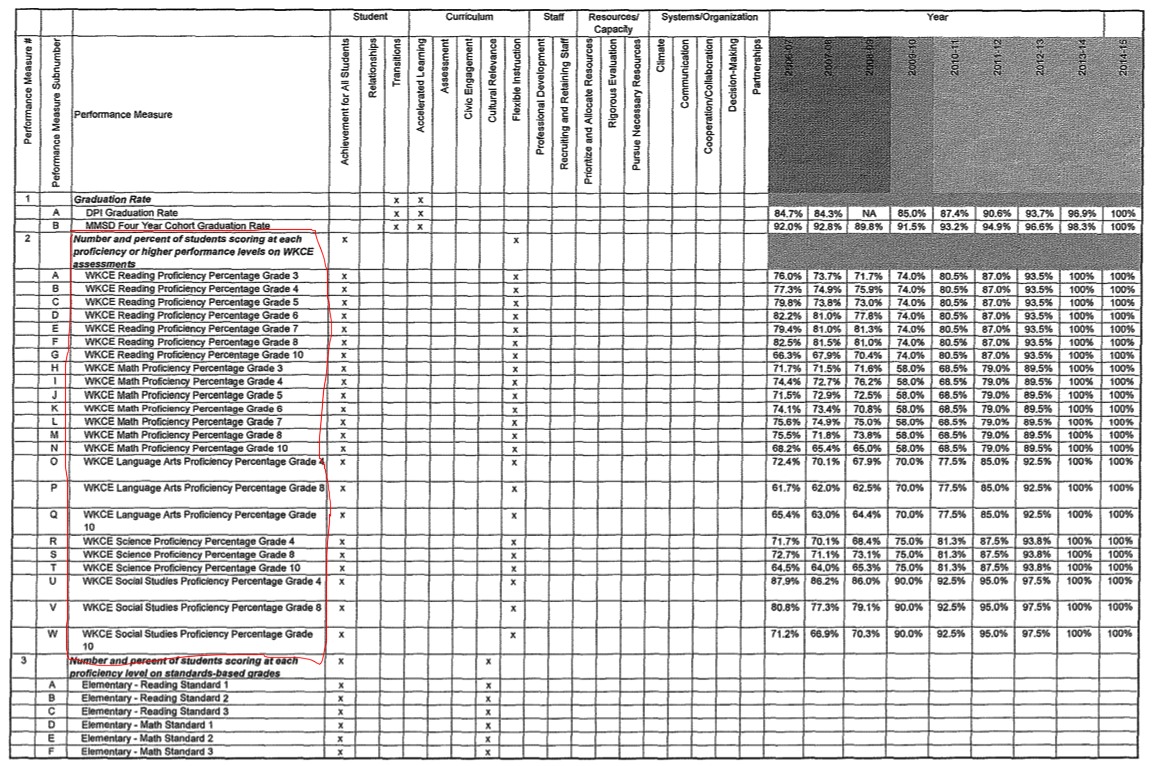
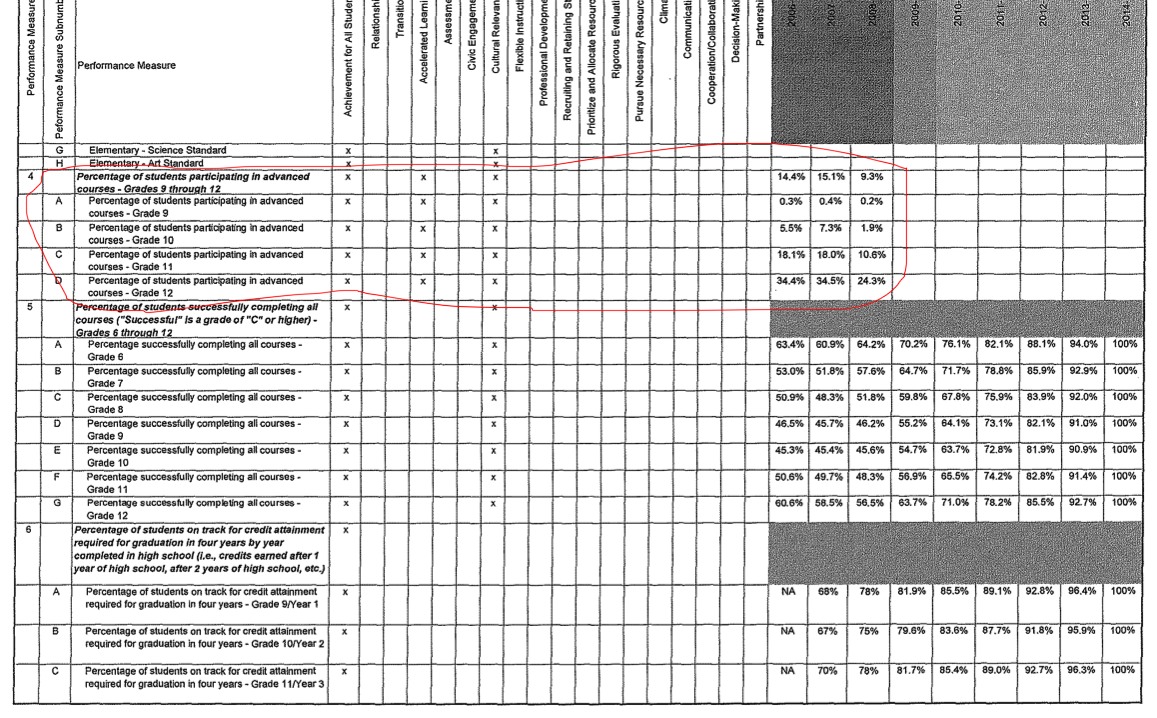
Those interested in a quick look at the state of Madison’s public schools should review Superintendent Dan Nerad’s proposed District performance measures. This document presents a wide variety of metrics on the District’s current performance, from advanced course “participation” to the percentage of students earning a “C” in all courses and suspension rates, among others.

Education Hot Topics

Finally, I hope President Obama mentions a number of Education Secretary Arne Duncan’s recent hot topics, including:

This wonderful opportunity for Wright’s students will, perhaps be most interesting for the ramifications it may have on the adults in attendance. Ripon Superintendent Richard Zimman recent Rotary speech alluded to school district’s conflicting emphasis on “adult employment” vs education.

Wisconsin State Test Score Comparisons: Madison Middle Schools:

WKCE Madison Middle School Comparison: Wright / Cherokee / Hamilton / Jefferson / O’Keefe / Sennett / Sherman / Spring Harbor / Whitehorse

About Madison:

UPDATE: How Do Students at Wright Compare to Their Peers at Other MMSD Middle Schools?

Share

Will reforming teacher salaries bring mile high results?

Alan Borsuk:

Denver is to reform in the way teachers are paid what Milwaukee is to private school vouchers: It’s the place that’s broken a lot of new ground and been a magnet for national attention.
With the likelihood that the Wisconsin Legislature will take important steps in the next few weeks that will substantially increase the prospects for changing the classic system for teacher salaries, here’s some advice for Wisconsin from Brad Jupp, a central architect of the Denver system:
“The most important thing to do is not to be so cautious that you don’t move forward,” Jupp said. “Breaking the barrier doesn’t kill you.”
Nationwide for almost a century, salaries of teachers have been set almost entirely by how many years a person has taught and whether the person has a master’s degree or certain amounts of college credits beyond a bachelor’s degree. Research has pretty firmly established that there is little, if any, correlation between teaching quality and those traditional measurements.
The political appeal of changing the way teachers are paid is huge now. The idea of paying good teachers more than bad teachers or using pay as an incentive to improve educational results has become popular across the political spectrum. President Barack Obama is scheduled to visit Madison this week to speak on education, and you can bet he will hit on this point.

Share

Racial Achievement Gap Still Plagues Schools

Nancy Solomon via a kind reader’s email:

American schools have struggled for decades to close what’s called the ‘minority achievement gap’ — the lower average test scores, grades and college attendance rates among black and Latino students.
Typically, schools place children who are falling behind in remedial classes, to help them catch up. But some schools are finding that grouping students by ability, also known as tracking or leveling, causes more problems than it solves.
Columbia High School in Maplewood, N.J., is a well-funded school that is roughly 60 percent black and 40 percent white. The kids mix easily and are friendly with one another. But when the bell rings, students go their separate ways.
Teacher Noel Cooperberg’s repeat algebra class last year consisted of all minority kids who had flunked the previous year. There were only about a dozen students because the school keeps lower-level classes small to try to boost success. But a group of girls sitting in the middle never so much as picked up a pencil, and they often disrupted the class. It was a different scene from Cooperberg’s honors-level pre-calculus class, which had three times as many students — most of them white.
These two classes are pretty typical for the school. Lower-level classes — called levels two and three — are overwhelmingly black, while higher-level four and five are mostly white. Students are assigned to these levels by a combination of grades, test scores and teacher recommendations.

Share

Madison School District Administration Response to the Math Task Force

The local school district’s increasing use of reform math programs lead to the creation of a “Math Task Force“. The District Administration’s response is outlined in this 2.6MB PDF document:

The purpose of this report is to describe the recomrnendations in response to the Madison Metropolitan School District Mathematics Task Force Report: Review of Mathematics Curriculum and Related Issues, submitted to the Board of Education June, 2008.
Administrative Recommendations Summary The materials included in this packet update and replace those distributed to the Board of Education in April 2009. Included in the materials is a proposed budget.
Middle School Mathematics Specialists (see Recommendations 1-5)
The Superintendent and UW-Madison Deans of Letters and Sciences and the School of Education commissioned a representative and collaborative group to design a professional development plan for this initiative. The group was convened in June and has since met four times during the summer to research and design a professional development plan to support middle school mathematics teachers.
The Middle School Math Partnership committee has tentatively planned five courses for the professional development proposal. Those courses are Number and Generalization, Rational Number and Proportional Reasoning, Geometry, Measurement and Trigonometry, and Algebra and Functions. The courses would be spread out over two years and be co-facilitated by UW and MMSD staff.
Research, data gathering and design will continue through 2009-2010 with the initial cohort of middle school teachers beginning in summer 2010. Upon completion of an initial draft, the plan will be presented to district teachers for further input and refinement.
In collaboration with the above group, a National Science Foundation Targeted Partnership proposal, Professional Learning Partnership K-20 (PLP K-20), was submitted on August 20, 2009. A UW-Madison and MMSD team of nearly 30 members worked during the summer to craft a proposal focused on systemic and sustainable mathematics professional development. The vision described in the proposal creates “a lasting interface to coordinate material, human, social, and cyber resources” among the UW-Madison and District. The principal investigator of the NSF proposal is Eric Wilcots. Co-Pl’s include Provost Deluca, Superintendent Nerad, Dean Sandefur and Dean Underwood.

Background notes and links:

Again, it will be interesting to see what, if any substantive changes occur in the local math programs.

Share

“Chicago Muscle” on Education Reform and the Democrat Party

Jonathan Alter:

Kennedy worked closely with President Bush on the flawed and deeply unpopular No Child Left Behind Act. Like a packaged-goods company with a tainted product, the Obama administration has left that name behind and now calls its program the Elementary and Secondary Education Act, LBJ’s original title in 1965. But the accountability-and-standards movement Kennedy and Bush launched is essential, and Obama has moved much faster than expected to advance it. He and Education Secretary Arne Duncan are showing some Chicago muscle and giving states a “choice” right out of The Untouchables: lift your caps on the number of innovative charter schools allowed and your prohibitions on holding teachers accountable for whether kids learn–or lose a chance for some of Obama’s $5 billion “Race to the Top” money. Massachusetts recently lifted its charter cap and nearly a dozen other states are scampering to comply. Now that’s hardball we can believe in.
This issue cleaves the Democratic Party. On one side are Obama and the reformers, who point out that we now have a good idea of what works: KIPP and other “no excuses” charter models boast 80 percent graduation rates in America’s roughest neighborhoods, nearly twice the norm. On the other side are the teachers’ unions and their incrementalist enablers in the political class. They talk a good game about education but make up phony excuses for opposing real reform and accountability.

Share

Madison School District 4K Proposal

Superintendent Dan Nerad [1.5MB PDF]:

Providing four year old kindergarten (4K) may be the district’s next best tool to continue the trend of improving academic achievement for all students and continuing to close the achievement gap.
The quality of care and education that children receive in the early years of their lives is one of the most critical factors in their development. Empirical and anecdotal evidence clearly shows that nurturing environments with appropriate challenging activities have large and lasting effects on our children’s school success, ability to get along with others, and emotional health. Such evidence also indicates that inadequate early childhood care and education increases the danger that at-risk children will grow up with problem behaviors that can lead to later crime and violence.
Background/Charge On February 9, 2009, the Board of Education asked the Superintendent to reconvene staff, and community members to begin planning for a collaborative 4K program in the Madison Metropolitan School District. The committee was directed to develop recommendations and timelines to present to the BOE.
Process Membership is attached and was generated by the AFSCME Child Care Representatives with membership growing as the months proceeded. Kathy Hubbard began facilitation and Jim Moeser is currently facilitating the committee work. Throughout the months of meeting, membership and attendance has been constantly high with energy and enthusiasm the same. The matrix presented in this packet includes a brief overview of the five committees below.

Related:

Perhaps the District might implement these initiatives first – and evaluate their effectiveness prior to expanding the organization (and budget) for 4K.

Share

New York Governor’s Charter Shock

Brendan Scott & Yoav Gonen:

In a surprise move, Gov. Paterson said yesterday he doesn’t plan to push for changes to state laws that experts have warned could jeopardize New York’s chances of raking in hundreds of millions of dollars in federal education aid.
Federal officials have highlighted two state laws in particular — one limiting the number of charter schools to 200 and another prohibiting the use of student test scores in determining whether a teacher deserves tenure — as potential barriers to the state’s bid for a share of the $4.3 billion competitive pot, known as Race to the Top.
While legislation was introduced last week to enhance New York’s standing by scrapping those laws, a spokeswoman for Paterson — who has supported charter schools in the past — said the governor would not be among its boosters.
“At this time, we believe New York state is eligible for Race to the Top funds and that legislative changes are currently not needed,” said the spokeswoman, Marissa Shorenstein.

Share

Madison School District: School Enrollment & Capacity Planning

Superintendent Dan Nerad [1.75MB PDF]:

Attached to this memo are several items related to enrollments, both actual and projections, as well as school capacities. We also include data on the enrollment data for students on the basis of their residence. Additional enrollment data will be provided in summary for the Board of Education at the December meeting.
The first attachment is a one-page overview summary of the past five years of enrollment history, the current year enrollment, and five years of projected enrollment by grade level. Overall, enrollment is generally flat for the district as a whole. However, the projections begin to show a slight increase starting in 2012-13 into 2014-15 at which time we will have increased enrollment to its highest level over the past ten years. By level, elementary and middle schools will continue to see increases in enrollment during the next five years whereas high schools will decline in enrollment.
The second attachment shows the detailed K-12 enrollment history and projections for each school. Historical data go back to the 1989-90 school year. Projections are through 2014-15. Projection years are boldfaced. The precision of projections at a school level and for specific grade levels within a school are less accurate when compared to the district as a whole. Furthermore, projections are much less reliable for later years in the projection timeline. Also, the worksheet reflects various program and boundary changes that were implemented and this accounts for some large shifts within schools and programs from one year to the next.
The third attachment contains two sheets – one for elementary and one for middle and high combined – and details the maximum capacities for each school, the current enrollment and capacity percentage, and the projected 2014-15 enrollment and capacity percentage. The sheets are organized by attendance area. Summaries are provided for levels. From the data, it appears elementary schools that have long term capacity constraints include Gompers,.Lake View, Sandburg, Allis/Nuestro Mundo, Kennedy, Orchard Ridge, and Van Hise. However, the schools that share a building with a middle school have access to other space. Among middle schools, Jefferson Middle School is the only school that may experience capacity concerns. None of the high schools are expected to have capacity issues for the foreseeable future.

Share

College Competitiveness Reconsidered

Scott Jaschik:

Everybody knows that college is harder to get into today than ever before, right? That’s why students flock to test-prep courses, and spend countless hours trying to transform themselves into what they imagine admissions deans want.
Admissions deans have tried to play down the hype, and just last week the National Association for College Admission Counseling released data showing that the acceptance rate at four-year colleges has declined from 71.3 percent in 2001 to 66.8 percent in 2007 — hardly an impossible bar to get over. So why are so many people convinced that the story in higher education admissions is about increased competitiveness?
The problem — according to a major research project released Monday by a leading scholar of higher education — is that there are two trends at play.
A small number of colleges have become much more competitive over recent decades, according to Caroline M. Hoxby, an economist at Stanford University. But her study — published by the National Bureau of Economic Research — finds that as many as half of colleges have become substantially less competitive over time.
The key shift in college admissions isn’t increased competitiveness, Hoxby writes. Rather, both trends are explained by an increased willingness by students generally, and especially the best students, to attend colleges that aren’t near where they grew up. This shift increased the applicant pool for some colleges but cut it for others.
“Typical college-going students in the U.S. should be unconcerned about rising selectivity. If anything, they should be concerned about falling selectivity, the phenomenon they will actually experience,” Hoxby writes.

Hoxby’s paper:

This paper shows that although the top ten percent of colleges are substantially more selective now than they were 5 decades ago, most colleges are not more selective. Moreover, at least 50 percent of colleges are substantially less selective now than they were then. This paper demonstrates that competition for space–the number of students who wish to attend college growing faster than the number of spaces available–does not explain changing selectivity. The explanation is, instead, that the elasticity of a student’s preference for a college with respect to its proximity to his home has fallen substantially over time and there has been a corresponding increase in the elasticity of his preference for a college with respect to its resources and peers. In other words, students used to attend a local college regardless of their abilities and its characteristics. Now, their choices are driven far less by distance and far more by a college’s resources and student body. It is the consequent re-sorting of students among colleges that has, at once, caused selectivity to rise in a small number of colleges while simultaneously causing it to fall in other colleges. I show that the integration of the market for college education has had profound implications on the peers whom college students experience, the resources invested in their education, the tuition they pay, and the subsidies they enjoy. An important finding is that, even though tuition has been rising rapidly at the most selective schools, the deal students get there has arguably improved greatly. The result is that the “stakes” associated with admission to these colleges are much higher now than in the past.

Share

New Global Academy to offer specialized courses to students in eight Dane County school districts

Gena Kittner:

The initial program in biomedicine would include courses in the principles of biomedical sciences; human body systems; medical interventions; and science research. The classes likely would be taught by high school teachers, but would incorporate business and academic experts to help teach, offer apprenticeships and career placement.
The academy’s location won’t be decided until leaders know how many students are interested in the program. However, one possibility is holding classes at MATC’s West campus in the former Famous Footwear building, Reis said.
Students – organizers hope about 150 – would travel from their respective high schools to Madison’s Far West Side every day for the courses, which would be part of the academy’s two-year programs. Depending on the interest in the biomedical class, three sections would be taught during the day and possibly one in the evening, Reis said.
Offering a night class would maximize the use of the facility and offer some flexibility to students who live farther outside of Madison, he said.
Verona, Middleton Cross-Plains, Belleville, McFarland, Mount Horeb, Oregon, Wisconsin Heights and Madison school districts have agreed to participate in the academy.

Related: Credit for non Madison School District Courses.

Share

Teacher Union Politics in Washington, DC: The D.C. Council seems to worry about everyone but students.

Washington Post Editorial:

D.C. SCHOOLS Chancellor Michelle A. Rhee stands accused, it seems, of trying to manage her budget in a way that will do the least harm to students. Not a crime, you might think — unless, like Ms. Rhee’s accusers on the D.C. Council, you are more interested in scoring political points than in hearing what she is doing for children.
Ms. Rhee was called before the council Thursday to explain the layoffs of 388 employees, including 266 teachers and other educators. She provided convincing evidence of the budget pressures leading to this month’s reduction in force. She offered solid reasons for the hiring of some 900 teachers last spring and summer, and held out an olive branch to the council — saying she never intended to blame it for the layoffs. She made clear that her goal was to save summer school as an option for as many children as possible.
This, by the way, was no secret; we referred to Ms. Rhee’s efforts to save summer school on these pages Sept. 23. It might help, in fact, if council Chairman Vincent C. Gray (D) got on the phone when Ms. Rhee called. It’s also clear, in the opinion of budget experts we consulted, that Ms. Rhee has the authority to cut now, with plans to restore summer school, as long as she submits a reprogramming later. So exclamations of surprise at her plans and accusations of law-breaking have little credibility.

Share

Madison School District Strategic Plan: Nirvana by 2014/2015?

The Madison School Board recently passed the District’s Strategic Plan. Superintendent Dan Nerad has now published a draft document outlining performance measures for the plan (this is positive). The 600K PDF document is well worth reading. Mr. Nerad’s proposed performance measures rely on the oft criticized – for its lack of rigor – state exam, the WKCE. The Wisconsin Department of Public Instruction recently stated that “Schools should not rely on only WKCE data to gauge progress of individual students or to determine effectiveness of programs or curriculum“.
A few highlights from the 600K PDF document:

Related:

Discussing these data is a step in the right direction. Unfortunately, use of the WKCE does not instill much confidence, from my perspective.

via “Some States Drop Testing Bar” by John Hechinger.
Happy Halloween!

Share

Why Public Sector Collective Bargaining Should Be Public

Mike Antonucci:

Because during contract negotiations in Stamford, Connecticut, someone might notice that the average teacher salary is about $80,000.

Because in Brevard County, Florida, someone might notice that more than $5 million designated for the employee health care trust fund was spent on an 8.5 percent teacher pay raise.

Because in Hawaii, someone might wonder if getting rid of school on Fridays is really that great of an idea.

Because in Chambersburg, Pennsylvania, someone might suggest that the union is filing multiple grievances to get negotiating leverage.

Because across America, someone might actually get to read the New Haven teacher contract before deciding how reformy it is. In the meantime, you can see that the New Haven Federation of Teachers didn’t emphasize the same areas as Randi Weingarten, Arne Duncan and the New York Times when discussing the contract internally.

Share

Federal Researchers Find Lower Standards in Schools

Sam Dillon:

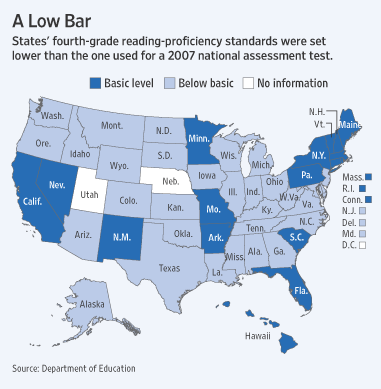
A new federal study shows that nearly a third of the states lowered their academic proficiency standards in recent years, a step that helps schools stay ahead of sanctions under the No Child Left Behind law. But lowering standards also confuses parents about how children’s achievement compares with those in other states and countries.
The study, released Thursday, was the first by the federal Department of Education’s research arm to use a statistical comparison between federal and state tests to analyze whether states had changed their testing standards.
It found that 15 states lowered their proficiency standards in fourth- or eighth-grade reading or math from 2005 to 2007. Three states, Maine, Oklahoma and Wyoming, lowered standards in both subjects at both grade levels, the study said.
Eight states increased the rigor of their standards in one or both subjects and grades. Some states raised standards in one subject but lowered them in another, including New York, which raised the rigor of its fourth-grade-math standard but lowered the standard in eighth-grade reading, the study said.

Wisconsin’s standards fell below the Federal “Basic Achievement Level”. Channel3000 has more.

Share

Should student drama productions be restricted to PG themes?

Valerie Strauss:

ou would think people have better things to fight about, but across the nation people are arguing–and even going to court–over high school plays. Yes, the drama productions that high school kids stage for other high school kids.
The latest instance occurred this week at Churchill High School in Potomac, Md., when administrators abruptly cancelled a production of “Chicago” three weeks before it was to be staged because it is too racy, my colleague Nelson Hernandez reported.
Never mind that these same officials had approved the production last spring when students first asked permission.
And never mind that the play is decades old and was turned into an Academy Award-winning movie, making it impossible for anybody at the school to claim they didn’t know it was about murder and sex and other themes, that, come to think of it, run through Shakespeare’s plays too.
But I digress.

Share

The Best Writing in Educational Technology

Joshua Kim:

The single best piece of writing in recent memory on the large scale structural forces shaping higher education and the role of technology in impacting these forces is the first chapter of The Tower and the Cloud, “The Gathering Cloud: Is This the End of the Middle?”
You can read Katz’s chapter here, or better yet go and get the whole volume. I’m focussing on Katz’s introductory chapter, but the whole book contains a series of wonderful essays that flush out the ideas raised by Katz in his chapter and are worth the investment to read.
Rarely does a piece of writing stick with me like Katz’s chapter has, one-year on from when I first picked up the Tower and the Cloud at last year’s EDUCAUSE conference. We live in such a fast world of micro information, tweets, disposable blog posts, quick YouTube videos, online presentations, and RSS feeds. We ed. tech. people like the new new, we like innovation, we are suspicious of the status quo and firmly believe that if technology has changed everything else it should (and can) change the academy as well.
Katz’s writing is an important antidote to the “right now” nature of much of our information consumption, communication and work in learning technology. He takes the time to tell the long story of the development and growth of higher education, and then situates the disruptive innovations slamming into our institutions as part of this larger story.

Share

President Obama’s November 4, 2009 Madison Destination: Wright Middle School?

President Obama’s “education” speech, due to be delivered in Madison on Wednesday, November 4, 2009 may, perhaps be given at Wright Middle School. It is a (rare) charter school located in Madison. Obama and Education Secretary (and former Chicago Superintendent) have been promoting structural change within our public schools. Wright, a Charter School, was birthed via a “Madison Middle School 2000” initiative along with the desire to place a new middle school on Madison’s south side. Local biotech behemoth Promega offered land for the school in Fitchburg, which the District turned down (that land and initiative became Eagle School).
Has Wright been successful? Has it achieved the goals illuminated in the original Madison Middle School 2000 initiative?
There are any number of local issues that could be discussed around the visit, including: the District’s general opposition to charter schools, changes to the teacher contract seniority system and Wisconsin’s controversial and weak state test system (WKCE).
The Wisconsin State Journal has more.
It will be interesting to see what, if any, substantive actions arise from Obama’s visit.

Share

Bad Trip: School Outings Get Downgraded

Sarah Nassauer:

Eleven-year-old Clayton Lundstrom couldn’t wait for sixth grade, the year he’d get to spend three days hiking, identifying plants and singing songs around a bonfire in the Cascade Mountains with his classmates. The trip to the Cispus Learning Center has been a rite of passage for sixth-graders in his Washington state district for almost 20 years.
But earlier this year, the Tumwater School District yanked funding for it, and unless the Parent Teacher Association can raise enough money, Clayton’s class will stay home. “I’ve been waiting to go to Cispus basically since first grade,” Clayton says.
As schools across the country face massive budget cuts and parents face their own financial shortfalls, field trips are getting canceled in droves. More than one in six schools plans to eliminate trips this year, according to a survey by the American Association of School Administrators. That’s up from 9% last year. By next school year, one in four schools will need to cut field trips, according to the survey.
Even when trips aren’t canceled, there often are downgrades. After budget cuts in Eau Claire, Wisc., the Northstar Middle School couldn’t pay for the eighth-grade trip to Minneapolis to see a performance of “A Christmas Carol” at the landmark Guthrie Theater, designed by French architect Jean Nouvel. Instead, the students will go to the local movie theater to see the Disney 3-D movie version of the Charles Dickens classic.

Share

Public-school education Desert excellence: “horrified by the mediocrity and low expectations at American public schools”

The Economist:

AND what was the Minotaur? The ten-year-olds scribble their answer onto tiny whiteboards and hold them up for the teacher to see. Once each has got a nod, they repeat together: “half-man, half-bull.”
By the time these fifth-graders at the BASIS school in Scottsdale, Arizona, reach 8th grade they will have the option of taking Advanced Placement (AP) exams, standardised nationally to test high-school students at college level. By the 9th grade, they must do so. As a result, says Michael Block, the school’s co-founder, our students are “two years ahead of Arizona and California schools and one year ahead of the east coast.”
But that, he emphasises, is not the yardstick he and his wife Olga use. Instead, their two BASIS schools, one in Tucson and this one in suburban Phoenix, explicitly compete with the best schools in the world–South Korea’s in maths, say, or Finland’s in classics.
They had the idea after Olga Block came to Arizona from her native Czech Republic, looked for a school for her daughter and was horrified by the mediocrity and low expectations at American public schools. So they decided to “establish a world-standard school in the desert,” says Mr Block. They started the Tucson campus in 1998 and added the Scottsdale one recently.

Share

Our Local Schools Should Be Showcases Not Basket Cases – GOOG Ups Its Schools Focus

Tom Foremski:

The promise of distance learning through the Internet has yet to be realized and I’m puzzled why this is the case since it should be possible to collaborate on creating a great online curriculum. Once it is created it can be easily accessed by anyone.
Why don’t we use the social networking and collaborative tools we already have to put together an open-sourced curriculum consisting of text, images, videos, lectures, online volunteers acting as tutors, etc. We have all the technology we need to do all of this today.
I’ve always been amazed that San Francisco/Silicon Valley region public schools are so bad. We are inventing the future here, yet we can’t use our ingenuity, our technologies to improve our local schools? Our public schools should be showcases, not basket cases, we should be ashamed to allow this to happen.
So it’s good to see Google becoming more interested in schools because there is a lot it could do to help, especially in terms of projects like its Google Books. Maybe it could help to provide text books. It’s incredible how expensive textbooks are.
For the past two days Google has hosted a conference on its campus: Breakthrough Learning in a Digital Age. The goal was to “create and act upon a breakthrough strategy for scaling up effective models of teaching and learning for children.” It’s not clear what breakthrough strategy has emerged but at least it’s a start,

Share

New Jersey Governor candidates differ on urban education solutions

Geoff Mulvihill:

It’s an eternally vexing problem in New Jersey: How do you give the children in the state’s largely poor cities as good an education as the kids in middle-class and affluent suburbs?
The three main candidates for governor in Tuesday’s election have different ideas highlighting their plans.
Democratic incumbent Jon Corzine says a major piece of the answer is expanding a program that seems to be working , state-funded preschools for low-income children.
Both his challengers, Republican Chris Christie and Independent Chris Daggett, want to give parents and students more ways out of bad schools, hoping that will pressure them to improve.
By most measures, New Jersey’s school system as a whole is good. On standardized tests that can be used to compare states, students regularly rank consistently at or near the top.
The system is also pricey: Public schools cost more than $16,000 per student in the 2006-07 school year , the last year for which federal data is available. That was the highest price tag in the country, though it also comes in a state where incomes and the cost of living are among the highest.
For all the money, there’s long been a gap between how well students do in the cities and in the suburbs.

Share

West Virginia Charter School Debate Heats Up

Ry Rivard:

Education reformers are intensifying their push to bring charter schools to West Virginia as parents, teachers and lawmakers ready themselves for another round of legislative battles aimed at improving the state’s school system.
Charter schools advocates are stepping up their lobbying efforts by running advertisements and polling West Virginians on their thoughts about charters, which are private-style public schools. The state’s powerful teachers unions helped kill a charter school proposal earlier this year.
“We hope to change that conversation a bit,” said Tim McClung, a member of the group that calls itself West Virginians for Education Reform
To help do that, the National Alliance for Public Charter Schools started polling state residents Wednesday night to gauge their reaction to charter schools, McClung said.

Share

Report Questions Duncan’s Policy of Closing Failing Schools

Sam Dillon:

Secretary of Education Arne Duncan presided over the closing of dozens of failing schools when he was chief executive of the Chicago public schools from 2001 until last December. In his new post, he has drawn on those experiences, putting school turnaround efforts at the center of the nation’s education reform agenda.
Now a study by researchers at the University of Chicago concludes that most students in schools that closed in the first five years of Mr. Duncan’s tenure in Chicago saw little benefit.
“Most students who transferred out of closing schools re-enrolled in schools that were academically weak,” says the report, which was done by the university’s Consortium on Chicago School Research.
Furthermore, the disruptions of routines in schools scheduled to be closed appeared to hurt student learning in the months after the closing was announced, the researchers found.
The reading scores of students in schools designated for closing “showed a loss of about six weeks of learning” on standardized tests in the months after the closing announcement, the report said. Math scores declined somewhat less, it said.

Alan Singer has more.

Share

Learning English

La Opinion:

Fluency in English is part of the foundation necessary for a good quality of life in the United States. The school system must be set up so that students who are in an English language learning [ELL] programs are able to master the language and transition out of the program, as soon as possible, to join the rest of the student body to continue their studies.
An analysis by the Tomás Rivera Policy Institute, appropriately entitled “¿Qué Pasa? Are ELL Students Remaining in English Learning Classes Too Long?” points to delays in reclassifying as “fluent English proficient” students who began school as English language learners so that they can transition into regular academic programs. The detailed study shows that 30% of students who started First Grade as English language learners were still in the same classification eight years later. This situation puts students at greater risk of academic failure, as Ninth Grade is seen as critical for success in High School.
The problem is that students who are not reclassified by school authorities as fluent English proficient are at a disadvantage even when they get to the California High School exit exam.

Share

Charter Schools ‘Market Share’ Growing; Exceeds 20% in 14 Communities

Reuters:

Public charter schools’
presence in K-12 schooling continues to grow, according to the latest Top 10 Charter Communities by Market Share report by the National Alliance for Public Charter Schools. In fact, charters now enroll more than one in five public school students in 14 communities – including major cities like Detroit, St. Louis, and Kansas City.
Demand remains strongest in urban areas – and as a result, charter “market share” is growing rapidly in cities and adjacent suburbs, even while the overall number of students remains a modest portion of nationwide enrollment.
“Charter schools are working at scale in a growing number of American cities,” according to Nelson Smith, President and CEO of the National Alliance for Public Charter Schools. “Chartering is becoming well-established as a key component of the public education delivery system,” he added.

Share

Many L.A. students not moving out of English language classes

Anna Gorman:

Nearly 30% of Los Angeles Unified School District students placed in English language learning classes in early primary grades were still in the program when they started high school, increasing their chances of dropping out, according to a new study released Wednesday.
More than half of those students were born in the United States and three-quarters had been in the school district since first grade, according to the report by the Tomás Rivera Policy Institute at USC.
The findings raise questions about the teaching in the district’s English language classes, whether students are staying in the program too long and what more educators should do for students who start school unable to speak English fluently.
“If you start LAUSD at kindergarten and are still in ELL classes at ninth grade, that’s too long,” said Wendy Chavira, assistant director of the policy institute. “There is something wrong with the curriculum if there are still a very large number of students being stuck in the system.”

Share

Washington, DC Teacher’s Union vs. Michelle Rhee

Andrew Rotherham:

Everyone is chattering about this full-page ad the AFT took out in this morning’s Washington Post. I work in this space and am quite familiar with all the protagonists and the issues and it took me a minute to make sense of the point of the ad. Maybe I’m stupid or needed more coffee but it was really busy and the punchline is buried in two unchecked boxes on the lower right. So I’m not sure it’s going to move the casual observer to action – or even to an opinion. It needs a clearer message but it’s probably hard to get that message on paper without giving away the game.
Leaving aside technical deficiencies, clearly the strategy is to appear reasonable everywhere else in order to box in Michelle Rhee in D.C. But there are two problems with that strategy. First, at the elite level people get what’s going on (increasingly the press, too) so the whole thing is sort of over before it even started and that plan only works if they can make this stuff real elsewhere and the clock is ticking on that. Meanwhile, even those frustrated with aspects of Rhee’s style and tactics are still sympathetic to what she’s trying to do and the obstacles to that. Second, and more basically, outside of big reform initiatives with lessons I don’t think Michelle Rhee really cares about what’s happening elsewhere and she’ll hold her ground. She responds to different incentives like the rest of us but peer pressure isn’t one of them.

Share

Rhode Island education chief seeks higher standards for prospective teachers

Jennifer Jordan:

Education Commissioner Deborah A. Gist, who has made teacher quality the cornerstone of her three-month-old administration, is raising the score that aspiring teachers must achieve on a basic skills test required for admission to all of the state’s teacher training programs.
Currently, Rhode Island’s “cut score” ranks among the lowest in the nation, alongside Mississippi and Guam. Gist wants to raise it to the highest.
“Teacher quality is the single most important factor for student success in school,” Gist said. “This is a first step in raising our expectations across the board for our educators and our system.”
Gist says she intends to transform “the entire career span of a teacher,” including who is allowed to train to become a teacher, the rigor of the programs, mentoring of new teachers, support and training for veteran teachers, and the reward of higher pay for high performance.
“We need to look at how we improve at every point along the span,” Gist said. “Looking at teacher cut scores before they ever get accepted to a preparation program is a way to safeguard the early gate.”
Gist and her staff reviewed other states’ cut scores and found Virginia’s to be the highest in reading, math and writing. Gist set Rhode Island’s score one point higher than Virginia’s in each subject, saying she wants to make Rhode Island’s education system the envy of the nation.
“I have the utmost confidence that Rhode Island’s future teachers are capable of this kind of performance,” she said.

Perhaps one day we’ll have such actions in Wisconsin…

Share

E. D. Hirsch’s Curriculum for Democracy
A content-rich pedagogy makes better citizens and smarter kids.

Sol Stern:

At his Senate confirmation hearing in February, Arne Duncan succinctly summarized the Obama administration’s approach to education reform: “We must build upon what works. We must stop doing what doesn’t work.” Since becoming education secretary, Duncan has launched a $4.3 billion federal “Race to the Top” initiative that encourages states to experiment with various accountability reforms. Yet he has ignored one state reform that has proven to work, as well as the education thinker whose ideas inspired it. The state is Massachusetts, and the education thinker is E. D. Hirsch, Jr.
The “Massachusetts miracle,” in which Bay State students’ soaring test scores broke records, was the direct consequence of the state legislature’s passage of the 1993 Education Reform Act, which established knowledge-based standards for all grades and a rigorous testing system linked to the new standards. And those standards, Massachusetts reformers have acknowledged, are Hirsch’s legacy. If the Obama administration truly wants to have a positive impact on American education, it should embrace Hirsch’s ideas and urge other states to do the same.
Hirsch draws his insights from well outside traditional education scholarship. He started out studying chemistry at Cornell University but, mesmerized by Nabokov’s lectures on Russian literature, switched his major to English. Hirsch did his graduate studies at Yale, one of the citadels in the 1950s of the New Criticism, which argued that the intent of an author, the reader’s subjective response, and the text’s historical background were largely irrelevant to a critical analysis of the text itself. But by the time Hirsch wrote his doctoral dissertation–on Wordsworth–he was already breaking with the New Critics. “I came to see that the text alone is not enough,” Hirsch said to me recently at his Charlottesville, Virginia, home. “The unspoken–that is, relevant background knowledge–is absolutely crucial in reading a text.” Hirsch’s big work of literary theory in his early academic career, Validity in Interpretation, reflected this shift in thinking. After publishing several more well-received scholarly books and articles, he received an endowed professorship and became chairman of the English department at the University of Virginia.

Share

Children’s Educational Records and Privacy

Joel R. Reidenberg, Jamela Debelak and others [Complete Report: 888K PDF]:

A Study of Elementary and Secondary School State Reporting Systems
Following the No Child Left Behind mandate to improve school quality, there has been a growing trend among state departments of education to establish statewide longitudinal databases of personally identifiable information for all K-12 children within a state in order to track progress and change over time. This trend is accompanied by a movement to create uniform data collection systems so that each state’s student data systems are interoperable with one another. This Study examines the privacy concerns implicated by these trends.
The Study reports on the results of a survey of all fifty states and finds that state educational databases across the country ignore key privacy protections for the nation’s K-12 children. The Study finds that large amounts of personally identifiable data and sensitive personal information about children are stored by the state departments of education in electronic warehouses or for the states by third party vendors. These data warehouses typically lack adequate privacy protections, such as clear access and use restrictions and data retention policies, are often not compliant with the Family Educational Rights and Privacy Act, and leave K-12 children unprotected from data misuse, improper data release, and data breaches. The Study provides recommendations for best practices and legislative reform to address these privacy problems.

Share

School board balks as Mayor Doyle controls search for superintendent

Ethan Shorey:

Mayor James Doyle has declared he’s in the city’s school superintendent search process, a move that is not sitting well with some School Committee members.
Doyle told members of the School Committee in an Oct. 15 letter, “I have decided to organize a search committee that will represent the entire community.
“The purpose of this search committee is to assist and advise the School Committee in the task of securing the best possible candidate to serve as Pawtucket’s next superintendent.”
Acting School Committee Chairman James Chellel told The Valley Breeze he planned to sit down with Doyle during the early part of this week as he tries to avoid a showdown over whether Doyle’s administration or the School Committee has the authority to set up a search committee.
“I want to show that we’re working together on this, but I do have reservations about the mayor taking this over,” said Chellel.
There’s no question that selecting a new superintendent falls under the purview of the School Committee, said Chellel, but the questions of who should set up the parameters of the search to find outgoing Superintendent Hans Dellith’s replacement are a little more fuzzy.
“I’ve asked our legal counsel for an opinion on it,” he said.

Share

The Ever-Expanding U. of Phoenix

Doug Lederman:

In the world of for-profit higher education, and higher education in general, the University of Phoenix has historically been viewed as the 800-pound gorilla.
As of Tuesday, it may be more like a 1,000-pound gorilla. As Phoenix’s parent company, the Apollo Group, reported its fourth quarter and annual earnings Tuesday, it announced that the university’s enrollment of degree-seeking students grew to 443,000 as of August 2009, up 22 percent from 362,000 in August 2008. The biggest growth in Phoenix’s enrollments, by far, came among students seeking associate degrees, which rose by 37 percent, to 201,200 from 146,500 in 2008.
About two-thirds of the university’s new students as of August are female, 27.7 percent are African-American, and about half are 30 or over.
The university attributed the sizable increases to a range of factors, including increased efforts in retaining students, expanded marketing, and the “current economic downturn, as working learners seek to advance their education to improve their job security or reemployment prospects.” Many community colleges and several of Phoenix’s major peers in for-profit career education, including Kaplan Higher Education (21.9 percent) and Corinthian Colleges, Inc. (24.4 percent), have reported sharp upturns in student enrollments this fall.

Share

Number-Crushing: When Figures Get Personal

Carl Bialik:

Everyone can agree that 1+1=2. But the idea that 7 is greater than 13 — that some numbers are luckier than others — makes no sense to some people. Such numerical biases can cause deep divisions.
And that is what happened earlier this month in Hong Kong. Property developer Henderson Land Development Co. made news for selling a condominium for $56.6 million, a price the developer called a residential record in Asia. But after that sale was announced, the property began making news for other unusual numbers. Henderson is labeling the floors of its property at 39 Conduit Road with numbers that increase, but not in the conventional 1-then-2 way. The floor above 39, for example, is 60. And the top three floors are consecutively labeled 66, 68 and 88.
This offended some people’s sense of order. At a protest Sunday against high housing prices, Hong Kong Democratic Party legislators expressed dissatisfaction with the numbering scheme’s tenuous relationship to reality. “You could call the ground floor the 88th floor, but it’s meaningless,” says Emily Lau. “When you say you live on the 88th floor, people expect you to be on the 88th floor, not the 10th floor or something.”

Share

Wisconsin Governor Doyle: Special session possible to pass education reforms

WisPolitics:

Gov. Jim Doyle is expressing confidence that key components of a package of education reforms he’s proposed will make it through the Legislature this fall.
On Sunday’s “UpFront with Mike Gousha” Doyle said a number of the proposals, designed to position the state to capture federal “Race to the Top” funds for educational improvement, will be introduced this week.
“We really are focused on getting the job done,” Doyle said.
Doyle held open the possibility of calling a special session if it were needed. The Legislature’s fall floor session ends next week. Senate Majority Leader Russ Decker said in an interview with WisPolitics.com last week that a special session may be possible.
The reforms include allowing student test scores to be used in teacher evaluation, increasing the length of school days or the school year and tracking individual student achievement, among other measures.

Share

Illinois Prosecutors Turn Tables on Student Journalists

Monica Davey:

For more than a decade, classes of students at Northwestern University’s journalism school have been scrutinizing the work of prosecutors and the police. The investigations into old crimes, as part of the Medill Innocence Project, have helped lead to the release of 11 inmates, the project’s director says, and an Illinois governor once cited those wrongful convictions as he announced he was commuting the sentences of everyone on death row.
But as the Medill Innocence Project is raising concerns about another case, that of a man convicted in a murder 31 years ago, a hearing has been scheduled next month in Cook County Circuit Court on an unusual request: Local prosecutors have subpoenaed the grades, grading criteria, class syllabus, expense reports and e-mail messages of the journalism students themselves.
The prosecutors, it seems, wish to scrutinize the methods of the students this time. The university is fighting the subpoenas.

Share

Parents banned from watching their children in playgrounds… in case they are paedophiles Read more: http://www.dailymail.co.uk/news/article-1223528/Parents-banned-supervising-children-playgrounds–case-paedophiles.html#ixzz0VI3l2cFH

Laura Clark:

Parents are being banned from playing with their children in council recreation areas because they have not been vetted by police.
Mothers and fathers are being forced to watch their children from outside perimeter fences because of fears they could be paedophiles.
Watford Council was branded a ‘disgrace’ yesterday after excluding parents from two fenced-off adventure playgrounds unless they first undergo criminal record checks.

Share

Madison Area School Districts Raising Taxes

Channel3000:

School districts are trying to find a balance between cuts in state funding and paying the bills, but the state budget crunch is ultimately leading to school districts raising taxes for homeowners.
When the state cut aid to schools, districts got the option of raising property taxes to make up the difference. But while they can raise taxes to make up whatever they’re losing in state aid, not all districts are.
The Sun Prairie School District said it has plenty going for it — a number of new schools in a few years and a new high school coming soon, but that it’s not immune to budget woes.
“We’ve got a reduction in state aid. We’ve got increasing numbers of students and we have the debt the voters approved three years ago to build the new high school,” said Tim Culver, Sun Prairie School District administrator.
Sun Prairie was in a similar situation as many Dane County districts. It could have raised the tax levy there to 14.4 percent, but instead it’s raising it to 7.7 percent, which is a $142 increase for the average $200,000 home.
“What we’re trying to do is balance out that we want the best education possible for kids, but people have to be willing to pay for the education too,” said Culver.

Share

Madison School Board Revises Budget to Reduce the Upcoming Property Tax Increase

WKOW-TV, via a kind reader’s email:

Madison school board leaders are revising a budget plan that lowers their property tax increase but defers millions of dollars in maintenance.
Leaders are looking to lower the previously agreed upon property tax hike by about $50 dollars per homeowner: from $147 on a $250,000 home, to $92.83 on a $250,000 home.
To accomplish that, members took from a few funds, and decided they would not levy the remaining balance on a 2005 maintenance referendum: that equaling out to almost $3 million dollars.
School board members had to compensate for the loss of $12-million dollars in state funding.
The loss of funding for the maintenance referendum didn’t come without discussion. Board member Beth Moss hoped to levy just enough to pay for $1.4 million dollars of roof maintenance.
Moss says, “The maintenance doesn’t go away… You can put it off, but putting it off usually only makes it worse.”
On the list for repairs, a boiler at Marquette Elementary, and more efficient windows at Shorewood Elementary.

Most budget changes passed 7-0, with the exception of the deferred maintenance, which passed 5-2 with Beth Moss and Ed Hughes voting against it. Moss’s school board seat is up for election on April 6, 2010. I emailed Beth last weekend, along with Maya Cole and Johnny Winston, Jr. to see if they plan to run for re-election.
Listen to Monday evening’s Madison School Board discussion via this 1 hour, 50 minute mp3 audio file.
The budget changes were driven by reduced transfers of state tax dollars to school districts and the drop in assessed property values (via an April, 2009 memo). Interestingly, I don’t believe this significant Board (mostly 7 votes, but some big dollar 5-2 as noted above) effort to hold down the local school property tax increase would have occurred with earlier Directors.

Share

Debating the Merits of Leaving High School Early to Go to College

Jack Kadden:

What should you do if you’re a high school junior who feels that spending one more year in high school would be a waste of time?
A thread on College Confidential raises that question, and has generated a lot of interesting responses. Here’s an excerpt from the original post:

I am a junior in high school and because I seem like I am more mature and academically way ahead of my peers (especially in the math and sciences) at the moment, am considering an early leave from high school. But the thing is, I cannot get a graduation degree unless I complete four years of high school. Nevertheless, my desire for early admission into college has never ceased because (a) I know what I want to study and roughly what I want to do in life and (b) I feel like my senior year in high school will be somewhat a waste of my time since I would have practically exhausted all the resources available to me.

In a later post, the student adds: “Every day at school I cannot help but realize that I need so much more than just the classes and activities I have available to me at the moment. I don’t know if I could stand senior year.”

Share

The death of Gerald Bracey is a loss for education

Maureen Downey:

I talk to many education researchers, but none had the passion or conviction of Gerald Bracey, whose e-mails I occasionally shared with you here. He died suddenly in his sleep last week at age 69.
What I admired about Bracey is that he criticized people he once esteemed, including President Obama. His allegiance was not to any political party, but to what he saw as the truth of the matter.
Often, his e-mails to me were stern scoldings about buying the latest “garbage” from Arne Duncan or Kathy Cox. (There would have been a chastising e-mail today from him on my blog entry yesterday on Duncan’s speech here in Atlanta.)
Affable and smart, Bracey was always willing to chat with me and show me the error of my ways.

Share

Paul Solman Answers Students’ Economic Questions

NewsHour:

Economics correspondent Paul Solman takes his Business Desk blog inside classrooms across the United States to respond to high school students’ most pressing questions about Wall Street, the recession and unemployment.
Question: How does it happen that the whole world is in a recession? –Kavion, senior, Central High School, Phoenix, Ariz.
Paul Solman: The whole world isn’t in a recession. China is growing; so is India; so is Brazil. Among them, those three countries alone have something like two-thirds our GDP and maybe nine times as many people as we do.
As to the parts of the world that are in recession — largely in Europe — it looks like the reason is because their citizens borrowed and spent “beyond their means.”

Share

Candidates for Charlottesville School Board

Ned Michie, Leah Puryear & Juandiego Wade:

According to the Virginia Department of Education, the drop-out rate for Charlottesville high school students is 13 percent.
How would you address this question? What measures would you recommend, specifically, to lower the rate?
As of last year, the state is calculating the dropout rate in a new, more accurate manner than in prior years, tracking individual students starting in ninth grade. Obviously the factors leading to a student’s high school success or failure start much earlier than ninth grade; therefore it is impossible to defeat the dropout problem even over several years of making all the right moves educationally. Moreover, because the educational needs of all children start at birth, every positive educational change will ultimately increase his or her chances of remaining in school.
Ned Michie
As a public school division, we take all comers regardless of aptitude, educational background, grade level, or other circumstance. While every school division has a set of challenges, Charlottesville’s student population presents a particularly unusual array of educational challenges for a small division.
On the one hand, we have a large number of children who will go on to the finest universities and become doctors, lawyers, scientists, entrepreneurs, and captains of industry. We ensure that these students stay challenged by providing an excellent gifted education program, honors classes, and about 20 AP and dual enrollment courses. On the other end of the spectrum, we have many children with great educational needs. For example, about 10 percent of our students use English as a second language (with about 50 different native languages). Half were refugees arriving with little or no knowledge of English; many had no education even in their own countries. Charlottesville also has a large number of group homes and, sadly, still has a significant population of economically disadvantaged families whose children are statistically at risk educationally.

Share

Nebraska Budget Input Website

Lincoln Journal-Star:

A state senator from Omaha has created an online site to gives Nebraskans a voice on potential budget cuts.
Sen. Jeremy Nordquist announced the launch of NebraskaBudget.com, a site aimed at making it easier for Nebraskans to contact the governor and Legislature.
The site contains a short online form asking questions about Nebraskans’ budget priorities and their daily challenges.

Share

Educator promoted ‘essential schools’

Nick Anderson:

Theodore R. Sizer, 77, a leading progressive educator who promoted the creation of “essential schools” to improve public education one school at a time and who thought that teachers function best as mentors or coaches to their students, died Oct. 21 at his home in Harvard, Mass. He had colon cancer.
In a career that spanned five decades, Dr. Sizer was dean of the Harvard Graduate School of Education, headmaster at the private Phillips Academy in Andover, Mass., and chairman of Brown University’s education department.
Dr. Sizer’s view of education reform — with a premium on classroom creativity, bottom-up innovation and multiple measures of student learning — was often at odds with the movement toward state standards, achievement testing and school accountability that culminated in the 2002 No Child Left Behind law.
Dr. Sizer scoffed at public policies that elevated multiple-choice testing to central importance while neglecting the physical and academic environment of schools.

Share

Davenport School Board OKs special education plan

Kurt Allemeier:

The Davenport School Board approved a state-required special education delivery plan Monday to the disappointment of one member who said it was a missed opportunity.
The board approved the plan 6-1, with Timothy Tupper voting against it.
“We had a real opportunity with this document to really look at our process and procedures, and we didn’t do that,” Tupper said during discussion of the plan. “I hoped we would look at our delivery of services to see how we (could) do it better.”
The plan moves the district away from teaching special needs students in seclusion. Instead, general education teachers will work with special education students in a regular classroom setting. The special education service delivery plan, recently required by the Iowa Department of Education, defines how schools meet the educational needs of students.
About 30 teachers were involved in the delivery plan and public input was sought, Betty Long, director of exceptional education and federal programming, told the board. Most public input was received via e-mail.

Share

Editorial: School reform the Gates way

The Commercial Appeal:

Memphis City Schools administrators haven’t spent the money, but they’re counting on nearly $100 million from the Bill & Melinda Gates Foundation to improve the effectiveness of the district’s teachers.
In fact, the district is investing $720,000 for a consultant to help make MCS Gates grant-ready.
U.S. Sen. Bill Frist may also tap the wealth of the Microsoft founder to help put together a statewide reform plan for Tennessee that would address teaching and school governance issues.
Not just at the district and state level, however, is the influence of America’s richest education reformer being felt.
The reform-minded Education Secretary Arne Duncan, who’s preparing to hand out $4.3 billion in stimulus money for public education improvement projects across the country, has two former Gates employees among his inner circle.

Share

In Google we trust? Think again

Joe Newman:

ow much of your personal information is Google willing to turn over to a third party without a fight? We’ve asked a California federal court to unseal a report that would give customers of the world’s largest Internet company an answer to that question.
Google handed the report in question over to a judge in September to comply with a restraining order requested by Rocky Mountain Bank. The bank requested the order after it mistakenly sent the bank records for more than 1,000 customers to the wrong Gmail account. In the order granted by the U.S. District Court for the Northern District of California in San Francisco, Google was told to deactivate the Gmail account and to provide contact information about the user of the Gmail account and whether he or she had read the e-mail. Google and the Gmail account holder also were told they couldn’t read the email, download the records or forward them to anyone.
A Gmail user who did nothing wrong had his or her account shut down because of the bank’s monumental screw up. And Google, a company that basically prints its own cash, didn’t lift a finger to protect the rights of one of its users. I love my Gmail account but this is a good reminder that there is NO privacy with any e-mail provider when push comes to shove. Public Citizen is representing Media Post Communications in this case. One of their reporters, Wendy Davis, has written extensively about the bank’s bungled email and Google’s lack of intestinal fortitude:

Share

State Board of Education passes Resolution to spark school districts to consolidate, revamp

Andrew Dodson:

State Superintendent of Public Instruction Mike Flanagan says our education system needs to look at the new three R’s.
“The solution will be a mix of revenues, reforms and reductions. We need all three,” said Flanagan in a release.
The State Board of Education approved a Resolution calling for Michigan school districts to continue to ReImagine the pre-K-12 educational system and consolidate services.

Share

Group culture protects from depression

The Royal Society:

Collectivistic cultures, which promote social harmony over individuality, protect people who are genetically predisposed to depression from experiencing the condition. So says a study published today in the journal Proceedings of the Royal Society B, which looks at how genes and environment can evolve together.
People living in individualistic cultures such as Western societies are more likely to suffer from a genetic tendency for depression than people in Eastern cultures, despite fewer people carrying the specific ‘depression gene’ being studied, say psychologists Joan Chiao and Katherine Blizinsky from Northwestern University. The research supports the idea that depression can result from both genes and the environment, and an interaction of the two.
The support offered by a collectivist attitude, “seems to buffer vulnerable individuals from the environmental risks or stressors that serve as triggers to depressive episodes,” argues Chiao.

Share

Girl gang-raped outside high school dance, police say

Karl Fischer & Shelly Meron:

Onlookers laughed, took pictures and even joined in Saturday night during the two-hour gang rape of a semi-conscious 15-year-old outside her high school homecoming dance, police said Monday.
Teams of detectives and school resource officers spent the rest of the weekend trying to track down those responsible.
“The crimes perpetrated against this 15-year-old are both startling and horrific,” police Chief Chris Magnus said Monday. “We are committed to arresting the perpetrators and to preparing the strongest case possible by aggressively pursuing every lead and utilizing the full resources of the department.”

Share

2nd Annual Wisconsin Charter Schools Awards Gala

Wisconsin Charter Schools Association via a Laurel Cavalluzzo email:

The 2nd Annual WCSA Awards Gala will take place on Friday, November 6th at Turner Hall Ballroom in Milwaukee. You don’t want to miss this special evening!
The Annual Awards Gala honors those individuals and schools that have made an impact on schools, teachers and students in Wisconsin’s charter school community.
The event will start at 6 p.m. with a “red carpet” meet and greet, and will continue with dinner and entertainment, with the exciting presentation of the 2009 Charter Schools Awards of Excellence and the premier of our new Charter School Video.

Share

INTRODUCTION by Theodor Sizer

Volume One, Number One
The Concord Review, Fall 1988
Theodore Sizer: Professor of Education, Brown University Author, Horace’s Compromise, Horace’s School Chairman, Coalition of Essential Schools

Americans shamefully underestimate their adolescents. With often misdirected generosity, we offer them all sorts of opportunities and, at least for middle-class and affluent youths, the time and resources to take advantage of them.
We ask little in return. We expect little, and the young people sense this, and relax. The genially superficial is tolerated, save in areas where the high school students themselves have some control, in inter-scholastic athletics, sometimes in their part-time work, almost always in their socializing.
At least if and when they reflect about it, adolescents have cause to resent us old folks. We do not signal clear standards for many important areas of their lives, and we deny them the respect of high expectations. In a word, we are careless about them, and, not surprisingly, many are thus careless about themselves. “Me take on such a difficult and responsible task?” they query, “I’m just a kid!”
All sorts of young Americans are capable of solid, imaginative scholarship, and they exhibit it for us when we give them both the opportunity and a clear measure of the standard expected. Presented with this opportunity, young folk respond. The Concord Review is such an opportunity, a place for fine scholarship to be exhibited, to be exposed to that most exquisite of scholarly tests, wide publication.
The prospect of “exhibition” is provocative. I must show publicly that I know, that I have ideas, and that I can defend them resourcefully. My competence is not merely an affair between me and a soulless grading machine in Princeton, New Jersey. It is a very public act.
The Concord Review is, for the History-inclined high school student, what the best of secondary school theatre and music performances, athletics, and (in some respects) science fairs are, for their aficionados. It is a testing ground, and one of elegant style, taste and standards. The Review does not undersell students. It respects them. And in such respect is the fuel for excellence.

================
“Teach by Example”
Will Fitzhugh [founder]
Consortium for Varsity Academics® [2007]
The Concord Review [1987]
Ralph Waldo Emerson Prizes [1995]
National Writing Board [1998]
TCR Institute [2002]
730 Boston Post Road, Suite 24
Sudbury, Massachusetts 01776-3371 USA
978-443-0022; 800-331-5007
www.tcr.org; fitzhugh@tcr.org
Varsity Academics®

Share

Success – Parent’s Advocacy Makes a Difference in Denver, North Carolina

Sara Bennett:

About a month ago, Deidra Hewitt, who lives in Denver, North Carolina, where she has two children in a public elementary school, wrote about how the school required her to sign off on her children’s homework more than 400 times a year. Today, she writes about what happened after she wrote to the school Superintendent to tell him about the policy. Read the background here.
Advocacy Can Make a Difference
by Deidra Hewitt
I emailed a letter to the school Superintendent and the Board of Education, regarding the “sign or your child will be punished” policies, that I find so offensive. The Superintendent contacted me for a meeting. I was really pleased with the outcome of this encounter. The Superintendent of Schools completely agreed with me, about parent signatures being voluntary. He was against children being held accountable for parent behavior. He indicated that changes were in the works. Starting at the county level, he advised me that the “accountability agreements” were being phased out, and that they will be gone next year. He stated that he is actively searching for ways to engage parents of disadvantaged students. He agrees that countless signatures do not accomplish this goal. He is prepared to investigate the objectives of requests for parent signatures, and certify that signatures are voluntary.

Share

Tie teachers to testing in Wisconsin

Wisconsin State Journal Editorial:

Teachers routinely use test scores to help them evaluate their students.
Wisconsin schools should similarly use student test results to help them evaluate teachers.
Every other state except Nevada allows this.
Wisconsin should, too.
And if we don’t, our state won’t be eligible for any of the $4.5 billion in “Race to the Top” grants President Barack Obama plans to award starting next year.
That’s how important this reform is to the Democratic president.
Gov. Jim Doyle announced last week he’ll push to repeal a Wisconsin law preventing schools from using tests to help evaluate teacher performance.
The Legislature needs to move fast to nix this law because Wisconsin has only a few months to submit an application for some of the $4.5 billion in federal innovation grants.

Share

Esther Wojcicki: Thousands of Kids Drop Out of High School Daily – How Are We Going to Solve the Problem?

Esther Wojcicki via a kind reader’s email:

On Tuesday and Wednesday this week, Sesame Workshop with Google and Common Sense Media are sponsoring Breakthrough Learning in a Digital Age, a conference of 200 thought leaders who will come together to discuss solutions to the literacy and dropout problems facing the nation. This blog focuses on the dropout crisis; the one yesterday focused on the literacy problems.

The dropout crisis is bigger than you might have guessed. While in some areas it has improved somewhat in the last year, in the country as a whole the problem is growing. Almost fifty percent of students in the fifty largest American cities drop out of high school. In some cities, there is over a seventy percent drop out rate.

A major consequence of the dropout rate is an increase in crime and and the prison rate. We spend more to keep prisoners in jail than we do to educate our students. Typical per-prisoner expenses run from $20,000-$50,000 per year while typical per pupil expenditures run from $7,000 to $20,000, averaging $9,000. This discrepancy needs to be addressed now and Secretary of Education Arne Duncan is trying to promote change through incentives in the $100 billion education stimulus package.

Share

Schools putting the moves on hold

Carla Rivera:

Contracts have helped tone down the hyper-sexed dance floor at some campuses, giving students clear guidelines on what’s acceptable and what’s not.
Downey High School sent its homecoming queen packing, crown and all, after she was seen making sexually suggestive moves on the dance floor a few years back. Aliso Niguel High School Principal Charles Salter made good on a threat to cancel school dances in 2006 as officials there and elsewhere fretted over how to deal with freaking, grinding and other provocative dances.
Their solution: Fight explicit teen dancing with an equal dose of explicitness. Downey and Aliso Niguel are among the first schools to draft “dance contracts,” binding agreements that parents and students must sign before a teenager can step onto the dance floor.
Administrators say the graphic descriptions in the contracts leave little room for arguments over interpretation and put everyone on notice about appropriate behavior.
The prom09contract.pdf, for example, specifies “no touching breasts, buttocks or genitals. No straddling each others’ legs. Both feet on the floor.” Students get two warnings about sexually suggestive behavior before being booted without a refund and barred from other dances.

Share

Indian education system: Crying out for speedy reforms

Rajiv Kumar:

At a recent India-China book launch, where human resource development minister Kapil Sibal was present, I made it a point to highlight the comparative picture between India and China in the education sector. This is a crucial sector for emerging economies attempting to achieve inclusive and rapid growth. Moreover, as several recent studies have brought out, returns on skill formation and higher education, which are already substantial, continue to rise as the world increasingly takes on the attributes of a knowledge economy. By the way, the book by Mohan Guruswamy and Zorawar Daulet Singh titled Chasing the Dragon is well worth a read for all those interested in finding out the distance we have to cover to catch up with China.
India’s adult literacy is 61 per cent compared with China’s 91 per cent. Expenditure on education as a percentage of total public expenditure is 10.7 per cent and 12.8 per cent, respectively. China has 708 researchers per million population compared with 19 in India. In 1990, publications by Indians in journals were 50 per cent higher but in 2008, Chinese publications outnumbered Indian ones by two to one. In 1985, the number of PhDs in science and engineering in India were 4,007 and 125 in China, but by 2004, China had 14,858 PhDs, while we had increased the number to only 6,318. In 2007, Indians filed 35,000 patents compared with 245,161 in China.

Share

Major changes at 2 troubled D.C. schools

Jay Matthews:

After days of frantic blogging on the latest D.C. schools crisis and trading speculation with interested readers, I find it refreshing to visit three educators who are making major changes in two of the city’s lowest-performing high schools. Unlike me and many of the people I exchange comments with, they know what they are talking about.
George Leonard, 57, chief executive officer of the Friends of Bedford group from New York; Chief Financial Officer Bevon Thompson, 35; and Chief Operating Officer Niaka Gaston, 34, sit around a table in the basement of the District’s Dunbar High School. The school was so dark and filthy when they first saw it that they cringe at the memory.
Dunbar and Coolidge high schools, both educational disaster areas, are under the command of their consulting company. D.C. Schools Chancellor Michelle A. Rhee handed them the keys to the two schools because of the rigor and high graduation rates they brought to a small public high school, the Bedford Academy, in a low-income neighborhood of Brooklyn.

Share

Why We’re Failing Math and Science

Wall Street Journal:

The problem is well-known: The U.S. lags far behind other developed countries at the K-12 level in terms of measured performance in math and science courses.
What can be done to change that? The Wall Street Journal’s Alan Murray posed that question to three experts: Joel Klein, chancellor of the New York City Department of Education; Amy Gutmann, president of the University of Pennsylvania; and Christopher Edley Jr., dean of the law school at the University of California at Berkeley, who was also a member of the Obama administration transition team working on education issues.
Here are edited excerpts of their discussion:
It’s the Teachers
ALAN MURRAY: What will it take to get the American system up to the level of some of the other developed countries in terms of math and science education?
JOEL KLEIN: The most important thing is to bring to K-12 education college graduates who excel in math and science. Those countries that are doing best are recruiting their K-12 teachers from the top third of their college graduates. America is recruiting our teachers generally from the bottom third, and when you go into our high-needs communities, we’re clearly underserving them.
MR. MURRAY: How do you explain that? It doesn’t seem to be a function of money. We spend more than any of these other countries.
MR. KLEIN: We spend it irrationally. My favorite example is, I pay teachers, basically, based on length of service and a few courses that they take. And I can’t by contract pay math and science teachers more than I would pay other teachers in the system, even though at different price points I could attract very different people. We’ve got to use the money we have much more wisely, attract talent, reward excellence.

Share

THE INFLUENCE GAME: Bill Gates sways govt dollars

Libby Quaid & Donna Blankinship:

The real secretary of education, the joke goes, is Bill Gates.
The Bill & Melinda Gates Foundation has been the biggest player by far in the school reform movement, spending around $200 million a year on grants to elementary and secondary education.
Now the foundation is taking unprecedented steps to influence education policy, spending millions to influence how the federal government distributes $5 billion in grants to overhaul public schools.
The federal dollars are unprecedented, too.
President Barack Obama persuaded Congress to give him the money as part of the economic stimulus so he could try new ideas to fix an education system that most agree is failing. The foundation is offering $250,000 apiece to help states apply, so long as they agree with the foundation’s approach.
Obama and the Gates Foundation share some goals that not everyone embraces: paying teachers based on student test scores, among other measures of achievement; charter schools that operate independently of local school boards; and a set of common academic standards adopted by every state.

Share

10/26/2009 =, < or > 4/6/2010 in Madison?

How will tonight’s property tax increase vote play out on April 6, 2010? Three Madison School Board seats will be on the ballot that day. The seats are currently occupied by:

Beth Moss Johnny Winston Maya Cole
Terms 1 2 1
Regular Board Meetings > 2007 election 28 28 28
Absent 4 (14%) 3 (10.7%) 3 (10.7%)
Interviews: 2007 Video 2004 Video (Election info) 2007 Video

I emailed Beth, Johnny and Maya recently to see if they plan to seek re-election in the April 6, 2010 election. I will publish any responses received.
What issues might be on voters minds in five months?:

Share

The Financial-Crisis Lit Cheat Sheet

New York Magazine:

Too Big To Fail: The Inside Story of How Wall Street and Washington Fought to Save the Financial System from Crisis — and Themselves, by Andrew Ross Sorkin
WHAT: A virtually minute-by-minute account of the scariest hours of the crisis, beginning in the aftermath of the seizures of Fannie Mae and Freddie Mac and concluding with TARP and the hastily assembled near-afterthought that was the $180 billion AIG bailout.
BEST BIT: On page 120 appears the first print mention of the rumored affair between Joe Gregory, the widely reviled chief operating officer of Lehman Brothers, and Erin Callan, the statuesque, blonde, wholly inexperienced tax attorney promoted to chief financial officer of the firm at the beginning of the year. According to the book, Callan separated from her husband “around the time” of the promotion, after which she and Gregory “became inseparable.”

Share

Parents: Fenger Is No Place for Our Kids

Nicola Orichuia:

The trouble at Fenger High School seems to never end.
A Far South Side community group is joining some parents in promoting a boycott of the school after several violent incidents among students.
“It’s a shame that a child is not safe inside that school,” parent Cassandra White-Robinson told WGN9 News.
The school was in the national spotlight in September, when 16-year-old honor roll student Derrion Albert was beaten to death just outside the school. A video of the Sept. 24 killing made national headlines and urged both Education Secretary Arne Duncan and Attorney General Eric Holder to address the issue of violence by visiting the Chicago school.

Share

Pervasive PowerPoint Culture: Former Detroit Bailout Czar Looks Back

Steven Rattner:

Everyone knew Detroit’s reputation for insular, slow-moving cultures. Even by that low standard, I was shocked by the stunningly poor management that we found, particularly at GM, where we encountered, among other things, perhaps the weakest finance operation any of us had ever seen in a major company.
For example, under the previous administration’s loan agreements, Treasury was to approve every GM transaction of more than $100 million that was outside of the normal course. From my first day at Treasury, PowerPoint decks would arrive from GM (we quickly concluded that no decision seemed to be made at GM without one) requesting approvals. We were appalled by the absence of sound analysis provided to justify these expenditures.
The cultural deficiencies were equally stunning. At GM’s Renaissance Center headquarters, the top brass were sequestered on the uppermost floor, behind locked and guarded glass doors. Executives housed on that floor had elevator cards that allowed them to descend to their private garage without stopping at any of the intervening floors (no mixing with the drones).

Share

An Earthquake: Rhode Island School Superintendents Told To Abolish Teacher Seniority

Linda Borg:

Dropping a bombshell on the teachers’ unions, state Education Commissioner Deborah A. Gist ordered school superintendents to abolish the practice of assigning teachers based on how many years they have in the school system.
Gist, who sent a letter to superintendents on Tuesday, is upending tradition and taking on two powerful unions, the National Education Association Rhode Island and the Rhode Island Federation of Teachers and Health Professionals (RIFT), who together represent 12,000 public school teachers.
On Friday, the unions said they were blindsided by Gist’s announcement, adding that the commissioner made no attempt to confer with labor before going public with the decision.
“We’re going to court,” said Marcia Reback, president of the Federation of Teachers. “I’m startled that there was no conversation with the unions about this. I’m startled there were no public hearings, and I’m startled at the content. This narrows the scope of collective bargaining.”
Gist says she has the authority to do away with seniority under the new Basic Education Plan, which the Rhode Island Board of Regents approved in June and which takes effect July 1.

Makes sense…..
NBC10 has more.

Share

Dyslexia Awareness Videos & We can and must help kids with dyslexia

Wisconsin Literacy:

To promote greater knowledge and understanding of dyslexia and related learning disabilities, The International Dyslexia Association (IDA) designated the month of October as National Dyslexia Awareness Month. “Awareness is key with learning disabilities because if identified early enough, their impacts can be minimized through intervention and effective teaching.”
In order to increase awareness of dyslexia, Wisconsin Literacy posted two videos on its website created by Sun Prairie Cable Access. You will need Quicktime installed on your computer to view the video files. Download it for free here: www.apple.com/quicktime/download.
Living and Learning with Dyslexia: Hope and Possibilities
(Time 36:59)
Dr. Julie Gocey leads a panel discussion on dyslexia with Cheryl Ward (Wisconsin Branch of the International Dyslexia Association), Layla Coleman (Wisconsin Literacy, Inc.), Pam Heyde (Dyslexia Reading Therapist) and Margery Katz (Dyslexia Reading Therapist). The program covers a variety of topics including science-based, multisensory instruction for kids and adults; obstacles for identifying individuals with dyslexia; and lack of training of teachers. A college student with dyslexia shares strategies for academic success.

Julie Gocey:

Educators, parents and health professionals must work together to improve literacy for ALL students in Wisconsin. It is well known that early literacy is one of the most powerful predictors of school success, gainful employment and many measures of health.
For that reason, the sincerest expression of child advocacy is to ensure that ALL students in Wisconsin have the opportunity to become proficient readers. In my experience as a pediatrician, co-founder of the Learning Difference Network, and as a parent, current policies and practices do not routinely provide the 10 percent to 17 percent of our students who have some degree of dyslexia with adequate opportunities for literacy.
Dyslexia is a language-based learning problem, or disability if severe. The impact that this neurobiological, highly heritable condition has on learning to read, write and spell cannot be underestimated.
Dyslexia is the best understood and most studied of all learning difficulties. There is clear evidence that the brains of dyslexic readers function differently than the brains of typical readers. But the good news is this: Reading instruction from highly skilled teachers or tutors who use evidence-based techniques can change how the brain processes print and nearly ALL students can become proficient readers.
Early intervention is critical to successful outcomes, but there is a disconnect between research and practice on many levels.
Current obstacles include myths about dyslexia, lack of early identification and a need for educators to be given training in the science of reading and multi-sensory, systematic, language-based instruction. This is critical for students with dyslexia, but can be beneficial to all learners. For those of us who are able to pay for private testing and instruction for our children, the outcomes can be phenomenal. Unfortunately, where poverty and its associated ills make daily life a struggle, this expert instruction is not routinely available.
Families who ask school personnel about dyslexia are often referred to a physician, who in turn sends them back to school for this educational problem. Educational testing is often denied coverage from insurance companies, though the implications for health and wellness are clear. Unfortunately, parents may be left without useful information from anyone, and appropriate treatment – excellent reading instruction – is further delayed.
October is Dyslexia Awareness Month. On Thursday, Oct. 22, there will be a noon rally in the Capitol rotunda to raise awareness about the need to improve reading instruction for students with dyslexia and for all struggling readers in Wisconsin.
State Rep. Keith Ripp, R-Lodi, is introducing bills this week to help identify and help children with dyslexia. One bill calls for screening for specific skills to find kids with a high chance of struggling to learn to read. The other bill aims to improve teacher training to deal with reading problems.
There is too much evidence describing the science of reading, dyslexia and the costs of illiteracy to continue without change. Parents who suspect dyslexia must not be dissuaded from advocating for their children; keep searching until you find help that works.
Health professionals must seek the latest information on this common condition in order to support families and evaluate for related conditions. Educators must seek out training to understand this brain-based condition that requires educational care. The information is solid. We must work together to give ALL our kids the opportunity to read and succeed.
Dr. Julie Gocey is a pediatrician and a clinical assistant professor in the University of Wisconsin School of Medicine and Public Health and also a co-founder of the Learning Difference Network

via a Margery Katz email.

Share

Are Teacher Colleges Turning out Mediocrity?

Gilbert Cruz:

There has been a mantra of sorts going around education circles over the past few years: “Nothing matters more to a child’s education than good teachers.” Anyone who’s ever had a Ms. Green or a Mr. Miller whom they remember fondly instinctively knows this to be true. And while “Who’s teaching my kid?” is an important question for parents to ask, there may be an equally essential (and rarely remarked upon) question — “Who’s teaching my kid’s teachers?”
On Thursday, Secretary of Education Arne Duncan went to Columbia University’s Teachers College, the oldest teacher-training school in the nation, and delivered a speech blasting the education schools that have trained the majority of the 3.2 million teachers working in U.S. public schools today. “By almost any standard, many if not most of the nation’s 1,450 schools, colleges and departments of education are doing a mediocre job of preparing teachers for the realities of the 21st century classroom,” he said to an audience of teaching students who listened with more curiosity than ire — this was Columbia University after all, and they knew Duncan wasn’t talking to them. It was a damning, but not unprecedented, assessment of teacher colleges, which have long been the stepchildren of the American university system and a frequent target of education reformers’ scorn over the past quarter-century.

Share

Theodore R. Sizer, Leading Education-Reform Advocate, Dies at 77

Margalit Fox:

Theodore R. Sizer, one of the country’s most prominent education-reform advocates, whose pluralistic vision of the American high school helped shape the national discourse on education and revise decades-old ideas of what a school should be, died on Wednesday at his home in Harvard, Mass. He was 77.
A former dean of the Harvard Graduate School of Education, Professor Sizer was later the headmaster of Phillips Academy, the preparatory school in Andover, Mass., and chairman of the education department at Brown University. He returned to Harvard as a visiting professor in 1997.
Professor Sizer was best known as the father of the Essential Schools movement, which he founded in 1984. The movement’s umbrella organization, the Coalition of Essential Schools, spans a diverse array of public and private schools united by their adherence to a set of common principles.

Elaine Woo:

His progressive ideas about how schools should be organized and what students should learn helped drive the debates that rattled parents, government officials and educators in the 1980s and ’90s.
Ted Sizer, a former prep school headmaster and Harvard University dean who built an education reform movement that has endured for two decades despite its unfashionable opposition to government- imposed standards and emphasis on deep learning over memorization and regurgitation, has died. He was 77.
Sizer died Wednesday at his home in Harvard, Mass., after a long battle with cancer, according to a statement by the Coalition of Essential Schools, the organization of 600 private and public schools he founded at Brown University in 1984 with the goal of restructuring the American high school.

Share

DPI Superintendent as the Wisconsin Education Czar?

Amy Hetzner:

An effort has been launched in the state Capitol to give the state schools superintendent broader authority to turn around struggling schools and position Wisconsin to better compete for millions of dollars in federal education grants.
Little fanfare has accompanied potential legislative changes that would allow the superintendent of public instruction to order curriculum and personnel changes in chronically failing schools. It didn’t even make the news release for Gov. Jim Doyle’s three-city announcement on Monday of educational changes he is seeking to help Wisconsin qualify for some of the $4.35 billion in Race to the Top funds from the U.S. Department of Education.
State Sen. John Lehman (D-Racine), chairman of the Senate Education Committee, said the idea of giving the state superintendent “super-duper powers” has attracted support from legislators and educational interest groups since it first surfaced earlier this month.
“There’s getting to be general agreement around these interventions,” he said.

Prior to any expansion of the Wisconsin DPI’s powers, I’d like to see them implement a usable and rigorous assessment system to replace the oft-criticized WKCE.
Perhaps, this is simply politics chasing new federal tax dollars….

Share

Online Education’s Great Unknowns

Steve Kolowich:

Distance learning has broken into the mainstream of higher education. But at the campus level, many colleges still know precious little about how best to organize online programs, whether those programs are profitable, and how they compare to face-to-face instruction in terms of quality.
That is what Kenneth C. Green, director of the Campus Computing Project, concludes in a study released today in conjunction with the Western Cooperative for Educational Telecommunications.
The study, based on a survey of senior officials at 182 U.S. public and private nonprofit colleges, found that 45 percent of respondents said their institution did not know whether their online programs were making money. Forty-five percent said they had reorganized the management of their online programs in the last two years, with 52 percent anticipating a reshuffling within the next two years. And while a strong majority of the administrators surveyed said they believed the quality of online education was comparable to classroom learning, about half said that at their colleges the professors are in charge of assessing whether that is true.

Share

A look at Yakima, WA School Board Candidates

Adriana Janovich:

Two of the five seats on the Yakima School District Board of Directors are up for grabs this election.
Of the four candidates vying for those spots, three have served — or are serving — on the school board. Two are incumbents. Two are retired. One taught in the district for 30 years. Another taught in the district for just over eight.
All of them identify several key issues — making tough budget decisions, implementing the new Measurements of Student Progress and High School Proficiency exams, and coordinating upcoming construction projects, specifically replacing Eisenhower High School, modernizing Davis High School and renovating six other schools.
The construction will be paid for through a 20-year, $114 million bond measure approved by taxpayers in May.

Share

Ruling on Quebec language law gives hope to immigrant parents

Less Perreaux & Kirk Makin:

Supreme Court strikes down law that has blocked children from attending English-language schools.
For thousands of francophone and immigrant parents in Quebec who want to send their children to English public schools but are barred from the system, a Supreme Court ruling Thursday seemed to offer hope.
“This is really wonderful news, it’s a great decision,” said Virender Singh Jamwal, one of the 25 parents who fought in court for seven years for the right to send their kids to school in English.
But in its attempt to reach a rare compromise in Quebec’s volatile language politics, the court may have managed to prick nationalist sentiment without doing much to protect Mr. Jamwal’s educational preference.
In a 7-0 decision, the court struck down a law known as Bill 104 that, since 2002, has blocked some 8,000 children in Montreal alone from attending English-language schools.

Share

We don’t need this delay on e-textbooks

South China Morning Post:

The benefits of electronic school textbooks are compelling. They cost half as much as ordinary books, are easy to locate and manage, can be quickly kept up to date, are environmentally responsible and do not risk a child’s physical well-being when carried in number in a backpack. Unsurprisingly, school boards and districts the world over are speedily adopting them. But such attributes are not so impressive to a Hong Kong government working group, which after a year of study, has recommended a cautious, go-slow, approach.
Among the group’s key suggestions are launching a three-year “promoting e-learning” pilot scheme in up to 30 of our city’s 1,060 schools and giving a one-off grant to buy resources. The conclusions are at vast odds with those drawn by the governor of the US state of California, Arnold Schwarzenegger, who in June launched a digital textbook initiative in the name of cutting costs and keeping learning material fresh and relevant. Students are being given free electronic readers, and publishers pushed to quickly make books available. California is by no means at the cutting edge; there are some Hong Kong schools already using the technology.

Share

Regulating home schooling: An inspector calls

The Economist:

A SCHOOL headmaster once observed that he would regularly consult his prefects on the running of the establishment. When he agreed with them, he would allow their views to prevail. It was only when they disagreed that he had to impose his will. On October 19th the schools secretary, Ed Balls, closed a consultation, the outcome of which he seems to have decided already. Legislation will be introduced to force parents wishing to educate their children at home to register with the state and undergo regular inspections.
Mr Balls says he is worried that children who do not attend school risk being abused by those looking after them. An earlier review by Graham Badman, a former head of children’s services in Kent who is now based at London University’s Institute of Education, found that in some areas a disconcertingly high proportion of home-schooled children were known to social services–ie, cause for concern.
No one is sure how many children in Britain are taught at home. York Consulting, a management outfit, put the figure at 20,000 in 2007. It could actually be more than 50,000, reckons Mike Fortune-Wood, who runs a support service for parents educating their children at home, and the total may be rising by 10% a year.

Share

More Testing, Less Logic?

Scott Jashik:

The Graduate Management Admission Test has for years been the dominant standardized test when it comes to getting into M.B.A. programs.
This week, Business Week reported on an interesting trend: Some employers are starting to ask M.B.A. grads for their GMAT scores, using them as one measure of a job candidate’s potential. In this tight market, business schools are worried about their graduates’ job prospects, so a number of them are now advising — informally or formally — some of their students to retake the GMAT in hopes of a higher score. The article, as one would expect for a business publication, focuses on why some businesses are using the GMAT in this way and other employers are not.
What the article doesn’t address is an educational issue: The employers who are using the GMAT in this way are doing so in direct violation of the guidelines issued by the test’s sponsors. And those sponsors include business schools that are apparently going along with the use of the test scores in this way.
The Graduate Management Admission Council, the association of business schools that runs the GMAT, has never claimed that it is a valid tool for employers. The council says that its research shows the test to have predictive value of first-year grades in an M.B.A. program. The council maintains a list of “inappropriate uses” of the GMAT, including as a requirement for employment.
Based on the Business Week article (and additional reporting by Inside Higher Ed), it appears that there is plenty of inappropriate use going around — and that the council (which benefits financially when people take the GMAT) isn’t objecting.

Share

Schools of Education: Mediocre? Not Us!

Jennifer Epstein:

All colleges and graduate schools of education must do a better job of preparing future teachers for the classroom, Arne Duncan, secretary of education, said in a speech Thursday. Many leaders of teacher education programs said they agreed with his comments, but it was hard to find any who said they thought his criticisms applied to their institutions.
“By almost any standard, many if not most of the nation’s 1,450 schools, colleges and departments of education are doing a mediocre job of preparing teachers for the realities of the 21st century classroom,” he told an audience of faculty members, students and teachers at Teachers College of Columbia University. “America’s university-based teacher preparation programs need revolutionary change — not evolutionary tinkering.”
Duncan’s speech bore down on the colleges and graduate schools that prepare more than half the teachers in U.S. primary and secondary schools — 60 percent of whom, by one count, entered the classroom feeling unprepared for the challenges that lay ahead — and called on those programs to introduce more in-the-classroom training and better tracking of teacher performance and student outcomes.
Arthur Levine, president of the Woodrow Wilson National Fellowship Foundation and former dean of Teachers College, said the speech “threw a lifeline to university-based teacher education programs” as more states and school districts are turning to other kinds of teacher certification programs to get bodies to the blackboard.

Share

Learn the Law Before Signing NDAs, Filing Class Actions

Barry Ritholtz:

“I would say more, but I don’t want somebody knocking on my door and asking for $50,000 back. It’s almost like bribery; I felt that I was supposed to sign the agreement, take the money and keep all their secrets.”
-former Freddie Mac employee who worked on internal financial controls.
>
I find this fascinating: Some people simply do not understand basic contractual freedoms between consenting adults. Others do not understand the concept of ethics. And, they want the free lunch, no personal responsibility, having it both ways. They want the money but not the obligations it comes with.
Sorry, that ain’t how it works.
Here’s the story: Former Freddie Mac employees, who upon departing FMC, were required to sign nondisclosure agreements (NDAs) as part of the severance package. These employees are now being requested to violate those agreements in civil — not criminal — litigation. Under the law, you cannot privately contract not to answer questions from government prosecutors and investigators in any criminal case or in a regulatory proceeding. Really smart class action lawyers try to get a criminal case going simultaneously.

Related: Our Struggling Public Schools “A Critical, but unspoken reason for the Great Recession”.

Share

For Some Parents, Shouting Is the New Spanking

Hilary Stout:

JACKIE KLEIN is a devoted mother of two little boys in the suburbs of Portland, Ore. She spends hours ferrying them to soccer and Cub Scouts. She reads child-development books. She can emulate one of those pitch-perfect calm maternal tones to warn, “You’re making bad choices” when, say, someone doesn’t want to brush his teeth.
That is 90 percent of the time. Then there is the other 10 percent, when, she admits, “I have become totally frustrated and lost control of myself.”
It can happen during weeks and weeks and weeks of no camp in the summer, or at the end of a long day at home — just as adult peace is within her grasp — when the 7- or 9-year-old won’t go to sleep.
And then she yells.

Share

Michigan Governor Reduces Education Spending by $212M

Chris Christoff:

Gov. Jennifer Granholm today ordered a $212 million additional cut from the state’s public schools, citing worsening tax revenues.
That cut of $127 per pupil comes on top of a $165-per-pupil reduction (which was about a 2.3% cut for most districts) they’ll see under a new, 2009-10 budget for K-12 schools Granholm signed Monday.
“This is not someting I want to be doing at all, but I do want to fix the problem,” she said in a news conference. She said she did it today to give schools time to adjust their budgets.
The order, called a proration notice, takes effect in 30 days unless the Legislature puts more money in the pot. Granholm had said earlier this week that another cut was coming, but the suddenness still caught people off guard.
Schools are squeezed by the state’s economic crunch. Sales tax revenue, which continues to come in below the projections of state economists, are a major source of school funding. About 70% of funding for the state’s 552 school districts and 232 public school academies comes from the state in the form of sales and property tax collections with a lesser amount from the state’s general fund.

Share

Seattle School Board candidates talk about equity

Sara Kiesler:

This election season, with so much money pouring into the King County executive race and the media attention given to the Seattle mayor’s race, School Board races have received far fewer eyes.
But with a new student assignment plan, Superintendent Maria Goodloe-Johnson’s five-year strategic plan starting to take off and a $34 million budget gap, this election is as important as ever for the board.
District 5
In the District 5 race, Seattleites have the choice between Mary Bass, an eight-year board member known as the dissenting voice on the board and Kay Smith-Blum, a businesswoman and fundraiser with big ideas that could be challenging to implement.
Smith-Blum won the primary with 42 percent of the vote; Bass got nearly 36 percent. Smith-Blum has raised five times as much money: $52,000 compared to Bass’ $10,000.
Bass, who unsuccessfully fought the reform math curriculum that was passed 4-3 in this year, said she is “proud of my long track record of fighting failures.” Her battles include the $34 million budget collapse when she recently joined the council in 2002 and fighting the race tiebreaker, she said.
Smith-Blum appears to have energy, a knack for fundraising and passion for both early education and extending the school day with more cultural and arts programs. She said she established the first-ever Annual Fund for Montlake Elementary in 1991, helping raise $300,000 in five years.

Share

Mississippi Task force to take on hot-button school district consolidation issue

Bobby Harrison:

A task force formed by the Legislature to improve underperforming schools has decided to take on the touchy subject of school district consolidation.
During a recent hearing of the task force, the story was told of an agency in the 1980s that had advocated Mississippi’s 152 school districts be consolidated into 82, basically along county lines. The task force was told, perhaps jokingly, that the agency was eliminated by the Legislature the next session.
Senate Education Chair Videt Carmichael, R-Meridian, the co-chair of the task force, responded, also perhaps jokingly, “I think I might disappear if consolidation happened in some of my school districts.”
For years, an array of groups has touted the virtue of school consolidation as a way to save money and increase efficiency in the public schools. The only problem has been finding agreement on how to do it.
“It’s been my observation everybody wants to consolidate everybody else’s district, but not their own,” said House Education Committee Chair Cecil Brown, D-Jackson, the other co-chair of the task force.

Share