School Information System

Louisiana’s top education official sketches plans for closer scrutiny of private schools

Andrew Vanacore:

The state’s top education official, Superintendent John White, laid out a broad framework Tuesday for revising the way Louisiana vets state-sanctioned private schools, a process under greater scrutiny now that those schools can apply to receive tax dollars through the state’s new voucher program. Without going into detail — the superintendent plans to bring a fleshed-out plan before the state board of education next month — White told members of the board’s nonpublic school council that his approach will vary from school to school based on the number of children affected and the amount of tax dollars at stake.

Share

Rising to the Challenge of College and Career Readiness

ACT:

Nearly every state has adopted the goal of college and career readiness for all students. At the end of 2011, 45 states had adopted the Common Core State Standards (CCSS) in English language arts (ELA) and mathematics,1 with the stated goal to prepare students to “graduate high school able to succeed in entry-level, credit- bearing academic college courses and in workforce training programs” (Common Core State Standards Initiative, 2010a).2 Other states, such as Texas and Virginia, have also focused on aligning their content and performance standards with college and career readiness requirements (Virginia Department of Education, 2010; Texas Education Agency & Texas Higher Education Coordinating Board, 2009).
Not surprisingly, current research shows that many students are not on target to meet college and career readiness requirements. For example, if performance standards for the Common Core State Standards are set at a level comparable to ACT’s College Readiness Benchmarks–consistent with the goal of preparing students for college and careers–the majority of today’s students are not well prepared to meet those standards (ACT, 2010).

Share

High school football participation

Tim Keown:

A couple of weeks ago, at a high school football game near where I live, a team showed up and played with just 13 players in uniform. Predictably, the game ended 53-0, and it was a struggle for the winning team to keep from scoring 100. At one point, a kid running a punt back for a touchdown intentionally fell at the 20 because enough was enough.
On the same night, at Galt High School near Sacramento, the school’s administration decided to forfeit a game rather than play with 14 healthy bodies. This was a big enough story to make the 11 o’clock news; Galt High has been playing football for 89 years, many of them with distinction, and this was the first time it had been forced to forfeit.

Share

Do Top Teachers Produce “A Year And A Half Of Learning?”

Matthew DiCarlo:

One claim that gets tossed around a lot in education circles is that “the most effective teachers produce a year and a half of learning per year, while the least effective produce a half of a year of learning.”
This talking point is used all the time in advocacy materials and news articles. Its implications are pretty clear: Effective teachers can make all the difference, while ineffective teachers can do permanent damage.
As with most prepackaged talking points circulated in education debates, the “year and a half of learning” argument, when used without qualification, is both somewhat valid and somewhat misleading. So, seeing as it comes up so often, let’s very quickly identify its origins and what it means.
This particular finding is traceable to a 1992 paper by economist Eric Hanushek, one which focused primarily on the relationship between achievement and family composition in Gary, Indiana (the data are from the early- to mid-1970s, and include only low-income students). After reviewing his (very interesting) main results on the relationship between student achievement and family size, birth order and the interval between births, Hanushek presents an analysis of test-based teacher effects.

Share

Chicago Seven: 7 Early Takaways From The Chicago Teachers Strike

Andrew Rotherham:

As the strike in Chicago enters its second day there is a lot of uncertainty but here are some early takeaways events in Chicago should probably remind us of:
Seriously, it’s not all about the kids. Saying it’s ‘all about the kids’ is education’s version of a routinized benediction. You hear it all the time – and often just preceding or just after some decision that’s actually not that good for kids. The system is more or less still set up for the benefit of adults – and that’s not just teachers unions, it’s management, vendors, and so forth, too. In this case, if the kids really mattered most then almost 400K of them wouldn’t be without places to go today because the adults charged with teaching them decided to strike.
This is a clash of values. This Ed Trust statement calls out the teachers union for low-balling expectations for kids. It’s a good illustration of how underneath the posturing and rhetoric and the substantive disagreements Chicago is really about what kind of school system they city is going to have – the old kind, which was a quasi-jobs program or the new type where performance and execution matter most. In that way the strike is an important national moment.

Related: Ripon Superintendent Richard Zimman:

“Beware of legacy practices (most of what we do every day is the maintenance of the status quo), @12:40 minutes into the talk – the very public institutions intended for student learning has become focused instead on adult employment. I say that as an employee. Adult practices and attitudes have become embedded in organizational culture governed by strict regulations and union contracts that dictate most of what occurs inside schools today. Any impetus to change direction or structure is met with swift and stiff resistance. It’s as if we are stuck in a time warp keeping a 19th century school model on life support in an attempt to meet 21st century demands.” Zimman went on to discuss the Wisconsin DPI’s vigorous enforcement of teacher licensing practices and provided some unfortunate math & science teacher examples (including the “impossibility” of meeting the demand for such teachers (about 14 minutes)). He further cited exploding teacher salary, benefit and retiree costs eating instructional dollars (“Similar to GM”; “worry” about the children given this situation).

Share

Athens Teacher unions complain of staff shortages

Athens News:

In a statement to reporters, Arvanitopoulos noted that the school year was launched with all schools fully equipped with books and staff, with books arriving even in remote Gavdos.
“Primary and kindergarten teachers and teachers of all basic subjects in secondary education were at their posts today. During the next week, when the size of each class is finalised, we will appoint every necessary reserve teacher, down to the last,” he said. Arvanitopoulos noted that even in a time of dire economic crisis, the ministry proved able to ensure that schools were open, supplied with books and that teachers were in their place.

Share

How much do Chicago teachers make?

Ezra Klein:

Luckily, we don’t have to guess, since CPS publishes median salary statistics (see page 198 in this pdf). As is often the case with stats like these, the median salary is below the mean: for the 2010-11 school year, the most recent year for which data is available, the median salary was $67,974, as opposed to the mean of $74,236 that year (as reported, pdf, by the Illinois State Board of Education). That mean is slightly different than the one reported by CPS because it relies on more recent ISBE data.
Some of that salary has to go to pension contributions. Teachers are required to contribute 9 percent of their salary to their pensions, and support personnel must contribute 8.5 percent, as opposed to 6.2 percent if they were part of the Social Security system. But the Chicago Public Schools system pays for 7 percent of the employee contribution. So the more relevant comparison is a 1.5 to 2 percent contribution for CPS employees compared to 6.2 percent for private sector workers paying Social Security tax. So the median after-pension income is $66,614, which a private sector employee on Social Security would need to earn $71,017 a year to make. So a median of $71,017 (or a mean of $77,560) is the most relevant number for comparing Chicago public school teachers to other workers.
What about the longer school day that Chicago Mayor Rahm Emanuel is implementing? The school day is increasing from five hours and forty-five minutes for elementary school and seven hours for high school, to seven and seven and a half hours, respectively. Isn’t an increase in hours of that scale effectively a wage cut, in per-hour terms?

Share

Everything you need to know about the Chicago teachers’ strike, in one post

Ezra Klein:

Chicago performs quite poorly on national assessments of educational quality. As Reuters notes, fourth-graders in Chicago performed an average of nine points worse than the big city average and sixteen points worse than the national average on the math section of the National Assessment of Educational Progress (NAEP), the national gold standard for measuring learning. On reading, they were eight and seventeen points worse than big city and national averages, respectively. That’s a bit better than Los Angeles or Washington, D.C. but worse than New York.
Chicago also has shorter than average school years and school days. Many students are only in class for 170 days a year as of a few years ago, below the state minimum of 176 days and the national average of 180 days; under Emanuel, the year was lengthened to 180 days. The school day in Chicago averages five hours and forty five minutes in elementary schools (as opposed to the national average of six hours and forty-two minutes) and seven hours for secondary schools, above the national average of 6.6 hours. Emanuel and teachers recently negotiated a deal to hire 500 new teachers to allow for a 90 minute school day extension without increasing hours for current teachers.

Share

Advocating Public Teacher Contract Negotiations

Andrew Rotherham:

Spoiler alert: when Maggie Gyllenhaal’s new feature film, Won’t Back Down, hits theaters later this month, its plot hinges on the forcing of school officials to make big decisions in front of parents rather than behind closed doors. The film is fictional, but raging against backroom power politics is not. Teachers’ unions and district officials almost always negotiate privately, so when those negotiations reach a deal or an impasse — or lead to a strike, as they did in Chicago yesterday — the public gets to hear only part of the story as families scramble to figure out what to do with their kids. Chicago, whose 400,000 students make it the U.S.’s third largest school district, today offered safe havens for kids in dozens of public libraries and churches and, for a four-hour stretch this morning, in nearly 150 public schools staffed with nonunion workers.

Share

Surge at Tampa Bay community colleges ends

Jodie Tillman:

Community college enrollment has started to decline, signaling a possible end to the recession-fueled boom that sent large numbers of local job-seekers back to classrooms.
Enrollment statewide began leveling off last year, but area colleges are now seeing significant dips in their fall term head counts.
The number of students enrolled so far this fall is down 4.4 percent at Hillsborough Community College and 2.5 percent at St. Petersburg College. Pasco-Hernando Community College is seeing an even steeper decline — about 8 percent.
Those decreases follow explosive growth — double-digit percentages in some years — at all three colleges in recent years.

Share

Webinar: Accountability and Choice

Center on Reinventing Public Education, via a kind Deb Britt email:

An important part of supporting choice is providing families with good information about school performance. However, families often do not have access to school performance information when deciding on schools. The Florida Department of Education implemented an A-F School Grading System that works to provide transparent, objective, and easily understood data to parents, educators, and the public to spur improvement among all schools. State and district leaders will spark a frank conversation about whether and how to use a state accountability system in districts’ school choice processes and will ask participants for feedback on how to expand the use of school performance information.
Mike Kooi, Executive Director of the Office of Independent Education and Parental Choice, Florida Department of Education
Dr. Pansy Houghton, Director of Choice and Magnet Programs, Hillsborough County Public Schools
Terrie Dodson-Caldevilla, Choice Marketing and Communications Managers, Hillsborough County Public Schools

Share

Hortonville: The Strike That Changed Wisconsin

Christian Schneider:

When 25,000 Chicago teachers walked off the job on Monday, it provided a perfect bookend to the sturm und drang Wisconsin Gov. Scott Walker faced in his recent attempts to lessen teachers union power.
But while the Chicago imbroglio marks the end of the Wisconsin struggle, many have forgotten that Wisconsin played a central role in birthing the framework that emboldens teachers unions.
In 1974, tiny Hortonville, Wis., saw one of the longest and ugliest work stoppages in American education history.
Before it was over, the town would be flooded with thousands of union activists and would draw the attention of the nationwide media. In fact, the Hortonville strike would prompt many of the changes Walker only recently revoked.
In March 1974, teachers unions were still a relatively new phenomenon. Wisconsin was one of 11 states in the late 1960s and early ’70s where statewide teachers unions were formed. (The Milwaukee Teachers’ Education Association became the first certified teachers bargaining agent in Wisconsin in 1964.) Between 1969 and 1974, Wisconsin teachers struck 50 times.
But the state hadn’t seen anything like what happened in Hortonville on March 18, 1974, when 88 teachers walked off the job. The teachers were seeking pay increases of 16.5% in the 1974-’75 school year; the district offered 1.2%. After several days of picketing, the district fired 86 of the striking teachers and immediately brought in replacements to get the schools running again.

Share

How teacher strikes hurt student achievement

Ezra Klein:

Talks between the Chicago Public Schools and the Chicago Teachers Union broke down yesterday, and now the city’s teachers are on strike, just as class was about to start for the 2012-13 school year. Labor will insist that the strikes lead to contracts that attract good teachers who promote student learning in the long-run, while Emanuel notes that the teachers are striking over his proposed evaluation system, which he argues will help achievement going forward. Leaving that debate aside, what does the strike itself mean for students?
Nothing good, the best empirical evidence suggests. Two of the best recent studies on the effects of teacher work stoppages and strikes concern labor disputes in Ontario schools in the late ’90s and early 2000s. One, by the University of Toronto’s Michael Baker, compared how standardized test scores rose between grade 3 and grade 6 for students who lost instructional time because of the Ontario strikes, and for students who were unaffected.

Share

Achievement Gap Plan – Accountability Plans and Progress Indicators

Madison School District:

Accountability Plan for All Achievement Gap Programs and Positions
The following motions were passed by the Board of Education on June 18, 2012, to assure that all staff responsible for the program or position/s follow the following protocol for accountability. Each staff member must submit to the Deputy Superintendent their plans for accountability in sections 1, 2 and 3 by September 1, 2012 (See attached template).

Share

New Jersey Interdistrict Choice: Overcoming the Trap of Geography

Courier Post, via Laura Waters:

Interdistrict school choice is one of the best new education programs legislators and Gov. Chris Christie have signed off on in recent years. Certainly, its scale is small — statewide there are only about 3,300 “choice” students who’ve moved to another district this year. Next year, that number is expected to jump to about 6,100. Still, that’s a drop in the bucket. Many of the schools accepting “choice” students only take a small number like 10 or 20 total.

Share

Understanding School Discipline in California: Perceptions and Practice

Edsource PDF:

As concerns grow about the effects of discipline policies on schools and students, and especially their disproportionate impact on African American and Latino students, attempts to reform these policies have also gained momentum.
To better understand how discipline policies are being implemented in California schools, EdSource conducted a survey of 315 of the state’s largest school districts. Collectively these districts enroll two-thirds of California’s students. This new EdSource report describes the findings from that survey and presents the perspectives of the district administrators in charge of student discipline policies for their schools.
Key findings include:

  • School officials express a need for support to more effectively manage discipline issues, including additional school counselors and community resources.
  • More than 80% said the state’s budget crisis has affected their ability to deal with student behavior and discipline.
  • School districts are trying a range of alternative approaches to suspension and expulsions.
  • Two-thirds of officials express concern about the differential impact of discipline policies on students from different racial and ethnic backgrounds.

Kathryn Baron

The survey found that an overwhelming 81 percent of administrators ranked student discipline and behavior management as a concern when compared to other issues facing districts, although just 22 percent said it was a major concern. They worry about the disproportionate number of expulsions and suspensions of Latino and African American students, about not having discretion when it comes to the state’s zero tolerance policies, and about the financial burden of student discipline on the schools in staff time, legal fees, and security measures.
“They are keenly aware of the challenges they face and are actively searching for solutions and support,” said Louis Freedberg, executive director of EdSource.

Share

Debt Collectors Cashing In on Student Loan Roundup

Andrew Martin::

At a protest last year at New York University, students called attention to their mounting debt by wearing T-shirts with the amount they owed scribbled across the front — $90,000, $75,000, $20,000.
On the sidelines was a business consultant for the debt collection industry with a different take.
“I couldn’t believe the accumulated wealth they represent — for our industry,” the consultant, Jerry Ashton, wrote in a column for a trade publication, InsideARM.com. “It was lip-smacking.”
Though Mr. Ashton says his column was meant to be ironic, it nonetheless highlighted undeniable truths: many borrowers are struggling to pay off their student loans, and the debt collection industry is cashing in.
As the number of people taking out government-backed student loans has exploded, so has the number who have fallen at least 12 months behind in making payments — about 5.9 million people nationwide, up about a third in the last five years.

Share

Scholarism’s Joshua Wong embodies anti-national education body’s energy (Hong Kong)

Ada Lee:

15-year-old Joshua Wong Chi-fung, co-founder of the group Scholarism, has come to symbolise the anti-national education movement’s energy.
You know Joshua Wong Chi-fung is a busy young man the moment he meets you. With the government headquarters in Admiralty alive with protest action, he walks fast, talks almost too quickly to catch his words, and hardly has time to chat at all.
The driven 15-year-old can claim credit for an anti-national-education message that is now all over the city. From a YouTube video showing his eloquent engagement with reporters, to mass rallies organised by a group he co-founded, he has grown in stature beyond his years, becoming an icon in the snowballing movement against the classes.

Share

A message to high school students who hate high school; Here is why you hate it

Roger Schank:

The other day an article written by me appeared in the Washington Post saying that algebra was useless and shouldn’t be taught in high school.
The hate mail that followed (written mostly by math teachers) was unbelievable. Mostly accusing me of being irrational and incapable of thought, and stating that math teaches people to think. This is pretty funny because if math is supposed to teach one to think, as they argue, they might have looked me up and discovered that not only was I a math major in college, but I was also a professor of computer science.
Of course, it is not only high school math I am against. I believe that every single subject taught in high school is a mistake. What I write here will infuriate teachers, but teachers are not my enemy. It isn’t their fault. They are cogs in a system over which they have no control. I believe there are many great teachers, and I believe that teaching and teachers are very important.

Share

LSAT Scores at Top Schools Are Dropping Like Flies

Vivia Chen:

If you think you’re a pretty smart cookie–but not spectacularly so–this might be the year that you can squeeze into a better law school than you thought possible.
The reason is simple: There are fewer applicants, which results in more opportunities at more prestigious law schools. You’ve probably heard about that 25 percent drop in law school applications in the past three years or so, but did you know that the top 14 law schools will be forced to accept students who are below the top 2 percent of their LSATs? (Sobs, please.)
Here’s the nitty gritty from Blueprint, an LSAT tutoring company, based on statistics from the Law School Admissions Council, Inc.:
We see that in 2010/2011, there were 3,430 students in the top 2 percent on the LSAT (171+), which is at or near the median LSAT score for most elite (top 14 or T14 as determined by U.S. News & World Report rankings) law schools. That number drops to 2,600 in 2011/2012, resulting in nearly 1,000 fewer top percentile scores from which law schools can recruit.

Share

Commentary on Student Tenure and Achievement in Madison

Wisconsin State Journal Editorial:

Given that, we should be cautious not to overreact to recent data the school district provided at the request of Mayor Paul Soglin. Yet the data is intriguing. And the numbers highlight the academic peril that often follows a transient student.
For example, in tracking the Wisconsin Knowledge and Concepts Examination scores of eighth-graders, we learn that those students who took the math portion of the test in Madison as both a fourth-grader and an eighth-grader scored significantly higher than those who took the test here only in eighth grade.
For the longer-term students who took the test last school year, 78 percent scored proficient or advanced in math while, for the shorter-term students, 65 percent were proficient or higher. The story is much the same in reading scores. Of long-term students in the district, 81 percent scored proficient or higher as an eighth-grader while, for the more recently arrived students, just 65 percent hit that mark.

I look forward to seeing a more in-depth analysis of this question.

Share

Where first school kids go to college

Jay Matthews:

Sidwell Friends is a special school, an exemplar of the best education we can provide in America for $34,268 a year. It is simlar to many other selective private schools, except that the children of the president of the United States attend. You might call it the First School or High School One.
I was drawn to a page of the most recent Sidwell alumni magazine enumerating where the class of 2012 went to college. Some people have the impression that kids at schools like Sidwell all go to the Ivy League, but that’s not true. One of the most popular colleges among Sidwell’s 123 graduates this year was a state school, the University of Michigan, number 28 on the U.S. News list.. More Sidwell students (15) were admitted there than any other college sought by the senior class, and more (6) chose it than any other college.

Share

Madison School Board & Employee Handbook

Madison Teachers’, Inc. 46K PDF, via a kind Jeanie Bettner email:

Not only did Governor Walker’s Act 10 strip from the Madison Metropolitan School District the ability to engage in collective bargaining regarding wages, benefits and working conditions, but it gave full authority to the Board to unilaterally create a “replacement document”, the Employee Handbook.
At last week’s Board of Education meeting, MTI Executive Director John Matthews delivered a letter to the Board in which, after acknowledging the negative impact of Act 10, he told the Board that Act 10 DID NOT take away the Board’s ability to engage in conversation with representatives of MTI about the subjects to which the parties had previously agreed in bargaining, as well as any other topics. Board President James Howard called Matthews to tell him that the Board’s process is still being developed and offered to meet with Matthews after the Board next meets about the Handbook.
MTI has developed a process for Handbook development for which MTI has asked to present that to the Board of Education. MTI’s proposed process includes a recommendation that those elected by the members of MTI’s various bargaining units be appointed to the BOE’s Handbook Committee. This will assure both elected representation and input from all employee groups.
Matthews told Board of Education members about the discussions he and representatives of the AFSCME, Firefighters and Police Unions have been having with Mayor Soglin, County Executive Parisi and Supt. Nerad about the need to maintain positive employment relations, particularly relative to the development of the Handbook. Unfortunately, this effort at creating goodwill hit a bump in the road by former Supt. Nerad’s failure to inform Interim Supt. Belmore. Working together to solve issues is the Madison way.

Share

Chicago Teachers Union on Strike – Administration offered 16% Salary Increase over 4 Years, Charter Schools Unaffected

Noreen S. Ahmed-Ullah, Joel Hood and Kristen Mack:

“This is about as much as we can do,” Vitale said. “There is only so much money in the system.”
The district said it offered teachers a 16 percent pay raise over four years and a host of benefit proposals.
“This is not a small commitment we’re handing out at a time when our fiscal situation is really challenged,” Vitale said.
Lewis said the two sides are close on teacher compensation but the union has serious concerns about the cost of health benefits, the makeup of the teacher evaluation system and job security.

More from
Justin Katz and Daily Kos.


Analysis: Striking Chicago teachers take on national education reform.

Chicago teachers walk picket lines for first time in 25 years.
Update: Madison Teachers’, Inc. [PDF] on the CTU Strike:

MTI Stands with Chicago Teachers
In August, over 90% of the members of the Chicago Teachers’ Union voted for authorization to strike. Our CTU brothers and sisters have long been fighting against the charter school initiatives supported by Democratic Mayor Rahm Emanuel and a Democratic city council. On August 22, several MTI members attended a “Solidarity with CTU” night at SCFL. MTI members made up almost half the room. CTU member Becca Kelly spoke passionately about the injustice, inequity and blatant racism present in Chicago Public School policies and closures. In an interview, Chicago Teachers’ Union President Karen Lewis stated, “Our students deserve smaller class sizes, a robust, well-rounded curriculum, and in-school services that address their social, emotional, intellectual and health needs. They deserve culturally-sensitive non-biased and equitable education, especially students with IEPs, emergent bilingual students and early childhood children. And all of our students deserve professional teachers who are treated as such, fully resourced school buildings and a school system that partners with parents.” This is what the CTU is fighting for.
This past year CTU fought side by side with parents to halt 17 schools closings or “turn arounds” in the city. The parents did secure a meeting with the city council, but all 17 schools were closed. Next year, Kelly shared, there are over 70 Chicago Public Schools identified for “turn around or closing.”
On August 22, the MTI Board voted unanimously to support the resolutions put forth by the CTU. The MTI Board also recommended further fundraising efforts. MTI President Kerry Motoviloff spoke in support of the CTU that evening. She called for MTI members to stand with our CTU brothers and sisters as they stood with us when we called them. Speaking of the anti-worker movement, she said, “This is not a Madison issue. This is not a Chicago issue. This is not a Wisconsin issue. This is not even limited to a union issue. This is a worker issue.” She continued, “Scott Walker, Rahm Emanuel, they cannot define us. They can make things difficult. They can give us hoops to jump thorough. They can try to throw us off our focus to play defense. But the more we control our message, our voice, the more potent our acts become. This is all one fight. We are all one movement. We will win this.” The Chicago Teachers Union has published a booklet and a page of 10 talking points, both can be downloaded in PDF on the CTU website. Members are encouraged to visit it for more details. MTI will keep members abreast of future solidarity actions.

CTU Parent Flyer (PDF) and CTU in the news (PDF).
Stephanie Banchero:

The Chicago battle has pitted Karen Lewis, one of the country’s most vocal labor leaders, against Mr. Emanuel, one of its most prominent mayors and the former White House chief of staff for President Barack Obama. The Democratic mayor has made efforts to overhaul the city’s public education a centerpiece of his administration.
The two sides have been negotiating for months over issues including wages, health-care benefits and job security. The city has offered teachers a 3% pay raise the first year and 2% annual raises for the next three years. The average teacher salary in Chicago is about $70,000.
On Sunday night, city officials and union leaders said the wage issues aren’t the sticking point. Rather, the two sides are at loggerheads over a new teacher-evaluation system and how much of it should be weighted on student test scores, and over job security for teachers laid off from low-performing schools.

Share

Best reformers create optimism, energy as they push strong change

Alan Borsuk:

I probably shouldn’t do this, but I keep thinking about Heidi Ramirez when I should be focusing on Darienne Driver.
Ramirez is gone now after two years as chief academic officer of Milwaukee Public Schools. Driver is freshly arrived as MPS’ chief innovation officer (a new position). The two jobs aren’t exactly the same, but there is reason to juxtapose Ramirez and Driver.
Specifically, when school opened in 2010, Ramirez was a youngish, very smart, change-minded, powerful MPS leader, fresh in from Philadelphia with degrees from Harvard and Stanford. And when school opened in 2012, Driver was a youngish, very smart, change-minded, powerful MPS leader, fresh in from Philadelphia with a lot of work done on a Harvard PhD.
More important, there are lessons from Ramirez’s time in Milwaukee that help frame the challenges Driver faces.

Share

Who sends most competitors to the Paralympics?

:

THE biggest national team at the Paralympic games in London is from the host country, Great Britain. The British team is 295-strong, larger even than that of the world’s most populous country, China. China topped the medal table at the games it hosted in Beijing four years ago, with Britain second, and these two countries were in the same position halfway through the London games. (America, which came third in Beijing, is trailing in sixth place at present.) Ranking the number of competitors on a population-weighted basis inevitably flatters tiny nations (Ireland is the biggest country in the top ten), but it does provide an interesting snapshot. Of the richer countries, Antipodean and Nordic nations appear to take their involvement in both the Olympics and the Paralympics pretty seriously. At the other end of the table, India and Indonesia, among the world’s four most populous nations, have sent tiny teams to the Paralympics and share the lowest ranking with another ten countries. Around 40 nations, however, did not even make it into the ranking as they sent athletes to the Olympics but not to the Paralympics. Five countries have sent more competitors to the Paralympics than they did to the Olympics: Iraq, Rwanda, Iran, Thailand and Bosnia (not shown).

Share

For success in the long run, brain power helps, but what our kids really need to learn is grit

Paul Tough;

We are living through a particularly anxious moment in the history of American parenting. In the nation’s big cities these days, the competition among affluent parents over slots in favored preschools verges on the gladiatorial. A pair of economists from the University of California recently dubbed this contest for early academic achievement the “Rug Rat Race,” and each year, the race seems to be starting earlier and growing more intense.
At the root of this parental anxiety is an idea you might call the cognitive hypothesis. It is the belief, rarely spoken aloud but commonly held nonetheless, that success in the U.S. today depends more than anything else on cognitive skill–the kind of intelligence that gets measured on IQ tests–and that the best way to develop those skills is to practice them as much as possible, beginning as early as possible.
There is something undeniably compelling about the cognitive hypothesis. The world it describes is so reassuringly linear, such a clear case of inputs here leading to outputs there. Fewer books in the home means less reading ability; fewer words spoken by your parents means a smaller vocabulary; more math work sheets for your 3-year-old means better math scores in elementary school. But in the past decade, and especially in the past few years, a disparate group of economists, educators, psychologists and neuroscientists has begun to produce evidence that calls into question many of the assumptions behind the cognitive hypothesis.
What matters most in a child’s development, they say, is not how much information we can stuff into her brain in the first few years of life. What matters, instead, is whether we are able to help her develop a very different set of qualities, a list that includes persistence, self-control, curiosity, conscientiousness, grit and self-confidence. Economists refer to these as noncognitive skills, psychologists call them personality traits, and the rest of us often think of them as character.

I agree wholeheartedly.

Share

Problems plaguing UW’s online course management system

Todd Finkelmeyer:

A technological glitch is confounding information technology experts and causing major headaches for some students and professors across the UW System as the 2012-13 academic year gets under way.
The problem lies within the university’s online learning and course management system, which is provided by the company Desire2Learn and managed by UW-Madison’s Division of Information Technology (DoIT).
According to this university update posted Friday at noon: “DoIT technologists continue to work daily with experts from Desire2Learn (D2L) and Microsoft to address the issue of slow application response. We’re keenly aware of the problem and regret the impact on the UW educational community. We remain steadfast in our commitment to resolve this situation and provide regular progress updates on the status. Please note this situation has the attention of top leadership within DoIT and Desire2Learn.”

Share

Chicago Teachers Say Latest Offer is Disappointing

Tammy Webber & Don Babwin:

The vice president of the Chicago Teachers Union said Saturday the city school district’s latest offer in contract negotiations was disappointing and that the wrangling would continue throughout the weekend, as tens of thousands of teachers readied to walk off the job on Monday.
Chicago teachers say they’re prepared to walk off the job for the first time in 25 years over issues that include pay raises, classroom conditions, job security and teacher evaluations. A strike would cause massive disruptions in the nation’s third-largest school district, which has 400,000 students.

Share

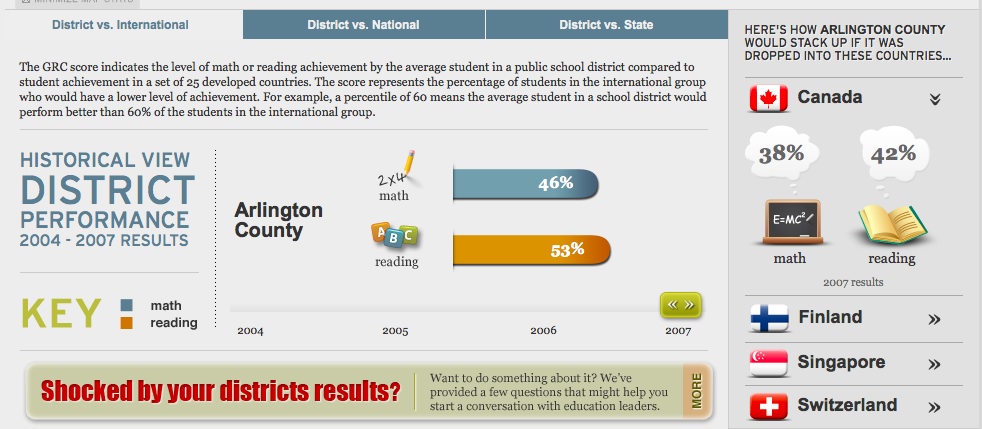
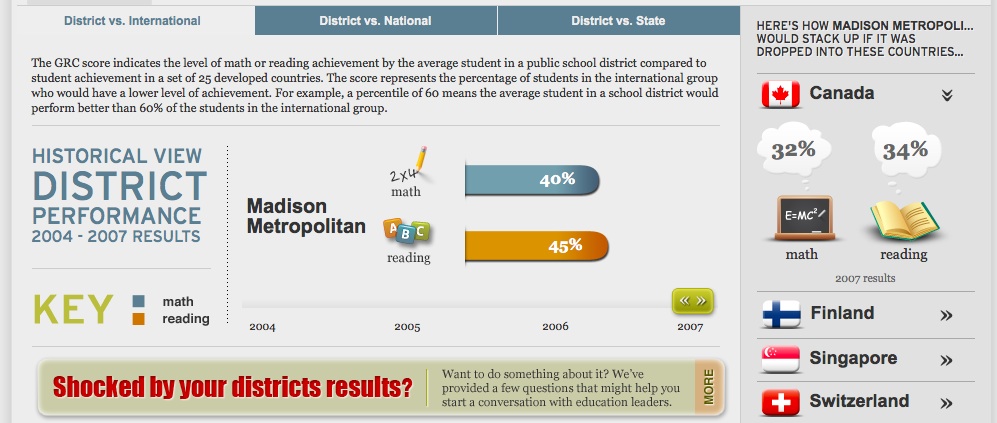
Madison Looks To Arlington, VA Schools for Achievement Gap Solutions; Arlington’s Tax Base & Demographics Quite Difference

Madison School District PDF Summary Document:

The 2005 to 2011 Strategic Plan was adopted by the School Board in June 2005. It outlines major objectives for the Arlington Public Schools for the six years covered by the plan. The Strategic Plan process was designed to result in clear direction for the school system that focuses on improved student learning for all students. For each goal of the plan, the School Board has defined specific objectives, indicators, and targets or benchmarks to measure progress over each of the 6 years. This summary provides selected findings from the results presented for 2009-10.

Links:

I hope the Madison School Board reviews additional Districts. Arlington’s demographics and tax base are substantially different than Madison.

Share

Chicago Teachers Union Tumblr Blog

http://wesupportchicagoteachers.tumblr.com/

Share

A manifesto for the new rules on human capital

Tom Peters:

I recently spoke at the World Strategy Forum event in Seoul, where the theme was “The new rules: reframing capitalism”. Predictably, the discussion focused on global financial infrastructure. But, as one of the few non-economist speakers, I instead argued that employment/unemployment is even more affected by the changing nature of work – and the wildly accelerating effectiveness of technology, which is encroaching on activities that employ tens of millions of people, especially in the developed world.
This is, I believe, in the mid to long term, both the number one problem and the number one opportunity for businesses and wider society. But the specifics of what follows were triggered by the debate at the event and were eventually encapsulated in what I grandly call: “A human capital development manifesto at the enterprise and national government level”.

Share

Adjusting for inflaton, the cost of attending a public, in-state college rose 268% from 1981 to 2011

John Pelletier:

Late summer is when parents bring their children to college. As they drive to campus they’re worried about tuition increases, the burden of student debt and whether their children will find jobs when they graduate.
Some parents and high-school students are beginning to question the value of a four-year college degree in this post-Great Recession world. And you can certainly understand why they have these concerns:
College costs keep rising. The College Board reports that from 1981 to 2011, after adjusting for inflation, the average published cost of going to college is up 180% for private, nonprofit four-year colleges and 268% for in-state, public four-year colleges.

Wow. I remember my first semester at the UW- Madison 31 years ago. In state tuition was $399/semester. That is $944 in 2010, according to this calculator. Current in state UW-Madison tuition is about 5,000/semester. Crazy.

Share

Grandparents as Source of College Funds

Inside Higher Ed:

A study from the MetLife Mature Institute found that 29 percent of grandparents have given their grandchildren financial support for education, spending an average of $8,276 over five years. Of those grandparents who did fund their grandchildren’s education, 32 percent helped with tuition or loan payments, 29 percent donated to a college savings plan, and 7 percent helped pay for graduate school.

Share

Integrating Film into Classroom Lessons: Three Teachers

Larry Cuban:

8:00 AM in a Northern California charter school.
I am observing Mr. Lesser (pseudonym), a U.S. history teacher for the past four years at the school. Students sit in six rows of six movable desks facing the front of the room. Teacher settles the students down and begins a review from the text (Bower and Hart, History Alive!) of what happened in U.S. after World War I. In rapid fire fashion, the teacher asks a series of questions to the entire class:
“What was the ‘Red Scare?
“What were the Palmer Raids?
“Who were Sacco and Vanzetti? Why do we study them?”

Share

Researchers Hack Brainwaves to Reveal PINs, Other Personal Data

Geeta Dayal:

Don’t you dare even think about your banking account password when you slap on those fancy new brainwave headsets.
Or at least that seems to be the lesson of a new study which found that sensitive personal information, such as PIN numbers and credit card data, can be gleaned from the brainwave data of users wearing popular consumer-grade EEG headsets.
A team of security researchers from Oxford, UC Berkeley, and the University of Geneva say that they were able to deduce digits of PIN numbers, birth months, areas of residence and other personal information by presenting 30 headset-wearing subjects with images of ATM machines, debit cards, maps, people, and random numbers in a series of experiments. The paper, titled “On the Feasibility of Side-Channel Attacks with Brain Computer Interfaces,” represents the first major attempt to uncover potential security risks in the use of the headsets.

Share

A Reverse Wisconsin: In Michigan, unions try to enshrine union power in the constitution

The Wall Street Journal:

The proposed amendment text would make the “rights” to organize and bargain collectively a constitutional guarantee, and any state law that would “abridge, impair or limit” collective bargaining would be repealed. Last Monday, the Michigan court of appeals ruled that the measure could appear on the ballot, and the state Supreme Court heard arguments on the case Thursday.
In a filing to challenge the ballot measure, Michigan Governor Rick Snyder and Attorney General Bill Schuette say the huge impact of the law can’t possibly be captured in the 100 words of a ballot measure. It is misleading, Mr. Schuette wrote, for unions to “propose an innocuous-sounding constitutional amendment that has the secret effect of wholesale changes in Michigan law.”
The problem is that the amendment language is so broad that the courts could interpret any union-related measure as a violation. It explicitly refers to all current and future laws. In 1997, for instance, Michigan moved new state employees to a defined-contribution pension from a defined-benefit plan. If the amendment passes, unions will challenge the new plan as unconstitutional and it could be invalidated at a cost of hundreds of millions of dollars a year.

Clusty Search: Michigan “Protect Our Jobs” Amendment.

Share

Studies Find More Students Cheating, With High Achievers No Exception

Richard Perez-Pena:

Large-scale cheating has been uncovered over the last year at some of the nation’s most competitive schools, like Stuyvesant High School in Manhattan, the Air Force Academy and, most recently, Harvard.
Studies of student behavior and attitudes show that a majority of students violate standards of academic integrity to some degree, and that high achievers are just as likely to do it as others. Moreover, there is evidence that the problem has worsened over the last few decades.
Experts say the reasons are relatively simple: Cheating has become easier and more widely tolerated, and both schools and parents have failed to give students strong, repetitive messages about what is allowed and what is prohibited.

Share

Admit it, first day of school exciting

The Leader-Telegram:

The issue: It’s the first day of school.
Our view: Students should take advantage of the exciting opportunity in front of them.
Even those who cheered the loudest back in June when school let out probably admit to at least a smidgen of excitement as they head off for the first day of school this morning in Eau Claire and districts around Wisconsin.
Soon enough, though, the routine of the school year will settle in, leading some students to question the point of the lecture or lesson in front of them.
“I’ll never use this,” we can hear them say, because many of us said the same thing when we were their age.

Share

Is Academia Becoming an “Idea Graveyard?”

PBS NewsHour:

Question: Science and technology don’t seem to be producing the jobs or economic improvement many would hope. What often gets forgotten is that many science and technology ideas are developed in academia where they are owned by the institutions. The schools are not businesses to turn them into products and businesses have a harder time making money on ideas they don’t own. So these intellectual property portfolios become idea graveyards. What if the rules changed so that the individuals who came up with the ideas could own a majority stake in their own ideas? Could they not then follow it out of academia and out to product? Seems like that would start more businesses, give universities more money (some of something as opposed to all of nothing), and even take some of the weight off of long term government support for science. Am I being naive to think that we could fix science and improve the economy?
Paul Solman:Yes, I think you are being naive. I know quite a few people at universities- professors and students both – and more and more of them talk about commercializing their research, or are actively engaged in doing so. Ideas do not seem to be trapped in the groves of academe. Just the opposite. If you think I’m wrong, readers, I trust you to let me know in the Comments section below.
A much more important hurdle to innovation may be the U.S. patent system, strengthened last week by the jury judgment against Samsung from infringing Apple patents. A number of economists have written about the anti-competitive constraints imposed by the patent system in the past decade, including Adam Jaffe of Brandeis and Josh Lerner of Harvard Business School (“Innovation and its Discontents”) and two economists at Washington University, St. Louis: Michele Boldrin and David K. Levine.

Share

Who’s Afraid Of Virginia’s Proficiency Targets?

Matthew DiCarlo:

The accountability provisions in Virginia’s original application for “ESEA flexibility” (or “waiver”) have received a great deal of criticism (see here, here, here and here). Most of this criticism focused on the Commonwealth’s expectation levels, as described in “annual measurable objectives” (AMOs) – i.e., the statewide proficiency rates that its students are expected to achieve at the completion of each of the next five years, with separate targets established for subgroups such as those defined by race (black, Hispanic, Asian, white), income (subsidized lunch eligibility), limited English proficiency (LEP), and special education.
Last week, in response to the criticism, Virginia agreed to amend its application, and it’s not yet clear how specifically they will calculate the new rates (only that lower-performing subgroups will be expected to make faster progress).

Share

Confessions of a Seventh-Grade Texas History Teacher

John Spong:

Of all the remote corners of Texas considered difficult to reach–the Lower Canyons of the Rio Grande, in Big Bend National Park; the center-field wall at Minute Maid Park, in Houston; the butcher block at Franklin Barbecue, in Austin–the single most challenging can actually be found in every big city and rural burg in the state: the mind of a seventh grader. It’s a destination with no clear path, the ground around it littered with hormonal land mines, the terrain ever shifting as growth spurts are endured or, even worse, anxiously awaited. In one of God’s great dirty tricks, an awareness of peer pressure presents itself during roughly the same week as zits. Soon come a new voice, a new shape, a new smell. Nothing about it is easy, not for the seventh graders and certainly not for the teachers charged with trying to get through to them.

Share

K-12 Tax & Spending Climate: Dane County property taxes highest in state, taxpayer group reports

:

Seventeen of Wisconsin’s 72 counties reduced property tax levies. Dane County was one of five that increased them by more than 3 percent.
Median property taxes in Dane County have increased 32.8 percent in the last 10 years. Home values have grown at a similar rate — the median Dane County home is worth $230,800, an increase of 38.6 percent in the last decade.

WISTAX 2011-2012 Property Tax Report.
Madison School District 2012-2013 Budget Update; Reduced3.47% Property Tax Increase due to Increased State Tax Dollar Spending.

Share

Suits Challenge Classrooms That Segregate Boys, Girls

Caroline Porter:

Public-school students in some parts of the country this year are going back to very different classrooms than they are used to: ones with both boys and girls.
A decade long campaign to separate genders in schools–based on the theory that children learn better that way–has sparked a backlash that is chalking up victories. Critics have sued three districts to end their single-sex classes, and sent letters of concern to 15 others.
A judge in one of those lawsuits last week ordered a school district in West Virginia to halt its single-sex program, and a handful of other districts around the country have voluntarily suspended their own split-gender classes for the new school year.

Share

Meet a Revolutionary Educator: Thomas Jefferson

Nat Hentoff:

II’m surprised that with all the warfare under way about teacher tenure and performance evaluation, together with standardized testing and schools as dropout factories, there has been hardly any mention of the leading active educator among our founders, Thomas Jefferson.
Some know of him only as the creative founder of the University of Virginia, but when he was a member of the Virginia House of Delegates, Jefferson introduced what he considered his most important educational effort, “A Bill for the More General Diffusion of Knowledge” in 1778.
In the invaluable The Cambridge Companion to Thomas Jefferson (Cambridge University Press, 2009), there is a chapter by Darren Staloff that I strongly recommend to present-day school boards, principals, teachers, students and members of Congress of both parties.
The chapter is titled “The politics of pedagogy: Thomas Jefferson and the education of a democratic citizenry.” In the primary grades, the goal of education was to ensure a citizenry that would be made “the safe, as they are the ultimate guardians of their own liberty.”

Share

Disappearing Mothers

Katie Rophie:

If, from beyond the grave, Betty Friedan were to review the Facebook habits of the over-30 set, I am afraid she would be very disappointed in us. By this I mean specifically the trend of women using photographs of their children instead of themselves as the main picture on their Facebook profiles. You click on a friend’s name and what comes into focus is not a photograph of her face, but a sleeping blond four-year-old, or a sun-hatted toddler running on the beach. Here, harmlessly embedded in one of our favourite methods of procrastination, is a potent symbol for the new century. Where have all of these women gone? What, some earnest future historian may very well ask, do all of these babies on our Facebook pages say about “the construction of women’s identity” at this particular moment in time?

Share

IBM making smartphone version of Watson

Sarah Frier:

International Business Machines researchers spent four years developing Watson, the computer smart enough to beat the champions of the quiz show “Jeopardy!” Now they’re trying to figure out how to get those capabilities into the phone in your pocket.
Bernie Meyerson, IBM vice president of innovation, envisions a voice-activated Watson that answers questions, like a supercharged version of Apple’s Siri personal assistant. A farmer could stand in a field and ask his phone, “When should I plant my corn?” He would get a reply in seconds, based on location data, historical trends and scientific studies.
Finding additional uses for Watson is part of IBM’s plan to tap new markets and boost revenue from business analytics to $16 billion by 2015. After mastering history and pop culture for its “Jeopardy!” appearance, the system is crunching financial information for Citigroup Inc. and cancer data for WellPoint Inc. The next version, dubbed Watson 2.0, would be energy-efficient enough to work on smartphones and tablets.

Share

Union Money in Elections

Amy Payne:

This election year, millions of Americans will donate to the political candidates and initiatives of their choice at the local, state, and federal levels. But for unionized workers, union dues come out of their paychecks and go to political causes–and they aren’t consulted on where that money will go.
In July, The Wall Street Journal’s Tom McGinty and Brody Mullins published an eye-opening report that “Organized labor spends about four times as much on politics and lobbying as generally thought.”
They broke down the unions’ political spending from 2005 to 2011: $1.1 billion “supporting federal candidates through their political-action committees, which are funded with voluntary contributions, and lobbying Washington, which is a cost borne by the unions’ own coffers.”

Share

Madison School District Superintendent Survey: 2012 Edition


Tap or click to view a larger version.

The survey can be found here, via a kind reader.

Share

Do We Still Segregate Students? Schools around the nation are ‘detracking’ classes, putting kids of all achievement levels in the same room. Does that sabotage higher achievers?

Julie Halpert:

WHEN ERIC WITHERSPOON became superintendent of Evanston Township High School (www site) near Chicago in 2006, he walked into a math class where all the students were black. “A young man leaned over to me and said, ‘This is the dummy class.'”
The kids at Evanston who took honors classes were primarily white; those in the less demanding classes were minority–a pattern repeated, still, almost 60 years after integration, across the nation. All of the Evanston kids had been tracked into their classes based on how they’d performed on a test they took in eighth grade.
Last September, for the first time, most incoming freshmen, ranging from those reading at grade level to those reading far above it, were sitting together in rigorous humanities classes. When I visited, students of all abilities and backgrounds met in small groups to discuss one of the required readings, which include A Raisin in the Sun and The Odyssey. This September, most freshmen will sit side-by-side in biology classes.
Mindy Wallis, the mother of a sophomore at Evanston Township High, agrees. She opposed the decision to detrack, and spearheaded a petition that advocated waiting for the results of a three-year evaluation before making changes that so substantively affected the freshman class. Angela Allyn, whose 14-year-old son just took a freshman humanities class, says her son was hungry to read more than two-thirds of The Odyssey, which was all the class required. He was encouraged by his teachers to read the entire book, but Allyn says the teachers didn’t help him navigate difficult portions during class, so she had to work with him into the late hours of the night. Her son was teased by classmates, she says, for “showing off and using big words,” something she believes wouldn’t have occurred if he’d been grouped with a similar cohort. Detracking, she contends, focuses “on bringing the bottom up–and there’s an assumption that our bright children will take care of themselves.” She acknowledges that because she’s seen as having “white privilege,” despite the fact that she put herself through school and even occasionally had to use soup kitchens to get by, she’s perceived as racist by merely making such a comment.

Adam Gamoran
, director of the Wisconsin Center for Education Research, also believes that race is part of the debate: “People who support tracking are more interested in productivity and less concerned about inequality, and people who are critics tend to focus on inequality and don’t spend too much time thinking about productivity.” Gamoran argues that schools that want to keep ability-grouping need to do a better job with the students in the lowest tracks, but he also believes that the most capable students may not always be sufficiently challenged in mixed-ability classes. “There’s no single solution,” he says. “The point is to try to address the limitations of whatever approach is selected.”

Links:

Share

On Charter Schools and Education Reform

Karran Harper Royal:

And how an you tell if you’re on the wrong side of reform: Does the policy shut down open debate? Does it remove the democratic process? Do parents get to elect the charter board? Do the policymakers have to focus on a villain, in this case, teachers and unions as the bogeyman? Do they insist on closing schools rather than improving them? Do they impose on high stakes decision for children or teachers or schools? Do they talk about return on investment and are there billionaires pulling the strings? Do they focus on “school choice” over civil rights? These are signals that they are on the wrong side of education reform. And yet it’s easy to fall into the wrong side. Check out Karran’s brilliant analysis why. Thanks to Norm Scott for the video.

Share

“I think we have come a long way”

NBC15:

“I think we have come a long way,” said Superintendent Jane Belmore. “The district, as you may know, developed a pretty ambitious achievement plan last year and came out to the community and talked with folks in the community about it, got a lot of buy-in and there are lots of community organizations that are really behind us on that.”
Superintendent Belmore says it will take a number of years to complete the process–but says they’re fortunate to have the resources to help put it into play this year. “We have a plan that we’re now looking at, really what I’m calling kind of sorting the priorities of the priorities, because it’s very ambitious,” she said. “We’re not going to be able to do everything at the same level, at the same time, but we’re really figuring out what the things are that are going to give us the most leverage.”
The Urban League of Greater Madison has been on the forefront of the fight to address the achievement gap. President and CEO Kaleem Caire says he thought the achievement gap plan was too broad to begin with.

Links:

Share

Laid-off teachers look for their Plan B

Marketplace:

Sarah Gardner:Thousands of teachers are notheading back to school this week. Budget cuts have hit one of this country’s largest professions especially hard. In the last three years, more than 300,000 education jobs have disappeared. And that’s left a lot of people working on their Plan B. Former technology teacher Chris Bjuland found his at the airport.
Chris Bjuland:I was working as a teacher in the Archdiocese of San Francisco, and I got called down to the principal’s office one day between classes, and he said, “Well I’m sorry to do this, but we’ve had some budget problems and so we’re going to have to let you and all the part-time teachers go.”
I did look for other teaching jobs. After about a year of really trying and seeing how frustrating it was, it was time to open up the horizons.

Share

New Jersey Monthly’s high school survey isn’t the whole story

Laura Water:

Last week New Jersey Monthly published its biennial ranking of the state’s 328 public high schools, a closely-followed contest among N.J. districts. The top-ranked school in N.J. is New Providence High School in Union County, which boasts combined SAT scores of 1737 and a 97.7% graduation rate. The lowest-ranked traditional high school is Thomas Jefferson Arts Academy in Elizabeth, which admits to combined SAT scores of 1136 and a 53% graduation rate.
Rankings were compiled by an independent research firm in Ringwood called Leflein Associates, which used a combination of factors in its calculations, including average class size; SAT, A.P. and state assessment scores (HSPA); graduation rates; and socio-economic ranking (DFG).

Share

Highlights from the NJ DOE’s Education Transformation Task Force Report

Laura Waters:

Yesterday the Christie Administration released the long-awaited the Education Transformation Task Force report. As NJ Spotlight reports, the 239-page report “was a gargantuan effort, with teams of educators and lawyers poring over more than 3,000 pages of the state’s voluminous laws and administrative code over the past six months.” (Also see overview from Courier Post.) Or, as the Task Force puts it,

Through the superintendents’ survey and countless conversations with educators across New Jersey, the Department learned that the State over the course of many years saddled educators with rules on every subject imaginable. The result is an accretion of provisions in statutes and regulations that ties the hands of schools and districts and stymies innovation. This not only frustrates good people trying to help students learn, it also increases costs and, on occasion, even erects obstacles to student achievement.

Share

Texas Students Revolt Against Mandatory RFID Tracking Chips

Information Liberation:

‘Students and parents at two San Antonio schools are in revolt over a program that forces kids to wear RFID tracking name tags which are used to pinpoint their location on campus as well as outside school premises.
Students at John Jay High School and Anson Jones Middle School will be mandated to wear the tags from today which will be used to track them on campus as well as when they enter and leave school.

Share

132 Wisconsin Schools of Recognition

Wisconsin Department of Public Instruction:

State Superintendent Tony Evers announced 132 Wisconsin School of Recognition awards for the 2012-13 academic year, an honor that recognizes success in educating students from low-income families.
“Congratulations on a strong start to the 2012-13 school year,” Evers said. “These schools are being recognized for their work to break the link between poverty and low academic achievement through rigorous programming and attention to student needs. Their efforts align with our Agenda 2017 goals: to improve graduation rates, reduce dropout rates, and close college and career readiness gaps.”

Matthew DeFour has more.

Share

Schools That Can Milwaukee September 2012 Update

Abby Andrietsch, via a kind email:

Happy start to the school year! Our team is more excited than ever about the transformational work being done across Milwaukee.
Today, our 24 STCM partner schools serve over 10,000 students. As I hear the “first day” stories from several of our partner schools, I am reminded of all of the work put in by our coaches and school leaders to prepare: I am reminded of the four days of leadership training STCM held with more than 80 leaders from across the city coming together to focus on excellence in their schools; I am reminded of the more than 135 new urban teachers that came together for a STCM training focused on high-impact instructional practices.
The power of this group is real and the momentum is visible – these are the leaders that will change Milwaukee’s education system and prepare our future leaders. The results we have seen in each of the three STCM pathways (described below) are an early indication of what is possible for our city.
While I am more aware of the challenges facing our students, families, teachers, leaders and schools in Milwaukee, I am more hopeful than ever about what I know is possible. However, we can’t do it alone. It takes engagement from city leaders, educators, non-profit partners, business leaders and foundations. Join us in the movement to support quality across Milwaukee.
Warmest regards,
Abby Andrietsch
Executive Director
Schools That Can Milwaukee

Share

Achievement Growth: International and U.S. State Trends in Student Performance; Wisconsin near the bottom….


(Tap or click to view a larger version)

Eric A. Hanushek, Paul E. Peterson & Ludger Woessmann

“The United States’ failure to educate its students leaves them unprepared to compete and threatens the country’s ability to thrive in a global economy.” Such was the dire warning recently issued by a task force sponsored by the Council on Foreign Relations.
Chaired by former New York City schools chancellor Joel I. Klein and former U.S. secretary of state Condoleezza Rice, the task force said that the country “will not be able to keep pace–much less lead–globally unless it moves to fix the problems it has allowed to fester for too long.”
The report’s views are well supported by the available evidence. In a 2010 report, only 6 percent of U.S. students were found to be performing at the advanced level in mathematics, a percentage lower than those attained by 30 other countries.ii Nor is the problem limited to top-performing students.
Only 32 percent of 8th- graders in the United States are proficient in mathematics, placing the United States 32nd when ranked among the participating international jurisdictions. Although these facts are discouraging, the United States has made substantial additional financial commitments to K-12 education and introduced a variety of school reforms.
Have these policies begun to help the United States close the international gap?
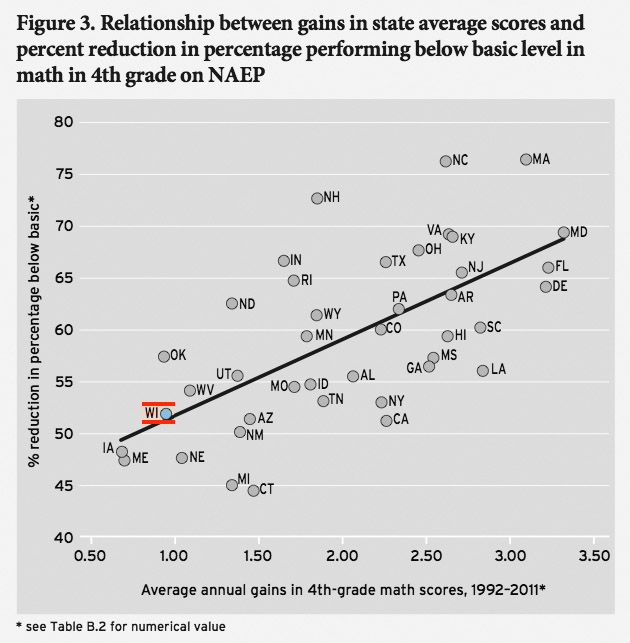
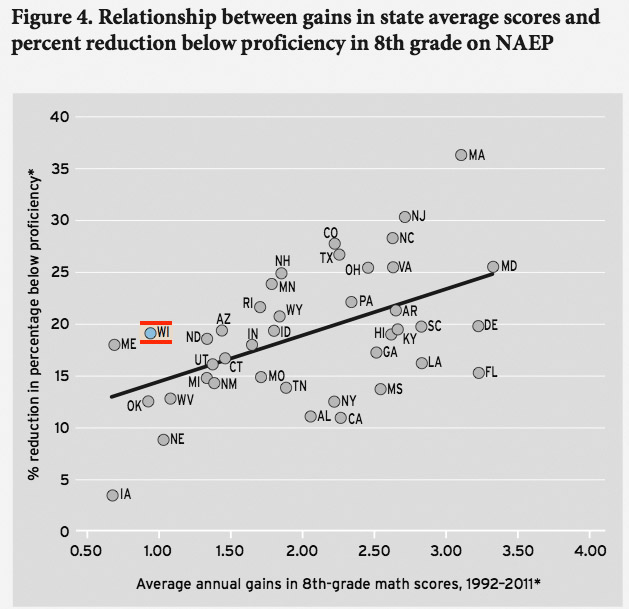
Progress was far from uniform across the United States, however. Indeed, the variation across states was about as large as the variation among the countries of the world. Maryland won the gold medal by having the steepest overall growth trend. Coming close behind, Florida won the silver medal and Delaware the bronze. The other seven states that rank among the top-10 improvers, all of which outpaced the United States as a whole, are Massachusetts, Louisiana, South Carolina, New Jersey, Kentucky, Arkansas, and Virginia.
Iowa shows the slowest rate of improvement. The other four states whose gains were clearly less than those of the United States as a whole, ranked from the bottom, are Maine, Oklahoma, Wisconsin, and Nebraska. Note, however, that because of nonparticipation in the early NAEP assessments, we cannot estimate an improvement trend for the 1992-2011 time period for nine states–Alaska, Illinois, Kansas, Montana, Nevada, Oregon, South Dakota, Vermont, and Washington.

Related:

Share

What’s A Charter School If Not A Game Changer?

Claudio Sanchez:

At this year’s charter school convention in Minneapolis, the birthplace of the movement, vendors sounded almost giddy about the millions of dollars charter schools spend every year. The vendors are selling everything from graphing calculators and playground equipment to packaged curricula and risk-management services.
Charter schools today are big business. The public and private money that’s going into charter schools, though, is not the main reason for their remarkable growth, Ted Kolderie says.
Kolderie, considered by many as the “godfather” of the charter school movement, says charters have grown because of the need for real options for kids who haven’t done well in traditional public schools.
…..
Kolderie, a former journalist turned academic, designed and helped pass the nation’s first charter school laws. He began the work in Minnesota in 1991, despite formidable opposition — and not just from teachers’ unions.
“School boards’ associations, superintendents’ associations, principals’ associations — the whole array of organizations regarded in most states as the most powerful at the [state] capitol,” he says. “So the opposition wasn’t just something that the unions led.”
Ironically, Kolderie says, it was a top union leader who first endorsed and promoted the concept of charter schools in the spring of 1988. Al Shanker, president of the American Federation of Teachers, gave a supportive speech at the National Press Club in Washington, D.C.
“We’re meeting here today because it’s time to take a major step forward in trying to improve the schools of our nation,” he said.

Share

In Defense of the Living, Breathing Professor

Adam Falk:

As classes resume on our nation’s campuses, amid anxiety about high tuition, student debt and other concerns, it’s worth examining what we value in college education. The question warrants consideration, in particular, following a recent recommendation by distinguished economists, appointed by the National Academy of Sciences, proposing to define the “output” of higher education as a combination of credit hours awarded and degrees earned.
That reduces the work of colleges to counting how many students they push through the system–a bit like defining a movie studio’s output as the number of feet of raw footage shot, with no consideration of whether the resulting movies are any good.

Share

Hallway, a homework helper for high school students

Christina Farr:

Hallway, a startup created by high-school students for high-school students, is launching to the public today with seed funding from Fortify.vc.
The founders view their technology as the next logical step in education, and this summer, they’ve been testing the private beta at schools across the Greater Washington region.
Hallway is a website where students submit questions about subjects, such as algebra or political science, that their peers can answer. The site uses a Reddit-style system to rate the most useful questions and answers, which then rise to the top.

Share

California Higher Education’s Hollow Core

Peter Berkowitz:

Some reflect the failure to manage effectively forces that have been inflating the nationwide higher education bubble. The cost of attending college, greatly outpacing the rate of inflation almost everywhere, has skyrocketed in California: Whereas nationwide tuition and fees at public universities over the last five years have risen on average by 28 percent, the average increase at UC campuses is an astounding 73.1 percent and, at Cal State campuses a still more astounding 83.8 percent. While turning away students and seeking billions for new buildings, California institutions are significantly under-using classroom and laboratory space. And, absent drastic reform, in little more than a decade the Cal State and UC systems are unlikely to be able to meet their obligations to faculty retirement programs.
More menacing to higher education in California is educators’ adoption of curricula, classroom pedagogy, and limitations on free speech that fly in the face of liberal education’s fundamental requirements. These practices also fly in the face of public opinion.

Read the complete PDF report, here.

Share

Wesleyan University offers a three-year bachelor’s degree

Marketplace:

Kai Ryssdal: There was an item in the Washington Post last week that piqued our interest. The president of an elite private college in Connecticut said he’s looking for ways to make school cheaper and let students graduate in less time.
The school is Wesleyan University. The president, Michael Roth, is also an alum. Back in the day, he got through in three years to save his parents some money. And with tuition where it is now, two fewer semesters can mean even bigger savings.
Michael Roth, good to have you with us.
Michael Roth: Nice to be here.
Ryssdal: How’s this going to work? Do you just double up on courses and work in the summertime?

Share

A 1939 Map of Physics

Frank Jacobs:

Geography was my favourite subject in school; physics the one I disliked the most. If only I’d known about this Map of Physics!
This spatial representation of the subject, dating from 1939, defines itself as Being a map of physics, containing a brief historical outline of the subject as will be of interest to physicists, students, laymen at large; Also giving a description of the land of physics as seen by the daring sould who venture there; And more particularly the location of villages (named after pioneer physicists) as found by the many rivers; Also the date of founding of each village; As well as the date of its extinction; and finally a collection of various and sundry symbols frequently met with on the trip.

Share

Computer programming will soon reach all Estonian schoolchildren

Richard Wilson:

Estonian Tiger Leap Foundation in September 2012 launched a program called “ProgeTiiger”, in the framework of which Estonian students in grades 1 to 12 will be introduced computer programming and creating web and mobile applications.
“The interest of students towards using modern technologies has grown year after year. With the “ProgeTiiger” program we create prerequisites for students to develop from consumers of software to developers of software,” said Tiger Leap Foundation training sphere manager Ave Lauringson.
In the first stage, the program concerns pilot schools, in the following years all public schools can join if they want to become part of the “ProgeTiiger” program.
The first ones to start with “ProgeTiiger” program lessons will be primary school students after their teachers go through corresponding training in September. Next year, programming hobby groups for middle school and selective courses for high school will be added. Study materials for all levels are being created. Tiger Leap Foundation’s initiative is supported by technology sphere

Share

K-12 Tax & Spending Climate: The Lost Decade of the Middle Class

Marcus Pohlman>:

The study released last week by the Pew Research Center confirms a trend that political economists have been observing for years — the middle class, the 50% of American households earning between $39,000 to $118,000, are now headed backward in income for the first time since the end of World War II.
The bedrock of a stable society is a large and healthy middle class. They not only do the bulk of the work and pay the lion’s share of the taxes, but their level of affluence gives them a personal stake in the survival of existing political and economic orders.

Related: Madison School District 2012-2013 Budget Update; Reduced 3.47% Property Tax Increase due to Increased State Tax Dollar Spending.

Share

Is Teach for America Working?

Room for Debate:

When Teach for America entered the national stage it was applauded as a fresh, innovative approach to education. Now, well into its second decade of providing teachers to struggling schools across the country, is it still a good idea for our children? Has bringing in smart, young college graduates improved the education that American children are receiving?

Share

Fears in Taiwan over downside of education boom

Peter Harmsen:

When Hsu Chung-hsin went to university three decades ago he became part of a small elite in Taiwan. Now virtually everyone can enter higher education. That, he thinks, is deplorable.
“It’s become so easy. As long as you’re willing to pay the tuition, you can go to university. That’s no good,” said Hsu, a legislator with a PhD in law from Cambridge.
“It doesn’t influence the top universities. It’s the low-end universities that are affected. Their quality is low. The teaching is not so serious and the students are not so hard-working.”
Declining birth rates and an explosion in the number of universities — there are more than 160 for a population of 23 million — mean the vast majority of high school students gain entry to higher education.

Share

Teachers unions’ alliance with Democratic Party frays

Seema Mehta:

Teachers unions have been the Democratic Party’s foot soldiers for more than half a century, providing not only generous financial backing but an army of volunteers in return for support of their entrenched power in the nation’s public schools.
But this relationship is fraying, and the deterioration was evident Monday as Democrats gathered here for their national convention.
A handful of teachers and parents, carrying large inflated pencils, picketed a screening of “Won’t Back Down,” a movie to be released this month starring Maggie Gyllenhaal and Viola Davis as mothers, one a teacher, who try to take over a failing inner-city school.

David Dayen has more.

Share

Lawmakers abandon California teacher evaluation bill

Associated Press:

State lawmakers failed to revive a controversial measure that would rewrite state rules on teacher evaluations, but supporters vowed to bring it up again in the next legislative session.
The long-dormant bill, AB 5, was resurrected in recent weeks by Assemblyman Felipe Fuentes (D-Sylmar), according to the Los Angeles Times (http://lat.ms/RwfqnW). It would institute a statewide uniform teacher evaluation system featuring more performance reviews, classroom observations, training of evaluators and public input into the review process.
Education advocates slammed the bill, saying the new rules would have weakened initiatives in Los Angeles and elsewhere to improve the quality of public school instructors.

Share

MoboMath

Enventra :

MoboMath lets you create formatted math expressions for your favorite applications in your own handwriting.
Using a pen and tablet, or even a trackpad or mouse, simply write an equation as you normally would, tap Enter to convert it to formatted math, and copy or drag it into your target application for calculation, graphing, or documentation.

Share

Outlook not set in stone for Wisconsin school of education enrollment

Arthur Thomas:

For all the changes implemented in 2011, one thing hurt enrollment at schools of education more than others, said John Gaffney, recruitment and retention coordinator at the University of Wisconsin-Stevens Point’s School of Education.
“The message of teachers being the problem hurt us the most,” Gaffney said.
The Act 10 legislation affected teachers’ pocketbooks – with union bargaining largely eliminated, higher deductions for benefits were imposed – and the political firestorm that resulted put teachers at the center of attention.
Maggie Beeber, undergraduate advising coordinator at the UW-Stevens Point education school, recounted a story where she was meeting with incoming freshmen. She asked the students if anyone had tried to discourage them from becoming teachers. Nearly every hand went up. Then she asked if more than five people had discouraged them. Most of the hands stayed up.
“It’s easy to follow the public discourse about teaching right now and conclude that everything is doomed,” said Desiree Pointer Mace, associate dean for graduate education at Alverno College.

Related:

Share

Madison School District Teacher Handbook Plateau Bargaining

Matthew DeFour

More than 40 members of Madison Teachers Inc. attended Tuesday’s board meeting, and executive director John Matthews delivered a letter reminding the board that changes in state law “did not take away the board’s ability to engage in conversation about” benefits and work rules.
Board vice president Marj Passman said she preferred a process where management and employees work out their differences.
“I don’t care what the governor wants,” Passman said. “I’d like to go back to the two equal body process.”
Board member Arlene Silveira said several districts included teachers on the committees that developed their handbooks and “having staff input right upfront prevents difficult ways of getting there.” She also suggested having a board member present at each meeting.
Prior to the meeting, School Board President James Howard said the work group is for administrators so it doesn’t need to include teachers. There will be other advisory groups that will include their input, he said.

Clusty Search: Plateau Bargaining.
Karen Vieth

“The kids are delighted to be back at school,” James Howard said as he addressed the Board and numerous spectators at tonight’s Board of Education Workshop. Everyone nodded their heads in agreement, while they anxiously awaited the real topic of conversation. This would be the Board’s first public conversation on the Madison Metropolitan School District (MMSD) Employee Handbook, a handbook that would replace more than sixty years of collective bargaining.
As Howard spoke, I surveyed the crowd that had gathered in the McDaniels Auditorium at the Doyle Administration Building. Madison Teachers Inc. (MTI) members stood out in their red, Union T-shirts. They made up more than half of the audience. The AFSCME members were dressed in green, representing custodial, maintenance and food service workers in the district. MMSD administrators, community members and a County Board member were also present.

TJ Mertz:

There was some Pollyannaish talk that the “Guiding Principles” in the process document — especially the first two “1. Improve student learning. As in everything we do, the first question and the top priority is student learning. How does what we are considering impact students? 2. Empower staff to do their best work. How does this impact teachers and staff? Does it help or hinder them in doing their jobs effectively?” — would be sufficient (a little more below on this), but there seemed to be a consensus that at very least the committee should present some options to the Board. That’s another reason to have an inclusive committee; to get better options.
A quick aside on the “Guiding Principals” and related thoughts and then back to the Board’s role. It is all well and good to say that student learning is or should be primary in just about everything, but it is also false and serves to marginalize staff. I’ve long said that the interests of teachers align with the interests of students and the district by about 95% and yes “student learning” is the prime interest. But staff are adults, with mortgages, families to support, loans to pay, relationships to cultivate and maintain, …They are not and should not be people who put student learning above the their own well being. To even contemplate that they should be is disrespectful. That’s why we hear the “All about the students” meme from the anti-teacher/anti-union reform crowd. It sound good, but it is wrong. Think about it, did the people negotiating a contract on behalf of Interim Superintendent Belmore put “student learning at the top of their list? Of course not, and they shouldn’t have.

Share

Madison Teachers’ Solidarity Newsletter

Madison Teachers’, Inc. 65K PDF, via a kind Jeannie Bettner email:

Members of MTI’s Board of Directors and Union staff greeted the District’s newly hired teachers at New Teacher Orientation on Monday. There are 250 new members of MTI’s teacher bargaining unit.
MTI Executive Director John Matthews addressed the District’s new teachers during their Tuesday session. In doing so, Matthews provided a brief history of the Union, its reputation of negotiating outstanding Collective Bargaining Agreements which provide both employment security and economic security, and in explaining the threat to both, given Act 10, said all MTI members would need to pull together to preserve the Madison Metropolitan School District as a quality place to teach.
Matthews told the new hires that these benefits and rights, along with MTI’s action to assure due process and workplace justice, has earned MTI the reputation of being one of the best Unions in the country. To illustrate the magnitude of MTI’s accomplishments over the years, Matthews told about school board policy mandating female teachers, through the early 1970’s, having to advise their principal “immediately upon becoming pregnant”, and being obligated to resign when the pregnancy “began showing.” As a result of MTI’s accomplishments, such antiquated, degrading policies are history, he said.
Matthews also cited MTI’s precedent setting accomplishments in advancing employee rights regarding race, religion, sexual orientation, and negotiating such things as the school calendar and health insurance. Until the early 1970’s, the school calendar only accommodated Christian holidays. MTI’s litigation expanded the benefit to cover all religions.
Continue the Awareness, Continue the Protest, Wear Red for Education
Since February, 2011, MTI members have been tirelessly protesting and working to end the disastrous impact on public sector workers of Governor Scott Walker’s union busting destructive budget. The most important reasons for resistance vary from one union member to another and include: the Legislation jeopardizes children’s future and the viability of public education and other public services; its provisions are dishonest and immoral; they constitute an attack on Wisconsin’s working-class and middle-class values; they ask for no shared sacrifice from the wealthy or profitable corporations.
Payroll checks for all public employees have been substantially lessened because of Act 10, causing financial hardship for many families. Walker’s Law forces all public employees to pay 50% of retirement contributions, even though MTI and the Madison Metropolitan School District have agreed as part of one’s total compensation package dating to the early 1970’s, that the District would pay 100% of the contribution and many have increased contributions for health insurance.
MTI leaders are working with other public sector union leaders across Wisconsin to reverse this disastrous legislation.
Ready, Set, Goal Conferences
As previously reported in MTI Solidarity!, the Ready, Set Goal (RSG) memorandum has been amended, as a result of grievance mediation.
The Memorandum of Understanding between MTI and the Madison Metropolitan School District, which governs RSG Conferences has been amended to include the following parameters which apply, when determining the amount of compensation due a teacher for holding RSG Conferences during times other than scheduled school day(s)/ hours:

  • Teachers receive up to 15 minutes per student for conference preparation.
  • Teachers receive up to 30 minutes for each conference held.
  • Teachers are compensated for up to two parent “no shows” per student, at 30 minutes per scheduled conference. Teachers are not obligated to schedule a RSG conference after there have been two parent “no shows”. However, a teacher will be compensated pursuant to Section 2b (second bullet above), if the teacher thereafter holds a RSG conference for the student.
  • Compensation will continue to include traveling to/from homes of parents, or other mutually agreed upon meeting place(s), or traveling to/from school if the conferences are not at a time adjacent to the Contract day. Mileage shall be paid in accordance with the terms and conditions of the Collective Bargaining Agreement and reasonable expenses for refreshments shall be reimbursed.

The full RSG agreement is located on MTI’s website (www.madisonteachers.org). Questions can be directed to Assistant Director Eve Degen at MTI (257-4091 or degene@madisonteachers.org).

Share

District working to pay more attention to new students

Matthew DeFour:

The later students enter Madison schools, the less likely they are to graduate on time and score well on state tests, according to district data Mayor Paul Soglin requested this year. The data do not take into account other variables connected to achievement such as race and income (bold added).
“Maybe we shouldn’t be as critical of the system in holding the district responsible for the failure of a 14-year-old who’s only been here a year and is reading at a seventh-grade level,” Soglin said. “If there is a difference, maybe it shows that some intense work should be done with kids upon arrival.”

I hope that the District evaluates the data in more depth…

Share

Expats in Singapore arm children for Chinese century

Agence France-Presse:

As far back as 25 years ago, US investor Jim Rogers already believed China would be the next economic superpower and young people the world over should prepare for the future by learning Mandarin.
Now 69, the billionaire had a chance to practise what he preached when he moved in 2007 to Singapore with his wife Paige Parker, 43, after visiting Hong Kong and Shanghai in search of an ideal place to bring up his children.
Their daughters Happy, now nine, and Baby Bee, four, are studying in public schools in Singapore, which promotes mastery of Mandarin as part of its own ethnic Chinese heritage and, more pragmatically, to give its people economic opportunities.
“Singapore has the best education in the world, the best healthcare, the best everything. I think that the best gift that I can give two children born in 2003 and 2008 is to know Asia and to speak Mandarin,” Rogers told AFP.

Share

On Harlem School Choice

Kyle Spencer:

But in interviews in recent weeks, Harlem parents described two drastically different public school experiences, expressing frustration that, among other things, there were still a limited number of high-quality choices and that many schools continued to underperform.
Those fortunate enough to get their sons or daughters into one of the high-performing schools said, for the most part, that they were thrilled with the quality of the teaching and extracurricular programs. Some of the parents who grew up in the neighborhood said that until a few years ago, they would never have imagined such options even existing.
Yet, while most of the charter schools perform relatively well on tests, a majority of Harlem’s students attend schools that do not. Among elementary schools in Harlem and East Harlem, only a few of the some 25 traditional neighborhood schools with students taking statewide tests had at least 50 percent of children reading at or above grade level.

Share

Sri Lanka’s Lecturers go on strike, and the government has a drastic response

The Economist:

THE Buddhist monk, staring intently at the smoke rising from an incense stick, said the government was destroying state-provided education because it was “easier to control uneducated fools”. Maduluwawe Sobitha is an influential figure among Sri Lanka’s majority Sinhala population. He is also a loud critic of the government of President Mahinda Rajapaksa. The monk’s new National Movement Against Social Injustice is, with other groups and unions, backing a university lecturers’ strike for more state spending on education. Almost 5,000 academics stopped work on July 4th. Like them, he is angry that the government spends a mere 1.9% of GDP on schools and universities.
On August 23rd the higher education minister, S.B. Dissanayake, responded by closing down indefinitely the country’s state universities and institutes. He accused lecturers of dragging students into their campaign. Yet students, among them young Buddhist monks, still protest, demanding that the universities be reopened. On August 29th police in Colombo fired water cannon and tear gas at hundreds of students marching in support of academics. Members of the Inter University Students’ Federation (IUSF) retaliated by flinging whatever they could lay their hands on, including rocks and spent tear-gas canisters, at police.

Share

Advocating More Rigorous Wisconsin Academic Standards

Wisconsin State Journal Editorial:

Similarly, Wisconsin is now in the process of raising its academic standards and its ability to accurately gauge student, teacher and school performance.
This is a good thing, too — even though ratings for many students and some schools will fall when initially put into place. It’s not that students will be learning less. It’s that more rigorous instruction and assessments are coming on board.
Our students, parents, teachers and taxpayers deserve this more accurate picture of progress toward higher goals — the ones Wisconsin will need to meet to succeed in the knowledge-based, highly competitive global economy.

Related: wisconsin2.org”: and Madison MAP Testing Shows They are Falling Short Too.

Share

An Interview with UW-Madison School of Education Dean Julie Underwood

Todd Finkelmeyer:

It’s an unprecedented amount of change, honestly,” says Julie Underwood, the dean of UW-Madison’s highly ranked School of Education.
Consider:

  • The state this year will start rating each school on a scale of 0 to 100 based on student test scores and other measurables. The idea, in part, is to give parents a way to evaluate how a school is performing while motivating those within it to improve.
  • Several schools across the state — including Madison’s Shorewood Elementary, Black Hawk Middle and Memorial High schools — are part of Wisconsin’s new teacher and principal evaluation system, which for the first time will grade a teacher’s success, in part, on student test scores. This system is to be implemented across Wisconsin in 2014-15.li>And instead of Wisconsin setting its own student benchmarks, the state is moving toward using Common Core State Standards, which have been adopted in 45 other states. State schools are starting new curricula this year in language arts and math so students will be prepared by the 2014-15 school year to take a new state exam tied to this common core and replacing the Wisconsin Knowledge and Concepts Examination.

Although Underwood says she generally backs most of these changes, she’s no fan of the decision announced last month that makes it easier for a person to become a public school teacher — even as those who are studying to become teachers must now meet stiffer credentialing requirements. Instead of having to complete education training at a place like UW-Madison en route to being licensed, those with experience in private schools or with other teaching backgrounds now can take steps to become eligible for a public teaching license.
“I think that’s really unfortunate,” says Underwood, who first worked at UW-Madison from 1986-95 before coming back to town as education dean in 2005.

Related:

Share

What Did You Do All Day?

Stanley Fish:

Of the many complaining questions that faculty members ask, the one I used to hear most often was, “Why do you administrators make so much more money than we do?” The answer is simple: Administrators work harder, they have more work to do, and they actually do it.
Now that I have made the passage back from administrator to faculty member, I know how true that is. Where before my calendar was crowded and even double-booked, now the largely empty pages beckon me forward to a life of comparative ease and downright leisure. Sure, I have some students to teach, and some papers to correct, and I chair a committee and go to a few meetings and write columns and essays; but I did all of that when I was a dean in addition to everything I did because I was a dean.

Share

A selection of highlights from The British Science Festival’s illustrious 19th-century past

Clive Cookson:

The annual meeting of the British Association for the Advancement of Science, founded in 1831 and attended by “300 gentlemen”, quickly became the leading scientific event in Great Britain, the place where important advances were announced and great issues debated. The British Science Festival, as it is now called, takes place in Aberdeen from September 4 to 9. Below Clive Cookson selects his highlights from the event’s illustrious 19th-century past and looks forward to next week’s festival.

Share

Zach Galin Interview on College Prep, Parents, Financing and Careers


Transcript

Listen or download the mp3 audio
Zach has spent the past nine years working independently with students and families in the college admissions process. From test preparation to college matching, applications, and financial aid, Zach has helped students gain acceptance to their top choice schools.
Zach spent his undergraduate years at Northwestern University, where he graduated with a Bachelor of Science in Learning and Organizational Change. He was actively engaged in student government, Greek life, cultural affairs, and community service. Upon graduation, he ran an academic tutoring and test prep center on New York City’s upper west side. He worked with hundreds of families to diagnose students’ specific academic deficiencies and develop courses from a variety of text-based and digital curricula to improve their skills.

Website | Twitter: @zachgalin
Share

An expert’s view of Common Core’s focus on nonfiction texts

Jim Stergios 165K PDF

The Common Core national standards are increasingly controversial, with Utah, Indiana and a number of states that had adopted them now reconsidering. A recent New York Times education blog notes the following:
Forty-four states and United States territories have adopted the Common Core Standards and, according to this recent Times article, one major change teachers can expect to see is more emphasis on reading “informational,” or nonfiction, texts across subject areas:
While English classes will still include healthy amounts of fiction, the standards say that students should be reading more nonfiction texts as they get older, to prepare them for the kinds of material they will read in college and careers. In the fourth grade, students should be reading about the same amount from “literary” and “informational” texts, according to the standards; in the eighth grade, 45 percent should be literary and 55 percent informational, and by 12th grade, the split should be 30/70.
And seeing itself as a potential vendor, the Times chirps cheerfully: “Well, The New York Times and The Learning Network are here to help”
There’s been a lot written on the loss of literature in curricula around the country. And there is good reason for that. As I noted in testimony to the Utah Education Interim Committee:
“Massachusetts’ remarkable rise on national assessments is not because we aligned our reading standards to the NAEP. Rather, it is because, unlike Common Core, our reading standards emphasized high-quality literature. Reading literature requires the acquisition in a compressed timeframe of a richer and broader vocabulary than non-fiction texts. Vocabulary acquisition is all-important in the timely development of higher-level reading skills.”
But even if you agree with the idea of refocusing our classrooms on nonfiction texts, what is the quality of the offerings suggested by Common Core, a set of standards copyrighted by two Washington-based entities (the Council of Chief State School Officers and the National Governors Association)?.

Share

American School Board Journal: Q&A with Will Fitzhugh, research paper advocate

September 2012 Q&A School Board News; www.asbj.com
Will Fitzhugh is a great believer in the educational power of the high school research paper. In fact, he’s such a fan that he founded The Concord Review in 1987 to publish student research papers and highlight the academic quality of their work.
But his mission is a bit tougher these days. In 2002, he conducted a study of high school history teachers and discovered that, although nearly all of them said a term paper was a good idea, 62 percent never assigned a 12-page paper–and 27 percent never assigned an eight-page paper.
Page numbers aren’t the only measure of a writing project, but the consensus is that the rigor of high school research papers hasn’t improved over the years. And that means that–outside of Advanced Placement and International Baccalaureate courses–very few students are tested by this kind of rigorous writing project.
That’s not a good trend, and Fitzhugh champions the idea that school policymakers should bring back the practice of assigning serious research papers to high school students. He encourages schools to adopt his Paper Per Year PlanĀ©, which calls on schools to assign research papers that require students to write one more page, with one more source, for every grade of schooling. Even a first-grader should be writing one-page papers with one source listed.
Recently, Fitzhugh shared his thoughts on the poor showing of high school writing projects with ASBJ Senior Editor Del Stover.
Why should it matter if students are writing lengthy term papers?
“Two great things about serious research papers: They ask for a lot of reading, and as a result, the student learns a lot about something. This encourages students to believe that, through their own efforts for the most part, they can learn about other things in the future. In addition, a serious research paper can help them keep out of remedial reading and writing classes at college.”
To engage students, some educators are allowing students to communicate through a variety of media. Is this innovative–or a mistake?
“This is a mistake by teachers desperate to pander to student interests instead of requiring them to do the hard work essential to their education. When the Business Roundtable companies spend $3 billion-plus each year on remedial writing courses for their employees–hourly and salaried, current and new–they do not have them write blogs, read comic books, or enjoy PowerPoint presentations. That would waste their money and the time of students, and it wouldn’t accomplish the remedial writing tasks.”
Is the term paper really dead? You’re still publishing term papers in your quarterly, so you must still be seeing teachers–and students–who are rising to the highest standards?
“The papers I have been getting continue to impress me. I could tell you stories of students who spend months on their submissions to The Concord Review and then send me an Emerson Prize-winning 15,000-word paper. Many of these students are going well beyond the expectations and standards of their schools because they seek to be published. But, as I say, for most students, they are never asked even to try a serious history research paper.
In general, it is safe to say that all U.S. public high schools are unlikely to assign rigorous term papers, and the kids suffer accordingly.”

What advice can you offer to school board members and administrators as they struggle to raise student skills in reading and writing?

“The California State College System reports that 47 percent of their freshmen are in remedial reading courses, and in a survey of college professors by The Chronicle of Higher Education, 90 percent of them said their students are not very well prepared in reading or writing, or in doing research.
So school board members should be aware of how poorly we are preparing our kids in nonfiction reading and academic expository writing–and they should ask their superintendents what can be done about that.
I’ve argued that, if reading and writing is a serious skill that kids need, then we have to decide if we are willing to invest [in this effort]. Kids are spending three or four hours of time on homework a week and 54 hours on entertainment. It’s not going to kill them to spend four more hours a week on a paper.”
——————————-
“Teach by Example”
Will Fitzhugh [founder]
The Concord Review [1987]
Ralph Waldo Emerson Prizes [1995]
National Writing Board [1998]
TCR Institute [2002]
730 Boston Post Road, Suite 24
Sudbury, Massachusetts 01776-3371 USA
978-443-0022; 800-331-5007
www.tcr.org; fitzhugh@tcr.org
Varsity AcademicsĀ®
www.tcr.org/blog

Share

Loss of master’s degree pay bump has impact on teachers, grad schools

Erin Richards, via a kind reader’s email:

The dropping of the master’s bump in many districts is also raising new questions about what kind of outside training is relevant to help teachers improve outcomes with their students, and what those teachers – who are already taking home less pay by contributing more to their benefits – will consider to be worth the investment.
Wauwatosa East High School government teacher Ann Herrera Ward is one educator puzzled by the turning tide on advanced degrees.
Ward earned her bachelor’s degree in political science at the University of Wisconsin-Madison before working in the U.S. House of Representatives for seven years, then got on the road to a teaching license through Marquette University, where she got a master’s in instructional leadership.
Entering her 20th year as a teacher, she’s finishing her dissertation for her doctorate degree: a study of how kids learn about elections and politics by discussing the matters in school and at home.

Related:

Share

Poverty Higher Than he 1960’s When War on Poverty Began

Al Jazeera English, via Matt Diaz:

There is more evidence of the growing wealth gap in the US: A new report says that the number of people living in poverty could be at its highest level in nearly half a century. So how can the US government help its least fortunate?
In 2010, one in six Americans were considered poor. That is more than 47 million people living on less than $10,500 per year.
“We are creating poverty in this country …. If you are unemployed, employers are not going to want to hire you because you are unemployed. If your credit rating is bad, nobody is going to want to hire you. It’s like we have a system for pushing people who begin to slide down further and further.”
– Barbara Ehrenreich, the author of the book Nickel and Dimed
The official government numbers on poverty in 2011 will be released just weeks ahead of the November presidential elections.
But an associated press survey of economists and think tanks says that the number of poor Americans could reach 15.7 per cent, making it the highest level since the 1960’s.

Share

Trading caps and gowns for mops

Quentin Fottrell:

After commencement, a growing number young people say they have no choice but to take low-skilled jobs, according to a survey released this week.
Another survey by Rutgers University came to the same conclusion: Half of graduates in the past five years say their jobs didn’t require a four-year degree and only 20% said their first job was on their career path. “Our society’s most talented people are unable to find a job that gives them a decent income,” says Cliff Zukin, a professor of political science and public policy at Rutgers.

Share

Is a Science Ph.D. a Waste of Time?

Daniel Lametti:

Few people spend 11 years in college. Most stay for four or five before the urge to leave campus and earn a salary kicks in. Barring a thesis defense meltdown, I’ll be one of about 50,000 graduate students across the United States and Canada to get a Ph.D. in science this school year. After seven years in graduate school, I’m left wondering if the time and effort was worth it. What do scientists do these days, anyways?
According to several recent reports, not much. The problem, stated last month in the Washington Post, is that academic jobs have all but disappeared. A 2011 report in Nature concurs: “People who have trained at great length and expense to be researchers confront a dwindling number of academic jobs, and an industrial sector unable to take up the slack.”
A 2010 article in the Economist subtitled “Why doing a PhD is often a waste of time” is even more damning of doctorates. To be fair, that article targeted all Ph.D.s, but the reporter made science doctorates seem particularly worthless, writing that she “slogged through a largely pointless PhD in theoretical ecology.” After crunching the numbers and talking to about a dozen people with science doctorates, though, I’ve concluded that for everything these accounts get right, they get just as much wrong. In short, science Ph.D.s are just about the last group of people the media should be worrying about. Let me explain.

Share

10 things to watch for in the new school year

Alan Borsuk

Oconomowoc High School.
They have reduced the teaching staff and increased the workload for many teachers (giving them a boost in pay).
But what really interests me is a key to their plan: Making fundamental changes in the dynamic of education.
The goal is that a lot of the presentation of lectures and other instruction will come via video and the Internet. Education will be more customized for students, students will take more responsibility for their learning, and teachers will do more coaching, mentoring, monitoring.
There’s a lot of ferment in education over changes such as these. Oconomowoc will be an important test case.

Related: Budget Cuts: We Won’t Be as Bold and Innovative as Oconomowoc, and That’s Okay.

Share

Madison School District Employee Handbook Process

The Madison School District Administration:

Guiding Principles: Superintendent

  • Improve student learning. As in everything we do, the first question and the top priority is student learning. How does what we are considering impact students?
  • Empower staff to do their best work. How does this impact teachers and staff? Does it help or hinder them in doing their jobs effectively?
  • Strategically align use of resources. Does this align with our strategic plan and achievement gap plan? Will it allow us to implement, measure, and improve that work? Is it financially responsible?
  • Avoid redundancies and create consistencies. Are pieces of the handbook already outlined in state law or Board policy or other mandates?
  • Consider incremental change. Can we work toward a larger goal through incremental steps?
  • Respectful discussion.

I will be surprised if the school District’s handbook differs materially from the current 182 page union contract. Some Districts will think very differently, while most will, I suspect continue business as usual.
Related:

Share

The Harvard Cheating Scandal Is Stupid

The Last Psychiatrist:

CAMBRIDGE, Mass. — Harvard University is investigating what it calls an “unprecedented” case of cheating. College officials say around 125 students may have shared answers and plagiarized on a [Introduction To Congress] final exam.

What a scandal that such a thing would happen at Harvard! “Academic integrity issues are a bedrock of the educational mission.” And etc.
Before everyone rushes to their predetermined sides, can we ask why, when there are cheating scandals, they are almost always in introductory classes? When the stakes are lowest?
75% of the students in these kind of courses get As and Bs because of Grade Inflation. I’d put big money down that if I used a crayon to draw an elephant and a donkey I’d get at least a B+ with the margin comment, “Interesting take, could you elaborate?”
And yet the students here felt compelled to cheat. Take a minute away from your self-righteousness and put yourself in their shoes. Did they not think they could get an A on their own? Or…. is “cheating” the only way to create the kind of answer that the professor wants?

Share

The first of a new breed of elite private school opens its doors

The Economist:

What’s Mandarin for “School’s out”?
THE first time he tried to create the “next generation of schools”, back in the early 1990s, Chris Whittle’s focus was on improving the education of the poorest pupils in America’s worst-performing public schools. Although in doing so the perennially bow-tied entrepreneur from Tennessee helped pioneer the charter-school movement, his Edison Project ultimately failed to thrive as a business. Now, with Benno Schmidt and Alan Greenberg, he is trying to reinvent education for bright, rich kids. On September 10th “Avenues: The World School“, the first of a planned global network, will welcome 700 pupils into a lavishly converted warehouse next to Manhattan’s popular High Line park. Their parents will typically pay just under $40,000 a year (in line with New York’s established top-tier private schools), having been promised cutting-edge technology and everything else to match.
Getting this far has not been easy for Mr Whittle, who says he has had to become “one third educator, one third real-estate developer, and one third investment banker.” After conceiving the idea in 2007 of creating a chain of similar schools in the world’s leading cities, the financial crisis robbed him of funding, a business partner and the intended first Manhattan site. Eventually he raised the $75m needed to get the first school up and running, found another site, and then toured the world to recruit staff and pupils. Many of the teaching staff have previously worked at other elite east-coast private schools, including Phillips Exeter, Hotchkiss and Dalton. (Even more gratifying than the 2,600 applications to attend Avenues were the 4,900 applications it received to teach there, says Mr Whittle.)

Share

Middle School Charters in Texas: An Examination of Student Characteristics and Achievement Levels of Entrants and Leavers

Dr. Ed Fuller:

Charter schools have proliferated in Texas and across the nation. The expansion of charter schools is now a popular reform effort for many policymakers on both the right and left of the political spectrum. To examine the efficacy of such policies, a number of researchers have focused on the effects charter schools have had on student achievement, most of which have found little difference in achievement between the two types of schools (CREDO, 2009; Zimmer, R., Gill, B., Booker, K., Lavertu, S., Sass, T., and Witte, 2008). Yet, there is still a relative dearth of information about the characteristics of students entering and leaving charter schools and how these characteristics might be related to school-level achievement. This is particularly true with respect to charter schools in Texas. Most of the work in this area has focused on student racial and ethnic characteristics, while a fair number of studies have examined special education status and English-Language Learner status of entrants. Very little research has focused on the academic ability of students entering charter schools, the student attrition rate of charter schools, and the characteristics of the students staying and leaving charter schools. This study seeks to ameliorate this paucity of information, particularly as it pertains to high-profile and high-enrollment charter schools in Texas.

Share

Nutritious School Lunches, or the New Hunger Games?

Kevin Fallon:

After a years-long crusade, activists including Michelle Obama have finally landed more nutritious lunches in public schools. But rather than giving thanks, hungry kids are pleading, ‘Please, first lady, may I have some more?’ Kevin Fallon on the response from health experts.
“Give me some seconds, I, I need to get some food today,” croons Callahan Grund, a 16-year-old football player from Wallace County High School in Sharon Springs, Kan. “My friends are in the corner store getting junk so they don’t waste away …”
Set to the tune of fun.’s chart-topping hit “We Are Young,” “We Are Hungry” is a video made by a group of Wallace County students and teachers who are tired of their stomachs grumbling after new regulations mandated healthier lunches be served in school. In the clip, which has already accrued over 500,000 views on YouTube, Grund and his classmates are seen collapsing during sports practice, stealing food off each other’s lunch trays, and frowning over puny-sized pieces of meat. “Tonight, we are hungry / Set the policy on fire, it can burn brighter than the sun.”

Share

Triumph of a tough writing teacher

Jay Matthews:

One of Anne Collins’s sons was not a strong writer. He struggled at Gonzaga College High School, an all-boys Catholic school in Northwest Washington, until his junior year in 2005, when he took an English class taught by Rick Cannon. Amazing things began to happen.
Cannon, a Gonzaga teacher since 1976, seemed to Collins from another time, perhaps another planet. He asked parents for help in limiting use of word processors. He wanted students to write in longhand as much as possible. Slower writing was better writing. His slogan: “Rewrite always.”

Share

The Creep of Marketplace Reasoning into Public Schools (Part 3)

Larry Cuban:

$If you are a second grader in an underachieving Dallas (TX) school for each book you read you will get paid $2.
And it is this last item that I want to elaborate because schools have become reformers’ favorite targets for cash incentives to change student and teacher behavior that go well beyond the business involvement I described in Arlington (VA) in the 1970s and 1980s. The “creep of marketplace reasoning into public schools” is the unexamined use of these cash incentives in current school reform efforts to solve larger national problems -producing skilled graduates to strengthen U.S. economic competitiveness and reduce inequalities in the U.S.

Share

High School Claims Title in Football’s Megascreen Wars

Ana Campoy

This tiny town near the Louisiana border can now make the outsize claim that it is home to the biggest high-school football video scoreboard in the whole state of Texas–and maybe the country.
On Friday, all eyes will be on the high-resolution, 1,200 square-feet screen when it powers on for the Carthage Bulldogs’ first game of the season.
Among the $750,000 behemoth’s features: instant replay, animated graphics to fire up the fans and individual stat cards for the teenage players, complete with pictures.

Share

Madison School District 2012-2013 Budget Update; Reduced3.47% Property Tax Increase due to Increased State Tax Dollar Spending

Interim Superintendent Jane Belmore:

We are now projected to receive an additional $11.8 million in state aid, but because of the state revenue limit, we only have the authority to increase our spending by $8.1 million. That means that $3.7 million of our projected $11.8 million increase in state aid must be used to shift spending off of the property tax levy. This shift results in a property tax increase of 3.47%, which is down from the original increase of 4.95% that you approved in the preliminary budget.
In other words, we will immediately deliver $3.7 million or nearly 1.5% in property tax relief for our constituents.

The $376,200,000 2012-2013 Madison School District budget spends $15,132 for each of its 24,861 students.

Share