School Information System

Madison Schools’ 2013-2014 Budget Charts, Documents, Links, Background & Missing Numbers


Sources:

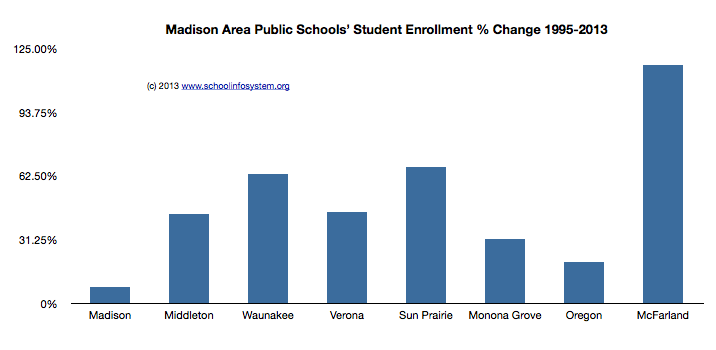
The charts reveal several larger stories:
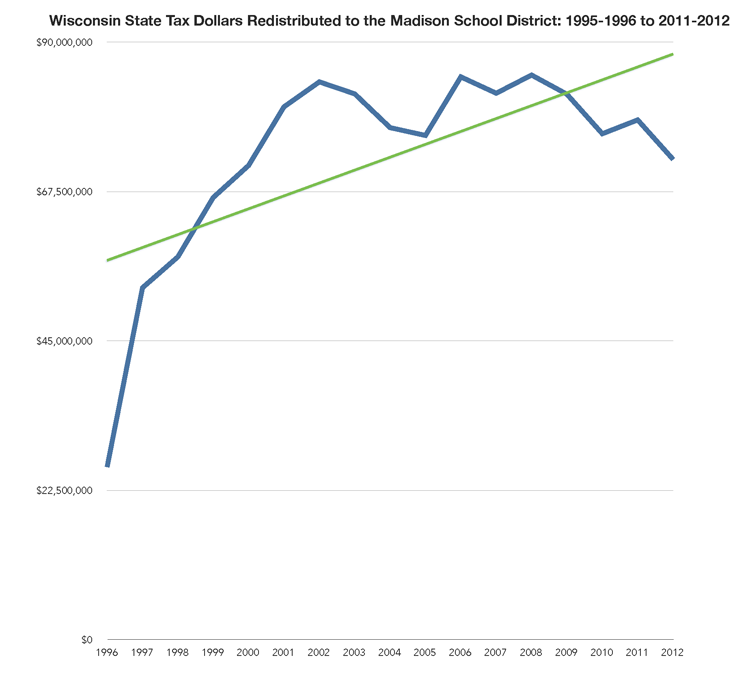
First, the State of Wisconsin “committed” to 2/3 K-12 funding in the mid-1990’s. The increase in redistributed state tax dollars is apparent. [Wisconsin Legislative Fiscal Bureau: State Aid to School Districts (PDF)]
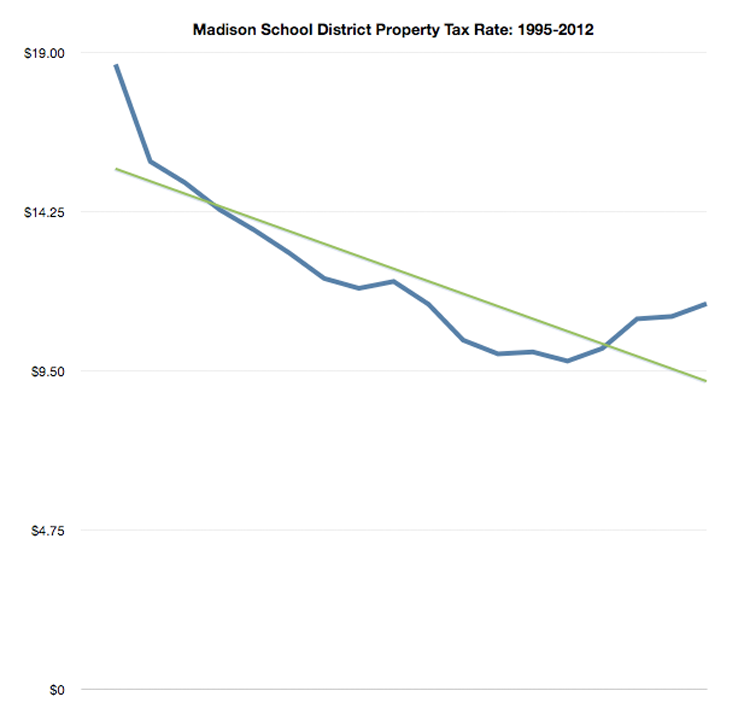
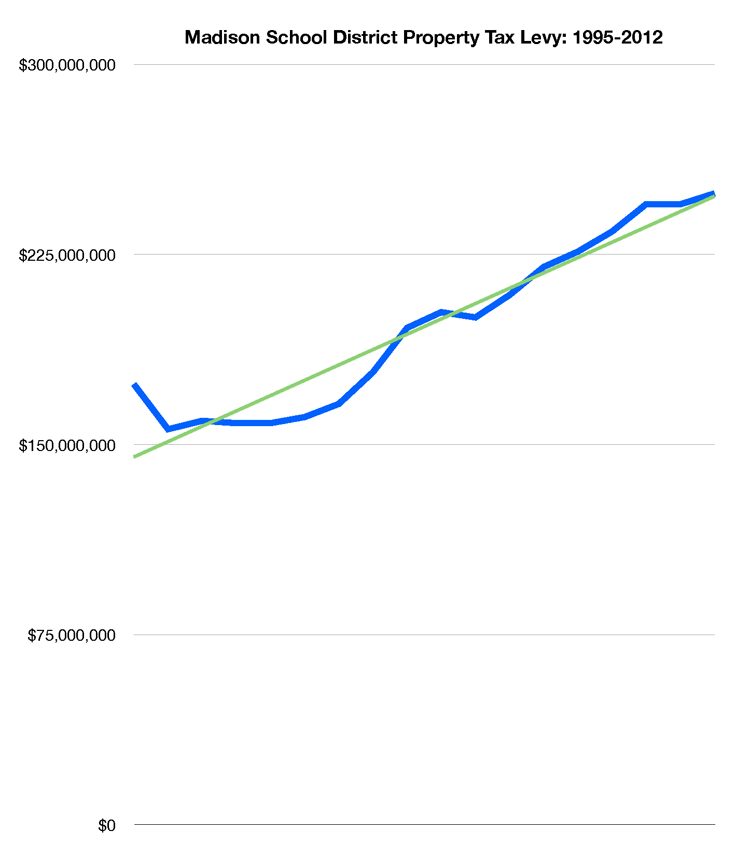
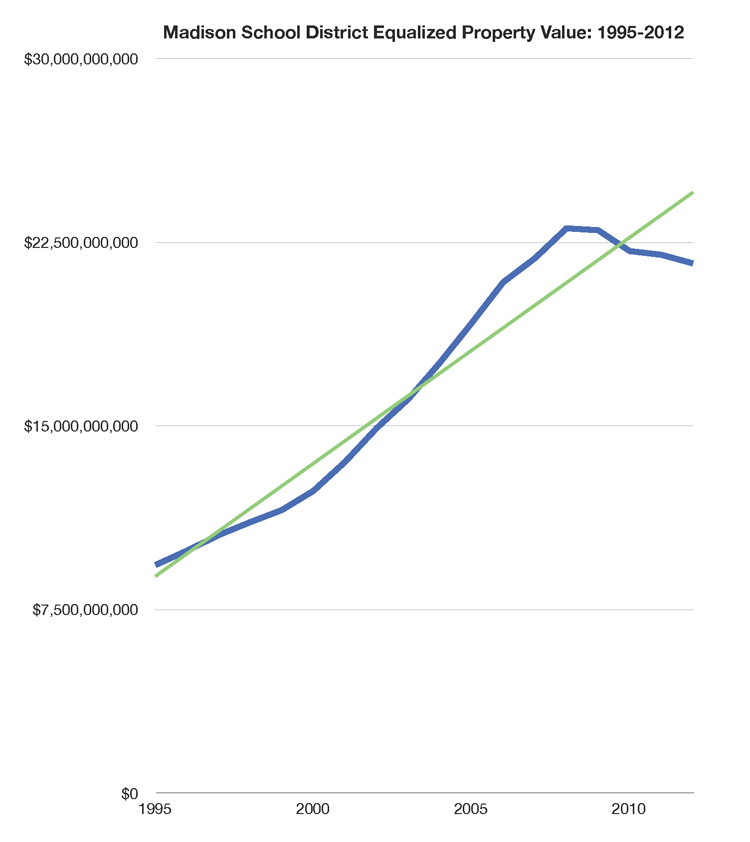
Second, Madison’s substantial real estate growth during the 2000’s supported growing K-12 spending while reducing the property tax rate (the overall pie grew so the “rate” could fall somewhat). The real estate music stopped in the late 2000’s (“Great Recession) and the tax rate began to grow again as the District consistently raised property taxes. *Note that there has been justifiable controversy over Madison’s large number of tax exempt properties. Fewer exemptions expands the tax base and (potentially) reduces individual homeowner’s taxes.
Third, Madison has long spent more per student than most public schools.
Fourth, the District’s June 10, 2013 budget document fails to address two core aspects of its mission: total spending and program effectiveness. The most recent 2012-2013 District budget number (via a Matthew DeFour email) is $392,789,303. This is up 4.4% from the July, 2012 District budget number: $376,200,000. The District’s budget has always – in my nine years of observation – increased throughout the school year. The late, lamented “citizen’s budget” was a short lived effort to create a standard method to track changes over time.
Fifth, the June 10, 2013 document does not include the District’s “Fund balance” or equity. The balance declined during the 2000’s, somewhat controversially, but it has since grown. A current number would be useful, particularly in light of Madison’s high property taxes.
Sixth, I took a quick look at property taxes in Middleton and Madison on a $230,000 home. A Middleton home paid $4,648.16 in 2012 while a Madison home paid 16% more, or $5,408.38. Local efforts to significantly increase property taxes may grow the gap with Middleton.
Finally, years of spending and tax growth have not addressed the District’s long term-disastrous reading results. Are we doing the same thing over and over?

Share

Ein neuer Deal? Germany’s vaunted dual-education system is its latest export hit

The Economist:

URSULA VON DER LEYEN, Germany’s labour minister, likes to point out that the two European Union countries with the lowest unemployment, especially among the young, have dual-education systems: Austria and Germany. Like Switzerland, they have a tradition of combining apprenticeships with formal schooling for the young “so that education is always tied to demand,” she says. When youths graduate, they often have jobs to walk into.
With youth unemployment in Germany and Austria below 8% against 56% in Spain and 38% in Italy, Mrs von der Leyen has won Europe’s attention. Germany recently signed memoranda with Greece, Italy, Latvia, Portugal, Slovakia and Spain to help set up vocational-education systems. Mrs von der Leyen discussed the topic in visits to Madrid in May and to Paris this week. There is even talk of a “new deal” for Europe, including bringing youths from crisis-hit countries to work in Germany and making more loans.

Share

New Lincoln math pages suggest more education

David Mercer:

Two math-notebook pages recently authenticated as belonging to Abraham Lincoln suggest the 16th president, who was known to downplay his formal education, may have spent more time in school than usually thought.
And the Illinois State University math professors behind the discovery say the work shows Lincoln was no slouch, either.
Math professors Nerida Ellerton and Ken Clements said Friday at the university in Normal that they’d recently confirmed that the two pages were part of a previously known math notebook from Lincoln’s childhood. It was found in the archives of Houghton Library at Harvard University, where it remains.
The book, known as a cyphering book in Lincoln’s day, is a sort math workbook in which Lincoln wrote math problems and their answers. It’s the oldest known Lincoln manuscript.

Share

Graduates finish GED before changes to testing GED testing will be computer-based, have essay portion starting in 2014

Channel3000:

Madison College GED students graduated Thursday night before major changes are made to testing.
The class that graduated Thursday night is the last to graduate before GED requirements change January 2014. Starting in 2014 the tests will be computer-based and an essay portion will be added.
Students who don’t finish before the deadline will have to start over.
“The students have made quite an accomplishment tonight,” said Jim Merritt, director of testing and assessment at Madison College. “They have worked very hard and some of them have been working at it for years and have felt a little pressure to get done with the changes coming this year.”
For most students, it takes years to complete the degree they hope will lead to better employment.

Share

Further Evidence That IQ Does Not Measure Intelligence

Annalee Newitz:

Every ten years, the average IQ goes up by about 3 points. Psychologist James Flynn has spent decades documenting this odd fact, which was eventually dubbed the Flynn Effect. The question is, does the Flynn Effect mean we’re getting smarter? Not according to Flynn, who argues that the effect simply reveals that IQ measures teachable skills rather than innate ones. As education changed over time, kids got better at standardized tests like the IQ test. And so their scores went up.
But some thinkers cling to the idea that IQ measures an inborn intelligence that transcends culture and schooling. If that’s true, one would expect that the most abstract, “culture free” elements of IQ testing wouldn’t be subject to the Flynn Effect. But they are. And now two psychology researchers have shown why that is.

Share

The Metropolitan (Philadelphia) Education Problem: Why High School Students Are Walking Out; Madison Spends about 36% More Per Student

Jon Shelton:

Philadelphia is far from the only American city with major fiscal problems in the school system at the moment. Just a few weeks ago, a similar student walkout took place in Newark, and for much of this week, teachers and students have been protesting the Chicago Public School District’s plan to close fifty-four public schools, mostly in Hispanic and African-American neighborhoods. These are not mere coincidences; indeed, both Newark and Chicago have demographic and economic trajectories that are similar to Philly. It is high time that we stop slashing budgets, closing schools, and blaming teachers and instead revisit the notion of metropolitan and even federal solutions to the crisis in urban education, which has been exacerbated by our seemingly endless economic downturn. We need to reconsider bold solutions to these problems–like integrating city and suburbs or legislating counter-cyclical revenue sharing that would pump up urban budgets during times of economic difficulty.
Because of the fractured nature of American metropolitan areas, those who live in the suburbs enjoy many of the privileges that cities offer–high-paying professional jobs, top-notch restaurants, museums, public transit, sports arenas–without contributing nearly as much to the city’s tax base in return. Beyond that, all Americans have a vested interest in providing a great education for all young people: developing civic responsibility, an educated electorate, and the human capital necessary to compete in an integrated global economy should be in everyone’s best interest. We may not live in a time in which these policies seem politically possible, but we must introduce them into the political conversation, instead of wallowing in the limits of what seems doable. If those thousands of marching students have shown us anything, it is that each of them wants an education. When historians look back at this period, perhaps they can point to 2013 as a time when talk about viable long-term solutions began, and every student was ensured the kind of education they deserve, no matter where they live.

Philadelphia plans to spend 2,224,219,000 for 202,300 students or $10,994 each. Madison spends 36% more, about $15k per student.

Share

Higher education for the masses

The Roanoke Times:

Larry Sabato doesn’t need to teach a free online course to become a celebrity professor. The director of the University of Virginia Center for Politics is one of the most visible and quoted academics in the country, analyzing topics as broad as presidential elections and as close to home as your local House of Delegates race.
But this fall, Sabato will enter the brave, new world of “massive open online courses,” or MOOCs. Sabato will lead a free online course examining the administration of President John F. Kennedy and his legacy in the half-century since his assassination. The noncredit class will be offered through the educational technology company Coursera, a Silicon Valley startup that partners with some of the nation’s top universities to offer free online courses.
Sabato said he was willing to conduct the course as part of UVa’s experiment with MOOCs, one of the hottest trends in American higher education. Companies such as Coursera and Udacity and the nonprofit edX have partnered with scores of universities in the U.S. and abroad to offer online courses on their sites, potentially expanding the institutions’ reach to millions of students worldwide.
Virginia Tech, which has developed its own strong distance-learning program, is not making an institutional push to experiment with MOOCs. Nor is it discouraging faculty from exploring opportunities. The Roanoke Times reported Monday that Tom Sanchez, a Tech urban affairs and planning professor, teamed with an Ohio State colleague to teach a course through Coursera for 21,000 students.

Share

Drew Houston’s Commencement address ‘I stopped trying to make my life perfect, and instead tried to make it interesting.’

Drew Houston:

Thank you Chairman Reed, and congratulations to all of you in the class of 2013.
I’m so happy to be back at MIT, and it’s an honor to be here with you today. I still wear my Brass Rat, and turning this ring around on graduation day is still one of the proudest moments of my life.
There are a lot of reasons why this is a special day, but the reason I’m so excited for all of you is that today is the first day of your life where you no longer need to check boxes.
For your first couple decades, success in life has meant jumping through one hoop after another: get these test scores, get into this college. Take these classes, get this degree. Get into this prestigious institution so you can get into the next prestigious institution. All of that ends today.
The hard thing about planning your life is you have no idea where you’re going, but you want to get there as soon as possible. Maybe you’ll start a company, or cure cancer, or write the great American novel. Or who knows? Maybe things will go horribly wrong. I had no idea.
Being up here in robes and speaking to all of you today wasn’t exactly part of my plan seven years ago. In fact, I’ve never really had a grand plan — and what I realize now is that it’s probably impossible to have one after graduation, if ever.

Share

The power of names

Adam Alter:

The German poet Christian Morgenstern once said that “all seagulls look as though their name were Emma.” Though Morgenstern was known for his nonsense poetry, there was truth in his suggestion that some linguistic labels are perfectly suited to the concepts they denote. “Dawdle” and “meander” sound as unhurried as the walking speeds they describe, and “awkward” and “gawky” sound as ungainly as the bodies they represent. When the Gestalt psychologist and fellow German Wolfgang Köhler read Morgenstern’s poem, in the nineteen-twenties, he was moved to suggest that words convey symbolic ideas beyond their meaning. To test the idea more carefully, he asked a group of respondents to decide which of the two shapes below was a maluma and which was a takete:

Share

European MOOCs in Global Context Workshop (19-20 June 2013 @ UW-Madison)

Kris Olds:

Massive Open Online Courses (MOOCs) were ‘invented’ in Canada in 2008, and then became transformed, institutionalized and scaled up via the efforts of people, universities, and firms, in the Boston and San Francisco Bay Area city-regions. In the process debates about MOOCs have blossomed, entangled as they are in discussions about online pedagogy through to longer-standing debates about lifelong learning, internationalization, austerity, ‘disruptive innovation,’ public service, deterritorialization, education reform, and many (many) other issues.
The European MOOCs in Global Context Workshop, a free and open access (i.e. no RSVP) event will be held in the Wisconsin Idea Room, Education Building, at the University of Wisconsin-Madison from 19-20 June 2013, This workshop is designed to engender discussion and debate about the MOOCs phenomenon from a European perspective, as well as about the implications of the MOOCs juggernaut for European universities and students. We seek to learn about MOOCs by contextualizing them, speaking about their histories and geographies, their technologies and aspirational futures, as well as their uneven geographies and power geometries. In doing so we hope that participants will become more astute thinkers about potentials and limits of MOOCs, not to mention how to situate the fast changing MOOCs phenomenon. Given this workshop attendees need not be Europeanists; you simply need to be interested in MOOCs, online learning, and the transformation of higher education more generally.

Share

Does Expanding School Choice Increase Segregation?

Matthew M. Chingos:

Advocates of expanding the educational options available to students from low-income families raise not only social justice arguments–pointing to the choices made by families that can afford to live close to a good public school or pay private-school tuition–but also the theory that competition induced by expanded school choice will be “the proverbial rising tide that lifts all boats.” Breaking the ironclad link between residence and school attended will, proponents argue, force schools to compete for students and resources in ways that increase the quality of education provided.
But critics of school choice policies argue that these reforms will lead to increased segregation by race and class as more motivated families move to better schools, leaving the most disadvantaged students behind in the worst public schools. Criticism has often focused on charter schools given the growth in the charter sector in recent years. Nationwide, charter enrollment grew from 1 to 3 percent of all students between 1999-2000 and 2009-10. Charters make up a much larger share of the market in several places, including 11 percent of Arizona students and 37 percent in the District of Columbia.

Share

The Dark Side of Dual Enrollment

Ken Smith and Diana Nixon:

Different students learn in different ways–we know that. Students know that too.
A precalculus student I talked to on a recent afternoon failed the class last fall and was on her way to failing it again this spring. Sadly, she will probably fail the class in the fall, too. Despite all the class aids (and there were many), she had not reacted to her consistently low exam scores until I spoke to her after class.
Her science major requires that she complete Calculus 1 and possibly Calculus 2. Her mathematics SAT score was 380.
We talked a little bit about the class, her performance, and where she should go next. The student explained that my class is not compatible with her “learning method.” She said that she prefers “that multiplying method, you know, where there are letters, A, B, C.”
I said, “You mean, multiple choice?”

Share

Humanities Fall From Favor

Jennifer Levitz & Douglas Belkin:

The humanities division at Harvard University, for centuries a standard-bearer of American letters, is attracting fewer undergraduates amid concerns about the degree’s value in a rapidly changing job market.
A university report being released Thursday suggests the division aggressively market itself to freshmen and sophomores, create a broader interdisciplinary framework to retain students and build an internship network to establish the value of the degree in the workforce.
This “is an anti-intellectual moment, and what matters to me is that we, the people in arts and humanities, find creative and affirmative ways of engaging the moment,” said Diana Sorensen, Harvard’s dean of Arts and Humanities. The division needs to show “what it is our work does so they don’t think we’re just living up in the clouds all the time.”

Share

A father who saw untapped forces in his son’s autism

Emma Jacobs:

When Thorkil Sonne’s son Lars was diagnosed with autism at the age of two and a half in 1999, the last thing the chief technology officer expected was a career change. “I was a happy employee. I was happy to be employed by a big company,” he says.
Today, the 52-year-old who once oversaw technology at a spin-off of TDC, Denmark’s largest telecoms company, has sold his family home – after remortgaging it several times – and is relocating to the US state of Delaware. It is all part of his mission to persuade high-tech companies of the merits of employing autistic workers.
This month Specialisterne, the social enterprise he formed in 2004, which recruits autistic people for work on data entry, software programming and testing projects, announced a partnership with SAP, the German business software company. SAP’s ambition is to recruit hundreds of autistic employees to test its software. By 2020, the tech company aims to employ 650 autistic workers, or 1 per cent of its workforce.
The announcement, he says, has sparked interest from other employers.CAI, an IT consulting firm, last week announced it would work with Mr Sonne’s organisation to recruit autistic employees.

Share

Florida colleges to drop remedial classes for thousands

Denise-Marie Ordway:

For years, men and women wanting to take classes at their local community colleges have been discouraged to learn they must complete a remedial program before enrolling in college-level courses.
Almost 200,000 students, including recent high-school graduates, had to take refresher classes in math, reading or writing last school year. Some needed extra help in all three subjects, adding a semester or two or more — and hundreds of dollars in tuition — onto their educational plans.
It’s a situation that has prompted numerous students to drop out before they ever enroll in their first college-level course.
Educators and lawmakers have long agreed the system needs revamping, considering colleges statewide pay tens of millions of dollars a year for a program with dismal results. Nationally, fewer than 1 in 10 students who started in remediation graduate from community colleges within three years, according to one estimate. Recent reliable data for Florida students were not immediately available, but old figures show it’s just as bad.

Share

CAN YOU STILL BECOME A QUANT IN YOUR THIRTIES?

quantstart:

Absolutely. In fact, a good fraction of quantitative analysts, traders and developers make the change to finance only in their late twenties or early-to-mid thirties. In this article I’m going to talk about how you can achieve the same thing.
Age really isn’t a barrier in financial markets. What matters the most is competence, drive and initiative. It is a very meritocratic industry (for better or worse!) in that good performers of all ages are well-rewarded. It is quite common to enter the industry after a stint elsewhere in some other technical field, particularly within the asset management (hedge fund) sector, so don’t be put off applying, even if you think you’re too senior for the roles.
If you’re considering a switch to quantitative finance then the first task you must carry out is to make a frank assessment of your background, experience and skill set. Most forms of quantitative finance are highly mathematical and require solid undergraduate experience in linear algebra, calculus (real analysis in the UK!), probability and statistics. If you have gained, or built upon, these skills in subsequent qualifications such as a MSc (science masters program) or quantitative PhD then so much the better. Prospective employers will also prefer you to have made use of such skills in previous roles.

Share

Is Coding the New Second Language?

Peg Tyre:

It’s first period at Harlem’s Cristo Rey high school, a private Catholic school for motivated low-income kids. In a third floor classroom, 10 sophomores and juniors stare into their wide Apple monitors and puzzle over what line of code they need to add to their rudimentary computer programs in order to make their names appear in a gray block between the word “‘Welcome” and an exclamation point.
Their teacher, Kevin Mitchell, 29, is a software engineer and volunteer at the tiny nonprofit startup, ScriptEd, which provides coding instruction in underserved high schools in New York City. Mitchell, a calm figure with an easy smile, suggests his students write a line of code: a word bookended by some simple punctuation. The students diligently attempt to implement it on their own.
For some, the code works on the first try. Welcome Jorge! Welcome Sonya! Around the room, a few other students make low groans–unexpected results. “Did you forget your curly brackets,” queries Mitchell, referring to the punctuation that looks like this “}” Other students have gotten no results at all.
Byron Acosta, a junior at Cristo Rey, seems satisfied when his name pops up. Before he took this class, Acosta says he didn’t know anyone with the skills he was learning in class. Even though he’s a self-described “English and history guy” he jumped at the chance to learn some basics. So far, he likes it. And he’s absorbed Mitchell’s Golden Rule: “You have to be specific in your language,” he offers. “One typo and you can mess everything up.”
Mitchell walks among the students, troubleshooting. Writing code is like giving commands, he tells the students. “The computer can’t know what you don’t tell it.”

Peg Tyre interview.

Share

Why does France insist school pupils master philosophy?

Hugh Schofield:

My primary thought is: Thank the Lord I was spared the torment.
I mean, can you imagine having to sit down one morning in June and spend four hours developing an exhaustive, coherent argument around the subject: Is truth preferable to peace?
Or: Does power exist without violence?
Or possibly: Can one be right in spite of the facts?
Perhaps you would prefer option B, which is to write a commentary on a text. In which case, here is a bit of Spinoza’s 1670 Tractatus Theologico-Politicus. Or how about some Seneca on altruism?
I take these examples from my daughter’s revision books. My heart bleeds for her, as I look at the list of themes that have to be mastered.
Ruby has chosen to take what they call a Bac Litteraire – the Literature Baccalaureat.
There are alternative, more science-biased versions of the Baccalaureat. They all include an element of philosophy.

Share

Racial and Income Gaps Persist in AP and IB Enrollment

Caralee Adams:

Record numbers of high school students are participating in Advanced Placement courses and International Baccalaureate programs in hopes of being better prepared for college. But a new report from the Education Trust finds students of color and those from low-income families are less likely to enroll in these rigorous programs, even if they show the academic promise to succeed.
Finding America’s Missing AP and IB Students by Christina Theokas and Reid Saaris from the Washington, D.C.-based organization notes that more students from all backgrounds are signing up for these programs, and efforts have been made to boost minority and low-income student participation, yet gaps exist. Nearly 91 percent of students attend a high school that offers AP. Those without the advanced programs tend to be rural, small, and high-poverty schools, the report says.
Each year, about 640,000 low-income students and students of color are “missing” from AP and IB participation–students who could benefit if they merely enrolled at the same rate as other students in their schools, the report says.
It is not just a matter access. About 1 million students do not attend schools that offer AP, and the authors note that only a small percentage of the gaps by race or family income can be accounted for by which schools do and do not offer the classes.

Share

Bernanke to Grads: Get Dirty and Call Mom

Jon Hilsenrath:

Everyone wants to psychoanalyze Ben Bernanke these days. Does he want another term as chairman of the Federal Reserve? Is he preparing to walk off into the sunset when his current term ends next January? What is his secret motive for skipping the Fed’s annual retreat in Jackson Hole, Wyoming this year?
In that vein, his unusually personal and wistful commencement address at Princeton University Sunday afternoon is sure to be closely scrutinized for hidden meaning. But let’s leave the psychobabble to unqualified bond traders and take the speech for what it is: His best graduation address as a public official.
Mr. Bernanke — a former Princeton economics professor — has delivered his share of clunkers before, such as a 2008 address to Harvard students about inflation, which was panned in the Harvard Crimson.
Others have been thoughtful but wound up rather dry, such as a recent talk on innovation and the economy’s long-run growth prospects at Bard College at Simon Rock.

Share

Americans Short on Financial Know How

Brendan Cronin:

Some household balance sheets have mended during the recovery but that may be thanks less to fiscal stewardship than the improving economy.
In fact, Americans’ grasp of concepts such as investment risk and inflation has weakened since the recovery began in mid-2009. Research released last week shows that on a five-question test (Take the test here), respondents did worse in 2012 than in 2009. The average number of correct answers fell to 2.9 in 2012 from 3.0 on the test in 2009.
The test, along with a wide-ranging survey of financial capability of more than 25,000 American adults, was conducted during the fall and funded by the Financial Industry Regulatory Authority Investor Education Foundation.
“People are finding it a little easier to make ends meet,” Finra Chief Executive Richard Ketchum said in presenting the 2012 National Financial Capability Study results last week in Washington. “More respondents have rainy-day funds, which puts them in a better position to deal with life’s unexpected events…But there are still very significant concerns,” he said, adding that debt continues to be a serious problem.

Share

Mathematica at 25

Stephen Wolfram:

I never liked calculational math, and was never good at it. But starting around the age of 10, I became increasingly interested in physics–and doing physics required doing math.
Electronic calculators arrived on the scene when I was 12–and I immediately became an enthusiast. And around the same time, I started using my first computer–an object the size of a large desk, with 8 kilowords of 18-bit memory, programmed mostly in assembler using paper tape. I tried doing physics with it, to no great success. But by the time I was 16, I had published a few physics papers, left high school, and was working at a British government lab. “Real” theoretical physicists basically didn’t use computers in those days. But I did. Alternating between an HP desk calculator (with a plotter!) and an IBM mainframe programmed in Fortran.
I was basically just doing numerics, though. But in the physics I wanted to do, there were all sorts of algebra. And not just a little algebra. Huge amounts. Expressions from Feynman diagrams with hundreds or thousands of terms, all of which had to be precisely right if one was going to get the right answer.

Share

Rushed Reforms in Delhi University: Akshita Nagpal

Akshita Nagpal:

It was only in 2012 that we got a subtle whiff of the broth brewing in the minds of the bosses of Delhi University. While this isn’t the first time that authorities have attracted opposition from everyone on the other side of the ideological fence, the repercussions of the present push for hasty implementation of the Four Year Undergraduate Programme(FYUP) might be much more damning. Refuting change is not what the displeased body of teachers and students mean to convey. The opposition is against the hasty implementation and lack of insight sharing on the workings of the new system. Keeping up with the absurd pace of implementation, procedural requisites as pivotal as UGC approval have been done away with!
Change can’t be injected like a shot of medicine, but has to be administered gradually, and in viable dosages if you mean to erect a healthier model. Anyone associated with DU would know how much precious time is lost due to strikes and protests. There was a spate of these in 2010, when the administration wanted to similarly inject semester system at the undergraduate level (which it eventually did). Though it is too soon to give any verdict, much less any polarised verdict, on the good and evils of the post-semester system quality of undergraduate education, some of its foibles have already exposed themselves. The swelled up scores are an amusing justification of the system by university authorities.
The university, in a hopeless bid to assuage allegations of being an authoritarian body held a 2 day Open House session to pretend to address the concerns of prospective students and their parents. But how impressively can a blatant façade function? Newspaper reports informed how the officials convening the session were suffering from selective hearing syndrome, owing to which they were able to comfortably dodge queries related to the viability of the FYUP and credence for a student putting in an extra year for graduation. Thus, the university seems to have failed to tide the opinions of the student community in favour of the hurried imposition of FYUP, who happen to be the direct beneficiaries or the ones to be saddled with encumbrance on account of any radical academic reforms. A recent General Body Meeting (GBM) of the Delhi University Teachers Association (DUTA) held on May 12 concluded with the teaching fraternity projecting an immoveable opposition to the hasty changes. All this sets up the stage for the classic Creon-Antigone ideological clash; the establishment and the individual at loggerheads.

Share

Why aren’t voucher schools subject to open records law?

Jack Craver:

Last week, Sarah Karon of the American Civil Liberties Union argued in a Cap Times column that voucher schools should be held to the same standard of public scrutiny to which public schools are currently subjected.
She noted that many private schools that participate in the Milwaukee School Choice Program receive the great majority of their money from taxpayer-financed vouchers.
Open records advocates, such as the Wisconsin Newspaper Association and the Wisconsin Freedom of Information Council, agree. If voucher schools are receiving taxpayer dollars, then shouldn’t the fourth estate be allowed to shine a light on them?
“We feel that because there’s a significant amount of money from taxpayers and because there is intense public interest in the metrics (for evaluating schools), they should provide a comparable level of transparency that public schools provide,” says Bill Lueders, president of the WFIC.
Among Republicans, there appears to be a divide over just how much accountability taxpayers can demand from vouchers. Whereas the GOP leadership and Gov. Scott Walker are pushing measures that will subject vouchers to the Common Core academic standards and include voucher student test scores in the statewide Student Information System, conservative stalwart Sen. Glenn Grothman, R-West Bend, one of the loudest advocates of voucher schools, believes those measures pervert the entire idea behind school choice.

Share

Poor and Rich Kids: Here’s How They Can Get the Same Education

Lauren McAlee
When parents imagine the ideal school for their kids, many probably envision a place where children can not only master basic skills and content, but also be valued as individuals, encouraged to delve into interesting topics, and safe to take healthy risks. Many schools offer this kind of rich education. Unfortunately, they disproportionately serve children who come from privileged backgrounds.
Right now, many students receive an imbalanced education. Kids need to develop defined sets of skills like reading and writing words and solving equations; they also need to know how to apply these skills and solve problems in open-ended contexts. Curriculum reform has found a relative balance, recognizing that students need to learn defined sets of skills as well as explore open-ended contexts to succeed in the 21st century. But students living in poverty disproportionately miss out on opportunities for balanced education.
Over 30 years ago, Jean Anyon wrote Social Class and the Hidden Curriculum of Work, observing that in sample working-class schools, “work is following the steps of a procedure,” usually “involving rote behavior and very little decision making or choice,” while in affluent and elite schools, “work is creative activity carried out independently” and “developing one’s analytical intellectual powers.”
Based on my experience working with educators and students around the country, this pattern persists.
Counterexamples such as Big Picture Learning schools, public Montessori and Expeditionary Learning schools, and schools using the Schoolwide Enrichment Model exist, but are the exception for students living in poverty, rather than the rule.
Having taught in both high- and low-poverty schools, I understand why open-ended thinking is easier to emphasize in privileged communities. Varying education and economic status of families creates a serious gap in vocabulary, reasoning, background knowledge, and social-emotional skills. Teachers in my pre-K through eighth-grade high-poverty school spend countless hours teaching students skills that affluent students already know. This leaves less school time for play, projects, and exploration.
In Teaching Other People’s Children, Lisa Delpit writes that, “skills are a necessary but insufficient aspect of black and minority students’ education. Students need technical skills to open doors, but they need to be able to think critically and creatively to participate in meaningful and potentially liberating work inside those doors.”
Skating over open-ended competencies is impractical for any school as the Common Core State Standards shift learners towards deeper, more nuanced thinking. With or without Common Core, we cannot accept our current state of curriculum segregation.
So how can we fix curriculum segregation? We can do a lot, but none of it will be easy. Here are a few ideas to get started:

  1. Urgently identify, study, and share learning about the existing pockets of educators who excel in balanced education for children living in poverty.
  2. Provide more intensive school services for children who come to school with less formal knowledge, including longer school days and years, and deeper and wider school staffing. Students with more to learn need more support.
  3. Share concrete tools. Open-ended education is harder to scale than defined education, and we need to share as much as we can.
  4. Ensure teacher evaluations, especially those including unannounced observations, reward rather than punish healthy risk-taking.
  5. Measure schools’ success with metrics that include students’ ability to think in robust, open-ended contexts.

Children in my school and around the country need all hands on deck to ensure their education is rigorous, rich, and respectful of their potential.

Share

The UnCommon Core of Learning: Researching and Writing the Term Paper

Michael F. Shaughnessy
Eastern New Mexico University
Portales, New Mexico
1) Will, you have been advocating for the high school term paper for years–why the persistence?
I have worked on The Concord Review for 26 years for several reasons. It pays almost nothing, but we have no children, the house is paid for and my wife has a teacher’s pension. Most of all, I am constantly inspired by the diligent work of high school students from 39 countries on their history research papers. I thought, when I started in 1987, that I would get papers of 4,000, words. But I have been receiving serious readable interesting history research papers of 8,000, 11,000, 13,000 words and more by secondary students, who are often doing independent studies to compete for a place in this unique international journal.
2) I remember with fondness, my term papers in both high school and college–and the feeling of accomplishment I received. Am I alone in this regard?
We did the only study done so far in the United States of the assignment of term paper in U.S. public high schools and about 85% of them never assign even the 4,000-word papers I had hoped for. Most American high school students just don’t do term papers. Teachers say they are too busy, and students are quite reluctant to attempt serious papers on their own, so they arrive in college quite unprepared for college term paper assignments. Many of our authors say that their history papers were the most important and most satisfying work they did in high school.
3) People write and talk about “curriculum issues”–are there any curriculums that you are aware of that focus on library research and writing?
As you know the hottest topic in American education now is “The Common Core Standards,” which are quite explicit in saying over and over that they are “not a curriculum.” They say that nonfiction reading is important, but they recommend no history books, and they say nonfiction writing is important, but they provide no examples, of the kind they might find, for example, in the last 97 issues of The Concord Review. To my mind, the CC initiative is “full of sound and fury, signifying nothing” as the man said. As you know, by a huge margin, the focus for writing in our schools is on personal and creative writing and the five-paragraph essay, even for high school students.
4) Let’s discuss some of the skills needed to write a good term paper–what would you say they are?
The most important skill or effort that leads to a good term paper is lots and lots of reading. Too often our literacy experts try to force students to write when they have read nothing and really have nothing to say. So the focus becomes the students’ personal life, which is often none of the teachers’ business, and there is little or no effort to have students read history books and learn about something (besides themselves) that would be worth trying hard to write about. Many of our authors learn enough about their topic that they reach a point where they feel that people ought to know about what they have learned–this is great motivation for a good term paper.
5) You have been publishing exemplary high school research papers from around the world for years–how did you get started doing this and why?
I had been teaching for enough years at the public high school in Concord, Massachusetts to earn a sabbatical (1986-1987). That gave me time to read What Do Our 17-Year-Olds Know, Horace’s Compromise, Cultural Literacy and some other books and articles that helped me understand that a concern over students’ knowledge of history and their ability to write term papers was not limited to my classroom or even to my school, but was a national issue. I had usually had a few students in my classes who did more work than they had to, and it occurred to me that if I sent out a call for papers (as I did in August, 1987) to every high school in the United States and Canada and 1,500 schools overseas, I might get some first-rate high school history essays sent to me. I did, and I have now been able to publish 1,066 of them in 97 issues of the journal. [Samples at www.tcr.org.] No one wanted to fund it, so I started The Concord Review with all of an inheritance and the principal from my teacher’s retirement.
6) Has the Internet impacted a high school student’s ability to research? Or is it a different kind of research?
I read history books on my iPad and so can high school history students. I also use the Internet to check facts, and so can students. There is a huge variety of original historical material now available on the Web, as everyone knows, but I would still recommend to students who want to do a serious history research paper that they read a few books and as many articles as they can find on their topic. This will make their paper more worth reading and perhaps worth publishing.
7) It seems that getting a paper into your Concord Review almost always guarantees admission to a top notch college or university–am I off on this?
Thirty percent of our authors have been accepted at Harvard, Princeton, Stanford, and Yale, but I have to remember that these serious authors doing exemplary papers for my journal are usually also outstanding in many other areas as well. A number of our authors have become doctors as well, but at least at one point in their lives they wrote a great history paper!
8) I was recently on the East Coast and was reading The Wall Street Journal and the New York Times. I was astounded by the quality of writing. There are still good writers out there–but do we treasure, promote and encourage good writing?
Those papers can hire a teeny tiny percent of those who want to make a living by their writing, and they provide a great service to the country, but for the vast majority of our high school students, reading and writing are the most dumbed-down parts of their curriculum. Many never get a chance to find out if they could write a serious history paper, because no one ever asks them to try. And remember, we have nationally-televised high school basketball and football games, but no one knows who is published in The Concord Review and they don’t ask to know.
9) What have I neglected to ask?
My greatest complaint these days is that all our EduPundits, it seems, focus their attention on guidelines, standards, principals, teachers, and so on, and pay no attention to the academic work of students. Indiana University recently interviewed 143,000 U.S. high school students, and found that 42.5% do one hour or less a week on homework. But no one mentions that. Our education experts say that the most important variable in student academic achievement is teacher quality (and thus all the attention on selection, training, assessment and firing of teachers). I maintain that the most important variable in student academic achievement is student academic work, to which the experts pay no attention at all. But then, most of them have never been teachers, and so they usually do not know what they are talking about.
www.tcr.org
fitzhugh@tcr.org
The Concord Review
Share

Asia’s teachers say copying their school hours won’t help Britain

Justin Harper:

Turning out successful pupils is about more than making them sit at their desks for hours, according to top-performing schools overseas
Asia’s schools produce successful pupils by focusing on plenty of homework and a “meritocratic” approach, according to teachers, who rejected suggestions that longer hours in the classroom are key.
They were responding to recent remarks from the British education minister, Michael Gove, who pointed out that a longer school day is the norm in East Asian nations.

Share

Afghan students flock to India’s universities

Bijoyeta Das:

Upon arriving in India, the first place Arif Ahmady visited was the Taj Mahal.
But it was hope for a better future that enticed Ahmady to leave his home in Kabul, Afghanistan last February. The second place he visted was Delhi University. Now he is busy scouting graduate schools to study computer science, checking out housing options, and connecting with other Afghan students in India.
“I want to study in a peaceful space, get an Indian degree because it has a great reputation in Afghanistan, go back and build a career,” says the 23-year-old, wearing a black cotton tunic, baggy pants, and a traditional Afghan scarf wrapped around his neck.
Indian cities such as New Delhi, Mumbai, Pune, Bangalore and Bhubaneswar attract thousands of Afghan youth to study. About 5,500 Afghan students are currently in the country, says Shaida Mohammad Abdali, Afghanistan’s ambassador to India, of whom about 300 are women.

Share

Reconciling the Common Core State Standards with reading research

Wisconsin Reading Coalition, via a kind email:

During her recent visit to CESAs 1 and 6 in Wisconsin, Louisa Moats recorded a podcast on the topic of reconciling the Common Core State Standards with reading research. This podcast, which comes in three parts for viewing, is an excellent source of information on what is necessary to effectively implement the CCSS in the area of reading. You can access the podcast at either of the following sets of links, depending on your computer system.
PART 1 –
aasaonline.mediasite.com/mediasite/Play/c70686d007f74391bc2bebe7c1ed
PART 2 –
aasaonline.mediasite.com/mediasite/Play/5352ade16e8549809f88db8397b1
PART 3 –
aasaonline.mediasite.com/mediasite/Play/ea05e4041b314797a8e7ad2efc8b
OR
PART 1 –
http://aasaonline.mediasite.com/mediasite/Play/c70686d007f74391bc2bebe7c1ed
8aea1d

PART 2 –
http://aasaonline.mediasite.com/mediasite/Play/5352ade16e8549809f88db8397b1
ede11d

PART 3 –
http://aasaonline.mediasite.com/mediasite/Play/ea05e4041b314797a8e7ad2efc8b
1f9d1d

Share

Voucher schools should be more open

Sarah Karon:

Back in 1990, when Milwaukee launched the nation’s first publicly funded voucher program, participating schools could enroll no more than 49 percent voucher students. These schools were considered private, because the majority of their students paid private tuition.
Fast-forward to 2013.
Now, more than half of Milwaukee’s 110 voucher schools have at least 95 percent of students on publicly funded vouchers. In one-fifth of these schools, every student receives a voucher.
Yet because voucher schools are still classified as “private,” they can — and do — ignore Wisconsin’s open records and meetings laws. It’s a double standard that undermines transparency and shields information from parents and the public.

Share

School database loses backers as parents balk over privacy

Stephanie Simon:

A $100 million database set up to store extensive records on millions of public school students has stumbled badly since its launch this spring, with officials in several states backing away from the project amid protests from irate parents.
The database, funded mostly by the Bill & Melinda Gates Foundation, is intended to track students from kindergarten through high school by storing myriad data points: test scores, learning disabilities, discipline records – even teacher assessments of a child’s character. The idea is that consolidated records make it easier for teachers to use software that mines data to identify academic weaknesses. Games, videos or lesson plans would then be precisely targeted to engage specific children or promote specific skills.
The system is set up to identify millions of children by name, race, economic status and other metrics and is constructed in a way that makes it easy for school districts to share some or all of that information with private companies developing education software.
The nonprofit organization that runs the database, inBloom Inc, introduced the project in March with a presentation at an education technology conference, complete with a list of nine states that it said were committed partners.

Share

How Gov’t Student Loans Ruined College

Liz Peek:

President Obama and Congress are squabbling again – this time over the rates charged on federal college loans.
Surrounded by students nicely turned out in suits and dresses, looking more like the Mormon Youth Chorus than today’s undergraduates, Mr. Obama recently chastised Congress for not yet blocking a doubling of rates for new Stafford loans set to occur on July 1.
As the president well knows, the House has already passed a bill preventing the hike and tying new loan terms to market levels. The president’s solution is similar, but would lock in rates for the duration of the loan. The spat is like bickering over menu choices on the Titanic.

Share

College in Sweden is free but students still have a ton of debt. How can that be?

Matt Phillips:

Swedish colleges and universities are free. Yep. Totally free.
But students there still end up with a lot of debt. The average at the beginning of 2013 was roughly 124,000 Swedish krona ($19,000). Sure, the average US student was carrying about 30% more, at $24,800.
But remember: Free. College in Sweden is free. That’s not even all that common in Europe anymore. While the costs of education are far lower than in the US, over the past two decades sometimes-hefty fees have become a fact of life for many European students. Britain got them in 1998. Some German states instituted them after a federal ban on student fees was overturned in the courts. In fact, since 1995 more than half of the 25 OECD countries with available data on higher education have overhauled their college tuition policies at public institions, with many adding or raising fees.

Share

Commentary on Wisconsin K-12 Tax & Spending Increases, Voucher Changes

Jason Stein

Lawmakers also want to expand school voucher programs beyond the borders of Milwaukee and eastern Racine County. The programs allow parents who meet income thresholds to send their children to religious schools and other private schools at taxpayer expense.
Under the motion approved 12-4 along party lines by Republicans on the budget panel:

  • Public schools would receive $150 more per student in general aid this fall and another $150 increase the following year. The plan would cost $289 million over two years, with $231.5 million funded with state taxes and the rest with an additional $52 million in higher local property taxes and an increase in expected revenues from the state lottery.
    School districts would have the authority to spend this new money. Walker wanted to give schools $129 million in state aid but require all of it to go toward property tax relief, rather than be used for new expenses.
    Under the budget committee’s proposal, total property taxes would increase by less than 1% per year, with school levies going up somewhat more than that.

  • A new voucher program would become available to all students outside Milwaukee and Racine. It would be limited to 500 students the first year and 1,000 students every year thereafter. Walker wanted no limits on the number of students in the program after the second year.
    If there are more students seeking slots in the program than allowed, the proposal would allocate the available slots by lottery. The slots would go to the 25 schools with the most applications, with each school getting at least 10 seats.

  • The new program would be available to students in any school district. Walker wanted to make it available in districts with 4,000 or more students that were identified as struggling on school report cards issued by the state.
  • No more than 1% of the students of any given school district could participate in the new program.
  • Over 12 years, the negative financial impacts for the Milwaukee Public Schools from the voucher program here would be phased out.
  • The new program would be available to students of families making 185% of the federal poverty level or less — well below the income thresholds for Milwaukee and Racine. Those programs are available to families making up to 300% of the federal poverty level, with a higher threshold for married couples.
  • Voucher schools in all parts of the state would receive $7,210 per K-8 student and $7,856 per high school student — up from $6,442 currently. Walker wanted to provide $7,050 for students in kindergarten through eighth grade and the same larger increase to high school students.


Wisconsin DPI Superintendent Tony Evers (PDF):

Today, Republican leaders are finalizing a deal to likely expand Wisconsin’s private school voucher program statewide. While this dramatic proposal has significant implications for citizens and taxpayers across Wisconsin, it has been developed behind closed doors with no public input, no public hearings, and no public fiscal analysis. If this proposal becomes law, taxpayers across Wisconsin will be financing a new entitlement for private school children whose tuition is currently paid for by their parents. To address the lack of information about the potential fiscal effects of this program, the attached table estimates potential long-term costs of statewide subsidization of private school tuition on a district-by-district basis. Cost to subsidize current private school students only: up to $560 million annually
While some lawmakers claim the purpose of the program is to provide educational choices to those who cannot afford it, the current school choice programs in Milwaukee and Racine provide vouchers to families who are already choosing to send their children to private schools. As many as 50% of the children participating in the Racine choice program were already in private schools when they began receiving a state-funded subsidy in
2011-12. If the voucher program is expanded statewide, it can be assumed that current private school families would also be eligible for this new entitlement.

Related:

Share

The number of high-poverty schools increases by about 60 percent

Jill Barshay:

Poverty is getting so concentrated in America that one out of five public schools was classified as as a “high-poverty” school in 2011 by the U.S. Department of Education. To win this unwelcome designation, 75 percent or more of an elementary, middle or high school’s students qualified for free or reduced-price lunch. About a decade earlier, in 2000, only one in eight public schools was deemed to be high poverty. That’s about a 60 percent increase in the number of very poor schools!
This figure was part of a large data report, The Condition of Education 2013, released by the National Center for Education Statistics on May 23, 2013. There’s a lot to chew on in it. But school poverty jumped out at me as a really depressing data point showing the growing income inequality in America.

Share

Not Impossible: The Story of Daniel, a 17 Year Old with Severe Autism & His 6 Completed Coursera Courses

Coursera Blog:

It is impossible to overstate the benefit and happiness that Coursera has brought to our son Daniel and our family.
Five years ago (next month) our severely autistic son Daniel had a major breakthrough. Then twelve years old, with a using vocabulary of thirty or forty words (though we knew he understood far more) he suddenly learned to answer questions by picking the answers out, one letter at a time, on a letterboard. Within a couple of weeks, Daniel could use the thousands of words he had heard but could not speak.
The teacher who created this breakthrough, Soma Mukhopadhyay, also taught us how to read to Daniel: read him a sentence, stop, ask him a comprehension question, get his answer on the letter board, go on to the next sentence, ask another question…

Share

An Open Letter to Science Students and Science Teachers

Carl Zimmer:

I never heard from Davis again. But I have continued to get a steady stream of emails from other students. Some are a pleasure to read. They are the products of young minds opening up to the rich rewards of science. These young correspondents are starting to understand something important about the natural world, and that understanding triggers a flood of questions that will take them even deeper.
But a lot of the emails follow in the tradition of Davis. Essentially: I have homework. I need information from you.
In the past couple years, I’ve noticed a shift in the tone of these requests. They’re not furtive acts of desperation. They seem to bear the seal of approval from adults-either from teachers or parents.

Share

If Employment Game Has Changed, Who’s Teaching The Rules?

NPR:

It still pays to earn a college degree. That is, if you get the right one. Georgetown University published a report Wednesday that looked into this dilemma.
Highlights From Georgetown’s Study:

(1.) Unemployment is generally higher for non-technical majors, such as the arts (9.8 percent) or law and public policy (9.2 percent).
(2.) Unemployment rates for recent graduates in information systems, concentrated in clerical functions, is high (14.7 percent) compared with mathematics (5.9 percent) and computer science (8.7 percent).
(3.) Unemployment rates are relatively low for recent graduates in education (5 percent), engineering (7 percent), health and the sciences (4.8 percent) because they are tied to stable or growing industry sectors and occupations.
(4.) Graduates in psychology and social work also have relatively low rates (8.8 percent) because almost half of them work in health care or education sectors.
— Georgetown University Center on Education and the Workforce
“The labor market demands more specialization. So, the game has changed,” says Anthony Carnevale, the report’s co-author and director of Georgetown’s Center on Education and the Workforce.

Share

Professors Are About to Get an Online Education

Andy Kessler

Anyone who cares about America’s shortage of computer-science experts should cheer the recent news out of Georgia Tech. The Atlanta university is making major waves in business and higher education with its May 14 announcement that the college will offer the first online master’s degree in computer science–and that the degree can be had for a quarter of the cost of a typical on-campus degree. Many other universities are experimenting with open online courses, or MOOCs, but Georgia Tech’s move raises the bar significantly by offering full credit in a graduate program.
It comes just in time. A shortfall of computer-science graduates is a constant refrain in Silicon Valley, and by 2020 some one million high-tech job openings will remain unfilled, according to the Commerce Department.
That’s why Georgia Tech’s online degree, powered by Udacity, is such a game-changer. For the same $7,000 a year that New York City spends per student on school buses, you can now get a master’s from one of the most well-respected programs in the country. Moore’s Law says these fees should drop to $1,000 by 2020–a boon for students and for the economy.

Share

Simpson Street Free Press Event: David Maraniss Talk


Simpson Street Free Press.
David Maraniss mentioned his four pillars:
1 Go there
2 Get the docs
3 Interviews
4 Organization thinking figure it out
He urged the students to focus on telling stories and to be perpetually curious.

Share

How to retain more of what you read

Shane Parrish:

One of the keys to getting smarter is to read a lot.
But that’s not enough. Reading is only one part of the equation.
We’re going to borrow a tip from Robert Cialdini, author of Influence: The Psychology of Persuasion, to make our reading go deeper and stay with us longer.
Cialdini revealed a trick that he uses, to a reader of Farnam Street, who was kind enough to share it with me.
While on the flight to Omaha, he was reading. He took notes on the material itself, and every time he completed a chapter he pulled out a sheet of white paper and wrote a single page summary on what he had just read. He places the paper in another folder. This is how he gets his learning deeper and this also enables him to refer to summaries in the future.

Share

The Teacher’s Personality & 5 Great Schools of Teachers

Professor Baker:

For more than 400 years, the personal essay has been one of the richest and most robust of all literary forms. Distinguished from the detached, formal essay by its warm, friendly, conversational tone, its loose structure and drive towards candor and self-disclosure, the personal essay seizes on the minutiae of daily life – vanities, fashions, food, culture, language and identity. It is poetry, it is song, it is speech, at once both call and response in the hands of a master story teller…
For some time now I have been researching into the schools of yesteryear. “5 Great Schools” is a gem that I wish to share with you. Though written over 100 years ago, the continued validity and wisdom displayed by President DeWitt (from Bowdoin College) is well worth a bit of reflection, even today…

Share

Many Well-Prepared US High School Grads Don’t Enroll/Persist in College

ACT News:

Nearly one in five 2011 U.S. high school graduates who were prepared to succeed in first-year college coursework either never enrolled in college or didn’t return for a second year, according to national and state-specific reports from ACT entitled The Reality of College Readiness 2013.
The data show 19 percent of college-ready, ACT-tested 2011 graduates were not enrolled in a two- or four-year college a little more than a year later, in the fall of 2012, including 10 percent who had never enrolled. Those data are based on graduates who had achieved the ACT College Readiness Benchmark scores on at least three of the four sections (English, math, reading and science) of the ACT® college readiness exam, suggesting they were ready for success in first-year college coursework in core subject areas from an academic standpoint.
“Academic readiness is vital to college success, but other factors such as self-discipline, financial stress and effective educational planning can also have an impact,” said Steve Kappler, head of postsecondary strategy for ACT. “It’s important for students to find the right college, be aware of financial aid opportunities and ensure their major matches their personal interests, among other things. We need to pay attention to multiple dimensions of readiness in helping students achieve their educational goals.”

Share

“The four-year graduation rate for African-American students in Madison is only 53 percent while in Milwaukee it is 59 percent.”

Former Wisconsin Gov. Tommy Thompson::

Nearly 25 years ago, business leaders in Milwaukee came to me deeply concerned that they couldn’t find enough qualified workers among the students leaving the Milwaukee Public Schools. At the same time, African-American parents came to me worried about their children’s future in a school system that wasn’t meeting their needs.
So, together, the city’s parents and the business community pleaded with state leaders to give these families a better option. Working with a Democratic Assembly and Senate, we created both the nation’s first private school choice program and a series of additional educational options including independent charter schools.
And it worked. Today, the children of Milwaukee have a wider array of educational options than students anywhere else in America. Children in the Milwaukee Parental Choice Program are more likely to graduate from high school and go on to college than their peers in the Milwaukee public school system. That accomplishment is all the more impressive because graduation rates in the Milwaukee Public Schools are also up. Choice and competition has improved the graduation rates for all of Milwaukee’s students.
Now school choice must be expanded to other communities in Wisconsin where students are struggling to graduate from high school.
A high school degree is the first step to success in this economy. Yet, the chances that an African-American student will earn a high school diploma are now better in Milwaukee than in the Madison. The four-year graduation rate for African-American students in Madison is only 53 percent while in Milwaukee it is 59 percent. In Green Bay, the odds for an African-American student are even more daunting – only half of that city’s African-American students will graduate from high school.

Share

Commentary & Links on Montgomery County English, Biology and Math Failure Rates

John Dickert, via a kind email

1. The problem concerns the results of the half year exams given at the end of January. I have not heard anything on what the results are for the end of year exams.
2. This problem has been building up over 5 years.
3. These are county wide tests. I’m not sure what information about the range of coverage is given to teachers. One article I read spoke to the issue that not enough time is allotted for covering important topics.
4. Honors classes do better than regular classes, but the results are still not good. One (make that I) also wonders why honors classes are tested on the same materials as regular classes.
5. Not enough emphasis is given to the disconnect between what is taught and what is tested.
6. This is not a situation that would encourage students to continue in STEM disciplines.

Montgomery considers multiple factors in math exam failure rates.
Large percentages of Montgomery students fail final exams in English, history and biology
Links: Biology English Math

Share

Advice for College Grads from 2 Sociologists

Lisa Wade & Gwen Sharp:

1. Don’t Worry About Making Your Dreams Come True
College graduates are often told: “follow your passion,” do “what you love,” what you were “meant to do,” or “make your dreams come true.” Two-thirds think they’re going find a job that allows them to change the world, half within five years. Yikes.
This sets young people up to fail. The truth is that the vast majority of us will not be employed in a job that is both our lifelong passion and a world-changer; that’s just not the way our global economy is. So it’s ok to set your sights just a tad below occupational ecstasy. Just find a job that you like. Use that job to help you have a full life with lots of good things and pleasure and helping others and stuff. A great life is pretty good, even if it’s not perfect.

Share

History Lessons about Preschools in U.S.

Larry Cuban:

“Our four-year-olds do have a place in school, but it is not at a school desk,” said Ed Zigler, Yale University psychologist who helped design Head Start in President Johnson’s “War on Poverty” and led the Office of Child Development in President Nixon’s administration. He wanted K-12 systems to welcome all young children but was concerned about pre-kindergartens becoming another academic boot camp for four-year-olds.
Many others, however, were strongly opposed to putting preschoolers into an already bureaucratized, ineffective K-12 system. For example, the head of the Commonwealth Foundation (PA) asked: “Would you hire a carpenter to remodel the first floor of your home if he was already working on the second and third floors and doing a poor job? Would you expect the results on the second and third floors to improve just because the carpenter was also remodeling the first floor?”
Both quotes stake out different positions on the significant policy question whether preschools for all children should be part of the existing K-12 system-as it is in Oklahoma, New York, Georgia, and New Jersey-or be part of the private market for child care in homes, churches, and corporate-owned facilities as it has been in most cities and suburbs for decades or, another option, a mix of public schools and private child care. These policy options capture the dilemma facing decision-makers on the issue of expanding access of three- and four-year-olds to preschool in the U.S.

Share

The Algebra of Algebraic Data Types, Part 1

Chris Taylor:

In this series of posts I’ll explain why Haskell’s data types are called algebraic- without mentioning category theory or advanced math.
The algebra you learned in high school starts with numbers (e.g. 1, 2, 3 …) and operators (e.g. addition and multiplication). The operators give you a way to combine numbers and make new numbers from them. For example, combining 1 and 2 with the operation of addition gives you another number, 3 – a fact that we normally express as
1+2=3
When you get a little older you are introduced to variables (e.g. x, y, z …) which can stand for numbers. Further still, and you learn about the laws that algebra obeys.

Share

Tracking Progress & Learning from Top Performers

The Unstudent Blog:

In the summer of 2008 I was working in the basement of the Seeley W. Mudd building where Columbia University’s Plasma Physics Lab is located. Our experiment was contained in a large steel vacuum chamber that sat on top of the concrete housing of an never-used Mark III TRIGA nuclear test reactor. Attached to our experiment were cryopumps, high voltage lines, an RF generator, and hundreds of diagnostic sensors. We were studying hydrogen plasmas in a dipole magnetic fields, such as the ones that surround the Earth and are responsible for aurorae.
It was one of my first experiences doing serious research and I was still an undergraduate in Applied Physics at the time. In our group we had this one stellar guy, who really looked like he had it together. He worked more efficiently then any other scientist I’ve spent serious time with. He always seemed like he had a clear idea about what he was doing and kept scrupulous notes as he tracked his progress.

Share

This session’s winners and losers in Texas education

Will Weissert:

Six days before Christmas, state Sen. Dan Patrick decamped from the Capitol to a nearby Roman Catholic school. The start of the legislative session was still two-plus weeks away, but the tea party Republican wanted to be in a classroom as he declared he was ready to lead the largest public education overhaul Texas had seen in decades.
“We don’t have time for evolution in public schools,” said Patrick, who hails from Houston and heads the powerful Senate Education Committee. “We need a revolution.”
It was a line he often repeated in the following months. And, by the time the 140-day session ended this week, Patrick had succeeded — at least partially.
Lawmakers restored nearly $4 billion of the $5.4 billion cut from public education in 2011, transformed high school standardized testing and curriculum standards, and expanded charter schools. Patrick’s push to allow students to attend private school with public funds fell flat — but could be revived during an ongoing 30-day special session that so far is focused solely on redrawing the state’s political maps.
“I’m really pleased,” Patrick said during the session’s final hours. Referencing the 150 House and 31 Senate lawmakers, he continued: “I’m just one of 181 members and there will always be members who disagree on a lot of things. But we’ve made a lot of progress.”

Share

Jeb Bush, Accountability And Support On Reading

Andrew Rotherham:

Getting students reading well by 3rd-grade is again emerging as a policy priority in many states. WaPo’s Lyndsey Layton took a look at the trend in March and Reading Partners’ Michael Lombardo responded.
What’s interesting is that a focus on early-learning was a key part of Florida’s success over the past decade (along with accountability, choice, and some other elements). Today, Jeb Bush’s advocacy on education is one reason states are adopting these reading policies. But while some states are now simply adopting the hard-edged policies around retention, the former Florida governor makes clear that the policies should be paired with support. I’ve asked experts on reading policy why they think some states are ignoring the support side and while answers vary, “selective listening based on underlying ideology on spending,” as one person put it, is the consensus response.
When I interviewed Bush for TIME late last year, I asked him about what had worked in Florida and why? Here’s what he said about coupling hard-edged policies with supports for students:

Share

The End of the Beginning for Common Core

Jay Greene:

The folks at Pioneer have landed another blow against Common Core in the mainstream Conservative press. This time Jim Stergios and Jamie Gass have a lengthy piece in the Weekly Standard detailing the start of troubles for Common Core, both substantively and politically. This follows on a piece by Gass and Charles Chieppo in the Wall Street Journal earlier this week. A central part of the strategy for Common Core was to create the impression that it was inevitable, so everybody might as well get on board. That aura of inevitability has been shattered.
My reasons for opposing Common Core are slightly different from those articulated by the folks at Pioneer, but we agree on the political analysis of its fate. To become something meaningful Common Core requires more centralization of power than is possible under our current political system. Pushing it forward requires frightening reductions in parental control over education and expansions of federal power. These are not the unnecessary by-products of a misguided Obama Administration over-reach. Constraining parental choice and increasing federal power were entirely necessary to advance Common Core. And they were perfectly foreseeable (we certainly foresaw these dangers here at JPGB).

Share

Vouchers: First He Came for the Teachers; then He Came for the Kids; School Calendar 2013-14; Ready, Set, Goal Conferences; Parent-Teacher Conferences

Madison Teachers, Inc. Solidarity Newsletter (PDF), via a kind Jeannie Bettner email:

As he described it in February, 2011, Governor Scott Walker “dropped a bomb” on Wisconsin’s public employees, attempting to strip them of their rights to collectively bargain. Now he’s aiming at our kids. Walker’s 2013 biennial budget goes a long way in his plan to crush public education in Wisconsin; a move to privatize via VOUCHERS (i.e. providing funding from the area public school to enable parents to pay tuition to send their children to private or religious schools).
In its press conference on May 17, the Forward Institute released their study of the impact of school funding on educational opportunity. The study found that schools with higher poverty levels have experienced greater loss in funding when compared to more affluent schools across the state. The number of students in Wisconsin living in poverty has doubled since 2007, and since 2007 state funding of public education has fallen to its lowest level in 17 years. Walker’s biennial budget proposes to further exacerbate the situation by expanding voucher schools into nine additional areas, including Madison.
Expanding voucher schools will take away funding from our public schools. Not only are school districts required to pay 38.4% of the cost of each voucher; they lose the ability to count the student attending private/parochial schools in the state aid formula on which the amount of revenue is based. In Madison, a person would receive $6,442 from the MMSD to send their child to a private or parochial school. Yet Madison would receive no additional state aid to offset that cost, so payments come directly from money that would have supported education in Madison public schools. It is projected that in the first five years of vouchers, Madison schools could lose nearly $27 million to vouchers.

….

MTI has received several concerns regarding the calendar, as recently released by the District, for the 2013-14 school year. Among the demands by the District, enabled by Governor Walker’s Act 10, in last year’s negotiations, was that one of the Voluntary Days, August 28, be converted to a mandatory attendance “development day”. It is specifically designated as “development”, not “staff development”. The latter is designated for August 29. Since the 1970’s the Contract provided returning teachers three Voluntary Days, days for which they are paid, but did not have to be at their assigned work site. The new Contract, effective July 1, 2013, reduces that to two days. “All Staff Day” is August 30.
Secondly, an agreement provides that the District has full
discretion as to whether to enable Ready, Set, Goal Conferences. The agreement provides teachers compensation or flex time for engaging parents in such conferences. Because of the proposed cut in State aid under Governor Walker’s Budget, MMSD may not authorize RSG Conferences this fall. They ask that teachers prepare letters inviting parents for such conferences, should funding enable them.
Third, is the issue of Parent-Teacher conferences. The Contract provides that there will be two evenings for conferences and that the day following conferences will also be for conferences with no students present to enable conferences which were not held on the prior evening. The District has failed to list November 13 as being with no students, while they scheduled evening conferences on November 12. The District has proposed to MTI changing the day following each conference to be with students, and having the only “no student” day be November 27, the day before Thanksgiving.

Vouchers are not an existential threat to our local public school structure. Long-term disastrous reading scores are, and merit everyone’s full attention.

Share

City of Monona to fine parents of bullies

Chris Walker:

The Monona City Council passed the measure last month (PDF), which levies fines on parents of bullies if they continually harass their peers.
It’s an unprecedented move that, so far as anyone can tell, hasn’t been adopted anywhere else in the nation.
The law wouldn’t target parents of first-time bullyers, but rather those whose children are consistent offenders. Before receiving a ticket, parents would have to be informed of a bullying incident that had occurred within the past 90 days. If the child continued to bully after the initial warning, the parents could then be fined.

Share

Support Our Public Schools

Share

David Maraniss Speaks This Evening (6.3.2013, 7:00p.m.); Edgewood College Distinguished Lecture Series


PDF version.
Via a kind reader’s email.

Share

The Commodification of Learning: Economic value is being attached to learning; in turn, this is giving the wrong incentives to students. Memorisation is winning over mind-broadening.

Michael Moore-Jones:

You can learn a huge amount by reading a novel, examining an artwork, or watching a movie. You can usually learn a lot more by doing one of those things than you can by reading a school textbook that spoon-feeds you information.
But every day, I see people choose to read a textbook they’ve already read a dozen times over a new novel, because they can see an immediate reward for reading that book. Namely, that reward is better grades.
But getting better grades doesn’t mean you’ve learned more. Getting a better grade on a topic usually shows that you’ve trained your brain to regurgitate information on a given topic so well that your brain isn’t even conscious of it anymore. It wasn’t learning beyond the point that you understood the concepts – from there, it was simple memorisation.

Share

Why Men Are Avoiding College

Helen Smith:

Among minorities, the male-female balance is even more skewed. When economist Andrew Sum and his colleagues at the Center for Labor Market Studies at Northeastern University looked at gender disparities in the Boston Public Schools, they found that for the class of 2008, among blacks there were 188 females for every 100 males attending a four-year college or university. Among Hispanics the ratio was 233 female for every 100 males. The facts are incontrovertible: young women from low-income neighborhoods in Boston, Los Angeles or Washington, D.C., do much better than the young men from those same neighborhoods. There are now dozens of studies with titles like “The Vanishing Latino Male in Higher Education” and “African-American Males in Education: Endangered or Ignored?”
Males Fading Away
So where are all the men? Media accounts are short on insight and often just insult males, calling them lazy and dumb. Maybe we would be better off if the media and elites weren’t so openly pleased that women are outpacing men in college. The college strike didn’t happen overnight. It started years ago when the war against boys began after the feminist era. Initially, feminism was presented as being about equal rights between the sexes. Now it is often about revenge and special privileges for women and girls. Christina Hoff Sommers, a scholar at the American Enterprise Institute and the author of The War Against Boys, argues that feminists and their sycophants have worked hard to turn the educational system into one that favors girls at the expense of boys. Boys are now seen as “defective girls” in need of a major overhaul. Sommers says, “Gender experts at Harvard, Wellesley, and Tufts, and in the major women’s organizations, believe that boys and men in our society will remain sexist (and potentially dangerous) unless socialized away from conventional maleness. . . . The belief that boys are being wrongly ‘masculinized’ is inspiring a movement to ‘construct boyhood’ in ways that will render boys less competitive, more emotionally expressive, more nurturing–more, in short, like girls.”

Share

Web Courses Woo Professors

Douglas Belkin & Melissa Korn:

Technology companies trying to reinvent higher education through online instruction are looking to win over the group with the most to lose from the effort: professors.
Coursera, one of the biggest providers of Massive Open Online Courses, or MOOCs, plans to announce Thursday it will open its doors to professors at 10 major university systems to create their own online courses.
Until now, Coursera content has come almost exclusively from professors at the world’s most prestigious institutions, making it vulnerable to charges that it was helping to create a system where elite professors would produce the content and eventually cost faculty at less selective schools their jobs.
The contracts broaden Coursera’s audience, currently 3.68 million people, by giving it access to more than 1.25 million students enrolled in the combined university systems. Professors will be able to incorporate MOOCs into their campus-based classes, creating a blended model designed to free up time for more classroom discussions as students watch lectures on their own.

Share

Prosecutors Should Be Ashamed of Their Egregious “Terrorism” Prosecution of Olutosin Oduwole

Justin Peters:

In 2007, an Illinois college student named Olutosin Oduwole was arrested after a campus police officer found a note promising “a murderous rampage similar to the [Virginia Tech] shooting” inside Oduwole’s locked car. Even though Oduwole insisted that the note was only a draft of some rap lyrics, he was nevertheless convicted of attempting to make a terrorist threat and sentenced to five years in prison. This March, Oduwole’s conviction was reversed on appeal, but the Illinois attorney general’s office promised to fight the reversal. Yesterday, the Illinois Supreme Court refused to review the appellate court’s decision. Oduwole is a free man.
This is great news for Oduwole–and, indeed, for everyone who cares about free speech. But it’s still worth noting that Oduwole should never have been tried in the first place. As I’ve written before, the “attempt” charge was baffling, given that, by all reasonable standards, Oduwole had not actually attempted to threaten anyone. The note was found face-down inside a locked car, where nobody would have been able to see or become alarmed by it. Police found no other evidence to support their charges.

Share

Racial segregation continues to impact quality of education in Mississippi–and nationwide

Alan Richard:

Debate is raging this year in Mississippi about whether state legislators should agree to start public pre-k programs for the first time. They’re also arguing about school funding and charter schools.
In decades of debate on school reform in Mississippi, though, one issue is ever-present but draws little public discussion: race.
The state’s public schools remain nearly as segregated, in some cases, as they did in the 1960s. In many communities across the state, especially in towns where black children are in the majority, white children almost exclusively attend small private schools founded around the time of court-mandated desegregation in the late 1960s.
Black children, by contrast, usually attend the public schools in these communities. This is also true in Jackson, the state capital. The consequences have been devastating for the state in terms of educational attainment and economic disparities.
White students are a minority in Mississippi’s public schools: Only 44 percent of the students in the state who attended public schools in 2010 were white, compared with 51 percent of whom were black and 3 percent who were Hispanic (a growing population), according to the National Center for Education Statistics’ annual Condition of Education report. This is one of the lowest percentages of white students attending public schools in the nation–and remember that the majority of Mississippi’s population is white.

Share

Learning styles, science, practice, and Disneyland

Daniel Willingham:

A teacher from the UK has just written to me asking for a bit of clarification (EDIT: the email came from Sue Cowley, who is actually a teacher trainer.)
She says that some people are taking my writing on the experiments that have tested predictions of learning styles theories (see here) as implying that teachers ought not to use these theories to inform their practice.
My own learning style is Gangnam
Her reading of what I’ve written on the subject differs: she thinks I’m suggesting that although the scientific backing for learning styles is absent, teachers may still find the idea useful in the classroom.
The larger issue–the relationship of basic science to practice–is complex enough that I thought it was worth writing a book about it. But I’ll describe one important aspect of the problem here.
There are two methods by which one might use learning styles theories to inspire ones practice. The way that scientific evidence bears on these two methods is radically different.

Share

Online Instruction for K-12

Larry Cuban:

For those familiar with past efforts to install new technologies in schools, the many claims for online instruction transforming traditional teaching and learning in K-12 public schools either cause snickers for their hyperbole or strike a flat note in their credibility. Consider the following answer Clayton Christensen author of Disrupting Class: How Disruptive Innovation Will Transform the Way the World Learns gave to an interviewer’s question: “Do you think that education is finally ready for the Internet?”
I absolutely do. I think that not only are we ready but adoption is occurring at a faster rate than we had thought… We believe that by the year 2019 half of all classes for grades K-12 will be taught online… The rise of online learning carries with it an unprecedented opportunity to transform the schooling system into a student-centric one that can affordably customize for different student needs by allowing all students to learn at their appropriate pace and path, thereby allowing each student to realize his or her fullest potential….
Such hype from academic gurus is unfortunate. Apart from mirth, they contribute to low credibility because of the history of exaggerated claims for earlier technologies (e.g., distance education, instructional television, and desktop computers) and thereby mask the complexity of online instruction. Moreover, the claims ignore differences among students who take online courses, how teachers deliver instruction, the quality of online teaching, assessments of student learning, and design of research studies.
Consider, for example, that students receiving online instruction span children of home-schoolers and those with disabilities who cannot attend school to students enrolled in the International Baccalaureate diploma program and Advanced Placement courses to those teenagers who have failed courses and sign up for credit recovery. And recently, there are now elementary schools that blend individual “learning labs” with regular classroom instruction. [i]

Share

Teachers Clash With Union Prez Over Turnaround

Melissa Bailey

Community, teachers are discovering they may have less power than before–not more.
That’s the thrust of an emerging disagreement between teachers and their union leadership at the 230-student magnet school on Water Street.
High School in the Community (HSC) has been teacher-run since its inception in 1970: Instead of answering to a principal, teachers elect their own peers to run the school through a democratic process.
That democratic process may soon change. The new boss threatening to change the rules is not a central office bureaucrat, but the very man teachers elected to lead their union, Dave Cicarella (pictured above).
Cicarella took on a new role last fall, when his union took over management of HSC as part of a new experiment aimed at turning around a failing school.

Share

A Message for the Class of 2013

Rob Lazebnik:

Thank you, President and Trustees.
I have to confess that coming here to speak today raised a question in my mind: Now that high-school students are so accomplished and work so hard, would I even be admitted today to this eminent liberal arts school, from which I graduated 25 years ago? I was curious enough about this that I contacted an admissions officer here. I asked her to dig up my old application and give me a quick opinion.
This turned out to be a grave mistake. Not only was her answer “absolutely not,” but a few days later I received a letter informing me that I had been retroactively denied admission to my own alma mater. To make matters worse, they culled through the entire cabinet of applications from my year and decided to revoke admission for 73% of my classmates.
If that includes any parents here today, I’m really sorry. I’ve printed out the non-admit list, and after my speech I’ll nail it to the door of our 300-year-old memorial church, which has recently been transformed into the student-run coffee shop Jitters and Beans.

Share

The new F-word: Father

Kathleen Parker:

News that women increasingly are the leading or sole breadwinner in the American family has resurrected the perennial question: Why do we need men?
Maureen Dowd attempted to answer this question with her 2005 book, “Are Men Necessary?” I responded three years later with “Save the Males.”
With each generation, the question becomes more declarative and querulous. Recent demographic shifts show women gaining supremacy across a spectrum of quantitative measures, including education and employment. Women outnumber men in college and in most graduate fields. Increasingly, owing in part to the recession and job loss in historically male-dominated fields, they are surpassing men as wage-earners, though women still lag behind at the highest income and executive levels.
My argument that men should be saved is that, despite certain imperfections, men are fundamentally good and are sort of pleasant to have around. Most women still like to fall in love with them; all children want a father no matter how often we try to persuade ourselves otherwise. If we continue to impose low expectations and negative messaging on men and boys, future women won’t have much to choose from.

Share

Towards the end of poverty: Nearly 1 billion people have been taken out of extreme poverty in 20 years. The world should aim to do the same again

The Economist:

IN HIS inaugural address in 1949 Harry Truman said that “more than half the people in the world are living in conditions approaching misery. For the first time in history, humanity possesses the knowledge and skill to relieve the suffering of those people.” It has taken much longer than Truman hoped, but the world has lately been making extraordinary progress in lifting people out of extreme poverty. Between 1990 and 2010, their number fell by half as a share of the total population in developing countries, from 43% to 21%–a reduction of almost 1 billion people.
Now the world has a serious chance to redeem Truman’s pledge to lift the least fortunate. Of the 7 billion people alive on the planet, 1.1 billion subsist below the internationally accepted extreme-poverty line of $1.25 a day. Starting this week and continuing over the next year or so, the UN’s usual Who’s Who of politicians and officials from governments and international agencies will meet to draw up a new list of targets to replace the Millennium Development Goals (MDGs), which were set in September 2000 and expire in 2015. Governments should adopt as their main new goal the aim of reducing by another billion the number of people in extreme poverty by 2030.

Share

Were all those standardized tests for nothing? The lessons of No Child Left Behind

Thomas Ahn & Jacob L. Vigdor:

The No Child Left Behind Act of 2001 (NCLB) introduced the first nationwide annual standardized testing requirement for students in grades 3 through 8. The law officially expired in 2007, and there is little or no legislative momentum to reauthorize it now. Should NCLB be thought of as a well-intentioned initiative that failed? Or did it make some progress in its stated goal of improving academic achievement, particularly for disadvantaged students?
This paper reviews the basic structure of the school incentives introduced by NCLB, as well as research and data from North Carolina public schools on the effect of these various sanctions on student learning. Among the main findings:

  • Evidence indicates that school accountability systems in general, and NCLB in particular, have beneficial systemic effects on standardized test scores. The overall effects are modest; however, accountability systems are complex policies that may entail a mix of beneficial and harmful elements. The most critical question is not whether NCLB worked, but which components worked.
  • Schools exposed to punitive NCLB sanctions, or the threat of sanctions, tend to outperform nearly identical schools that barely avoided them. Studies come to varying conclusions regarding differential effects by subject.
  • Most of the individual sanctions in the NCLB regime–including offering students transfers, tutoring, or modest “corrective actions”–appear to have had no effect.
  • Schools forced to undergo restructuring under NCLB posted significant improvements in both reading and math scores, suggesting that leadership change is an essential component of reform in persistently low-performing schools.
  • While a pure focus on proficiency can lead to scenarios where schools divert resources from higher- or lower-performing students, complementary policies focusing on those students appear to mitigate the risk substantially.
  • State and local initiatives have taught us much about promising strategies for offering schools incentives to improve student performance. NCLB encouraged a bottom-up approach to some extent, but in the final analysis did not go far enough. In imagining “accountability 2.0,” evidence indicates that a series of modifications to the NCLB approach would improve the system:
Share

Charter Schools and the Road to College Readiness: The Effects on College Preparation, Attendance and Choice

The Boston Foundation & New Schools Venture Fund (PDF):

Boston charter schools are making a substantive difference in the lives of their students. For the Boston Foundation, recognition of this began in 2009, when we partnered with the Massachusetts Department of Elementary and Secondary Education to publish an Understanding Boston report that compared the results of students in Boston’s charter schools, pilot schools and traditional schools.
The report, Informing the Debate, by a team of researchers from MIT and Harvard, which used data from the state, followed individual students over time. While it showed few advantages for students attending pilot schools, which the Boston Foundation had heavily invested in at the time, it did show that charter schools–at both the middle and high school levels had a decidedly positive impact on student achievement. The results in math achievement for middle-school students were nothing short of remarkable.
Informing the Debate helped to fuel the movement to partially lift the cap on charter schools in Massachusetts, spurred by President Barack Obama’s Race to the Top federal funding strategy for education, which emphasizes innovation and encourages the establishment of more charter schools. Inspired by the potential for federal funds for education, in the spring of 2009 Governor Deval Patrick announced support for in-district charter schools. On a local level, Mayor Thomas M. Menino filed legislation that would allow local school districts to open new, district-run charter schools.
In January of 2010, a major education reform act was passed in Massachusetts. Through our convening of the Race to the Top Coalition, the Boston Foundation was proud to play a key role in the passage of An Act Relevant to the Achievement Gap, which, among other advances, doubled the number of charter school seats in the state.

Share

The Real Mismatch The Supreme Court should not force universities to trade affirmative action for socioeconomic diversity. Schools can have both.

Lee Bollinger:

The distance the United States has traveled in overcoming racial discrimination reflects one of our nation’s greatest achievements. Our long struggle toward redeeming the country’s founding ideal of equality has been embraced for decades by virtually every institutional sector in American society. But we still have a long way to go. And with an imminent Supreme Court ruling in Fisher v. University of Texas at Austin, a case in which a white student has challenged the school’s affirmative action policy, we are at risk of historical amnesia, of unraveling a heroic societal commitment that we have yet to fulfill. This is occurring amid a public debate too often framed by a false choice about diversity in higher education.
On university and college campuses, the educational benefits of racial and ethnic diversity are not theoretical but real and proven repeatedly over time. This is a conclusion embraced both by the Supreme Court in its definitive 2003 ruling on the matter, Grutter v. Bollinger (as University of Michigan’s president at the time, I was the named defendant), and by my colleagues at 13 schools which, along with Columbia, jointly submitted a brief in the Fishercase asserting that “diversity encourages students to question their assumptions, to understand that wisdom and contributions to society may be found where not expected, and to gain an appreciation of the complexity of the modern world.” Empirical studies havedemonstrated that exposure to a culturally diverse campus community environment has a positive impact on students with respect to their critical thinking, enjoyment of reading and writing, and intellectual curiosity. Indeed, there is a nearly universal consensus in higher education about these benefits.
For many years now, the value of diverse backgrounds and viewpoints has been embraced as essential to the fabric of our major institutions, from the military services to private corporations. Yet there is evidence that, particularly in the private sector, the commitment to racial diversity is eroding. A change in the law at this moment making it harder for colleges and universities to supply racially diverse professional talent could be devastating.

Share

Applying to Harvard Business Gets Easier

Melissa Korn:

Getting into Harvard Business School just got easier. At least, the application form did.
HBS announced that applicants seeking admission for the Fall 2014 incoming class will no longer need to submit two 400-word essays, and may not even have to write anything at all. The prompt now reads:
“You’re applying to Harvard Business School. We can see your resume, school transcripts, extracurricular activities, awards, post-M.B.A. career goals, test scores and what your recommenders have to say about you. What else would you like us to know as we consider your candidacy?”
There’s no word limit, and Dee Leopold, managing director of M.B.A. admissions and financial aid, says it’s possible HBS will even accept (or at least consider) candidates who decide to leave the section blank.

Share

College Longreads Pick of the Week: ‘Freefall Into Madness,’ from Students at Fresno State

Aileen Gallagher:

There’s a lot of great writing on the Internet, but not as much great reporting. And that’s what we mean when we talk about “the death of newspapers.” It’s less about the end of a product and more about the dearth of watchdogs. Investigative reporting is expensive. It takes time, people and money. When it’s done well, it’s often upsetting, and not something that advertisers rally around.
But exposing injustice, malfeasance, waste, fraud, courage, humanity, and truth are the most important things journalists can do with their talents, skills and platforms. With that in mind, we selected an investigative piece as the inaugural #college #longreads selection.
Students at Fresno State, under the guidance of former Los Angeles Times reporter Mark Arax, produced “Freefall Into Madness: The Fresno County Jail’s Barbaric Treatment of the Mentally Ill.” Through their reporting, the team learned that Fresno County Jail denies medication to mentally ill inmates. “Because they are not mentally competent to stand trial, they bounce back and forth in a perverse revolving door between the county jail and state mental hospitals, costing taxpayers even more money,” the article notes in a chilling early paragraph.

Share

Outsourced Lectures Raise Concerns About Academic Freedom

Steve Kolowich:

Students at Massachusetts Bay Community College this year got a rare opportunity to take a computer-science course designed and taught online by some of the top professors in the field.
The 17 students in a programming course at MassBay’s Wellesley Hills campus watched recorded lectures and completed online homework assignments created by professors at the Massachusetts Institute of Technology and offered as a massive open online course through edX, a nonprofit MOOC vendor co-founded by MIT.
The MassBay students met for regular class sessions with Harold Riggs, a professor of computer science at the community college. Students were required to come for only 90 minutes each week, rather than the customary three hours. And in addition to graded in-class projects from Mr. Riggs, the students completed homework assignments and three major exams written by the MIT professors and graded automatically by edX. At the end of the semester, the students who passed the class got three credits from MassBay and a certificate of achievement from edX.

Share

Opposition to Common Core standards defies political lines Tea party activists, union leaders form strange bedfellows

Erin Richards

or the past three years, teachers in Wisconsin’s public schools — and some private schools — have been changing curriculum and practices to make sure what’s taught in class fulfills the expectations of a common set of national standards in reading and math.
West Bend School District Superintendent Ted Neitzke calls them the highest standard he’s seen as a teacher.
“West Bend is now benchmarking itself against some of the best school districts in the country, such as Montgomery County, Md., because of the impetus of the Common Core State Standards,” Neitzke told a committee of legislators earlier this month.
“This is putting us in a position to move forward,” he said. “Whatever happens, we can’t go backward.”
But a growing movement of national resistance to the common core threatens to derail a movement that many Wisconsin education leaders say is a big step forward for the state.
Recently lawmakers in at least nine states have introduced legislation that would pause or block implementation of the common core. And last week the Wisconsin Legislature’s Joint Finance Committee made a less aggressive move, voting to implement a more rigorous review process for any new standards introduced.

Share

Zazes, Flurps and the Moral World of Kids

Alison Gopnik

Here’s a question. There are two groups, Zazes and Flurps. A Zaz hits somebody. Who do you think it was, another Zaz or a Flurp?
It’s depressing, but you have to admit that it’s more likely that the Zaz hit the Flurp. That’s an understandable reaction for an experienced, world-weary reader of The Wall Street Journal. But here’s something even more depressing–4-year-olds give the same answer.
In my last column, I talked about some disturbing new research showing that preschoolers are already unconsciously biased against other racial groups. Where does this bias come from?
Marjorie Rhodes at New York University argues that children are “intuitive sociologists” trying to make sense of the social world. We already know that very young children make up theories about everyday physics, psychology and biology. Dr. Rhodes thinks that they have theories about social groups, too.
In 2012 she asked young children about the Zazes and Flurps. Even 4-year-olds predicted that people would be more likely to harm someone from another group than from their own group. So children aren’t just biased against other racial groups: They also assume that everybody else will be biased against other groups. And this extends beyond race, gender and religion to the arbitrary realm of Zazes and Flurps.

Share

California District To Test Student Location

Dian Schaffhauser:

An unnamed school district in Northern California will be testing a free system that communicates the location of students whose families have opted into the service. The district will run its test in June 2013 using StudentConnect, a service from East Coast Diversified (ECDC).
StudentConnect uses global positioning satellites (GPS) and radio frequency identification (RFID) to provide wireless communications to parents and schools regarding the status of students during their daily bus pickup and arrival at school and their school bus stop drop-off. Each child wears or carries an RFID tag, which is detected by an RFID reader on the bus when it’s in range and transmits data to a GPS system. That system sends parents text alerts to their mobile phones.
The same system also communicates with classroom RFID readers to track student entry and exit, allowing parents and schools to view online where the student is located during a given period.

Not a good idea in any way shape or form….

Share

K-12 Tax & Spending Climate: Illinois plans to shift pension costs from the state to universities and community colleges

Kurt Erickson:

A plan to slowly shift employee retirement costs from the state to universities and community colleges won approval in the Illinois House on Thursday as part of a last-minute push by lawmakers to find a solution to the state’s pension mess.
The move came as Democrats in the Senate killed off a pension reform proposal that had won earlier approval in the House. They said the plan, backed by House Speaker Michael Madigan, D-Chicago, wasn’t constitutional.

Share

Income based diversity lags at some universities

Richard Perez Pena:

Opponents of race-based affirmative action in college admissions urge that colleges use a different tool to encourage diversity: giving a leg up to poor students. But many educators see real limits to how eager colleges are to enroll more poor students, no matter how qualified — and the reason is money.
“It’s expensive,” said Donald E. Heller, dean of the College of Education at Michigan State University. “You have to go out and identify them, recruit them and get them to apply, and then it’s really expensive once they enroll because they need more financial aid.”
The Supreme Court is expected to rule soon in a closely watched case over admissions at the University of Texas at Austin, and the court could outlaw any consideration of race.
Opponents of affirmative action welcome that prospect, arguing that race-conscious admissions favor minority applicants who are not disadvantaged, and people on both sides of the issue contend that colleges should do more to achieve socioeconomic diversity. Polls show that while most Americans oppose racial or ethnic preferences in college admissions, they also think colleges should give extra help to the poor.

Share

States sinking in pension plan debt: Column

Nathan Benefield:

Taxpayers nationwide are staring down a swelling tidal wave of government pension debt. Recent estimates put the combined unfunded liability of state pension systems at $2.5 trillion. Nearly every state has tried to reduce these unsustainable costs, but most reforms have proven to be baby steps or worse — leaving future generations up to their necks in waves of debt.
One inescapable fact remains: Without meaningful reform, paying down these liabilities would cost the average American household an additional $1,385 in taxes every year for the next three decades.
Not all state reforms have merely kicked the can down the road, however. Some states have pursued — or are pursuing — a shift to a defined contribution plan like the 401(k), which most private companies already offer. These states are leading the way in government pension reform. By simply moving to a 401(k)-style plan, states will put themselves on surer financial footing and protect taxpayers from the political games that have created this funding crisis.

Share

Would Smell As Sweet: Geo-popularity of Given Names

Frank Jacobs:

Maybe you’ve never heard of Emmaland or Sophialand, but if you’re reading this in the United States, there’s a better than 90% chance that you live in either one of these two curious nations.
The former is made up of the 31 states where ‘Emma’ was the most popular baby name for girls in 2012. In spite of that institutional majority, another girl’s name proved more popular nationwide. ‘Sophia’ also came out ahead in 16 states, including America’s three most populous ones [1].
Last year, a total of 20,791 Emmas were born in the United States. The size of that cohort [2] was only surpassed by the 22,158 Sophias added to the US population in 2012. Together, both names came out on top in 47 of the 50 states. The exceptions were Florida, where baby girls were most likely to be named Isabella (#3 nationwide); Idaho, where new parents preferred Olivia for their girls (#4 overall); and Vermont, where new parents favoured Ava for their newborn daughters (#5 in the national rankings).

Share

The Modern Writing-School Paradox: More Students, Fewer Jobs, More Glory

Jon Reiner:

Never before have there been so many teachers telling so many students how to write. This is very good for the teachers. However meager the money, teaching is a paying gig and a subsidized education. Nothing helps you understand something like being forced to explain it.
The students, though, are a mystery. The number of traditional MFA programs, undergraduate writing programs, non-traditional low-residency writing programs, online writing courses, weekend writing workshops, summer writing conferences, writers’ colony retreats, private instruction classes, and How-to-Write books, blogs, and software programs has grown so colossally you’d think there is as much demand for new writers in the marketplace as there is for mobile app designers. You’d be wrong. But given the explosion of writing academies, you may be persuaded to chuck that programming job at Y Media Labs to join the monster literary salon.

Share

The GOP and the Common Core

Chester E. Finn Jr.:

Though few Americans have ever heard of the “Common Core,” it’s causing a ruckus in education circles and turmoil in the Republican Party. Prompted by tea party activists, a couple of influential talk-radio hosts and bloggers, some disgruntled academics, several conservative think-tanks, and a couple of mysterious but deep-pocketed funders, the Republican National Committee recently adopted a resolution blasting the Common Core as “an inappropriate overreach to standardize and control the education of our children.” Several red states that previously adopted it for their schools are on the verge of backing out. Indiana has already hit the “pause” button.
What, you ask, is this all about?
Thirty years after a blue-ribbon panel declared the United States to be “a nation at risk” due to the weak performance and shoddy results of our public-education system, one of the two great reforms to have enveloped that system is the setting of explicit academic standards in core subjects, standards that make clear what math youngsters should know by the end of fifth grade, what reading and writing skills they must acquire by tenth grade, and so on. (The other great reform: school choice.)
Up to now, individual states set their own academic standards. A few did this well but most, according to reviews undertaken by the Thomas B. Fordham Institute and others, faltered badly, putting forth vague expectations that lack content and rigor, are unhelpful to teachers and curriculum directors, and often promote left-wing dogma. Even the good ones differ so much from state to state that school and student performance cannot be compared around the country, much less with other lands.

Share

Sizing Up Education Action in Madison

Mike Ford:

Seems yesterday was a busy day at the State Capitol. Legislators tackled school choice, ACT testing, common core standards, and the use of data systems in school districts.
I’ll withhold any judgment about the supposed school choice deal because there appears to be a heck of a lot about it I don’t know. The biggest thing I’ve learned about school choice programs is that design matters. A lot. The boring specifics of funding and school and student eligibility are the difference between a program with a chance to succeed and one that is doomed to fail. This morning’s Journal Sentinel article is too vague to make a judgment on those specifics. But don’t worry, when it comes to school choice I am like Bob Seger and songs about the nostalgia of youth, I’ll eventually write about the issue whether it’s needed or not.
Joint Finance’s approval of universal ACT testing is great news. I ‘ve been arguing since 2011 that the ACT suite of tests is a simple way to give students and teachers comparable student performance data that can be used to aid instruction and measure Wisconsin student performance against other states. It’s a no-brainer.
I find the vote to delay the implementation of thecommon core standards a bit more perplexing. I support local control but wonder if having national standards regarding what students ought to know is an infringement on local control. Districts would still have the freedom to teach how and what they want, just with the expectation that students will be proficient in certain subject manner at certain times. I guess I am ambivalent about the common core, I don’t think it will dramatically improve our nation’s education system, but nor do I find it a significant threat.

Share

Is the new ‘bible of psychiatry’ a weapon for the courts?

Matt Stroud:

Walter had been depressed for a long time, he said, and when he finally decided to identify publicly as female, his depression waned. Though he did not have gender reassignment surgery, he began introducing himself as Wynonna in public.
Most people might call Wynonna a transgender woman. The DSM, until last week at least, categorized him as having Gender Identity Disorder, a mental illness. If the court sided with Kelsey, that categorization could separate Wynonna permanently from her only child.
While the DSM’s text is introduced with a caveat that it’s only to be used for clinical, educational, and research purposes, the book has another key application: It’s often used as a way to make decisions within governing bodies, in court, and in the criminal justice system. A 2011 paper by Dr. Ralph Slovenko, a professor emeritus of law and psychiatry at Detroit’s Wayne State University, found that the DSM had been cited in some 5,500 court opinions and 320 pieces of legislation.

Share

Writing Rules

Elif Shafak:

Novelist Elif Shafak urges authors to write the book they want to read and to cut their work mercilessly.
1. Writing is a tribute to solitude. It is choosing introversion over extroversion, lonely hours/days/weeks/years over fun and sociability. Writers might enjoy a good gossip or a crazy party once in a while, but the act of writing and the nexus of our lives is pure solitude.
2. The only way to learn writing is by writing. Talent, as charming as it sounds, amounts to no more than 12 per cent of the process. Work is 80 per cent. The remaining 8 per cent is “luck” or “zeitgeist” – in short, things that are not in our hands.

Much more on Elif Shafak, here.

Share

Online college classes, once aimed at advanced students, target the masses

Stephanie Simon:

A leading U.S. provider of online college courses on Thursday announced plans to expand into introductory level classes such as algebra and composition, marking a shift for a fledgling industry that has until now focused on specialized material.
Coursera, a popular for-profit provider of massive online open courses – known as MOOCs – will host a series of basic general education classes to be developed in partnerships with 10 state university systems across the United States.
“If we really want to move the needle, we can’t just stick with offering continuing education to lifelong learners,” said Daphne Koller, the Stanford computer scientist who co-founded Coursera. “We have to help people achieve degrees that will help them get a better life.”

Share

States Raise College Budgets After Years of Deep Cuts

Amy Schatz:

After cutting spending on public colleges and universities during the economic crisis, many state governments have begun to boost higher-education budgets once again.
Lawmakers in Indiana recently approved a $500 million funding increase over two years for state colleges and universities, a 14.6% increase, following four years of cuts. New Hampshire’s governor has proposed increasing the university budget for the coming academic year by $20 million, or 37%. And state lawmakers in Florida recently approved a budget that increases higher-education funding by $314 million, or 8.3%, following seven years of cuts.

Share

The Fine Print: Georgia Tech & Udacity

Ry Rivard:

The Georgia Institute of Technology’s plan to offer a low-cost online master’s degree to 10,000 students at once creates what may be a first-of-its-kind template for the evolving role of public universities and corporations.
When it agreed to work with Udacity to offer the online master’s degree in computer science, Georgia Tech expected to make millions of dollars in coming years, negotiated student-staff interaction down to the minute, promised to pay professors who create new online courses $30,000 or more, and created two new categories of educators — corporate “course assistants” tasked with handling student issues and a corps of teaching assistants hired by Georgia Tech who will be professionals rather than graduate students.
New details about the internal decision making and fine print of Georgia Tech’s revolutionary effort are based on interviews and documents, including some that the university provided to Inside Higher Ed following an open records request.
Georgia Tech this month announced its plans to offer a $6,630 online master’s degree to 10,000 new students over the next three years without hiring much more than a handful of new instructors. Georgia Tech and Udacity, a Silicon Valley-based startup, will work with AT&T, which is putting up $2 million to heavily subsidize the program’s first year. The effort, if it succeeds, will allow one of the country’s top computer science programs to enroll 20 times as many students as it does now in its online master’s degree program, and to offer the degree to students across the world at a sixth of the price of its existing program.
A contract between Georgia Tech’s research corporation and Udacity spells out the time that Udacity staff members are to spend helping students, though representatives of both the company and the university say their understanding of how much time students will need is likely to evolve.

Share

224 years of substance abuse

Live Journal:

Once in a while I come across an animated debate on health benefits of sugar vs. high-fructose corn syrup (HFCS). It is enzymatically produced mixture of glucose and fructose that approximately matches the chemical composition of sucrose, aka sugar. It is not this debate that is my concern; rather, it is the following question: why do American companies use HFCS so obsessively? There is presently as much HFCS produced as the sucrose.
The obvious answer is that HFCS is cheaper than refined sucrose, but this does not quite answer the question. Making of HFCS is a costly operation that involves chromatographic purification
http://en.wikipedia.org/wiki/High_fructose_corn_syrup#Production

Share

Fascinating: UW education dean warns school boards that ALEC seeks to wipe them out

Pat Schneider:

ALEC is still at it, Julie Underwood, dean of the School of Education at the University of Wisconsin-Madison, cautions in “School Boards Beware,” (PDF) a commentary in the May issue of Wisconsin School News.
The model legislation disseminated by the pro-free market American Legislative Exchange Council’s national network of corporate members and conservative legislators seeks to privatize education and erode the local control, Underwood says.
“The ALEC goal to eliminate school districts and school boards is a bit shocking — but the idea is to make every school, public and private, independent through vouchers for all students. By providing all funding to parents rather than school districts, there is no need for local coordination, control or oversight,” she writes in the magazine of the Wisconsin Association of School Boards.
Underwood, who says that Wisconsin public schools already face unprecedented change, last year co-authored a piece about ALEC’s grander plans, a “legislative contagion (that) seemed to sweep across the Midwest during the early months of 2011.”
In her recent piece, Underwood argues that a push to privatize education for the “free market” threatens the purpose of public education: to educate every child to “become an active citizen, capable of participating in our democratic process.”

Related:

  • The state this year will start rating each school on a scale of 0 to 100 based on student test scores and other measurables. The idea, in part, is to give parents a way to evaluate how a school is performing while motivating those within it to improve.
  • Several schools across the state — including Madison’s Shorewood Elementary, Black Hawk Middle and Memorial High schools — are part of Wisconsin’s new teacher and principal evaluation system, which for the first time will grade a teacher’s success, in part, on student test scores. This system is to be implemented across Wisconsin in 2014-15.li>And instead of Wisconsin setting its own student benchmarks, the state is moving toward using Common Core State Standards, which have been adopted in 45 other states. State schools are starting new curricula this year in language arts and math so students will be prepared by the 2014-15 school year to take a new state exam tied to this common core and replacing the Wisconsin Knowledge and Concepts Examination.

Although Underwood says she generally backs most of these changes, she’s no fan of the decision announced last month that makes it easier for a person to become a public school teacher — even as those who are studying to become teachers must now meet stiffer credentialing requirements. Instead of having to complete education training at a place like UW-Madison en route to being licensed, those with experience in private schools or with other teaching backgrounds now can take steps to become eligible for a public teaching license.

“I think that’s really unfortunate,” says Underwood, who first worked at UW-Madison from 1986-95 before coming back to town as education dean in 2005.

Related:

Share

Commentary on Wisconsin’s Proposed Voucher and Charter School Expansion

Long term disastrous reading scores are the existential threat to our local public school “status quo” structure.


Related: Where Have all the Students Gone? Madison Area School District Enrollment Changes: 1995-2013.

Share

Former spelling champ: “People want to be nerds” now

CBS News:

Of the 85 kids who have won the National Spelling Bee, only one became an instant movie star.
For the millions who watched back in 1999, her face is frozen in time. She’ll always be the 14-year-old girl from Tampa, Fla., with the glasses and dark shoulder-length hair, her arms raised while leaping for joy.
But that was a half-life ago for Nupur Lala. Like all bee winners, she’s since had to deal with the perks, drawbacks and stereotypes that come with the title — all magnified because she won the same year the competition was featured in an Oscar-nominated documentary.
She became a role model for those who realized it’s OK to be nerdy. She became a trend-setter, starting a run in which 10 of 14 national bee winners have been Indian-American, including the last five.

Share

Slashing Higher Ed Red Tape

Stephen Matchett:

In a radical policy change, Australia’s Tertiary Education Minister, Craig Emerson, is this week releasing a new approach to quality control that meets university demands for a lighter regulatory burden and could gut Labor’s own creation, the Tertiary Education Quality Assurance Agency.
While Emerson is announcing only a regulatory review, measures included in the announcement make it clear he has heard and understood the concerns of Universities Australia and the Group of Eight, and accepts that an estimated $280 million in annual compliance costs for universities to report to government is unacceptable. “The review will ensure more of the government’s record investment is directed at student tuition than administration,” he planned to say.
In immediate measures Emerson will announce rationalizations of reports required by his department and says the departmental secretary, Don Russell, will write to the chief commissioner of the quality assurance agency, Carol Nicoll, to “seek advice about any immediate actions that can be taken to ameliorate concerns in the sector about red tape.”

Share

Are public universities too big to fail?

Wade
Gilley
:

Dark clouds are forming over America’s public universities as the Wall Street mindset spreads across more of our institutions. A decade of excessive spending based largely on unlimited student loans is looming dangerously over a major national asset.
In January 2013, Moody’s, the nation’s premier credit rating organization, issued a report titled “U.S. Higher Education Outlook Negative in 2013.” Moody’s evaluation was based on the hundreds of billions of dollars in institutional debt incurred by America’s public universities, including exotic non-traditional financial schemes.
And Moody’s evaluation did not include the trillion dollars of debt currently owed by college and university students and former students. Today, more than 35 million Americans owe an average of $28,000 in college loans and half have not earned and are not likely to earn a four-year degree.

Share

Commentary on iPad Hardware Reliability in Schools

Fraser Speirs:

So we are coming up on three years with the iPad 1. I thought it would be interesting to look back at our damage rate and see how things went.
I’ve kept a log of when devices were replaced and why. These numbers are based on a deployment of 115 iPads and all the repairs were handled through the Genius Bar at our local Apple Store.
1 Sep 2010: Dead Digitiser
A pupil reported that her iPad was not responding to touches in one area of the screen. I checked and there did appear to be a ‘dead band’ the width of the screen about one fifth of the way up where drags across the affected area would not be recognised. The iPad acted as if the user had lifted their finger from the screen.

Share

Middle-class parents closely watching changes in Prince George’s public schools

Ovetta Wiggins:

Adrion Howell has strong connections to the Prince George’s County public school system. The 43-year-old lobbyist’s mother taught in the schools for 35 years, and Howell attended school there and worked as a substitute teacher in the county before going to Howard University Law School.
But, like many other middle-class parents in Prince George’s and in urban school districts across the country, when the time came for Howell’s daughter, Aaliyah, to attend Glenn Dale Elementary School, he instead enrolled her in a private school.
With Maryland’s second-largest school system poised for a leadership overhaul and a reconfigured school board next week, one of the major challenges facing County Executive Rushern L. Baker III (D) is how to convince the county’s middle class that his approach to fixing the schools will be successful enough to lure their children back into the public schools. Parents, particularly those who have opted out of the public schools for what they think is a better education elsewhere, say they are closely watching the transition.
Prince George’s has experienced middle-class flight before, when white families departed as the black population grew. But in what is now one of the wealthiest predominantly black counties in the country, more and more affluent black families have turned away from the public schools. Experts say the trend in Prince George’s is similar to what has happened in other large school systems that have struggled academically: The loss of middle-class families has led to a higher percentage of poor students using the public school system, less local accountability and waning community involvement.

Princes George’s taxpayers spent $1,664,442,000 for 124,000 students, or $13,422 per student during the 2013 school year. Madison spends about $14,451 per student (latest 2012-2013 budget is about $394,000,000) for 27,095 students (including Pre-k).

Share

Wisconsin Charter schools, voucher plan hit snags

Matthew DeFour

Gov. Scott Walker’s plan to create a statewide charter school board has hit a roadblock as lawmakers are considering removing it from the next two-year budget.
Republicans are also backing away from using new school report cards to expand the state’s voucher program, though a broader agreement on the voucher expansion remained elusive Wednesday.
Republicans said they might introduce separate legislation to establish a statewide board to authorize nonprofits to open charter schools in certain school districts, including Madison.
“We think that’s highly popular around the state and we need to talk about it a little more,” said Sen. Alberta Darling, R-River Hills, co-chairwoman of the Joint Finance Committee, which is rewriting Walker’s 2013-15 spending plan.

Share

A Better Way to Treat Anxiety

Laura Landro:

The high-school sophomore overcame a crippling case of social anxiety as a patient in the Child and Adolescent Anxiety Disorders program at the Mayo Clinic in Rochester, Minn. Therapists there use an innovative approach early in treatment, gradually exposing children to things they fear most and teaching parents to act as “exposure coaches” rather than enable their children to avoid things and situations as a protective measure.
Georgiann Steely, 16, is developing confidence doing things she once would have avoided, such as ordering in a coffee shop.
When parents help children to escape from feared situations, anxiety symptoms may worsen and children frequently become more impaired, says Stephen Whiteside, a Mayo pediatric psychologist.
“Kids who avoid fearful situations don’t have the opportunity to face their fears and don’t learn that their fears are manageable,” he says.
Anxiety disorders, comprising a dozen diagnoses including phobias and obsessive-compulsive disorder, are among the most common mental health issue in youth yet they often go undetected or untreated, experts say. They can prevent a child or teen from developing skills necessary for success later in life.

Share

Common Core Education Is Uncommonly Inadequate

Jamie Gass & Charles Chieppo:

Massachusetts student test scores on the National Assessment of Educational Progress and SATs were unremarkable in the early 1990s. Then, after a landmark educational reform in 1993, state SAT scores rose for 13 consecutive years. In 2005, Bay State students became the first to score best in the nation in all grades and categories on the National Assessment of Educational Progress. The students have repeated the feat each time the tests have been administered.
How to explain this turnaround? The state’s educational success hinged on rigorous academic standards, teacher testing and high-quality tests that students must pass to graduate from high school. All locally developed, these three factors aligned to produce amazing results.
Unfortunately, Massachusetts dropped its own standards in 2010 to join 44 other states (and the District of Columbia) in adopting the flawed standards of the Common Core. This is an educational program sponsored by the National Governors Association and the Council of Chief State School Officers that has been championed by the Obama administration.
Common Core recycles a decades-old, top-down approach to education. Its roots are in a letter sent to Hillary Clinton by Marc Tucker, president of the National Center on Education and the Economy, after Bill Clinton’s presidential victory in 1992. The letter laid out a plan “to remold the entire American system” into a centralized one run by “a system of labor-market boards at the local, state and federal levels” where curriculum and “job matching” will be handled by government functionaries.

Share

Department of education study could alter equity funding formula for public schools

Evan Belanger:

The Alabama State Department of Education has launched a study that could lead to reform of the state’s system for distributing funds to public schools.
Public records provided by the department show it has contracted the Colorado-based consulting firm Augenblick, Palaich and Associates Inc. to evaluate the adequacy and equity of Alabama’s current method for distributing public education dollars.
The study, which will cost $338,950 and take more than a year to complete, is intended to determine how the state can better distribute education dollars to meet the objectives set by Plan 2020.
Plan 2020 is the department’s comprehensive plan to achieve a 90 percent graduation rate and ensure all high school graduates are adequately prepared for college or career by the year 2020.

Share