School Information System

Mobile phone bans improve school exam results, research shows

Richard Adams:

Schools that ban pupils from carrying mobile phones show a sustained improvement in exam results, with the biggest advances coming from struggling students, according to research published by the London School of Economics.

The findings calculated that pupils at mobile-free schools benefitted by the equivalent of an extra hour’s teaching per week, meaning many schools would benefit from taking a tough line on keeping phones out of pupils’ pockets.

The large-scale study found schools in Birmingham, London, Leicester and Manchester that banned mobiles enjoyed a boost in the proportion of pupils getting five good passes at GCSE, compared with schools that allowed pupils to keep their phones, even if switched off.

Share

Punishing parents who deviate from the government-enforced norm

George Will:

Controversies about “free-range parenting” illuminate today’s scarred cultural landscape. Neighbors summon police in response to parenting choices the neighbors disapprove. Government extends its incompetence with an ever-broader mission of “child protection.” And these phenomena are related to campus hysteria about protecting infantilized undergraduates from various menaces, including uncongenial ideas.

The Meitivs live in suburban Montgomery County, which is a bedroom for many Washington bureaucrats who make their living minding other people’s business. The Meitivs, to encourage independence and self-reliance, let their 10- and 6-year-old children walk home alone from a park about a mile from their home. For a second time, their children were picked up by police, this time three blocks from home. After confinement in a squad car for almost three hours, during which the police never called or allowed the children to call the Meitivs, the children were given to social workers who finally allowed the parents to reclaim their children at about 11 p.m. on a school night. The Meitivs’ Kafkaesque experiences concluded with them accused of “unsubstantiated” neglect.

Share

The Facebook “It’s Not Our Fault” Study

Christian Sandvig:

Today in Science, members of the Facebook data science team released a provocative study about adult Facebook users in the US “who volunteer their ideological affiliation in their profile.” The study “quantified the extent to which individuals encounter comparatively more or less diverse” hard news “while interacting via Facebook’s algorithmically ranked News Feed.”*

The research found that the user’s click rate on hard news is affected by the positioning of the content on the page by the filtering algorithm. The same link placed at the top of the feed is about 10-15% more likely to get a click than a link at position #40 (figure S5).

The Facebook news feed curation algorithm, “based on many factors,” removes hard news from diverse sources that you are less likely to agree with but it does not remove the hard news that you are likely to agree with (S7). They call news from a source you are less likely to agree with “cross-cutting.”*

The study then found that the algorithm filters out 1 in 20 cross-cutting hard news stories that a self-identified conservative sees (or 5%) and 1 in 13 cross-cutting hard news stories that a self-identified liberal sees (8%).

Finally, the research then showed that “individuals’ choices about what to consume” further limits their “exposure to cross-cutting content.” Conservatives will click on only 17% a little less than 30% of cross-cutting hard news, while liberals will click 7% a little more than 20% (figure 3).

Share

Starbucks and Arizona State University are collaborating to help cafe workers get college degrees. Is this a model for helping more Americans reach the middle class?


Amanda Ripley:

But those objections missed the purpose of the program, which, admittedly, Schultz had glossed over in his soaring rhetoric about creating “access to the American dream.” The goal was not to print a pile of get-out-of-tuition-free coupons. It was something less expensive and possibly more important: to help more students finish what they’d started.

The most revolutionary part of the program had nothing to do with tuition and got far less media attention. In their announcement, Starbucks and Arizona State also committed themselves to providing all enrolled employees with individualized guidance—the kind of thing affluent American parents and elite universities provide for their students as a matter of course. Starbucks students would each be assigned an enrollment counselor, a financial-aid adviser, an academic adviser, and a “success coach”—a veritable pit crew of helpers. Like a growing number of innovative colleges around the country, Starbucks and Arizona State were promising to prioritize the needs of real-life students over the traditions of academia.

Starbucks and Arizona State granted The Atlantic exclusive access to the first semester’s students, advisers, and detailed results. Despite all the hype, no one at either institution knew how many employees would sign up—or how they would fare once enrolled. Working students attending college online drop out at notoriously high rates, but if the experiment succeeded, it might suggest that college, designed differently, could still become the equalizer it was meant to be. “We’re not trying to save the world,” Arizona State’s president, Michael Crow, told me. “We’re trying to show that the world can be saved.”

Share

Real Finnish Lessons: The true story of an education superpower

Gabriel Heller Sahlgren:

Why did Finland’s pupils do so well? Popular explanations include the country’s focus on equity, the high standard of teacher training, a comparatively low workload, and the lack of market reforms and school accountability. But research does not support any of these conclusions. In fact, Finland’s rise began well before most of these policies were able to take eff ect – and its recent decline started soon after they took hold.

Instead, Finland’s success appears to be the result of deep-rooted historical, socioeconomic and cultural factors, combined with a resistance to the rising global tide of progressive teaching methods. Its current fall can in turn be linked to cultural changes and recent reforms which may have undermined the causes of its achievements. The findings of this monograph shed new light on Finland’s educational performance and provide important lessons for policymakers.

Share

Q: Is there something mysterious about mathematics?

Scott Aaronson:

In one sense, of course, there’s less mystery in math than there is in any other human endeavor. In math we can really understand things, in a deeper way than we ever understand anything else. (When I was younger, I used to reassure myself during suspense movies by silently reciting the proof of some theorem: here, at least, was a certainty that the movie couldn’t touch.) So how is it that many people, including mathematicians, do feel there’s something “mysterious” about this least mysterious of subjects? What do they mean?

Share

K-12 Tax & Spending Climate: Early & Often Moody’s, citing pension crisis, downgrades Chicago’s debt to junk status

Fran Spielman:

Moody’s Investor’s Service on Tuesday dropped Chicago’s bond rating two more notches — to junk status — turning up the heat on Mayor Rahm Emanuel to raise property taxes and on the Illinois General Assembly to approve a Chicago casino.

“It is irresponsible to play politics with Chicago’s financial future by pushing the city to increase taxes on residents without [pension] reform,” Emanuel was quoted as saying in an emailed statement.

The decision to drop the bond rating that determines city borrowing costs — from Baa2 to Ba1 with a negative outlook — comes just days after the state Supreme Court unanimously overturned state pension reforms and placed Emanuel’s plan to save two of four city employee pension funds in similar jeopardy.

The rating applies to $8.1 billion in general-obligation debt, $542 million in outstanding sales tax revenue debt and $268 million in outstanding and authorized motor fuel tax revenue.

Share

Michigan Lawmaker Proposes State Registry Of Homeschooled Children

CBS Detroit:

A Michigan lawmaker proposed legislation Friday to create a state registry of homeschooled students following the deaths of two Detroit children who were found in a freezer.

The measure from State Rep. Stephanie Chang, a Detroit Democrat, would require visits with children at least twice per year by someone such as a licensed social worker or law enforcement officer. The bill would also require that parents who want to homeschool their children provide their names and ages, along with the name and address of a parent or guardian, to the superintendent of the school district in which they reside.

Chang cited the case of Stoni Ann Blair and Stephen Gage Berry as a reason for planning the legislation. Investigators believe Stephen was 9 when he died in August 2012 and that Stoni was 13 when she died the following May. Their mother, who is accused of torturing and killing them and then stuffing their bodies in the freezer, had said she homeschooled them.

Share

The 1% of scientific publishing

Erik Stokstad:

Publishing is one of the most ballyhooed metrics of scientific careers, and every researcher hates to have a gap in that part of his or her CV. Here’s some consolation: A new study finds that very few scientists—fewer than 1%—manage to publish a paper every year.

But these 150,608 scientists dominate the research journals, having their names on 41% of all papers. Among the most highly cited work, this elite group can be found among the co-authors of 87% of papers.

The new research, published on 9 July in PLOS ONE, was led by epidemiologist John Ioannidis of Stanford University in Palo Alto, California, with analysis of Elsevier’s Scopus database by colleagues Kevin Boyack and Richard Klavans at SciTech Strategies. They looked at papers published between 1996 and 2011 by 15 million scientists worldwide in many disciplines.

Share

Life in the Accelerated Academy: anxiety thrives, demands intensify and metrics hold the tangled web together.

Mark Carrigan:

When questioned by a friend in 1980 as to whether he was happy at Princeton, the philosopher Richard Rorty replied that he was “delighted that I lucked into a university which pays me to make up stories and tell them”. He went on to suggest that “Universities permit one to read books and report what one thinks about them, and get paid for it” and that this is why he saw himself first and foremost as a writer, in spite of his already entrenched antipathy towards the philosophical profession which would grow with time. It’s a lovely idea, isn’t it? This is the thought that keeps coming back to me as I’m preparing to participate in the Time Without Time symposium in Edinburgh later this week.

The problem is that employment in a university no longer requires that one simply reads books and reports what one thinks about them. Was this ever really the case? Either way, it’s a seductive vision. Unfortunately, it is belied by the over one hundred metrics to which each academic working within UK higher education is potentially subject. Contrary to Rorty’s ideal of scholars reading books, writing about them and occasionally deigning to share their reflections with students, we’re instead measured constantly in matters such as workload, teaching and research within institutions that are themselves ranked in a way constituted through the measurement of the individuals within them.

Share

Can there be an excuse to block a Milwaukee ‘no excuses’ school?

Alan Borsuk:

Don’t want excuses about why things aren’t going better on Milwaukee’s education scene? Well, meet the people who don’t want schools that demand no excuses.

A significant number of the latter are on the Milwaukee School Board. How significant the number is will become clear in coming months.

But it looks like they make up a growing force in deciding what kind of change there will be (or not be).

One of the interesting questions raised by School Board actions in the last two weeks is whether resisting a proposal to open a school will have an impact on Republican legislators in Madison who are considering ideas for taking some power, some schools, or both away from the board.

First, let’s describe “no excuses.” That is a label applied, sometimes in praise, sometimes in criticism, to schools nationwide that pursue ambitious goals with highly structured and strong (sometimes very) discipline. They strongly push, even down to kindergarten, a message that every student, most of them low-income minority kids, will get a college degree.

Basically, the schools stand for accepting no excuses for kids not succeeding. That includes downplaying or dismissing poverty as an explanation for low success rates.

In many instances, the “no excuses” schools have had notably higher rates of graduation and better test scores than nearby conventional schools. But in places such as New Orleans, there has been a lot of blowback against schools that are too demanding and too strict on discipline. Some schools have moderated their practices.

Share

Social Networks Affect The Brain Like Falling In Love

Adam Penenberg:

The essence of affection. The cuddle chemical. In other words, oxytocin.

This hormone, produced daily by your brain and mine, is the reason I’m on my back, trying to remain perfectly still inside a magnetic-resonance-imaging machine secreted in the basement of a cheerless building at the California Institute of Technology. Even though I am cocooned by earplugs and noise-cancellation headphones, it’s freakishly loud in here, a mix of jackhammer pulses and a hurricane whoosh of air. In other words, it’s your typical MRI experience — save for the Apple laptop bolted a couple of feet above my head, the mouse on my chest, and the unbearably sad video playing on the MacBook screen.

I have volunteered for this, signing up to be a test subject for Dr. Love, aka Paul J. Zak, a professor at Claremont Graduate University who popularized “neuroeconomics,” an emerging field that combines economics with biology, neuroscience, and psychology. In this first of three experiments, I’m helping Zak’s researchers gauge the relationship between empathy and generosity. While best-selling behavioral economists such as Dan Ariely (Predictably Irrational) and Steven D. Levitt (half of the Freakonomics duo) ponder how we make economic decisions, Zak wants to figure out why we do what we do.

Share

U.S. cracks down on female teachers who sexually abuse students

Richard Goldberg:

A “Saturday Night Live” skit about a male student having sex with his female high school teacher painted the relationship as every teen boy’s dream, but drew a firestorm of criticism on social media.

The reaction to the comedy sketch reflected a growing view among law enforcement and victims’ advocacy groups that it is no laughing matter when a woman educator preys on her male students.

In U.S. schools last year, almost 800 school employees were prosecuted for sexual assault, nearly a third of them women. The proportion of women facing charges seems to be higher than in years past, when female teachers often got a pass, said Terry Abbott, a former chief of staff at the U.S. Department of Education, who tracked the cases.

This year’s numbers are already slightly ahead of last year with 26 cases of female school employees accused of inappropriate relationships with male students in January compared to 19 cases the previous January.

Share

Tough Times Ahead For 16,000 Students Of Disgraced College Chain

Molly Hensley-Clancy:

Don’t tell Natalie Anderson that she is better off without Everest College.

Until Sunday, Anderson was a student in medical assisting at Everest College in Phoenix. That day, she saw a message on Facebook: “This campus has been permanently closed.”

Anderson is unemployed, supporting two children on disability payments, and living in a Budget Suites of America, the only place she could find that came fully furnished. She’s “barely surviving,” she said, but dreams of becoming a nurse: “I want to get my kids off of the system.”

When she saw that Everest had closed, stranding her partway through her nine-month certificate, Anderson said, “I cried. Seriously, I did, because this was my chance.” Her voice broke: “Now I’m going to cry again.”

The saga of America’s largest for-profit college shutdown began last June and ended last week, when Corinthian Colleges abruptly shuttered 28 of its Everest and Heald college campuses. Since the beginning, when Corinthian began to teeter on the verge of collapse, there has been a tug between those who say Corinthian’s students are better off with their campuses closed — eligible to have their students loans forgiven — and those who say students should be allowed to finish their educations.

Share

Creepy Scholarship

Andrew Pilsch:

There is a lot of talk of the “weird” in today’s humanities. From Karen Gregory’s “Weird Solidarities” to Graham Harman’s Weird Realism, we are going through a “weird” moment in humanities (we’re also going through a weird moment, if you catch my drift). “Weird” is, as you probably know, entering our academic lexicon not only through our own perplexity at emerging digital culture but also specifically through an engagement with the horror fiction of H.P. Lovecraft as a possible guide to that perplexed state of affairs.

A term I want to consider in this post, though, is another term in the horror lexicon: “creepy.” “Creepy,” according to the OED, comes from the “chill shuddering feeling caused by horror or repugnance,” a “creeping of the skin.” Recently, I’ve been thinking about creepy scholarship, as a possible related discourse to weird scholarship, sharing some of the same antecedents, though arriving at different results and deploying different methods.

Share

Identifying manuscripts in social media

Michael Schonhardt:

Some days ago a number of articles and blogposts appeared in my twitter timeline criticizing “twitter streams that do nothing more than post ‘old’ pictures and little tidbits of captions for them”1 , e.g. https://twitter.com/medievalreacts

Sarah Werner (whose blogpost I highly recommend!) and others rightly criticized these accounts for using unattributed and unidentified historical pictures for their own commercial purpose, making it impossible to access the underlying historical context of those pictures.

Following the debate on twitter, however, I stumbled across a few tweets (quoted below) that prompted me to scrutinize my own social media practice as a historian, especially the limitations and potential of scientific work using social media, and twitter in particular.

An increasing number of scholars not only employs the microblogging network for channeling private messages, but also to provide glimpses into their professional work and expertise. I have characterized this as a revival of the so called context of discovery (Reichenberg)2 .

Following both the logic of social media and the nature of historical research on the Middle Ages, a good deal of this information shared on twitter consists of digitized images of medieval manuscripts, to which sometimes additional information is added.

Share

The Nation’s First Vegetarian Public School Is Thriving

Fast Company:

A few years before Queens elementary school PS 244 became the first public school in the nation to go vegetarian, it decided to stop serving chocolate milk. That had never been done before in New York City’s school meals program. Robert Groff, the school’s principal, says even that first simple step took a lot of time and effort.

Groff, whose grandfathers both died of heart attacks in their 50s, co-founded PS 244 in 2008 on the premise that health and wellness is closely tied to academic performance. The chocolate milk removal, suggested at first by a third grader who was learning about nutrition labels, was followed by other menu changes that maximized healthy eating.

It soon became apparent that meat-free meals were the way to go, given that the city—which serves 850,000 meals a day—can’t necessarily afford top-of-the-line lean meat. “We had no focus on vegetarianism specifically,” says Groff. “If we were presented with a free-range, organic chicken, that’s something we would talk about.”

Share

What is it like to be poor at an Ivy League school?

Brooke Lea Foster :

WHEN ANA BARROS first stepped into Harvard Yard as a freshman, she felt so out of place she might as well have had the words “low income” written on her forehead. A girl from Newark doesn’t belong in a place like Harvard, she thought, as she marveled at how green the elms were, how quaint the cobblestone streets. Back home, where her family lives in a modest house bought from Habitat for Humanity, there wasn’t always money for groceries, and the world seemed gray, sirens blaring at all hours. Her parents, who immigrated to the New York area from Colombia before she was born, spoke Spanish at home. It was at school that Barros learned English. A petite 5-foot-2 with high cheekbones and a head of model-worthy hair, Barros found out in an e-mail that she’d been accepted to Harvard — a full scholarship would give her the means to attend. “I knew at that moment that I’d never suffer in the way that my parents did,” she says.

Share

Collecting And Measuring Classroom Data

Motoko Rich:

In this small suburb outside Milwaukee, no one in the Menomonee Falls School District escapes the rigorous demands of data.

Custodians monitor dirt under bathroom sinks, while the high school cafeteria supervisor tracks parent and student surveys of lunchroom food preferences. Administrators record monthly tallies of student disciplinary actions, and teachers post scatter plot diagrams of quiz scores on classroom walls. Even kindergartners use brightly colored dots on charts to show how many letters or short words they can recognize.

Data has become a dirty word in some education circles, seen as a proxy for an obsessive focus on tracking standardized test scores. But some school districts, taking a cue from the business world, are fully embracing metrics, recording and analyzing every scrap of information related to school operations. Their goal is to help improve everything from school bus routes and classroom cleanliness to reading comprehension and knowledge of algebraic equations.
On a recent morning at Riverside Elementary School, Alyssa Walter, 7, opened her first-grade “data binder,” in which she recorded progress on reading and math tasks throughout the year. On one page, she showed a visitor six colored circles pasted into a drawing of a gumball machine, each dot representing her successful completion of a three-minute addition quiz.

Share

The fate of Los Angeles Charter Schools

Joshua Enpmerson Smith:

When Highland Park resident Liz Martinez talks about charter schools, she speaks with the same kind of pride she reserves for her children’s accomplishments. Her youngest daughter graduated from PUC Cals Charter Early College High School in 2010 and then Brown University. Her son graduated from another PUC charter school and was accepted to Notre Dame.

“They care about the kids,” Martinez says of the neighborhood charter schools where she opted to send them. “They know the kids by name. They know us by name, too. When you come to the high school, you feel welcome.”

The 46-year-old mother of three wasn’t as pleased with Franklin High School, a traditional LAUSD school her older daughter attended while the other children went to charter schools.

The public school is just five minutes down the street from Cals High School, but Martinez’s assessment of the two couldn’t be further apart.

“There’s a big difference,” she says. “At the charter schools, they told them they had to go to university. In Franklin High School, they don’t even care about the kids

Share

Accessibility & Apple Watch

Molly Watt:

The new setting “Prominent Haptic” is perhaps my favourite in accessibility.

On putting the Apple Watch on my wrist although on my small wrist it appeared large, it felt light and comfortable.
After a little playing I discovered by holding down the face of the watch you can vary how the time is displayed, a standard clock face but typically Apple quirky or large numbers and digital.

Share

Convicted defendants left uninformed of forensic flaws found by Justice Dept.

Spencer Hsu:

Justice Department officials have known for years that flawed forensic work might have led to the convictions of potentially innocent people, but prosecutors failed to notify defendants or their attorneys even in many cases they knew were troubled.

Officials started reviewing the cases in the 1990s after reports that sloppy work by examiners at the FBI lab was producing unreliable forensic evidence in court trials. Instead of releasing those findings, they made them available only to the prosecutors in the affected cases, according to documents and interviews with dozens of officials.

In addition, the Justice Department reviewed only a limited number of cases and focused on the work of one scientist at the FBI lab, despite warnings that problems were far more widespread and could affect potentially thousands of cases in federal, state and local courts.

Share

How the legal system often ignores the constitutional rights of parents

Ilya Somin

By Ilya Somin April 21 at 8:13 PM

In a recent post on the notorious Maryland case where authorities have repeatedly detained two children in order to force the Meitiv family to stop them from walking home alone, I noted that the parents have the Constitution and Supreme Court precedent on their side. At Above the Law, experienced public interest lawyer Sam Wright agrees that the parents have the Constitution on their side, but cautions that bureaucrats and lower court judges routinely ignore such petty issues as constitutional rights when it comes to enforcing the their conceptions of “the best interests of the child”:

Over at the Volokh Conspiracy, law professor Ilya Somin notes that the application of child welfare laws is subject to some (seemingly) robust constitutional constraints: there’s case law providing that the Fourteenth Amendment protects the rights of parents to raise their children as they see fit and that it also, in the words of Justice O’Connor’s plurality opinion in Troxel v. Granville, creates a “presumption that fit parents act in the best interests of their children.”

But the reality facing most parents in court is that that “presumption” isn’t actually a thing. Take the experience documented in a well-publicized essay on Salon last year: the author left her four-year-old unattended in a car for a few minutes on a mild day, the police were called, she found herself charged with a crime…. [Her lawyer] warned her that “juvenile courts are notorious for erring on the side of protecting the child” and suggested that fighting the case might lead her to lose her child. Faced with that possibility she, of course, folded. Anyone would…

And that’s been my experience as an advocate too. When I worked for a legal aid organization, one of my tasks was to represent parents in child welfare proceedings. No one in those sad, sequestered courtrooms cited Supreme Court cases; everyone just argued over what was in the best interest of the child….

So parents, be cautious: yes, there’s Supreme Court precedent on your side, but if you find yourself in court then the system’s conception of the “best interests of the child” will likely overrule yours.

Wright also notes that vaguely worded child welfare statutes give bureaucrats wide discretion that they sometimes exert in ways that punish perfectly reasonable and safe parenting practices, a problem I wrote about in this 2012 post.

Wright’s note of caution is well-taken. When I wrote that the Maryland situation “should be a relatively case,” I meant that applicable precedent clearly supports the parents, and that they should ultimately prevail if the constitutional issue is raised and courts take Supreme Court precedent seriously. However, achieving such a victory against determined bureaucrats could require prolonged and costly litigation. Sometimes, seemingly novel constitutional issues won’t be taken seriously until a case reaches the appellate level, where judges are more used to addressing constitutional questions. Many parents understandably lack the time, resources, and emotional stamina for a lengthy legal battle. And even a small risk of defeat might be unacceptable if it could mean losing custody of your children or suffering continued official harassment. I don’t blame parents who decide that such a fight isn’t worth it. The purpose of my earlier post was to analyze the relevant constitutional issue, not give advice to parents facing a potentially difficult legal battle with child welfare bureaucrats.

At the same time, it is important to recognize that, in the cases Wright cites, the constitutional issue mostly wasn’t even raised, much less decided. Anxious parents generally give in without putting up a fight. If the issue were raised in a sufficiently egregious case, and effectively pursued by determined parents with strong legal representation, the chances of ultimate victory might well be good. And such a victory could create an important precedent that helps deter similar official misconduct in the future, especially if the government agency is forced to pay damages as well as cease its harassment of the parents.

Share

Welcome to the Education-Industrial Complex

socialist worker.org

That night, the Warren school district’s testing coordinator received a call from a state official informing her about the “breach” and requesting that the student be suspended. The next morning, Warren school superintendent Elizabeth Jewett e-mailed her colleagues about the incident:

The DOE informed us that Pearson is monitoring all social media during PARCC testing. I have to say that I find that a bit disturbing–and if our parents were concerned before about a conspiracy with all of the student data, I am sure I will be receiving more letters of refusal once this gets out.

At the time, the Jewett didn’t even know that Pearson was doing far more than “monitoring” social media. Because the student’s Twitter handle didn’t involve her name, Pearson got Twitter to turn over her private personal information, on the grounds that she had violated the testing company’s “intellectual property.”

As Jewett predicted, the spying revelations added fuel to the fire for parents and educators who were already upset at the state’s cozy relationship with Pearson, and their joint agenda to implement a mandatory testing regime in line with the Common Core standards that have reshaped schools across the country with virtually no democratic discussion about their educational merits.

Share

Starving the Beast: The UNC System in 2015

Amanda Ann Klein:

Maybe I’m biased, but I was always under the impression that the most important commodity at a university is the quality of its teaching staff, not the quality of its administrators. When I graduated from college in 1999 I didn’t think back fondly on all the administrators I had encountered along the way. So what explanation could possibly be given for proposing that university administrators deserve “competitive salaries” but the university’s teachers don’t? Why is the Board of Governors only concerned with attracting and retaining top administrative talent, not top teaching or research talent?

What, exactly, is going on? My university, you see, is very slowly being converted from an institution of education into a business. “Can’t it be both?” some of you might be thinking? “Wouldn’t academia, that dying giant, benefit from trimming the fat and keeping an eye towards pleasing the customer?” The answer, as someone who has slowly watched her university transition from a university into a Wal Mart over the last 8 years, is a resounding no.

Share

Nick Timiraos:

Last week’s WSJ/NBC poll found that Americans, by more than two to one, are more worried about their ability to get ahead financially than they are about the widening income gap.

A new book by Robert Putnam, the Harvard University political scientist, delivers some detailed insights into what’s behind those worries. Mr. Putnam joins President Barack Obama and Arthur Brooks, president of the American Enterprise Institute, for a discussion on poverty at Georgetown University on Tuesday.

Mr. Putnam drew attention to the growing segregation of America along class lines at a conference hosted last month by the Federal Reserve on economic mobility in which he outlined key themes from the book, “Our Kids: The American Dream in Crisis.”

Even as Americans have become less segregated across racial and religious lines than they were a generation ago, they have grown more segregated along class lines. Americans are much less likely to go to school, live with, or marry people from different socioeconomic backgrounds, Mr. Putnam said.

Share

China’s social credit system

GERELATEERDE ARTIKELEN

The regulations were announced last year, but have attracted almost no attention thus far in China and abroad. This week Rogier Creemers, a Belgian China-specialist at Oxford University, published a comprehensive translation of the regulations regarding the Social Credit System, which clarifies the scope of the system. In an interview with Dutch newspaper de Volkskrant he says: ‘With the help of the latest internet technologies the government wants to exercise individual surveillance’.

In his view this surveillance will have a wider scope than was the case under the former East German system: ‘The German aim was limited to avoiding a revolt against the regime. The Chinese aim is far more ambitious: it is clearly an attempt to create a new citizen.’

The intentions of the new system are not only economical, fighting fraudulent practices, but also moral. ‘This is a deliberate effort by the Chinese government to promote among its citizens “socialist core values” such as patriotism, respecting the elderly, working hard and avoiding extravagant consumption’, says Creemers. A bad ‘credit code’ can result in being not eligible for certain jobs, housing or credit to start a company. ‘On the labour market you might need a certain score to get a specific job.’

Share

Alumni from these colleges (almost) always pay their debts

Brookings:

Every student at Harvey Mudd College who borrowed between 2009 and 2011 was making loan payments three years later, though only 326 borrowed. At Vasser, 99.3 percent of its 923 borrowers were current. Out of non-medical colleges with at least 1,000 borrowers, those attending Notre Dame had the highest repayment rates: Of 4,691 borrowers, just 43 had defaulted within three years.

Brookings’ new report on college quality attempts to evaluate schools based on their contributions to the economic success of alumni. Federal loan repayment is one of the measures, in addition to mid-career salaries and careers in high-paying occupations.

Share

A Trick For Higher SAT scores? Unfortunately no.

Terry Burnham:

Professor Kahneman discussed an intriguing finding that people score higher on a test if the questions are hard to read. The particular test used in the study is the CRT or cognitive reflection task invented by Shane Frederick of Yale. The CRT itself is interesting, but what Professor Kahneman wrote was amazing to me,

Share

Inventing an algebraic knot theory for eight year olds (III)

Dan Ghica

Unlike previous posts, this one precedes the math club meeting. The reason is that we need to tighten some loose ends in our emerging knot theory notation. The first two meetings (I and II) were all about exploring knots and ways to describe them using notations, and we made some impressive strides. But at this stage I need to exercise some authority and steer them firmly in the right direction:

We are going to use I rather than 0 (zero) to denote the identity of composition. Even though 0 is a neutral element for addition, as correctly spotted by the children, using it as the neutral element for composition is not idiomatic. 1 (one) is more standard, for various reason I will not get into here.

Share

What If Students Could Fire Their Professors?

Anya Kamanetz:

“Welcome to Iowa State University. May I take your paper, please?”

A bill circulating in the Iowa state Senate would rate professors’ performance based on student evaluations. Just student evaluations.

Low-rated professors would be automatically fired — no tenure, no appeals.

The bill’s author, state Sen. Mark Chelgren, a Republican, argues that too many students are taking on student loan debt but not getting their money’s worth in the classroom. “Professors need to understand that their customers are those students,” Chelgren told the Chronicle of Higher Education.

Though the bill appears unlikely to pass, it has made national news because of the broader debate around student debt, the cost of college and what, exactly, students are getting for their money.

Share

Indiana school district bused only black third-graders to tour local colleges

Kaitlyn Schallhorn:

An Indiana public school district segregated elementary field trips last week when administrators included only African-Americans on the college introduction tour.

According to ABC 57, South Bend Community Schools Corporation has planned a series of field trips to three local colleges for black third-graders in seven school districts. The excursions began last week with a trip to Ivy Tech Community College.

“I feel like all kids should be going.” Tweet This

Dr. G. David Moss, the director for the African-American student-parent services with the South Bend Community Schools Corporation, told ABC 57 that he wanted the third-grade students to begin to think of themselves attending college.

“I was hired to look at the issues facing African-American kids in the South Bend Community Schools Corporation and my job specifically says that I need to develop programs and develop strategies to help these kids and their families become more successful academically,” Moss said.

Share

I Will Not Be Lectured To. I’m Too Busy Teaching.

Kevin:

I was having a really good day today; recovering from post-semester burnout, recharging the batteries–all in all, getting to my Happy Place. But then I read Mark Bauerlein’s Op-ed in today’s New York Times, and now I’m all irritated. “What’s the Point of a Professor?” Bauerlein asks; he then goes on to tell us, basically, “not much.” And who’s responsible for this lamentable state of affairs, you might wonder? Well–there’s students, for one. In today’s consumerist and career-over-true-education society, they just don’t engage with professors outside of the classroom transaction. “They have no urge to become disciples,” according to Bauerlein. Why don’t they want to become disciples? Well, colleagues, there’s where it becomes our fault, too:

Sadly, professors pressed for research time don’t want them, either. As a result, most undergraduates never know that stage of development when a learned mind enthralled them and they progressed toward a fuller identity through admiration of and struggle with a role model

Who even realizes they want to become an acolyte of a rock-star professor if they never get to the right “stage of development?” College seems to be reduced, in this view, to a several-year series of rote careerist transactions between infantilized students and disinterested professors. Gone are the halcyon days of yore when professors dispensed wisdom to adoring throngs of geek-groupies, never to return. O THE POOR CHILDREN.

Share

The History of US Public Education

Sam Blumenfeld:

Most Americans assume that we’ve always had public schools, that they came with the Constitution and are an indispensable part of our democratic system. But nothing could be farther from the truth as I discovered when I wrote my book, Is Public Education Necessary?, published in 1981. In writing that book I wanted to find out why the American people put education in the hands of government so early in their history. I was quite surprised to find that it had nothing to do with economics or the lack of literacy. It was the result of a philosophical change in the minds of the academic elite.

The U.S. Constitution does not mention education anywhere. It was left up to the states, parents, religious denominations, and school proprietors to deal with. True, in the early days of New England, towns were required to maintain common schools supported and controlled by the local citizenry. This had been done to make sure that children learned to read so that they could read the Bible and go on to higher education. But there was much homeschooling, private tutoring, private academies, church schools, and dames’ schools for very young children. There were no compulsory school attendance laws, and no centralized state control over the curriculum.

This system, or lack of it, produced a highly literate population that could read the Federalist Papers, the King James Version of the Bible, and everything else that was published. All one has to do is read a Farmer’s Journal of those early days to realize the high level of literacy that was enjoyed by the general population in America prior to the advent of the public schools.

Share

What’s happened to the Small schools Taskforce report and yet more trouble for Small Schools

Not Very Jolley:

The small schools task force promised a more detailed report giving indicative costings and guidance for schools, with the initial hope it would be published some time prior to the implementation of UIFSM in September 2014. This was then delayed and eventually promised in November.

Then it came to light that their flagship school, Peyhembury junior school, despite all the extra advice provided by the small schools task force experts, had been unable to run a universal infant free school meal service. They were forced into asking for an extra £43,217 for new infrastructure. (oddly the SFP video promoting Peyhembury was taken down from youtube at around this time)

The original target of 30 schools in the south west was never met and the project seemed to lurch from one problem to another. To the point the small schools task force has all but disappeared from the school food plan website.

Share

Children use time words like “seconds” and “hours” long before they know what they mean

Resaerch Digest:

For adults, let alone children, time is a tricky concept to comprehend. In our culture, we carve it up into somewhat arbitrary chunks and attribute words to those durations: 60 seconds in a minute, and 60 of those in an hour and so on. We also have a sense of what these durations feel like. Children start using these time-related words at around the age of two or three years, even though they won’t master clocks until eight or nine. This raises the question – what do young children really understand about duration words?

Katharine Tillman and David Barner began by asking dozens of three- to six-year-olds to compare several pairs of durations (e.g. Farmer Brown jumped for a minute. Captain Blue jumped for an hour. Who jumped more?). As well as minutes and hours, other durations used were seconds, days, weeks, months and years. This test showed that by age four, the children were tending to get more of these questions right than would be expected if they were just guessing. With increasing age, the children got better at the task. In other words, from age four and up, children have a sense of the rank order of different duration terms.

What young children don’t have, according to the findings from further experiments, is a sense of the actual lengths of time that these terms refer to. When the comparison test was repeated, but with different amounts of each duration, the children were flummoxed. Take, for example, the question “Farmer Brown jumped for three minutes. Captain Brown jumped for two hours. Who jumped more?”As adults, we aren’t thrown by the minutes outnumbering the hours by three to two, because we know that an hour is 60 times longer than a minute, and that an hour feels much longer than minute. However, even five-year-olds, who know well the principle that an hour is longer than a minute, were thrown by these kinds of comparisons. This suggests they don’t yet have a very good understanding of the formal definitions of duration words, nor what the different durations feel like.

Share

Commentary On Wisconsin’s K-12 Tax & Spending Climate

Todd Milewski:

“There should be some room for inflationary increases, and our schools have been really constrained for several biennia now. So zero is not a win. Certainly, it’s better than what it was but, frankly, nothing has changed over the last six months so maybe the budget should have been put in place as 0 percent to begin with and we could have worked from there. Now we’re working from a place of disadvantage.”

Some school districts have responded to state cuts by asking voters to approve referenda for funding. Last month, Madison voters approved a $41 million referendum that will pay for upgrades and expansions in 16 schools.

Evers said districts have a success rate of 60 to 70 percent when they go to referendum, but that kind of arrangement could lead to legal challenges.

Much more on Wisconsin’s K-12 tax & spending climate, here.

Share

What Chess Means To My Family

Nina Zito:

It’s 10 at night and my husband, Ilya, is breathlessly asking me if he can wake the kids to show them the online chess game he just finished. He’s joking. Mostly. Since it is a scene I witness often in daylight hours, I sense that if I weren’t scowling, he’d romp in and wake our son and daughter — both scholars and chess players at Success Academy Upper West — to show them a tactic he found that lets him win with a forced “mate-in-3 [moves].” Years ago, when we were first dating, he and I played chess all the time, frequently getting in two to three games a day while stretched out on a blanket in Central Park’s Sheep Meadow. He always won graciously, but still I’d be slightly irked and very stubborn, so I would challenge him again – sometimes with thinly veiled aggression. It was interesting, though, because I was learning how he thought. One happy Sunday afternoon when I finally did win, a non-sportsmanlike grin spread over my face as I finally checkmated his king. Victory was sweet. – See more at: http://successacademies.org/education-blog-item/what-chess-means-to-my-family/#sthash.yL1uuHXO.dpuf

Share

Marquette Education Conference video

Via Alan Borsuk

Share

School districts grapple with added costs via the “prevailing wage law”

Betsy Thatcher:

@hat a difference a year makes in the world of Wisconsin’s prevailing wage law.

Last year, the Oakfield School District needed a small painting job done as part of a refurbishing project at one of the small district’s two schools. The project fell within the state’s prevailing wage law – which meant the Fond du Lac County District had to pay painters $22.53 per hour in wages and benefits, according to Jackie Hungerford, administrative assistant with the district.

The work won’t take place until this year, but because the district signed the contract with a local painter in 2014, it was able to lock in that year’s rate, Hungerford says. That’s a good thing. This year, she said, the state’s prevailing wage and benefits package

for that painter in Fond du Lac County is $42.35 per hour, nearly double the cost. “You never know from year to year what the dollar amount is,” says Hungerford. “It makes it hard to bid a job.”

While the painting job will be done, other projects affected by the prevailing wage law will not.

Share

The New Bookkeeper Is a Robot

Vipal Monga:

Five years ago, 80 clerks and salespeople at Pilot Travel Centers LLC spent a combined 3,200 hours a week tracking and paying for orders for thousands of goods, ranging from candy bars to diesel fuel.

They typed the orders into an accounts-payable database, and printed out thousands of checks to pay suppliers. After slipping them into envelopes and adding postage, they put the checks in the mail.

“It was just awful,” said David Clothier, treasurer of the Knoxville, Tenn., company, which operates more than 500 Pilot Flying J truck stops nationwide. “There were humans everywhere.”

Today, a computer “robot”—basically software—automates these tasks. Suppliers send their invoices to Pilot Travel electronically. Its software sends out payments and records every transaction. As a result, the company needs just 10 clerks working a weekly total of 400 hours to pay suppliers.

Robots are taking over corporate finance departments, performing work that often required whole teams of people. Big companies such as Pilot Travel, New York-based Verizon Communications Inc. and GameStop Corp., of Grapevine, Texas, are among those using software to automate many corporate bookkeeping and accounting tasks.

Share

The Students Universities ‘Cannot Afford to Fail’

Elizabeth Redden:

A recent investigative news program combined with a report from a governmental anticorruption commission have stirred up a debate in Australia about the prevalence of fraud in international student recruitment and the alleged slippage of academic standards as the country’s universities have grown increasingly dependent on the tuition these students bring. The debate in Australia — where international students account for more than a fifth of university enrollments, compared to just about 4 percent in the U.S. — arguably has implications for American universities as they seek to grow international student enrollments and increasingly embrace the use of commissioned agents in recruiting, a practice widely accepted in Australia.

Share

Commentary On Wisconsin’s K-12 Tax & Spending Climate

Alan Borsuk:

Everyone was awaiting word from the Legislative Fiscal Bureau on revenue projections for the next two years. The hope was that the estimates would be raised from earlier figures, which would allow more money to be put into play and allow Republicans to get out from under some Walker proposals that have been highly unpopular. That included his idea of dropping state aid to schools for 2015-’16 by $127 million.

Public schools leaders around the state knew months ago not to expect much, if any, new money in the state budget, either in terms of state aid or in terms of permission from the state to spend more (using property tax increases, primarily).

In general, school officials wanted a funding increase that would take into account rising costs in some areas, especially given the spending lids schools have lived under and the reductions that have been made in recent years.

The school people were surprised when, instead of staying flat, they found themselves facing cuts under Walker’s proposal. Including in many Republican-oriented communities, a lot of opposition arose to cuts that would result.

In April, a Marquette Law School Poll (disclosure: I do some work on the polling effort) found 78% opposition to the $127 million cut. Other poll results also indicated a shift in sentiment toward supporting spending on public schools. Politicians noticed this.

But when the revenue estimate came out on Wednesday, it didn’t change prior projections. There would be no new money. That means big problems for a variety of parties, including the University of Wisconsin System.

But the main item to get attention was the $127 million K-12 problem. Republican leaders, including the governor himself, said they were not going to make that cut. Some said doing something about kindergarten through 12th-grade funding was their first priority.

Fine, but all that really was done was to go back to a flatline budget for state aid to schools, which was where the conversation stood in January. An inflation adjustment? Not much momentum behind that currently. Money is too tight, and there’s still that UW issue, among other things.

Related: Madison spends 16% of its $413,700,000 budget on healthcare.

Share

Civics Education Primer: FBI admits flaws in hair analysis over decades

Spencer Hsu

The Justice Department and FBI have formally acknowledged that nearly every examiner in an elite FBI forensic unit gave flawed testimony in almost all trials in which they offered evidence against criminal defendants over more than a two-decade period before 2000.

Of 28 examiners with the FBI Laboratory’s microscopic hair comparison unit, 26 overstated forensic matches in ways that favored prosecutors in more than 95 percent of the 268 trials reviewed so far, according to the National Association of Criminal Defense Lawyers (NACDL) and the Innocence Project, which are assisting the government with the country’s largest post-conviction review of questioned forensic evidence.

Share

Madison Schools’ Advanced Learner Status & Arts Education Update

Madison School District (PDF):

Annual Advanced Learning Department report in the fall

Parent Meeting and Listening sessions are providing valuable

Systematic communication plan is a priority for families and schools

Development of a year-at-a-glance calendar for enrichment opportunities and identification based on testing schedule

Greater focus on systems supporting underrepresented populations

Coaching and professional development for AL-IRTs

Train AL-IRTs to use OASYS and STAT Reports

Work with MTSS and C&I to develop guidance and options for schools within a more comprehensive system

Provide increased online Intervention Resources

Develop and implement Honors Guidance Document

Work collaboratively with Fine Arts and the Arts Rich Schools Blueprint to identify options for Advanced Learners

Share

Arts Rich School Blueprint (Madison)

Madison School District

Why is it important for all of our children in Madison to have equitable access to a comprehensive arts education and to thrive in an arts rich school? Through creating, presenting, responding, and connecting in multiple art forms, students can come to recognize and celebrate their own unique ways of seeing, doing, and communicating. With access to a comprehensive arts education, our students can explore and problem-solve through productivity and teamwork. Skill development through an art form teaches students to describe, analyze, and interpret visual, aural, and kinesthetic images. This strengthens skills in reading, writing, speaking, and listening within text and language of that art form, and contributes to their comprehensive literacy skills.

The arts also impact our local economy by creating a sense of place, developing skilled creative workers for non-arts related careers, helping to revitalize neighborhoods and giving communities a competitive edge in attracting businesses and talent. We believe that arts rich schools are a foundational piece of our community fabric that cultivate the creative thinking, innovation, and attractive community that will fuel our economic future. Students trained in the arts as part of their K-12 education will have the opportunity to contribute to one of our city’s major economic engines. The local abundance of cultural offerings and the arts are cited frequently as attributes that support Madison being listed as a top place to live in the United States.

The Arts Rich Schools Blueprint will also build on a long history of arts education support between the Madison Metropolitan School District and the community.

The Madison School District administration tried, a number of years ago, to kill the popular strings program.

View a longer version of the Arts Rich School Blueprint (PDF).

Arts Rich School Continnum Rubric – 2015-16 (PDF).

Share

Madison Schools’ Employee Handbook Update

Madison Teachers, Inc., via a kind Jeanie Kamholtz email (PDF):

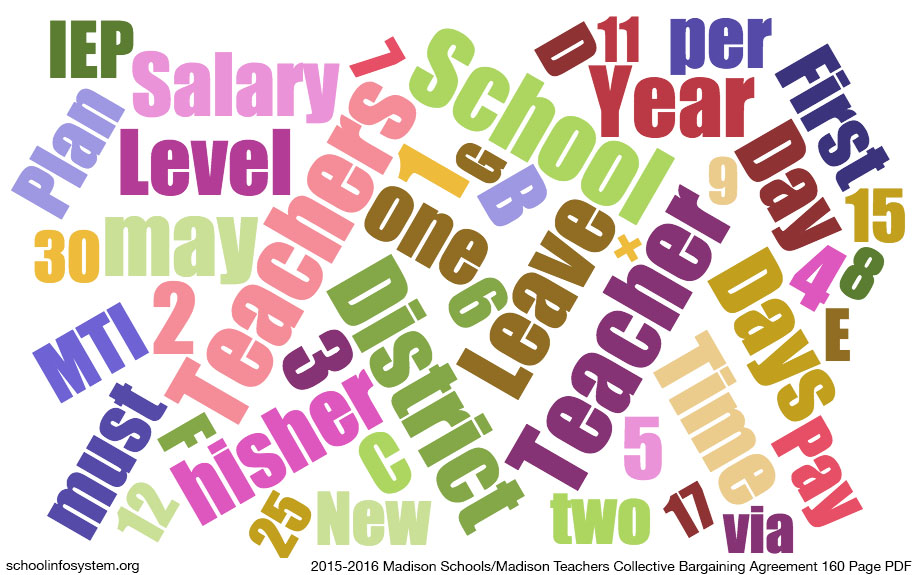
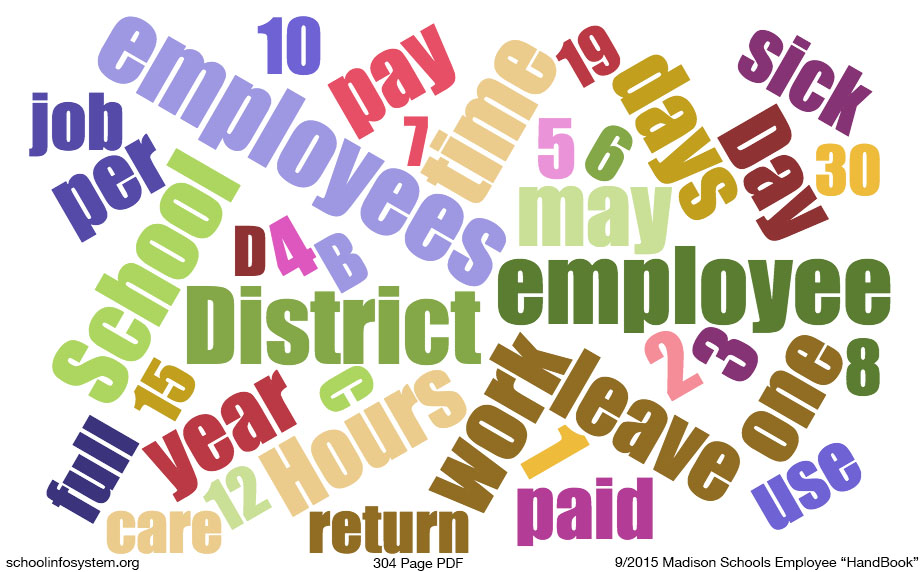
Work continues on the creation of an Employee Handbook to take effect once the Collective Bargaining Agreements expire in June, 2016. MTI-represented employees continue to be covered by Collective Bargaining Agreements through June 30, 2016. The Board of Education has approved a process for the development of the Employee Handbook which includes a joint Oversight Group composed of five (5) appointees by MTI, two (2) by AFSCME, one (1) by the Building Trades Council, three (3) building principals and up to five (5) other administrators. It was agreed in negotiations for the 2015-16 Contracts that the Collective Bargaining Agreements will serve as the foundation of the Handbook.

Share

Health Insurance premiums account for 16% of the Madison School District budget

Madison School District (PDF):

MMSD will spend $61 million on health insurance this year.

One of Every Six Dollars is Spent on Health Insurance in the MMSD budget.

Health Insurance premiums account for 16% of the MMSD budget.

Over 3,900 employees are enrolled in the MMSD plan

The MMSD plan design lacks common features that promote efficient utilization – the plan has no deductibles, no co-insurance requirements, and no employee premium contribution

Our multi-year claims experience (medical loss ratio) does not suggest that MMSD should expect less-than-market pricing

Medical trend (inflation) continues to grow at 7-8% annual increases (including 3-4% ACA fees)

Health insurance costs have long been an issue in the Madison Schools.

Share

US Ranked 35th In Math Achievement

Drew DeSilver:

Scientists and the general public have markedly different views on any number of topics, from evolution to climate change to genetically modified foods. But one thing both groups agree on is that science and math education in the U.S. leaves much to be desired.

In a new Pew Research Center report, only 29% of Americans rated their country’s K-12 education in science, technology, engineering and mathematics (known as STEM) as above average or the best in the world. Scientists were even more critical: A companion survey of members of the American Association for the Advancement of Science found that just 16% called U.S. K-12 STEM education the best or above average; 46%, in contrast, said K-12 STEM in the U.S. was below average.

Standardized test results appear to largely bear out those perceptions. While U.S. students are scoring higher on national math assessments than they did two decades ago (data from science tests are sketchier), they still rank around the middle of the pack in international comparisons, and behind many other advanced industrial nations.

Related: connected math.

Math task force.

What impact do high school mathematics curricula have on college-level mathematics placement

Share

Gendered Language in Teacher Reviews

Ben Schmidt:

This interactive chart lets you explore the words used to describe male and female teachers in about 14 million reviews from RateMyProfessor.com.

You can enter any other word (or two-word phrase) into the box below to see how it is split across gender and discipline: the x-axis gives how many times your term is used per million words of text (normalized against gender and field). You can also limit to just negative or positive reviews (based on the numeric ratings on the site). For some more background, see here.

Not all words have gender splits, but a surprising number do. Even things like pronouns are used quite differently by gender.

Share

In Mathematics, Mistakes Aren’t What They Used To Be

Siobhan Roberts:

Vladimir Voevodsky had no sooner sat himself down at the sparkling table, set for a dinner party at the illustrious Institute for Advanced Study in Princeton, New Jersey, than he overturned his empty wine glass, flipping bowl over stem and standing the glass on its rim—a signal to waiters that he would not be imbibing. He is not always so abstemious, but Voevodsky, that fall of 2013, was in the midst of some serious work.

Founded in 1930, the Institute has been called “the earthly temple of mathematical and theoretical physics,” and is a hub for all manner of rigorous intellectual inquiry. Einstein’s old house is around the corner. In the parking lot a car sports a nerdy bumper sticker reading, “Don’t Believe Everything You Think”—which might very well be aimed directly at Voevodsky. Because during the course of some professional soul-searching over the last decade or so, he’d come to the realization that a mathematician’s work is 5 percent creative insight and 95 percent self-verification. And this was only reinforced by a recent discovery around the time of the dinner party: He’d made a big mistake.

Share

Do Your Kids Hate Science?

Olivia:

Last week, a science teacher who had heard about the knowledge-led, mastery-focused curriculum at Michaela asked me, “do your kids hate Science yet?” On the same day, I attended a ‘knowledge versus skills’ science debate. The skills troops were gathered and I was offered an insight into the ideological battlefield. There was a real sense of dissatisfaction by how little their sevens’ loved Science. The troops seemed to agree that the reason why secondary school science does not inspire young minds is because there are not enough opportunities for discovery, creativity and awe-inspiring practicals.

I agreed that many science departments in secondary schools do not inspire young minds. However, this is because those departments do not have a high enough level of rigour in their curriculum at Key Stage Three. Even their lower ability pupils are not sufficiently challenged.
Quite frankly, science departments around the country patronise children. They do this by trying to get their children to be scientists and think like scientists. Ironically, by trying to treat the pupils like adult scientists, they end up patronising them by turning lessons into ‘playing grown-ups’. Even at Advanced Level, I did not think like a scientist. On starting out, even Aristotle did not think like a scientist. Instead, he was deeply influenced by his teacher, Plato. Aristotle’s work on geology, physics, metaphysics, psychology, biology and medicine were founded on the 20 years that he spent at Plato’s Academy, accumulating masses of knowledge and experience.

Share

Beating Newark’s odds, KIPP charter network is poised to expand

Julie O’Connor:

It is an unlikely place to see so many children celebrating college acceptance letters.

Here in the heart of Newark, a poor and violent city, sits a passage to another world. Just blocks from Barringer High School — where at least a dozen gangs recruit, cops break up fights with pepper spray, a girl was sexually assaulted and a boy stabbed to death — Newark Collegiate Academy is an oasis.

In a city where almost half the students don’t graduate, nearly all its kids finish, and a remarkable 95 percent of them go on to college.

This isn’t supposed to happen. The first rule of education in America is that poverty breeds failure. You can find 100 studies to show that. It’s normally true.

Share

Surge in US ‘brain-reading’ patents

BBC:

Fewer than 400 so-called neuro-technology patents a year had been filed in 2000-09, research company SharpBrains said. But that had doubled to 800 in 2010. And 1,600 such patents had been lodged in the US in 2014.

Research company Nielsen holds the most neuro-technology patents – with 100.
Microsoft holds 89 patents for software that can assess mental states.

The expansion into non-medical uses represented a dawn of the “pervasive neuro-technology age”, said SharpBrains chief executive Alvaro Fernandez.

“Neuro-tech has gone well beyond medicine, with non-medical corporations, often under the radar, developing neuro-technologies to enhance work and life,” he added.

Share

A Bitter Goodbye: Sweet Briar College Closes Its Doors

Jasmine Garsd:

For most college students May is a happy month: the senior class graduates and summer vacation beckons. But at Sweet Briar College, a women’s college in western Virginia, there’s little celebration this spring.

The board of directors says declining enrollment leaves them no choice: Classes ended this week for the year and forever.

Share

Bernie Sanders is wrong: College is not a right

Ryan Cooper:

Liberals care about higher education — a lot. It’s long been a top-tier issue of the left, from the construction of state universities decades ago to the Occupy Wall Street protests of this decade. So it’s no surprise that Democratic presidential candidate Bernie Sanders has made higher education policy a major plank in his left-wing primary challenge to Hillary Clinton.

Higher education ought to be considered a “right,” Sanders said in an interview with The Huffington Post. Similarly, he has previously argued for large increases in government tuition assistance. By upping federal aid by $18 billion, matched by states, all Americans could effectively have two years of free college at public universities across the nation.

Share

While billions are spent on new schools to boost literacy and growth, teaching standards lag behind

Amy Kazmin:

Yet in their zeal to build schools, and to encourage attendance with incentives such as free lunches, Indian policy makers have paid scant attention to what is taking place inside the new classrooms. There has been little serious national debate over how to teach fundamental skills effectively to millions of first-generation students.

“The government said let’s get children into school, we’ll worry about quality later, and we’ll worry about content of teaching later,” says Vimala Ramachandran, a professor at New Delhi’s National University of Educational Planning and Administration. “They separated the quantitative goals from what is happening inside the school.”

Ms Aiyar echoes that view: “The government focused entirely on getting schools to children and getting children into schools. It assumed the teaching-learning story would take care of itself.”

Some argue India’s low learning levels are the result of an “overambitious” national curriculum, which assumes all students will master reading in their first year of school, even if they come from “text-scarce” environments, with little or no prior exposure to written material. “By the end of grade 1, they are supposed to be done with reading,” says Ms Duflo. “It’s a complete fantasy.”

Madison, too, has long dealt with disastrous reading results.

.

Share

Debt hangover ruins the American dream

Gillian Tett:

But there is one glaring exception to this trend: student debt. Over the past decade, the level of outstanding student debt has almost tripled to $1.3tn.

And although the law makes it relatively hard to walk away from student debt, defaults are also strikingly high. There are many ways to measure this figure but the Department of Education reports that Americans who were due to start repaying their student debts in 2011 had a 13.7 per cent default rate last year. This is a touch lower than the previous year (14.7 per cent) but dramatically higher than it had been since the mid-1990s; and it is higher than the credit card default rate.

This figure may understate the problem, however. The Treasury Borrowing Advisory Committee released a report late last year which suggests that actual defaults (using its data) were just 9 per cent but the “shadow” default rate — the debt “delinquencies” that are not fully reported — could be 23 per cent. Other economists have similar estimates.

Share

18% of US 8th Graders Proficient in US history….

Nations Report Card:

Nationally, eighth graders’ average scores on the NAEP U.S. history, geography, and civics assessments showed no significant change in 2014, compared to 2010—the last assessment year. However, several student groups have made gains. In 2014, eighteen percent of eighth-graders performed at or above the Proficient level in U.S. history, 27 percent performed at or above the Proficient level in geography, and 23 percent performed at or above the Proficient level in civics. Students performing at or above the Proficient level on NAEP assessments demonstrate solid academic performance and competency over challenging subject matter.

This interactive report presents average score and achievement level results of the nation’s eighth-grade students by gender, race/ethnicity, parental education levels, and other student groups. The report also describes classroom practices and students’ attitudes regarding these subjects, and features sample questions and student performance on those questions. Below is an overview of the results and the assessment content for the 2014 U.S. history, geography, and civics assessments.

Share

Families Just Settled the Education Debate

Alex Hernandez:

The families of 21,000 New York City students applied for 1,000 openings at public charter schools run by the nonprofit Achievement First. And 22,000 students hoped to land one of 2,300 slots at Success Academy Charter Schools.

During school enrollment season, families are telling school districts exactly which public schools they want their children to attend. To paraphrase former NBA player Rasheed Wallace, “[school choice] don’t lie.”

Share

John Oliver – This Moment in History Requires a Bigger Vision Than That Of Privileged Anti-Testers

Marianne Lombardo:

Baltimore burned because black people’s lives are devalued by systematic, institutionalized unfairness in the justice, economic, and education systems. Anger is the manifestation of despair. The Telegraph writes “While black men of all economic backgrounds face many pressures, those without hope for economic opportunity are the most likely to explode.”

Earlier today, I read the story of Tamir Rice’s mother moving into a homeless shelter

(Tamir Rice was the 12 year-old killed by a police officer for playing with a toy guy in a Cleveland park). You can’t believe there’s going to be another life taken or another mother’s heartbreak, and then there is.

Share

The 25 Hottest Skills That Got People Hired in 2014

Spahn Murthy:

Believe it or not, 2014 is almost over and 2015 is right around the corner. With a new year comes new opportunities, and around this time we at LinkedIn are typically asked the following question: “Who’s getting hired and what are they doing?”

To get to an answer, we analyzed the skills and experience data in over 330 million LinkedIn member profiles. If your skills fit one of the categories below, there’s a good chance you either started a new job or garnered the interest of a recruiter in the past year.

Share

A Message To Our Teachers

Eva Moskowitz:

Teaching is everything. You build relationships, you inspire, you draw out human potential. There is no more important job or work than teaching and learning!
While this week is Teacher Appreciation Week, in my mind, every day is teacher appreciation day.
As the leader of this organization, I appreciate you; as a parent and as a Success Academy parent, as an educator, I appreciate all that you do!

I appreciate your hard work. I appreciate your high expectations. I appreciate the demands you make of our scholars. I appreciate the joy you infuse into your classrooms and how nurturing you are. I appreciate your willingness to collaborate and be school teachers rather than classroom teachers. I appreciate how invested you are in the whole child, in discovery-oriented science, conceptual math, and great critical and creative thinking!

Share

Education Standards Rhetoric: “We Cannot Fix What We Cannot Measure”

Laura Waters:

I’ve been really good about not quoting Diane Ravitch, but I’m off the wagon. In a recent blog post she demeans national civil and human rights groups who are working hard to help the U.S. Senate understand the necessity of maintaining ESEA’s mandate of annual standardized testing. As these groups explained in a press release today, “we cannot fix what we cannot measure.”

We all know this. We know that the achievement gap between poor children and wealthier children, between whites and blacks, between children with and without disabilities, was only revealed through states’ analyses of disaggregated data from annual standardized tests.

Share

Colleges Respond to Racist Incidents as if Their Chief Worry Is Bad PR, Studies Find

Peter Schmidt:

College administrations react to hate crimes, hate speech, and other high-profile incidents of bias by focusing mainly on repairing their institution’s reputation, two new studies conclude.

The administrations’ responses generally paper over underlying prejudices in the campus culture, leaving the victims at risk of further harm in the future, argue the researchers, who presented the studies’ findings on Monday in Chicago, at the annual conference of the American Educational Research Association.

“College presidents are willing to address the racist but rarely the racism,” says a paper summarizing one of the studies, based on a rhetorical analysis of presidents’ statements in response to bias incidents.

Share

For-Profit Schools Get Bailed Out, Students Get Sold Out?

Bull Market

When the subprime crisis hit, Congress agreed to bailout the financial industry only after they were promised homeowners would see relief, too. But in the years since, it’s become clear even to Tim Geithner, the architect of the bailouts, that while the Administration went out of its way to save the arsonists of the crisis, the people burned by it were left without an Emergency Room.

Today, history risks repeating itself, as students scammed by a predatory for-profit school have yet to see meaningful relief — even as the school itself was bailed out by the government. And just as in the foreclosure crisis, the very entity in charge of providing relief to victimized borrowers has a financial incentive to leave them screwed.

Share

Is Montessori The Origin Of Google & Amazon?

Steve Denning:

There was considerable interest in the Wall Street Journal article by Peter Sims, author of Little Bets: How Breakthrough Ideas Emerge from Small Discoveries (Free Press, 2011) about the possibility of a “Montessori Mafia”, given that the Montessori approach has spawned a creative elite, including Google’s founders Larry Page and Sergei Brin, Amazon’s Jeff Bezos, videogame pioneer Will Wright, Wikipedia founder Jimmy Wales, cook Julia Child and rapper Sean “P.Diddy” Combs.

The Montessori learning method establishes a collaborative environment without grades or tests, multi-aged classrooms, as well as self-directed learning and discovery for long blocks of time.

Montessori methods go against the grain of traditional educational methods but they have uncanny parallels in the success of their alumni:

Share

The Big Problem With The New SAT

Richard Atkinson & Saul Geiser:

AT first glance, the College Board’s revised SAT seems a radical departure from the test’s original focus on students’ general ability or aptitude. Set to debut a year from now, in the spring of 2016, the exam will require students to demonstrate in-depth knowledge of subjects they study in school.

The revised SAT takes some important, if partial, steps toward becoming a test of curriculum mastery. In place of the infamously tricky, puzzle-type items, the exam will be a more straightforward test of material that students encounter in the classroom. The essay, rather than rewarding sheer verbosity, will require students to provide evidence in support of their arguments and will be graded on both analysis and writing. Vocabulary will move away from the obscure language for which the SAT is noted, instead emphasizing words commonly used in college and the workplace.

Share

Lexical Distance Among Languages of Europe 2015

Reddit:

The distance of Maltese and Arabic seems greatly overestimated. The distance between Italian and Maltese is certainly underestimated, and the lack of correlation with English is baffling considering that almost a third of words in every day speech of the Maltese are English loanwords (that are now fully incorporated into the language).

The lexical distance between Polish and Ukrainian seems overestimated, but then I am no expert so I cannot confirm this. Also as was mentioned in the previous thread, I find it very unusual that the correlation between West Slavic (Polish, Czech) and German languages was not explored, especially considering how many common words in these languages are of full German origin.

Share

Dear Superprofessors: The experiment is over.

Jonathan Rees:

Now that it’s in Arizona State’s financial interest to accept as much MOOC credit as possible, all prior restraint will disappear. Indeed, now that the cat is out of the bag, look for more schools to become predator universities any day now.

What this means for you superprofessors is that your time to “experiment” is now over. Whether you like it or not, people will soon be giving credit for your MOOCs to the exclusion of courses taught by living, breathing faculty all around the world. I think this gives you two options:

a) Explain exactly why your video lectures and computer algorithms are pedagogically superior to actual human beings with PhDs. Or

b) Get out of the MOOC business altogether.

Share

States Are Required to Educate Students Behind Bars. Here’s What Really Happens.

Molly Knefel:

When he was young, Cadeem Gibbs was really into school. Bright, curious, and naturally rebellious, he enjoyed arguing the opposing point of view in a classroom discussion just to see how well he could do it. “I was always academically inclined,” says the Harlem native, now 24. “I always wanted to learn.”

But there were plenty of stressors in his young life—a violent upbringing, a household in poverty—and the struggle to navigate them pulled him away from his education. He started getting into trouble and ended up in the juvenile justice system at the age of 12. That first contact with “the system” began a 10-year cycle of incarceration that ended only when Gibbs was released from an upstate New York prison two years ago, at the age of 22. He was just a sixth grader when first arrested, but he would never complete a school year as a free child again.

Americans believe that education is the great equalizer, the key that opens the door to a better future and lifts young people out of poverty. And this is true, to an extent—those who finish high school or college have lower unemployment rates and higher incomes than those who don’t. But while people who don’t complete their education are more likely to stay in poverty, they’re also more likely to come from poverty. In the 21st century, so-called reformers have emerged to prescribe everything from charter schools to iPads in order to boost poor students’ educational achievements.

Share

A Letter To My Children: What It Means to Be a Teacher

Sarah Brown Weisling:

Dear Evan, Lauren, and Zachary,

Many (many) years ago, there was this little girl who spent her summer afternoons creating neighborhood schools for all of the children on her block. She mimicked what school looked like to her: rows of desks, questions and answers, praise and encouragement from the teacher, stickers and stars on the top of “assignments.” She imagined what it would be like to free an idea in someone else’s mind. She was crestfallen when the game of tag pulled her “students” away all too soon in the afternoon. She would wake up early and try to think about how to make learning fun.

What I want you to know is that there are things in this world that you will choose, and there are things in this world that will choose you. That little girl was meant to be a teacher. Although it would take her years to recognize it, that meant you would, by default, know the life of a teacher.

Sometimes I wonder how you feel about this. Sure, there are parts of it you love: hanging out in mom’s classroom, feeling like little celebrities when my students see you at the grocery store. But there’s also the Saturday afternoons I’ve spent grading papers when you’re outside playing, or the dry cereal in to-go bags some mornings when I’ve already been up for hours trying to finish responding to that stack of papers.

Share

Names of the chemical elements in Chinese

Victor Mair:

The first thing we may say about the names of the chemical elements in Chinese is that every single one of them is monosyllabic. This actually causes great problems for Chinese chemists and other scientists, as well as the lay public, since there are so many homophones and near-homophones among them and with other monosyllabic words not on the list. Listening to a lecture or holding discussions that mention chemical elements and hearing the elements referred to by these monosyllabic names is challenging, to say the least. They just don’t stand out the way, say, “chlorine” and “hydrogen” do.

The vast majority of the Chinese characters for the elements contain the “gold / metal” radical 金. Next in number are characters that contain the “gas / vapor” radical 气. After that comes a smaller group of characters containing the “stone / rock” radical 石. Last, there are two characters that contain the water radical 氵/ 水: xiù 溴 (“bromine”) and gǒng 汞 (“mercury”). In terms of the classification of the elements by state (solid, liquid, gas, unknown) and type (metals [alkali metals, alkaline earth metals, lanthanoids, actinoids, transition metals, post-transition metals], nonmetals [halogens, noble gases, other nonmentals]), and metalloids, the division (according to character radicals) into metal, gas, stone, and water is not accurate.

Only a few of the characters for the elements existed in premodern times (e.g., those for “silver”, “copper”, “iron”, “tin”, “gold”, “lead”, “mercury”, “carbon”, “boron”, and “sulfur”). Most of the characters for elements that were isolated during the Industrial Age or discovered more recently have had to be invented from scratch to transcribe the sound of the initial part of the name of the element in Western languages. These characters serve no other purpose than to designate the elements in question, and a number of them do not exist in electronic fonts. Unicode strives to add these newly created characters to the higher levels of its latest versions, but there is always naturally going to be a time lag between the creation of new characters and the time they are actually implemented in Unicode. In addition, as more and more new elements are being discovered, chemists in China, Taiwan, and elsewhere have not yet devised any character for several of them. And that brings up the matter of multiple characters for the same elements and multiple readings for the same characters in Taiwan and China (see the list below).

Share

Inside The School Silicon Valley thinks will Save Education

Issie Lapowsky:

On one side of the glass is a cheery little scene, with two teachers leading two different middle school lessons on opposite ends of the room. But on the other side is something altogether unusual: an airy and open office with vaulted ceilings, sunlight streaming onto low-slung couches, and rows of hoodie-wearing employees typing away on their computers while munching on free snacks from the kitchen. And while you can’t quite be sure, you think that might be a robot on wheels roaming about.

Then there’s the guy who’s standing at the front of the conference room, the school’s founder. Dressed in the San Francisco standard issue t-shirt and jeans, he’s unlike any school administrator you’ve ever met. But the more he talks about how this school uses technology to enhance and individualize education, the more you start to like what he has to say.

And so, if you are truly fed up with the school status quo and have $20,875 to spare (it’s pricey, sure, but cheaper than the other private schools you’ve seen), you might decide to take a chance and sign your 7-year-old up for this little experiment in education called AltSchool. Except it’s not really so little anymore. And it’s about to get a lot bigger.

Share

An Atlas of Upward Mobility Shows Paths Out of Poverty

David Leonhardt, Amanda Cox & Claire Cain Miller:

In the wake of the Los Angeles riots more than 20 years ago, Congress created an anti-poverty experiment called Moving to Opportunity. It gave vouchers to help poor families move to better neighborhoods and awarded them on a random basis, so researchers could study the effects.

The results were deeply disappointing. Parents who received the vouchers did not seem to earn more in later years than otherwise similar adults, and children did not seem to do better in school. The program’s apparent failure has haunted social scientists and policy makers, making poverty seem all the more intractable.

Share

The president wants to zero out a program that is saving poor kids from bad schools—the kind of reform that could work in Baltimore too.

Stephen Moore

The scenes of Baltimore set ablaze this week have many Americans thinking: What can be done to rescue families trapped in an inner-city culture of violence, despair and joblessness?

There are no easy answers, but down the road from Baltimore in Washington, D.C., an education program is giving children in poor neighborhoods a big lift up. The D.C. Opportunity Scholarship Program, which George W. Bush signed into law in 2004, has so far funded private-school tuition for nearly 5,000 students, 95% of whom are African-American. They attend religious schools, music and arts schools, even elite college-prep schools. Last month at the Heritage Foundation in Washington, I met with about 20 parents and children who participate in the program. I also visited several of these families in their homes—which are located in some of the most beaten-down neighborhoods in the city, places that in many ways resemble the trouble spots in Baltimore.

Share

Most People in the World Have No Idea How to Manage Their Money

Moises Naim:

Do you understand money? Let’s see how well you do with the following questions.

1. Suppose you had $100 in a savings account and the interest rate was 2 percent per year. After five years, how much do you think you would have in the account if you left the money to grow? A) more than $102; B) exactly $102; C) less than $102; D) do not know; refuse to answer.

2. Imagine that the interest rate on your savings account is 1 percent per year and inflation is 2 percent per year. After one year, would you be able to buy A) more than, B) exactly the same as, or C) less than today with the money in this account?; D) do not know; refuse to answer.

3. Do you think that the following statement is true or false? “Buying a single company stock usually provides a safer return than a stock mutual fund.” A) true; B) false; C) do not know; refuse to answer.

The correct answers are 1-A; 2-C; and 3-B.

Share

Do SAT Prep Courses Help Test Takers?

Jo Craven McGinty:

Academic researchers have repeatedly tried to determine whether coaching improves SAT scores. It is a difficult question to answer objectively because of the confounding variables.

Highly motivated students—like those who sign up for test-prep courses—are likely to improve no matter what. Just taking the test again often raises scores. And it is hard to distinguish the effects of test prep from other factors that may contribute to a better score.

Still, different studies over the years have suggested coaching tends to improve performance, though perhaps less dramatically than some test-prep companies suggest as researchers have found some improvement was likely to occur without coaching.

“The mythology is that students who are scoring in the 500s will get into the 750 range,” said Derek Briggs, a professor at the University of Colorado School of Education who has studied the effects of test preparation. “A realistic bump from commercial test prep might be about 20 to 30 points on math and verbal sections combined, but that’s on top of whatever baseline increase we’d expect of students who do everything except get commercial test prep.”

Share

A world of difference: the global challenge of rising inequality

Martin Wolf:

Bourguignon makes clear that this is a global concern. “After a significant decline in the mid-20th century, followed by a long period of stability, inequality has begun to rise over the last two or three decades in the large majority of developed countries.” he writes. “It has also risen in a number of developing countries for which we have long-term data. This phenomenon is therefore not isolated to a few cases, such as the oft-cited examples of the United States and China.”

Yet, while inequality in the distribution of incomes has risen in most high-income countries, the scale of that increase varies. Atkinson notes that the US and UK have experienced exceptionally large rises in inequality since 1980. Italy, the Netherlands, Canada, Japan and Germany have experienced far smaller rises. France has even experienced a small reduction. The forces driving the increase in inequality in the high-income countries are strong, but cannot be overwhelming. This conclusion is supported by the fact that levels of inequality are also divergent: relatively low in the Nordic countries, far higher in the UK and US, but also in Italy and Japan, with France and Germany in between.

Share

Forget Harvard: Here’s Where To Go To College If You Want A High-Paying Job

Fast Company:

Want a prestigious education? Harvard, Yale, and Princeton are the way to go. But if you’re looking for a high-paying career after graduation, you may want to look elsewhere.

A new study from the the Brookings Metropolitan Policy Program ranks two- and four-year colleges based on economic outcomes for graduates—and none of the Ivy League even makes it to the top 10 for the four-year institutions. This is the data that the U.S. News and World Report rankings won’t tell you.

Some of the major findings: Schools with high completion rates and good financial aid are linked to better economic outcomes. And schools with lots of students in STEM majors (like computer science and engineering), as well as majors with paths to higher paying careers in business and health care, also have superior financial payback.

Share

“in both professions, unions have consistently exploited that sympathy to protect failed policies and incompetent personnel.”

Ross Douthat

In an irony typical of politics, then, the right’s intellectual critique of public-sector unions is illustrated by the ease with which police unions have bridled and ridden actual right-wing politicians. Which in turn has left those unions in a politically enviable position, insulated from any real pressure to reform.

Yet reform is what they need. There are many similarities between police officers and teachers: Both belong to professions filled with heroic and dedicated public servants, and both enjoy deep reservoirs of public sympathy as a result. But in both professions, unions have consistently exploited that sympathy to protect failed policies and incompetent personnel.

A focus on “adult employment“.

Share

It’s time to stop underestimating our students

Chris Hayes:

But my students are excited every time we read about new things. They use the rich vocabulary they are hearing, and they have unbelievable discussions and heated debates on a daily basis. I hear questions like, “Mrs. Hayes, why was it called the Trail of Tears when pioneers died on the Oregon Trail, too?” to which one student named Andrew responds, “Because the pioneers chose to move west, but the Cherokee were forced to go.” This same Andrew, who reads just barely on a second grade level, chose to read further about the Civil War and showed me where he found examples of historical notices posted in Boston warning runaway slaves of slave-catchers in the area.

I have never seen such a spark in all of my 20 years as an educator in Washoe County. The students are excited about learning, are pushing themselves to read complex text, and are so proud of what they know. And they are hungry for more.

Share

Madison Staffing Per School

Rather interesting data from the District’s latest $413,703,424 2015-2016 budget document.

The budget document includes total spending and a good amount of detail.

Tap for a larger view.

Van Hise and Hamilton are Madison’s least diverse schools, yet the District plans to expand their facilities. The staffing differences are rather illuminating, particularly when one considers the effectiveness of increased adult counts…

A PDF version is also available. The District document includes a few per school spending data points. It would be useful to see total spending per school.

Share

A Value Added Approach to Assessing 2 and 4 Year Colleges

Brookings:

The choice of college is among the most important investment decisions individuals and families make, yet people know little about how institutions of higher learning compare along important dimensions of quality. This is especially true for colleges granting credentials of two years or less, which graduate two out of five postsecondary graduates. Moreover, popular rankings from U.S. News, Forbes, and Money focus only on a small fraction of four-year colleges and tend to reward highly selective institutions over those that may contribute the most to student success.

Drawing on government and private sources, this report analyzes college “value-added,” the difference between actual alumni outcomes (like salaries) and the outcomes one would expect given a student’s characteristics and the type of institution. Value-added captures the benefits that accrue from aspects of college quality we can measure, such as graduation rates and the market value of the skills a college teaches, as well as aspects we can’t.

The value-added measures introduced here improve on conventional rankings in several ways. They are available for a much larger number of schools; they focus on the factors that best predict measurable economic outcomes; and they attempt to isolate the effect colleges themselves have on those outcomes, above and beyond what students’ backgrounds would predict.

Share

Teacher goes extra mile on three R’s: reading, writing — rescue

Jim Stingl:

The way they see it, Sebastian Flynn and his second-grade teacher Debbie Groth are connected forever.

Saving someone’s life will do that.

A routine morning this week in Mrs. Groth’s classroom at Pershing Elementary School in West Milwaukee turned terrifying when Sebastian choked on a cracker during snack time. He couldn’t speak or breathe. The boy’s friend, Danny, noticed this and alerted the teacher.

After calling the office about the emergency, she spoke to the 7-year-old and explained she would get behind him and try to dislodge the cracker with the Heimlich maneuver. It was something she learned years ago and never had to use during her 18 years as a teacher.

She made a fist and pulled in and up just below the boy’s rib cage. Nothing happened.

“I’m going, ‘Oh my gosh, Debbie, you have to save this kid. You have to save this kid.’ I did it a second time. Nothing.”

Sixteen other students in Room 206 nervously watched, and a few ran into the hallway to summon more help.

“I know you’ve only got seconds, all that time with the oxygen not going to his brain. So I’m freaking out, but they don’t know that because I’m just in the zone. It’s all the adrenaline,” Mrs. Groth said.

Finally, on the third thrust, the cracker popped out.

Share

Grafton educator goes all out for kids with disabilities

Alan Borsuk:

Recently, Pledl, who has the title of “school to life coordinator” at Grafton High, also has put a lot of that energy and enthusiasm into an idea that could lead to more kids with substantial disabilities statewide having opportunities for transitioning from school to positive situations in life, particularly involving work.

In the enormous and complex work of creating a state budget for the next two years, the plan Pledl has been supporting is a relatively small matter. It’s a good example of the many programs and proposals that usually attract little, if any, attention, but which could have impact on people’s lives.

The budget process will move into a crucial stage in the next several days with the release of updated forecasts for state revenue. What gets put into and left out, what gets changed from Gov. Scott Walker’s budget proposal of three months ago, and who wins and loses in the end will be affected by how much money is forecast to be available. Indications last week were that the new estimate is not going to offer the rosy increases all sorts of people have been hoping for.

Where will that leave increased support for the idea Pledl is promoting?

Pledl has already accomplished a lot more than I would have bet. He’s been a car salesman and, yes, a football coach and he’s good at winning people over. As Mel Lightner, superintendent of the Grafton School District says, a lot of educators are not good sales people for ideas that open doors for their students. But as for Pledl, Lightner says, “He’s a salesman.” And he really wants to open doors for his students.

Share

The Most Diverse Cities Are Often The Most Segregated

Nate Silver:

When I was a freshman at the University of Chicago in 1996, I heard the same thing again and again: Do not leave the boundaries of Hyde Park. Do not go north of 47th Street. Do not go south of 61st Street. Do not go west of Cottage Grove Avenue. 1

These boundaries were fairly explicit, almost to the point of being an official university policy. The campus police department was not committed to protecting students beyond the area,2 and the campus safety brochure advised students not to use the “El” train stops just a couple of blocks beyond them unless “traveling in groups and during the daytime.”

What usually wasn’t said — on a campus that brags about the diversity of its urban setting but where only about 5 percent of students are black — was that the neighborhoods beyond these boundaries were overwhelmingly black and poor. The U. of C. has, for many decades, treated Hyde Park as its “fortress on the South Side,” and its legacy of trying to keep its students within the neighborhood — and the black residents of surrounding communities out — has left its mark on Chicago.

Related: the expansion of Madison’s least diverse schools, despite long term disastrous reading results and the rejection of the proposed Madison Preparatory IB charter school.

Share

Dear Student: No, I Won’t Change the Grade You Deserve

Stacey Patton:

When that happens, one thing becomes clear: Their feelings about the quality of their work often don’t match the reality of their performance. Instead of seeing their grades as a reflection of how well they interpreted or executed their assignments, some students will come to a different conclusion: The assignment was too difficult. Or my professor doesn’t get me.

For many professors—especially faculty without tenure or the job security that comes with it—this poses a problem. Pleas to re-evaluate work can draw professors into annoying confrontations—or force them to explain the mechanics of grading to students, and sometimes angry parents, department chairs, or deans.

So I decided to ask a few professors, a learning consultant, and a graduate student how they would respond to these requests. Let’s say a student who received a C grade on a paper asks you to reread it and change their grade because they “worked so hard on it.” How would you respond?

Share

Why You Should Care About the Rising Cost of College

Rick Reider:

4 reasons college costs & student debt are a major headwind to U.S. recovery

1 Contributing to unemployment and declining labor market participation

Due to the heavy financial burden college costs place on parents, many parents struggling to pay for their children’s education are left with less savings and more debt when they hit retirement age than they might otherwise have had. As a result, they’re forced to stay in the workforce longer, crowding out younger workers and making it harder for the younger generation to find jobs. In other words, the rising cost of college is one reason for the demographic-related headwinds facing the labor market today.

2 Stymieing savings

By some estimates, more than half of college students now borrow annually to cover the costs of education, and more than half of student loan borrowers still have outstanding debt balances into their 30s. This early-life debt means that the younger generation has less money to save–significant student debt lowers the average savings rate for young workers–and will likely have to work longer to cover future children’s college costs.

3 Suppressing home buying

Today, the first-time home buyer demographic is synonymous with student loan borrowers, posing a major headwind to recoveries in the lackluster housing market and in real estate-related employment. Thanks to high-interest student loan debt payments, along with disappointing employment opportunities and stagnant incomes, many young adults don’t have the savings required to make a down payment. Indeed, the proliferation of student loans in the early 2000s coincides with a decline in home ownership rates of 25 to 34 year olds, and the trend appears to be continuing. According to one recent report, rising student debt burdens reduced U.S. home sales by about 8% in 2014.

4 Worsening the class divide

Share

Three Beijing International School Teens Detained in Drug Investigation

Beijinger:

Three students from one of Beijing’s major international schools have been detained by police in an ongoing drug investigation over the past week, our sister magazine beijingkids has learned. In total eight students from the school were questioned, and five released.

According to an official school announcement sent to school parents Monday, four students, three seniors and one junior, were detained late Friday night at a private residence in the Beijing Riviera villa compound for alleged involvement with marijuana.

One teenager from the Friday night raid has been released while the remaining three are still in police custody. A videotape of the raid appeared on BTV and shows the police entering the residence to discover the four teens in the dark and their parents upstairs.

Share

Are E-Books Good for Kids?

Sara Yu

On Thursday President Obama announced a plan to make $250 million worth of e-books available to public libraries as part of an effort to expand literacy and “digital connectivity” among low-income students. He spoke to Washington, D.C., students about his personal fondness for print books but stressed the importance of keeping up with technological advances.

Parents often ask me if it’s okay for their children to read on an iPad, Kindle, or other type of e-reader. New opinion polls and studies about e-reading come out every few months, and it seems like everyone has an opinion about this relatively new technology.
There are lots of reasons why e-books are more convenient than print books – weight, storage space, instant accessibility – but I’m going to lay aside those practical concerns for now and focus on what’s best for kids. And I’m going to be completely forthright here: This is new technology, and we’re still figuring it out. As we learn more about how kids read, we’ll adjust our teaching practice to make sure we’re meeting kids’ needs.

Share

Commentary and Charts on Madison’s $413,703,424 Planned 2015-2016 Budget

Notes and charts from the Districts’ most recent 2015-2016 budget document (5MB PDF):

Our 25,364 students are served by 4,076 Teachers & Staff (6.22 students per District employee).

Salaries and Wages
For 2015-16, MMSD has collective bargaining agreements in place with its represented employee groups, including teachers, aides, clerical, and custodial staff. The teachers’ collective bargaining agreement is based on a traditional salary schedule, including compensation components for additional years of service (step movement) and additional professional development (lane movement). In addition,

the Board approved an increase of 0.25% per cell for all teachers (cell increase). Together, the additional compensation for step movement and cell increases provides an average increase of 1.75% to employees, plus a reserve for lane changes of $400,000, for a combined budgetary impact of $4.5 million on district salaries. This budget proposal includes funding for these wage and salary commitments. MMSD’s other employee groups will experience similar increases in compensation.
Health Insurance

MMSD offers an attractive employee benefits plan to its employees. The district spends over $61 million per year on health insurance premiums, which is approximately 15% of the total district budget. Each year, the risk of rising health care costs creates significant budget uncertainty for the district: each one percent increase in health insurance rates costs MMSD about $610,000. The implementation of the Affordable Care Act brings additional fees and responsibilities for employers, including the requirement to offer affordable and valuable coverage to all employees who work 30 or more hours per week, starting July 1, 2015. Although the exact impact of this requirement is not yet known, MMSD could be required to provide coverage to approximately 120 employees not currently eligible for health insurance benefits.
The district contracts for health insurance with three Madison area HMOs. Group Health Cooperative (GHC) has covers approximately 60% of MMSD employees, while Dean and Unity each cover approximately 20%. Negotiations are continuing for July 1, 2015 rate renewals. The district, in collaboration with employee representatives, are working to minimize the budget impact for 2015-16. An update on the current status of health insurance rate renewals will be presented to the Board in May.

This year, MMSD launched its employee wellness program, which was developed with the input of the employee unions. A team representing a broad spectrum of employees has been selected to design the program activities and support district wellness. In addition, employees are asked to sign up for biometric screenings and health risk assessments, which will provide information that can be used to develop programs that meet the needs of MMSD employees and help curb long-term health care cost increases.

Mitch Henck Comments on Madison’s Spending and Tax Practices:

Share

Mom Says School Wouldn’t Let Daughter Finish Lunch Because It Was Not ‘Nutritious’

16 News:

Dear Parents, it is very important that all students have a nutritious lunch. This is a public school setting and all children are required to have a fruit, a vegetable and a healthy snack from home, along with a milk. If they have potatoes, the child will also need bread to go along with it. Lunchables, chips, fruit snacks, and peanut butter are not considered to be a healthy snack. This is a very important part of our program and we need everyone’s participation.

Share

Mixing Work and Social Media

Madison Teachers, Inc. Newsletter, via a kind Jeanie Kamholtz email (PDF):

It is important for all to review the District’s social media policy before using electronic media to interact with families, students, colleagues and/or the general public. The District policy permits communication with parents and students via District-sanctioned electronic media and accounts, and cautions against interacting on your personal social media accounts or cell phones. Comments you make on Facebook, Twitter or other social media accounts that can be tracked to your work as a teacher or educational support staff can become problematic if they reflect poorly on the District or use unauthorized copies of students’ work, pictures or comments.

The policy contains the following phrase: Be advised that failure to adhere to these guidelines may result in disciplinary action. MTI strongly encourages members to review the policy and contact MTI with any questions or concerns.

www.madison.k12.wi.us/social-media-guidelines

Share

Study: Far fewer new teachers are leaving the profession than previously thought

Emma Brown:

New teachers are far less likely to leave the profession than previously thought, according to federal data released Thursday.

Ten percent of teachers who began their careers in 2007-2008 left teaching after their first year, according to the National Center for Education Statistics. But attrition then leveled off, and five years into their careers, 83 percent were still teaching.

That figure — indicating that just 17 percent of new teachers left their jobs in the first five years — stands in stark contrast to the attrition statistic that has been repeated (and lamented) for years: That between 40 percent and 50 percent of teachers leave the profession within their first five years.

The higher estimate, which has become a fixture in education debates, comes from the work of Richard Ingersoll, a professor at the University of Pennsylvania and a leading scholar on the nation’s teacher workforce.

Share

Outschooling in the Bay Area

Amir:

Homeschooling is interesting because, if some new approach is going to disrupt the current education system and change it radically for the better, it seems likely it would come from outside the system.

By necessity, parents who homeschool must try new approaches in order to find something that works for their child. With 1.77M homeschooled students in the US – 3.4% of the school-aged population – this is the community where experimentation / iteration amongst educational approaches is happening the fastest. As a result the future of education is likely to come out of this community.

Yet it is an overlooked community. For various reasons, the mainstream regard homeschooling as a niche approach suitable only for the weird or the wealthy. That’s a prejudice that doesn’t reflect the reality of the growing movement I’ve observed in the Bay Area.

Share

Impasse breached, Oconomowoc school district announces pay plan

Donna Frake:

After announcing it had reached an impasse in negotiations with the Oconomowoc Education Association, the Oconomowoc Area School District School Board approved a new contract for teachers for the 2015-16 school year.

The new compensation model approved in January this year, sets pay ranges, or bands, at five levels, each with more requirements for leadership, school and districtwide involvement and education, as well as a corresponding higher pay range.

According to the school district, the Consumer Price Index (CPI) currently in effect for base wage bargaining is 1.62 percent. In order to transition into the new compensation model, rather than cap the proposal at that rate, the district offered a 3.1 percent increase in the form of discretionary pay.

This offer allows all educators to receive a pay increase for 2015-16 in one of three methods, depending upon how each educator’s 2014-15 salary compares to the placement band salary range.

Share

Stakes for “high-stakes” tests are actually pretty low

LILLIAN MONGEAU, EMMANUEL FELTON and SARAH BUTRYMOWICZ

Of the 21 states that plan to use the tests as part of teacher evaluations in the future, many have already specified that the score will count for only a percentage of the evaluation. For example, Wyoming plans to use test scores as 20 percent of teacher evaluations starting in 2020.

Related: Will test-based teacher evaluations derail Common Core?
Minnich, who describes himself as part of the “moderate middle” on testing and Common Core, said that the important message for students was that while the tests are important for adults to know how a class is doing, there’s no need to stress about the results. He admitted that the task of finding the right balance in delivering that message is not easy.

As for teachers, Minnich hopes that they can continue to be part of an ongoing conversation about the best way to use measures of student learning in evaluations. He said his members – the country’s state superintendents – were more or in agreement on the benefit of using scores as one of several teacher performance measures.
All of which is to say, yes, the tests are important. Decisions will be made based on how students perform on them. But the vast majority of states will use the scores only as one measure in a web of other factors when making staffing decisions. And most states have no plans to use the scores to make student advancement decisions.

Share

Will These New Apps Boost Your Baby’s Brain Health?

Anica John:

I’m seven months along with my first child and feeling inundated with information and advice on baby products.

It’s no wonder, because registering for a baby shower can be daunting. I found myself stunned by the sheer volume of strollers and car seats (which, when put together are billed as “travel systems”), cribs and hundreds of other baby products.

Alongside these staples, I’m evaluating a new wave of devices that can now gather important health and wellness data about your baby.

Share

Trigger Warning: College Kids Are Human Veal

Nick Gillespie:

Abetted by idiot administrators, today’s students seem incapable of living in the real world.

Every time we seem to have reached peak insanity when it comes to the intellectually constipated and socially stultifying atmosphere on today’s college campuses, some new story manages to reveal vast new and untapped reservoirs of ridiculousness. In a world of trigger warnings, microaggressions, and official apologies featuring misgendered pronouns that start a whole new round of accusations, wonders never cease.

So when ’60s-radical-turned-Reagan-fanboy David Horowitz shows up at University of North Carolina to equate Islam with terrorism for the thousandth time, the student body gets the vapors, tries to shut him down, and creates the hashtag #notsafeUNC.

When a student publication prints a story called “So You Want to Date a Teaching Assistant?” in a special satirical issue, the whole run gets pulped.

When Laura Kipnis, a feminist professor at Northwestern, publishes an essay in The Chronicle of Higher Education extolling her experiences sleeping with professors while a student, two current undergrads lodge complaints with the university’s Title IX office.

Share