School Information System

Civics: How should the Chinese media approach Belt and Road reporting?

Panda Paw Dragon Claw:

Many Chinese netizens, including myself, recognize the pen name “Michael Anti” (real name Zhao Jing) as an internet legend. His blogs, back in the early 2000s, were must-reads of an emerging body of online writing that was distinctive in style and latitude from what people usually saw on media outlets back then. As a journalist, columnist and blogger, Anti represents the outward-looking, critical voice that introduces liberal ideals into the Chinese cyberspace. In 2005 he famously celebrated China’s Super Girl show (an American Idol style singing talent show) as a massive experiment of democracy, where tens of millions of Chinese viewers voted for their favorite singers through mobile phone SMS. His critique of the global and Chinese media/cyber landscape has established his reputation as one of the sharpest journalistic minds in China. He was the winner of the 2011 M100 Sanssouci Media Award, worked as a war correspondent for 21st Century Business Herald and a researcher for the New York Times Beijing bureau, and became a Harvard Niemann fellow in 2008.

Share

High myopia rates among Chinese teenagers influence defense security

Senior Colonel Dai Xu:

According to a recent media report in the UK, in a study involving about 4,700 primary and junior middle school students in Guangzhou, a city located in southern China, that 12% of students from Grade One in primary schools were found to be suffering from myopia. This number shockingly goes up to 67% among students of Grade One in junior middle schools.

My colleague in charge of the PLA Air Force pilot recruitment sector and I visited a senior middle school in South China three years ago to study the vision problems of students. Based on our investigation, we found that only 8 – 10 students in a class of 40 students did not wear glasses, and there was a high rate of myopia of about 80%.

According to my colleague, some students without glasses might be wearing contact lenses. Combined with other indexes, in a senior middle school with almost 10,000 students, it was difficult to select a student who could qualify to be trained to become a pilot.

I was shocked. Was this the real condition of our military talent reserves supporting our modern and powerful Air Force? Based on later investigations, I found that this was a universal result. Undoubtedly, a high rate of myopia has already greatly influenced national defense security.

Share

Why Do the Biggest Companies Keep Getting Bigger? It’s How They Spend on Tech

Christopher Mims:

Economists have proposed many possible explanations: top managers flocking to top firms, automation creating an imbalance in productivity, merger-and-acquisition mania, lack of antitrust regulation and more.

But new data suggests that the secret of the success of the Amazons, Googles and Facebook s of the world—not to mention the Walmart s, CVSes and UPSes before them—is how much they invest in their own technology.

There are different kinds of IT spending. For the first few decades of the PC revolution, most companies would buy off-the-shelf hardware and software. Then, with the advent of the cloud, they switched to services offered by the likes of Amazon, Google and Microsoft . Like the difference between a tailored suit and a bespoke one, these systems can be customized, but they aren’t custom.

IT spending that goes into hiring developers and creating software owned and used exclusively by a firm is the key competitive advantage. It’s different from our standard understanding of R&D in that this software is used solely by the company, and isn’t part of products developed for its customers.

Share

Madison schools committee scraps concept of police liaison program

Logan Wroge:

A Madison School Board committee on Wednesday scrapped the concept of replacing school-based police officers with a liaison program, while it continued to draft recommendations on the future of the school district’s relationship with the Madison Police Department.

A draft report from the committee studying armed and uniformed officers stationed in the Madison School District’s main high schools — La Follette, Memorial, East and West — who are known as educational resource officers, or EROs, included the idea of a liaison program in which officers would be in regular contact with schools and receive special training but not be embedded in the school buildings.

Several committee members said the liaison concept was not vetted well enough over their 16 months of meeting, and they did not feel it would be appropriate to provide such a recommendation to the School Board.

Gangs and school violence forum.

Share

How Elite Schools Stay So White

Natasha Warikoo and Nadirah Farah Foley:

That question is being debated in Massachusetts, where court papers argue over Harvard’s use of race in its “holistic” admissions process, and in New York City, where politicians are trying to increase the number of black and Latino students at top public high schools.

But the answer has always been obvious: only the elite.

While standards of merit shift over time, prominent schools and even their critics usually take for granted admissions systems that uphold the privileges of elite groups. In the United States, “elites” are mostly white people. That means Asian-Americans and underrepresented minorities — Latinos, Native Americans and African-Americans — are pitted against one another for coveted spots at elite schools.

Madison recently expanded their least diverse schools.

Share

Doctors rely on more than just data for medical decision making

Anne Trafton:

Many technology companies are working on artificial intelligence systems that can analyze medical data to help diagnose or treat health problems. Such systems raise the question of whether this kind of technology can perform as well as a human doctor.
A new study from MIT computer scientists suggests that human doctors provide a dimension that, as yet, artificial intelligence does not. By analyzing doctors’ written notes on intensive-care-unit patients, the researchers found that the doctors’ “gut feelings” about a particular patient’s condition played a significant role in determining how many tests they ordered for the patient.
“There’s something about a doctor’s experience, and their years of training and practice, that allows them to know in a more comprehensive sense, beyond just the list of symptoms, whether you’re doing well or you’re not,” says Mohammad Ghassemi, a research affiliate at MIT’s Institute for Medical Engineering and Science (IMES). “They’re tapping into something that the machine may not be seeing.”

Share

The death of Don Draper Advertising, once a creative industry, is now a data-driven business reliant on algorithms. The implications are deeply sinister – not only for the consumer but for democracy itself.

Ian Leslie:

The earthquake, of course, was the internet, and the subsequent seizure of the ad business by technology companies. Between them, Google, Apple, Facebook and Amazon (about whom Galloway has written an acclaimed, critical book, The Four), have transformed advertising’s terms of trade. Clients pour billions into a digital ecosystem that revolves around Google and Facebook in particular. The ad industry, run by people who pride themselves on creativity, is being displaced by the ad business, which prides itself on efficiency. Clients are spending less on the kind of entertaining, seductive, fame-generating campaigns in which ad agencies specialise, and more on the ads that flash and wink on your smartphone screen.
 
 The ad industry views itself as a field of applied artistry, a next-door neighbour to the entertainment industry. Though it often fails, it aspires to surprise, charm, move and delight people on behalf of its clients. The ad business is obsessed with data science, and distrusts the messy stuff of story, image and idea. The ad industry thinks of itself as the custodian of a brand’s meaning in popular culture. The ad business could not care less about such fluff. Instead, it seeks to identify the precise moment that a consumer needs something so that it can trigger a sale. Shopping, on its model, is essentially an engineering problem to which a satisfyingly logical solution has finally been found.
 
 The ad business is largely automated. Clients only have to decide how many people they want to reach, and how much they want to spend; algorithms do the rest. In the milliseconds before a page loads on to your screen, a virtual auction takes place. Advertisers bid for the chance to place their client’s ad on it, based on data about your online behaviour: where you live, whether you’re young or old, recently shopped for shoes or searched for a car brand. The advertiser might create multiple ads and serve different executions to different slices of its audience. Some companies, such as Cambridge Analytica, claim to be able to target personality types using this method. The more valuable your particular profile is to the advertiser, the higher price its algorithm will pay the publisher to get an ad in front of your eyes. In this way, every scintilla of attention is transformed into money.

Share

To Raise Exceptional Children, Teach Them These 7 Values

Sherrie Campbell:

To parent our children to be exceptional, we must allow our children to experience “optimal levels of frustration.” It is our job to love and support them through their struggles, but to refrain from solving their problems for them.

We need to equip our children with the insight that their struggles and failures serve as master teachers that help grow them into stronger, more successful people. It is important we help our children overcome the emotional blocks they face, which breed thoughts of small-mindedness and create self-imposed limitations. We must teach them to set high standards for themselves and to never apologize for striving to live up to those higher standards. Our goal as parents should be to encourage our children to think as big as they can, expect nothing less than the best, to have courage and, most importantly, to be kind.

Share

The ugly scandal that cancelled the Nobel prize

Andrew Brown:

In the eyes of its members, there is no more important cultural institution in the world than the Swedish Academy. The members, who call themselves The Eighteen (always in capitals), are elected for life by their peers, and meet for a ritual dinner every Thursday evening at a restaurant they own in the heart of the old town in Stockholm. And once a year, at a ceremony brilliant with jewels and formality, the permanent secretary of the academy hands out the Nobel prize in literature and all the world applauds.

But this year there will be no prize and no ceremony. In November 2017, it was revealed in the Swedish press that the husband of one of the academy members had been accused of serial sexual abuse, in assaults alleged to have taken place over more than 20 years. Jean-Claude Arnault, a French photographer and cultural entrepreneur, is married to the poet and academician Katarina Frostenson. In addition to assault accusations against him, the pair are accused of misusing academy funding. Arnault has denied all accusations, and Frostenson has refused to comment.

The academy is paralysed by the scandal, which was followed by a slew of resignations and expulsions. Six of The Eighteen have withdrawn from any part in its deliberations; another two were compelled to do so. The statutes say that 12 members must be present to elect any new ones, so with only 10, no important decisions can be taken and no new members elected. The vacuum has been filled with invective.

Share

Big Tech is Throwing Money and Talent at Home Robots

Mark Gurman:

Science fiction writers and technologists have been predicting the arrival of robot butlers for the better part of a century. So far domestic robots have been relatively pedestrian: robot dogs, vacuum cleaners, lawn mowers. Rosie of “The Jetsons” fame? Not so much.

That may be about to change. Behind the scenes, big tech companies are funding secret projects to develop robots. Amazon.com Inc. has been working on a robot version of its Echo voice-activated speaker for a while now and this year began throwing more money and people at the effort. Alphabet Inc. is also working on robots, and smartphone maker Huawei Technologies Inc. is building a model for the Chinese market that will teach kids to speak English.

Share

K-12 Tax & Spending Climate: Venezuela’s Inflation to Reach 1 Million Percent, IMF Forecasts

Andrew Rosati:

Venezuela’s inflation will skyrocket to 1 million percent by the end of the year as the government continues to print money to cover a growing budget hole, the International Monetary Fund predicted on Monday.

The crisis is comparable to that of Germany in 1923 or Zimbabwe in the late 2000s, said Alejandro Werner, head of the IMF’s Western Hemisphere department. He forecast the economy to shrink 18 percent in 2018 — the third consecutive year of double-digit contractions — as oil production falls significantly.

“The collapse in economic activity, hyperinflation, and increasing deterioration in the provision of public goods as well as shortages of food at subsidized prices have resulted in large migration flows, which will lead to intensifying spillover effects on neighboring countries,” Werner wrote in a blog post.

Related: US Debt Clock

Share

K-12 Tax & Spending climate: Housing is eating the world

Alex Tabarrok:

The return to education, for example, has increased in the United States but it’s less well appreciated that in order to earn high wages college educated workers must increasingly live in expensive cities. One consequence is that the net college wage premium is not as large as it appears and inequality has been over-estimated. Remarkably Enrico Moretti (2013) estimates that 25% of the increase in the college wage premium between 1980 and 2000 was absorbed by higher housing costs. Moreover, since the big increases in housing costs have come after 2000, it’s very likely that an even larger share of the college wage premium today is being eaten by housing. High housing costs don’t simply redistribute wealth from workers to landowners. High housing costs reduce the return to education reducing the incentive to invest in education. Thus higher housing costs have reduced human capital and the number of skilled workers with potentially significant effects on growth.

Share

Facebook quietly sets up subsidiary in China despite hardening censorship

Cate Cadell:

“We are interested in setting up an innovation hub in Zhejiang to support Chinese developers, innovators and start-ups,” a Facebook representative said via email.

Facebook’s website remains banned in China, which strictly censors foreign news outlets, search engines and social media including content from Twitter Inc and Alphabet Inc’s Google.

Having a wholly foreign-owned enterprise in China does not change Facebook’s approach in the country, the company said, adding that it was still learning different approaches on what it takes to be in China.

Last year Facebook’s messaging app WhatsApp was also blocked in the run up to the country’s twice-a-decade congress, and it has remained mostly unavailable since.

The filing listed Facebook Hongkong Ltd and no other entities as a shareholder.

Share

Departing Facebook Security Officer’s Memo: “We Need To Be Willing To Pick Sides”

Ryan Mac and Charlie Warzel:

In March, days after confirming his plans to leave the company, Facebook’s highest-ranking security official implored his colleagues to take responsibility for the social network’s failings amid the fallout of the most notable privacy scandal in the company’s 14-year history.

Advocating for dramatic shifts in Facebook’s culture, Alex Stamos, the company’s outgoing chief security officer, sent a reflective, brutally honest note to employees on March 23 attributing the social network’s problems to “tens of thousands of small decisions made over the last decade.” The memo, which has not previously been circulated outside Facebook, is a rare look at some of the internal debate currently taking place over the company’s future direction and the growth-at-any-cost attitude that has driven it for years.

“We need to build a user experience that conveys honesty and respect, not one optimized to get people to click yes to giving us more access,” Stamos wrote. “We need to intentionally not collect data where possible, and to keep it only as long as we are using it to serve people.”

Share

What Is Academic Freedom? Statement That Alarmed Professors at U. of Texas Sets Off Debate

Zlindsay Ellis:

Who gets academic freedom at the University of Texas at Austin? In a court filing on Monday, three professors at the state’s flagship argued that it depends on whom you ask — and in what context.
Lawyers representing UT-Austin as part of a campus-carry lawsuit argued in January that academic freedom, if it exists, belongs to the institution and not to individual professors. In response to recent inquiries, the flagship’s president, Gregory L. Fenves, affirmed to faculty leaders that the principle of freedom remained central to the campus.

But the debate continued this week. A lawyer representing the professors — Jennifer Glass, Lisa L. Moore, and Mia Carter — wrote on Monday that the two positions were “inconsistent.” A lawyer representing the state and the university fired back on Tuesday, saying academic freedom was a “workplace policy,” not a First Amendment right.

The statements suggest that there may be a line beyond which a pledge to support academic freedom doesn’t matter, some supporters of the professors say. The lawsuit was initially dismissed, and for its appeal, lawyers for the state are representing Fenves; Ken Paxton, attorney general of Texas; and the UT regents.

Renea Hicks, a lawyer for the faculty members, said if Fenves disagrees with the brief, he must tell UT’s legal team to change their tune. The president’s letter doesn’t offer much protection, he said.

Share

“And I am going to call it Madison Prep.”

Amber Walker:

Critics were also concerned about Madison Prep’s operating costs — totaling $11,000 per student — and its reliance on non-union staff in the wake of Wisconsin’s Act 10, a state law that severely limited collective bargaining rights of teachers and other state employees which passed early in 2011.

Caire said despite the challenges, building Madison Prep would have been an opportunity for the district to respond to the longstanding concerns of African-American parents for better educational outcomes for their children.

“How could (the Madison School Board) question us like that? (They) hadn’t gotten this thing right in two to three decades,” Caire said.

“Black kids were not getting what they needed. Black community members felt that and it’s real,” he said. “White community members said we were trying to tell them that their system doesn’t support black kids… a whole lot of it was about that.”

In December 2011, hundreds of people on both sides of the Madison Prep debate crowded the auditorium at Madison Memorial High School to appeal to the Madison School Board. Ultimately, the Board voted 5-2 against the charter proposal.

“It actually made me feel like Madison was no longer my home, going through that,” Caire said. “A lot of friends I had, to this day, after that experience don’t hang out with me like they used to. I miss that… unfortunately, there were some casualties with that whole episode.”

Ed Hughes, former Madison School Board president who was one of the two members who voted in favor of Madison Prep [Incorrect], agreed.

“It was an eye-opening experience for me. I had been on the board for a few years, but there was not previously an issue like that, one that highlighted the school district’s failure to educate children of color,” Hughes said.

“It took someone like (Caire) to come in, request the data, put it out, and say, ‘The school district is failing in some really significant ways and no one is doing anything about it.’ It is a real credit to him that he got people talking about the issue and starting to focus on it.”

Current Madison School Board member T.J. Mertz is an instructor at Edgewood College who blogs extensively about K-12 education issues in the city. Before joining the board, Mertz voiced his concerns about Madison Prep’s funding structure and pedagogical approach in his blog.

In an interview with the Cap Times, Mertz acknowledged the Madison Prep debate illuminated MMSD’s shortcomings in serving low income, African-American students, but it bolstered the rift between black families and the district.

“I think the campaign around Madison Prep shed more heat than light on the issues. It certainly called attention to it, but also created difficulties in district and community members working together,” Mertz said.

“I implored him, ‘Don’t make it harder for African-American families to work with the school district,’” Mertz said regarding a conversation he had with Caire early on in the Madison Prep charter process.

Correction: Mr. Hughes voted against Madison Prep, along with Beth Moss, Mary Passman, Arlene Silveira and Maya Cole.

Lucy Mathiak and James Howard voted for it.

Much more on the 2011 Madison School Board’s rejection of Madison prep, here.

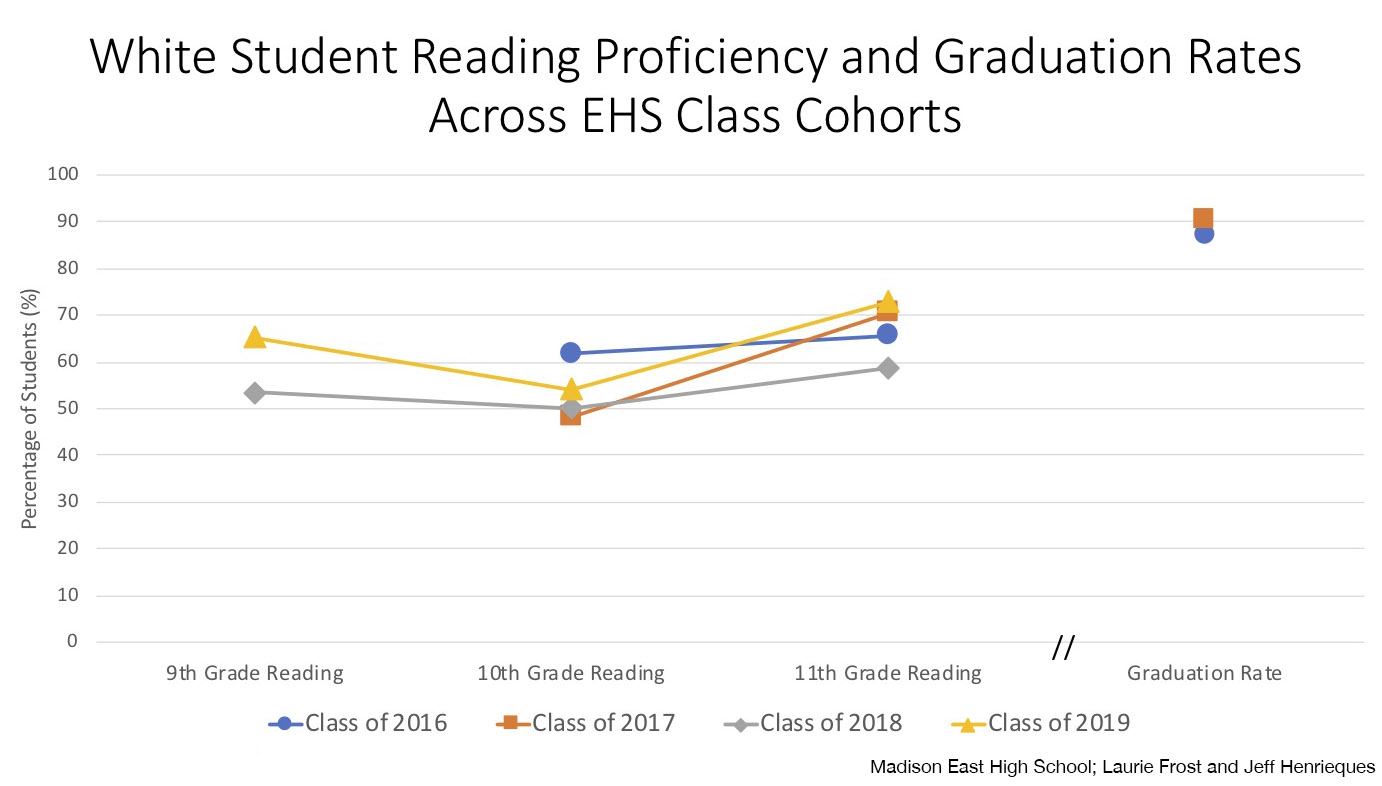
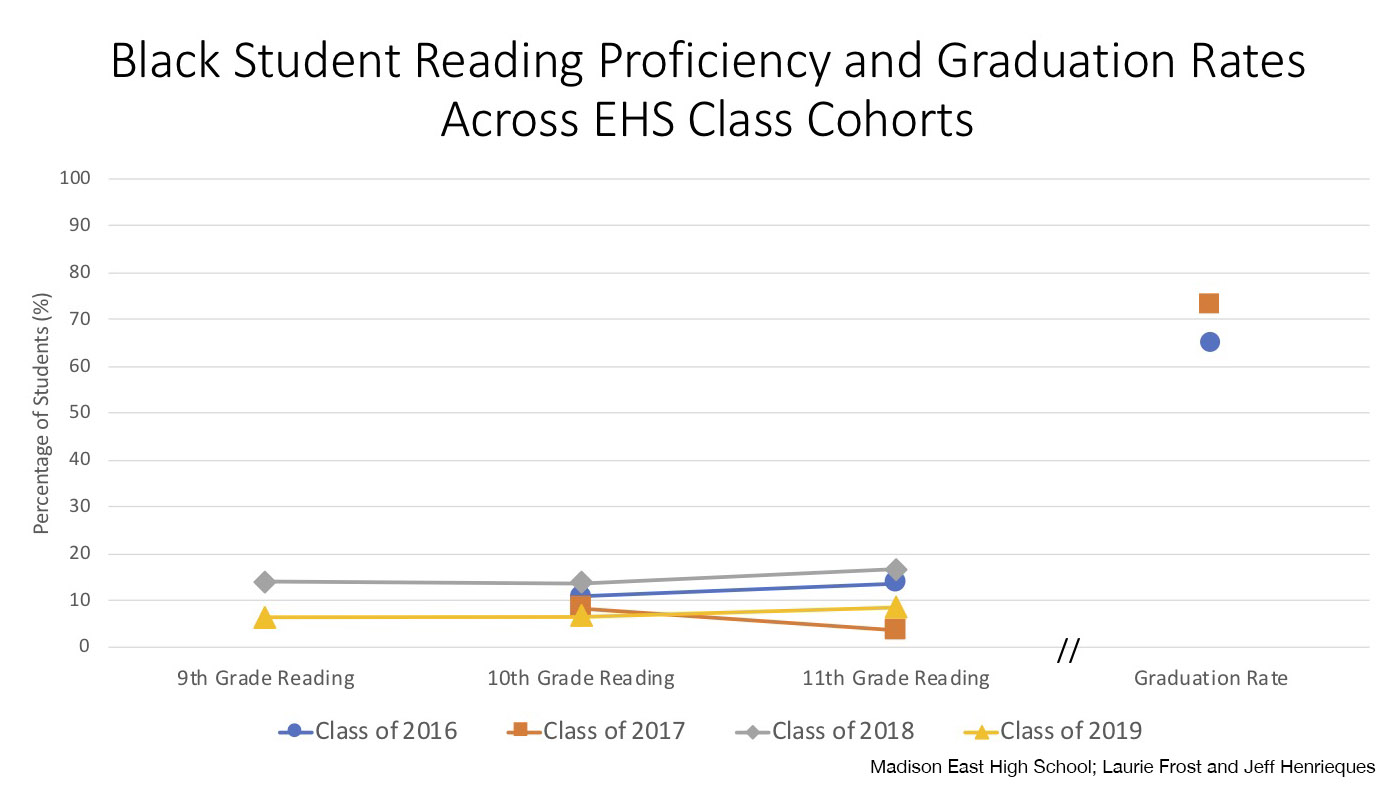
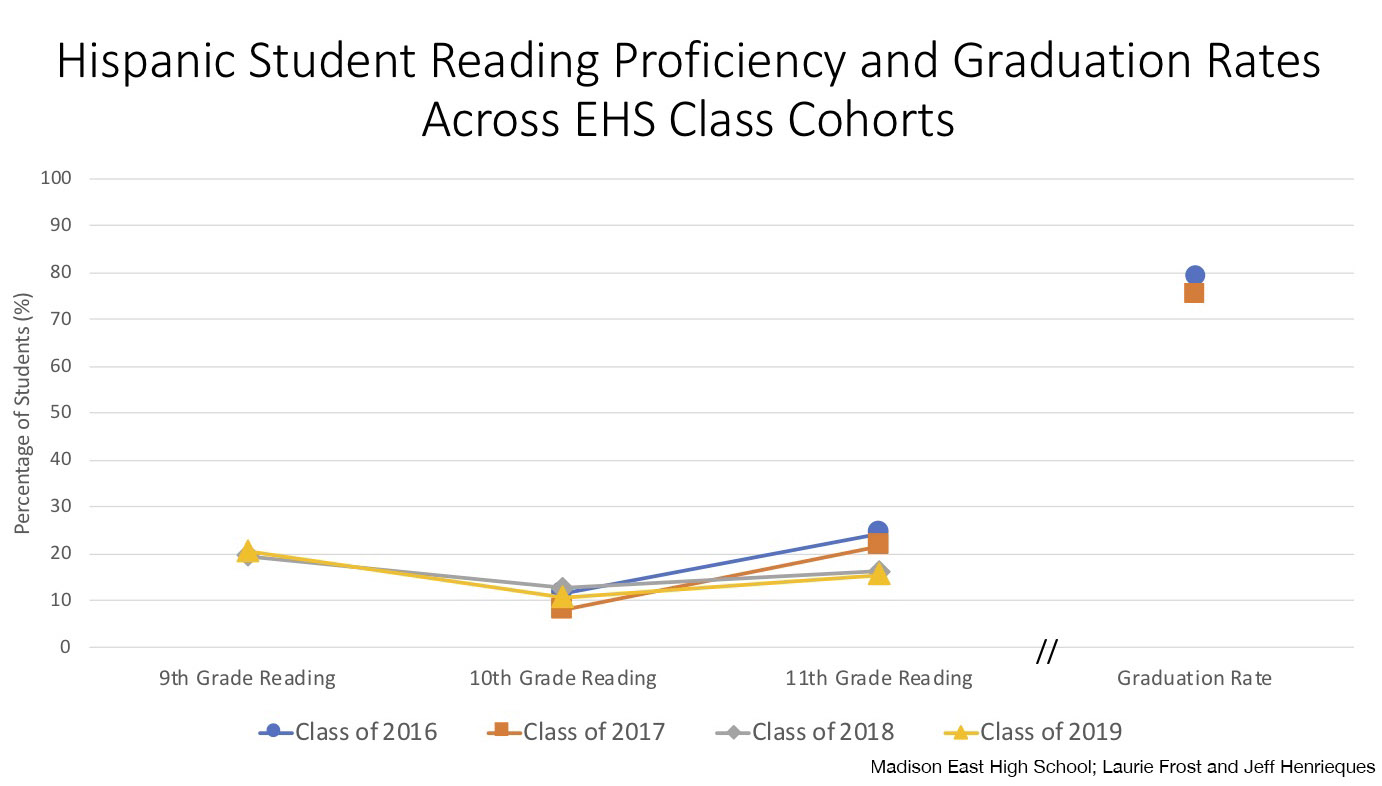
Superintendent Jennifer Cheatham: “without; being held accountable to district standards”. Madison has long tolerated disastrous reading results.

Finally, Madison spends far more than $11k per student….

Share

Beijing’s new Zaha Hadid-designed airport to showcase latest facial recognition technology

Sarah Dar:

Beijing’s new US$12 billion airport, which is designed to handle up to 100 million passengers a year at full capacity, will feature cutting-edge surveillance technology to ease bottlenecks in security and immigration screening.

Chinese artificial intelligence start-up Yitu is preparing a bid to provide its facial recognition technology to the airport, while its close rival SenseTime Group is also expected to compete for the contract.

The new Zaha Hadid-designed airport is situated about 50 kilometres south of central Beijing and will help ease congestion at the current airport located in the northeast of the capital. It will also serve Xiongan, the satellite city in neighbouring Hebei province created to reduce overcrowding in Beijing.

Share

The Tyranny of Stuctureless

Jo Freeman aka Joreen:

If the movement is to grow beyond these elementary stages of development, it will have to disabuse itself of some of its prejudices about organization and structure. There is nothing inherently bad about either of these. They can be and often are misused, but to reject them out of hand because they are misused is to deny ourselves the necessary tools to further development. We need to understand why “structurelessness” does not work.

FORMAL AND INFORMAL STRUCTURES

Contrary to what we would like to believe, there is no such thing as a structureless group. Any group of people of whatever nature that comes together for any length of time for any purpose will inevitably structure itself in some fashion. The structure may be flexible; it may vary over time; it may evenly or unevenly distribute tasks, power and resources over the members of the group. But it will be formed regardless of the abilities, personalities, or intentions of the people involved. The very fact that we are individuals, with different talents, predispositions, and backgrounds makes this inevitable. Only if we refused to relate or interact on any basis whatsoever could we approximate structurelessness — and that is not the nature of a human group.

This means that to strive for a structureless group is as useful, and as deceptive, as to aim at an “objective” news story, “value-free” social science, or a “free” economy. A “laissez faire” group is about as realistic as a “laissez faire” society; the idea becomes a smokescreen for the strong or the lucky to establish unquestioned hegemony over others. This hegemony can be so easily established because the idea of “structurelessness” does not prevent the formation of informal structures, only formal ones. Similarly “laissez faire” philosophy did not prevent the economically powerful from establishing control over wages, prices, and distribution of goods; it only prevented the government from doing so. Thus structurelessness becomes a way of masking power, and within the women’s movement is usually most strongly advocated by those who are the most powerful (whether they are conscious of their power or not). As long as the structure of the group is informal, the rules of how decisions are made are known only to a few and awareness of power is limited to those who know the rules. Those who do not know the rules and are not chosen for initiation must remain in confusion, or suffer from paranoid delusions that something is happening of which they are not quite aware.

Share

Trade war risks university joint ventures in China

Lisa Murray:

The escalating trade war between Washington and Beijing has increased the risk for university joint ventures and partnerships operating in China, according to Jeffrey Lehman, vice-chancellor of New York University Shanghai.

When NYU set up China’s first Sino-American joint university in Shanghai five years ago, the biggest risk it faced was attracting students and teaching staff to the new and experimental institution. However, Mr Lehman said geostrategic developments have rocketed up the risk list, threatening the viability of international collaborations.

Share

UK snooping ‘unlawful for more than decade’

BBC:

The system that allowed spy agency GCHQ access to vast amounts of personal data from telecoms companies was unlawful for more than a decade, a surveillance watchdog has ruled.

The Investigatory Powers Tribunal said that successive foreign secretaries had delegated powers without oversight.

But it added there was no evidence GCHQ had misused the system.

Privacy International criticised the “cavalier manner” in which personal data was shared.

The group brought the legal challenge and solicitor Millie Graham Wood said it was “proof positive” that the system set up to protect personal data was flawed.

Share

K-12 Tax & Spending Climate: New Yorkers Trying to Flee High State Taxes Find Moving Isn’t So Easy

Ben Steverman:

Among the wealthy tri-state-area set, there’s more buzz than ever about fleeing south to Florida, land of mild winters and, more importantly after last year’s federal tax overhaul, zero state personal income tax.

Actual action? Pretty scarce.

High-earners are learning what tax experts have known for years: Tax collectors in states like New York make it really hard to leave. Wealth managers and tax lawyers say many of their clients are staying put after hearing about the scrupulous records they would have to keep to show they’ve really uprooted their lives and severed ties with their former states — and that it’s not as easy as just spending a few more days a month in a Florida vacation home.

Like other high-tax states, New York’s Department of Taxation and Finance will go to great lengths to keep wealthy residents on their tax lists. The states’ methods can be aggressive: Issuing subpoenas to pore through credit card statements, bank transactions or phone records to track a taxpayer’s location, and sending auditors to interview doormen or confirm doctors’ appointments.

“When people understand they have to change their life circumstances, some people say: ‘Never mind, that’s too big a life change for us to do right now”’ said Timothy Noonan, a partner at law firm Hodgson Russ LLP, who’s based in Buffalo and Manhattan.

Share

The ‘Overparenting’ Crisis In School And At Home

Anya Kamenetz:

Julie Lythcott-Haims: We parents are overprotecting, overdirecting and doing a lot of hand-holding, ostensibly in furtherance of kids’ safety — physical, emotional — and security — emotional, academic, reputational, professional, financial. But also in furtherance of our own ego. Our kid becomes chronologically adult but still expects us to tell them what to do and how to do it, and is bewildered by the prospect of having to fend for themselves as an actual independent human. God help them when we are gone.

How are schools playing into this dynamic?

Lahey: Teachers and administrators complain about parents, but we helped create this frenzy … Teachers have come to accept that parents interfere and co-opt school projects and have begun to take that for granted when grading.

Lythcott-Haims: The other way in which high schools in particular play into the dynamic is during the college admission process, where they feel judged based on the brand names of the colleges their seniors get into, and their incentive is to brag about that.

Share

California teacher pension debt swamps school budgets

calmatters:

California’s public schools have enjoyed a remarkable restoration of funding since the bone-deep cuts they endured during the recession, but many are now facing a grave financial threat as they struggle to protect pensions crucial for teachers’ retirement.

Over the next three years, schools may need to use well over half of all the new money they’re projected to receive to cover their growing pension obligations, leaving little extra for classrooms, state Department of Finance and Legislative Analyst’s Office estimates show. This is true even though the California State Teachers’ Retirement System just beat its investment goals for the second straight year.

Some districts are predicting deficits and many districts are bracing for what’s to come by cutting programs, reducing staff or drawing down their reserves—even though per-pupil funding is at its highest level in three decades and voters recently extended a tax hike on the rich to help pay for schools.

At the same time, some districts are grappling with how to simultaneously afford raises for teachers who have threatened to strike.

Share

Audit Bureau Survey of Parents Shows Support for Special Needs School Choice Program

Will Flanders:

The Special Needs Scholarship Program (SNSP) represents an important new option for families of students with disabilities in Wisconsin. The SNSP provides a substantially larger voucher for families of students with disabilities who do not feel their needs are being met in the traditional public school setting to attend a private school that better meets those needs.

During the previous legislative session, a number of constraints on the program were removed meaning that many more Wisconsin children will be able to participate in the future. For the 2018-19 school year, 84 schools have signed up to participate including 55 schools which will be participating in the program for the first time. With a growing program such as this, it is important to get an assessment ‘on the ground’ of how well it is meeting the needs of participating students.

Share

Retro UW-Madison delivery van hits road to dispel myths about school, and get in a few licks

Karen Herzog:

If you’ve heard it’s next to impossible for Wisconsin kids to get into the University of Wisconsin-Madison, here’s the scoop.

And if you’re in the right place at the right time, you also may get some Babcock ice cream.

UW-Madison’s Alumni Association is on the road this summer with a retro 1957 dairy delivery truck loaded with campus-churned ice cream. It’s making scheduled stops across the state at community events like band concerts and farmers markets as part of a myth-busting #GetTheScoop outreach.

One of the biggest “myths” the alumni foundation-funded effort aims to knock down is that few Wisconsin kids get into Madison — something that creates frustration and makes the flagship campus seem elitist. The outreach aims to create positive connections with Wisconsin residents ahead of next spring’s state budget deliberations — where the rubber meets the road — and to make sure people know the facts; not just what they hear on the street. ‚

UW-Madison and other UW campuses in recent years have faced budget cuts and criticism from some Republican state lawmakers. There’s a lack of trust. Some of that comes from accounting issues within the UW System unearthed in recent years. But there’s also a sense among many residents that the flagship campus doesn’t benefit — or even looks down on — all residents of Wisconsin, UW officials acknowledge.

Share

To Think or Not to Think?

Mike St. Thomas:

“Thinking for yourself” is an anomaly.

Or so argues Alan Jacobs in his recent book How to Think: A Survival Guide for a World at Odds. “Thinking,” he argues, “is necessarily, thoroughly, and wonderfully social.” For Jacobs, a cultural critic and professor at Baylor University, thinking well involves navigating the often bumpy terrain of other people’s lives and ideas. We learn through dialogue, and we begin to think as individuals only in relation to the communities which shape us. The Greeks had a word for this process, paideia, and in their view each citizen, educated in this way, distills the habits and vision of the entire community.

What happens to individuals raised not on books and conversation but on an unholy amalgam of YouTube videos, Snapchat streaks, and clickbait? What happens to good thinking when a community threatens every moment to splinter into a thousand shouting tribes? Attempting to make sense of it all often seems like so much wandering in a dark wilderness. Jacobs’s tidy book, as portable as a field manual and only 157 pages long, attempts to lead us out of the briars.

As an academic and a Christian (he is Anglican), Jacobs is uniquely positioned to bridge the gap between some of the most entrenched tribes in our country. He has consciously chosen a modern and diverse range of thinkers to include in this book. Hipsters and evangelicals alike will recognize the cast of How to Think: We encounter Megan Phelps-Roper, whose public departure from the Westboro Baptist Church in 2012 landed her spots on NPR, the New York Times, and, eventually, a TED talk. Shortly thereafter we hear from Roger Scruton, the Anglican intellectual steeped in the classical tradition whose writing often appears in culturally conservative journals. Young Catholic convert and writer Leah Libresco makes an appearance, as do Ta-Nehisi Coates and Ursula K. LeGuin. And this is just in the first two chapters of the book.

Share

Time to Junk Racial Quotas in Higher Education

Michael Barone:

But the increasingly glaring contact between elite institutional practice and constitutional principle is driving the case against racial quotas and preferences. “Governmental use of race must have a logical end point,” Justice Sandra O’Connor wrote in Grutter v. Bollinger, allowing racial preferences at Michigan Law School. “We expect that 25 years from now, the use of racial preferences will no longer be necessary to further the interest approved today.”

That was in 2003. Ten years left to go.

Except it may come sooner. Earlier this month, the Trump administration’s Education and Justice Department withdrew six possibly illegal guidance letters issued to colleges and universities by their Obama administration predecessors, each one encouraging racial discrimination in admissions.

Harvard, meanwhile, faces a lawsuit from Asian plaintiffs who charge the elite school with racial discrimination against Asians, similar to its discrimination against Jews from the 1920s to the 1950s, designed to prevent the overrepresentation that their academic achievement might justify. Discovery in the case has revealed that Harvard lowballs “personality” ratings of Asian applicants who have high test scores, grades, and extracurriculars. In other words, not the kind we want in our country club.

For me, the clinching argument against racial discrimination in admissions is not how it hurts Asians or, to a much lesser extent, whites, but how it hurts the intended beneficiaries. As Richard Sander and Stuart Taylor showed in their 2012 book Mismatch, and as subsequent research has confirmed, black and Hispanic students who are less well prepared than their schoolmates tend to struggle with instruction pitched to others more advanced. They are thus more likely to shun science and tech courses and to drop out without degrees, weighed down in many cases by debts they cannot pay.

Share

Lawrence University sued over campus sex assault procedures

Bruce Vielmetti:

A Lawrence University student has sued the institution, alleging it allowed a sexually aggressive student to remain on campus, despite repeated complaints about him, until months after she reported to police that he had raped her.

The woman, identified in the suit as Jane Doe, accuses Lawrence of “deliberate indifference” toward the suspected male student, who was eventually expelled after Doe reported him to Appleton police.

The federal lawsuit says the assault occurred last fall when the woman was an 18-year-old freshman at the Appleton campus. The male student, it says, was a junior and is now 21.

Doe’s lawsuit names the male student in the complaint, but it does not list him as a defendant. It seeks compensatory and punitive damages from Lawrence for negligence, and violations under Title IX, which prohibits discrimination on the basis of sex in any federally funded education program or activity.

Share

How Playing Music Benefits Your Brain More than Any Other Activity “Playing music is the brain’s equivalent of a full-body workout.”

Maria Popova:

“Each note rubs the others just right, and the instrument shivers with delight. The feeling is unmistakable, intoxicating,” musician Glenn Kurtz wrote in his sublime meditation on the pleasures of practicing, adding: “My attention warms and sharpens… Making music changes my body.” Kurtz’s experience, it turns out, is more than mere lyricism — music does change the body’s most important organ, and changes it more profoundly than any other intellectual, creative, or physical endeavor.

This short animation from TED-Ed, written by Anita Collins and animated by Sharon Colman Graham, explains why playing music benefits the brain more than any other activity, how it impacts executive function and memory, and what it reveals about the role of the same neural structure implicated in explaining Leonardo da Vinci’s genius.

Share

Only one fourth-grader at a school in California can read at grade level; now a lawsuit claiming the state is violating students’ ‘constitutional right to literacy’ is moving to trial

Esmeralda Fabián Romero :

Can a school in California where only one fourth-grader is able to read at grade level be violating students’ constitutional guarantee to a basic education?

A lawsuit could get the green light within days to move forward with its claim that the state’s Department of Education is depriving low-income students equal access to learn to read and write. The suit claims to be the first in the United States to seek recognition of the constitutional right to literacy.

Superior Court Judge Yvette Palazuelos will rule by next Tuesday on the state’s petition to dismiss the lawsuit. She heard both parties’ arguments last week in Los Angeles.

Madison has long tolerated disastrous reading results.

Share

You’ve Heard of Berkeley. Is Merced the Future of the University of California?

Jennifer Medina:

In the decades since a ballot measure banned affirmative action in California’s public institutions, the University of California has faced persistent criticism that it is inadequately serving Latinos, the state’s largest ethnic group. The disparity between the state’s population and its university enrollment is most stark at the state’s flagship campuses: at University of California, Los Angeles, Latinos make up about 21 percent of all students; at Berkeley, they account for less than 13 percent.

But at Merced, the newest addition to the 10-campus University of California system, about 53 percent of the undergraduates are Latino, most closely mirroring the demographics of the nation’s most diverse state.

Share

Can Unions Be Sued For Janus Claims?

Will Baude:

Last month the Supreme Court held in Janus v. AFSCME that it is unconstitutional for the states to require public employees to pay labor unions if they choose not to become members (these payments were called “agency fees”). There has been plenty written about what this means for the future of public sector unions and what might happen next. But it turns out that there is another important question: what about the agency fees that unions had been collecting before Janus? Are unions liable for collecting them? Can they be forced to pay them back?

A series of lawsuits have been recently brought in seven states arguing that unions are liable, and now subject to quite significant liability. Noam Scheiber has a story in the New York Times about the suits, (and the lawyer bringing the suits, a former law professor and former Texas solicitor general, Jonathan Mitchell):

Share

The “Intellectual Dark Web” Is Nothing New

Jacob Hamburger:

THE FIRST DISTINCT intellectual movement to have emerged during the Trump presidency is not the alt-right, which rose to prominence during the 2016 campaign. Nor is it democratic socialism, the egalitarian platform that many young progressives have embraced since the Occupy Wall Street movement.

Instead, this movement may well be what some are calling the “intellectual dark web.” It is a heterogeneous group, bringing together neuroscientists, biologists, and psychologists with entrepreneurs, comedians, and sports commentators. Some claim to lean to the left, others to the right. There is nonetheless a common enemy that unites them. Despite their various differences, all members of the movement believe their ideas are being stifled by an epidemic of “political correctness.”

Unlike the actual “dark web” of hidden online networks, this one requires no specialized software to be made accessible. Its ideas can be found in best-selling books and media channels with millions of subscribers. Mathematician and financier Eric Weinstein coined the term intellectual dark web, and he meant to point out not that this group is obscure — it isn’t — but that its figures all pride themselves on upturning conventional beliefs.

Share

Evidence on New York City and Boston exam schools

Susan Dynarski:

New York City is wrestling with what to do with its exam schools. Students at Stuyvesant, Bronx Science, and Brooklyn Tech (the oldest exam schools) perform brilliantly and attend the best colleges. Their students score at the 99th percentile of the state SAT distribution (with Stuyvesant at the 99.9th percentile) and they account for the majority of New York City students attending Harvard, Princeton and Yale.1 These are by any measure elite schools and are revered as jewels of the city school system.

But of the 900 freshmen who enrolled at Stuyvesant this past fall, just 10 were black.2 By state law, admission to these schools is via a specialized, voluntary, admissions test. Mayor Bill de Blasio and others complain that this admissions system perpetuates inequality in opportunity to an excellent education.

A lot of ink has been spilled over the exam schools, in popular news outlets as well as in academic journals. In this piece, I address a narrow but relevant question: the causal impact of these schools on the students who attend them. Do the exam schools produce academically outstanding graduates, or do they simply admit stellar students and enjoy credit for their successes? I also briefly discuss alternative methods the city could use to dole out scarce seats at these over-subscribed schools.

Understanding the effectiveness of any school is a challenge because parents choose their children’s schools. In many cases, the school a child attends is tied to her address, so a parent effectively chooses a school when she picks a residence. In places like New York and Boston, which have district-wide choice, families can choose from dozens of public schools, including charters, magnets and exam schools. And there are private schools for those who can afford them or who have vouchers to subsidize the cost.

Share

Civics: Perspective

Lyle Jeremy Rubin:

I was trained at NSA headquarters as a signals intelligence officer in the Marines. This was about a decade ago, and I was by no means an area specialist. That said, I was privy to relevant briefs. At the time I learned that U.S. cyber operations in Russia, across Russia’s periphery, and around the world already dwarfed Russian operations in size, capability, and frequency. It wasn’t even close, and the expectation was that the gap was about to grow a whole lot wider.

This should hardly come as a surprise. Just compare the defense budgets of the United States and Russia. The president recently signed a gargantuan $700 billion gift to the Pentagon, with marginal dissent from either party or their affiliated media outlets. The budget increase alone ($61 billion) exceeds Russia’s entire annual expenditure ($46). The U.S. military budget now equals more than the combined budgets of China, Russia, Britain, Japan, Saudi Arabia, India, and France. As Vice concluded, “it’s 14 times larger than the Kremlin’s budget.”

Furthermore, covert American operations are deeply invested in interrupting democratic processes not only in Russia, but everywhere else. This includes the heart of Europe, where corporate media is now pretending the United States has always respected happy norms and decorum. It is as if the Snowden leaks never happened. The Defense Department’s tapping of Angela Merkel’s phone never happened. The Obama administration’s spying on the German press, including Der Spiegel, never happened. The same administration’s outing of German government whistle-blowers never happened.

Electoral meddling in particular happens all the time, both to us and by us. The U.S. government rigged the Russian election for Yeltsin in 1996, and then they bragged about it in a cover story for Time. (You can still find the cover online.) This followed the disastrous capitalist “shock therapy” of the early nineties and preceded the rise of the Russian oligarchs. Putin’s brand of nationalist resentment grew out of this moment of extreme collective humiliation. Meanwhile, Hillary Clinton is happily on record pushing for the tampering of Palestinian elections in 2006.

Share

1 big thing: The childless, aging future

axios:

Whichever the case, almost no one seems prepared. People are going to have to work longer, experts say. And the U.S. requires “major reforms” in its programs for the elderly, says Richard Cincotta, director of the Global Political Demography Program at the Stimson Center, and fofrmerly a lead demographer for the U.S. intelligence community. But the government “seems to be nowhere near making the social security reforms that are needed.”

Share

A new digital divide: Young people who can’t use keyboards

Toshihiko Katsuda:

“How do I double click?” “What is a cell in a spreadsheet?”

Mashiko Ishii often hears that her fellow lecturers at Uchida Human Resources Development Center become confused when they are asked such basic questions during training for new employees of IT companies.

Pressing the button of a computer mouse twice and knowing the basic unit for data input in spreadsheets are some of the fundamentals of using a computer, but it is not uncommon for even would-be system engineers to ask such questions.

The reason is clear. As smartphones have become extremely convenient, a growing number of students have never laid their hands on a personal computer.

Lecturers who work with Ishii often start training by teaching students how to use a keyboard.

Share

The Mismatch Effect: A Danger for Students of All Races

Eugene Volokh:

Say that you apply to many schools, including some where other students have much better predictors (chiefly test scores and grades from earlier institutions) than you. And you get in! Maybe it was affirmative action (whether based on race, socioeconomic status, or something else), maybe it was a preference because your relatives had gone to the same school, maybe it was something in your admission essay, maybe it was just luck. Either way, you’re thrilled.

Might you have reason to be less thrilled, and actually not want to go to this highly ranked school? (Conversely, might the school reconsider its policy that led you to be let in?) If the predictors are actually reasonable predictors (and apparently grades and test scores tend to be reasonable predictors), then you can expect you’ll end up lower in the class at the new school than you might be at some other school, precisely because the other students are better than you. The advantage of having a more prestigious degree might be counteracted by the disadvantage of having a less prestigious class rank. But might you end up getting a worse education, being less likely to graduate, and being less likely to pass any professional licensing exams (such as the bar) that you might be expecting to take?

That’s the debate about the “mismatch effect,” which I’ve followed over the years (though from a distance); it has mostly focused on whether race-based affirmative action causes problems (such as lower black bar passage rates) as a result of this effect, but it can also be relevant to many students of all races. I was first exposed to it because of the work of my UCLA School of Law colleague Rick Sander, and Robert Steinbuch at Arkansas / Little Rock has been working in it as well; Rob has been kind enough to pass along these thoughts on the subject:

Share

Thoughts on Mass Tenure Revocation at Vermont Law School in the Shadow of the Market and Beyond Shared Governance

Larry Data Backer:

The reactions are what might be expected, though surprisingly muted (see, e.g., here, here, here, here, and here). In the end, after the hand wringing and acrimony, the substance of this action will likely remain undisturbed. “If the reports are accurate, Vermont has essentially acted as if tenure does not exist. This could potentially raise questions about whether Vermont is in compliance with ABA standard 405, but it is unclear how assertive the ABA or site visit teams will be in enforcing those standards.” (How secure is tenure? (Michael Simkovic)).

For this post I offer some brief thoughts on what is likely to be a very useful and evolving addition to the toolkit of administrators as they continue the hard task of commodifying and capitalizing education within what is still nostalgically referenced as “the university.” The focus is not on the lawyering of protection for those faculty with respect to whom tenure has been made a mockery, though one clothed in the delightfully unctuous ululations of administrator speak. Rather the reflections here focus on the ways in which these actions evidence more generally a perhaps significant changes of power relations within an institution in which the notions of traditional shared governance has withered away. The character of that withering away is itself of interest, as the successful de-professionalization of the faculty has opened the way for their replacement in governance by an emerging corps of professional administrators only some of whom are drawn from their ranks who (ironically) remain protected by tenure.

Share

Unwanted Sterilization and Eugenics Programs in the United States

Lisa Ko:

Coerced sterilization is a shameful part of America’s history, and one doesn’t have to go too far back to find examples of it. Used as a means of controlling “undesirable” populations – immigrants, people of color, poor people, unmarried mothers, the disabled, the mentally ill – federally-funded sterilization programs took place in 32 states throughout the 20th century. Driven by prejudiced notions of science and social control, these programs informed policies on immigration and segregation.

As historian William Deverell explains in a piece discussing the “Asexualization Acts” that led to the sterilization of more than 20,000 California men and women,“If you are sterilizing someone, you are saying, if not to them directly, ‘Your possible progeny are inassimilable, and we choose not to deal with that.’”

According to Andrea Estrada at UC Santa Barbara, forced sterilization was particularly rampant in California (the state’s eugenics program even inspired the Nazis):

Share

The Essay That Helped Bring Down the Soviet Union

Natan Sharansky:

Sakharov’s essay, which coincided with the Prague Spring, helped energize democratic dissident movements that were just budding in a post-Stalinist world. The largest of these was one I would soon join: the so-called refusenik movement to allow the Soviet Union’s long-oppressed Jews the freedom to emigrate.

Some Russian dissidents mistrusted the Zionist movement as particularistic and unpatriotic, fearing it would distract from their broader human rights agenda. Not Sakharov. He supported the refuseniks because he recognized the right to emigrate as a gateway to democratic entitlement that opens everyone to embracing freedom in a closed society.

By the mid-1970s I was serving as Sakharov’s spokesman, and I remember after yet another friend of ours had been sentenced to prison, he told me: “They want us to believe there’s no chance of success. But whether or not there’s hope for change is not the question. If you want to be a free person, you don’t stand up for human rights because it will work, but because it is right. We must continue living as decent people.”

Sakharov’s decency made him a moral compass orienting not just the East, but also the West. He insisted that international relations should be contingent on a country’s domestic behavior — and that such a seemingly idealistic stance was ultimately pragmatic. “A country that does not respect the rights of its own people will not respect the rights of its neighbors,” he often explained.

Share

Partnerships with people on the spectrum yield rich research insights

Nicholette Zeliadt:

There are different views on whether ‘people with autism’ or ‘autistic people’ is the better way to refer to individuals on the spectrum. Some of the people quoted in this article prefer to say ‘autistic,’ but Spectrum’s style is to refer to ‘people with autism.’

It wasn’t until Anna Remington had nearly finished collecting data that she uncovered the flaw in her study.

A couple of years ago, Remington, then a lecturer at University College London, was investigating how people determine whether someone is trustworthy. She and her colleagues showed participants with the condition a series of images of unfamiliar faces, along with some hypothetical information about each person. They then asked the participants, “Would you approach this person — either in a social or financial context?”

Overwhelmingly, the participants with autism said “no,” even in response to characters who had been described as trustworthy. Eventually, one of them pulled her aside to explain: He wasn’t interested in “approaching” anyone.

Share

Steps Toward Super Intelligence I, How We Got Here

Rodney Brooks:

Once again, with footnotes.

God created man in his1 own image.2

Man3 created AI in his3 own image.

At least that is how it started out. But figuring out what our selves are, as machines, is a really difficult task.

We may be stuck in some weird Gödel-like incompleteness world–perhaps we are creatures below some threshold of intelligence which stops us from ever understanding or building an artificial intelligence at our level. I think most people would agree that that is true of all non-humans on planet Earth–we would be extraordinarily surprised to see a robot dolphin emerge from the ocean, one that had been completely designed and constructed by living dolphins. Like dolphins, and gorillas, and bonobos, we humans may be below the threshold as I discussed under “Hubris and Humility”.

Or, perhaps, as I tend to believe, it is just really hard, and will take a hundred years, or more, of concerted effort to get there. We still make new discoveries in chemistry, and people have tried to understand that, and turn it from a science into engineering, for thousands of years. Human level intelligence may be just as, or even more, challenging.

In my most recent blog post on the origins of Artificial Intelligence, I talked about how all the founders of AI, and most researchers since have really been motivated by producing human level intelligence. Recently a few different and small groups have tried to differentiate themselves by claiming that they alone (each of the different groups…) are interested in producing human level intelligence, and beyond, and have each adopted the name Artificial General Intelligence (AGI) to distinguish themselves from mainstream AI research. But mostly they talk about how great it is going to be, and how terrible it is going to be, and very often both messages at the same time coming out of just one mouth, once AGI is achieved. And really none of these groups have any idea how to get there. They are too much in love with the tingly feelings thinking about it to waste time actually doing it.

Share

55% of the US National Debt Is the Result of Repaying Debt with More Debt

Taps Coogan:

The last time the US completely paid off the national debt was in 1840. It was the result of decades of balanced budgets under Presidents James Monroe, John Quincy Adams, and Andrew Jackson.

In the 179 years since 1840 (counting the 2018 budget), the US has run a deficit 109 times and a surplus or balanced budget just 70 times, amounting to a cumulative net deficit of $14.2 trillion. All of the surpluses combined in the last 179 years amount to $580 billion, less than the deficit in 2017 alone ($665 billion).

Since the national debt was last eliminated in 1840, the US has paid a cumulative $7.8 trillion of interest on the national debt. This interest includes repaying principal. Simple arithmetic reveals that 55% the $14.2 trillion in deficit spending since 1840 has, in effect, gone towards servicing the national debt. Put differently, instead of paying down its debt with tax revenue, the federal government has essentially rolled over 55% of its debt since 1840 with new debt. The result is that despite running ‘only’ $14.2 trillion in deficits over that last 179 years, and despite having already repaid all debt issued more than 30 years ago, the national debt today is $21.4 trillion. The difference, $7.2 trillion, represents the cumulative interest the US has paid to fund its deficits minus its modest surpluses. As a result, a full 36% of today’s national debt is, in effect, the interest paid on past debt. Only 45% of the national debt went to spending on actual programs. The rest went to servicing the national debt itself and to rolling the debt over with new debt. It also means that the government has been carrying forward the majority of the national debt going all the way back to 1840 by paying it off with new debt. A portion of the money the government borrowed in 1841 is still being paid for today via rolling the debt forward.

Share

Tulane University awarded $10 million grant to launch national school choice research center

Keith Brannon:

The U.S. Department of Education’s Institute of Education Sciences has awarded a five-year, $10 million grant to Tulane University to study how different approaches to school choice, such as voucher programs and charter schools, can better serve disadvantaged students.

The grant will create the National Center for Research on Education Access and Choice (REACH), a first-of-its-kind center that will be housed at Tulane and led by prominent education scholars from around the country, including Douglas Harris of Tulane, Joshua Cowen and Katharine Strunk of Michigan State University, Julie Marsh of the University of Southern California and Amy Ellen Schwartz of Syracuse University.

Most states have charter school systems, and more than half have voucher or tuition tax-credit policies that allow students to use public funds to attend private schools. School choice programs have delivered some notable successesin cities like Boston, New York and New Orleans but have not succeeded everywhere.

Share

‘My brain feels like it’s been punched’: the intolerable rise of perfectionism

Paula Cocozza:

Tom Nicol thought he had a problem with sleep. He could never get enough. He took “a very disciplined, stripped approach” to his routine. He drank water only at premeditated times, ate according to schedule, avoided caffeine, exercised (but not close to bedtime) and shut down all screens at 9pm. Nicol, a PhD student, was recounting this long list of sleep settings to his student counsellor after yet another bad night, when she told him: “You have perfectionism.”

“I’m not good enough to have perfectionism,” Nicol replied.

It was “one of the most perfectionist things you can say”, he says now. At the time, though, the discovery took Nicol by surprise. He shared his surprise with his partner. “She was like: ‘Well, duh!’” But he needed to be convinced.

On the phone, Nicol, 25, has a persuasive and clear-eyed sense of his own averageness. He is “not particularly” industrious, “quite” messy and has “never been the kind of person who was seen as one of the top achievers”, he says. He recounts these perceived shortcomings with an amiable ease that sounds a lot like contentment. But maybe this, too, is a perfectionist sleight of hand, to present persistent self-criticism as casual self-deprecation. I arrange to visit Nicol at the University of York, where he is in the second year of his doctorate in theoretical chemistry.

Share

Can’t Enter Uni Because of Daddy’s Bad Social Credit – The Blacklist Story That’s Got Weibo Talking

Manya Koetse:

However, the public black list was introduced before this time, with Chinese courts in 2013 starting to publicly give out the names online of people who have not complied with court orders. Additionally, In 2006, the People’s Bank of China (PBOC) also already began operating its own independent Credit Reference Center tasked with managing a national commercial and consumer credit reporting system. With the recent launch of the so-called ‘trust alliance’ (信联), a new unified platform that has access to an enormous number of personal credit data, China’s credit-based society has taken another leap – with state level and commercial organizations joining forces in further developing China’s credit systems. In recent (English-language) media reports, the lines are often blurred between the Social Credit system and a number of private programs, including the Sesame Credit program. These misunderstandings partly come from the fact that both the government’s plans on introducing their ‘Social Credit System’ (社会信用体系) and the Central Bank’s endeavors to build a stronger personal credit industry (个人征信行业) were major developments in the period from 2013-2015 up to the present. Together with the 2013 judicial online blacklist, these policies and programs all built on a stronger credit-based society that governs both economic and social areas.

Share

Civics: Top Voting Machine Vendor Admits It Installed Remote-Access Software on Systems Sold to States

Kim Zetter:

Remote-access software and modems on election equipment ‘is the worst decision for security short of leaving ballot boxes on a Moscow street corner.’

Share

Civics: When a U.S. citizen heard he was on his own country’s drone target list, he wasn’t sure he believed it. After five near-misses, he does – and is suing the United States to contest his own execution

Matt Taibbi:

How to Survive America’s Kill List

Bilal Abdul Kareem is an expert in staying alive.

Born Darrell Lamont Phelps, he grew up just north of the Bronx in Mount Vernon, New York. He did what lots of kids in his neighborhood were doing in the late Seventies and Eighties: He spent his time rolling on the floor laughing to comics like Flip Wilson and Richard Pryor.

Later, after college at SUNY Purchase in Westchester, he decided to try stand-up himself. Hecklers were a problem.

In upscale white clubs where he sometimes performed, audiences would clap politely if his jokes missed. Not so much in the Brooklyn clubs he worked. The mostly black audiences there let him have it when he was off.

“Black folks always want to get involved in the act, you know what I’m saying?” he recalls, laughing. “Then you gotta respond with some ‘Yo mama’s so fat’ jokes just to get them to sit down and shut up.”

Over a decade later, after some major life changes – he’d converted to Islam and found himself working as a TV reporter in the Middle East under his new name, Bilal Abdul Kareem – he again drew upon his stand-up experience to stay alive. Only he wasn’t worried about dying on stage this time. This time it was more serious.

In the waning days of the Battle of Aleppo, as Syrian dictator Bashar al-Assad’s forces closed in on the city, Kareem found himself in a room full of desperate Free Syrian Army rebels.

Share

Researchers produce images of people’s faces from their genomes

The Economist:

CRAIG VENTER, a biologist and boss of Human Longevity, a San Diego-based company that is building the world’s largest genomic database, is something of a rebel. In the late 1990s he declared that the international, publicly funded project to sequence the human genome was going about it the wrong way, and he developed a cheaper and quicker method of his own. His latest ruffling of feathers comes from work that predicts what a person will look like from their genetic data.

Human Longevity has assembled 45,000 genomes, mostly from patients who have been in clinical trials, and data on their associated physical attributes. The company uses machine-learning tools to analyse these data and then make predictions about how genetic sequences are tied to physical features. These efforts have improved to the point where the company is able to generate photo-like pictures of people without ever clapping eyes on them.

In a paper this week in Proceedings of the National Academy of Sciences, Dr Venter and his colleagues describe the process, which they call “phenotype-based genomic identification”. The group took an ethnically diverse group of 1,061 people of different ages and sequenced their genomes. They also took high-resolution, three-dimensional images of their faces, and measured their eye and skin colour, age, height and weight. This information was used as a “training set” to develop an algorithm capable of working out what people would look like on the basis of their genes.

Share

Algorithms and Venture Capital Investing

Dan Primack:

When most venture capitalists want approval to make a new investment, they go to their partners. When venture capitalists at GV do it, they go to something called “The Machine.”

Axios has learned that the firm, formerly known as Google Ventures, for years has used an algorithm that effectively permits or prohibits both new and follow-on investments.

Staffers plug in all sorts of deal details into “The Machine” — which is programmed with all sorts of market data, and returns traffic signal-like outputs. Green means go. Red means stop. Yellow means proceed with caution, but sources say it’s usually the practical equivalent of red.

It was initially designed and used as a due diligence assistant that could be overruled but, according to three sources, it has evolved into a de facto investment committee.

History: GV was formed in 2009 as one of the first venture firms to employ engineers whose primary job was to work with portfolio companies on technical challenges. But, in the early days, there weren’t too many portfolio companies yet, so the engineers were tasked first with building a dealflow management tool dubbed “Vortex,” and then with what would become “The Machine.”

Share

Madison’s K-12 Governance Non Diversity: Police in Schools Meeting

Logan Wroge:

Throughout the public comment period, several people said the presence of police officers inside school can negatively affect students of color and feeds into the “school-to-prison pipeline.”

“Ain’t no amount of training, ain’t no amount of special certificates is going to matter when it comes to black and brown kids, because (police officers) see us as thugs and criminals,” said Bianca Gomez, a member of Freedom Inc., an activist organization focused on issues that affect minority populations.

As Blaska attempted to capture the public comment on his cellphone, others took issue with juvenile speakers being recorded and attempted to block his view by either standing in front of him or putting objects in front of his phone, alleging he runs a racist blog where the youths’ photos would be posted.

Blaska moved about the meeting room, which was held in the McDaniels Auditorium in the district’s Doyle Administration Building, and others continued to follow along and block his phone.

The emotions culminated in a heated face-to-face argument between a woman who had earlier spoke in support of EROs and some people wishing to remove EROs.

Steven Elbow:

A public hearing on a proposal to redefine the Madison School District’s relationship with police descended into chaos Wednesday when factions confronted each other with invective, insults and physical altercations.

The proposal would remove armed educational resource officers from the district’s four main high schools and replace them with at least 20 specially trained school liaison officers that would develop relationships with all district schools and respond to incidents when needed.

The proposal drew no support from 20 people who registered to speak, many of them members of Freedom Inc., a grassroots social justice group that sees the move as an increase in policing efforts. But a small minority of speakers blasted the committee in charge of drafting the new policy for proposing to remove armed officers at East, West, La Follette and Memorial high schools.

“Think of that potential school shooter out there,” said Patrick O’Loughlin, an accountant who teaches business math at a local private high school. “Experience tells us that they think about it for quite some time before acting. What is he going to think when you kick the armed officers off campus?”

O’Loughlin suggested that the draft proposal was intentionally light on statistics supporting the elimination of EROs. He went on to list the kinds of statistics the proposal should have included.

“You can take your statistics and shove them,” said Mahnker Dahnweih of Freedom Inc.

Related:

Gangs and School Violence Forum

Police Calls: Madison Schools 1996-2006

Why did Cops Out of Schools committee ignore its own safety expert?

NBC 15 meeting report.

Free speech and the Madison School Board. Former President Obama on “shutdown culture“.

Madison should kick police officers out of its public high schools, a school board committee is poised to recommend. Instead, they would be replaced by 20 more so “liaison” officers who would be called into the schools only as needed.

A majority of the Madison School Board rejected the proposed Madison Preparatory Academy IB Charter school.

“They’re all rich white kids and they’ll do just fine, NOT!”: 1995-1999 (!)

Madison’s long term, disastrous reading results.

The Madison school district spends far more than most: budget details.

What’s different, this time (2013)?

Additional commentary here, and here.

Share

‘I kind of gave up’: how academics in danger rebuild their lives in exile

Tim Judah:

A few minutes after meeting Zaher al-Bakour in a Caffè Nero on Aberdeen’s Union Street, his phone rings and he swipes to decline the call. It is just his sister, he says. Mortified that he should do this to someone WhatsApp-calling him from rebel-held territory in Syria while we chat over croissants and cappuccinos, I suggest that he call her back. She thinks her nine-year-old daughter has typhoid and, since there are no doctors there, wants al-Bakour, an academic who specialises in pharmacology, to analyse the case. He can’t. Though he spends his days in a white lab coat tinkering with test tubes and microscopes, “I’m not a doctor,” he says.

It’s a cruel twist to a modern war. Imagine that, in 1943, you could have called Aberdeen from the Warsaw ghetto. Indeed, in a way al-Bakour, a 27-year-old from conflict-torn Aleppo, has ended up in the granite “grey city” because of the Nazis. He is an exiled academic who has been brought to Britain by the Council for At-Risk Academics (Cara), a British organisation founded in 1933 to help German-Jewish scholars who were fired when Hitler came to power.

Share

China’s ‘red education’ history tours and the rise of communist cosplay

Josephine Ma:

If anyone can best tell the scale and intensity of China’s “red education” drive to promote loyalty to the ruling Communist Party, it’s businessman Yu Meng.

The 36-year-old runs the largest Red Army uniform rental business in Jinggangshan, a city dubbed the “cradle of the communist revolution” deep in the mountains of Jiangxi. Last year alone, his company rented uniforms to 256,000 people taking part in red ideology study tours.

Yu started the Xiangganbian Red Army uniform company 10 years ago. But it’s only in the last three years that the business has really taken off, thanks to the relentless push of patriotic education by President Xi Jinping. Xi has said he wants “faith” in communist rule to be passed down to a new generation as “red DNA”.

Share

Why the Unfair Sex Tribunals of Title IX Are Losing Ground

KC Johnson:

In a reproof to Obama-era guidance on campus sex hearings, Education Secretary, Betsy DeVos issued interim Title IX guidance fair to the accused as well as the accusers. This brought a storm of abuse from the founders of the kangaroo court system, favored by the Obama team.

The lawsuits against the interim guidance issued by DeVos appear to have stalled. So on June 27, a coalition of accusers’ rights organizations invoked an obscure law, the Data Quality Act, to demand “corrections” in the September 2017 guidance issued by DeVos. The effort, which smacks of desperation, doesn’t seem likely to yield a victory for the groups, but that’s probably not the goal—as a fundraiser and publicity effort, the letter probably will serve its purposes.

The accusers’ rights groups claim that the interim guidance falls short factually in six respects, reproduced below:

Share

A Fast-Food Problem: Where Have All the Teenagers Gone?

Rachel Abrams and Robert Gebeloff:

A quarter-century ago, there were 56 teenagers in the labor force for every “limited service” restaurant — that is, the kind where you order at the counter.

Today, there are fewer than half as many, which is a reflection both of teenagers’ decreasing work force participation and of the explosive growth in restaurants.

But in an industry where cheap labor is an essential component in providing inexpensive food, a shortage of workers is changing the equation upon which fast-food places have long relied. This can be seen in rising wages, in a growth of incentives, and in the sometimes odd situations that business owners find themselves in.

This is why Jeffrey Kaplow, for example, spends a lot of time working behind the counter in his Subway restaurant in Lower Manhattan. It’s not what he pictured himself doing, but he simply doesn’t have enough employees.

Mr. Kaplow has tried everything he can think of to find workers, placing Craigslist ads, asking other franchisees for referrals, seeking to hire people from Subways that have closed.

Share

Potential DNA damage from CRISPR has been ‘seriously underestimated,’ study finds

Sharon Begley:

Share

What Knitting Can Teach You About Math

Sara Jensen:

One snowy January day, I asked a classroom of college students to tell me the first word that came to mind when they thought about mathematics. The top two words were “calculation” and “equation.”

When I asked a room of professional mathematicians the same question, neither of those words were mentioned; instead, they offered phrases like “critical thinking” and “problem-solving.”

This is unfortunately common. What professional mathematicians think of as mathematics is entirely different from what the general population thinks of as mathematics. When so many describe mathematics as synonymous with calculation, it’s no wonder we hear “I hate math” so often.

So I set out to solve this problem in a somewhat unconventional way. I decided to offer a class called “The Mathematics of Knitting” at my institution, Carthage College. In it, I chose to eliminate pencil, paper, calculator (gasp) and textbook from the classroom completely. Instead, we talked, used our hands, drew pictures and played with everything from beach balls to measuring tapes. For homework, we reflected by blogging. And of course, we knit.

Share

K-12 Tax & Spending Climate: “suggests that the minimum wage increases led to employment losses in Minnesota, particularly in the restaurant industry and youth demographic most affected by the changes”

Noah Williams:

Over 60% of employees in the restaurant industry in Minnesota work for the minimum wage or less, and workers under the age of 24 account for 54% of minimum wage earners. Following the minimum wage increases limited service restaurant employment fell by 4% in Minnesota relative to Wisconsin. Further, youth employment fell by 9% in Minnesota following the minimum wage increases, while it increased by 10.6% in Wisconsin over the same time period.

In addition, part of the increased wage costs employers faced have been passed on to consumers through higher prices. The relative price of restaurant food in the Minneapolis metro area had fallen by 2% in the four years preceding the minimum wage hikes, but it has risen by 6% in the four years since. On the benefit side, earnings for affected workers grew more rapidly in Minnesota than Wisconsin following the minimum wage hikes, with average annual pay at limited service restaurants increasing by 5.5% more in Minnesota from 2014-2017.

Overall, this evidence is consistent with a competitive market for low wage workers in Minnesota, with the minimum wage increases leading to labor market distortions.

Share

Venmo: how the payment app exposes our private lives

Olivia Solon:

Anyone can track a Venmo user’s purchase history and glean a detailed profile – including their drug deals, eating habits and arguments – because the payment app lacks default privacy protections.
 
 This was the finding of a Berlin-based researcher, Hang Do Thi Duc, who analysed the more than 200 million public Venmo transactions made in 2017. Her aim was to highlight the privacy risk from using a seemingly innocuous peer-to-peer app.
 
 By accessing the data through a public application programming interface, Do Thi Duc was able to see the names of every user who hadn’t changed their settings to private, along with the dates of every transaction and the message sent with the payment. This allowed her to explore the lives of unsuspecting Venmo users and learn “an alarming amount about them”.
 
 The default state for transactions when a user signs up to the app is “public”, which means they can be seen by anyone on the internet. Users can change this to “private” by navigating to the app’s settings, but it’s not clearly highlighted during sign-up.


Share

Health Insurers Are Vacuuming Up Details About You — And It Could Raise Your Rates

Marshall Allen:

With little public scrutiny, the health insurance industry has joined forces with data brokers to vacuum up personal details about hundreds of millions of Americans, including, odds are, many readers of this story. The companies are tracking your race, education level, TV habits, marital status, net worth. They’re collecting what you post on social media, whether you’re behind on your bills, what you order online. Then they feed this information into complicated computer algorithms that spit out predictions about how much your health care could cost them.
 
 Are you a woman who recently changed your name? You could be newly married and have a pricey pregnancy pending. Or maybe you’re stressed and anxious from a recent divorce. That, too, the computer models predict, may run up your medical bills.
 
 Are you a woman who’s purchased plus-size clothing? You’re considered at risk of depression. Mental health care can be expensive.
 
 Low-income and a minority? That means, the data brokers say, you are more likely to live in a dilapidated and dangerous neighborhood, increasing your health risks.
 
 Get ProPublica’s Major Investigations by Email
 “We sit on oceans of data,” said Eric McCulley, director of strategic solutions for LexisNexis Risk Solutions, during a conversation at the data firm’s booth. And he isn’t apologetic about using it. “The fact is, our data is in the public domain,” he said. “We didn’t put it out there.”
 
 Insurers contend they use the information to spot health issues in their clients — and flag them so they get services they need. And companies like LexisNexis say the data shouldn’t be used to set prices. But as a research scientist from one company told me: “I can’t say it hasn’t happened.”

Share

K-12 Governance Diversity; Charlotte Edition – Nearly 1 in 5 NC students are opting out of traditional public schools. Does it matter?

T. Keung Hui:

Nearly 1 in 5 North Carolina students is not attending a traditional public school, and that percentage is likely to continue rising as more families choose alternative education options.

For the third year in a row, enrollment has fallen in North Carolina’s traditional public schools even as the number of students continues to rise in charter schools, private schools and homeschools. The percentage of the state’s 1.8 million students attending traditional public schools has dropped to 80.8 percent and is continuing to fall rapidly.

“Families are more attuned to and used to having choices at their fingertips, and that is entering education as well,” said Brian Jodice, interim president of Parents For Educational Freedom in North Carolina. “We’re no longer in this mindset that because I live at this address or this ZIP code I have to attend this particular school that works for many students but doesn’t have to be the only choice.”

But what’s seen as an expansion of school choice by some is viewed by others as part of an effort to undermine the state’s traditional public schools.

“North Carolina has already embraced the privatization, the ALEC (American Legislative Exchange Council) agenda of dismantling public schools in favor of their donors who’d rather try to monetize what should be a public good,” said Kris Nordstrom, education finance and policy consultant for the N.C. Justice Center’s Education and Law Project.

The education landscape has changed considerably since Republicans took control of the General Assembly after the 2010 election. Changes have included:

A majority of the Madison School Board rejected the proposed Madison Preparatory IB Charter school.

Yet, Madison has long tolerated disastrous reading results.

Share

Oil’s New Technology Spells End of Boom for Roughnecks

Christopher Matthews:

After 20 years in the oil-and-gas industry, Eric Neece was used to its booms and busts. He wasn’t surprised when he was laid off by GE Oil & Gas in Conroe, Texas, in 2015 after oil prices plummeted. He figured his job would come back when prices crept back up.

He was almost right.

Share

You Graduated Cum Laude? So Did Everyone Else

Melissa Korn:

Nearly half of students who graduated from Lehigh University, Princeton University and the University of Southern California this year did so with cum laude, magna cum laude or summa cum laude honors, or their equivalents. At Harvard and Johns Hopkins, more got the designations than didn’t.

Anyone with a grade-point average of at least 3.4 is granted Latin honors at Middlebury College; the number of students graduating with honors has been rising in recent years, the school says, and was north of 50% this spring.

“I’d say that it’s time to reconsider our eligibility criteria,” said Middlebury Interim Provost Jeff Cason.

Share

First space, then auto—now Elon Musk quietly tinkers with education

Mark Harris:

“I just didn’t see that the regular schools were doing the things that I thought should be done,” he told a Chinese TV station in 2015. “So I thought, well let’s see what we can do. Maybe creating a school will be better.”

In an atmosphere closer to a venture capital incubator than a traditional school, today’s Ad Astra students undertake challenging technical projects, trade using their own currency, and can opt out of subjects they don’t enjoy. Children from 7 to 14 years old work together in teams, with few formal assessments and no grades handed out.

Ad Astra’s principal hopes that the school will revolutionize education in the same way Tesla has disrupted transportation, and SpaceX the rocket industry. But as Musk’s sons near graduation age, the future of Ad Astra is unclear. Will Musk maintain interest in the school once his children move on? And even if he does, can a school of fewer than 40 students ever be anything more than a high-tech crèche for already-privileged children?

Share

The Extinction of the Middle Child They’re becoming an American rarity, just when America could use them the most.

Adam Sternbergh:

I don’t need to ask you what you’re doing on August 12, 2018. You’re no doubt planning to attend your local Middle Child Day parade, or take in a lecture on Famous Middle Children Throughout History (Abraham Lincoln, Anne Hathaway, Jan Brady), or perhaps treat your own middle child (or middle children — after all, every child born after the first and before the last is technically a middle) to a special Middle Child’s dinner, then come home and cut your Happy Middle Child Day cake into several perfectly equal pieces, then crack open a bottle of Middle Sister wine to celebrate. (It’s a real product, created for “middle sisters everywhere.”)

Or, more likely, you’re doing none of these things, because you had no idea that August 12 is National Middle Child Day. I am a middle child, and until very recently, I had no idea. Of course, to middle children, this exact brand of ambient neglect is what defines being a middle: Not the lionized firstborn, adored and groomed to succeed, and not the coddled lastborn, the baby of the family, who benefits from inexhaustible attention and experienced parents. No, the middle child is just that — the middle. Excluded, forgotten, shoved into the role of de facto peacemaker among squabbling kinfolk, stripped rudely at an early age of the privileged status as the youngest and taught instead to accept benign indifference from siblings, parents, and the world.

So here’s a suggestion as to how you can spend the next National Middle Child Day: contemplating the extinction of the middle child. Because, like the mountain gorilla and the hawksbill turtle, the American Middle Child is now an endangered species. As the ideal number of children per family has shrunk to two — that’s not me speaking, it’s demographics — the middle child, in a very real sense, is disappearing. According to a study by the Pew Research Center in 1976, “the average mother at the end of her childbearing years had given birth to more than three children.” Read that again: In the ’70s, four kids (or more) was the most common family unit. Back then, 40 percent of mothers between 40 and 44 had four or more children. Twenty-five percent had three kids; 24 percent had two; and 11 percent had one.

Share

Schools borrow retailers’ approach in analyzing consumer databases; triggering online ads

Melissa Korn:

Houston Baptist University found a new way to appeal to prospective graduate students: boats.

The university hired higher-education consulting firm EAB to analyze a vast consumer database aiming to identify potential applicants the same way retailers find shoppers. EAB created a demographic and psychographic profile of Houston Baptist’s enrolled students and found a high percentage had interests in recreational boating and fishing. They also liked to travel, and many had kids, so their schedules were packed tight.

Houston Baptist’s next Facebook advertisement used a picture of a woman fishing with her children, suggesting adults could go to school and still have time for family fun. Another featured a woman checking flight times at an airport, referencing the global opportunities available to business students—75% of whom indicated an interest in travel.

Consumer-driven marketing, as EAB calls it, is the latest step in universities’ efforts to enroll adult students and build up a new revenue stream as the number of new high-school graduates stagnates.

Share

University of Iowa to close 7 centers, slash support to 5 others and cut jobs of 33 people

Kathy Bolten:

In 2008, 49 percent of the universities’ revenue came from state aid and 45 percent from tuition. Last year, tuition generated 63 percent of revenue, compared with 32 percent for state aid.

In addition, the universities have undergone mid-year budget cuts the past two years. In March, both the University of Iowa and Iowa State University were told to find $11 million to cut from their budgets with just three months left in the fiscal year that ended June 30.

The centers that the University of Iowa will close include:

Share

More Students Are Getting Special Help in Grades K-12

Douglas Belkin and Tawnell D. Hobbs:

More students are getting extra help for a range of issues including ADHD and anxiety, data show, with a disproportionate amount of those receiving support attending schools in wealthier districts.

From the 2009-10 school year to 2015-16, the number of public school students in kindergarten through 12th grade granted accommodations known as 504 plans more than doubled, according to a Wall Street Journal analysis of federal data.

504 plans are designed to level the academic playing field for K-12 students who face a variety of physical and emotional challenges by providing services such as extended time for tests, including college entrance exams like the SAT and ACT.

The data show high rates of students receiving accommodations in wealthier districts and lower rates in poorer ones. In some wealthy schools, as many as one in five students receive this type of accommodation.

Awareness and diagnoses of mental-health issues have been rising in recent years, according to the Centers for Disease Control and Prevention. Factors in the lopsided growth include gaps in both resources at schools and information among parents about the plans, advocates say.

Share

Mozart on how to unlock your inner creative genius

Mayo Oshin:

In 1787, one of history’s most prolific and influential music composers had just arrived in Prague for a second time.

Over the next few days, Wolfgang Amadeus Mozart would oversee the rehearsals of the first performance of his new opera — Don Giovanni.

As the final rehearsals were coming to a close, Mozart and the orchestral conductor —Johann Baptist Kucharz, exchanged words in a brief conversation.

During their conversation, Mozart made a distinct comment:

“I have spared neither care nor labor to produce something excellent for Prague. Moreover, It is a mistake to think that the practice of my art has become easy to me. I assure you, dear friend, no one has given so much care to the study of composition as I. There is scarcely a famous master in music whose works I have not frequently and diligently studied.” (1)

The premiere of Don Giovanni – then titled “Il dissoluto punito, ossia il Don Giovanni” took place at the National Theatre — in Prague on October 29 1787.

Share

Large randomized controlled trial finds state pre-k program has adverse effects on academic achievement

straight talk on evidence:

In this report we discuss newly-published findings from a randomized controlled trial (RCT) of Tennessee’s voluntary prekindergarten (pre-k) program for low-income children (Lipsey, Farran, and Durkin 2018). We are highlighting this study for two reasons. First, the effectiveness of state and local pre-k programs is a topic of high policy importance. Approximately 28 percent of the nation’s four-year-olds are enrolled in pre-k programs funded by states, municipalities, or school districts—a number that has grown rapidly over time (Chaudry and Datta 2017)—and policy officials often tout pre-k as a powerful tool for closing school achievement gaps between minorities and whites and increasing earnings later in life (e.g., Executive Office of the President 2015).

Second, this study provides uniquely credible evidence on the topic. It is the first large RCT of a state-funded pre-k program, and one of only two such studies ever conducted of public preschool programs—the other being the national RCT of the federal Head Start program. Other studies of public or private preschool programs have had weaknesses that limit the reliability of their findings, such as lack of random assignment (e.g., Oklahoma universal pre-k, Chicago Child-Parent Centers) or small samples and imperfect randomization (e.g., Perry Preschool Project, Abecedarian Project).

What did the Tennessee study find? Like the Head Start RCT, it found positive effects on student achievement at the end of the pre-k year (e.g., their ability to identify letters and words), but these effects dissipated as children entered elementary school and—in the case of Tennessee—turned modestly negative by third grade, with the control group outperforming the pre-k group in math and science achievement. Here’s a brief overview of the newly-published third-grade findings in Tennessee:

Share

Black men are succeeding in America

W. Bradford Wilcox, Wendy R. Wang, and Ronald B. Mincy:

In recent years, much of the racial news in America has been sobering, if not depressing. Trayvon Martin. Tamir Rice. Walter Scott. Ferguson. Baltimore. And Charlottesville. While many public commentators, like Ta-Nehisi Coates, have underlined the enduring character of racism in America, and the ways in which America’s racial divide has exacted a particular kind of toll on black men and boys, there is today, unheralded, good news about African-American men.

Share

What Effect Did the New Orleans School Reforms Have on Student Achievement, High School Graduation, and College Outcomes?

Douglas N. Harris and Matthew F. Larsen:

The New Orleans school reforms represent the first time in the last century that the traditional U.S. government-driven system of K-12 schooling has been completely replaced by a market-driven one. In 2005, in the wake of Hurricane Katrina, the state took over almost all of the city’s public schools from the local school district and then turned them over to non-profit organizations. These charter schools had autonomy over personnel decisions and almost all other matters and were held accountable to the state through performance-based contracts. Instead of assigning students to schools based on the neighborhoods they lived in, the new system allowed families to choose schools from across the city, and schools began receiving funding based almost entirely on the number of students they attracted.

This study builds on our earlier analysis where we estimated the effect of the entire package of market-based reforms on test scores through 2012. Our method entails essentially subtracting the improvements in New Orleans from those in a carefully matched comparison group of students, schools, and districts elsewhere in Louisiana, and adjusting the result for any remaining demographic differences between the groups. Here, we use this method to examine a wider range of outcomes through 2014. We find that for New Orleans:

Share

Teachers Unions Scramble to Save Themselves After Supreme Court’s Blow

Erica Green:

The American Federation of Teachers and its state affiliates like the New York State United Teachers are hoping to counter Janus with aggressive “recommitment” campaigns. The union has focused on 18 states with the largest numbers of public employees. The day before the Janus decision came down, they reported that of the 800,000 members in those states, they had secured more than 500,000 membership cards over the past five months.

On a recent Saturday, 45 educators — bus drivers, adjunct faculty, teachers — attended a membership organizing institute in Albany’s union headquarters, preparing to fan out for door-knocking in the community. A smartphone app allowed them to access and share information about their potential recruits. But much of the training was focused on a skill that will be crucial for the union’s survival: listening.

Share

Tech’s ‘Dirty Secret’: The App Developers Sifting Through Your Gmail

Douglas MacMillan:

But the internet giant continues to let hundreds of outside software developers scan the inboxes of millions of Gmail users who signed up for email-based services offering shopping price comparisons, automated travel-itinerary planners or other tools. Google does little to police those developers, who train their computers—and, in some cases, employees—to read their users’ emails, a Wall Street Journal examination has found.

One of those companies is Return Path Inc., which collects data for marketers by scanning the inboxes of more than two million people who have signed up for one of the free apps in Return Path’s partner network using a Gmail, Microsoft Corp. or Yahoo email address. Computers normally do the scanning, analyzing about 100 million emails a day. At one point about two years ago, Return Path employees read about 8,000 unredacted emails to help train the company’s software, people familiar with the episode say.

In another case, employees of Edison Software, another Gmail developer that makes a mobile app for reading and organizing email, personally reviewed the emails of hundreds of users to build a new feature, says Mikael Berner, the company’s CEO.

Share

University of Michigan must give student live hearing in sex assault case, court rules

Darcie Moran:

A federal judge has ordered that the University of Michigan allow a live hearing for a student accused of sexual assault.

The student, identified only as “John Doe” in the filings, has alleged that the university is violating his due process rights during an ongoing investigation into whether he violated the university’s sexual misconduct policy.

The decision Friday comes in response to a request for a temporary restraining order and preliminary injunction in the federal lawsuit filed in June. It points to a likelihood the case against the university may be decided in the student’s favor.

The sexual misconduct investigation stems from a complaint a female student raised with UM’s Office of Institutional Equity on March 12, 2018 alleging the male student assaulted her in his residence hall room four months prior. The male student claims in the lawsuit that the sex was consensual.

The lawsuit alleges the university has denied the male student any form of hearing or cross examination, but provides those to students facing all other forms of discipline.

University policy, the lawsuit claims, has “created an environment in which decision-makers at the University are explicitly and implicitly biased against males accused of sexual assault.”

Share

“Every school, school district, and school network needs to clearly decide whether its fundamental role is to educate children, or to provide jobs for adults.”

Aln Borsuk:

“We need to put kids first. We must put the interests of children ahead of the interests of adults, every time. If we are to have any hope of meaningful change, this principle must be our organizing philosophy.

“Every school, school district, and school network needs to clearly decide whether its fundamental role is to educate children, or to provide jobs for adults.

“We must treat the adults — teachers, classroom aides, cafeteria workers, school leaders, etc. — with dignity and respect. Exploitative wages and working conditions are wrong in any setting, and when educators are exploited or demonized, students suffer. But too often, our decisions err on the side of advantaging adults at the expense of kids.”

“We need a comprehensive plan. When it comes to education, no one is leading our city. A few spheres of influence shape the dialogue, make policy and direct funding, but there is no unifying voice to set an agenda, highlight bright spots and call out bad actors across all types of schools.

“We need to build a comprehensive plan to support our schools and students, with the entire community working together toward a common vision.

Share

China Studies Paying for Kids to Boost Population, Report Says

Bloomberg News:

Chinese health authorities are studying the possibility of financial incentives to encourage child birth, local media reported, after decades of population controls left the country with a shrinking workforce.

China’s National Health Commission has organized experts to explore using tax breaks and other benefits to reduce the cost of having children, the Paper, a Shanghai-based news portal, reported Wednesday. The study would assess the effects of rewarding families based on the number of children they have, the report said, without saying where it got the information.

The research is the latest sign that Chinese policy makers believe more dramatic action is needed to defuse a demographic time bomb almost three years after allowing all families to have two children instead of one. Bloomberg News reported in May that China was planning to scrap all limits on the number of children a family can have to reduce the pace of ageing in the country and remove a source of international criticism.

Share

If community colleges want more funding, they have to graduate more students

David Kirp:

California’s community colleges have done a bang-up job of getting students in the door, but a terrible job of making sure they graduate.
Six years after enrolling, less than half of 2.2 million students had earned an associate’s degree or transferred to a university, according to the Legislative Analyst’s Office. Graduation rates are considerably lower for black and Latino students, many of whom come to college ill-served by their high schools and unprepared to do college-level work. And a host of attempts to improve on graduation rates have gone nowhere. Over the last decade, the graduation rate has slipped 1%.
Now the state is taking a blunt approach: using funding levels to force reform. Instead of basing the state dollars that community colleges receive entirely on the number of students who come through the door, as has been the case, the schools will also be rewarded for the number of students who graduate or transfer. Forty percent of state community college money — that’s nearly $2.5 billion — has been tied to the schools’ effectiveness in improving student outcomes and in educating low-income students.

Share

Massachusetts allows school to continue with electric shocks

Jeffrey Delfin:

In 2012, video of electric shock conditioning used inside the Judge Rotenberg Educational Center was released to the public for the first time. It showed 18-year-old Andre McCollins being restrained face down, shouting for help from the people around him. His calls go unanswered, and he is given repeated shocks which cause him to scream in pain.

The footage appears to show McCollins being tortured. The Judge Rotenberg Center (JRC) is not a rogue interrogation facility in a failed state, however, but a facility for children and adults with learning disabilities in Massachusetts.

Last week the facility won another legal challenge, which will allow it to continue to use shock treatment on its students.

Share

709 Crackdown Three Years on: A Tribute to Wang Quanzhang

Yaxue Cao:

As of today, lawyer Wang Quanzhang has been held incommunicado for 1,095 days. Over the 1,095 days, his toddler has grown into a boy who vows to fight the “Monster” that took his father; his wife has metamorphosed from a timid housewife to one of the most recognizable faces of the 709 resistance. With each day, we worry about Wang Quanzhang’s fate: Is he still alive? Has he been so severely debilitated by torture that they can’t even show him? These dreadful thoughts eat at our hearts when we think about Wang Quanzhang, and we don’t know how not to think about him.

Wang Quanzhang is 42 years old. Like most human rights lawyers in China, he was born and raised in the countryside, and came of age with a deep-rooted sense that Chinese society was unjust and unfair.

He graduated from Shandong University in 2000 with a law degree. While still in college in 1999, the brutal, nationwide suppression against Falun Gong began, and he provided legal assistance to Falun Gong practitioners. That makes him one of the earliest defenders of Falun Gong. As a result, he was threatened and his home was raided by police.

After college, Wang Quanzhang took up volunteer work to teach villagers about Chinese law near Jinan, the provincial capital of Shandong. He debated with villagers about whether it was power, or the law, that was supreme in China. The villagers believed that in China, power rules — not the law.

They were right then, and they’re right now.

Share

UBC student uses satellite images to track suspected Chinese re-education centres where Uyghurs imprisoned

Nathan Vanderklippe:

Many nights in the past few months, Shawn Zhang has come home from work at a student legal-aid program and pulled up satellite imagery of a place 10,000 kilometres away.

He is looking for re-education camps in Xinjiang, the Chinese region where, scholars estimate, hundreds of thousands of mainly Muslim people have been forced to undergo political indoctrination. What Mr. Zhang has found has given the Chinese-born University of British Columbia law student, 28, an important role in documenting a system that Chinese authorities call “vocational skills training,” but critics liken to military prisons.

Some of the most revealing details lie in the shadows, which show features that would otherwise be invisible in overhead images. There, in silhouette, lie the barbed-wire-topped fences and guard towers that surround the re-education centres.

Share

How Much Does Being a Legacy Help Your College Admissions Odds?

Melissa Korn:

Top colleges have pledged to become more socioeconomically diverse, but the admissions edge many give to children of alumni may make that goal harder to achieve.

At the University of Notre Dame, the University of Virginia and Georgetown University, the admission rate for legacies is about double the rate for the overall applicant pool, according to data from the schools. At Princeton University, legacies are admitted at four times the general rate, or roughly 30% compared with about 7% overall over the past five years, the school says.

Legacy applicants at Harvard University were five times as likely to be admitted as non-legacies, according to an analysis of admissions data from 2010 through 2015. The numbers—33.6% for legacies and 5.9% for those without parental ties—were submitted in a June court filing for a case claiming Asian students are being discriminated against in the name of greater diversity at the school.

All of those schools have signed on to or plan to join the American Talent Initiative, a Bloomberg Philanthropies-backed effort to enroll 50,000 more low- and moderate-income students by 2025.

Share

A look at “Chicago’s Nation-Leading Educational Gains”

Joyce Foundation:

For the last 30 years, the city of Chicago—from grassroots activists to local foundations to City Hall—has undertaken nothing less than the gut rehab of its public education system. Billions of dollars and untold hours of sweat equity from teachers, parents, principals and community leaders have been invested in the improvement of the Chicago Public Schools.
In the daily rough-and-tumble of the political and fiscal challenges faced by the district, it can be difficult to see the return on this massive collective investment. But the rehab effort is working, and today’s students are reaping real benefits. Hard data show the progress: improved test scores, more graduates and more college-goers.

Recently, new research from Sean Reardon, Professor of Poverty and Inequality in Education at Stanford University, shows that Chicago’s public elementary schools are helping students who start off behind in third grade nearly catch up to the national average by the end of eighth grade. This rate of learning outpaces what happens in 96 percent of all U.S. school districts: urban, rural and suburban. Such a remarkable achievement deserves careful attention, both to understand why it is happening and to discover what lessons could be applied elsewhere.

Reardon’s new findings are not the only evidence of Chicago’s progress. Chicago elementary-school students are the main driver of Illinois’ test score gains on both the state achievement exams and the National Assessment of Educational Progress, a rigorous yet low-stakes test that shows how students compare across the United States. By 2017, Chicago’s high school graduation rate
Janice Jackson (Chicago Public Schools) at the CPS Forum
More of those graduates are starting college. According to an October 2017 report from the University of Chicago Consortium on School Research, a research-practice partnership that supports improvement in Chicago’s public schools, the share of Chicago Public Schools graduates enrolling in 4-year colleges and universities—44 percent—outpaces that of other urban districts, which range from 23 to 38 percent. Across the country, the 4-year college enrollment rate for students graduating from low-income high schools stands at 29 percent, far lower than college enrollment in CPS.

Share

The Department of Education’s Obama-Era Initiative on Racial Disparities in School Discipline: Wrong For Students and Teachers, Wrong on the Law

Gail Heriot:

As the title suggests, the article makes two arguments: (1) The Obama Administration’s aggressive application of disparate impact theory to school discipline, is a bad policy; and (2) It goes beyond the scope of the federal government’s authority too.

I’ll discuss the second argument in another post. Right now, let me give you a taste of the first.

During the Obama Administration, one of the Department of Education’s primary missions was to stop schools from suspending or otherwise disciplining African American students at higher rates than white or Asian American students:

Share

Inside China’s Dystopian Dreams: A.I., Shame and Lots of Cameras

Paul Mozur:

In the Chinese city of Zhengzhou, a police officer wearing facial recognition glasses spotted a heroin smuggler at a train station.

In Qingdao, a city famous for its German colonial heritage, cameras powered by artificial intelligence helped the police snatch two dozen criminal suspects in the midst of a big annual beer festival.

In Wuhu, a fugitive murder suspect was identified by a camera as he bought food from a street vendor.

With millions of cameras and billions of lines of code, China is building a high-tech authoritarian future. Beijing is embracing technologies like facial recognition and artificial intelligence to identify and track 1.4 billion people. It wants to assemble a vast and unprecedented national surveillance system, with crucial help from its thriving technology industry.

Share

K-12 Tax & Spending Climate: By limiting the power of public unions, Janus may help them (States) avert fiscal disaster.

Arthur Laffer and Steve Moore:

The Illinois crisis is so severe that paying the promised pensions would require a 30-year property-tax increase that would cost the median Chicago homeowner $2,000 a year, according to a study from three economists at the Chicago Fed. Not a penny of that added tax money would pay for better schools, police, roads, hospitals or libraries. Already, Illinois’s property taxes are among the country’s highest.

The pension problems have gotten so bad because state lawmakers don’t dare to stand up to powerful government unions. Consider the legendary California Teachers Association, which collects some $240 million a year from its 325,000 members and about 28,000 nonmembers who have been forced to pay fees. The CTA is the most influential political force in Sacramento. It spent twice as much on politics from 2000-10 as the next largest donor—also a government union, the California State Council of Service Employees.

Janus will allow teachers and other government employees to stop funding the union if they oppose its political goals. Under the old Supreme Court precedent, public workers could choose not to join unions, but in 22 states—including California, Illinois and New Jersey—they were required to pay “agency fees” to cover the cost of collective bargaining, including over the pensions now swamping state budgets. Janus has freed such workers from that obligation.

Related links:

Act 10.

Madison Teachers, Inc.

John Matthews

Share

China tightens party control of foreign university ventures

Emily Feng:

The University of Nottingham Ningbo China, the first joint venture university in China, has removed a foreign academic from its management board for being critical of Communist party-backed initiatives.

The management shuffle marks a setback for joint venture universities — legally independent institutions 49 per cent held by a foreign university — which for years have operated in tenuous conditions as China’s Communist party seeks to exert more influence on educational institutions.

The academic, Stephen Morgan, had served as Nottingham Ningbo’s associate provost since 2016. The party objected to the renewal of his contract with the university after he wrote an online essay critical of the 19th party congress, a top meeting of Communist party officials held every five years, according to two people familiar with the situation.

Share

Civics: An Arkansas man complained about police abuse. Then town officials ruined his life.

Radley Balko:

When body-camera footage of an aggressive or abusive police officer goes viral, the response from law enforcement groups is often to caution that we shouldn’t judge the entire system based on actions of a few bad apples. That’s fair enough. But what does it say about the system when the cops gets away with their bad behavior? What if, despite video footage clearly showing that the cops are in the wrong, sheriffs and police chiefs cover for them, anyway? What if local prosecutors do, too? What if even mayors and city attorneys get into the act?

Adam Finley had such an interaction with a bad cop. He was roughed up, sworn at and handcuffed. When he tried to file a complaint, he was hit with criminal charges. The local police chief turned Finley’s wife against him, which (according to both Finley and her) eventually ended their marriage. The fact that video of the incident should have vindicated him didn’t seem to matter.

Finley’s trouble — first reported by the Jonesboro Sun and Stan Morris at NEA Report — began in December 2016 in Walnut Ridge, Ark. It’s a small town of about 5,000 in the northeast part of the state — its charmingly humble claim to fame is that the Beatles once changed planes there. Officer Matthew Mercado of the Walnut Ridge Police Department pulled Finley over, near the railroad yard where Finley works. But Finley hadn’t committed any traffic infraction. Instead, Mercado apparently suspected that Finley didn’t really work for the railroad and therefore was trespassing, or perhaps engaged in some sort of criminal mischief.

The encounter quickly escalated. But as you can see in the video below, the escalation was entirely due to Mercado’s behavior, not Finley’s.

Share

Nearly 1,000 Paintings & Drawings by Vincent van Gogh Now Digitized and Put Online

Open Culture:

The opportunity to see all of Van Gogh’s bedroom paintings in one place may have passed us by for now—an exhibit in Chicago brought them together in 2016. But we can see the original bedroom at the yellow house in Arles in a virtual space, along with almost 1,000 more Van Gogh paintings and drawings, at the Van Gogh Museum in Amsterdam’s site. The digitized collection showcases a vast amount of Van Gogh’s work—including not only landscapes, but also his many portraits, self-portraits, drawings, city scenes, and still-lifes.

Share

How Property Taxes Shape Our Cities

Connor Nielsen:

“In this world, nothing can be said to be certain except death and taxes.”
— Benjamin Franklin

One of the core messages that Strong Towns and Urban3 share is that professionals in urban planning and city finance should work in tandem. Specifically, planners should pay attention to property taxes and assessors should pay attention to planning, because a failure to do so can lead to a multitude of unintended consequences in our cities. Over the next few weeks, I will share a series of articles based on Josh McCarty’s work at Urban3, spotlighting the follies of property taxes wielded indiscriminately.

Property taxes elicit a behavioral impact on urban design, just as planning policy shapes tax revenue. If bricks are taxed higher than wood, wood becomes a more attractive building resource to developers. If larger lots are taxed lower per acre, local government incentivizes larger lots and auto-oriented development.

As a result, property taxes have shaped our cities in ways that are often hard to spot. Throughout history, these nearly invisible forces have encouraged distinctive architectural features that ended up characterizing whole cities. Many of these peculiarities are widespread and date back to the 17th century at least. Here are a few examples:

Share

On populism and the middle class.

Victor Davis Hanson:

Populism is today seen both as a pejorative and positive noun. In fact, in the present age, there are two sorts of populism. Both strains originated in classical times and persisted in the West until today.

One in antiquity was known as the base populism. It involved the unfettered urban “mob,” or what the Athenians disapprovingly dubbed the ochlos and the Romans disparagingly called the turba. Such popular movements were spearheaded by the so-called demagogoi (“leaders of the people”) or in Roman times the more radical popular tribunes.

These were largely urban movements. Protesters focused on the redistribution of property, radical democratization, taxes on the wealthy, the cancellation of debts, vast increases in public entitlements, and civic employment. The French Revolution and European upheavals of 1848 reflect some of the same themes. Today, Occupy Wall Street, Antifa, Black Lives Matter, and the Bernie Sanders phenomenon all stand in the same current. Often, urban intellectuals, aristocrats, and elites—from the patrician Roman Republican street agitator Publius Clodius Pulcher and the Jacobin Maximilien Robespierre, to present-day billionaires like George Soros and Tom Steyer—have sought to assist the urban protesters. Perhaps these gentleman- agitators thought they could offer money, prestige, or greater wisdom, thereby channeling and elevating shared populist agendas.

The antithesis to such radical populism was likely thought by ancient conservative historians to be the “good” populism of the past—and what the contemporary media might call the “bad” populism of the present: the push-back of small property owners and the middle classes against the power of oppressive government, steep taxation, and internationalism, coupled with unhappiness over imperialism and foreign wars and a preference for liberty rather than mandated equality. Think of the second century B.C. Gracchi brothers rather than Juvenal’s “bread-and-circuses” imperial Roman underclass, the American rather than the French Revolution, or the Tea Party versus Occupy Wall Street.

The mesoi, or “middle guys,” both predated and remained somewhat at odds with contemporary radical Athenian democracy. Yet these agrarian property-owning classes were also originally responsible for the Greek city-state and thus for Western civilization itself. The Jeffersonian idea of preserving ownership of a family plot, and passing on farms through codified inheritance laws and property rights, were the themes of the constitutions of the early polis. The citizen—neither a peasant nor a subject—remained rooted to a particular plot of ground, and thereby enjoyed the tripartite rights of citizenship: military service, voting rights in the assembly, and the ability to be self-supporting and autonomous. The mesoi, then, lent stability to otherwise often volatile consensual politics.

Share

This Professor Made Up a Job Offer From Another University. Now He Faces a Criminal Charge.

Megan Zahneis:

In January 2015, Brian R. McNaughton, an associate professor at Colorado State University, sent his administration an offer letter he’d received from another university.

To entice McNaughton to stay, Colorado State raised his base pay by $5,000, a university spokeswoman said. Using offer letters from other institutions as leverage in salary negotiations is common practice at colleges and universities.

There was just one problem with McNaughton’s case: The offer letter was fake.

McNaughton now faces a criminal charge of attempting to influence a public official for allegedly falsifying an offer letter from the University of Minnesota. He has since resigned from his position at Colorado State.

Share

A record number of folks age 85 and older are working. Here’s what they’re doing.

Andrew Van Dam:

Seventy may be the new 60, and 80 may be the new 70, but 85 is still pretty old to work in America. Yet in some ways, it is the era of the very old worker in America.

Overall, 255,000 Americans 85 years old or older were working over the past 12 months. That’s 4.4 percent of Americans that age, up from 2.6 percent in 2006, before the recession. It’s the highest number on record.

They’re doing all sorts of jobs — crossing guards, farmers and ranchers, even truckers, as my colleague Heather Long revealed in a front-page story last week. Indeed, there are between 1,000 and 3,000 U.S. truckers age 85 or older, based on 2016 Census Bureau figures. Their ranks have roughly doubled since the Great Recession.

Share

CHINA INSIGHTChina’s “University Counseling” Business: High School Graduates Pay over $7,500 to Pick the Right University

Chauncey Jung:

Many Chinese high school graduates are willing to pay a high price for the right selection of their higher education institutions. Paying over US$7,550 for so-called ‘university counselors,’ Chinese students pay a higher price for the process preceding their uni years than the total cost of their entire college education.

A recent news item reported by China News Agency on the growing popularity of university counseling services has generated discussions on Chinese social media.

University counseling services have become an especially hot business now that the gaokao, China’s national university entrance exams, are over.

These kinds of counseling services help students to choose the best available institution based on their exam results, but they also include personality tests and the exploration of the potential future majors students could take on.

Share

Civics: California Shopping Centers Are Spying for an ICE Contractor

Dave Maass:

Update 7:30 p.m. July 10, 2018: The Irvine Company provided The Verge with the following response.

“Irvine Company is a customer of Vigilant Solutions. Vigilant employs ALPR technology at our three Orange County regional shopping centers. Vigilant is required by contract, and have assured us, that ALPR data collected at these locations is only shared with local police departments as part of their efforts to keep the local community safe.”

EFF urges the Irvine Company to release the names of the three regional shopping centers that are under surveillance and to provide a copy of the contract indicating the data is only shared with local police. The company should also release the names of which local agencies are accessing its data. We remain concerned and skeptical. EFF would appreciate any information that would clear up this matter. The public deserves greater transparency from The Irvine Company and Vigilant Solutions.

A company that operates 46 shopping centers up and down California has been providing sensitive information collected by automated license plate readers (ALPRs) to Vigilant Solutions, a surveillance technology vendor that in turn sells location data to Immigrations & Customs Enforcement.

The Irvine Company—a real estate company that operates malls and mini-malls in Irvine, La Jolla, Newport Beach, Redwood City, San Jose, Santa Clara and Sunnyvale—has been conducting the ALPR surveillance since just before Christmas 2016, according to an ALPR Usage and Privacy Policy published on its website (archived version). The policy does not say which of its shopping centers use the technology, only disclosing that the company and its contractors operates ALPRs at “one or more” of its locations.

Share

A psychology of the film

Ed Tan:

The cinema as a cultural institution has been studied by academic researchers in the arts and humanities. At present, cultural media studies are the home to the aesthetics and critical analysis of film, film history and other branches of film scholarship. Probably less known to most is that research psychologists working in social and life science labs have also contributed to the study of the medium. They have examined the particular experience that motion pictures provide to the film audience and the mechanisms that explain the perception and comprehension of film, and how movies move viewers and to what effects. This article reviews achievements in psychological research of the film since its earliest beginnings in the 1910s. A leading issue in the research has been whether understanding films is a bottom-up process, or a top-down one. A bottom-up explanation likens film-viewing to highly automated detection of stimulus features physically given in the supply of images; a top-down one to the construction of scenes from very incomplete information using mental schemata. Early film psychologists tried to pinpoint critical features of simple visual stimuli responsible for the perception of smooth movement. The riddle of apparent motion has not yet been solved up to now. Gestalt psychologists were the first to point at the role of mental structures in seeing smooth movement, using simple visual forms and displays. Bottom-up and top-down approaches to the comprehension of film fought for priority from the 60s onwards and became integrated at the end of the century. Gibson’s concept of direct perception led to the identification of low-level film-stylistic cues that are used in mainstream film production, and support film viewers in highly automated seamless perception of film scenes. Hochberg’s argument for the indispensability of mental schemata, too, accounted for the smooth cognitive construction of portrayed action and scenes. Since the 90s, cognitive analyses of narration in film by film scholars from the humanities have revolutionised accounts of the comprehension of movies. They informed computational content analyses that link low-level film features with meaningful units of film-story-telling. After a century of research, some perceptual and cognitive mechanisms that support our interaction with events in the real world have been uncovered.

Share

A tutorial on the free-energy framework for modelling perception and learning

tmorville:

Why is this important/exciting?

R. Bogacz delivers a detailed and beautifully made tutorial on a subject that can be very difficult to understand, Variational Bayes, as seen from Karl Fristons perspective; Namely invoking the Free-Energy principle to motivate Active Inference. In the last decade, Active Inference has gained traction with the wider neuroscientific community, and recently Karl was measured to be the most influential neuroscientist in the modern era.

Share

Back-and-forth exchanges boost children’s brain response to language

Anne Trafton:

A landmark 1995 study found that children from higher-income families hear about 30 million more words during their first three years of life than children from lower-income families. This “30-million-word gap” correlates with significant differences in tests of vocabulary, language development, and reading comprehension.

MIT cognitive scientists have now found that conversation between an adult and a child appears to change the child’s brain, and that this back-and-forth conversation is actually more critical to language development than the word gap. In a study of children between the ages of 4 and 6, they found that differences in the number of “conversational turns” accounted for a large portion of the differences in brain physiology and language skills that they found among the children. This finding applied to children regardless of parental income or education.

Share

Why, for example, were board members approving staff contracts they’d never seen? Why was the district administrator’s salary higher than his contract stipulated?

Annysa Johnson:

One way to make enemies in a small-town school district, it turns out, is to start sniffing around its finances.

Christa Reinert was hardly welcomed when she joined the Mercer School Board in 2016. She’d run, at least partly, in protest after two girls basketball coaches — one a sitting School Board member at the time — allowed players to watch the sexploitation flick “Fifty Shades of Grey” on a road trip.

But things got worse, she says, when she started asking questions:

Why, for example, were board members approving staff contracts they’d never seen?

Why was the district administrator’s salary higher than his contract stipulated?

And why had the community recreation fund in this tiny Northwoods district — with 151 students in a single K-12 school — ballooned in the years after the administrator’s arrival from about $3,000 a year to more than $200,000 on average over the last seven years.

District Administrator Erik Torkelson and School Board members — one of them his mother-in-law — were openly hostile, she said. Torkelson directed his staff to stop providing her documents without an open records request and payment upfront.

$175,000 claw back

So Reinert took her concerns to the state Department of Public Instruction.

DPI issued a finding late last month that the Mercer School District inappropriately spent about $175,000 from its community programs and services account — otherwise known as “Fund 80” — over the 2015-’16 and 2016-’17 school years. Most of that was used to boost wages and benefits for a small group of employees, including Torkelson, without adequate documentation, according to the letter.

DPI also admonished board members for voting on bonuses for administrators, including $11,000 for Torkelson, in closed session.

Large, high spending districts merit attention as well.

Share