School Information System

Student performance improves when teachers given incentives upfront

University of Chicago News, via a kind Beth Dorhn email:

A bonus payment to teachers can improve student academic performance — but only when it is given upfront, on the condition that part of the money must be returned if student performance fails to improve, research at the University of Chicago shows.
The study showed that students gained as much as a 10 percentile increase in their scores compared to students with similar backgrounds — if their teacher received a bonus at the beginning of the year, with conditions attached. There was no gain for students when teachers were offered the bonus at the end of the school year, the research found.
“This is the first experimental study to demonstrate that teacher merit pay can have a significant impact on student performance in the U.S.,” said UChicago economist John List, an author of the study.
The study, “Enhancing the Efficacy of Teacher Incentives through Loss Aversion: A Field Experiment,” published by the National Bureau of Economics Research, reflects the findings of other studies in psychology and behavioral economics.

Share

Stop Teaching Calculating; Start Teaching Math

Conrad Wolfram:

I wanted to talk today about math education and then specifically reforming math education in a rather dramatic fashion, so if you’ve got eggs to throw, this is the time to prepare them!
I think we’ve got a real problem with math education, particularly in schools right now. Basically, no one’s very happy. Most of those trying to learn it think it’s boring and irrelevant. Employers think that people don’t know enough.
Governments realize it’s critical for economic development, but don’t know what to do about fixing it, and many teachers are frustrated, too. And yet, without question, math is more important to the world than it ever has been in human history. So at one end we’ve got falling interest in education in math and at the other, a world that’s ever more quantitative, ever more mathematical than it has been. So what’s gone wrong and how do we bridge this chasm? Well, actually I think the answer’s really very simple: use computers. I want to talk through and explain why I think computers really are the silver bullet to making math education work but used dramatically.
To understand what I’m talking about, let’s remind ourselves what math looks like in the real world. It’s got lots of modeling, lots of simulation. It’s not just for mathematicians, but for a huge range of other subjects: medical imaging, electrical engineering, etc. That’s an important thing to understand, of course. And it’s actually very popular. Now, look at math in much of education. It looks very different–lots of calculating, usually by hand or sometimes with a calculator and dumbed down problems.
Why teach math?
So to understand why this is, why these things have got so separated, why a chasm has opened up, let’s first ask the question, why do we teach math? What is math? What do we mean by it? Well, I think there are sort of three reasons why we teach people math, in particular, why we teach it to everyone. Firstly there’s technical jobs. Secondly what I call everyday living. Just being able to survive in a civilized society and prosper in it nowadays requires much more mathematical understanding than it ever did. And thirdly, what one might call logical mind training–being able to reason, whether with math itself or with other things. Math has given society a tremendous ability to go through logical reason.

Share

U.S. Should Adopt Higher Standards for Science Education

Scientific American:

Americans have grown accustomed to bad news about student performance in math and science. On a 2009 study administered by the Organization for Economic Co-operation and Development, 15-year-olds in the U.S. placed 23rd in science and 31st in math out of 65 countries. On last year’s Nation’s Report Card assessments, only one third of eighth graders qualified as proficient in math or science. Those general statistics tell only a piece of the story, however. There are pockets of excellence across the U.S. where student achievement is world-beating. Massachusetts eighth graders outscored their peers from every global region included, except Singapore and Taiwan, on an international science assessment in 2007. Eighth graders from Minnesota, the only other U.S. state tested, did almost as well.
What do Massachusetts and Minnesota have in common? They each have science standards that set a high bar for what students are expected to learn at each grade level. Such standards form the scaffolding on which educators write curricula and teachers plan lessons, and many experts believe them to be closely linked with student achievement.

Related: www.wisconsin2.org

Share

Late bloomers put back on course

Linda Yeung:

Momo Ngan scored only two marks in the now-defunct Hong Kong Certificate of Education Examination. But he took the poor result in his stride because he had never been particularly academic. Besides, he found an alternative path that allowed him to tap his other talents.
Ngan enrolled in a three-year fashion design diploma programme at Caritas Bianchi College of Careers, which awards the Business and Technician Education Council (BTEC) qualification. After finishing the programme, he went on to study fashion design at the prestigeous London College of Fashion and two years later left with a degree.

Share

Amazingly easy intervention for STEM participation

Daniel Willingham:

Making a change to education that seems like a clear improvement is never easy. Or almost never.
Judith Harackiewicz and her colleagues have recently reported an intervention that is inexpensive, simple, and leads high school students to take more STEM courses.
The intervention had three parts, administered over 15-months when students were in the 10th and 11th grades. In October of 10th grade researchers mailed a brochure to each household titled Making Connections: Helping Your Teen Find Value in School. It described the connections between math, science, and daily life, and included ideas about how to discuss this topic with students.

Share

Back to school: How to measure a good teacher

Amanda Paulson:

Indeed, when her Hillsborough County, Fla., school district overhauled its teacher evaluation program two years ago, Ms. Newman was no longer considered “perfect.” But, with new specific guidelines and feedback on her teaching technique, Newman explains, she began to push the kids in ways she never would have thought second-graders capable of, and their performance soared. The mean standardized test score for reading in her second-grade class moved from the 41st percentile in 2010 to the 60th this year; in math the mean moved from the 50th to the 69th percentile.
In the past decade of national anxiety over the quality of American public education, no area in education reform has gotten more attention than teacher quality, and few reforms have encountered as much pushback as the efforts to change how to take the measure of a teacher.

Share

Literacy For Life: The Role Of Career And Technical Education In Reading Proficiency

Randall Garton:

It is well established that a student’s reading proficiency level in elementary school is a good predictor of high school graduation success. The lower the reading level, the more likely it is that the student will not graduate on time. Against this background, it is sobering that many U.S. students reach high school without the reading and comprehension skills they need. According to NAEP data, in 2011, more than a third (33 percent) of 4th-graders were reading at a below basic level; among 8th-grade and 12th grade students, the percentage of students who were stuck at the below basic reading level had dropped, but only to about 25 percent. Many of these students drop out; many go on to earn a diploma, but enter the work world singularly unprepared to earn a living.
What is to be done? Certainly, intensive remediation is part of the answer, but so are practice and motivation and interest. The challenge for struggling readers at the high school level is hard to overstate; by the time they enter high school, they often display a negative and despairing attitude toward school that has been hardened by years of failure. Furthermore, most high school teachers are not trained in literacy instruction, a specialized skill which is theoretically the purview of early elementary school. Indeed, for many urban teachers, motivating kids just to come to school is the major challenge.

Share

Math Curriculum & Common Core: Exeter, we have a problem

Glenn Waddell:

As public school math teachers … we are screwed.
Let me explain how I reached this epiphany.
It is impossible to work on the Exeter math problems and not realize how carefully they are constructed and well developed the curriculum. After spending time with an Exeter math teacher and developing a deeper understanding of the Harkness Method they use (never once did this phrase come up, but the methods used by the instructor were clearly modeling the method) a person can’t help but really develop a strong affinity for their curriculum, which they GIVE away for FREE!
Okay, I really like their curriculum. It is rigorous, models real life situations constantly, allows learners to develop strong understandings without memorization, has multiple entry points for learners to develop strengths and and is completely free. Point one to my depression today.
My state, like 44 other states (Utah backed out this week) is adopting the Common Core State Standards. This fact is point two to my depression. You see, when those two points are combined we are in a heap of trouble. Pearson and McDougal-Littel (among others) are developing many programs they are chomping at the bit to sell to our admins, and we all know they have a direct line through media and other means to our principals and curriculum directors.

Share

National classes ‘build values’


Linda Yeung and Ada Lee:

Education minister Eddie Ng Hak-kim has defended the controversial national-education subject for schools, saying it is useful for “values building” despite its overlap with other subjects and the growing pressure to delay its introduction.
Academics, meanwhile, continued to criticise the decision to make it a stand-alone subject, with one saying it would be better as part of the liberal studies curriculum.
The government will launch national education in primary schools next month, and make it compulsory for primary schools in 2015 and in secondary schools the following year.

Share

L.A. Unified settlement bypassing seniority-based layoffs nullified

Stephen Ceaser:

Setting the stage for future legal battles, a state appeals court Friday nullified a settlement that allowed the Los Angeles Unified School District to shield certain schools from teacher layoffs during budget crises.
The decision by the California 2nd District Court of Appeal voided a settlement in Reed vs. L.A. Unified that allowed the district to bypass seniority-based layoffs at 45 schools. Those campuses, the district argued, would be heavily affected because many of their faculty members have taught for relatively fewer years and thus accrued little seniority.
Citing state law, school districts typically dismiss teachers who have less seniority during budgetary shortfalls.
The lawsuit, filed in 2010 on behalf of students at three of the city’s worst-performing middle schools, Samuel Gompers, Edwin Markham and John H. Liechty, claimed that those students were denied their legal right to an education and aimed to prevent L.A. Unified from laying off more teachers there.

Share

Get the market out of Hong Kong’s language policy


Angel Lin and Miguel Perez-Milans:

The latest Secondary One place allocation results showed that 72 per cent of participating pupils were admitted to a school from their top three choices, while some parents and students were seen to “knock on the door” of some secondary schools to beg for a discretionary place. Many of the schools in demand were those that offer classes taught in English. Why is it so? What are these parents and students looking for? What is at stake, and for whom?
Language-in-education policies have been traversed by diverse and often conflicting interests across different contexts in the world. In the case of Hong Kong, public opinion cannot be detached from the historical link of English and the former colonial order in which English speakers occupied the highest social positions within a stratified social structure. However, persistent parental demand for English- medium education is also deeply tied to current trends in economic globalisation that go beyond the local confines of the old colony/metropolis dichotomy in Hong Kong.

Share

School’s $60 million stadium, no bake sale required

Jonathan Anker, via a kind reader’s email:

“Football is a religion.” Or so goes the increasingly overheard statement about our national obsession with the sport. And while tangible verification of this belief can be a bit challenging to come by, a sparkling $60 million temple of sorts offers some very compelling evidence of its accuracy.
This particular shrine is a high school football stadium in, of course, Texas. The good voters (worshippers?) in Allen approved a $119 million bond package three years ago, which included funds for the stadium, a fine arts auditorium and school transportation among other things.
Yes, yes. The other stuff is all well and good. But you know all anyone is looking at is the $60 million voters approved to finance a high school stadium.

Related: U.S. public education rates below sports.

Share

Ex-CNN Anchor Joins Debate vs. Unions Over Teacher Misconduct

Al Baker:

In late July, a Twitter user began to post a flurry of messages on what happens to be one of the Bloomberg administration’s newest education campaigns.
Steven Ostrin, a former New York City school teacher whose disciplinary hearing in relation to a 2005 complaint has been cited by Ms. Brown.
“Teachers union must stop protecting those who commit sexual misconduct with children,” read one post on July 29.
“Unions have to be there to support great hardworking teachers. Not ones who sexually harass and endanger our kids,” said another from Aug. 3.
The posts began to draw the attention of Randi Weingarten, the head of the American Federation of Teachers, who wrote on Twitter, “Union protects against false allegations,” which elicited this comeback:
“Then how do u explain teacher asking child for striptease and not fired?”

Share

And, They Are Off: Fall Sports Begin; Per Student Spending Comparison


Hartland Arrowhead high school will spend $23,156,689 [PDF 2012-2013 Budget Document] for 2,300 students, $10,068/student or 34% less than Madison. Madison will spend $376,200,000 during the upcoming 2012-2013 budget, or $15,132 for each of its 24,861 students.
I am quite surprised at the disparity.

Share

A First Course in Linear Algebra

A Free Textbook:

A First Course in Linear Algebra is an introductory textbook designed for university sophomores and juniors. Typically such a student will have taken calculus, but this is not a prerequisite. The book begins with systems of linear equations, then covers matrix algebra, before taking up finite-dimensional vector spaces in full generality. The final chapter covers matrix representations of linear transformations, through diagonalization, change of basis and Jordan canonical form. Along the way, determinants and eigenvalues get fair time. PDF versions are available to download for printing or on-screen viewing, two online versions are available, and physical copies may be purchased from the print-on-demand service at Lulu.com.

Share

For Unpaid College Loans, Feds Dock Social Security

AnnaMaria Andriotis:

It’s no secret that falling behind on student loan payments can squash a borrower’s hopes of building savings, buying a home or even finding work. Now, thousands of retirees are learning that defaulting on student-debt can threaten something that used to be untouchable: their Social Security benefits.
According to government data, compiled by the Treasury Department at the request of SmartMoney.com, the federal government is withholding money from a rapidly growing number of Social Security recipients who have fallen behind on federal student loans. From January through August 6, the government reduced the size of roughly 115,000 retirees’ Social Security checks on those grounds. That’s nearly double the pace of the department’s enforcement in 2011; it’s up from around 60,000 cases in all of 2007 and just 6 cases in 2000.

Share

Potential State Testing Improprieties

U.S. Government Accountability Office, via a kind reader’s email:

The U.S. Government Accountability Office (GAO) has created this website for the purpose of gathering information on fraudulent behavior in state-administered standardized tests. The information submitted here will be used as part of an ongoing GAO investigation into cheating by school officials nationwide, and will be referred to the appropriate State Educational Agency, the U.S. Department of Education, or other agencies, as appropriate.

Share

Skip the Knowledge!

Poor James Madison, back in the day, spending endless hours reading scores upon scores of books on the history of governments, as he prepared to become the resident historian and intellectual “father” of the United States Constitution in the summer of 1787 in Philadelphia! If he had only known what we know now thanks to the new Common Core, he could have saved the great bulk of that time and effort if he had only acquired some Thinking Skills instead!
Our schools of education have long understood that if a student teacher [sideguider] can acquire enough pedagogicalistical sophistication and the right Thinking Skills, she will be able to teach [sideguide] anything, from Mandarin to European History to Calculus to Home Economics, to classes with any number of students.
The Harvard College faculty wasted many hours in the 1980s trying to derive a Common Core of knowledge which every undergraduate ought to acquire. No one on the faculty wanted to allow any other member of the faculty to tell her/him what knowledge students needed to learn at Harvard, and none wished to give up teaching what he/she was currently studying to devote any time to a survey course in the general knowledge of their field or any other field. So they agreed, thirty-odd years ago, on a Common Core of Thinking Skills instead.(1)
It is not clear whether the knowledge-free curricula of the graduate schools of education, or the Core experiences at Harvard College, in any way guided the authors of our new Common Core in their achievement of the understanding that it is not knowledge of anything that our students require, but Thinking Skills. They took advantage of the perspective and arguments of a famous cognitive psychologist at Stanford in designing the history portion of the Core. Just think how much time they saved by not involving one of those actual historians, who might have bogged down the whole enterprise in claiming that students should have some knowledge of history itself, and that such knowledge might actually be required before any useful Thinking Skills could be either acquired or employed. If we had followed that path, we might actually be asking high school students to read real history books–shades of the James Madison era!!
Just think of all the time and effort that was expended by Professor Hirsch and all those who worked to develop, and are now working to offer, a Core Knowledge curriculum to thousands of our students. If they had only had the benefit of the cognitive psychology undergirding at least the history portion of the new Common Core, they could have skipped all that and gone straight to the Core Thinking Skills now being promoted across the country.
The whole idea that knowledge is so important, or should precede thinking about anything, is so antedeluvian (which means–oh, never mind–just more of that knowledge stuff!). What is the value of being 21st Centurians and right up-to-date, if we can’t ignore the past and skip over its history?
Our advance into the brave new world of thinking skills was anticipated by the Harvard Graduate School of Education, which, as far as I can tell by looking over the research interests of the faculty, long ago left behind such mundane matters as the chemistry, foreign languages, history, literature and mathematics that students used to (and some still do, I suppose) study in our high schools. The Education faculty has moved boldly on beyond all that academic knowledge to, in addition to lots of psychology/diversity/poverty/sociology/disability studies, the new bare essentials of Thinking Skills.
During the discussions over Harvard’s Common Core decades ago, one physics professor pointed out that in order to think like a physicist it is important to know quite a bit of physics, but then, he would say that, wouldn’t he? He had spent his whole career in the pursuit of a knowledge of physics, so naturally he would think that knowledge is more important than Thinking Skills, or, at least, should come first in the study of physics or anything else.
We have finally come to realize that, after all, Google has all the knowledge we will ever need, and so, with keyboarding skills, and some time in Common courses on Thinking Skills, our students will be well prepared to launch their careers as ignoramuses, and make their own unique contributions to the disappearance of knowledge, understanding and wisdom in the United States, and to the decline of our civilization (which means–oh, never mind–just look it up!).
Let those history-minded Asian countries continue to ask their students to acquire lots of knowledge. Our students will have their new Common Core Thinking Skills, and all the pride and self-esteem that the ignorance we have given them can support.
(1) Caleb Nelson, Harvard Class of ’88 (Mathematics) “Harvard’s Hollow Core,” The Atlantic Monthly, September 1990
=================
“Teach by Example”
Will Fitzhugh [founder]
The Concord Review [1987]
Ralph Waldo Emerson Prizes [1995]
National Writing Board [1998]
TCR Institute [2002]
730 Boston Post Road, Suite 24
Sudbury, Massachusetts 01776-3371 USA
978-443-0022; 800-331-5007
www.tcr.org; fitzhugh@tcr.org
Varsity Academics®
www.tcr.org/blog

Share

Public Education, Part 1

Richard Baird

eginning with the Boston Latin School in 1635, education’s role in a transformation of America has a nebulous foundation. For the privileged few, almost always males in New England, intellectual growth was expected. In 1642, the Massachusetts Bay Colony felt compulsory education for males was a necessity.
Well into the 18th Century, Caucasian males essentially enjoyed the educational domain to themselves. However, as early as 1740 in Philadelphia, women began to “advance” their sensory skills in Arts and Sciences. By 1767, women were educated to read religious pamphlets, without being taught to write.
In the early 1800’s Lydia Maria Francis Child, Lydia Sigourney, others, endeavored to educate children in various subjects. This movement following the Revolutionary War was labeled as the “Republican Motherhood” by writers in the 1980’s.
Thomas Jefferson proposed education for the common good of the government, for the enlightenment of citizens contributing to America’s development; expansion to the west and the expansion of one’s mind.
Jefferson contended, “By teaching correct political principles to the young, they could nurture virtuous citizens; local controls gives adult citizens a chance to exercise self-rule.” John Dewey over one hundred years later believed, “A commitment to education in democracy through an emphasis on political socialization and wise collective choices is a course to adhere to.”
Dewey’s philosophy, regardless of its vitality and viability, informally or formally; unfortunately, because of the political climate did not include women to its fullest extent, nor blacks, nor many dwelling in rural areas, particularly in the south.

Share

As Medi-Cal soars, higher education loses

Maura Casey:

The U.S. Supreme Court decision upholding the Obama administration’s health care law opens the door for millions more to get coverage through the expansion of Medicaid, the public health insurance for the poor. But if history is any guide, college students could feel the pinch as states cut aid to higher education to expand health care.
Why? Now Medicaid is split between states and the federal government. And although the federal government will pay the entire cost of the expansion beginning in 2014, three years later states will have to begin sharing the cost. That might leave less money than ever for higher education. The result: higher tuition and fees as academic institutions scramble for ever-scarcer dollars from state budgets.

Share

The State of Teacher Retention in Urban Schools

Alix:

Experts agree that teacher retention is one of the biggest challenges facing urban school districts. Everyone knows that an aging teacher workforce will lead to projected shortages in the years to come, but, worse still, some studies estimate that as many as 50% of newer teachers are leaving the classroom after just five years. In light of the crisis, a new study by The New Teacher Project (TNTP) aims to identify the reasons teachers leave and promotes long-term strategies for empowering a successful teacher workforce.
According to TNTP researcher, the best and worst teachers leave urban schools at strikingly similar rates. The nation’s 50 largest districts lose approximately 10,000 effective teachers each year. Meanwhile, about 40% of teachers with more than seven years of experience are considered less effective at advancing academic progress than the average first-year teacher.

Share

The Age of Cheats

Rich Kaarlgard

A new and growing form of cheating is taking place in our high schools. During tests, particularly SATs, kids are popping speed and prescription drugs meant to treat attention-deficit disorder. Anything for an edge.
Make no mistake, our Age of Cheats is a sign of rot. The U.S. government fudges its numbers (by way of the monetary printing press). Our politicians call reduced growth rates “cuts in spending.” Our biggest banks take obscene risks and cry poor when they don’t work out. But we’ve risen above moral rot before. The U.S. has transcended slavery and civil war, as well as periods of rampant corruption and paralyzing resentment.

Share

Highland Park, MI School board activist seeks removal of districts’ emergency financial managers

Chastity Pratt Dawsey:

Highland Park school board member Robert Davis is asking the state attorney general to remove the emergency financial managers running the Highland Park and Detroit public school districts.
Davis, who has successfully sued public bodies for violating legal procedures of the Open Meetings Act, claims that Gov. Rick Snyder skipped several steps when he appointed the managers Wednesday.
Davis expects Attorney General Bill Schuette to deny his argument. Schuette’s office provides legal representation for emergency financial managers.

Share

Wisconsin School District Finance Challenges

Alan Borsuk:

What’s going to happen over the next several years to the fairly normal school district in Wisconsin? I’ve seen a serious and well-based forecast, and it’s not pretty if things go forward by the current rules.
You’re right if you think the changes wrought by Gov. Scott Walker and Republicans in the Legislature sharply trimmed how much schools have available to spend per student but also reduced how much they have to spend on employee benefits – and that, for the 2011-’12 school year, it was a more or less balanced deal from the standpoint of most school districts.
But let’s look down the road for Fairly Normal, which is what Bob Borch calls the middle-of-the-pack, composite school district he uses in making forecasts of what lies ahead financially.
Borch is an old hand at school finances. He worked for several school districts in the Milwaukee area, including 23 years as business manager of Elmbrook Schools. Now he works for PMA Financial as a senior financial adviser. The firm does financial consulting work with, among other clients, 140 school districts in Wisconsin. Borch is apolitical, as is PMA. But Borch knows school spending inside and out and, as Jeff Carew, senior vice president of PMA put it, “Data is data. It doesn’t lie.”

Share

Canadian School Boards & Teacher Unions

Louise Brown and Kristin Rushowy:

In an unusual move that has fuelled tensions between Queen’s Park and school boards, Education Minister Laurel Broten sent a personal email to some 660 school trustees Friday urging them to sign deals with their local unions by Sept. 1 or face paying millions of dollars in extra wages from their boards’ coffers.
The personal pitch also warns trustees that Broten will go ahead with controversial plans regarding in-class testing and the hiring of supply teachers, whether or not boards agree.
“I just think the memo is so inappropriate and so inflammatory,” said Janet McDougald, longtime chair of the Peel District School Board, who said she has not received such correspondence from a minister in her 24 years as a trustee.

Share

Teacher Incentives: F is for Fewer Bucks

The Economist:

iHOW do you improve education? To economists the answer is simple. Pay teachers for performance: if the pupils get good test results, give the teacher a bonus. Attempts to incentivise US teachers to bump up grades have generally proven ineffective, however. The solution, according to a recent research paper finds, is to hand teachers a large sum in advance and dock their pay if students flunk their exams. This gets results.
The authors of the paper divided Chicago teachers into two groups: a “loss” group and a “gain” group. They paid “loss” teachers a bonus of $4,000 at the start of term. If exam results were below average, they took away up to $4,000, depending on performance. If results were above average, teachers could earn an additional sum of up to $4,000. “Gain” teachers were simply paid a bonus of up to $8,000.>

Share

College Debt Hits Well-Off

Ruth Simon and Bob Barry:

Rising college costs and a sagging economy are taking the biggest toll on a surprising group: upper-middle-income families.
According to a Wall Street Journal analysis of recently released Federal Reserve data, households with annual incomes of $94,535 to $205,335 saw the biggest jump in the percentage with student-loan debt from 2007 to 2010, the latest figures available. That group also saw a sharp climb in the amount of debt owed on average.

Share

School bonds could trigger fiscal shock

Gillian Tett:

That has left schools in a bind. So, local financial advisers have offered some “innovative” solutions. Last year, Poway Unified, one San Diego educational district, issued some $105m worth of “capital appreciation” bonds to finance previously planned investment projects.
These are similar to zero-coupon bonds, meaning the district does not need to start repaying interest or capital until 2033.
As a result, Poway’s local authority has been able to promise to keep local taxes unchanged while completing previously promised investments (building projects, computers and so on).
But, there is a big catch: to compensate for this payment deferral, these bonds are paying double-digit interest rates and cannot be redeemed early. When the bond is repaid in 2051, the total bill will be more than 10 times the initial loan.

Share

Spanish parents to be charged three euros for packed lunches

Fiona Govan:

A daily fee of up to €3 (£2.36) will be introduced when the new term begins next month.
The charge — which reflects “the relative cost for the use of the dining room and the supervision that entails” — has been condemned as “barbaric” by parents.
Traditionally, Spanish children have eaten hot meals in the school canteen during a two-hour lunch break for a monthly fee paid by parents that averages about €4.50 (£3.50) a day.
The economic crisis has left Spain with a 25 per cent unemployment rate and many parents have opted to save money and send their children to school with home-made lunches.

Share

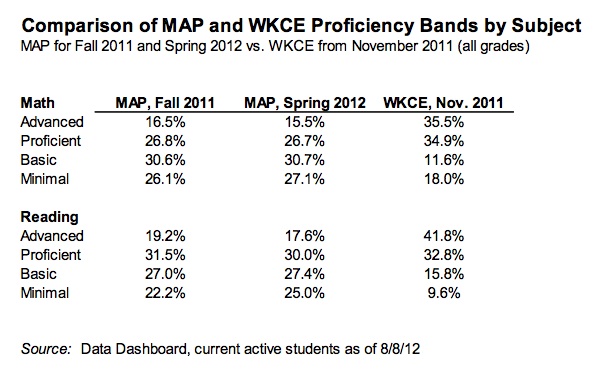
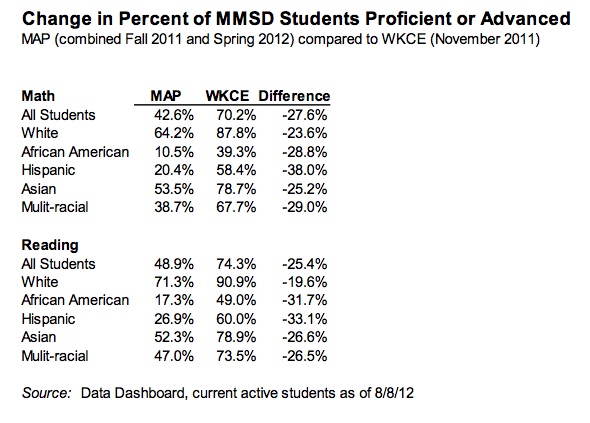
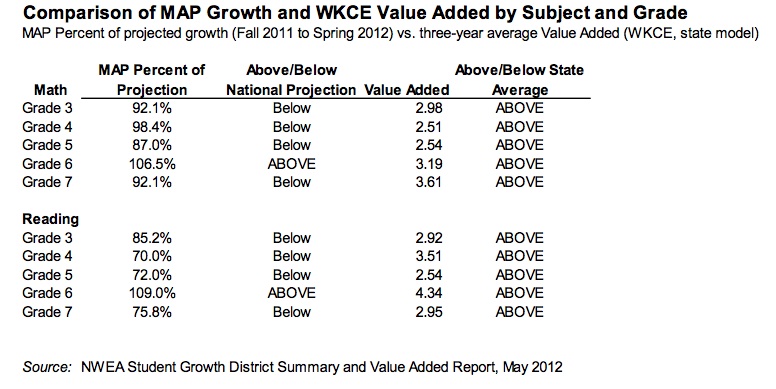
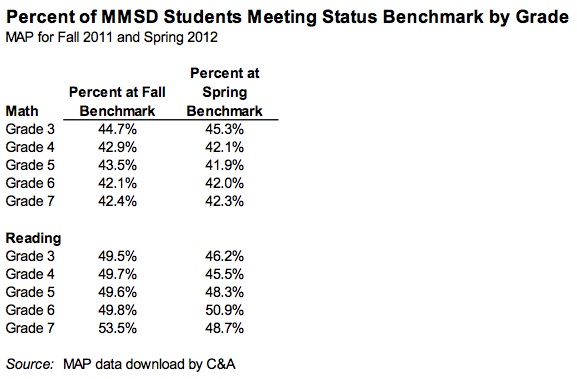
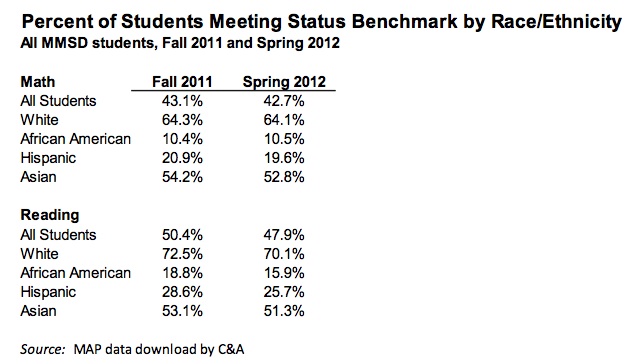
Madison Schools’ Measures of Academic Progress (MAP) Assessment Results Released

Interim Madison Superintendent Jane Belmore (175K PDF):

The Measures of Academic Progress (MAP) is a computer adaptive series of assessments from the North West Evaluation Association (NWEA). There are tests in reading, language usage and math.
When taking a MAP test, the difficulty of each question is based on how well a student answers all the previous questions. As the student answers correctly, questions become more difficult. If the student answers incorrectly, the questions become easier. In an optimal test, a student answers approximately half the items correctly and half incorrectly. The final score is an estimate of the student’s achievement level. Each test takes approximately 50 minutes to complete.
MMSD has chosen to administer MAP for the following reasons:

  • It helps ensure technical infrastructure to support implementation of Smarter Balanced Assessment.
  • Rapid turn-around of classroom, school and district level data.
  • Nationally normed results give a more accurate picture of MMSD’s standing.
  • MAP measures student achievement growth in content area and within strands in a content area.
  • Beginning 2012-13, MAP will be aligned with the Common Core State Standards
  • MAP is not high stakes. It is not reported to the state for accountability purposes, but rather for district and school improvement.

In 2011-12, MAP was administered for Grades 3 through 7. In 2012-13, it will be expanded to include Grade 8. The default is to provide the test to all students, but MMSD has the ability to use judgment for students with disabilities. So, not all special education students will take MAP. Also, MAP is not for ELL levels 1 or 2.

I’m glad the Madison Schools published this information, and that they are implementing a much more rigorous assessment than the oft-criticized WKCE. I look forward to seeing the District’s report on the EXPLORE assessment, as well.
Nearby Monona Grove has used the MAP assessment for a number of years. It would be interesting to see how the Districts compare.


Matthew DeFour and TJ Mertz comment.

Share

Interim Principal Named for Stuyvesant High School as Cheating Inquiry Unfolds

Al Baker:

The former head of a specialized high school in Queens was named interim head of Stuyvesant High School on Monday, three days after its principal abruptly announced his retirement amid a continuing cheating inquiry.
The new interim principal, Jie Zhang, has been an educator in the school system for more than two decades, education officials said. From 2006 to 2011, she was principal of Queens High School for the Sciences at York College; it is one of the city’s eight high schools, including Stuyvesant, that use a common achievement test for admission.

Share

Brazil approves affirmative action law for universities

BBC:

The Brazilian Senate has approved a bill that reserves half the places in the country’s prestigious federal universities to state school students.
African-Brazilian Senator Paulo Paim said most Brazilians would benefit as only 10% of students graduated from private schools.
President Dilma Rousseff is now expected to sign the bill into law.
But the measure has attracted criticism, as it also sets up quotas based on racial background.

Share

Opportunities Suspended: The Disparate Impact of Disciplinary Exclusion from School

Daniel J. Losen, Jonathan Gillespie, Foreword by Gary Orfield:

The Civil Rights Project (CRP) is proud to publish this important report by Daniel Losen and Jon Gillespie. It is the first national study by our Center for Civil Rights Remedies, which is headed by Dan Losen. Since its founding 16 years ago, CRP’s central focus has been on racial and ethnic inequalities in educational opportunities, and on policies that could remedy the resulting inequalities in school outcomes. We have published studies and books on segregation in schools, inequality in choice programs, issues of equity in testing, discrimination in special education placement, the dropout crisis, and the school-to-prison pipeline, as well as many studies on college access. Losen has done pioneering work on issues of unequal treatment within schools, including the widely cited book, Racial Inequity in Special Education (Losen & Orfield, 2002), and on dropouts.
One thing that has become very clear through our work at the Civil Rights Project is that it is critically important to keep students, especially those facing inequality in other parts of their lives, enrolled in school. This relates directly to the common and often highly inappropriate policy of punishing students who are already at risk of dropping out by suspending them from school. Because suspension increases a young person’s probability of both dropping out and becoming involved with the criminal justice system, it is difficult to justify, except in extreme situations where safety or the educational process of the school is directly and seriously threatened. For the vast majority of cases, however, the challenge is to find a way to address the situation with better practices, more alternatives, and more effective training of school personnel.

Share

All systems are go for N.J. teacher tenure reform, now comes the serious work

Laura Waters:

Now that our kumbaya moment is over, the real work begins: implementation of TEACHNJ, Senate Bill 1455. So much depends on the N.J. Department of Education’s ability to oversee the transformation of teacher and principal evaluations. Many people believe that our system for measuring classroom and management effectiveness must evolve beyond the meaningless toggle of satisfactory-unsatisfactory designations towards meaningful assessments, tied to both student growth and best practices.
But starting a year from September? For 591 school districts?

Share

Peter Thiel’s College Dropouts: How’s That Working Out?

Jillian D’Onfro:

Peter Thiel, co-founder of PayPal and prolific angel investor, sparked controversy last fall when he announced a fellowship giving 24 young adults $100,000 over two years to leave college and pursue entrepreneurship full time.
The mission behind the program: Rattle the default assumption that every young adult needs a college education. Thiel thinks that rather than spend four (or more) years acquiring a crushing debt load, creative talents should instead go directly into enterprise: “an inquisitive mind, rigorously applied to a deep-rooted problem, can change the world as readily as the plushest academic lab.”

Share

How Americans Would Slim Down Public Education

Steve Farkas, Ann Duffett:

Education budgets are tight and state and district leaders must make tough decisions about where and how to save. But is the public willing to accept cuts? Which ones? Where? According to the results of this pathbreaking survey, many Americans support dramatic changes to how school districts do business. From cutting central-office staff to reforming retirement benefits, this report outlines how voters think spending should be reduced–and what programs must be protected. What exactly did the authors find?

Share

More on New Jersey Teacher Tenure Reform

John Mooney:

With the signing yesterday of New Jersey’s new teacher tenure law, there was the expected fanfare about the stakeholders and bipartisan efforts that went into crafting the final bill.
Less attention was given to the two weeks of marathon meetings in early June that finally turned the legislation, the break coming when the governor relented on an issue that was once almost non-negotiable.
A half-dozen key players led by state Sen. Teresa Ruiz (D-Essex), the main crafter of the bill, met for hours at a time in a handful of locations to work out the details, according to several of those who attended.

Matt Katz has more.

Share

K-12 Tax & Spending Climate: Amid the Debate About Whether and How to Reform the Tax Code, a Look at How the Picture Has Changed

David Wessel:

President Barack Obama says someone has to pay more taxes if the U.S. is to tame its budget deficit and provide the government he thinks the nation needs. He proposes that the best-off Americans pay more. It’s only fair, he says.
“There are a lot of wealthy, successful Americans who agree with me because they want to give something back,” he said in a speech in Roanoke, Va., that set off dueling campaign ads. “Look, if you’ve been successful, you didn’t get there on your own.”
His Republican opponent, Mitt Romney, counters that the deficit can be reduced without raising taxes if Washington is tough on spending. He thinks raising taxes on the best-off would be unwise and unfair. “President Obama attacks success, and therefore under President Obama we have less success,” he said.

Share

Aiming at the Suburbs and Hitting Higher Ed

Peter Wood:

Spreading the Wealth, however, bears directly on the economic prospects of higher education. Kurtz’s provocative thesis is that under bland-sounding labels such as “regionalism” and “Building One America,” Obama has laid the regulatory groundwork for curtailing the political autonomy and the economic vitality of the nation’s suburbs. He traces Obama’s animus against the suburbs back to his days as a community organizer and traces the community organizers Obama worked with in the 1980s and 1990s forward to their participation in White House meetings during Obama’s presidency. A principal figure in this is Mike Kruglik, a longtime community organizer who was one of Obama’s first bosses in Chicago in the 1980s, and who remains one of Obama’s close confidants and White House guests.

Share

Q&A with Madison schools’ Belmore: Interim post ‘kind of my style’

Matthew DeFour:

Q: What will the state’s new report cards and individual school ratings this fall mean for Madison schools?
A: We need to work together with our community members and organizations and make sure we understand what the information is going to mean to our different audiences. The conversation that took place in the school district and the community last year laid the foundation for that. People are absolutely focused on the fact that we have to do better with all of our children. It’s really a matter of making sure the strategies that we have are moving forward and are the right ones and we’re checking them along the way and making corrections, and hopefully every child will be better on every measure

Much more on Interim Madison Superintendent Jane Belmore, here.

Share

Teachers put to test by digital cheats

John Keilman:

Heloise Pechan’s heart rose when she read the essay one of her students, a seemingly uninterested high school sophomore, had turned in for a class assignment on “To Kill a Mockingbird.” The paper was clear, logical and well written — a sign, she thought, that she had gotten through to the boy.
Her elation passed quickly. What came next was suspicion.
Pechan, then substitute teaching at a McHenry County high school, went to Google, typed the paper’s first sentence (“Kind and understanding, strict but fair, Atticus Finch embodies everything that a father should be”) and there it was: The entire essay had been lifted from an online paper mill.
“I went from amazement and excitement to ‘Oh my God’ in the space of a half-second,” Pechan recalled.

Share

Amazon launches textbook rental service

Andrew Edgecliffe-Johnson and Barney Jopson:

Amazon.com has launched a textbook rental service, allowing US students to borrow print editions for a school term at up to 70 per cent off the price of new titles, but the education industry is expecting the growth of rentals to slow.
Book Industry Study Group research found that textbook rentals rose last year from 8 per cent of the market to 11 per cent, with a corresponding drop in new textbook sales, from 59 to 55 per cent. There is also a sizeable second-hand market in textbooks.
Cengage, one of the largest US college publishers, forecast that rentals could reach 26 per cent of new and used textbook sales by 2015 before flattening out. “I don’t think [Amazon’s entry] changes anything for us,” said Ron Dunn, Cengage’s chief executive.

Share

Raising Successful Children

Madeline Levine:

PHRASES like “tiger mom” and “helicopter parent” have made their way into everyday language. But does overparenting hurt, or help?
While parents who are clearly and embarrassingly inappropriate come in for ridicule, many of us find ourselves drawn to the idea that with just a bit more parental elbow grease, we might turn out children with great talents and assured futures. Is there really anything wrong with a kind of “overparenting lite”?
Parental involvement has a long and rich history of being studied. Decades of studies, many of them by Diana Baumrind, a clinical and developmental psychologist at the University of California, Berkeley, have found that the optimal parent is one who is involved and responsive, who sets high expectations but respects her child’s autonomy. These “authoritative parents” appear to hit the sweet spot of parental involvement and generally raise children who do better academically, psychologically and socially than children whose parents are either permissive and less involved, or controlling and more involved. Why is this particular parenting style so successful, and what does it tell us about overparenting?

Share

High Schools putting kids off IT careers, deepening skills shortage

Simon Sharwood:

High School teaching of IT as a career actually puts kids off pursuing careers in the field, according to John Ridge, Executive Director of the Australian Computer Society Foundation Trust Fund (ACSF).
Ridge says general computer literacy courses in early high school are important and welcome, as employers expect some level of skill with productivity applications when hiring. But once kids start to study IT as a career, he says, they tend to abandon the idea of actually working in the industry.
The reason for the rebound, he says, is that too few teachers have the skills and passion to teach IT well. In New South Wales, Ridge said he feels 100 to 200 IT teachers do well … but with more than 1000 high schools in the State that’s not a great strike rate. Without proper resourcing and relevant curricula – the NSW Higher Schools Certificate’s Software Development and Design course is unchanged since 2009 – Ridge therefore wonders if it is even worth teaching IT as a career in schools.

Share

Brown’s CS1730 Available Online

brown.edu:

We will be making this course, Brown’s upper-level programming languages offering, available for free on the Web. People anywhere are welcome to view the lectures, read the materials, and do the assignments.
The on-line version does not offer credit from Brown; but those who successfully complete it can get recognition of this directly from the instructor. In particular, because we anticipate some people following the course will be busy professionals, we will offer three levels of recognition:
Lite
You successfully complete a sufficiently high number of the regular quizzes throughout the semester.
Mezzanine
In addition to Lite, you also complete the minor project that occupies the first month.
Ninja
In addition to Mezzanine, you also complete the major project that occupies the remaining two months.

Share

How to help your child overcome the fear of public speaking

Jessica Ogilvy-Stuart:

My son’s school is following the Hong Kong Diploma of Secondary Education (HKDSE) curriculum, and I am worried about the speaking element of the English assessment. His written work is good, but he is not a great communicator. How can I help him to develop more confidence in this area?
Public speaking is seen as a challenge by many Hong Kong students. The speaking portion of the HKDSE may be less familiar than other assessment tools. But it can be an area in which students can develop confidence, which will serve them well in their professional lives.
All Form Four to Form Six students taking the HKDSE course through their schools will have to take the school-based assessment (SBA) component of the English language examination. This accounts for 15 per cent of the final grade. Part A of the assessment contributes two-thirds of the grade and requires students to read or view four texts, record their personal views and then either discuss their perspectives with classmates or make individual presentations.

Share

Percentage of College Graduates in Total Population

OECD via Laura Waters:

The OECD (Organisation for Economic Cooperation and Development) has just released data regarding the “tertiary education graduation rates” based on the “percentage of graduates to the population at the typical age of graduation.”
The percentages run from 2000 – 2007. So, for example, in the Czech Republic the percentage of high school graduates as part of the general population was only 13.8% in 2000 but then soared to 34.9% in 2007.
The United States was relatively flat: 34.4% in 2000 with a slight increase to 36.5% by 2007. For comparison’s sake, hallowed Finland moved from 40.8% to 48.5% and Japan started at 29.4% and moved to 38.8%. Among the 25 nations included in the analysis, in 2007 15 countries achieved higher percentages than the U.S. and 9 had percentages below. Outliers were Iceland, with a 63.1% graduation rate in 2007 and Turkey with 15.2% in 2006.

Share

An Interview with Laurie Rogers: Parent, Activist, Author, Education Blogger


Laurie Rogers
39MB mp3 audio file
Transcript
I appreciate the time Laurie took to discuss her activism, experience and aspirations along with her views on where our ed system is going.

Laurie is the author of Betrayed: How the Education Establishment Has Betrayed America and What You Can Do About It and publishes a related blog.
Share

A Review of Sunday is for the Sun; Monday is for the Moon

Sandra Priest Rose and Glen Nelson
New York: Reading Reform Foundation, 2012
There seems to be a growing frustration and concern, among Upper Education professors, and many teachers in Lower Education as well, with the poor reading and writing abilities of our students. If they cannot read, they cannot understand the material being assigned, and their academic writing has discouraged many educators from even trying to assign term papers.
This book, by Sandra Priest Rose and Glen Nelson, explains the thirty-year effort of the Reading Reform Foundation to ensure that at least some students in New York learn to read well early, and so to enjoy the knowledge and understanding they can get from reading with ease. It should be widely read and its programs sought out by educators all over the country who want to do more to introduce their students as soon as possible to such success.
I did not learn to read in the first grade. When I brought home an “F” in reading, it is not too much to say that my mother (Wellesley BA, Radcliffe MA, in English Literature) was not happy. That summer she taught me (unrelentingly) to read phonetically. When my first report card came back from second grade (the school had let me advance) it showed a “D”in reading. My mother went to the school and said “What is this? He is an excellent reader!” The problem, as it turned out was that I “would not stay with the rest of the class”–that is, when the class started a story, I finished it by myself–thus my grade of “D.”
That was probably in 1942, so I am not sure whether I was being offered the “look-say” method in my first school year or not, but my mother’s phonics instruction was very helpful to me in my reading at Harvard and later at Cambridge University, again in English Literature.
This new book about the reading program of the Reading Reform Foundation is not just about the essential value of phonics. It also takes the now unorthodox view that there are obvious connections between reading and knowledge, between knowledge and understanding, and between understanding and writing.
Over the last thirty years, for about 2,000 students a year in New York, the Reading Reform Foundation has offered 160 hours of teacher training, 60 visits a year by a mentor for each participating teacher, and an engaging curriculum to immerse young students in the excitement of sounding out words, and discovering not only their meaning, but very soon the meaning of the reading material in which they appear.
More than 14,000 teachers have attended the annual conferences of the Reading Reform Foundation over the years, and the Program is now at work in 75 New York classrooms each year.
This book includes the results of a study conducted by the City University of New York into the work of the Reading Reform Foundation. They may mean more to those who got a better grade in Statistics in graduate school than I did, but they look very encouraging to anyone concerned over the slow progress in reading of too many of our current youngsters who don’t have explicit phonics instruction on their side.
One of the authors, Sandra Priest Rose, has been a supporter of The Concord Review for years, and is assuredly one of the small group of dedicated people who have enabled the Reading Reform Foundation to serve students and teachers for thirty years with only 20% of their expenses coming from the schools which participate.
For those with an English major Wellesley graduate at home, learning to read phonetically (after school) may not be a problem. For all other elementary students, and especially for their teachers, I recommend the Reading Reform Foundation’s program. Jeanne Chall’s idea that after third grade students will be “reading to learn,” will not come true for too many students if they don’t have the benefit of a vigorous and engaging reading and writing program like the one offered by the Reading Reform Foundation in New York.

Share

New Jersey Passes Teacher Tenure Reform

Heather Haddon:

After signing a bill to overhaul teacher tenure rules Monday, Gov. Chris Christie said the changes represented one of his signature political achievements, ranking only behind a successful effort to limit government employees’ pension and benefit costs.
“It’s right behind pension and benefit reform just because the level of skepticism that we would get anything done,” Mr. Christie said in an interview with The Wall Street Journal following a news conference at a middle school here. “There had been such inertia on this topic. I always enjoy defying expectations.”
The new law doesn’t go as far as tenure bills passed in other states in the past year. But it marks a significant shift in the nation’s oldest teacher job-security law, requiring all teachers to undergo annual performance reviews and making it easier to fire poorly performing educators.

Laura Waters:

For Senator Teresa Ruiz, who tirelessly shepherded NJ’s tenure reform bill through the gauntlet of the Senate, the Assembly, union opposition, aggressive reformers, and countless interest groups.
How collegial was the signing yesterday at a Middlesex middle school? Chris Christie sounded practically conciliatory, telling NJ Spotlight that he signed the bill because “my decision was there was enough really good things in this bill that I was not going to allow it not to become law because it didn’t have everything I wanted” and seating arrangements placed B4K’s Derrell Bradford in between NJEA President Barbara Keshishian and AFT President Joseph Del Grosso.

Share

What I’ve Learned About Learning

raganwald:

I have a rather glaring life-long weakness, a behaviour that has tripped me up many times. You would think that I would have noticed it and corrected my behaviour in my teens or twenties, but no, it has persisted. While I am much better at correcting myself, it is extremely persistent and requires constant vigilance to suppress.
The behaviour in question is this: When I am learning something new, I suffer from laziness, impatience, and hubris. I try to grasp the gist of the thing, the conclusion, and then I stop. I figure I “understand” it, so I must be done learning.
This is wrong for me. I am blessed with a quick mind for certain subjects, so there are times when I am reading something, or someone is explaining something, and I can work out the obvious implications. Someone is telling me about aspect-oriented programming, and I start thinking about cross-cutting concerns like authorization. Or perhaps database access. Then I ask myself whether AOP is related to the “Unobtrusive Javascript” style. Or if it’s really fine-grained dependency injection.

Share

5 Things Young People Don’t Know

Jason Goldberg:

One of the greatest joys of my job is coaching and mentoring super smart and super ambitious young people.
I find myself doing this a lot lately.
Here’s a common pattern we find at Fab (and, I’m sure, at many startups): Young person leverages his or her brain, passion, ambitions and talents to rise up to a senior role very quickly. They take on a ton of responsibility and they kick ass at it. But, then, invariably, the young superstar hits some sort of a wall. Often it’s a burnout wall. Other times it’s a managing-down wall. Other times it’s a managing-up wall. Other times it’s just a bruised ego. Most of the time though it’s just youth. There’s value and maturity that comes from experience and pattern recognition. And, for young people who rise to the top quickly, there’s a natural impatience that flies in the face of waiting for that experience and pattern recognition to guide the way.

Share

N.J. Mom Puts Kids To Bed With Math

Ashley Milne-Tyte:

The U.S. ranks 25th out of 34 countries when it comes to kids’ math proficiency. One New Jersey parent wants to change that by overhauling the culture of math. An astrophysics graduate and mother of three kids, she started a ritual when each child was 2 years old: a little bedtime mathematical problem-solving that soon became a beloved routine. Parent friends began to bug her to send them kid-friendly math problems, too. Now Bedtime Math is gaining fans among children and math-shy parents around the country.

Share

Kindergarten in the Computer

Katherine Mangu-Ward:

The notion of online education for the Crayola set can strike adults as absurd. But for kids, even little ones, it’s the idea ignoring computers all day that sounds crazy. After all, if you ask a third grader to list his favorite things, “doing stuff on the computer” will rank high, probably somewhere between race cars and string cheese.
What most people envision when they think of online education–a college or high school student sitting at a computer all day at home, perhaps with minimal parental guidance–isn’t viable for the vast majority of families with young kids. Warehousing is a dirty word in education circles, but the truth is that it must be part of the package. Kids need somewhere to go during the day, preferably to hang out with other kids. They also need a bunch of adults there to keep them from killing one another and help them learn something.

Share

New Jersey Gov. Christie signs teacher tenure overhaul bill

Melissa Hayes:

Governor Christie today signed a bill that overhauls the state’s teacher tenure system, even though it is missing a key component he fought to include in the measure.
Christie signed the bill, known as the Teacher Effectiveness and Accountability for Children of New Jersey Act, in the media center of the Von E. Mauger Middle School after briefly meeting with children in a summer camp program in the school’s gymnasium.
Christie had wanted the bill to include a provision that would weaken seniority provisions, known as last in first out.
Education Commissioner Chris Cerf praised the law, but said that the “last in, first out” provision must still be addressed.
“Lets celebrate this moment together but lets not pretend the work is done,” he said.

Share

Carrots and Sticks for School Systems

The New York Times:

Education Secretary Arne Duncan has been pushing the states to create rigorous teacher evaluation systems that not only judge teachers by how well their students perform but also — when the results are in — reward good teachers while easing chronic low performers out of the system. More than half the states have agreed to adopt new evaluation systems in exchange for competitive grants from the federal Race to the Top program or greater flexibility under the No Child Left Behind law.
These incentives are long overdue. As things stand now, according to a study by the New Teacher Project, a Brooklyn-based policy group, many school managers make no distinction between high-performing and low-performing teachers. The result is that poor teachers stick around while good teachers go elsewhere or leave the profession, frustrated because they are not promoted, rewarded with better pay, or even simply acknowledged.

Share

HS football players’ cognitive skills tested

Associated Press:

South Florida public high school football players are having their cognitive skills assessed before their season starts.
The Immediate Post-Concussion Assessment and Cognitive Testing is a 20-minute, computerized evaluation often administered by a trainer. It gives doctors a baseline assessment of an athlete’s mental abilities so that after an injury, the test can be retaken for a true measure of recovery.
The Cleveland Clinic agreed last month to underwrite a pilot program testing Palm Beach County football players before their season starts Monday. Miami-Dade County has been using baseline testing for two years, and Broward County began mandatory testing this year.

Share

More education jargon and what it really means

Valerie Strauss:

Here are 10 education terms with definitions that tell you what they really mean to people who use them in our national education conversation.
Yesterday I published the first installment of education jargon, written by Joanne Yatvin, a vet­eran public school educator, author and past president of the National Council of Teachers of English. She is now teaching part-time at Portland State University.
Here’s more jargon from Joanne Yatvin:
School Reform Plans: Untested notions for improving public education, many of which have been tried before with negligible results
School Reformers: People with impressive titles who have had little or no practical experience in schools.
Charter Schools: Semi-private schools supported by public funds deemed superior by parents because they appear more elegant and exclusive than public schools.

Share

Day Dreaming – The Secret Behind Success

Dan Jones:

Research shows daydreaming leads to improved learning; enhanced abilities; greater creativity & increased success I researched how people achieve success. I wanted to find out if there is a pattern that can be replicated and used to help others get the same results. I initially looked at highly successful people in their chosen field from Entrepreneurs like Richard Branson & Peter Jones to Geniuses like Albert Einstein & Leonardo Da Vinci. I also looked at the thinking styles of successful creative people like Beethoven & Walt Disney. What I found was that they all had one thing in common. They all spent time daydreaming about their area of success. “When I get an idea I start at once building it up in my imagination.” Nikola Tesla “When I heard the music it made pictures in my head…here are the pictures.” Walt Disney (Describing the film Fantasia)

Share

To Increase Learning Time, Some Schools Add Days to Academic Year

Motoko Rich:

Griffith, one of five schools in the Balsz Elementary School District here, is one of a handful of public schools across the country that has lengthened the school year in an effort to increase learning time.
A typical public school calendar is 180 days, but the Balsz district, where 90 percent of the students qualify for free or reduced lunch, is in session for 200 days, adding about a month to the academic year.
According to the National Center on Time and Learning, a nonprofit research group in Boston, about 170 schools — more than 140 of them charter schools — across the country have extended their calendars in recent years to 190 days or longer.

Share

Why Students Need a Guide to Free Speech on Campus More Than Ever

Will Freeley:

Today’s college students enjoy the ability to speak their minds in unprecedented ways. Powered by omnipresent high-speed Internet access, students may sound off at all hours via a sparkling array of online outlets: Twitter, Facebook, Tumblr, Instagram, email, instant messaging, and blogs, just to name a few.
The ancient among us — by which I mean those who graduated from college before, say, the year 2002 — may not realize the enormity of this change. While old standbys like phone calls, text messages, and even face-to-face conversations have certainly not been forsaken, student speech — to each other, and to professors, parents, and the public — has increasingly moved online.
On balance, this shift is a positive development. Students may now communicate with each other and the wider world at a speed impossible just 20 years ago. The vastly expanded audience made possible by the Internet’s hyperconnectivity means student ideas now rocket around the globe instantly, no longer confined to the quad or the classroom.

Share

Open Access facts from Peter Suber

David Weinberger:

I’m enjoying my friend Peter Suber’s small book Open Access. He’s a very clear and concise writer, and of course he knows this topic better than anyone.
Here are some facts Peter mentions:
In 2008, Harvard subscribed to 98,900 serials. Yale subscribed to 73,900. “The best-funded research library in India…subscribed to 10,600.” And, Peter points out, some Sub-Saharan universities cannot afford to subscribe to any. (pp. 30-32) Way to make yourself smart, humanity!
“In 2010, Elsevier’s journal division had a profit margin of 35.7 percent while ExxonMobil had only 28.1 percent.” (p. 32)
The cost of journals has caused a dramatic decrease in the percentage of their budgets research libraries spend on books, from 44% in 1986 to 28% now. “Because academic libraries now buy fewer books, academic book publishers now accept fewer mauscripts…” (p. 33)

Share

K-12 Tax & Spending Climate: The Size of the State

The Economist:

At first glance, Mr Obama’s critics have ample ammunition. Federal spending during his term was the highest relative to GDP since the end of the second world war. A record number of the population now gets federal entitlements such as Medicaid and food stamps. The federal government backs 90% of new mortgages, up from half before the financial crisis, as well as a growing share of student loans. Staffing levels at regulatory agencies have ballooned, and they churn out more and costlier rules than their predecessors.
Behind these bits of data, however, lies a more complicated reality. Much of the expansion in government is a direct consequence of the weak economy. Last year a record 45m people received food stamps, up 58% from 2008, while a record 53m were on Medicaid (the health-care programme for the poor), up 21%. This is almost entirely caused by unemployment and shrunken pay-cheques; eligibility has not changed for either programme in that time, although the 2009 stimulus act temporarily raised food stamp benefits and state Medicaid transfers. Similarly, because investors have lost their appetite since the crisis for securities without a federal guarantee, federally-backed agencies have been forced to underwrite a growing share of new mortgages.

Share

Large study says great teachers get little respect

Jay Matthews:

The fourth-grade teacher was by any measure a star. Fidgety students behaved in her class. Test scores were high. She had come to the low-income neighborhood school to make an impact. In her class, she did. But few of her supervisors or colleagues seemed to care.
“School leaders gave her little recognition,” says a new research study on how schools treat great teachers. They “failed to take advantage of her instructional expertise and stymied the sort of team-building and collaboration that had helped her boost performance among students and fellow teachers at other schools for decades.”
So this summer, she left for another school that wanted her talent. She told the researchers that when she resigned, the principal “just signed my paperwork, and didn’t even say a word. . . . It made me feel like he couldn’t care less, not about me and not about this school.”

Share

Common Core Anyone? Anyone?

The totalitarian left has been similarly clear that decision-making power should be confined to a political elite–the “vanguard of the proletariat,” the leader of a “master race,” or whatever the particular phrase that might become the motto of the particular totalitarian system. In Mussolini’s words, “The mass will simply follow and submit.”
Thomas Sowell
Intellectuals and Society
New York: Basic Books, 2011, pp. 104-106
…Reliance on systemic processes, whether in the economy, the law, or other areas, is based on the constrained vision–the tragic vision–of the severe limitations on any given individual’s knowledge and insight, however knowledgeable or brilliant that individual might be, compared to other individuals. Systemic processes which tap vastly more knowledge and experience from vastly more people, often including traditions evolved from the experience of successive generations, are deemed more reliable than the intellect of the intellectuals.
By contrast, the vision of the left is one of surrogate decision-making by those presumed to have not only superior knowledge but sufficient knowledge, whether these surrogates are political leaders, experts, judges or others. This is the vision that is common to varying degrees on the political left, whether radical or moderate, and common also to totalitarians, whether Communist or Fascist. A commonality of purpose in society is central to collective decision-making, whether expressed in town-meeting democracy or totalitarian dictatorship of other variations in between. One of the differences between the commonality of purpose in democratic systems of government and the totalitarian systems of government is in the range of decisions infused with that commonality of purpose and in the range of decisions reserved for individual decision-making outside the purview of government.
The free market, for example, is a huge exemption from government power. In such a market, there is no commonality of purpose, except among such individuals and organizations as may choose voluntarily to coalesce into groups ranging from bowling leagues to multinational corporations. But even these aggregations typically pursue the interests of their own respective constituents and compete against the interests of other aggregations. Those who advocate this mode of social decision-making do so because they believe that the systemic results of such competition are usually better than a society-wide commonality of purpose imposed by surrogate decision-makers superintending the whole process in the name of “the national interest” or of “social justice.”
The totalitarian version of collective surrogate decision-making by government was summarized by Mussolini, who defined “totalitarianism” in the motto: “Everything in the State, nothing outside of the State, nothing against the State.” Moreover, the state ultimately meant the political leader of the state, the dictator. Mussolini was know as Il Duce–the leader–before Hitler acquired the same title in German as the Führer.
Democratic versions of collective surrogate decision-making by government choose leaders by votes and tend to leave more areas outside the purview of government. However, the left seldom has any explicit principle by which the boundaries between government and individual decision-making can be determined, so that the natural tendency over time is for the scope of government decision-making to expand, as more and more decisions are taken successively from private hands, since government officials constantly have incentives to expand their powers while the voters’ attention is not constantly focussed on maintaining limits on those powers.
Preferences for collective, surrogate decision-making from the top down are not all that the democratic left has shared with the original Italian Fascists and with the National Socialists (Nazis) of Germany. In addition to political intervention in economic markets, the democratic left has shared with the Fascists and the Nazis the underlying assumption of a vast gap in understanding between ordinary people and elites like themselves. Although both the totalitarian left–that is, the Fascists, Communists and Nazis–and the democratic left have widely used in a positive sense such terms as “the people,” “the workers” or “the masses,” these are the ostensible beneficiaries of their policies, but not autonomous decision-makers. Although much of the rhetoric on both the democratic left and the totalitarian left has long papered over the distinction between ordinary people as beneficiaries and as decision-makers, it has long been clear in practice that decision-making has been seen as something reserved for the anointed in these visions.
Rousseau, for all his emphasis on “the general will,” left the interpretation of that will to elites. He likened the masses of the people to “a stupid, pusillanimous invalid.” Godwin and Condorcet, also on the eighteenth century left, expressed similar contempt for the masses. Karl Marx said, “The working class is revolutionary or it is nothing”–in other words, millions of human beings mattered only if they carried out his vision. George Bernard Shaw included the working class among the “detestable” people who “have no right to live.” He added: “I should despair if I did not know that they will die presently, and that there is no need on earth why they should be replaced by people like themselves.” As a young man serving the U.S. Army during the First World War, Edmund Wilson wrote to a friend: “I should be insincere to make it appear that the deaths of this ‘poor white trash’ of the South and the rest make me feel half so bitter as the mere conscription or enlistment of any of my friends.”
The totalitarian left has been similarly clear that decision-making power should be confined to a political elite–the “vanguard of the proletariat,” the leader of a “master race,” or whatever the particular phrase that might become the motto of the particular totalitarian system. In Mussolini’s words, “The mass will simply follow and submit.”
—————————
“Teach by Example”
Will Fitzhugh [founder]
The Concord Review [1987]
Ralph Waldo Emerson Prizes [1995]
National Writing Board [1998]
TCR Institute [2002]
730 Boston Post Road, Suite 24
Sudbury, Massachusetts 01776-3371 USA
978-443-0022; 800-331-5007
www.tcr.org; fitzhugh@tcr.org
Varsity Academics®
www.tcr.org/blog
Share

Automated grammar-checking

The Economist:

READERS are still debating my criticism of Kyle Wiens’s “I won’t hire people with bad grammar” post on language and computer code. To recap, Mr Wiens said “at its core, code is prose” and I said “no, it isn’t.” My criticism had more to it than that (and granted Mr Wiens several points). But here is a test, illustrative if not dispositive: if code is prose, then prose is a kind of code, and excellent coders should be able to write meta-code that would error-check natural language (analogous to how compilers check a program).
As it happens, Ben Yagoda recently tested Grammarly, a service that, for $140 a year, will be “an automated proofreader and your personal grammar coach.” Yesterday he posted his results:

Share

10 Things in School That Should Be Obsolete in Schools

Greg Stock:

So much about how and where kids learn has changed over the years, but the physical structure of schools has not. Looking around most school facilities — even those that aren’t old and crumbling – it’s obvious that so much of it is obsolete today, and yet still in wide use.
1. COMPUTER LABS. Students are connected to the Internet everywhere except in school. Regardless of their income bracket, most kids carry around a world of information in their pockets on their mobile devices, and yet we force them to power down and disconnect, and we confine them in obsolete computer labs. A modern school needs to have connectivity everywhere and treat computers more like pencils than microscopes.

Share

Auto Crrect Ths!

James Gleick:

I MENTION a certain writer in an e-mail, and the reply comes back: “Comcast McCarthy??? Phoner novelist???” Did I really type “Comcast”? No. The great god Autocorrect has struck again.
It is an impish god. I try retyping the name on a different device. This time the letters reshuffle themselves into “Format McCarthy.” Welcome to the club, Format. Meet the Danish astronomer Touchpad Brahe and the Franco-American actress Natalie Portmanteau.
In the past, we were responsible for our own typographical errors. Now Autocorrect has taken charge. This is no small matter. It is a step in our evolution — the grafting of silicon into our formerly carbon-based species, in the name of collective intelligence. Or unintelligence as the case may be.
Earlier this year, the police in Hall County, Ga., locked down the West Hall schools for two hours after someone received a text message saying, “gunman be at west hall today.” The texter had typed “gunna,” but Autocorrect had a better idea.

Share

‘Won’t Back Down’ highlights parent trigger law for schools

Greg Toppo:

Set in a gritty Pittsburgh neighborhood, the upcoming Maggie Gyllenhaal/Viola Davis film tells the story of two parents, one of them a teacher, who use a little-known state law to take over their kids’ struggling public school. Turns out that such laws actually exist in four states — California, Texas, Mississippi and Louisiana — with lawmakers in about a dozen more, including Pennsylvania, expected to consider them over the next year.
First dreamed up by Democratic activist and former Clinton White House staffer Ben Austin, so-called parent trigger laws allow dissatisfied parents to demand changes at their kids’ schools — including a total takeover — if a majority sign on.

Won’t Back Down Links.

Share

Early childhood education works; it’s time to just make it happen

Tom Beebe:

If our children are going to learn in school and succeed in life they need opportunities to learn, like quality early childhood educational experiences.
The Wisconsin State Journal made that point very well in a recent editorial (“Sooner is better than later in learning”). Children from poverty face an array of problems that hold them back when they enter school. The paper talked about the United Way of Dane County’s Parent-Child Home Programs as a way to “help more parents give their children a good start at learning.”
This program and others, including Head Start and local efforts around the state and country, have been around for years. In this specific instance, United Way points to studies that suggest participants were better prepared for kindergarten, had higher test scores in elementary school and were more likely to graduate than non-participating peers.”

Share

Junking old way of teaching writing

Jay Matthews:

I almost never give advice to teachers. They live their work, while I just observe it and cannot hope to know as much as they do.
But on one subject, writing, I could teach most of them. My learning to put words together was long, painful and instructive. I know what works and what doesn’t.
That’s my excuse for suggesting in my last Local Living column a new kind of high school course. We should suspend the regular English curriculum for a semester and teach “Reading and Writing.” Every student would produce an essay each week and spend time at the teacher’s desk being edited. We would hire or train teachers to do what my first editors did: Cross out cute phrases, ask what I was trying to say, break overlong sentences into pieces, ask for specific examples, replace inactive verbs with active ones, and so on.
A class of 25 meeting five times a week for 50 minutes would allow only 10 minutes of editing a week for each student. But that adds up to 200 minutes of one-on-one editing per student by the end of the semester, a big improvement over what students get now, which often is zero. The usual written comments on graded papers lack the force of these personal exchanges.

Share

Utah ed leaders: Share teacher data with parents

Lisa Schencker:

Parents may soon be able to learn how their children’s individual teachers rate when it comes to student achievement.
But the general public will not be given access to that information.
The Utah state school board jumped this week into what’s become a national debate over whether individual teacher performance data should be released publicly. The board voted 9-6 on Friday to encourage school principals to share classroom-level achievement data with parents who ask for it. But the data will not be posted publicly, meaning nonparents will not have access to it, and parents will not likely be able to see that information for schools other than their own.

Share

Scolding, threats and security escorts — and it’s only August

Katy Murphy:

The fall semester is weeks away, but after a brief summer recess, tension came flooding back to the Oakland school board room this week.
I wasn’t at the Wednesday night board meeting when this went down, but it didn’t look pretty from my screen.
One minute Joel Velasquez — a Westlake and former Lakeview parent who has been perhaps the most outspoken and persistent critic of Oakland’s school closures — was at the podium, speaking about working closely with the superintendent and school board and becoming “allies.”
In the next, he was being escorted out of the school board meeting room by Oakland School Police after having threatened to stage protests at board members’ homes.

Share

A School Desk That Can Save Lives During An Earthquake

fastcodesign.com:

In the ’50s, American students practiced taking cover under their desks to protect themselves against nuclear attack. That precaution, of course, would have been pointless under those circumstances, but it could save lives in the case of an earthquake. The Earthquake Proof Table, designed by Bezalel student Arthur Brutter and instructor Ido Bruno, is engineered to shield two students from a ton of debris.

Share

Former Des Moines Superintendent Sebring: School slow in turning over emails she requested

Mary Stegmeir:

Nancy Sebring is at odds with her former employer, the Des Moines school district, which she claims has been slow to respond to her requests for public records.
The former schools superintendent believes the information in the emails and other documents that she has requested will “give a full picture” of what transpired following her May 10 resignation.
Sebring left her post after district staff members learned she had used her school email account to send and receive sexually explicit emails.
“I’m trying to put all the information of the last couple of months together and see what was going on and what was being said,” Sebring told The Des Moines Register Friday. “I’ve been approached by someone who is interested in my story. I am just trying to keep track of everything while it is still available.”

Share

We get got you into the UCF classes you need.

ucouldfinish.com

In just six days, U Could Finish helped over 500 students search for classes. On the seventh day, we were blocked.
U Could Finish was a tool that searched myUCF and sent a text when it found a seat in the class you wanted. That all came to a screeching halt on Friday, June 8th, when our server was blocked from UCF entirely. If you try to access this site on campus, it doesn’t even exist.

Share

PAVE aims to improve school boards

Alan Borsuk:

I’ve often said things like this: Show me a good school and I’ll show you a good principal. Or this: Show me a good school and I’ll show you valued and valuable teachers who row the boat together.
Dan McKinley would add this to the list: Show me a good school and I’ll show you a good board of directors.
He makes an important point, and PAVE, the organization he has headed for two decades, is launching a potentially valuable effort to improve a key to a school’s quality that has gotten little attention.
In a way that is likely to unfold largely behind the scenes, the new board quality initiative PAVE has launched could improve the success and long-term vitality of the 125 or so schools in Milwaukee that largely govern themselves – often, not particularly well.
The focus in education policy these days is predominantly on the classroom – including teachers and teaching, curriculum, higher standards and whether technology and online resources will bring fundamental changes in the way kids are taught in coming years. This is all important, of course.

Share

Education — Heading to Mediocrity for the Many

Adnan Al-Daini

Would Einstein and Newton have made good teachers of physics and mathematics in a school? I very much doubt it. Being an expert in a particular subject does not necessarily mean you are able to teach it to a class of teenagers; obvious really, but not to Britain’s Education Secretary apparently.
The decision by Michael Gove, the Education Secretary, that Academies – semi-independent state schools that receive funding directly from the government rather than through a local authority – can appoint teachers without formal teaching qualifications – “qualified teacher status” (QTS) – was characterized by the Department of Education as no big deal, and that most teachers will continue to have QTS qualifications.
But how long will this remain the case? Presumably, the Education Secretary believes that formal teaching qualifications make no difference to the quality of teaching in the classroom. That being the case why, then, should anyone bother with it in the future?

Share

Students need more civics education, warts and all

Chris Rickert:

Or consider — as both an example of the need for more civics education and as fodder for a potential lesson — the Kelda Helen Roys-Mark Pocan Democratic primary for Congress.
What else than a stunning lack of voter awareness could let Roys paint a staunch liberal like Pocan as some kind of Republican sympathizer and not get laughed out of Wisconsin’s 2nd District?
Then there’s the explosion in partisan media’s cult of personality.
I don’t know any better evidence of the citizenship skills gap than the droves of people who practice a form of citizenship that involves having their political biases regularly reinforced by radio and TV opinionators who feel pretty much the way they do.
Lack of civics education is a “huge problem,” said Mike McCabe, who as executive director of the Madison-based Wisconsin Democracy Campaign said he gets invited to speak in high school and college classrooms one to three times a month during the school year.

Share

Words: Madison’s Plan to Close the Achievement Gap: The Good, Bad, and Unknown

Mike Ford:

Admittedly I did not expect much. Upon review some parts pleasantly surprised me, but I am not holding my breath that it is the answer to MMSD’s achievement gaps. It is a classic example of what I call a butterflies and rainbows education plan. It includes a variety of non-controversial, ambitious, and often positive goals and strategies, but no compelling reason to expect it to close the achievement gap. Good things people will like, unlikely to address MMSD’s serious problems: butterflies and rainbows.
What follows is a review of the specific recommendations in the MSSD plan. And yes, there are good things in here that the district should pursue. However, any serious education plan must include timelines not just for implementation, but also for results. This plan does not do that. Nor does it say what happens if outcomes for struggling subgroups of students do not improve.
Recommendation #1: Ensure that All K-12 Students are Reading at Grade Level

The rejected Madison Preparatory IB charter school was proposed to address, in part Madison’s long standing achievement gap.
Related: Interview: Henry Tyson, Superintendent of Milwaukee’s St. Marcus Elementary School (an inner-city voucher school).

Share

Does mathematics have a place in higher education?

Cathy O’Neil:

A recent New York Times Opinion piece (hat tip Wei Ho), Is Algebra Necessary?, argues for the abolishment of algebra as a requirement for college. It was written by Andrew Hacker, an emeritus professor of political science at Queens College, City University of New York. His concluding argument:

Share

Teacher Dress Code

Yasmeen Abutaleb:

The Wichita School District is just one of a growing number in the nation cracking down on teacher apparel. Jeans are banned in at least one elementary school in New York City. A school district in Phoenix is requiring teachers to cover up tattoos and excessive piercings. And several Arizona schools are strictly defining business casual.
In an increasingly diverse nation where what you wear may be the ultimate self-expression, teachers are falling victim to the same dress code rules as their students.
In most cases, schools are taking the actions because they believe some teachers are dressing inappropriately. School board members received parental complaints about teacher dress at Arizona’s Litchfield Elementary School District, Superintendent Julianne Lein says.
The move comes at a time when the number of public schools requiring uniforms has nearly doubled over the past decade to 19%, reports the National Center for Education Statistics. The center doesn’t track teacher uniforms or dress codes. But it soon may have to, as schools have moved to:

Wichita’s 2011-2012 budget was $606,000,000 for 50,103 students ($12,095/student). Madison spent 18.6% more, or $14,858/student during the 2011-2012 budget cycle.

Share

Selling Public Education Feels Like Selling Out

One Teacher’s Perspective:

Gen. George C. Marshall once said, “There is no limit to the amount of good you can do if you don’t care who gets the credit.” Purportedly, this quote was one of Ronald Reagan’s favorites and was etched on a plaque that sat on the late president’s Oval Office desk.
A plaque with this noble quote would be equally appropriate sitting on a teacher’s desk. Most educators realize from our own schooling that education is normally a no credit profession and rarely a deferred credit occupation. Most students do not mature enough to realize the amount of good teachers do until they have already outgrown schools. A supermajority of my colleagues and I do not care if we never get credit for the amount of good we do for our students. We teach because we recognize–even without the surveys and the quantified data–the limitlessness of learning. The lack of recognition is simply the nature of the teaching profession.

Share

Belt Tightening @ Harvard University

Jennifer Levitz:

In 2009, as its endowment plunged by nearly 30%, Harvard University halted construction on a $1.2 billion science center across the Charles River, angering the neighborhood there by leaving behind a foundation and an idle construction site.
Harvard now says it will resume work on the project, but not until 2014 and even then at half the originally planned size, reflecting a newfound fiscal caution at the school. “The economic realities necessitate this,” Kevin Casey, a Harvard spokesman, said in June at a community meeting.
Due to budgetary constraints, Harvard has delayed the construction of a science complex, seen in the foreground above, inside the fenced-in area.
Many universities face shaky finances because of declining state aid and weakened returns on endowments. At Harvard–and some of its Ivy League peers –the recession has lingered because of an unusually heavy dependency on their endowments for operating income. Harvard’s $32 billion endowment is up from its 2009 drop to $26 billion, but still off its pre-recession 2008 value of $36.9 billion.

Share

A Look at Governance: Anthropologists join actuaries on risk

Gillian Tett:

On the first issue, for example, it is possible to view the world in two ways. Sometimes societies assume that there is a vertical, hierarchical pattern of control (ie somebody, like a government, in charge) but sometimes there is a horizontal dynamic where crowd power rules. This second pattern is roughly how the financial markets were supposed to work before 2007, when investors and free market forces shaped our financial system instead of government diktat. However, since 2007, government intervention has repeatedly trumped the power of the crowd, in ways that feel alien to investors.
However, it also matters whether we believe that societies operate in a benign, accountable manner, or not. Hierarchical relationships can be considered beneficial; wise regulators, for example, can shape markets in sensible, accountable ways and corporate managers steer their way round risks. But sometimes power seems capricious and harmful; panic-stricken governments suddenly do unpredictable, negative things. Similarly, while crowd rule can feel benign and collaborative, markets, say, can feel like a community, it can also be anarchic and unpleasant, a jungle driven by Darwinian selfish instincts.

I thought this passage “Sometimes societies assume that there is a vertical, hierarchical pattern of control (ie somebody, like a government, in charge) but sometimes there is a horizontal dynamic where crowd power rules.” was appropriate for what we often witness in the school governance arena.

Share

Whatever happened to kids’ chemistry sets?

Alex Hudson:

The first chemistry sets for children included dangerous substances like uranium dust and sodium cyanide, but all that has changed.
Talk to people of a certain age about chemistry sets and a nostalgic glaze comes over their eyes.
Stories of creating explosions in garden sheds and burning holes in tables are told and childhood is remembered as a mischievous adventure.
Portable chemistry sets were first used in the 18th Century but it took more than 100 years before they became popular with children, partly prompted by a desire to recreate the coloured puffs of smoke used by conjurors.

Share

Jumping the gap between a US and UK high school education

Andrew Maynard:

Tomorrow, my 16 year old daughter is leaving her home in the US for the UK. She’ll be there for the next two years while she studies for her A levels. It was a heart-rending decision for my wife and I to agree to her living apart from us in a different country. But the stark reality is that my daughter’s high school education here is just not good enough to prepare her for a British University – and in two years’ time, that’s where she wants to be.
I’ve long been worried about the US approach to science education in particular. When I was at school in the UK, we started studying physics, chemistry and biology in parallel from the age of 13. It didn’t suit everyone. But I wouldn’t be here as a science professor and department chair in a major university without this early start. It was key to me getting hooked on physics at an early age, while gaining a broad and integrated understanding of how the different disciplines complemented each other. In contrast, both of my kids have been following a sequential science track – biology (grade 9), geophysical science (grade 10), chemistry (grade 11) then physics (grade 12).

Share

PISA based Wealth Comparison

Zeit Online, via a kind Richard Askey email:

How do families live these days? OECD’s comprehensive world education ranking report, PISA 2009, was published in December of 2010. All participants of the test (fifteen-year-old pupils) completed a questionnaire about their living situation at home. ZEIT ONLINE analyzed and visualized this data to provide you with a unique way of comparing standards of living in different countries. Click on any icon to see further details.

Share

Australian Teachers to face annual review of performance

Andrew Stevenson:

EVERY school teacher faces an annual performance review with education ministers set today to approve a national framework for assessments to begin next year.
The actual form of the review will be left to individual schools and school systems but the ministers will commit to begin the process of reviewing the work of the country’s 290,000 teachers.
Reviews will be led by the principal, a senior teacher or an outsider could be brought in. They are expected to include observation of classroom performance, student results and feedback from both parents and students.
The federal Education Minister, Peter Garrett, said the performance reviews were a ”genuinely big and important reform”.

Share

AAE Signs on to College of Education Reform Coalition

Association of American Educators:

With the teaching profession growing and evolving, one theme that remains constant is the fact that effective teachers are the key to student success. Studies have shown that education schools are deeply in need of reform. From attracting top high school graduates, to improving the quality of instruction, institutions that prepare future teachers must be able to produce results. In order to bring our colleges of education into a new era of success, AAE is pleased to be joining the list of endorsers of the National Council on Teacher Quality’s (NCTQ) project to rank colleges of education in an effort to better prepare future educators.

Share

On Louisiana School Reform

The Advocate:

A deserved amount of controversy is generated by the state’s new vouchers for private school tuition, but it is not the only element of state law that changed this year. Significant changes are in store and new demands placed on traditional school systems by education bills championed by Gov. Bobby Jindal in this year’s Legislature.
Parts of the wide-ranging new laws — crammed together as Act 1 and Act 2 of the 2012 Legislature — affect the relationships between school boards and superintendents, giving the latter more untrammeled authority in hiring and firing. Other parts of the package include new alternative course work that might be available online for some students.
And amid all this is the looming implementation of a teacher evaluation system that could provide a significant amount of new work for principals and other supervisors of teachers, as well as paperwork demands. The state, for example, is working to assess whether computer capabilities in local systems are up to the task — for otherwise, the new demands could overwhelm the information technology that cash-strapped public schools can today afford.

Share

Why an All-Female School May Be Best Training Ground

Melissa Korn:

The best training ground for success in a male-dominated business world is a classroom full of women, says Cathy E. Minehan, dean of the all-female Simmons College School of Management.
In a coed environment, “male leadership roles remain unchallenged, and women are left with ‘play the game our way, or go home,'” she says.
Ms. Minehan, 65 years old, knows a thing or two about the old boys’ club. She is a former chief of the Federal Reserve Bank of Boston, and spent nearly 40 years at central bank branches in Boston and New York. She stepped down in 2007, then took the deanship at the Boston-based school last summer, joking that she “flunked” retirement.

Share

MMSD Alum Barbara Thompson’s Tenure in Montgomery, Alabama: IB, AP, Pre-AP, Mandarin, Programs with Higher Ed; Spends 39% per student less

The Montgomery Business Journal, via a kind reader’s email:

The Grundels’ success story is exactly what Montgomery Public Schools Superintendent Barbara Thompson [bing blekko clusty google] wants to hear. She wants all the district’s nearly 32,000 students to achieve, succeed and enjoy learning.
This fall, the district will launch its International Baccalaureate program and will offer a career technical education program along with seven Career Academies; a growing magnet program for both the arts and academics; and an Advanced Placement (AP) program that continues to expand at a tremendous pace.
“It is a unique pathway for our students having all those programs,” Thompson said. “It means that your child can come into this school district and be challenged at any level. Some of those pathways are going to lead to a four-year college; some will lead to a two-year college; some will lead you right into the world of work. It’s giving students those career pathways that really fit with their strength area.”
Now, you begin to see what all those pieces mean and what the big picture is. “The master plan is to bring our traditional schools up to the level of the magnets,” Thompson said. “That really is the ultimate goal in terms of what we are doing with our rigor and expectations. That is the end game.”
“These are all steps to get us there. I think kids need deliberate steps to get from places, which is why you have the pre-AP program offered at middle school because they can’t just jump into AP in high school.
“It’s why you have the Career Exploratory at middle school because once again you want to go into the Career Academies or career tech. We are making sure that every child takes the explorer test in eighth grade and that goes over their aptitude and skills so when they reach high school they are supposedly doing a four-year plan. That’s every student.”
And the programs that the superintendent has implemented the past few years as well as expanding existing ones, support, encourage and excite targeted groups of students – all students.
The programs on the surface may appear to be disjointed – what does a pre-K program have in common with an Overage Academy – but the common thread is making sure the students succeed.
The pre-K program was expanded from six to 23 programs and turned the closed McKee Elementary School into a pre-K center. Those programs may be cut to 21 because of funding.
That’s the youngest targeted group. Here’s what the district has done for other groups of students:

  • Increased graduation rates, although with the state’s new method of computing graduation rates – those numbers are likely to fall as will graduation rates across the state.
  • Created a sixth-grade academy to help elementary school students make the transition to middle school.
  • Created a ninth-grade academy to help middle school students make the transition to high school.
  • Created an Overage Academy to help struggling ninth-graders who are two or more years older than the usual students further advance in their schooling.
  • Created a Credit and Grade Recovery program to provide more one-on-one teacher assistance so the students will be able to graduate – and hundreds have.
  • Launched an academic magnet program at Johnnie Carr Middle School.
  • Reconfigured nearly all the middle schools for grades six through eight.
  • Instituted a school-wide dress code.
  • Placed a pre-AP program in middle schools.
  • Placed a career tech program in middle schools.
  • Will launch a Mandarin Chinese program with Auburn University Montgomery that will be at the new eastside high school (in fall 2013) as well as Carr and MacMillan International Academy.
  • Consolidated the district by closing some schools and using others in a different way.
  • Will bring at least 15 highly qualified Teach for America teachers to the district in the fall – and they usually stay for two years.
  • Has begun the process for system-wide accreditation.
  • Cut $37 million from the budget over three years and turned a $2.5 million deficit into a surplus of nearly $8 million.

“It really is a puzzle and you are trying to put it together so you create this environment where learning is really exciting for students,” Thompson said. “We are trying to meet those needs of all of our students.
“When I first came here, I gave you the three Rs: relevance, rigor and relationships. All of these programs fall under that category.”
You can imagine, a system with nearly 32,000 students has a lot of needs and you can imagine that Montgomery County’s third-largest employer – about 4,500 people – has a lot of needs. Tom Salter, senior communications officer for MPS, likes to point out that if you combine the students and employees, the school district would be the 13th-largest city in the state. “With that many folks compared to a single, private school that has a hand-picked 600 or 700 in it – it’s different, but it’s not necessarily better to be in a private school.”

“relevance, rigor and relationships” – well said.
Alabama participated in the 2011 TIMSS global exam along with Minnesota and Massachusetts. Wisconsin has never benchmarked our students via the global exams. We have been stuck with the oft-criticized WKCE.
The Montgomery, Alabama schools spent $283,633,475 for 31,470 students ($9,012.82/student) while Madison spent 39% more, or $14,858 per student. The 2011-2012 budget was roughly $369,394,753 for 24,861 students.

Share

India’s street children bank on the future

International News:

Ram Singh, 17, earns just one dollar from the 100 cups of tea he makes every day outside Delhi railway station, but each evening, after packing up, he goes to the bank and deposits nearly half of it.
Singh holds an account at a special bank, run for — and mostly by — Indian street children, that keeps what little money they have safe and seeks to instill the idea that savings, however meagre, are important.
Just one among millions of street children who rely on menial jobs for survival, Singh is determined to make his work pay some sort of future dividend.
“I’m smart, but that alone isn’t enough to start a business.

Share

Many American universities are in financial trouble

The Economist:

WITH its leafy avenues and Gothic buildings, the University of Chicago seems a sober, solid sort of place. John D. Rockefeller, whose money built it, said it was the “best investment I ever made”. Yet Chicago and other not-for-profit American universities have been piling on the debt as if they were high-tech start-ups.
Long-term debt at not-for-profit universities in America has been growing at 12% a year, estimate Bain & Company, a consultancy, and Sterling Partners, a private-equity firm (see chart 1). A new report looked at the balance-sheets and cashflow statements of 1,692 universities and colleges between 2006 and 2010, and found that one-third were significantly weaker than they had been several years previously.
A crisis in higher education has been brewing for years. Universities have been spending like students in a bar who think a Rockefeller will pick up the tab. In the past two years the University of Chicago has built a spiffy new library (where the books are cleverly retrieved by robots), a new arts centre and a ten-storey hospital building. It has also opened a new campus in Beijing.

Share

Michigan school report cards: Achievement gaps could see academic powerhouses targeted for improvement

Dave Murray:

For individual school and district data, visit www.MISchoolData.org and click on Dashboard & School Report Card button located on the left.
The changes were praised by an education advocacy group, with leaders saying that the problems of low-scoring students were for years masked by the high-achievers in some districts. Communities that have long prided themselves on their school systems are now left to ponder stark disparities, said Amber Arellano, executive director of the Education Trust-Midwest.
New this year is a designation based in part on the gap between the highest-scoring 30 percent of students and the lowest-performing 30 percent – a measure that landed some high-achieving schools in affluent areas in a new, “focus school” category. The 10 percent of the schools with the widest gaps are added to the group.

Share

How to Write

Colson Whitehead:

The art of writing can be reduced to a few simple rules. I share them with you now.
Rule No. 1: Show and Tell. Most people say, “Show, don’t tell,” but I stand by Show and Tell, because when writers put their work out into the world, they’re like kids bringing their broken unicorns and chewed-up teddy bears into class in the sad hope that someone else will love them as much as they do. “And what do you have for us today, Marcy?” “A penetrating psychological study of a young med student who receives disturbing news from a former lover.” “How marvelous! Timmy, what are you holding there?” “It’s a Calvinoesque romp through an unnamed metropolis much like New York, narrated by an armadillo.” “Such imagination!” Show and Tell, followed by a good nap.

Share

‘Conventional’ online universities consider strategic response to MOOCs

Steve Colowich:

Online education not only gave nontraditional students a chance to enroll in collegiate programs from afar; it has also given universities that historically have not enjoyed the prestige of the Ivies a chance to build a reputation on fresh territory and build reliable revenue streams.
But, now that higher education’s traditional heavyweights are creating online courses and offering them for free to anyone who wants to register, those universities that have made names for themselves in the market for “conventional” online programs are trying to sort out how these high-profile “MOOCs” (i.e., Massive Open Online Courses) could affect their own positions in an online market where many have staked their futures.
One strategy for established online players would put them in the somewhat ironic role of making sure students who have passed Harvard-level exams deserve college credit.

Share

China Re-Educates Hong Kong

The Wall Street Journal:

Some 90,000 Hong Kong citizens, many of them parents accompanied by small children, marched in blazing heat Sunday to oppose a government plan to teach respect for one-party rule in all government-funded schools. So far the administration of newly inaugurated Chief Executive Leung Chun-ying refuses to back down. Officials in Beijing insist the courses go ahead, a serious violation of Hong Kong’s autonomy and a move that could alienate Hong Kong from the motherland.
Chinese President Hu Jintao called for “more emphasis on national education” in 2007, and the territory’s government has paid lip service to the idea. But concrete plans only got underway in the last two years. The sudden urgency is clearly related to the passage of political reforms in 2010 that allow for elections by universal suffrage for the Chief Executive in 2017 and Legislative Council in 2020.

Share

Future of education, workforce to be discussed at Yuba City meeting

Ashley Gebb:

The future of education and its role in economic development will be featured in a town hall meeting on Saturday hosted by the Yuba City Unified School District.
As part of the review and discussion of the district’s strategic plan, officials want feedback on what residents value about students’ preparation for the future and workforce, and how to prioritize the budget to achieve those goals. With a $100 million budget and as one of the largest employers in Yuba-Sutter, the district wants to ensure it can continue to provide quality education with its dwindling resources, said Superintendent Nancy Aaberg.
“It’s about keeping our students competitive and the community competitive,” she said.

Share