School Information System

Racial Sensitivity as Condescension

Michael Rubin:

Last year was a tumultuous one for Yale University which, once again, found itself in the limelight not for its educational success or scientific breakthroughs, but rather for its political insularity and its willingness of students and perhaps administrators as well to subordinate free speech to a political agenda.

Share

Students design their own day at 2 Providence schools

Linda Borg:

What if students were asked to design their own high schools from the ground up? What if they had a strong voice in what they studied and how? And what if they had a say in how the school day was structured?

That’s exactly what happened with two small, experimental high schools in Providence: 360 High School, located within the larger Hope High School, and Evolutions, located within Mount Pleasant High School.

Share

Humanizing the Humanities

Lara Dotson Renta:

Early in my undergraduate years at Dartmouth College, I signed up for a French theater course. I remember waiting in the auditorium with the rest of the class, a large one by the standards of our small liberal-arts school. It was a few minutes past the scheduled starting time, and everyone scanned the room looking for the professor.

Suddenly the lights dimmed and a booming voice emerged from the back of the room, growing louder while reciting a passage from Jean Anouilh’s Antigone, the classic French rewriting of Sophocles. Clad in a black cape, our professor, then in his 70s, nimbly climbed over seats and acted out the scene in the aisles, inviting giggling students to stand and become players in the unfolding scene. Finally this man, already larger than life, swept up to the stage at the front of the room and drew back his cape, delivering a breathless “Bienvenue au théâtre!” to his newly found apprentices. We broke out into applause, laughing and stunned in equal measure. This would be no ordinary French class. In John Rassias’s classroom, language was an experience of the mind and body, meant to be lived and breathed.

Share

Project Alexandria – Helping you find your next favorite book

Zola Partners:

We built Project Alexandria, a book exploration engine. Unlike standard recommendation engines, we don’t just list books you may like. Rather, we let you explore a rich book landscape and highlight how books are related.

Share

How many hours a week should academics work?

David Matthews:

Many academics feel overworked and exhausted by their jobs. But there is little evidence that long hours lead to better results, while some research suggests that they may even be counterproductive.

The research on how long academics work is patchy, but on the whole it shows that scholars are putting in longer hours than the average worker, and certainly more than the 9-to-5 norm that in any case seems to be disappearing from Western workplaces. A 1999 study by the US Department of Education found that full-time faculty clocked up 55 hours a week. A survey 15 years later at Boise State University in Idaho found an even more gruelling schedule: faculty worked an average 61-hour workweek, including 10 hours at the weekend.

Share

Boys And Girls Club Of Being County Received Multi-Million $ Grant

Ogechi Emechebe:

“It’s a seven-figure gift so we’re talking millions. What’s really exciting about the announcement is the performance of our kids,” Johnson said. “We have almost 300 kids that are African-American in the program and they are showing an increase in performance and the Latino kids are showing an increase. We want to let the community know to continue to support the program and the kids.”

In its partnership with the Madison School District, the AVID/TOPS program works to narrow achievement gaps, helps students stay on track for graduation and prepares them for college. The program offers mentoring, tutoring, internships and college scholarships.

Share

How and why are scientific theories accepted?

Stephen Brush:

November 2015 marks the 100th anniversary of Albert Einstein’s general theory of relativity. This theory is one of many pivotal scientific discoveries that would drastically influence our understanding of the world around us. But how, and why, are these theories accepted – first by the scientific community, and then by the general public? To find out, let’s use Einstein’s relativity as a case study to examine how the theory was ultimately accepted and how scientists have made 20th century science as we know it today.

Share

IBM Research Thinks It’s Solved Why The Brain Uses So Much Energy

Dave Gershgorn:

We don’t know much about the brain. Scientists and researchers have poked and prodded parts of our most complex organ for centuries, giving names to the most obvious parts. But we still lack answers to fundamental questions, like what the brain does with most of its energy, or how diseases make neurons in the brain affect each other.

A researcher at IBM has uncovered what could be a start to these answers: a model for what the brain does at rest, when it’s not reading or thinking or cooking you breakfast. IBM neuroscientist James Kozloski calls it “the Grand Loop.”

Share

Creeping Campus Totalitarianism

Larry Summers:

“I’m somebody who believes very strongly in diversity, who resists racism in all of its many incarnations… But it seems to be that there is a kind of creeping totalitarianism in terms of what kind of ideas are acceptable and are debatable on college campuses. And I think that’s hugely unfortunate. I think the answer to bad speech is different speech. The answer to bad speech is not shutting down speech.”

Share

References to Islam in School Textbooks Stir Up a Fight

Cameron McWhirter:

Language about Islamic history in school textbooks is spurring battles across the nation, with some parents’ groups and lawmakers objecting to what they see as an overly benign portrayal of the religion’s spread and its teachings.

Following recent attacks in the U.S. and abroad by terrorists who claim to espouse Islamic beliefs, more American parent groups have turned attention to what children are taught about the religion. Muslims and their supporters say the opposition to the textbooks amounts to fear-mongering and presents a distorted view of their faith.

Share

Stop telling kids that programming is a ‘foreign language’

Forrest Brazeal:

letting kids study Swift instead of Spanish may seem appealing. We all know computer programming is an important skill, so it would be nice if it was promoted from elective status in schools, and there are plenty of superficial parallels between code and natural languages: both come from large families, so picking up your eighth declarative programming language is a lot easier than learning your first; both have concepts of grammar, syntax and so on.

The ways in which this idea is terrible are also apparent at first glance, and agreed on by both linguists and computer scientists. A quick rundown of some highlights:

Share

The man who studies the spread of ignorance

Georgina Kenyon:

Proctor found that ignorance spreads when firstly, many people do not understand a concept or fact and secondly, when special interest groups – like a commercial firm or a political group – then work hard to create confusion about an issue. In the case of ignorance about tobacco and climate change, a scientifically illiterate society will probably be more susceptible to the tactics used by those wishing to confuse and cloud the truth.

Related: Connected Math and Reading Recovery.

Share

Madison Teachers’ Executive Director to Retire

Madison Teachers, Inc. PDF Newsletter

On his pending retirement, Matthews said, “I never thought this day would arrive, but I provide this notice knowing we have accomplished so much for MTI members, that while I leave with a heavy heart it is one filled with great satisfaction.” He added that he would remain available to MTI whenever his advice or assistance is needed; that he will continue to help individuals however he can; and that he will continue to be active in social justice.

January 4, 2016 Newsletter and January 19, 2016

Share

Anti-Education by Friedrich Nietzsche review – why mainstream culture, not the uuniversities, Is Doing Our Best Thinking

John Gray:

Throughout his life Nietzsche thought of himself as an educator, but the time he spent working in higher education was not long and much of it he found frustrating. Appointed professor in classical philology at the University of Basel in 1869 when he was only 24 years old, he was seen as a prodigy with a brilliant career ahead of him. However, he left academic life in 1878, due to his worsening health and increasing disillusionment with institutionalised scholarship. The writings for which he is most remembered were written in the following decade, which he spent wandering restlessly around Europe. Then, in 1889, he suffered a disastrous mental collapse from which he never recovered.

Until his death in 1900 Nietzsche remained a mute invalid under the guardianship of his sister Elisabeth, a repulsive individual with whom he quarrelled bitterly when she married an antisemitic high school teacher, Bernhard Förster, and accompanied him to found an “Aryan” colony, Nueva Germania, in Paraguay. Following the failure of the fly-blown settlement and the suicide of her husband, Elisabeth Förster-Nietzsche continued promoting racist ideas by seizing control of her helpless brother’s writings, establishing a Nietzsche Archive and methodically deleting passages in which he lambasted the “race swindle”. For this service she was duly rewarded. On the basis of a highly selective biography and a heavily redacted compilation of Nietzsche’s writings that she published under the title The Will to Power, she was several times nominated by admiring German academics for the Nobel prize in literature. When she died in 1935, Hitler attended her funeral.

Share

What I Learned From Creating a High School Social Network

Julian Rosenblum:

In October 2013, I launched freshStart, an anonymous social networking website for my high school. The premise was simple. Hunter College High School is a small school that starts in 7th grade. By the time you’re in 9th grade, you already pretty much know your entire class. However, these impressions are based on what people were like in middle school. I don’t think I need to elaborate on why that’s a problem. The solution I came up with was an anonymous social networking site exclusively for Hunter students. You sign up, enter your gender, grade, and genders and grades (9–12) of people you’re interested in talking to. You’re then randomly paired with someone who meets these criteria and given a chat interface, with both parties anonymous unless they choose to reveal themselves. This gives you the opportunity to make a second first impression. In short, it was Omegle for Hunter Students plus an appealing elevator pitch. In the Aaron Sorkin version of the story, I created freshStart because I was dissatisfied with my high school romantic situation. He would not be completely wrong on that one.

When I first started talking to people about my idea for freshStart, the responses were mixed. Some people thought it could be really cool and useful. Some people thought it would just be awkward and creepy. I honestly had no idea what it would be like and I was curious. So being the edgy 17-year-old coder that I was (as opposed to the wise, mature 19-year-old coder that I am today), I hacked tog

Share

Why Are There So Few Black Children in Gifted Programs?

Alia Wong:

It’s a reality that’s rattled the education world for years: Black and Latino students are far less likely than their white and Asian peers to be assigned to gifted-and-talented programs. The odds of getting assigned to such programs are 66 percent lower for black students and 47 percent lower for Latino students than they are for their white counterparts

Share

The disintegration of the parent-child bond

Leonard Sax:

Fragility has become a characteristic of children and teenagers to an extent unknown 25 years ago. That’s what I’m seeing in the office today – and what I did not see in the office years ago. But besides my observations and experience as a physician over the past quarter-century, several lines of evidence support my claim. The first and most obvious evidence is the extraordinary rise in the proportion of young people diagnosed and treated today for anxiety and depression.

Share

Real harm to real people from shoddy PR news releases

Health News:

News consumers are often unaware of how much of what they read is dominated by – and may, in fact, be simply a minimal re-write of – PR news releases written by people whose job it is to make their institution, their faculty, their ideas, their research or their products look as good as they possibly can.
 
 Today, probably more than ever, many supposedly independently-vetted news stories are actually just mirror images of PR news releases.

Share

The Year of Educational Choice: Final Tally

Jason Bedrick:

This is the seventh and likely final entry in a series on the expansion of educational choice policies in 2015. As I noted at the outset, the Wall Street Journal declared 2011 “The Year of School Choice” after 13 states enacted new school choice laws or expanded existing ones. As of my last update in late September, 15 states had adopted 21 new or expanded educational choice programs, including three education savings account laws, clearly making 2015 the “Year of Educational Choice.” As I wrote previously:

Share

“I am so tired of hearing that it is just poverty. Schools really are enough if they are good schools”

John McDermott:

Such is the case with his latest work. At a quiet table in the cavernous Hawksmoor Seven Dials, a branch of the high-end restaurant chain in central London, where the decor is brown and the meat is red, Fryer tells me how he spent two days last year on the beat shadowing cops in Camden, New Jersey. (On his first day on patrol a woman overdosed in front of him and died.) What Fryer wanted to figure out was whether the killings of Michael Brown and Eric Garner — two African-Americans whose deaths led to widespread protests — were part of an observable pattern of discrimination, as activist groups such as Black Lives Matter have suggested. After his week on patrol, he collected more than 6m pieces of data from forces such as New York City’s on cases of blacks, whites and Latinos being victims of police violence.

The graph he passes between the salt and pepper displays his provisional findings. The horizontal axis is a scale of the severity of the violence, from shoving on the left all the way to shootings on the right. The curve starts high, suggesting strong differences in minor incidents, but descends to zero as the cases become more violent. In other words, once contextual factors were taken into account, blacks were no more likely to be shot by police. All of which raises the question: why the outcry in 2014 in Ferguson, Missouri, where Brown was shot?

“That’s the data,” Fryer says. “Now one hypothesis for why Ferguson happened — not the shooting but the outcry — was not because people were making statistical inference, not from whether Michael Brown was guilty or innocent but because they fucking hate the police.” He continues: “The reason they hate the police is because if you spent years having hands put on you and [being] pushed to the ground and handcuffed without proper cause, and then you hear about a [police] shooting in your town, how could you believe it was anything but discrimination?”

“I think it’s about incentives and rewards,” Fryer adds. Officers, he explains, are often given the same rewards regardless of the severity of crimes they address, and because they are not punished for using “lower level force” without proper cause, it encourages aggressive behavior.
< “I never believed that going to jail is cool”, he says. It was a sports scholarship (his athletic frame hints at his past as a college American footballer) that took him from a “bad school” to the University of Texas, where he first came across the study of economics. “My grandfather didn’t have much education,” Fryer goes on. “He used to talk in riddles. He’d say little things to me, he’d say, ‘Boy, you start out life with a 10, and you grow up in poverty, let’s take three away. And if you go to bad schools we’ll take another three away. And if you’re brought up by a single mom we’ll take another three away. But you know what’s left? Dignity.’ ” “This is why I can use my own experience,” he says. His past gives him ideas for what theories to test, but only through the data can he reach firm conclusions. “I know the danger of taking away people’s dignity.” But “experience alone doesn’t help us design policies that will work”. ..... As the starters arrive, we turn from his work on criminal justice to Fryer’s focus: education. His first working paper — co-authored with Steven Levitt of Freakonomics fame, and published in 2002 before he completed a PhD at Penn State University — sought to explain the “black-white test score gap”, or why black pupils on average do worse at school than whites. To make a somewhat crude distinction, at the time there were broadly two interpretations for the test-score gap. The first, commonly found on the left, was that it was all down to poverty: African-Americans were more likely to be poor and therefore were less likely to do well in school. The second account, more popular among conservatives, pointed to rates of “family breakdown” among African-Americans. .... Fryer’s first and subsequent papers transcended those interpretations by showing the importance of schooling to inequality — in effect, that black kids did worse because they went to bad schools. Conversely, Fryer hypothesised, perhaps great schools could close the gap. Many visits to high-performing charter schools — those relatively free of local government control — and terabytes of data later, he arrived at five common features of a good school: an extended school day and year; the use of data by teachers; a culture of high expectations; small-group tutoring; and a “devotion to high-quality human capital” (well-qualified teachers). ..... He wants to try “education learning accounts”: giving money directly to parents to spend on their child’s education (with more money given to the poorest parents). And he is wrapping up work on how to improve attendance at vital early-years education by giving parents cash incentives, as has proved effective in similar cases in countries such as Mexico. ..... He says he agrees with much of what the president has done through his Race to the Top initiative, which has incentivised the type of charter schools commended by Fryer’s research, often in the teeth of opposition from local governments and teaching unions, which are also influential forces upon the Democratic party. Fryer says that half of the “dropout factory” schools have gone under Obama’s watch. “I’m worried that in the next education bill we’re going to be moving backwards, not forwards.” Hillary Clinton, previously a proponent of charter schools, has heaped criticism on them as she has come under pressure from Bernie Sanders.

Share

How Not To Hire A Superintendent

Citizen Stewart:

It’s hard to find agreement on much that ails the Minneapolis Public Schools, but few would disagree that the district is deeply troubled. Saddled with the poor governance of a chronically discordant board, lagging achievement, deteriorating internal systems, discipline issues, and waning public confidence, it’s hard to see how we will ever return to schools that Minneapolitans can be proud of supporting.

One thing is for sure, there is no hope of turning the district around without strong leadership, and that makes recent reports about the failed process of selecting the next superintendent concerning.

Share

Learning to Read at Age 41

Elaine Sohn:

It was June, 2006. The place was the Adult Learning Center at the Aguilar branch of the NYPL on 110th Street near Lexington, where more than a hundred students and twenty-five volunteers met regularly to study together. Around a table, small groups of students met with one or two volunteers for four hours each week, and built their reading and writing skills together in a relaxed, informal setting.

Awa* was 41 years old. She had five children aged 4-13, and she was born in Gambia, in West Africa. She walked into the Aguilar Adult Learning Center and said to the Site Advisor, “Can you help me? I want to learn to read.”

Awa’s spoken English was poor, but her desire to learn was clear. She had had only a few months of education in Gambia before coming to the US to start a new life here. Catholic Charities had helped her with housing, food, and schools for her kids, and then sent her to the library so she could learn how to read. They knew that her low literacy put a ceiling on her prospects to survive in NYC.

Related: Madison’s long term, disastrous K-12 reading results.

Share

Healthy and Fit Cities Reflect America’s Increasing Inequality

Ricard Florida:

The beginning of January is prime time for making resolutions to improve one’s fitness and health. But maintaining a healthy lifestyle isn’t as simple as burning holiday calories. Our socioeconomic class, combined with where we grow up and where we currently reside, structures everything from our education to our income to our employment opportunities—and now our fitness as well.

To better understand this latter divide, I took a detailed look at the connection between how metros rank on the American Fitness Index™ (AFI) (which rates metros on individual health indicators like vegetable consumption and daily physical activity, as well as community or environmental indicators like walkability or proximity to a local park) and the key socioeconomic characteristics of these metros. (My CityLab colleague Jessica Leigh Hester has already covered the strengths and weaknesses of the latest rankings on this site.)

Share

Older interns need soft skills to comfortably land a new job

Emma De Vita:

More older people are finding themselves facing a change of career later in their working lives, and some may choose to intern to help them move into a new role. They must handle their unusual amount of career experience tactfully if they want to ensure things go smoothly with a much younger boss and colleagues.

There are challenges for interns over the age of 40, says Ben Lyons, co-founder of Intern Aware.

“Managers may feel uncomfortable about hiring someone older than them,” he says. The number of older interns has been growing, he adds, because people are working for longer and are having to pick up new skills to enter new industries.

However, older people might be put off from applying because the role tends to be associated with students or people in their 20s, he adds. While interns may be expected to do tasks that might be seen as menial — administration or making tea — he says that interns are increasingly expected to do work that has real business value.

Mr Lyons’ advice to older interns is for them to explain to their new boss that they are keen to learn and that they want to understand the industry that they are making a transition into.

Share

Erdoğan continues to rail against academics, calls them ‘despicable,’ ‘cruel’

Today’s Zaman:

Turkish President Recep Tayyip Erdoğan continued with his criticism of more than 1,000 academics who have been subject to prosecution and administrative penalties from their institutions after signing a statement criticizing the government’s actions in the Southeast, calling them “despicable” and “cruel.”
“They are cruel, they are despicable because those who are together with the cruel are themselves cruel. People who are [in solidarity] with those who commit massacres are guilty of the same crime,” Erdoğan told reporters after Friday prayers at İstanbul’s Sultanahmet Mosque, also known as the Blue Mosque, which was the site of a suicide attack that killed 10 German tourists on Tuesday.

At least 12 academics who signed the petition this Monday as part of the “Academics for Peace” initiative were detained on Friday after prosecutors launched an investigation on the grounds of “insulting the state” and spreading “propaganda for a terrorist organization.” Dozens of them have also been suspended from their posts after Erdoğan railed against them in a speech on Tuesday.

Share

Is the art of shorthand dying?

Juatin Parkinson:

For more than 2,000 years people have used shorthand to make note-taking quicker and more reliable. It’s a skill that has weathered being banned by a Roman emperor and associations with witchcraft, but could technology finally kill it?

To the uninitiated it looks like gobbledegook, an alien language with an indecipherable alphabet. But the squiggles and lines on the page are actually a version of English.

Shorthand is a method of quickly writing down information. It has roots in the Senate of ancient Rome and allows the annotation of more than 200 words a minute by top exponents. It enables secretaries to transcribe meetings and dictated letters. Newspaper reporters can get down details of court case proceedings or interviews.

Share

Wisconsin grades as proficient in standardized testing chaos

Alan Borsuk:

The standardized tests a few hundred thousand Wisconsin third- through eighth-graders will take this spring will be the third version of such tests used in three years, each with a different definition of proficiency.

Months overdue, results the Department of Public Instruction released Wednesday did not include data for individual schools or districts or for private schools taking part in the voucher program, a big step backward from past practice.

The state testing picture has been chaotic of late. There seems to be some hope it will settle into a more consistent, maybe even helpful testing routine, starting this spring. But the ups and downs of the last couple of years justify skepticism.

And they justify (at least I think so) some mockery. So here’s my own multiple choice test about Wisconsin testing.

More here.

Wisconsin’s long serving WKCE was often criticized for its low standards.

Share

How Do New NAEP Scores Compare With Smarter Balanced and PARCC?

Marianne Lombardo:

Overall, the 2015 National Assessment for Educational Progress (NAEP) data released today were disappointing. We’ll be delving into it for weeks, looking for insights along with many of our fellow edu-data nerds. For today, we’ll refer you to some of the good work that’s already been done from our friends at the The Education Trust, The Education Post, and from USC Professor Morgan Polikoff.

Because this year’s NAEP scores came on the heels of the first wave of Common Core-aligned assessments — Smarter Balanced Assessment Consortium (SBAC) and the Partnership for Assessment of Readiness for College and Careers (PARCC) — we decided to match up the results for states with data across those instruments.

Share

Horizontal History – Wait But Why

Tim Urban:

Most of us have a pretty terrible understanding of history. Our knowledge is spotty, with large gaps all over the place, and the parts of history we do end up knowing a lot about usually depend on the particular teachers, parents, books, articles, and movies we happen to come across in our lives. Without a foundational, tree-trunk understanding of all parts of history, we often forget the things we do learn, leaving even our favorite parts of history a bit hazy in our heads. Raise your hand if you’d like to go on stage and debate a history buff on the nuances of a historical time period of your choosing. That’s what I thought.

Share

‘The triumph of writing a book elevates you above the frauds who tell people at parties that they want to write one’

Simon Kuper:

One day about 50 years ago, Paul McCartney read an article in the Daily Mail about an aspiring writer. The topic fascinated him, he told The New Yorker decades later, “because I was a young paperback writer, sort of. My age group was.” McCartney drove to John Lennon’s house in Weybridge and proposed a song written as a letter. “Dear Sir or Madam, will you read my book/It took me years to write, will you take a look?” Lennon said, “Good, that’s it,” and so we got Paperback Writer (1966).

The song captures an eternal fantasy. I’ve just begun writing another book myself (though if McCartney wants to make a song about me, he should call it Ebook Writer). However, the fantasy has grown ever more detached from reality. Writing a book used to be like spending years carving out a stone, then chucking it into a lake and watching it sink without a splash. Now writing a book is like chucking that stone into an ocean. You don’t even hear a plop.

Share

Drug Overdoses Propel Rise in Mortality Rates of Young Whites

Gina Kolata and Sarah Vohen:

Drug overdoses are driving up the death rate of young white adults in the United States to levels not seen since the end of the AIDS epidemic more than two decades ago — a turn of fortune that stands in sharp contrast to falling death rates for young blacks, a New York Times analysis of death certificates has found.


The rising death rates for those young white adults, ages 25 to 34, make them the first generation since the Vietnam War years of the mid-1960s to experience higher death rates in early adulthood than the generation that preceded it.

Share

Oxford University To Students: Grow The Hell Up

Lizzie Crocker:

Oxford University installed its first female vice-chancellor this week, Louise Richardson, who boldly stressed the importance of free speech and critical thinking at university amid roiling student protests.

Addressing students for the first time in her new role, Richardson urged them to be open-minded and tolerant; and to engage in debate rather than censorship, alluding to countless calls from students at Oxford and other universities across the U.K. to ban potentially offensive speakers and rename or remove historical monuments.

Share

School District Financial Condition and Achievement Postcard….

The Beaver Dam, Wisconsin School District embraces direct mail with a glossy postcard:

Beaver Dam’s 2015-2016 budget information is available here (PDF). I could not quickly find the District’s current enrollment on their website, but NCES posted their 2013-2014 data: 3,642.

It appears that Beaver Dam plans to spend roughly $36,866,065.77 during the 2015-2016 school year. That’s about $10,122 per student.

Madison plans to spend more than $17,000 per student during the same period or 68% more…..

Madison’s long term, far above average spending has not addressed it’s long term, disastrous reading results.

Share

A Puzzling Solution for Math Education

Frank Wilczek:

not expect to find challenging mathematics on supermarket magazine stands, but it is there in abundance. New collections of cerebral puzzles are always coming out (including a weekly feature in this section). Many, such as Sudoku, involve pattern recognition. Others, such as Kakuro and Kenken, bring in simple arithmetic. Still others smuggle in graph theory and topology. My favorites are logic puzzles.

Though never labeled as such, all of these puzzles involve the same kinds of thinking as formal mathematics. Yet many people think of “math” as something scary and of puzzles as something fun. The reason for this paradox is that they’ve been misled about what mathematics is. Their main exposure to something with that name, in school, is often an off-putting ritual featuring memorization and mindless replication of useless abstractions.

Share

5 Ways Elite-College Admissions Shut Out Poor Kids

Anya Kamenetz:

Often, when the media report on this phenomenon, known as undermatching, the focus is on the motivations of the students. Maybe low-income students think these schools are out of their league. In many cases, they fail to apply in the first place.

But a new report from the Jack Kent Cooke Foundation takes a more pointed look at the other side of the table: the admissions policies of selective and elite colleges. (Note: The foundation is a supporter of NPR Ed.)

“Although neutral on its face,” the report concludes, “the admissions process as it is implemented is actually skewed dramatically against the poor.”

Share

Education and underemployment in the age of machine intelligence

Daniel Araya:

Although the current unemployment rate now stands at just 5.0 percent, many economists concede that the real figure is much higher. In fact, according to the Bureau of Labor Statistics (BLS), the U-6 rate (total unemployed, plus all persons marginally attached to the labor force, plus total employed part time for economic reasons) measures underemployment at 10 percent. If we add in people who have given up looking for work altogether, the number is higher still.

What is the root cause of persistent underemployment in the United States today? The short answer is technology. Knowledge-based societies are becoming highly computational. Where the Agricultural Revolution harnessed domesticated animals for pastoral farming, and the Industrial Revolution adapted machines for factory production, so today the Computational Revolution is advancing computers to augment machine intelligence. Together software algorithms, computer-aided design, data analytics, and machine learning are beginning to disrupt the institutions and economic practices that anchor postindustrial societies. As this “computational knowledge economy” expands and matures, it is facilitating deep structural changes in the U.S. labor force.

Share

Solving The Special Ed Teacher Shortage: Quality, Not Quantity

Lee Hale:

United States, schools are scrambling to find qualified special education teachers. There just aren’t enough of them to fill every open position.

That means schools must often settle for people who are under-certified and inexperienced. Special ed is tough, and those who aren’t ready for the challenge may not make it past the first year or two.

Really good teacher preparation might be the difference. At least, that’s what the Lee Pesky Learning Center believes.

In partnership with Boise State University, this nonprofit is working to overcome the shortage in Idaho, not just by filling vacancies, but by creating special education teachers fully prepared for the demands — and the rewards — of working with special-needs students.

Related: National Council on Teacher Quality.

Share

Wisconsin ACT Results Rhetoric

Politifact:

What made headlines from the announcement by the Department of Public Instruction were scores by younger students on a different test, the Badger Exam.

More than half of Wisconsin’s public school students in grades three through eight — 51.2 percent — were proficient or advanced in English language arts in 2014-’15, and 43.7 percent did as well in math.

Meanwhile, the department’s release of the ACT scores got lesser billing in the news reports.

That release stressed that the 2014-’15 school year marked the first time in Wisconsin that all juniors (11th grade) in public high schools had the opportunity to take the test. That’s because testing fees were paid by the state.

Share

A Push to Make Harvard Free Also Questions the Role of Race in Admissions

Stephanie Saul:

free?

That is the provocative question posed by a slate of candidates running for the Board of Overseers at Harvard, which helps set strategy for the university. They say Harvard makes so much money from its $37.6 billion endowment that it should stop charging tuition to undergraduates.

But they have tied the notion to another, equally provocative question: Does Harvard shortchange Asian-Americans in admissions?

Share

Adding ‘Beauty And Joy’ To Obama’s Push For Computer Science Teaching

Eric Westervelt:

But what, exactly, would offering every student hands-on computer science look like?

Dan Garcia spends part of each day trying to answer that question. He’s a computer science professor at the University of California, Berkeley, and he’s working out ways to teach computer science to everyone.

He set up a makeshift studio in his home, next to his laundry room, and he uses it to webcast his massive open online course. He calls it “BJC,” short for “the Beauty and Joy of Computing.”

BJC was originally an undergraduate computer science course, one Garcia co-developed to teach the subject to non-majors. In the last five years, he’s given summer courses to more than 200 high school teachers across the country, helping them learn the same material.

Share

The Writers Handbook

Writing Center:

In this section, you will find many instructional materials we’ve developed for our Writing Center teaching.

However, there are limitations to these materials. Assignments vary, and different instructors want different things from student writers. Therefore, the advice here may or may not apply to your writing situation.

Finally, handouts can give only a fraction of the customized guidance that an individual conference with a Writing Center instructor can provide. If you have questions about the information in our handouts, please make an appointment to see a Writing Center instructor.

Share

K-12 a tax & spending climate: Over A Quarter Of Americans Have Trouble Paying Their Medical Bills

Statista:

Recent research from the Kaiser Family Foundation has revealed that just over a quarter of American adults (ages 18-64) say they or someone in their household struggled to pay their medical bills over the past 12 months. These payment problems impact all kinds of people, regardless of household income or insurance status.

Share

Mathematical Illiteracy

Ed Krayewski:

The math is way off. Divided among 300 million Americans, the $1.2 billion Powerball jackpot, even before taxes and the cut taking it as lump sum (as most people do) comes with, would amount to just $4.00 per person, not $4 million. That’s not a minor error, it’s off by six orders of magnitude. And it’s not an uncommon one. Snopes.com brought up a similar meme from last year, which I remember seeing, that thought $317 million of Obamacare spending was enough to just give every American about $1 million each.

How much would it actually take for the government to “give” every American a million dollars? $300 trillion. If the government spends about $4 trillion a year, it would take 75 years of federal spending to give every American alive today $1 million. By then there would be millions if not a billion more Americans.

There’s a relevant Richard Feynman quotes about big numbers. “There are 1011 stars in the galaxy,” Feynman once said. “That used to be a huge number. But it’s only a hundred billion. It’s less than the national deficit! We used to call them astronomical numbers. Now we should call them economical numbers.” That was at least three decades ago—the annual deficit is at about a trillion now.

Share

China downturn means trouble for U.S. colleges seeking revenue from foreign students paying full tuition

Hechinger report:

Chinese students such as Zhang help make higher education of international students a $30 billion-a-year American business. Nearly a million such students attended U.S. universities and colleges last year, according to the Institute of International Education.
Almost a third of those were from China — which means that China’s economic slump could hit U.S. institutions hard. China’s economy, the world’s second largest, is slowing, and exports and share prices in the stock market there are down. And while the numbers of Chinese undergraduate and graduate students in the U.S. increased last year by 13 and 4 percent, respectively, that pace was down considerably from the 18 and 12 percent growth of 2013-14.

Share

Moving achievement goalposts? Brown says it’s time to abandon API to judge schools’ performance

John Fensterwald:

Members of the State Board of Education who favor replacing the three-digit Academic Performance Index with a “dashboard” of measurements highlighting school performance can count on the backing of Gov. Jerry Brown.

The K-12 summary (pages 22-23) of Brown’s proposed 2016-17 state budget, released last week, stated, “The state system should include a concise set of performance measures, rather than a single index.” Brown said the new federal Every Student Succeeds Act creates the opportunity to design a “more accurate picture of school performance and progress” than in the past.

Share

Is the Law School Crisis Affecting Harvard?

Natalie Kitroeff:

Harvard Law School accepted 55 students who transferred from other schools in 2015, according to data recently released by the American Bar Association. In the four prior years, the school never took in more than 35 transfer students. Harvard Law is one of the most exclusive law schools in the country, with its pick of the very best future lawyers in America. Class sizes generally hover at 560. Why did Harvard decide to accept so many additional transfer students last year?

Share

There’s a good reason Americans are horrible at science

Danielle Teller:

The United States of America has arguably done more to advance science in the modern world than any other country on earth. From the nimble ingenuity of Silicon Valley to the ascendency of US military technology, this nation has impeccable high-tech bona fides. Many of the world’s top engineering schools are located on American soil, and we are even hanging onto our supremacy in medical research—though our lead is slipping quickly. If countries were students, America would have an A+ in science. We would win the egghead olympiad and do pretty well in the robotics competition. We might even get a place on the Asia-dominated mathlete team if every single European country decided to bow out because, I’m guessing, Europe is too cool for something as nerdy as mathletics.

Share

On Government School Unions

Mike Antonucci:

I don’t know what went through the mind of Friedrichs attorney Michael A. Carvin upon hearing this, but he responded in the only sensible way.

“No,” he said.

Justice Sotomayor then read from the respondents’ brief of the California Attorney General, which cited the Perry case.

“When recognized as the exclusive bargaining representative, a union assumes an official position in the operational structure of a school.” So it seems to me that ­­– and California tells the union what topics it can negotiate on, it requires them to do training, and in the end it accepts their recommendations with respect to the issues of employment at its own will, meaning the State is creating the union as part of the employment training and other responsibilities.

The discussion then veered off into the weeds of whether the teachers’ union is a creation of the State, which I’m sure must have puzzled the union members and officers in the audience. Justice Sotomayor eventually returned to the debate. She asked Garvin whether, without the benefit of agency fees, the union could claim it could not financially fulfill the duties of exclusive representative and ask the school district to pay those expenses.

Garvin then asked if she meant could the government subsidize the union’s collective bargaining efforts. “Mm­-hmm,” she replied.

Share

How Credit Cards Tax America

Alex Mayyasi:

How much money did you send your bank this year when you used your credit card?

Did you notice that you paid a $400 fee—one of the highest in the world?

Paying with a credit card seems simple. You swipe your card, wait a moment, and then grab your groceries and go. Yet behind the scenes, your trip to the grocery store initiates a complicated transaction—a vestige of a time when banks had to communicate by phone.

Over the next several days, two banks, Visa or Mastercard, and multiple intermediaries will communicate back and forth until money is moved from your bank to your grocer’s bank. And each bank and middleman charges a fee for their role.

You won’t notice this fee. It’s charged to the merchant, and your credit card is seemingly free to use. An issuer probably sent it for free, and promised you free stuff like cash back or airline miles if you use it.

Share

“Princeton uses square footage—as in the physical size of its entrepreneurship offices and classrooms—as a metric to evaluate the rigor and quality of the program.”

age of austerity:

In a recent report on “entrepreneurship” education at elite colleges–an “innovation arms race”–Natasha Singer in the New York Times shared a few startling examples of the the innovation cult’s creative use of metaphor.

One of these, “moonshot” (as in, “What’s your moonshot?” a slogan used by Rice University’s entrepreneurship program faculty) was particularly grating, partly because of how it celebrates the romance of “risk-taking” so critical to the entrepreneurial myth–when even I know that the smarter business move is to minimize risk or outsource it onto someone else, not chase it.

The bigger irony of the “moonshot” as a metaphor for entrepeneurial heroism is of course the fact that the actual “moonshot” was a public endeavor, in which a government agency set scientific knowledge to work for the nation (for geopolitically dubious reasons relating to the Cold War, but that’s another story). If the original moonshot was a weapon in the ideological combat with the USSR–and, arguably, a massive waste of valuable resources–these entrepreneurship labs, besides wasting money, also do their own ideological training, teaching students to think of themselves as pliable, “flexible,” precarious future employees. Failures or frustrations, when they encounter them, will stem not from systemic injustices but from a moral deficit–a failure to innovate. See the student quoted in the article, who appears to misunderstand millennial job insecurity as a generational virtue, a willingness not to not only pull yourself up by your own bootstraps, but to do so repeatedly:

Share

Social Boycott of Dalit Scholars: Locating caste in Modern context

Agnes Amala:

Agnes 2While Indians take pride in calming that the Art (15) of our constitution provides for “Prohibition of discrimination on grounds of religion, race, caste, sex or place of Birth” yet there is very little evidence of its application across the higher education sector.

In fact, five research scholars at University of Hyderabad (UoH), belonging to the Dalit community, were dumbstruck by the decision of the university to restrict their entry into hostels, administration building and other common places in groups and denial of permission to participate in students’ union elections. This was the unjust administrative response to the incidents related to Ambedkar Students Association (ASA) Vs Akhil Bharatiya Vidyarthi Parishad (ABVP) on 3rd August 2015. The decision was an outcome of political pressure exerted by BJP Union Minister for Labour, Bandaru Dattatreya and BJP MLC Ramachandra Rao.

Share

Can’t Disrupt This: Elsevier and the 25.2 Billion Dollar A Year Academic Publishing Business

Jason Schmitt:

Twenty years ago (December 18, 1995), Forbes predicted academic publisher Elsevier’s relevancy and life in the digital age to be short lived. In an article entitled “The internet’s first victim,” journalist John Hayes highlights the technological imperative coming toward the academic publisher’s profit margin with the growing internet culture and said, “Cost-cutting librarians and computer-literate professors are bypassing academic journals — bad news for Elsevier.” After publication of the article, investors seemed to heed Hayes’s rationale for Elsevier’s impeding demise. Elsevier stock fell 7% in two days to $26 a share.

As the smoke settles twenty years later, one of the clear winners on this longitudinal timeline of innovation is the very firm that investors, journalists, and forecasters wrote off early as a casualty to digital evolution: Elsevier. Perhaps to the chagrin of many academics, the publisher has actually not been bruised nor battered. In fact, the publisher’s health is stronger than ever. As of 2015, the academic publishing market that Elsevier leads has an annual revenue of $25.2 billion. According to its 2013 financials Elsevier had a higher percentage of profit than Apple, Inc.

Share

UMD Fat Studies course labels dieting ‘special enemy’ of diversity

Peter Hasson:

Students at the University of Maryland will have the chance to “engage fatness” next term as part of a “Fat Studies” course offered by the school’s American Studies department.

“Introduction to Fat Studies” will not engage “fatness” as a social or medical problem, according to a syllabus for the course posted online. Instead, the course will approach fatness as “an aspect of human diversity, experience, and identity.”

The syllabus goes on to say that the course “will function as an introduction to the recent (and growing) field known as Fat Studies.” The field of Fat Studies, the syllabus claims, is “a field that is not concerned with the eradication of fatness, but with offering a sustained critique of anti-fat sentiment, discrimination, and policy.”

Share

Sorry Kid, You Don’t Have The Right To A College Education

Matt Walsh:

Things cost money, Student. Everything costs money. You better get used to it, because, out here in the real world, that gruesome reality will smack you in the face like a ton of bricks and then make you pay for the bricks.

I pay for everything. Every second of the day I’m paying for things. Even when I’m not in the process of buying something, I’m still paying. I’m racking up fees for the heat and electricity and cable and water. I’m paying for car insurance. I’m paying a mortgage. I’m paying, paying, paying, paying, paying.

Everything costs money. I hate to be the bearer of bad news, but it’s true.

Even Bernie Sanders knows that things cost money. Heck, it costs $250 just to go to one of his swanky Hollywood fundraisers. By the way, do you now why he’s raising funds? Because he needs them to pay for his campaign, which, you guessed it, costs money.

Share

A new report from the Delta Cost Project reveals how much more heavily institutions rely on tuition dollars since the recession.

Kellie Woodhouse:

There’s good news and bad news when it comes to how much of a financial burden students and families are shouldering for a college education.

The good news? The share of tuition that covers educational costs at institutions didn’t go up much in 2013, the most recent year studied by the Delta Cost Project in its new report “Trends in College Spending: 2003-2013,” released Tuesday. The bad news? Students and families, through tuition, have been shouldering a much larger portion of educational costs ever since the recession hit in 2008. The increase is, on average, 10 percentage points.

“For the first time in a while for all public four-year institutions, the share did not go up from 2012. Community colleges actually dipped down a percentage point,” explained Steven Hurlburt, a senior researcher at American Institutes for Research and co-author of the report.

Share

Professors moved left since 1990s, rest of country did not

Sam Abrams:

Every few years a debate re-emerges on the internet as to whether university faculty have truly shifted to the left, and if so, whether it matters. The debate has just flared up because of a graph that I made after some discussions about ideology in the academy with my friend Jon Haidt, who wanted to document the trend here at Heterodox Academy. The graph (Figure 1) got picked up and debated at a number of websites, including The American Interest, The American Conservative, Mother Jones, and Bloomberg.

Share

How a man accused of million-dollar fraud uncovered a never before seen, secret surveillance device

Russell Brandom:

On May 6th, 2008, a package containing $68,000 in cash arrived at a FedEx store in Palo Alto, California. The bills had been washed in lantern fuel, as per instruction, then double-vacuum-sealed and placed inside the cavity of a stuffed animal, which was then gift wrapped. The store had been chosen carefully: it was open all night, and located just 500 feet from a Caltrain station. The package was general delivery, to be picked up at the store by a man named Patrick Stout.

The money was being closely watched. The package had been prepared by a criminal informant, working in cooperation with a joint task force of agents from the FBI, IRS, and US Postal Service, who were investigating a tax fraud scheme. The informant had been arrested and flipped months earlier, betrayed by yet another informant. Now they were after the mastermind.

Share

Colonial History in the Age of Digital Humanities

Robert Englebert:

Well before digital humanities was a hot commodity and seemingly a must for every grant application, I was cutting my teeth as a grad student and inadvertently became involved in digital history. Working for my PhD supervisor, Nicole St-Onge, at the University of Ottawa, I helped manage a team that digitized over 35,000 fur-trade contracts of indentured servants who were hired in Montreal between the 1730s and 1830s. The Voyageur Contract Database project (VCD), while far from fully comprehensive, quickly became the largest collection of its kind for the fur trade. After my PhD, I continued on as assistant director of the project, helping to build and clean up what had become a very large database from my post at the University of Saskatchewan. One of the project partners, Saint-Boniface Historical Society, migrated the core data to an online platform on its website so that researchers, genealogists, and other interested parties could use this resource (http://shsb.mb.ca/en/Voyageurs_database).

Share

It’s time for the US to use the metric system

Susannah Locke:

The metric system is far superior to the bizarre system of feet, miles, pounds, and gallons used in the United States. The whole rest of the world seems to get this. So why aren’t we doing it, too?

The United States actually tried to once before. In the 1970s, there was a big push to switch to metric. But it fizzled out because the legislation wasn’t strong enough. And that failed legislation created a slew of naysayers who think that switching to metric is simply impossible.

But that’s not true. The reasons to go metric are stronger than ever, and it’s time to revive the effort. In our increasingly global economy, America’s bizarre measurement system puts the country at a disadvantage. Popular opinion on the matter seems to be quite positive, and there are some hints of change on the horizon.

Share

Vermeer as scientist

Claudia Swan:

It is a truism of responses to the Dutch painter Johannes Vermeer’s life and works that what very little we know about the life stands in inverse relationship to how intimately we relate to the work. This is only one of many contrasts that shape our perception of the artist. His younger compatriot Rembrandt van Rijn (1606–69) may have been a reluctant correspondent – only seven autograph letters survive – but hundreds of extant paintings, drawings and etchings, and the legacy of pupils and assistants bear eloquent witness to Rembrandt’s artistic ways and means. Archival records and an extensive record of published responses to Rembrandt, going back to 1629, when he was in his twenties, enable scholars to trace connections between compositions in various media and the events in his life. When we engage with the magisterial paintings Rembrandt produced in the final decade of his life, for example, our empathy is stirred by knowledge of his bankruptcy in 1656, his complicated personal life, and the decline in favour he suffered. Johannes Vermeer’s surviving oeuvre, by contrast, consists of three dozen paintings but not a single drawing, letter or other autograph testimony to the process of making what are widely celebrated as works of timeless, universal appeal.

Share

The College With Mandatory Fitness Tracking Devices

Samantha Allen:

And you thought your mandatory physical education class was bad. Oral Roberts University (ORU) in Tulsa, Oklahoma, is requiring all incoming students to wear Fitbit fitness tracking devices, according to a press release that the small Christian liberal arts school proudly broadcast last week.

In olden and less dystopian times, ORU students simply had to keep a fitness journal and “manually log [their] aerobics points,” the release notes. Now, ORU freshman will have to buy a Fitbit watch to track their fitness. The wearable device retails online for about $140, which is substantially higher than the average cost of a new textbook.

Share

I made $1,000 an hour as an SAT tutor. My students did better without me.

Anthony James-Green:

Melissa is a 17-year-old high school junior. She’s bright, hard-working, and ambitious. Her parents, both extremely successful entrepreneurs, have enlisted me to help Melissa raise her SAT scores. Their only goal is to get her into her dream school: the University of Southern California. The problem, they say, is that Melissa is “a bad tester” — she might have a 4.0 GPA and a slew of extracurricular achievements, but when it comes to standardized tests, she’s helpless.

Share

why do universities salivate over money-losing grants?

org theory:

Happy new year. Guess what my New Year’s resolution is. To that end, a few quick thoughts on universities and the grant economy to dip a toe back in the water.

We all know that American universities (well, not only American universities) are increasingly hungry for grants. When state funding stagnates, and tuition revenues are limited by politics or discounting, universities look to their faculty to bring in money through grants. Although this may be a zero-sum game across universities (assuming total funding is fixed), it is unsurprising that administrations would intensify grant-seeking when faced with tight budgets.

Share

5 outrageous things educators can’t do because of copyright

Lisette Kalshoven:

Finland: No moving images in class
In the 1990s, Finnish copyright law was modified so that in order to show a commercial movie in the classroom, the school would need to pay for screening rights. Unfortunately, the wording in the law is ambiguous, and covers all “moving picture works”. So, to view an online educational animation or instructional demo made by another teacher or student, the educator would also need to obtain a permission from the rightsholder. And unlike for commercial films — where teachers can pay for screening rights via a simple web interface — there’s no way to obtain rights for online video clips or indie films without negotiating with the rights holders directly. In practice this means that teachers must either potentially break the law or spend a lot of time tracking down rights holders for permission.

Share

Wisconsin’s K-12 Math And Reading Performance: NAEP 37% at or Above Proficient

Annysa Johnson:

They do not include individual district- and school-level data for public schools or the scores for private schools participating in the state-funded voucher programs.

Among the highlights:

The composite score for juniors who took the ACT was 20 on a scale of 36. That’s below the 22.2 reported in August 2015. Again, DPI said any comparisons would be “flawed” because of significant changes in the pool of test-takers.Until this year, the ACT scores reflected those taken during senior year, in many cases by students who had taken it multiple times. The drop was expected because of a new mandate that requires all juniors to take the exam.

Overall, 45.7% of students scored proficient or advanced on the combined ACT/Dynamic Learning Maps exams; 35.9% did as well in math. The ACT/DLM scores also show significant achievement gaps along racial, socioeconomic and other lines.

In the elementary grades, third- and fourth-graders performed significantly better in math than their older counterparts on the Badger Exam. DPI spokesman John Johnson said that may be attributed to the state’s adoption of the Common Core standards.

“What we think is going on is that those students… had been taught pretty much with the new standards from the time they went into school, as opposed to students in the older grades who transitioned to the new standards,” Johnson said.

Milwaukee Public Schools, the state’s largest district, which has a disproportionate percentage of students in poverty, performed well-below the state average, district officials said Wednesday.

In grades three through eight, 27% of MPS students scored proficient or advanced in language arts and 17% did so in math. On ACT scores, 22% of juniors were sufficient or advanced in language arts and 10% did as well in math.

2014-15 Badger Exam (administered April-May 2015), via a kind reader:

% Proficient/Advanced, English Language Arts, 4th grade:

All: 50.4%

Black: 20.2%

Hispanic: 33.5%

White: 57.7%

2015 NAEP

% at or above Proficient:

All: 37%

Black: 11%

Hispanic: 19%

White: 44%

More, from Doug Erickson.

Share

The Most and Least Paid Teachers in the World

Tom Ostapchuk:

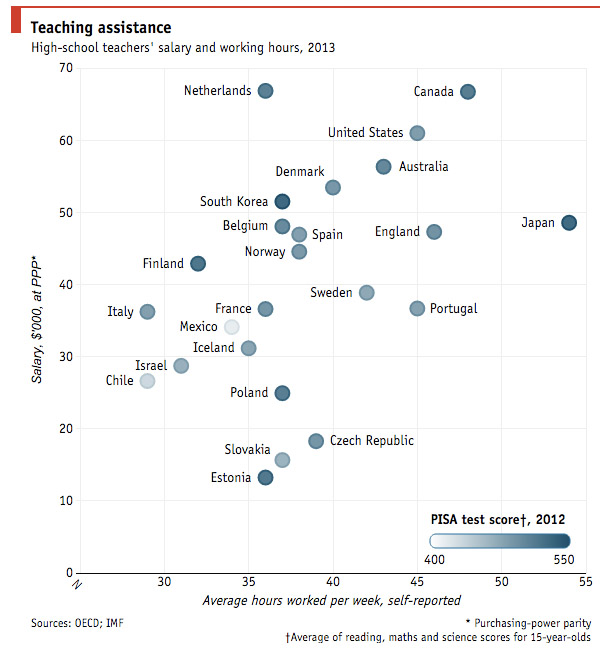
Ever met a teacher making over $138,000 a year? Maybe you should talk to educators in Luxembourg, where the starting salary of lower secondary teachers is $79,000 in equivalent US Dollars. Teachers in Luxembourg earn 30% more than any other teacher in the world, with a starting salary that exceeds nearly every other nation’s maximum teacher salary. By sharp contrast at the bottom of this chart, teachers in Estonia reach their maximum earning potential at just over $17,000 a year.

Other big players in the teaching world are Germany and Denmark, who take home near their maximum earning

Share

New Erdős Paper Solves Egyptian Fraction Problem

Siobhan Roberts:

Nearly 20 years after his death, the famed mathematician Paul Erdős keeps on publishing, thanks to the conjectures he left behind and the friends who strive to prove them

Ancient Egyptians were thought to have used different parts of the Eye of Horus to represent unit fractions, up to the first six powers of two Credit: Benoît Stella
Ancient Egyptians were thought to have used different parts of the Eye of Horus to represent unit fractions, up to the first six powers of 2. Credit: Benoît Stella
Writing a paper with Paul Erdős might seem like utter fantasy, considering that the prolific Hungarian mathematician died in 1996. Yet such co-authorship has happened 35 times since his death. The latest co-author is Steve Butler of Iowa State University, who becomes the 512th Erdős collaborator and has earned a coveted Erdős number of 1.

Share

For 1st time, MIT’s free online classes can lead to degree

Colin Binkley:

The Massachusetts Institute of Technology has offered free online courses for the last four years with one major downside: They didn’t count toward a degree. That’s about to change.

In a pilot project announced Wednesday, students will be able to take a semester of free online courses in one of MIT’s graduate programs and then, if they pay a “modest fee” of about $1,500 and pass an exam, they will earn a MicroMaster’s credential, the school said.

The new credential represents half of the university’s one-year master’s degree program in supply chain management. As part of the pilot project, students who perform well in the online half can take an exam to apply for the second semester on campus. Those who get in would pay $33,000, about half the cost of the yearlong program.

Share

Download Free Mathematics Books by Knapp

Anthony W. Knapp:

From this page anyone can download free PDF files of “digital second editions” of the four books of mine whose first editions were published in the Cornerstones series of Birkhäuser Boston between 2005 and 2007. These books are at the first-year graduate level or a little higher, depending on one’s university. Two of the four are available for download now, and two are to be available later in 2016, as follows:

Basic Algebra (available now)
Advanced Algebra (available now)
Basic Real Analysis, with an appendix “Elementary Complex Analysis” (available later in 2016)
Advanced Real Analysis (available later in 2016).

Share

The Latest Battle Over When and Where Kids Can Walk to School

Aarian Marshall:

provision tucked deep within a gargantuan education bill passed in December clarifies the murky legal standing of free-range parenting—sort of. Advocates for the practice—that is, encouraging kids to build self-reliance skills by traveling their neighborhoods solo—are hailing the 101-word section as a victory, though the law still leaves parents and journeying kiddos subject to state and local guidelines.

The amendment is on page 857 of the Every Student Succeeds Act, and is the work of Mike Lee, the Republican senator from Utah who has become something of a political patron saint of anti-helicopter parenting. The provision declares that nothing will “prohibit a child from traveling to and from school on foot or by car, bus, or bike when the parents of the child have given permission.”(Note that the language does not specify how parents are to give legitimate permission.)

Share

A New Proof Of Euclid’s Theorem

Filip Saidak:

A prime number is an integer greater than 1 that is divisible onlyby 1 and itself. Mathematicians have been studying primes and theirproperties for over twenty-three centuries. One of the very first resultsconcerning these numbers was presumably proved by Euclid of Alexan-dria, sometime before 300 B.C. In Book IX of his legendary Elements
(see [2]) we find Proposition 20, which states:

Share

Ask Yourself if You Believe It

Greg Richmond:

Is it worth your time to consider the argument behind a new report that contrasts school choice with the subprime mortgage bubble? Yes, but dig beyond its face to the deeper ideology at its core.
A new front has opened in the education reform wars and if you are reading this, you should decide which side you are on.

Opponents of charter schools have begun to argue that the growth of charter schools shares characteristics with the growth of the housing bubble that collapsed in 2008. Just as the housing bubble ultimately burst, causing harm to many homeowners and to the economy, we are asked to believe that the growth of charter schools will also collapse and harm children and the general public.

The foundation text for this argument is a 28-page paper written by four professors. The paper provides a high-level summary of changes in mortgage lending practices, dating back to the 1970s, and compares those changes to certain claims about the attributes of charter schools. The four authors are professors of education, not finance or economics. The paper itself is heavily footnoted, not with reference to empirical research, but with references to newspaper columnists and bloggers. Those same columnists and bloggers are now promoting the paper as credible research, in a less than virtuous circle.

Share

Oral Arguments: Rebecca Friederichs vs California Teachers Association

The Supreme Court:

Every year, Petitioners are required to provide significant support to a group that advocates an ideological viewpoint which they oppose and do not wish
to subsidize. Abood’s authorization of this clear First Amendment violation should be overturned, both to end this ongoing deprivation of basic speech and association
rights, and to restore consistency and predictability to the Court’s First Amendment jurisprudence.

Related: Act 10.

Share

The new way police are surveilling you: Calculating your threat ‘score’

Justin Jouvenal:

While officers raced to a recent 911 call about a man threatening his ex-girlfriend, a police operator in headquarters consulted software that scored the suspect’s potential for violence the way a bank might run a credit report.

The program scoured billions of data points, including arrest reports, property records, commercial databases, deep Web searches and the man’s social- media postings. It calculated his threat level as the highest of three color-coded scores: a bright red warning.

Share

Chicago Teacher’s Union allies benefit from newly enriched union foundation

DAN MIHALOPOULOS AND LAUREN FITZPATRICK:

When the Chicago Teachers Union rallied at Grant Park one frigid night in November, protesters from Action Now were there. So were members of community groups from Brighton Park and Kenwood, showing support for the CTU in its long-running battle with Mayor Rahm Emanuel.

Activists from across Chicago long have stood together with the teachers union in its bitter feuds with Emanuel. But in only the last 1-1/2 years, financial connections have added to those ideological ties.

A newly wealthy charitable foundation formed by the CTU is funding the three groups at the November rally and many other organizations allied with the union, according to records obtained by the Chicago Sun-Times.

Share

Why public schools need measurable standards

Bob Woods:

In a Jan. 5 guest column by Geoffrey Barrett, the argument is made that standards and testing do not improve results in schools. When Barrett states that “reform advocates claim that ‘tougher standards’ and test-based accountability increase student proficiency levels,” he is fundamentally misstating the issue.

Most people are intimately familiar with the standards and measurements they must meet every day in their jobs. Whether it’s how quickly a fast-food customer is served and satisfied, the number of cases an attorney wins or how many RBIs a pitcher gives up — we all know what it means to meet a standard.

Share

Open Access at Both Ends

Carl Straumsheim:

Amherst College Press, the University of Michigan Library and the dozens of liberal arts colleges that make up the Oberlin Group on Thursday unveiled a new scholarly open-access monograph publisher that aims to promote digital scholarship and lower the barriers to publication for researchers at smaller institutions.

As part of that concept, the press will require neither authors nor readers to pay for publication costs.

Known as Lever Press, the publishing venture is the end product of the initiative of the same name. The Oberlin Group launched the initiative in the summer of 2013 to gauge interest in how colleges and libraries could work together to improve scholarly publishing. Emboldened by a survey of faculty members that showed many scholars were less than satisfied with their options in the monograph publishing market, the group quickly zeroed in on establishing a publisher of its own.

Share

An example of poor economics journalism

Economist:

OWEN JONES, who mainly works for The Guardian, is an excellent and influential writer, but we feel duty-bound to comment on an article he wrote just before Christmas. Plenty of people are saying at the moment that Britain’s household debt is getting out of control. The Bank of England released new figures yesterday, showing that mortgage and credit-card lending is growing rapidly. Mr Jones weighed in to argue that the “latest figures confirm Britain’s supposed economic recovery rests on a personal debt timebomb. When it runs out is unclear, but run out it will.”

It proved to be a popular article, but it’s necessary to point out some serious misunderstandings.

Share

PH556X: Practical Improvement Science in Health Care: A Roadmap for Getting Results

edx:

Developed through a collaboration between HarvardX and the Institute for Healthcare Improvement, PH 556x: Practical Improvement Science in Health Care: A roadmap for getting results will provide learners with the valuable skills and simple, well-tested tools they need to translate promising innovations or evidence into practice. A group of expert faculty will explore a scientific approach to improvement — a practical, rigorous methodology that includes a theory of change, measurable aims, and iterative, incremental small tests of change to determine if improvement concepts can be implemented effectively in practice. Faculty will present this science through the lens of improving health and health care, but will also share examples of how improvement can (and does) influence our daily lives.

Each week, learners will dive into engaging, interactive materials and relevant resources to start building an improvement toolkit that will serve them long after the six-week course ends. Learners will immediately put their new skills to the test as they work each week on a personal improvement project that will show them the power of the science that has improved healthcare — and other industries — around the world for decades.

The only prerequisite for the course is curiosity, but the reward is a lifetime of improvement.

Share

What Segregation Looked Like in 1950s Alabama

Jordan Teacher:

“I picked up a camera because it was my choice of weapon against what I hated most about the universe: racism, intolerance, poverty,” the legendary photojournalist once said.

Parks’ philosophy is eloquently expressed in his photo essay, “The Restraints: Open and Hidden,” which ran in Life magazine, where he was the first black photographer on staff, in 1956. In Mobile, Alabama, and beyond, he documented the everyday lives of Albert Thornton and his wife as well as their nine children and 19 grandchildren, who comprised the Causey and Tanner families. At the time, most of the media coverage of the civil rights era centered on political demonstrations and violence. Parks, however, highlighted the injustices of the Jim Crow era—just as, in 1950, he demonstrated the consequences of school segregation in work that we featured earlier this year on Behold—not with spectacle but with the everyday.

Share

Report: Nebraska Lets Juveniles Be Locked in Solitary Confinement for 90 Days

Zaid Jilani:

As a teenager, Jacob Rusher was detained at the Douglas County Youth Facility in Omaha, Nebraska. After he broke his ankle, he was told that he was being placed in “lockdown” — a form of solitary confinement — for “his own good.” He spent three months there, often pounding against the door begging to be released.

“It was 23 hours a day alone, no TV or radio. You were in there with one book, a blanket, a mat, and a toothbrush. No art materials, no hobby items — everything was considered contraband,” he told the ACLU of Nebraska. “Nighttimes, you’d get a little crazy. They kept the light on and would wake us up every hour to check on you so you’d never get any good sleep.”

Share

Goldman Sachs Looks At Higher Education, Very Darkly

Bryan Alexander
:

[U]sing SAT scores as a proxy, the gap in alumni earnings between colleges in the 99th percentile of scores and the 99.9th is as big as the gap between the 1st percentile and the 20th. If future wages for an individual joining college today were 30% below the average wages expected for college graduates, they wouldn’t break even until they were over 50. Graduates studying lower paying majors such as Arts, Education and Psychology face the highest risk of a negative return. For them, college may not increasingly be worth it.


The average return on going to college is falling. For the typical student the number of years to break even on the cost of college has grown from 8 years in 2010 to 9 years today. If current cost and wage growth trends persist then students starting college in 2030/2050 will have to wait 11/15 years post college to break even. 18 year olds starting college in 2030 with no scholarship or grants will only start making a positive return when they turn 37.

The complete report is available here.

Share

How to build a school in three weeks

Sonali Kohli:

About 75 maintenance and operations workers hustled across an area that used to be open asphalt space. In an informal uniform of jeans, black sweatshirts and highlighter-yellow vests, they were making a new school in the backyard of an old one. It was a six-month job, and they had three weeks.

“It’s kind of a model of people working together for a purpose and for emergencies in other parts of the country,” said Scott Schmerelson, the L.A. Unified School District board member for the area.

Share

Hawaii Lawmakers question $35M price tag of Campbell High building

Nanea Kalani:

state lawmakers are questioning the DoE’s request for $35M for a new building to relieve overcrowding at the state’s largest high school because the same amount paid for the construction an entire elementary school campus last year.

Share

Will the Supreme Court deal a blow to public-sector unions?

Christina Beck:

The Supreme Court will hear oral arguments on Monday in Friedrichs v. the California Teachers Association, a case that has the potential to dramatically change the future of organized labor in the United States.

This case is the result of years of effort by 10 California teachers led by Rebecca Friedrichs, a longtime elementary school teacher and a former union member. They are leading the charge in a case that challenges state laws that boost union power.

“My union has become what it used to fight,” said Ms. Friedrichs, “It is powerful, it is entrenched, and it is not listening to its members.”

Related: Wisconsin’s Act 10.

Share

Milwaukee’s Attendence Improvement Plans

Alan Borsuk:

OK Google, what’s the famous quote from Woody Allen about showing up?

“Eighty percent of success is showing up.”

But here’s an additional quote, attributed to Thomas Edison: “Ninety percent of a man’s success in business is perspiration.” (In today’s world, it would definitely be phrased as “a person’s success” or something similar.)

I’m partial to both showing up and perspiring (so to speak) when it comes to education.

That’s why I hope Milwaukee Public School’s “summit on attendance” at 5:30 p.m. Monday at James Madison Academic Campus, 8135 W. Florist Ave., is a big success.

I’m not naive on this. I’ve covered a lot of attendance and truancy stories in the last couple decades, not focused only on MPS. Campaigns come and go. The net result is little or no improvement. But attendance is such a threshold issue in schooling — you’ve got to keep trying.

School attendance is among the problems that correlate strongly with income. Schools with a lot of kids from well-to-do homes don’t have so much of an issue.

Share

The Truthiness Of Scientific Research

Judith Rich Harris:

The topic itself is not new. For decades, there have been rumors about famous historical scientists like Newton, Kepler, and Mendel. The charge was that their research results were too good to be true. They must have faked the data, or at least prettied it up a bit. But Newton, Kepler, and Mendel nonetheless retained their seats in the Science Hall of Fame. The usual reaction of those who heard the rumors was a shrug. So what? They were right, weren’t they?

What’s new is that nowadays everyone seems to be doing it, and they’re not always right. In fact, according to John Ioannidis, they’re not even right most of the time.

Share

How to Fix the Country’s Failing Schools. And How Not To.

David Kirp:

A QUARTER-CENTURY ago, Newark and nearby Union City epitomized the failure of American urban school systems. Students, mostly poor minority and immigrant children, were performing abysmally. Graduation rates were low. Plagued by corruption and cronyism, both districts had a revolving door of superintendents. New Jersey officials threatened to take over Union City’s schools in 1989 but gave them a one-year reprieve instead. Six years later, state education officials, decrying the gross mismanagement of the Newark schools, seized control there.

In 2009, the political odd couple of Chris Christie, the Republican governor-elect, and Cory Booker, Newark’s charismatic mayor, joined forces, convinced that the Newark system could be reinvented in just five years, in part by closing underperforming schools, encouraging charter schools and weakening teacher tenure. In 2010 they persuaded Mark Zuckerberg, Facebook’s chief executive, to invest $100 million in their grand experiment. “We can flip a whole city!” the mayor enthused, “and create a national model.”

Share

Career Advice

Scott Adams:

The first strategy is difficult to the point of near impossibility. Few people will ever play in the NBA or make a platinum album. I don’t recommend anyone even try.

The second strategy is fairly easy. Everyone has at least a few areas in which they could be in the top 25% with some effort. In my case, I can draw better than most people, but I’m hardly an artist. And I’m not any funnier than the average standup comedian who never makes it big, but I’m funnier than most people. The magic is that few people can draw well and write jokes. It’s the combination of the two that makes what I do so rare. And when you add in my business background, suddenly I had a topic that few cartoonists could hope to understand without living it.

Share

Elegy For Lost Verbiage: A crowd of difficult words will vanish from America’s SAT tests in 2016. We join them for their farewell party

Economist:

As he brushed his recalcitrant hair and tried to pick an accretion of egg from his best tie, Joe wondered by what aberration he had been included in this gathering. He was not a demagogue, despot, gourmand, insurgent, reprobate or virtuoso. Indeed, he was almost their antithesis: a humble shoemaker who banged in the tacks with acumen and alacrity, and with a punctilious regard for setting soles straight. His life was ascetic, his politics nonpartisan. His predilection was for all that was staid, stolid and utilitarian. Hapless, he stared at the vestige of the egg, which for some reason he could not dispel, emend, expunge, expurgate or palliate, only exacerbate; and sighed.

Share

Interactive 21st Century Atlas

Liz Stinson:

Share

Another look at how America’s middle class is disappearing into higher income households

Mark Perry:

Here’s another look in the two charts above showing how America’s lower-income and middle-income households have declined as a share of all US households between 1967 and 2014, while the share of high-income households keeps increasing.

1. The top chart shows the three income groups: a) low-income households with income of $35,000 and below (in 2014 dollars), whose share of US households declined from by five percentage points from 38.7% in 1967 to 33.7% (in 2014 dollars), b) middle-income households with income between $35,000 and $100,000 (in 2014 dollars), whose share of all households declined by 11.6 percentage points from 53.2% to 41.6% between 1967 and 2014, and c) high-income households with income of $100,000 and above (in 2014 dollars) whose share increased by a factor of more than three times (and by 16.6 percentage points), from 8.1% in 1967 to 24.7% in 2014.

Share

Philip Pullman: professional writers set to become ‘an endangered species’

Alison Flood:

In an open letter to Britain’s publishers, the Society of Authors points to a recent survey that found that the median income of a professional author is now just £11,000, with only 11.5% of UK writers making a living solely from writing. Pointing out that “authors remain the only essential part of the creation of a book and it is in everyone’s interests to ensure they can make a living”, it tells publishers that “unfair contract terms, including reduced royalty rates, are a major part of the problem”.

“From our positions as individual creators, whether of fiction or non-fiction, we authors see a landscape occupied by several large interests, some of them gathering profits in the billions, some of them displaying a questionable attitude to paying tax, some of them colonising the internet with projects whose reach is limitless and whose attitude to creators’ rights is roughly that of the steamroller to the ant,” said Pullman.

“It’s a daunting landscape, far more savage and hostile to the author than any we’ve seen before. But one thing hasn’t changed, which is the ignored, unacknowledged, but complete dependence of those great interests on us and on our talents and on the work we do in the quiet of our solitude. They have enormous financial and political power, but no creative power whatsoever. Whether we’re poets, historians, writers of cookery books, novelists, travel writers, that comes from us alone. We originate the material they exploit.”

The society wants authors to receive at least 50% of ebook revenue, rather than 25%, and is also asking publishers not to discriminate against writers “who don’t have powerful agents”.

Share

Who Makes A Good Father?

Economist:

This study was a follow-up to one in which Dr Maestripieri had tested the existing theory of who makes a good dad, and found it wanting. This is that the more testosterone a man has, the less likely he is to hang around to help bring up baby. Using a questionnaire which asked things like, “How much do you like babies?”, “Do you think most babies are cute?” and “Do you want to have children someday?” Dr Maestripieri showed that the answers are uncorrelated with a man’s testosterone level, as measured from a saliva sample. Good news, then, for women who would like to settle down with a hunk, but fear hunks are not the settling-down sort. But there is still the question of which hunk to choose—and that is where the movie (an attractive young lady performing a striptease, and then masturbating) comes in.

Share

Top 2015 Education Stories

Beth Hawkins:

4. Madaline Edison

Despondent about the scope of the challenges in education, four years ago kindergarten and first grade teacher Edison began asking educators to join forces to think about how to raise their voices in policy discussions. She found no shortage of kindred spirits and in 2013, the Minnesota chapter of Educators4Excellence was born with 300 members. This year, the group boasts more than 1,000 members. Minnesota E4E teachers Holly Kragthorpe and Ben MacKenzie were at the U.S. Capitol talking about ESSA. And Kragthorpe was at the state Capitol talking about holding teacher preparation programs accountable. Many more E4E members blogged and tweeted and generally shared their lived experiences and hopes for their students. And you know what? They got heard.

Share

Addressing the Heartbreak of Addiction

Jeb Bush:

father, I have felt the heartbreak of drug abuse. My daughter Noelle suffered from addiction, and like many parents facing similar situations, her mom and I struggled to help.

I have so many friends and know so many families who have faced this terrible challenge. Addiction crosses all barriers, all lines, all races and all incomes. It creates real hardship and heartbreak in families. And, it places substantial demands on government at every level.

I never expected to see my precious daughter in jail. It wasn’t easy, and it became very public when I was Governor of Florida, making things even more difficult for Noelle. She went through hell, so did her mom, and so did I.

Share

Government Schools And Parenting

Conor Boyack:

Parents, ask yourself this question: who has stewardship over your child — you, or the government? Think it’s you? Apparently, the federal government disagrees.

In a draft policy statement jointly issued by the U.S. Department of Health and Human Services and the U.S. Department of Education, federal bureaucrats have — on their own initiative — subordinated parents to a secondary role in the rearing of their children. While the draft is neither finalized nor binding (yet), it serves as a clear shot across the bow of every freedom-loving parent who naively believes that his parenting principles, priorities and practices will be protected and respected by government.

The entire purpose of the 18-page statement is to explain, promote and bureaucratically implement what the departments call “family engagement.” This term sounds like something every good parent would inherently want, but here’s how the government defines it: “the systematic inclusion of families as partners in children’s development, learning and wellness.”

That’s right: the government is going to include you, the parent, as a partner in rearing your child. Are we supposed to thank it for this privilege?

We know best” is hardly a new topic…

Share

As college sports revenues spike, coaches aren’t only ones cashing in

Will Hobson & Steven Rich

Since 2004, many athletic directors have seen their pay soar and have gone on hiring sprees, surrounding themselves with well-paid executives and small armies of support staffs to help their premier teams — primarily football — recruit, train and plan for games.

Rising administrative and support staff pay is one of the biggest reasons otherwise profitable or self-sufficient athletic departments run deficits, according to a Washington Post review of thousands of pages of financial records from athletic departments at 48 schools in the five wealthiest conferences in college sports. In a decade, the non-coaching payrolls at the schools, combined, rose from $454 million to $767 million, a 69 percent jump.

Share

Is Pre-K All It’s Cracked Up To Be?

Andrew Flowers:

Prekindergarten is extremely popular. President Obama made expanding pre-K a major policy goal. In the past few years, several states have launched pre-K programs, and large cities such as New York have pushed to make pre-K universal on the promise that seemingly large benefits can come from educating kids at a young age, setting them up for success later in life.

But a recent study of Tennessee’s voluntary program for 4-year-olds from low-income families found that by third grade, kids who went to pre-K fared worse academically than those who didn’t. That shocking finding has triggered a debate among experts; some have called into question pre-K’s long-touted benefits, while critics of the study have sought to reaffirm pre-K as a good investment.

“We haven’t found any sustained effects, either in social and emotional development or achievement,” Vanderbilt University professor Dale Farran, an expert in early childhood education and one of the co-authors of the bombshell study, said in an interview in December. As a result, Farran and her co-authors caution against a rush to expand pre-K programs, saying that the evidence of early childhood education’s benefits is based on research of programs that differ significantly from the large state pre-K programs that are in vogue.

Share

Too many American schools are using police officers to enforce classroom discipline

The Economist:

It was with violent schools like Furr in mind that Texas began stationing police officers in its schools in the early 1990s, which helped start a national trend. It proceeded to accelerate on the back of persistent concerns over law and order during the decade; in 1999, after 13 people were massacred at Columbine High School, in Colorado, the federal government launched a supportive funding programme, Cops in Schools. By 2007 there were an estimated 19,000 school policemen, known as School Resource Officers, plodding the corridors of America’s schools, in addition to many regular police and private security officers.

Share