School Information System

State ratings for New Orleans schools are on a three-year slide

Marta Jewson:

State rankings for most New Orleans schools are on a three-year slide, with 65 percent dropping from 2014 to 2017.

The drop in School Performance Scores from 2016 to 2017 caused hand-wringing among the city’s education leaders. The Lens’ analysis of state data shows it’s part of a worrisome trend.

“We have to acknowledge and confront the brutal facts of where we are,” said Orleans Parish school board member Ben Kleban. However, he said he has faith in the district’s commitment to improve.

Scores at some schools tumbled. Mahalia Jackson Elementary School dropped almost 30 points to a score of 50 on the state’s 150-point scale. That’s a D.

Sylvanie Williams College Prep fell about 22 points to 32.4, an F. It was the second-lowest elementary school score; the one with the lowest score, McDonogh 42, has been turned over to another charter operator.

More, here.

Share

Will Chicago Close Another 50 Schools?

Sarah Karp and Becky Vevea :

Chicago Public Schools has lost 32,000 students over the last five years, nearly the same enrollment drop as in the 10-year period leading up to the closures of 50 elementary schools in 2013. Those missing students could fill 53 average-sized Chicago schools.

This massive enrollment decline comes as a self-imposed five-year moratorium on school closings lifts in 2018. Despite that, political observers and CPS insiders said they are not betting on Mayor Rahm Emanuel closing 50 more schools — at least not all at once.

They say if Emanuel opts to close more schools, they hope he does it more slowly and over time. In fact, that’s already underway, despite the moratorium. Since 2013, CPS has quietly shuttered more than a dozen schools, many of them charter schools.

The school system must announce by Dec. 1 any proposed closures for its more than 600 schools. Officials have already indicated they will recommend closing only a handful of schools for next year, the first without the moratorium.

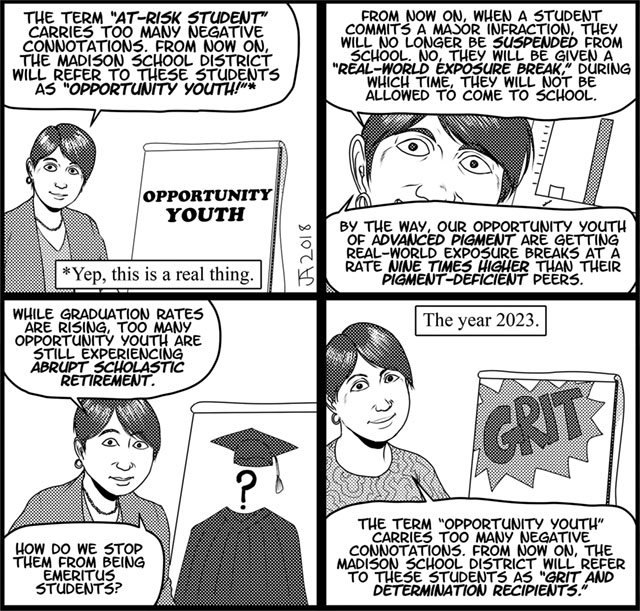
Madison’s non diverse K-12 governance model has not addressed boundary or school diversity in decades.

Share

State’s smallest and most isolated school district overcomes its challenges and limitations

Barry Adams:

There are no plastic trays, pans of lasagna, a salad bar or even crates filled with cartons of chocolate milk.

Most days, students in the Washington Island School District are on their own for lunch. If they want something hot, they bring a Thermos or use one of the eight microwave ovens in the school’s multipurpose room to heat up leftovers or other concoctions from home.

The closest the school comes to a lunch program is once every other Wednesday. That’s when the student council, as a fundraiser, makes a $4 meal that can include homemade spaghetti, pizza or hot dogs.

Share

How Education Reform Ate the Democratic Party

Jennifer C. Berkshire :

In a Facebook post this summer, hedge fund billionaire Daniel Loeb took aim at the highest ranking Black woman in the New York legislator, Andrea Stewart-Cousins. “[H]ypocrites like Stewart-Cousins who pay fealty to powerful union thugs and bosses,” wrote Loeb, “do more damage to people of color than anyone who has ever donned a hood.” The rant, which had the exquisite misfortune of appearing just days before the actual KKK took to the streets of Charlottesville to menace nonwhite people and their allies, struck a familiar Loeb theme. In a previous post he implored his peer to take up the fight against the teachers union: “the biggest single force standing in the way of quality education and an organization that has done more to perpetuate poverty and discrimination against people of color than the KKK.”

It would be easy to dismiss all this frothing as just Loeb being Loeb. This is, after all, the same crusader for justice who once lambasted a CEO for his imperial lifestyle, not an easy charge to level from a ten-thousand-square-foot penthouse. But the NYC financier is not just any hedge fund billionaire. As the chair of the board of Success Academy, New York’s largest network of charter schools, he is a leading force within the nexus of big money and self-proclaimed school “reformers” within the Democratic party. While Loeb doesn’t limit his donations to Dems (as his profile on the married-but-looking dating site, Ashley Madison, indicated, he is not one to be tied down), he exerts the kind of outsized influence that $3.2 billion in net worth reliably commands these days.

Share

Poor boys are falling behind poor girls, and it’s deeply troubling

Jeff Guo:

It’s become a fact of American life that girls are better than boys at school. They get better grades. They’re suspended less. For every generation since the boomers, women have been more likely than men to earn high school and college diplomas.

In fact, girls are pretty much the only reason the high school graduation rate went up in past 40 years, according to calculations by Harvard economist Richard Murnane. The male high school graduation rate has been stuck at 81 percent since the 1970s, while the female graduation rose from 81 percent to 87 percent.

Women have been so persistently superior it is perhaps time for a new stereotype about the sexes — girls as bookish mavens like Lisa Simpson; boys as goof-offs like Bart.

Share

UW Police Chief Kristen Roman: Students’ lack of trust ‘disheartening’

Pat Schneider:

The discouraging findings came from UW-Madison’s first survey of students on campus climate, the results of which were released Nov. 16.

The results “further illuminate the trust challenges facing not only our department but the department across the street and those across the nation,” Roman wrote in a blog posted Nov. 20.

Roman asserted her department’s commitment to serving all members of the campus community.

“I am deeply concerned about any reported community reluctance to reach out to police for assistance. I understand that there are many social and political obstacles in place that inhibit/prevent certain individuals or groups from officially reporting problems to police and that many of these are beyond the ability of the police alone to eliminate,” she said. Roman pledged to work to identify and eliminate barriers between police and the community to the extent possible.

Share

How Social Media Is Leveling the Playing Field Between Governments, Militants, and Ordinary People

Murtaza Hussain:

Decades before smartphones, the internet, and social media, the philosopher Marshall McLuhan, who worked on media theory, predicted a future world war fought using information. While World War I and World War II were waged using armies and mobilized economies, “World War III [will be] a guerrilla information war with no division between military and civilian participation,” McLuhan said, a prophecy included in his 1970 book of reflections, “Culture Is Our Business.”

McLuhan’s prediction may have felt outlandish in his own era, but it seems very close to our present-day reality. Decades ago, the barriers to entry for broadcasting and publishing were so high that only established institutions could meaningfully engage in news dissemination. But over the past 10 to 15 years, ordinary individuals have been radically empowered with the ability to record, publish, and broadcast information to millions around the world, at minimal cost.

Share

China High Court Accepts Appeal Against Family Planning Fine

Wang Lianzhang:

Earlier this month, a high court in eastern China accepted a couple’s appeal against a fine they received for having a second child, Sixth Tone’s sister publication The Paper reported Tuesday. The case will test whether the two-child policy can apply retroactively for those who have unpaid family planning fines.

The couple had their first child, a girl, in 2008, and then a son in June 2012, when the one-child policy still applied. But no one mentioned a fine until May 2016 — five months after the two-child policy came into effect nationwide. Then, the local health and family planning commission in their hometown of Suining County, Jiangsu province, told them they owed 104,584 yuan ($15,800) for having a second child, who was by then 4 years old.

“Since the two-child policy is now being promoted across the country, why do we still have to pay the fine?” Tong Gang, the 34-year-old father, told Sixth Tone on Wednesday.

Share

Nearly All of Wikipedia Is Written By Just 1 Percent of Its Editors

Daniel Oberhaus:

At the time of writing, there are roughly 132,000 registered editors who have been active on Wikipedia in the last month (there are also an unknown number of unregistered Wikipedians who contribute to the site). So statistically speaking, only about 1,300 people are creating over three-quarters of the 600 new articles posted to Wikipedia every day.

Of course, these “1 percenters” have changed over the last decade and a half. According to Matei, roughly 40 percent of the top 1 percent of editors bow out about every five weeks. In the early days, when there were only a few hundred thousand people collaborating on Wikipedia, Matei said the content production was significantly more equitable. But as the encyclopedia grew, and the number of collaborators grew with it, a cadre of die-hard editors emerged that have accounted for the bulk of Wikipedia’s growth ever since.

Share

“1816, The Year without a Summer”

Gillen D’Arcy Wood :

In a similar vein, it is important to remember that the misery of the Tambora period in Europe—years of famine, disease, and homelessness—was borne overwhelmingly by the poor, who left scant record of their sufferings. For most of those belonging to the middle and upper classes—including the Shelleys and their circle—the social and economic upheaval of those years presented only minor inconveniences. By contrast with the illiterate underclass, these affluent Europeans left voluminous accounts of their lives. To look at only their documentary record, therefore, can leave one with the misleading impression that the Tambora years were not exceptional in the history of the early nineteenth century. It is necessary to scrutinize what they wrote carefully for clues to the experience of the silent millions who suffered displacement, hunger, disease, and death at that time. From the bubble of privilege within which educated people such as the Shelleys and their friends composed their brilliant verse and letters, it is possible to catch gleams of this benighted other world through which they mostly passed oblivious.

In her account of the stormy night in Geneva when she first conceived her famous novel, Shelley imagines Frankenstein waking from a nightmare to find his hideous creation at his bedside, “looking on him with yellow, watery, but speculative eyes” (196). The description is reminiscent of numerous impressions of European beggars in this period. One English tourist, travelling from Rome to Naples in 1817, remarked on “the livid aspect of the miserable inhabitants of this region.” When asked how they lived, these “animated spectres” replied simply: “We die” (Matthews 192-3). From the beginning, then, Shelley’s imaginative conjuring of her famous Creature bears the mark of the famished and diseased European population by which she was surrounded in 1816-18. Like the hordes of hungry refugees spreading typhus across the continent during Shelley’s writing of the novel, the Creature in Frankenstein is a wanderer and a perceived menace to civilized society. In the novel, this murderous capability is attributed to the monster’s preternatural strength. But the terrifying atmosphere of his rampage, and his ability to strike at will across thousands of miles, seems more like the spread of a famine or contagion. In short, once the supernatural element of the monster’s creation is set aside, the experience of Mary Shelley’s creature most closely embodies the degradation and suffering of the homeless European poor in the Tambora period, while the violent disgust of Frankenstein and everyone else toward him mirrors the utter want of sympathy shown by most affluent Europeans toward the millions of Tambora’s climate victims suffering hunger, disease, and the loss of their homes and livelihoods. As the Creature himself puts it, he suffered first “from the inclemency of the season,” but “still more from the barbarity of man” (84).

Share

Kids’ smartwatches banned in Germany over spying concerns

Graham Cluley:

German parents are being told to destroy smartwatches they have bought for their children after the country’s telecoms regulator put a blanket ban in place to prevent sale of the devices, amid growing privacy concerns.
Jochen Homann, president of the Federal Network Agency, told BBC News that the so-called smartwatches, typically aimed at children between the ages of five and 12 years old, are classified as spying devices:

Share

Dayton School of Law Offers 3+2 JD

Angela Morris:

Plenty of law schools have rolled out programs designed to shave a year off the traditional path to a J.D. But on Friday, the University of Dayton School of Law became just the second school to offer a way to slice two years off the typical seven year undergrad-J.D. combo. Dayton, like other schools offering shorter tracks, is eager to attract stronger candidates as the overall applicant pool remains shallow. While many schools have 3+3 programs or accelerated two-year J.D. programs, so far only Dayton and Vermont Law School offer a way to become a lawyer in five years total.

“This is definitely for the best students,” said Paul Schlottman, Dayton’s director of strategic initiatives, who helped launch the 3+2 program. “These are for people who are very academically and otherwise gifted.”

The way it works is that students complete three years of courses in a partner undergraduate institution, and then transfer to Dayton, where their first year of law school counts towards their fourth year of undergraduate studies. In law school, students take courses—the same ones as traditional law students—in the summer, fall and spring semesters, which allows them to graduate in two years instead of three. However, if a law student at some point decides life is too hectic, she can always slow down and do the normal three-year J.D. program.

Share

The Testing Charade: Pretending to Make Schools Better, by Daniel Koretz [book review]

Richard P. Phelps, via a kind email:

The mainstream research that informs our country’s education policies is often more caricature than genuine research. Policy discussions tend to be dominated by the research that the ruling class inside education wishes to be true, rather than by that which is true.

Among the several falsehoods book author Daniel Koretz and his colleagues have peddled over the years is the claim that the evidence for the benefits of testing is “thin” (and the evidence for costs abundant). Largely in response to their claims, I several years ago published a meta-analysis of 100 years’ worth of research on the effects of testing on student achievement. I reviewed over 800 quantitative, experimental, survey, and qualitative studies. The weight of the latter two types of studies was overwhelmingly positive (e.g., 93% of qualitative studies found a positive result to a testing intervention and the average effect size for survey studies exceeded 1.0, a very high effect. The effect sizes for the quantitative and experimental studies—hundreds of mostly random assignment experiments dating back to the 1920s—ranged between moderately and highly positive.

Because I read and heard the same messages as everyone else from those prominent education researchers who receive press attention, I had expected to find clearly negative effects. Some of the most widely covered studies allegedly demonstrating that testing was, on balance, harmful were included in my meta-analysis. But also included in my meta-analysis were hundreds of studies that had received virtually no public attention. Testing experts, education practitioners, and psychologists performed most of those studies.

(True to form, not a single education journalist has ever asked me about the meta-analysis. Meanwhile, DC-based education journalists talk to anti-testing spokespersons thousands of times a year and often promote the single research studies conducted by celebrity researchers as hugely consequential to policy.)

Therein lies the chief secret of the success of the anti-testing forces in education research: they count (i.e., cite or reference) the research that reaches anti-testing conclusions and they ignore the abundance of research that contradicts. (For the few pro-testing studies that receive so much public attention they cannot simply ignore them, other information suppression methods may be used, such as dismissive reviews, tone policing, misrepresentation, or character assassination).

Share

The New Campus Censors

David Bromwich:

Three or four years ago, in the early days of campus protests against unwelcome speakers, the censors sometimes said in their own defense: “This isn’t about free speech.” The disclaimer served to lighten the burden of apology for crowd behavior that most Americans distrust. As the protesters saw it, the speakers who got shouted down or who canceled engagements under a threat of violence were opportunists of free speech. But this was apt to sound evasive. What honest intellectual forum ever subjected speakers to a test of motives?

In any case, the argument that “it isn’t really about free speech” has largely been dropped by the censors. They are now likelier to say that there never was freedom of speech, anywhere, and that we shouldn’t expect to find it in colleges. The primary duty of institutions of higher education is rather to create a space for qualified speech; and we should be aware that a wrongly chosen or unqualified speaker may stir up controversy and “stifle productive debate.” That phrase comes from a campus letter circulated by a group of Wellesley College professors after a speech by Laura Kipnis. By this logic, productive debate is to be understood as quite a different thing from open debate. But who, then, is qualified to speak on campus?

Share

The Generalized Specialist: How Shakespeare, Da Vinci, and Kepler Excelled

Farnam Street:

Then something happens. Maybe your specialty is no longer needed or gets replaced by technology. Or perhaps you get promoted. As you go up the ranks of the organization, your specialty becomes less and less important, and yet the tendency is to hold on to it longer and longer. If it’s the only subject or skill you know better than anything else, you tend to see it everywhere. Even where it doesn’t exist.

Every problem is a nail and you just happen to have a hammer.

Only this approach doesn’t work. Because you have no idea of the big ideas, you start making decisions that don’t take into account how the world really works. These decisions ripple outward, and you have to spend time correcting your mistakes. If you’re not careful about self-reflection, you won’t learn, and you’ll make one version of the same mistakes over and over.

Should we become specialists or polymaths? Is there a balance we should pursue?

Share

Why Ancient Mapmakers Were Terrified of Blank Spaces

Greg Miller:

The Indian Ocean is teeming with sea monsters in Caspar Vopel’s 1558 map of the world. A giant swordfish-like creature looks to be on a collision course with a ship, while a walrus with frighteningly large tusks emerges from the water, and a king carrying a flag rides the waves on a hog-faced beast.

Vopel, a German cartographer, left behind no explanation of why he added these things to his map, but he may have been motivated by what art historians call horror vacui, the artist’s fear of leaving unadorned spaces on their work. Chet Van Duzer, a historian of cartography, has found dozens of maps on which cartographers appear to have filled the empty spaces on their maps with non-existent mountains, monsters, cities, and other gratuitous illustrations.

Van Duzer, who presented some of his findings at a recent cartography conference at Stanford University, says that some scholars have been skeptical that this aversion to blank spaces has been an important influence on map design.

Share

‘Elitists, crybabies and junky degrees’ A Trump supporter explains rising conservative anger at American universities.

Kevin Sullivan, Mary Jordan:

Frank Antenori shot the head off a rattlesnake at his back door last summer — a deadeye pistol blast from 20 feet. No college professor taught him that. The U.S. Army trained him, as a marksman and a medic, on the “two-way rifle range” of Afghanistan and Iraq.

THE FORGOTTEN: THE ISSUES AT THE HEART OF TRUMP’S AMERICA

PART 1: On a Texas prairie, distance grows between neighbors over an American birthright.

PART 2: The painful truth about teeth.

PART 3: “I’m going to work until I die”: The new reality of old age in America

Useful skills. Smart return on taxpayers’ investment. Not like the waste he sees at too many colleges and universities, where he says liberal professors teach “ridiculous” classes and indoctrinate students “who hang out and protest all day long and cry on our dime.”

“Why does a kid go to a major university these days?” said Antenori, 51, a former Green Beret who served in the Arizona state legislature. “A lot of Republicans would say they go there to get brainwashed and learn how to become activists and basically go out in the world and cause trouble.”

Antenori is part of an increasingly vocal campaign to transform higher education in America. Though U.S. universities are envied around the world, he and other conservatives want to reduce the flow of government cash to what they see as elitist, politically correct institutions that often fail to provide practical skills for the job market.

Share

A growing number of young Americans are leaving desk jobs to farm

Caitlin Dewey:

Liz Whitehurst dabbled in several careers before she ended up here, crating fistfuls of fresh-cut arugula in the early-November chill.

The hours were better at her nonprofit jobs. So were the benefits. But two years ago, the 32-year-old Whitehurst — who graduated from a liberal arts college and grew up in the Chicago suburbs — abandoned Washington for this three-acre farm in Upper Marlboro, Md.

She joined a growing movement of highly educated, ex-urban, first-time farmers who are capitalizing on booming consumer demand for local and sustainable foods and who, experts say, could have a broad impact on the food system.

Share

The Western Elite from a Chinese Perspective

Puzhong Yao :

It was the summer of 2000. I was 15, and I had just finished my high school entrance exam in China. I had made considerable improvements from where I started in first grade, when I had the second- worst grades in the class and had to sit at a desk perpendicular to the blackboard so that the teacher could keep a close eye on me. I had managed to become an average student in an average school. My parents by then had reached the conclusion that I was not going anywhere promising in China and were ready to send me abroad for high school. Contrary to all expectations, however, I got the best mark in my class and my school. The exam scores were so good that I ranked within the top ten among more than 100,000 students in the whole city. My teacher and I both assumed the score was wrong when we first heard it.

As a consequence, I got into the best class in the best school in my city, and thus began the most painful year of my life. My newfound confidence was quickly crushed when I saw how talented my new classmates were. In the first class, our math teacher announced that she would start from chapter four of the textbook, as she assumed, correctly, that most of us were familiar with the first three chapters and would find it boring to go through them again. Most of the class had been participating in various competitions in middle school and had become familiar with a large part of the high school syllabus already. Furthermore, they had also grown to know each other from those years of competitions together. And here I was, someone who didn’t know anything or anyone, surrounded by people who knew more to begin with, who were much smarter, and who worked just as hard as I did. What chance did I have?

Share

6 takeaways from the Wisconsin’s latest school report cards

Alan Borsuk:

What are our expectations? I fear that, overall, we set them too low for many kids’ education. Nonetheless, we’re doing a good job of meeting or exceeding expectations, as they’re defined for these reports.

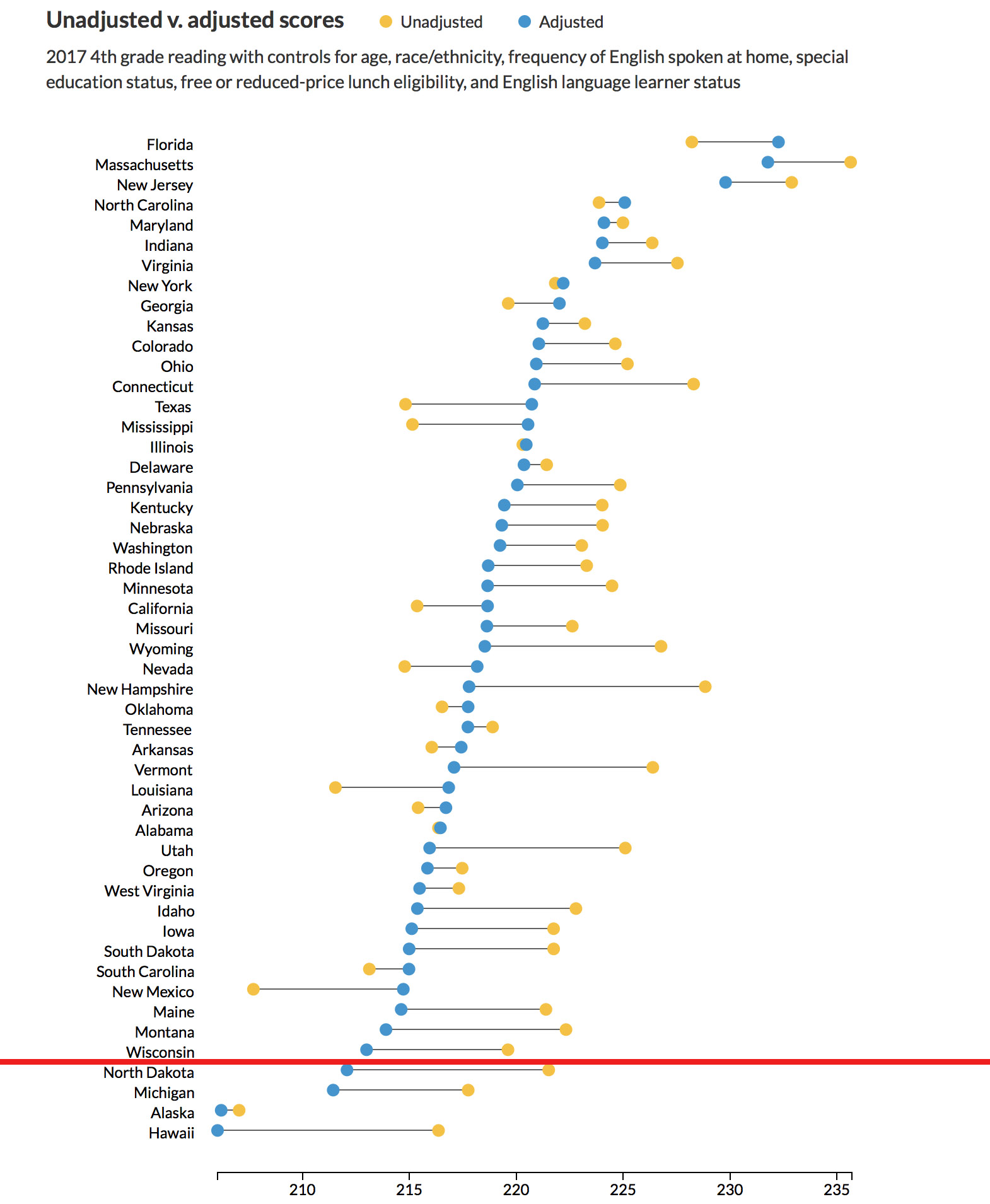
More than 95% of the 420-plus school districts in Wisconsin got at least a three-star rating, also called “meets expectations.” The same was true for 82% of individual schools. You still want more three-star schools to move up to four- or five-star levels, where they “exceed expectations,” but, in general, the results offered some cheer.

Related: Madison’s long-term, disastrous reading results.

Share

What’s the point of sexual harassment training? Often, to protect employers.

Lauren Edelman:

Now that we’ve had something of an awakening about the pervasiveness of sexual harassment in the American workplace, the conversation is shifting to what to do about it. In many workplaces, the answer seems to be that we need mandatory training and clearer policies.

That seems to be the dominant thinking on Capitol Hill. After more than 1,500 former congressional aides signed a letter calling for action, the House and Senate adopted mandatory anti-harassment training for all lawmakers and staffers. This “sends a clear message: harassment of any kind is not and will not be tolerated in Congress,” Sen. Amy Klobuchar (Minn.), the ranking Democrat on the Senate Rules Committee, said in a statement.

Unfortunately, there is little evidence that training reduces sexual harassment. Rather, training programs, along with anti-harassment policies and reporting procedures, do more to shield employers from liability than to protect employees from harassment. And the clearest message they send is to the courts: Nothing to see here, folks.

There have been only a handful of empirical studies of sexual harassment training, and the research has not established that such training is effective. Some studies suggest that training may in fact backfire, reinforcing gendered stereotypes that place women at a disadvantage.

A 2001 study of a sexual harassment program for faculty and staff at a university found, based on responses to a questionnaire, that training increased knowledge about laws pertaining to sexual harassment but had no significant positive effects on behavior. Men who participated in the training were less likely to view coercion of a subordinate as sexual harassment, less willing to report harassment and more inclined to blame the victim than were women or men who had not gone through the training.

Share

Civics: We’ll Be Paying For Mark Halperin’s Sins For Years To Come

Eve Fairbanks:

Gossip: The word comes from the old English for “baptismal sponsor” — a godparent — and Halperin positioned himself as the priest who stood between the layman and the sacred mysteries of Washington, only letting a person through in exchange for the corrupting coin of accepting your own personal idiocy. It required acknowledging, like a cult initiate, that you had to learn the Master’s arcane knowledge before claiming to know anything at all.

The Note was a cult. Between bits of knowledge in each mailer, Halperin inserted birthday wishes to his gang, cementing the impression of Washington as a place where people are much more interested in buttering each other up than they are in the lives of the kind of Americans whose names Mark Halperin did not know.

As I said: Washington was my city. But it is a city for all Americans, as the seat of our democracy. For his efforts to make the city seem, instead, like a nonstop exclusive party to which almost nobody is invited, I dare say Halperin is the single journalist most responsible for Donald Trump. Think that’s too bold? Name me another.

After all, what did Trump respond to? Most of all, two things: the sense among Americans that the language of politics has become an incomprehensible jargon of the elite, and the sense that a disaster or a dramatic change that will upend everything looms at every moment — hidden from sight, but still imminent.

We have an apocalyptic politics in part because Halperin helped promote an apocalyptic approach to political coverage. It made him and his little scoops seem hugely important: that conversation he overheard between McConnell and Schumer meant everything. The title of his career-making book, 2008’s Game Change — which sold over 350,000 copies and netted him and his coauthor John Heilemann a $5 million advance for a follow-up — says everything. Politics is a game and its rules are constantly being transformed. Its intentionally hyperbolic, breathless text presented details like the fact that Obama “woke up late … and went for a haircut with his pal Marty Nesbitt” the way an ancient monarch’s courtiers used to examine his every sigh for divine omens.

Share

Texas Education Agency back in the headlines over special education firing

Aliyya Swaby:

Both allegations are devastating for special education advocates and parents who had hoped for a turnaround after a Houston Chronicle investigation last year found that agency officials were denying special education services to thousands of Texas students.

“A lot of parents are feeling just very distraught and once again very betrayed by TEA,” said Cheryl Fries, co-founder of the advocacy group Texans for Special Education Reform, which was first to raise concerns about the contract this fall.

Fired after just three months on the job, Kash came to Texas from the Rainier School District in Oregon, where she was special education director. Two instructional assistants brought a civil lawsuit against her on Nov. 14, claiming she encouraged them to hide allegations of sexual abuse of a six-year-old and threatened them when they refused.

When the TEA terminated Kash, officials said she did not disclose that information during the hiring process.

“The existence of allegations of this nature, given her roles and responsibilities, prevent her from carrying out her duties effectively in Texas, and the agency has terminated Dr. Kash’s employment. Dr. Kash has no business being in charge of special education policy and programming in Texas,” TEA spokeswoman DeEtta Culbertson said in a statement.

Kash denies the lawsuit’s allegations. She said TEA fired her because she had been vocally critical of a contract TEA awarded in May to the Georgia-based company SPEDx to analyze private data about how students are receiving special education services in Texas public schools. In the Nov. 21 federal complaint, Kash argued SPEDx did not qualify for a no-bid contract since other private and public entities could have provided the service. She said the TEA did not publicize its justification for awarding a no-bid contract to the company in the spring, as state law requires.

Share

Special education’s hidden racial gap

Emmanuel Felton:

“In WI, 84% of white students in special education who exited [high school in] 2014-15 earned a traditional diploma, while just 53% of black students and 71% Latino students with disabilities did so.”

Via Chan Stroman-Roll.

Share

Many college students going hungry, need donated food groceries and food stamps

Nanette Asimov:

A nitro cold brew sells for $5, and a large mocha for $4.50 at a popular coffee and muffin bar in UC Berkeley’s student union. Downstairs, business is just as brisk at another food emporium.

The provisions there are free.

“I’m low on funds,” shrugged Christopher, a junior, as he stuffed apple juice, a half gallon of milk, a box of peanut butter Puffin cereal and two cans of organic pinto beans and sweet corn — the UC Berkeley Food Pantry’s five-item limit — into his backpack.

Christopher, who asked that his last name not be used, said he depends on the pantry’s donated groceries to make ends meet, especially during emergencies. Someone slashed his tire last week, he said, and now he’s out $110 for a new one. Without the help, he’d have to make a choice: wheels or food.

Faced with such choices, students often skip the nutrition.

Share

Islamic schools in Pakistan plagued by sex abuse of children

Kathy Gannon:

Kausar Parveen struggles through tears as she remembers the blood-soaked pants of her 9-year-old son, raped by a religious cleric. Each time she begins to speak, she stops, swallows hard, wipes her tears and begins again.

The boy had studied for a year at a nearby Islamic school in the town of Kehrore Pakka. In the blistering heat of late April, in the grimy two-room Islamic madrassa, he awoke one night to find his teacher lying beside him.

“I didn’t move. I was afraid,” he says.

The cleric lifted the boy’s long tunic-style shirt over his head, and then pulled down his baggy pants.

“I was crying. He was hurting me. He shoved my shirt in my mouth,” the boy says, using his scarf to show how the cleric tried to stifle his cries. He looks over at his mother.

Share

Professors Are Losing Their Freedom of Expression

Howard Gillman & Erwin Chemerinsky :

With so much attention focused on whether controversial speakers such as Milo Yiannapoulos or Richard Spencer should be allowed to appear on campus, an even more basic issue has been obscured: universities punishing faculty who, outside of professional settings, express views that are considered controversial or even offensive.

There are many recent examples of this. A year ago, a University of Oregon law professor was suspended for wearing blackface at a Halloween party held at her house. Twenty-three law school faculty members wrote a letter urging the professor to resign. A campus investigation found that by wearing this costume at a party in her home she had engaged in “discriminatory harassment.” [More here]. …

Share

Tech billionaires spent $170 million on a new kind of school — now classrooms are shrinking and some parents say their kids are ‘guinea pigs’

Melia Robinson:

Max Ventilla, a Google executive who left the search giant to launch AltSchool in 2013, wooed parents with his vision to bring traditional models of elementary education into the digital age.

AltSchool has raised $175 million from Mark Zuckerberg, Peter Thiel’s Founders Fund, and others, and the startup is closing a Series C round of funding. But now some parents are bailing out of the school because they say AltSchool put its ambitions as a tech company above its responsibility to teach their children.

The startup, which launched in 2013, develops educational software and runs a network of small schools with four locations, in California and New York; two others closed their doors in the past year, and three more will close in the spring of 2018. These schools serve as testing grounds for an in-house team of technologists to work on tools for the modern classroom.

Since August, 12 parents spoke with Business Insider on the condition of anonymity, some because they worried that speaking out against AltSchool could hurt their children’s chances of being enrolled elsewhere. Six parents have withdrawn their children from AltSchool in the past year, and two others said they planned to do so as soon as they found a transfer spot at a different school. AltSchool enrolls between 30 and 100 students at each campus.

Share

The CPS boss apologizes for an invoice change he previously said he didn’t recall—after being shown proof of the change.

Ben Jarofsky:

As Thanksgiving bombshells go, Chicago Public Schools CEO Forrest Claypool’s letter of apology regarding his role in “invoicegate” isn’t anywhere near as explosive as the release of the Laquan McDonald video.

If you recall, it was on the eve of Thanksgiving in 2015 that Mayor Emanuel released the video that blew away what had until then been the official version of what happened when police gunned down 17-year-old McDonald.

A judge had ordered the video’s release, but no doubt the mayor was hoping that most of the public would be too distracted by the holidays to pay attention. Clearly that didn’t work, as protesters spent the next several weeks essentially accusing the mayor of concealing evidence of murd

Share

Closing Of The Canadian Academic Mind

Rod Dreher:

If you have ten minutes, it would be well spent listening to this secretly recorded meeting between Lindsay Shepherd, a graduate student at Canada’s Wilfrid Laurier University, and unnamed faculty and administration officials there. She was being disciplined for airing in a class a video by the controversial Canadian academic Jordan Peterson, who insists on the traditional pronoun usage “him” and “her,” and has become a pariah in Canadian academia because of it. Before the audio clip, here’s background on the story:

Apology from Laurier President and Vice-Chancellor Deborah MacLatchy :

I’m writing to make an apology on behalf of the university.

Through the media, we have now had the opportunity to hear the full recording of the meeting that took place at Wilfrid Laurier University.

After listening to this recording, an apology is in order. The conversation I heard does not reflect the values and practices to which Laurier aspires. I am sorry it occurred in the way that it did and I regret the impact it had on Lindsay Shepherd. I will convey my apology to her directly. Professor Rambukkana has also chosen to apologize to Lindsay Shepherd about the way the meeting was conducted.

Share

Nature and origins of the lexicon in 6-mo-olds

Elika Bergelsona,b,1 and Richard N. Aslinb:

Infants start understanding words at 6 mo, when they also excel at subtle speech–sound distinctions and simple multimodal associations, but don’t yet talk, walk, or point. However, true word learning requires integrating the speech stream with the world and learning how words interrelate. Using eye tracking, we show that neophyte word learners already represent the semantic relations between words. We further show that these same infants’ word learning has ties to their environment: The more they hear labels for what they’re looking at and attending to, the stronger their overall comprehension. These results provide an integrative approach for investigating home environment effects on early language and suggest that language delays could be detected in early infancy for possible remediation.

Share

Stop Using Excel, Finance Chiefs Tell Staffs

Tatyana Shumsky:

Adobe Inc.’s . finance chief Mark Garrett says his team struggles keeping track of which jobs have been filled at the software company.

The process can take days and requires finance staff to pull data from disparate systems that house financial and human-resources information into Microsoft Corp.’s Excel spreadsheets. From there they can see which groups are hiring and how salary spending affects the budget.

“I don’t want financial planning people spending their time importing and exporting and manipulating data, I want them to focus on what is the data telling us,” Mr. Garrett said. He is working on cutting Excel out of this process, he said

Share

Singapore Math

Avenues:

At Avenues, we have adopted Math in Focus, a Singapore approach, as our math curriculum in the Lower School*. So what is Singapore Math? The math we are teaching is not different math. Two plus two is still four; ten times ten is still one hundred. What is unique about the Singapore approach is the style of teaching and the student goals.

The classroom lessons begin with concrete experience. A kindergartener may use four blue blocks and three red blocks to add 4 + 3. A third grader may use groups of tens and ones counters to make four groups of fifteen in order to multiply 4 x 15. This concrete step engages students and builds deeper understanding of mathematical concepts. From the concrete stage, lessons move toward a pictorial focus. In this stage students use pictures, symbols, diagrams and other two-dimensional representations. Students learn to visualize math concepts and create representations based on the pictures in their minds.

Much more on Singapore Math, here.

Our society is being hijacked by technology.

Time Well Spent:

The whole system is vulnerable to manipulation.
Phones, apps, and the web are so indispensable to our daily lives—a testament to the benefits they give us—that we’ve become a captive audience. With two billion people plugged into these devices, technology companies have inadvertently enabled a direct channel to manipulate entire societies with unprecedented precision.

Technology platforms make it easier than ever for bad actors to cause havoc:

Pushing lies directly to specific zip codes, races, or religions.

Finding people who are already prone to conspiracies or racism, and automatically reaching similar users with “Lookalike” targeting.

Delivering messages timed to prey on us when we are most emotionally vulnerable (e.g., Facebook found depressed teens buy more makeup).

Creating millions of fake accounts and bots –” impersonating real people with real-sounding names and photos, fooling millions with the false impression of consensus.

Share

How Serving in World War II Spurred My Academic Ambition

Kurt Lang:

I graduated from high school six weeks after the bombing of Pearl Harbor. My parents—with whom my older brother and I had emigrated from Berlin five and a half years earlier—wanted me to enroll in Queens College, one of New York City’s tuition-free schools. But high school had been too much of a bore for me. Although I earned good grades, easily making the honor roll every term, I had no taste for more of the same. Being certain that sooner or later I would be subject to the military draft, I found work in a mechanical laboratory as a toolmaker’s apprentice.

Then, in April 1943, the army sent me its greetings—even before I became an American citizen and even though I was, technically, still an enemy alien. The army expedited my naturalization two months after I was inducted.

My first 18 months of military service were uninspiring. Donning the uniform did not fill me with pride, nor did the experience alter my perspective on life. What basic training had taught me was that the best way to get by was to stay out of sight. The army, more than the other branches of the military, was undergoing a massive expansion in a short time. Too many of its newly minted officers were apt to assert their military status by yelling commands and threatening any laggards instead of leading by example. This was particularly true of the infantry, in which I, along with thousands of others, landed when the army abruptly canceled the “specialized training” I was undergoing.

Share

Stanford trained AI to diagnose pneumonia better than a radiologist in just two months~

Dave Gershgorn:

There’s a clear trend that having more data makes it easier to train artificial intelligence. Bigger datasets, like ImageNet, originally showed that AI could be useful for tasks like image recognition, leading to a race among everyone from large technology companies to academics to compile new datasets to stretch the limits of AI.

Now, a new paper from Stanford University shows just how fast a new dataset could be used to train artificial intelligence algorithms to the point of near-human accuracy. Using 100,000 x-ray images released by the National Institutes of Health on Sept. 27, the research published Nov. 14 (without peer review) on the website ArXiv claims its AI can detect pneumonia from x-rays with similar accuracy to four trained radiologists.

Share

Secrets of the U.S. Puzzle Championship

Matt Matros:

Wordstar, Nurikabe, Double Minesweeper, and the rest of the puzzles in this year’s U.S. Puzzle Championship (USPC) were kept under tight security until the last possible instant. At precisely 1 p.m. EST on May 17, a password was released to open the protected file, and this year’s contestants had a frantic 150 minutes in front of them—printing out puzzles, penciling in solutions, and hoping to submit results to the server before time expired. The test, which determined who would compete for the American team at the World Puzzle Championships (WPC) in London, was challenging even for experts, but it was also eagerly anticipated by amateur enthusiasts. 2,180 hopefuls registered for the USPC and downloaded the puzzles, but only 273 submitted answers. Some people were surely in it for the competitive glory, but it seems most were in it for fun—a familiar dichotomy that’s hardly unique to puzzling.

I’ve always loved puzzles. They combine the joy of revelation with the satisfaction of effort rewarded. Nothing tops the epiphany of realizing that the 9 in the corner of the Sudoku means the middle square can’t be a 4. It feels like magic. And when that final square is filled in, the untold minutes spent in intense focus, locked out from the rest of the world, become justified. I once got an email from the director of a Sudoku tournament wishing me many “nice moments” with the puzzles. Nice moments—to me that’s what solving is about.

Share

There’s a Digital Media Crash. But No One Will Say It

Josh Marshall:

Yesterday I appeared on a panel about digital publishers who are ‘pivoting to video’. I’ve written about this before. But in case you’re new to it, there have been numerous cases over the last six months to a year in which digital publishers have announced either major job cuts or in some cases literally fired their entire editorial teams in order to ‘pivot to video.’ The phrase has almost become a punchline since, as I’ve argued, there is basically no publisher in existence involved in any sort of news or political news coverage who says to themselves, my readers are demanding more of their news on video as opposed to text. Not a single one. The move to video is driven entirely by advertiser demand.

What crystallized for me from this and other discussions I had yesterday is that we’re actually in the midst of a digital news media crash, only no one is willing to say it. I’ve noted before that digital news media in the midst of a monetization crisis. But it’s more than that. It’s a full blown crash.

Share

It’s Basic Math: Spending – Revenue = Deficit

Concord Coalition:

The federal budget is an expression of our country’s values. What we choose to spend money on and how much we spend, who we tax and how we collect, and the borrowing we engage in to make up the difference between the two, all reflect the basic math of national priorities.

Share

The Complete Moral Bankruptcy of Manipulating Human Psychology To Turn Users Into Addicts

Dan Kaplan:

Given that some (all?) of your income comes from teaching software makers how to leverage BJ Fogg’s discoveries on behavioral psychology for fun and profit, you must surely be one of the least qualified people to define the moral guidelines around the subject of digital psychological manipulation.

Your essay on The Morality of Manipulation is so profoundly detached from even a basic understanding of human nature and the reality of self-interest that I’m still not sure whether or not you are trolling us.

Share

No, you’re not being paranoid. Sites really are watching your every move

Dan Goodin:

If you have the uncomfortable sense someone is looking over your shoulder as you surf the Web, you’re not being paranoid. A new study finds hundreds of sites—including microsoft.com, adobe.com, and godaddy.com—employ scripts that record visitors’ keystrokes, mouse movements, and scrolling behavior in real time, even before the input is submitted or is later deleted.

Session replay scripts are provided by third-party analytics services that are designed to help site operators better understand how visitors interact with their Web properties and identify specific pages that are confusing or broken. As their name implies, the scripts allow the operators to re-enact individual browsing sessions. Each click, input, and scroll can be recorded and later played back.

A study published last week reported that 482 of the 50,000 most trafficked websites employ such scripts, usually with no clear disclosure. It’s not always easy to detect sites that employ such scripts. The actual number is almost certainly much higher, particularly among sites outside the top 50,000 that were studied.

“Collection of page content by third-party replay scripts may cause sensitive information, such as medical conditions, credit card details, and other personal information displayed on a page, to leak to the third-party as part of the recording,” Steven Englehardt, a PhD candidate at Princeton University, wrote. “This may expose users to identity theft, online scams, and other unwanted behavior. The same is true for the collection of user inputs during checkout and registration processes.”

Share

New Number Systems Seek Their Lost Primes

Kevin Hartnett:

In 1847, Gabriel Lamé proved Fermat’s Last Theorem. Or so he thought. Lamé was a French mathematician who had made many important discoveries. In March of that year he sensed he’d made perhaps his biggest: an elegant proof of a problem that had rebuffed the most brilliant minds for more than 200 years.

His method had been hiding in plain sight. Fermat’s Last Theorem, which states that there are no positive integer solutions to equations of the form an + bn = cn if n is greater than 2, had proved to be intractable. Lamé realized that he could prove the theorem if he just expanded his number system to include a few exotic values.

Share

Beijing blamed for blocking Japanese students’ speech

Asahi Shimbun:

High school students acting as peace ambassadors attend a disarmament conference held at the United Nations European Headquarters in Geneva on Aug. 22. They were not allowed to give their speech against nuclear weapons. (Asahi Shimbun file photo)

China blocked Japanese high school students acting as peace ambassadors from giving their annual anti-nuclear weapons speech at a U.N. disarmament event, according to Japanese government sources.

Beijing requested that Tokyo stop the students from delivering the speech at the United Nations European Headquarters in Geneva, the sources said.

It is the first time the anti-nuclear speech has not been delivered since it started in August 2014.

Twenty-two senior high school students attended the event after being chosen by the Japanese Foreign Ministry as special youth diplomats.

Share

Attica: It’s Worse Than We Thought

Heather Ann Thompson :

Last year I published a book, “Blood in the Water,” that offered the first comprehensive account of the uprising at New York’s Attica Correctional Facility in 1971 and its legacy. Though this protest against systematic abuse and abysmal living conditions — in which nearly 1,300 prisoners took over the facility, and law enforcement ultimately shot 128 men, killing 39 — was a cultural and political touchstone of the 1970s, much of the story was covered up. Attica is a public institution, but its records are not easily accessible. With no statute of limitations on murder, state officials had much to protect.

So I had to dig, for 13 years, to uncover what had really happened. But even more than a decade of research didn’t turn up everything.

Share

What does it take to conquer life’s adversities? Lessons from successful adults who overcame difficult childhoods

Meg Jay:

Does early hardship in life keep children from becoming successful adults? It’s an urgent question for parents and educators, who worry that children growing up in difficult circumstances will fail to reach their full potential, or worse, sink into despair and dysfunction.

Social scientists have shown that these risks are real, but they also have found a surprising pattern among those whose early lives included tough times: Many draw strength from hardship and see their struggle against it as one of the keys to their later success. A wide range of studies over the past few decades has shed light on how such people overcome life’s adversities—and how we might all cultivate resilience as well.

In 1962, the psychologist Victor Goertzel and his wife, Mildred, published a book called “Cradles of Eminence: A Provocative Study of the Childhoods of Over 400 Famous Twentieth-Century Men and Women.” They selected individuals who had had at least two biographies written about them and who had made a positive contribution to society. Their subjects ranged from Louis Armstrong, Frida Kahlo and Marie Curie to Eleanor Roosevelt, Henry Ford and John D. Rockefeller.

Share

Whatever happened to the presumption of innocence?

Brendan O’Neill:

I want to praise Jeremy Piven. That’s a risky thing to do, I know. Piven is one of Those Men. One of those big entertainment figures who has fingers pointed at him. He has joined Harvey Weinstein, James Toback and many others in facing accusations that he abused his power to sexually abuse women.

Yet Piven has also issued a principled statement that should give pause to all those taking pleasure in the #MeToo movement’s instant-destruction of men’s careers.

After describing the accusations against him as “absolutely false,” Piven laments the fact that “allegations are being printed as facts” and “lives are being put in jeopardy without a hearing, due process or evidence.” He wonders what happened to “the benefit of the doubt.” To “tear each other down and destroy careers based on mere allegations is not productive at all,” he says.

He’s right. In defending himself, Piven is also defending one of the core principles of an advanced society: the presumption of innocence.

Share

Gov. Scott Walker, AG Brad Schimel block Tony Evers from getting his own attorney

Patrick Marley:

Superintendent Evers should welcome greater accountability at (his Department of Public Instruction), not dodge it,” Evenson said in his email. “It’s not politics, it’s the law.”

The lawsuit centers on the powers of Evers. It was brought Monday by two teachers and members of the New London and Marshfield school boards, represented by the conservative Wisconsin Institute for Law & Liberty.

The group filed its case directly with the state Supreme Court, which last year ruled Evers had more power and independence than the heads of other state agencies.

The group argues the Department of Public Instruction is ignoring a new law that its backers say is meant to keep rules written by state agencies in check. The law, which took effect in September, says state agencies must run the scope of state rules past Walker’s Department of Administration before putting them into place.

Such rules are written to carry out state laws and include more details than the laws themselves.

Evers’ department issued rules this fall without first going to the Department of Administration. That’s because a divided state Supreme Court ruled last year that Evers did not have to abide by a similar law governing administrative rules because he is an independently elected official under the state constitution.

The latest lawsuit essentially asks the state’s high court to revisit that earlier ruling.

Much more on Wisconsin DPI Superintendent Tony Evers, here.

Share

K-12 Tax & Spending Climate: The Disappearing Right to Earn a Living

Conor Friedersdorf :

In most states, a person who desires to install home-entertainment systems for a living, or as a part-time gig for extra cash, faces relatively few barriers to entry. This is work teenagers routinely do for grandparents after they make a technology purchase. But in Connecticut, a home-entertainment installer is required to obtain a license from the state before serving customers. It costs applicants $185. To qualify, they must have a 12th-grade education, complete a test, and accumulate one year of apprenticeship experience in the field. A typical aspirant can expect the licensing process to delay them 575 days.

These figures are drawn from License to Work, a report released this week by the Institute for Justice, a public-interest law firm that has sued state governments on behalf of numerous small-business owners and members of the working class who’ve faced unduly onerous obstacles while trying to earn a living.

Occupational-licensing obstacles are much more common than they once were. “In the 1950s, about one in 20 American workers needed an occupational license before they could work in the occupation of their choice,” the report states. “Today, that figure stands at about one in four.” These requirements are at their most reasonable when regulating occupations such as anesthesiologist or airline pilot, as in those instances, they can mostly affect a privileged class.

Share

More Than 100 Universities And Colleges Included In Offshore Leaks Database

Sasha Chavkin, Emilia Díaz-Struck and Cecile S. Gallego:

Hidden in the 25,000 offshore entities we added to the Offshore Leaks Database today are some of the world’s most prestigious universities and colleges.

ICIJ and its partners found more than 100 educational institutions in offshore law firm Appleby’s client database, which was part of the Paradise Papers leaks.

Some of these elite institutions hold tens of billions of dollars in their endowments, and in the eyes of the law, they are treated as charities: altruistic, mission-driven and tax-exempt.

The only time university endowments pay taxes is when they invest in debt-financed financial firms such as private equity funds and hedge funds. These investments are considered a business activity unrelated to their tax-exempt missions.

Share

Why America Loses Every War It Starts

Harlan Ullman:

Most Americans believe that their military is the finest in the world, a belief well-founded by several measures. Yet if the U.S. military were a sports team, based on its record in war and when called upon to defend the nation since World War II, it would be ranked in the lowest divisions.

Consider history. The United States won the “big one”: the Cold War. But every time Americans were sent to wars that it started or into combat for reasons that lacked just cause, we lost or failed. Korea was at best a draw, ended not by a peace treaty but a “temporary” truce. Our record in subsequent conflicts was too often no better, and too often worse. Vietnam was an outright and ignominious defeat in which over 58,000 Americans died. George H.W. Bush’s administration deserves great credit in the first Iraq War and in handling the collapse of the Soviet Union. But the Afghanistan intervention begun in 2001 is still going with no end in sight. The Second Iraq War, launched in 2003, was rightly termed a fiasco. Even far smaller interventions — Beirut and Grenada in 1983, Libya in 2011 — failed.

Americans need to know why. Notably, failure was not the fault of the Pentagon. My new book, Anatomy of Failure: Why America Loses Every War It Starts, analyzes and explains why this record of failure has occurred and why these setbacks, if uncorrected, will continue. Interestingly, the reasons for failure span generations of leaders and apply equally to both political parties, suggesting that somehow this predilection for failure has become part of the national DNA.

Share

NJEA Spent $5.7M of Dues on Recent Election

NJTV:

According to recent filings with the Election Law Enforcement Commission, the New Jersey Education Association spent about $5.7 million in union dues on the recent general election. It did so through Garden State Forward, a Super PAC (political action committee) that the teachers union founded four years ago.

That was almost seven times more than the NJEA spent from voluntary donations to its regular PAC. NJEA communications director Steve Baker confirmed that all the roughly $5.7 million came from membership dues.

Share

Collaborative problem solving – Key findings OECD PISA


Andreas Schleicher: OECD PISA.

“The kind of things that are easy to teach are now easy to automate or outsource”.

Share

CS + X adds new music and crop science degrees for fall semester

Andrea Flores:

Two new CS + X majors, CS+ Music and CS + Crop Sciences, will be made available to students through the University’s School of Music and the College of ACES Department of Crop Sciences.

Students can start enrolling in fall 2018.

“CS + X opens up new possibilities in education, research, science, technology, industry and entrepreneurship; the potential discovery of new connections between CS and other disciplines; and the benefits of data management and analysis applied in new ways to new fields,” said Colin Robertson, assistant director of communications for the Department of Computer Science, in an email.

These two new majors are not the first of their kind. Four CS + X degrees exist in the college of LAS, including CS + Anthropology, CS + Astronomy, CS + Chemistry and CS + Linguistics.

Robertson said computer science is critically important to a growing number of disciplines.

Share

How Many Hours Americans Need to Work to Afford a Home

Jeff Desjardins :

When it comes to the cost of living in cities, a general rule of thumb is that housing prices are much higher in the country’s economic and population hubs, especially in the cities along the coasts.

Particularly in recent years, prices have been pushed sky-high in places like New York City or San Francisco through a combination of limited supply of new homes, increasing demand, shifting demographics, and government regulations.

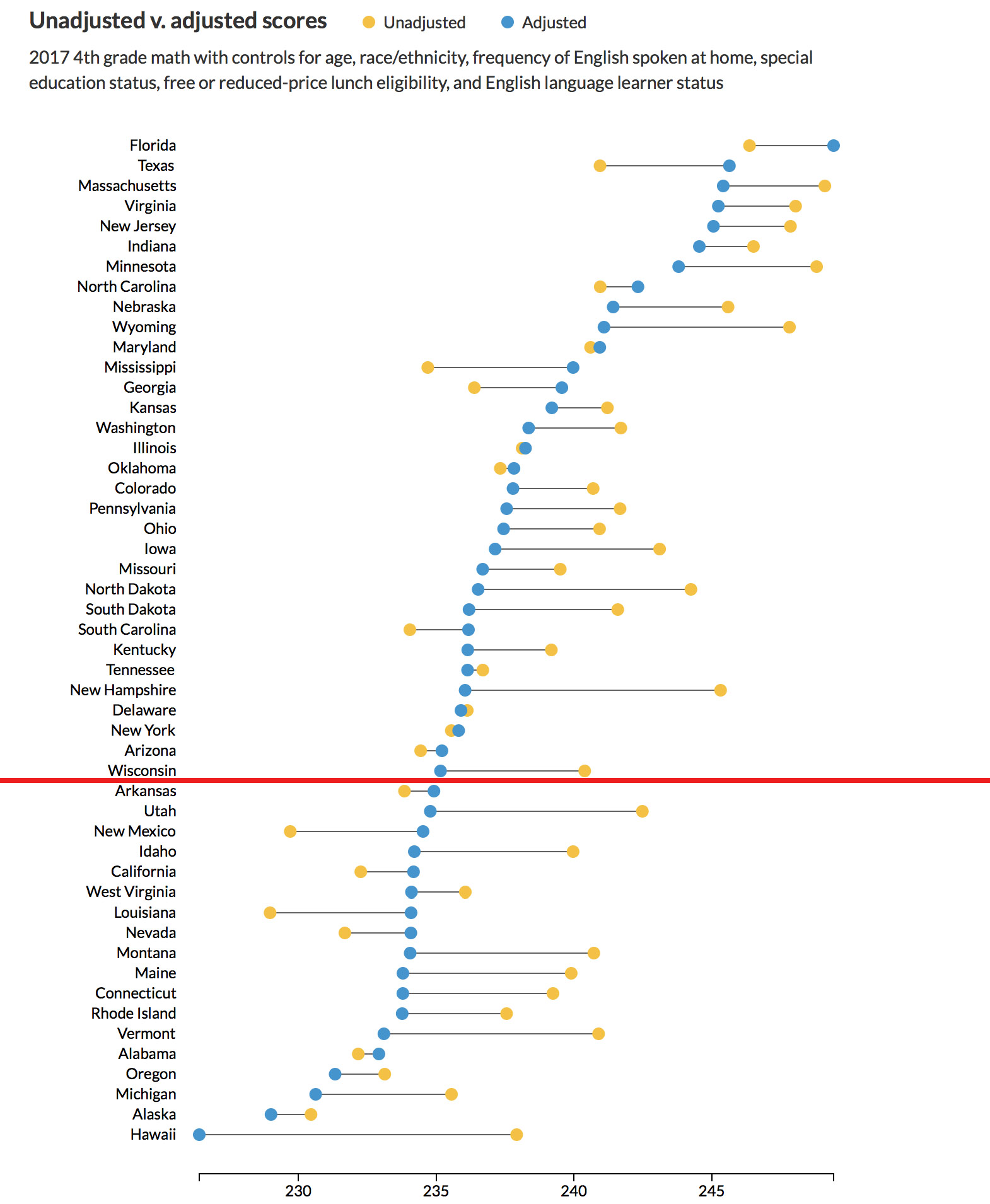
Locally, Madison tax and spending grows annually, with schools spending nearly $20,000 per student during the 2017-2018 year.

Share

Rating Madison area taxpayer funded school districts

Karen Rivedal:

Mirroring results from a year ago, all 16 Dane County school districts earned three or more stars on the state’s 2016-17 report cards, meaning they met or exceeded expectations for educating children.

The top county score went to Waunakee, which was the only one of the 16 to earn all five stars, placing it in the category of “significantly exceeding expectations.” Only 43 other districts in the state out of 424 did the same.

This is the second year the report cards used a five-star rating system. The stars correspond to one of five categories: “fails to meet expectations,” “meets few expectations,” “meets expectations,” “exceeds expectations” and “significantly exceeds expectations.”

Share

Google will ‘de-rank’ RT articles to make them harder to find – Eric Schmidt

rt.com:

Eric Schmidt, the Executive Chairman of Google’s parent company Alphabet, says the company will “engineer” specific algorithms for RT and Sputnik to make their articles less prominent on the search engine’s news delivery services.

“We are working on detecting and de-ranking those kinds of sites – it’s basically RT and Sputnik,” Schmidt said during a Q & A session at the Halifax International Security Forum in Canada on Saturday, when asked about whether Google facilitates “Russian propaganda.”

Related: Eric Schmidt, the 2016 Clinton Campaign and wikileaks.

Share

Beijing vies for greater control of foreign universities in China

Emily Fang:

The Chinese Communist party has ordered foreign-funded universities to install party units and grant decision-making powers to a party official, reversing an earlier promise to guarantee academic freedom as President Xi Jinping strengthens political control over all levels of education…

Foreign-invested universities and institutes will need to show co-operation over the next few months, the two people said.

Discussions over the new directive began in August among party and education officials. The formal decision to implement it was made after the party’s recently concluded 19th congress, at which Mr Xi said: “Government, military, society and schools — north, south, east and west — the party is leader of all.

Share

Why Clocks Run Clockwise (And Some Watches And Clocks That Don’t)

Jack Forster:

Most timepieces have hands that turn clockwise, and the reason is much older than clocks themselves.

The first thing most of us notice about clocks and watches when we learn to tell time, is that the hands turn clockwise – the habit of perceiving clockwise motion as a representation of the forward movement of time is deeply ingrained; so much so that once having learned it, most of us cease to notice it at all. Imagine you are standing on the center of a watch: in any direction you face, the hands will appear to pass from left to right. Theoretically, we could just as easily tell time if they went from right to left, so why do clock and watch hands overwhelmingly have rightward, or clockwise, motion? Why is there no period in history where anticlockwise and clockwise rotation competed for supremecy.

Share

Schools and families struggle for balance with students and smartphones

Alan Borsuk:

Furthermore, railing against the impact of smartphones is sort of like railing against the impact of cars. They’re so deeply embedded in our lives that few think of them as choices.

In 2015, a study by the Pew Research Center found that nationwide 73% of teens had access to a smartphone and another 15% had “only” a basic cellphone. Furthermore, 24% of teens said they are online “almost constantly.” Facebook was used by 71% of teens, Instagram by 52% and Snapchat by 41%.

Share

Civics: European Court Ruling Could Recognize Mass Surveillance Violates Human Rights

Ailidh Callander & Scarlet Kim :

The European Court of Human Rights last week held a hearing in a challenge to the United Kingdom’s mass surveillance practices, brought by the ACLU, Privacy International, Liberty, and seven other human rights organizations from around the world.

The case challenges practices, revealed by Edward Snowden, that breach the rights to privacy and freedom of expression, which are guaranteed not only under U.S. domestic law, but also under international human rights law.

The European Court of Human Rights is a critical component of the international human rights system. The court enforces the European Convention on Human Rights, a treaty ratified by 47 nations, including the United Kingdom. Its judgments are legally binding, and its jurisprudence helps shape the interpretation of human rights laws around the world — including those that bind the United States.

Share

A Litigious Climate Threatens Scientific Norms

Roger Pielke Jr.:

I’ve worked alongside climate researchers for decades. Almost all of them are ethical, dedicated to science and not particularly political. But some leading figures and organizations in this community are weakening the norms that make science robust. A lawsuit filed in September and recently made public is a case in point.

Mark Z. Jacobson, a professor of civil and environmental engineering at Stanford, is suing fellow renewable-energy researcher Christopher Clack, CEO of Vibrant Clean Energy LLC, for critiquing his work. Also named as a defendant is the National Academy of Sciences, which published Mr. Clack’s paper in its flagship journal. Mr. Jacobson alleges that Mr. Clack’s paper contains reputation-damaging “fabrication and falsification.”

Mr. Jacobson argues that the world can obtain all its energy from 100% renewable technologies, a claim endorsed by celebrities, advocacy groups and politicians. Mr. Clack’s paper, with 20 accomplished co-authors, takes issue with Mr. Jacobson’s claims. Based on my experience reading and reviewing thousands of scientific papers over more than 25 years, Mr. Clack’s critique is utterly typical scientific discourse, regardless of whose arguments ultimately prevail. Even if Mr. Jacobson turns out to be right on the merits, he is wrong to seek to resolve the matter in court.

Share

Oxford college introduces compulsory classes on ‘cultural appropriation’ for students

Camilla Turner:

An Oxford college has become the first to introduce compulsory classes on “cultural appropriation” for students.

Magdalen College will run the mandatory workshops for freshers starting from next year, where they will be taught about racism, institutional racism, cultural appropriation and implicit bias.

The move follows a series of rows about racism and cultural appropriation at the university. Magdalen College was criticised by students over its 1920s-themed ball, held last year.

It was claimed that the ball may cause offence to female and ethnic minority students on the basis that “people of colour and women were entirely absent from college spaces” during the time period.

Share

Google collects Android users’ locations even when location services are disabled

Keith Collins:

Many people realize that smartphones track their locations. But what if you actively turn off location services, haven’t used any apps, and haven’t even inserted a carrier SIM card?
 
 Even if you take all of those precautions, phones running Android software gather data about your location and send it back to Google when they’re connected to the internet, a Quartz investigation has revealed.
 Since the beginning of 2017, Android phones have been collecting the addresses of nearby cellular towers—even when location services are disabled—and sending that data back to Google. The result is that Google, the unit of Alphabet behind Android, has access to data about individuals’ locations and their movements that go far beyond a reasonable consumer expectation of privacy.

Share

The Story Behind Project Follow Through

Bonnie Grossen:

Project Follow Through (FT) remains today the world’s largest educational experiment. It began in 1967 as part of President Johnson’s ambitious War on Poverty and continued until the summer of 1995, having cost about a billion dollars. Over the first 10 years more than 22 sponsors worked with over 180 sites at a cost of over $500 million in a massive effort to find ways to break the cycle of poverty through improved education.

The noble intent of the fledgling Department of Education (DOE) and the Office of Economic Opportunity was to break the cycle of poverty through better education. Poor academic performance was known to correlate directly with poverty. Poor education then led to less economic opportunity for those children when they became adults, thus ensuring poverty for the next generation. FT planned to evaluatewhether the poorest schools in America, both economically and academically impoverished, could be brought up to a level comparable with mainstream America. The actual achievement of the children would be used to determine success.

The architects of various theories and approaches who believed their methods could alleviate the detrimental educational effects of poverty were invited to submit applications to become sponsors of their models. Once the slate of models was selected, parent groups of the targeted schools serving children of poverty could select from among these sponsors one that their school would commit to work with over a period of several years.

The DOE-approved models were developed by academics in education with the exception of one, the Direct Instruction model, which had been developed by an expert Illinois preschool teacher with no formal training in educational methods.The models developed by the academics were similar in many ways. These similarities were particularly apparent when juxtaposed with the model developed by the expert preschool teacher from Illinois. The models developed by the academics consisted largely of general statements of democratic ideals and the philosophiesof famous figures, such as John Dewey and Jean Piaget. The expert preschool teacher’s model was a set of lesson plans that he had designed in orderto share his expertise with other teachers.

The preschool teacher, Zig Engelmann, had begun developing his model in 1963 as he taught his non-identical twinboys at home, while he was still working for an advertising agency. From the time the boys had learned to count at age 3 until a year later, Zig had taught them multi-digit multiplication, addition of fractions with like and unlike denominators, and basic algebraic concepts using only 20 minutes a day.

Many parents may have dismissed such an accomplishment as the result of having brilliant children. Zig thought differently; he thought he might be able to accomplish the same results with any child, especially children of poverty. He thought that children of poverty did not learn any differently than his very young boys, whose cognitive growth he had accelerated by providing them with carefully engineered instruction, rather than waiting for them to learn through random experience.

Madison has long tolerated disastrous reading results, despite spending more than most, now nearly $20,000 per student.

Share

Popular Science Writing: A Challenge to Academic Cultures

Lna Erickson:

In Feynman’s popular science works, the aesthetic meets the empirical, as scien- tific knowledge is transmitted through a medium of story. Accepting tenets of both literary works and academic science writing, popular science writing, through its very existence, challenges the dichotomy of scientific versus literary cultures. Popular science writers like Richard Feynman, Carl Sagan, Stephen Jay Gould, Natalie Angier, and Neil DeGrasse Tyson―scientists who have authored books of creative scientific nonfiction for a lay audience―must face conflicting episte- mologies in science and the humanities, paying careful attention to the translation from scientific material to expressive forms. Popular science writers represent a precedent of literary-scientific work that challenges the two cultures’ dichotomy in Western thought.

Share

Startups worship the young. But research shows people are most innovative when they’re older

Neha Thirani Bagri :

While Silicon Valley had peddled the image of the 20-something, sweatshirt-wearing, college-dropout genius as the model for creativity in the 21st century, research shows that it is, in fact, older people who are more creative and productive.

For example, a 2016 study (pdf) by the Information Technology & Innovation Foundation that looked at the demographics of over 900 individuals who have made high-value meaningful, marketable contributions to technology-heavy industries in the US.

The study found that the overall median age of innovators was 47 years old. Only 5.8% of the sample—which ranged in age from 18 to 80—was 30 years or younger, and innovation peaked between the ages of 46 and 50. The rate of innovation continues to be very high until the age of 55 and declined sharply after 65, the median expected retirement age in the US.

Particularly in the life sciences, material sciences, and information-technology fields, individuals who filed patents tended to be in the latter half of their careers.

Share

Boardroom battles

The Economist:

Chalkbeat, an education news organisation, reported that political committees on both sides of the dispute channelled at least $1.65m into the school-board races that took place on November 7th in Denver, nearby Aurora and Douglas County. Other areas have seen even more expensive contests. In Los Angeles, where three board seats came up for election earlier this year, outside groups poured nearly $15m into canvassing and advertisements on behalf of the candidates. Much of the money came from California Charter Schools Association, which supports charter schools and received nearly $7m from Reed Hastings, the co-founder of Netflix, in the run-up to the election, and United Teachers Los Angeles, a union which opposes charters. According to Carol Burris, the executive director of the Network for Public Education, an advocacy organisation, outside money has also fuelled school-board fights in Louisiana, Minneapolis, and Perth Amboy, a town of just 52,500 in New Jersey.

It is not just the volume of cash being poured into school-board elections that is striking. So is where it comes from. As with political contributions in general, the origins of donations in school-board races are being obscured. The elections in Colorado illustrate how. Political action committees (PACs), which pool contributions from members and put them towards campaigning for or against candidates, are required to disclose their donor rolls. But social-welfare organisations, also referred to as 501(c)4s after the section of the tax code that describes them, are not. Those who wish to fund local races anonymously can direct their money to amenable 501(c)4s, which in turn donate to the PACs. In Colorado, for instance, a PAC called Raising Colorado, which supports the campaigns of charter-school champions, has received donations from only one source: Education Reform Now Advocacy (ERNA), the 501(c)4 arm of a non-profit organisation with its headquarters in New York City and Washington, DC. Who has donated to ERNA is a mystery.

Share

Battered St. Paul teacher meets with Trump officials over school discipline

Josh Verges:

In an email to the Pioneer Press, York said her goal is to get school management to implement and enforce safety policies “so teachers can teach and kids can learn in a healthy, risk/trauma-free environment.”

Last year, York’s testimony helped strengthen a Minnesota law that warns teachers about students with a history of classroom violence. She wants similar protections to be enacted nationwide.

The meeting comes almost four years after a letter from President Obama’s education department discouraged schools from suspending kids for nonviolent misbehavior and warned against punishing students of color more harshly.

In a January 2014 speech, then-education secretary Arne Duncan said adults, not children, are responsible for high rates of suspensions in certain schools and states.

“That huge disparity is not caused by differences in children; it’s caused by differences in training, professional development and discipline policies. It is adult behavior that needs to change,” he said.

Critics of the letter say real differences in student behavior are driving the disparities and that the focus on suspensions data has made schools more dangerous.

Share

How to find out what Facebook knows about you

Todd Haselton:

Between information you’ve provided and your usage habits, Facebook knows a lot about you

CNBC will walk you through how to find out what Facebook knows about you

You’ll see options to help limit what Facebook can discover about you along the way

Share

200 universities just launched 600 free online courses. Here’s the full list.

Dhawal Shah:

If you haven’t heard, universities around the world are offering their courses online for free (or at least partially free). These courses are collectively called MOOCs or Massive Open Online Courses.

In the past six years or so, close to 800 universities have created more than 8,000 of these MOOCs. And I’ve been keeping track of these MOOCs the entire time over at Class Central, ever since they rose to prominence.

In the past three months alone, over 200 universities have announced 600 such free online courses. I’ve compiled a list of them and categorized them according to the following subjects: Computer Science, Mathematics, Programming, Data Science, Humanities, Social Sciences, Education & Teaching, Health & Medicine, Business, Personal Development, Engineering, Art & Design, and finally Science.

Share

Laurier university starts independent probe after teaching assistant plays clip of gender debate

Michelle McQuige:

An Ontario university that has raised eyebrows among those concerned with questions of academic freedom has engaged a third-party investigator to probe an incident involving one of its teaching assistants.

Lindsay Shepherd, a graduate student at Wilfrid Laurier University, said she ran afoul of school authorities after she aired a clip in two tutorials of a debate on gender-neutral pronouns featuring polarizing University of Toronto professor Jordan Peterson.

The excerpt from TVO’s current affairs program The Agenda shows Peterson, who has famously refused to use gender pronouns other than “he” or “she,” defending his position against a professor who argued it was necessary to use the pronouns that a person prefers to be called.

Share

Complex Problems Require Rapid Experiments

Paul Taylor:

Most of you will have taken part in the Marshmallow Challenge or a variant of it. It’s the team exercise where you get a load of spaghetti, some tape, a marshmallow, a piece of string, and 18 minutes to build the tallest freestanding structure.

Peter Skillman, who devised it, found something fascinating when he tested it on multiple participants.

Children out performed most groups – including business school students and CEOs.

When Vicky Green repeated this experiment in Bromford Lab a couple of years ago – the team that did worst were…..our Project Managers.

Share

Sandburg maker space clubs give students choices

Pamela Cotant:

Facebook
Twitter
Email
Print
Save
Fourth-grader Andi Paulsen is excited to get the chance to spend part of every Wednesday afternoon practicing with a new band at her Sandburg Elementary School.

“I’ve been dying to learn how to play guitar,” she said.

The band is one of the options during Sandburg ‘choice time,’ when third through fifth graders participate in a variety of clubs. Started last year, it was expanded this year and is being supported by “Making Spaces,” which is a new partnership between the Madison Public Library’s Bubbler program, the Madison School District and the Foundation for Madison Public Schools to support maker education.

Share

Disrupting the World of Private School With Tech and Guinea Pigs

Kate Taylor:

Long dominated by a small group of elite institutions, New York City’s private schools have limited seats, annual tuition approaching $50,000, and an admissions process that can drive even the most levelheaded parents to teeth-grinding anxiety. The schools range in philosophy from traditional to progressive, but in general, they change slowly, if at all.

Now, a rash of start-ups say they can offer more 21st-century alternatives — and make a profit in the process.

They are entities like AltSchool, a San Francisco-based start-up that says it can use technology to revolutionize education. It opened its first “micro-school” in New York in 2015, and has opened two more since then.

There are the cost-cutter schools, like the tiny Portfolio School, which opened last year in TriBeCa, and uses technology to keep administrative costs down but emphasizes experiential learning, like having students design a home for the class’s pet guinea pigs. BASIS Independent Schools, with campuses in Brooklyn and Manhattan, offer a traditional curriculum, with an emphasis on science, for about a third less in tuition than the city’s most prestigious private schools.

Share

A Billionaire Is Trying to Ignite a Revolution in Russian Education

Emily Erken:

An education revolution could be coming to Russia. Its stage: the fields and forests on the outskirts of the country’s capital.

In 2012, the Russian government incorporated large swaths of land into Moscow, nearly doubling the city’s already vast area. Dubbed New Moscow, the new space was soon auctioned off under a mandate to develop it as an urbanist utopia of mixed housing, public transportation and recreational space.

Vadim Moshkovich, a Russian agriculture and real estate mogul, won the tender. Two years earlier, he had conceived Russia’s ideal private school to be set just outside the capital. New Moscow would serve as the perfect playground for his vision.

Moshkovich, whose net worth was estimated at $1.3 billion in 2014, created a 200 million dollar trust for his dream project, The Letovo School. The endowment will cover student tuition — $20,000 per year — a tantalizing carrot for most Russian families.

Share

A Hedge Fund That Has a University

Thomas Gilbert and Christopher Hrdlicka:

Whatever you may hear, the Republican tax-reform proposal isn’t an assault on higher education. The House and Senate plans include a new 1.4% excise tax on the net investment income of university endowments, but the levy applies only to private colleges with at least 500 students and endowments of more than $250,000 a student. Schools like Harvard, Yale, Stanford and Princeton—which together hold over $100 billion—are predicting doom. Yet this long-overdue tax will benefit higher education in the end.

Over the past 30 years universities have chased higher returns on their endowments, leading them to take greater risks. Our research shows that more than 75% of the assets in university endowments are now in risky investments: equities, hedge funds and private equity. Think of Harvard as a tax-free hedge fund that happens to have a university.

Share

A Chess Novice Challenged Magnus Carlsen. He Had One Month to Train

Ben Cohen:

Max Deutsch went through a month of training before he traveled across the ocean, sat down in a regal hotel suite at the appointed hour and waited for the arrival of the world’s greatest chess player.

Max was not very good at chess himself. He’s a 24-year-old entrepreneur who lives in San Francisco and plays the sport occasionally to amuse himself. He was a prototypical amateur. Now he was preparing himself for a match against chess royalty. And he believed he could win.

The unlikely series of events that brought him to this stage began last year, when Max challenged himself to a series of monthly tasks that were ambitious bordering on absurd. He memorized the order of a shuffled deck of cards. He sketched an eerily accurate self-portrait. He solved a Rubik’s cube in 17 seconds. He developed perfect musical pitch and landed a standing back-flip. He studied enough Hebrew to discuss the future of technology for a half-hour.

Share

Higher Education’s Deeper Sickness

John M. Ellis:

The sheer public spectacle of near-riots has forced some college administrators to take a stand for free expression and provide massive police protection when controversial speakers like Ben Shapiro come to campus. But when Mr. Shapiro leaves, the conditions that necessitated those extraordinary measures are still there. Administrators will keep having to choose between censoring moderate-to-conservative speakers, exposing their students to the threat of violence, and spending hundreds of thousands of dollars on every speaker. It’s an expensive treatment that provides only momentary relief from a symptom.

What then is the disease? We are now close to the end of a half-century process by which the campuses have been emptied of centrist and right-of-center voices. Many scholars have studied the political allegiances of the faculty during this time. There have been some differences of opinion about methodology, but the main outline is not in doubt. In 1969 the Carnegie Commission on Higher Education found that there were overall about twice as many left-of-center as right-of-center faculty. Various studies document the rise of that ratio to 5 to 1 at the century’s end, and to 8 to 1 a decade later, until in 2016 Mitchell Langbert, Dan Klein, and Tony Quain find it in the region of 10 to 1 and still rising.

Share

Conservative group challenges Wisconsin DPI’s rule-making authority

Todd Richmond:

The Wisconsin Institute for Law and Liberty (WILL) filed a lawsuit directly with the Supreme Court. The lawsuit argues the Department of Public Instruction has been writing administrative rules without permission from the Department of Administration and the governor as required by the REINS Act.

Republicans passed the act this summer. It requires state agencies to submit rule proposals to DOA and the governor before drafting anything. Rules are the legal language that enacts statutes and agency policy. Requiring permission from DOA and the governor before agencies can start writing them essentially gives the governor oversight of every major move the agency makes.

Much more on Tony Evers, here.

Share

We Can’t Trust Facebook to Regulate Itself

Sandy Parakilas:

This makes for a dangerous mix: a company that reaches most of the country every day and has the most detailed set of personal data ever assembled, but has no incentive to prevent abuse. Facebook needs to be regulated more tightly, or broken up so that no single entity controls all of its data. The company won’t protect us by itself, and nothing less than our democracy is at stake.

Share

UW-Madison’s corporate partnerships raise revenue and ethical questions

Nico Savidge:

The line to enter a pastel pink Google “Donut Shop” on UW-Madison’s Engineering Mall one cloudy morning earlier this month snaked around the grassy quad, filled with students and others who wanted to experience the pop-up promotion for the tech giant’s smart speaker.

“The new #GoogleHome Mini is the size of a donut, with the powers of a superhero,” @WisconsinUnion, the official Twitter account of UW-Madison’s student unions, wrote to its nearly 30,000 followers. “Get a taste today from 10-6. #ad #sponsored @madebygoogle.”

The Google event was the latest in a string of highly visible corporate partnerships at UW-Madison — others have included an Amazon location in a dorm and a campaign promoting Mentos Gum at the start of the fall semester — in which the university’s physical and digital spaces have been used as platforms for businesses.

Share

Matrix Calculus

www.matrixcalculus.org:

MatrixCalculus provides matrix calculus for everyone. It is an online tool that computes vector and matrix derivatives (matrix calculus).

Share

New Orleans man locked up nearly 8 years awaiting trial, then drug case gets tossed

Matt Sledge:

When Kevin Smith was jailed on a drug charge in New Orleans in 2010, Blockbuster was still renting DVDs and President Barack Obama was still trying to pass his signature health care bill.

Smith’s case never went to a jury. On Monday, 2,832 days after he was locked up, Criminal District Court Judge Tracey Flemings-Davillier ordered Smith’s release, bowing to an appeals court ruling that prosecutors had violated his right to a speedy trial.

Her decision represents an extreme example of how slowly the wheels of justice can grind in Orleans Parish while defendants sit in jail. All sides involved in the complicated saga point fingers at each other for the delays. No one can guarantee it won’t happen again.

Smith, 51, who is supposed to go free within a few days, has served more time in custody than any other New Orleans inmate awaiting trial for a nonviolent crime.

“If you’ve been in jail for right at eight years on the same charge and it won’t go to trial, that’s injustice,” said Smith’s cousin, Michael Smith.

Share

Statistical and Discrete Methods for Scientific Computing

CSE383M (65280) and CS395T (53715), Spring 2014:

Welcome to the course! The instructor is Professor William Press (Bill), and the TA is Jeff Hussmann (Jeff). We meet Mondays and Wednesdays, 1:30 – 3:00 p.m. in CBA 4.344 with Bill, and Fridays, 1:30 – 3:00 p.m. in CBA 4.348 with Jeff. The course is aimed at first or second year graduate students, especially in the CSEM, CS, and ECE programs, but others are welcome. You’ll need math at the level of at least 2nd year calculus, plus linear algebra, plus either more continuous math (e.g., CSEM students) or more discrete math (e.g., CS and ECE students). You’ll also need to be able to program in some known computer language.

Mechanics of the Course

The last two years, we have tried the experiment of a “flipped” course. This has worked so well that we are doing this again this year. “Flipped” means that the lectures are all on the web as recorded webcasts. You must watch the assigned webcasts before the class for which they are scheduled; maybe watch them more than once if there are parts that you don’t easily understand. Then, you will be ready for the active learning that we do in class. The class activities will not “cover the material”. Rather, class is supposed to be for “aha moments” and for “fixing” the material in your learning memory. We’ll thus do various kinds of “active learning” activities that will test and improve your understanding of the material in the lecture. Such in-class activities, often done in randomized groups of two or three, may include

Share

Yes, Nafta Is Good for My Children

Patrick J. Ottensmeyer:

This week American, Canadian and Mexican negotiators will meet in Mexico City for the fifth round of talks to modernize the North American Free Trade Agreement. During the previous round of negotiations in Washington, I had the opportunity to meet with U.S. Trade Representative Robert Lighthizer, who leads the U.S. delegation. I wanted to explain how important Nafta is to my company and the communities we serve.

Near the end of our meeting, Mr. Lighthizer asked me a more personal question: “How is Nafta good for your children and grandchildren?” Afterward, I spent a good deal of time thinking about this. I also took the time to consider how this trade deal will affect America’s place in the world for decades to come. I think I can now give a definitive answer to Mr. Lighthizer’s question.

Share

Can journalists ever regain Americans’ trust?

Andrew Edgecliffe-Johnson :

“Even journalists in this day and age have lost their mind on social media,” he says.

We can make space for “solutions journalism”, which, as Ford puts it, “is not about balancing bad news with puppies”, but highlighting constructive responses to the challenges that most worry our audiences. We might even take a leaf from Trump’s book by talking less like politicians and acknowledging the existence of communities such as Bowling Green. Most important, perhaps, we can start by admitting we have a deep-seated trust problem that will not go away on its own.

A week in Kentucky has also reminded me of what has not changed: the power of setting down the clearly attributed facts of a big story and the pleasure of well-crafted storytelling.

The year the fake news narrative took off has also seen some memorable journalism. The growth in subscriptions to organisations from the Washington Post to The New Yorker suggests high-quality reporting is being rewarded. Gallup and Reuters/Ipsos polls have even found the number of Americans expressing confidence in the press has ticked up in recent months.

I make one more stop as I drive to Nashville for the flight back to New York. Gold City Grocery is surrounded by fields. At the petrol pump outside, a tractor is refuelling under a sign advertising a cola brand that has not bothered Coke and Pepsi for decades. Inside is what’s known as a liars table, where regulars discuss the issues of the day. The walls are decorated with deer heads; rallying cries for God, the military and the Second Amendment; and a picture of a handgun with the warning to would-be miscreants: “We don’t dial 911”.

Share

Give them a problem and watch them iteratively try to figure it out.

David Bland:

Kids start out in life naturally curious. In a way, they are like good designers. Give them a problem and watch them iteratively try to figure it out.

Share

Five Questions for Any Free College Plan

Michael Dannenberg:

Nearly every Democrat — and likely a number of Republicans — running for statewide office this cycle will propose some sort of free college, debt-free college, or just general college affordability plan. Those plans need to be well-designed and in particular recognize the relationship between college affordability and college completion. Otherwise they’re apt at best to under deliver, and at worst, do more harm than good for a large number of students who end up dropping out with no degree and student loan debt for non-tuition and fee costs to boot.

Share

What is transfer learning?

Pranoy Radhakrishnan:

Transfer learning make use of the knowledge gained while solving one problem and applying it to a different but related problem.

For example, knowledge gained while learning to recognize cars can be used to some extent to recognize trucks.

Pre-Training

When we train the network on a large dataset(for example: ImageNet) , we train all the parameters of the neural network and therefore the model is learned. It may take hours on your GPU.

Share

Harvard Business School professor: Half of American colleges will be bankrupt in 10 to 15 years

Abigail Hess:

There are over 4,000 colleges and universities in the United States, but Harvard Business School professor Clayton Christensen says that half are bound for bankruptcy in the next few decades.

Christensen is known for coining the theory of disruptive innovation in his 1997 book, “The Innovator’s Dilemma.” Since then, he has applied his theory of disruption to a wide range of industries, including education.

In his recent book, “The Innovative University,” Christensen and co-author Henry Eyring analyze the future of traditional universities, and conclude that online education will become a more cost-effective way for students to receive an education, effectively undermining the business models of traditional institutions and running them out of business.

Share

Civics: Dark Cloud: Inside The Pentagon’s Leaked Internet Surveillance Archive

Upguard:

The UpGuard Cyber Risk Team can now disclose that three publicly downloadable cloud-based storage servers exposed a massive amount of data collected in apparent Department of Defense intelligence-gathering operations. The repositories appear to contain billions of public internet posts and news commentary scraped from the writings of many individuals from a broad array of countries, including the United States, by CENTCOM and PACOM, two Pentagon unified combatant commands charged with US military operations across the Middle East, Asia, and the South Pacific.

The data exposed in one of the three buckets is estimated to contain at least 1.8 billion posts of scraped internet content over the past 8 years, including content captured from news sites, comment sections, web forums, and social media sites like Facebook, featuring multiple languages and originating from countries around the world. Among those are many apparently benign public internet and social media posts by Americans, collected in an apparent Pentagon intelligence-gathering operation, raising serious questions of privacy and civil liberties.

Share

Five graphs that will change your mind about poverty

Chrlsea Follett:

Angus Deaton, the Nobel-prize winning economist (who also sits on the advisory board of HumanProgress.org), recently reiterated his belief that on the whole the world is getting better – if not, as he accepted, everywhere or for everyone at once. Perhaps that comes as no surprise, but the idea that the world is getting better in regards to poverty is actually a deeply unpopular view.

Ask most people about global poverty, and chances are that they’ll say it is unchanged or getting worse. A survey released late last year found that 92 per cent of Americans believe the share of the world population in extreme poverty has either increased or stayed the same over the last two decades.

Share

On Being Midwestern: The Burden of Normality

Phil Christman:

After my Texas-born wife and I moved to Michigan—an eleven-hour drive in the snow, during which time itself seemed to widen and flatten with the terrain—I found myself pressed into service as an expert on the region where I was born and where I have spent most of my life. “What is the Midwest like?” she asked. “Midwestern history, Midwestern customs, Midwestern cuisine?” I struggled to answer with anything more than clichés: bad weather, hard work, humble people. I knew these were inadequate. Connecticut winters and Arizona summers are also “bad”; the vast majority of humans have worked hard, or been worked hard, for all of recorded history; and humility is one of those words, like authenticity or (lately) resistance, that serves mainly to advertise the absence of the thing named.

I soon learned that I was hardly the only Midwesterner left tongue-tied by the Midwest. Articulate neighbors, friends, colleagues, and students, asked to describe their hometowns, replied with truisms that, put together, were also paradoxes: “Oh, it’s in the middle of nowhere.” “It’s just like anywhere, you know.” “We do the same things people do everywhere.” No-places are as old as Thomas More’s Utopia, but a no-place that is also everyplace and anyplace doesn’t really add up. Nor, at least in my experience, does one hear such language from people in other regions—from Southerners, Californians, Arubans, Yorkshiremen. Canadians live in a country that has been jokingly described as America’s Midwest writ larger—Canada and our Midwest share, among other things, manners, weather, topography, and a tendency among their inhabitants to downplay their own racism—yet they are hyperspecific in their language, assuming a knowledge of local landmarks that it never occurs to them non-Canadians may not possess. They assume that whatever their setting is, it is a setting, not, as Midwesterner-turned-expatriate Glenway Wescott once wrote of Wisconsin, “an abstract nowhere.”1

Share

These 3 Student Data Bills Could Ruin Your Kid’s Life

Jenni White:

For years, I researched and wrote about the State Longitudinal Database Systems (SLDS) here in Oklahoma and across the nation (here, here and here), warning that these ill-advised legislative efforts to codify “transparency and accountability” in public schools would end up creating what could only be considered a national database.

In 2013 I testified before our state legislature on the dangers of SLDS, which are a system of interconnected state data streams that flow into a giant federal data river collecting information starting when small humans enter the public school system. Sorry, but I don’t happen to believe that lifelong surveillance and surveillance-based manipulation of my choices should be the price of a public education. Nobody needs his preschool discipline records following him for life because some data company in cahoots with the government—well beyond my control—wants to plunder education records to make a buck.

Share

Attacks on Public-Sector Unions Harm States: How Act 10 Has Affected Education in Wisconsin

David Madland and Alex Rowell:

This issue brief examines the impact of the law on Wisconsin’s K-12 public education system and state economy. While this brief focuses on Act 10’s impact on Wisconsin teachers based on the data available, the same forces driving changes in the teaching workforce can also affect the broader public sector.3 Proponents of Act 10 insisted that reducing collective bargaining rights for teachers would improve education by eliminating job protections such as tenure and seniority-based salary increases. As Gov. Scott Walker (R-WI) argued, “We no longer have seniority or tenure. That means we can hire and fire based on merit, we can pay based on performance. That means we can put the best and the brightest in our classrooms and we can pay them to be there.”4 However, the facts suggest that Act 10 has not had its promised positive impact on educational quality in the state.
The authors’ analysis using data collected by the Wisconsin Department of Public Instruction (DPI) finds that since the passage of Act 10, teachers have received far lower compensation; turnover rates have increased; and teacher experience has dropped significantly. Importantly, the harms from Act 10 extend beyond public-sector workers to all Wisconsinites, as current research suggests that student outcomes could be negatively affected by the law as well. Rather than encouraging the best and brightest students to become teachers and to remain in the field throughout their career, the law appears to have had the opposite effect by devaluing teaching and driving many teachers out of Wisconsin’s public schools.

Much more on Act 10, here.

Share

5 Lessons From a Diplomat for Bridging the Parent-Teacher Divide

Amy Robertson:

Recently, I’ve been using globally tested advocacy and solution-building strategies to help smooth a critical friction point close to home: the parent-teacher conference.

“Gosh, those teachers were defensive,” I said to my husband, Luca, as we walked out of a grade school parent-teacher conference for our son.

“Well …” he hesitated, and then cut to the chase. “Your question about spelling was a trap.”

I was indignant. “I was asking for their side of the story before I gave my observations.”

He shrugged. “You already had your opinion. It wouldn’t have mattered what they said.”

Share

Welcome to the Cult of Saints in Late Antiquity (CSLA) database.

History at Oxford:

By the end of our project, on 31 December 2018, you will find here the vast majority of the early evidence for the cult of Christian saints (up to around AD 700), readily accessible and searchable, with key texts presented in their original language, and all with English translations and brief contextual commentary.

At the time of our launch (1 November 2017), only part of the evidence is fully accessible; but this will be added to steadily over the coming months.

It is important to note that this is a database of the surviving early evidence of cult, not a database of all early saints, of whom there will have been many who lived before 700, but for whom there is no unequivocal surviving early evidence of cult.

This database is built on the published work of hundreds of scholars, whom we hope to have credited fully and correctly; if you are unhappy with our use of your material, do please contact us.

We welcome constructive feedback on this database, since a principal aim in making it public before completion is to hear from users.

Share

Historian gripes about access and quality of archives in China

Jiayun Feng:

Shen Zhihua 沈志华 is a famous Chinese historian who specializes in the history of the Soviet Union, the Cold War, and Sino-Soviet relations. As a professor of history at East China Normal University, Shen earned a reputation for his obsession with archival research, which, according to him, should always be a priority for historians. In a recent and surprisingly frank interview (in Chinese) with Paper.cn, Shen talked the absurd difficulties of obtaining permission to read historical documents in China, and how often they have been tampered with.

At the beginning of the conversation, Shen talks about how he collected a large quantity of declassified archival materials in the 1990s after the collapse of the Soviet Union. At that time, he paid out of his own pocket for most of the trips that he made to Moscow. But what bothered Shen more than the lack of funding was the quality of the documents he found: “In the U.S.S.R., many government reports submitted to top authorities were written to please superiors,” Shen said. “And archives preserved by Russia are poorly organized compared with those in Western countries such as the United States.”

Share

Google Has Picked an Answer for You—Too Bad It’s Often Wrong

Jack Nicas:

Google became the world’s go-to source of information by ranking billions of links from millions of sources. Now, for many queries, the internet giant is presenting itself as the authority on truth by promoting a single search result as the answer.

Share

The Hidden Science and Tech of the Byzantine Empire

Anthony Kaldellis:

In reality, Byzantium was also a pragmatic and down-to-earth culture—it developed sophisticated systems for taxation, justice, administration, and military deployment—and it also exhibited prowess in science and technology. My new book, A Cabinet of Byzantine Curiosities: Strange Tales and Surprising Facts from History’s Most Orthodox Empire, aims to capture this side of the Byzantines, too. Byzantine military inventors perfected Greek Fire, a combustible liquid like napalm that could be hurled at enemy ships (or lobbed against land armies as hand grenades); a Byzantine philosopher made two synchronized clocks, placing one at the frontier and one in the capital, so that messages could be sent across Asia Minor via a network of fire signals, each message keyed to the time of day or night that it was sent; and Byzantine theologians included ancient Greek science within the basic curriculum of learning that aspiring religious thinkers had to master.

Share