School Information System

California Governor Brown should give ‘thumbs down’ on autism-linked education bill

Patrick Johnston:

Hundreds of pieces of legislation are sitting on Governor Jerry Brown’s desk awaiting his proverbial “thumbs up” or “thumbs down.” Gov. Brown has already warned that many of these bills will be vetoed, saying that there will be “plenty of veto blues.”
One bill that regretfully deserves a veto is Senate Bill 946 (Steinberg). It would impose a costly new mandate for private health insurance to pay for educational non-medical services for children with autism, while exempting the public health programs — Medi-Cal and Healthy Families — from the requirement to cover the same therapy.
The bill was jammed through the legislature at the last possible moment without sufficient time for debate or evaluation of the potential consequences of passage. While on the surface it may seem like a well-intentioned bill, it is riddled with flaws and in the end will do more harm than good.

Share

Crunch Time for Madison Prep Charter School


Ruth Conniff:

Ed Hughes has a problem.
Like most of his fellow school board members and practically everyone else in Madison, he was bowled over by Urban League president Kaleem Caire’s vision for Madison Prep, a charter school that would aggressively tackle the school district’s entrenched minority achievement gap.
“The longer day, the instructional focus, and the ‘no excuses’ approach appealed to me,” Hughes says.
But as he looked into the details, Hughes became more and more concerned about the cost of the school and “whether there is a good match between the problem we are trying to address and the solution that’s being proposed.”
Expressing those doubts in his blog has turned the soft-spoken Hughes into a heretic.
Caire is a superstar who has galvanized the community to get behind his charter school. At school board hearings, only a handful of speakers express any reservations about the idea, while an overwhelming number speak passionately about the need to break the school-to-prison pipeline, and about Madison’s moral obligation to do something for the kids who are not being served.
Hughes listens respectfully. But, he says, “for Madison Prep to be the answer, we’d need to know that the students it was serving would otherwise fall through the cracks.”
…..
But Hughes’ big problem with the Urban League’s draft proposal, submitted to the district last February, is cost. The total cost to the school district of $27 million over five years is just too much, he says.

Madison School Board Member Ed Hughes:

I don’t know if the Urban League’s plans for Madison Prep will come to fruition. If they do, I predict here and now that the school will have a higher graduation rate than the Madison school district as a whole for African-American students and probably for other groups of students as well. I also predict that all or nearly all of its graduates will apply to and be admitted to college. What is impossible to predict is what difference, if any, this will make in overall educational outcomes for Madison students.
Of course charter schools like Madison Prep will have higher graduation rates than their home school districts as a whole. Students enrolled in charter schools are privileged in one clear way over students not enrolled. Each student has a parent or other caregiver sufficiently involved in the child’s education to successfully navigate the process to get the student into the charter school. Not all students in our traditional neighborhood schools have that advantage. Other things equal, students with more involved parents/caregivers will be more likely to graduate from high school. So, one would expect that charter schools will have higher graduation rates.

Share

Proposed Madison Prep IB Charter School and Madison Teachers, Inc will work together on new charter school; to be staffed largely with Union Teachers

Susan Troller:

Several major impediments facing the proposed Madison Prep charter school appear closer to resolution after a series of meetings and communications Friday between Urban League CEO Kaleem Caire, district Superintendent Daniel Nerad and John Matthews, executive director of Madison Teachers Inc.
The changes are just in time for a public hearing on the Urban League-backed school on Monday, Oct. 3 at 6 p.m. at the Doyle Administration Building, 545 W. Dayton St.
In a major shift, the proposed charter school will now be what’s called an “instrumentality” of the Madison Metropolitan School District. That means a significant portion of the school’s staff will be covered by the contract the district has with the local teachers union, Madison Teachers Inc. The contract runs through the end of June 2013

Matthew DeFour and Gayle Worland:

On the eve of a public hearing for Madison Preparatory Academy — a proposed charter school with single-sex classrooms focused on raising the academic performance of minority students — backers of the school agreed to employ union staff, eliminating a potential hurdle to approval of the school.
A budget plan for Madison Prep, proposed by the Urban League of Greater Madison, also was released late Friday. It estimates the Madison School District would spend $19.8 million over five years on the school, or about $2,000 less per student than it spends on other secondary-school students.
In lengthy meetings Friday, Urban League officials hammered out an agreement with Madison Teachers Inc., the union that represents Madison school teachers. MTI executive director John Matthews said the union, which previously opposed creation of Madison Prep, will remain neutral on whether the school should be approved.

Fascinating. It will be interesting to see the substance of the arrangement, particularly its implications for the current MMSD schools and Madison Prep’s curriculum and operating plans. 
A friend notes that the change is “stunning” and that it will likely “cost more” and perhaps “gut” some of Madison Prep’s essential components.

Share

The Higher-Education Battle the White House Should Be Waging

Kevin Carey:

In February 2009, in his first speech to Congress, President Obama pledged that America would regain the world lead in college attainment by 2020. It was a bold declaration, one that gave hope to those who worry that the nation’s historic commitment to higher learning is at risk.
Whether Obama really means it, however, remains to be seen. The administration has not yet developed a plan that would plausibly produce the millions of additional graduates needed to meet the 2020 goal.
To get there, the president must change the politics of higher-education reform. He should begin by using the bully pulpit to underscore how public and student interests often conflict with the priorities of traditional colleges and universities. The administration knows how to do this, because it’s already done so–twice. In 2010 it took $87-billion in unneeded student-loan subsidies away from private banks and gave the money to taxpayers and low-income students in the form of more-generous Pell Grants. In 2011 the Department of Education installed a new system for regulating the rapidly growing for-profit higher-education sector, protecting public dollars and saving students from being suckered into borrowing too much money for low-value degrees.

Share

K-12 Tax & Spending Climate: Bread & Circuses, or a Look at California’s Union, Pension, Budget and Political Challenges

Michael Lewis:

David Crane, the former economic adviser–at that moment rapidly receding into the distance–could itemize the result: a long list of depressing government financial statistics. The pensions of state employees ate up twice as much of the budget when Schwarzenegger left office as they had when he arrived, for instance. The officially recognized gap between what the state would owe its workers and what it had on hand to pay them was roughly $105 billion, but that, thanks to accounting gimmicks, was probably only about half the real number. “This year the state will directly spend $32 billion on employee pay and benefits, up 65 percent over the past 10 years,” says Crane later. “Compare that to state spending on higher education [down 5 percent], health and human services [up just 5 percent], and parks and recreation [flat], all crowded out in large part by fast-rising employment costs.” Crane is a lifelong Democrat with no particular hostility to government. But the more he looked into the details, the more shocking he found them to be. In 2010, for instance, the state spent $6 billion on fewer than 30,000 guards and other prison-system employees. A prison guard who started his career at the age of 45 could retire after five years with a pension that very nearly equaled his former salary. The head parole psychiatrist for the California prison system was the state’s highest-paid public employee; in 2010 he’d made $838,706. The same fiscal year that the state spent $6 billion on prisons, it had invested just $4.7 billion in its higher education–that is, 33 campuses with 670,000 students. Over the past 30 years the state’s share of the budget for the University of California has fallen from 30 percent to 11 percent, and it is about to fall a lot more. In 1980 a Cal student paid $776 a year in tuition; in 2011 he pays $13,218. Everywhere you turn, the long-term future of the state is being sacrificed.
This same set of facts, and the narrative it suggested, would throw an ordinary man into depression. He might conclude that he lived in a society that was ungovernable. After seven years of trying and mostly failing to run California, Schwarzenegger is persuasively not depressed. “You have to realize the thing was so much fun!” he says. “We had a great time! There were times of frustration. There were times of disappointment. But if you want to live rather than just exist, you want the drama.” As we roll to a stop very near the place on the beach where he began his American bodybuilding career, he says, “You have to step back and say, ‘I was elected under odd circumstances. And I’m going out in odd circumstances.’ You can’t have it both ways. You can’t be a spoiled brat.”

wikipedia on bread and circuses.

Share

Bipartisan bill would block automatic voucher school expansion in Wisconsin

Susan Troller:

Ten Wisconsin senators, from both parties, have joined forces to propose legislation that would require any further expansion of voucher schools to receive a full public debate.
The state’s voucher program provides taxpayer funds for families to send their children to private schools. It has served low-income students in Milwaukee for about 20 years, but was expanded by Gov. Scott Walker in the state budget passed in June without public debate or other legislative action.
Also included was language allowing automatic expansion of the voucher program in the future to any school district in Wisconsin that meets certain financial and demographic criteria.
That mechanism isn’t sitting well with some senators, including Senate President Mike Ellis, R-Neenah. He introduced SB 174, which ensures that any further expansion of the voucher program would include full public debate and legislative action.
“Sen. Ellis is not an enthusiastic advocate nor is he an opponent of voucher programs. But he’s long argued that policy issues should not be added into the budget process and this legislation addresses concerns about automatic expansion without proper debate,” says Michael Boerger, an aide to Ellis.

Share

Test Scores, Multiple Measures, and Circular Reasoning

Christinia Collins:

Anthony Cody’s recent reflection on this year’s Education Nation program on MSNBC offers an important caution to those trying to develop “multiple measures” for student learning and effective teaching. If the decision to use a given measure is determined solely by whether or not it’s linked to higher standardized test scores (as with the Gates Foundation’s Measures of Effective Teaching study), then you don’t really have “multiple measures.”

Tracking test scores can be an important tool in helping students make progress, and it is useful to know which elements of classroom practice have a significant impact on students’ performance on end-of-the-year tests. For example, teachers in Chicago who had high ratings on Charlotte Danielson’s framework for evaluating effective teaching have also been shown to have higher value-added scores. However, when test scores are used as the sole measure of effective teaching and learning — or when valuable aspects of effective teaching and important types of student learning are discarded or ignored because they don’t align with standardized test results — our students are the ones who ultimately pay the price.

Do you notice what is bothering me? Mrs. Gates begins by acknowledging that good teaching cannot be reduced to a test score — or at least that this is often said. She then asserts that the half billion dollars they have spent on research in this area have uncovered a number of things that can be measured that allow us to predict which teachers will have the highest test scores. A great teacher is defined over and over again as one who made sure students “learned the material at the end of the year.”

Share

To Hover Over Schoolwork, Parents Go Online

Molly Baker:

When Debbie Sumner Mahle, an Atlanta mother, wants to know what her sons, ages 6, 7 and 10, are working on in school, she turns on her computer and logs into NetClassroom. The portal lets her see not just their school assignments but also their attendance and grades.
More public and private school systems are wiring up data-management systems, and school work is just the tip of the iceberg. Parent-accessible websites and “learning community management systems”–or LCMSs, in the age of no jargon left behind–are increasingly handling schools’ scheduling, emergency contacts, immunizations, academic assessments and even meals, with some offering a daily nutritional breakdown of lunch.
Ms. Sumner Mahle receives email reminders to place her sons’ requests at orderlunches.com, which manages the meal program at their school, the Davis Academy. If she wants to work a shift as a cafeteria monitor, or bring cupcakes to a Halloween party, she signs up at volunteerspot.com.

Share

Scott Walker and Mitch Daniels on Public Employee Unions

Ira Stoll:

The governor of Wisconsin, Scott Walker, and the governor of Indiana, Mitch Daniels, were both in New York City earlier this week for a Manhattan Institute conference about a “new social contract” with public employees.
Mr. Walker spoke first. He said the changes enacted in Wisconsin that had opponents sitting in and sleeping over in the state capital in protest earlier this year had saved $1.44 billion for state and local governments combined. He said school districts had used the savings to hire more teachers to reduce class sizes and to offer merit pay.
Mr. Walker said voters are looking for “not Republican leadership, not Democrat leadership, they just want leadership.”
Mr. Walker contrasted his approach with that of Governor Patrick Quinn, a Democrat, of Wisconsin’s neighbor Illinois, who “laid off thousands” of state workers after “massive tax increases.”

Share

Further Commentary on the Proposed Madison Preparatory Academy IB Charter School: Gender discrimination likely a red herring in charter school discussion

Chris Rickert:

The Madison School District now has another justification for killing a charter school aimed at doing what the district hasn’t: consistently educate minority students.
Last week, the state Department of Public Instruction said the first half of a planning grant for Madison Preparatory Academy would be released. Madison Prep would focus on low-income minority students and was originally just for boys but has since been revamped to include girls in separate classrooms.
But DPI had a catch: In order to get the rest of the grant, the school must provide scientific research that single-gender education is effective. If you’re going to discriminate by gender, DPI is saying, at least have a good reason for it.
I can’t help but wonder: Is this the best DPI can do?
I don’t know much more than what I’ve read in this newspaper about how Madison Prep would organize itself, what kinds of educational approaches it would use or how capable its sponsor, the Urban League of Greater Madison, would be.

TJ Mertz:

ewsletter (as of this writing PD has not taken a position on the Madison Prep proposal). I’ve only changed minimally for posting here; one thing I have added is some hyperlinks (but I did not link as thoroughly as I usually do), another is a small “For Further Reading” set of links at the end,” and of course the song. This is intended to be a broad overview and introduction to what I think are some of the most important issues concerning the decision on the Madison Preparatory Academy presented in the context of related national issues. Issues raised in this post have been and will be treated in more depth — and with hyperlinks — in other posts]

For decades free market advocates such as the Bradley Foundation, the Walton Foundation and the Koch brothers have a waged a multi-front campaign against the public sector and the idea of the common good. Public education has been one of the key battlegrounds. In the coming weeks the Madison Metropolitan School District Board of Education will decide whether to approve a proposal for the Madison Prep Charter School. This proposal and the chief advocate for it – Kaleem Caire of the Urban League of Greater Madison – have their roots in the Bradley/Walton/Koch movement, and like much of that movement they offer false promises of educational progress in order to obscure the damage being done to every child in our public schools.

A Public Hearing on the Madison Prep proposal has been scheduled for Monday October 3, at 6:00 PM in the Doyle Building Auditorium; The Madison Prep proposal is on the agenda of the PD General Membership Meeting (Wed , 9/28 , 6:00 p.m, Hawthorne Branch Library, guests welcome).

Much more on the proposed Madison Preparatory Academy IB Charter School, here.

Share

Educating the Gifted

Norman Augustine, via a kind reader’s email:

The very subject of giftedness is fraught with contradiction and controversy. On the one hand, we often encounter misunderstanding, envy, and perceived elitism–and on the other, admiration, dependency, and respect. Little wonder that our K-12 education system has not yet determined how best to nurture extraordinary individuals so that they can become extraordinary contributors to society–and feel rewarded in doing so. Unfortunately, it is not simply the gifted who are underserved by most of our nation’s 14,000 public school systems; that group is just more acutely neglected, along with the economically less fortunate, than the nation’s student population as a whole.

Share

Madison School Board OKs use of police dogs for drug searches

Devin Rose:

In the coming weeks, Madison police dogs will be able to sniff through the halls, bathrooms and parking lots of the city’s middle and high schools if school principals suspect there may be illegal drugs there.
The School Board voted 5-1 Monday to allow the sweeps, which school officials say will help eliminate drug use and trafficking in schools and decrease violence. Annual evaluations will be conducted to assess the program’s effectiveness.
Supporters, including Madison Police Chief Noble Wray, said it could be an effective and color-blind tool as part of a strategy to keep schools safe. The dogs would search for marijuana, heroin and cocaine.
Luis Yudice, coordinator of safety and security for the school district, said one statistic that led officials to consider these searches was the 60 percent increase in student code-of-conduct violations since 2007 occurring because of drugs.

Share

The Global Report: Compare US School Districts to the World

The Global Report Card, via a kind Chan Stroman-Roll email:

The Global Report Card was developed by Jay P. Greene and Josh B. McGee as part of the George W. Bush Institute’s Education Reform Initiative. The Bush Institute works to increase dramatically the number of American students who graduate high school ready for college or prepared for a good career by:

  • cultivating a new generation of principals
  • implementing cutting edge research
  • advancing accountability

Driven by accountability and data, these initiatives challenge the status quo and lead a wide range of partners to share goals and use clear metrics tied to student achievement.
Summary of Methodology
The calculations begin by evaluating the distributions of student achievement at the state, national, and international level. To allow for direct comparisons across state and national borders, and thus testing instruments, we map all testing data to the standard normal curve using the appropriate student level mean and standard deviation. We then calculate at the lowest level of aggregation by estimating average district quality within each state. Each state’s average quality is evaluated then using national testing data. And finally, the average national quality is determined using international testing data. Essentially, this re-centers our distribution of district quality based upon the relative performance of the individual state when compared to the nation as a whole as well as the relative performance of the nation when compared to our economic competitors.
For example, the average student in Scarsdale School District in Westchester County, New York scored nearly one standard deviation above the mean for New York on the state’s math exam. The average student in New York scored six hundredths of a standard deviation above the national average of the NAEP exam given in the same year, and the average student in the United States scored about as far in the negative direction (-.055) from the international average on PISA. Our final index score for Scarsdale in 2007 is equal to the sum of the district, state, and national estimates (1+.06+ -.055 = 1.055). Since the final index score is expired in standard deviation units, it can easily be converted to a percentile for easy interpretation. In our example, Scarsdale would rank at the seventy seventh percentile internationally in math.

The Best United States School Districts (2007 Math data) [PDF].
Related: www.wisconsin2.org and 1990-2010 US High School & College Graduation Comparison.

Share

What Do Test Scores Tell Us?

Gary Gutting:

Tests used to be just for evaluating students, but now the testing of students is used to evaluate teachers and, in fact, the entire educational system. On an individual level, some students and parents have noticed a change — more standardized tests and more classroom and homework time devoted to preparation for them.
So what exactly do test scores tell us?
Poor test scores are the initial premises in most current arguments for educational reform. At the end of last year, reading scores that showed American 15-year-olds in the middle of an international pack, led by Asian countries, prompted calls from researchers and educators for immediate action. This year two sociologists, Richard Arum and Josipa Roksa, showed that 45 percent of students, after two years of college, have made no significant gains on a test of critical thinking. Last week’s report of falling SAT scores is the latest example.

Share

Martin Institute Looks at Inclusion Teaching

Bill Dries:

Public and private school teachers will explore the shifting line between “mainstream” students and special education students during a two-day special education summit at The Martin Institute that begins Tuesday, Sept. 27.
The session is for special education teachers. The Wednesday session is for teachers outside the specific special education area. Both are on the Presbyterian Day School campus in East Memphis.
The summit and an 18-month focus on special education that follows arose from a series of luncheons and discussions Institute director Clif Mims had last spring with special education teachers.
The teachers and school system administrators cited “inclusion teaching” as both a trend and a challenge for all teachers.

Share

Commentary on Wisconsin School Choice Battles

Mike Ford:

A 3,000 plus word article by Bill Lueders in the Capital Times today questions the motives behind legislators that support the Milwaukee Parental Choice Program (MPCP). Specifically targeted is Rep. Howard Marklein, a freshman legislator from Spring Green who had the gall to not only support school choice in Milwaukee but also to introduce legislation to improve the program.
Lueders quotes Rep. Sandy Pope-Roberts as asking: “What’s in this for Howard Marklein?…If it isn’t for the campaign funds, why is he doing this?”
Perhaps he is doing it because it benefits taxpayers in the 51st Assembly district. As Marklein points out to Lueders, an analysis by the Legislative Fiscal Bureau shows the MPCP is a benefit to his constituents. Without the MPCP, the 15 school districts represented by Rep. Marklein would lose $1.3 million in state aid. The estimate assumes that 90% of students in the MPCP would have no choice but to return to the more expensive Milwaukee Public School (MPS) system if the MPCP was ended. The 90% figure is the number used by the official state evaluators of the MPCP and is based on evidence from choice programs around the country.

David Blaska has more.
TJ Mertz:

This is Take Two in a series. Take One, with a fuller introduction, can be found here. Briefly, the idea of the series is to counter anti-teacher and anti-teachers’ union individuals and “reform” groups appropriation of the phrase “it is all about the kids” as a means to heap scorn and ridicule on public education and public education employees by investigating some of the actions of these individuals and groups in light of the question “is it all about the kids?” In each take, national developments are linked to local matters in relation to the Madison Prep charter school proposal.
Take Two: A Picture is Worth A Thousand Words: Public Lotteries and the Exploitation of Families and Children

Share

K-12 America Since 1981

edweek, via a kind Richard Askey email:

This interactive timeline digs deep into the Education Week archives to tell the story of U.S. education and the changing policies, theories, and perspectives that have influenced it since 1981, the year the publication began.

Share

A New Law on School Fitness Data Faces Obstacles

Morgan Smith:

Texas children are fat — and getting fatter.
It is something state policy makers have known and have struggled to address for years. In the last decade, the Legislature has passed laws that set nutritional standards for school meals, required body mass index screenings for children and adolescents, and instituted physical activity requirements.
The latest effort came during this year’s legislative session with a bill passed by Senator Jane Nelson, Republican of Flower Mound, that allows a deeper study of schools’ fitness data.
Under the new law, researchers can access unidentified individual student data, which they say will help bolster aggregate analyses that already show correlations between physical fitness and academic performance, gang activity and absenteeism.

Share

Think Different? Not in Higher Ed

Jeffrey Selingo:

When Steve Jobs introduced the “Think Different” advertising campaign on his return to the helm of Apple, in 1997, the slogan was not just aimed at consumers. It was also meant to inspire those inside the struggling company to innovate for the future.
Of course, what followed is now the story of one of the most successful companies in American history: a decade when Apple transformed the music industry with the iPod, the mobile-phone industry with the iPhone, and now the publishing industry with the iPad.
Apple succeed partly because it decided to take a different path than its competitors in the tech industry, and consumers followed. The history of business is filled with similar tales. Just look at what happened to Detroit’s Big Three after the arrival of Japanese automakers in the United States.

Share

Clashes of Money and Values: A Survey of Admissions Directors

Scott Jaschik:

Admissions counselors like to talk about finding the right “fit” for applicants — a great match between a student’s educational and other goals and an institution’s programs. But a new survey of the senior admissions officials at colleges nationwide finds that this “fit” is, from many colleges’ point of view, increasingly about money. As evidence of that pressure, the survey found that:
For many colleges, a top goal of admissions directors is recruiting more students who can pay more. Among all four-year institutions, the admissions strategy judged most important over the next two or three years — driven by high figures in the public sector — was the recruitment of more out-of-state students (who at public institutions pay significantly more). The runner-up was the strategy of providing more aid for low- and middle-income students.
Among all sectors of higher education, there is a push to recruit more out-of-state students and international students.

Share

School district tackles its changing demographics

Mila Koumpilova:

WORTHINGTON, Minn. (AP) — Perla Banegas arrived in Worthington a decade ago, on a Greyhound bus from Los Angeles. Her single mom had heard about a safe, quiet town in the upper Midwest and steady jobs at its meatpacking plant.
In sixth grade that year, Banegas quickly got a reputation as a painfully shy kid — and a talking-to for taking too many bathroom breaks. She wasn’t shy: She just didn’t understand a word of English in class. In bathroom stalls, she’d have a good cry and then give herself a pep talk: “You have to go back and try.”
She did. And she graduated.

Share

Building an Education Nation

Tom Brokaw:

Think of American education as a house of many rooms, each with a distinct function but taken as a whole, this house is shelter against the winds of change buffeting the world and threatening our future.
Any objective analysis of that shelter comes to the same conclusion: we have work to do to be sure we’re secure and able to hold our own against whatever this new global climate sends our way.
That’s the unsettling news. The good news? Work is under way, from the most remote school districts in rural America, to the inner city of our largest urban areas.

Share

Milwaukee Public Schools: Educator & Social Agency

James Causey:

Imagine what would happen to Milwaukee’s most vulnerable children if it weren’t for the services provided by their school district: Milwaukee Public Schools.
I know what some of you are thinking: Their parents should be providing for them. Or: MPS might get better results if the district focused more on education and less on being a social service agency.
I agree. Parents are responsible for their kids, and the district is responsible for education. I’m not here to defend the district against justifiable criticism.
But understand: Many of the kids who attend MPS come from homes so impoverished that even the most basic things – breakfast or a place to sleep – are missing. How can the district educate kids living in such circumstances?
The U.S. Census Bureau reported last week that nearly half of Milwaukee’s kids live in poverty. More than 80% of MPS students receive free or reduced-price lunch.

Share

Parental participation in Milwaukee Public Schools appears weak

Alan Borsuk:

Twenty-three percent?
Does it surprise you to hear that is the percentage of Milwaukee Public Schools children who had adults in their lives attend parent-teacher conferences last spring?
Or that the figure for a year earlier was 47%, meaning the percentage dropped by half in one year?
I’ve often heard anecdotes from teachers or principals about how low involvement is in parent-teacher conferences. Five parents show up for conferences involving a class of 27 kids. Numbers like that. There are individual MPS schools where participation is high, but that underscores how low the figure is at many other schools.
Parent-teacher conference attendance is sometimes overemphasized. There are other things parents can and should do that are much more important. But conferences can be seen as a measure of parent involvement. I had never seen specific numbers for MPS as a whole until now. The School Board was given a report on parent involvement this month, including numbers produced by stepped-up efforts in MPS to monitor this.

Share

Teenage Brains

David Dobbs:

To see past the distracting, dopey teenager and glimpse the adaptive adolescent within, we should look not at specific, sometimes startling, behaviors, such as skateboarding down stairways or dating fast company, but at the broader traits that underlie those acts.
Let’s start with the teen’s love of the thrill. We all like new and exciting things, but we never value them more highly than we do during adolescence. Here we hit a high in what behavioral scientists call sensation seeking: the hunt for the neural buzz, the jolt of the unusual or unexpected.
Seeking sensation isn’t necessarily impulsive. You might plan a sensation-seeking experience–a skydive or a fast drive–quite deliberately, as my son did. Impulsivity generally drops throughout life, starting at about age 10, but this love of the thrill peaks at around age 15. And although sensation seeking can lead to dangerous behaviors, it can also generate positive ones: The urge to meet more people, for instance, can create a wider circle of friends, which generally makes us healthier, happier, safer, and more successful.

Share

Great Recession yields a lost generation of workers

Hope Yen:

Call it the recession’s lost generation.
In record-setting numbers, young adults struggling to find work are shunning long-distance moves to live with Mom and Dad, delaying marriage and buying fewer homes, often raising kids out of wedlock. They suffer from the highest unemployment since World War II and risk living in poverty more than others — nearly 1 in 5.
New 2010 census data released Thursday show the wrenching impact of a recession that officially ended in mid-2009. It highlights the missed opportunities and dim prospects for a generation of mostly 20-somethings and 30-somethings coming of age in a prolonged slump with high unemployment.
“We have a monster jobs problem, and young people are the biggest losers,” said Andrew Sum, an economist and director of the Center for Labor Market Studies at Northeastern University. He noted that for recent college grads now getting by with waitressing, bartending and odd jobs, they will have to compete with new graduates for entry-level career positions when the job market eventually does improve.

Share

Our Achievement-Gap Mania

Frederick Hess:

A decade ago, the No Child Left Behind Act ushered in an era of federally driven educational accountability focused on narrowing the chasms between the test scores and graduation rates of students of different incomes and races. The result was a whole new way of speaking and thinking about the issue: “Achievement gaps” became reformers’ catch phrase, and closing those gaps became the goal of American education policy.
Today, the notion of “closing achievement gaps” has become synonymous with education reform. The Education Trust, perhaps the nation’s most influential K-12 advocacy group, explains: “Our goal is to close the gaps in opportunity and achievement.” The National Education Foundation has launched its own “Closing the Achievement Gaps Initiative.” The California Achievement Gap Educational Foundation was launched in 2008 to “eliminate the systemic achievement gap in California K-12 public education.” Elite charter-school operator Uncommon Schools says its mission is running “outstanding urban charter public schools that close the achievement gap and prepare low-income students to graduate from college.” Education Week, the newspaper of record for American education, ran 63 stories mentioning “achievement gaps” in the first six months of this year.
The No Child Left Behind Act’s signal contribution has been this sustained fixation on achievement gaps — a fixation that has been almost universally hailed as an unmitigated good. Near the end of his presidency, George W. Bush bragged that NCLB “focused the country’s attention on the fact that we had an achievement gap that — you know, white kids were reading better in the 4th grade than Latinos or African-American kids. And that’s unacceptable for America.” Margaret Spellings, Bush’s secretary of education, said last year, “The raging fire in American education is the achievement gap between poor and minority students and their peers.”

Share

Wisconsin School chief Evers says state will seek No Child Left Behind waivers

Scott Bauer:

State Superintendent of Public Instruction Tony Evers said Friday that Wisconsin will seek waivers to avoid having to meet basic elements of the federal No Child Left Behind education law at the “first possible moment.”
Evers spoke during a conference call with U.S. Education Secretary Arne Duncan shortly after President Barack Obama announced that he was allowing states to seek the waivers.
“This is absolutely outstanding news,” said Evers, who has long advocated for states to be given the ability to get out of meeting some parts of the law.
Obama is allowing states to scrap the hugely unpopular requirement that all children must show they are proficient in reading and math by 2014 if states can meet conditions designed to better prepare and test students.

Kevin Helliker:

Education chiefs from more than 20 states gathered at the White House on Friday morning to hear President Barack Obama formally propose relaxing certain tenets of the No Child Left Behind act for states that agree to meet a new set of standards he called more flexible.
In characterizing the nearly 10-year-old act as too rigid, the president appeared to strike a chord with school administrators across the country. How much enthusiasm his solution will generate remains to be seen. It calls for evaluating teachers in a way that wouldn’t be legal in California, for example, a state that very much supports amending the No Child Left Behind Act.
“It’s problematic,” Michael Kirst, president of the California State Board of Education, said of a condition that would require states to set specific policy on teacher evaluation, something that in California currently can be done only at the local level. To comply, he said, “we would need legislation passed.”

Much more on No Child Left Behind, here
I spoke with a local mother recently who mentioned that her child was doing great, based on the WKCE math report.

Share

Is it “all about the kids” (and what that might mean)? — Take One (in relation to ULGM and Madison Prep)

TJ Mertz:

My training as a historian has taught me that all knowledge is tentative and that this is especially true when it comes to assigning motives to people’s actions. It has also taught me to not accept self-proclaimed motives at face value , to only state an opinion about the motives of others when there is a preponderance of evidence, and to look at actions and consequences as well as rhetoric when trying to make sense of things.
With those caveats, I think it is worthwhile to investigate the motives, actions and the consequences of the actions of Kaleem Caire and some of others associated with the Madison Prep proposal and the Urban League of Greater Madison in relation to public education.
Enemies of teachers and teacher unions have seized upon the phrase “it is all about the kids” to ridicule and attack teachers and their representatives. With union and (almost all) others, of course it isn’t “all about the kids.” Interestingly, those who blame unions for some or all of the ills of public education — like many of the proponents of Madison Prep — often offer their own versions of “it is all about the kids.” Examples include Michelle Rhee who named her group Students First (Valarie Strauss pointedly offered a column on Rhee’s organization titled “Rhee’s campaign is not about the kids.”) and the anti-Union political bribery has been done in Illinois (and elsewhere) under the banner of Stand for Children ( a must-see video here).

Much more on the proposed Madison Preparatory Academy IB charter school, here.

Share

Texas Students of all backgrounds outperform Wisconsin Students

Allison Sherry, via a kind reader’s email

While Perry has been outspoken against the Common Core, he and his education commissioner have pulled the quality of Texas tests up to a level respected among education reformers. Test scores among kids of all racial and ethnic backgrounds are higher in Texas than in Wisconsin, for example, which has fewer students qualifying for free- and reduced-price lunch.
Though Perry will probably make this point on the campaign trail, he’s not likely to promise to take over the nation’s schools. On the contrary, he’ll likely pick up on his recent call to repeal No Child Left Behind and let states take charge of their education systems. In his book released last year, Fed Up! Our Fight to Save America from Washington, Perry argues that Washington has taken power away from states. At a speech in November in Washington, Perry took aim at two of former President Bush’s signature accomplishments, No Child Left Behind and the Medicare drug benefit program, saying they were examples of areas in which Washington need not be.
“Those are both big government but more importantly, they were Washington-centric,” he told the Dallas Morning News. “One size does not fit all, unless you’re talking tube socks.”

National Center for Education Statistics State Education Data Profiles.
much more at www.wisconsin2.org

Share

1990-2010 US High School & College Graduation Comparison, by State


Download a 55K PDF version.
Conor Dougherty & Rob Barry

Despite a decade of technological advances that make it possible to work almost anywhere, many of the nation’s most educated people continue to cluster in a handful of dominant metropolitan areas such as Boston, New York and California’s Silicon Valley, according to census data released Thursday.
The upshot is that regions with the most skilled and highly paid workers continue to widen their advantages over less well-endowed locales.
“In a knowledge economy, success breeds success,” said Alan Berube, a senior fellow at the Brookings Institution in Washington, D.C.
Of the largest 100 metropolitan areas, those with the highest percentage of college graduates in 2000 outpaced in education gains areas with lower percentages of college grads. For instance, the 10 cities with the highest share of their population holding a bachelor’s degree or higher saw that share jump by an average of 4.6 percentage points over the decade, while the bottom 10 saw their share grow 3.1 percentage points.

Data Source: American Community Survey.
Related: www.wisconsin2.org

Share

The worth of education cannot be determined solely by marketplace logic. Hong Kong needs to reflect on the true mission of a university to avoid failing its future generations

Anthony Cheung:

While money does not work miracles (as the saying goes, any problem that money can solve is not a problem), it is a necessary ingredient of many solutions to our problems. Without money, many poor countries and rural communities simply cannot provide basic education to improve literacy and promote life skills, never mind consider the quality of education. Unesco, the UN cultural organisation, calls on all governments to invest in education, to provide “education for all”.
Having said that, education should not be seen as just an investment business in the sense that we look for money indicators to measure performance – for example, if we invest so much in a law degree student, how much will he or she earn upon graduation – as if justice can be measured by earnings.

Share

20-Somethings Rack Up Frequent-Flier Miles to Take Far-Flung Journeys; Flying to Fiji for Lunch

Scott McCartney:

The 18-year-old Drexel University student in Philadelphia buys cheap tickets and takes “mileage runs” solely to build up frequent-flier account balances. Then, he cashes in the miles for expensive, far-flung journeys. Once there, he buys rail passes and catches the first train that comes along–doesn’t matter where it’s going–just to see some of the city. “It’s hard for me to stay home. I just want to go,” said Mr. Nguyen, who is from Seattle.
Mr. Nguyen is among a growing number of 20-somethings mastering the calculus of frequent-flier miles, making globe-trotting their hobby. It’s a generation that has grown up with airline deregulation, discount airlines, global airline alliances and “open skies” treaties that make flying between countries easier. They’re also at an age when they have time and flexible schedules. As a result, many have become ferocious travelers.

Share

The Myth About Traditional Math Education

Barry Garelick, via email:

The education establishment commits to fads like group and collaborative learning, but Garelick says they shouldn’t ignore and misinterpret traditional math.
Most discussions about mathematics and how best to teach it in the K-12 arena break down to the inevitable bromides about how math was traditionally taught and that such methods were ineffective. The conventional wisdom on the “traditional method” of teaching math is often heard as an opening statement at school board meetings during which parents are protesting the adoption of a questionable math program: “The traditional method of teaching math has failed thousands of students.” A recent criticism I read expanded on this notion and said that it wasn’t so much the content or the textbooks (though he states that they were indeed limited) but the teaching was “too rigid, too inflexible, too limited, and thus failed to adequately address the realities of educating a large, diverse, and rapidly changing population during decades of technological innovation and social upheaval.”
There is some confusion when talking about “traditional methods” since traditional methods vary over time. Textbooks considered traditional for the last ten years, for example, are quite different than textbooks in earlier eras. For purposes of this discussion, I would like to confine “traditional” to methods and textbooks in use in the 40′s, 50′s and 60′s. And before we get to the question about teaching methods, I want to first talk about the textbooks in use during this time period. A glance at the textbooks that were in use over these years shows that mathematical algorithms and procedures were not taught in isolation in a rote manner as is frequently alleged. In fact, concepts and understanding were an important part of the texts. Below is an excerpt from a fifth grade text of the “Study Arithmetic” series (Knight, et. al. 1940):

Share

Declining Local School District “Control”

Lyndsey Layton:

Obama and Education Secretary Arne Duncan are scheduled Friday to detail plans to waive some of the law’s toughest requirements, including the goal that every student be proficient in math and reading by 2014 or else their schools could face escalating sanctions.
In exchange for relief, the administration will require a quid pro quo: States must adopt changes that could include the expansion of charter schools, linking teacher evaluation to student performance and upgrading academic standards. As many as 45 states are expected to seek waivers.
For many students, the most tangible impact could be what won’t happen. They won’t see half their teachers fired, their principal removed or school shut down because some students failed to test at grade level — all potential consequences under the current law.

A Capital Times Editorial:

Wisconsin has moved to take authority away from local elected school boards and parents and to rest it with political appointees who respond to Gov. Scott Walker and out-of-state groups that are spending millions of dollars to undermine public education.
Wisconsin’s best and brightest teachers — the Teacher of the Year award winners — have joined mass demonstrations to decry the assault by politicians and their cronies on public education.
What’s Walker’s response? He wants to tell the nation how to do the same.

Share

Proposed Madison Prep Academy needs to show proof of effectiveness of single-gender education to get grant

Matthew DeFour:

The state Department of Public Instruction is requiring backers of the proposed Madison Preparatory Academy to provide scientific research supporting the effectiveness of single-gender education to receive additional funding.
The hurdle comes as university researchers are raising questions about whether such evidence exists. In an article published Thursday in the journal Science, researchers also say single-gender education increases gender stereotyping and legitimizes institutional sexism.
Efforts to justify single-gender education as innovative school reform “is deeply misguided, and often justified by weak, cherry-picked, or misconstrued scientific claims rather than by valid scientific evidence,” according to the article by eight university professors associated with the American Council for CoEducational Schooling, including UW-Madison psychology professor Janet Hyde.
The Urban League of Greater Madison originally proposed Madison Prep as an all-male charter school geared toward low-income minorities. But after a state planning grant was held up because of legal questions related to single-gender education, the Urban League announced it would open the school next year with single-gender classrooms in the same building.

I find this ironic, given the many other programs attempted within our public schools, such as English 10, small learning communities, connected math and a number of reading programs.
Related: Co-Ed Schooling Group Study Assails Merits of Single-Sex Education and from Susan Troller:

A newly published article by child development experts and neuroscientists blasting the trend toward single-sex education as “pseudoscience” won’t help the cause of the proposed Madison Preparatory Academy.
Neither will the continued opposition of the South Central Federation of Labor, which reiterated its opposition to the Urban League-sponsored proposal this week because teachers at the school would not be represented by a union. The Madison Metropolitan School District has a collective bargaining agreement with Madison Teachers Inc. that runs through June of 2013, and Madison Prep’s plan envisions working conditions for its staff — a longer school day and a longer school year, for example — that differ substantially from the contract the district has with its employees.
With a public hearing on the charter school scheduled for Monday, Oct. 3, the debate surrounding Madison Prep is heating up on many fronts. The Madison School Board must take a final vote giving the charter school a go or no-go decision in November.
Kaleem Caire, CEO of the Urban League and a passionate proponent for the separate boys and girls academies aimed at helping boost minority youth academic performance, says he is unimpressed by an article published in the prestigious journal, Science, on Sept. 23, that says there is “no empirical evidence” supporting academic improvement through single-sex education.

Are other DPI funded initiatives held to the same “standard”?
The timing of these events is certainly interesting.
14mb mp3 audio. WORT-FM conducted an interview this evening with Janet Shibley Hyde, one of the authors. Unrelated, but interesting, Hyde’s interview further debunked the “learning styles” rhetoric we hear from time to time.
UPDATE: The Paper in Question: The Pseudoscience of Single-Sex Schooling:

In attempting to improve schools, it is critical to remember that not all reforms lead to meaningful gains for students. We argue that one change in particular–sex-segregated education–is deeply misguided, and often justified by weak, cherry-picked, or misconstrued scientific claims rather than by valid scientific evidence. There is no well-designed research showing that single-sex (SS) education improves students’ academic performance, but there is evidence that sex segregation increases gender stereotyping and legitimizes institutional sexism.

Share

Co-Ed Schooling Group Study Assails Merits of Single-Sex Education

Tamar Lewin:

Single-sex education is ineffective, misguided and may actually increase gender stereotyping, a paper to be published Friday asserts.

The report, “The Pseudoscience of Single Sex Schooling,” to be published in Science magazine by eight social scientists who are founders of the nonprofit American Council for CoEducational Schooling, is likely to ignite a new round of debate and legal wrangling about the effects of single-sex education.

It asserts that “sex-segregated education is deeply misguided and often justified by weak, cherry-picked or misconstrued scientific claims rather than by valid scientific evidence.”

Share

The Education Our Economy Needs: We lag in science, but students’ historical illiteracy hurts our politics and our businesses

Norm Augistine:

In the spirit of the new school year, here’s a quiz for readers: In which of the following subjects is the performance of American 12th-graders the worst? a) science, b) economics, c) history, or d) math?
With all the talk of America’s very real weaknesses in the STEM subjects (science, technology, English and math), you might be surprised to learn that the answer–according to the federal government’s National Assessment of Educational Progress–is neither science nor math. And despite what might be suggested by the number of underwater home loans, high-school seniors actually fare best in economics.
Which leaves history as the answer, the subject in which students perform the most poorly. It’s a result that puts American employers and America’s freedoms in a worrisome spot.
But why should a C grade in history matter to the C-suite? After all, if a leader can make the numbers, does it really matter if he or she can recite the birthdates of all the presidents?
Well, it’s not primarily the memorized facts that have current and former CEOs like me concerned. It’s the other things that subjects like history impart: critical thinking, research skills, and the ability to communicate clearly and cogently. Such skills are certainly important for those at the top, but in today’s economy they are fundamental to performance at nearly every level. A failing grade in history suggests that students are not only failing to comprehend our nation’s story and that of our world, but also failing to develop skills that are crucial to employment across sectors. Having traveled in 109 countries in this global economy, I have developed a considerable appreciation for the importance of knowing a country’s history and politics.
The good news is that a candidate who demonstrates capabilities in critical thinking, creative problem-solving and communication has a far greater chance of being employed today than his or her counterpart without those skills. The better news is these are not skills that only a graduate education or a stint at McKinsey can confer. They are competencies that our public elementary and high schools can and should be developing through subjects like history.
Far more than simply conveying the story of a country or civilization, an education in history can create critical thinkers who can digest, analyze and synthesize information and articulate their findings. These are skills needed across a broad range of subjects and disciplines.
In fact, students who are exposed to more modern methods of history education–where critical thinking and research are emphasized–tend to perform better in math and science. As a case in point, students who participate in National History Day–actually a year-long program that gets students in grades 6-12 doing historical research–consistently outperform their peers on state standardized tests, not only in social studies but in science and math as well.
In my position as CEO of a firm employing over 80,000 engineers, I can testify that most were excellent engineers–but the factor that most distinguished those who advanced in the organization was the ability to think broadly and read and write clearly.
Now is a time to re-establish history’s importance in American education. We need to take this opportunity to ensure that today’s history teachers are teaching in a more enlightened fashion, going beyond rote memorization and requiring students to conduct original research, develop a viewpoint and defend it.
If the American economy is to recover from the Great Recession–and I believe it can–it will be because of a ready supply of workers with the critical thinking, creative problem-solving, technological and communications skills needed to fuel productivity and growth. The subject of history is an important part of that foundation.
Mr. Augustine, a former Under Secretary of the Army, is the retired Chairman and CEO of Lockheed Martin.

“Teach by Example”
Will Fitzhugh [founder]
The Concord Review [1987]
Ralph Waldo Emerson Prizes [1995]
National Writing Board [1998]
TCR Institute [2002]
730 Boston Post Road, Suite 24
Sudbury, Massachusetts 01776-3371 USA
978-443-0022; 800-331-5007
www.tcr.org; fitzhugh@tcr.org
Varsity Academics®
www.tcr.org/blog

Share

Recess Making Comeback in Chicago Schools

Rebecca Vevea:

As more Chicago public schools cash in on Mayor Rahm Emanuel’s longer-day financial incentives by adding 90 minutes to their school day, the previous votes by a dozen schools to add about a half hour to the day by bringing back recess are going unnoticed.
Restoring recess is part of a broader health push by parents, advocacy groups and some city officials to bring more exercise and better nutrition to both schoolchildren and preschoolers.
Beginning in November, the city’s Department of Public Health will require children who attend preschool or day care centers in Chicago to spend less time in front of television or computer screens — 60 minutes or less — and more time, at least an hour a day, participating in physical activity. At snack or meal time, milk cannot have a fat content higher than 1 percent, unless a child has written consent from a doctor. Only 100 percent juice can be served.
In Chicago, 22 percent of children are overweight before they enter school, more than twice the national average, according to research compiled by the Consortium to Lower Obesity in Chicago Children, a group of organizations and health advocates.

Share

Universities Seeking Out Students of Means

Tamar Lewin, via a kind reader’s email:

Money is talking a bit louder in college admissions these days, according to a survey to be released Wednesday by Inside Higher Ed, an online publication for higher education professionals.
More than half of the admissions officers at public research universities, and more than a third at four-year colleges said that they had been working harder in the past year to recruit students who need no financial aid and can pay full price, according to the survey of 462 admissions directors and enrollment managers conducted in August and early September.
Similarly, 22 percent of the admissions officials at four-year institutions said the financial downturn had led them to pay more attention in their decision to applicants’ ability to pay.

Share

Illinois Bombshell: Class of 2014 Median LSAT/GPA Is 163/3.70, Not 168/3.81

TaxProf:

Following up on my prior post, Did Illinois Inflate LSAT (168), GPA (3.81) Medians to Goose U.S. News Ranking?: Illinois today dropped this bombshell:

The accurate, independently verified data for the class of 2014’s Law School Admission Test (LSAT) scores and grade point averages (GPA) are as follows: median LSAT, 163; median GPA, 3.70. Information originally posted on the College of Law website last month inaccurately listed the median LSAT score as 168 and the median GPA as 3.81.

Share

Selling out public schools: Millions of dollars are changing face of education

Bill Lueders:

“School choice” is a broad term that refers to a wide range of alternatives, including themed charter schools that are entirely under the control of their home school districts. Forty states and the District of Columbia have those in place, according to the American Federation for Children, a national school choice advocacy group.
But it is the voucher programs, in which public funds are used to send children to private schools, that are the focus of much of the energy around the choice movement. Seven states and the District of Columbia have those, and Milwaukee’s voucher program is the first and largest of its kind in the country. That makes Wisconsin a key national battleground.
“Wisconsin has a high level of value to the movement as a whole,” says Robert Enlow, president of the Indianapolis-based Friedman Foundation for Educational Choice, a nonprofit group that advocates for school choice. The state, he says, is notable for “the high level of scholarship amounts that families can get.”
Milwaukee’s voucher program had 20,300 full-time equivalent voucher students at 102 private schools in 2010-11, compared to about 80,000 students at Milwaukee’s public K-12 schools. The total cost, at $6,442 per voucher student, was $130.8 million, of which about $90 million came from the state and the rest from the Milwaukee Public Schools.
Critics see the school choice program as part of a larger strategy — driven into high gear in Wisconsin by the fall election of Gov. Scott Walker and other Republicans — to eviscerate, for ideological and religious reasons, public schools and the unions that represent teachers.

It would be interesting to compare special interest spending in support of the status quo, vs groups advocating change, as outlined in Bill Lueders’ article. A few links:

  • WEAC: $1.57 million for Four Wisconsin Senators

    How much do election-year firewalls cost to build? For the state’s largest teachers union, $1.57 million.
    That’s how much the Wisconsin Education Association Council said last week it will spend trying to make sure four Democratic state senators are re-elected – enough, WEAC hopes, to keep a Democratic majority in the 33-member state body.
    Although there are 15 Democratic candidates running for the state Senate, and 80 Democrats running for the state Assembly, the latest WEAC report shows that the teachers union is placing what amounts to an “all in” bet on saving just four Democratic senators who are finishing their first terms.
    In an Oct. 25 report to the Government Accountability Board, the 98,000-member union reported that it will independently:

  • Wisconsin teachers union tops list of biggest lobbying groups for 2009-10, report shows

    The statewide teachers union led in spending on lobbying state lawmakers even before this year’s fight over collective bargaining rights.
    The Wisconsin Education Association Council spent $2.5 million on lobbying in 2009 and 2010, years when Democrats were in control of all of state government, a report released Thursday by the Government Accountability Board showed.
    WEAC is always one of the top spending lobbyists in the Capitol and they took a central role this year fighting Gov. Scott Walker’s plan curbing public employee union rights, including teachers.
    Back in 2009, when Democrat Jim Doyle was governor and Democrats controlled the Senate and Assembly, WEAC wasn’t helping to organize massive protests but it was a regular presence in the Capitol.

  • Spending in summer recall elections reaches nearly $44 million

    Spending in the summer’s recall elections by special interest groups, candidates and political action committees shattered spending records set in previous elections, with $43.9 million doled out on nine elections, according to a study released Tuesday by the Wisconsin Democracy Campaign.
    Spending by six political action committees or special interest groups topped the $1 million mark. We Are Wisconsin was the top spender.
    The union-backed group spent roughly $10.75 million, followed by the conservative-leaning Club for Growth at $9 million and $4 million in spending from the Greater Wisconsin Committee.

  • Kansas City School District Loses its Accreditation
Share

Kansas City, Mo., School District Loses Its Accreditation

A.G. Sulzberger:

The struggling Kansas City, Missouri School District was stripped of its accreditation on Tuesday, raising the possibility of student departures and a state takeover. The action follows weeks of tumult that included another round of turnover of top leadership.
Though not entirely unexpected, the move was a painful return to reality for the city after a period of optimism that difficult choices were finally being made to confront longstanding problems in the school district, most notably the closing of nearly half the schools in response to a huge budget deficit.
The Missouri Board of Education cited the continued failure to improve academic performance and the continued instability in district leadership as driving its decision. The district has been provisionally accredited for nearly a decade after a two-year period during which it was unaccredited.
“We’ve given Kansas City more time than maybe we should have to address the problems,” said Chris L. Nicastro, the state education commissioner, who had recommended the move. “Over a sustained period of time, student performance has not met state standards.”

Former Madison School District Superintendent Art Rainwater formerly worked for the Kansas City School District.
The great schools revolution Education remains the trickiest part of attempts to reform the public sector. But as ever more countries embark on it, some vital lessons are beginning to be learned.
Money & School Performance is well worth a read.
It is a rare organization that can reinvent itself, rather than continuing to atrophy.

Share

Time for a Tuition Revolt: By The Way, We Teach A Little Too

Investors Business Daily:

It’s time for a tuition revolt, and higher taxes aren’t the answer. Students and the rest of the public are now paying for decades of mission creep and bureaucratic bloat.
The regents of the University of California met this past week to revisit an old issue they’ve never really dealt with well — how to cope with erratic (and usually dwindling) state aid.
Sooner or later, they’ll probably raise tuition again, as they have in the past. But for now they are quailing at a plan, offered by UC’s president, to raise students’ costs by at least 8%, and up to 16%, annually for the next four years. “It scares the bejesus out of folks,” said one of the regents, California’s Lt. Gov. Gavin Newsom.
If the past is any guide, that horror will give way to realism. The regents will take a shot at raising more private money from corporations, foundations, rich alumni and the like. They’ll come up short, if only because every other academic institution is trying to do the same thing and there’s only so much money to go around.

Share

How to Stop the Drop in Verbal Scores

E D Hirsch:

THE latest bad but unsurprising news on education is that reading and writing scores on the SAT have once again declined. The language competence of our high schoolers fell steeply in the 1970s and has never recovered.
This is very worrisome, because the best single measure of the overall quality of our primary and secondary schools is the average verbal score of 17-year-olds. This score correlates with the ability to learn new things readily, to communicate with others and to hold down a job. It also predicts future income.
The decline has led some commentators to embrace demographic determinism — the idea that the verbal scores of disadvantaged students will not significantly rise until we overcome poverty. But that explanation does not account for the huge drop in verbal scores across socioeconomic groups in the 1970s.

Share

Parental Involvement in Education: Fact and Fiction

Harrison Blackmond:

I have attended dozens of legislative hearings, community meetings, and board meetings where the problems related to public education are discussed. Not to mention the numerous one-on-one conversations I’ve had with adults who are usually middle or upper class, where the subject of parental involvement in children’s education is raised as a major factor contributing to the ills of public education. Educators who work in urban areas are quick to point out how negligent their students’ parents are and are eager to recite anecdotes to illustrate their case. What is not said, but clearly implied is this: if the parents of these children in low-performing schools would do their jobs as parents, these children would not be failing.
Every time I hear someone raise the issue of parental involvement, I can’t help but think of the parents in the latest “education” movies: The Lottery and Waiting for Superman. What good did “parental involvement” do for their children that didn’t get accepted into a charter school? If they were not lucky enough to have their number called, they were still stuck in bad schools with educators who, for the most part, had given up on them. What good did “parental involvement” do for them?

Share

Britain needs schools for science

Martin Rees:

Scientists habitually moan that the public doesn’t understand them. But they complain too much: public ignorance isn’t peculiar to science. It’s sad if some citizens can’t tell a proton from a protein. But it’s equally sad if they’re ignorant of their nation’s history, can’t speak a second language, or can’t find Venezuela or Syria on a map.
Indeed, I’m gratified and surprised that so many people are interested in dinosaurs, the Large Hadron Collider or alien life – all blazingly irrelevant to our day-to-day lives. We should be grateful to David Attenborough, Robert Winston, Brian Cox and other popular writers and television presenters for generating such interest. But it’s depressing that all too often this natural enthusiasm of the young has been stifled by the time they leave school.
That’s sad, because science is important for its own sake. It is a cultural deprivation not to appreciate the wonderful panorama offered by modern cosmology, DNA and Darwinian evolution. This common understanding should transcend all national differences – and all faiths, too. It should be part of global culture; but even in the UK a group of scientists including Attenborough has this week felt the need to reassert this.

Share

A better way for Madison Prep

Jack Craver:

If people want a charter school to be an inspiration to other youngsters in the community, here’s a better way to do it. Instead of building an entirely new school, which costs a ton and isolates the kids from the rest of their peers, why not go with the school within a school model, in which a charter is operated within an existing public school?
That’s the only original idea I have. Now here is my two cents on the rest of the plan.
I believe Kaleem Caire knows what he is talking about though. It’s frustrating to see a debate on the crisis facing minority students as polarized between the know-nothings on the right who believe the only issues facing blacks are self-inflicted cultural ones and the lefties who refuse to accept that anything besides racism and poverty are responsible for the poor performance of black males in America.

Much more on the proposed Madison Preparatory Academy IB Charter school, here.

Share

Spending in summer recall elections reaches nearly $44 million

Jessica Vanegeren:

Spending in the summer’s recall elections by special interest groups, candidates and political action committees shattered spending records set in previous elections, with $43.9 million doled out on nine elections, according to a study released Tuesday by the Wisconsin Democracy Campaign.
Spending by six political action committees or special interest groups topped the $1 million mark. We Are Wisconsin was the top spender.
The union-backed group spent roughly $10.75 million, followed by the conservative-leaning Club for Growth at $9 million and $4 million in spending from the Greater Wisconsin Committee.
Put in perspective, the $43.9 million spent on the recalls more than doubled the previous record for spending by candidates and groups in legislative races, which was $20.25 million for 99 Assembly seats and 16 Senate seats in the 2008 general elections, according to the Wisconsin Democracy Campaign.

Share

Despite changes, Wisconsin charter school expansion bill faces a headwind

Susan Troller:

A controversial bill that would create an independent, statewide authorizing board for charter schools is facing a tougher path now that Republicans have a razor thin 17-16 edge in the Wisconsin Senate. The legislation is designed to expand charter school choice in Wisconsin and to allow charters to be formed even in communities where they are not approved by local school districts.
Although the bill, introduced by Sen. Alberta Darling, R-River Hills, last spring, has been modified from its original form, the amended Senate Bill 22 still doesn’t pass muster with the Department of Public Instruction. Perhaps more importantly, moderate Republican Sen. Dale Schultz, R-Richland Center, says he continues to have “more concerns than enthusiasm” for the legislation.
If he, or one of the Senate Democrats that opposed the earlier legislation, can’t be persuaded that more independent charter schools would benefit Wisconsin students, SB 22 will be in trouble if it moves from the Joint Finance Committee to a vote in front of legislators, likely in October.
Read more: http://host.madison.com/ct/news/local/education/blog/article_a54178bc-e30a-11e0-b207-001cc4c03286.html#ixzz1YXkYxg5f

Share

The great schools revolution Education remains the trickiest part of attempts to reform the public sector. But as ever more countries embark on it, some vital lessons are beginning to be learned


The Economist via a kind Mary Battaglia email

FROM Toronto to Wroclaw, London to Rome, pupils and teachers have been returning to the classroom after their summer break. But this September schools themselves are caught up in a global battle of ideas. In many countries education is at the forefront of political debate, and reformers desperate to improve their national performance are drawing examples of good practice from all over the world.
Why now? One answer is the sheer amount of data available on performance, not just within countries but between them. In 2000 the Programme for International Student Assessment (PISA) at the OECD, a rich-country club, began tracking academic attainment by the age of 15 in 32 countries. Many were shocked by where they came in the rankings. (PISA’s latest figures appear in table 1.) Other outfits, too, have been measuring how good or bad schools are. McKinsey, a consultancy, has monitored which education systems have improved most in recent years.

Related: www.wisconsin2.org.

Share

Kaleem Caire draws on personal experience to support school alternatives for blacks

Dan Simmons:

“Come on Madison, we can do better than this!”
That’s Kaleem Caire. He said it not recently but in 1998 in an op-ed questioning why his hometown wasn’t paying more attention to the poor educational outcomes and high incarceration rates of black males.
“I’m asking Madison to be your best self and get this done!”
That’s also Caire, in an interview this week about his proposal for a publicly funded charter school designed to improve educational outcomes of low-income minority students.
What hasn’t changed, then to now, is Caire’s conviction that Madison’s public schools are failing minority students and his willingness to force issues that cause some distress to the city’s white liberal establishment.
What has changed is Caire’s clout. He returned to his hometown in 2010 after a decade long detour with his family to the East Coast. As president and CEO of the Urban League of Greater Madison, and public face for the proposed Madison Preparatory Academy, his profile has skyrocketed. But with it has come criticism and skepticism over a plan that challenges Madison’s longstanding commitment to inclusive learning.

Share

The great schools revolution

The Economist:

Education remains the trickiest part of attempts to reform the public sector. But as ever more countries embark on it, some vital lessons are beginning to be learned
FROM Toronto to Wroclaw, London to Rome, pupils and teachers have been returning to the classroom after their summer break. But this September schools themselves are caught up in a global battle of ideas. In many countries education is at the forefront of political debate, and reformers desperate to improve their national performance are drawing examples of good practice from all over the world.
Why now? One answer is the sheer amount of data available on performance, not just within countries but between them. In 2000 the Programme for International Student Assessment (PISA) at the OECD, a rich-country club, began tracking academic attainment by the age of 15 in 32 countries. Many were shocked by where they came in the rankings. (PISA’s latest figures appear in table 1.) Other outfits, too, have been measuring how good or bad schools are. McKinsey, a consultancy, has monitored which education systems have improved most in recent years.

Related: www.wisconsin2.org

Share

“1493” and How We Teach History

Joshua Kim:

Before I jump into an argument about how we teach history, I want to make we don’t lose the point that Charles Mann’s 1493: Uncovering the New World Columbus Created is a wonderful book.
A modern updating of Crosby’s classic The Columbian Exchange, Mann traces the biological, epidemiological, and agricultural impact of trade between Europe, Asia and the America’s after 1493.
1493 is a book for fans of Pollan’s Omnivore’s Dilemma and Morris’ Why the West Rules — for Now.
If you like your history to be big, the scope to be wide, but to be tied into how you eat and pay your way in the world, then 1493 is probably perfect.

Share

Strike Hits Madrid’s High Schools

Jonathan House:

High-school teachers in the Spanish capital started a two-day strike Tuesday, disrupting the school days of hundreds of thousands of youths as opposition to sweeping austerity measures starts to harden ahead of general elections this November in the euro zone’s fourth-largest economy.
The Madrid protests were echoed by demonstrations across the country against spending cuts on education. Teachers in Galicia, in northwest Spain, have called a strike for later this month. The protests follow close on the heels of a series of rallies called by unions against new constitutional budget controls they say will undermine the social welfare state.
The cuts in education are part of a new round of austerity from regional governments as Spain aims to narrow its budget deficit to 6% of gross domestic product this year, from just over 9% in 2010. Most of the country’s 17 regions are now in the hands of the conservative Popular Party. Currently in the opposition at the national level, the Popular Party is widely tipped by opinion polls to win the Nov. 20 elections and oust the incumbent Socialists. If he becomes prime minister, party leader Mariano Rajoy has pledged to follow the example of austerity set by the regions, regardless of any public backlash.

Share

Putting our minds to helping immigrants learn English

Steve Lopez:

In my back-to-school column two weeks ago, I wrote that parents ought to look in the mirror before pinning all the blame for the state of education on schools and teachers.
Readers were with me on the idea that parents ought to be more engaged in their children’s education, whether they do so at home, on campus or by marching on Sacramento. But reactions split over my suggestion that parents who make no effort to learn English aren’t helping their kids or themselves.
As promised, here’s the follow-up.
And let me begin by saying that lack of parental involvement is a problem regardless of income or race. Are any parents more annoying than those who impose no discipline at home, then blame their child’s disruptive antics or lousy grades on the school, the curriculum or the teacher’s inability to recognize what a genius the child is?

Share

Putting Parents in Charge

Peg Tyre:

Peg Tyre is the author of “The Good School: How Smart Parents Get Their Kids the Education They Deserve.”
THE school year is in full swing and, if you are the parent of a school-age child, you’ve probably figured out how to get your children up each weekday morning, dressed and out the door — toast in hand — in order to catch the school bus. Good for you.
If you’ve met and exchanged contact information with your child’s homeroom teacher or gone the extra step and volunteered to become the class parent, give yourself a pat on the back. You’re on your way to becoming an engaged parent — the kind of adult, education researchers say, who helps children to be the best they can be in school.
Now, steady yourself. New legislation, called the parent trigger, which is being proposed in more than 20 states, including New York, is about to make your role as an engaged parent a lot more complicated.

Share

Starting College Later

Phil Bowermaster:

Some interesting comments from reader John Kennedy (no relation, as far as I know) on the recent poll about people’s reasons for going to college. He writes:

There’s another question in this discussion that I didn’t address in previous comment. Apparently, kids going to college with no clear goal is somehow thought stupid (that’s the implication). But I would ask, how many 17- or 18-year-olds have any idea about the real working world or about their own strengths and limitations? How many can think? What about having a chance to grow up a bit? This is also what college provides. OK, expensive? Do the first two years of general education at a community college, not perhaps a fine intellectual atmosphere, but possible to live at home, listen to the instructors, maybe get a clearer idea about personal and vocational possibilities.

Share

In California, More Cuts Are in the Cards

Vauhini Vara:

California Gov. Jerry Brown already anticipates relying on spending cuts and forgoing higher taxes to balance his state’s budget next year, sobered by his deadlock with Republicans over revenue issues this year.
“There will be no taxes, as far as I know, by the legislature,” he said in an interview this week.
The Democrat also said he hasn’t decided whether to seek a ballot measure next year that would allow him to bypass the legislature and ask voters to boost taxes–apparently backing off earlier plans to do so. “I’m talking to groups…but we don’t have a clear path forward,” he said.
On Sept. 9, the last day of the legislature’s eight-month session, Mr. Brown failed to pass a plan to rework state tax breaks after GOP senators balked. It was the 73-year-old’s latest letdown after he unsuccessfully tried to pass a budget pairing deep cuts with the extension of some expiring tax increases. Those higher taxes would have been subject to voter approval.

Share

A better way for Madison Prep

Jack Craver:

If people want a charter school to be an inspiration to other youngsters in the community, here’s a better way to do it. Instead of building an entirely new school, which costs a ton and isolates the kids from the rest of their peers, why not go with the school within a school model, in which a charter is operated within an existing public school?
That’s the only original idea I have. Now here is my two cents on the rest of the plan.
I believe Kaleem Caire knows what he is talking about though. It’s frustrating to see a debate on the crisis facing minority students as polarized between the know-nothings on the right who believe the only issues facing blacks are self-inflicted cultural ones and the lefties who refuse to accept that anything besides racism and poverty are responsible for the poor performance of black males in America.
I saw the intersection of both the cultural and economic aspects that bring black guys down. At my high school, in Montclair, NJ, which was slightly majority-minority, blacks were not only much more likely to come from poor or uneducated backgrounds, but many black kids from well-to-do or educated families felt pressure to conform to the mainstream image of black Americans. To not be “oreos.” This, according to friends who spent their whole lives in Montclair, was one of the reasons why groups of friends were generally more integrated in grade school and middle school than in high school.

Share

Pay for Only 4 Years of College. Guaranteed.

Alan Schwarz:

Each incoming freshman at Randolph-Macon College this year was eligible to take part in a brief signing ceremony.
The new student, along with a parent and the college president, could sign a special agreement that is emerging at some colleges and universities: As long as the student keeps up with academic work and meets regularly with advisers, the college guarantees that earning a degree there will take no more than four years.
If it fails to hold up its end of the bargain — if required classes are not available, or if advisers give poor counsel — the college promises to cover the cost of additional tuition until the degree is completed.
Four-year degree guarantees, as they have become known, are being offered at a growing number of smaller private colleges. They work as a marketing tool, giving colleges a way to ease parents’ fears that their children might enjoy college enough to stick around for five or six costly years. And they help to focus attention on the task at hand: graduating in four years.

Share

For Student Borrowers, a Hard Truth

Annamaria Andriotis:

As many students and parents struggle to make payments on their student loans, many are finding this debt comes with some serious strings attached.
After years of economic difficulty and rising college tuition, the recent news that the default rate on federal student loans has risen came as little surprise to many. Nearly one in ten federal student-loan borrowers defaulted during the two years ended Sept. 30, 2010, meaning they failed to make a payment on their loans for more than 270 days, according to the Department of Education. That’s up from 7% in 2008. Much of that increase came from for-profit colleges, whose students’ default rate jumped to 15% from 11.6%, but the default rate among students at public and private, four-year universities also increased.
What many people may not realize, however, when taking out a student loan is just how different it is from other kinds of debt. Credit-card debt, for example, can be wiped out in bankruptcy. Mortgages can be discharged through foreclosure. For borrowers with crippling student loan debt, financial failure offers no such fresh start. The loan still must be paid off, and often with new collection costs tacked on, making it much more expensive than before. On top of that, up to 25% of a person’s wages can be deducted until the loan is paid back in full. (Private lenders must get court approval for wage garnishment and the amount they can take varies.) With federal loans, the government can also keep your federal and state income tax refunds, intercept future lottery winnings and withhold part of your Social Security payments. “Defaulting can be completely devastating to a family’s finances and sense of well being,” says Mark Kantrowitz, publisher of FinAid.org and Fastweb.com.

Share

THE DARK SIDE: Religion has no place in public schools

David Ziemer:

Many years ago, I attended a public high school student’s graduation ceremony out in what I consider the sticks.
I was amazed at the overt Christianity. There was a prayer at the beginning, and again at the end. The commencement speeches were full of references to God.
My own public high school was roughly one-third Jewish, so this wouldn’t have flown. Someone would have sued, and rightfully so. A Jewish student should be able to go to his own public high school graduation without being told he needs to pray to Jesus Christ.
But out in the sticks, I guess, that sort of thing was okay.
Being a lawyer, I approached the father of the graduate, knowing he was not religious, and asked if he would like to bring a lawsuit against the school district. He said he found the ceremony offensive, but that he owns a business in that town, and he was certainly not going to bring a lawsuit just because they turned his son’s graduation ceremony into a revival meeting. Fair enough. I let the matter drop.

Share

Only 20 states check test-tampering

Jay Matthews:

USA Today, in the persons of reporters Marisol Bello and Greg Toppo, has a new ground-breaking report on the feeble response to standardized test-tampering in America.
Bello and former USA Today reporter Jack Gillum exposed test security problems in the D.C. schools. Now, we learn that most states are even worse than D.C. because they don’t bother even to look for evidence of unusual numbers of wrong-to-right erasures.
USA Today reports that only 20 states and the District do any erasure analysis. Four others give tests online (a good way to prevent principals from changing answers after the kids go home) and so don’t have erasures to check. It said five other states, including Maryland, plan to check erasures next year because of the outbreak of cheating scandals in Atlanta, Baltimore, Philadelphia and the District. New York may do the same.

Share

SAT Reading, Writing Scores Hit Low

Stephanie Banchero:

SAT scores for the high-school graduating class of 2011 fell in all three subject areas, and the average reading and writing scores were the lowest ever recorded, according to data released on Wednesday.
The results from the college-entrance exam, taken by about 1.6 million students, also revealed that only 43% of students posted a score high enough to indicate they were ready to succeed in college, according to the College Board, the nonprofit that administers the exam. Students had to score a 1550 out of a possible 2400 to meet that benchmark, which would indicate a 65% chance of getting at least a B-minus average in the first year of college, the Board calculated.
The report on the SAT, long known as the Scholastic Aptitude Test, comes on the heels of results from the ACT college-entrance exam that suggested only 25% of high-school graduates who took that exam were ready for college. And results from national high-school math and reading exams show only modest progress over the past five years. The data highlight the difficult task faced by the Obama administration in pursuing education policies to help Americans remain globally competitive.

Michael Alison Chandler:

SAT reading scores for graduating high school seniors this year reached the lowest point in nearly four decades, reflecting a steady decline in performance in that subject on the college admissions test, the College Board reported Wednesday.
In the Washington area, one of the nation’s leading producers of college-bound students, educators were scrambling to understand double-digit drops in test scores in Montgomery and Prince William counties and elsewhere.

Share

The Dark Side of the Placebo Effect: When Intense Belief Kills

Alexis Madrigal:

They died in their sleep one by one, thousands of miles from home. Their median age was 33. All but one — 116 of the 117 — were healthy men. Immigrants from southeast Asia, you could count the time most had spent on American soil in just months. At the peak of the deaths in the early 1980s, the death rate from this mysterious problem among the Hmong ethnic group was equivalent to the top five natural causes of death for other American men in their age group.
Something was killing Hmong men in their sleep, and no one could figure out what it was. There was no obvious cause of death. None of them had been sick, physically. The men weren’t clustered all that tightly, geographically speaking. They were united by dislocation from Laos and a shared culture, but little else. Even House would have been stumped.
Doctors gave the problem a name, the kind that reeks of defeat, a dragon label on the edge of the known medical world: Sudden Unexpected Nocturnal Death Syndrome. SUNDS. It didn’t do much in terms of diagnosis or treatment, but it was easier to track the periodic conferences dedicated to understanding the problem.

Share

Study: College graduates driving increase in bankruptcy filings

Ylan Mui:

College graduates are the fastest-growing group of consumers who have filed for bankruptcy protection in the past five years, according to a new study by a financial nonprofit, which underscores the broad reach of the Great Recession.
The survey by the Institute for Financial Literacy, slated for release Tuesday, found that the percentage of debtors with a bachelor’s degree rose from 11.2 percent in 2006 to 13.6 percent in 2010. The group tracked similar but smaller increases in consumers with two-year associate and graduate degrees. Meanwhile, the percentage of debtors with a high school diploma or who did not finish college declined.

Share

SpongeBob Found to Impair Preschoolers’ Thinking — Should You Be Worried?

Matt Blum:

Who lives in a pineapple under the sea?
SpongeBob SquarePants!
Rot your kids’ brains right there in their heads will he.
SpongeBob SquarePants!
There’s a lot of hullabaloo on the web today about a newly-published study out of the University of Virginia that shows that preschoolers who watched SpongeBob SquarePants had increased difficulty performing tasks requiring focus and self-control. The study draws the conclusion that watching a fast-paced TV show negatively affects kids’ cognitive functioning for a short time after watching it.
The scientists conducting the study, which was published in the journal Pediatrics, took a group of 60 four-year-olds, mostly from white, middle-class families, and randomly separated the kids into three groups: one which watched a part of a SpongeBob episode, one which watched a similar amount of a Caillou episode, and one which simply did some free-drawing and watched no TV. After that phase was over, they gave the children a set of tasks to do which required what’s called “executive function,” a term which refers to a set of skills related to goal-directed behavior — including attention, self-regulation, problem-solving, and ability to deal with delayed gratification. They consistently found that the kids who had watched SpongeBob did significantly worse at the tasks than the kids in either of the other groups.

Share

More Arkansas students taking AP classes, passing, education officials say

Rob Moritz:

The number of Arkansas students taking Advance Placements tests in math, science and English has risen 32 percent in the past five years and there has been a nearly 50 percent rise in the number of students receiving qualifying scores, state education officials heard today.
Also, the state Board of Education learned of an academic turnaround for a Fort Smith elementary which last year ranked among the lowest performing school in the state.
Tommie Sue Anthony, president of the Arkansas Advanced Initiative for Math and Sciences, which is funded primarily through a grant from the national Math and Science Initiative, told board members that the number of students achieving scores of 3 or better on AP math, science and English scores — the highest possible score is 5 — increased in Arkansas by 46 percent from 2007 to 2011.

Share

The Importance of Geographic Literacy in Liberal Arts Education

Tim Flower:

Last Thursday, Dr. Christopher Sutton, professor of geography at Western Illinois University, delivered the ninth annual John Hallwas Liberal Arts Lecture, entitled “Geography Matters! The Importance of Geographic Literacy in Liberal Arts Education.”
“Everybody views the world in a geographical context,” he said. “We do it all the time in our everyday pursuits.”
Sutton believes that geography has escaped public interest due to a lack of mainstream understanding.
“We seem to not have a good sense of what it is, who does it, and why in the world we actually do it,” he said.
At its simplest, he explained, the study of geography is devoted to further understanding the connections between humans and the world around them.
“We’re interested in understanding the links between humans and their natural environment,” he said. “We’re interested in the linkages that exist between people, and how our connections that exist between people and cultures and governments and the economies affect one another.”

Share

What if the Secret to School Success Is Failure?

Paul Tough, via a kind reader’s email:

Dominic Randolph can seem a little out of place at Riverdale Country School — which is odd, because he’s the headmaster. Riverdale is one of New York City’s most prestigious private schools, with a 104-year-old campus that looks down grandly on Van Cortlandt Park from the top of a steep hill in the richest part of the Bronx. On the discussion boards of UrbanBaby.com, worked-up moms from the Upper East Side argue over whether Riverdale sends enough seniors to Harvard, Yale and Princeton to be considered truly “TT” (top-tier, in UrbanBabyese), or whether it is more accurately labeled “2T” (second-tier), but it is, certainly, part of the city’s private-school elite, a place members of the establishment send their kids to learn to be members of the establishment. Tuition starts at $38,500 a year, and that’s for prekindergarten.
Randolph, by contrast, comes across as an iconoclast, a disrupter, even a bit of an eccentric. He dresses for work every day in a black suit with a narrow tie, and the outfit, plus his cool demeanor and sweep of graying hair, makes you wonder, when you first meet him, if he might have played sax in a ska band in the ’80s. (The English accent helps.) He is a big thinker, always chasing new ideas, and a conversation with him can feel like a one-man TED conference, dotted with references to the latest work by behavioral psychologists and management gurus and design theorists. When he became headmaster in 2007, he swapped offices with his secretary, giving her the reclusive inner sanctum where previous headmasters sat and remodeling the small outer reception area into his own open-concept work space, its walls covered with whiteboard paint on which he sketches ideas and slogans. One day when I visited, one wall was bare except for a white sheet of paper. On it was printed a single black question mark.
For the headmaster of an intensely competitive school, Randolph, who is 49, is surprisingly skeptical about many of the basic elements of a contemporary high-stakes American education. He did away with Advanced Placement classes in the high school soon after he arrived at Riverdale; he encourages his teachers to limit the homework they assign; and he says that the standardized tests that Riverdale and other private schools require for admission to kindergarten and to middle school are “a patently unfair system” because they evaluate students almost entirely by I.Q. “This push on tests,” he told me, “is missing out on some serious parts of what it means to be a successful human.”

Share

Do You Like Me? Click Yes or No

Jason Harrington:

To: Alice
First day of school. Sucks, huh? This class is so boring. I hate long division. Anyway, I like you. I set up a Tumblr for you while we were supposed to be doing #5. Just a poll with your name as the site’s title:

Share

One of the world’s oldest publishing companies brought in a ringer to revolutionize the way the company does business. The result? The first fully-interactive textbook

Eric Markowitz:

Nature Publishing Group, which publishes several highly regarded scientific journals and textbooks, was founded in England in 1869, eight years before electric lights illuminated the streets of London. Now, 140 years later, with the help of Harvard Classics scholar Vikram Savkar, the company is beginning to disrupt the traditional textbook model that it helped to create. This month at California State University, the company released Principles of Biology, an interactive, constantly updating biology textbook that retails for less than $50. Like most digital textbooks, the software is accessible on laptops and tablets, but unlike most digital textbooks, it’s not just a scan of a .pdf. The company calls it a “digital reinvention of the textbook,” meaning that students can interact with the material; they can literally match amino acids and corresponding DNA with their fingers. Inc.com’s Eric Markowitz spoke with Vikram Savkar about what it takes to create a culture of innovation in an old-school company.

Share

26 National Merit Semifinalists from Madison West High School

Susan Troller:

It’s not supposed to be a competition among schools or states, or anything beyond the recognition of individual academic excellence. But the numbers of students from West High School ranking as semifinalists in the annual National Merit Scholarship Program are always impressive, and this year is no exception.
Twenty-six West students are on the list, announced Wednesday. Other Madison students who will be now eligible to continue in the quest for some 8,300 National Merit Scholarships, worth more than $34 million, include 10 students from Memorial, six from Edgewood, five from East, one from St. Ambrose Academy and one home-schooled student. Winning National Merit scholars will be announced in the spring of 2012.
Other area semifinalists include 20 additional students from around Dane County, including seven students from Middleton High School, four from Stoughton High School, three from Mount Horeb High School and one student each from Belleville High School, DeForest High School, Monona Grove High School, Sun Prairie High School, Waunakee High School and a Verona student who is home-schooled.

Much more on national merit scholars, here.
A Deeper Look at Madison’s National Merit Scholar Results.
Madison School Board member Ed Hughes’ recent blog post:

We brag about how well Wisconsin students do on the ACT, and this is certainly good. But about 30 states have higher cut scores than Wisconsin when it comes to identifying National Merit Scholars, which means that their top 1% of students taking the test score higher than our top 1% do. (We in the MMSD are justly proud of our inordinate number of National Merit semi-finalists, but if – heaven forbid – MMSD were to be plopped down in the middle of Illinois, our number of semi-finalists would go down, perhaps significantly so. Illinois students need a higher score on the PSAT to be designated a National Merit semi-finalist than Wisconsin students do.)

Qualifying Scores for the Class of 2011 National Merit Semifinalists:

Illinois 214
Minnesota 213
Iowa 209
Massachusetts 223
Michigan 209
Texas 215
Wisconsin 209

Share

Chicago Teachers union: Pattern longer CPS day after Emanuel kids’ school

Rosalind Rossi:

Using the elite private school where Mayor Rahm Emanuel now sends his kids as a starting point, Chicago Teachers Union officials have crafted a proposed schedule that adds 75 minutes to the typical public elementary school student’s day.
The union’s latest salvo in the battle over a longer school day uses as a comparison point the schedule of one third-grade classroom at the University of Chicago Laboratory Schools, union officials said Tuesday.
Just like at what U of C kids often call “the Lab School,” the CTU proposal offers a well-rounded curriculum featuring far more art, music, physical education and other extras than most CPS kids now get and even includes the study of a second language.
Ultimately, the proposed CTU schedule would provide an even longer school day than the Lab School , where a third-grader’s tuition is $21,876. And it does so without requiring Chicago Public School teachers to add any minutes to their work day.

Share

Madison Preparatory Academy today announced its inaugural Board of Directors

Laura DeRoche-Perez, via email:

Media Release
Madison Preparatory Academy today announced its inaugural Board of Directors. Board members represent a diverse cross-section of corporate and community leaders from the Greater Madison area who are all passionate about and dedicated to ensuring Madison Prep becomes a reality for young men and women. They are:
Tyler Beck, Undergraduate Student, UW-Madison
Dave Boyer, CEO, MCD, Inc.
David Cagigal, Vice Chair, Urban League of Greater Madison
Elizabeth Donley, CEO, Stemina Corporation
Rosa Frazier, Clinical Professor/Immigration Law, UW-Madison Law School
Dennis Haefer, Vice President of Commercial Banking, Johnson Bank
Donna Hurd, Executive Director, Boardman Law Firm
Torrey Jaeckle, Vice President, Jaeckle Distributors
Rev. Richard Jones, Pastor, Mount Zion Baptist Church
Gloria Ladson-Billings, Chair of Urban Education and Professor of Curriculum & Instruction and Education Policy Studies, UW-Madison
Maddy Niebauer, Managing Director of Strategy & Human Assets, Teach for America
J. Marshall Osborn, Retired Math Professor, UW-Madison
Fran Petonic, President, Meriter Foundation
John Roach, Owner & CEO, John Roach Projects
Mario Garcia Sierra, Director of Programs, Centro Hispano
Derrick Smith, Area Manager, Thermo Fisher Scientific Corporation
Terrence Wall, President, T. Wall Properties
About Madison Preparatory Academy:
Madison Preparatory Academy (Madison Prep) is a tuition-free public charter school that will serve as a catalyst for change and opportunity, particularly for young people of color. Its mission is to prepare students for success at a four year college or university by instilling excellence, pride, leadership, and service. The school will open in the Fall of 2012 to students in the Madison Metropolitan School District, pending approval from the Board of Education in the Fall of 2011.
For more information, contact Laura DeRoche-Perez at 608-729-1230 or Lderoche@ulgm.org
Website: www.madison-prep.org

Much more on the proposed Madison Preparatory Academy IB Charter school, here.

Share

The 1979 6-Year-Old: Less Reading, More Range

KJ Dell Antonia:

Is your child ready for first grade? Earlier this month, Chicago Now blogger Christine Whitley reprinted a checklist from a 1979 child-rearing series designed to help a parent figure that one out. Ten out of 12 meant readiness. Can your child “draw and color and stay within the lines of the design being colored?” Of course. Can she count “eight to ten pennies correctly?” Heck, yeah, I say for parents of kindergarteners everywhere. “Does your child try to write or copy letters or numbers?” Isn’t that what preschool is for?
“Can he travel alone in the neighborhood (four to eight blocks) to store, school, playground, or to a friend’s home?”
It’s amazing what a difference 30 years have made. Academically, that 1979 first grader (who also needed to be “six years, six months” old and “have two to five permanent or second teeth”) would have been considered right on target to start preschool. In terms of life skills, she’s heading for middle school, riding her two-wheeled bike and finding her own way home. It’s not surprising that I came to this link via Lenore Skenazy’s Free-Range Kids blog. What is surprising is just how shocking a jolt it is to realize how stark the difference is between then and now.

Share

New Jersey school accountability task force report

New Jersey, via a kind Chan Stroman-Roll email:

To be sure, the Task Force recognizes, these are not always easy lines to draw. How do we define the level of school failure that is sufficiently injurious to children that we can no longer afford to “empower” districts with the authority to be the primary decision-maker? In addition to the core duty of setting goals and enforcing a schedule of consequences for failure, are there other areas that are so central to success that a state should continue to hold them “tight” rather than devolve them to local control?
(Examples might include teacher certification and evaluation criteria, requirements that schools have systems and processes in place to enable data driven decision-making to adjust instruction and address deficiencies, or matters related to health and safety.) As the entity ultimately responsible for the fiscal health of the State and the legal distribution of hundreds of millions of dollars of federal funds, should state authorities reserve a larger measure of involvement to assure that districts are responsible wards
of taxpayers’ money?
These are difficult questions, which the Task Force will continue to wrestle with throughout its tenure.Whatever the answer in these more nuanced areas however, the Task Force believes that there is much that can and should be accomplished as quickly as possible with respect to the two inextricably connected elements of the Governor’s charge: 1) an evaluation and redesign of the State’s accountability system, and 2) reduction of “empowerment – restricting” red tape.
With respect to the first, the Task force has concluded that the State’s accountability system warrants significant revision. More likely to frustrate than positively affect behavior, the system is a patchwork of essentially unconnected, sometimes contradictory, federal (No Child Left Behind) and State (QSAC, etc.)mandates.

Share

Brainwave controllers: Put your thinking cap on

The Economist:

THE idea of moving objects with the power of the mind has fascinated mankind for millennia. At first it was the province of gods, then sorcerers and witches. In the late 19th century psychokinesis, as the trick then came to be known, became a legitimate object of study, as part of the nascent field of parapsychology, before falling into disrepute in the arch-rationalist 20th century. Since the 1990s, however, it has seen something of a revival, under a more scientifically acceptable guise.
There is nothing particularly magical about moving things with thoughts. Human beings perform the feat every time they move a limb, or breathe, by sending electrical impulses to appropriate muscles. If these electrical signals could be detected and interpreted, the argument goes, there is in principle no reason why they could not be used to steer objects other than the thinker’s own body. Indeed, over the past two decades brain-computer interfaces (BCIs) which use electrodes implanted in the skull have enabled paralysed patients to control computer cursors, robotic arms and wheelchairs.

Share

New Studies Show Severe Racial Discrimination at University of Wisconsin

Center for Equal Opportunity:

Two studies released today by the Center for Equal Opportunity reveal severe discrimination based on race and ethnicity in undergraduate and law school admissions at the University of Wisconsin-Madison, with African Americans and Latinos given preference over whites and Asians.
The studies are based on data supplied by the schools themselves, some of which the university had refused to turn over until a lawsuit was filed by CEO and successfully taken all the way to the state supreme court. The studies were prepared by Dr. Althea Nagai, a research fellow at CEO, and can be viewed on the organization’s website, www.ceousa.org.
CEO president Roger Clegg will answer questions about the studies when they are formally released at a press conference today at 11:00 a.m. at the DoubleTree hotel in Madison–525 W. Johnson St.
The odds ratio favoring African Americans and Hispanics over whites was 576-to-1 and 504-to-1, respectively, using the SAT and class rank while controlling for other factors. Thus, the median composite SAT score for black admittees was 150 points lower than for whites and Asians, and the Latino median SAT score was 100 points lower. Using the ACT, the odds ratios climbed to 1330-to-1 and 1494-to-1, respectively, for African Americans and Hispanics over whites.

Adelaide Blanchard:

Two reports released today allege the University of Wisconsin discriminates against whites and Asian applicants and have electrified both UW administration and some student leaders.
A crowd of more than 150 students filled the Multicultural Student Center in the Red Gym on Monday after an ominous message from UW Vice Provost for Diversity and Climate Damon Williams claimed a threat had been made against the diversity efforts in the campus community.
The reports were released at midnight on Tuesday from the Center for Equal Opportunity in conjunction with a press conference CEO President Roger Clegg will hold at the Double Tree Inn at 11 a.m. today. Clegg will also be at a debate on the future of Affirmative Action at the UW Law School at 7 p.m. this evening.
Williams said the timing of the events is no coincidence.
In an interview with The Badger Herald, Clegg said the reports show how a heavy preference is given to blacks and Latinos over whites and Asians in the admissions process for undergraduate programs and in the law school.

Todd Finkelmeyer:

Whites and Asians aren’t getting a fair crack at being admitted to the University of Wisconsin-Madison.
That’s what two studies released late Monday night by the Center for Equal Opportunity indicate. The organization states in a press release accompanying the studies that there is “severe discrimination based on race and ethnicity in undergraduate and law school admissions” at Wisconsin’s flagship institution of higher education.
The CEO — a conservative think tank based out of Sterling, Va., that pushes “colorblind public policies” and backs the elimination or curtailment of existing racial preference and affirmative action programs — reports that UW-Madison gives “African Americans and Latinos preference over whites and Asians” in admissions. The studies, which initially were embargoed until Tuesday morning, were released late Monday on the CEO website.
According to the executive summary of the report examining undergraduate admissions at UW-Madison: “In 2007 and 2008, UW admitted more than 7 out of every 10 black applicants, and more than 8 out of 10 Hispanics, versus roughly 6 in 10 Asians and whites.”

Dr. Sara Goldrick-Rab:

The Center for Equal Opportunity and its president and general counsel, Roger Clegg, claim to advance educational opportunity by punishing colleges and universities for attempting to level a highly unequal playing field.
The CEO’s name is laughable. It is the exact opposite of what the organization does. The misnomer is a deliberate deception. It is a lie so blatant that it would be considered a joke in very poor taste were it not so outrageously fallacious.
The record of CEO’s lawsuits has never been in support of equality–it has always been to preserve and protect educational opportunity for those most fortunate social classes and racial/ethnic groups. There is no no record of this organization filing a lawsuit on behalf of newly emerging and underrepresented populations in higher education–it always and only files lawsuits on behalf of the already-advantaged.

Share

Who Are You and What Are You Doing Here?

Mark Edmundson:

Welcome and congratulations: Getting to the first day of college is a major achievement. You’re to be commended, and not just you, but the parents, grandparents, uncles, and aunts who helped get you here.
It’s been said that raising a child effectively takes a village: Well, as you may have noticed, our American village is not in very good shape. We’ve got guns, drugs, two wars, fanatical religions, a slime-based popular culture, and some politicians who–a little restraint here–aren’t what they might be. To merely survive in this American village and to win a place in the entering class has taken a lot of grit on your part. So, yes, congratulations to all.
You now may think that you’ve about got it made. Amidst the impressive college buildings, in company with a high-powered faculty, surrounded by the best of your generation, all you need is to keep doing what you’ve done before: Work hard, get good grades, listen to your teachers, get along with the people around you, and you’ll emerge in four years as an educated young man or woman. Ready for life.

Share

Never a better time for Seattle Schools?

Linda Thomas:

The new school year begins in Seattle today, with the superintendent feeling “excited and hopeful that anything is possible” in the year ahead.
I’m not as confident, yet.
My daughter starts her junior year of high school. She’s enthusiastic, optimistic and one of those students who always gets a “she’s a delight to have in class” comment on her report cards. She has the school system figured out. Today she’s on the team who will help incoming, possibly nervous, freshmen. Have a great day sweetie; I know you will.
This is not a routine day for my son. He’s making the transition from elementary to middle school. No more bubbly fish tank in the school lobby, little kids’ artwork on the walls and shock absorbing wood chips on the playground. Instead, he’ll be surrounded by the echoing thud of steel locker doors slamming, the shuffle of grown up-sized tennis shoes tromping through the halls and concrete sidewalks with weeds growing through the gaps. Have a great day son; I don’t know how your day will go. I can’t wait to find out this afternoon.

Share

Milwaukee Public Schools’ fast-tracks proposal to make ‘voucher tax’ transparent

Karen Herzog:

A proposal that Milwaukee taxpayers be told on tax bills exactly how much of their money is going to private schools through the Milwaukee Parental Choice Program is on the fast track for school board consideration.
During a special MPS board meeting Saturday morning to discuss the district’s long-range master plan for buildings, board member Larry Miller asked that his “voucher tax” transparency proposal be discussed at a school board committee meeting Tuesday, rather than wait to be introduced at the board’s next regular meeting Sept. 22, and then be referred to committee for discussion at a later date.
“The urgency of this is there’s a huge tax burden on the community and it’s important for the community to be educated on this burden,” Miller told the board Saturday morning.
The tax that MPS must levy under state law to support low-income Milwaukee students enrolled in private schools under the choice program would have ranked just behind Milwaukee Area Technical College and ahead of the Milwaukee Metropolitan Sewerage District if it had been broken out, ranked, and displayed under the “Levy by Unit of Government” section of tax information sent to taxpayers in 2010, Miller said.

Share

What College Can Mean to the Other America

Mike Rose:

It has been nearly 50 years since Michael Harrington wrote The Other America, pulling the curtain back on invisible poverty within the United States. If he were writing today, Harrington would find the same populations he described then: young, marginally educated people who drift in and out of low-pay, dead-end jobs, and older displaced workers, unable to find work as industries transform and shops close. But he would find more of them, especially the young, their situation worsened by further economic restructuring and globalization. And while the poor he wrote about were invisible in a time of abundance, ours are visible in a terrible recession, although invisible in most public policy. In fact, the poor are drifting further into the dark underbelly of American capitalism.
One of the Obama administration’s mantras is that we need to “out-innovate, out-educate, and out-build” our competition in order to achieve fuller prosperity. The solution to our social and economic woes lies in new technologies, in the cutting edge. This is our “Sputnik moment,” a very American way to frame our problems. However, the editors of The Economist wrote a few months back that this explanation of our economic situation is “mostly nonsense.”

Share

Value Added Report for the Madison School District

Full Report 1.1MB PDF

Value added is the use of statistical technique to isolate the contributions of schools to measured student knowledge from other influences such as prior student knowledge and demographics. In practice, value added focuses on the improvement of students from one year to the next on an annual state examination or other periodic assessment. The Value-Added Research Center (VARC) of the Wisconsin Center for Education Research produces value-added measures for schools in Madison using the Wisconsin Knowledge and Concepts Examination (WKCE) as an outcome. The model controls for prior-year WKCE scores, gender, ethnicity, disability, English language learner, low-income status, parent education, and full academic year enrollment to capture the effects of schools on student performance on the WKCE. This model yields measures of student growth in schools in Madison relative to each other. VARC also produces value-added measures using the entire state of Wisconsin as a data set, which yields measures of student growth in Madison Metropolitan School District (MMSD) relative to the rest of the state.
Some of the most notable results are:
1. Value added for the entire district of Madison relative to the rest of the state is generally positive, but it differs by subject and grade. In both 2008-09 and 2009-10, and in both math and reading, the value added of Madison Metropolitan School District was positive in more grades than it was negative, and the average value added across grades was positive in both subjects in both years. There are variations across grades and subjects, however. In grade 4, value-added is significantly positive in both years in reading and significantly negative in both years in math. In contrast, value-added in math is significantly positive–to a very substantial extent–in grade 7. Some of these variations may be the result of the extent to which instruction in those grades facilitate student learning on tested material relative to non-tested material. Overall, between November 2009 and November 2010, value-added for MMSD as a whole relative to the state was very slightly above average in math and substantially above average in reading. The section “Results from the Wisconsin Value-Added Model” present these results in detail.
2. The variance of value added across schools is generally smaller in Madison than in the state of Wisconsin as a whole, specifically in math. In other words, at least in terms of what is measured by value added, the extent to which schools differ from each other in Madison is smaller than the extent to which schools differ from each other elsewhere in Wisconsin. This appears to be more strongly the case in the middle school grades than in the elementary grades. Some of this result may be an artifact of schools in Madison being relatively large; when schools are large, they encompass more classrooms per grade, leading to more across-classroom variance being within-school rather than across-school. More of this result may be that while the variance across schools in Madison is entirely within one district, the variance across schools for the rest of the state is across many districts, and so differences in district policies will likely generate more variance across the entire state. The section “Results from the Wisconsin Value-Added Model” present results on the variance of value added from the statewide value-added model. This result is also evident in the charts in the “School Value-Added Charts from the MMSD Value-Added Model” section: one can see that the majority of schools’ confidence intervals cross (1) the district average, which means that we cannot reject the hypothesis that these schools’ values added are not different from the district average.
Even with a relatively small variance across schools in the district in general, several individual schools have values added that are statistically significantly greater or less than the district average. At the elementary level, both Lake View and Randall have values added in both reading and math that are significantly greater than the district average. In math, Marquette, Nuestro Mundo, Shorewood Hills, and Van Hise also have values added that are significantly greater than the district average. Values added are lower than the district average in math at Crestwood, Hawthorne, Kennedy, and Stephens, and in reading at Allis. At the middle school level, value added in reading is greater than the district average at Toki and lower than the district average at Black Hawk and Sennett. Value added in math is lower than the district average at Toki and Whitehorse.
3. Gaps in student improvement persist across subgroups of students. The value-added model measures gaps in student growth over time by race, gender, English language learner, and several other subgroups. The gaps are overall gaps, not gaps relative to the rest of the state. These gaps are especially informative because they are partial coefficients. These measure the black/white, ELL/non-ELL, or high-school/college-graduate-parent gaps, controlling for all variables available, including both demographic variables and schools attended. If one wanted to measure the combined effect of being both ELL and Hispanic relative to non-ELL and white, one would add the ELL/non-ELL gap to the Hispanic/white gap to find the combined effect. The gaps are within-school gaps, based on comparison of students in different subgroups who are in the same schools; consequently, these gaps do not include any effects of students of different subgroups sorting into different schools, and reflect within-school differences only. There does not appear to be an evident trend over time in gaps by race, low-income status, and parent education measured by the value-added model. The section “Coefficients from the MMSD Value-Added Model” present these results.
4. The gap in student improvement by English language learner, race, or low-income status usually does not differ substantively across schools; that between students with disabilities and students without disabilities sometimes does differ across schools. This can be seen in the subgroup value-added results across schools, which appear in the Appendix. There are some schools where value-added for students with disabilities differs substantively from overall value- added. Some of these differences may be due to differences in the composition of students with disabilities across schools, although the model already controls for overall differences between students with learning disabilities, students with speech disabilities, and students with all other disabilities. In contrast, value-added for black, Hispanic, ELL, or economically disadvantaged students is usually very close to overall value added.
Value added for students with disabilities is greater than the school’s overall value added in math at Falk and Whitehorse and in reading at Marquette; it is lower than the school’s overall value added in math at O’Keefe and Sennett and in reading at Allis, Schenk, and Thoreau. Value added in math for Hispanic students is lower than the school’s overall value added at Lincoln, and greater than the school’s overall value added at Nuestro Mundo. Value added in math is also higher for ELL and low-income students than it is for the school overall at Nuestro Mundo.
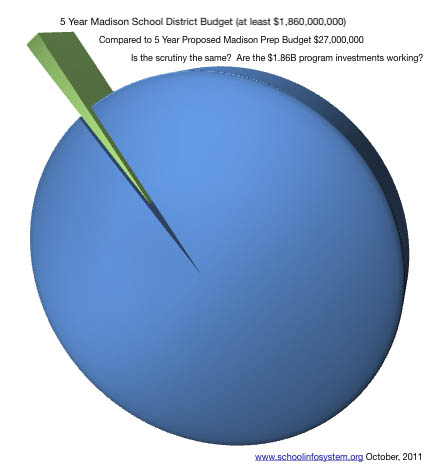
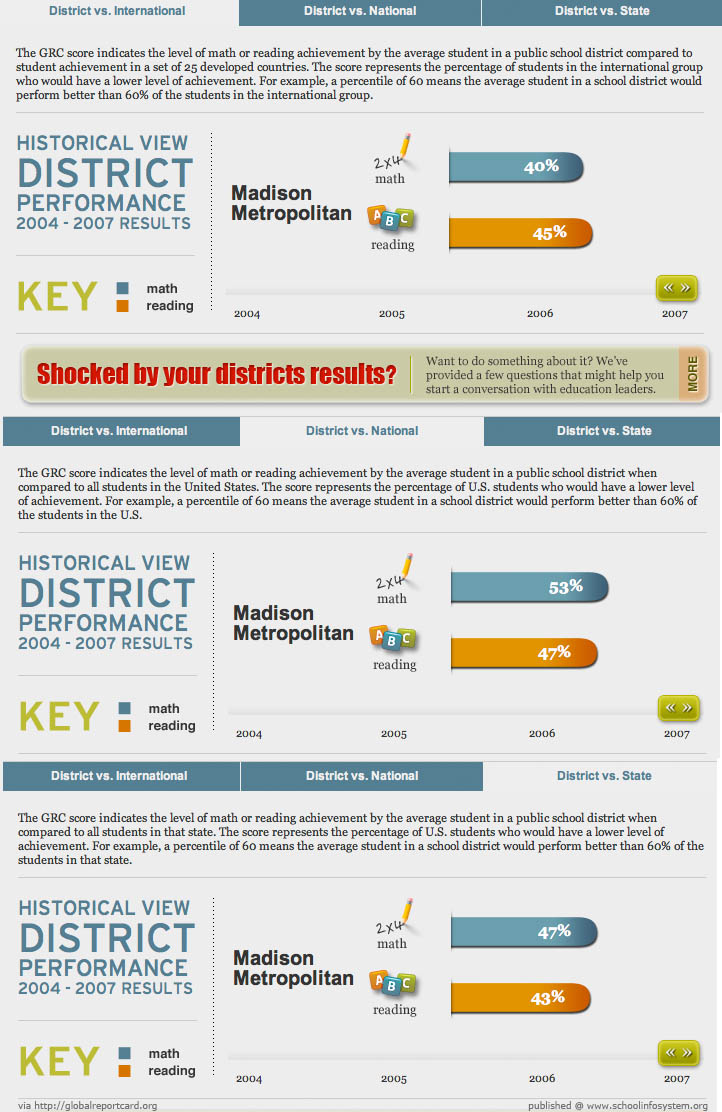
Much more on “value added assessment”, here.

Share

Madison School District High School REaL Grant Updates

Madison School District Superintendent Dan Nerad:

Year four of the five-year REaL Grant has several key areas of focus to support our three grant goals:
Increase student achievement for all students
Strengthen student-student and student-staff relationships
Increase post-secondary outcomes for all students
Following the completion of the K-12 Literacy Evaluation during the 2010-2011 school year there is a renewed commitment and expectations to develop core practices in literacy across the content areas. Professional development around literacy has been scheduled for the 2011-2012 school year and includes: instructional resource teachers, reading interventionists, learning coordinators, literacy coaches. Data from WKCE and EXPLORE indicate the need to improve core practices in literacy.
The division of Curriculum and Assessment has structured the entire 2011-2012 school year with high school department chairperson meetings across the district. The central purpose of this important dialogue is to build consensus around a curriculum scope and sequence that is aligned to both the ACT Career and College Readiness Standards and the Common Core State Standards. Much progress has been made with the adoption of common course names and numbers throughout our high schools.
AVID/TOPS has increased in capacity throughout the high schools and preliminary data indicates continued significant differences in the success of our AVID/TOPS students and their comparison group counterparts. Several teachers and departments outside of our AVID/TOPS classrooms have adopted the AVID/TOPS strategies and we look forward to supporting this demand helping our schools develop consistent systems of support and shared high expectations for all students.
Several professional development opportunities over the summer were supported by the REaL grant. Examples include: Critical Friends, Adaptive Schools, AVID Institute, and Align by Design. Additionally, school leadership teams under the direction of principals, REaL grant coordinators and literacy coaches met to create the Welcome Back Conference sessions for their respective schools.
Principals and teacher leaders continue to increase their capacities as instructional leaders. This year we also have in place a coordinated plan to help assistant principals progress their roles as instructional leaders. This has been an area clearly lacking in the first three years of the grant. Principals and all assistant principals will receive the same professional development each month.
The four high schools received a significant grant from the DPI to support safe schools. These added resources and action plans will compliment the REaL grant goals of improved relationships. High schools continue to address critical student behavior issues with a greater systematic approach. Two areas identified district wide based on the success in one school are: Youth Court and Restorative Justice classes.

Share

An Open Letter to a College Freshman

Timothy Dairymple:

At last your time has come. Leaving behind the old world and the deep ruts you carved in the corner of that world that belonged to you, you’re off to explore undiscovered countries, to join a new and ever-replenishing society of fascinating people and learned scholars and impassioned artists and driven achievers, off to a place where the world is new and so are you. Whether or not your college years will be “the best years of your life,” they will almost certainly be among the most transformative.
The question is whether that transformation will be for the better. Unmoored from the people and places that once defined you, you’ll feel a fluidity in your identity that’s both thrilling and frightening. You may feel as though you can be anyone and become anything. I pray that you will become who you are — the individual you most truly and deeply are, the one God dreamt of when he made you — and not the person that you or your parents or your friends think you should be. In service to that end, I thought I would offer seven pieces of advice. Though it feels churlish to say so, I offer this advice on the basis of some personal experience — more than many and less than some, with four undergraduate years at Stanford, three at Princeton Seminary and seven at Harvard for my Ph.D. I did a fair amount of teaching, came to know many professors well, and spent time too at universities overseas. So, on the basis of those experiences, here are my thoughts:

Share

The Heisenberg Uncertainty Principle applied to schools

Anneliese Dickman:

Werner Heisenberg’s Uncertainty Principle states that one cannot simultaneously measure the location of a particle while also measuring the momentum of that particle. When you apply this principle to schools, it’s a little disheartening–if we attempt to measure where we are now, we are no longer certain how fast we’re improving. If the environment in which the measurement is taking place is also moving (think of the vast legal and budgetary changes at the state level), the uncertainty is all but overwhelming.
Thus, this year’s analysis of public school data in southeast Wisconsin heeds Heisenberg and emphasizes the use of the 2010-11 data as a baseline. Knowing that all Wisconsin school districts will be in a state of flux over the next few years due to changes in contractual bargaining legislation, the state budget, a slow economic recovery, a new standardized testing system, and new standards for curriculum, in the future we hope to measure their improvements over time as these various “new normals” kick in. For now, we emphasize where they’ve been and where they are currently.

Share

Lies, damn lies and the myth of “standardized” tests

Marda Kirkwood:

[Note from Laurie Rogers: Recently, results from the 2011 state standardized test scores came out, and the general impression given to the public — for example from the state education agency (OSPI) and from media in Seattle and in Spokane — was that improvements had been made. It’s all in the definitions: How do you define “improvement”? Did some of the numbers go up? Assuredly. Did that mean that real improvments in real academic knowledge had been made? It’s best to remain skeptical.
Most students in Spokane are as weak in math skill this year as they were last year. Given a proper math test that assesses for basic skills, many high schoolers still test into 4th or 5th-grade math. College remedial rates are still high. Parents are still frantic, and students are still stressed out about math. So … what do those higher scores actually mean? I’ve been trying to find out. It’s hard to say.

Share

City, Union Stories on Votes Conflict

Hunter Clauss:

In an attempt to counter Mayor Rahm Emanuel’s relentless campaign for a longer school day, the Chicago Teachers Union claimed Friday that 30 elementary schools have voted to reject the city’s offer to extend the school day in exchange for financial incentives.
Emanuel and the Chicago Public Schools have offered up to $150,000 in discretionary funds and a roughly 2 percent raise for teachers at city elementary schools that elect to waive a portion of the union contract and add 90 minutes to the day. CPS spokeswoman Becky Carroll told the Chicago News Cooperative that the union’s list is not accurate. She said the only schools that have voted are the four elementary schools that have accepted the district’s deal.
“Not a single school voted down waivers. Not true,” Carroll said in an email. “Only four have voted on waivers and they all supported them.”

Share

What teachers really want to tell parents

Ron Clark:

This summer, I met a principal who was recently named as the administrator of the year in her state. She was loved and adored by all, but she told me she was leaving the profession.
I screamed, “You can’t leave us,” and she quite bluntly replied, “Look, if I get an offer to lead a school system of orphans, I will be all over it, but I just can’t deal with parents anymore; they are killing us.”
Unfortunately, this sentiment seems to be becoming more and more prevalent. Today, new teachers remain in our profession an average of just 4.5 years, and many of them list “issues with parents” as one of their reasons for throwing in the towel. Word is spreading, and the more negativity teachers receive from parents, the harder it becomes to recruit the best and the brightest out of colleges.

Share

Needs of schools, not seniority, best way to manage staff

Eau Claire Leader Telegram:

A debate related to the repeal of collective bargaining rights for most public employees in Wisconsin is whether teachers’ job security should be tied to seniority.
The Cadott school board recently rewrote its employee handbook, which now says the needs of the district, not the seniority of its employees, will be the “prime consideration” to determine which employees should be laid off.
Other school districts are deciding how to proceed. In the past, representatives of the school board and teachers union would negotiate the handbook’s contents. Now, the board can unilaterally set the rules, which has teachers understandably unnerved. Job security, especially in this economy, is paramount.

Share

Madison Preparatory IB Charter School School Board Discussion Notes

Matthew DeFour:

Madison Preparatory Academy will receive the first half of a $225,000 state planning grant after the Madison School Board determined Thursday that the revised proposal for the charter school addresses legal concerns about gender equality.
Madison Schools Superintendent Dan Nerad announced the decision following a closed School Board meeting.
Questions still remain about the cost of the proposal by the Urban League of Greater Madison, which calls for a school for 60 male and 60 female sixth-graders geared toward low-income minorities that would open next year.
“I understand the heartfelt needs for this program,” Nerad said, but “there are other needs we need to address.”

Madison School Board Member Ed Hughes

The school district does not have a lot of spare money lying around that it can devote to Madison Prep. Speaking for myself, I am not willing to cut educational opportunities for other students in order to fund Madison Prep. If it turns out that entering into a five-year contract with Madison Prep would impose a net cost of millions of dollars on the school district, then, for me, we’d have to be willing to raise property taxes by that same millions of dollars in order to cover the cost.
It is not at all clear that we’d be able to do this even if we wanted to. Like all school districts in the state, MMSD labors under the restrictions of the state-imposed revenue caps. The law places a limit on how much school districts can spend. The legislature determines how that limit changes from year to year. In the best of times, the increase in revenues that Wisconsin school districts have been allowed have tended to be less than their annual increases in costs. This has led to the budget-slashing exercises that the school districts endure annually.
In this environment, it is extremely difficult to see how we could justify taking on the kind of multi-million dollar obligation that entering into a five-year contract with Madison Prep would entail. Indeed, given the projected budget numbers and revenue limits, it seems inevitable that signing on to the Madison Prep proposal would obligate the school district to millions of dollars in cuts to the services we provide to our students who would not attend Madison Prep.
A sense of the magnitude of these cuts can be gleaned by taking one year as an example. Since Madison Prep would be adding classes for seven years, let’s look at year four, the 2015-16 school year, which falls smack dab in the middle.

TJ Mertz:

Last night I (TJ) was asked to leave the meeting on African American issues in the Madison Metropolitan School District (MMSD) advertised as being facilitated by the Department of Justice Community Relations Service (DOJ CRS) and hosted or convened by the Urban League of Greater Madison (ULGM) with the consent and participation of MMSD. I was told that if I did not leave, the meeting would be canceled. The reason given was that I write a blog (see here for some background on the exclusion of the media and bloggers and here for Matt DeFour’s report from outside the meeting).
I gave my word that I would not write about the meeting, but that did not alter the request. I argued that as a parent and as someone who has labored for years to address inequities in public education, I had both a legitimate interest in being there and the potential to contribute to the proceedings. This was acknowledged and I was still asked to leave and told again that the meeting would not proceed if I did not leave. I asked to speak to the DOJ CRS representatives in order to confirm that this was the case and this request was repeatedly refused by Kaleem Caire of the ULGM.

The Milwaukee Journal-Sentinel:

An idea hatched in Madison aims to give parents with boys in Wisconsin’s second-largest city another positive option for their children. It’s an idea that ought to be channeled to Milwaukee.
Madison Preparatory Academy for Young Men would feature the rigorous International Baccalaureate program, longer days, a longer school year and lofty expectations for dress and behavior for boys in sixth grade through high school. And while it would accept all comers, clearly it is designed to focus on low-income boys of color. Backers hope to open a year from now.
One of the primary movers behind Madison Prep is Kaleem Caire, the head of the Urban League of Madison, who grew up in the city and attended Madison West High School in 1980s, Alan J. Borsuk explained in a column last Sunday. Caire later worked in Washington, D.C., as an education advocate before returning to Madison.
Caire saw too many young black men wash out and end up either dead or in jail, reported Borsuk, a senior fellow in law and public policy at Marquette University Law School. And Caire now is worried, as are we, about the atrocious statistics that place young black boys so far behind their white peers.

Rebecca Kemble:

The Department of Justice official explained the shadowy, confidential nature of the Community Relations Service to the audience by describing the kinds of situations it intervenes in, mostly having to do with hate crimes and rioting. He said in no uncertain terms, “We are not here to do an investigation,” and even asked for the audience members to repeat the sentence with him. He then went on to ask for people to respect the confidentiality of those raising issues, and laid out the structure of the meeting: 30 minutes for listing problems relating to the achievement gap and 45 minutes generating solutions.
I will respect the confidentiality of the content of the meeting by not repeating it. However, I will say that what was said in that room was no different that what has been said at countless other open, public meetings with the School District and in community groups on the same topic, the only difference being that there were far fewer parents in the room and few if any teachers.
It turned out that the Department of Justice secretive meeting was a convenient way to pack the house with a captive audience for yet another infomercial about Madison Prep. Kaleem Caire adjourned the one meeting and immediately convened an Urban League meeting where he gave his Madison Prep sales pitch yet again. About 1/3 of the audience left at that point.

Share

Back-to-school virtually: Separating fact from fiction

Michelle Mueller:

very principal looks forward to the first day of school when students return with fresh minds eager to learn and ready to work. But as students prepare to hit the books in the next couple weeks, some of them won’t have to take the bus to school, wander the halls looking for their classroom or search rows of desks to find their seat.
Virtual schooling with Wisconsin Connections Academy (WCA) allows students to receive a top-notch public education online from the comfort of their homes. Virtual education is an increasingly popular alternative to the traditional brick and mortar classroom, but many parents still don’t fully understand online learning and how it works.
Virtual public schooling is not homeschooling. In fact, the two are quite different. Virtual public schools deliver public education to a student’s home at no cost that combines state-certified teachers and a rigorous curriculum that correlates to state standards. At WCA, students learn at home under the guidance of a Wisconsin certified teacher. A Learning Coach, typically a parent, assists the student in day-to-day activities. Our teachers work directly with both the student and Learning Coach to develop an individual learning plan, provide instruction and evaluate assignments.

Share

Web of Science

Thompson Reuters:

Web of Science ® provides researchers, administrators, faculty, and students with quick, powerful access to the world’s leading citation databases. Authoritative, multidisciplinary content covers over 10,000 of the highest impact journals worldwide, including Open Access journals and over 110,000 conference proceedings. You’ll find current and retrospective coverage in the sciences, social sciences, arts, and humanities, with coverage available to 1900.
Overcome information overload and focus on essential data across 256 disciplines.

Share

People are biased against creative ideas, studies find

Mary Catt:

The next time your great idea at work elicits silence or eye rolls, you might just pity those co-workers. Fresh research indicates they don’t even know what a creative idea looks like and that creativity, hailed as a positive change agent, actually makes people squirm.
“How is it that people say they want creativity but in reality often reject it?” said Jack Goncalo, ILR School assistant professor of organizational behavior and co-author of research to be published in an upcoming issue of the journal Psychological Science. The paper reports on two 2010 experiments at the University of Pennsylvania involving more than 200 people.

Share

Will Madison School Board pull the plug on Madison Prep’s planning grant?

Susan Troller:

The threat of possible litigation has roiled the already turbulent waters surrounding the proposal for a single-sex Urban League charter school.
Madison school officials began feeling skittish over recommending a $225,000 planning grant for the Madison Preparatory Academy for Young Men after the state Department of Public Instruction raised concerns recently that the school doesn’t meet state and federal requirements to provide gender-equal education.
Now, a new legal threat has emerged, this one from Madison Teachers Inc. Together, the two issues could cause the board to pull back from supporting the planning grant, possibly as early as Thursday.
First, some background: After DPI put the planning grant on hold, the Urban League of Greater Madison last week submitted a new proposal to simultaneously establish a separate campus for girls. Kaleem Caire, Urban League president and a driving force behind Madison Prep, wants to see the schools open next year, initially with 60 sixth-grade girls and 60 sixth-grade boys. The proposal calls for adding 120 additional sixth-graders in each of the four subsequent years. Because the proposal now envisions 600 students rather 480 as originally planned, it would require more funding from the Madison Metropolitan School District than originally planned.

Much more on the proposed Madison Preparatory Academy IB Charter school, here.

Share

Back to (the wrong) school

Seth Godin:

A hundred and fifty years ago, adults were incensed about child labor. Low-wage kids were taking jobs away from hard-working adults.
Sure, there was some moral outrage at seven-year olds losing fingers and being abused at work, but the economic rationale was paramount. Factory owners insisted that losing child workers would be catastrophic to their industries and fought hard to keep the kids at work–they said they couldn’t afford to hire adults. It wasn’t until 1918 that nationwide compulsory education was in place.
Part of the rationale to sell this major transformation to industrialists was that educated kids would actually become more compliant and productive workers. Our current system of teaching kids to sit in straight rows and obey instructions isn’t a coincidence–it was an investment in our economic future. The plan: trade short-term child labor wages for longer-term productivity by giving kids a head start in doing what they’re told.
Large-scale education was never about teaching kids or creating scholars. It was invented to churn out adults who worked well within the system.

Share

Degrees of separation over top US university’s online courses

Lisa Krieger:

Going online to get a college degree has been championed as a cost-effective way to educate the masses and challenged as a cheapening of academia. Now, the online classroom is coming to the vaunted University of California system, making it the nation’s first top-tier university to offer undergraduate credit for cyberstudies.
By dislodging education from its brick-and-mortar moorings, the University of California – short on money and space – hopes to ease the path to a diploma for students who are increasingly forced to wait for a vacant seat in a lecture hall. Especially in high-demand “gateway courses,” such as chemistry, calculus and composition.
This summer, UC Berkeley tested its first pilot course: Chemistry 1A. For one student, working as a lifeguard in San Rafael, it accelerated her progress toward a joint degree in biology and economics. Another was able to live at home in Sacramento, because she registered for summer school too late to get dorm space.

Share

Emanuel urges parents to demand longer school day

Rosalind Rossi:

Mayor Rahm Emanuel focused on parents Tuesday in his quest for a longer school day, saying they should demand the extra hours teachers already approved outside the Chicago Teachers Union contract at STEM Magnet Academy and two other schools.
“Three schools took this step forward. We hope other schools will do the same,” Emanuel said as he kicked off a new school year at STEM, a new magnet school in an old Chicago Public School building.
“Most important, the parents want this,” said Emanuel, whose campaign promises included a longer school day. “Parents need to ask their schools, ‘How can we get the same thing?'”
Meanwhile, CPS officials Tuesday invited all elementary schools to join the “Longer School Day Pioneers Program,” which adds 90 minutes of daily instructional time this school year in exchange for pro-rated teacher raises of 2 percent. Plus, schools that join in September will net an extra $150,000; those that start in January will get $75,000, a CPS news release explained.

Share

