School Information System

High school football stars on display

Diane Pucin:

On Sunday, ESPN will televise the Under Armour High School All-America High School football game from the Florida Citrus Bowl in Orlando at 5 p.m. PT.
USC and UCLA fans will be able to see several players who have committed to their teams.
For the Trojans, playing on the White team: Santa Ana Mater Dei quarterback Matt Barkley; Calhoun (S.C.) County wide receiver Alshon Jeffrey; and Agoura High offensive lineman Kevin Graf.
For the Bruins, also playing on the White team: Rancho Cucamonga Los Osos quarterback Richard Brehaut; Carson High receiver Morrell Presley; and Kapolei, Hawaii, offensive lineman Stan Hasiak.

Share

Unspoken Link Between Credit Cards and Colleges

Jonathan Glater:

When Ryan T. Muneio was tailgating with his parents at a Michigan State football game this fall, he noticed a big tent emblazoned with a Bank of America logo. Inside, bank representatives were offering free T-shirts and other merchandise to those who applied for credit cards and other banking products.
“They did a good job,” Mr. Muneio, 21 and a junior at Michigan State, said of the tactic. “It was good advertising.”
Bank of America’s relationship with the university extends well beyond marketing at sports events. The bank has an $8.4 million, seven-year contract with Michigan State giving it access to students’ names and addresses and use of the university’s logo. The more students who take the banks’ credit cards, the more money the university gets. Under certain circumstances, Michigan State even stands to receive more money if students carry a balance on these cards.
Hundreds of colleges have contracts with lenders. But at a time of rising concern about student debt — and overall consumer debt — the arrangements have sounded alarm bells, and some student groups are starting to push back.
The relationships are reminiscent of those uncovered two years ago between student loan companies and universities. In those, some lenders offered universities an incentive to steer potential borrowers their way.

Share

Claiborne Pell 1918-2008, champion of accessible higher education

Lauren Starkey:

Over six million low-income college students this year received Pell Grants, and its likely that most of them aren’t familiar with their originator, Claiborne Pell. This morning, the Rhode Island senator (who retired in 1997 after his sixth term) passed away at his home in Newport. He was 90, and died after a long battle with Parkinson’s disease. His work will live on, however, in the lives and deeds of the students who attend college due in large part to his insistence that access to higher education be available to as many students as possible.
In 1972, Pell drafted legislation that created the Basic Educational Opportunity Grants, which were renamed Pell Grants in 1980. At the time of his retirement in 1994, the Grants provided aid to over 54 million low- and middle-income students (90% of recipients have family incomes of $40,000 or less). In 2008, the US Department of Education reports that the program awarded almost 5.6 million grants totaling $16.4 billion.
The New York Times in September called Pell Grants “the most important form of aid to needy students, and for millions, whether recent high school graduates or those who have been working for years, higher education would be impossible without such aid.” The grants have been threatened with funding cuts throughout their 36-year existence. Pell told Times in 1996 that although the Grant program “exceeded [his] wildest hopes,” he believed it should have become an entitlement, protected from Senate budget conflicts.

Share

Is the Minnesota Depart of Education Too political to think big on education policy?

Emily Johns:

With the start of Minnesota’s legislative session nearing, several education groups have been pushing the Legislature to establish an independent commission to research state education policy and look at efficient, innovative ways to educate Minnesota students.
Groups such as Parents United for Public Schools and the Association of Metropolitan School Districts say it will help the state’s education system if legislators are armed with good, independent peer-reviewed research. And they say it will help the state’s taxpayers when education policies that are ineffective or inefficient are proven to be so, and are ended.
“We as legislators are constantly asked to make some very hard decisions that impact many, many lives, and we don’t always have good research at our disposal,” said Sen. Sandy Rummel, DFL-White Bear Lake, who is working on drafting the legislation.
An independent research group would likely be funded by start-up money from the state — maybe $200,000, according to Scott Croonquist, executive director of the Association of Metropolitan School Districts. Then, it would seek independent foundation and grant money, and try to get some help from higher education research institutions, he said.

Share

Social Networking Meets College Reviews

Unigo:

Unigo is a new platform for college students to share reviews, photos, videos, documents, and more with students on their campus and across the country.
It’s also the best place for high school students to find out what life is really like at North America’s colleges, and to make friends who can help them find the school that’s right for them.
Unigo is the result of a community of students across the country dedicated to getting the truth out about college life, and it’s growing bigger every day.

Share

The Worst Jobs in History

Channel4:

The history we are taught usually features the lives and times of the great and the good, of the haves but not the have-nots. However, the monarchs, aristocrats and magnates could not have existed without the battalions of minions who performed the tasks that were beneath their masters and mistresses.
In this website, we take you on a journey through 2,000 years of British history and the worst jobs of each era, as seen in both Channel 4 Worst Jobs series. Tony Robinson has devised a quiz to see how suited you would be to certain jobs, and we have an extract from his book on the worst children’s jobs. The skills agency learndirect has provided information on offbeat careers, and we show you how to take your interest further.

Share

2008 NCAA Division 1 Sports Graduation Success Rates

NCAA:

The NCAA Graduation Success Rate (GSR) and the Academic Success Rate (ASR) were developed in response to college and university presidents who wanted graduation data that more accurately reflect the mobility among college students today. Both rates improve on the federally mandated graduation rate by including students who were omitted from the federal calculation.
The GSR measures graduation rates at Division I institutions and includes students transferring into the institutions. The GSR also allows institutions to subtract student-athletes who leave their institutions prior to graduation as long as they would have been academically eligible to compete had they remained.
The ASR measures graduation rates at Division II institutions and is very similar to the GSR. The difference is that the ASR also includes those freshmen who were recruited to the institution but did not receive athletics financial aid.

Share

New High-School Elective: Put Off College

Toddi Gutner:

Like many motivated, focused high-school students, Lillian Kivel had worked hard academically and in community service in hopes that her efforts would win her acceptance into a good college. It did. Trouble was, Ms. Kivel’s focus was much less clear when she had to decide which college to attend — the Boston-area senior had applied to 38 schools because her interests were so varied.
At the suggestion of friends, Ms. Kivel decided to take a gap year — a year outside of academia between high-school graduation and college matriculation. It wasn’t rest and relaxation that Ms. Kivel sought, but rather an opportunity to gain life experience and focus her goals. Gappers, as they’re called, typically feel that taking a year off will give them a head start in college — and life. “I [have] the opportunity to explore my interests, like medicine and China, outside the classroom,” she says.
Ms. Kivel eventually decided to attend Harvard College, but deferred entrance until fall 2009. Ms. Kivel lived at home this fall and interned at the Boston branch of Partners of Health, a global health outreach nonprofit. She’s also serving as a legislative aide in the Massachusetts Statehouse. And she’s auditing at anthropology class at Harvard.

Share

Offer vouchers for special education: It would save money and improve quality

Marcus Winters:

About 13% of public school students in New York State are enrolled in special education. Educating each of them costs taxpayers many thousands of dollars more than it does to educate a regular student. With the financial crisis compelling Gov. Paterson, Mayor Bloomberg and other officials around the state to make cuts that have the least impact on services to which we have become accustomed, now is the time for them to give a special-education voucher program a second look. Aside from offering better educational outcomes, such a program would significantly reduce expenditures.
Contrary to popular belief, tuition charged by private schools, where vouchers can be used, is actually lower than public school per-pupil expenditures. Take Florida, which is home to the nation’s first voucher program for disabled students. Under the program, all disabled students are eligible for a voucher that is worth the lesser of the amount the public school would have spent on them or the tuition at a chosen private school. The value of the average voucher for disabled students there is $7,295. Not only is this far less than what the state spends to educate a disabled student in a public school, it is even below the state’s much lower average per-pupil cost of educating all students, both disabled and regular enrollment.
In other words, the public system actually saves money when it pays for students to attend private school, and even more money when those students are disabled.

Share

10 Lessons of an MIT Education

Gian-Carlo Rota:

Lesson One: You can and will work at a desk for seven hours straight, routinely. For several years, I have been teaching 18.30, differential equation, the largest mathematics course at MIT, with more than 300 students. The lectures have been good training in dealing with mass behavior. Every sentence must be perfectly enunciated, preferably twice. Examples on the board must be relevant, if not downright fascinating. Every 15 minutes or so, the lecturer is expected to come up with an interesting aside, joke, historical anecdote, or unusual application of the concept at hand. When a lecturer fails to conform to these inexorable requirements, the students will signify their displeasure by picking by their books and leaving the classroom.
Despite the lecturer’s best efforts, however, it becomes more difficult to hold the attention of the students as the term wears on, and they start falling asleep in class under those circumstances should be a source of satisfaction for a teacher, since it confirms that they have been doing their jobs. There students have been up half the night-maybe all night-finishing problem sets and preparing for their midterm exams.
Four courses in science and engineering each term is a heavy workload for anyone; very few students fail to learn, first and foremost, the discipline of intensive and constant work.
Lesson Two: You learn what you don’t know you are learning. The second lesson is demonstrated, among other places, in 18.313, a course I teach in advanced probability theory. It is a difficult course, one that compresses the material typically taught in a year into one term, and it includes weekly problem sets that are hard, even by the standards of professional mathematicians. (How hard is that? Well, every few years a student taking the course discovers a new solution to a probability problem that merits publication as a research paper in a refereed journal.)
Students join forces on the problem sets, and some students benefit more than others from these weekly collective efforts. The most brilliant students will invariably work out all the problems and let other students copy, and I pretend to be annoyed when I learn that this has happened. But I know that by making the effort to understand the solution of a truly difficult problem discovered by one of their peers, students learn more than they would by working out some less demanding exercise.

Share

The Parent-Teacher Talk Gains a New Participant

Karen Ann Cullotta:

For years attendance was minimal at Tefft Middle School’s annual parent-teacher conferences, but the principal did not chalk up the poor response to apathetic or dysfunctional families. Instead, she blamed what she saw as the outmoded, irrelevant way the conferences were conducted.
Roughly 60 percent of the 850 students at Tefft, in this working-class suburb some 30 miles northwest of Chicago, are from low-income families. Many are immigrants, unfamiliar or uncomfortable with the tradition of parents perched in pint-size chairs, listening intently as a teacher delivers a 15-minute soliloquy on their child’s academic progress, or lack thereof.
“Five years ago, the most important person — the student — was left out of the parent-teacher conference,” Tefft’s principal, Lavonne Smiley, said. “The old conferences were such a negative thing, so we turned it around by removing all the barriers and obstacles,” including allowing students not only to attend but also to lead the gatherings instead of anxiously awaiting their parents’ return home with the teacher’s verdict on their classroom performance.

Share

Obama’s $10,000,000,000 Early Childhood Education Pledge

Sara Mead:

Advocates for early childhood education are understandably excited about their prospects under President-elect Barack Obama’s administration. During the campaign, Mr. Obama pledged to increase federal early education spending by $10 billion annually.
Currently, the two largest federal early childhood programs, Head Start and the Child Care and Development Block Grant, spend about $12 billion annually combined. A $10 billion increase would almost double that investment.
Just as remarkably, Mr. Obama deliberately singled out early education as an important investment he would prioritize even in tight economic times. Add in a potentially $1 trillion economic stimulus package that’s raising the prospects for even previously inconceivable public investments, and advocates are downright giddy.
It seems terribly Grinch-like to throw cold water on these hopes. But in fact this is a dangerous moment for both Mr. Obama and the early education movement.

Share

Is Recess Necessary?

Jay Matthews:

I often spout opinions on matters about which I know nothing, so I understand when my favorite peer group — the American people — does the same. The latest example is a survey of 1,000 U.S. adults [931K PDF] by the Robert Wood Johnson Foundation, which specializes in public health projects, and Sports4Kids, a national nonprofit organization that supports safe and healthy playtime in low-income elementary schools.
According to the survey’s press release, “seven out of 10 Americans disagree with schools’ policies of eliminating or reducing recess time for budgetary, safety or academic reasons.” I realize most people don’t know how poisonous recess can be for urban schools with severe academic needs, but I was surprised to see the news release fail to acknowledge this. It even suggests, without qualification, that “in low-income communities” recess time “offers one of our best chances to help children develop into healthy, active adults who know how to work together and resolve conflicts.”
Few Americans have an opportunity to experience what teaching in urban schools is like. The people I know who have done so have developed a well-reasoned antipathy for the typical half-hour, go-out-and-play-but-don’t-kill-anybody recess. In my forthcoming book, “Work Hard. Be Nice,” about the Knowledge Is Power Program, I describe the classroom and playground chaos KIPP co-founders Mike Feinberg and Dave Levin encountered before starting their first KIPP fifth grade in a Houston public elementary school, the beginning of their successful program:

Share

In College, But Only Marginally

Globe Editorial
The Boston Globe
In college, but only marginally
December 23, 2008
MUCH SOUL-SEARCHING is taking place on local college campuses after a recent study showing that college was a bust for almost two-thirds of Boston high school graduates in the class of 2000. Students attending two-year community colleges–the least-expensive option–fared the worst in the survey by the Center for Labor Market Studies at Northeastern University, with an abysmal 12 percent graduation rate.
Specific results for all public and private colleges in the study should be available shortly after Christmas. But some figures are trickling in. Roxbury Community College fell flat. Of the 101 students from the high school class of 2000 who enrolled in RCC shortly after high school, only 6 percent would go on to earn a diploma there–or anywhere else–by June 2007. Quincy College, a low-profile, two-year college on the South Shore, did comparatively well (but not good enough) by its 62 Boston students, posting a 19 percent graduation rate. Bunker Hill Community College, which drew 155 enrollees from Boston’s class of 2000, yielded a 14 percent graduation rate.
The study, which was funded by the Boston Foundation, strips away some of the hype about college attendance rates in Boston. Seven out of 10 public school graduates may get into college, but many lack the preparation to succeed. At Bunker Hill, for example, more than 80 percent of the Boston students from the class of 2000 required a remedial math course. Wisely, Bunker Hill and Boston school officials are now introducing students at some city high schools to the placement exams they will face on campus in the coming year.
The study should put an end to common claims by community college officials that their graduation rates don’t reveal much because many of their students transfer to four-year colleges before earning associate degrees. In this study, a student merely needed to earn a diploma or certificate from any institution of higher education, not just the original college. And by providing at least a six-year window, the study made allowances for students who often juggle college with work or family obligations. Rationalizations are now off the table.

(more…)

Share

How Not to Get Into College: Submit a Robotic Application

Sue Shellenbarger:

Swamped by a rise in early applications from the biggest class of high-school seniors ever, college admissions officials have some advice for the class of 2009: Be yourself.
Although this year’s applicant pool is by many measures the most highly qualified yet, admissions deans at a dozen top-tier colleges and universities said in interviews last week that they’re also seeing a disappointing trend: Too many students are submitting “professionalized” applications rendered all too slick by misguided attempts at perfection, parental meddling and what one admissions dean describes as the robotlike approach teens are taking in presenting themselves.
Among the symptoms: Too many formulaic, passionless personal essays. Too many voluminous résumés devoid of true commitment. And too many pointless emails and calls from overanxious students and parents — a trend one dean labels “admissions stalking.”
“We keep looking for authenticity and genuineness, for kids who are their true selves,” says Jennifer Delahunty, dean of admissions at Ohio’s Kenyon College. Instead, anxious students, and the adults who help them overpolish their applications, “leach all the personality out” of them, she says.

Share

Local, Fresh Lunches Would be a Tasty Change

Margaret Krome:

My friend gave a guest presentation at a local high school last week and was invited to stay for lunch. “Horrible,” was her description of the meal. “I appreciated the generous invitation, and I’m sure the lunch ladies worked hard, but it was awful. Pizza, totally tasteless chicken sandwiches and fried food — that’s what we offer our children at school.”
Any parent who has peered into their school cafeteria’s garbage can to see what children throw out knows my friend is right. But it’s not for lack of caring on the part of school nutritionists. The amount of funding they receive for school meals is ridiculously low and not been updated for years. Fruits and vegetables are reimbursed at 10 cents a day, and the state school meal reimbursement rates haven’t changed since 1981.
But panels of legislators, medical experts, school dieticians, educators, agency staff and others have been working this year to change the situation. They are motivated largely by the high and increasing rates of overweight and obese adults in Wisconsin.
Obesity’s significance for health is clear. Being obese or overweight increases one’s risk of chronic diseases like hypertension, Type 2 diabetes, coronary heart disease and osteoarthritis. Our state’s annual obesity-related medical costs were estimated in 2004 to be $1.5 billion.

Share

Scientists discover gene that explains why naughty children are popular

Kate Devlin:

Researchers found that people find those who are more likely to break the rules more likeable, even after meeting them for just a short time.
They found that the people who achieve popularity by defying authority all tend to carry a specific “rebel” gene.
The findings could explain how Just William inspired the devotion of his bunch of Outlaws in the famous novels and why children labelled “teachers’ pets” have traditionally attracted the attention of bullies.
“The idea is that your genes predispose you to certain behaviours and those behaviours elicit different kinds of social reactions from others,” said Alexandra Burt, assistant professor of psychology at Michigan State University.
“And so what’s happening is, your genes are to some extent driving your social experiences.
“So the gene predisposes (people) to rule-breaking behaviour and their rule-breaking behaviour made them more popular,” Burt said.

More here.

Share

An Article Full of “Good Cheer” – Merry Christmas! Bringing the Power of Education to Children around the World

Knowledge @ Wharton via a kind reader’s email:

After a trek in the Himalayas brought him face-to-face with extreme poverty and illiteracy, John Wood left his position as a director of business development at Microsoft to found Room to Read, an award-winning international education organization. Under his leadership, more than 1.7 million children in the developing world now have access to enhanced educational opportunities. Room to Read to date has opened 725 schools and 7,000 bilingual libraries, and funded more than 7,000 scholarships for girls. Wood talked with Knowledge@Wharton about the launch of Room to Read, the book he wrote called Leaving Microsoft to Change the World and his personal definition of success.
Knowledge@Wharton: Our guest today is John Wood, founder of Room to Read. John, thank you so much for joining us.
John Wood: Thank you.
Knowledge@Wharton: I read your book back in 2006. You began it with the epiphany you had during your trip to Nepal which inspired you to do what you’re doing now and led to the creation of Room to Read. Can you tell us a little bit about that story?
Wood: Certainly. The book is called Leaving Microsoft to Change the World. The nice thing is I got that title before Bill Gates could get that title for his book, because, of course, Bill has now left Microsoft and is going to do amazing things to change the world through the Gates Foundation. My own personal journey to devoting my life to education was undertaken because, in so many places where I’ve traveled, whether it be post-Apartheid South Africa or post-Khymer Rouge Cambodia or the mountains of Nepal, you just find so many kids who have so little opportunity to gain the gift of education. To me, it just seemed like a very cruel Catch-22, that you would meet people who say, “We are too poor to afford education, but until we have education, how will we ever not be poor.” Throughout places I traveled, be it India, Nepal, Cambodia or Vietnam, I kept meeting kids who wanted to go to school but they couldn’t afford it. I would have kids ask me for a pencil. I thought, “How could something so basic be missing?”

Share

Fast food + nearby schools = fat kids

Julie Steenhuysen:

Youth who study just a short walk from a fast-food outlet eat fewer fruit and vegetables, drink more soda and are more likely to be obese than students at other schools, according to research published Tuesday.
The study, which involved more than 500,000 adolescents at middle schools and high schools in California, lends new fuel to a growing backlash against the fast-food industry as studies suggest they contribute to the rising obesity epidemic in the United States.
“We’ve basically discovered that kids who are going to a school that is near a fast-food restaurant have a higher chance of being overweight and obese than kids who are at a school that is not near a fast-food restaurant,” said Brennan Davis of Azusa Pacific University in California, whose study appears in the American Journal of Public Health.
U.S. youth obesity rates have tripled since 1980, although they leveled off this decade. The government says 32 percent of U.S. children are overweight and 16 percent are obese.

Share

Benjamin Zander Talk


Well worth watching as Zander discusses giving students an A on their first assignment. Zander begins with a discussion of living in either the “Downward Spiral” or an alternative world of “Possibilities”. A 15 year old cello player makes an appearance. Clusty search on Benjamin Zander.

Share

College Students Using ADHD Drugs to Study for Exams

Channel3000:

It’s final exam week for thousands of UW students on campus.
For years, some students have quietly taken drugs like Ritalin and Adderall to help them focus and prepare for exams.
The drugs are widely prescribed by physicians to help school children focus longer and perform better in school.
College students told WISC-TV it’s no secret that students use the medicines and get them illegally
An opinion article in Nature Magazine on Sunday suggested there is a responsible way for the “healthy to use the drugs without an ADHD diagnosis” – but many medical doctors disagree.
UW student Jonathan Roffee has been studying all weekend.
“Ten to twelve hours a day, takes a toll after a while,” said Roffee.

Share

An Update on Madison’s Small Learning Community / High School “Redesign” Plans

The Madison School Board recently received a presentation (25mb mp3 file) from the Administration on its plans for High School “redesign” and the use of the $5,500,000 Small Learning Community grant funded by our federal tax dollars. Assistant Superintendent Pam Nash along with representatives from the four large high schools participated in the discussion. The Board asked some interesting questions. President Arlene Silveira asked how this initiative relates to the District’s “Strategic Planning Process”? Vice President Lucy Mathiak asked about opportunities for advanced students.
Related:

The interesting question in all of this is: does the money drive strategy or is it the other way around? In addition, what is the budget impact after 5 years? A friend mentioned several years ago, during the proposed East High School curriculum change controversy, that these initiatives fail to address the real issue: lack of elementary and middle school preparation.

Share

Dane County High School AP Course Offering Comparison

The College Board recently updated their AP Course Audit data. Dane County offerings are noted below, including changes from 2007-2008:

  • Abundant Life Christian School: 3 Courses in 2007/2008 and 3 in 2008/2009
  • Cambridge High School: 1 Course in 2007/2008 and 0 in 2008/2009
  • De Forest High School: 8 Courses in 2007/2008 and 8 in 2008/2009
  • Madison East High School: 12 Courses in 2007/2008 and 12 in 2008/2009
  • Madison Edgewood High School: 11 Courses in 2007/2008 and 10 in 2008/2009 (11 are on offer this year. There’s been a paperwork delay for the 11th course, AP Biology due to a new teacher)
  • Madison LaFollette High School: 12 Courses in 2007/2008 and 6 in 2008/2009
  • Madison Memorial High School: 18 Courses in 2007/2008 and 17 in 2008/2009
  • Madison West High School: 6 Courses in 2007/2008 and 0 in 2008/2009 (I’m told that West has 6, but the College Board has a paperwork problem)
  • Marshall High School: 5 Courses in 2007/2008 and 5 in 2008/2009
  • McFarland High School: 6 Courses in 2007/2008 and 6 in 2008/2009
  • Middleton-Cross Plains High School: 8 Courses in 2007/2008 and 8 in 2008/2009
  • Monona Grove High School: 9 Courses in 2007/2008 and 8 in 2008/2009
  • Mt. Horeb High School: 5 Courses in 2007/2008 and 5 in 2008/2009
  • Oregon High School: 9 Courses in 2007/2008 and 9 in 2008/2009
  • Sauk Prairie High School: 10 Courses in 2007/2008 and 10 in 2008/2009
  • Stoughton High School: 7 Courses in 2007/2008 and 10 in 2008/2009
  • Sun Prairie High School: 15 Courses in 2007/2008 and 17 in 2008/2009
  • Verona High School: 10 Courses in 2007/2008 and 11 in 2008/2009
  • Waunakee High School: 6 Courses in 2007/2008 and 6 in 2008/2009
  • Wisconsin Heights High School: 6 Courses in 2007/2008 and 6 in 2008/2009

Related: Dual Enrollment, Small Learning Communities and Part and Full Time Wisconsin Open Enrollment.

Share

My Daughters/My Self

Judith Warner:

There was something about last week’s column that left me dissatisfied. I wrote about the difficulty of helping my 8-year-old daughter Emilie process disturbing news, particularly when she tends to over-focus on life’s ugliness.
But what I really wanted to discuss – via the vehicle of our obsessive replaying of the death of the trampled Wal-Mart worker Jdimytai Damour – was emotional enmeshment.
I find myself these days, to a surprising degree, dealing with the problem of enmeshment. This surprises me because not so long ago I wrote a book that was largely a polemic against enmeshment: against the boundary collapsing that I think is the signature characteristic of motherhood (and parenthood) in our time.

Clusty search: Judith Warner.

Share

Madison West’s Natalia Thompson earns top Girl Scout honors

The Capital Times:

Awards continue for Natalia Thompson of Madison, who was named as one of the Girl Scouts of USA top 10 Girl Scout Gold Award recipients, which makes her one of the nation’s 2008 Young Women of Distinction for extraordinary leadership through the recipients’ remarkable community action projects.
Only 5 percent to 6 percent of girls involved in the Scouts receive the award, considered the organization’s highest achievement. Thompson and the other nine winners were honored at the 2008 Girl Scout National Council Session in Indianapolis.
Kathy Cloninger, who heads the Girl Scouts of USA, said Thompson and the other award winners are “outstanding examples of the kind of leadership Girl Scouts are capable of.”

Share

The New Examined Life

Jamin Brophy-Warren:

In the first week of January, New York graphic designer Nicholas Felton will boil down everything he did in 2008 into charts, graphs, maps and lists.
The 2007 edition of his yearly retrospective notes that he received 13 postcards, lost six games of pool and read 4,736 book pages. He tracked every New York street he walked and sorted the 632 beers he consumed by country of origin.
Part experimentation, part self-help, such “personal informatics” projects, as they are known, are gathering steam thanks to people like Mr. Felton who find meaning in the mundane. At their disposal are a host of virtual tools to help them become their own forensic accountants, including Web sites such as Dopplr, which allows people to manage and share travel itineraries, and Mon.thly.Info, for tracking menstrual cycles. Parents can document infant feeding schedules with Trixie Tracker. And couples can go from between the sheets to spreadsheets with Bedpost, which helps users keep track of their amorous activities.
The objective for Mr. Felton and others is to seize data back from the statisticians and the scientists and incorporate it into our daily lives. Everyone creates data — every smile, conversation and car ride is a potential datapoint. These quotidan aggregators believe that the compilation of our daily activities can reveal the secret patterns that govern the way we live. For students of personal informatics, the practice is liberating because it shows that our lives aren’t random, and are more orderly than some might expect.

Share

The “Certified” Teacher Myth

Wall Street Journal Editorial:

Like all unions, teachers unions have a vested interest in restricting the labor supply to reduce job competition. Traditional state certification rules help to limit the supply of “certified” teachers. But a new study suggests that such requirements also hinder student learning.
Harvard researchers Paul Peterson and Daniel Nadler compared states that have genuine alternative certification with those that have it in name only. And they found that between 2003 and 2007 students in states with a real alternative pathway to teaching gained more on the National Assessment of Educational Progress (a federal standardized test) than did students in other states.
“In states that had genuine alternative certification, test-score gains on the NAEP exceeded those in the other states by 4.8 points and 7.6 points in 4th- and 8th-grade math, respectively,” report the authors in the current issue of Education Next. “In reading, the additional gains in the states with genuine alternative certification were 10.6 points and 3.9 points for the two grade levels respectively.”
The study undermines the arguments from colleges of education and teachers unions, which say that traditional certification, which they control, is the only process that can produce quality teachers. The findings hold up even after controlling for race, ethnicity, free-lunch eligibility, class size and per-pupil state spending.

From the report:

Forty-seven states have adopted a pathway to teaching, alternative to the standard state certification otherwise required. Is this new pathway genuine or merely symbolic? Does it open the classroom door to teachers of minority background? Does it help–or hinder–learning in the classroom? Claims about all of these questions have arisen in public discourse. Recently, data have become available that allow us to check their validity.
To receive a standard state certification in most states, prospective teachers not only must be college graduates but also must have taken a specific set of education-related courses that comprise approximately 30 credit hours of coursework. Prospective teachers are well advised to pursue studies at a college or university within the state where they expect to teach, because it is often only within that state that students can get the courses required for state certification in the subject area and for the grade levels that they will be teaching.
Such certification requirements limit the supply of certified teachers, and as a result, serious teaching shortages are regularly observed. For example, in California, one-third of the entire teacher work force, about 100,000 teachers, will retire over the next decade and need to be replaced, compounding what the governor’s office calls a “severe” current teacher shortage. Other states are facing a similar situation. The National Council of Teachers of Mathematics projects a shortfall of 280,000 qualified math and science teachers by 2015. As former National Education Association president Reg Weaver put it, “At the start of every school year, we read in the newspaper…stories about schools scrambling to hire teachers.”

Share

Please, sir, what’s history?
A missed chance to make hard choices about what children should learn

The Economist:

IF YOU are in your 40s and British, it is quite possible that your spelling is an embarrassment. You may never have been taught the distinction between “there”, “their” and “they’re”, or perhaps even your times tables. If you moved house during your primary years you may have entirely missed some vital topic–joined-up writing, say. And you may have struggled to learn to read using the “initial teaching alphabet”, a concoction of 40 letters that was supposed to provide a stepping stone to literacy but tripped up many children when they had to switch to the standard 26.
Those days of swivel-eyed theorising and untrammelled experimentation–or, as the schools inspectorate put it at the time, “markedly individual decisions about what is to be taught”–ended in 1988 with the introduction of a national curriculum. But though that brought rigour and uniformity, it also created an unwieldy–and unworldly–blueprint for the Renaissance Child. Schools have struggled to fit it all in ever since. Now, 20 years later, the primary curriculum is to be cut down.

Share

Flirting goes high-tech with racy photos shared on cellphones, Web

Sharon Jayson:

Passing a flirtatious note to get someone’s attention is so yesterday. These days, young people use technology instead.
About a third of young adults 20-26 and 20% of teens say they’ve sent or posted naked or semi-naked photos or videos of themselves, mostly to be “fun or flirtatious,” a survey finds.
A third of teen boys and 40% of young men say they’ve seen nude or semi-nude images sent to someone else; about a quarter of teen girls and young adult women have. And 39% of teens and 59% of those ages 20-26 say they’ve sent suggestive text messages.
“One of the reasons we wanted to do the survey was to put some sort of structure around the anecdotes,” says Marisa Nightingale of the non-profit National Campaign to Prevent Teen and Unplanned Pregnancy, which commissioned the survey with the Hearst Digital Media site CosmoGirl.com. Chicago-based market research firm Teenage Research Unlimited surveyed 1,280 teens and young adults online Sept. 25 to Oct. 3.

Share

TIMSS-07 comment

In the comments on TIMSS-07 math scores, one important aspect
has not been mentioned.


Grade 8 US

Minn.

Korea

Singapore
Number 510 537 583 597
Algebra 501 515 596 579
Geometry 480 505 587 578
Data and Chance 531 560 580 574

Korea and Singapore have balanced scores, the US and Minnesota do not. The first three areas are the core areas of mathematics on which otherthings are built. We have to improve on them.
Dick Askey
John Hechinger has more:

U.S. fourth- and eighth-graders improved their math scores in a closely watched international test, but continued to lag well behind peers from top-performing Asian countries. U.S. students also failed to show measurable gains in science.
The U.S. and other governments on Tuesday released the results of the test, Trends in International Mathematics and Science Study, the world’s largest assessment of international achievement. Some 425,000 students in almost 60 countries took the exam, administered every four years, starting in 1995.

Share

Gangs in Dane County? Yes, they’re everywhere, detective says

Karyn Saemann:

Gangs are everywhere in Dane County, from the largest Madison high schools to the smallest rural hamlets.
In the latest of a series of informational meetings led by a Dane County detective who monitors local gang activity, Sun Prairie parents were told their help is needed.
Detective Joel Wagner estimated that 3 to 4 percent of Dane County youths are involved in a gang. Recruiting begins in the fourth grade, he said; gang members can be of any race and socioeconomic status, but are primarily kids who have fallen away from school and family and are looking for a group to belong to.
“The best thing is prevention,” Wagner said. “We need to get back to eyes and ears.”
“Know your children’s friends. Know them well,” he said. “Know your children’s friends’ parents. Know them better.”
Wednesday night’s meeting at Sun Prairie High School stretched more than two hours and included disturbing video of gang fights and other violence from Dane County and across the nation as well as online photos of gang members who identify themselves as being from Sun Prairie and other Dane County communities.
Particularly disturbing was video — not from Dane County — of a gang initiation in which a teen’s head was smashed into a cement curb and into a florescent light tube. In another video, a teen was beaten in a bathroom as part of an initiation.

Related:

Share

Where Children Find Hope

Pictorial from Kathleen Galligan in Detroit.

Share

Dynamo Brought IB and Rigor To All Students

Jay Matthews:

The first story Bernie Glaze ever told me was about Kevin and Duc, two basketball-crazed teens who felt her Theory of Knowledge class at Mount Vernon High School was not their thing. All that talk of Kant and Aristotle and other dead guys with no jump shot made their brains hurt, they told her.
But one day she heard them talking about an NBA playoff game. They were interpreting, predicting, differentiating and synthesizing. Ha! She had them. “Listen to yourselves,” she said. “Your brains know what to do. Just treat Plato as though he were Michael Jordan.”
Bernie died Nov. 20 of complications from lung cancer. She was 62. Some people might remember her as the talkative woman who unaccountably left the faculty of the celebrated Thomas Jefferson High School for Science and Technology, with its 7 percent annual bonus for all teachers, to help start an International Baccalaureate program at Mount Vernon High in Fairfax County, then considered one of the worst schools in Northern Virginia. I remember her as the dynamo who helped turn Fairfax, known for gifted education and science prodigies, into a national model for teachers, like her, who preferred to spend their days looking for the hidden potential in C students.

Share

Student Weeks

The High School Survey of Student Engagement (Indiana University, 2004) found that 55% of the 80,000 students surveyed said they did fewer than three hours of homework each week, and most received As and Bs anyway.
I just received a paper by a HS student from Oregon, and her information sheet
included a listing of the hours per week she spends on activities:
Equestrian Team: 5 hours a week [52 weeks a year]
Theater/Drama: 15 hours a week [13 weeks a year]
Teach Africa: 3 hours a week [40 weeks a year]
Volunteering at the Hunt Club: 1 hour a week [50 weeks a year]
Volunteering for NARAL: 10 hours a week [1 week a year]
Scholars’ Alliance: 3 hours a week [10 weeks a year]
Food Drive: 15 hours a week [2 weeks a year]
Total outside of homework and school: 52 hours a week for one or more weeks.
[To be fair, the “Scholars’ Alliance” is a Saturday seminar taught by the superintendent
of the district on critical thinking skills, metacognition, the Art of War, the Tao, etc.]
Even so, it might be instructive to note this level of commitment (52 hours/week), in addition to any computer games, television, and instant messaging and other social activities during perhaps an average HS student week–the Kaiser Foundation has found that the average American teen spends nearly 45 hours a week on electronic entertainment media–and compare it with the Indiana University finding of half the HS students spending less than three hours a week on homework.
Could this have something to do with current levels of academic achievement? Is the question of the number of hours American HS students spend on non-academic activities during their waking periods each week worthy of a research study? I think so. If this has been done, please refer me to the study.
Will Fitzhugh
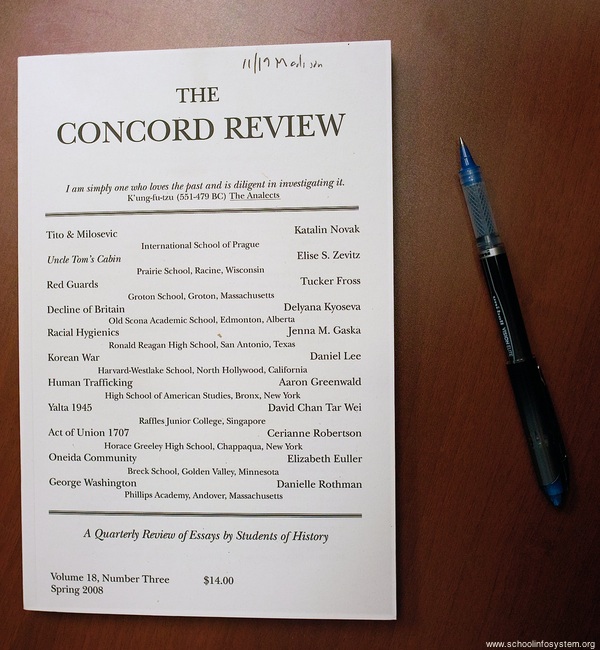
The Concord Review
www.tcr.org

Share

Montgomery County Schools Post All Time High on Advanced Placement Exams

Daniel de Vise:

Superintendent Jerry D. Weast cited competing magazine rankings as evidence Maryland’s largest system, with 139,000 students, now offers arguably the premier AP program in the nation.
Three county high schools appear on a list of the nation’s top 100 from U.S. News & World Report, published online last week and based in part on AP and International Baccalaureate test performance. Weast said only the million-student New York system had more “gold medal” schools.
Six Montgomery schools rank among the top 100 on Newsweek magazine’s 2008 Challenge Index, a measure of AP and IB test participation created by Washington Post education writer Jay Mathews. Weast said no other school system had as many schools at the top of that list.
Speaking at Bethesda-Chevy Chase High School, Weast said the county’s students “are doing things that are historic, are doing things that, no matter who’s measuring them, are coming out at the top of the chart in the United States.”
Montgomery students took 25,921 AP tests this year, representing a 53 percent increase over six years. Of those tests, 18,306 earned a score of 3 or higher on a 5-point scale, a threshold for college credit.

Share

Siemens Competition Winners Announced

Amanda Fairbanks:

Practical advances in medicine ruled the day in the Siemens Competition in Math, Science and Technology, one of the nation’s most coveted student science awards, whose winners were announced Monday morning at New York University.
While highly regarded, a Tamari lattice, a mathematical structure, and Bax and Bak, two proteins, lost out to a project by Wen Chyan, 17, a senior at the Texas Academy of Mathematics and Science in Denton, Tex. Mr. Wen won the top individual prize — a $100,000 scholarship — for research on fighting hospital-related infections with antimicrobial coatings for medical devices.
For genetics research that has the potential to identify new chemotherapeutic drugs and improve existing ones, Sajith M. Wickramasekara and Andrew Y. Guo, both 17 and seniors at the North Carolina School of Science and Mathematics in Durham, N.C., took home $50,000 each — the top team prize.
Trailing not far behind, four high school seniors in the New York region won a total of $100,000 in scholarships.

Share

A Retired Teacher on Governance, Administrators and Education Flavor of the Month Theories

James Behrend:

Extraordinary times command extraordinary measures and grant extraordinary opportunities. Our state’s budget crisis calls already for kids and schools to sacrifice. It does not have to be. This is Olympia’s chance to substantially improve our entrenched education system and save some money.
Here are three problems Olympia must tackle to make a real difference:
1. Washington taxpayers support 295 independent school districts. Each district is top-heavy with too many administrators: superintendents, assistant superintendents, executive directors, curriculum directors, special ed directors, human resources directors, finance directors, transportation directors, purchasing directors and other nonteaching executives.
2. The second problem is lack of stability. Administrators introduce too often “new” educational theories. With each new administrator come new ideas. What was the silver bullet in education one year ago is toxic with a new principal or new superintendent.
I experienced over a period of 12 years changes from a six periods day to a four periods “block system” (several years in the planning). After starting the block, my school planned for two years to establish five to six autonomous Small Schools, but only one was eventually organized. In the midst of those disruptive changes, Best Practices was contemplated but never enacted; special ed and ESL students were mainstreamed, and NovaNet, a computerized distant learning, was initiated with former Gov. Gary Locke present and praising our vision. Finally, all honors classes were abandoned and differentiated instruction was introduced.
Eventually, all these new methods were delegated to the trash heap of other failed educational experiments. By 2008, the school was where it had been in 1996, minus some very good teachers and more than a few dollars.
3. The third problem is the disconnect between endorsements and competency. A sociology major gets a social sciences endorsement from the Office of Superintendent of Public Instruction and may teach history, or math, or Spanish. A PE teacher may instruct students in English literature or history. A German or English teacher may teach U.S. history.

Share

Wide world of greed

by Yvonne Abraham
Globe Columnist / December 7, 2008
The Boston Globe
The Dorchester Eagles, the powerhouse of their Pop Warner football league, had another undefeated season this year.
Their regional championship earned them a spot in the national playoffs in Florida. Oh, and a week of acute anxiety over how to get there.
It’s as messed up as it is predictable. Every year around this time, talented kids and their coaches across the country scramble to raise tens of thousands of dollars so they can compete in the Pop Warner superbowl.
Little Leaguers go to their World Series in Williamsport, Pa., for free. Why do Pop Warner teams have to come up with as much as 45 grand to go to the playoffs they’ve spent an entire season working toward?
One big reason: unlike Little League, Pop Warner doesn’t have its own stadium or dorms. So, for more than a decade now, the Super Bowl has been held at Disney’s Wide World of Sports Complex in Orlando.
And under its contract with Pop Warner, Disney has the whole thing locked down. To compete in Disney’s pristine facilities, players must stay at Disney hotels and buy passes to its theme parks. They eat in Disney restaurants, with nonrefundable Disney dining cards, and they use Disney transportation.

(more…)

Share

America’s Best High Schools 2008

US News & World Report:

The Top 100

Video

Search by State

Wisconsin Results

Share

Balls & Brains: The quality of a man’s sperm depends on how intelligent he is, and vice versa

The Economist:

THERE are few better ways of upsetting a certain sort of politically correct person than to suggest that intelligence (or, rather, the variation in intelligence between individuals) is under genetic control. That, however, is one implication of a paper about to be published in Intelligence by Rosalind Arden of King’s College, London, and her colleagues. Another is that brainy people are intrinsically healthier than those less intellectually endowed. And the third, a consequence of the second, is that intelligence is sexy. The most surprising thing of all, though, is that these results have emerged from an unrelated study of the quality of men’s sperm.
Ms Arden is one of a group of researchers looking into the connections between intelligence, genetics and health. General intelligence (the extent to which specific, measurable aspects of intelligence, such as linguistic facility, mathematical aptitude and spatial awareness, are correlated in a given individual) is measured by psychologists using a value called Spearman’s g. Recently, it has been discovered that an individual’s g value is correlated with many aspects of his health, up to and including his lifespan. One possible explanation for this is that intelligent people make better choices about how to conduct their lives. They may, for example, be less likely to smoke, more likely to eat healthy foods or to exercise, and so on.
Alternatively (or in addition) it may be that intelligence is one manifestation of an underlying, genetically based healthiness. That is a view held by many evolutionary biologists, and was propounded in its modern form by Geoffrey Miller of the University of New Mexico, who is one of Ms Arden’s co-authors (and, as it happens, her husband). These biologists believe intelligence, as manifested in things like artistic and musical ability, is such a reliable indicator of underlying genetic fitness that it has been chosen by members of the opposite sex over the millennia. In the ensuing arms race to show off and get a mate it has been exaggerated in the way that a peacock’s tail is. This process of sexual selection, Dr Miller and his followers believe, is the reason people have become so brainy.

Share

Montgomery County Teachers & Administrators Forego 5% Pay Raise to Help Balance the Budget

Daniel de Vise & Ann Marimow:

Montgomery County teachers and other school employees have agreed to give up a 5 percent pay raise next year, a concession that saves the school system $89 million and allows Superintendent Jerry D. Weast to balance the budget.
The Montgomery County Board of Education, meeting in closed session last night, tentatively accepted the renegotiated labor deals, according to a school official.
Leaders of four employee associations, representing more than 22,000 workers, agreed Tuesday to forgo the raise all workers would have received in the fiscal year that begins in July. Weast said he and other top administrators in Maryland’s largest school system would also lose annual raises.
School officials said it was the first time since the early 1990s that Montgomery school employees had given up a contractual pay raise, a sign of the magnitude of the economic challenge. School board President Nancy Navarro (Northeastern County) credited unions with “tremendous sacrifice during these tough times.”
Budget constraints have prompted Gov. Martin O’Malley (D) to consider requiring unpaid furloughs for more than 67,000 state employees and contractors. And across the region, school officials are wondering whether they can fund cost-of-living raises in the 2009-10 academic year. Loudoun County teachers were forced to go without such raises this school year.

Share

The Making of a Rhodes Scholar – Duke University Graduate Earns Coveted Award

Open Education:

Parker Goyer has certainly tasted her share of success even if she is just 23-years-old.
Following her graduation from Duke, Goyer received a fellowship from the Robertson Scholars Program, a merit scholarship program that seeks to encourage social entrepreneurship and to increase collaboration between Duke University and UNC-Chapel Hill. Goyer was the only non-Robertson Scholar to be selected for the one year fellowship.
That same year, the 2007 graduate would go on to see her benchmark concept, the Coach for College Program, come to fruition. Securing nearly half-a-million dollars in funding, Goyer led a group of college student-athletes to Vietnam to deliver the first ever edition of the program to 200 middle school-aged children.
Yet, when it comes to recognition for a job well-done, the first-year student at the Harvard Graduate School of Education recently hit new heights even for her. On Saturday, November 22nd, the Coach for College founder learned she was one of 32 American students chosen to receive a prestigious Rhodes Scholarship.

Share

Changing the Tuition Discussion

Scott Jaschik:

If tuition policy is a vexed question in normal budget years for public universities, it will be especially challenging to discuss public policy on the subject this year. States are facing record deficits and many public colleges are seeing enrollment and application increases — a formula that could combine to create large, unpopular tuition increases.
In this environment, the leaders of a national association of public universities hope to shift the debate — calling for better information about what really is going on with college costs, and also urging colleges to consider some potentially radical ways to control their costs. “University Tuition, Consumer Choice and College Affordability,” being released today by the National Association of State Universities and Land-Grant Colleges, both defends public higher education and criticizes it. While suggesting that colleges are more affordable than many people realize today, the report sees a “looming affordability challenge” in which public institutions could move out of the reach of many Americans, a potential shift that the association sees as counter to the values of its institutions.
The beginning of the report — consistent with efforts by others in higher education — tries to shift public attention away from colleges’ sticker prices and broad generalizations about affordability, arguing that sticker prices rarely reflect what students actually pay and that affordability depends both on the charges of a college and the means of a student, and is thus unique for individual circumstances. The report then goes on to suggest that much is unknown about whether colleges can save money through various means — such as providing more instruction online — and suggests that now is the time for serious research on such questions. The report faults universities for not having the data that would allow for better decision making.

Share

“Rice Paddies and Math Tests”

Malcolm Gladwell, Outliers
New York: Little, Brown, 2008, pp. 247-249
“Rice Paddies and Math Tests”
Every four years, an international group of educators administers a comprehensive mathematics and science test to elementary and junior high students around the world. It’s the TIMSS…and the point of the TIMSS is to compare the educational achievement of one country with another’s.
When students sit down to take the TIMSS exam, they also have to fill out a questionnaire. It asks them all kinds of questions, such as what their parents’ level of education is, and what their views about math are, and what their friends are like. It’s not a trivial exercise. It’s about 120 questions long. In fact, it is so tedious and demanding that many students leave as many as ten or twenty questions blank.
Now, here’s the interesting part. As it turns out, the average number of items answered on that questionnaire varies from country to country. It is possible, in fact, to rank all the participating countries according to how many items their students answer on the questionnaire. Now, what do you think happens if you compare the questionnaire rankings with the math rankings on the TIMSS? They are exactly the same. In other words, countries whose students are willing to concentrate and sit still long enough to focus on answering every single question in an endless questionnaire are the same countries whose students do the best job of solving math problems.
The person who discovered this fact is an educational researcher at the University of Pennsylvania named Erling Boe, and he stumbled across it by accident. “It came out of the blue,” he says. Boe hasn’t even been able to publish his findings in a scientific journal, because, he says, it’s just a bit too weird. Remember, he’s not saying that the ability to finish the questionnaire and the ability to excel on the math test are related. He’s saying that they are the same: if you compare the two rankings, they are identical.
Think about this another way. Imagine that every year, there was a Math Olympics in some fabulous city in the world. And every country in the world sent its own team of one thousand eighth graders. Boe’s point is that we could predict precisely the order in which every country would finish in the Math Olympics without asking a single math question. All we would have to do is give them some task measuring how hard they were willing to work. In fact, we wouldn’t even have to give them a task. We should be able to predict which countries are best at math simply by looking at which national cultures place the highest emphasis on effort and hard work.
So, which places are at the top of both lists? The answer shouldn’t surprise you: Singapore, South Korea, China (Taiwan), Hong Kong, and Japan. [Mainland China doesn’t yet take part in the TIMSS study.] What those five have in common, of course, is that they are all cultures shaped by the tradition of wet-rice agriculture and meaningful work. They are the kind of places where, for hundreds of years, penniless peasants, slaving away in the rice paddies three thousand hours a year, said things to one another like “No one who can rise before dawn three hundred and sixty days a year fails to make his family rich.”

Share

Media Bombardment Is Linked To Ill Effects During Childhood

Donna St. George:

In a detailed look at nearly 30 years of research on how television, music, movies and other media affect the lives of children and adolescents, a new study released today found an array of negative health effects linked to greater use.
The report found strong connections between media exposure and problems of childhood obesity and tobacco use. Nearly as strong was the link to early sexual behavior.
Researchers from the National Institutes of Health and Yale University said they were surprised that so many studies pointed in the same direction. In all, 173 research efforts, going back to 1980, were analyzed, rated and brought together in what the researchers said was the first comprehensive view of the topic. About 80 percent of the studies showed a link between a negative health outcome and media hours or content.
“We need to factor that in as we consider our social policies and as parents think about how they raise their kids,” said lead researcher Ezekiel J. Emanuel, director of the Department of Bioethics at the National Institutes of Health, which took on the project with the nonprofit organization Common Sense Media. “We tend not to think of this as a health issue, and it is a health issue.”
The average modern child spends nearly 45 hours a week with television, movies, magazines, music, the Internet, cellphones and video games, the study reported. By comparison, children spend 17 hours a week with their parents on average and 30 hours a week in school, the study said.
“Our kids are sponges, and we really need to remember they learn from their environment,” said coauthor Cary P. Gross, professor at Yale School of Medicine. He said researchers found it notable how much content mattered; it was not only the sheer number of hours of screen time. Children “pick up character traits and behaviors” from those they watch or hear, he said.

Share

It’s 3 p.m. – do you know where your kids are?

As a child, 9:59 p.m. was a crucial time for me.
The local television news was about to begin. My dad was asleep in his easy chair in the living room. If he woke up, the first words he’d say would be “up to bed,” and then I’d never know what happened in the world outside my Iowa farm. To delay the inevitable I crept over to the TV set (we didn’t have remotes back then) and turned the volume down so the news program’s theme song wouldn’t disturb him.
Standing inches from the television, I heard this public service announcement every night: “It’s 10 p.m.: Do you know where your children are?”
I didn’t understand that. Where else would I be, but home? Even as a teenager I was in my room most nights giving my parents little reason to wonder or worry about my location. They had it too easy.
Many parents today aren’t so lucky.
More moms and dads are working outside the home and their jobs demand more hours than ever before. They’d love to be home when their kids finish school in the afternoon or during winter and summer breaks from school, but many can’t be there.
Continue reading here.

Share

The “Secret to Raising Smart Kids”

Carol Dweck:

Hint: Don’t tell your kids that they are. More than three decades of research shows that a focus on effort–not on intelligence or ability–is key to success in school and in life.
A brilliant student, Jonathan sailed through grade school. He completed his assignments easily and routinely earned As. Jonathan puzzled over why some of his classmates struggled, and his parents told him he had a special gift. In the seventh grade, however, Jonathan suddenly lost interest in school, refusing to do homework or study for tests. As a consequence, his grades plummeted. His parents tried to boost their son’s confidence by assuring him that he was very smart. But their attempts failed to motivate Jonathan (who is a composite drawn from several children). Schoolwork, their son maintained, was boring and pointless.
Our society worships talent, and many people assume that possessing superior intelligence or ability–along with confidence in that ability–is a recipe for success. In fact, however, more than 30 years of scientific investigation suggests that an overemphasis on intellect or talent leaves people vulnerable to failure, fearful of challenges and unwilling to remedy their shortcomings.
The result plays out in children like Jonathan, who coast through the early grades under the dangerous notion that no-effort academic achievement defines them as smart or gifted. Such children hold an implicit belief that intelligence is innate and fixed, making striving to learn seem far less important than being (or looking) smart. This belief also makes them see challenges, mistakes and even the need to exert effort as threats to their ego rather than as opportunities to improve. And it causes them to lose confidence and motivation when the work is no longer easy for them.
Praising children’s innate abilities, as Jonathan’s parents did, reinforces this mind-set, which can also prevent young athletes or people in the workforce and even marriages from living up to their potential. On the other hand, our studies show that teaching people to have a “growth mind-set,” which encourages a focus on effort rather than on intelligence or talent, helps make them into high achievers in school and in life.

Share

Murdoch: “Schools a Moral Scandal”

Glynne Sutcliffe Adelaide:

Rupert Murdoch has used his fourth Boyer Lecture to slam Australian schooling. No punches pulled here. “Our public education systems are a disgrace” was almost his opening sentence. And the reason is clear : “despite spending more and more money, our children seem to be learning less and less.”
A residual affection for the land of his birth is probably the main driving force of his critique. His country is going down the gurgler. It is a realistic assessment of the situation we are in. India and China especially are poised to wipe us out. Finland irks. Singapore and Korea also graduate students who both know more and think better than Aussie grads. Intellectual sophistication in Australia is an increasingly rare and obviously endangered phenomenon. Football commands the Aussie imagination. Those who study think of learning as work, from which escape must be regularly programmed in order to maintain sanity.
Explanations for poor results abound. The teaching staffs of our schools manifest a huge compassion for instance, for the children who have a low SES (Socio-Economic Status) rating, and stress that these children don’t/can’t learn because they don’t have space at home to do their homework. Murdoch is properly scathing about this and about all the other various excuses offered to explain why so many children are learning so little:”a whole industry of pedagogues (is) devoted to explaining why some schools and some students are failing. Some say classrooms are too large. Others complain that not enough public funding is devoted to this or that program. Still others will tell you that the students who come from certain backgrounds just can’t learn.”
While George Bush may be reasonably classified as a major disaster, someone seems to have provided him with a memorable, useful and highly pertinent assessment. (The US Dept of Ed has been a good deal more useful to humanity than its Dept Of Defence).His words were resonant. He said we should overthrow “the tyranny of low expectations”.(I have written more extensively on this dereliction of professional duty in a paper that can be read at http://review100childrenturn10.blogspot.com)
Murdoch is of the same view, that all our students need us to have high expectations of them, and”the real answer is to start pursuing success”.

Share

“The Trouble With Textbooks”

Greg Toppo:

In 2004, the Institute for Jewish and Community Research, a San Francisco think tank, launched an effort to address “anti-Semitism and anti-Israelism” in American education, from K-12 to higher education. Its book, The UnCivil University, focused on the USA’s colleges and universities.But the effort also gave rise to an extensive survey on the political, religious and social beliefs of university faculty — some of whom admitted to holding strong prejudices against evangelical Christians.
The researchers say they found a politically active, vocal minority — especially within Middle East studies departments — that held strong anti-Israel positions. Many of the same professors holding what the researchers found were strong political biases are often tapped to review K-12 social studies, history and geography textbooks, which explain religious history, among other topics, to very young children, the institute says.
So authors Gary Tobin and Dennis Ybarra looked at 28 textbooks over nearly five years — finding what they call “glaring distortions and inaccuracies,” many centered on the books’ treatment of Israel, Judaism and Christianity. Aside from their findings on how religions are treated, their new book, The Trouble With Textbooks (Lexington Books, $21.95), which appeared on shelves this fall, in part explores problems with the textbook approval process.

Share

Survey Finds Growing Deceit Among Teens
64 Percent Admit Cheating on Test In High School

David Crary:

In the past year, 30 percent of U.S. high school students have stolen from a store and 64 percent have cheated on a test, according to a new, large-scale survey suggesting that Americans are apathetic about ethical standards.
Educators reacting to the findings questioned any suggestion that today’s young people are less honest than previous generations, but several agreed that intensified pressures are prompting many students to cut corners.
“The competition is greater, the pressures on kids have increased dramatically,” said Mel Riddle of the National Association of Secondary School Principals. “They have opportunities their predecessors didn’t have [to cheat]. The temptation is greater.”
The Josephson Institute, a Los Angeles-based ethics institute, surveyed 29,760 students at 100 randomly selected high schools nationwide, both public and private. All students in the selected schools were given the survey in class; their anonymity was assured.
Michael Josephson, the institute’s founder and president, said he was most dismayed by the findings about theft. The survey found that 35 percent of boys and 26 percent of girls — 30 percent overall — acknowledged stealing from a store within the past year. One-fifth said they stole something from a friend; 23 percent said they stole something from a parent or other relative.

Share

Why can’t Johnny adapt?

Physician & Author Gabor Mate, via a kind reader’s email:

Among the major challenges we face, as a society, is the widespread lack of resilience of many young people. Resilience is the capacity to overcome adversity, to let go of what doesn’t work, to adapt and to mature. Growing evidence of its absence among the young is as ominous for our future as the threat of climate change or financial crisis.
A disturbing measure is the increasing number of children diagnosed with mental-health conditions characterized by rigid and self-harming attitudes and behaviours, such as bipolar disorder, attention deficit hyperactivity disorder, eating disorders and “conduct” disorders. Hundreds of thousands of American children under 12 are being prescribed heavy-duty antipsychotic medications to control behaviours deemed unacceptable and unmanageable.
Canadian statistics are less dire but typically follow that trend. University of British Columbia psychologists have warned that today’s children between 6 and 12 “will be the first generation to have poorer health status as adults than their parents, if measures are not taken now to address their developmental needs.” Their report was presented in Winnipeg at last week’s National Dialogue on Resilience in Youth. The conference itself was a marker of the alarm among those concerned with the well-being of youth – educators, business people, people in government.
Beyond mental pathology, many young people exhibit difficulties adapting, as indicated by burgeoning drug use, aggression, bullying and violence. These tendencies all manifest alienation and frustration – that is, an inability to deal creatively and powerfully with life’s inevitable setbacks. The less resilient we are, the more prone we become to addictions and aggressive behaviours, including self-harm. We also become more attached to objects. A young Ottawa man was recently killed when he refused to surrender his iPod to a knife-wielding assailant. “I’d rather be stabbed than give up my iPod,” a 17-year-old woman told The Globe.

Share

Should Teachers Ignore Poverty’s Impact?

Jay Matthews:

I received a message from a young woman named Erika Owens recently that was so honest and so important to our national argument about teachers that I decided to coax responses from smart people on both sides of the issue. It is an uncomfortable topic, making it all the more important that we pick at it a bit.
Owens described her effort to join the Philadelphia Teaching Fellows program, and her reaction to the prevailing view in that organization that good teachers should be able to raise the achievement of even the poorest kids. That is my belief, and the belief of the educators I most admire. But most Americans, including Owens, think people like me are wrongly discounting the effects of poverty and thus hurting, rather than helping, the national movement to raise the level of instruction in impoverished neighborhoods.
The issue can get very personal, which might explain why I rarely hear discussions of it. It is too easy to make one side think they are being called racists and the other side think they are being called bullies. So this time, it is a debate at a distance, nobody in the same room, just sending e-mails to a nosy columnist. Owens is up first, then several people who know schools well, then me.

Share

Immersion: A Fascinating Look at Kids & Video Games

Robbie Cooper shows how focused young video players can be.

Share

Can She Save Our Schools? Michelle Rhee

Amanda Ripley:

In 11th grade, Allante Rhodes spent 50 minutes a day in a Microsoft Word class at Anacostia Senior High School in Washington. He was determined to go to college, and he figured that knowing Word was a prerequisite. But on a good day, only six of the school’s 14 computers worked. He never knew which ones until he sat down and searched for a flicker of life on the screen. “It was like Russian roulette,” says Rhodes, a tall young man with an older man’s steady gaze. If he picked the wrong computer, the teacher would give him a handout. He would spend the rest of the period learning to use Microsoft Word with a pencil and paper.
One day last fall, tired of this absurdity, Rhodes e-mailed Michelle Rhee, the new, bold-talking chancellor running the District of Columbia Public Schools system. His teacher had given him the address, which was on the chancellor’s home page. He was nervous when he hit SEND, but the words were reasonable. “Computers are slowly becoming something that we use every day,” he wrote. “And learning how to use them is a major factor in our lives. So I’m just bringing this to your attention.” He didn’t expect to hear back. Rhee answered the same day. It was the beginning of an unusual relationship.
The U.S. spends more per pupil on elementary and high school education than most developed nations. Yet it is behind most of them in the math and science abilities of its children. Young Americans today are less likely than their parents were to finish high school. This is an issue that is warping the nation’s economy and security, and the causes are not as mysterious as they seem. The biggest problem with U.S. public schools is ineffective teaching, according to decades of research. And Washington, which spends more money per pupil than the vast majority of large districts, is the problem writ extreme, a laboratory that failure made. (See pictures of a diverse group of American teens.)

Related: Nurith Aizenman:

“It was a very hard decision,” Rhee said of her vote. “I’m somewhat terrified of what the Democrats are going to do on education.”
No word on whether the intermediary was Jason Kamras, a top Rhee aide who advised the Obama campaign on education issues.
Now that Obama has won office, Rhee has reasons for both hope and alarm.
Before clinching the nomination, Obama bucked the National Education Association to introduce a Senate bill that would reward teachers according to the sort of statistically-based rating system Rhee champions. In his book “The Audacity of Hope,” Obama also stressed the need for linking increased teacher pay to greater accountability. And in his last debate with McCain, Obama even praised Rhee, describing her as “a wonderful new superintendent … who’s working very hard with the young mayor … who initiated, actually supports, charters.” (Rhee said she slept through that moment.)

Share

Schools Trim Service hours to Help Students Go For Quality, Not Quantity

Douglas Quenqua:

IT’S a rainy November Saturday in Yonkers, and all across town, high school students are engaged in the relentless pursuit of community service hours.
Five students from Horace Mann, a private school in the Riverdale section of the Bronx, are spackling and painting a half-gutted, partly bullet-riddled home on Porach Street so that a new family can move in. (Three hours.)
On the other side of town, students from Lincoln High School, a public school in Yonkers, are raucously demolishing the basement of a thrift store on Riverdale Avenue, to create space for storage. (Four hours.)
Meanwhile, on East 27th Street in Manhattan, a hostess at the upscale barbecue restaurant Blue Smoke is turning away the fifth person who showed up a day early looking to make crafts for underprivileged children. The restaurant’s Web site had the right date, she insists, but students these days seem pretty desperate to volunteer. (Come back tomorrow; two hours.)

Share

An Interview with Will Fitzhugh: About Academic Excellence and Writing

Michael F. Shaughnessy:

1) Will, you recently gave a talk in Madison, Wisconsin. What exactly did you speak about?
WF: A group of professors, teachers, business people, lawyers and community people invited me to speak at the University of Wisconsin in Madison about the work of The Concord Review since 1987, and about the problems of college readiness and academic writing for high school students.
The Boston Public Schools just reported that 67% of the graduating class of 2000 who had gone on to higher education had failed to earn a certificate, an associate’s degree or a bachelor’s degree by 2008. Also, the Strong American Schools program just reported that more than a million of our high school graduates are in remedial education in college each year.
I recommend their report: Diploma to Nowhere, which came out last summer. While many foundations, such as Gates, and others, have focused on getting our students into college, too little attention has been paid to how few are ready for college work and how many drop out without any degree.
2) “We believe that the pursuit of academic excellence in secondary schools should be given the same attention as the pursuit of excellence in sports and other extracurricular activities.” This is a quote from The Concord Review. Now, I am asking you to hypothesize here–why do you think high schools across America seem to be preoccupied with sports and not academics?
WF: In Madison I also had a chance to speak about the huge imbalance in our attention to scholars and athletes at the high school level. I had recently seen a nationally televised high school football game in which, at breaks in the action, an athlete would come to the sidelines, and announce, to the national audience, which college he had decided to “sign” with. This is a far cry from what happens for high school scholars. High school coaches get a lot of attention for their best athletes, but if the coach also happens to be a history teacher, he or she will hear nothing from a college in the way of interest in his or her most outstanding history student.
When Kareem Abdul Jabbar was a very tall high school senior at Power Memorial Academy in New York, he not only heard from the head coaches at 60 college basketball programs, he also got a personal letter from Jackie Robinson of baseball fame and from Ralph Bunche at the United Nations, urging him to go to UCLA, which he did. That same year, in the U.S., the top ten high school history students heard from no one, and it has been that way every year since.
The lobby of every public high school is full of trophies for sports, and there is usually nothing about academic achievement. For some odd reason, attention to exemplary work in academics is seen as elitist, while heaps of attention to athletic achievement is not seen in the same way. Strange…The Boston Globe has 150 pages on year on high school athletes and no pages on high school academic achievement. Do we somehow believe that our society needs good athletes far more than it needs good students, and that is why we are so reluctant to celebrate fine academic work?

(more…)

Share

Bill and Melinda Gates go back to school
Their crusade to fix schools earned a “needs improvement,” so they have a new plan. The most surprising beneficiaries? Community colleges.

Claudio Wallis & Spencer Fellow:

ince 2000 the Bill & Melinda Gates Foundation has invested $2 billion in public education, plus another $2 billion in scholarships. Most of it went into efforts to improve high schools that serve poor and minority students – mainly breaking up big, urban high schools and creating smaller, friendlier, and in theory more scholastically sound academies. (All told, the Gates Foundation gave money to 2,602 schools in 40 school districts.) Overall, it hasn’t worked. [Much more on Small Learning Communities]
“We had a high hope that just by changing the structure, we’d do something dramatic,” Gates concedes. “But it’s nowhere near enough.”
The results were a disappointing setback. So Gates and his $35 billion foundation went back to school on the issue. They spent more than a year analyzing what went wrong (and in some cases what went right). They hired new leaders for their education effort, while Gates turned his attention to philanthropy full-time after stepping away from his operating role at Microsoft last summer.
In mid-November, when Gates and his wife, Melinda, were finally ready to unveil their fresh direction, they delivered the news at a private forum at the Sheraton Seattle for America’s education elite, including New York City schools chief Joel Klein, his Washington, D.C., counterpart, Michelle Rhee, Education Secretary Margaret Spellings, and top advisors to President-elect Obama.
The upshot is that Education 2.0 is bolder and more aggressive in its goals, and it involves even more intensive investment – $3 billion over the next five years. This time the focus isn’t on the structure of public high schools but on what’s inside the classrooms: the quality of the teaching and the relevance of the curriculum. It steers smack into some of the biggest controversies in American education – tying teacher tenure and salaries to performance, and setting national standards for what is taught and tested.
And it looks beyond high school. “Our goal, with your help, is to double the number of low-income students who earn post-secondary degrees or credentials that let them earn a living wage,” declared Melinda French Gates at the Seattle gathering.

Share

Feds, teachers differ on ‘highly qualified’

Laura Diamond:

Georgia teachers differ with the federal government as to how qualified they are, according to a national report released Tuesday.
While about 95 percent of Georgia’s middle and high school teachers met the federal requirement of “highly qualified,” only 65 percent of the teachers said in a survey that they had the appropriate certification, according to the study from the Education Trust, a child advocacy group.
The two percentages come from different reports completed during the 2003-04 school year, the last time the teacher survey was conducted by the U.S. Department of Education. The two reports also defined teacher quality differently.
The survey asked teachers to indicate whether they have full state certification in the subject they are assigned to teach.
The “highly qualified” label is mandated by the federal No Child Left Behind Act to ensure that all students have effective teachers. Congress passed the law in 2001 and allowed each state to develop its own definition of what constitutes a “highly qualified” teacher.
Georgia teachers are “highly qualified” if they have an academic degree in the subject matter they’re teaching; or if their college course work is equivalent to a major in that area; or if they pass a state content test in the subject.

Share

An Interview with Kathleen Chamberlain: New IEP’s in N.Y.

Michael Shaughnessy:

Kathleen Chamberlain is the president of East End Special Education Parents, a not for profit parent advocacy group. She is mother of a child with a disability and formed EESEP with other local parents whose children were also not getting the special education services they felt they were entitled to. In addition to advocating for children with disabilities, she owns her own financial services firm. She lives with her husband, and daughter on Eastern Long Island in New York.
1) First of all, you are President of EESEP. What exactly is EESEP and what are you trying to do?
East End Special Education Parents is a not for profit parent advocacy group.Our main goal is to teach parents how to advocate for their children with disabilities and we have been very effective doing so.So effective in fact that our members are routinely trashed at local Board of Education meetings and in the local papers by school district administrations because knowledge is power and the school districts have it and sped parents don’t and they want to keep it that way.It’s our goal to make sure that doesn’t happen.

Share

How I Got Into College: 6 Stories

Ellen Gamerman:

Many seniors in the Class of ’09 — that’s more than 3.3 million students — are now applying to college. For many, it’s a time fraught with paperwork, essays, interviews and road trips. And after all that work, it comes down to a letter or an email: In or out?
Admissions are expected to be as competitive as ever, and many schools say even the economic downturn has not slowed the onslaught of early applications. At Cornell University, early applications are up 9% from what they were this time last year; at Amherst College, they are up 5%; and at Barnard College, the rise is 8%. The acceptance odds are still long; many highly selective schools accept fewer than 20% of applicants.
Counselors, admissions staff and parents can all provide useful advice for getting in, but some of the best tips can come from the most recent veterans of the application frenzy: college freshmen. We’ve asked a range of students to share what they’ve learned.
Dare to Dream
Matthew Crowley was set on going to Stanford University last fall, but all the signs told him he wouldn’t make the cut. He plugged his grades and test scores into a computer program that tracked college-acceptance statistics and came out on the low end of a graph for Stanford. Guidance counselors at Kent Denver, a private school he attended in Englewood, Colo., did not include Stanford on a list of suggested colleges. And he says a college adviser his family hired for $2,800 told him not to bother applying.

Share

Study: Math teachers a chapter ahead of students

Libby Quaid:

Math can be hard enough, but imagine the difficulty when a teacher is just one chapter ahead of the students. It happens, and it happens more often to poor and minority students. Those children are about twice as likely to have math teachers who don’t know their subject, according to a report by the Education Trust, a children’s advocacy group.
Studies show the connection between teachers’ knowledge and student achievement is particularly strong in math.
“Individual teachers matter a tremendous amount in how much students learn,” said Ross Wiener, who oversees policy issues at the organization.
The report looked at teachers with neither an academic major nor certification in the subjects they teach.
Among the findings, which were based on Education Department data:
_In high-poverty schools, two in five math classes have teachers without a college major or certification in math.
_In schools with a greater share of African-American and Latino children, nearly one in three math classes is taught by such a teacher.
Math is important because it is considered a “gateway” course, one that leads to greater success in college and the workplace. Kids who finish Algebra II in high school are more likely to get bachelor’s degrees. And people with bachelor’s degrees earn substantially more than those with high school diplomas.

Share

APEC leaders pledge to expand co-op on education, health issues

Xinhua:

The leaders supported the efforts of APEC Education Ministers to strengthen education systems in the region including ongoing support to the APEC Education Network.
They welcomed the research-based steps taken by APEC in the areas of mathematics and sciences, language learning, career and technical education, information and communication technologies and systemic reform.
They pledged to facilitate international exchanges, working towards reciprocal exchanges of talented students, graduates and researchers.

Ednet.

Share

Dane County Youth Entrepreneurs in Science Contest

Wisconsin Technology Council:

What is Dane County YES?
Youth Entrepreneurs in Science, or Dane County YES, is a youth version of the successful Governor’s Business Plan Contest, which recently completed its fifth year. YES will bring Dane County youth, educators and people working in the region’s commercial tech sectors together in a contest forum. Contestants will be challenged to develop innovative tech-based business solutions across a broad range of technologies.
What’s the goal of a business plan contest for young people?
It will help young people learn how science and technology innovations can be developed into solid business plans. This multi-stage, primarily online contest will help middle- and/or high-school students to better envision careers in science and technology, and especially where those disciplines intersect with the creation and growth of businesses.
We’ll interpret a tech-based business plan broadly. For example, a web-based business may qualify.

Share

Children Who Live in Public Housing Suffer in School, Study Says

Manny Fernandez
New York City children who live in public housing perform worse in school than students who live in other types of housing, according to a study by New York University researchers.
The study, which is being released on Monday, found that students living in public housing are more likely to drop out of high school and less likely to graduate in four years than those who do not live in public housing.
It also showed that fifth graders living in public housing did worse on standardized math and reading tests than fifth graders who lived elsewhere. Researchers found this disparity in fifth-grade test scores even when comparing students at the same school who shared similar demographics, like race, gender and poverty status.
The report is the first large-scale study of the academic performance of children growing up in the city’s 343 public housing complexes, researchers said. They suggest that those children face social and economic hurdles at home that affect their success in the classroom and illustrate the often-overlooked role that housing can play in education. The report was done by the university’s Furman Center for Real Estate and Urban Policy and its Institute for Education and Social Policy.

Share

College student sets ambitious goals

Caille Millner:

GOAL DIGGER
goal-digger09.blogspot.com
UPSHOT: For three years, the editorial page has followed Sade Daniels, a driven former foster child from Oakland, as she navigated the pitfalls of California’s foster care system in a heroic effort to graduate from high school and go on to college. Daniels is now a sophomore at Philander Smith College in Little Rock, Ark. She’s just started a blog, which makes it easy for everyone in the Bay Area to cheer her on.
SUBJECT MATTER: The title says it all: Daniels is all about having goals. Some of those goals are very serious (getting good grades is No. 1), some less so (growing her hair out).
TONE: If only I felt this excited about my to-do list. Daniels discusses everything with irrepressible charm and enthusiasm. Goals sound like fun, not work.

Share

Will Fitzhugh’s Madison Talk – Audio


Author, publisher, entrepreneur and good guy Will Fitzhugh recently visited Madison. Listen to the 90 minute event via this 41MB mp3 audio file [CTRL-Click to Download]. (Please note that the audio level varies a bit during the talk – sorry). Video version is available here.
I’d like to thank www.activecitizensforeducation.org, www.madisonunited.org and supporters who wish to remain anonymous for making Will’s visit a reality.

Share

Anything but Knowledge

Why Johnny’s Teacher Can’t Teach” (1998)
from The Burden of Bad Ideas
Heather Mac Donald
Chicago: Ivan R. Dee, 2000, pp. 82ff.
America’s nearly last-place finish in the Third International Mathematics and Sciences Study of student achievement caused widespread consternation this February, except in the one place it should have mattered most: the nation’s teacher education schools. Those schools have far more important things to do than worrying about test scores–things like stamping out racism in aspiring teachers. “Let’s be honest,” darkly commanded Professor Valerie Henning-Piedmont to a lecture hall of education students at Columbia University’s Teachers College last February. “What labels do you place on young people based on your biases?” It would be difficult to imagine a less likely group of bigots than these idealistic young people, happily toting around their handbooks of multicultural education and their exposés of sexism in the classroom. But Teachers College knows better. It knows that most of its students, by virtue of being white, are complicitous in an unjust power structure.
The crusade against racism is just the latest irrelevancy to seize the nation’s teacher education schools. For over eighty years, teacher education in America has been in the grip of an immutable dogma, responsible for endless educational nonsense. That dogma may be summed up in the phrase: Anything But Knowledge. Schools are about many things, teacher educators say (depending on the decade)–self-actualization, following one’s joy, social adjustment, or multicultural sensitivity–but the one thing they are not about is knowledge. Oh, sure, educators will occasionally allow the word to pass their lips, but it is always in a compromised position, as in “constructing one’s own knowledge,” or “contextualized knowledge.” Plain old knowledge, the kind passed down in books, the kind for which Faust sold his soul, that is out.
The education profession currently stands ready to tighten its already viselike grip on teacher credentialing, persuading both the federal government and the states to “professionalize” teaching further. In New York, as elsewhere, that means closing off routes to the classroom that do not pass through an education school. But before caving in to the educrats’ pressure, we had better take a hard look at what education schools teach.
The course in “Curriculum and Teaching in Elementary Education” that Professor Anne Nelson (a pseudonym) teaches at the City College of New York is a good place to start. Dressed in a tailored brown suit, and with close-cropped hair, Nelson is a charismatic teacher, with a commanding repertoire of voices and personae. And yet, for all her obvious experience and common sense, her course is a remarkable exercise in vacuousness.

(more…)

Share

The Sidwell Choice: The Obama Family Leads by Example

Wall Street Journal Editorial:

Michelle and Barack Obama have settled on a Washington, D.C., school for their daughters, and you will not be surprised to learn it is not a public institution. Malia, age 10, and seven-year-old Sasha will attend the Sidwell Friends School, the private academy that educates the children of much of Washington’s elite.
Vice President-elect Joe Biden’s grandchildren attend Sidwell — as did Chelsea Clinton — where tuition is close to $30,000 a year. The Obama girls have been students at the private University of Chicago Laboratory Schools, where tuition runs above $21,000. “A number of great schools were considered,” said Katie McCormick Lelyveld, a spokeswoman for Mrs. Obama. “In the end, the Obamas selected the school that was the best fit for what their daughters need right now.”
Note the word “selected,” as in made a choice. The Obamas are fortunate to have the means to send their daughters to private school, and no one begrudges them that choice given that Washington’s public schools are among the worst in America.

Share

Critical Thinking

The Pioneer Institute [April 2006]
A Review of E.D. Hirsch’s The Knowledge Deficit (Houghton Mifflin, 2006)
by Will Fitzhugh, The Concord Review
E.D. Hirsch, Jr., who published Cultural Literacy in 1987, arguing that there was knowledge which every student ought to have, has now published another book, The Knowledge Deficit, (Houghton Mifflin, 2006) suggesting that the bankruptcy of the “transfer of thinking skills” position has lead to preventing most U.S. schoolchildren, and especially the disadvantaged ones who really depend on the schools to teach them, from acquiring the ability to read well.
Not too long after the beginning of the twentieth century, the U.S. mental measurement community convinced itself, and many others, that the cognitive skills acquired in the study of Latin in school did not “transfer” to other important tasks, one of which at the time was teaching students “worthy home membership.”
As a result, not only was the study of the Latin language abandoned for many students, but at the same time the “baby”–of Caesar, Cicero, Horace, Tacitus, Virgil and others–was thrown out with the “bathwater.” In losing the language, we also lost Roman history, law, poetry, and prose.
In place of this classical knowledge which had been thought essential for two thousand years, the mental measurement community offered “thinking skills,” which they claimed could be applied to any content.

Professor Hirsch reaches back beyond the mental measurement folks to Thomas Jefferson, for someone who shares his view of the value of the knowledge in books:
“In our pre-romantic days, books were seen as key to education. In a 1786 letter to his nephew, aged fifteen, Jefferson recommended that he read books (in the original languages and in this order) by the following authors: [history] Herodotus, Thucydides, Xenophon, Anabasis, Arian, Quintus Curtius, Diodorus Siculus, and Justin. On morality, Jefferson recommended books by Epictetus, Plato, Cicero, Antoninus, Seneca, and Xenophon’s Memorabilia, and in poetry Virgil, Terence, Horace, Anacreon, Theocritus, Homer, Euripides, Sophocles, Milton, Shakespeare, Ossian, Pope and Swift. Jefferson’s plan of book learning was modest compared to the Puritan education of the seventeenth century as advocated by John Milton.” (p. 9)

(more…)

Share

Ecuador exchange enhances Madison Country Day School

Pamela Cotant:

A recent visit by six exchange students from Ecuador enhanced the global view embraced by Madison Country Day School.
The students stayed for two weeks, attending classes at the private school for pre-kindergarten through 12th grade in the town of Westport and staying with students’ families.
They also shared aspects of their culture, in part by dancing at the school’s weekly assembly.
“It’s just one facet of the whole international program here,” said Fabian Fernandez, a sophomore at Madison Country Day School. “The whole culture exchange — it really shakes you out of a routine … . You can really become a member of the global community.”
Some students from the school here have visited Colegio Britanico Internacional, a school in Quito, Ecuador.

Share

“The Obamas Walk Away from Public Schools” and a Look at Sidwell Friends

Andrew Coulson:

Not that there’s anything wrong with that. In fact, it’s wonderful that the Obamas had such a broad range of public and private school choices available to them. What’s puzzling is that the president-elect opposes programs that would bring that same easy choice of schools within reach of families who lack his personal wealth. By his actions, Senator Obama is demonstrating that he is not willing to wait for his own policy prescriptions to “fix and improve” public schools, but he expects folks with less ample bank accounts to patiently await his hoped-for change.
And while many reports will no doubt trumpet the $25,000+ tuition at Sidwell Friends, implying that this is extravagantly beyond what is spent in D.C. public schools, they will be mistaken. As I wrote in the Washington Post and on this blog, D.C. public schools also spent about $25,000 per child in the 2007-08 school year.
It’s not that president-elect Obama is against spending a lot of money on other people’s kids — he’s just against letting their parents choose where that money is spent.

Michael Binyon:

It is the Quaker ethos that is the most striking feature of Sidwell Friends School, the one chosen by President-elect Obama for his daughters Sasha and Malia. A sense of community, equality and friendship runs through every classroom: children are encouraged to strive for their best, but to value above all their relations with each other and their place in the school family.
For any president trying to ensure that his children enjoy as normal an education as possible, such an ethos is invaluable. However rich, influential or politically important the parents – as many at Sidwell are – what matters is the “inner light” in every child. Pupils are not ranked by academic scores, and Sidwell never releases its SAT scores or college admission list. In race, wealth and nationality and in all else, all are treated the same. The two Obama girls will find their White House address is officially all but irrelevant.
Sidwell, founded in 1883 and now enrolling more than 1,000 children from kindergarten to 18, was a committed pioneer of integration and coeducation. More than one third of its intake belongs to ethnic minorities and one fifth receives financial assistance to help with the fees. The only preference is to those with Quaker connections. Since my wife and I went to Quaker schools, our daughter spent three happy primary years there during my time as bureau chief in Washington.

Share

US officials flunk test of Amerian history, economics, civics

2008-2009 American Civic Liberty Report:

US elected officials scored abysmally on a test measuring their civic knowledge, with an average grade of just 44 percent, the group that organized the exam said Thursday.
Ordinary citizens did not fare much better, scoring just 49 percent correct on the 33 exam questions compiled by the Intercollegiate Studies Institute (ISI).
“It is disturbing enough that the general public failed ISI’s civic literacy test, but when you consider the even more dismal scores of elected officials, you have to be concerned,” said Josiah Bunting, chairman of the National Civic Literacy Board at ISI.
“How can political leaders make informed decisions if they don’t understand the American experience?” he added.
The exam questions covered American history, the workings of the US government and economics.
Among the questions asked of some 2,500 people who were randomly selected to take the test, including “self-identified elected officials,” was one which asked respondents to “name two countries that were our enemies during World War II.”

Take the quiz.

Share

Are Tennessee schools too easy? ACT scores show lack of readiness

Jaime Sarrio:

Only four Tennessee public high schools are preparing students to pass basic academic courses when they go on to college, if their ACT entrance exams are the indicator.
The ACT is one of the most high-profile, high-stakes tests in the country. In Tennessee, a score of 21 out of a perfect 36 is one of the requirements to earn a lottery scholarship.
Students from Hume-Fogg and Martin Luther King magnet schools in Metro Nashville, Merrol Hyde Magnet in Hendersonville and Gatlinburg-Pittman in East Tennessee averaged ACT scores high enough over a three-year period to be considered ready for basic college coursework. Only 18 percent of Tennessee’s class of 2008 students who took the test met that standard, compared with about 22 percent of students nationally.
Education experts in the state and region say that’s more evidence of what they’ve been saying about Tennessee’s high school curriculum: It’s too easy.
“We see high school valedictorians who are forced to take remedial courses,” said Alan Richard, spokesman for the Southern Regional Education Board, a nonprofit network that focuses on learning in the South. “That means there’s a gulf between what high schools teach and what colleges expect.”

Share

Academic Decathlon faces coach shortages

Erin Richards:

It’s early in the season for Academic Decathlon, but several previously successful Milwaukee-area schools are already out of the game.
The problem isn’t a lack of smarts for the battle of the brains between school teams – it’s a lack of coaches.
Wisconsin Academic Decathlon last week announced the 60 schools that advanced to the regional competition on Jan. 9. Officials from previously successful institutions that failed to make the list – Nicolet, Wauwatosa West, Bay View and Kettle Moraine high schools – said they didn’t field teams because they couldn’t find coaches to lead the groups.
“Funding has been easier to get than teachers,” state Academic Decathlon Director Mollie Ritchie said. “Usually a school drops its program because a coach left or retired.”
For schools around Milwaukee, and Rhinelander High School in northern Wisconsin, filling the shoes of a coach who left or gave up the position has posed problems because of the nature of the job – a time consuming, seven-month commitment if the team is successful, not counting hours inevitably spent fund raising.

Share

Putting the Student Before the Athlete

Michael Wilbon:

I’m dropping the pretense of having no rooting interest this week. I’m rooting for Myron Rolle as if he’s a blood relative. I’m rooting for his flight from Birmingham, Ala., to Baltimore-Washington International Marshall Airport to be on time. I’m rooting for him to make it to Byrd Stadium by halftime at the very latest, for him to get into uniform and play as many snaps as possible for Florida State. Most of all, I’m rooting for him to wow the panelists in his Rhodes Scholarship interview earlier in the day.
Texas Tech and Oklahoma will get the majority of the college football attention this weekend, but Rolle is the best story. He’s not the first football player up for one of 32 Rhodes Scholarships. In fact, a Yale defensive back, Casey Gerald, will be in Houston today as one of 13 region finalists. But while Yale is as much a part of college football’s history as Florida State, let nobody suggest that the football pressures in the Ivy League match those at a school such as Florida State, where Rolle’s defensive coordinator once suggested the kid might be devoting too much time to academics and not enough to football.

Share

Alan Kay: A powerful idea about teaching ideas

TED Talks:

Share

Academic Credit for Sports in Texas

Terrence Stutz:

The proposal, which could go into effect as early as next school year, would allow four years of sports to count as elective credits toward graduation instead of the current maximum of two years.
The board’s 10-5 vote followed often emotional debate, with both Dallas members – Republican Geraldine Miller and Democrat Mavis Knight – voting no.
Supporters said the move would keep kids in school and spur them to do well in academic courses. Critics charged that the plan would de-emphasize academics and return to the days of “football comes first.”
Ms. Miller was among the most vocal opponents, insisting the plan would “completely dismantle” many of the education reforms enacted in Texas over the last two decades.
“This takes us back to the way things used to be,” she said. “Our school reform movement put everything in perspective, with academics coming first. Now, we are opening the door to water down all the efforts we have made to strengthen standards in our schools.”
But Craig Agnew, the Brenham High School coach and teacher who petitioned the board to adopt the rule, said an “unfair burden” exists for student athletes who must meet stringent course requirements to retain their athletic eligibility.

Share

The Test Passes, Colleges Fail

Peter Salins:

FOR some years now, many elite American colleges have been downgrading the role of standardized tests like the SAT in deciding which applicants are admitted, or have even discarded their use altogether. While some institutions justify this move primarily as a way to enroll a more diverse group of students, an increasing number claim that the SAT is a poor predictor of academic success in college, especially compared with high school grade-point averages.
Are they correct? To get an answer, we need to first decide on a good measure of “academic success.” Given inconsistent grading standards for college courses, the most easily comparable metric is the graduation rate. Students’ families and society both want college entrants to graduate, and we all know that having a college degree translates into higher income. Further, graduation rates among students and institutions vary much more widely than do college grades, making them a clearer indicator of how students are faring.
So, here is the question: do SATs predict graduation rates more accurately than high school grade-point averages? If we look merely at studies that statistically correlate SAT scores and high school grades with graduation rates, we find that, indeed, the two standards are roughly equivalent, meaning that the better that applicants do on either of these indicators the more likely they are to graduate from college. However, since students with high SAT scores tend to have better high school grade-point averages, this data doesn’t tell us which of the indicators — independent of the other — is a better predictor of college success.

Share

Study Abroad Flourishes, With China a Hot Spot

Julia Christensen:

The big-box aesthetic does not immediately lend itself to any other use. The buildings are often upward of 150,000 square feet. There simply aren’t many enterprises that need that much space, and because the buildings are built for a single-use purpose, it’s not so easy to break them up into smaller units. Yet all over the country, resourceful communities are finding ways to reuse these buildings, turning them into flea markets, museums, schools–even churches.

“>Tamar Lewin:

Record numbers of American students are studying abroad, with especially strong growth in educational exchanges with China, the annual report by the Institute on International Education found.
The number of Americans studying in China increased by 25 percent, and the number of Chinese students studying at American universities increased by 20 percent last year, according to the report, “Open Doors 2008.”
“Interest in China is growing dramatically, and I think we’ll see even sharper increases in next year’s report,” said Allan E. Goodman, president of the institute. “People used to go to China to study the history and language, and many still do, but with China looming so large in all our futures, there’s been a real shift, and more students go for an understanding of what’s happening economically and politically.”

Share

You are Invited: Varsity Academics in Madison Tonight, 11/19 @ 7:00p.m.

Wednesday, November 19, 2008; 7:00p.m. in Madison. [PDF Flyer]
Lecture Hall 1345
Health Sciences Learning Center (HSLC)
750 Highland Avenue Madison, WI [Map]

We hope that Mr. Fitzhugh’s appearance will create new academic opportunities for Wisconsin students.

Parking

Metered parking is available at the University Hospital (UWHC) Patient/Visitor Lot [Map], just south of the HSLC. Free parking is available in Lot 85, across the street from the HSLC and next to the Pharmacy Building at 2245 Observatory Drive [Map].

About the Speaker:

Low standards led Will Fitzhugh to quit his job as a history teacher in 1987 and begin publishing the journal [The Concord Review] out of his home in Concord, Mass.

Concerned that schools were becoming anti-intellectual and holding students to low standards, he thought the venture could fuel a national–even international–interest in student research and writing in the humanities.
“As a teacher, it is not uncommon to have your consciousness end at the classroom wall. But I came to realize that there was a national concern about students’ ignorance of history and inability to write,” he said.
During his 10 years of teaching at Concord-Carlisle High School, the 62-year-old educator said in a recent interview, he always had a handful of students who did more than he asked, and whose papers reflected serious research.

Those students “just had higher standards, and I was always impressed by that,” Mr. Fitzhugh said. “I figured there have got to be some wonderful essays just sitting out there. I wanted to recognize and encourage kids who are already working hard, and to challenge the kids who are not.”

Fitzhugh will discuss the problems of reading, writing and college readiness at the high school level. There will be an extended discussion period.

For more information, or to schedule some time with Mr. Fitzhugh during
his visit, contact Jim Zellmer (608 213-0434 or zellmer@gmail.com), Lauren Cunningham (608 469-4474) or Laurie Frost (608 238-6375).

Share

Wisconsin Poll on Public Education:
A Slight Majority Believe They Received a Better Education than Students Do Today
Residents Support Major Reforms in Teacher Compensation

Wisconsin Policy Research Institute:

There are some issues that seemingly never change. Twenty years ago 49% of Wisconsin residents thought they had received a better education in elementary and secondary schools than students today. In 2008, 47% of Wisconsin residents had the same view. Twenty years ago 70% of our residents rated their local schools as excellent or very good. Today, 69% rated their local schools as excellent or good.
Twenty years ago 76% of our residents supported merit pay for teachers; today 77% of our residents support merit pay for teachers. Twenty years ago 58% of our residents thought that discipline in our public schools was too lenient; today 60% hold this view.
These are among the key findings about statewide policy issues from the most recent survey of 600 Wisconsin residents conducted by the Wisconsin Policy Research Institute, Inc. and Diversified Research between November 9 and 10, 2008.
The Overall Quality Of Education
47% of the respondents in this survey thought that they had received a better education at the elementary and secondary level than students do today; 44% disagreed. Twenty years ago 49% thought they had received a better education and 45% thought they had not. Demographically there is a large gap in this response based on race–46% of Whites in 2008 thought they had received a better education, but 90% of Black respondents thought they had received a better education and only 10% thought that students today received a better education.

Alan Borsuk has more.

Share

On College Choice

Stephen Kreider Yorder & Isaac Yoder:

When we get lots of reader email, we know we’ve struck a chord. College choice is clearly a chord.
After our column discussing how much college is worth — and my plan to narrow my search to small liberal-arts schools — many readers agreed with us that getting the best-fitting education is the top priority.
Marina E. Marra from Tucson, Ariz., writes that her son, like me, “was very concerned about spending his parents’ money for a degree that can be purchased for less elsewhere. I, too, advised him that it is his job to be accepted at the best school possible with the best education and it is my job to figure out how to pay for it.” She adds: “There is an intangible element that isn’t apparent in a cost/benefit comparison among colleges, something that can be found only at smaller liberal-arts colleges.”
Others held that price should be a top consideration. “YES — Price DOES Matter!,” writes Pat Diamond, also of Tucson. “I can’t understand why either of you would consider going into debt for a college education when there’s the option of a perfectly good state university system that would provide an education equal to that of a small expensive elite liberal-arts college.”
An expensive education is fine if I know what I plan to do with it, writes Robert Lowrie of Georgetown, Texas. “To spend $48,000/year, and then not know what he’s going to do with the B.A. degree after four years, is insanity,” he says, suggesting that I “look into getting [my] bachelor’s degree at a less expensive state university, and then enter a small, probably more prestigious and expensive school for [my] graduate studies.”

Share

Keeping Notes Afloat in Class

Michael Alison Chandler:

Third-graders at Hunters Woods Elementary School are required to learn the fundamentals of the violin. They know how to stand up straight, how to hold their instruments and how to use the tippy tips of their fingers when they press on the strings so they don’t make what their teacher calls “an icky sound.”
After learning a grand total of eight notes, they also know how to make music. Their repertoire one fall morning included pieces from a range of cultures and styles: “Caribbean Island,” “Seminole Chant,” “Good King Wenceslas.”
In Fairfax County and elsewhere, students often begin studying violin in fourth grade. Hunters Woods, an arts and science magnet school in Reston, gives them a one-year head start. Experts say the earlier children begin, the more likely they are to succeed in music.
Hunters Woods, with 950 students, is one of more than a dozen local schools in which teachers are trained through the Kennedy Center for the Performing Arts to infuse arts education into other subjects. For instance, students might build instruments from recycled materials, learn science through lessons on sound and vibration or study math through measurement and patterning. Some also compose songs with lyrics inspired by Virginia history.
But music programs and the rest of the education budget are under scrutiny as the county School Board seeks to close a $220 million budget shortfall for the fiscal year that begins in July. One proposal to save about $850,000 would trim band and strings teaching positions, making it tough to keep such programs in third and fourth grades, said Roger Tomhave, fine arts coordinator for Fairfax schools.

This tune sounds familiar. Madison formerly offered a 4th grade strings program (now only in 5th).

Share

Another Look at the Madison School District’s Use of “Value Added Assessment”


Andy Hall:

The analysis of data from 27 elementary schools and 11 middle schools is based on scores from the Wisconsin Knowledge and Concepts Examination (WKCE), a state test required by the federal No Child Left Behind law.
Madison is the second Wisconsin district, after Milwaukee, to make a major push toward value-added systems, which are gaining support nationally as an improved way of measuring school performance.
Advocates say it’s better to track specific students’ gains over time than the current system, which holds schools accountable for how many students at a single point in time are rated proficient on state tests.
“This is very important,” Madison schools Superintendent Daniel Nerad said. “We think it’s a particularly fair way … because it’s looking at the growth in that school and ascertaining the influence that the school is having on that outcome.”
The findings will be used to pinpoint effective teaching methods and classroom design strategies, officials said. But they won’t be used to evaluate teachers: That’s forbidden by state law.
The district paid about $60,000 for the study.

Much more on “Value Added Assessment” here.
Ironically, the Wisconsin Department of Public Instruction stated the following:

“… The WKCE is a large-scale assessment designed to provide a snapshot of how well a district or school is doing at helping all students reach proficiency on state standards, with a focus on school and district-level accountability. A large-scale, summative assessment such as the WKCE is not designed to provide diagnostic information about individual students. Those assessments are best done at the local level, where immediate results can be obtained. Schools should not rely on only WKCE data to gauge progress of individual students or to determine effectiveness of programs or curriculum.”

Related:

Share

Public vs. Private Schooling: Is There A Wrong Answer?

NPR:

As the Obama family prepares to transition into the White House, one of the most pressing matters is choosing a school for their two daughters, Sasha and Malia. Mary Lord, of D.C. State Board of Education; Mark Gooden, an education professor and Jay Matthews, education columnist for the Washington Post talk about the sometimes complicated choice between public or private schooling for children.

Share

Incompletes
Most from class of 2000 have failed to earn degrees

James Vaznis:

About two-thirds of the city’s high school graduates in 2000 who enrolled in college have failed to earn degrees, according to a first-of-its-kind study being released today.
The findings represent a major setback for a city school system that made significant strides in recent years with percentages of graduates enrolling in college consistently higher than national averages, according to the report by the Boston Private Industry Council and the School Department.
However, the study shows that the number who went on to graduate is lower than the national average.
The low number of students who were able to earn college degrees or post-secondary certificates in a city known as a center of American higher education points to the enormous barriers facing urban high school graduates – many of whom are the first in their families to attend college. While the study did not address reasons for the low graduation rates, these students often have financial problems, some are raising children, and others are held back by a need to retake high school courses in college because they lack basic skills.
The students’ failure to complete college could exacerbate the fiscal problems in the state’s economy, which requires a highly skilled workforce, say business leaders and educators. While tens of thousands of students around the globe flock to the region’s colleges each fall, many of them leave once receiving their degrees.

(more…)

Share

“Good News isn’t News”: Addressing Health Care Costs

FoxPolitics via a Steve Loehrke email:

Fremont School District Board of Education and FoxPolitics reader, wrote to update me with positive (!!) financial news from a school district. Refreshing!
In early March, 2007, the Post-Crescent, striving to illustrate the Freedom of Information Act for readers, requested invoices for legal charges from Weyauwega Fremont (W-F), a 1000-student school district west of Appleton. Per one of the newspaper’s articles at the time:

Using the state’s Open Records law, the newspaper fought for 10 months to see detailed invoices for attorney services after the district released heavily redacted copies ….

(P-C, March 11, 2007. The articles are no longer linkable. You can pay the P-C for an archived copy, or access articles from 1999 and later, free with your library card via Newsbank on the Appleton Public Library website.)
Loehrke objected to carte blanche (unredacted) release of the information and the P/C suit ended up costing district taxpayers about $25,000.
Quoting again from the March 11, 2007 P/C article:

District officials maintain they have not broken the law nor spent money irresponsibly, that the media is hyping the issue, and a handful of antagonistic residents are digging for dirt where none exists.
“We have willingly and openly responded promptly to more than 30 open records requests in the last year,” school board president Steve Loehrke wrote in an e-mail to The P-C this past week.

Much of the legal work paid for by W-F and questioned by the P-C, was in response to actions by district retirees unhappy with health insurance changes the board and administration were considering – changes which ultimately led to substantial savings for the District.
Loehrke is proud of his school district and concerned that good news isn’t reported.

To update you, our school district changed to a self-funded insurance plan and got rid of the WEAC owned insurance carrier. This year the school district put $800,000 (8%) of our budget into the Fund Balance. Tax rate is lowest of all surrounding school districts. Test scores are up. Permanently fixed the OPEB [Other Post-Employment Benefits] problem. Balanced the next year’s budget. Many things the newspaper could have and should have reported. Instead they wanted a whipping boy to help them sell papers. They never showed up at this year’s annual meeting. News silence. Good news isn’t news.

I talked with W-F District Administrator Jim Harlan to confirm Loehrke’s claims, and if accurate, to get the low-down on how the district achieved all this good stuff.
It seems to me the primary story is one of doggedly doing everything they can to reduce costs – to reduce costs that don’t impact learning in the classroom. Lo and behold, one way W-F reduced costs was by controlling – surprise, surprise – health insurance costs.

(more…)

Share

Fenty, Rhee Look for Ways Around DC Teacher’s Union
Proposals Would Set Stage For School System Rebuild

Bill Turque:

Mayor Adrian M. Fenty and Schools Chancellor Michelle A. Rhee are discussing a dramatic expansion of their effort to remove ineffective teachers by restoring the District’s power to create nonunionized charter schools and seeking federal legislation declaring the school system in a “state of emergency,” a move that would eliminate the need to bargain with the Washington Teachers’ Union.
If adopted, the measures would essentially allow the District to begin building a new school system. Such an effort would be similar to one underway in New Orleans, where a state takeover after Hurricane Katrina placed most of the city’s 78 public schools in a special Recovery School District. About half of the district’s schools are charters, and it has no union contract.
Pursuit of the ideas would intensify the considerable national attention that Washington has drawn as a staging ground for school reforms. The moves could force a major confrontation with the union and its parent organization, the American Federation of Teachers, which has denounced the changes in New Orleans. The proposals also could place Fenty (D) and Rhee at odds with President-elect Barack Obama, who has praised their reform efforts but who also counts federation President Randi Weingarten as a major supporter in the labor movement.
Fenty and Rhee referred questions about the proposals to mayoral spokeswoman Mafara Hobson.

Share

High School Rugby Team Breaks Down Barriers

Will Bardenwerper:

The rugby practice field at Hyde Leadership Public Charter School bears little resemblance to the manicured lawns of the English boarding school where the sport was born. It is more brown than green, and sirens sometimes drown out the shouts of players. Then there are the occasional interruptions, like when play was briefly halted during a recent practice as a man darted about wildly on a nearby street, calling football plays and evading imaginary tacklers.
But this patch of mud and grass is more than the home of what is believed to be the nation’s first all-African-American high school rugby team. It is also where a growing number of students have been exposed to a sport they once knew nothing about and to parts of society that once seemed closed to them.
Hyde players have a hard time explaining rugby to friends who do not attend their school and who do not know much about the sport. Others say things like, “You’re crazy, that’s a white person’s sport,” said Lawrenn Lee, a senior on the team. One parent, Clifford Lancaster, recalled his reaction when his son Salim announced he was going to play: “My eyes got this big. I said, ‘That’s a wild sport.’ “

Share

Putting education — not unions — first

Ben DeGrow:

This year brought the biggest electoral Democratic wave in more than three decades. Yet Colorado teachers union officials may have lost, rather than gained, political ground.
Sometimes, the interests of the Democratic Party and teachers union officials align closely. The Colorado Education Association and Colorado Federation of Teachers together give Democrats about $50 in contributions for every $1 they give Republicans.
Of course, not all Democratic legislators are in the pockets of the teachers union hierarchy. It is remarkable, though, to see not one but two legislators without union connections assume the highest positions at our state Capitol. Peter Groff’s Democratic peers voted to re-elect him as state Senate president, and Rep. Terrance Carroll was selected to become the new speaker of the House.
Supporters of public school parental choice could find no better friends in the Democratic caucus than Groff and Carroll. Both men have a strong record of protecting charter schools against union-backed legislative attacks, even attacks launched by other Democrats.

Share

ADHD Primer for Parents Part I

Susan Crum:

Although called Attention Deficit Disorder, and thus many parents and teachers believe that the primary problem is distractibility or poor attention, in reality this disorder is primarily a disorder of impaired executive function. When an individual has ADHD, executive functions are not emerging or unfolding as expected for the child chronological age. By executive functions I refer to a wide range of central control process of the brain that temporaneously connect, prioritize and integrate cognitive functions in the same manner that a conductor directs a band. Clearly, this does not refer to a single task at a given point in time such as focusing on getting a hamburger when hungry, or pushing a button at a given moment in order to stop a character is a video game from going forward. But, it does mean there is impairment in the ability to sustain concentrated focus on a task that requires constant monitoring and adjustment, as well as intermediate and long-term projection into the future such as driving a car, following a complicate classroom lecture or interacting with others and anticipating their reactions and the long-term outcomes of my statements or actions. In short, impaired executive functions negatively impact the real stuff of day to day life.

Share

Should Schools Tackle Poverty?
Yeah, let’s add that between recess and lunch.

Alexander Russo:

Don’t be surprised if you hear a lot more from teachers and board members about “out of school” social issues and programs this year. Chatter about more daring and wider-ranging approaches to school improvement is all the rage right now, as part of a longer-term pushback against accountability-based reform like NCLB.
Jumping into efforts to reach children in their home lives, however, may stretch schools’ abilities to make a real difference–and may take you and your team’s eyes off quality classroom instruction and academic improvement.
Over the past few months, there has been a slew of ideas and proposals to move beyond reform efforts that are primarily school-based. Just as the Democratic primary was wrapping up, a coalition of educators put out a call for a “broader, bolder” approach to education reform. Later in the summer, aft president-elect Randi Weingarten called for “community schools” that would provide social services as well as education. Early in the fall, Democratic presidential nominee Barack Obama began touting a proposal to create “Promise Neighborhoods” around the country, in which low-income children and their parents would receive a comprehensive set of medical and social services in addition to a quality education. About a third of states have recently embarked on new antipoverty programs, according to Stateline.org .

Share

Competing for Grammar School

Lisa Freedman:

It’s a brisk Friday morning and a skinny little boy in a large blazer stands shivering by locked school gates. Close beside him are his mother, his father and his two grandmothers, both in saris. The trembling child is right to be anxious. He is about to sit the entrance tests for Queen Elizabeth’s School in Barnet, north London, one of England’s leading grammar schools, and the odds against him passing through this narrow gateway to academic success are extremely slim. There are just 180 places available in the school’s Year Seven each year and 1,200 boys hoping to fill them.
Grammar schools have always been popular but with the financial meltdown affecting many affluent families, a free education in a traditional environment is looking highly attractive to parents of bright 10-year-olds. Fees for three children at independent secondary schools cost £50,000 or more a year, and four out of five parents pay those fees out of income.
Jenny Jones, secretary of the National Grammar Schools Association, a non-political body of parents, teachers and heads promoting grammar schools, confirms that “there have definitely been more applications from families who would normally go to independent schools”.

Share

AP Students Forced to Accept Less

Jay Matthews:

A teacher with the sign-on name of pfelcher posted a provocative comment on the Web version of my Nov. 3 column for the Post’s Metro section. I was repeating for the 4,897th time my view that even low-income students who have not performed well in school can learn in a college-level high school course, like Advanced Placement or International Baccalaureate, if given extra time and encouragement.
Pfelcher would have none of my argument. To support his opinion, he cited a personal experience in his classroom. I always find first-person accounts helpful when debating this issue. I decided to send his comment to a few other AP teachers I knew, and see what they had to say.
Here is the post from pfelcher, whom I do not know and cannot identify further, followed by the reactions of three teachers, plus a student who sent me his view. If we want to make our high schools better, we have to work this out. I think such exchanges help us figure out what to do:
……
It’s not about who wins in a class of students with such disparate preparation and skill; it’s about who loses. The students ready to march ahead are forced instead to grind to a halt as the other students have to be taught the basics with which they should have entered the class.
At the end of the year, those unprepared students who might have gained from my class but who still had too far to go to attain the literacy and competence the test requires, failed miserably on the AP exam. So, did these lower-end students gain from the experience? Yes, they did to some degree, even though egos that had never really been tried suffered when they saw how they compared to the nation.

Share

Vouchers in Texas, A Worthy Experiment

The Economist:

THE Edgewood independent school district covers an unassuming part of west San Antonio, a district of fast-food joints and car-body shops, with houses that run from modest to ramshackle. It is mostly poor and mostly Hispanic, and in 1968 its government-funded public schools were so bad that a parents’ group sued the state, prompting a debate over school funding that lasted for decades. By 1998 the situation had improved. The National Education Association, America’s largest teachers’ union, said that Edgewood could be a model for other urban school districts.
Then its voucher programme started. In 1998 the Children’s Educational Opportunity Foundation, a private group, announced that it would put up $50m over the next ten years to provide vouchers for private education to any low-income Edgewood student who wanted one. The “Horizon” plan was meant to show legislators that vouchers could help students and motivate schools through competition.
Critics said the programme would take money from a school district that was poor already. One teacher wrote an angry editorial comparing Horizon to Napoleons invasion of Russia“>Napoleon’s invasion of Russia, destined for “history’s trash heap of bad ideas”.
But a report published in September [3.5MB PDF Report] by the Texas Public Policy Foundation (TPPF), a conservative think-tank, argues that the programme was a hit over its ten-year span. More than 4,000 students claimed the vouchers; their test scores jumped, and only two dropped out.

Share

The Best Places in the USA to Raise Your Children

Prashant Gopal:

A Chicago suburb beats out thousands of other communities around the U.S. as the best, most affordable place to raise kids.
Mount Prospect, Ill., is a quiet Chicago suburb with a population of just over 56,000. It is a tight-knit town where over the past eight years Prospect High School’s football team won three state championships, its Marching Knights picked up their 26th straight grand champion title at the annual state marching band festival, and just last month the school itself ranked 12th among all state high schools. Now the town is also the winner of Businessweek’s second annual roundup of the Best Places in America to Raise Kids.
Founded by German immigrants and incorporated in 1917, Mount Prospect hasn’t strayed far from its values of fiscal conservatism and community involvement, even as it has expanded to include new immigrants from Poland, Mexico, Korea, and India. It is a middle-class community with low crime, affordable homes, award-winning schools, ethnic restaurants, a major regional mall, and a small-town charm that makes the big city less than an hour away seem much farther away.

Other cities mentioned include: Euless, TX, Murfreesboro, TN, Huntsville, AL and Eau Claire, WI.

Share

Tempe High relishes chance to become IB school

Georgann Yara:

A 3.7 grade-point average and a schedule stacked with honors classes may be enough for Tempe High School sophomore Fabian De La Cruz to attain his goal of attending Harvard University.
A new program slated for implementation at his school next year could only help the aspiring surgeon reach his dream and become the first person in his family to go to college.
The International Baccalaureate program comprises a rigorous interdisciplinary curriculum that emphasizes an international perspective and critical and creative thinking skills.

Share

Arts Integration Aids Students’ Grasp of Academics

Julie Rasicot:

Teacher Karen McKiernan’s science class at Dr. Charles R. Drew Elementary School seemed more like a lesson in art appreciation than the laws of physics as students focused on a poster of an abstract painting propped against the blackboard.
The room buzzed with questions as the fifth-graders at the Silver Spring school queried each other about the piece, “People and Dog in the Sun,” by Joan Miró.
“What would this painting look like if it was not abstract?” 10-year-old Annesha Goswami asked her classmates.
“Why do you think there are so many dark colors and only one bright color?” asked Elizabeth Iduma, 10.
The students, participants in the school’s talented and gifted magnet program, were practicing a thinking routine called “creative questions” which was designed to help them “think outside the box,” McKiernan said. For the class’s next meeting, McKiernan said, she planned to have students relate their thoughts about the artwork to the concepts of force, motion and energy that the fifth-graders had been studying.

Share

Page Per Year Plan

Diane Ravitch recently pointed out that, “the campaign against homework goes on. Its success will guarantee a steady decline in the very activities that matter most in education: independent reading; thoughtful writing; research projects.”
It is clearer and clearer that most high school students, when they do read a book, read fiction. The College Board’s Reading List of 101 Books for the College-Bound Student includes only four works of nonfiction: Walden, Emerson’s Essays, Night, and The Autobiography of Frederick Douglass. Nothing by David McCullough, David Hackett Fischer, or any other great contemporary (or past) historian is suggested for the “College-Bound Student.”
The SAT, ACT, and NAEP writing assessments, and most state writing standards, require no prior knowledge and challenge students to write their opinions and personal stories in 25 minutes. Unless college history professors start assigning term papers by saying: “‘History repeats itself.’ See what you can write about that in 25 minutes and turn it in six weeks from now,” our high school graduates will continue to find that they have been sadly misled about the demands for academic writing they will face.
A national study done for The Concord Review in 2002, of the assignment of high school history term papers, found that 81% of public high school history teachers never assign a 20-page paper, and 62% never assign a 12-page paper any more, even to high school seniors. The Boston Latin School, a famous exam school, no longer assigns the “traditional history term paper.”
One reason for this, I believe, is that teachers find that by the time their students are Juniors and Seniors in high school, they have done so little academic expository writing that they simply could not manage a serious history research paper, if they were asked to do one.

(more…)

Share

How Much Homework is Too Much?

Linda Thomas, via email:

Q: My son is in elementary school and has already gotten far more homework than last year, going from fourth to fifth grade. The work isn’t difficult, but there’s a lot of it. Keeping him on task is a nightly struggle at our house. I’ve talked with his teacher and she says no one else has complained. How much is too much homework?
A: I hate homework. Do I lose my mom sash and crown for admitting that?
I understand the importance of homework: It gives students a chance to review what they’re learning in class; it is feedback for teachers so they’ll know whether students understand the subjects covered in school; it’s a way to extend learning by having students discover new information about a subject; it’s practice; it gives parents an opportunity to be involved in their kids’ education. That’s all positive. But some nights, the homework routine in our house makes me feel like a crinkled, crumpled sheet of notebook paper.
Seattle Public Schools requires its teachers to assign homework. The district’s homework policy was adopted way back in 1983 and hasn’t been modified since. Here are the district’s guidelines for the minimum/maximum amount of homework a student should receive:
Grades K-2: Five to 10 minutes per day or 20 to 40 minutes each week
Grades 3-4: 10 to 20 minutes per day, 40-80 minutes each week
Grades 5-6: 20 to 40 minutes per day, 80-160 minutes a week
Middle School: One to two hours per night, five to 10 hours per week
High School: Two hours per night, 10 hours each week

Share