School Information System

Madison School District appears to be softening stance toward charter schools

Susan Troller, via a Chris Murphy email:

When teachers Bryan Grau and Debora Gil R. Casado pitched an idea in 2002 to start a charter school in Madison that would teach classes in both English and Spanish, they ran into resistance from school administrators and their own union. Grau and his cohorts were asked to come up with a detailed budget for their proposal, but he says they got little help with that complex task. He recalls one meeting in particular with Roger Price, the district’s director of financial services.
“We asked for general help. He said he would provide answers to our specific questions. We asked where to begin and again he said he would answer our specific questions. That’s the way it went.”
Ruth Robarts, who was on the Madison School Board at the time, confirms that there was strong resistance from officials under the former administration to the creation of Nuestro Mundo, which finally got the green light and is now a successful program that is being replicated in schools around the district.
“First they would explain how the existing programs offered through the district were already doing a better job than this proposal, and then they would show how the proposal could never work,” says Robarts. “There seemed to be a defensiveness towards these innovative ideas, as if they meant the district programs were somehow lacking.”
The Madison School District “has historically been one of the most hostile environments in the state for charter schools, especially under Superintendent Rainwater,” adds John Gee, executive director of the Wisconsin Association of Charter Schools.

Related: the now dead proposed Madison Studio Charter and Badger Rock Middle School.
Madison continues to lag other Districts in terms of innovative opportunities, such as Verona’s new Chinese Mandarin immersion charter school.


Share

Amid rising tuition costs and heavy debt burdens, college marketplace lacks consumer focus

MassINC, C. Anthony Broh & Dana Ansel:

Rising college costs have Americans making greater sacrifices to get their degrees. In 2008, families took on more than $86 billion in college loans and the average undergraduate finished school with more than $23,000 in debt. Higher education is now one of the most important investment decisions middle class Americans make. But far too often they’re lured to colleges with the most energetic tour guide, the biggest reputation for partying, or the highest ranking in the popular press.
These temptations win out because the choices are complicated and families aren’t getting the information they needed to make truly informed decisions. Beyond choosing a school, families trying to find the best savings plan or the least expensive loan also face complicated choices with insufficient information.
According to the new MassINC report, “When you look at the tuition prices that middle class families are facing, together with the debt burdens graduates are taking on, it is astounding that there is such little transparency in the higher education marketplace,” said Greg Torres, President of MassINC and Publisher of CommonWealth magazine. “By laying out a framework for how parents and students navigate this system, we hope to shed some light on what we can do to give more support to families making one of the biggest investments of their lives.”

Read the complete report here. CTRL – click to download the 2.0MB PDF file.

Share

An Evaluation: Virtual Charter Schools

Wisconsin Legislative Audit Bureau:

Virtual charter schools are publicly funded nonsectarian schools that are exempt from many regulations that apply to traditional public schools and that offer the majority of their classes online. They began operating in Wisconsin during the 2002-03 school year. Pupils typically attend from their homes and communicate with teachers using e-mail, by telephone, or in online discussions. During the 2007-08 school year, 15 virtual charter schools enrolled 2,951 pupils. Most were high schools.
A Wisconsin Court of Appeals ruling in December 2007 prevented the Department of Public Instruction (DPI) from providing state aid payments to a virtual charter school through the open enrollment program, which allows pupils to attend public schools outside of their school districts of residence. 2007 Wisconsin Act 222, which was enacted to address concerns raised in the lawsuit, also required us to address a number of topics related to virtual charter schools. Therefore, we evaluated:

  • enrollment trends, including the potential effects of a limit on open enrollment in virtual charter schools that was enacted in 2007 Wisconsin Act 222;
  • virtual charter school operations, including attendance requirements, opportunities for social development and interaction, and the provision of special education and related services;
  • funding and expenditures, including the fiscal effects of open enrollment on “sending” and “receiving” districts;
  • teaching in virtual charter schools, including teacher licensing and pupil-teacher interaction; and
  • academic achievement, including test scores and other measures, as well as pupils’, parents’, and teachers’ satisfaction with virtual charter schools.

Share

If you really want to hear about it …

Nikola Krastev:

The seminal coming-of-age novel, The Catcher in the Rye, came out in 1951 during a time of anxious, Cold War conformity. The book by J D Salinger, the reclusive American author who died last week at the age of 91, featured its immortal teenage protagonist – the anguished, rebellious Holden Caulfield.
The book struck a chord with American teenagers who identified with the novel’s themes of alienation, innocence and rebellion.
But when the novel was translated into Russian during the “Khrushchev thaw”, its anti-hero’s tormented soul-searching also reverberated among admirers throughout the Soviet bloc.
Nad propastyu vo rzhi was first published in the Soviet Union in the November 1960 issue of the popular literary magazine Inostrannaya Literatura (Overseas Literature). The translation became an instant sensation, and dog-eared copies of the magazine were passed from reader to reader.
Boris Paramonov, a Russian philosopher and contributor to RFE/RL’s Russian Service, says he and his Russian friends and colleagues instantly recognized that it was a book that would endure.

Share

Achievement gap

Akron Beacon Journal:

Ask about the signature achievements of George W. Bush’s eight years as president, and the No Child Left Behind Act is certain to be high on the list. The 2002 law made accountability a watchword in public school education. It aimed to evaluate the nation’s elementary and secondary schools based on student test scores and to hold schools, teachers and administrators to account for their success or failure in moving students to achieve proficiency targets for the classroom.
The law, which has been the subject of much debate and criticism from the start, is up for reauthorization this year. President Obama has made clear his intent to reshape the legislation and the federal role in public education. Not clear yet is what precisely he intends to do.
No Child Left Behind has been criticized fiercely for its heavy emphasis on yearly testing and the rating of schools as successes or failures on the basis of test scores. For teachers and school officials, one of the most contentious of the law’s requirements is that schools be able to show, from the test scores, that every student group is making adequate yearly progress, AYP. Repeated failure to make AYP results in penalties that include shutting down schools.
The law also set a deadline: that students be proficient in math and English by 2014, a goal Obama’s secretary of education, Arne Duncan, recently described as utopian.

Share

Girl thrown over balcony failed to get place at ESF primary school

Sherry Lee:


The mother who threw her four-year-old daughter from a shopping mall balcony before leaping to her death had recently learned that her child had failed to get a primary place at an ESF school, despite attending an ESF kindergarten. Police are still investigating the cause of the tragedy….

Share

HOPE Christian schools go quietly about business of teaching

Erin Richards:

It’s easy to miss the school tucked into the corner of a strip mall at N. 25th St. and W. North Ave. and its sister building a few miles away, an airy gray metal and brick structure that doesn’t have a sign yet.
The most noticeable school of the three may be at the south end of a nonprofit building on N. King Drive, and that’s because a large banner outside proclaims the high school’s name.
But within these unassuming spaces, HOPE Christian Schools are quietly expanding and changing, figuring out the best way to make sure every child – from kindergarten through 12th grade – is on the path to college.
The schools are without frills because energy and resources at this point are better spent on the elements more closely tied to student success: strong teachers who want to stay year to year, innovative and empowered administrators, testing tools that provide day-to-day and week-to-week feedback about how fast kids are progressing and which ones need more attention.
“We’re still focusing on what our model looks like,” said Andrew Neumann, president of HOPE Christian Schools.
Neumann also is president of the umbrella nonprofit Educational Enterprises, which plans to establish schools nationwide that help populations of disadvantaged, minority children get to college. The schools in Milwaukee are a testing ground; this year, Educational Enterprises opened a HOPE-inspired college prep charter elementary school in Phoenix.

Share

Choices without Equity: Charter
 School
 Segregation 
and 
the

 Need
 for
 Civil
 Rights
 Standards


Erica 
Frankenberg,
 Genevieve 
Siegel‐Hawley,
and
 Jia
 Wang [1.4MB PDF]
:

Seven years after the Civil Rights Project first documented extensive patterns of charter school segregation, the charter sector continues to stratify students by race, class and possibly language. This study is released at a time of mounting federal pressure to expand charter schools, despite on-going and accumulating evidence of charter school segregation.
Our analysis of the 40 states, the District of Columbia, and several dozen metropolitan areas with large enrollments of charter school students reveals that charter schools are more racially isolated than traditional public schools in virtually every state and large metropolitan area in the nation. While examples of truly diverse charter schools exist, our data show that these schools are not reflective of broader charter trends.
Four major themes emerge from this analysis of federal data. First, while charter schools are increasing in number and size, charter school enrollment presently accounts for only 2.5% of all public school students. Despite federal pressure to increase charter schools–based on the notion that charter schools are superior to traditional public schools, in spite of no conclusive evidence in support of that claim–charter school enrollment remains concentrated in just five states.
Second, we show that charter schools, in many ways, have more extensive segregation than other public schools. Charter schools attract a higher percentage of black students than traditional public schools, in part because they tend to be located in urban areas. As a result, charter school enrollment patterns display high levels of minority segregation, trends that are particularly severe for black students.

More here and here.

Share

Rigorous college-prep (AP) classes skyrocketing in Washington state

Katherine Long:

A decade ago, most Seattle-area high schools offered just a handful of rigorous classes that provided a way to earn college credit while supercharging a transcript. And only students with top grades were allowed to sign up.
But in 10 years, the intensive, fast-paced Advanced Placement (AP) classes have skyrocketed in this state.
In 2008, fully one-quarter of Washington public-school seniors took at least one AP test during their high-school years, compared with 10 percent in 1997. In some schools, almost every student takes an AP class in junior or senior year.
And other schools around the state are moving fast to add AP classes and expand participation, in part because college admissions officials say the demanding classes do a good job of preparing students for higher education.
Many schools are encouraging all students — not just the high achievers, but also average students and even those who struggle — to take AP classes or enroll in other rigorous programs such as the International Baccalaureate (IB).

Melissa Westbrook has more.

Share

Schools use support centers to help students

Amy Hetzner:

Seated with a classmate at a table near the Whitnall High School library, freshman Josh Kelly stumbles into trouble with some of his make-up work for history class.
“There’s this artist in the Middle Ages, and I don’t know how to spell his name,” Josh says as teacher Andrew Baumann comes over quickly to help.
“Oh, Giotto . . .  frescoes,” Baumann replies, bending over the teenager’s textbook. “He basically invented all these new techniques that people after him started using in the Renaissance.”
While Baumann is a social studies teacher, he’s not technically Josh’s social studies teacher. Instead, he’s one of two full-time faculty members who staff the school’s academic support center, an all-day service where students can come for tutoring, to complete projects or to make up assignments and tests.
It’s one of several solutions that high schools have come up with to provide students with more academic help during the school day, as opposed to trying to compete with work, sports and other activities that commonly lure teenagers outside of the school hours.
The year after Whitnall’s center started in 2006, Germantown High School initiated one of its own.
Today, it serves between 90 and 120 students a day – enough that Germantown’s Academic Support Center teacher, Cindy Collins, had to come up with a new 15-minute pass system to ensure she wasn’t turning students away. She also depends on volunteers from the school’s junior and senior classes to provide tutoring in easier subjects that freshmen might grapple with during the center’s busy times.

Share

A Chicago High-Tech Alternative for Hollywood Hopefuls

James Warren:

House lights up!” proclaimed the silver-haired former lawyer who, with blue jeans, black T-shirt, black safari jacket and Nikes, looked oh-so Hollywood in an oh-so Chicago bastion, the Merchandise Mart.
As four understudies from the Second City comedy troupe entered the sound stage, they were trailed by film students climaxing three weeks of labor by taping a half-hour faux “Saturday Night Live.” It featured comedy sketches, droll pre-taped mock commercials and a live performance by Rhymefest, a hip hop artist.
The students get academic credit by handling sound, cameras, lights and the funny people, all with the help of professionals, and their polished handiwork, “Live at the Mart,” may soon be shown on NBC locally or nationally. It underscored the glitz, teamwork and market-driven pragmatism at the core of Chicago’s Flashpoint Academy of Media Arts and Sciences, one of the country’s most curious and disorienting educational institutions.
Imagine Pixar, Disney, Nintendo and Dreamworks all melded into a vocational setting. Started in 2007, this is a pricey ($25,000 a year) two-year school intended for those not motivated by high school, or brief college stays, but who are captivated by technology.

Share

Contact the Seattle Public Schools’ board and administrators, asks Where’s the Math

Martha McLaren:

On February 4th, King County Superior Court Judge Julie Spector ruled that last year’s Seattle School board decision to adopt the Discovering high school textbook series was arbitrary and capricious. Judge Spector’s ruling was heard and hailed across the country by private citizens and math education advocacy groups.
This unprecedented finding shows school boards and district administration that they need to consider evidence when making decisions. The voice of the community has been upheld by law, but the Seattle School district indicated they plan to appeal, demonstrating the typical arrogant, wasteful practices which necessitated the lawsuit in the first place.
Concerned individuals in Seattle and across the country need to speak up now, and let Seattle administration know that it’s time to move forward and refocus on the students, rather than defend a past mistake.
The ruling states:
“The court finds, based upon a review of the entire administrative record, that there is insufficient evidence for any reasonable Board member to approve the selection of the Discovering Series.”

Share

“Innovation Schools” presentation

Andrew Kwatinetz:

I attended a presentation on Friday by Dr. Rob Stein, principal (and alum) of Manual High School in Denver. Manual HS has been designated an “Innovation School” with approval from its staff and the local & state school boards, which means they, by Colorado state law, can deviate from district and state regulations (but not federal). They are not a charter school – all of their staff are district employees.
Denver’s central bureaucracy and expenditures sounded similar to Seattle’s. He showed a picture of Denver’s policy manuals: thousands of pages occupying an entire shelf. Some were downright comical but illustrative of the dysfunction in public schools. For example, their 98 page union agreement includes “Article 15-1-1: Each school will have a desk and a chair for each teacher, except in unusual circumstances.” He was quick to point out that the union is not to blame, but it’s symptomatic of a breakdown in trust in a system no longer optimized for student education. He showed the Denver schools org chart with dozens of arrows pointing to all of the folks that a typical principal needs to answer to. He estimated 80+ hours a week just to respond to the emails. More importantly, he calculated $4,157 per student to pay for central staff despite a fuzzy connection to specific student learning in his school.

Well worth reading.

Share

For Students at Risk, Early College Proves a Draw

Tamar Lewin:

Precious Holt, a 12th grader with dangly earrings and a SpongeBob pillow, climbs on the yellow school bus and promptly falls asleep for the hour-plus ride to Sandhills Community College.
When the bus arrives, she checks in with a guidance counselor and heads off to a day of college classes, blending with older classmates until 4 p.m., when she and the other seniors from SandHoke Early College High School gather for the ride home.
There is a payoff for the long bus rides: The 48 SandHoke seniors are in a fast-track program that allows them to earn their high-school diploma and up to two years of college credit in five years — completely free.
Until recently, most programs like this were aimed at affluent, overachieving students — a way to keep them challenged and give them a head start on college work. But the goal is quite different at SandHoke, which enrolls only students whose parents do not have college degrees.
Here, and at North Carolina’s other 70 early-college schools, the goal is to keep at-risk students in school by eliminating the divide between high school and college.
“We don’t want the kids who will do well if you drop them in Timbuktu,” said Lakisha Rice, the principal. “We want the ones who need our kind of small setting.”

Once again, the MMSD and State of WI are going in the wrong direction regarding education. Much more on “Credit for non-MMSD courses.

Share

New Jersey Gov. Christie, lawmakers propose sweeping pension, health care changes for public employees

Claire Heininger:

Gov. Chris Christie and lawmakers of both parties will unveil a series of sweeping pension and benefit reforms Monday that could affect every public employee in New Jersey while saving the state billions of dollars, according to four officials with direct knowledge of the plan.
The proposals would require workers and retirees at all levels of government and local school districts to contribute to their own health care costs, ban part-time workers at the state and local levels from participating in the underfunded state pension system, cap sick leave payouts for all public employees and constitutionally require the state to fully fund its pension obligations each year.
Details of the four-bill package to be introduced Monday were provided to The Star-Ledger on the condition of anonymity because the four officials were not authorized to speak in advance.
The proposals go further than several past efforts at reining in taxpayer-funded pension and benefit costs, and if enacted would represent a major early victory for the new Republican governor and Democrats who control the state Legislature. But supporters anticipate an angry response from public employee and teachers unions that wield considerable power throughout the state — though lawmakers argue rank-and-file workers would have safer pensions than before.
Christie’s office declined to comment, as did top Democrats and Republicans involved in crafting the bills.
All sides had made their feelings clear last month, when Senate President Stephen Sweeney (D-Gloucester) announced the upper house’s intentions to fix a system that would otherwise “go bankrupt.” Lawmakers of both parties pledged their support, with Christie saying “bipartisan action is critical to reforming a broken pension and benefits system.”

Share

Relevant to Them

North Carolina has dropped the teaching of United States History before 1877 for its public high school students. Quite a number of U.S. History teachers have argued for years that they should have two years for the subject, but North Carolina has just dropped year one.
One argument they advance for doing this is that it will make our history “more relevant” to their students because it will be “closer” to their own lives.
The logical end of this approach will be, I suppose, to constrict the teaching of U.S. History to the latest results for American Idol.
This is just one more egregious consequence of the flight from academic knowledge in our schools.
One of the authors published in The Concord Review wrote more than 13,000 words on Anne Hutchinson, who not only lived before the student did, but even lived and died more than two centuries before 1877. How was this possible? The public high school student (who later graduated summa cum laude from Yale and won a Rhodes Scholarship) read enough about Anne Hutchinson so that her life became relevant enough to the student to let her write a long serious term paper about her.
For students who don’t read history, and don’t know any history from any other source, of course anything that happened “back then” seems not too relevant to their own lives, whether it is or not.
It is the job of the history teacher to encourage and require students to learn enough history so that what happened in the past is understood to be relevant, whether it is Roman Law, or Greek Philosophy, or the Han Dynasty, or the Glorious Revolution or our own.
If the student (and the teacher) has never read The Federalist Papers, then the whole process by which we formed a strong constitutional government will remain something of a mystery to them, and may indeed seem to be irrelevant to their own lives.
Kieran Egan quotes Bertrand Russell as saying: “the first task of education is to destroy the tyranny of the local and immediate over the child’s imagination.”
Now, the folks in North Carolina have not completely abandoned their high school history students to American Idol or to only those things that are local and immediate in North Carolina. After all, President Rutherford B. Hayes rarely appears on either local tv or MTV, so it will be a job for teachers to make Rutherfraud seem relevant to their lives. Students will indeed have to learn something about the 1870s and even the 1860s, perhaps, before that time will come to seem at all connected to their own.
But the task of academic work is not to appeal to a student’s comfortable confinement to his or her own town, friends, school, and historical time.
Academic work, most especially history, opens the student to the wonderful and terrible events and the notable human beings of the ages. To confine them to what is relevant to them before they do academic work is to attempt to shrink their awareness of the world to an unforgivable degree.
North Carolina has not done that, of course. If they had made an effort to teach United States history in two years, or perhaps, if they decided to allow only one year, many will feel that they should have chosen Year One, instead of starting with Rutherford B. Hayes. These are curricular arguments worth having.
But in no case should educators be justified in supporting academic work that requires less effort on the part of students to understand what is different from them, whether it is Cepheid variable stars, or Chinese characters, or the basics of molecular biology, or calculus, or the proceedings of an American meeting in Philadelphia in 1787.
Our job as educators is to open the whole world of learning to them, to see that they make serious efforts in it, and not to allow them to confine themselves to the ignorance with which they arrive into our care.

Share

Easy = True How ‘cognitive fluency’ shapes what we believe, how we invest, and who will become a supermodel

Drake Bennett:

Imagine that your stockbroker – or the friend who’s always giving you stock tips – called and told you he had come up with a new investment strategy. Price-to-earnings ratios, debt levels, management, competition, what the company makes, and how well it makes it, all those considerations go out the window. The new strategy is this: Invest in companies with names that are very easy to pronounce.
This would probably not strike you as a great idea. But, if recent research is to be believed, it might just be brilliant.
One of the hottest topics in psychology today is something called “cognitive fluency.” Cognitive fluency is simply a measure of how easy it is to think about something, and it turns out that people prefer things that are easy to think about to those that are hard. On the face of it, it’s a rather intuitive idea. But psychologists are only beginning to uncover the surprising extent to which fluency guides our thinking, and in situations where we have no idea it is at work.
Psychologists have determined, for example, that shares in companies with easy-to-pronounce names do indeed significantly outperform those with hard-to-pronounce names. Other studies have shown that when presenting people with a factual statement, manipulations that make the statement easier to mentally process – even totally nonsubstantive changes like writing it in a cleaner font or making it rhyme or simply repeating it – can alter people’s judgment of the truth of the statement, along with their evaluation of the intelligence of the statement’s author and their confidence in their own judgments and abilities. Similar manipulations can get subjects to be more forgiving, more adventurous, and more open about their personal shortcomings.

Share

Divided Attention: In an age of classroom multitasking, scholars probe the nature of learning and memory

David Glenn:

Imagine that driving across town, you’ve fallen into a reverie, meditating on lost loves or calculating your next tax payments. You’re so distracted that you rear-end the car in front of you at 10 miles an hour. You probably think: Damn. My fault. My mind just wasn’t there.
By contrast, imagine that you drive across town in a state of mild exhilaration, multitasking on your way to a sales meeting. You’re drinking coffee and talking to your boss on a cellphone, practicing your pitch. You cause an identical accident. You’ve heard all the warnings about cellphones and driving–but on a gut level, this wreck might bewilder you in a way that the first scenario didn’t. Wasn’t I operating at peak alertness just then? Your brain had been aroused to perform several tasks, and you had an illusory sense that you must be performing them well.
That illusion of competence is one of the things that worry scholars who study attention, cognition, and the classroom. Students’ minds have been wandering since the dawn of education. But until recently–so the worry goes–students at least knew when they had checked out. A student today who moves his attention rapid-fire from text-messaging to the lecture to Facebook to note-taking and back again may walk away from the class feeling buzzed and alert, with a sense that he has absorbed much more of the lesson than he actually has.

Share

An Oasis of Calm, for Young People That Need It

Jennifer Medina:

OF all the supplies at Haven Academy, a charter school in the South Bronx, none matter as much as the squishy. Like any elementary school, Haven has pencils, books and desks. But it is the squishy — a colorful rubber ball with dozens of tentacles that can withstand the strength of any young student — that daily absorbs a fit of anger or a mess of tears.
In the office of Jessica Nauiokas, the principal, a forlorn little boy yanks at a squishy and an angry little girl tosses one like a yo-yo. When Marquis, 6, was kicking and screaming one recent morning, a purple squishy was the only thing that could calm him.
Marquis, a kindergartner, had grown so frustrated with reading that he crawled under a table while other students wrote their alphabet letters; then he threw a chair across the room. Gabriella Cassandra, the school’s social worker, literally carried him to the principal’s office, where he again crawled under a chair.

Share

New Chef Will Help Pastry Level to Rise

Ben Goldberger:

New Chef Will Help Pastry Level to Rise
Restaurants like Charlie Trotter’s, Tru and Per Se all have alumni of the French Pastry School in their kitchens.
Chicago has long attracted ambitious immigrants from all corners of the world. World champion bakers from tiny Alsatian villages are not usually among them.
Pierre Zimmermann may well be the first when he arrives in August to join the faculty of Chicago’s French Pastry School. Mr. Zimmermann stands out in the tightly-knit and highly competitive international baking scene as the latest in four generations of his family who have run a boulangerie-patisserie in Schnersheim.
Mr. Zimmermann, 45, won the World Cup of Baking as a member of France’s gold medal team at the 1996 Coupe du Monde de laBoulangerie and coached France’s 2008 World Cup of Baking championship team.
The pedigree, and Mr. Zimmermann’s deft touch with a baguette, made him such an attraction that the Loop school pursued him for four years.
That he chose to give up his job as “the little baker of my village,” as he put it in a recent e-mail translated from French, is a testament to Chicago’s importance among food cognoscenti and the French Pastry School’s growing reputation.

Share

The best way to guide your teenager through the high-risk years.

Alan Kazdin & Carlo Rotella:

Our last article summarized the current state of research on teens and risk. That research demonstrates that teenagers do not suffer from some special inability to reason. Larry Steinberg and other researchers explain the steep rise in risk-taking behavior that comes with puberty by elaborating the interplay between two brain systems. The social-emotional system, which develops robustly in early adolescence, seeks out rewarding experiences, especially the sensation afforded by novel and risky behavior, and is also activated by the presence of peers. The cognitive-control system, which undergoes its great burst of development in later adolescence, evaluates and governs the impulses of the social-emotional system.
During the years of greatest risk-taking, which peak somewhere around the age of 16 and during which the presence of peers greatly increases risk-taking, the adolescent brain is like a car with a powerful accelerator (the sensation- and peer-seeking social-emotional system) and weak brakes (the risk-containing cognitive-control system). That being the case, it’s clear why some common approaches to reducing risk-taking by teenagers–explaining why drunk driving is dangerous, asking them to pledge to abstain from premarital sex–don’t work very well.

Share

Facebookgate, the 2010 edition

Jenna Johnson:

Admissions officers more than a year ago started noticing something odd about the Facebook groups built around their incoming classes: The creators weren’t newly admitted students. Or current students. Or alums. Or anyone with any tie to the universities.
Brad J. Ward, who then worked in the Butler University admissions office, began to compare the groups from colleges across the country — including Georgetown, Virginia Tech and George Washington University — and realized they were all created by the same handful of people. “There’s something going down on Facebook. Pay attention,” he wrote on his blog, Squared Peg, in December 2008
With help from admissions workers across the country, Ward traced these individuals to College Prowler, a Pittsburgh-based company that publishes campus guidebooks, and a not-yet-launched roommate-matching Web site called MatchU, started by a recent college graduate named Justin Gaither.

Share

Ever wondered why your friends seem so much more popular than you are? There’s a reason for that

Oliver Burkeman:

This is going to be ­awkward, but someone has to tell you, so it may as well be me: you’re kind of a loser. You know that feeling you sometimes have that your friends have more friends than you? You’re right. They do. And you know how almost everyone at the gym seems in better shape than you, and how everyone at your book club seems better read? Well, they are. If you’re single, it’s probably a while since you dated – what with you being such a loser – but when you did, do you recall thinking the other person was more romantically experienced than you? I’m afraid it was probably true.
The only consolation in all this is that it’s nothing personal: it’s a ­bizarre statistical fact that almost all of us have fewer friends than our friends, more flab than our ­fellow gym-goers, and so on. In other words, you’re a loser, but it’s not your fault: it’s just maths. (I mean, it’s probably just maths. You might be a catastrophic failure as a human being, for all I know. But let’s focus on the maths.)
To anyone not steeped in ­statistics, this seems crazy. ­Friendship is a two-way street, so you’d assume things would average out: any given person would be as likely to be more popular than their friends as less. But as the sociologist Scott Feld showed, in a 1991 paper bluntly entitled Why Your Friends Have More Friends Than You Do, this isn’t true. If you list all your friends, and then ask them all how many friends they have, their ­average is very likely to be higher than your friend count.

Share

Districts turn to arbitration to settle teacher contracts

Amy Hetzner:

In an action that’s likely to be repeated across the state, the West Bend School District is preparing to take contract negotiations with its teachers to arbitration, potentially among the first districts to do so since the Legislature removed teacher salary controls that held sway in Wisconsin for 16 years.
District negotiators and representatives for the West Bend Education Association have their first mediation session scheduled for next week, the first step they need to take before they can proceed to binding arbitration.
Administrators say they would prefer being able to resolve their issues with the teachers union by settling a contract through the mediation process. But they also say they are willing to go to arbitration if needed.
“We’re not afraid of it,” said Bill Bracken, labor relations coordinator for Davis & Kuelthau, which is representing the school district.
Other districts apparently aren’t afraid either. At least a couple of school districts outside southeastern Wisconsin are getting ready to certify their final offers after already going through the mediation process, indicating binding arbitration is probable, said Scott Mikesh, a staff attorney with the Wisconsin Association of School Boards.
On Friday, the Elmbrook School District and its teachers union announced they were filing for mediation help in their contract negotiations, although Assistant Superintendent Christine Hedstrom said the two sides were not filing for help with the state and won’t automatically go to arbitration if they reach deadlock.

Related: Madison School District & Madison Teachers Union Reach Tentative Agreement: 3.93% Increase Year 1, 3.99% Year 2; Base Rate $33,242 Year 1, $33,575 Year 2: Requires 50% MTI 4K Members and will “Review the content and frequency of report cards”.
It would be interesting to compare contracts/proposals among similarly sized Districts.

Share

Failure rate for AP tests climbing

Greg Toppo & Jack Gillum:

The number of students taking Advanced Placement tests hit a record high last year, but the portion who fail the exams — particularly in the South — is rising as well, a USA TODAY analysis finds.
Students last year took a record 2.9 million exams through the AP program, which challenges high school students with college-level courses. Passing the exams (a score of 3 or higher on the point scale of 1 to 5) may earn students early college credits, depending on a college’s criteria.
MARYLAND: A model in AP access, achievement.
The findings about the failure rates raise questions about whether schools are pushing millions of students into AP courses without adequate preparation — and whether a race for higher standards means schools are not training enough teachers to deliver the high-level material.

Jay Matthews has more.

Share

The Junior Meritocracy: Should a child’s fate be sealed by an exam he takes at the age of 4? Why kindergarten-admission tests are worthless, at best.

Jennifer Senior:

Skylar Shafran, a turquoise headband on her brunette head and a pink princess shirt on her string-bean frame, is standing on a chair in her living room, shifting from left foot to right. She has already gulped down a glass of orange juice and nibbled on some crackers; she has also demonstrated, with extemporaneous grace, the ability to pick up Hello Kitty markers with her toes. For more than an hour, she has been answering questions to a mock version of an intelligence test commonly known to New York parents as the ERB. Almost every prestigious private elementary school in the city requires that prospective kindergartners take it. Skylar’s parents, Liz and Jay, are pretty sure they know where they’re sending their daughter to school next year, but they figure it can’t hurt to get a sense of where she sits in the long spectrum of precocious New York children. And so, although it wasn’t cheap–$350–they’ve hired someone to find out. Skylar has thus far borne this process with cheerful patience and determination. But every 4-year-old has her limits.
“What is an umbrella?” asks the evaluator, a psychology graduate student in her mid-twenties.
“To keep me dry.”
“And what is a book?”

David Shenk has more.

Share

Alabama Governor Riley enlists help from Washington on charter school legislation

Mary Orndorff:

U.S. Secretary of Education Arne Duncan is expected to travel to Alabama next month to help Gov. Bob Riley persuade lawmakers to pass legislation allowing charter schools, Riley said Wednesday.
“As a Republican I’ve always pushed for charter schools . . . but when I say it, it doesn’t have the legitimacy and credibility that the secretary of education and president of the United States has,” Riley said after meeting with Duncan Wednesday afternoon in Washington.
President Obama’s administration is preparing to hand out more than $4 billion to help states improve their public schools, and those without charter schools — like Alabama — are at a competitive disadvantage for the money.

Share

How Unions Work

Megan McArdle:

In a valiant attempt to defuse the ideological conflicts between the reformist and traditionalist wings of the liberal education wonketariat, Matthew Yglesias argues that this disagreement is not not ideological at all. Rather, it is an artifact of past decisions about educational structure:

Take, for example, the hot issue of teacher compensation. The traditionalist view is that teachers should get paid more for having more years of experience and also for having more degrees. The reform view is that teachers should get paid more for having demonstrated efficacy in raising student test scores. This is an important debate, but I think it’s really not an ideological debate at all. I think the only reason it’s taken on an ideological air is that unions have a view on the matter and people do have ideological opinions about unions in general. But if we found a place where for decades teachers had been paid based on demonstrated efficacy in raising student test scores, then veteran teachers and union leaders would probably be people who liked that system and didn’t want to change to a degree-based system. Because unions are controversial, this would take on a certain left-right ideological atmosphere but it’s all very contingent.

This is a very interesting thesis, but ultimately I think it’s wrong. There is a reason that unions kill merit pay, and it’s not because they just happened to solidify in an era when merit pay was out of fashion.

Share

Teach your children wellness: Schools are rethinking phys ed

Lenny Bernstein:

Two months back, tiny Lincoln University attracted worldwide media attention when it threatened to withhold diplomas from overweight students unless they took a special fitness class.
Under its 2005 policy, which the Philadelphia area school rescinded in December after weeks of criticism from activists and the media, students with body mass indexes (BMI) over 30 were required to take a one-credit class called “Fitness for Life” in order to graduate from the historically black college. A person with a BMI of 30 is considered obese under health guidelines.
We’ll get back to Lincoln. But the controversy made me curious about the role our schools are playing in our children’s fitness and whether they are having any impact in the so far losing effort against the obesity epidemic.
When I went to high school in the early 1970s, phys ed was a requirement: three periods a week, if memory serves, through junior year. Team sports reigned. The athletic kids would park me on the offensive line during flag football and tell me to stay out of the way on the basketball floor. Let’s not even bring up Greco-Roman wrestling.

Share

Top step teacher pay limits budget options

Russell Moore:

There’s not much young blood in the Warwick school system and according to a top administrator – that’s costly.
There are currently 1,051 teachers in the Warwick School Department. Out of those teachers, 865 – or 82 percent of the department – rank in the top three “steps”.
All things considered, those highest paid teachers earned an average of $75,400 last year – according to Rosemary Healey, the school department’s Director of Compliance. That number represents compensation but excludes benefits such as health care and pensions.
Those 865 teachers earned a combined pay of $65,220,792.36. The school department’s total budget this fiscal year, which runs from July 1 until June 30 of this year, is just under $170 million.
The number includes a teacher’s base pay, longevity, and stipends paid to teachers for having attained various educational achievements – including a Master’s Degree or Doctorate, or advanced certifications.

Share

The Soft Shoe of School Board/Union Negotiations

New Jersey Left Behind:

The Asbury Park Press slams the Marlboro Board of Education for taking a hard line with the local teachers union during contract negotiations and then, apparently, folding after two years of an escalating impasse. If only it were that simple.
Here’s how it works in N.J.: as the end of a typically-three-year contract approaches, a school board, represented by an attorney, and the local NJEA chapter, represented by NJEA reps, exchange proposals and proceed with negotiating everything from minor changes in contract language to salary increases and contributions (or not) to health benefits. If the two sides reach an impasse (usually once they hit salary and benefits, but sometimes over a seemingly insurmountable semantic technicality), they call in a state-appointed mediator who proposes a compromise. If one or both sides reject the compromise, they go to a state-appointed fact-finder who recommends a settlement. (Here’s Marlboro’s fact-finder’s report.) If that doesn’t work, they go to someone called a super conciliator, who writes up a lengthy resolution to the impasse. None of these interventions are binding.

Share

Utah Bill to prohibit paid union leave clears committee

Lisa Schencker:

A bill that would prohibit school districts from paying the salaries of teachers who leave the classroom to engage in union activities cleared its first legislative hurdle Tuesday.
Several Utah school districts now pay a portion of their local union presidents’ salaries even though they no longer teach, and the union pays the rest of their salaries according to contract agreements. Sen. Margaret Dayton’s bill, SB77, would prohibit districts from paying those on association leave and require that if a teacher or employee leaves “regular school responsibilities” for association or union duties that the employee, association or union reimburse the district for that time.
Dayton said the bill is about “keeping taxpayer dollars allocated for education in the classroom.”
Others, however, opposed the bill, saying the decision should be left up to local districts. Local union presidents have said that many of their duties, such as representing teachers on district committees and resolving conflicts, benefit both the union and the district.
“The functions [they] carry out are things the district would have to have people do or reassign staff to do,” said Susan Kuziak, of the Utah Education Association.

Share

The Big Picture on School Performance

Sam Chaltain:

On Feb. 1, President Obama vowed to toss out the nation’s current school accountability system and replace it with a more balanced scorecard of school performance that looks at student growth and school progress.
I love the idea. Mr. Obama and education secretary Arne Duncan have repeatedly criticized the No Child Left Behind Act for keeping the “goals loose but the steps tight.” On their watch, both men aspire to introduce a new law that keeps the “goals tight but the steps loose.”
With that more flexible standard in mind, I have a scorecard to propose: the ABC’s of School Success. It provides both structure and freedom by identifying five universal measurement categories — Achievement, Balance, Climate, Democratic Practices and Equity — and letting individual schools chose which data points to track under each category.
1. ACHIEVEMENT
If there is a bottom line in schools today, it’s that educators must do whatever it takes to help close the achievement gap and improve student learning. To do so effectively and fully, schools must expand their measures for determining student achievement. After all, “achievement” isn’t only about student test scores; it’s also about other factors. The following are all critical to achievement:

Share

A Little Fiction

Will Fitzhugh
The Concord Review
February 3, 2010
I got a call the other day from the head football coach at one of the larger state universities.
He said, after the usual greetings, “I’ve got some real problems.”
“Like what?” I asked.
“The players I am getting now are out of shape, they don’t know how to block or tackle, then can’t read the playbook and they can’t follow their assignments.”
“That does sound bad. What is your record this season?”
“The teams we play seem to have similar problems, so all our games are pretty sad affairs, ending in scoreless ties.”
“Also,” he told me, “During breaks in practice, most of them are text-messaging their friends, and almost half of them just drop out of college after a year or two !”
“Have you talked to any of the high school coaches who send you players?”
“No, I don’t know them.”
“Have you visited any of the high school games or practices?”
“No, I really don’t have time for that sort of thing.”
“Well, have you heard there is a big new push for Common National Athletic Standards?”
“No, but do you think that will help solve my problems? Are they really specific this time, for a change?”
“Absolutely,” I said. “They want to require high school students, before they graduate, to be able to do five sit-ups, five pushups, and to run 100 yards without stopping. They also recommend that students spend at least an hour a week playing catch with a ball!”
“That is a start, I guess, but I don’t think it will help me much with my problem. My U.S. players have just not been prepared at all for college football. I have a couple of immigrant kids, from Asia and Eastern Europe, who are in good shape, have been well coached at the secondary level, and they have a degree of motivation to learn and determination to do their best that puts too many of our local kids to shame.”
“Well,” I said, “what do you think of the idea of getting to know some of the coaches at the high schools which are sending you players, and letting them know the problems that you are having?”
“I could do that, I guess, but I don’t know any of them, and we never meet, and I am really too busy at my level, when it comes down to it, to make that effort.”
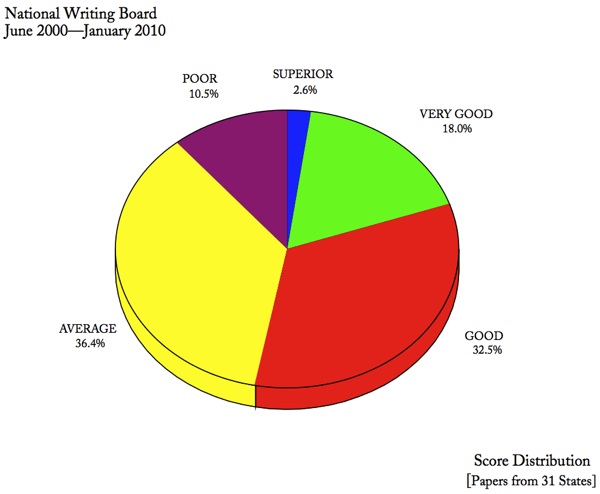
[If we were talking about college history professors, this would not be fiction. They do complain about the basic knowledge of their students, and their inability to read books and write term papers. But like their fictional coaching counterpart, they never talk to high school history teachers (they don’t know any), they never visit their classrooms, and they satisfy themselves with criticizing the students they get from the admissions office. Their interest in National Common Academic Standards does not extend to their suggesting that high school students should read complete nonfiction books and write a serious research paper every year. In short, they, like the fictional head coach, don’t really care if students are so poorly prepared for college that half of them drop out, and that most of them do not arrive on campus prepared to do college work. They are really too busy, you see…]
===========
“Teach by Example”
Will Fitzhugh [founder]
Consortium for Varsity Academics® [2007]
The Concord Review [1987]
Ralph Waldo Emerson Prizes [1995]
National Writing Board [1998]
TCR Institute [2002]
730 Boston Post Road, Suite 24
Sudbury, Massachusetts 01776-3371 USA
978-443-0022; 800-331-5007
www.tcr.org; fitzhugh@tcr.org
Varsity Academics®

Share

Madison School District 2010-2011 Budget: Comments in a Vacuum?

TJ Mertz comments on Monday evening’s Madison School Board 2010-2011 budget discussion (video – the budget discussion begins about 170 minutes into the meeting). The discussion largely covered potential property tax increases. However and unfortunately, I’ve not seen a document that includes total revenue projections for 2010-2011.
The District’s Administration’s last public total 2009-2010 revenue disclosure ($418,415,780) was in October 2009.
Property tax revenue is one part of the MMSD’s budget picture. State and Federal redistributed tax dollars are another big part. The now dead “citizens budget” was a useful effort to provide more transparency to the public. I hope that the Board pushes for a complete picture before any further substantive budget discussions. Finally, the Administration promised program reviews as part of the “Strategic Planning Process” and the recent referendum (“breathing room”). The documents released to date do not include any substantive program review budget items.
Ed Hughes (about 190 minutes): “it is worth noting that evening if we taxed to the max and I don’t think we’ll do that, the total expenditures for the school District will be less than we were projecting during the referendum“. The documents published, as far as I can tell, on the school board’s website do not reflect 2010-2011 total spending.
Links to Madison School District spending since 2007 (the referendum Ed mentioned was in 2008)

It would be great to see a year over year spending comparison from the District, including future projections.
Further, the recent “State of the District” document [566K PDF] includes only the “instructional” portion of the District’s budget. There are no references to the $418,415,780 total budget number provided in the October 26, 2009 “Budget Amendment and Tax Levy Adoption document [1.1MB PDF]. Given the organization’s mission and the fact that it is a taxpayer supported and governed entity, the document should include a simple “citizen’s budget” financial summary. The budget numbers remind me of current Madison School Board member Ed Hughes’ very useful 2005 quote:

This points up one of the frustrating aspects of trying to follow school issues in Madison: the recurring feeling that a quoted speaker – and it can be someone from the administration, or MTI, or the occasional school board member – believes that the audience for an assertion is composed entirely of idiots.

In my view, while some things within our local public schools have become a bit more transparent (open enrollment, fine arts, math, TAG), others, unfortunately, like the budget, have become much less. This is not good.
Ed, Lucy and Arlene thankfully mentioned that the Board needs to have the full picture before proceeding.

Share

Stanford’s effort to curb alcohol abuse grows

John Wildermuth:

Stanford’s successful effort to exempt itself from Santa Clara County’s new rules on underage drinking has put a focus on the university’s growing effort to curb alcohol abuse on campus.
The county’s new ordinance, which took effect last year, makes it easier for police to cite anyone hosting a party where underage drinking occurs. It can mean a fine of up to $1,000 plus costs anytime the police are called in.
About 95 percent of Stanford’s 6,600 undergraduates, many of them younger than 21, live on campus in university-owned housing. As the landlord, the school could have found itself facing plenty of potential liability under the new county rules.
But the financial question didn’t play a role in the university’s attempt to persuade county officials to free Stanford from the regulations, said Jean McCown, the school’s director of community relations.

Share

Playing to Learn

Susan Engel:

So what should children be able to do by age 12, or the time they leave elementary school? They should be able to read a chapter book, write a story and a compelling essay; know how to add, subtract, divide and multiply numbers; detect patterns in complex phenomena; use evidence to support an opinion; be part of a group of people who are not their family; and engage in an exchange of ideas in conversation. If all elementary school students mastered these abilities, they would be prepared to learn almost anything in high school and college.
Imagine, for instance, a third-grade classroom that was free of the laundry list of goals currently harnessing our teachers and students, and that was devoted instead to just a few narrowly defined and deeply focused goals.
In this classroom, children would spend two hours each day hearing stories read aloud, reading aloud themselves, telling stories to one another and reading on their own. After all, the first step to literacy is simply being immersed, through conversation and storytelling, in a reading environment; the second is to read a lot and often. A school day where every child is given ample opportunities to read and discuss books would give teachers more time to help those students who need more instruction in order to become good readers.
Children would also spend an hour a day writing things that have actual meaning to them — stories, newspaper articles, captions for cartoons, letters to one another. People write best when they use writing to think and to communicate, rather than to get a good grade.

Share

Crazy-quilt democracy in action in Tuesday vote on L.A. Unified school reform

Howard Blume:

Voters Tuesday will choose reform plans for 30 Los Angeles-area schools in an election like no other.
For one thing, the voting age could dip to 14. Undocumented residents are welcome. Some people will get multiple votes. Ballot stuffing is expected.
And did we mention that each contestant will actually be competing in seven simultaneous elections? And that the results could be meaningless?
Whoever said democracy is messy could have been thinking of the Los Angeles Unified School District.
The subject of the election is singular: Groups inside and outside the school system are competing to run 12 persistently low-performing schools and 18 new campuses. The purpose of the balloting is for different voting blocs to select their favored bidder. Each bloc will be tallied separately, including parents, high school students and school employees.

Share

A Talk with Ellie Schatz: WCATY Founder and Author of “Grandma Says It’s Good to be Smart”

I enjoyed meeting and talking with Ellie Schatz recently. Listen to the conversation via this 17MB mp3 audio file CTRL-Click to download or read the transcript. Parent and activist Schatz founded WCATY and is, most recently author of “Grandma Says it’s Good to Be Smart“.
I enjoyed visiting with Ellie and found the conversation quite illuminating. Here’s a useful segment from the 37 minute interview:

Jim: What’s the best, most effective education model these days? Obviously, there are traditional schools. There are virtual schools. There are chartered schools. There are magnets. And then there’s the complete open-enrollment thing. Milwaukee has it, where the kids can go wherever they want, public or private, and the taxes follow.
Ellie: [32:52] I think there’s no one best model from the standpoint of those models that you just named. [32:59] What is important within any one of those models is that a key player in making that education available to your child believes that no matter how good the curriculum, no matter how good the model, the children they are about to serve are different, that children are not alike.
[33:30] And that they will have to make differences in the curriculum and in the way the learning takes place for different children.
[33:45] And I have experienced that myself. I’ve served on the boards of several private schools here in the city, and I have given that message: “This may be an excellent curriculum, and I believe it’s an excellent curriculum. But that’s not enough.”
[34:05] You cannot just sit this curriculum down in front of every child in the classroom and say, “We’re going to turn the pages at the same time, and we’re going to write the answers in the same way.” It does not work that way. You must believe in individually paced education.
[34:24] And that’s why I say the WCATY model cannot change. If it’s going to accomplish what I set out for WCATY to do, it must be accelerated from the nature of most of the curriculum that exists out there for kids today.

Thanks to Rick Kiley for arranging this conversation.

Share

A Tougher ‘A’ at Princeton Has Students on Edge

Jacques Steinberg, via a kind reader’s email:

p>Lisa Foderaro writes in The Times’s Metropolitan section that efforts by Princeton University to curb grade inflation are “now running into fierce resistance from the school’s Type-A-plus student body.”

The university had hoped that other institutions would follow its lead in making it harder for students to earn an A. “But the idea never took hold beyond Princeton’s walls,” Ms. Foderaro writes, adding: “with the job market not what it once was, even for Ivy Leaguers, Princetonians are complaining that the campaign against bulked-up G.P.A.’s may be coming at their expense.”

How much tougher is it to earn an A at Princeton? The percentage of grades in the A range fell below40 percent last year, compared to nearly 50 percent in 2004, when the policy was adopted.

In nearly 100 comments and counting, reader response on the issue of grade inflation has been fierce. For a sense of how one important arbiter — Yale Law School — interprets undergraduate grades, I draw your attention to this comment, from Asha Rangappa, the dean of Yale Law (and a Princeton graduate.) — Jacques

Share

Virtual Schools, Students with IEPs, and Wisconsin Open Enrollment

Chan Stroman:

Virtual schooling can be an educational choice with particular benefits for some students with disabilities. The recent study “Serving Students with Disabilities in State-level Virtual K-12 Public School Programs” by Eve Müller, Ph.D., published in September 2009 by the National Association of State Directors of Special Education (NASDSE)’s Project Forum, and funded by the U.S. Department of Education’s Office of Special Education Programs, surveyed state education agencies nationwide regarding their virtual K-12 public school programs:

Eleven states described one or more benefits associated with serving students with disabilities in virtual K-12 public school programs. These include:

Share

Spending on education Investing in brains

The Economist:

IN CALIFORNIA the students are revolting–not against their teachers, but in sympathy with them. The state’s governor, Arnold Schwarzenegger, has cut $1 billion, some 20% of the University of California’s budget, as he tries to balance the state’s books. Fees may rise by a fifth, to over $10,000. Support staff are being fired; academics must take unpaid leave.
That is part of a global picture in which cash-strapped governments in the rich world are scrutinising the nearly 5% of GDP they devote to education. Those budgets may not be the top candidates for the chop, but they cannot fully escape it.
Just before Christmas the British government said it planned to reduce spending on higher education, science and research by £600m ($980m) by 2012-13, just as a chilly job market is sending students scurrying to do more and longer courses. The trade union that represents academic staff claims that up to 30 universities could close with the loss of 14,000 jobs. A House of Commons select committee is investigating the effects on British science.
Even where education spending has not been slashed, it may face a squeeze as short-term stimulus spending ends. America’s $787 billion Recovery Act passed by Congress nearly a year ago included $100 billion for education. More than half is to be spent this year, meaning that the budget will have to be cut in 2011. A study by the Centre for the Study of Education Policy at Illinois State University, published on January 18th, found that half of American states will have spent all of their stimulus money for education by the end of July. Cuts will follow. Privately funded schools and colleges have seen their endowments and donors’ enthusiasm wither.

Share

Who Owns Student Work?

Meredith Davis:

A number of years ago, curious about the ownership of student work produced in a class, I asked a lawyer friend who specializes in art and design copyright law if schools had the right to reproduce student work in their recruitment publicity without the students’ permission. He informed me that the student, despite advice from faculty who may have shaped the work, owns the work and that written permission must be secured before it could be reproduced. He also said such works could be considered student records and recruitment results in some benefit to the institution that exceeds any reading of the “fair use” practices of educational institutions (i.e. those that might be applied to the use of lecture slides for a class).
This reading of the law is at odds with the prevailing opinion of many schools that the student would not have produced work of a particular quality under his or her own resources, and therefore, that faculty have some “ownership rights” in the output of any class. Since that time I have been very careful to ask students first about any public use of their work, even in lectures I give at other schools, and I always credit the work with their names and give students the details on the presentation venues for their resumes. My lawyer friend told me that statements in college catalogs claiming that the institution retains ownership of work produced in a class wouldn’t hold up in court; unless the maker is an employee of the institution/company or has signed away rights through some explicit agreement, ownership is retained by the maker. Other attorneys may have different interpretations, and I don’t profess to be a legal expert, but the ownership of work produced by students is certainly something to think about.

Share

Abstinence-Only Education Works According To New Study

Frank James:

Abstinence-only education has been a frequent point of contention between conservatives and liberals.
Conservatives, particularly religious ones, have argued that young people need to be taught the moral dimension of sexual activity as part of abstinence education and urged to avoid sex until marriage.
For those reasons, liberals and many health and education professionals have argued against abstinence-only education. Many of them have preferred comprehensive sex education.
Now a new study indicates that abstinence-only education works even when it doesn’t have a moral component.

Share

Finding the Better High School

Jay Matthews:

On the second page of the Post’s Metro section, and on this Web site, you see the results of the 12th annual Washington Post survey of high school student participation in college-level tests, what I call the Challenge Index.
The ranked list of public schools — both the Washington area version in the Post and the national version in Newsweek each June — gets lots of attention, but the outrage and acclaim usually swirls around the issue of whether ranking schools is good for you. With much support from Advanced Placement and International Baccalaureate teachers around the country, I think it is. But how can you use it?
I invented the list to show that some schools in good neighborhoods don’t deserve their great reputations, and some schools in poor neighborhoods don’t deserve their terrible ones. Opening up AP and IB courses to everyone who wants to work hard — the philosophy of the teachers who inspired me to do this — is a relatively new idea. Ten years ago, most schools in the United States did not let students take these courses unless they had strong grade point averages or teachers’ recommendations.

Share

Nokia, Pearson Set Up Digital Education Joint Venture In China

Robin Wauters:

Nokia and education company Pearson have formed a joint venture in China dubbed Beijing Mobiledu Technologies to grow MobilEdu, the wireless education service that the Finnish mobile giant launched in China back in 2007.
Mobiledu is a mobile service that essentially provides English-language learning materials and other educational content, from a variety of content providers, directly to mobile phones.
Customers can access the content through an application preloaded on new Nokia handsets, or by visiting the service’s mobile website and most other WAP portals in China.
According to Nokia, Mobiledu has attracted 20 million subscribers in China so far, with 1.5 million people actively using the service each month. According to the press release and by mouth of John Fallon, Chief Executive of Pearson’s International Education business, China is the world’s largest mobile phone market and the country with the largest number of people learning English.

There are many ways to learn, not all of them require traditional methods or expensive “professional development”.

Share

New Critiques on the Proposed “Common Core” English & Math Standards

via a kind reader. Math 627K PDF:

This document provides grade level standards for mathematics in grades K-8, and high school standards organized under the headings of the College and Career Readiness Standards in Mathematics. Students reaching the readiness level described in that document (adjusted in response to feedback) will be prepared for non-remedial college mathematics courses and for training programs for career-level jobs. Recognizing that most students and parents have higher aspirations, and that ready for college is not the same as ready for mathematics-intensive majors and careers, we have included in this document standards going beyond the readiness level. Most students will cover these additional standards. Students who want the option of entering STEM fields will reach the readiness level by grade 10 or 11 and take precalculus or calculus before graduating from high school. Other students will go beyond readiness through statistics to college. Other pathways can be designed and available as long as they include the readiness level. The final draft of the K-12 standards will indicate which concepts and skills are needed to reach the readiness level and which go beyond. We welcome feedback from states on where that line should be drawn.
English Language Learners in Mathematics Classrooms
English language learners (ELLs) must be held to the same high standards expected of students who are already proficient in English. However, because these students are acquiring English language proficiency and content area knowledge concurrently, some students will require additional time and all will require appropriate instructional support and aligned assessments.
ELLs are a heterogeneous group with differences in ethnic background, first language, socio-economic status, quality of prior schooling, and levels of English language proficiency. Effectively educating these students requires adjusting instruction and assessment in ways that consider these factors. For example ELLs who are literate in a first language that shares cognates with English can apply first-language vocabulary knowledge when reading in English; likewise ELLs with high levels of schooling can bring to bear conceptual knowledge developed in their first language when reading in a second language. On the other hand, ELLs with limited or interrupted schooling will need to acquire background knowledge prerequisite to educational tasks at hand. As they become acculturated to US schools, ELLs who are newcomers will need sufficiently scaffolded instruction and assessments to make sense of content delivered in a second language and display this content knowledge.

English Language Arts 3.6MB PDF
Catherine Gewertz:

A draft of grade-by-grade common standards is undergoing significant revisions in response to feedback that the outline of what students should master is confusing and insufficiently user-friendly.
Writing groups convened by the Council of Chief State School Officers and the National Governors Association are at work on what they say will be a leaner, better-organized, and easier-to-understand version than the 200-plus-page set that has been circulating among governors, scholars, education groups, teams of state education officials, and others for review in recent weeks. The first public draft of the standards, which was originally intended for a December release but was postponed until January, is now expected by mid-February.

Share

A “Value Added” Report for the Madison School District

Kurt Kiefer:

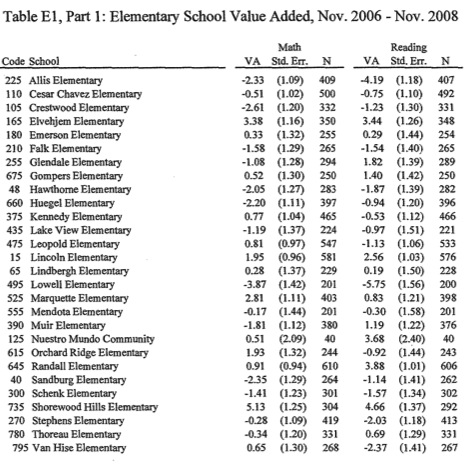
Attached are the most recent results from our MMSD value added analysis project, and effort in which we are collaborating with the Wisconsin center for Educational Research Value Added Research Center (WCERVARC). These data include the two-year models for both the 2006-2008 and 2005-2007 school year spans.
This allows us in a single report to view value added performance for consecutive intervals of time and thereby begin to identify trends. Obviously, it is a trend pattern that will provide the greatest insights into best practices in our schools.
As it relates to results, there do seem to be some patterns emerging among elementary schools especially in regard to mathematics. As for middle schools, the variation across schools is once again – as it was last year with the first set of value added results – remarkably narrow, i.e., schools perform very similar to each other, statistically speaking.
Also included in this report are attachments that show the type of information used with our school principals and staff in their professional development sessions focused on how to interpret and use the data meaningfully. The feedback from the sessions has been very positive.

Much more on the Madison School District’s Value Added Assessment program here. The “value added assessment” data is based on Wisconsin’s oft-criticized WKCE.


Table E1 presents value added at the school level for 28 elementary schools in Madison Metropolitan School District. Values added are presented for two overlapping time periods; the period between the November 2005 to November 2007 WKCE administrations, and the more recent period between the November 2006 and November 2008 WKCE. This presents value added as a two-year moving average to increase precision and avoid overinterpretation of trends. Value added is measured in reading and math.
VA is equal to the school’s value added. It is equal to the number ofextra points students at a school scored on the WKCE relative to observationally similar students across the district A school with a zero value added is an average school in terms of value added. Students at a school with a value added of 3 scored 3 points higher on the WKCE on average than observationally similar students at other schools.
Std. Err. is the standard error ofthe school’s value added. Because schools have only a finite number of students, value added (and any other school-level statistic) is measured with some error. Although it is impossible to ascertain the sign of measurement error, we can measure its likely magnitude by using its standard error. This makes it possible to create a plausible range for a school’s true value added. In particular, a school’s measured value added plus or minus 1.96 standard errors provides a 95 percent confidence interval for a school’s true value added.
N is the number of students used to measure value added. It covers students whose WKCE scores can be matched from one year to the next.

Share

What’s your experience with the new (Discovery) math textbooks?

KUOW.org:

Last year Seattle Public Schools selected new, “inquiry-based” math textbooks. Now there’s a lawsuit against the district over the Discovering Mathematics series of textbooks.
Do you have a child in school who is using the new textbooks? What is your experience with inquiry-based math education? KUOW’s Ross Reynolds is planning a show on Wednesday, February 3 in the 12 o’clock hour. We’d like to hear from you by Wednesday morning. Share your experience with KUOW by filling out the form below, or call 206.221.3663.

Share

A Determined Quest to Bring Adoptive Ties to Foster Teenagers

Erik Eckholm:

After a day of knocking on doors chasing fleeting leads, Carlos Lopez and his partner finally heard welcome words: Yes, a resident confirmed, the man they were seeking lived in this house and would be home that evening.
Mr. Lopez, a former police detective, now does gumshoe work for what he calls a more fulfilling cause: tracking down long-lost relatives of teenagers languishing in foster care, in desperate need of family ties and in danger of becoming rootless adults. That recent day, he was hoping to find the father of a boy who had lived in 16 different foster homes since 1995. The boy did not remember his mother, who had long since disappeared.
Finding an adoptive parent for older children with years in foster care is known in child welfare circles as the toughest challenge. Typically, their biological parents abused or neglected them and had parental rights terminated. Relatives may not know where the children are, or even that they exist. And the supply of saints in the general public, willing to adopt teenagers shaken by years of trauma and loss, is limited.

Share

The Economic Benefits From Halving The Dropout Rate: A Boom To Businesses In The Nation’s Largest Metropolitan Areas

Alliance for Excellent Education:

Few people realize the impact that high school dropouts have on a community’s economic, social, and civic health.
Business owners and residents–in particular, those without school-aged children–may not be aware that they have much at stake in the success of their local high schools.
Indeed, everyone–from car dealers and realtors to bank managers and local business owners–benefits when more students graduate from high school.
Nationally, more than seven thousand students become dropouts every school day. That adds up to almost 1.3 million students annually who will not graduate from high school with their peers as scheduled. In addition to the moral imperative to provide every student with an equal opportunity to pursue the American dream, there is also an economic argument for helping more students graduate from high school.
To better understand the various economic benefits that a particular community could expect if it were to reduce its number of high school dropouts, the Alliance for Excellent Education (the Alliance), with the generous support of State Farm®, analyzed the local economies of the nation’s fifty largest cities and their surrounding areas. Using a
sophisticated economic model developed by Economic Modeling Specialists Inc., an Idaho-based economics firm specializing in socioeconomic impact tools, the Alliance calculated economic projections tailored to each of these metro regions.

Share

Green Bay Schools Advertise to Stem Losses

Matt Smith:

The Green Bay Area Public School District is losing students to open enrollment by a three-to-one ratio. Now, during a pivotal few weeks, it’s launching a major multi-media campaign.
Statewide, applications for open enrollment begin Monday and run through the first part of February.
For school districts everywhere, it’s a critical time to keep — and gain — students.
The Green Bay district is wasting no time in getting its message out. From the classroom to your TV screen, it’s an all-out multi-media blitz to highlight the district during a very vulnerable few weeks.
Beginning Monday, a TV ad hits the airwaves advertising what the Green Bay school district says it can offer current and potential students.

Current Madison Superintendent Dan Nerad formerly served in the same position in Green Bay. Much more on open enrollment here.

Share

Discussing Rigor at Seattle’s Rainier Beach High School

Michael Rice:

I was reading the comments in an earlier post about the new assignment plan and there were many comments about the rigor or lack there of at Rainier Beach High School. I would like to dispel the myth that Rainier Beach does not offer rigor to the high achieving student. If you have a high achieving 8th grader and are in the RBHS attendance area, here is just a sample of what you can expect:
In math as a Freshman, you will start in at least Honors Geometry with Ms. Lessig who is our best math teacher. Once you get through that, you will take Honors Advanced Algebra with me, then Pre Calculus with Mr. Bird (a math major in college) and then as a Senior, you take AP Calculus with Ms. Day, a highly experienced and skilled teacher. As a bonus, in either your Junior or Senior year, you get to take AP Statistics with me. All of these classes are demanding and well taught by teachers who know what they are doing and are passionate about teaching math.

Share

Excellent education: a right or a privilege?

Erica Sandberg:

Being deeply entrenched in all things money, I see first-hand the link between quality education and real, lasting economic success. The better schools you attend, the greater the chance you’ll find and prepare for work that will provide satisfaction and financial stability. This is not to say that other factors (such as parent involvement) don’t count or that some people don’t overcome the odds and attain wealth and happiness without attending or graduating from college, but I’m talking the basics here: kindergarten though high school.
The sad fact is that California public schools are in jeopardy. Many are wonderful now, but as the Chron’s Jill Tucker reports, 113 million in funding cuts over two years will change all that. Teachers are facing lay-offs, class size will swell to unmanageable numbers, and programs that make schools appealing to students will be slashed. Want to make kids dislike and devalue formal learning? This will do it. And as a society, we can’t afford to have children reject education. Those who do are more likely to make poor financial and lifestyle choices when they reach adulthood, draining the resources of the population at large.

Share

Response to Danny Westneat 1/27 Math column in Seattle Times

Martha McLaren:

I am one of the three plaintiffs in the math textbook appeal. I am also the white grandmother of an SPS fifth grader, and a retired SPS math teacher.
Mr. Westneat grants that the textbooks we are opposing may be “lousy,” but he faults us for citing their disproportionate effect on ethnic, racial, and other minorities. He states that we can’t prove this claim. I disagree, and West Seattle Dan has posted voluminous statistics in response to the column. They support our claim that inquiry-based texts, which have now accrued a sizable track record, are generally associated with declining achievement among most students and with a widening achievement gap between middle class whites and minorities.
We’ve brought race and ethnicity (as well as economic status) into this appeal because there is ample evidence that it is a factor. True, this is not the 80’s, and true, in my 10 years of experience teaching in Seattle Schools, I found no evidence that people of color are less capable than whites of being outstanding learners. However, in my 30+ years as a parent and grandparent of SPS students and my years as a teacher, I’ve developed deep, broad, awareness of the ways that centuries of societally mandated racism play out in our classrooms, even in this era of Barack Obama’s presidency.

Share

How Michigan education reforms will unfold is unclear

Julie Mack:

How sweeping education reforms signed into law Monday will be implemented in Michigan remains unclear to area school officials.
Gov. Jennifer Granholm on Monday signed reforms that make it easier to close failing schools, link teacher pay to performance and hold school administrators accountable. The bills also raise the dropout age from 16 to 18, starting with the Class of 2016; allow up to 32 more charter schools to open each year; give professionals from areas other than education an alternative way to become teachers, and allow for cyber-schools to educate students who have dropped out online.
State Superintendent Mike Flanagan said up to 200 low-performing schools could end up under state control as a result of the new laws.
The legislation is part of Michigan’s effort to win money from the Obama administration’s Race to the Top competition tied to education reform. Michigan could get up to $400 million if it’s among the winners.
Local school boards and unions now face a Thursday deadline to sign a “Memorandum of Understanding” that indicates their support for the reforms. The memorandums are to be included with the state’s Race to the Top application. School districts where the board and union do not sign an agreement risk losing their share of the money.

Share

On Seattle’s “Discovery Math” Lawsuit: “Textbook argument divides us”

Danny Westneat:

Can an algebra textbook be racist?
That’s what was argued Tuesday in a Seattle courtroom. Not overtly racist in that a book of equations and problem sets contains hatred or intolerance of others. But that its existence — its adoption for use in Seattle classrooms — is keeping some folks down.
“We’re on untested ground here,” admitted Keith Scully.
He’s the attorney who advanced this theory in a lawsuit challenging Seattle Public Schools’ choice of the Discovering series of math textbooks last year.
The appeal was brought by a handful of Seattle residents, including UW atmospheric-sciences professor Cliff Mass. It says Seattle’s new math books — and a “fuzzy” curriculum they represent — are harmful enough to racial and other minorities that they violate the state constitution’s guarantee of an equal education.
It also says the School Board’s choice of the books was arbitrary.
Mostly, Mass just says the new textbooks stink. For everyone. But he believes they will widen the achievement gap between whites and some minority groups, specifically blacks and students with limited English skills.

Share

Study: Online Education Continues Its Meteoric Growth

Jeff Greer:

Online college education is expanding–rapidly. More than 4.6 million college students were taking at least one online course at the start of the 2008-2009 school year. That’s more than 1 in 4 college students, and it’s a 17 percent increase from 2007.
Turns out it’s the economy, stupid.
Two major factors for the soaring numbers in the 2008-2009 school year are the sour economy and the possibility of an H1N1 flu virus outbreak, according to the seventh annual Sloan Survey of Online Learning report, titled “Learning on Demand: Online Education in the United States in 2009.” But, the survey’s authors say, there is a lot more work to be done, and there’s huge potential for online education to expand, especially at larger schools.
“For the past several years, all of the growth–90-plus percent–is coming from existing traditional schools that are growing their current offerings,” says Jeff Seaman, one of the study’s authors and codirector of the Babson Survey Research Group at Babson College. Seaman’s coauthor, Elaine Allen, who is also a codirector of the Babson Survey Research Group, added that community colleges, for-profit schools, and master’s programs have seen significant growth in online offerings.

Share

Growing Special Education Enrollments in Charter Schools

Michael D. Van Beek:

Although public charter schools are required by law to admit all students who apply, a common criticism is that charters fail to enroll enough special education students. Statistics show that public charter schools have proportionately smaller special education enrollments than conventional public schools, but recent trends suggest the difference will continue to dwindle.
According to the Center for Educational Performance and Information, 13.6 percent of students in conventional schools in the 2008-2009 school year were enrolled in special education programs, compared to 9.6 percent in charter schools. While a difference still exists between charter and conventional schools, special education enrollment is rising quickly in charter schools.
Since the 2000-2001 school year, the proportion of charter school students enrolled in special education programs grew by 76 percent. Charter schools served nearly four times as many special education students at the end of the last decade as they did at the beginning.

Share

Fix schools with ideas, not money

Jay Matthews:

President Obama is apparently about to tell the nation he wants to freeze federal spending for three years in several areas, including education. I like the idea. I would also support cutting back entitlement payments for financially secure geezers like me, and find ways for everyone to make some sacrifices for our country.
I can hear the objections. We can’t fix our economy by shortchanging our kids. They are our future. True, but we don’t have much evidence that spending more money on their schooling has had much effect on what they have learned. The most exciting and productive schools I have studied are driven by ideas, not bucks. If they need money for special projects, they find it. But the power of their teaching comes from the freedom they are allowed to help with their students, as a team, in ways that make the most sense to them.
More money often prevents that from happening. It has strings that force teachers to do stuff, and spend time on paperwork, that doesn’t work for them. The recent history of the stimulus funds used for education makes this clear.

I agree.

Share

National Australia Schools comparison website going live

Sydny Morning Herald:

The federal government’s controversial website giving information on the performance of all schools will go live from this Thursday.
The site, called My School, will provide profiles for almost 10,000 schools and will allow parents to compare schools in their area as well as statistically-similar schools in other regions.
In navigating the web page, parents will be able to look at the profiles of their child’s school which includes the numbers of students, teachers, attendance rates and the percentage of indigenous students.
Federal Education Minister Julia Gillard made no apology for the introduction of the website.
“I’m passionate about this and I believe this is the right direction for this country,” she told Sky News on Monday.

www.myschool.edu.au

Share

In Oklahoma, One in Five Children Live in Poverty

Gavin Off:

A year ago, the life Demetria Overstreet and her family knew slowly began to fade.

Her husband, Lenzie, was diagnosed with kidney failure and had to leave his job to begin treatment.

With its main money-maker out of work, mounting medical bills and three children to care for, the family saw its financial problems beginning to build.

At one point, their home’s gas and electricity were turned off. Car payments lagged. And at times, the family survived on eating hotdogs and chips.

“It was depressing, especially when my son would come home and said ‘Momma, nothing comes on,’ ” Overstreet said, referring to the electricity.

Share

Lawsuit Challenging the Seattle School District’s use of “Discovering Mathematics” Goes to Trial

Martha McLaren, DaZanne Porter, and Cliff Mass:

Today Cliff Mass and I, (DaZanne Porter had to be at a training in Yakima) accompanied by Dan Dempsey and Jim W, had our hearing in Judge Julie Spector’s King County Superior Courtroom; the event was everything we hoped for, and more. Judge Spector asked excellent questions and said that she hopes to announce a decision by Friday, February 12th.
The hearing started on time at 8:30 AM with several members of the Press Corps present, including KIRO TV, KPLU radio, Danny Westneat of the Seattle Times, and at least 3 others. I know the number because, at the end, Cliff, our attorney, Keith Scully, and I were interviewed; there were five microphones and three cameras pointed towards us at one point.
The hearing was brief; we were done by 9:15. Keith began by presenting our case very clearly and eloquently. Our two main lines of reasoning are, 1) that the vote to adopt Discovering was arbitrary and capricious because of the board’s failure to take notice of a plethora of testimony, data, and other information which raised red flags about the efficacy of the Discovering series, and 2) the vote violated the equal education rights of the minority groups who have been shown, through WASL scores, to be disadvantaged by inquiry based instruction.
Realistically, both of these arguments are difficult to prove: “arbitrary and capricious” is historically a very, very difficult proof, and while Keith’s civil rights argument was quite compelling, there is no legal precedent for applying the law to this situation.
The School District’s attorney, Shannon McMinimee, did her best, saying that the board followed correct procedure, the content of the books is not relevant to the appeal, the books do not represent inquiry-based learning but a “balanced” approach, textbooks are merely tools, etc., etc. She even denigrated the WASL – a new angle in this case. In rebuttal, Keith was terrific, we all agreed. He quoted the introduction of the three texts, which made it crystal clear that these books are about “exploration.” I’m blanking on other details of his rebuttal, but it was crisp and effective. Keith was extremely effective, IMHO. Hopefully, Dan, James, and Cliff can recall more details of the rebuttal.

Associated Press:

A lawsuit challenging the Seattle School District’s math curriculum went to trial Monday in King County Superior Court.
A group of parents and teachers say the “Discovering Math” series adopted last year does a poor job, especially with minority students who are seeing an achievement gap widen.
A spokeswoman for the Seattle School District, Teresa Wippel, says it has no comment on pending litigation.
KOMO-TV reports the district has already spent $1.2 million on Discovering Math books and teacher training.

Cliff Mass:

On Tuesday, January 26th, at 8:30 AM, King County Superior Court Judge Julie Spector will consider an appeal by a group of Seattle residents (including yours truly) regarding the selection by Seattle Public Schools of the Discovering Math series in their high schools. Although this issue is coming to a head in Seattle it influences all of you in profound ways.
In this appeal we provide clear evidence that the Discovery Math approach worsens the achievement gap between minority/disadvantaged students and their peers. We show that the Board and District failed to consider key evidence and voluminous testimony, and acted arbitrarily and capriciously by choosing a teaching method that was demonstrated to produce a stagnant or increasing achievement gap. We request that the Seattle Schools rescind their decision and re-open the textbook consideration for high school.

Share

A study in intellectual uniformity: The Marketplace of Ideas By Louis Menand

Christopher Caldwell:

As his title hints, Louis Menand has written a business book. This is good, since the crisis in American higher education that the Harvard professor of English addresses is a business crisis. The crisis resembles the more celebrated one in the US medical system. At its best, US education, like US healthcare, is of a quality that no system in the world can match. However, the two industries have developed similar problems in limiting costs and keeping access open. Both industries have thus become a source of worry for public-spirited citizens and a punchbag for political opportunists.
Menand lowers the temperature of this discussion. He neither celebrates nor bemoans the excesses of political correctness – the replacement of Keats by Toni Morrison, or of Thucydides by queer theory. Instead, in four interlocking essays, he examines how university hiring and credentialing systems and an organisational structure based on scholarly disciplines have failed to respond to economic and social change. Menand draws his idea of what an American university education can be from the history of what it has been. This approach illuminates, as polemics cannot, two grave present-day problems: the loss of consensus on what to teach undergraduates and the lack of intellectual diversity among the US professoriate.
Much of today’s system, Menand shows, can be traced to Charles William Eliot, president of Harvard for four decades after 1869. Faced with competition from pre-professional schools, Eliot had the “revolutionary idea” of strictly separating liberal arts education from professional education (law, medicine, etc), and making the former a prerequisite for the latter. Requiring a lawyer to spend four years reading, say, Molière before he can study for the bar has no logic. Such a system would have made it impossible for Abraham Lincoln to enter public life. Funny, too, that the idea of limiting the commanding heights of the professions to young men of relative leisure arose just as the US was filling up with penurious immigrants. Menand grants that the system was a “devil’s bargain”.

Clusty Search: Louis Menand – “The Marketplace of Ideas”.

Share

State of the Union on Education

Joe Williams:

Unfettered by inside-the-beltway partisan politics, President Obama indisputably has affected more change in the nation’s education policies in his first year in office than any President in modern history.
The boost that the Administration’s Race to the Top initiative – which was accompanied by a record $100 billion increase in general federal aid to education – has given state and local education reform efforts is the Administration’s biggest domestic policy success of 2009 – all without yet expending a dime of the $5 billion Race to the Top fund.
What’s more, while not a single Republican Congressman and only 3 Republican Senators voted for the economic and education reform stimulus package last February, the policy initiatives that Obama and Secretary Duncan put forth have since been embraced through both words and action by state and local elected officials in both parties across the ideological and geographical spectrum.
These accomplishments reflect campaign promises kept – in recognition of the relationship between education reform, jobs, and economic growth – to make education one of three key components of a long-term U.S. economic recovery strategy (the other two being energy and health care which obviously, and to say the least, have not fared as well), an augur well for the work on education reform that is yet to come.
Some effects are immediate – for example, more than a hundred thousand slots have already opened to parents across the country who want to choose a high quality public charter school for their children. Others, such as changes in state academic standards to ensure that students are college and career ready, the development of better tests, more rigorous qualification criteria and better pay for teachers, and fundamental overhauls of chronically failing schools, will pay dividends later this year, and over the next several.

Share

Honor student world: Where all the students are above average

Maureen Downey:

Here is an interesting op-ed piece by a tenured professor of biology at Piedmont College, Robert H. Wainberg. He is alarmed because he has been told by former students who are now teachers that some schools no longer hold Honors Day to recognize the accomplishments of above average and exemplary students so they don’t hurt the feelings of kids who don’t earn awards.
This piece will appear in the paper on the education page Monday. Enjoy.
By Robert H.Wainberg:

I have been a professor of Biology and Biochemistry at a regional college for over two decades. Sadly, I have noticed a continual deterioration in the performance of my students during this time. In part I have attributed it to the poor study habits of the last few generations (X, XX and now XXX) who have relied too heavily on technology in lieu of thinking for themselves.
In fact, the basics are no longer taught in our schools because they are considered to be “too hard,” not because they are archaic or antiquated. For example, students are no longer required to learn the multiplication or division tables since they direct access to calculators in their phones.
Handwriting script and calligraphy are now in danger of extinction since computers use printed letters. A report I recently read disturbingly admitted that many of our standardized tests used for college admission or various professional schools (MCAT, LSAT and GRE) have to manipulate their normal bell-shaped curves to obtain the higher averages of decadtudenes ago.
What we fail to realize is that the concept of “survival of the fittest” still applies even within the realm of technology. There will always be those who are more “adapted” to the full potential of its use while others will be stalled at the level of downloading music or playing games.

Ah, yes. One size fits all education uber alles.

Share

Advanced Pressure

New York Times Video:

The filmmaker Vicki Abeles features the stories of students and teachers of Advanced Placement classes and the pressures they face in our achievement-obsessed culture.

Share

Berkeley High may cut lab classes to fund programs for struggling students

Marie L. La Ganga:

Trying to address a major ethnic and racial achievement gap, the school could divert funds from before- and after-school science labs filled mostly with white students. The plan has sparked debate.
Aaron Glimme’s Advanced Placement chemistry students straggle in, sleepy. It is 7:30 a.m. at Berkeley High School. The day doesn’t officially begin for another hour. They pull on safety goggles, measure out t-butyl alcohol and try to determine the molar mass of an unknown substance by measuring how much its freezing point decreases.
In the last school year, 82% of Berkeley’s AP chemistry students passed the rigorous exam, which gives college credit for high school work. The national passing rate is 55.2%. The school’s AP biology and physics students are even more successful.
Most districts would not argue with such a record, but Berkeley High’s science labs are embroiled in a debate over scarce resources with overtones of race, class and politics.
Campus leadership has proposed cutting before- and after-school labs — decreasing science instruction by 20% to 40% — and using that money to fund “equity” programs for struggling students in an effort to close one of the widest racial and ethnic achievement gaps in the state.

Related: English 10.

Share

Five areas where colleges could use some schooling

Jay Matthews:

My family has much experience in higher education, not all of it happy. I spent six years as an often struggling undergraduate and grad student. My journalist wife did ten years in higher ed, including three of what she considered hard labor as a visiting professor. Our kids add another 11 years, with the youngest child about to sign up for three more. Please don’t ask me what that will cost.
American colleges and universities are the great strength of our education system. They are revered around the world. But those schools put heavy stress on our families, since getting into, paying for and graduating from the ones we most want often exceeds our capabilities. We need to know more about what they are doing to us, so I am happy to see washingtonpost.com launch two higher education blogs: College Inc. by Daniel de Vise and Campus Overload by Jenna Johnson. Let me celebrate that event by grumbling about what I consider higher education’s five biggest blind spots:
1. College privacy rules are a mess. They are difficult to understand and infuriating when they exacerbate a family crisis. I have heard many stories about students getting into trouble, and their parents being among the last to know. University officials will sometimes take pity on a frantic dad and reveal important things in the kid’s personal file. But why can’t we have more reasonable procedures? Academics who fear intrusive helicopter parents should read the National Survey of Student Engagement report, which reveals that the children of such people do better in college than kids like mine, who didn’t hear much from us.
2. Professors know too little about what high schools are doing to prepare students for their classes.

Share

The Lottery

Erin O’Connor:

Since we’re talking about school choice–and the role of the teachers’ unions not only in preventing needed reform, but in keeping parents from choosing to place their kids in good schools that are good fits for them–check out the trailer above.
The story of teachers’ union intransigence when it comes to the extremely time-sensitive matter of kids’ futures urgently needs to be told. And finally, with films like this one and like The Cartel (which attracted a nasty, tellingly defensive hit piece from the New Jersey Education Association), that story is beginning to be told.

Share

Convicted sex pests may still be teaching in Hong Kong

Liz Heron, Elaine Yau and Fox Yi Hu:

More than 30 teachers and classroom assistants have been convicted of sex offences in the past 10 years – but the Education Bureau will not say if they are still working in the city’s schools.
Since January 1, 2000, at least 31 staff have been convicted of offences ranging from indecent assault of their pupils to secretly filming girls getting undressed for a dance class.
The catalogue of convictions and the names of the offenders was compiled by the Sunday Morning Post (SEHK: 0583, announcements, news) and presented to the Education Bureau, which was asked what action had been taken against the offenders.
But the bureau, responsible for registering teachers and advising schools on vetting prospective staff, refused to say how many of the 31 were still registered as teachers and how many were working in schools.
A spokeswoman also refused to explain why it would not release the information to the public. She did say 13 teachers were deregistered from 2006 to 2008 and seven of these had been convicted of sex offences.

Share

A Few Comments on Monday’s State of the Madison School District Presentation

Madison School District Superintendent Dan Nerad will present the “State of the Madison School District 2010” tomorrow night @ 5:30p.m. CST.
The timing and content are interesting, from my perspective because:

  • The nearby Verona School District just approved a Mandarin immersion charter school on a 4-3 vote. (Watch the discussion here). Madison lags in such expanded “adult to student” learning opportunities. Madison seems to be expanding “adult to adult” spending on “coaches” and “professional development”. I’d rather see an emphasis on hiring great teachers and eliminating the administrative overhead associated with growing “adult to adult” expenditures.
  • I read with interest Alec Russell’s recent lunch with FW de Klerk. de Klerk opened the door to South Africa’s governance revolution by freeing Nelson Mandela in 1990:

    History is moving rather fast in South Africa. In June the country hosts football’s World Cup, as if in ultimate endorsement of its post-apartheid progress. Yet on February 2 1990, when the recently inaugurated state President de Klerk stood up to deliver the annual opening address to the white-dominated parliament, such a prospect was unthinkable. The townships were in ferment; many apartheid laws were still on the books; and expectations of the balding, supposedly cautious Afrikaner were low.
    How wrong conventional wisdom was. De Klerk’s address drew a line under 350 years of white rule in Africa, a narrative that began in the 17th century with the arrival of the first settlers in the Cape. Yet only a handful of senior party members knew of his intentions.

    I sense that the Madison School Board and the Community are ready for new, substantive adult to student initiatives, while eliminating those that simply consume cash in the District’s $418,415,780 2009-2010 budget ($17,222 per student).

  • The “State of the District” document [566K PDF] includes only the “instructional” portion of the District’s budget. There are no references to the $418,415,780 total budget number provided in the October 26, 2009 “Budget Amendment and Tax Levy Adoption document [1.1MB PDF]. Given the organization’s mission and the fact that it is a taxpayer supported and governed entity, the document should include a simple “citizen’s budget” financial summary. The budget numbers remind me of current Madison School Board member Ed Hughes’ very useful 2005 quote:

    This points up one of the frustrating aspects of trying to follow school issues in Madison: the recurring feeling that a quoted speaker – and it can be someone from the administration, or MTI, or the occasional school board member – believes that the audience for an assertion is composed entirely of idiots.

    In my view, while some things within our local public schools have become a bit more transparent (open enrollment, fine arts, math, TAG), others, unfortunately, like the budget, have become much less. This is not good.

  • A new financial reality. I don’t see significant new funds for K-12 given the exploding federal deficit, state spending and debt issues and Madison’s property tax climate. Ideally, the District will operate like many organizations, families and individuals and try to most effectively use the resources it has. The recent Reading Recovery report is informative.

I think Dan Nerad sits on a wonderful opportunity. The community is incredibly supportive of our schools, spending far more per student than most school Districts (quite a bit more than his former Green Bay home) and providing a large base of volunteers. Madison enjoys access to an academic powerhouse: the University of Wisconsin and proximity to MATC and Edgewood College. Yet, District has long been quite insular (see Janet Mertz’s never ending efforts to address this issue), taking a “we know best approach” to many topics via close ties to the UW-Madison School of Education and its own curriculum creation business, the Department of Teaching and Learning.
In summary, I’m hoping for a “de Klerk” moment Monday evening. What are the odds?

Share

A Diverse Milwaukee IB High School with Rigor…. Problem or Opportunity?

Alan Borsuk:

Picture a Milwaukee Public Schools high school that college-bound students are clamoring to attend. The school has grown from 100 to 1,000 in six years. Its program is rigorous, its test scores are strong. Hundreds are on a waiting list for admission for next year.

You might think MPS leaders would look at the meteoric rise of Ronald Wilson Reagan College Preparatory School on the far south side and say, "Terrific! This is an opportunity. What can we do to satisfy the obviously huge appetite for what this program has to offer?"

Or, if you were perhaps a bit more cynical, you might think MPS leaders would look at the Reagan situation and say: "OK, who screwed up? Who allowed this school to grow so fast? Can we get a lot of these parents to switch their kids to other high schools where – for some reason – there is no waiting list?"

Reagan arguably has provided the biggest shot in the arm that MPS has gotten in the last decade or so. It provides a rigorous International Baccalaureate program for all its students – "We have one vision, one mission, one focus – IB," says Julia D’Amato, the principal and chief driver behind Reagan’s success. Reagan is working with other MPS schools to develop a kindergarten through high school IB continuum in MPS.

But in recent months, Reagan has had to fend off an attempt to cap its enrollment and it has been ordered to reduce sharply the number of students next fall who do not fall into the special education category. Reagan leaders clearly feel frustrated by how much work is going into protecting their success from MPS leaders.

"All the buzzwords that are supposed to make a successful school, that’s what we have here," says Mary Ellen McCormick-Mervis, one of the school’s administrators. "If we’re doing everything right, why not help us?"

Parent meeting set

Share

Teaching Without Gimmicks

Diana Senechal:

In discussions of “effective” teaching, we often hear about the “objectives” that teachers should spell out and repeat, the “learning styles” they should target, the “engagement” they should guarantee at every moment, and the constant encouragement and praise they should provide–all in the interest of raising test scores. The D.C. public schools IMPACT (the teacher assessment system for D.C. public schools) awards points to teachers who implement such practices; Teach For America addresses some of them in its forthcoming book.
Except for the misguided notion of targeting learning styles, none of these techniques is wrong in itself. But together they raise a barrier. Instead of bringing the subject closer to the students, this heap of tools proclaims: “No entrance! The subject is too hard without spelled-out skills, too boring without adornment, and too frustrating without pep talks and cheers!”
Worse still, such techniques take precedence over the lesson’s content. A literature teacher is evaluated not for her presentation of specific poems, but for stating the objectives, keeping all students “on task,” reminding them about the relation between hard work and success, using visuals and manipulatives, and, ultimately, raising the scores. It matters little, in such a system, whether the poem is excellent or trivial, what kind of insight the teacher brings, or what the students might take into their lives.

Share

More teens are choosing to wait to get driver’s licenses

Donna St. George:

The quest to get a driver’s license at 16 — long an American rite of passage– is on the wane among the digital generation, which no longer sees the family car as the end-all of social life.
The holdouts include Kat Velkoff, who turned 17 in Chantilly without a license. Focused on tough classes, the debate team, dance and color guard, she turned 18 without taking the wheel. Then 19.
“It just wasn’t a priority,” said Velkoff, who got her license last fall at 20. “It was just never the next thing that needed to get done in my life.”
Federal data released Friday underscore a striking national shift: 30.7 percent of 16-year-olds got their licenses in 2008, compared with 44.7 percent in 1988. The downtrend is even sharper in Virginia and Maryland, state figures show. Numbers from the District, which go back to 2003, show a decline in the past two years.

Share

“People over Programs”: Better School District Administration….

Peter Sobol:

The most interesting session I attended concered Kewaskum schools program they call “People over programs“. I have long noted that compared to the private sector, school district management structures are very weak – the Kewaskum program deals with this problem by focusing on high professional standards for their staff. I was encouraged to see an alternative model that acknowledges this issue and attempts to address the problem directly.
Along similar lines I hear a presentation from the Janesville schools – they are working with a management consulting firm (that is donating their services) to develop standards of professionalism and accountability in management. The Superintendents evaluation is published on the district website with progress toward specific measurable goals.
I also attended a session with ideas about using incentives with HRA’s to reduce health insurance costs, and a session about district consolidation – I think that looking at collaborative or consolidated support services with neighboring district might be a way to save money.

Share

Wisconsin School Open Enrollment Period Begins 2/1, Ends 2/19

Channel3000:

Parents wishing to send their children to a different school district next year will be able to participate in the open enrollment program the first three weeks of February.
From Feb. 1 through Feb. 19 parents can apply for their children to attend a public school other than the one in which they live. Last school year, more than 28,000 students participated.
Participation in the program has grown each year since it began in 1998 when just 2,500 were enrolled.

Learn more about full and part time Wisconsin open enrollment here.

Share

A “Fight Club” at Madison West High School

Joe Tarr:

Cassie Frankel seems an unlikely martial arts warrior.
The sophomore at West High heard about the Mixed Martial Arts Club from her chemistry teacher and decided to give it a try. The group meets Thursdays at noon, learning and practicing a variety of fighting styles, including boxing, wrestling, judo and jujutsu.
“I like that it’s an individual sport because I’m not that athletic,” Frankel says during a break in practice. “It’s more about how your body works.” She likes boxing best: “I feel really tough with the boxing gloves, even though they’re pink.”
Frankel acknowledges the controversy over teaching kids to fight. But, she says, “I think it’s a good idea because if you know how to fight you’re less likely to get hurt.”

Share

What Makes a Great Teacher–Not Just for the Gifted, but for All Students

Carol Fertig:

The January/February 2010 issue of The Atlantic features a noteworthy article titled, What Makes a Great Teacher? Although the article does not focus on gifted education per se, it is still worth a close read. The article discusses specific attributes that excellent teachers with exceptional track records tend to display in the classroom. (It is important to note that these attributes are based on research that was conducted by the nonprofit organization, Teach for America, which advocates for teacher reform. It is also important to note that the group’s research focuses solely on teachers who work in underperforming school districts where the primary goal in the general education classroom is to get students to perform at or above grade level.) The article outlines several specific recommendations that the organization makes for recruiting and hiring successful teachers, particularly in underserved communities.
For those of us in the gifted education community, the traits identified in the article may be ones that we should perhaps consider first before we consider any additional teacher characteristics that might be specific to gifted education. (See my previous blog entry titled, Training and Competencies of Teachers of the Gifted.)

Share

Elementary gifted ed made easy

Jay Matthews:

Two weeks ago I explored the possibility that high schools could challenge all students, gifted or otherwise, without having gifted programs. Quaker Valley High School outside of Pittsburgh, for instance, seemed able to create new opportunities for a variety of kids by ignoring standard procedures that had outlived their usefulness, such as homework requirements or rules against taking more than one course in the same period.
One wise reader said, in effect: Yeah, but that will never work in elementary schools.
As if by fate, I received an email shortly after from Susan Ohanian, a delightful teacher, speaker, author and blogger whose work I love, even when she is portraying me as a test-addled idiot. We may disagree on policy issues, but we have shared tastes about what good teaching looks and sounds like. In her email, she described how she brought a free-form gifted non-program to an elementary school in Troy, N.Y.
Here is what she said. Don’t forget to take a look at her blog at susanohanian.org.

Share

Three Quick Steps to Clear Writing

Brian Clark:

“Few appreciate brilliance, but everyone appreciates clarity.”
I came up with that line on Twitter, and thought . . .
Why waste it there?
Here’s the quick and clear guide to clarity in writing:
Short
Short words are the rule that makes your exceptional words sing.
Short sentences make powerful points faster.

Share

The Elements of Style

Bartleby.com:

William Strunk, Jr.
Asserting that one must first know the rules to break them, this classic reference book is a must-have for any student and conscientious writer. Intended for use in which the practice of composition is combined with the study of literature, it gives in brief space the principal requirements of plain English style and concentrates attention on the rules of usage and principles of composition most commonly violated.

Share

South Africa’s education system No one gets prizes Blacks suffer most, as schools remain ill-equipped and children are ill-taught

The Economist:

SOUTH AFRICA spends a bigger share of its GDP on education than any other country on the continent. Yet its results are among the worst. Fifteen years after apartheid was buried, black children continue to receive an education that is vastly inferior to most of their white peers. Instead of ending inequality, as the ruling African National Congress (ANC) promised, the country’s schools are perpetuating it.
For Graeme Bloch, an education expert at the Development Bank of Southern Africa, his country’s education system is a “national disaster”. He says around 80% of schools are “dysfunctional”. Half of all pupils drop out before taking their final “matric” exams. Only 15% get good enough marks to get into university. Of those who do get in, barely half end up with a degree. South Africa regularly comes bottom or near the bottom in international literacy, numeracy and science tests.
University heads increasingly complain about students totally unprepared for higher education. Employers bemoan a dearth of skilled manpower, yet–by some measures–one in three South Africans has no job. A study of first-year students by Higher Education South Africa, the universities’ representative body, found only half the 2009 intake to be proficient in “academic literacy” and barely a quarter in “quantitative literacy”, while no more than 7% were deemed to have the necessary mathematics skills.

Share

The State of the Madison School District, 2010

588K PDF, Dan Nerad, Superintendent:

Dear Members of Our Community, The mission of the Madison Metropolitan School District is as follows:

Our mission is to cultivate the potential in every student to thrive as a global citizen by inspiring a love of learning and civic engagement, by challenging and supporting every student to achieve academic excellence, and by embracing the full richness and diversity of our community.

A year ago, a group of community and school staff members committed time to develop a revised Strategic Plan for the school district. As part of this, our mission statement was revised. This plan was approved by the Board of Education in September 2009 and will be reviewed and updated annually. For the foreseeable future, the plan will serve as our road map to know if we are making a difference relative to important student learning outcomes and to the future of our community. To make the most difference, we must continue to partner with you, our community. We are indeed very fortunate to be able to educate our children in a very supportive, caring community.
As a school district, our highest priority must be on our work related to teaching and learning. For our students and the community’s children to become proficient learners and caring and contributing members of society, we must remain steadfast in this commitment.
Related to our mission, we have also identified the following belief statements as a district:

  1. We believe that excellent public education is necessary for ensuring a democratic society.
  2. Webelieveintheabilitiesofeveryindividualinourcommunityandthevalueof their life experiences.
  3. We believe in an inclusive community in which all have the right to contribute.
  4. Webelievewehaveacollectiveresponsibilitytocreateandsustainasafe environment that is respectful, engaging, vibrant and culturally responsive.
  5. Webelievethateveryindividualcanlearnandwillgrowasalearner.
  6. We believe in continuous improvement in formed by critical evaluation and reflection.
  7. We believe that resources are critical to education and we are responsible for their equitable and effective use.
  8. Webelieveinculturallyrelevanteducationthatprovidestheknowledgeandskills to meet the global challenges and opportunities of the 21st Century.

Purpose of this report
The purpose of this State of the District Report is to provide important information about our District to our community and to share future priorities.

This report will be presented at Monday evening’s Madison School Board meeting.

Share

School Finance 2009-10: Budget Cataclysm and its Aftermath

EdSource:

Trying to make sense of the 2009-10 education budget and a year when everything went topsy turvey?
This 20-page report looks at how California got to this point and leads you through the cuts, funding delays, and policy changes that lawmakers implemented in 2009 to address a state budget crisis that just kept getting worse. It also explains the impact on local education agencies, including the changed rules around many K-12 programs such as Class Size Reduction.
Some key messages from the report:

  • California has struggled with creating sound state budgets since the early 2000s, so the national economic downturn hit the state particularly hard.
  • K-12 spending cuts have been a major part of the budget solutions and were accompanied by substantive changes in how education funds are allocated, including some new flexibility.
  • Local school agencies must absorb funding cuts, address cash flow challenges, and plan carefully in order to avoid insolvency.
  • Going forward, Californians may either have to accept the “new normal” of continued education reductions or push for schools to be exempted from further cuts as another bad year begins.

Share

Chicago Mayor Daley on The Schools

Prescott Carlson:

2010_01_10_daley_photo.jpg CBS 2’s Mike Flannery recently received a little one-on-one time with Mayor Daley when he interviewed the mayor while riding along in his town car. The crux of the interview was about the future of Northerly Island and if a casino would be built there, to which Daley replied, “It’s strictly a park, always will be; because it belongs to the people.” He also reiterated comments from his verbal spat with Han Solo last week, saying that he’s “very proud” of his decision to bulldoze Meigs Field to create Northerly Island and that it was all part of the Burnham Plan. When asked if he felt it was one of his major accomplishments, Daley responded, “No. No, I think the schools are.”

Share

Your school’s AP secrets

Jay Matthews:

Ever seen the Advanced Placement Grade Report for your high school? I thought not. Most people don’t know it exists. That is why I have so much pleasure going over the reports. It is like reading the principal’s e-mails, full of intriguing innuendo and secrets that parents and students aren’t supposed to know.
Although these subject-by-subject reports rarely appear on public Web sites, some schools will show them to me if I ask, for the following reasons: 1. I am very polite; 2. no reporter has ever asked for them before, so there are no rules against it; and 3. they don’t think anyone will care.
They are wrong on that last count. The AP Grade Report allows the public to see which AP courses at a school produce the most high grades, and the most low grades, on AP exams. You can gauge the skill of the teachers and the nature of the students who take various AP subjects.
This region’s schools have made AP (and the similar International Baccalaureate, which provides comparable reports) the most challenging and influential courses they have. On Feb. 1, The Post will publish my annual rankings of Washington area schools based on participation in these tests, written and scored by outside experts. Students who do well on them can earn college credit. Many people would be interested in the actual results (different from the participation figures I use in the rankings) if they were readily available. To my surprise, that is beginning to happen.

Share

Foreign Languages Fade in Class — Except Chinese

Sam Dillon:

Thousands of public schools stopped teaching foreign languages in the last decade, according to a government-financed survey — dismal news for a nation that needs more linguists to conduct its global business and diplomacy.
But another contrary trend has educators and policy makers abuzz: a rush by schools in all parts of America to offer instruction in Chinese.
Some schools are paying for Chinese classes on their own, but hundreds are getting some help. The Chinese government is sending teachers from China to schools all over the world — and paying part of their salaries.
At a time of tight budgets, many American schools are finding that offer too good to refuse.
In Massillon, Ohio, south of Cleveland, Jackson High School started its Chinese program in the fall of 2007 with 20 students and now has 80, said Parthena Draggett, who directs Jackson’s world languages department.

National K-12 Foreign Language Survey. Verona recently approved a Mandarin charter school.

Share

High cholesterol puts 1 of 5 teens at risk of heart disease

Rob Stein:

One out of every five U.S. teenagers has a cholesterol level that increases the risk of heart disease, federal health officials reported Thursday, providing striking new evidence that obesity is making more children prone to illnesses once primarily limited to adults.
A nationally representative survey of blood test results in American teenagers found that more than 20 percent of those ages 12 to 19 had at least one abnormal level of fat. The rate jumped to 43 percent among those adolescents who were obese.
Previous studies had indicated that unhealthy cholesterol levels, once a condition thought isolated to the middle-aged and elderly, were increasingly becoming a problem among the young, but the new data document the scope of the threat on a national level.
“This is the future of America,” said Linda Van Horn, a professor of preventive medicine at Northwestern University who heads the American Heart Association’s Nutrition Committee. “These data really confirm the seriousness of our obesity epidemic. This really is an urgent call for health-care providers and families to take this issue seriously.”

Share

More screen time for youth than adults on the job

Cecilia Kang:

Youth are spending more time with nearly every form of media than ever, according to a report released Wednesday by the Kaiser Family Foundation. They spend more hours on the computer, in front of television, playing video games, texting and listening to music than an adult spends full-time at work.
The only media young people aren’t soaking up, the study says, are newspapers, magazines and other print publications.
Youth spend more than 7 1/2 hours a day using electronic media, or more than 53 hours a week, the 10-year study says. “And because they spend so much of that time ‘media multitasking’ (using more than one medium at a time), they actually manage to pack a total of 10 hours and 45 minutes worth of media content into those 7½ hours.”
Affirming parents’ fears, the study showed those habits ripple throughout a youth’s life. Those who were big media consumers were more likely than kids and teens who are only seldom in front of a screen to earn average or poor grades in school. Those who use more electronic media get in more trouble, and say they are often sad.

Share

Verona School Board Approves Mandarin Chinese Charter School: 4 to 3

channel3000, via a kind reader:

A new Mandarin Chinese immersion charter school will open this fall in Verona.
The Verona school board voted 4-3 on Monday night to approve the school, making it the first of its kind in the state.
The school will be called the Verona Area International School. It will have two halftime teachers, one who teaches only in English and the other who teaches only in Mandarin. Math, science and some social-science classes would be taught in the Chinese language. Students will spend half the day learning in English and half in Mandarin Chinese.

Smart and timely. Much more, here.

Share

Former Dem lawmaker, DPI superintendent Grover advocates smaller districts within the Milwaukee Public Schools

Neil Shively:

Grover is not real sanguine with current education policy ideas, such as Mayor Tom Barrett’s bid for a takeover of Milwaukee public schools. Fundamentally, smaller school districts (500 kids) should be the goal, and structural changes will never trump upbringing and parental involvement in their children’s education, he said.
“The difference between the kid headed to a Milwaukee school and one in Whitefish Bay is what they bring to the school house door,” he said. “The aspiration level of the parents is key. They want the best for their kids.”
As for the contest to succeed Jim Doyle as governor in 2010, Grover isn’t sure Barrett can be tough enough but suggests he’d be an improvement.
“Jim Doyle started out life at third base and thought he hit a triple,” Grover said, using an aphorism to denote “an elitist west side (Madison) upbringing.”
“Barrett is absolutely a decent human being. I have the feeling he won’t be as aggressive as he will need to be. He’s almost like Barack (Obama) …’Let us reason together.'”

Smaller districts certainly make sense, including places like Madison.

Share

Two New Governors Pick Reform Oriented Education Chiefs

Wall Street Journal:

Kudos to the country’s two newest governors, Republicans Bob McDonnell of Virginia and Chris Christie of New Jersey, who have tapped strong school choice advocates to head their state education departments.
Last week, Mr. McDonnell chose Gerald Robinson to become Virginia’s next Secretary of Education. Mr. Robinson currently heads the Black Alliance for Educational Options, a national nonprofit that backs charter schools and performance pay for teachers. Meanwhile, Mr. Christie has picked former Jersey City Mayor Bret Schundler to serve as his state’s next education commissioner. Mr. Schundler is an unabashed supporter of using education vouchers and charter schools to improve the plight of urban school districts.
This is good news for all school children in both states, but it’s especially auspicious for low-income kids stuck in failing schools who have the most to gain from a state education official who is unafraid to shake up the establishment. Virginia has a grand total of three charter schools, one of the lowest numbers in the nation. New Jersey spends more money per pupil than all but two states, yet test scores in Newark and Jersey City are among the worst in the country.

Share

Yale: The musical

Jenna Johnson:

A new Yale admissions video released Friday starts as most campus tours do: an uncomfortable question-and-answer session with an over-caffeinated admissions officer. Some kid asks what year the school was founded. A dowdy mom elbows a nerdy dad.
And then a sultry young woman in a red sundress in the back row asks: “Why did you choose Yale?”
There’s a reflective pause. A reflection piano overture. Reflective looks around the room. And then — bam! — the boring admissions video turns into a musical. The admissions officer serenades the no-longer-bored students: When I was a senior in high school, colleges called out my name. Every day I debate where to matriculate, but every place seemed the same. Yet after I went through the options, only one choice remained. I wanted to hail from a college called Yale . . . .
It feels like an episode of Glee, the popular TV show that overnight made it socially acceptable and even sexy to sing in the high school show chorus. Those involved admit they watched the movie “High School Musical” for inspiration. And since the video was posted on YouTube on Friday evening, it has been viewed nearly 50,000 times.

Share