School Information System

Transparency: Are the Richest Americans Also the Best Educated?

GOOD and Greg Hubacek:

The latest data from the U.S. Census’s American Community Survey paints a fascinating picture of the United States at the county level. We’ve looked the educational achievement and the median income of the entire nation, to see where people are going to school, where they’re earning money, and if there is any correlation.

Share

D.C. to review high rates of erasures on school tests

Marisol Bello and Jack Gillum:

The D.C. State Board of Education will hold a hearing next week on irregularities in standardized test scores, board President Ted Trabue said Monday.
The hearing comes in response to a USA TODAY investigation that found 103 public schools in the nation’s capital where tests showed unusually high numbers of answers that had been changed from wrong to right.
“It’s disturbing,” Trabue said. “You never want to see the system being gamed.”
The board is a group of elected officials who advise the state superintendent, the District of Columbia’s equivalent to a state education department.

Share

Mandating Betamax

Jay Greene:

I just returned from the Association for Education Finance and Policy annual conference in Seattle, which was a really fantastic meeting. At the conference I saw Dartmouth economic historian, William Fischel, present a paper on Amish education, extending the work from his great book, Making the Grade, which I have reviewed in Education Next.
Fischel’s basic argument is that our educational institutions have largely evolved in response to consumer demands. That is, the consolidation of one-room schoolhouses into larger districts, the development of schools with separate grades, the September to June calendar, and the relatively common curriculum across the country all came into being because families wanted those measures. And in a highly mobile society, even more than a century ago, people often preferred to move to areas with schools that had these desired features. In the competitive market between communities, school districts had to cater to this consumer demand. All of this resulted in a remarkable amount of standardization and uniformity across the country on basic features of K-12 education.
Hearing Fischel’s argument made me think about how ill-conceived the nationalization effort led by Gates, Fordham, the AFT, and the US Department of Education really is. Most of the important elements of American education are already standardized. No central government authority had to tell school districts to divide their schools into grades or start in the Fall and end in the Spring. Even details of the curriculum, like teaching long division in 4th grade or Romeo and Juliet in 9th grade, are remarkably consistent from place to place without the national government ordering schools to do so.

Share

Freshmen Ineligibility: An Old-but-Wise Approach to Improving Academics in College Basketball

Maggie Severns:


U.S. Secretary of Education Arne Duncan ushered in the NCAA Men’s Basketball tournament earlier this month with an op-ed in The Washington Post arguing that schools should only qualify for post-season play if they are on track to graduate at least 40 percent of their players.
The argument by Duncan, who is a basketball player and fan himself, has been made by many critics, including the Knight Commission for Intercollegiate Athletics, which proposed restricting participation to only those programs that graduated more than half of their players. And rightfully so: men’s college basketball does a poor job of graduating its players, with 10 of the original 68 teams in the tournament not meeting the “50 percent” benchmark this year. This leaves players who don’t go professional — the vast majority of them — without the knowledge and skills they need to succeed in the real world. Many sportswriters and fans, on the other hand, think that Duncan’s viewpoint is out of touch –and that critics of NCAA basketball and football need to come to grips with the fact that, for many athletes who play for hugely popular athletics programs, the sport is simply more important than the degree.

Share

Wisconsin State Budget Hearings

Laura Chern, via email:

The Joint Committee on Finance is required to get input on the proposed budget at a series of hearing around the state. Let legislators and the governor know how you feel about the $1 billion in cuts to public education by attending a hearing. Here is a link to the hearing schedule:
http://legis.wisconsin.gov/lfb/jfc/schedule.htm

2011-13 Summary of Governor’s Budget Recommendations (SB27/AB 40).

Share

Wisconsin Schools Told to Wait on Contracts

Scott Bauer:

The Wisconsin school board association on Monday urged districts that have not reached new deals with teachers’ unions to hold off given the uncertainty over whether a new law removing nearly all collective bargaining rights is in effect.
Many school districts, counties and municipalities have been rushing to reach deals before the law that takes away all bargaining rights except over base salary kicks in.
Republican lawmakers pushed through passage of the law earlier this month despite massive protests that drew up to 85,000 people to the state Capitol and a boycott by Democratic state senators. Opponents immediately filed a series of lawsuits, and a hearing on one was scheduled Tuesday. The judge in that case had issued a restraining order barring Democratic Secretary of State Doug La Follette from publishing the law, typically the last step before it takes effect.

Share

Caire, Nerad & Passman Wisconsin Senate Bill 22 (SB 22) Testimony Regarding Charter School Governance Changes

Madison Urban League President Kaleem Caire 13mb .mp3 audio file. Notes and links on the Urban League’s proposed IB Charter school: Madison Preparatory Academy. Caire spoke in favor of SB 22.
Madison School District Superintendent Dan Nerad 5mb .mp3 audio file. Nerad spoke in opposition to SB 22.
Madison School Board Member Marj Passman 5mb .mp3 audio file. Passman spoke in opposition to SB 22.
Much more on SB 22 here.
Well worth listening to. Watch the hearing here.

Share

Milwaukee Voucher School WKCE Headlines: “Students in Milwaukee voucher program didn’t perform better in state tests”, “Test results show choice schools perform worse than public schools”, “Choice schools not outperforming MPS”; Spend 50% Less Per Student

Erin Richards and Amy Hetzner

Latest tests show voucher scores about same or worse in math and reading.
Students in Milwaukee’s school choice program performed worse than or about the same as students in Milwaukee Public Schools in math and reading on the latest statewide test, according to results released Tuesday that provided the first apples-to-apples achievement comparison between public and individual voucher schools.
The scores released by the state Department of Public Instruction cast a shadow on the overall quality of the 21-year-old Milwaukee Parental Choice Program, which was intended to improve results for poor city children in failing public schools by allowing them to attend higher-performing private schools with publicly funded vouchers. The scores also raise concerns about Gov. Scott Walker’s proposal to roll back the mandate that voucher schools participate in the current state test.
Voucher-school advocates counter that legislation that required administration of the state test should have been applied only once the new version of the test that’s in the works was rolled out. They also say that the latest test scores are an incomplete measure of voucher-school performance because they don’t show the progress those schools are making with a difficult population of students over time.
Statewide, results from the Wisconsin Knowledge and Concepts Exam show that scores didn’t vary much from last year. The percentage of students who scored proficient or better was higher in reading, science and social studies but lower in mathematics and language arts from the year before.

Susan Troller:

Great. Now Milwaukee has TWO failing taxpayer-financed school systems when it comes to educating low income kids (and that’s 89 per cent of the total population of Milwaukee Public Schools).
Statewide test results released Tuesday by the Wisconsin Department of Public Instruction include for the first time performance data from the Milwaukee Parental Choice Program, which involves about 110 schools serving around 10,000 students. There’s a total population of around 80,000 students in Milwaukee’s school district.
The numbers for the voucher schools don’t look good. But the numbers for the conventional public schools in Milwaukee are very poor, as well.
In a bit of good news, around the rest of the state student test scores in every demographic group have improved over the last six years, and the achievment gap is narrowing.
But the picture in Milwaukee remains bleak.

Matthew DeFour:

The test results show the percentage of students participating in the Milwaukee Parental Choice Program who scored proficient or advanced was 34.4 percent for math and 55.2 percent for reading.
Among Milwaukee Public Schools students, it was 47.8 percent in math and 59 percent in reading. Among Milwaukee Public Schools students coming from families making 185 percent of the federal poverty level — a slightly better comparison because voucher students come from families making no more than 175 percent — it was 43.9 percent in math and 55.3 percent in reading.
Statewide, the figures were 77.2 percent in math and 83 percent in reading. Among all low-income students in the state, it was 63.2 percent in math and 71.7 percent in reading.
Democrats said the results are evidence that the voucher program is not working. Rep. Sondy Pope-Roberts, D-Middleton, the top Democrat on the Assembly Education Committee, said voucher students, parents and taxpayers are being “bamboozled.”
“The fact that we’ve spent well over $1 billion on a failed experiment leads me to believe we have no business spending $22 million to expand it with these kinds of results,” Pope-Roberts said. “It’s irresponsible use of taxpayer dollars and a disservice to Milwaukee students.”
Rep. Robin Vos, R-Rochester, who is developing a proposal to expand the voucher program to other cities, took a more optimistic view of the results.
“Obviously opponents see the glass half-empty,” Vos said. “I see the glass half-full. Children in the school choice program do the same as the children in public school but at half the cost.”

Only DeFour’s article noted that voucher schools spend roughly half the amount per student compared to traditional public schools. Per student spending was discussed extensively during last evening’s planning grant approval (The vote was 6-1 with Marj Passman voting No while Maya Cole, James Howard, Ed Hughes, Lucy Mathiak, Beth Moss and Arlene Silveira voted yes) for the Urban League’s proposed Charter IB School: The Madison Preparatory Academy.
The Wisconsin Knowledge & Concepts Examination (WKCE) has long been criticized for its lack of rigor. Wisconsin DPI WKCE data.
Yin and Yang: Jay Bullock and Christian D’Andrea.
Related: “Schools should not rely on only WKCE data to gauge progress of individual students or to determine effectiveness of programs or curriculum”.

Share

Racial achievement gap narrows state-wide, but remains a problem in Madison

Matthew DeFour:

Statewide the gap between the percentage of white and black students scoring proficient or advanced closed 6.8 percentage points in math and 3.9 points in reading between 2005-06 and this year. Comparing white students to Hispanics, the gap closed 5.7 points in math and 3.7 points in reading.
In Madison the gap between white and black students closed 0.4 percentage points in math and 0.6 points in reading. Among Hispanics, the gap increased half a point in math and decreased 1 point in reading.
Madison Superintendent Dan Nerad was unavailable to comment Monday on the results.

The Wisconsin Knowledge & Concepts Examination (WKCE) has long been criticized for its lack of rigor.
Related: “Schools should not rely on only WKCE data to gauge progress of individual students or to determine effectiveness of programs or curriculum”.

Share

Teachers’ union sues MIddleton-Cross Plains school district

Gena Kittner:

The union representing teachers in the Middleton-Cross Plains School District sued the district Monday over their collective bargaining negotiations.
According to the complaint filed in Dane County Circuit Court, the union said the district “bargained in bad faith” and proposed non-negotiable contract changes including removal of just cause for discipline and discharge, total district discretion of work hours, elimination of seniority protections, elimination of fair share union dues, modifications/freezes on salary schedules and elimination of compensatory time off.
The district also proposed, according to the complaint, that the School Board be the final step in the grievance procedure as opposed to having a third-party arbitrator as the current agreement states.

Share

Philadelphia School Violence Searchable Database

The Philadelphia Inquirer. Related: Police calls near local Madison High Schools: 1996-2006.

Share

‘Value-added’ teacher evaluations: Los Angeles Unified tackles a tough formula

Teresa Watanabe:

In Houston, school district officials introduced a test score-based evaluation system to determine teacher bonuses, then — in the face of massive protests — jettisoned the formula after one year to devise a better one.
In New York, teachers union officials are fighting the public release of ratings for more than 12,000 teachers, arguing that the estimates can be drastically wrong.
Despite such controversies, Los Angeles school district leaders are poised to plunge ahead with their own confidential “value-added” ratings this spring, saying the approach is far more objective and accurate than any other evaluation tool available.
“We are not questing for perfect,” said L.A. Unified’s incoming Supt. John Deasy. “We are questing for much better.”

Much more on “Value Added Assessment“, here.

Share

College daze: The insanity of the application process

George Will:

For many families, this is March madness — the moment of high anxiety concerning higher education as many colleges announce their admittance decisions. It is the culmination of a protracted mating dance between selective institutions and anxious students. Part agony, part situation comedy, it has provoked Andrew Ferguson to write a laugh-until-your-ribs-squeak book — “Crazy U: One Dad’s Crash Course in Getting His Kid into College.”
He begins in Greenwich, Conn. — a hedge fund habitat — watching Katherine Cohen, an “independent college admissions counselor,” market her $40,000 “platinum package” of strategies for bewitching Ivy League admissions officers. “Everyone in the room,” writes Ferguson, “was on full alert, with that feral look of parental ambition. They swiveled their tail-gunning eyes toward Kat when she was introduced.” Kat introduced them to terror:
“There are 36,000 high schools in this country. That means there are at least 36,000 valedictorians. They can’t all go to Brown. You could take the ‘deny pile’ of applications and make two more classes that were every bit as solid as the class that gets in.”

Share

Bill bans trans fats in schools

Associated Press:

A bill that would ban trans fats in Nevada public schools got support from health advocates and some mild opposition from administrators who don’t want to be food police.
A Senate committee on Friday heard Senate Bill 230, which bans trans fats from vending machines, student stores, and school activities. The current bill version exempts school lunches, but pending rules through the national school lunch program would ban trans fats there, too.
Trans fats raise levels of harmful cholesterol and decrease levels of healthy cholesterol. They are common in processed snack foods, fried foods and baked goods.

Share

Charter, Shmarter

New Jersey Left Behind:

Michael Winerip in today’s New York Times channels Diane Ravitch:

There is a quiet but fierce battle going on in education today, between the unions that represent the public school teachers and the hedge-fund managers who finance the big charter chains, between those who trust teachers to assess a child’s progress and those who trust standardized tests, and occasionally it flares out into the open over something as seemingly minor as the location of a school.

Ooh, those greedy hedge fund managers.
There are plenty of fierce battles in education today, some not so quiet, but I’m not sure the assignation of space in this Washington Heights neighborhood is one of them. Winerip describes two candidates for the space in question, one a traditional public school to be called Castle Bridge, which defines its mission as a non-reliance on standardized testing to gauge student learning, and the other a KIPP academy, with a well-proven track record of excellence.

Share

Ed Hughes, Beth Moss and Maya Cole: Cieslewicz forged good partnership with schools

Ed Hughes, Beth Moss and Maya Cole

As members of the Madison School Board, we appreciate that Mayor Dave Cieslewicz’s vision for the future recognizes that strong Madison public schools are vital to a growing and vibrant community.
Whether it’s been working together to establish the Meadowood Community Center, devoting city funds to improving safe routes for walking and biking to our schools or helping to plan for our new 4-year-old kindergarten program, the city under Cieslewicz’s leadership has forged a strong and productive partnership with the school district.
We look forward to continuing our work with Mayor Dave on smart and effective responses to the challenges that lie ahead for our schools and our city.
Ed Hughes, Beth Moss and Maya Cole, members, Madison School Board

Share

IMPORTANT SCHOOL BOARD MEETING: Madison Board of Education to Vote on Madison Prep Planning Grant!

Kaleem Caire, via email:

March 28, 2011
Dear Friends & Colleagues,
In 30 minutes, our team and the public supporting us will stand before the Madison Metropolitan School District Board of Education to learn if they will support our efforts to secure a charter planning grant from the Wisconsin Department of Public Instruction for Madison Preparatory Academy for Young Men.
For those who still do not believe that Madison Preparatory Academy for Young Men is a cause worthy of investment, let’s look at some reasons why it is. The following data was provided by the Madison Metropolitan School District to the Urban League of Greater Madison in September 2010.
Lowest Graduation Rates:

  • In 2009, just 52% of Black males and 52% of Latino males graduated on-time from the Madison Metropolitan School District (MMSD) compared to 81% of Asian males and 88% of White males.

Lowest Reading Proficiency:

  • In 2010, just 45% of Black, 49% of Hispanic, and 59% of Asian males in 10th grade in the MMSD were proficient in reading compared to 87% of White males.

Largest ACT Performance Gap:

  • Just 7% of Black and 18% of Latino seniors in the MMSD who completed the ACT college entrance exam were “college ready” according to the test maker. Put another way, a staggering 93% of Black and 82% of Latino seniors were identified as “not ready” for college. Wisconsin persistently has the largest gap in ACT performance between Black and White students in the nation every year.

Children Grossly Underprepared for College:

  • Of the 76 Black seniors enrolled in MMSD in 2010 who completed the ACT college entrance exam required by Wisconsin public universities for admission consideration, just 5 students (7%) were truly ready for college. Of the 71 Latino students who completed the ACT, just 13 students (18%) were ready for college compared to 403 White seniors who were ready.
  • Looking at it another way, in 2010, there were 378 Black 12th graders enrolled in MMSD high schools. Just 20% of Black seniors and completed the ACT and only 5 were determined to be college ready as state above. So overall, assuming completion of the ACT is a sign of students’ intention and readiness to attend college, only 1.3% of Black 12th graders were ready for college compared to 36% of White 12th graders.

Not Enrolled or Succeeding in College Preparatory Courses:

  • High percentages of Black high school students are completing algebra in the 9th grade but only half are succeeding with a grade of C or better. In 2009-10, 82% of Black 9th graders attending MMSD’s four comprehensive high schools took algebra; 42% of those taking the class received a C or better compared to 55% of Latino and 74% of White students.
  • Just 7% of Black and 17% of Latino 10th graders attending MMSD’s four comprehensive high schools who completed geometry in 10th grade earned a grade of C or better compared to 35% of Asian and 56% of White students.
  • Just 13% of Black and 20% of Latino 12th graders in the class of 2010 completed at least two or more Advanced Literature courses with a grade of C or better compared to 40% of White and 43% of Asian students.
  • Just 18% of Black and 26% of Latino 12th graders in the class of 2010 completed at least two or more Advanced Writing courses with a grade of C or better compared to 45% of White and 59% of Asian students.
  • Just 20% of Black 12th graders in the class of 2010 completed 2 or more credits of a Single Foreign Language with a grade of C or better compared to 34% of Latino, 69% of White and 59% of Asian students.
  • Just 33% of Black students took Honors, Advanced and/or AP courses in 2009-10 compared to and 46% of Latino, 72% of White and 70% of Asian students.
  • Just 25% of Black students who took Honors, Advanced and/or AP courses earned a C or better grade in 2009-10 compared to 38% of Latino, 68% of White and 64% of Asian students.

Extraordinarily High Special Education Placements:

  • Black students are grossly over-represented in special education in the MMSD. In 2009-10, Black students made up just 24% of the school system student enrollment but were referred to special education at twice that rate.
  • Among young men attending MMSD’s 11 middle schools in 2009-10, 39% of Black males were assigned to special education compared to 18% of Hispanic, 12% of Asian and 17% of White males. MMSD has been cited by the Wisconsin Department of Public Instruction for disparities in assigning African American males to special education. The full chart is attached.
  • Of all students being treated for Autism in MMSD, 14% are Black and 70% are White. Of all Black students labeled autistic, 77% are males.
  • Of all students labeled cognitively disabled, 46% are Black and 35% are White. Of all Black students labeled CD, 53% are males.
  • Of all students labeled emotionally disabled, 55% are Black and 35% are White. Of the Black students labeled ED, 70% are males.
  • Of all students labeled learning disabled, 49% are Black and 35% are White. Of the Black students labeled LD, 57% are males.

Black students are Disproportionately Subjected to School Discipline:

  • Black students make up a disproportionate percentage of students who are suspended from school. Only Black students are over represented among suspension cases.
  • In 2009-10, MMSD levied 2,754 suspensions against Black students: 920 to Black girls and 1,834 to Black boys. While Black students made up 24% of the total student enrollment (n=5,370), they accounted for 72% of suspensions district-wide.
  • Suspension rates among Black children in MMSD have barely changed in nearly 20 years. In 1992-93, MMSD levied 1,959 suspensions against a total of 3,325 Black students. This equaled 58.9% of the total black enrollment in the district compared to 1,877 suspensions against a total of 18,346 (or 10.2%) white students [Dual Education in the Madison Metropolitan School District, Wisconsin Policy Research Institute, February 1994, Vol. 7, No. 2].
  • Black males were missed a total of 2,709 days of school during the 2009-10 school year due to suspension.
  • Additionally, 20 Black students were expelled from the MMSD in 2009-10 compared to 8 White students in the same year.

    The Urban League of Greater Madison his offering MMSD a viable solution to better prepare young men of color for college and beyond. We look forward to making this solution a reality in the next 18 months.
    Madison Preparatory Academy for Young Men 2012!
    Onward!
    Kaleem Caire
    President & CEO
    Urban League of Greater Madison
    Main: 608-729-1200
    Assistant: 608-729-1249
    Fax: 608-729-1205
    Website: www.ulgm.org

  • Much more on the proposed Madison Preparatory Academy Charter school.

    Share

    Corbett’s vision for Pennsylvania schools: His plan includes voter approval of budgets.

    Dan Hardy:

    When it comes to changing public education in Pennsylvania, Gov. Corbett’s proposed billion-dollar funding cut to school districts this year could be just the beginning.
    The governor also is pushing a legislative agenda that could significantly affect the way children are taught, the teachers who instruct them, and how schools craft their budgets.
    One proposal that many suburban school boards fear and many taxpayers relish calls for voter approval of proposed district budgets when tax increases exceed inflation. If this were in effect now, more than 80 percent of the districts in Philadelphia’s suburbs probably would have to vote.
    Other Corbett initiatives would:
    Give school boards, for the first time, a free hand to lay off teachers to cut costs, with the decider in the furloughs being classroom performance, not seniority.
    Create vouchers providing state funding so low-income children in struggling schools could transfer to private ones. The role of charter schools would also be expanded.

    Share

    Audience Participation

    I remember once, in the early 1980s, when I was teaching at the high school in Concord, Massachusetts, I visited a class in European History taught by my most senior colleague, a man with a rich background in history and many years of teaching.
    He presented a lot of historical material in that class period, interlaced with interesting historical stories and anecdotes which the students seemed to enjoy. While I envied him for his knowledge and experience, I began to notice that the students were, for the most part at least, laid back and simply being entertained.
    They were not being asked to answer challenging questions on the material, or demonstrate the knowledge they had gathered from their homework or outside reading in history, or, in fact, do anything except sit there and be entertained.
    This was before the IPod, IPhone, IPad or laptops appeared in classrooms, so no one was texting anyone, but I did see that a few students were not even being bothered enough to be entertained. Here was this fine, educated instructor offering them European history and they were just not paying attention.
    I understand that high school classes are only partly voluntary, that if students want a high school diploma they have to take some courses, and history is generally less demanding than calculus, chemistry or physics.
    Nevertheless it stayed with me that there was so little “audience participation” from these Juniors and Seniors. I couldn’t see that any of them felt much obligation, or opportunity really, to do the work or take part in the class.
    Perhaps the teacher was trying to entertain them because a junior colleague was visiting the class, but I don’t think that was it. I think that good teacher, like so many of us, and so many of his colleagues to this day, had bought the idea that it was his job to entertain them, rather than to demand that they work hard to learn history for themselves.
    He told good stories, but the students said nothing. They, too, had adopted the notion that a “good” teacher would keep them entertained with the absolute minimum of effort on their part, as though it was the teacher’s responsibility to “make learning happen,” as it were, to them.
    The memory of this classroom visit comes back to me as I see so many people in and out of education these days, talk about selecting, monitoring, controlling, and, if necessary removing, teachers who are not sufficiently entertaining, who do not “make students learn” whether they want to or are wiling to work on it themselves or not.
    As a high school student in Pennsylvania recently commented, “It’s a teacher’s job to motivate students.” Of course, football and basketball coaches are expected to motivate their athletes as well, but not while those athletes do nothing but sit in the stands and watch the coach do “his thing.” They are expected to take part, to work hard, to get themselves into condition and to carry their load in the enterprise of sports.
    A sports clothing store near me sells sweatshirts which say; “Work all Summer, Win all Fall.” I confirmed with the store owner, a part-time high school football coach, that “Work” in this case does not mean get a summer job and save some money. Rather, it means run, lift weights and generally put time in on their physical fitness so that they will be in shape to play sports in the Fall.
    I do not know of any equivalent sweatshirt for high school academics: “Study all Summer, Get Good Grades all Fall.” I don’t think there is one, and I think the reason is, in part, that so many of us, including too many teachers, have decided that teachers are the ones who need to work on, and take responsibility for, student academic learning. Their job goes way beyond the coaches’ task of motivating young athletes who “Work all Summer” and come expecting to give it their all in the Fall.
    Those who keep saying that the most important variable in student academic achievement is teacher quality simply conspire with all those others, including too many students, who support the idea that academic work and student learning are the teachers’ problem, and not one in which the students have a major share. Of course teachers who are forced out of teaching because their students don’t do any academic work suffer, but we should also be concerned with the consequences for so many of our students who have been led down the primrose path of believing that school is not their primary job at which they also must work hard.
    ——————-
    “Teach by Example”
    Will Fitzhugh [founder]
    The Concord Review [1987]
    Ralph Waldo Emerson Prizes [1995]
    National Writing Board [1998]
    TCR Institute [2002]
    730 Boston Post Road, Suite 24
    Sudbury, Massachusetts 01776-3371 USA
    978-443-0022; 800-331-5007
    www.tcr.org; fitzhugh@tcr.org
    Varsity Academics®
    www.tcr.org/blog

    Share

    Cost of borrowing to send child to a for-profit college may be too high

    Dear Liz: My son will be going to a for-profit technical school about 120 miles away from home. Unfortunately, we have not saved any money for his college education. What are our best options for borrowing to pay for his college education, which will cost about $92,000 for four years? He is not eligible for any financial aid other than federal student loans. Our daughter will graduate debt free with her bachelor’s degree in December. Since we concentrated on her education first, our son kind of got left behind.
    Answer: Please rethink this plan, because your family probably cannot afford this education.

    Share

    It’s back to the basics in Milwaukee schools: evidence-based approach to improving literacy teaching and learning across all schools and classrooms

    Heidi Ramirez:

    The district has focused reading instruction and has launched an intensive effort aimed at boosting dismal outcomes. The MPS chief academic officer asks: Will we be given enough time?
    Walk in many Milwaukee Public Schools classrooms today, and here’s what you’re likely to see:
    There will be a teacher sitting at a table in a corner, guiding a handful of young readers or writers in targeted instruction. The other students, whether they be 4-year-olds or teenagers, will be actively engaged in small group work.
    What you’re not likely to see: a teacher holding court at the center of the room of mostly silent children, heads down on tables or blank stares on their faces.
    As the district’s new literacy effort takes hold, our students increasingly work in small groups at hands-on literacy stations set up around the room. Students, who otherwise would have had to wait for their teacher to pause and for their turn to speak, are instead guiding their own practice and that of their peers.

    Share

    Atlanta Public Schools underfunded its pension plan

    Russell Grantham:

    Beset by scandal over irregularities in test scores, Atlanta Public Schools has another, longer-running scandal on its hands: The district has underfunded its pension for custodians, bus drivers and cooks by more than a half-billion dollars.
    APS has the worst underfunding of any large public pension plan in the state, according to a recent state audit. While it is generally agreed that, at any given time, a pension plan should contain 80 percent to 90 percent of the money it is obligated to pay out, APS has assets to cover just 17.4 percent of its pension promises.
    The Jan. 1 report by the state Audits and Accounts Department found that pensions run by Georgia’s cities, counties and other local governments are under water by almost $4.5 billion. Three plans run by the city of Atlanta, plus the APS plan, accounted for nearly 40 percent of the deficit statewide.

    Share

    A Mentor’s Goal: Keeping At-Risk Chicago Teens Alive

    David Schaper:

    In Chicago last school year, 245 public school students were shot, 27 of them fatally.
    It’s a high toll. To try to find out who might be next, Chicago Public School officials developed a probability model by analyzing the traits of 500 shooting victims over a recent two-year period. They noted that the vast majority were poor, black and male, and had chronic absences, bad grades and serious misconduct.
    Using this probability model, they identified more than 200 teenagers who have a shockingly good chance of being shot — a better than 1 in 5 chance within the next two years.
    Project Director Jonathan Moy says the probability model isn’t perfect, but it’s working.

    Share

    Milwaukee could become first American city to use universal vouchers for education

    Alan Borsuk:

    Milwaukee’s private school voucher program has broken new and controversial ground often in its 21-year history. Now, it is headed toward what might well be another amazing national first.
    If Gov. Scott Walker and leading voucher advocates prevail, Milwaukee will become the first city in American history where any child, regardless of income, can go to a private school, including a religious school, using public money to pay the bill.
    Universal vouchers have been a concept favored by many free-market economists and libertarians since they were suggested by famed economist Milton Friedman more than half a century ago. Friedman’s theory was that if all parents could apply their fair share of public money for educating their children at whatever school they thought best, their choices would drive educational quality higher.
    Coming soon (fairly likely): Milwaukee as the biggest testing ground of Friedman’s idea.
    But not only is it hard to figure out what to say about the future of vouchers, it’s not easy to know what to say about the past of Milwaukee’s 21-year-old program of vouchers limited to low-income students except that it has been popular (more than 20,000 students using vouchers this year to attend more than 100 private schools) and there is not much of a case (except in some specific schools) that it has driven quality higher, both when it comes to many of the private schools specifically and when it comes to the educational waterfront of Milwaukee.

    Share

    PLEASE JOIN US MONDAY! Madison Board of Education to Vote on Madison Prep; costs clarified


    March 25, 2011
    Dear Friends & Colleagues,
    On Monday evening, March 28, 2011 at 6pm, the Madison Metropolitan School District’s (MMSD) Board of Education will meet to vote on whether or not to support the Urban League’s submission of a $225,000 charter school planning grant to the Wisconsin Department of Public Instruction. This grant is essential to the development of Madison Preparatory Academy for Young Men, an all-male 6th – 12th grade public charter school.
    Given the promise of our proposal, the magnitude of longstanding achievement gaps in MMSD, and the need for adequate time to prepare our final proposal for Madison Prep, we have requested full support from the school board.
    Monday’s Board meeting will take place at the Doyle Administration Building (545 West Dayton Street) next to the Kohl Center. We hope you will come out to support Madison Prep as this will be a critical vote to keep the Madison Prep proposal moving forward. Please let us know if you’ll be attending by clicking here. If you wish to speak, please arrive at 5:45pm to register.
    Prior to you attending, we want to clarify misconceptions about the costs of Madison Prep.
    The REAL Costs versus the Perceived Costs of Madison Prep
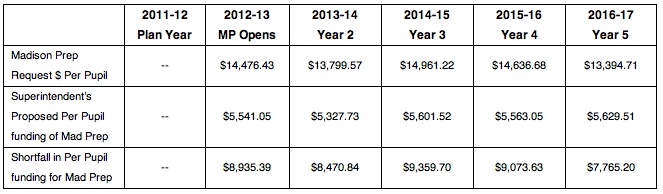
    Recent headlines in the Wisconsin State Journal (WSJ) reported that Madison Prep is “less likely” to be approved because of the size of the school’s projected budget. The article implied that Madison Prep will somehow cost the district more than it currently spends to educate children. This, in fact, is not accurate. We are requesting $14,476 per student for Madison Prep’s first year of operation, 2012-2013, which is less than the $14,802 per pupil that MMSD informed us it spends now. During its fifth year of operation, Madison Prep’s requested payment from MMSD drops to $13,395, which is $1,500 less per student than what the district says it spends now. Madison Prep will likely be even more of a savings to the school district by the fifth year of operation given that the district’s spending increases every year.
    A March 14, 2011 memo prepared by MMSD Superintendent Daniel Nerad and submitted to the Board reflects the Urban League’s funding requests noted above. This memo also shows that the administration would transfer just $5,541 per student – $664,925 in total for all 120 students – to Madison Prep in 2012-2013, despite the fact that the district is currently spending $14,802 per pupil. Even though it will not be educating the 120 young men Madison Prep will serve, MMSD is proposing that it needs to keep $8,935 per Madison Prep student.


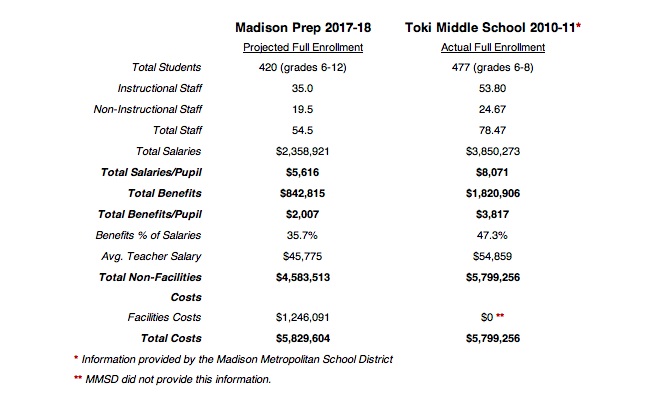
    Therefore, the Urban League stands by its request for equitable and fair funding of $14,476 per student, which is less than the $14,802 MMSD’s administration have told us they spend on each student now. As Madison Prep achieves economies of scale, reaches its full enrollment of 420 sixth through twelfth graders, and graduates its first class of seniors in 2017-18, it will cost MMSD much less than what it spends now. A cost comparison between Madison Prep, which will enroll both middle and high school students at full enrollment, and MMSD’s Toki Middle School illustrates this point.


    We have also attached four one-page documents that we prepared for the Board of Education. These documents summarize key points on several issues about which they have expressed questions.
    We look forward to seeing you!
    Onward!
    Kaleem Caire
    President & CEO
    Urban League of Greater Madison
    Main: 608-729-1200
    Assistant: 608-729-1249
    Fax: 608-729-1205
    Website: www.ulgm.org


    Kaleem Caire, via email.
    Madison Preparatory Academy Brochure (PDF): English & Spanish.
    DPI Planning Grant Application: Key Points and Modifications.
    Update: Madison School Board Member Ed Hughes: What To Do About Madison Prep:

    In order to maintain Madison Prep, the school district would have to find these amounts somewhere in our budget or else raise property taxes to cover the expenditures. I am not willing to take money away from our other schools in order to fund Madison Prep. I have been willing to consider raising property taxes to come up with the requested amounts, if that seemed to be the will of the community. However, the draconian spending limits the governor seeks to impose on school districts through the budget bill may render that approach impossible. Even if we wanted to, we likely would be barred from increasing property taxes in order to raise an amount equal to the net cost to the school district of the Madison Prep proposal.
    This certainly wouldn’t be the first time that budgetary considerations prevent us from investing in promising approaches to increasing student achievement. For example, one component of the Madison Prep proposal is a longer school year. I’m in favor. One way the school district has pursued this concept has been by looking at our summer school model and considering improvements. A good, promising plan has been developed. Sadly, we likely will not be in a position to implement its recommendations because they cost money we don’t have and can’t raise under the Governor’s budget proposal.
    Similarly, Madison Prep proposes matching students with mentors from the community who will help the students dream bigger dreams. Effective use of mentors is also a key component of the AVID program, which is now in all our high schools. We would very much like to expand the program to our middle schools, but again we do not have the funds to do so.

    Mr. Hughes largely references redistributed state tax dollars for charter/virtual schools – a portion of total District per student spending – the total (including property taxes) that Madison Prep’s request mentions. I find Madison Prep’s fully loaded school based cost comparisons useful. Ideally, all public schools would publish their individual budgets along with total District spending.

    Share

    Great Teacher for Every Course

    Tom Vander Ark:

    here are some problems that are too hard to solve in traditional ways. Teacher effectiveness and school choice fit the bill–they are complicated and contentious. The good news is that digital learning allows us to solve these problems in new ways.
    It’s pretty easy to solve the teacher problem if we focus on providing a ‘great teacher for every course’ rather than a great teacher in every classroom.’
    If educational funding follows the student to the best course available (online or onsite) it provides a much more powerful and accountable model than partial funding for a private school down the street.
    Digital Learning Now recommends that all students should be able to “customize their education using digital content through an approved provider.” More specifically, DLN recommends that states:

    Share

    Building Teacher Evaluation Systems: Learning From Leading Efforts

    The Aspen Institute:

    Ambitious reforms across the country are reshaping teacher evaluation and performance management. Designing new systems for measuring teacher effectiveness and using that information to increase student achievement are at the heart of these efforts and at the center of important policy debates. Yet little information exists about how these systems work in practice and how to use evaluations in concert with other levers to improve teaching and learning.
    As policymakers and education leaders seek to accelerate reform in this area, it is essential to learn from efforts already underway. The Education & Society Program published three new reports: profiles of the performance management work in District of Columbia Public Schools (DCPS) and the Achievement First (AF) charter school network; and a synthesis of issues that emerge from the two profiles. Both DCPS and AF are at the forefront of efforts to re-design teacher evaluation, performance management, and compensation policies. The commonalities, distinctions, and early lessons learned in these initiatives represent an important learning laboratory for the field.

    Share

    The Death and Life of the Great American School System: How Testing and Choice Are Undermining Education, a Review

    Reviewed by Katharine Beals, via a kind reader’s email:

    The Death and Life of the Great American School System was wildly hailed as author and education critic Diane Ravitch’s dramatic about-face on No Child Left Behind, charter schools, and school choice. What’s missing from this sensational take is that Ravitch has changed her mind only about school reform tactics, and not about what constitutes good schools, or about her top priorities in fostering them.
    She still stresses curriculum–apparently still her topmost priority. She still supports a challenging, content-rich core curriculum of the sort promoted by E.D. Hirsch and his Core Knowledge Foundation. She still believes that the best teachers are those with who know their fields well and are enthusiastic about teaching. She still believes that attracting such teachers is nearly as essential, if not as essential, as curriculum reform.
    It’s in the question of why we’ve strayed so far from these ideals that Ravitch has shifted. While her earlier research (c.f. Left Back, published in 2000) critiqued, inter alia, a variety of prominent fad-peddling members of the education establishment, Ravitch now appears to blame just three factors: the high-stakes testing and accountability of No Child Left Behind (NCLB); the meddling in education by powerful outsiders like politicians and businessmen; and school choice ventures that skim off the best students and leave the rest to the most struggling of public schools.
    On NCLB testing and accountability, Ravitch is convincing. Tests can be effective, comprehensive measures of achievement, in which case teaching “to” them is equivalent to teaching students what they should learn anyway. But, as Ravitch explains, NCLB’s top-down, high-stakes, punitive approach deters states from devising tests that come anywhere near this ideal.

    Share

    GOP seeks to expand school voucher program

    Matthew DeFour:

    A Republican Assembly leader plans to add to the state budget bill an expansion of Milwaukee’s voucher program to other school districts, potentially giving more families in cities such as Madison access to private and religious schools.
    Voucher advocates say the time is ripe to expand the program to other cities, especially with Republicans in control of state government and a recent study suggesting students in the 20-year-old Milwaukee program are testing as well or better than their public school counterparts, with a lower cost per pupil.
    They also argue that vouchers would level the playing field for private schools, which have seen enrollment decline as public charter schools have gained popularity.
    But voucher opponents say expansion would further cripple public schools, which already face an $834 million cut in state funding over the next two years.
    And state test scores to be released Tuesday, which for the first time include 10,600 Milwaukee voucher students, could suggest they are testing no better than poor students in the Milwaukee Public Schools.
    “Given the proposed unprecedented cuts to public education as well as results from our statewide assessments, I question plans in the 2011-13 state budget for expanding the choice program in Milwaukee or anywhere else in Wisconsin,” State Superintendent Tony Evers said.

    Share

    Community College vs. Student Loan Debt

    Ron Lieber:

    One of the articles in our special section on Money Through the Ages (produced in partnership with the public radio program Marketplace Money) is about an 18-year-old high school senior with a choice to make. Should he go into at least $6,500 in debt each year to attend a private college or university like Juniata or Clark, or is he better off working part time and attending community college for two years before transferring to one of those colleges?

    Zac Bissonnette, the author of Debt-Free U and a senior in college himself, encourages students and families to take on as little debt as possible. He urged the subject of our profile, Mino Caulton of Shutesbury, Mass., to consider the University of Massachusetts, though Mr. Caulton was worried that he wouldn’t get enough individual attention there.

    Share

    Video, Notes & Links: Wisconsin Senate Bill 22 Hearing

    via a kind reader’s email:

    Clusty Search: Wisconsin Senate Bill 22.

    Share

    A Nation of Dropouts Shakes Europe

    Charles Forelle:

    Isabel Fernandes, a cheery 22-year-old with a constellation of stars tattooed around her right eye, isn’t sure how many times she repeated fifth grade. Two, she says with a laugh. Or maybe three. She redid seventh grade as well. She quit school with an eighth-grade education at age 20.
    Ms. Fernandes lives in a poor suburb near the airport. She doesn’t work. Employers, she says, “are asking for higher education.” Even cleaning jobs are hard to find.
    Portugal is the poorest country in Western Europe. It is also the least educated, and that has emerged as a painful liability in its gathering economic crisis.
    Wednesday night, the economic crisis became a political crisis. Portugal’s parliament rejected Prime Minister José Sócrates’s plan for spending cuts and tax increases. Mr. Sócrates handed in his resignation. He will hang on as a caretaker until a new government is formed.

    Share

    Race, Poverty and the Public Schools

    Letters to the New York Times:

    Re “Separate and Unequal,” by Bob Herbert (column, March 22):
    In spite of the 1954 Brown v. Board of Education decision by the Supreme Court, sadly the struggle goes on. The Department of Education reported in 2008 that 70 percent of white schoolchildren attend schools where at least 75 percent of the students are white, whereas more than half of all black children in industrial states attend schools where over 90 percent are members of minority groups. Go into any urban school and it is clear that 57 years after Brown, the schools have largely remained segregated.
    Years of social science research have cited the benefits of integrated schools. In our work with the West Metro Education desegregation initiative in Minneapolis public schools, the students in grades 3 to 7 who got on the bus to attend suburban schools made three times the progress in both reading and math when compared with similar students who did not participate.
    Teacher quality remains a consistent important factor. Ultimately, though, students in diverse classrooms benefit from collaboration and teamwork with those whose family circumstances are different from theirs. Eric J. Cooper
    President, National Urban Alliance for Effective Education
    Stamford, Conn., March 22, 2011

    Share

    On Public Education

    Jerry Pournelle:

    “How Not to Lay Off Teachers” in today’s Wall Street Journal (link) rather weakly repeats something that everyone who studies the education mess knows. It’s worth your time if you have any doubts that seniority is not the right way to determine who should be paid public money to teach in public schools. Of course just because everyone knows something doesn’t mean much.

    The steep deficits that states now face mean that teacher layoffs this year are unavoidable. Parents understandably want the best teachers spared. Yet in 14 states it is illegal for schools to consider anything other than a teacher’s length of service when making layoff decisions.
    It gets worse. “Many people don’t realize that teachers are not evenly distributed nationwide,” says Tim Daly of the New Teacher Project, which has released a new report on the nationwide impact on quality-blind layoffs. “Fourteen states have these rules but about 40% of all teachers work in those states, and they’re the states with the biggest budget deficits.” In addition to New York, the list includes California, New Jersey, Pennsylvania, Ohio, Illinois and Wisconsin.

    Share

    What do students miss with a virtual education?

    Christopher Dawson:

    I had the chance to speak at a local university on Tuesday, talking to a class on cloud computing about the impact of technology (especially, of course, the cloud) on higher education. The class was great and was, itself, focused on team-based learning and simulations using a variety of cloud and web-based tools. What was even better, though, was the Q&A session with the students and my follow-up conversations with faculty and staff.
    Let me start with something that ZDNet’s digital video and photo blogger, Janice Chen, wrote in an unrelated discussion we were having about ZDNet’s upcoming 20th anniversary:

    Share

    Not-so-public education: A Colorado school voucher program seems likely to benefit mostly middle-class students and religious schools.

    Los Angeles Times

    Supporters of school vouchers like to say that their goal is to provide a higher-quality education for the children who need it most. The latest events in Colorado say otherwise. A voucher program there seems more likely to benefit middle-class children and religious schools than low-income public school students, and to worsen inequities in education.
    Last week, the board of the Douglas County School District voted for a pilot program that will give the parents of 500 of its 60,000-students about $4,500 each — 75% of what the district receives in per-pupil funding — to use toward tuition at participating private schools of their choice. Many of the private schools in the area are religiously based.
    Even in Colorado, where a dollar stretches a lot further than in Southern California, $4,500 falls significantly short of private school tuition. Most schools there range from about $7,000 up to $14,000. Clearly, the parents poised to benefit most from this taxpayer-sponsored perk are those with a few thousand to spare to fill in the price gap. There might be scholarships for some of the needier students — about 10% of the Douglas County students qualify for free or reduced-price school lunches — but no one is promising anything.

    Share

    The College Derby Andrew: Ferguson’s delightful plea for sanity about college admissions.

    Timothy Noah:

    I have this problem. I can’t read self-help books. Like everybody else, I’ve experienced my share of life challenges–“life challenges” being the self-help euphemism for “problems”–and I would never pretend not to need any help in facing them, solving them, or at least getting through them. I accept the principles of, and am myself no stranger to, modern psychotherapy. But whenever I try to cope with one of life’s predictable stress points by reading a self-help book, I can’t manage it. My eyes glaze over. I think “This person is an idiot,” or “This person thinks I’m an idiot,” or “Maybe I am an idiot, because I can’t follow this.” Within minutes I toss the book aside and start digging around for a decent novel.
    hat I’ve come to believe is that psychological advice isn’t worth much if it isn’t rooted in personal experience. So instead of reading self-help books I read memoirs about the kinds of experience I’m trying to cope with. It doesn’t especially matter whether the author went about confronting his problem in a sensible way, nor even, necessarily, whether the author came out of the experience with a clear understanding of what he did right and what he did wrong. For instance, just about the last person I’d look to for personal advice about anything is Joan Didion. But when my wife died six years ago, I devoured Didion’s best-selling memoir about widowhood, The Year of Magical Thinking, and then for good measure I read the script she wrote when she adapted it into a one-person show starring Vanessa Redgrave. (If asked to blurb either, I’d write, “Loopy but compelling.”) I read Donald Hall’s lovely book of poems about his wife’s death, Without, and Hall’s more tedious nonfiction reworking of the same material, The Best Day, The Worst Day. I read a mediocre book called Widow written three decades earlier by a publicist for Little, Brown named Lynn Caine, and a brilliant book–the gold standard on widowhood–called A Grief Observed, written four decades earlier by C.S. Lewis, an author I’d previously avoided like the plague. Some of these books were more helpful than others, but all provided some form of “self-help.” Meanwhile, a stack of self-help books pressed on me by well-meaning friends gathered dust.

    Share

    How Miami students can get a free college education

    Stacy Teicher Khadaroo:

    Miami Dade College announced Wednesday the American Dream Scholarship. The ‘free college’ offer could help boost college graduation rates – a goal of President Obama’s.
    College tuition is going up and financial aid is on the chopping block in many states, but in the Miami area, one college is offering successful high school graduates a price tag that’s hard to refuse: free.
    Miami Dade College – the largest institution of higher education in America, serving more than 170,000 students on eight campuses – announced its American Dream Scholarship on Wednesday. It will cover 60 credits at a value of about $6,500 – enough to earn a two-year degree or start in on one of the four-year programs offered by the community college.
    This spring’s high school graduates in Miami-Dade County will be the first to benefit from the “free college” offer. To qualify for the new scholarship, students must have a 3.0 grade-point average and score well enough on entry tests to show they don’t need remedial math or reading courses. Normally, about a third of the college’s entering students pass at that level.

    Share

    Hand-Crafted Digital Texts

    Scott McLemee:

    Despite an abiding preference for the traditional book, I started using an e-reader about seven months ago — and have found it insinuating itself into daily life, just as a key chain or wallet might. For there is a resemblance. A key chain or wallet (or purse) is, in a sense, simply a tool that is necessary, or at least useful, for certain purposes. But after a while, each becomes more than that to its owner. To be without them is more than an inconvenience. They are extensions of the owner’s identity, or rather part of its infrastructure.
    Something like that has happened with the e-reader. I have adapted to it, and vice versa. Going out into the world, I bring it along, in case there are delays on the subway system (there usually are) or my medical appointment runs behind schedule (likewise). While at home, it stays within reach in case our elderly cat falls asleep in my lap. (She does so as often as possible and has grown adept at manipulating my guilt at waking her.) Right now there are about 450 items on the device. They range from articles of a few thousand words to multivolume works that, in print, run to a few hundred pages each. For a while, my acquisition of them tended to be impulsive, or at least unplanned. Whether or not the collection reflected its owner’s personality, it certain documented his whims.

    Share

    In Preschool, What Matters More: Education or Play?

    Bonnie Rochman:

    It’s practically been relegated to superstar status in the annals of parenting lore: the Manhattan mom who sued her daughter’s $19,000-a-year preschool on grounds that the 4-year-old was not sufficiently prepared to tackle the entrance test for private kindergarten.
    Earlier this month, Nicole Imprescia filed her lawsuit against the York Avenue Preschool, claiming that her daughter, Lucia, was not primed to take the intelligence test and was instead relegated to a mixed-age classroom where talk revolved around — oh, the horror — shapes and colors. As a result, Imprescia withdrew her daughter from the preschool. (More on Time.com: Perspective on the Parenting Debate: Rich Parents Don’t Matter?)
    “The school proved to be not a school at all, but just one big playroom,” the suit stated.

    Share

    Questions Abound as the College-Rankings Race Goes Global

    Ellen Hazelkorn:

    It is amazing that more than two decades after U.S. News & World Report first published its special issue on “America’s Best Colleges,” and almost a decade since Shanghai Jiao Tong University first published the Academic Ranking of World Universities, rankings continue to dominate the attention of university leaders. Indeed, the range of people watching them now includes politicians, students, parents, businesses, and donors. Simply put, rankings have caught the imagination of the public and have insinuated their way into public discourse and almost every level of government. There are even iPhone applications to help individuals and colleges calculate their ranks.
    More than 50 country-specific rankings and 10 global rankings are available today, including the European Union’s new U-Multirank, due this year. What started as small-scale, nationally focused guides for students and parents has become a global business that heavily influences higher education and has repercussions well beyond academe.

    Share

    Parents want child with peanut allergy removed from school

    Amy Graff:

    As more kids are diagnosed with food allergies, more schools are faced with figuring out how to deal with students who require a special environment. Should schools be expected to inconvenience all students when only one of them has a severe peanut allergy? This debate is currently playing out at a school in Florida.
    A 6-year-old girl at a school in Florida has a peanut allergy so severe that she could have a reaction if she were to breath traces of nut dust in the air. Her elementary school in Edgewater, Fl., has taken extraordinary measures to accommodate her.
    All students are now required to wash their hands and rinse out their mouths before stepping inside the classroom. Desks must be regularly wiped down with Clorox wipes. School administrators have banned all peanut products and snacks are no longer allowed in the class. Earlier this month, a peanut-sniffing dog walked through the school to make sure everyone is following the rules.
    The school is legally obligated to take these safety precautions because of the Federal Disabilities Act, according to Nancy Wait, the the spokeswoman for Volusia County Schools.

    Share

    Hundreds attend, testify at legislative hearing on charter school changes

    Susan Troller:

    Testimony at the Capitol over a controversial bill that would strip control over charter schools from locally elected officials and place it in the hands of a politically appointed state-wide authorizing board drew hundreds on Wednesday to a standing-room-only Senate education committee hearing.
    Senate Bill 22, authored by state Sen. Alberta Darling (R-River Hills) would also fund independent charter schools ahead of traditional public schools. I wrote about the bill on Tuesday and it’s generated a robust conversation.
    Madison Superintendent Daniel Nerad testified in opposition to the bill, and so did local school board member Marjorie Passman. Kaleem Caire, president and CEO of the Urban League of Greater Madison and a strong proponent of the proposed boys-only Madison Preparatory Academy for minority students, testified in support of the bill. Madison Prep, if approved, will be a publicly funded charter school in Madison.

    Share

    Justice Department sues on behalf of Muslim teacher, triggering debate

    Jerry Markon:

    Safoorah Khan had taught middle school math for only nine months in this tiny Chicago suburb when she made an unusual request. She wanted three weeks off for a pilgrimage to Mecca.
    The school district, faced with losing its only math lab instructor during the critical end-of-semester marking period, said no. Khan, a devout Muslim, resigned and made the trip anyway.
    Justice Department lawyers examined the same set of facts and reached a different conclusion: that the school district’s decision amounted to outright discrimination against Khan. They filed an unusual lawsuit, accusing the district of violating her civil rights by forcing her to choose between her job and her faith.

    Share

    Teacher bonus program fails to lure and retain top teachers in Washington’s high-poverty schools

    Jim Simpkins, via email:

    – A $99 million teacher bonus program that Washington legislators designed to lure good teachers into high-poverty schools has not worked as intended, according to a new analysis from the University of Washington Bothell’s Center on Reinventing Public Education.
    “Not only has the $10,000 annual bonus failed to move effective teachers to high-poverty schools, it has also failed to make those teachers any more likely to stay in high-poverty schools than other teachers,” said the report’s author, Jim Simpkins.
    Washington State provides $5,000 bonuses to those teachers who undergo and pass the rigorous national board certification process, a credentialing program that marks its graduates as among the best teachers. The evidence, however, on whether national board certified teachers (NBCTs) are actually more effective teachers is mixed.
    In 2007, state legislators added a second $5,000 bonus for NBCTs who teach in a high-poverty school, defined as one where a large portion of students are on free or reduced-price lunches. According to the Center’s report, ” . . . less than 1% of Washington’s NBCTs move from low-poverty to high-poverty schools each year.”

    Share

    Harvard Isn’t Worth It Beyond Mom’s Party Chatter: Amity Shlaes

    Amity Shlaes:

    Anxious families awaiting April college admission news are living their own March Madness.
    Their insanity is captured in Andrew Ferguson’s new book, “Crazy U: One Dad’s Crash Course in Getting His Kid Into College” (Simon & Schuster). He describes the vanity of a desperate mother at a cocktail party who is dying to announce her daughter’s perfect SAT scores:
    “‘We were really surprised at how well she did,’ the mother would say, running a finger around the rim of her glass of pink Zinfandel.
    Her eyes plead: Ask me what they were, just please please ask.”

    Share

    Separate and Unequal

    Bob Herbert:

    One of the most powerful tools for improving the educational achievement of poor black and Hispanic public school students is, regrettably, seldom even considered. It has become a political no-no.
    Educators know that it is very difficult to get consistently good results in schools characterized by high concentrations of poverty. The best teachers tend to avoid such schools. Expectations regarding student achievement are frequently much lower, and there are lower levels of parental involvement. These, of course, are the very schools in which so many black and Hispanic children are enrolled.

    Share

    Newark teachers protest charter schools’ use of public school buildings

    Daniel Ulloa:

    The Newark Teachers Union sent an email to its 4,800 members urging them to protest against the placement of charter school in underutilized public school buildings at an Advisory board meeting held tonight at Barringer High School.
    According to the Wall St. Journal, Union President Joseph Del Grosso strongly objects to the placement of charter schools in public school buildings, claiming that some of the private funding that the Charter schools will make obvious the stark differences between the two types of schools.
    The meeting will begin at 6 P.M. Tuesday, and staff, students, and parents are all being invited to voice their concerns.

    Share

    Unions Give Teachers a Voice and a Platform From Which to Help Students

    Marc Korashan:

    When I began teaching in New York City in 1975 I didn’t initially see the need for a union or get involved in union activities. I knew, from history and the stories my parents and grandparents told, about the struggle for unions, but like so many today, I took the existence of a union and a contract for granted. My chapter leader gave me some advice and made sure I had all the necessary forms when I got appointed, but that was the sum of my union involvement until I moved to a position as an Education Evaluator on School Based Support Teams.
    In that position, as a Special Education Teacher/Education Evaluator, I was much more exposed to the whims of management than I had been as a classroom teacher. Administrators didn’t often walk into my SIE VIII classroom as most of them were afraid of the volatile students I taught. I worked with my co-teacher and we succeeded in making a difference for most of our students.

    Share

    As Little Girls and Boys Grow, They Think Alike

    Avery Johnson:

    Boys’ and girls’ brains are different–but not always in the ways you might think.
    A common stereotype is that boys develop more slowly than girls, putting them at a disadvantage in school where pressure to perform is starting ever younger. Another notion is that puberty is a time when boys’ and girls’ brains grow more dissimilar, accounting for some of the perceived disparities between the sexes.
    Now, some scientists are debunking such thinking. Although boys’ and girls’ brains show differences around age 10, during puberty key parts of their brains become more similar, according to recent government research. And, rather than growing more slowly, boys’ brains instead are simply developing differently.

    Share

    Georgia charter school ruling to reverberate across nation

    A state Supreme Court opinion that will decide who has the power to fund and open public charter schools is expected by March 31, ending a constitutional challenge that threatens to derail the education of thousands of students.
    The two-year legal battle launched by seven local districts over power, money and the exclusive right to open neighborhood schools has threatened Georgia’s reputation as a national leader in education reform.
    The feud began in 2009 when the Georgia Charter Schools Commission, a state board, got into the business of approving and funding neighborhood schools such as Cherokee Charter Academy.
    The school, which plans to open in the fall as Cherokee County’s first charter campus, received more than 1,300 applications for about 700 spots. It was denied twice by the Cherokee Board of Education.

    Share

    Bill Gates Seeks Formula for Better Teachers

    Stephanie Banchero:

    Bill Gates shook up the battle against AIDS in Africa by applying results-oriented business metrics to the effort. Now, he is trying to do the same in the tricky world of evaluating and compensating teachers.
    The Microsoft Corp. co-founder has moved on from a $2 billion bet on high school reform–much of it spent on breaking up big, failing high schools and replacing them with smaller ones.
    Now, he is venturing that improving teacher effectiveness is the key to fixing broken schools. The Bill & Melinda Gates Foundation has awarded $290 million to school districts in Memphis, Tenn.; Hillsborough, Fla.; and Pittsburgh, and a charter consortium in California to build new personnel systems Mr. Gates hopes will be models for the country.

    Share

    Republican bill calls for a board of political appointees to authorize charter schools

    Susan Troller:

    Under a Republican-sponsored bill, nine political appointees would get to authorize public charter schools while local school districts foot the bill. The creation of this state-wide charter school authorizing board — with members appointed by the governor and the leaders of the state Senate and Assembly — is a key provision of legislation authored by Sen. Alberta Darling of River Hills that will get a hearing on Wednesday at 10 a.m. at the Capitol before the Senate Education Committee.
    Senate Bill 22 not only de-emphasizes local control, but also creates changes in how teachers are certified and removes caps from the numbers of students who may enroll in virtual schools. A companion bill is also pending in the state Assembly.
    Opponents say the proposed changes would not only eliminate local control in favor of a new, politically motivated bureaucracy but would also siphon general aid away from all of Wisconsin’s 424 public school districts in favor of charters. But backers say it will remove current barriers that prevent charter schools from realizing their full potential.
    “This bill would get rid of the charter school lite culture we currently have in Wisconsin and allow these schools’ full potential for autonomy, flexibility and innovation to be fully realized,” says John Gee, executive director of the Wisconsin Association for Charter Schools.

    Related:
    School Choice Wisconsin: Milwaukee residents favor school choice expansion

    Share

    Teacher Tenure Reform: Applying Lessons from the Civil Service and Higher Education

    Public Impact:

    Research continues to confirm what intuition has told many of us for years: Teacher quality has a bigger impact on student learning than any other factor in a school. Nationwide, this finding has increasingly motivated policymakers and the public to focus reforms on dramatically improving teacher quality. National, state, and local leaders have initiated reforms designed to better prepare teachers for the classroom, more accurately identify and reward top teachers, support teachers’ development, and equip education leaders to identify and remove the very least-effective teachers.
    Discussions of teacher quality often lead to questions about which teachers are retained and dismissed in K-12 public schools, and thus to questions about tenure. Teacher tenure was designed in the early 1900s as a set of procedural protections against unfair and arbitrary dismissals.1 But today, concerns about the effect on student outcomes — along with budgetary constraints — dominate education reform discussions.
    As a result, leaders in a handful of states and districts have begun making changes to align their tenure systems with their goal of increasing student learning. Common changes include streamlining tenure protections and increasing the rigor of the tenure-granting process.2 Parallel efforts to improve the quality, accuracy, and rigor of educator evaluations have strengthened the basis for personnel decisions based on performance, and have fueled increased interest in tenure reform

    Share

    The Search for a New Way to Test Schoolkids

    Bill Tucker:

    Excerpt from Greg Toppo’s article:
    “…In other places, educators are experimenting with different ways to test what kids learn. Bill Tucker, a managing director at Education Sector, a Washington, D.C., think tank, says states like Oregon have led the way with so-called adaptive tests, computerized assessments that actually change as students answer questions right or wrong. Such tests satisfy the requirements of the No Child Left Behind law. Students sit for these tests any time they’re ready, from October on, and the tests allow schools to find out more about how much kids have learned. And since each test is essentially different from the last, they’re “harder to game,” Tucker says.
    In a bid to look beyond bedrock skills such as reading and math, a few states are also looking at other measures, such as how many of their high school graduates had to take remedial classes in college, Tucker says. Federal Race to the Top funding, part of the Obama administration’s education stimulus plan, is pushing states to develop databases that would allow states to track graduates.
    The federal government has also invested in two separate efforts by the states to overhaul tests; 45 states are participating. One project is aimed at developing so-called “through testing,” which would sample every few months how much students learn, then combine those scores with the score on an end-of-year test. The other project focuses on computer-adaptive tests, like those used in Oregon, to be given at year’s end.

    Share

    What the Department of Education’s “82 Percent of Schools Are Failing” Statistic Really Tells Us

    Rachel Sheffield:

    According to the Obama Administration, the majority of the nation’s schools could be failing.
    In a statement to the House Committee on Education and the Workforce just over a week ago, U.S. Secretary of Education Arne Duncan said that under the current No Child Left Behind law, 82 percent of the nation’s schools may not be sufficiently educating students. But this is debatable.
    It is true that far too many schools in the United States are not providing students with a good, or even remedial, education. Children in the U.S. continue to fall behind their peers internationally, and too few students are able to reach proficient levels in crucial areas like reading and math. This spells tragedy for the future of our nation.

    Share

    Education reform: the problem with helping everyone reach ‘average’

    Ann Robinson
    The alarm clock is sounding on American education. While China’s emergence as an educational powerhouse is relatively new, the continued poor performance by US students – though improved, still 31st place in math on the most recent international test – is not. Today, Shanghai tops the charts, but yesterday, it was other nations. Even a casual observer of education news knows the US long ago ceded its place as world leader in student performance. It’s an unsettling state of affairs.
    West loses edge to Asia in education: Top five OECD findings
    But what’s more unsettling is how prominent education leaders like Education Secretary Arne Duncan have called America’s sorry standing a “wakeup call.” President Obama has called for a new “Sputnik moment” to reignite the nation’s commitment to science education. But the wakeup alarm didn’t just start going off. It sounded decades ago; the US has just repeatedly hit the snooze button.
    The crisis in American education includes both our overall poor national performance and the miniscule numbers of US students achieving at the highest levels. Even our best students are less competitive. The problem with previous education reform efforts is that they have poured time, money, and resources into bringing all students up to proficiency – at the expense of our most gifted students. If we want the best educational performance, we have to target our brightest students, not ignore them in the fight to help everyone reach “average.”
    Moving from paper to practice
    We’ve been inundated with reams of reports, studies, and expert panels advising us how to fix this problem. During one week last fall, two government-convened panels released reports full of prescriptions for what the nation must due to reclaim its position as a leading innovator.
    The reports by the President’s Council of Advisors on Science and Technology (PCAST) and the National Science Board offer a plethora of recommendations including better teacher training, creating 1,000 new STEM-focused (science, technology, engineering, and mathematics) schools, and holding schools accountable for the performance of high-achieving students.

    (more…)

    Share

    Teaching to the Text Message

    Andy Selsberg:

    I’VE been teaching college freshmen to write the five-paragraph essay and its bully of a cousin, the research paper, for years. But these forms invite font-size manipulation, plagiarism and clichés. We need to set our sights not lower, but shorter.
    I don’t expect all my graduates to go on to Twitter-based careers, but learning how to write concisely, to express one key detail succinctly and eloquently, is an incredibly useful skill, and more in tune with most students’ daily chatter, as well as the world’s conversation. The photo caption has never been more vital.
    So a few years ago, I started slipping my classes short writing assignments alongside the required papers. Once, I asked them, “Come up with two lines of copy to sell something you’re wearing now on eBay.” The mix of commerce and fashion stirred interest, and despite having 30 students in each class, I could give everyone serious individual attention. For another project, I asked them to describe the essence of the chalkboard in one or two sentences. One student wrote, “A chalkboard is a lot like memory: often jumbled, unorganized and sloppy. Even after it’s erased, there are traces of everything that’s been written on it.”

    Share

    It’s School Admissions Season in New York City: Does your 18-month-old have what it takes?

    Katie Roiphe:

    When T.S. Eliot wrote about the cruelest month “mixing memory and desire”, he might also have had in mind that this is the season of school admissions in New York City. So as the sooty piles of snow melt into gray puddles, parents obsess over the letters they will and won’t receive from the school that will or won’t confer on their radiant progeny the blessing of its approval. It seems to be a challenge in this season for even the more sensible parents among us, even those who really have better things to do, not to fall prey to the prevailing fantasy that if your child is rejected from one of these desirable and enlightened places, he or she will be destined for a life of drug addiction, grand theft auto, or general exile.
    My 18-month-old recently had his first school interview. Apparently he sailed through it, though how is somewhat mysterious to me. Especially since he calls all fruits “apples” and sentences such as “Mommy. Moon. Get it” are not necessarily indicative of a huge understanding of the workings of the universe. However, no one is too young for the system, and a small obstacle like language cannot be permitted to get in the way of the judging and selecting and general Darwinian sorting to which it is never too soon to accustom yourself in this city. I have been asked to write recommendations for other one-and-a-half-year-olds for this same lovely school, and have thought of, but did not actually write, “He knows a lot about trucks.”

    Share

    Better education takes team work

    Kathleen Monohan Romano:

    Suzanne Fields writes in her March 5 column that teachers should put pupils first. I am appalled that teachers are being blamed for the state of education and the economy.
    I have been a teacher in the Capital Region for 25 years and have had the privilege of working with highly qualified, dedicated, hardworking professionals. Yes, we consider ourselves professionals. The union has fought to improve salaries and working conditions, and protect workers from favoritism.
    U.S. schools lag behind those in other countries because of America’s culture. There has been a decline in discipline, self-discipline and structure in the home, as well as a host of other social problems. Teachers should be respected by their students and the families they serve; instead, they are unfairly under attack. Students in other countries work harder; their culture is one of respect for education and teachers.

    Share

    The College Board Honors 4 Districts with Advanced Placement District of the Year Awards:
    Districts in Chicago; Tampa, Fla.; Hudson County, N.J.; and San Bernadino, Calif. to Be Recognized at the AP® Annual Conference in July

    The College Board:

    AP Achievement List of 388 school districts that have had similar successes.
    “These districts are defying expectations by expanding access while improving scores,” said College Board President Gaston Caperton. “They are experimenting with initiatives and strategies that have driven increases in average exam scores when making AP available to a much broader and more diverse student population. Over the next two months we will work closely with each of the AP District of the Year winners to document what they are doing so we can share their best practices with all members of the AP community.”

    Wisconsin Districts that achieved recognition:
    Appleton Area School District
    Columbus School District
    D C Everest Area School District
    Diocese of Madison Education Office
    Germantown School District
    Green Bay Area Public Schools
    Kimberly Area School District
    Marshfield School District
    Menomonie Area School District
    Middleton-Cross Plains Schools
    Monroe School District
    Mt Horeb Area School District
    Mukwonago Area School District
    School District of Hudson
    School District of Rhinelander
    Stevens Point Area Public School District
    Trevor-Wilmot Consolidated School District
    Watertown Unified School District
    Wauwatosa School District
    West Bend School District

    Share

    As Thomas Jefferson High School adds help for poor English skills, some Va. parents fume

    Kevin Sieff:

    As Northern Virginia became home to more immigrant families in recent decades, Fairfax County officials say they started programs to teach English as a second language at every school – about 200 of them. Except one.
    The holdout was the region’s hallowed magnet school, Thomas Jefferson High School for Science and Technology, where many assumed that steep admissions standards rendered such a program for English language learners unnecessary.
    But next year, at the behest of the school’s teachers, Thomas Jefferson – often called TJ – plans to hire its first instructor to cater to a growing number of students who thrive in math and science classes but sometimes struggle with English.
    The decision to hire the half-time teacher has reinvigorated a debate about TJ’s mission – namely, how heavily the school’s admissions policy should favor math and science standouts over well-rounded applicants with superior reading and writing abilities.

    Share

    Wisconsin Kids caught in the middle of stalemate between Walker, teachers union

    Chris Rickert:

    Meanwhile, American kids, when compared with those in other countries, are in the middle of the pack or worse when it comes to reading, math and science proficiency, according to a study released last week. And locally, Madison schools struggle with rising numbers of low-income students and poor minority graduation rates.
    These are not problems that can be solved by killing teachers unions, nor with teachers unions unwilling to participate in real reform.
    But I suppose that as long as Walker and the unions remain in fight mode, solutions will have to wait.

    Share

    The search for a new way to test schoolkids

    Greg Toppo:

    By all accounts, George Washington Elementary School is the very model of a modern urban public school.
    Tucked into an up-and-coming neighborhood west of downtown, the school has produced impressive results on annual Maryland School Assessment (MSA) math and reading tests over the past several years. By 2007, scores had improved so steadily that the U.S. Department of Education made it a National Blue Ribbon School of Excellence. First lady Laura Bush came to town to hand out the award.
    But in October 2008, a parent came forward with a troubling complaint: Someone was tampering with answer bubble sheets at Washington Elementary.
    Soon, Baltimore Schools CEO Andres A. Alonso showed up at a PTA meeting at Washington and found “very poor” parent turnout and “an absence of student or staff enthusiasm,” according to city records.

    Share

    Report: Teacher quality crucial: Meeting targets best practices for nation’s educators

    Associated Press:

    Countries that outpace the U.S. in education employ many different strategies to help their students excel. They do, however, share one: They set high requirements to become a teacher, hold those who become one in high esteem and offer the instructors plenty of support.
    On Wednesday and today, education leaders, including U.S. Education Secretary Arne Duncan, the nation’s largest teacher unions, and officials from the highest scoring countries, are meeting in New York to identify the best teaching practices.
    The meeting comes after the recently released results of the Programme for International Student Assessment exam of 15-year-olds alarmed U.S. educators. Out of 34 countries, it ranked 14th in reading, 17th in science and 25th in math.
    “On the one hand, the United States has a very expensive education system in international standards,” said Andreas Schleicher, who directs the exam. “On the other hand, it’s one of the systems where teachers get the lowest salaries.
    “Then you ask yourself, how do you square those things?”

    Investors:

    Some 16 countries’ teachers union leaders and education ministers say the U.S. must “raise the status of the teaching profession”– meaning spend more money. We’ve wasted enough. Let’s reduce unions’ power.
    Defenders of government control of education will believe any and every explanation for failure — except government control.
    Andreas Schleicher, the head of the division of the Organization for Economic Cooperation and Development that conducts evaluations of the scholastic performance of different countries’ 15-year-old pupils every three years, complains in a new report about the image of educators in America.
    “The teaching profession in the U.S. does not have the same high status as it once did,” he says, “nor does it compare with the status teachers enjoy in the world’s best-performing economies.”

    Share

    An interview with Henna Virkkunen, Finland’s Minister of Education

    Justin Snider:

    The Hechinger Report: It’s well-known that Finland’s teachers are an elite bunch, with only top students offered the chance to become teachers. It’s also no secret that they are well-trained. But take us inside that training for a moment – what does it look like, specifically? How does teacher training in Finland differ from teacher training in other countries?
    Virkkunen: It’s a difficult question. Our teachers are really good. One of the main reasons they are so good is because the teaching profession is one of the most famous careers in Finland, so young people want to become teachers. In Finland, we think that teachers are key for the future and it’s a very important profession–and that’s why all of the young, talented people want to become teachers. All of the teacher-training is run by universities in Finland, and all students do a five-year master’s degree. Because they are studying at the university, teacher education is research-based. Students have a lot of supervised teacher-training during their studies. We have something called “training schools”–normally next to universities–where the student teaches and gets feedback from a trained supervisor.
    Teachers in Finland can choose their own teaching methods and materials. They are experts of their own work, and they test their own pupils. I think this is also one of the reasons why teaching is such an attractive profession in Finland because teachers are working like academic experts with their own pupils in schools.

    Share

    Superman & Teacher Evaluation

    Elizabeth Coffman:

    There’s been a lot of negative media lately, particularly surrounding education and teachers’ unions in Wisconsin, Ohio and Florida.
    My children attend a Florida public high school that is ranked as one of the top five best schools in the state for academics, and consistently ranked number one in football and volleyball. They have an extensive Advanced Placement course program that is so popular that my kids cannot get into all of the AP courses that they want. The courses are large and overenrolled, but at least they are challenging.
    From my perspective as a parent and a college educator, most of my kids’ high school teachers have been excellent. A few, however, have been inferior — a situation that does not really surprise me. As a former department chair and evaluator of faculty performance at the college level, I understand how flawed and difficult the evaluation process can be. I also understand how faculty have different strengths and weaknesses. The weaker scholar with the higher student GPA average may be the person who provides after-hours counsel to students in trouble. The faculty with the lower student evaluations and course G.P.A.’s may be the most intellectually challenging faculty in the classroom — the one who students learn to appreciate after they graduate. And then there are a few faculty who should probably leave education entirely, but will not go and cannot be fired without difficulty, if they have tenure. All of these issues–teacher evaluation, compensation, tenure–are on the political table right now for public schools. Florida is one of the states that is pushing a bill to link secondary student performance to better teacher retention and merit pay. New Florida Governor (and Tea Party favorite) Rick Scott supports a bill in which teacher evaluations are no longer subject to the collective bargaining process, only pay and benefits are negotiated. Teachers’ unions are unhappy about the methods (and the rhetoric) that many politicians are using for evaluating them and their classrooms. It’s unfortunate how this clash between workers and management is playing out in the classroom.

    Share

    The Inevitable Wisconsin

    Hans Moleman:

    In the words of Young Frankenstein’s Inspector Kemp, “A riot iss an ogly think.” So is the Wisconsin shootout; ugly – but inevitable.
    The unions had to be expecting a tough time with their new Governor Walker. No doubt they anticipated a difficult negotiation – “hard bargaining”, as the governor cut labor costs to balance the budget. Instead, they found themselves facing political forces who actually intend to put an end to them.
    Unions have always decried every effort to rollback labor costs or union power as “union-busting.” Now their past rhetorical excesses have caught up with them, as they confront the real thing. (Cf “Wolf, the Boy who Cried…”)
    At first it looked as if Walker was indeed bargaining hard. Rolling back pensions, increasing employee contributions, and making labor accept it as a compromise by agreeing not to end collective bargaining outright. And there would be the peace, as Don Barzini would say.
    Well, gentlemen may cry “peace, peace,” but there is no peace. Before it could be seen if Walker was a “let’s make a deal” type, Democrats abandoned the state and the unions seized the Capitol to bully the governor and Republicans. They in turn found a parliamentary bypass and passed the bill to strip bargaining rights. The budget, with its real benefit reductions and budget cuts is still pending. But the unions appear to have used up most of their ammo, so their hopes cannot be high.

    Share

    College Degree Fails to Promote Active Civic Engagement Beyond Voting

    Intercollegiate Studies Institute:

    nlightened Citizenship: How Civic Knowledge Trumps a College Degree in Promoting Active Civic Engagement is the fifth report to the nation issued by ISI’s National Civic Literacy Board. While each past study has had a different point of emphasis, all share a common thread of examining the relationships that exist between higher education, civic knowledge, and citizenship.
    Unfortunately, the results of ISI’s past civic literacy research does not inspire confidence that our institutions of higher learning are living up to their educative and civic responsibilities, responsibilities that almost all American colleges recognize as critical to their overall public missions.
    In 2006 and 2007, ISI administered a sixty-question multiple-choice exam on knowledge of American history and institutions to over 28,000 college freshmen and seniors from over eighty schools. In both years, the average freshman and senior failed the exam.
    In 2008, ISI tested 2,508 adults of all ages and educational backgrounds, and once again the results were discouraging. Seventy-one percent of Americans failed the exam, with high school graduates scoring 44% and college graduates also failing at 57%.

    Share

    On Creative Writing

    Andrew Cowan:

    Creative writing is an academic discipline. I draw a distinction between writing, which is what writers do, and creative writing. I think most people in the UK who teach creative writing have come to it via writing – they are bona fide writers who publish poems and novels and play scripts and the like, and they have found some way of supporting that vocation through having a career in academia. So in teaching aspirant writers how to write they are drawing upon their own experience of working in that medium. They are drawing upon their knowledge of what the problems are and how those problems might be tackled. It’s a practice-based form of learning and teaching.
    But because it is in academia there is all this paraphernalia that has to go with it. So you get credits for attending classes. You have to do supporting modules; you have to be assessed. If you are doing an undergraduate degree you have to follow a particular curriculum and only about a quarter of that will be creative writing and the rest will be in the canon of English literature. If you are doing a PhD you have to support whatever the creative element is with a critical element. So there are these ways in which academia disciplines writing and I think of that as Creative Writing with a capital C and a capital W. All of us who teach creative writing are doing it, in a sense, to support our writing, but it is also often at the expense of our writing. We give up quite a lot of time and mental energy and also, I think, imaginative and creative energy to teach.

    Share

    Let Kids Rule the School

    Susan Engel:

    IN a speech last week, President Obama said it was unacceptable that “as many as a quarter of American students are not finishing high school.” But our current educational approach doesn’t just fail to prepare teenagers for graduation or for college academics; it fails to prepare them, in a profound way, for adult life.
    We want young people to become independent and capable, yet we structure their days to the minute and give them few opportunities to do anything but answer multiple-choice questions, follow instructions and memorize information. We cast social interaction as an impediment to learning, yet all evidence points to the huge role it plays in their psychological development.
    That’s why we need to rethink the very nature of high school itself.

    Share

    Teachers will move forward

    Mary Bell

    Wisconsin’s public school teachers and support staff are reeling after a week in which our state leaders put political ambitions before their constituents.
    When the governor signed into law his unprecedented attack on workers’ rights, he did so amidst plummeting approval ratings and an intense and growing base of Wisconsinites who are outraged by the actions he is taking to destroy our great state.
    Make no mistake, this disregard for public opinion and workplace rights will have a broad and lasting negative impact on our state’s future. From schools to hospitals to public services – and ultimately, to middle-class families across this state, the damage these actions set into place will be deep and wide.
    On behalf of educators across our state, I remind you that weeks ago we accepted the financial concessions the governor asked for to help solve our state’s budget crisis. But we have consistently said that silencing the voices of workers by eliminating their collective bargaining rights goes too far.

    Mary Bell is a Wisconsin Rapids junior high teacher with 33 years experience in the classroom. She is serving as president of the Wisconsin Education Association Council.

    Share

    Teachers must be evaluated by what students learn

    Doug Lasken & Bill Evers:

    Students in California public schools are not achieving at the levels they should. Too many students are unprepared for jobs or have to take remedial courses when they start college. In California, we judge student achievement through student scores on statewide tests. These tests assess how much students know about subject-matter content that is specified in an official set of state academic-content standards. Research has long shown that effective teachers are among the best ways to bring up student achievement. But in order to improve teaching effectiveness, it is helpful to know where the challenges are.
    We’ve heard a lot in California recently about the move to factor student test scores from statewide standards-based tests into teacher evaluations. Yet did you know that for more than a decade, it has been the law in California to do just that?

    Share

    Madison School Board Tension over Spending/Taxes & Compensation

    Bill Lueders:

    Gov. Scott Walker says the changes he has rammed through the Legislature will give school districts and local governments “the tools” they need to withstand the severe cuts in state aid his budget will deliver. What he doesn’t get into is how the tensions caused by his agenda will divide the members of these bodies, as they have the state as a whole.
    One example of this is the Madison school board, where disagreements over the impact of Walker’s actions have spurned an ugly exchange, in which school board member Lucy Mathiak lobbed an F-bomb at a fellow board member, Marj Passman.
    The exchange happened yesterday, March 14. Passman was contacted by a Madison school teacher who felt Mathiak had been dismissive of the teacher’s concerns, urging her to “get over yourself.” Passman, who allows that board members have been deluged with angry emails, says she expressed to Mathiak that she agreed this response was a little harsh.

    Somewhat related: Jason Shepherd: Going to the mat for WPS
    School board yields to pressure to keep costlier insurance option

    Suzanne Fatupaito, a nurse’s assistant in Madison schools, is fed up with Wisconsin Physicians Service, the preferred health insurance provider of Madison Teachers Inc.
    “MTI uses scare tactics” to maintain teacher support for WPS, Fatupaito recently wrote to the school board. “If members knew that another insurance [plan] would offer similar services to WPS and was less expensive – it would be a no-brainer.”
    WPS, with a monthly price tag of $1,720 for family coverage, is one of two health coverage options available to the district’s teachers. The other is Group Health Cooperative, costing $920 monthly for a family plan.
    During the past year, the Madison school board has reached agreements with other employee groups to switch from WPS to HMO plans, with most of the savings going to boost pay.
    In December, the board held a secret vote in closed session to give up its right to seek health insurance changes should negotiations on the 2007-09 teachers contract go into binding arbitration. (The board can seek voluntary insurance changes during negotations.)

    Lucy has been a long time friend and I have long appreciated her activism on behalf of students, the schools and our community.

    Share

    1 Billion Customers for Education

    Sanjay Saigal:

    The sixteenth century universalist poet Kabir captures the high Indian regard for education:
    गुरु गोबिंद दोऊ खडे, काके लागूं पाये
    बलिहारी गुरु आप की, गोबिंद दियो मिलाये
    To whom should I bow, my Guru or the Lord?
    I bow to thee, O Guru, for you have shown me God
    A host to universities since before the time of Christ, India has long revered learning, which, along with spirituality have been the pillars of the Indian notion of civilization (Sankriti). Despite the history, at the time of independence in 1947, only one in five citizens was literate. In independent India, equitable access to education was considered of first importance, hence the sector came under the purview of the government.
    Until economic liberalization in 1991, India’s best tertiary institutions were exclusively public funded. These included the well-known Indian Institutes of Technology (IITs) and the Indian Institutes of Management (IIMs). The first private university was recognized in 1995 – today, India has 77. Most private universities are run on unabashedly profit-oriented lines. While the better ones compete with the top public institutions, most do not. Philanthropic support of college and universities is weak, even as the ranks of the wealthy grows in strength.

    Share

    Guido Sarducci and the Purposes of Higher Education

    Sandy Baum and Michael McPherson:

    The way college courses generally work is that a teacher presents a group of students with some subject matter, then attempts through tests and papers to determine how well the students have mastered the subject matter. Those judgments are summarized in a letter grade. A list of those subject matters and grades constitutes the transcript that describes what the student has learned and what the student’s performance was overall.
    The students and the teacher are focused on the subject matter, and the implied view is that the learning in college is captured in the exercises that inform those grades. The limitations of this “subject matter recall” model of higher education are hilariously captured in Don Novello’s comic performance on Saturday Night Live as Father Guido Sarducci, who marketed the “Five Minute University”: http://youtu.be/kO8x8eoU3L4

    Share

    Teacher says debate has ignored a crucial issue: parents

    Robert King:

    Evan Camp’s frustration had built up to the point where he couldn’t shed it even by feverishly cleaning his house.
    To him, all the talk about education reform seemed to be about punishing teachers, especially the part about tying teacher pay to test scores.
    So Camp, a middle school science teacher in Greenwood, started jotting down thoughts as he cleaned one Saturday afternoon. Soon, he had enough material to write a tome for beleaguered teachers that would become an open letter to Gov. Mitch Daniels and state Superintendent of Public Instruction Tony Bennett.

    Share

    Idaho lawmakers want to give kids computers and require some online courses. Idaho Virtual Academy has done it for 9 years

    Kristine Rodine:

    Based in a Meridian business park and powered by the K12 education company, the Idaho Virtual Academy is the state’s oldest and largest online charter school, with 3,000 students from 43 counties.
    State Superintendent Tom Luna’s education reform would give students computers and require some online classes. His proposals, stuck in the Senate Education Committee for the past two weeks, would not affect the Virtual Academy, but the current debate has fostered numerous misconceptions about virtual education, according to academy staff and students.
    “The biggest misconception is that the computer replaces the teacher,” academy Head of School Desiree Laughlin said. More than 80 certified teachers who live and work in Idaho teach the classes, and learning coaches, generally parents, oversee the home study.

    Share

    Vouchers advance in Pennsylvania and Washington, D.C.

    The Wall Street Journal:

    The U.S. is enjoying a new spring of education reform, with challenges to teacher tenure and “parent-trigger” for charter schools. So it’s natural that the mother of all school choice reforms–vouchers–is also making a comeback.
    Last week a House committee voted to restore Washington, D.C.’s opportunity scholarship program, which lets kids in persistently failing schools attend a private school of the family’s choosing. Joe Lieberman is pushing similar legislation in the Senate, where it enjoys bipartisan support. The White House and teachers unions killed the program in 2009, despite clear evidence of academic gains.
    Meanwhile, more states are realizing that true educational choice extends beyond charter schools. The most promising development is occurring in Pennsylvania, where a state-wide voucher bill supported by new Governor Tom Corbett is moving through the Republican-controlled legislature.

    Share

    The Classroom vs. the Workshop

    Edmund de Waal:

    When I was a child there was a truism that anyone could make something (a rabbit hutch, say) or mend something (a bicycle) if they had a classical education. It was felt that using intellectual tools–parsing a bit of Latin history, constructing an argument–was training enough for taking on the material world. Learning gave you a steady approach to the tricksiness of the world of things. Lurking behind this belief was an attitude of de haut en bas; condescension towards those working with their hands.
    This annoyed me. Partly because I could only stumble through my Latin lessons but mostly because my afternoons were spent in a pottery workshop learning to throw pots. It was clear to me–a white apron over my school uniform as I kneaded the clay to take out the air bubbles and give it the right consistency, pulled the long twisted wire made from rabbit snares, divided it into 4-ounce balls and sat at my kick wheel in the corner readying myself for my hours of practice–that this was different from classroom learning.

    Share

    Demonize data on teaching at our state’s (California) peril

    Jim Wunderman:

    The facts are hard.
    A generation ago, California had what was considered the best education system on the planet.
    Today, our daughters and sons attend one of the worst-performing education systems in the industrialized world.
    We are failing on the rock-bottom basics. California students’ ability to read is ranked 49th in the country by the U.S. Department of Education. Our kids’ ability to do math is ranked 47th and we are second to worst in science. Compared globally, the situation darkens further. Of the top 35 nations, the United States is ranked 29th in science and 35th in math. Your neighborhood school might be good by California standards, but that is a very low bar indeed. Our education crisis is a human tragedy and a looming economic disaster.
    The Bay Area Council resolutely refuses to accept this crisis as our state’s fate. Let’s get past the political gridlock and get down to the real business of dramatically improving California schools. We know, as every honest study has shown, that it will take a combination of real dollars and major changes in the way we deliver education.

    Share

    K-12 Tax & Spending Climate: Outgoing Democrat Representative Dave Obey’s Midnight Bonuses

    Michael Horne:

    Retired Rep. Dave Obey, the Wausau Democrat who was known for running a lean congressional office, left office after giving a nice taxpayer-funded gift to his staff in the form of an 84 percent salary bonus. Obey ranked eighth among all 435 members of the House of Representatives in his fourth quarter generosity to staff.
    The practice of jacking up fourth quarter salaries for staffers is something that several members of Wisconsin’s congressional delegation – led by Republican representatives Thomas Petri (Wisconsin’s 6th District), F. James Sensenbrenner (5th Dist) and Democrat Gwen Moore (4th Dist.) – have engaged in over the last decade.
    DAVE OBEY
    The “4th Quarter Bonus,” as it has been called by Capitol insiders, is now documented thanks to the researchers at LegiStorm, an organization that catalogues and categorizes Congressional financial data. Congressional salary data is reported quarterly and was released March 1. In every year, there is a pronounced spike in fourth-quarter staff salaries that averages 20 per cent among members of the House of Representatives.
    In the fourth quarter of 2010, fueled by bonuses that were largely fed by departing members – mostly retiring or defeated Democrats like Obey – congressional staff salary expenditures exceeded $200 million for the first time, totaling $201.7 million. LegiStorm reported that bonuses were nearly twice as large for staffs of departing House members as they were for continuing members.

    Related: US debt clock: The outstanding public debt as of 3/13/2011 @ 8:01:46p.m. is $14,175,382,249,980.58 which is $45,698.37 per citizen.

    Share

    In Virginia assault case, anxious parents recognize ‘dark side of autism’

    Theresa Vargas:

    When a Stafford County jury this month found an autistic teenager guilty of assaulting a law enforcement officer and recommended that he spend 101/2 years in prison, a woman in the second row sobbed.
    It wasn’t the defendant’s mother. She wouldn’t cry until she reached her car. It was Teresa Champion.
    Champion had sat through the trial for days and couldn’t help drawing parallels between the defendant, Reginald “Neli” Latson, 19, and her son James, a 17-year-old with autism.

    Share

    Teachers shouldn’t be judged by test scores alone

    David Sanchez:

    There are those who think the best way to determine teacher effectiveness is by looking only at students’ test scores. The simplicity of this approach can be seductive, but it is inherently flawed. This approach only makes sense if you assume all children come to school with the same abilities, have the same educational resources and opportunities and return home to the same support systems. As a kindergarten teacher for more than 30 years, I can confirm what you already know to be true: Every child is different.
    The fact of the matter is student achievement and teacher effectiveness aren’t simple to measure, and the results of one test are not going to offer a complete assessment of either. Many different measures must be used in order to determine true effectiveness.
    So how do you define teacher effectiveness? How to evaluate it? How to reward it? These are all good questions. Most research will tell you an effective teacher is one of the most important factors in a student’s education, and I would agree. Research will also tell you that many other factors can and do influence student success: poverty, hunger, homelessness, language skills, parental involvement and education, the learning environment, hormones and personal motivation.

    Share

    Proposed budget makes all-male charter school in Madison less likely

    Matthew DeFour:

    The chances the Madison School Board will approve an Urban League proposal for an all-male charter school geared toward low-income minorities are dwindling.
    Madison Preparatory Academy would cost the district $1.1 million in 2012-13, its first year of operation. That would increase to $2.8 million by its fifth year, Superintendent Dan Nerad told the board last week.
    “For each of these years, (the district) would be obligated to reduce programs and services to our existing schools to transfer this amount of money to Madison Prep,” Nerad wrote in a memo.
    Some school board members said last week that Gov. Scott Walker’s budget proposal makes it less likely they will be able to support cutting other programs to find money for Madison Prep.

    Share

    Who has plan to lift teachers’ gloom?

    Alan Borsuk:

    So much tumult lately. It’s hard to focus on just one thing. So here are four short columns instead of one long one.
    Column 1
    Forget the Viagra. The teachers I’ve been in touch with lately need Prozac.
    Somewhere in the chaos of last week, the Milwaukee teachers union confirmed that it had given up the fight for its members’ rights to have drugs for sexual dysfunction covered by their insurance (a stand that, whatever its merits, belongs in the Hall of Fame of public relations blunders).
    But depression among teachers – now that’s a serious subject. Maybe not genuine, clinical depression. Rather, bad-morale, pessimistic, stressed-out, I-think-it’s-only-going-to-get-worse depression.
    Maybe the unhappiness will blow over. Daily routines tend to win out in our minds. Or maybe you think ill will is just a necessary by-product of the mother of all comeuppances that teachers deserved and got at the hands of Gov. Scott Walker and the legislative Republicans.
    But marking the 150th anniversary of the start of the Civil War by staging a new one in Wisconsin will have long-term consequences on teachers and teaching. Some maybe on the upside. Some will have lasting effects as downers. Who goes into teaching, who stays, what the work is like – there will be big issues to sort out.

    I sincerely hope that Wisconsin political, education and civic leaders take the lead on new education opportunities, rather than follow. Minnesota Democrat Governor Mark Dayton just signed an alternative teacher licensing law days ago. Janet Mertz advocated for a similar model for math & science teachers via this 2009 email. Education model, curricular and financial changes are certainly well underway.

    Share

    Life Beyond Autism

    Janet Grillo:

    It’s been 81 years since Virginia Wolff published her famous essay, more than 20 since I read it, and even more before I followed her advice that “a woman must have a room of her own, if she is to write.”
    When my mother was my age, she considered the best part of her life as behind her. When my grandmother was this age, considered herself “old.” And my great-grandmother most certainly was. But that was then, and this is the era of longevity, vitality and change. We’ve rewritten all the rules. But maybe rules are only scaffolds we construct to contain what we can’t control. Which is just about everything.
    My dreams and expectations changed radically when my child was diagnosed with Autism. From that moment, and for the next decade, every thought in my head, urge in my heart and pulse in my body was redirected to helping him. When your child is diagnosed as on the Spectrum, you’re told that much can improve, but most profoundly before the age of 5. My son was already three. So the clock was ticking, the meter was running, and I had a choice to make; pursue my needs, or save his life. So I put away the screenplay I was writing, abandoned the film collective I was trying to form, and forgot any notion of going back to a traditional job. In their place, I organized a line of behavioral therapists, occupational therapists, auditory training technologies, and casein-free diets. And thanked God each day that I had the resources so I could.

    Share

    Detroit Considers Turning 41 Schools Into Charters

    Matthew Dolan:

    The emergency financial manager of the Detroit Public Schools presented a plan Saturday to turn nearly one in every three schools into charter schools as part of a bid to save the district millions of dollars and prevent massive school closings.
    The 41 schools selected for independent control currently enroll about 16,000 of the district’s 73,000 students and would operate as public school academies starting as soon as this fall. The district expects to release a list of the schools this week and solicit proposals for their transfer.
    Recently the district led by a state-appointed manager overseeing a total of 142 schools has explored modeling Detroit on post-Katrina New Orleans, where a shrunken district was remade with mostly charter schools.
    Robert Bobb, the emergency financial manager, said in a news release Saturday that the charter-school plan would reduce operating costs by $75 million to $99 million, but did not say over what period of time any cost savings would be realized.

    Share

    Salman Khan: Let’s use video to reinvent education

    TedTalks:

    Salman Khan talks about how and why he created the remarkable Khan Academy, a carefully structured series of educational videos offering complete curricula in math and, now, other subjects. He shows the power of interactive exercises, and calls for teachers to consider flipping the traditional classroom script — give students video lectures to watch at home, and do “homework” in the classroom with the teacher available to help.

    Khan discusses moving away from the “one size fits all” approach to education. However, he does advocate “peer to peer tutoring”…….

    Share

    What the school reform debate misses about teachers

    Joel Klein:

    As the debate rages over public unions and, in particular, over their role in school reform, an unfortunate dichotomy about America’s teachers has emerged. On one side, unions and many teachers say that teachers are unfairly vilified, that they work incredibly hard under difficult circumstances and that they are underpaid. Critics, meanwhile, say that our education system is broken and that to fix it we need better teachers. They say that teachers today have protections and benefits not seen in the private sector – such as life tenure, lifetime pension and health benefits, and short workdays and workyears.
    Both sides are right.
    Teaching is incredibly hard, especially when dealing with children in high-poverty communities who come to school with enormous challenges. Many teachers work long hours, staying at school past 6 p.m., and then working at home grading papers and preparing lessons. Some teachers get outstanding results, even with our most challenged students. These are America’s heroes, and they should be recognized as such. Sadly, they aren’t.

    Share

    Just say no to voucher expansion

    Barbara Miner:

    Memo to all Wisconsin legislators. There is an easy way to prove you care about public education in Wisconsin. And it won’t cost a penny.
    Just say no to Gov. Scott Walker’s proposed expansion of the Milwaukee voucher program providing tax dollars to private schools.
    This may seem merely like a Milwaukee issue. It’s not. Voucher advocates have made clear for more than 20 years that their goal is to replace public education with a system of universal vouchers that includes private and religious schools.
    The heartbreaking drama currently playing in Milwaukee – millions of dollars cut from the public schools while vouchers are expanded so wealthy families can attend private schools in the suburbs – may be coming soon to a school district near you.

    Share

    Madison School District reaches tentative contract agreement with teachers’ union

    Matthew DeFour:

    The Madison School District has reached a tentative agreement with all of its unions for an extension of their collective bargaining agreement through mid-2013.
    Superintendent Dan Nerad said the agreement includes a 50 percent employee contribution to the pension plan. It also includes a five percentage point increase in employees’ health insurance premiums, and the elimination of a more expensive health insurance option in the second year.
    Salaries would be frozen at current levels, though employees could still receive raises for longevity and educational credits.
    The district said the deal results in savings of about $23 million for the district over the two-year contract.
    The agreement includes no amnesty or pay for teachers who missed four days last month protesting Gov. Scott Walker’s proposal to strip public employee collective bargaining rights. Walker’s signing of the bill Friday prompted the district and MTI to reach an agreement quickly

    Channel3000:

    A two-year tentative contract agreement has been reached between the Madison Metropolitan School District and the Madison Teachers Union for five bargaining units: teachers, substitute teachers, educational and special educational assistants, supportive educational employees and school security assistants.
    District administrators, with the guidance of the Board of Education, and Madison Teacher Inc. reps negotiated from 9 a.m. Friday until 3 a.m. Saturday when the tentative agreements were completed.
    Under details of the contract, workers would contribute 50 percent of the total money that’s being contribution to pension plans. That figure according to district officials, is believed to be very close to the 12 percent overall contribution that the budget repair bill was calling for. The overall savings to the district would be $11 million.

    David Blaska

    I present Blaska’s Red Badge of Courage award to the Madison Area Technical College Board. Its part-time teachers union would rather sue than settle until Gov. Scott Walker acted. Then it withdrew the lawsuit and asked the board for terms. No dice. “Times have changed,” said MATC’s attorney.
    The Madison school board showed a rudimentary backbone when it settled a contract, rather hastily, with a newly nervous Madison teachers union.
    The school board got $23 million of concessions over the next two years. Wages are frozen at current levels. Of course, the automatic pay track system remains, which rewards longevity.

    NBC 15

    The Madison Metropolitan School District and Madison Teachers, Inc. have reached tentative contract agreements for five bargaining units: teachers, substitute teachers, educational and special educational assistants, supportive educational employees, and school security assistants.
    District administrators, with the guidance of the Board of Education, and MTI reps negotiated from 9:00 a.m. Friday until 3:00 a.m. Saturday when the tentative agreements were completed.
    The Board of Education held a Special Meeting today at 2:00 p.m. and ratified the five collective bargaining agreements. The five MTI units must also ratify before the contracts take effect.
    Summary of the agreements:

    Share

    Judge Bars School Tax Increase in Kansas

    Stephanie Simon:

    A federal judge in Kansas on Friday ruled against a group of suburban parents who sought to put a property-tax increase on the ballot in order to raise funds for their public schools.
    Kansas, like a handful of other states, caps the amount of money that local school districts can raise from property taxes, in an effort to enforce a rough parity in spending across the state. Parents in the Shawnee Mission School District, which serves mostly affluent suburbs of Kansas City, sued to lift that cap. They were opposed in court by Gov. Sam Brownback’s administration and a coalition of superintendents representing mostly poor and rural districts.
    U.S. District Judge John W. Lungstrum dismissed the case on the grounds that the cap was a crucial and integral part of the state’s complex formula for distributing education funds in a manner meant to ensure that wealthy school districts don’t pull far ahead of poorer districts. “If the plaintiffs were to prevail on their claim that the cap is unconstitutional, the entire [school funding] scheme would be struck down,” Judge Lungstrum wrote.

    Share

    Emanuel: City (Chicago) needs more single-gender public high schools

    Fran Spielman:

    Chicago needs more public high schools in general — and more single-gender high schools in particular — to bolster student performance and stem an exodus of middle class families, Mayor-elect Rahm Emanuel said Friday.
    During a town-hall meeting with Chicago high-school students, Emanuel blamed a “severe shortage” of high schools, in part, for an alarming, 200,000-person decline in the city’s population in the 2010 U.S. Census.
    The mayor-elect said that nine out of ten students who apply for admission to Lane Tech High School are turned away. On the West Side, there are 14,000 students “ready to go to high school and only 7,000 slots,” he said.

    Share

    Gist Says Providence Teacher Firings Were Legal

    Stephen Beale:

    Education Commissioner Deborah Gist has ruled that the mass firings of all Providence teachers was legal, in a letter to a state senator obtained by GoLocalProv.
    Gist says that budget issues–such as the financial crisis facing Providence–can be a cause for terminating teachers, in a March 8 letter she sent in response to a letter from state Senator James Sheehan, D-Narragansett, North Kingstown.
    “As to your first question, there is a clear precedent for the use of ‘financial exigency’ as just cause for termination,” Gist says in the letter.
    Gist cited a 1982 case, Russell Arnold & Michael Clifford v. Burrillville School Committee. “In this case, the Commissioner held that ‘fiscal exigency’ could provide ‘good and just case’ for the termination of tenured teachers,” Gist writes. “In short, provided that there exists adequate evidence of exigent fiscal circumstances, financial exigency has been found to satisfy the ‘good and just cause’ element of statutory protection for teachers.”

    Share

    Teachers Unions explained

    via Brian Hall

    Share

    The Education DIMARYP (Pyramid Spelled Backwards)


    The Concord Review.

    Share

    How Did Students Become Academically Adrift?

    Melinda Burns:

    “Academically Adrift,” a new book on the failures of higher education, finds that undergrads don’t study, and professors don’t make them.
    Here’s the situation. You’re an assistant to the president at DynaTech, a firm that makes navigational equipment. Your boss is about to purchase a small SwiftAir 235 plane for company use when he hears there’s been an accident involving one of them. You have the pertinent newspaper clippings, magazine articles, federal accident reports, performance graphs, company e-mails and specs and photos of the plane.
    Now, write a memo for your boss with your recommendation on the SwiftAir 235 purchase. Include your reasons for finding that the wing design on the plane is safe or not and your conclusions about what else might have contributed to the accident.
    You have 90 minutes.

    Share

    Do Charters Discriminate Against Kids with Disabilities?

    New Jersey Left Behind:

    Acting Comm. Christopher Cerf directly rebutted “myths” about charter schools at a State Board of Education meeting, according to The Record. Contrary to claims by anti-charter proponents, says Cerf, NJ’s charter school admit very poor kids and children with disabilities, and perform better than traditional public schools in Abbott districts.
    Here’s the powerpoint.
    For example, in NJ 15.87% of kids are classified as eligible for special education services. (We rank second in the nation in this category. First is Massachusetts. Then again, the classification rate at Wildwood High is 24.6%, Asbury Park High is 20.2%, John F. Kennedy in Paterson is 24.1%, and Camden Central High is a stunning 33.6%. But back to charters.)

    Share

    Study Hard to Find If Harvard Pays Off

    Laurence Kotlikoff:

    The notion that education pays and that better education pays better is taken for granted by almost everyone. For college professors like me, this is a very convenient idea, providing a high and growing demand for our services.
    Unfortunately, the facts seem to disagree. A recent study by economists Stacy Dale and Alan Krueger showed that going to more selective colleges and universities makes little difference to future income once one accounts for the underlying ability of the student. Their work confirms other studies that find no financial benefit to attending top-tier schools.
    It’s good to know that Harvard applicants can safely attend Boston University (my employer), and that “better” higher education doesn’t pay better. But does higher education pay in the first place?

    Share