School Information System

What makes some people learn language after language?

The Economist:

CARDINAL MEZZOFANTI of Bologna was a secular saint. Though he never performed the kind of miracle needed to be officially canonised, his power was close to unearthly. Mezzofanti was said to speak 72 languages. Or 50. Or to have fully mastered 30. No one was certain of the true figure, but it was a lot. Visitors flocked from all corners of Europe to test him and came away stunned. He could switch between languages with ease. Two condemned prisoners were due to be executed, but no one knew their language to hear their confession. Mezzofanti learned it in a night, heard their sins the next morning and saved them from hell.
Or so the legend goes. In “Babel No More”, Michael Erard has written the first serious book about the people who master vast numbers of languages–or claim to. A journalist with some linguistics training, Mr Erard is not a hyperpolyglot himself (he speaks some Spanish and Chinese), but he approaches his topic with both wonder and a healthy dash of scepticism.

Share

Want to Improve Schools? Make Parent Involvement Meaningful

Al Vann:

Truly involving parents and communities in our public schools, and the decisions that affect them, is essential to improving our school system.
While parent involvement is crucial to a child’s educational success, the reality is that such involvement is not always present for various reasons. However, the larger communities in which a student’s school and home are located also play an instrumental role in nurturing educational achievement, as expressed by the African proverb, “It takes a village to raise a child.”
Unfortunately over the past several years, the Department of Education has consistently failed to meaningfully empower and involve these important stakeholders in its decisions about schools. Nowhere has this been more evident than in the Education Department’s decisions and proposals regarding closing or phasing out schools, and opening new ones.

Share

Fargo’s Plains Art Museum to open K-5 art education center

Dan Gunderson

The Plains Art Museum announced plans Thursday to open a “Center for Creativity” that will teach art to thousands of local elementary school students.
The $2.8 million center will open next fall near the museum in downtown Fargo.
Museum Director Colleen Sheehy said in the first year the center will serve 5,000 Fargo elementary students. Schools will pay a fee for the classes.
Ultimately, Sheehy said the new center will teach art education to the 12,000 K-5 students in the Fargo-Moorhead area. Programs offered at the center will replace some existing art education programs in the schools.
The center will significantly increase the number of people who use the museum, she said.

Share

Education and Income, Not Race

Ivory A. Toldson:

Lower marriage rates among black women have less to do with the character of black men, and more to do with specific social characteristics that are associated with lower marriage rates among all men and women, but are more common among black people. A black woman with a postsecondary degree is more likely to be married than a white woman who dropped out of high school. A black woman with a personal annual income of more than $75,000 is more than twice as likely to be married as white women who live in poverty. White women living in New York and Los Angeles have much lower marriage rates than most black women who live in small towns.
Black and white women who are younger than 40 have higher college graduation rates, lower incarceration rates and lower mortality rates when compared to their male counterparts. However, black men on average have higher incomes than black women, and there are hundreds of thousands more black men earning $75,000 a year or more than black women. Eighty-eight percent of all married black men are married to black women, a figure that changes less than five percentage points with more education and income.

Share

Undocumented students learn about path to college

Rupa Shenoy:

More than 100 students attended Minnesota’s first-ever conference for undocumented high school students seeking a college education Saturday at the University of Minnesota.
The event, organized by the group Navigate, included workshops on the legal and financial steps to college.
Navigate Executive Director Juventino Meza said the group had a lot of support for the event, but he says there was some criticism over calling it a conference for, quote, “undocumented students.”
“And we decided, you know what, there is a negative rhetoric already in our communities and there is fear, and we want to make sure students have a space where they can be undocumented — where they can talk about it and ask questions,” he said.

Share

Study finds faults in S.C. colleges and universities

Wayne Washington:

Many South Carolina public colleges and universities are excessively expensive and have strayed too far from their core mission: educating students, according to a recent study by a Columbia-based think tank.
Tuition is rising faster than household income in South Carolina, says the study of eight colleges and universities by the S.C. Policy Council, a public policy research and education foundation that advocates for more limited government.
The study, which did not include Winthrop University, The Citadel and many other state institutions, also says:
The colleges and universities do a poor job of retaining and graduating students.

Share

529 college savings plans have their downsides

Walter Hamilton and Stuart Pfeifer:

Sherri and Cliff Nitschke thought they were planning wisely for their children’s college educations when they opened a 529 savings account in 1998.
The Fresno couple saved diligently over the years in hopes of avoiding costly student loans. But their timing couldn’t have been worse.
When they needed the money a decade later, their 529 account had plunged in value during the global financial crisis. Their portfolio sank 30% in 2008, forcing the Nitschkes to borrow heavily to send their two sons to UCLA.
“529s were no friend to us,” Cliff Nitschke said. “Honestly, it’s probably one of the worst things we did. I could have made more money putting it in a mayonnaise jar and burying it in the backyard.”
Over the last decade, 529 savings plans have surged in popularity as parents scramble to keep up with rapidly escalating college costs.

Share

Do High Flyers Maintain Their Altitude? Performance Trends of Top Students

Yun Xiang, Michael Dahlin, John Cronin, Robert Theaker, Sarah Durant:

Fordham’s latest study, “Do High Flyers Maintain Their Altitude? Performance Trends of Top Students,” is the first to examine the performance of America’s highest-achieving children over time at the individual-student level. Produced in partnership with the Northwest Evaluation Association, it finds that many high-achieving students struggle to maintain their elite performance over the years and often fail to improve their reading ability at the same rate as their average and below-average classmates. The study raises troubling questions: Is our obsession with closing achievement gaps and “leaving no child behind” coming at the expense of our “talented tenth”–and America’s future international competitiveness? Read on to learn more.

Share

‘Alarming’ new test-score gap discovered in Seattle schools

Brian M. Rosenthal:

African-American students whose primary language is English perform significantly worse in math and reading than black students who speak another language at home — typically immigrants or refugees — according to new numbers released by Seattle Public Schools.
District officials, who presented the finding at a recent community meeting at Rainier Beach High School, noted the results come with caveats, but called the potential trend troubling and pledged to study what might be causing it.
Michael Tolley, an executive director overseeing Southeast Seattle schools, said at the meeting that the data exposed a new achievement gap that is “extremely, extremely alarming.”
The administration has for years analyzed test scores by race. It has never before broken down student-achievement data by specific home language or country of origin — it is rare for school districts to examine test scores at that level — but it is unlikely that the phenomenon the data suggest is actually new.

Share

The Hormone Surge of Middle Childhood

Natlie Angier:

VIEWED superficially, the part of youth that the psychologist Jean Piaget called middle childhood looks tame and uneventful, a quiet patch of road on the otherwise hairpin highway to adulthood.
Said to begin around 5 or 6, when toddlerhood has ended and even the most protractedly breast-fed children have been weaned, and to end when the teen years commence, middle childhood certainly lacks the physical flamboyance of the epochs fore and aft: no gotcha cuteness of babydom, no secondary sexual billboards of pubescence.
Yet as new findings from neuroscience, evolutionary biology, paleontology and anthropology make clear, middle childhood is anything but a bland placeholder. To the contrary, it is a time of great cognitive creativity and ambition, when the brain has pretty much reached its adult size and can focus on threading together its private intranet service — on forging, organizing, amplifying and annotating the tens of billions of synaptic connections that allow brain cells and brain domains to communicate.

Share

In rating child care provider quality, Wisconsin can learn from other states

Milwaukee Public Policy Forum:

In June 2010, Wisconsin’s Joint Committee on Finance approved YoungStar, a new quality rating and improvement system (QRIS) for the state’s nearly 8,500 child care providers. YoungStar supporters believe the new system will improve the overall quality of childcare in Wisconsin by motivating and supporting providers to make quality improvements and by providing parents with the information they need to choose high-quality child care options.
In the Forum’s latest Research Brief, we examine several issues and challenges that have arisen in other states or jurisdictions with QRIS policies, how those entities have tackled those challenges, and the lessons their experiences might yield for Wisconsin. We found five common implementation challenges that have confronted other states and that have the potential to occur in Wisconsin, as well.

Share

Madness: Even School Children Are Being Pepper-Sprayed and Shocked with Tasers

Rania Khalek:

There is something truly disturbing about a society that seeks to control the behavior of schoolchildren through fear and violence, a tactic that harkens back to an era of paddle-bruised behinds and ruler-slapped wrists. Yet, some American school districts are pushing the boundaries of corporal punishment even further with the use of Tasers against unruly schoolchildren.
The deployment of Tasers against “problem” students coincides with the introduction of police officers on school campuses, also known as School Resource Officers (SROs). According to the Los Angeles Times, as of 2009, the number of SROs carrying Tasers was well over 4,000.
As far back as 1988, the American Academy of Child and Adolescent Psychiatry, National Congress of Parents and Teachers, American Medical Association, National Education Association, American Bar Association, and American Academy of Pediatrics recognized that inflicting pain and fear upon disobedient children is far more harmful than helpful. Yet, we continue to do it with disturbing results, despite mountains of evidence of more effective methods of discipline.

Share

ROOTLESSNESS

Two of our overriding efforts in Lower Education in recent years have been: 1) raising the low math and reading scores of black and Hispanic students, and 2) increasing the number of our high school and college graduates capable of employment in Science, Technology, Engineering, and Mathematics [STEM}.
Very recently evidence has been allowed to surface pointing out that while students in the bottom 10% of academic performance have indeed improved, students in the top ten percent of academic performance have stagnated, where they have not dropped out from boredom. Related evidence now suggests that complacency with secondary public education in our more affluent suburbs may have been quite misplaced as well.
As Thomas Friedman and Michael Mandelbaum point out in their recent book, That Used To Be Us, “average is over.” That is to say, students in other cities (Singapore, Hong Kong, Shanghai) and countries (Finland, South Korea, Japan) take their educations so much more seriously than our students (and teachers) do that their economies are achieving gains on our own that are truly startling, if we take the time to notice.
If we are to retain good jobs, restart our manufacturing, and otherwise decide to compete seriously with others who seem to take both education and work more seriously than we have come to do, it might be wise to increase the interest of our students in STEM fields. According to the Kaiser Foundation, our students aged 8-18 are spending, on average, more than seven hours a day with electronic entertainment media.
Now of course we want our young people to buy our electronic entertainment hardware and software and we definitely want them to have a good time and be happy, but probably we would like them to be employable some day as well. Friedman and Mandelbaum point out that not only blue collar jobs and white collar jobs, but increasingly sophisticated professional work can be done to a high standard at a much lower cost in other countries than it can be done here.
Having our students spend 53 hours a week on their electronic entertainment media, while their high school homework tops out, in many cases, according to ACT, at three to four hours a week, is not a plan that will enable us to resume our competitive position in the world’s economies.
So perhaps we should assign students in high school 15 hours a week of homework (which would reduce their media time to a mere 38 hours a week) and pass on to them the information that if they don’t start working to a much much higher academic standard they will probably face a more depressing future in a greatly diminished nation than they currently imagine they will have.
But, is STEM enough? I remember the story told about a visit Sir Alexander Fleming, who discovered penicillin, made to the gleaming new Salk Laboratory in La Jolla. A young biologist, thrilled to be a guide to the Nobel Prize-winner, was very proud to be able to show off all the bright new spotless expensive state-of-the-art research equipment. When they finished the tour, the young man could not stop himself from saying, “Just think, Sir Alexander, with all this equipment, what you could have discovered!” And Sir Alexander said, “not penicillin.”
Because the discovery of penicillin relied on serendipity and curiosity. Fleming found some petri dishes contaminated by something that had come in, probably, through one of the dirty old badly-closed windows in his lab in England. Instead of washing the dishes so he could start over with them, as most scientists would have done, he asked himself what could have killed off those bacteria in the dishes. And a major breakthrough was made possible.
Just in passing, amid the rush for more STEM, I would like to put in a word for serendipity, which often fuels creativity of many kinds, by making possible the association of previously unrelated ideas and memories when in contact with a new fact or situation not deliberately sought out.
I argue that serendipity is more likely to occur and to be fruitful if our students also have a lot of experience with the ROOTS of civilization, that is, the history, literature, art, music, architecture and other fields which have provided the background and inspiration for so much that we find worthwhile in human life. Steve Jobs found his course in calligraphy useful when he came to think about Macintosh software, but there are countless examples of important discoveries and contributions that have been, at least in part, grounded in the ROOTS of civilized life. So let us push for more STEM, by all means, but if, in the process we neglect those ROOTS, our achievements will be fewer, and our lives will be the poorer as a result, IMHO.
Will Fitzhugh
The Concord Review

Share

We Blew It on Madison Prep

Madison School Board Member Ed Hughes:

I can’t shake the feeling that something important was going on at our School Board meeting last Monday night to consider the Madison Prep charter school proposal, and that the actual School Board vote wasn’t it.
The bare-bone facts are that, after about 90 public speakers, the Board voted 2-5 to reject the Madison Prep proposal. I reluctantly voted against the motion because I was unwilling to violate the terms of our collective bargaining agreement with our teachers.
After the motion failed, I moved that the Board approve Madison Prep, but delay its opening until the fall of 2013. My motion failed for lack of a second. (And no, I don’t have an explanation for why neither James Howard nor Lucy Mathiak, who voted in favor of the first motion, was willing to second my motion.)
Probably like most who attended Monday night’s meeting, I have thought a lot about it since. People who know I voted against the proposal have come up to me and congratulated me for what they say was the right decision. I have felt like shaking them and saying, “No, you don’t understand. We blew it Monday night, we blew it big time. I just hope that we only crippled Madison Prep and didn’t kill it.”
I appreciate that that’s an odd and surprising place for me to have ended up. To echo the Talking Heads, “Well, how did I get here?” I’ll try to explain.

Much more on the proposed Madison Preparatory IB charter school, here.

Share

Charter association’s call for closure of charter schools stirs controversy

Louis Freedberg and Sue Frey:

In a bold move that is generating controversy within its own ranks, the California Charter School Association is urging that 10 of the 145 charter schools up for renewal this year be denied their charters because they failed to meet academic performance benchmarks set by the association.
U.S. Secretary of Education Arne Duncan hailed the association for its “courageous leadership” in attempting to “hold schools accountable.” “This is an important conversation for California to have, and one that we need to have across the country,” Duncan said, echoing remarks made by several charter school leaders.
But the association’s action has also provoked fierce criticism from schools it has recommended for closure, as well as from some long-time supporters of the charter movement.

Share

High School Flight from Reading and Writing

Academic Questions, the journal of the
National Association of Scholars: 90K PDF
:
As concerns mount over the costs and benefits of higher education, it may be worthwhile to glance at the benefits of high school education at present as well. Of course, high school costs, while high, are borne by the taxpayers in general, but it is reasonable to hope that there are sufficient benefits for such an outlay.
In fact, 30 percent of ninth-grade students do not graduate with their class, so there is a major loss right there. In addition, it appears that a large fraction of our high school graduates who go on to college leave without taking any credential or degree within eight years. On November 17, 2008, the Boston Globe reported, “About two-thirds of the city’s high school graduates in 2000 who enrolled in college have failed to earn degrees, according to a first-of- its-kind study being released today.”1 The fact that this is a new study shows that the days of taking not just college, but high school education for granted may be ending as well. If public high schools were preparing their graduates (the 70 percent) adequately, they should be able to read and write in college.
Alternatives to high school are coming only slowly. Charter schools, some good and some bad, are being tried. Homeschooling serves some 1.5 million students, and some edupundits (and computer salesmen) are pushing for ever more use of virtual distance learning at the high school level.

Share

Segregated Charter Schools Evoke Separate But Equal Era in U.S.

John Hechinger:

At Dugsi Academy, a public school in St. Paul, Minnesota, girls wearing traditional Muslim headscarves and flowing ankle-length skirts study Arabic and Somali. The charter school educates “East African children in the Twin Cities,” its website says. Every student is black.
At Twin Cities German Immersion School, another St. Paul charter, children gather under a map of “Deutschland,” study with interns from Germany, Austria and Switzerland and learn to dance the waltz. Ninety percent of its students are white.
Six decades after the U.S. Supreme Court struck down “separate but equal” schools for blacks and whites, segregation is growing because of charter schools, privately run public schools that educate 1.8 million U.S. children. While charter-school leaders say programs targeting ethnic groups enrich education, they are isolating low-achievers and damaging diversity, said Myron Orfield, a lawyer and demographer.

Share

Madison Prep, at Bottom

Rebecca Kemble:

The most straightforward, clear and dispassionate vote taken on the Madison Preparatory Academy charter school proposal at last Monday’s Madison Metropolitan School District Board meeting didn’t even count. It was the advisory vote cast by the student representative, Philippo Bulgarelli.
The School Board turned down the controversial proposal on a 5-2 vote, and after nearly five hours of public testimony, all the school board members gave speeches explaining how they arrived at their decisions. In addition to being the most succinct, Bulgarelli’s statement penetrated all of the intense emotions and wildly divergent interpretations of data and personal anecdotes used to argue both for and against the proposal. Bulgarelli said that the students for whom he speaks did not have enough information to make a reasonably good decision, so he voted to abstain.

Much more on the proposed Madison Preparatory IB charter school, here.

Share

After Kim Jong Il’s death, a Korean language class shifts format

Geoff Decker, via a kind reader’s email:

Students in Democracy Prep High School’s Korean classes typically learn words that boost their vocabulary and develop basic grammar — standard fare for introductory foreign language instruction. But this week the lessons took a turn for the geopolitical.
Youngjae Hur greeted his students yesterday with an unusual pop quiz in English and asked them to define words such as “despotism,” “denuclearize,” and “repressive.”
For Hur, North Korean dictator Kim Jong Il’s abrupt death over the weekend offered the school a unique opportunity to infuse what students learn about the South Korean language and culture every day with the politics that have shaped life on the Korean Peninsula for decades.
“It’s important to let them know not just the skills to understand the language, but also the culture, the history, the politics,” said Hur, a first-year teacher who moved to the United States from South Korea three years ago. “Especially at this special moment.”

Share

A Sociobiological Approach for At-Risk High School Students

PLoS/One: A Program for At-Risk High School Students Informed by Evolutionary Science
Improving the academic performance of at-risk high school students has proven difficult, often calling for an extended day, extended school year, and other expensive measures. Here we report the results of a program for at-risk 9th and 10th graders in Binghamton, New York, called the Regents Academy that takes place during the normal school day and year. The design of the program is informed by the evolutionary dynamics of cooperation and learning, in general and for our species as a unique product of biocultural evolution. Not only did the Regents Academy students outperform their comparison group in a randomized control design, but they performed on a par with the average high school student in Binghamton on state-mandated exams. All students can benefit from the social environment provided for at-risk students at the Regents Academy, which is within the reach of most public school districts.
One body of knowledge that we drew upon to design the Regents Academy is based on the work of Elinor Ostrom [19], [20], who received the Nobel Prize for economics in 2009. Ostrom is a political scientist by training but has become part of the evolutionary science community. Working primarily with groups attempting to manage common pool resources, she identified eight design features that contributed to the success of each group, which can also be used by groups attempting to achieve other shared objectives. Briefly, the design features are: 1) a strong group identity, including understanding and agreeing with the group’s purpose; 2) benefits proportional to costs, so that the work does not fall unfairly on some individuals and unearned benefits on others; 3) consensus decision-making, since most people dislike being told what to do but will work hard to achieve their own goals; 4) low-cost monitoring, so that lapses of cooperation can be easily detected; 5) graduated sanctions to correct misbehaviors, which begin with friendly reminders and escalate only as needed; 6) conflict resolution that is fast and perceived as fair by group members; 7) sufficient autonomy for the group to make its own decisions without interference from other groups; 8) relations among groups that embody the same principles as the relations among individuals within the group. These design features are consilient with the general evolutionary dynamics of cooperation and the social environment of small-scale human societies throughout our own history as a species. Any educational program, including one for at-risk high school students, can potentially benefit from implementing these design features.

(more…)

Share

Madison Prep proponents raise possibility of creating private school

Matthew DeFour:

Supporters of a controversial charter school proposal geared toward low-income, minority students said Tuesday they will continue to fight to establish it next fall — including possibly as a private school.
Their comments came Tuesday after the Madison School Board voted 5-2 early that day to reject a proposal for Madison Preparatory Academy, which would offer single-sex classrooms and a college preparatory curriculum.
The board didn’t vote on an alternate proposal to approve the school but delay its opening until 2013.
David Cagigal, president of the Madison Prep board, said a private school would be expensive because the school’s target low-income population wouldn’t be able to afford tuition. Instead, the board would ask private donors to replace the roughly $9,300 per pupil it had sought from the School District.
“Maybe money is not the issue if we want to go ahead and prove our point,” Cagigal said. “I can assure you we will persist with this idea of closing the achievement gap.”

Much more on the proposed Madison Preparatory IB charter school, here.

Share

Do colleges with test-optional admissions inflate their U.S. News ratings?

Jay Mathews:

Some readers mentioned, after a recent Admissions 101 discussion of using the average SAT score of the incoming class to pick the school best for you, that this method might be ruined by the growing number of colleges that do not require SAT or ACT tests. Some even suggested that these test-optional colleges might look better than they are on some measures, like the ranked U.S. News college list, because the lowest scorers in their freshmen classes are the ones most likely not to reveal their scores, and thus by not revealing, raising the freshman class SAT or ACT average that forms part of the U.S. News formula.

Share

To Stay Great, Never Forget Your Basics

This interview with Geoffrey Canada, president and C.E.O. of the nonprofit Harlem Children’s Zone, was conducted and condensed by Adam Bryant.

Q. What were some early management challenges for you?
A. At a school in Massachusetts where I once worked, we managed early on through consensus. Which sounds wonderful, but it was just a very, very difficult way to sort of manage anything, because convincing everybody to do one particular thing, especially if it was hard, was almost impossible.
Q. How big a group was this?
A. There were about 25 teachers and instructors and others. And very quickly I went from being this wonderful person, “Geoff is just so nice, he’s just such a great guy,” to: “I cannot stand that guy. He just thinks he’s in charge and he wants to do things his way.” And it was a real eye-opener for me because I was trying to change something that everybody was comfortable with. I don’t think we were doing a great job with the kids, and I thought we could perform at a higher level.

Share

Buying the Professor a BMW

Perry Zirkel:

In a casual conversation between an upper-middle-class parent and a senior faculty member at a four-year institution of higher education, the parent bemoaned the steep increase in the cost of sending his youngest daughter to college, compared to that of her eldest sibling. Clearly intimating that the substantial monetary difference went into the faculty member’s pocket, the parent quipped, “I hope you are enjoying the car that I bought for you.”
This parent’s conclusion raises two questions — one about rising costs and the other about faculty salaries. Addressing these questions must take into consideration various factors. First, for example, institutions of higher education vary widely. The answers here are limited to four-year public and private, nonprofit colleges and universities. Second, the sources of data vary in their objectivity and in their time periods. These answers identify the sources, which are reputable as not particularly skewed. Similarly, although not uniformly available for the same long-term period, the cited data cover at least 8-10 years so as not to rely on short-term changes.
Question 1: Have college prices to parents really risen steeply, when inflation, institutional financial aid grants, and other sources of “tuition discounting” are taken into account?

Share

Education reformer urges zero tolerance for failure

Deidre Williams:

The main principle of the Harlem Children’s Zone is simple: When failure is not allowed, success prevails.
“Are your kids graduating high school? No. Are your kids going to college? No. That’s not success,” Geoffrey Canada, president and chief executive officer of the Harlem Children’s Zone, asked a Buffalo audience Friday.
Canada, nationally recognized as an advocate for education reform, was the keynote speaker at the first Education Summit presented by the Community Action Organization of Erie County’s Education Task Force.
Entitled “Power of Education — Children First,” the summit was held at the Adam’s Mark Hotel in downtown Buffalo. The purpose was to advance the cause of educational reform in the interests of children across Western New York and explore how to create those opportunities. About 300 people attended.

Share

Statistical Illiteracy, Media Narratives, and the Spread of a Canard

Tom Elia:

The other day AP published an article titled, “Census shows 1 in 2 people are poor or low-income,” which pointed to a US Census Bureau report showing that half of all households earn less than the median national income. Yes, you read that correctly.
The AP’s Hope Yen reported:
Squeezed by rising living costs, a record number of Americans — nearly 1 in 2 — have fallen into poverty or are scraping by on earnings that classify them as low income.
The Census Bureau’s definition of a ‘low-income household’ is less than $45,000, as the AP’s Yen wrote:
Many middle-class Americans are dropping below the low-income threshold — roughly $45,000 for a family of four…
As we noted in a post on the AP ‘story,’ the US Census Bureau estimates that the median 2009 US household income was about $50,000.
So it seems the crux of the AP article can be accurately shortened to: Half of all households have an income below the median average!

Share

Sleep Deficit: The Performance Killer

A Conversation with Charles A. Czeisler by Bronwyn Fryer:

At 12:30 am on June 10, 2002, Israel Lane Joubert and his family of seven set out for a long drive home following a family reunion in Beaumont, Texas. Joubert, who had hoped to reach home in faraway Fort Worth in time to get to work by 8 am, fell asleep at the wheel, plowing the family’s Chevy Suburban into the rear of a parked 18-wheeler. He survived, but his wife and five of his six children were killed.
The Joubert tragedy underscores a problem of epidemic proportions among workers who get too little sleep. In the past five years, driver fatigue has accounted for more than 1.35 million automobile accidents in the United States alone, according to the National Highway Traffic Safety Administration. The general effect of sleep deprivation on cognitive performance is well-known: Stay awake longer than 18 consecutive hours, and your reaction speed, short-term and long-term memory, ability to focus, decision-making capacity, math processing, cognitive speed, and spatial orientation all start to suffer. Cut sleep back to five or six hours a night for several days in a row, and the accumulated sleep deficit magnifies these negative effects. (Sleep deprivation is implicated in all kinds of physical maladies, too, from high blood pressure to obesity.)

Share

More on the Turmoil at the University of Texas Law School

TaxProf:

New York Times, University of Texas President Ends Tough Year With Yet Another Battle:

[O]n Dec. 8, Mr. Powers abruptly demanded — and received — the resignation of Lawrence Sager as dean of the School of Law. Mr. Powers, who had formerly held the post, said the move was necessary to quell unrest among a deeply divided faculty. “You can’t have a unit be productive, frankly, both on the teaching and on the research side, if there’s not a sense of common enterprise,” he said. “And for whatever reason, that has broken down.” …

Tensions at the law school spiked following the distribution of 75 pages of documents requested from the university by three faculty members. The records, which have since been made public online, reveal complaints about gender equity at the school and detail the use of money from the University of Texas Law School Foundation, a separate nonprofit organization, to supplement faculty salaries — including a $500,000 “forgivable loan” made in 2009 to Mr. Sager.

Brian Leiter (Chicago), Playing the “Gender Card” at Texas:

One of the ugliest, and most unjust aspects, of recent turmoil at Texas is that allegations of gender discrimination have surfaced. “Patriotism” may still be the first refuge of scoundrels, but at least at the University of Texas School of Law, the demand for “gender equity” has taken on that role.

There are women on the Texas faculty who don’t perform any institutional service or committee work, who barely publish, who publish but whose work isn’t very highly regarded, and/or who are poor teachers. There are men who fit those descriptions too, unsurprisingly. And in looking over the public salary data, I am struck by how equitable the under-performing men and women are treated, with a few exceptions in both directions (and of both genders). By the way, that is what “gender equity” means: it means faculty are treated equally without regard to gender, not that women are paid as much as men, regardless of their job performance or scholarly reputation.

Share

Marijuana Use Growing Among Teenagers

Anahad O’Connor:

One out of every 15 high school students smokes marijuana on a near daily basis, a figure that has reached a 30-year peak even as use of alcohol, cigarettes and cocaine among teenagers continues a slow decline, according to a new government report.
The popularity of marijuana, which is now more prevalent among 10th graders than cigarette smoking, reflects what researchers and drug officials say is a growing perception among teenagers that habitual marijuana use carries little risk of harm. That perception, experts say, is fueled in part by wider familiarity with medicinal marijuana and greater ease in obtaining it.
Although it is difficult to track the numbers, “we’re clearly seeing an increase in teenage marijuana use that corresponds pretty clearly in time with the increase in medical marijuana use,” said Dr. Christian Thurstone, medical director of the adolescent substance abuse treatment program at Denver Health and Hospital Authority, who was not involved in the study. Medical marijuana is legal in 16 states, including Colorado, and the District of Columbia.

Share

Cell Phones & Driving

Ed Wallace:

One drive back from Dallas on Interstate 30 is indelibly etched into my memory. I was in the center lane. And just forward of me in the right lane, a soft-top Jeep slowly started drifting across all three lanes of traffic, never slowing down. I honked my horn to alert the driver, but the Jeep left the highway and slammed into the first wooden pike in a crash barrier, throwing the vehicle’s rear end so high that I thought it might flip over.
Pulling onto the shoulder 50 or so feet ahead of the Jeep, I ran back, expecting the worst. But, while the driver was certainly going to be bruised, she was actually all right. So was her dog, in the front passenger floorboard. When I asked what had happened, she said she’d leaned over to pour some water into her dog’s bowl on the floorboard and just wasn’t paying attention. But I’d watched this accident unfold over five to seven seconds: She didn’t just lean over for a second, she was completely oblivious to her loss of control of her vehicle until it crashed. I couldn’t help but notice all the prescription bottles littering the Jeep’s interior; one, filled the day before, was for Valium.
Because I had my cell phone with me, I had called Arlington 911 before I ever made it to her wreck.

Share

Closing the achievement gap, but at gifted students’ expense

Michael J. Petrilli and and Frederick M. Hess
President Obama’s remarks on inequality, stoking populist anger at “the rich,” suggest that the theme for his reelection bid will be not hope and change but focus on reducing class disparity with government help. But this effort isn’t limited to economics; it is playing out in our nation’s schools as well.
The issue is whether federal education efforts will compromise opportunities for our highest-achieving students. One might assume that a president determined to “win the future” would make a priority of ensuring that our ablest kids have the chance to excel.
To Obama, however, as for President George W. Bush, such concerns are a distraction at best. Last year the Education Department’s civil rights division announced that it would investigate local school policies that have a “disparate impact” on poor or minority students — signaling a willingness to go to court if department officials think that school systems have too few of such children in gifted programs or Advanced Placement courses. This bit of social engineering ignores the unseemly reality that advantaged children are statistically more likely to be ready to succeed in tough classes than are low-income children raised in households with fewer books and more television.
The result is a well-intended but misguided crusade to solve via administrative fiat the United States’ long-standing achievement gap: the dramatic differences in test scores between white and minority students and between middle-class and poor youngsters. The message to schools was unmistakable: Get more poor and minority children into your advanced courses or risk legal action by Uncle Sam.
Then, in September, the president offered states and school districts flexibility around onerous provisions of the No Child Left Behind Act — linked to certain conditions. Among these: States must explain how they are going to move more students into “challenging” courses. The effect will be yet another push to dilute high-level classes.
The goal of helping more young people succeed in challenging coursework is laudable. But pushing ill-prepared students into tougher classes without adequate preparation isn’t doing anyone any favors. Indeed, the administration’s strategy has been tried. Nationally, the number of graduates who had taken Advanced Placement exams rose from 1 million students in 2003 to 1.6 million in 2008. In a 2009 study of AP teachers, just 14 percent of educators said that the growth stemmed from an increase in the pool of qualified students. Half of the AP teachers in high-poverty schools said that their African American and Hispanic students were not prepared for AP instruction. Fifty-six percent said that too many students were in over their heads, with adverse consequences for those students and their better-prepared classmates.
Our single-minded focus on closing achievement gaps has almost certainly hurt our top students. In 1996, Rand Corp. scholars determined that low-achieving pupils benefit when placed in mixed-ability classrooms, faring about five percentage points better than those placed in lower-track classes, but that high-achievers score six percentage points worse in such general classes.
In 2008, six years after No Child Left Behind became law, a survey of teachers found 60 percent saying that struggling students were a “top priority” at their schools, while just 23 percent said the same of “academically advanced” students. Eighty percent said that struggling students were most likely to get one-on-one attention from teachers; only 5 percent said the same of advanced students.
The Thomas B. Fordham Institute and the Northwest Evaluation Association released a study in September that tracked more than 100,000 high-achieving pupils over time and found that more than one-third lost steam as they progressed through school. The Brookings Institution’s Tom Loveless has reported that, while the nation’s lowest-achieving students made significant gains in reading and math between 2000 and 2007, top students’ gains were “anemic.”
There are trade-offs here. But the possibility that what’s best for our worst-off students is bad for high achievers is blithely ignored by the Obama team and many other school reformers. (To be fair, it was ignored by the Bush team, too.) Advocates with a single-minded focus on closing achievement gaps have insisted that what’s good for the neediest kids is best for all kids. Those who question this mantra risk being labeled racist.
It’s not like we can afford to coast. Just 6 percent of U.S. eighth-graders scored “advanced” on the 2007 international Trends in International Mathematics and Science Study assessment, while many nations fared at least twice that well.
Implemented thoughtfully, a commitment to getting more students into advanced classes is an objective worthy of a great nation. But it’s not going to happen overnight — not without defining “excellence” down.
At this very moment, millions of high-achievers are waiting to be challenged. Meeting their needs is another objective worthy of a great nation. They deserve our encouragement, not our indifference.
Michael J. Petrilli is executive vice president of the Thomas B. Fordham Institute. Frederick M. Hess is director of education policy studies at the American Enterprise Institute and author of “Our Achievement-Gap Mania,” an article published in the journal National Affairs’ Fall 2011 edition.

Share

eCheating: Students find high-tech ways to deceive teachers

Greg Toppo:

As students gain access to sophisticated gadgets both at school and at home, educators are on the lookout for new kinds of cheating. From digitally inserting answers into soft drink labels to texting each other test answers and photos of exams, kids are finding new ways to get ahead when they haven’t studied.
YouTube alone has dozens of videos that lay out step-by-step instructions: One three-minute segment shows how to digitally scan the wrapper of a soft drink bottle, then use photo editing software to erase the nutrition information and replace it with test answers or handy formulas. The video has gotten nearly 7 million hits.

Share

Madison Prep: Closing Argument, Part I

Madison School Board Member Ed Hughes:

Here’s a quote from an on-line comment of a Madison Prep opponent responding to one of the several op-ed pieces posted in the Cap Times in recent days: “There are barriers to students with special education needs, barriers to students with behavioral needs, and barriers to kids who rely on public transportation. These children are simply not the ‘right fit’. It is Madison Prep’s proposal to leave these kids in their neighborhood schools.”
The notion seems to be that Madison Prep may not be welcoming for students from all points along the spectrum of educational needs, even though our neighborhood schools are obligated to serve everyone.
I think the self-selection process for Madison Prep should be taken into account in assessing how its students perform. But it does not trouble me that the school is not designed to meet the needs of all our students. No one need apply to attend and no student will be denied current services or programs if Madison Prep is authorized.

Much more on the proposed Madison Preparatory IB charter school, here.

Share

Colleges That Help Grads Get Top Salaries

Chad Terhune & Matthew Heimer:

It’s the kind of calculation that ruffles the robes of administrators at the most prestigious universities in the country. It’s a blunt bottom-line approach to a postsecondary education, a show-me-the-money college survey. And it’s one academic contest that the Ivies don’t win.
For decades, the best-known college rankings have tried to encompass everything from alumni giving and “academic reputation” to dorm amenities. But a few years ago, SmartMoney stripped all that away in favor of a simpler benchmark. With help from PayScale, a Seattle-based compensation-data company that maintains salary profiles of 29 million workers, we collected median pay figures for two pools of each school’s alums: recent grads (who’ve been out of school for an average of two years) and midcareer types (an average of 15 years out). For each class, we divided the median alumnus salary by tuition and fees (assuming they paid full price at then-current rates), averaged the results and, finally, converted that result to a percentage figure. The outcome: a measure of return on (tuition) investment that we’ve dubbed the Payback Score. For example, a hypothetical grad who spent $100,000 to attend college and now earns $150,000 a year would score 150. The higher the score, obviously, the better.

Share

Class Matters. Why Won’t We Admit It?

HELEN F. LADD and EDWARD B. FISKE
NO one seriously disputes the fact that students from disadvantaged households perform less well in school, on average, than their peers from more advantaged backgrounds. But rather than confront this fact of life head-on, our policy makers mistakenly continue to reason that, since they cannot change the backgrounds of students, they should focus on things they can control.
No Child Left Behind, President George W. Bush’s signature education law, did this by setting unrealistically high — and ultimately self-defeating — expectations for all schools. President Obama’s policies have concentrated on trying to make schools more “efficient” through means like judging teachers by their students’ test scores or encouraging competition by promoting the creation of charter schools. The proverbial story of the drunk looking for his keys under the lamppost comes to mind.
The Occupy movement has catalyzed rising anxiety over income inequality; we desperately need a similar reminder of the relationship between economic advantage and student performance.
The correlation has been abundantly documented, notably by the famous Coleman Report in 1966. New research by Sean F. Reardon of Stanford University traces the achievement gap between children from high- and low-income families over the last 50 years and finds that it now far exceeds the gap between white and black students.
Data from the National Assessment of Educational Progress show that more than 40 percent of the variation in average reading scores and 46 percent of the variation in average math scores across states is associated with variation in child poverty rates.
International research tells the same story. Results of the 2009 reading tests conducted by the Program for International Student Assessment show that, among 15-year-olds in the United States and the 13 countries whose students outperformed ours, students with lower economic and social status had far lower test scores than their more advantaged counterparts within every country. Can anyone credibly believe that the mediocre overall performance of American students on international tests is unrelated to the fact that one-fifth of American children live in poverty?
Yet federal education policy seems blind to all this. No Child Left Behind required all schools to bring all students to high levels of achievement but took no note of the challenges that disadvantaged students face. The legislation did, to be sure, specify that subgroups — defined by income, minority status and proficiency in English — must meet the same achievement standard. But it did so only to make sure that schools did not ignore their disadvantaged students — not to help them address the challenges they carry with them into the classroom.
So why do presumably well-intentioned policy makers ignore, or deny, the correlations of family background and student achievement?
Some honestly believe that schools are capable of offsetting the effects of poverty. Others want to avoid the impression that they set lower expectations for some groups of students for fear that those expectations will be self-fulfilling. In both cases, simply wanting something to be true does not make it so.
Another rationale for denial is to note that some schools, like the Knowledge Is Power Program charter schools, have managed to “beat the odds.” If some schools can succeed, the argument goes, then it is reasonable to expect all schools to. But close scrutiny of charter school performance has shown that many of the success stories have been limited to particular grades or subjects and may be attributable to substantial outside financing or extraordinarily long working hours on the part of teachers. The evidence does not support the view that the few success stories can be scaled up to address the needs of large populations of disadvantaged students.
A final rationale for denying the correlation is more nefarious. As we are now seeing, requiring all schools to meet the same high standards for all students, regardless of family background, will inevitably lead either to large numbers of failing schools or to a dramatic lowering of state standards. Both serve to discredit the public education system and lend support to arguments that the system is failing and needs fundamental change, like privatization.
Given the budget crises at the national and state levels, and the strong political power of conservative groups, a significant effort to reduce poverty or deal with the closely related issue of racial segregation is not in the political cards, at least for now.

(more…)

Share

Why I Am Voting Yes on Madison Prep

Lucy Mathiak:

The Urban League’s proposal to create a Madison Preparatory charter school is, at its heart, a proposal about public education in our community. Although the discussions often boil down to overly simplistic assertions about whether one position or the other is supportive of or hostile toward public education, it is not that simple. What we are facing is a larger and more fundamental question about our values when it comes to the purpose of public education and who it is supposed to serve.
I am voting “yes” because I believe that strong public education for all is the foundation for a strong society. While our schools do a very good job with many students who are white and/or living above the poverty line, the same cannot be said for students of color and/or students living in poverty. The record is most dismal for African American students.
The Madison Prep proposal is born of over 40 years of advocacy for schools that engage and hold high academic expectations for African American and other students of color. That advocacy has produced minor changes in rhetoric without changes in culture, practice, or outcome. Yes, some African American students are succeeding. But for the overwhelming majority, there are two Madison public school systems. The one where the students have a great experience and go on to top colleges, and the one that graduates only 48% of African American males.
The individual stories are heartbreaking, but the numbers underscore that individual cases add up to data that is not in keeping with our self-image as a cutting edge modern community. We ALL play a role in the problem, and we ALL must be part creating a sound, systemic, solution to our failure to educate ALL of our public school students. In the meantime, the African American community cannot wait, and the Madison Prep proposal came from that urgent, dire, need.
Our track record with students and families of color is not improving and, in some cases, is going backward rather than forward as we create more plans and PR campaigns designed to dismiss concerns about academic equality as misunderstandings. To be sure, there are excellent principals, teachers, and staff who do make a difference every day; some African American students excel each year. But overall, when presented with opportunities to change and to find the academic potential in each student, the district has failed to act and has been allowed to do so by the complicit silence of board members and the community at large.
A few turning points from the past year alone:

  • The Urban League – not MMSD administration or the board – pointed out the dismal graduation rates for African American students (48% for males)
  • Less than 5% of African American students are college ready.
  • AVID/TOPs does a terrific job with underrepresented students IF they can get in. AVID/TOPs serves 134 (2.6%) of MMSD’s 4,977 African American secondary students.
  • The number of African American students entering AVID/TOPs is lower this year after MMSD administration changed the criteria for participation away from the original focus on students of color, low income, and first generation college students.
  • Of almost 300 teachers hired in 2011-12, less than 10 are African American. There are fewer African American teachers in MMSD today than there were five years ago.
  • Over 50 African Americans applied for custodian positions since January 1, 2011. 1 was hired; close to 30 custodians were hired in that time.
  • 4K – which is presented as a means to address the achievement gap – is predominantly attended by students who are not African American or low-income.
  • In June, the board approved a Parent Engagement Coordinator to help the district improve its relations with African American families. That position remains unfilled. The district has engagement coordinators working with Hmong and Latino families.

The single most serious issue this year, however, came in May when MMSD administration was informed that we are a District Identified for Improvement (DIFI) due to test scores for African American students along with students from low income families and those with learning disabilities. This puts Madison on an elite list with Madison (Milwaukee?) and Racine. The superintendent mentioned DIFI status in passing to the board, and the WI State Journal reported on the possible sanctions without using the term DIFI.
Whether one agrees or disagrees with NCLB, DIFI status is a serious matter because of the ladder of increasing sanctions that come with poor performance. In an ideal world, the district would have articulated the improvement plan required by DPI over the summer for implementation on the first day of school. Such a plan would include clear action steps, goals, and timelines to improve African American achievement. Such a plan does not exist as of mid-December 2011, and in the most recent discussion it was asserted that the improvement plan is “just paper that doesn’t mean much.” I would argue that, to the African American community, such a plan would mean a great deal if it was sincerely formulated and implemented.
At the same time, we have been able to come up with task forces and reports – with goals and timelines – that are devoted to Talented and Gifted Programing, Direct Language Instruction, Fine Arts Programing, and Mathematics Education to name a few.
Under the circumstances, it is hard to see why the African American community would believe that the outcomes will improve if they are ‘just patient’ and ‘work within the existing public school structures to make things better.’ Perhaps more accurately, I cannot look people in the face and ask them to hope that we will do a better job if they just give up on the vision of a school structure that does what the MMSD has failed to do for the African American community since the advocacy began some 40 years ago.

Also posted at the Capital Times.

Share

Another Letter to the Madison School District’s Board of Education on Madison Prep

750K PDF – Kaleem Caire, via email

December 11, 2011
Mr. Ed Hughes
Board of Education
Madison Metropolitan School District 545 West Dayton Street
Madison, WI 53713
Dear Mr. Hughes:
This letter is intended to respond to your December 4, 2011 blog post regarding the Madison Preparatory Academy initiative. Specifically, this letter is intended to address what you referred as “a fairly half-hearted argument [advanced by the Urban League] that the state statute authorizing school districts to enter into contracts for non-instrumentality charter schools trumps or pre-empts any language in collective bargaining agreements that restricts school districts along these lines.” Continuing on, you wrote the following:

I say the argument is half-hearted because no authority is cited in support and itjust isn’t much ofan argument. School districts aren’t required to authorize non-instrumentality charter schools, and so there is no conflict with state statutesfor a school district to, in effect, agree that it would not do so. Without that kind of a direct conflict, there is no basis for arguing that the CBA language is somehow pre-empted.

We respectfully disagree with your assessment. The intent of this letter is to provide you with the authority for this position and to more fully explain the nature of our concern regarding a contract provision that appears to be illegal in this situation and in direct conflict with public policy.
Background
As you are aware, the collective bargaining agreement (the “CBA”) between MMSD and MTI Iprovides “that instructional duties where the Wisconsin Department of Public Instruction requires that such be performed by a certificated teacher, shall be performed only by ‘teachers.”‘ See Article I, Section B.3.a. In addition, “the term ‘teacher’ refers to anyone in the collective bargaining unit.” See Article I, Section B.2. You have previously suggested that “all teachers in MMSD schools– including non-instrumentality charter schools- must be members of the MTI bargaining unit.” As we indicated in our December 3, 2011 correspondence to you, under a non-instrumentality charter, the school board may not be the employer of the charter school’s staff. See§ 118.40(7)(a).
Under Wisconsin’s charter school law, the MMSD School Board (the “Board”) has the exclusive authority to determine whether a school is an instrumentality or not an instrumentality of the school district. See§ 118.40(7)(a). That decisio n is an important decision reserved to the Board alone. The effect of that decision drives whether teachers and staff must be, or cannot be, employees of the Board. The language of the CBA deprives the Board ofthe decision reserved to it under the statute and that language cannot be harmonized to give effect to both the statute and the CBA. Alternatively, the CBA language creates a situation whereby the Board may exercise its statutory authority to approve a non- instrumentality charter, but it must staff the school with school district employees, a result clearly prohibited under the statute. For reasons that will be explained below, in our view, the law trumps the CBA in either of these situations.
Analysis
Under Wisconsin law, “[a]labor contract may not violate the law.” Glendale Professional Policeman’s Ass’n v. City ofGlendale, 83 Wis. 2d 90, 102 (Wis. 1978). City ofGlendale addressed the tension that can arise between bargained for provisions in a collective bargaining agreement and statutory language. In City of Glendale, the City argued that a provision dealing with job promotions was unenforceable because it could not be harmonized with statutory language. Specifically, the agreement in question set forth parameters for promoting employees and stated in part that openings “shall be filled by the applicant with the greatest department seniority…” City of Glendale, 83 Wis. 2d at 94. Wisconsin law provided the following:

The chiefs shall appoint subordinates subject to approval by the board. Such appointments shall be made by promotion when this can be done with advantage, otherwise from an eligible list provided by examination and approval by the board and kept on file with the clerk.

Wis. Stat.§ 62.13(4)(a).
The City contended that “the contract term governing promotions is void and unenforceable because it is contrary to sec. 62.13(4)(a), Stats.” City ofGlendale, 83 Wis. 2d at 98. Ultimately, the court ruled against the City based on the following rationale:

Although sec. 62.13(4)(a), Stats., requires all subordinates to be appointed by the chief with the approval of the board, it does not, at least expressly, prohibit the chief or the board from exercising the power of promotion of a qualified person according to a set of rules for selecting one among several qualified applicants.

The factual scenario in City ofGlendale differs significantly from the present situation. In City of Glendale, the terms of the agreement did not remove the ability of the chief, with the approval of the board, to make promotions. They could still carry out their statutory duties. The agreement language simply set forth parameters that had to be followed when making promotions. Accordingly, the discretion of the chief was limited, but not eliminated. In the present scenario, the discretion of the Board to decide whether a charter school should be an instrumentality or a non-instrumentality has been effectively eliminated by the CBA language.
There is nothing in the CBA that explicitly prohibits the Board from voting for a non-instrumentality charter school. This discretion clearly lies with the Board. Pursuant to state law, instrumentality charter schools are staffed by District teachers. However, non-instrumentality charter schools cannot be staffed by District teachers. See Wis. Stat.§ 118.40. Based on your recent comments, you have taken the position that the Board cannot vote for a non-instrumentality charter school because this would conflict with the work preservation clause of the CBA. Specifically, you wrote that “given the CBA complications, I don’t see how the school board can authorize a non-instrumentality Madison Prep to open its doors next fall, and I say that as one who has come to be sympathetic to the proposal.” While we appreciate your sympathy, what we would like is your support. Additionally, this position creates at least two direct conflicts with the law.
First, under Wisconsin law, “the school board of the school district in which a charter school is located shall determine whether or not the charter school is an instrumentality of the school district.” Wis. Stat. § 118.40(7)(a) (emphasis added.) The Board is required to make this determination. If the Board is precluded from making this decision on December 19″‘ based on an agreement previously reached with MTI, the Board will be unable to comply with the law. Effectively, the instrumentality/non- instrumentality decision will have been made by the Board and MTI pursuant to the terms and conditions of the CBA. However, MTI has no authority to make this determination, which creates a direct conflict with the law. Furthermore, the Board will be unable to comply with its statutory obligation due to the CBA. Based on your stated concerns regarding the alleged inability to vote for a non-instrumentality charter school, it appears highly unlikely that the Board ever intentionally ceded this level ofauthority to MTI.
Second, if the Board chose to exercise its statutorily granted authority on December 19th and voted for a non-instrumentality charter school, this would not be a violation of the CBA. Nothing in the CBA explicitly prohibits the Board from voting for a non-instrumentality charter school. At that point, to the extent that MTI chose to challenge that decision, and remember that MTI would have to choose to grieve or litigate this issue, MTI would have to try to attack the law, not the decision made by the Board. Pursuant to the law, “[i] f the school board determines that the charter school is not an instrumentality of the school district, the school board may not employ any personnel for the charter school.” Wis. Stat.§ 118.40(7)(a) (emphasis added). While it has been suggested that the Board could choose to avoid the legal impasse by voting down the non-instrumentality proposal, doing so would not cure this conflict. This is particularly true if some Board members were to vote against a non-instrumentality option solely based on the CBA. In such a case, the particular Board Member’s obligation to make this decision is essentially blocked. Making a decision consistent with an illegal contract provision for the purposes of minimizing the conflict does not make the provision any less illegal. “A labor contract term whereby parties agree to violate the law is void.” WERC v. Teamsters Local No. 563, 75 Wis. 2d 602, 612 (Wis. 1977) (citation omitted).
Conclusion
In Wisconsin, “a labor contract term that violates public policy or a statute is void as a matter of law.” Board of Education v. WERC, 52 Wis. 2d 625, 635 (Wis. 1971). Wisconsin law demonstrates that there is a public policy that promotes the creation of charter schools. Within that public policy, there is an additional public policy that promotes case-by-case decision making by a school board regarding whether a charter school will be an instrumentality or a non-instrumentality. The work preservation clause in the CBA cannot be harmonized with these underlying public policies and should not stop the creation of Madison Preparatory Academy.
The Madison Prep initiative has put between a rock and a hard place. Instrumentality status lost support because of the costs associated with employing members of MTI. Yet, we are being told that non-instrumentality status will be in conflict with the CBA and therefore cannot be approved. As discussed above, the work preservation clause is irreconcilable with Wisconsin law, and would likely be found void by acourt of law.
Accordingly, I call on you, and the rest of the Board to vote for non- instrumentality status on December 19th. In the words of Langston Hughes, “a dream deferred is a dream denied.” Too many children in this district have been denied for far too long. On behalf of Madison children, families and the Boards of the Urban League and Madison Prep, I respectfully request your support.
Respectfully,
Kaleem Caire
President & CEO
cc: Dan Nerad, Superintendent
Dylan Pauly, Legal Counsel
MMSD Board ofEducation Members
ULGMand Madison Prep Board Members and Staff
Godfrey & Kahn, S.C.

Related: Who Runs the Madison Schools?
Howard Blume: New teacher contract could shut down school choice program

As schools across California bemoan increasing class sizes, the Alliance Technology and Math Science High School has boosted class size — on purpose — to an astonishing 48. The students work at computers most of the school day.
Next door in an identical building containing a different school, digital imaging — in the form of animation, short films and graphics — is used for class projects in English, math and science.
At a third school on the same Glassell Park campus, long known as Taylor Yards, high-schoolers get hands-on experience with a working solar panel.
These schools and two others coexist at the Sotomayor Learning Academies, which opened this fall under a Los Angeles school district policy called Public School Choice. The 2009 initiative, the first of its kind in the nation, has allowed groups from inside and outside the Los Angeles Unified School District to compete for the right to run dozens of new or low-performing schools.

Much more on the proposed Madison Preparatory Academy IB Charter School, here.

Share

NAEP comparisons show key points for Milwaukee Public Schools

Alan Borsuk:

What does the Hillsborough County, Fla., school district have that Milwaukee Public Schools doesn’t? What about Charlotte-Mecklenburg schools in North Carolina?
Much better overall scores in reading and math, for one thing. They were at the top of the list of 21 urban school districts in results released last week as part of the National Assessment of Education Progress, or NAEP. Milwaukee was near the bottom.
But here’s something else Hillsborough County – which is the Tampa school district – has: Among its 193,000 students, 57% are from low-income homes. For Charlotte-Mecklenburg, the percentage of low-income students among its 136,000 students is 52%.
For MPS, with 80,000-plus students, the low-income rate is 83%.
Each of the four urban districts that scored the best in fourth-grade reading had a low-income rate of 61% or less. Among the four with the worst results, MPS was the lowest with its 83% rate. Detroit, with the worst scores, was listed in the NAEP report at 87%, Cleveland at 100%, and Fresno, Calif., at 93%.
Two other things:

Share

Discovering Autism: Unraveling an epidemic

Alan Zarembo:

Amber Dias couldn’t be sure what was wrong with her little boy.
Chase was a bright, loving 2 1/2-year-old. But he didn’t talk much and rarely responded to his own name. He hated crowds and had a strange fascination with the underside of the family tractor.
Searching the Internet, Amber found stories about other children like Chase — on websites devoted to autism.
“He wasn’t the kid rocking in the corner, but it was just enough to scare me,” recalled Dias, who lives with her husband and three children on a dairy farm in the Central Valley town of Kingsburg.
She took Chase to a psychologist in Los Angeles, who said the boy indeed had autism and urged the family to seek immediate treatment.

Share

Will The Madison School Board Madison Prep IB Charter School Vote Spill over to the 2012 Spring Elections, and More?

Matthew DeFour:

And no matter which way the Dec. 19 vote goes, there’s no way to know now whether the school will be entirely effective.
“This is the most difficult decision I will ever make on the School Board,” said Marj Passman, who plans to vote against the proposal. “It has the potential for polarizing our community, and that’s the last thing I want to happen.”
The vote comes more than a year after the charter was proposed and in the wake of a School District report outlining its opposition to Madison Prep. The school would violate the district’s contract with its teachers and preclude sufficient oversight of the $17.5 million in district funds the school would receive over five years, the report said.
District opposition likely will lead the board to reject the proposal, said School Board president James Howard.
“I don’t see how it can pass,” said Howard. He and Lucy Mathiak are the only two board members who said they will vote to approve the school.
In interviews last week, Passman, Maya Cole and Ed Hughes said they expect to vote against the proposal. Arlene Silveira and Beth Moss declined to disclose how they plan to vote.
Urban League of Greater Madison president Kaleem Caire, the lead proponent of the charter, acknowledged he doesn’t have the votes. But he’s engaged in a full-court press to generate public support for the proposal.
“We have a moral obligation to do whatever it takes to support our children and special interest of adults should not come before that,” Caire said last week.

Two School Board seats will be on the Spring, 2012 ballot. They are currently occupied by Lucy Mathiak, who is not running again and Arlene Silveira. I suspect the outcome of this vote will drive new candidates, and perhaps, even recalls.

Share

Teach to the Test? Most of the problems with testing have one surprising source: cheating by school administrators and teachers.

Richard P. Phelps, via a kind email:

Every year, the education magazine Phi Delta Kappan hires the Gallup Organization to survey American opinion on the public schools. Though Gallup conducts the poll, education grandees selected by the editors of the Kappan write the questions. In 2007 the poll asked, “Will the current emphasis on standardized tests encourage teachers to ‘teach to the tests,’ that is, concentrate on teaching their students to pass the tests rather than teaching the subject, or don’t you think it will have this effect?”
The key to the question, of course, is the “rather than”–the assumption by many critics that test preparation and good teaching are mutually exclusive. In their hands, “teach to the test” has become an epithet. The very existence of content standards linked to standardized tests, in this view, narrows the curriculum and restricts the creativity of teachers–which of course it does, in the sense that teachers in standards-based systems cannot organize their instructional time in any fashion they prefer.
A more subtle critique is that teaching to the test can be good or bad. If curricula are carefully developed by educators and the test is written with curricula in mind, then teaching to the test means teaching students the knowledge and skills we agree they ought to learn–exactly what our teachers are legally and ethically obligated to do.

Share

The Student Aid ‘Myth’ Myth

Neal McCluskey:

There’s a very disturbing tendency among academics — though many people in policy fights do it — to dodge substantive debate by declaring, basically, “the other side is full of garbage so just ignore them.” You probably see it most glaringly about climate change — no one credible disagrees with Al Gore! — but I see it far too frequently regarding the possibility that government student aid, the bulk of which comes from Washington, is a significant factor behind college price inflation.
Today, we are treated to this lame dodge in a letter to the Washington Post from Terry Hartle, Senior Vice President at the American Council on Education, arguably the most powerful of Ivory Tower advocacy groups. He writes:

Share

Madison Public Schools: A Dream Deferred, Opportunity Denied? Will the Madison Board of Education Hear the 40-year long cries of its Parents and Community, and Put Children and Learning before Labor and Adults?

Kaleem Caire, via email:

December 10, 2011
Dear Friends & Colleagues.
For the last 16 months, we have been on an arduous journey to develop a public school that would effectively address the educational needs of children who have under-performed or failed to succeed in Madison’s public schools for at least the last 40 years. If you have followed the news stories, it’s not hard to see how many mountains have been erected in our way during the process.
Some days, it has felt like we’re desperately looking at our children standing dangerously close to the edge of a cliff, some already fallen over while others dangling by their thumbs waiting to be rescued; but before we can get close enough to save them, we have to walk across one million razor blades and through thousands of rose bushes with our bare feet. As we make our way to them and get closer, the razor blades get sharper and the rose bushes grow more dense.
Fortunately, our Board members and team at the Urban League and Madison Preparatory Academy, and the scores of supporters who’ve been plowing through the fields with us for the last year believe that our children’s education, their emotional, social and personal development, and their futures are far more important than any pain we might endure.
Our proposal for Madison Prep has certainly touched a nerve in Madison. But why? When we launched our efforts on the steps of West High School on August 29, 2010, we thought Madison and its school officials would heartily embrace Madison Prep.We thought they would see the school as:
(1) a promising solution to the racial achievement gap that has persisted in our city for at least 40 years;
(2) a learning laboratory for teachers and administrators who admittedly need new strategies for addressing the growing rate of underachievement, poverty and parental disengagement in our schools, and
(3) a clear sign to communities of color and the broader Greater Madison community that it was prepared to do whatever it takes to help move children forward – children for whom failure has become too commonplace and tolerated in our capital city.
Initially, the majority of Board of Education members told us they liked the idea and at the time, had no problems with us establishing Madison Prep as a non-instrumentality – and therefore, non-union, public school. At the same time, all of them asked us for help and advice on how to eliminate the achievement gap, more effectively engage parents and stimulate parent involvement, and better serve children and families of color.
Then, over the next several months as the political climate and collective bargaining in the state changed and opponents to charter schools and Madison Prep ramped up their misinformation and personal attack campaign, the focus on Madison Prep got mired in these issues.
The concern of whether or not a single-gender school would be legal under state and federal law was raised. We answered that both with a legal briefing and by modifying our proposal to establish a common girls school now rather than two years from now.
The concern of budget was raised and how much the school would cost the school district. We answered that through a $2.5 million private gift to lower the per pupil request to the district and by modifying our budget proposal to ensure Madison Prep would be as close to cost-neutral as possible. The District Administration first said they would support the school if it didn’t cost the District more than $5 million above what it initially said it could spend; Madison Prep will only cost them $2.7 million.
Board of Education members also asked in March 2011 if we would consider establishing Madison Prep as an instrumentality of MMSD, where all of the staff would be employed by the district and be members of the teacher’s union. We decided to work towards doing this, so long as Madison Prep could retain autonomy of governance, management and budget. Significant progress was made until the last day of negotiations when MMSD’s administration informed us that they would present a counter-budget to ours in their analysis of our proposal that factored in personnel costs for an existing school versus establishing a modest budget more common to new charter schools.
We expressed our disagreement with the administration and requested that they stick with our budget for teacher salaries, which was set using MMSD’s teacher salary scale for a teacher with 7 years experience and a masters degree and bench-marked against several successful charter schools. Nevertheless, MMSD argued that they were going to use the average years of experience of teachers in the district, which is 14 years with a master’s degree. This drove up the costs significantly, taking teacher salaries from $47,000 to $80,000 per year and benefits from $13,500 to $25,000 per year per teacher. The administration’s budget plan therefore made starting Madison Prep as an instrumentality impossible.
To resolve the issue, the Urban League and Board of Madison Prep met in November to consider the options. In doing so, we consulted with every member of MMSD’s Board of Education. We also talked with parents, stakeholders and other community members as well. It was then decided that we would pursue Madison Prep as a non-instrumentality of the school district because we simply believe that our children cannot and should not have to wait.
Now, Board of Education members are saying that Madison Prep should be implemented in “a more familiar, Madison Way”, as a “private school”, and that we should not have autonomy even though state laws and MMSD’s own charter school policy expressly allow for non-instrumentality schools to exist. There are presently more than 20 such schools in Wisconsin.
What Next?
As the mountains keep growing, the goal posts keep moving, and the razor blades and rose bushes are replenished with each step we take, we are forced to ask the question: Why has this effort, which has been more inclusive, transparent and well-planned, been made so complicated? Why have the barriers been erected when our proposal is specifically focused on what Madison needs, a school designed to eliminate the achievement gap, increase parent engagement and prepare young people for college who might not otherwise get there? Why does liberal Madison, which prides itself on racial tolerance and opposition to bigotry, have such a difficult time empowering and including people of color, particularly African Americans?
As the member of a Black family that has been in Madison since 1908, I wonder aloud why there are fewer black-owned businesses in Madison today than there were 25 years ago? There are only two known black-owned businesses with 10 or more employees in Dane County. Two!
Why can I walk into 90 percent of businesses in Madison in 2011 and struggle to find Black professionals, managers and executives or look at the boards of local companies and not see anyone who looks like me?
How should we respond when Board of Education members tell us they can’t vote for Madison Prep while knowing that they have no other solutions in place to address the issues our children face? How can they say they have the answers and develop plans for our children without consulting and including us in the process? How can they have 51 black applicants for teaching positions and hire only one, and then claim that they can’t find any black people to apply for jobs? How can they say, “We need more conversations” about the education of our children when we’ve been talking for four decades?
I have to ask the question, as uncomfortable as it may be for some to hear, “Would we have to work this hard and endure so much resistance if just 48% of white children in Madison’s public schools were graduating, only 1% of white high school seniors were academically ready for college, and nearly 50% of white males between the ages of 25-29 were incarcerated, on probation or under some form of court supervision?
Is this 2011 or 1960? Should the black community, which has been in Madison for more than 100 years, not expect more?
How will the Board of Education’s vote on December 19th help our children move forward? How will their decision impact systemic reform and seed strategies that show promise in improving on the following?
Half of Black and Latino children are not completing high school. Just 59% of Black and 61% of Latino students graduated on-time in 2008-09. One year later, in 2009-10, the graduation rate declined to 48% of Black and 56% of Latino students compared to 89% of white students. We are going backwards, not forwards. (Source: MMSD 2010, 2011)
Black and Latino children are not ready for college. According to makers of the ACT college entrance exam, just 20% of Madison’s 378 Black seniors and 37% of 191 Latino seniors in MMSD in 2009-10 completed the ACT. Only 7% of Black and 18% of Latino seniors completing test showed they had the knowledge and skills necessary to be “ready for college”. Among all MMSD seniors (those completing and not completing the test), just 1% of Black and 7% of Latino seniors were college ready
Too few Black and Latino graduates are planning to go to college. Of the 159 Latino and 288 Black students that actually graduated and received their diplomas in 2009-10, just 28% of Black and 21% of Latino students planned to attend a four-year college compared to 53% of White students. While another 25% of Black and 33% of graduates planned to attend a two-year college or vocation program (compared to 17% of White students), almost half of all of all Black and Latino graduates had no plans for continuing their education beyond high school compared to 27% of White students. (Source: DPI 2011)
Half of Black males in their formative adult years are a part of the criminal justice system. Dane County has the highest incarceration rate among young Black men in the United States: 47% between the ages of 25-29 are incarcerated, on probation or under some form of court supervision. The incarceration phenomena starts early. In 2009-10, Black youth comprised 62% of all young people held in Wisconsin’s correctional system. Of the 437 total inmates held, 89% were between the ages of 15-17. In Dane County, in which Madison is situated, 49% of 549 young people held in detention by the County in 2010 were Black males, 26% were white males, 12% were black females, 6% were white females and 6% were Latino males and the average age of young people detained was 15. Additionally, Black youth comprised 54% of all 888 young people referred to the Juvenile Court System. White students comprised 31% of all referrals and Latino comprised 6%.
More importantly, will the Board of Education demonstrate the type of courage it took our elders and ancestors to challenge and change laws and contracts that enabled Jim Crow, prohibited civil rights, fair employment and Women’s right to vote, and made it hard for some groups to escape the permanence of America’s underclass? We know this is not an easy vote, and we appreciate their struggle, but there is a difference between what is right and what is politically convenient.
Will the Board have the courage to look in the faces of Black and Latino families in the audience, who have been waiting for solutions for so long, and tell them with their vote that they must wait that much longer?
We hope our Board of Education members recognize and utilize the tremendous power they have to give our children a hand-up. We hope they hear the collective force and harmony of our pleas, engage with our pain and optimism, and do whatever it takes to ensure that the proposal we have put before them, which comes with exceptional input and widespread support, is approved on December 19, 2011.
Madison Prep is a solution we can learn from and will benefit the hundreds of young men and women who will eventually attend.
If not Madison Prep, then what? If not now, then when?
JOIN US
SCHOOL BOARD VOTE ON MADISON PREP
Monday, December 19, 2011 at 5:00pm
Madison Metropolitan School District
Doyle Administration Building Auditorium
545 West Dayton Street
Madison, WI 53703
Contact: Laura DeRoche Perez, Lderoche@ulgm.org
Phone: 608-729-1230
CLICK HERE TO RSVP: TELL US YOU’LL BE THERE
Write the School Board and Tell Them to “Say ‘Yes’, to Madison Prep!”
Madison Prep 2012!
Onward!
Kaleem Caire
President & CEO
Urban League of Greater Madison
Phone: 608-729-1200
Fax: 608-729-1205
www.ulgm.org
OUR RESPONSE TO MMSD’S NEW CONCERNS
Autonomy: MMSD now says they are concerned that Madison Prep will not be accountable to the public for the education it provides students and the resources it receives. Yet, they don’t specify what they mean by “accountability.” We would like to know how accountability works in MMSD and how this is producing high achievement among the children it serves. Further, we would like to know why Madison Prep is being treated differently than the 30 early childhood centers that are participating in the district’s 4 year old kindergarten program. They all operate similar to non-instrumentality schools, have their own governing boards, operate via a renewable contract, can hire their own teachers “at their discretion” and make their own policy decisions, and have little to no oversight by the MMSD Board of Education. All 30 do not employ union teachers. Accountability in the case of 4K sites is governed by “the contract.” MMSD Board members should be aware that, as with their approval of Badger Rock Middle School, the contract is supposed to be developed “after” the concept is approved on December 19. In essence, this conversation is occurring to soon, if we keep with current district practices.
Collective Bargaining Agreement (CBA): MMSD and Madison Teachers, Incorporated have rejected our attorney’s reading of ACT 65, which could provide a path to approval of Madison Prep without violating the CBA. Also, MTI and MMSD could approve Madison Prep per state law and decide not to pursue litigation, if they so desired. There are still avenues to pursue here and we hope MMSD’s Board of Education will consider all of them before making their final decision.

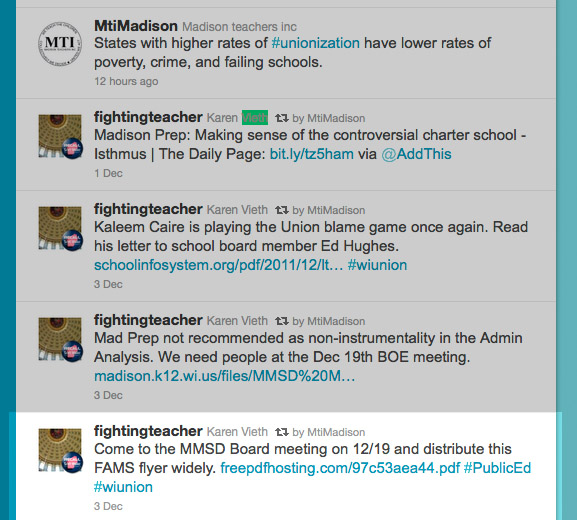
Much more on the proposed Madison Preparatory Academy IB charter school, here.

Share

More School Choice Questions From Parents

Patricia Willens:

We were not able to get to all the audience questions at the SchoolBook community event in Brooklyn on Thursday night. Here is a sampling of 10 of them. Keep the conversation going on your school pages and with SchoolBook editors. We will do our best to get some answers for you.
Meanwhile, the video above was shown during the event at the Pratt Institute. See what the students have to say about the choice process.
What happens to students that schools don’t “compete” for?
Why do all the kids have to be tutored to get into the specialized schools?
I just moved to Harlem and found out I’m in District 5 with almost no choice for middle schools. Why is this?
Why were the neighborhood schools discontinued? MetroCards and buses are very expensive.
Why don’t you see which principals have success and copy their idea and fire the incompetent ones?

Share

How to Guess Better on an SAT

Stephen Dubner:

A nice analytic giblet from a Times profile of new Nobel economists Thomas Sargent and Christopher Sims:

Because of his father’s College Board connections, Mr. Sims got hold of an old SAT exam, which he and Mr. Willoughby used to conduct a statistical analysis. They found that on multiple-choice questions in English and social studies, the “longer answers tended to be correct.” In math, they determined that the number that was “closest to all of the other numerical choices” was probably the right one.

Share

Was Gingrich Right About Putting Kids to Work?

Andrew Rotherham:

Newt Gingrich has a penchant for saying provocative and often downright crazy things. When the former House Speaker gave a lecture at Harvard last month, calling child labor laws “truly stupid” and suggesting that low-income kids should be required to do some manual labor in their schools, it was a classic Gingrich proposal: over-the-top, totally tone-deaf, and way too broad in scope. But it also was not entirely wrong. Although his specifics are often bewildering, it’s hard to deny that Gingrich has a knack for spotting trends in education.
In 1994, when Gingrich was the leader of House Republicans, he suggested a radical welfare reform: to break the cycle of poverty, take poor kids away from their unwed teen mothers and put them in state-run facilities. His orphanage idea was designed to free up single parents for job training while simultaneously instilling better work habits in their children. Not surprisingly, the proposal quickly died on Capitol Hill. But in the 17 years since then, hundreds of schools have sprung up across the country that are designed to get students to spend more time on school-related activities and less time exposed to adverse influences in their neighborhoods and, yes, sometimes in their homes. These schools also have clear nonacademic curricula that focus on behavior, self-management and life skills. The goal, as described by journalist David Whitman, the current speechwriter for Secretary of Education Arne Duncan, in Sweating the Small Stuff: Inner-City Schools and the New Paternalism, is to use school as an anti-poverty tool by deliberately fostering a strong work ethic in students.

Share

Don’t Worry About It

apaitch:

I have never let my schooling interfere with my education. – Mark Twain
Disclaimer: I write this as a university student. Some of my points may or may not be applicable in a high school environment.
The grading system in schools and universities has a long history of opponents and criticism. I won’t go into the arguments here because, quite frankly, I don’t have anything new to say about it. In short: the system sucks. It encourages memorization and frenzied, last-minute studying, can be played in a variety of ways, etc. Educators can debate the alternatives and run pilot projects, and that’s all well and good. But what can we – the students – do about it?
My answer: Don’t Worry About It.
Of course, this could easily be interpreted as a call to rebel against the system, forget grades entirely, and party night and day. So let me expand on that:
Pick courses that interest you, and focus on learning. And don’t worry about the grades – they will come with the territory.

Share

Some Asians’ college strategy: Don’t check ‘Asian’

Jesse Washington:

Lanya Olmstead was born in Florida to a mother who emigrated from Taiwan and an American father of Norwegian ancestry. Ethnically, she considers herself half Taiwanese and half Norwegian. But when applying to Harvard, Olmstead checked only one box for her race: white.
“I didn’t want to put ‘Asian’ down,” Olmstead said, “because my mom told me there’s discrimination against Asians in the application process.”
For years, many Asian-Americans have been convinced that it’s harder for them to gain admission to the nation’s top colleges.
Studies show that Asian-Americans meet these colleges’ admissions standards far out of proportion to their 6 percent representation in the U.S. population and that they often need test scores hundreds of points higher than applicants from other ethnic groups to have an equal chance of admission. Critics say these numbers, along with the fact that some top colleges with race-blind admissions have double the Asian percentage of Ivy League schools, prove the existence of discrimination.

Share

Our Enemy, the Book

Fellow members of the Electronic Educational Entertainment Association. My remarks will be brief, as I realize you all have texts to read, messages to tweet, and you will of course want to take photos of those around you to post on your blog.
I only want to remind you that the book is our enemy. Every minute a student spends reading a book is time taken away from purchasing and using the software and hardware the sale of which we depend on for our livelihoods.
You should keep in mind the story C.S. Lewis told of Wormwood, the sales rep for his uncle Screwtape, a district manager Below, who was panicked when his target client joined a church. What was he to do? Did this mean a lost account? Screwtape reassured him with a story from his own early days. One of his accounts went into a library, and Screwtape was not worried, but then the client picked up a book and began reading. However, then he began to think! And, in an instant, the Enemy Above was at his elbow. But Screwtape did not panic–fortunately it was lunchtime, and he managed to get his prospect up and at the door of the library. There was traffic and busyiness, and the client thought to himself, “This is real life!” And Screwtape was able to close the account.
In the early days, Progressive Educators would sometimes say to students, in effect, “step away from those books and no one gets hurt!” because they wanted students to put down their books, go out, work for social justice, and otherwise take part in “real life” rather than get into those dangerous books and start thinking for themselves, for goodness’ sake!
But now we have more effective means of keeping our children in school and at home away from those books. We have Grand Theft Auto and hundreds of other games for them to play at escaping all moral codes. We have smartphones, with which they can while away the hours and the days texting and talking about themselves with their friends.
We even have “educational software” and lots of gear, like video recorders, so that students can maintain their focus on themselves, and stay away from the risks posed by books, which could very possibly lead them to think about something besides themselves. And remember, people who read books and think about something besides themselves do not make good customers. And more than anything, we want and need good customers, young people who buy our hardware and software, and who can be encouraged to stay away from the books in libraries, which are not only free, for goodness’s sake, but may even lead them to think. And that will be no help at all to our bottom line. Andrew Carnegie may have been a philanthropist, but by providing free libraries he did nothing to help us sell electronic entertainment products. We must never let down our guard or reduce our advertising. Just remember every young person reading a book is a lost customer! Verbum Sap.
—————————–
“Teach by Example”
Will Fitzhugh [founder]
The Concord Review [1987]
Ralph Waldo Emerson Prizes [1995]
National Writing Board [1998]
TCR Institute [2002]
730 Boston Post Road, Suite 24
Sudbury, Massachusetts 01776-3371 USA
978-443-0022; 800-331-5007
www.tcr.org; fitzhugh@tcr.org
Varsity Academics®
www.tcr.org/blog

Share

Some Madison Teachers & Some Community Members (*) on the Proposed Madison Preparatory Academy IB Charter School


200K PDF File, via a kind reader.
Madison Teacher’s Inc. Twitter feed can be found here.
Much more on the proposed Madison Preparatory Academy IB charter school, here.
* Please see TJ Mertz’s comment below. A link to the document was forwarded to me via a kind reader from Madison Teachers, Inc. Twitter Feed (a “retweet” of Karen Vieth’s “tweet”). Note that I enjoyed visiting with Karen during several Madison School District strategic planning meetings.
A screenshot of the link:

The outcome of the Madison Prep “question” will surely reverberate for some time.
Finally, I suspect we’ll see more teacher unions thinking different, as The Minneapolis Federation of Teachers has done: Minneapolis teacher’s union approved to authorize charter schools.

Share

Why Innovation Can’t Fix America’s Classrooms

Marc Tucker:

Most Atlantic readers know that, although the U.S. spends more per student on K-12 education than any other nation except Luxembourg, students in a growing number of nations outperform our own. But think about this: Among the consistent top performers are not only developed nations (Japan, Finland, Canada), but developing countries and mega-cities such as South Korea, Hong Kong, and Shanghai.
Even if we find a way to educate our future work force to the same standards as this latter group — and we are a very long way from that now — wages in the United States will continue to decline unless we outperform those countries enough to justify our higher wages. That is a very tall order.
You would think that, being far behind our competitors, we would be looking hard at how they are managing to outperform us. But many policymakers, business leaders, educators and advocates are not interested. Instead, they are confidently barreling down a path of American exceptionalism, insisting that America is so different from these other nations that we are better off embracing unique, unproven solutions that our foreign competitors find bizarre.

Share

Online Learning, Personalized

Somini Sengupta:

Jesse Roe, a ninth-grade math teacher at a charter school here called Summit, has a peephole into the brains of each of his 38 students.
He can see that a girl sitting against the wall is zipping through geometry exercises; that a boy with long curls over his eyes is stuck on a lesson on long equations; and that another boy in the front row is getting a handle on probability.
Each student’s math journey shows up instantly on the laptop Mr. Roe carries as he wanders the room. He stops at each desk, cajoles, offers tips, reassures. For an hour, this crowded, dimly lighted classroom in the hardscrabble shadow of Silicon Valley hums with the sound of fingers clicking on keyboards, pencils scratching on paper and an occasional whoop when a student scores a streak of right answers.
The software program unleashed in this classroom is the brainchild of Salman Khan, an Ivy League-trained math whiz and the son of an immigrant single mother. Mr. Khan, 35, has become something of an online sensation with his Khan Academy math and science lessons on YouTube, which has attracted up to 3.5 million viewers a month.

Share

Seattle Cluster (Spectrum) Grouping Discussion

Chris Cronas, Principal, Wedgwood Elementary

Prior to the Thanksgiving break, we administered a survey asking for feedback from families about their knowledge and thoughts on the changes we are making to the curriculum delivery model at Wedgwood. Thank you to the 259 families who responded to the survey. We have 449 students currently enrolled at Wedgwood, 185 of whom are siblings. If respondents only completed one survey per family, as requested, our sample is quite accurate.
Overall, families want more information about what cluster grouping is. This was expressed in a variety of ways by families of general education, spectrum and special education students. I will attempt to clarify what it is here and how Wedgwood staff is using this information to move forward.
For those who do not know, cluster grouping is a method of grouping gifted students (gifted being identified as students who score in the 98th – 99th percentile on a cognitive ability test) into clusters of 6 students in one classroom that also include high achievers and above average students. The remaining students would be clustered so that the highest achieving students and lowest achieving students are not in the same classroom. With that as a guide, Wedgwood is developing plans to move from having self-contained spectrum classrooms to integrated classrooms using an interpretation of this model. We are already doing this in 1st grade, albeit more heterogeneously than what the research we based our 1st grade model on suggests.

Charlie Mas has more:

Are you confused about what Wedgwood is doing with their Spectrum program? Join the club. Everyone is confused about what Wedgwood is doing with their Spectrum program. The president of the confusion club appears to be the school’s principal, Chris Cronas.

Share

School Choice? A Question of Time and Money

Amy Stuart Wells:

In a New York Times op-ed article on Monday, Natalie Hopkinson writes that school choice in her neighborhood in Washington has destroyed community-based education for working-class families. With New York ranked No. 1 in the nation in giving parents and students choices, according to one study last week, Amy Stuart Wells, a parent of an eighth grader and a professor at Teachers College, has her own take on New York’s system.
When my son’s high school choice process began last spring, I already had a full-time job. I was not looking for a second one. But as the summer turned to fall, and the high school touring and test-taking kicked into full gear, I watched as many 8th grade parents (myself included) became increasingly bleary eyed and overwhelmed.
We sought each other’s empathy and commented that orchestrating our children’s school choices was like a full-time job — a second one for many of us.

Share

Private-College Presidents Getting Higher Salaries

Tamar Lewin:

Presidents at 36 private colleges earned more than $1 million in 2009, up from 33 the previous year, according to a study by The Chronicle of Higher Education.
The annual study, using data from federal tax documents, found that the median compensation — including salary and benefits — was $385,909, a 2.2 percent increase from the previous year. The median base salary increased by 2.8 percent to $294,489.
The highest-paid president in 2009 was Constantine Papadakis of Drexel University. Mr. Papadakis, who died in April that year, earned $4,912,127, most of it from life insurance and previously accrued compensation paid to his widow. His base salary was $195,726.
The next three top earners — William R. Brody of Johns Hopkins University ($3,821,886); Donald V. DeRosa of University of the Pacific ($2,357,540); and Henry S. Bienen of Northwestern University ($2,240,775) — also left their presidencies.

Share

Are visits by parents to schools a threat to teaching?

Jay Matthews:

Paula Prosper worried that her son was not ready for the differences between his private Montessori school and the public Fairfax County seventh grade she planned to transfer him to next year.
Prosper, a teacher, asked if he and she could sit for a few hours at Longfellow Middle School “to see what happens in classes and to get a feel for the school in general.” The answer was no, with explanations that made little sense.
Prosper said Longfellow’s director of student services, Gail Bigio, told her “it had to do with privacy issues for the teachers — the public employees whose salaries are paid by my tax dollars. Then she brought up immunization and likened it to the students attending the school who wish to have a visiting cousin shadow them.” Longfellow Principal Carole Kihm told me Bigio did not mention teacher privacy.

Share

What Is Happening to America’s Less-Skilled Workers? The Importance of Education and Training in Today’s Economy

Michael Greenstone, Adam Looney:

The labor market continued to expand at a modest pace last month, according to today’s employment report. Payroll employment increased by 120,000 jobs in November, and the fraction of Americans with a job ticked up. Including revisions to previous months, total employment was 192,000 higher in November. Private employment increased by 140,000 jobs last month while governments continued to shed jobs. While the unemployment rate jumped down to 8.6 percent, some of the reduction reflected lower labor force participation rather than increases in employment.
While overall job creation has improved slightly, many American workers continue to face serious difficulties in the labor market. These workers tend to have less formal education and/or fewer job-relevant skills. For less-educated workers, the Great Recession has only exacerbated a longer-term trend of diminished earnings and job opportunities.

Share

NJEA’s President Guilty of “Deliberate Misuse of the Data”

New Jersey Left Behind:

Over the last several months it’s been a pleasure to witness the easing of ill will between the leadership of NJ’s primary teachers’ union, NJEA, and members of Gov. Christie’s educational team. After several years of bitter recrimination from both sides of the table, everyone seems to have moved on from the trauma of our botched Race To The Top application and former Comm. Bret Schundler’s resignation. Sure, the sting of last Spring’s health and benefits reform bills, championed by Gov. Christie, must be a sore spot for union leadership, but there appears to be a shared recognition that we should recalibrate the balance between the needs of schoolchildren and the needs of teachers. Suddenly NJ’s 100-year old tenure law is on the table – a boon for both student and professionals – and Ed. Comm. Cerf ‘s speech at NJEA’s Annual Convention earlier this month and was courteously received (except for a few nasty tweets).
So we’ll hold onto the progress and roll our eyes at the retro and reactive press release just out from NJEA President Barbara Keshishian, in which she claims, in outraged tones, that NJ’s alleged achievement gap among black, white, Hispanic, and poor kids is a “classic strawman” on the part of Gov. Christie and “based on a deliberate misuse of the data.”

Share

Just 31% of California students pass P.E. test

Teresa Watanabe:

Fewer than one-third of California students who took a statewide physical fitness test this year managed to pass all six areas assessed, new results show.
State Supt. of Public Instruction Tom Torlakson, a longtime cross-country coach who has made physical fitness a signature issue, announced the results this week as he launched a program to improve children’s health. The campaign will use such celebrity athletes as NBA all-star Bill Walton and others to visit schools to urge students to drink more water, eat more fruits and vegetables and increase their exercise.
“When only 31% of children are physically fit, that’s a public health challenge we can’t wait to address,” Torlakson said in a statement.

Share

Straight Time: The boy’s pot habit was out of control, so his parents enrolled him at The House, a nonresidential rehab facility attended by the kids of well-connected Westsiders. Now his family questions everything

Michael Angeli:

When the end finally came, it came fast. Spotting Steve’s red BMW convertible parked in the driveway, Culver City police in tactical vests and armed with assault weapons quickly deployed, swarming the front and rear entrances. Wearing a green nylon jacket with RAID splashed across the shoulders, Sergeant Jason Sims knocked on the front door, then ordered his men to break it down with a battering ram. Inside, kids screamed, cried, or just stood there trying to wrap their heads around what they were witnessing–and what their parents were witnessing. Because this was a Thursday, this was Family Night. Expecting to endure an evening of candor with impunity–Guess what, Mother? The world doesn’t revolve around you!–parents had their bean dip and decaf upended by an armed raid. Tilling the big wayward ship of their children’s adolescence had left them chronically alert to trouble, but not like this.

Share

How Madison Prep Can Be a Non-Instrumentality (Non-Union)?

Kaleem Caire, via email

December 2, 2011
Greetings Madison Prep.
Tomorrow afternoon, we are expecting to learn that MMSD’s Administration will inform the Madison Metropolitan School District Board of Education that Madison Prep should not be approved. A possible reason we expect will be MMSD’s concern that the current collective bargaining agreement between the District and Madison Teachers Inc. (MTI) has a “work preservation clause” which the teacher’s union advocated for long ago to ensure that it was the only game in town to represent public school teachers in Madison.
Below, is the cover note that I forwarded to Ed Hughes of the Board of Education and copied to a number of others, who had asked a thoughtful question about our proposal to establish Madison Prep as a non-instrumentality charter school, we hope, in fall 2012. Also see the letter attached to this email.
—————————————- ————————————————————————–
December 2, 2011
Greetings Ed.
Attached, please find a letter that contains the answer to your question referenced in your email below. The letter contains the explanation of a path to which Madison Prep could be established as a non-instrumentality public charter school, under Wisconsin law, and in a way that would not violate the current collective bargaining agreement between MMSD and Madison Teachers Inc.
We look forward to answering any questions you or other members of the Board of Education may have.
Thank you so much and Many blessings to you and your family this holiday season.
Onward.
cc: Daniel Nerad, MMSD Superintendent
Dylan Pauly, MMSD Legal Counsel
MMSD Board of Education Members
ULGM Board of Directors
Madison Prep Board of Directors
Godfrey & Kahn, S.C.
Steve Goldberg, CUNA Mutual Foundation

PDF letter:

This letter is intended to respond to your November 78,207I email and to suggest that there is a viable option for moving forward with Urban League’s proposal for the Madison Preparatory Academy (“Madison Prep”) that: [i) will reduce cost; and (ii) will not sacrifice the union security provisions of the Collective Bargaining Agreement “Agreement” or “Contract”) between the Madison Metropolitan School District (“MMSD” or “District”) and Madison Teachers, Inc. (“MTI”).
Your email asks for a response to a question concerning how the school district could authorize Madison Prep as a non-instrumentality charter without thereby violating the terms of the District’s Agreement with MTI. Your email references a provision in the MTI Agreement that provides “that instructional duties where the Wisconsin Department of Public Instruction requires that such be performed by a certifìcated teacher, shall be performed only by’teachers.”‘ .See Article I, Section 8.3.a. In addition you note that “the term ‘teacher’ refers to anyone in the collective bargaining unit.” See Article I, Section 8.2. You conclude your email by stating that “it appears that all teachers in MMSD schools — including non-instrumentality charter schools – must be members of the MTI bargaining unit.”
The Urban League is aware of the Agreement’s language and concedes that the language, if enforceable, poses an obstacle as we look for School Board approval of the plan to open and operate a “non-instrumentality” school. Under an instrumentality charter, the employees of the charter school must be employed by the school board. Under a non-instrumentality charter, the school board may not be the employer of the charter school’s staff. See S 118.40(7)(a). Thus, the statement in your email that all teachers, including those in a non-instrumentality charter school – “must be members of the MTI bargaining unit” and, presumably, employed by the school board is not permitted under Wisconsin law.
Under Wisconsin’s charter school law the School Board has the exclusive authority to determine whether a school is an instrumentality or not an instrumentality of the school district. .See S 118.40(7)(a). That decision is an important decision reserved to the School Board alone. The effect of that decision drives whether teachers and staff must be, or cannot be, employees of the School Board. The language of the Contract deprives the School Board of the decision reserved to it under the statute and that language cannot be harmonized to give effect to both the statute and the Agreement. Alternatively the Contract language creates a situation whereby the School Board may exercise its statutory authority to approve a non-instrumentality charter but it must staff the school with school district employees, a result clearly prohibited under the statute. In our view the law trumps the Contract in either of these situations.
The situation described above could likely only be resolved in a court of law. The Contract includes a “savings clause” that contemplates that where a court invalidates a provision in the Agreement, the invalid provision is deleted and the remainder of the contract remains intact. See Article VIII, Section E.
The Urban League is, however, mindful that litigation is both expensive and time consuming. Moreover it is clear that the Contract language will become a prohibited subject of bargaining in the near future when the current Agreement expires. Unfortunately, the children we seek to serve, do not have the time to wait for that day.
Our second purpose in writing is to make you aware of a possible solution to a major obstacle here. One of the major obstacles in moving forward has been the cost associated with an instrumentality school coupled with MTI’s reluctance to work with the District in modifying the Contract to reduce costs associated with staffing and certain essential features of Madison Prep, like an extended school day, As we understand it MTI does not want to modify the Contract because such a modification would result in an earlier application of 2077 Wisconsin Act L0 to the District, members of the bargaining unit and to MTI itself.
We understand MTI’s reluctance to do anything that would hasten the application of Act 10 in the school district, With the passage of 2011. Wisconsin Act 65, that concern is no longer an obstacle.
Act 65 allows the parties to a collective bargaining agreement to enter into a memorandum of understanding that would run for the remaining term of the collective bargaining agreement, for the purpose of reducing the cost of compensation or fringe benefits in the collective bargaining agreement,
The Act also provides that entering into such a memorandum would not be considered a “modification” of the collective bargaining agreement for the purposes of Act 10. Act 65 was published on November 23,2077 and took effect the following day. The law allows the parties to a collective bargaining agreement to enter into such a memorandum no later than 90 days after the effective date of the law.
The Urban League believes that Act 65 gives the Board and MTI the opportunity to make changes that will facilitate cost reductions, based in compensation and fringe benefits, to help Madison Prep move forward. And, the law allows the parties to do so in a way that does not adversely impact the teachers represented by MTI or the union security provisions of the Collective Bargaining Agreement.
For example, the parties could agree to reduce the staffing costs for Madison Prep, The parties could also agree that a longer school day would not have to cost more. And, the parties could agree that the work preservation clause referenced in the first part of this letter does not apply where the School Board has determined a charter school willbe a non-instrumentality of the District, a move that would also most certainly reduce costs. These changes would not be forced upon any existing MTI represented teacher as teachers would apply for vacancies in the school.
We hope that the School Board will give serious consideration to the opportunity presented by Act 65. 0n behalf of the Urban League of Greater Madison and Madison Preparatory Academy, we thank you for your support of Madison Prep.

Much more on the proposed Madison Preparatory IB charter school, here.

Share

Schools Get White House Advice on Race, Admissions

Jess Bravin:

The Obama administration issued new guidance Friday advising schools and colleges on how they can make race-based enrollment decisions to promote campus diversity, shortly before the Supreme Court is set to consider whether to re-examine a 2003 case holding that universities could sometimes use race in admissions decisions.
“Diverse learning environments promote development of analytical skills, dismantle stereotypes and prepare students to succeed in an increasingly interconnected world,” Attorney General Eric Holder said in a joint release by the Justice and Education departments.
The departments withdrew prior guidance from the Bush administration, which officials said was too vague to assist school administrators seeking to promote diverse student enrollment. The new guidance parses the Supreme Court’s most recent rulings on student diversity to suggest policies the administration believes would not violate the 14th Amendment’s guarantee of equal protection of the laws.
Like the former Bush administration guidance, the new documents advise schools to use race-neutral policies if possible. If those prove insufficient, however, the new guidance states that a school “may consider a student’s race as a ‘plus factor’ (among other, nonracial considerations) to achieve its compelling interests” in diversity.

Share

College for All?

Kevin Carey:

It would have been understandable if President Barack Obama had ignored education in his first speech to Congress. There were other things to worry about in February 2009: an economy in free fall, health care costs threatening to bankrupt the federal government, a nation bleeding in two protracted foreign wars. Obama had said little about education on the campaign trail. Yet when he took the podium, he made a bold declaration: By 2020, America would regain its historical international lead in college attainment.
Months earlier, Bill Gates had announced a similar priority for his charitable foundation, the richest on the planet. After years of focusing on improving education for students in kindergarten through 12th grade, the Microsoft billionaire had set his sights on college. As would Obama, he called for a major increase in the number of adults with college degrees. Together, the most powerful man in the world and one of the richest created a rare moment of purpose and clarity in American education policy.
But effecting a major increase in college attainment is a daunting task. The percentage of American working-age adults who have graduated from college has hovered around 40 percent for years, with roughly 30 percent holding four-year degrees and another 10 percent associate’s degrees. Obama and Gates were calling for a rise in the college attainment rate to nearly 60 percent in less than a generation, even though many public colleges and universities were already bursting at the seams, and cash-strapped state legislatures were handing down further punishing budget cuts.

Share

Is Suburbia Doomed?

Joel Kotkin:

This past weekend the New York Times devoted two big op-eds to the decline of the suburb. In one, new urban theorist Chris Leinberger said that Americans were increasingly abandoning “fringe suburbs” for dense, transit-oriented urban areas. In the other, UC Berkeley professor Louise Mozingo called for the demise of the “suburban office building” and the adoption of policies that will drive jobs away from the fringe and back to the urban core.
Perhaps no theology more grips the nation’s mainstream media — and the planning community — more than the notion of inevitable suburban decline. The Obama administration’s housing secretary, Shaun Donavan, recently claimed, “We’ve reached the limits of suburban development: People are beginning to vote with their feet and come back to the central cities.”
Yet repeating a mantra incessantly does not make it true. Indeed, any analysis of the 2010 U.S. Census would make perfectly clear that rather than heading for density, Americans are voting with their feet in the opposite direction: toward the outer sections of the metropolis and to smaller, less dense cities. During the 2000s, the Census shows, just 8.6% of the population growth in metropolitan areas with more than 1 million people took place in the core cities; the rest took place in the suburbs. That 8.6% represents a decline from the 1990s, when the figure was 15.4%.

Share

Ways to Inflate Your IQ

Sue Shellenbarger:

Many people think of IQ as a genetic trait, like brown eyes or short legs: You’re born with it and you’re stuck with it. Now, a growing body of research is showing that a person’s IQ can rise–and even fall–over the years.
Scores can change gradually or quickly, after as little as a few weeks of cognitive training, research shows. The increases are usually so incremental that they’re not immediately perceptible to individuals, and the intelligence-boosting effects of cognitive training can fade after a few months.
In the latest study, 33 British students were given IQ tests and brain scans at ages 12 to 16 and again about four years later by researchers at the Wellcome Trust Centre for Neuroimaging at University College London; 9% of the students showed a significant change of 15 points or more in IQ scores.
On a scale where 90 to 110 is considered average, one student’s IQ rose 21 points to 128 from 107, lifting the student from the 68th percentile to the 97th compared with others the same age, says Cathy Price, professor of cognitive neuroscience at the center and co-author of the study, published last month in Nature. Another student’s score skidded out of the “high average” category, to 96 from 114.

Share

Andy Grove on Vocational Education

The Angry Philanthropist:

PHILANTHROPY: Are you as paranoid about vocational education as you were about business?
MR. GROVE: The details are of course different, but in this way, they are very similar. Paranoia in management involves trying to anticipate who intentionally or unintentionally will slow you down, or who will derail you. Usually this attitude is not taught in school, which is why I wrote my book. Now, as for vocational education, do you recall the words of the presidential report on education [A Nation at Risk] from 1983? It started out by saying, “If an unfriendly foreign power had attempted to impose on America the mediocre educational performance that exists today, we might well have viewed it as an act of war.” Is this paranoia?
Well, the same thing applies to vocational education–only doubly so. Most people don’t even realize the need for more highly trained workers. The assumption remains that technical education is for less intelligent people. The first item cut from educational budgets is vocational education. People are required to be suitably trained for their work requirements, and yet the classes that are required for this are cut to the bone. In some instances, students are halfway through the course when funding is cut and then they are sent home. We create a damned obstacle course for people who want to work!

Share

Home Depot co-founder Bernie Marcus is working with John Ratzenberger to build interest in the skilled trades.

Jonathan Last:

Bernie Marcus is a do-it-yourself kind of guy. Sure, he knows his way around sheetrock and, yes, he can talk in great detail about remodeling a bathroom or putting in a backyard deck. But for Marcus, home improvement projects represent a part of something much more profound. Doing it yourself means being able to take control of your own life, shaping your own destiny, daring to accomplish more than you imagine possible. It’s an essential part of being an American. After all, it’s what inspired his signature project. He built a company from scratch, and turned his idea into a household name with a $60 billion market cap. Bernie Marcus built Home Depot.
“It happened because of us,” says Marcus. “I mean, we had no money. When we opened Home Depot in 1979, we were broke. I had just been fired. Some of us were on the verge of bankruptcy. But we had a great idea, and we had some people who were willing to support us. And we put in the work–we put in sweat and tears, our hearts and souls. But today Home Depot has more than 300,000 people working for it. We built it all.”

Share

School Choice?

Andrew Rotherham:

The new Brookings index on school choice is interesting and worth a look but as I go through it two things seem to jump out. First, despite the rhetoric in the public square there still isn’t a great deal of real choice in education. And second, the index seems to reward places (relatively speaking) that have limited choices but still do all the things you should do (information, transportation etc…nonetheless). That’s like having an incredible restaurant with easy valet parking, wonderful fresh food, great service, and lovely ambiance – but that can only seat four people a night. Nice but limited.

Share

The Extraordinary Syllabus of David Foster Wallace What his lesson plans teach us about how to live.

Katie Roiphe:

Lately David Foster Wallace seems to be in the air: Is his style still influencing bloggers? Is Jeffrey Eugenides’ bandana-wearing depressed character in The Marriage Plot based on him? My own reasons for thinking about him are less high-flown. Like lots of other professors, I am just now sitting down to write the syllabus for a class next semester, and the extraordinary syllabuses of David Foster Wallace are in my head.
I am not generally into the reverential hush that seems to surround any mention of David Foster Wallace’s name by most writers of my generation or remotely proximate to it; I am not enchanted by some fundamental childlike innocence people seem to find in him. I am suspicious generally of those sorts of hushes and enchantments, and yet I do feel in the presence of his careful crazy syllabuses something like reverence.
Wallace doesn’t accept the silent social contract between students and professors: He takes apart and analyzes and makes explicit, in a way that is almost painful, all of the tiny conventional unspoken agreements usually made between professors and their students. “Even in a seminar class,” his syllabus states, “it seems a little silly to require participation. Some students who are cripplingly shy, or who can’t always formulate their best thoughts and questions in the rapid back-and-forth of a group discussion, are nevertheless good and serious students. On the other hand, as Prof — points out supra, our class can’t really function if there isn’t student participation–it will become just me giving a half-assed ad-lib lecture for 90 minutes, which (trust me) will be horrible in all kinds of ways.”

Share

More kids are missing school shots

Associated Press:

More parents are opting out of school shots for their children. In eight states now, more than one in 20 public school kindergartners aren’t getting all the vaccines required for attendance, an Associated Press analysis found.
That growing trend among parents seeking vaccine exemptions has health officials worried about outbreaks of diseases that once were all but stamped out.
Take measles, for example. It can lead to pneumonia, encephalitis and death. Since 2000, one in every 250 Americans who got measles died.
The measles vaccine is so effective, 99.9% of those who get vaccinated gain immunity, said Geoffrey Swain, associate professor at the University of Wisconsin School of Medicine and Public Health and chief medical officer for the Milwaukee Health Department.
Many children cannot get the measles vaccine, though, because they aren’t old enough – the first dose of vaccine is recommended between 12 and 15 months. Or, they have medical issues or families with religious beliefs that leave them unprotected and susceptible to measles through no fault of their own, Swain said.

Share

Proposed High School Angers Parents at Gifted and Talented School

Emily Canal:

Parents gathered in the auditorium of the Talented and Gifted School for Young Scholars on Tuesday morning were not happy.
Their school, one of only three citywide gifted and talented programs in Manhattan, shares space in an East Harlem building with three middle schools. They learned recently that one of the schools, Esperanza Preparatory Academy, wants to expand to a high school, and they are concerned that the expansion will cause overcrowding and bring other problems.
Tuesday’s meeting was called by the Education Department last week after parents flooded the office with calls and e-mails expressing concern about the addition of high school grades when their school has children as young as kindergarten.

Share

Keys to college students’ success often overlooked, report says

Carla Rivera:

Colleges should examine a wider set of social, economic and personal characteristics to determine how they can help students remain in school and graduate, a new report has found (PDF report link).
Aside from SAT scores and high school grade point averages, students’ success in college relies on a number of other factors — often overlooked — that more accurately predict whether they will stay in school, according to the report scheduled for release Tuesday by the Higher Education Research Institute at UCLA.
Using information from a national survey of college freshmen in public and private institutions as well as graduation data, the report found, for example, that students who visit a college before enrolling, participate in clubs and other activities and those who have used the Internet for research and homework are more likely to complete a degree earlier than others. The costs of attending a college and the institution’s size also contribute to students’ success, the report found.

Share

Chicago Public Schools’ Unveils School Turnaround Targets

Rebecca Vevea:

Chicago Public Schools officials plan to overhaul 10 schools next year, six of which will be managed by a private organization in the latest move by Mayor Rahm Emanuel’s administration to turn to the private sector to aid poorly performing public schools.
The proposed overhauls–commonly called turnarounds–involve the firing of existing staff and improvements to school curriculum and culture. Turnarounds are the first step in a series of school actions that include consolidating and closing underperforming schools.
A new state law requires CPS to announce all school closings and turnarounds by Thursday. There was vociferous opposition to any proposed closings at recent public hearings, which were also required by the law, even though though the list of targeted schools had not yet been released.
The elementary schools slated for turnaround are: Pablo Casals, 3501 W. Potomac Ave.; Melville W. Fuller, 4214 S. Saint Lawrence Ave.; Theodore Herzl, 3711 W. Douglas Blvd.; Marquette, 6550 S Richmond St.; Brian Piccolo, 1040 N Keeler Ave.; Amos Alonzo Stagg, 7424 S Morgan St.; Wendell Smith, 744 E 103rd St. and Carter G. Woodson South Elementary Schools, 4414 S Evans. The Chicago Vocational Career Academy, at 2100 E 87th St., and Tilden Career Community Academy, 4747 S Union Ave., high schools also are targeted for turnaround.

Share

Taking healthcare to students

Anna Gorman:

As soon as the school day ended, the rush at the health clinic began.
Two high school seniors asked for sports physicals. A group of teenagers lined up for free condoms. A girl told a counselor she needed a pregnancy test.
The clinic, at Belmont High School near downtown Los Angeles, is part of a rapidly expanding network of school-based centers around the nation offering free or low-cost medical care to students and their families.
In California, there are 183 school health centers, up from 121 in 2004. Twelve more are expected to open by next summer, according to the California School Health Center Assn.
The centers have become a small but important part of the nation’s healthcare safety net, experts say, treating low-income patients who might otherwise not have regular medical care. Now, they add, campus clinics are serving as a model for health officials trying to reduce costs.

Share

The other student loan problem: too little debt

Justin Pope:

Jesse Yeh uses the University of California-Berkeley library instead of buying textbooks. He scrounges for free food at campus events and occasionally skips meals. He’s stopped exercising and sleeps five to six hours per night so he can take 21 credits — a course load so heavy he had to get special permission from a dean.
The only thing he won’t do: take out a student loan.
“I see a lot of my friends who took out student loans, then they graduated and because of the economy right now they still couldn’t find a job,” said the third-year student, whose parents both lost their jobs in 2009 and who grew up in the boom-and-bust town of Victorville, Calif., on a block with several houses in foreclosure. “The debt burden is really heavy on them.”

Share

Korean teen held after pushy mother’s death

Christian Oliver and Song Jung-a:

South Korean police have detained a teenager suspected of murdering his mother after she allegedly beat him with a golf club to get better school grades, in a case that has raised questions about the high-pressure nature of the country’s education system.
The macabre incident has shocked the nation, with younger mothers questioning the values of previous generations who have been pushing children hard to improve their school performance.
“Children are being driven to the limit … so many of them suffer from depression, kill themselves or commit impulsive crimes out of desperation,” says Oh Sung-sook, head of the Citizens’ Council for Educational Reform, an activist group.
Psychologists argue that the educational rat-race – children are routinely forced to study late into the night seven days a week and corporal punishment is still permitted – is stunting social development.

Share

Finland puts bar high for teachers, kids’ well-being

Erin Richards:

English class is about to start, and Taneli Nordberg introduces the day’s guests: a row of fresh-faced university students sitting in the back of the classroom. They’re training to be teachers at the University of Helsinki.
Nordberg, 31, wants the eighth-graders to become teachers for a moment.
“I want you to tell the teacher trainees something you would like them to do when teaching and something you want them to avoid doing,” he explains. “In English, please.”
The students tumble up to the chalkboards and start writing. Some of the advice is predictable – “not too much homework” – but much of it is insightful.
The exercise, though short and light, is something of a microcosm of the Finnish educational approach – engagement and collaboration between teacher and student, a comfortable atmosphere, and the expectation of quality in how students express themselves.
Over the past decade, students in Finland have soared on international measures of achievement. They’ve continued to post some of the best scores in the developed world in reading, math and science, according to a respected international exam. The country has one of the narrowest gaps in achievement between its highest and lowest-performing schools, and on average spends less per pupil than the United States.

Share

Do schools conceal violent incidents and threats to avoid negative press and parent outrage?

Maureen Downey:

Among the extended family I saw over the holiday was a young relative who is working as a substitute teacher in the Northeast since he can’t find a full-time teaching post. He shared a story that surprised me, and I wanted to run it by folks here.
He was subbing at a low-performing high school that recently had a well-publicized stabbing. A student in his class pulled what he thought was a real gun on him, and they had a standoff for several minutes until the teen put the “gun” away and the teacher tackled him to the floor. It turned out the gun was a toy, and the student received a three-day suspension for the incident.
The substitute teacher was disappointed with the punishment, but said the school wanted to prevent another round of negative press.
Would such an incident be kept quiet in Georgia? Could it go so easily unreported under zero tolerance policies in which students can get suspended for Tweety Bird key chains?

Share

The Secret of My Success: How Status, Prestige and School Performance Shape Legal Careers

Richard Sander & Jane Yakowitz:

Rewards are distributed more unevenly within the legal profession than in virtually any other occupation. Most of those who study the careers of lawyers would agree that law school eliteness, law school grades, and social status each play a role in determining which lawyers capture the greatest rewards. But remarkably little effort has been made to directly compare these inputs in explaining career outcomes, to see which of the three matters most, and how they interact.
In this paper, we first examine general beliefs about the importance each of these three factors has upon lawyer careers – beliefs among academics as well as beliefs among the actual participants in the sorting process. We next present some specific findings about each of the three factors. Finally, we directly compare the three factors in regression models of career outcomes. The consistent theme we find throughout this analysis is that performance in law school – as measured by law school grades – is the most important predictor of career success. It is decisively more important than law school “eliteness.” Socioeconomic factors play a critical role in shaping the pool from which law students are drawn, but little or no discernible role in shaping post-graduate careers. Since the dominant conventional wisdom says that law school prestige is all-important, and since students who “trade-up” in school prestige generally take a hit to their school performance, we think prospective students are getting the wrong message.

Share

Welcome to India’s Higher Education system . God Bless You!!!

Karam:

I have been taking an Under-Graduate Course in Computer Science and Engineering(in short B.Tech CSE) in a reputed Private Engineering in India for one and half years.My college has given me 7.5 grades till now. I would rate them 5/10. I wanted to give them 2 or 3 but presence of Infrastructure and some encouraging professors saved them.
Every day when I go to college I expect to learn something new that would encourage me for research and thinking. And after coming back to my hostel room, I do have something new that make me thinking. But mind you its not because of the college or their intensive study program that I’m paying high fees for; but it is the Internet, the articles at Hacker News and Reddit and other sites that does this. Whenever I get time I tend to open these sites on my not so good Nokia touchscreen phone. It doesn’t have much of features that i can boost of but it does my work. That is the state of our private Universities.
Well I agree with my college friends that most of the students that come to private universities don’t want education but a degree, a campus life and guys they can hook up with. They have their contacts and their Dad’s business after that. Most of the students that come here want spoon feeding. Tell them what is important and coming in exam and they will cram it, cram it so much they can recite it word to word. But still it doesn’t mean professors also does spoon feeding for them and come here for high salaries, comfort and increasing their teaching experience so that later on can go to some Top Government College.

Share

Smart, Young, and Broke: White-collar workers are China’s newest underclass.

Melinda Liu:

At first glance, Guo Yilei looks like a Chinese success story. Born to a poor peasant family in China’s remote Gansu province, he’s now a 26-year-old computer programmer in the Big Cabbage (as some call Beijing nowadays). By Chinese standards he makes decent money, more than $70 a week. When he has work, that is. It can take months to find the next job. And meanwhile, he’s living in Tangjialing, a reeking slum on the city’s edge where he and his girlfriend rent a 100-square-foot studio apartment for $90 a month. “When I was at school, I believed in the saying, ‘Knowledge can help you turn over a new leaf,'” says Guo. “But since I’ve started working, I only half-believe it.”
Guo and an estimated million others like him represent an unprecedented and troublesome development in China: a fast-growing white-collar underclass. Since the ’90s, Chinese universities have doubled their admissions, far outpacing the job market for college grads. This year China’s universities and tech institutes churned out roughly 6.3 million graduates. Many grew up in impoverished rural towns and villages and attended second- or third-tier schools in the provinces, trusting that studying hard would bring them better lives than their parents had. But when they move on and apply for jobs in Beijing or Shanghai or any of China’s other booming metropolises, they get a nasty shock.

Share

Where Does Passion Come From?

Jared Cosulich:

A Pivot (someone who works for Pivotal Labs) gave an excellent presentation on observational astronomy the other day. The presentation was so well done that I think it could easily inspire people to learn more about astronomy.
This is one of the questions I think about a lot. I truly believe that for education to be effective you need to tap in to intrinsic motivation. You can’t rely on extrinsic motivators like grades otherwise you run the risk of losing all motivation once the extrinsic motivators are removed.
Passion is a vague term, but it’s often to used to identify some subject or activity that people are strongly intrinsically motivated to do. You never hear people talk about passions rooted in the desire to get a good grade or a big bonus or the chance of promotion. People talk about being passionate about something because of the importance it plays in the world or how it makes them feel at fundamental level.

Share

Perth Amboy superintendent: Tenure laws keep bad apples in the classroom

Janine Walker Caffrey:

As the superintendent of the Perth Amboy school district, I am responsible for the education of more than 10,000 children.
We are fortunate to have the dedication of hundreds of committed and talented teachers and administrators who focus on education every day. But for 15 to 20 percent of each week, I shift focus from our students, who should be at the center of all we do, to certain adults who no longer have a place in our education system, yet simply can’t be dismissed.
There has been much discussion about teacher evaluation and its potential to improve learning in our classrooms. This issue focuses on things like linking teacher tenure and pay to student test scores, and so-called value-added data. There are many disagreements about these measures, but I believe we can agree on the fact that there are certain teachers who just should not be working with children. We don’t want teachers in our classrooms who talk explicitly about sexual acts, or who hit children, put soap in their mouths or curse at them. We certainly don’t want teachers who make repeated sexual advances to other teachers, do drugs at school or fly into rages for no apparent reason. I have active cases like these, and have returned almost all of these teachers to their positions.

Share

A Closer Look at Wisconsin’s Test Scores Reveals Troubling Trend

Christian D’Andrea:

When the National Assessment of Educational Progress (NAEP) released their 2011 results, things seemed to be working out well for Wisconsin’s public schools. The state posted above average numbers in key subjects like reading and mathematics in fourth and eighth grade.
However, a deeper look into those numbers exposes some troubling trends. Namely, Wisconsin’s Hispanic students are regressing when it comes to reading in the state’s classrooms.
The state’s 2011 results held steady at 202 points for fourth-grade reading amongst Hispanic pupils. This was down from a score of 208 in 2007 and less than the state’s score of 209 in 1992, the first iteration of the test. In eighth grade, the average score dropped from 250 to 248. This is a decrease from 1998’s average of 256 – the first year the test was recorded for the group.
These results highlight a grim trend. Over the past two decades, reading achievement amongst the state’s Hispanic students has regressed. While national averages have seen a growth of 5.7 percent in fourth grade reading and 5.5 percent in eighth grade reading amongst Hispanic test takers, Wisconsin has posted losses. The state’s scores dropped by 3.4 percent and 2.8 percent in the two grades, respectively.

Related: Updating the 2009 Scholastic Bowl Longhorns 17 – Badgers 1; Thrive’s “Advance Now Competitive Assessment Report”

Earlier this year Wisconsin teachers and their supporters compared Wisconsin and Texas academically and claimed that Wisconsin had better achievement because it ranked higher on ACT/SAT scores. The fact that this claim ignored the ethnic composition of the states, prompted David Burge to use the National Assessment of Educational Progress(NAEP) to compare educational achievement within the same ethnic groups. His conclusion, based on the 2009 NAEP in Reading, Mathematics, and Science (3 subject areas times 2 grades, 4th and 8th, times 3 ethnicities, white, black, and hispanic equals 18 comparisons), was Longhorns 17 – Badgers 1.

http://iowahawk.typepad.com/iowahawk/2011/03/longhorns-17-badgers-1.html

The 2011 NAEP results are now available for Reading and
Mathematics. The updated conclusion (2 subject areas times 2 grades, 4th and 8th, times 3 ethnicities, white, black, and hispanic equals 12 comparisons) is Longhorns 12 – Badgers 0. Not only did Texas students outperform Wisconsin students in every one of the twelve ethnicity-controlled comparisons, but Texas students exceeded the national average in all 12 comparisons. Wisconsin students were above the average 3 times, below the average 8 times, and tied the average once.

Share

Lady Gaga Makes It to Harvard

[well, at least these guys don’t have students reading history books, writing history papers–stuff like that!!]
Charlotte Allen:

What is it about academics and Lady Gaga? Last year it was a freshman writing course at the University of Virginia titled “GaGa for Gaga: Sex, Gender, and Identity.” This fall there’s an upper-division sociology course at the University of South Carolina titled “Lady Gaga and the Sociology of Fame.” Meghan Vicks, a graduate student in comparative literature at the University of Colorado, co-edits a postmodernist online journal, “Gaga Stigmata: Critical Writings and Art About Lady Gaga,” in which the names “Judith Butler” and “Jean Baudrillard” drip as thickly as summer rain and the tongue-tripping sentences read like this: “And her project?–To deconstruct the very pop culture that creates and worships her, and to explore and make problematic the hackneyed image of the pop icon while flourishing in the clichéd role itself.”
And now Gaga has reached the very pinnacle of academic recognition: a Harvard affiliation. On Nov. 2 she announced that she and Harvard’s Berkman Center for Internet Society will launch a nonprofit foundation, to be called Born This Way (after one of Gaga’s songs), which will focus on mentoring teenagers and combating bullying.
What is fascinating is how, well, gaga the tenured scholars and highly placed academic administrators are for the 25-year-old singer whose main claim to fame is her rise from unknown to superstar and multiple Grammy winner in just three years. She managed this feat mostly on the basis of outré costumes and transgressive dancing–plus her world-class flair for self-promotion–rather than her ho-hum musical ability. Mathieu Deflem, the sociology professor who is teaching the Gaga course at South Carolina, for example, owns more than 300 of her records, maintains a fan website called gagafrontrow.net, and (according to a 2010 New York Times article) has attended more than 28 of her live concerts, following her from city to city around the world. Similarly, Harvard’s Berkman Center is a well-funded interdisciplinary think tank whose faculty consists of prestigious professors of law, engineering, and business at Harvard (two of the biggest names are Lawrence Lessig and Charles Ogletree). But when the forthcoming Gaga-Berkman partnership went public last week, the center’s mental heavyweights sounded as besotted as the teen-age girls and starstruck gays who hang onto every Gaga Twitter tweet. In an interview with the Harvard Crimson John Palfrey, a Harvard law professor who is the Berkman Center’s co-director, praised as “impressive” the “research” that Gaga had done and hailed the forthcoming partnership as “a good chance for Harvard to be one University.”
Gaga’s faculty fans like to clothe their obsessive interest in her with a dense coat of academic-speak. Christa Romanosky, the graduate student at U.Va. who made Gaga the centerpiece of her freshman writing course last year, told the student newspaper, the Daily Cavalier, “We’re exploring how identity is challenged by gender and sexuality and how Lady Gaga confronts this challenge.” The reading list for Deflem’s course at South Carolina includes several articles about Gaga by Victor Corona, a postdoctoral fellow in sociology at the Polytechnic Institute of New York University. Corona’s writing is a kudzu-like tangle of po-mo jargon: “Gaga’s hypermodern gospel of liberation hints at the irrelevance of truth or, rather, the creation of one’s own truth, a performance that is relentlessly enacted until some version of it becomes true.
Yet Corona has nothing on Judith “Jack” Halberstam, English professor and director of the Center for Feminist Research at the University of Southern California. In an essay analyzing Gaga’s Grammy-nominated 2010 music video “Telephone” for Gaga Stigmata, Halberstam drops trendy poststructuralist surnames like coins into a wishing well: “[I]t is a [Michel] Foucaultian take on prison and ‘technological entrapment’; here… it has been read as the channeling of [Judith] Butler’s ‘Lesbian Phallus’; it is obscene, murderous, cruel to animals, misogynist, man-hating, homophobic and heterophobic; and I think you could safely place it as a [Gilles] Deleuzian exploration of flow and affect not to mention an episode in Object Oriented Philosophy. So whether the philosophy in question is drawn from [Slavoj] Zizek on speed, [Avital] Ronell on crack or [Quentin] Meillassoux on ecstasy, this video obviously chains a few good ideas to a few very good bodies and puts thought into motion.” Neither Halberstam nor Corona permit any negative assessments of their idol. Corona characterized a recent critical biography, Poker Face: The Rise and Rise of Lady Gaga, as “embittered.”
Since Gaga’s academic fan base indulges heavily in “theory,” as the po-mo types like to call it, allow me to indulge in my own “theory” about why college professors and other self-proclaimed avant-garde intellectuals have taken her to their bosoms. Take note of the academic fields represented by the scholars I have quoted above: sociology (Deflem and Corona), English (Halberstam), comparative literature (Vicks), and creative writing (Romanosky). Once those were real fields, with genuine bodies of knowledge to be studied and then enlarged by their scholarly practitioners. English professors taught and wrote about the literature of English-speaking nations. Sociologists studied the writings of Emil Durkheim and C. Wright Mills and built upon their paradigms for understanding how human beings function in social groups. Instructors of freshman writing focused on teaching their students how to write, often using models of particularly effective rhetoric and style.

Now, it seems, professors and their graduate students want to do anything but teach or do research in the fields with which they are supposedly affiliated. Sociologists want to devote class time to their record collections. English professors want to gush on about music videos. Writing instructors want to immerse their students in “gender and sexuality,” not the mechanics of constructing a coherent term paper. In short, professors want to teach pop culture and nothing but pop culture. Christa Romanosky, for example, was hardly unusual in turning her freshman writing class into a class about something else besides writing. The freshman writing course list for this fall at U.Va. includes sections titled “Gender in Film,” “Graffiti and Remix Culture,” “Cinematic Shakespeare,” “Queer Studies,” “Race Matters,” “Pirates,” and “Female Robots.” Fortunately for themselves, those professors who have turned the humanities and social sciences into vehicles for indulging their hobbies have the vast and unintelligible apparatus of postmodern theory to give their fanboy preoccupations intellectual respectability. Or at least to make it look that way to outsiders–such as parents–who might wonder why they are spending up to $6,000 per course so that little Johnny or Jenna can write an essay about “Telephone.”
I admit that I’m not much of a fan of Lady Gaga. I find her music monotonous, although she cleverly camouflages that defect with histrionic visuals and shocking costumes. I give her an A+, however, for brains, a sure market sense, and an entrepreneurial spirit worthy of Henry A. Ford. She has also snookered an entire generation of academics into deeming her profound. The Harvard Business School has just added Lady Gaga to its curriculum, with a case study of the decisions she and her manager made that catapulted her to fame. Now that’s where Lady Gaga belongs as an object of scholarly study.

Share

College Does Pay Off, but It’s No Free Ride

Carl Bialik:

The swelling ranks of unemployed young college graduates are left with a diploma, stacks of student-loan bills and lingering questions about just how much that degree is worth.
A million dollars? Sorry, say economists, but that widely reported figure significantly overstates the boost a bachelor’s degree gives to earnings over a career. The estimate isn’t baseless, but it doesn’t account for the cost of college, nor the opportunity cost of forgoing income during school.
Another complication: Even before stepping foot on campus, students who attend college generally have better earnings prospects than their high-school classmates who go straight to work. So any estimate of college’s monetary value needs to separate out those factors.

Share

Connecticut Graduation Rates

conncan.org, via a kind Doug Newman email:

For the past five years, ConnCAN has analyzed the state’s graduation rates; this Issue Brief provides a more detailed examination of the latest data. In addition to relatively flat graduation rates across the board in Connecticut, the data reveal dramatic, persistent gaps by race.1 These numbers point to an urgent need for policy change to reverse these trends. By 2020, nearly one-third of Connecticut’s population and nearly half of the youngest workers (25-29 year olds) will be non-white.2 If we fail to increase graduation rates significantly, especially for students of color, we risk seeing a continued increase in the proportion of children who are not prepared for success in our state–and we put our state’s economic future in peril.
As with previous years, our analysis also reveals that Connecticut State Department of Education graduation rates are significantly higher than the rates reported in Education Week’s Diplomas Count report. Edu- cation Week uses a more accurate cohort method to calculate these rates. Connecticut plans to use this method beginning with the class of 2009.3 The analyses in this report draw on data for the Class of 2008, which is the most recent data available from both the Connecticut State Depart- ment of Education and from Education Week’s Diplomas Count report.4

Share

LAUSD won’t release teacher names with ‘value-added’ scores

Jason Song:

The Los Angeles Unified School District has declined to release to The Times the names of teachers and their scores indicating their effectiveness in raising student performance.
The nation’s second-largest school district calculated confidential “academic growth over time” ratings for about 12,000 math and English teachers last year. This fall, the district issued new ones to about 14,000 instructors that can also be viewed by their principals. The scores are based on an analysis of a student’s performance on several years of standardized tests and estimate a teacher’s role in raising or lowering student achievement.

Much more on value-added assessment, which, in Madison is based on the oft-criticized WKCE.

Share

Intensive Introduction to Computer Science: Free Course Videos

Harvard University.

Share

Stepping Back on Madison Prep Governance Rhetoric

Susan Troller:

Late last week I got an email from Kaleem Caire, Urban League CEO and champion of the Madison Preparatory Academy charter school proposal.
Caire was unhappy with the way I had characterized the latest version of the charter school proposal.
In a blog post following the Madison Prep board’s decision late Wednesday to develop the proposed school as what’s known as a “non-instrumentality” of the school district, I described this type of school as being “free from district oversight.”
While it’s true that the entire point of establishing a non-instrumentality charter school is to give the organization maximum freedom and flexibility in the way it operates on a day-to-day basis, I agree it would be more accurate to describe it as “largely free of district oversight,” or “free of routine oversight by the School Board.”
In his message, Caire asked me, and my fellow reporter, Matt DeFour from the Wisconsin State Journal, to correct our descriptions of the proposed school, which will be approved or denied by the Madison School Board in the coming weeks.
In his message, Caire writes, “Madison Prep will be governed by MMSD’s Board of Education. In your stories today, you (or the quotes you provide) say we will not be. This continues to be a subject of public conversation and it is just not true.”

I wonder if other Madison School District programs, many spending far larger sums, receive similar substantive scrutiny compared with the proposed Madison Preparatory Academy IB charter school? The District’s math (related math task force) and reading programs come to mind.
Ideally, the local media might dig into curricular performance across the spectrum, over time along with related expenditures and staffing.
From a governance perspective, it is clear that other regions and states have set the bar much higher.
Related: Updating the 2009 Scholastic Bowl Longhorns 17 – Badgers 1; Thrive’s “Advance Now Competitive Assessment Report”.
In my view, the widely used (at least around the world) IB approach is a good start for Madison Prep.

Share

Could Apprenticeships Replace College Degrees?

Liz Dwyer:

With college costs skyrocketing and the number of jobs for new grads on the decline, it’s no wonder that students are questioning whether a degree is worth the investment. But given that the jobs of the future are projected to require some form of post-secondary education, a key question is how to provide academic knowledge and industry-specific training that will prepare students for the future. The answer might come from a throwback to the Middle Ages: apprenticeships.
Traditionally, we think of interning as the way for students to get on-the-job experience. But internships vary in quality and often aren’t paid, which means that students from low-income backgrounds are unable to take advantage of the opportunity. Apprenticeships offer a new model, combining paid on-the-job training with college or trade school classes.
The demand for apprenticeships is particularly acute in the United Kingdom, where a recent BBC survey of high schoolers revealed that two-thirds say they’d forgo attending college in favor of entering an apprenticeship. Businesses there also support the apprenticeship revival. Adrian Thomas, head of resourcing for Network Rail, a company that maintains the U.K.’s rail infrastructure told The Independent that “the investment that we make in our apprentices is driven by needing people with the right skills coming in to support our maintenance teams.” Thomas says organizing an apprenticeship program makes “both economic and safety sense,” because without the trainees, his company would be in the position of having to look outside the country for employees, or retrain workers from other industries.

Share

The Educational Lottery: on the four kinds of heretics attacking the gospel of education

Steven Brint:

Education is as close to a secular religion as we have in the United States. In a time when Americans have lost faith in their government and economic institutions, millions of us still believe in its saving grace. National leaders, from Benjamin Rush on, oversaw plans for extending its benefits more broadly. In the 19th century, the industrialist Andrew Carnegie famously conceived of schools as ladders on which the industrious poor would ascend to a better life, and he spent a good bit of his fortune laying the foundations for such an education society. After World War II, policy makers who believed in the education gospel grew numerous enough to fill stadiums. One by one, the G.I. Bill, the Truman Commission report, and the War on Poverty singled out education as the way of national and personal advance. “The answer to all of our national problems,” as Lyndon Johnson put it in 1965, “comes down to one single word: education.”
The American education gospel is built around four core beliefs. First, it teaches that access to higher levels of education should be available to everyone, regardless of their background or previous academic performance. Every educational sinner should have a path to redemption. (Most of these paths now run through community colleges.) Second, the gospel teaches that opportunity for a better life is the goal of everyone and that education is the primary — and perhaps the only — road to opportunity. Third, it teaches that the country can solve its social problems — drugs, crime, poverty, and the rest — by providing more education to the poor. Education instills the knowledge, discipline, and the habits of life that lead to personal renewal and social mobility. And, finally, it teaches that higher levels of education for all will reduce social inequalities, as they will put everyone on a more equal footing. No wonder President Obama and Bill Gates want the country to double its college graduation rate over the next 10 years.

Share

November 17, 2011 Madison, Wis. – Last night, by unanimous vote, the Board of Directors of Madison Preparatory Academy announced they would request that the Madison Metropolitan School District’s Board of Education approve their proposal to establish it

The Urban League of Madison, via a kind Kaleem Caire email:

November 17, 2011
Madison, Wis. – Last night, by unanimous vote, the Board of Directors of Madison Preparatory Academy announced they would request that the Madison Metropolitan School District’s Board of Education approve their proposal to establish its all-boys and all-girls schools as non-instrumentality public charter schools. This means that Madison Preparatory Academy would employ all staff at both schools instead of MMSD, and that Madison Prep’s staff would not be members of the district’s collective bargaining units.
If approved, the Board of Education would retain oversight of both schools and likely require Madison Prep to submit to annual progress reviews and a five year performance review, both of which would determine if the school should be allowed to continue operating beyond its first five-year contract.
“We have worked for six months to reach agreement with MMSD’s administration and Madison Teachers Incorporated on how Madison Prep could operate as a part of the school district and its collective bargaining units while retaining the core elements of its program design and remain cost effective,” said Board Chair David Cagigal.
Cagigal further stated, “From the beginning, we were willing to change several aspects of our school design in order to find common ground with MMSD and MTI to operate Madison Prep as a school whose staff would be employed by the district. We achieved agreement on most positions being represented by local unions, including teachers, counselors, custodial staff and food service workers. However, we were not willing to compromise key elements of Madison Prep that were uniquely designed to meet the educational needs of our most at-risk students and close the achievement gap.”
During negotiations, MMSD, MTI and the Boards of Madison Prep and the Urban League were informed that Act 10, the state’s new law pertaining to collective bargaining, would prohibit MMSD and MTI from providing the flexibility and autonomy Madison Prep would need to effectively implement its model. This included, among other things:
Changing or excluding Madison Prep’s strategies for hiring, evaluating and rewarding its principals, faculty and staff for a job well done;
Excluding Madison Prep’s plans to contract with multiple providers of psychological and social work services to ensure students and their families receive culturally competent counseling and support, which is not sufficiently available through MMSD; and
Eliminating the school’s ability to offer a longer school day and year, which Madison Prep recently learned would prove to be too costly as an MMSD charter school.
On November 1, 2011, after Madison Prep’s proposal was submitted to the Board of Education, MMSD shared that operating under staffing and salary provisions listed in the district’s existing collective bargaining agreement would cost $13.1 million more in salaries and benefits over five years, as compared to the budget created by the Urban League for Madison Prep’s budget.
Cagigal shared, “The week after we submitted our business plan to the Board of Education for consideration, MMSD’s administration informed us that they were going to use district averages for salaries, wages and benefits in existing MMSD schools rather than our budget for a new start-up school to determine how much personnel would cost at both Madison Prep schools.”
Both MMSD and the Urban League used the same district salary schedule to write their budgets. However, MMSD budgets using salaries of district teachers with 14 years teaching experience and a master’s degree while the Urban League budgeted using salaries of teachers with 7 years’ experience and a master’s degree.
Gloria Ladson Billings, Vice Chair of Madison Prep’s Board and the Kellner Professor of Urban Education at the University of Wisconsin-Madison stated that, “It has been clear to all parties involved that the Urban League is committed to offering comparable and competitive salaries to its teachers but that with limited resources as a new school, it would have to set salaries and wages at a level that would likely attract educators with less teaching experience than the average MMSD teacher. At the budget level we set, we believe we can accomplish our goal of hiring effective educators and provide them a fair wage for their level of experience.”
Madison Prep is also committed to offering bonuses to its entire staff, on top of their salaries, in recognition of their effort and success, as well as the success of their students. This also was not allowed under the current collective bargaining agreement.
Summarizing the decision of Madison Prep’s Board, Reverend Richard Jones, Pastor of Mount Zion Baptist Church and Madison Prep Board member shared, “Our Board has thought deep and hard about additional ways to compromise around the limitations that Act 10 places on our ability to partner with our teachers’ union. However, after consulting parents, community partners and the MMSD Board of Education, we ultimately decided that our children need what Madison Prep will offer, and they need it now. A dream deferred is a dream denied, and we must put the needs of our children first and get Madison Prep going right away. That said, we remain committed to finding creative ways to partner with MMSD and the teachers’ union, including having the superintendent of MMSD, or his designee, serve on the Board of Madison Prep so innovation and learning can be shared immediately.”
Cagigal further stated that, “It is important for the public to understand that our focus from the beginning has been improving the educational and life outcomes of our most vulnerable students. Forty-eight percent high school graduation and 47 percent incarceration rates are just not acceptable; not for one more day. It is unconscionable that only 1% of Black and 7% of Latino high school seniors are ready for college. We must break from the status quo and take bold steps to close the achievement gap, and be ready and willing to share our success and key learning with MMSD and other school districts so that we can positively impact the lives of all of our children.”
The Urban League has informed MMSD’s administration and Board of Education that it will share with them an updated version of its business plan this evening. The updated plan will request non-instrumentality status for Madison Prep and address key questions posed in MMSD’s administrative analysis of the plan that was shared publicly last week.
The Board of Education is expected to vote on the Madison Prep proposal in December 2011.
Copies of the updated plan will be available on the Urban League (www.ulgm.org) and Madison Prep (www.madison-prep) websites after 9pm CST this evening.
For more information, contact Laura DeRoche Perez at Lderoche@ulgm.org or 608.729.1230.

Much more on the proposed Madison Preparatory IB charter school, here.
Matthew DeFour:

A Madison School Board vote to approve Madison Preparatory Academy has been delayed until at least December after the proposed charter school’s board decided to amend its proposal to use nonunion employees.
The Madison Prep board voted Wednesday night after an analysis by the school district found the pair of single-sex charter schools, geared toward low-income minority students, would cost $10.4 million more than previously estimated if it were to use union staff.
Superintendent Dan Nerad said the district would have to update its analysis based on the new proposal, which means a vote will not happen Nov. 28. A new time line for approval has not been established.
In announcing Wednesday’s decision, the Madison Prep board said the state’s new collective bargaining law made the school district and teachers union inflexible about how to pay for employing teachers for longer school days and a longer school year, among other issues.

Share

Will Madison School Board go for non-union Madison Prep?

Susan Troller:

Backers of the Madison Preparatory Academy are now recommending establishing the proposed single-sex public charter school as what’s known as a “non-instrumentality” of the district.
Ultimately, that means the school’s staff would be non-union, and the Urban League-backed charter school would have an unprecedented degree of autonomy in its operations, free from district oversight.
With the recommendation, made at a meeting Wednesday, Madison Prep supporters, the school district and the local School Board wade into uncharted waters.
Because of the change, school officials will need to revise their administrative analysis of the charter school proposal in advance of a School Board vote on whether to approve the Madison Prep plan.

Related: Madison School Board Member Ed Hughes provides his perspective on the proposed Madison Preparatory IB charter school.
Much more on Madison Prep, here.

Share

The Two Year Window: The new science of babies and brains–and how it could revolutionize the fight against poverty.

Jonathan Cohn:

A decade ago, a neuroscientist named Charles Nelson traveled to Bucharest to visit Romania’s infamous orphanages. There, he saw a child whose brain had swelled to the size of a basketball because of an untreated infection and a malnourished one-year-old no bigger than a newborn. But what has stayed with him ever since was the eerie quiet of the infant wards. “It would be dead silent, all of [the babies] sitting on their backs and staring at the ceiling,” says Nelson, who is now at Harvard. “Why cry when nobody is going to pay attention to you?”
Nelson had traveled to Romania to take part in a cutting-edge experiment. It was ten years after the fall of the Communist dictator Nicolae Ceauşescu, whose scheme for increasing the country’s population through bans on birth control and abortion had filled state-run institutions with children their parents couldn’t support. Images from the orphanages had prompted an outpouring of international aid and a rush from parents around the world to adopt the children. But ten years later, the new government remained convinced that the institutions were a good idea–and was still warehousing at least 60,000 kids, some of them born after the old regime’s fall, in facilities where many received almost no meaningful human interaction. With backing from the MacArthur Foundation, and help from a sympathetic Romanian official, Nelson and colleagues from Harvard, Tulane, and the University of Maryland prevailed upon the government to allow them to remove some of the children from the orphanages and place them with foster families. Then, the researchers would observe how they fared over time in comparison with the children still in the orphanages. They would also track a third set of children, who were with their original parents, as a control group.

Share

School’s over. Now pay back the loan

Alex Lo:

If you’re late on your mortgage payment, you risk losing your flat. Default on your bank loan and scary collectors pay you a visit. But if you’re a university graduate and bail on your student loan, you get letters in the mailbox. If you move, the government administrator may lose track of you and you’ll no longer get bothersome mail.
The government has been excessively lenient in collecting student loans given by the Student Financial Assistance Agency. Up to the past academic year, about 13,000 students had failed to repay loans totalling HK$213 million. This sends a bad message to the young: be irresponsible; don’t pay back money you owe.
Now officials want to take action by transferring a student defaulter’s credit history to a credit reference agency. But the proposal has generated howls of protest from the usual suspects.

Share

Why Kids Can’t Search

Clive Thompson:

We’re often told that young people tend to be the most tech-savvy among us. But just how savvy are they? A group of researchers led by College of Charleston business professor Bing Pan tried to find out. Specifically, Pan wanted to know how skillful young folks are at online search. His team gathered a group of college students and asked them to look up the answers to a handful of questions. Perhaps not surprisingly, the students generally relied on the web pages at the top of Google’s results list.
But Pan pulled a trick: He changed the order of the results for some students. More often than not, those kids went for the bait and also used the (falsely) top-ranked pages. Pan grimly concluded that students aren’t assessing information sources on their own merit–they’re putting too much trust in the machine.

Share

The New Physiocrats, or, Is There Value in the Humanities?

Kenneth Anderson:

In general, I agree entirely with the many commentators who have argued that the United States needs to produce more STEM graduates. But I also take note of the many people who have written to me to argue that the only truly employable STEM fields at the moment are engineering and computer science, and only certain disciplines within those. (I.e., I take the point made by many commenters that STEM graduates are not doing all that well in this economy either — when we say STEM = employment, so commenters point out, we don’t mean scientists or mathematicians as such, we mean particular fields of engineering and computer science. I can’t vouch for that but do accept it.)
It’s also worth keeping in mind that the United States could easily produce an excess of engineers — yes, even engineers. The labor market of a complicated, division-of-labor society means many, many specializations, and most of them are not STEM. We need lawyers, human resources staff, janitors, communications specialists, and many things that too-reductionist a view might lead one to believe are purely frivolous intermediary occupations. Maybe they are parasitical, and maybe they will get squeezed out of existence over time. But there is a sometimes incorrect tendency these days to believe that since innovation is the heart of all increases in productivity and hence in long run growth and wealth, STEM must be responsible for it and that because STEM is the root of innovation, only STEM jobs are truly value added. I exaggerate for effect, but you see the point.

Share

Parents applaud huge breakthrough as Gove’s great schools shake-up spreads to special needs children

Simon Walters:

A major breakthrough in Michael Gove’s education revolution will be heralded tomorrow with the launch of the first-ever ‘free schools’ for special needs children.pecial needs children Read more: http://www.dailym
And two of Britain’s oldest football clubs, Everton and Derby County, are to open free schools for children from difficult backgrounds.
Education Secretary Mr Gove believes the latest batch of establishments will silence critics who claim they are designed to be the elitist preserve of pupils of sharp-elbowed, middle-class parents.

Share

Want More Parents? Make Them Want to Come

Stephen Slater:

Parent-teacher conferences for elementary-school children are scheduled for Tuesday afternoon and evening, and for middle-school children on Wednesday. One teacher explains how his school has been able to draw parents in.
Many teachers and schools are wondering how to get more parents to come to parent-teacher meetings. At my school, the Urban Assembly School for Applied Math and Science, where over 90 percent of parents come to the meetings, something seems to be working well.
What is the school doing to make them want to come? First it expends serious effort. A.M.S., as we call it, took responsibility for reaching out to the parents by making visits to the home of every new student before school started. So, come parent meetings, it is the parents’ turn to go out of their way to meet the teachers.

Share