School Information System

Ambitious New Model for 7 Newark Schools

Winnie Hu:

New Jersey’s largest school district will create a special enterprise zone for education in September, bringing together seven low-performing schools for an ambitious program of education and social services provided through a coalition of colleges and community groups led by New York University.
The Newark schools — Central High School and six elementary and middle schools — will be part of a Global Village School Zone stretching across a poor, crime-ridden swath of the city known as the Central Ward. The zone is modeled after the Harlem Children’s Zone, a successful network of charter schools and social service programs, and represents the latest in a growing number of partnerships between urban school districts and colleges.
While the Newark zone will remain part of the city’s long-troubled school system, which has been under state control since 1995, its schools will be largely freed from district regulations and will be allowed to operate like independent charter schools. Decisions about daily operations and policies will be turned over to committees of principals, teachers, parents, college educators and community leaders, and the schools will be allowed to modify their curriculum to address the needs of students.

Share

Public pensions put state, cities in crisis

Tom Abate:

The recent layoff of 80 police officers in Oakland could be the harbinger of things to come as government officials find that public employee pension deals made when the stock market was booming are helping bust their budgets today.
“It’s regrettable, but we had no choice,” said City Council President Jane Brunner of the layoffs that were Oakland’s response to a growing public pension crisis.
Forced to make a $30.5 million budget cut – Brunner said that’s more than the city’s discretionary spending – Oakland had asked police officers to pay 9 percent of their salaries toward their pensions and accept a later retirement age for new hires.

Share

California academics may be tops, but officials say it’s time for a change

Ben Trefny:

California’s public school system has finally found itself at the top of a list. According to a new report, its academic standards are the highest in the country. But in less than two weeks, California’s State Board of Education will vote on whether or not to swap them out for new national standards-and there may be good reason to do so.
California’s academic rigor may be high, but its student proficiency rates still trail behind many states with less stringent standards. Consider the state of Maryland. According to a study released by the Thomas B. Fordham Institute, an education think tank, Maryland’s standards are less rigorous than California’s. But a separate report by Education Week ranked Maryland first in the country for overall quality, with high marks for the indicators that measure academic achievement and a student’s success from school to the workforce.
Supporters of the switch to the Obama administration’s so-called “Common Core Standards,” including Governor Arnold Schwarzenegger and State Superintendent of Public Instruction Jack O’Connell, say that the new framework makes more sense because it focuses on building critical grade skills and abilities rather than touching on a long list of academic materials.

Share

A more rigorous high school curriculum is paying off

Detroit News:

A more rigorous high school curriculum is paying off in better college entrance scores for state students.
Michigan’s tough, new high school curriculum is passing the test. Scores for state high school students on the Michigan Merit Examination, which includes the ACT, climbed by half a percentage point, meaning students will enter college better prepared.
The results, released Thursday by the Michigan Department of Education, show high school students have improved their ACT scores for the third year in a row.
The steady improvement, from an average score of 18.8 in 2008 to 19.3 this year, demonstrates the rigorous high school graduation requirements adopted in 2006 are gradually paying off.

Share

High cost of Hershey School-related boards

Bob Fernandez:

Four prominent Pennsylvania Republicans are earning more than a combined $1 million a year as directors on three boards connected with the Milton Hershey School, one of the state’s wealthiest charities and the nation’s largest residential school for disadvantaged children.
LeRoy Zimmerman, a former two-term attorney general who has headed the charity since 2006, earned the most, $499,996, according to the group’s latest tax filing with the Internal Revenue Service.
The others are:
James Nevels, a Philadelphia investment manager, who was compensated $325,359 on two Hershey-related boards.
Former Gov. Tom Ridge, who is earning $200,000 a year on the Hershey Co. board.
Lynn Swann, former gubernatorial candidate and Pittsburgh Steeler star, who is making $100,000 a year on the board of the company that operates Hersheypark.

Share

Madison schools will seek proof of age for some new students

Gena Kittner:

The Madison School District will ask for proof of age when registering students who live with people other than their parents or guardians or those who are 18 years or older and are enrolling themselves for school.
The district disclosed the new procedure — which goes into effect next month for the 2010-11 school year — in a statement to the State Journal dated July 23 and received Monday.
The announcement comes three months after the revelation that a 21-year-old gang member charged in a fatal April shooting had enrolled in Madison’s West High School and later transferred to Middleton High School under a fake name and age.
Ivan Mateo-Lozenzo, 21, was enrolled at Middleton High School as 18-year-old junior Arain Gutierrez at the time of the shooting. Middleton officials have said Mateo-Lozenzo, who police have identified as an illegal immigrant from Veracruz, Mexico, had transferred from Madison’s West High School.

Share

How will Portland schools fare when gifted education funding is cut?

Kristin Carle:

Few U.S. citizens would agree to cutting special education funds. After all, students with an Individualized Education Plan (IEP) obviously learn differently and need increased time and attention from educators in order to ensure they are attending to and learning the academic standards. However, another group of students who learn differently and need time and attention to guide their learning of the academic standards are being denied this year. These are the gifted students.
According to the Council for Exceptional Children (CEC) Policy Insider, the Labor, Health and Human Services, and Education Appropriations Subcommittee met to draft the Fiscal Year (FY) 2011 budget for the Department of Education. Although the budget has increased 3.2% since FY 2010, the budget completely eliminates the Jacob K. Javits Gifted and Talented Student program. “The 20 year-old Javits program is the only federal program that supports the unique learning needs of America’s three million students with gifts and talents.”
Portland schools may not feel an immediate impact from the loss of the Javits Program. However, this program provides scholarships to the disadvantaged gifted student and research support in the area of effective instructional practices for these students who learn differently than their peers.

Share

Dropouts in Portland Public Schools an entrenched pattern & per student spending

Betsy Hammond:

People in other big-city school districts around the country have a hard time thinking of Portland Public Schools as a truly urban district.
Not only is Portland tiny (47,000 students, compared with 700,000 in Los Angeles), but only 43 percent of its students are poor (in Chicago, 85 percent are). A majority are white (in Philadelphia, 13 percent are). What’s more, middle- and upper-income professionals in Portland do something their counterparts in Detroit, L.A. or Washington, D.C., rarely consider: They send their children to central-city public schools.
But there is one way in which our small, mostly white, heavily middle-class school system is statistically right in line with some of the grittiest urban districts in the nation: A shockingly low share of Portland’s high school students earn diplomas.
As The Oregonian reported on the front page recently, just 53 percent of Portland’s high school students graduate in four years.

Portland’s 2010-2011 budget is $653,796,298 = $13,910.55 per student. Madison spent $15,241 per student during the 2009/2010 budget.

Share

Senator James Webb (D-VA) on Affirmative Action and Race

Ilya Somin:

In his much-discussed recent Wall Street Journal op ed, Virginia Senator James Webb makes some good points about affirmative action and race, but also some key mistakes and omissions. On the plus side, Webb’s article highlights the contradictions between the “diversity” and compensatory justice rationales for affirmative action. He also correctly suggests that slavery and segregation inflicted considerable harm on southern whites as well as blacks; it is therefore a mistake to view these injustices as primarily a transfer of ill-gotten wealth from one race to another. On the negative side, Webb is very unclear as to his own position on affirmative action. He also seems to blame racism and the historic economic backwardness of the South on the machinations of a small elite. The reality was more complicated. Low-income southern whites were often much more supportive of racism and segregation than economic elites were, and Jim Crow might have been less virulent without their support.
I. Competing Rationales for Affirmative Action.
One of Webb’s best points is that affirmative action has resulted in preferences for groups that cannot claim to be victims of massive, systematic injustices inflicted in the United States:

Clusty Search: James Webb, Ilya Somin.

Share

How People Learn: It Really Hasn’t Changed

Bersin & Associates:

Over the last several months I have been in many meetings with HR and L&D professionals talking about the enormous power of formalized informal learning. As we walk through out enterprise learning framework and talk with people about the need to expand their concept of training, I am reminded of the work we did back in 2003 and 2004 when I wrote The Blended Learning Book® (which is just as important to understand today as ever before).
Here are a few of the jewels I want to remind everyone to consider.
1. Mastery Means Being Able to Apply Knowledge

Share

10 hopefuls seek seats on Rockingham County board of education

Morgan Josey Glover:

Ten candidates filed this month to run for five open at-large seats on the Rockingham County Board of Education.
Voters will chose among them during the November general election to address Rockingham County Schools’ biggest issues and opportunities. These include an expected tough budget in 2011-12, academic performance and technology in schools.
The candidates:
Corey Brannock, 32, of Eden, works as a wastewater treatment plant operator in Mayodan.
He has never run for elected office but decided to after volunteering at Central Elementary and witnessing crowded classrooms and stressed teachers.
“I just want to know if I can help change that,” he said about his decision to file. “I’m just trying to make a difference.”

Share

Dual credits encourage students on path to higher education

Carmen McCollum:

Thanks to a dual credit program at her high school, Casey Hahney, of Hammond, was able to transfer her credits and enroll at Ivy Tech Community College Northwest.
Dual credit is designed for high school juniors and seniors, enabling them to earn college credits while fulfilling high school requirements.
Educators say dual credit may not mean that students will finish college in less than four years but it may reduce the number of students finishing in six years.
Local colleges and universities recently reported six-year graduation rates in 2008 well below 50 percent, also less than the national average of 55.9 percent.
Not every high school graduate will go on to college. But for those who do, a basic high school diploma may not give them the preparation they need. Dual credit classes range from English to anatomy or engineering. It saves times and money, and gives students a leg up, helping to prepare them for a successful college career.

Related: Janet Mertz’s tireless effort: Credit for non-MMSD courses.

Share

Seattle School District Citizen Lawsuit Update: New Student Assignment Plan

via a Dan Dempsey email, 7/25/2010 483K PDF

The first finding of the Audit Report is “The Seattle School District did not comply with state law on recording meeting minutes and making them available to the public”. Id., p. 6. The auditor found: “We determined the Board did not record minutes at retreats and workshops in the 2008 – 2009 school year. Id. These retreats and workshops were held to discuss the budget, student assignment boundaries, school closures and strategic planning”. [Emphasis Supplied] Id., p. 6. The school board’s decisions regarding student assignment boundaries and school closures are the subject of the Commissioner’s ruling denying review in the Briggs and Ovalles discretionary review proceedings and in this original action.
The Auditor described the effect of these violations to be: “When minutes of special meetings are not promptly recorded, information on Board discussions is not made available to the public”. Id., p. 6. The Auditor recommended “the District establish procedures to ensure that meeting minutes are promptly recorded and made available to the public.” Id., p. 6. The District’s response was: “The District concurs with the finding and the requirement under OPMA that any meeting of the quorum of the board members to discuss district business is to be treated as a special or regular meeting of the OPMA.” Id. p. 6. Thus, the school board admits the Transcripts of Evidence in the Ovalles and Briggs appeals contains no minutes of the discussions relating to student assignments and school closures, even though the law required otherwise. Additionally, there is no indication of what evidence the school board actually considered with regard to the school closures and the new student assignment plan at retreats and workshops devoted to these specific decisions.
The fifth finding of the Auditor’s Report was: “5. The School Board and District Management have not implemented sufficient policies and controls to ensure the District complies with state laws, its own policies, or addresses concerns raised in prior audits”. Id., p. 25. In a section entitled “description of the condition” the report states: “In all the
areas we examined we found lax or non-existent controls in District operations. …” Id., p. 25. With regard to the Open Meetings Act the Auditor noted continuing violations of state law and that “the District did not develop policies and procedures to adequately address prior audit recommendations.” Id, at p. 27.

Related: Recall drive for 5 of 7 Seattle School Board members.

Share

More class time needed, experts say

Alan Borsuk:

Time is on my side, the Rolling Stones sang in the 1960s.
Seems like it was. They’re still rich and famous four decades later.
But what about millions of school kids, especially those on the short end of educational good fortune? What if time – namely, too little of it in constructive educational situations – is working against them?
The way time is and is not used to give kids valuable educational experience is a good subject here at the height of the summer, when a large number of kids, especially those with the biggest challenges in school, are likely going backward educationally.
“Summer learning loss” is the term for the well-documented problem of kids coming back to school around Labor Day with erosion in their skills.
Should something be done about the classic school schedule – 180 days a year, usually not more than seven hours from the time a student walks in the door until dismissal, with 10 weeks or more off in the summer?
The current calendar became the norm more than a century ago, and many trace its origins to an economy that leaned heavily toward agriculture. Kids were needed to help out during the growing season.

Share

Reform education reform

Joseph V. Summers, Ed.D:

Since the start of American public schools, both well-meaning and not so well-meaning people have tried to reform them. Movements have ranged from the introduction of “teaching machines” to the current political cry for increased testing, market-model accountability and school choice.
Until recently, most reform efforts have been relatively benign, with no serious threat to the concept of public education. That was changed during the George W. Bush administration and it continues under President Obama. His plans are punitive, counter-productive to real reform and insidious in intent. They do pose serious threats to the very existence of the American public school system.
Fresh from his hard-earned, well-deserved victories in health-care reform and financial regulation, Obama is now redirecting his energy toward education reform. This time, though, he is acting on bad advice, misinformation about education and denial of valid research that rebuts the plan he supports. Race to the Top (RTTT) is the name of President Obama’s plan, spearheaded by U.S. Secretary of Education Arne Duncan. Under it, states submit an application to the federal government with their “best blueprint” for reform. Duncan has devised a model for the states to follow that’s composed of several elements, each given a point value. The total number of points possible, if all criteria are met, is 500.
The model includes provisions for taking over “failing schools” and encouraging the establishment of charter schools, many of which are funded by such organizations as the self-serving Gates Foundation. Recent national studies have found no significant difference between the education students receive in charter schools and public schools — but the studies are ignored.

Share

$100,000 Illinois (Mostly Suburban) Teachers

Chicago Tribune:

Let’s get one thing straight, right from the start: We love $100,000 teachers. We wish Illinois had more of them.
You wouldn’t know it to listen to Ken Swanson, president of the Illinois Education Association, who didn’t like Tribune reporter Diane Rado’s story about the concentration of teachers earning $100,000 a year in some suburban school districts. Swanson is urging teachers to write letters to the editor or cancel the paper because he believes the news story was driven by the editorial board.
“From the first sentence of the article, it was apparent that this was another education-bashing Tribune editorial, thinly disguised as a news story,” Swanson wrote in a letter to members.
Baloney.

More here.

Share

N.J.’s largest state worker union warns lawmakers of cost for working with Gov. Christie

Matt Friedman:

The state’s public worker unions are at war with Gov. Chris Christie, but they have not ramped up their political spending.
The New Jersey Education Association’s political action committee spent $234,788 in the first half of this year, according to reports released today by the state Election Law Enforcement Commission. At this point last year, when there were far more state-level political races, the union had spent $426,200. This year, the NJEA has raised $797,841 and has $1.2 million on hand.
The PAC for New Jersey’s largest state workers union, the Communications Workers of America, has taken in $77,000 so far this year and has spent $78,169, the reports show.

The Wisconsin Education Association Council is the top lobbying organization in the state, outspending #2 by more than two to one.

Share

Grade inflation is making students lazy

Daniel de Vise:

College students study a lot less now than in the 1960s, yet they get better grades.
For students, these trends must seem like marvelous developments. But they raise questions about both declining rigor and potential grade inflation in higher education.
In a forthcoming study in the journal Economic Inquiry, economist Philip Babcock finds the trends linked. As Babcock related in an e-mail, when the instructor “chooses to grade more strictly, students put in a lot more effort.” And when the professor gives easy A’s, students expend less effort.
The finding relates to an earlier study, cited in a previous post here, showing that professors who get high ratings from their students tend to teach those students less. (The minimal effort required in those classes apparently fuels the professor’s popularity.)
Babcock, an economist at the University of California, Santa Barbara, reviewed two sets of research literature that document crisscrossing trends.

Share

Expensive exit: Cost of 2 chiefs too much for LAUSD

DailyBreeze.com:

When David Brewer III was on the outs – but had not yet been ousted – as superintendent of the Los Angeles Unified School District, he appointed Ramon Cortines as senior deputy superintendent. It was a bogus title, and everyone knew it.
Cortines had decades more experience than Brewer, a former Navy admiral who had never worked in a school district before. Cortines had been Mayor Antonio Villaraigosa’s deputy mayor of education and head of the Partnership for Los Angeles Schools. Before that he had run some of the nation’s largest districts, including New York and L.A. Unified. So, who was whose deputy?
The arrangement was a way for the district to have a competent leader while the Board of Education figured out a graceful exit for Brewer. Eight months later, in January 2009, the transition was formalized.

Share

K-12 Tax & Spending Climate: A Look at Wisconsin Gubernartorial Candidate Positions

Mary Spicuzza & Clay Barbour:

Wisconsin’s approach to funding schools relies on a confusing and frequently misunderstood formula under which the state picks up the bulk of costs while capping how much districts can collect in state aid and local property taxes combined.
Districts have complained the caps, which are based largely on the number of students a district has, have not kept pace with expenses. In recent years, the state has reduced its share of aid to schools from two-thirds of total costs to slightly less than that, forcing districts to choose between two unpopular options: Cutting programs and services or raising property taxes.

Wisconsin K-12 spending via redistributed taxes has grown substantially over the past 20+ years, as this WISTAX chart illustrates:

More here, via a 2007 look at K-12 tax & spending growth:

MMSD is one of the most expensive public school districts in the state (per pupil spending is highest among the largest school districts). It has been for decades. However, the annual rate of increase in per pupil spending has been very close to the Wisconsin average. While per pupil spending for the average Wisconsin public school district has increased at an annual rate of 5.10%, it has increased by an annual rate of 5.25% in MMSD (see table below). That MMSD costs have risen more should be no surprise, because of cost of living, the loss of students to the growing suburbs (subsidized by state taxes), and the relative portion of special education needs and classroom support needs have risen significantly.

The “great recession” has certainly affected many organizations, including public school districts via slower tax collection growth and flat or reduced property values (which further increases taxes, such as the 2010-2011 Madison School District budget, which will raise them by about 10%).

Share

Recall Drive for 5 of 7 Seattle School Board Members

Retired Teacher Dan Dempsey:

On Thursday at 10:30 AM an appeal of the Superintendent’s one-year contract extension to June 30, 2013 will be filed at the King County Courthouse.
At 1:30 PM filings initiating the recall and discharge of each of five Seattle School Directors will be filed at the King County Elections Office. Directors Sundquist, Maier, Martin-Morris, Carr, and DeBell are the subjects of these five recalls. Directors Smith-Blum and Patu are not subjects of recall.
Each of these filings rely heavily on the Washington State Auditor’s Audit issued on July 6, 2010 for evidence. See Seattle Weekly’s coverage of the audit here.
If you wish to volunteer to collect signatures…
please contact: .. dempsey_dan@yahoo.com
using the subject line “RECALL”.
We expect to receive authorization to begin collecting signatures within 30 days of initial filing. Signatures will be gathered from voters registered in the City of Seattle. We hope that most voters will choose to sign all 5 petitions. Approximately 32,000 valid signatures will be needed for each director to bring about a recall election. A 180 day maximum for signature gathering is allowed and the election is scheduled 45 to 60 days after the required number of signatures has been submitted and verified.

Related: Governance, or Potted Plant? Seattle School Board To Become More Involved In District Operations and a view from Madison.

Share

Study links educational leadership to student achievement

SIFY News:

A new study has claimed that good school leadership is critical to good education.
Researchers Kyla Wahlstrom and Karen Seashore Louis from the University of Minnesota College of Education and Human Development and Kenneth Leithwood and Stephen Anderson from the University of Toronto, have broad implications for the understanding of how leadership affects learning across the United States.
“Leadership is important because it sets the conditions and the expectations in the school that there will be excellent instruction and there will be a culture of ongoing learning for the educators and for the students in the school,” said Wahlstrom.
The report Learning from Leadership: Investigating the Links to Improved Student Learning, found that student achievement is higher in schools where principals share leadership with teachers and the community.

Share

New Jersey Governor’s Proposal Would Allow Boards of Education to Impose Contract Terms on Teachers

John Celock:

A proposal from Gov. Chris Christie to overhaul teacher contract negotiations has gained support from management while further angering the state teachers union.
As part of his proposed toolkit to reduce property taxes statewide, Christie is calling for the move back to allowing “last offer/best offer” in negotiations. The system would allow Boards of Education to unilaterally impose a contract on a local union in the event negotiations broke down. The system was allowed in New Jersey until banned by law in 2003.
Frank Belluscio, a spokesman for the New Jersey School Boards Association, said the proposal would provide assistance to school boards by allowing them to impose final offers when negotiations drag on. Current policy allows boards and teachers unions to go to a binding arbitration, which Christie and municipal leaders have said resulted in larger compensation awards to unions.

More here:

Associations representing state teachers and school boards have expressed opposition to a proposal in Gov. Chris Christie’s property tax toolkit to increase state oversight to contracts negotiated between school districts and local unions.
The proposal would set a four point criteria for county executive superintendents of schools to review local contracts, with the governor’s goal to keep property taxes below the two percent cap Christie signed into law earlier this month.
The criteria, as outlined in a preliminary proposal to the New Jersey School Boards Association from the governor’s office earlier this month, would include county executive superintendents reviewing all contracts that have the total compensation and benefits exceeding the cap, did not allow subcontracting of such services as food and maintenance, did not allow employee contributions to health benefits and did not set a minimum number of instructional hours and days. The proposal was drafted when the cap was the two and a half percent constitutional amendment and not the two percent statutory cap, Christie negotiated with the legislature.

Share

A setback for German education reformers

The Economist:

“SCHOOL reform chaos?” asked a frowning satchel depicted on posters plastered around Hamburg. “No thank you.” The sorrowful satchel was the mascot of a citizens’ rebellion against a proposed school restructuring in the city-state. Voters rejected the plan in a referendum on July 18th. The stinging defeat for Hamburg’s government, a novel coalition between the conservative Christian Democratic Union (CDU) and the Green Party, has national consequences, as it may make the CDU-Green alliance a less appealing model for a future federal government. Ole von Beust, Hamburg’s mayor, announced his resignation before the result, saying he had done the job for long enough. He is the sixth CDU premier to leave office this year. Chancellor Angela Merkel, who leads the CDU, must now promote a new generation of leaders.
More important are the implications for schools. Hamburg’s plan was a bold attempt to correct a German practice that many think is both unjust and an obstacle to learning. In most states, after just four years of primary school children are streamed into one of several types of secondary school: clever kids attend Gymnasien, middling ones Realschulen and the slowest learners Hauptschulen, which are supposed to prepare them for trades. (A few go to Gesamtschulen, which serve all sorts.) Early selection may be one reason why the educational achievement of German children is linked more closely to that of their parents than in almost any other rich country. Children at the bottom often face low-wage drudgery or the dole.

Share

K-12 Tax & Spending Climate: The Democratic Party’s capture by public unions and professional politicians is strangling much of liberalism’s agenda.

Daniel Henninger:

Numerologists may have to be called in to explain the historic magnitude of the year 2010. After 60 years of doubling down on their spending, 2010 became the year governments from Greece to California hit the wall. (That Athens became the symbol of the democracies’ compulsion to spend themselves into oblivion is an eeriness we’d rather not ponder.)
In the distant future, some U.S. historian in kindergarten today will write about Congressman David Obey’s contribution to the splitting apart of American liberalism’s assumptions about the purpose of government. Mr. Obey of Wisconsin is chairman of the House Appropriations Committee, the spenders. People have said for years that government robs Peter to pay Paul. Now brother is ripping off brother. Mr. Obey plans to send $10 billion to school districts to avoid teacher layoffs and will pay for it in part by taking money from several school reform programs, such as Race to the Top.

Share

Teacher: Oakland kids could be squeezed out of Alameda schools

Katy Murphy:

Brian Rodriguez, a history teacher at Alameda’s Encinal High School, once taught at the old Elmhurst Middle School in East Oakland. Though he left the Oakland school district, he’s still teaching lots of Oakland kids. He worries that a “witch hunt” for out-of-district transfers is about to happen. -Katy
I have taught at Encinal High School in Alameda since the 1996-97 school year, when I left Oakland following the teacher strike. I left reluctantly, because I loved teaching at Elmhurst Middle School, but like many union reps, I was the subject of illegal disciplinary action following the month-long teacher’s strike and left in disgust.
To my delight, I still was able to teach many Oakland students who also left OUSD following the strike, and to work with fine educators who left then, too. It’s estimated that 400 out-of-district students attend Alameda schools.

Share

No Visa, No School, Many New York Districts Say

Nina Bernstein, via a Rick Kiley email:

Three decades after the Supreme Court ruled that immigration violations cannot be used as a basis to deny children equal access to a public school education, one in five school districts in New York State is routinely requiring a child’s immigration papers as a prerequisite to enrollment, or asking parents for information that only lawful immigrants can provide.
The New York Civil Liberties Union, which culled a list of 139 such districts from hundreds of registration forms and instructions posted online, has not found any children turned away for lack of immigration paperwork. But it warned in a letter to the state’s education commissioner on Wednesday that the requirements listed by many registrars, however free of discriminatory intent, “will inevitably discourage families from enrolling in school for fear that they would be reported to federal immigration authorities.”
For months, the group has been pushing the State Education Department to stop the practices, which range from what the advocates consider unintentional barriers, like requiring a Social Security number, to those the letter called “blatantly discriminatory,” like one demanding that noncitizen children show a “resident alien card,” with the warning that “if the card is expired, it will not be accepted.”

Local school enrollment policies have been in the news recently due to an accused murderer (and apparent illegal immigrant) using a false identity to enroll in the Madison West and Middleton High Schools.

Share

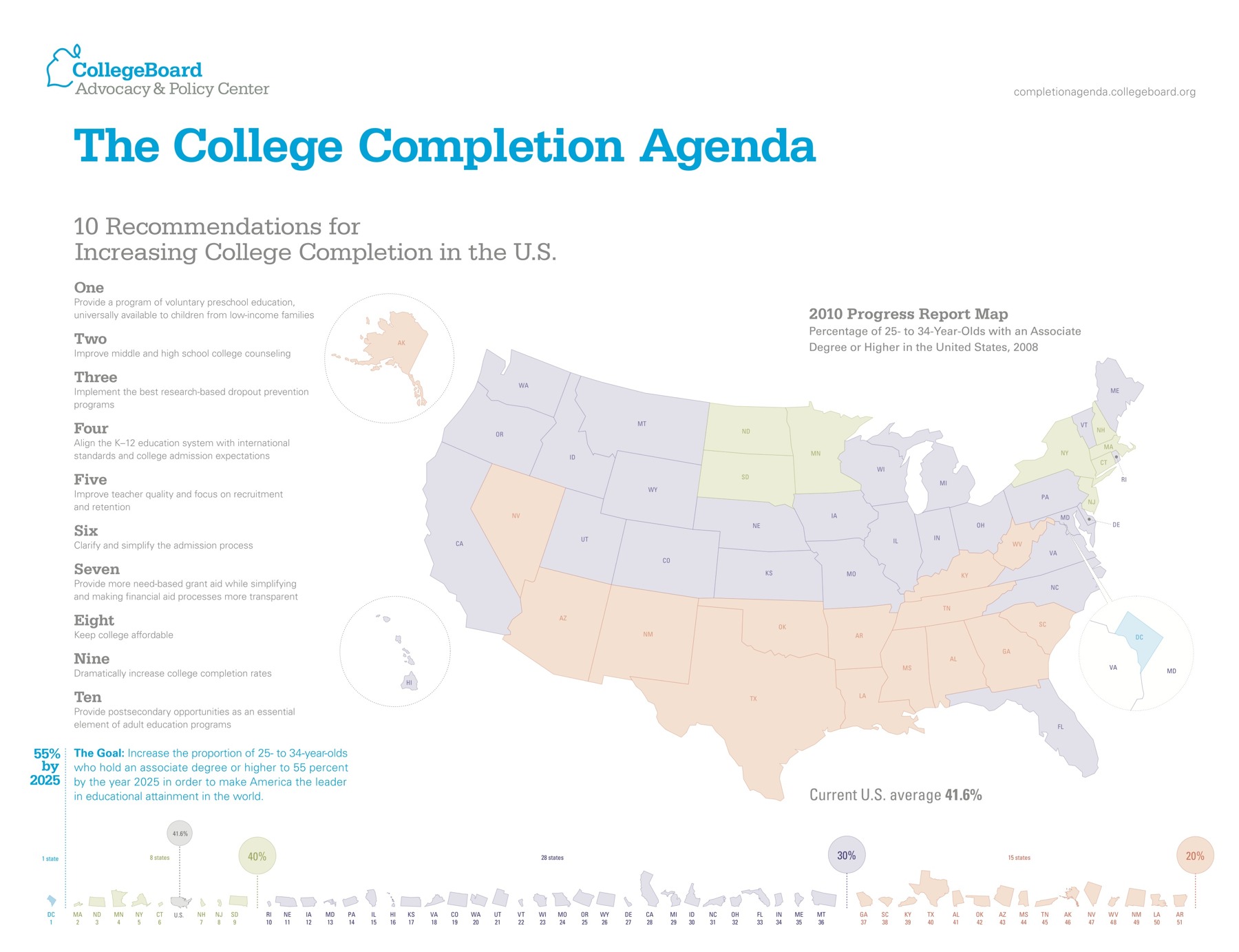
Once a Leader, U.S. Lags in College Degrees; Wisconsin Ranks 23rd


Click for a larger version.

Tamar Lewin, via a Rick Kiley email:

Adding to a drumbeat of concern about the nation’s dismal college-completion rates, the College Board warned Thursday that the growing gap between the United States and other countries threatens to undermine American economic competitiveness.
The United States used to lead the world in the number of 25- to 34-year-olds with college degrees. Now it ranks 12th among 36 developed nations.
“The growing education deficit is no less a threat to our nation’s long-term well-being than the current fiscal crisis,” Gaston Caperton, the president of the College Board, warned at a meeting on Capitol Hill of education leaders and policy makers, where he released a report detailing the problem and recommending how to fix it. “To improve our college completion rates, we must think ‘P-16’ and improve education from preschool through higher education.”

The complete 3.5MB PDF report is available here.

Share

Wisconsin Gubernartorial Candidate Walker proposes letting schools, government units use lower-cost state health plan

Lee Bergquist:

Milwaukee County Executive Scott Walker proposed a plan he says would potentially save school districts and local units of government more than $300 million in health care costs.
Walker, a Republican candidate for governor, said his proposal would allow local units of government to switch from health plans that have high premiums to the state’s lower-cost employee health plan.
Walker said his proposal could save school districts $68 million and local governments up to $242 million annually in health care costs.
He cautioned, however, that the savings estimate for local units of government is impossible to estimate because there is no central database of what municipalities pay for health care. To make his projections, he used data of the potential savings at school districts and applied those figures to the state’s more than 200,000 local public employees.
Walker said the biggest reduction would come from Milwaukee Public Schools, which he said could realize $20 million a year in savings.

Locally, the Madison School District’s use of WPS has long been controversial due to its high cost versus alternatives, such as GHC, among others.

Share

Abandoning Age-Tracking

Tamara Fisher:

In the school district where I teach, we do a moderate amount of within-grade-level ability-grouping with our students, particularly in reading and math. Occasionally I hear a teacher bemoan this practice as “tracking,” despite the fact that the groups are rather flexible and, particularly in reading, the students are re-grouped often (every few weeks) according to their learning needs. It is not “tracking” in the way groupings were created decades ago in our district in which students were irreversibly placed into, or rather locked into, a track. These are flexible groupings far more than they are tracks.
Ironically, the grade-level, whole-class groupings apparently preferred by these teachers who bemoan ability-grouping are the most restrictive form of tracking, that by age. For a century (-ish), schools have “tracked” students based on when they were born, not based on what they are ready and able to learn. “Born between September 1, 2003, and August 31, 2004? You belong to the Class of 2022.” That is how it works in nearly every school in our country. It’s tracking by age, but no one calls it that.
Of course, many teachers, especially those of us in the realm of gifted education, recognize that age-tracking (particularly in the absence of any differentiation) does little to help schools meet the learning needs of gifted and advanced learners who are academically years ahead of their age-peers.

Share

Teaching the Tech Generation

Douglas Crets:

The story about Provost Academy and the rise of online learning initiatives in South Carolina should be a pretty good indicator of the benefit that alternative learning methods have for today’s youth. Here is a stretch of text from the story. You can read the whole story online by visiting the site. Everyone has his or her own learning style.
Washington’s mother, Alice Peterson, said she knew her daughter was headed down the wrong path.
“I might have been in jail and she might have been in the funeral home somewhere,” Peterson said.
Instead, the cousins heard about Provost Academy, a free public online high school for South Carolina residents. They meet at Refuge Outreach Ministry in Lake City to take their lessons.

Share

Some Chicago schools lose diversity under new admissions policy

Azam Ahmed:

An overhaul in the admissions process for Chicago’s selective public schools had little impact on overall diversity, but individual buildings show much more variance — in some cases growing more segregated for the 2010-11 school year, CPS officials said Tuesday.
Chicago Public Schools chief Ron Huberman cautioned that the data are very preliminary and could change when the school year starts. Among other things, a budget crisis may force cuts in transportation to and from these schools, which could prompt enrollment changes.
He conceded that some schools are losing diversity.

Share

State switch to U.S. school standards debated

Jill Tucker:

California typically lands at or near the bottom in virtually every measure of public school performance nationally, but the academic content taught to the state’s schoolchildren is second to none, according to a study released Tuesday. That status has left the Golden State with a conundrum. To be more competitive for federal Race to the Top funds, the state must adopt common standards in English, math and other subjects to be in sync with most other states.
But that would mean replacing the academic standards that were recognized in the study conducted by the Thomas B. Fordham Institute, a think tank based in Ohio.
Critics are concerned the national standards could dumb down California classrooms, discarding the state’s superior academic framework adopted 13 years ago for students from kindergarten through high school.

Share

Hawaii Schools’ goals get ‘C’ grade

Mary Vorsino:

Reading and math learning goals for Hawaii public schools are “mediocre” and “often vague,” says a new national report that gives the state a “C” for its educational standards.
But the report points out that when Hawaii adopts common national standards in the 2011 school year, its standards will improve. The report gives the national standards a B-plus for English and an A-minus for math.
“Hawaii has raised the bar by adopting the common core,” said Michael Petrilli, vice president for national programs and policy at the Thomas B. Fordham Institute, which was scheduled to release its standards report today. “There are going to be much higher expectations.”
The state Department of Education said yesterday it agreed with the report’s findings.

Share

Study: California Classroom spending dips as ed funding rises; A Look at Per Student Spending vs. Madison

Don Thompson:

Spending in California classrooms declined as a percentage of total education spending over a recent five-year period, even as total school funding increased, according to a Pepperdine University study released Wednesday.
More of the funding increase went to administrators, clerks and technical staff and less to teachers, textbooks, materials and teacher aides, the study found. It was partially funded by a California Chamber of Commerce foundation.
Total K-12 spending increased by $10 billion over the five-year period ending June 30, 2009, from $45.6 billion to $55.6 billion statewide. It rose at a rate greater than the increase in inflation or personal income, according to the study. Yet researchers found that classroom spending dipped from 59 percent of education funding to 57.8 percent over the five years.
Spending on teacher salaries and benefits dropped from 50 percent of statewide spending to 48 percent over the same period. Spending on administrators and supervisors, staff travel and conferences all increased faster than teachers’ pay.

Complete study: 1.1MB PDF.
This is not a big surprise, given the increasing emphasis on, ironically, in the K-12 world, adult to adult spending, often referred to as “Professional Development“. Yippy Search: “Professional Development“.
The report mentions that California’s average per student expenditure is just under $10,000 annually. Madison’s 2009/2010 per student spending was $15,241 ($370,287,471 budget / 24,295 students).

Share

A Review of State Academic Standards, and the Common Core

Sheila Byrd Carmichael, Gabrielle Martino, Kathleen Porter-Magee, W. Stephen Wilson:

he K-12 academic standards in English language arts (ELA) and math produced last month by the Common Core State Standards Initiative are clearer and more rigorous than today’s ELA standards in 37 states and today’s math standards in 39 states, according to the Fordham Institute’s newest study. In 33 of those states, the Common Core bests both ELA and math standards. Yet California, Indiana and the District of Columbia have ELA standards that are clearly superior to those of the Common Core. And nearly a dozen states have ELA or math standards in the same league as Common Core. Read on to find out more and see how your state fared.

Wisconsin’s standards (WKCE) have often been criticized. This year’s study grants the Badger State a “D” in Language Arts and an “F” in Math.

Share

The National Standards Delusion

Neal McCluskey:

As Massachusetts nears decision time on adopting national education standards, the Boston Herald takes state leaders to task for their support of the Common Core standards, which some analysts say are inferior to current state standards. But fear not, says Education Secretary Paul Reville. If the national standards are inferior, the Bay State can change them. “We will continue to be in the driver’s seat.”
If only national standardizers — many of whom truly want high standards and tough accountability — would look a little further than the ends of their beaks.
Here’s the reality: Massachusetts will not be in the drivers seat in the future. Indeed, states aren’t in the driver’s seat right now, because it is federal money that is steering the car, and many more DC ducats will likely be connected to national standards when the Elementary and Secondary Education Act is eventually reauthorized. And this is hardly new or novel — the feds have forced “voluntary” compliance with its education dictates for decades by holding taxpayer dollars hostage.

Share

Charter Backers Flex Political Muscles

Jacob Gershman:

The charter-school movement appears to be catching up to the teachers union in political giving to Albany.
With the help of hedge-fund managers and other Wall Street financiers, charter-school advocates gave more than $600,000 to Albany political candidates and party committees since January, according to the latest campaign filings. That’s more than twice as much as in prior reporting periods, according to allies of charter schools, which are publicly funded but privately run.
Pro-charter donations appear to have surpassed the $500,000 or so that candidates raised from teachers unions during the six-month period.

Share

What we know on the standards debate

Jim Stergios:

We know that Massachusetts students scored below the national average on SATs in the early 1990s and barely broke the top 10 on national assessments. We know that Massachusetts students have become the best students in the nation on these same assessments, and are among the best “nations” in math and science.
We know that implementing standards in Massachusetts took years of public debate and hard work, and, spending over $90 billion since 1993 on K-12 education, that it came at no small cost to the Commonwealth and its communities.
We know that there are ways to improve our current standards and our performance across all demographics and geographies of the Commonwealth.
We know that our education reforms distinguish us from the rest of the country and are critical to business and job creation.
We know that having state flexibility allows us to improve faster than the rest of the nation and to make adjustments that are good for the people and children of Massachusetts.

Share

National Standards for US Schools Gain Support From States

Avi Arditti & Bob Doughty:

Americans have never had national education standards. Goals for what public schools should teach are set by state and local school boards. Their members are often elected.
But some Americans say the lack of national standards is wrong in a competitive global economy. Former president Bill Clinton said it was as if somehow school boards “could legislate differences in algebra or math or reading.”
President George W. Bush and Congress expanded federal intervention. His education law, still in effect, required states to show yearly progress in student learning as measured by the states’ own tests.

Share

School Quality Model and Management

Charlie Mas:

Seattle Public Schools has a number of slogans. Among them is “Every School a Quality School”. The District claims to be working towards this goal, but the District has no definition of a Quality School, so those claims lack credibility. Rather than clucking at the District for not having a definition of a Quality School, our time would be more productively used helping them to find one.
What is a Quality School? We need to be clear that we separate the idea of a Quality School from the students in the school. If we were to rely on student achievement, for example, as our definition of a Quality School, then we might conclude that Bryant is good school and that Hawthorne is a struggling school. But does anyone believe that if the Hawthorne students were all transferred to Bryant and if the Bryant students were all transferred to Hawthorne that the outcomes for the students would be much different? Would the Hawthorne students suddenly start to achieve because they are now at a good school and the Bryant students suddenly start to under-perform because they are now at a struggling school? I doubt it.

Share

Rutgers University to Approve Charter Schools Under a Proposed New Jersey Bill

Michael Symons:

With the latest batch of charter-school approvals likely to be announced soon by the state Department of Education, some state lawmakers are beginning a push for a bill that could expand the alternative public schools’ movement in New Jersey.
The proposal would permit Rutgers University to approve charter schools, in addition to the Department of Education. It also would end deadlines for organizers to apply for charters, allowing applications to be filed at any time and requiring decisions on them within five months.
The proposal would also expand the types of charter schools allowed in New Jersey, allowing virtual or e-charter schools, charter schools with students of only one gender and charter schools catering to students with behavioral needs or disorders, such as autism.
The legislation is sponsored by five Democrats but seems likely to receive a warm welcome from pro-charter Republican Gov. Chris Christie and his education commissioner, Bret Schundler, who helped found a Jersey City charter school in the 1990s.

Share

Most Northwest Indiana schools lag on classroom spending

Chelsea Schneider Kirk:

A majority of Northwest Indiana schools districts fell behind the state’s average in the percentage of dollars spent in the classroom, according to an annual school expenditures report released by the state’s Office of Management and Budget this month.
But at least seven school districts were above the state average of 58 percent. Gary Community School Corp. was among the highest in the region with 66 percent of its overall budget tied to student achievement compared to other operational and overhead expenses, such as salaries and costs for transportation and construction.
Lake Station Community Schools and the School City of Hammond routed 65 percent and 63 percent to district classrooms, respectively, during the 2008-2009 school year.
Those numbers include teacher salaries, textbooks as well as guidance counselors, social workers and other expenses tied to instructional support. While the state average is comparable to previous years, Indiana lags 5 percentage points behind the national average. Indiana Superintendent of Public Instruction Tony Bennett challenged school districts to not only meet the national average but to push more dollars to classrooms than any other state.

Share

DREAM-LOGIC, THE INTERNET AND ARTIFICIAL THOUGHT

David Gelernter:

This is the second in a series of essays by Gelernter commissioned by Frankfurter Allgemeine Zeitung. The German translation was published on June 22nd (“Ein Geist aus Software“).
DAVID GELERNTER is a professor of computer science at Yale and chief scientist at Mirror Worlds Technologies (New Haven). His research centers on information management, parallel programming, and artificial intelligence. The “tuple spaces” introduced in Nicholas Carriero and Gelernter’s Linda system (1983) are the basis of many computer communication systems worldwide. He is the author of Mirror Worlds, and Drawing a Life: Surviving the Unabomber.

Share

New York’s Charters Chief Steps Down

Barbara Martinez:

Victory Schools Inc., a for-profit charter-school operator, has hired away New York City’s charter-schools chief and is considering converting into a nonprofit.
Michael Duffy, the director of the Department of Education’s Charter School Office, will join Victory, according to representatives for both the DOE and the company. Victory helps manage 16 charter schools with 7,000 students in New York, Philadelphia and Chicago.
Mr. Duffy, whose title hasn’t yet been decided, is widely credited for accelerating charter-school growth in the city. He couldn’t be reached for comment.
The future of Victory has been the subject of interest since the spring, when the New York legislature passed a law that essentially prevents for-profit charter schools from growing. The law, which also doubled the number of charter schools allowed in the state, said no more than 10% of the state’s charter schools can be for-profit. Victory operates nine such schools in the state.

Share

Massachusetts panel wants to set limits on virtual public schools

James Vaznis:

The state Board of Elementary and Secondary Education, apprehensive about a new state law that allows public schools to operate almost entirely in cyberspace, will consider imposing limits on the growth of these “virtual schools,” much to the dismay of supporters.
The goal of the proposed regulations, which the board is scheduled to vote on tomorrow, is to allow some experimentation in Massachusetts with these kinds of schools, while not allowing them to grow unfettered without knowing what works and what doesn’t, said Jeff Wulfson, an associate education commissioner.
Among the proposed limits: capping enrollment at each virtual school at 500 students and requiring at least 25 percent of those students to reside in the school district that is operating the virtual school, according to the proposed regulations.
“We’re trying to find the right balance,” Wulfson said.

Share

New York State’s Exams Became Easier to Pass, Education Officials Say

Jennifer Medina:

New York State education officials acknowledged on Monday that their standardized exams had become easier to pass over the last four years and said they would recalibrate the scoring for tests taken this spring, which is almost certain to mean thousands more students will fail.
While scores spiked significantly across the state at every grade level, there were no similar gains on other measurements, including national exams, they said.
“The only possible conclusion is that something strange has happened to our test,” David M. Steiner, the education commissioner, said during a Board of Regents meeting in Albany. “The word ‘proficient’ should tell you something, and right now that is not the case on our state tests.”

Wisconsin’s WKCE has been criticized for its lack of rigor, as well.

Share

Parents fret about Milwaukee Public Schools’ middle-high school hybrids

Erin Richards:

When Kim Lecus heard that the Fritsche Middle School program would move into Bay View High School in the fall of 2010, she immediately was concerned about the impact on her daughter, who just finished seventh grade at Fritsche.
The emerging middle/high model at Bay View may offer student Lindsey Lecus a greater variety of accelerated courses, but in her mother’s eyes, it comes with a serious price: the mixing of vulnerable adolescents with older teenagers.
The Milwaukee School Board has approved an increasing number of sixth through 12th grade schools in the city. Board members think it will improve the transition for students from middle to high school and will consolidate space in the district.
The “best” way to serve children in the delicate and hormonally charged years between ages 11 and 13 – something national researchers have wrestled with for years – is still unclear. Underscoring that point is Milwaukee, where the emergence of more 6-12 schools is coming just a few years after former superintendent William Andrekopoulos championed moving middle schoolers in with elementary students in K-8 schools.
“It’s not like any other time period in life,” said Trish Williams, executive director of EdSource, a non-profit group that recently studied the effects of grade design on middle schoolers at more than 300 schools in California.

Share

Gove’s UK schools proposals are being rammed through – and the devil is very possibly in the absence of detail

The Guardian:

Of all the vows made at the coalition’s May marriage, one stood out: the vow for a new politics. Out, so it seemed, was the divisive tub-thumping positioning, along with the legislate-first-think-later style of government. In its place was the prospect of cross-party public administration which was deliberative, consultative and calm. No Conservative seemed more in tune with the new times than Michael Gove. What a shame, then, that the same Mr Gove was yesterday defending a decision to ram schools reforms through without full parliamentary scrutiny on the basis that Labour had once displayed similar haste.
The education secretary’s bill will allow schools to turn themselves into academies without consulting the council. Where the issue is the removal of extra-parliamentary consultation it is surely especially important for ministers to provide the time for a thoroughgoing consultation with parliament itself. Yet instead of a white paper, which invites responses on detailed proposals and gives the select committee time to get its teeth into principles, we have a bill which may be law before Mr Gove has even met that committee. And instead of line-by-line scrutiny in a standing committee – with scope to consider representations, and time for parliamentary alliances to be formed – the detailed drafting of the law will be finessed on the floor of the House, a procedure ordinarily reserved for responding to emergencies.

Share

Wake School Board Prepares For Packed House Regarding Neighborhood Schools At Tuesday Meeting

Lauren Hills:

The decision to switch to neighborhood schools has been a divisive one in Wake County, and although the school board has already voted to shift to the new model, groups like “Great Schools In Wake” said they will still plan to have a presence and a voice at the meetings as the board hashes out the specifics of the new policy.
“Give our input and have some influence,” said Yevonne Brannon with the Great Schools in Wake Coaltion. “I still hope, think, there’s room for negotiation and still hope there’s room for reconsideration.”
That’s the hope for many who oppose neighborhood schools. It’s also why the NAACP will hold a protest before the meeting in down town Raleigh Tuesday morning. The organization will call school board leaders to stop what they say is segregation and promote diversity.

Share

Math Curricula

Charlie Mas:

I know that I’m inviting trouble with this, but something that Reader wrote in a comment on another thread piqued my interest. I would like to discuss only a narrow question. Please don’t expand the discussion.
Writing about Everyday Math and Singapore, Reader wrote: “The fact is, the newer curricula stress more problem solving and discovery. That is, it’s doing more than a lot of older curricula.”
Here’s my question: can problem-solving be taught?
I mean this in the nicest possible way and I don’t have an answer myself. I’m not sure, I’m asking. Can people be taught or trained in problem-solving techniques or is it a talent that some people just natively have more than others? Problem solving requires a certain amount of creativity, doesn’t it? It can require a flexibility of perspective, curiosity, persistence, and pattern recognition. Can these things be taught or trained?

Related: Math Forum audio/video links.

Share

On Budgets & Professional Development

Patricia Wasley and Stephanie Hirsch:

BUDGETS across the state and nation are being slashed, forcing education leaders to confront economic shortfalls unseen in recent memory and make do with less.
One area especially hard hit by the cuts is professional development — the process by which we ensure our educators are well equipped to meet constantly evolving demands of helping students succeed. Often overlooked, high-quality professional learning is indispensable in generating the outcomes — like better test scores and higher graduation rates — that should be expected of our schools.
Absent high-quality professional learning and support for professional growth, the ability of teachers to meet new challenges becomes compromised and their practices habitual. This makes it more difficult to achieve higher outcomes and is not what we want for our teachers or students.

There has been an increasing emphasis on “adult to adult” expenditures within our public schools, as Ripon Superintendent Richard Zimman noted last summer.

Share

Primary cancelled for Detroit school board as no candidates file to run for open seats

Jonathan Oosting:

It’s been a tough year for the Detroit Board of Education.
So tough, it appears nobody wants the job.
The Detroit News reported this weekend that not a single candidate has filed to run for two open seats on the 11-member board. As a result, the race will not appear on the city’s Aug. 3 primary ballot.
But really, can you blame potential candidates for seeking other opportunities?
The popularity of the board hit perhaps an all-time low last month when then-president Otis Mathis resigned amid allegations he fondled himself during meetings with Superintendent Theresa Gueyser. He’s since been charged criminally.

Share

K-12 Tax & Spending Climate: The Crisis in Public Sector Pension Plans

Eileen Norcross:

New Jersey’s defined benefit pension systems are underfunded by more than $170 billion, an amount equivalent to 44 percent of gross state product (GSP) and 328 percent of the state’s explicit government debt. Depending on market conditions, the state will begin to run out of money to pay benefits between 2013 and 2019. The state’s five defined benefit pension plans cover over 770,000 workers, and more than a quarter million retirees depend on state pensions paying out almost $6 billion per year in benefits. Nationwide, state pensions are underfunded by as much as $3 trillion, approximately 20 percent of America’s annual output.
This path is not sustainable. In order to avert a fiscal crisis and ensure that future state employees have dependable retirement savings, New Jersey should follow the lead of the federal government and the private sector and move from defined benefit pensions to defined contribution pensions. While significant liabilities will remain, the first step to addressing the pension crisis is capping existing liabilities and providing new employees with more sustainable retirement options.

Share

Wisconsin’s Education Superintendent on the National “Common Core” Academic Standards

Alan Borsuk:

But signing Wisconsin on to the nationwide standards campaign may trump all of those. Wisconsin’s current standards for what children should learn have been criticized in several national analyses as weak, compared with what other states have. The common core is regarded as more specific and more focused on what students really should master.
Chester E. Finn Jr., president of the generally conservative Thomas B. Fordham Institute in Washington, is a big backer of the new standards. “There is no doubt whatsoever in Wisconsin’s case that the state would be better off with the common core standards than what it has today,” he said in a phone interview.
But standards are one thing. Making them mean something is another. Evers said that will be a major focus for him ahead.
“How are we going to make this happen in the classrooms of Wisconsin?” he asked.
The answer hinges on making the coming state testing system a meaningful way of measuring whether students have learned what they are supposed to learn. And that means teaching them the skills and abilities in the standards.
Does that mean Wisconsin will, despite its history, end up with statewide curricula in reading and math? Probably not, if you mean something the state orders local schools to do. But probably yes in terms of making recommendations that many schools are likely to accept.
“We will have a model curriculum, no question,” Evers said. He said more school districts are looking to DPI already for answers because, with the financial crunches they are in, they don’t have the capacity to research good curriculum choices.

Share

Debate over school data in wealthy counties

Jay Matthews:

Educational statistics expert Joseph Hawkins, one of my guides to the mysteries of test assessment, is impatient with the way the Montgomery County Public School system, as he puts it, “is always telling the world how better it is than everyone else.” He finds flaws in its latest celebration of college success by county graduates, particularly minorities.
As a senior study director with the Rockville-based research firm Westat, Hawkins’ critique has regional and national importance because it deals with the National Student Clearinghouse. This little-known information source may become the way school raters like me decide which school families and taxpayers are getting their money’s worth and which aren’t.
The clearinghouse has a database of more than 93 million students in more than 3,300 colleges and universities. It originally specialized in verifying student enrollment for loan companies. Now it tells high schools how their alums are doing.
Yeah, sure, says Hawkins, but “data from the Clearinghouse is not completely accurate, especially if social security numbers for students are not obtained.” Also, he says, some of the numbers Montgomery County brags about don’t look so good when compared to others.

Share

On UC’s Risky Venture Into Online Education Mortarboards without the bricks

San Francisco Chronicle:

A handful of administrators at the University of California are spearheading an effort to create an ambitious online educational program for undergraduates. The idea is that UC could become the first top-tier American university to offer a bachelor’s degree over the Internet. It’s a thought-provoking, fascinating and innovative concept. It’s also a highly risky experiment.
Online education has a place – even in the university system. For students, it’s impossible to beat the convenience and the accessibility of online learning. For workers, it can be a great way to expand their knowledge base without having to leave their jobs. Corporations, small businesses, even traffic schools – all of these institutions have shown that there’s a positive place for online education in our society.
But that doesn’t mean that the UC should jump into the fray.

Share

In Search of EduProductivity

Tom Vander Ark:

Almost every state has been slashing budgets trying to balance expenses with shrinking revenues. A few governors have asked for creative ways to stretch education funding while improving learning and operating productivity. Here’s a few ideas:
Promote blended learning
Require all students to take at least one online course each year of high school and negotiate a 10-20% discount with multiple online providers and give students/schools options.
Provide statewide access to multiple online learning providers and reimburse at 80% of traditional schools (with performance incentives for serving challenging populations).
Encourage K-8 schools to adopt a Rocketship-style schedule with 25% of student time in a computer learning lab and a tiered staffing model that makes long day/year affordable. A loan program to upgrade to a 1:3 computer ratio would support adoption of a blended model could be repaid out of savings.
Acceleration

Share

NO to Mayor control. YES to Community.

Shea Howell:

The debate over control of Detroit Public Schools is intensifying. Last week three important events happened.
First, the elected school board selected community activist Elena Herrada to join them. Herrada brings vision and passion to the board and a long history of working on behalf of the community.
Second, citizens under the name of We the People testified before the Detroit City Council, objecting to the very idea of mayoral control of the schools.
Finally, Council President Charles Pugh, who appears to be at least willing to listen to new thinking, indicated to Rochelle Riley that he is not necessarily in favor of mayoral control.
The Mayor’s effort to seize control of public schools is wrongheaded and dangerous. It is part of a larger scheme, backed by corporate interests, to destroy the democratic responsibilities of public education and to make money off the bodies of our children while limiting their minds.

Share

Flexibility for higher ed, and maybe some help

David Sarasohn:

This is a life’s work,” says Jay Kenton, the Oregon University System’s vice chancellor for finance and administration. “I’ve been working to change this for 30 years.”Flexibility for higher ed.
“This” is not Oregonians’ understanding of the importance of a national-class higher education system, why some states regard their universities as economic engines, why it’s a problem to be among the lowest higher-ed-funding states in the country. Changing that could be more than a life’s work; it could take at least until Oregon State wins a Rose Bowl.
Kenton’s goal, expressed in a proposal from the State Board of Higher Education earlier this month, is to loosen the Legislature’s control over the state universities’ budgets, control that has not lightened an ounce while the state’s fiscal contribution has become almost weightless.

Share

Economy’s impact on public schools

Megan:

I was contacted by a reporter working on a story for Gannett News Service about the economy and its impact on public schools. At my kids’ former school (AS#1) we got hit with the triple whammies of the budget cuts, drop in enrollment, and a decline in parent involvement, so I feel that my experience isn’t exactly typical. I thought this blog would be a great place to get a broad response. Here is a modified version of the email the reporter sent me (edited to fit a public forum). If you’d rather contact the reporter directly to give a quotable account of your experience, you can email me at megan_mcblog@yahoo.com.
Here’s the story overview:

Share

Seattle Community Blog Commentary

Melissa Westbrook:

So I like to check in regularly with other blogs. I look at LEV’s blog, the Alliance’s blog and Harium’s blog. One interesting thing I’ve noticed is that, when challenged or asked about information on their threads, you can rarely get an answer. Charlie asks a lot of pertinent questions in a respectful, albeit blunt, manner and rarely gets an answer. Harium does occasionally but most of his replies are that he supports the staff. I noticed that when Charlie started asking questions at LEV, there stopped being replies.
So what are these people afraid of? I can get Harium being busy and not able to reply to everything (but then, why have a blog?). But LEV and the Alliance say they want to engage and talk and yet there’s silence. I think there are two issues.

Share

Oklahoma’s lowest performing schools split $36.9M in federal grants

Megan Rolland:

The grants were approved during a special meeting Wednesday so schools could implement sweeping reforms this summer, state schools Superintendent Sandy Garrett said.
“This could really be transformative for urban districts,” Garrett said.
Oklahoma City Public Schools received $12.1 million for three schools: U.S. Grant High School, Douglass Middle School and F.D. Moon Elementary School.
Tulsa Public Schools received $22.6 million for six schools: Clinton and Gilcrease middle schools, and Central, East Central, Nathan Hale and Will Rogers high schools.
And Crutcho Elementary School in northeast Oklahoma County will receive $2.24 million.

Share

On national standards, the Gates Foundation gets what it pays for

Jim Stergios:

This week, State House News broke a story on the “cozy relationship” between Health Care for All and the Patrick Administration. HCFA is an effective organization, but when an HCFA official writes to the state’s Insurance Commissioner: “If you expect to do anything ‘newsworthy’ [on insurance premium caps], can we be helpful with our blog or media at all?” well, then you have to take their positions with a brimming cup of salt.
Surrogate relationships are very much a fact of life in a state where one party is dominant, like Massachusetts. Next up to bat in this age-old game, Education Commissioner Mitch Chester and Secretary Paul Reville. In anticipation of the important debate over whether to adopt weaker K-12 national standards, they have to all appearances lined up their surrogates.
Via two trade organizations, the National Governors Association (NGA) and the Council of Chief State School Officers (CCSSO), the Obama Administration and the Gates Foundation have decided to get all states to “voluntarily” adopt national standards. They are working closely with longtime national standards advocates, such as Achieve, Inc., and are funded with tens of millions of dollars from the Gates Foundation. As Tom Loveless of the Brookings Institution notes in an article by Nick Anderson of the Washington Post:

Share

Bill Gates’ School Crusade The Microsoft founder’s foundation is betting billions that a business approach can work wonders in the classroom

Daniel Golden:

It’s been two years since Bill Gates left his day-to-day role at Microsoft (MSFT) to concentrate on supervising the Bill & Melinda Gates Foundation–and his new enterprise is booming. Headquartered in a converted check-processing center in Seattle’s Eastlake neighborhood, the 10-year-old foundation plans to move into a 900,000-square-foot campus and visitors’ center near the city’s Space Needle next spring. The Gates Foundation opened a London office this year; it also has offices in Washington, Delhi, and Beijing, and 830 employees around the world, up from about 500 in 2008. With assets of $33.9 billion as of Dec. 31, 2009, and America’s two richest people–Gates and Warren Buffett–as trustees, the foundation plans to spend $3 billion in the next five to seven years on education. If there’s such a thing as a charity behemoth, the Gates Foundation is it.
While its efforts in global health are widely applauded, its record in America’s schools has been more controversial. Starting in 2000, the Gates Foundation spent hundreds of millions of dollars on its first big project, trying to revitalize U.S. high schools by making them smaller, only to discover that student body size has little effect on achievement.

Related: Small Learning Communities and English 10.

Share

School’s Out for Summer but Education Reform Talk is In

Alberta Darling:

School may be out for the summer, but the topic of education reform has certainly not gone on vacation. Both nationwide and right here at home there are several different ideas on the table that, if implemented, could go a long way tdsoward improving educational outcomes for our students.
Under the guidance of Governor Tommy Thompson, Wisconsin was once a nationwide leader in educational innovation. Unfortunately, bold, reform-minded leadership has been absent from the Governor’s office for the last eight years. The most recent failures of Governor Jim Doyle and legislative Democrats were their unsuccessful efforts to grab federal Race to the Top dollars and their blundering attempt at a mayoral takeover of the Milwaukee Public Schools.
Usually we look to our nation’s capital for examples of how not to do business, but the new collective bargaining agreement Washington D.C. School Chancellor Michelle Rhee struck with her teachers’ union is just the sort of thing we need here in Milwaukee. The contract includes teacher pay for performance, lessens the weight of seniority if layoffs become necessary and ends “job for life” tenure for ineffective teachers.
Another reform MPS sorely needs is the elimination of the teacher residency requirement, a completely arbitrary barrier that discourages quality educators from teaching at MPS. Only two of the nation’s fifty largest school systems, Milwaukee and Chicago, still require its teachers to live within the city limits. No other school district in Wisconsin has a residency requirement.
As always, there will be some who maintain the cure for all that ails K-12 public education is just to keep throwing more money at it. There are some holes in that logic. First, one need look no further than MPS for an example of high spending and low results. Second, aid to public schools is already the biggest chunk of the state budget by far and spending per pupil is over $11,000. Even if simply putting a lot more money into the system were the answer, the state doesn’t have it and taxpayers are already stretched to the limit.

Clusty search: Alberta Darling.

Share

Arne Duncan’s $800 million fight

Joel Wendland:

he total federal budget for 2010 came in at just a hair under $3.6 trillion. In some weird sort of perspective that means $800 million equals less than three hundredths of one percent (.00022 percent) of the total amount. So why is Education Secretary Arne Duncan fighting so hard to keep it?
According to media reports, the $800 million comes out of his “Race to the Top” and other education reform programs to help offset a $10 billion package to protect education jobs in the House supplemental appropriations bill, which includes $33 billion for the wars.
Leading House Democrats proposed the offset in response to public school teachers who oppose some of the provisions of the “Race to the Top” program.
While they appreciate the administration’s commitment to educate, teachers say the “Race to the Top” reforms specifically emphasize testing and school privatization over a needed bigger commitment to professional development and financial support for ailing schools. Under the reform, teachers argue, schools are forced to teach to tests or face closure and mass firings of school personnel.

Share

Teacher Fired, School Disciplined For Student’s Drowning

Jen Chung:

A Department of Education investigation into the drowning of sixth grader Nicole Suriel during a class trip to Long Beach slammed Columbia Secondary School for poor planning that led to the tragedy. The beach had numerous signs noting there were no lifeguards on duty; there were three adults supervising the 24 students. The DOE fired first-year teacher Erin Bailey and disciplined assistant principal Andrew Stillman and Principal Jose Maldonado-Rivera.
The Daily News runs down some of the findings, including how “Assistant Principal Andrew Stillman decided at the last minute not to go, staying behind to do administrative work. Bailey’s boyfriend – former teacher Joseph Garnevicus, 28 – went in Stillman’s place, but couldn’t swim.” Also, “There weren’t specific permission slips, just ‘blanket’ slips from the start of the year that didn’t include swimming.” The “blanket slips” were only for trips in Manhattan; instead of issuing a permission slip to parents, Stillman simply emailed them, “We’re headed to the beach tomorrow.”

Share

U.S. education secretary calls on NAACP to focus on schools

Mara Rose Williams:

Calling education “the civil rights issue of our generation,” U.S. Education Secretary Arne Duncan on Wednesday issued a national challenge for whole communities to get involved in improving public education.
“The only way to achieve equality in society is to achieve it in the classroom,” Duncan told NAACP delegates meeting in Kansas City for the group’s annual convention.
“This is not just a moral obligation; it is our economic imperative,” he said. “Everyone has a responsibility. Every one can step up. Education is our national mission. Education is our best hope.”
He said community leaders “must be at the table when decisions are made about how to improve struggling schools.”
The Obama administration is making $4 billion available to improve the 5 percent worst-performing schools in the country, Duncan said.

Share

High school drug testing shows no long-term effect on use

Greg Toppo:

New research paints a decidedly mixed picture when it comes to mandatory drug testing for high school students trying out for sports or other extracurricular activities: While testing seems to reduce self-reported drug use in the short term, it has virtually no effect on teens’ plans to use drugs in the future.
A U.S. Department of Education study, out today, surveyed students at 36 high schools that got federal grants to do drug testing. Half of the schools had already begun testing for marijuana, amphetamines and other drugs; the other half had not.

Share

New Jersey’s Christie Seeks Superintendent Pay Cap

Bloomberg:

New Jersey Governor Chris Christie proposed salary caps on public school superintendents to help rein in the highest property taxes in the U.S., a move he said may slice pay for 70 percent of the top district administrators.
Christie, 47, announced the limit today as part of a package to control rising real estate tax bills. The proposal would cut salaries for 366 school superintendents when their current contracts expire, the governor’s office said in a statement.
More than 50 school administrators had base salaries of $200,000 or more last year, the state Education Department reported last month. The governor’s salary is $175,000.

Notes and links via New Jersey Left Behind and the Associated Press.

Share

Graduate tax and private colleges at heart of UK higher education blueprint

Jessica Shepherd and Jeevan Vasagar:

The government signalled the biggest shakeup of Britain’s universities in a generation today, with a blueprint for higher education in which the highest-earning graduates would pay extra taxes to fund degrees, private universities would flourish and struggling institutions would be allowed to fail.
Vince Cable, the cabinet minister responsible for higher education, also raised the prospect of quotas to ensure state school pupils were guaranteed places at Britain’s best universities, breaking the private school stranglehold on Oxbridge.
Comparing the existing system of tuition fees to a “poll tax” that graduates paid regardless of their income, the skills secretary argued it was fairer for people to pay according to their earning power.
He said: “It surely can’t be right that a teacher or care worker or research scientist is expected to pay the same graduate contribution as a top commercial lawyer or surgeon or City analyst whose graduate premium is so much bigger.”

Share

Obama’s School Reforms Are a Priority

JOEL I. KLEIN, MICHAEL LOMAX AND JANET MURGUÍA:

In the days following his inauguration, President Obama included a package of educational reforms in his stimulus bill that offered states financial incentives to make dramatic improvements in their education systems. About 10% of the $100 billion allocated for education was used to create competitive grants. States could only win them by drafting comprehensive and aggressive plans to, for example, adopt higher academic standards, turn around chronically low-performing schools, and redesign teacher evaluation and compensation systems.
Although it has received much less attention than health care and financial regulatory reform, this measure may ultimately be one of Mr. Obama’s most profound and lasting achievements. In just one year, we’ve already seen more reforms proposed and enacted around the country than in the preceding decade.
Yet on July 1, with little warning, the House of Representatives watered down these reform efforts by approving an amendment to the emergency supplemental appropriations bill, proposed by Rep. David Obey (D., Wis.). It takes away $800 million that has already been committed to three critical parts of the president’s education reform package–Race to the Top, the Teacher Incentive Fund, and the Charter Schools Program. This breaks a promise to the states, districts and schools that are doing the most important work in America. The funds are to be redirected to a $10 billion “Edujobs” bill to prevent teacher layoffs.

Share

“Common core standards”: education reform that makes sen

Los Angeles Times:

In many third-grade classrooms in California, students are taught — briefly — about obtuse and acute angles. They have no way to comprehend this lesson fully. Their math training so far hasn’t taught them the concepts involved. They haven’t learned what a degree is or that a circle has 360 of them. They haven’t learned division, so they can’t divide 360 by 4 to determine that a right angle is 90 degrees, and thus understand that an acute angle is less than 90 degrees and an obtuse angle more.
It makes no pedagogical sense, but California’s academic standards call for third-graders to at least be exposed to the subject, and because angles might be on the standardized state test at the end of the year, exposed they are.
Now, that might change. In June, a yearlong joint initiative by 48 states produced a set of uniform but voluntary educational standards in English and math. Urged on by the Obama administration, the initiative’s main purpose was to encourage states with low academic standards to bring their expectations into line with those of other states. Twenty states have already adopted the standards; 28 more, including California, are considering them. Texas and Alaska are the only states that declined to participate in the project.

Clusty Search: Common Core Standards.

Share

Advocates: Private Reform Aid Slights Rural Schools

Mary Schulken:

Rural schools are being left out of pivotal policy changes being tried out in the nation’s education system, say some rural advocates, and that goes for reform experiments bankrolled with private dollars from the Bill & Melinda Gates Foundation.
“The [Gates] Foundation funded work around smaller schools in mostly urban places–a sort of ironic phenomenon, given the consolidation of rural schools. And they funded some early-college initiatives in places like rural Appalachian Ohio,” said Caitlin Howley, senior manager, education and research, for ICF International in Charleston, W.Va., an educational research firm. “But I don’t think rural is part of what they’ve been thinking about.”
A Washington Post report this week tracked the influence of some $650 million the Gates Foundation has pledged for key reforms in the nation’s schools in the past two and one-half years. The story also noted the close relationship between the Gates Foundation and the Obama administration (a number of Gates Foundation employees have assumed key roles in the administration) as well as similarities in the educational priorities pushed by Gates and the Obama White House.

Share

Teaching: The Passion and the Profession

Room for Debate:

A Times article this week described the stiff competition among graduates from top colleges for jobs with Teach for America. “Teach for America has become an elite brand that will help build a résumé, whether or not the person stays in teaching,” writes Michael Winerip, the On Education columnist for The Times.
But, Mr. Winerip noted, the 20-year-old program has gotten mixed reviews from education experts, who complain that the recruits do not stay long enough to gain the experience to make them effective teachers. T.F.A.’s proponents point out that the poorest schools don’t attract the top career teachers to begin with. Does Teach for America’s popularity among top students raise the status of the teaching profession? Or is there a risk that it makes teaching seem more like a personal steppingstone, rather than a lifetime career?

Share

Long papers in high school? Many college freshmen say they never had to do one.

Jay Matthews:

Kate Simpson is a full-time English professor at the Middletown, Va., campus of Lord Fairfax Community College. She saw my column about Prince George’s County history teacher Doris Burton lamenting the decline of research skills in high school, as changing state and local course requirements and grading difficulties made required long essays a thing of the past.
So Simpson gave her freshman English students a writing assignment.
Simpson noted my complaint that few American high-schoolers, except those in International Baccalaureate programs, were ever asked to do a research project as long as 4,000 words. Was I right or wrong? Did her students feel prepared for college writing? The timing was good because her classes had just finished a three-week research writing project in which they had to cite sources, do outlines, write and revise drafts.
She said she discovered that 40 percent of her 115 students thought that their high schools had not prepared them for college-level writing. Only 23 percent thought they had those writing skills. Other responses were mixed.

Will Fitzhugh has been discussing this issue for decades….

Share

UC online degree proposal rattles academics

Nanette Asimov:

Taking online college courses is, to many, like eating at McDonald’s: convenient, fast and filling. You may not get filet mignon, but afterward you’re just as full.
Now the University of California wants to jump into online education for undergraduates, hoping to become the nation’s first top-tier research institution to offer a bachelor’s degree over the Internet comparable in quality to its prestigious campus program.
“We want to do a highly selective, fully online, credit-bearing program on a large scale – and that has not been done,” said UC Berkeley law school Dean Christopher Edley, who is leading the effort.

Matthew Ladner has more.

Share

The Slippery Slope Toward National Science Standards

Lindsey Burke:

The Obama Administration is successfully orchestrating one of the largest federal overreaches into education policy since the Great Society programs of the mid-1960s. If this news is coming as a surprise, it’s because the Administration is maneuvering outside of normal legislative procedure, by way of Trojan-horse programs such as Race to the Top and the suggestive power of their “blueprint” to reauthorize No Child Left Behind.
The Administration’s push for national standards and tests, which is moving quickly, is an historic federal overreach. By August 2, 2010, states must submit “evidence of having adopted common standards” in order to increase their chances of winning a Race to the Top grant. For states not enticed by the $4.35 billion grant competition, the Administration has already laid the groundwork in their blueprint for tying the $14.5 billion in Title I funding for low-income districts to the adoption of national standards–a deal that states will likely be unable to turn down.

Share

Trials on drug testing in Hong Kong schools are prudent given the threat to young people

Lai Tung-kwok:

The objectives of the drug-testing trial scheme in Tai Po schools were made abundantly clear at the outset. It was meant to strengthen the resolve of students to stay away from drugs. With the support of their parents, more than 12,400 students have joined the scheme voluntarily to make that pledge. Now they are in a better position to say “no” to their peers when tempted to try drugs.
The scheme is also meant to assist students troubled by drugs and to motivate them to seek help. Since the scheme was announced last summer, the Counselling Centres for Psychotropic Substances Abusers serving Tai Po have received some 80 self-referral cases involving youngsters, more than double the number over the same period in the previous year.

Share

What is the Education Revolution really all about?

Charlie Mas:

The League of Education Voters is trying to co-opt dissent by creating a campaign called Education Revolution and using a lot of incendiary language and images, but not taking any action.
It got me thinking about what the Revolution really is or should be. Help me clarify my thinking on this.
I think that the Revolution is about re-defining and re-purposing the District’s central functions and responsibilities. The change will come when the role of the central administration is defined. What do we want the District’s central administration to do? And what DON’T we want them to do?
Ideally, the District’s headquarters will take responsibility for everything that isn’t better decided at the school building level. They should relieve the school staff of those duties. They should:
1) Provide centralized services when those services are commodities and can achieve economies of scale. For example, HR functions, facilities maintenance, data warehousing, contracting, food service, procurement, accounting, and transportation.

Well worth reading.

Share

Helena school board gets earful on sex ed proposal

Matt Gouras:

A proposed sex education program that teaches fifth graders the different ways people have intercourse and first graders about gay love has infuriated parents and forced the school board to take a closer look at the issue.
Helena school trustees were swamped Tuesday night at a hearing that left many of the hundreds of parents in attendance standing outside a packed board room. They urged the school board in this city nestled in the Rocky Mountains to take the sex education program back to the drawing board.
The proposed 62-page document covers a broad health and nutrition education program and took two years to draft. But it is the small portion dealing with sexual education that has drawn the ire of many in the community who feel it is being pushed forward despite its obvious controversial nature.

Share

California’s school funding system and report of an ACT inequity

Katy Murphy:

Most people I’ve spoken with about California’s school finance system, regardless of their political views, seem to think it’s a mess. The researchers on the Governor’s Committee on Education Excellence described it as “the most complex in the country, lacking an underlying rationale and transparency.”
Mike Kirst, the Stanford University education Professor Emeritus I interviewed today, said he wouldn’t even call it a system. He called it “an accretion of incremental actions that don’t fit together and that make no sense.”
Will the courts finally force the deadlocked state Legislature to overhaul the formulas and regulations that dictate how California allocates money to its schools (and how much)? The nonprofit Public Advocates law firm hopes so. It filed suit today in Alameda Superior Court on behalf of a coalition of advocacy groups, students and parents, saying the status quo denies students the right to a meaningful education.

Share

How Bellevue’s Superintendent Works

Melissa Westbrook:

Interesting article in last week’s Times about the Superintendent over in Bellevue. First, she’s never been a superintendent before; Bellevue got to her come from her consulting business in California. Two, she says she’s doing this one gig and then going back to consulting. (She was allowed to still keep that job as president something that seems to bother some. The State Auditor found no issue with her hiring of a colleague to work as an education consultant.)
What makes her most interesting is this:

The first-time superintendent is engaged in a bold move to change the teaching culture in a district that has already gained a reputation for excellence, with all five of its high schools regularly winning national acclaim.
But it’s that very reputation, the school board believes, that has masked an important failure: reaching students at the bottom of the socioeconomic ladder in a district that’s far more diverse than many may realize.
Cudeiro believes a philosophy she honed over eight years of consulting work could close the divide.

Share

Does He Want It? Does the Mayor of Detroit Want to Control the City’s Schools?

Darrel Dawsey:

There’s a scene from the legendary HBO show The Wire that I think about when I consider this increasingly divisive issue of mayoral control of Detroit Public Schools: In the scene (which I decided against posting here because it’s graphic), young drug runner Namond is urged by his friend and fellow dealer Michael to confront a kid who has run off with Namond’s drugs. When Namond and Michael find the young thief, the kid starts to insult the obviously intimidated Namond. Michael steps in and beats the kid bloody.
“Take ya pack,” Michael then says to Namond, motioning for him to retrieve his stolen drugs from boy. But Namond, who never wanted to be a dealer in the first place, recoils and rushes off into the night, leaving Michael and the drugs behind. “I don’t want it,” he sobs as he scurries away.
If DPS is the coveted “pack,” Bing reminds me of Namond. Everyone else may think this is worth battling over and some may be egging him on to take over the troubled Detroit school district. But it seems that deep down, the mayor doesn’t want it.

Share

K-12 Tax & Spending Climate: More Americans’ credit scores sink to new lows

Eileen Aj Connelly:

The credit scores of millions more Americans are sinking to new lows.
Figures provided by FICO Inc. show that 25.5 percent of consumers — nearly 43.4 million people — now have a credit score of 599 or below, marking them as poor risks for lenders. It’s unlikely they will be able to get credit cards, auto loans or mortgages under the tighter lending standards banks now use.
Because consumers relied so heavily on debt to fuel their spending in recent years, their restricted access to credit is one reason for the slow economic recovery.
“I don’t get paid for loan applications, I get paid for closings,” said Ritch Workman, a Melbourne, Fla., mortgage broker. “I have plenty of business, but I’m struggling to stay open.”

Share

Milwaukee’s School Experiment Shows Promise

Patrick Wolf:

On a rainy May morning in 2008, my research team assembled at the Italian Community Center in downtown Milwaukee for focus-group sessions with the parents of students enrolled in the Milwaukee Parental Choice Program.
After a long morning of listening to parents vent about the aspects of their children’s schools that disappointed them, the tone of the meeting suddenly changed when we concluded with an “open mike” session.
“We may complain a lot about our children’s schools,” one of the parents told us, “but please, please, please don’t take our school choice away.”
Parents like this concerned mother have played a starring role in the long-running policy debate over the school-choice program, which enables parents to select a school for their child other than the assigned neighborhood public school. Charter schools, for example, offer choices within the public school system. School-choice programs like Milwaukee’s notably include private schools and are often called voucher programs.

Share

A Fresh Take on Urban Schooling

Sunny Schubert:

It is just minutes before the bell rings to end Tom Schalmo’s eighth-grade reading class at Milwaukee’s Burbank Elementary School, and the first-year teacher is trying hard to keep the 29 kids in his room focused.
He is reviewing the answers to a test on the book Holes by Louis Sachar. But a warm breeze floats through the window, carrying the sounds of kids on the playground three stories below. Schalmo’s students are restless, and he has to tell them to “Sit down” repeatedly. He does it firmly, without saying “Please,” and without raising his voice.
A tall, gangly kid in the second row keeps getting to his feet and edging toward the door. In the third row, another boy and a girl poke and slap at each other. Schalmo holds his hand up and says in a flat, warning tone, “Five, four, three…” The kids settle.
“These grades are important to you,” he says, holding a handful of test papers aloft.
“I have recorded them. Now pay attention.”
The students take turns answering the questions aloud, until Schalmo asks what offense Kissin’ Kate Barlow had committed that caused her to be cursed. The answer: “She kissed a Negro.” This causes about half the class — the black kids — to burst into giggles.

Share

Curing Baumol’s Disease: In Search of Productivity Gains in K-12 Schooling

Paul Hill & Marguerite Roza, via a Deb Britt email:

Public schools in most areas of the U.S. are caught in the vise of declining revenues and rising costs.
Policymakers talk about innovating to do more with less, but to date no one knows what that looks like in education. The truth is that dramatically more productive schooling models simply have not emerged in the last two decades, even amidst cost pressures that drove spending up faster than inflation or GDP.
While education differs in important ways from other service sectors, improvement in productivity in other economic sectors may hold important lessons for understanding how the education system can become more efficient and effective.
This paper first explores the past and future outlook for education absent productivity gains. The authors then discuss several areas in which labor-intensive businesses have improved productivity: information technology, deregulation, redefinition of the product, increased efficiency in the supply chain, investments by key beneficiaries, production process innovations, carefully defined workforce policies, and organizational change. They conclude with a five-step agenda for finding the cure for Baumol’s* disease in public education.
*In the 1960s, economist William Baumol observed that productivity (defined as the quantity of product per dollar expended) in the labor-intensive services sector lagged behind manufacturing. Because labor-intensive services must compete with other parts of the economy for workers, yet cannot cut staffing without reducing output, costs rise constantly. This phenomenon, of rising costs without commensurate increases in output, has been labeled Baumol’s cost disease.

420K PDF Report.

Share

Fighting the Dropout Crisis

Richard Lee Colvin:

In his first address to Congress in February 2009, when the nation teetered on the brink of economic collapse, President Obama declared that “dropping out of high school is no longer an option. It’s not just quitting on yourself, it’s quitting on your country–and this country needs and values the talents of every American.” Since then, the administration has made a major commitment to increasing America’s high school graduation rate, which was once the highest in the developed world and is now among the lowest. Leading researchers now agree that 25 to 30 percent of students who enroll in American high schools fail to graduate. In many of the country’s largest urban school districts, such as Detroit, Cleveland, and Indianapolis, the dropout rate is as high as 60 percent, and rates are similarly high in many rural areas. A generation ago, high school dropouts could still join the military, or get work on assembly lines, and had a fair chance of finding their way in the world. President Obama does not exaggerate when he implies that today’s America has little use for dropouts and cannot expect to flourish so long as their numbers remain so high.
The administration has proposed nearly $1 billion in its latest budget specifically for the dropout problem. And it has already put $7.4 billion on the table, including its famous Race to the Top grants, which states and districts can get only if they agree to overhaul their worst-performing high schools. These are the 2,000 or so high schools that Obama and Secretary of Education Arne Duncan refer to as “dropout factories”–schools that graduate fewer than 60 percent of their students and account for more than half the nation’s dropouts.
This level of financial commitment to fixing America’s underperforming high schools is unprecedented. The 1983 Nation at Risk report, which marked the start of the modern era of education reform, did not so much as mention the dropout problem even as it called for higher graduation requirements. Between 1988 and 1995, only eighty-nine school districts won federal grants for dropout prevention programs. The No Child Left Behind Act of 2002 applied mostly to grades three through eight. While it nominally required states to hold high schools accountable for dropout rates, it ended up allowing them to lowball the problem. Generally, the thought among educational reformers has been to concentrate on preschool and grade school education, and hope that success there would result in better student performance in high school.

Share

What Canada can teach the U.S. about education

Lance Izumi, Jason Clemens And Lingxiao Ou, via a Kris Olds email:

Canadians, particularly those of conservative persuasion, love to compare Canada with the United States, which has a lot to learn in the key area of K-12 education. As the United States struggles with mounting deficits and debt, Americans would be well served to look north if they want to raise student performance while saving money. Canadians would be equally well served to understand their own success and expand it.
Little known to most Canadians is how well the country’s students perform on international tests, particularly when compared to the United States. The Program for International Student Assessment (PISA) is an internationally standardized test administered by the Organization for Economic Co-operation and Development (OECD). Every three years PISA tests 15-year-olds in reading; mathematical and scientific literacy; and general competencies — that is, how well students apply the knowledge and skills they have learned at school to real-life problems.

Share

No More Cuts To Public Education – The Case for The Parcel Tax

Doug Porter:

The San Diego Unified District Board of Education will be voting Tuesday, July 13th, at 5pm in the evening to place a temporary parcel tax up for voter approval on the November ballot. While this move on the surface is a response to the “funding cliff” that public education systems state-wide are facing as Federal stimulus dollars expire next year, the reality is that much larger stakes are in play here.
The school district is facing the prospect of $127 million in projected cuts for the school year beginning in September 2011 after cutting more than $370 million from its budget over the last four years. They have tentatively proposed a long list of budget reductions, from eliminating librarians and counselors to halving the school day for kindergartners. More than 1,400 employees – ten per cent of school district employees – will be facing layoffs if those cuts become reality.

Share

New Jersey Teacher Union Politics & Budget

New Jersey Left Behind:

Here’s NJEA President Barbara Keshishian on yesterday’s Assembly approval of legislation to cap property tax increases at 2%:

This is a devastating day for children and public education in New Jersey. On the heels of more than $1.3 billion in cuts to public education, the Legislature and the governor have put an ill-conceived and shortsighted policy in place that will prevent our public schools from ever climbing out of the hole that has been dug for them by the state.

An understandable reaction, if a bit histrionic. The hole we’re in doesn’t have a lot to do with any sort of property tax cap, but to an expensive, inefficient, and unsustainable public school system.

Share

School’s out, but education reform talk is in

Alberta Darling:

School may be out for the summer, but the topic of education reform certainly has not gone on vacation. Both nationwide and here at home, there are several different ideas on the table that, if implemented, could go a long way toward improving educational outcomes for our students.
Under the guidance of Gov. Tommy Thompson, Wisconsin was once a nationwide leader in educational innovation. Unfortunately, bold, reform-minded leadership has been absent from the governor’s office for the past eight years. The most recent failures of Gov. Jim Doyle and legislative Democrats were their unsuccessful efforts to grab federal Race to the Top dollars and their blundering attempt at a mayoral takeover of the Milwaukee Public Schools.
Usually, we look to our nation’s capital for examples of how not to do business, but the new collective bargaining agreement Washington, D.C., School Chancellor Michelle Rhee struck with her teachers union is just the sort of thing we need in Milwaukee. The contract includes pay for performance, lessens the weight of seniority if layoffs become necessary and ends “job for life” tenure for ineffective teachers.
Another reform MPS sorely needs is the elimination of the teacher residency requirement, an arbitrary barrier that discourages some quality educators from teaching at MPS. Only two of the nation’s 50 largest school systems, Milwaukee and Chicago, still require its teachers to live within the city limits. No other school district in Wisconsin has a residency requirement.

Share

Opposing view on early education: ‘Significant dividends’

Yasmina Vinci:

At-risk children who depend on Head Start should not have their futures jeopardized by a study that leaves many questions unanswered or by decision-makers who seem to be ignoring the study’s very first conclusion: Head Start children outperformed the control group “on every measure of children’s preschool experiences.”
Head Start’s value has been affirmed by people who experience the outcomes. Just ask police chiefs who know that people who began in Head Start commit fewer crimes and go to jail less often. Just ask school administrators. For example, Montgomery County Public Schools in Maryland recently found that kindergarteners with special needs who had been in Head Start needed 3.7 hours of special education per week on average, versus 9.8 hours for non-Head Start children — a huge financial saving.

Share

Cutting and Pasting: A Senior Thesis by (Insert Name)

Brent Staples, via a kind reader’s email:

A friend who teaches at a well-known eastern university told me recently that plagiarism was turning him into a cop. He begins the semester collecting evidence, in the form of an in-class essay that gives him a sense of how well students think and write. He looks back at the samples later when students turn in papers that feature their own, less-than-perfect prose alongside expertly written passages lifted verbatim from the Web.
“I have to assume that in every class, someone will do it,” he said. “It doesn’t stop them if you say, ‘This is plagiarism. I won’t accept it.’ I have to tell them that it is a failing offense and could lead me to file a complaint with the university, which could lead to them being put on probation or being asked to leave.”
Not everyone who gets caught knows enough about what they did to be remorseful. Recently, for example, a student who plagiarized a sizable chunk of a paper essentially told my friend to keep his shirt on, that what he’d done was no big deal. Beyond that, the student said, he would be ashamed to go home to the family with an F.

Share

K-12 Tax & Spending Climate: Debt commission chiefs give gloomy fiscal outlook

Dan Balz:

The co-chairs of President Obama’s debt and deficit commission offered an ominous assessment of the nation’s fiscal future here Sunday, calling current budgetary trends a cancer “that will destroy the country from within” unless checked by tough action in Washington.
The two leaders — former Republican Senator Alan Simpson of Wyoming and Erskine Bowles, White House chief of staff under former President Bill Clinton — sought to build support for the work of the commission, whose recommendations due later this year are likely to spark a fierce political debate in Congress.
“There are many who hope we fail,” Simpson said at the closing session of the National Governors Association meeting. He called the 18-member commission “good people with deep, deep differences” who know the odds of success “are rather harrowing.”

Share

A Case Study in Teacher Bailouts: Milwaukee shows that unions will keep resisting concessions if Washington rides to the rescue.

Stephen Moore:

The Obama administration is pressuring Congress to spend $23 billion to rehire the more than 100,000 teachers who have been laid off across the country. Before Congress succumbs, it should know about the unfolding fiasco in Milwaukee. Wisconsin is a microcosm of the union intransigence that’s fueling the school funding crisis in so many cities and states and leading to so many pink slips. It also shows why a federal bailout is a mistake.
Because of declining tax collections and falling enrollment, Milwaukee’s school board announced in June that 428 teachers were losing their jobs–including Megan Sampson, who was just awarded a teacher-of-the-year prize. Yet the teachers union, the Milwaukee Teachers Education Association, had it within its power to avert almost all of the layoffs.
The average pay for a Milwaukee school teacher is $56,000, which is hardly excessive. Benefits are another matter. According to a new study by the MacIver Institute, a state think tank, the cost of health and pension benefits now exceeds $40,000 a year per teacher–bringing total compensation to $100,500.

Share

How Diversity Punishes Asians, Poor Whites and Lots of Others

Russell K. Nieli:

When college presidents and academic administrators pay their usual obeisance to “diversity” you know they are talking first and foremost about race. More specifically, they are talking about blacks. A diverse college campus is understood as one that has a student body that — at a minimum — is 5 to 7 percent black (i.e., equivalent to roughly half the proportion of blacks in the general population). A college or university that is only one, two, or three percent black would not be considered “diverse” by college administrators regardless of how demographically diverse its student body might be in other ways. The blacks in question need not be African Americans — indeed at many of the most competitive colleges today, including many Ivy League schools, an estimated 40-50 percent of those categorized as black are Afro-Caribbean or African immigrants, or the children of such immigrants.
As a secondary meaning “diversity” can also encompass Hispanics, who together with blacks are often subsumed by college administrators and admissions officers under the single race category “underrepresented minorities.” Most colleges and universities seeking “diversity” seek a similar proportion of Hispanics in their student body as blacks (since blacks and Hispanics are about equal in number in the general population), though meeting the black diversity goal usually has a much higher priority than meeting the Hispanic one.
Asians, unlike blacks and Hispanics, receive no boost in admissions. Indeed, the opposite is often the case, as the quota-like mentality that leads college administrators to conclude they may have “too many” Asians. Despite the much lower number of Asians in the general high-school population, high-achieving Asian students — those, for instance, with SAT scores in the high 700s — are much more numerous than comparably high-achieving blacks and Hispanics, often by a factor of ten or more. Thinking as they do in racial balancing and racial quota terms, college admissions officers at the most competitive institutions almost always set the bar for admitting Asians far above that for Hispanics and even farther above that for admitting blacks.

Share

Islamic Schools in US Raise Hopes, Fears

Mohamed Elshinnawi:

As the population of Muslims in the United States continues to grow, so too does the number of Islamic schools serving Muslim families across the nation.
American Muslims see these schools as a way to provide their children with a combination of good, mainstream education and training in the essentials of their faith. But critics fear some of these schools might expose Muslim children to radical Islamist views.
Religious education
Education has always been very important to the Muslim community in the United States. And like many other families, Muslim parents have educational options. They can send their children to secular, county-administered public schools or private academies while providing religious training at home or on weekends.

Share