School Information System

Online textbooks moving into Washington area schools

Emma Brown, via a kind James Dias email:

Seventh-grade history teacher Mark Stevens bellowed a set of 21st-century instructions as students streamed into class one recent Friday at Fairfax County’s Glasgow Middle School.
“Get a computer, please! Log on,” he said, “and go to your textbook.”
Electronic books, having changed the way many people read for pleasure, are now seeping into schools. Starting this fall, almost all Fairfax middle and high school students began using online books in social studies, jettisoning the tomes that have weighed down backpacks for decades.
It is the Washington area’s most extensive foray into online textbooks, putting Fairfax at the leading edge of a digital movement that publishers and educators say inevitably will sweep schools nationwide.
But questions remain about whether the least-privileged children will have equal access to required texts. Many don’t have computers at home, or reliable Internet service, and the school system is not giving a laptop or e-reader to every student.

Share

What if the NFL Played by Teachers’ Rules? Imagine a league where players who make it through three seasons could never be cut from the roster.

Fran Tarkenton:

Imagine the National Football League in an alternate reality. Each player’s salary is based on how long he’s been in the league. It’s about tenure, not talent. The same scale is used for every player, no matter whether he’s an All-Pro quarterback or the last man on the roster. For every year a player’s been in this NFL, he gets a bump in pay. The only difference between Tom Brady and the worst player in the league is a few years of step increases. And if a player makes it through his third season, he can never be cut from the roster until he chooses to retire, except in the most extreme cases of misconduct.
Let’s face the truth about this alternate reality: The on-field product would steadily decline. Why bother playing harder or better and risk getting hurt?
No matter how much money was poured into the league, it wouldn’t get better. In fact, in many ways the disincentive to play harder or to try to stand out would be even stronger with more money.
Of course, a few wild-eyed reformers might suggest the whole system was broken and needed revamping to reward better results, but the players union would refuse to budge and then demonize the reform advocates: “They hate football. They hate the players. They hate the fans.” The only thing that might get done would be building bigger, more expensive stadiums and installing more state-of-the-art technology. But that just wouldn’t help.

Share

Arne Duncan Meetings With Rahm Emanuel, Scott Walker Don’t Address Teachers Union Controversy

Joy Resmovits:

Stopping in areas notorious for volatile labor relations this year, U.S. Secretary of Education Arne Duncan wrapped up his Great Lakes bus tour in Milwaukee and Chicago on Friday with little talk of teachers union battles.
In Milwaukee, Duncan was joined by Republican Gov. Scott Walker, who outraged educators by signing a budget in June that severely limited their collective bargaining rights, at a town hall event focused on connecting learning to career skills.
“All of us feel your presence today but appreciate your interest in Milwaukee and particularly the Milwaukee Public School system,” Walker said in the library of Milwaukee’s School of Career and Technical Education.
“You’ve done some things we agree with, and you’ve done some things that we don’t agree with,” Duncan said, addressing Walker. “Limiting collective bargaining rights is not the right way to go,” he added, garnering applause.

Share

Teachers Union Courts Aldermen

Hunter Clauss:

The Chicago Teachers Union’s closed-door “policy briefings” for aldermen Monday were as much about public relations as they were about school policy, Mayor Rahm Emanuel’s unofficial City Council floor leader, Ald. Patrick O’Connor (40th Ward) said after attending one of the three sessions.
For weeks, the union and Emanuel have been locked in a war of words over the mayor’s push to immediately extend the school day by 90 minutes. On Monday, the union’s leaders made their case instead to 25 of the council’s 50 members, with eight other aldermen sending aides to the meetings.
“They’re trying to win a little more sympathy from the public and the City Council, and this was their effort to do that,” O’Connor said. “I think today was an attempt by the Chicago Teachers Union to basically say, ‘We don’t like to be vilified. We don’t want to be in a position when people are upset with us as being an obstruction to a longer school day.'”

Share

Defensive WEAC Chief Has Selective Memory

James Wigderson:

It was interesting to read the op-ed in the Milwaukee Journal Sentinel from Mary Bell, the president of the Wisconsin Education Association Council (WEAC). In Bell’s world, the state’s teachers unions are a benevolent force for education in Wisconsin.
Maybe that is the view from the WEAC office building on Nob Hill outside Madison. Parents, advocates for reform in education, and even a few teachers might have a little less sanguine view of the supposed benefits of the teachers unions.
We should be grateful to Bell for at least differentiating between the role of the teacher and the union. “As educators, we are determined to help every student succeed. As a union, we are determined to help every educator – and our schools – succeed.”
We’re just not sure in what the union wants the teachers and school districts to succeed. If it’s in educating children, the union has done it’s best to fight any needed education reforms that would allow teachers and schools to succeed.

Share

Audit of online education funds a necessity

The Coloradoan:

It all seemed like a good idea at the time: give students an option to attend school online rather than through traditional bricks-and-mortar institutions.
The concept launched in Colorado in 1995 was intended to help at-risk students who struggle in traditional settings and to provide a choice for students and parents looking to reap more from their educational experiences.
Here in Poudre School District, its online school, the Global Academy, is controlled with much the same accountability as other PSD schools, including regular audits and monitoring for achievement and standardized testing.

Share

Madison Preparatory Academy Hearing Statement

Don Severson, via email:

DATE: October 3, 2011
TO: MMSD Board of Education
FROM: Don Severson, President, 577-0851, donleader@aol.com RE: Madison Preparatory Academy Hearing
Notes: For public appearance
The actions of the past few days are stunning, but not necessarily surprising ULGM (Madison Prep) and MTI have made working ‘arrangements’ regarding employment of teachers and staff and working conditions, the details of which have yet to be made public.
Major issue: ‘negotiations/arrangements’ have been made between MP & MTI without MMSD BOE nor administration at the table–both observed and verified by parties not involved.
In other words, MTI is the de facto negotiator for the Board and NOT the elected BOE, nor specified as its representative
ACE has publicly stated its support of MP. We must now withhold affirmation of that support until and unless major, systemic changes occur in how the proposal process and plans (both academic and business) play out.
By design, default, benign neglect or/and collusion the BOE has abdicated the authority vested in it by law and the electorate of the District with regards to its fiduciary irresponsibility and lack of control for policy-making.
Lest you are OK with your past and current operating methods; have forgotten how you are demonstrating your operating methods; or don’t care, you have been elected to be the leader and be in charge of this District, not MTI.
By whatever BOE action or in-action has thus far been demonstrated, the proposed operational direction of MP has been reduced to appearing and acting in the mirror image of the District. This is inappropriate to say the least. The entire purpose of a charter school is to be different and to get different results.
How is forcing MP to operate in essentially the same fashion as the District and at a cost of more money….any different from….operating the District’s nearly 30 current alternative/innovative programs and services for 800 students, at millions of dollars, taking away from other students in the District? And, you can’t even produce data to show what differences, if any, are being made with these students.
This current Board, and past Boards of Education have proven over and over again that spending more money and doing essentially the same things, don’t get different results (speaking here essentially about the ‘achievement gap’ issue)
Continuing to speak bluntly, the Board’s financial and academic philosophies, policies and actions are inconsistent, phony and discriminatory.
Let us be clear…
The process for consideration of the Madison Prep charter school proposal must

  • be open and public
  • be under the leadership of the BOE
  • be accountable to the BOE and the public
  • have ALL stakeholders at the same table at ALL times

Thank you.

PDF Version.
Much more on the proposed Madison Preparatory IB charter school, here.

Share

Public Comments on The Proposed Madison Preparatory IB Charter School

Matthew DeFour:

Late last week the proposal cleared a major hurdle with the announcement that the Urban League had struck a deal with MTI to employ unionized teachers, nurses and clerical staff.
AFSMCE Local 60 President Tom Coiyer asked the district to use its own unionized custodial staff rather than allow them to be contracted. And Don Severson, president of a conservative district watchdog group, withdrew his previous support because of the deal struck between the Urban League and MTI, which didn’t involve the School Board.
MTI executive director John Matthews, who attended but did not speak at the hearing, said the union would no longer oppose the proposal. However, he remains skeptical that Madison Prep would be more successful than the district’s high schools at closing the achievement gap.

Share

The price of a free school: Of course the idea sounds grand – but free from what? Or, more importantly, free for what?

Harry Eyres:

At this time of year there is always talk of education. The autumn term has started; some children are entering school for the first time; others are making the transition from primary to secondary; young adults are being driven, with bulging bags and cases, to halls of residence by parents who may be more traumatised than they are. And this year, at least in the UK, there is more talk than ever, because education is being “shaken up” by Michael Gove, a notably driven and idealistic, and ideological, education secretary; and also by a universities minister, David Willetts, of legendary intellectual firepower. A new class of “free schools” has been created; the whole system of university education has been rethought, or at least put on a different financial footing.
Of course the idea of free schools sounds grand – but free from what? Or, more importantly, free for what? Trying to get some perspective on what this idea of freedom might mean, I found myself looking back to two inspiring experiments in education, both of which were conducted in Madrid before the Spanish Civil War.
The more famous of the two was the Residencia de Estudiantes – the arty version of an Oxbridge college at which Lorca, Buñuel, Dalí, Falla and others spent time in the 1920s and 1930s, and which served as a seedbed for much of the burgeoning artistic creativity of that brilliant, short-lived time.
But the less well-known Institución Libre de Enseñanza, or Free Institute of Education, founded in 1876 by Francisco Giner de los Ríos, is possibly more relevant to my theme. In this case the word “free” meant very specifically free from the dead hand of state and religious control. The Spanish “Glorious Revolution” of 1868 had promised a more modern, secular, scientific model of education; but the Restoration of 1874 brought back not only the Bourbons but a repressive, state-controlled education system in which the minister dictated the choice of textbooks and curriculum, and forbade the teaching of non-Catholic religious doctrine or critical political ideas.

Share

Incentives for Advanced Work Let Pupils and Teachers Cash In

Sam Dillon:

Joe Nystrom, who teaches math at a low-income high school here, used to think that only a tiny group of students — the “smart kids” — were capable of advanced coursework.
But two years ago, spurred by a national program that offered cash incentives and other support for students and teachers, Mr. Nystrom’s school, South High Community School, adopted a come one, come all policy for Advanced Placement courses. Today Mr. Nystrom teaches A.P. statistics to eight times as many students as he used to, and this year 70 percent of them scored high enough to qualify for college credit, compared with 50 percent before. One in four earned the top score possible, far outpacing their counterparts worldwide.
South High students said Mr. Nystrom and his colleagues had transformed the culture of a tough urban school, making it cool for boys with low-slung jeans who idolize rappers like Lil Wayne to take the hardest classes.

Share

City native, Teach for America see better days

Alan Borsuk:

It would have been easy to predict an unpromising future for Maurice Thomas when he was born. His mother was single, 17 years old, and the product of a low-income, troubled Milwaukee home.
But Thomas had some big things going for him: His mother’s dedication to education. Teachers who pushed him forward with care and skill. And his own commitment to making a difference.
“Trajectory” is a word used often by Wendy Kopp, the founder of Teach for America, the organization that over two decades has trained more than 20,000 high performing college graduates to be teachers and placed them in high-needs classrooms across the country for their first two years out of school.
Kopp is convinced that the trajectory of the lives of children – in fact, of entire communities – can be turned for the better, especially by education.
When Kopp published her book, “A Chance to Make History,” last winter, Maurice Thomas, who was with Teach for America in Atlanta, was one of the people she wrote about in detail. She described his impact as a teacher and how he had become deeply involved in getting his students to succeed.

Share

Do Principals Know Good Teaching When They See It?

Melinda Burns:

Most principals can’t identify or explain what constitutes good teaching, much less help teachers improve, according to a new book.
It’s happened hundreds of times. An audience of principals, superintendents and instructional coaches is shown a short videotape of a classroom lesson and asked to score it from 1 to 5. It would seem straightforward: The teacher is good, bad or somewhere in-between. But invariably, the scores come in all over the map, with high and low in fairly equal numbers.
Having toured the United States with those videotapes, two leaders of the University of Washington’s Center for Educational Leadership conclude that most school leaders can’t identify or explain what constitutes good teaching, much less come up with helpful suggestions for improvement.

Leading for Instructional Improvement: How Successful Leaders Develop Teaching and Learning Expertise

Share

Common-Core Math Standards Don’t Add Up

Grant Wiggins, via a kind reader

There is little question in my mind that national standards will be a blessing. The crazy quilt of district and state standards will become more rational, student mobility will stop causing needless learning hardships, and the full talents of a nation of innovators will be released to develop a vast array of products and services at a scale that permits even small vendors to compete to widen the field to all educators’ benefit.
That said, we are faced with a terrible situation in mathematics. In my view, unlike the English/language arts standards, the mathematics components of the Common Core State Standards Initiative are a bitter disappointment. In terms of their limited vision of math education, the pedestrian framework chosen to organize the standards, and the incoherent nature of the standards for mathematical practice in particular, I don’t see how these take us forward in any way. They unwittingly reinforce the very errors in math curriculum, instruction, and assessment that produced the current crisis.

One wonders what became of the Madison School Districts Math Task Force?

Share

Should kids’ test scores be used to evaluate teachers’ colleges?

Todd Finkelmeyer:

The ongoing debate over whether using student test results on standardized exams is a good way to evaluate a teacher’s effectiveness just took a new twist.
The U.S. Department of Education on Friday released a report calling for new regulations designed to link federal funding for teacher-education programs to the test scores of students.
“While there are many beacons of excellence, unfortunately some of our existing teacher preparation programs are not up to the job,” U.S. Secretary of Education Arne Duncan says in the forward to the report. “They operate partially blindfolded, without access to data that tells them how effective their graduates are in elementary and secondary school classrooms after they leave their teacher preparation programs. Too many are not attracting top students, and too many states are not setting a high bar for entry into the profession.”
The report, which outlines the Obama administration’s proposals for teacher education reform, also calls for additional funds for teaching scholarships and expanding efforts to create more minority teachers. It’s mainly catching the eyes of higher education officials nationally, however, for proposing ways to hold colleges, universities and programs that produce teachers accountable for those they send into the classroom.

Share

Pittsburgh’s School/Union Partnership

Sean Hamill:

It was sometime in July 2009 that then-Pittsburgh Public Schools (PPS) Superintendent Mark Roosevelt and then- Pittsburgh Federation of Teachers (PFT) President John Tarka had some things to work out. They were in yet another on a proposal to the Gates Foundation that would eventually win them $40 million and national acclaim, and they decided to leave the room where they were meeting with staff.
When they didn’t come back for much longer than expected, Rob Weil, director of field programs in the Educational Issues department of the American Federation of Teachers, who was visiting Pittsburgh and sitting in on the meetings, decided to look for them. He expected that maybe each had wandered away indi- vidually for a break. Instead, he found them both in Roosevelt’s office, huddled together looking over some documents, deep into a conversation that obviously hadn’t broken since they left 15 minutes earlier. “This is what needs to happen,” he told them.
“I wish more places would do that: have an honest discussion about the issues,” Weil says now, thinking back to that visit. “Mark and John already knew that the relationship [between the union and] the district had to change for the future of the kids in Pitts- burgh. They said that outright.”

Share

Why Madison Prep deserves consideration

The Capital Times:

We have historically been uncomfortable with so-called “charter” schools, which too frequently sacrifice the principle of providing all students with a well-rounded education in favor of narrower experiments.
And we have never had any taste for separate-but-equal — or more usually separate-and-unequal — schemes that divide students along lines of race, class and gender.
As such, we approached the Madison Preparatory Academy project with trepidation.
The proposal to create a charter school with single-sex classrooms focused on raising the academic performance of minority students has been sincerely and generally well presented by Urban League President Kaleem Caire. We respect that Caire is attempting to address serious issues, including a lingering frustration with the Madison Metropolitan School District’s responses to the achievement gap that has plagued the district for many years.

Share

Frustrations mount as racial achievement gap persists in Madison schools

Matthew DeFour:

Tim Comer says when his son moved from a mostly black magnet school in Chicago to the Madison School District in 2006, “he went from sharp to dull.”
Comer, 45, a black father and unemployed electronic engineer, said the difference was that Madison was “laid back” while the Chicago school pushed students to work extra hard to succeed.
“In Chicago he was always a frontrunner,” Comer said. “But here, he’s always on the back burner.”
Comer’s dissatisfaction is shared by many black parents in Madison where, despite decades of efforts, a significant gap persists between white and black students’ academic performance and graduation rates.
Although the gap is closing among students completing algebra by the 10th grade, it has widened on 4th grade reading tests and in high school graduation rates since 2003. Those changes have come as the number of black students in the district has increased and the number of whites has declined.
“We know that we’re not pushing the needle significantly,” Superintendent Dan Nerad said about what he considers “the most significant social justice issue in America.”

Share

History of education reform in Iowa

The Des Moines Register:

State leaders have created at least five task forces over the past three decades to provide recommendations for overhauling Iowa’s education system. The groups produced at least six reports with their ideas for changes. These are the highlights of the proposals.
“First in the Nation Education,” 1984
Implement an effective evaluation process for teachers, administrators and support services staff.
Give all educators 12-month contracts and use time for planning, developing, implementing and evaluating programs, staff development and more instruction time.

Share

Madison Prep and Teacher’s Union Collaborate: What’s it all about?

Kaleem Caire, via email:

October 3, 2011
Dear Friends & Colleagues.
As the Wisconsin State Journal and The Capital Times newspapers reported over the weekend, the Urban League of Greater Madison, the new Board of Madison Preparatory Academy and Madison Teachers, Inc., the local teachers’ union, achieved a major milestone last Friday in agreeing to collaborate on our proposed charter schools for young men and women.
After a two-hour meeting and four months of ongoing discussions, MTI agreed to work “aggressively and proactively” with Madison Prep, through the existing collective bargaining agreement (CBA) between MTI and the Madison Metropolitan School District, to ensure the school achieves its diversity hiring goals; educational mission and staff compensation priorities; and staff and student performance objectives.
Where we started.
In March 2011, we submitted a proposal to MMSD’s Board of Education to start an all-boys public charter school that would serve 120 boys beginning in the 2012-13 school year: 60 boys in sixth grade and 60 boys in seventh grade. We proposed that the school would operate as a “non-instrumentality” charter school, which meant that Madison Prep would not employ teachers and other relevant support staff that were members of MTI’s collective bargaining unit. We also proposed a budget of $14,471 per pupil, an amount informed by budgets numbers shared with us by MMSD’s administration. MMSD’s 2010-11 budget showed the projected to spend $14,800 per student.
Where we compromised.
A. Instrumentality: As part of the final proposal that the Urban League will submit to MMSD’s Board of Education for approval next month, the Urban League will propose that Madison Prep operate as an instrumentality of MMSD, but have Madison Preparatory Academy retain the autonomy of governance and management of both the girls and boys charter schools. MTI has stated that they have no issue with this arrangement.
What this means is that Madison Prep’s teachers, guidance counselor, clerical staff and nurse will be members of the MTI bargaining unit. As is required under the current CBA, each position will be appropriately compensated for working extra hours to accommodate Madison Prep’s longer school day and year. These costs have been built into our budget. All other staff will employed by Madison Preparatory Academy, Inc. and the organization will contract out for some services, as appropriate.
B. Girls School Now: When we began this journey to establish Madison Prep, we shared that it was our vision to establish a similar girls school within 12-24 months of the boys school starting. To satisfy the concerns of the Wisconsin Department of Public Instruction about how Madison Prep complies with federal Title IX regulations, we offered to start the girls school at the same time. We have since accelerated the girls school in our planning and look forward to opening the girls and boys schools in August 2012 with 60 sixth grade boys and 60 sixth grade girls. We will add one grade per year in each school until we reach a full compliment of 6th – 12th grades and 840 students total.
C. Costs: Over the past six months, we have worked closely with MMSD’s administration to identify an appropriate budget request for Madison Prep. Through an internal analysis of their spending at the secondary level, MMSD recently reported to us that they project to spend $13,207 per pupil on the actual education of children in their middle and high schools. To address school board members’ concerns about the costs of Madison Prep, we worked hard to identify areas to trim spending without compromising our educational mission, student and staffing needs, and overall school effectiveness. We’ve since reduced our request to $11,478 per pupil in Madison Prep’s first year of operation, 2012-13. By year five, our request decreases to $11,029 per pupil. Based on what we have learned about school spending in MMSD and the outstanding educational needs of students that we plan to address, we believe this is a reasonable request.
Why we compromised.
We have more information. After months of deliberation, negotiation and discussion with Board of Education members, school district administration, the teacher’s union and community stakeholders, we’ve been able to identify what we believe is a clear path to getting Madison Prep approved; a path that we hope addresses the needs and interests of all involved without compromising the mission, objectives and needs of our future students.
We believe in innovation and systemic change. We are very serious about promoting change and opportunity within our public schools, and establishing innovative approaches – including new schools – to respond to the educational needs, interests and challenges of our children, schools and community. Today’s children are tomorrow’s workforce; tomorrow’s leaders; tomorrow’s innovators; and tomorrow’s peacekeepers. We should have schools that prepare them accordingly. We are committed to doing our part to achieve this reality, including finding creative ways to break down boundaries rather than reinforce them.
The needs and desires of our children supersede all others. Children are the reward of life, and our children are our first priority. Our commitment is first and foremost to them. To this end, we will continue to seek ways to expand opportunities for them, advocate on their behalf and find ways to work with those with whom we have differences, even if it means we have to compromise to get there. It is our hope that other organizations and individuals will actively seek ways to do to the same.
We see the bigger picture. It would not serve the best interests of our community, our children, our schools or the people we serve to see parents of color and their children’s teachers at odds with each other over how best to deliver a quality education to their children. That is not the image we want to portray of our city. We sincerely hope that our recent actions will serve as a example to areas businesses, labor unions, schools and other institutions who hold the keys to opportunity for the children and families we serve.
Outstanding Issues.
Even though we have made progress, we are not out of the woods yet. We hope that over the next several weeks, the Board of Education will respond to your advocacy and work with us to provide the resources and autonomy of governance and leadership that are exceedingly important to the success of Madison Prep.
We look forward to finding common ground on these important objectives and realizing our vision that Greater Madison truly becomes the best place in the Midwest for everyone to live, learn and work.
Thank you for your courage and continued support.
Madison Prep 2012!
Onward!
Kaleem Caire
President & CEO
Urban League of Greater Madison
Phone: 608-729-1200
Fax: 608-729-1205
www.ulgm.org

Share

Madison Prep – 1,2,3 Yellow Light (updated)

TJ Mertz:

Big news over the weekend in the Madison Preparatory Academy saga. There has been significant and positive movement on four issues by the Urban League of Greater Madison (ULGM). First, they have changed their request from non-instrumentality to instrumentality, increasing control by and accountability to the district. Second, they have agreed to be staffed by teachers and other educators represented by Madison Teachers Incorporated (MTI) and follow the existing contract between MTI and the Madison Metropolitan School District (the memo on these two items and more is here). ULGM has also morphed their vision from a district-wide charter to a geographic/attendance area charter. Last, their current budget projections no longer require outrageous transfers of funds from other district schools. Many issues and questions remain but these move the proposal from an obvious red light to the “proceed with caution” yellow. It is far from being a green light.
Before identifying some of the remaining questions and issues, I think it is important to point out that this movement on the part on the Urban League came because people raised issues and asked questions. Throughout the controversies there has been a tendency to present Madison Prep as initially proposed as “THE PLAN” and dismiss any questioning of that proposal as evidence that the questioners don’t care about the academic achievement of minorities and children of poverty. This has been absurd and offensive. Remember this started at $28,000 per/pupil. Well, ULGM has moved this far because people didn’t treat their proposal as if it had been brought down from Mount Sinai by Moses; if the proposal is eventually approved, MMSD and likely Madison Prep will be better because these changes have been made. As this process enters the next phases, I hope everyone keeps that in mind.

Share

Bringing the Common Core State Mathematics Standards to Life

Hung-Hsi Wu, via Richard Askey:

Many sets of state and national mathematics stan- dards have come and gone in the past two decades. The Common Core State Mathematics Standards (CCSMS), which were released in June of 2010,*have been adopted by almost all states and will be phased in across the nation in 2014. Will this be another forgettable stan- dards document like the overwhelming majority of the others?
Perhaps. But unlike the others, it will be a travesty if this one is forgotten. The main difference between these standards and most of the others is that the CCSMS are mathematically very sound overall. They could serve–at long last–as the foundation for creating proper school mathematics textbooks and dramatically better teacher preparation.
Before the CCSMS came along, America long resisted the idea of commonality of standards and curriculum–but it did not resist such commonality in actual classrooms. Despite some politicians’ rhetoric extolling the virtues of local control, there has been a de facto national mathematics curriculum for decades: the curriculum defined by the school mathematics textbooks. There are several widely used textbooks, but mathe- matically they are very much alike. Let’s call this de facto math- ematics curriculum Textbook School Mathematics (TSM).1

Share

Math Curriculum: School District’s Activities Should be an Open Book

Laurie Rogers:

Since January 2007, I’ve attempted repeatedly and in myriad ways to persuade Spokane Public Schools‘ leadership to provide teachers with good math materials so that our children will gain sufficient basic math skills. It’s an effort you’d think would be welcome, respected, and relatively painless. Alas.
In 2008, after repeated failed efforts to get a conversation going with the district or with the daily newspaper, I decided to take that conversation public. Thus was born my blog, Betrayed. Shortly after that, I began writing my book, Betrayed: How the Education Establishment Has Betrayed America and What You Can Do about it. The book was published in January 2011, and shortly thereafter, I worked with two professionals to hold public forums in Spokane and talk directly with the people. The district leadership does not appear to appreciate my efforts to inform the people and try to get the children the mathematics they need.
A school district’s activities should be an open book to the community that pays for them. My blog, book and advocacy all required thorough and accurate information. Therefore, over these nearly five years of effort, I’ve had to file public records requests with the district in order to obtain pertinent information that wasn’t available in any other venue. For records other than internal district communications, my searches usually went like this:

Share

AP & ACT Results Over the Years at Madison’s Edgewood High School

Edge on the News:

Last year, 120 students took 223 Advanced Placement exams from 15 different exams last year. Congratulations to all of our faculty and staff who contributed to our students’ success.

  • 34% of juniors – over 40% of seniors and over a quarter of juniors took at least one AP course and exam in 2010-2011. The most recent report available shows the national figure in 2010 was 2010 was 26% for Wisconsin.
  • 86.7% of EHS students who took an AP course scored a 3 or higher (passing), compared with 69.9% in the State of Wisconsin and 60.2% globally.
  • 38.2% of the EHS graduating class passed (scored 3, 4 or 5) at least one AP exam. According to the 2010 AP report, the national average was 16.9% and Wisconsin average was 18.3% for any time during high school.
  • EHS offers one AP course for every 13-14 seniors.

For the period 1997-2011:

  • Edgewood’s average ACT score rose about 2 points to 25.0 with an average of 96% of EHS students taking the test over that period. During the same period, state and national averages remained essentially unchanged from the low 22s and about 21, respectively. In 2010-11, 71% of Wisconsin students and 49% of all US students took the test.
  • The total number of students taking Edgewood’s AP courses more than tripled.
  • The average number of tests taken per EHS AP student per year rose from 1.34 to 1.86.
  • The percent of students receiving passing scores (3, 4 or 5) rose from 54% to 87%.

Share

U.S. Education Secretary calls Massachusetts ‘great example’ for nation

Matt Murphy:

Celebrating the one-year anniversary of Massachusetts’s successful pitch for $250 million from the Obama administration’s Race to the Top program, Gov. Deval Patrick, U.S. Education Secretary Arne Duncan and state Education Secretary Paul Reville on Wednesday touted the efforts the state has made to improve innovation and student performance in public schools.
The anniversary comes as state education officials indicate they plan to seek a waiver from key provisions of the federal No Child Left Behind Act that require 100 percent of students to be proficient in English and math by 2014. Obama announced the opportunity for states to apply to opt out of portions of NCLB last Friday.
Duncan credited Massachusetts with setting “a great example for the country,” despite Reville acknowledging that under No Child Left Behind over 90 percent of Massachusetts schools have been categorized in some way as “underperforming” based on the most recent MCAS scores.

How does Wisconsin compare to Massachusetts? Find out, here.

Share

Cassidy: Education on the brink of an online revolution

Mike Cassidy:

I’ve been something of a pessimist when it comes to the general state of public education.
But I’m coming around. I’m coming around to the view that big, important, disruptive — and positive — changes are coming; and they’re coming faster than many might think. I’ve concluded that those who see online learning as a part of the solution to crumbling school budgets and lackluster student performance are right. I now believe that the education world is on the brink of a revolution that will come about not because of politics and policy, but despite them.
The potential is so compelling that if the education establishment does not encourage the move to smart online learning, parents, students, teachers and innovative administrators will lead the charge. They will engineer the shift. And they’ll do it in a matter of years, not decades.

Share

The China Syndrome? Here? In Sun Prairie?

sp-eye:

Someone PLEASE explain to us the fascination the district (or a portion thereof) has with the need for Mandarin Chinese in the curriculum!
We hear the argument, “China is the second largest country by size and most populous–and therefore the ability to speak Chinese will ultimately have value”.
Right. And property values always rise. And 100-year storms only occur once in one hundred years.

Share

The Latest Crime Wave: Sending Your Child to a Better School

Michael Flaherty:

In case you needed further proof of the American education system’s failings, especially in poor and minority communities, consider the latest crime to spread across the country: educational theft. That’s the charge that has landed several parents, such as Ohio’s Kelley Williams-Bolar, in jail this year.
An African-American mother of two, Ms. Williams-Bolar last year used her father’s address to enroll her two daughters in a better public school outside of their neighborhood. After spending nine days behind bars charged with grand theft, the single mother was convicted of two felony counts. Not only did this stain her spotless record, but it threatened her ability to earn the teacher’s license she had been working on.
Ms. Williams-Bolar caught a break last month when Ohio Gov. John Kasich granted her clemency, reducing her charges to misdemeanors from felonies. His decision allows her to pursue her teacher’s license, and it may provide hope to parents beyond the Buckeye State. In the last year, parents in Connecticut, Kentucky and Missouri have all been arrested–and await sentencing–for enrolling their children in better public schools outside of their districts.

Share

How Dangerous Are College Rankings and the Rat Race For Prestige?

Stephen Joel Trachtenberg:

You can buy a pair of jeans at Wal-Mart for $29 and one from Ralph Lauren for $98. While both cover your backside, one comes with a label of status that appeals to some and not to others. Customers — and let’s not forget that students are customers of academic services — like choices and they usually make selections based on more than one factor, price being only one.
When my son checked into his freshman dorm, there were no lights in his room – nothing on the ceiling, walls or desk. There were two outlets: if you wanted light, Yale required you to bring your own lamp. I thought this took the parable of Plato’s Cave a bit too far.
Applicants to GW look for more than overhead lights: they want living and dining choices, places to study and swim, comfortable desks and chairs, and tennis and basketball courts. Yes, they are looking for great professors but they want more than classroom life. The only way to provide more books in the library, more theaters for performances, laboratories for experiments, coffee shops for study breaks is to have the dollars to build and maintain all these things – and dollars come from tuition.
At the same time as the demand for quality services increased, so too did the cost for basic utilities: electricity, water, security, oil, insurance, personnel health and other employee benefits have all risen over the past 40 years.

Share

The Obama Administration’s Plan for Teacher Education Reform and Improvement

US Department of Education:

Teacher preparation programs play an essential role in our elementary and secondary education system, which relies on them to recruit, select, and prepare approximately 200,000 future teachers every year.1 Strong programs recruit, select, and prepare teachers who have or learn the skills and knowledge they need to be hired into teaching positions, be retained in them, and lead their students to strong learning gains. Weak programs set minimal standards for entry and graduation. They produce inadequately trained teachers whose students do not make sufficient academic progress.
Unfortunately, while there are shining examples of strong programs throughout the country, too many of our teacher preparation programs fall short. As a whole, America is not following the lead of high-performing countries and recruiting the nation’s best and brightest into teaching. Instead, only 23% of all teachers, and
only 14% of teachers in high-poverty schools, come from the top third of college graduates.2 Our differences with other nations are not due to teacher preparation alone. We must do more to support and reward excellent teaching at various stages in the education system. However, we can do more in the area of preparation. After admission, too many programs do not provide teachers with a rigorous, clinical experience that prepares them for the schools in which they will work. Only 50 percent of current teacher candidates receive supervised clinical training. More than three in five education school alumni report that their education school did not prepare them for “classroom realities.” 3

Share

A federal takeover of education

George Will:

Many Americans, having grown accustomed to Caesarism, probably see magnanimity in that front-page headline. Others, however, read it as redundant evidence of how distorted American governance has become. A president “gives” states a “voice” in education policy concerning kindergarten through 12th grade? How did this quintessential state and local responsibility become tethered to presidential discretion? Here is how federal power expands, even in the guise of decentralization:
Ohio Sen. Robert Taft (1889-1953) was “Mr. Republican,” revered by conservatives chafing under the domination of the GOP by Eastern money that preferred moderates such as New York Gov. Tom Dewey, the GOP’s 1944 and 1948 presidential nominee. In “The Roots of Modern Conservatism: Dewey, Taft, and the Battle for the Soul of the Republican Party,” Michael Bowen, historian at Pennsylvania’s Westminster College, recounts how Taft leavened his small-government orthodoxy with deviations, including federal aid to primary and secondary education.
In the 79th Congress (1945-47), Taft sponsored legislation to provide such education more than $8 billion over 25 years. The sum was huge (the 1947 federal budget was $34.5 billion), and the 25-year horizon said that federal intervention would not be temporary. Taft drafted his bill with help from the National Education Association (NEA), the teachers union that today is an appendage of the Democratic Party, except when the relationship is the other way around.

Share

Hillsborough school officials take new evaluation system to parents

Marlene Sokol:

It started with a partnership between the school district and the teachers’ union.
Next came $100 million in grant funding from Bill and Melinda Gates, then the arduous job of explaining the Empowering Effective Teachers plan to more than 11,000 teachers.
On Monday night, a small group of parents braved heavy rains for its chance.
Turnout at Chamberlain High School to hear Hillsborough County school officials explain and answer questions about the program was sparse. But Melissa Erickson, president of the county PTA council, didn’t mind.
“It’s the beginning of a conversation,” she said.

Share

Do High Flyers Maintain Their Altitude? Performance Trends of Top Students

Yun Xiang, Michael Dahlin, John Cronin, Robert Theaker, Sarah Durant:

Fordham’s latest study, “Do High Flyers Maintain Their Altitude? Performance Trends of Top Students,” is the first to examine the performance of America’s highest-achieving children over time at the individual-student level. Produced in partnership with the Northwest Evaluation Association, it finds that many high-achieving students struggle to maintain their elite performance over the years and often fail to improve their reading ability at the same rate as their average and below-average classmates. The study raises troubling questions: Is our obsession with closing achievement gaps and “leaving no child behind” coming at the expense of our “talented tenth”–and America’s future international competitiveness? Read on to learn more.

Share

Preschool Funding for Kids Now Pays Off Billions Later

Katherine Harmon:

There are few sure investments in this chaotic economic climate, but on a national level, education has proven to pay off big down the road. As tight economic times have put the squeeze on education budgets here in the U.S., a new report shows the big benefits of even small investments in early education worldwide.
For every dollar invested in boosting preschool enrollment, middle- and low-income countries would see a return of some $6.40 to $17.60, according to a new analysis published September 22 in The Lancet. “Early childhood is the most effective and cost-effective time to ensure that all children develop to their full potential,” noted the authors, led by Patrice Engle, of California Polytechnic State University. “The returns on investment in early child development are substantial.”

Share

How Sports Can Help High Schools

Jay Matthews:

Education writers rarely examine high school sports, but something is happening there that might help pull our schools out of the doldrums.
In the last school year, a new national survey found, 7,667,955 boys and girls took part in high school sports. This is 55.5 percent of all students, according to the report from the National Federation of State High School Associations, and the 22nd straight year that participation had increased.
Despite two major recessions and numerous threats to cut athletic budgets to save academics, high schools have found ways not only to keep sports alive but increase the number of students playing. We have data indicating sports and other extracurricular activities do better than academic classes in teaching leadership, teamwork, time management and other skills crucial for success in the workplace.
Coaches may be the only faculty members still allowed by our culture and educational practice to get tough with students not making the proper effort. They have the advantage of teaching what are essentially elective non-credit courses. They can insist on standards of behavior that classroom teachers often cannot enforce because the stakes of dismissing or letting students drop their courses are too high.

Share

Crunch Time for Madison Prep Charter School


Ruth Conniff:

Ed Hughes has a problem.
Like most of his fellow school board members and practically everyone else in Madison, he was bowled over by Urban League president Kaleem Caire’s vision for Madison Prep, a charter school that would aggressively tackle the school district’s entrenched minority achievement gap.
“The longer day, the instructional focus, and the ‘no excuses’ approach appealed to me,” Hughes says.
But as he looked into the details, Hughes became more and more concerned about the cost of the school and “whether there is a good match between the problem we are trying to address and the solution that’s being proposed.”
Expressing those doubts in his blog has turned the soft-spoken Hughes into a heretic.
Caire is a superstar who has galvanized the community to get behind his charter school. At school board hearings, only a handful of speakers express any reservations about the idea, while an overwhelming number speak passionately about the need to break the school-to-prison pipeline, and about Madison’s moral obligation to do something for the kids who are not being served.
Hughes listens respectfully. But, he says, “for Madison Prep to be the answer, we’d need to know that the students it was serving would otherwise fall through the cracks.”
…..
But Hughes’ big problem with the Urban League’s draft proposal, submitted to the district last February, is cost. The total cost to the school district of $27 million over five years is just too much, he says.

Madison School Board Member Ed Hughes:

I don’t know if the Urban League’s plans for Madison Prep will come to fruition. If they do, I predict here and now that the school will have a higher graduation rate than the Madison school district as a whole for African-American students and probably for other groups of students as well. I also predict that all or nearly all of its graduates will apply to and be admitted to college. What is impossible to predict is what difference, if any, this will make in overall educational outcomes for Madison students.
Of course charter schools like Madison Prep will have higher graduation rates than their home school districts as a whole. Students enrolled in charter schools are privileged in one clear way over students not enrolled. Each student has a parent or other caregiver sufficiently involved in the child’s education to successfully navigate the process to get the student into the charter school. Not all students in our traditional neighborhood schools have that advantage. Other things equal, students with more involved parents/caregivers will be more likely to graduate from high school. So, one would expect that charter schools will have higher graduation rates.

Share

Proposed Madison Prep IB Charter School and Madison Teachers, Inc will work together on new charter school; to be staffed largely with Union Teachers

Susan Troller:

Several major impediments facing the proposed Madison Prep charter school appear closer to resolution after a series of meetings and communications Friday between Urban League CEO Kaleem Caire, district Superintendent Daniel Nerad and John Matthews, executive director of Madison Teachers Inc.
The changes are just in time for a public hearing on the Urban League-backed school on Monday, Oct. 3 at 6 p.m. at the Doyle Administration Building, 545 W. Dayton St.
In a major shift, the proposed charter school will now be what’s called an “instrumentality” of the Madison Metropolitan School District. That means a significant portion of the school’s staff will be covered by the contract the district has with the local teachers union, Madison Teachers Inc. The contract runs through the end of June 2013

Matthew DeFour and Gayle Worland:

On the eve of a public hearing for Madison Preparatory Academy — a proposed charter school with single-sex classrooms focused on raising the academic performance of minority students — backers of the school agreed to employ union staff, eliminating a potential hurdle to approval of the school.
A budget plan for Madison Prep, proposed by the Urban League of Greater Madison, also was released late Friday. It estimates the Madison School District would spend $19.8 million over five years on the school, or about $2,000 less per student than it spends on other secondary-school students.
In lengthy meetings Friday, Urban League officials hammered out an agreement with Madison Teachers Inc., the union that represents Madison school teachers. MTI executive director John Matthews said the union, which previously opposed creation of Madison Prep, will remain neutral on whether the school should be approved.

Fascinating. It will be interesting to see the substance of the arrangement, particularly its implications for the current MMSD schools and Madison Prep’s curriculum and operating plans. 
A friend notes that the change is “stunning” and that it will likely “cost more” and perhaps “gut” some of Madison Prep’s essential components.

Share

Academic Performance and the BCS

John V. Lombardi , Elizabeth D. Capaldi and Craig W. Abbey:

Those of us who inhabit the core of the university’s academic environment share the enthusiasm for measuring and evaluating the quality of our institutions, although we have less enthusiasm for the endless ranked lists that appear in popular publications.
While some dote on the U.S. News rankings, which like their BCS counterpart rely on hugely unreliable opinion surveys, we, however, prefer our own system for evaluating the Top American Research Universities that recognizes the importance of successful performance among highly competitive institutions without requiring a simple top to bottom ranking that often distorts more than it informs.
For over ten years, The Center for Measuring University Performance, now located at Arizona State University, has produced an annual report on the Top American Research Universities that uses objective data on nine measures to put universities into categories according to their performance.

Share

Me vs. the movement to opt students out of tests

Jay Matthews:

Shaun Johnson is a blogger and assistant professor of elementary education at the College of Education at Towson University in Maryland. He has been active in the movement to protest overuse of standardized tests by persuading parents to opt their children out of the testing, an option few exercise or even know they have.
I told him I thought that was a bad idea. He agreed to debate the issue here. I start:
Mathews: You realize, I assume, that the vast majority of parents approve of testing and want their schools to be accountable in this way. Politicians who embrace the notion that we have to junk standardized tests don’t go far. You are never going to get much support for an opt-out. Why do it? Why not instead come up with an alternative that makes sense to most parents? You don’t have that yet.
Johnson: There’s a lot of assumptions being thrown around here. I think you assume incorrectly that a vast majority of parents approve of testing and want “schools to be accountable in this way.” It’s the only “way” that’s been offered to them within the mainstream conversation on education. As a result, parents, and even many educators, don’t necessarily receive the perfect information to make rational decisions. The test-driven mandate is what predominates in educational discourse in both traditional and non-traditional media.

Share

Gaithersburg school says no homework — just free reading

Jay Matthews:

Two years ago in a column on how schools could save money, I suggested replacing elementary school homework with free reading.
“Throw away the expensive take-home textbooks, the boring worksheets and the fiendish make-a-log-cabin-out-of-Tootsie-Rolls projects,” I wrote. “Eliminating traditional homework for this age group will save paper, reduce textbook losses and sweeten home life. Students should be asked instead to read something, maybe with their parents — at least 10 minutes a night for first-graders, 20 minutes for second-graders and so on.”
Many readers liked the idea, but they and I were sure it would go nowhere, particularly in the Washington area. Many children here see homework as a welcome rite of passage, like getting a library card or being allowed to watch the seamier shows on the CW. Many parents equate heavy homework with good teaching.

Share

K-12 Tax & Spending Climate: Bread & Circuses, or a Look at California’s Union, Pension, Budget and Political Challenges

Michael Lewis:

David Crane, the former economic adviser–at that moment rapidly receding into the distance–could itemize the result: a long list of depressing government financial statistics. The pensions of state employees ate up twice as much of the budget when Schwarzenegger left office as they had when he arrived, for instance. The officially recognized gap between what the state would owe its workers and what it had on hand to pay them was roughly $105 billion, but that, thanks to accounting gimmicks, was probably only about half the real number. “This year the state will directly spend $32 billion on employee pay and benefits, up 65 percent over the past 10 years,” says Crane later. “Compare that to state spending on higher education [down 5 percent], health and human services [up just 5 percent], and parks and recreation [flat], all crowded out in large part by fast-rising employment costs.” Crane is a lifelong Democrat with no particular hostility to government. But the more he looked into the details, the more shocking he found them to be. In 2010, for instance, the state spent $6 billion on fewer than 30,000 guards and other prison-system employees. A prison guard who started his career at the age of 45 could retire after five years with a pension that very nearly equaled his former salary. The head parole psychiatrist for the California prison system was the state’s highest-paid public employee; in 2010 he’d made $838,706. The same fiscal year that the state spent $6 billion on prisons, it had invested just $4.7 billion in its higher education–that is, 33 campuses with 670,000 students. Over the past 30 years the state’s share of the budget for the University of California has fallen from 30 percent to 11 percent, and it is about to fall a lot more. In 1980 a Cal student paid $776 a year in tuition; in 2011 he pays $13,218. Everywhere you turn, the long-term future of the state is being sacrificed.
This same set of facts, and the narrative it suggested, would throw an ordinary man into depression. He might conclude that he lived in a society that was ungovernable. After seven years of trying and mostly failing to run California, Schwarzenegger is persuasively not depressed. “You have to realize the thing was so much fun!” he says. “We had a great time! There were times of frustration. There were times of disappointment. But if you want to live rather than just exist, you want the drama.” As we roll to a stop very near the place on the beach where he began his American bodybuilding career, he says, “You have to step back and say, ‘I was elected under odd circumstances. And I’m going out in odd circumstances.’ You can’t have it both ways. You can’t be a spoiled brat.”

wikipedia on bread and circuses.

Share

Bipartisan bill would block automatic voucher school expansion in Wisconsin

Susan Troller:

Ten Wisconsin senators, from both parties, have joined forces to propose legislation that would require any further expansion of voucher schools to receive a full public debate.
The state’s voucher program provides taxpayer funds for families to send their children to private schools. It has served low-income students in Milwaukee for about 20 years, but was expanded by Gov. Scott Walker in the state budget passed in June without public debate or other legislative action.
Also included was language allowing automatic expansion of the voucher program in the future to any school district in Wisconsin that meets certain financial and demographic criteria.
That mechanism isn’t sitting well with some senators, including Senate President Mike Ellis, R-Neenah. He introduced SB 174, which ensures that any further expansion of the voucher program would include full public debate and legislative action.
“Sen. Ellis is not an enthusiastic advocate nor is he an opponent of voucher programs. But he’s long argued that policy issues should not be added into the budget process and this legislation addresses concerns about automatic expansion without proper debate,” says Michael Boerger, an aide to Ellis.

Share

Students say: ‘Pressure? What pressure?’

Jay Matthews:

We have had a lively debate in the Washington area, and other regions blessed with competitive high schools, about the demands we make on students.
Much of the talk has been about the documentary “Race to Nowhere.” The film’s creator, Vicki Abeles, told me its popularity is proof of a “silent epidemic” of “pressure-cooker education” nationally.
How much academic stress do students feel? Hart Research Associates just asked them. The answer was: not a lot. Of a representative sample of the high school Class of 2010, 69 percent said the requirements for graduating, including tests and courses, were “easy” or “very easy.” And 47 percent said they totally or mainly wish they had worked harder in high school. An additional 16 percent partially feel that way.
The Hart poll, done for the College Board, was not inspired by discussions of “Race to Nowhere,” College Board officials say, but it is relevant. It includes a question about the Advanced Placement and International Baccalaureate programs; those college-level courses and extra-long final exams that are often said to be crushing our youth.

Share

Education entrepreneurship, disruption alive and well

Michael Horn:

ImagineK12, an incubator modeled after Y Combinator to help education startups “get it right and get funded,” held its first demo day for its first cohort of 10 companies Sept. 9 in Palo Alto, Calif., and a week later the companies presented at TechCrunch Disrupt.
The companies’ pitches were crisp and intriguing, and I was struck–and encouraged–by how many of them are attempting disruptive strategies. Who knows how many in the cohort will be successful of course–they are all heading into notoriously choppy waters in a space that, as I’ve written about, feels a bit overheated at the moment–but by going this route, they do improve their odds.
Here is a rundown of just some of the things that struck me.
GoalBook: The company’s mission is to create a personal learning plan for every student. So where are they starting? Special education. Why? The law requires students to have individual learning plans (ILPs). Goalbook can create help a teacher and school create these way more affordably–not a bad thing in times of budget cuts when less expensive (think low-end disruption) could be critical to allowing districts to continue to fulfill their legal mandate.

Share

Test Scores, Multiple Measures, and Circular Reasoning

Christinia Collins:

Anthony Cody’s recent reflection on this year’s Education Nation program on MSNBC offers an important caution to those trying to develop “multiple measures” for student learning and effective teaching. If the decision to use a given measure is determined solely by whether or not it’s linked to higher standardized test scores (as with the Gates Foundation’s Measures of Effective Teaching study), then you don’t really have “multiple measures.”

Tracking test scores can be an important tool in helping students make progress, and it is useful to know which elements of classroom practice have a significant impact on students’ performance on end-of-the-year tests. For example, teachers in Chicago who had high ratings on Charlotte Danielson’s framework for evaluating effective teaching have also been shown to have higher value-added scores. However, when test scores are used as the sole measure of effective teaching and learning — or when valuable aspects of effective teaching and important types of student learning are discarded or ignored because they don’t align with standardized test results — our students are the ones who ultimately pay the price.

Do you notice what is bothering me? Mrs. Gates begins by acknowledging that good teaching cannot be reduced to a test score — or at least that this is often said. She then asserts that the half billion dollars they have spent on research in this area have uncovered a number of things that can be measured that allow us to predict which teachers will have the highest test scores. A great teacher is defined over and over again as one who made sure students “learned the material at the end of the year.”

Share

Technology isn’t the fix for what ails America’s schools

Esther Cepeda:

If it weren’t so tragic, it might be amusing.
Last week, Secretary of Education Arne Duncan had an op-ed article in The Wall Street Journal, co-authored with Reed Hastings, CEO of Netflix, pushing “Digital Promise,” a new program to use technology to “revolutionize” K-12 education.
It was published the day after Hastings sent an email to Netflix customers informing them that, in addition to having just ticked them off by both limiting their choices and hiking rates, he also planned to split the company into two separate and unrelated entertainment services.

Share

Career advice worth spreading

Jamie Condliffe:

In part, that was down to a wonderfully diverse range of ideas and participants. Vidal Sassoon’s touching monologue about his journery from orphan to perhaps the most famous hairdresser in the world sat seamlessly beside Marcus du Sautoy discussing multi-dimensional symmetry. Alan McGee’s tales of launching Oasis into super-stardom and his battles with drug abuse somehow beautifully complemented Aubrey de Grey’s explanations of the complexities of regenerative therapies for ageing. Even cybernetic professor, Kevin Warwick’s description of a future where our bodies are augmented and invaded by technology managed not to feel at odds with Charles Roberts’ inspirational not-for-profit project Greeenstar, which aims to help consumers make green choices by including environmental weightings in internet searches.
Such cohesion is no mean feat, and successfully achieving it made for a relentless yet inspiring day – a sentiment echoed by the attendees I spoke to. “I just love the fact that there are talks on such a wide range of topics,” one of them told me. “I’m learning about areas I would never sit down and read about. It makes you value the overlap between topics in a whole new way.”
Blurring of boundaries was celebrated by du Sautoy, too, who took time to probe the fallacies of the science-humanities divide. “When I was at school I was frustrated by the idea of being put in an arts or science box,” said du Sautoy. “But mathematicians often talk of beauty and aesthetics. The mathematics I do, I do because it tells an interesting story.” A refreshing alternative to conventional career advice, and an important point to remember: a career in science needn’t mean you can’t dabble in the arts, and vice versa.

Share

Madison Teachers union receives national recognition for organizing protests

Samuel Schmitt:

A Madison teachers union will receive a national award for its organizational work during last spring’s protests against Gov. Scott Walker’s budget repair bill throughout Wisconsin.
The Institute for Policy Studies, located in Washington, D.C., announced Tuesday Madison Teachers Incorporated would be honored with the Letelier-Motiff Human Rights Award on Oct. 12, said ISP spokesperson Lacy MacAuleyet.
IPS annually presents two awards to honor those who the group believes to be “unsung heroes of the progressive movement.” One award is presented domestically and one internationally, she said.
MTI Executive Director John Matthews said the union has never received an award of this caliber.
“This is a first,” Matthews said. “[The national distinction represents] significant recognition for MTI’s leadership. MTI hasn’t slowed its effort in the movement.”

Share

WEAC (Wisconsin Teacher Union): Who Benefits?

Why this area teacher chose the non-union option

Elijah Grajkowski:

If the teachers union is as wonderful as it claims, then it should have no problem attracting members, without the need to force teachers to join. How is this any different from any other professional organization that teachers, as professionals, may choose to join? It’s a question I have been pondering since I became a public school teacher in Wisconsin.
For years, I have chosen not to be a member of the union. However, this is a choice I didn’t exactly have before Gov. Scott Walker’s collective-bargaining bill became law. As a compulsory union state, where teachers are required to pay union dues as a condition of employment, the most I could hope for was a “fair share” membership, where the union refunded me a small portion of the money that was taken from my paycheck that lawyers have deemed “un-chargeable.”
Every September, after lengthy, bureaucratic and unadvertised hurdles, I would file my certified letter to try to withdraw my union membership. Then, the union would proceed to drag its feet in issuing my small refund. I often wondered why this kind of burden would be put on an individual teacher like me. Shouldn’t it be up to the organization to convince people and to sell its benefits to potential members afresh each year?
Why should I have to move mountains each fall to break ties with this group that I don’t want to be a part of in the first place? Something seemed dreadfully wrong with that picture.

Union’s efforts help all students, educators and schools

WEAC President Mary Bell:

I became a Wisconsin teacher more than 30 years ago. I entered my classroom on the first day of school with my eyes and heart wide open, dedicated to the education of children and to the promise public schools offer. I was part of our state’s longstanding education tradition.
Like many beginning teachers, I soon encountered the many challenges and opportunities educators face every day in schools. About 50% of new educators leave the profession within their first five years of teaching. New teachers need mentors, suggestions, support and encouragement to help them meet the individual needs of students (all learning at different speeds and in different ways) and teach life lessons that can’t be learned from textbooks.
That’s where the union comes in. In many ways, much of the work the Wisconsin Education Association Council does is behind the scenes: supporting new teachers through union-led mentoring programs and offering training and skill development to help teachers with their licenses and certification. Our union helps teachers achieve National Board Certification – the highest accomplishment in the profession – and provides hands-on training for support professionals to become certified in their fields. These are efforts that benefit all Wisconsin educators, not just a few, and no single educator could accomplish them all alone.

Share

To Hover Over Schoolwork, Parents Go Online

Molly Baker:

When Debbie Sumner Mahle, an Atlanta mother, wants to know what her sons, ages 6, 7 and 10, are working on in school, she turns on her computer and logs into NetClassroom. The portal lets her see not just their school assignments but also their attendance and grades.
More public and private school systems are wiring up data-management systems, and school work is just the tip of the iceberg. Parent-accessible websites and “learning community management systems”–or LCMSs, in the age of no jargon left behind–are increasingly handling schools’ scheduling, emergency contacts, immunizations, academic assessments and even meals, with some offering a daily nutritional breakdown of lunch.
Ms. Sumner Mahle receives email reminders to place her sons’ requests at orderlunches.com, which manages the meal program at their school, the Davis Academy. If she wants to work a shift as a cafeteria monitor, or bring cupcakes to a Halloween party, she signs up at volunteerspot.com.

Share

Scott Walker and Mitch Daniels on Public Employee Unions

Ira Stoll:

The governor of Wisconsin, Scott Walker, and the governor of Indiana, Mitch Daniels, were both in New York City earlier this week for a Manhattan Institute conference about a “new social contract” with public employees.
Mr. Walker spoke first. He said the changes enacted in Wisconsin that had opponents sitting in and sleeping over in the state capital in protest earlier this year had saved $1.44 billion for state and local governments combined. He said school districts had used the savings to hire more teachers to reduce class sizes and to offer merit pay.
Mr. Walker said voters are looking for “not Republican leadership, not Democrat leadership, they just want leadership.”
Mr. Walker contrasted his approach with that of Governor Patrick Quinn, a Democrat, of Wisconsin’s neighbor Illinois, who “laid off thousands” of state workers after “massive tax increases.”

Share

Further Commentary on the Proposed Madison Preparatory Academy IB Charter School: Gender discrimination likely a red herring in charter school discussion

Chris Rickert:

The Madison School District now has another justification for killing a charter school aimed at doing what the district hasn’t: consistently educate minority students.
Last week, the state Department of Public Instruction said the first half of a planning grant for Madison Preparatory Academy would be released. Madison Prep would focus on low-income minority students and was originally just for boys but has since been revamped to include girls in separate classrooms.
But DPI had a catch: In order to get the rest of the grant, the school must provide scientific research that single-gender education is effective. If you’re going to discriminate by gender, DPI is saying, at least have a good reason for it.
I can’t help but wonder: Is this the best DPI can do?
I don’t know much more than what I’ve read in this newspaper about how Madison Prep would organize itself, what kinds of educational approaches it would use or how capable its sponsor, the Urban League of Greater Madison, would be.

TJ Mertz:

ewsletter (as of this writing PD has not taken a position on the Madison Prep proposal). I’ve only changed minimally for posting here; one thing I have added is some hyperlinks (but I did not link as thoroughly as I usually do), another is a small “For Further Reading” set of links at the end,” and of course the song. This is intended to be a broad overview and introduction to what I think are some of the most important issues concerning the decision on the Madison Preparatory Academy presented in the context of related national issues. Issues raised in this post have been and will be treated in more depth — and with hyperlinks — in other posts]

For decades free market advocates such as the Bradley Foundation, the Walton Foundation and the Koch brothers have a waged a multi-front campaign against the public sector and the idea of the common good. Public education has been one of the key battlegrounds. In the coming weeks the Madison Metropolitan School District Board of Education will decide whether to approve a proposal for the Madison Prep Charter School. This proposal and the chief advocate for it – Kaleem Caire of the Urban League of Greater Madison – have their roots in the Bradley/Walton/Koch movement, and like much of that movement they offer false promises of educational progress in order to obscure the damage being done to every child in our public schools.

A Public Hearing on the Madison Prep proposal has been scheduled for Monday October 3, at 6:00 PM in the Doyle Building Auditorium; The Madison Prep proposal is on the agenda of the PD General Membership Meeting (Wed , 9/28 , 6:00 p.m, Hawthorne Branch Library, guests welcome).

Much more on the proposed Madison Preparatory Academy IB Charter School, here.

Share

Educating the Gifted

Norman Augustine, via a kind reader’s email:

The very subject of giftedness is fraught with contradiction and controversy. On the one hand, we often encounter misunderstanding, envy, and perceived elitism–and on the other, admiration, dependency, and respect. Little wonder that our K-12 education system has not yet determined how best to nurture extraordinary individuals so that they can become extraordinary contributors to society–and feel rewarded in doing so. Unfortunately, it is not simply the gifted who are underserved by most of our nation’s 14,000 public school systems; that group is just more acutely neglected, along with the economically less fortunate, than the nation’s student population as a whole.

Share

You are Not a Tinker Toy: Libraries and Reorganization

Barbara Fister:

When I read “Library Limbo,” a news story about library staff members being laid off the University of San Diego, I had to resist adding a comment because I needed what preschools sometimes call a “time out.” My first responses were strong, but not measured, and in stories like this there are always layers of complexity that the best journalist in the world cannot represent. Rarely are personnel decisions of any kind easy to describe, and some of the key information is usually not publicly available. Often what is described as the elimination of a position becomes suddenly not discussable because it’s a personnel matter. A personnel matter that can’t be discussed is not about a change in a position but about the performance of the person in the position, which is a different . . . hang on, I apparently need to go sit quietly in the corner for a few more minutes . . .
Okay. So let’s not talk about that particular situation at the University of San Diego because I don’t know enough about it to comment meaningfully. Instead I want to propose a few general things about libraries, change, and organizations.

Share

RBC to Pay $30.4 Million Over Wisconsin Investment Sales

Andrew Ackerman & Joan Solsman:

The Securities and Exchange Commission said the corporate and investment-banking arm of Royal Bank of Canada agreed to pay $30.4 million to settle charges it inappropriately sold unsuitable investments to five Wisconsin school districts.
The settlement, disclosed Tuesday, with the SEC comes as the agency is stepping up its probe into complex derivatives transactions at the heart of the financial crisis. The school district case is the latest to arise out of those efforts, SEC officials said.
“This unit has brought several cases and there will still be some more to come,” said Kenneth Lench, chief of the SEC enforcement division’s structured- and new-products unit, which jointly investigated the matter with a separate municipal securities-enforcement team.

Share

Madison School Board OKs use of police dogs for drug searches

Devin Rose:

In the coming weeks, Madison police dogs will be able to sniff through the halls, bathrooms and parking lots of the city’s middle and high schools if school principals suspect there may be illegal drugs there.
The School Board voted 5-1 Monday to allow the sweeps, which school officials say will help eliminate drug use and trafficking in schools and decrease violence. Annual evaluations will be conducted to assess the program’s effectiveness.
Supporters, including Madison Police Chief Noble Wray, said it could be an effective and color-blind tool as part of a strategy to keep schools safe. The dogs would search for marijuana, heroin and cocaine.
Luis Yudice, coordinator of safety and security for the school district, said one statistic that led officials to consider these searches was the 60 percent increase in student code-of-conduct violations since 2007 occurring because of drugs.

Share

The Global Report: Compare US School Districts to the World

The Global Report Card, via a kind Chan Stroman-Roll email:

The Global Report Card was developed by Jay P. Greene and Josh B. McGee as part of the George W. Bush Institute’s Education Reform Initiative. The Bush Institute works to increase dramatically the number of American students who graduate high school ready for college or prepared for a good career by:

  • cultivating a new generation of principals
  • implementing cutting edge research
  • advancing accountability

Driven by accountability and data, these initiatives challenge the status quo and lead a wide range of partners to share goals and use clear metrics tied to student achievement.
Summary of Methodology
The calculations begin by evaluating the distributions of student achievement at the state, national, and international level. To allow for direct comparisons across state and national borders, and thus testing instruments, we map all testing data to the standard normal curve using the appropriate student level mean and standard deviation. We then calculate at the lowest level of aggregation by estimating average district quality within each state. Each state’s average quality is evaluated then using national testing data. And finally, the average national quality is determined using international testing data. Essentially, this re-centers our distribution of district quality based upon the relative performance of the individual state when compared to the nation as a whole as well as the relative performance of the nation when compared to our economic competitors.
For example, the average student in Scarsdale School District in Westchester County, New York scored nearly one standard deviation above the mean for New York on the state’s math exam. The average student in New York scored six hundredths of a standard deviation above the national average of the NAEP exam given in the same year, and the average student in the United States scored about as far in the negative direction (-.055) from the international average on PISA. Our final index score for Scarsdale in 2007 is equal to the sum of the district, state, and national estimates (1+.06+ -.055 = 1.055). Since the final index score is expired in standard deviation units, it can easily be converted to a percentile for easy interpretation. In our example, Scarsdale would rank at the seventy seventh percentile internationally in math.

The Best United States School Districts (2007 Math data) [PDF].
Related: www.wisconsin2.org and 1990-2010 US High School & College Graduation Comparison.

Share

What Do Test Scores Tell Us?

Gary Gutting:

Tests used to be just for evaluating students, but now the testing of students is used to evaluate teachers and, in fact, the entire educational system. On an individual level, some students and parents have noticed a change — more standardized tests and more classroom and homework time devoted to preparation for them.
So what exactly do test scores tell us?
Poor test scores are the initial premises in most current arguments for educational reform. At the end of last year, reading scores that showed American 15-year-olds in the middle of an international pack, led by Asian countries, prompted calls from researchers and educators for immediate action. This year two sociologists, Richard Arum and Josipa Roksa, showed that 45 percent of students, after two years of college, have made no significant gains on a test of critical thinking. Last week’s report of falling SAT scores is the latest example.

Share

Martin Institute Looks at Inclusion Teaching

Bill Dries:

Public and private school teachers will explore the shifting line between “mainstream” students and special education students during a two-day special education summit at The Martin Institute that begins Tuesday, Sept. 27.
The session is for special education teachers. The Wednesday session is for teachers outside the specific special education area. Both are on the Presbyterian Day School campus in East Memphis.
The summit and an 18-month focus on special education that follows arose from a series of luncheons and discussions Institute director Clif Mims had last spring with special education teachers.
The teachers and school system administrators cited “inclusion teaching” as both a trend and a challenge for all teachers.

Share

In Public School Reform, What Can Private Money Buy?

Helen Zelon:

Bill Gates has donated more than $5 billion to improve U.S. schools. But he sees little bang for all those bucks. What do other philanthropists–and the school systems who’ve benefited from them–think they have to show for what’s been spent?
Two months ago, Bill Gates told the Wall Street Journal that private money–including upwards of $5 billion in Gates foundation funding–“didn’t move the needle much,” in terms of substantial, measurable improvements in student achievement and graduation outcomes.
“It’s hard to improve public education–that’s clear,” Gates said. “If you’re picking stocks, you wouldn’t pick this one.”

Share

Commentary on Wisconsin School Choice Battles

Mike Ford:

A 3,000 plus word article by Bill Lueders in the Capital Times today questions the motives behind legislators that support the Milwaukee Parental Choice Program (MPCP). Specifically targeted is Rep. Howard Marklein, a freshman legislator from Spring Green who had the gall to not only support school choice in Milwaukee but also to introduce legislation to improve the program.
Lueders quotes Rep. Sandy Pope-Roberts as asking: “What’s in this for Howard Marklein?…If it isn’t for the campaign funds, why is he doing this?”
Perhaps he is doing it because it benefits taxpayers in the 51st Assembly district. As Marklein points out to Lueders, an analysis by the Legislative Fiscal Bureau shows the MPCP is a benefit to his constituents. Without the MPCP, the 15 school districts represented by Rep. Marklein would lose $1.3 million in state aid. The estimate assumes that 90% of students in the MPCP would have no choice but to return to the more expensive Milwaukee Public School (MPS) system if the MPCP was ended. The 90% figure is the number used by the official state evaluators of the MPCP and is based on evidence from choice programs around the country.

David Blaska has more.
TJ Mertz:

This is Take Two in a series. Take One, with a fuller introduction, can be found here. Briefly, the idea of the series is to counter anti-teacher and anti-teachers’ union individuals and “reform” groups appropriation of the phrase “it is all about the kids” as a means to heap scorn and ridicule on public education and public education employees by investigating some of the actions of these individuals and groups in light of the question “is it all about the kids?” In each take, national developments are linked to local matters in relation to the Madison Prep charter school proposal.
Take Two: A Picture is Worth A Thousand Words: Public Lotteries and the Exploitation of Families and Children

Share

School Libraries Struggle with E-Book Loans

Audrey Watters:

Just as many predicted, sales figures show that more people are opting to buy e-books rather than printed copies. Sales of e-books rose 167 percent in June, reports Publishers Weekly, with sales totaling $473.8 million for the first half of the year. But sales of print books — both paperbacks and hardcovers — continue to decline.
It isn’t just publishers that are scrambling to adjust their business models to the growing demand for e-books; so too are libraries having to reconsider how they will provide content for their patrons.
Even though there’s keen interest on the part of library patrons to check out e-books, making a move to digital loans is not going to be easy. That’s true for all libraries, but it’s especially true for school libraries, many of which already face budget woes, and as such, have to weigh carefully how to invest in new books to stock the shelves.

Share

Schools need more than money to improve

Wisconsin Governor Scott Walker:

Education is a key part of job creation and long-term economic growth. That’s one of the reasons why the issue is so important to me and governors across the country. It’s also why I’m excited to be participating in an extended national discussion about the future of education, how it will be the backbone of future innovation, and help grow our economy.
As part of an “Education Nation Summit” hosted by NBC on Monday, I will be talking with a bipartisan group of governors about education in America and its importance to economic competitiveness.
Although Democratic and Republican governors don’t always agree on every issue, there is broad consensus about the need to improve education in our country to keep our workforce the best in a global economy. Almost every governor has dealt with declining revenues and difficult budget decisions, but almost every governor has ideas on how to reform and improve education that go beyond spending more money.

Share

K-12 America Since 1981

edweek, via a kind Richard Askey email:

This interactive timeline digs deep into the Education Week archives to tell the story of U.S. education and the changing policies, theories, and perspectives that have influenced it since 1981, the year the publication began.

Share

Common Core unconstitutional, will “nationalize mediocrity, stifle innovation”

Gary Palmer:

With the help of some Republican governors and school board members, the Obama Administration is on the verge of taking over education.
Common Core is the latest attempt to expand the reach of federal government even more broadly into our daily lives. Common Core, which was reportedly conceived by the National Association of Governors, was originally presented to the states as an effort to develop consistency in state curriculums for college and workforce readiness. Theoretically, the Common Core standards will improve education outcomes and increase transparency and accountability.
One problem with the new Common Core standards is that they are almost indistinguishable from the old state standards they are supposed to replace. According to an Education Week blog by Catherine Gewertz, many teachers and administrators don’t see any difference between their old state standards and the Common Core standards. The fact is, state boards of education have bought into something that most of them had little or no input in and that many of them really do not fully understand and that will inevitably lead to having federal government bureaucrats setting education standards for Alabama’s children.

Share

A Look at Madison Badger Rock Middle School

On a recent school day, sixth-grader Cassidy Wimmer places surveyors’ flags in spots where runoff water from the Beltline, other roads and parking lots flows toward the wetlands of Indian Springs south of Madison.
She and her classmates are part of a field biology class at Badger Rock Middle School and they’re learning a hands-on lesson about water quality and the environment in the neighborhood that surrounds their school.
“It’s interesting to see where the water travels,” she says. “It probably has a lot of pollution in it.”
Meanwhile, other students from Badger Rock are studying an enormous burr oak tree, and estimating its age. Still other sixth-graders are helping move a giant compost pile toward a community garden at their school that they help tend. Their lesson today is on improving soil to nourish growing plants, and learning the ideal ratio of carbon to nitrogen to create the best compost.

Share

Pro-Charter Group Seeks to Bolster Support

Dan Mihalopoulous & Rebecca Vevea:

Chicago’s charter school advocates could have reason for unprecedented optimism, given that new Mayor Rahm Emanuel frequently praises their efforts – and that a prominent charter-school executive was Emanuel’s election campaign co-chairman.
Yet, rather than assume that they will reap the benefits of firm political backing, charter advocates say they are organizing a show of support from parents to help convince the new mayor and other leaders that they deserve more funding.
A rally on Saturday, billed as the “Charter schools Day of Action,” is among the first public displays of a new public-relations push. The New Schools for Chicago group, which is devoting tens of millions of dollars to scores of new charters, has entered into a $250,000 contract with the United Neighborhood Organization to organize public support, said Juan Rangel, UNO’s chief executive officer.

Share

School district tackles its changing demographics

Mila Koumpilova:

WORTHINGTON, Minn. (AP) — Perla Banegas arrived in Worthington a decade ago, on a Greyhound bus from Los Angeles. Her single mom had heard about a safe, quiet town in the upper Midwest and steady jobs at its meatpacking plant.
In sixth grade that year, Banegas quickly got a reputation as a painfully shy kid — and a talking-to for taking too many bathroom breaks. She wasn’t shy: She just didn’t understand a word of English in class. In bathroom stalls, she’d have a good cry and then give herself a pep talk: “You have to go back and try.”
She did. And she graduated.

Share

Why won’t the Chicago Teacher’s Union Support a Longer School Day?

Elena Silva:

There has been plenty of chatter in the past weeks about Chicago’s plans to extend its school days by 90 minutes. An editorial in today’s Washington Post asks why won’t the Chicago Teachers’ Union support a longer school day? Well, they are a union, which is designed to protect teachers pay and work. But this aside, how many people do you know that would accept 2 percent more pay for more than 20 percent more work?
Teachers at more than a dozen CPS schools have agreed to the terms, and more will likely sign on in the coming weeks. They are the heroes of this editorial because they are “willing to buck the union leadership” and because, we are reminded, it’s all about the student. Except it’s not just about the student. Remember that most important in-school factor for student learning that needs better systems for evaluation, training, support, promotion and pay? We held a focus group recently with about a dozen teachers from Chicago-they were open to talking about evaluation reforms and career ladders and differential pay structures. But the 2 percent for 90 more minutes a day? At least this one small group was entirely against it.

Share

Milwaukee Public Schools: Educator & Social Agency

James Causey:

Imagine what would happen to Milwaukee’s most vulnerable children if it weren’t for the services provided by their school district: Milwaukee Public Schools.
I know what some of you are thinking: Their parents should be providing for them. Or: MPS might get better results if the district focused more on education and less on being a social service agency.
I agree. Parents are responsible for their kids, and the district is responsible for education. I’m not here to defend the district against justifiable criticism.
But understand: Many of the kids who attend MPS come from homes so impoverished that even the most basic things – breakfast or a place to sleep – are missing. How can the district educate kids living in such circumstances?
The U.S. Census Bureau reported last week that nearly half of Milwaukee’s kids live in poverty. More than 80% of MPS students receive free or reduced-price lunch.

Share

Let’s Not Focus on the Achievement Gap

The Milwaukee Talkie:

A thought-provoking essay in the current issue of National Affairs by the prolific and sardonic Rick Hess of the American Enterprise Institute calls for a retreat from education reform’s long-held focus on closing the achievement gap. Hess feels the federal No Child Left Behind Act has, ironically, become “education policy that has shortchanged many children.” His thesis is that by focusing on improving achievement scores of the lowest performing subgroups of students, opportunities for reform that would also benefit the other students have been passed up. The result is that many parents, educators, principals, and elected officials see school reform as inapplicable to the average- or highly-performing students who make up the majority of children in most classrooms across the country.
Which begs the question–if most children in the country are, in fact, being served pretty well by their public schools (and there can be strong arguments made that children who are white, or female, or upper class, or suburban are served well enough by public schools), then why should the adults who care for and educate them want to reform their schools? Should education reform affect change throughout the system or should it focus more narrowly on those students poorly served by public schooling?

Parental participation in Milwaukee Public Schools appears weak

Alan Borsuk:

Twenty-three percent?
Does it surprise you to hear that is the percentage of Milwaukee Public Schools children who had adults in their lives attend parent-teacher conferences last spring?
Or that the figure for a year earlier was 47%, meaning the percentage dropped by half in one year?
I’ve often heard anecdotes from teachers or principals about how low involvement is in parent-teacher conferences. Five parents show up for conferences involving a class of 27 kids. Numbers like that. There are individual MPS schools where participation is high, but that underscores how low the figure is at many other schools.
Parent-teacher conference attendance is sometimes overemphasized. There are other things parents can and should do that are much more important. But conferences can be seen as a measure of parent involvement. I had never seen specific numbers for MPS as a whole until now. The School Board was given a report on parent involvement this month, including numbers produced by stepped-up efforts in MPS to monitor this.

Share

Great Recession yields a lost generation of workers

Hope Yen:

Call it the recession’s lost generation.
In record-setting numbers, young adults struggling to find work are shunning long-distance moves to live with Mom and Dad, delaying marriage and buying fewer homes, often raising kids out of wedlock. They suffer from the highest unemployment since World War II and risk living in poverty more than others — nearly 1 in 5.
New 2010 census data released Thursday show the wrenching impact of a recession that officially ended in mid-2009. It highlights the missed opportunities and dim prospects for a generation of mostly 20-somethings and 30-somethings coming of age in a prolonged slump with high unemployment.
“We have a monster jobs problem, and young people are the biggest losers,” said Andrew Sum, an economist and director of the Center for Labor Market Studies at Northeastern University. He noted that for recent college grads now getting by with waitressing, bartending and odd jobs, they will have to compete with new graduates for entry-level career positions when the job market eventually does improve.

Share

Wisconsin School chief Evers says state will seek No Child Left Behind waivers

Scott Bauer:

State Superintendent of Public Instruction Tony Evers said Friday that Wisconsin will seek waivers to avoid having to meet basic elements of the federal No Child Left Behind education law at the “first possible moment.”
Evers spoke during a conference call with U.S. Education Secretary Arne Duncan shortly after President Barack Obama announced that he was allowing states to seek the waivers.
“This is absolutely outstanding news,” said Evers, who has long advocated for states to be given the ability to get out of meeting some parts of the law.
Obama is allowing states to scrap the hugely unpopular requirement that all children must show they are proficient in reading and math by 2014 if states can meet conditions designed to better prepare and test students.

Kevin Helliker:

Education chiefs from more than 20 states gathered at the White House on Friday morning to hear President Barack Obama formally propose relaxing certain tenets of the No Child Left Behind act for states that agree to meet a new set of standards he called more flexible.
In characterizing the nearly 10-year-old act as too rigid, the president appeared to strike a chord with school administrators across the country. How much enthusiasm his solution will generate remains to be seen. It calls for evaluating teachers in a way that wouldn’t be legal in California, for example, a state that very much supports amending the No Child Left Behind Act.
“It’s problematic,” Michael Kirst, president of the California State Board of Education, said of a condition that would require states to set specific policy on teacher evaluation, something that in California currently can be done only at the local level. To comply, he said, “we would need legislation passed.”

Much more on No Child Left Behind, here
I spoke with a local mother recently who mentioned that her child was doing great, based on the WKCE math report.

Share

Is it “all about the kids” (and what that might mean)? — Take One (in relation to ULGM and Madison Prep)

TJ Mertz:

My training as a historian has taught me that all knowledge is tentative and that this is especially true when it comes to assigning motives to people’s actions. It has also taught me to not accept self-proclaimed motives at face value , to only state an opinion about the motives of others when there is a preponderance of evidence, and to look at actions and consequences as well as rhetoric when trying to make sense of things.
With those caveats, I think it is worthwhile to investigate the motives, actions and the consequences of the actions of Kaleem Caire and some of others associated with the Madison Prep proposal and the Urban League of Greater Madison in relation to public education.
Enemies of teachers and teacher unions have seized upon the phrase “it is all about the kids” to ridicule and attack teachers and their representatives. With union and (almost all) others, of course it isn’t “all about the kids.” Interestingly, those who blame unions for some or all of the ills of public education — like many of the proponents of Madison Prep — often offer their own versions of “it is all about the kids.” Examples include Michelle Rhee who named her group Students First (Valarie Strauss pointedly offered a column on Rhee’s organization titled “Rhee’s campaign is not about the kids.”) and the anti-Union political bribery has been done in Illinois (and elsewhere) under the banner of Stand for Children ( a must-see video here).

Much more on the proposed Madison Preparatory Academy IB charter school, here.

Share

Texas Students of all backgrounds outperform Wisconsin Students

Allison Sherry, via a kind reader’s email

While Perry has been outspoken against the Common Core, he and his education commissioner have pulled the quality of Texas tests up to a level respected among education reformers. Test scores among kids of all racial and ethnic backgrounds are higher in Texas than in Wisconsin, for example, which has fewer students qualifying for free- and reduced-price lunch.
Though Perry will probably make this point on the campaign trail, he’s not likely to promise to take over the nation’s schools. On the contrary, he’ll likely pick up on his recent call to repeal No Child Left Behind and let states take charge of their education systems. In his book released last year, Fed Up! Our Fight to Save America from Washington, Perry argues that Washington has taken power away from states. At a speech in November in Washington, Perry took aim at two of former President Bush’s signature accomplishments, No Child Left Behind and the Medicare drug benefit program, saying they were examples of areas in which Washington need not be.
“Those are both big government but more importantly, they were Washington-centric,” he told the Dallas Morning News. “One size does not fit all, unless you’re talking tube socks.”

National Center for Education Statistics State Education Data Profiles.
much more at www.wisconsin2.org

Share

1990-2010 US High School & College Graduation Comparison, by State


Download a 55K PDF version.
Conor Dougherty & Rob Barry

Despite a decade of technological advances that make it possible to work almost anywhere, many of the nation’s most educated people continue to cluster in a handful of dominant metropolitan areas such as Boston, New York and California’s Silicon Valley, according to census data released Thursday.
The upshot is that regions with the most skilled and highly paid workers continue to widen their advantages over less well-endowed locales.
“In a knowledge economy, success breeds success,” said Alan Berube, a senior fellow at the Brookings Institution in Washington, D.C.
Of the largest 100 metropolitan areas, those with the highest percentage of college graduates in 2000 outpaced in education gains areas with lower percentages of college grads. For instance, the 10 cities with the highest share of their population holding a bachelor’s degree or higher saw that share jump by an average of 4.6 percentage points over the decade, while the bottom 10 saw their share grow 3.1 percentage points.

Data Source: American Community Survey.
Related: www.wisconsin2.org

Share

Restructuring, Reform and Reality

Nancy Connor:

In a recent eduwonk post regarding NCLB’s complex and controversial school restructuring options, Andrew Rotherham wrote, “When it comes to tackling these problems, we have a serious failure of creativity, imagination, and, of course, political will. That’s not this law’s fault, and it’s not going to be solved by any future law. Rather, it’s cultural, deep rooted and demands real leadership…”
He has a point. However, the restructuring project is pretty daunting and beset with real practical constraints. Take the staffing issue. Which staff would you replace if the achievement failure is limited to the Hispanic subgroup within the school, but two-thirds of the students are Hispanic? What do you do if you are having difficulties with second-language learners, but your school has kids who speak fifteen different languages? Would you really fire all of the special education staff, even if there is no hope of hiring more?

Share

K-12 Tax & Spending Climate: Americans Say Federal Gov’t Wastes Over Half of Every Dollar; Believe state and local governments waste proportionately less money


Jeffrey M. Jones:

PRINCETON, NJ — Americans estimate that the federal government wastes 51 cents of every dollar it spends, a new high in a Gallup trend question first asked in 1979.
The current estimate of 51 cents wasted on the dollar is similar to what Gallup measured in 2009, but marks the first time Americans believe more than half of federal spending is wasted. The low point in the trend is 38 cents wasted on the dollar, in 1986.
Americans are less likely to believe state and local governments waste money they spend than they are to believe this about the federal government, with the state estimate at 42 cents on the dollar and the local at 38 cents.

Share

Plan would shake up Utah Education

Paul Rolly:

At its next general session, the Legislature will be considering a bold plan that would put a new face on public education in Utah and dramatically alter the relationships between school districts, individual schools and students.
The question being asked now: Will the plan propel individual student achievement or stunt it?
Legislation proposed by Rep. John Dougall, R-American Fork, would give each high school student in Utah an individual education savings account, sort of like a debit card, and that student could use that money any way he or she wanted toward earning a diploma.
The plan would be unique in the United States and, just like initiatives from the Utah Legislature on public employee pension reform and Medicaid reform, could become a model for other states, its supporters boast.

Share

Declining Local School District “Control”

Lyndsey Layton:

Obama and Education Secretary Arne Duncan are scheduled Friday to detail plans to waive some of the law’s toughest requirements, including the goal that every student be proficient in math and reading by 2014 or else their schools could face escalating sanctions.
In exchange for relief, the administration will require a quid pro quo: States must adopt changes that could include the expansion of charter schools, linking teacher evaluation to student performance and upgrading academic standards. As many as 45 states are expected to seek waivers.
For many students, the most tangible impact could be what won’t happen. They won’t see half their teachers fired, their principal removed or school shut down because some students failed to test at grade level — all potential consequences under the current law.

A Capital Times Editorial:

Wisconsin has moved to take authority away from local elected school boards and parents and to rest it with political appointees who respond to Gov. Scott Walker and out-of-state groups that are spending millions of dollars to undermine public education.
Wisconsin’s best and brightest teachers — the Teacher of the Year award winners — have joined mass demonstrations to decry the assault by politicians and their cronies on public education.
What’s Walker’s response? He wants to tell the nation how to do the same.

Share

Proposed Madison Prep Academy needs to show proof of effectiveness of single-gender education to get grant

Matthew DeFour:

The state Department of Public Instruction is requiring backers of the proposed Madison Preparatory Academy to provide scientific research supporting the effectiveness of single-gender education to receive additional funding.
The hurdle comes as university researchers are raising questions about whether such evidence exists. In an article published Thursday in the journal Science, researchers also say single-gender education increases gender stereotyping and legitimizes institutional sexism.
Efforts to justify single-gender education as innovative school reform “is deeply misguided, and often justified by weak, cherry-picked, or misconstrued scientific claims rather than by valid scientific evidence,” according to the article by eight university professors associated with the American Council for CoEducational Schooling, including UW-Madison psychology professor Janet Hyde.
The Urban League of Greater Madison originally proposed Madison Prep as an all-male charter school geared toward low-income minorities. But after a state planning grant was held up because of legal questions related to single-gender education, the Urban League announced it would open the school next year with single-gender classrooms in the same building.

I find this ironic, given the many other programs attempted within our public schools, such as English 10, small learning communities, connected math and a number of reading programs.
Related: Co-Ed Schooling Group Study Assails Merits of Single-Sex Education and from Susan Troller:

A newly published article by child development experts and neuroscientists blasting the trend toward single-sex education as “pseudoscience” won’t help the cause of the proposed Madison Preparatory Academy.
Neither will the continued opposition of the South Central Federation of Labor, which reiterated its opposition to the Urban League-sponsored proposal this week because teachers at the school would not be represented by a union. The Madison Metropolitan School District has a collective bargaining agreement with Madison Teachers Inc. that runs through June of 2013, and Madison Prep’s plan envisions working conditions for its staff — a longer school day and a longer school year, for example — that differ substantially from the contract the district has with its employees.
With a public hearing on the charter school scheduled for Monday, Oct. 3, the debate surrounding Madison Prep is heating up on many fronts. The Madison School Board must take a final vote giving the charter school a go or no-go decision in November.
Kaleem Caire, CEO of the Urban League and a passionate proponent for the separate boys and girls academies aimed at helping boost minority youth academic performance, says he is unimpressed by an article published in the prestigious journal, Science, on Sept. 23, that says there is “no empirical evidence” supporting academic improvement through single-sex education.

Are other DPI funded initiatives held to the same “standard”?
The timing of these events is certainly interesting.
14mb mp3 audio. WORT-FM conducted an interview this evening with Janet Shibley Hyde, one of the authors. Unrelated, but interesting, Hyde’s interview further debunked the “learning styles” rhetoric we hear from time to time.
UPDATE: The Paper in Question: The Pseudoscience of Single-Sex Schooling:

In attempting to improve schools, it is critical to remember that not all reforms lead to meaningful gains for students. We argue that one change in particular–sex-segregated education–is deeply misguided, and often justified by weak, cherry-picked, or misconstrued scientific claims rather than by valid scientific evidence. There is no well-designed research showing that single-sex (SS) education improves students’ academic performance, but there is evidence that sex segregation increases gender stereotyping and legitimizes institutional sexism.
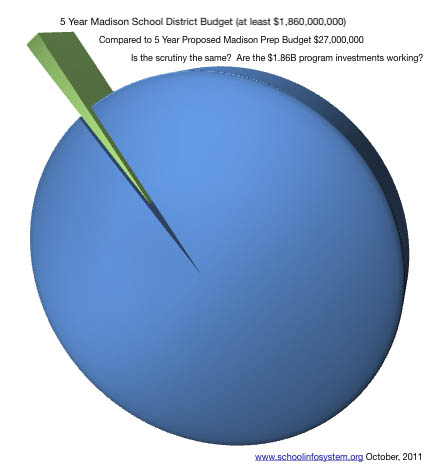
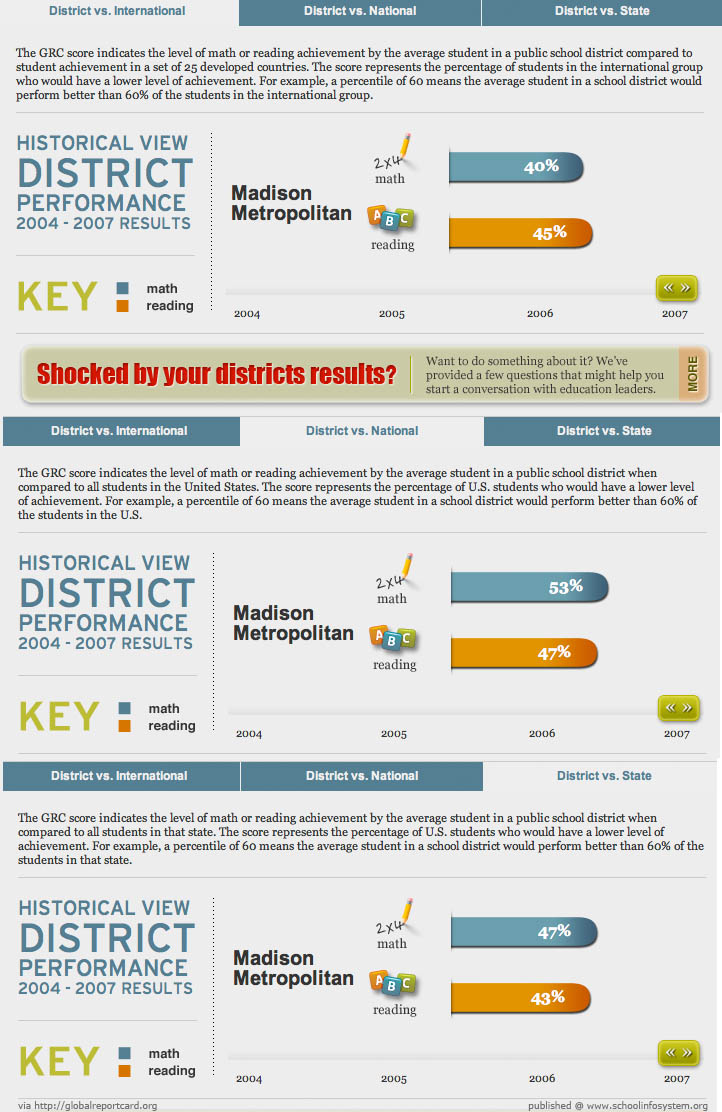
Share

Co-Ed Schooling Group Study Assails Merits of Single-Sex Education

Tamar Lewin:

Single-sex education is ineffective, misguided and may actually increase gender stereotyping, a paper to be published Friday asserts.

The report, “The Pseudoscience of Single Sex Schooling,” to be published in Science magazine by eight social scientists who are founders of the nonprofit American Council for CoEducational Schooling, is likely to ignite a new round of debate and legal wrangling about the effects of single-sex education.

It asserts that “sex-segregated education is deeply misguided and often justified by weak, cherry-picked or misconstrued scientific claims rather than by valid scientific evidence.”

Share

The Education Our Economy Needs: We lag in science, but students’ historical illiteracy hurts our politics and our businesses

Norm Augistine:

In the spirit of the new school year, here’s a quiz for readers: In which of the following subjects is the performance of American 12th-graders the worst? a) science, b) economics, c) history, or d) math?
With all the talk of America’s very real weaknesses in the STEM subjects (science, technology, English and math), you might be surprised to learn that the answer–according to the federal government’s National Assessment of Educational Progress–is neither science nor math. And despite what might be suggested by the number of underwater home loans, high-school seniors actually fare best in economics.
Which leaves history as the answer, the subject in which students perform the most poorly. It’s a result that puts American employers and America’s freedoms in a worrisome spot.
But why should a C grade in history matter to the C-suite? After all, if a leader can make the numbers, does it really matter if he or she can recite the birthdates of all the presidents?
Well, it’s not primarily the memorized facts that have current and former CEOs like me concerned. It’s the other things that subjects like history impart: critical thinking, research skills, and the ability to communicate clearly and cogently. Such skills are certainly important for those at the top, but in today’s economy they are fundamental to performance at nearly every level. A failing grade in history suggests that students are not only failing to comprehend our nation’s story and that of our world, but also failing to develop skills that are crucial to employment across sectors. Having traveled in 109 countries in this global economy, I have developed a considerable appreciation for the importance of knowing a country’s history and politics.
The good news is that a candidate who demonstrates capabilities in critical thinking, creative problem-solving and communication has a far greater chance of being employed today than his or her counterpart without those skills. The better news is these are not skills that only a graduate education or a stint at McKinsey can confer. They are competencies that our public elementary and high schools can and should be developing through subjects like history.
Far more than simply conveying the story of a country or civilization, an education in history can create critical thinkers who can digest, analyze and synthesize information and articulate their findings. These are skills needed across a broad range of subjects and disciplines.
In fact, students who are exposed to more modern methods of history education–where critical thinking and research are emphasized–tend to perform better in math and science. As a case in point, students who participate in National History Day–actually a year-long program that gets students in grades 6-12 doing historical research–consistently outperform their peers on state standardized tests, not only in social studies but in science and math as well.
In my position as CEO of a firm employing over 80,000 engineers, I can testify that most were excellent engineers–but the factor that most distinguished those who advanced in the organization was the ability to think broadly and read and write clearly.
Now is a time to re-establish history’s importance in American education. We need to take this opportunity to ensure that today’s history teachers are teaching in a more enlightened fashion, going beyond rote memorization and requiring students to conduct original research, develop a viewpoint and defend it.
If the American economy is to recover from the Great Recession–and I believe it can–it will be because of a ready supply of workers with the critical thinking, creative problem-solving, technological and communications skills needed to fuel productivity and growth. The subject of history is an important part of that foundation.
Mr. Augustine, a former Under Secretary of the Army, is the retired Chairman and CEO of Lockheed Martin.

“Teach by Example”
Will Fitzhugh [founder]
The Concord Review [1987]
Ralph Waldo Emerson Prizes [1995]
National Writing Board [1998]
TCR Institute [2002]
730 Boston Post Road, Suite 24
Sudbury, Massachusetts 01776-3371 USA
978-443-0022; 800-331-5007
www.tcr.org; fitzhugh@tcr.org
Varsity Academics®
www.tcr.org/blog

Share

Christie, Cerf, and Teachers’ Union: A Fragile Peace

John Mooney:

Fred Frangiosa’s presence was conspicuous last week when Gov. Chris Christie visited a Bergenfield middle school to promote his plans for remaking teacher evaluation statewide.
Frangiosa is president of the Bergenfield Education Association, and it is his union’s 450 teachers who will help test the new system. Bergenfield is one of 10 pilot districts for Christie’s plan.
But there was Frangiosa, sitting in Christie’s audience in a middle school classroom — not a cheerleader for the plan, by any means, but not protesting it, either.
“You can’t sign off on something if you don’t know what it is,” Frangiosa said, “and you can’t oppose it either. “

Share

WEA Trust demands talk show host ‘cease and desist’

Wisconsin Reporter:

WEA Trust doesn’t like what Mark Belling has to say, and the health insurer wants the conservative talk show host to “cease and desist.”
WEA Trust, which bills itself on its website as a not-for-profit insurance group for Wisconsin public school employees and their families, today sent a letter to the afternoon, drive-time, radio host at 1130 WISN in Milwaukee, demanding Belling stop making what WEA Trust describes as “defamatory public accusations.
Belling repeatedly has accused the private health insurance company of “racketeering” by transferring its revenue to the Wisconsin Education Association Council, or WEAC, the state teachers union, an act that would be illegal under state and federal law.

Share

America’s Report Card

Column Five Media:

As we ramp up to the 2012 election, politicians are really starting to grandstand about their accomplishments, but what do the everyday people think about how their state is doing? This infographic done with 1Bog, asked hundreds of U.S. residents in all 50 states to grade their state on several different factors.

Share

Spelling City

VocabularySpellingCity.com

VocabularySpellingCity.com is dedicated to helping students, teachers, parent-teachers, and school systems. VocabularySpellingCity is an award-winning site with ongoing introduction of new features, many based on input from existing users.
The site was launched on the web as SpellingCity in 2008 and has grown primarily through word of mouth. During the 2008-2009 school year, the site was used by over a half-million people in the peak months. In 2009-2010, SpellingCity was used by over a million unique visitors a month. The site’s services have been steadily expanded over the years. SpellingCity became VocabularySpellingCity in January 2011 to reflect the addition of significant vocabulary capabilities. During the 2010-11 school year, the site attracted nearly two million unique visitors per month – over four million visits total, and over 40 million page views monthly. (source Quantcast.com). This level of traffic and usage gives VocabularySpellingCity a ranking as a top 1000 site in the U.S. during its peak months. VocabularySpellingCity is supported by revenues from Premium Memberships (which are priced low for maximum accessibility) and advertising displayed to non-Premium Members. VocabularySpellingCity prides itself as being amongst the best values in education.

Share

Selling out public schools: Millions of dollars are changing face of education

Bill Lueders:

“School choice” is a broad term that refers to a wide range of alternatives, including themed charter schools that are entirely under the control of their home school districts. Forty states and the District of Columbia have those in place, according to the American Federation for Children, a national school choice advocacy group.
But it is the voucher programs, in which public funds are used to send children to private schools, that are the focus of much of the energy around the choice movement. Seven states and the District of Columbia have those, and Milwaukee’s voucher program is the first and largest of its kind in the country. That makes Wisconsin a key national battleground.
“Wisconsin has a high level of value to the movement as a whole,” says Robert Enlow, president of the Indianapolis-based Friedman Foundation for Educational Choice, a nonprofit group that advocates for school choice. The state, he says, is notable for “the high level of scholarship amounts that families can get.”
Milwaukee’s voucher program had 20,300 full-time equivalent voucher students at 102 private schools in 2010-11, compared to about 80,000 students at Milwaukee’s public K-12 schools. The total cost, at $6,442 per voucher student, was $130.8 million, of which about $90 million came from the state and the rest from the Milwaukee Public Schools.
Critics see the school choice program as part of a larger strategy — driven into high gear in Wisconsin by the fall election of Gov. Scott Walker and other Republicans — to eviscerate, for ideological and religious reasons, public schools and the unions that represent teachers.

It would be interesting to compare special interest spending in support of the status quo, vs groups advocating change, as outlined in Bill Lueders’ article. A few links:

  • WEAC: $1.57 million for Four Wisconsin Senators

    How much do election-year firewalls cost to build? For the state’s largest teachers union, $1.57 million.
    That’s how much the Wisconsin Education Association Council said last week it will spend trying to make sure four Democratic state senators are re-elected – enough, WEAC hopes, to keep a Democratic majority in the 33-member state body.
    Although there are 15 Democratic candidates running for the state Senate, and 80 Democrats running for the state Assembly, the latest WEAC report shows that the teachers union is placing what amounts to an “all in” bet on saving just four Democratic senators who are finishing their first terms.
    In an Oct. 25 report to the Government Accountability Board, the 98,000-member union reported that it will independently:

  • Wisconsin teachers union tops list of biggest lobbying groups for 2009-10, report shows

    The statewide teachers union led in spending on lobbying state lawmakers even before this year’s fight over collective bargaining rights.
    The Wisconsin Education Association Council spent $2.5 million on lobbying in 2009 and 2010, years when Democrats were in control of all of state government, a report released Thursday by the Government Accountability Board showed.
    WEAC is always one of the top spending lobbyists in the Capitol and they took a central role this year fighting Gov. Scott Walker’s plan curbing public employee union rights, including teachers.
    Back in 2009, when Democrat Jim Doyle was governor and Democrats controlled the Senate and Assembly, WEAC wasn’t helping to organize massive protests but it was a regular presence in the Capitol.

  • Spending in summer recall elections reaches nearly $44 million

    Spending in the summer’s recall elections by special interest groups, candidates and political action committees shattered spending records set in previous elections, with $43.9 million doled out on nine elections, according to a study released Tuesday by the Wisconsin Democracy Campaign.
    Spending by six political action committees or special interest groups topped the $1 million mark. We Are Wisconsin was the top spender.
    The union-backed group spent roughly $10.75 million, followed by the conservative-leaning Club for Growth at $9 million and $4 million in spending from the Greater Wisconsin Committee.

  • Kansas City School District Loses its Accreditation
Share

Kansas City, Mo., School District Loses Its Accreditation

A.G. Sulzberger:

The struggling Kansas City, Missouri School District was stripped of its accreditation on Tuesday, raising the possibility of student departures and a state takeover. The action follows weeks of tumult that included another round of turnover of top leadership.
Though not entirely unexpected, the move was a painful return to reality for the city after a period of optimism that difficult choices were finally being made to confront longstanding problems in the school district, most notably the closing of nearly half the schools in response to a huge budget deficit.
The Missouri Board of Education cited the continued failure to improve academic performance and the continued instability in district leadership as driving its decision. The district has been provisionally accredited for nearly a decade after a two-year period during which it was unaccredited.
“We’ve given Kansas City more time than maybe we should have to address the problems,” said Chris L. Nicastro, the state education commissioner, who had recommended the move. “Over a sustained period of time, student performance has not met state standards.”

Former Madison School District Superintendent Art Rainwater formerly worked for the Kansas City School District.
The great schools revolution Education remains the trickiest part of attempts to reform the public sector. But as ever more countries embark on it, some vital lessons are beginning to be learned.
Money & School Performance is well worth a read.
It is a rare organization that can reinvent itself, rather than continuing to atrophy.

Share

Time for a Tuition Revolt: By The Way, We Teach A Little Too

Investors Business Daily:

It’s time for a tuition revolt, and higher taxes aren’t the answer. Students and the rest of the public are now paying for decades of mission creep and bureaucratic bloat.
The regents of the University of California met this past week to revisit an old issue they’ve never really dealt with well — how to cope with erratic (and usually dwindling) state aid.
Sooner or later, they’ll probably raise tuition again, as they have in the past. But for now they are quailing at a plan, offered by UC’s president, to raise students’ costs by at least 8%, and up to 16%, annually for the next four years. “It scares the bejesus out of folks,” said one of the regents, California’s Lt. Gov. Gavin Newsom.
If the past is any guide, that horror will give way to realism. The regents will take a shot at raising more private money from corporations, foundations, rich alumni and the like. They’ll come up short, if only because every other academic institution is trying to do the same thing and there’s only so much money to go around.

Share

How to Stop the Drop in Verbal Scores

E D Hirsch:

THE latest bad but unsurprising news on education is that reading and writing scores on the SAT have once again declined. The language competence of our high schoolers fell steeply in the 1970s and has never recovered.
This is very worrisome, because the best single measure of the overall quality of our primary and secondary schools is the average verbal score of 17-year-olds. This score correlates with the ability to learn new things readily, to communicate with others and to hold down a job. It also predicts future income.
The decline has led some commentators to embrace demographic determinism — the idea that the verbal scores of disadvantaged students will not significantly rise until we overcome poverty. But that explanation does not account for the huge drop in verbal scores across socioeconomic groups in the 1970s.

Share

Parental Involvement in Education: Fact and Fiction

Harrison Blackmond:

I have attended dozens of legislative hearings, community meetings, and board meetings where the problems related to public education are discussed. Not to mention the numerous one-on-one conversations I’ve had with adults who are usually middle or upper class, where the subject of parental involvement in children’s education is raised as a major factor contributing to the ills of public education. Educators who work in urban areas are quick to point out how negligent their students’ parents are and are eager to recite anecdotes to illustrate their case. What is not said, but clearly implied is this: if the parents of these children in low-performing schools would do their jobs as parents, these children would not be failing.
Every time I hear someone raise the issue of parental involvement, I can’t help but think of the parents in the latest “education” movies: The Lottery and Waiting for Superman. What good did “parental involvement” do for their children that didn’t get accepted into a charter school? If they were not lucky enough to have their number called, they were still stuck in bad schools with educators who, for the most part, had given up on them. What good did “parental involvement” do for them?

Share

Britain needs schools for science

Martin Rees:

Scientists habitually moan that the public doesn’t understand them. But they complain too much: public ignorance isn’t peculiar to science. It’s sad if some citizens can’t tell a proton from a protein. But it’s equally sad if they’re ignorant of their nation’s history, can’t speak a second language, or can’t find Venezuela or Syria on a map.
Indeed, I’m gratified and surprised that so many people are interested in dinosaurs, the Large Hadron Collider or alien life – all blazingly irrelevant to our day-to-day lives. We should be grateful to David Attenborough, Robert Winston, Brian Cox and other popular writers and television presenters for generating such interest. But it’s depressing that all too often this natural enthusiasm of the young has been stifled by the time they leave school.
That’s sad, because science is important for its own sake. It is a cultural deprivation not to appreciate the wonderful panorama offered by modern cosmology, DNA and Darwinian evolution. This common understanding should transcend all national differences – and all faiths, too. It should be part of global culture; but even in the UK a group of scientists including Attenborough has this week felt the need to reassert this.

Share

Pearson Buys U.S. Online School Network

Simon Zekaria:

Pearson PLC on Thursday said it has acquired U.S.-based online schooling network Connections Education for $400 million in cash, as the U.K.-based publishing giant ramps up its extensive North American education operations.
Pearson acquired the company from an investor group led by private-equity investment firm Apollo Management LP.
“Virtual schooling is an attractive choice for a growing group of American parents and in the next decade it will take off in other countries,” Chief Executive Marjorie Scardino said.
Connections Education supplies “virtual” education services to students in grades K-12 and learning programs to educational institutions globally. It operates online public schools accredited in 21 U.S. states, serving more than 40,000 students who choose not to attend traditional schools, Pearson said.

Share

A better way for Madison Prep

Jack Craver:

If people want a charter school to be an inspiration to other youngsters in the community, here’s a better way to do it. Instead of building an entirely new school, which costs a ton and isolates the kids from the rest of their peers, why not go with the school within a school model, in which a charter is operated within an existing public school?
That’s the only original idea I have. Now here is my two cents on the rest of the plan.
I believe Kaleem Caire knows what he is talking about though. It’s frustrating to see a debate on the crisis facing minority students as polarized between the know-nothings on the right who believe the only issues facing blacks are self-inflicted cultural ones and the lefties who refuse to accept that anything besides racism and poverty are responsible for the poor performance of black males in America.

Much more on the proposed Madison Preparatory Academy IB Charter school, here.

Share

Spending in summer recall elections reaches nearly $44 million

Jessica Vanegeren:

Spending in the summer’s recall elections by special interest groups, candidates and political action committees shattered spending records set in previous elections, with $43.9 million doled out on nine elections, according to a study released Tuesday by the Wisconsin Democracy Campaign.
Spending by six political action committees or special interest groups topped the $1 million mark. We Are Wisconsin was the top spender.
The union-backed group spent roughly $10.75 million, followed by the conservative-leaning Club for Growth at $9 million and $4 million in spending from the Greater Wisconsin Committee.
Put in perspective, the $43.9 million spent on the recalls more than doubled the previous record for spending by candidates and groups in legislative races, which was $20.25 million for 99 Assembly seats and 16 Senate seats in the 2008 general elections, according to the Wisconsin Democracy Campaign.

Share

Despite changes, Wisconsin charter school expansion bill faces a headwind

Susan Troller:

A controversial bill that would create an independent, statewide authorizing board for charter schools is facing a tougher path now that Republicans have a razor thin 17-16 edge in the Wisconsin Senate. The legislation is designed to expand charter school choice in Wisconsin and to allow charters to be formed even in communities where they are not approved by local school districts.
Although the bill, introduced by Sen. Alberta Darling, R-River Hills, last spring, has been modified from its original form, the amended Senate Bill 22 still doesn’t pass muster with the Department of Public Instruction. Perhaps more importantly, moderate Republican Sen. Dale Schultz, R-Richland Center, says he continues to have “more concerns than enthusiasm” for the legislation.
If he, or one of the Senate Democrats that opposed the earlier legislation, can’t be persuaded that more independent charter schools would benefit Wisconsin students, SB 22 will be in trouble if it moves from the Joint Finance Committee to a vote in front of legislators, likely in October.
Read more: http://host.madison.com/ct/news/local/education/blog/article_a54178bc-e30a-11e0-b207-001cc4c03286.html#ixzz1YXkYxg5f

Share

The great schools revolution Education remains the trickiest part of attempts to reform the public sector. But as ever more countries embark on it, some vital lessons are beginning to be learned


The Economist via a kind Mary Battaglia email

FROM Toronto to Wroclaw, London to Rome, pupils and teachers have been returning to the classroom after their summer break. But this September schools themselves are caught up in a global battle of ideas. In many countries education is at the forefront of political debate, and reformers desperate to improve their national performance are drawing examples of good practice from all over the world.
Why now? One answer is the sheer amount of data available on performance, not just within countries but between them. In 2000 the Programme for International Student Assessment (PISA) at the OECD, a rich-country club, began tracking academic attainment by the age of 15 in 32 countries. Many were shocked by where they came in the rankings. (PISA’s latest figures appear in table 1.) Other outfits, too, have been measuring how good or bad schools are. McKinsey, a consultancy, has monitored which education systems have improved most in recent years.

Related: www.wisconsin2.org.

Share

Kaleem Caire draws on personal experience to support school alternatives for blacks

Dan Simmons:

“Come on Madison, we can do better than this!”
That’s Kaleem Caire. He said it not recently but in 1998 in an op-ed questioning why his hometown wasn’t paying more attention to the poor educational outcomes and high incarceration rates of black males.
“I’m asking Madison to be your best self and get this done!”
That’s also Caire, in an interview this week about his proposal for a publicly funded charter school designed to improve educational outcomes of low-income minority students.
What hasn’t changed, then to now, is Caire’s conviction that Madison’s public schools are failing minority students and his willingness to force issues that cause some distress to the city’s white liberal establishment.
What has changed is Caire’s clout. He returned to his hometown in 2010 after a decade long detour with his family to the East Coast. As president and CEO of the Urban League of Greater Madison, and public face for the proposed Madison Preparatory Academy, his profile has skyrocketed. But with it has come criticism and skepticism over a plan that challenges Madison’s longstanding commitment to inclusive learning.

Share

The great schools revolution

The Economist:

Education remains the trickiest part of attempts to reform the public sector. But as ever more countries embark on it, some vital lessons are beginning to be learned
FROM Toronto to Wroclaw, London to Rome, pupils and teachers have been returning to the classroom after their summer break. But this September schools themselves are caught up in a global battle of ideas. In many countries education is at the forefront of political debate, and reformers desperate to improve their national performance are drawing examples of good practice from all over the world.
Why now? One answer is the sheer amount of data available on performance, not just within countries but between them. In 2000 the Programme for International Student Assessment (PISA) at the OECD, a rich-country club, began tracking academic attainment by the age of 15 in 32 countries. Many were shocked by where they came in the rankings. (PISA’s latest figures appear in table 1.) Other outfits, too, have been measuring how good or bad schools are. McKinsey, a consultancy, has monitored which education systems have improved most in recent years.

Related: www.wisconsin2.org

Share
