School Information System

K-12 Tax & Spending Climate: Pensions Push Taxes Higher Cities Tap Homeowners for Revenue as Workers’ Retirement, Health Costs Rise

Jeannette Neuman:

Cities across the nation are raising property taxes, largely citing rising pension and health-care costs for their employees and retirees.
In Pennsylvania, the township of Upper Moreland is bumping up property taxes for residents by 13.6% in 2011. Next door the city of Philadelphia this year increased the tax 9.9%. In New York, Saratoga Springs will collect 4.4% more in property taxes in 2011; Troy will increase taxes by 1.9%.
Property-tax increases aren’t unusual, in part because the taxes are among the main sources of local revenue. But officials say more and larger increases are taking hold. “This year we have seen a dramatic increase in our cities and towns having to increase property taxes” for pensions and other expenses, said Jack Garner, executive director of the Pennsylvania League of Cities and Municipalities.

Share

How the world’s most improved school systems keep getting better

Mona Mourshed, Chinezi Chijioke, Michael Barber, via several kind readers:

“We analyzed 20 systems from around the world all with improving but differing levels of performance and examined how each has achieved significant, sustained, and widespread gains in student outcomes, as measured by international and national assessments. The report was based on more than 200 interviews with stakeholders in school systems and an analysis of some 600 interventions they carried out two strands of research comprising what we believe is the most comprehensive database of global school system reform ever assembled. It identifies the reform elements replicable for school systems elsewhere, as well as those elements that are context specific, as they move from poor to fair to good to great to excellent performance.
Among other findings, the report shows that a school system can improve from any starting point and can become significantly more effective within six years. The research suggests that all improving systems implement similar sets of interventions to move from one particular performance level to the next, irrespective of culture, geography, politics, or history. A consistent cluster of interventions moves systems from poor to fair performance, a second cluster from fair to good performance, a third from good to great performance, and yet another from great to excellent performance. Although reaching each performance stage involves a common set of interventions, systems may sequence, time, and roll them out quite differently.

Share

Schools Still Facing Tough Budget Questions

Vermont Public Radio:

In recent weeks, Vermont School boards have been putting together the budgets they’ll submit to voters next year. This time around, though they were asked by the state to cut spending by an average of more than 2 percent. The cuts were needed to save $23 million as part of the Challenges for Change effort to close the overall state budget gap. But the results fell far short. Statewide, schools appeared to have made just over $4 million in cuts – far short of the $23 million.
Now the schools have a reprieve. Yesterday, Governor elect Peter Shumlin announced $19 million in federal stimulus money will go to the schools – which basically zeros out the needed cuts. But Vermont Education Commissioner Armando Vilaseca says school districts will still face difficult budget decisions next year. And he suggests that, with student enrollment decreasing by 1 1/2% to 2% each year, districts should look at Act 153, the voluntary merger bill.

Share

K-12 Tax & Spending Climate: Government liabilities rose $2 trillion in FY 2010: Treasury

David Lawder:

The U.S. government fell deeper into the red in fiscal 2010 with net liabilities swelling more than $2 trillion as commitments on government debt and federal benefits rose, a U.S. Treasury report showed on Tuesday.
The Financial Report of the United States, which applies corporate-style accrual accounting methods to Washington, showed the government’s liabilities exceeded assets by $13.473 trillion. That compared with a $11.456 trillion gap a year earlier.

Share

K-12 Tax & Spending Climate: 2010 US Census – Fastest Growth in States Without an Income Tax

Wall Street Journal:

The Census is in. There are now 308.74 million Americans, an increase of 27 million, or 9.7%, since 2000. Americans are still multiplying, one of the best indicators that the country’s prospects remain strong.
About 13 million of that increase were new immigrants. These newcomers brought energy, talent, entrepreneurial skills and a work ethic. Their continued arrival in such large numbers validates that the rest of the world continues to view the U.S. as a land of freedom and opportunity.
The Census figures also confirm that America is a nation in constant motion, with tens of millions hopping across state lines and changing residence since 2000. And more of them are moving into conservative, market-friendly red states than into progressive, public-sector heavy blue states.
In order the 10 states with the greatest population gains were Nevada, Arizona, Utah, Idaho, Texas, North Carolina, Georgia, Florida, Colorado and South Carolina. Their average population gain was 21%. In the fast-growing states, the average income tax rate is 4% versus 6.9% in the slowest growing states.

Share

Professor has seen Madison’s image problem first-hand

Paul Fanlund:

Hi, I’m Kathy. I’m from UW-Madison. Do you mind if I join you?”
Those words, or some variation, provided an introduction at gas stations, coffee shops, cafes and churches across small-town Wisconsin.
While those of us ensconced in Madison scratch our heads about why so many in Wisconsin appear to dislike or distrust us, associate professor Katherine Cramer Walsh ventured out to hear it first-hand. So how did people respond? They were uniformly friendly, she says, but bewildered as to why she was there. “You should have seen their faces,” she says, smiling.
What she found is a big disconnect. For example: “When you ask, ‘What does hard work mean to you? Who does hard work?’ I would give examples like a waitress or someone who works in the lumber industry. Then I would say ‘professor’ and people would just laugh. Like, ‘give me a break.'”

Share

K-12 Tax & Spending Climate: Many Dane County property owners face higher tax bills

Gena Kittner:

Many Dane County residents are facing higher property tax bills this month as the growth of new property hasn’t kept up with higher government spending.
“We’re in a falling value market,” said David Worzala, Dane County treasurer. Taxpayers experienced similar conditions last year, but in this tax cycle “it’s more pronounced,” he said.
Before 2009, new construction and a growing tax base helped reduce the tax hit resulting from spending by schools, local governments and other taxing authorities.
The deadline for residents to pay at least half of their property taxes is Jan. 31.
In Dane County, bills cover municipal and county government, K-12 schools and Madison Area Technical College. Some municipalities add special charges for trash collection or recycling, improvements to streets or sidewalks, or unpaid bills.

Michael Louis Vinson:

School districts across the Green Bay and Appleton areas raised property taxes an average of 3.8 percent compared with last year, slightly higher than the 3.4 percent statewide average.
In Brown County school districts, increases range from 2.9 percent in De Pere and Pulaski to 12.3 percent in West De Pere, according to the Wisconsin Taxpayers Alliance, a government watchdog group that crunched the tax numbers and released them this week. Only the Ashwaubenon district didn’t increase its tax levy.
Each of the six districts based in Brown County is taxing to the limit allowed by the state this year.

Share

Washington’s faulty thinking about education rules

Harris Miller:

America won the moon race. Can it win the higher education race?
A smart and innovative strategy will make this goal attainable, but too many in Washington fail to recognize that private-sector colleges and universities – sometimes referred to as career colleges – are an essential part of the answer. Now educating 12 percent of higher education students, these schools are the game-changer when a game-changer is badly needed.
In California, private-sector colleges and universities play crucial roles in educating students. More than 340,000 students in the state, 9 percent overall, attend career colleges. Two-thirds of these students are minorities, and almost 80 percent receive financial aid. These students are being armed with the skills needed to meet the demands of the 21st century economy.

Share

The Fairy Tale of School Reform

Brock Cohen:

Struggling to drum up dissipating ad revenue and to stay afloat in the sea of cable news slime, most media organizations have resorted to sloshing around in the infotainment gutter for shock and schlock. No surprise then that the issue of school reform has played out with all the depth and journalistic standards of an Ali G. interview. And while it’s had innumerable opportunities to unravel the eternal conundrum of public education through exhaustive research and nuanced reporting, the press has all but ignored its obligation to offer the public a sober, informed, balanced discourse on a topic with such critical short- and long-term import.
Instead, the school reform debate screeches to its ignoble crescendo. The media has gone all STORM WATCH on us, opting for a sensational script over substance, and emphasizing the fear factor by manufacturing predictable boogie men. For the most part, the American public has jumped onboard for yet another ride on the self-righteous victimhood express.

Share

Private-school vouchers return to education agenda

David Harrison:

A decade ago, almost any discussion about reforming the nation’s public schools included vouchers. The idea of letting students use taxpayer dollars to attend private schools appealed to conservatives, who liked the notion of subjecting public schools to competition. Some Democratic mayors, frustrated with the slow pace of school improvement, also rallied behind vouchers.
Then, vouchers got overtaken by other ideas about how to shake up public schools. Unions vehemently opposed vouchers, arguing they would starve public schools of funding. Vouchers were left out of the 2002 federal No Child Left Behind law, making it difficult for programs to gain a foothold in school districts. More recently, the Obama administration left vouchers out of its Race to the Top grant program, even as it endorsed other reforms such as charter schools and pay-for-performance plans for teachers.

Share

Taxpayer student aid and contingency on success

San Francisco Chronicle:

What standards should career education programs have to qualify for federal student grants and loans? The U.S. Department of Education already has drafted a “gainful employment rule” that could limit the flow of taxpayer-backed student aid to some education and training programs. The for-profit education industry, however, has dug in to oppose the proposed regulation, which is still under review.
The commentaries on these pages offer two views of the controversy.

Share

Dem leader says more South Dakota schools will have to opt out of funding formula

Kayla Gahagan:

Gov. Mike Rounds implied Tuesday that school districts could dig into their reserves to absorb proposed cuts to K-12 education funding.
In his final annual budget address, Rounds said the state faces a $75 million structural deficit and proposed unprecedented cuts to education, including a 5 percent reduction to state aid to school districts.
The education changes would result in $240 less per student to school districts, saving the state about $20 million.
House Minority Leader Bernie Hunhoff of Yankton predicted that the 5 percent cut will be modified by the time the final budget is presented, but any cut will hurt.

Share

All eyes on Eden Prairie school boundary vote

Kelly Smith:

An Eden Prairie school board vote on attendance zones may have broad impact on desegregation and neighborhood schools.
When Eden Prairie’s seven school board members convene Tuesday night, the controversial decision they are set to make about redrawing school boundary lines will be of keen interest throughout the metro area.
Will they back a plan that will move 1,100 elementary students next fall to new schools, largely to reduce segregation in schools? Or will they scale back in response to a huge parental outcry and make fewer changes or nix the plan altogether?
Bloomington and other metro-area suburban school districts, which also face increasingly diverse student demographics, are watching Eden Prairie’s move. Bloomington’s school board chair attended Eden Prairie meetings to watch how feedback was handled.

Share

Moseley Braun unveils Chicago education plan

Mark Konkol:

Chicago children shouldn’t have to compete for the chance to attend the city’s best performing schools, mayoral candidate Carol Moseley Braun said Thursday.
And if she’s elected, Braun said she plans to focus on improving neighborhood schools so parents won’t have to send their kids to magnet and selective enrollment schools in other parts of town.
“It seems to me the opportunity for a quality education is not something we should have to compete for,” Braun said.
“It ought to be available to every child in every neighborhood.”

Share

Dave Baskerville Interview on “Wisconsin Needs Two Big Goals”

Dave Baskerville Interview on “Wisconsin Needs Two Big Goals”

I talked with Dave regarding his recent article:

https://www.schoolinfosystem.org/archives/2010/11/well_worth_read.php

Share

Half of Fox Valley school districts tax to the limit; less state aid further shifts load to taxpayers

Michael Louis Vinson

A dip in state education aid will force many taxpayers to reach deeper into their pockets this year to help fund schools.
School districts across the Fox Cities raised property taxes by an average of 3.8 percent compared with last year, slightly higher than the 3.4 percent statewide average.
“Districts are kind of in a no-win situation,” said Dale Knapp, a spokesman for Wisconsin Taxpayers Alliance, a government watchdog group that crunched the tax numbers and released them this week. “The tax levy is a function of what happens with state aid.”
When aid drops, schools turn to the taxpayers to make up the difference.

Share

New Jersey Governor Christie in Clinton: Education reform a key part of agenda

Walter O’Brien:

Some of Chris Christie’s reform agenda has become law, but more work is left to be done — including education reform, which the governor says is at the top of his agenda for 2011.
Christie discussed that and other topics Tuesday during his 17th town hall meeting at the Clinton Community Center on Halstead Street.
The governor said New Jerseyans are beginning to feel pride again in their state, and that there are some positive discussion topics for the public.
New Jersey has the highest tax burden in the nation, many anti-business regulations and an atmosphere where private-sector jobs are treated like the enemy, Christie said. But, he said, the Legislature is getting serious about passing his many reform initiatives, including property tax reform, education reform and the municipal tool kit.

Share

New Jersey Governor Chris Christie Taps New Education Chief

Lisa Fleisher:

New Jersey Gov. Chris Christie has selected former New York City schools official Christopher Cerf to be his next commissioner of education, two sources close to the administration said.
Cerf will be nominated to lead a department that has been adrift since the sacking of its former commissioner, Bret Schundler, in the wake of the state’s loss in a federal education grant. A spokeswoman for the governor would not confirm the selection.
Christie has spent the past year cutting school funding, tangling with teachers and superintendents, and trying to make New Jersey’s schools do more with less. He has pointed to Newark and other cities as examples of school systems where more money has not led to education gains, leaving children “trapped” in failing schools.
Joel Klein, the outgoing chancellor of New York City schools, where Cerf served as a deputy chancellor until 2009, called Cerf “a man of enormous intellect, talent and deep understanding of K-12 education and would be a terrific leader.”

Share

K-12 Tax & Spending Climate: California Budget Gap May Reach $28.1 Billion Over 18 Months, Brown Says

Michael Marois

California’s budget gap may widen to $28.1 billion over 18 months, according to Governor-elect Jerry Brown, who takes charge of the most-populous U.S. state next month. A cash shortage may force the use of IOUs by July, Controller John Chiang said.
The deficit estimate takes into account a $2.7 billion drop in projected estate-tax receipts, and compares with the most recent forecast of a $25 billion gap for the period, Brown said today at a public meeting of state officials. The cash accounts may be short by $2.3 billion within eight months, Chiang said at the meeting in Sacramento.
“I don’t want to say it, but this could mean IOUs and more tax-refund deferrals,” Chiang said.

Share

Education in Wisconsin

Bob and Jean Dohnal

Our family is very proud of the fact that five of the seven of us has graduated from the University of Wisconsin System and the other two attended for some time. We all attended public schools in our youth. We are very pro-education. Jean was a teacher for many years.
But, times have changed in the last 20 years or so. Spending on education has skyrocketed. Quality has gone down. Kids are forced to mortgage half of their lives to graduate from college and it takes five years. MPS is a total disaster with only a small number of kids being able to read in the 10th grade. Many businessmen consider high school degrees worthless.
School budgets are bloated with administrators as salaries and benefits far exceed what the average taxpayer makes. The unions have little interest beyond themselves. If left to their own, kids would continue to come out dumber per national average than when they went into the system. All of the advertising during Green Bay Packer games will not change that.

Share

Jerry Brown: Cuts To Education Will Continue

Paresh Dave

Cuts to spending on education are likely to continue, Governor-elect Jerry Brown said Tuesday as he searches for ways to increase California’s revenues to match its spending.
Faced with a $28.1 billion deficit for the next fiscal year, Brown is trying to give a crash-course to California voters about how disastrous that figure really is.
The self-described “happy warrior” appears headed down a path of asking voters to extend a handful of temporary tax increases, to raise other taxes and to accept more control over local affairs because cutting 20 to 25 percent from the budgets of state agencies won’t alone solve the mess.

Share

Meeks wants vouchers for 50,000 Chicago students

Fran Spielman:

Arguing that Chicago Public Schools are “broken” and that parents deserve a “choice,” mayoral challenger James Meeks said Wednesday he would offer $4,500-a-year vouchers to 50,000 low-and-middle-income Chicago families to use toward private school tuition.
If he is elected mayor, Meeks said he would also offer full-day kindergarten and character education in all Chicago Public Schools and double the time spent on reading and math in first through third grades. Full-day kindergarten would be financed in part by cutting bonus pay for teachers with master’s degrees.
The 90 minutes of daily reading time — up from 45 minutes currently — is designed to make certain that students read at a third-grade level by the time they finish third-grade.

Share

$500,000 Earmark for the Madison School District via Senator Herb Kohl

US Senate 700K .XLS file:

The end-of-the-year Omnibus Appropriations bill includes approximately $8.3 billion and 6,714 earmarks.
Click here for a working database of all the earmarks included in the Omnibus Appropriations bill. It’s important to note that the database only refers to disclosed earmarks, not the billions in undisclosed earmarks.

The Madison School District $500,000 earmark is in row 4380 of the .xls file. The description: Madison Metropolitan School District, Madison, WI, for educational programming and Elementary & Secondary Education (includes FIE) via the US Department of Education. Senator Kohl also supports a $20,000,000 Teach for America earmark (row 5497).
I wonder what the $500,000 earmark, if it is realized, will be used for and how it ended up in the $1,100,000,000,000 spending bill?
Clusty search: earmark.
Update: Senator Kohl’s office provided this link and description:

Recipient: Madison Metropolitan School District
Location: Madison
Amount Requested: $500,000
The AVID (Advancement via Individual Determination) [SIS Links] program supports high school students who complete a college preparatory path and enroll in college. The program uses “small learning communities” and a rigorous curriculum to prepare students for college. The program places particular priority on serving students in the “academic middle,” who are capable of success in college with some additional supports. AVID currently serves 240 students and will use this federal funding to expand access to the program to 800 students in all four Madison Metropolitan School District high schools.

Share

The Achievement Recession

Tom Vander Ark

Given middle of the pack reading levels on PISA results, the National Journal asked the rediculous question, “what’s so awful about being average?” They seem to ignore that US math and science results are much worse and lag most of the developed world. As dumb as the prompt was, it got a few of us to write a response. Here’s mine.

Twenty years of prompting, investing, threatening and reforming have largely failed to dramatically improve education in American. There are pockets of excellence, but results from American schools are flatlined. While unions and school boards argue about contract minutes, the rest of the developed world passed us by in achievement, high school graduation and college completion rates.

Share

Money Matters

Andy Rotherham:

Last week’s TIME column about the prospects for school spending occasioned some interesting responses. A common one, though, was the idea that the public is just clamoring to spend more on schools. You hear this a lot. Unfortunately, there are three problems with this argument:

Structural: The money just isn’t there (and annual increases are largely spoken for). The current trajectory of spending is simply not sustainable unless we’re prepared to made radical changes in policies, for example, affecting health care, senior citizens, or prisons. Whether or not we should make those changes is debatable. In many states all senior citizens get a break on property taxes, which are a key revenue source for schools. As the population ages this will ripple through public education budgets. Should these measures be means-tested for ability to pay? Perhaps. Given how politics works are they likely to be? Doubtful. Likewise, our correctional policies are a mess but most politicians are not lining up to fix them. So sure, today’s fiscal choices are just that, choices, but the implications of those decisions and prospects for change must be considered with an eye toward political and other realities realities. A second, related, structural constraint is how little discretionary money there is annually because of how much is tacked down for ongoing obligations. In practice this means that there are annual increases (excepting the last few years where in some places you’ve seen genuine reductions), which consume new money.

Share

Education fills big space on Brown’s chalkboard

Seema Mehta:

As the governor-elect prepares to take office, California’s schools are confronted by a lack of funding that threatens to further harm pupils and a controversial reform movement that could dramatically reshape how classrooms are run.
As Gov.-elect Jerry Brown prepares to take office, major headwinds are buffeting the biggest component of his upcoming budget: California’s schools. They are being confronted by a lack of funding that threatens to further harm pupils and a controversial reform movement that could dramatically reshape how classrooms are run.
Most immediate and pressing is the state’s fiscal crisis — a $28-billion gap is forecast for the next 18 months. How that will affect school districts already reeling from years of multibillion-dollar cuts will be the subject of Brown’s second budget forum, which is scheduled for Tuesday in Los Angeles.
“Jerry Brown is entering office at a moment when the capacity of the system is weaker than any time in recent memory,” said John Rogers, director of the Institute for Democracy, Education and Access at UCLA. “I worry we may be reaching a breaking point.”

Share

Confronting the Myths About Tenure and Teachers’ Unions

Ellen Dannin

Current American education policy is built on these assumptions: The quality of American education has plummeted because our schools are filled with teachers who can’t teach. Teachers’ unions and contracts tie the hands of school administrators. And teachers’ unions protect bad teachers. Here are a few reasons why these conclusions are leading our educational system in a bad direction.
First, these policies ignore the effects of poverty on educational outcomes. Given the increasing number of children growing up in poverty, we ignore its effects at our peril.
I know something about poverty and its effects because I grew up in an impoverished, single-parent home and attended a low-quality school through eighth grade. Despite those beginnings, I graduated from one of the top US law schools and am now a law professor. If I could make it, then poverty must not matter, right?

Share

Rahm Emanuel Announces Education Plans, Gery Chico Responds

Fox Chicago News

In the race to replace Mayor Daley, Rahm Emanuel would like voters to be thinking about something other than those challenges to his residency, and he’s talking about schools.
Sunday, he unveiled his plans for improving education in Chicago, includind giving principals more power over their individual schools, doubling the number of teacher training academies and getting parents more involved.
Emanuel wants parents to sign a contract with their child’s teacher pledging to encourage learning at home.
“Our teachers simply cannot succeed without parents as partners. While government must do its part, it’s no substitute for a committed parent,” Emanuel said.
Monday, it’s back to the residency challenge, when Emanuel and other witnesses will be called to testify at a Board of Elections hearing.

Share

Los Angeles Mayor Villaraigosa takes on teachers union

Patrick J. McDonnell and David Zahniser

In a speech to state leaders, the mayor brands United Teachers Los Angeles as an obstacle to reform as the city stands at ‘a critical crossroads.’
With a hard-hitting speech that branded the city’s teachers union as an unyielding obstruction to education reforms, Mayor Antonio Villaraigosa set the stage this week for a new battle over control of the troubled Los Angeles Unified School District, the nation’s second-largest.
In a Sacramento address to state leaders, Villaraigosa — himself a longtime teachers union employee before launching a career in public office — declared that education in Los Angeles stands at “a critical crossroads,” and he assailed United Teachers Los Angeles for resisting change.
During the last five years, the mayor said, union leaders have stood as “one unwavering roadblock to reform.” He called for change in contentious areas such as tenure, teacher evaluations and seniority — all volatile arenas in which teachers unions have balked at proposals for reform as eroding their rights.

Related: Marc Eisen:

Public employee unions look increasingly out of touch and may be forced to swallow wage and benefit cuts.
Too bad a ball-peen hammer wasn’t handy. If so, leaders of the embattled Milwaukee Teachers’ Education Association might have walloped themselves over the head. Instead, they did something even more self-destructive, suing Milwaukee Public Schools for Viagra coverage of its members.
Union president Mike Langyel gamely defends the suit, saying Viagra is used to treat a bona fide medical problem. But even liberal supporters winced at the timing.
Here was a financially strapped school system struggling with an anticipated layoff of almost 500 teachers, and the clueless union was demanding insurance coverage of a sexual aid that could cost taxpayers more than $700,000 a year.

Share

K-12 Tax & Spending Climate: Schools facing storm Money no longer there for education

San Bernardino County Sun:

California’s massive 2011-12 budget shortfall won’t be closed without big cuts to public education.
The likely result doesn’t look pretty.
“Schools will become more and more like prisons and less and less like schools,” said David Plank, a professor of education at Stanford University. “You’ll have huge classes, restive young people and overworked teachers.”
Sound drastic? So is the budget crisis.
Soon after Gov.-elect Jerry Brown is sworn in next month, he will have to present a budget for 2011-12, a year that likely will be worse than any that California schools have endured in modern history.
On Wednesday, Brown noted the budget deficit over the next 18 months is likely worse than previously reported. He released figures showing California stands to lose another $2.7 billion from potential changes to the federal estate tax, swelling the shortfall through June 2012 to $28.1 billion.

Share

Candidates dwindling for Madison School Board races

Matthew DeFour:

One suggestion Severson offered that hasn’t gained much traction in the past is to have board members represent geographic areas rather than the entire city, more like the Milwaukee School Board.
Ruth Robarts, who served on the board for 10 years, said a consequence of at-large seats like those in Madison is that races are more expensive — hers cost $20,000 — and it becomes impossible to campaign door-to-door.
That means candidates rely on the endorsements of Madison Teachers Inc., which Robarts said has “almost overwhelming influence” on local board elections, and other groups, which then tout candidates’ qualifications and get members out to vote.
“However, the big unknown in my mind is whether School Board campaigns would become much more parochial,” she added, referring to district-based elections. “If so, would that lead to good trade-offs needing to happen to get things done or would it lead to political gridlock at this very local level?”

Share

Teachers unions often resist school reforms

Amy Hetzner:

The Obama administration could not have set the stage for a better demonstration of the power and priorities of Wisconsin’s teachers unions.
With its Race to the Top competition, the federal government dangled the prospect of a share of $4.35 billion for those states ready to enact reforms, especially related to improving teacher and principal performance.
Eyes on that prize, states launched plans tying teacher pay and promotions to student achievement, giving state officials more control over local schools and overhauling data tracking and assessment systems.
Then the game got tricky: Teachers unions had to be on board.
In the end, only 11 states and the District of Columbia ended up with money from the program this year. Wisconsin got nothing.
The Wisconsin Education Association Council had helped kill or watered down critical parts of the state’s proposal, with the president of the teachers union attaching a letter to the application that one participant described as “grudging.” In the end, only 12% of the union’s local leaders endorsed a plan that might have brought in more than $250 million in school funding to Wisconsin.

Related: WEAC tops lobbyist spending list

The Wisconsin Education Association Council spent nearly twice as much as any other organization to lobby lawmakers in 2009, according to the Government Accountability Board.
The state’s largest teachers union reported spending more than $1.5 million and 7,239 hours lobbying, almost twice as much as the Wisconsin Insurance Alliance, which spent the second-highest amount on lobbying in the state.
One aspect of the union’s lobbying effort was largely successful, with the state Legislature repealing the 16-year-old qualified economic offer law that restricted teachers’ pay and benefits.

Share

US Education Secretary Duncan Re-thinks Goals

Sam Dillon

For two years, backed by a friendly Congress and flush with federal stimulus money, President Obama’s administration enjoyed a relatively obstacle-free path for its education agenda, the focus of which is the $4 billion Race to the Top grant program.
But with Republican deficit hawks taking control of the House next month, Education Secretary Arne Duncan will no longer have billions of dollars to use at his discretion.
The administration is also having to recalibrate its goals for working with Congress to overhaul the main federal law on public schools. Fortunately for the administration, its ambitions for the law, the Bush-era No Child Left Behind effort, are shared by Representative John Kline, a Minnesota Republican who will be the chairman of the House education committee.

Share

Is the Golden Age of Education Spending Over?

Andrew Rotherham:

As America starts to grapple with its out-of-control spending habits, we as a nation really should reckon with our education costs. Few federal education programs were targeted by President Obama’s deficit-reduction commission, but that’s because most school funding comes from the state and local levels. And that’s where the big-time money problem is. According to a report issued jointly last week by the National Governors Association and the National Association of State Budget Officers, when federal stimulus funds run out in 2011, states — and, by extension, schools — will tumble off a fiscal cliff, and even an economic upturn won’t bring state funding back up to where it was a few years ago.
The problem, however, is not just the struggling economy. In 1970 America spent about $228 billion in today’s dollars on public schools. In 2007 that figure was $583 billion. True, some of the increase can be traced back to growing enrollments, better programs, and improved services for special-education and other students, but much of the increase is just a lot of spending without a lot to show for it. And given all the various pressures on state budgets (including our aging population, health care costs and the substantial obligations states and school districts owe for pensions and benefits), the golden age of school spending is likely coming to an end.

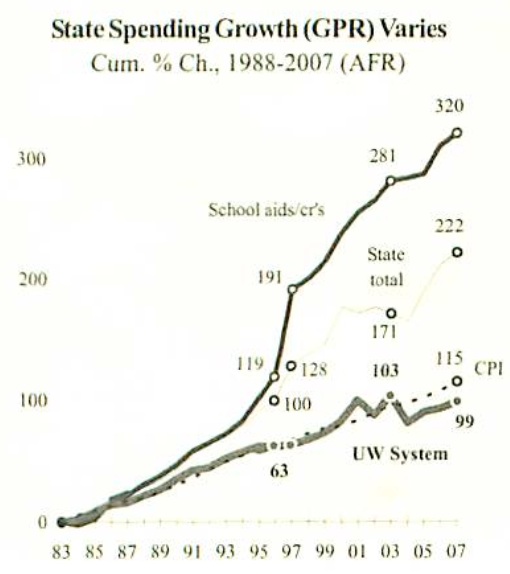
Related: Wisconsin K-12 spending growth far exceeds University pace.

Share

Do we the courage to address flaws in our education system?

Alan Borsuk:

President Barack Obama said Monday in a speech about education that this is “our generation’s Sputnik moment.”
My first question is: How many high school students around here know what Sputnik is?
My second question is: Do you think there are things to be learned from the educational success in countries that are doing better overall than the United States?
The release last week of results from testing of 15-year-olds around the world, including in most of the world’s industrial nations, was one of the main factors underlying Obama’s statement. American students showed a bit of improvement, but overall were in the middle of the pack. That means, among the 34 countries at the center of the study, the U.S. was 14th in reading, 17th in science and 25th in math. The U.S. standings were in line with other results in recent years.
While the rankings from the Program for International Student Assessment got a lot of attention, a set of accompanying reports got little. Among those was one focused on lessons for the United States.

Share

Educator Is Said to Have Rejected Chancellor Job

Javier Hernandez

In defending his selection for schools chancellor, Mayor Michael R. Bloomberg has called Cathleen P. Black, a publishing executive with no education experience, “exactly the right person for the job” and suggested that her skills as a manager were unrivaled.
Ms. Black, however, was not the first person the mayor asked to take the position. Mr. Bloomberg tried to persuade Geoffrey Canada, the prominent Harlem education leader and a friend of the mayor, to be chancellor, but Mr. Canada turned it down, according to two people with direct knowledge of the discussions.
The two people did not want to be identified because Mr. Bloomberg has sought to keep the process private.
Mr. Bloomberg has repeatedly declined to offer details about whom he consulted during the search process, or how he ultimately settled on Ms. Black, the chairwoman of Hearst Magazines.

Share

K-12 Tax & Spending Climate: Survey says 55% of Wisconsin residents live paycheck-to-paycheck

Paul Gores:

More than half of Wisconsin residents are living paycheck-to-paycheck and have no “rainy day” fund that would cover thee months of unanticipated financial emergencies, a survey released this week says.
The Financial Capability Survey conducted by FINRA, the self-regulating agency of the investing industry, said 55% of Wisconsinites report spending all or a little more than their household income, which is similar to the rate nationwide. About 57% of Wisconsin resident don’t have emergency money stashed away, slightly better than the national average of 60%.

Share

K-12 Tax & Spending Climate: Wisconsin State agencies request 6.2% hike in spending

Jason Stein:

State agencies are requesting an additional $3.94 billion in state and federal money – a 6.2% increase – over the next two years to fund priorities such as health care and education.
But with the state already facing a massive deficit in the 2011-’13 budget, Governor-elect Scott Walker and the Republican-controlled Legislature are unlikely to fill many of those requests. The report on the $67.43 billion in requests over two years – most by agencies in Gov. Jim Doyle’s administration -was released Thursday by the Legislative Fiscal Bureau.
The biggest share of the proposed increases would go to the state Department of Health Services for programs such as Medicaid health care for the poor – spending that Walker and other Republicans have pledged to rein in.

Share

Monona Grove School Board Update

Peter Sobol:

In the public appearances section of the meeting MGEA representative Kevin Mikelbank noted that in consideration of the status of the ongoing negotiations the teacher’s union has suspended their “work to the contract” job action, and that teachers would now participate in activities such as writing student letters of recommendation.
After the remaining preliminaries, the board heard first from PMA financial consultants who perform a 5 year budget forcast for the district each year. This year’s preliminary model assumes zero enrollment growth and $200/year increase in the revenue cap – in all likelyhood we will see a smaller increase. Even so, the preliminary projections show a deficit that increases $700K to $1M each of the next five years, and unless a miracle occurs in the state budget process it will quite probably be worse. Ugh.

Share

More schools join Minnesota teacher reform program, Begin Sharing K-12 Lessons via iTunes

Chris Williams

Seven school districts and 23 charter schools are joining Minnesota’s alternative system for evaluating and paying teachers — the signature education initiative under Gov. Tim Pawlenty, who leaves office next month.
Pawlenty on Wednesday announced the largest one-year expansion of the Q Comp program since it began in 2006. With the addition of the new schools next year, nearly a third of Minnesota students will be taught by a teacher in the program.
Also, the Minnesota Department of Education has begun uploading state-approved lessons for teachers and preschool through high school students to the iTunes web site in collaboration with Apple Inc., Pawlenty said.

Share

Texas Study suggests education cost savings

Candace Carlisle

Texas Comptroller Susan Combs released a study Wednesday to help school districts and campuses identify cost-saving strategies schools can make without compromising academics.
The newly released study was required by House Bill 3 from the 2009 legislative session. It was conducted by researchers from the state’s top institutions, including the University of Texas at Dallas, among industry experts.
The costs of Texas public education have increased significantly to nearly $55 billion, with per-pupil spending rising by 63 percent, Combs said, in a written letter. With cuts to state-funded budgets expected in the upcoming legislative session, school districts will need to operate more efficiently.

Share

K-12 Tax & Spending Climate: Wisconsin State budget preview leaves unanswered questions

WisTax

Much of the state’s recurring deficit problems are due to short-term budget decisions made over the past 15 years. But revenue volatility has also played a role. During 1990-2000, annual growth in general purpose tax revenues (GPR) averaged 6.8%, and the average was still higher (7.0%) during 1995-2000. Even after the 2001 recession, state tax collections grew an average of 5.0% per year during 2003-2008. But that was followed by collections dropping 7.1% in 2008-09 and remaining stagnant the following year, despite tax increases.
How the 2011-13 budget ultimately fares depends in part on the revenue outlook. And the new forecast for 2010-13 shows tax revenues growing at annual (bars in graph above) and average (line) rates generally below the recent past. The table below provides forecast detail. Tax revenues are projected to grow 4.2% or less over the next biennium.

Share

K-12 Tax & Spending Climate: 2010 Madison Property Tax Bills Online

City of Madison 2010 property tax bills can be viewed at the City Assessor’s office website and via Access Dane.. Taxes are up, significantly.
The increases depend, to some extent on property assessments (if the assessed value declines, tax rates generally increase more to compensate for the reduced tax base and support spending growth), but a quick look reveals City of Madison and Dane County taxes are up in the 6% range, MATC over 10% and the Madison School District in the 9% range. Much more on the Madison School District’s 2010-2011 budget, here.
Two Madison School Board seats will be on the April, 2011 spring election ballot. They are currently occupied by Ed Hughes and Marj Passman. I presume they are both seeking re-election, but I’ve not seen an announcement to that effect.

Share

The honeymoon’s over: After two years at helm, Madison school chief Nerad struggling

Susan Troller

For months, there was nothing but enthusiastic buzz surrounding the proposal to start a green charter school in Madison. The organizers of Badger Rock Middle School have broad support throughout the community and have meticulously done their homework. The school district administration was enthusiastic about the school’s focus on urban agriculture, and School Board members, who have the ultimate vote, were too.
Then, just days before the board was expected to give its final approval, the school district released new figures showing it would likely cost hundreds of thousands of dollars a year to staff and operate the new school. This was a reversal from earlier projections that showed Badger Rock would bring no extra costs to the district.
In the current era of pinched budgets and dreary financial prospects, this revelation threw a monkey wrench into the process and caused the board to delay final consideration of the project until later this month.
“I had planned to come in here tonight to vote for this most innovative project,” board member Marj Passman said during the Nov. 29 meeting. “But at the last minute the Badger Rock people and the board were both hit broadside with new information that raises a lot of last-minute questions.”

Much more on Dan Nerad, here. Watch a recent video interview.

Share

Time to discuss state employee benefits

Joe Nation

Stanford’s Institute for Economic Policy Research has issued two recent reports on the condition of public employee pension funds in California. The first identified a $425 billion funding shortfall for three state pension systems: the California Public Employees’ Retirement System, California State Teachers’ Retirement System, and the University of California Retirement System. The second report found a nearly $200 billion shortfall for local government pension systems.
Both reports focused on the overall financial health of pension systems in California but did not touch on retiree benefit levels. It’s time to begin that conversation.
Discussing public employee retirement benefits is dangerous politically. So let’s start with the legal status of benefits owed to public employees.

Share

Give all-male charter school a chance

Wisconsin State Journal Editorial

The Urban League of Greater Madison’s dramatic proposal for an all-male public charter school deserves open minds and fair consideration from the Madison School Board.
Don’t dismiss this intriguing initiative just because the teachers union is automatically opposed. A new approach to helping more young black men get to college is justified, given the district’s stark numbers:

  • Only 7 percent of black students who took the latest ACT college preparation test were ready for college.
  • Barely half of black students in Madison schools graduated in 2009.
  • Almost three-quarters of the 3,828 suspensions last school year were black students, who make up less than a quarter of the student body

Much more on the proposed IB Charter Madison Preparatory Academy and Kaleem Caire.

Share

Teachers can make their case about reform to policymakers

In the Nov. 28 Star, Matthew Tully contributed an insightful piece highlighting a significant disconnect between education reformers and those who will perhaps be most affected by reforms — teachers (“Teachers hear something else in reform debate”). The article begs us to contemplate the forces underlying educators’ distrust of state-directed education reforms. Teachers will be instrumental in implementation of these reforms. As such, the fracture between policymakers and practitioners demands our attention.
Tully captured the gestalt of the problem when noting that many good teachers think those of us pushing for education reform blame them for their schools’ failures. We’re not. We’re actually making the opposite case: Good and great teachers are responsible for their schools’ successes.

Share

Hold the brownies! Bill could limit bake sales

Mary Clare Jalonick

A child nutrition bill on its way to President Barack Obama — and championed by the first lady — gives the government power to limit school bake sales and other fundraisers that health advocates say sometimes replace wholesome meals in the lunchroom.
Republicans, notably Sarah Palin, and public school organizations decry the bill as an unnecessary intrusion on a common practice often used to raise money.
“This could be a real train wreck for school districts,” Lucy Gettman of the National School Boards Association said Friday, a day after the House cleared the bill. “The federal government should not be in the business of regulating this kind of activity at the local level.”

Share

New Jersey Governor Christie Takes on Parsippany School Board, Super at Town Meeting

Carrie Stetler

Gov. Chris Christie didn’t mention Superintendent of Schools LeRoy Seitz in his town meeting speech Friday afternoon at the Morris County Public Safety Training Academy.
But it didn’t take him long to get around to the subject.
When it was time for the audience to ask questions, Parsippany Township resident Hank Heller came to the microphone and asked if the board’s approval of Seitz’s contract made him consider stripping local school boards of their power.
“Since we’ve seen the results in Parsippany of home rule run amok with the superintendent’s contract, any thought of changing home rule to county rule or state rule?” asked Heller, who was first line at the event, which drew a crowd of more than 200.
Christie chuckled, then said, “All night, and the first question we get is about Lee Seitz.”

Share

Britain’s students: the revolution will be along later

The Economist

“YOU ARE the backbone of a new movement. This is a movement that is capable of changing Britain, Europe and the world,” bellowed the student representative from University College, London (UCL), standing on the plinth at the base of Nelson’s Column in Trafalgar Square this afternoon. His claim was manifestly false.
I am sure he believed it, as a megaphone carried his words into a horizontal-sleet-laden wind. I suspect many of the crowd of a few hundred freezing young protestors gathered below wanted to believe it. They clutched placards denouncing plans by the Coalition government to raise a cap on student tuition fees to abour £9000 a year, and they were genuinely, sincerely angry. Today’s day of action was the third major demonstration by students in central London, and the foul weather had not deterred a good number of students from showing up, though they were outnumbered by chilly-looking police.
There were signs of troublemaking here and there: hairy, middle-aged Trots handing out tracts called things like Proletarian Struggle or words to that effect. Lots of ready-made signs distributed by the Socialist Workers’ Party, a hardline outfit. A few gaggles of scary youths in hooded tops with scarves over their faces, roaming the crowd in search of trouble. An Iranian television news crew filming the scene.

Share

Goal of education is to serve all customers

Alan Borsuk

Consider this a thought that could change the way schools operate throughout the Milwaukee area:
Hold the pickles, hold the lettuce, special orders don’t upset us … 
Or, to put the 1970s Burger King jingle into education jargon:
Individualize and customize within a standardized system. (OK, that’s not quite as catchy. )
The promise of Burger King was that they would come up with the best thing for you as an individual. You weren’t just another customer. This would make your experience at Burger King more engaging and more successful. Yet you could count on consistent standards of quality in the outcomes.
Now replace all the food references with educational references and you get at a key to a campaign by area school leaders that aims to bring major change to the basic structures of schooling. They don’t have small goals – the title of the report at the heart of their effort is Transforming Public Education: A Regional Call to Action.

Share

What I Learned at the Education Barricades

Over the past eight years, I’ve been privileged to serve as chancellor of the New York City Department of Education, the nation’s largest school district. Working with a mayor who courageously took responsibility for our schools, our department has made significant changes and progress. Along the way, I’ve learned some important lessons about what works in public education, what doesn’t, and what (and who) are the biggest obstacles to the transformative changes we still need.
First, it is wrong to assert that students’ poverty and family circumstances severely limit their educational potential. It’s now proven that a child who does poorly with one teacher could have done very well with another. Take Harlem Success Academy, a charter school with all minority, mostly high-poverty students admitted by lottery. It performs as well as our gifted and talented schools that admit kids based solely on demanding tests. We also have many new small high schools that replaced large failing ones, and are now getting outsized results for poor children.

Share

K-12 Tax & Spending Climate: Report of the National Commission on Fiscal Responsibility

Report of the National Commission on Fiscal Responsibility (PDF)

Alternative Link: Report of the National Commission on Fiscal Responsibility (PDF)

Throughout our nation’s history, Americans have found the courage to do right by our children’s future. Deep down, every American knows we face a moment of truth once again. We cannot play games or put off hard choices any longer. Without regard to party, we have a patriotic duty to keep the promise of America to give our children and grandchildren a better life.

Our challenge is clear and inescapable: America cannot be great if we go broke. Our businesses will not be able to grow and create jobs, and our workers will not be able to compete successfully for the jobs of the future without a plan to get this crushing debt burden off our backs.
Ever since the economic downturn, families across the country have huddled around kitchen tables, making tough choices about what they hold most dear and what they can learn to live without. They expect and deserve their leaders to do the same. The American people are counting on us to put politics aside, pull together not pull apart, and agree on a plan to live within our means and make America strong for the long haul.
As members of the National Commission on Fiscal Responsibility and Reform, we spent the past eight months studying the same cold, hard facts. Together, we have reached these unavoidable conclusions: The problem is real. The solution will be painful. There is no easy way out. Everything must be on the table. And Washington must lead.
We come from different backgrounds, represent different regions, and belong to different parties, but we share a common belief that America’s long-term fiscal gap is unsustainable and, if left unchecked, will see our children and grandchildren living in a poorer, weaker nation. In the words of Senator Tom Coburn, “We keep kicking the can down the road, and splashing the soup all over our grandchildren.” Every modest sacrifice we refuse to make today only forces far greater sacrifices of hope and opportunity upon the next generation.
Over the course of our deliberations, the urgency of our mission has become all the more apparent. The contagion of debt that began in Greece and continues to sweep through Europe shows us clearly that no economy will be immune. If the U.S. does not put its house in order, the reckoning will be sure and the devastation severe.
The President and the leaders of both parties in both chambers of Congress asked us to address the nation’s fiscal challenges in this decade and beyond. We have worked to offer an aggressive, fair, balanced, and bipartisan proposal – a proposal as serious as the problems we face. None of us likes every element of our plan, and each of us had to tolerate provisions we previously or presently oppose in order to reach a principled compromise. We were willing to put our differences aside to forge a plan because our nation will certainly be lost without one.
We do not pretend to have all the answers. We offer our plan as the starting point for a serious national conversation in which every citizen has an interest and all should have a say. Our leaders have a responsibility to level with Americans about the choices we face, and to enlist the ingenuity and determination of the American people in rising to the challenge.

Share

Rhee tapped by Fla. Gov.-elect Scott

Nick Anderson

Former D.C. schools chancellor Michelle A. Rhee has joined the education transition team of Florida Gov.-elect Rick Scott (R), according to a statement from the Scott’s office.

The full text of the statement, after the jump.
FORT LAUDERDALE, FL – Calling the members of his latest transition team “Champions for Achievement,” Governor-elect Rick Scott announced an experienced and distinguished team of education experts, including nationally recognized education reformer, Michelle Rhee, to help him find innovative ways to create a new education system for a new economy.

Share

Surprisingly Predictive (you moron!): “…student feedback (surprisingly predictive of success in the classroom)”

Jonathan Alter

Bill Gates is raising his arm, bent at the elbow, in the direction of the ceiling. The point he’s making is so important that he wants me and the pair of Gates Foundation staffers sitting in the hotel conference room in Louisville, Ky., to recognize the space between this thought and every lower-ranking argument. “If there’s one thing that can be done for the country, one thing,” Gates says, his normally modulated voice rising, “improving education rises so far above everything else!” He doesn’t say what the “else” is–deficit reduction? containing Iran? free trade?–but they’re way down toward the floor compared with the arm above that multibillion-dollar head. With the U.S. tumbling since 1995 from second in the world to 16th in college-graduation rates and to 24th place in math (for 15-year-olds), it was hard to argue the point. Our economic destiny is at stake.
Gates had just finished giving a speech to the Council of Chief State School Officers in which he tried to explain how administrators could hope to raise student achievement in the face of tight budgets. The Microsoft founder went through what he sees as false solutions–furloughs, sharing textbooks–before focusing on the true “cost drivers”: seniority-based pay and benefits for teachers rising faster than state revenues.
Seniority is the two-headed monster of education–it’s expensive and harmful. Like master’s degrees for teachers and smaller class sizes, seniority pay, Gates says, has “little correlation to student achievement.” After exhaustive study, the Gates Foundation and other experts have learned that the only in-school factor that fully correlates is quality teaching, which seniority hardly guarantees. It’s a moral issue. Who can defend a system where top teachers are laid off in a budget crunch for no other reason than that they’re young?
In most states, pay and promotion of teachers are connected 100 percent to seniority. This is contrary to everything the world’s second-richest man believes about business: “Is there any other part of the economy where someone says, ‘Hey, how long have you been mowing lawns? … I want to pay you more for that reason alone.’ ” Gates favors a system where pay and promotion are determined not just by improvement in student test scores (an idea savaged by teachers’ unions) but by peer surveys, student feedback (surprisingly predictive of success in the classroom), video reviews, and evaluation by superiors. In this approach, seniority could be a factor, but not the only factor.
President Obama knows that guaranteed tenure and rigid seniority systems are a problem, but he’s not yet willing to speak out against them. Even so, Gates gives Obama an A on education. The Race to the Top program, Gates says, is “more catalytic than anyone expected it to be” in spurring accountability and higher standards.
Gates hardly has all the answers: he spent $2 billion a decade ago breaking up big high schools into smaller ones and didn’t get the results he’d hoped for. Today, he’s too enamored of handheld devices for tracking student performance. They could end up as just another expensive, high-tech gimmick. But you’ve got to give Gates credit for devoting so much of his brain and fortune to this challenge. [BIG BIAS ALERT HERE!] His biggest adversary now is Diane Ravitch, a jaundiced former Education Department official under George H.W. Bush, who changed sides in the debate and now attacks Gates-funded programs in books and articles. Ravitch, the Whittaker Chambers of school reform, gives intellectual heft to the National Education Association’s campaign to discredit even superb charter schools and trash intriguing reform ideas that may threaten its power. When I asked Gates about Ravitch, you could see the Micro-hard hombre who once steamrolled software competitors: “Does she like the status quo? Is she sticking up for decline? Does she really like 400-page [union] contracts? Does she think all those ‘dropout factories’ are lonely? If there’s some other magic way to reduce the dropout rate, we’re all ears.” Gates understands that charters aren’t a silver bullet, and that many don’t perform. But he doesn’t have patience for critics who spend their days tearing down KIPP schools and other models that produce results.
There’s a backlash against the rich taking on school reform as a cause. Some liberals figure they must have an angle and are scapegoating teachers. But most of the wealthy people underwriting this long-delayed social movement for better performance are on the right track. [BIG BIAS ALERT HERE!] Like the rest of us, they know that if we don’t fix education, we can kiss our future goodbye.
Jonathan Alter is also the author of The Promise: President Obama, Year One and The Defining Moment: FDR’s Hundred Days and the Triumph of Hope.

Share

Stephanie Findley learned the hard way that while the public favors school reform, the political system is rigged to kill it.

Mike Nichols

Stephanie Findley was not just some carpetbagger looking for a job when she decided to run for the Assembly earlier this year.
She had a job — a few of them, actually. She worked as an office manager for Milwaukee District Council 48, a large and politically active labor group. She owned a small business, Fast & Accurate Business Solutions. She taught classes at the Spanish Center in Milwaukee and at Bryant & Stratton College.
A single mother who says she was already pregnant when she walked across the stage to get her Milwaukee Public High School degree some 20 years ago, Findley had overcome poverty and earned a master’s degree from Cardinal Stritch. She was also active in the Democratic Party, was head of the City of Milwaukee’s Election Commission and volunteered for too many organizations to count.
She was a 20-year resident of the 10th Assembly District, which has long been the province of retiring lawmaker Annette Polly Williams — a woman many still call “the mother of school choice” — when she decided to run for the seat herself. Findley, after all, had many of the same struggles and worries her neighbors did — including the high cost of health care, taxes, and the quality of MPS schools.

Share

Is Federal Government Meddling Into Schools With Child Nutrition Bill?

Huma Khan

The House of Representatives today delayed a vote on the $4.5 billion child nutrition bill that would ban greasy food and sugary soft drinks from schools. The legislation has triggered criticism for its hefty price tag and new nutritional requirements that some say shouldn’t come from the federal government.
The bill is expected to be brought up later this week.
The legislation has the support of the White House and first lady Michelle Obama, who has made childhood obesity a central focus.
The Senate bill, which passed with unanimous bipartisan consent in August, would expand eligibility for school lunch programs, establish nutrition standards for all school meals, and encourage schools to use locally produced food. It would also raise the reimbursement rate to six cents per meal, marking the first time in over 30 years that Congress has increased funding for school lunch programs.

Share

Seattle Public Schools superintendent Maria Goodloe-Johnson stands firm, even as her teachers lose faith in her leadership.

Matthew Halverson

SEVEN YEARS AGO, Maria Goodloe-Johnson declined to apply for the job as superintendent of Seattle Public Schools and instead took the same job with the Charleston County School District in South Carolina. “The [Seattle] school board was very confused,” she says. “And I wasn’t interested in confusion.” She won’t get more specific than that when describing the district circa 2003, but it couldn’t have been drastically different than the situation she inherited when she accepted the Seattle school district’s top spot in 2007.
Attendance at South Seattle schools was sinking. The school board had adopted a new student assignment plan without any idea of how to implement it. Schools were teaching to vastly different standards. Heck, the district’s computer system was so outdated, prospective teachers had no means for applying online for jobs at multiple schools at once. SPS lacked accountability and administrative oversight, and Goodloe-Johnson whipped out her ruler and started rapping knuckles almost immediately.

Melissa Westbrook has more.

Share

Teaching in schools: Michael Gove wants to change how and what schools teach, as well as how they are organised

The Economist

ALLOWING teachers, parents, charities and religious groups to open new schools funded by the state, but independent of local authorities, is a central plank of the government’s plans for improving education in England. Despite the enthusiasm of the education secretary, Michael Gove, for such radical reform, take-up has been lacklustre: he has approved just 25 “free-school” proposals so far. Likewise his bid to encourage existing state schools to become academies–again, funded by the state but independent of local authorities–has failed to take off.
On November 24th Mr Gove unveiled his latest plan for curing ailing schools, this time by changing what is taught in them, and who does the teaching. He is thus revisiting the policy terrain on which the previous Labour government focused (arguing that “standards, not structures” were what mattered) until its final term in office.
Britain’s best independent schools attract pupils from around the world. But most British families cannot afford the steep fees such schools charge. Just 7% of British children are educated privately; the rest attend state schools, where standards are generally much lower. The Labour government doubled school spending in real terms during its 13 years in power; despite the splurge, the attainment gap between the two systems has widened.

Share

More Evidence that Florida’s Education Reforms Succeeding

Christian D’ Andrea

Eleven years ago, Florida chose sweeping reforms to improve the dire state of education affecting their children. Today, these changes are still paying dividends, and don’t show signs of slowing down anytime soon.
Florida’s graduation rate, once amongst the worst in America, has risen steadily over the past five years, capping off at 79 percent for the 2009-2010 school year. This is over ten percentage points more than in 2005-2006, when the rate held at 68.9, and a 20-point increase from Manhattan Institute estimates of the rate in 2000-2001. Over this span, the state has gone from straggling behind the national average to becoming an above-average performer when it comes to graduating their high school students.
Most encouraging, however, are the state’s results when it comes to the matriculation of minority students. African-American and Hispanic students have made the strongest gains of any group since 2005-2006. These two groups have improved their rates by 13.1 and 13.3 percent, respectively, to become the driving force behind Florida’s overall improvement. Comparatively, white students have only bettered their graduation rate by eight percent over the same time frame. Through the past decade, Florida has proven that the achievement gap can be conquered through dynamic solutions in the classroom.

Share

Wisconsin Representative Nass hopes to cap UW tuition hikes at 4 percent

Todd Finkelmeyer

Rep. Steve Nass plans to introduce legislation in the coming year which would cap the amount tuition and most mandatory fees can be raised for those attending the state’s public colleges and universities.
Nass on Tuesday was named chairman of the Assembly Colleges and Universities Committee for the 2011-12 legislative session.
This proposal by the Republican from the Town of La Grange could put UW System officials in a tight bind. In addition, the tuition cap idea isn’t the only topic that came up in Campus Connection’s wide-ranging phone conversation with Nass spokesman Mike Mikalsen that will likely ruffle the feathers of those with ties to higher education in the state.
Mikalsen also addressed: the famously poor relationship between Nass and UW System officials; “education” versus “indoctrination”; the potential for a “smart furlough” plan; and what the state’s massive budget hole might mean for universities in the state.
“The real rubber is going to meet the road when it comes to budget issues,” says Mikalsen. “If the UW System covers the table with ideas, it’s going to be very helpful. If they come to the table saying, ‘We’re the economic engine for the state and you need to give us more money,’ then it’s going to be a difficult time in the next two years.”
Perhaps most notably, Mikalsen says Nass plans to push for a measure which would cap — likely at 4 percent — the amount tuition and most fees could be raised at UW System schools.

Share

Evers defends Wisconsin school finance plan as “fairness issue”

WisPolitics

State schools Superintendent Tony Evers (left) says his proposed funding plan is a matter of fairness and transparency.
“Every child in the state of Wisconsin should be supported by some level of general aid,” Evers said on Sunday’s “UpFront with Mike Gousha,” a statewide TV newsmagazine produced in conjunction with WisPolitics.com. “That’s not the case now. It’s a pure fairness issue.”
His plan calls for a $420 million funding boost over two years that would allow the state to pitch in at least $3,000 for every student in each district.
Evers said the increase would represent the smallest bump in terms of dollars or percent that the department has asked for in the past decade. He disputed accounts that the plan was “dead on arrival” in next year’s Republican-run Legislature and said he’s gotten good response to at least talking about the concept.
He said the major concerns so far have been the price tag, but there has been support for the overall policy.
Evers said his goal with the plan is to reduce the complexity in the school funding formula, increase transparency in the way schools are funded and “nudge the system” away from using property values as the basis for funding schools.

Share

Commentary on the Proposed Madison Preparatory Academy, a Charter School

Kaleem Caire, via email: Chris Rickert:

At some point in the next couple months, members of the Madison School Board are almost certain to be in the unlucky position of having to decide whether to admit what is most fairly characterized as a colossal failure.
Approving a charter for Urban League of Greater Madison President Kaleem Caire’s all-boy, mostly black, non-union Madison Preparatory Academy will make it clear that, when it comes to many black schoolchildren, teachers have failed to teach, parents have failed to parent, and the rest of us have failed to do anything about either.
Reject the charter and risk the false hope that comes from thinking that all these children need is another program and more “outreach.” A tweak here and a tweak there and we can all just keep on keeping on. Never mind that the approach hasn’t seemed to work so far, and that if past is prologue, we already know this story’s end.
Caire’s model would be a radical departure for Madison. The district’s two existing charter schools — Wright Middle School and Nuestro Mundo — don’t exactly trample on hallowed educational ground. They employ union teachers and have the same number of school days and teaching hours as any other non-charter and “broadly follow our district policies in the vast majority of ways,” said district spokesman Ken Syke.

Amber Walker:

I want to thank Kaleem Caire for coming home to Madison and making positive changes. If anyone can make an all-male charter school happen here, he can. The statistics in the article may be alarming to some, but not as alarming to the students and parents who are living these statistics.
I support integration, but how can it be true integration when the education gaps are so large? Who is benefiting? In my eyes, true integration in the school system would support the same quality of education, the same achievement expectations, the same disciplinary measures and so on.
Numbers don’t lie, and what they tell us is that we need to go another route to ensure educational success for black males. If that means opening a charter school to intervene, then let’s do it!

Sally Martyniak:

Instead of the headline “All-male charter school a tough sell,” imagine this one, “Loss to society: Madison schools graduated only 52 percent of black male students in 2009.” Then the reaction to the Urban League’s plan to start a charter school intended to boost minority achievement might have been different.
Reaction in the article discussed all the reasons why people will or should oppose the idea of an all-male charter school, despite its benefits. Let’s not talk about why we should be aghast at the cultural performance disparities in Madison’s schools. And let’s not talk about what we lose as a society when almost half of all black males attending Madison schools fail to graduate.

Marshall Smith:

The comments of John Matthews, head of the Madison teachers union, on charter schools are hyperbole. Saying that the Madison School Board will have no control is a cover for the union not having control.
We can’t argue the importance of good teachers. But the idea that a degree in education, and a union membership, make you the only one capable of performing this role is specious. All of us are teachers, or have been taught meaningfully by individuals with teaching skills. Are we going to let successful teachers teach, or are we going to let their union dictate?
According to Carlo D’Este’s book “Warlord: A Life of Winston Churchill at War,” Churchill, during a lull in his career, learned bricklaying. Hearing this, the British Trade Union Council, in a public relations gesture, offered him a Master’s card.

Douglas Alexander:

Madison Urban League President Kaleem Caire applied for a charter school for males because only 52 percent of black males graduate in Madison schools, while black males are suspended significantly more than the majority white students.
Before anyone responds, they should answer two questions:

  • Are you concerned about these statistics?
  • What are you doing about it?

Much more on the proposed IB Charter school: Madison Preparatory Academy.

Share

Emanuel Vows Fix For Chicago Math and English

Dan Mihalopoulos

Rahm Emanuel made a campaign promise last week that if elected mayor, he would install a new math and English language curriculum in Chicago’s public schools by the end of his first term.
Mr. Emanuel said the new curriculum would be geared toward equipping students with the skills to meet the “common core standards” that education officials in Illinois and more than 40 other states have adopted. In imposing the new standards, the state has left up to the districts the question of how to try to meet those standards.
“I want us, the city of Chicago, to be the first city to adopt the curriculum that teaches toward the common standards,” he said in an interview with the Chicago News Cooperative. “Nobody has taken on the initiative.”
The effort would better prepare high school graduates for college or the workplace, he said.

Share

Madison School District Draft Superintendent Evaluation Documents

Beth Moss & James Howard 450K PDF

Attached is the final draft of the Superintendent evaluation document to be used for the summative or end -of-year evaluation to be voted on at the November 29 meeting. The document has two parts. The first part is the Superintendent of Schools Performance Expectations Standards Assessment, a rubric based on the following:

  1. The Superintendent Position Description, adopted Sept. 21, 2009; and
  2. Feedback from the formative (mid-year) evaluation for the Superintendent, July 2010

The second part of the evaluation involves feedback on the following elements:

  1. The Superintendent goals, approved December 15, 2009;
  2. Two elements from the additional evaluation framework identified by Mr. Howard: Diversity and Inclusion and Safety.

From the original draft sent to the Operational Support Committee on November 8, these are element numbers 3 and 4. In addition to approving a final version of the evaluation plan, the Board needs to discuss the date for evaluations to be submitted for compilation to the Board president and dates for a closed session meeting(s) to discuss the results. To complete the process by February, January 3, 2011 is the recommended date for submittal. January 10, 24, and 31 are possible meeting dates. During this period Board members also need to provide input on the Superintendent’s goals for 2011.
If you have any questions, please email James or Beth.

Much more on the Superintendent evaluation, here. A side note: the lack of annual, substantive evaluations of former Superintendent Art Rainwater was an issue in mid 2000’s school board races. Related: Who Does the Superintendent Work For?

Share

Wisconsin could learn a thing or two from Florida’s school grading system

Alan Borsuk

I heard Jeb Bush give a talk a few months ago in Milwaukee about education policies that he promoted while he was governor of Florida from 1999 to 2007. I should have taken notes, because I think I was listening to at least a few of the pages from the playbook that will be used by Scott Walker when he becomes governor of Wisconsin in about five weeks.
I’m betting that is particularly true for the system of giving every school in the state a grade – A to F – each year. It’s a centerpiece of the “A+ Schools” program that Bush championed in Florida. He credits the grading system with being a key driver of rising test scores over the last decade.
In his campaign platform, Walker called for launching a grading system for Wisconsin schools. He hasn’t spelled out details, but Florida is the primary example of such a system, and Walker is an admirer of Bush. Walker also will have strong Republican majorities in both houses of the Legislature, and I can’t think of any reason he won’t succeed in turning what he said he would do into reality in the not-at-all-distant future.
So let’s look at Florida’s grading system on the assumption it is a lot like what will be used here.

Share

San Francisco considers full-time school board

Associated Press

Several San Francisco supervisors are proposing making members of the city’s school board full-time workers with health benefits, a pension and salary of $50,000 each.
The San Francisco Chronicle reports that the four supervisors have put forth an amendment to the City Charter that would change the position from what is currently largely a volunteer job.
San Francisco’s seven school board members get a $500 stipend, shared use of a district car and a life insurance policy, but no salary.

Share

Make college cost more

Shirley V. Svorny

Recent decisions by the California State University Board of Trustees and the University of California regents to increase student fees have been attacked by critics who insist that higher education subsidies are critical for California’s economic growth and prosperity.
This is not true; the state’s prosperity rests on public policies that encourage economic activity, not on heavy subsidies to higher education.
Moreover, artificially low fees attract some students to higher education who simply aren’t suited to the academic rigors of a university. Ultimately, the presence of these lower-achieving students hurts those who are more academically inclined, as they end up in watered-down courses in which professors have to focus on bringing the low achievers along.

Share

Gov. Christie faces opposition from N.J. public school advocates in superintendent salary cap measure

Bob Braun

He was the very model of a modern Morris County Republican. He wore a dark suit under a gray Chesterfield overcoat with a black velvet collar. Hair, cropped military style. When he flipped open his cell phone, its backlit screen broadcast the familiar, stylized symbol of the GOP elephant.
Yet Joseph Ricca, the young schools superintendent in East Hanover, had just told Gov. Chris Christie, a rising Republican star, to back off.
“I don’t think any level of government, whether in Washington or Trenton, has the right to dictate what someone can and cannot earn,” said Ricca after testifying before a state hearing on the governor’s plan to cap the salaries of school chiefs.

Share

Poorest would have to travel furthest in Madison schools’ 4K plan

Matthew DeFour

“It would be completely crazy to roll out this 4K plan that is supposed to really, fundamentally be about preparing children, especially underprivileged, and not have the centers in the neighborhoods that most need the service,” School Board member Lucy Mathiak said.
Deputy superintendent Sue Abplanalp, who is coordinating implementation of the program, acknowledged some students will have to travel outside their school attendance areas to attend the nearest 4K program, “but it’s not a long drive, especially if they’re in contiguous areas.”
“We will make it work,” Abplanalp said. “We’re very creative.”
The school district is conducting its own analysis of how the distribution of day care providers and existing elementary school space will mesh under the new program. Some alternative programs may have to move to other schools to make room, but no final decisions have been made, Abplanalp said.
Detailed information has not been shared with the Madison School Board and is not expected to be ready before the board votes Monday on granting final funding approval for the program. The approval must happen then because the district plans to share information with the public in December before enrollment starts in February, Abplanalp said.

Much more on Madison’s proposed 4K program, here. The District has a number of irons in the fire, as it were, including high school curricular changes, challenging reading results and 4K, among many others. Can 4K lift off effectively (both in terms of academics and costs)?

Share

UK School sports cash plans criticised

UKPA

Education Secretary Michael Gove’s decision to end ring-fenced funding for school sports “quite frankly flew in the face” of the UK’s commitment to a lasting sports legacy after the 2012 Olympic Games, Labour has claimed.
Shadow education secretary Andy Burnham said there was widespread disbelief over Mr Gove’s £162 million cut in sports funding for English state schools.
And he seized on an Observer report that suggested Deputy Prime Minister Nick Clegg and Health Secretary Andrew Lansley had expressed concerns in Cabinet over the decision.
Mr Gove has insisted that overall spending in schools has increased and it is up to headteachers to decide their own priorities.
But Mr Burnham told Sky News’ Sunday Live: “I remember the 1980s when school sports dried up and when I worked in government I was on a mission to rebuild it and that’s what we’ve done in the last 10 years.

Share

K-12 Tax & Spending Climate: The Answer Is No

Jason Zengerle

His battle with the New Jersey Education Association (NJEA), over a proposed pay freeze and an increase in employee contributions to health benefits, has been particularly epic. “I came to Trenton … and it’s like coming to a new schoolyard,” he says. “I looked around, and there were a bunch of people on the ground, all bloody and moaning, all beat up, and there was one person on the schoolyard standing … When you see that one person standing up, that’s the bully. And in New Jersey, that’s the New Jersey teachers union.” He has accused teachers of “ripping off” the state and treating their pupils like “drug mules” after some were sent home tasked with asking their parents how they would vote on the school budget. And the demonizing has worked. A November poll put Christie’s in-state approval rating at 51 percent–30 points higher than the NJEA’s.
Less than a year into his tenure, Christie is no longer just a popular governor; he has become a national Republican star. His focus on fiscal issues and his reluctance to wade into the culture wars–during his gubernatorial campaign, he declined Palin’s offer to stump for him–have endeared him to members of the GOP’s sane wing. “The breakthrough he’s scoring in New Jersey is hugely promising,” says David Frum, a conservative writer who fears that the Republican Party is being swallowed by the tea party. At the same time, Christie’s combativeness has made him a popular figure with the tea party in a way that someone like Indiana governor Mitch Daniels–who’s fought some of the same fiscal battles in his state but with the mien of an accountant–can only dream of. More than anything, Christie fills the longing, currently felt in all corners of the GOP (and beyond), for a stern taskmaster. “People just want to be treated like adults,” Christie says. “They just want to be told the truth. They know we’re in tough times, and they’re willing to sacrifice. But they want shared sacrifice.”

Share

K-12 Tax & Spending Climate: We can’t afford deep budget cuts in Asheville education (11,631.37/student in 2009-2010)

Asheville Citizen Times

The North Carolina budget for the upcoming year is looming like a menacing storm cloud approaching on the horizon.
A funding hole of between $3 billion and $4 billion is anticipated.
Short of a rapid (and unexpected) economic turnaround that pumps more tax dollars into state coffers, it’s a hole that will have to be closed.
It’s how that hole will be closed, and the very nature of the state budget, that worries educators.
It ought to worry all of us.
For decades, North Carolina has made a quality public education system a priority, and indeed it’s been the foundation of the state’s economic policy as well. An educated citizenry is an educated work force, the coin of the realm for employers.
Education makes up the bulk of the state’s budget. K-12 funding alone is the single biggest chunk of the budget, representing 35 percent of spending.

Buncombe County Schools’ 2009-2010 budget was $290,784,230 for their 25,000 students. ($11,631.37 per student). Locally, Madison spent $15,241 per student in 2009-2010.

Share

School districts evaluate merits of merit pay

They call it the War Room.
It looks like any other classroom inside Carrick High School, a sprawling structure that towers like a stone fortress over this working-class neighborhood on the city’s south side. It’s still dark out as 16 teachers and counselors – some clutching coffee or energy bars – sit in a circle, dissecting with brutal candor their students’ performance.
In addition to their classroom duties, these teachers serve as advisers to every ninth- and 10th-grader in the school, and they show up 45 minutes before school starts each day to talk about where their students need to be. No punches are pulled; no feelings are spared.
As part of the Promise Readiness Corps, these teachers are eligible for financial bonuses.
In Pittsburgh, the Corps is one element of a new plan that overhauls the way the district hires, trains, evaluates, pays and dismisses teachers. Under a new performance-pay system, incoming district teachers whose students learn, on average, at 1.3 times their grade level can earn $100,000 a year within seven years of being hired.
Raising the quality of teaching in America has been a priority of President Barack Obama’s administration, and reforms receiving the most attention right now include stronger teacher evaluation systems and financial incentives to attract, reward and retain quality educators.

Share

K-12 Tax & Spending Climate: $2.2 billion Wisconsin deficit balloons to $3.3 billion without assumed spending cuts

Jason Stein

Democratic Gov. Jim Doyle’s administration on Friday told Republican Governor-elect Scott Walker that he would have to cope with a $2.2 billion deficit in the state’s upcoming two-year budget, but this brighter-than-expected forecast contained more than $1 billion in hidden pain.
To arrive at the favorable estimate, the Doyle administration’s estimate assumed that Walker and lawmakers would make spending cuts that have yet to actually happen – two more years of state employee furloughs, no pay raises, a virtual hiring freeze and belt tightening in state health programs. Without that $1.1 billion in savings, the state’s projected shortfall rises to $3.3 billion – a significant increase over previous estimates that put the gap at between $2.7 billion and $3.1 billion.
The shortfall and the efforts to close it could affect everything from schools and health care to local governments and taxpayers.
The “revenue projections released Friday underscore what Governor-elect Walker has said for months – the state of Wisconsin is facing very serious budget challenges,” Walker transition director John Hiller said in a statement. “Further, we believe that the true budget shortfall is much higher than indicated by the projections released today.”

Share

A Dilemma For Schools Seeking To Reform

Sarah Karp:

On the eve of a Board of Education meeting in February where the death knell was to sound for five schools, Ron Huberman, the chief executive of Chicago Public Schools, granted an 11th-hour reprieve.
The low enrollment and poor academic record at Paderewski Elementary had made the South Side school a target for closing, and its students were being sent to Mason Elementary, the only nearby school that had higher test scores. Mr. Huberman said he changed his mind after walking from Paderewski to Mason and discovering that students would have to cross a wide intersection of four streets, a situation he concluded was too dangerous.
Although the pardon for Paderewski might have been a relief for some teachers, parents and students, it did not address the problems at a low-performing, underutilized school. Other poorly performing schools are also being spared as resistance to closing them has grown, confronting the next mayor with a longstanding question: What can be done with neighborhood schools where enrollment is shrinking and academic improvement is slow?

Share

A School Board Thinks Differently About Delivering Education, and spends less

Stephanie Simon

The school board in a wealthy suburban county south of Denver is considering letting parents use public funds to send their children to private schools–or take classes with private teachers–in a bid to rethink public education.
The proposals on the table in Douglas County constitute a bold step toward outsourcing a segment of public education, and also raise questions about whether the district can afford to lose any public funds to private educators.
Already hit hard by state cutbacks, the local board has cut $90 million from the budget over three years, leaving some principals pleading for family donations to buy math workbooks and copy paper.
“This is novel and interesting–and bound to be controversial,” said Chester E. Finn Jr., president of the Thomas B. Fordham Institute, a conservative, educational think tank in Washington, D.C.

Douglas County School District board members are also considering letting students enrolled in public schools opt out of some classes in favor of district-approved alternatives offered at for-profit schools or by private-sector instructors. Students might skip high-school Spanish, for example, to take an advanced seminar in Chinese, or bypass physics to study with a rocket scientist, in person or online.
Another proposal under review calls for expanding publicly-funded services for families that home-school their children.
Superintendent Elizabeth Celania-Fagen said she is not sure which proposals she might support. But in a recent letter to parents of the district’s 56,000 students, she said her leadership team “did not find the ideas alarming” and pledged the district would “set the stage for new thinking in education.”
“These days, you can build a custom computer. You can get a custom latte at Starbucks,” said board member Meghann Silverthorn. “Parents expect the same out of their educational system.”

Related: The ongoing struggle for credit for non Madison School District courses.
Colorado’s Douglas County School District spends $8512.74 per student ($476,977,336 for 56,031 students in 2009). Madison spent $15,241 per student in 2009, a whopping $6,728.26, 79% more than the “wealthy Denver suburbs”.

Share

On the American Federation of Teachers president Rhonda “Randi” Weingarten’s Compensation

J.P. Freire

American Federation of Teachers president Rhonda “Randi” Weingarten has issued a statement slamming proposed cuts from the congressional deficit commission for not pushing shared sacrifice among the wealthy, but an AFT spokesman has told The Examiner that Weingarten will not be taking a paycut from the total $428,284 she received in salary and benefits during fiscal year 2010.
Weingarten wrote of the proposed budget cuts from the National Commission on Fiscal Responsibility and Reform:n

Share

Gates Urges School Budget Overhauls

Sam Dillon

Bill Gates, the founder and former chairman of Microsoft, has made education-related philanthropy a major focus since stepping down from his day-to-day role in the company in 2008.
His new area of interest: helping solve schools’ money problems. In a speech on Friday, Mr. Gates — who is gaining considerable clout in education circles — plans to urge the 50 state superintendents of education to take difficult steps to restructure the nation’s public education budgets, which have come under severe pressure in the economic downturn.
He suggests they end teacher pay increases based on seniority and on master’s degrees, which he says are unrelated to teachers’ ability to raise student achievement. He also urges an end to efforts to reduce class sizes. Instead, he suggests rewarding the most effective teachers with higher pay for taking on larger classes or teaching in needy schools.
“Of course, restructuring pay systems is like kicking a beehive” — but restructure them anyway, Mr. Gates plans to tell the superintendents in his talk to the Council of Chief State School Officers, which opens a convention in Louisville on Friday.

Share

MacIver’s Analysis of Superintendent Evers’ School Funding Reform Plan

Christian D’Andrea

This would ensure that areas with greater concentrations of low-income families receive more funding in their classrooms.
However, history shows that this isn’t a winning formula. While students from poorer family backgrounds present challenges in the classroom, greater financial support hasn’t led to better results in Wisconsin. Milwaukee has the highest concentration of free and reduced-price lunch students in the state, as well as one of the highest per-pupil expenditure figures, spending an average of $16,730 per child according to DPI data. Madison, a city with similar low-income population issues, spent $16,393 on each student in 2009.
Conversely, other areas dealing with diverse student populations have shown better returns on their educational investments with less expenditure. Wauwatosa and Green Bay have produced more positive results in the classroom despite spending less. The districts spent just $12,098 and $13,041, respectively, per student in 2009.

Much more on the proposed changes to State of Wisconsin tax dollars for K-12 Districts, here.

Share

K-12 Tax & Spending Climate: The big givers: Teacher Unions, tribes, and real estate agents

Ben Smith

A readers sends on a link to OpenSecrets.org’s novel compilation of the top political donors of the 2007-8 cycle, novel in that it combines state and federal spending.
The results are striking: The biggest spender over all was the National Education Association, the bigger national teachers union, with nearly all of its $53.6 million spent on the state level. Six more of the top ten were gambling interests, at least five of them backing Indian casinos, again mostly at the state level.
SEIU comes in fifth, the National Association of Realtors comes in sixth.

Share

Wisconsin Education Superintendent Seeks 2-4% annual increases in redistributed state tax dollars, introduction of a poverty formula and a shift in Property Tax Credits


Many links as the school finance jockeying begins, prior to Governor Scott Walker’s January, 2011 inauguration. Wisconsin’s $3,000,000,000 deficit (and top 10 debt position) makes it unlikely that the K-12 world will see any funding growth.
Matthew DeFour

Evers plan relies on a 2 percent increase in school aid funding next year and a 4 percent increase the following year, a tough sell given the state’s $3 billion deficit and the takeover of state government by Republicans, who have pledged budget cuts.
One major change calls for the transfer of about $900 million in property tax credits to general aid, which Evers said would make the system more transparent while having a negligible impact on property taxes. That’s because the state imposes a limit on how much a district can raise its total revenue. An increase in state aid revenue would in most cases be offset by a decrease in the other primary revenue — property taxes.
Thus the switch would mean school districts wouldn’t have such large annual property tax increases compared to counties, cities and other municipalities, even though tax bills would remain virtually the same, said Todd Berry, executive director of the Wisconsin Taxpayers Alliance.
“Distributing the money through the school aid formula, from a pure policy sense, is probably more equitable than distributing it in its current tax credit form,” Berry said. “The money will tend to help districts that tend to be poorer or middle-of-the-road.”

Susan Troller

Inequities in the current system tend to punish public schools in areas like Madison and Wisconsin’s northern lake districts because they have high property values combined with high poverty and special needs in their school populations. The current system doesn’t account for differences in kids’ needs when it doles out state aid.
Education policy makers as well as politicians on both sides of the aisle have talked school funding reform for over a dozen years but it’s been a tough sell because most plans have created a system of winners and losers, pitting legislator against legislator, district against district.
Evers’ plan, which calls for a 2 percent increase in school aid funding next year and a 4 percent increase the following year, as well as a transfer of about $900 million in property tax credits to general aid, addresses that issue of winners and losers. Over 90 percent of districts are receiving more funding under his proposal. But there aren’t any district losers in Evers’ plan, either, thanks to a provision that requests a tenth of a percent of the total state K-12 schools budget — $7 million — to apply to districts facing a revenue decline.

WISTAX

Wisconsin State and Local Debt Rose Faster Than Federal Debt During 1990-2009 Average Annual Increase in State Debt, 7.8%; Local Debt, 7.3%

Scott Bauer

Rewrite of Wisconsin school aid formula has cost

Wisconsin Department of Public Instruction:

The following printout provides school district level information related to the impact of State Superintendent Evers’ Fair Funding proposal.
Specifically, the attachment to this document shows what each school district is receiving from the state for the following programs: (1) 2010-11 Certified General Aid; (2) 2009-10 School Levy Tax Credit; and (3) 2010-11 High Poverty Aid.
This information is compared to the potential impact of the State Superintendent’s Fair Funding proposal, which is proposed to be effective in 2012-13, as if it had applied to 2010-11.
Specifically, the Fair Funding Proposal contains the following provisions:

Amy Hetzner

But the plan also asks for $420 million more over the next two years – a 2% increase in funding from the state for the 2011-’12 school year and 4% more for the following year – making it a tough sell in the Legislature.
State Sen. Alberta Darling (R-River Hills), who will co-chair the powerful Joint Finance Committee, said she considered the proposal pretty much dead on arrival in the state Legislature, which will be under Republican control next year, without further changes.
“I think those goals are very admirable,” said Darling, who has been briefed on the plan. “But, you know, it’s a $6 billion budget just for education alone and we don’t have the new money. I think we have to do better with less. That’s just where we are.”
On Friday, Governor-elect Scott Walker said his office had only recently received the proposal from the DPI and he had not had time to delve into its details or to speak with Evers. He said he hoped to use his budget to introduce proposals that would help school districts to control their costs, such as freeing them from state mandates and allowing school boards to switch their employees to the state health plan.

Share

Shakedown: The Current Conspiracy against the American Public School Parent, Student, and Teacher.

Dan Dempsey, via email

he above shakedown is similar to but not the same as
Shakedown: The Continuing Conspiracy Against the American Taxpayer (Hardcover)
by Steven Malanga.
In his book Mr. Malanga speaks of how the Government has financed an entire “Cottage Industry of Activists” for causes that advocate for what he sees as the Shakedown of the American taxpayer. I see that he makes a strong case and do not disagree with him.
I think a similar case can be built around
Shakedown: The Current Conspiracy against the American Public School Parent, Student, and Teacher.
This shakedown is financed by foundations and other forces (often business related) that finance the faux grassroots organizations that pose as pushing for Better Public Schools, while neglecting the significant data that shows what they advocate for is very ill advised.
The Obama/Duncan “Race to the Top” is a perfect example of this Shakedown. It is founded on attempting to define problems and then mandate particular actions as the solutions to these problems. The real problem with “RttT” is that while the problems defined may in fact be real, unfortunately the changes advocated are NOT solutions.

Share

No more waiting for (Wisconsin) school reform

Wisconsin State Journal

Wisconsin Gov.-elect Scott Walker hasn’t seen the film “Waiting for Superman” yet, about America’s struggling public school system. The demands of campaigning and now preparing to take office don’t allow much time for movies.
But Walker did have “a good chat” with U.S. Education Secretary Arne Duncan last week. “In many ways,” Walker told the State Journal, “our ideas on reform follow a similar path.”
That’s encouraging because Walker has a huge opportunity to reshape our state’s schools. The incoming GOP governor needs to think big and act boldly, just as the Democratic president’s impressive education secretary has.
Duncan last month called the release of “Waiting for Superman,” by director Davis Guggenheim, “a Rosa Parks moment.” Duncan hopes the vital film — now playing at Sundance Cinemas in Madison — will spark discussion and action aimed at the incredibly serious challenges facing public education.

Share

Walker, GOP pledge to reform Wisconsin’s approach to school funding

Matthew DeFour

Wisconsin’s next governor has promised big changes for schools and taxpayers – from tying teacher pay raises to performance and giving each school a letter grade to expanding alternatives to public schools and helping school districts cut costs.
But the first challenge facing Republican Scott Walker and the GOP-controlled Legislature next year is closing a $3 billion deficit in the state’s general fund, 44 percent of which covers K-12 education.
“I don’t think anybody is going to, in the short run, be able to solve the budget problems without cutting state funding for K-12,” said Andrew Reschovsky, a UW-Madison economics professor. “The current situation is unsustainable in the long run. There really is a crisis in how we fund schools.”
State Superintendent Tony Evers this week is expected to kick-start the school spending debate by announcing the details of his plan to reform the state’s complex education funding formula. In June, he said his proposal would move away from distributing aid based on property values and take into account factors such as student poverty – a move that could help districts such as Madison with high property wealth but also a lot of poor students.
The state cut $284 million, or 2.6 percent, from school aid in the current budget, resulting in an 8 percent reduction for Madison. The state also reduced the amount districts could increase revenues from $275 per pupil to $200 per pupil, which helped keep a lid on property taxes but forced districts to make budget cuts.

Share

K-12 Tax & Spending Climate: Teachers’ $500 Billion (and Growing) Pension Problem

Andrew Rotherham

Teacher pensions may not sound like a sexy or even high-profile issue, but keep reading: they’re threatening the fiscal health of many states and could cost you — yes, you — thousands of dollars. And, like the savings-and-loan crisis at the end of the 1980s or the current housing-market mess, insiders see big trouble ahead in the next few years and are starting to sound warnings.
Today there is an almost $500 billion shortfall for funding teacher pensions, and that gap is growing. Why should you care? Because ultimately taxpayers are on the hook for that money. But the problem doesn’t just end there. The way teacher pensions operate is badly suited to today’s teacher workforce, where 30-year careers are no longer the norm. The current setup penalizes teachers who move between states, switch to private or public-charter schools that do not participate in the pension system or leave teaching altogether. Meanwhile, it becomes financial suicide for teachers to change careers after a certain point, even if they no longer want to teach or are not good at it.
(See 10 smarter ways to reach your retirement goals.)
But first, let’s talk about the money. Teacher pensions are part of a larger set of benefits that states and cities offer public employees, including health care and pension programs for cops, garbage men and other public employees. The Pew Center on the States puts the total shortfall for these benefits at $1 trillion. You read that right: trillion with a t. Obviously, these are important benefits to offer, but the costs are out of hand.

Share

The Original Inhabitants of Crazy Town: Eliminating the Department of Education

Mike Antonucci

It’s with some amusement that I read the overheated debate about abolishing the U.S. Department of Education. For one thing, there is a vast difference between those who want to eliminate the federal role in education, and those who want to return ED to its former home in the Department of Health, Education, and Welfare. But since neither of those things is going to happen, I guess it doesn’t matter if they are lumped together.
On the other hand, there are those who think getting rid of ED would “destroy public education as we know it,” and that those abolitionists are “strange bedfellows in Crazy Town.” This attitude only demonstrates the hopelessness of the task. If talk of eliminating or downgrading a Cabinet department is beyond the pale, maybe the Postmaster General should should be returned to his spot.

Less federalism in education would certainly be welcome, from my perspective.

Share

Obama’s New Digital Learning Plan: A Killer App

Fred Belmont

Education Secretary Arne Duncan unveiled the final version of the National Education Technology Plan on Tuesday — proposals to use social networking, data collection and multi-media to get U.S. kids to learn more. According to Duncan, the plan — almost two years in the making — will help American education “transition to digital classrooms and transform learning” for the Facebook and IPhone generation and beyond.
As a middle school math teacher and a long-time union member, I had heard it all before. Dozens of “solutions du jour” have come and gone — with little if any measurable improvement. I figured that this was one more attempt that was destined to fail.
As I read Duncan’s speech about the plan, my skepticism evaporated. Not only could this plan prompt Democrats and Republicans in the incoming Congress to cross the aisle to focus on a crucial learning roadmap, but the plan — and each of its five very specific goals — makes sense!

Share

Joel Klein’s Report Card

The Wall Street Journal

Education reformers tend to react to the ferocious opposition of the status quo in one of two ways: Either they fade away in resignation, or they become even more radical. Joel Klein did the latter, which is why he leaves New York City’s 1,600 public schools and 1.1 million students better than he found them.
A Democrat without education experience when he became schools chancellor in 2002, Mr. Klein began as a mainstream reformer. Raise standards, end social promotion, hire better teachers, promote charter schools. But as he was mugged by the reality of the K-12 public school establishment, he began to appreciate that real improvement requires more than change at the margin.
Thus he led the fight for far more school choice by creating charter school clusters, as in Harlem, that are changing the local culture of failure. Kids from as far away as Buffalo will benefit from his fight to lift the state charter cap, which increased to 460 schools from 200. Mr. Klein helped to expose the “rubber rooms” that let bad teachers live for years on the taxpayer dime while doing no work. He gave schools grades from A to F and pushed to close the bad ones, and he fought for merit pay in return for ending teacher tenure.

Share

Minneapolis Schools budget deficit could be double original estimate

Minneapolis school officials are warning of an even larger budget deficit next year than first expected.
District leaders had said next year’s budget gap would exceed $20 million, but they now estimate it will be between $30 million and $45 million.
Peggy Ingison, the district’s chief financial officer, said the deficits are the result of federal stimulus money that is running out, along with uncertain and likely less funding from the state and cuts are certain to affect classroom instruction and teaching jobs.
“We wouldn’t be able to probably continue to totally protect the classroom with this level of cuts,” Ingison said. “Neither will we be able to avoid, with such a significant portion of our budget related to wages and benefits, any staff reductions.”

Share

How NOT to vote for school board & Who Does the Superintendent Report to

Last week, I voted for several people on the Montgomery County school board, one of the few times I ever thought about that body.
As an education writer, I try to stay away from school boards. I know that sounds odd, but over the years, I have found school board meetings to be as interesting, newsworthy and uplifting as visits to the dentist. I avoid them. I talk to teachers, principals, students and parents instead.
I feel guilty about that. School boards have a vital role in a democratic society. They are the link between us and our schools. If you have a complaint that the school system is not addressing, the school board is pretty much the only place to go. So why don’t I make more of an effort to get to know its members?
The recent election reminded me of one reason. The public sources of information about school board members, such as news articles, voters guides and school district Web sites, rarely tell me the most important things to know about those being elected.
The most important decision school board members make is whom to hire as superintendent. Whether they vote for or against the superintendent’s plans for improving schools is also crucial. Cities, including the District, have transferred that power over superintendents to mayors or city councils because their school boards were too distracted by political or personal feuds and failed to support even effective superintendents.

The Madison School District discussed Superintendent Nerad’s review during their 11/8/2010 meeting. Watch the quite interesting discussion here, starting at about 83 minutes..

Share

Chicago Public Schools sees $700 mil. deficit next year

Rosalind Rossi

Two months into the school year, Chicago Board of Education officials Tuesday were already estimating next school year’s deficit at $700 million.
Plus, the State of Illinois now owes the Chicago Public Schools more money than it did in August, when CPS officials scraped together enough cost savings, last-minute revenues and rainy-day reserve fund-raiding to balance the system’s budget.

Share

Wisconsin Gov. Jim Doyle says 10 percent of public school teachers would have lost their jobs without federal stimulus aid

The Truth-O-Meter

Lame-duck governor Jim Doyle’s low popularity rating among Wisconsin voters guaranteed he would keep a low profile while Tom Barrett fought — unsuccessfully — to keep a Democrat in charge in Madison.
But that doesn’t mean Doyle was silent.
In mid-October, Doyle was showcased on a BBC NewsHour radio feature that asked whether the United States needed a second shot of stimulus money from Washington.
Not surprisingly, Doyle defended President Barack Obama and blamed Republicans for creating an enormous fiscal mess that demanded an unpopular but necessary response — the giant stimulus bill OK’d in early in 2009.
Doyle said stimulus grants helped keep schools functioning well, boosted road projects and showered funds on University of Wisconsin medical researchers. And he talked of how he has tried to sell the public on the measure’s positive impact:

Share

Taste of things to come: Do more with less, Gov.-elect Walker tells University of Wisconsin regents

Todd Finkelmeyer

Two days after the election, Gov.-elect Scott Walker was greeted with wide smiles, warm handshakes and a standing ovation during a short stop at the University of Wisconsin System Board of Regents meeting.
Walker returned the love by telling the regents gathered at UW-Madison that “this is truly one of the greatest university systems in the world, not just the country. It’s an honor to be here today.”
But he soon got down to business, making it clear that with the state’s massive budget hole, university leaders would be asked to do more with less.
“It isn’t just always about more money,” Walker said, noting that leaders would need to be flexible, innovative and creative to get the most out of limited resources.
Some believe any more cuts in state funding to the UW System will do significant harm to its 13 universities and 13 two-year colleges, but UW System leaders would be wise to start preparing for the worst, says Noel Radomski.

Share

N.J. activists, parents warn against promoting charter schools as fix for education system

Bob Braun

From Washington to Trenton to Newark, political leaders from both parties – including President Barack Obama and Gov. Chris Christie — are promoting charter schools as an answer to perceived public school failure. And the privately run but publicly funded schools receive support from some of the wealthiest and most famous people on the planet.
But a few activists based in Princeton — some charter school parents — and a Rutgers researcher want their voices heard above the cheerleading. They warn charters are not panaceas.

Share

Well Worth Reading: Wisconsin needs two big goals

Dave Baskerville

Having worked some 40 years in the business world, mostly abroad, with many leaders in business, politics and religion, I believe the most important ingredient for success is setting one or two ambitious, long-term goals that are routinely and publicly measured against the best in the world.
For Wisconsin, we only need two:
Raise our state’s per capita income to 10 percent above Minnesota’s by 2030.
In job and business creation over the next decade, Wisconsin is often predicted to be among the lowest 10 states. When I was a kid growing up in Madison, income in Wisconsin was some 10 percent higher than in Minnesota. Minnesota caught up to us in 1967, and now the average Minnesotan makes $4,500 more than the average Wisconsinite.
Lift the math, science and reading scores of all K-12, non-special education students in Wisconsin above world-class standards by 2030. (emphasis added)
Wisconsinites often believe we lose jobs because of lower wages elsewhere. In fact, it is often the abundance of skills (and subsidies and effort) that bring huge Intel research and development labs to Bangalore, Microsoft research centers to Beijing, and Advanced Micro Devices chip factories to Dresden.
Our educational standards are based relative to the United States. So even if we “successfully” accomplish all of our state educational goals, our kids would still be in the global minor leagues. How about targeting Finland and Singapore in math, South Korea and Japan in science, Canada in reading?
As the saying goes: “When one does not know where one is going, any road will do” (or not do).
Without clear scorecards, we citizens will have little ability to coerce and evaluate politicians and their excuses, rhetoric and laws from the right and left. If JFK had not set a “man on the moon” stretch target, would we have landed there? Do the Green Bay Packers have a chance at winning another Super Bowl if they never tack that goal to the locker room walls?

Clusty Search: Dave Baskerville.

Share

K-12 Tax & Spending Climate: California’s Budget Agreement May Hurt School Credit Most, Moody’s Says

Michael B. Marois

The budget agreement California Governor Arnold Schwarzenegger and lawmakers reached last month will have a “negative influence” on the credit of school districts more than on other parts of local government, Moody’s Investors Service said.
School districts will face cash-flow problems because the state delayed or deferred subsidies they are owed, Moody’s Senior Vice President Eric Hoffmann said in a report today. Counties and cities should be at less risk, he said.
Schwarzenegger signed the $86.6 billion budget Oct. 8 after lawmakers wrestled over an agreement for 100 days into the fiscal year, the longest the most populous U.S. state has ever gone without a spending plan. It eliminated a $19 billion deficit by cutting spending almost $8 billion, half of that from health and welfare programs administered by local governments. It also delayed paying more than $5 billion in subsidies to schools and community colleges.
“These new cross-fiscal year deferrals could particularly pose a challenge for school districts with narrow liquidity and outstanding tax and revenue anticipation notes due on June 30, the last day of their current fiscal year,” Hoffman said in the report.

Share

Our View: Maine Governor Elect LePage will get a shot at reforming education

Maine Sunday Telegram

A lot of harsh words are thrown around during a campaign, and Gov.-elect Paul LePage was on the receiving end of many of them, particularly regarding his positions on education.
But now that the votes have been cast the rhetoric can die away. Although there is still considerable flesh that has to be added to the policy bones that LePage campaigned on, we like much of what he proposed in regards to education reform, which includes ideas that we have been championing for some time.
LePage supports public charter schools, funded from the same sources as traditional schools. Charter schools have a mixed track record, but the best ones serve as innovative laboratories for new approaches to teaching and learning.
They also offer school districts a way to pilot alternative programs, like schools that meet at night, during the weekend or combine with a vocational focus, which could bring dropouts back into education.

Share

Will Jerry Brown Rescue Public Education?

NBC Bay Area

The election is over, and yes, California has a new governor–well, actually a previous governor back for another turn.
Jerry Brown will return to the state’s highest office but in a radically different political setting. Term limits, federal mandates, and tough requirements for raising taxes have created a political environment that makes it almost impossible for any governor to govern, yet that is what Brown must do.
Brown re-enters the office under conditions similar to those encountered by his predecessor, Arnold Schwarzenegger: fiscal crisis. To some, this almost sounds like the boy who cried wolf–surely we must have solved the revenue and spending problem
by now.
But we haven’t. Current projections show California about $15 billion in the red for the new fiscal year, perhaps more. This after several years of draconian cutbacks.

Share

K-12 Tax & Spending Climate: Indebted and Unrepentant

Fred Siegel

The big news from Tuesday’s elections–the GOP’s gains of 60-plus seats in the House, recapturing the majority that it lost in 2006–naturally makes one wonder about the divisions that the victories are likely to foment. Pundits are speculating on conflicts between the Tea Party and Republican regulars over spending; between the 25 remaining Blue Dog Democrats and the party’s liberal leadership; and of course between the two parties over budgetary matters, which could lead to gridlock.
But another division is likely to compete for center stage in the next two years: the split between, on one side, California and New York–two states, deeply in debt, whose wealthy are beneficiaries of the global economy–and, on the other, the solvent states of the American interior that will be asked to bail them out. This geographic division will also pit the heartland’s middle class and working class against the well-to-do of New York and California and their political allies in the public-sector unions.

Share