School Information System

Survey: Teens Lack Financial Literacy

AP:

They like to spend it, but young people don’t know much about how money works. On average, high school seniors answered correctly only 52.4 percent of questions about personal finance and economics, according to a nationwide survey released Wednesday….

Share

KEEP DIVERSITY IN THE CLASSROOM

The school board race has exposed beliefs among some citizens that I thought I had escaped by moving to a progressive city.
The people of Madison should be proud of the school board’s efforts to create a real world environment for our kids in the classroom, a real world made up of all types of learners of all economic backgrounds. To say that a teacher cannot teach a variety of students in the same classroom is an insult to Madison’s teachers.
Creating homogeneous classrooms would harm all students because it would deprive them of learning the skill and art of “getting along” with those who are different. The attitude that students should be segregated is outdated and prejudicial. It is also against the law. Students learn and absorb so much more in school than the content of a lesson.
I will vote for Arlene Silveira and Juan Jose Lopez because they are committed to maintaining an inclusive environment in our classrooms.
– Beth Moss, Madison
Letter to the Editor
Wisconsin State Journal, March 30, 2006

Share

For The Record

Sunday 10 a.m., Channel 3’s For the Record will feature a debate among the four candidates for school board.
Here is my email to Neil Heinen regarding the station’s coverage including a discussion of some of the issues at stake in the race: To: Neil Heinen Subject: Sunday show
Dear Neil,
A new post up on SIS (https://www.schoolinfosystem.org/) discusses a debate at East yesterday covered by your station. Thank you for this and for dedicating Sunday’s show to the race.
One point that I’m not sure was reported correctly however, is the assertion in your coverage that the current board has not said who they support. The five-member majority has clearly stated their support for Silveira and Lopez (who is of course part of that majority and a candidate) while Robarts and Kobza have stated their support for Mathiak and Cole.
This race truly is for control of the majority and will dictate how we go forward on matters of heterogeneous classrooms (the dismantling of honors and possibly AP at West is part of that), school boundary changes, the construction of new and closure of existing schools, budget concerns, how to responsibly provide teachers health insurance, etc.
The Silveira/Lopez line is that Mathiak and Cole are focused merely on “process”. This significantly minimizes what’s at stake. The board is currently divided and removed from community input. For instance, when a school board member can’t get an item on the agenda because she’s in the minority, or she can’t get information she has requested from the superintendent, we’ve got closed, dysfunctional governance. Mathiak and Cole may not always vote the same with each other or Kobza or Robarts, but the four of them are dedicated to transparency and public participation. With that, I believe the community will be better informed and more likely to support the hard decisions facing our district as we go forward into a land of $40 million more in budget cuts over the next five years.
But there’s an even bigger topic that might be coming up soon. I’d appreciate if you could ask the candidates what they’d look for in a new superintendent. Rainwater has made no secret of his plan to retire in the not too distant future and it’s no stretch to believe that the next board majority will determine whether we hire someone like Art or someone who is less, shall we say, autocratic/didactic, someone who takes his direction FROM the board on policy matters rather than dictating it TO them?
Let me close by focusing on hetergeneous classes. The trend everywhere else is to have more not less AP and honors classes. I met a woman recently who is an education professor at Marquette. She was shocked to learn of MMSD’s policy changes, pointing out that in Milwaukee even the most impoverished schools have AP, with the focus being how to increase participation by more students, especially minority students. Extending the K-8 model into high school is irresponsible. The data clearly indicate that this model is failing our students. Indeed, even at West, the internal data show that the one-size-fits-all English 9 and now English 10 doesn’t work as advertised. Our children attend Stanford and Macalester. Almost all their classmates have had the full range of AP courses in their high schools, even those coming from small towns. Especially in science and math, this is critical. Success after MMSD is a measure that doesn’t get much play, but it really should be the ultimate measure of our students’ success, not just those who go on to college and post-graduate careers, but all our students. Are they prepared to participate meaningfully in society. Do they have the skills they need to be good critical thinkers, to make informed decisions.
As our district grows increasingly more diverse ethnically, and as the disparity socieconomically widens, we have to ask whether we can meet all students’ needs with the little red school house approach, if that model ever worked in a town our size. More important, perhaps, will be how the community will perceive this—a posting a few months back on SIS looked at the district’s demographic data and demonstrated that brain flight has already happened out of the West HS district. Folks will be voting with their feet if they feel those setting policy don’t care about all the children.
How we see ourselves and whether Madison continues to draw new folks to our community depends heavily on the strength of our schools. Obviously I believe we need a fresh start, but however you come down on it, the stakes are high.
Best,
Joan
Share

Facts and Folly – Thomas L. Friedman, NYT

I was leaving for a trip the other day and scooped up some reading material off my desk for the plane ride. I found myself holding three documents: one was the Bush administration’s National Security Strategy for 2006; another was a new study by the Economic Strategy Institute entitled “America’s Technology Future at Risk,” about how America is falling behind the world in broadband. And the third was “Teaching at Risk,” a new report by the Teaching Commission, headed by the former I.B.M. chairman Louis Gerstner Jr., about the urgent need to upgrade the quality and pay of America’s K-12 teachers.
The contrast was striking. The Bush strategy paper presupposes that we are a rich country and always will be, and that the only issue is how we choose to exercise our power. But what the teaching and telecom studies tell us is that key pillars of U.S. power are eroding, and unless we start tending to them in a strategic way, we aren’t going to be able to project power anywhere.

(more…)

Share

MTI on Inclusion

For what it’s worth, this comes up when you Google for Madison and inclusion [pdf version]:
From a 1996 MTI document. Note the emphasis on appropriate support and funding, and the statement “MTI opposes the exclusive use of any full inclusion model.” Can anyone posting to this blog tell us whether this is still the MTI position (and I am not criticizing it) and what this means for the push to extend heterogeneous classrooms to all Madison Schools, as one of a parent noted in board testimony in early February?

  1. MTI believes that Inclusion exists when student(s) with disability(ies) attend age appropriate regular education class(es), with appropriate support and funding.
  2. MTI believes that Inclusion is one option in the full continuum of services and full range of delivery models available to students with disabilities as determined by the Individualized Educational Plan (IEP).
  3. MTI believes that Inclusion requires additional Federal and State funding. This funding is mandatory prior to the implementation of Inclusion and will continue for as long as this option exists.
  4. MTI believes that coordinated planning time for all educational employees involved is a requirement for successful Inclusion.
  5. MTI believes that the impact of Inclusion must be bargained.
  6. MTI believes that regular educators, special educators and support personnel must be involved as full partners in the planning for and implementation of Inclusion.
  7. MTI believes that inservice education for all educational employees involved in the implementation of Inclusion must be provided.
  8. MTI believes that modification in class size, scheduling, and curriculum design may be needed to accommodate the shifting demands that Inclusion creates.

Madison Teachers Inc. believes the prime consideration in the placement of all students should be the welfare of each student thereby requiring a full continuum of placement options. MTI opposes the exclusive use of any full inclusion model. Any decision concerning the placement of an exceptional student must be a majority opinion of those participating in the Individualized Education Plan (IEP) team meeting. MTI further believes that adequate safeguards must be provided for the classroom teacher to ensure that a proper classroom atmosphere be maintained at all times.

Share

Response to Betzinger et al on Heterogeneous Grouping

March 29, 2006
To the Editor of the Capital Times:
I read with interest the March 28 letter from Betzinger et al regarding heterogeneous grouping.
Using inflammatory “tracking” vs. “inclusion” rhetoric, the authors clearly misrepresent my position on the current debate, which was posted through the Isthmus on-line questions to candidates two weeks ago. I have stated my position in front of the board and in several forums attended by their group. I also have asked for dialogue with Barb Katz on more than one occasion and she has declined my request to learn more about her position.
Under the circumstances, I can only believe that the authors would prefer not to be confused by the record, which is:
Mathiak: Despite noble rhetoric in favor of this plan, I have deep reservations about the current push for “mixed ability grouping” (a.k.a. “heterogeneous grouping”). The district has failed to clarify whether the goal is to achieve a perfect demographic balance in each classroom or address the historic segregation of Madison’s advanced academic programs.
These are two very different objectives that would require different strategies to succeed.
Since 2000, the district has known that 27% of high school drop outs scored above the 84th percentile in the 5th grade math test; this group includes a large number of low income and minority students. If the district wanted to desegregate advanced academics it would require:

  • Early testing of all students to identify and nurture high ability students of color and low income students.
  • Reform of the middle school and high school guidance system to encourage rather than discourage advanced classes among students of color and low income students.
  • Creation of enough places in advanced classes to accommodate all students capable of success.

If the goal is to achieve a perfect population mix, we need to have a plan that meets the needs of all of the students in that mix. This means addressing several factors identified in successful models but which are not part of Madison’s current public school practice including:

  • The ability to control who attends the school and under what terms
  • The ability to require teachers to be trained in and to implement differentiated curriculum (one expert recently testified that this takes ten or more years to put in place).
  • Generous levels of in-stepping for students who are significantly above grade level.
  • Adequate numbers of support staff — social workers, psychologists, learning disabilities specialists, librarians, TAG specialists, and other core staff — to allow teachers to teach to all levels.
Share

INCLUSIVE EDUCATION AS A CIVIL RIGHTS ISSUE

A letter to the editor
Dear Editor: We are dismayed that two of the candidates running for the Madison School Board, Lucy Mathiak and Maya Cole, would work toward reversing access for students by promoting ability-grouping and tracking. In fact, Cole called the district’s efforts to provide more heterogeneous classes that all students could access “worrisome.”
Consider these points:
• The research has clearly shown that ability-grouping and tracking lead to unequal educational opportunities for students, particularly students of color, poor students and students with disabilities.
• Madison schools are regularly studied and visited by other urban districts looking for successful ways to increase inclusion.
• Only nine-tenths of 1 percent of MMSD’s African-American students are taking advanced placement classes, while more than 30 percent receive special education support.
• The achievement gap between white, middle-income students and all other students in the district is just starting to show improvement.
This is an issue of civil rights and full access for traditionally marginalized groups. Mathiak, Cole and their supporters can point to no hard data showing that including all students in classes with appropriate supports, services and differentiated curriculum harms the highest echelon. At most, they claim that some high-achieving students may be “bored.” Hardly a concern when the dropout rates, AP course access, and postgraduate outcomes for traditionally marginalized students continue to be both a nationwide and an MMSD problem.
Using words like “cookie cutter” approach and “one size fits all,” they portray the issue of access as one of “dumbing down” to low achievers. Nothing could be further from the truth in successful differentiated classes, where all students access curriculum at the learning levels that are appropriate for their individual needs and goals.
In fact, teaching in a fully inclusive model requires the best-trained, most creative and hardest-working school staff available. While Mathiak and Cole say it sounds good in theory, we have seen effective inclusive education in classrooms all over the district.
That’s why Madison Partners supports strong leadership, high-level training and total team teaching as strategies to improve Madison schools and outcomes for all students. Just because inclusive strategies are challenging doesn’t mean these research-proven methods aren’t worth doing.
We encourage the community to step forward on this critical civil rights issue.
Kelli Betzinger, Kristina Grebener, Helen Hartman, Barb Katz, Jane and Randy Lambert, Lisa and Mike Pugh, Tom Purnell, Beth Swedeen and Terry Tuschen on behalf of Madison Partners for Inclusive Schools
Published: March 28, 2006
Copyright 2006 The Capital Times

Share

Majors Not For High School Students

Josh Cohen:

Lost in this consumer’s plight is the student’s struggle to figure things out for his or herself. Gained is a concentration of power in the state.
What may be most egregious about the plan is that with the inevitable succession of self-proclaiming experts will come the further diminishment of a teacher’s authority in the classroom. Teenagers may think this sounds cool, but several years later, in the real world, they will find themselves terribly misled. The Senate should resist the powerful forces at hand, reject Gov. Bush’s proposal and relegate adolescents back to where they belong: in high school, without a clue.

Share

Educational Flatline in Math and Reading Bedevils USA

Greg Toppo:

Despite nearly 30 years of improvements in U.S. children’s overall quality of life, their basic academic skills have barely budged, according to research led by a Duke University sociologist.
The “educational flatline,” as measured by scores on math and reading exams, defies researchers’ expectations, because other quality-of-life measures, such as safety and family income, have improved steadily since 1975.
More recently, even areas that had worsened in the 1970s and 1980s, such as rates of teen suicide, have improved dramatically, so researchers had expected that education improvements would soon follow. They didn’t.

2006 Child Well-Being Results.
The Educational Flatline, Causes and Results:The Education Flatline: Causes and Solutions

Share

Schools Cut Back Subjects to Push Reading and Math

Sam Dillon:

Thousands of schools across the nation are responding to the reading and math testing requirements laid out in No Child Left Behind, President Bush’s signature education law, by reducing class time spent on other subjects and, for some low-proficiency students, eliminating it.
Schools from Vermont to California are increasing — in some cases tripling — the class time that low-proficiency students spend on reading and math, mainly because the federal law, signed in 2002, requires annual exams only in those subjects and punishes schools that fall short of rising benchmarks.
The changes appear to principally affect schools and students who test below grade level.

Share

“Public education is the foundation of our democracy”

George Lucas, writing about education and his Foundation (via Maya Cole’s post on Effective School Boards:

Public education is the foundation of our democracy — the stepping stones for our youth to reach their full potential. My own experience in public school was quite frustrating. I was often bored. Occasionally, I had a teacher who engaged my curiosity and motivated me to learn. Those were the teachers I really loved. I wondered, “Why can’t school be exciting all of the time?” As a father, I’ve felt the imperative to transform schooling even more urgently.
Traditional education can be extremely isolating — the curriculum is often abstract and not relevant to real life, teachers and students don’t connect with resources and experts outside of the classroom, and schools operate as if they were separate from their communities.
Project-based learning, student teams working cooperatively, students connecting with passionate experts, and broader forms of assessment can dramatically improve student learning. New digital multimedia and telecommunications can support these practices and engage our students. And well-prepared educators are critical.
Our Foundation documents and disseminates the most exciting classrooms where these innovations are taking place. By shining the spotlight on these inspiring teachers and students, we hope others will consider how their work can promote change in their own schools.

Share

What does it mean if NCLB wants to leave history

Ms. Cornelius:

A few of us from the high school got together with a couple of our middle school counterparts a while back. They wanted to meet with us to see how they could help align the skills and content they teach to help support their students who want to take AP level courses in high school. This was a watered down version of a concept known in AP world as “vertical teaming.”
What finally came out after we got finished talking about specific things like creating a thesis statement and analyzing documents and pictorial evidence was this: they have gotten the message from administrators that their only function in an NCLB world is to reinforce the English curriculum. They were meeting with us in a bid to justify their existence as an independent department. Of course, this situation is already in jeopardy when you have not one soul teaching a social studies class in two of the three grades in one of the middle schools who has an actual major in social studies or history.
Not. One.

Share

What Islands of Excellence Would You Expand

Maya Cole wants to expand the district’s island of excellence if she’s elected to the school board.
What islands of excellence would you expand?
The islands might be a particular teacher, an afterschool program, an academic program, or a particular class. Just list what you’d like to expand and briefly tell how you’d expand it.
To get things started, I’d expand the championship chess at West High School by recruiting chess enthusiasts to teach chess after school at each school in the district.

Share

New Glarus Parent Files Gifted Ed Lawsuit Against DPI, DPI Superintendent Burmaster

New Glarus parent and Madison attorney Todd Palmer has filed a lawsuit against the Wisconsin Department of Public Instruction and DPI Superintendent Elizabeth Burmaster for their failure to promulgate rules for the identification and appropriate education of Wisconsin’s 51,000 academically gifted students, as is required by Wisconsin state law. Here is the press release; a link to the lawsuit itself may be found at the end.
Todd will be joining us for the beginning portion of our Madison United for Academic Excellence meeting on Thursday, March 23, at 7:00 p.m. in Room 209 of the Doyle Administration Building. We will also be discussing the INSTEP process and the District’s new TAG education plan, currently under development. Come share your experiences and offer your input. All who care about rigorous curriculum and high educational standards are welcome.

(more…)

Share

Gates’ Small Learning Communities: The Wrong Investment?

Diane Ravitch:

Bill, I heard you speak a few weeks ago at Davos, when you told a large audience that education is the biggest challenge for the future. You are right about that. You pointed to the 1,500 or so small high schools that the Gates Foundation has funded as evidence of your commitment to make a difference. If you are worried about our nation’s future competitiveness, I am not so sure you made the right investment.
Small schools are not always the best answer to low achievement. Sometimes they are, sometimes not. Poor academic results can be found in large schools and in small schools. Great academic results can be found in schools of any size. Success is the result of a solid curriculum, dedicated teachers, a strong principal and students who arrive in high school with the skills and motivation to succeed.
There is another investment that you could make that would be far more effective in raising student achievement than churning out another thousand or so small high schools. As the chief executive officer of the largest software company in the world, you have a certain competitive advantage. Your company really knows how to use advanced technology to teach people almost anything.
American students are accustomed to using computers and getting instant answers. Yet, when they open their textbooks, they find wooden prose. Instead of inspiring them to dig deeper into their studies, the textbooks more often than not simply turn them off. The medium itself is a problem, especially when compared with what they are used to doing for themselves on a computer. Textbooks have never been known for their sparkling prose, but today more than ever their obsolescence is apparent when they compete with new technologies.

Share

In Defense of Big Schools

Gotham Gazette’s Reading NYC Book Club met with author Samuel Freedman, New York Times education columnist, and Jessica Siegel, the teacher who is one of the subjects of “Small Victories: The Real World of a Teacher, Her Students and Their High School.”An edited transcript is below:

The problem is that you have this tail of this big grant from the Gates Foundation wagging this policy dog at the Department of Ed. Because Gates has a big priority to start small schools, the Department of Education is jumpstarting 50 a year, year after year. It’s just impossible to have quality opening up schools in that kind of frenetic way. It also means a lot of these schools get opened up with these ultra-niche academic orientations – sports careers or architecture – that I think are really preposterous for a ninth grader. I think what they tend to do is serve the interests of community organizations that are sponsors. These may be perfectly well-intended sponsoring groups, but that doesn’t mean that the high school as a whole is going to work with a curriculum that is defined that narrowly, especially when there is a good reason to put more emphasis on language, science, math and a lot of the core subjects.


Joanne Jacobs has more
, including this”

Gotham Gazette: Jonathan Kozol recently wrote an article for Gotham Gazette Segregated Schools: Shame Of The City, in which he argued that one issue that is being ignored is racial segregation. He said that until that is confronted, other reforms will not accomplish much. What is your perspective on that?
Jessica Siegel: What is the percentage of the public schools students that are children or color? Eighty-five percent? It’s not even relevant. That’s who is in the public schools. To me it’s not an issue of segregation so much as what kind of education you are going to give to the kids there.
Samuel Freedman: I completely agree with Jessica. Kozol espouses a point of view you pick up in education schools. But it is a high-minded excuse for paralysis.
. . . It’s part of educational suicide to say now, however well intentioned you are, that until you solve poverty or segregation nothing can happen in the schools. Something has to be able to happen in the schools.

Share

MIT’s Open Courseware

MIT:

A free and open educational resource for faculty, students, and self-learners around the world. OCW supports MIT’s mission to advance knowledge and education, and serve the world in the 21st century. It is true to MIT’s values of excellence, innovation, and leadership.

Share

Lopez, Silveira support one-size-fits-none classrooms

From an article in The Capital Times by Susan Troller:

Noting that he grew up poor in a segregated school district, Lopez said firmly, “I don’t like segregating kids.” He said that there are real advantages for all students in classes that reflect the real world. He also said that he believes young people benefit from teaching to, and learning from, each other.
Silveira, who has an eighth-grade daughter and has been involved with school issues as a volunteer for almost a decade, agreed with Lopez.
“I’m a proponent of the heterogeneous classroom,” she said.

Heterogeneous classrooms mix students of all skill levels. For example, English 10 at West places non-readers and college-level readers in the same classroom.
While the board still investigates the appropriateness of one-size-fits-none, it’s disappointing to have two candidates whose minds are already made up.

Share

Intel Science Talent Search Winners

Intel:

On March 14, 2006 Intel Corporation and Science Service awarded the top 10 college scholarship awards for the Intel Science Talent Search (STS) at a black-tie banquet in Washington, D.C.

Nicholas Michael Wage from Appleton East placed fourth, winning a $25K scholarship.

Nicholas Michael Wage, 17, of Appleton, studied generalized Paley graphs, an important class of graphs, for his Intel Science Talent Search project in mathematics. Given a prime p such that 4 divides p-1, we obtain a Paley graph by taking as vertices the integers (0, 1, …, p-1), with an edge between x and y just in case x – y is a square modulo p. These, together with similarly defined graphs and directed graphs form the class called “generalized Paley.” In the case above, when p – 1 is divisible by 4, Nick found the asymptotic limit, as p increases, for the number of complete subgraphs of a fixed size. He showed that this limit equaled that which Paul Erd”s (incorrectly) conjectured for all graphs. Nick also counted the number of three cycles for members of the larger family of generalized Paley graphs. His proofs used results from number theory, including Weil’s deep theorem on the Riemann Hypothesis for finite fields. Nick, who attends Appleton East High School, earned 800s on his critical reading and math SAT scores. His paper is published in the journal Integers. Son of Drs. Michael Wage and Kathy Vogel, he plans to study math at Harvard or the University of Wisconsin.

Wage was one of only two semifinalists (out of a group of 300 chosen throughout the U.S.) from Wisconsin. The other was Michael James Pizer from Milwaukee’s University School. Martin Weill has more. David Pescovitz has photos.

Share

Why the School System Prefers AP Over Honors Courses

Fairfax County Assistant Superintendent Ann Monday:

It is recommended practice for all secondary schools to offer two curriculum levels for all core subjects at each grade, with one offering providing advanced academic coursework.
In 1998, the first year of open AP enrollment for all students, both the numbers and the diversity of students increased throughout the County. In this same year, all students taking AP courses were also required to take the end-of-course AP exams. Enrollment in AP has increased consistently with 2005 having the highest AP participation yet with 13,995 students enrolled in AP courses. . . .
FCPS is committed to providing students with challenging courses offering preparation for life in a competitive society. . . . If you have questions about particular courses or guidance policies regarding dropping and adding courses, please discuss the matter with your local guidance department and school administration.

Share

Madison School Board candidates differ on classroom mix

From an article by Susan Troller in The Capital Times:

Citing the example of her own family, Madison School Board candidate Lucy Mathiak says she does not believe that a one-size-fits-all approach to teaching is a good idea. Mathiak, who is running against incumbent Juan Jose Lopez in the upcoming April 4 spring election, was one of a quartet of candidates featured Wednesday at the Downtown Madison Rotary meeting.

Share

Wisconsin Academic Decathlon

Tuesday afternoon, the Madison Masonic Center was the setting for the Wisconsin Academic Decathlon State Competition.  About 800-900 people were there, almost all of high school age.  It had all the youthful enthusiasm and cheer of a pep rally, except this time mental achievement was being honored, not physical.  School mascots were in attendance, and competing cheers filled the auditorium before quiztime.  
 
Twenty high school teams of nine students each competed in the final Super Quiz Oral Relay.  During this section of the competition (the written portion was held the day before), each member went down to sit at tables facing a screen where a multiple choice question was displayed that was read out by News 15’s John Stofflet.  Competitors then had ten seconds in which to “bubble-in” their response.  Correct responders were known immediately as they were asked to raise their hands.  Each team’s cheering section would then erupt with glee (provided a hand had been raised).
 
Each team member answered five questions; there were 45 questions in all.  And they were tough, all having to do with the Renaissance.  Waukesha West were declared the state champions at a dinner held at the Madison Concourse Tuesday night.  They will get to compete in the national finals in San Antonio, TX on April 27-29.  Wilmot was second and Sun Prairie third.  McFarland also made the finals.  Madison and Middleton were not amongst the 114 teams fielded this 2005-06 season.
 
This was the 23rd annual competition, and quite possibly the last, as the event costs about $220,000 annually, and depends on private donations for two-thirds of that amount; this year, donations fell $50,000 short.  I am writing this as thousands arrive in Madison on a snowy day to watch three days of state high school basketball competition.  As well they should; it’s a culmination of a long and exciting season for those twenty schools.  But I can think of no more exquisite demonstration of our society’s values than the hoopla at the hoops this weekend versus the media’s nigh-silent coverage of the noisy and exuberant academic decathlon.  The WSJ had a four-sentence description beneath two photos; the Capital Times had nothing at all.
 
On Waukesha West!  On Wisconsin!

Share

Madison School Board Candidate Take Home Test Week 7

Isthmus:

Great questions.

Share

The Liberal Arts in School and College

Stanley N. Katz:

The debates that dominate the discussion of the transition from high school to college today assume that the sole function of high school is to prepare graduates to succeed in college courses. If we look at secondary education from the point of view of the liberal arts, however, we can discover a fundamentally different concept of its purpose — and of the capabilities of adolescents. A liberal-arts focus shows how different American assumptions are from those of the other industrialized nations with whom we compete globally today.
Let me start with two points. First, liberal education (by which I mean an engagement with the major aspects of human knowledge and values) is not a throwaway, a bauble for rich kids in select institutions who are going to get good jobs no matter what they study. Liberal education is, or should be, at the core of training our youth to serve themselves, their country, and the world. Second, liberal education is a process laden with content that stretches over an extended period of schooling — at the very least from the third year of high school through the second year of college — and arguably over the entire eight years for those who attend the two institutions.
The question I want to raise is whether we, in the United States, assume that the majority of students aren’t ready to take on a challenging liberal-arts curriculum until they get to college. Have we implicitly taken for granted that adolescents are not capable of tackling the liberal arts? And must we assume, as I think we do, that college students need to get through studying them as quickly as possible, in order to go on to more-professional studies?

Share

What’s an AYP Rating? And Why it Matters

Eduwonk:

Most everyone in the political and policy world was fixated on all the “what does it mean” questions about Sunday’s NYT Mag story on Mark Warner. But there was also some chattering about the Outlook spread on No Child Left Behind in the Wash. Post. It was well done including reactions from DC-area principals, an NCLB primer by Jay Mathews, and a map of DC-area schools (pdf) not making “adequate yearly progress” or AYP.

But despite the primer, readers might have been left wondering about these adequate yearly progress targets. That’s understandable, it’s confusing, and they’re not the result of a single calculation. Instead, it’s a multi-step process with opportunities to increase or decrease the level of difficulty at each one. It goes something like this:

First, the state chooses a test to use. This can be a pre-existing test used elsewhere, a custom-designed one based on the state’s standards, or a combination of the two. Obviously, the degree of difficulty is a big issue here.

Second, the state decides what the cut score on the test will be for a student to be “proficient” as well as “basic”, “advanced”, and any other delineations of performance the state wants to have. In other words, how many questions does a student need to answer correctly? For No Child Left Behind the most important category is proficient because that is what the law’s “adequate yearly progress” ratings are based on. There are several methods for determining cut scores. What’s most important to remember about them is that they all rely on professional judgment. There is no revealed source of truth about what a fifth-grader or a high school student needs to know and be able to do. At the risk of oversimplifying too much, the three most common methods are based on using expert judgment from a panel of experts to come up with cut scores, comparing and contrasting how various groups of test takers do on the test, and scaling the questions from easy to hard and determining various delineations for performance along the scale. Again, plenty of chances to increase or reduce the level of difficulty in this process.

But, while newspapers commonly report the percentage of students passing a test, they rarely report on what the cut scores are and when and how they are set. The composition of the professionals involved also matters a lot. Is it just K-12 teachers, or outside experts for instance representatives of higher education, too? Lack of attention to this process is unfortunate because there is plenty of opportunity for mischief and a state with a difficult test and a high cut score, say 40 out of 50, is going to have different results than a state with an easier test or a low cut scores. But, cut scores of half to 2/3 of the questions correct in order to be “proficient” are not at all uncommon. All this is public information or can be obtained through a FOIA. And it’s all extremely relevant to all this.

Dick Askey commented on test scores vis a vis local, state and national results here.

Share

How the Masses will Innovate

Frank Moss, head of MIT’s Media Lab via a Q & A with Business Week:

You talk about education and the bottom-up effect that millions more people will play in societal advances. How do you see this unfolding?
We will undergo another revolution when we give 100 million kids a smart cell phone or a low-cost laptop, and bootstrap the way they learn outside of school. We think of games as a way to kill time, but in the future I think it will be a major vehicle for learning.
Creative expression (is another area). No longer will just a few write or create music. We will see 100 million people creating the content and art shared among them. Easy-to-use programs allow kids to compose everything form ringtones to full-fledged operas. It will change the meaning of creative art in our society.
We are already seeing early signs of it in blogs. The source of creative content is coming from the world. That revolution will go well outside of the written word to all forms of visual and performing arts.

Share

Earthwatch Scholarships and Volunteer Opportunities

Earthwatch Institute:

We offer a range of opportunities specifically designed for educators and students. Be sure to check back often to see what’s new!

Share

Schools to share what works through charter dissemination grants

State Superintendent Elizabeth Burmaster has announced $1.3 million in dissemination grants to 12 charter schools in nine school districts. The grants are part of the state’s $52 million, three-year federal funding to create 100 new charter schools in Wisconsin. Four of the grants renew previous dissemination projects; eight are for new projects, some of which include partnerships with existing schools to improve student achievement.

“Charter school practices keep getting better each year of the program,” said State Superintendent Elizabeth Burmaster in announcing $1.3 million in dissemination grants to 12 charter schools in nine school districts. . . .

(more…)

Share

Madison Schools’ Board of Education Candidate Take Home Test: Week 7

Isthmus:

There’s no doubt that Isthmus has the juice in this campaign. The traditional daily newspapers haven’t covered any substantive issues in this race. I’d like to see some links/words that contrast my opinion on their lack of “beef” (Have they attended any forums?). Focusing on personalities is a simple, self made “pass” that avoids issues critical to our children:

  • World Class Curriculum; ineffective curriculum choices can place a lifelong tax on our children. Ironic, from a community that includes the University of Wisconsin.
  • Leadership that can pass referenda (will the current approach and personalities be successful?)
  • Transparency with respect to the District’s growing $321M+ budget. Again, will the current approach pass the necessary referenda?

Isthmus’s work represents the best of local journalism. Rather amazing, given the resources they have vs the enormous dailies. Interestingly, the Fitchburg Star has posted some useful articles as well.
The Memorandum to Local Media represented one attempt to at least look at the issues rather than simply compare and contrast personalities.

Share

Professor Goodgrade

Louise Churchill:

This fall I gave my students grades for the first time. Of course, my students have received grades from me before, but I was always of the philosophy that those grades should be the ones they had earned.
This semester, that changed. I began giving A’s like gifts. Why? I need to get tenure.
At my midtenure review, I performed excellently in all areas but one — the computerized scores calculated from student evaluations of my teaching. Despite my solid scholarship, a wide range of academic service, great rapport with colleagues, and, most significantly, many strong written testimonials from students praising my teaching, I was warned that my computer scores needed to rise significantly in order for me to be sure of tenure at my small college.
On the written evaluations, students attest that my high standards, impressive expertise, and challenging assignments mean that they learn a great deal in my class. Many students express gratitude for that.

Share

Standards, Accountability, and School Reform

This is very long, and the link may require a password so I’ve posted the entire article on the continued page.
TJM
http://www.tcrecord.org/PrintContent.asp?ContentID=11566
Standards, Accountability, and School Reform
by Linda Darling-Hammond — 2004
The standards-based reform movement has led to increased emphasis on tests, coupled with rewards and sanctions, as the basis for “accountability” systems. These strategies have often had unintended consequences that undermine access to education for low-achieving students rather than enhancing it. This article argues that testing is information for an accountability system; it is not the system itself. More successful outcomes have been secured in states and districts, described here, that have focused on broader notions of accountability, including investments in teacher knowledge and skill, organization of schools to support teacher and student learning, and systems of assessment that drive curriculum reform and teaching improvements.

(more…)

Share

“Students Need to Prepare Earlier”

Beverly Creamer:

Leaders of Hawai’i’s P-20 Initiative say students and families need to start thinking about getting through high school and beyond as early as the middle- school years to avoid pitfalls in the education system.
Also troubling is the amount of remediation needed by students enrolled in Hawai’i’s community colleges. According to the P-20 Initiative’s new strategic plan, 89 percent of students in Hawai’i’s two-year colleges require remediation in math, and 68 percent require remediation in English.
That’s especially troubling to national Education Trust advocate Kati Haycock.
“Having to take one brush-up course is not a big deal,” Haycock said. “But students who have to take two or three end up never completing anything in college, so it’s something you want to fix.”

Related: Hawai’i Public Schools “Leak Students”.

Share

Michigan’s House Increases High School Graduation Requirements

Judy Putnam:

Gov. Jennifer Granholm last year called for the more rigorous courses in an effort to make Michigan’s workers more competitive. The state now requires only a half-credit civics course, with other requirements set by the local districts.
Rep. David Hildenbrand, R-Lowell, voted for the graduation requirements even though he was leading an effort to delete Algebra II from them. A vote to drop Algebra II wasn’t taken, but Hildenbrand said he will try when the legislation comes back from the Senate.
“I’m all for rigor, and I think Algebra II is right for most kids, but not every kid,” he said after the vote. “I think it’s important that we have that local flexibility.”

Share

Further discussion of ability grouping postponed

The continued public discussion of “some” versus “no” ability grouping originally scheduled for tonight’s Performance and Achievement Committee meeting has been postponed. Instead, according the the District website, the agenda for tonight consists of a 2005 Summer School report and 2006 budget recommendations.
In response to a suggestion that the discussion has been postponed because U.W. Sociology Professor Adam Gamoran’s January 30 presentation to the Performance and Achievement Committee had not provided the “green light” on heterogeneous grouping that the BOE had hoped for, BOE President Carol Carstensen wrote, “I am not putting off the discussion on heterogeneous classes because of any information, pro or con, from any of the presentations so far. I have always said that this should be a complete discussion – and that the Board should not rush into any decisions. I am hoping that we can continue these discussions in May and early June.” Ms. Carstensen also reminded us that Shwaw Vang is chair of the Performance and Achievement Committee.

(more…)

Share

More on The “Silent Epidemic”

Colin summarizes conversation on the Gates Foundation’s recent report on dropouts:

The study, titled The Silent Epidemic (pdf doc), funded by the Gates Foundation and conducted by Civic Enterprises, was compiled from information gathered from interviews with recent dropouts. John Bridgeland, CEO of Civic Enterprises says, “the problem is solvable.” In part, it’s solvable because it’s not necessarily a case that dropouts are intellectually incapable of keeping up with classes. 90 percent of the dropouts interviewed for the study reported they were passing in all of their classes. So, what are the forces causing kids to close their eyes to the fact of getting placed behind the power curve by virtue of dropping out.

Share

Primary Progress, Secondary Challeng: A State-By-State Look At Student Achievement Patterns

The Education Trust [full report: 480K pdf]:

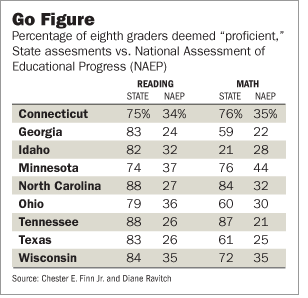
The analysis also raises questions about the rigor of state tests and standards, putting a spotlight on the huge disparities in student performance on state tests and on the National Assessment of Educational Progress (NAEP) [an issue raised recently by UW Math Professor Dick Askey]. Just 29 percent of the nation’s eighth-graders demonstrate proficiency in reading and math on federal NAEP assessments. But most states report much higher proficiency rates on their own tests. The report provides a 50-state look at student performance on both tests.
Among the report’s key findings:

  • Overall achievement gains were most consistent in the elementary grades, where math achievement increased in 29 of 32 states examined, and reading achievement increased in 27 of 31 states. Math achievement declined in one state, reading achievement in three.
  • In middle school math, 29 states improved overall achievement while one lost ground and one saw no change. The picture in middle school reading, however, is less positive. Overall reading achievement increased in only 20 of 31 states examined, while achievement declined in six states and did not change in five others.
  • High school math results increased in 20 of 23 states and decreased in only two. High school reading results increased in 17 of 24 states and decreased in five.

While important, overall trends do not tell the whole story. To ensure that all students meet grade-level standards, schools must increase achievement for all students while accelerating gains for poor and minority children who are often the furthest behind. Many states are meeting this goal in the elementary grades, but the results in middle and high school are disturbing.

Via Joanne.

Share

Elementary school students build cardboard cities

Amanda Becker:

After months of constructing miniature cardboard buildings and houses, more than 800 students from 10 Dane County elementary schools brought their box cities to Monona Terrace Friday.
The young architects and carpenters-in-training also brought their yellow hard hats with them, and spread their cities, like urban picnics, on green tarps representing the land, applying duct tape for roads and blue construction paper as water.
Each school created its own model city. A typical display filled the space of about three dinner tables.
The models showed whatever the children thought belonged in a city: people, cars, hospitals, police and fire departments and even schools.

Share

More on Local/State vs. National Tests

Michele Besso & Cecilia Le:

The study raised questions about the rigor of state tests and standards because of the large disparity in student performance between state and federal standardized tests. While most states report high proficiency rates on their own tests, just 29 percent of the nation’s eighth-graders did well in reading and math on the National Assessment of Educational Progress, a federal test.
In Delaware, 85 percent of fourth-graders scored as proficient or above in reading in the Delaware Student Testing Program, but only 34 percent of the same group scored proficient or above on the federal test. In math, those numbers are 77 percent on the state test versus
36 percent on the federal test.
“They set proficiency on the NAEP pretty darn high,” Woodruff said. “I feel our [minimum] score for meeting the standard is reasonable, but we need to get our students beyond proficient. This business of ‘meeting the standard is enough’ is not OK.”

Dick Askey made a similar point regarding local test results here.

Share

What about heterogenous classes with high-track curriculum?

It’s clear from educational research that “tracking” high school students into low to high-level courses based on their prior academic achievement denies opportunities to low income students and many students of color. De-tracking is clearly in order for school districts seeking to offer equal educational opportunity to all students.
However, de-tracking can be done in many ways. The MMSD administration’s plan for tenth grade English courses at West High School follows one model: eliminate high level courses, require all students to take the same course and depend on teachers to “differentiate” instruction so that students of all ability levels and interest are challenged and gain academically.
A diverse suburban district in New York has narrowed the achievement gap in math by offering its high-track curriculum to all students. Rather than offer a mid-range materials with special opportunities for very capable students to accelerate to all students, the district has offered the same high-level courses to all students. Students having difficulty with the course material also attend special support classes and receive afterschool help four days a week. Closing the Achievement Gap by Detracking?
The resulting gains in student achievement are worth our consideration.
from Phi Delta Kappan, April 2005

Share

Most US high school dropouts regretful: study

Patricia Wilson (Reuters):

Most students who drop out of high school in the United States admit they made a mistake by quitting and some say they might have stayed if classes were more challenging, according to a report released on Thursday.
Researchers said they were surprised to find that a majority of the 467 dropouts they interviewed were not what most people would consider underachieving troublemakers and losers.
One-third said they were failing in school, but more than six out of 10 were maintaining C averages or better when they quit. Almost half said they were bored or that the classwork seemed irrelevant.
“The teacher just stood in front of the room and just talked and didn’t really like involve you,” a young female respondent from Baltimore said.

Source: Gates Foundation Report. Morning Edition has more (audio).

Share

The Gap According to Black

Bridging the Achievement Gap: Positive Peer Pressure – Just the Push Students Need to Succeed
Cydny Black:
The decisions we make, especially as adolescents, are influenced by the people who surround us, and by how we feel about ourselves. I’ve found that the encouragement of my friends and family, and the examples they set, have a lot to do with my academic success. My friends challenge themselves and encourage me to do the same. This concept is known as peer pressure—a term that often has a negative connotation. In many situations, however, peer pressure can be positive and powerful. Positive peer pressure can give students the push they need to succeed.
It occurs to me that friends who value academic success help give us the support we need to do well. Not only does it help to have friends who push us to do better in school, but these friends also help us to feel better about ourselves.
In school, I notice that many students who are not making the leap over this gap are students who are surrounded by negative reinforcements. These students often lack friends who value education. Negative friends don’t challenge themselves by taking difficult classes, or holding Thursday night study sessions. Negative friends don’t work with you to prepare for final exams.
So what can we do? For all the students reading this who are succeeding in school, my advice is to step out and lend a helping hand to those who are not as successful. Be a supportive classmate, and more importantly, be a good role model. Promote the idea that getting good grades does not mean you’re acting “white” or “selling out” and it definitely does not mean you’re nerdy.

Share

What First Amendment?

Paul Soglin makes a great point:

We went wrong in the 1970’s. That was when the core curriculum in America’s public schools changed and the the classical civics classes were dropped. I had no problem with expanding the curriculum, particularly given the absence of ‘real’ history. I had and still have a problem that most pubic schools do not have at least one required course at both the elementary and the high school level on American institutions, civics, or history that covers among other things, the Constitution and the Bill of Rights. Then maybe half, instead of ten percent, of all Americans would know their freedoms.

My high school government teacher (a Vietnam Vet) drilled these rights and words into our brains (drilled).

Share

As AP Expands, Studies Disagree on Its Value

Jay Matthews:

Now, a series of competing, sometimes contradictory studies have begun to look at the effectiveness of AP and IB in meeting their central purpose — preparing students such as Palma for college. Some parents and students are questioning whether the college-level courses are placing too much strain on children and supplanting useful honors courses. And the College Board, which sponsors the AP program, has begun to ask schools to examine the content of their AP courses to make sure they meet the program’s standards.
Palma is taking AP psychology but decided on the regular history course, calling the AP class “beyond my capabilities.” Choices such as hers are part of a debate over AP that shows no signs of abating as the program undergoes growing pains.

Share

Madison and Wisconsin Math Data, 8th Grade

At a meeting on February 22 (audio / video), representatives of the Madison Metropolitan School District presented some data [820K pdf | html (click the slide to advance to the next screen)] which they claimed showed that their middle school math series, Connected Mathematics Project, was responsible for some dramatic gains in student learning. There was data on the percent of students passing algebra by the end of ninth grade and data from the state eighth grade math test for eight years. Let us look at the test data in a bit more detail.

All that was presented was data from MMSD and there was a very sharp rise in the percent of students scoring at the advanced and proficient level in the last three years. To see if something was responsible for this other than an actual rise in scores consider not only the the Madison data but the corresponding data for the State of Wisconsin.

The numbers will be the percent of students who scored advanced or proficient by the criteria used that year. The numbers for Madison are slightly different than those presented since the total number of students who took the test was used to find the percent in the MMSD presented data, and what is given here is the percent of all students who reached these two levels. Since this is a comparative study, either way could have been used. I think it is unlikely that those not tested would have had the same overall results that those tested had, which is why I did not figure out the State results using this modification. When we get to scores by racial groups, the data presented by MMSD did not use the correction they did with all students ( All 8th grade students in both cases)

MMSD Wisconsin
Oct 97 40 30
Feb 99 45 42
Feb 00 47 42
Feb 01 44 39
Feb 02 48 44
Nov 02 72 73
Nov 03 60 65
Nov 04 71 72

This is not a picture of a program which is remarkably successful. We went from a district which was above the State average to one with scores at best at the State average. The State Test was changed from a nationally normed test to one written just for Wisconsin, and the different levels were set without a national norm. That is what caused the dramatic rise from February 2002 to November 2002. It was not that all of the Middle Schools were now using Connected Mathematics Project, which was the reason given at the meeting for these increases.

It is worth looking at a breakdown by racial groups to see if there is something going on there. The formats will be the same as above.

Hispanics
MMSD Wisconsin
Oct 97 19 11
Feb 99 25 17
Feb 00 29 18
Feb 01 21 15
Feb 02 25 17
Nov 02 48 46
Nov 03 37 38
Nov 04 50 49
Black (Not of Hispanic Origin)
MMSD Wisconsin
Oct 97 8 5
Feb 99 10 7
Feb 00 11 7
Feb 01 8 6
Feb 02 13 7
Nov 02 44 30
Nov 03 29 24
Nov 04 39 29
Asian
MMSD Wisconsin
Oct 97 25 22
Feb 99 36 31
Feb 00 35 33
Feb 01 36 29
Feb 02 41 31
Nov 02 65 68
Nov 03 55 53
Nov 04 73 77
White
MMSD Wisconsin
Oct 97 54 35
Feb 99 59 48
Feb 00 60 47
Feb 01 58 48
Feb 02 62 51
Nov 02 86 81
Nov 03 78 73
Nov 04 88 81

I see nothing in the demography by race which supports the claim that Connected Mathematics Project has been responsible for remarkable gains. I do see a lack of knowledge in how to read, understand and present data which should concern everyone in Madison who cares about public education. The School Board is owed an explanation for this misleading presentation. I wonder about the presentations to the School Board. Have they been as misleading as those given at this public meeting?

Richard Askey

Share

Closing the Gap Forum

Samara Kalk Derby:

Kambwa, who served as emcee for the Closing the Gap conference, gave the younger students five guidelines for bridging the achievement gap:

  • Ask younger students how they’re doing in school.
  • Recommend a good book to a peer or younger student.
  • Help younger students with their homework. Quiz them on their knowledge of academic subjects. Let them know you are there for questions.
  • Raise your hand in class, or sit in front while you’re in class. Set a positive example for your peers.
  • Adopt a new attitude. Don’t be afraid to say what you’re about: “I think it’s cool to get good grades. I plan to go to college.”

In Wisconsin, the gap is greatest between white and Hispanic students when comparing high school graduation rates. White students graduate at a rate of 90 percent, compared to only 63 percent for Hispanic students. For Asian students it’s 89 percent, Native Americans 73 percent and black students 72 percent.
Charles Peterson, 17, another Free Press editor, called the achievement gap “huge” and said it is only getting wider.
As a young black male, Peterson has done well at La Follette despite expectations to the contrary.
“I get a lot of negative attention from all colors for doing well in school and for not fitting stereotypes,” he said.

Share

Basic Instincts

naep_state.gif
Chester Finn, Jr. and Diane Ravitch:

U.S. students lag behind their peers in other modern nations — and the gap widens dramatically as their grade levels rise. Our high school pupils (and graduates) are miles from where they need to be to assure them and our country a secure future in the highly competitive global economy. Hence, any serious effort at education reform hinges on our setting world-class standards, then candidly tracking performance in relation to those standards. Even when gains are slender and results disappointing, we need the plain truth. Which is why recent attempts by federal and state governments to sugarcoat the performance of students is so alarming.

NAEP vs. State test scores was discussed during the recent math forum.

Share

Schools consider Afrocentric curriculum

This is not meant as a suggestion that MMSD should take this approach but I do think that we should be aware of what similar districts are considering and doing.
See also: http://www.evanstonroundtable.com/roundtable022206/schools.html
TJM
Schools consider Afrocentric curriculum
Evanston-Skokie district’s proposal targets achievement gap between blacks and whites
By Lolly Bowean, Tribune staff reporter. Freelance writer Brian Cox contributed to this report
Published February 15, 2006
Hoping to better capture the attention of African-Americans and close the achievement gap between black and white students, a group of parents and educators is pushing for adoption of an African-centered curriculum in Evanston/Skokie School District 65.

(more…)

Share

Making One Size Fit All: Rainwater seeks board input as schools cut ability-based classes

Jason Shephard, writing in this week’s Isthmus:

Kerry Berns, a resource teacher for talented and gifted students in Madison schools, is worried about the push to group students of all abilities in the same classrooms.
“I hope we can slow down, make a comprehensive plan, [and] start training all teachers in a systematic way” in the teaching methods known as “differentiation,” Berns told the Madison school board earlier this month. These are critical, she says, if students of mixed abilities are expected to learn in “heterogeneous” classrooms.
“Some teachers come about it very naturally,” Berns noted. “For some teachers, it’s a very long haul.”
Following the backlash over West High School replacing more than a dozen electives with a single core curriculum for tenth grade English, a school board committee has met twice to hear about the district’s efforts to expand heterogeneous classes.
The school board’s role in the matter is unclear, even to its members. Bill Keys told colleagues it’s “wholly inappropriate” for them to be “choosing or investigating curriculum issues.”
Superintendent Art Rainwater told board members that as “more and more” departments make changes to eliminate “dead-end” classes through increased use of heterogeneous classes, his staff needs guidance in form of “a policy decision” from the board. If the board doesn’t change course, such efforts, Rainwater said, will likely be a “major direction” of the district’s future.

Links and articles on Madison West High School’s English 10, one class for all program. Dr. Helen has a related post: ” I’m Not Really Talented and Gifted, I Just Play One for the PC Crowd”

(more…)

Share

Lending a Brain

Inside Higher Ed:

With scientific expertise sweeping the globe, the next generation of American scientists and engineers are going to face unprecedented competition, and college is too late to begin preparing them for it, according to the National Science Board.
The board released its “Science and Engineering Indicators, 2006″[pdf] report Thursday. The report, which focused on elementary and secondary education, cast a foreboding tone. According to the report, while the scores of American students on national math assessments have risen slightly in recent years, the same cannot be said for science. According to the 2003 Trends in International Mathematics Science Study , fourth and eighth graders in the United States performed better in math and science than the international average of industrial nations, but improvement since 1995 was modest for eighth graders, and fourth graders took a slight step backward.
Even a fourth grade student who is getting his or her first exposure to science might already be left in the starting blocks, according to Jo Ann Vasquez, a National Science Board member and the lead author of the report. “[Kids] have to get science by third grade,” she said, “or that wonderment disappears.”

Share

” I’m Not Really Talented and Gifted, I Just Play One for the PC Crowd”

Dr. Helen:

Wouldn’t the proper way to answer the question of why Blacks and Hispanics are lagging behind Whites and Asians be to conduct research on the factors that may be causing the discrepancies and remedy those rather than setting up a phony group of gifted students whose only gift may be that they have a teacher who holds self-esteem and looking diverse in higher regard than children actually learning anything?
With such unscientific inquiry, it is no wonder more and more parents are homeschooling or turning to private schools to educate their children. I foresee that the more schools substitute “diversity” for education, the more parents will take flight from the public schools.

The link includes several interesting comments.

Share

Middle School Design Team: Final Report to the Superintendent

The Madison schools middle school curriculum design team’s final report is now available [1.7MB pdf]. Topics addressed include:

  • Math
  • Music
  • Art
  • World Languages
  • Health/Family and Consumer Education
  • Information and Technology Literacy
  • Student Services

The report closed with a discussion of the Future Areas for Discussion:

The Design Team had a very specific charge. As the team met, it quickly became apparent that additional areas that pertain to middle level education are ripe for discussion. The final recommendation from the team includes a wish to continue this discussion over time. The areas that are of interest include:

  • K-8 model
  • Scheduling around part-time staff. Sharing staff.
  • Distance Learning, i.e. district on-line course offerings
  • Mental health and severe behavioral issues
  • Alternative educational settings
  • Bus safety
  • Regular articulation meetings between middle and high school staff in all content areas
  • Regular articulation meetings between middle and high schools among student
  • services staff to increase communication and develop a set of agreed upon
  • expectations and practices regarding 8th to 9th transition.
  • Advisories
  • Safety issues, i.e. bullying, climate
  • City-wide projects and competitions
  • Revisit the juxtaposition of the MMSD Educational Framework, the Equity Framework, the MMSD Middle School Common Expectations, and the current middle school models used in MMSD.
Share

“Moving Beyond Islands of Excellence”

Madison School Board Seat 1 Candidate Maya Cole:

The Madison Metropolitan School District is, in my opinion, at a tipping point. We need to adopt a new way of looking at education. Our community is growing and is beginning to look more and more like an urban school district. Debate in the public forum is healthy when it comes to addressing issues of equity and education.
The Learning First Alliance, a partnership of leading education organizations was founded in 1997, is looking at this type of leadership model in school districts. The goals of the Alliance are to: ensure that high academic expectations are held for all students; ensure a safe and supportive place of learning for all students; and, to engage parents and other community members in helping students achieve high academic expectations.

Cole’s opponent in the April 4, 2006 election is parent Arlene Silveira

Share

“Gifted” Label Takes a Vacation in Diversity Quest

Lori Aratani:

Middle school magnet programs in Montgomery County have traditionally operated as schools within schools, offering specialized curriculum to a few select students — who have been mostly Asian and white.

Share

Secrets of Graduating from College

Jay Matthews:

The first Toolbox provided the most powerful argument by far for getting more high school students into challenging courses, my favorite reporting topic. Using data from a study of 8,700 young Americans, it showed that students whose high schools had given them an intense academic experience — such as a heavy load of English courses or advanced math or Advanced Placement — were more likely to graduate from college. It has been frequently cited by high school principals, college admissions directors and anyone else who cared about giving more choices in life to more students, particularly those from low-income and minority families.
The new Toolbox is 193 pages [pdf] of dense statistics, obscure footnotes and a number of insightful and surprising assessments of the intricacies of getting a college degree in America. It confirms the lessons of the old Toolbox using a study of 8,900 students who were in 12th grade in 1992, 10 years after the first group. But it goes much further, prying open the American higher education system and revealing the choices that are most likely to get the least promising students a bachelor’s degree.

(more…)

Share

“Let’s Teach to the Test”

Jay Matthews:

Let’s start by trying to clarify what I consider the most deceptive phrase in education today: “teaching to the test.”
Teaching to the test, you may have heard, is bad, very bad. I got 59.2 million hits when I did a Google search for the phrase, and most of what I read was unfriendly. Teaching to the test made children sick, one article said. Others said it rendered test scores meaningless or had a dumbing effect on instruction. All of that confused me, since in 23 years of visiting classrooms I have yet to see any teacher preparing kids for exams in ways that were not careful, sensible and likely to produce more learning.

Share

Will Standards-Based Reform in Education Help Close the Poverty Gap

Reader Paul Baker emails:

February 23, 2006, 4:00-5:30 p.m.
Gale VandeBerg Auditorium, Pyle Center Room 121, 702 Langdon Street
Cosponsored by the Institute for Research on Poverty, WCER, and the School of Education. Presenter: Barbara Foorman, University of Texas-Houston. Respondent: William Clune, UW-Madison. More about this event is available here.

Share

Strategies to Raise SAT Scores

Ian Shapira:

School officials said they are weighing several options, including encouraging more non-honors or non-AP students to enroll in Algebra II by sophomore year instead of participating in an easier, two-year Algebra I course; financing the PSAT for sophomores and perhaps freshmen; and, on a more basic level, adding more testing sites within the county so that students can take the exam in a comfortable setting without having to commute long distances.

Share

“We Must Show Every Child The Light”

Reaction to Joel Rubin and Nancy Cleeland’s “The Vanishing Class“:

So Much Damage
Perhaps these fiascos could be avoided if public officials first tested proposed policy changes on a small scale (instead of blindly applying them to tens of millions of students with no insight on the potential impact). At this point, so much damage has been done to so many people, I’m uncertain how the situation can be rectified (except perhaps to save future generations of students).
— MARC
Learning … Is Work
Get rid of calculators … [and get rid of the] false belief that learning should be fun! Learning, the repeated cycles of drill and mastery, is WORK!
— KATHRYN
Squeaky Wheel
Parents need to be more involved, and this involvement has to originate from the schools. With the large numbers of students whose parents do not speak English, the schools must do a better job of bringing these parents into the school community and getting them involved in their child’s education. Many a night I sat frustrated and nearly on the verge of tears because I couldn’t help my son. My son was lucky, though, I was the proverbial squeaky wheel that ensured he was not passed over, but most students aren’t that lucky.
— PAUL ROBINSON
Individual Attention
As a member of a school board in Ventura County (not the rich part), I can say that I think there are two reasons that LAUSD is failing its students. First, the system is simply too large. How can a school of 4,000 do everything well? Our kids need individual attention, and I just don’t see how any massive organization like LAUSD can succeed. Second, I believe that because politics are involved in such an intimate way in these large districts, the kids get left in the dust. The unions are fighting for ever more of the financial pie (most districts spend 85% to 90% of their total [budget] on personnel and benefits); the administration is beholden to the myriad rules and regulations coming at them from both the state and federal level; and less and less control is at the local level. The politicians don’t want to pay for raises for employees or lower student-staff ratios, so the existing dollars must be stretched. That means more students per class, more students per counselor, more students per custodian, maintenance person, etc. And we wonder why the kids feel like no one cares about them?
— JOHN G.

These links include many more words and are well worth reading.

Share

Advanced Classes Open Doors for Minorities

School district works to boost participation
By Kelly McBride
The path toward post-secondary education formed naturally for 18-year-old Wekeana Lassiter.
Her mom always emphasized the importance of learning. An older sister attends college at the University of Wisconsin-Milwaukee. And Lassiter is a studious Green Bay Preble High School senior with aspirations of becoming an architect.
If college was a given, the Advanced Placement courses that are preparing her for it — as well as allowing her to earn college credit — made just as much sense for Lassiter, who will attend UWM in the fall.
“Originally, why I took AP classes was to get credit,” said Lassiter, who is enrolled in AP physics and AP calculus. “Now that I’m in them, they’re really difficult, (but) it’s awesome. You get kind of a feel about how college classes are going to be.”
But the doors that have opened for Lassiter, who is black, have in many cases stayed closed for some of her peers, say officials in the Green Bay School District.
Minority participation in AP courses continues to lag behind that of their white counterparts, with a lower percentage of minority students, by about 15 percentage points, taking AP courses than that of whites during 2004-05, data show.
But the figures are improving, and district officials say new initiatives can help alter the disparity.

Share

Students Form Video News Team

Marcia Standiford:

A class of sixteen high school juniors and seniors is meeting everyday in the Doyle building to learn video production and journalism skills. This district-wide High School Video News Production class is being offered for the first time thanks to the efforts of Mary Ramberg, Director of Teaching and Learning and Gabrielle Banick, Coordinator of Career and Technical Education and a grant from the Wisconsin Department of Public Instruction.

Cool.

Share

Expecting High Quality Work from Students

Mary Ramberg, MMSD Teaching and Learning:

If nothing is expected of a man, he finds that expectation hard to contradict.

Frederick Douglas

The converse of what Frederick Douglas learned from his life experience has been tested and verified by educational researchers.
Research in Chicago schools looked at what happens when teachers expect more of students. In other words, if teachers expect much of students, are those expectations affirmed? The answer is “YES.”
When students are expected — and supported — to do high quality work and to learn important content, that’s exactly what they do.

Share

The Gates Effect: High School Small Learning Communities

Wendy Zellner:

More to the point, others wonder: Is the Gates Foundation making the right calls? The early results of its high school reinvention efforts–with many foundation-backed schools now in their fourth year of existence–are mixed at best. Outside researchers hired by Gates have found “positive cultures” at the new and redesigned schools but raise serious questions about such issues as the teacher burnout, attendance, and the quality of math instruction.
Particularly troublesome has been the effort to transform existing high schools rather than start from scratch. “Improving struggling schools remains a challenge,” admits Vander Ark. Indeed, the foundation’s own studies show that these restructured schools are often bogged down in their early years with questions about facilities, schedules, and staff. In some cases, says Vander Ark, instead of beginning with structural change, “it may be better to start with curriculum–getting rid of dead-end classes and encouraging students to take more challenging courses–and improving the quality of instruction.”

Share

“Why We May Have to Move …”

I received a copy of this personal essay — a letter to the Administration and BOE — last night. The author said it was fine for me to post it, if I thought it was worth it. I most definitely think it’s worth it because it so poignantly describes a family’s real life experience and frustration in our schools … not to mention their agony over whether or not to move elsewhere.

Our kids are in 5th, 4th and 1st grades. I am really very concerned about our son going into sixth grade next year. He has some special education needs related to Asperger Syndrome, such as sensory defensiveness and skills to do with what some have called “theory of mind” (self-control, recognizing and assessing others’ points-of-view and feelings, anger management). I love the idea that Spring Harbor is smaller because of his sensitivities to light, personal space issues, noise levels and the like. I do not like that they are relatively inflexible in meeting special needs otherwise because they are small and missing some services – or severely limited – due to space and spending constraints. I also do not like that we would have NO options as to who his special ed case manager/teacher would be, because there is essentially one person to cover it all for each grade, whether or not they display and apply the kind of flexibility that being a “cross-categorical” special ed teacher demands.

(more…)

Share

Video of Performance and Achievement Meeting Available

The video of the Performance and Achievement meeting of December 19, 2005 is available in the Performance and Achievement blog site.
This meeting is the second meeting concerning the Middle School Design Team work, with a presentation by Pam Nash explaining the current status, focus groups involved, role of the Board, access by the Board to draft decisions and general approaches being considered by the Team and Administration.

Share

Performance and Achievement Videos available.

Videos of the Performance and Achievement committee meetings of January 30 and February 6 are available in the Performance and Achievement blog.
The topics of these meetings were heterogeneous vs. homogeneous classroom instruction. Professor Adam Gamoran, Director of WCER, made a presentation at the January 30 meetng. His Powerpoint presentation and a research paper are included.
The following week continued with presentations by Mike Lipp, West HS Biology teacher; Linda McQuillen, Math Resource teacher; Jenny Ruef, Math teacher at East HS; Lisa Wachtel, Science and Environment Coordinator, and Pam Nash, Asst Superintendent for Secondary Schools.

Share

Teach Children Dollars & Sense

WiSJ:

Wisconsin students should learn to be financially savvy enough not to succumb to two huge national problems – low savings and high debt.
The state Department of Public Instruction, with help from educators, lawmakers, money managers and others, introduced voluntary state standards last week. Now it’s up to local school districts to adopt them.

Share

For The Record: An Interview with Editors and Writers from the Simpson Street Press on the Achievement Gap

Neil Heinen hosted an interesting conversation Sunday morning with editors and writers (Andrea Gilmore, Ashley Crawford) from the Simpson Street Press on the achievement gap. Video and audio, available: (audio feed | video feed) or a popup window. Slick.
Share

Fragile Futures: Risk and Vulnerability Among Latino High Achievers

Patricia Gándara
Policy Information Center, Educational Testing Service
December 2005
The achievement gap usually refers to the chasm between low- and higher-performing students. But, as this study makes clear, disparities are just as pronounced among separate groups of high-achieving students. For example, in 2002 the top fifth of Latino test-takers scored means of 598 and 646 on the SAT verbal and math sections, respectively. Their white peers’ mean scores were 65 points higher on the verbal section and 74 points higher in math. Yet of the hundreds of studies reviewed for this report, hardly any “acknowledge… that high-achieving students might need support and that this support might differ from what is needed by their lower-achieving peers.” It’s tempting to think that smart youngsters, regardless of socio-economic situations or ethnic backgrounds, will turn out just fine. But as these data show, that’s not always true. Bright Latino students, who often come from low-income families and have parents with little education, are particularly susceptible to becoming frustrated or discouraged with schoolwork and the school environment. These kids require just as much encouragement, support, and instruction as their lower-performing peers, albeit in different ways. They, too, need goals, and information on where academic achievement can lead (college). But too often, they don’t receive it. Even when Latino students earn good grades in high school, register for the SAT (not an insignificant step), and do well on the exam, many still make poor college decisions. We cannot address achievement gaps by continuing to ignore these bright youngsters.

Share

“Academic Rigor Not Just for A Select Few”

Mary Ramberg, executive director of Teaching & Learning:

Rigor means different things to different people. Some people think rigor and rigidity are the same. In this case, academic rigor might look like teacher inflexibility — an “it’s my way or the highway” kind of attitude. Some people think rigor and harshness are the same. In this case, academic rigor might mean that student work is an endurance test and only a predetermined number of students can receive high grades. Neither of these views of rigor matches the MMSD understanding of rigor in an academic setting.
The MMSD Educational Framework describes three characteristics of rigor in an academic setting:

Share

“What? Me Worry?

“What? Me Worry? is the attitude of education researchers, writes Douglas Reeves, CEO of the Center for Performance Assessment, on Education Gadfly. Reeves cites a study by Peggy Hsieh and Joel R. Levin, which ran in the Journal of Educational Psychology on “ed researchers’ continued retreat from accepted research methodology. In this case, randomized experiments.”

Randomized experiments, aka field trials, whereby an experimental group that receives an intervention (say, Whole Language) is compared with a control group that receives no intervention, have been standard operating procedure since rats were first run through mazes. But who needs control groups in the age of feelings-based research?

. . . Hsieh and Levin report that “The percentage of total articles in these four journals [Cognition & Instruction, Contemporary Educational Psychology, Journal of Educational Psychology, Journal of Experimental Education, American Educational Research Journal] based on randomized experiments decreased over the 21-year period in both the educational psychology journals (from 40 percent in 1983 to 34 percent in 1995 to 26 percent in 2004) and the American Educational Research Journal (from 33 percent to 17 percent to 4 percent).”

Education policy makers are eager for the latest magic bullet and reluctant to think through fundamental changes, Reeves argues.

via Joanne

Share

Notes from Monday’s Madison School Board Meeting

Two interesting notes, among many, I’m sure from Monday evening’s Madison School Board meeting:

  • Johnny Winston, Jr. introduced a motion for the Administration to look at acquiring land in Fitchburg for a new school. This motion passed 5-1, with Bill Keys voting no (and Juan Jose Lopez absent).
  • Ruth Robarts advocated curriculum changes as a means to attract more families to certain schools. She mentioned the use of Singapore Math (Note that some Madison residents are paying a chunk of money to send their children to Madison Country Day School, which uses Singapore Math).

Speaking of Math, Rafael Gomez is organizing a middle school math forum on February 22, 2006, from 7 to 8:00p.m.
Local news commentary:

  • Channel3000:

    The Madison Metropolitan School Board met for hours Monday discussing overcrowding options for the looming referendum

  • WKOW-TV:

    After nearly five hours of discussion, the Madison School Board decided to put off asking tax payers for a new school in April and says voters may have to head to the polls this fall instead.

  • Susan Troller:

    That potential option was added to the mix regarding how the Madison School District could deal with growth and overcrowding on the west side following a special School Board meeting Monday night.
    Board Vice President Johnny Winston, Jr. led a motion to ask district administrators to explore land sites and options for a possible new school in the rapidly developing areas south of the Beltline in Fitchburg, including land currently in the Verona and Oregon school districts.
    Board member Lawrie Kobza supported Winston’s motion and said she may be willing to support a new elementary school in the south Fitchburg area as part of a long-range plan for the district. Kobza does not support an addition at Leopold, saying the school already has more than 650 students, which the district has deemed its maximum acceptable capacity.

  • Sandy Cullen:

    The Madison School Board voted Monday to direct district administrators to investigate purchasing land for a future school in south Fitchburg as a long-term solution to crowding at Leopold Elementary School, while board members continue to explore a more immediate solution to the problem.

Share

EXECUTIVE SUMMARY MIDDLE SCHOOL DESIGN TEAM

Focus groups have been held with parents, middle school teachers, current high school students, current middle school students, and representatives of community organizations that are connected to our middle schools through tutoring, mentoring or other programming. Summaries of those focus groups are attached.
The design team has set one additional all day meeting to draft the recommendations. This meeting will be held on December 20. The report will go to the Superintendent and will also be made available to the original parent focus group for their feedback and suggestions.
Throughout this process, information, questionnaires and summaries of input have consistently been made available on the district website.
The design is going to focus on specific, consistent recommendations regarding length and duration of classes in middle school in the areas of FiFine Arts, Life Skills, Mathematics, Wellness, Student Services, and World Languages.

Share

High Grades, No Skills

Joanne Jacobs:

Honor students who can’t pass California’s graduation exam should be angry, writes Ken at It Comes in Pints? They should be angry at teachers who gave them A’s they didn’t deserve.

While the hardest questions on the graduation exam require 10th grade English skills and algebra (allegedly an 8th grade skill in California), students with basic skills who guess blindly on the harder multiple-choice questions should be able to get a minimum passing grade in their first, second, third, fourth or fifth try at the test. The minimum passing grade is 60 percent for English and only 55 percent for math.

In Tracy, a girl who claims a 3.6 grade point average says she’s failed the math exam five times because teachers didn’t teach her right. She doesn’t seem to question the validity of her A’s and B’s.

My great potential is being snuffed by this test.

Share

The Black Star Project

www.blackstarproject.org:

What Is The Black Star Project? The Black Star Project is a Chicago-based nonprofit that works around the country to help preschoolers to collegians succeed. The group focuses on low-income black, Hispanic and American Indian students in low-achieving schools.
Problems of school districts that teach Black children and the solutions

Via School Board Seat 1 Candidate Maya Cole [podcast]

Share

The Art of Teaching Traditional Building

Bruce Smith:

The steady pings of hammers on molten metal, the grinding of stone and scraping of plaster fill the workshop of a new school that seeks to pass on old-world building techniques in an age of cookie-cutter construction.

Share

Tutor Program Going Unused

Susan Saulny:

The No Child Left Behind law requires consistently failing schools that serve mostly poor children to offer their students a choice if they want it: a new school or tutoring from private companies or other groups, paid for with federal money — typically more than $1,800 a child in big cities. In the past the schools would have been under no obligation to use that Title I federal poverty grant to pay for outside tutoring.
City and state education officials and tutoring company executives disagree on the reasons for the low participation and cast blame on each other. But they agree that the numbers show that states and school districts have not smoothed out the difficulties that have plagued the tutoring — known as the supplemental educational services program — from its start as a novel experiment in educational entrepreneurship: largely private tutoring paid for with federal money.
Officials give multiple reasons for the problems: that the program is allotted too little federal money, is poorly advertised to parents, has too much complicated paperwork for signing up, and that it has not fully penetrated the most difficult neighborhoods, where there are high concentrations of poor, failing students.

Share

Schools Top Scores No Accident

Rosalind Rossi:

More African-American kids at Morgan Park passed their AP exams in two courses — English language/composition and European history — than at any other high school in the nation offering AP courses last year, AP officials said.
The number of Morgan Park students required to achieve that feat was 32 in English language and 26 in European history.
That may not sound like much, but those numbers translate roughly into 1-1/2 classrooms full of kids, all of them testing at college-level standards, and all of them African American — the racial group most under-represented in AP classrooms across the nation, state and city. Two sections of each course were offered last year at Morgan Park, where the student body is 93 percent African-American.

Share

AP Program Gaining Increasing Prominence Nationwide

Tamar Lewin:

According to the second annual report from the College Board, which administers the Advanced Placement program, about 60 percent of American high schools now offer Advanced Placement courses, and the average high school offers a choice of eight such courses.

“The number of students participating in A.P. has more than doubled in 10 years, and today almost 15,000 U.S. schools offer A.P. courses,” said Gaston Caperton, the president of the board, a New York-based nonprofit organization.

The percentage of American high school students passing A.P. exams increased in all 50 states last year, the report said. In the class of 2005, 14.1 percent of students received an A.P. exam grade of 3 or higher on one or more A.P. exams, up from 13.2 percent of the class of 2004, and 10.2 percent of the class of 2000.

A.P. exams in 35 subjects are given in May, at a cost of $82 each. They are graded on a scale of 1 to 5, with 5 representing A-level college work, and 3 representing about a C+.

Barb Schrank earlier noted that East offers 8 AP courses, LaFollette 13, Memorial 16 and West 8. The District’s efforts in these areas appear to be going in different directions, with a growing effort to provide a one size fits all curriculum (West and Sherman examples) while recently receiving a grant to increase the number of AP classes. The District’s approach to Athletics has apparently not changed, though Kurt Vonnegut via his short story Harrison Bergeron, notes that 2081 might be the year for that.

Share

AP Exams Growing in Popularity

Jay Matthews:

American high school seniors took more than 1.5 million Advanced Placement exams last year, closing the gap with the SAT test and dramatizing the rising influence of AP on school curriculums, college admissions and assessment of schools and state education programs.

Share

State of Education: Who Makes the Grade?

Kavan Peterson:

Schools spend fewer dollars per student in Utah than in any other state, but more fourth-graders there improved reading and math scores over the past decade than in more than half of the states.
Maine, for example, spends nearly twice as much on a comparable student population — $9,300 a student vs. $4,800 in Utah. But fewer Maine fourth-graders improved their math scores — and their reading scores actually declined in the past decade.
Both states ranked just above the national average on 2005 national reading and math tests, known as the National Assessment of Education Progress, or NAEP. But Utah stands out for its success in boosting the number of students to pass the tests since 1992, the first year of state-by-state NAEP testing, despite ranking dead last for spending.
State by State Test Scores and Per Pupil Spending (.xls)

UPDATE: a reader emails:

The relevant comparison to make on the data on school funding and NAEP scores is Minnesota versus Wisconsin. We have a somewhat higher level of students eligible for free or reduced lunch, over 10% higher funding per pupil and lower NAEP scores.

Share

Reader Reed Schneider on Curriculum and School Boards

Reed Schneider emails on recent posts regarding a School Board’s role in curriculum policy:

I agree that the school board should be responsible for the district’s curriculum. In fact, it is the most important thing they are charged with. 10 or more years ago, before widespread internet availability, the non-edu-estab person on a board would have the excuse that it would be impossible for them to know which curricula works. All decisions would be deferred to the so-called experts. That excuse doesn’t work any more. Any board member can now go to www.nrrf.org and discover opinion and independent research showing programs like Reading Recovery and balanced Literacy have serious flaws. They can go to www.mathematicallycorrect.com and discover that math programs recommended by the NCTM like Everyday Math fail our children.
Even if the board becomes involved, it will take board members willing to do this. Just because they become involved with curriculum will not automatically mean they will critically evaluate administrators recommendations. Far too often they simply rubber stamp what the curriculum specialist puts in front of them.
The parents and tax payers are the only ones with the power to change this. A good question at a board candidate’s forum would be: “What is your opinion of reading or math programs based on constructivist theory?” If they don’t understand the question, can’t answer, hem and haw, or embrace it, don’t vote for them. It’s really that simple.

Share

MMSD School Board Says They Don’t Do Curriculum: WI State Law Says Otherwise

The Madison School Board is directly and legally responsible for the curriculum taught in their district. The WI Administrative Code, which is law, sets forth the legal requirements for public instruction. Public Instruction, Chapter PI 8.01 (Download Admin. Code Public Instruction – School Standards)says:
2. Each school district board shall develop, adopt and implement a written school district curriculum plan which includes the following: a. A kindergarten through grade 12 sequential curriculum plan in each of the following subject areas: reading, language arts, mathematics, social studies, science, health, computer literacy, environmental education, physical education, art and music.
Does this mean the Madison School Board is responsible for designing and creating curriculum and curriculum plans? No, of course not. I feel, however, they are responsible a) for making sure a process is in place so that academically rigorous, sequential curriculum plans are developed and evaluated regularly for meeting stated goals (and with opportunity for public comment along the way) and b) for approving curriculum plans developed under the guidance of the administration. How does the process currently this work? It’s not publicly clear, perhaps, because the Madison School Board has no written curriculum board policy and no written administrative procedures (that I could find and I’ve asked – see below) for the development and approval of curriculum plans.
I have been told by board members the Superintendent and his staff “do curriculum,” because they are the experts. What does that mean? Of course, we hope they are the experts; and, being experts in education administration, we hope and expect they use the teachers and other professionals who are experts in their field to develop curriculum plans using a well defined process that is clear and known by all. Yet, the sentiment from the board that was heard again in the their discussions of heterogenous classes is simply, “We don’t do curriculum.” When I first heard this type of statement from board members several years ago, I was puzzled and then I found the WI Admin. Code, which identifies the Board’s responsility over approval of curriculum plans. My question for the Madison School Board is: How do and will you execute your legal responsibility? How can the School Board make this clear to the public? Written board policies and procedures that are discussed and approved by a school board are how board members spell out publicly how they will execute their legal responsibilities. I feel such policies and procedures for curriculum, which ties directly with a board’s top priority of student achievement, would be illuminating and helpful for the board, public, teachers, administrators, etc.

(more…)

Share

Notes from Performance & Achievement Meeting on Ability Grouping

At this past week’s meeting, Adam Gamoran from the UW Center for Educational Research spoke to the Board about ability grouping. Dr. Gamoran talked about how ability grouping often ends up grouping students by race and SES because these students enter school having had different early childhood experiences and different educational opportunities (recall Donna Ford discussing the number of books in the homes of low income and middle income families).
Dr. Gamoran noted that there are often differences in the classroom experiences of high and low ability groups of students in regards to teacher expectations, academic rigor, and teacher ability.
He also emphasized that there is no simple solution to the achievement gap. Heterogeneous or homogeneous grouping by themselves will not reduce the gap in achievement. However, there are some clear cut solutions that are obvious according to Dr. Gamoran.

  1. No more dead end classes like general math for the low ability students;
  2. high academic expectations for students of all ability levels; and
  3. teachers should not be assigned in a way that results in only the newest and least experienced teachers working with the low ability students, in other words, all students deserve quality instruction.

In discussing heterogeneous grouping, Dr. Gamoran noted that differentiation is hard work for teachers, and they need a lot of support and training in order to be successful.
Dr. Gamoran also shared an example of a school where heterogeneous grouping was successful. This was a school that was 51% free and reduced lunch, but because the school had a strong, dynamic leader and had gotten grants, they were able to recruit a top notch staff. Not only was the principal able to select which teachers worked in the school, but approximately half of the student body had to go through an interview process to get into the school, so this magnet school was selective about its teachers and its students. Class size was kept to 15 students and instruction went at a fast pace. Students who were struggling were expected to attend tutoring sessions on Saturdays. I think there was an expectation that parents would be involved in their student’s education, but I am not sure about that.
Obviously the situation in the Madison schools is different from this ideal, and that’s why I think it is important for the Board and the administration to hear from students and parents what it is like in the classroom. I should add that Bill Keys was very annoyed that the Board was even discussing this issue because he believes that the Board has no place in the classroom. According to Mr. Keys this is the responsibility of the teachers and administrators and they know better than the members of the Board what should be done in the classroom. However, I would argue that the teachers and administrators don’t know any better than the Board does about what happens in the classroom, and they certainly don’t know what it is like for high ability students in those classes. Those of us who have sat around the kitchen table while our children talk about their boredom, frustration, and lack of challenge need to help them understand and make our voices heard.

Share

Regular computer users perform better in key school subjects, OECD study shows

OECD (Organisation for Economic Co-operation and Development):

The relationship with student performance in mathematics is striking. Students who have used computers for several years mostly perform better than average. By contrast, those who don’t have access to computers or who have been using computers for only a short time tend to lag behind their class year.
According to the OECD study, students who had been using computers for less than one year (10% of the total sample) scored well below the OECD average. By contrast, students who had been using computers for more than five years (37% of the total sample) scored well above the OECD average.

Via the Economist. My view on this, fwiw, is that we need to get the curriculum right first, then apply technology where it makes sense.

Share

Why Education is Productive, A Parable of Men and Beasts

Tyler Cowen:

We know the paradox. Education improves earnings but most formal schooling appears to be a waste of time. Many economists claim that education is mostly a means of signaling quality.
I view education as a self-commitment to being a more productive kind of person. Education is about self-acculturation.
Men are born beasts. But education gives you a peer group, a self-image, and some skills as well. Getting an education is like becoming a Marine. Men need to be made into Marines. By choosing many years of education, you are telling yourself that you stand on one side of the social divide. The education itself drums that truth into you.

Share

Students and Teachers, from K to 12 Hit the Podcasts

Jeffrey Selingo, via reader Wade Waege:

THE subjects were typical for a seventh-grade classroom: a summary of a mealworm’s metamorphosis, strategies on improving memory and making studying easier and a story about a classroom candy thief.

But the discussions last fall at Longfellow Middle School in La Crosse, Wis., were not taking place only for their classroom to hear. They were recorded as part of a series of podcasts the students produced and syndicated over Apple’s iTunes music store.

“Their audience has moved to the entire world,” said Jeanne Halderson, one of two seventh-grade teachers at Longfellow who supervise the podcasts. “The students find that exciting. It’s a lot more motivating to write something that the whole world can hear, rather than just something for a teacher to put a grade on.”

Podcasting – posting an audio recording online that can be heard through a computer or downloaded to a mobile device like an iPod – is following blogs and online classes as yet another interactive technology catching on as a teaching tool. Currently, iTunes lists more than 400 podcasts from kindergarten through 12th-grade classes, while Yahoo has nearly 900 education-related podcasts. Some are produced by teachers wanting to reach other educators with teaching tips, while many are created by students, like the La Crosse seventh graders with their podcast, at lacrosseschools.com/longfellow/sc/ck/index.htm.

Wade mentioned that Apple is holding a free seminar on February 14 in Brookfield, 2006 on Education and Podcasting.

Share

The State of High School Education in Wisconsin: A Tale of Two Wisconsins

Alan Borsuk on Phil McDade’s report for the Wisconsin Policy Research Institute: [250K pdf]

“The growing performance gap is largely influenced by socioeconomic factors beyond the influence of schools,” McDade said. “Property wealth, poverty and race were found to affect student performance.”
The per-student spending difference was much smaller than the difference in test scores and actually was smaller in 2003-’04 than it was seven years earlier, leading McDade to conclude that increased spending would not be a key to closing the gap.
Even though the roots of the gap are in matters such as poverty, McDade suggested that policy makers consider steps to increase academic performance of high school students, including stronger graduation requirements, tougher admissions standards to University of Wisconsin campuses and increased emphasis on sending more high school graduates to college.

According to the report, Madison High Schools (along with Verona, Middleton-Cross Plains, Wisconsin Heights, Monticello, Monona Grove and Waunakee) were in the top 10% based on 1996-1997 WKCE results in. However, they (Madison) were no longer present in the top 10% based on 2003/2004 results (Deerfield, Dodgeville, Middleton-Cross Plains, McFarland, Waunakee and Verona were in the top 10% based on the 2003/2004 data).

Share

The “Intelligence of 11 Year Olds has Fallen by 3 Years Worth in the Past Two Decades

The Sunday Times:

For a decade we’ve been told that our kids, just as they seem to be getting taller with each generation, are also getting brighter. Every year new waves of children get better GCSE, A-level and degree results than their predecessors. Meanwhile, in primary schools, the standards in national maths and English tests at 11 head in one direction — relentlessly upwards.
Last week came the bombshell that blew a gaping hole in this one-way escalator of achievement.
Far from getting cleverer, our 11-year-olds are, in fact, less “intelligent” than their counterparts of 30 years ago. Or so say a team who are among Britain’s most respected education researchers.
In the easiest question, children are asked to watch as water is poured up to the brim of a tall, thin container. From there the water is tipped into a small fat glass. The tall vessel is refilled. Do both beakers now hold the same amount of water? “It’s frightening how many children now get this simple question wrong,” says scientist Denise Ginsburg, Shayer’s wife and another of the research team.
Another question involves two blocks of a similar size — one of brass, the other of plasticine. Which would displace the most water when dropped into a beaker? children are asked. Two years ago fewer than a fifth came up with the right answer.

Share

Five Rules for Florida School Reform

Florida Governor Jeb Bush:

This year, Florida will introduce the largest reform package since the sweeping changes we made in 1999.
These reforms include differentiated pay and performance-based pay for teachers to attract and retain talented educators in critical subject areas, encourage them to teach in economically challenged schools and reward them for improving student performance.
Our proposed reforms will bring rigor and relevance to middle schools by requiring students in grades six through eight to earn 12 credits in math, science, language, arts and social studies for promotion to high school, and requiring those who cannot read at grade level to get reading instruction.
We’re also looking to revamp high schools to better prepare students for the future and for postsecondary education by creating career academies, where students can major or minor in math and science, or fine arts, or on career and vocational skills, depending on their goals and interests. The goal is for students to graduate knowing what they want to do with their lives, so they leave school armed with college credits toward their goal or, if they choose a vocational route, with certified skills for a specific industry.

Share

The Vanishing Class: Why Does High School Fail So Many?

Mitchell Landsberg:

On a September day 4 1/2 years ago, nearly 1,100 ninth-graders — a little giddy, a little scared — arrived at Birmingham High School in Van Nuys. They were fifth-generation Americans and new arrivals, straight arrows and gangbangers, scholars and class clowns.
On a radiant evening last June, 521 billowing figures in royal blue robes and yellow-tasseled mortarboards walked proudly across Birmingham’s football field, practically floating on a carpet of whoops and shouts and blaring air horns, to accept their diplomas.
It doesn’t take a valedictorian to do the math: Somewhere along the way, Birmingham High lost more than half of the students who should have graduated.
It is a crucial question, not just for Birmingham but for all American schools.
High school dropouts lead much harder lives, earn far less money and demand vastly more public assistance than their peers who graduate.

Lucy Mathiak posted MMSD dropout data, including those who showed high achievement during their elementary years.

Share

iTunes U: College Lectures via Podcast

May Wong:

The University of Missouri offered podcasts of lectures through its school network before it signed up with Apple last summer as a pilot school. But “iTunes U” offered a software and service package for free, said Keith Politte, the development officer at the university’s School of Journalism.

Share

A Different Approach: Affiliated Alternatives

Jason Shepherd recently wrote an article on the Madison School District’s Affiliated Alternatives Program. This differentiated program supports about 150 students:

Many of the school’s students have multiple problems, from severe learning deficits to turmoil at home. A countywide survey found they use alchol and marijuana at three times the rate of other students in Dane County.
Academic classes follow state standards but are tailored to students’ interests and needs, with a focuse on practical life skills.
One of the delights in spending time at Affiliated Alternatives is watching Principal Fischer in action.
It’s clear she’s in command, and she’s set high expectations for staff and students. She talkes to students with respect, and kids say they feel as if they can share problems with her.

View full article.

Sort of related: Carol Carstensen mentioned that the Board’s Performance and Achievement committee, in a somewhat rare meeting, will discuss heterogeneous groupings at 5 p.m. Monday, January 30, 2006. This is apparently the first of several meetings on this topic. West High School’s imminent English 10, one curriculum for all (apparently 40+ sophomore English electives reduced to none) has created no small amount of heterogeneous grouping discussion. I’m glad that a Board committee will soon discuss curriculum, in my view, the District’s #1 priority.

Share

Student Posting on District Food Policy

I am a member or the MMSD’s Student Senate. I am currently involved in a group discussing a draft of a proposed food policy which I feel is rather Draconian. The draft has not yet been made public (I am told this is because it is a “draft” and thus not ready for release) and that the issues have been publicized. However, I am concerned about some measures of the policy and feel that they have not been highlighted for interested parents. I think some of you might have concerns as well. Here are some of the propositions that my committee has voted against altering as well as what parents were told at the January 17th meeting about the policy
“When beverage vending is available, the only beverages that be offered for sale [not me wording] or permitted in schools at all sites accessible to students will be water, milk, fruit juices composed of 100% fruit juice with no added sweeteners of caffeine, and electrolyte replacement (“sports”) beverages that do not contain caffeine or more than 42 grams of added sweetener per 20 oz serving.”
“No food will be sold to students in vending machines”
This is currently true of all elementary schools and most middle schools, but not the high schools. Vending sales at the four major high schools bring in roughly $15-20 thousand a year for the school (some of a principal’s only discretionary income). Personally, I feel eliminating all sales of soda and snacks seems extreme, especially considering the current financial pressure schools are under. The “cold turkey” elimination of all of these sales starting with the 06-07 school year seems like too much.
“Candy will not be given or sold to students nor offered for sale at school or to the community by the school during the school day. The sale of candy and snacks [this language will be revised to be more specific] is not permitted on school grounds during the school day.”
This would mean that clubs that rely on sales of such items would have to search for new methods. Bake sales would be eliminated. Students would be able to buy a giant cookie in the lunchroom, but not a small one in support of a club.

(more…)

Share

Wisconsin Biotech: Could be a $10B Industry

Jim Leonhart:

“We have the critical mass to get serious about this sector of our economy,” Jim Leonhart, a biotech executive said Tuesday at a Wisconsin Innovation Network luncheon.
“We don’t have any option but to promote life science technologies, including stem cell research here in this state,” added Leonhart, who heads the Wisconsin Biotechnology and Medical Device Association.

Obiviously, our young people will need to tools (curriculum) to play in this era.

Share

Elimination at Jr. High

My Jr. High student at Jefferson has been informed that there is a good chance his Family and Consumer Education (FCE) and his Technology classes will not be at Jeffferson next year. I have heard ramblings about foreign language being reduced at Jr. High level as well.
This is where I begin to think Public Schools are going to continue to lose students. My son would never choose to take a foreign language or FCE. He is my “jock” and the wonderful cultural and diverse information he is receiving from foreign L.A. and F.C.E are the reason we keep sending our kids to a public school. If the public offerings dwindle to nothing, why would we, a middle to high income family continue to send our children to public schools? If MMSD continues eliminate the diversity and class selection, they can continue to see the decrease in high income students. Money is required to offer these classes, however, if the extra-curricula activities and interesting diverse classes are eliminated, the district will deal with less students, higher numbers of low income students, and the continual decrease of middle and high income students. Many will not see the significance of these numbers, but it is significant as costs rise to educate students that demand more social and psychological needs. The district needs to evaluate the long term effects of eliminating these programs.

Share

Curriculum Policy – Top School Board Priority

Student achievement is a top priority of all school boards. To me student achievement in any subject area results from how well the student is able to learn and to experience what’s being taught. Multitudes of factors effect how well students are able to learn –for example, a students’ personal socioeconomic background and parents’ education, the school environment, teacher training, etc. There is something else that can effect how well each and every child will learn – curriculum.
What is the school board’s responsibility regarding curriculum? In the next few blogs, I’ll be posting some information I’ve gathered and thoughts/questions I have about curriculum policy and school board responsibility. Personally, I feel that developing and overseeing curriculum policy is one of the most important roles of any school board if that board’s top priority is student achievement. What is the MMSD School Board’s curriculum policy?

Share

MAUE School Board Candidate Forum

Madison United for Academic Excellence [www site] held a Madison School Board candidate forum Tuesday evening, January 17, 2006. Maya Cole, Michael Kelly, Lucy Mathiak and Arlene Silveira participated (election website). Candidate statements and questions appear below:

(more…)

Share

College Aid Plan Rates US High School Academic Rigor

Sam Dillon:

The measure, backed by the Bush administration and expected to pass the House when it returns next month, would provide $750 to $1,300 grants to low-income college freshmen and sophomores who have completed “a rigorous secondary school program of study” and larger amounts to juniors and seniors majoring in math, science and other critical fields.
It leaves it to the secretary of education to define rigorous, giving her a new foothold in matters of high school curriculums.
Mindful of the delicate politics at play when Washington expands its educational role into matters zealously guarded as local prerogatives, senior Department of Education officials said they would consult with governors and other groups in determining which high school programs would allow students to qualify for grants.

Share

Literacy of College Students Finds Some are Graduating with Only Basic Skills

Pew Charitable Trusts:

Twenty percent of U.S. college students completing 4-year degrees – and 30 percent of students earning 2-year degrees – have only basic quantitative literacy skills, meaning they are unable to estimate if their car has enough gasoline to get to the next gas station or calculate the total cost of ordering office supplies, according to a new national survey by the American Institutes for Research (AIR). The study was funded by The Pew Charitable Trusts.

1.9MB PDF

Share

International Baccalaureate program considered for grades K-12

Maricella Miranda writes:
Teachers and administrators want to keep challenging students in the Burnsville-Eagan-Savage school district [MN], but traditional college-prep courses may not be enough.
That’s why the International Baccalaureate program might be introduced into the curriculum districtwide. The program’s rigorous courses demand critical thinking and hands-on learning from students of all ages while focusing on international components for each subject. The IB program is taught in 1,597 schools in 122 countries.
There are three International Baccalaureate programs for grades K-12. They have common components, such as relating subjects and finding connections in local and international communities.
“We want to make sure we have something that gives our students an advantage. We want our students to stay in our district,” Babbitt said. Adding the programs to District 191’s curriculum would cost an estimated $100,000, district administrators said.

Rufus King, Milwaukee WI , known as the Rufus King International Baccalaureate High School is a WI urban, citywide, college preparatory high school that is strongly committed to math, science, technology, and the International Baccalaureate (IB) Program. Well over 1000 students each year now vie for the 350 freshmen seats. Rufus King is consistently in the top 50% of schools in the U.S., and the top 3.5% of schools worldwide in the number of IB examinations given.

Share