School Information System

Madison school officials want new standardized tests

Matthew DeFour:

Madison students are slated to get a double dose of standardized tests in the coming years as the state redesigns its annual series of exams while school districts seek better ways to measure learning.
For years, district students in grades three through eight and grade 10 have taken the Wisconsin Knowledge and Concepts Examination (WKCE), a series of state-mandated tests that measure school accountability.
Last month, in addition to the state tests, eighth- and ninth-graders took one of three different tests the district plans to introduce in grades three through 10. Compared with the WKCE, the tests are supposed to more accurately assess whether students are learning at, above or below grade level. Teachers also will get the results more quickly.
“Right now we have a vacuum of appropriate assessment tools,” said Tim Peterson, Madison’s assistant director of curriculum and assessment. “The standards have changed, but the measurement tool that we’re required by law to use — the WKCE — is not connected.”

Related Links:

I’m glad that the District is planning alternatives to the WKCE.

Share

Wisconsin Gov. Walker takes fight to privatize education to D.C.

John Nichols:

Wisconsin Gov. Scott Walker continues to court national support for an extreme agenda of attacking public employees and public services while diminishing local democracy and shifting public money to private political allies. Despite the fact that Walker’s moves have been widely condemned in his home state, the hyper-ambitious career politician has repeatedly suggested that he will not moderate his positions because he wants to shift the tenor of politics and policymaking far beyond Wisconsin.
Walker’s stance has earned him talk as a possible dark-horse contender for a chance at the 2012 Republican nod, and the governor has not discouraged it.
To that end, Walker was in Washington Monday night to deliver a keynote address at the innocuously named American Federation for Children’s “School Choice Now: Empowering America’s Children” policy summit. It’s actually a key annual gathering of advocates for privatizing public education, and of some of the biggest funders of right-wing political projects nationally.
The appearance comes at a time when education cuts are becoming a front-and-center issue, as New York Mayor Michael Bloomberg has stirred an outcry in the nation’s largest city by proposing to lay off thousands of teachers.

Share

Wisconsin Governor Scott Walker’s school choice bills face some hurdles

Susan Troller:

Republican Gov. Scott Walker will be on a national education stage tonight to tout his efforts to expand charter school and voucher programs, but he is running into obstacles back home, and not just from those you might expect.
At an Assembly Education Committee hearing last week, for example, a bill Walker backs that would allow parents of special education students to use state tax dollars to pay for private school tuition hit significant roadblocks. In fact, the Republican chair of the committee, Rep. Steve Kestell of Elkhart Lake, called the funding mechanism for the legislation in its current form a “fatal flaw” in a telephone interview Friday.
“The bill is an intriguing proposal,” Kestell says. “Where we have a big challenge is how to pay for it.”
Kestell and other representatives grilled the authors of the bill during committee testimony. The language of the proposal appears to be taken fairly literally from generic legislation used in other states that have passed special education voucher programs. Kestell says the legislation would have to be “Wisconsinized” to be acceptable.
The bill was also sharply criticized by disability rights groups, who say it would strip hard-won legal rights from families with special-needs children, and by the state Department of Public Instruction, which faults the bill for demanding no accountability from private schools for actually providing the special education services that would be the basis for the vouchers.

Share

g and genomics

Steve Hsu:

I begin with a brief review of psychometric results concerning intelligence (sometimes referred to as the g factor, or IQ). The main results concern the stability, validity (predictive power) and heritability of adult IQ. Next, I discuss ongoing Genome Wide Association Studies which investigate the genetic basis of intelligence. Due mainly to the rapidly decreasing cost of sequencing (currently below $5k per genome), it is likely that within the next 5-10 years we will identify genes which account for a significant fraction of total IQ variation. Finally, I end with an analysis of possible near term genetic engineering for intelligence.
This talk is aimed at physicists and should be accessible even to those with no specialized background in psychology or biology.

The slides can be viewed here.

Share

Times updates and expands value-added ratings for Los Angeles elementary school teachers

Jason Song and Jason Felch:

New data include ratings for about 11,500 teachers, nearly double the number covered last August. School and civic leaders had sought to halt release of the data.
The Los Angeles Times on Sunday is releasing a major update to its elementary school teacher ratings, underscoring the large disparities throughout the nation’s second-largest school district in instructors’ abilities to raise student test scores.
The posting — the only publication of such teacher performance data in the nation — contains value-added ratings for about 11,500 third- through fifth-grade teachers, nearly double the number released last August. It also reflects changes in the way the scores were calculated and displayed.
Overall ratings for about 470 schools also are included in the release, which is based on student standardized test scores from the academic years 2003-04 through 2009-10. To obtain the rating of a teacher or school, go to latimes.com/valueadded and enter the teacher’s or the school’s name.
The initial release of teacher ratings last summer generated intense controversy — and some praise — across the country, and this round has already met with some opposition.

Share

Wisc., Pa. governors to address pro-school voucher nonprofit; union leaders plan protest

Associated Press

Two Republican governors are scheduled to speak at a Washington conference hosted by a nonprofit that pushes for private school vouchers and charter schools.
Gov. Scott Walker of Wisconsin and Gov. Tom Corbett of Pennsylvania will address the American Federation for Children’s second annual policy summit Monday.
Both are expected to talk about school choice. Walker has proposed expanding a school voucher program in Milwaukee. Corbett is proposing cutting $1.6 billion from public education while also pushing for vouchers, which would allow students in poor-performing public schools to transfer to private schools.
Union leaders and other activists are planning a rally outside the summit, which will also feature former District of Columbia schools chancellor Michelle Rhee. Opponents say the federation is trying to “dismantle public education.”

More, here.

Share

Ivy League education pays off

Matthew Ondesko:

They are some of most prestigious and toughest schools to get into – and they only take the best of the best.
They also are schools that have long, successful, athletic traditions.
For some getting into the prestigious institutions might mean being set for life when getting out into the real world.
The Ivy Eight, Cornell, Princeton, Harvard, Columbia, Penn, Yale, Dartmouth and Brown, are some of the top schools in the country – and some of the toughest schools to crack.
So, when a student-athlete gets a shot to attend one of these fine institutions they usually don’t turn them down – even if it means going into debt for a very long time.
You have to remember for presidents, top executives of Fortune 500 companies and others have all roamed the hallow halls.
But, what does it take to get notice or get into these schools?

Share

The Rise of Teaching Machines

Josh Fischman:

At Arizona State University, a high-tech teaching tool with roots in the pre-Internet 1950s has created a bit of a buzz. “I think it’s going to be quite good,” says Philip Regier, dean of ASU Online. “Looking forward to it,” says Arthur Blakemore, senior vice provost of the university. “I’m excited,” says Irene Bloom, a senior lecturer in mathematics at the downtown campus.
All are anticipating this summer’s debut of Knewton, a new computerized-learning program that features immediate feedback and adaptation to students’ learning curves. The concept can be traced back a half-century or so to a “teaching machine” invented by the psychologist B.F. Skinner, then a professor at Harvard University. Based on principles of learning he developed working with pigeons, Skinner came up with a boxlike mechanical device that fed questions to students, rewarding correct answers with fresh academic material; wrong answers simply got them a repeat of the old question. “The student quickly learns to be right,” Skinner said.

Share

Education reform: Shorter week, more learning More than 120 school districts across the U.S. are finding that less can be more — less being fewer days spent in school.

Los Angeles Times:

The general assumption is that when it comes to educating American kids, more is more. Longer school hours. Saturday school. Summer school. Yet more than 120 school districts across the nation are finding that less can also be more — less being fewer days spent in school.
The four-day school week has been around for decades, according to the National Council of State Legislatures, but it’s quietly spreading as a money-saving tactic, especially after several states — including Montana, Georgia, Missouri and Washington — passed legislation allowing school districts to make the switch as long as they lengthened each school day so that there was no reduction in instructional hours. Teachers work just as much under the four-day plan, so there are no cost reductions there, but schools have saved from 2% to 9%, according to a 2009 report by the Center for Education Policy at the University of Southern Maine. Utility and transportation costs are lower; there’s no need to serve a fifth lunch each week; even the reduced wear and tear on buildings has helped.

Share

The Future of Learning

Tom Vander Ark:

KnowledgeWorks, led for a decade by Chad Wick, a former bank CEO passionate about connecting urban kids to the idea economy, developed a 2020 forecast that outlines five learning priorities:
1. Students need the ability to sort, verify, synthesize, and use information to make judgments and take action. These skills have always been important but now that we’re all drinking from a fire hose of information they are essential.
2. Students need a working knowledge of market economics and personal finance–most students still leave high school without them. Students will be navigating an increasingly dynamic economy in which technologies will improve and change at exponential rates and market opportunities will be big but competitive. Students need the ability to sell–themselves and an idea. They need to experience and give candid performance feedback and gain appreciation for a quality work product.
Curtis Carlson, the chief executive of SRI International, an independent research institute, told Tom Friedman, “Fortunately, this is the best time ever for innovation,” said Carlson, for three reasons: “First, although competition is increasingly intense, our global economy opens up huge new market opportunities. Second, most technologies–since they are increasingly based on ideas and bits and not on atoms and muscle–are improving at rapid, exponential rates. And third, these two forces–huge, competitive markets and rapid technological change–are opening up one major new opportunity after another.”

Share

Expert to help Ball State better train teachers to educate autistic kids

Dan McFeely:

Among the questions facing parents raising children with autism is this: Could easing the symptoms be as simple as taking away grains and dairy products?
Many parents swear the popular gluten-free, casein-free diets being promoted by celebrities help their children be more social and less prone to problematic behaviors such as loud outbursts.
But Lee Anne Owens, a Brownsburg mother of two boys with autism, isn’t sure.
“I have a girlfriend who has tried it for her autistic child, and she has seen remarkable improvement,” Owens said. “But I just don’t see it.”

Share

What’s High School For?

Seth Godin:

What’s high school for?
Perhaps we could endeavor to teach our future the following:
How to focus intently on a problem until it’s solved.
The benefit of postponing short-term satisfaction in exchange for long-term success.
How to read critically.
The power of being able to lead groups of peers without receiving clear delegated authority.
An understanding of the extraordinary power of the scientific method, in just about any situation or endeavor.

Share

Critic William Deresiewicz undertakes ‘A Jane Austen Education’ and becomes a convert

Nancy Connors:

When I was college student and for a few years afterward, there were certain books — often books I picked up by accident or for which I had low expectations — that were so revelatory, so eye-opening, that after finishing them I walked around feeling at if I’d just landed on Earth. Everything looked new and strange, and every incident in the book felt as if it related directly to my own life.
It was a giddy sensation, and one that, sadly, comes much less frequently now. Reading William Deresiewicz’s “A Jane Austen Education” brought me back to those heady days, when I believed that nothing could possibly be more important than literature.
Deresiewicz, a former English professor at Yale University and now a book critic, is an accidental Austen enthusiast. As a New Yorker and a graduate student at Columbia during the 1990s, he resisted Austen, preferring “modernism, the literature that had formed my identity as a reader and, in many ways, as a person. Joyce, Conrad, Faulkner, Nabokov: complex, difficult, sophisticated works.”

Share

Brainwashing fears far-fetched

Mary Ma:

Schoolchildren in Canada sing the national anthem in class everyday. It’s also common for US students to recite a pledge of allegiance to their country.
In Hong Kong, most schoolchildren started to learn singing China’s national anthem only after Britain returned its most famous colony to Beijing’s sovereignty in 1997. Now, the SAR government wants to carry national education further, but is ironically chided for political brainwashing.
The criticism is simply strange. During the colonial era, students never had the opportunity to study modern Chinese history. Crucial chapters differentiating between the Republic of China – now Taiwan – and the People’s Republic of China were nowhere to be found in textbooks. It was deliberate as this served the colonial regime’s interest better for locals not to be identified with China.
Last week, the SAR launched a four- month consultation on moral and national education, proposing that primary and secondary schools devote 50 hours per year, or two lessons a week, for students to learn the national anthem, attend national flag-raising ceremonies, understand the Basic Law, support national sports teams, and appreciate Chinese culture and the development of China via current affairs. Teachers would have a large freedom in teaching. This is overdue. After all, it has been nearly 14 years since the handover.

Share

Why America’s best school may be no better than yours

Jay Matthews:

I have written many columns about the Thomas Jefferson High School for Science and Technology in Fairfax County. Some readers have suggested I stop. They ask: Why is one school so important?
Here’s the situation. I am an education writer who focuses on the best teachers and best schools, as measured by how much value they add to students’ educations and lives. Jefferson is the most selective high school in the country. By many benchmarks — faculty quality, course level, equipment — it has to be considered among the best.
That is irresistible to me. Now I have found a Jefferson graduate, Chelsea Slade, who has given me a way to drag into my Jefferson obsession everyone who didn’t go to Jefferson, which includes me and almost all of mankind.

Share

Failing Our Children: Wisconsin’s Deficit in Teaching Personal Finance and Economics

Scott Niederjohn:

Given the importance of economic and financial education, one might expect to find these subjects emphasized in Wisconsin’s K-12 schools. Other states are ahead of Wisconsin. Twenty-one states now require high school students to take an economics course; thirteen states require students to take a personal finance course. In Wisconsin, neither is required, so few Wisconsin high school students take a course in economics or personal finance, and few teachers are qualified to teach one.
This widespread disregard has real consequences. The financial crisis from which our nation is currently recovering illustrates some of these, having arisen in part from ill-considered decisions by financially illiterate consumers of credit. For American workers, moreover, the trend away from defined-benefit pensions toward defined-contribution pensions places increasing investment responsibilities in the hands of individuals.
Evidence suggests that improvement will be a challenge. Surveys and assessments of economic and financial education generally yield dismal results. Americans are neither confident in their skills in these areas nor do they perform well on tests of knowledge. Their lack of economic and financial savvy plays out variously — for example, in the lives of large numbers of Americans who find themselves “unbanked” and reliant on dubious sources of financial services such as payday-loan stores and check-cashing outlets. College students, meanwhile, rack up record levels of credit-card and student-loan debt.

Share

Comments on the Madison School District’s Literacy Initiative and Budget Proposal

First of all, our thanks and compliments to you and the administration for undertaking the assessment of literacy in the District. Thanks also to staff and outside advisors for their contributions to making the Report and Recommendations the most meaningful and significant direction for systemic change toward achieving measurable results in student achievement and staff performance in the District’s recent history.
We urge the Board of Education support of the Literacy Report AND adoption of the recommendations for implementation of the initiatives and for the budget proposed in the Superintendent’s Preliminary Budget for 2011-12. It is vital for the Board to support the direction of the initiatives for balanced literacy with integrity at all grades levels of the District. It is deplorable that heretofore there has been no systematic plan to address the reading and writing shortcomings of the District that are the most fundamental causative factor contributing to the “achievement gap”. Finally, we have pro-active leadership from Dr. Sue Abplanalp, who has a full grasp of the organizational development and change processes critical and significant to the implementation and sustainability of difference- making strategies. The proposed design of systemic changes to the curriculum, instructional strategies, engagement of teachers, support staff, students and parents/other adults and the realignment of financial and other resources will result in measurable student growth. Board adoption of the $650,000.00 2011-12 budget considerations is an absolute necessity of the very highest priority. We urge you to get on with it. Thank you.
For further information contact: Don Severson, donleader@aol.com 577-0851
Print version: 222K PDF

Share

Community colleges wasting student time and money

Jay Matthews:

As I learn more about community colleges, one of the most surprising lessons has been the sloppy and deceptive ways that students are introduced to courses. Placement tests are not well explained to students. Whether you have a passing score or not can depend on which college you attend.
At least as unsettling are studies showing that dual enrollment courses — community college courses given to high school students — often bar applicants who have less than a B average or fail a placement test, even though they need that taste of college-level work to prepare for the real thing.
Now a troubling new research paper says that the remedial courses given to community college students who do not score high enough on placement tests often do no good. Colleges still swear by the courses, however. Students are further deceived by upbeat guidance to a community college placement test owned by the College Board that tells students, wrongly, that they can’t really fail a placement test.

Share

Questions & Suggestions for the Madison School District’s Innovation & Alternative Programs

225K PDF: As a result of the presentations and discussion at the first Committee meeting I have some questions and suggestions I want to share with you.
1. Regarding the “Charge” for the Committee: Is the identification and planning for expansion limited to “programs and educational options”?
Recommended suggestions: Think beyond programs, services and projects for processes to affect ‘systemic’ changes.
Much more on the Madison School District’s Innovation & Alternative Programs Initiative, here.

Share

Questions and Concerns Regarding the “Findings and Recommendations” of the MMSD K-12 Literacy Program Evaluation report

The following questions and concerns are submitted to you for your consideration regarding the “findings and recommendations” of the MMSD K-12 Literacy Program Evaluation report:
1. What findings and recommendations are there for ‘year-around’ literacy experiences to help mitigate ‘losses’ over the summer months in achievement gains during the traditional academic year?
Although “summer loss” was not a particular focus of discussion during the evaluation process, there are several ways in which the recommendations address reducing the impact of summer reading loss. These include:
Recommendation I – curricular consistency will provide for a more seamless connection with content and instruction in summer school, Saturday school (pending funding) and after school supports.
Recommendation II – more explicit instruction focused in early grades will allow students to read for enjoyment at earlier ages.
Recommendation III – a well-developed intervention plan will follow a student through summer school and into the following academic year

2. What are the findings and recommendations regarding parental (significant adults in student’s life) participation, training, evaluation and accountability in the literacy learning process?
Parental participation opportunities to support their children’s enjoyment and achievement in literacy include:
Family Literacy Nights at various elementary schools and in collaboration with Madison School and Community Recreation. Town Hall Meetings that provide opportunities for families to share pros and cons of literacy practices at school and home.
Literacy 24-7: Parent training for Spanish speaking families on how to promote literacy learning. Read Your Heart Out Day: This event builds positive family, community and school relationships with a literacy focus and supports both the family involvement and cultural relevance components of the Madison Metropolitan School District Strategic Plan.
Tera Fortune: Professional development for parents about the Dual Language Immersion Program with a focus on bi-literacy throughout the content areas. MALDEF Curriculum Training: Nine-week training covering a variety of topics to assist parents in sharing the responsibility of student success and how to communicate effectively in schools.
Regular column in Umoja Magazine: Forum to inform families and community members about educational issues through African American educators’ expertise. Several columns have focused on literacy learning at home.
Training is provided for parents on how to choose literature that:
Has positive images that leave lasting impressions
Has accurate, factual information that is enjoyable to read
Contains meaningful stories that reflect a range of cultural values and lifestyles
Has clear and positive perspective for people of color in the 21st century
Contains material that is self affirming Promotes positive literacy learning at home
Evaluations of the Read Your Heart Out and Family Literacy Night were conducted by requesting that participating parents, staff, students and community members complete a survey about the success of the event and the effects on student achievement.

3. What are the consequential and remediation strategies for non-performance in meeting established achievement/teaching/support standards for students, staff and parents? What are the accompanying evaluation/assessment criteria?
A District Framework is nearing completion. This Framework will provide clear and consistent expectations and rubrics for all instructional staff and administrators. Improvement will be addressed through processes that include the School Improvement Plans and staff and administrator evaluations processes.
4. Please clarify the future of the Reading Recovery program.
MMSD proposes to maintain Reading Recovery teachers and teacher leaders as an intervention at grade 1. There are currently two Reading Recovery teacher leaders participating in a two-year professional development required to become Reading Recovery teacher leaders. One of these positions will be certified to support English Language Learners. The modifications proposed include: 1) targeting these highly skilled Reading Recovery teachers to specific students across schools based on district-wide data for 2011-12 and 2) integrating the skills of Reading Recovery staff into a comprehensive intervention plan along with skilled interventionists resulting in all elementary schools benefiting from grade 1 reading intervention.
5. How will the literacy learning process be integrated with the identification and development of Talented and Gifted (TAG) students?
The development of a balanced, comprehensive assessment system will result in teachers having more frequent and accurate student data available to tailor instruction. K-12 alignment uses tools such as Measures of Academic Progress (MAP) and Educational Planning and Assessment System (EPAS) are being implemented in Spring, 2011.
The Response to Intervention model is based on evidence-based instruction and responds to students who need additional challenge and/or support.

6. What will be the 2010-2011 budgetary priorities and strategies for undertaking the literacy program and resources recommendations outlined in the report?
PreK-12 literacy will be a priority for the 2011-12 budget process. In addition to the prioritization of funding within our budget parameters, MMSD is in the process of writing a major grant (Investing in Innovation – i3) to support the recommendations of the literacy evaluation as a key strategy to close achievement gaps and improve literacy for all students to be ready for college and/or careers.

Share

Gov. Walker’s plan: ‘a slew of absurdities’

WEAC President Mary Bell:

For generations, Wisconsin has taken pride in the opportunities we offer children through our public schools. When students or schools are struggling, we work together to find solutions.
Wisconsin is at the top when it comes to ACT and Advanced Placement scores and graduation rates, and just last month, significant gains on test scores were reported along with a narrowing of achievement gaps between minority groups. That’s a foundation that should be built upon, not dismantled.
Gov. Scott Walker’s education plan included in his state budget proposal will move our students and state backward. Whether you have children in a public school or not, whether you are Democrat, Republican or somewhere in between, children are counting on the state to do what’s right. Public education must remain a top priority.
For months, Wisconsinites have been telling their legislators that we believe there is a better way – a balanced way – to respond to tough fiscal times without throwing away our tradition of high-quality public education. Linda Copas of Plainfield pointed out to the Joint Finance Committee that in her small school district, the number of students who live in poverty has more than doubled, but the governor’s education plan ignores that. Kim Schroeder, a Milwaukee teacher, said his students are losing opportunities such as gym, art and music.

Share

We must put kids before adults

Wisconsin Governor Scott Walker

I’ve read Dr. Seuss’ “Oh, the Places You’ll Go” quite a bit over the past few weeks as I visited schools in Milwaukee, Green Bay and Stevens Point to read to second- and third-graders and meet with teachers and school officials. I’ve been visiting schools to promote our Read to Lead Task Force, which is finding ways to make sure all Wisconsin students can read before they complete the third grade.
As a parent with two boys in public schools, it has been great to see the passion our teachers have for showing children how education can take them to amazing places. Like the teachers I met, I believe strongly in the power of education to open new worlds of opportunity, break the cycle of poverty and empower those searching for hope with a sense of purpose and self-determination.
All too often, people focus on the negatives in our education system. We are trying to focus on our strengths – particularly in reading – and then replicate that success in every classroom across our state.

Related: Ripon Superintendent Richard Zimman:

“Beware of legacy practices (most of what we do every day is the maintenance of the status quo), @12:40 minutes into the talk – the very public institutions intended for student learning has become focused instead on adult employment. I say that as an employee. Adult practices and attitudes have become embedded in organizational culture governed by strict regulations and union contracts that dictate most of what occurs inside schools today. Any impetus to change direction or structure is met with swift and stiff resistance. It’s as if we are stuck in a time warp keeping a 19th century school model on life support in an attempt to meet 21st century demands.” Zimman went on to discuss the Wisconsin DPI’s vigorous enforcement of teacher licensing practices and provided some unfortunate math & science teacher examples (including the “impossibility” of meeting the demand for such teachers (about 14 minutes)). He further cited exploding teacher salary, benefit and retiree costs eating instructional dollars (“Similar to GM”; “worry” about the children given this situation).

Share

Reality Check: Milwaukee Exceed’s Madison’s Black Not Hispanic 4 Year High School Graduation Rate: 59.5% to 48.3%

Andrew Shilcher, via email:

In response to the press release that the DPI put out today, I did some digging to see where Madison and Milwaukee stacked up. You can check out how each district breaks down for yourself by following the links at the bottom, but here are some of the highlights (if you want to call them that)
According to WINSS
The 4 year graduation rate for Black Not Hispanic students in MMSD for the 2009-2010 school year was 48.3%.
The 4 year graduation rate for Black Not Hispanic students in MPS for the 2009-2010 school year was 59.5%.
The 4 year graduation rates for Hispanic students in MMSD and MPS for the 2009-2010 school year are comparable at 56.7% in MMSD and 59% in MPS.
The statewide average 4 year graduation rate for Black Not Hispanic students for the 2009-2010 school year was 60.5%.
The statewide average 4 year graduation rate for Hispanic students for the 2009-2010 school year was 69%.
I won’t go into the difference between the 4 year rates and Legacy rates, but you can check those out at the links below too. 4 year rates place students in a cohort beginning in their first year of high school and see where things stand within that cohort 4 years later. Legacy rates are a yearly snapshot of the number of graduates for a year compared to the number of students expected to graduate high school for that given year. For a further explanation of this refer to http://dpi.wi.gov/spr/grad_q&a.html.
Here is the link to the press release:
http://dpi.wi.gov/eis/pdf/dpinr2011_43.pdf
Here is the link to MMSD WINSS statistics:
http://data.dpi.state.wi.us/Data/HSCompletionPage.aspx?GraphFile=HIGHSCHOOLCOMPLETION&S4orALL=1&SRegion=1&SCounty=47&SAthleticConf=45&SCESA=05&FULLKEY=02326903““&SN=None+Chosen&DN=Madison+Metropolitan&OrgLevel=di&Qquad=performance.aspx&Group=RaceEthnicity
Here is the link to MPS WINSS statistics:
http://data.dpi.state.wi.us/data/HSCompletionPage.aspx?GraphFile=HIGHSCHOOLCOMPLETION&S4orALL=1&SRegion=1&SCounty=47&SAthleticConf=45&SCESA=05&FULLKEY=01361903““&SN=None+Chosen&DN=Milwaukee&OrgLevel=di&Qquad=performance.aspx&Group=RaceEthnicity

Share

Half Of Adults In Detroit Are Functionally Illiterate

Matthew Yglesias:

Something that I think drives at least some of my disagreements with other liberals about education policy is that I think a lot of middle class liberals implicitly underestimate the extent of really bad learning outcomes. Take this report (PDF) from the Detroit Regional Workforce Fund which notes “that 47% of adults (more than 200,000 individuals) in the City of Detroit are functionally illiterate, referring to the inability of an individual to use reading, speaking, writing, and computational skills in everyday life situations” and also that “within the tricounty region, there are a number of municipalities with illiteracy rates rivaling Detroit: Southfield at 24%, Warren at 17%, Inkster at 34%, Pontiac at 34%.”

Share

Do Poor Kids Need A Different Pedagogy Than Wealthy Kids?

New Jersey Left Behind:

Alfie Kohn has really pushed the buttons of ed reformers in his Education Week commentary, “How Education Reform Traps Poor Children.” He bemoans the educational techniques of charter school teachers whom, he says, perseverate on mechanical drills and rote learning. This results in a pedagogy that is “noticeably different from the questioning, discovering, arguing, and collaborating that is more common (though by no means universal) among students in suburban and private schools.” In low-income schools, he charges, “not only is the teaching scripted, but a system of almost militaristic behavior control is common, with public humiliation for noncompliance and an array of rewards for obedience that calls to mind the token-economy programs developed in prisons and psychiatric hospitals.”
Phew. Strong stuff. This “pedagogy of poverty” (the phrase comes from a 1991 paper by Wisconsin professor Martin Haberman) is racist, charges Kohn, stemming from an over-emphasis on standardized tests. In the end it “serves to simultaneously narrow the test-score gap and widen the learning gap.”

Share

Lotus founder Mitch Kapor sets his sights on fixing education

Mike Cassidy:

Mitch Kapor knows something about reaching full potential.
When the IBM PC came out in the early 1980s, it was fabulous in concept. A computer that fit on a desk! But available programs were clunky and sales were slow. Kapor went about developing Lotus 1-2-3, a spreadsheet designed for the computer that turned the early PC into a bona fide business machine.
It’s no different with students who are potentially brilliant at science and math, but are hamstrung by poor schools that are not equipped to prepare them for the 21st century. “It is possible to take a population of students who are failing and whose schools are failing them, who are being written off as not being college material,” Kapor says, “and if they have the right support, they can all go to college and succeed.”
Kapor is a tech icon, for starting Lotus, for cofounding the Electronic Frontier Foundation, for being the first chairman of the Mozilla Foundation, which supports Firefox and other open source projects. He’s a San Francisco-based venture capitalist now and he’s done well for himself.
But he has always had a wide progressive advocacy streak. Born in Brooklyn, he worked as a rock disc jockey, taught Transcendental Meditation and worked as a mental health counselor before making his name in the tech field.

Share

Would improved TAG program hurt other Madison School District Programs?

Chris Rickert:

Just when you thought the Madison School District had enough on its plate — perennially tight budgets, teachers incensed at Gov. Scott Walker’s union-busting, minority achievement gaps — it’s under a gun of a different sort:
Get your program for talented and gifted, or TAG, students in order, the state told the district in March, after a group of parents complained their kids were not being sufficiently challenged in the classroom.
I am dubious of efforts to devote additional time and money to students who already have the advantage of being smart — and often white and upper-middle class — and who have similarly situated parents adept at lobbying school officials.
Money, time and effort generally not being unlimited commodities in public school districts, the question over what is to be done about Madison’s TAG program strikes me as one of priorities.
Improving TAG offerings would seem to require an equal reduction in something else. And maybe that something else is more important to more students.
Not that it’s likely anyone on the School Board would ever acknowledge any trade-offs.
It’s a “false dichotomy,” said School Board member Ed Hughes, and “not an either/or situation.” Can the district be all things to all people? I asked. “Sure,” he said. “Why not?”

Much more on the Talented & Gifted Wisconsin DPI complaint, here.

Share

The Tectonic Shift in Education

Jon Rappoport:

During the 1960s, the whole society caved in and gave up the ghost. The education system, such as it was, crashed. I was there, as a teacher, part of that time, and I saw it happen. It foundered on just this point. Repetition. It was as if minds had gone soft and couldn’t perform.
Broadly speaking, the basics of arithmetic went out the window. So did spelling, grammar, and the ability to write coherent sentences. Poof. The amount of scut work it took to build a basic education became unacceptable.
When I read tracts about the intentional undermining of the American educational system, I sense truth in them, but to me the real crash was all about what I’m discussing here.
You can bring up drugs, horrible junk food, the influence of TV and the Internet, large classes, and so on. You can say they all make education a tougher job. Sure, I don’t deny any of that, but the rubber meets the road in REPETITION. The grind. You can either do it or you can’t. If you can’t, everything you learn is faked. It SEEMS to be real, but it isn’t.

Share

I ain’t taking no deep breaths

Miss Brave:

THE TEST is almost upon us! Recently I met with my principal to discuss what grade I’d like to teach next year. After many, many hours of soul-searching I had listed second grade as my first choice on my preference sheet, but there may not be an opening, so I then spent many, many hours agonizing over whether I’d rather move to first grade or stay in third. My principal asked me to be “completely honest” about my reservations in third grade.
“Well,” I said, “I’ve never done test prep before, and I’ve never had a class like this before, so getting this class through test prep has been…”
He finished the sentence for me. “Get me the hell out of third grade?”

Share

If Supermarkets Were Like Public Schools: What if groceries were paid for by taxes, and you were assigned a store based on where you live?

Donald Boudreaux:

Teachers unions and their political allies argue that market forces can’t supply quality education. According to them, only our existing system–politicized and monopolistic–will do the trick. Yet Americans would find that approach ludicrous if applied to other vital goods or services.
Suppose that groceries were supplied in the same way as K-12 education. Residents of each county would pay taxes on their properties. Nearly half of those tax revenues would then be spent by government officials to build and operate supermarkets. Each family would be assigned to a particular supermarket according to its home address. And each family would get its weekly allotment of groceries–“for free”–from its neighborhood public supermarket.
No family would be permitted to get groceries from a public supermarket outside of its district. Fortunately, though, thanks to a Supreme Court decision, families would be free to shop at private supermarkets that charge directly for the groceries they offer. Private-supermarket families, however, would receive no reductions in their property taxes.
Of course, the quality of public supermarkets would play a major role in families’ choices about where to live. Real-estate agents and chambers of commerce in prosperous neighborhoods would brag about the high quality of public supermarkets to which families in their cities and towns are assigned.

Share

Chicago Urban Prep charter school seniors get into Ivy League schools

Noreen S. Ahmed-Ullah, via a kind reader’s email:

Urban Prep Academy will mark another first this year — the city’s all-male, all-African-American charter high school will be sending its first students to an Ivy League school in the fall.
Seniors Matthew Williams and Julius Claybron have been accepted into Cornell University. Williams also has been accepted into Dartmouth College and wait-listed at Harvard and Yale, school officials said.
The students and 102 others in the Class of 2011 announced the colleges they will attend at a ceremony Wednesday at U.S. Cellular Field. They put on baseball caps for their college picks, which included Morehouse, Oberlin, Grinnell and the University of Michigan.

Much more on Chicago’s Urban Prep Academy and the proposed Madison Prep IB Charter school here.

Share

Evaluating Teacher Effectiveness

Thomas J. Kane, Eric S. Taylor, John H. Tyler and Amy L. Wooten:

The Widget Effect,” a widely read 2009 report from The New Teacher Project, surveyed the teacher evaluation systems in 14 large American school districts and concluded that status quo systems provide little information on how performance differs from teacher to teacher. The memorable statistic from that report: 98 percent of teachers were evaluated as “satisfactory.” Based on such findings, many have characterized classroom observation as a hopelessly flawed approach to assessing teacher effectiveness.
The ubiquity of “satisfactory” ratings stands in contrast to a rapidly growing body of research that examines differences in teachers’ effectiveness at raising student achievement. In recent years, school districts and states have compiled datasets that make it possible to track the achievement of individual students from one year to the next, and to compare the progress made by similar students assigned to different teachers. Careful statistical analysis of these new datasets confirms the long-held intuition of most teachers, students, and parents: teachers vary substantially in their ability to promote student achievement growth.

Share

White paper: The Rise of K-12 Blended Learning

Heather Staker with contributions from Eric Chan, Matthew Clayton, Alex Hernandez, Michael B. Horn, and Katherine Mackey:

Some innovations change everything. The rise of personal computers in the 1970s decimated the mini-computer industry. TurboTax forever changed tax accounting, and MP3s made libraries of compact discs obsolete. Even venerable public institutions like the United States Postal Service, which reported an $8.5 billion loss in 2010, are not immune. It experienced a 6 billion piece decline in mail volume that fiscal year, thanks mostly, of course, to email.
These innovations bear the traits of what Harvard Business School Professor Clayton M. Christensen terms a disruptive innovation. Disruptive innovations fundamentally transform a sector by replacing expensive, complicated, and inaccessible products or services with much less expensive, simpler, and more convenient alternatives. This pattern is as common in heavy industrials as in professional services, consumer packaged goods, and nonprofits. In one of its most recent manifestations, it is little by little changing the way people think about education.
Online learning appears to be a classic disruptive innovation with the potential not just to improve the current model of education delivery, but to transform it. Online learning started by serving students for whom there was no alternative for learning. It got its start in distance-learning environments, outside of a traditional school building, and it started small. In 2000, roughly 45,000 K-12 students took an online course. But by 2010, over 4 million students were participating in some kind of formal online-learning program. The preK-12 online population is now growing by a five-year compound annual growth rate of 43 percent–and that rate is accelerating.

Share

SPECIAL NEEDS SCHOLARSHIPS: Myths and Facts about Wisconsin’s AB 110

Disability Rights Wisconsin (78K PDF), via a kind reader’s email:

Special interests in Washington DC have hired expensive lobbyists who also represent large corporate interests including, General Motors and Proctor & Gamble to try to pull the wool over the eyes ofparents ofchildren with disabilities. They allege that their interest is, “To advocate for parental options in education that empowers low and middle-income families to make choices in where they send their children to school.” (1) These high powered special interests have never approached Disability Rights Wisconsin or any other major Wisconsin disability group to learn from those of us who have been advocating for Wisconsin children with disabilities for over 30 years, to find out what really needs improvement Wisconsin’s special education system. Instead, they have set up a Facebook site which fails to tell the whole truth about the bill they promote.
This fact sheet tells the whole truth about AB 110 and its effort to dismantle special education as we know it and subsidize middle and upper income families who want to send their kids to private school ai taxpayer expense.
Myth# l-AB 110 allows parents the option to choose any other school they want their child to attend if they are unsatisfied with the special education being provided in their public school.
Fact-AB 110 has no requirement in it that forces any school to accept a child who has a special needs voucher.
Myth# 2-Since only children with Individualized Education Programs (IEPs) can receive a special needs scholarship, private schools who accept them must provide them with special education and implement the child’s IEP.
Facts-AB 110 makes no requirement that private schools which accept a special needs scholarship provide any special education or implement any IEP. In fact, AB II 0 does not even require that private schools which accept special needs scholarships have a single special education teacher or therapist on their staff!

Related: Wisconsin Public Hearing on Special Needs Scholarship.

Share

The University Has No Clothes

Daniel Smith:

The notion that a college degree is essentially worthless has become one of the year’s most fashionable ideas, with two prominent venture capitalists (Cornell ’89 and Stanford ’89, by the way) leading the charge.
Pity the American parent! Already beleaguered by depleted 401(k)s and gutted real-estate values, Ponzi schemes and toxic paper, burst bubbles and bear markets, he is now being asked to contend with a new specter: that college, the perennial hope for the next generation, may not be worth the price of the sheepskin on which it prints its degrees.
As long as there have been colleges, there’s been an individualist, anti-college strain in American culture–an affinity for the bootstrap. But it is hard to think of a time when skepticism of the value of higher education has been more prominent than it is right now. Over the past several months, the same sharp and distressing arguments have been popping up in the Times, cable news, the blogosphere, even The Chronicle of Higher Education. The cost of college, as these arguments typically go, has grown far too high, the return far too uncertain, the education far too lax. The specter, it seems, has materialized.
It’s no surprise, given how the Great Recession has corroded public faith in other once-unassailable American institutions, that college should come in for a drubbing. But inevitability is just another word for opportunity, and the two most vocal critics are easy to identify and strikingly similar in entrepreneurial self-­image. In the past year or so, James Altucher, a New York-based venture capitalist and finance writer, has emerged through frequent media appearances as something of a poster boy, and his column “8 Alternatives to College” something of an essential text, for the anti-college crusade. The father of two young girls, Altucher has a very personal perspective on college: He doesn’t think he should pay for it. “What am I going to do?” he asked last March on Tech Ticker, a popular investment show on Yahoo. “When [my daughters are] 18 years old, just hand them $200,000 to go off and have a fun time for four years? Why would I want to do that?” To Altucher, higher education is nothing less than an institutionalized scam–college graduates hire only college graduates, creating a closed system that permits schools to charge exorbitant ­prices and forces students to take on crippling debt. “The cost of college in the past 30 years has gone up tenfold. Health care has only gone up sixfold, and inflation has only gone up threefold. Not only is it a scam, but the college presidents know it. That’s why they keep raising tuition.”

Share

The Evidence Is In: School Vouchers Work

Jason Riley:

‘Private school vouchers are not an effective way to improve student achievement,” said the White House in a statement on March 29. “The Administration strongly opposes expanding the D.C. Opportunity Scholarship Program and opening it to new students.” But less than three weeks later, President Obama signed a budget deal with Republicans that includes a renewal and expansion of the popular D.C. program, which finances tuition vouchers for low-income kids to attend private schools.
School reformers cheered the administration’s about-face though fully aware that it was motivated by political expediency rather than any acknowledgment that vouchers work.
When Mr. Obama first moved to phase out the D.C. voucher program in 2009, his Education Department was in possession of a federal study showing that voucher recipients, who number more than 3,300, made gains in reading scores and didn’t decline in math. The administration claims that the reading gains were not large enough to be significant. Yet even smaller positive effects were championed by the administration as justification for expanding Head Start.

Share

K-12 Tax & Spending Climate: The Destruction of Economic Facts

Hernando de Soto:

During the second half of the 19th century, the world’s biggest economies endured a series of brutal recessions. At the time, most forms of reliable economic knowledge were organized within feudal, patrimonial, and tribal relationships. If you wanted to know who owned land or owed a debt, it was a fact recorded locally–and most likely shielded from outsiders. At the same time, the world was expanding. Travel between cities and countries became more common and global trade increased. The result was a huge rift between the old, fragmented social order and the needs of a rising, globalizing market economy.
To prevent the breakdown of industrial and commercial progress, hundreds of creative reformers concluded that the world needed a shared set of facts. Knowledge had to be gathered, organized, standardized, recorded, continually updated, and easily accessible–so that all players in the world’s widening markets could, in the words of France’s free-banking champion Charles Coquelin, “pick up the thousands of filaments that businesses are creating between themselves.”

Share

The School I’d Like: here is what you wanted


Dea Birkett:

What makes the ideal school? After entries from all over the country, Dea Birkett reveals the Children’s Manifesto of ideas, from comfy beanbags to soothing music and pets
In January we launched the School I’d Like, asking schoolchildren what would make their perfect school. Hundreds of young people let us know in emails, essays, poems and pictures. From these ideas, we’ve compiled the Children’s Manifesto for the school we’d like, overseen and edited by a panel of 10 children. Some of the ideas are blue-sky thinking: horses and sheep in playgrounds may never be the norm. But many are small and easy to implement. First-aid lessons, a choice of uniform and music instead of bells at break time involve little cost or effort.
Behind these specific, modest requests lie big ideas. The most important aspect of education children want changed is the timetable. They wanted their educational experience to be tailored to them. Sausage-machine schooling, with a one-size-fits-all schedule, is their biggest complaint. They don’t want to do less work (although Friday afternoons off was a popular request). They just want work that enthuses and means something to them.

Share

Sen. Vinehout Says Wisconsin “Can’t Afford” Expanded Voucher Program, Despite a Net Savings of $46.7m to the State in FY 2010

Christian D’Andrea:

Sen. Kathleen Vinehout suggests that we can’t afford expanded school choice in Wisconsin – but history shows that the Milwaukee Parental Choice Program has saved the state hundreds of millions of dollars, especially in areas like Vinehout’s hometown of Alma.
Vinehout’s recent op-ed in the La Crosse Tribune suggested several changes to the proposed 2011 Wisconsin State Budget in order to accommodate potential shifts in fiscal projections over the next two years. One of the Senator’s ideas is to cut any proposed expansions to charter school and MPCP. Her emphasis is clearly worded: “Get rid of the charter school expansion and new private school “choice” vouchers. We can’t afford them.”

Share

Partnership for Assessment of Readiness for College and Careers (PARCC)

PARCC

The Partnership for Assessment of Readiness for College and Careers (PARCC) is a consortium of 25 states working together to develop a common set of K-12 assessments in English and math anchored in what it takes to be ready for college and careers. These new K-12 assessments will build a pathway to college and career readiness by the end of high school, mark students’ progress toward this goal from 3rd grade up, and provide teachers with timely information to inform instruction and provide student support. The PARCC assessments will be ready for states to administer during the 2014-15 school year.
PARCC received an $186 million grant through the U.S. Department of Education’s Race to the Top assessment competition to support the development and design of the next-generation assessment system.

Share

Whose school is it anyway? Under proposal, taxpayers could pay for experimental charter schools

Susan Troller

Kaleem Caire has spent much of the last year making a passionate, personal and controversial pitch for a publicly funded male-only charter school called Madison Preparatory that would operate independently of the Madison Metropolitan School District. It aims to serve primarily minority boys in grades six through 12 and their families.
Caire, a Madison native and the president and CEO of the Urban League of Greater Madison, has mustered a great deal of community support by highlighting the struggles of and grim statistics surrounding black and Hispanic young boys and men in Dane County, and through telling his own powerful story of underachievement in Madison’s public schools.
“I learned about racism and lower expectations for minority kids when I arrived the first day at Cherokee Middle School, and all the black boys and a few other minorities sat at tables in the back. I was assigned to remedial math, and even when I showed the teacher I already knew how to do those worksheets, that’s where I was stuck,” Caire says.
With its emphasis on discipline, family involvement, preppy-looking uniforms and a non-negotiable stance on being a union-free school, Caire’s proposal for the boys-only middle and high school has won hundreds of enthusiastic supporters, including a number of prominent conservatives who, surprisingly, don’t seem particularly troubled by the school’s price tag.

Some might argue that certain programs within “traditional” public schools are experimental, such as Connected Math and Small Learning Communities among others.

Share

Combining exercise with school lessons could boost brain power

Jeannine Stein:

Physical education classes may be scarce in some schools, but an activity program combined with school lessons could boost academic performance, a study finds.
Research presented recently at the Pediatric Academic Societies meeting in Denver looked at the effects of a 40-minute-a-day, five-day-a-week physical activity program on test scores of first- through sixth-graders at a public school. This program was a little different from most, since it incorporated academic lessons along with exercise.
For example, younger children hopped through ladders while naming colors found on each rung. Older children climbed on a rock wall outfitted with numbers that challenged their math skills. The students normally spent 40 minutes a week in PE class.

Share

Cory Doctorow Predicts the Future in Makers

Jonathan Liu:

Perry and Lester are two guys living in an abandoned mall outside of Miami. They’re the sort of guys who, to borrow a phrase from the Queen in Alice in Wonderland, can think up six impossible things before breakfast — and then build them in their workshop out of stuff they’ve found in the junkyard.
In short, they’re makers.
Cory Doctorow’s Makers: A Novel of the Whirlwind Changes to Come is jam-packed with cool ideas. In the book, a lot of these come from Perry and Lester, like a toast-making robot made of seashells or the Distributed Boogie Woogie Elmo Motor Vehicle Operation Cluster, which uses a gaggle of discarded toys to drive a Smart car via voice commands. Now these two examples are pretty silly — something you do just to prove you can, but there’s also some stuff that shows up later in the book that made me think, “Hey, I’d buy one of those!” Parts of the book read like a “Best of Kickstarter” highlights reel.

Share

State investigation finds problems with Madison talented and gifted program

Matthew DeFour:

The Madison School District is under added pressure to improve how it identifies and educates talented and gifted students after state officials found its program does not comply with state law.
In revealing shortcomings in the district’s offerings for talented and gifted (TAG) students, the Department of Public Instruction challenges the approach some schools, particularly West High School, have used in which all students learn together.
“The district is going to have to face (the question): ‘How do they reconcile their policy of inclusion with honors classes?’?” said Carole Trone, director of the Wisconsin Center for Academically Talented Youth at UW-Madison. “If parents see the other districts are challenging their students more, they might send their students there.”
Developing a comprehensive system to identify TAG students — including testing and staff training — can be expensive, Trone said. Moreover, districts that don’t identify students from all socioeconomic and cultural backgrounds open themselves up to discrimination lawsuits, she said.
Superintendent Dan Nerad said it’s unclear how much such a revamped program will cost.

Much more on the talented & gifted complaint, here.

Share

Teachers Bring Science to Life, Sponsored by Rayovac

Science & Technology Institute, via a kind reader’s email:

Do you know a teacher who brings learning to life? Whether you’re a student, parent, teacher or school administrator, you can nominate your K-6 teacher for a chance to win an all-expense paid trip to Science in the Rockies, Steve Spangler’s three-day hands-on science teacher training in Denver.

Share

Good golly, our schools desperately need new leadership

Laurie Rogers, via email:

When our school administrators speak to the public, we often hear one or more of the following:

  • Blaming of others – Typical targets include teachers, parents, students, poverty, and a (fake) lack of money.

  • Deceitful presentation of student outcomes – They’ll speak glowingly of some stray statistic that supposedly shows them in a slightly more positive light, but which also depends on the public not knowing the entire truth of it.
  • Astonishing ignorance or accidental honesty. Sometimes the truth comes out of them – in shocking or comical ways.
  • Requests for more money, on the heels of low student achievement. As pass rates go down, the expense per student continues to increase.
  • New policy that will serve their ulterior purpose, but which will make life more difficult for students, parents and teachers.

And so it went, at two recent gatherings for Spokane Public Schools. Teachers were blamed. Administrators praised themselves. The superintendent’s comments caused a stir. And the school board voted to increase class sizes and cut 90 teachers.
…….
Increased expense for unproved programs
Taxpayers pay for scads of district and community programs devoted to reducing dropout rates and increasing on-time graduation rates. As district expenditures skyrocket, parents are still staring at students’ low pass rates, high dropout rates, high rates of college remediation, and low levels of basic skills.
Dr. Stowell praised the district for obtaining a multi-million-dollar grant for Rogers High School, which suffers from particularly low graduation rates. (Please note the illogic of awarding grants to failing programs because they are failing. Failure thus results in more money.) Dr. Stowell said the grant will pay for longer school days, extra teacher pay, a homework center, and – you knew it was coming – a pilot evaluation for teachers.

Share

Learning from Data on Ohio E-Schools

Bill Tucker:

Part I of a new blog series exploring data from Ohio e-schools. While online learning is still new to the vast majority of K-12 students and schools, Ohio has operated “e-schools,” public charter schools that operate entirely online and which students “attend” on a full-time basis, for a decade. As policy debates around online learning grow, what do we know about these schools-who do they enroll and how well do they perform-and what can we learn from Ohio’s e-school experience?
In 2001, the Electronic Classroom of Tomorrow (ECOT), Ohio’s first charter ‘e-school’, opened its doors. Soon there were 27 e-schools across the state. And, despite a moratorium that has prevented any new schools from opening since 2005, total e-school enrollment has skyrocketed to over 29,000 students.

Share

A New Measure for Classroom Quality

P. Barker Bausell:

OF all the goals of the education reform movement, none is more elusive than developing an objective method to assess teachers. Studies show that over time, test scores do not provide a consistent means of separating good from bad instructors.
Test scores are an inadequate proxy for quality because too many factors outside of the teachers’ control can influence student performance from year to year — or even from classroom to classroom during the same year. Often, more than half of those teachers identified as the poorest performers one year will be judged average or above average the next, and the results are almost as bad for teachers with multiple classes during the same year.
Fortunately, there’s a far more direct approach: measuring the amount of time a teacher spends delivering relevant instruction — in other words, how much teaching a teacher actually gets done in a school day.

Share

San Francisco gives parents what they really want: school choice.

Bill Jackson:

GreatSchools is headquartered in San Francisco, home of the San Francisco Unified School District (SFUSD). And it just so happens that San Francisco Unified is on the vanguard of school choice, allowing and encouraging all parents to make a proactive choice about which of the districts’ approximately 160 schools they would like their children to attend.
SFUSD recently completed the “first round” of its school selection process for the 2011-12 school year, and released some interesting information about the process.
Like most districts, SFUSD has the concept of an “attendance area” for elementary schools. Perhaps the most interesting piece of data is that only 23 percent of kindergarten applicants listed their attendance-area school as a first choice. The remainder: 24 percent listed a city-wide school, and 53 percent listed another attendance area school as their first choice.
Other findings:

Share

Ed Secretary encourages educators to challenge the status quo

Margaret Reist:

The U.S. Secretary of Education said Friday he was impressed with Nebraska’s P-16 initiative — a coalition of state education, business and government leaders — and a sense of cohesion and commitment to education.
“To see all these leaders from across the state come together to really challenge the status quo and drive the state to new heights actually is extraordinarily encouraging to me,” said Arne Duncan, who met Friday with state and local education leaders at the governor’s mansion.
In a short news conference after a closed-door meeting with education leaders, Duncan touched on the No Child Left Behind law and the cost of college education. He said the Obama administration will invest in community colleges and in early education.
“At the end of the day, my goal and (the) president’s goal is to again lead the world in college graduates,” he said.

Share

What Computer Game Design can Teach us for Lesson Design

Kirsten Winkler:

One of the core features of computer games besides the graphics, sounds and story is something you don’t notice immediately. Some games do not do it very well but some became famous for it: Game Artificial Intelligence.
From the humble beginnings in games like Pacman to the great successes we know today like the Halo series, Game AI showed generations of kids that a computer can be pretty smart and sometimes even mean. Some of the better computer games adapt to the way the player reacts and then find new ways to compete. The aim is of course to keep the player interested in the game and engaged in the sense to make it just as difficult to challenge the player’s skills but on the other hand not to make it too frustrating or impossible to win.
Another part of good game design is that the controls are self explanatory and most gamers won’t be bothered with reading a manual before starting the game. If something is boring and thus means the player understood a strategy or principle of the game there needs to be a way to skip it and move on.

Share

The Michigan proposals and their prospects

Detroit Free Press:

The plan:
• School districts where students show an average of one year academic growth per year of instruction would get bonus money, on top of per-pupil state aid. Some individual schools might qualify. In the 2012-13 School Aid Fund, $300 million would be set aside for rewards.
• Some funding for all districts would be tied to achievement, not enrollment.
• Tougher standards for individual schools to ensure academic progress.
• Require all districts to develop online dashboard that shows funding and academic progress. Prohibit districts from paying more than 80% of employee health care; those that fail would lose some state per-pupil funding.

Share

Indiana Governor signs teacher quality bill, part of sweeping education reforms

wane.com:

Governor Mitch Daniels signed Senate Enrolled Act 1 Saturday, a key measure in his comprehensive education reform package that changes the way teachers are evaluated and paid.
According to the governor’s office, for the first time in Indiana, teacher effectiveness will be part of decisions for hiring, salary and promotions.
“Among all the things we can do to make more successful the children of this state, nothing comes close to a better teacher. We are so glad that Indiana has leaped to the forefront by saying to people of all backgrounds and all walks of life, ‘come and teach,'” Daniels said, surrounded by Hoosier teachers from such organizations as Stand for Children, Students First and Teach for America.
Sen. Dennis Kruse, R-Auburn, was the author of the bill; Rep. Robert Behning, R-Indianapolis was the sponsor.
Among provisions, the measure:

Share

Seattle Schools confirms grade tampering at Ingraham

Brittany Wong:

Grade tampering suspected at three Seattle high schools has been confirmed only at Ingraham High School, according to Seattle Public Schools.
It’s the only school “that we’ve been able to verify that a grade has been changed so far,” spokeswoman Teresa Wippel said.
Earlier in the week, a school-district official said it was possible there had been grade tampering at Ballard and Chief Sealth high schools, too.

Share

UW-Milwaukee holds its 12 charter schools accountable and is getting promising results

Alan Borsuk:

The doorbell wasn’t working when Bob Kattman visited a school recently. Kattman sent the principal an email afterward saying that he expected that wouldn’t be the case the next time he arrived.
Kattman isn’t particularly meddlesome or picky – in fact, his reputation is the opposite. But he has expectations for what he wants to see in a school. An orderly, functioning atmosphere where things like doorbells work is part of the recipe.
Other critical ingredients: strong school leadership, a united and energized staff, a clear academic program (although what the program is can vary widely), a focus on achievement, skillful use of data, an effective character education program for students and a climate in which everyone from the principal to the students is continuously asks how to do things better.
The success overall of the dozen schools in Milwaukee that Kattman oversees as head of the charter school office at the University of Wisconsin-Milwaukee is one of the most important and promising developments on the education scene in Milwaukee and perhaps well beyond.

Share

Education in Turkey: Inspiring or insidious

Delphine Strauss:

In one corner of the courtyard, green-painted railings enclose the tomb of a saint. In another, a pair of 12-year-old boys in spotless white shirts and neatly pressed trousers politely answer visitors’ questions. In Diyarbakir, a city in Turkey’s Kurdish south-east where many children work on the streets or land in jail for throwing stones at security forces, these two have come to prepare for high school entrance exams. Asked what they want to do later, one says “doctor” and the other, grinning, declares “police”.
They are attending a study house run by supporters of Fethullah Gulen – a preacher who has inspired the creation of a vast network of schools and student dormitories that blend academic rigour, especially in the sciences, with a moral education based on Islamic principles.
“It’s not just explaining English or maths – it’s explaining what it means to be a good or bad person,” says the director of Diyarbakir’s 20 study houses. “In this system teachers come to school earlier, become friends with students and care about the relationship….In none of our schools do we teach religion. We tell them what’s right and wrong. We show them good and bad practice, and they decide.”
But in Turkey, opinion is sharply divided between those who see Mr Gulen as a force for social mobility and tolerance, and those who suspect he is insidiously undermining the country’s secular foundations. His followers have been described as “Islamic Jesuits” – and as Turkey’s equivalent of Opus Dei. Yet there is little doubt that the movement he inspires is now an important force shaping Turkish society, part of a broader evolution in which leaders emerging from a religious, business-minded middle class are gradually eclipsing older, fiercely secular, elites.

www.fethullahgulen.org.

Share

KIPP criticizes its college graduation record

Jay Matthews:

Many people, including commenters on this blog, say the people running the KIPP charter school network—the best known and most successful in the country—don’t explain themselves enough. That may be, but KIPP provides more information about its efforts to raise student achievement than any other charter network, or most school districts for that matter.
One example is its report, just released, on how many KIPP graduates have so far graduated from college: “The Promise of College Completion: KIPP’s Early Successes and Challenges.
The report is a bit of a stretch in terms of KIPP taking credit or blame, since the students surveyed left KIPP more than a decade ago at the end of eighth grade. But KIPP co-founders Dave Levin and Mike Feinberg made preparing kids for college their chief goal when they started the first KIPP middle schools in Houston and the South Bronx in 1995. That is still their main target. They say they are determined to report how that effort is going no matter what statistical qualms they may hear from people like me.

Share

The Story of a Successful Non-Charter School in New York City

A thought-provoking article about a successful district middle school in the Bronx in a recent issue of the New York Times Magazine has led to some interesting public responses from charter advocates in New York. As the article notes, this school’s principal and teachers combine innovative teaching and learning (such as a dual-language immersion program for its high proportion of English Language Learners) with a firm commitment to serving all students who want to come — even if, unlike at charters, those students arrive in the middle of the year or as transfers in upper grades.
One of the most negative reactions to the piece has come from former Chancellor Joel Klein, who (in an email exchange with the reporter) responded defensively to the article’s implied criticism of his own administration’s support for charters:

A thought-provoking article about a successful district middle school in the Bronx in a recent issue of the New York Times Magazine has led to some interesting public responses from charter advocates in New York. As the article notes, this school’s principal and teachers combine innovative teaching and learning (such as a dual-language immersion program for its high proportion of English Language Learners) with a firm commitment to serving all students who want to come — even if, unlike at charters, those students arrive in the middle of the year or as transfers in upper grades.
One of the most negative reactions to the piece has come from former Chancellor Joel Klein, who (in an email exchange with the reporter) responded defensively to the article’s implied criticism of his own administration’s support for charters:

Share

McDonnell’s Progressive Agenda: Teacher Performance-Pay

Krystal Ball:

This week Governor McDonnell announced, as part of his “Opportunity to Learn” education reform agenda, an initiative to institute performance-pay at Virginia schools that are designated as “hard to staff.”
While performance-pay is supported by President Obama and Education Secretary Arne Duncan, many Democrats side with teachers unions in opposing performance-pay. I have been critical of many aspects of Governor McDonnell’s education policy including his lack of adequate funding and partisan decision not to participate in Race to the Top. This latest initiative however, is worthy of support.

Share

Indiana OKs broadest private school voucher system in US, as governor mulls White House bid

Associated Press:

Indiana will create the nation’s broadest private school voucher system and enact other sweeping education changes, making the state a showcase of conservative ideas just as Gov. Mitch Daniels nears an announcement on whether he will make a 2012 presidential run.
The Republican-controlled state legislature handed Daniels a huge victory Wednesday when the House voted 55-43 to give final approval to a bill creating the voucher program that would allow even middle-class families to use taxpayer money to send their children to private schools.

Share

Plagiarism and the Web: Myths and Realities

Turnitin.com:

The move to a digital culture is raising a new set of challenges for educators. This study examines the Internet sources that students commonly use and provides educators with ideas to help students develop better citation and writing skills.

Share

The pressure’s on for Texas, California teams at Academic Decathlon

Rick Rojas:

For weeks leading up to the national Academic Decathlon, two teams — from California and Texas — have been sizing each other up from afar, rekindling a rivalry nearly as old as the competition itself.
Each team has something to prove: Granada Hills Charter High School wants to maintain California’s winning streak for the ninth consecutive year; Dobie High School, on the outskirts of Houston, wants to show that Texas, dormant as a frontrunner since 2000, is ready to be a contender again.
On Friday, Dobie upped the ante when it narrowly beat Granada Hills in the Super Quiz, the only public portion of the intense, two-day competition. (They’ll find out who won overall here Saturday.)
The pressure has been on since the recent state-level competitions, when Dobie won in Texas with a score only 300 points lower than Granada Hills’ winning score in California. In a competition where good teams score more than 50,000 points, that kind of margin is akin to, according to one description, a football game with a score of 20 to 20.4.

Waukesha South High School scored 37,477.

Share

Seattle Schools Students Steal Teacher Passwords, Alter Grades

Riya Bhattacharjee:

We just received a tip that Seattle Public School students are using high-tech to steal teacher passwords, hack systems, and alter grades. I am waiting for SPS to confirm this.
According to an email sent by the district’s Chief Informational Officer Jim Ratchford at 11:15 a.m. today to SPS employees, including Interim Superintendent Susan Enfield, Department of Technology Services has determined that network log-in credentials “are being stolen and used to inappropriately access district systems.”
The email, whose subject line reads “Unauthorized Access Warning,” says that the incident “appears to have been going on for the last few weeks, possibly longer.” “At this point, we are aware of this happening at these schools: Ballard, Ingraham, and Sealth. However, all schools and teachers are at risk,” Ratchford says in his email.

Share

Gates to help schools adopt common core standards

Associated Press:

The Bill & Melinda Gates Foundation announced Wednesday it would be investing $20 million to bring new national education standards into the classroom using game-based learning, social-networking and other approaches to capture the imagination of bored or unmotivated students.
The Seattle-based foundation is partnering with the nonprofit arm of one of the largest textbook publishers in the United States to create the new learning tools and offer some of the materials for teachers and school districts to use for free. It is also working with education game developers and an online public school in Florida for this project.
Judy Codding, the Pearson Foundation executive leading the course development team, said during a news conference that her organization already planned to be involved in developing new ways to help teachers adopt the new national education standards that will replace local learning goals in more than 40 states.
The partnership with the Gates Foundation offers the philanthropic side of the textbook company the money it needs to really innovate and try out new ideas that catch kids’ attention, said Codding, former president and CEO of America’s Choice, an education reform company acquired last year by Pearson.

Share

Teachers and the future

Rachel Ida Buff:

On Easter weekend, I went to a wedding in Michigan. The occasion featured a radiant young couple who are expecting their first child in June, amidst a loving community of family and friends. As it happened, many of the people assembled were teachers. And so, on this April weekend, with the countryside greening around us and signs of new life everywhere, I found myself engaged in many conversations about teachers and schooling.
I was struck by the optimism and ambition of many of these young people embarking on careers in education. With their talent and accomplishments, they could select careers that are much more financially rewarding than teaching. But instead, they have chosen the classroom as a site to try to make the world better. They see education as a place to help train young minds and create engaged communities.
One young man, a second-generation teacher, told me that he thinks he affects many more lives as a teacher than he did in his prior work as a student leader and activist. Teaching seventh- and eighth-graders on the south side of Chicago, he explained, forces him to keep learning with his students, to keep their interest and to motivate them.

Share

High school physics teacher perfects the formula for inspiring students

Steve Chawkins:

It was lunch hour and hundreds of Dos Pueblos High School students surged onto the bleachers at the school’s outdoor Greek Theater. The crowd was cheering, the music was thumping and a student-built robot named Penguinbot IV was wheeling and pivoting, sucking up dozens of lightweight balls and shooting them at the young athletes who had ventured onstage.
From a console to one side, teenagers in black, NASA-style jumpsuits guided the 150-pound machine as it weaved and dodged. When the robot and star basketball player Jay Larinan began pelting each other, a girl in the stands screamed, “I believe in you, Jay!” The crowd went wild.
It was the kind of free-spirited scene that gladdens the heart of Amir Abo-Shaeer, the 39-year-old physics teacher who each year leads the school’s robotics team into a rigorous national competition that requires months of preparation and a season’s worth of intense face-offs.

Share

New evidence that IQ is not set in stone

Ed Yong:

Ever since there have been IQ tests, people have debated what they actually measure. Is it “intelligence”, is it an abstract combination of mental abilities, or is it, as Edwin Boring said, “the capacity to do well in an intelligence test”? Regardless of the answer, studies have repeatedly shown that people who achieve higher scores in IQ tests are more likely to do well in school, perform well in their jobs, earn more money, avoid criminal convictions, and even live longer. Say what you like about the tests, but they have predictive power.
However, Angela Lee Duckworth from the University of Pennsylvania has found that this power is overrated. The link between our IQs and our fates becomes muddier when we consider motivation – an aspect of test-taking that is often ignored. Simply put, some people try harder in IQ tests than others. If you take this into account, the association between your IQ and your success in life becomes considerably weaker. The tests are not measuring intelligence alone, but also the desire to prove it.

Share

Raymund Paredes: $10,000 Degrees “Entirely Feasible”

Reeve Hamilton:

At a board meeting of the Texas Higher Education Coordinating Board on Wednesday, Higher Education Commissioner Raymund Paredes said that $10,000 bachelor’s degrees — books included — as proposed by Gov. Rick Perry are “entirely feasible.”
He hopes to have concrete proposals and coursework in place to meet the challenge before the start of the next legislative session in 2013.
A repeated theme in the board’s discussion about the governor’s cost-cutting proposal was that they were not seeking to replace existing degrees or artificially push the costs of those down, but were rather seeking to provide alternative options for low-income students. “We’re not talking about every field,” Paredes said. “We’re not talking about every baccalaureate degree. We’re not talking about every student.”

Share

Michigan Gov. Snyder targets teacher performance in sweeping plan

Paul Egan:

Gov. Rick Snyder said today he wants to retool Michigan’s school system so it demands and rewards performance in terms of student achievement.
He detailed changes to merit pay and the teacher tenure system; approval for more charter schools; a new state office devoted to early childhood education; tough anti-bullying measures; a greater emphasis on online education; and a more flexible system in which state funding would follow students wherever they go, rather than being assigned to a particular school district.
Further, the governor announced as many as 23 financially distressed school districts could be placed under emergency managers who have beefed-up powers to scrap collective bargaining agreements under controversial legislation he recently signed into law.
Snyder also expanded “Schools of Choice” plans and said residents of a local district will have the first opportunity to enroll there, but schools will no longer be able to refuse out-of-district students. And he called for consolidation and competitive bidding of school district business and administrative functions.

Share

“Transparency Central” National Review of Education Schools

The National Council on Teacher Qualty:

Higher education institutions, whether they are private or public, have an obligation to be transparent about the design and operations of their teacher preparation programs. After all, these institutions have all been publicly approved to prepare public school teachers.
Here at Transparency Central, you can keep track of whether colleges and universities are living up to their obligation to be open. Just click on a state to learn more about the transparency of individual institutions there.
NCTQ is asking institutions to provide documents that describe the fundamental aspects of their teacher preparation programs: the subject matter teachers are supposed to know, the real-world classroom practice they are supposed to get, the outcomes that they achieve once they enter the classroom. Taken together, the evidence we gathering will answer a key question: Are individual programs setting high expectations for what new teachers should know and be able to do for their students?
A number of institutions have let us know that they do not intend to cooperate with our review, some even before we formally asked them for documents. As a result, we have begun to make open records requests using state “sunshine” (or “freedom of information act”) laws.
We’ll be regularly updating our progress, so come back soon to learn more about our efforts to bring transparency to teacher prep.

Related:

Share

72% Say Taxpayers Not Getting Their Money’s Worth from Public Schools

Rasmussen Reports, via a kind reader’s email:

Voters overwhelmingly believe that taxpayers are not getting a good return on what they spend on public education, and just one-in-three voters think spending more will make a difference.
Nationally, the United States spends an average of about $9,000 per student per year. A new Rasmussen Reports national telephone survey finds that only 11% of voters think the taxpayers are getting a good return on that investment. Seventy-two percent (72%) disagree and say taxpayers are not getting their money’s worth. Sixteen percent (16%) are undecided. (To see survey question wording, click here.)
Thirty-four percent (34%) voters believe student performance will improve if more money is spent on funding for schools and educations programs. A plurality (41%) disagrees and thinks that increased spending will not lead to improve student performance. Twenty-five percent (25%) aren’t sure.
The survey also found that voters tend to underestimate how much is spent on education. Thirty-nine percent (39%) say the average per student expenditure is less than $9,000 per year while only 12% think it’s higher than that. Nine percent (9%) estimate the right amount but a plurality of 40% is not sure. There is a wide range of expenditure on education depending upon the state and region.

Share

Report calls for reform of Ph.D.s

Elizabeth Weise
Gannett :

The system of awarding science Ph.D.s needs to be reformed or shut down, given the tough competition for limited jobs in academia, a provocative series of pieces in one of the world’s pre-eminent scientific journals said this week.
According to the multipart series in the journal Nature, the world is awash in Ph.D.s, most of them being awarded to scholars who will never find work in academia, the traditional goal of those holding a doctorate.
“In some countries, including the United States and Japan, people who have trained at great length and expense to be researchers confront a dwindling number of academic jobs and an industrial sector unable to take up the slack,” the cover article said.
Of people who received Ph.D.s in the biological sciences five to six years ago, 13 percent have tenure-track positions leading to a professorship, said Paula Stephan, who studies the economics of science at Georgia State University in Atlanta. For the rest, 10 percent work part time or not at all; 33 percent are in academic positions that don’t lead to a professorship; 22 percent are in industry; and 20 percent are at community colleges or in government or non-profit jobs, she said.

Share

Foundations Join to Offer Online Courses for Schools

Sam Dillon:

The Bill & Melinda Gates Foundation, the world’s largest philanthropy, and the foundation associated with Pearson, the giant textbook and school technology company, announced a partnership on Wednesday to create online reading and math courses aligned with the new academic standards that some 40 states have adopted in recent months.
The 24 new courses will use video, interactive software, games, social media and other digital materials to present math lessons for kindergarten through 10th grade and English lessons for kindergarten through 12th grade, Pearson and Gates officials said.
Widespread adoption of the new standards, known as the common core, has provoked a race among textbook publishers to revise their current classroom offerings so they align with the standards, and to produce new materials. The Gates-Pearson initiative appears to be the most ambitious such effort so far.

Share

The Whiff of Plagiarism Again Hits German Elite

Christopher Schuetze:

Weeks after Karl-Theodor zu Guttenberg, Germany’s defense minister, was forced to resign in a plagiarism scandal, three German universities say they are investigating similar complaints about the academic work of three figures from the country’s political sphere.
The theses of all three have been posted for public scrutiny on VroniPlag , a site run by the same people who posted the Guttenberg work online.
Two of the three — Silvana Koch-Mehrin, a member of the European Parliament; and Veronica Sass, a daughter of former state leader — have declined to comment on the accusations that their theses are suspect. The third, Matthias Pröfrock, a new state lawmaker, conceded that he might have committed unintentional errors and has called on his university to recheck his thesis.

Share

Don’t Discount Charter School Model

Fresh Air:

The best schools — whether they’re charter schools, public schools or private schools — are intentional about everything they do, says educational analyst Andrew Rotherham.
“They are intentional about who is in the building, who is teaching, how they use data, what’s happening for students, the support for students, the curriculum, how progress is assessed,” he says. “Everything is intentional and nothing is left to chance.”
On Thursday’s Fresh Air, Rotherham explains why he supports strategies that will redesign American public education with the help of charter schools, public sector choices and teacher accountability.
Rotherham is a partner at Bellwether Education, a nonprofit organization working to improve educational outcomes for low-income students. Bellwether advises grant-making organizations like The Bill and Melinda Gates Foundation, educational nonprofits and charter school networks on their operational and public policy issues.
Rotherham, who served in the Clinton administration as a special assistant of domestic policy, now spends his days thinking about how to make public and charter schools work for more kids. The public school system worked for him, he says, but only because he grew up in a nice suburb outside Washington, D.C.

Share

Ravitch: Standardized Testing Undermines Teaching

Fresh Air:

Former Assistant Secretary of Education Diane Ravitch was once an early advocate of No Child Left Behind, school vouchers and charter schools.
In 2005, she wrote, “We should thank President George W. Bush and Congress for passing the No Child Left Behind Act. … All this attention and focus is paying off for younger students, who are reading and solving mathematics problems better than their parents’ generation.”
But four years later, Ravitch changed her mind.
“I came to the conclusion … that No Child Left Behind has turned into a timetable for the destruction of American public education,” she tells Fresh Air’s Terry Gross. “I had never imagined that the test would someday be turned into a blunt instrument to close schools — or to say whether teachers are good teachers or not — because I always knew children’s test scores are far more complicated than the way they’re being received today.”

Share

Many factors affect states’ ACT scores

Sunny Schubert:

The achievement gap between white and minority students has nothing to do with aptitude but correlates to socioeconomic factors such as poverty, racism and family structure. Still, it stands to reason that states with higher percentages of lower-performing students will perform lower in the aggregate than states with higher percentages of better performing students.
Results from the National Assessment of Educational Progress test are broken down for ethnicity. The scores show white students in Texas consistently score higher than white students in Wisconsin, and black and Hispanic students in Texas also outscore their Wisconsin counterparts.
As for the writer’s statement that Texas licenses mere four-year college graduates rather than school of education graduates, I say “good for Texas!” It’s ironic that the most engaging teachers at our colleges and universities, such as UW-Madison’s famous chemistry professor Bassam Shakhashiri, would not be allowed to teach in a Wisconsin public school because most have no degrees in education.

Share

Madison Schools Found Non-Compliant on Wisconsin DPI Talented & Gifted Complaint

Madison School District 450K PDF and the DPI Preliminary Audit, via a kind reader’s email:

I. Introduction A.Title/topic-Talented and Gifted Compliance
B. Presenter/contact person -Sue Abplanalp, Jennifer Allen, Pam Nash and Dylan Pauly
Background information- On March 24,2011, MMSD received DPI’s initial findings in the matter ofthe TAG complaint. DPI found MMSD to be noncompliant on all four counts. The Board has forty-five days from the date of receipt ofthe initial findings to petition the state superintendent for a public hearing. If the Board does not request such a hearing, the findings will become final. Once the findings are final, regardless of whether a hearing is held, if there is a finding of noncompliance, the state superintendent may develop with the Board a plan for compliance. The plan must contain a time line for achievement of compliance that cannot exceed ninety days. An extension of the time period may be requested if extenuating or mitigating circumstances exist.
II. Summary of Current Information:
Current Status: Currently, DPI has made an initial finding of noncompliance against MMSD. While the Board is entitled to request a public hearing on the issue of compliance, the administration does not recommend this course of action. Consequently, at this time, the administration is working toward the development ofa response to DPI’s findings, which will focus on remedial steps to insure compliance.
Proposal: Staff are working on a response to the preliminary findings which we will present to the Board when completed. It is the administration’s hope that this response will serve as the foundation to the compliance plan that will be developed once the DPI findings are final. The response will include input from the TAG Advisory Committee, the District’s TAG professionals — our Coordinator and staff. A meeting to begin work one the proposed response is currently scheduled for April28, 2011 from 4:00 p.m.-5:00pm. Subsequent meetings will follow.

Much more on the Wisconsin DPI Parent Talented & Gifted complaint.
Watch Monday evening’s Madison School Board discussion of the DPI Talented & Gifted complaint, here (starts at 128:37). and here.

Share

The Limits of School Reform

Joe Nocera:

I find myself haunted by a 13-year-old boy named Saquan Townsend. It’s been more than two weeks since he was featured in The New York Times Magazine, yet I can’t get him out of my mind.
The article, by Jonathan Mahler, was about the heroic efforts of Ramón González, the principal of M.S. 223, a public middle school in the South Bronx, to make his school a place where his young charges can get a decent education and thus, perhaps, a better life. Surprisingly, though, González is not aligned with the public school reform movement, even though one of the movement’s leading lights, Joel Klein, was until fairly recently his boss as the head of the New York City school system.
Instead, González comes across as a skeptic, wary of the enthusiasm for, as the article puts it, “all of the educational experimentation” that took place on Klein’s watch. At its core, the reform movement believes that great teachers and improved teaching methods are all that’s required to improve student performance, so that’s all the reformers focus on. But it takes a lot more than that. Which is where Saquan comes in. His part of the story represents difficult truths that the reform movement has yet to face squarely — and needs to.

Share

Amazon to launch library service for Kindle

Barney Jopson and David Gelles:

Amazon will let users of its Kindle e-reader borrow electronic books from two-thirds of US libraries as it seeks to broaden the device’s appeal in the face of competition from Apple’s iPad and rival tablets.
The world’s largest online retailer said that from later this year, customers would be able to borrow e-books from libraries and read – and annotate – them on a Kindle or any other device to which users have downloaded a Kindle app.
Amazon’s move intensifies questions about the commercial threat the growing popularity of e-readers poses to traditional book publishers, which have acknowledged a concern that e-book lending might cannibalise sales of books. US public libraries have spent several years building up their e-book collections, which have been accessible to users of Barnes & Noble’s Nook and Sony’s Reader device. But until now they have not worked with the Kindle.

Share

How to Blend Math

Tom Vander Ark

Most schools are looking for ways to boost achievement and save money. Blended learning is part of the solution. Blended learning is an intentional shift to an online environment for at least a portion of the student day to boost learning and operating productivity. Math is a great place for a school or district to introduce blended learning because it:
facilitates individualized progress
leverages great math teachers
takes advantage of quality math content (open & proprietary)
can be augmented by games and tutorials
School of One, a pilot middle grade math program in New York City, is a good example of multiple modes of instruction aligned with an assessment framework. An early example of a smart recommendation engine creates a unique schedule for each student every day. This important pilot project introduced the idea of a customized learning playlist, but it has not attempted to improve operating productivity.

Share

Nevada Teachers skeptical of plan to end bonus for degree

Associated Press:

Among the drastic changes planned for Nevada’s K-12 education system — ranked at the bottom of the nation for high school graduation — few strike a nerve like a plan to stop paying higher salaries to teachers with advanced degrees and switch to a pay-for-performance model.
The bill reflects a growing nationwide movement toward performance pay; it’s based on research that shows an advanced degree seldom leads to increased student achievement at the elementary school level, and only sometimes increases it in high school classrooms.
“We’re 50th in the nation,” said Assemblyman Ira Hansen, R-Sparks. “We need radical surgery.”

Share

UK Students Often Unprepared for University Academic Writing

Louise Tickle:

The Guardian highlights a serious problem both in the United Kingdom and the United States: students aren’t comfortable with and sometimes aren’t prepared for academic writing.
Whether the cause is an unsatisfactory education prior to enrollment or a long layoff since a student last studied formally, writing improvement is a priority.
Daphne Elliston cried the first time she had to write an assignment. She put it bluntly:

“I just didn’t know what I was doing.”
The Guardian highlights a serious problem both in the United Kingdom and the United States: students aren’t comfortable with and sometimes aren’t prepared for academic writing.
Hurdles include understanding content and vocabulary unique to academic writing, which can be a stumbling block to understanding the assignment itself. Research, too, is difficult when a student is having trouble with language.
And then they must analyze it, process it and put it into their own words to write the paper. It can be a daunting combination, but colleges and universities are trying to rectify it.
Daphne Ellison said she thought a gap in her education was the reason for her trouble with writing–she continued higher education after many years out of school–but Margi Rawlinson, an academic coordinator at Edge Hill University, says it’s an epidemic not confined to non-traditional students:
“We have people with A-levels who are arriving poorly equipped for academic writing,” she says.
“I think one of the issues at A-level is that they’re not being taught to research independently, and [with essays] it’s not just the writing–that’s only part of it.”

Rawlinson isn’t alone in her assessment. Helena Attlee, a writer in residence at Worcester University and a fellow of the Royal Literary Fund echoes Rawlinson’s diagnoses:
“It seems to me there’s a lack of interface between A-levels and degrees, so the thing that people are required to do to get very good A-levels isn’t equipping them to do what is required to get a degree.”
A variety of support systems are in place for struggling writers, from one-on-one instruction to more detailed irection on particular assignments from professors themselves. School officials are hopeful that increased attention and support can improve an adult student’s poor writing skills. Professor Wayne Martin, when askked whether students can really improve, sums it up:
“Yes, incredibly. And the biggest improvement is generally in the first five weeks,” he says.
—————————
“Teach by Example”
Will Fitzhugh [founder]
The Concord Review [1987]
Ralph Waldo Emerson Prizes [1995]
National Writing Board [1998]
TCR Institute [2002]
730 Boston Post Road, Suite 24
Sudbury, Massachusetts 01776-3371 USA
978-443-0022; 800-331-5007
www.tcr.org; fitzhugh@tcr.org
Varsity Academics®
www.tcr.org/blog

Share

Test, Lies & Race to the Top

Shashi Parulekar:

Obama had his “Sputnik Moment,” when standardized test scores around the world pointed to the mediocrity of American students in reading, math and sciences. There is now a major mantra coming from Washington to all state capitals: the “race to the top” is on, and it doesn’t include a continuation of the downward spiral of test scores. The new modus operandi: Leave aside achievement throughout the years in high school, the stream of G.P.As., the difficulty of courses taken during the years in 9 to 12, and any creative projects done by students. Base everything on standardized tests.
When career prospects, prestige, and job security are connected to one and only one criteria — score on a standardized test — human nature is bound to creep in. Baseball players start taking steroids; Olympic athletes try every means to beat the system. Will it happen to dedicated teachers who are working hard to educate our next generation? Will temptation overtake honesty, integrity and ethical behavior?

Share

Drop tedious ICT lessons, says Intellect Time for education to grow up and start teaching kids the meaning of computing…

Natasha Lomas, via a James Dias email:

There have been fresh calls for schools to dump the dull ICT lessons that are turning kids off IT and failing to create the type of IT-savvy employees that UK businesses need.
Earlier this year, a discussion forum on digital skills heard from a BCS member and IT teacher that pupils and teachers are “bored rigid” by ICT lessons in their present form.
Intellect, the trade body for the UK’s tech sector, has now called on the government to drop ICT lessons in their current form from the national curriculum and replace them with ones that focus on higher-value computer science skills. The organisation was submitting its response to a Department of Education review of the National Curriculum in England, launched in January this year.
ICT should also be taught by embedding interactive and multimedia technology across every subject, according to Intellect – which believes technology businesses could play a role here to help teachers make the best use of relevant equipment by supporting training.
Intellect reckons the ICT curriculum is too focused on teaching pupils how to use a limited number of software packages and is therefore failing to inspire students to develop more advanced computer skills.

Share

The Future: Education Reform Version

Charlie Mas:

It seems to me that the goals of Education Reform are primarily to bring the increases in productivity (and cost reductions) seen in other industries to the education industry. The greatest obstacle to the effort to cut the cost of education is teacher salaries. The cost of education cannot be cut until the cost of teaching is cut. The Education Reform movement seeks paths to cutting the cost of teaching.
While technology has allowed for amazing radical increases in productivity in nearly every other industry, teaching is still, for the most part, done exactly as it was done in pre-industrial times: face-to-face with a personal relationship between a professional teacher and a limited number of students. For there to be any improvement in productivity (and reduction in cost), this model must be broken.
Education Reform is pursuing four paths to increase productivity (and thereby reduce costs).
1. The de-professionalization of teaching. Teachers are professionals. They are expected to work with minimal supervision and direction. They are expected to use their expertise, judgement, and talent to respond improvisationally to student needs. In the Education Reform model, however, teachers are expected to deliver standardized lessons prepared centrally. They can make some small prescribed variations within a prescribed range. The best model for this is how professional bankers have been replaced by non-professionals, sitting in cube farms, wearing headsets, and completing loan application forms by working through a script on a computer screen. The script includes what to say if the customer says this or if the customer says that. Based on this model it isn’t hard to imagine non-professionals in front of a classroom delivering a scripted lesson with scripted responses to expected student questions.

Share

Baltimore makes the grade with school incentives

Matt Kennard:

Nathan Carlberg, 27, is exactly the type of teacher Barack Obama, US president, wants to keep in the system. Fresh-faced and passionate, he troops around room 207 at Commodore John Rogers Elementary School in Baltimore dispensing superlatives to students who get the answers right to his spelling quiz.
“Bingo,” yelps one of the second-graders and jumps up with his paper. Mr Carlberg ambles over. “Let me check,” he says and the class is silent. “He got it right,” shouts Mr Carlberg. The kids erupt, eager to win the next round.
Even a year ago this scene would have been unthinkable at CJR. It ranked as one of the worst five elementary schools in Maryland in 2010 but has since managed to pull itself around. Last year it became a “turnaround school”, which meant every teacher had to reapply for his or her job. Only three were retained.
The turnaround process is one of the signature strategies of Mr Obama’s new school agenda and its flagship Race to the Top programme. It revolves around a simple but controversial notion: giving incentives for innovation. Race to the Top awards money to school districts that can prove they have new strategies for improving teaching and results.

Share

Michigan Gov. Rick Snyder to call for overhaul of outdated public school system in speech Wednesday

Chris Christoff:

Michigan’s public schools need to more rigorously measure students’ academic growth, but with fewer state rules to make that happen, Gov. Rick Snyder said today.
That means more autonomy for individual schools and teachers, and a system to financially reward outstanding teachers who can mentor others.
Also, state schools superintendent Michael Flanagan called for a virtual deregulation of schools, such as eliminating minimum number of hours or days students must attend each year.
That’s a change Snyder hinted he’ll include in his special message on education Wednesday. He said the state should give teachers and schools and the state more flexibility to teach and to lift all students to higher academic standards.

Share

SMS education in Pakistan

Michael Trucano:

Two to three years ago, I found very little traction when trying to initiate discussions around the potential use of mobile phones in education with many counterparts in education ministries around the world. (And when this *was* discussed, talk usually centered on how to ban them from schools.)
This is now changing very quickly! Many factors appear to be behind this change — including, it is probably worth noting, the strong apparent interest by many companies to get in on the ground floor of what they feel will be very large markets related to ‘m-learning’ in developing countries in the coming years. (I now get so many cold calls from vendors every week wanting to share information about their ‘m-learning solutions’ that I let all phone calls ring into voicemail by default.)
With momentum building around 1-to-1 computing initiatives (where every student receives her own laptop) in many countries, many governments are embarking on large-scale roll outs of educational technologies as never before. However one feels about the potential relevance of mobile phones in education (and reasonable people can certainly disagree about this), it appears to me to be a topic that at a minimum merits some discussion in many education systems, given that small, connected computing devices known today as mobile phones are increasingly to be found in the pockets and pocketbook of teachers, and even students, at rates perhaps unimagined only a decade ago. It is worth noting that this large scale roll-out of computing devices in the hands of teachers and students has largely happened without any government subsidy at all. Given this fact, is it worthwhile for governments to consider taking some of the monies dedicated for the purchase of ICT hardware and use it instead for other purposes (more/better education content? more training? better connectivity? something not at all ICT-related?)? Even if you feel that mobile phones are not relevant to discussions of technology use in education, perhaps it is worth considering these sorts of questions before dismissing such use out of hand.

Share

A Trial Run for School Standards That Encourage Deeper Thought

Fernanda Santos:

Until this year, Ena Baxter, an English teacher at Hillcrest High School in Queens, would often have her 10th graders compose papers by summarizing a single piece of reading material.
Last month, for a paper on the influence of media on teenagers, she had them read a survey on the effects of cellphones and computers on young people’s lives, a newspaper column on the role of social media in the Tunisian uprising and a 4,200-word magazine article titled “Is Google Making Us Stupid?”
A math teacher, José Rios, used to take a day or two on probabilities, drawing bell-shaped curves on the blackboard to illustrate the pattern known as normal distribution. This year, he stretched the lesson by a day and had students work in groups to try to draw the same type of graphic using the heights of the 15 boys in the class.

Share

New England public education: Walking wounded

Carolyn Morwick:

Here’s a status report on the region’s public education from the New England Board of Higher Education.
Connecticut
Gov. Dannel Malloy’s two-year plan to deal with a $3.2 billion deficit (in the first year alone) relies on significant concessions from labor to the tune of $1.5 billion. Unions gave Malloy strong support in his race for governor. The remaining portion of the deficit would be addressed through $750 million in program cuts and $1.5 billion in tax increases.
The General Assembly’s Finance and Appropriations Committees met with Malloy and reached agreement on the budget for FY12-FY13. Following the meeting, the Joint Appropriations Committee released its budget, which will be debated in the House in the coming week. The governor and legislative leaders still must finalize an agreement with labor. Malloy has said he expects to see a budget on May 6.
Higher Education
Malloy has proposed a two-year $144-million cut to public higher education. Also included in his budget is a plan to restructure the system, which features the following:

Share

Acronyms and plain language Cutting out the capital letters

The Economist:

OVER at Language Log is a discussion of a new directive that is intended to get executive agencies to cut the jargon and acronyms in writing intended for the public. Johnson certainly applauds that effort. But Mark Liberman and other commentators note a few ironies. One is that the guidance itself is pretty confusingly worded, as is the underlying statute (like many other statutes). Mr Liberman’s peeve is the confusing scope of conjunctions in acts of Congress: how to interpret simple ands, ors and buts ends up taking up a lot of appellate courts’ time.
The second irony, noted by Matt Negrin at Politico, is the name of the set of rules designed to cut masses of capital letters. It is the Plain Language Action and Information Network. (Update: see correction below.) Get it? PLAIN? Ugh. This from the sausage factory that brought you the Uniting and Strengthening America by Providing Appropriate Tools Required to Intercept and Obstruct Terrorism Act of 2001. As David Rees wrote in his comic “Get Your War On”, “I still can’t believe they named that thing the fuckin’ USA-PATRIOT Act. Grown-ups did that. Never forget that.” If I were in Congress I’d sponsor a Prohibiting Naming Laws With Cute Titles Act, or the PNLWCT Act, avoiding initial vowels just to make sure that it’s unpronounceable.

Share

Why edReform isn’t in trouble

Tom Vander Ark:

Richard Whitmire’s latest blog (via Whitney Tilson) suggests that edreform is in trouble “My sense is that the school reform movement — roughly defined as those who believe that schools alone can make a dent in the seemingly intractable problems arising from the confluence of race and poverty — is headed toward a major beat-down.”
Here’s what he’s missing:
1.The Race: A half a dozen examples of the new employment bargain, data systems, and choice landscapes are sufficient to tip a lot of states.
2. The Khan-a-bes: the explosion of informal learning like Khan Academy is enveloping the formal system. It’s now possible for anyone to learn anything anywhere.
3. Online learning. We finally have a massively scalable quality capability. The top half a dozen providers (both nonprofit and for-profit) could provision summer school for any interested student in America.

Share

High School Classes May Be Advanced in Name Only

Sam Dillon:

More students are taking ambitious courses. According to a recent Department of Education study, the percentage of high school graduates who signed up for rigorous-sounding classes nearly tripled over the past two decades.
But other studies point to a disconnect: Even though students are getting more credits in more advanced courses, they are not scoring any higher on standardized tests.
The reason, according to a growing body of research, is that the content of these courses is not as high-achieving as their names — the course-title equivalent of grade inflation. Algebra II is sometimes just Algebra I. And College Preparatory Biology can be just Biology.
Lynn T. Mellor, a researcher in Austin, Tex., who has studied the phenomenon in the state, compares it to a food marketer labeling an orange soda as healthier orange juice.
“Like the misleading drink labels, course titles may bear little relationship to what students have actually learned,” said Dr. Mellor, who has analyzed course completion, test records and other student data in Texas. “We see students taking more and more advanced courses, but still not performing well on end-of-course exams.”

Share

Poor white UK pupils lag behind black peers

Chris Cook:

White schoolchildren in Britain’s poorest communities lag behind peers who are black or of Pakistani or Bangladeshi origin, a Financial Times analysis of more than 3m sets of exam results reveals.
Poor white children even achieve worse average results than deprived pupils for whom English is a second language.
The average black pupil from among the poorest fifth of children, identified by postcode analysis, gains the equivalent of one more GCSE pass at A*, the highest grade, than the average white child from a similar background.
The figures highlight the challenge facing the coalition, which has identified social mobility as one of its top concerns. Earlier this month, the government published a “social mobility strategy”, which stated that “tackling the opportunity deficit…is our guiding purpose”.
Sir Peter Lampl, chairman of the Sutton Trust and Britain’s leading educational philanthropist, said the FT results showed that “if the coalition is really serious about raising social mobility, it will need to find a way to crack the problems of the English white working class”.

Share

State Life Insurance Examinations May Be Too Hard

Leslie Scism:

Primerica Inc., which has the country’s largest life-insurance sales force, had another strong recruiting year in 2010: About 230,000 people signed up to become agents.
Another number also stayed strong: the drop-out rate
About 80% of Primerica recruits don’t actually become insurance agents, often because they flunk state licensing exams, according to filings and interviews. That’s a problem for the company, which, more than any other insurer of its size, depends on agents to sell policies. As the number of Primerica agents has declined over the past four years, so, too, have sales of life insurance.
So Primerica recently came up with a novel solution: Make the tests easier. It asserted to state regulators that the exams aren’t only too hard in some places, but might also be racially biased, putting African-Americans and other minorities at a disadvantage.

Share

Changes to the Excel Data Table for the NRC Data-Based Assessment of Research-Doctorate Programs

Board on Higher Education & Workforce:

A revised Excel Data Table for the NRC Data-Based Assessment of Research-Doctorate Programs in the United States is now available. A summary of changes for each program can be found here. Those who wish to compare the September 28, 2010 version of the Data Table to the revised rankings, may find the old rankings here.
The revisions are in response to communications and queries received by the NRC since the first Data Table was released on September 28, 2010. At that time, the NRC agreed to follow up on queries about the data and these were received from approximately 450 doctoral programs from 34 institutions. Ten of these institutions had queries for 10 or more of their programs.
The most common questions centered around faculty lists and related characteristics: publications per allocated faculty member, citations per publication, the allocation of faculty, and the measure of interdisciplinarity that used this measure. The NRC was not able to permit changes in faculty lists from what universities had originally submitted. That would have required enormous expense to completely redo the study with the 2005/6 data.

Share

Rahm Emanuel: Not Yet Mayor and Already Got Chicago Schools in a Fine Mess

Michael Klonsky:

“I wanted an entire new board, an entire new corporate suite because what’s happening today both on the finances and the educational scores — needs to be shaken up. And what I know in my heart [is that] the people of the city do not think we’re doing what we need to do for our children.” — Rahm Emanuel
Rahm Emanuel isn’t even officially mayor yet and he’s already got the city and its schools in a fine mess. His appointment of the embattled J.C. Brizard as schools CEO (that’s what we call school superintendents here in Chicago) rivals only Bloomberg’s pick of Cathie Black in New York as most embarrassing of the year. Black lasted a mere three months before high-tailing it back to the sanctity of the corporate world, where failure is more often than not rewarded with super bonuses and not just a kick in the ass and a golden parachute a la urban school bosses.
Bloomberg’s choice of the eminently unqualified Black reset the I-don’t-give-a-damn-what-anybody-else-thinks standard previously set by former D.C. mayor, Adrian Fenty, whose pick of the also unqualified Michelle Rhee earned him the total disdain of D.C. voters who ultimately booted both Fenty and Rhee out of town.

Share

Important voice missing in blue ribbon reading discussion

Susan Troller

While working on another story this morning, I kept checking Wisconsin Eye’s live coverage of the first meeting of Gov. Scott Walker’s blue ribbon task force on reading.
Sitting next to the Governor at the head of the table was State Superintendent Tony Evers, flanked by Sen. Luther Olsen, chair of the Education Committee and Rep. Steve Kestell. Also on hand were representatives from organizations like the Wisconsin State Reading Association (Kathy Champeau), teachers and various other reading experts, including a former Milwaukee area principal, Anthony Pedriana, who has written an influential book on reading and student achievement called “Leaving Johnny Behind.” Also on hand was Steven Dykstra of the Wisconsin Reading Coalition.
Dykstra, in particular, had a lot to say, but the discussion of how well Wisconsin kids are learning to read — a subject that gets heated among education experts as well as parents and teachers — struck me as quite engaging and generally cordial.
There seemed to be consensus surrounding the notion that it’s vitally important for students to become successful readers in the early grades, and that goal should be an urgent priority in Wisconsin.
But how the state is currently measuring up to its own past performance, and to other states, is subject to some debate. Furthermore, there isn’t a single answer or widespread agreement on precisely how to make kids into better readers.

Related:

Share

In Kansas City, tackling education’s status quo “We’re not an Employment Agency, We’re a School District”

George Will:

John Covington hesitated before becoming this city’s 26th school superintendent in 40 years. A blunt-talking African American from Alabama, he attended the Broad Superintendents Academy in Los Angeles, which prepares leaders for urban school districts, and when he asked people there if he should come here, their response, he says, was: “Not ‘no,’ but ‘Hell, no!’ ” He says they suggested that when flying across the country he should take a flight that does not pass through this city’s airspace.
How did this pleasant place become so problematic? Remember the destination of the road paved with good intentions.
This city is just 65 miles down the road from Topeka, Kan., from whence came Brown v. Board of Education , the fuse that lit many ongoing struggles over schools and race. Kansas City has had its share of those struggles, one of which occurred last year when Covington took office with a big bang: He closed 26 of the district’s 61 schools. Kansas City had fewer students but twice as many schools as Pueblo, Colo., where Covington had been superintendent.
Thirty-five years ago, Kansas City’s district had 54,000 students. Today it has fewer than 17,000. Between then and now there was a spectacular confirmation of the axiom that education cannot be improved by simply throwing money at it.
In the 1980s, after a court held that the city was operating a segregated school system, judicial Caesarism appeared. A judge vowed to improve the district’s racial balance by luring white students to lavish “magnet schools” offering “suburban comparability” and “desegregative attractiveness.” And he ordered tax increases to pay the almost $2 billion bill for, among other things, an Olympic-size swimming pool, a planetarium, vivariums, greenhouses, a model United Nations wired for language translation, radio and television studios, an animation and editing lab, movie editing and screening rooms, a temperature-controlled art gallery, a 25-acre farm, a 25-acre wildlife area, instruction in cosmetology and robotics, field trips to Mexico and Senegal, and more.

Related: Money And School Performance:
Lessons from the Kansas City Desegregation Experiment
:

For decades critics of the public schools have been saying, “You can’t solve educational problems by throwing money at them.” The education establishment and its supporters have replied, “No one’s ever tried.” In Kansas City they did try. To improve the education of black students and encourage desegregation, a federal judge invited the Kansas City, Missouri, School District to come up with a cost-is-no-object educational plan and ordered local and state taxpayers to find the money to pay for it.
Kansas City spent as much as $11,700 per pupil–more money per pupil, on a cost of living adjusted basis, than any other of the 280 largest districts in the country. The money bought higher teachers’ salaries, 15 new schools, and such amenities as an Olympic-sized swimming pool with an underwater viewing room, television and animation studios, a robotics lab, a 25-acre wildlife sanctuary, a zoo, a model United Nations with simultaneous translation capability, and field trips to Mexico and Senegal. The student-teacher ratio was 12 or 13 to 1, the lowest of any major school district in the country.
The results were dismal. Test scores did not rise; the black-white gap did not diminish; and there was less, not greater, integration.
The Kansas City experiment suggests that, indeed, educational problems can’t be solved by throwing money at them, that the structural problems of our current educational system are far more important than a lack of material resources, and that the focus on desegregation diverted attention from the real problem, low achievement.

Former Madison Superintendent Art Rainwater served in Kansas City prior to taking a position with the local schools.
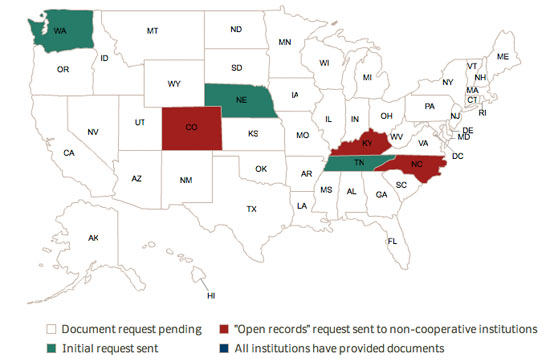
Share